9th October 1944, loss of Mosquito KB261 RAF Downham Market

On October 9th 1944 Mosquito KB261 608 (PFF) Sqn, took off with 21 other Downham Market aircraft to attack the naval port at Wilhelmshaven in Lower Saxony, Germany. Situated on the western side of the Jade Bight, a bay of the North Sea in Northern Germany, it was a major target frequently attack by allied bombers during the war.

The Mosquito, ‘D’ – Dog, a MK. XX, piloted by Flt. Lt. Reginald George Gardner (s/n 68776) with Fl. Off. Oswald Cuthbert Sweetman DFM*1 (s/n 145171) as navigator, departed Downham Market at 18:03 carrying a mix of bombs. It arrived over the target only to see 10/10ths cloud, and the target obscured. However, bombs were released successfully on red target indicators, after which crews reported seeing several flashes beneath the cloud along with large explosions lasting several seconds.

In debriefing, all crews reported a successful operation although visual confirmation was difficult due to the cloud cover which had extended to between 6 and 8,000 ft in height.

However, Mosquito KB261 never made it down. It arrived home and circled the airfield waiting for its turn to land, it showed no signs of distress or problem – all appeared well. As it entered the ‘funnel’ it suddenly – and without explanation, –  dived into the ground from around 1,000 ft, crashing at 21:30.

The aircraft hit a cowshed in the nearby hamlet of Barroway Drove, to the south-west of the airfield, killing both pilot and navigator. A farm building was slightly damaged and some animals in or near the shed were also killed.

The aircraft had been fully flight tested and reported  ‘serviceable’ that afternoon by the pilot Flt. Lt. Gardner, and both engines were known to be running at the time of the crash.

A report into the accident concluded it as “obscure” with no known cause, although the Station Commander witnessed the crash saying “…it would appear that while turning into the funnel the aircraft did a slipping turn resulting in rapid loss of height and final crash.”

In the Accident Report Form 765C, the pilot was noted to have called the tower on the downwind leg, but there was no report at that time, from him, as to any problems with the aircraft and all appeared to be in order.

The two crewmen were both married. Flt. Lt. Gardener was born in 1913 and married Nancy Buttle of Bearstead, Kent, where his remains are buried*2; and Fl. Off. Sweetman, born 1916, was married to Jessie James from Newcastle in 1940, he also remains buried in his home town*3.

On the following two nights, October 10th and 11th, two more 608 Squadron Mosquitoes were lost; KB404 ‘6T-T’ and KB348 ‘6T-M’.

In KB404, a Mosquito B MK. 25, both crewmen (pilot – Fl. Off. James Arthur Smith DFC RAAF, and navigator Sgt. John Burchell) emerged safely from the aircraft which crash landed in a field near to the airfield. The port engine was reported to have cut out at approximately 100 feet after take off, whereupon the pilot managed to perform a wheels up landing bringing the aircraft down safely.

In the third Mosquito, KB348, (MK.XX), the aircraft was hit by Flak over the city of Berlin and crashed at the Bornstettin Army Exercise Grounds near Potsdam at 04:02 hrs. The pilot,  Fl. Off.  Stanley Warren Reeder (RAFVR), and navigator Flt. Sgt. Robert John Bolton (RAAF) were both killed. Initially buried locally in Potsdam, they were, in 1946, interred in the Berlin 1939-1945 War Cemetery, Plot 4, Row K, Graves 26 and 27, where they remain today.

608 Squadron were only reformed at Downham Market on August 1st 1944, after being disbanded earlier at the end of July. They remained at Downham Market for the remainder of the war being disbanded again on 24th August 1945. In May 1946 they reformed once more only to disband for the last time on March 10th, 1957 at Thornaby whilst flying Vampires. It was at Thornaby that they were initially formed in 1930.

Downham Market Runway remains

The last remnants of the main runway being approached by the Mosquito before they were removed.

The history of Downham Market appears in Trail 7 – North West Norfolk.

Notes and sources.

*1  Fl. Off. Sweetman’s DFM was gazetted on 5th February 1943, for service he carried out with 104 Sqn flying Wellingtons in the Middle East.

*2 Flt. Gardener was buried in the Holy Cross Churchyard, Section N, Grave 184

*3 Fl. Off. Sweetman was buried in All Saints Cemetery, Section E, Unconsecrated Grave 191.

National Archives: AIR-27-2101-19, AIR-27-2101-20

Chorley, W.H. “Bomber Command Losses – Vol 5 1944” Midland Publishing,. 1997

Aviation Safety Network website, accessed 11/1/25

Downham Market Heritage Centre

Loss of Lancaster EE118, 156 Sqn PFF – RAF Warboys.

Lancaster, a MK.III, took off from RAF Warboys, at 18:24 on September 29th 1943 on operations to Germany. It was joined by nine other Lancasters from the same squadron to bomb Bochum in Western Germany. Over the target, flak was moderate and visibility was good. Marking was in the form of skymarkers, along with red and green target indicators (TI) and bombing was reported as scattered with smoke rising to 5,000 ft.

On Lancaster EE118 that night was Flt. Sgt. Frederick H. Ray (Pilot); Sgt. David R. Booker (Bomb aimer);  Fl. Off. Sydney K. Smith RCAF (Navigator); Sgt. Norman P. Winterburn (Wireless Op); Sgt. William A. Lineham (Flt. Engineer); Sgt. Frederick D. Dickens (Air Gunner) and Sgt. Arthur S. W. Orchard (rear Gunner).

The aircraft had suffered heavy flak damage, several of the instruments were not working including the compass and altimeter, and a 1,000lb bomb remained ‘hung-up’ in the bomb bay, Their return to Warboys would take them over the North Sea, across the Wash and south-east toward Warboys, but they requested landing permission at RAF Downham Market as it was closer. Permission was granted, and the ‘hung-up’ bomb was safely disposed of over the Wash.

Lancaster EE118 crash plaque

The Memorial Plaque to Lancaster EE118.

Downham Market was at the time shrouded in thick fog and the FIDO installation recently added was not yet fully serviceable. Flt. Sgt. Ray made his approach, and with 10/10ths cloud as low as 1,000 feet, it was very difficult to make out where he was.

On his first approach, Flt. Sgt. Ray missed the runway and so headed north, and then turned in a south-west direction to make a new approach from the east. On his run in toward the final turn, the rear wheel caught the tree tops of a Slubberdike Wood, located  north-west of the airfield. This slowed the aircraft down sufficiently to prevent it from climbing, and as they passed over Allotments at nearby Wimbotsham village, the port wing clipped a raised air-raid shelter near to the allotment entrance. This caused the wing tip to break off and resulted in the aircraft colliding with a telegraph pole at the end of Hop Pikel field near to Milller’s Lane which flipped the aircraft over bring it down in an orchard.

In the accident, all but the rear gunner Sgt. Orchard were killed outright, Sgt. Orchard being thrown clear from his rear turret.

The noise of the crash alerted  local people who went out to see what had caused all the noise, and suspecting an air crash, they searched for wreckage. Gardens at the end of Miller’s Lane were strewn with bits of aircraft and a two young boys by the name of Gutteridge, came across Sgt. Orchard with a large branch across his legs. Fearing he had broken it, Sgt. Orchard begged them not to move it and await medical assistance in case it made the injury worse.

In the confusion that followed, Sgt. Orchard couldn’t remember if the 1,000 lb bomb had been dropped or not, so the police on the scene cleared the nearby houses sending everyone into their various bomb shelters for protection. It was not necessary however, and soon the all clear had been given and they returned to their homes.

Another young boy, 12 years old at the time, recalled how the rest of the crew were found in his garden, 39 Miller’s Lane, and how they were removed by RAF personnel during the night. Wreckage was found across the orchard and in local gardens, until RAF salvage teams took the aircraft away some 3 – 4 weeks later.

aerial photo

An aerial photo of Wimbotsham showing the direction the Lancaster flew on that fateful night. The scar in the orchard is clearly visible. The airfield is in the bottom right hand corner.

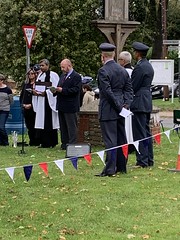
On the 30th September 2023, a plaque was attached to the Wimbotsham village sign to commemorate the loss of the crew nearby. The ceremony was opened by Mr. Ian Cable, Chairman of Wimbotsham Parish Council with a greeting and introduction from Reverend Canon Dr. David Karoon. After the hymn ‘O God our help in ages past’, Group Captain Frederick Wigglesworth, Station Commander RAF Marham, gave the Bible reading Isaiah 40:25:31 which was followed by a prayer of dedication led by The Rev. (Wing Commander) Eddie Wynn.

Dr. Karoon then gave a blessing of the memorial after which followed  ‘The Airman’s Hymn’ sung by those gathered at the service.

Memorial dedication EE118

Mr. Dutton gives background information on the Pathfinders with Rev. Canon Dr. Davis Karoon, The Rev (Wing Cdr) Eddie Wynn and Group Captain Frederick Wigglesworth looking on.

Following the Lords Prayer, a further dedication was given by Bill Bower, the R.A.F.A. Chairman, which preceded the Last Post and a minutes silence. The ceremony was closed with some back ground information on the Pathfinders by Tim Dutton, and the Benediction from Dr. Karoon. Lastly, the National Anthem was sung and a thanks to those involved given by Mr. Cable.

In the gathering were relatives of both Sgt. Arthur Orchard and Sgt. David Booker, the bomb aimer, along with villagers who remember the crash in 1943.

Tea, cake and a display of material from the crash and personal letters from Arthur Orchard to relatives of the crew were made available in the village hall, itself a former RAF Downham Market admin building.

The crew in Lancaster EE118 (GT-?)

Flt. Sgt. Frederick H. Ray (Pilot), s/n: 1391599, age 26
Sgt. David R. Booker (Bomb aimer), s/n: 1413457, age 20
Fl. Off. Sydney K. Smith RCAF. (Navigator), s/n: J/14174, age 21
Sgt. Norman P. Winterburn (Wireless Op), s/n: 1439760, age 21
Sgt. William A. Lineham (Flt. Engineer), s/n: 1815307, age 19
Sgt. Frederick D. Dickens (Air Gunner), s/n: 1613337, age 20
Sgt. Arthur S. W. Orchard (rear Gunner) – survived

The Lancaster, a MK.III, was built as part of the fourth production batch of 620 aircraft (the final contract of No. 6427) by A.V. Roe & Co Ltd. at Chadderton. It was delivered to 32 Maintenance Unit (MU) on 27th May 1943 transferring to 156 Sqn. on 22nd June 1943. It was struck off charge after the Wimbotsham crash on 19th October 1943.

A range of resources were used in the compiling of this post, including:

National Archives: AIR 27/1041/40

Chorley, W.H. “Bomber Command Losses of the Second World War – 1943“, Midland Counties, 1996.

Holmes, H. “Avro Lancaster – The Definitive Story“, Airlife Publishing, 1997

Personal letters and photos on display from Arthur Orchard and Derek Neal.

4th June 1944 – Death of a Lancaster Crew

On June 3rd 1944, Lancaster ND841 ‘F2-D’ piloted by Flying Officer George. A. Young (s/n: 134149) RAFVR 635 Squadron, was detailed to mark and attack Calais as part of the preparations for D-Day. There would be eight other aircraft from RAF Downham Market also detailed for the mission and take off would be late that evening.

Initially, the aircraft and crew, were designated for training, but that night, nine aircraft and crews, were then detailed for operations to Calais, including F.O. Young’s crew in ‘D-Dog’. They were given orders to mark a coastal defence battery, as part of the preparations for the forthcoming D-Day invasion.

The mission as a whole would involve 127 Lancasters and 8 Mosquitoes of No.1, 3 and 8 Groups and the targets would be the gun batteries at both Calais and Wimerereux. It was a diversionary raid as part of Operation “Fortitude South“, to fool the Germans into believing the invasion would occur in the Pas-de-Calais region.

At 28 minutes past midnight, F.O. Young lined the Lancaster up, opened the throttles and began the long run down the runway. As the aircraft approached take off, it began to swing striking the roof of a B1 Hangar nearby. In an uncontrollable state the aircraft crashed just outside the airfield killing all those on board.

All other eight aircraft took off and returned safely after having dropped their bombs as instructed.

On board Lancaster ‘F2-D’ that night were:

Lancaster D - Dog crashed RAF Downham Market 4.6.44

Lancaster ND841 ‘D’ and its crew before the fatal crash on June 4th 1944.

Pilot: F.O. George Ambrose Young, aged 24 (s/n: 134149) RAFVR.
Flight Engineer: Sgt. Thomas Snowball, aged 32 (s/n: 1100769) RAFVR
Navigator: Flt. Sgt. Howard Pritchard, aged 22 (s/n: 1578502) RAFVR
Bomb Aimer: F.O. Walter Thomas Olyott, aged 21 (s/n: 151238). RAFVR
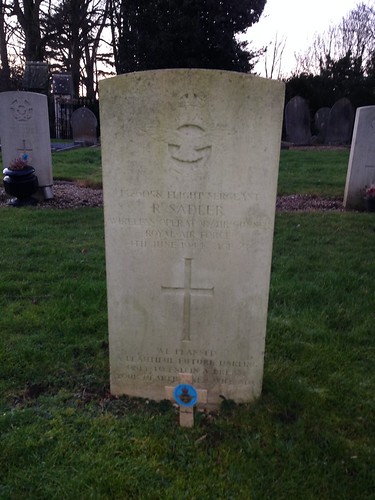
Wireless Operator / Gunner: F.Sgt. Robert Sadler, aged 23 (s/n: 1526058). RAFVR
Air Gunner: Flt Sgt. Stanley Wharton, aged 30 (s/n: 1578013) RAFVR
Air Gunner: Flt Sgt. Charles Patrick Nallen, aged 20 (s/n: 427537) RAAF

The Squadron’s Operation’s Record Book (AIR 27/2155/7) for that day simply  states:

3.6.44  ‘D’ F/O Young G.A. hit hangar after taking off and crashed on airfield when large bomb exploded and the crew all killed.  8 aircraft returned to base .

Three of the crew are buried in Kings Walk Cemetery, Downham Market, a short distance from the airfield.

Downham Market Cemetery

F.Sgt. Stanley Wharton (RAFVR)

Downham Market Cemetery

F.Sgt. Robert Sadler (RAFVR)

Downham Market Cemetery

F.O. Walter Thomas Olyott (RAFVR)

Sqn. Ldr. Ian Willoughby Bazalgette (RAFVR) VC

RAF Downham Market was one of a small number of airfields that were home to the RAF’s Pathfinder Squadrons. Elite airmen who would lead formations of heavy bombers into some of the most heavily defended areas of the Reich, often against insurmountable odds and always at great risk to themselves. The Pathfinders produced some remarkable flyers and many, many heroes. Of all the crews who flew with 8 Group PFF, only three were rewarded for their valour and gallantry with the highest possible accolade, the Victoria Cross. One of those went Posthumously to Sqn. Ldr. I. W. Bazalgette, whose long and distinguished career led him to achieving 58 missions before his death. Based at RAF Downham Market, Bazalgette, would become legendary, flying his Lancaster bomber in pursuit of victory against a tyranny beyond all evil.

Ian Willoughby Bazalgette.jpg

Sqn Leader Ian Bazalgette (RAFVR) died August 4th 1944, a few days before his 26th Birthday.*1

Squadron Leader Ian Willoughby “Baz” Bazalgette was born on October 19th 1918 in Calgary, Canada and was the youngest of three children. His parents decided to move to England in 1924 when he was six, settling in New Malden, Surrey on the outskirts of London.

During his school life he developed a passion for music, and in particular Classical Music, which he immersed himself in spending hours listening to and writing about.

As a teenager, he would have his first real battle, that of tuberculosis, which meant he would have to undergo four long months of hospital treatment. Bazalgette’s strength and determination would see him pull though this, a strength and determination that would go on to show itself on a number of occasions later on during his RAF career. 

Prior to the outbreak of war, Bazalgette decided to enlist, applying to, and being accepted by, the Royal Artillery; achieving a commission as Second Lieutenant within a year. This new role took him to the outskirts of Edinburgh operating a radar searchlight, protecting both the city, and the Forth Estuary from Luftwaffe bombers. Dissatisfied with the routine of searchlight activities, he decided to give up this role, and whilst on a trip into nearby Edinburgh in March 1941, he applied to the Royal Air Force Volunteer Reserves. His application was accepted and in the following July, he received his first posting to a training unit – 22 Elementary Flying Training School at Cambridge.

Throughout his training Bazalgette showed great tenacity and promise, quickly passing  a number of stringent and difficult flying tests. Flying solo for the first time during August, gave him the opportunity he had been longing for. His flying skills impressed his seniors so much that on the 28th, he passed the C.O.s test taking just 30 minutes to complete the flight. Upon passing, he was graded as an ‘above average’ pilot by his examiners.

Bazalgette was then transferred to Cranwell where he trained on Airspeed Oxfords. At Cranwell he achieved his wings, and after a short break, he was sent to Scampton and 18 Beam Approach School. Bazalgette eventually left Scampton, heading towards his first operational unit, 25 Operational Training Unit, where he would form his first crew.

Informal crewing up was very much encouraged by the RAF, but those that didn’t manage the task were allocated crew members by the relevant staff at the various bases; Bazalgette had no problems in finding his own.

Whilst at the OTU, Bazalgette would have his first experience of heavy bombers flying the Vickers Wellington; a remarkable aircraft that used Barnes Wallis’ geodesic construction in Rex Pierson’s design.  Bazalgette and his crew competed a range of training flights whilst at 25 OTU, including air gunnery and bombing practice, all of which they passed. On September 18th 1942, after accumulating some 223 hours as a pilot, Bazalgette received his first posting to a fully operational Squadron, 115 Squadron at RAF Marham, Norfolk, he was off to war.

The very next day he flew “Second Dickie” assisting an experienced crew tackling the rigours of an operational sortie to Saarbrucken. Two days later he was back out, but this time laying mines on a ‘Gardening’ mission shortly before the squadron moved to nearby RAF Mildenhall in Suffolk. It was here that Bazalgette would fly his first operational mission as a pilot leading his own crew.

After moving to East Wretham, 115 squadron then began the task of replacing their Wellingtons with Stirlings, and Bazalgette was sent to 1567 Operational Conversion Unit (OCU) to convert to the big heavy four-engined aircraft. Between him completing the course and returning to East Wretham though the Stirling had been superseded, proving to be a poor performer in conflict zones. Bazalgette would now get his chance to fly the legendary Lancaster.

On the 3rd April 1943, Bazalgette was awarded the DFC, and the same strength and determination that had got him though tuberculosis would get him through his tour of 30 missions. On completion, as was customary at this point, he and his crew were separated and scattered across a range of new squadrons within the Air Force.

Bazalgette was sent back to Scotland and RAF Lossiemouth where he reluctantly trained new bomber pilots, a position he disliked immensely. He pleaded for postings to an operational unit, a plea that was eventually granted in April 1944, and a posting to RAF Warboys and the Pathfinder Conversion Unit.

From here he transferred with a new crew to 635 Squadron at RAF Downham Market, in Norfolk, a few miles west of Marham the very station he had spent his early days at with 115 Sqn.

As a model crew, he was looked up to by others at Downham Market. He would go on to fly 58 missions in total, two off his score of two tours of duty.

However, his 58th mission would be his last. On August 4th 1944, Lancaster ‘M’ for Mother would not be listed for duty, but an absent crew left an opening that Bazalgette and his crew jumped at. It was a decision that would change their lives forever.

On that day, Bazalgette would fly Lancaster Mk III, F2-‘T’ for Tommy, not their usual aircraft but it was ready, fuelled and bombed up. The aircraft was known for a history of mechanical problems, its usual pilot tending to work the engines much harder than necessary, but it was a choice of stay on the ground or fly the mission: for Bazalgette and the crew of ‘M’ for Mother it was an easy choice.

The mission for the day was as Master Bomber of the Pathfinder squadron to identify and mark a V1 storage site at Trossy St. Maximin, a heavily defended area to the north of Paris. Take off was set for 11:00, over the next fifteen minutes at five-minute intervals, 14 Lancasters of 635 Sqn would leave Downham Market heading for France. The weather was less than 3/10 cloud over the target, excellent for the determined and accurate anti-aircraft gunners below. On the second run in to the target, the Master Bomber and Deputy Master bomber were both hit, one being downed (PA983 F2-A piloted by F/L. R. W. Beveridge) and the second forced to return home, leaving Bazalgette as the lead aircraft.

Flak was incredibly intense and his aircraft repeatedly hit. The starboard wing was struck causing damage to both engines, subsequently putting them both out of action. In the wing the fuel tanks caught fire, fuel poured into the rear of the fuselage and the situation becomes desperate. The bomb aimer was mortally wounded, his arm barely recognisable due to his injuries, but Bazalgette managed to reach the target, drop both his markers and his bombs, whereupon the aircraft began a steep spin toward the ground below. As the situation worsened, he gave the order to bail out, all but three; Bazalgette, F/Lt. I. A. Hibbert and F/Sgt. V. V. R. Leader are left.

Bazalgette continued to fight with the controls and quite remarkably managed to keep the stricken bomber flying long enough to avoid the French village of Senantes. Unable to maintain height, the aircraft finally hit the ground, resting momentarily before exploding in a massive fireball killing all those remaining on board.

Once the ferocious fire subsided, locals were able to reach the wreck and remove the bodies of both Leeder and Hibbert. Bazalgette’s remains were not found until the air frame was removed, some days later.

For his bravery and sacrifice, Ian Bazalgette was awarded the V.C., the highest honour for military personnel. The London Gazette, of 14th August 1945, published the following:

On 4th August 1944 Squadron Leader Bazalgette was “Master bomber” of a Pathfinder Squadron detailed to mark an important target for the main bomber force. When nearing the target his Lancaster was seriously damaged and set on fire by anti-aircraft fire; the bomb aimer was badly wounded. As the deputy “Master bomber” had already been shot down, the success of the attack depended on Squadron Leader Bazalgette who despite appalling conditions in his burning aircraft pressed on gallantly, bombed, and marked the target accurately. That the attack was successful was due to his magnificent effort. The condition of the aircraft had by now become so bad that Squadron Leader Bazalgette ordered his crew to leave the aircraft by parachute. He attempted the almost hopeless task of landing the crippled and blazing aircraft to save the wounded bomb aimer, and one air-gunner, who had been overcome by fumes. With superb skill and taking great care to avoid a French village, be brought the aircraft safely down. Unfortunately it then exploded and this gallant officer and his two comrades perished. His heroic sacrifice marked the climax of a long career of operations against the enemy. He always chose the more dangerous and exacting roles. His courage and devotion to duty were beyond praise.

Ian Bazalgette’s sacrifice marked the end of a career covering an incredible 58 operational missions. His courage, determination and devotion to duty going way beyond those expected of any serving officer. With him that day on ‘T’ for Tommy were: Sgt. G. R. Turner; F/L. G. Goddard; F/L. I. A. Hibbert DFC; F/O. C. R. Godfrey DFC; F/S. V. V. R. Leeder (RAAF) and F/O. D. Cameron DFM. Of the four men who manged to get out of the aircraft: Turner, Goddard, Godfrey and Cameron, all managed to evade capture*2.

In his honour, Bazalgette has a Garden in New Malden, Surrey named after him, a school in Calgary, the ‘Ian Bazalgette Junior High School’, and at the Bomber Command Museum of Canada, an Avro Lancaster, FM159, was painted in the markings of his aircraft; the Lancaster was dedicated in 1990. At the ceremony, Bazalgette’s sister, Mrs. E. Broderick, unveiled a commemorative plaque whilst the aircraft itself was unveiled by two of Bazalgette’s former crew members, Chuck Godfrey DFC and George Turner, both of whom were with him of that fateful night.

Outside the church of St. Mary’s at Bexwell close to the accommodation sites of Downham airfield, stands a new memorial in his name. Laying beside him is the memorial of another V.C. winner Arthur Aaron, who was also based at RAF Downham Market during the Second World War.

Ian Bazalgette was one of those many young men who sacrificed their lives in the hope of saving others. He dedication to duty, determination to win and above all, his value of other’s led to a tragic and sad end, that shall forever be remembered in the hearts and minds of those who lived through those terrible years 1939-45.

Downham Market updated memorial

The new memorial at St. Mary’s Church Bexwell.

There is a book written listing every operation of 635 Sqn whilst at RAF Downham Market, with crew details, aircraft profiles and mission aerial photographs. It is an amazing record and the result of three years work. The author Christopher Coverdale, is also on the committee aiming to construct the new memorial at RAF Downham Market.

Downham Market appears in Trail 7.

Notes and Further Reading.

Coverdale C. ‘Pathfinders 635 Squadron – definitive history March 1944 – September 1945‘ Published by Pathfinder Publishing, 2009. ISBN: 978-0-9561145-0-1

The Bomber Command Museum of Canada website has a detailed account of the restoration of Lancaster FM159.

*1 Photo IWM – CH 15911 in the public domain.

*2 Chorley, W. R. ‘Bomber Command Losses of the Second World War‘ Vol 5, 1944, 1997

Downham Market VC Memorial Updated.

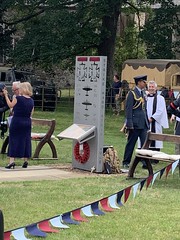
The memorial, located outside of Bexwell church, opposite what was the entrance to RAF Downham Market (Bexwell) was updated and officially rededicated on Sunday 8th July 2023.

It commemorates two pilots who were posthumously awarded the VC  both whilst serving at the airfield during the Second World War.

Both Flt. Sgt. Arthur Louis Aaron, (218 Squadron) and Sqn. Ldr. Ian Willoughby Bazalgette (635 Squadron) lost their lives in heroic attempts to save not only their injured crew but also the aircraft in which they were flying. The awards were given posthumously following their deaths, a year apart, on 12th August 1943 and August 4th, 1944 respectively.

Up until now, a small memorial has been on the site commemorating the heroic action of both men, but on Sunday, a new memorial was unveiled which is far more befitting not only of the two men, but all those who served at the airfield during those dark days of World War II.

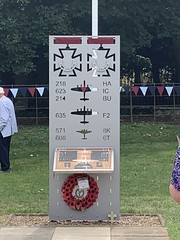
The memorial, in steel, stands at around six feet in height and shows not only the two VCs but the types of aircraft flown (Stirling, Lancaster and Mosquito) by the six squadrons who operated from RAF Downham Market along with their relative squadron codes.

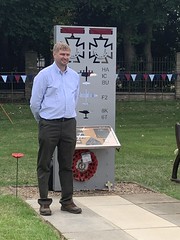
Each symbol is cut out of the steel which (intentionally or not) allows the sun to shine through casting an image on the ground. The creator, Jonathan Horton, also made a series of steel silhouettes of the different aircraft, these were placed in the ground to appear as if flying toward the memorial.

Downham Market updated memorial

Designer Johnathon Horton with the memorial.

The service opened at 02:30hrs, and was well attended by various military dignitaries from nearby RAF Marham, and the RAAF, also with representatives from the Royal Air Force Association, a local village spokeswomen and members of the community who helped organise the memorial as well as a former Mosquito pilot Flt. Lt. Colin Bell DFC, AE now 102 years old.

Downham Market updated memorial

The new memorial with Station Commander Grp. Cpn. Frederick Wigglesworth (right) and Colin Bell DFC AE (left)

Words of prayer were said by Reverend (Wg CDR) Eddie Wynn, the blessing by Reverend Nigel Moat, words from Grp. Cpn. Frederick Wigglesworth (station Commander RAF Marham) and a bible reading from Air Commodore Steve Thornber CBE RAFR. Sadly a fly past by the BBMF Spitfire didn’t happen.

Two hymns were sung: O God, our help in ages past and The Airman’s hymn,  with the National Anthem closing the ceremony.

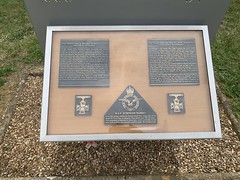
The new memorial uses the original memorial rearranged in a new setting and attached to the new memorial rather than on a pedestal as before. The Pathfinder Moto ‘Strike Hard Strike Sure’ is also cut down the flanks of the sheet, further reflecting the work carried at Downham Market.

Downham Market updated memorial

The updated board from the original memorial.

The memorial can be found outside of Bexwell Church opposite what is the former technical area of RAF Downham Market. Grid Reference TF 63142 03460, Post Code PE38 9LZ

Another blow for RAF Downham Market.

In April 2023 a group of archaeological surveyors arrived at the former RAF Downham Market and began digging trenches on the western perimeter along where the track led to the threshold of the main east-west runway. They were looking for historical artefacts of any significance, either wartime or Anglo-Saxon. Apart from odd items, nothing of any real significance was found and the trenches were filled in.

RAF Downham Market (Bexwell)

The remains of the perimeter track after diggers removed it.

In mid May, the diggers moved in again, but these were the developer’s diggers, and they began to remove a strip of the western perimeter track along half its length, taking away what would have been the site of two hangars, and several hardstands along with it.

Evident from the thick concrete slabs that have been lifted, are substantial sections of piping for drainage,  along with wiring most likely for the perimeter track lighting. Each section of concrete has thick reinforcement cable thread through it to give added strength.

RAF Downham Market (Bexwell)

Pipework going through the track bed.

The planning for this site has been ongoing for about 15 years, stalling over various aspects since the current landowners took over. Now, finally, an agreement has been reached and some 240 houses have been earmarked for this site on the former airfield. Other plans have been considered for the remains of the technical area but these didn’t seem to come to fruition. All the runways have been removed and only small sections of peri track now remain, one as a private road and the other along this section to the north of this site.

RAF Downham Market, otherwise known as RAF Bexwell, was opened in July 1942 and closed in 1946. It was home to the Pathfinders of Don Bennett and to Stirlings, Lancaster’s and Mosquitos. It features in Trail 7.

RAF Downham Market (Bexwell)

There is extensive pipework along the length of the removed track.

RAF Downham Market (Part 1 – The beginning)

In Trail 7, we visited the northern part of Norfolk, not far from the coast where it borders Cambridgeshire to the west and the North Sea to the north and east. In this part of the trail we visit a site that was once one of Norfolk’s most prestigious airfields, where not one, but two VCs were awarded to airmen of the RAF.

Not far from RAF Marham, we return to this once busy airfield to see what is left and take another look at the incredible history that was RAF Downham Market.

RAF Downham Market (Bexwell)

Located in the corner of the A10 and A1122, 10 miles south of Kings Lynn and and 15 miles north east of Ely, RAF Downham Market (known locally as Bexwell) was only open for four years. Yet considering its relatively short life, it created for itself a unique history that was, and remains, unprecedented in military history.

Built by W. & C. French Ltd., it was primarily a bomber station serving initially with 2 Group before transferring to 3 Group and then to 8 PFF (Pathfinder) Group, Bomber Command. Opened as a satellite station to RAF Marham, it eventually became an airfield in its own right, achieving this status on 3rd March 1944, when it became a parent station itself.
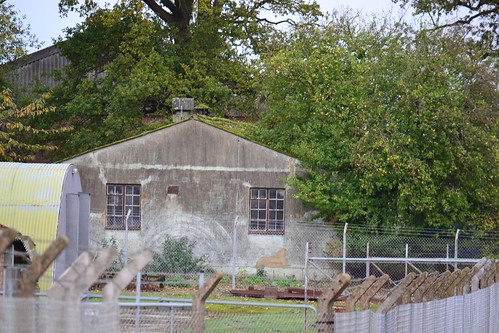
RAF Downham Market

One of the several buildings surviving at Downham Market.

Downham opened in 1942 as a bomber station, a role it performed for the duration of the Second World War. To achieve this, it would require substantial runways and a number of dispersed accommodation sites. As a classic Class ‘A’ airfield, it was spread over a large area incorporating two main sites, the main airfield to the north and the accommodation to the south. It was equipped to accommodate 1,719 male and 326 female personnel at its peak. A network of small roads would link all these dispersed sites together.

Downham would have three concrete runways the main being 1,900 yards long running east-west, whilst the second and third ran north-west to south-east and north-east to south-west, each 1,400 yds long. The classic ‘A’ formed by these runways, was linked by a perimeter track with 36 original pan style hardstands. At its peak, Downham boasted seven hangers, six ‘T2’ and one ‘B1’ which replaced two of the hardstands reducing the number to 34. None of these hangars survive here today. It had the usual bomb store (to the north east), technical area (south side) and eight accommodation areas spread well to the south and south west. As with all these Class ‘A’ stations, the two areas were separated by a public road, the ‘airfield’ to the north and accommodation to the south.

Today, little remains of the actual airfield site, the runways having been removed some considerable time ago. However, on the technical site there are a number of buildings still remaining, and in the accommodation areas further buildings also exist. All of these are either used by local industry or local farmers.

On opening, Downham received its first residents, the Stirling MK.Is of 218 (Gold Coast) Squadron. Arriving on the 8th July 1942, they would retain these aircraft until February 1943, when the new updated Stirling MK.III was brought into squadron service. 218 Sqn had a history that went back to the First World War; disbanded in 1919 they had been reborn in 1936, and were posted to France where their Fairey Battles were decimated by the superior fighters of the Luftwaffe. In November 1940, prior to arriving here at Downham, the squadron joined 3 Group, it remained operational with this Group for the remainder of the war.

On July 6th, they began preparing for their move to Downham, aircraft were stood down and no operational flying took place. On the morning of the 7th, thirteen Stirlings departed RAF Marham, completing the 10 mile straight line flight they arrived at Downham fifteen minutes later. By midnight, the entire squadron had transferred over, and crews were settling into their new quarters. Over the next few days air tests, fighter affiliations and cross country flying were the order of the day, the first operational flight not taking place until the 12th. In Stirling ‘HA-N’ was P.O. Farquharson and in ‘HA-R’ was Sgt. Hartley. A ‘gardening’ mission, only two crews were assigned and briefed but records show that “The vegetables were planted in the allotted positions. 18,000lb of seed were planted during this effort“*1. With that, Downham Market had now entered the war.

Over the next few weeks operations began to build, and targets moved into Germany itself. Lubeck, Vegesack, Duisberg, Hamburg and Saarbrucken were all on the initial list of operations. Apart from early returners due to ice or poor weather, all operations were considered successful and bombing was ‘accurate’.

On 29th July, a royal party visited RAF Downham Market to see how the crews were settling in at the new station. Led by Air Vice Marshall HRH The Duke of Kent, and accompanied by Sir Louis Grieg KBE CBO (ret),  the party were given an official tour of the airfield by Wing Commander P. D. Holder DFC – the Station Commander. After talking to a number of ground crews and watching Stirlings being bombed up, the Royal party then sampled the delights of the officers mess before departing the airfield.

In February 1943, 218 began replacing their Stirling MK.Is with the upgraded MK.IIIs, the last model of the Stirling bomber before they were relegated to other duties. By June, the last of the MK.Is were gone. Although fitted with better engines, the MK.III still remained limited by both its short wingspan and poorly designed bomb-bay.

In the following month a major decision was made to install the still experimental FIDO fog dispersal system here at Downham Market. With RAF Graveley only just having hers installed, the benefits of this system were by now bearing fruits, but despite this, only fifteen British airfields were to have the system installed. FIDO used oil burnt through a series of pipes set alongside the runway. These burners were supplied from large storage tanks, which in Downham’s case, were located to the south-east just off the airfield site. Each tank was filled by road from Kings Lynn, five tankers carrying out two runs each to complete the fill. Oil from these tanks, was then fed into the system – which was installed along the main east-west runway – by large pumps. Once lit, the burners could clear extensive fog or mist in a relatively quick time. The main storage tank site is today a car dealership, all signs of the network of pipes having since been removed.

Downham’s FIDO installation was slow at first, and only covered the initial touchdown area and the first 700 yards of the main east-west runway. A number of burner types were fitted at Downham over a period of time, starting with the MK.III or Haigill burner. These were in turn were replaced y the MK.IV and eventually, when labour became more available, the MK.V which was a sturdier, longer lasting burner capable of withstanding much heavier use.  It wouldn’t be until late 1943/44 that a longer section of the system was installed, now extending to 1,362 yds, almost the entire length of the main runway. The problem with FIDO was always where runways crossed, and here the pipes had to be placed below ground level. Along side the runway they were above ground, and with difficulty in seeing, some aircraft did manage to damage the piping on more than one occasion. With experimental lighting and landings used in the autumn of 1943, the first use of the system was on the night of December 16th/17th that year, when a large number of aircraft returning from Berlin were diverted to Downham due to their own bases being fog bound.

Over 35 aircraft landed at Downham that night, the toll on crews had FIDO not been in existence would certainly have been considerably higher than the terrible price that had already been paid on that disastrous night over Berlin. FIDO with all its counter arguments, had proved its worth in one fell swoop.

The Short Stirling, the first of the heavies for Bomber Command, was liked by many crews, but its short-comings were to become apparent all too soon. One of its problems was its enormous height, created through its huge and weak, undercarriage, which sometimes made landings difficult. Another recurring problem was a significant swing to port when taking off, combine the two features, and you have a difficult aeroplane to control at the best of times, let alone when badly damaged or in very poor weather.

One of the first casualties at Downham occurred on the morning of May 14th 1943, when Stirling ‘BF480’ HA-I piloted by Sgt. W. Carney, swung on touchdown careering off the runway into the Watch Office. No injuries were sustained by those onboard, but two other crewmen on the ground, who had previously landed, were killed in the accident. Coincidentally, another 218 Sqn Stirling, ‘EF367’, HA-G had a similar landing away at RAF Chedburgh at the same time on the same night. Onboard that aircraft there were an American and a New Zealander, all but two of the crewmen were killed, the others  escaping with injuries.

With plans for the invasion of occupied Europe well in hand by mid 1943, movements across Britain were starting to take place. At Downham a number of hangars were used to store Horsa gliders (hence the large number on site) ready for the invasion the following year. Between April 1943 and March 1944 the airfield was awash with stored examples. Accompanying the gliders were No. 14 Heavy Glider Maintenance Section, who maintained and prepared the gliders ready for when they were needed.

In the August 1943, an element of 218 Sqn was extracted to create a new squadron, 623 Sqn, using the MK.III Stirlings already on site. On the very day they were formed, 10th August 1943, four crews were briefed for operations, the target Nuremberg. Unfortunately, once over the target, crews had difficulty in distinguishing any relevant ground detail, and as a result, bombs were scattered over a wide area and the operation was largely unsuccessful. With little opposition all aircraft returned to Downham safely.
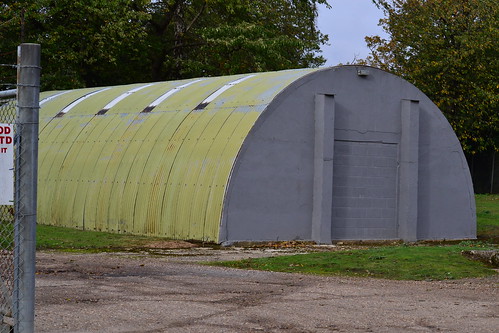
RAF Downham Market

One of the many huts that were left on the airfield.

However, two days after this on the night of August 12th /13th 1943, it was a different matter. It was whilst flying a 218 Sqn Stirling over Turin, that Flight Sergeant Arthur Louis Aaron, would suffer bullet strikes to his head that would break his jaw and tear away a large part of his face. Further bullets damaged his lung and right arm rendering it useless. Aaron still fought on though, despite his severe injuries, managing to assist the bomb-aimer in flying the stricken Stirling away from the enemy. Unable to speak, he communicated instructions to his bomb-aimer by writing with his left hand. Aaron attempted on four occasions to land the plane, but with failing strength, he was persuaded to vacate the cockpit; enabling the bomb-aimer to complete the belly landing on the fifth attempt. Aaron later died from exhaustion, the consequence of his determination and unparalleled allegiance to his crew, his aircraft and his duty. Aaron was the first of two pilots to receive the Victoria Cross whilst at Downham Market – both for extreme bravery in the face of the enemy.

The new squadron 623 Sqn, like many other squadrons however, was to be a short lived one. With high demand for Stirlings in the Conversion Units, it was decided to utilise the aircraft of 623 Sqn for this role, and on December 6th 1943 the unit was officially disbanded. Some crews returned to 218 Sqn but many others were posted out to new units. Flying of a total of 150 sorties in just four months, the squadron would lose ten aircraft, a loss rate of almost 7%.

The void left by 623 Sqn would be soon filled though. Just four days later another unit would transfer in, that of 214 (Federated Malay States) Sqn from RAF Chedburgh also a Stirling MK.III unit. For the majority of December, 214 Sqn would carry out ‘gardening’ missions, dropping mines designated ‘Nectarines‘ or ‘Cinnamon‘. Other operations would see bombs dropped on ‘Special Targets‘ although the Operational Records don’t specify the identity of these targets. 214 Sqn as with 623 Sqn, would be another of these short stay units, on January 17th 1944 they would transfer to RAF Sculthorpe and 100 Group, for RCM (electronic warfare) duties and a new aircraft, the B-17 Flying Fortress or Fortress I. As crews carried out circuits, lectures and training at Sculthorpe, the remainder of the squadron continued operations from Downham. By the 24th January though, all personnel had transferred over and Downham Market was far behind them.

In March 1944, Downham’s long standing unit 218 Sqn was finally ordered out, and on the 7th the entire squadron departed, the operations books simply stating: “218 Sqn moved from Downham Market to Woolfox Lodge by road and air today“. *2 Once at Woolfox Lodge, they would begin disposing of their Stirlings to take on the new heavy bomber – the Avro Lancaster.

The dust wasn’t allowed to settle at Downham however, and before long more personnel and a new Squadron would arrive, ready to fill the skies of Norfolk. This was no ordinary squadron though. With concerns about the poor quality of bombing and the lack of accuracy, it was decided to form a new Group that went much against the wishes of Arthur Harris. Seen as ‘elitist’, Harris vehemently disagreed with the new Group and fought his corner bravely. But with little choice in the matter and lacking his own high level support, he eventually succumbed to the Air Ministry’s demands, putting in command the Australian Group Captain Donald C.T Bennett, CB, CBE, DSO.

The new group would be called 8 Group (PFF) ‘The Pathfinders’, and was designed to use the cream of Bomber Command crews whose record for bombing had been excellent. Aircraft from the Group were to fly ahead of the main bomber force and ‘mark’ the target by various means – coloured flares being the primary and main method. In principle it worked well, but as records show, it was not without its own difficulties or setbacks.

Bennett, an aggressive pilot who didn’t suffer fools gladly, quickly won the admiration of his crews. He was also highly admired by Harris, who once described him as the the “most efficient airman” he had ever met; Harris considered Bennett perfect for the role. In appointing Bennett, Harris dismissed all other possible candidates including Air Chief Marshall Basil Embry, the Air Ministry’s most likely favourite.

The Pathfinders were officially formed on 15th August 1942, with 8 Group coming into official formation in January 1943. With the arrival of the new Squadron, 635 Sqn, Downham would now be playing its part in this role. This change would also mean a change in aircraft type at this Norfolk airfield, out went the now relegated Stirlings and in came Avro’s remarkable four engined heavy, the Lancaster MK.III.
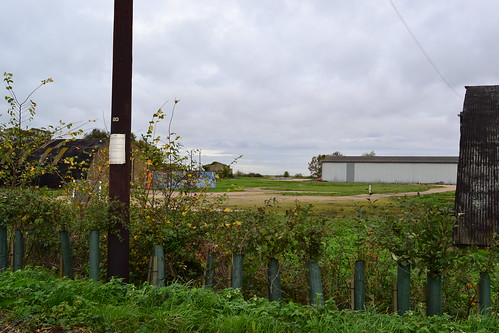
RAF Downham Market

The remains of the Technical site looking toward the airfield.

635 Sqn was created under the command of Wing Commander Alan George Seymour Cousens on March 20th 1944. Using ‘C’ Flight from RAF Graveley’s 35 Sqn and ‘C’ Flight from RAF Bourn’s 97 Sqn. A total of eight aircraft and crews from each flight immediately began the move to Downham. At 09:15 the first of the road crews arrived from Bourn, with further sporadic arrivals until 11:00. The first aircraft to arrive touched down at 12:00, and within the next 20 minutes all aircraft were safely on the ground. Graveley crews began arriving soon after this, their first aircraft, along with a ground party, arriving at 15:05.

The new squadron consisted of 36 Officers, 120 NCOs and 200 ‘other ranks’. They were accommodated in Site ‘J’ whilst 20 NCOs and 40 armourers were accommodated in site ‘B’. A small number of officers were put up in the Rectory just outside the main gate of the airfield*3.

Shortly after the crews had landed, they were quickly briefed for an operation to attack Munich, but by the time the aircraft were prepared and bombs loaded, the operation was cancelled, the crews were then given the chance to settle in to their new homes.

635 Sqn would continue to use the Mk.III Lancaster for the next four months, replacing it with the Lancaster MK.VI  from March onward. This was an unusual model of the famous aircraft as it had neither a nose nor mid-upper turret, instead it was crammed with electronic radar jamming devices. Also replacing the normal three-bladed propellers were four bladed examples, aiming to improve the aircraft’s performance.

A growth in aircraft numbers and the development of Pathfinder methods soon led to a new branch of the Group, the Light Night Striking Force (LNSF) equipped with de Havilland’s ‘Wooden Wonder‘ the Mosquito.  In response to this, 571 Sqn, a new light bomber squadron equipped with the Mosquito XVI, was born here at Downham on April 5th 1944, barely two weeks after 635 Sqn themselves arrived. As a temporary measure it was decided that on April 10th, the squadron would be reduced to one Flight instead of two leaving eight aircraft plus a ‘spare’ at Downham whilst the remainder transferred to RAF Graveley. The idea behind the move was two-fold, firstly to bolster the expansion of 105 Sqn at Graveley, and secondly, to provide experience for the ground crews on the Mosquito.

The move went well, but on the 17th, a new order would come through that would change Downham yet again.

Movement order 21 required the entire 571 squadron to transfer to RAF Oakington, effective by 24th April. With that, preparations began and the advanced party moved from Downham on the 22nd followed by the rear party on the 24th. The entire squadron including the Graveley detachment were, by the end of the day, now at Oakington. Due to the move, there were no operations flown by the squadron from Downham Market during this short period of their history.

This departure left 635 Sqn as the only operational squadron at Downham Market. Whilst somewhat quieter, it is was not to be all plane sailing.

In Part 2, we see how Downham takes part in D-Day, the end of the war approaches but operations continue and Downham remains busy. After the war, the airfield is used for other purposes, and eventually closes. We then see what remains today and ask what does the future hold?

The full Trail appears in Trail 7.

4th June 1944 – Death of a Lancaster Crew

On June 3rd 1944, Lancaster ND841 ‘F2-D’ piloted by F/O. George. A. Young (s/n: 134149) RAFVR 635 Squadron, was detailed to mark and attack Calais as part of the preparations for D-Day. There would be eight other aircraft from RAF Downham Market also detailed for the mission and take off would be late that evening.

Initially, the aircraft and crew, were designated for training, but that night, nine aircraft and crews, were then detailed for operations to Calais, including F/O. Young’s crew in ‘D-Dog’. They were given orders to mark a coastal defence battery, as part of the preparations for the forthcoming D-Day invasion.

The mission as a whole would involve 127 Lancasters and 8 Mosquitoes of No.1, 3 and 8 Groups and the targets would be the gun batteries at both Calais and Wimerereux. It was a  diversionary raid as part of Operation “Fortitude South“, to fool the Germans into believing the invasion would occur in the Pas-de-Calais region.

At 28 minutes past midnight, F/O. Young lined the Lancaster up on the runway, opened the throttles and began the long run down the runway. As the Lancaster approached take off, it began to swing striking the roof of a B1 Hangar. In an uncontrollable state the aircraft crashed just outside the airfield killing all on board.

All other eight aircraft took off and returned safely after having dropped their bombs.

On board Lancaster F2-D that night was:

Lancaster D - Dog crashed RAF Downham Market 4.6.44

Lancaster ND841 ‘D’ and its crew before the fatal crash on June 4th 1944.

Pilot: F.O. George Ambrose Young, aged 24 (s/n: 134149) RAFVR.
Flight Engineer: Sgt. Thomas Snowball, aged 32 (s/n: 1100769) RAFVR
Navigator: F.Sgt. Howard Pritchard, aged 22 (s/n: 1578502) RAFVR
Bomb Aimer: F.O. Walter Thomas Olyott, aged 21 (s/n: 151238). RAFVR
Wireless Operator / Gunner: F.Sgt. Robert Sadler, aged 23 (s/n: 1526058). RAFVR
Air Gunner: F.Sgt. Stanley Wharton, aged 30 (s/n: 1578013) RAFVR
Air Gunner: F.Sgt. Charles Patrick Nallen, aged 20 (s/n: 427537) RAAF

The Operations record book (AIR 27/2155/7) for that day simply  states:

3.6.44  ‘D’ F/O Young G.A. hit hangar after taking off and crashed on airfield when large bomb exploded and the crew all killed.  8 aircraft returned to base .

Three of the crew are buried in Kings Walk Cemetery, Downham Market, a short distance from the airfield.

Downham Market Cemetery

F.Sgt. Stanley Wharton (RAFVR)

Downham Market Cemetery

F.Sgt. Robert Sadler (RAFVR)

Downham Market Cemetery

F.O. Walter Thomas Olyott (RAFVR)

4th June 1944 – Death of a Lancaster Crew

On June 3rd 1944, Lancaster ND841 ‘F2-D’ piloted by F/O. George. A. Young (s/n: 134149) RAFVR 635 Squadron, was detailed to attack Calais as part of the preparations for D-Day. There would be eight other aircraft from RAF Downham Market also detailed for the mission and take off would be late that evening.

The mission as a whole would involve 127 Lancasters and 8 Mosquitoes of No.1, 3 and 8 Groups and the targets would be the gun batteries at both Calais and Wimerereux. It was a  diversionary raid as part of Operation “Fortitude South“, to fool the Germans into believing the invasion would occur in the Pas-de-Calais region.

At 28 minutes past midnight, F/O. Young lined the Lancaster up on the runway, opened the throttles and began the long run down the runway. As the Lancaster approached take off, it began to swing striking the roof of a B1 Hangar. In an uncontrollable state the aircraft crashed just outside the airfield killing all on board.

All other eight aircraft took off and returned safely after having dropped their bombs.

On board Lancaster F2-D that night was:

Pilot: F.O. George Ambrose Young, aged 24 (s/n: 134149) RAFVR.
Flight Engineer: Sgt. Thomas Snowball, aged 32 (s/n: 1100769) RAFVR
Navigator: F.Sgt. Howard Pritchard, aged 22 (s/n: 1578502) RAFVR
Bomb Aimer: F.O. Walter Thomas Olyott, aged 21 (s/n: 151238). RAFVR
Wireless Operator / Gunner: F.Sgt. Robert Sadler, aged 23 (s/n: 1526058). RAFVR
Air Gunner: F.Sgt. Stanley Wharton, aged 30 (s/n: 1578013) RAFVR
Air Gunner: F.Sgt. Charles Patrick Nallen, aged 20 (s/n: 427537) RAAF

The Operations record book (AIR 27/2155/7) for that day simply  states:

3.6.44  ‘D’ F/O Young G.A. hit hangar after taking off and crashed on airfield when large bomb exploded and the crew all killed.  8 aircraft returned to base .

Three of the crew are buried in Kings Walk Cemetery, Downham Market, a short distance from the airfield.

Downham Market Cemetery

F.Sgt. Stanley Wharton (RAFVR)

Downham Market Cemetery

F.Sgt. Robert Sadler (RAFVR)

Downham Market Cemetery

F.O. Walter Thomas Olyott (RAFVR)

Flt. Sgt. Arthur L. Aaron, V.C., D.F.M., 218 Sqn, RAF Downham Market

The Second World War produced some incredible heroes, men and women, who in he face of incredible odds, continued to carry out their duties, often going beyond those expected of anyone.

One such man was Arthur Louis Aaron, of 218 Squadron, RAF Downham Market, Norfolk.

Image result for arthur louis aaron

Arthur Louis Aaron (RAFVR) V.C., D.F.M, (source unknown)

Aaron, born 5th March, 1922, in Leeds,  who at the time that war was declared, was training to become an architect at Leeds School of Architecture. On joining the Royal Air Force on December 15th, 1941, he was sent, via Canada, to No.1 British Flying Training School (B.F.T.S.) at Terrell, Texas, where he completed his initial flying training.

Aaron like the other recruits would pass through ten weeks of biplane flying, moving onto monoplane aircraft at which point, if successful, they would receive their wings. Returning back home also via Canada, he was hoping to fly fighters but was disappointed when he was posted to bomber training, and was sent to 6 Advanced Flying Unit at Little Rissington. After further training, he was sent on to 1657 Heavy Conversion Unit (Stradishall) flying Stirling MKIs, and then on 17th April 1943, he was posted to his first operational flying unit, 218 (Gold Coast) Squadron, at RAF Downham Market.  

Whilst here at Downham Market, Aaron continued flying Short Stirling bombers, the large heavy bomber that proved to be both vulnerable to fighters and poor performing. Due to high losses it  was eventually pulled out of front line bombing duties, and used for mine laying, glider towing and parachute operations.

Aaron’s first mission would be the very next day after arriving at Downham Market. He, and his crew, would fly a ‘gardening’ mission laying mines off Biaritz, after which he would be sent on more heavily defended targets within German occupied Europe and Germany itself.

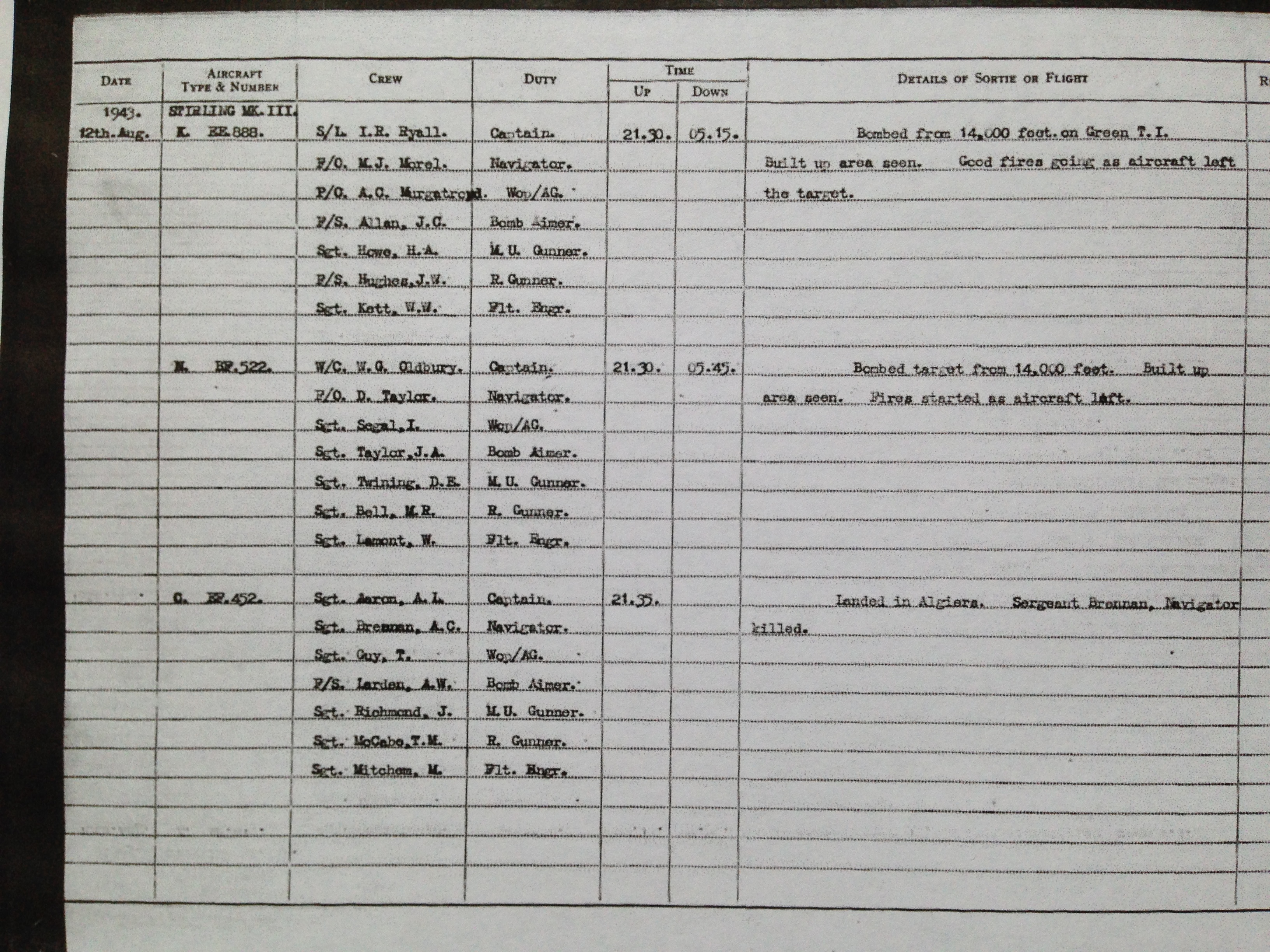
At 21:35 on the night of August 12 – 13th 1943, Flt. Sgt. Aaron and his crew: Sgt. M. M. Mitchem (Flt Eng.); Sgt. A. C. Brennan (RCAF) (Nav.); Flt. Sgt. A. W. Larden (RCAF) (Bomb Aim.); Sgt. T. Guy (Wop/AG); Sgt. J. Richmond (M.U. Gunner) and Sgt. T. M. McCabe (R. Gunner), all took off from Downham Market on their second mission of August to attack Turin, a night that featured several attacks on Italian targets.

This would be Aaron’s 20th and final mission, three as co-pilot and seventeen as pilot. He was a man known for his courage and bravery, only 12 days earlier he had struggled with his aircraft whilst his crew bravely fought fires that had broken out in the fuselage after being hit by incendiaries from aircraft flying above. Using his skill and judgement, he managed to evade both flak and searchlights by corkscrewing his aircraft whilst the crew members put out the fire that resulted from the accident. For his action on this day, he would be awarded the D.F.M.,*1 one of the highest possible awards for non-commissioned officers in the Royal Air Force, but this, like his V.C., would only come posthumously after his death on 13th August 1943.

That night, two of the thirteen 218 Sqn aircraft from RAF Downham Market in Norfolk, would be posted ‘missing’; Stirling HA-Y ‘MZ 263’ piloted by F/O J. McMallister, and that of 21-year-old Arthur Aaron – Stirling III ‘EF452’ HA-O . Whilst in the bomber stream heading toward Turin,  the aircraft was hit by gunfire from another aircraft. The navigator, (Sgt. Brennan s/n R/117605) was killed, Sgt. Mitchem and Flt. Sgt. Larden were both injured. The aircraft, now badly damaged, had been hit in three of the engines resulting in one of them being put out of action. Both front and rear turrets were immobilised, various control lines were broken and the windscreen was shattered. During the attack, Aaron received devastating blows to his face, his jaw being broken and quantities of flesh being blown away. A further bullet struck him in the chest, puncturing his lung. Now in great pain and severely injured, Aaron fell against the control column forcing the aircraft into a dive. After the Flight Engineer regained control, a course was set for North Africa, Aaron was moved to the rear of the plane where he was treated. He remained here for only a short time, insisting on returning to the cockpit where he was placed with his feet on the rudder bars. Wanting to take over, he had simply insufficient strength, and was persuaded to assist rather than fly. He wrote notes with his left hand, guiding the crew toward the airfield at Bone, in Algiers. After four failed attempts at landing, the bomb-aimer finally managed to get the aircraft down, low on fuel and with its undercarriage still raised.

The entry in the Operations Record Book for August 12th 1943, merely states “Landed in Algiers, Sergeant Brennan, Navigator Killed.”*2

At 15:00 on August 13th 1943, Arthur Aaron finally lost his determined battle to survive and died from his terrible injuries. He had fought on, overcoming severe pain and injury to guide his crewmen back to safety. Flt. Sgt. Aaron was buried alongside Sgt. Brennan in Bone War Cemetery, in Algeria.

For their action Flt. Sgt. Larden received the C.G.M., and Sgt Mitcham and Sgt. Guy, both a D.F.M.

Arthur Aaron was awarded not only his D.F.M. from his previous mission, but the V.C., the highest honour for military personnel. His V.C. was announced in the London Gazette on November 5th, 1943*3.

It reads:

Air Ministry, 5th November, 1943.

The King has been graciously pleased to confer the Victoria Cross on the undermentioned airman in recognition of most conspicuous bravery:
1458181 Acting Flight Sergeant Arthur Louis Aaron, D.F.M., Royal Air Force Volunteer Reserve, No. 218 Squadron (deceased).

On the night of 12 August 1943, Flight Sergeant Aaron was captain and pilot of a Stirling aircraft detailed to attack Turin. When approaching to attack, the bomber received devastating bursts of fire from an enemy fighter. Three engines were hit, the windscreen shattered, the front and rear turrets put out of action and the elevator control damaged, causing the aircraft to become unstable and difficult to control. The navigator was killed and other members of the crew were wounded.

A bullet struck Flight Sergeant Aaron in the face, breaking his jaw and tearing away part of his face. He was also wounded in the lung and his right arm was rendered useless. As he fell forward over the control column, the aircraft dived several thousand feet. Control was regained by the flight engineer at 3,000 feet. Unable to speak, Flight Sergeant Aaron urged the bomb aimer by signs to take over the controls. Course was then set southwards in an endeavour to fly the crippled bomber, with one engine out of action, to Sicily or North Africa.

Flight Sergeant Aaron was assisted to the rear of the aircraft and treated with morphia. After resting for some time he rallied and, mindful of his responsibility as captain of aircraft, insisted on returning to the pilot’s cockpit, where he was lifted into his seat and had his feet placed on the rudder bar. Twice he made determined attempts to take control and hold the aircraft to its course but his weakness was evident and with difficulty he was persuaded to desist. Though in great pain and suffering from exhaustion, he continued to help by writing directions with his left hand.

Five hours after leaving the target the petrol began to run low, but soon afterwards the flare path at Bone airfield was sighted. Flight Sergeant Aaron summoned his failing strength to direct the bomb aimer in the hazardous task of landing the damaged aircraft in the darkness with undercarriage retracted. Four attempts were made under his direction; at the fifth Flight Sergeant Aaron was so near to collapsing that he had to be restrained by the crew and the landing was completed by the bomb aimer.

Nine hours after landing, Flight Sergeant Aaron died from exhaustion. Had he been content, when grievously wounded, to lie still and conserve his failing strength, he would probably have recovered, but he saw it as his duty to exert himself to the utmost, if necessary with his last breath, to ensure that his aircraft and crew did not fall into enemy hands. In appalling conditions he showed the greatest qualities of courage, determination and leadership and, though wounded and dying, he set an example of devotion to duty which has seldom been equalled and never surpassed.

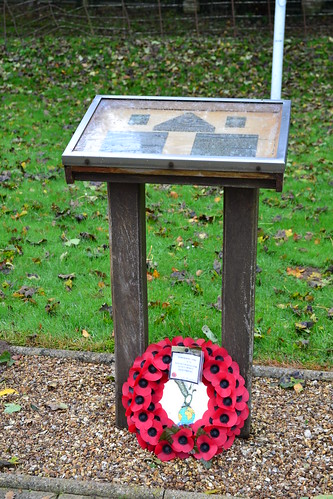
A number of memorials exist in honour of Arthur Aaron. On the site of the former accommodation blocks at Bexwell (RAF Downham Market) stands a small plaque in his honour along side that of Squadron Leader Ian Bazalgette, who also won the V.C. whilst at Downham Market.

There is another plaque in the main hall of Roundhay School, Leeds, Aaron’s former school; another commemoration can be found at the AJEX Jewish Military Museum in Hendon, London, and a five-metre bronze sculpture by Graham Ibbeson has been erected on a roundabout to the north of Leeds city centre. Unveiled on 24th March 2001 by the last survivor of the crew, Malcolm Mitchem, it represents the freedom Aaron’s sacrifice helped ensure.

RAF Downham Market

The Memorial Plaque at the former RAF Downham Market.

Sources and Further Reading:

RAF Downham Market appears in Trail 7.

Other Heroic tales appear in Heroic Tales of WW II.

*1 London Gazette, 15th October 1943, page 4620.

*2 Air 27/1351 – National Archives

*3 London Gazette, (supplement) 5th November 5th, 1943, page 4859

No. 218 Gold Coast Squadron, 1936-1945. A blog that has many letters, from Aaron along with the history of 218 Squadron.