RAF North Witham – A Truly Historical Place

On the western fringes of Lincolnshire close to the Leicestershire border, is an airfield that is little known about, yet its part in history is perhaps one of the most important played by any airfield in Britain. Famous battles such as the Normandy invasion, the Ardennes and the crossing of the Rhine all took place because of the events that occurred here, and were it not for North Witham, many may not have been as successful as they were. For the next part of trail 3, we head west to perhaps one of Britain’s best kept secrets.

RAF North Witham (Station 479)

RAF North Witham sits quietly amongst the trees of Twyford Woods, a site originally known as Witham Wood, it is now a public space owned and maintained by the U.K.’s Forestry Commission.

Originally, North Witham was one of twelve airfields in the Leicestershire cluster intended to be an RAF bomber station for No. 7 Group, however, it was never used operationally by the Royal Air Force, instead like ten others in the area, it was handed over to the US Ninth Air Force and in particular the IX Troop Carrier Command.

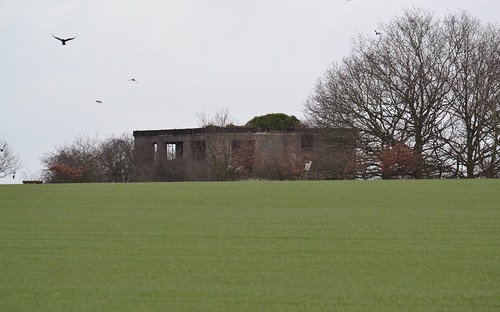
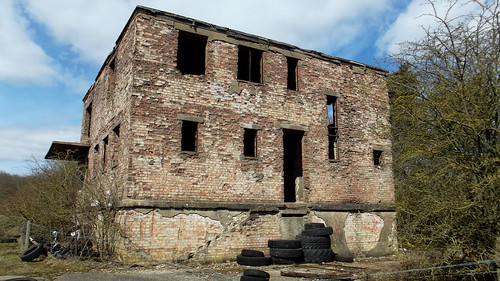
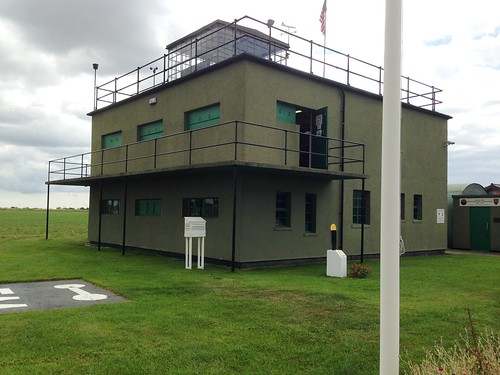
North Whitham control tower

North Witham’s Tower – now a mere shell.

As it was originally designed as a bomber station it was built to the Air Ministry’s class ‘A’ specification, formed around the usual three triangular runways, perimeter track and aircraft hardstands. With construction beginning in the mid-war years 1942/43, its main runway would be 2000 yds long, with the second and third runways 1,400 yds in length and all 50 yds wide. To accommodate the aircraft, 50  ‘spectacle’ style dispersals were built, scattered around the adjoining perimeter track. As a bomber base it had a bomb store, located to the north-eastern side of the airfield, with the admin and technical site to the south-east. One feature of North Witham was its operations block, built to drawing 4891/42, it was larger than most, with ceilings of 14 feet high. Amongst the myriad of rooms were a battery room, cipher office, meteorology room, PBX, traffic office and teleprinter room, all accessed through specially designed air locks. A further feature of this design was the attachment of a Nissen hut to house plant equipment and boiler equipment, a feature not commonly seen at this time.

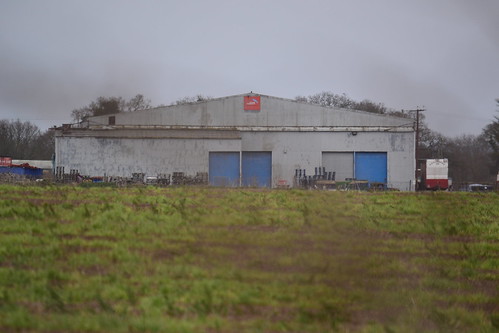
Aircraft maintenance could be carried out in one of two ‘T2’ hangars with additional work space provided by one of six ‘Butler’ hangars. Designed and built by the Butler Manufacturing Company of Kansas, USA, these were supplied in kit form and had to be erected on site by an Engineer Aviation Battalion. These ‘hangars’ had rigid box section girders over a canvas cladding, and once fully erected, gave a wide 40 ft span. Quite a rare feature, these types of structures were only built in limited numbers during the Second World War and only appeared on American occupied airfields. Post-war however, they were far more commonly used appearing on many American cold-war sites across the UK.

A hangar under construction at the 1st Tactical Air Depot at North Witham. Printed caption on reverse: '77877 AC - A butler hangar under construction by members of the 833rd Engineer Aviation Battalion at North Witham, England. U.S. Air Force Photo.'

A ‘Butler’ hangar under construction by members of the 833rd Engineer Aviation Battalion (EAB) at a very snowy North Witham (IWM479)

The Ninth Air Force was born in 1942 out of the ashes of the V Air Support Command, and then combined with units already located in the England operating under the American Eighth Air Force. Its initial activities focused on the allied push across North Africa followed by the move up into southern Europe through Italy.

Moving to England in October 1943, it then became the tactical Air Force that would support the Normandy invasion, supplying medium bombers, operating as troop support and providing supply flights. Facilitation of this massive invasion required both a huge backup, and an intricate supply and support network. North Witham would form part of this support network through both repair and maintenance of the troop carrier aircraft that were operated by the Ninth Air Force – primarily the C-47s. The main group undertaking this role at North Witham was the 1st Tactical Air Depot comprising the 29th and 33rd Air Depot Groups between January and September 1944*1. One of a number of depots, they were once described as the “backbone of Supply for the Army Air Force”, and had a complicated arrangement that encompassed numerous groups across the entire world theatre.

For such a large base, North Witham would be operationally ‘underused’, the only unit to fly from here being those of the IX Troop Carrier Command (TCC), who would primarily use C-47 ‘Skytrains’ – an established and true workhorse, and one that would go on to supply many air forces around the world.

During the Sicily campaign, it was found that many incoming aircraft were not finding the drop zones as accurately as they should and as a result, paratroops were being widely and thinly scattered. More accurate flying aided by precise target marking was therefore required and so the first Pathfinder School was set up.

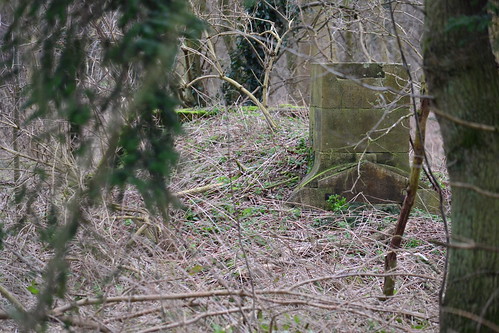
North Whitham pen

Part of one of North Witham’s 50 dispersal pans.

The IX TCC Pathfinder School (incorporating the 1st, 2nd, 3rd and 4th Pathfinder Squadrons) was formed whilst the TCC was at RAF Cottesmore. Initially having only seven C-47 aircraft, it arrived at North Witham in March 1944. These aircraft were fitted with ‘modern’ Gee radar and navigation equipment, and would be used to train paratroops of the 101st and 82nd Airborne to mark targets prior to the main invasion force arriving.

These crack troops would remain at North Witham for short periods before returning to their own designated bases. The idea being a joint venture to land the troops who would then set up a ‘homing’ station using ‘Eureka’ beacons that would connect to ‘Rebecca’ receivers in the aircraft. This would allow flying to near pinpoint accuracy even in poor weather or at night; something that would be employed with relative success in the forthcoming Normandy landings.

On arrival at North Witham, the Pathfinders were accommodated in the huts originally provided for the depot’s crews – some 1,250 enlisted men and 75 officers. Many of these displaced men were rehoused in tents along the northern end of the site which only added a further strain to the already rudimentary accommodation that was already in place at the airfield. At its height, North Witham would house upward of 3,700 men in total, a figure that included an RAF detachment of 86 men and large quantities of GIs.

Pathfinders of North Witham were the first to leave the UK and enter the Normandy arena. Departing late in the evening of June 5th, men of the 82nd and 101st Airborne climbed aboard their C-47s and departed in to the night sky. North Witham based C-47A*2 ‘#42-93098’ piloted by Lieutenant Colonel Joel Crouch*3, led the way. Nineteen other North Witham aircraft joined Crouch that night, with only one being lost in the entire mission. The Douglas built C-47A-15-DK Skytrain, #42-92845 was lost en route due to mechanical failure – the aircraft ditching in the sea. All the crew and paratroops on-board were believed to have been rescued by the British destroyer HMS Tartar.

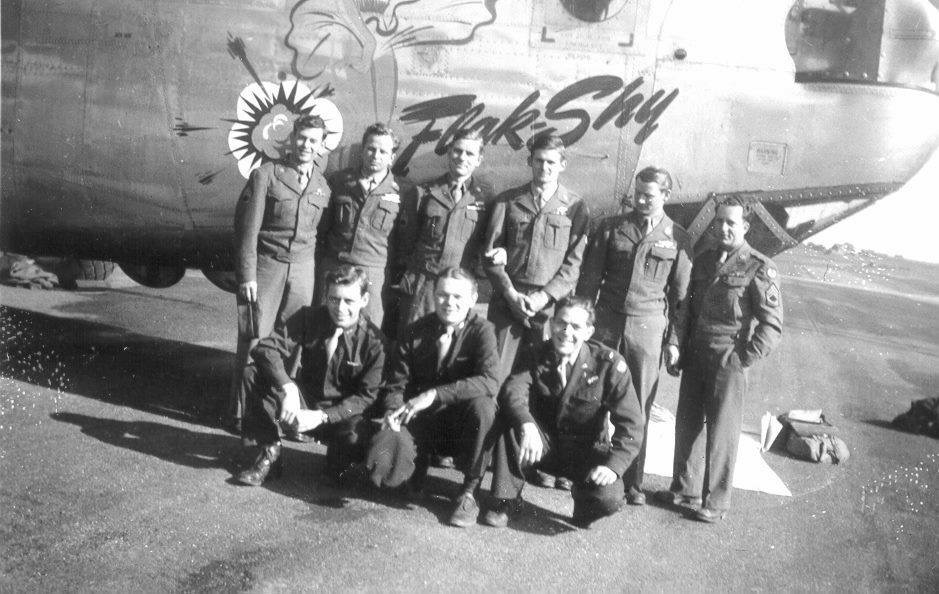
Image result for Lieutenant Colonel Joel Crouch and his crew

The Crew of C-47A #42-93098, a few hours before they left for Normandy. Including Pilot, Lieutenant Colonel Joel Crouch (centre), Captain Vito Pedone (copilot), Captain William Culp (Navigator), Harold Coonrod (Radio Operator), along with Dr. Ed Cannon (physician), and E. Larendeal (crew chief)

Pathfinder training continued at North Witham into the summer of 1944, training that included Polish paratroops (1st Independent Polish Airborne Brigade) who would perform a similar role to their American counterparts. These various Pathfinder groups would go on to have long and distinguished careers, supporting the battles at Arnhem, the Ardennes and participating in Operation Varsity – the Allied crossing of the Rhine.

As the Allies pushed further into enemy territory, the flying distance from England became too great and so new airfields were either constructed or captured airfields refurbished. The Pathfinder School soon moved away to Hampshire and the maintenance units, needed nearer the front lines, gradually departed to new bases on the continent.

September 1944 would see big changes in the Ninth and the knock-on was felt at North Witham. Firstly, the IX TCC transferred from the Ninth AF to the First Allied Airborne Army, and as a result, the Air Depot title was changed to IX Troop Carrier Service Wing (Provisional), which was re-assigned to aid and supply the new Troop Carrier Groups (TCG) now based in France. To accomplish this new role, groups often used borrowed or war-weary C-47s, C-46 (Commandos) or C-109s (converted B-24 Liberators) to fulfil their role. Secondly, the Pathfinder School was re-designated IX Troop Carrier Pathfinder Group (Provisional) and they moved away from North Witham to their new base at Chalgrove near Oxford. Now much quieter, life otherwise carried on at North Witham, but gradually the UK-based maintenance and repair work slowed down, and before long its fate was sealed and the airfield began the long wind-down that many of these unique places suffered.

By the war’s end the last American personnel had pulled out and the site was handed back to the RAF’s 40 Group who, after using it for a brief spell as a maintenance depot themselves, placed it under care and maintenance. It was used as a munitions and hardware store until 1948, and then finally, in 1956, it was closed by the Ministry and the site sold two years later.

Photograph of North Witham taken on 17th January 1947. The technical site and barrack sites are at the top left, the bomb dump is bottom left. (IWM RAF_CPE_UK_1932_FP_1221)

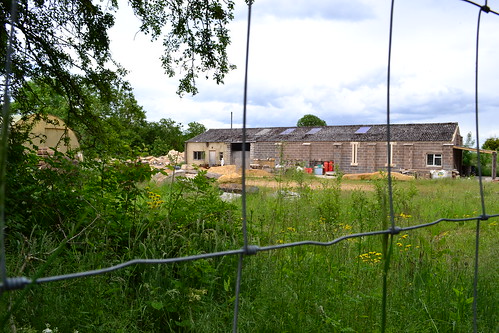
The site, intact as it was, was returned to the Forestry Commission who planted a range of new trees around the site, covering the vast areas of grass. The technical area was developed into a small industrial unit and perhaps most sadly the watch office left to decay and fall apart.

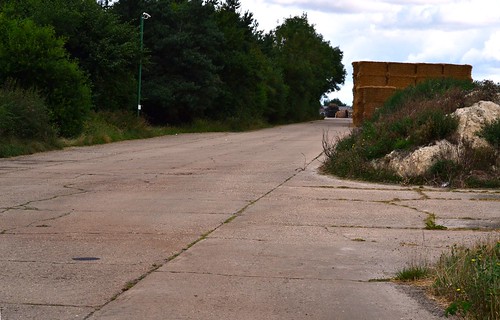
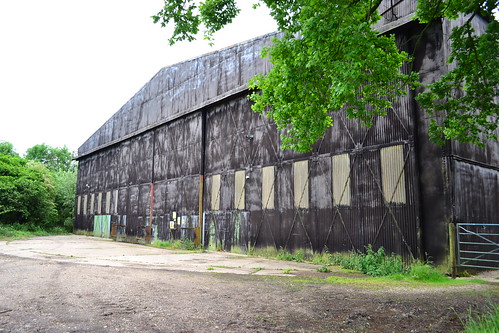
Today the three runways and perimeter track still exist almost in their entirety, and remarkably, in generally good condition. Largely overgrown with weeds and small trees, the remainder is well hidden obscuring what little there is in the way of buildings – most being demolished and the remains left piled up where they stood. However, a T2 hangar is now used on the industrial estate and the watch office still stands tucked away amongst the trees and undergrowth. This area is a favourite place for dog walkers, and because of its runways, it is accessible for prams and pushchairs. Whilst here, I spoke to quite a few people, remarkably none of them knew of the site’s historical significance let alone the office’s existence!

Today the watch office remains open to the elements. Surrounded by used tyres and in constant threat of the impending industrial complex over the fence, its future is uncertain. Access stairs have been removed, but an entrance has been made by piling tyres up to the door – presumably by those wishing to enter and ‘explore’ further. Little evidence of its history can be seen from the outside, even the rendering has been removed, and so, any possible personal links with the past are more than likely now gone.

DSCF1273

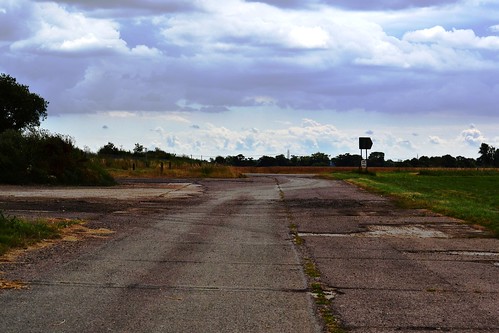
The view of the main runway from outside the tower.

Returning back to the main public entrance along the perimeter track, a number of dispersal pens can be found; overgrown but relatively intact, they are a further sign that even here, war was never very far away.

North Witham was one of those ‘backroom boys’ whose contribution, whilst extremely important, is little known about. The work carried out here not only helped to maintain a strong and reliable fighting force, but one that spearheaded the frontal invasion of Normandy. It served as a cold and perhaps uncomfortable home to many brave troops, many of whom took the fight direct to Nazi Germany.

Standing here today, it is quiet and strangely surreal – you can almost hear the roar of engines. Looking along its enormous runways you get an eerie feeling – how many troops also stood here, spending their last few hours in this quiet place. Looking around now, it is difficult to imagine the immense work that went on here, the gathering of equipment as preparations were made for the big push into Normandy on that famous June night.

North Witham is truly a remarkable place, hidden away amongst the trees as a giant time capsule, a monument to those who lived, worked and died during that turbulent time in 1944-45.

After leaving North Witham, we return to the main A1 road and head south. Any journey here can not avoid briefly mentioning RAF Wittering, its Harrier still standing proudly outside the main gate. All went quiet here following the Government cutbacks of December 2010, but flying has now returned in the form of Grob Trainers – a small reprieve for this historic site. Wittering can seen later in Trail 37.

Another view along the main runway.

Another view along the main runway.

Sadly in May 2015, Twyford Woods was the scene of a large illegal rave, over 1000 people attended the event where a number of arrests were made in the violent altercations that took place*4. A sad day that would turn the souls of those who sacrificed themselves for the freedom we take for granted so very easily today.

(North Witham was originally visited in early 2013)

Links and sources

*1 American Air Museum in Britain

*2 C-47A #42-93098 itself was later lost whilst flying with the 439th Troop Carrier Group (TCG) on September 18th 1944, whilst flying in support of Operation ‘Market Garden‘ in Holland.

*3 Superb footage of Crouch and his crew as they depart from North Witham is available on-line here, it also shows the Watch Tower in its former glory.

*4 A report of the event is available on the BBC News website.

RAF Bovingdon – The Hour that Never Was!

During the 1960s, a cult TV series hit the British Screens – ‘The Avengers’ starring  Patrick Macnee (as John Steed), and Diana Rigg (as Emma Peel).

In episode 9 of the fourth series, “The Hour That Never Was” the two characters go to an old airbase, the fictitious RAF Hamelin home to (also fictitious) 472 Squadron, where Steed had been invited to a party before the base was officially closed.

But following an accident in their car, Steed and Mrs. Peel, find things are not what they seem and so begins the investigation into what has happened.

The episode was filmed on location at the former RAF Bovingdon between the 5th July and 20th July 1965 before the site was officially closed in 1972.

The film designer used Bovingdon to cleverly achieve the illusion of abandonment, an aim successfully done through filming in the old original wartime buildings. They even manage to include a shot where Steed climbs inside a D.H. Mosquito!

Bovingdon was initially designed as a bomber airfield for the RAF, but was quickly passed over to the USAAF. Sadly it never became a true operational airbase primarily due to the three short runways. However, the 92nd BG, the only operational unit to be stationed here, are reported to have taken part in a small number of raids in both September and October 1942, before departing to Alconbury in January 1943. Bovingdon then became a training centre for bomber crews as the 11th Combat Crew Replacement Centre, training the majority of US crewmen after their arrival in the UK. It also trained and hosted a number of film stars (including Clarke Gable and James Stewart) along with reporters who were to fly over occupied Europe for reporting and making propaganda films.

As a support station for the Eighth Air Force Headquarters and the Air Technical Section, it would also see a range of aircraft types based here, the most noteworthy being General Eisenhower’s own personal B-17 stored in one of the four T2 hangars that stood on the base.

Bovingdon, now a prison, is also noted for being the location for “633 Squadron” as the fictional base RAF Sutton Craddock also with its D. H. Mosquitoes, and with “The War Lover” with Steve McQueen. Other films include: “Mosquito Squadron“, “The Battle of Britain“, and the James Bond film “The Man With the Golden Gun“.

Bovingdon has a remarkable and highly significant history and like so many others has earned its place in history.

A ‘You Tube’ version of “The Hour That Never Was” is not the best quality film, but it does give you good views of the airfield and the hangars before the airfield was closed for good.

My thanks go to fellow blogger and reader John Knifton  for the links!

RAF Methwold – unassumingly famous.

The East Anglia countryside is littered with remnants of the Second World War. The massive build up that occurred here in the mid 1940s has led to changes in both landscape and culture, the ‘friendly invasion’ as it has become fondly known, had a huge impact on the towns and villages around here. An area rich in aviation history there are numerous tales of heroism and valour to be found.

Whilst on the eighth Trail of aviation sites, we stop at the former site that was RAF Methwold.

RAF Methwold

Methwold Village sign

Methwold village sign

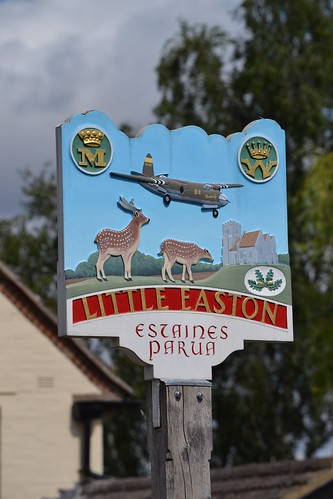
Located between Downham Market and Thetford, Methwold is a small rural setting on the edge of Thetford Forest. Its village sign and combined memorial, remind the passer-by of its strong air force links – a Lockheed Ventura taking off over the village church.

Methwold was actually built as a satellite for nearby RAF Feltwell and as such, had few squadrons of its own. Being a satellite its runways were of grass construction with little in the way of luxuries for accommodation.

On the day war broke out in Europe, 214 Squadron, equipped with Wellington MKIs, moved from RAF Feltwell to here at Methwold. Feltwell being larger, offered a prime target for the Luftwaffe and so their loss would be Methwold’s gain. The first production Wellington, the MKI was powered by two 1,000 hp Bristol Pegasus XVIII radial engines, and would soon be updated and replaced by the MKIA; the main difference being a change in gun turret from the Vickers to the Nash & Thomson. As part of Bomber Command, 214 Sqn did not carry out its first operational bombing flight until June 1940 some four months after it had left Methwold; but that is not to say casualties were not suffered.

On Monday November 6th 1939, Wellington L4345, crashed whilst circling on approach to Methwold. The accident resulted in the deaths of both crewmen, Pilot Officer J. Lingwood and Aircraftman 1, – A. Matthews.

Tragic accidents were not uncommon in these early stages of the war, another similar incident occurring at Methwold only a month later. In mid December, Pilot Officers W. Colmer and R. Russell-Forbes, along with Leading Aircraftman J. Warriner, were all killed whilst on approach to the airfield flying in another Wellington, R2699. Both these Officers were only recently commissioned and were still considered relative flying ‘novices’.

In February 1940, 214 Sqn departed Methwold and transferred to RAF Stradishall leaving only a small number of Wellington IIIs of 57 Sqn detached from their parent station at Feltwell. These would, in September 1942, be replaced by the mighty Lancaster, the four engined bomber that formed the backbone of the RAF’s Bomber Command.

The Intelligence Room of No. 140 Wing, No. 2 Group, at Methwold, Norfolk. © IWM (HU 81315)

Little happened at Methwold for the next two years, then in October 1942, 21 Sqn arrived. After having flown many missions against coastal targets in the Mediterranean, they were disbanded at Luqa only to be reformed and re-equipped at Bodney the same day. After changing their Blenheims for Venturas in May 1942, they transferred to RAF Methwold where they stayed for six months.

Operating both the Ventura MKI and II, they were the first Bomber Command squadron to re-equip with the type, and were one of the small number of squadrons who took part in the famous Eindhoven raid, attacking the Philips radio factory in December 1942. The daring Operation Oyster, would see the loss of sixteen aircraft – three of which belonged to 21 Sqn. Two of these aircraft crashed in enemy territory, whilst the third ditched in the North Sea after having been hit by enemy gunfire. Using a mix of Venturas, Bostons and Mosquitos, this mission perhaps revealed the true vulnerability of such aircraft over enemy territory, a warning that would violently repeat itself in the months to come.

The spring of 1943 would again see changes at Methwold; as 21 Sqn departed, the ‘Flying Dutchmen’ of 320 (Dutch) Sqn would move in. 320 Sqn, were formed after the German forces invaded the Netherlands and consisted of mainly Dutch nationals. They carried out both anti-shipping and rescue duties before transferring, from Leuchars, to Methwold via Bircham Newton. Upon arriving here, 320 Sqn was absorbed into No. 2 Group and would shortly swap their Hudson VIs for Mitchell IIs. After a very short transfer period, they then departed Methwold, moving to the much larger base at Attlebridge.

Two further squadrons of Venturas arrived at Methwold in the early spring of 1943. Both 464 (RAAF) and 487 (RNZAF) Sqns were formed, transferred and disbanded in unison, and both consisted of commonwealth crews. Having entered the war in a baptism of fire, they also flew alongside 21 Sqn on the Eindhoven raid; 464 Sqn contributing fourteen aircraft whilst 487 contributed sixteen – each squadron losing three aircraft and all but four of the twenty-four crewmen.

DSC_0029

One of the original hangers

The Venturas earned themselves the unsavoury title the ‘flying pig‘ partly due to their appearance and partly due to poor performance. Based on the Lockheed Model 18 Lodestar, it was primarily a passenger aircraft and even though it had powerful engines, it performance was low and so operational losses were often high.

On May 3rd 1943, whilst on a ‘Ramrod‘ mission, eleven out of twelve (one returning due to engine trouble) 487 Sqn aircraft were lost to enemy action, and all but twelve of the forty-four crewmen were killed. Of these twelve, Squadron Leader Leonard H. Trent, was captured and taken to Stalag Luft III where he participated in the ‘Great Escape‘. On his eventual return to England at the end of the war, he was awarded the Victoria Cross for his leadership in ensuring the bomb run was completed despite heavy enemy resistance and very high losses.

In the summer of 1943, both 464 and 487 Squadrons became part of the newly formed Second Tactical Air Force; a move that led to their departure from Methwold, along with a new role and new aircraft.

Following their departure, Methwold was passed over to 3 Group and was designated to receive the heavy four-engined bombers of Bomber Command. To accommodate them, the site was upgraded to Class ‘A’ standard. Three runways were built, five hangars (four ‘T2s’ and one ‘B1’) were erected, and a wide range of ancillary buildings added. Aircraft dispersal consisted of 36 hard standings mainly of the spectacle type.

The incoming ground and aircrews would be accommodated in areas to the east of the airfield, buildings were sufficient for a small bomber site of some 1,800 men and just over 300 women, by no means large.

In this interim period on March 13th, a lone American P-47 #42-74727, suffered engine failure whilst on a routine training flight in the area. In an attempt to land at Methwold, the P-47 Thunderbolt crashed, slightly injuring the pilot but writing off the aircraft.

The first of the heavy bombers to arrive at the newly constructed Methwold were the mighty Stirling IIIs of 218 Sqn. A small detachment from RAF Woolfox Lodge, they would operate from here along side 149 Squadron who moved here from RAF Lakenheath in May 1944. 149’s record so far had been highly distinguished. Participating in the RAF’s second bombing mission of the war on September 4th, they had gone on to take part in the first 1,000 bomber raid, attacked prestige targets such as the Rhur, and had taken part in the Battle of Hamburg. They had also been in action in the skies over the Rocket development site at Peenemunde. They had gone on to drop essential supplies to the French Resistance, and one of its pilots, Flight Sergeant Rawdon Middleton, had won the VC for his valour and determination in action. 149 Sqn would go on with the offensive right up until the war’s end, replacing the ill-fated Stirlings with Lancaster MKIs and later the MKIIIs in August 1944.

During the D-Day landings, 149 Squadron were tasked with dropping dummy parachutists away from the Normandy beaches. As part of Operation Titanic, they were to deceive the German ground forces, aiming to draw them away from the Normandy beaches, thus reducing the defensive force. A task that proved relatively successful in certain areas of the invasion zone, it caused confusion in the German ranks and pulled vital men away from drop zones. During this dramatic operation, two 149 Sqn Stirlings were lost; LJ621 ‘OJ-M’ and LX385  ‘OJ-C’ – with all but three of the eighteen crew being killed.

In August 1944, 218 Sqn moved the remaining crews over to Methwold completing the unit’s strength once more. This move also led to them taking on the Lancaster MKIs and IIIs. 218 Sqn was another squadron with a remarkable record of achievements, its most notable being the VC posthumously awarded to Flight Sergeant Arthur Aaron for his ‘most conspicuous bravery’ whilst at RAF Downham Market.

As the allied advance moved across Europe, 149 Sqn supported them. In December 1944, 218 Sqn departed Methwold taking their Lancasters to RAF Chedburgh and disbandment the following year. 218’s losses were not over though, just days before the war’s end on April 24th 1945, Lancaster NF955 ‘HA-H’ crashed on take off, the last fatality of the squadron’s operational record. For 149 Sqn food packages replaced bombs as the relief operation – Operation Manna – took hold. After the fall of Germany in 1945, 149 Sqn ferried POWs back to Methwold in Operation Exodus, and for many, it was their first taste of freedom for many years.

The final squadron to be stationed at Methwold was 207 Squadron, between October 1945 and the end of April 1946 also flying the Lancaster I and III. As with many other bomber command squadrons, its history was also long and distinguished; flying its final mission of the war on 25th April 1945, against the SS Barracks at Berchtesgaden. During its wartime service 207 Sqn had completed some 540 operations, lost 154 crews and earned themselves a total of 7 DSOs, 115 DFCs and 92 DFMs.

In 1946, the Lancasters of 149 Squadron departed Methwold and all fell quiet. The site was officially closed in 1958 and the land returned to the former owners. In the early 1960s, much of the concrete was removed for hardcore, buildings were demolished and the land returned to agriculture, a state it primarily survives in today.

RAF Methwold

Stores huts used for light industry

Methwold airfield is located south of the village of Methwold, accessible by the B1112. As you drive along this road, the technical area is to your left and the main airfield to your right. The entire site is primarily agricultural, with some of the remaining buildings being used for farming purposes or light industry. Many of these are accessible or at least can be seen from the main public highway.

Large parts of the runways do still exist, although much of them are covered in newly developed industrial units, or are hidden away on private land. These most notable developments are at the northern end of the runway closest to Methwold village. However, best views of what’s left, are from the southern end, along a farm track that was once the perimeter track. Also here, is a single large and original ‘T2’ hangar, now used for storing agricultural equipment and other farm related products. This main north-westerly runway, built later in the war, is also used for farm related storage. Divided by a large fence, it is now part track and part storage. The remaining sections of perimeter track, a fraction of its original size, allows access to the runway past the hangar to an area of development further south to where the turret trainers once stood. Also visible here, is the Gymnasium built to drawing 16428/40 later adapted by the addition of a projection room (889/42) for recreational films.

Back alongside the B1112 hidden amongst the woods, is the technical area. Here in between the trees are the former technical huts and workshops now used by small industrial units, many of which survive in varying conditions, some of these are accessible to the general public.

RAF Methwold

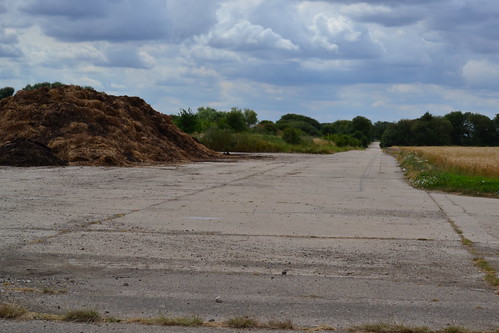
One of the former runways looking north-west.

Methwold was never intended to be major player in the war. home to a small number of squadrons, it housed a variety of aircraft and a number of nationals who all combined, tell incredible stories of heroism, bravery and dedication. The squadrons who passed though here, carried out some of the RAF’s most daring raids, whether it be as part of a thousand bomber raid, a small force to attack the heart of Reich, or a diversionary raid to foil air and ground forces.

Methwold is now quiet, agriculture has taken over. The sound of heavy piston engines are now replaced by the sound of tractors, the buildings that once housed brave young men and their incredible machines now home to the machinery of food and farming. The small remnants of Methwold hold stories of their own, for it is here that history was made, war was won and lives were lost – and all in a very unassuming manner.

Notes and further reading:

Methwold appears in Trail 8 and was originally visited in April 2013.

Local information and further detail is available from the local Methwold history group. 

Britain’s Latest Housing Proposal

In November 2011, the Coalition Government, led by David Cameron, set out its ambitions to stimulate the development and construction sector in order to meet the rising demand for housing in England. The document ‘Laying the Foundations: A Housing Strategy for England ‘ sets out the long-term plans for tackling the current critical housing shortage.

The Government states in the document that:

In 2009/10, there were 115,000 new build housing completions in England. Meanwhile, the latest household projections suggest that the number of households will grow by 232,000 per year (average annual figure until 2033).

If this growing demand is to be met, then there needs to be both extensive investment and increased development in the housing sector.

The problem as seen by the Government is wide-reaching: Investors, developers, growing families, growth of tenants and restrictions by the lending banks were all factors that culminated in the stagnation of new housing development;  but one of the biggest issues, and probably the most contentious, is where to build these houses.

Land in the UK is at a premium, finding the right location that meets the demands both socially, geographically, and economically, is a challenge, and we’re not talking about a handful of houses here, we’re talking about thousands at any one given time.

As part of the proposals to solve these issues, the Government said it will:

– Free up public sector land with capacity to deliver up to 100,000 new homes – with ‘Build Now, Pay Later’ deals on the table, where there is market demand and where this is affordable and represents value for money, to support builders who are struggling to get finance upfront.

– We will provide more support for local areas that want to deliver larger scale new development to meet the needs of their growing communities – through locally planned large-scale development – with a programme of support for places with the ambition to support new housing development on various scales.

– We have consulted on simplifying planning policy through the draft National Planning Policy Framework (NPPF).

– We are giving communities new powers to deliver the development they want through Community Right to Build.

Former defence sites especially airfields, have become prime ‘targets’ for housing development, and for a variety of reasons, (many of these have been highlighted in previous posts: Britain’s Airfields – What does the future hold?). However, they are not unique. Other ‘Brown Field’ sites, ex industrial areas, derelict housing estates and so on, are also targets and have also been identified as possible areas for development. The problem with some of these sites is clearing them, many may have contaminated soils or are just ‘inappropriate’ for housing development, and so existing land, adjacent or near to other larger conurbations, is preferred. It would now seem that this is where many of these new developments are heading. (Many of the identified sites are listed in the ‘National Land Use Database of Previously Developed Land 2012 (NLUD-PDL)‘ ).

Adding to this, the Ministry of Defence is desperate to save money and recently gave notice of its intention to close and sell off a number of active sites around the UK, again these have been highlighted previously, (Britain’s Airfields – What does the future hold?). Furthermore, with American interests in European defence also wavering, the possibility of further cuts, or condensing of their activities, is also a possibility on top of those previously identified.

With all this in mind, the Government recently outlined and published its list of the first 14 sites where new ‘Garden Villages’ will be built. One of these is directly on the former airfield at Deenethorpe whilst a second directly affects the currently active site at former Andrews Field.

Whilst neither the Deenethorpe nor Andrews Field  development proposals are new, this move certainly signifies the end of flying at Deenethorpe and certain development of one of the UK’s larger former bomber bases. It also threatens flying opportunities in Essex and risks further development on that site.

This move is a major step forward in meeting the current housing crises, but at what cost both environmentally, locally and historically? How much of the history of these sites will be lost or preserved and what does it say about preservation of historical sites in this country? This could well be the ‘thin end of the wedge’ for these old sites – only time will tell.

Further reading and links

RAF Deenethorpe appears in Trail 6

RAF Andrews Field appears in Trail 33

For a full list of the 14 sites designated for development see the BBC report .

The Deenethorpe proposal can be seen as a pdf file here.

News reports about Andrews Field can be found on the Braintree and Witham Times.

RAF Framlingham & the 390th BG – Masters of the Air

In Trail 39 we turn south once more and return to Suffolk, to the southern most regions of East Anglia, to an area known for its outstanding beauty and its stunning coastline. It is also an area rich in both Second World War and Cold War history. Perhaps better known for its fighter and light bomber stations, it was also the location for several heavy bomber bases, each one with its own fascinating story to tell.

We start off this trail at the former site of American base at RAF Framlingham.

RAF Framlingham (Station 153)

RAF Framlingham is actually closer to the village of Parham than it is the town of Framlingham, hence it was also known as RAF Parham – a name that it became synonymous with. Built as a class ‘A’ bomber station its official American designation was Station 153.

Building work commenced in 1942, and as with most large bomber stations it was designed to the Class A specification to include: three concrete runways (one of  6,400 ft and two of 4,400 feet in length), an adjoining perimeter track that linked fifty ‘pan style’ dispersals; two T-2 hangars (one to the west with the technical site and one to the south-east) and accommodation for some 3,000 personnel dispersed in 10 sites to the south-west of the airfield.  A  further sewage treatment plant dealt with the site’s waste.

The main runway ran east-west and to the eastern end sat the bomb store, a large area that included: a pyrotechnic store, fusing point, incendiary store and small arms store – all encircled by a concrete roadway.

Peri track looking north toward tech area (A)

Part of the Perimeter track at the southern end of the airfield. To the right was the crew rest rooms, locker and drying rooms.

The administration site sat between the main technical site and accommodation areas all located to the south-west side of the airfield.

Opened in 1943, the first residents were the B-17s of 95th Bomb Group which consisted of four bomb squadrons: the 334th, 335th, 336th and the 412th. Flying a tail code of a square ‘B’ they initially formed part of the 4th Bomb Wing, changing to the 13th Combat Wing, 3rd Air Division of the Eighth Air Force in September 1943 following the reorganisation of the U.S. Air Force in Europe.

Following their inception and constitution on 28th January 1942 and subsequent activation in June, they moved from their training ground at Barksdale Field, Louisiana, through Oregon, Washington and eventually to Rapid City Air force Base in South Dakota. They began their move across the Atlantic in the spring of 1943, taking the southern route via Florida arriving at Alconbury and then moving on directly to Framlingham in early May/June that year. It was whilst stationed at Alconbury though that they would have their first few encounters of the war, and they would not all be plain sailing.

On May 27th, 1943 just 14 days after their first mission, ground crews were loading 500 lb bombs onto a 334th BS B-17 ’42-29685′ when the bombs inexplicably detonated, the Alconbury landscape was instantly turned to utter carnage and devastation. The blast was so severe that it killed eighteen men (another later died of his injuries), injured twenty-one seriously and fourteen others slightly.  The B-17 involved was completely destroyed and very little of its remains could be found in or around the huge crater that was left deep in the Alconbury soil. Three other aircraft, 42-29808, 42-29706 and 42-29833, all sat within 500 feet of the explosion, were severely damaged and subsequently scrapped. In total, fifteen B-17s were damaged by the blast, it was a major blow to the 95th and a terrible start to their war.

There then followed a transition period in which the group moved to Framlingham. During this time operations would continue from both airfields leaving the squadrons split between the two bases. The first few missions were relatively light in terms of numbers of aircraft lost, however, on June 13th 1943, they were part of a ‘small’ force of seventy-six B-17s targeting Kiel’s U-boat yards. This was to be no easy run for the 95th, a total of twenty-two aircraft were lost on this raid and of the eighteen aircraft who set off from Framlingham in the lead section, two aborted and only six made it back. In one of the lead planes, was the newly appointed Brigadier General Nathan Bedford Forrest as observer. Riddled with bullet holes, his aircraft plummeted from of the sky with the majority of its tail plane missing and one of its engines ablaze. His body was never found and he became the first U.S. General causality of the war. In total, the raid resulted in 236 crewmen being listed as either missing, killed or wounded – this would be the 95th’s heaviest and most costly mission of the entire war.

A view from the tower looking East to West.

Two days after this mission the group would depart Framlingham and move to RAF Horham a few miles north-west, where they remained for the remainder of the war. The majority of the crews would probably be pleased to move away leaving behind many terrible memories and lost friends. However, the tide would turn and they would go on to gain a remarkable reputation and make a number of USAAF records. They would be the only Eighth Air Force group to achieve three Distinguished Unit Citations (DUC), and be the first group to bomb Berlin. They also claimed the highest number of enemy aircraft shot down by any bomb group and they would be the group to suffer the last aircraft loss (on a mission) of the war – all quite remarkable considering their devastating introduction to the European Theatre.

As the 95th departed Framlingham so moved in the 390th BG.

The 390th BG like the 95th and 100th were part of the 13th Combat Wing, 3rd Air Division. They too were a new Group, only being formed themselves early in 1943. The 390th BG was made up of four B-17 bomb squadrons: the 568th, 569th, 570th and 571st, and at initial full strength consisted of just short of 400 personnel. They formed part of the larger second wave of USAAF influxes who were all new recruits and whose arrival in the U.K. would double the size of the USAAF’s presence overnight.

Old hands of the Mighty Eighth, took great pride in teasing these new recruits whose bravado and cockiness would soon be knocked out of them by the more experienced Luftwaffe fighter pilots.

The 390th would create quite a stir in the Suffolk countryside and not just because of their ‘smooth taking’, ‘endless supply of chocolate’ and ‘upbeat music’. Up until now, the ‘smuggling’ of pets into American airbases had been by-and-large ignored, but with the 390th came a Honey Bear, a beast that quite frequently escaped only to be confronted by rather bemused locals! There would be however, despite all this frivolity, no rest period for the crews, and operations would start the 12th August 1943, less than a month after they arrived.

B-17 Flying Fortresses of the 390th Bomb Group in flight over Framlingham. Handwritten caption on reverse: '390BG.'

B-17s of the 390th BG over RAF Framlingham (IWM)

The latter parts of 1943 saw a lot of poor weather over both the U.K. and the continent, and this combined with the heavy use of smoke screens by the Germans, prevented large numbers of bombers finding their targets. As a result, many crews sought targets of opportunity thus breaking up strong defensive formations. The eager Luftwaffe pilots made good use of this, taking advantage of broken formations and poor defences. As a result, the bombers of this new influx would receive many heavy casualties and August 12th was to become the second heaviest loss of life in the American air war so far.

1943 would be a busy time for the 390th, within a few days and on the anniversary of the U.S. VIII Air Force’s first European operation, they would attack the Messerschmitt factory at Regensburg, a mission for which they would receive their first Distinguished Unit Citation (DUC).

The operation would be a blood bath. On that day 147 B-17s took off with the 390th forming the high squadron in the first formation. For over an hour and a half, multiple fighters of the Luftwaffe attacked the formations which were split by delayed arrivals, and large gaps in the formation. Compounded with this was the fact that the escorting P-47s had to return home leaving the formations largely undefended. With no fighter escort the bombers became easy prey and the numbers of blood-thirsty attacks increased. The rear and low formations of the force were decimated and departing P-47 fighter crews could only look on in horror.

Over the target, skies cleared and bombing accuracy was excellent, but it was the 390th that would excel. Of the seven groups to attack, the 390th manged to get 58% of its bombs within 1000 ft of the target and 94% within 2000 ft, a remarkable achievement for a fledgling group. Flying on, they passed over the Alps and across Italy onto North Africa where they landed – their first shuttle mission was complete. The run in to the target and subsequent journey to North Africa would create multiple records; two B-17s, one of which belonged to the 390th, sought sanctuary in neutral Switzerland, the first of any group to do so. But the journey across Europe had been difficult and it would cost the lives of six B-17 crews – it had truly been a hard-won DUC.

Two months and some 20 missions later, they would repeat this epic achievement. On October 14th 1943, they took part in the second major attack on Schweinfurt, a target whose name alone put the fear of God into many crews. The route that day would take them across some of the most notorious Flak black spots, Aachen, Frankfurt, Bad Kissingen and Schweinfurt itself. On top of that, Luftwaffe fighters would be hungry for blood, many crew members knew this would be a one way trip.

Take off was at 10:00am, and the Third Air Division would provide 154 aircraft, but again due to mechanical problems and poor weather, the formation were scattered across the sky and defences were weak. As they crossed the channel enemy aircraft were few and far between, giving false hopes to rookie crews who were cruising 20,000 feet above the ground. Eventually at around 1:00pm the escorts left and the waiting Luftwaffe crews stepped in. All hell broke loose. Rockets, timed bombs and heavy machine gun fire riddled the B-17 formations – Schweinfurt was going to live up to its reputation. After fending off relentless attacks by the Luftwaffe, the formation reached their target and all 390th aircraft managed to bomb with an accuracy of 51% of the MPI (Mean Point of Impact). For this they received their second DUC – the newbies were rapidly becoming masters of the air.

July 2016 019

The widest section of runway, now a mere fraction of its former self.

1943 would draw to a close, and the optimism of many ‘successful’ raids over the Reich would bring the dawn of 1944.  Big week in February saw the massed attacks on the German aircraft production factories, and in March, the 390th attacked Berlin. During this raid B-17 ’42-30713′ “Phyllis Marie” made an emergency landing only to be captured intact by the Luftwaffe and flown under KG200. It was later found in Bavaria.

Other major targets for the 390th this year included Frankfurt marshalling yards, Cologne, Mannheim, the navel yards at Bremen and the oil refineries at Mersburg. In 1944 the 390th softened the German defences along the Atlantic coast just fifteen minutes before the invasion force landed in June. They followed up the advance by supporting the allied break out at St. Lo.

During August 1944, the 390th flew a round mission that took them for the second time to a Russian airfield. After refuelling and rearming, they attacked the oil refineries at Trzebinia (later famed with the POW’s ‘death march’ across western Europe) and then back to Russia. Three days later they flew to North Africa, depositing high explosives in Romania, and then four days after that, the return trip to Framlingham bombing Toulouse on the way.

The cold winter of 1944 would become well-known for its snow and ice, a period in which almost as many aircraft were lost to ice as to enemy action. On December 27th, the cold would claim B-17 ’42-107010′ “Gloria-Ann II” of the 569th BS. A build up of ice would bring her down within a minute of taking off and the ensuing explosion of fuel and bombs would cause a fire from which nine crew members would perish. Houses in the vicinity of Parham were also damaged but there were no local casualties and the aircraft would be salvaged and reborn as “Close Crop“.

B-17G-35-VE #42-97849

Battle damage was often severe, here B-17G #42-97849 “Liberty Bell” of the 570th BS, shows extensive damage to her tail section. (IWM)

In the early months of 1945 the Ardennes was also gripped in this terrible fog and cold. The 390th took off in support of the paratroopers locked in the Belgium forests, bombing strategic targets beyond the Ardennes, they cut German lines preventing further supplies reaching the front.

By 1945 it was no longer a rare occurrence for bombers to have exceeded the 100 mission milestone, for the crews however, it was a target to avoid. For the 390th, April 1945 would see the first US airman to surpass the 100 mission mark achieved solely whilst operating in the European theatre. Hewitt Dunn, acting as bombardier (Togglier) was the first US Eighth AF airman to surpass 100 missions in an operational span that started in January 1944 and that had seen him in virtually every position of an operational B-17, and over virtually every high risk target in occupied Europe – he was just 24 years old.

Gradually the summer sun came and with it clear skies. Allied air operations increased and soon the end was in sight for Nazi Germany, but air accidents and US losses would still continue. On landing his B-17 “Chapel in the Sky“, Murrell Corder ground looped his aircraft to prevent crashing into other parked B-17s. In doing so, he clipped the wings of “Satan’s Second Sister” severely damaging both aircraft, thankfully though, there were no casualties.

At the end of the war the 390th left Framlingham and returned to the United States. They had received two Distinguished Unit Citations, had the highest enemy aircraft claim of any unit on one single mission and reached the first 100th mission of any aircrew member. Their tally had amounted to 300 missions in which they had dropped over 19,000 tons of bombs. They had definitely earned their place in the Framlingham history books.

On departure, Framlingham was given back to the RAF who used it as a transit camp to help with the relocation of displaced Polish people. It was then closed in the late 1940s and sold back to the local farmer, with whom it remains today.

A small consortium of volunteers have manged to rebuild the control tower into a fabulous museum, displaying a wide variety of aircraft and airfield parts, and personal stories from those at Framlingham. They have also refurbished a couple of Nissen huts, recreating life in a barrack room as it would have been during the Second World War, and displaying articles and stories from the resistance organisation.

As for the airfield, much of the perimeter track remains as do long sections of the runways as farm tracks. The public road today passes through the centre of the airfield dissecting the technical area from the bomb store. From the northern most end a footpath allows you to walk along the north-western section of the perimeter track, currently used by a road repair company for storing stone chippings and lorries. The hardstands have been removed and piles of rubble contain evidence of drainage and electrical supply pipes. From the road at this point you can also see a small section of the main runway – now holding piggery sheds – which has virtually all been removed. From the western side of the perimeter track you can look along the north-west to south-east runway, a mere fraction of its former self, it is barely wide enough for a tractor let alone a heavily laden B-17 and her crew.

Returning to the museum front takes you along the widest part of this runway. A small section at almost full width, it gives you an indication of the 150 feet of concrete that makes up these great structures, and an insight into what they would have been like during the mid 1940s.

Tower 4

The Watch office is now a refurbished museum and highly recommended.

Behind the museum stands one of the hangars, this along with the tower are the two most discernible buildings left on site. Many of the accommodation buildings are now gone, and what is left is difficult to see. A footpath does allow access across the bomb store – now a wooded area, but if walking from the north, it is virtually impossible to park a car due to the very narrow and tight roads in the area.

Like many of Britain’s airfields Framlingham holds a wealth of stories in its midsts. The near constant roar of B-17s flying daily missions over occupied Europe are now whispers in the trees. The museum, a lone statue, gazes silently over the remains of the airfield offering views of ghostly silhouettes as they lumber passed on their way to a world gradually being forgotten. Framlingham and the 390th, have definitely earned their place in the world’s history books.

Whilst in the area, take a short trip to Framlingham town, below the castle, is St Michael’s church and above the door a 390th Group Hatchment in honour of those who served at Framlingham.

From here, we travel south-west toward Ipswich and stop at another USAAF base also with a fabulous museum. We go to RAF Debach – home of the 493rd BG(H).

Notes, sources and further reading.

*Photos exist of what appears to be a Type ‘J’ or ‘K’ hangar on the site. This does not appear on the airfield drawings however and its origin is as yet unknown.

A number of sources were used to research the history of RAF Framlingham and the 390th, they are highly recommended for further information. They include:

The 390th Memorial Museum website.

Veronico. N., “Bloody Skies“, Stackpole Books, 2014

Freeman, R., “The Mighty Eighth“, Arms and Armour Press, 1986

Freeman, R,. “The B-17 Flying Fortress Story“, Arms and Armour Press, 1998

RAF Hethel – from Africa to Norfolk

As we leave both Swanton Morley and Hingham behind, we head directly east crossing the main A11 toward Wymondham and Mulbarton. Here we visit another former USAAF base now home to Lotus cars. We stop off at RAF Hethel.

RAF Hethel (Station 114)

RAF Hethel was initially designed for the RAF but, like so many airfields of the Second World War, it was transferred very quickly to the USAAF for use by the bombers of the  Eighth Air Force. Construction of the site began in 1941 and wasn’t complete when the first units arrived in 1942.

The ground echelons of the 320th BG arrived at Hethel in September, poised and ready for training. Travelling across the northern sea route, they arrived long before the air echelons who, due to extremely bad weather, had to divert from their designated route to the longer Southern route, via Africa. As this was considerably further to fly, many of the B-26s, of these units did not arrive until well into the December.

A dramatic picture of B-24 Liberator ’44-40085′ “Z-Bar” of the 389th BG after crash landing at Hethel. It was hit by British Flak and on trying to land, crashed into a radar building. Surprisingly all the crew escaped. 22nd April 1944 (IWM)

Training of these raw crews became the responsibility of the Eighth Air Force – and raw they certainly were. The 320th had only been active since June 23rd that year, and within  weeks they would be posted to North Africa once suitable airfields had been secured.

Construction work continued on Hethel throughout the latter stages of 1942 and into 1943; the number of hardstands rose from the original 36 to 50 giving a mix of both ‘spectacle’ and ‘frying pan’ types dotted around the three concrete runways. The main runway ran north-east to south-west with two smaller runways traversing east-west and north-west to south-east respectively. A large bomb store was located to the north-west, the opposite side to both the technical and accommodation areas both of which were to the south-eastern side of the airfield. That all important commodity, fuel, was stored to the south, and three T2 hangars would eventually provide room for aircraft maintenance away from the bitter 1940’s winters.

With the 320th away in North Africa, Hethel was operationally quiet, but the summer of 1943 would once again bring changes.

Oil had long been considered a major target, reduce your enemies oil supplies and you reduce their ability to function. Stopping these supplies however, was going to be no easy task. The mighty German war machine was using oil located in the far eastern regions of Europe, located at the very edge of any major allied aircraft’s range. This gave the Luftwaffe plenty of time to attack, on both the inward and outward journeys. With round trips in excess of 2,000 miles, they would be dangerous and difficult missions for any crews. Polesti in Romania would become synonymous with oil production and a major target for the allied forces. To reach it, crews would have to fly from North Africa at very low-level, something they had not even thought possible let alone trained for in B-24s. In the summer a plan was hatched to do just that, a low-level bomber raid by B-24 Liberators of the Eighth and Ninth Air Force launched from bases in North Africa.

Hethel and the 389th would play their part in this daring plan. The first vanguard of the 389th led by Brigadier General Jack Wood, arrived at Hethel on June 11th 1943, followed by the air echelons of the four squadrons: 564th, 565th, 566th and 567th over the next two weeks. The ground echelons travelling by ship, would arrive some time later. Urgency was the key word and so as to not lose valuable training time, ground crews were drafted in from nearby Shipdham (93rd BG) and Hardwick’s 44th BG.

This change in tactics, from high-level to low certainly perplexed the crews of the 389th. New top-secret bomb sights had been trialled over The Wash to the north of the Norfolk coast and they had been successful in their operation. Extensive training operations were put in place to prepare the crews for the forthcoming operations. So intense was this low-level training, that two B-24Ds collided over East Anglia, ’42-40687′ piloted by 1st Lt. Edward Fowble, and ’42-40774′ “Heaven Can Wait” piloted by 1st Lt. Harold James, struck each other. Whilst both aircraft managed to return to Hethel, one of the navigators, 2nd Lt. Charles Quantrell sadly lost his life. Eventually on the 31st June, the crews left Hethel, to join those they had worked so hard with, they flew via Portreath to their destination in Libya. From here they would undertake a multitude of missions including the support of the Sicily invasion before going on to attack the infamous oil refineries at Polesti. Whilst in Libya the 389th would earn many distinctions including a posthumous Medal of Honour to Lt. Lloyd H. Hughes (s/n 0-666292) for his determination in dropping his bombs on target even though his B-24 was burning ferociously. The 389th would also receive the Distinguished Unit Citation (DUC) from Lt. General Spaatz and hence forth become known as “The Sky Scorpions“.

Former RAF Hethel

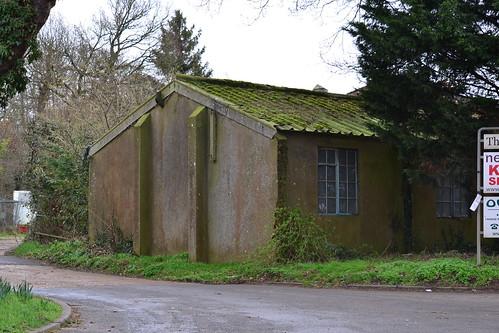
One of the remaining buildings on the Accommodation site.

Whilst the main sections of the 389th were out in Libya, the remaining Hethel units were reduced to training and Air-Sea rescue missions, ironically searching for downed B-17 crews, something the Liberator would prove to be invaluable at.

With the return of the Africa detachments, the Bomb Group  was complete again, and missions over occupied Europe could begin once more from Hethel. Their first contribution to this new phase was to attack Leeuwarden, but cloud cover forced them to find alternative targets on which they unleashed their devastating load. With operation STARKEY about to commence, the 389th were ordered to target the Luftwaffe airfields in the St. Omer region, and then again six days later they visited St. Andre De L’Eure. The next day, the 389th were informed that they would be returning to North Africa this time in support of the Salerno beachhead. A blow to those crews who had only recently arrived here at Hethel.

With the group split again, Hethel based units would continue the fight on. As the renamed 2nd Bombardment Division, they now carried a large Black ‘C’ enclosed in a white circle on their tail fins and starboard wingtip, they would also fly the updated ‘H’ model B-24. With a nose turret, more experienced crews had their reservations about these aircraft, slower and heavier they were also colder due to gaps in the turret surrounds.

A number of strategic missions took these aircraft over occupied Europe many deep across the German Heartland. As 1943 drew to a close the 389th would attack dock yards at Vegesack, Danzig and Wilhelmshaven; targets at Munster, Breman, Emden and Kiel to name but a few. It was at Emden that the Luftwaffe fighters were trialling a new weapon, a bomb dangled on 100 feet of wire to catch the bombers. A rather poor attempt it nevertheless caused great concern for pilots having to fly through wires hanging in an already busy sky. To bring 1943 to a close, on the 30th and 31st December, the 389th were part of further large formations attacking both Ludwigshafen on the Rhine and the airfield at St. Jean D’Angeley respectively.

Former RAF Hethel

Views of the former Technical site, now under the ownership of Lotus cars. The grey line across the centre of the photograph is the former runway now a testing track.

A new year brought little change, but with the introduction of H2X-equipped aircraft, bombing became more accurate, and new targets were identified; ‘No Ball’ operations began and attacks on German cities increased. Late February saw the 389th in action during ‘Big Week’, an operation designed to cripple the German aircraft industry by targeting both aircraft and component manufacturing sites.

With the lead up to D-day, operations would occur almost every day from June 2nd up to June 29th, there would be only six days in this month period where no missions were flown by the 389th.

November 1944 would bring another devastating blow to the crews of Hethel. A collision between B-24J ’42-50452′ ‘Earthquake Magoon‘ and another B-24J ’44-10513’ on November 21st over the local parish of Carelton Rode, saw the loss of 17 of the 20 crew men. A devastating blow that highlighted the need for good communication and careful flying in these close quarters.

Missions carried on and as the war drew to a close, fighter attacks became less effective but even more daring. Pockets of resistance were becoming a ‘nuisance’ and the need for the further ports led to an attack in the Bordeaux region. On April 14th 1945, 1,161 heavy bombers were sent to the area. The 2nd Air Division accounted for 336 of these aircraft, of which only two were lost; B-24J ’42-50774′ “Stand By” and B-24J ’42-51233′ “The Bigast Boid“.

In “The Bigast Boid” of the 567th BS, was pilot 2nd Lt. Edward Bush and his nine other crew members. The aircraft was seemingly hit by friendly fire from B-17s flying above, completely severing the aircraft in half at the trailing edge of the wing, resulting in total loss of control. In the subsequent crash all ten crew members were killed. Other pilots from the 389th who witnessed the accident, attributed the fires and crash to flares being dropped from higher flying B-17s, – such was the danger of flying in tight formations.

Leon J Nowicki, and engineer of the 389th Bomb Group with the nose art of a B-24 Liberator (serial number 42-51233 nicknamed

Leon J Nowicki, engineer of the 389th BG with the B-24 “The Bigast Boid”. The aircraft would be lost to ‘friendly fire’ on April 14th 1945.  (IWM)

Eleven days later on April 25th, 1945 the 389th BG flew its final mission. The last target to receive the attention of the four squadrons was Salsburg, an operation that closed the books on 321 operational missions in five different versions of B-24. In total they dropped 17,548 tons of ordnance, lost 116 aircraft as Missing in action and claimed 209 enemy aircraft shot down. In 1945 they were awarded ‘best squadron’ on efficiency, an award that clearly reflected their attitude and dedication to the war effort.

With the departure of the air echelon at the end of May 1945 and the ground echelons from Bristol, the unit was given 30 days ‘R and R’ before inactivation in September. Hethel like so many airfields was then handed back to RAF Fighter Command who stationed a small number of Squadrons here before disbanding them. In September 1945, 65 Sqn and 126 Sqn were here with Mustang IVs. 65 Sqn stayed taking on Spitfire LF XVI E models before moving to Spilsby in early 1946. 126 Sqn left, had a months stay at Bradwell bay and then returned here, also taking the Spitfire LF XVI E and eventual disbandment in the following March.

Five Polish squadrons then came to Hethel. During the period March to December 1946: 302, 303, 308, 316 and 317 each stayed bringing with them Spitfire XVIs / Es, Mustang IIIs, and IVs, before all being disbanded in the December 1946.

Some technical activity on the site became almost token in comparison and eventually, after being used for repatriation and displaced persons purposes, Hethel was closed and sold off. After laying dormant for a number of years, the majority of the site was bought by Lotus Cars, the company who own the ‘airfield’ today using part of the main runway and perimeter track for testing their high performance cars. The remaining accommodation areas were bought back by the local farmer and are now used for chicken farming, or left allowing the woods to envelop what is left of the accommodation sites.

Former RAF Hethel

A T2 Hangar moved to the northern side of the airfield. One of the better ‘accessible’ features of Hethel.

Considering the role of the Lotus factory, access is generally good. Look for signs for ‘Lotus Engineering’ and drive along the road passing the Lotus site. This was the main entrance to the airfield, separating the ten accommodation and defence sites (on your right) from the main airfield to your left. On the right hand side are some of the former Defence site buildings, now used by small industrial units, the Lotus factory taking over the main technical area including the control tower. On your left is one of the original three hangars. Continue on past the Lotus entrance along the road as far as you can. To your right is a wood, this once housed Communal Site 1 and beyond this the other accommodation sites. A footpath allows access through here where a small number of buildings can be seen albeit enveloped in very dense undergrowth. The road along here eventually turns into a farm, and private property, however, the chapel and Gymnasium are located along this road and have since been turned into a museum. Access to the museum is through this gate. Beyond, the road turns into a footpath and utilises the former perimeter track linking to the main runway to the north. This runs alongside the track now used by Lotus.

From here turn back, return to the main road and turn right. Follow the road parallel to the former east-west runway and turn right. Keep going following the road round, eventually you come to another T2 Hangar. Not originally erected here, it was moved at some point from elsewhere, but is perhaps one of the better examples of airfield archaeology left on the site that is ‘accessible’.

Whilst the majority of Hethel has been removed or utilised by Lotus, it makes for a fascinating trip. The museum, run by volunteers, opens infrequently but I believe offers a fabulous insight into life on the base during the war. One of the more stunning aspects of the exhibition is a number of murals painted in 1944 by “Bud” Doyle. A small memorial is also located at the museum in honour of those who served here.

Hethel was once a heaving airfield, it has now taken on a new sound, but the memories of those brave young men still linger in the Norfolk air; the trees sway to the tunes of their music and their lives rest peacefully at last, honoured in the churches of the nearby Norfolk villages.

Sources and notes

While in the area, visit All Saints Church at Hethel, a memorial headstone dedicated to the crews of Hethel is located in the churchyard with a Roll of Honour inside the church itself. It also contains a Roll of Honour and extracts from ‘The Attlebridge Diaries’, for those who flew as part of the 466th BG from nearby RAF Attlebridge.

A plaque and small stained glass window in All Saints Church, Carelton Rode, commemorates the deaths of the seventeen airmen killed in a mid-air collision in November 1944.

The Hethel Museum was closed on my visit, but a blog site gives some details of the exhibits along with the restricted opening time information.

I recommend: Freeman, R.A., “The Mighty Eighth“, published by Arms and Armour, 1986 which has proven to be a valuable source of background information.

Also Joe Baugher’s website, for serial numbers of the USAAF aircraft.

Spanhoe Airfield – into the Jaws of Death

RAF Spanhoe (Station 493)

With the BEF evacuation at Dunkirk, some thought that the war was over and that the mighty Nazi war machine was undefeatable. Poised on the edge France, a mere 20 or so miles from the English coast, the armies of the Wehrmacht were waiting ready to pounce and invade England. For Britain though, the defences came up and the determination to defeat this evil regime grew even stronger.

Defeat in the air during the Battle of Britain reversed the fortunes of Germany. Then the Japanese attack on Pearl Harbour in the Pacific, which led to the United States joining the war, set the scene for a new and vigorous joint front that would lead to the eventual invasion of occupied Europe, and ultimately the freedom for those held in the grip of the Nazi tyranny.

Plans for the invasion were never far from the thoughts of those in power – even in the darkest hours of both Dunkirk and the Battle for the British homeland. To complete this enormous task, an operation of unprecedented size and complexity would be needed. Vehicles, troops and supplies would all needed to be ferried across the English Channel, a massive air armada would have to fly thousands of young men to the continent. To succeed in this auspicious and daring operation, a number of both training and operational airfields would need to be built, and in 1943 Spanhoe was born.

Known originally as RAF Wakerley (and also referred to as Harringworth or Spanhoe Lodge) it was handed over to the U.S.A.A.F. and designated Station 493.

RAF Spanhoe Lodge

Remaining buildings on the Technical site at Spanhoe Lodge.

Located in the county of Northamptonshire, it would be a huge site with three concrete runways, the longest of which was 6000 ft. Two smaller intersecting runways were of 4,200 ft and all three were a huge 150 ft wide. A total of 50 spectacle hardstands were spread around the perimeter track whilst the tower, built to a 1941 design (12779/41), was located to the south of the airfield between the technical area and main airfield. Such was the design of the airfield, that the tower was located a good distance away from the main runway to the north. The technical area included a small number of Quonset huts, temporary brick-built buildings and two T2 hangars. Instructional and training buildings included a Synthetic Navigation Classroom (2075/43) designed with the most up-to-date projection and synthetic training instruments possible. These buildings were made more distinct by the two glazed astrodomes located at one end of the building which could be used on nights when stars were visible.

As Spanhoe was originally built as a bomber station, a bomb and pyrotechnic store was built on the eastern side of the airfield with three huge fuel stores, one to the north and two others to the west, all capable of holding 72,000 gallons of aviation fuel each.

Accommodation for the crews and ground staff was widely spread to the south amongst the local woods and fields, and consisted of numerous cold Quonset huts – but for the residents, Spanhoe was considered nothing special to write home about.

The first U.S. units to arrive were the Troop Carriers the of the 315th Troop Carrier Group (TCG), whose journey from the United States was not as straightforward as most.

Whilst on their way over the north Atlantic route, they were hit by bad weather and had to be diverted to Greenland. Here they stayed for over a month scouring the seas for downed aircraft and dropping supplies to the crews before they were rescued.

Eventually the 315th made England and began a series of training operations. A small detachment were sent to Algiers to assist in the dropping of supplies to troops in the Sicily and Italy campaigns before returning to the main squadron in the U.K. The 315th arrived at Spanhoe on 7th February 1944 now part of the Ninth Air Force,  IX Troop Carrier Command, 52nd Troop Carrier Wing. They operated two versions of the adapted Douglas DC-3; the C-47 Skytrain and the C-53 Skytrooper transport aircraft. Four Troop Carrier Squadrons (TCS) would use Spanhoe: the 34th, 43rd, 309th and 310th, and would all operate purely as paratroop carriers.

C-47 Skytrains of the 315th Troop Carrier Group in flight. Handwritten caption on reverse: 'C-47 Skytrain. 315 TCG over Lincolnshire. C-47 before 1944.'Image actually shows Harringworth Viaduct. RAF Spanhoe, the home field of the two Aircraft, is slightly out of shot to the left, making this right on the border of Rutland & Northamptonshire.

C-47 Skytrains of the 315th Troop Carrier Group in flight. over the Harringworth Viaduct. RAF Spanhoe, the home of the two Aircraft is just out of shot. (IWM – FRE 3396)

For the next few months they would train in preparation for the forthcoming D-day landings in which they would rehearse both formation flying at night and night paratroop drops with the 82nd Airborne; the unit the 315th would take to drop zones behind enemy lines in Normandy. These preparations were relentless, and not without casualties. The 315th were considered as one of the ‘weaker’ elements of the air invasion force, and would carry out drops nightly until the paratroops had completed their full quota of jumps and all were finally classed as ‘proficient’. The majority of these jumps were however, carried out in clear weather, a point that had not been factored into the final decision.

Flying at night would, unsurprisingly, claim  lives and this was brought home when on the night of May 11th-12th, two aircraft from the 315th’s sister group the 316th, collided during combined operations, killing fourteen airmen.

Even with all this training and a very high aircraft maintenance programme, there were many factors that could affect the outcome of operations. Some 40% of crews had only recently arrived before operations, and thus were not a party to a large part of the training missions.  Of the 924 crews that were designated for the operations, 20% had only had minimal training and 75% had never actually been under fire. The airborne crews were not well prepared.

On the third day of June the order came through to paint invasion stripes on the aircraft. These three white and two black stripes, each two feet wide, were designed to enable the recognition of allied aircraft who were sworn to radio silence over the invasion zones. D-Day was now imminent.

The 52nd’s mission would involve all the other groups of the Wing, taking aircraft from: Barkston Heath (61st TCG), Folkingham (313th TCG) Saltby (314th TCG) and Cottesmore (316th TCG) as well as eleven other paratroop and glider-towing units of the U.S. Ninth Air Force and fifteen RAF Squadrons – it was going to be an incredible sight.

315th C-47 landing at Spanhoe. On the ground can be seen the 315th’s C-109 (converted B-24) tanker . (Knight Collection)

Forty-eight aircraft took off from Spanhoe and formed up with the other Groups at checkpoint ‘ATLANTA’, they continued on toward Bristol turning south at checkpoint ‘CLEVELAND’ . They flew crossed the south coast at Portland and headed out toward Guernsey. The route would then take them north of the island where the 52nd would turn east and head over the Cherbourg Peninsula. They would drop their load of heavily laden paratroops south of Utah beach to capture the important town of St. Mere-Eglise. A ten-mile wide corridor would be filled with aircraft and gliders.

Over the drop zone the aircraft encountered cloud and heavy flak. Whilst a quarter received damage, all but one were able to return to England, the last being lost over the drop zone. For their efforts that night, the 315th TCG was awarded the Distinguished Unit Citation, the only one they would receive during the war.

After D-day, units of the 315th continued to drop supplies to the advancing troops, a default role they carried out for much of the war.

Tragedy was to rear its ugly head again and strike down Spanhoe crews. In July 1944, 369 Polish paratroopers arrived for training as part of Operation ‘Burden’. This involved thirty-three C-47s of the 309th TCS, fully loaded flying in formation at around 1,300 ft. The aim of the flight was to drop the Polish Paratroops at a drop zone (DZ) over R.A.F. Wittering.

RAF Spanhoe Lodge

One of the few overgrown buildings at the entrance to Spanhoe Lodge.

Shortly before arriving at the DZ near to the Village of Tinwell, two aircraft made deadly contact and both plummeted to the ground. Twenty-six paratroops and eight crewmen were killed that day, the only survivor was Corporal Thomas Chambers who jumped from an open door. Eyewitness accounts tell of “soil soaked in aviation fuel”, and bodies strapped to part open parachutes as many tried to jump as the aircraft fell. This tragic accident was a devastating blow to the Polish troops especially as they had not yet been able to prove themselves in combat and one that ultimately led to the disbandment of the section and reabsorption into other units.*1

The 315th’s next major combat mission would be ‘Market Garden‘ on September 17th, 1944, another event that led to many tragedies. On the initial day, ninety aircraft left Spanhoe with 354 Paratroops of the U.S. 82nd Airborne, the following day another fifty-four aircraft took British paratroops and then on the third day they were to take Polish troops. However, bad weather continually caused the cancellation of the Polish operations and even with attempts at take-offs, it wasn’t to be. Finally on September 23rd good skies returned and operations could once more be carried out. During all this time, the Polish troops were loaded and unloaded, stores under the wings of the C-47s were added and then removed, it became so frustrating that one Polish paratrooper, unable to cope with the stress and anticipation of operations, fatally shot himself.

Later that month, another plan was hatched to resupply the beleaguered troops in Holland. The idea was to land large numbers of C-47s on different airfields close to Nijmegen. Not sure if they had been secured, or even taken, the daring mission went ahead. Escorting fighters and ground attack aircraft neutralised anti-aircraft positions around the airfields allowing hundreds of C-47s to land, deposit their supplies and take off again, in a mission that took over six hours to complete. In total: jeeps, trailers, motorcycles, fuel, ammunition, rations and 882 new troops were all delivered safely without the loss of a single transport aircraft – a remarkable feat.

Further supplies were dropped to troops during both the Battle of the Bulge and Operation Varsity – the crossing of the Rhine – in March 1945. During this operation, the 315th would drop more British paratroopers near Wesel, Germany, a mission that would cost 19 aircraft with a further 36 badly damaged.

By now the Allies were in Germany and the Troop Carrier units were able to move to France leaving their U.K. bases behind. This departure signalled the operational end for Spanhoe and all military flying at the airfield would now cease.

Two months later the 253rd Maintenance Unit arrived and prepared Spanhoe for the receiving of thousands of military vehicles that would soon be arriving from the continent. Now surplus to requirements, they would either be scrapped or sold off, Spanhoe became a huge car park and at its height, would accommodate 17,500 vehicles. For the next two years trucks, trailers and jeeps of all shapes and sizes would pass through, until in 1947 the unit left and the site was closed for good and eventually sold off.

This was not the end for Spanhoe though. Aviation and controversy would return again for a fleeting moment on August 12th 1960, with the crash of Vickers Valiant BK1 ‘XD864’ of 7 Squadron RAF. The aircraft, piloted by Flt. Lt. Brian Wickham, took off from its base at nearby RAF Wittering, turned and crashed on Spanhoe airfield just three minutes after take off. The official board of enquiry concluded that the accident was caused by pilot error and that Flt. Lt. Wickham, was guilty of “blameworthy negligence”. The Boards findings were investigated by an independent body who successfully identified major flaws in both the analysis and the Boards subsequent findings.  Sadly no review of the accident or the Boards decision has ever taken place since.

Spanhoe Lodge

Spanhoe was the home of the 315th Troop Carrier Group, part of the 52nd Troop Carrier Wing, Ninth Air Force.

Spanhoe was then turned into a limestone quarry by new owners, the runways and the majority of the perimeter track was dug up and the substrate was removed. The majority of the buildings were demolished but a few were left and now survive as small industrial units involved in, amongst other things, aircraft maintenance and preservation work. A private flying club has also started up and small light aircraft now use what remains of the southern section of the perimeter track and technical area.

The main entrance to the airfield is no longer grand, and in no way reflects the events that once took place here. From this point you can see some of the original technical buildings and hidden behind the thicket, what was possibly a picket post. A footpath though the nearby woods allows access to the remains of eastern end of the main runway and perimeter track, other than this little is accessible without permission.

Outside the main entrance are two memorials consisting of a modern board detailing the group and squadron codes, and a stone obelisk listing the names of those crew members who failed to come home. Both are well cared for if not a little weathered.

DSC_0159

Spanhoe Lodge memorial

Spanhoe leaves a legacy, for both good reasons and bad. The crews that left here taking hundreds of young men into the jaws of death showed great bravery and skill. Determination to be the best and perform at the limits were driving factors behind their successes. Relentless training led to the deaths of many who had never even seen combat, and the scars of these events linger in what remains of the airfield today. Thankfully for the time being, the spirit of aviation lives on, and Spanhoe clings to the edge, each last gasp of breath a reminder of those brave men who flew defenceless in those daring and dangerous missions over occupied Europe.

On leaving Spanhoe, return to the main road, keeping the airfield to your left, join the A43, and then turn right and then immediately left. Follow signs to Oundle and Kings Cliffe and our next destination, the former airfield at Kings Cliffe, an airfield with its own modern controversies.

Spanhoe features as part of Trail 6, ‘American Ghosts’.

Sources and Further Reading

*1 A list of those killed in the Tinwell Crash can be found via this Dutch website for Polish War Graves.

The 315th TCG has a detailed website with regular newsletters and photographs.

RAF Great Dunmow – In the shadow of Stansted Airport.

In Trail 33, we continue to explore the county of Essex. Touching the outskirts of London to the south and Suffolk to the north, it has an aviation history that has lasted over two world wars.

After visiting both Matching Green and Andrews Field, we travel a few miles west back again toward Stansted Airport.

Our next stop is Great Dunmow.

RAF Great Dunmow (Station 164)

Great Dunmow is another former airfield that sits in the shadow of nearby Stansted airport, itself a former World War 2 airfield. Dunmow was home to only two RAF units, 190 Squadron (RAF) and 620 Squadron (RAF) operating Stirling IVs and latterly the Halifax III and VII. It was also used by the USAAF flying B26 Marauders under the 386th BG.

Great Dunmow, had a multitude of names: Little Easton,  Easton Lodge and Great Easton due to its close proximity to all three locations. It was designated Station 164 by the Americans but became more commonly known as Great Dunmow.

RAF Great Dunmow

The Village sign depicts its wartime heritage.

Not built until mid-way through the war (1942-43) by the US Army’s 818th Engineer Battalion (Aviation), the American units of the 386thBG were the first to move in.

It would have three runways (concrete and wood chip), with the main one running north-west / south-east and 6,000ft in length. The second and third runways ran east-west and north-east \ south-west and were both 4,200 ft in length. The main technical and administrative areas were to the north side in which one of the airfield’s two T2 hangars were located. A bomb store was situated to the east and was capable of storing in excess of 800 tons of bombs. Dispersals consisted of 50 loop style hardstands around the concrete perimeter track. The staff accommodation sites were dispersed over 12 sites all to the north around the Easton Lodge, referred to by crews as ‘The Big House’*1. Two Mess sites, two WAAF sites, a sick quarters, an officers and four airmen sites housed a huge number of personnel – even parts of the house itself were used. A communal site provided a number of small shops selling local produce and groceries.

RAF Great Dunmow

The secondary runway (N/E-S/W) disappears into the distance. This section is the only part in full width. The tree line marks the third E-W runway.

The 386th BG (M) were activated mid-war, on December 1st 1942 at MacDill Field, Florida, and arrived in England with their olive and grey B-26s in the following June. Their journey to Great Dunmow would take them via both RAF Snetterton Heath and RAF Boxted. For four months they would operate under the control of the Eighth Air Force, swapping in October 1943, to the 99th Combat Wing of the Ninth Air Force. Consisting of four Medium Bomb Squadrons: 552nd (code RG), 553rd (AN), 554th (RU) and 555th (YA), they would focus their attention on airfields, marshalling yards and gun batteries. Over the winter of 1943-44 they targeted V weapon sites, along France’s coast, and attacked enemy airfields during the ‘Big-Week’ campaign of February 1944.

During the Normandy invasion, they targeted bridges and Luftwaffe airfields, coastal batteries, fuel and munitions supplies, they preceded the allied forces as they moved inland; supported ground troops at Caen and St. Lo in July 1944, earning themselves a Distinguished Unit Citation (DUC) for their actions. As the allies moved deeper into France, they were then free to move to the continent allowing them to reach further afield and support the advance toward and into Germany itself.
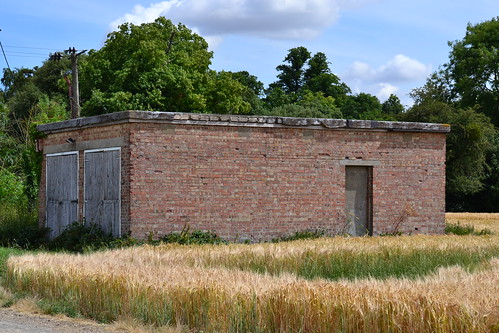
A crashed B-26 Marauder (AN-J, serial number 41-31585) nicknamed

B-26 Marauder ‘AN-J’, (s/n 41-31585) nicknamed “Blazing Heat” of the 553rd BS, 386th BG, 23rd June 1944.  balances on its nose after making a crash landing at Great Dunmow. (IWM)

In total, the 386th would fly 257 missions from Dunmow, operating between 24th September 1943 and 2nd October 1944, in an aircraft that earned itself a rather distasteful name for being unreliable and difficult to fly. Later versions having both larger wingspans and flying surfaces, partly cured this problem, but in the hands of a good crew, they were deemed no more ‘dangerous’ than any other bomber of that time. In fact, a number of Marauders were known to return home in an incredible condition, after taking a substantial beating at the hands of both flak and fighter attention.

After the 386th left Dunmow, it was handed over to the RAF and the first unit to arrive was 190 Squadron (RAF) with the Stirling IV. Pulled out of bomber squadrons for its ‘poor’ record, they were used by various units for both mine laying activities and glider-tug operations. Arriving from Fairford they stayed here until July 1946 whereupon 190 Sqn was disbanded. During this time they also flew the Halifax III and later the Halifax VII – an aircraft that was proven in combat and also as a transport machine. With a history that extended back to the First World War, 190 Sqn operated as a Glider-tug unit taking Horsa gliders to a number of prestige targets;  both Normandy, during the D-Day invasion, and Arnhem during the ill-fated Rhine crossing of Operation Market Garden. They flew fuel and supplies to advancing troops and carried out a number of transport duties as the war drew to a close.

The changeover between the exiting Americans and the arriving British was seen as an ideal opportunity to gather ‘supplies’ by the locals. Many tins of rationed food and other ‘luxuries’ left by the U.S. airmen were deemed ‘fair-game’ and ‘removed’ in the intervening days. Dennis Williams*2 book ‘Stirlings in Action with the Airborne Forces’ describes in detail how the incoming airmen were surprised by the extent of the items left by the Americans.

Four days after 190’s arrival, 620 Sqn also arrived at Dunmow, along with all their respective Echelons. Like their partners, they also came from RAF Fairford flying the Stirling IV. A former bomber squadron, they cut their teeth at RAF Chedburgh, then in November 1943 they transferred across to the Airborne Forces. Also flying glider operations, they too swapped their Stirlings for Halifax A.VIIs in July 1945 before moving off to the Middle East post war. Similarly, 620 Sqn flew troops into some of the most dangerous war zones, losing a number of crews and aircraft along the way.

Both 620 and 190 Sqn returned to operations soon after their arrival, flying SOE operations, glider training sorties across the UK and dropping equipment into occupied territory. As can be imagined these dangerous operations were not without their problems. A number of aircraft were lost and even during training flights, losses were still incurred.

On the 21st November 1944, Stirling LK276 crashed killing all seven crew members. It was initially thought that the pilot either failed to read his altimeter correctly causing the aircraft to strike trees and power lines, or he took his attention away from the instruments in front. Subsequent reports however, show eye witnesses claiming to have seen a following night fighter. Again contradictions in statements were not helpful and no conclusive decision could be reached. The court of enquiry ruled that it was an accident and so the case was closed. Whatever the cause was, it was a major blow to the crews at Great Dunmow.

RAF Great Dunmow

The Administrative site is now used by the local farmer and small ‘industrial’ units. The crew briefing room (front) stands in front of the intelligence block. The main Operations block has gone but the station offices are still here.

Being so far south, Great Dunmow offered a safe haven for some returning bombers. On November 5th 1944, whilst on their return from mission 166 over Frankfurt, the 401st were diverted to the Great Dunmow as bad weather had closed in over Deenethorpe. An eye-witness account describes two B-17s ‘colliding’ on the runway, whilst other records suggest the two B-17s crash landed both suffering from extensive flak damage.  Records show one of them as B-17G ’42-102674′ flown by 2nd Lt. William F. Grimm  and the other as B-17 ’42-31662′ flown by 1st Lt. Leland R. Hayes. However this particular aircraft (42-31662) was known to be ‘Fancy Nancy IV‘ flown by Walter Cox which did not crash at Dunmow, going on to serve to the war’s end. As with many war records, it can be difficult ascertain total accuracy and an anomaly has occurred here somewhere.*3

Both 190 and 620 Sqns continued on in SOE operations, including their first to Norway on the night of November 6th/7th 1944.  Both operations were seen as failures but it would highlight the difficulties of flying for four hours to often heavily fog-laden environments and back again.

Poor weather dogged this part of the country especially in the early 1940s. The airfield was in a poor condition and a great deal of work had to be carried out to assist operations. Lighting, repairs to the runways and drainage were all severe problems and all needed urgent and immediate attention. Conditions therefore were not good. Successive cold winters and the continual mud, left some with very ‘unsavoury’ memories. Working in bitter cold weather outside certainly became a challenge for hard pressed ground-crews.
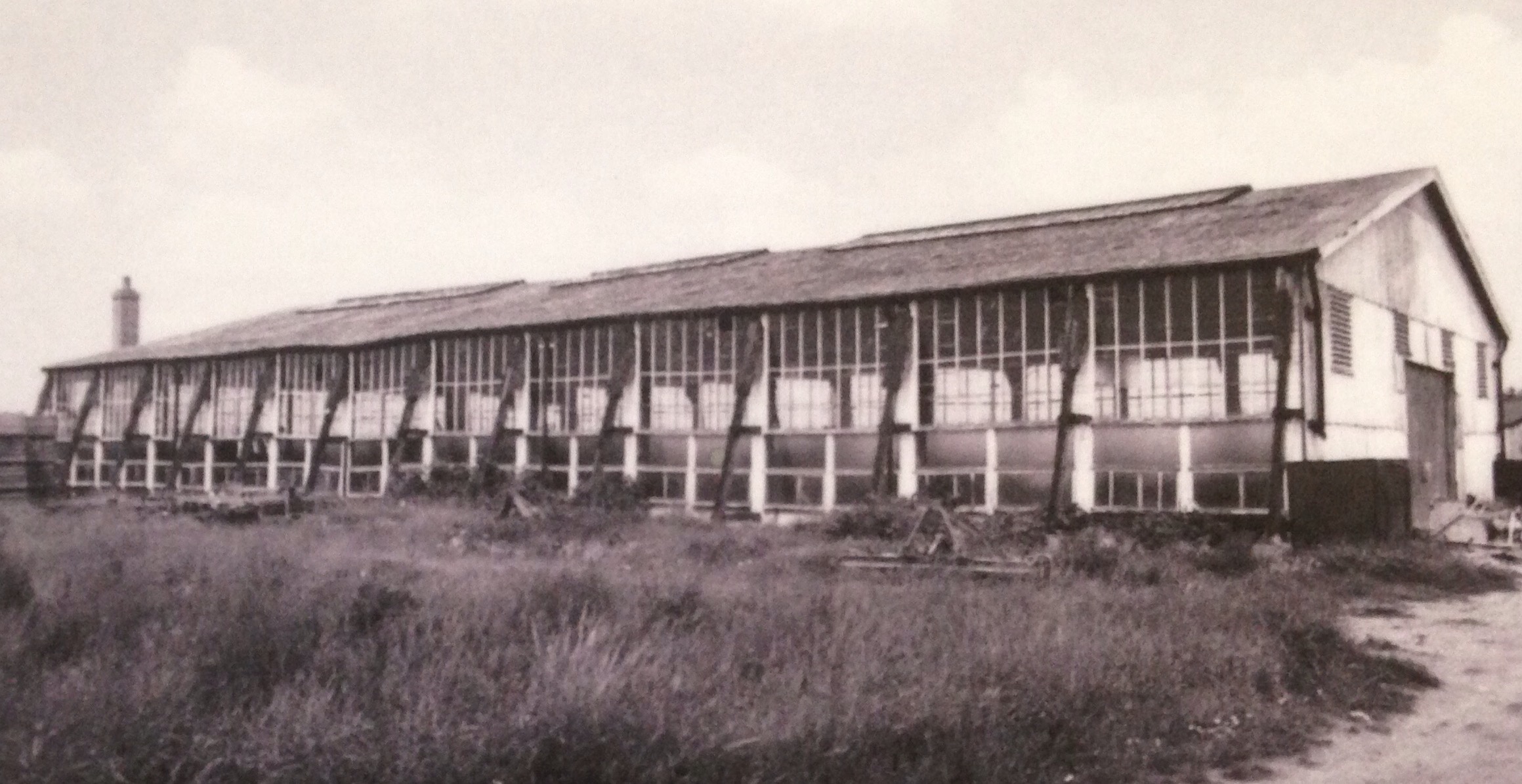
A number of operations involved Dunmow aircraft over the next few months, but they were mainly confined to practice flights towing Horsa gliders. Then in late March 1945, Operation ‘Varsity’ began. The drive into Germany required 21,000 troops, 1,800 transport aircraft and over 1,300 gliders. The base was sealed off from the outside world, only air-tests and spoof flights were scheduled, and then on the morning of the 24th March 1945 60 aircraft were lined up along the runways ready to go.

Anti-aircraft fire was heavy and conditions poor over the drop zone, but all 190 Sqn and 620 Sqn aircraft returned – some with damage. They seem to fair far better than the gliders though of which some 80% were damaged by flak – many severely.

Toward the end of the war, both squadrons dropped supplies and recovered POWs from the now free Europe. It was an emotional time for all but accidents and losses still occurred and crews still died.

In July 1945 620 Sqn received the Halifax A.VII and finally in January 1946 it would be all change for Great Dunmow. 620 Sqn were posted to Aqir in Palestine; 190 Squadron was disbanded and the unit renumbered as 295 Squadron and sent to Tarrant Rushton – this was the end for Great Dunmow. The airfield was used as a vehicle storage unit until 1948, at which point it was closed for good. The tower and major buildings were demolished, the concrete dug up for hardcore for the new road, and the remainder returned to agriculture, a state it survives in today.

As with many airfields today, there is little left to see in the way of buildings and infrastructure at Dunmow airfield. A memorial stands alongside the B1256 road a few miles to the south side of the airfield site and an adjacent footpath takes you through what was the bomb store on to the airfield itself.  By driving from here to the village of Little Easton, you can more easily access the site from the northern side, by far the better option. Drive through the small village of little Easton, past the quaint village duck pond and on toward Little Easton Manor. Much of the grounds of the Manor were the accommodation areas and now as an estate once more, is (at the time of writing) up for sale for a cool £5,000,000.

Before arriving at the manor – which shows little of its aviation history – there is a small tourist sign and access to the adjacent fields. Stop here. The footpath to your left crosses the airfield utilising  much of the remaining perimeter track. This path is an old access road to the airfield and takes you up to the threshold of the former second runway (N/E-S/W).  It is a short walk but once there the full width of the runway can be seen, and when looking on, so to can the length (albeit cut short). The only part that is full width, the enormity of these tracks is staggering. The path then leads off to the west through the field strangely enough only feet from the usable but broken and much narrower perimeter track. At the end of this path, you arrive at the threshold of the third (E-W) runway. Now only a single farm track; the length is in its entirety but again standing at this point you can see how long the runways were. The path then crosses over the southern half of the airfield away to the south but there is little to be gained from taking this route, other than to know you have walked where many crews would have spent their time.  The dispersals that once stood here are now long gone and no trace remains of their existence.

If you continue east the path splits again and the one turning south takes you through the former bomb store and onto the afore-mentioned memorial. Now a quarry, the store is supplied by the perimeter track which is used by lorries to transport materials. Turning back on yourself it is possible to walk along the perimeter track back to your starting point. Along these paths are signs of the concrete that once carried the B-26s, Stirlings and Halifaxes, much narrower now, their significance little more than a farm track. Away to your right, was the former ‘dump’ or Marauder graveyard, where scrapped B-26s were left to rot.

Return to the road and walk from here west toward the lodge. After a few minutes you arrive at the former airfield entrance. The airfield sub-station marks the entrance and a footpath takes you along the road onto the airfield site. The technical area would be to your left and right, with one of the T2 hangars to your left. Follow the path as it crosses the field and you arrive where the tower once stood. There is no sign of it now, but the path takes you right though the spot where so many decisions were made and aircraft counted back. The path then leads on through the airfield and  joins the third (E-W) runway at its centre. largely overgrown with trees, the line is clearly evident, but again evidence of the concrete structure lay  scattered along the edges of this once gigantic pathway.

RAF Great Dunmow

The airfield substation marks the airfield entrance.

Turn back again and through the technical area. Hovering over the tress to your left you will be able to see the current control tower and landing aircraft at Stansted airport – a mere stones throw away. Also to your left are a small group of farm buildings , amongst them a blister hangar that appears to have been moved here after the war. Beyond these and accessible from the roadway, a small collection of administrative buildings remain now used by the local farmer and as small industrial units. By walking along the road these are accessible and perfectly visible from the roadway.

The road from here continues on and takes you into where the  main accommodation sites once stood. Much of this is private land but traversed in places by small bridal ways and footpaths. Immediately opposite was the mess site 4 and further along the road the sick quarters. The remaining accommodation sites were to the north of here amongst the now dense forests that have replaced them. To the north of these woods was the sewage plant that once served the airfield. It has now been replaced by a more a modern unit but its location is still precise.   Various tracks lead into private land from here, but they are the original tracks for the various accommodation sites that once housed the crews and staff of this once busy base.

Return to your car and drive back to Little Easton stopping at the church  (St. Mary the Virgin). Inside at the back of the church on the north wall are two beautiful widows that commemorate the service of those stationed here at Great Dunmow – both RAF and USAAF. Primarily focusing on the USAAF, they depict a number of scenes – each reflecting the daily lives of the airmen. Some show them holding hands with the civilian children, others preparing for and returning from flight; Marauders in the ‘Missing man’ formation, and two hands clasped together as a sign of American and British unity – each one is beautifully presented and well maintained. One of the windows depicts ‘peace and tranquillity’, whilst the other called “The Window of the Crusaders”; depicts the role played by the 386th. Plaques, rolls of honour and information boards give great detail about the lives of those who were stationed here for those short periods during the Second World War.

August 2015 007

One of two stained glass windows in Little Easton church.

Great Dunmow served an important role during the Second World War. Today its historical significance is in no way played down. Whilst the majority of the airfield is now crops, ‘free access’ allows you to revisit those days of the Second World War, to walk in the footsteps of heroes, to experience the sight of a welcome runway as a returning bomber would. The huts and church windows stand as reminders of those who, whilst so young, gave their all in the name of freedom and democracy.

Notes and further reading

*1The Big House, was the former Estate of Frances, Countess of Warwick, who was regularly visited by the Prince of Wales, who later became King Edward VII. A railway halt was built outside the house to accommodate these visits.

*2 Williams Dennis, Stirlings in Action with the Airborne Forces, Pen and Sword Aviation, 2008 – this book provides an in-depth look at life within both 620 Squadron and 190 Squadron whilst at RAF Great Dunmow. It is highly recommended as a follow-up to the activities of these two units whilst here and abroad.

*3 See the 401st BG website for details of these aircraft and missions, including the original mission reports.

RAF Tydd St. Mary

Just over the Cambridge border into the area known today as South Holland in Lincolnshire, is a field that was a small airfield during the First World War. Designed for home defence, it was used for attacking marauding Zeppelin airships approaching England across the North Sea. Larger towns and cities such as Norwich and Lincoln were prime targets, although most designated targets were much further north for example Manchester and Liverpool. To protect themselves, the crews of these mighty airships flew at night and at altitude, but navigation skills were poor and crews were generally unaware of their actual location. As a result, they rarely made it beyond the eastern counties or the Fens of Cambridge and Lincolnshire. Because of poor weather and inexperienced pilots flying against these ships, some Zeppelins were able to wander – at the will of the weather – for as much as 10 hours unabated, randomly dropping bombs on what they considered to be ‘prime targets’.

A major turning point in this air-war, was the night of January 31st 1916 when nine Zeppelins of the German Navy attacked what they believed to be the industrial north-west. In fact they had barely got beyond the lower regions of Lincolnshire before dropping their ordnance. These attacks resulted in the loss of sixty-one people and whilst no British fighter was known to have engaged the airships, a number of Royal Flying Corps (R.F.C) crews were lost due to bad weather.

This disastrous night led to major changes in the Home Defence Squadrons of the R.F.C and R.N.A.S (Royal Naval Air Service), a process that would take a considerable time to complete.

As a part of these changes, an airfield was developed just south of the South Holland Drain a mile or so north of the village of Tydd St. Mary.

RAF Tydd St. Mary

Designed as a class 1 landing ground, Tydd St. Mary covered 125 acres by the time it closed in 1919. Development of the site began in mid 1916 following the re-organisation of the home defence force, but the first units didn’t arrive until the autumn of 1917. Not much more than a field, it did eventually have a small number of  Bessonneau*1 hangars and a small selection of crew huts.

The main unit to use Tydd St. Mary was 51 Home Defence (HD) Squadron whose main flight was based at Thetford. Formed from the nucleus of 9 Reserve Squadron (RS) on 15th May 1916, they moved to Hingham with flights dispersed at Harling Road, Norwich (‘A’ Flight), Mattishall (‘B’ Flight), ) and Narborough (‘C’ Flight). Initially they were equipped with the BE2c, which were soon replaced by the BE12 and subsequently the FE2b aircraft and then the BE2e in December 1916.

For a short while Zeppelin intruder flights were rare and this breather allowed for extensive practice flights by both 51 (HD) Sqn and their partner unit 38 (HD) Sqn who were based a little further to the north.

This lull in movements ceased in the autumn of 1916, when a large formation of Zeppelins gathered over the wash and headed for London. Badly hindered by fog and bad weather, they were eventually scattered across the southern and eastern regions of England where they dropped their bombs on remote farmland. This attack caused no damage to property, nor were the Zeppelins challenged in any major way – the marauders had little to worry about other than poor weather. Patrols by 51 and 38 (HD) Sqn’s were in vain, a pattern that was to continue for the large part, for the duration of the war.

At the end of 1916, Tydd St. Mary was re-designated a Night Landing Ground (NLG) following the renaming of R.F.C Home Defence Stations. 51 (HD) Squadron would soon fly from here in the defence of the eastern counties.
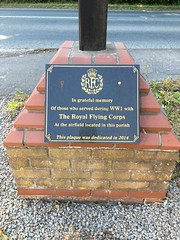
51(HD) Sqn aircraft hangar modified for agricultural use post war.*2

The Zeppelins main advantage over the British was the poor performance of the aircraft types the R.F.C used.  Whilst capable of operating at the 8,000 – 10,000 ft altitude used by the Zeppelins, many aircraft simply took too long to get there and thus could not reach the airship in time to attack it.

As performance improved along with the development of the explosive ammunition that would ignite the airship’s gases, the odds were a little more balanced and larger numbers of airships were being brought down over the eastern region. The tide was turning and pilots of 51 (HD) Sqn were playing a large part in this.

In the early part of 1917  cuts to the Home Defence units were announced based on the increasing gains made by units of the Norfolk / Cambridge / Lincoln squadrons. But the Germans had not given up yet. Reductions in weight enabled new Zeppelins to reach greater altitudes. Now capable of 16,000 – 20,000 feet, few British defences could reach them.

As the tide was turning in France, attacks became fewer and fewer. These high altitude flyers were more at the mercy of the bitter cold and poor weather than defending aircraft.

In August 1917 51 (HD) Sqn moved their headquarters to Marham, and ‘A’ Flight arrived at Tydd St. Mary and 51 (HD) Sqn began replacing their BE2e aircraft with the Martinsyde G.100 ‘Elephants’ – so-called because of their size and poor manoeuvrability.

A large contingent of airships gathered once more on the night of October 19th 1917, requiring extensive sorties by 51 (HD) Sqn at Tydd St. Mary and her counterparts. Whilst a determined effort was made by the R.F.C crews, they had little or no impact, and the gathered airships made off only to be badly beaten by bad weather and anti-aircraft fire over France.

Further changes to R.F.C Squadron designations  in the latter parts of 1917/18, dropped the title ‘Home Defence’ and Tydd St. Mary became the base for 51 Sqn ‘A’ Flight in Eastern Command. Aircraft by now were primarily Royal Aircraft Factory FE2bs, although 51 Sqn were now replacing some of their ‘Elephants’ with BE12b variants which they kept until the autumn of that year. Further changes in February 1918 meant that ‘A’ Flight moved to Mattishall, whilst ‘B’ Flight took their place at Tydd St. Mary.

As the R.F.C turned into the R.A.F on April 1st 1918, Tydd St. Mary would once again become significant. On the night of April 12th 1918, Zeppelin L62 was sighted close by and aircraft took off to intercept. As it was dark at 22:00 the flare path was lit to assist the now R.A.F crews, which openly guided L62 directly onto the airfield. Gliding above the site, L62 dropped a small number of incendiary bombs onto the aerodrome in an attempt to damage or destroy aircraft on the ground. Fortunately the bombs fell well away from parked aircraft and caused no damage to either buildings or aircraft. Pursuit was made by Lt. F. Sergeant in FE2b ‘A5753’, but to no avail and he returned to base empty-handed. Other pilots also tried to catch L62, some crashing due to engine failure, but many simply weren’t able to catch-up with the intruder. Eventually L62 reached the coast and made a break for it across the sea under the protection of yet more bad weather.

By November 1918 the final FE2bs had been relinquished and for the remainder of the year and into May 1919, 51 Sqn operated Sopwith Camels. A move by ‘B’ Flight in May to Suttons Farm (RAF Hornchurch) not only signified the end of the Camels (replaced by Sopwith Snipes) but the end of 51 Squadron who were disbanded in June. This departure also meant the end of Tydd St. Mary and in November 1919 notice of closure was given and the site finally closed in January 1920.

Tydd Gote Village sign

The village sign at Tydd Gote, remembers the RFC from the airfield at Tydd St Mary.

At its height Tydd St. Mary covered an area of 125 acres, and contained two Home Defence flight sheds as single units (believed to measure 130 x 60 ft). These were utilised by local farmers and business and lasted for many years. Other buildings were also utilised, the last, believed to be the Flight Office, is thought to have been demolished as late as 2009.

Not a major player in the war and never to return to aviation, Tydd St. Mary is a notable site and perhaps when passing, a second thought for those who flew from here in defence of the Eastern counties, should be offered.

Tydd St. Mary forms part of Trail 37.

Sources and Further Reading

*1 Early Bessonneau hangars were constructed of wood covered in canvas. Various types were made and were designed to be erected by small trained groups of men. Later models replaced wood with metal and were more permanent.

*2 Photo on display at Thorpe camp, Woodhall Spa.

Goodrum, A. ‘No Place For Chivalry: RAF Night Fighters Defend the East of England Against the German Air Force in Two World Wars‘. 2005, Grub Street

The Great War Forum – website 

RAF Narborough – Norfolk’s first Airfield.

Resting not more than a mile or so from the boundary of RAF Marham, is an airfield that never made it beyond the First World War – but it played such a major part, it should never be forgotten. Opened originally as a satellite by the Royal Naval Air Service, it became the biggest First World War airfield and led the way for the aviators of today’s Royal Air Force.

RAF Narborough

Built as the largest, aircraft based, World War One aerodrome, Narborough was known under a range of different names. The most common, ‘The Great Government Aerodrome’ reflected not only its size but also its multi-national stature and its achievements in aviation history. Used by both the Royal Naval Air Service (RNAS) and the Royal Flying Corps (RFC) it would also have names that reflected both these fledgling services.

Designed to counteract the threat of the German Zeppelin and Schütte-Lanz airships, Narborough was initially used by the RNAS as a satellite station to RNAS Great Yarmouth. No crews were permanently stationed here, but ‘on-duty’ crews would fly in and await the call to arms should a raid take place over East Anglia.

The first recorded arrival was in August 1915; an event that would keep the site in use by the RNAS for the next ten months before being designated as surplus to requirements, and handed over to the RFC in June 1916.

Used as a training ground, accommodation was basic to say the least, being described as a “desolate God-forsaken place”*1 buildings needed to be erected for accommodation, training and maintenance. A total of seven Boulton and Paul hangars and up to 150 buildings would be built on the site over the next two years. By the end of the war, some 1,000 personnel would be based at Narborough – a number comparable with any modest Second World War airfield.

As the First World War raged on the European continent, the use of aircraft was seen as a new way to monitor, kill and record enemy troop movements; it would develop into a lethal weapon and a very potent reconnaissance vehicle. Training programmes were rushed into place, and Narborough would become a preparation ground for new recruits. With training considered basic by today’s standards, recruits had to pass a series of tests before being sent to the France. Written examinations followed up by twenty hours solo flying, cross-country flights and two successful landings, were followed by flying for fifteen minutes at 8,000 feet and landing with a cut engine. These daring young men, many who were considered dashing heroes by the locals, would display their skills for all who lined the local roads awe-inspired by their antics.

Life was not always ‘fun’ though. Accident rates were high and survival from a crash was rare. Some 15 graves lay in the local church  at Narborough, all young men who never made it through the training and on to the battle in France.

The occurrences of these accidents were so frequent, that one instructor, W.E. Johns, creator of ‘Biggles’ cited spies as the cause of many ‘accidents’ – tampering with machines causing the deaths of the crews on board. Johns, himself having written of many machines, believed Americans with German sounding names were to blame for aircraft breaking up in mid-air or crashing at the bottom of loops. More likely, the fault lay with over exuberant or poorly trained recruits.

Narborough as a training station would operate a wide range of aircraft. The French designed Henry Farman F.20, a military reconnaissance trainer, would operate with 35 Squadron from June 1916 until October when they were replaced by the Armstrong Whitworth FK8; 35 Sqn moving to France with these aircraft in January 1917.

The first full squadron to be formed here was 59 Sqn on 21st June 1916. Born out of 35 Sqn, they would operate Avro’s 504K followed by the second French design, the Maurice Farman Shorthorn; named so because of the length of the skids designed to prevent recruits overturning the aircraft on landing. After these came the BE2c, BE12 and RE8s, before the squadron moved to St-Omer in February 1917.

It was during this year that 83 Squadron would be born out of 18 Reserve Squadron (RS) operating various aircraft in the training role. They arrived at Narborough during December that year with FE2bs before they themselves moved to St-Omer in March 1918.

As the war drew to a close, one further squadron was formed at Narborough; 121 Squadron on New Year’s Day 1918. Whilst originally formed to fly the DH9, they actually used a variety of aircraft before being moved to Fliton and eventual disbandment on 17th August 1918.

Three other units would pass through Narborough before it closed. Now part of the Royal Air Force, 56, 60 and 64 Sqns would all come here as cadres in February 1919. 64 Sqn disbanded here in the following year, whilst both 56 and 60 Sqn moved to Bircham Newton and onto disbandment.

The end of the war saw the closure of Narborough. But unlike its sister station RAF Marham a mile or so away, it would remain closed. The buildings were all sold off in what was considered to be one of the biggest auctions in Norfolk, with some of them going to local farmers, small industrial units, schools and the like. Some of these buildings still exist at various places around the local area today but many have long since succumbed to age and inevitable deterioration.

Narborough itself having no hard runways or perimeter tracks has long since gone. A small memorial has been erected by a local group aiming to promote and preserve the memory of Narborough, a memorial plaque also marks the fifteen graves of those who never made it to France; and the small Narborough Museum & Heritage Centre holds exhibits of 59 Squadron in the local church.

Significant not only in size, but in its history, Narborough has now been relegated to the history books. But with the dedication and determination of a few people the importance and historical significance of this site will hopefully continue to influence not only the aviators of tomorrow, but also the public of today.

The memorial to those who served at Narborough.

Sources, Links and Further Reading.

*1 letter from 2/AM C. V. Williams from 59squadronraf.org.uk

C.G. Jefford, RAF Squadrons, Airlife Publishing limited, 2001

The Narborough History Society cane be visited through their website.

The Narborough Airfield Research Group tell the history of 59 Squadron at Narborough, this includes personal notes and details of the Narborough airfield.