RAF Gamston – Home of the OTU.

Britain’s longest, and perhaps most famous road the A1, which is known in part as the ‘Great North Road’, stands at 410 miles (660km) in length, and  connects the two capitals of England (London) and Scotland (Edinburgh) in one direct route. Original parts of it were built by the Romans, always easily distinguished by its direct routing. Over the years, the numerous upgrades and widening programmes have revealed both Roman settlements and Roman artefacts now totalling their thousands.  Much has been written about the A1, both its history and its legacy, but little about its aviation connections.

It is therefore along this route that we next travel, for here we find many of Britain’s wartime airfields, and while most have now disappeared into the history books,  a few still linger on operating the fast jets of the current Royal Air Force.

With such a huge route to cover, it will take time to travel from one end to the other, but it is along this route that we begin our next trail, Trail 54, The Great North Road.

The majority of these airfields, of which there are literally dozens, lie in Northern England, but include notable examples such as: Old Warden (The Shuttleworth Collection), Brampton, Alconbury, Glatton, Wittering, North Witham, Bottesford, Winthorpe, Dishforth, Leeming, Brunton, East Fortune and Macmerry as its close or direct neighbours.

Our first stop in this next trail, is one of the lesser known airfields along this route, one that sits on the very edge of this great road, and one that survives today, not as a military site, but as a civilian airfield where flying is a strong today as it was during those dark days of the 1940s.

From Newark in Nottinghamshire we travel north where we find our first stop, the former RAF Gamston.

RAF Gamston (Retford Airport).

Gamston is a little known airfield, but it is one that played an important part during the Second World War. Opened in December 1942 it was a classic Class A airfield, built with three concrete and tarmac runways with a main runway of 2,000 yards and two subsidiary runways of the standard 1,400 yards forming the distinctive offset A frame. A perimeter track linked all three runways with thirty heavy bomber hardstands located around its length giving an indication as to its wartime role. Further clues to this role are the four type T2 and single B1 aircraft hangars, designed large enough to hold medium to heavy bombers of the RAF. As with all wartime airfields, the technical area came with a variety of ancillary buildings, workshops, MT sheds (12775/41) and stores.

RAF Gamston

Gamston’s former Watch Office is now a residential property.

With temporary accommodation for almost 1,000 male ranks and over 300 female ranks, it was by no means a large airfield, but at a cost of £468,000, it was quite an expensive airfield to build.

When Gamston was being constructed in 1942, Bomber Command was going through a period of reorganisation and re-equipment. At the beginning of the year there were six operational groups: 1,2,3,4,5 and 8 along with two training groups 6 and 7. No. 8 Group was disbanded only to be reborn as the Pathfinders in January 1943 whilst No. 2 Group was transferred to the Tactical Air Force in that same year. A further part of this reorganisation was the renaming of 6 and 7 Operational Training Unit (O.T.U) Groups as No. 91 and 92 (OTU) Groups in the May 1942. In the June, another new Training Group No. 93 (OTU) Group was formed, giving three training Groups in total under Bomber Command’s control. 93 Group bucked the general trend at this point in the war, being the only expansion in what was basically a shrinking Command.

It was this third Group, led by Air Vice Marshal P. E. Maitland, that Gamston would fall beneath, joining in a collection of twelve airfields: Finningly, Bircotes, Worksop, Ossington, Castle Donnington, Wymeswold, Lichfield, Church Broughton, Hixon, Seighford and Peplow that all fell under the direct control of the headquarters at Eggington near Nottingham. This meant that the responsibility of No. 93 Group stretched from Shropshire in the west, through the centre of England into Derbyshire and Nottingham, and north as far as Yorkshire. The purpose of these Operational Training Units was to meet the demand for new crews whilst conducting operational flights with experienced crews as their leads. To this end, Gamston’s closet neighbour Ossington, was to be its ‘parent’, Gamston forming the satellite airfield for all flying operations.

RAF Gamston

One of the many buildings left standing on the Technical Site.

The first unit to use Gamston was No. 82 Operational Training Unit, who were formed at Ossington on June 1st 1943 with Wellington MK.IIIs. Over the time that 82 OTU used the two airfields, they would also fly Wellington MK.Xs. Martinets, Oxfords, Tomahawks, Miles Masters and the Hawker Hurricane. Their period of operations lasted for almost two years until they were disbanded in January 1945 just prior to the war’s end. Flying mainly out of Ossington, 82 OTU wold have their fair share of fatalities, with their first occurring with devastating effect on August 9th 1943, with the loss of all five crewmen and the first total aircraft write-off since forming.

The first Gamston based fatalities occurred on 12th October  that year, when Wellington MK.X HK201 took off on a training flight. Immediately after take off the port engine cut out forcing the aircraft down. Three of the seven crew were killed, the remaining four being treated for their injuries in hospital. For his actions that day, F/O. J Coughian was awarded the DFM.

Gamston would also serve as a safe haven for other operational bombers returning from action over occupied Europe. On December 1st 1943, a No. 9 Squadron RAF, Lancaster MK.I was returning from operations over Berlin. In attempting to land at Gamston, the aircraft DV334 ‘WS-C’ crashed killing six of the eight crewmen on board. The remaining two crew, Sgt. C. Rickards and F/S. L. Owen (RCAF), both being injured. This tragedy brought an end to 1943 but not a change in luck for the training crews of 82 OTU.

RAF Gamston

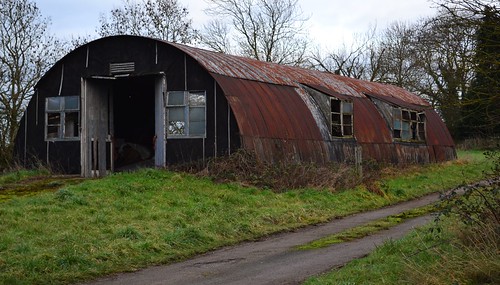
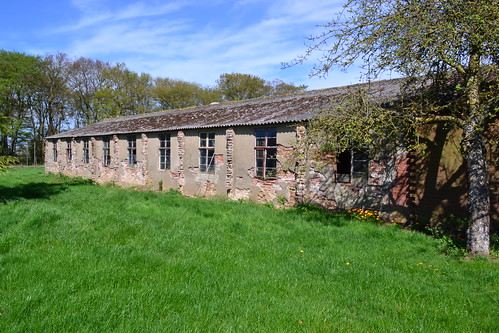
Many buildings are overgrown and in a poor state.

The January and February 1944 brought two more accidents, the first without fatalities as F/L. D. Parry brought the aircraft, a Wellington MK.X, down with its wheels retracted after the port engine lost power. F/L. Parry was uninjured in the accident unlike his five colleagues, who on the night of February  3 – 4, were all killed when their Wellington ‘X3409’ was seen to dive into the ground near the airfield resulting in a massive explosion. The crew, four Canadians and an Englishman, all perished.

Being an operational training unit, 82 OTU would participate in operational duties, such as flying ‘Nickel‘ operations (leaflet dropping) over occupied Europe. One such operation saw the loss of Wellington MK.X on the night of May 14 – 15 with the loss of all as the aircraft ran out of fuel on the return flight from Rennes.

Another near tragic accident occurred in June when a returning bomber, a Halifax from 1667 HCU was trying to make an emergency landing at Gamston when it collided with a stationary Wellington. There were no injuries in the collision but it was another event that brought home the dangers of flying heavy bombers in wartime Britain.

With two further losses in August 1944, and another in April 1945, death or injury were never far from the minds of the crews. Even as a ground crew you were not safe from the slightest lack of concentration or slip. In November, an accidental spark caused by a slipping airman ignited petrol in one of the hangars whilst working on Wellington MK.X ‘HK750. The accident on November 13th 1944, proved fatal for the Wellington destroying it completely in the subsequent fire.

RAF Gamston

1944 saw yet further changes to the Training Command. In June, the number of Bomber Command Squadrons increased, conversion training was taken away from the main squadrons and given to a new Heavy Conversion Group No. 7 (HCU) Group.  it was also decided that a new OTU was required and so ‘C’ Flight of 82 OTU was moved permanently to Gamston where it was re-designated No. 86 OTU who would specialise in the role of night training with both the Wellington MK.III and X. This was a  short-lived unit though, lasting only until October 15th that same year before being  disbanded. Crews from 86 OTU were then used to form the Heavy Glider Conversion Units elsewhere.

A gradual reduction in crew losses toward the end of 1944 meant that 93 (OTU) Group could now be disbanded,  with the operational training being consolidated into the two original groups. By the end of February 1945, No. 93 (OTU) Group was no more.

As the war drew to a close, other training units also began to close. No. 30 OTU who were originally formed at Hixon in June 1942, also with Wellingtons, moved to Gamston where they were disbanded on 12th June 1945. Their final days at Gamston would not be the quite and sedate ending that many would have hoped for though.  On May 18th, a month before disbanding, Gamston would see its final wartime loss, when Wellington NA718 ‘BT-O’ crashed killing both crewmen: F/O. Robert Fraser Thompson (s/n:174908)  and Leading Aircraftman. Douglas Fletcher Dryden (s/n:1353162). It is not known what caused the accident but, the pilot had attempted to glide the aircraft back into Gamston without success.

With the closure of these units, Bomber Command began the rapid decline that would see it become a shadow of its former self. Crew training was put on hold, aircrew held pending a decision as to where to send them and aircraft mothballed.

Once the European war was finally over, Gamston’s flying days were over, at least for the time being, and from July 1945, it became the main resettlement camp for repatriating Royal Australian Air Force personnel. The responsibility for this fell to No. 9 Aircrew Holding Unit (ACHU), where crews were sent before departure to either the Pacific Theatre or more likely home. Once all the residents had departed the Nottingham site, it lay dormant, being used primarily for agricultural purposes.

RAF Gamston

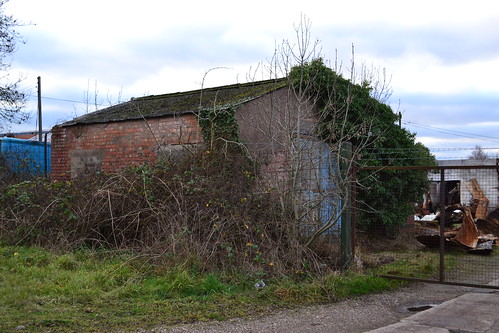
Many buildings a re left open to the elements.

For 8 years the airfield remained closed, but over 1950-51, the site was used for motor racing activities. Small races were held but these never truly ‘took off’ and any future use of the site for such activities, were curtailed in May 1953, when Gamston reopened as a satellite for nearby RAF Worksop, where No. 211 Advanced Flying School (AFS) were currently based. The aircraft type had now changed and the jet age had dawned. The RAF’s latest jet aircraft the Gloster Meteor and de Havilland Vampire now being the aircraft to utilise Gamston’s runways.

No.211 AFS would go through several numerical changes over the next few years, on June 1st 1954 it became 211 Flying Training School (FTS), disbanding on June 9th 1956 to be absorbed into No. 4 Flying Training School (FTS). This in turn was disbanded at Worksop in 1958 to be reformed at RAF Valley in Wales – thus ending the links with Gamston. All through these changes, the aircraft remained primarily the same types, Meteors, Vampires and Prenctices of various marks.

It was during this time, on 1st April 1955, that a Gloster Meteor T.7  WL474 of 211 FTS would crash 2½m north-east of Gamston whilst performing asymmetric training. During the manoeuvres the aircraft dived into the ground killing both its crewmen: F/O. Stanley T. Jenkins and Acting Pilot Officer Duncan H. Moffat.

Gamston then again closed in 1957, but although officially closed it was used during the 1970s and 80s as a satellite landing ground by training aircraft from RAF Finningley. These consisted mainly of the small de Havilland ‘Chipmunks’ and later Scottish Aviation’s ‘Bulldogs’.

Then in 1993 when the site was purchased by Gamston Aviation Limited who opened and operated it as a civil airport under the name Retford Gamston Airport.

RAF Gamston

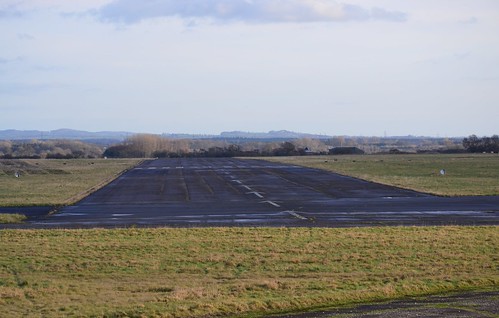
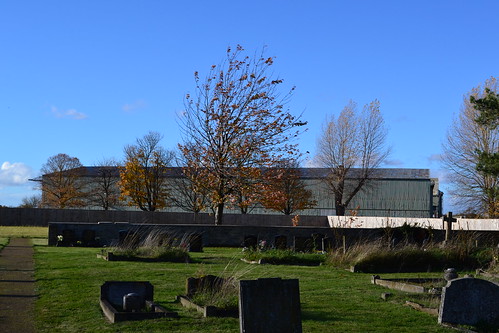
Gamston’s former runway is still in use (in part) today as part of Retford Airport.

Since then, Gamston has been upgraded with maintenance work being carried out on both the hangars, usable runway and perimeter tracks. Whilst these are part of the original infrastructure, they are much smaller only dealing with single or twin-engined light aircraft rather than the larger bombers of Bomber command.

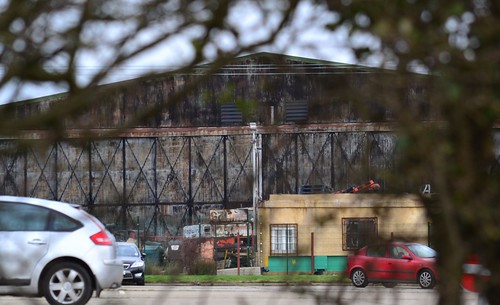
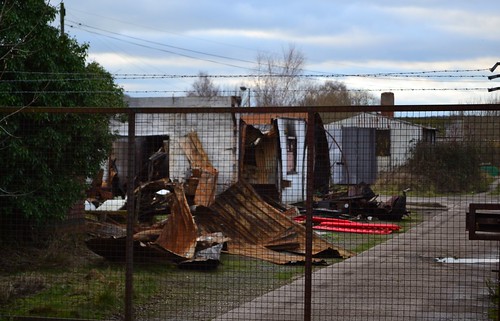
The airfield is a going concern today, the main site operated by the Airport Authority whilst the technical area is a small industrial unit. Within this, there are numerous original wartime buildings still surviving in varying degrees of condition. The various stores are used for storing of industrial ‘components’ and general industrial rubbish, whilst another houses a car repair shop. Discarded vehicles lay buried beneath an ever-increasing range of thorny shrubbery while the whole area is fenced off and basically left with little outside interest.

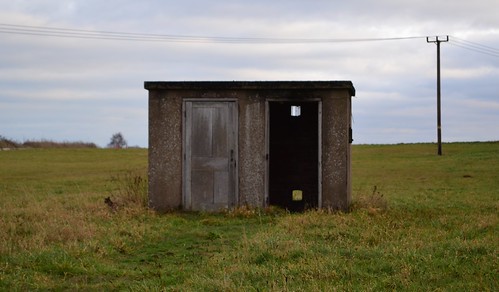
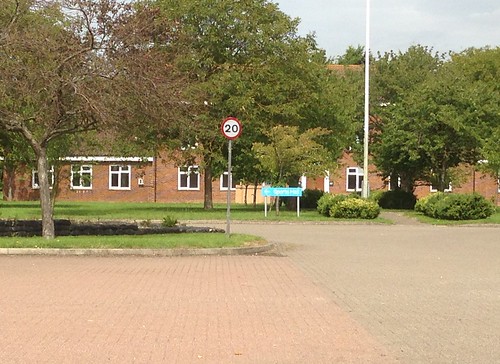
Accessing the two sites is best from the A1, the industrial area is the first turning off this road and takes you along the former perimeter track past the end of the former main runway. It is this runway that is used today, very much a smaller part of the original. The former watch office is also here, tucked away behind hedges it is now a private residence. Various huts and small buildings can be found here, the whole area in a rapid state of decline and disrepair.

Taking a left turn back onto the main road takes you toward the airfield with its modern buildings, hangar space and offices. A small but excellent cafe ‘The Apron’ provides refreshments and the chance to sit and watch the activities of this small but thriving airport. There is also further evidence of the airfields history here, one of the hardstands now forms a parking area, discernible only where a careful eye will distinguish its outline amongst the more modern structures around it.

RAF Gamston

The general state pf the site suggests a bleak future for these historic buildings.

Compared to front line operational airfields Gamston’s history is perhaps ‘less intense’. But, in the bigger picture of Bomber Command, it is a major cog that helped turn the wheels of this massive wartime organisation, providing trained crews for operations over a country, whose determination to destroy all in its path, was finally brought to its knees by those who passed though Gamston’s very doors.

As we leave Gamston behind, we return to the A1 and head north and yet more trails around Britain’s forgotten airfields.

Sources and further reading. 

AIR 27/127/24 – 9 Squadron ORB National Archives.

Chorley, W.R., “Royal Air Force Bomber Command Losses Vol 7“, Midland Publishing, 2002.

The website for Retford (Gamston) Airport has details of its operations and facilities.

My thanks to the anonymous reader for the update of the 1970s and 80s.

The 446th BG (H), “The Bungay Buckaroos” – Part 2

In part 1 of this Trail (Trail 14) we saw how Bungay had grown from a satellite airfield into a fully fledged bomber airfield housing the 446th BG known as “The Bungay Buckaroos”.

The night of April 22nd 1944 saw the USAAF’s Mission 311, when over 800 bombers, a mix of B-17s and B-24s, were ordered to attack the marshalling yards at Hamm in three waves, each with its own designated target. The bombers were to take off from their respective bases between 17:50 and 18:21, but even before the stream arrived over the target, Bungay would bear witness to what was about to happen that night.

For the crew of #42-50306 “Dragon Lady“, it would begin at home. On take off the B24 skidded and crashed killing not only the ten airmen on-board, but two ground staff as well. Then, shortly before arriving over the Dutch coast, a B-17 #42-19818 of the 401st BG at Deenethorpe, suffered a fire inside the fuselage. As the fire took a grip of the aircraft, the pilot Lt. Roland Schellenberg put the B-17 into a steep dive during which three crew members either fell or jumped from the aircraft. Eventually, the fires were extinguished and the aircraft returned to the UK making an emergency landing here at Bungay, with nor further loss. The aircraft was salvaged at the Salvage depot at Watton, but the three crewmen who left the aircraft, were never found even after an intense RAF Air Sea Rescue Search of the area.

B-24H #42-50306 crashed on take off at Bungay on April 27th 1944 with killing twelve men. (IWM FRE 6607)

As the bomber stream made its way to Hamm, unpredicted winds played havoc with many aircraft, some passing beneath the higher groups as they approached the bomb release point, putting themselves in grave danger of being hit from falling bombs. Others following these leading groups also began arriving too early over the target, and were unable to distinguish landmarks due to the heavy smoke from the previous wave’s bombing.

Whilst conditions were very difficult, most aircraft did manage to bomb either their given target or alternative targets of opportunity, and considering this, results were generally good for the three Divisions. However, the troubles for the crews didn’t really start until they left the target and began their flight home.

Being a late operation, returning bombers were not locating their bases until well after dark, a situation the Luftwaffe exploited to their full advantage. A small force of Me-410 night fighters mingled with the returning bombers, and so ground radar were then unable to pick them up. Once the ground staff realised what was happening airfield lights were extinguished and crews ordered to other bases. Unseen, the German fighters gradually picked off the bombers as they tried in vain to land at darkened airstrips.  One such pilot, 2nd. Lt. Frank Baker,  luckily managed to avoid not only the fighters but another B-24 as he struggled to bring his aircraft (#42-95294) down at an alternative base. For his action that night, Baker received an Oak Leaf Cluster to add to his DFC. The entire night cost the USAAF nearly 60 men, some of these being to friendly fire in the confusion that reigned in the skies that night. Twenty Liberators had been damaged by the marauding Luftwaffe fighters, many crashing with fatal results.

The night of June 5th 1944, brought good news and a surprise for the men of the 446th. A crew briefing was called at 23.30 in which they were told they would lead the Eighth Air Force’s part in the invasion the next day. A massive operation, it would require pin-point accuracy and split-second timing to achieve its aim. Bombers were to take off in darkness and rendezvous at given heights with the 2nd Division forming up in an area between the Mersey and Humber estuaries. Take off was just before 02:00 with the 446th’s ‘Red Ass‘ piloted by Captain Charles Ryan, along with Sgt William Barlow, (G); Sgt Stuart Merwin, (R/O); Sgt Bruno Corridino, (G); Sgt Jesse Davis, (G); Sgt Joseph Parkin, (G); Sgt Howard Weaver, (Flt. Eng/G); 1st. Lt Robert McConnel, (C/P); 1st. Lt. Banks Jacobs, (B/A); and 1st. Lt. Michael Paczan, (N) taking the lead. Also on board that day was Col. Jacob Brogger the station Commander.

At 05:55 the formation was over Vierville  dropping one hundred 500lb bombs. A days long event that saw continued and repeated attacks behind the invasion line. With no Luftwaffe intervention, the event was more of a side-show for the gunners of the heavy bombers, and very few casualties were incurred by the crews. This did not mean however, that casualties were absent throughout the invasion period. On June 7th, #42-51116 crashed on takeoff on a mission to Alencon in France. In the accident eight members of the ten crew were killed.

It was also the 446th that would suffer from the little impact that the Luftwaffe had. On the next day 8th and then again on 12th near Jersey and Rennes respectively, they were attacked by a small group of Bf109s, on each day one 446th aircraft was lost.

On the 8th, the first of these two days, #42-109830 went down in the English Channel with the loss of five crewmen. The remaining five were rescued by French fishermen only to be picked up later the German forces.*2 On the second day, B-24 #42-94859 also went down with another five aircrew killed. Of those who survived, one was caught and taken prisoner, whilst the remaining four managed to evade capture.*3

As the allies pushed on thorough France, Holland and into Germany, the 446th supported them. They targeted bridges, gun batteries and enemy troop positions during the St. Lo breakout in July. They dropped supplies to the paratroops around Nijmegen in September and attacked marshalling yards, bridges and road junctions in the Ardennes, preventing German reinforcements from pushing through in December 1944 – January 1945. This support continued right up to the wars end, dropping supplies to advancing troops over the Rhine and on through Germany itself.

Through all these missions, the ‘Bungay Buckaroos‘ managed some remarkable achievements. Liberator #42-52612 of the 706th BS, “Home Breaker” flew 102 missions before returning to the US, and both the 706 BS and the 707 BS surpassed 60 consecutive mission each (62 and 68 respectively) without loss.

RAF Bungay (Flixton)

Admin and bomb site Site – now a decaying.

The end of the war however brought a final twist for the 446th. On April 11th, when on the return flight from Regensburg, two B-24s #42-50790 and #42-51909, both of the 706th BS, collided over the base killing all twenty-two airmen on-board. But as if that were not enough, there was another evil twist of the knife just two weeks later, on the 26th, when two days after their final mission, a transition flight crashed killing a further six crewmen. It was a tragic and sad end to the Group’s war.

In all, the 446th had carried out 273 missions in total, dropping just short of 17,000 tonnes of bombs for the loss of 68 aircraft in combat and 28 through accidents and other incidents. Yet with all these remarkable achievements, the Group were never awarded any recognition in the form of a Citation or Group award.

With the war at an end, the 446th would depart Bungay for home. The aircraft departing mid June via the southern routes and the ground parties departing on the Queen Mary from Greenock in early July.

Bungay airfield, then surplus to US requirements, was transferred over to the Fleet Air Arm and renamed HMS Europa II on September 25th 1945. Bungay formed one of a small cluster of former USAAF airfields handed over to the Fleet Air Arm in preparation for the war in the Pacific. Acting as a satellite for HMS Sparrowhawk (formally RAF Halesworth another US airbase), it fell under the command of  Lt. Csr. R.J. Hanson D.S.O., D.S.C. but due to the end of the war against Japan, it only operated until May 1946 when it was handed back to the RAF and placed under the control of 53 Maintenance Unit. A further change in management saw it pass to 94 Maintenance Unit in November 1947 who stored surplus munitions along its runways and inside its buildings. A range of ordinance, from 250lb bombs to 4,00lb bombs, cables, flares, mines and German munitions were all stored here before disposal.

In the early 1950s the site was gradually run down, no longer needed by the RAF and finally closed in 1955. It was eventually sold off in 1961 and was returned to agriculture. As it closed, the last main gate board to adorn the site was rescued and now rests in the Norfolk and Suffolk Aviation Museum a short distance away.

Bungay gate sign

The last main gate sign from Bungay.

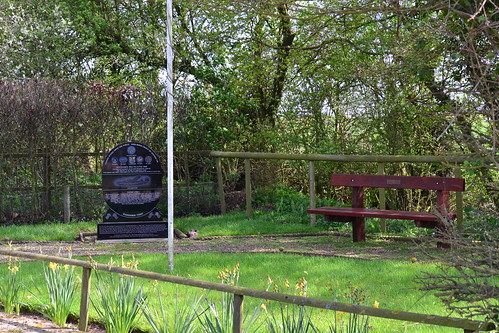
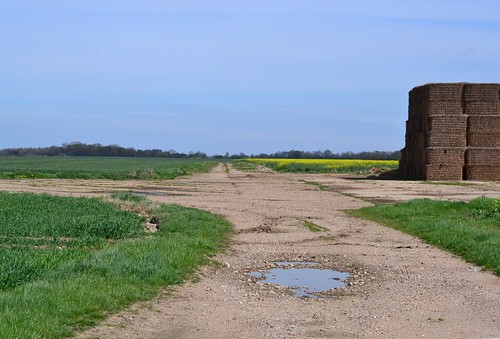
After that some private flying did take place at the airfield, the Martlesham Heath Parachute Club using it with a variety of aircraft types, but this was short-lived. Gradually the site was taken over by agricultural uses, the runways and perimeters tracks being all but removed, the buildings allowed to deteriorate with many being removed over time. Time had gone full circle, and Bungay airfield is no more. In memory of those who were stationed here a memorial stone in the shape of a B24 tail fin marks the site of the former airfield. Just one of several memorials in the local area.

Tucked away down a country lane, Bungay is best found from the B1062. Stopping on the small country lane, Abbey Road, you can see along what is left of these parts. Now predominately agriculture, fields stretch where the Liberators once stood, trees adorn the admin areas and hard standings support tractors and other modern farm machinery. Much of what remains is rooted on private land, and many of these buildings contain murals created by those who were stationed here in the latter part of the war. Dilapidated huts, they are gradually falling into ruin, overgrown with bushes and trees.

A well presented memorial and garden marks the site, and the Airfield entrance is now a farm along with its associated dwellings. A small plaque signifies a crash site at Barsham some 3 miles east and a superb museum at nearby Bungay  houses a range of artefacts associated with the 446th and other Eights Air Force groups. The nearby church holds a roll of honour and its own memorial to the group. A former rest room for the crews is now the local Community Centre and it too holds a plaque in memory of the 446th.

RAF Bungay (Flixton)

A peaceful memorial garden to the 446th marks the site of Station 125.

Sources and further reading.

*1 MACR 1735
*2 MACR 5482
*3 MACR 5802

Freeman, R.A., “The Mighty Eighth“, 1986, Arms and Armour Press.

A website dedicated to the 446th has further details of the crews and aircraft.

The 446th BG (H), “The Bungay Buckaroos” Part 1

In Trail 14 we visit an airfield that was built in the mid part of the war and one that took some time to establish itself as a front line bomber station. However, it is one that would have its own share of problems, heroic acts, records and sacrifice.  In the second part of this trip, we visit the former airfield RAF Bungay.

RAF Bungay (Flixton) (USAAF Station 125)

Bungay airfield lies in Suffolk, above an area known as the Waveney Valley, about two miles from the village from which it takes its name and fifteen miles from Norfolk’s county town of Norwich. It served under a variety of names: HMS Europa II,  RAF Flixton,  RNAS Bungay and USAAF Station 125. However, throughout its short life, it remained primarily under the control of the United States Army Air Force as a heavy bomber station designated Station 125.

Construction began in 1942, by Kirk & Kirk Ltd, but the work would not be completed for at least another two years until the spring of 1944. Even though the site was unfinished, the first units to be stationed here, would be so in the autumn of that same year, 1942.  Initially designated as a satellite for the heavy bombers of RAF Hardwick, it would be some time before Bungay would establish itself as a fully operational front line airfield.

With the invasion of North Africa dominating the European theatre, a build up of military might would see many of Britain’s airfields taken over and utilised for both men and machinery. A part of this build up was the arrival of the twin-engined units the: 47th, 310th, 319th and 320th BGs operating the North American B-25 Mitchell. The 310th BG initially arrived at RAF Hardwick, over September and into October, where they would continue their flying training before departing for North Africa. The 310th consisted of the usual four Bomb Squadrons: 379th, 380th, 381st and 428th BS, and it was whilst training at Hardwick that one of these squadrons, the 428th, would move across to Bungay. Their arrival here was no more than as a dispersed site, allowing for free movement of aircraft in the busy skies over this part of East Anglia. At the end of their short stay, they would rejoin the main Group and depart for the warmer climates of North Africa.

The next group to arrive was something considerably bigger but also posted from nearby RAF Hardwick, the 329th BS of the 93rd BG with their B24 Liberators. Known affectionately as ‘Ted’s Travelling Circus‘ (after the CO, Colonel Ted Timberlake), the 93rd BG earned their unique name as a result of their constant moving around, continuously being spread across, what must have seemed, the entire European and Mediterranean theatres of war. Often split between the two, rarely were the Group ever together for any length of time.

During this period UK-based units of the 93rd at Hardwick began transferring to the 2nd Bombardment Wing, where they began training for ‘special duties’. Gaps in the 329th BS were filled with crews from the other 3 squadrons of the Group (328th, 330th, 409th) and were moved here to Bungay. Once here, the aircraft were fitted with the British ‘Gee‘ system and crews trained in its use. A remarkably accurate system of radio navigation, it was devised initially by Robert Dippy as a short-range aid for blind landings, but its success encouraged its development for a much greater use by the  Telecommunications Research Establishment (TRE) at Swanage.

RAF Bungay (Flixton)

The remains of Bungay’s NE-SW runway looking north-east.

Bungay was Initially planned to equip the 44th BG, but the 329th were chosen over them and within a very short time the crews were ready, and ‘Moling’ mission could now begin. Designed as a ‘blind bombing’ utility, and because of fears of the system falling into enemy hands, heavy cloud cover was needed for operations to go ahead. Such conditions occurred early in 1943, on January 2nd, when four B-24s of the 329th set off from Bungay for the Ruhr. Unfortunately, as they neared the target, the cloud cover broke and the flight was exposed. This exposure prevented Gee from being used as it was intended, and the aircraft returned both without bombing and without using their Gee successfully. The weather again proved to be the Achilles heel in the planning on both the 11th and 13th January, when similar conditions were experienced and again all aircraft returned without bombing. These erratic weather conditions carried on well into March, the last attempt being made on the 28th, after which it was decided to abandon the idea, and ‘Moling’ operations were cancelled.

It was not a complete disaster for the 329th though, the experience of flying over occupied territory and using blind bombing equipment, meant they were able to transfer to a new Pathfinder role, now skilled in equipment not known about in other units of the USAAF.

At the end of these trials, and in the absence of her sister squadrons, the 329th joined up with the 44th BG in a move that led to their imminent departure from Bungay.

Following their departure, the work on Bungay’s construction continued. Built to Class A specifications, it would have three concrete, tarmac and wood chip runways intersecting to form the ‘A’ frame. Thirty-six frying pan and fourteen spectacle hardstands provided dispersed aircraft accommodation and two T2 hangars provided covered space for maintenance and repairs. The main technical area lay to the west of the airfield, the bomb store to the east and the main administration site (site 2) across the road to the west. As a dispersed site, many of its accommodation areas would be hidden amongst the trees beyond here. Linked by a maze of footpaths and small roadways, there were two communal sites (sites 3 and 4), seven officer and other ranks sites, a WAAF site, a sewage works and a sick quarters. In all it could accommodate around 3,000 men and women of mixed rank. Updating of the watch office included the addition of a Uni Seco control room (5966/43) by anchoring it to the roof of the already built observation room. By late autumn 1943, it was completed and the site was handed over to the 446th BG (H), Bungay’s most prominent resident, who would become known as  “The Bungay Buckaroos”.

Their arrival here commenced on 4th November 1943, with four squadrons of B-24s – the 704th, 705th, 706th and 707th – all of which formed the larger 20th Combat Wing of the Second Bombardment Division, Eighth Air Force. The remainder of this wing included those of Hardwick’s 93rd BG and Seething’s 448th BG.

The 446th’s journey took the ground echelons from Arizona, to Colorado and onto Bungay via the Queen Mary,  and the air echelons the southern air route via Brazil and Marrakesh. Under the command of Colonel Jacob J. Brogger, they would begin operations on the 16th December 1943. Throughout their term here the 446th would attack prestige targets including: U-boat installations, Bremen’s port, the chemical plants at Ludwigshafen, Berlin’s ball-bearing plants, the aero-engine works in Munich and the marshalling yards at Coblenz. In addition to these, the 446th would support the Normandy invasion, the break out at St.Lo, and drop supplies to the ground forces at both Nijmegen and in the snowy conditions of the Ardennes.

This remarkable list of strategic targets would begin with Bremen. The mission would see twenty-three heavy bomber groups along with a Pathfinder group drop over four thousand 500lb general purpose bombs and over ten thousand 100lb incendiary bombs. During the raid four B-17s would collide in mid-air and as for the 446th, they would not escape without loss. Two of their aircraft would crash, one of which, a Ford built B-24H-1-FO Liberator #42-7539, “Ye Old Thunder Mug“, would run out of fuel and crash near to its home airfield at Bungay.

The 446th would unusually send just one aircraft to Bremen four days later. This aircraft, a 704th BS Liberator, #42-7494 “Bumps Away” was hit by flak over Texel, one of the Dutch Wadden Islands. The strike sheered the tail turret sending the aircraft momentarily out of control. After the pilot (Second Lieutenant Thomas B. Long) stabilised the aircraft, it went on to complete its mission only to collide with another B-24 of the 392nd BG on its return journey. The collision sent the Liberator crashing into the North Sea killing all those on board*1.

Then on the 22nd, the 446th were sent back to Germany, this time Osnabruk. On this mission, B-24 #42-7611, another 704th BS Liberator thought to be ‘Silver Dollar‘, was hit by falling bombs from above. The aircraft fell from the sky killing eight of the crew with another two surviving, both being taken prisoner by the Germans. On board this aircraft was right waist Gunner Sergeant Walter B. Scurlock who had survived the crash landing in “Ye Old Thunder Mug” earlier that month on the 16th. It had been a difficult start for both Sgt. Scurlock and the 446th.

A B-24 of the 446th BG lands at a cold and frosty Bungay 24/12/44 (IWM FRE 6571)

January 1944 then took the men of the 446th to Kiel, but the cold and icy winter would be as much of an enemy to the group as the occupying German forces were a short distance across the sea. With several missions being curtailed during the month, those that did take place were prone to their own problems. On the 7th, the Bomb Group was unable to rendezvous with the 392nd and returned without bombing; on the 11th, the mission to Brunswick was recalled, again due to the bad weather. Following a Noball mission to St. Pierre-des-Jonquies on the 14th, the group were grounded for a week after yet more bad weather closed in. The continuing poor conditions prevented further immediate attacks,  but the 28th would see the weather ease and the start of four days of consecutive flights to Frankfurt, Brunswick and two further Noball targets.

February, March and April were much more conducive to flying activities but the weather still played its part in cancelled or aborted operations. As the lead up to D-Day began, breaks in the weather allowed for strategic targets to be hit, airfields and marshalling yards, along with yet more Noball targets.

April 22nd 1944 saw the USAAF’s Mission 311, a mission that would become notorious in the history of the Eighth Air Force. On this day, the Eighth would lose more aircraft to enemy infiltrators than at any other time in its wartime history. The mission was to attack the  marshalling yards at Hamm, which was considered a highly important strategic communications target, especially in the lead up to the allied invasion of Normandy. Hamm was especially chosen as it was said to be capable of dealing with up to 10,000 railways wagons a day, making it the busiest marshalling yard in Germany, and a prime target for the heavy bombers of the Allied forces.

On that particular day, over 800 bombers, a mix of B-17s and B-24s, were ordered to attack in three waves, each with its own designated target. The bombers were to take off from their respective bases between 17:50 and 18:21, but even before the stream arrived over the target, Bungay would bear witness to what was about to happen that night.

In part two we shall see what happened on the night of April 22nd and how Bungay developed during the closing stages of the war and beyond.

A Long Way From Home.

A guest post from Mitch Peeke.

June 19th, 1944: Just thirteen days after the Allied D Day Invasion. The weather that day was dry, but the late afternoon sunshine over Kent in Southern England was hazy. A formation of around 30 American B17 “Flying Fortress” bombers from the 379th BG, part of “The Mighty Eighth”, were returning home across the Kent countryside, heading due North, toward their base at Kimbolton, in Huntingdonshire. They were returning from a raid on the V1 launching site at Zudausques in Northern France.

The raiders had taken some Flak, but thankfully, no German fighters had found them. They were doubtlessly busy elsewhere, trying to stem the Allied advances. But the Flak they had encountered had been accurate and had exacted a price from the 379th for their raid. Many of those B17’s were now badly damaged and flying home on three engines rather than four. More of them than not, now had “extra ventilation”, courtesy of the German Flak Gunners, and were trailing heavy smoke from those engines that remained running. However, the B17 was known to be “a good ship”. Inherently stable, it was a remarkable aircraft for its size, able to withstand a hell of a lot of battle damage and still be capable of flying. Many a pilot had been able to “nurse” one home, despite the odds. The crews all had faith in their aircraft. It was a faith that was born from hard experience in hostile skies.

The formation crossed the South coast of England at 21,000 feet. Leading the No. 2 Section was B17 Heavenly Body II, of the 525th Squadron, Captained by 1st Lieutenant Lloyd Burns. A veteran crew, this had been their 29th mission over enemy territory. Just one more mission and the crew would have completed their tour and then they’d be going home, Stateside. The D Day Invasion had of course been keeping them busy. This mission to the V1 site at Zudausques had been their second mission of the day.

Lloyd Burns was an exceptional pilot with an enviable reputation for pulling off the smoothest of landings under any circumstances. The original Heavenly Body had been written off quite recently when the brakes failed on landing. Not even Burns could prevent that aircraft from being a runaway and as the heavy B17 simply ran out of airfield space, she rolled off the end of the runway, down a small hill and straight into a pile of scrap concrete rubble. Miraculously, Burns and his entire crew walked away from that landing. They got a new aircraft and quickly named her Heavenly Body II. (In fact, there were at least 4 other US aircraft named Heavenly Body. Two B29’s, another B17 of the 401st Squadron and at least one B25, all of which had a pin-up girl as nose art). This was now their third mission in the replacement aircraft and although they’d not yet had the time to paint the name and art on the bomber’s nose, the crew had happily settled in to their new ship.

Just after the formation crossed the South coast, Lloyd Burns swapped seats with his co-pilot, 2nd Lieutenant Fred Kauffman. Fred was hoping to get a ship of his own after they completed their tour and had asked Lloyd if he could take over for the descent and landing, as he wanted more 1st pilot experience. Lloyd saw no reason not to. Now as the formation was beginning the let down toward Kimbolton, they gradually lost their height over Kent.

At nearly 18:15, the formation was almost over Allhallows and down to 17,000 feet. Ahead of them, left to right, was the Thames Estuary; even busier than usual, with all sorts of shipping, due in no small part to the D Day invasion traffic.

At 17,000 feet, the haze grew thicker. Fred Kauffman was beginning to work hard for his 1st pilot experience. He was having to fly more by instruments as the visibility forwards was down to about 1,000 yards and the horizon was beginning to disappear into the miasma, though to the airmen flying through it, it didn’t seem to be too bad at that moment.

Flying above and slightly behind Burns’ aircraft, was his Port Side Wingman. This B17  bore the serial number 44-6133, but  no name. The pilot was 2nd Lieutenant Armand Ramacitti and he was in trouble. This was his first combat mission and his B17 had been very badly damaged by the German Flak. He’d been nursing her along since leaving France behind. He’d already lost one engine, his Port elevator and a fair piece of the Starboard one had also been blown away and he had another engine on the Port side smoking heavily and running rough. Now, that engine was making an unbearably loud whining noise, looking and sounding as if it was about to seize up too. Jockeying the throttles on his remaining engines, Ramacitti was trying to compensate for the dropping power, but the flight controls were growing sloppy and with the Port elevator gone, maintaining the crippled bomber’s height was getting harder by the minute. She was beginning to give up the unequal struggle to stay in the air.

Ramacitti’s Bombardier, 2nd Lieutenant Theodore Chronopolis, saw that having surged slightly ahead of their leader, they were now dropping back, out of formation. He called Ramacitti on the intercom, warning him to pull up, as they were now dropping very close to Heavenly Body II. Ramacitti was desperately wrestling with the dying bomber’s controls, trying to claw back some height, but it was a losing battle. Without warning, 6133 side-slipped sickeningly to Starboard, literally dropping out of Ramacitti’s hands. Chronopolis frantically buckled on his parachute, as did the Navigator, for both men now knew with absolute certainty, what was coming next.

6133’s side-slip cut across the top of Burns’ aircraft at an angle of about 35 degrees. Engine bellowing, the Starboard outer prop cut into the top of Heavenly Body II‘s flight deck, right behind the Pilot’s window, killing Fred Kauffman instantly. The two aircraft momentarily locked together in a deadly embrace.

Theodore Chronopolis knew they’d hit Burns’ aircraft. All he’d heard was a very loud, sharp bang and a terrible rending sound, as the two aircraft collided. He and the Navigator went straight for the nearest escape hatch. The Flight Engineer and a couple of the Gunners were already there, but the hatch was totally jammed. Just then, 6133 rolled off Heavenly Body II‘s back and inverted. Thrown about inside the aircraft like a small toy, Theodore didn’t know what happened next. He recalled hearing another big bang, then he blacked out.

The momentum of 6133’s continuing side-slip had separated the two planes. As 6133 rolled off Heavenly Body II‘s back and then inverted, her Flak-battered Port wing now sheared off completely, which was probably the second bang that Theodore Chronopolis had heard. As the wing came off, 6133 started to spin, pointing her nose straight down and plunging headlong toward the muddy waters of the Thames Estuary below.

When Theodore came to, he was free-falling outside of the aircraft. Instinctively, he pulled the ripcord on his parachute, which thankfully deployed. As his descent rapidly slowed, he saw a B17 going down below him, its death-plunge marked by a thick trail of black smoke. Then shock set in and he blacked out again. Unbeknown to Theodore, he was the only one who’d got out of 6133 alive.

Literally moments before, on Heavenly Body II, Lloyd Burns suddenly realised that something was horribly wrong. He was about to reach over behind Fred to pull back the curtain. He wanted to see if their rookie wingman, Ramacitti, was keeping with them, when a terrible grinding noise to his left made him duck down instinctively. The daylight through the left side windows was blocked momentarily and he felt the aircraft shudder viciously. He realised in that instant that they’d been hit by another B17, which seemed to him, to be on top of them. Then as 6133 slid off the top, he looked over at Fred. Lloyd was in no doubt at all that Fred was now dead. The first thing Lloyd tried to do was to somehow stabilise the aircraft. Grabbing the controls, he found  the ailerons completely unresponsive and he got next to no feedback from the elevators. This was not surprising as the B17’s control cables ran centrally along the top of the fuselage. 6133’s prop had undoubtedly chopped through them. Heavenly Body II was still flying as she’d been trimmed, just; but for how much longer was the question.

Lloyd noticed that the Flight Engineer was at the escape hatch, trying to open it. Realising that he’d no hope of flying the plane, Lloyd quickly reached for where his parachute was stowed, but couldn’t find it. As he climbed off the flight deck, one of the crew thrust a chute into his hands and he hurriedly strapped it on; only partially as it turned out. He assisted the Engineer in forcing the escape hatch open then literally shoved him through it, as he immediately followed the Engineer himself. As his parachute opened, Lloyd realised he was only half in the harness. Hanging on for dear life, he saw a B17 going down in a steep turn with one engine smoking badly, but was unsure which of the two aircraft it was.

The Bombardier on Burns’ aircraft, Jack Gray, later recalled that the bomber’s Plexiglas nose had been all but severed and he suddenly found himself seemingly more outside of the aircraft than inside it. Jack pulled himself back in and went for his parachute.

Heavenly Body II continued flying, though steadily losing height, even though there was only the dead co-pilot at the now useless controls. Six of her crew managed to safely escape. The Ball Turret Gunner, S/Sgt William Farmer, was one of the last to leave, noting that the aircraft looked like it was coming apart. He needed no second telling to get out and fast.

The six crew members that managed to escape were: Pilot Lloyd Burns, Bombardier Jack Gray, Top Turret Gunner Leonard Gibbs, Ball Turret Gunner William Farmer, Tail Gunner Richard Andrews and Radio Operator/Gunner Leroy Monk. All but one of those six landed in the water and were rescued by fishing boats. Tail Gunner Richard Andrews came down on dry land at Canvey. The three men who didn’t make it were: Co-pilot Fred Kauffman, Navigator Edward  Sadler and Gunner Louis Schulte.

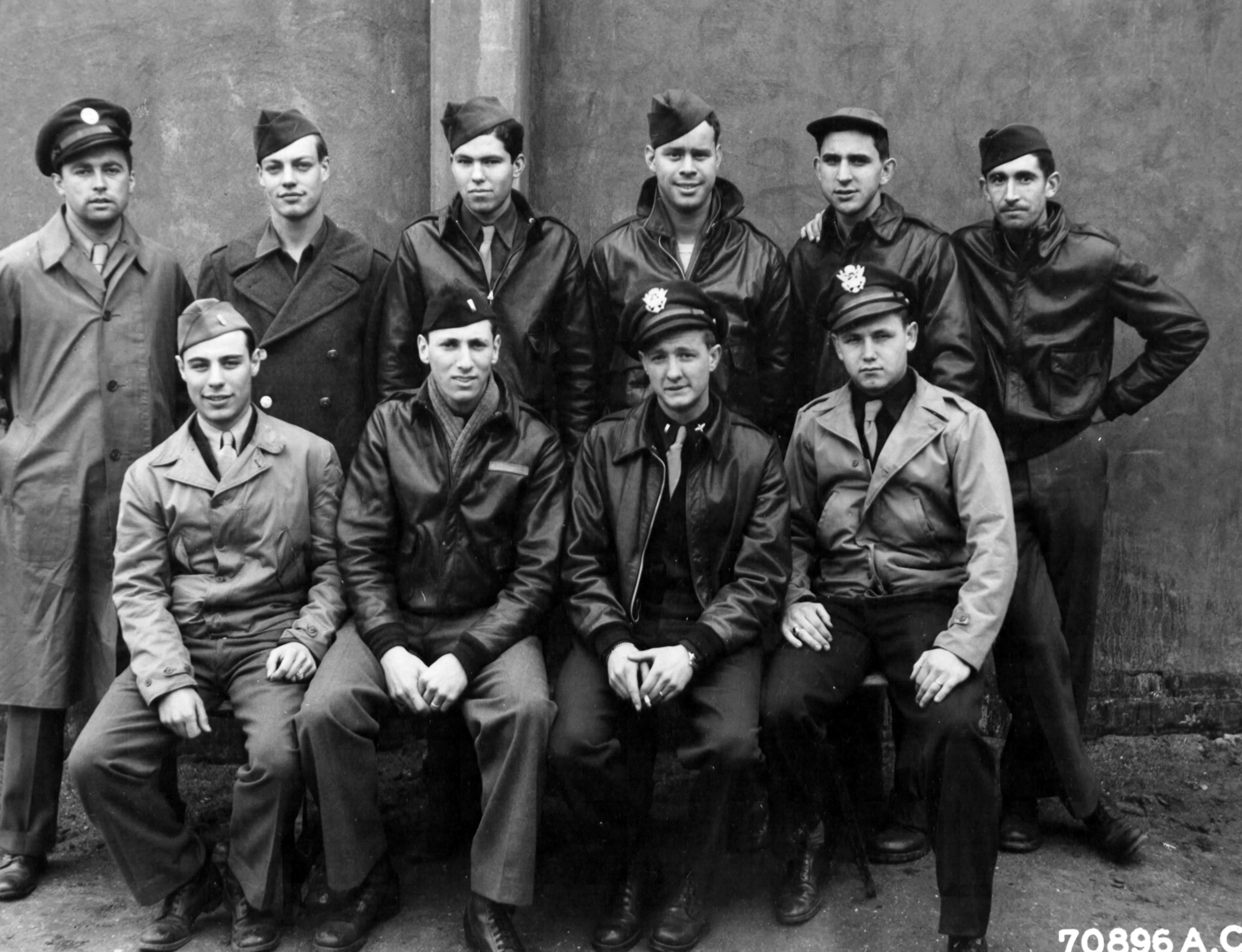
Crew of Heavenly Body II: Front Row, L to R: Edward Sadler; Fred Kauffman; Jack Gray; Lloyd Burns
Back Row, L to R; Louis Schulte; Leroy Monk; Richard Andrews; Richard Billings; William Farmer; Leonard Gibbs
Note that Richard Billings was part of the Burns crew on arrival at Kimbolton, but was the 10th man when crew size was reduced to 9, and so was not with the crew at the time of the collision. The survivors of the Burns crew are all deceased except for Richard Andrews. (Photo courtesy 379th BG Association archive,  by kind permission.)

6133 meanwhile, had gone straight down and crashed in twenty feet of water, in what was then a minefield, about half a mile or so off the west beach at Allhallows. The Estuary bottom was and still is, soft Thames mud and the main part of the wreck undoubtedly buried itself to some extent in the mud. (What remained of the wreckage was later salvaged, probably when the minefield was cleared). She had taken most of her crew with her, trapped inside.

Sole survivor Theodore Chronopolis, landed safely by parachute. He was fished out of the water by a passing  boat. The eight men of 6133’s crew who died that day were: Pilot 2nd Lt. Armand Ramacitti, Co-pilot 2nd Lt. William Hager, Navigator 2nd Lt. Donald Watson, Gunner S/Sgt. Richard Ritter, Gunner S/Sgt. Cecil Tognazzini, Gunner S/Sgt. John  Burke, Gunner Sgt. Warren Oaks and Gunner Cpl. Paul Haynes.

Meanwhile, having been abandoned by her crew, Heavenly Body II continued flying, somewhat erratically and losing height all the time. At first, she’d turned west and seemed to be heading directly toward the oil storage tanks at ShellHaven on Canvey Island. To those watching on the ground, a disaster seemed inevitable, then; still losing height, she miraculously turned east, away from the refinery, over the town, toward Canvey Point and the mudflats. It seemed as though the pilot was still trying to find somewhere safe to put her down. She then circled once over Canvey Point before she  finally nose-dived onto the mudflats, throwing an engine forward as she crashed.

To this day, those who can remember the event have always held the pilot of that aircraft in high esteem. Trouble was, the pilot was at that moment, just landing in the water off Canvey Island by parachute! Did Fred Kauffman not die in the collision after all? Had he somehow survived his injuries, regained consciousness and taken control of the shattered aircraft? Unlikely. Burns had tried to take control just after the collision and found the controls unresponsive. It is also extremely unlikely that Fred could have come round from such traumatic head injuries as he’d received when 6133’s Starboard outer prop cut through the roof and side of the Flight deck.

The answer probably has more to do with the B17’s inherent stability. With the nose section totally open and the escape hatches gone, the sheer force of the through-rushing air was probably responsible for the apparent “steering” of the aircraft. Also of course is the fact that, though a stable design, the aircraft was literally coming apart in flight. Who knows precisely how the aerodynamics were working, but one thing is certain, she was not being actively piloted.

The semi-submerged wreckage of Heavenly Body II remained on the mudflats for decades. Every so often, the tides would uncover more of it and bury other sections. The wreck was easily accessible and so subjected to many souveniring expeditions. A local historical society salvaged some of it and put it on display in a museum, until it closed. The thrown engine was salvaged fairly recently and together with some other artefacts, is now on display at another local museum. There is also a storyboard on the seafront close to the crash site at Canvey Point and a memorial plaque, dedicated to the memory of both crews. Sadly, there is nothing of the kind at Allhallows, where 6133 crashed.

Most of the bodies, including Ramacitti’s, were recovered; some at the time, some a little later, and are interred in the American Cemetery at Madingley, Cambridge; a long way from home. One body was later sent home. The body of Gunner Louis Schulte from 6133 now rests at home in a cemetery in St. Louis. Only two are still unaccounted for: Fred Kauffman, Co-pilot of Heavenly Body II and Gunner Cecil Tognazzini from 6133, both of whom are listed on the tablets of the missing at Madingley. Their last resting places are very probably in the soft Thames mud that their aircraft crashed in. They too, are a long way from home.

The US Military Authorities naturally held an inquiry into the crashes. It was chaired by  Lieutenant-Colonel Robert S Kittel of the United States Army Air Corps. The Pilots and Co-pilots of both aircraft were charged to account. At the end of the inquiry, the official findings were that 2nd Lieutenant Armand J Ramacitti had failed to keep proper position within the formation. In trying to correct this, he had over-controlled, slid into and collided with, aircraft 42-97942 (Heavenly Body II) which was leading the second section of the formation. It was further stated that “No pecuniary or disciplinary action is contemplated”.

Comment from Mitch.

Personally, I cannot help but feel that this was a “cop out” and an extremely harsh outcome for the enquiry to have reached, to say the least.  Given the actual circumstances involved, simply blaming the collision on Pilot error seems to me to be grossly unjust. Some of the deceased crew members were awarded posthumous decorations, as indeed was Ramacitti. In my opinion though, Armand Ramacitti deserved far better than the enquiry board’s sanctimonious posthumous censure, their apparent “favour”of no official punishment and the award of what certainly looks to me to have been a “token” Purple Heart. He’d given his young life, on his first combat mission, desperately trying to get his Flak-blasted aircraft back to base; as had seven others of his equally meritorious crew, all of whom will remain forever, a long way from home.

My thanks go to Mitch for allowing me to post his write-up, it was a tragic accident that may or may not have been avoidable. Whatever the cause, I personally feel that the pilot was struggling with an aircraft that was unstable, difficult to control and likely to fall out of the sky at any moment. The fact that the aircraft had gotten as far as it had was a miracle in itself and those who lost their lives should be remembered for what they did and the sacrifice they made. To even consider that the pilot(s) were to blame for what happened to me is a travesty, they were young men fighting a war that was taking the lives of thousands.

Mitch is currently trying to have a memorial or plaque raised as close to the crash site as possible, I sincerely hope he achieves that aim and that these men are remembered in perpetuity.

Post Script.

B-17  #44-6133 was a Douglas/Long Beach B-17G-45-DL Flying Fortress delivered to Tulsa airbase, Oklahoma, May 10th, 1944. It was transferred to Hunter airbase, Savannah, Georgia, on May 19th, 1944, and then onto Dow Field on May 29th, 1944. She was assigned to the 525th BS, 379th BG as ‘FR-Y’at Kimbolton Jun 8th, 1944. The crew of #44-6133 were:

Pilot: Second Lieutenant Armand Ramacitti
Co-pilot: Second Lieutenant William ‘Bill’ Hager
Navigator: First Lieutenant Donald ‘Don’ Watson
Flight engineer/top turret gunner: Staff Sergeant Cecil Tognazzini
Radio Operator: Sergeant Richard ‘Dick’ Ritter
Ball turret gunner: Staff Sergeant John Burke
Waist gunner: Corporal Paul Haynes
Tail gunner: Sergeant Warren Oaks (his second mission)
Bombardier: Second Lieutenant Theodore Chronopolis

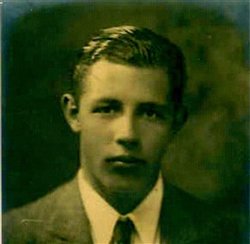
Sgt Cecil A Tognazzini

Flight engineer/top turret gunner: Staff Sergeant Cecil Tognazzini (Photo Janet Penn, via www.findagrave.com)

#42-97942 was a Lockheed/Vega B-17G-40-VE Flying Fortress delivered to Denver on April 11th, 1944. She then went onto Kearney air base in Nebraska on May 4th, 1944, before transferring also to Dow Field May 23rd, 1944. She was then assigned to 525th BS,  379th BG at Kimbolton as ‘FR-K’. The crew of #42-97942 were:

Pilot: First Lieutenant Lloyd Burns (just 19 years of age)
Bombardier: Second Lieutenant Jack Gray
Flight engineer/top turret gunner: Technical Sergeant Leonard Gibbs
Radio Operator: Technical Sergeant Leroy Monk
Ball turret gunner: Staff Sergeant William ‘Bill’ Farmer
Waist gunner: Staff Sergeant Richard ‘Dick’ Andrews
Co-pilot: Second Lieutenant Fred Kauffman
Navigator: Flight Officer Edward Sadler
Tail gunner: Staff Sergeant Louis Schulte

Mitch is the author of a number of books including “1940 – The Battle to Stop Hitler“the proceeds of which go to help the preservation of the Medway Queen a ‘little ship’ used in the Dunkirk evacuations.

A ‘gofundme’ fundraising account has been set up with a target of £1000, for which it is hoped the public will get behind, and secure a memorial for those young men who lost their lives that tragic day. Find the account at: https://www.gofundme.com/ww2-aircrew-memorial 

Further reading and sources:

www.canveyisland.org

www.379thbga.org

www.americanairmuseum.com

www.8thafhs.com

MACR 6984

MACR 6983

RAF Waterbeach – A period of change (Part 3).

In this last part looking at RAF Waterbeach we see how its military career finally came to a close. The jet age was had arrived but would soon pass, the curtain was about to fall on this historic airfield.

Immediately after the war, two new squadrons would take up residence at Waterbeach. During early September 1945 No. 59 Squadron would arrive followed within a few days by No. 220 Squadron, both flying the Consolidated B-24 Liberator. Both these squadrons transferred from Coastal Command into the Transport Command and were used to ferry the many troops back and forth from India and the Far East. These operations would continue well into May (59 Sqn) and June (220 Sqn) 1946 whereupon both Squadrons were disbanded. The cessation of the units allowed for crews of the Squadrons to be transferred to a new unit and training on the Avro York aircraft, a model 59 Sqn would then use once reformed in 1947 at Abingdon. No. 220 Sqn would later reform flying the Shackleton, returning once more to Maritime Patrols from Kinloss in Scotland. Neither Squadron would return to Waterbeach, but whilst here, they would carry almost 19,000 troops across the world, a tremendous achievement indeed.

Whilst neither 59 nor 220 Squadrons would return, the Avro York would come to Waterbeach. In the August of 1946, No. 51 Squadron brought the C.1 York from Stradishall, continuing the India flights that both 59 and 220 had performed before her. Initially carrying freight, they the went on to carry passengers before departing themselves to Abingdon in December 1947.

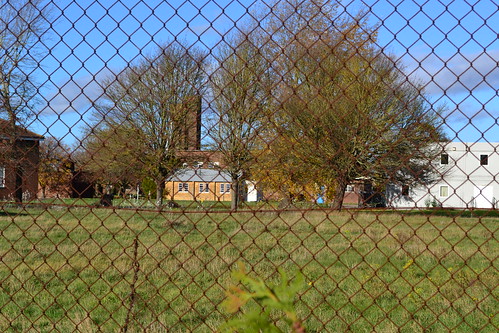
RAF Waterbeach

Waterbeach seen through the fence.

The advanced party of 51 Sqn would arrive on the 16th, with the main party arriving on the 20th of August (1946). Flights would occur almost daily for the whole of August, flying to Palam (India) and back. In that month alone the Squadron would fly 1,435 hours of training flights, 355 of which were at night.

With a regular number of aircrew being posted to RAF Bourn amongst other airfields, the turnover of staff would be very high. Specific training was targeted at the long distance flights, many going to Cairo or Singapore, and many flying via RAF Lyneham in Wiltshire.

A year later, in mid November 1947, 242 Squadron joined the York group, crews gradually absorbing into 51 Sqn. Shortly after this however, notice came through that 51 Squadron was to move to Abingdon, along with the remnants of three other squadrons (242 included) to form a new long-range unit there.

After their departure, two more transport squadrons moved in to Waterbeach, taking a step backwards in terms of aircraft, both with that Second World War Veteran the  Dakota. No. 18 and 53 Squadrons stayed here, operating flights to and around the Middle East from December 1947 to early September 1948 (18 Sqn) and the end of July 1949 (53 Sqn).

With the Berlin Airlift demanding high levels of aircraft, 18 and 53 Sqns were soon ordered into the affray, and began carrying out flights under operation ‘Plainfare‘. After their withdrawal from the operations, 18 Sqn moved to Oakington for almost a year, during which time No. 24 Squadron moved into Waterbeach momentarily sharing the ramp with 53 Sqn. Yet another York unit, they also flew Avro’s Lancastrians and Dakotas, a role that involved them carry numerous dignitaries such as Field Marshall Lord Montgomery to various destinations around the globe. A short return of 18 Sqn meant that Waterbeach was again particularly busy with transport aircraft, and then for another short two month period it would get even busier.

During the New Year period, 1st December 1949 – 20th February 1950, No 206 Squadron appeared at Waterbeach, also reforming with that old favourite the C-47 Dakota. Using examples such as KN701, it was another squadron who had a long and distinguished history in Maritime patrol, eventually going on to return to this role also from Kinloss in Scotland.

Between the 25th February and the 29th February 1950, both No. 18 and 24 Squadrons departed Waterbeach, 18 Squadron disbanding and 24 Sqn moving to Oakington. During the move, the resident aircraft were disposed of, and the new Vickers Valletta was used in their place.

Quiet then reigned at Waterbeach for about three months. After which time Waterbeach took yet another turn of its page in the history books. With a combined flight of twenty-seven Meteors from both No. 56 and 63 Squadrons the silence was broken and the jet age had arrived. On May 10th 1950, the Meteors became the first major units of the RAF’s front line to be stationed at Waterbeach, two units that would remain here for a number of years operating several variants of the Meteor, Supermarine’s Swift and then the Hawker Hunter.

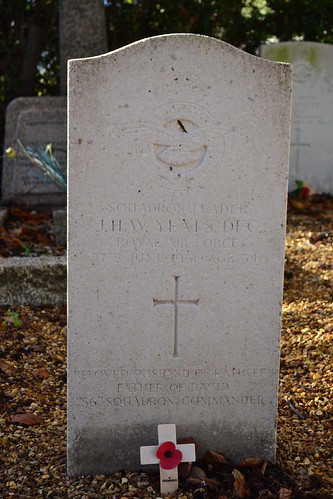
The initial variants of Meteor F.4 were replaced within two years by the F.8, during which time a number of accidents occurred – some incurring fatalities. Perhaps the worst blow came with the death of the Station Commander Sqn. Ldr. J. Yeates DFC when on 27th June 1951 his Meteor F.8 (WA953) rolled after take off crashing into the ground. Sqn. Ldr. Yeates was killed in the resultant crash and is buried in the local cemetery next to the airfield.

Sqn. Ldr. J. Yeates DFC

Sqn. Ldr. J. Yeates DFC killed on 27th June 1951.

Sqn. Ldr. Yeates’ death came at the end of a month that had seen four other aircraft damaged in landing accidents. These included two Station Flight Tiger Moths and two other Meteor F.8s, a decidedly bad month for the two squadrons.

A further landing accident brought home the dangers of jet aircraft on November 1st 1951, when Meteor WA940 of 63 Sqn collided with Meteor VZ497 of 56 Sqn after landing. The collision caused a fire in which both F/O. K Jones and Sgt. G Baldwin were both killed. As if through foresight, the personnel of 63 Sqn has noted on their arrival in 1950 that not only was the accommodation sub-standard but the hangarage and aircraft dispersals were insufficient for the needs of two squadrons. Highlighting the problems certainly didn’t prevent this tragedy from occurring. The terrible conflict of the Second World War may have been over, but casualties at Waterbeach would continue on for some time yet.

The work of 56 Sqn and 63 Sqn was carried out in cooperation with the US forces at nearby RAF Lakenheath, who at that  time were operating Boeing’s B-29 ‘Superfortress’ known for their devastating effect on Japan. These exercises, carried out over the skies of the UK,  were joint Anglo-American fighter affiliation exercises and included not only the B-29s but F-86 ‘Sabres’ as well.

As if history was to repeat itself, the bad weather that had brought disaster upon the bombers of the RAF’s Bomber Command on ‘Black Thursday‘ (RAF Bourn) ten years earlier also brought havoc to 56 Sqn on December 16th 1953.

With visibility down to a little as 100 yards on the Tuesday, Wednesday saw some improvements. With flying restricted to four aircraft per flight, it was going to be difficult. The Cathode Ray Direction Finding equipment (C.R.D.F.) was not working and so bearings needed to be obtained by VHF. Whilst the majority of aircraft were able to land using a Ground-Controlled Approach (G.C.A.) ‘A’ flight were not so lucky. Red Section were diverted to Duxford, but failed to achieve a landing. Being too low on fuel to continue on or try for a third time, the two aircraft climbed to 5,000 feet and the pilots, Flt/Lt. G. Hoppitt  and F/O. R. Rimmington ejected. Fuel gauges at the time were reading as little as 20 Gallons. Both aircraft came down near to each other, no damage was caused to public property and both pilots were unhurt. Yellow section, also diverted to Duxford, where they attempted G.C.A. landings also, but unable to do so, the section leader, F/O. N. Weerasinghe suffered a broken neck and fractured skull after he force landed in a field. The fourth pilot, F/O. Martin, broke his back in two places after ejecting at only 700 feet. A court of enquiry ruled that three of the pilots had difficulty in jettisoning their canopies, and F/O. Martin, even though he managed to succeed,  ejected at an all time low-level. It was well into the New Year before  F/O. Weerasinghe regained consciousness, and all four aircraft, WA769, WH510, WA930 and WH283 were written off.  In a light-hearted but perhaps tasteless ‘that’s how its done‘ demonstration, both Flt/Lt. Hoppitt  and F/O. Rimmington jumped off the bar at a Pilot’s party in the Bridge Hotel.*2

Over the next four years a number of other squadrons would arrive and depart Waterbeach. On 18th April 1955 a new night fighter squadron was formed, that of No. 253 Sqn. Operating the DH Venom NF.2A, an aircraft designed around the earlier Vampire, it was a short-lived squadron, disbanding on September 2nd 1957. 253’s reforming would however, see the beginnings of a string of Night Fighter Squadrons being stationed here at Waterbeach.

Almost simultaneously to the disbanding of 253 Sqn, was the arrival of a second Night Fighter squadron, the Meteor NF.14 of 153 Sqn from RAF West Malling absorbing the staff of the now disbanded 253 Sqn. Training crews on Meteors along with being on 24 hour standby, meant that flights were frequent, a regime that continued until July 2nd 1958 when 153 was disbanded being renumbered 25 Sqn. After having a short spell in the turmoil of the Middle East, they then began to prepare to upgrade to Gloster’s Delta wing fighter the Javelin in September. By December only a handful of aircraft had been received, but further training and upgrades saw the FAW.7 replaced by the FAW.9. Work was slow but by late 1959 the squadron was considered operational.  By the October 1961, 25 Sqn was posted north to Scotland and RAF Leuchars, where it received the FAW.7 back before being disbanded once more.

Gloster Javelin FAW.7 of No 25 Squadron RAF Waterbeach, showing its missile complement of De Havilland Firestreak infra-red homing air-to-air missiles. © IWM (RAF-T 2172)

During this time 56 Sqn who had been one of Waterbeach’s longest standing squadrons, departed to RAF Wattisham where it would receive the Lightning, the RAF’s high-speed interceptor that burnt fuel at an incredible rate of knots. No. 56 Sqn had whilst here at Waterbeach, used not only the Meteor but the Supermarine Swift (F.1 and F.2) and the Hunter F.5 and F.6. No. 63 Sqn, who also flew the Hunter F.6 was also disbanded at Waterbeach during this period (October 1958), and the loss of these Hunters would also see the end of the line for 63 Sqn RAF.

The last 5 years would see the last of the RAF’s involvement at Waterbeach. July 17th 1959 saw the arrival of No. 46 Sqn with Javelin FAW.6s. Disbanded in 1961 the nucleus would remain ferrying Javelins to the Far East. The November 1961, would then see two more squadrons arrive; No. 1 on the 7th and No. 54 on the 23rd.

Both these squadrons were Hunter FGA.9 Squadrons, both moving in from RAF Stradishall operating as Ground Attack squadrons. With successive  deployments to the Middle East, they were armed for operational flying patrolling the border along Aden.

By August 1963, both No.1 and No.54 Sqn were moved on, thus ending the RAF’s ‘front line’ flying involvement with Waterbeach. Whilst the military retained Waterbeach as an active airfield, the Royal Engineers as airfield construction and maintenance units used the site to  test numerous runway surfaces and construction methods. Testing of these surfaces used a wide variety of aircraft types, from small jets to large multi-engined aircraft such as the Hercules and BAC 111. A further ten years of intermittent flying activity ensured that the legacy of Waterbeach continued on. With various open days and flying events to raise much need money bringing crowds onto the airfield, Waterbeach’s life was extended yet further, but then in March 2013 the MOD finally pulled out, and the site has since been earmarked for development.

The post war era saw many gate guardians at Waterbeach. Spitfire Mk22 (PK664) was later moved to Binbrook, whilst the Hurricane MKIIc went to Bentley Priory. Another  Spitfire replaced both these examples, Mk XVIe (TE392) which was brought here in 1961 and remained here until 1966. A veteran of 63, 65, 126, 164, 595 and 695 Sqns, it eventually ended up in the United States flying with the Lone Star Flight Museum in Texas.

Other guardians include Westland Whirlwind HAR3  (XG577) of the Royal Air Force and a Hawker Hunter (WN904) which flew with 257 Squadron at RAF Wattisham. It was brought in to represent the Hunters, the last aircraft that flew from Waterbeach, and was present here until 2012. It was then moved to the Sywell Aviation Museum in Northampton.

Plans are already in the pipe-line to develop the 293-hectare site along with adjacent fields into a £2.5bn ‘Silicon Valley’ style township, complete with marina facilities and three schools. The barracks site alone will include 6,300 new homes with some original aspects such as the Watch Office utilised in the modern development.

At present the site is empty, entrance strictly controlled and by prior appointment only, the gate guarded by a private security firm. A fabulous museum exists in a managed building just inside the gate and can only be accessed by appointment. Whilst the site is gradually becoming overgrown, it is virtually intact, the main runway, hangars and ancillary buildings are all present. Local farmers store hay on the disused runways and an eerie silence blows across the parade ground.

Some views are possible from certain public advantage points but these are very limited and restrictive. The busy A10 allowing only occasional glimpses to the watch office and hangars, and side roads giving no more than fleeting glimpses through high fences and locked gates.

This once thriving airfield has finally met its match. The enormous hangars that once housed the heavy bombers of Bomber Command, the mighty B-24s of Transport Command and the fast jets of Fighter Command, now shells awaiting their fate. Once one of the RAF’s biggest and most important airfields, Waterbeach will soon been relegated to the history books, buried beneath the conglomeration of houses, schools and small technology businesses that thrive in today’s fast living world. Which buildings survive have yet to be finalised, the future of Waterbeach lays very much in the hands of the developer, and as a historical site of major aviation significance it is hoped that they look upon it sympathy and understanding, something that is often left out when it comes to development.

RAF Waterbeach appears in full in Trail 11 with Mepal and Witchford.

Sources and further reading.

*Aviation Trails – “The Development of Britain’s Airfields“.
*2 AIR 27/2620/1 – The National Archives
AIR 27/789/5 – The National Archives
AIR 27/792 – The National Archives
AIR 27/1977/2 – The National Archives
AIR 27/1978/11 – The National Archives

Grehan, J., & Mace. M. “Bomber Harris – Sir Arthur Harris’ Despatch on War Operations 1942-1945“, Pen & Sword. 2014

The museum website has details of opening times and access.

For details of the development of Waterbeach see the Cambridge News Live website, with links to the plans.

RAF Waterbeach – Stirlings to Lancasters (Part 2).

In Part 1 we saw how Waterbeach was built. How the Conversion Units were created in response to the demands of Bomber Command and how crews were being  trained in old and war weary aircraft. In this next part we see how the station transitioned from the Stirling to the Lancaster and how Waterbeach’s squadrons fared with the aerial war.

Training exercises in old and worn aircraft were often the cause of mishaps, accidents and tragedies, and as was seen in other training squadrons, the casualty rates were sometimes high. One of the first accidents for 1651 Conversion Unit (CU) at Waterbeach was caused by a malfunction in the extractor controls of N3642 which was being flown solo at the time by Sgt. K. Richards. The damage to the aircraft was so severe that it was downgraded being used as an instructional airframe only. Thankfully Sgt. Richards was unhurt in the incident and went on to fly with a new operational squadron later on.

Several more incidents in the following months led to further badly damaged aircraft, but the first fatalities came on the evening of June 16th 1942 when Stirling N6088 ‘LS-X’ flown by 24-year-old New Zealander F/O. Milan Scansie (s/n: 411491) was seen to fall from the sky over Nottingham with its port wing in flames and parts falling away. The entire crew died as a result of the accident, the cause of which has not yet been verified. The Stirling they were flying, was a veteran of European Operations, it had flown for nearly 250 hours and in twenty-two operational sorties, a remarkable achievement for a Stirling!

Bombing-up a Stirling of No 1651 CU/HCU  Waterbeach, Cambridgeshire, 30 April 1942.© IWM (CH 5474)

Gaining operational experience was one of the most valuable tasks the trainee crews could undertake, and there was no ‘softly, softly’ approaches for the Conversion Units. The first 1,000 bomber raid to Cologne required every available aircraft and the Conversion Units were called upon to provide some of these aircraft.  In June 1942, whilst on operations to Bremen, the first operational aircraft casualty would occur when N7442 was shot down shortly before 01:00 by a Luftwaffe night-fighter over Holland. Another factor that made this loss so great was the fact that not only did all seven crewmen lose their lives, but one of the crew, P/O. Lewis A. Booth (s/n: 118627), had international caps for the England rugby team.

Born in 1909, Booth is one of sixteen boys from the Malsis School, who is commemorated on the Chapel’s stained glass window. After playing his debut match against Wales, his career ended in a game against Scotland at Murrayfield. In-between these games he achieved seven international caps for England scoring three tries.

The following July and August were to see the start of a catalogue of accidents and operational losses that would reflect not only the poor quality of the machines that trainees were expected to fly, but the disadvantages that the Stirling became famous for. The night of July 28th/29th being one of the worst with the loss of four aircraft in a mission to Hamburg, followed on the 30th by a further loss of an aircraft whilst on a training flight. In two nights alone, twenty-four airmen had lost their lives with a further one being injured and four taken prisoner.

Waterbeach would prove to be a safe haven again on the night of August 10th/11th 1942, when aircraft sent to drop SOE troops at zones ‘Giles‘ and ‘John‘ found their home base at Fairford fog-bound. Spread far and wide the sight of Waterbeach’s runway must have been a very welcome sight indeed.

In the early days of October 1942, on the 7th, the two flights, 214 and 15 Squadron Conversion Flights were amalgamated fully into 1651 Conversion Unit raising the number of personnel to over 1,000. This change would mean that 1651 would now be designated 1651 Heavy Conversion Unit (HCU) allowing for the first time, flight engineers and second air gunners to join the crews. Training would then continue, some of it for only a matter of a few weeks, as would more losses.

Whilst the transition between Conversion and Heavy Conversion Unit went smoothly, the 2nd and 18th saw two more training accidents. Whilst both incidents only involved one crewman – the pilot – both accidents involved the aircraft developing a swing that became uncontrollable – the resultant crash leaving both aircraft severely damaged.

1942 turned to 1943, and by the end of the year 1651 HCU would eventually depart Waterbeach. With a further small number of training accidents, some due to the aircraft swinging, some due to mechanical failures, others were due to forces outside of the control of Waterbeach crews.

On the night of 4th/5th May 1943, a Lancaster from 97 Squadron from RAF Bourn was diverted to land at Waterbeach. On landing, the aircraft overshot the runway colliding with Stirling MK.I  (BF393), wrecking both aircraft. Of the seven aircrew in the Lancaster, the pilot Sgt. Anthony Reilly (s/n: 1005145) was killed with a further three injured, thankfully there were no injures associated with the parked Stirling.

May would also see an increase of the numbers of Heavy Conversion Units at Waterbeach, but inadequate planning meant that this unit was spread across three separate airfields, a situation that proved too much and so within a month, they were all moved to RAF Woolfox Lodge. This short interlude by 1665 HCU played no major part in Waterbeach’s history.

The last 1651 HCU  accident occurred at Waterbeach on October 27th 1943 when Stirling N3704 piloted by F/O. K Becroft DFC, another New Zealander, and F/S. F Burrows, an Australian, landed with its undercarriage still retracted. Neither airmen were hurt in the accident, but it was F/O Becroft’s third accident in a Stirling in the last year. Whilst no further accidents were to occur at Waterbeach, a 1651 HCU aircraft did have the misfortune to crash-land at RAF Witchford a few miles away, after suffering brake failure, on the last day of the month.

November 1943 would bring further changes to Waterbeach as 1651 CU pulled out, moving to Wratting Common to allow room for the new radial engined version of the famous Lancaster bomber – the Lancaster MK.II of 514 Squadron and her associated Conversion Unit 1678 HCU. This move was in response to a reorganisation of No. 3 Group, the whole process of transferring taking a mere few days, primarily by road.

514 were formed on 1st September 1943, and 1678 HCU on the 16th September, both whilst at Foulsham (under the control of No.3 Group) and would go on to specialise in blind bombing techniques. Like many of Bomber Command’s Squadrons, 514 Sqn would draw their crews from a broad spectrum of the Commonwealth countries, giving it a real multi-national feel.

The squadrons first mission took place on the night of November 26th/27th and it would be to the German heartland, and Berlin. This would be their second trip into the Lions den in three days and would see eight aircraft  leave Waterbeach each carrying 4,000lb bombs and a wide range of incendiaries. Leaving between 17:45 and 17:55, they would arrive over the target at around 21:30 dropping their bombs from a height of between 20,000 and 21,000 feet. Large fires were seen from the bomber stream, some crews saying from 100 miles away, indicating that the city was “well alight”. On this mission, one aircraft returned at 19:28 with engine problems jettisoning its bombs before returning and another was reported ‘missing’ over the target area. It was later found that the aircraft was shot down over Germendorf killing all on board. Lancaster MK.II (DS814) ‘JI-M’ was piloted by twenty-one year old Canadian F/O. Maurice R. Cantin (RCAF).

RAF Waterbeach

The main entrance of Waterbeach through which many have passed.

It was during this period of the war that the Stirling was withdrawn from front line operations, its losses far outweighing its benefits. From this point on no further action over Germany would include the Stirling, and the hunters now focused on the Halifaxes and Lancasters. On this night alone over 40 Lancasters were lost (either over the target or crashing in England) with the majority of the crews being killed. This would prove to be one of the most devastating raids of Berlin causing extensive damage, loss of life and casualties.

The terrible winter of 1943/44 made operational flying very difficult. Ice was a problem as was thick cloud over the target area. With numerous bombing missions taking place, many to Berlin again, Harris’s desire to destroy the German Capital was proving difficult. Whilst many front line squadrons were suffering high casualties, for 514 Sqn, losses would be light.

The first loss of 1944 would not occur until January 14th/15th in a raid to Brunswick. During this night two Lancasters would be lost, that of LL679 ‘JI-J2’ and LL685 ‘JI-G2’ with the loss of fourteen airmen. For a raid that cost thirty-eight Lancasters, equivalent to 7.6% of the force, it provided very disappointing results, many of the bombs falling on open countryside or in the suburbs of the city.

Berlin would be hit hard during January. Over almost three consecutive nights, 27th-31st Lancasters would strike at the heart of the Reich, 514 Sqn losing  no aircraft in their part even though nineteen aircraft would participate in the mission. Of those nineteen, four would not get off the ground and one would return early.

February 1944 was a big month for both the RAF and USAAF as more combined operations began against the aircraft production and supply facilities. On the 19th/20th, Leipzig was hit by 823 aircraft of which 561 were Lancasters. 514 Sqn would lose three aircraft that night: DS736 ‘JI-D2’, piloted by F/S. Norman Hall, DS823 ‘J1-M’ piloted by F/S. Walter Henry and LL681 ‘JI-J’ piloted by F/L. Leonard Kingwell, there were no survivors from any of the three aircraft.

Schweinfurt ball bearing factories were once again targeted on the night of the 24th/25th, a foreboding target that had proven so disastrous for the USAAF in the previous October. Luckily for 514 Sqn though, losses were much lighter, with only one crew failing to return home.

As the summer arrived in England, so too did the invasion of continental Europe. May meant that the RAF’s bomber force would switch from the industrial targets of Germany to strategic bombing of defences, marshalling yards, communication lines and fortifications all along western France and in particular the Normandy area. Allied leaders stressed the importance of blocking a German reinforcements through the rail network, as a result, the entire system west of the Rhine became a target with Bomber Command being given the lion’s share to attack. Seventy-nine rail centres were chosen for the attacks, and by D-Day all those assigned to Bomber Command had received their attention.

On the days before the invasion the aircraft were painted with the well-known black and white invasion stripes, used to allow easy identification of allied aircraft by friendlies. On the early morning of June 6th, twenty-two 514 Sqn aircraft set off to attack fortifications at  Ouistreham, the port at the mouth of the Canal de Caen à la Mer, the canal that serves Caen found on the eastern flank of the allied beachhead area.

RAF Waterbeach

The remaining hangars in close proximity to the Cemetery.

Considering that the June raids set new records for the number of Bomber Command raids, 514 Sqn suffered no casualties. The first coming in the days after when two Lancasters (DS822) ‘JI-T’ and (LL727)  ‘JI-C2’ were lost over France. With a loss of four, the remainder of the two crews were either captured or managed to escape.

By June 1944 the need for the HCU had diminished, crews no longer needing the training to transfer to heavy bombers, and so 1678 HCU was disbanded in the usual grand style that was becoming famous in RAF circles.

It was also at this time, mid June, that 514 Sqn began to replace it MK.II Lancasters with the more famous Merlin engined MK.I and IIIs. The change itself didn’t herald a significant change in operations, now dogged by bad weather the constant cancellation of missions began to affect morale as crews were stood down often at a moments notice. The poor weather continued for most of the summer, what operations did take place were in support of the Allied forces as they advanced through France. Harris remained under the control of Eisenhower and so the focus of attacks continued to be Western France and German supply lines to the invasion area.

July into August saw a return to Germany for the bombers, a new experience for many crews of Bomber Command. By the October, raids were now being carried out in daylight hours. The first enemy jet aircraft were encountered and morale was high. However, the year would not end quietly.

December 29th 1944 was a hazy day with severe frost, fourteen aircraft were allocated for operations whilst H2S and G.H. training was provided for the non-operational crews. Out on the dispersal, the operational aircraft were being loaded with their bombs and prepared for the forthcoming flight, when suddenly one of the bombs being loaded on to Lancaster (PD325) ‘JI-L2’ fell and exploded. The explosion completely destroyed the aircraft and severely damaged seven others including NG141 which was parked alongside. The blast, heard as far away as Mildenhall, had repercussions across the airfield damaging windows and sending aircraft parts far and wide. Nine members of the ground crew attending to the aircraft also died, some simply ‘disappeared’ as did a tractor along with its portable generator. Following the incident, which was thought to have been caused by an ‘old stock’ bomb, the Station Commander cancelled operations for the day, partly in case time-delayed bombs exploded. To clear them and make the area safe, bomb disposal teams were brought in to remove those that were left remaining in the aircraft’s bomb bays.

1945 brought good fortune as the war came to an end. ‘Manna’ operations became the order of the day along with ‘Exodus’ flights bringing POWs back home for their captive camps across the continent. Slowly flights were wound down and on August 22nd 1945, 514 Squadron was disbanded at Waterbeach. Whilst they had been here, 514 Sqn had lost sixty-six aircraft on operational missions with the loss of over 400 aircrew, some of whom are buried in the neighbouring Cemetery at Waterbeach.

Thus ended the wartime exploits of RAF Waterbeach, despite crews leaving and the aircraft being taken away, Waterbeach’s wartime legacy would go on, strongly embedded in Britain’s aviation history. The peace would not last long though, for within a month a new era would dawn, a new aircraft type would arrive and Waterbeach would begin to see a change in operational flying take place.

In the final part of this trail we see how Waterbeach entered a new age of flying and how its wartime legacy was carried on through the front line fighters of the RAF as the jet age arrived.


RAF Waterbeach – Birth of the Conversion Units (Part 1).

In Trail 11, we visit three airfields all within a stones throw of each other, and all situated around Britain’s third smallest city Ely, in Cambridgeshire. They were all once major airfields belonging to the RAF’s Bomber Command. Post war, two of the three went on to be major Cold War stations, one housing the Thor Missile, whilst the second housed the fast jets of the RAF’s front line of defence. It is this one we visit in the final part of this Trail. It is also one whose days are numbered, already closed and earmarked for development, the bulldozers are knocking at the door whilst the final plans are agreed and development can begin. But this development may not be the total clearing of the site it often is. With plans to integrate parts of this historical site into the development, it is aimed to create a living and working space that reflects it significant historical value. Today, in the final part of Trail 11, we visit the former station RAF Waterbeach.

RAF Waterbeach.

The land on which Waterbeach airfield stands has a history of its own, with royal connections going back as far as the 12th Century. Eventually divided up into farms, one of which, Winfold Farm, stood at the centre, the area would be developed into a long-term military base.

RAF Waterbeach would have a long career, one that extended well into the Cold War and beyond. It would be home to no less than twenty-two operational front line squadrons from both Bomber Command and Fighter Command, along with a further five Conversion Units. With only six of these units (3 front line and 3 Conversion Units) operating during the Second World War, the majority would be post-war squadrons, three being reformed here and eleven being disbanded here. This range of squadrons would bring with them a wide range of aircraft from Dakotas and Wellingtons through the four engined heavies the Stirling, Lancaster and B-24 Liberator, and onto the single and two seat jets, the Meteor, Hunter and Javelin, who would all grace the skies over this once famous airfield.

Originally identified as a possible site in the late 1930s, the land was purchased by the Government with development beginning in 1939. The farm at its centre was demolished and the surrounding fields dug up and prepared for the forthcoming heavy bombers of Bomber Command. As with many airfield developments, there was local opposition to the idea, partly as it occupied valuable Fen farmland with a farm at its centre.

In the early years of the war, it was found that heavy aircraft, bombers in particular, were struggling to use the grassed surfaces originally constructed on pre-war airfields. The rather ridiculous test of taxing a laden Whitley bomber across the site to test the ground’s strength would soon be obsolete, and so after much internal wrangling, hard runways were eventually agreed upon which would be built into all bomber and some fighter stations from that point forward*1.

As an airfield built at the end of the expansion period and into the beginning of the war, Waterbeach would be one of those stations whose runways were hard from the start; a concrete base covered with tarmac to the soon to be standard 2,000 and 1,400 yards in length. By the end of 1945, there would be 35 heavy bomber hardstands of the ‘frying pan’ style and a further three of the spectacle style, all supporting a wide range of aircraft types well into the cold war.

Waterbeach would develop into a major airfield, capable of housing in excess of 3,000 personnel of mixed rank and gender, dispersed as was now common, over seven sites to the south-eastern corner of the airfield. The bomb store was located well away to the north of the airfield, but surprisingly close to the main public road that passed alongside the western boundary of the site.

Being a bomber base, there would be a wide range of ancillary and support buildings, including initially, two J type hangars, followed by three T2s and a B1. The site was considered by its new occupants as ‘luxurious’ and compared to many other similar airfields of that time, it certainly was. This opinion was not formed however, when it opened on January 1st 1941, as it was in a state that was nowhere near completion. The official records show that along with Group Captain S. Park (Station Commander) were the Sqn. Ldr. for Admin  (Sqn. Ldr. F Carpenter), Station Adjutant (Flt. Lt. H. Daves) and Sqn. Ldr. J. Kains (Senior Medical Officer) who were joined  by various other administrative officers, Senior NCOs and 157 corporals and Airmen. They found the majority of buildings incomplete, the runways and dispersals still being built and the site generally very muddy. The cook house was ‘adequate’ for the needs of the few who were there, but the sergeants mess could not be occupied for at least another five to six weeks.

RAF Waterbeach 'J' Hangar

A ‘J’ Hangar seen from the public road at Waterbeach.

As occurred with many airfields at this time, the first personnel to arrive took up the task of completing many aspects of the outstanding work themselves, laying concrete, installing fixings and preparing accommodation blocks for the forthcoming arrivals.

During these early years of the Second World War, the Luftwaffe targeted Britain’s Fighter airfields as a way of smashing the RAF before the German planned invasion could take place. Whilst this policy failed, attacks on RAF airfields were continued, becoming more ‘nuisance’ attacks or small raids, in which airfields beyond the reaches of Kent and London were also targeted. Waterbeach itself was subjected to these nuisance attacks on two occasions between the New Year December 1940 and February 1941. During these, some minor damage was done to the site (hangars, aprons and a runway) and there was one fatality.

These early days of 1941 would be a busy time for the personnel at Waterbeach, further attacks intermixed with flying activities kept them alert and on their feet. Being a large base, its runways would become safe havens for crippled or lost aircraft desperately trying to find a suitable site on which to put down. A number of aircraft used Waterbeach for such an activity, primarily Whitleys and Wellingtons, many being damaged and unable to reach their home bases further north in Yorkshire.

With changes in airfield command taking place a month after its opening, the first units to arrive were the Wellingtons of No. 99 Squadron RAF, in a move that was delayed by a further month in part due to the late completion of the construction work and also because of yet another nuisance attack by the Luftwaffe.

Whilst 99 Sqn were preparing to transfer to Waterbeach, operations would continue from their base at Newmarket Heath, bombing raids that took the Wellingtons to Breman, Gelsenkirchen, Dusseldorf, Duisburg and Cologne.

Once arriving here at Waterbeach, they found early missions, on both the 1st and 2nd of April 1941, being cancelled due to poor weather – training would therefore be the order of the day. The 3rd however, would be very different.  With revised orders coming through in the morning, thirteen aircraft would be required to attack the Battle cruisers Scharnhorst and Gneisenau located in Brest harbour.

Whilst one of the aircraft allocated was forced to land at RAF St Eval in Cornwall due to icing, the remainder flew on completing the raid which was considered a “great success”. One crew, led by P/O. Dixon, carried out particularly daring diving attacks scoring direct hits on one of the two ships in question. Whilst no other hits were recorded by the Wellingtons, many bombs fell very close to the targets and it was thought some may have even struck one of the two ships.

With the squadron being stood down on the 5th April, there would be a return to flying on the 6th, with ten aircraft being allocated to a maximum effort mission returning to Brest and the two German ships. Taking off at 20:17, ten aircraft flew directly to the harbour and carried out their attacks, whilst a ‘freshman’ crew flew a diversionary mission elsewhere. Although all but one aircraft returned safely to base, one aircraft did have problems when its 4,000lb bomb fell off the mounts prematurely.

Flying the MK.I, MK.IC and MK.II Wellington, 99 Sqn would carry out further operations to Germany, and on one of these sorties on the night of April 9th/10th, eight aircraft were assigned to Berlin, two to Breman and a further two to Emden. One Wellington, R1440, piloted by P/O. Thomas Fairhurst (s/n 85673) crashed in the Ijsselmer near Vegesack, whilst the second, R3199 disappeared without trace after making a distress call. On the 30th, the Air Ministry informed Waterbeach that POW cards had been received from a German prison camp from four of the crew: S/L. D. Torrens, P/O. P. Goodwin, Sgt. A. Smith and Sgt. E. Berry. The remaining two crewmen were also taken prisoner but this was not confirmed until much later.

April was a difficult month for 99 Sqn, operations called for in the morning were often cancelled by the evening, those that went ahead were made more difficult by poor weather over the target area. Two positive events occurring during April did bring good news to the crews however. On the 15th, the King approved an award of the DFC to P/O. Michael Dixon (s/n: 86390) for his action in attacking the Scharnhorst and Gneisenau earlier on, and on the 22nd, the Inspector General of the RAF Air Chief Marshal Sir Edgar Ludlow-Hewitt visited the station where he inspected various sections of the squadron, met the crews and discussed some of their recent operations with them. A nice end to what had been a difficult start at Waterbeach.

Air Chief Marshal Sir Edgar Ludlow-Hewitt, Air Officer Commanding-in-Chief Bomber Command, sitting in his office at Headquarters Bomber Command, High Wycombe. © IWM (C 1013)

Throughout the summer months 99 Sqn would continue operations into Germany along with further attacks on the Scharnhorst and Gneisenau docked at Brest. With further loses on May 5/6, May 8/9, June 11/12 , and June 21st with the loss of X9643 two miles from the airfield, losses would be relatively low. In a freak accident X9643 would be lost with all of her crew when the dingy became dislodged and fouled the elevators causing the aircraft to crash and burst in to flames.

Corporal C. P. Eva

Corporal C. P. Eva, killed 21st June 1941 when the dingy in his aircraft fouled the elevators.

The latter months of 1941 would see two conversion flights formed at Waterbeach. Designed to train crews on the new four engined bombers, the Stirling and latterly the Lancaster, 26 Conversion Flight was formed out of ‘C’ flight of 7 Sqn on 5th October with 106 Conversion Flight joining them in December. Both units flew the Stirling bomber and were amalgamated in January 1942 to form 1651 Conversion Unit (CU) (later 1651 Heavy Conversion Unit (HCU)). Flying a mix of Stirlings and later Lancasters, they also used a Beaufighter, Spitfire, Tiger Moth and Airspeed Oxford. 1651 CU were one of only three Conversion Units set up in early 1942, with 1651 being the only Stirling unit at this point; the other two units flying with the Halifax or Liberator aircraft.

By the end of 1941, 99 Sqn would suffer thirty-four aircraft lost (2 in non-operational accidents), with many of the crewmen being killed. Whilst these were tragic losses, they were nevertheless ‘in line’ with the majority of all 3 Group operational units of that year. In early 1942 the squadron was sent overseas to India, a move that coincided with the new arrivals at RAF Waterbeach of No. 215 Sqn.

215 Sqn were going through a process of reorganisation and transfer. On 21st February 1942, the air echelon formed at Waterbeach whilst the ground echelons were already on route to India from Stradishall. With more Wellington ICs, they would also depart for India a month later, where they would stay for the remainder of the war. Being only a brief stay, their departure left Waterbeach with only 1651 Conversion Unit and its associated units in situ.

Being a conversion unit, 1651’s aircraft were worn and often unserviceable, and in February 1942, they could only muster five flight worthy aircraft. As the need for more bomber crews grew, so too did the number of aircraft supplied to the Conversion Units, and as a result the number of crews undertaking training also grew. To help meet this demand, another new squadron was formed within 1651 CU in the April, that of 214 Squadron Conversion Flight. Another Flight was also formed at Alconbury and moved to join these two units, No. 15 Squadron Conversion Flight. The idea behind this unit was to provide aircrews with operational experience, an experience many would find hard to deal with.

In Part 2 we see how the Conversion Units were sent into battle, how they coped with the rigours of the aerial war over occupied Europe and then the change from Stirlings to the Lancaster.


“1940: The Battles to Stop Hitler” – Mitch Peeke

A book review.

This is a superbly written book that looks at the Battle of Britain through the life of the airmen who were primarily based at a now disused RAF station (RAF Gravesend) in Kent. Whilst being historically accurate throughout, it is not one of those books that is full of data, figures and graphs, more a book based on personal and general historical events. It deals well with the political climate in Europe post World War I, setting the scene for Hitler’s rise to power, and the lethargic way in which the Allies allowed him to achieve his ultimate goal. It looks at the political unrest at home, and how that shaped both a public and government totally unprepared for war.

Each of the first four chapters look at specific events that led to the declaration of war on September 3rd, 1939. It looks at how the Allied response to Poland’s invasion was belittled by the massive and hugely technologically advanced German forces, who cut through Belgium circumnavigating the Maginot line, forcing the BEF and French forces to a small pocket at Dunkirk. It then looks at the evacuation through the eyes of two small boats (one of which Mitch supports through his book sales) and those who sailed on her. By examining the infrastructure surrounding the evacuation, it adds a very personal touch to what was a massive undertaking, and one that the many other books, films and documentaries have failed to highlight.

After Dunkirk, Mitch examines the Battle of Britain as it occurred in the skies over Kent and London. Individual skirmishes, with details of those involved, add a very personal touch to the blow-by-blow account of the battle as it weaves its way to its ultimate ending.

It is clear from the references to the skirmishes that Mitch has carried out extensive and prolonged investigations into each one, even pinpointing in many cases the actual crash site of the aircraft. Added to this are the personal and eye-witness accounts which continue to keep the personal aspect very much at the front. As the battle draws to its conclusion, life in London’s city streets are revealed through events that are again backed up with eyewitness accounts and personal details. Some of these stories will make you laugh, the absurdity of ill-fitting fire hoses and the tenacity of the firemen to solve the problem whilst all around were in chaos, is just one incredible example. It also shows that how through it all, the people of Britain managed to keep smiling, still seeing the good in what was a terrible time.

Whilst the Battle of Britain officially ended on 31st of October, Mitch continues to tell the story as autumn turns to winter and as the Battle of Britain turned to the Blitz. The nightly bombing of British cities gave rise to some dark secrets and activities, but balanced with these are other more informal and light-hearted highlights, all of which add to pulling the reader into the atmosphere of 1940s Britain.

In summing up, Mitch analyses the flaws in the German strategic plan for attacking Britain. He looks at how poor decisions enabled Britain to refocus and rearm thus building her forces up to a strength that was far better than those that remained in the period immediately following Dunkirk.

He then reintroduces the characters that had appeared throughout the book informing the reader of their postwar lives, some of whom were his own family members and who witnessed first hand, the true horrors of war.

Throughout Mitch’s final chapters there is a glowing slant toward the people,  showing the true grit and resolve of the British people who ‘pulled together’, that has become synonymous with those dark days of 1940/41. But this is not a patriotic, ‘let’s wave the flag and tell the world how good we were’ book, it’s more a heartfelt look at a very decisive time in world history, one that could have been so very different if it were not for ‘the few’, their leaders and the British people who supported them.

As appendices, Mitch looks at one RAF Station in particular, RAF Gravesend, its history and what has happened to the site since its closure post war. Now long gone, it is one of the many airfields that were so important to Britain’s survival, yet nothing remains of it today. He also looks at the 15 brave airmen who lost their lives in 501 and 66(F) Sqns, their names now on a plaque on the wall of a leisure centre on what was the former entrance to the airfield. Reading their short biographies really brings home the tender age of those who paid the ultimate sacrifice for our freedom.

I read this book in about two days, it’s easy, and compelling reading, very detailed and very personal. “1940: The Battles to Stop Hitler” is not about the Battle of Britain per se, but more a personal examination of the people who were involved in the two battles; Dunkirk and the Battle of Britain, and how their lives were interwoven in the summer of 1940. Light hearted in places, extremely moving in others, it adds another dimension to those famous battles, and I for one would most certainly recommend it.

1940: The Battles to Stop Hitler” by Mitch Peeke is available from Pen and Sword Books Limited. It is sadly only available in digital format and all the author’s royalties go to The Medway Queen Preservation Society, The Medway Queen being a survivor of the Dunkirk evacuation and featured in Mitch’s book.

1940: The Battles to Stop Hitler”  is available from Pen and Sword Books,  ISBN: 9781473858091, Published: 24th June 2015. https://www.pen-and-sword.co.uk/1940-The-Battles-to-Stop-Hitler-Kindle/p/11118

I would like to pass on my immense gratitude to Mitch for providing me with a copy of the book via publishers Pen and Sword Books.

RAF Hardwick – Ted’s Travelling Circus. (Part 2).

In Part 1, we saw how, at the end of 1943, the 93rd BG stationed at Hardwick had been ridiculed by B-17 crews, they had been spread far and wide and had won a hard fought DUC for their action over the Polesti oil fields. As 1943 turned to 1944, was their luck about to change?

1944 brought more similar events. January saw ‘No Ball‘ missions, attacks on the V-weapon sites across northern France. A turn that pleased some of the tired crews of the USAAF but one that was considered unnecessary and unlikely to turn the tide of the war by many others. January also saw the build up to February’s ‘Big Week’ campaign, a series of RAF and USAAF operations to destroy Germany’s aircraft manufacturing plants.

A dramatic picture taken shortly after a B-24 of the 93rd BG crashes on take-off at Hardwick on March 3rd 1944. Surprisingly the crew were all able to escape before the bombs exploded. (IWM FRE 3779)

In the following month, April 1944, the US Air Force was to suffer its greatest loss ever to intruders, Luftwaffe night fighters who followed the heavy bombers home, picking them off one at a time until they reached their bases in England. The bombers, many badly damaged or low on fuel, were easy pickings as they tried to land in the early evening darkness. Illuminated by navigation lights, the bombers could do little to protect themselves as the Luftwaffe pilots waited until the most opportune moment to unleash their cannon and machine gun bullets into the bombers. The mission to Hamm in Germany would mean the bombers were arriving back later, and once it was realised that the Luftwaffe were there, runway lights were extinguished, navigation light were put out and aircraft almost left to their own devices – the risk of collision increasing ten fold as a result of these actions. Two aircraft at Hardwick were attacked that night, both sustaining minor damage but thankfully suffering little in the way of long-term harm. Whilst a number of airfields across East Anglia did suffer badly that night, Hardwick on the face of it, got off lightly, with minimal damage being inflicted by these intruders.

June saw the Allied invasion of occupied Europe. The 2nd BD sending almost 550 B24s to the Normandy area with the 93rd bombing strategic military targets such as gun emplacements and bridges around Cherbourg. They would then go on to support the breakthrough at St. Lo and drop supplies to troops as they advanced across occupied Europe.

High numbers of operations during the summer of 1944 led to many crews achieving their 200 mission mark, each one showing the strain of continuous operations over occupied France.

During the failed operations in Market Garden, the 93rd supported the airborne troops dropping supplies on the 18th September. Then over the winter of 1944-45, they would support the troops in the Ardennes, a role they continued as the allied forces pushed across the Rhine and on into Germany itself.

By April 1945, the end was in sight and the 93rd were officially withdrawn from operations, performing their last mission on 25th April 1945.

Their stay post war would not be prolonged. They departed Hardwick over May and into June 1945, at which point the airfield was handed back to the Royal Air Force. The RAF retained the site until the early 1960s when it was eventually sold off, quickly returning to agriculture, a state in which it remains in today.

By the time they left, the 93rd had conducted 330 missions (41 from North Africa) from Hardwick, which added to the 66 already carried out from Alconbury, meant this was to be the highest number of operations of any Eighth Air Force Group. They flew 8,169 sorties dropping over 19,000 tons of bombs across Europe.  They were the oldest Bomb Group of the Eighth Air Force, having the first bombers to fly both 25 and 50 missions – ‘Boomerang‘ and ‘Hot Stuff‘ respectively. They had also performed in numerous theatres: the Atlantic (Anti submarine theatre), Egypt-Libya, Sicily, Normandy, the Rhine, and over wide areas of central Europe making them the most travelled Group of the Eighth Air Force. They were awarded two DUCs, and post war went on to serve well into the early 1950s. This achievement made them the only USAF Group that had not been inactivated since its original formation in 1942.

Their departure from Hardwick marked the end of an era, a move that left an enduring mark on the local area. The Liberators may have moved on, but the history of the 93rd lives on to this day though the displays and actions of those who preserve Hardwick’s small number of buildings for the benefit of future generations.

While the airfield was returned to agriculture, proposals were put forward to transform part of the site into a domestic waste site. These were later withdrawn though after investigations into the geology of the site revealed that such actions could lead to toxins entering the water course below ground. A potentially lethal release with serious consequences.

RAF Hardwick Original buildings now serve as poultry sheds.

Today there are few physical remains of the airfield, a few scattered buildings amongst the trees, a small section of runway and a smattering of Nissen huts that form the recently created 93rd BG Museum. With such a large site, all of which is on private land, it is difficult to investigate individual parts in any depth. However, this does not lead to an uninteresting visit.

The airfield is separated by the local road, to the west are the runways and the east the admin and accommodation areas. To the west, one section of the main runway still exists in good condition and for a very special reason; the local farmer (Hardwick Warbirds) uses this to fly his TWO restored P-51Ds and other ex-military aircraft! Seen over the airfield on special occasions, he performs small displays for ‘open days’ and other museum related activities.  Looking across the westerly side, one can see a lone windsock catching the morning breeze. This windsock marks the location of  the remaining runway sections part of which can be seen easily from the public road.

There are two entrances to the eastern side, both go across private land, but the landowners are happy (in my experience) to allow free passage on both. I approached from the Barondole Lane entrance and headed to the aptly named ‘Airfield Farm’. Once there, I knocked at the farm door and gave notice of my intentions to the farmer’s delightful wife. She was happy for me to wander, and even took time out to explain the layout of the remaining buildings. She took time to show me the memorial that now stands outside the farmhouse, and then pointed me toward the museum further along the farm track and suggested I take a drive down even though they were not fully open for business. A truly lovely and helpful lady!

RAF Hardwick Museum The original Nissen huts serve as a superb Museum.

The family now own a large part of the airfield and its remaining buildings. They have utilised some of these as part of the farm many of which now house chickens. In one of them, is a small clear block with a Liberator suspended inside, marking it as an original. Behind here are further building’s remains, in particular the gas training room, condemned as unsafe it is too costly to have demolished.

Driving on, you arrive at a small collection of Nissen huts, this forms the museum. Each one is original and in very good condition. Here they hold a huge range of memorabilia, uniforms, photographs and aircraft parts. This museum is a real gem quietly hidden away in this corner of Norfolk.

One of the volunteers at the time, himself ex-USAF, (RAF Bentwaters), told me stories about the site, the history of all the parts they had gathered and then he gave an amazing personal guided tour even though they were closed. He explained how at the end of the war, as the Americans pulled out, large trenches were dug and filled with unwanted bicycles and other artefacts that they were not allowed to give away for fear of disrupting the local economy – what you wouldn’t give for a heavy-duty metal detector! He also showed me spent cartridges that were used to light the Nissen hut fires, all found in the topsoil of the adjacent field!

RAF Hardwick A lone windsock marks the runway.

After you leave the museum, going back by the same track, turn left out onto the road and then right, you come across another one of the entrances to the original airfield, considerably smaller in size it is now only a  farm track. It looks so insignificant shrouded by tress and bushes that it is difficult to imagine what went on here all those years ago.

Hardwick once bustled with airmen and personnel, several thousand in all, but with so much gone there is little to show for it now. It is however, good to know that flying still does take place here, and that through the museum,  the dedication, sacrifice and bravery of those young men in their B-24s shall live on for many years to come.

Hardwick was originally visited in 2014, it appears in Trail 12.

Sources and further reading.

93rd BG casualty reports.

More information about Hardwick and museum details can be found on the museum website.  When visiting the museum, check opening times as they are limited, but do spend a good half-day or more here. It will be worth your while.

RAF Hardwick – Ted’s Travelling Circus. (Part 1).

There are many good museums across the country that tell the stories of heroism and sacrifice witnessed during the Second World War. In Norfolk, most reflect the lives of the ‘friendly invasion’ the lives of the US armed forces and in particular the USAAF, who flocked here in their thousands to a life that was new and very dangerous.

One such group, the 93rd BG, achieved many records and fought in many theatres, but their road was not easy nor was it any ‘milk run’.

In this trail, we return to Norfolk, revisiting the lives of those who served at the former US station 104, otherwise known as RAF Hardwick.

RAF Hardwick (Station 104)

Hardwick is a difficult place to find, primarily due to the narrow lanes and the fact that the name given to it is not the closest village! In fact, Alburgh is closer, but once found this delightful place has a lot to offer to the visitor.

Opening in September 1942, the first units to arrive were B-25 Mitchells of the 310th BG of the Eighth Air Force. Its three runways of concrete and tarmac construction, one of 2,000 yards and two of 1,400 yards, were laid out in the classic Class A style. The entire site covered an enormous area, housing eleven ‘spectacle’ (double loop) and fifty ‘frying pan’ type hardstands, it had three T2 hangars, a watch office (to design 518/40 later modified to 5966/43) and a wide range of support and ancillary buildings common to  all Class A airfields. Being a bomber base, it would require two enormous fuel stores holding a combined total of 144,000 imp Gallons of fuel.

The airfield’s construction process commenced in late 1941 with the main infrastructure being built by John Laing & Son Ltd. Completion was achieved in the autumn of 1942, when the site was officially opened. The construction process would lead to a site capable of  holding around 3,000 personnel of mixed rank and gender. There would be six male sites, two female, two communal quarters and a sick quarters, and as was common with all airfields built after the start of the war, the main public road dissected the airfield separating it from the dispersed accommodation blocks. As a result, the accommodation was to the east beyond the technical area with the bomb dump far to the north-west. Accommodation for the personnel was primarily through ‘Laing’ or ‘Nissen’ hutting, with a small number of Boulton & Paul style huts, none of which offered a great deal of protection from the cold outside.

Handed over to the US forces in 1942, the ground echelons of the 310th BG arrived by sea during the September, with the air echelons bringing their B-25 ‘Mitchells’ via the northern route during early October. The 310th were lucky enough to avoid the seasonal weather change that caused so many problems for units flying across the northern route in the winter months that followed.

Brought to the UK to train crews before they were shipped out to North Africa, the new twin-engined bomber crews would very soon leave Hardwick behind, receiving their posting and transferring abroad in three stages during November and on into December.

RAF Hardwick Memorial

Memorial to the 93rd BG (328th 329th 330th and 409th BS) RAF Hardwick.

Hardwick would take on a very different sound after that, the B-25s being replaced by the heavy four-engined B-24s of the 93rd BG. The 93rd were already a battle experienced outfit, having flown a number of missions from Alconbury since the 9th October 1942 – the day the B-24 Liberator entered into the war.

Many of the early missions performed by the 93rd would be attacks on the submarine pens along the French coast, a move discussed at great length between the two US Generals, Spaatz and Arnold. The poor successes of these missions, which were designed to support the war in the Atlantic, were borne out in an Eighth Air Force study later on. In the report, published on 8th December, it was summarised that American bombs at that time were incapable of penetrating the thick ceilings of the U-boat pens, and that little damage was being achieved by the current US bombing strategy. As a result of this, attacks soon curtailed and operations moved to other targets.

Preceding the move of the 93rd to Hardwick was the posting of a large detachment to North Africa on December 5th. It was a detachment that would see the men and machines of the Eighth transfer across to the Twelfth Air Force. It was a move that was often complained about, seen as draining valuable resources and hindering the training and future operations of the Eighth Air Force in Europe.

Those who remained in the UK began transferring over to the 2nd Bombardment Wing and a new airfield here at Hardwick, where they were trained for ‘special duties’. Gaps in the 329th Bomb Squadron (BS) were filled with crews from the other 3 squadrons of the Group (328th, 330th, 409th) and were moved to a satellite airfield at Bungay. Here, the aircraft were fitted with the British ‘Gee’ system and crews trained on its use. By December they were ready, and ‘Moling‘ mission could now begin.

Unfortunately, the weather played a major part in the operational downfall of these missions, with insufficient amounts of bad weather being found to allow Gee to be used properly. Much to the surprise of the Americans, it didn’t always rain in England!

With the other three squadrons away in North Africa, the 329th joined forces with its sister group the 44th BG at Shipdham. Here they waited in earnest for the return of their associate squadrons.

Gas Training Room.

The gas training room, one of the few remaining buildings at Hardwick.

However, it was not a harmonious relationship. With the squadrons placed in North Africa getting considerable press coverage for their successes, and the B-17 groups being regular features in the UK, the 44th were understandably aggrieved, feeling that the press were ignoring the immense effort and losses they were incurring. The cold of high altitude bombing over occupied Europe was, it would seem, little match for the delights of North Africa.

In the following February / March 1943 the four squadrons were reunited for the first time, and they returned to Hardwick. Here they would fly bombing mission to targets in France and the low countries. In the April, Hardwick was visited by both Lord Trenchard and, ten days later, by Lieutenant General Frank Andrews,  two high-ranking officials who would bring prestige and pride to the men and women of Hardwick. It was Andrews who would be so tragically killed flying across the Northern Atlantic route later on. He along with the crew of B-24 #41-23728 ‘Hot Stuff‘, the first Hardwick crew to achieve their mission quota, would die in a crash that left just one survivor, the tail gunner. The name Andrews would live on though, his name being given to the airfield in Essex, RAF Andrews Field in memory of his work.

The summer of 1943 saw a further detachment being sent out again to North Africa. Here they would earn themselves a Distinguished Unit Citation (one of two), for the low-level action over the Ploesti oil fields in Romania. Further moves and detachments between Hardwick and mainly North Africa earned the unit the name ‘Ted’s Travelling Circus’, Ted being Colonel Ted Timberlake, the Group’s Commander.

During this early period of the war the Liberator groups had little in the way of operational ‘clout’ over France and Germany. With the larger operations being handled by the established B-17 Groups, the B-24s were often relegated to Air Sea Rescue missions where they would search for downed aircraft particularity over the North Sea.

By early September 1943 the bulk of the 93rd were back once more at Hardwick, small in numbers they were often overlooked for the more popular B-17s. Looked down upon by the crews of the B-17s who openly criticised the ungainly lines of the Liberator with names such as ‘banana boat’, only led in turn to jeers from B-24 crews who highlighted the short-range and lower bomb load carried by the sleeker B-17.

This short-range was a factor borne out on the 93rd’s first mission back in the UK when on the 6th September, sixty-nine B-24s of the 2nd Bomb Division (BD)  were sent along with 338 B-17s of the 1st and 3rd BDs to attack Stuttgart. A disaster from start to finish, heavy cloud prevented the target being bombed, formations were separated and targets of opportunity were then chosen. With the formations broken up, defensive power was lost and the Luftwaffe made easy pickings of those aircraft left out alone. Forty-five of the B-17s were lost compared to none of the B-24s, many B-17s having to ditch in the sea or crash-land in Kent after running out of fuel.  Of the sixty-nine B-24s flown out, none dropped their bombs but all four groups returned to their respective bases safely.

For the remainder of September, the Liberators of the 2nd BD were ordered to carry out ‘STARKEY‘ operations, beginning on the 9th to airfields in France and particularly  St. Omer. With few bombs being dropped it was a poor mission and one that was followed on the 15th September by similar results at Chatres. This would be the last mission for the B-24s of the 93rd before yet another posting to North Africa in a move that left the crews both astonished and in total disbelief. During this mission on the 15th, ten airmen would be lost with at least three having been known to have been killed. All ten were from the 330th BS, a sad end to a poor series of missions.

Returning again in early October, the 93rd of Hardwick would join the recently formed 392nd at Wendling for a mission  to Vegesack, a northern district of Bremen. With heavy cloud cover, alternative targets of opportunity were chosen, with little damage being done to Vegesack itself.

The poor weather continued for much of October, preventing the Liberators flying in anything but training flights. The 93rd were able to launch a diversionary raid for the B-17s ill-fated attack on Schweinfurt on October 14th, the majority of the sixty B-24s allocated for the raid failing to even get airborne. After abandoning the mission those that had managed to get aloft headed for Emden in an aim to draw fighters away from the main body of the Schweinfurt  raid. It was hoped that this move would reduce the mauling that would occur from this deep, unprotected penetration mission.

B-24D Liberator #41-23722 ‘Boomerang‘ (GO-C) of the 328th BS, 93rd BG at Hardwick. This was the first Eighth AF Liberator to complete 50 missions. After completing 53 missions, it was flown back to the US for a War Bond tour.

With further diversionary raids on the 29th, attacks on Wilhelmshaven on the 3rd November, Munster on the 5th and Bremen the 13th; the 93rd would then turn to Norway and targets at Rjukan. An ineffectual raid, it preceded further runs back into Germany. December and the approaching Christmas would see no let up for the men of the 93rd and Hardwick, mission numbers being so high that on the 16th, B-24D #41-23722 ‘Boomerang‘ became the first Liberator of the Eighth to pass the fifty missions mark. Three mission later she would depart the UK for American shores where she would perform a war bond tour raising much-needed money for the war effort.

Five days before Christmas, December 20th 1943, would see a return trip to Bremen. Two more aircraft would be lost on this mission. The first, B-24 #42-40133 of 328th BS piloted by Captain Cleveland Hickman (s/n: 0-727870) was shot down by Lt Kard-Heinz Kapp of JG 27/5 in Bf 109G-6 with the loss of all nine men on board. The second, #42-63963 ‘Unexpected II‘ of the 329th BS collided in midair with P-47D #42-8677 and crashed into North Sea north of Den Helder, Netherlands. All nine from ‘Unexpected II’ were captured and became prisoners of war.

Two days later, T/Sgt.John Tkachuk 329th BS died of anoxia after his foot was caught between a bomb and the bomb rack. The ‘walk around bottle’ he was carrying running out of oxygen before he could be given assistance. 1943 would draw to a close with a very sad overtone.

In Part 2, we see how 1944 arrives and how the closing stages of the war produced some remarkable records for the 93rd BG. We find out what happened to Hardwick and see the museum that has emerged to remember those who served from this airfield in the heart of Norfolk.