The Development of Britain’s Airfields (Part 5).

Once the airfield had been built (Part 4), it was occupied by ground and later air forces, and became operational. However, the process by which it was developed, was not haphazard, nor was the architecture of its buildings. Designed to meet specific needs, the airfields of Britain were built using local knowledge, materials and in many cases architectural design.

Airfield Architecture

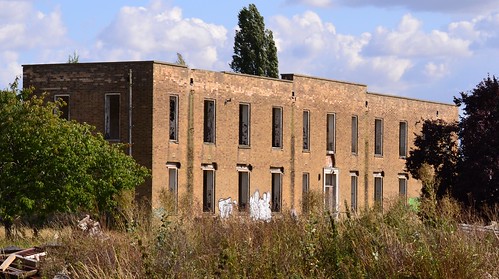
Any of these airfield developments had to be in line with guidelines laid down by both the Royal Fine Arts Commission and the Society for the Preservation of Rural England, hardly what you’d want in such difficult times! These restrictions however, would initiate a building design that would initially be both functional and aesthetically pleasing, with standard designs varying only through local conditions (suppliers of local brick for example). In the early schemes a ‘Georgian’ style of architecture was chosen for all permanent brick buildings, distinguished by their pillars and ornate archways, often seen on the entrances to Officers Quarters.

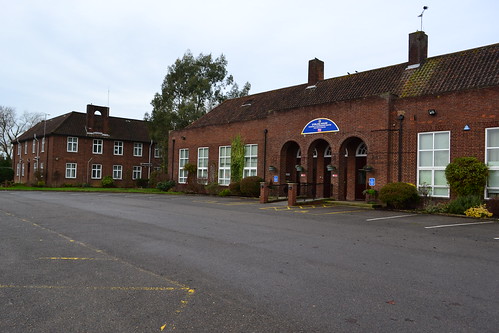
RAF Stradishall

The Officers Quarters at RAF Stradishall were reflective of the types built during war-time under Scheme A

Officer's Quarters now called 'The Gibson Building'.

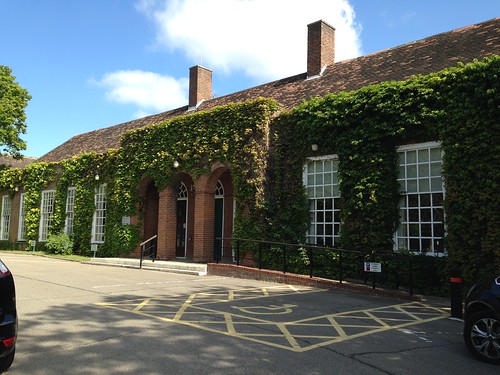
Standard designs allowed for replication across numerous airfields, the idea being an officer could lift his room from one site and drop it directly on another. RAF West Malling, (built under Scheme M), reflecting this with Stradishall, (Scheme A), above.

All buildings were constructed from brick with roofing tiles chosen accordingly for the local conditions. As the schemes progressed and brick became scarce, concrete was used as a cheap and strong substitute, certainly for technical buildings but less so for administration and domestic structures.

As each scheme was replaced, any previous buildings would have remained (some modified to the new standard), thus some sites will have had a range of building types, often leading to confusion and a mix of architectural styles. The accommodation areas themselves changed too. In the early war years and as the awareness of air attack increased, accommodation was built away from the main airfield site and outside of the airfield perimeter. Classed as either ‘dispersed’ or ‘non-dispersed’, they were identified by the location of these domestic sites, where ‘non-dispersed’ were within the perimeter, and dispersed were beyond the main perimeter area of the airfield.

Barrack block Type Q (RAF Upwood)

The changing face of Barrack Blocks. A Type Q Barrack block at RAF Upwood, built to design 444/36, to accommodate 3 NCOs and 68 aircraftsmen. Compare this flat-roofed, expansion period building to the later Nissen hut.

In these early stages little consideration was given to air attack, and so ‘non-dispersed’ sites were still being constructed at the beginning of the war. The benefit of these sites being that all personnel were in close proximity, general accommodation buildings often being built around the parade ground, and with all the amenities under one roof. These sites also saw the segregation between officers, sergeants and other ranks along with separate married (many with servants quarters) and single quarters. However, with the outbreak of war and as a result of austerity measures, the building of separate married quarters ceased. Examples of these early non-dispersed designs include: StradishallMarham, Tern Hill, Waddington and Feltwell.

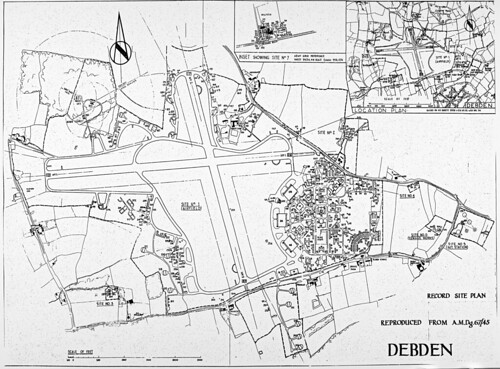
RAF Debden

RAF Debden, a non-dispersed site where accommodation and administrative areas were collectively close to the main airfield site within the outer perimeter (IWM17560).

The layout of these barrack blocks, took on the familiar ‘H’ shape, a design that replaced the initial ‘T’ shape of the post First World War and inter-war years. The ‘H’ Block became the standard design and gave a distinct shape to accommodation blocks on these prewar non dispersed airfields.

As the awareness of the dangers of non-dispersed designs became all too apparent, dispersed sites became the norm, where domestic areas were located a good distance from the main airfield site. Dispersed accommodation could have many sites, depending largely upon the nature of the airfield (Bomber, Fighter etc), when it  was built and whether it was operated by the RAF or USAAF. In these later dispersed schemes, domestic sites became more temporary in nature, whilst some remained as brick, many were built as prefabricated units often as Nissen or Quonset style huts, often due in part to the shortage of brick for building and the speed at which they could be erected.

With the changes in dispersing accommodation blocks away from the main airfield, safety increased but both administrative and operational effectiveness noticeably dropped. It was going to be a fine balance between keeping a safe distance and achieving maximum effectiveness.

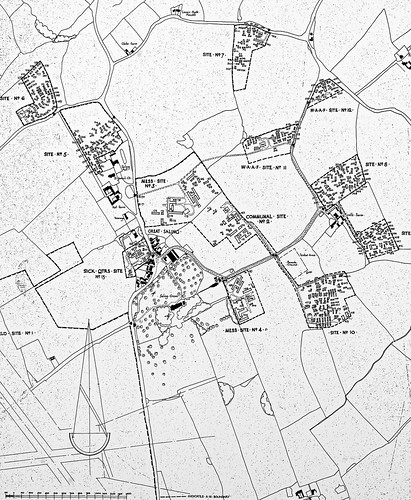
Andrewsfield Accommodation site

A typical dispersed site showing the accommodation areas dispersed well away from the main airfield (bottom left). RAF Andrews Field (IWM UPL17532)

Depending upon local topography, these domestic areas could be situated as much as two miles from the airfield site, wooded areas being utilised where possible to hide the location of huts; blocks were randomised in their position to break up the appearance of housing, and pathways weaved their way round the sites to reduce their visual impact. In most later airfields, a public road would separate the technical and accommodation sites, with as many as thirteen or fourteen sites becoming common place.

The separation of WAAFs from RAF communal quarters also ceased, men and women now allowed to mix rather than having the separate sites for each. As a result many post 1942 sites had fewer dispersed sites then those of pre 1942.

The design of the technical areas also took on a new look. The prewar practice of squadrons offices being attached to the hangar was dropped, these also being placed away from the main technical site, dispersals for ground crew or waiting pilots were spread about the perimeter so airmen could be closer to the aircraft but far away enough to be safe in the case of attack. This led to a number of buildings appearing on the outer reaches of the airfield, along perimeter tracks and near to hardstands, often these were brick, small and square, others more temporary.

Further changes occurred with the reduction in available materials. These changes have given rise to a wide variation in building design, again many airfields having a variety of buildings using different materials.

Initially, buildings built of brick were strong and commonplace, but as this became both scarce and time-consuming to build, alternative forms were found. Timber followed on, but it too proved to be time-consuming to manufacture, and by 1940 acutely rare also.

A range of materials were looked into, using a mix of timber and concrete, plasterboard and concrete, but they were all below the Air Ministry standard. Even so, many were accepted as design alternatives and used in temporary building construction.

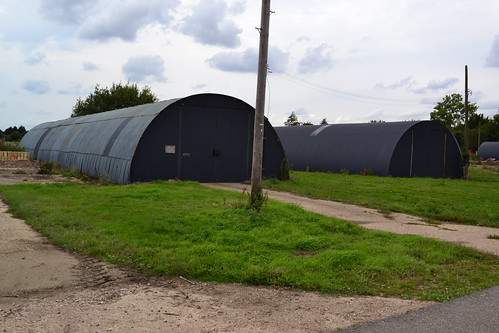
1940 saw the return of the 1916 designed Nissen hut, a curved hut that bolted together in widths of 16, 24 or 30 feet. A cold but effective hut it was commonplace on many airfields as both accommodation huts and technical huts, many being sold post war, and ending up in farmer’s fields many miles from the nearest airfield. With the arrival of the USAAF in 1942-3, they brought with them the Quonset hut, bigger in design than the Nissen, they are mainly distinguishable by their curvatures, the Quonset being semi-circular to the ground whilst the Nissen gave a 210o curvature. This extra curvature gave greater use of ground space, but lacked in overall space compared to it US counterpart.

RAF Matching Green

A Quonset hut at Matching Green. Note the curvature at ground level.

Nissen Hut on Acc. Site

The Nissen hut had a larger curvature giving greater ground space – RAF Fersfield.

Even this material became in short supply, metal being scare and urgently required for the building of military hardware. In 1942 the Ministry of Works took over control of hut design, manufacture and supply, and various new designs were brought into play. Asbestos became popular again, with the US being able to supply large quantities of the material. Uni-Seco Ltd, Turners Asbestos and Universal Handcraft being examples introduced at this time.

The final design to be used, was that of the Orlit, a reinforced concrete panel and post design that slots together to form the walls and roof. Also know as the British Concrete Federation (BCF) design they were quick to erect and lasted from many years. This type of design was used for emergency housing in the post war period and has since proven to be degrading to the point that some of these properties have been condemned.

Thus the architecture of airfield buildings took on many guises, from permanent brick designs, through timber, timber and plasterboard mixes, various metal design, asbestos and finally concrete, all of which gave a change in shape and design examples of which could appear on many airfields. The most common surviving examples today being the Nissen hut.

In the next section we shall look at the runway, the very heart of the airfield and often the defining factor in its designation.

Warning over Airfield Closures.

A recent report on the BBC has highlighted a number of military airfields that are set to close over the next six years, with the potential loss of thousands of jobs. However, the threat is much wider than that, and an all-party group have now highlighted the issue, putting pressure on the Government to take action before the situation becomes extremely serious.

In the report, the BBC say that the all-party group on general aviation, labels airfields as “national assets“, and that once closed they “will never be replaced” – a statement primarily based on the complex planning system currently operating in the UK.

Many of the sites identified by the BBC have already been reduced to a holding status, or with minimal military activity anyway. In most cases military flying has already ceased and in some cases, has been so for a number of years. So why are the all party group so concerned?

As highlighted previously, this is all part of a massive cost cutting exercise and streamlining of Britain’s armed forces, a move that will not only save money for the Ministry of Defence, but provide valuable space for much-needed new housing projects across the UK.

Military airfields not only employ armed forces personnel but they also employ a large number of civilians.  Many of these people live locally, and provide a great deal of income to the local economy. As such, many small towns, for example Mildenhall, could be seriously affected by any such closure of its military base. In the event that a new airfield be required, the cost of it would, even if possible, run into millions of pounds, and would take a considerable time to complete. At a time when Britain and her allies were facing increased threats from foreign nationals, is this not perhaps a dangerous policy to be considering at this particular moment in time?

Furthermore, the issue here is not just military airfields, but Britain’s airfields in general. The all-party group, led by the Right Honourable Grant Shapps MP, aims to promote jobs and growth throughout General Aviation in the UK. The group currently (April 2018) contains 150 parliamentary members, which is a record number of members, and one that highlights the depth of feeling amongst its associates.  The group’s primary aim, which covers four areas of aviation: Airfield, Airspace, Tax and Regulations and Heritage, is to safeguard Britain’s network of airfields regardless of their size or status.

The BBC report states that many of those airfields highlighted are also used by both private pilots and particularly flight training firms, who are having to move their operations abroad due to lack of suitable airfields in the UK. Along with other ‘non-commercial’ flying activities (general aviation), these account for “£3bn a year to the UK economy“, the BBC says citing Government figures.

Whilst both military and general aviation airfields are the focus of this report, there are also wider issues at stake here. Figures quoted by the group show that the closure of Britain’s (civilian) General Aviation airfields not only affects the £3bn Gross Value Added (GVA), but directly affects over 38,000 people employed largely in the Science, Technology, Engineering and Mathematics (STEM) roles. These activities they say, “provide the foundation for the much broader £60.6bn UK aviation sector“.

The general aviation situation at the moment, according to the all-party group, shows that in Surrey for example, every licensed airfield is under threat, whilst in Hertfordshire there is only one remaining licensed airfield, and in twenty-two counties across the whole of the UK, there are no licensed airfields whatsoever.

In terms of heritage, many of these airfields, and those that have closed already, are former World War Two sites, and as such have an immense  historical value to them. As we have seen many times already, many of these airfields are no longer in existence and many have been reduced to mere shells of buildings with no memorial, or little recognition of the human sacrifice made from them.

With the closure of airfields comes the knock on effect of air displays, which since the tragic events at Shoreham, have become prohibitively expensive. Owners of historic jet aircraft for example, are having to sell them abroad as they can no longer afford to fly them in this country. The drain on flying examples could, they say, lead to there being no examples of post war models left flying in this country at all. Even military supported fleets e.g the Battle of Britain Memorial Flight, the Royal Navy Historic Flight and the Army’s Historic Aircraft Flight, are having their ability to perform at airshows reduced by Government cutbacks. This is particularly worrying they say, as evidence shows that a considerably large number of armed forces recruits are gained through airshow attendance.

Promoting general aviation, and particularly Britain’s rich and diverse aviation heritage across the UK, also falls to the numerous museums located around the country.  The majority of people they say, are within an hours drive of at least one aviation museum, and whilst the majority are on former wartime sites in the east and south of the country, this figure broadly applies to the whole of the UK; one I think you’ll agree is both astonishing and reflective of the general interest in aviation in this country.

The national interest in aviation has also been heightened by the current anniversary of the founding of the Royal Air Force on April 1st 1918, but notwithstanding this, visits to these museums accounts for an estimated 2.5 million visits a year, generating over £40 million of heritage tourism revenue – a very significant figure indeed.

The purchase and storage of static aircraft for these museums is also a costly one, rents, hangar space and ground running costs are ever-increasing. Aircraft themselves are not cheap, and few museums can ill-afford to update ‘stock’ with models that are becoming more rare with each passing day. New or more recent examples are also at the base of the argument; with the forthcoming withdrawal of the Tornado for example, how many will be ‘offered’ to local small-scale museums at a reasonable price rather than dealers who will pass them on to foreign or large-scale buyers.

Furthermore, many of these museums, house archives and personal records of those who served during many of the conflicts this country and her allies have been involved in over the last 100 years. Allowing these organisations to prosper, enables future generations to access records, photographs and information, not only about world history, but in many cases family histories too.

The closure of Britain’s airfields has not just a localised impact, it has a national impact that long-term, could have serious affects not only on the aviation and tourist economy as a whole, but science and technology, the armed forces and historical sources too. Whilst the need for housing must be met, a balance must also be sought where these valuable assets are not simply stripped away and forgotten, but consideration is given to their historical and economic contributions too. We can ill-afford to let our aviation heritage be simply removed without due consideration of the financial, economic and historical consequences.

Some of the airfields currently listed as ‘under threat’ include:

Andrewsfield
Blackpool
Bourn
Deenethorpe
Dunsfold
Elvington
Halfpenny Green
Kemble
Long Marston
Manston
Alconbury
Molesworth
Mildenhall
Chalgrove
Colerne
RAF Henlow
RAF Hullavington
RAF Wyton
RAF Wethersfield
RMB Chivenor
Linton-on-Ouse
RAF Topcliffe
Nottingham City
Old Sarum
Panshanger
Peterborough
Plymouth
Redhill
Rochester
Wellesbourne
Wycombe Air Park
Fairoaks
North Danes
Tollerton
+ 30 other MOD sites

The BBC highlighted the story on April 21st 2018 via their website. (this may not be accessible outside of the UK).

The General Aviation All-Party Parliamentary Group has a website detailing its aims and policies. It also encourages lobbying of MPs for improvements to the planning process and in particular the protection of Britain’s aviation heritage.


The Development of Britain’s Airfields (Part 4).

In Part 4 of the Development of Britain’s Airfields, we take a short look at the construction process and the numerous companies that were involved in building the airfield. Once a site was found in Part 3, compulsory purchase was made and the developers moved in.

Building the airfield.

The creation of airfields was set, each plan was studied, trees, shrubs and hedges were removed, ditches filled and the land leveled to a maximum gradient of 1:60.

First of all to reduce the risk of machinery being bogged down, perimeter tracks were built. This allowed the delivery of heavy loads to any part of the site, and so were originally designed to carry support vehicles rather than aircraft. One reason why so many grassed airfields had hard perimeter tracks.

With such a big workforce being drafted in, accommodation for the workers would be needed, these would generally be the huts that would be used for the aircrews and other personnel on the base once active. Drainage and dry storage was needed as a matter of urgency, and were usually a priority even before the accommodation areas.

RAF Bury St Edmunds (Rougham)

Buildings would be built using a range of materials.

Hiding these enormous excavations was going to a headache for the authorities. How do you hide a building site covering many acres? (Average grassed stations covered 200 – 400 acres whilst those with runways were around 500 acres extending to over 1,000 by the war’s end).  Numerous strategies were tried from painting the ground to covering it with coal dust, even adding wood chip to the concrete surfaces was used all with little real impact. Any spy or reconnaissance pilot worth his salt would have spotted the works and reported back immediately.

Gradually the airfield developed. Workers worked in shifts covering a 24 hour working day, seven days a week, this meant that the construction period was relatively short and the completion rapid. By the end of the war some £200 million worth of work had been carried out involving somewhere in the region of 130,000 individuals including engineering workers, and building sub-contractors.

As the site neared completion, RAF staff would begin moving in. The stores officer or ‘Equipment manager’ would often be first, ordering the necessary supplies to accommodate the forthcoming personnel. He would usually be followed by a NAFFI and a medical officer who would officially declare the site ready for occupation. Once this had been given the ground crews would be brought in, followed by aircrews and the aircraft. Even with a newly opened site, it was rare that it was ever fully finished, often accommodation was rudimentary or cooking facilities limited. In some cases tents were the order of the day until construction was completed. Great emphasis was placed on getting the site open and operational rather than ready. In some cases ground crews, who were otherwise waiting for aircraft to arrive, would take to shovels and picks to complete or improve upon work that had been started on site.

Also the airfield needed naming. Names were usually taken from the nearest village or town, and where confusion might arise from a similar name, it could then be taken from an alternative nearby village. This is why some airfields appear to be quite distant from their respective named locations. Alternatives to this would be geographical features or alternatively local farms e.g RAF Twinwood Farm. The Americans used the system of numbering partly because (a) the American airmen were unable to pronounce accurately some of the English names and were often found getting confused by them, and (b) the American administration system made it easier to use numbers rather than names.

By now the airfield was built, or at least open, the first unit would arrive and airfield defences would be set up. Military personnel would become established and operations would soon begin. All this could occur within months, it was a massive undertaking achieved in very little time.

In the next section we look at the architecture of British airfields, how the idea of replication in design led to architectural developments, and how the demand for materials led to changes in airfield buildings.

The Development of Britain’s Airfields (Part 3).

In Part 3 of this series, we turn from the political scene of Part 2 and look at how airfields were identified, The process and methodology of airfield selection.

Choosing a site.

Choosing an airfield site during these prewar periods was especially difficult as there were many ‘unknown’ factors to predict, a factor in itself that helped determine the needs of each of the various schemes mentioned previously. However, there were a number of airfields already in situ, some used by the military and some used by civilian aviation. As remnants of the First World War, many military sites were inadequate or inappropriate for the growing future needs of the RAF, but with some work, they could be developed into workable sites as the basic infrastructure was already there in place.

As well as these RAF sites, there were also civilian airfields, which the Government considered as potential military airfields. Because civil aviation had grown amongst the wealthier members of society, although not exclusively, this meant that in the pre-war period, there were some 90 airfields*4 owned either by local councils or under private ownership. Many of these were requisitioned by the authorities, but because many were small or located very close to built-up areas, (in 1928 the Air Ministry ‘encouraged’ towns of 20,000+ inhabitants to have a municipal airport), they were not suitable for modern fighter or bomber aircraft. As a result, many of these became training or maintenance sites, some linked to aircraft production facilities, but none were ‘operational’ for fighting units.

A further group of airfields in use at this time, were those of the AA (Automobile Association – better known as a motoring organisation). The AA Landing Grounds were often ex First World War sites located near to hotels and other places of interest to the motorist. Fuel was usually supplied at, or near to, each site, and each one was ‘tested’ by an aircraft on behalf of the AA before it was granted AA status. As these sites were registered, their locations were readily available to the Germans and so they were closed and rendered unsuitable for aircraft. However, land in close proximity was occasionally used, and so a new site would be created in a similar location.

With all these sites available, one would imagine choosing a site and developing it, would be relatively straight forward, but this is far from the truth. Many of these sites were inadequate, and the process of repairing/upgrading or rectifying it was simply not going to be sufficient. Therefore, many new sites were going to be required and the process by which a site was identified, acquired and then subsequently developed was not at all straightforward. In each case the Air Ministry Directorate (AMDGW) and Air Ministries Aerodromes Board would work in very close conjunction with numerous other Government departments and interested public bodies. These would include local Electricity Boards, Drainage Boards, the Geological Survey Department and the local War Agricultural Committee, who were concerned about flooding caused by run-off from the sudden building of large expanses of concrete.

In the first instance, using an ordnance survey map, areas that were below 50 feet above sea level or above 650 feet were generally ignored, the former being prone to flooding whilst the latter suffering high levels of low cloud or hill fog. Next a circle with a radius of 1,100 yards was marked off, this had to be flat with minimal rise in the ground layer. It also had to be free from obstructions and ideally at least three miles away from any other flying location. Next officers from the Air Ministries Aerodromes Board would walk the site, field by field, recording maximum landing distances, and noting any unidentified obstacles, trees, hedges, ditches or more permanent structures that would need removal.

By September 1939, board officials had identified, examined and recorded around 4,000 possible sites in the U.K. Many would be simply filed away never to see aviation of any kind, whilst others would become famous for years to come.

Once a suitable site had been identified and examined, the local geology had to be established where possible. In the pre-war years, no consideration was given to hard runways, they didn’t exist in any real form and were not seen as needed as any aircraft of that time could happily take off from a grass strip. However, in order to prevent aircraft wheels from bogging down, or flooding closing an airfield, well-drained soils were absolutely paramount.

Once the site had been accepted, the land was requisitioned, forcibly purchased using new powers created under the Emergency Powers (Defence) Act 1939. This gave virtually immediate access and ownership of the land – with little notice to the land owner – to the Government. These powers also saw their way to reducing the ‘NIMBY*5 effect, protests against developments being side-lined through political clout.

The next stage in the process was to put the job out to tender. The difficulty here was that secrecy was of the utmost importance, and so little of the detail was released other than an approximate location. As the war progressed, the number of construction companies involved became fewer, and those that were involved more established, prime contractors being Wimpey, Laing, Taylor-Woodrow and McAlpine – all of whom went on to be major construction companies post war. That said, no major airfield would generally be completed by one single contractor, as the whole process required a wide range of skills based operations. As one completed their task, another would come in, sometimes dual operations would be carried out simultaneously. For example taxiways and access roads may have been built by Tarmac, whereas the runway may have been built by McAlpine. Accommodation areas often used ‘Nissen’, or in many USAAF cases, ‘Quonset’ huts, many of these and other ‘standard’ buildings were erected by buildings contractors whereas other more substantial buildings may have been built by John Laing and Co.

By the outbreak of war, 100 sites had been purchased, as the number was relatively small, the board were able to be ‘particular’ in their choice, something that was quickly disregarded as the war progressed.

Airfields are highly labour intensive projects requiring an enormous workforce and extensive heavy machinery, little of which were available in the early 1940s. Irish labour provided the backbone of the initial workforce, whilst heavy plant came in from the United States. At its peak there were some 60,000 men employed on airfield construction, all of whom were unable to spend their time rebuilding the devastated towns and cities of the UK.

As the war progressed, the Royal Air Force Airfield Construction Service began taking a greater role in airfield construction, diversifying away from their original role as repairers of damaged airfields sites. There would be an initial 20 squadrons created to carry out these tasks, with a further 6 being formed later in the war. With squadron numbers ranging from 5001 to 5026, they would be initially involved in the updating of older sites and the creation of ALGs, eventually taking on a much greater responsibility of airfield construction. These squadrons, were of course given great assistance by the well established Royal Engineers.

In 1942, the United States joined the European theatre sending their own Engineer Aviation Battalions to the U.K. Their task was to support these British squadrons by building their own airfields ready for the huge influx of men and machines that was about to arrive. The first site completed by the Americans and opened in 1943, was Great Saling (later renamed Andrews Field) by the 819th engineer Aviation Battalion. Not being experienced in U.K. soils, it was a steep learning curve fraught with a number of initial problems.

Former RAF Andrewsfield

RAF Andrews Field memorial to the 819th Engineer Aviation Battalion.

In 1939 there were only 60 military airfields in the UK, by 1940 this had increased to 280, almost tripling to over 720 by 1945. Between 1939 and 1945 444 airfields*2,4 new airfields were built by these organisations – an amazing feat by any standard. Using almost a third of Britain’s total construction labour force, they were often open and manned within a matter of months rather than years. Building Britain’s wartime airfields was not cheap. Many, like Debach the last USAAF airfield to be constructed, cost almost £1,000,000 to construct.  A small amount compared to the £645, 000,000 it cost to build all 250 US airfields in the UK*5a

This whole process however was not fool-proof. In a number of situations sites were identified and requisitioned, but not developed. In several cases they were partly built, and in others like RAF Cottam, they were completely built but then never occupied. Some airfields were identified for USAAF use, only to be declined and then handed over to their RAF counterparts. Some US bases were never actually started but remained named and therefore official sites even though they remained as farmers fields!

The lead up to war led to a massive change in the British landscape. Keeping airfields secret led to many being built in remote areas and away from major towns. Little did the inhabitants of these quiet little villages know, but their population was about to increase, in some cases by thousands.

In the next section we look at how the airfield was built, the process of construction and the difficulties faced during this phase.

Sources and further reading. 

*2 Smith, D.J., “Britain’s Military Airfields 1939-1945“, Patrick Stephens Limited, 1989

*4 Francis, P., et al, “Nine Thousand Miles of Concrete, Historic England in Conjunction with the Airfield Research Group (ARG). pdf document Published 15/1/16 via website accessed 2/1/18

*5 NIMBY – Acronym used to describe the objections of local planning projects. (Not In My Back Yard).

*5a Wilson. K., “Blood and Fears – How America’s Bomber Boys and Girls in England Won Their War.”, Weiden & Nicolson. (2016)

The Development of Britain’s Airfields (Part 2).

In this series of posts we look at the development of Britain’s airfields and how they developed over the years. We move on from Part 1, and the “Road to War”, to look at the Political response to Germany’s build up and the development of the airfield. We focus on the expansion period 1934-1939, and the political moves that helped shape the airfields that are found in Britain today.

The expansion period and airfield development.

In this, the expansion period 1934-39, airfield development would become a prime factor in the RAF’s own development.  The driving force behind this was the need to increase the numbers of front line aircraft, both fighters and bombers, if Britain was to be able to match Germany’s growing armed forces and her desires over Europe. To this end, a number of schemes were created, each one building upon the previous through  adaptation of technological development, design improvement and political pressure. A continuation of updating meant that the face of the British airfield would change considerably from 1934 to the end of the war in 1945. This development would then go on post war as the world entered the jet age and nuclear deterrent.

Whilst many of Britain’s original airfields dated back to the First World War, the vast majority had vanished, (of the original 301 only 45 remained and of these 17 were civil*2) the rest being sold cheaply in the reorganisation of the post war RAF. Of those that did remain, many were poorly kept, the permanent huts that had been built were in poor condition and flying surfaces totally inadequate for the heavier aircraft that were envisaged.  Many of these airfields were located around London (including Biggin Hill and North Weald) and were built on a clay subsoil, a soil that holds water and led to numerous accidents as aircraft landed badly. The RAF began to apply pressure on the Government, but with no real direction, there was little hope of achieving anything more than lip service.

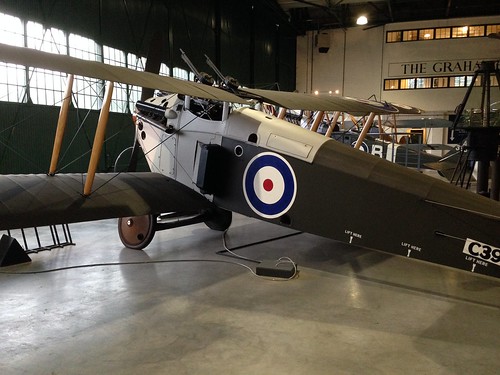
RAF Museum Hendon

Early biplanes formed the backbone of the interwar years.

The Government finally realising that change was needed, formed a new department, whose role of executing these new plans it fell to. The Air Ministry Directorate General of Works (AMDGW) under the control of Ernest Holloway, oversaw the process with the new Air Ministries Aerodromes (later Airfield) Board, being responsible for identifying the new airfield. The Lands Branch of the Air Ministry would purchase the land, and then the construction, development and maintenance would be carried out under contract, by civilian organisations, to the Air Ministry.

This process took airfield design through a series of successive alphabetically listed schemes commencing with ‘A’ (not to be confused with Class ‘A’ airfields that emerged much later in 1942) progressing through to ‘M’. Due to the rapid changes in these designs though, not all were implemented, many being absorbed into subsequent models before they could be administered. The future development and expansion of the RAF would be built-in to these schemes, restricted initially by the monetary cost of such a plan. But the overall  aim would be to build the RAF up to full strength within eight years (1942).

The key to these designs was continuity and replication. By creating a series of standard design drawings for everything from latrines to heating systems, hangars and runways, airfields could be ‘mass produced’ with ease, saving both time and money, which was paramount if the RAF was to be ready for the forthcoming war.

In essence, these schemes increased targets for aircraft numbers, including training facilities and airfield design:*2,3,4

Scheme A – (adopted in July 1934) is the scheme that set the bench mark by which all future schemes would develop, and called for a front line total of 1,544 aircraft within the next five years. Of these, 1,252 would be allocated specifically for home defence. This scheme was responsible for bringing military aviation back to the north of England, Norfolk and Suffolk, of which Marham (the first), Feltwell and Stradishall were among the first completed. These airfields were designed as “non-dispersed” (or compact) airfields, where all domestic sites were located close to the main airfield site, and not spread about the surrounding area as was common practice in war-time airfield designs. At this stage, the dangers of an air attack were not being wholeheartedly considered, and such an attack could have proven devastating if bombs had been accurately dropped. It was thought that by having personnel close by, airfields would run both economically and efficiently, and of course they could more easily be protected from ground forces.

Scheme ‘A’ would also introduce the idea of standard building designs, in which all new airfields (and older original airfields) would now be built to.

Scheme B – was never submitted to Government

Scheme C – adopted May 1935 following Hitler’s boast to Anthony Eden that the German Air Force had surpassed the RAF’s in number, a claim that has since been discounted. This would develop bomber bases within flying distance of Germany (notably Lincolnshire and Yorkshire), and proposed creating a further 70 bomber and 35 fighter squadrons accommodating 1,500 front line aircraft within two years.

Scheme D – was never submitted to Government

Scheme E – was never submitted to Government

Scheme F – replaced Scheme ‘C’ and was approved in March 1936. Scheme ‘F’ expanded the defence force, further increasing front line numbers to 1,736 with a foreseeable number of 2,500 by 1939. This scheme saw the creation of additional factories in close proximity to the already adopted car manufacturing plants in the industrial midlands. A move that was intended to assist with the supply of new aircraft and aircraft components. Such was the industrial output at this time that Aircraft Storage Units (ASU) had to be specially set up utilising land on already established Flying Training Schools. These ASU stations would be specifically created to assemble or disassemble aircraft for transport to fighter bases, either within or outside of Britain. Scheme ‘F’ would also create further new front line airfields, examples including: Debden, Upwood, Scampton and Dishforth, with further updating being implemented at previously built airfields.

Scheme G – was never submitted to Government

Scheme Hreached proposal at the end of 1936 and would have increased front line strength at the expense of the reserves, and so was rejected. It was at this point that the ADGB and associated bodies were split into the four aforementioned commands each headed by a Commander-in-Chief (CIC)

Scheme I – was not used

Scheme Jonly reached proposal, but would have provided the RAF with 2,400 front line aircraft. It was considered too expensive and rejected in lieu of Scheme ‘K’.

Scheme Kreached proposal in March 1938, but was considered too small following the German’s annexation of Austria. A further review was requested which accelerated the expansion, and was proposed a month later as Scheme ‘L’.

Scheme L – passed by the Government on 27th April 1938, it called upon industry to produce the maximum output possible over the next two years. Superseded by ‘M’ after the Munich crisis, new airfields included: Binbrook, Leeming, Middle Wallop, and Horsham St. Faith. This scheme required 2,373 front line aircraft in 152 squadrons, and focused on fighter Command; in particular, increasing the number of fighter pilot training units. Scheme ‘L’ also called for increased accommodation facilities to allow for this increase in trainee pilots, and it called for new RAF Hospitals, the first of which was at Ely in Cambridgeshire.

Scheme M – approved on 7th November 1938 and called for 2,550 front line aircraft by March 1942. Airfield examples included: Swanton Morley in Norfolk, Coningsby in Lincolnshire and West Malling in Kent. This scheme introduced the ‘J’ and ‘K’ hangars, implemented as part of austerity measures, one of the few permanent buildings now on site.

By the outbreak of war the RAF had a force that equalled less than half that of the Luftwaffe, Fighter Command possessing only 1,500 aircraft (less than was required under Scheme ‘F’), of which many were already outdated or inadequate. Bomber Command had 920 aircraft, but nothing was bigger than a twin-engined aircraft with limited capabilities.

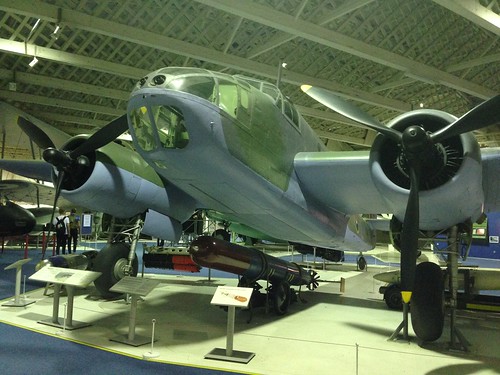
RAF Museum Hendon

The RAF’s front line bombers were twin-engined with limited capability.

The four Commands created out of the ADGB were also undergoing dramatic change, with aircraft being distributed more appropriately and groups being formed to streamline operations. Whilst still far below the levels at which the Luftwaffe were operating, the RAF had over the last few years seen a major reconstruction process, both in terms of aircraft and airfield development, along with major changes in the Air Force’s structure.

As aircraft were designed to perform different duties, airfields within their commands would also differ in their operation and construction. Hangars or watch offices for example, would be designed but modified depending upon the nature of the airfield they were servicing. Standard buildings would be altered to suit the different needs of the different duties, and airfield design would take a change in direction, the non-dispersed site being discarded for the safer, but less efficient, dispersed site.

As the years progressed, further changes to airfield development would occur as new, larger and heavier aircraft were developed. The four engined heavies: Stirling, Halifax and Lancaster, determining new designs and new requirements. The entrance of the USAAF in the European theatre also played a part in airfield design and development, and by 1942, a new standard would be devised by which all future airfields would be built.

The Class ‘A’ airfield became the standard airfield design for bomber airfields, with many fighter airfields, training and temporary airfields remaining either as grass or using a form of steel matting. Twelve different types of matting were developed during the war, the most common being – Sommerfeld Track, Pierced Steel Planking (PSP – also called Marston Mat), or Square Mesh Track (SMT). The Class A was determined primarily by its runway layout and measures, formed around three intersecting runways at 60o to each other, the main was 2,000 yards long with two subsidiaries of 1,400 yards, each 50 yards wide. An extension of 75 yards was provided alongside the runaway to allow for emergency landings. In addition, another grass strip clear of all obstacles was also provided, these measured 400 and 200 yards respectively.

The Class A would set the standard from now on, the British airfield was now a major geographical conurbation. They were now like small towns, with cinemas, gymnasiums and other recreational facilities, they had dispersed accommodation areas, technical sites, large aircraft maintenance sheds and hard runways that only a few years earlier were unheard of.

Each of these schemes brought new requirements for airfield designs; their layouts and buildings were changing almost as fast as aircraft development. The airfield had finally evolved.

In the next part we look at the way in which a site was chosen, the number of agencies involved and the criteria for airfield location.

Sources and further reading. 

*2 Smith, D.J., “Britain’s Military Airfields 1939-1945“, Patrick Stephens Limited, 1989

*3 “Norfolk Heritage Explorer pdf document published by Norfolk County Council – via  website accessed 2/1/18,

*4 Francis, P., et al, “Nine Thousand Miles of Concrete, Historic England in Conjunction with the Airfield Research Group (ARG). pdf document Published 15/1/16 via website accessed 2/1/18

The Development of Britain’s Airfields (Part 1).

The development of Britain’s airfields has been both rapid and complex. The design, layout and specific requirements of airfields changing as the need for areas suitable for larger and more powerful aircraft arose. From the early days of flight through the expansion period of 1934 – 1939, and on into the cold war, Britain’s airfields have become iconic symbols not only of Britain’s defence, but also the rapid development of air travel.

The range of airfields is as wide as their developmental history: fighter; Bomber; Coastal Command; Emergency Landing Grounds (ELG); Relief Landing Ground (RLG); Satellite Landing Grounds (SLG); Advanced Landing Grounds (ALG) and Cub Strips, not to mention the fake ‘Q’ sites along with the various training, glider and ATC sites.

It is a very detailed and complex subject, and one in which there have been many valuable and in-depth texts written. It is a subject that is far too detailed to cover in its entirety here, but by focusing on the main features of airfield development, we can at least shed some light on the huge undertaking that reshaped the British landscape, and whose effect has been long-lasting, becoming the widespread topic of interest it is today.

In the following series of eight posts, we look at the development of these airfields, the main structures that are associated with them and how Britain’s airfields grew from basic fields to major conurbations as a result of the direct threat of war.

We start with the build up to war and the growth of the Royal Air Force from 1918.

Britain’s Road to War.

The Royal Air Force was formed on April 1st 1918 through an act of Parliament that saw its predecessor, the Royal Flying Corp, mutate into what has become not only one of the premier fighting forces of the world, but also the oldest Air Force in the World. However, in the post-war era following the First World War, political opinion was very much against the continuation of the RAF, feeling that it was exhausting an already depleted national economy and contravening a stern non-rearmament policy. In addition, an apathetic and vehemently pacifist post war public was also hard to convince that a third force, which was seen as ‘weaker’ than its two older sisters, was really necessary.

Two men, Winston Churchill (then Minister for War) and Air Marshal Trenchard (as Chief of the Air Staff), crusaded on behalf of the RAF, seeing it as the valuable asset it had become. In the Trenchard memorandum of December 1919, Trenchard outlined the biggest re-organisation of the Royal Air Force in history, a change that included everything from insignia and uniforms, to buildings and training. It was a change that would establish the RAF as an air force capable of mobilisation and expansion at a moments notice.

To achieve these goals, Trenchard would set up a rigorous training plan, with stations specifically designed to deal with the various aspects that would be needed; an Air Force Cadet College at Cranwell, a flying training school for Air Force Staff in Andover, a further scheme for short-service commissions and a technical college at Halton (set to close in 2022) in Buckinghamshire.

RAF Cranwell

RAF Cranwell in Lincolnshire remains the Officer Training College today.

This re-organisation would be a re-organisation for survival, and would involve the disbandment and demobilising of vast numbers of men and women; the subsequent rundown of the RAF being both rapid and immediate. By March 1920, in excess of 23,000 officers, 21,000 cadets and 227,000 other ranks and been demobilised and returned to ‘civvy street’. The new RAF was small, formed with just 3,280 officers and 25,000 other ranks. Assets too were stripped, airfields were sold off and hardware disposed of, but the Air Force was going to survive as an independent fighting force that would become a major peacekeeping force within the next few decades.

In the 1920s, and even though limited by the 10 Year Rule on defence expenditure, Trenchard envisaged a build up of the Air Force, incorporating both fighters and bombers, to a level that would be both powerful and dominant. He set a target of some 52 Home Defence Squadrons, but his continued battles with the Army, Royal Navy and politicians alike, meant that this figure would take many years to achieve and Britain would be poorly protected in the case of attack.

In a statement by the Secretary of State for Air, Sir Samual Hoare, at a meeting of the Imperial Conference on October 19th, 1923, Sir Samual highlighted the inadequate numbers that were present for Home Defence, he said:

“When the Navy and Army requirements were met and the squadrons provided for the Air Command in Iraq, and provision made for training in Great Britain, the machines left for home defence in Great Britain were altogether insignificant. I may give as an instance of this insignificance the fact that a few months ago at the height of the Turkish crisis, when we had sent two Royal Air Force squadrons to Constantinople, we were left with only twenty-four first-line machines actually available for home defence against air attack.”

Whilst slow, the 1920s and early 1930s did see the RAF expand, achieving 65 squadrons by January 1st 1935, mostly manned by fully trained reserves. This did however, do little to bolster the front line numbers of available fighters, and as demands for spending cuts in the world’s depression started to bite, this build up began to slow even further.

It was during these early 1930s that movements in Germany, in particular with Hitler and the rise of the Nazi Party, gave rise to an uneasy feeling across Europe; a feeling that would lead to new policies being implemented, policies that would refuel the impetus of Britain re-arming its major forces in the latter half of the 1930s.

With events like the Schneider Trophy and displays at Hendon capturing the imagination of the public, the Government saw these as a way to develop new faster and more agile aircraft, and as a pedestal on which to put both Britain and the RAF. These air displays continued until 1937, when a war with Germany became evermore likely, and the previously formed rearming policies began to take shape.

German boasting of its redevelopment was barely enough to hide the fact that it was rearming as early as 1932, and the speed at which this was happening would far outstrip the RAF’s meagre numbers in the years following the Nazi’s rise to power in 1933. In these early years, Britain’s bomber strength was as low as five night, and six-day bomber squadrons, each one operating limited, slow and cumbersome biplanes. Aircraft that were no match for even the reduced force that Germany was to front during the controversial Spanish Civil War.

Germany’s rearming was occurring at an alarming rate, and after Goring’s inauguration as head of the Reich Commission for Aviation, a formal request for the purchase of British aircraft, by Goring, was refused, but ironically not the supply of two military supercharged aero-engines that were to be built under license in Germany! Britain was not alone in this action though, the USA also sold Germany contravening merchandise during the 1930s, 19 aircraft and 569 aero-engines crossed the Atlantic, with most of these being supplied during 1934.*1 Perhaps even more astonishingly, the World War 1 German Ace Ernst Udet visited the US in the 1930s, where he developed not only ground attack and dive bombing techniques, but purchased two Curtiss Hawk II biplanes, which were taken back to Germany for evaluation for future dive bomber designs. This action eventually led to the Germans developing the Junkers Ju-87, famously known as the ‘Stuka‘, an aircraft that wreaked fear and havoc across the European continent.

Although the depression of the 1930s held German production back, the number of air-frame plants rose from 2,813 in January 1933 to almost 38,000 in 1935. This rearming was becoming so rapid, that in 1933, six new aircraft manufacturers joined the seven already established – all diversifying from other engineering areas to begin aircraft manufacture. By 1935, the total number of air-frame and aero-engine plants had risen to an astonishing 53,865, an increase of nearly 50,000 in just two years.

This massive increase was highlighted in a letter from Winston Churchill to Stanley Baldwin (three times British Prime Minister) on March 17th 1935*8, in which Churchill pointed out that:

“I believe that the Germans are already as strong as we are and possibly stronger, and that if we carry out our new programme as prescribed Germany will be 50 per cent stronger than we by the end of 1935 or the beginning of 1936.”

This increase eventually led to a number of changes in Britain. One such change was the demand for a twin-engined aircraft capable of delivering a 1,000lb bomb up to 720 miles away. Whilst not record-breaking, specification B.9/32 led to both the Wellington and the Hudson being developed, each a major step forward from the biplanes in RAF service at that time.

A further major change that the German action brought about, occurred during the mid – late years of the 1930s (1934-1939) where Britain saw, what is now commonly referred to as, “the Expansion Period”, a period in which the RAF began to increase its numbers also. It was during this period (between May and July 1936) that the idea of Trenchard’s small elite force would become four; the Air Defence of Great Britain (ADGB) along with No.1 Air Defence Group and other administration and command groups, would be disbanded and reformed as four new commands: Fighter Command (HQ at Stanmore), Bomber Command (HQ at Uxbridge), Coastal Command (HQ at Lee-on-Solent) and Training Command (HQ at Ternhill). In addition, new aircraft were going to be required, particularly fighters and heavy bombers, and to support these new aircraft, a massive support network:  new training facilities; aircraft and aero-engine factories; storage facilities; armaments factories; flying schools, and of course a range of new airfields would be needed. Running in conjunction with this would be research and development. The RAF’s budget, which included research and procurement, rose from £17.5m in 1934-5 to £74.5m by 1938-39, a massive injection of cash to help develop these new ideas.

This demand would begin the process by which Britain would develop its airfields and air force, kick starting the huge economic and technological change that would see Britain move from the simple bi-plane to jet technology, and airfields that covered not just a few, but several thousands of acres of land across the British landscape.

Britain had entered the arms race with Germany, and it would be a race to the death.

In the second part we examine the political response focusing on the expansion period 1934-1939, and how Britain’s airfields changed as a direct result.

Notes, sources and further reading.

CAB\24\164 Note from the Meeting  of the Imperial Conference on October 19th, 1923. (National Archives)

*1 Dancey, P.G., and Vajda, A-V, “German Aircraft Industry and Production, 1933-45“. 1998, Airlife Publishing Ltd

*8 Churchill, W.S., “The Second World War Volume I – The Gathering Storm“, Cassell, 1948

RAF Stradishall – The early years.

Moving on from RAF Chedburgh, we continue south-west along the A143 to another former bomber airfield, and the parent station of Chedburgh. This next site has a history that dates back to the late 1930s and is one that has many of its original buildings still in situ, many thankfully still being used albeit by a completely different organisation.

The next stop on this trail is the historically famous airfield the former RAF Stradishall.

RAF Stradishall.

RAF Stradishall has a rather unique history, it was one of the first to be built during the expansion period of Britain’s Air Force beginning in 1935.  A series of Schemes, this programme was to develop the RAF over a period of years to prepare it for the forth coming war; a series of schemes that continued well into the war and created the basis of what we see today around Britain’s forgotten landscape.

This first scheme, Scheme ‘A’ (adopted by the Government in July 1934), set the bench mark by which all future schemes would develop, and called for a front line total of 1,544 aircraft within the following five years. Of these aircraft, 1,252 would be allocated specifically for ‘home defence’. This scheme brought military aviation back to the north of England, and to the eastern counties of Norfolk and Suffolk. Under this scheme, a number of airfields would be built or developed, of which Marham (the first completed under these schemes), Feltwell and Stradishall were among the first. These airfields were designed as “non-dispersed” airfields, where all domestic sites were located close to the main airfield site, and not spread about the surrounding area as was common practice in later airfield designs. At this stage, the dangers of an air attack were not being whole heartedly considered, and such an attack could have proven devastating if bombs had been accurately dropped.

Thus in 1938 Stradishall was born, its neo-Georgian style buildings built-in line with common agreements and local features. Within the grounds of the airfield accommodation blocks provided rooms for just over 2,500 personnel of mixed rank, and all tightly packed in within the main airfield site.

In these pre-war years, the development of hard runways and large airfields was a new phenomena, hard surfaces being a new aspect still very much a topic of considerable controversy. By now, Bomber Command had realised that the new era of bombers would call for hard runways on its airfields, and so they pushed the Government on allowing these to be developed. However, before any firm decisions could be made, trials would need to be carried out to determine whether or not they were indeed needed and if so, how they should be best constructed.

The test to determine these needs was to take a Whitley bomber, laden to equal its full operational weight, and taxi it across a grassed surface.  A rather primitive assessment, it was intended to ascertain the effects of the aircraft on the ground beneath. Trials were first carried out at Farnborough and then Odiham, and these were generally successful, the Whitley only bogging down on recently disturbed soils. Further trials were then carried out here at Stradishall in March 1938, and the results were a little more mixed. Whilst no take offs or landings took place during these trials, the general agreement was that more powerful bombers would have no problems using grassed surfaces, as long as the ground was properly prepared and well maintained. All well and good when the soils were dry and well-drained.

However, Dowding continued to press home the need for hard surfaces, and by April 1939, it had finally been recognised by the Air Ministry that Dowding was indeed right. A number of fighter and bomber airfields were then designated to have hard runways, of which Stradishall was one. These initial runways were only 800 yards long and 50 yards wide, extended later that year to 1,000 yards long, as aircraft were repeatedly running off the ends of the runways on to the grassed areas. Over the years Stradishall would be expanded and further developed, its longest runway eventually extending to 2,000 yards.

Stradishall was also one of the first batch of airfields to have provisions for the new idea of dispersing aircraft around the perimeter. To meet this requirement, hard stands were created to take parked aircraft between sorties, thus avoiding the pre-war practice of collective storage, and so reducing the risk of damage should an attacking force arrive – a practice not necessarily extended to the accommodation! By the end of development, Stradishall would have a total of 36 hardstands of mixed types, the extension of the runway being responsible for the removal and subsequent replacement of some. For maintenance, five ‘C’ type hangars and three ‘T2’ hangars were built, again standard designs that would be later superseded as the need required.

As Stradishall was one of this first batch of new airfields, it would also be used for trials of airfield camouflaging, particularly as the now large concrete expanses would reveal the tell-tale sign of a military airfield. On wet days the sun would shine off these surfaces making the site highly visible for some considerable distance. Initial steps at Stradishall used fine coloured slag chippings added to the surface of the paved areas. Whilst generally successful, and initially adopted at many bomber stations, Fighter Command refused the idea as too many aircraft were suffering burst or damaged tyres as a result of the sharp stones being used. Something that is reflected in many casualty records of airfields around the country.

RAF Stradishall

The Type ‘B’ Officers Mess at Stradishall is now a Prison Officers Training Facility. The Officers quarters are located in wings on either side of the mess hall.

On opening Stradishall would fall under the command of 3 Group Bomber Command, and would operate as an RAF airfield until as late as 1970, being home to 27 different operational front line squadrons during this time. Many of these would be formed here and many, particularly those post-war, would be disbanded here, giving Stradishall a long and diverse history.

The first squadrons to arrive did so on March 10th 1938. No. 9 Sqn and No. 148 Sqn (RAF) arriving with Heyford III and the Vickers Wellesley respectively. 148 Sqn replaced these outdated Wellesleys with the Heyfords in November, and then again replacing these with both the Wellington and Anson before departing for Harwell on September 6th 1939. No. 9 Sqn also replaced their aircraft with Wellingtons in January 1939, themselves departing on July 7th that same year.

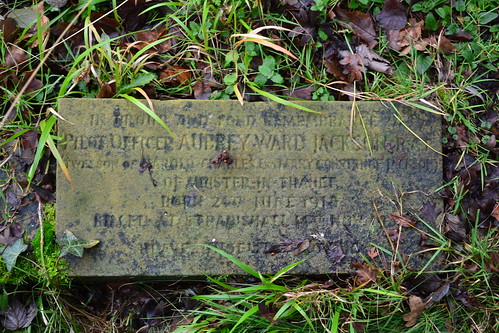
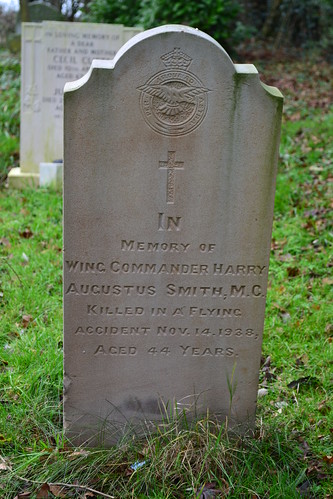
It was during a night training flight, on November 14th 1938, that Wing Commander Harry A. Smith MC along with his navigator Pilot Officer Aubrey W. Jackson would be killed in Heyford III K5194, when the aircraft undershot the airfield striking trees outside the airfield boundary. The crash was so forceful that the aircraft burst into flames killing both airmen.

Wing Commander Smith MC qualified as a pilot whilst in the Royal Flying Corps in 1916, and was the first of his rank to be killed since the inception of Bomber Command in July 1936. He had been awarded the Military Cross ‘for gallantry and distinguished service in the field‘ in 1918.

Pilot Officer Jackson was appointed for a Short Service Commission in January 1937, and later a Permanent Commission. He was only 20 years old at the time of his death.

Both crewmen are buried in Stradishall’s local cemetery.

St. Margaret of Antioch, Stradishall

A very much less than grand grave stone marks the plot of P.O. Aubrey W. Jackson, killed on November 14th 1938 on a night training flight.

St. Margaret of Antioch, Stradishall

Wing Commander Smith, killed alongside P.O. Jackson on a night training flight. He was the first of his rank to die since the formation of Bomber Command.

Two more squadrons arrived here in 1939. No. 75 Sqn operated the Wellington MK. I from July, departing here just after the outbreak of war in September, and 236 Sqn flying Blenheims between the end of October and December that same year. 236 Sqn were reformed here after being disbanded in 1919, and after replacing the Night-Fighter Blenheims with Beaufighters, they went on with the type until the end of the war and disbandment once more. Almost simultaneously, 254 Squadron reformed here in October 1939, also with Blenheims. They remained here building up to strength before moving to RAF Sutton Bridge in Lincolnshire in December – one of many ‘short stay’ units to operate from Stradishall during its life.

This pattern would set the general precedence for the coming years, with bizarrely, 1940 seeing what must have been one of the shortest lived squadrons of the war. No. 148 Sqn being reformed on April 30th with Wellingtons only to be disbanded some twenty days later!

This year saw three further squadrons arrive at Stradishall: 150 Sqn on June 15th, with the Fairy Battle (the only single engined front line aircraft to be used here during the war), whilst on their way to RAF Newton; a detachment of Wellington MK.IC from 311 Sqn based at East Wretham (Sept); and 214 Sqn flying three variants of Wellington between 14th February 1940 and 28th April 1942. No. 214 Sqn would be the main unit to operate from here during this part of the war, and would suffer a high number of casualties whilst here.

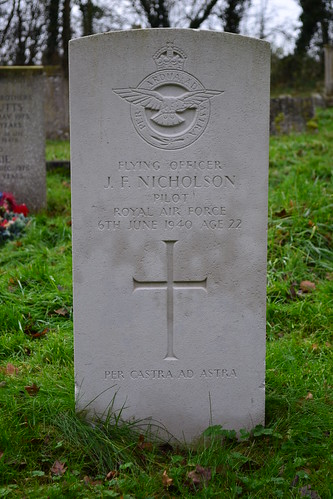
On June 6th 1940, 214 Sqn Wellington IA ‘N2993’ piloted by F/O. John F. Nicholson (s/n 70501), would take off on a routine night flying practice flight. During the flight, it is thought that F/O. Nicholson became blinded by searchlights throwing the aircraft out of control. Unable to regain that control, the aircraft came down near to Ely, Cambridgeshire, killing the five crewmen along with an additional Leading Aircraftman (LAC) Maurice Peling who had joined them for the flight. A tragic accident that needlessly took the lives of many young men. F/O. Nicholson is buried in the local cemetery at Stradishall, whilst the remainder of the crew are buried in different cemeteries scattered around the country.

St. Margaret of Antioch, Stradishall

F/O. J. Nicholson was killed when he lost control of his Wellington on the night of June 6th 1940.

214 Sqn began operations from Stradishall on the night of June 14th/15th, the day German forces began entering Paris. This first raid was to the Black Forest region of Germany, a mission that was relatively uneventful.

Joining 214 Sqn at Stradishall was another unit, 138 Sqn*1 between December 1941 and March 1942. Flying a mix of aircraft, including the Lysander, Whitley, and later: Liberator, Stirling and Halifax, they would perform duties associated with the Special Operations Executive (SOE) carrying out clandestine missions dropping agents behind enemy lines.

It was one of these aircraft, Lysander III T1508, that crashed in January, nosing over near to the French town of Issoudun, a medieval town that bordered the regions of occupied France and ‘free’ France. The towns people protected many wanted resistance supporters, and so it was the scene of many heroic acts. From this particular accident, Squadron Leader J. Nesbit-Dufort managed to escape, evading capture and eventually returning to England where he was awarded the DSO for his actions. Needing to destroy the aircraft, locals pushed the Lysander onto nearby railway lines where it was obliterated after being hit by a passing train*2. It is believed that this was the first Lysander to be lost on these clandestine operations.

This night of January 28th/29th 1942, was a particularly bad night for Stradishall, with three aircraft being lost, two from 138 Squadron and one from 214 Squadron. Thirteen souls were lost that night none of which have any known grave.

1942 would also see a short one month stay by the Wellingtons of 101 Squadron, a detachment of 109 Squadron, and the accommodation of 215 Squadron’s ground echelon. Formed at Newmarket, the ground crews were posted to India whilst the air echelons were formed up at Waterbeach joining them with Wellingtons in April.

An updating of Wellington MK.Is with the MK.VI saw the remainder of 109 Squadron move into Stradishall, only leaving a small detachment at Upper Heyford – a residency that only lasted 4 months between April and July 1942. As 109 Sqn left, Stradishall was joined by the Heavy Conversion Unit 1657 HCU.

Formed as a bomber training unit through the merger of No. 7, 101, 149 and 218 Squadron Conversion Flights and 1427 (Training Flight), it would also operate the Stirling, and later the Lancaster along with some smaller aircraft such as the Airspeed Oxford. They would remain here until late 1944 when they too were finally disbanded. This meant that 1943 was quieter than usual, there wasn’t any sign of the previous ebbing and flowing that had taken place in the preceding years.

With a focus on training, few of these aircraft were used for ‘operational’ sorties until the closing stages of the war. That said, there were still a number of accidents and crashes that resulted in injury. A number of these were due to technical issues, engine failure, engine fires or undercarriage problems, some were due to pilot error. One of the earliest incidents here was that of Stirling MK.I W7470 which crashed, after suffering engine problems over County Durham. The accident killed two crewmen and injured a further two.

After a short spell at Honnington, 214 Sqn would join 1657 HCU, also replacing the Wellington with the ill-fated Short Stirling MK.I in April 1942. But the last flights of the Wellington would not be a good one. The night of April 1st/2nd 1942 would go down as 214 Sqn’s worst on record, and one that would prove devastating to the crews left behind.

In part two of RAF Stradishall, we look at the later war years, the terribly sad events that scarred 214 Squadron, and Stradishall’s post war development. The dawning of the jet age.

RAF Brunton – A little known about airfield.

In this the second stop on our trip to Northumberland, we travel close to the North Sea coast not far from the eastern borders of England and Scotland. A small airfield, this was the satellite to RAF Milfield, and performed an important role in the Second World War. You cannot mention Milfield without reference to this airfield, and vice versa. Here we stop off at that little known about site RAF Brunton.

RAF Brunton.

Brunton is located some 3.5 miles to the south-east of Seahouses, a short distance from the Northumbrian coast. The village it takes its name from sits alongside the airfield, and is made up of a handful of buildings – primarily farmhouses. It is an open and flat area ideal for an airfield, and only a short flying distance away from its parent airfield RAF Milfield.

Brunton was designed as a satellite, and even though it was not a major airfield, it more than fulfilled the role of one. A constantly busy site, it somehow managed to ward off the high numbers of tragedies, losses and accidents that dogged Milfield and many other aircrew training facilities.

Brunton was conceived during the development of Milfield, when the need for another site was soon realised. The land on which Brunton stands was requisitioned in 1941, opening for business in early 1942. With its three runways forming an almost perfect equilateral triangle at its centre, it had a 50 yard perimeter track and twenty-five hardstands of the frying pan style. The longest of the three runways ran slightly off north-south, and was originally built to a length of 1,600 yards – it was later extended to 2,000 yards. The second and third runways, intersecting almost at their centre, were both 1,100 yards and were also extended but to 1,400 and 2,000 yards respectively.

RAF Brunton

One of several exposed shelters at RAF Brunton.

Unusually, the accommodation areas were all closely tied together, a rare feature that placed them to the south of the airfield straddling the local railway (now the East Coast main line from which views can be seen as you pass by). Being a satellite, Brunton was only designed to accommodate small numbers of personnel, upward of some 750 men and women of mixed ranks.

As a satellite, there were no permanent hangars built, but four blister hangars were erected around the site, and used to maintain the aircraft. These Blister hangars (a name given to cover a wide range of arched aircraft shelters initially designed by architects and engineers, Norman & Dawbarn and William C. Inman of Miskins and Sons) were known as Dorman Long hangars, and were built to design 4630/42. At slightly under 72 feet in length they were 45 feet wide with a height of over 20 feet. Dorman Long hangars differed in design to other hangars by being constructed of four sections each held together by three RSJ type ribs, and ‘I’ shaped Purlins along the roof. These hangars were also bolted to foundations rather than staked to the ground like the more conventional blister hangars in use at that time. A similar hangar was used at RAF Sawbridgeworth in Hertfordshire – none of which survive today.

As a satellite, Brunton would work closely with its parent. It would be used in the second part of the 9-10 week pilot’s course to train pilots in formation flying, ground attack and strafing techniques. In the ground attack role, pilots would use a mix of rockets, bombs and cannon to destroy dummy convoys and strongholds. There were a number of ranges in the region providing targets for this particular role; Brunton aircraft predominately using the gunnery range at Goswick Dunes on which numerous ex-army vehicles, including Churchill Tanks, were placed.

Even before Brunton officially opened, it would witness a tragic accident in which it became the final resting place of one Whitley bomber, and three of its four crew. On November 6/7th 1941, whilst on a training flight, the MK. V Whitley (Z6932) of 10 Sqn, RAF Leeming, became lost in poor weather due to a failure of its navigation equipment. After landing on the partially built site, the Whitley took off again, heading south in an effort to locate its home base. As it lifted off, it struck a steam roller causing the aircraft to jolt and strike live high tension cables. The aircraft burst into flames and subsequently crashed. The Wireless Operator/Rear Gunner Sgt. Robert Whitlock, RAFVR (s/n: 163028) was pulled free by a crew from the local search light battery, but the remainder of the crew: Pilot F/Sgt. William Stuart RCAF, (s/n: R/60298) P/O. Richard. S. Austin, RNZAF, (s/n: 403785) and Observer Sgt. P. Bryant, RAFVR, (s/n: 976876), all perished. Bryant was a mere 23 years of age whilst Stuart and Austin were both just 21 years old.

Brunton’s opening in the summer of 1942, coincided with the start of operations at RAF Milfield, Brunton’s first residents would be 59 Operational Training Unit, a unit set up to train pilots for Fighter Command.

59 OTU operated the Hurricane, many of which were themselves veterans of the Battle of Britain. War-weary and battle-scarred, they were joined by a number of other aircraft types including Magisters and Fairy Battles. These flights would take the now adept pilots and train them to fly in formation and at low-level. A speciality would be to fly across the sea, at low-level, turn toward land and then strike at land based targets with bombs and canon or later rockets.

During the Spring of 1942 it was decided to allocate reserve squadron numbers to Operational Training Units, these numbers being in the range 551 – 566. The idea behind this plan – code name ‘Saracen‘ – was to create a series of squadrons that could be mobilised at a moments notice to counteract an imminent German invasion threat. The plans were later revised under the codename ‘Banquet‘ but would remain, in essence, in its original form well into 1944 before being seen as unnecessary, and so  withdrawn. At Brunton, 559 Sqn was allocated, (500 was generally added to the OTU number to create the reserve number) but the pilots of 31 Course, like many others, were never officially mobilised. However, Brunton was run as if it were a fully fledged operational squadron, the same rules and regulations, with two flights ‘E’ and ‘F’ both operating the Hurricane MK.I.

Flying with old and war-weary aircraft was difficult. Many would suffer engine fires, oil leaks or complete engine failures – some whilst in flight – and they rarely flew without the need for excessive trimming or constant adjustments to flying controls. These continuing problems would hound the pilots and ground crews for months, but undeterred they carried on, and morale remained particularly high.

RAF Brunton

A very small number of buildings exist dotted about the former airfield. Thought to be the former flight offices, these examples are the largest.

On October 13th 1942, one of these Hurricanes would suffer from such a problem and its engine would fail causing the pilot to crash-land. A MK.I  Hurricane (P3524) it would be forced to land in a field not far from Alnwick, the county town a few miles to the south-west of the airfield. The aircraft was slightly damaged in the incident but fortunately the pilot, Sgt. C. Tidy (s/n 1042890), would walk away unhurt. In carrying out the controlled crash, Sgt. Tidy would steer his aircraft down missing a nearby school, but as he exited the aircraft, the documents he was carrying were scattered to the four winds. Wanting to do their bit, a local school master organised a search party with the boys in his care, and the documents were all gathered up and retrieved successfully. *1

Brunton, like Milfield, would have a high turnover of visiting aircraft. Many would come from Milfield, but some from much further afield to practice landings at night or as pilots transferred from one aerodrome to another. Some aircraft were also using Brunton as a safe haven, getting down after getting in trouble in the air. In March 1943 a Hurricane MK. I (W9121) of 59 OTU based at Milfield  crashed whilst on final approach at night to Brunton airfield. The pilot, Sgt. Cullener was very sadly killed in an event that was repeated in early 1944, when another Milfield 59 OTU Hurricane MK.I (P3104) also crashed on its approach to Brunton.

The dawn of 1944 saw 59 OTU along with the Specialised Low Attack Instructors School  (SLAIS) (also formed in 1942 at Milfield) disband, being replaced by a specialised unit the Fighter Leader School. The FLS was a unit designed solely to train pilots in the ground attack role and was set up primarily in preparation for the forthcoming Allied Invasion of Normandy. With this change so came a change of aircraft type, the Spitfire VB and MK IX now becoming the main aircraft operated in place of the Hurricane. The FLS would make great use of Brunton, training many pilots until it moved to Wittering at the end of 1944.

But not all staff would vacate Brunton in this move. A small detachment remained behind to give support to the build up of the newly reformed 56 Operational Training Unit who were brought together, both here and at Milfield, in place of the vacating FLS. This meant that the two sites would continue to operate very closely, but now using the heavier radial engined Tempests and Typhoons still in the ground attack role rather than the previous Spitfires and the now vulnerable Hurricanes of before.

The Typhoons came in with a number of teething troubles, one such attribute was the propensity to lose its tail plane during mid-flight, or the engine suffering a blow-back resulting in a fire in the engine or worse still in the cockpit. These issues were soon dealt with  though, and the Typhoon went on to become renowned as a ground attack aircraft, with its bombs or rockets proving devastating weapons in the role.

Av Typhoon IB JP853/SA-K of No 486 Squadron (Tangmere) (IWM CH 11578)

Brunton continued its close relationship with Milfield, supporting its 140 aircraft. Course No. 1 would begin in that January of 1945 and through it a large number of pilots would pass on their way to new roles in the European campaign.

Even as the war drew to a close accidents were still to happen and Brunton was no exception. In early January 1945, whilst being ferried from Milfield to Brunton Typhoon IB. (RB343) developed engine failure on take of at Milfield causing it to lose height and ultimately crash into the ground. The pilot, Canadian born P/O Nelson I. Gordon (J88818) was killed. Then just a month before the end of the war on April 9th, Tempest MK. V (EJ845) swung on take off at Brunton colliding with a wind sock. The accident took the life of another Canadian pilot, 32-years-old F/Lt. Ivan W. Smith (J22244) RCAF; he remains buried at Harrogate (Stonefall) Cemetery in Yorkshire along with over 1,000 other war dead.

Gradually though, the need for ground attack pilots diminished and Brunton, no longer required, was earmarked for closure. The war finally came to a close, and on February 14th 1946, 56 OTU were disbanded and the RAF pulled out of Brunton almost immediately. The airfield was now all but deserted.

After the war, for around 20 years, the Borders Parachute Centre occupied Brunton, until the land was sold, and the owner gave them notice to quit. Their lease ran out in 2004 and the club closed on the site. During this time a small contingent of RAF personnel were brought in when a radar facility was set up on the eastern side of the site. This too eventually closed though, and the personnel were pulled out. A small number of private pilots used the airfield to store and fly their aircraft from, it is believed they too have had to vacate the site, although this is not certain.

A large portion of the airfield still exists and in very good condition today. If travelling toward Brunton village you pass beneath the main East Coast main line railway, and on into the village. This road was the original entrance to the airfield, with the main technical area to your left. Now only farm buildings stand here, but the concrete pathway is still visible as it leads away to the main airfield site. Views across the airfield from this point offer little advantage, so turning back and driving along side the railway  down a single track, will lead you along the western side of the airfield and toward the back of the site. This is another original road and provides much better, but still limited, views of the site. The runways and perimeter track are present and many air raid shelters are also present along this western side. The remainder of the buildings from these various sites are now gone.

The small radar / monitoring dome is also still present but on the eastern side of the airfield, and although information about this is scarce, it was linked to nearby RAF Boulmer, and manned by RAF personnel. Boulmer which is currently the home of the Air Surveillance and Control System (ASACS) plays a key role in the home defence of the United Kingdom. Boulmer is linked to a number of monitoring stations around the British Isles and monitors, around the clock, an area of over one million square miles of airspace. This airspace stretches from the northern tip of Norway to as far out as Iceland and beyond, and encompasses the whole of the United Kingdom. With links direct to the QRA sites at RAF Coningsby, it monitors and tracks all aircraft activity around British Airspace, and in particular Soviet intrusions into this Airspace.

RAF Brunton

Another of the exposed shelters to along the western boundary. The taxiway of a short distance from here.

Brunton, whilst only a satellite, proved its worth during the Second World War. It trained numerous pilots in the art of ground attack techniques, and was pivotal in both the Normandy invasion and the drive on through occupied Europe. Visited by many commonwealth pilots, it was more ‘relaxed’ than other wartime airfields, but always maintained the highest of standards, operating as strictly and smoothly as any operational airfield of the Second World War.

Sources and further Reading.

*1 Article appeared in “The Northumbrian Times – No. 28” and was quoted in Walton, D. (1999), Northumberland Aviation Diary, Norav Publications.

RAF Waterbeach Museum.

Earlier this year I was able to visit the Waterbeach Military Heritage Museum located on the former RAF Waterbeach airfield; creating the museum has been quite an achievement and a very worthy cause. The museum contains many interesting photographs and artefacts relating to life at “the ‘Beach”, from its inception in 1940 right through to its final closure in 2013.

The current Museum was opened after the Army’s departure and the subsequent closure of the barracks. It is currently housed in Building 3 just inside the main entrance next to the former guard-house, and access is strictly controlled, and by prior arrangement only. It was created by the then curator, Oliver Merrington, along with a handful of local people who wanted to secure the future of the museum and keep the memories of Waterbeach alive for future generations. Mr. Merrington has since sadly passed away, but the volunteers continue the good work he put in place.

Whilst the museum is currently small, it holds a tremendous amount of information, all  of which is neatly displayed in cabinets and on the walls. Many original photographs are supplemented with official documents, personal stories, newspaper cuttings and artefacts, some of which relate to specific aircraft from Waterbeach’s history.

RAF Waterbeach Museum

Part of one of the many displays in the museum.

Whilst most of the displays reflect life at Waterbeach during the Second World War, various aspects reflect its post war life, both with the RAF and with the Army’s Engineer Regiment – the founders of the original Waterbeach Museum in 1984.

The two rooms of the museum are dedicated to all these people, taking you on a journey through the life of Waterbeach, starting with the sad First World War story of three brothers: Sgt. Jack Day, (1st July 1916), Private Walter Day (1st July 1916) and Private Clifford Day (13th August 1918). Like so many families of the war, their lives were all taken prematurely, two of which occurred on the first day of the first Battle of the Somme. The three brothers, whose ages ranged from 19 to 22 years old, were all local boys to Waterbeach, and like so many, left a family devastated by their loss. Two of the boys remain buried abroad but Walter, like so many other young men, has no known grave and remains missing.

From here the display takes us to Waterbeach in the 1940s, the story of its construction and design are told using photographs taken at that time. Representations of the various bomber squadrons who used the airfield are supported with operational details, personal stories and artefacts relating to individual aircraft that flew from Waterbeach during these early war years.

In the post-war period Waterbeach was transferred to the Transport Command and again photographs and documents show the range of aircraft that flew from here: Liberators, Dakotas, Lancastrians and Avro Yorks.

Into the jet age and we see a flying suit, and a canopy from Gloster Javelin XH871, which ended its days at Bovingdon as a fire fighting air frame. It is particularity significant as it previously served here at RAF Waterbeach in the late 1950s.

RAF Waterbeach Museum

One of the many exhibits on display at the Museum.

After the Royal Air Force departed the base was handed over to the Army, and a small number of exhibits represent their presence here at Waterbeach. The Royal Engineers finally departed the barracks themselves in March 2013.

Other exhibits on display here include: the weather vane from the station church (now demolished), the operations boards, astro-compasses, radios and telephone equipment, all neatly arranged inside glass cabinets. A detailed history of one of the former gate guards, Spitfire LF MK.XIVe ‘TE392’ which now flies with the Lone Star Flight Museum, Galveston, Texas, is also on view.

This is a delightful little museum that has been put together to pay homage to those who served at Waterbeach, either under RAF command or with the Royal Engineers. It is run by volunteers and relies on charitable donations to keep it running. Like many museums, it has limited opening hours, but the range of material is fabulous and it deserves a great deal of public support.

On a final note, my personal thanks go out to Adrian Wright who gave up his own time to open up and show me around the museum.

For details of opening times and other information the curator can be contacted via email at:  waterbeachmilitarymuseum@waterbeach.org

or via Facebook at: https://en-gb.facebook.com/waterbeachmilitaryheritagemuseum/


RAF Debden (Part 3) – The USAAF Arrives.

After Part 1 and Part 2 of the trail, we find that Debden has a new owner, the USAAF. Its fortunes change and it becomes home to one of the most famous Fighter Groups of the Second World War.

121 Sqn, were reformed in 1941 at Kirton-in-Lindsey, initially with the Hurricane MK. I, and then IIBs moving on to the Spitfire IIA and eventually the VB; a model they brought with them to Debden. 71 Squadron had been formed at Church Fenton, and after moving through a series of stations that included Martlesham Heath, they arrived at Debden on 3rd May 1942 also with the Spitfire VB. On September 29th 1942 the two RAF units along a with a third, the 133 Sqn at Great Sampford,  were officially disbanded, but the men of the three units were not dispersed. Instead they absorbed into the USAAF as the 4th Fighter Group (FG). The men of these squadrons were all originally US volunteers who formed the three  American ‘Eagle Squadrons‘ operating within the Royal Air Force.

The 4th FG was specially created to take these three squadrons, they were brought together at Debden where they became the 334th (71 Sqn), 335th (121 Sqn) and 336th (133 Sqn) Fighter Squadrons (FS).  Debden would then be passed from the RAF to the USAAF, the transition of which, would be smooth and relatively uneventful, the units retaining the Spitfires they already had before replacing them with P-47s later in 1943.

A Spitfire Mk. V (QP-V) of the 334th Fighter Squadron, 4th Fighter Group. Handwritten caption on reverse: '1942. 334 FS. 4th FG.'

A Spitfire Mk. V (QP-V) of the 334th Fighter Squadron, 4th Fighter Group. (IWM)

The handover of ownership of Debden took place on the 12th September 1942, with an official ceremony on the 29th to coincide with the disbandment of the RAF units. During this ceremony both Major General Spatz and Brigadier General Hunter were joined by Air Chief Marshal Sir Sholto Douglas of the RAF’s Fighter Command, to see Debden and the aircrews officially joining the ranks of the USAAF. Initially little changed after the handover, the most prominent feature being the removal of the RAF roundels and the application of the US Star on the aircraft’s fuselage and wings. New ground crews were brought in and trained by RAF personnel to maintain the Spitfires, and so RAF crews remained on site until such times as the American were in position to become self-sufficient.

As these crews had been involved in front line operations for some time – the 71st having gathered a total of over half the 73.5 kills recorded by the three squadrons – they were immediately made operational and went on performing in the duties they had been so adept at completing thus far. So proud of their origins were they, that the 4th FG stood out from their fellow Americans both in the way they flew, and the way they behaved.

With their first mission under the ‘Stars and Stripes’ on October 2nd, they would not have to wait long before seeing action once again. The Eagle Squadrons would become famous throughout the war, achieving many records in aerial combat over the next three years. Taking part in the Normandy invasion, aerial battles over Northern France, the Ardennes, the Rhineland, and over Berlin itself; they would not be short of combat experience. Throughout their time the 4th FG would achieve many ‘firsts’. They were the oldest fighter group of the Eighth Air Force, and their combined totals of  enemy aircraft destroyed both in the air and on the ground was the highest of the entire USAAF. They were also the top scoring Allied Fighter Group of the war, destroying 1016 enemy aircraft for a loss of 241 of their own aircraft, many of which were due to flak. They would be the first unit to engage the enemy in air battles over both Paris and Berlin, and they would be the first US Eighth AF Group to penetrate German airspace – a record they established on 28th July 1943. The 4th would also be the first fighter group to be selected to escort the heavy bombers of the USAAF on their first shuttle run, landing in Russia before returning home.

Not only did they undertake many ‘firsts’, but the 4th FG gained an undeniable reputation, between the 5th March and 24th April 1944 they earned a Distinguished Unit Citation when they shot down 189 enemy aircraft whilst destroying 134 on the ground. You cannot mention the 4th without mentioning the name of Donald M. Blakeslee, credited with 16 kills, he was a brilliant fighter pilot who retired from the USAAF as a Colonel. Blakeslee was considered one of finest combat fighter leaders of the Second World War who shunned publicity even refusing to paint ‘kills’ on his aircraft, and he was known, on several occasions, to give kills to rookie airmen. Blakeslee initially flew in 401 Sqn (RCAF) before transferring to 133 Sqn and then the USAAF when they transferred across. He was a remarkable man, a great leader who was looked up to by all those who flew with him, he sadly died in September 2008 leaving a daughter. All-in-all, the 4th achieved quite a remarkable record considering they were initially volunteers of the American air war in Europe.

The 4th FG would remain at Debden thought the war, leaving it only when the RAF required the return of the airfield in July 1945, at which point the whole group packed up and departed for Steeple Morden in Cambridgeshire.

Airmen of the 4th Fighter Group ride in the back of a jeep at Debden air base. A P-47 Thunderbolt is in the background of the shot. Passed by the U.S. Army on 2 October 1943, THUNDERBOLT MISSION. Associated Press photo shows:- Pilots at a U.S. Eighth Air Force station in England are taken by truck from the Dispersal room to their waiting P-47's (Thunderbolts) at the start of a sortie over enemy territory. L-R: Lt. Burt Wyman, Englewood, N.J. ; Lt. Leighton Read, Hillsboro, W.V.; F/O Glen Fiedler, Frederickburg, Tex. AKP/LFS 261022 . 41043bi.' [ caption].' Passed for publication ....1943'. [stamp].

Taken almost a year to the day the US forces moved in, airmen of the 4th FG are taken ot heir P-47s before departing on a mission over enemy territory. The aircrew are: L-R: Lt. Burt Wyman, Englewood, N.J. ; Lt. Leighton Read, Hillsboro, W.V.; F/O Glen Fiedler, Frederickburg, Texas. (FRE 28 – IWM).

As 1943 dawned it would become much quieter in terms of movements at Debden. Now officially a US fighter airfield, the RAF had little to do here. For a short period of a week, 303 Squadron would stop over, the only visitors to make any great use of the airfield for the entire year. With Debden having long concrete runways, it was regularly visited by the lighter bombers, Marauders and Havocs taking refuge here from their own fog bound airfields during poor winter weather. It was during this time in 1943, that The Duchess of Kent, made a royal visit to Debden, taking time out to inspect the aircraft and crews of the 4th Fighter Group, accompanied by General D. Hunter and Colonel Edward Anderson.

With that 1943 faded into 1944, the jet age was dawning and the end of the war nearing sight.  In the July, 616 Squadron appeared with the Meteor, Britain’s first operational Jet aircraft. The squadron detachment stayed here until early 1945 when they moved on to Colerne and eventually the continent.

This move would signify the end of operational flying at Debden. The RAF retained the site reforming the Empire Flying Training School here on 7th March 1946 by merging both 12 and 14 Radio Schools into one. Flying a number of aircraft including Proctors, Tiger Moths, Ansons, Dominie and Lincoln IIs until October 20th 1949 when it was disbanded and Debden became the Royal Air Force Technical College, Signals Division. After a further name change the unit was finally disbanded on April 8th 1960, after it had operated a variety of aircraft including an: Anson, Air Speed Oxford, Spitfire XVI, Lincoln and Varsity.

Between 1963 and October 1973, Vampire F. MK.3 VF301 stood outside Debden’s front gate as guardian, one of several that have been here. It is now sits in the Midland Air Museum at Baginton in the markings of 605 (County of Warwick) Sqn as ‘RAL-G’.

DH Vampire F-1

A former Guardian of Debden now at the Midland Air Museum at Coventry’s Baginton airport.

Although remaining open, the airfield was used for a number of public displays and as a race track, including in 1966, the RAF Debden Motor Gala which featured Donald Campbell’s car, Bluebird CN7, in which Campbell set the land speed record in 1964.  Parts of the site are still used for racing today by the Borough 19 Motor Club*3

In 1975 the airfield officially closed although 614 Gliding School (later 614 Volunteer Gliding School) remained on site using it for flying, until they too departed moving to Wethersfield in 1982.

The army took over the site when the RAF Departed and they remain there to this day.

Debden, because if its post war usage, is a remarkably unique site, but whilst many of the original buildings remain intact, some even being listed as Grade II buildings*4, access is not permitted to the general public and therefore very little can be seen without prior permission. From public roads, high fences and thick hedges obscure most views although from the south, parts of the runway, and several dispersals can be seen quite easily.

RAF Debden

One of the pans now missing its Blister hangar.

By keeping the gate house to your right and passing along the road east to west, you pass the current accommodation area, Guard House and modern buildings used by the current Army owners. Continuing along this road soon brings you to the memorial. Whilst there is no official parking space here, there is a grass verge opposite the memorial where you can safely park your car off the busy main road. Behind the memorial is the north-south runway, still in full width, in which a small section of it can be seen as it rises and dips over the hill. Returning toward the main entrance brings you to a parking area on your right, where public access is permitted to Rowney Wood. Here there are a small number of original buildings still left along with former roads / and taxi ways. During its US occupation, there were five Blister Hangars located here, today only a couple survive, both in current use by local companies.

Like many former airfields and military sites, Debden has been identified as a possible housing location, with the potential for the construction of 55,000 homes. The announcement to close the barracks was made on November 7th 2016, as part of the ‘Better Defence Estate’ strategy, in which 91 MOD sites across the country will close by 2040. Government figures say that the move will save £140 million by closing these sites which also includes the US base at Mildenhall.*5

Considering the history of RAF Debden and the current status of its buildings, the restrictive nature of the site is also its guardian angel. However, with the axe looming heavily overhead, what will become of this site in the future? Its runways will no doubt be dug up, the older non-classified buildings could be demolished, its pathways and taxiways removed. Debden is in danger of disappearing for good leaving only small traces of this once famous airfield that not only took part in the Battle of Britain, but whose airmen defended London in what was very much our darkest hour.

Sources and further reading.

*2 AIR 27/703/17 National Archives

*3 ‘Borough 19 Motor Club’ website has details of their race activities.

*4 One such building is the Sector Operations Block, built in 1938, to the designs of J.H. Binge of the Air Ministry’s Directorate of Works and Buildings (drawing no. 5000/137).

*5 The story was highlighted in the Saffron Walden Reporter website accessed 11th October 2017.

Royal Air Force Police Flights who were at Debden have photos and information on their website.