RAF Sawbridgeworth – Humble Beginnings.

In Hertfordshire (Trail 25) is a small long, gone airfield that was once home to a number of squadrons including both 2 and 4 Squadrons RAF; two squadron that went on to operate, for many years, in Germany post war.

It is an airfield that its origins in the First World War. It struggled with poor weather, exceedingly bad drainage and was one that developed not through careful planning, but more the luck and perseverance of its station commander.

With remnants of its part still remaining, we take a look at the former RAF Sawbridgeworth.

RAF Sawbridgeworth

RAF Sawbridgeworth, also known as Mathams Wood and RFC Sawbridgeworth, was originally constructed as a second-class night landing ground during April 1916. After considering three sites in the area, Sawbridgeworth, a 31 acre site to the west of Shingle Hall was chosen, the reason being it had good approaches, was flat and had a main public road running alongside it.

Facilities at the ground were limited however; there were no hangars and only a small wooden hut with an occasional tent was provided in cases of bad weather. Any aircraft landing due to difficulties or damage, could have minor repairs carried out, but little more than that. As a result, staffing at the site was also minimal, manned by just one RFC officer and a handful of civilians who would carry out repairs and maintenance to any aircraft using the site. Whilst based here, the primary role of the RFC Officer was merely to provide signals to landing aircraft by using flares laid out in the form of an ‘L’ with the longer leg pointing downwind.*1

Sawbridgeworth was small, only being intended to take aircraft from 39 Sqn, a home defence unit who were currently based at nearby North Weald, and who were activated to combat the Zeppelins flying in from Germany to bomb targets in southern and eastern England.

It was indeed Lt. Leefe Robinson of 39 Sqn who attacked and shot down the first Zeppelin over British Territory on 2nd September 1916. Called the ‘Cuffley Zeppelin’ after the village near to where it crashed, Robinson was immediately  awarded the Victoria Cross for his action on that night, an honour not bestowed lightly.

Wreck of the German Zeppelin L 21 at Cuffley, Hertfordshire (IWM Q73672).

The squadron was initially formed with its headquarters at Hounslow, and had two Flights – one based at Hainhault Farm, and the other at Sutton’s Farm – both part of the Home Defence force, and were directed to protect London from Zeppelin attacks from the north-east coming across the Wash and down through East Anglia.

In August, the Headquarters were transferred to Woodford in Essex and a third Flight established at North Weald Bassett. The three Flights were then merged to form 39 Sqn RFC. The squadron would indeed primarily attack Zeppelins, but records show they also attacked a number of German Gothas also used to attack the capital..*2

Little use was made of Sawbridgeworth however, and in November 1918 it was closed as a landing ground, the site quickly reverting to its former agricultural use.

For almost 20 years the site remained in this form, until 1928, when a small gliding club was formed at nearby Shingle Hall Farm. It would turn out to be a short -lived venture however, ceasing to operate within a year or so. But despite this, all was not lost, and in 1933, a ‘Great Air Pagent’ took place in which fifteen aircraft paraded past a growing crowd who had come to experience the thrills and spills of flying. The Pagent itself, was part of a wider programme designed to tour the country raising money for local hospitals, and successfully visited 180 towns and cities across the country, being seen by over one million spectators. *3

Led by Mr. Charles W. A. Scott, AFC, the famous airman who held the world record for his flight from England to Australia, the event was to specifically raise money for a new wing at the Bishops Stortford Hospital, and would showcase a range of daring flying stunts to amaze the gathered crowd. The event was a great success, and a new wing was indeed opened at the hospital as a result. Also taking part was one of the more notable aviators, Pauline Gower, who would later go on set up the Women’s Section of the Air Transport Auxiliary in 1939.

However, there was no further flying activity at the site after the pageant, and no further aviation interest was shown in the area, until after 1934 when a beacon was located on the south side of the field.

Then, with tensions rising on the continent, it was decided to begin training troops in preparation for what may lie ahead, and in order to do this, a new landing ground was needed in the vicinity. However, due to developments in aircraft design, size and power, the site at Shingles Farm was determined too small and not able to accommodate the new types of aircraft coming through. To remedy the problem another area just a short distance away, was then chosen as the new site. *1

The new site lay between Shingle Hall Farm and a wooded area known as Matham’s Wood, (seen on 1/4 inch map sheet 9, Ref:L 9137) located to the north-west of the farm, and was larger in area then the previous site used. The Ministry obtained it in 1937, and it was passed directly to the control of Army Co-Operation (AC) Squadrons, commanded by the 22nd Army Co-Operation Command. It would immediately become an Advanced Landing Ground (ALG).

Designated Matham’s Wood ALG, Army Co-Operation units, in particular, 2 (AC) Squadron, would operate with Army units, under operational conditions, simulating what it would be like for the troops to perform in times of war. These training operations would later become fundamental in the training of SOE agents who would be transported into occupied Europe to work with numerous groups including the French Resistance. Whilst the site was only used intermittently, it nevertheless set the seeds for the growth of the site into the what would become Sawbridgeworth airfield.

Former grocery store

The former Grocery store.

2 (AC) would remain the primary user of Matham’s Wood arriving in June 1940 after their retreat from France earlier in May. Whilst on the continent, they were  attacked on many occasions by the advancing Germany forces, receiving as many as 75 bombs in one attack alone. In support of the Allied retreat to Dunkirk,  they carried out sorties both over the town itself and over the advancing German front lines; eventually being forced to pull back to England and Bekesbourne in Kent, where they initially made their new home.

On June 15th 1940, Matham’s Wood ALG officially opened with its first ‘resident’ units, and was referred to as Sawbridgeworth Advanced Landing Ground for the first time. Flt Lt. P. Edinger was the Officer in Charge, who would oversee two Flights on rotation in conjunction with a third Flight then based at Hatfield. With them, were the associate section 5 A.I.L and a photographic section with their trailer. In support of operations, a range of appropriate night flying equipment was also transported over to the airfield.

The move would also see the requisition of Blounts Farm on the southern side of the airfield – this would be used as the Flight Office. Crew accommodation however, would once again be rudimentary at best – initially tents being the main form of accommodation for anyone stationed here.

Over the next few months various tactical flights would take place in conjunction with numerous Army Units, many of these involving the Lysanders of 2 (AC) Sqn ‘dive bombing’ the ground troops or performing mock gas spraying attacks. This rather deadly weapon was kept stored at various airfields around the country including Macmerry in Scotland and were a back up to thwart any invasion attempt made by the Germans.

Later, at the end of July, the bulk of 2 (AC) Sqn was divided, one Flight moving from Hatfield to Cambridge, leaving the other two Flights at Sawbridgeworth.  This meant that ‘C’ Flight, now at at Cambridge, would operate under HQ 2 Corps, whilst ‘A’ and ‘B’ Flights left at Sawbridgeworth, would operate under XI Corps. This move, whilst minor in itself,  was the next step forward in establishing an airfield here at Sawbridgeworth. For the next few years 2 (AC) Sqn would operate out of Sawbridgeworth, spending in some cases days or even weeks at a time at other airfields as part of their operational role. This would be a regular occurrence until mid 1944 when they finally departed and moved onto the continent following D-day.

Following the defeat of the Allied forces in France and their retreat from Dunkirk, the fear of invasion was now high, and tactical reconnaissance sorties were flown daily over the coast and inland water ways looking for intruders. Lysanders of the two units based at Sawbridgeworth carried out many of these flights, photographing areas of coastline stretching from The Wash in Norfolk, to the Thames Estuary in the south.

Fearing that Lysanders were no match for enemy fighters, Wing Commander Geddes of 2 (AC) Sqn, put in a request for fighter aircraft for the Squadron to support any action that may be needed. The Boulton-Paul Defiant was identified as a possible model, and so flight trials began, trials which continued well into September.

The crews at Sawbridgeworth, still residing in temporary accommodation, were given a ray of hope on September 11th, 1940, when the Great Hyde Hall, a 15th  Century Manor House, was requisitioned for the billeting of 2 (AC) Sqn personnel; because of its size and location though, it would be destined to become a temporary Station Headquarters and the Officer’s Mess.

With this increasing use, Sawbridgeworth ALG was gradually growing and developing into an airfield in its own right. This was largely through luck more than careful planning, and was mainly due to the efforts of the Commanding Officer of 2 (AC) Squadron, Wing Commander A. W. Geddes.

It was Geddes who made another step forward when he met with the Section Officer, No. 10 Works, on September 20th, 1940 to discuss further improvements to Sawbridgeworth. These talks were very fruitful and the future of the site began to look more promising.

During all this, operations continued with co-operation and reconnaissance flights occurring regularly. The use of gas in these training sessions was a high priority as there was a fear that the Germans would use such a weapon themselves, or that if the invasion came, the Lysanders would be ordered to use it as well. To meet the demand for training, supplies of “S3D” gas were constantly forthcoming, with 650 Gallons of the type arriving at Sawbridgeworth at this time*4

October 1940 began with a parade and the awarding of the DFC to Sgt. J. Clark by Air Vice Marshal C.H.B. Blount CB, OBE, MC; after the parade, the AOC went on to inspect the ‘airfield’ including the Great Hyde Hall, to see how it was being used  following its requisitioning earlier on. On the same day, Brigadier Withington of XI Corps also visited Sawbridgeworth, examining the few huts now on site to check their suitability for a possible aerodrome guard, a cookhouse and possible accommodation blocks. These visits were all seen as positive steps for the airfield.

RAF Sawbridgeworth

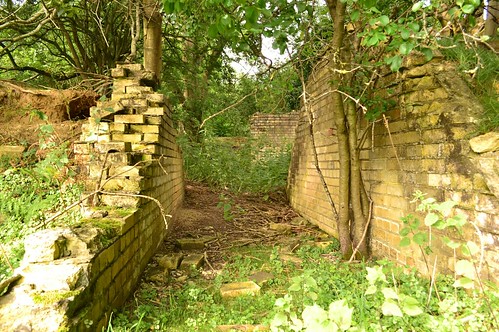
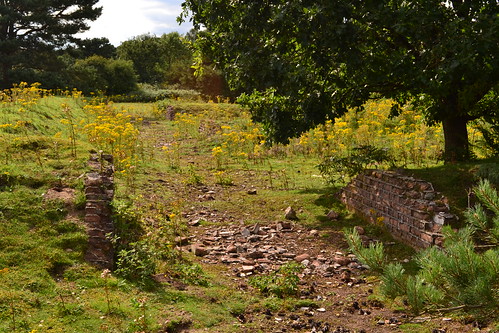
Remains of a building located in Mathams Wood.

By now, the airfield had gained the attention of the Luftwaffe, firstly when a Ju 88 crashed nearby at Bishops Stortford church, exploding on impact, and secondly, a few days later on 8th October 1940, when two parachute mines were dropped in the grounds of Hyde Hall  causing damage to the windows, but thankfully without causing any casualties.

Another major move then came on October 9th, when the first permanent members of 2 (AC) Sqn moved in, a move that was followed five days later, when nearby Townsend House was taken over by the Equipment Section, and immediately turned it into a stores block.

On the 20th, nine more bombs fell, this time they hit the cricket field of Great Hyde Hall, but with little overall effect except perhaps, to disrupt the challenge of playing matches. In all these attacks, no one was hurt nor any major damage sustained, but each bomb brought the front line that little bit closer to home once more.

December came and Christmas approached adding a little merriment to the routines of airfield life. It was a worrying time for the cooks though, as the cook house located in the Assembly Hall in Sawbridgeworth itself, burnt down. A new cookhouse was quickly set up within the Great Hyde Hall, and was duly opened on December 24th just in time for a much welcomed Christmas dinner the following day.

Part 2 continues with the development of Sawbridgeworth. The full story can be read in Trail 25.

Robert C Frascotti, USAAF, 352nd FG, 486th FS. RAF Bodney (Trail 8)

D-Day began many months if not years ahead of June 6th 1944. That day was to become famous as the biggest, most important day in the Second World War.

As the world’s largest amphibious assault force assembled along the South Coast of England, thousands of aircrew prepared for what was to be the most incredible night of their lives.

Across the Midland Counties, American ground crews prepared their fighters and paratrooper aircraft. Along southern England, the same scene was being played out. RAF crews too prepared Stirlings, Lancasters and Horsa gliders; fighter groups were briefed and paratroopers readied their gear. The invasion was on!

Flying an operation of this magnitude was going to require guts, daring and precision flying. There was little room for error.

In the lead up to June 6th, the RAF and USAAF had been bombing prime targets across Northern France to soften up the defending Germans. Supply lines were severed and gun emplacements destroyed. Beachhead bunkers had been heavily targeted, and supporting artillery further inland, hit hard.

In the air, fighters had been downing the Luftwaffe in an effort to gain vital air superiority over the drop zones.

At home, huge attempts were made to keep the plans and preparations as secret as possible. An intricate operation of deception was being played out; dummy airfields were built, camps and troop movements were hidden under cover and concealed in forests.

At an airfield in Norfolk, the day was to begin very badly for one particular young pilot. He was 1st Lt. Robert C. Frascotti of Milford, Massachusetts.

In the days leading up to D-Day at RAF Bodney (USAAF Station 141), the 352nd FG had been flying intruder missions over France, attacking ground targets and completing air superiority missions. P-51s were rapidly being prepared, and the growth of black and white stripes adorning aircraft, hinted of an imminent invasion.

In the late hours of June 5th, the P-51s were being fueled up and armed, ready for an early morning takeoff.  The weather was not at its best and a low mist shrouded the airfield reducing visibility. The mission ahead was to support the troops landing on the Normandy beaches.

At 02:30, the pilots climbed in, fastened their belts and awaited the signal to launch D-Day. First to leave were the 486th FS. To help with the takeoff, temporary lights were placed along the runway, guiding the aircraft safely out of harm’s way into the night sky. One of these aircraft, unfortunately struck the lights knocking them out and plunging the airfield into darkness once more. Lining up behind them were the second flight of the 486th, including Frascotti’s P-51.

When lining up, the flight were unaware that they were off centre. Frascotti and his wingman, Lt. Carlton “Bud” Fuhrman, accelerated away and raced down the runway. Fuhrman watched Frascotti to his left when suddenly there was a massive fireball. Thinking someone had dropped their external fuel tanks, Fuhrman pulled up sharply and pushed on through the flames hoping his engine would not falter resulting in him crashing into the raging fire below. Momentarily blinded by the now total darkness, Fuhrman, pushed the stick forward and fought against the impending stall. Eventually his sight returned and he was able to read his instruments once more. Looking back, he could see Frascotti’s fully fueled plane engulfed in fire with no hope of an escape. Frascotti died instantly. The accident report filed after Frascotti’s death stated that an inadequately lit tower along with poor weather and high levels of traffic had caused him to inadvertently strike the unfinished new control tower at Bodney resulting in the ignition of his fuel. Tragically, Frascotti died instantly, and the aircraft was a total loss.

Frascotti’s plane, a blue nosed P-51B-5 Mustang, 43-6685 was named ‘Umbriago‘. In Italian, ‘umbriago’ means ‘drunk’. Frascotti could have named his plane for that reason, but it could also be he was referring to the World War II-era song of 1944, “Umbriago”by Jimmy Durante about a fabled friend of the same name. The song lyrics end with, “So when you feel low, better send for my friend, Umbriago.”

At a mere 21 years of age, 1st Lt. Robert C. Frascotti had many tributes written about him. There was one benefit of his tragic accident: the following aircraft now had a ‘guiding light’ by which they could safely takeoff and leave for Normandy.

Frascotti was born on February 13, 1923 into a very close-knit and patriotic family in Milford, Massachusetts. (His father fought in World War I where he was gassed). Frascotti was awarded his pilot wings in Marianna, Florida on March 25, 1943, then completed advanced fighter training before deploying to England in March 1944. He joined the 486th FS of the 352nd FG, otherwise known as ‘The Blue Nosed Bastards of Bodney”.

1st Lt. Donald “Red” Whinnem of Hartford, Connecticut, was best friends with Frascotti since the early days of flight school. On D-Day at Bodney, “Red” took off without incident and flew for sixteen hours, returning to discover the tragedy that had occurred. “Red” says of his friend, “Bob was the nicest guy you would ever want to know, and a great athlete as well. He could stir up laughter anywhere he went, and he was great fun to be with. Bob would sing a song or tell a story and cheer everyone up. You couldn’t ask for a better friend, and he was closer than a brother to me.”

During his service, Frascotti was credited with the destruction of two enemy aircraft on the ground whilst strafing enemy airfields. On D-Day, he departed for his 89th mission. This was to be his last mission of the war as he was due to return to the States leaving conflict behind him. Sadly, he never made that journey home to Massachusetts until many years later.

Initially, Frascotti was buried in England. His remains were eventually taken back to Massachusetts in 1948 after his next of kin had his body exhumed, and he now lies in the Sacred Heart Cemetery, in Milford. Lt. Robert C. Frascotti VFW Post 1544 in his hometown, now bears his name, and on December 6, 2013, as part of the annual “Wreaths Across the Worcester and Norfolk District”, a group of local veterans, families and friends, laid a holiday wreath at Calzone Park in Milford to remember the fallen veterans of the area, including Frascotti. Since the war, every year until his death in 1998, 1st Lt. Donald “Red” Whinnem travelled to Frascotti’s grave in Milford to pay his respects and remember his wartime friend.

Fly-pasts and tributes continue to be paid for Frascotti, in both the United States and here at RAF Bodney, Norfolk. 1st Lt. Robert C. Frascotti will long be remembered for his brave sacrifice, and we that are here, are honored to continue to tell his story.

As for RAF Bodney, the airfield is now an Army training camp and part of the Stanford Training Area (STANTA) in Thetford Forest. Little remains of the airfield today but the history held within its decaying walls will long live on.

RAF Bodney can be visited in Trail 8 – Swaffham and her Neighbours (Part 1).

IMG_2210

Robert Frascotti next to his P-51B, 43-6685, named ‘Umbriago’ . At 21 years of age he was killed on his final mission before returning home. (Photo – Marc Hamel)

Trail 63 – The Twelve Airfields of The New Forest – Now There is Only One

This is an article submitted by Steve Williams on behalf of FONFA (Friends of the New Forest Airfields), a charity aiming to preserve the aviation heritage of the New Forest. For more information about their work and the airfields concerned see their website at https://fonfa.co.uk/ 

The Twelve airfields of the New Forest.

Driving through the New Forests’ lush and tranquil scenery today, it is hard to imagine that during the mid-1940s The Forest was progressively militarised, as Britain defended itself from threatened invasion, and prepared for Operation Overlord, the D Day landings. By May 1944 there were a staggering 2,876,000 troops from many nations, together with their vehicles and equipment in Southern England. Many of these were in the New Forest, which is located close to the major ports of Southampton and Poole and had flat terrain and trees to provide camouflage for the build-up of troops and supplies, as well as hiding aircraft.

At the start of The War there were only two active airfields in the New Forest. The sea plane base at Calshot, and the civilian airport at Christchurch. Both played key roles during and after The War.  The bombing of Britain during the early part of The War provided the stimulus to build many new airfields across the South of England. Five concrete runway airfields for heavy aircraft such as bombers, maritime patrol, troop transport and glider towing were built in the New Forest at Stoney Cross, Ibsley, Holmsley South, Beaulieu and Hurn.

As part of the preparation for D Day, a chain of Advanced Landing Grounds (ALG) were rapidly built on agricultural land, or existing airports. Five of these were in the New Forest at Winkton, Lymington, Needs Oar Point, Bisterne and on Christchurch airfield. These were temporary airfields and there were few permanent buildings. Much of the accommodation was tented. These five airfields played a major role during the build-up and execution of the D Day landings. They became operational during late March or early April 1944 and in the few weeks after D Day the RAF and USAAF squadrons moved from the New Forest Advanced Landing Grounds to new Advanced Landing Grounds built on liberated land in France, to continue providing support to the advancing troops.

This meant that four of the New Forest Advanced Landing Grounds were no longer required and were returned to agricultural use after just three months of intense operation. The larger concrete runway airfields remained in use longer. By the end of the 1940s only Calshot, Christchurch and Hurn existed. Calshot and Christchurch shut down in the 1960s leaving only Hurn, or what we now know as Bournemouth International Airport.

For me, the most interesting of the New Forest Airfields was Christchurch. It was operational for around 40 years, starting and finishing its life as a civilian airfield.  The Air Defence Research and Development Establishment was set up at Christchurch and this made many ground-breaking scientific developments in areas such as airborne radar, ground controlled interception, radio navigation and low visibility landing aids.  During the War, the Airspeed factory at Christchurch was an important Centre for the assembly of Horsa gliders and the manufacture and maintenance of aircraft including the Airspeed Oxford and the Mosquito.  After the War, De Haviland took over the Airspeed factory and produced Vampire, Venom and Sea Vixen military jets as well as the Ambassador twin engine airliner.

During 1944, the New Forest airfields were manned by over 25,000 military and 10,000 civilian staff and there were estimated to be around 1,500 RAF and USAAF aircraft. The airfields were involved in every aspect of air warfare from research and development, training, defensive and offensive missions, reconnaissance, and supporting the operations of secret agents and Resistance Organisations in occupied Europe. During the D-Day period, hundreds of sorties were flown daily. The ‘Advanced Landing Ground’ at Needs Oar Point was the busiest airfield in the country for around three weeks. Take offs or landings occurred as often as one every 45 seconds, for up to eighteen hours a day.

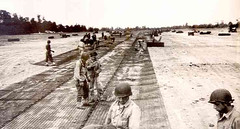
Building an Advanced Landing Ground

Building an Advanced Landing Ground

It is hard to imagine the scale of the social impact that this number of military personnel had on the unique culture, legal framework and way of life of the population of the New Forest. Each of the airfields has unique stories of bravery of those who flew from them and there are fascinating memories of life during these difficult years from those living on the RAF stations or in the New Forest during this period.

Today there is very little left of these airfields, especially the Advanced Landing Grounds. There are remnants of the larger concrete runway airfields and the runway pattern of some are still visible from the air.

RAF Beaulieu

RAF Beaulieu Airfield today from an aircraft approaching Southampton Airport

Airspeed Ambassador

Airspeed Ambassador taking off from Christchurch airfield (Photo by John Levesley)

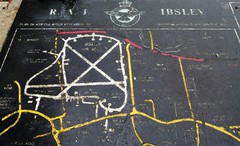
RAF Ibsley

There are memorials and/or information boards at some of the airfields, this is at RAF Ibsley

A good overview of each of the airfields can be found in Alan Brown’s book, Twelve Airfields. For those who would like to find out more there is a wealth of detailed information, artefacts, archives, interactive displays, pictures, videos, models and dioramas, pilot’s stories and limited edition prints at The Friends of the New Forest Airfields, (FONFA) Heritage Centre, located near Bransgore on the former RAFCamp at Sopley.

RAF Sopley was not an airfield, but a very important early radar station, also known as “Starlight”. Much of the ground-breaking work done at Purbeck Radar in Swanage and at Christchurch was put into operation at Sopley. This evolved into what we now know as air traffic control.

A great deal of archives, pilot stories, memories of those who servedand useful information, together with the opening times for the Heritage Centre, can be found on the FONFA web site at https://fonfa.co.uk

P-38 in Support of D-Day

The USAAF P-38 Lightnings that operated from New Forest Airfields during 1944 in support of D Day

Article written by Steve Williams (FONFA) who provided all the photos. (My thanks go to Steve for the article and the work FONFA do in keeping this important part of our heritage alive. It is hoped to add more as information comes in from Steve and eventually to separate each of the twelve airfields out to give as much detail as possible to each).

RAF North Witham – Leading the way into Normandy.

If you follow the A151 towards the main A1, close to the Lincolnshire / Leicestershire border, and you come across Twyford Woods, and an airfield that is little known about, yet its part in history is perhaps one of the most important played by any airfield in Britain. Famous battles such as the Normandy invasion, the Ardennes and the crossing of the Rhine all took place because of the events that occurred here, and were it not for this airfield, many may not have been as successful as they were. In Trail 3, we head further west to perhaps one of Britain’s best kept secrets – RAF North Witham.

RAF North Witham (Station 479)

RAF North Witham sits quietly amongst the trees of Twyford Woods, a site originally known as Witham Wood, which is now a public space owned and maintained by the U.K.’s Forestry Commission.

Originally, North Witham was one of twelve airfields in the Leicestershire cluster intended to be an RAF bomber station for No. 7 Group, however, it was never used operationally by the Royal Air Force, instead like ten others in the area, it was handed over to the US Ninth Air Force and in particular the IX Troop Carrier Command.

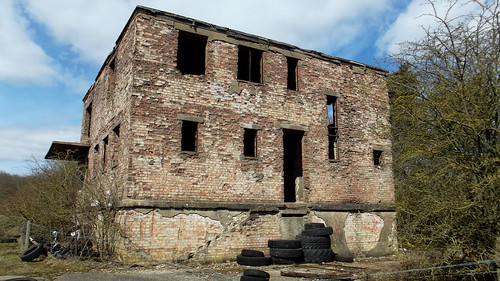
North Whitham control tower

North Witham’s Tower – now a mere shell.

As it was originally designed as a bomber station it was built to the Air Ministry’s class ‘A’ specification, formed around the usual three triangular runways, perimeter track and aircraft hardstands. With construction beginning in the mid-war years 1942/43, its main runway would be 2000 yds long, with the second and third runways 1,400 yds in length and all 50 yds wide. To accommodate the aircraft, 50  ‘spectacle’ style dispersals were built, scattered around the adjoining perimeter track. As a bomber base it had a bomb store, located to the north-eastern side of the airfield, with the admin and technical site to the south-east. The usual range of stores and ancillary buildings adorned these areas. One architectural feature of North Witham was its operations block, built to drawing 4891/42, it was larger than most, with ceilings of 14 feet high. Amongst the myriad of rooms were a battery room, cipher office, meteorology room, PBX, traffic office and teleprinter room, all accessed through specially designed air locks. A further feature of this design was the attachment of a Nissen hut to house plant and boiler equipment, a feature not commonly seen at this time.

Aircraft maintenance could be carried out in one of two ‘T2’ hangars with additional work space provided by one of six ‘Butler’ hangars. Designed and built by the Butler Manufacturing Company of Kansas, USA, these were supplied in kit form and had to be erected on site by an Engineer Aviation Battalion. These hangars consisted of rigid box section girders over a canvas cladding, and once fully erected, gave a wide 40 ft span. Quite a rare feature, these types of structures were only built in limited numbers during the Second World War and only appeared on American occupied airfields. Post-war however, they were far more commonly used appearing on many American cold-war sites across the UK.

north whitam

A ‘Butler’ hangar under construction by members of the 833rd Engineer Aviation Battalion (EAB) at a very snowy North Witham (@IWM479)

The Ninth Air Force was born in 1942 out of the ashes of the V Air Support Command, and then combined with units already located in the England operating under the American Eighth Air Force. Its initial activities focused on the allied push across North Africa followed by the move up into southern Europe through Italy.

Moving to England in October 1943, it then became the tactical Air Force that would support the Normandy invasion, supplying medium bombers, operating as troop support and finally providing supply flights. Facilitation of this massive invasion required both a huge backup, and an intricate supply and support network. North Witham would form part of this support network through both repair and maintenance of the troop carrier aircraft that were operated by the Ninth Air Force – primarily the C-47s. The main group undertaking this role at North Witham was the 1st Tactical Air Depot comprising the 29th and 33rd Air Depot Groups between January and September 1944*1. One of a number of depots, they were once described as the “backbone of Supply for the Army Air Force”, and had a complicated arrangement that encompassed numerous groups across the entire world theatre.

For such a large base, North Witham would be operationally ‘underused’, the only unit to fly from here being those of the IX Troop Carrier Command (TCC), who would primarily use C-47 ‘Skytrains’ – an established and true workhorse, and one that would go on to supply many air forces around the world.

During the Sicily campaign, it was found that many incoming aircraft were not finding the drop zones as accurately as they should, and as a result, paratroops were being widely and thinly scattered. More accurate flying aided by precise target marking was therefore required, and so the first Pathfinder School was set up.

North Whitham pen

Part of one of North Witham’s 50 dispersal pans.

The IX TCC Pathfinder School (incorporating the 1st, 2nd, 3rd and 4th Pathfinder Squadrons) was formed whilst the TCC was at RAF Cottesmore in Rutland. Initially having only seven C-47 aircraft, it arrived at North Witham on March 22nd 1944. These aircraft were fitted with, at the time, modern Gee radar and navigation equipment, along with SCR-717 navigational radar housed in a dome beneath the fuselage of the aircraft. This combination of equipment would allow the aircraft to be used as ‘Pathfinders’, and would be used to train both crews and paratroops of the 101st and 82nd Airborne to mark targets prior to the main invasion force arriving.

These crack troops would train at North Witham before returning to their own designated bases to pass on their newly acquired skills. The idea being that these troops would set up ‘homing’ stations using ‘Eureka’ beacons that would connect to ‘Rebecca’ receivers in the aircraft (distinguished from the outside by antenna protruding from the nose). This would allow flying to near pinpoint accuracy even in poor weather or at night; something that would be employed with relative success in the forthcoming Normandy landings.

On arrival at North Witham, the Pathfinders were accommodated in the huts originally provided for the depot’s crews – some 1,250 enlisted men and 75 officers. Many of these displaced men were rehoused in tents along the northern end of the site which only added a further strain to the already rudimentary accommodation that was already in place at the airfield. At its height, North Witham would house upward of 3,700 men in total, a figure that included an RAF detachment of 86 men and large quantities of GIs.

After arrival, the crews began training for the invasion. Flying cross country flights enabled them to practise using their new radar sets, flying in all weathers, at night and during the day. By D-Day, all navigators had been using the equipment in excess of 25 hours and were considered more than competent in its operation.

With postponements of the invasion came frustration, crews and paratroops mentally prepared for war were let down, there was little for them to do to release the tension that many must have felt.

On June 5th, after the plan was finally given the go ahead, some 821 Dakotas at various sites across England were primed ready for the initial wave of the invasion. Timing was of the utmost importance. As rehearsals had shown, seconds could mean the difference between life and death – for the crews of the C-47s, the pressure was on.

Around 200 Pathfinders of North Witham were the first to leave the UK and enter the Normandy arena. Departing late in the evening of June 5th, men of the 82nd and 101st Airborne climbed aboard their twenty C-47s and rose into the night sky. North Witham based C-47A*2 ‘#42-93098’ piloted by Lieutenant Colonel Joel Crouch*3, led the way. Nineteen other North Witham aircraft joined Crouch that night, and remarkably only one aircraft was lost in the entire flight. Flying under mission ‘Albany‘, the Douglas built C-47A-15-DK Skytrain, #42-92845 (aircraft #4) was lost en route either due to mechanical failure, or as some sources say, following a direct hit by Anti-Aircraft fire. Either way, the aircraft lost an engine and was forced to ditch in the sea. Once down, the crew and paratroops on-board were rescued by the British destroyer HMS Tartar.

Image result for Lieutenant Colonel Joel Crouch and his crew

The Crew of C-47A #42-93098, a few hours before they left for Normandy. Including Pilot, Lieutenant Colonel Joel Crouch (centre), Captain Vito Pedone (copilot), Captain William Culp (Navigator), Harold Coonrod (Radio Operator), along with Dr. Ed Cannon (physician), and E. Larendeal (crew chief)*1

The aircraft flew in groups of three in an in-line ‘V’ formation; aircraft 1, 2, 3 followed by 4, 5, 6; 19 and 20 (added as a late decision); 7, 8, 9; 10, 11, 12; then 16, 17 and 18. The formation was finally completed with aircraft 13, 14 and 15 bringing up the rear. Each C-47 would deposit its collection of Paratroops over six drop zones (DZ) A, C, D, O, N and T between 00:20 and 02:02.

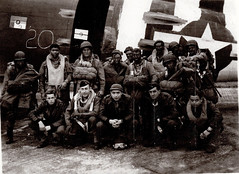
Flying alongside aircraft #19, the only pair on the flight, was C-47 #20 piloted by 1st Lt. Paul F. G. Egan, of Massachusetts. Joining him in the aircraft were: Sgt. Jack Buchannon, Crew Chief (Mass); 2nd Lt. Richard A. Young, Co-Pilot (Ohio); 2nd Lt. Fern D. Murphy, Navigator (PA);  Staff Sgt. Marvin Rosenblatt, Radio Operator (NY) along with ten Combat Engineers of the 101st Airborne who  were dropped at Sainte-Mère-Église on the Cherbourg Peninsula early in the morning 6 June 1944.

Lt. Paul Egan had a remarkable service history, serving in each of the US Army, US Army Air Force and US Air Force after the war, a service that stretched from 1939 to 1967. His remarkable record includes: Pearl Harbour in 1939 and the Japanese attack in December 1941, the Battle of Midway in 1942, followed by advanced training in 1943. This training kept Lt. Egan in military intelligence as a Pathfinder pilot flying mostly C-47s out of both North Witham and later Chalgrove. As well as dropping the paratroopers on D-Day in Operation Market Garden, he also dropped troops in Operation Varsity along with every other major airborne operation flown from England. He also flew bombing missions in B-17s and flew ‘secret’ missions in early 1945. At the signing of the Japanese surrender onboard the USS Missouri on September 2nd 1945, he was the only USAAF representative there, General McArthur wanting someone who was present at Pearl Harbour to also be present at the surrender. His record is certainly remarkable and one to admire.*5

1st Lt Paul F. G. Egan and crew (photo courtesy Jean Egan)

Photo taken at North Witham Air Base, England on June 5, 1944, the night before D-Day. C-47 #20 (note the number chalked in front of the door to ensure paratroops boarded the right aircraft, and the crudely painted invasion stripes) one of the first 20 aircraft to fly with the elite group, the Pathfinders.  Front row: Sgt. Jack Buchannon, Crew Chief; 2nd Lt. Richard A Young, Co-Pilot; 2nd Lt. Fern D. Murphy, Navigator; 1st Lt. Paul F. G. Egan, Pilot (Captain); Staff Sgt. Marvin Rosenblatt, Radio Operator along with ten 101st Airborne Combat Engineers dropped on the Cherbourg Peninsula early morning 6 June 1944, “D-Day” (Photo courtesy Jean Egan).

Pathfinder training continued at North Witham beyond D-Day, well into 1944. The scope of those trained expanding to include Polish paratroops of the 1st Independent Polish Airborne Brigade, who would perform a similar role to their American counterparts. These various Pathfinder groups would go on to have long and distinguished careers, supporting the battles at Arnhem, the Ardennes and also Operation Varsity – the Allied crossing of the Rhine.

As the Allies pushed further into enemy territory, the flying distance from England became too great and so new airfields were either hastily constructed on the continent or captured airfields refurbished. As a result, the Pathfinder School soon moved away to Hampshire and the maintenance units, needed nearer the front lines, gradually departed to these newly acquired bases on the continent.

September 1944 would see big changes in the Ninth and the knock-on was felt at North Witham. Firstly, the IX TCC transferred from the Ninth AF to the First Allied Airborne Army, and as a result, the Air Depot title was changed to IX Troop Carrier Service Wing (Provisional), which was re-assigned to aid and supply the new Troop Carrier Groups (TCG) now based in France. To accomplish this new role, groups often used borrowed or war-weary C-47s, C-46 (Commandos) or C-109s (converted B-24 Liberators) to fulfil their role. Secondly, the Pathfinder School was re-designated IX Troop Carrier Pathfinder Group (Provisional) and they moved away from North Witham to their new base at Chalgrove near Oxford. Now much quieter, life otherwise continued on at North Witham, but it wouldn’t long before the demand for UK-based maintenance and repair work would slow, and within months North Witham’s fate would be finally sealed.

As the end of the war approached, the airfield quickly became obsolete, and the long wind-down to closure, that many of these unique places suffered, began to take effect.

By the time the war was over, the last American personnel had pulled out and the site was handed back to the RAF’s 40 Group who, after using it for a brief spell as a maintenance depot themselves, placed it under care and maintenance. It was used as a munitions and hardware store until 1948, and then finally, in 1956, it was closed by the Ministry and within two years the site was sold off.

Photograph of North Witham taken on 17th January 1947. The technical site and barrack sites are at the top left, the bomb dump is bottom left. (IWM RAF_CPE_UK_1932_FP_1221)

The site, intact as it was, was returned to the Forestry Commission who planted a range of new tress around the site, covering the vast areas of grass. The technical area was developed into a small industrial unit and perhaps most sadly the watch office left to decay and fall apart.

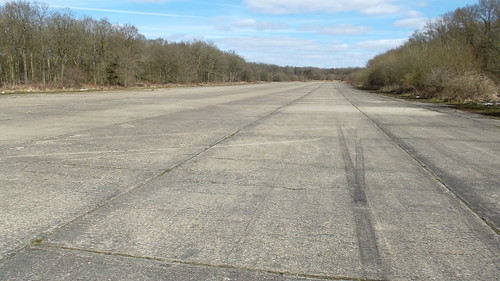
Today the three runways and perimeter track still exist almost in their entirety, and remarkably, in generally good condition. Largely overgrown with weeds and small trees, the remainder is well hidden obscuring what little there is in the way of buildings – most being demolished and the remains left piled up where they stood. However, a T2 hangar is now used on the industrial estate and the watch office still stands tucked away amongst the trees and undergrowth. This area is a favourite place for dog walkers, and because of its runways, it is accessible for prams and pushchairs. Whilst here, I spoke to quite a few people, remarkably none of them knew of the site’s historical significance let alone the office’s existence!

Today the watch office remains open to the elements. Surrounded by used tyres and in constant threat of the impending industrial complex over the fence, its future is uncertain. Access stairs have been removed, but an entrance has been made by piling tyres up to the door – presumably by those wishing to enter and ‘explore’ further. Little evidence of its history can be seen from the outside, even the rendering has been removed, and so, any possible personal links with the past are more than likely now gone.

North Whitham runway

The view of the main runway from outside the tower.

Returning back to the main public entrance along the perimeter track, a number of dispersal pens can be found; overgrown but relatively intact, they are a further sign that even here, war was never very far away.

North Witham was one of those ‘backroom boys’ whose contribution, whilst extremely important, is little known about. The work carried out here not only helped to maintain a strong and reliable fighting force, but one that spearheaded the frontal invasion of Normandy. It served as a cold and perhaps uncomfortable home to many brave troops, many of whom took the fight direct to Nazi Germany.

Standing here today, it is quiet and strangely surreal – you can almost hear the roar of engines. Looking along its enormous runways you get an eerie feeling – how many troops also stood here, spending their last few hours in this quiet place. Looking around now, it is difficult to imagine the immense work that went on here, the gathering of equipment as preparations were made for the big push into Normandy on that famous June night.

North Witham is truly a remarkable place, hidden away amongst the trees as a giant time capsule, a monument to those who lived, worked and died during that turbulent time in 1944-45.

North Whitham runway

Another view along the main runway.

Sadly in May 2015, Twyford Woods was the scene of a large illegal rave, over 1000 people attended the event where a number of arrests were made in the violent altercations that took place*4. A sad day that would turn the souls of those who sacrificed themselves for the freedom we take for granted so very easily today.

(North Witham was originally visited in early 2013)

Links and sources (RAF North Witham)

*1 American Air Museum in Britain

*2 C-47A #42-93098 itself was later lost whilst flying with the 439th Troop Carrier Group (TCG) on September 18th 1944, whilst flying in support of Operation ‘Market Garden‘ in Holland.

*3 Superb footage of Crouch and his crew as they depart from North Witham is available on-line, it also shows the Watch Tower in its former glory.

*4 A report of the event is available on the BBC News website.

*5 My sincere thanks go to Jean Egan, daughter of Lt. Paul Egan, for the information and photograph.

An excellent website contain photos of paratroops and air crew as they prepare for embarkation and advance through France.

RAF Snailwell – Where life was far from Slow (Pt2)

After part 1, we return to  Snailwell, to see how the American influence played its part at Snailwell and how the build- up to D-day affected life at this small grassed airfield.

The squadron was assigned to the 350th Fighter Group (FG) who would eventually transfer to the Middle East. It would be the 347th’s sister squadron the 346th who would later convert Hurricane Mk I #LB640 target tug into a two-seat liaison plane.

Hurricane Mk I LB640, which was being operated as a target-tug with the P-39-equipped 346th Fighter Squadron, 350th Fighter Group, 12th AF USAAF in Sardinia in early 1944. It was field converted into a two-seater as a liaison plane by the unit's ground crew.

Hurricane Mk I #LB640 after being converted into a two-seat liaison plane.  IWM (UPL 17052)

As they were a new squadron the 347th would initially have no ground echelon, they were still being formed and prepared for transportation over the Atlantic from their base at Harding Field, Louisiana. They would arrive in the UK in the November and after a short period at Snailwell, the entire squadron would move out to RAF Kings Cliffe in Northamptonshire, before moving away to the warmer climate of the Middle East.

The winter of 1942/43 saw further detachments being based here at Snailwell. In conjunction with the US forces were 170 Sqn, who remained here from the end of October through the winter until February 1943. After a short spell away they made a brief one day stop over before being moved to RAF Odiham.

The January of 1943 saw yet more short stays. On the 17th 182 Sqn arrived with Typhoon IBs. Based at RAF Sawbridgeworth in Hertfordshire, 182 Sqn were finding it hard to get in any flying at all, as the heavy winter rains had clogged up the metal PSP runways with thick mud preventing the aircraft from taking off.

Two days earlier 70 ground personnel had been dispatched from Sawbridgeworth to Snailwell in preparation for the forthcoming training operation. Operation “Shatter” as it was designated, would be a mock attack on gun emplacements on the outskirts of Thetford Forest. On the 17th, the ten aircraft were sent from RAF Sawbridgeworth led by Sqn. Ldr Pugh along with a further four from the detachment at RAF Hunsdon. On arrival they found their sister squadron, 181 Sqn also with Typhoons, already here for the Army Cooperation training operation. A large party was given that night in honour of the new 182 Sqn crews. The next day, a preliminary attack was made on the target by eleven 182 Sqn aircraft, who made runs over both the dummy and real guns in a “full frontal attack”. The following day, a complete squadron attack was made with the aircraft having to be airborne in under 4.5 minutes. For the first time since forming, all the canons on the Typhoons are fully loaded with live ammunition and a full squadron scramble was undertaken.

Aerial photograph of Snailwell airfield looking south, 26 July 1942 (IWM RAF_FNO_67_V_6032)

In the afternoon a four ship formation was loaded up with 2 x 250 lb bombs and a further attack was made. This attack ended the training session for 182 Sqn and the next day they return to the muddy runways of Sawbridgeworth.

Two months later on March 8th 1943, 181 Sqn was reunited with her other sister squadron 183 Sqn here at Snailwell. After a number of short training flights covering just four days, 183 Sqn departed the Cambridgeshire airfield leaving 181 Sqn here until the end of the month.

Throughout 1943 much of the same was to happen, short stays for training missions were the order of the day.  309 Sqn flew the Mustang MK.I and Hurricane VIs. The Polish squadron became renowned amongst the Allies when F/Lt Janusz Lewkowicz flew a Mustang I to Norway and back strafing targets at Stavanger just to prove the point that the Mustang had the range!

Another squadron, 613 Sqn also brought their Mustangs along in July, and 184 Sqn arrived with Hurricanes. 247 Sqn brought back the mighty Typhoon, each of these squadrons carrying out training flights, some for as little as two days others for more prolonged periods.

As the end of 1943 drew a line under the busy ebb and flow of visiting squadrons, 1944 would see a rather more settled year. After a single RAF squadron, 527 Sqn, moved in and then out two months later, the  build up to D-day would see big changes at Snailwell.

The invasion of Europe was destined to be the largest invasion build up the world had ever seen, and southern England was to be the primary area in which this build up would take place. With the creation of the Ninth Air Force, whose primary purpose was to provide assistance to the forth coming Normandy landings, more and more airfields were going to be required. Whilst front line units would be directly involved in operations over the Normandy coast, there would need to be a major service and maintenance support network, if the invasion were to succeed. This service was to be carried out by a series of  six Tactical Air Depots (TAD) all falling under the command of the IX Air Force Service Command, via two Advanced Air Depot Areas (AADA).

One of these depots, the 3rd Tactical Air Depot based at RAF Grove some 55 miles from London, were responsible for the maintenance and repair of Douglas A-20 ‘Havocs’ and P-61 ‘Black Widows’. Because of the increasing demand for maintenance facilities, the 3rd TAD took over the facilities at RAF Snailwell, moving in two Mobile Repair and Maintenance Squadrons, the 33rd and 41st, in preparation for maintenance operations. Their primary role was to make field modifications to the aircraft in preparation for operational roles, as a result of which the A-20s became a regular feature around the airfield. After only a short time though it was realised that the 41st would not be required here, and so they returned to RAF Grove. To replace them, a specialist team were brought in – the 51st Service Squadron. By the time D-day had passed, the pressure at Grove had subsided and so both units were able to return home from Snailwell. With that, the American connection with Snailwell ended.

As the war drew to a close so too did both operational flying and training flights. The RAF (Belgian) Initial Training School used the airfield sharing it with nearby RAF Bottisham. In March 1946, the Belgians pulled out returning to their own country now free from the Nazi tyranny that had dominated it for so long.

Snailwell then closed, standing empty and gradually returning to agricultural use. Many of the buildings were pulled down but some hung on for several years being used for agricultural purposes. The Blister hanger, sheds and training buildings remained for a number of years, certainly until the mid 1990s, but gradually even these were removed with little evidence of their existence being left today. The airfield was then dissected by a major road development in 1975, remaining parts being bought up by the British Horse Racing School who now own a large portion of the former airfield. High hedges and gated access restrict most access to the former site, (the Icknield Way long-distance route does pass along side these tracks and borders the former airfield from which remnants can be seen) leaving the last few sections of concrete hanging on as reminders of the airfields once proud and hectic existence.

With a mix of repair and maintenance units added to the pot, the war years for Snailwell were far from slow. The regular ebb and flow of detached units for training flights, and the occasional permanent flying unit, saw a wide range of aircraft types and nationalities grace the skies of this small area of Eastern Cambridgeshire. With little evidence of its existence left today, Snailwell, and its proud history, would seem to have been lost, replaced by Horse racing and the desire for the high stakes demanded by the equestrian market.

From Snailwell, we head west, deeper in to the area owned by the Horse racing fraternity. Here we see on every street corner evidence of this now popular sport, well groomed bushes that surround neatly cut turfs, on what now remains of Britain’s wartime heritage. Our next stop on Trail 55, is the pinnacle of these activities, the former RAF Newmarket Heath.

Sources and Further Reading.

*1 Official Directorate of Works drawing (WA7/395/41) IWM UPL 17710

British History Online (Snailwell) website.

National Archives AIR 27/1563/9

National Archives AIR 27/954/6

National Archives AIR 27/1135/1

Niall Corduroy. “Whirlwind: Westland’s Enigmatic FighterFonthill Media, 2017.

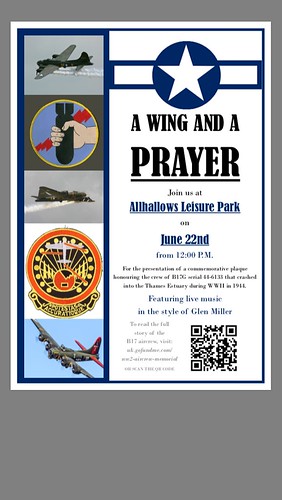
A Wing and a Prayer – B-17 Memorial update.

The planned memorial for the crew of B-17 #44-6133 which collided with another B-17 ‘Heavenly Body II’ over Allhallows in Kent, has taken a major step forward recently.

In the crash all but one of the crewmen were killed and Mitch Peeke has been organising the erection of a memorial to commemorate the tragic accident.

With a large part of the funding having been raised, materials donated and a considerable number of leaflets distributed, there has been great interest shown from not only the UK but also from the United States.

Both Mitch and I have been in contact with Noel Tognazzini, the nephew of S/Sgt. Cecil Tognazzini, Flight Engineer/Top Turret Gunner on the B17 #44-6133.

Noel has made arrangements for not only himself, but also the daughter of 2nd Lt. Theodore Chronopolis, (Bombardier), Jeanne Crons Campbell, the only child of the sole survivor of #44-6133, to attend both the 75th anniversary of the crash on June 19 and the Allhallows event which Mitch has organised for June 22nd.

With a collection of Second World War vehicles, a live band and stalls from aviation related organisations, it is going to be a superb day with a great deal of supporters in attendance. With other events occurring locally at the same time, this will be a remarkable way to commemorate the loss of these young men who were so tragically taken from us in 1944.

Following the collision between the two aircraft, #44-6133 fell into the mud flats at Allhallows, from where most of the bodies were recovered; some at the time, some a while later, and who are now interred in the American Cemetery at Madingley, Cambridge. The body of Gunner Louis Schulte from #44-6133 was sent home and rests in a cemetery in St. Louis. Only two crewmen are still unaccounted for: Fred Kauffman, Co-pilot of Heavenly Body II, the second B-17, and Cecil Tognazzini from #44-6133, both of whom are listed on the tablets of the missing at Madingley. Their last resting places are very probably in the soft Thames mud that the aircraft crashed in.

Sole survivor Theodore Chronopolis, landed safely by parachute. He was fished out of the water by a passing  boat. The eight men of #44-6133’s crew who died that day were: Pilot 2nd Lt. Armand Ramacitti, Co-pilot 2nd Lt. William Hager, Navigator 2nd Lt. Donald Watson, Gunner S/Sgt. Richard Ritter, Gunner S/Sgt. Cecil Tognazzini, Gunner S/Sgt. John  Burke, Gunner Sgt. Warren Oaks and Gunner Cpl. Paul Haynes.

Mitch has set up a ‘gofundme’ fundraising account, with a target of £1000 to help secure the memorial for those young men who lost their lives that tragic day. Additional funds and collections on the day will go towards the up keep of Britain’s only flying B-17 – ‘Sally B’ (http://www.sallyb.org.uk/). 

For further information or if you would like to have a stall promoting your group, please contact Mitch direct at: madmitch.peeke978@gmail.com or leave a comment here and I’ll make sure he gets it.

Find the fund-raising account at: https://www.gofundme.com/ww2-aircrew-memorial 

The full story of the crash can be found using the link: ‘A Long way from Home’.

B-17 Memorial flyer Allhallows, Kent.

RAF Hardwick – Ted’s Travelling Circus. (Part 1).

There are many good museums across the country that tell the stories of heroism and sacrifice witnessed during the Second World War. In Norfolk, most reflect the lives of the ‘friendly invasion’ the lives of the US armed forces and in particular the USAAF, who flocked here in their thousands to a life that was new and very dangerous.

One such group, the 93rd BG, achieved many records and fought in many theatres, but their road was not easy nor was it any ‘milk run’.

In this trail, we return to Norfolk, revisiting the lives of those who served at the former US station 104, otherwise known as RAF Hardwick.

RAF Hardwick (Station 104)

Hardwick is a difficult place to find, primarily due to the narrow lanes and the fact that the name given to it is not the closest village! In fact, Alburgh is closer, but once found this delightful place has a lot to offer to the visitor.

Opening in September 1942, the first units to arrive were B-25 Mitchells of the 310th BG of the Eighth Air Force. Its three runways of concrete and tarmac construction, one of 2,000 yards and two of 1,400 yards, were laid out in the classic Class A style. The entire site covered an enormous area, housing eleven ‘spectacle’ (double loop) and fifty ‘frying pan’ type hardstands, it had three T2 hangars, a watch office (to design 518/40 later modified to 5966/43) and a wide range of support and ancillary buildings common to  all Class A airfields. Being a bomber base, it would require two enormous fuel stores holding a combined total of 144,000 imp Gallons of fuel.

The airfield’s construction process commenced in late 1941 with the main infrastructure being built by John Laing & Son Ltd. Completion was achieved in the autumn of 1942, when the site was officially opened. The construction process would lead to a site capable of  holding around 3,000 personnel of mixed rank and gender. There would be six male sites, two female, two communal quarters and a sick quarters, and as was common with all airfields built after the start of the war, the main public road dissected the airfield separating it from the dispersed accommodation blocks. As a result, the accommodation was to the east beyond the technical area with the bomb dump far to the north-west. Accommodation for the personnel was primarily through ‘Laing’ or ‘Nissen’ hutting, with a small number of Boulton & Paul style huts, none of which offered a great deal of protection from the cold outside.

Handed over to the US forces in 1942, the ground echelons of the 310th BG arrived by sea during the September, with the air echelons bringing their B-25 ‘Mitchells’ via the northern route during early October. The 310th were lucky enough to avoid the seasonal weather change that caused so many problems for units flying across the northern route in the winter months that followed.

Brought to the UK to train crews before they were shipped out to North Africa, the new twin-engined bomber crews would very soon leave Hardwick behind, receiving their posting and transferring abroad in three stages during November and on into December.

RAF Hardwick Memorial

Memorial to the 93rd BG (328th 329th 330th and 409th BS) RAF Hardwick.

Hardwick would take on a very different sound after that, the B-25s being replaced by the heavy four-engined B-24s of the 93rd BG. The 93rd were already a battle experienced outfit, having flown a number of missions from Alconbury since the 9th October 1942 – the day the B-24 Liberator entered into the war.

Many of the early missions performed by the 93rd would be attacks on the submarine pens along the French coast, a move discussed at great length between the two US Generals, Spaatz and Arnold. The poor successes of these missions, which were designed to support the war in the Atlantic, were borne out in an Eighth Air Force study later on. In the report, published on 8th December, it was summarised that American bombs at that time were incapable of penetrating the thick ceilings of the U-boat pens, and that little damage was being achieved by the current US bombing strategy. As a result of this, attacks soon curtailed and operations moved to other targets.

Preceding the move of the 93rd to Hardwick was the posting of a large detachment to North Africa on December 5th. It was a detachment that would see the men and machines of the Eighth transfer across to the Twelfth Air Force. It was a move that was often complained about, seen as draining valuable resources and hindering the training and future operations of the Eighth Air Force in Europe.

Those who remained in the UK began transferring over to the 2nd Bombardment Wing and a new airfield here at Hardwick, where they were trained for ‘special duties’. Gaps in the 329th Bomb Squadron (BS) were filled with crews from the other 3 squadrons of the Group (328th, 330th, 409th) and were moved to a satellite airfield at Bungay. Here, the aircraft were fitted with the British ‘Gee’ system and crews trained on its use. By December they were ready, and ‘Moling‘ mission could now begin.

Unfortunately, the weather played a major part in the operational downfall of these missions, with insufficient amounts of bad weather being found to allow Gee to be used properly. Much to the surprise of the Americans, it didn’t always rain in England!

With the other three squadrons away in North Africa, the 329th joined forces with its sister group the 44th BG at Shipdham. Here they waited in earnest for the return of their associate squadrons.

Gas Training Room.

The gas training room, one of the few remaining buildings at Hardwick.

However, it was not a harmonious relationship. With the squadrons placed in North Africa getting considerable press coverage for their successes, and the B-17 groups being regular features in the UK, the 44th were understandably aggrieved, feeling that the press were ignoring the immense effort and losses they were incurring. The cold of high altitude bombing over occupied Europe was, it would seem, little match for the delights of North Africa.

In the following February / March 1943 the four squadrons were reunited for the first time, and they returned to Hardwick. Here they would fly bombing mission to targets in France and the low countries. In the April, Hardwick was visited by both Lord Trenchard and, ten days later, by Lieutenant General Frank Andrews,  two high-ranking officials who would bring prestige and pride to the men and women of Hardwick. It was Andrews who would be so tragically killed flying across the Northern Atlantic route later on. He along with the crew of B-24 #41-23728 ‘Hot Stuff‘, the first Hardwick crew to achieve their mission quota, would die in a crash that left just one survivor, the tail gunner. The name Andrews would live on though, his name being given to the airfield in Essex, RAF Andrews Field in memory of his work.

The summer of 1943 saw a further detachment being sent out again to North Africa. Here they would earn themselves a Distinguished Unit Citation (one of two), for the low-level action over the Ploesti oil fields in Romania. Further moves and detachments between Hardwick and mainly North Africa earned the unit the name ‘Ted’s Travelling Circus’, Ted being Colonel Ted Timberlake, the Group’s Commander.

During this early period of the war the Liberator groups had little in the way of operational ‘clout’ over France and Germany. With the larger operations being handled by the established B-17 Groups, the B-24s were often relegated to Air Sea Rescue missions where they would search for downed aircraft particularity over the North Sea.

By early September 1943 the bulk of the 93rd were back once more at Hardwick, small in numbers they were often overlooked for the more popular B-17s. Looked down upon by the crews of the B-17s who openly criticised the ungainly lines of the Liberator with names such as ‘banana boat’, only led in turn to jeers from B-24 crews who highlighted the short-range and lower bomb load carried by the sleeker B-17.

This short-range was a factor borne out on the 93rd’s first mission back in the UK when on the 6th September, sixty-nine B-24s of the 2nd Bomb Division (BD)  were sent along with 338 B-17s of the 1st and 3rd BDs to attack Stuttgart. A disaster from start to finish, heavy cloud prevented the target being bombed, formations were separated and targets of opportunity were then chosen. With the formations broken up, defensive power was lost and the Luftwaffe made easy pickings of those aircraft left out alone. Forty-five of the B-17s were lost compared to none of the B-24s, many B-17s having to ditch in the sea or crash-land in Kent after running out of fuel.  Of the sixty-nine B-24s flown out, none dropped their bombs but all four groups returned to their respective bases safely.

For the remainder of September, the Liberators of the 2nd BD were ordered to carry out ‘STARKEY‘ operations, beginning on the 9th to airfields in France and particularly  St. Omer. With few bombs being dropped it was a poor mission and one that was followed on the 15th September by similar results at Chatres. This would be the last mission for the B-24s of the 93rd before yet another posting to North Africa in a move that left the crews both astonished and in total disbelief. During this mission on the 15th, ten airmen would be lost with at least three having been known to have been killed. All ten were from the 330th BS, a sad end to a poor series of missions.

Returning again in early October, the 93rd of Hardwick would join the recently formed 392nd at Wendling for a mission  to Vegesack, a northern district of Bremen. With heavy cloud cover, alternative targets of opportunity were chosen, with little damage being done to Vegesack itself.

The poor weather continued for much of October, preventing the Liberators flying in anything but training flights. The 93rd were able to launch a diversionary raid for the B-17s ill-fated attack on Schweinfurt on October 14th, the majority of the sixty B-24s allocated for the raid failing to even get airborne. After abandoning the mission those that had managed to get aloft headed for Emden in an aim to draw fighters away from the main body of the Schweinfurt  raid. It was hoped that this move would reduce the mauling that would occur from this deep, unprotected penetration mission.

B-24D Liberator #41-23722 ‘Boomerang‘ (GO-C) of the 328th BS, 93rd BG at Hardwick. This was the first Eighth AF Liberator to complete 50 missions. After completing 53 missions, it was flown back to the US for a War Bond tour.

With further diversionary raids on the 29th, attacks on Wilhelmshaven on the 3rd November, Munster on the 5th and Bremen the 13th; the 93rd would then turn to Norway and targets at Rjukan. An ineffectual raid, it preceded further runs back into Germany. December and the approaching Christmas would see no let up for the men of the 93rd and Hardwick, mission numbers being so high that on the 16th, B-24D #41-23722 ‘Boomerang‘ became the first Liberator of the Eighth to pass the fifty missions mark. Three mission later she would depart the UK for American shores where she would perform a war bond tour raising much-needed money for the war effort.

Five days before Christmas, December 20th 1943, would see a return trip to Bremen. Two more aircraft would be lost on this mission. The first, B-24 #42-40133 of 328th BS piloted by Captain Cleveland Hickman (s/n: 0-727870) was shot down by Lt Kard-Heinz Kapp of JG 27/5 in Bf 109G-6 with the loss of all nine men on board. The second, #42-63963 ‘Unexpected II‘ of the 329th BS collided in midair with P-47D #42-8677 and crashed into North Sea north of Den Helder, Netherlands. All nine from ‘Unexpected II’ were captured and became prisoners of war.

Two days later, T/Sgt.John Tkachuk 329th BS died of anoxia after his foot was caught between a bomb and the bomb rack. The ‘walk around bottle’ he was carrying running out of oxygen before he could be given assistance. 1943 would draw to a close with a very sad overtone.

In Part 2, we see how 1944 arrives and how the closing stages of the war produced some remarkable records for the 93rd BG. We find out what happened to Hardwick and see the museum that has emerged to remember those who served from this airfield in the heart of Norfolk.

RAF East Wretham (P2)- From Bomber Command to USAAF

After part one of RAF East Wretham, we see how the poor fortunes of the Czech squadron of Bomber Command were left behind, a new breed of aircraft had now arrived in the form of the US fighter Group’s P-47s and P-51s. After the departure of Bomber Command, the site was turned over to the USAAF and renamed Station 133.

RAF East Wretham (Station 133)

With this change came a number of modifications to the airfield. Temporary Pierced Steel Planking (PSP) was laid, more concrete pathways added and the site accommodation improved generally. The work continued for several weeks whilst the personnel of the newly formed 359th Fighter Group (FG) were gathered together in the United States, finally shipping out across the Atlantic in the October 1943.

Only being recently manned, the 359th were truly a new group (although some pilots were drawn from other established combat units) being formed of the 368th, 369th and 370th Fighter Squadrons (FS). Arriving from Westover Field Massachusetts in the October 1943, they were one of the last units to join the Eighth Air Force with P-47 Thunderbolts; a move that bolstered fighter numbers to some 550, trebling the Eighth’s total number of fighters in only a matter of weeks.

By December they were combat ready, and their first mission took place on December 13th 1943 – an escort mission protecting  heavy bombers as they attacked airfields in France. During the mission, thirty-six aircraft of the 359th carried out fighter sweeps in the  Pas-de-Calais area without loss and without a single ‘kill’, a rather calm opening to their European war. On the 20th, they undertook their second mission, another escort of heavy bombers to Breman. Joining them were the 4th FG, 56th FG, 78th FG, 352nd FG, 353rd FG, 356th FG, and for their first time the 358th FG all flying P-47s. For the fighters it was another ‘uneventful’ mission with only minimal losses, but for the heavy bombers it was their first encounter with Me-410s, and their time-fused, aircraft launched missiles.

During March 1944 a special squadron was formed commanded by Capt. Charles E. Ettlesen of the 359th. Known as “Bill’s Buzz Boys”, the purpose of the unit was to develop ground-attack tactics as so few of these had been truly successful up until now.

The group tried many new ways of attacking enemy airfields, and in the month they were together, they succeeded in destroying or damaging numerous aircraft, blowing up several hangars, locomotives, barges and other small boats in their attacks. During one of these attacks on the airfield at Chateudun, Capt. Ettlesen hit a high tension wire which cut half way through his wing. He manged to fly the P-47 back to England landing at RAF Martlesham Heath in Suffolk, trailing a good 30 feet of wire behind him! On April 7th, the unit’s four flights returned to their respective groups, and the new tactics learned were taken to RAF Millfield, the brainchild of General Quesada to train pilots in the art of ground attack.

, 8AF USAAF.

Capt Charles C. Ettlesen 369FS, 359FG, headed the specialised ground attack unit. After returning to East Wretham he was last seen going down to strafe a Locomotive north of Gotha, 9th Feb. 1945. Classed as MIA he was never heard from again. *2

The 359th at East Wretham continued on with bomber escort operations throughout the early stages of 1944, and then in the April, they began to convert to P-51 Mustangs, a change that involved major retraining of both pilots and ground crews. Used to the air-cooled Douglas Wasp engines of the P-47s, they now had to convert to liquid cooled Merlins. To prepare mechanics for the forthcoming Mustangs, ‘sample’ P-51Bs were sent out prior to the shipment to allow for a smooth transition from one aircraft to the other.

By May, the 359th were ready with their P-51s and their first foray into enemy territory took place on the 5th. Not unlike their first mission with P-47s, it was an escort mission to attack targets in the Pas-de-Calais and Siracourt areas in ‘Noball‘ operations. Like the first, it also was uneventful, cloud cover preventing both allied bombing or Luftwaffe intervention.

Ground attacks were incredibly dangerous, and the summer of 1944 would reinforce that fact. In May pilot, Major George “Pop” Doersch, whose daring would eventually take his ‘kill’ rate into double figures, flew too low to the ground in a strafing attack on an airfield near Rheims. In the attack his propeller struck the ground causing the blades to bend at the tips. Fortunately and using all his skill and strength, he managed to nurse the aircraft (P-51B) back to Manston where it landed without further incident.

George

Major George Doersh who took his P-51B too close to the ground bending the propeller tips. (IWM)* 3

As D-Day approached, the 359th focused on strafing ground targets in and around the Normandy area; railway locomotives and communication lines were all now very high priority. During the invasion itself, the 359th escorted the heavy bombers across the channel, and whilst over France, they took the opportunity to continue with these opportunist attacks.

With the new P-51s they were now able to fly deeper into the heart of Germany and as far east as Poland. It was during these later stages of the war that the 359th really began to make their mark, participating in some of the biggest bombing missions of Germany, including those of: Ludwigshafen, Stuttgart, Frankfurt, Berlin, Mersberg, and Brux.

On 11th September 1944, the green nosed Mustangs of the 359th were finally rewarded for their efforts when they received the Distinguished Unit Citation (DUC) for their action over Mersberg. After attacking over 150 Luftwaffe fighters they also went on to destroy seven  locomotives on their way home. The detailed Citation highlights the bravery and dedication shown by the pilots of the 359th summing up with:

The conspicuous intrepidity, aggressive tactics and esprit de corps displayed by the pilots of this unit on this occasion accounted for the destruction of thirty-five enemy aircraft and contributed to the safe escort of the attacking bombardment formations. The actions of this unit reflect the highest credit upon the 359th Fighter Group and the Armed Forces of the United States.

The determination shown by the 359th resulted in many outstanding pilots. One, Maj. Raymond “X-Ray Eyes” Wetmore became the 359th’s (370th FS) top ace scoring 21 victories (plus 3 on the ground)- his last being an Me 163. Flying latterly  in P-51 #44-14733, Wetmore, like Doersch had a very lucky escape when his aircraft was hit by friendly fire during the Battle of the Bulge. By putting the Mustang into a steep dive he was able to extinguish the fire and return home safely. Flying in three aircraft all called “Daddies Girl” after his daughter, he received numerous awards and by the end of the conflict had completed 142 missions covering 563 combat hours.

RAF East Wretham 4

The old part remains cordoned off.

This attitude to the war, gave the 359th a worthy credit of 263 aircraft shot down with over 100 more being destroyed on the ground. In the 346 missions they flew, they lost a total of 106 of their own aircraft.

Along with further support operations in France and Holland, the 359th went on performing ground attack missions as the allied forces entered Germany. At the war’s end flying wound down, and the USAAF remained at East Wretham until the November of 1945 when the 359th departed, returning to the States and inactivation. With this, no further flying took place at East Wretham and the skies would fall quiet once more.

The airfield then reverted to 12 Group (RAF) ownership, then in May the following year, it was handed back once more to Bomber Command. Within a month the site was handed over to the Technical Training Command and finally East Wretham became a Polish resettlement camp for those personnel who were unable to return home. When they had all finally been moved on, the majority of the site became what it is today, used by the British Army as part of the massive Stanford Practical Training Area (STANTA) for manoeuvres and live firing training.

Bomb Store

The bombs stores blast walls are still intact – just.

Today most traces of the airfield as it was are gone. A number of buildings notably a T2 hangar and several Nissen huts survive on what is now farmland or in the military camp. The unique Watch Tower was demolished after the war as were many of the other ‘temporary’ buildings. Now used by STANTA, a mix of old and new are intertwined with the majority standing on inaccessible military ground. Parts of the perimeter track and hardstands do exist, many overgrown or broken up by the weather and weed growth.

Perhaps the best and by far most accessible examples of East Wretham’s past, is the bomb site which forms part of the East Wretham Heath Nature Heritage Trail. Access is to the south of the site just off the main A1075, Thetford Road. A two-mile walk through Heath land, it takes you right through the original bomb store. An area of natural beauty, famed for its wetland and ancient flints, you can easily find the many blast walls and small fusing buildings still there. Also traceable are the tracks that once took bomb loaded trailers to the airfield across the heath. Many now buried under the acidic soil, their existence evident in exposed patches of bare concrete.

Bomb Store

The decay is evident throughout the bomb store.

All these stores are being gradually reclaimed by nature, trees and rabbit holes have both taken their toll, the layout is still discernible and whilst much of the brickwork is ‘intact’, the warning signs are there and the wartime structures are crumbling fast.

A small airfield, East Wretham was never considered the most ‘homely’ of sites. Often wet and boggy, it was one of the less well-known and less famous places to be used. But the courage and determination of those who served here both RAF and USAAF, went a long way to helping defeat the tyranny that stood facing us across the small section of water not so far away.

Sources and further reading: (East Wretham)

For more detailed information on the Free Czechoslovak Air Force see their superb website.

No.311 ORB – AIR 27/1687/7

*1 IWM –  FRE 6117

*2 IWM – UPL 31469

*3 IWM – UPL 22685

Norfolk Wildlife Trust website.

RAF Bodney – High casualties and Heroic acts (Part 2).

After Part 1, we return to RAF Bodney to the point where the RAF had pulled out handing Bodney over to the US forces. From now on, it would be the home of the USAAF 352nd FG, its P-47s and P-51s.

Famed for the blue-noses on their P-51s, there would be high successes but there would also be many tragedies along the way.

Formed previously in September 1942, the 352nd Fighter Group (FG) composed of three Fighter Squadrons (FS): 328th FS, 486th FS (previously the 21st PS) and 487th FS (formally the 34th PS). Their journey had been both long and difficult, using elements of two squadrons who had previous battle experience in the Pacific theatre. The new 352nd would move through a series of training camps and bases across America, serving as part of the US Air Defence force before deploying overseas. From Mitchel Field, they transferred to Bradley Field (Connecticut), Westover Field (Massachusetts), Trumbull Field (Connecticut) and onto Republic Field, New York before  eventually leaving on the Queen Elizabeth arriving a week later at Bodney on July 7th 1943.

Arriving via Greenock and the Queen Elizabeth, the ground echelons of the 352nd were deposited at Watton station where they were taken by truck to RAF Watton. Pleasantly surprised by the far nicer accommodation blocks they had been used to, their joy was to be short-lived as Bodney was perhaps even worse than the original training camps they had endured back home.

Whilst the surrounding woods had been utilised for aircraft dispersal, the base was in need of an upgrade if it was to be used successfully. These improvements included the addition of steel mat and pierced-steel planking hardstands, additional taxiways and more roads constructed of both macadam and concrete. The men of the 352nd commuted daily from Watton carrying out repairs and improvements until such time as the airfield was more or less ready for occupation and they moved in.

During its time, Bodney would have two T2 hangars and five Blister hangars, accommodation would continue to be limited, allowing for around 1,700 men of mixed rank. Eleven accommodation sites were spread round the north and east of the main airfield, which included two communal sites (site 2 and 3) and two sewage works (sites 12 and 13). There were no WAAF accommodation blocks and due to initial shortages of Nissen huts, nearby Clermont Hall (originally a grand plastered brick Italian style building built by William Pilkington in 1812 as Lord Clermont’s hunting lodge*1)  was ‘requisitioned’ and flying crews moved in, it was a complete change and total luxury compared to other bases and camps used by either the RAF or USAAF. However, following a visit from an Air Inspector, the stay was short-lived and the airmen moved back to the basic hutting of Bodney, even after strong protests from Group Commander, Lt. Col. Joe Mason.

Master Mark II glider tug at Bodney, during airborne forces Exercise ‘SNAFFLE‘ © IWM (H 31737)

During this time manoeuvres regularly took place in the local area, and between August 9th and 11th 1943, one such exercise was conducted near to Newmarket, an exercise that involved both Polish and Canadian divisions opposing each other in mock attacks. During exercise ‘SNAFFLE‘, Master Mark II glider tugs used Bodney airfield whilst dropping a range of supplies such as petrol, ammunition and ordnance to illustrate both the usefulness, and importance of such activities. This made an interesting change to Bodney and something else for the crews to focus on.

It wasn’t long however, before the first P-47s were to arrive at Bodney, and at last flying could begin again with training flights started very soon afterwards. However, maintenance and flying operations were arrested by the lack of equipment, spares and aircraft – all very typical of the build up of US squadrons across the UK. As morale sunk, a special visitor arrived at Bodney, that of Capt. Clark Gable along with a film crew who were documenting the lives of American Fighter Squadrons involved in the European war.

A line up of P-47 Thunderbolts including (PZ-T,) “Little Evey” and (PZ-Z) “Pistol Packin’ Mama” at Bodney.  (IWM FRE 2795)

On September 9th 1943, some two months after their arrival, the 352nd flew their first mission. An uneventful patrol over England’s eastern coast between Southwold and Felixstowe. For the next few mission, even those into enemy territory, similar conditions were found, the enemy were not seen and flak remained low. However, this did not mean the 352nd were casualty free.

On 13th September 1943, Lt. Arthur Eaker was killed in a local flying accident, the groups first, then on the 14th, Lt. William Alm disappeared whilst in flight over the North Sea. His aircraft P-47D (#42-22531) was thought to have been lost due to mechanical failure, he was never found.

It wasn’t until the 10th October that the pilots of the 352nd got to fire their guns in anger, when they encountered a flight of Bf-109s near to Hertogenbosch, Holland. The first kills were recorded, but it was not to be all plain sailing. Four days later on the 14th (‘Black Thursday‘), the Luftwaffe changed tactics and hit the escorts as they crossed the coastline. Leaving the bombers unescorted to their targets in Germany. Once away from their ‘Little Friends’ the bomber formations were decimated by Me-110s – something need to be done.

With more mission to Germany and escort duties, the 352nd began to cut their teeth and become battle hardened. By the turn of the year they had completed 38 missions with the loss of ten aircraft. The pilots of the 352nd had now twenty-two enemy aircraft as confirmed ‘kills’, but five of their own were killed and two others had been made prisoners of war.

A new year and new directives for fighter squadrons. in order to achieve total air superiority pilots were instructed to hunt for the Luftwaffe and destroy them whenever the opportunity arose. Every aircraft destroyed on the ground now counting as a battle credit, the same as an aerial kill. In addition, fighter squadrons were now given designated ‘zones’ to protect, and once the bomber stream had passed through their zone, the fighters were free to roam at will. The gauntlet had been thrown and the US pilots were hungry for rewards.

Early 1944 saw these directives put into action. ‘kill’ rates began to rise, but along with it casualties also mounted. By February the war-weary P-47s were looking tired and the new P-51 began to appear. The Ninth Air Force taking first pickings with Don Blakeslee, (Trail 46 and Trail 50) formerly of the ‘Eagle Squadrons’ becoming the first US squadron to have the mighty Mustangs. It wasn’t until March 1st, 1944 that the 352nd would receive their first P-51s, with seven being delivered and duly handed over to the pilots of the 486th FS at Bodney.

A battled damaged P-51 Mustang (PZ-S) of the 486th FS, in a Blister hangar at Bodney. (IWM- FRE 2803)

It would take just eight days for the Bodney crews to mark their first Mustang ‘Kill’. Capt. Ed Gignac, in P-51B ‘PZ-W’ (#43-7022), shooting down a Bf-109 in battle that saw both P-51s and P-47s of the 352nd participate.

April saw more changes and new arrivals, by now there were two squadrons of P-51s at Bodney, a new sound reverberated around the grassed airfield and with it came more new directives, As many squadrons were equipped with a mix of aircraft, it was beginning difficult to tell them apart in the hectic skies. Coloured noses, wing tips and fins were rapidly becoming markings of individual squadrons and those in charge realised that a standard form of scheming was now necessary for this new and innovative way of distinguishing squadrons.

The blue nose was born, and Bodney’s Blue-nosed Mustangs were soon to be seen at low-level attacking airfields, locomotives, vehicles, troop columns and other similar ground targets.

In May, whilst acting on escort duties for a raid over Brunswick, the group shot down 27 enemy Bf-109s and FW-190s with the loss of only one aircraft. This action earned them a Distinguished Unit Citation, for taking on a “numerically superior force of German interceptors” continuing on until lack of ammunition and fuel forced their withdrawal.

The 352nd went on to support the Normandy invasion, an operation that proved to be a fatal tragedy for one pilot in particular, Lieutenant Bob Frascotti.

IMG_2210

Robert Frascotti next to his P-51B, 43-6685, named ‘Umbriago’ . At 21 years of age he was killed on his final mission before returning home. (Photo – Marc Hamel)

D-Day began early for the 352nd, the night sky was dark and to assist the take off temporary runway lights had been lit. Preceding Frascotti were his compatriots of the 486th FS. During the take off, one of the preceding aircraft struck a light causing the entire collection to extinguish. In the moments that followed, Frascotti and his wing-man, Lt. Carlton Fuhrman, were plunged into total darkness. Unable to see, the two were now committed and carried on, Fuhrman slightly behind Frascotti. Within seconds of them leaving the ground, there was a sudden and massive fireball in front of Fuhrman, a fireball that was the result of Frascotti striking the new, and as yet unfinished, watch office. His aircraft, fully armed and fully fuelled, became a fireball that lit-up the night sky, and one from which Frascotti would not survive.

Blinded temporarily by the flash, Fuhrman fought to prevent his aircraft stalling as he flew through the flames and on out into the night sky, struggling to orientate himself and  unable to register his instruments due to the blinding flash. Behind him, Frascotti’s burning wreck lit up the field, one of the 352nd’s finest had been killed in a total and needless tragedy. The only saving grace from this was that every other aircraft taking off after Frascotti was able to see, a guiding light some say, and so prevented other tragic accidents from happening that night. This was the young 21 year old’s final mission, his 89th, and on completion he would have been returning home.

During D-Day the 352nd flew 116 sorties, reigning death and destruction down on the German forces below, other casualties were to follow, but none until now, as destructive and heart rendering as that of Frascotti.

The Watch Office after being hit by Frascotti’s P-51 on the morning of D-Day. (© 352nd FG, USAAF)*2

After Normandy, the 352nd went on to support the breakout at St.Lo and the airborne assault in Holland. As autumn led into winter, the temperature dropped and the weather took a dramatic turn for the worse; with heavy snow and cold winds across the continent, as the ground forces held out on the Ardennes forest knew only too well. The 352nd, like many other squadrons, were to help support the paratroops, being moved on a short-term basis to Belgium (Asch (Y-29) and Chievres (Y-84)) to join the Ninth Air Force earning themselves the French Croix de Guerre on New Year’s Day 1945.

A week earlier, on Christmas Day 1944 a second tragedy was to befall the 352nd, one that would take the life of another one of the 352nd’s finest. The squadrons highest scoring pilot at that time, Major George Preddy, a hero to many of the airmen and ground crews at Bodney, flew into an American Flak barrage put up by the US Army’s 12th Anti-Aircraft Group. His plane was hit and whilst his canopy was seen to be ejected, no chute appeared, and his body was found still in the wreckage of his beloved P-51. The news of Preddy’s death stunned the celebrations at both Asch and Bodney, no-one could believe that such a daring and brave pilot could have been lost, let alone lost to friendly fire.

April would see the 352nd return to Bodney, where they continued operations until May 3rd 1945. Their final move on November 4th would take them home to the United States, a move that left Bodney empty and a legacy that would be hard to follow. The 352nd had flown 420 missions, losing 118 aircraft with 70 pilots killed. They had been awarded 13 DSC’s, 31 Silver Stars, 336 DFCs, 1304 Air Medals and 42 Bronze Star Medals. The Group had created 52 ‘Aces’, 28 of which had achieved the status in air-to-air combat, accounting for 505 aircraft in the air with Major George Preddy achieving 27 of these himself.

With that departure Bodney fell silent, it closed very soon after the war in Europe ended on November 26th 1945, reverting back to farmland soon after.

Today Bodney falls next to the British Army’s STANTA training ground and as such parts are a military site. Some structures can easily be seen from the main road, B1108,  with signs warning of MOD activity are everywhere.  The original water tower and pump still serve the camp, a few air raid shelters exist and some buildings on the camp. Hardstands can be seen in the woods but little from the road itself.

The watch office is accessible (on farmland) where there are also a few other buildings to be found, including  number of Type 22 pillboxes, many are derelict. The main army base is on part of the former accommodation site, with a memorial outside the gate dedicated to 352nd FG and associated units.

RAF Bodney

Bodney’s memorial to the 352nd FG.

Many of the buildings that were in existence were pulled down in 2012/13 due to increased vandalism and their heavy use for Rave parties. As a result even less now stands visible telling the incredible stories of this forgotten airfield.

Sources and further reading.

*1 Norfolk Heritage Explorer website, accessed 15/8/18

*2 Photo via www.controltowers.co.uk

Frascotti’s story is told in more detail in Heroic tales.

Preddy’s story is told in more detail in Heroic Tales.

Walton, D. “Northumberland Aviation Diary” (1999), Norav Publications

Freeman, R. “The Mighty Eighth“, (1986), Arms and Armour.

There is a website dedicated to the 352nd with a link to the superb ‘Bluenoser’ magazine.

RAF Bodney – High casualties and Heroic acts (Part 1).

Much has been written about the Famous ‘Blue Nosed Bastards of Bodney‘, the 352nd Fighter Group, Eighth Air Force. Famed for their determination and ferocious attacks on Luftwaffe aircraft, they produced some remarkable results – but they also suffered some terrible losses. Nicknamed the ‘Blue Nosers‘, because of their blue nosed P-51 Mustangs, they became one of the most successful fighter groups of the Eighth Air Force. In just a two-year period (September 1943 to May 1945), they were credited with 800 enemy aircraft destroyed, either on the ground or in the air, flying a total of 420 missions. Today the airfield they served from, RAF Bodney, is a small part of the STANTA training ground used by the Army for military exercises, and whilst the airfield has all but gone, the stories and tales of the 352nd continue to live on.

In this Trail, we look again at RAF Bodney, the units and the men who served, the heroic acts and the cost paid at this small grass airfield.

RAF Bodney (Station 141)

Bodney was initially an RAF airfield, opened in 1940 as a grassed site with a hardened perimeter track. During its construction, it had 27 asphalt hard stand of mixed sizes, fifteen large and twelve small, and was designed as a satellite for nearby RAF Watton (Trail 9). Whilst primarily associated with the USAAF, it was in fact an RAF Airfield for several years, housing detachments of aircraft from its parent station.

On 2nd March 1939, 21 (Norwich) Squadron (RAF), now part of 2 Group,  moved into Watton from Eastchurch bringing with them Blenheim MK.Is which they retained until the September when they changed them for the MK.IV. Being early on in the war, they were not yet fully operational, and so were limited to reconnaissance flights over northern France. They were also joined in the August by 82 Sqn, another Blenheim squadron, and it was at this time that they began to utilise Bodney as a satellite, dispersing aircraft here away from the parent airfield.

One of the earliest casualties to occur at Bodney was that of 82 Squadron, on the 22nd anniversary of the forming of the Royal Air Force – 1st April 1940. Take off occurred at 11:00 hrs when Blenheim MK.IV #L8867, piloted by F/O. Glyn Harries (s/n 39520), along with Sgt, Herbert Kelleway (s/n 561573) and LAC. Eric Wolverson (s/n 544700), was sent to attack enemy shipping off the Danish coast. During an attack, the aircraft was hit by Flak from enemy shipping and brought down with the loss of all three  crewmen on board. Their bodies were never recovered and they are commemorated at Runnymede.

RAF Bodney

Bodney today.

By the summer of 1940, Western Air Plan W.A.4(b) was put into operation, a plan that formed part of a 16 part operations plan in the event of a German attack, and one that would focus British Air power in the destruction of German power sources. Part 4(b) focused on the advancing troop and armour columns when they crossed into Southern Holland, Belgium and France. This required aerial attacks primarily from Blenheim and Fairy Battle Squadrons, and was intended to slow or even stop the advancement.

Blenheims of 21 Squadron were assigned to this plan focusing on troop columns and bridges, but being under-powered and weaker than their adversaries, Blenheim casualties were very high and operations over enemy territory were soon curtailed.

Western Air Plan W.A.4(b) was a plan that sent many pilots to their ultimate death or capture, as the aircraft they were flying were woefully inadequate for the job in hand. A fact borne out by the brave attempts of three crewmen on June 14th. On this day, Blenheim #R3742, of 21 Squadron at Bodney, was shot down over France, the three crewmen: P/O. W. Saunders, Sgt. H. Eden and Sgt. C. Webb,  fortunately surviving the resultant crash. After making their way to the coast, finding a boat and attempting to row to England, the three men began to hallucinate through exhaustion. After the second night, P/O. Saunders ‘disappeared’, leaving only his tunic behind in the boat. After being what they thought was only 10 miles from the English coast, they were eventually picked up in France and taken to a new POW camp on the Baltic coast.

On June 24th, 21 Sqn left Bodney moving north to RAF Lossiemouth where they performed anti-shipping operations off the Norwegian coast, before returning once more to Watton (and Bodney) where they continued these low-level operations. It was whilst back here at Bodney that another of 21 Sqn’s pilots, Sqn. Ldr. Malcolm McColm, flying in Blenheim MK.IV #T2223 ‘YH-T’ would also be shot down also ending his war as a POW.

On the night of 27th/28th December 1940, he took off with his crew, Sgt.  Cecil Hann (s/n 580541) and Sgt David Shepherd (s/n 625253), to attack coastal targets. After being shot down, both Sgts. Hann and Shepherd were killed but Sqn. Ldr. McColm survived and would go on to be one of the RAF’s greatest evaders, escaping no less than seven times from German incarceration. Eventually he was sent to Colditz where he shared a room with Douglas Bader and was an active member of the Colditz Escape Committee along with Airey Neave. These would prove to be residencies that would befall many Blenheim pilots at this point in the War.

Eventually in 1941, 21 Sqn moved away to the Middle East, only to be disbanded and reformed later on, all on the same day.

Being a satellite, the facilities at Bodney were rudimentary, and remained so even when 90 Squadron (RAF) began using it during testing of the mighty B-17 (Fortress MK.I). Initially reformed at Watton on May 3rd 1941, they quickly moved to larger bases at West Raynham and then Polebrook, where the Fortresses were tested for RAF bombing missions. Unfortunately operations proved too costly with too little success for them to continue, and the B-17s were gradually phased out of RAF operations.

RAF Bodney water tower

The water tower and pump house at Bodney are some of the structures remaining.

These coming and goings at Bodney had left 82 Sqn one of the few squadrons still in situ. Performing anti-shipping activities off the coast of the Friesian Islands, they would regularly fly over the sea at very low levels, attacking whatever ships they could find. On August 20th 1941, Blenheim MK.IV #V6445 ‘UX-E’ took off from Bodney on what was supposed to be a routine operation; at the controls was 20-year-old F/Lt. Dennis R. Gibbs (s/n 63471), with Sgt. Stanley V. Pascoe (s/n 548419) as wireless operator / gunner, and Sgt. Eric L. Cash (s/n 916895) as Observer / bomb aimer.

As the aircraft flew in low toward its target, Sgt. Cash (referred to as ‘Laurie’) released the bombs, at which point the pilot, realising how low he was, pulled up only to strike the mast of the ship they were attacking. The mast smashed the Blenheim’s perspex front severely wounding Sgt. Cash, and damaging numerous instruments, including the radio, in the process.

Unable to navigate properly, the pilot turned west and headed for what he hoped would be land. After some 6 1/4 hours flying time, a point very close to the flying limit of the Blenheim, F/Lt. Gibbs, not knowing where he was, decided to put the aircraft down in a suitable field. The nose of the aircraft still had part of the mast embedded in it, which made handling and landing the aircraft even more difficult than it would have been normally.

Luckily a passing Home Guard platoon were near by, and once the aircraft had come to a stand still, they helped pull the crew out of the wreckage; Sgt. Cash was taken to Acklington Hospital whilst F/Lt. Gibbs and Sgt. Pascoe were treated for minor injuries.

Later that night Sgt. Cash died from wounds he sustained in the collision, and was buried in Chevington Cemetery. F/Lt. Gibbs and Sgt. Pascoe returned to Bodney and after a short period of leave, returned to flying duties; F/Lt. Gibbs later receiving the DSO.

Until now Bodney had not had its own squadron, but on March 14th, 1942, a unique day in 21 Sqn’s history, the unit was disbanded in Malta only to be reformed the same day at Bodney. They continued to use the Blenheim MK.IVs, placing a small detachment at Abbotsinch (now Glasgow Airport) whilst the main part of the squadron stayed at Bodney. It was also during this month that 82 Sqn departed for the far east leaving Bodney to the new 21 Sqn.

During May 1942, 21 Sqn began to change their Blenheims, replacing them with the American built Lockheed Ventura (MK.I and MK. II), the first RAF squadron to do so. Throughout the summer months 21 Sqn carried out training flights converting crews from the Blenheim onto the Ventura, a slow process as new aircraft were only being sent as few as one or two at a time. The Ventura, a former passenger aircraft, could carry a 2,500lb bomb load with a larger crew of 4 or 5 including a top turret gunner. Take offs, landings and formation flying were the order of the day until in the October 1942, when 21 Sqn finally departed Bodney for RAF Methwold (Trail 8). This move signalled the permanent break that would mean 21 Sqn would now leave Bodney behind for good.

The winter months of 1942-43 were quiet at Bodney. The gradual build up of American forces in the UK meant that more and more airfields were needed to house fighters and bombers of the Eighth and Ninth Air Forces. Through both a renewed building programme and the taking over of older RAF sites, this heavy demand would soon be met. As part of this buildup, Bodney was identified as suitable site for a bomber station, but upgrading to Class A standard never happened, and instead it was allocated to a fighter group. After being designated Station 141, it was handed over to the US forces, who quickly began to make improvements to its design.

In part 2 of this RAF Bodney – High casualties and heroic acts, we shall see how Bodney  became home to the three squadrons of the 352nd FG, The tragedies that occurred at this small grassed airfield, and how the 352nd became one of the top scoring Fighter Groups of the US Air Force.

(See part two for references).