A Wing and a Prayer – B-17 Memorial update.

The planned memorial for the crew of B-17 #44-6133 which collided with another B-17 ‘Heavenly Body II’ over Allhallows in Kent, has taken a major step forward recently.

In the crash all but one of the crewmen were killed and Mitch Peeke has been organising the erection of a memorial to commemorate the tragic accident.

With a large part of the funding having been raised, materials donated and a considerable number of leaflets distributed, there has been great interest shown from not only the UK but also from the United States.

Both Mitch and I have been in contact with Noel Tognazzini, the nephew of S/Sgt. Cecil Tognazzini, Flight Engineer/Top Turret Gunner on the B17 #44-6133.

Noel has made arrangements for not only himself, but also the daughter of 2nd Lt. Theodore Chronopolis, (Bombardier), Jeanne Crons Campbell, the only child of the sole survivor of #44-6133, to attend both the 75th anniversary of the crash on June 19 and the Allhallows event which Mitch has organised for June 22nd.

With a collection of Second World War vehicles, a live band and stalls from aviation related organisations, it is going to be a superb day with a great deal of supporters in attendance. With other events occurring locally at the same time, this will be a remarkable way to commemorate the loss of these young men who were so tragically taken from us in 1944.

Following the collision between the two aircraft, #44-6133 fell into the mud flats at Allhallows, from where most of the bodies were recovered; some at the time, some a while later, and who are now interred in the American Cemetery at Madingley, Cambridge. The body of Gunner Louis Schulte from #44-6133 was sent home and rests in a cemetery in St. Louis. Only two crewmen are still unaccounted for: Fred Kauffman, Co-pilot of Heavenly Body II, the second B-17, and Cecil Tognazzini from #44-6133, both of whom are listed on the tablets of the missing at Madingley. Their last resting places are very probably in the soft Thames mud that the aircraft crashed in.

Sole survivor Theodore Chronopolis, landed safely by parachute. He was fished out of the water by a passing  boat. The eight men of #44-6133’s crew who died that day were: Pilot 2nd Lt. Armand Ramacitti, Co-pilot 2nd Lt. William Hager, Navigator 2nd Lt. Donald Watson, Gunner S/Sgt. Richard Ritter, Gunner S/Sgt. Cecil Tognazzini, Gunner S/Sgt. John  Burke, Gunner Sgt. Warren Oaks and Gunner Cpl. Paul Haynes.

Mitch has set up a ‘gofundme’ fundraising account, with a target of £1000 to help secure the memorial for those young men who lost their lives that tragic day. Additional funds and collections on the day will go towards the up keep of Britain’s only flying B-17 – ‘Sally B’ (http://www.sallyb.org.uk/). 

For further information or if you would like to have a stall promoting your group, please contact Mitch direct at: madmitch.peeke978@gmail.com or leave a comment here and I’ll make sure he gets it.

Find the fund-raising account at: https://www.gofundme.com/ww2-aircrew-memorial 

The full story of the crash can be found using the link: ‘A Long way from Home’.
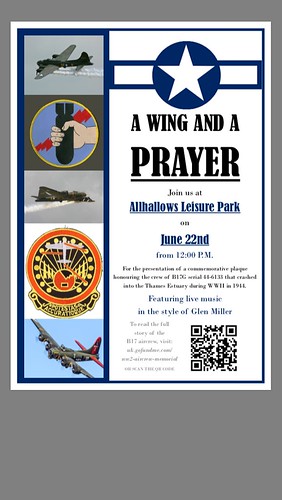
B-17 Memorial flyer Allhallows, Kent.

Two B17s Collide near RAF Snetterton Heath (Station 138)

With the number of aircraft in the skies over Britain during the Second World War, it was inevitable that some would collide, often fatally. Carrying full bombs loads and full fuel tanks, these aircraft were literally ‘flying bombs’ and a collision would often have disastrous consequences.

One such incident happened on 29th January 1945 just months before the cessation of war. Two B-17s from the 96th Bomb Group collided over the small village of North Lopham near to RAF Snetterton Heath with the loss of all eighteen crew members.

The first aircraft, B-17G-DL*1 ’44-6137′, of the 337th Bomb Squadron was delivered from the factory to Tulsa Air Base on 12th May 1944; travelling on via Kearney Training base to Dow Field, Maine, on the 1st June 1944. It was initially assigned to the 452nd Bomb Group, where upon it was flown to RAF Deopham Green in Norfolk, England. After arriving at Deopham, it was immediately transferred to the 337th BS, 96th BG, and given the coding ‘AW – J’. The aircraft was subsequently flown on to RAF Snetterton Heath and operational status.

The second aircraft, B-17G -BO*1 ’43-38746′, was initially delivered to Lincoln Air Base on 16th September 1944. It was also flown on to Dow Field but later in the September of that same year. Here the aircraft was assigned to the 338th BS, 96th BG, transported to Snetterton Heath, and given the coding ‘BX – J’. The aircraft arrived for active duty in the October of 1944.

The 96th BG, consisted of four squadrons: the 337th, 338th, 339th and 413thBSs,  operating both B-17-F and B 17-G models. At the time of the accident they were part of the 3rd Air Division, 45th Combat Wing, Eighth Air Force.

The 96th BG like their crews, were relatively young. Activated on 15th July 1942 at Salt Lake City, Utah, the group wasn’t allocated any operational personnel until reaching Gallon Field in Idaho, in August that same year. They moved through a number of airfields and training camps, until setting sail for the European Theatre of Operation on the Queen Elizabeth, on 5th May 1943, arriving in Greenock, Scotland, six days later. After moving from Grafton Underwood to Andrews Field, in Essex, they finally arrived at their base RAF Snetterton Heath,  on 12th June 1943 where they would remain until December 1945.

By the end of the war the 96th BG would have completed 321 missions in total dropping in excess of 19,200 tons of ordinance, a figure that included around 130 tons of supplies. They would lose 189 aircraft in operations over Europe and would receive two Distinguish Unit Citations for their operations over both Regensburg and Poznan.

On the day in question, January 29th 1945, two years into their war, the two aircraft took off from their base at Snetterton Heath (Station 138) to attack the Bielefield Marshalling yards at Kassel as part of Mission 811.  As they were forming up to find their position in the flight, the disaster struck. The first aircraft flown by Second Lt. Alex Philipovitch,  flew across the path of the second aircraft flown by Second Lt. George Peretti. As a result Peretti’s port wing struck the B17 causing it to explode whilst his own was split in half. As a result of the collision, both aircraft plummeted helplessly to the ground killing all eighteen men on board.

Regrettably, this collision was one of many that occurred both within the USAAF and RAF during the Second World War, a sad loss of many a young life. Thankfully however, neither this tragedy, nor the sacrifice of the crews will be forgotten as the people of North Lopham have laid a commemorative memorial stone in the village centre on their combined war memorial, just a few miles away from Snetterton Heath airfield, now Snetterton race park.

The names of the crew members, many of whom were only 19 or 20 years of age, appear in the St Paul’s Cathedral Roll of Honour, London.

Aug 2015 found in North Lopham

The memorial stone at North Lopham

In honour of the crews:*2

B-17 ’44-6137′

2nd Lt. George .J. Peretti: Buried – St. John Cemetery, Illinois (age 22)
2nd Lt. Ernest .S. Throne: Buried – Fountain Grove Cemetery, Ohio (age 29)
2nd Lt. Gerald. S. Stambaugh: Buried – Keokuk National Cemetery, Iowa (age 23)
Sgt. Robert. I. Good: Buried – Greenville Union Cemetery, Ohio (age 24)
Sgt. Maynard. A. Faux: Purple Heart and Air Medal, Buried – Cambridge American Cemetery, UK (age 19)
Sgt. Gordon. C. Shaul: Buried – Ford City Cemetery, Pennsylvania (age 20)
Sgt. Noble. E. Ellington: Buried – Gwin Memorial Cemetery, Louisiana (age 25)
Sgt. Clarence. C Hagler: ETO Ribbon with 1 Battle Star, AD Ribbon, Air Medal, Buried – Gilmer City Cemetery, Texas (19 years old)
Sgt. Robert. R.Stone: Purple Heart, Air Medal, Buried – Forest Lawn Cemetery, North Carolina (age 22)

B-17, ’43-38746′

2nd Lt. Alex. Philipovitch: Purple Heart, Buried – Gettysburg National Cemetery, (age 23)
2nd Lt. John. C. Hubbard: Buried – McCall Cemetery, South Carolina, (age 30)
Flt. Off. Slatten. H. Gooden: Buried – Arlington National Cemetery, Virginia, (age 27)
Flt. Off. Martin. P. Schmidt: Buried – Saint Mary Cemetery, Omaha, (age 19)
T/Sgt. Richard. J. Zander: Buried – Mount Sinai Cemetery, Pennsylvania, (age 20)
T/Sgt. Charles. H. Tibbatts:  Purple Heart, Buried – Cambridge American Cemetery, UK
Sgt. Robert. K. Smith: Buried – Stones River National Cemetery, Tennessee, (age 19)
Sgt. James. E. Flora: Buried – Musselman Cemetery, Indiana, (age 20)
Sgt. William. F. Brauner: Buried – Calvary Cemetery and Mausoleum, Missouri, (age 19)

Sources:

RAF Snetterton Heath appears in Trail 27.
*1 – “The B-17 Flying Fortress Story”, Roger A Freeman with David Osborne, 1998, Arms and Armour
*2Find a Grave, accessed 14/11/15