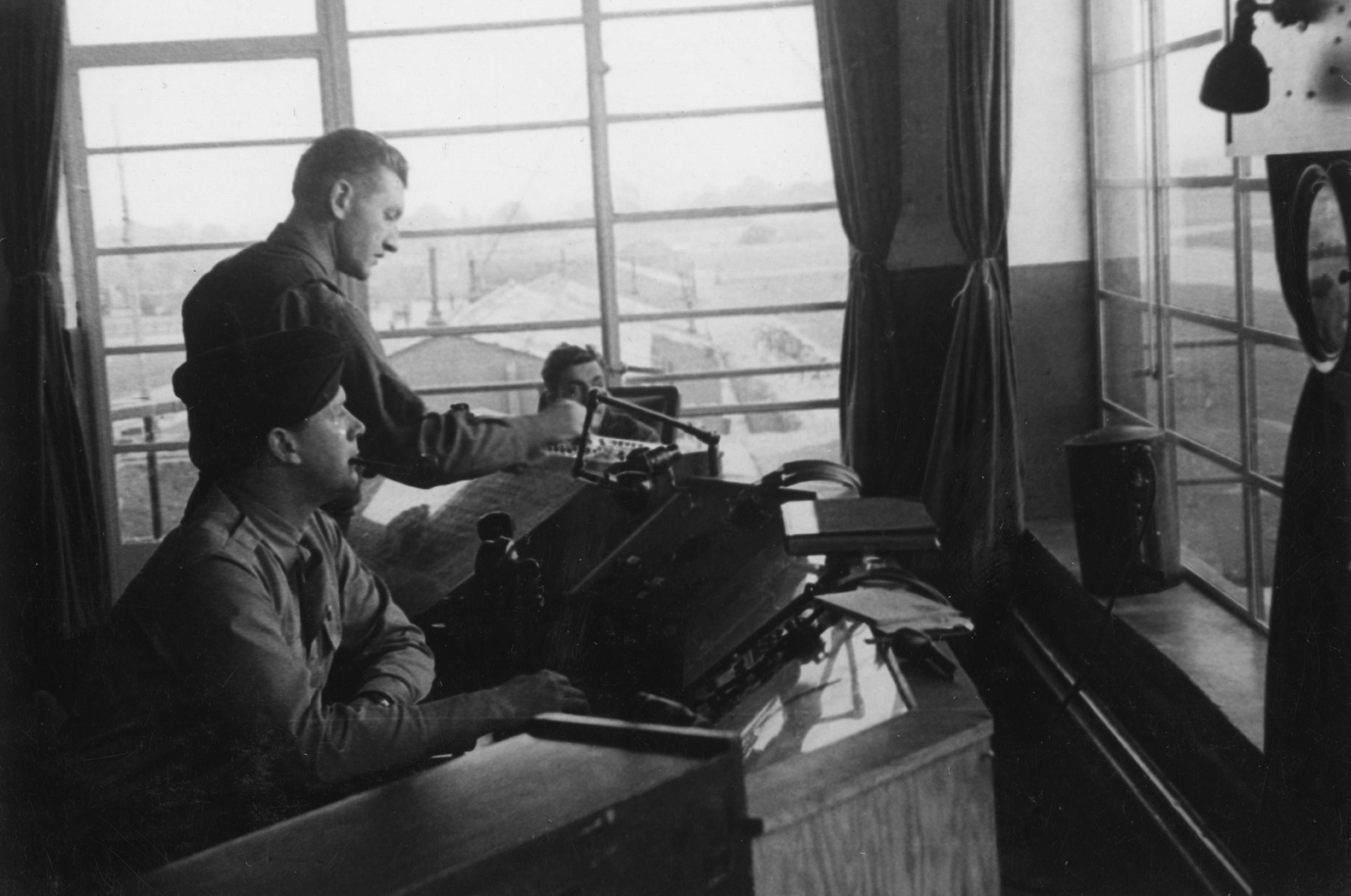
‘Black Thursday’ took the lives of many crews – RAF Bourn.

In Trail 31 we continue our trip around the historic countryside of Southern Cambridgeshire. Moving on from the open expanses of Graveley and Caxton Gibbet, we visit two more airfields both of which continue for now, to uphold their aviation heritage. Our first stop is the current small airfield on the former RAF Bourn.

RAF Bourn.

Bourn sits between the towns of Cambourne to the west and Hardwick to the east and is confined by the new dual carriageway cutting across its northern side. Both the immediate eastern and western sides are heavily built upon and with further developments under proposal, the future of this historic airfield remains in the balance.

RAF Bourn was built-in 1940 /41 initially as a satellite for nearby RAF Oakington. With growing pressure from Bomber Command it would eventually become a bomber station  in its own right and come under the control of Air Commodore Donald Bennett’s 8 Group operating the elite Pathfinder Force (PFF). Accommodation would be suitable for 1,805 males and 276 females making it a relatively large airfield. Its three ‘A’ style concrete runways, would be extended later in 1942 to accommodate the heavier aircraft that were to use Bourn thus raising its profile as a bomber base. By the end of the war, Bourn squadrons would lose 135 aircraft in total accounting for: 60 Lancasters, 32 Short Stirlings, 24 Mosquitos and 19 Wellingtons – a considerable number of lives.

runway

Views along one of Bourn’s enormous runway.

Bourn would serve a number of RAF squadrons during its short wartime life: 15, 97, 101, 105, 162 and 609 would all play a part in its rich wartime tapestry. The first to arrive were the Wellington ICs of 101 Squadron (RAF). They arrived at Bourn very soon after the runways were constructed on February 11th 1942. During this time 101 were going through the process of updating their Wellingtons with the new Mk III. One of the first casualties of Bourne would be one of these models. Wellington ‘X3656’  SR-L, was lost on the night of March 8th/9th 1942, on a mission to Essen. Flight Sgt. S. Brown, P.O. C. Luin and Sergeants L. Calderhead, R. Lawrence and C. Parry were all lost in the attack; the aircraft missing in action and the crew presumed dead. Their names are now inscribed  on the wall of remembrance at Runneymede Cemetery.

101 sqn would continue the fight staying at Bourn until the 11th August that same year. They would then move on to Stradishall and Holme-on-Spalding Moor where they took on the Lancaster.

As 101 left, 15 Sqn (RAF) moved in, bringing the much heavier Short Stirling MkI. Having a rather checkered history behind them, 15 Sqn would operate the MkIs until the following January when the MK IIIs came into operation. Built by Short Brothers, the Stirling was a massive aircraft, dwarfing many of its counterparts with a cockpit height of some 22 feet. A forbidding aircraft, it was cumbersome on the ground but was said to be very agile in the air, some would say it could out-turn a Spitfire! Sadly though, it was a slow aircraft and whilst heavily defended, loses were to be high leading to its eventual withdrawal from front line operations .

A few miles away at Cambridge, an industrial unit of some  six / seven hangars were built by Short Sebro Ltd who manufactured the Stirling parts. Final assembly and air testing was then carried out at Bourn, the wings being transported by ‘Queen Mary’ trailers and the fuselage on specially made carriers pulled by tractors. To help, three large hangars would be built away to the east of the airfield to accommodate both these and battle damaged bombers for repair.

ROYAL AIR FORCE BOMBER COMMAND, 1942-1945.

The crew of the Short Stirling Mk I, N3669 ‘LS-H’, of No. 15 Squadron after their 62nd mission. © IWM (CH 7747)

It was here at Bourn that a record would be set by a 15 Squadron crew. Stirling Mk I, N3669 ‘LS-H’,  would go on to complete 67 operations, a record for the type. N3669 would eventually be reduced to an instructional airframe in February 1943.

A short spell of conversion proceeded 15 Sqn moving to their new base at RAF Mildenhall on April 14th 1943, where they would eventually take on the new and more successful Lancaster I. It was here that LL806 “J-Jig”, would become one of the most famous Lancasters in Bomber Command, flying 134 sorties accumulating 765 hours in the air. Two incredible records were now set by 15 squadron aircraft and their crews.

Bourn would then have just another short spell visitor, 609 Sqn. Battled hardened from covering the BEF withdrawal at Dunkirk and defending Britain in the Battle of Britain, 609 Sqn moved in on 26th August 1942, with the potent Typhoon IB. Accustom as they were to moving around, their stay at Bourn would last only 4 days.

It was at this time that Bourn really came into its own as a bomber base. 97 squadron (RAF) arrived on April 18th 1943 with their Lancaster Is and IIIs. With small detachments at nearby Graveley, Gransden Lodge and Oakington, they would stay here until moving on to Coningsby a year to the day later. Whilst at Bourn, they became a ‘marker’ squadron as part of the PFF  Group.  Notable target’s were both the  Zeppelin works at Friedrichshafen in June 1943 and the Italian naval base at Spezia in April 1944; an event that became to be the first RAF “shuttle-bombing” raid. The introduction of Lancasters at Bourn greatly reduced the number of crews being lost. However, 97 Sqn were to suffer one of the worst nights on Bomber Command record, and not through enemy action either. During the night of December 16th /17th 1943, a large number of aircraft left from some 20 squadrons*1 to attack Berlin. Casualties to and from the target were on the whole low but for 97 Squadron it was arriving home that their troubles were to begin. This night would become known as ‘Black Thursday’.*2.

Aug 2015 014

A Nissen huts survives in modern use.

As they approached Cambridgeshire, they were informed that the weather had closed in on Bourn and landing would be very difficult if not impossible. In an effort to get the bombers down safely, all manner of tactics were used to move the fog and illuminate the runways.  Some aircraft managed to divert to other bases in Lincolnshire and Norfolk where FIDO was in operation, but many tried to wait it out. The result was a critical loss of fuel and subsequently several aircraft crashed in the dense fog. The loss that night was devastating for 97 Sqn: JB531 ‘OF-Y’; JA963 ‘Q’; JB243 ‘P’; JB482 ‘S’; JB219 ‘R’; JB117 ‘C’; JB119 ‘F’ and JB176 ‘K’ were all lost crashing in the vicinity of the airfield with many of the crews being killed.*3

It was during these last few weeks of 97 Sqn’s stay that Bourn would start to accept new residents. The smaller and much more agile Mosquito IX of 105 Squadron arrived to continue the pathfinder operations. Noted for their unusual black paint work, they would carry out many notable operations from here, especially in the lead up to D-day in June 1944, identifying and marking coastal batteries for the heavier bombers to attack in preparation for the invasion. One of these aircraft, MM237, would sadly fall victim to ‘friendly fire’. On crossing the coast on its way home, on March 6th 1945, it was shot down by a British night fighter. The crew luckily managed to bale out moments before the aircraft struck the ground.

105 would stay at Bourn for the duration of the war, taking on a new model Mosquito XVI in March 1944. They would mark high-profile targets such as: oil refineries, road and rail junctions, marshalling yards and coastal batteries. Many targets were as far afield as the German heartland; 105’s  final operational sorties would take  4 Mosquitos to Eggebeck on the night of 2nd/3rd May 1945, a month before they left Bourn for Upwood and final disbandment.

In December 1944, the last residents of Bourn would arrive and join 105 Sqn. Being reformed here on December 16th, 162 Squadron (RAF), would fly the Mosquito XXV until February the following year when they would replace them with the Mosquito Mk XX. As part of the light-bomber unit of the Light Night Striking Force, 162 would quickly establish their effectiveness, striking hard at the heart of Germany, Berlin, in 36 consecutive raids.  162 would eventually leave Bourn on July 10th 1945 to go to RAF Blackbushe and their disbandment. Even though they were only here at Bourn for a short period, they would amass 4,037 flying hours in 913 operational sorties. Their loss rate would reflect the effectiveness of the Mosquito as a fighter, a bomber and a PFF weapon, losing only four aircraft in operational missions.

The departure of 162 Sqn would leave Bourn both desolate and very quiet.

Aug 2015 012

One of the few derelict buildings that still survive.

Post war, Bourn lay idle, the nearby hangars were used by Marshalls of Cambridge for vehicle repairs but eventually these were sold at auction, leaving the  site empty. It was completely closed down three years later. The land was sold off in the early 1960s and development has gradually encroached ever since. One small saving grace for Bourn is that a small flying club operated by the Rural Flying Corps is utilising a small part of the field including sections of two of the original runways. It is hoped that this will continue and keep the history of Bourn airfield alive.

Recently affected by the building of extensive housing developments and a new dual carriageway, Bourn has had much of its original infrastructure removed. The runways were cut slightly short and much of the accommodation and technical site redeveloped. However, a small gain from this is that the dual carriage way offers some interesting views along the remains of its enormous stretches of runway.

If approaching from Caxton Gibbet to the west, leave the dual carriageway and pull on to the smaller Saint Neots road that runs parallel. From the bank you can see along the runway taking in its enormous width. Other views of this, can be seen from the bridge that takes you back over the A428 toward the village of Bourn to the south.

It is also along this road that the fire tender station can be found, now utilised by a small industrial company it is one of the few original buildings surviving in good condition today.

Aug 2015 016

The fire tender shed, now a small business unit.

Many tracks can also be seen along here, pathways that would have led to the admin and accommodation areas of Bourn, the road now separating the two areas. There are a couple of Nissen huts here too, again used by small industrial companies, whilst other buildings stand derelict and in grave danger of demolition by weather or developer.

Whilst the runways are intact, large parts are used for storage and a section is used for motorcycle training. A lone windsock flies over the flying club.

Recent archeological investigations have revealed late prehistoric and Roman connections around the site, including a Roman burial site within the grounds of the airfield. Great crested Newts are also known to inhabit the area, perhaps history and nature will prevail. With continued development and further proposed housing, the future of Bourn is very uncertain and should these plans go ahead, Bourn like many other airfields of Britain will most likely cease to exist.

After leaving Bourn, we travel a stones throw south-west to a small airfield now more commonly seen with sedate gliders than fearsome fighters of the Second World War. We stop at Gransden Lodge.

Notes:

*1 loses were recorded from 7, 9, 12, 44, 57, 97, 100, 101, 103, 156, 166, 207, 405, 408, 426, 432, 460, 576, 619, 625 squadrons all Lancasters.

*2 a website dedicated to 97 Squadron gives detailed information into ‘Black Thursday’ including personal accounts, the unit, men and operations.

*3 records from aircrew remembered

RAF Witchford a revisit to a fascinating airfield.

I originally visited RAF Witchford some time ago but was lucky enough to have an invite to a gathering taking place earlier this month at the site. It was a very memorable day indeed. Trail 11, which this forms part, can be found here.

RAF Witchford

Witchford is found a few miles East of Mepal in the shadows of Ely Cathedral. Now an industrial estate, a large amount of the site is still in existence (and being used) and freely accessible to the general public. This makes it one of the rarer airfields around in terms of visiting.

RAF Witchford Perimeter Track Looking South

RAF Witchford Perimeter Track Looking South, the B1 Hangar is to your right.

A typical triangular Class A airfield, it had two runways of 1,408 and 1,415 yards and a further main runway of 2,010 yards, all concrete and 50 yards in width. The technical site was located on the western side of the airfield behind the long and straight perimeter track. A number of Nissen workshop huts were constructed along with the standard 343/43 Watch Office, Braithwaite water tower and 150 or so supporting buildings. As with all bomber airfields, the bomb store was well away from accommodation and was located to the southern side. Being a large airfield, it had three hangars, two T2 and one B1, and a total of 36 loop-type dispersed hardstandings.

The accommodation sites (14 in total), were spread out well behind the technical site predominately where the village now stands and beyond. The main entrance to the airfield, also to the west, is now a small track leading to housing known as Bedwell Hey Lane. In total Witchford was designed to accommodate 1,502 men and 230 female ranks and it officially became operational in July / August 1943.

Original Stores Hut

Original Nissen Hut now used for stores.

Witchford was served initially by Stirling IIIs of the newly formed 196 sqn RAF, whose first operational flight took place on August 28th that year. But as heavy operational losses built up, it soon became obvious that the large bomber was ‘unsuitable’ for long distance bombing missions and gradually, squadron by squadron, they were replaced by the more superior Lancaster to which the business park gets it’s modern name.  As these Stirlings became obsolete for front line use many were redeployed covering glider towing, mine laying and transport duties.

During September to November 1943 a number of changes were to happen at Witchford. A second squadron, 195 sqn RAF, was reformed at Witchford (October 1st 1943) using elements of 115 sqn, who were at that time, based at Little Snoring (Trail 22) in Norfolk.

IMG_3282

Inside the Nissen Hut.

A further unit, 513 Squadron, also formed at Witchford (15th September) again using the ill-fated Stirlings. However, 513 sqn never became operational, and were disbanded only two months later.

On the night of 26th November 1943, 12 aircraft of 115 Squadron left RAF Little Snoring in Norfolk, to attack the German capital, Berlin. On return, they were to land at their new station RAF Witchford where the ground staff had moved to that very day. Only one aircraft did not make it back that night and this meant that 115 sqn (who in August 1941 had taken part in trials of GEE) were now totally based at Witchford. 115 were still using the Armstrong Whitworth (Bagington) built Lancaster IIs with their Bristol Hercules engines. (My father, the inspiration to my love of aircraft, worked for Armstrong Whitworth at the Bagington site not long after being demobbed). It was with these aircraft that the Squadron dropped the first 8000 lb bomb on Berlin during Air Chief Marshal Harris’s bombing campaign against the German capital.

In March 1944, 115 sqn began replacing its Mk IIs with the Merlin engined Mk I and IIIs, aircraft it flew until hostilities ceased in 1945.

IMG_3287

Currently a stable, the original building will become a Gymnasium.

Enemy intruder missions over Allied Airfields were common place, and Witchford and her neighbour Mepal, were no exception. On the night of April 18th and 19th 1944 an ME 410 joined the circuit over nearby Mepal (see above) and shot down two Lancasters both from 115 sqn. A further intruder mission also occurred on the night of April 2oth / 21st but luckily there were no fatalities and little damaged was caused in this attack.

When 115 sqn’s war finally came to an end, it had one of the finest records in Bomber Command. A total of 678 operations in all, second only to 75(NZ) Sqn at Mepal. But the price was high, 208 aircraft being shot down or lost in action. Witchford as an airfield closed in March 1946 with the withdrawal of all operational units at the end of hostilities.

Today the site is a small business park, located on the western side of the airfield with a wide range of businesses working where the main Technical site of the field once stood. On entering the park, you drive down a long straight road, this is the original perimeter track. On your right is where the main hangars and maintenance area would have been located. The original B1 still stands today, but it is heavily transformed with new cladding and metal work. If you drive the length of this road you come to a security gate. Just to your right are a number of small huts. These are the original stores and in remarkable condition. Used by local businesses they house machinery and other equipment, but their features and layout clearly represent airfield architecture. Tucked away in here, in the foyer of one of the businesses, is a small but significant museum dedicated to the crews and personnel of RAF Witchford and nearby Mepal. It has a fantastic array of photographs, personal items and one of the Bristol Hercules engines from the downed 115 sqn Lancaster II. A free museum, it has a bizarre feeling to it as workers casually walk through between offices while you peruse the items neatly displayed on the walls. Do spend some time here; it is a fascinating insight into life on the base. (Further details are available later in the blog).

RAF Witchford Memorial Looking South

RAF Witchford Memorial Looking South

After leaving the museum, return back up the road taking the first right turn. On your right is the location of the control tower – now long gone. This brings you onto the remains of the main runway. If you drive to the top and turn back, you will see that it has been cut by a hedge that now separates the runway with the field. To the left of the hedge, you can still see the concrete remains of the original track. Continue to the top and turn the corner, then turn right.

RAF Witchford 'Diary'

RAF Witchford ‘Diary’

This is the threshold of the runway and joining perimeter and is marked by a superb memorial dedicated to the crews of the airfield. Also on here, is the remarkable ‘factual diary’ of the squadron and makes for very interesting reading. Look back south from here you have views across the airfield, along the perimeter track and down the runway; you just can sense the roar of lumbering bombers on their way to occupied Europe.

If you now leave the site, and turn left out of the park, follow the road down and turn left. Drive along as far as you can and stop at the gate. This is Bedwell Hey Lane and the original main entrance to the airfield. Vehicle access is only by permission, but a ‘kissing gate’ allows walkers free access and walks across the field. Go through. On your right are the entrances to various works stations, denoted by covered brickworks, further along to your left is the site of the original guard-house. keep going, and on your left you will see the Nissen huts mentioned previously. You finally arrive at the rear of the security gate you were at earlier. There are several occurences of a worker having stood in the wet concrete, these footprints can be found at numerous points around the site, especially here. Turn right and walk through another farm gate and you are on the remainder of the perimeter track. From here you can walk around a large portion of the perimeter track, having great views across the field. In a short distance you join where the threshold of the second runway would have been, it too is now all but gone.

RAF Witchford Holding point and Runway Threshold to the Right

RAF Witchford Holding point and Runway Threshold to the Right

Continue walking round the perimeter track, after a while, you see it narrows, the sides becoming overgrown with weeds, If you look in the adjacent fields, you will find a large quantity of former airfield drainage piping, scattered amongst pieces of building left after demolition. Eventually you arrive at a split in the track. Access straight on is not permitted, but you can take the right fork and in front you will see the low-lying remains of the armoury. Walking down this section will eventually bring you onto the main Ely to Cambridge road. If you look straight ahead and to the right from where you are standing, you will see the location of one of the two type T2 hangars.

RAF Witchford Perimeter Track Looking East - The Bomb Stores are to the Right

Witchford Perimeter Track Looking East – The Bomb Stores are to the Right, the T2 Hangar in Front

To your right and behind, is the bomb store, a significant size in its day, covered in huts and stores, bustling with activity; today there is sadly no remaining evidence of this busy section of the airfield.  However, this part of the perimeter track is well-preserved and shows use by the local farmer who now uses a  majority of the site. But looking across back toward the industrial area, you get a real sense of wartime activity, Lancasters and Stirlings rumbling where you now stand, bomb crews readying aircraft and vehicles hurrying from one aircraft to the next. Take in the atmosphere before walking back the way you came. Keep your eye open to the right. Part way along here, you can see along the length of what remains of the second runway along to the point where you stood earlier by the memorial. The original concrete still evident and witness to the many aircraft that flew from here. A poignant moment indeed. Continue back the way you came taking in views across the filed and the stores area.

RAF Witchford Runway Looking North

Remains of RAF Witchford Runway Looking North

After leaving the site, drive back along the main road away from Ely, you will pass a number of derelict buildings once used by the RAF at Witchford. Indeed one such building is now a small industrial unit, the others overgrown and in a poor state of disrepair. (Photos of both these buildings are available on flckr).

One of the happier stories to emerge from wartime Witchford is that of Sgt. Nicholas Alkemade, who given the choice of staying in his burning Lancaster, to die a terrible death, or jump minus his parachute, to a rather quicker death, opted for the latter. Amazingly for him, jumping from 18,000ft he landed in fir trees and soft snow, surviving with little injury. The Germans, after questioning him, confirmed his story after finding burnt sections of his parachute in the aircraft wreckage. He survived the war and returned to England later marrying his sweetheart. See his story here.

There are few wartime airfields today that exist in any form let alone accessible to the general public. Witchford has a few little gems tucked away in amongst the now busy business park, none more so than the museum and memorial. But walking round the perimeter track, you do so knowing that many years ago, Lancasters and Stirlings also rumbled here, and that many a young man left here never to return again.

On July 12th 2015, I was lucky enough to have been invited to join members of the 115 squadron Memorial project who have painstakingly researched the crash site and details of Lancaster ‘KO-Y’ DS 734, that took off from Witchford and crashed near Pasbrug, Mechelen, Belgium on the night of April 24th/25th, 1944.

Together with Sue Aldridge, one of the Museum founders, we met Dave Howell, son of Aubrey Howell DFC who flew Lancasters whilst at RAF Witchford. We were also given a short tour of the buildings by David Brand of Grovemere Holdings, the current land owners of both Witchford and Mepal sites. To them all I would like to say a huge thank you, It was a most memorable day and a great honour to have met you.

Sue and her husband Barry, have written a book ‘Memories of RAF Witchford’ which includes an enormous number of personal stories, photographs and detail about the life of RAF Witchford and the people who worked here. It is a must for anyone wanting to know more.

115 visit 010

The members of the Belgium memorial Project at Witchford July 2015.

Sources and Links.

‘Memories of RAF Witchford’ can be purchased from Sue, for details click here.

The 115 Squadron Memorial Project website can be found here.

Memorial Garden Opening 

Mixing my day job with my hobby is not usual but I felt this was more than worthy of a post.

For some time now I have been toying with the idea of a Memorial Garden at school tied in with the various topic work that we have been doing, which is linked to both the World War I and VE-day commemorations.

The idea really came to fruition in sort early last year when I approached the head of the school and put the idea to her. With enthusiasm the go ahead was given and the children were approached with the idea as an after school club. A small group volunteered to help and we began planning.

On June 18th 2015 the plan finally came together.

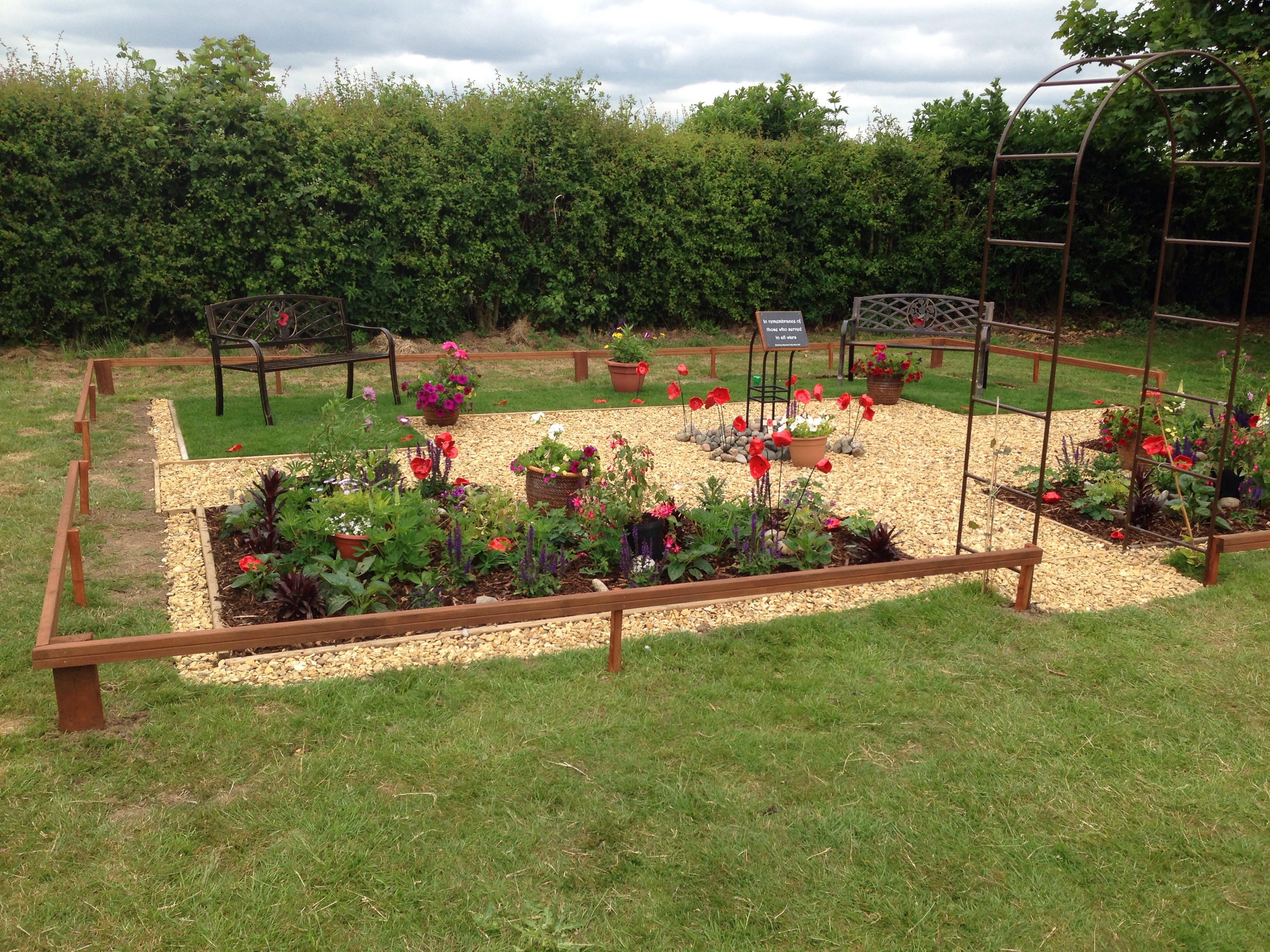
The Memorial at the Centre of the Garden.

As people arrived they were greeted with refreshments and displays of work, photos of family members along with artefacts gathered or brought in by friends and parents. My good friend Kevin Fleckner brought four original uniform and bits from a crashed B-17 for us to show.

At 17:15 two RAF Tornado jets from RAF Marham flew overhead. The first low and slow, the second 15 seconds behind, higher and much faster with her wings swept. Over the school, she banked and the crowd waved. The event had opened.

The head then read a short introduction and it was my turn. I have to tell you that public speaking is not my forte and whilst I had been a little nervous I stood at the podium and the nerves vanished. My speech went thus:

June 18th 2015 is a special day. Not just because we’re opening this beautiful space, but for several iconic reasons. 200 years ago today the British and French forces were locked in arms at the Battle of Waterloo. 75 years ago today Winston Churchill made his famous “this was their finest hour” speech. Two dates that will go down in history as both important and momentous.

But these ae not the only significant dates in history.

100 years ago last year in 1914 young men in their thousands signed up with excitement for what they thought would be the war to end all wars. However, the war they thought would be over by Christmas went on for four long years. In the killing fields of Flanders, young men, many barely older than 16 or 17 were slaughtered in their thousands, living in mud and rat infested trenches very few were to survive. If not killed by the constant shelling, sniper fire or the slow march through no man’s land, many would suffer shell shock, a brutal psychological illness that would eat away at the very heart and soul of the young men. Eventually, in 1918 the First World War ended, the guns fell silent and Europe could finally begin rebuilding once more.

Sadly man’s inhumanity to man was to raise its ugly head again. In 1939, Europe was plunged once more into war with the German invasion of Poland. As The mighty Nazi war machine blitzkrieged its way across Europe, the British Armed Forces once more fought bravely in the name of freedom and democracy.

From the beaches of Dunkirk to the defence of Britain in the skies over Kent, the landing grounds of Normandy, to the battles in the Ardennes, Arnhem, over the Rhine and eventually the battle for Berlin itself, the brutality of war would once more be seen again.

The civilian population of Europe was to suffer greatly too. The blitz of our cities and the bombing of European targets that killed thousands upon thousands as bombs rained down from the sky. The concentration camps, death camps and prisoners of war camps saw a brutality on a scale that was and still is, incomprehensible.

From the hot deserts of Africa through the warm seas of the Mediterranean to the freezing conditions of the Arctic convoys, young men would bravely fight without question many paying the ultimate and final sacrifice.

Eventually, on 8th May 1945, the war in Europe finally ended and Peace reigned once more. However, the killing went on in the Far East. On the Pacific Islands of Okinawa, Saipan, Iwo Jima and Guadalcanal, The fighting continued in some of the most brutal conditions known to man. Eventually on August 15th 1945. UK time, following the Americans dropping the world’s most devastating and horrific bombs on Hiroshima and Nagasaki, war was declared finally over. The world has now entered the atomic age and six years of war had left it scars across Europe, the Middle East, The Far East, in the waters of the Atlantic and Pacific Oceans and across both the northern and Southern Hemispheres. Across the world millions lay dead, injured, homeless or orphaned. In the words of our distinguished guests here today “There are no winners in war.”

If there is one thing that history can teach us, it is that man is unable to live at peace with his fellow-man. Whether it be disputes over territory, natural resources or religious ideologies, War has continued to be fought and young men and women have continued to die.

In post-World War 2, the world lived on a knife-edge; the Cuban missile crisis being the ultimate stand-off between the east and west. From Korea and Vietnam to the Falkland Islands, the Middle Eastern countries of Iraq and Afghanistan, Britain and her allies have continued to fight for peace and democracy something we here take very much for granted.

It is in the name of these young men and women that we have built this memorial garden, so that their memories and their sacrifice may live on in the hearts and minds of future generations. It is so that we can pay homage and remember the dedication, bravery and self-sacrifice that they have shown so that we may live today without fear and in freedom.

It is to these people that I say thank you. Thank you for willing to lay down your life so we may freely speak out against injustice. To those who never came home, who paid the ultimate sacrifice, may you forever rest in peace. Thank you

Next one of the children read what the garden meant to him. Un-nerved by the occasion, he told how his father passed on his grandfathers tales of the war, how it means he can enjoy the peace and tranquility and he made a remarkably moving speech from the heart.

We then had a young lady from the group read in full the Robert Lawrence Binyon poem ‘For the fallen’. Short gasps from some of the audience told me they didn’t realise where the Remembrance Day words came from as it appears in the middle of the poem. She too read fluently and without falter, quite an achievement. Both these children were only just 10/11 years old.

A blessing by the vicar led us into the last post and a two minutes silence for those who had paid the ultimate sacrifice. A number of visiting Vets saluted, the Air Training Cadets lowered the colours and all went silent. Not a sound bar the cool wind in the adjacent trees.

My Good Friends Baz and Helen, whom helped enormously, John and Tony the Veterans and Kevin, who brought a number of uniforms and bits for us to display.

After the reveille the colours were raised and the two veterans invited to open the memorial officially. One Tony, a Normandy D-day+1 vet and the other John, who fought from Africa against Rommel’s Tigers, through Italy up into the continent, stood either side. As they lifted the flag, John declared the garden open to applause from the gathered audience. The children then sang unaccompanied Vera Lynn’s “We’ll meet again”; many from the audience joined in. The event closed and photos were taken around the memorial.

I estimated around 150 people, which for a small school of 68 children is remarkable. We had veterans from Cambridge a good hour and half away,  visitors from Northampton another similar distance and a large number of folk from the village turn up.

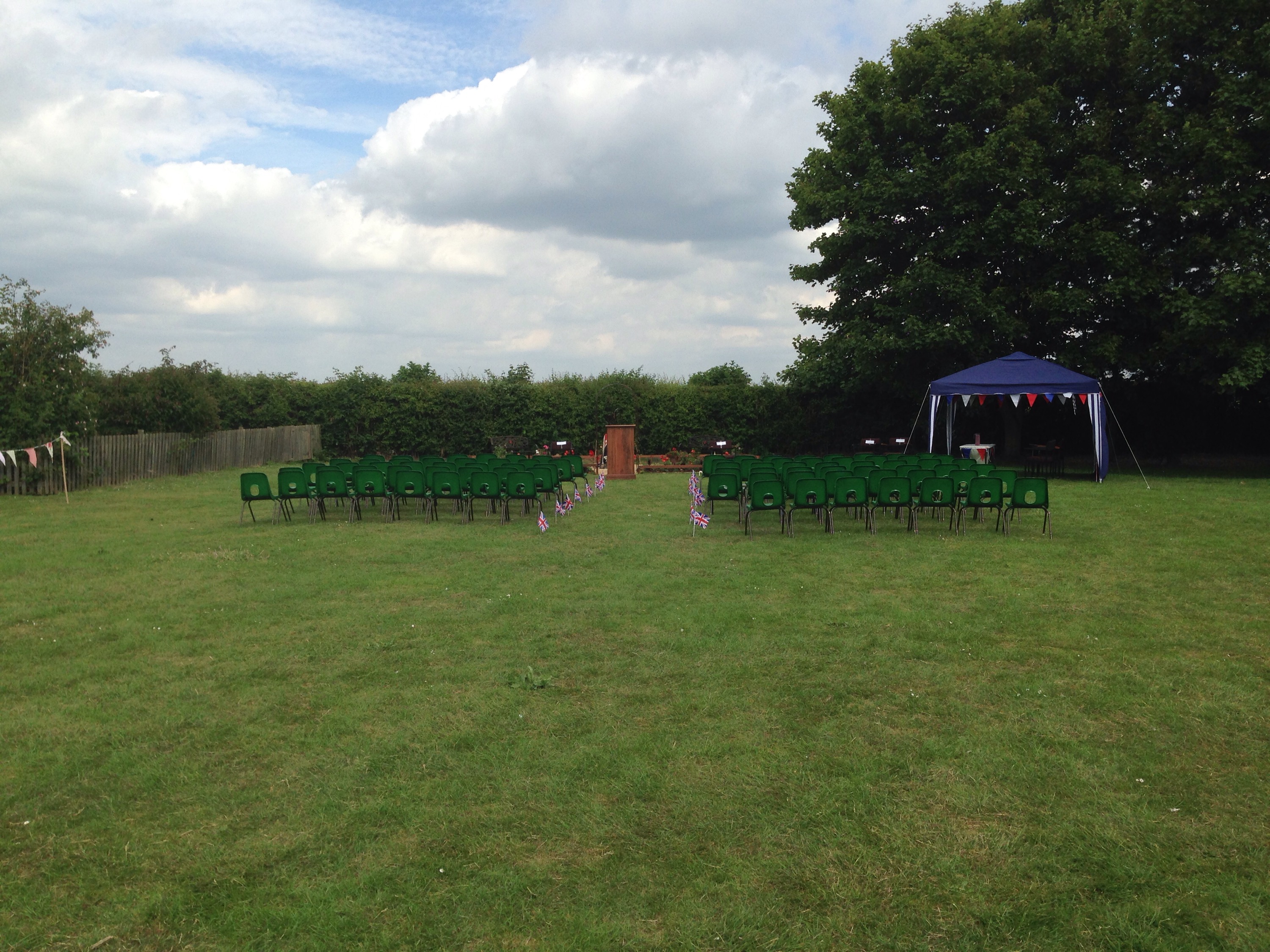
The seating before people started to arrive. There were many more standing, being a small school. we simply didn’t have enough chairs!

The feedback from visitors was superb and everyone was buzzing.

A real team effort, the long evenings, the hard work and recent battle against moles had all been worth while.

We had texts and emails from those who were there praising the efforts. It all worked out far better than even I had envisaged.

We shall miss it. We had great fun, even the odd beer or two, but it has been a real bonding exercise, we have become a little ‘family’ and are really proud of our achievements.

I passed on the good wishes to the children whom I think are quite overwhelmed themselves. They did a fantastic job and were superb role models for others to follow.

The Garden as it is today. We shall seed the outside, and continue the fight with the moles. An area for relaxation and thought.

We shall continue to nurture and maintain the Garden and watch it grow. The children use it already and do enjoy it. The rose in the crown were the poppies. Made out of clay, they are all handmade by the children mounted on metal rods and bunched in groups of 3 or 4. They do look superb.

There were small stumbling blocks along the way, and these caused delays but none so great we couldn’t deal with them. All in all it went beautifully, far, far better than I ever imagined and the finished product, I hope you’ll agree, is stunning.

An article appeared in the paper on the following day, Saturday here’s a link.

Luftwaffe diaries – Big Week

Following on from the earlier diaries of Luftwaffe pilots during the Battle of Britain, I have found other examples, worth sharing.

These examples, were written as the Allies launched the ‘Big Week’ campaign against heavily defended German targets. In defence, the Luftwaffe were operating a wide range of aircraft, heavily armed, they were designed to destroy the big heavy bombers, both quickly and easily. The US Eighth and Fifteenth Airforces were bombing during daylight whilst the RAF were bombing at night. As a result, brutal dogfights were common place between escorting P-51s, P-47s and P-38s and the German aircraft.

Based at Wunstorf near Hanover, was III Gruppe Zerstorergeschwader 26, (part of Luftflotte 2) whose primary role was defence of the North Western Sector of Europe, Belgium and the Netherlands. Formed along with I. and II. Gruppe; III. Gruppe were to suffer badly at the hands of their superior American counterparts. During 1940, they had a total fo 33 aircraft, by the time ‘Big Week’ had come in 1944, this number was significantly lower.

The entry starts in the middle of February, with visits from Generalmajor Ibel1, re-equiping of machines and flight training. Prior to Big week, the Gruppe were also operating in support of land forces. However, as the allied forces began their operations, this role changed.

20.2.44 – At 12:03 hours the Gruppe received orders from 2. Jagddivision to take off and engage reported enemy bomber formation. At 12:13 hours, Bf 110s were airborne and assembled at radio beacon Marie, after new orders re-assembled overhead base. The Kommandeur, Major Kogler, took off late with three more BF 110s at 12.19 hours but failed to meet up with the aircraft which had taken off at 12.13. At 4,000m the first formation was surprised by enemy fighters attacking out of the sun and as a result 11 Bf 110s were shot down2. During the incursion two enemy fighters carried out a low-level attack on the airfield. As a result nine aircraft were hit and suffered up to 30% damage.3

21.2.44 – At 12:41 hours the group received orders to engage incoming enemy formations. At 12:45 ten BF 110s were airborne; assembly over radio beacon Marie.
At 13:15 hours these aircraft joined up with the escort a friendly fighters in the Rottenburg area. Our formation made contact with the enemy force, but due to poor direction failed to reach a favourable position from which to attack.4

22.2.44 – The Gruppe was ordered to take off at 12:22 hours to engage incoming enemy formations. The Gruppe scrambled eight BF 110s at 12:28 hours. Weather at take-off: Fair weather, 50km visibility, cloud base 1,000m, 2–3/10 cover. At 12:55 to 13:00 hours joined own fighter escort at 7,000m above Lake Steinhude. The Gruppe joined up behind I./ZG 26 which was operating under the control of the 2. Jagddivision. At 13:35 hours three formations of Fortress IIs were sighted. The leader of our formation (I./ZG 26) closed on the enemy formation to attack from head-on. III./ZG 26, following, was too close behind for a head-on attack, and had to turn an attack from the rear. While closing in to attack, fire was opened from about 400m. The enemy machine flying on the left outside of the formation burst into flames along its right side. It began to curve away to the left and the second attack was carried out from above and to the left, from behind. This Fortress dropped away from the formation well ablaze. There was strong defensive fire from the enemy rear gun positions. Each enemy formation numbered about 60 aircraft, flying in arrow. Weather in operational area: about 3/10 cloud cover, cloud base 500m tops 2,000m. Visability above cloud more than 50km.

During the head-on attack, the formation leader turned in too soon, so that the aircraft coming behind were unable to get into an attacking position.

Landing: Two BF 110s landed at Wunstorf, at 13:58 and at 14:10 hours. Four BF 110s made belly-landings. No landing reports received so far from two BF 110s. 5

Successes: One Fortress II shot down by Oblt. Bley.

23.2.44 – No operations. The Gruppe carried out instrument flying training missions as planned. The 7th Staffel is in the process of receiving replacement aircraft.

24.2.44 – Operational report.
Take off: Four BF 110s from Wunstorf at 12:01 hours. Order: Scramble take-off to engage incoming enemy formations. The Gruppe assembled at 7,000m over Brunswick with ten BF 110s of I./ZG 26. II./JG 11 joined up to provide the escort at 12:15 hours. Instructions received from JaFue6 during the assembly. At 13:15 hours eight formations each of about 15 liberators were seen in the area of Nordhausen, stepped up from 4,000m to 7,000m and flying on the south-easterly heading. It was noticeable that the enemy aircraft were wavering about. On the approach of our Gruppe the enemy force turned south and later south-west. Attack was carried out at 13:00 hours in the area of Holzminden, from the left and above. III./ZG 26 scored one victory7 and one Herausschuss (bomber leaving formation after attack by Major Kogler). Several liberators were observed to be on fire; others were seen to crash8. The claims of I./ZG 26 are not to hand. Landing: Two BF 110s landed at Wunstorf at 14:08 and 14:14 hours. One BF 110 suffered damage to the cabin and turned back. One BF 110: no landing report received (Gern’s aircraft).

Supplement: the enemy bombers were escorted by Thunderbolts, which flew above the formation. It was ascertained that the leading formation, which I tried to attack, always went into a turn to the right when I was in front shortly before I turned in to make my attack. It is possible that this forced the bombers away from their target.

Diary written by Major (Gruppe Kommandeur) Kogler, 1944

On February 24th 1944, there were several missions flown by the USAAF: Mission 233, (to attack targets at: Gotha, Rostock, Poznan and Schweinfurt) and 234 which occurred at night.  Mission 233 was the second largest operation to take place during ‘Big Week’ and involved 809 bombers with 767 fighters as escort.

Mission 233 took place in 3 Waves, Wave 1 – 239 B-24s were sent to Gotha; Wave 2 – 266 B-17s were sent to Schweinfurt and Wave 3, 304 B-17s were dispatched to the primary target of Poznan.

A fatal mistake by the lead aircraft in the first Wave (due to a faulty oxygen mask) led to Eisenach being bombed by mistake. The following formation also bombed by mistake, following his mark.  These are the only B-24s that flew on that day and as a result, it is probable (but not certain) that these are the Liberators mentioned in Kogler’s diary for that day. Casualties reported by the USAAF for that mission were: 3 KIA, 6 WIA and 324 MIA9.

Liberators of the 392nd BG from RAF Wendling were involed in this mission, an account is available here along with MACRs and statements from those involved.

It has been interesting to compare explantions from both sides, with limited resources, any connection is only presumed, but it does give an interesting perspective to the bomber war over Europe.

Sources:

1 – Generalmajor Ibel was the Commander of 2. Jagddivision

2 – Six pilots and five radio operators were killed in the attack. Two pilots and four radio operators were wounded.

3 – One armourer was killed along with one Radio operator and one mechanic wounded.

4 – Combat report D1

5 – Later found to have been shot down, their crews were killed.

6 – JaFue – Fighter Controller.

7 – Oblt Meltz.

8 – Lt. Gern, who was shot down during the action but bailed out of his aircraft, logged a claim for one Fortress shot down when he returned to his unit.

9 – 8th Airforce Operations, http://8thafhs.com/missions.php

The full diary entry appeared in The Luftwaffe Data Book, by Dr. Alfred Price, Published by Greenhill Books, 1936, 1977, 1997. pg197-200

Lt. Col. Leon Vance 489th BG – Medal of Honour

Leon vance.jpg

Leon Vance*

The story of Leon Vance is one of  the saddest stories to emerge from the Second World War. He was a young American, who through his bravery and dedication, saved the lives of his colleagues and prevented their heavily striken aircraft from crashing into populated areas of southern England. Following a mission over France, his was very severely injured, but miraculously fought on.

Leon Robert Vance, Jr. known as ‘Bob’ to his family and friends, was born in Enid, Oklahoma, on August 11th, 1916. He graduated from high school in 1933 after receiving many honours and being singled out as a high performing athlete. He went on, after University, to the prestigious Training College at West Point in 1935, staying until his graduation four years later in 1939. It was here, at West Point, he would meet and marry his wife Georgette Brown. He and Georgette would later have a daughter, after whom Vance would name his own aircraft ‘The Sharon D’.

Vance would become an aircrew instructor, and would have various postings around the United States. He became great friends with a Texan, Lieutenant Horace S. Carswell, with whom he would leave the Air Corps training program to fly combat missions in B-24 Liberators. They became great friends but would go on to fight in different theatres.

Prior to receiving his posting, Vance undertook training on Consolidated B-24s. Then, in October 1943, as a Lieutenant Colonel, he was posted to Europe with the newly formed 489th Bombardment Group (Heavy), as the Deputy Group Commander. One of the last groups to be assigned to the european theatre, they formed part of the 95th Combat Bombardment Wing (2nd Bomb Division),  Eighth Airforce, and were sent to RAF Halesworth (RAF Holton) designated Station 365 by the USAAF.

The group left their initial base at Wendover Field, Utah in April / May 1944 and their first mission would be that same month on May 30th, 1944, as part of a combined attack on communication sites, rail yards and airfields. A total of 364 B-24s were to attack the Luftwaffe bases at Oldenburg, Rotenburg and Zwischenahn, along with other targets of opportunity far to the north in the German homeland. With only 1 aircraft lost and 38 damaged, it was considered a success and a good start to the 489th’s campaign.

As the build up to Normandy developed, Vance and the 489th would be assigned to bombing targets in northern France in support of the Normandy invasion about to take place further to the south. An area the unit would concentrate on, prior to the Allied beach invasion on June 6th that year.

The day before D-day, the 489th would fly to Wimereaux, in the Pas-de-Calais region of northern France. This would be Leon Vance’s final mission.

B-24H Liberator of the 489thBG, RAF Halesworth*2

The group, (Mission 392),  consisted of 423 B-17s and 203 B-24s and were to hit German coastal defenses including: Le Havre, Caen, Boulogne and Cherbourg areas as precursors to the Normandy invasion. Some 127 P-47s and 245 P-51s would support the attacks. The 489th would assemble at 22,500 feet on the morning of June 5th, proceed to the south of Wimereaux and fly over dropping their payload then return to England. On the run in to the target, Vance was stationed behind the pilot and copilot.  The lead plane encountered a problem and bombs failed to jettison. Vance ordered a second run, and it was on this run that his plane, Missouri Sue, took several devastating hits.

Four of the crew members, including the pilot were killed and Vance himself was severely injured. His foot became lodged in the metal work behind the co-pilots seat. There were frantic calls over the intercom and the situation looked bad for those remaining on board. To further exacerbate the problems, one of the 500lb bombs had remained inside the bomb bay armed and in a deadly state, three of the four engines were disabled, and fuel spewed from ruptured lines inside the fuselage.

Losing height rapidly, the co-pilot put the aircraft into a dive to increase airspeed. The radio operator, placed a makeshift tourniquet around Vance’s leg, and the fourth engine was feathered.  They would then glide toward the English coast.

The aircraft was too damaged to control safely, so once over english soil, Vance ordered those who could, to bail out. He then turned the aircraft himself out to the English Channel to attempt a belly landing on the water. A dangerous operation in any aircraft, let alone one with an armed bomb and no power.

Still trapped by the remains of his foot, laying on the floor and using only aileron and elevators, he ensured the remaining crew left before the aircraft struck the sea. The impact caused the upper turret to collapse, effectively trapping Vance inside the cockpit. By sheer luck, an explosion occurred that threw Vance out of the sinking wreckage,  his foot now severed.  He remained in the sea searching for whom he believed to be the radio operator, until picked up by the RAF’s Air Sea Rescue units.

Vance was alive, but severely injured. He would spend a number of weeks, recuperating in hospital, writing home and gradually regaining his strength. Disappointed that his flying career was over, he looked forward to seeing his wife and young child once more. However, on a recuperation trip to London, Vance met a young boy, who innocently, and without thought, told him he wouldn’t miss his foot. The emotional, impact of this comment was devastating to Vance and he fell into depression. Then, news of his father’s death pushed him down even further.

Eventually, on July 26th, 1944 Vance was given the all clear to return home and he joined other wounded troops on-board a C-54, bound for the US. It was never to arrive there.

The aircraft disappeared somewhere between Iceland and Newfoundland. It has never been found nor has the body of Leon Vance or any of the others on board that day. Vance’s recommendations for the Medal of Honour came through in the following  January (4th), but at the request of his wife, was delayed until October 11th 1946, so his daughter could be presented the medal in her father’s name.

The citation for Leon Vance reads:

For conspicuous gallantry and intrepidity above and beyond the call of duty on 5 June 1944, when he led a Heavy Bombardment Group, in an attack against defended enemy coastal positions in the vicinity of Wimereaux, France. Approaching the target, his aircraft was hit repeatedly by antiaircraft fire which seriously crippled the ship, killed the pilot, and wounded several members of the crew, including Lt. Col. Vance, whose right foot was practically severed. In spite of his injury, and with 3 engines lost to the flak, he led his formation over the target, bombing it successfully. After applying a tourniquet to his leg with the aid of the radar operator, Lt. Col. Vance, realizing that the ship was approaching a stall altitude with the 1 remaining engine failing, struggled to a semi-upright position beside the copilot and took over control of the ship. Cutting the power and feathering the last engine he put the aircraft in glide sufficiently steep to maintain his airspeed. Gradually losing altitude, he at last reached the English coast, whereupon he ordered all members of the crew to bail out as he knew they would all safely make land. But he received a message over the interphone system which led him to believe 1 of the crew members was unable to jump due to injuries; so he made the decision to ditch the ship in the channel, thereby giving this man a chance for life. To add further to the danger of ditching the ship in his crippled condition, there was a 500-pound bomb hung up in the bomb bay. Unable to climb into the seat vacated by the copilot, since his foot, hanging on to his leg by a few tendons, had become lodged behind the copilot’s seat, he nevertheless made a successful ditching while lying on the floor using only aileron and elevators for control and the side window of the cockpit for visual reference. On coming to rest in the water the aircraft commenced to sink rapidly with Lt. Col. Vance pinned in the cockpit by the upper turret which had crashed in during the landing. As it was settling beneath the waves an explosion occurred which threw Lt. Col. Vance clear of the wreckage. After clinging to a piece of floating wreckage until he could muster enough strength to inflate his life vest he began searching for the crew member whom he believed to be aboard. Failing to find anyone he began swimming and was found approximately 50 minutes later by an Air-Sea Rescue craft. By his extraordinary flying skill and gallant leadership, despite his grave injury, Lt. Col. Vance led his formation to a successful bombing of the assigned target and returned the crew to a point where they could bail out with safety. His gallant and valorous decision to ditch the aircraft in order to give the crew member he believed to be aboard a chance for life exemplifies the highest traditions of the U.S. Armed Forces”*1

Leon Vance’s actions would be remembered. His local base in Oklahoma was renamed ‘Vance Air Force Base’ on July 9th, 1949. The gate at Tinker Air Force Base, Oklahoma was also later named after him on May 9th, 1997, and his name appears on the ‘Wall of the Missing’ at Madingley American War Cemetery in Cambridge, England.

IMG_2005

The Wall of the Missing, on Which Leon Vance’s Name Appears.

Leon Robert Vance, Jr. (August 11th, 1916 – July 26th, 1944)

For other personal tales, click here.

references

* Photo public domain ia Wikipedia

*1 “Medal of Honor recipients – World War II”.

*2 Photo Public Domain via Wikipedia.

Caught at Upwood and executed for spying

“Upwood was to experience some rather difficult times and localised action. Numerous accidents were interspersed with attacks by marauding Luftwaffe aircraft and a parachuting spy. This event led to much excitement around the base. The spy,  Josef Jakobs, was found guilty of treason and later executed at the Tower of London”

Possibly one of the most photographed sites in the country, it is like a ghost town, its buildings vandalised and shattered, its walls resonate with the ghostly callings of those who trod its corridors.

Why not see more of Upwood and what remains of this one bustling site using this link.

DSC_0179

Ghostly reminders of days long gone


5,127 Missing Americans are Honoured Here

There are many excellent and fitting memorials around the country dedicated to the RAF and USAAF personnel. Many of these are relatively new and make for terrific places to sit, remember and give thanks to the young men and women who gave so much.

I have visited a few myself and will feature them here as I get round them. If you have been to one and would like to write a piece for us, please feel free to contact us, and we can make the necessary arrangements to post it here. We would love your contribution.

My first is the American Cemetery at Madingley.

Cambridge American Cemetery and Memorial – Madingley

Not far from Cambridge, to the west of the M11, is the American Cemetery and Memorial at Madingley.

IMG_1998

A Panoramic View Across Madingley Cemetery

Madingley is the only American Military Cemetery in the United Kingdom, dedicated solely to the Second World War. It covers an area of some 30 acres and the land it uses was donated by Cambridge University. The site was dedicated on July 16th 1956. It is operated and maintained solely by the American Battle Monuments Commission, who oversee 24 cemeteries and 25 memorials across 15 different countries.

DSC_0573

One of the 3,812 Headstones

The cemetery has become a symbol of not only the  sacrifice of those held within its walls but the 3 million Americans who were stationed here during Word War II and the continuing alliance between the United Kingdom and the United States in times of conflict.

Within the cemetery stand 3,812 headstones, 3,732 Latin crosses, and 80 Stars of David. The stones are laid out in a fan, each row like a ripple in a pool, with the origin at a flagpole, from which the entire site and surrounding countryside can be seen. Around the base of the flag pole are the words from  “In Flanders Fields“, a World War I poem written by John McCrae, which reads: “To you from failing hands, we throw the torch – be yours to hold it high“. Every night, as the flag is lowered, ‘Taps’ is played on a bugle to signify the end of the military day and lights out – the time to sleep.

DSC_0572

The Plaque Dedicated to the Crew of the 577th BS

Next to this are two buildings. Firstly, the visitors’ centre, where there is a place to sit and staff who will willingly search the Commission’s online database for you. On the wall outside the centre is a plaque dedicated to the crew of a B-24 of the 577th BS, 392nd BG, that flew from RAF Wendling; who through their actions avoided crashing into civilian homes in Hertfordshire.  Next to this, is an exhibition hall, detailed through stories and pictures, the American involvement in the Second World War; with specific examples of some of those souls laid to rest at Madingley.

Along the southern side of the cemetery, is the wall holding the “Tablets of the Missing”. Here, the names, rank and service branch of 5,127 personnel, whose bodies were never found are located. Among them are those of Major Alton Glenn Miller and Lt. Joseph P. Kennedy Jr. (Older brother of John F. Kennedy), to name but a few.

Along the top of the wall is the inscription:

The Americans, whose names here appear, were part of the price that free men for the second time in this century, have been forced to pay to defend human liberty and rights. All who shall hereafter live in freedom
will be here reminded that to these men, and their comrades,
we owe a debt to be paid with grateful remembrance of their sacrifice,
and the high resolve that the cause for which they died
shall live eternally.”

IMG_2005

The Wall With the Names of the Missing

The 427 foot long wall, has 4 statues representing: a soldier, an airman, sailor and coast guardsman, who stand guard over the inscriptions; the four statues were designed and created by the American sculptor, Wheeler Williams (November 30th, 1897 – August 12th, 1972). Wreaths are placed at the foot of the wall by American associations and serving units and makes for a moving experience.

DSC_0590

One of the Four Sculptures Depicting an Airman

At the other end of the wall is the memorial and chapel. The inscription on the memorial says “Grant Unto Them O Lord Eternal Rest” and 5 pillars each inscribed with one year of the war 1941 – 1945, that the Americans were involved. A brass inscription over the entrance reads “Into Thy Hands O Lord” and opens up to a detailed and incredible room. The roof depicts a formation of bombers and their escorts typical of those that flew from airfields in England, on their way to occupied Europe. On the wall a large map illustrates “The Mastery of the Atlantic – The Great Air Assault”,  in superb detail.  Designed by Herbert Gate, the American Artist, it is thirty feet long and eighteen feet high and shows the routes used to transport men and machinery from the United States. It also shows Naval operations and the bombing routes used during the great battles over Europe.

DSC_0581

The Memorial Building and Chapel

Outside the chapel, along the length of the ‘Tablets of the Missing’, are rectangular pools and rose beds, neatly laid out as they should be. Lined by trees, it makes a serene place to walk.

Madingley Cemetery is a moving yet peaceful place to sit and remember, to pay homage and to give thanks to the many young men and women who came from another country, to give up their lives in the name of freedom and democracy.

In the words of the original Chairman, General John J. Pershing, Commander of the American Expeditionary Force of the First World War:

“Time will not dim the Glory of Their Deeds”.

IMG_2006

The Atlantic Display Inside the Chapel

DSC_0582

The Rectangular Ponds in Front of ‘The Tablets of the Missing’

Madingley Cemetery can be visited freely, opening times and other details are available on their website here, from which many of the facts of this record have come.

The American Battles Monuments Commission also manages the Brookwood Cemetery in Woking, Surrey and their details can be found here.

The American Role of Honour can be seen here at St Pauls Cathedral, my thanks goes to wynnebook.wordpress.com for the valuable link.

They shall grow not old, as we that are left grow old: …

Originally posted on the anniversary of the publication of his poem, For the Fallen, 21st September 2014, Laurence Binyon’s poem has become synonymous with remembrance services across the country. This week is remembrance Weekend (and Veteran’s day in the United States) on which we remember the fallen: those who gave the greatest sacrifice, so we could live in peace.

I thought it appropriate to repost this during Thai special week so we know a little more about the poem and the history behind it.

‘Lest we forget’

“To all those who went before, (Robert) Laurence Binyon’s 1914 poem is widely used in remembrance services across the world. Laurence Binyon wrote his For the Fallen, with its Ode of Remembrance, while Binyon was visiting the cliffs of North Cornwall between Pentire Point and The Rumps.

Today, if you visit, there is a stone plaque at the spot to commemorate his poem, which reads: For the Fallen Composed on these cliffs 1914″. There is also a second plaque located on the beehive monument on the East Cliff above Portreath in central North Cornwall. There, you will find a plaque on a statue inscribed with the same words. Laurence Binyon’s poem, For the Fallen, was published in The Times newspaper, following heightened public sentiment due to the recent Battle of Marne (5-12 September 1914) on 21st September 1914, 100 years ago today. http://wp.me/P4xjD9-8u

For the Fallen

With proud thanksgiving, a mother for her children,
England mourns for her dead across the sea.
Flesh of her flesh they were, spirit of her spirit,
Fallen in the cause of the free.

Solemn the drums thrill: Death august and royal
Sings sorrow up into immortal spheres.
There is music in the midst of desolation
And a glory that shines upon our tears.

They went with songs to the battle, they were young,
Straight of limb, true of eye, steady and aglow.
They were staunch to the end against odds uncounted;
They fell with their faces to the foe.

They shall grow not old, as we that are left grow old:
Age shall not weary them, nor the years condemn.
At the going down of the sun and in the morning
We will remember them.

They mingle not with their laughing comrades again;
They sit no more at familiar tables of home;
They have no lot in our labour of the day-time;
They sleep beyond England’s foam.

But where our desires are and our hopes profound,
Felt as a well-spring that is hidden from sight,
To the innermost heart of their own land they are known
As the stars are known to the Night;

As the stars that shall be bright when we are dust,
Moving in marches upon the heavenly plain,
As the stars that are starry in the time of our darkness,
To the end, to the end, they remain.

(Published in The Times newspaper, 21st September 1914).

Thanks to Marcella who contributed to the writing of the original post.”

DSC_0097

 For the Fallen – Laurence Binyon (1869-1943)

Ode to the Fallen.

As we approach Remembrance day (and Veteran’s day in America), Aviation Trails will be publishing a mix of poetry and aviation material in remembrance of those brave and courageous young men and women, who, from all nationalities, gave the ultimate sacrifice in war.

The numbers are staggering; during World War 1, there were some 37 million* deaths, (of which around 7 million were civilian). Thankfully, because the war was quite stationary, it did not create as many of the civilian casualties that were found in the Second World War. The higher number here being primarily military and serving personal. Defined as the ‘War to end all Wars’, it brought a devastating blow to societies across the European countries and their allies, as men flocked to the front and the mass slaughter that prevailed.

World War 2 on the other hand, due to the much faster, greater technological advancement that war brings, saw a much higher casuality rate. Over 60 million people died which amounted to approximately 2.5% of the world’s population*1. This is currently about the size of Nigeria, the world’s seventh largest country*2. The war was so widespread and devastating, that the actual number of casualties will never be known. A new type of war, it spread death and destruction to a much wider audience.

Subsequent wars, have also taken their toll, both in military and civilian terms. Continuing conflicts are, and will account for further deaths, and it is a sad reflection of the world we live in today.

So on this special weekend, during the 100th anniversary of the First World War, we remember those who have given so much so that the rest of us can live peacefully.

Memorials visited during the making of ‘Aviation Trails‘ can be seen here.

Ypres 007

Tyne Cot Cemetery, Belgium


Sources:

Whilst not official, Wikipedia gives some detailed accounts of countries and their casualties.

* Wikipedia, World War 1 Casualties;  http://en.wikipedia.org/wiki/World_War_I_casualties

*1 Wikipedia, World War 2 casualties; http://en.wikipedia.org/wiki/World_War_II_casualties

*2 Wikipedia, list of countries by population; http://en.wikipedia.org/wiki/List_of_countries_by_population

The Command Structure of the USAAF

During the Second World War, the USAAF grew beyond recognition. The 16 air forces that made up the overall USAAF covered the globe, every theatre of war saw some action. This ranged from the home regions, protecting the west coast from Japanese submarines and naval attacks, the east coast, searching for marauding German submarines, Europe, the Middle East, the Pacific and Japan.

Organising these air forces fell to Commands, the ‘middle management’ of the Air Force. Commands, or sometimes referred to as ‘Divisions’, combined the groups that made up the fighting forces of each of the 16 air forces.

I have broken each one down, listing the groups and main squadrons that fell within each one. Click the link here to see how these Divisions were organised.

DSC_0042