This is a repost of an event that took place on February 22nd 1944, as told by my good friend Mitch Peeke.
Kimbolton station was home to the four Squadrons of the 379th BG, Eighth Air Force flying B-17 ‘Flying Fortresses’, identifiable by a triangle and large ‘K’ on the fin.
The 379th BG took part in many of the war’s greatest air battles carrying out numerous bombing missions over occupied Europe. They also flew, unprotected, into the heartland of Germany, attacking prestige industrial targets, losing many aircraft and aircrew in the process.
As with many squadrons of both the USAAF and RAF, heroic acts of bravery and self-sacrifice were common place, crews putting their own lives in jeopardy to save those of their fellow crewmen and colleagues. Many did not return as a result. This is the story of one such crew, told by Mitch Peeke.
I was recently contacted by a lady via the GoFundMe (now closed) page linked to the memorial I am raising here at Allhallows, to 2nd Lieutenant Armand Ramacitti and the crew of B-17 #44-6133. The lady’s name is Mary Barton and her Dad was a pilot in the 524th Squadron, 379th Bombardment Group, who were also based at Kimbolton.
Mary Barton’s Dad was 1st Lieutenant John E Morse and his B-17 was #42-5828 “The Sweater Girl“.
The John Morse Crew: (not the final crew of ‘The Sweater Girl’ – see below) Standing left to right : John F. Humphreys (top-turret gunner, fatally injured , mission 54, Dec. 31, 1943) Charles S. Sechrist S/Sgt – Eng/TTG; Homer L. Neill S/Sgt – BTG; Charles E. Cox S/Sgt – RWG; Andrew L. Allen S/Sgt – LWG; Willard H. Clothier T/Sgt RO; Kneeling left to right: John E. Morse 1st Lt – Pilot; Robert J.Philips FO – CP; Robert Y. Daniels 2nd Lt – Bom; Leonard R Lovelace 2nd Lt – Nav; Photo by kind permission of Mary Barton
John Morse’s crew were the second crew assigned to that ship, taking over when the first crew completed their tour. She had already been named “The Sweater Girl” by her first crew. As she’d seen her previous crew safely through their tour, John and his crew kept the name. Sadly, the run of luck was not set to continue. On John’s third mission, their Top turret gunner, John Humphreys was fatally wounded when a German fighter attacked the aircraft.
John’s eighth mission was on February 22nd 1944 during “Big Week.” The target was an aircraft factory at Halberstadt. However, near Koln, “Sweater Girl” was seen to take a devastating hit from Flak in the starboard wing. The aircraft dropped out of formation and went down in a spin. No parachutes were seen to emerge and “Sweater Girl” was presumed lost.
The exploding Flak shell had not only severely damaged the aircraft, but it had started a fire in the Cockpit and terribly wounded the Radio Operator, T/Sgt Willard Clothier. The shrapnel had practically severed Clothier’s thigh. The Tail Gunner, Sgt Edward Pate, had also been wounded and now had a large gaping hole in his ankle. However, John Morse was an exceptional pilot, he’d been a flying Instructor for two years previously and was just shy of thirty years old when he’d volunteered for combat duty. He was not about to give up on his ship or his crew. Somehow, John managed to regain control of the aircraft pulling it out of its potentially terminal fall.
The Cockpit fire having now been put out, John and his Co Pilot realised that “Sweater Girl” would never make it back to Kimbolton. With two critically wounded crewmen aboard, John’s next decision was how best to get his crew and his aircraft safely down. There were really only two options: a traditional wheels-up crash landing, or letting the crew bail out.
By now, they were over the German town of Oberbruch, about six miles short of the Dutch border. It was crunch time. John saw a piece of open ground below, away from the houses, but it wasn’t big enough to accommodate a B-17 coming in wheels-up. Gently banking left, he began circling, giving the “Everybody out!” order to the crew. The Bombardier had already put a tourniquet on the Radio Operator’s thigh and a field dressing on the Tail gunner’s ankle. Both men were now strapped into their parachutes and put out of the aircraft. As the rest of the crew bailed out, John trimmed the stricken B-17 and lashed the control yoke with belts to hold “Sweater Girl” in the shallow spiral dive he’d started, then he too bailed out.
John’s piloting skills had saved his crew. Moreover, as “Sweater Girl” continued to circle, descending unmanned over that open ground, the people on the ground watching the drama unfold had plenty of warning that a crash was inevitable. Witnesses on the ground said that the plane had circled for nearly fifteen minutes before finally and literally flying itself into the ground behind the houses. There was no explosion and nobody was hurt.
B-17 ‘The Sweater Girl’ #42-5828 after crashing at Oberbruch (by kind permission of Mary Barton)
The Tail Gunner, Sgt Edward Pate, and the Radioman, T/Sgt Willard Clothier, were both repatriated some months later, after treatment in a POW Hospital, Clothier losing his leg. John Morse and the rest of “Sweater Girl”s crew spent the remainder of the war as POW’s. All later returned home.
In 2015, A civic-minded citizen of Oberbruch, Helmut Franken, created a monument to the event bearing the names of all nine crew members, near to the place where the B-17 crashed. He also sent Mary, John Morse’s daughter, the pictures of the wreck, which were taken the day after the crash. Oberbruch has never forgotten how John Morse’s actions that day not only saved the lives of his crew, but also spared the town from what certainly would have been a devastating plane crash.
A few years ago, Mary was fortunate enough not only to have been given a tour, with her sister, of Kimbolton as it is now, but also to have been able to take a flight in a B-17. She described it as an unforgettable experience and one that added to her understanding of her late Father. She wants others to be able to have that experience, which is why she is kindly supporting A WING AND A PRAYER. She wants to help keep Britain’s last remaining airworthy B-17 in the air, as a flying memorial to the 79,000 US and British airmen who gave their lives flying B-17’s during World War 2.
Thank you, Mary; for your support and for sharing your Dad’s remarkable story and the equally remarkable photographs.
Note:
My own thanks go to Mitch for writing the article and for gaining Mary’s permission to publish both it and her photos. I also thank Mary for taking the time to share her father’s story, it is truly a remarkable one.
‘Sweater Girl‘ was a B-17-F-VE ‘Flying Fortress’ delivered to Long Beach March 1st, 1943. She travelled to Sioux City, onto Kearney and then to Dow Field where she was assigned to the 524thBS/379thBG and Kimbolton. Her loss is detailed in MACR 2868.
The crew at the time of the crash were:
Sgt. Edward T Pate (TG) – repatriated
1st Lt. John E. Morse (P) – POW
F.O. Robert J. Philips (CP) – POW
2nd Lt. Leonard R. Lovelace (Nav) – POW
2nd Lt. Robert Y. Daniels (Bom) – POW
T. Sgt. Willard H. Clothier (RO/Gunner) – RTB
S/Sgt. Homer L. Neil (BTG) – POW
S/Sgt. Charles S. Sechrist (Eng/TTG) – POW
S/Sgt. Charles E. Cox (RWG) – POW
S/Sgt. Andrew L. Allen (LWG) – POW
Kimbolton airfield is part of Trail 6, little exists of it, the main buildings and runways being removed many years ago. Patches of concrete do still remain and part of it forms a kart track. A memorial and a Roll of Honour stand outside what was the airfield’s technical area.
It was on Wednesday 1st December 1943, that a 75 Squadron Stirling MK.III (EH880) piloted by F/S J. S. Kerr (s/n 1558163) would be diverted from RAF Mepal and instructed to land at RAF Acklington in Northumbria.
The aircraft had been on operations to plant mines in the Danish coastal waters. On the final approach it undershot striking a family farmhouse in Togston near Amble. Inside the house, Cliff House Farmhouse, was the Robson family. The five children, ranging in ages from 19 months to 9 years of age, were all killed, whilst the parents who were playing cards downstairs, escaped with varying injuries after being pulled from the rubble by helpers. All but one of the Stirling’s crew were killed, the mid upper gunner Sgt K Hook, was pulled from the burning wreckage, his burning clothes being extinguished, by the local butcher, Jim Rowell.
This crash was the greatest civilian loss of life in the district,
The crew of Stirling EH880 ‘AA-J’ were:
F/S George John Stewart Kerr, RAFVR (s/n 1558163) – Pilot.
Sgt. Donald Frank Wort, RAFVR (s/n 1585034) – Navigator.
Sgt. Ronald Smith, RAFVR (s/n 1239376) – Air Bomber.
Sgt. Derek Arthur Holt, RAFVR (s/n 1217087) – Wireless Operator.
Sgt. Leonard George Copsey, RAFVR (s/n 1691471) – Flight Engineer.
Sgt. Kenneth Gordon Hook, RAFVR (s/n 1335989) – Mid Upper Gunner.
Sgt. George William Thomas Lucas, RAFVR (s/n 1250557) – Rear Gunner.
The ‘Times’ Newspaper, published the story of 3rd December 1943:
Aircraft Crash on Farmhouse. Family of five young children killed.
Five children – all their family – of Mr and Mrs W. Robson were killed when an Aircraft crashed into Cliff House, a small dairy farm near Amble, Northumberland, on Wednesday night. The children’s ages ranged from one to nine years. They were sleeping in an upstairs room.
The mother and father, who with two friends Mr. and Mrs Rowell of Dilston [Terrace] Amble, were sitting in a downstairs room, were injured but not seriously. One of the crew of the aircraft, a gunner, was saved by Mr. Rowell.
Mr Rowell said last night: “We did not realise what had happened until the house collapsed above our heads. We managed to stand up, bruised and badly dazed, and, looking upward we saw the sky. Mrs Robson tried to make her way towards the stairs, which had been blown away. My wife called my attention to a burning object outside which was moving about. We rushed over and found it was a gunner with his clothes alight. Mr Rowell rolled the airman on the ground to extinguish the burning clothes. Although badly burned, the gunner was alive.
The children’s partly charred bodies were recovered later.
Five streets on a housing estate near to the crash site in Amble have since been named after each of the Robson children. The crew are remembered on a plaque in St. John the Divine, the official church of RAF Acklington St. John.
In 1942 Air Ministry Directive S.46368/D.C.A.S. turned Bomber Command’s focus to the morale of the German population and in particular its industrial workforce. Bomber Command now turned to strategic bombing, a controversial campaign that was debated for many years after, it was seen as a way to destroy the enemy’s industrial output, by attacking the very workforce that produced it.
Flt. Lt. Bill Reid VC (IWM CHP 794)
But as loses had mounted, Bomber Command had been forced to fly at night, a task that was almost impossible to satisfactorily achieve for most bomber crews who had been trained to bomb in daylight. Indeed, only some 3 in every 100 bombers were hitting within 5 miles of the aiming point at the start of the campaign.
Harris himself knew that hitting a single target consistently, at night was impossible, and so there was little choice seen other than the controversial bombing campaign.
On one of these raids, on the night of 3rd/4th November 1943, Bomber Command sent a large raid of almost 600 aircraft to Germany. In that raid was Acting Flight Lieutenant William (Bill) Reid, a Scot born in Baillieston, Glasgow, and the son of a Blacksmith .
Reid performed his duties that night in a manner that would see him earn the Victoria Cross, the highest honour possible, for taking his damaged Lancaster to the heart of Dussledorf and bombing the target even though he himself and his Flight Engineer were wounded; the navigator killed and the aircraft severely damaged and so difficult to fly.
That evening, eleven Lancasters from 61 Squadron, RAF Syerston, took off on a mission to bomb Dusseldorf. Reid’s aircraft, Lancaster LM360 was second to depart taking off at 16:59. On board with Flt. Lt. William (Bill) Reid were: Sgt. J. Norris (Flt Eng); Flt. Sgt. J. Jeffries (Nav); Sgt T. Rolton (Bomb Aimer); Flt. Sgt. J. Mann (WT/ Air Gunner); Flt. Sgt. S. Baldwin (Air Gunner) and Flt. Sgt. A. Emerson (Air Gunner).
As the aircraft crossed the Dutch coast there was a terrific bang outside the aircraft which resulted in the windscreen being shattered and partially blown out. Reid was wounded in the head, shoulders and hands, and the plane temporarily went out of control. Flak continued to burst all around the Lancaster with one further burst injuring the Flight Engineer, who was next to read, and causing further injuries to Reid himself. The port elevator had been shot away and to compensate, Reid had to pull the stick fully back just to keep the plane straight and level. Between Reid and the Flight Engineer, they maintained level flight as part of the formation of almost 600 aircraft across an 8 to 10 mile span of up to 6000 feet deep – the option of turning back was not a viable one.
Keeping the plane straight and level, Reid watched the target indicators. The bombs were dropped and the photographic evidence taken. Turning the aircraft away, the Lancaster headed for home. Reid knew that he was the only one who could fly the aircraft and even with with no elevator, virtually no instruments and at night, he was determined to make it back safely. With further attacks from night fighters on the return trip, it was not an easy journey, but they eventually made it to England. Once over the English coast they looked for a suitable airfield to land, they came across the beacons at the American base at RAF Shipdham in Norfolk, and Reid put the aircraft down. Almost immediately, the legs of the undercarriage collapsed and the aircraft hit the runway on its belly, sliding along for some 50 yards or so, before coming to a complete stop. At this point Reid realised the Navigator had died slumped in his seat behind him.
Reid, severely injured, had managed to fly the badly damaged aircraft, without oxygen and with wounded on board, for many hours from deep inside Germany, the actions of which earned the 22-year-old acting Flight Lieutenant the Victoria Cross.
His citation in the Third Supplement to the London Gazette on Tuesday 14th December 1943 covered an entire page and read:
Air Ministry, 14th December, 1943.
The KING has been graciously pleased to confer the VICTORIA CROSS on the undermentioned officer in recognition of most conspicuous bravery: —
Acting Flight Lieutenant William REID (124438), Royal Air Force Volunteer Reserve, No. 61 Squadron.
On the night of November 3rd, 1943, Flight Lieutenant Reid was pilot and captain of a Lancaster aircraft detailed to attack Dusseldorf.
Shortly after crossing the Dutch coast, the pilot’s windscreen was shattered by fire from a Messerschmitt 110. Owing to a failure in the heating circuit, the rear gunner’s hands were too cold for him to open fire immediately or to operate his microphone and so give warning of danger; but after a brief delay he managed to return the Messerschmitt’s fire and it was driven off.
During the fight with the Messerschmitt, Flight Lieutenant Reid was wounded in the head, shoulders and hands. The elevator trimming tabs of the aircraft were damaged and it became difficult to control. The rear turret, too, was badly damaged and the communications system and compasses were put out of action. Flight Lieutenant Reid ascertained that his crew were unscathed and, saying nothing about his own injuries,
he continued his mission.
Soon afterwards, the Lancaster was attacked by a Focke Wulf 190. This time, the enemy’s fire raked the bomber from stem to stern. The rear gunner replied with his only serviceable gun but the state of his turret made accurate aiming impossible. The navigator was killed and the wireless operator fatally injured. The mid-upper turret was hit and the oxygen system put out of action. Flight Lieutenant Reid was again wounded and the flight engineer, though hit in the forearm, supplied him with oxygen from a portable supply.
Flight Lieutenant Reid refused to be turned from his objective and Dusseldorf was reached some 50 minutes later. He had memorised his course to the target and had continued in such a normal manner that the bomb-aimer, who was cut off by the failure of the communications system, knew nothing of his captain’s injuries or of the casualties to his comrades. Photographs show that, when the bombs were released, the aircraft was right over the centre of the target.
Steering by the pole star and the moon, Flight Lieutenant Reid then set course for home. He was growing weak from loss of blood. The emergency oxygen supply had given out. With the windscreen shattered, the cold was intense. He lapsed into semi-consciousness. The flight engineer, with some help from the bomb-aimer, kept the
Lancaster in the air despite heavy anti-aircraft fire over the Dutch coast.
The North Sea crossing was accomplished. An airfield was sighted. The captain revived, resumed control and made ready to land. Ground mist partially obscured the runway lights. The captain was also much bothered by blood from his head wound getting into his eyes. But he made a safe landing although one leg of the damaged undercarriage collapsed when the load came on.
Wounded in two attacks, without oxygen, suffering severely from cold, his navigator dead, his wireless operator fatally wounded, his aircraft crippled and defenceless, Flight Lieutenant Reid showed superb courage and leadership in penetrating a further 200 miles into enemy territory to attack one of the most strongly defended targets in Germany, every additional mile increasing the hazards of the long and perilous journey home. His tenacity and devotion to duty were beyond praise.
Reid would go on to fly in Bomber Command being transferred to the famous 617 Sqn at Woodhall Spa after his recovery. Here he would fly with Leonard Cheshire, another VC holder, on Tallboy missions, dropping the enormous weapon onto heavily fortified or deeply buried structures.
On 31st July 1944, sixteen Lancasters and two Mosquitoes of 617 Sqn were ordered to attack the V-1 site at Rily-la-Montage, a railway tunnel used by the Germans to store the pilot-less flying bombs ‘The Doodlebug’. Here Flt. Lt. William ‘Bill’ Reid’s luck would finally run out.
He had managed so far to evade either death or capture, only to be struck down by bombs from one of his own. The Lancaster Mk.I (ME557) ‘KC-S’ he was flying with 617 Sqn, shuddered as allied bombs crashed through the Lancaster severing the control cables, fracturing the structure of the Lancaster’s body and removing one of the port engines. Uncontrollable, the aircraft then entered a spin. Reid gave the order to bail out, himself escaping through the hatch above his head. He landed heavily, breaking an arm in the process – an injury that would hinder his escape from his pursuers. Within an hour he was captured, interrogated and sent on to a POW camp. Reid and one other crewman, Flying Officer D. Luker, were the only two airmen to escape the stricken Lancaster, the remaining five all being killed in the crash.
As the allied forces moved ever closer, the much admired Reid was moved from camp to camp, ending his war at Stalag III – a POW camp made famous by ‘The Great Escape’ and ‘The Wooden Horse’.
Back at the RAF Woodhall Spa in Lincolnshire, he colleagues ‘mourned’ his capture by joking that he had escaped with all their money, money he had won in an early morning card game in the officers mess at the Petwood Hotel. *1.
Liberated in May 1945, Reid returned home and became well known in the agricultural business. He became great friends with the that other Scottish VC holder John Cruickshank a friendship that lasted a good many years.
Some time after moving to his new home in Crieff, Bill Reid sadly passed away; his death being announced on November 28th 2001. He was buried in the local cemetery at Crieff.
Sources and Further Reading.
National Archives AIR 27/578/22
National Archives AIR 27/2128/24
National Archives AIR 27/2128/23
The Third Supplement of The London Gazette Publication date: 10th December 1943; Supplement: 36285 Page: 5435
World At War Series BBC narrated by Lawrence Olivier Episode 12
*1 Sweetman, J. “Bomber Crew – Taking on the Reich“, Abacus, 2004 pg 207
The Scotsman Newspaper website, 29th November 2001.
Sir Arthur Harris’s continuation of the bomber initiative of 14th February 1942, in which German cities became the focus for RAF raids, led to massed formations of light and heavy bombers striking at the very heart of Germany.
In order to achieve these aims, bomber forces of 1,000 aircraft would be required, meaning every available Bomber Command aircraft would be utilised along with those from Operational Training Units (OTU) and (Heavy) Converstion Units (CU).
On June 25th, 1942, whilst on operations to Bremen, the third of the ‘1,000’ bomber raids, one of the first operational aircraft casualties for 1651 CU would occur when N7442 was shot down shortly before 01:00 by a Luftwaffe night-fighter over Holland. One factor that made this particular loss so great was that not only did all seven crewmen onboard lose their lives, but one of the crew, P/O. Lewis A. Booth (s/n: 118627), had gained international caps playing for England’s National rugby team.
Born on September 26th 1909, Lewis Booth was the son of Alfred and Amie Booth. He was educated initially at Giggleswick School in Yorkshire, after which he transferred to the Malsis School becoming one of sixteen boys who was lost during the war and since commemorated on the Chapel’s Stained glass window.
Booth attended the Malsis school for two years, 1920-22, when the school first opened. A grand School, it was founded by Albert Henry Montagu, which grew and expanded over the years.
Ten years after he left the school, Booth made his international rugby debut in a game against Wales at Twickenham (January 21st, 1933), in front of a crowd of 64,000 fans; a game in which Wales beat England by 7 points to 3. Booth played his last international match against Scotland at Edinburgh’s Murrayfield stadium two years later on March 16th, 1935. Throughout his two year international rugby career he achieved seven caps for England scoring three tries, his first for England against Ireland at Twickenham, on 11th February 1933. After serving his national team, Booth went on to serve his country joining the Royal Air Force where he achieved the rank of Pilot Officer within Bomber Command.
On the night of 25/26th June 1942, he was in a Short Stirling MK.I flying with 1651 Conversion Unit (CU) based at RAF Waterbeach in Cambridgeshire. 1651 CU was one of three Conversion Units set up in January 1942, by merging previously formed Conversion Flights. It served to convert crews of No. 3 Group to the Stirling, a rather ungainly aircraft that developed a poor reputation as a bomber. 1651 CU would join that night, sixty-eight other Stirlings in a force of over 1,000 aircraft; a mix of heavy and light bombers, ranging from the Hampden and Whitley to the Halifax and Lancaster.
Take off was at 23:58 from RAF Waterbeach, the weather that week had been good with little rain for many days. After forming up they headed for Germany a course that would take them across the North Sea and on to the western coast of Holland. Just 40 minutes into the flight, whilst over Waddenzee, the Stirling was attacked by a Luftwaffe night fighter and shot down with the loss of all seven crewmen on-board.
A Stirling MK.I bomber of 1651 HCU at Waterbeach. @IWM (COL202)
P/O. Booth was publicly reported missing four days later on Tuesday 30th June in an article in the local paper “Yorkshire Post and Leeds Intelligencer”, which stated that he had been ‘lost in a Bomber Command raid’. The article highlighted Booth’s rugby career, saying that he had been a member of the Headingly Club playing over sixty games for his county team Yorkshire, before leaving to join up.
P/O. Booth died just short of his 33rd birthday, he left behind a wife, Gladys, and a son Michael. His son would follow in his father’s footsteps also taking up rugby and also playing for his home country. P/O. Booth’s body was never recovered and remains missing to this day.
P/O Lewis Booth is joined by two other Pilot Officers, two Flying Officers, a Flight Lieutenant and two Sergeant Pilots amongst other ranks and service personnel all honoured by the Malsis School. Amongst the many awards they’ve achieved are three D.F.C.s and an A.F.M.
The game of rugby was hit hard by the Second World War, during which Germany would lose 16 of its international rugby players, Scotland 15, England 14, Australia 10, Ireland and France both 8, Wales 3 and New Zealand 2. All these losses were a severe blow to the international game, a game that brought many enemies face to face in a friendly tournament where there was little more at stake that honour and a cup.
With no official burial, P/O Booth’s service was commemorated on Panel 68 of the Runneymede Memorial, Surrey.
Lewis Alfred Booth @Tim Birdsall from the Malsis website.
During March 1944, an event took place in the UK that considering its historical importance, is little known about. It was actually quite a momentous event, especially in terms of aviation history, and in particular the Second World War.
As a follow on to RAF Glatton and Trail 6, we look into the short-lived presence of Boeing’s mighty aircraft the B-29 ‘Superfortress’, in what would appear to be its first and only wartime presence on British soil.
At the time of the bombing of Pearl Harbour in 1941, the United States was less than ready for a global war. The retaliation and defeat of not only Japan, but Nazi Germany as well, was going to be both costly and massive, requiring a huge increase in manufacturing of both arms and machinery.
This increase meant not only aircraft for the Air Force, but the infrastructure to support and train the aircrews too. A network of airfields and supporting organisations totalling some $100 million in 1940, would, by the war’s end be valued in the region of $3,000 million. In terms of size, this infrastructure would cover an area of land equal to the combined areas of: New Hampshire, Vermont, Massachusetts, and Connecticut.*1
To complete the task, along with aiding her allies, the U.S. was going to need to design and manufacture many new models of aircraft, aircraft that would outshine anything previously made available to the U.S. forces. Long range bombers in particular, capable of travelling great distances were going to be required – and a lot of them. At the outbreak of the European war, the U.S. Army Air Corps was in comparison to the European forces, very small, commanding just 26,000 officers and enlisted men, and operating only 800 front-line aircraft. The Luftwaffe on the other hand, had expanded considerably over the previous years, now commanding some 3,600 aircraft. The British, who were still some way behind the Germans but growing rapidly, had available to them some 2,000 aircraft, whilst the French could muster slightly over 1,700. *1a
To meet this demand, U.S. aircraft manufacturers were going to have to start by modifying, and with some exceptions, redesigning the various aircraft types that were already available to the U.S. forces. However, and likewise the British and German manufacturers, new models were going to have to be designed and put into production very quickly if victory was to be achieved in any of the world’s theatres.
Preempting war, the US Government put out tenders for long range bombers, in answer to which during the 1930s, the Boeing Model 299, first flew. Eventually being purchased by the US Government to fulfil the role, it was put into production as the iconic B-17 ‘Flying Fortress’, and was followed not long after by the B-24 ‘Liberator’; a more modern aircraft which took its maiden flight in 1939. But sitting on the drawing board at this time, was another aircraft that performed even better, the formidable B-29, a bomber designed to fly at altitudes up to 40,000ft, beyond the range of anti-aircraft guns and faster than many fighters of the time. The aircraft was so advanced in design that depending upon its payload it was capable of flying distances of up to 5,000 miles, far beyond that of any other heavy bomber.
Whilst the U.S. aircraft manufacturers had already begun designing and testing these new models, it would be some time before the number and types of available aircraft would come anywhere close to being comparable to those of the Luftwaffe, R.A.F. or even later, the Imperial Japanese Air Force.
By August 1942 both the development and production of these two heavy bombers, the B-17 and B-24, were well underway, and so it was decided that they would go initially to the European theatre rather than the Far East. The competition for the attack on Japan now lay between the B-29 and Consolidated’s competitor the B-32 ‘Dominator’ – an enlarged and also pressurised version of their B-24. However, two years after the first design drawings were revealed, neither of these aircraft types had yet flown, and so the shorter ranged B-17 and B-24s were going to have to fill the gap until such times as their replacements could arrive.
The war in the Far East would provide its own set of problems. The distance that supplies would have to be taken would take time and before any invasion could take place, lost ground not only had to be recovered, but held. To achieve this, ground forces would need to be protected by an air umbrella, a defensive shield formed so tightly that air supremacy was guaranteed.
Getting supplies into China was difficult, by air it required long and dangerous flights over the ‘Hump’, the Himalayan mountain range, usually fulfilled by C-47s and DC-3s, their commercial equivalent. With the C-46 ‘Commando’ and C-87 coming on line later on, the frequency and quantity of these supplies could increase but it was still not enough for the Chinese, nor for the difficult task ahead.
By March 1943 the stage was set. The Fourteenth Air Force was created out of Maj. Gen. Claire Chennault’s China Air Task Force, which by the summer time, had begun attacks on coastal positions, ports and troop concentrations under Japanese control. This air umbrella was in part achieved over Burma, and the desired attacks on Japan now looked more possible, but the B-17s and B-24s that had worked tirelessly lacked the range to hit the Japanese homeland; the long range high performance B-29 was by now desperately needed.
During the Quebec Conference in August that year, U.S. officials put forward their proposal to stage American long range bombers on airfields in China, the area required for such bases being under Chinese control already and therefore not at the mercy of the Japanese forces. This offensive, designated the Matterhorn Project, would involve the still as yet untested in battle, B-29s, their longer range and larger bomb capacity enabling them to ‘bomb Japan into submission’ in a similar way that Sir Arthur Harris had hoped for in Europe with the RAF’s bombing campaign against Germany’s industrial targets and cities.
To meet these aims a new force would be created, the Twentieth Air Force, which would be made up of two commands: the XX Bomber Command from China and the XXI Bomber Command who would be based in the Mariana Islands after they were retaken from Japanese control.
The aircraft destined to carry out this role, the B-29, was still very much an unknown quantity. Rushed into production with scant attention to testing, it was a monster of an aircraft, with a crew of eleven in pressurised compartments, electronic gun turrets and a massive 141 ft wingspan. The project was to be the biggest in U.S. aviation history, spares alone in the initial contract costing $19.5m, and one which General Arnold
referred to as the “$3 billion gamble”.*1b
The following film “Birth of the B-29 Superfortress” shows a B-29 production line and a test YB-29 in flight. It also contains some short graphic images at the start.
A batch of four XB-29 prototypes were built, and after initial test flights, a further fourteen ‘test’ aircraft, designated the YB-29, were also constructed. But problems with design drawings, missing parts and rushed testing meant that production was slowed to a minimum, part finished aircraft being stored whilst awaiting vital components. After test flights it became apparent that the B-29’s engines were prone to overheating and in several cases catching fire. This delayed further testing reducing flying time considerably until the problems could be solved. During flight tests, this problem with the engines was graphically seen, first on February 18th 1943, and then again a year later.
In February, XB-29 #41-003 (the second prototype XB) crashed into a meat packing factory killing all eight crew on board along with twenty civilians on the ground. The pilot, Eddie Allen, had already received the Air Medal for successfully landing the same XB-29 following another engine fire in the preceding December. A year later, January 29th 1944, engine problems caused yet another accident when #41-36967, the last of the fourteen*2 Wichita YB-29s manufactured, crashed after losing all four engines whilst in the air. This problem with overheating engines becoming the proverbial ‘thorn in the side’ of the Boeing production team.
By the summer of 1943, B-29 training squadrons were being set up, the first, the 58th Bombardment Operational Training Wing (Heavy) later the 58th BW (Very Heavy), was formed with the 40th, 444th, 462nd, 468th and 472nd Bombardment Groups, each with four or five squadrons of their own.
After a period of training four of these groups (the 472nd was disbanded April 1944) would transfer to India flying via Africa to join the Twelfth Air Force initially flying supplies over ‘the Hump’, before taking part in operations against Japan from the Chinese airfields.
Departure for these groups occurred over the March – April 1944 period, during which time one of these aircraft would divert to the U.K. causing a huge stir whilst ‘touring’ several U.K. airbases.
Whilst precise sources seem scarce, it is thought that flying B-29s across the southern route raised fears of a Luftwaffe attack whilst en-route, and so a plan of ‘disinformation’ was set in motion to fool the Germans into thinking that the B-29s were to be based in England, ready to be used against German targets. The first part of this ruse was in early March 1944, when YB-29 #41-36963 ‘Hobo Queen‘ took off from Salina Airbase in Kansas and flew to England. It initially took the southern route toward Africa, but then deviated north heading to Newfoundland. The YB-29, piloted by Colonel Frank Cook, then flew across to the UK initially landing at RAF St. Mawgan, in Cornwall.
During its short stay in the U.K. it was known to have visited RAF Horsham St. Faith near Norwich, RAF Bassingbourn on the 8th March, RAF Knettishall and RAF Glatton on 11th March before its final departure from RAF St. Mawgan to India in April that year. The route took the YB-29 to Marrakech, Cairo (2nd April), Karachi (5th Apr) finally arriving at Kharagpur, India, on 6th Apr 1944 . Once here, it was assigned to the 769th Bomb Squadron, 462nd Bomb Group who were then based at Piardoba in India, where it was modified as a tanker to ferry fuel over ‘the Hump’. The YB-29, the only test model to fly overseas, gave a successful service, eventually being declared war weary and returned to the United States, its eventual fate being unknown, presumably, like many war weary models, the aircraft was scrapped.*3
Whilst in the U.K. the YB-29 was certainly a major draw, over 1,000 key personnel viewing the aircraft at RAF Glatton alone, its enormous size dwarfing anything that had been seen in U.K. skies before.
The ruse was considered a success. The many B-29s that followed across the southern route did so without any interference from German aircraft, although how much of that was actually down to the ruse itself, is hard to distinguish. It is even thought in some circles that photos of the ‘Hobo Queen‘ appeared in the newspaper of the National Socialist German Workers’ Party, The Völkischer Beobachter, although an initial search of the paper through the Austrian National Library proved fruitless.
Crews and ground staff swarm around B-29 #41-36963 at Glatton airfield 11th March 1944*4.
Although B-29s were initially considered for the European theatre none operated from British soil until after the wars end, when a joint British and American operation, Project ‘Ruby‘*5, investigated deep penetration bombs against reinforced concrete structures. Three B-29s were prepared in the United States along with four B-17s and a select detachment of admin, maintenance, technical staff and air crew, who arrived at RAF Marham, Norfolk, on March 15th 1946. Initial plans were to test a series of bombs on the submarine assembly plant at Farge, but due to the close proximity of housing and an electricity plant, the U-boat shelter at Heligoland was used instead. The bombing trials began on March 25th by which time an original three B-17s from RAF Mildenhall had also joined the group.
A number of both American and British bombs were tested in the trials:
The US 22,000lb. ‘Amazon’ bomb
The US rocket assisted 4,500lb. ‘Disney’ bomb (used by B-17s in the latter stages of the war)
The 4,500lb. ‘Disney’ bomb without rocket assistance
The American 22,000lb. fabricated ‘Grand Slam’ (designated T14)
The American 12,000lb. fabricated ‘Tall Boy’ (designated T10)
The British 12,000lb, ‘Tall Boy’
The British 2,000lb. Armour Piercing bomb
The inert loaded 2,000lb. SAP (M103) bomb
The Picratol filled 2,000lb. SAP (M103) bomb
The 1,650lb. Model bomb
The results of the trials were quite conclusive, none of these bombs in their current form, were capable of penetrating the 23 ft thick concrete of the Farge roof, and therefore, all would need adapting, redeveloping or redesigning if such operations were to be carried out again.
Post war, B-29s were brought into the UK and operated as Boeing Washington B1s, operating with nine RAF Squadrons: No. 15, 35, 44, 57, 90, 115, 149, 192 and 207 at various airfields including RAF Marham, RAF Coningsby, RAF Watton and RAF Waddington, eventually being replaced by the high flying English Electric Canberra. The B-29 then disappeared from operational service in the UK.
Without doubt, the development of the B-29 had a major impact on the world as we know it today, and even though its first arrival in the UK in March 1944 caused a major stir in the aviation world, it incredibly remains a little known about clear fact. With little documentation available, there is clearly much more research to be done.
Since the original posting of this article, I have been contacted by Daniel Partridge whose grandfather (Leon Suthers) was at Randolph Field in the United States, after the war’s end. He has sent me some photos of ‘Hobo Queen’ after she returned to the US. According to information Daniel has supplied, she was used as a training airframe from January 1945 until 1954, after which she was scrapped. From the photos, you can see that much of the aircraft has been stripped away, presumably as part of this programme, yet the 45 camel ‘mission scores’ have been left. Further information from Daniel confirms that these Camels represent flights ‘over the hump’. My sincere thanks to Daniel for the information.
Hobo Queen Post War (Photo courtesy Daniel Partridge)
Hobo Queen Post War (Photo courtesy Daniel Partridge)
Sources and further reading.
*1 Nalty, B., et al. “With Courage The U.S. Army Air Forces in World War II” 1994. Air Force Historical Studies Office (p61)
*1a ibid (p38)
*1b ibid (p147)
*2 Only 14 YB-29BWs were built (#41-36954 – #41-36967) and all at Wichita. They were painted olive drab upper surfaces and light gull grey lower surfaces.
*3 MSN 3334.
*4 Image courtesy of 457th BG Association.
*5 Comparative Test of the Effectiveness of Large Bombs Against Large Reinforced Concrete Structures (PDF), Report of the Air Proving Ground Command, Elgin Field, Florida – Anglo-American Bomb Test Project “Ruby”. October 31st, 1946.
On 11th April 1944, a mix of 917 B-17s and B-24s of the 1st, 2nd and 3rd Bomb Divisions (BD) of the USAAF, departed their airfields in England to strike at a range of targets across Germany – it was mission 298. The 1st BD, made up of 341 B-17s, attacked targets at Cottibus, Dobberphel, Stettin, Trechel and Sorau. the Focke Wulf aircraft assembly plant in Germany.
One of those aircraft taking part was #42-31083 “Tenny Belle” of the 525nd BS, 379th BG, based at RAF Kimbolton (Station 117) in Cambridgeshire. The aircraft had already flown thirty-seven operations before this one, but this would sadly be her last.
After taking off from Kimbolton at 07:41, the aircraft climbed to gain altitude and to form up. Its flight would take it easterly over Norfolk and the coast.
On board the aircraft, a B-17G-1-BO “Flying Fortress”, ‘FR*A’, was: 2nd Lt. John E. Daly Jr. (pilot); 2nd Lt. Robert W. Koerber (co-pilot); 2nd Lt. Williams F. Evans (navigator); S/Sgt. Carl B. Christensen (nose gunner/bombadier); T.Sgt. Omer L. Young (Flt. Engineer/top turret gunner); T.Sgt. Adriel Langendoerfer (radio operator); S.Sgt. Harvey W. Tuber (Ball turret gunner); S.Sgt. John N. MacCallum (right waist gunner); S.Sgt. Frank J. Hearne Jr. (left waist gunner) and S.Sgt. Howard L. Polizzo (tail gunner).
This was not Daly’s first crew though, they had formed at Pyote Air Base, Texas and transferred out to the UK together. On this operation, S/Sgt. Carl B. Christensen replaced the normal bombardier 1st Lt. Joseph Jennings who was at RAF Alconbury receiving Radar training.
#42-31083 ‘Tenny Belle‘ and probably Daly’s crew (centre facing camera) after the 25th mission. (IWM UPL 31620)
Once airborne, the aircraft levelled out and began to find its place in the formation before heading off over the sea to Germany. At 09:03 and at 9,000 feet, in formation travelling at about 115 mph, the aircraft for unknown reasons, suddenly and violently lurched to the left as if the pilot had tried to steer away from another aircraft; it then lurched once again, this time to the right throwing the crew around inside the fuselage in an uncontrollable manner. The forces acting on the weary aircraft were too great though, and a fracture caused it to split into two sections.
The “Tenny Belle“, now unstable and with no aerodynamic stability whatsoever, simply fell from the sky hitting the ground with such force as to completely destroy it. In the impact, it also killed nine of the ten crewmen left onboard. The tenth, 2nd LT. Evans, managed to don his chute and escape the stricken aircraft whilst it hung in the air on the smallest amount of lift possible immediately following the accident.
According to the official crash report Form AF-14, the aircraft came down four miles west-south-west of Downham Market in the small hamlet of Barroway Drove. However, some sources say the aircraft fell at Fen Farm some six miles south-west of the town, neither can be confirmed at this stage, although due to the nature of the accident, it is possible parts were located in both areas.
There was no record of any explosions, and all engines were reported by 2nd Lt. Evans as “running very fast”. In his statement following the crash he said:
“The formation entered the clouds and we levelled off. We were in the clouds only a few minutes when the ship swerved violently to the left. I thought the pilot saw another wing-tip and was trying to avoid it. We then swerved more violently to the right. I then figured out it was out of control and thought that the plane had broken in two. I had my chute on before this. The last I saw of the Bombadier, he was trying to put his chute on. We were going straight down, and the engines were all running fast. There did not appear to be any fire in the wings. I tried to get to the escape hatch, but everything at his point is very confused and I do not know if I got out this way. I remember looking down to see of my chute was on, and noting that it was backwards. It opened with some help from me and a moment later I hit the ground. I looked around to the plane coming down, the tail part landed way behind the ship and numbers of burning pieces were falling around. There was a farmer near and I tried to walk over to him, but I was feeling pretty shaky. He got a car and took me to a hospital. I didn’t feel any explosions and no alarm was given.”
The official board of enquiry concluded that:
“The cause of the accident is undetermined and consequently, responsibility therfor[sic] cannot be established.”
Post crash, the bodies of the crew were removed and the B-17 guarded, none of the bombs aboard detonated. It was later salvaged on the 18th April 1944, but the strength of the impact had completely destroyed its fragile structure.
The normal bombadier, Joseph Jennings learnt about the loss of the crew that day, the news affected him badly, and he never talked about them or their loss afterwards.
Pilot, 2nd Lt. John Daly, (s/n: 0-805776) had flown 273 hours and 15 minutes on B-17s, gaining his pilots licence on June 30th 1943. He was only 19 years of age and thought to be one of the youngest pilots to serve in the USAAF at that time.
There have been many stories about bravery and acts of courage in all the Armed Forces involved in war. Jumping out of a burning aircraft at 18,000 ft without a parachute must come as one of those that will live on in history.
There have been a number of recorded incidents where this has occurred, and the crew member involved has lived to tell the tale. On the night of March 23rd/24th 1944, such a thing happened, and to the astonishment of both the Germans and the crew member, he survived to tell the tale.
Flt Sgt Nicholas Stephen (Nico Stephan) Alkemade was born the 10 December 1922 (believed to be North Walsham, Norfolk, England), and was just 21 years old on that eventful night. He was stationed at RAF Witchford in Cambridgeshire, England and operated as a rear gunner in a Lancaster bomber.
On the night of the 23rd March 1944, the squadron was called to report to briefing to find that their mission for that night would be Berlin, the heart of Germany. They would form part of an 811 strong force made up of Lancasters, Halifaxes and Mosquitoes. This was to be the final run over Berlin.
Later that night, Alkemade climbed into the rear turret of 115 Squadron RAF, 3 Group, Lancaster DS664 named ‘Werewolf’ and prepared himself for the coming raid which was to be his 13th mission.
Once over Oberkochen, nr, Frankfurt, Germany, the aircraft was attacked by a Luftwaffe Ju 88 night-fighters, it caught fire and began to spiral out of control.
Now fearing for his life, the aircraft burning furiously, he looked round for his parachute. Turrets being notoriously small, he was not wearing it and would have to find it from inside the fuselage and put it on before exiting the aircraft.
He found himself surrounded by fire, the heat melting his mask and his skin burning. The fuselage was by now a massive fire. It was at this point, that he noticed his parachute no longer on the rack but burning on the floor of the aircraft. In his recount later in life, he describes how he felt:
“For a brief moment I stared while it dissolved before my eyes. It was not so much a feeling of fear, or dismay, or horror, as a sensation, a sort of twisting in the stomach”.
The fire reached his turret, his clothes scorched, now began to burn. With two options, die in an inferno or jump, he rotated the turret, elbowed open the hatch and fell back, he was 18,000 feet (5,500 m) up. As he fell, he could see the stricken Lancaster explode, then the stars beneath his feet. As he gained momentum, breathing became difficult, again his account reads:
‘Funny, I thought, but if this is dying, it’s not so bad . Then the rushing air, the stars, the ground, the sky, all merged and were forgotten as unconsciousness crept over me…’
Three hours later, Alkemade opened his eyes and looked at his watch, it read 3:25. He had jumped just after midnight. cautiously, he moved each part of his body to find everything was alright, if not a little stiff.
It was at this moment he realised what he had done and that he was lying beneath pine tress in snow. It was these trees and snow that had saved his life. Cold and unable to move, he needed help. Taking out his whistle, he blew hard, and continued with alternate blows and smokes of his remaining cigarettes, until found, unfortunately for him, by a German patrol.
The Gestapo interrogated Alkemade, at first in disbelief of his story, but after examining the wreckage of his aircraft, they found the remains of his parachute and were so amazed by his escape, they (reputedly) gave him a certificate in acknowledgement of his testimony.
He was taken to Stalag Luft 3, North Compound, in Poland, and was given Prisoner number: 4175. On the night he jumped, 76 men escaped from the very same prison, an event that became known as ‘The Great Escape’.
Alkemade’s stay was initially very unpleasant, spending days in solitary confinement for being a spy. He was eventually billeted amongst other airmen in the very same hut that one of the tunnels was dug from. He, like other prisoners, was given a diary which was his only and most prized possession. In it he wrote about the boredom and monotony of prison life. He became friends with the artist Ley Kenyon, who added illustrations to his diary.
Sporadic letters from home kept his spirits up, and eventually the Allies reached the camp and he was set free.
Alkemade found out later that the Lancaster had crashed, killing the pilot Jack Newman and three other members of the crew. Both the wireless operator and Navigator survived being thrown clear on impact. The deceased are all believed to be buried in the CWGC’s Hanover War Cemetery. Alkemade was repatriated in May 1945. Post war he returned to Leicestershire, where he married Pearl with whom he had been sending letters and was employed initially in a chemical works (where he survived 3 chemical accidents) and then as a furniture salesman until his death on June 29th 1987, in Cornwall.
Nicholas Alkemade’s story, along with his whistle, is recorded in the RAF Witchford Display along with artefacts and other personal memorabilia from the crews and staff of the airfield. His diary and letters remain with his son in their Leicestershire home. Pictures from his diary were published in the ‘Leicester Mercury’ Newspaper, November 2013.
For more information about RAF Witchford see Trial 11.
The location of Both RAF Witchford and the Witchford display can be found on the Interactive map, Airfields, Museums and Memorials page.
The end of training flights in the Second World War in the quiet and blue skies of the United States, were occasionally ‘celebrated’ with flyovers and ‘buzzing’ of the home town of family or girl friend
The end of training flights in the Second World War in the quiet and blue skies of the United States, were occasionally ‘celebrated’ with flyovers and ‘buzzing’ of the home town of family or girl friends. Whilst this unofficial activity was frowned upon, in general, a blind eye was turned by Commanding Officers of the various Groups. However, one such activity was not taken quite so lightly, and almost led to the end of a promising career before it had even started.
At RAF Molesworth (Station 107) not far from Huntingdon, Cambridgeshire, the 303rd Bomb Group (BG) had been serving the Allied offensive since mid September 1942. They had taken heavy casualties after participating in many prestige missions including the disastrous August and October raids on the ball-bearing plant at Schweinfurt. The invincibility of the heavily armed B-17 was very quickly shown to be a myth.
After a period of calm, primarily due to persistent bad weather rather than any significant strategic military decision, the USAAF was allowed unofficial time to recuperate, rebuild and rearm. During this period, new recruits and aircraft poured into the United Kingdom via either the Northern or the Southern transit routes over the Atlantic Ocean.
On one of these aircraft was Lt. Jack Watson, a ‘green’ pilot’ who had recently completed his training, and was now on his way to fight in a war a long way from his Indianapolis home.
A fresh faced 2nd Lt. Jack Watosn who bravely brought home his burning and crippled B-17 bomber after ordering his crew to bail out. (IWM UPL 32160)
On eventual arrival at Molesworth, Lt. Watson was soon to experience for himself the horrors and reality of war. On January 11th 1944, he was part of a 291 bomber force attacking both the FW190 production factory as Oschersleben and the Junkers factory at Halberstadt, Germany. On what became one of the blackest days for the Group, eleven out of the forty aircraft dispatched were lost, an attrition rate of just over 25%, which was also the highest loss of the entire force.
On the inward flight, the weather, which had dogged much of the winter, closed in over the continent. A recall message was sent out, the 2nd and 3rd Divisions turning for home, but it was ignored by Brigadier General Robert F. Travis, 1st Bombardment Division Commander in the lead plane – ‘The Eight Ball‘. Original orders were to bomb by visual methods but if cloud cover prevailed then pathfinder Liberators were to mark the target.
As the weather had deteriorated, cloud being present as high as 24,000 feet, fighter cover was all but withdrawn. The bombers were now virtually on their own and much smaller in number.
Alerted early on, the Luftwaffe had managed to form an enormous welcoming party for the now weakened force. It would be the strongest collection of Luftwaffe aircraft since the October raids, and it was waiting, eager for blood.
The first contact between the two forces was made over the shallow waters of the Zuiderzee on the inward flight. A collection of rocket-firing fighters launched a gruesome attack on the lead section of the 303rd, an attack that lasted for several hours and took out numerous aircraft.
From the Initial point (IP) to the target, flak was light but accurate, more aircraft took hits and further damage was sustained by the formation. Those bombers that did get through managed to bomb the target, the accuracy of which was considered ‘excellent’.
On the return flight B-17F #42-29524 ‘Meat Hound‘, piloted by Lt. Jack Watson was attacked again by waves of enemy fighters who zoned in on the bomber and its supporting formation. With many aircraft now crippled, the B-17s were easy targets for the fierce and determined Luftwaffe defenders.
Lt. Watson’s aircraft, (a B-17F-55-BO, which had previously been assigned to the 306th BG transferring to the 303rd in July 1943), was hit hard over Durgerdam. The damage looked terminal, two engines were on fire, there was substantial damage around the wing root and the left elevator had been shot completely off. With such damage, not only was the aircraft difficult to control but it was losing vital airspeed and altitude as well.
Lt. Watson, gave the bail out order, holding the aircraft steady until all the crew had departed. Lt. Watson, who had by then put the aircraft on automatic pilot, was himself preparing to jump, but the thought of the cold waters below forced his retreat to the cockpit and the challenge of getting home alone.
Of those who did jump, four fell into the Ijsselmeer and sadly drowned, and another four were caught by occupying forces and sent to POW camps. The ninth, Lt. Col. Clayton David, the Co-Pilot, managed to evade capture eventually making his way back to England. Clayton’s journey took him through Holland and Belgium and on into France, where he headed south, eventually crossing the Pyrenees into Spain. From there, he reached Gibraltar eventually returning to England in May 1944, four months after he was reported as ‘Missing in Action.’ For his efforts he received the Purple Heart*1.
Lt. Watson, now alone in the crippled B-17 fought on, keeping the aircraft flying toward England. Once over home territory he brought the aircraft down through the thick cloud that had dogged so many of Britain’s airfields that winter, landing at RAF Metfield, an American Fighter airfield home at that time to the 353rd Fighter Group.
So severe was the fire on the aircraft that it took fire crews a considerable time to extinguish it. These crews were not only amazed to see just one crewman exit the aircraft, but also to find an unexploded shell sitting directly behind the pilots seat.
B-17 ‘Meat Hound‘ on the ground at Metfield, Suffolk after landing with two burning engines. The aircraft was subsequently written off and salvaged for usable parts. (IWM UPL 32171).
On his arrival back at Molesworth, Lt Watson received a telegram sent by New York Mayor Fiorello LaGuardia, forgiving Watson for his villainous activity previously in late 1943.
It was at this time that Watson along with three other pilots; 2nd Lts. Robert Sheets, Elmer Young, and Joseph Wheeler, buzzed the World Series game between St. Louis Cardinals and the New York Yankees at the Yankee Stadium, New York. Mayor LaGuardia was so incensed by the action at the time, that he insisted Watson and the others be disciplined, court martial proceedings being instigated as soon as the four landed in Maine*2.
However, it was not to be, the top brass needing every aircraft and crewman they could muster, sent the four on their way with a $75 fine and a stiff telling off!
Although tinged by the sad loss of his crew, the villain of the World Series’ Buzzing, had gone on to prove himself more than a worthy pilot, making history in more ways than one.
A Boeing B-17 ‘buzzes’ the Yankee stadium October 5th 1943. (Author unknown).*3
The crew of ‘Meat Hound‘ were:
Pilot – 2nd Lt. Jack Watson (Returned to Duty)
Co-Pilot – Lt Col. Clayton David (Evaded)
Navigator – 2nd Lt. John Leverton (POW)
Radio Operator – Stf. Sgt. Harry Romaniec (KIA)
Bombardier – 2nd Lt. Vance Colvin (KIA)
Flight Engineer/Top Turret Gunner – Stf. Sgt. Sam Rowland (POW)
Right Waist Gunner – Sgt. William Fussner (KIA)
Left Waist Gunner – Gene Stewart (POW)
Tail Gunner – Sgt. Roman Kosinski (POW)
Ball Turret Gunner – Sgt. Fred Booth (KIA)
The B-17F, #42-29524, was delivered to Denver 31st December 1942; then assigned to the 423rd BS (306th BG) as ‘RD-D’ at Thurleigh 2nd March 1943. It was later transferred to the 358th BS (303rd BG) as ‘VK-K’ based at Molesworth on 30th July 1943.
For their efforts in this mission, the 303rd Bomb Group were awarded a Distinguished Unit Citation, the only time the entire unit achieved such an accolade.
The Royal Air Force was made up of many nationals including both those from the Commonwealth and those from across the globe.
In Bomber Command, and the Pathfinders in particular, one man stood out not just for his nationality, but for his bravery and dedication in the face of death.
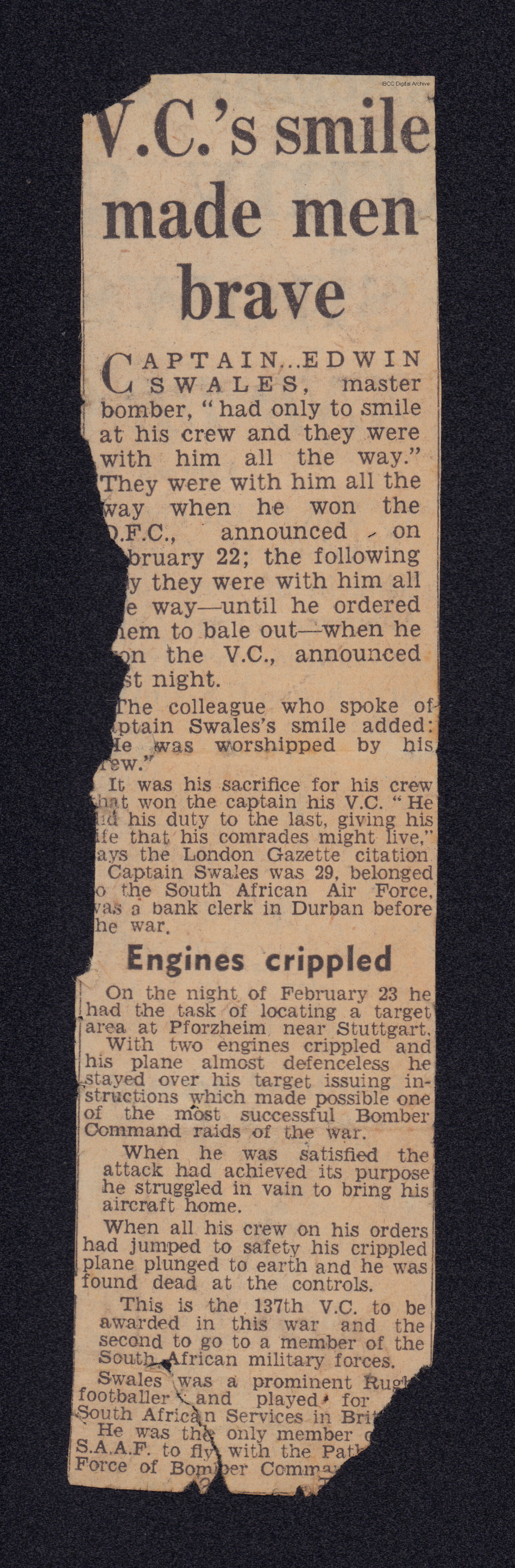
That man was one Acting Major*1 Edwin Essery Swales VC, DFC based at RAF Little Staughton on the Bedfordshire / Cambridgeshire border.
Swales (fourth from right) and his crew with their Lancaster ‘M’ Mother *9
Swales was born on 3rd July 1915, the son of Harry Evelyn Swales and Olive Essery, in Inanda, Natal South Africa. He was one of four children whose father was a farmer. Whilst Edwin was young, his father, Harry, died from the influenza epidemic that claimed some 50 million lives after the First World War. Without a father, the family were unable to maintain the farm, and so they moved away to Berea in Durban.
Once of high school age, the young Edwin Swales attended Durban High School, he also joined the Scouts learning valuable skills with like minded youngsters, that would help in him in later life. After leaving school Swales landed himself his first job, working at the international branch of Barclays Bank in Durban. But with with war looming, Swales like many young men at the time, was drawn to military service, and so he joined up, posted to the Natal Mounted Rifles where he achieved the rank of Sergeant Major.
Whilst with the Mounted Rifles, Swales served in several locations including: Kenya, Abyssinia and North Africa where he fought bravely alongside his compatriots and the Eighth Army under Montgomery. He would remain with the rifles until January 1942 at which point he transferred to the South African Air Force, obtaining his wings on 26th June a year later. Two months after this milestone, he, like many others from across the commonwealth, was seconded to the Royal Air Force ensuring his position overseas.
Swales (s/n: 6101V) like many new recruits to the Royal Air Force, would undergo a tense period of retraining, eventually being posted to fly heavy bombers within Donald Bennett’s 8 Group – ‘The Pathfinders’. His first and only posting, would be at Little Staughton with 582 Sqn.
During his short time at Little Staughton, Swales would fly a number of missions piloting Avro’s delight, the four engined heavy bomber the Lancaster.
Swales took part in many operations over occupied Europe, including the ill-fated attack on Cologne on December 23rd 1944, which saw the loss of five aircraft from 582 Sqn. In total, eight aircraft from seventeen flying from both Little Staughton and Graveley were lost that day including the lead bomber flown by Sqn. Ldr. Robert Palmer who himself was awarded the Victoria Cross for his actions.
On that day, an Oboe mission that went terribly wrong, Swales heard the instruction to bomb visually releasing his bombs at 12:51hrs. Flak and fighter attacks were so ferocious, that Swales, like many others in the formation, had to take “violent evasive action” to shake off persistent and accurate attacks from fighter and ground based gunners. He was able to return his aircraft and crew safely to Little Staughton landing at 14:35*2
The action taken by Swales that day was indicative of his determination to succeed and protect both his aircraft and crew, and one that would be repeated time after time by the airman. As a result, it was seen fit to award Captain Swales the DFC for his action that night, his citation stating:
This Officer was pilot and Captain of an aircraft detailed to attack Cologne in December, 1944. When approaching the target, intense anti-aircraft fire was encountered. Despite this, a good bombing attack was executed. Soon afterwards the aircraft was attacked by five enemy aircraft. In the ensuing fights, Capt. Swales manoeuvred with great skill. As a result his gunners were able to bring effective fire to bear upon the attackers, one of which is believed to have been shot down. Throughout this spirited action Captain Swales displayed exceptional coolness and captaincy, setting a very fine example. This Officer has completed very many sorties during which he has attacked a variety of enemy targets*3
Within two months of the operation and at the time his award was being awarded, Swales would be in a similar position again. This time as Master Bomber leading the formation and directing the bombers to the target.
On that night, only ten days after the historical attack on Dresden, 367 Lancasters and 13 Mosquitoes from 1, 6 and 8 Groups were detailed to attack the city of Pforzheim to the north-west of Stuttgart. This would be the only attack on the city during the war and it would prove almost as devastating as both Dresden and Hamburg.
Flying along side Swales that night in his Lancaster III PB538 ‘N’, were seven other crewmen, including two navigators as was commonplace for Oboe fitted aircraft.
On the run in to the target, the Lancaster was badly mauled by night fighters who successfully put one engine and the rear turret guns out of action. But undeterred, Swales remained on station guiding the following bombers onto the target with the greatest of precision.
When he was finally satisfied that the attack had been carried out successfully, he left his station and turned the aircraft for home. It had been difficult to keep the Lancaster flying, but Swales had persevered in order to complete the job. But he was now easy prey for enemy fighters and inevitably more attacks came.
Soon a second engine was put out of action and flying controls were damaged further with some now completely inoperable. With a reduced speed and difficult flying conditions he headed for the allied lines, where he hoped to get his crew out safely.
All those on board made the jump to safety, leaving just Swales at the controls of the failing Lancaster. As if someone had been watching over them, just as the last man left, the Lancaster finally gave up the struggle and dived into the earth – Edwin Swales was still sat at the controls when it was found later on.
The attack on Pforzheim was considered to be very accurate, with over 1,800 bombs having been dropped in as little as twenty minutes or so. Over 17,000 people were known to have died that night in the raging fire that followed the bombing, and a post-war photo, revealed that 83% of the built up area had been destroyed by the raid *4
Following the death of Captain Swales, Air Chief Marshall Sir Arthur Harris KCB, OBE, AFC, Chief of Bomber Command, personally write to Swales’ mother saying: “On every occasion your son proved to be a fighter and a resolute captain of his crew. His devotion to duty and complete disregard for his own safety will remain an example and inspiration for all of us.”*10
For his action, bravery and dedication to duty, 29 year old Edwin Swales, a prominent rugby player and South African “who only had to smile at his crew and they were with him all the way“*5 was awarded the Victoria Cross posthumously, the second such award to go to an airman of RAF Little Staughton, just one of three to the Pathfinders and one of only four South Africans to be awarded the Victoria Cross during the war. His citation appeared in the Fifth Supplement to The London Gazette, of Friday, the 20th of April, 1945:
Air Ministry, 24th April, 1945.
The KING has ‘been graciously pleased to confer the VICTORIA CROSS on the undermentioned officer in recognition of most conspicuous bravery:.—
Captain Swales was ” master bomber ” of a force of aircraft which attacked Pforzheim on the night of February 23rd, 1945. As ” master bomber,” he had the task of locating the target area with precision and of giving aiming instructions to the main force of bombers following in his wake.
Soon after he had reached the target area he was engaged by an enemy fighter and one of his engines was put out of action. His rear guns failed. His crippled aircraft was an easy prey to further attacks. Unperturbed, he carried on with his allotted task; clearly and precisely he issued aiming instructions to the main force. Meanwhile the enemy fighter closed the range and fired again. A second engine of Captain Swales’ aircraft was put out of action. Almost defenceless, he stayed over the target area issuing his aiming instructions until he was satisfied that the attack had achieved its purpose.
It is now known that the attack was one of the most concentrated and successful of the war.
Captain Swales did not, however, regard his mission as completed. His aircraft was damaged. Its speed had been so much reduced that it could only with difficulty be kept in the air. The blind-flying instruments were no longer working. Determined at all costs to prevent his aircraft and crew from falling into enemy hands, he set course for home. After an hour he flew into thin-layered cloud. He kept his course by skilful flying between the layers, but later heavy cloud and turbulent air conditions were met. The aircraft, ‘by now over friendly territory, ‘became more and more difficult to control; it was losing height steadily. Realising that the situation was desperate Captain Swales ordered his crew to bale out. Time was very short and it required all his exertions to keep the aircraft steady while each of his crew moved in turn to the escape hatch and parachuted to safety. Hardly had the last crew-member jumped when the aircraft plunged to earth. Captain Swales was found dead at the controls.
Intrepid in the attack, courageous in the face of danger, he did his duty to the last, giving his life that his comrades might live.*6
His body was removed from the aircraft in which he gave his life and was interned at the War Cemetery at Leopoldsburg, in Belgium, Section VIII Grave C.5.
In honour of Captain Swales, two memorial stones were laid and revealed outside his Durban High School on Armistice day 2009. One in the Memorial Courtyard of the School and the second on the Memorial Wall of the Natal Mounted Rifles also in Durban. In attendance were both his niece, Professor Edwina Ward, and Lt. Gen. Carlo Gagiano, Chief of the South African Air Force.
In 2013, Swales was also awarded the “Bomber Command” clasp to be worn on the 1939 – 1945 Star already awarded.
Edwin Swales was indeed a very brave man, who through sheer determination managed to save his crew in spite of the dangers facing him. His award was in no doubt deservingly awarded.
The story of pals Edwin Swales and Robert Palmer both of whom won VCs posthumously whilst at RAF Little Staughton.*7
The story of Captain Swales appeared in a newspaper cartoon “Heroes of the Air War”.*8
Sqn Ldr. Robert Palmer’s story appears in Heroic Tales.
Sources and further reading.
*1 the documents showing Captain Swales’ promotion to the rank of Major only reached the UK authorities after his death and as a result he was cited as being a Captain. (South African Aviation Foundation)
*2 National Archives 582 Operational Record Book AIR-27-2052-18
*3 Supplement 36954, to The London Gazette, 23rd February 1945, published 20th February 1945, page 1070
*4 Middlebrook, M., Everitt. C., “The Bomber Command War Diaries“, Midland Publishing Ltd, 1996
*5 International Bomber Command Centre National Archive website.
*6 Fifth Supplement to The London Gazette, of Friday 20th April 1945. Published on Tuesday 24th April 1945, Supplement 37049, Page 2173.
*7 “Newspaper cuttings concerning awards of Victoria Crosses,” IBCC Digital Archive, accessed November 11, 2023,
*8 “Heroes of the Air War (No. 39) Captain Swales,” IBCC Digital Archive, accessed November 11, 2023,
*9 Photo The South African Legion of Military Veterans website
The end of training flights in the Second World War in the quiet and blue skies of the United States, were occasionally ‘celebrated’ with flyovers and ‘buzzing’ of the home town of family or girl friends. Whilst this unofficial activity was frowned upon, in general, a blind eye was turned by Commanding Officers of the various Groups. However, one such activity was not taken quite so lightly, and almost led to the end of a promising career before it had even started.
At RAF Molesworth (Station 107) not far from Huntingdon, Cambridgeshire, the 303rd Bomb Group (BG) had been serving the Allied offensive since mid September 1942. They had taken heavy casualties after participating in many prestige missions including the disastrous August and October raids on the ball-bearing plant at Schweinfurt. The invincibility of the heavily armed B-17 was very quickly shown to be a myth.
After a period of calm, primarily due to persistent bad weather rather than any significant strategic military decision, the USAAF was allowed unofficial time to recuperate, rebuild and rearm. During this period, new recruits and aircraft poured into the United Kingdom via either the Northern or the Southern transit routes over the Atlantic Ocean.
On one of these aircraft was Lt. Jack Watson, a ‘green’ pilot’ who had recently completed his training, and was now on his way to fight in a war a long way from his Indianapolis home.
A fresh faced 2nd Lt. Jack Watosn who bravely brought home his burning and crippled B-17 bomber after ordering his crew to bail out. (IWM UPL 32160)
On eventual arrival at Molesworth, Lt. Watson was soon to experience for himself the horrors and reality of war. On January 11th 1944, he was part of a 291 bomber force attacking both the FW190 production factory as Oschersleben and the Junkers factory at Halberstadt, Germany. On what became one of the blackest days for the Group, eleven out of the forty aircraft dispatched were lost, an attrition rate of just over 25%, which was also the highest loss of the entire force.
On the inward flight, the weather, which had dogged much of the winter, closed in over the continent. A recall message was sent out, the 2nd and 3rd Divisions turning for home, but it was ignored by Brigadier General Robert F. Travis, 1st Bombardment Division Commander in the lead plane – ‘The Eight Ball‘. Original orders were to bomb by visual methods but if cloud cover prevailed then pathfinder Liberators were to mark the target.
As the weather had deteriorated, cloud being present as high as 24,000 feet, fighter cover was all but withdrawn. The bombers were now virtually on their own and much smaller in number.
Alerted early on, the Luftwaffe had managed to form an enormous welcoming party for the now weakened force. It would be the strongest collection of Luftwaffe aircraft since the October raids, and it was waiting, eager for blood.
The first contact between the two forces was made over the shallow waters of the Zuiderzee on the inward flight. A collection of rocket-firing fighters launched a gruesome attack on the lead section of the 303rd, an attack that lasted for several hours and took out numerous aircraft.
From the Initial point (IP) to the target, flak was light but accurate, more aircraft took hits and further damage was sustained by the formation. Those bombers that did get through managed to bomb the target, the accuracy of which was considered ‘excellent’.
On the return flight B-17F #42-29524 ‘Meat Hound‘, piloted by Lt. Jack Watson was attacked again by waves of enemy fighters who zoned in on the bomber and its supporting formation. With many aircraft now crippled, the B-17s were easy targets for the fierce and determined Luftwaffe defenders.
Lt. Watson’s aircraft, (a B-17F-55-BO, which had previously been assigned to the 306th BG transferring to the 303rd in July 1943), was hit hard over Durgerdam. The damage looked terminal, two engines were on fire, there was substantial damage around the wing root and the left elevator had been shot completely off. With such damage, not only was the aircraft difficult to control but it was losing vital airspeed and altitude as well.
Lt Watson, gave the bail out order, holding the aircraft steady until all the crew had departed. Lt. Watson, who had by then put the aircraft on automatic pilot, was himself preparing to jump, but the thought of the cold waters below forced his retreat to the cockpit and the challenge of getting home alone.
Of those who did jump, four fell into the Ijsselmeer and sadly drowned, and another four were caught by occupying forces and sent to POW camps. The ninth, Lt. Col. Clayton David, the Co-Pilot, managed to evade capture eventually making his way back to England. Clayton’s journey took him through Holland and Belgium and on into France, where he headed south, eventually crossing the Pyrenees into Spain. From there, he reached Gibraltar eventually returning to England in May 1944, four months after he was reported as ‘Missing in Action.’ For his efforts he received the Purple Heart*1.
Lt. Watson, now alone in the crippled B-17 fought on, keeping the aircraft flying toward England. Once over home territory he brought the aircraft down through the thick cloud that had dogged so many of Britain’s airfields that winter, landing at RAF Metfield, an American Fighter airfield home at that time to the 353rd Fighter Group.
So severe was the fire on the aircraft that it took fire crews a considerable time to extinguish it. These crews were not only amazed to see just one crewman exit the aircraft, but also to find an unexploded shell sitting directly behind the pilots seat.
B-17 ‘Meat Hound‘ on the ground at Metfield, Suffolk after landing with two burning engines. The aircraft was subsequently written off and salvaged for usable parts. (IWM UPL 32171).
On his arrival back at Molesworth, Lt Watson received a telegram sent by New York Mayor Fiorello LaGuardia, forgiving Watson for his villainous activity previously in late 1943.
It was at this time that Watson along with three other pilots; 2nd Lts. Robert Sheets, Elmer Young, and Joseph Wheeler, buzzed the World Series game between St. Louis Cardinals and the New York Yankees at the Yankee Stadium, New York. Mayor LaGuardia was so incensed by the action at the time, that he insisted Watson and the others be disciplined, court martial proceedings being instigated as soon as the four landed in Maine*2.
However, it was not to be, the top brass needing every aircraft and crewman they could muster, sent the four on their way with a $75 fine and a stiff telling off!
Although tinged by the sad loss of his crew, the villain of the World Series’ Buzzing, had gone on to prove himself more than a worthy pilot, making history in more ways than one.
A Boeing B-17 ‘buzzes’ the Yankee stadium October 5th 1943. (Author unknown).*3
The crew of ‘Meat Hound‘ were:
Pilot – 2nd Lt. Jack Watson (Returned to Duty)
Co-Pilot – Lt Col. Clayton David (Evaded)
Navigator – 2nd Lt. John Leverton (POW)
Radio Operator – Stf. Sgt. Harry Romaniec (KIA)
Bombardier – 2nd Lt. Vance Colvin (KIA)
Flight Engineer/Top Turret Gunner – Stf. Sgt. Sam Rowland (POW)
Right Waist Gunner – Sgt. William Fussner (KIA)
Left Waist Gunner – Gene Stewart (POW)
Tail Gunner – Sgt. Roman Kosinski (POW)
Ball Turret Gunner – Sgt. Fred Booth (KIA)
The B-17F, #42-29524, was delivered to Denver 31st December 1942; then assigned to the 423rd BS (306th BG) as ‘RD-D’ at Thurleigh 2nd March 1943. It was later transferred to the 358th BS (303rd BG) as ‘VK-K’ based at Molesworth on 30th July 1943.
For their efforts in this mission, the 303rd Bomb Group were awarded a Distinguished Unit Citation, the only time the entire unit achieved such an accolade.
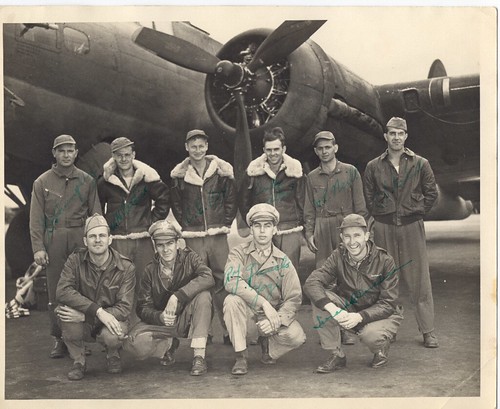
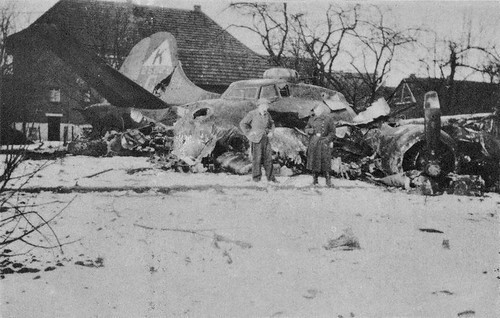
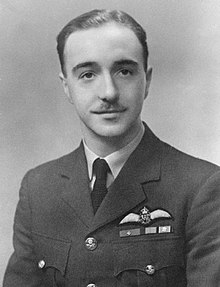

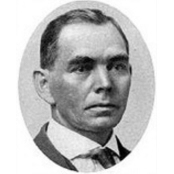

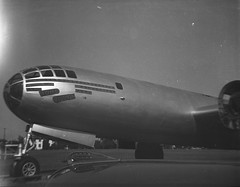
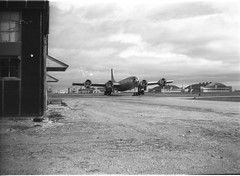
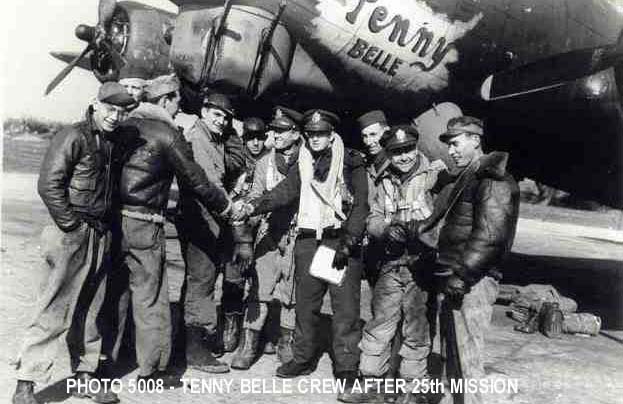


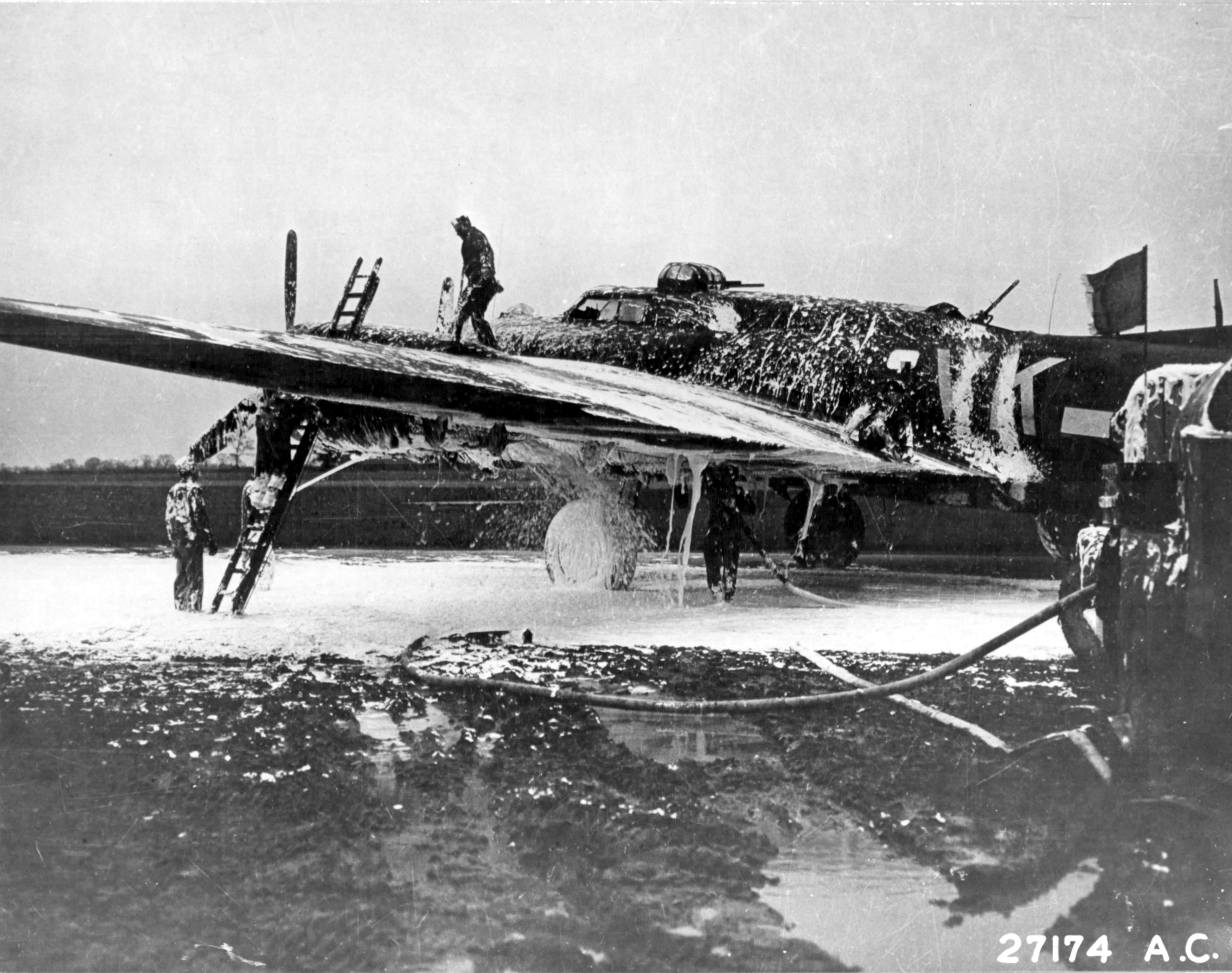
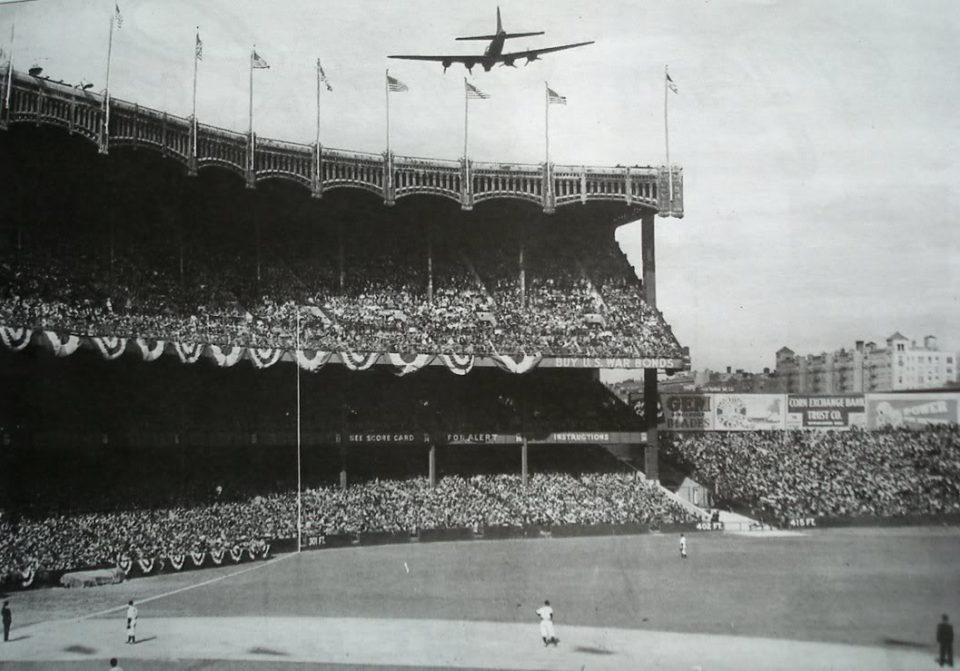

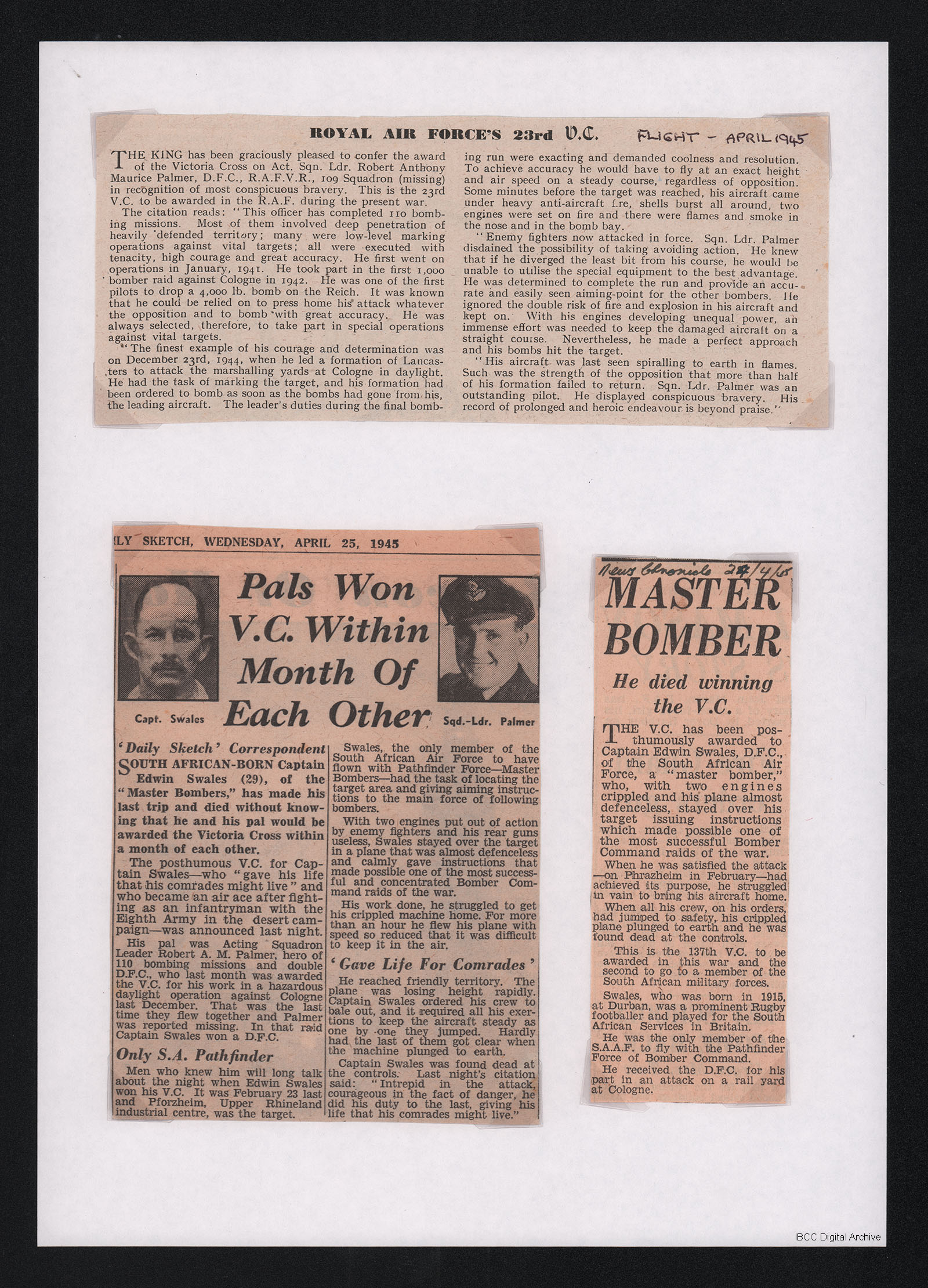
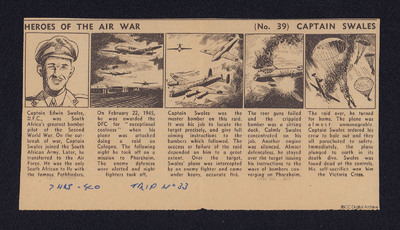
 Aviation Trails