Colonel Thomas J.J. Christian Jnr. 361st FG RAF Bottisham.


Colonel Thomas J.J. Christian Jnr. (s/n: O-21782) (IWM UPL 18211)

Born Thomas Jonathan Jackson Christian, jr., on November 19th 1915 in San Francisco, Colonel Christian would become known as ‘Jack’ and would have a distinguished military career.

He was the great-grandson of “Stonewall” Jackson, an outstanding commander of the Confederate army in the American Civil War, and he was the son of a Brigadier-General – the military ethos ran thick through his veins.

Christian graduated from Chicago University High School in 1933 after which he went on to University where he studied for a further two years.

After graduating, he then went on to West Point, where in 1939, he chose to follow in his father’s footsteps into Field Artillery. Here he was appointed as a Second Lieutenant. Not long after though he changed his mind, being drawn to the idea of flying, and the Army Air Corps.

He studied initially at the Texas Air Corps Flying School in Love Field, Dallas, transferring to the the Air Training Corps Centre at Randolph Field, Texas. From here, he progressed to the Air Corps Advanced Flying School based at Kelly Field located in San Antonio. By 1940, he had passed and was assigned as an instructor back at Randolph Field.

His first overseas posting came in March 1941, when he was sent to the 19th BG at Clark Field in the Philippines. Here he flew the heavy bomber the B-17 Flying Fortress until the Outbreak of war, and the Bombing of Pearl Harbour and its surrounding airfields by the Japanese. He was then reassigned to Australia via a posting at Bataan. His job here was to ferry P-40 fighters.

It was during one these flights that he was shot down and declared missing. Protected and guided by the natives of the Timor Coast, he managed to find his way back to base.

In 1942, Christian was reassigned again, this time to fly fighters with the 67th Pursuit Squadron. operating out of Henderson Field, he achieved the Silver Star for his gallantry flying over 60 hours of combat flights in a Bell P-400.

In Early 1943, Christian returned to the United States, where he married Marjorie Lou Ashcroft, a woman he had met in Dallas. It was here that the now Major Christian, would join the 361st FG, becoming their first Commanding Officer. The 361st were constituted on January 28th, being activated just two weeks later. Assigned to the Eighth Air Force, it would be the last of twelve Fighter Groups to fly the P-47 Thunderbolt.

The unit trained and transited from Richmond AAB in Virginia, through Langley Field, Millville New Jersey, back to Richmond and then, via the Queen Elizabeth, on to Bottisham in England. At Bottisham, Christian flew with his men, leading them on their first operational mission on January 21st 1944, eleven months after they had been formed. It was during this very month, that Christian would become a father, his daughter being named Lou Ellen.

His first aircraft at Bottisham was P-47 ’42-75494′ coded E2-C, and he called it ‘Lou‘ after his baby girl. He had a picture of a crawling baby painted on its nose, a tribute to the baby he hadn’t yet seen.  Throughout his flying career with the 361st, Colonel Christian would fly three aircraft (successively named Lou, Lou III and Lou IV). The second aircraft 42-106787 and third 44-13410 were both P-51 Mustangs.

In March 1944, he was promoted to Colonel, he was still just 28 years of age. Whilst leading the 361st, Christian would fly over seventy combat missions his final and fatal one being on August 12th 1944.

On that day, Colonel Christian was flying his latest aircraft, P-51 ‘Lou IV’ 44-13410 in a ground attack role against the marshalling yards at Boisleux-au-Mont in France. Over the target area, accurate and heavy ground fire made flying difficult, and it was probably this that brought down his plane causing it to crash. Colonel Christian never survived and was killed in the crash, he was just twenty-eight years old.

During this military career Colonel Christian would be awarded the: American Defence Medal: Asiatic-Pacific Campaign Medal; Philippine Defence Ribbon; European-African-Middle Eastern Campaign Medal; Distinguished Flying Cross with 1 Oak Leaf Cluster; Air Medal with 3 Oak Leaf Clusters; World War II Victory Medal; Croix de Guerre; Silver Star and the Purple Heart.

Just weeks before the crash, Christian had taken part in a photo shoot with three other P-51s from Bottisham, which affectionately became  known as the ‘Bottisham Four’, the group appearing numerous times. The photo since became a tribute to Christian, and all that he had achieved.

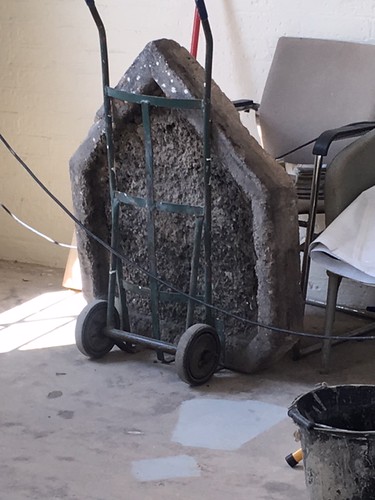
At Bottisham, on what was one of the former accommodation sites, is a further tribute to Colonel Christian, a Lych Gate style memorial, it is sadly now missing its top, but was unveiled on 10th October 1955 by his daughter.

RAF Bottisham

A tribute at Bottisham to Colonel Thomas Christian.

Thomas Christian appears in the Tablets of the Missing in the Ardennes American Cemetery and on the Memorial at Neuville-en-Condroz Liège in Belgium. He also has several cenotaph memorials in the Texas State Cemetery, Austin Travis County, Texas and also in the Stonewall Jackson Memorial Cemetery, Lexington, Virginia. Christian’s body has never been recovered.

Marjorie Lou, Thomas’s wife died in 1984 aged 66, whilst his daughter Lou Ellen died in 2011 aged 67.

RAF Bottisham appears in Trail 55 – Around Newmarket.

Sources.

Find a grave website.

American Air Museum Website

RAF Bottisham – A small airfield that became a big player (P2)

In Part 1 of RAF Bottisham, we saw how the airfield was opened as a satellite and how it was underused for the first part of its life. With numerous short stay or training squadrons it never really  attained the level of prestige it wanted.

In part 2 we see how this struggle continued in 1943, but in 1944 things would change, and Bottisham would become a major front line airfield with a record breaking Fighter Group.

RAF Bottisham (Station 374).

Between January and mid March, 2 Squadron were stationed here, albeit briefly, after receiving their own Mustangs in the preceding April. With their parent airfield Sawbridgeworth being unusable, they needed a new place to stay. The advanced party departing, led by F.Lt. Fletcher, on the 30 January, with the main party leaving the following day. Using these Mustangs 2 Sqn would fly long range reconnaissance flights over to Holland, where they would photograph military compounds and enemy shipping.

After that, in March, came another four short-stay units; 268 Squadron who stayed for a mere 4 days; 613 Sqn who stayed for twelve days; 169 Sqn for two days and 4 Sqn who stayed here for a little longer at four months. 4 Sqn were another unit who had previously used both the Lysander and Tomahawk before converting over to the Mustang.

Their departure in July signified the end of RAF operations from Bottisham airfield, the site being all but empty for the next six months. At this point the US Eighth Air Force took over the airfield, poured engineers into it, developed the technical site and  improved the accommodation blocks. After renaming the airfield Station 374, they began to bring in a new unit and Bottisham would finally become the airfield it was so struggling to be.

At the end of November, the twelfth and last Fighter Group to fly P-47s joined the VIII Air Force here at Bottisham. The 361st FG had only been active for eleven months when they entered combat in January 1944. Their journey had taken them from Richmond AAB in Virginia, through Langley Field, Millville New Jersey, back to Richmond and then, via the Queen Elizabeth, on to Bottisham their first European stop. Here the three squadrons: 374th FS, 375th FS and 376th FS flew P-47D ‘Thunderbolts’ or ‘Jugs’ as they were affectionately known, under the command of Colonel Thomas J.J. Christian Jnr, a high ranking officer who was killed in action in August 1944.

‘The Bottisham Four’, 26th July 1944, Leader is Col. Thomas J. J. Christian Jr. Second plane ‘E2-S’ flown by Lt. Urban L. Drew; third is Major Roswell Freedman’s E2-A and the fourth is P-51B E2-H ‘Suzy G’ flown by Lt. Francis Glankler. None of these aircraft survived the war (IWM UPL 18209)

Colonel Christian led the 361st on their first combat sortie on January 21st 1944, as part of an escort of over 600 fighters, to the Pas de Calais and Cherbourg areas. Here, almost 800 B-17s and B-24s from the First, Second and Third Bomb Groups attacked thirty-six ‘V’ weapons sites, thirty-four in the Pas de Calais and two at Cherbourg. As the formation split, the 361st went to Calais, where poor weather hampered the bomb runs. However, allied air superiority meant there were little pickings for the fighters and few enemy aircraft were engaged or shot down. The group returned to Bottisham yet to draw their first blood.

Over the next few weeks, the Group would take part in further escort duties, covering bombers to Frankfurt, Watton, Wilhelmshaven and Gilze-Rijen. February saw them participate in the ‘Big Week’ campaign with further missions to Germany.

On April 27th, the Eighth Air Force undertook two missions, No. 322 and 323, both targeting areas in France and Belgium. On one of these missions was Capt. Charles H. Feller who took off with the 375th FS to escort the bombers. His P-47, ’42-75447′ was the only aircraft lost on that mission, a loss made worse by the fact that his brother Cpl. Jack Feller, was waiting to meet him at the main gate. Cpl. Feller, was informed that his brother was missing in action, and at the time his whereabouts weren’t known. It later transpired that he was killed whilst attacking the former French Air base Etampes-Mondesir which had been taken over by the Luftwaffe*1.

Back at Bottisham, the heavy weight of the Thunderbolt was playing havoc with the Sommerfeld tracking, forcing it to be replaced with Pierced Steel Planking (PSP), a feat that was achieved in a matter of just three days.

As the winter of 1944 passed and spring arrived, the 361st were told that their P-47s were to be replaced by Mustangs, the P-51 would be returning to Bottisham once more, but in a far Superior form than its original one.

In May, the first of these more agile and more powerful P-51s arrived, and under the guidance of General Arnold’s New Year message, “Destroy the enemy Air Force where ever you find them, in the air, on the ground and in the factories” they performed well achieving many high scores. Operating over the Normandy landscape during May, they attacked targets such as airfields, marshalling yards and transport systems, taking out 23 Locomotives in one day, a quarter of the entire day’s total. After Normandy, the 361st  would go on to  cover the breakout at St. Lo, and the failed airborne operation ‘Market Garden‘ in the autumn of 1944.

In late September 1944, the 361st transferred to Little Walden in Essex, but even with their belongings packed and furniture in transit, they would still be willing to perform their duty. On the 26th, they escorted over 1,100 heavy bombers to a range of targets in Germany. Whilst approaching Hamm, one of the pilots 1st Lt. Urban Drew (one of the Bottisham Four), spotted an Me 262 beneath him. After giving chase, diving at incredible speeds to catch the jet, he finally lost him, but not until after he had expelled over 1,300 rounds of ammunition, in a chase that took him from 20,000 ft to 0 ft, in a matter of minutes. The frustration of the pilots in catching these new aircraft clear in their reports back at base.

On the next day, as the move was progressing, another call came out. This time it would be a good day for the pilots of the 361st. Escorting almost 1,200 bombers to Germany again, the group spotted large numbers of enemy fighters attacking the bomber formation in a ‘company front’ attack. The P-51s dived in, splitting the 109s and 190s sending them wayward. ‘Heading for the deck’, a flight of four P-51s lead by Lt. William Beyer gave chase, and in what turned out to be a disastrous day for the Tibbenham based 455th BG (losing 25 aircraft the highest of any mission), the 361st managed to achieve the highest recorded number of kills for any fighter group to date.

After Kassel, Sept. 27, 1944: Lt. William Beyer (left), and Lt. Bocquin (right) prepare their reports. While Bocquin downed three enemy planes, Beyer got five– becoming an “Ace in a Day.” .(IWM UPL 29364)

With eighteen confirmed kills, five for Beyer who was an ‘Ace in a day’, and three for the Squadron Leader 1st. Lt. Victor Bocquin, it was an amazing achievement for the 361st, and as their last operation from Bottisham, it gave cause for great celebration.

Their time at Bottisham had now come to an end and they never returned to the airfield where they had cut their teeth. The move, instigated by a reshuffling of the Air Force’s organisation, meant that the 361st would be closer to the Bomb Groups they were to be attached to. It also signalled the end of Bottisham as an active front line airfield.

By the time the ‘Yellow Jackets‘ as they were known, had completed their tours, they had completed 441 missions, claiming 226 enemy aircraft destroyed in the air and 105 on the ground.

With the departure of the 361st, Bottisham fell operationally quiet. In the following June 1945, it was passed back to RAF control and linked once more to Snailwell, who used it as a relief airfield for Belgian pilots of the RAF (Belgian) Initial Training School. In the October, its status was reduced to satellite and the Belgian’s partially moved in. Using primarily Tiger Moths, the Belgians used Bottisham for a mere ten months, disbanding as a Royal Air Force unit in April 1946 and passing over to the Belgian Air Force. With that, Bottisham closed on May 1st, and stood empty until sold for agricultural use in October 1958.

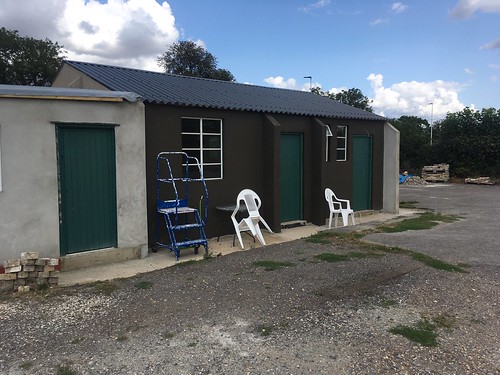
Since then, the runways have been pulled up, the buildings on the airfield have been removed and the accommodation blocks have all been built up expanding the village that played such a great part in its life. On the corner of the airfield site a small cluster of buildings still stand, these include the former squadron offices (themselves former crew rooms), a sleeping shelter, and general purpose huts. These have been purchased and are being restored to house a small museum dedicated to those who served at the airfield.

RAF Bottisham

The former Sleeping Shelter.

The airfield itself is now cut by the main A14 dual carriageway. But by leaving this road and turning along the A1303,  you can access both the museum and the airfield quite easily. The museum sits on the corner of the A1303 and Wilbraham Road, along which, if you turn right, cuts across the airfield and the remains of the former runway. As with many former airfields the runway line has been planted with trees giving a good indication of both its location and size. Parts of the perimeter track are also visible from this road to the north end, but otherwise there is little left to see other than a small selection of concrete patches. The village has a memorial in both the British Legion club and in the village with the Thomas Christian memorial. Sadly, little else of this small but once busy airfield exists today.

Bottisham airfield was generally speaking, a minor airfield housing a number of units in its early years. However, once it became fully fledged, it became not only significant, but a leader in the stakes of war. Now all but gone, the memories of those who served here are firmly embedded in the streets of Bottisham along with a few buildings that survive to tell their story.

My sincere thanks go to the members of the Bottisham Airfield Museum who so kindly stopped their work to give me a personal guided tour of the site when I visited. I wish them luck in their venture.

Sources and Further Reading.

The full story of Bottisham can be read in Trail 55 – Around Newmarket.

The full story of Colonel Thomas Christian appears in Heroic Tales. 

National Archives – AIR 27/1465/10

National Archives – AIR 27/19/25

National Archives – AIR 27/2170/1

Bottisham Airfield Museum website.

*1 Wilson, K., “Blood and Fears – How America’s Bomber Boys and Girls in England Won Their War” Orion Books, 2016.

RAF Bottisham – A small airfield that became a big player (P1)

In Trail 55 we travel from Snailwell to Cambridge passing through Newmarket and the former bomber airfield that has become the famous horse racing circuit. From here, we continue west where we find a small airfield that has all but gone, the last remnants now a small museum that utilises a mix of original and non-original buildings.

This particular airfield was home to a number of RAF units but is perhaps more noted for its American links, and in particular the fighters of the 361st Fighter Group. On our third stop around Newmarket, we visit the former airfield RAF Bottisham.

RAF Bottisham (Station 374).

Located about 5.5 miles east of Cambridge between the villages of Little Wilbraham and Bottisham village, Bottisham airfield was initially opened in 1940 as a satellite for the new bomber base at Waterbeach, a few miles to the north of nearby Cambridge. Although designed as a satellite, it would later become a fighter airfield in its own right, with its own resident unit.

At first, the runways were grass and there were only two. However, later on, a third runway was ‘constructed’ and each of the three were then strengthened, using initially Sommerfeld Track and then Pierced Planking, both similar and both temporary methods of construction that were easy and quick to lay. Around the concrete perimeter track were fifteen concrete hardstands and a further 48 hardstands constructed with the steel matting. This gave a vast number of areas to safely disperse parked aircraft.

The longest runway was 1,435 yards long, whilst the shortest was some 300 yards shorter. The Watch office, designed to drawing 15371/41, was of brick construction with concrete slabs for the roof, which was the most common design used on World War Two airfields. Demolished in 1948, it was an off-shoot of design 12779/41 which allowed for smaller windows at the front of the tower, more commonly found where night flying regularly took place such as bomber airfields.

RAF Bottisham

On site, there were eight Blister hangars (9392/42), a fourteen bay T2 Hangar (3635/42) and a range of stores, fire tender shelters, workshops and offices, mostly brick or steel framed buildings of standard airfield designs.

Accommodation was eventually erected over ten sites both WAAF and enlisted men/officers, many of which were located in and around the village of Bottisham itself.  This huge increase would eventually lead to a massive explosion in the village’s population.

For the first seven months of its existence, from March to October 1940, Bottisham saw little activity, and as the land was little more than a field, it was totally unsuitable for anything larger than a small aircraft. As a result it was barely used, and little development occurred on the site. The only visitors being seen were the occasional Tiger Moth of the 22 Elementary Flying School (EFTS), from nearby Cambridge. 22 EFTS was set up, at Cambridge, on the declaration of war in 1939, and they used a range of small light trainers: Miles Magisters, Proctors, Tiger Moths and Hawker Demons.

For the next year or so, Bottisham airfield remained in this state, barely used and under-developed until, in July 1941, it was handed over to the Army Co-operation Command and 241 Squadron.

After being disbanded at the end of 1919, 241 Squadron was reformed in 1940 by merging two ‘A’ Flights from other units. They initially used Lysander IIs replacing them with Blackburn Rocs, a model they replaced again with Lysander IIIs before moving to Bury St. Edmunds. After that, they moved here to Bottisham, on July 1st 1941. After a matter of only weeks, the Lysanders were replaced with Tomahawk IIA (the British named P-40) which was intended to be a fighter escort aircraft for the RAF. However, its poor performance led to it being used instead for pilot training and Army cooperation work. Something that would become significant over the next year or so. Over the next few weeks, the new aircraft were collected and ‘normal flying training’ flights were the order of the day.

RAF Bottisham

The runway, marked by the treeline looking south-west.

The British saw the Tomahawk as a possible fighter aircraft during the 1940s supplementing the Spitfires and Hurricanes provided by British aircraft manufacturers. However, production problems of the P-40 led to the British seeking alternative suppliers. Realising there was a niche for a new model, the North American Company offered to design their own fighter, one which they designed, built and tested within 100 days. This new model, whilst not perfect, its Allison engine performing badly at altitude, would eventually go on to supply the American Air force and become one of the most famous aircraft ever built – the P-51 Mustang.

With detachments of aircraft based at Snailwell, Macmerry, Henlow and Docking, 241 Squadron would be spread far and wide, but continued to pursue their duties as an Army Cooperation flight. However, their job was not easy, the new Tomahawks and the poor British weather over the winter 1941-42, proved to be a major challenge for both air and ground crews here at Bottisham. The Operational Record Books for the period showing that the month of January in particular was ‘not satisfactory’, with crews struggling to keep aircraft serviceable in the poor weather. On the 20th, a new structure for the Air Force and a new section for the Squadron were brought into being. This did not however, alleviate the difficulties the crews were having. The main issue seemed to be down to generator drive problems in the P-40s, which combined with an accident in the squadron’s  Airocobra, meant flying was very much restricted to the last remaining Lysanders.

On March 15th 1942, things would begin to change. In now fine weather, the first four of the new P-51 Mustangs arrived, flown down from Speke (now Liverpool airport) by P/Os Kirkus, Clarke, Harrup and F/Lt. Coe. During the next few weeks as more P-51s arrived, the old Tomahawks were gratefully handed over to other Training units and Squadrons, and probably without a tear being shed.  Then on May 1st 1942, 241 Squadron began its departure for pastures new and Ayr in Scotland. On that day, the road party left Bottisham in 21 vehicles at 09.00hrs, whilst the rail party left in the evening at 20:00hrs. By the next day, the rail party had arrived but it would be a further 24 hours before the road party would find their new home.

Throughout the war Bottisham would develop a strong relationship with nearby RAF Snailwell, being only a few miles apart, the two frequently used each other to store and operate their aircraft. The next two squadrons to arrive were just that, both Snailwell based units that moved in to Bottisham. Bottisham was never considered a good posting in these early stages of the war, its accommodation at this point was considered primitive, cold and damp, it was certainly not the most hospitable airfield to have to stay at.

RAF Bottisham

A pot Belly stove stand now in the museum.

Some two weeks after 241’s departure the first of these squadrons arrived – 652 squadron. 652 was part of the Air Observation Post (AOP) and like all the units 651 – 666 they were manned partly by Army (pilots) and RAF (maintenance crews) personnel, they were noted for persistent and regular moves sometimes even daily. Noted as being at Bottisham between June and August 1942, 652 Sqn operated Tiger Moths in the observation role, spotting gun shots off the Hunstanton coast for field artillery units. At the end of their stay here at Bottisham they departed moving to Westley in Suffolk.

The second squadron to arrive at this time was another Tomahawk squadron, 168 Squadron, who were formed at Snailwell on 15th June 1942, moving across to Bottisham in mid July after receiving their Tomahawk IIs. Operating from Bottisham in these early days preceded a move to the fighter station at Tangmere and a more glamorous role with Mustangs and later Typhoons.

The transfer occurred in the afternoon of July 13th, with four flights amounting to twelve aircraft flying in formation across to Bottisham. The flights were led by W/Cdr. Watson-Smyth, who on their arrival realised that the AOP squadron were still using the accommodation blocks, and as the new ones were not yet finished, ‘A’ flight had to share until theirs was suitably completed. There was also insufficient room for the officers, who had to sleep in tents in the grounds around the Mess, whilst ground crews were billeted in three huts in the grounds of Bottisham Hall.

On July 19th, the squadron used the new north-south runway for the first time, it was noted that it was rather more “bumpy” and “shorter” than the east-west runway  but was considered “satisfactory” for their use.

During their stay here, 168 Sqn performed many cross country navigation and fighter affiliation exercises. However, a lack of Allison engine tool kits meant many aircraft were unserviceable for long periods. This became a frustration with the flights, restricting their flying time to a minimum. Then on 31st July, a large quantity of the specialist tool kits finally arrived, and the aircraft were able to be repaired and normal flying duties continued.

The dawn of 1943 would bring little change to Bottisham. More short stay units would mean life was a little more hectic, but Bottisham was still not the major front line airfield it so wanted to be.

In part two we see how Bottisham struggled on in the next year. But January 1944 would see big changes and a renewed impetus that would propel Bottisham to the forefront of Fighter aviation.