RAF Little Walden (Station 165)

Sometimes, we come across quite unexpectedly, something of great interest. Whilst on my travels recently, passing through the southern regions of Cambridge into Essex, I came upon the former station RAF Little Walden. Being an unplanned visit, I was rather short in prior knowledge and preparation, no maps, aerial photographs, or other documents that I normally seek out before venturing off into the wilderness. So I was quite unprepared when I stumbled across the Watch Office from former station RAF Little Walden, otherwise known as Station 165 of the USAAF.

RAF Little Walden (Hadstock) – (Station 165)

Little Walden lies slightly closer to the village of Hadstock than it does Little Walden, and was originally called Hadstock. When construction began in 1942, it was allocated to the Eighth Air Force as a Class A bomber airfield. However, due to the bad winter of 1942/43 work ceased temporarily, being held up until well into the summer of 1943. At this point, Hadstock became known as Little Walden, a name change that coincided with the formation of the Ninth Air Force in Europe, an organisation whose primary role was the support of ground troops in the European theatre. With its headquarters at Sunninghill Park1 in Ascot, it would operate both transport and bomber units, taking many of these units (and their airfields) from the already established Eighth Air Force. Little Walden was one such airfield passing from the Eighth to the Ninth to fulfil this new role.

Although a Class A airfield, Little Walden’s main runway was slightly shorter than those of its counterparts, 1,900 yards as opposed to 2,000 yards, but the two auxiliary runways were both the standard 1,400 yards in length. A concrete and wood chip construction gave these runways good strength, it also had hardened perimeter tracks and fifty hardstands of the spectacle type. Grouped mainly in blocks of five, they were located around the perimeter track with a further block of eighteen to the north-west of the site. In the development process a public road the B1052, was closed as it passed directly though the centre of the proposed site.
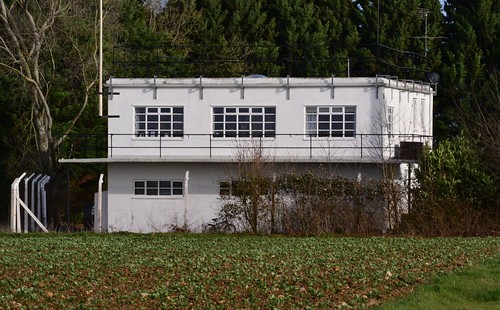
Little Walden Watch Office

Little Walden’s Watch Office is now a private residential property.

A large bomb store lay to the west of the airfield, surprisingly close to the majority of the hardstands, any major accidental discharge being likely to cause substantial damage to parked aircraft. There were four areas within the bomb store, each holding 200 tons of bombs and tail units, further stores held pyrotechnics, incendiaries, ‘small’ bombs, grenades and small arms ammunition. Most of these were secured by earth banks with fusing points (both ultra-heavy and heavy-light) being held in temporary brick buildings.

To the eastern side of the airfield lay the technical area, with one of the type T2 hangars (the second being located to the north), a fire tender shelter, and a watch office designed to drawing 12779/41 – the standard airfield design of 1942/43. Behind this, lay the main technical area, with its usual range of dingy stores, MT (Motor Transport) sheds, parachute stores and a wide range of ancillary buildings.

Accommodation for staff was, as usual by now, dispersed over eleven sites, a sick quarters, communal site and WAAF site accounting for three of them. A further sewage works made the twelfth site. All-in-all accommodation was provided for just short of 3,000 men and women of mixed rank.

On March 6th, 1944 the airfield officially opened, the day before its first residents arrived. The 409th BG were a new Group, only constituted on June 1st, the previous year (1943). They trained using Douglas A-20 Havocs (known in British service as the Boston) a twin engines light bomber capable of carrying up to 4,000lb of bombs.

The 409th BG formed at Will Rogers Field (Oklahoma) and transitioned through Woodward and DeRidder bases before arriving in the UK. Between March and September they operated out of Little Walden, bombing V-weapons sites and airfields in France in a strategic role. Initially they performed in the low-level role, but soon moved to higher altitudes, performing their first mission on April 13th 1944.

In the short period of residency at Little Walden, the 409th would lose a number of aircraft, one of the first being that of #43-9899 of the 642nd BS, which was written off in a landing accident on April 22nd 1944. Three days later a second aircraft, #43-9691, would also crash-land at Little Walden being damaged in the process.

May would also prove to be a difficult month for the 409th, with one aircraft ‘lost’ on the 9th, a further crash landing on the 11th, another lost on the 22nd and two further aircraft lost (classified as MIA) on the 27th. It was on this mission that a further Havoc would collide with a low flying Mustang resulting in several tragic deaths.

Havoc #43-10130 of the 643rd BS, piloted by Captain Roger D. Dunbar took off from Little Walden heading south-east, when it collided with P-51B #42-106907 of the 503rd FS, 339th FG, piloted by 2nd Lt. Robert L. Dickens. The Mustang, on a training flight, disintegrated killing the pilot, whilst the Havoc crashed into the farmland below. In the ensuing fire, a local farmer’s widow and trained nurse, Betty Everitt ran to the scene and managed to pull one of the airmen out of the aircraft. When returning to retrieve another crewman, one of the bombs on board the aircraft exploded killing her, her small dog, a helping Staff Sgt. and those left inside the aircraft. As a thank you to Betty, the US airmen, from the base, raised almost £3,000 to provide an education for her four-year old orphaned son, Tony2. This was not a one-off either, a fund set up by Stars and Stripes and the British Red Cross, aimed to raise funds for children who had suffered the loss of one or both parents. The amounts raised went a long way to getting these children an education that they would not otherwise have had.

Early June would see another such tragedy, when three more Havocs would collide. Havocs A-20G #43-9703 and #43-9946, both of the 641st BS, would crash whilst the third aircraft managed to land at the airfield. #43-9703 was piloted by Joseph R. Armistead, whilst #43-9946 was piloted by Thomas A. Beckett. A young girl, Marjorie Pask, ran to help, pulling two airmen out of the wreckage then waiting with them until help arrived. Five airmen including the pilots and an air gunner, Staff Sergeant Albert H Holiday, were all killed. It was not until later that Marjorie realised that there were many bombs scattered around the site and how much danger she had been in 3.
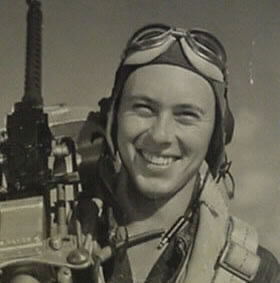
Staff Sgt. Albert H Holiday, killed June 11th 1944 in a collision between two Havocs of the 409th BG. (IWM-UPL 21530)

With two further loses and a forced landing in June, it was be a difficult month for the 409th. The late summer months of July and August would be lighter but by no means a clean sheet. In September 1944, on the 18th, the 409th were moved out of Little Walden and posted to a forward Landing Ground A-48 at Bretigny, where they would continue to suffer from landing accidents, Flak and fighters.

Next at Little Walden came the Mustangs of the 361st FG, in a move that saw possession of Little Walden pass back into the hands of the Eighth Air Force. Station 165 was now back with its original owners.

The 361st FG were the last of the P-47 Groups to arrive in the UK. Initially based at Bottisham, they converted to the P-51 in the weeks leading up to D-day. Using the Thunderbolts they earned a reputation as a strong and determined ground attack unit, hitting rail yards and transportation links across France.

A short break whilst transferring from Bottisham to Little Walden gave a somewhat minor break for the 361st. But, following changes to the Eighth’s overall structure, it was soon back to normal and more attacks over occupied France. In October, Lt. Urban Drew shot down two Me 262s who were in the process of taking off from their airfield at Achmer. What was more remarkable about the attack was that Lt. Drew had only arrived in the U.K. a few days earlier, had been grounded for a Victory Roll and then went on to become an Ace shooting down six enemy aircraft and the first pair of 262s! He was awarded the Air Force Cross, being denied the Distinguished Flying Cross until after the war when records from both the Luftwaffe and US Air Force were able to confirm his dramatic claims.

The Christmas and winter of 1944-45 was notoriously bad, very cold temperatures, fog, frost and ice played havoc with operations. The Battle of the Bulge was raging and the allies were finding it all but impossible to provide assistance from the air. Many Bomb Groups suffered terrible tragedies as collisions and accident numbers increased in the poorer weather. The Ninth, who themselves had primary roles in ground support were finding it particularly difficult. To help, a selection of men and machines from the 361st (and 352nd from Bodney) were transported to France and the airfields at St. Dizier (Y-64) and Asch (Y-29) where they were seconded into the Ninth Air Force.  The main force back at Little Walden continued to support bomber missions whenever they could, a difficult job in often appalling conditions.

Duxford American Airshow May 2016

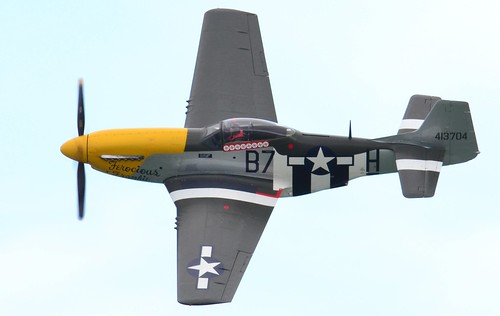
‘Ferocious Frankie’ #44-13704 (374th FS, 361st FG). The original crashed during a wheels up belly landing at RAF Little Walden, on November 9th, 1944. (This aircraft was flying at the Duxford American Airshow May 2016).
Aug 2015 317a

‘Ferocious Frankie’ (named after the wife of Lieutenant-Colonel Wallace E. Hopkins) seen at the Eastbourne Air Display August 2015.

By the end of January the seconding to the Ninth came to an end and the entire Group moved across to Belgium and Chievres, a former Belgian airfield captured and used by Luftwaffe bombers during the earlier years of the war. The 361st would remain there until April 1945 whereupon they returned back to Little Walden. During their absence Little Walden was made good use of. Being a ‘bomber airfield’ by design, its runways and hardstands were put to good use by Debach’s 493rd BG and their B-17 ‘Flying Fortresses’ whilst their own airfield was repaired and strengthened.

Spending only a month at Little Walden, the Air Echelons of the 493rd BG would depart in the April as the 361st FG returned. On the 20th, the 361st would fly their last operational mission, a flight that would close the record books culminating in a total of 441 missions. As the war ended and personnel were sent home, crews and aircraft of the 361st were dispersed to depots around the U.K., those that were left were sent home via the Queen Mary from Southampton arriving in New York in early November 1945. Within hours the group was disbanded and the men scattered to the four winds.

Between early September and early October 1945, the 56th FG ‘The Wolfpack’ were brought to Little Walden. The aircraft were also dispatched to depots around the country whilst personnel were brought to Little Walden for onward transportation to the United States. By mid October they too had gone.

Little Walden then began the wind down, transferring back to RAF ownership in early 1946. For the next twelve years or so, it was used to store surplus military equipment before they were sold off. After that, the site was returned to agriculture, the majority of the buildings pulled down and the runways dug up for road building hardcore.

The control tower stood for many years derelict and forlorn, until being purchased by an architect in 1982, eventually being turned into a private residence, the state it exists in today. The closed road has since been restored, utilising part of the NE-SW runway. Other parts that remain being a public footpath, but all a fraction of their former selves and no more than a tractor’s width wide.

What’s left of the technical area is a small industrial unit, remaining buildings being used for storage or small industrial companies. An access road from the B1052 passes the site an on to private residencies.

Little else survives of Little Walden. Memorial plaques are believed to be mounted on the side of the watch office, although I could not see these when I visited, and the village memorial mentions those who were stationed at the airfield.

The serenity of Little Walden does nothing to reflect the goings on here over 70 years ago. The aircraft are gone, the bird song replacing the sound of engines, and the busy runways now a small road. For those who were lost here, the watch office stands as  a memorial to their memory and the dedication shown by the many young men and women of the USAAF.

Sources and further reading.

1 Sunninghill Park was originally part of Windsor Forest and dates back to the 1600s and King Charles 1. Its ownership changed hands several times, and in the early 1800s during the Georgian period,  a large house was built upon it. The Ninth Air Force made it their headquarters between  November 1943 and September 1944, after which, in 1945, it was sold to the Crown Estate as a future home for Queen Elizabeth and Prince Philip, Duke of Edinburgh. However, before their marriage, the house burned down and the site remained unoccupied until the 1980s when a new property was designed and constructed for the Duke and Duchess of York. However, it was never occupied, the house fell into a very poor state of disrepair and was bought for £15m by an overseas investor. The site continued to decay and by 2014 was ordered for demolition.

2The Troy Record Newspaper Archives, Page 20, June 5th 1944 accessed 10/3/19.

3The full story can be read in ‘Balsham, A Village Story 1617-2017‘.

Little Walden is a new addition to Trail 46

RAF Little Walden (Station 165)

Sometimes, we come across quite unexpectedly, something of great interest. Whilst on my travels recently, passing through the southern regions of Cambridge into Essex, I came upon the former station RAF Little Walden. Being an unplanned visit, I was rather short in prior knowledge and preparation, no maps, aerial photographs, or other documents that I normally seek out before venturing off into the wilderness. So I was quite unprepared when I stumbled across the Watch Office from former station RAF Little Walden, otherwise known as Station 165 of the USAAF.

RAF Little Walden (Hadstock) – (Station 165)

Little Walden lies slightly closer to the village of Hadstock than it does Little Walden, and was originally called Hadstock. When construction began in 1942, it was allocated to the Eighth Air Force as a Class A bomber airfield. However, due to the bad winter of 1942/43 work ceased temporarily, being held up until well into the summer of 1943. At this point, Hadstock became known as Little Walden, a name change that coincided with the formation of the Ninth Air Force in Europe, an organisation whose primary role was the support of ground troops in the European theatre. With its headquarters at Sunninghill Park1 in Ascot, it would operate both transport and bomber units, taking many of these units (and their airfields) from the already established Eighth Air Force. Little Walden was one such airfield passing from the Eighth to the Ninth to fulfil this new role.

Although a Class A airfield, Little Walden’s main runway was slightly shorter than those of its counterparts, 1,900 yards as opposed to 2,000 yards, but the two auxiliary runways were both the standard 1,400 yards in length. A concrete and wood chip construction gave these runways good strength, it also had hardened perimeter tracks and fifty hardstands of the spectacle type. Grouped mainly in blocks of five, they were located around the perimeter track with a further block of eighteen to the north-west of the site. In the development process a public road the B1052, was closed as it passed directly though the centre of the proposed site.

Little Walden Watch Office

Little Walden’s Watch Office is now a private residential property.

A large bomb store lay to the west of the airfield, surprisingly close to the majority of the hardstands, any major accidental discharge being likely to cause substantial damage to parked aircraft. There were four areas within the bomb store, each holding 200 tons of bombs and tail units, further stores held pyrotechnics, incendiaries, ‘small’ bombs, grenades and small arms ammunition. Most of these were secured by earth banks with fusing points (both ultra-heavy and heavy-light) being held in temporary brick buildings.

To the eastern side of the airfield lay the technical area, with one of the type T2 hangars (the second being located to the north), a fire tender shelter, and a watch office designed to drawing 12779/41 – the standard airfield design of 1942/43. Behind this, lay the main technical area, with its usual range of dingy stores, MT (Motor Transport) sheds, parachute stores and a wide range of ancillary buildings.

Accommodation for staff was, as usual by now, dispersed over eleven sites, a sick quarters, communal site and WAAF site accounting for three of them. A further sewage works made the twelfth site. All-in-all accommodation was provided for just short of 3,000 men and women of mixed rank.

On March 6th, 1944 the airfield officially opened, the day before its first residents arrived. The 409th BG were a new Group, only constituted on June 1st, the previous year (1943). They trained using Douglas A-20 Havocs (known in British service as the Boston) a twin engines light bomber capable of carrying up to 4,000lb of bombs.

The 409th BG formed at Will Rogers Field (Oklahoma) and transitioned through Woodward and DeRidder bases before arriving in the UK. Between March and September they operated out of Little Walden, bombing V-weapons sites and airfields in France in a strategic role. Initially they performed in the low-level role, but soon moved to higher altitudes, performing their first mission on April 13th 1944.

In the short period of residency at Little Walden, the 409th would lose a number of aircraft, one of the first being that of #43-9899 of the 642nd BS, which was written off in a landing accident on April 22nd 1944. Three days later a second aircraft, #43-9691, would also crash-land at Little Walden being damaged in the process.

May would also prove to be a difficult month for the 409th, with one aircraft ‘lost’ on the 9th, a further crash landing on the 11th, another lost on the 22nd and two further aircraft lost (classified as MIA) on the 27th. It was on this mission that a further Havoc would collide with a low flying Mustang resulting in several tragic deaths.

Havoc #43-10130 of the 643rd BS, piloted by Captain Roger D. Dunbar took off from Little Walden heading south-east, when it collided with P-51B #42-106907 of the 503rd FS, 339th FG, piloted by 2nd Lt. Robert L. Dickens. The Mustang, on a training flight, disintegrated killing the pilot, whilst the Havoc crashed into the farmland below. In the ensuing fire, a local farmer’s widow and trained nurse, Betty Everitt ran to the scene and managed to pull one of the airmen out of the aircraft. When returning to retrieve another crewman, one of the bombs on board the aircraft exploded killing her, her small dog, a helping Staff Sgt. and those left inside the aircraft. As a thank you to Betty, the US airmen, from the base, raised almost £3,000 to provide an education for her four-year old orphaned son, Tony2. This was not a one-off either, a fund set up by Stars and Stripes and the British Red Cross, aimed to raise funds for children who had suffered the loss of one or both parents. The amounts raised went a long way to getting these children an education that they would not otherwise have had.

Early June would see another such tragedy, when three more Havocs would collide. Havocs A-20G #43-9703 and #43-9946, both of the 641st BS, would crash whilst the third aircraft managed to land at the airfield. #43-9703 was piloted by Joseph R. Armistead, whilst #43-9946 was piloted by Thomas A. Beckett. A young girl, Marjorie Pask, ran to help, pulling two airmen out of the wreckage then waiting with them until help arrived. Five airmen including the pilots and an air gunner, Staff Sergeant Albert H Holiday, were all killed. It was not until later that Marjorie realised that there were many bombs scattered around the site and how much danger she had been in 3.

Staff Sgt. Albert H Holiday, killed June 11th 1944 in a collision between two Havocs of the 409th BG. (IWM-UPL 21530)

With two further loses and a forced landing in June, it was be a difficult month for the 409th. The late summer months of July and August would be lighter but by no means a clean sheet. In September 1944, on the 18th, the 409th were moved out of Little Walden and posted to a forward Landing Ground A-48 at Bretigny, where they would continue to suffer from landing accidents, Flak and fighters.

Next at Little Walden came the Mustangs of the 361st FG, in a move that saw possession of Little Walden pass back into the hands of the Eighth Air Force. Station 165 was now back with its original owners.

The 361st FG were the last of the P-47 Groups to arrive in the UK. Initially based at Bottisham, they converted to the P-51 in the weeks leading up to D-day. Using the Thunderbolts they earned a reputation as a strong and determined ground attack unit, hitting rail yards and transportation links across France.

A short break whilst transferring from Bottisham to Little Walden gave a somewhat minor break for the 361st. But, following changes to the Eighth’s overall structure, it was soon back to normal and more attacks over occupied France. In October, Lt. Urban Drew shot down two Me 262s who were in the process of taking off from their airfield at Achmer. What was more remarkable about the attack was that Lt. Drew had only arrived in the U.K. a few days earlier, had been grounded for a Victory Roll and then went on to become an Ace shooting down six enemy aircraft and the first pair of 262s! He was awarded the Air Force Cross, being denied the Distinguished Flying Cross until after the war when records from both the Luftwaffe and US Air Force were able to confirm his dramatic claims.

The Christmas and winter of 1944-45 was notoriously bad, very cold temperatures, fog, frost and ice played havoc with operations. The Battle of the Bulge was raging and the allies were finding it all but impossible to provide assistance from the air. Many Bomb Groups suffered terrible tragedies as collisions and accident numbers increased in the poorer weather. The Ninth, who themselves had primary roles in ground support were finding it particularly difficult. To help, a selection of men and machines from the 361st (and 352nd from Bodney) were transported to France and the airfields at St. Dizier (Y-64) and Asch (Y-29) where they were seconded into the Ninth Air Force.  The main force back at Little Walden continued to support bomber missions whenever they could, a difficult job in often appalling conditions.

Duxford American Airshow May 2016

‘Ferocious Frankie’ #44-13704 (374th FS, 361st FG). The original crashed during a wheels up belly landing at RAF Little Walden, on November 9th, 1944. (This aircraft was flying at the Duxford American Airshow May 2016).

Aug 2015 317a

‘Ferocious Frankie’ (named after the wife of Lieutenant-Colonel Wallace E. Hopkins) seen at the Eastbourne Air Display August 2015.

By the end of January the seconding to the Ninth came to an end and the entire Group moved across to Belgium and Chievres, a former Belgian airfield captured and used by Luftwaffe bombers during the earlier years of the war. The 361st would remain there until April 1945 whereupon they returned back to Little Walden. During their absence Little Walden was made good use of. Being a ‘bomber airfield’ by design, its runways and hardstands were put to good use by Debach’s 493rd BG and their B-17 ‘Flying Fortresses’ whilst their own airfield was repaired and strengthened.

Spending only a month at Little Walden, the Air Echelons of the 493rd BG would depart in the April as the 361st FG returned. On the 20th, the 361st would fly their last operational mission, a flight that would close the record books culminating in a total of 441 missions. As the war ended and personnel were sent home, crews and aircraft of the 361st were dispersed to depots around the U.K., those that were left were sent home via the Queen Mary from Southampton arriving in New York in early November 1945. Within hours the group was disbanded and the men scattered to the four winds.

Between early September and early October 1945, the 56th FG ‘The Wolfpack’ were brought to Little Walden. The aircraft were also dispatched to depots around the country whilst personnel were brought to Little Walden for onward transportation to the United States. By mid October they too had gone.

Little Walden then began the wind down, transferring back to RAF ownership in early 1946. For the next twelve years or so, it was used to store surplus military equipment before they were sold off. After that, the site was returned to agriculture, the majority of the buildings pulled down and the runways dug up for road building hardcore.

The control tower stood for many years derelict and forlorn, until being purchased by an architect in 1982, eventually being turned into a private residence, the state it exists in today. The closed road has since been restored, utilising part of the NE-SW runway. Other parts that remain being a public footpath, but all a fraction of their former selves and no more than a tractor’s width wide.

What’s left of the technical area is a small industrial unit, remaining buildings being used for storage or small industrial companies. An access road from the B1052 passes the site an on to private residencies.

Little else survives of Little Walden. Memorial plaques are believed to be mounted on the side of the watch office, although I could not see these when I visited, and the village memorial mentions those who were stationed at the airfield.

The serenity of Little Walden does nothing to reflect the goings on here over 70 years ago. The aircraft are gone, the bird song replacing the sound of engines, and the busy runways now a small road. For those who were lost here, the watch office stands as  a memorial to their memory and the dedication shown by the many young men and women of the USAAF.

Sources and further reading.

1 Sunninghill Park was originally part of Windsor Forest and dates back to the 1600s and King Charles 1. Its ownership changed hands several times, and in the early 1800s during the Georgian period,  a large house was built upon it. The Ninth Air Force made it their headquarters between  November 1943 and September 1944, after which, in 1945, it was sold to the Crown Estate as a future home for Queen Elizabeth and Prince Philip, Duke of Edinburgh. However, before their marriage, the house burned down and the site remained unoccupied until the 1980s when a new property was designed and constructed for the Duke and Duchess of York. However, it was never occupied, the house fell into a very poor state of disrepair and was bought for £15m by an overseas investor. The site continued to decay and by 2014 was ordered for demolition.

2The Troy Record Newspaper Archives, Page 20, June 5th 1944 accessed 10/3/19.

3The full story can be read in ‘Balsham, A Village Story 1617-2017‘.

Little Walden is a new addition to Trail 46

RAF Swanton Morley – Small but rich in history.

In this Trail, we return to Norfolk and take in three former airfields each of notable historical value. Our first is probably better known as an Army barracks than it is an RAF airfield, but, for the duration of the Second World War, it would be home to a number of different aircraft types and to a range of international crews. Amongst the many residents here would be those from Poland, the Netherlands, Australia and New Zealand. We start our journey at the former RAF Swanton Morley.

RAF Swanton Morley

Following the end of hostilities in 1918, Britain’s defences and in particular the RAF, were cut back dramatically. From around 250,000 personnel (the worlds largest air force) to just under 30,000 by the early 1920s, the reductions were both severe and widespread. Political in-fighting between the three armed forces and the Government had seen the RAF lose out significantly, and under the terms of the ‘Ten year Rule’, expansion was prevented, and so little could be done to redress the declining situation.

During the 1930s, world developments (and in particular those in Germany) raised the threat of yet another war, at which point the Government realised that Britain’s defences were now totally inadequate and in dire need of redevelopment and expansion.

Their response was a series of expansion ‘schemes’  which would not only reshape the organisation of the RAF, but would cater for the huge increase in numbers of personnel that would be required to raise an adequate fighting force .

Considered lacking in direction by many, these early schemes surprisingly paid little attention to future needs, and so no real provision was made for supporting aspects such as training, maintenance or supply.

Scheme A, approved in July 1934, would set the bench mark at 84 home-based squadrons, a figure that was still woefully inadequate compared to the might that was building up across the channel. Each scheme would build on and replace the former, taking into account layout, new developments and the materials available – but all under the monetary restrictions of the 1930’s depression.

By the time war came, Scheme ‘M’ had been implemented (November 7th 1938), which called for 163 home based squadrons involving 2,500 aircraft for Britain’s home defence. It was under this scheme that Swanton Morley would be built.*1.

Initially designed as a fighter station, construction began in 1939, and one of the criteria for this scheme was to include type ‘C’ hangars. However, being incomplete by the outbreak of war, it was caught in the transition period between temporary and permanent aircraft storage. The ‘C’ types were cancelled in favour of three ‘J’ types, only one of which was actually built – this left Swanton Morley with considerably less hangar space than was actually required. Unfinished, the airfield opened on September 17th 1940 under the ownership of No. 2 Group Bomber Command.

As war broke out, a small detachment of 107 Squadron Blenheim IVs were based here. 107 Sqn were widely spread with other detachments at: Lossiemouth, Newmarket, Hunsdon, Horsham St. Faith and Ipswich, whilst the main squadron was based at RAF Wattisham. As part of 83 Wing, 107 would be joined by a further detachment from 110 Sqn the following month, also bringing the twin-engined Blenheim IV.

It was a No. 2 group aircraft that famously made the first sortie over the German frontier on the very day war broke out, and then on the second day, Monday September 4th 1939, a flight of four 107 Sqn aircraft and one 110 Sqn all from RAF Wattisham, dropped the first salvo of bombs on German ships at Wilhelmshaven . It was from one of these aircraft (Blenheim IV ‘N6240’) that Observer, Sergeant George Booth, and AC1 L. J. Slattery would become the first British Prisoners of War, captured when their Blenheim was shot down by German defences. None of the five aircraft returned, a rather disastrous start to the war for the RAF.*2

Work continued at Swanton Morley throughout the next two to three years, and eventually accommodation blocks were raised, hard perimeter tracks laid and four T2 hangars erected. Around twenty hardstands were created although many aircraft were still dispersed on the grassed areas around the technical site. A bomb store was developed to the south, and lighting added to the three runways, but despite of all the improvements, upgrades and developments, it was felt Swanton Morley did not warrant having any hard runways and so they continued to remain as grass.

It wasn’t until the end of October 1940, that Swanton Morley would have its own squadron of aircraft, 105 Squadron arrived bringing their Blenheim IVs to compliment those of 107 Sqn and 110 Sqn. With two detachments at Lossiemouth and Luqa (Malta), 105 would take part in anti-shipping sorties and attacks on targets in the low countries. A successful unit they swapped these for the Mosquito IV in November 1941, becoming the first operational squadron to receive these highly manoeuvrable aircraft, taking them to nearby Horsham St. Faith in the following month.

ROYAL AIR FORCE BOMBER COMMAND, 1939-1941.

A Blenheim of 105 Squadron passing over a fiercely burning enemy merchant vessel (© IWM (C 1940)

One of Swanton Morley’s earliest casualties was a 105 squadron aircraft, piloted by F/O. D. Murray DFC with Sgt’s C. Gavin and T. Robson. The aircraft, Blenheim IV ‘T1890’, was brought down over Brussels with the loss of all three crew members.

It was during August of 1941, that the first of many units would arrive – No. 152 Squadron. Like so many other squadrons around the country, their stay was to be short-lived taking their Spitfire IIAs to Coltishall the following December.

Coinciding with 105’s departure, was 226 Squadron’s arrival. At the end of December 1941, 226 Sqn would bring a new twin-engined aircraft to the grounds of Swanton Morley, the Douglas Boston. The Mk III was proving to be a formidable medium bomber and night-fighter, featuring improved armour, larger fuel tanks and its two Wright Twin Cyclone engines providing 1,600hp each. 226 Sqn were to later replace the MKIIIs with the MKIIIAs in January 1943 under the lend-lease agreement and then very shortly afterwards, with the B-25 Mitchell II. 226 Sqn operated these aircraft for almost a year at Swanton Morley before moving on to Hartford Bridge and the continent in 1944, thus becoming Swanton Morley’s longest standing squadron.

It was with 226 Squadron that the United States would make its mark on the war. On June 29th 1942, with both Eisenhower and Churchill present, twelve RAF Boston IIIs were sent to bomb the Marshalling yards at Hazebrouck, one of these aircraft (AL743) was flown by an all American crew. A rather ‘unofficial’ entry into the conflict, it was made more formal on Independence day, July 4th 1942 when six U.S. crews joined 226 Squadron in a low-level attack against Luftwaffe airfields in Holland. Twelve RAF aircraft took off a few minutes after 07:00 hrs and flew low and fast over the North Sea toward Holland. After splitting up to attack their designated targets, one group encountered severe flak and was badly beaten, one aircraft crashing whilst another had an engine knocked out. Before the pilot could regain control, the aircraft, Boston AL750, scraped the ground coming remarkably close to a complete disaster. However, the pilot Major Charles Kegelman, managed to regain control and nurse the stricken aircraft back to Swanton Morley. Of the twelve Bostons sent out, two U.S. and one RAF crewed aircraft failed to return. A baptism of fire that resulted in a 30% loss of the U.S. Air Force contingency. For their bravery, three DFCs were awarded to the U.S. crews, with Major Kegelman receiving a D.S.C. from Major Gen. Dwight D. Eisenhower, American commander in the European war theatre. This made Major Kegelman the first member of the United States forces in Europe to be decorated for gallantry against the enemy.

Whilst not the first U.S. involvement nor their first casualties of the war, their actions did officially bring the United States into the European conflict.

Sergeant Bennie Cunningham, Technical-Sergeant Robert Golay, Major Charles C Kegelman and Lieutenant Randall Dorton in front of a Boston bomber. (Roger Freeman Collection IWM)

1943 would go on to prove to be an eventful year for Swanton Morley. With the Allied invasions plans taking shape, a new force was needed to support those destined to take to the Normandy beaches. The creation of the Second Tactical Air Force (TAF) in November 1943, was designed to meet that challenge and with it came changes at Swanton Morley.

Ownership now passed from Bomber Command to the Second TAF, and many units that would operate from here were part of that force. Following a relatively short stay by 88 Squadron (30th March 1943 – 19th August 1943) flying both the Boston III and IIIA, No. 305 (Weilkopolski) Squadron would arrive bringing the first Polish crews to Swanton Morley. Being the fourth and final Polish bomber squadron to be formed, they arrived in early September bringing Wellington MK Xs with them. Whilst serving in Bomber Command, the Polish had amassed some 1,117 sorties in which they had lost 136 brave young men as either killed or captured.

After arrival here, 305 Sqn changed their Wellingtons for Mitchell IIs and in line with the Second TAF objectives, began attacking targets around the Cap Griz Nez region. Being daylight operations, this was something new for the Polish crews, but one they relished and carried out well. In November after only being at Swanton Morley for two months, the Polish crews left leaving 226 Sqn with only a small detachment of 98 Squadron Mitchells for company.

At the end of 1943, three days after Christmas, No. 3 Squadron arrived bringing  a new breed of aircraft with them – the single-engined Typhoon IB, which they kept at Swanton Morley until February 14th 1944. No. 3 Sqn had been one of three founder squadrons of the Royal Flying Corp in 1912 and they remain one of the few squadrons to retain an active role today, flying the aircraft’s namesake, the modern Eurofighter Typhoon.

Whilst here at Swanton Morley, No. 3 Sqn carried out duties that the ill-fated Hawker Typhoon performed well at, low-level ground attack and anti-shipping roles. Dogged by development problems – engines fires and deadly levels of Carbon Monoxide in the cockpit – the Typhoons suffered terrible problems throughout their wartime service, subsequently virtually every model was scrapped at the end of war.

February 1944 was all change again at Swanton Morley. A detachment of 107 Squadron would return after a couple of years absence, and with their arrival came the departure of 226 Sqn after just over two years of being at Swanton. On the thirteenth of that month, they left for Hartford Bridge in Hampshire, in preparations for the Allied invasion at Normandy.

In the two months that followed, Swanton Morley began its wind down, a move signified by a number of short stay units. Each of these would however bring a wide range of nationalities, including crews from the Australian unit No. 464 (RAAF) Sqn, from 25th March 1944 to 9th April 1944. Then came 180 Sqn (12 – 26th April 1944) a short-lived unit that survived just under four years before disbandment only to be reformed as No. 69 Sqn.

Coinciding with 180 Sqn was the Auxiliary Squadron, No. 613 Sqn with Mosquito VIs. This too would disband at the end of the war also to reform as 69 Squadron. Then as April drew to a close another international unit would arrive and depart, a New Zealand unit, No. 487 Sqn (RNZAF)  also bringing Mosquito VIs – an aircraft they used in conjunction with 464 Sqn in the attack on the Amiens prison earlier on.

Finally for two weeks in May 1944 (6th – 18th), a dutch contingency arrived in the form of No. 320 Squadron. 320 Sqn was formed out of evacuated Dutch airmen along with a handful of Fokker T-VIIIW seaplanes which they used until spares were no longer available. Here at Swanton Morley they had lost their seaplanes and were now flying Mitchell IIs, wreaking their revenge by attacking enemy communication lines and airfields. After the war the crews of this unit were transferred to the Royal Netherlands Navy and 320 was disbanded as an RAF unit.

ROYAL AIR FORCE: 1939-1945: COASTAL COMMAND

Before arriving at Swanton Morley, No. 320 Sqn flew a handful of Fokker T-VIIIW float-planes, that they had brought with them when the Netherlands fell to the Germans. Here, one is being serviced at Pembroke Dock, August 1940. (© IWM (CH 1042)

Coinciding with the invasion of Normandy in June 1944, the Bomber Support Development Unit (BSDU) transferred across from RAF Foulsham. Developed under the wing of 100 Group, they used a range of aircraft to investigate and develop electronic counter measures and radar technologies for aircraft.  At Swanton Morley, this involved nine Mosquitoes, MK XIX and XXX, to operate in both operational and non-operational duties. The BSDU (and 100 Group) were responsible for a range of electronic devices including Serrate, Hookah, Perfectos and Mandrel to name but a few, and were involved in some 114 operations, claiming  five air-to-air victories.

The USAAF were to play another small and final part in the life of Swanton Morley, when on 25th July 1944, B-24H ’41-29402′ “The Mad Monk” of the 786th BS, 466th BG, took off from nearby Attlebridge. It clipped some trees causing it to crash-land at Swanton-Morley; the aircraft was so severely damaged it was condemned and salvaged for spares.

Another near disaster was averted at Swanton Morley when Mosquito NFXXX (MM797) of the BSDU crashed after take off on the night of 2nd-3rd January 1945. On take off, with a full fuel load, the port engine began leaking glycol at a furious rate. Too low to bail out, the pilot, Flt. Lt. Harry White DFC, put the aircraft down on the frozen ground. After both pilot and co-pilot were pulled from the wreckage by local farmers, the aircraft exploded creating a ferocious fireball that destroyed the air frame completely.

Eventually the war came to a close, the ‘Window’ research station was transferred to the BSDU and in the summer 100 Group was disbanded. With that Swanton Morley fell quiet and no further operational units would serve from here.

In the closing months of 1946, No. 4 Radio School moved in using Avro’s Anson, and Percival’s Proctor and Prentice aircraft. Various ground units also used the site but gradually flying all but ceased. Eventually on September 15th 1995, Battle of Britain day, the RAF Ensign was lowered and RAF Swanton Morley was officially closed. A small private micro-light club took over part of the site, but in 1996 the Army claimed the airfield forcing the club to close. It remains in the hands of the Army today as the ‘Robertson Barracks’, named after Field Marshal Sir William Robertson and no flying takes place.

Swanton Morley’s history was fairly rare, in that it never had any concrete runways and boasted to be one of the longest lasting Worlds War 2 grassed airfields. It had, at its peak, one – ‘J’ Type hangar and four – ‘T2’ hangars. Its watch office, built to drawing 5845/39, included a Met Section and is now thankfully, a Grade II listed building making it one of the best originally preserved examples of Watch Office designs.

Swanton Morley june 2016 (3)

Swanton Morley had four T type hangars. All but one have been demolished. This one remains in private ownership.

Many of the original buildings have gone and either their concrete bases left or more modern replacements put in their place. Some of the concrete pathways have been removed as have all the dispersal pans. The bomb store is now a field and all but one of the hangars were demolished – the remaining one being re-clad.  A number of pill boxes and air-defence structures also remain, but like the main airfield site it is all securely kept behind very high fences and armed guards.

The public highway circumnavigates Swanton Morley, but views are best achieved from the main entrance. As with all active military sites there is a no stopping rule, but as you pass, careful observations will reveal some of the main buildings of the accommodation area.

Swanton Morley retains some if its historical features, and they are all in the care of either the Army or the local farmer. As the MOD holds this site, many of these features are well hidden from public view, but for now at least, this along with the preservation order on the watch office, does at least mean Swanton Morley’s past is in part ‘protected’ for future generations.

From Swanton Morley we visit two more airfields in the area, Hethel, a USAAF base with its own museum and Hingham an airfield that had possibly the shortest life of any UK airfield.

Sources and further reading

*1 Royal Air Force Historical Journal No. 35

*2 Chorley, W.R., “Bomber Command Losses of the Second World War, V1, 1939-40″, Classic, 1992

Norfolk Heritage Website

Freeman, R.A., “The Mighty Eighth“, Arms & Armour, 1970

Bowman, M., “100 Group (Bomber Support)”, Pen & Sword, 2006