Loss of Lancaster EE118, 156 Sqn PFF – RAF Warboys.

Lancaster, a MK.III, took off from RAF Warboys, at 18:24 on September 29th 1943 on operations to Germany. It was joined by nine other Lancasters from the same squadron to bomb Bochum in Western Germany. Over the target, flak was moderate and visibility was good. Marking was in the form of skymarkers, along with red and green target indicators (TI) and bombing was reported as scattered with smoke rising to 5,000 ft.

On Lancaster EE118 that night was Flt. Sgt. Frederick H. Ray (Pilot); Sgt. David R. Booker (Bomb aimer);  Fl. Off. Sydney K. Smith RCAF (Navigator); Sgt. Norman P. Winterburn (Wireless Op); Sgt. William A. Lineham (Flt. Engineer); Sgt. Frederick D. Dickens (Air Gunner) and Sgt. Arthur S. W. Orchard (rear Gunner).

The aircraft had suffered heavy flak damage, several of the instruments were not working including the compass and altimeter, and a 1,000lb bomb remained ‘hung-up’ in the bomb bay, Their return to Warboys would take them over the North Sea, across the Wash and south-east toward Warboys, but they requested landing permission at RAF Downham Market as it was closer. Permission was granted, and the ‘hung-up’ bomb was safely disposed of over the Wash.

Lancaster EE118 crash plaque

The Memorial Plaque to Lancaster EE118.

Downham Market was at the time shrouded in thick fog and the FIDO installation recently added was not yet fully serviceable. Flt. Sgt. Ray made his approach, and with 10/10ths cloud as low as 1,000 feet, it was very difficult to make out where he was.

On his first approach, Flt. Sgt. Ray missed the runway and so headed north, and then turned in a south-west direction to make a new approach from the east. On his run in toward the final turn, the rear wheel caught the tree tops of a Slubberdike Wood, located  north-west of the airfield. This slowed the aircraft down sufficiently to prevent it from climbing, and as they passed over Allotments at nearby Wimbotsham village, the port wing clipped a raised air-raid shelter near to the allotment entrance. This caused the wing tip to break off and resulted in the aircraft colliding with a telegraph pole at the end of Hop Pikel field near to Milller’s Lane which flipped the aircraft over bring it down in an orchard.

In the accident, all but the rear gunner Sgt. Orchard were killed outright, Sgt. Orchard being thrown clear from his rear turret.

The noise of the crash alerted  local people who went out to see what had caused all the noise, and suspecting an air crash, they searched for wreckage. Gardens at the end of Miller’s Lane were strewn with bits of aircraft and a two young boys by the name of Gutteridge, came across Sgt. Orchard with a large branch across his legs. Fearing he had broken it, Sgt. Orchard begged them not to move it and await medical assistance in case it made the injury worse.

In the confusion that followed, Sgt. Orchard couldn’t remember if the 1,000 lb bomb had been dropped or not, so the police on the scene cleared the nearby houses sending everyone into their various bomb shelters for protection. It was not necessary however, and soon the all clear had been given and they returned to their homes.

Another young boy, 12 years old at the time, recalled how the rest of the crew were found in his garden, 39 Miller’s Lane, and how they were removed by RAF personnel during the night. Wreckage was found across the orchard and in local gardens, until RAF salvage teams took the aircraft away some 3 – 4 weeks later.

aerial photo

An aerial photo of Wimbotsham showing the direction the Lancaster flew on that fateful night. The scar in the orchard is clearly visible. The airfield is in the bottom right hand corner.

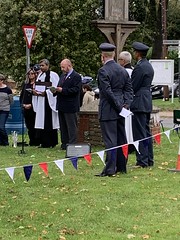
On the 30th September 2023, a plaque was attached to the Wimbotsham village sign to commemorate the loss of the crew nearby. The ceremony was opened by Mr. Ian Cable, Chairman of Wimbotsham Parish Council with a greeting and introduction from Reverend Canon Dr. David Karoon. After the hymn ‘O God our help in ages past’, Group Captain Frederick Wigglesworth, Station Commander RAF Marham, gave the Bible reading Isaiah 40:25:31 which was followed by a prayer of dedication led by The Rev. (Wing Commander) Eddie Wynn.

Dr. Karoon then gave a blessing of the memorial after which followed  ‘The Airman’s Hymn’ sung by those gathered at the service.

Memorial dedication EE118

Mr. Dutton gives background information on the Pathfinders with Rev. Canon Dr. Davis Karoon, The Rev (Wing Cdr) Eddie Wynn and Group Captain Frederick Wigglesworth looking on.

Following the Lords Prayer, a further dedication was given by Bill Bower, the R.A.F.A. Chairman, which preceded the Last Post and a minutes silence. The ceremony was closed with some back ground information on the Pathfinders by Tim Dutton, and the Benediction from Dr. Karoon. Lastly, the National Anthem was sung and a thanks to those involved given by Mr. Cable.

In the gathering were relatives of both Sgt. Arthur Orchard and Sgt. David Booker, the bomb aimer, along with villagers who remember the crash in 1943.

Tea, cake and a display of material from the crash and personal letters from Arthur Orchard to relatives of the crew were made available in the village hall, itself a former RAF Downham Market admin building.

The crew in Lancaster EE118 (GT-?)

Flt. Sgt. Frederick H. Ray (Pilot), s/n: 1391599, age 26
Sgt. David R. Booker (Bomb aimer), s/n: 1413457, age 20
Fl. Off. Sydney K. Smith RCAF. (Navigator), s/n: J/14174, age 21
Sgt. Norman P. Winterburn (Wireless Op), s/n: 1439760, age 21
Sgt. William A. Lineham (Flt. Engineer), s/n: 1815307, age 19
Sgt. Frederick D. Dickens (Air Gunner), s/n: 1613337, age 20
Sgt. Arthur S. W. Orchard (rear Gunner) – survived

The Lancaster, a MK.III, was built as part of the fourth production batch of 620 aircraft (the final contract of No. 6427) by A.V. Roe & Co Ltd. at Chadderton. It was delivered to 32 Maintenance Unit (MU) on 27th May 1943 transferring to 156 Sqn. on 22nd June 1943. It was struck off charge after the Wimbotsham crash on 19th October 1943.

A range of resources were used in the compiling of this post, including:

National Archives: AIR 27/1041/40

Chorley, W.H. “Bomber Command Losses of the Second World War – 1943“, Midland Counties, 1996.

Holmes, H. “Avro Lancaster – The Definitive Story“, Airlife Publishing, 1997

Personal letters and photos on display from Arthur Orchard and Derek Neal.

Trail 65 – RAF Thurleigh Part 2 – The USAAF Arrive.

In Part 1 we saw how RAF Thurleigh emerged from the Bedfordshire countryside and was shaped by early Luftwaffe raids on the construction site. We saw the arrival of new RAF training units flying Wellington bombers, and their subsequent departure to the far East. We saw how tragedy and fatal accidents claimed the lives of new Polish crews training at the station with 18 OTU, and how with Bomber Command moving on, Thurleigh’s role was set to change dramatically.

A New Ally Arrives: The American Transformation of Thurleigh

At the end of 1941, after the surprise attack on Pearl Harbour, America entered the conflict declaring war on both Japan and Germany and their allies. Over the next few months high ranking officials hurriedly put plans in place to send twenty-eight American bomb groups to the United Kingdom, and the European theatre of war. In a meeting between General Eaker and Air Chief Marshal Arthur Harris, discussions took place that would not only facilitate such a move, but also give the Americans suitable airfields on which to house their new heavy bombers.

Aware that most British airfields were too small to accommodate the American’s heavy bomber units, Eaker went on to press Harris for specific details including both their locations and the facilities available at each one. Anticipating this, Harris handed over the identity of eight potential sites, many of them RAF satellite stations, but all suitable for the American’s use. Amongst these were the airfields at Polebrook, Chelveston, Molesworth, Kimbolton, and of course Thurleigh.

Initially designated Station B-4, Thurleigh would then undergo a major modification programme, one that would bring it up to the new Class ‘A’ standard, a specification that would make it suitable for the American heavy bombers, both the B-24 ‘Liberator’ and the B-17 ‘Flying Fortresses’ that Eaker was sending over.

Thurleigh

One of the former arms buildings.

Construction crews quickly began work, both extending and reinforcing the short runways; they added additional hardstands, and expanded both the technical and domestic sites. Upon completion, the airfield would feature three concrete runways: one of 2,000 feet and two of 1,400 feet in length, each being the standard 50 yards wide. Aircraft dispersal was facilitated by a total of 51 loop and frying-pan style hardstands arranged around a full length perimeter track.

In addition, and unusually, four T2 hangars were erected, providing protective aircraft shelter and maintenance facilities. The bomb store was discreetly placed in Galsey Wood, a wooded area to the northwest and away from the main flying and accommodation areas – an essential safety precaution in wartime.

Fifteen accommodation sites, including two communal areas, two WAAF quarters, medical facilities, and barrack blocks, were all established along the road leading away from Thurleigh village to the south-west of the airfield. These sites employed a variety of wartime construction styles – brick, timber, concrete, steel, asbestos, and plasterboard – using standard designs from Laing, Nissen, Seco, Jane, Romney, and others. At full capacity, the base would accommodate over 440 officers and more than 2,500 enlisted personnel, including members of the Women’s Auxiliary Air Force.

After being allocated to the Americans on August 10th 1942, Thurleigh opened with its first residents. On 7th September that year, the first and only front line bomber Group to operate from the airfield, the 306th Bomb Group (BG), arrived with its four squadrons of B-17s: the 367th, 368th, 369th and 423rd Bomb Squadrons (BS). In command would be Col. Charles B. “Chip” Overcracker.

The 306th Bomb Group: Arrival of “The Reich Wreckers” (Autumn 1942)

Known as “The Reich Wreckers” the 306th would have many claims to fame, including being the oldest operational Bomb Group in the 8th Air Force and the only one to remain at the same station (Thurleigh) in England for the longest period of time. In addition, they were the first unit to have personnel achieve their first tour of operations, a major mile stone that gave the whole air force hope that going home was indeed possible.

Thurleigh

A graffiti panel rescued from a 423rd BS barrack now on display at the museum.

The Group, designated the 306th, were constituted on January 28th 1942, and activated in March that same year. Their journey to the UK began at Gowen Field in Idaho, transferring through Wendover Field to their embarkation point at New York onboard HMS Queen Elizabeth. The ground echelon set sale, travelling across the treacherous north Atlantic route to arrive at Greenock in Scotland, on September 5th, 1942.

The air echelon travelled separately, arriving a week later in small groups touching down at Thurleigh between the 8th and 13th September, having flown their own thirty-five aircraft across the northern route. This cold and bleak route took them via Greenland and Iceland, before passing over northern Ireland to arrive at Prestwick in Scotland on the north-west coast. During the journey over, one B-17F, with a crew of nine and one passenger, exploded for no apparent reason, 150 miles from Gander Lake,  Newfoundland. A second aircraft also ditched in the Irish Sea. The crew in this instance were picked up, but the aircraft was lost in the cold waters of the North Atlantic. This was the third B-17 the group had lost since their inauguration.

The 306th would go on to fight in some of the most bitter air battles of the war, including Schweinfurt, Stuttgart, Hannover, Berlin, Ludwigshafen and Leipzig. They would lead the first US bomber penetration of German skies; Big Week in February 1944, and go on to support both the Normandy landings and the St. Lo breakout. They would remain active throughout the war achieving numerous awards including two Medals of Honour, numerous Purple Hearts and two Distinguished Unit Citations (DUC) for action over occupied Europe.

Their arrival at Thurleigh was not however the great dream they may have wished for. On unloading, the 306th were greeted by unfinished buildings and mud – lots of it. Tents immediately formed the basis of personnel  accommodation and the officers’ mess was so small, staff had to operate in three shifts to enable them all to get fed.

Not only was a considerable amount of work needing to be done to get the station ready, but being new to the European theatre, a huge amount of ‘up-skilling’ was also going to be needed. To this end, intelligence staff, operations controllers and flight controllers were all sent to RAF stations to learn the ‘tricks of the trade’ enabling them to operate alongside their British counterparts in what was about to become a very busy airspace.

Baptism by Fire: First Operations and Early Losses

This poor start was then compounded when on October 2nd 1942, during a practice mission over the Wash, one of the waist gunners of B-17 #41-24492 ‘Lady Halitosis‘ of the 367th BS, suffered oxygen failure. In a bid to help the gunner, the pilot put the aircraft into a steep dive losing some 9,000 feet of altitude in a matter of minutes. The dive and subsequent recovery was so severe that the aircraft’s control cables snapped, and part of the starboard wing broke away taking an engine with it. The aircraft then caught fire and the bomb bay doors became detached. One of these doors, struck the rear section of the aircraft with such force that it severed the fuselage at the tail. The rear gunner, trapped inside his position, desperately tried to escape, hammering at the plexiglass and fuselage to break out. With only a 1,000 feet of air left, he just managed to break through the fuselage and free himself from his falling coffin. His parachute luckily opened, and he landed safely some distance away south-east of Spalding in Lincolnshire. His luck, already used exhaustively, somehow managed to continue on for a few moments more, when the remainder of the burning  B-17 came crashing down a mere one hundred yards or so from where he was sat.

Rescue crews from a nearby anti-aircraft gun ran to the scene but they were unable to get close enough to the wreckage due the the ferocity of the fire, and sadly, all six of those left inside, perished. During the whole episode only one other crewman managed to escape – Ball Turret Gunner Private Raymond McAskill – suffering slight injuries as he did so.

The event was so understandably harrowing for gunner S.Sgt. William Kellum, that he was eventually grounded, his mental state rendering him ‘unfit’ to continue on after having only carried out a few missions following his horrific flight debut in England.

With this disaster behind them, the 306th took to the air once more on their maiden operation on October 9th 1942, an operation to bomb the steel works at Lille, France. But again, it was not to be the glorious outcome they all would have wished for.

For the first time, over 100 American bombers, a mix of B-24s and B-17s, led by the soon to be legendary Col. Edward “Ted” Timberlake, flew across the English Channel to France. The huge formation, escorted by over 400 fighters, a mix of Spitfires – now part of the 4th Fighter Group –  and P-38 “Lightnings”, knew how important this mission was going to be.

Waiting for them were the battle hardened Luftwaffe pilots of JG 26 in their FW190s, they were not going to let the bombers through easily and the sky would be full.

With departure planned for 08:32, the lumbering giants gradually rose in to the air and set route for France.

As the bombers reached the target, the Luftwaffe struck, focussing initially on the B-24s of 93rd BG. Attacking from their favoured position, the rear, they struck at the formation ignoring the fighters flying high above. Releasing over the target, bombing was considered poor, some bomb aimers not even finding the target and so dropping their bombs on alternative sites. During the action, the formation had become disjointed, partly due to some turning back with technical problems and partly to some being knocked out by enemy fighters – the defensive wall had been breached.

As for the 306th, a second aircraft was lost, and this time there were no survivors. A third B-17, #41-24486 “Man O’ War” piloted by 2nd. Lt. James M. Stewart, lost three engines and its radio failed. It was about to ditch in the English Channel, when – as if out of a boy’s action story – a Spitfire, flown by Flt. Lt. Andrews of 91 Sqn, appeared alongside and guided the B-17 to RAF Manston in Kent where it made a successful crash landing. None of the crew were injured in the event, saved no doubt by the actions of Flt. Lt. Andrews.

Inexperience played a large part for many of the crews taking part that day. Being new to operational duties, not only had they suffered poor aiming but gunners had made hugely exaggerated claims about the numbers of enemy aircraft shot down – although probably unknowingly to them. In reply to the frenzied attack on the formation, air gunners sprayed bullets all over the sky hitting everything except the enemy. A mix of poor training and a determination to prove their worth, had been a recipe for disaster.

Thurleigh

One of several buildings on the bomb store.

Not only was the bomb aiming poor but so was the navigation. Many navigators, like the gunners, were simply not experienced enough, nor trained well enough for the European geography. With thick cloud being present almost all of the time, many new crews were unable to identify specific geographical features and were simply lost within 10 minutes of leaving their home base.*4

During this initial operation experienced enemy fighters were both fearsome and determined in their attacks. Whilst few bombers were actually shot down, all of those in the lagging 306th received hits from the FW-190s – some severely. The opening few weeks had been a real eye opener for the 306th, an experience resembling a baptism of fire not only for those newbies the “The Reich Wreckers“, but for the Eighth Air Force as a whole.

Weather, Warnings, and Misfires: October’s Frustrating Missions

The British winter weather then intervened. Several operations were cancelled as were training flights which were greatly needed. A cancelled flight to Lorient on October 21st, merely two weeks after their first operation, meant that the entire 306th returned without dropping a single bomb. The declining weather and poor visibility was to blame, but some ninety aircraft did continue on, and of those who did bomb, their bombs simply “bounced off” the submarine pens, having no impact whatsoever. *5

Aircrews were learning that operations over enemy territory were high risk, but even scrubbed missions could have their problems: aircraft still had tanks full of petrol and bomb-bays were still filled with tons of high explosives. For the 306th, troubles on this mission began even before they had left British airspace. When the abort signal came through, it instructed crews to drop their ordnance in the Wash – a large body of shallow coastal water off the north Norfolk coast.  Whilst it became a common practice for scrubbed missions, for one B-17 it was not going to be a simple or straight forward task.

Emergency Landing: A B-17 Touches Down at Sutton Bridge

B-17F, #41-24460 ‘RD-A’, “Little Audrey” of the 423 BS, began the process of releasing its bombs when suddenly the life raft latch broke loose causing the raft to escape and wrap itself around the elevator rendering the aircraft difficult to control.

Captain Mack McKay, 306th BG points to a “kill” marking painted on his B-17 Flying Fortress “Little Audrey” (IWM FRE 4418)

Now being unstable in flight, the B-17 had to find a safe place to land, and near to the Wash was the firing range at Holbeach and its associated airfield at RAF Sutton Bridge. A physically small grass airfield that was used for gunnery training of RAF fighters, it was not designed to take large four-engined heavy bombers. The likely hood of getting down safely was slim, but after using all his skill and judgement, the pilot managed to put the bomber down safely on the grass much to the joy of those inside the bomber. Once remedial work had been carried out on the aircraft, the crew began to prepare for the take off, an event just as risky as the landing and with odds just as bad.

Being an unusual aircraft to see at Sutton Bridge, huge crowds gathered to see the B-17 and to witness what could have been a terrible accident had the take off been misjudged on the small grass strip. Fortunately though, again using all his skill and judgement, the pilot got the aircraft up and the B-17 successfully rose in to the air making its way home to Thurleigh being waved off by the extensive crowd of locals gathered by. *6

Mounting Pressure: Heavy Losses and Royal Visits

The early days of November 1942, saw missions 3, 4 and 5 for the 306th. Visits to Brest, Lille and St. Nazaire, saw a further four aircraft lost with all crews listed as ‘missing in action’. These early loses were beginning to mount, and those in charge were beginning to voice their concerns.

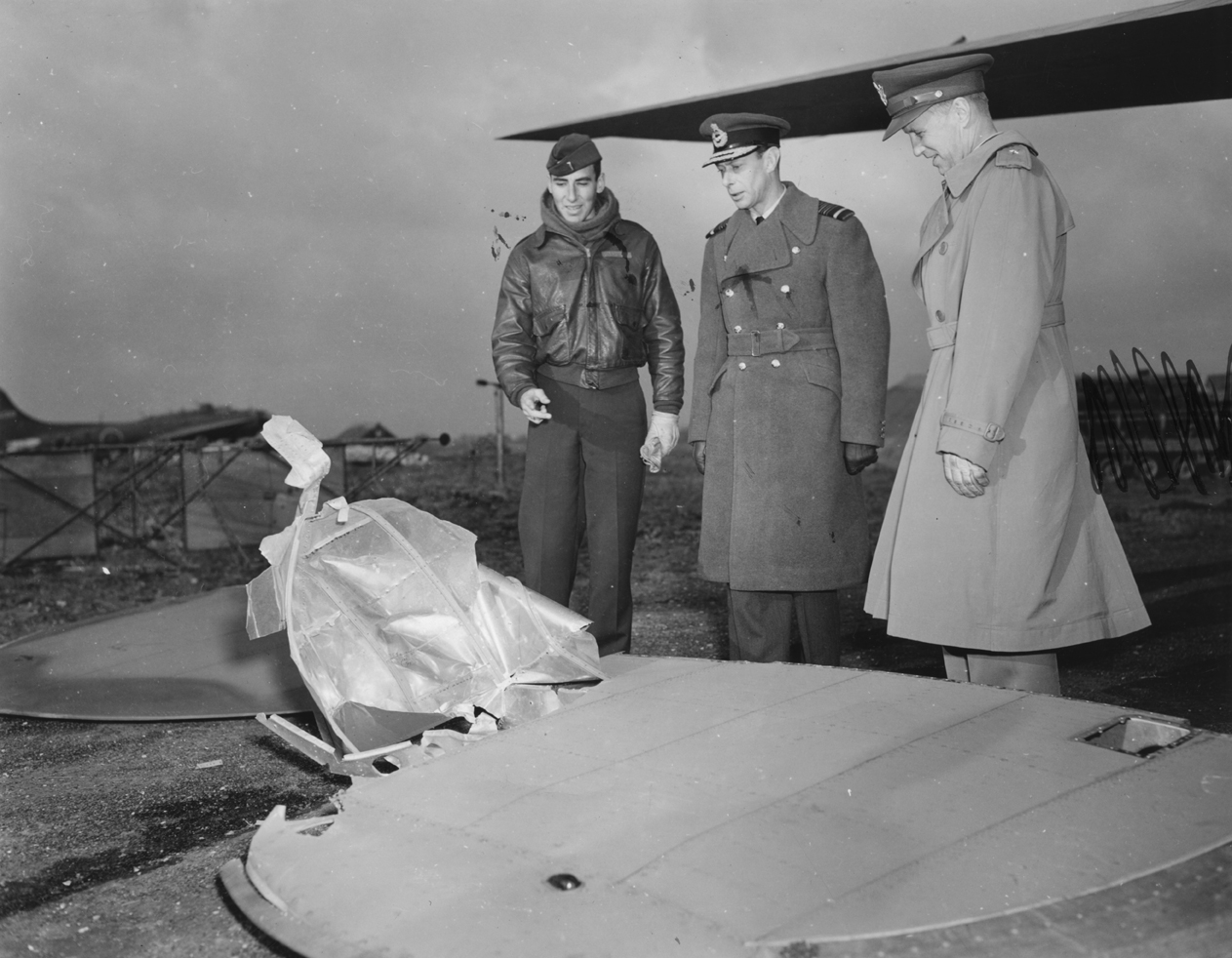
On November 13th, a Royal visit was made in which General Carl Spaatz and King George VI carried out a tour of the many airfields now in the region, including Thurleigh. Whilst the Royal party were here, they were shown around the airfield, seeing the various facilities available. They were also introduced to several crews and ground staff with whom they chatted happily.
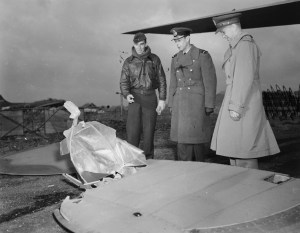
Brigadier-General Newton Longfellow and Lieutenant Robert L Riordan of the 306th Bomb Group, show King George VI part of a damaged B-17 Flying Fortress during a royal visit. (IWM FRE 4390)

The B-17’s Fatal Flaw – and its Remedy

But the relief brought by important visitors didn’t prevent problems in the air. By now, the Luftwaffe had got the measure the of the B-17 and pilots, such as Oberstleutant Egon Mayer, quickly found its Achilles heel. Even though bristling with guns, the B-17s suffered from ‘blind spots’, areas where the gun’s arc didn’t cover. This made the bomber vulnerable, and the worst position was through a direct full frontal attack. New tactics were then used by the Luftwaffe, directing fire directly at the front of the aircraft, potentially its most vulnerable position. It became so successful, that some 30% of pilots and co-pilots in the 306th were killed in such attacks.*7  With little protection, early model B-17Es were quickly withdrawn from front line operations and investigations carried out into a possible remedy to the problem.*8

Naturally the B-17 crews realised this vulnerability too, and also set about finding their own remedy. Whilst official routes were being taken to solve the problem, these were taking too long, and a quicker solution was needed. Within the 367th BS an armourer  and a welder (S. Sgts. James C. Green and Ben F. Marcilonis) got together and took matters into their own hands. They designed and built a new bracket that could hold a heavy .50 machine gun fitted into the nose of the aircraft to protect this gap in the forward arc.  Once constructed and fitted, trials began, the ‘guinea pig’ being a B-17F #42-5130 named “Sweet Pea“.

The bracket fitted to Sweet Pea, proved to be so successful that it was adopted not only by the 306th but the 8th Air Service Command as a whole*9 becoming part of a modification feature to future B-17 models.

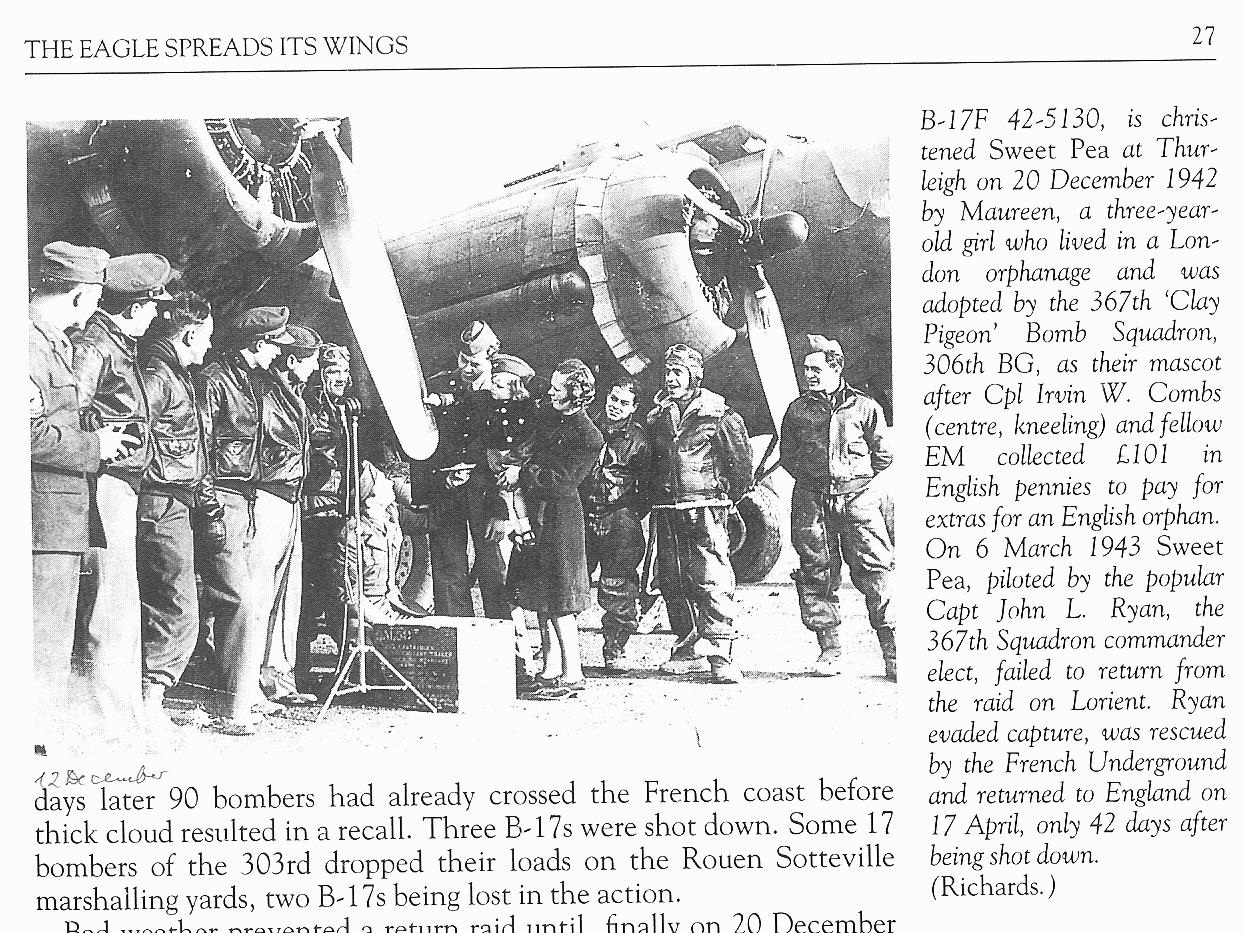
The aircraft  was unusual for other reasons though. It was ‘christened’ on December 20th 1942, by a small orphan girl called ‘Maureen’ whom the 367th BS had adopted from a London orphanage. They gave her the nickname ‘Sweet Pea‘ and to mark the occasion, she dipped her hand in paint and placed a print on the aircraft as a form of dedication.. Like many aircraft of the ‘Reich Wreckers’, Sweet Pea would fly on several operations, suffering a great deal of damage in the process; eventually failing to return from operations to Lorient on March 6th 1943, with one airman killed in action, one evading and eight being taken prisoners of war.
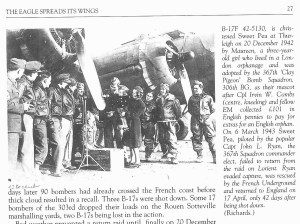
The news report on the dedication of ‘Sweet Pea‘ by Maureen – a three year-old orphan – at Thurleigh. (IWM UPL 15963)

Thurleigh had transformed from a training airfield into a heavy bomber base ready for its new American role. Upgraded to Class “A” standard it soon became home to the 306th Bomb Group – “The Reich Wreckers.” Their arrival in September 1942 was far from smooth though: unfinished buildings, muddy conditions, and a steep learning curve in the European theatre made for a difficult start. Early missions brought tragedy, from training accidents to heavy combat losses, while poor weather and inexperience compounded their struggles. Yet alongside setbacks came resilience, adaptation, and even innovation, as crews refined tactics and strengthened their aircraft. With these foundations laid, the stage was set for the 306th to face the increasingly bitter air battles of 1943.

The entire history can be read in Trail 65

Trail 65 – RAF Thurleigh Part 1 – Its Birth.

In Trail 65 we head west again this time to the borders of Bedfordshire and Northampton, where a former wartime airfield evolved from a base for USAAF bombers into a centre of aviation excellence. First built during the Second World War, it supported critical missions over occupied Europe. In the post-war years, it transitioned into a leading site for aeronautical research, contributing to major advances in jet technology, carrier operations, and automated landing systems. Although official flying ended in 1994, the site continued to reflect a remarkable legacy, marking its place in history as a cornerstone of Britain’s military and civil aviation development.

In this trail, we go back to Bedfordshire and the former RAF Thurleigh.

RAF Thurleigh (Station 111)

Situated some 6.5 miles north of Bedford, RAF Thurleigh was built on land approximately 250 feet above sea level. Although not a high elevation, its open plateau setting – typical of many wartime airfields – exposed it to the elements. Surrounded by multiple river sources, the location benefited from good natural drainage, aiding its suitability as an airfield site.

The nearby village of Thurleigh has a long recorded history, appearing in the Domesday Book as La Lega*1 – a name that over centuries, has evolved into its current form. In a similar fashion, the airfield that bears the same name, would come to be known under many titles of its own: RAF Thurleigh, USAAF Station 111, RAE Bedford, Bedford Aerodrome, and Thurleigh Airfield Business Park amongst others. Yet throughout its history, one theme remained constant – aviation.

The War Reaches Bedfordshire: Early Bombings and Construction (1941)

Thurleigh’s association with the Second World War began even before construction commenced. Isolated bombing incidents in the parish during 1941 – possibly the result of jettisoned bombs from German aircraft – marked its early wartime experience. Once the airfield’s construction began however, it quickly caught the attention of the Luftwaffe. On 17th April that year, eight enemy bombs were dropped directly onto the construction site, causing damage to the incomplete runway. A second attack on 12th August 1941 saw another eight bombs fall along the northern boundary, again damaging the airfield and rupturing a water main*2. Both raids highlighted how conspicuous such developments were to enemy reconnaissance and subsequent aerial attacks.

Once land had been sourced, the airfield’s construction was carried out by the company W.C. French Ltd. and officially opened during the summer of 1941. At this early stage, Thurleigh was a modest airfield in size, suited only for fighters or light to medium bombers. Its first operational residents were the personnel from No. 18 Operational Training Unit (OTU), part of the RAF’s Bomber Command. Having recently adopted the twin-engined Vickers Wellington, 18 OTU (formed from the Polish Training Unit in No. 6 Group, in June 1940 to train light bomber crews for Polish operational squadrons) was tasked with preparing new crews transitioning onto bombers ready for active duty.

Though OTUs were primarily training units, they often found themselves involved in operational sorties, especially during periods of ‘maximum effort’. As a result, many crews suffered casualties, even before they joined a front-line operational squadron.

Following them, in October 1941, 12 Operational Training Unit – first formed at RAF Benson in April 1940 – briefly stayed here. Their residency lasting a mere month, it remains unclear whether it was the entire unit, or just detachments  that were present here during that time. It was also at this time that the first recorded aircraft landing took place at Thurleigh: Wellington IC R1234*3 touching down on the new runway, marking a small but important milestone in the station’s dramatic history.

12 OTU Were not the only training unit to reside here. The Central Gunnery School (CGS), famed for “training the trainers” remained here from December 1941 until their departure to RAF Sutton Bridge on the Lincolnshire / Norfolk border in April 1942.

First established at RAF Warmwell on 6th November 1939, the CGS would train both gunners of bombers and fighters in the art of aerial warfare, those attending having proven themselves in combat already. Once trained, they would return to their original squadrons and pass on their valuable knowledge to others.

Tropical Kit and Tragedy: The Brief Story of 160 Squadron (1942)

Thurleigh’s relative quiet made it an ideal location to raise a new unit, and on January 16th 1942, the ground echelon of 160 Squadron RAF, formed here. Created as a Consolidated B-24 Liberator unit under War Establishment order WAR/ME/448 (dated 31st December 1941), the squadron’s formation began with the arrival of 108 airmen, who were followed by a further 126 the very next day. Over the following weeks, the numbers of ground crew and support staff swelled, as it did, each one was issued with tropical kit, a move that suggested a deployment to the Far East.

Throughout the weeks that followed, the air echelon underwent heavy bomber training some with 1653 Heavy Conversion Unit at RAF Polebrook, while  other crew members were sent to RAF Upwood for additional preparation. In mid-February, the posting finally came through and the ground party departed enroute to the Far East. Meanwhile, the air crews transferred to RAF Lyneham in Wiltshire, where they collected their new B-24s before they too left for the Far east.

Tragedy and Transition – May 1942

The now quieter Thurleigh would then experience a series of tragic accidents. On 18th May 1942, Wellington IC DV783, flown by a Polish crew led by Pilot Officer J. Kilmcsyk, crashed shortly after taking off. Just moments after departing the runway, the aircraft suddenly, and without warning, dived into the ground; the ensuing fireball killing all five crew members onboard. The Wellington, along with the crew’s bodies, was later recovered and the airmen interned in the Polish War Graves section of Newark cemetery in Nottinghamshire.

This was the second fatal crash suffered by the unit in as many days, a tragedy that was compounded by another such incident the following day – although mercifully this time, there would be no fatalities.

Not long after this short but devastating period, 18 OTU departed Thurleigh, a move that signified the end of its ties, as a training airfield, with Bomber Command. For the remainder of the war,  there would be no further front line, RAF units assigned here, and attention now turned to its new owner, the United States Army Air Forces.

In Part 2, we continue our journey through Thurleigh’s wartime history. We see the arrival of the USAAF, and share their experiences both good and bad. We learn of the failures of the B-17 and how through innovation they overcome these problems becoming one of the most successful bomb groups of the war.

The full story of RAF Thurleigh can be. read in Trail 65.

July 30th 1944 – Loss of Lancaster PB304 – 106 Squadron.

On Sunday July 30th 1944, Lancaster PB304 from 106 Squadron RAF Metheringham in Lincolnshire, crashed with the loss of all on board, along with two civilians, in Salford Greater Manchester.

Lancaster PB304, was a MK.III Lancaster based at RAF Metheringham in Lincolnshire, flying under the squadron code ZN-S. It was tasked to attack enemy strong points at Cahagnes in the Normandy battle zone following the Allied invasion in June.

The early briefing at 04:00 was not a welcome one, many men having been out the night before following a stand down order due to bad weather and heavy rain over the last two days. On board that day was: F/L. Peter Lines (Pilot); Sgt. Raymond Barnes (Flt. Eng.); F/O. Harry Reid RCAF (Nav.); F/O. John Harvey Steel (Air Bomber); Sgt. Arthur William Young (W.O/Gunner); Sgt. John Bruce Thornley Davenport (Mid-Upper Gunner) and Sgt. Mohand Singh (Rear Gunner)*1.

The operation, code-named Operation Bluecoat, would involve attacking six specific targets, each one identified to assist a forthcoming offensive by British land forces in the Normandy area.

After all the ground checks were completed and the signal given to depart, PB304 began the long taxi to the runway, take off was recorded as 05:55, but it is thought that this was ten minutes early with the first aircraft (ND682) departing at 06:05. Once in the air, the aircraft formed up alongside twenty other 106 Sqn aircraft,  meeting with a smaller formation from 83 Sqn at Coningsby before joining the main formation.

The weather remained poor with heavy cloud blanketing the sky between 5,000 and 10,000 feet, as the 183 Lancasters from No. 5 Group and one Mosquito headed south toward the Normandy coast.

With further poor weather ahead, signals were beginning to come through to abandon the mission and return to base, but communication between aircraft was garbled and difficult to understand, it may have been as a result of German interference broadcasting messages over that of the master bomber. The order to abort finally came through just after 08:00 even though some of the formation had released bombs on target indicators (TI) dropped by the Pathfinders. Smoke was by now mixing with the low cloud causing more confusion and difficulty in identifying the primary targets. Not all aircraft understood the message however, and many continued circling in the skies above Cahagnes. To make a difficult situation even worse, there was by now, an  approaching formation of over 450 American A-20s and B-26s along with just short of 260 P-51 and P-47 escorts on their way to France; the sky was full of aircraft in thick cloud and was an accident waiting to happen.

Difficult communication continued, some aircraft were seen disposing of their bomb loads over the Channel, whilst others retained them. Various courses were set for home, but with many airfields closed in by low cloud, alternatives were gong to be needed and alternative courses were issued to the returning bombers of each squadron.

106 Sqn were ordered to fly north along the western coast, passing over Pershore and on to Harwarden near Chester, before turning for home. The messages coming through continued to be misheard or misunderstood with several aircraft landing at either Pershore, Harwarden or Squires Gate at Blackpool. Gradually all aircraft managed to land, whether at home at Metheringham or at away airfields. Patiently the Metheringham staff waited, nothing had been heard from PB304 and they could not be contacted on the radio – something was wrong.

Precise details of the accident are sketchy, but an aircraft was seen flying low and in some difficulty. It passed low over Prestwich on the northern edges of Manchester, where it was later seen engulfed in flames. It twice passed over a playing field, where some suspect F/L. Lines was trying to make a crash landing, but this has not been confirmed. At some time around 10:10 -10:15 the aircraft came down resulting in a massive explosion, a full bomb load and fuel reserves igniting on impact. Many houses were damaged in the explosion with one being completely demolished.

As a result of the accident, all seven of the crew were killed along with two civilians, Lucy Bamford and George Morris, as well as, what is believed to be, over 100 others being injured all to varying degrees.

PB304 was the only aircraft lost that night, in a mission that perhaps with hindsight, should not have taken place. The poor weather and difficult communication playing their own part in the terrible accident in Salford on July 30th 1944.

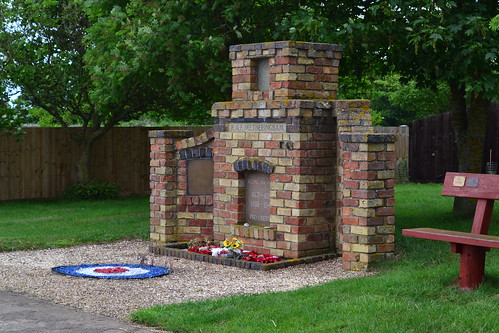
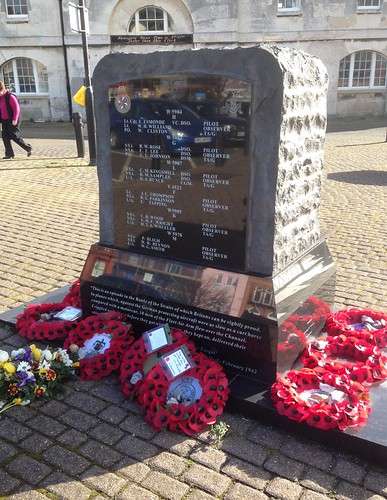
RAF Metheringham

The Memorial at Metheringham pays tribute to all those who flew with 106 Sqn.

Notes and Further Reading.

*1 Operational Record Book AIR 27/834/14 notes Sgt. Young as Sgt. A.L. Young.

A book written by Joseph Bamford the Grandson of Lucy who was killed that night, was published in 1996. “The Salford Lancaster” gives excellent details of the crew, the mission and the aftermath of the accident, published by Pen and Sword, it is certainly worth a read for those interested in knowing more about the incident.

Carter. K.C., & Mueller. R., “Combat Chronology 1941-1945“, Centre for Air Force History, Washington D.C.

Freeman. R., “Mighty Eighth War Diary“, Jane’s Publishing. 1980

June 25th 1944, loss of a Rugby Star.

Sir Arthur Harris’s continuation of the bomber initiative of 14th February 1942, in which German cities became the focus for RAF raids, led to massed formations of light and heavy bombers striking at the very heart of Germany.

In order to achieve these aims, bomber forces of 1,000 aircraft would be required, meaning every available Bomber Command aircraft would be utilised along with those from Operational Training Units (OTU) and (Heavy) Converstion Units (CU).

On June 25th, 1942, whilst on operations to Bremen, the third of the ‘1,000’ bomber raids, one of the first operational aircraft casualties  for 1651 CU would occur when N7442 was shot down shortly before 01:00 by a Luftwaffe night-fighter over Holland. One factor that made this particular loss so great was that not only did all seven crewmen onboard lose their lives, but one of the crew, P/O. Lewis A. Booth (s/n: 118627), had gained international caps playing for England’s National  rugby team.

Born on September 26th 1909, Lewis Booth was the son of Alfred and Amie Booth. He was educated initially at Giggleswick School in Yorkshire, after which he transferred to the Malsis School becoming one of sixteen boys who was lost during the war and since commemorated on the Chapel’s Stained glass window.

Booth attended the Malsis school for two years, 1920-22, when the school first opened. A grand School, it was founded by Albert Henry Montagu, which grew and expanded over the years.

Ten years after he left the school, Booth made his international rugby debut in a game against Wales at Twickenham (January 21st, 1933), in front of a crowd of 64,000 fans; a game in which Wales beat England by 7 points to 3. Booth played his last international match against Scotland at Edinburgh’s Murrayfield stadium two years later on March 16th, 1935. Throughout his two year international rugby career he achieved seven caps for England scoring three tries, his first for England against Ireland at Twickenham, on 11th February 1933. After serving his national team, Booth went on to serve his country joining  the Royal Air Force where he achieved the rank of Pilot Officer within Bomber Command.

On the night of 25/26th June 1942, he was in a Short Stirling MK.I flying with 1651 Conversion Unit (CU) based at RAF Waterbeach in Cambridgeshire. 1651 CU was one of three Conversion Units set up in January 1942, by merging previously formed Conversion Flights. It served to convert crews of No. 3 Group to the Stirling, a rather ungainly aircraft that developed a poor reputation as a bomber. 1651 CU would join that night, sixty-eight other Stirlings in a force of over 1,000 aircraft; a mix of heavy and light bombers, ranging from the Hampden and Whitley to the Halifax and Lancaster.

Take off was at 23:58 from RAF Waterbeach, the weather that week had been good with little rain for many days. After forming up they headed for Germany a course that would take them across the North Sea and on to the western coast of Holland. Just 40 minutes into the flight, whilst over Waddenzee, the Stirling was attacked by a Luftwaffe night fighter and shot down with the loss of all seven crewmen on-board.

ROYAL AIR FORCE BOMBER COMMAND, 1942-1945.

A Stirling MK.I bomber of 1651 HCU at Waterbeach. @IWM (COL202)

P/O. Booth was publicly reported missing four days later on Tuesday 30th June in an article in the local paper “Yorkshire Post and Leeds Intelligencer”, which stated that he had been ‘lost in a Bomber Command raid’. The article highlighted Booth’s rugby career, saying that he had been a member of the Headingly Club playing over sixty games for his county team Yorkshire, before leaving to join up. 

P/O. Booth died just short of his 33rd birthday, he left behind a wife, Gladys, and a son Michael. His son would follow in his father’s footsteps also taking up rugby and also playing for his home country. P/O. Booth’s body was never recovered and remains missing to this day.

P/O Lewis Booth is joined by two other Pilot Officers, two Flying Officers, a Flight Lieutenant and two Sergeant Pilots amongst other ranks and service personnel all honoured by the Malsis School. Amongst the many awards they’ve achieved are three D.F.C.s and an A.F.M.

The game of rugby was hit hard by the Second World War, during which Germany would lose 16 of its international rugby players, Scotland 15, England 14, Australia 10, Ireland and France both 8, Wales 3 and New Zealand 2. All these losses were a severe blow to the international game, a game that brought many enemies face to face in a friendly tournament where there was little more at stake that honour and a cup.

With no official burial, P/O Booth’s service was commemorated on Panel 68 of the Runneymede Memorial, Surrey.

Lewis Alfred Booth @Tim Birdsall from the Malsis website.

Sources

ESPN Website.

The British Newspaper Archive.

Old Malsis Association website.

Rugby Football History website.

4th June 1944 – Death of a Lancaster Crew

On June 3rd 1944, Lancaster ND841 ‘F2-D’ piloted by Flying Officer George. A. Young (s/n: 134149) RAFVR 635 Squadron, was detailed to mark and attack Calais as part of the preparations for D-Day. There would be eight other aircraft from RAF Downham Market also detailed for the mission and take off would be late that evening.

Initially, the aircraft and crew, were designated for training, but that night, nine aircraft and crews, were then detailed for operations to Calais, including F.O. Young’s crew in ‘D-Dog’. They were given orders to mark a coastal defence battery, as part of the preparations for the forthcoming D-Day invasion.

The mission as a whole would involve 127 Lancasters and 8 Mosquitoes of No.1, 3 and 8 Groups and the targets would be the gun batteries at both Calais and Wimerereux. It was a diversionary raid as part of Operation “Fortitude South“, to fool the Germans into believing the invasion would occur in the Pas-de-Calais region.

At 28 minutes past midnight, F.O. Young lined the Lancaster up, opened the throttles and began the long run down the runway. As the aircraft approached take off, it began to swing striking the roof of a B1 Hangar nearby. In an uncontrollable state the aircraft crashed just outside the airfield killing all those on board.

All other eight aircraft took off and returned safely after having dropped their bombs as instructed.

On board Lancaster ‘F2-D’ that night were:

Lancaster D - Dog crashed RAF Downham Market 4.6.44

Lancaster ND841 ‘D’ and its crew before the fatal crash on June 4th 1944.

Pilot: F.O. George Ambrose Young, aged 24 (s/n: 134149) RAFVR.
Flight Engineer: Sgt. Thomas Snowball, aged 32 (s/n: 1100769) RAFVR
Navigator: Flt. Sgt. Howard Pritchard, aged 22 (s/n: 1578502) RAFVR
Bomb Aimer: F.O. Walter Thomas Olyott, aged 21 (s/n: 151238). RAFVR
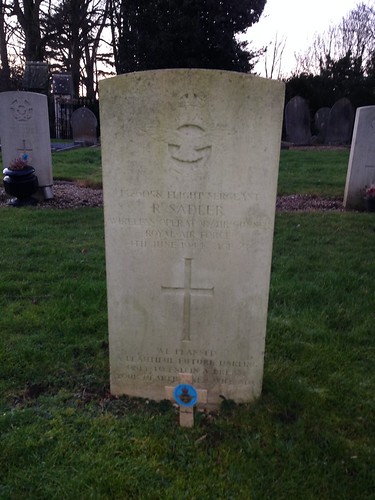
Wireless Operator / Gunner: F.Sgt. Robert Sadler, aged 23 (s/n: 1526058). RAFVR
Air Gunner: Flt Sgt. Stanley Wharton, aged 30 (s/n: 1578013) RAFVR
Air Gunner: Flt Sgt. Charles Patrick Nallen, aged 20 (s/n: 427537) RAAF

The Squadron’s Operation’s Record Book (AIR 27/2155/7) for that day simply  states:

3.6.44  ‘D’ F/O Young G.A. hit hangar after taking off and crashed on airfield when large bomb exploded and the crew all killed.  8 aircraft returned to base .

Three of the crew are buried in Kings Walk Cemetery, Downham Market, a short distance from the airfield.

Downham Market Cemetery

F.Sgt. Stanley Wharton (RAFVR)

Downham Market Cemetery

F.Sgt. Robert Sadler (RAFVR)

Downham Market Cemetery

F.O. Walter Thomas Olyott (RAFVR)

Sqn. Ldr. Leonard Trent VC – RAF Methwold

RAF Methwold was a small airfield that was never intended to be a major player in the Second World War, yet it would see some remarkable achievements performed by the people who were stationed there.

Once such notable person was Squadron Leader Leonard Trent V.C., who, on 3rd May 1943, took a squadron of Lockheed Venturas on a ‘Ramrod’ Mission to attack an electricity power station on the northern side of Amsterdam.

As part of a larger attack, it would not be a mission central to Bomber Command’s overall bombing strategy, but more a mission of support and encouragement to the resistance fighters bravely fighting in occupied Holland.

Trent (N.Z.248i) was born in Nelson, New Zealand on 14th April 1915 the son of dentist Leonard Noel Trent and his wife, Irene Violet Everett.

The family moved to Takaka when Trent was four years old where, a short while later, he would be introduced to flight, and a ride in a Gipsy Moth.

As an older child he attended Nelson College, a boarding school, where he took up golf, and rather that focus on his work, he focussed on his new found hobby which would eventually take him to victory in the Nelson Golf Club Senior Championship.

After finishing his studies, Trent worked in various jobs, saving steadily to reach his goal of earning a pilot’s licence. Once qualified, he returned to flying at Taieri near Dunedin, where a brief training course prepared him to join the RNZAF.

Following his Air Force training, he earned his wings in Christchurch in May 1938 – just one month before departing for England to begin service with the Royal Air Force.

At the outbreak of war he was sent with No. 15 Squadron flying the out-gunned and out-performed Fairy Battles, to France to carry out photo-reconnaissance sorties over occupied territory. As part of the Advanced Air Striking Force, he flew only one mission before the squadron would return to England (RAF Wyton) and change their Fairy Battles for Bristol Blenheim IVs.

After carrying out a number of low-level attacks, he was awarded a DFC for his part in the air war over Belgium, a career that preceded him becoming a flying instructor for RAF crews.

Wing Commander G J “Chopper” Grindell (centre), Commanding Officer of No. 487 Squadron RNZAF, with his two flight commanders in front of a Lockheed Ventura at Methwold, Norfolk. On his left is the ‘A’ Flight commander, Squadron Leader T Turnbull, and on his right is the commander of ‘B’ Flight, Squadron Leader L H Trent. (IWM)*1

In 1942 he returned to operational duties as a newly promoted Squadron Leader taking command of B Flight, 487 (NZ) Squadron at RAF Feltwell. At the time 487 were part of No. 2 Group and were in the process of replacing their Blenheims with Venturas. The squadron moved from Feltwell to Methwold in early April 1943. Little did they know that only a month later, the Squadron’s Operations Record Book would read: “This is a very black day in the Squadron history…a better set of boys could not be met in 30 years. Everybody is still feeling dazed by the news.”

As an experienced pilot Trent would fly several low-level missions over the low countries, using an aircraft that was originally designed around a small passenger aircraft back in the United States. Whilst having powerful engines, Venturas suffered from poor manoeuvrability and a heavy air frame, these two failings combined with its rather ‘fat’ appearance, earned it the name “flying pig“.

Loses in Ventura operations would be high, and this was reflected nowhere else than on the very mission that Trent would fly on May 3rd 1943.

On that day fourteen Venturas of 487 Sqn were detailed to attack a target in Amsterdam, however only twelve aircraft actually took off, all at 16:43 from RAF Methwold. These aircraft were all part of a much wider operation, one that would involve an escort of nine RAF fighter squadrons. Timing was therefore crucial, as was low-level flying and maintaining the element of surprise. Within five minutes of their departure though, ‘EG-Q’ piloted by Sgt. A. Baker, would return after losing the crew escape hatch. This left eleven aircraft to carry on to the target.

A diversionary attack carried out by aircraft of 12 Group flying ahead of the main formation flew in too high, too soon, thus losing the surprise and alerting the defenders of the impending attack. Caught out by low fuel, many of the escorting fighters then had to leave, thus reducing the overall effectiveness of the defensive escorting force. The Luftwaffe, now ready and waiting, had scrambled numerous fighters, a deadly cocktail of FW-190s and Bf-109s. The squadron record book reports an estimated “80+ ” enemy aircraft in the locality of the attacking Venturas.

From this point on things went very badly for 487 Sqn.

As they crossed the Dutch coast Ventura ‘AJ478’ (EG-A) was attacked and shot down by Luftwaffe fighters. Ditching in the sea the crew took to a life raft where Sgt. T Warner, injured in the attack, died of his injuries. Committing his body to the sea the remaining three would be captured and become prisoners of war. Warner’s body would wash up two days later on a Dutch beach and be buried in the small town of Bergen op Zoom – all four were from New Zealand.

A second aircraft, ‘AE916’ (EG-C) was also very badly shot up by the pouncing fighters. However, it managed to return to England landing at their former base RAF Feltwell. The pilot and navigator were both unhurt, but the wireless operator and air gunner were both badly wounded, and were immediately taken directly the RAF hospital at Ely, Cambridgeshire. The aircraft was so badly damaged in the attack that it was written off. For their actions the pilot (F/Lt. Duffill) and navigator (F.O. Starkie) were both awarded the DFC, whilst the wireless operator (Sgt. Turnbull) and gunner (Sgt. Neill) the DFM.  Dufill later went on to become the managing director of Humbrol paints, a company renowned for its paint and modelling supplies.

Pressing on to the target, the casualties got worse and the loss rate increased.

Firstly, Ventura ‘AE684’ (EG-B) was shot down at 17:45 near Bennebroek with the loss of two; at the same time ‘AE731’ (EG-O) was shot down  just north of Vijfhuizen, three crewmen were captured but the fourth, Sgt. Tatam, died. Five minutes later at 17:50, ‘AE780’ (EG-S) was lost, with only one crew member surviving – the aircraft crashing into the suburbs of Amsterdam. Within three more minutes, a fourth aircraft of this group would go down; ‘AE713’ (EG-T) was hit, also causing it to crash in the northern suburbs of Amsterdam, this time killing all on board. By 18:00 there were only two of the eleven aircraft left, ‘AJ209’ (EG-V) flown by Squadron Leader Leonard Trent, and ‘AE716’ (EG-U) flown by F.O. T. Baynton.

Baynton’s aircraft, ‘EG-U’, would then be shot down by fighters causing it to crash in the outskirts of Amsterdam, also killing all four on board. Squadron Leader Trent, seeing all around him fall from the sky, pressed on. Flying toward the target he dropped his bombs and then turned away. Trent bravely and coolly defended his aircraft, shooting down a Bf-109 with his forward facing guns. Shortly after, he too was hit, the aircraft badly damaged, spiralled earthward uncontrollably, breaking up as it did so, throwing both Trent and his navigator F.L. V. Philips, out of the falling wreckage.

Both Trent and Philips were later captured and taken prisoner, the other two crew members; F.O. R. Thomas and Sgt. G. Trenery, both lost their lives in the crash.

One further aircraft, ‘AJ200’ (EG-G) piloted by New Zealander Sgt. J Sharp was thought to crash 3 km west of Schiphol, with only Sharp surviving; whilst the remaining two unaccounted aircraft, ‘AE956’ (EG-H) and ‘AE 798’ (EG-D), were lost over the sea on the way to the target. All eight crewmen were presumed killed, two of them being washed up several days later on the Dutch coast. The remainder were never heard from again.

In the space of only a few minutes, eleven aircraft had been attacked and ten shot down with the loss of 28 young RAF lives.

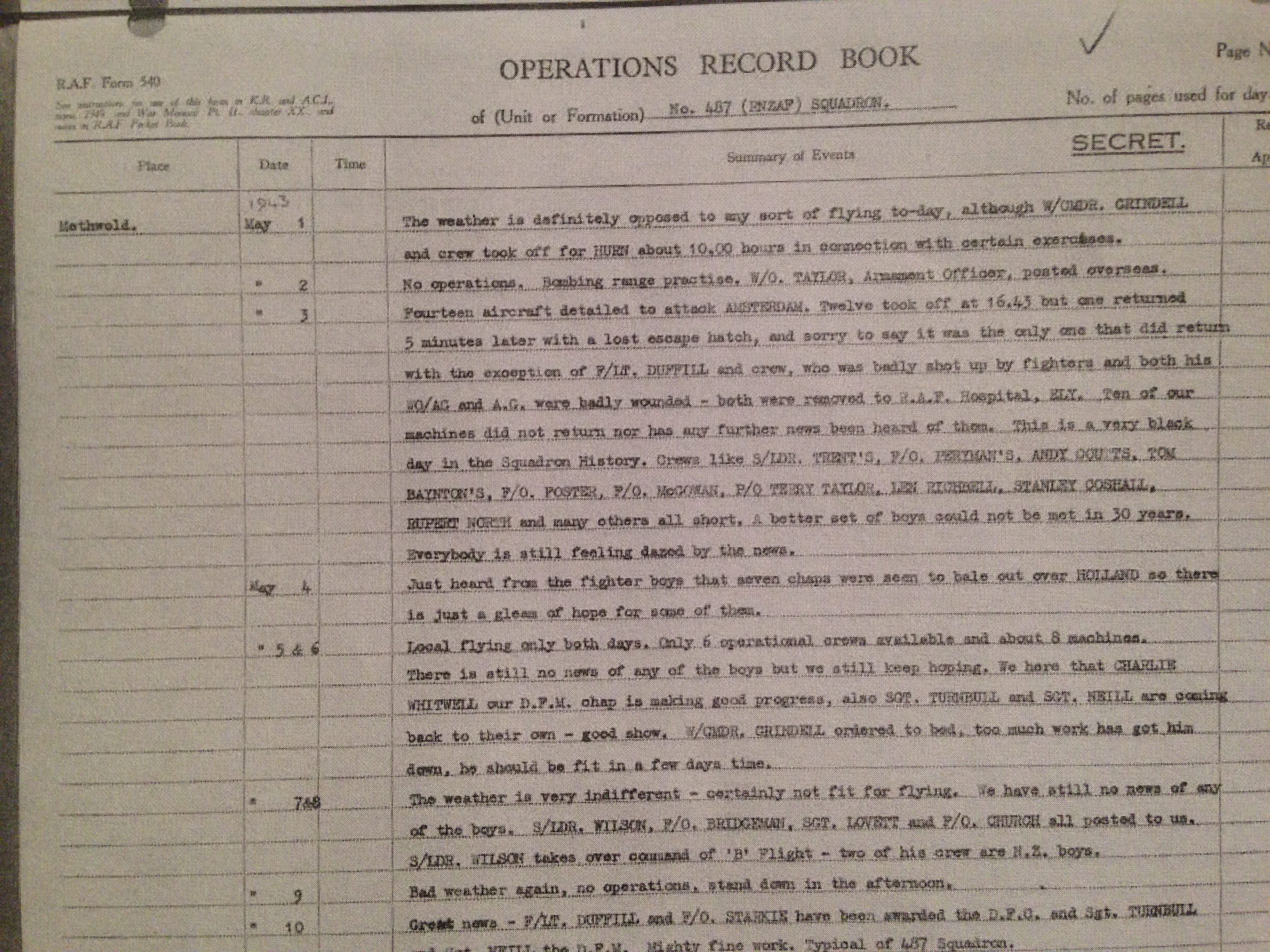
operations-record-page

The Operations Record Book for May 3rd 1943, shows the depth of feeling felt by the crews at Methwold following the disastrous mission. (Crown Copyright*2)

Trent spent the remainder of the war in Stalag Luft III where he participated in the ‘Great Escape‘, being the 79th man out of the famous tunnel, just as the sentry discovered the escape route. Trent was almost stood on by the guard. Being captured at this point possibly saved his life after Hitler gave orders to shoot many of the escapees. Only on his eventual return to England did the full and disastrous story of what had happened come out. He was awarded the Victoria Cross for his leadership in ensuring the bomb run was completed despite heavy enemy resistance and very high losses. The London Gazette published his citation on Friday 1st March 1946, in the Third Supplement which said:

“Before taking off, Squadron Leader Trent told the deputy leader that he was going over the target, whatever ‘happened…”

It later went on to say…

“On this, his 24th sortie, Squadron Leader Trent showed outstanding leadership. Such was the trust placed in this gallant officer that the other pilots followed him unwaveringly. His cool, unflinching courage and devotion to duty in the face of overwhelming odds, rank with the finest examples of these virtues.” *3

A determined attack, it was flawed from the moment the preceding force were spotted. The Venturas, woefully inadequate and unprotected, were literary cut down from the sky. Fighters escorting the Venturas confirmed seeing seven parachutes from the aircraft, but the scale of the loss was a blow so devastating, it left only six operational crews in the entire squadron.

For many days after, the Operational Record Books indicated “no news of the boys“, and as new crews and aircraft arrived, prayers for their return faded, but hopes for a return to operational status rose. Following a number of training flights, the next operational mission would finally take place on May 23rd, a mission that was a total success, and one that must have boosted the morale of the squadron immensely.

This mission was a disaster for the Royal Air Force and for Methwold in particular. The loss of life dealt a huge blow to the community both on, and around the base. In memory of these gallant young men, many of whom were never found, their names are inscribed on the Runnymede memorial, whilst those whose bodies were recovered, remain scattered in various graves across the Dutch countryside.

Trent himself, was transferred back to the UK in 1947 on a permanent commission, and from 1948 to 1959,  he was attached to Training HQ No. 3 Group based at Mildenhall. During this time, he would be posted to RAF Oakington and as Commander of 214 Sqn at RAF Marham, from where he flew Vickers Valiants during the Suez crises of 1956. On the night of 1st – 2nd September 1956, he flew a Valiant non-stop from Loring Air Base in Maine to RAF Marham, a time of 6 hours and 25 minutes – the first non-stop ‘V’ bomber flight across the Atlantic*4.

After that, and for the next three years, he would command RAF Wittering before being posted to the British Defence staff in Washington as an assistant air attaché, where he remained up until his retirement in 1965. During this time, he would also take up the role of Senior Air Staff Officer, Chief Intelligence Officer (RAF) and as an aide-de-camp to Her Majesty the Queen, Queen Elizabeth II.

After retirement, Trent would return to his homeland, where he would build a home for himself and his family.

In 1983, Leonard Trent managed an emotional return visit to his former station, RAF Methwold, from where he and so many of his friends took off from on that fateful day. Just three years later he would pass away at the age of Seventy-one.

As an accomplished golfer, painter and expert flyer, Leonard Trent was proud of his nationality and of his homeland. His distinguished service record and numerous honours position him among the nation’s foremost military pilots, securing his legacy as a revered figure.

RAF Methwold appears in Trail 8.

Sources and further reading.

*1 Photo source The Imperial War Museum (© IWM HU 81283)

*2 AIR\27\1935\13

*3  The London Gazette: (Supplement) no. 37486. p. 1179. 26 February 1946. Retrieved 29th January 2017

*4  RAF Museum Website accessed 3/11/25

Times Newspaper 20th May 1986.

AIR\27\1935\13 – Operational Records Book (summary), The National Archives

AIR\27\1935\14 – Operational Records Book (work carried out), The National Archives

Chorley, W.R., “Bomber Command Losses 1943, Midland Counties, 1996

Sgt. Norman Cyril Jackson VC. RAF Metheringham.

On April 26th 1944, the RAF sent 206 Lancasters and 11 Mosquitoes from No. 5 Group, along with 9 Lancasters from No. 1 Group, to attack the notorious ball bearing factories at Schweinfurt in Bavaria.

Schweinfurt, had since August 1943, struck fear into the the hearts of allied airmen, ever since the USAAF’s attack on the city resulted in a disaster in which 230 unescorted B-17s were cut to pieces by German defences. Subsequent raids, whilst not as disastrous, had also proven costly, and it was a target that Bomber Command’s Commander in Chief, Sir Arthur Harris, so vividly wanted to avoid.

The attention Schweinfurt was getting from the Allies, gave the German authorities sufficient concern to force them into spreading their ball-bearing production far and wide across Germany. This aligned with the fact that the Swiss and Swedes were supplying large quantities of ball-bearings to the Germans, led Harris to believe it was a target for the American forces to deal with, and not Bomber Command.

Norman Cyril Jackson 106 Sqn RAF Metheringham (photo via Wikipedia)

Much against his wishes, an order under the ‘Point-blank’   directive was given, and Harris sent his men to attack the factories. With smoke screens surrounding the area, it proved difficult to hit, as the attack in February proved.

In April, they were to go again, this time using a new low-level target marking technique devised by the then Wing Co. Leonard Cheshire. It would be in this mission that the remarkable actions by the crew of Lancaster ME669, and in particular Flight Engineer Sergeant Norman C. Jackson (later Warrant Officer), would become well known.

At RAF Metheringham in Lincolnshire, sixteen Lancasters completed their ground checks, started their engines and began the taxi along to the runway’s threshold. For around fifteen minutes between 21:30 and 21:45, the heavily laden aircraft took off and headed along the first long unbroken leg 130 miles into enemy held territory.

In Lancaster ‘ZN-O’ #ME669 were: F/O. F Miffin DFC (Pilot); Sgt. N Jackson (Flt. Eng.); Flt. Sgt. F. Higgins (Nav.); Flt. Sgt. M. Toft (Bomb Aim.); Flt. Sgt. E. Sandelands (W/Op); Sgt. W. Smith (M.Up. Gunner) and Flt. Sgt. N. Johnson (Rear Gun.) on the penultimate operation of their tour of duty. The plan was for two groups to attack the city from different directions, bombing on a series of markers dropped by the pathfinders.

On approach to the target the formation encountered strong headwinds and no cloud. With a new moon, they were going to be easy targets for the Nachtjägers. These winds blew markers off track, and repeated efforts by the master bomber to relay instructions to the crews failed, primarily due to faulty radio equipment.

Throughout the run-in over the city, attacks were fierce and consistent. Confused by poor messages and inaccurately placed markers, bombs fell well away from their intended targets. By now fourteen aircraft had already been lost to the fighters, many of them the ghostly Schräge Musik, upward firing fighters.

After bombing from 21,500 feet, Lancaster ‘ZN-O’ was hit several times by a night fighter, starting a fire started in the inner starboard wing section next to the upper fuel tank.  Sgt. Jackson, who had been wounded in the leg and shoulder, donned his parachute and grabbed a fire extinguisher before climbing out on to the wing through an escape hatch in the fuselage roof. In doing so, his parachute was deployed into the cockpit area, where his colleagues gathered it up and gradually fed the lines through the hole allowing Jackson to gain access to the fire in the wing. Undertaking such an act on a burning aircraft at speed and altitude, was no easy task, and getting back, had he been successful, virtually impossible. The wind knocked the extinguisher out of his grip which prevented Jackson from succeeding in achieving his aim. The fire now spreading, began to burn his parachute, hands and face and fearing for his safety, his colleagues let go releasing him from the stricken bomber. Sgt. Jackson fell to Earth, his parachute partially burned, opened and allowed him to reach the ground alive, but suffering several injuries in the process.

Norman Cyril Jackson VC

Sgt. Jackson’s Grave. He died almost 50 years to the day after his brave attempt to save teh aircraft and crew. (Photo Paul Cannon)

The 21 year old Canadian Captain, F/O. Frederick M. Miffin D.F.C., then ordered the crew to abandon the aircraft; himself and 20 year old F/Sgt, Norman H. Johnson, both failing to survive.

Sgt. Jackson’s brave attempt to save his colleagues and their aircraft earned him the Victoria Cross, his actions being published in the Fourth Supplement to the London Gazette on Tuesday 23rd October 1945.

25 year old Sgt. Jackson from London, had been with the crew since training at Wigsley, and had completed his tour of duty. He volunteered for the Schweinfurt mission so he could be with his own crew as they completed their own tour of duty, before all going to join the Pathfinders. Earlier that same day, Sgt. Jackson had received news that he was now a father too.

Sgt. Jackson spent ten months in hospital before eventually being repatriated. He received his VC at the same time as the then, Wing Commander Leonard Cheshire, would receive his. Cheshire asking for Jackson to receive his first, citing his selfless act of bravery as going far beyond anything he had achieved himself.

Sgt. Jackson’s citation reads:

This airman’s attempt to extinguish [sic] the fire and save the aircraft and crew from falling into enemy hands was an act of outstanding gallantry. To venture outside, when  travelling at 200 miles an hour, at a great height and in intense cold, was an almost incredible feat. Had he succeeded in subduing the flames, there was little or no prospect of his regaining the cockpit. The spilling of his, parachute and the risk of grave damage to its canopy reduced his chances of survival to a minimum. By his ready willingness to face these dangers he set an example of self-sacrifice which will ever be remembered.

Sources.

RAF Metheringham features in Trail 1.

The London Gazette, 23rd October 1945.

National Archives. AIR 27/834/8

Rear Gunner Flight Sergeant Nicholas S. Alkemade, 115 Squadron RAF Witchford (Trail 11)

There have been many stories about bravery and acts of courage in all the Armed Forces involved in war. Jumping out of a burning aircraft at 18,000 ft without a parachute must come as one of those that will live on in history.

There have been a number of recorded incidents where this has occurred, and the crew member involved has lived to tell the tale. On the night of March 23rd/24th 1944, such a thing happened, and to the astonishment of both the Germans and the crew member, he survived to tell the tale.

Flt Sgt Nicholas  Stephen (Nico Stephan) Alkemade was born the 10 December 1922 (believed to be North Walsham, Norfolk, England), and was just 21 years old on that eventful night. He was stationed at RAF Witchford in Cambridgeshire, England and operated as a rear gunner in a Lancaster bomber.

On the night of the 23rd March 1944, the squadron was called to report to briefing to find that their mission for that night would be Berlin, the heart of Germany. They would form part of an 811 strong force made up of Lancasters, Halifaxes and Mosquitoes. This was to be the final run over Berlin.

Later that night, Alkemade climbed into the rear turret of 115 Squadron RAF, 3 Group, Lancaster DS664 named ‘Werewolf’ and prepared himself for the coming raid which was to be his 13th mission.

Once over Oberkochen, nr, Frankfurt, Germany, the aircraft was attacked by a Luftwaffe Ju 88 night-fighters, it caught fire and began to spiral out of control.

Now fearing for his life, the aircraft burning furiously, he looked round for his parachute. Turrets being notoriously small, he was not wearing it and would have to find it from inside the fuselage and put it on before exiting the aircraft.

He found himself surrounded by fire, the heat melting his mask and his skin burning. The fuselage was by now a massive fire. It was at this point, that he noticed his parachute no longer on the rack but burning on the floor of the aircraft. In his recount later in life, he describes how he felt:

“For a brief moment I stared while it dissolved before my eyes. It was not so much a feeling of fear, or dismay, or horror, as a sensation, a sort of twisting in the stomach”.

The fire reached his turret, his clothes scorched, now began to burn. With two options, die in an inferno or jump, he rotated the turret, elbowed open the hatch and fell back, he was 18,000 feet (5,500 m) up. As he fell, he could see the stricken Lancaster explode, then the stars beneath his feet. As he gained momentum, breathing became difficult, again his account reads:

‘Funny, I thought, but if this is dying, it’s not so bad . Then the rushing air, the stars, the ground, the sky, all merged and were forgotten as unconsciousness crept over me…’

Three hours later, Alkemade opened his eyes and looked at his watch, it read 3:25. He had jumped just after midnight. cautiously, he moved each part of his body to find everything was alright, if not a little  stiff.

It was at this moment he realised what he had done and that he was lying beneath pine tress in snow. It was these trees and snow that had saved his life. Cold and unable to move, he needed help.  Taking out his whistle, he blew hard, and continued with alternate blows and smokes of his remaining cigarettes, until found, unfortunately for him, by a German patrol.

The Gestapo interrogated Alkemade, at first in disbelief of his story, but after examining the wreckage of his aircraft, they found the remains of his parachute and were so amazed by his escape, they (reputedly) gave him a certificate in acknowledgement of his testimony.

He was taken to Stalag Luft 3, North Compound, in Poland, and was given Prisoner number: 4175. On the night he jumped, 76 men escaped from the very same prison, an event that became known as ‘The Great Escape’.

Alkemade’s stay was initially very unpleasant, spending days in solitary confinement for being a spy. He was eventually billeted amongst other airmen in the very same hut that one of the tunnels was dug from. He, like other prisoners, was given a diary which was his only and most prized possession. In it he wrote about the boredom and monotony of prison life. He became friends with the artist Ley Kenyon, who added illustrations to his diary.

Sporadic letters from home kept his spirits up, and eventually the Allies reached the camp and he was set free.

Alkemade found out later that the Lancaster had crashed, killing the pilot Jack Newman and three other members of the crew. Both the wireless operator and Navigator survived being thrown clear on impact. The deceased are all believed to be buried in the CWGC’s Hanover War Cemetery. Alkemade was repatriated in May 1945. Post war he returned to Leicestershire, where he married Pearl with whom he had been sending letters and was employed initially in a chemical works (where he survived 3 chemical accidents) and then as a furniture salesman until his death on June 29th 1987, in Cornwall.

Nicholas Alkemade’s story, along with his whistle, is recorded in the RAF Witchford Display along with artefacts and other personal memorabilia from the crews and staff of the airfield. His diary and letters remain with his son in their Leicestershire home. Pictures from his diary were published in the ‘Leicester Mercury’ Newspaper, November 2013.

For more information about RAF Witchford see Trial 11.

The location of Both RAF Witchford and the Witchford display can be found on the Interactive map, Airfields, Museums and Memorials page.

alkemade

Sgt. Nicholas Alkemade

Operation ‘Fuller’ – “The Channel Dash”.

The Second World War was full of extraordinary operations many of which succeeded in their aim resulting in great jubilation on home shores, whilst others will always be remembered for their catastrophic fail and loss of life. In these operations, and even though the mission may have failed, those who took part went far beyond the ‘call of duty’, showing incredible bravery and self sacrifice for the better good.

One such operation took place on February 12th 1942.

Up until now, German warships had been causing havoc in the waters around Britain, sinking in excess of 100,000 tons of allied shipping since the opening days of the war; their ‘trophies’ including the aircraft carrier HMS Glorious and the battleship HMS Hood. In January 1942, three of those German warships responsible the Gneisenau, Scharnhorst (Gluckstein and Salmon as the ships were known by bomber command crews) and Prinz Eugen, all heavily armed and battle hardened, were laying in the port of Brest. Even by remaining there, they were causing the Royal Navy an immense headache, as they were diverted from other important tasks, including operations in the Middle East against German supply ships supplying Rommel, and the valuable protection of allied shipping crossing the Atlantic. The small fleet were a major thorn in the Royal Navy’s side and had to be dealt with.

Coastal Command had been closely monitoring the vessels over a period of months, but information had led to little more than that. With the aim of sinking these ships, the RAF became involved undertaking a total of 299 attacks against them whilst docked in the port. During these attacks, forty-three aircraft were lost along with 247 brave airmen. Included in these raids, were in December 1941, ten such operations by Bomber Command which resulted in the loss of some twenty aircraft and seventy airmen. On the 8th of that month, forty-seven bombers escorted by ten fighter squadrons also attacked the docks. Whilst the three ships remained intact, three enemy fighters were claimed to have been shot down but with with the loss of four Stirlings.

During this time though, the ships were indeed hit, and in the case of Scharnhorst, damaged badly, but none ever badly enough not to be beyond repair.

The decision was eventually made therefore, to move the ships, Hitler’s fear of a second front being opened in Scandinavia proving to be the deciding factor. On that decision two routes were considered, the northern route around Scotland which would take the small, but powerful fleet in range of British carriers and warships at Scapa Flow, a fight the Germans did not want to engage in. Alternatively, they could attempt a daring dash through the narrow and well defended English Channel. It was a difficult decision to make.

The presence of the ship and their likely move to safer harbours prompted William Helmore (one of those behind the Turbinlite project) to go to the Alan Muntz Company with an idea as to how to sink them. In conjunction with GEC, RAE Farnborough, Dowty and Stones of Deptford to name but a few, the idea of a radio controlled, 5 ton torpedo with a diameter of 39 inches able to fit a Lancaster bomber, was devised.

The idea was that a Mosquito would control the torpedo once it had been dropped from the Lancaster, and a mast would rise to maintain radio contact with the controlling aircraft. The torpedo would have a range of 25 miles with a warhead weighing 1 ton, limited only by the size of the Lancaster. While tests were carried out, many issues raised their heads including an air supply for the engine, (a Meteor Tank engine) which all proved too complicated and the project was eventually shelved*4.

However, following a meeting on January 12th, 1942 between many top ranking German officials including Hitler, Raeder (the C In C of the Navy), Vice-Admiral Ciliax and Adolf Galland as commander of the Luftwaffe in the Channel area, a decision was finally made, the shorter English Channel route would be the one to take and so Operation Cerberus, (the breakout) was born.

The decision raised great concerns though. Both Galland and other Luftwaffe officials knew that there were too few available fighters in the region – just some two groups and a few training units – to be able to provide the 24 hour protection the ships needed as they dashed through the straits. Night fighters were especially needed, a decision which was affirmed and granted by Major General Jeschonnek, the Luftwaffe Chief of Staff; but the numbers of aircraft available to Galland would still remain greatly inferior to those on British soil ready to attack.

So, Operation Thunderbolt (Donnerkeil ) was put in place, the air umbrella that would protect the ships as they sailed northward. Operation Cerebus (the breakout) was affirmed with February 11th chosen as ‘X’ day, and a sailing time set at 8:00pm. In the weeks leading up to the ‘dash’, German transmitting stations based at both Calais and Cherbourg, began a cat and mouse game transmitting a series of elaborate but false messages to interfere with British radar stations along the south coast. They provided a cover story, suggesting that the fleet would set sail but head toward the Pacific in support of the Japanese and not north to Scandinavia. In preparation, trial runs were made to test engines, guns and communications. The British, still monitoring their actions, began a series of raids on the port, none of which achieved any great success.

During these attacks, which had been occurring regularly since early January, several aircraft were lost including: three Manchesters from 61 Squadron; two Hampdens from 144 Sqn; three Wellingtons, one each from 12, 142 and 300 Sqns and on the 10th February, another Manchester from 61 Sqn.

To meet the anticipated challenge, Galland had some 252 fighters, including a mix of 109s, 190s and some thirty 110 night fighters at his disposal, but he argued, it was still not enough to provide the cover he wanted.

As ‘X’ day approached, the radars went wild with false readings and interference. But the British, now aware of an impending escape, were on high alert, additional Motor Torpedo Boats (MTBs) were docked at Dover and Swordfish aircraft were drafted in to RAF Manston in Kent. Some 1,100 magnetic mines were laid along the projected route and Dover command was put on standby. At 8:00pm on February 11th,  the flotilla began to assemble outside of Brest harbour, just as a routine air raid was launched, and so the port was shut down. Although only one aircraft was lost, a Wellington from 150 Sqn, the raid proved no more than a nuisance, only delaying the fleet’s departure by two hours.

Now temporarily blinded by false radio measures, the British were unable to ‘see’ the mighty armada as it finally slipped out into the open waters of the Channel. Their escape had been a success.

During the night, good progress was made by the fleet and the lost time was made up quickly. Meanwhile, the skies remained quiet, the British not yet realising the ruse. The early morning remained dark, night fighters patrolled along side the fleet at wave top level, thus avoiding detection by British radar. Day fighters joined them in a relay operation that would be held below the cloud ceiling of 1,500 feet.

At 11:00 am on the 12th, the Germans intercepted a British message signalling that the fleet had been spotted. But it remained another hour before further RAF aircraft were seen, the British being wary and unsure of the message’s accuracy. Even though for months the British Command had been monitoring the fleet, those in command failed to act on valuable information, a mistake that led to a vital delay in operations.

Then, in the early hours of the afternoon, as the fleet approached the narrowest point of the Channel, British defences at Dover opened fire. A sea battle then raged between German warships and British MTBs, but for all their valiant efforts they failed to achieve their goal.

At 13:20 A group of sixteen Spitfires took off from Kenley on a Beaufort escort mission that were sent out to search for, and attack the fleet. They initially  rendezvoused with twelve more Spitfires from 602 Sqn, but then failed to meet the Beauforts over Manston. The formation then continued on to the target area looking for the convoy and its escort. Soon after arriving over the Channel, 485 (NZ) Sqn’s leader, Group Captain, Francis V. Beamish DSO and Bar, DFC, AFC, spotted six destroyers, two E-Boats and two German Battle cruisers. At his altitude there was no fighter escort, the mix of Bf109s and FW190s remaining firmly below radar level at 600ft.

Seizing his chance, Beamish then attacked one of the destroyers raking it with gunfire along the length of its deck, a Spitfire’s guns were no match for the destroyer though and little damage was done. The remaining aircraft of the two squadrons then took on the enemy who were forming a low level protective umbrella, achieving a greater rate of success with several ‘kills’ being reported back at Kenley.

Now fully aware of the situation, the RAF and Navy were called into action. At RAF Manston, eighteen young men began to prepare for take off, their target, the escaping German fleet of some sixty-six surface vessels including the warships Gneisenau, Scharnhorst and Prinz Eugen, now sailing almost unopposed through the English Channel.

The six Fairy Swordfish of 825 Naval Air Squadron were ageing biplanes, they were no match for Galland’s fast and more dominant fighters, nor the defensive guns of the mighty German fleet they were hoping to attack. To pitch a handful of biplanes with torpedoes against such a heavily armed and well prepared armada, turned out to be no less than suicide.

In front of their Swordfish, Lieut Cdr E Esmonde, RN, (2nd Left) on board HMS Ark Royal, October 1941. This photo was taken after the attack on the Bismark, and includes the various aircrew who received decorations as a result of that daring attack. (Left to right: Lieut P D Gick, RN, awarded DSC; Lieut Cdr E Esmonde, RN, awarded DSO; Sub Lieut V K Norfolk, RN, awarded DSC; A/PO Air L D Sayer. awarded DSM; A/ Ldg Air A L Johnson, awarded DSM). (© IWM A 5828)

The winter of 1942 was very cold, but the Swordfish were kept ready, engines warmed and torpedoes armed, now they could no longer wait, and instead of attacking as planned at night, they would have to attack during the day, and so the order to go was given. The crews started their engines and set off on their daring mission in what was appalling weather.

Shortly after take off, the escort arrived, merely ten Spitfires from No. 72 Squadron RAF, led by Squadron Leader Brian Kingcombe, and not the five Spitfire squadrons promised. The six Swordfish, led by  Lt. Cdr. Eugene Esmonde, dived down to 50 feet and began their attack. Hoping to fly below the level of the anti-aircraft guns each of the six Swordfish flew gallantly toward their targets. Eventually, and even though they were hit and badly damaged, they pressed home their attacks, but they were out-gunned, and out performed, and just twenty minutes after the attack began, all six had fallen victim to the German guns. No torpedoes had struck home.

Of the eighteen men who took off that day, only five were to survive.

Leading the attack, Lt. Cdr. Esmonde (an ex-Imperial Airways captain) was warded the V.C. Posthumously, he had previously been awarded the Distinguished Service Order for his part in the attack on the Battleship Bismark; an award that also went to: S/Lt. B Rose, S/Lt. E Lee, S/Lt. C Kingsmill, and S/Lt. R Samples. Flying with them, L/A. D. Bunce was awarded the Conspicuous Gallantry Medal and twelve of the airmen were mentioned in dispatches.

The attack became known as ‘The Channel dash’ officially called Operation Fuller, and in honour of the brave attempt to hit the German fleet that day, a memorial was erected in Ramsgate Harbour, the names of the eighteen Swordfish crew are listed where their story is inscribed for eternity.

Operation Fuller was a disaster not only for the Royal Navy and Coastal Command who had been monitoring the fleet for many months, but also for the Royal Air Force. A force of some 100 aircraft made up from almost every Group of Bomber Command had made its way to the Channel. By the time evening had dawned, it had become clear that some sixteen aircraft from the force had been lost. The loss of life from those sixteen aircraft totalled sixty-four, with a further five being captured and incarcerated as prisoners of war.*1

Bomber Command were not without their terrible stories either. The sad loss of W/C. R MacFadden DFC and his six crew who remained in their dingy after their Wellington from 214 Sqn ditched in the cold waters of the Channel. Over a period of 72 hours all but Sgt. Murray, slowly died from the cold, he being rescued at the last minute and incarcerated by the Germans. Of all the RAF squadrons that took part that day, their losses amounted to: 49 Sqn (4 x Hampdens); 50 Sqn (1 x Hampden); 103 Sqn (1 x Wellington);  110 Sqn (1 x Blenheim); 114 Sqn (1 x Blenheim); 144 Sqn (2 x Hampdens); 214 Sqn (1 x Wellington); 419 Sqn (2 x Wellingtons); 420 Sqn (2 x Hampdens) and 455 Sqn (1 x Hampden)*2

February 12th had been a disaster, so bad that The Daily Mirror reported on February 16th 1942 under the headline “9 Lost Hours in the Channel“,  that a demand had been put forward to Parliament for a complete statement on Naval strategy during the event. It also questioned the “suitability of Admiral Sir Dudley Pound”, in fulfilling his role. The paper goes onto say that a lag of some nine hours had largely been ignored by officials, that being the time between the first notice and when action was finally taken against the fleet. It also says that although the initial sighting was no earlier than 10:42 am, it took another hour before it too was responded to.  The public had been mislead it believed.

The entire operation has been badly organised by those in command, with little or no cohesion nor coordination between this various forces involved. As a result, the entire operation was a catastrophe with a major loss of life and no real result. The entire operation was seen by some as akin to a “Gilbert and Sullivan” comedy*3.

However, from that disaster came stories of untold heroism, bravery and self sacrifice by a group of men that have turned this event into one of Britain’s most remarkable and incredible stories of the war.

Operation 'Fuller' The memorial stands in Ramsgate Harbour.
Operation 'Fuller' The names of the 18 airmen and the Swordfish they flew.

Sources and Further reading

*1 To read more about Bomber Commands part in operation Fuller and a German film of the event, see the Pathfinders Website.

*2 Chorley, W.R., “Bomber Command Losses of the Second World War – 1942” 1994, Midland Counties publications.

*3 Bennet, D “Pathfinder“, Goodall, 1998

*4 McCloskey, K., “Airwork – A History.” The History Press, 2012

A German account of the ‘dash’ is given in “The First and the Last” by Adolf Galland published in 1955 by Meuthuen & Co.. Ltd.

Smith. G., “Heroes of Bomber Command – Cambridgeshire“. Countryside Books (2007)

National Archives AIR 27/1933/20, AIR 27/1933/21