Diary of a Luftwaffe pilot

A recent visit to an antiques shop, led to the purchase of two books, one detailing the events of the Battle of Britain, the second included short diary entries of Luftwaffe pilots. Sadly, not many Luftwaffe diaries exist today, all but a few being destroyed in case they fell into enemy hands! As a result, records are sketchy, few and far between.

Some of these Luftwaffe entries refer to the Battle of Britain.  I tried to make a comparison, maybe one entry would refer to the other – sadly they were not sufficiently detailed enough to be certain. This aside, I was intrigued to see the Germans portrayed their part in the battle and how they might compare in terms of recounts.

After the fall of France, the Germans built up strong groups of fighters, transports and bombers in readiness for the coming invasion of Great Britain. Five main groups (Luftflotte ‘air fleets’ similar to the RAF groups) operated across the German empire. Covering the eastern borders were Luftflotte 1 and 4, to the north in Norway and Denmark was the newly formed Luftflotte 5 and in Belgium and France , Luftflotte 2 and 3 respectively.Total servicable aircraft facing Britain amounted to 3,157.

Jagdgeschwader 3 (fighter ‘wing’ made up of 3 Gruppen*1 and 1 Stab) normally stationed on the eastern front, had been brought in to bolster numbers in Luftflotte 2 and were now based at Samer not far from Boulogne. Commanded by Hauptmann Hans von Hahn*2 (himself a German Luftwaffe ace and recipient of the Knight’s Cross), Luftflotte 2 were able to field 23 Messerschmitt Bf 109Es at the start of September.

The mid part of September had been dogged by poor weather, on the 12th 13th and 14th, the Luftwaffe launched only small raids and reconnaissance missions with minimal numbers of aircraft. Many fighter pilots were given the luxury of rest periods some even taking in local sites.

One of the biggest days of the Battle of Britain, now celebrated as Battle of Britain day, was Sunday 15th September 1940. It saw a major change in Luftwaffe policies. The weather was misty but promised to improve, and the Germans saw this as an opportunity to bring a severe blow to London and the RAF; this would be the ultimate prelude to invasion.

The Unit war diary for 1 Gruppe, Jagdgeschwader 3, September 15th 1940*3, reads:

12:00.

Escort (by 12 aircraft) Do 17s against London. Oblt Keller shot down the Spitfire, Leutnant Rohwer a Hurricane. Fw Wollmer dived into the channel; the impact was seen by Lt Springer. This crash appears not to have been caused by enemy action. After a long dive Wollmer’s machine rolled a quarter turn into a vertical dive and he did not succeed in bailing out. A motorboat detached from a German convoy near Cap Gris Nez and went to the scene of the crash.

15:10.

Operation by nine aircraft to escort He 111s against London. At 1,500m there was almost total cloud cover. Over the Thames estuary and to the north of London there were gaps in the cloud. During the flight in there was contact with Spitfires. The bombers flew in loose formation to the north of London. Strong and accurate flak. The Spitfires came from above, fired, and dived away. Hauptmann von Hahn shot down the Spitfire, Lt Rohwer probably destroyed a Hurricane. During an attack by Spitfires Oberleutnant Reumschuessel became separated from his wing-man, Obfw Olejnik, and has not returned (this aircraft crashed near Charing, Kent; the pilot bailed out and was taken prisoner). After he was separated from the formation Obfw Hessel was heard on the radio, but he failed to return (this aircraft crash near Tenterdon; The pilot bailed out was taken prisoner). Obfw Buchholz’s aircraft was hit in the cooling system and forced down in the Channel. Oblt Keller made contact with the rescue aircraft nearby, which picked up Buchholz. He had injuries and was taken to the military hospital a Boulogne. The body of Lt Kloiber has been washed ashore near St. Cecile, and buried. Lt Meckel and two Feldwebeln attended the funeral. During the last few days news has been received from the Red Cross in Geneva that Oblt Tiedmann, Oblt Rau, Oblt Loidolt, Lt Landry (these last two wounded) and Obfw Lamskemper have been captured by the British”.

 An interesting read, if only there were more!

Notes:

*1 The singular is ‘Gruppe‘ and each Gruppen operated with three Gruppe. Each Gruppe would operate from one airfield but moved as a Gruppen.

*2 Hauptmann Hans von Hahn more infomration can be found at http://www.luftwaffe.cz/hahn3.html or http://falkeeins.blogspot.co.uk/2013/11/hans-von-hahn-and-his-stab-ijg-3.html

*3 The Luftwaffe Data Book, Dr. Alfred Price (1977) Greenhill Publications pg196-197
What the Luftwaffe failed to do, the local council have finally managed.

Many of Britain’s airfields have hung on desperately to a small corner of history. Hawkinge is sadly one of those that has been buried deep beneath housing, schools and shops. Sadly, one of England’s most historic airfields, has finally been defeated not by Goring’s Luftwaffe, but by local planners.

Hawkinge was at the forefront of the Battle of Britain, it was repeatedly attacked by the bombers of the Luftwaffe. Because of its location, just minutes from France, crews would often have little warning and would have to take to the sky unprepared. Many returning aircraft would use its runways as a safe haven returning battle damaged and weary; Hawkinge fire crews were some of the busiest Britain was to have. It was used as a transport depot in the First World War, became a mecca for international pilots, saw some of the first ‘drones’ and was used in the filming of the 1969 film ‘The Battle of Britain’.

Today a small museum, utilises what’s left of the original buildings whilst housing creeps like poison ivy, ever further across the airfield.

The nearby cemetery is home to not only RAF pilots but also fallen Luftwaffe crews, ironically remaining in the land they tried to take all those years ago.

As part of a second aviation trail around historic Kent, Hawkinge is a must for any follower of history, aviation or the Battle Of Britain.

See the full story and Kent’s second trail here.
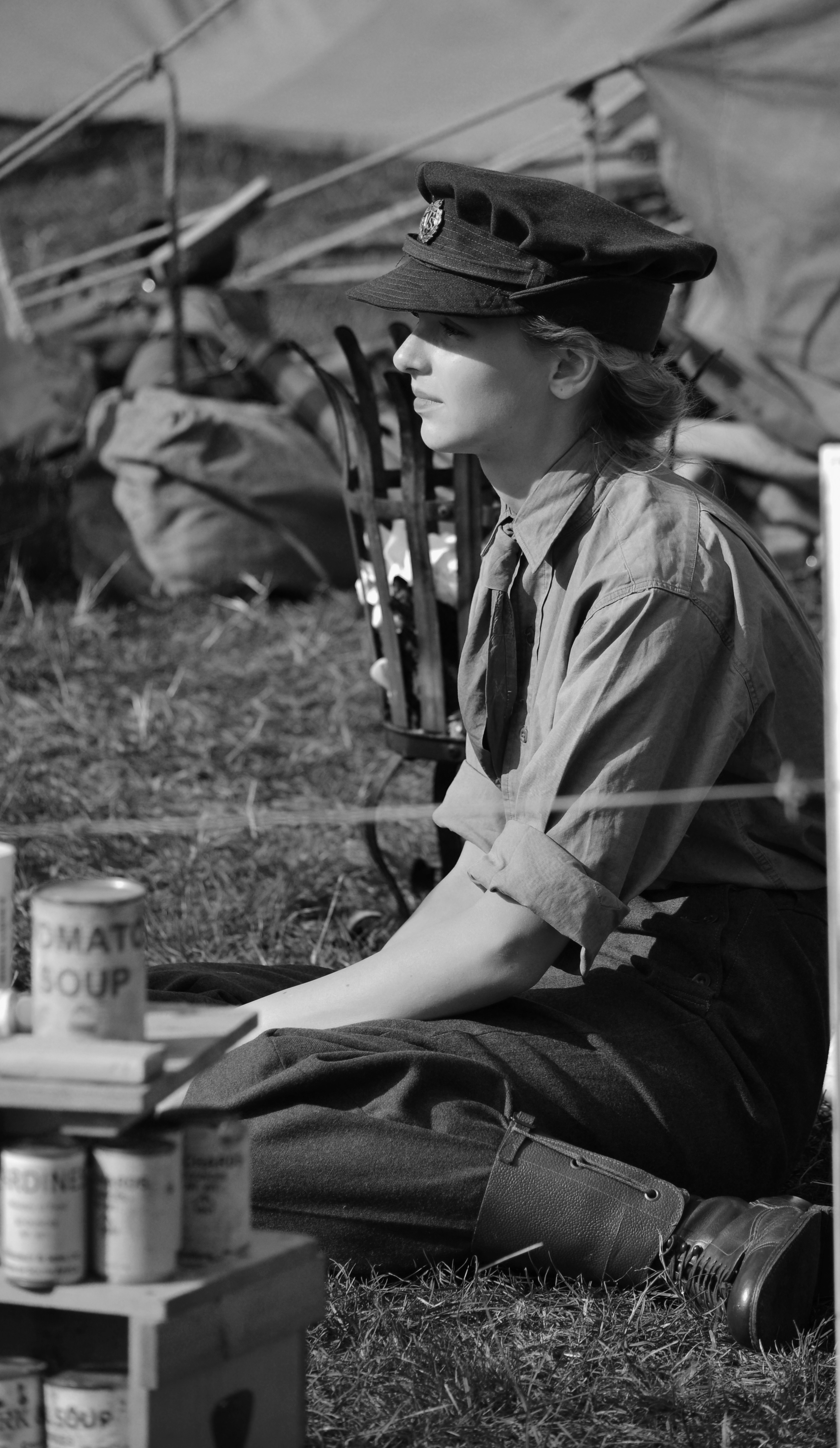
lady cropped 2 B&W


Polish Fighter Ace Turned a V1 on its back.

The first V1 for 315 sqn was shot down by Flt Sgt Jankowski at 13:10 on July 11th. There were three more the following day and several others would meet similar fates. Shooting down a V1 was dangerous, many aircraft being caught in the subsequent blast. Other, less conventional methods would include tipping the wing of the V1 destabilising the gyroscopic guidance system within, sending it tumbling to the ground. On one occasion, WO Tadeusz Szymanski managed to completely turn a V1 onto its back using such a method.

Brenzett, was an advanced landing ground, built to be temporary, but even so, it produced some remarkable stories.

As part of a second trail around Kent, we visit three more of Britain’s airfields, Hawkinge, Brenzett and Lashenden. Each with its own story to tell. Want to know more? click here to go back to 1940s England and then see what has happened to these historic places.

Brenzett village sign

Brenzett Village Sign Depicts its Aviation History


They shall grow not old, as we that are left grow old: …

Originally posted on the anniversary of the publication of his poem, For the Fallen, 21st September 2014, Laurence Binyon’s poem has become synonymous with remembrance services across the country. This week is remembrance Weekend (and Veteran’s day in the United States) on which we remember the fallen: those who gave the greatest sacrifice, so we could live in peace.

I thought it appropriate to repost this during Thai special week so we know a little more about the poem and the history behind it.

‘Lest we forget’

“To all those who went before, (Robert) Laurence Binyon’s 1914 poem is widely used in remembrance services across the world. Laurence Binyon wrote his For the Fallen, with its Ode of Remembrance, while Binyon was visiting the cliffs of North Cornwall between Pentire Point and The Rumps.

Today, if you visit, there is a stone plaque at the spot to commemorate his poem, which reads: For the Fallen Composed on these cliffs 1914″. There is also a second plaque located on the beehive monument on the East Cliff above Portreath in central North Cornwall. There, you will find a plaque on a statue inscribed with the same words. Laurence Binyon’s poem, For the Fallen, was published in The Times newspaper, following heightened public sentiment due to the recent Battle of Marne (5-12 September 1914) on 21st September 1914, 100 years ago today. http://wp.me/P4xjD9-8u

For the Fallen

With proud thanksgiving, a mother for her children,
England mourns for her dead across the sea.
Flesh of her flesh they were, spirit of her spirit,
Fallen in the cause of the free.

Solemn the drums thrill: Death august and royal
Sings sorrow up into immortal spheres.
There is music in the midst of desolation
And a glory that shines upon our tears.

They went with songs to the battle, they were young,
Straight of limb, true of eye, steady and aglow.
They were staunch to the end against odds uncounted;
They fell with their faces to the foe.

They shall grow not old, as we that are left grow old:
Age shall not weary them, nor the years condemn.
At the going down of the sun and in the morning
We will remember them.

They mingle not with their laughing comrades again;
They sit no more at familiar tables of home;
They have no lot in our labour of the day-time;
They sleep beyond England’s foam.

But where our desires are and our hopes profound,
Felt as a well-spring that is hidden from sight,
To the innermost heart of their own land they are known
As the stars are known to the Night;

As the stars that shall be bright when we are dust,
Moving in marches upon the heavenly plain,
As the stars that are starry in the time of our darkness,
To the end, to the end, they remain.

(Published in The Times newspaper, 21st September 1914).

Thanks to Marcella who contributed to the writing of the original post.”

DSC_0097

 For the Fallen – Laurence Binyon (1869-1943)

Ode to the Fallen.

As we approach Remembrance day (and Veteran’s day in America), Aviation Trails will be publishing a mix of poetry and aviation material in remembrance of those brave and courageous young men and women, who, from all nationalities, gave the ultimate sacrifice in war.

The numbers are staggering; during World War 1, there were some 37 million* deaths, (of which around 7 million were civilian). Thankfully, because the war was quite stationary, it did not create as many of the civilian casualties that were found in the Second World War. The higher number here being primarily military and serving personal. Defined as the ‘War to end all Wars’, it brought a devastating blow to societies across the European countries and their allies, as men flocked to the front and the mass slaughter that prevailed.

World War 2 on the other hand, due to the much faster, greater technological advancement that war brings, saw a much higher casuality rate. Over 60 million people died which amounted to approximately 2.5% of the world’s population*1. This is currently about the size of Nigeria, the world’s seventh largest country*2. The war was so widespread and devastating, that the actual number of casualties will never be known. A new type of war, it spread death and destruction to a much wider audience.

Subsequent wars, have also taken their toll, both in military and civilian terms. Continuing conflicts are, and will account for further deaths, and it is a sad reflection of the world we live in today.

So on this special weekend, during the 100th anniversary of the First World War, we remember those who have given so much so that the rest of us can live peacefully.

Memorials visited during the making of ‘Aviation Trails‘ can be seen here.

Ypres 007

Tyne Cot Cemetery, Belgium


Sources:

Whilst not official, Wikipedia gives some detailed accounts of countries and their casualties.

* Wikipedia, World War 1 Casualties;  http://en.wikipedia.org/wiki/World_War_I_casualties

*1 Wikipedia, World War 2 casualties; http://en.wikipedia.org/wiki/World_War_II_casualties

*2 Wikipedia, list of countries by population; http://en.wikipedia.org/wiki/List_of_countries_by_population

17 Trails Around Britain’s Lost Airfields

As a youngster, I was fascinated by aircraft, the Second World War and the airfields that the brave young men of the RAF and USAAF  flew from. A mixture of nationalities, they gave their lives without hesitation or question.

My interest and love of this period extended to the Cold War, to fast jets and amazing feats of aerobatics that defy logic and gravity. I would badger my parents into visiting a nearby airfield when on holiday, I would stand eyes skyward watching as the roar of a jet came and went. Books were collected, photos gathered and dreams made.

As an adult, I started visiting these old sites, and more recently began the blog chronicling my experiences for those who wish to share them with me.

So far, I have covered 17 trails, which include  over 40 airfields ranging from Lincolnshire to Kent, Norfolk to Northamptonshire. As I travel further afield, my experiences, the people I meet and the stories I find, never fail to amaze me.

Why not come on a voyage of discovery and nostalgia; choose a trail; see what part they played and see what remains of those places today.

Click on the links below to see some of the pages in the site.

Choose your Aviation Trail.

See the memorials to these people.

Read about heroic tales and acts of bravery.

Find out about the inspiration behind my love of aviation, my father.

View the interactive map.

DSC_0025Mepal peri track south of the Airfield

to sort 412