RAF Scone – A little airfield with a big History (4)

In Part 3, we saw how Scone grew in the post war era, taking on more civilian operations, training pilots from around the world. This continued on in the years that followed and so the airfield grew even more.

Airwork’s ideas were big though, and one of the major changes they would make would be the extension of the runways adding not one but two tarmac runways of 2,800 ft and 2,000 ft in 1968. Scone then became the only UK Air Training School to have such facilities. As an international training college it was going to need to be able to accommodate large numbers of personnel, students and aircraft.

By the 1970s Scone had reached a peak with in excess of 400 students being trained at any one time. Catering for all these nationalities was hard work and a separate school had to be set up to standardise the language.  A School of English taught both basic English and technical English, meaning that by this time not only were pilots and engineers being trained in aeronautical procedures, but English as well. The AST became so busy, that it boasted of being “the largest civil aviation training organisation in the world”.*3

The demand for Scone’s operations continued to grow, as did the airfield itself.  Development took another step forward in the late 1970s and early 1980s when Air Service Training Ltd. expanded yet again. With huge increases in overseas student numbers (over 100 nationalities) a new hall had to be built to provide accommodation for them all. This was Stormont Hall, a large building with all the facilities needed to accommodate and cater for all student needs.

However, like many aviation related histories, things took a turn in the 1990s. Political moves by the Civil Aviation Authority and the Government, combined with changing global economies, caused AST to cease training overseas pilots at the international college at Scone. By April 1996, following the closure of the college, the site owners, Caledonian Investments, broke the news to its users, that it was selling up and in August, Scone was put on the market with a £3m price tag; the end of an era had apparently come to an abrupt end.*4

However, the move did not initially prove to be too much of a set back for AST and Scone as a whole, as it was able to bolster its maintenance programme with the purchase of a Jetstream from Cranfield University. The facilities for the programme, primarily the hangar,  proved to be too small, so a larger one was obtained, on lease, from the Airport authorities, and was officially opened for business in November 2008 after an opening ceremony led by the then-Cabinet Secretary for Education and Lifelong Learning, Fiona Hyslop MSP.*3

A buyer for Scone was soon found however, and in 1997, the airport was purchased as a going concern by the Morris Leslie Group, who allowed the various companies to continue to operate as normal from the airfield. Scone, or now Perth airport, had a new lease of life and would quickly grow to some fifty companies employing around 400 people once more. It has also updated many of the former buildings, providing both residential properties and workshops. It has over recent years, welcomed high prestige figures including Queen Elizabeth, former President George Bush and Prince Andrew.

AST continue to operate from Scone under the new owner, and they are not alone. Other organisations include the Scottish Aero Club (formerly The Scottish Flying Club) and whose history, goes back to 1927, and who relocated to Scone in 1956, joining ranks with the Strathtay Aero Club to form the new  club.  The Aero Club remains Scotland’s largest flying club and continues to offer rotary and fixed wing training as well as both auto-gyro and micro-light flying. It also provides maintenance for those aircraft located on the site.

Other users of Perth include Scotland’s Charity Air Ambulance (SCAA) flying the EC135-T2 helicopter, a charitable organisation that relies solely on donations to keep it flying. It was formed in 2012 and launched a helicopter air ambulance in May 2013 to assist the Scottish Air Ambulance Service (SAAS) to deliver front-line care to time-critical emergencies across Scotland. SCAA provides a fully equipped medical helicopter that can be deployed to incidents across the length and breadth of Scotland.

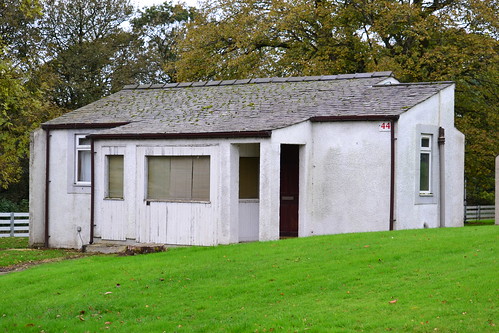
Today many of the wartime buildings remain, in use, by small industrial units. The Battle Headquarters, can be seen from the road very much exposed, as all but the top slotted observation ‘turret’ would normally be underground. The accommodation and technical areas are located together and many now form part of a small hotel for those visiting the area.

There are three runways in use, two of concrete / tarmac and one of grass, these being 2,799 ft and 1,998 feet, the third grass runway is 2,040 feet, all joined at the ends to form a perimeter. Two large hangars hold around 85 aircraft with further space for 15 more parked on the apron.

The airfield lies a few miles north of Perth, the main A94 offers access to the airfield and views across some of the site. It sits on a hill and so much of it is hidden from view at ground level. Being an active airfield, access is limited and understandably restricted. However, views of the current residents are available and many of the wartime buildings are accessible operating as retail and industrial units.

RAF Scone (Perth Airport)

The Battle Headquarters is very much exposed, this would normally be below ground level with only the slits visible.

Scone for such a small airfield, has had a long and fruitful history. Its links to pilot training, especially throughout the war years, no doubt sent many airmen to front line squadrons, many of whom  would go onto serve in some of Britain’s fiercest air battles. A small and often rudimentary airfield, it played a huge part in Britain’s wartime and post-war aviation history, and long may it continue.

The full history of Scone can be read in Trail 56.

Sources and further reading (RAF Scone).

*1 University of Glasgow website. Accessed 10.2.25

*2 McCloskey. K., “Airwork – A History“. The History Press, 2012.

*3 The Herald Newspaper, 16th August 2020, via website

*4 The Herald Newspaper, 9th August 1996 via website

Perth Airport website

National Archives AIR 27/1679/1; AIR 27/1679/1

McCloskey, K. “Airwork – A history” The History Press, 2012

Lake, A., “Flying Units of the Royal Air Force“, Airlife, 1999.

McKay, S., “Secret Britain” Headline Publishing Group. 2021

Lake. A., “Flying Units of the RAF“. Air Life Publishing, 1999.

RAF Scone – A little airfield with a big History (3)

In Part 2, Scone supported the RAF throughout the war, training pilots and navigators in a range of aircraft. Post war, this demand reduced, but it was not the RAF’s end with Scone, nor the end of pilot training.

With Airwork now owning the site outright, they began to look to the future. In 1950, BEA began trials with flights to Renfrew and Glasgow, a scheme that was hoping to open doors to destinations wider afield, but it was not successful and so the idea never came to fruition. Keen to expand, Airwork then took on conversion flying for the Admiralty, converting naval pilots to from single to twin-engined aircraft. They also carried out engineering and navigational training and began work overhauling radio systems, the future was looking bright for the expanding airfield.

The December of 1950 saw the Glasgow University Air Squadron (UAS) move to Scone as a temporary measure whilst their runway at Abbotsinch was resurfaced. As a result, Airwork became responsible for the maintenance of the training aircraft they were using, primarily Tiger Moths and Miles Magisters. Airwork soon came up with the idea of a trophy to be contested for by the various Scottish University Air Squadrons, called the Scone Cup,  the first competition was held in October 1951 and won by Glasgow. After a further name change of the UAS to Universities of Glasgow and Strathclyde Air Squadron (UGSAS) in 1965, the squadron re-equipped with DH Chipmunks, bringing yet another type to the small Scottish airfield.

RAF Scone (Perth Airport)

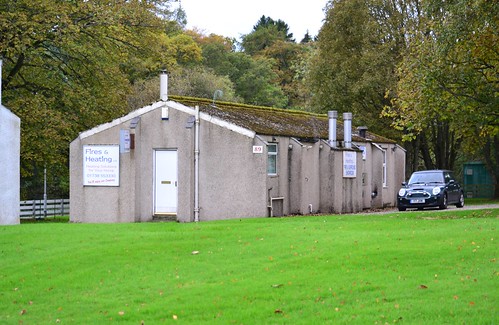
Old buildings are utilised for modern purposes.

Meanwhile the Scone Cup continued, as did the relationship between Scone and the various Air Squadrons, until in 1969, when the RAF centralised all its maintenance work at RAF Turnhouse, and the link with Scone was broken. The GSAS were then reassigned back to Glasgow airport, the location of its origin way back in April 1941.

Like so many other contracts with the military post war, the Admiralty’s pilot training programme wouldn’t last long either, and a gradual reduction in the need for pilot training for the service, forced Airwork to look elsewhere for their trade. The dynamic years that followed saw a huge growth in civil aviation, with jets now spanning the globe in hours and not days, and private flying was becoming evermore affordable to the masses. It was this opportunity that Airwork seized, becoming the first civil school to gain an Instrument rating course certificate for pilot training.

This enabled the now renamed ‘Airwork School of Aviation’ to officially offer its services to civilian operators for the first time, an offer that was taken up by numerous airlines including the first, Sudan Airways, with the first trainees arriving in November 1955.

Although the Navy had ended its contract with Airwork and Scone, it was not the end of military training for good. Whilst 1957 brought the disbandment of some landmark units, on March 8th, another training unit, 1 Civilian Fighter Control Co-Operation unit, formed here at Scone operating the Avro Anson T22. Little seems to be published about the activities of this unit, but I would assume it was, like other training units at Scone, operated by civilians working as part of the Royal Air Force’s training programme. The unit remained active here at Scone, until 31st January 1961 where upon it was disbanded. A year after its cessation on May 10th, an Anson of the unit ‘VV977’ was sold as scrap at No.27 Maintenance Unit (MU) at Shawbury.

With that any RAF connections with Perth ceased. The airfield was passed to ACS Aviation, who claim to be the “leading Commercial Flight Training Organisation in Scotland”. Operating a range of services including commercial pilot training and maintenance provisions.

By the turn of the 1950s / 60s, Scone was heralded as a thriving pilot training facility, seen by many organisations as one of the best available. In acknowledgement of this, the recently formed British United Airways sent their pilots here and were quickly followed by other UK based airlines. The prestige that attracted these airlines  led to an award by the Ministry of Aviation confirming Scone’s high ranking status, something that had not been done before to any other UK based school.

Airwork’s organisation stretched the length and breadth of the UK, and as military reorganisations took place, so some of Airwork’s units were either closed or relocated to alternative locations. In the early 1960s, Scones Airwork School of Aviation began to expand further by taking over the School of Aeronautical Engineering from Hamble, which led to yet another name change to Airwork Services Training (AST) to match the new role now being served at Scone. As the school developed and established itself at Scone, so it too began to expand, delving into the roles of electrical, turbine and rotary fields, all of which required further development of the pre-war site.

RAF Scone (Perth Airport)

Modern day Scone is home to a large number of small aircraft.

As Airwork has expanded into the rotary field, the next natural step was to train helicopter pilots at the airfield. The first such operation took place on 30th September 1963, with students from the Ghana Air Force. The instructor on that course, one Cryil Sweetman, would go onto gain his own fifteen minutes of fame flying a Hiller UH-12C in James Bond’s ‘From Russia with Love.’

The growth of Scone continued on throughout the (1960s) decade. During these years no less than thirty Cessnas (130 and 150 models) were brought into the airfield to train pilots, a number that would make it the largest fleet in Europe, giving Scone the advantage over other European training centres. Combine that with the additional training facilities and private maintenance work, Scone was rapidly becoming one of the biggest players in the civil aviation industry.

In the final part, we see how Scone had grown from strength tot  strength, through different ownership it has continued to supply training for new and established pilots, establishing itself as one of the largest training centres around.

The full history of Scone can be read in Trail 56.

RAF Scone – A little airfield with a big History (2)

Part 1 of this trail, saw how Scone began its life, and how through private enterprise, it developed into a pilot training centre for RAF pilots. As the need for pilots and navigators increases so does the work at Scone.

On September 3rd 1939, with Britain’s declaration of war, the training units operating on behalf of the RAF were immediately reorganised and re-designated, 11 E&RFTS becoming known more simply as 11 Elementary Flying Training School (EFTS).

This reorganisation of training schools also led to new aircraft, the Tiger Moths currently under civilian registration, were given military designations (BB672 – BB692) and the Hart trainers were replaced by Miles Magisters. Whilst ground crews remained as civilians, the instructors were drafted into the RAF and the school became RAF controlled.

Also at this time, Airwork formed and operated a further training unit here at Scone, 7 Civil Air Navigation School (CANS) flying Avro Ansons. Like 11 E&RFTS, they were, in October, disbanded and re-designated 7 Air Observers Navigation School (AONS), this new designation beginning on 1st November 1939. To fulfil their role, they would then take on eight Dragon Rapides, specifically to train new crews in cross country navigation techniques. After further expansion of both aircraft numbers and type, on June 1st 1940, the AONS was disbanded, further streamlining of training units meaning these needs were met elsewhere.

It was in these early war years that Scone almost became the hub for vital research into radar, when in late 1939, the Telecommunications Research Establishment (TRE) relocated here from Bawdsey Manor in Suffolk; mainly to be away from prying eyes but also away from the possibility of attack by German bombers. The pioneer of radar Robert Watson-Watt, grew up in this region and later went to University here, so it was a natural place to move the research to. However, once at RAF Scone, it was realised that the facilities were far to rudimentary and completely insufficient to accommodate the amount of work  needed to carry out this vital research. So, in early 1940, the establishment moved again this time near to Swanage on the Dorset coast. Scone’s fifteen minutes of fame had sadly and quickly passed them by.

Then in early November 1940, 309 Squadron sent a detachment of Lysander IIIs to Scone. Only recently formed, they remained here for about six months, being primarily based at Renfrew where the Polish pilots found the number of woods and railway lines confusing. The sole purpose of 309 Sqn was as a Polish Co-operation unit to work in conjunction with the C-in-C of the Polish Army. It was unique in that it was ‘double’ ranked, having both British and Polish officers in charge, the idea being that once the Polish personnel were in place the British would be pulled out and the squadron would operate as an independent Polish unit. A series of training flights were carried out by the Polish pilots, but with lectures being carried out through a translator, it was often a difficult task to do.

In September 1941, ‘E’ Flight of 11 EFTS  was used to form a new training unit, 5 Flying Instructors School (Supplementary) then again simply to the Flying Instructors School, finally becoming the Flying Instructors School (Elementary) from April 1942. The small number of resident pilot instructors flew Miles Masters and Tiger Moths training hundreds of pilots between them before the unit was eventually disbanded in November 1942.

Scone airport looking south in 1947. (@Britain from above)

The remainder of 11 EFTS continued on to the war’s end however, gradually being reduced in size as demand for new pilots decreased. Post war, in 1947, it was renamed as 11 Reserve Flying School (RFS) still operated by Airwork and still flying the biplane the Tiger Moth along with Airspeed Oxfords, Ansons and Hawk trainers. By 1954, the unit had wound down finally being disbanded that same year on the 20th June.

The immediate post war years also saw a huge closure of now ‘unwanted’ airfields, all surplus to requirements. Many were put into care and maintenance or reserved for future use should east-west relations diminish. RAF Errol, located to the east of Scone between Perth and Dundee, was closed and proposals put forward to turn it into a municipal airport for Perth and Dundee. This proposal allowed Airwork to put forward their own offer to Perth Town Council for the site at Scone, the offer (£54,000) was quickly accepted and the deal was finalised and ownership handed over on 31st July 1946, just four months after the initial offer was made.

The war’s end allowed many of the former civilian clubs to reinstate their operations, some though, were unable to due to high costs or lack of suitable facilities. The Strathtay Aero Club, who were one of the lucky ones, were once again able to continue their operations with Airwork at Scone.

Throughout the 1940s, a resurgence of public events saw many air pageants and displays take place across the country. At Perth, the Strathtay Aero Club in conjunction with Airwork, organised its first post war air display attracting around 10,000 spectators, highlighting the renewed interest in aviation at that time.

Amongst those present at the display on 16th August 1947, were the Lord Provost Ure Primrose and Air Marshal Sir Richard Peirse. Aircraft taking part ranged from Bleriot’s 1909 monoplane to a squadron of clipped wing Spitfires. A short film of the event is available to view through the British Pathe News website.

Thus renewed interest in civilian flying, allowed Scone (Airwork) to become the saviour of yet another civilian aeroclub, and another that had been forcible suspended by the war. The Scottish Flying Club (SFC), who were initially based at Renfrew and whose buildings 309 Sqn moved into, were closed following the declaration of war and evicted from their premises. After being ejected from their airfield, they found themselves in the awkward position of having nowhere to operate from and unable to afford the high fees being charged by many civilian operators in the immediate post war years.

Airwork allowed the SFC to use Scone’s facilities in such a way that Airwork made no profit out of the agreement. This was clearly a saving grace for the club who eventually joined forces with the Strathtay Aero Club later in 1956, to form a new organisation, The Scottish Aero Club, who would continue to operate from here at Scone.

But the RAF had not finished with Scone yet. In 1949, 666 Squadron was reformed at Scone as an Royal Auxiliary Air Force unit (RAuxAF) comprising of the 1966 Air Observation Post Flight (AOP), the 1967 (AOP) Flight at Renfrew and the 1968 (AOP) Flight at Abbotsinch. The squadron flew Austers Vs and VIs, in a cooperation role with Army units, but by 1957 all three flights, and thus the squadron, had ceased to exist when a letter, signed by the Queen, was handed to more than eighty senior officers of the RAuxAF, officially ending its existence as a military unit. With that, thirty-two years of history had come to an end, a history that had seen the RAuxAF take part in virtually all of Britain’s major air battles since 1925.

With the war over, the RAF’s need for pilots reduces dramatically and so does the need for supporting civilian operations. However, at Scone, operations go from strength to strength.

The full history of Scone can be read in Trail 56.

RAF Scone – A little airfield with a big History (1)

In Trail 56, we head north once again, this time across the River Tay into Perthshire,  the gateway to the Highlands.

The grand city of Perth boasts a majestic history, once the capital of Scotland, it is a city with galleries, museums and stunning architecture; described by VisitScotland.com as “a picturesque playground for Kings and Queens“, and rightly so.

The village that gave this airfield its name, has its own history, going back as far as the Iron age. Once the seat of Royals, it is mentioned in Shakespeare’s Macbeth, and once housed the famous ‘Stone of Scone‘ or ‘Coronation stone‘ that has for centuries been used for coronations of the Kings and Queens of Scotland and England. It was stolen by King Edward I of England who took it to London, where it remained until 1950 when it was stolen once more by four Scottish students and taken back to Scotland. It was a year later, returned to London where it remained, being used for the coronation of Queen Elizabeth II. In 1996, the Queen and Prime Minister agreed the stone should be returned to Edinburgh on the proviso that it be brought to London for any future coronations, the last one being King Charles III – it must be the most famous 125kg of rock anywhere in the world. *1

So, on Trail 56 after passing through the beautiful city of Perth and onto this small but famous village, we find one former RAF airfield that has since become Perth Airport. Located in the same region as Scone Castle, we now visit the former RAF Scone.

RAF Scone.

RAF Scone was built in the 1930s, and has been known by a series of names: Perth Airport, Perth Aerodrome, Perth Municipal Airport, RAF Perth, RAF Scone and Scone Aerodrome. The airfield is located about 3.5 miles north-east of the aforementioned city of Perth.

In the days before Scone was built, the Lord Provost of Perth, Thomas Hunter, had an idea to build an aerodrome near to his home town, designated Newlands aerodrome. The idea never came to fruition however, and no real progress was ever made on the site. However, in 1935, with the rumblings of war in Europe, the Government announced the expansion of the Royal Air Force, and so the idea was taken up again, this time by Sir John Ure Primrose.

Sir John, with support from many Perth Councillors, put forward a plan costing some £20,000 for an aerodrome, and with a small committee of members, began to seek advice from a number of sources including the aircraft company A.M. Airwork Ltd., and the architects Norman, Muntz and Dawbarn. After looking at the designs and reviewing Sir John’s plans, a revised model was put forward doubling the cost to some £40,000.

The new scheme was passed however, and 250 acres of woodland and pasture were purchased from two local landowners, Scone Estates and J. Patrick Cuthbert of Barclayhills. In September 1935, work began on clearing the site which employed around 440 labourers and tradesmen all employed by two companies, Maxwell M. Hart & Co. and William Taylor & Son.*2

It was agreed that the running of the airfield would be undertaken by the Airwork company, who were founded in 1928 and based at the then Heston Aerodrome in Middlesex. For much of this time, Airwork’s chief pilot was Captain Valentine Baker MC, DFC, who later joined forces with Sir James Martin to form the now famous  Martin-Baker company, famous for it ejector seats found on numerous fast jests world wide.

RAF Scone (Perth Airport)

Numerous buildings survive from Scones wartime past.

Initially Scone (pronounced Scoone) aerodrome, would be a municipal aerodrome used by various civilian operators including North Eastern Airways and Railway Air Services, who made both local and national flights as far as London and Aberdeen. Some of these flights began in the dawning of 1936, before the airfield had officially opened and so the future looked fairly bright.

This burning light was also fuelled by the formation of the Strathtay Aero Club here at Scone, on May 29th 1936. Set up by three ex-RAF personnel, its initial operations were short lived however, being suspended due to the impending war in Europe. Despite this, with the war’s end in 1945, the club was allowed to continue these operations, including holding major events in 1947 leading to further growth over the next few years.

However, with increasing tension on the continent in the 30s, the RAF’s expansion was paramount and it would take preference over civilian operations. Not only would huge numbers of military personnel be required – an additional 2,000 pilots and over 16,000 ground personnel – but new airfields to operate and fly the aeroplanes from to wage such a war.

With some fifty new aerodromes required by the end of 1937, and so many new pilots to train, elementary flying training would have to form a major constituent of the programme, the majority of which would pass to civilian hands allowing the RAF to focus their efforts on advanced flying techniques. To meet this demand, civilian centres were to be increased from four to an initial thirteen *1, of which Scone would be one.

The entire training programme was overhauled with separate sites providing different instructions – ground or air – and a new RAF Volunteer Reserve class was set up to provide temporary training to cadets designated the rank of Sergeant. It was planned that those part-time trainees located at Scone, would learn to fly in one of twelve aircraft, each aircraft accumulating as many as 3,500 flying hours each year as a result.

The demand was therefore great, and Scone’s civilian operators, who were by now well established, would be joined on 27th January 1936, by No. 11 Elementary & Reserve Flying Training School (E&RFTS) operating under the control of 51 Group RAF, who were then based in Leeds. Even though 11E&RFTS were a military unit, their pilots would be trained by civilian instructors whilst they were stationed at the airfield.

It was clear at this point though, that Scone’s infrastructure was going to be insufficient for both the military and Airwork’s needs, and further land and development was going to be required. To this end, another 120 acres were either purchased, or leased from local landowners, allowing the development, now costing £60,000, to have two runways, 1,000ft and 4,200ft both initially of grass. These new extensions and the extra teaching facilities provided would add both space and accommodation to the original large hangar, administration and support buildings,  terminal and its six cottages.

Airwork’s influence stretched far beyond the boundaries of Scone though, their experiences elsewhere allowing them to develop the airfield and provide much of the infrastructure themselves. As an established aviation company they already provided maintenance facilities and operations across Britain, supporting what would become a thriving civil aviation network. In fact, this additional work would provide as much for the aviation industry as the flying training did.

RAF Scone (Perth Airport)

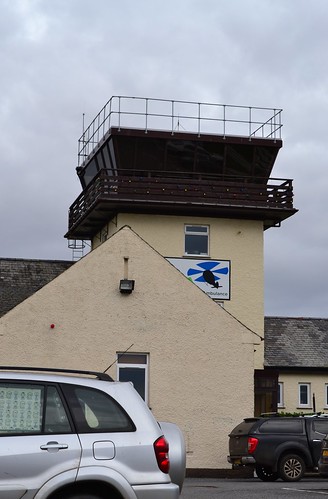
The current Watch Office at Scone (Perth Airport).

The original twelve training aircraft supplied by the RAF were also going to be insufficient, so a further eight were obtained giving of total of twenty, a mix of  Tiger Moths (DH.82) along with a handful of Hawker Harts and Hawker Hinds. Over the next few months, various other models would be obtained and used by the unit at Scone, these included:  Audax, Fairy Battles and Avro Ansons at some point.

With the number of operators using the site growing, it was going to be busy, and the ground would take considerable punishment. But the cold winter weather prevented the growth of newly laid grass and so, for a period of some two months, 11 E&RFTS moved out until the grass had established itself and the colder weather had passed.

Not long after this, the airfield was officially opened. On June 5th, 1936, a grand ceremony, led by Viscount Swindon, and a number of dignitaries, saw the airfield officially handed over to the Airwork Company under the management of P. Perkins, the general manager of Airworks – Scone had been born.

Even with all the development and extension work that had been going on, Scone would remain a relatively rudimentary station. On site, there would be a watch office, a single Civil 160 x 90 ft hangar; one 120 x 110 ft hangar, six blister hangars but no hardstands and the runways remained grass. A hard perimeter track did circumnavigate the airfield and although it only had two runways,  a third strip was also used. A set up that would see Scone enter the war.

In Part 2, Scone develops as the war progresses. Pilot training and maintenance work increases.

The full history of Scone can be read in Trail 56.

The Best of British and German!

Here’s another guest post from Mitch Peeke.

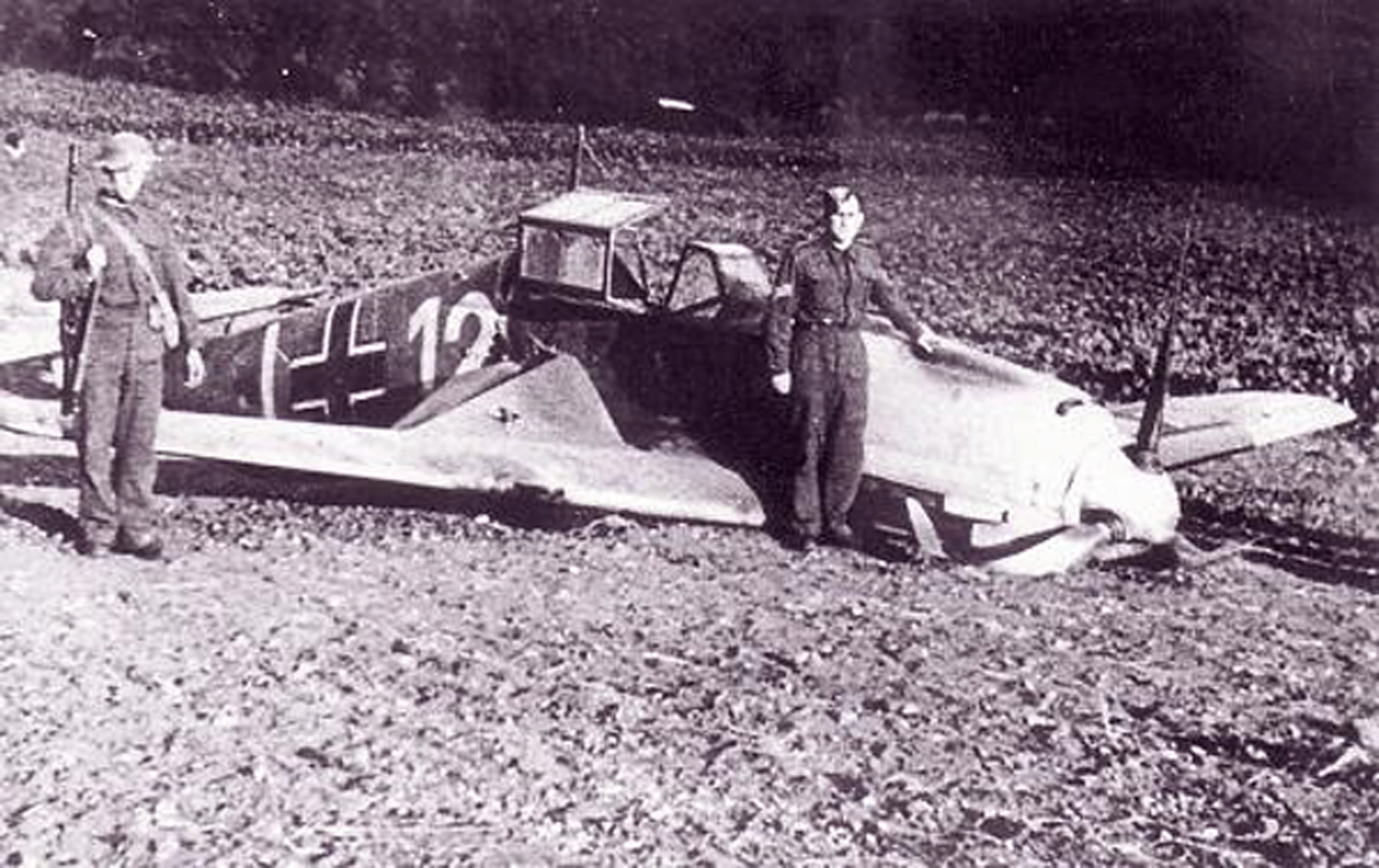
In the afternoon of the September 30th, 1940; a lone Messerschmitt 109 flew low and slow over Strood, Kent, belching smoke. The pilot, Unteroffizier Ernst Poschenrieder, had been in combat with Spitfires from 222 Squadron whilst escorting bombers to London. Ernst’s squadron had suffered  heavily when the Spitfires pounced. The aircraft he was flying wasn’t even his usual mount. He wasn’t superstitious, but so far this definitely wasn’t his day.

Knowing he would never get back to France and that he was too low to jump, crash-landing on Broom Hill, a hilltop field cultivating vegetables for the war effort, was now his only option. He could see it would be tricky. People were tending the field, but his wounded engine was giving up. To minimise the dangers of a wheels-up landing, he overflew the field and emptied his guns harmlessly into the surrounding treetops.

Unteroffizier Ernst Poschenrieder (courtesy Shoreham Aircraft Museum)

Approaching the tree-line, Ernst throttled back and put the flaps down, losing as much airspeed as possible. The treetops seemed to be trying to grab him as he cut the dying engine; a fire prevention measure. Skimming the trees, the Messerschmitt sank through the last thirty feet of the air and hit the ground violently at 60 MPH, ploughing down the slope. Bucking and bouncing, it tore up the dry soil then broke its back, slewing half-round and stopping just before the trees. He’d made it, just; but the force of the crash had nearly broken Ernst’s back, too.

The farm workers ran to the scene with hoes and forks. Thinking the pilot had tried to machine-gun them, they sought blood; but a young Land Army girl, a Scots lass named Sarah Kortwright, got there first. Standing beside the cockpit, she kept them back. Ernst sat there, ears ringing and in intense pain; and waited. Someone had gone to fetch a Policeman.

PC Jack Matthews (back row, 3rd from right) who later arrested Unteroffizier Ernst Poschenrieder (by kind permission of Mike Hearne)

Sixty-year-old PC 28 Jack Matthews, of the Rochester Police, quickly arrived on the scene. Taking immediate control, he arrested the pilot, for his own protection. Jack was over six feet tall and athletically built. Facing the mob, truncheon in hand, he sternly announced that anyone trying to interfere would be obstructing a Police Officer or having to assault one. The mob lost interest and Ernst was carefully extracted from his cockpit, grateful to be alive.

Ernst’s crashed 109, courtesy Friends of Broomhill

Ernst was taken to Chatham Police station, then immediately to Hospital, for emergency surgery. Thereafter, he was a POW.

He returned to England in 1955, to thank both Sarah Kortwright and the doctor who’d treated him. He traced the hospital doctor, but Sarah had returned to Scotland. Undeterred, he tracked her down and armed with a bouquet of flowers, went to Scotland and took her out to dinner!  In 2005, Ernst visited artist Geoff Nutkins, at the Shoreham Aircraft Museum in Kent, to sign some prints and sketches. Ernst became a frequent visitor to the museum’s events. Sadly, he died in 2009, aged 98. he was killed not by old age; but rather unexpectedly, by a car.

This article was excerpted from a new e-book. 1940: THE BATTLES TO STOP HITLER gives the full story of this and many other events like it, that took place during the time when it seemed that only the French and the British stood in Hitler’s way. Published by Pen & Sword Books Ltd this e-book is available to download at  http://www.pen-and-sword.co.uk/1940-The-Battles-to-Stop-Hitler-ePub/p/11119  priced at £8:00.

A Dogfight That Ended At The Movies.

Another guest post by Mitch Peeke.

Toward the end of the Battle of Britain, Reichsmarschall Herman Goring chose to blame his hitherto beloved fighter pilots for the devastating losses the German bomber squadrons had suffered that summer. He decided that if the fighters couldn’t protect the bombers, then the fighters could carry the bombs to London themselves! On his direct orders, about one third of the Luftwaffe’s fighter force was swiftly converted to carry a single bomb slung under the belly of their Me109’s. Flying at high altitude, these Jagd-Bomber aircraft, or Jabos as they were now called, were then to be heavily escorted by the regular fighters, in an attempt to draw the RAF’s fighters into battle, where they could be annihilated by the superior German numbers. It didn’t matter to the Germans where the bombs fell as the hapless Jabos were simply the bait.

On the morning of Sunday, October 20th 1940, the high-flying Jabos were making daylight attacks on south-east England and London again. They came over in five waves, heavily escorted as per Goring’s orders, from about 09:30 till approximately 14:00. Part of the fighter escort for one of the later raids was provided by 6/JG52, based at Peuplingues, in France and one of the escort pilots from this unit was Oberfeldwebel Albert Friedemann.

The inbound raiders and their escorts had already been fighting their way across Kent when they reached Central London at around 13:35. Having dropped their burdensome bombs, the Jabo pilots could now accelerate to fighting speed and engage the defending RAF fighters on equal terms, though ever with a cautious eye on the fuel gauge.

One of the RAF squadrons sent to deal with these raiders that day was 41 Squadron, up from Hornchurch in Essex. High over the City of London area, 41 Squadron’s Flying Officer Peter Brown in his Spitfire, was in combat with a yellow-nosed Messerschmitt 109, that flown by Friedemann.  During the combat, Brown succeeded in gaining the advantage over his opponent and scored several decisive hits on the nose of Friedemann’s Messerschmitt, which started to belch brownish-black smoke from its now mortally wounded Daimler-Benz engine.

Flying Officer Peter Brown in combat with Oberfeldwebel Albert Friedemann over London on Sunday 20th October 1940.

Flying Officer Peter Brown in combat with Oberfeldwebel Albert Friedemann over London on Sunday 20th October 1940 (Painting by Geoff Nutkins of Shoreham aircraft Museum, by kind permission).

The crippled Messerschmitt began to lose speed and height as it flew over Tower Bridge, crossing the Thames in a roughly East-south-easterly direction, towards Shooters Hill. Brown flew his Spitfire alongside his vanquished foe as the German pilot jettisoned his cockpit canopy and raised himself out of the seat. Having no choice in the matter, Friedemann baled out of his doomed fighter over the Plumstead/Welling area of South London and as it transpired, his exit was not a moment too soon. Seconds after Friedemann had jumped, the Messerschmitt’s fuel tank exploded in mid-air. The time was almost exactly 13:45.

On the ground at Welling, was fifteen year-old Ennis Mowe. Though still at school, Ennis was the sort of girl who hated the fact that she was considered too young to take any active part in the war effort. She badly wanted to “do something” and even though it was she who had done the Lion’s share of the work involved in constructing the family’s Anderson shelter, it simply wasn’t enough for her to be content with; an attitude that had lead to several arguments with her father recently.

Not feeling inclined to enjoy the dubious comforts of the public air-raid shelter in Bellegrove Road that Sunday, Ennis was making her way home, on foot, half-watching the vapour trails of yet another aerial battle that was obviously taking place at altitude over London again. Suddenly, she heard a loud “boom” high above her. Stopping, she quickly looked up in time to see a fireball and a fighter aircraft breaking apart as another fighter turned rapidly away. The tail section of the stricken aeroplane disintegrated, but the front section was coming straight down, dropping like a stone.

A good many people on the ground, including young Ennis, also saw something else falling away from the doomed aircraft, flailing and tumbling through the air as it came down. It was Oberfeldwebel Albert Friedemann, who was now condemned to realise a horrible end to his young life, by the fact that his parachute had failed to open.

The Messerschmitt’s largely intact front section landed with a very loud thud, upside-down in a front garden in Wickham Street, Welling, just across the road from the gate of Gibson’s Farm. The impact forced the Messerschmitt’s undercarriage to spring partially from the wheel-bays. Albert Friedemann fell to his terrifying death a short distance away across the farm, whilst pieces of his Messerschmitt’s tail section fluttered down over a wide area.

The wreck of Oberfeldwebel Albert Friedemann’s Messerschmitt 109 where it fell, opposite Gibson’s Farm in Wickham Street, Welling, on October 20th 1940. The aircraft exploded in mid-air shortly after Friedemann baled out of it following combat with Flying Officer Peter Brown of 41 Squadron. Friedemann fell to his death when his parachute failed to open. The fence in the background is the perimeter fence to the farmhouse garden of Gibson’s Farm, across the road. Photo: Bexley Local Studies and Archive Centre, by kind permission.

Meanwhile, in Wickham Street, there was already a small crowd around the wreckage; the fallen Messerschmitt having miraculously missed the houses. The hot metal of the fighter’s engine was still ticking as it cooled, but there was no fire. The Messerschmitt’s remaining fuel had been burnt off in the mid-air explosion, some twelve thousand feet ago. People seemed to be looking at the vanquished aircraft with a mixture of curiosity and awe, as if it were something from outer space.

The authorities were soon on the scene and gradually the crowd dwindled as the Police sent the sightseers away. Later, the RAF posted a guard over the wreck to prevent any possible souvenir hunting, for the wreck rapidly became a spectator attraction. The authorities quickly removed Albert Friedemann’s shattered and lifeless body from Gibson’s Farm, but the wreck of his aircraft stayed in Welling for another three weeks. Removed from its crash site, it was put on display outside the local cinema and fifteen year-old Ennis Mowe stood proudly beside it nightly, in all weathers, for just over a fortnight. She was collecting donations from the queue of cinema-goers, in aid of the district Spitfire Fund.

This is the site of Oberfeldwebel Albert Friedemann’s crash as it is today. Wickham Street has been widened since the war, but as near as I can place it, the wreck of Friedemann’s Messerschmitt landed roughly where the van is parked, with the propeller hub facing across the road. The entrance to Gibson’s Farm is just to the left of the picture, out of shot, and about ten feet or so toward the camera from the position of the traffic island. Photo: Mitch Peeke.

At the end of each collection, she gave her collecting tin to the cinema manager, who counted the money she’d collected, paid it into the Post Office on her behalf and posted a notice showing the Post Office receipt for the amount raised. Ennis felt proud that she was at last doing her bit for the war effort, while her father simply shook his head in quiet capitulation. However, this episode proved to be just the beginning of a long, long history of young Ennis “doing her bit”.

Following her successful spell of fundraising beside the wreck of Albert Friedemann’s Messerschmitt outside the cinema; Ennis Mowe, in late 1941, blatantly lied about her age, falsely obtained a driving licence, and joined the London Ambulance Service. She soon became Britain’s youngest-ever Ambulance Driver, a fact not realised till long afterwards, when she confessed to her “crime” at her official retirement! Her father had by then long given up the unequal paternal struggle with his fiercely independent daughter. Ennis eventually married, becoming Ennis Smith, and she carried on “doing her bit” in just about every conflict that has involved British servicemen ever since. Her last such activities were based around the organisation and distribution of Christmas parcels to British troops stationed in Bosnia. Throughout her life, Ennis never once allowed her age to be a deterrent to her determination.

OberFeldwebel Albert Friedemann was 26 at the time of his death. His body was interred at the German Military Cemetery in Cannock Chase, Suffolk; there to rest with many of his comrades. Details of his grave can be found using the ‘Find a Grave’ Website.

Flying Officer Peter Brown, the RAF Spitfire pilot who had shot Friedemann down, finished his RAF career as a Squadron Leader. Like Ennis, he went on to a life of helping others. Peter was also a lifelong friend of The Shoreham Aircraft Museum in Kent. He passed away in 2011 and the museum has posted a fine tribute to him, which can be found using the link below.

http://www.shoreham-aircraft-museum.co.uk/news/2011/02/02/remembering-squadron-leader-peter-brown/

by Mitch Peeke

My sincere thanks go to Mitch for this article.

Squadron Leader Emile Fayolle: A Free, French Pilot.

June 1940: Britain’s last remaining European ally, France; was now hors de combat, and the French people began to face the gruelling prospect of an indeterminate period of time in the shadow of the Swastika, under German occupation.

As news of the ignominious armistice and the new collaborationist Vichy government under Marshal Petain spread, there were many brave and defiant French servicemen who refused to acknowledge it. Some went underground, founding the Maquis; the French Resistance movement, whilst quite a number decided to get to England, by any available means, following their chosen leader: Brigadier-General Charles de Gaulle. Once in England, they formed themselves into La France Libre, the Free French Forces, with General de Gaulle as their commanding officer.

One such Frenchman was a nearly 24 year-old, qualified Pilote de Chasse, (fighter pilot) who was then serving overseas in the Armee de l’Air at Oran in French Algeria. He was Sergeant Emile “Francois” Fayolle.

Battle of Britain London Monument - ADJ EFM FAYOLLE

Sgt. Emile “Francois” Fayolle (Photo: © Friends of the Battle of Britain Monument)

Born on 8th September 1916, at Issoire, in Central France, Emile’s father was an Admiral in the French Navy and his Grandfather was none other than Marshal Marie Emile Fayolle, the legendary French Army commander of the First World War. With such ancestry, it was little wonder that Emile refused to acknowledge the humiliating armistice of Compiegne. After much discussion, and despite the warnings of dire consequences from their Station Commander, Emile, his good friend and squadron-mate Francois De Labouchere and two other like-minded pilots, stole two of the station’s aircraft and flew to the British base at Gibraltar. There all four took ship to England, arriving in Liverpool in mid July. Emile Fayolle and his close friend Francois De Labouchere strengthened their already inseparable partnership throughout their RAF training and even made sure they were posted to the same fighter squadron later.

On August 18th 1940, at the height of the Battle of Britain, Emile and Francois were posted to 5 OTU, (Operational Training Unit) at Aston Down. Both men were by now commissioned as Pilot Officers and at 5 OTU, they would be learning to fly and fight with the Hurricane. Pilot Officers Fayolle and De Labouchere would join 85 Squadron, commanded by Squadron Leader Peter Townsend at Church Fenton, on September 13th 1940, flying Hurricanes. They would both soon start making their presence felt with the Luftwaffe.

Emile stayed with 85 Squadron for nearly three months, being posted to 145 Squadron on December 3rd. He stayed with 145 Squadron till April 26th 1941, when he was then posted to Douglas Bader’s 242 Squadron. Although the Battle of Britain was over by then and the German night Blitz on Britain’s major towns and cities had largely petered out, every now and again the Luftwaffe could, and would, still mount a really big raid, such as the one they made on London during the night of May 10th 1941. Exactly one year to the day since they’d started the whole ball rolling by attacking the Low Countries and France, this raid would prove to be pretty much the Luftwaffe’s swansong; their final, despairing fling. Making use of the full moon in a cloudless night sky, the Luftwaffe, in that one night, seemed to drop a month’s worth of bombs and incendiaries on the British Capital. The damage they inflicted was widespread and severe.

It was on this night, during a late evening patrol, that Pilot Officer Emile Fayolle scored his first confirmed ‘kill’. Emile’s victory was one of three that night; all Heinkel 111 bombers and all scored by French pilots. Pilot Officer Demozay of 1 Squadron shot his down over East London, whilst Pilot Officer Scitivaux and Pilot Officer Emile Fayolle, both of whom were serving with 242 Squadron, had their encounters over the London Docks. All three ‘kills’ were confirmed.

On October 14th 1941, Emile was posted to 611 Squadron, flying the Hurri-bomber: a cannon-armed, bomb carrying, fighter-bomber version of the Mk IIc Hurricane. It wasn’t long before he personally took a heavy toll on enemy shipping. Despite being there for only three weeks, Emile seemed to take particularly well to 611 Squadron’s role, becoming something of a specialist in the rather risky art of fast and accurate low-level attacks. He was posted to a very special unit; 340 Squadron, at Turnhouse.

When the RAF formed 340 Squadron, it was the first, all-Free French, squadron. It was formed as part of the Ile de France fighter group and Emile, as well as his great friend Francois de Labouchere, naturally joined the unit. Promotion, as well as confirmed ‘kills’, swiftly followed. As well as the Heinkel 111 he’d shot down on 10th May 1941, he also had confirmed a FW 190 on 3rd May 1942 and a JU88 shot down into the sea on 11th May 1942. His tally of enemy shipping stood at an impressive 25 sunk by then. At the end of July 1942, Emile was further promoted; to the rank of Squadron Leader, and given command of 174 Squadron at Warmwell.

On the Dieppe operation of 19th August 1942, his first one as Commanding Officer, his Hurricane took a hit from defending German anti-aircraft fire after he’d led his squadron of Hurri-bombers fast and low into the attack. His battle-damaged aircraft lost height and crashed in the Channel on the way back to England, not far from Worthing.  Emile was still in the cockpit.

But that is not quite the end of this extraordinary Frenchman’s story. By the strange vagaries of the English Channel’s currents, Emile’s body was eventually washed ashore in his native France. The Germans recovered it and given that he was wearing what remained of the uniform of an RAF Squadron Leader, but with some French insignia, they presumed him to have been a Canadian. Emile’s body had been in the water for some time and was in no real state to be positively identified, so the Germans buried him in a grave marked “Unknown RAF Squadron Leader”.

It wasn’t till 1998, after much laborious research had been done, that Emile finally got a headstone of his own. He is buried at Hautot-sur-Mer (Dieppe Canadian) Cemetery and he is also commemorated on the London Battle of Britain memorial; with all the other gallant countrymen of his who had flown and fought with the RAF in the Battle of Britain. His fighting prowess had earned him a total of four medals, including the DFC and the Croix de Guerre. At the time of his death; the remarkable, Squadron Leader Emile Fayolle, had been just two weeks and six days short of his 26th birthday.

By Mitch Peeke

My thanks to Mitch for this story.

 An Unknown Airman; No longer

A Guest Post by Mitch Peeke.

At 10:30 on the morning of Tuesday 3rd September, over the Kent village of Chart Sutton, near Maidstone, the then usual sounds of cannon and machine gun fire, from yet another dogfight high in the heavens, were heard. Then came the other sound; a high-pitched screaming, as a blazing Hurricane plunged toward the earth out of the summer sky, with a long plume of black smoke marking its descent. Farm workers and others watched in horror; the stricken fighter looked set to crash onto the village school, where classes of local children were in attendance. But at almost the last moment, the doomed fighter was seen to veer sharply away to Port and to then crash in flames on the edge of the apple orchard at nearby Parkhouse Farm. The unfortunate pilot was obviously still at the controls.

The force of the crash was so great that identification of the pilot and aircraft seemed virtually impossible at the time, though in typically British fashion, a sharp-eyed local Police Officer watching the events unfold, had managed to note the aircraft’s serial number and the crash was reported to the Hollingbourne district ARP office. Despite this, it would be another forty-five years before the identity of this self-sacrificing pilot would even be guessed at, and a further five years before it was even remotely confirmed. Until then, he would simply be one of the increasing number of unsung heroes; young pilots who were simply posted as “Missing, presumed Killed In Action” as the Weald of Kent continued to be both a witness to, and a graveyard of, the great aerial struggle that was known as The Battle Of Britain.

Yet what this tiny piece of the huge Battle of Britain jigsaw vividly illustrates, is precisely the reason that this period of our island’s history is so dear to us.

As I said; the identity of the gallant pilot, who had stayed with his blazing aircraft and steered it away from the village school, remained a mystery for years. In 1989, I’d just moved to that area and was intrigued when one Sunday afternoon, I saw a Hurricane and a Spitfire, obviously from the RAF’s Battle of Britain Memorial Flight, performing a display over a nearby farm. My curiosity was of course aroused, as I knew the BBMF do not spare the engine hours of their aircraft lightly; so I asked around locally the following day and started to piece together the story, which ultimately turned into a full page article for the local newspaper, commemorating the 50th anniversary of the battle.

During the course of my research in 1989, I came across the following reports in the Kent County Archive at Maidstone:

Tuesday 3rd September 1940, Hollingbourne District A.R.P. Office: 

10:42.  A British Fighter has crashed in flames on Parkhouse Farm, Chart Sutton. Map reference 21/73.

11:12.  The aircraft is still burning fiercely and its ammunition is now exploding. There is no news of the pilot yet.

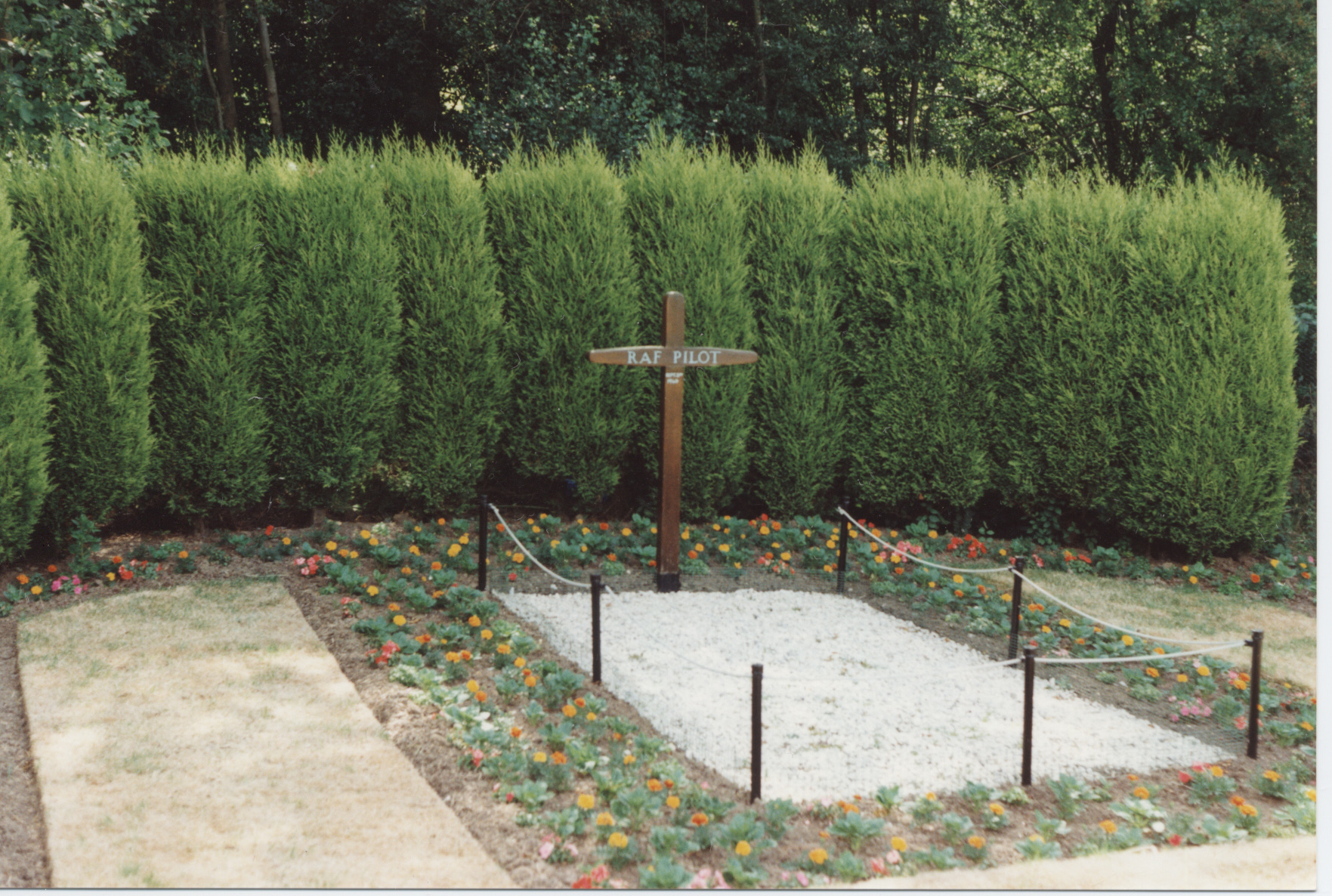
I also found out, thanks to the helpful locals, that even then, 49 years on from the crash, there is in fact a memorial to this unknown pilot, very close to where the aircraft crashed. It is a peaceful, beautifully kept garden, with a simple wooden cross bearing the inscription “RAF PILOT 3rd September 1940”. It was above this little memorial garden that the RAF had been performing their display.

The memorial lies hidden in a shady copse beside an apple orchard, on a south-facing slope that overlooks the one of the most beautiful parts of the county: the Weald of Kent. It is only open to the public once a year, and few people outside of the local Royal Air Force Association’s Headcorn branch and the people of Chart Sutton village, know its location. The whole thing, even now, is still a rather private affair between the local people, the RAF and the memory of the fallen pilot.

In 1970, the overgrown crash site was cleared and a formal garden constructed. There has been a memorial service every year at Chart Sutton Church ever since, which is usually followed by a display from either a lone fighter, or a pair of fighters, from the RAF’s Battle of Britain Memorial Flight. Tuesday, 3rd September 1940, is a date that Chart Sutton, and the RAF, have never forgotten.

Despite the fact that a local Police Officer had actually witnessed the crash and managed to log the involved aircraft’s number, confusion arose at the time because two more British fighters crashed in close proximity to the first very soon afterwards; one the next day in fact, at neighbouring Amberfield Farm and one ten days later on 14th September, almost unbelievably at Parkhouse Farm again.

The RAF sent a recovery squad to Chart Sutton on September 26th 1940, to clear the wreckage from all three crash sites. Although a local constabulary report to the RAF cited Hurricane P3782 as having been cleared from Parkhouse Farm, along with the fragmented remains of its pilot, plus the remains of the other pilot who’d crashed there on the 14th, that single piece of seemingly unimportant paper then got buried, lost in the general Police archives for years. It didn’t come to light again till the early to mid-nineteen eighties, probably during a clearout. It was then reproduced in that epic book, “The Battle of Britain Then & Now”.

Meanwhile, the removed remains of both pilots were interred at Sittingbourne & Milton Cemetery, in graves marked “unknown British airman”. The fighter that crashed at Amberfield Farm had left very little in its wake, having gone straight into the ground, so it is easy to see now, how the confusion over the identification of the three pilots subsequently arose, as aircraft crashes in Kent were of course quite commonplace during that long hot summer of 1940.

That was pretty much how things remained, till in 1980 a museum group excavated the site of the second Parkhouse Farm crash. Forty years to the very day since he’d crashed, Sergeant Pilot J.J. Brimble of 73 Squadron and his Hurricane, were exhumed from the Kent soil and positively identified. Also excavated at sometime soon afterwards, was the site of the Amberfield Farm crash, which was then positively identified as being that of Flying Officer Cutts of 222 Squadron, and his Spitfire. This left the last of the three “unknown airmen” and Hurricane P3782, the number from the now rediscovered police report.

Hurricane P3782 belonged to No. l Squadron, whose records show that on 3rd September 1940, it was allocated to Pilot Officer R.H. Shaw. The squadron log posts both Shaw and Hurricane P3782 as: “Missing, failed to return from a standing patrol” on the morning of Tuesday September 3rd 1940.

There can be little doubt now as to whom the Chart Sutton memorial belongs, but as the engine and cockpit of Shaw’s Hurricane are still deeply buried where they fell, there is nothing to base any official identification upon. Despite this, and the fact that the RAF removed what human remains they could find at the time, it has always been regarded locally as the last resting place of this gallant young airman.

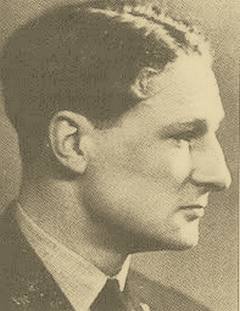
Pilot Officer Robert Henry Shaw of 1 Squadron. By kind permission of Winston G. Ramsay, via Mitch Peeke.

Robert Henry Shaw was born on 28th July 1916, in Bolton to a family in the textile Business. He was commissioned as a Pilot Officer in the RAF on February 1st 1940 and posted to 11 Group, Fighter Command. On March 11th, he joined No.1 Squadron in France, as part of the force attempting to stem the German advance. The squadron was withdrawn to Tangmere, in Hampshire just before Dunkerque. It was at this time that Robert was inadvertently shot down by the pilot of another British fighter, who had evidently mistaken Robert’s Hurricane for a Messerschmitt 109. However, Robert managed to land his damaged Hurricane back at Tangmere and was himself unhurt.

I had the pleasure of meeting Robert’s brother when we were introduced to each other at the annual memorial service the year after the local newspaper ran my original story. Unbeknown to me, the paper had traced and contacted Robert’s family. His brother, who was completely unaware that Robert’s memory had been honoured annually in Chart Sutton for the previous nineteen years, travelled down for the 1991 service. At our meeting, he told me that Robert, in connection with the family’s textile business, had been a frequent visitor to Germany before the war and was at first mightily impressed by Hitler’s regime. However, during what turned out to be his final visit in 1937, Robert was witness to a public incident that dispelled any illusions he had formed of Hitler’s new Germany. Robert never did say exactly what it was that he’d witnessed, but though obviously tight of lip, he was decidedly firm of jaw. Robert came straight home and joined the RAF Volunteer Reserve, immediately.

The exact circumstances of Robert’s death have never been established, but it seems likely that he and his flight commander, Flight Lieutenant Hillcoat, probably encountered a pack of “Free hunting” Messerschmitt 109’s; ironically, one of the last such hunting pack operations before Goring unwisely tied his fighters to the bomber formations as a close escort. Robert was by then a seasoned and experienced fighter pilot, but the ensuing dogfight would have been anything but equal. Despite the odds being heavily against them, the pair did not shrink from the fight. Flight Lieutenant Hillcoat was also killed.

Pilot Officer Robert Henry Shaw of 1 Squadron Chart Sutton, Maidstone (photo Mitch Peeke)

The Chart Sutton memorial is the village’s way of honouring that last great courageous deed of Robert’s in steering his blazing and doomed Hurricane away from the village school. It was his final, desperate act of pure self-sacrifice that has justly made twenty-four year-old Pilot Officer Robert H. Shaw an immortal part of that Kent village.

Since I first penned this, some evidence has now emerged in the form of an engine plate that was apparently dug up at the site as long ago as 1987, which has now at last been brought out into the light of day. One is left to wonder just how many such artefacts, souvenired at some point in the past, still lie undiscovered in people’s houses!

My thanks go to Mitch for bringing this story to us.

“1940: The Battles to Stop Hitler” – Mitch Peeke

A book review.

This is a superbly written book that looks at the Battle of Britain through the life of the airmen who were primarily based at a now disused RAF station (RAF Gravesend) in Kent. Whilst being historically accurate throughout, it is not one of those books that is full of data, figures and graphs, more a book based on personal and general historical events. It deals well with the political climate in Europe post World War I, setting the scene for Hitler’s rise to power, and the lethargic way in which the Allies allowed him to achieve his ultimate goal. It looks at the political unrest at home, and how that shaped both a public and government totally unprepared for war.

Each of the first four chapters look at specific events that led to the declaration of war on September 3rd, 1939. It looks at how the Allied response to Poland’s invasion was belittled by the massive and hugely technologically advanced German forces, who cut through Belgium circumnavigating the Maginot line, forcing the BEF and French forces to a small pocket at Dunkirk. It then looks at the evacuation through the eyes of two small boats (one of which Mitch supports through his book sales) and those who sailed on her. By examining the infrastructure surrounding the evacuation, it adds a very personal touch to what was a massive undertaking, and one that the many other books, films and documentaries have failed to highlight.

After Dunkirk, Mitch examines the Battle of Britain as it occurred in the skies over Kent and London. Individual skirmishes, with details of those involved, add a very personal touch to the blow-by-blow account of the battle as it weaves its way to its ultimate ending.

It is clear from the references to the skirmishes that Mitch has carried out extensive and prolonged investigations into each one, even pinpointing in many cases the actual crash site of the aircraft. Added to this are the personal and eye-witness accounts which continue to keep the personal aspect very much at the front. As the battle draws to its conclusion, life in London’s city streets are revealed through events that are again backed up with eyewitness accounts and personal details. Some of these stories will make you laugh, the absurdity of ill-fitting fire hoses and the tenacity of the firemen to solve the problem whilst all around were in chaos, is just one incredible example. It also shows that how through it all, the people of Britain managed to keep smiling, still seeing the good in what was a terrible time.

Whilst the Battle of Britain officially ended on 31st of October, Mitch continues to tell the story as autumn turns to winter and as the Battle of Britain turned to the Blitz. The nightly bombing of British cities gave rise to some dark secrets and activities, but balanced with these are other more informal and light-hearted highlights, all of which add to pulling the reader into the atmosphere of 1940s Britain.

In summing up, Mitch analyses the flaws in the German strategic plan for attacking Britain. He looks at how poor decisions enabled Britain to refocus and rearm thus building her forces up to a strength that was far better than those that remained in the period immediately following Dunkirk.

He then reintroduces the characters that had appeared throughout the book informing the reader of their postwar lives, some of whom were his own family members and who witnessed first hand, the true horrors of war.

Throughout Mitch’s final chapters there is a glowing slant toward the people,  showing the true grit and resolve of the British people who ‘pulled together’, that has become synonymous with those dark days of 1940/41. But this is not a patriotic, ‘let’s wave the flag and tell the world how good we were’ book, it’s more a heartfelt look at a very decisive time in world history, one that could have been so very different if it were not for ‘the few’, their leaders and the British people who supported them.

As appendices, Mitch looks at one RAF Station in particular, RAF Gravesend, its history and what has happened to the site since its closure post war. Now long gone, it is one of the many airfields that were so important to Britain’s survival, yet nothing remains of it today. He also looks at the 15 brave airmen who lost their lives in 501 and 66(F) Sqns, their names now on a plaque on the wall of a leisure centre on what was the former entrance to the airfield. Reading their short biographies really brings home the tender age of those who paid the ultimate sacrifice for our freedom.

I read this book in about two days, it’s easy, and compelling reading, very detailed and very personal. “1940: The Battles to Stop Hitler” is not about the Battle of Britain per se, but more a personal examination of the people who were involved in the two battles; Dunkirk and the Battle of Britain, and how their lives were interwoven in the summer of 1940. Light hearted in places, extremely moving in others, it adds another dimension to those famous battles, and I for one would most certainly recommend it.

1940: The Battles to Stop Hitler” by Mitch Peeke is available from Pen and Sword Books Limited. It is sadly only available in digital format and all the author’s royalties go to The Medway Queen Preservation Society, The Medway Queen being a survivor of the Dunkirk evacuation and featured in Mitch’s book.

1940: The Battles to Stop Hitler”  is available from Pen and Sword Books,  ISBN: 9781473858091, Published: 24th June 2015. https://www.pen-and-sword.co.uk/1940-The-Battles-to-Stop-Hitler-Kindle/p/11118

I would like to pass on my immense gratitude to Mitch for providing me with a copy of the book via publishers Pen and Sword Books.

RAF Boulmer – Sophistication and intrigue (Part 2).

After Part 1 of ‘RAF Boulmer – Sophistication and intrigue’ we see how Boulmer developed during and after the Cold War. From a small decoy airfield, to a training facility for fighter pilots of 57 Operational Training Unit it then closed at the end of World War 2. Laying dormant for a while, flying would return, and Boulmer would become one of the most sophisticated RAF facilities anywhere in the United Kingdom.

RAF Boulmer

Boulmer’s modern watch office and hangar

After this, the RAF had no need to retain Boulmer, and so it was placed into care and maintenance. But then, in the early 1950s with the Cold War heating up, Boulmer was put back into action but not as an operational airfield flying front line aircraft, but as part of a sophisticated network of radar stations monitoring British airspace. To accommodate this new equipment, a new part to the of the airfield was opened up, located on both new land and former domestic sites to the north-west of the main airfield. This new construction took the name of the airfield but remains separate from its namesake, and well guarded from prying eyes.

During this time Boulmer would use  Linesman Passive Detection equipment, *1 to detect jamming targets in mass formations. An innovative design they were eventually removed as new and more modern equipment came into operation. In conjunction with this was the primary radar, the Marconi Type 84 and 85 search radars. These massive structures used  antenna reflectors measuring some 60 feet wide by 22 feet high, completing a full rotation four times every minute.

It was at this time, in the mid 1960s, that Boulmer the airfield, would once again see military flying take place. But by now the hard runways had been removed, and Boulmer’s gain had sadly been Acklington’s loss.

The closure of RAF Acklington meant that the Search and Rescue helicopters of 202 Sqn ‘A’ flight, would be moved into Boulmer to carry out Search and Rescue operations over the eastern regions of England and Scotland.  The Whirlwind HAR 10s of 202 Sqn were spread far and wide in a complex range of changes that saw them move as far a field as Coltishall, Leuchars, Lossiemouth, Manston and Port Stanley. These moves placed many stresses on the unit, and with the reduction in operational aircraft, Boulmer’s search area became much bigger.

A series of updates over the coming years meant several changes to the  various sites at Boulmer.  For a short period between 1968 and 1974, Boulmer Radar Station (Lesbury) was closed, as upgrading took place which saw ‘electronic’ warfare, and later a computerised interception control system, added. By the 1990s mobile radar was becoming more widely available and the giant Type 85 radar was dismantled and replaced by modern 3-D screening and automated tracking radar. Part of this network being housed on part of the former RAF Brunton.

In 1975 the robust Search and Rescue helicopters on the former airfield began being replaced by the successful Sea King HAR-3, an aircraft they operated for a further forty years in the Search & Rescue role. In 1978, the Sea King was withdrawn from some of these 202 Sqn operations and replaced themselves by the Wessex HAR 2, but three Sea King helicopters continued on at Boulmer, being the last aircraft to fly here under Military control. In conjunction with these changes, the main headquarters of 202 Sqn also moved into premises at RAF Boulmer, giving a new and extended lease of life to the former airfield.

In this new role Boulmer would regularly bear witness to accidents and fatalities. On Sunday 17th May 1987, an ex Boulmer airmen F/Sgt. Philip Scott crashed in an Steen Skybolt he had built himself at Boulmer. The aircraft ploughing into the ground killing  both F/Sgt. Scott and his passenger Cpl. Martin Leitner. It was suggested that a suitcase on board the aircraft had restricted control column movement leading to the crash.

In July 1989 an RAF Sea King from Boulmer was involved in a rescue mission to save two downed military airmen. A Tornado F3 of 23 Sqn RAF Leeming crashed into the sea 35 miles off Tynemouth, both airmen ejected, and whilst the navigator was saved, the pilot F/Lt. Stephen Moir was killed, trapped under his parachute in the cold waters of the North Sea.

Another RAF Leeming Tornado F3 (11 Sqn) got into difficulties later in 1994, the crew ejecting again but not before managing to transmit a distress call. This time both airmen were pulled from the water and taken to hospital with minor injuries, RAF Boulmer crews being on the spot within minutes.

A year later, 1995 saw another rescue mission by a Boulmer Sea King, when two Tornadoes collided 60 miles off the coast of Berwick-upon-Tweed. All four aircrew survived with two ejecting from one aircraft at the scene, whist the second (ZE773) was gingerly nursed back to RAF Leuchars. The aircraft landed without further incident even though it had no hydraulics or navigational aids.

In 2003 the Government put forward plans to close Boulmer, but protests from those opposed to the end of search and rescue operations led to a reprieve, and Boulmer would live a little longer.

Then during 2015, it was decided that the last six remaining UK RAF Search and Rescue bases – RAF Lossiemouth (202 Sn ‘D’ Flt.), DST Leconfield (202 Sqn ‘E’ Flt.), RAF Valley (22 Sqn ‘C’ Flt.), RAF Wattisham (22 Sqn ‘B’ Flt.), RAF Chivenor (22 Sqn ‘A’ Flt.) and RAF Boulmer’s ‘A’ Flight – would close, as Search and Rescue operations were finally privatised. Boulmer ceased operations on 30th September, with the last crews at RAF Chivenor being told to ‘Stand down’ a few days later on October 4th 2015, an event that ended seventy-four years of Search and Rescue history.

Since April 1st 1983 Search and Rescue units had answered 34,122 call-outs during which time 26,916 people have been rescued from both the sea and land*2.  Boulmer’s operations had now ended, raising a feeling of great sadness in the local community, a community who had regularly witnessed the S & R helicopters over their small village.

RAF Boulmer

Many of the private gardens around the airfield use shelters for storage.

During this time the Sea Kings had operated in some of the most treacherous of conditions and some of the most important events in recent history. This included rescue operations in the Lockerbie bombing, the collapsed North Sea oil rig ‘Alexander Kielland‘ and the Carlisle floods.

Boulmer’s name would not end there though, now forming the backbone of Britain’s Air Defence Network as the headquarters of the Air Surveillance and Control System Force (ASACS), it monitors the UK and NATO airspace 24 hours a day, 365 days year.  As part of a sophisticated network of mobile and fixed radar monitoring stations, it is linked to European based networks ready to intercept any threat or unidentified aircraft entering British Airspace. Boulmer remains the headquarters of this force with No.1 Air Control Centre currently at RAF Scampton in Lincolnshire, but due to return to Lossiemouth once Scampton has closed and refurbishment at Lossiemouth are complete. Together their information can lead to the dispatch of QRA Typhoons from RAF Coningsby or RAF Lossiemouth depending upon the direction and location of the threat.

Whilst the main airfield site is still owned and used by the RAF, there are currently no flying operations taking place. High tech training is the order of the day, Boulmer being home to the RAF School of Aerospace Battle Management (SABM). This is a worldwide centre of excellence leading battlespace management training and education for not only the UK’s Armed Forces, but NATO and other foreign military personnel as well. A range of associated technical units also serve and train here, giving Boulmer one of the most sophisticated organisational groups in RAF service. There are currently some 1,000 Service, civilian and contracted personnel working at the site at any time.

RAF Boulmer

RAF Phantom guarding RAF Boulmer.

Whilst flying ceased some years ago, Boulmer’s aviation history has not been forgotten. The main gate at Boulmer continues today to be guarded by Phantom XV415 an FGR.2 which operated with eight RAF squadrons before its final retirement. Prior to this, Spitfire MKVb EP120 was in pride of place until 1967 when it was removed for use in the film ‘The Battle of Britain‘. Its replacement was another Spitfire F, Mk XVI TB252 which left in December 1969 for RAF Leuchars.

These Spitfires headed a succession of aircraft to guard Boulmer’s gate. In 1972 Lightning XP745 became guardian as  tribute to the close work carried out between the radar station and 11 Group’s fighters. The twenty-sixth MK.3 Lightning built, XP745 was formerly based at RAF Wattisham with 56 Sqn, it moved to Akrotiri and then back to Wattisham and 29 Sqn. The Lightning made its last flight on February 4th 1975 to Leconfield, where it remained for a number of years donating parts and being gradually stripped of its components. Eventually it was given to Boulmer and returned to guardian standard. The current gate guardian, a McDonnell Douglas Phantom FGR.2 XV415 ‘E’, like its predecessor, also stands at Boulmer in the colours of No. 56 Sqn formerly of RAF Wattisham.

Even though Boulmer is no longer a flying RAF base, it is heavily guarded and its operations kept secret behind high fences. The main airfield site has itself gone, the runways all removed (a small patch remained at the time of visit in 2018) and little of the wartime airfield remains in public view.  The road approaching Boulmer gives you a choice, turning right takes you to the Radar centre an area patrolled by dog handlers and armed guards, this gives some indication of the seriousness taken inside the perimeter fence. Taking the left fork brings you to the main gate of the former airfield and Air Sea Rescue centre, and the location of the Phantom gate guard mentioned above. Behind here are the various training facilities, again guarded from prying eyes and unwanted visitors.

Carrying on past here, in a small coppice on the left, is a small collection of wartime buildings, very much left to the elements they are still mainly intact and possibly the best reminders of any wartime activity here at Boulmer.

Continue on from here along the coast road. This takes you to the eastern end of the former airfield, and in parts, along the original perimeter track used during Boulmer’s flying life. A caravan park sits on what was part of the airfield here, the only location where the remnants of the runway can still be found.

RAF Boulmer

What’s left of Boulmer’s runways are barely distinguishable beneath the stones.

Further along this road and you come to a bend, this is the threshold to the two main runways with their location still visible as scars on the earth disappearing into the distance. Distant views also allow sighting of the current hangar and watch office, but there is little to be gained here. The road then continues round and whilst the perimeter track carries on into the field, the road leaves here and passes away from the airfield site. The perimeter track at this point is now a mere single track hardly distinguishable as an airfield perimeter track.

RAF Boulmer

The scars of the two runways can still be seen in the fields of Boulmer.

Other than small buildings found in private gardens, little exists of this rather interesting site. Whilst its early wartime history is not earth shattering, it has however become one of the most important and key RAF sites in the UK today.

Sources and Further Reading.

*1 For a detailed explanation of these radar systems and personal accounts of using them, visit Dick Barrett’s excellent website.

*2 MOD Memo dated 10 May 2016 in response to a freedom of information request.

Chronical Live website accessed September 29, 2015 “Farewell to the Sea Kings at RAF Boulmer as new era in search and rescue dawns