Lt. Jack Watson 303rd BG. – From Villain to Hero.

The end of training flights in the Second World War in the quiet and blue skies of the United States, were occasionally ‘celebrated’ with flyovers and ‘buzzing’ of the home town of family or girl friends. Whilst this unofficial activity was frowned upon, in general, a blind eye was turned by Commanding Officers of the various Groups. However, one such activity was not taken quite so lightly, and almost led to the end of a promising career before it had even started.

At RAF Molesworth (Station 107) not far from Huntingdon, Cambridgeshire, the 303rd Bomb Group (BG) had been serving the Allied offensive since mid September 1942. They had taken heavy casualties after participating in many prestige missions including the disastrous August and October raids on the ball-bearing plant at Schweinfurt. The invincibility of the heavily armed B-17 was very quickly shown to be a myth.

After a period of calm, primarily due to persistent bad weather rather than any  significant strategic military decision, the USAAF was allowed unofficial time to recuperate, rebuild and rearm. During this period, new recruits and aircraft poured into the United Kingdom via either the Northern or the Southern transit routes over the Atlantic Ocean.

On one of these aircraft was Lt. Jack Watson, a ‘green’ pilot’ who had recently completed his training, and was now on his way to fight in a war a long way from his Indianapolis home.

jack watson page

A fresh faced 2nd Lt. Jack Watosn who bravely brought home his burning and crippled B-17 bomber after ordering his crew to bail out. (IWM UPL 32160)

On eventual arrival at Molesworth, Lt. Watson was soon to experience for himself the horrors and reality of war. On January 11th 1944, he was part of a 291 bomber force attacking both the FW190 production factory as Oschersleben and the Junkers factory at Halberstadt, Germany. On what became one of the blackest days for the Group, eleven out of the forty aircraft dispatched were lost, an attrition rate of just over 25%, which was also the highest loss of the entire force.

On the inward flight, the weather, which had dogged much of the winter, closed in over the continent.  A recall message was sent out, the 2nd and 3rd Divisions turning for home, but it was ignored by Brigadier General Robert F. Travis, 1st Bombardment Division Commander in the lead plane – ‘The Eight Ball‘. Original orders were to bomb by visual methods but if cloud cover prevailed then pathfinder Liberators  were to mark the target.

As the weather had deteriorated, cloud being present as high as 24,000 feet, fighter cover was all but withdrawn. The bombers were now virtually on their own and much smaller in number.

Alerted early on, the Luftwaffe had managed to form an enormous welcoming party for the now weakened force. It would be the strongest collection of Luftwaffe aircraft since the October raids, and it was waiting, eager for blood.

The first contact between the two forces was made over the shallow waters of the  Zuiderzee on the inward flight. A collection of rocket-firing fighters launched a gruesome attack on the lead section of the 303rd, an attack that lasted for several hours and took out numerous aircraft.

From the Initial point (IP) to the target, flak was light but accurate, more aircraft took hits and further damage was sustained by the formation. Those bombers that did get through managed to bomb the target, the accuracy of which was considered ‘excellent’.

On the return flight  B-17F #42-29524 ‘Meat Hound‘, piloted by Lt. Jack Watson was attacked again by waves of enemy fighters who zoned in on the bomber and its supporting formation. With many aircraft now crippled, the B-17s were easy targets for the fierce and determined Luftwaffe defenders.

Lt. Watson’s aircraft, (a B-17F-55-BO, which had previously been assigned to the 306th BG transferring to the 303rd in July 1943), was hit hard over Durgerdam. The damage looked terminal, two engines were on fire, there was substantial damage around the wing root and the left elevator had been shot completely off. With such damage, not only was the aircraft difficult to control but it was losing vital airspeed and altitude as well.

Lt Watson, gave the bail out order, holding the aircraft steady until all the crew had departed. Lt. Watson, who had by then put the aircraft on automatic pilot, was himself preparing to jump, but the thought of the cold waters below forced his retreat to the cockpit and the challenge of getting home alone.

Of those who did jump, four fell into the Ijsselmeer and sadly drowned, and another four were caught by occupying forces and sent to POW camps. The ninth, Lt. Col. Clayton David, the Co-Pilot, managed to evade capture eventually making his way back to England. Clayton’s journey took him through Holland and Belgium and on into France, where he headed south, eventually crossing the Pyrenees into Spain. From there, he reached Gibraltar eventually returning to England in May 1944, four months after he was reported as ‘Missing in Action.’ For his efforts he received the Purple Heart*1.

Lt. Watson, now alone in the crippled B-17 fought on, keeping the aircraft flying toward England. Once over home territory he brought the aircraft down through the thick cloud that had dogged so many of Britain’s airfields that winter, landing at RAF Metfield, an American Fighter airfield home at that time to the 353rd Fighter Group.

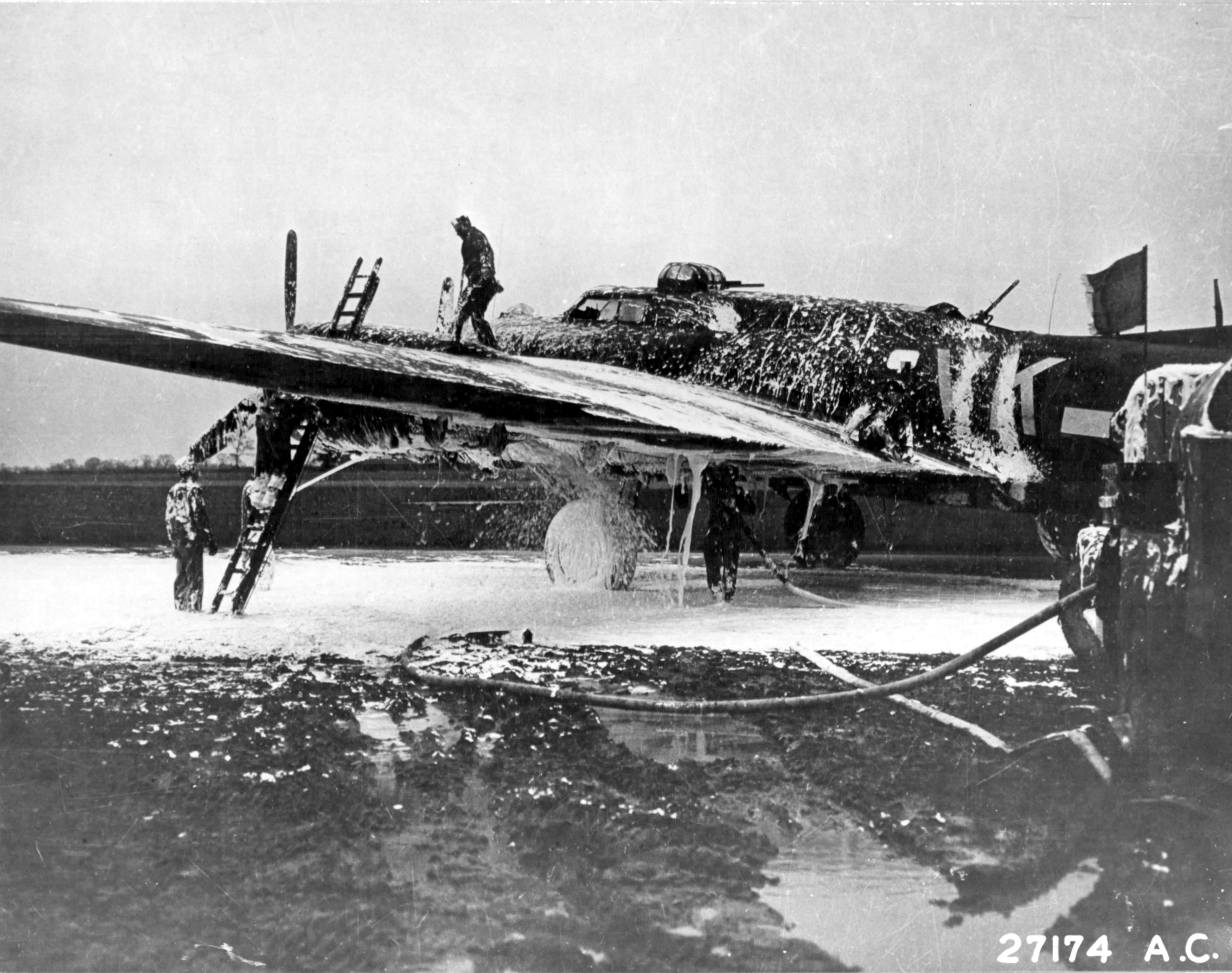
So severe was the fire on the aircraft that it took fire crews a considerable time to extinguish it. These crews were not only amazed to see just one crewman exit the aircraft, but also to find an unexploded shell sitting directly behind the pilots seat.

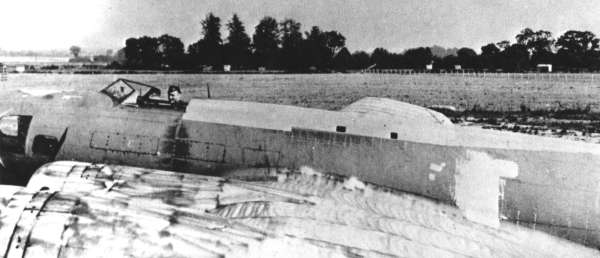
WM UPL 32171

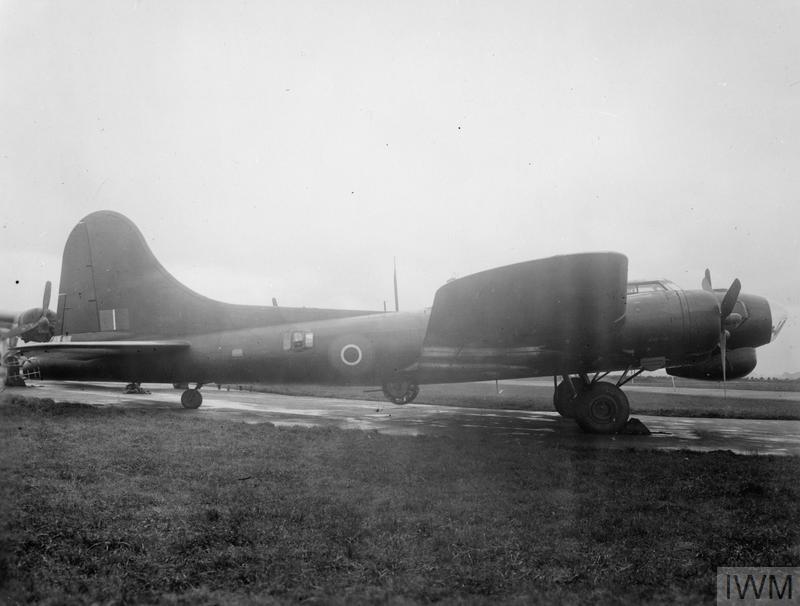
B-17 ‘Meat Hound‘ on the ground at Metfield, Suffolk after landing with two burning engines. The aircraft was subsequently written off and salvaged for usable parts.  (IWM UPL 32171).

On his arrival back at Molesworth, Lt Watson received a telegram sent by New York Mayor Fiorello LaGuardia, forgiving Watson for his villainous activity previously in late 1943.

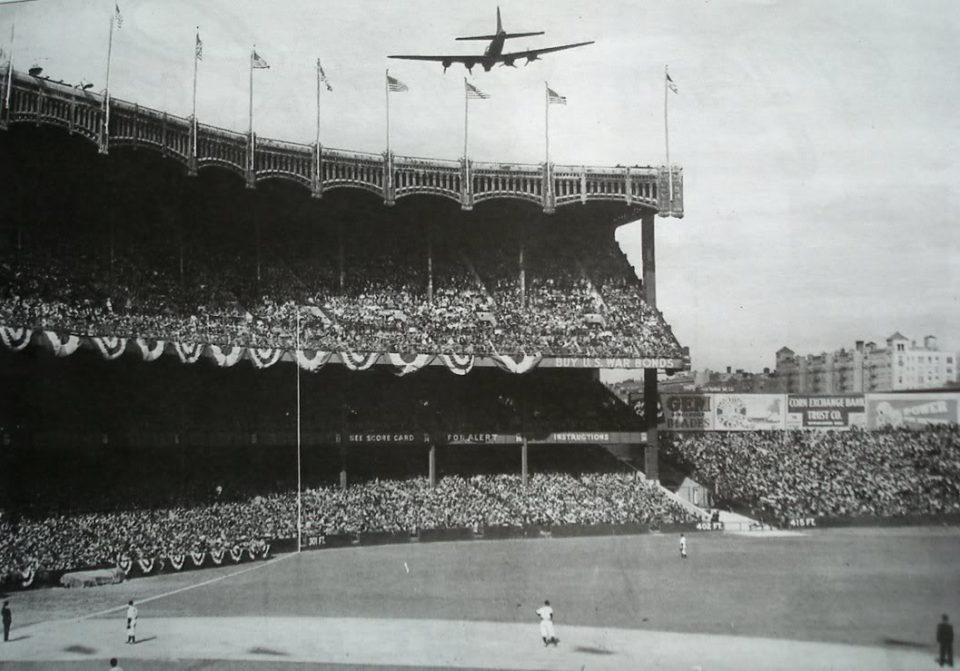
It was at this time that Watson along with three other pilots; 2nd Lts. Robert Sheets, Elmer Young, and Joseph Wheeler, buzzed the World Series game between St. Louis Cardinals and the New York Yankees at the Yankee Stadium, New York. Mayor LaGuardia was so incensed by the action at the time, that he insisted Watson and the others be disciplined, court martial proceedings being instigated as soon as the four landed in Maine*2.

However, it was not to be, the top brass needing every aircraft and crewman they could muster, sent the four on their way with a $75 fine and a stiff telling off!

Although tinged by the sad loss of his crew, the villain of the World Series’ Buzzing, had gone on to prove himself more than a worthy pilot, making history in more ways than one.

Yankee Stadium, Bronx, NY, October 5, 1943 – B-17 Flying Fortress bombers makes a surprise visit during the first game of the 1943 World Series

A Boeing B-17 ‘buzzes’ the Yankee stadium October 5th 1943. (Author unknown).*3

The crew of ‘Meat Hound‘ were:

Pilot – 2nd Lt. Jack Watson (Returned to Duty)
Co-Pilot – Lt Col. Clayton David (Evaded)
Navigator – 2nd Lt. John Leverton (POW)
Radio Operator –  Stf. Sgt. Harry Romaniec (KIA)
Bombardier – 2nd Lt. Vance Colvin (KIA)
Flight Engineer/Top Turret Gunner – Stf. Sgt. Sam Rowland (POW)
Right Waist Gunner – Sgt. William Fussner (KIA)
Left Waist Gunner – Gene Stewart (POW)
Tail Gunner – Sgt. Roman Kosinski (POW)
Ball Turret Gunner – Sgt. Fred Booth (KIA)

The B-17F, #42-29524, was delivered to Denver 31st December 1942; then assigned to the 423rd BS (306th BG) as ‘RD-D’ at Thurleigh 2nd March 1943. It was later transferred to the  358th BS (303rd BG) as ‘VK-K’ based at Molesworth on 30th July 1943.

For their efforts in this mission, the 303rd Bomb Group were awarded a Distinguished Unit Citation, the only time the entire unit achieved such an accolade.

This and other similar stories appears in Heroic tales of World War 2.

Sources and Further Reading.

Missing Air Crew Report 4269

*1 Herald-Whig Obituaries Website accessed 27/5/19

*2 303rd BG website ‘Outfield Fly’ by Hap Rocketto accessed 27/5/19

*3 Photo appeared in ‘Old-Time Baseball Photos and Essays’, blogsite. accessed 27/5/19

The Transformation of 2nd Lt. Kermit D. Wooldridge, 379th BG, 525th BS.

Kermit D. Wooldridge’s future looked dim as a teenager. The troubled youngster was described as truant, incorrigible, and a run-away. He dropped out of high-school. Born to deaf-mute parents who could not control him, he was raised by an uncle in Lubbock and Abernathy, Texas.

Bored and headed for trouble, on July 12, 1934, Kermit Wooldridge, age 17, joined the US Army. No one would have predicted that a few years later he would find himself in the midst of the most important war America would ever fight. It was unimaginable that he would pilot the formidable four-engine heavy bomber – the B-17 Flying Fortress.

Enlisted man Wooldridge – with a GED in one hand and a forged document of parental permission in the other – would soon be whipped into shape by the United States Army.

Private Wooldridge spent five years with the 7th Cavalry, Ft. Bliss, Texas. In 1939, Corporal Wooldridge was transferred to the Hawaiian Coast Artillery Corps.

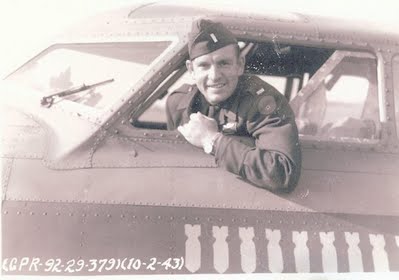
K.D. Wooldridge in his B17

K.D. Wooldridge in his B-17

Life for Wooldridge changed on Dec. 7, 1941. The bombing of Pearl Harbor heightened urgency for pilots in our woefully inadequate Army Air Corps (now the USAAF.) Two weeks later, Dec. 24, 1941, Kermit Wooldridge was commissioned a 2nd Lt. – appointed on a temporary basis for “the duration of the present emergency.” On that day, the now disciplined, military-indoctrinated “Woody” Wooldridge began pilot training, initially in twin engines, and later in the B-17 four engine bomber.

Looking at his military records, the amount of time to learn to fly an aircraft in wartime was greatly abbreviated. Pilots and airmen were needed – and fast. Air schools and fields were authorised. Wooldridge’s military records show he began intensive pilot training Dec, 24, 1941 (200 hrs flight time) for one year. Training in the B-17 followed – completed in fewer than six months.

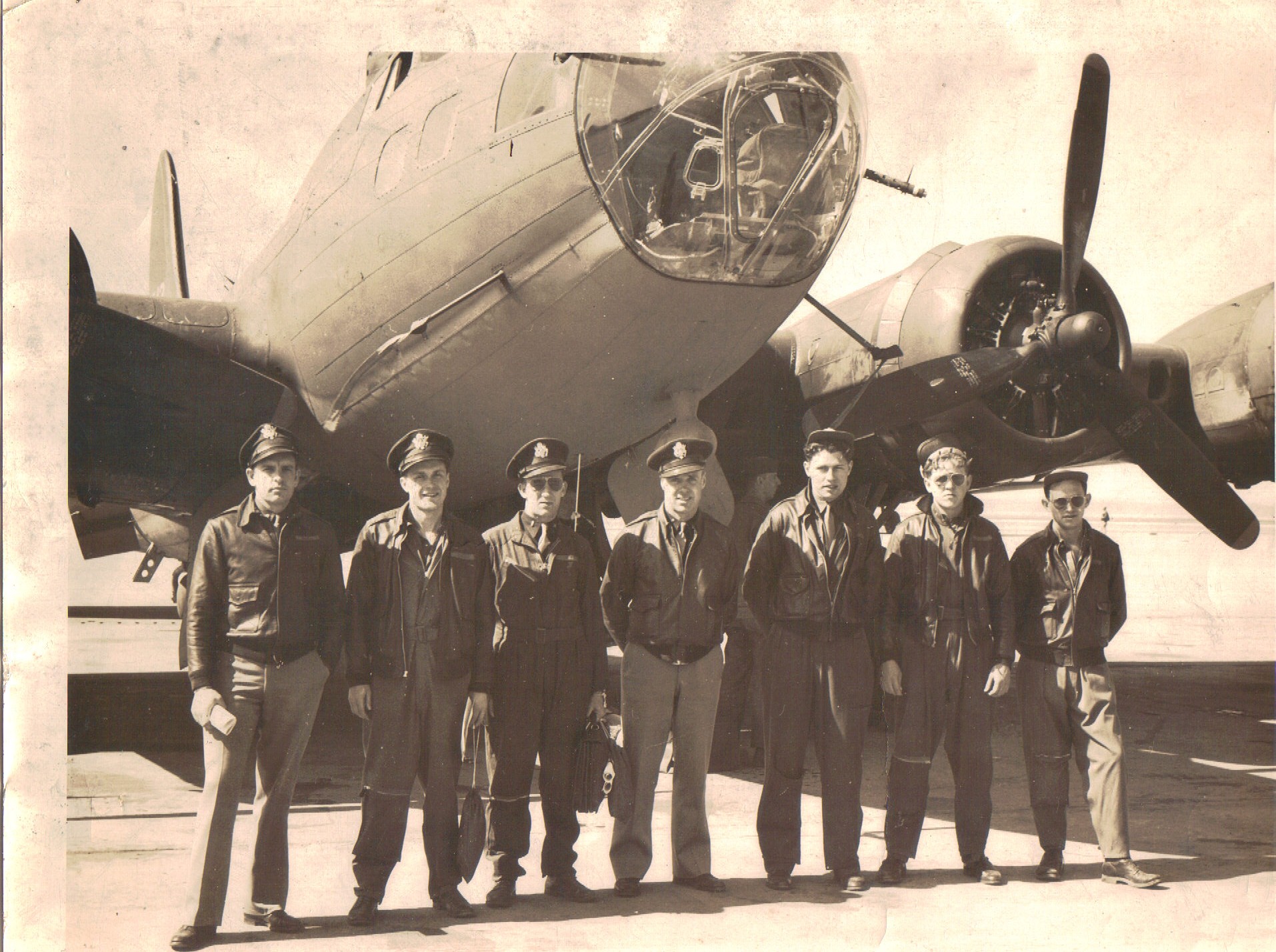
KDW_(L)_and_crew_B-17__1943_200_dpi

Pilot Wooldridge (L) and His Crew Beside their B-17

On June 9, 1943, with eighteen months flight training total (495 hrs flight time) Wooldridge – along with thousands of other eager airmen – would land at Kimbolton Airfield, England. On June 29, 1943, he would fly his first mission of the war – the bombing of Paris.

The transformation of a truant high school dropout was well on its way.

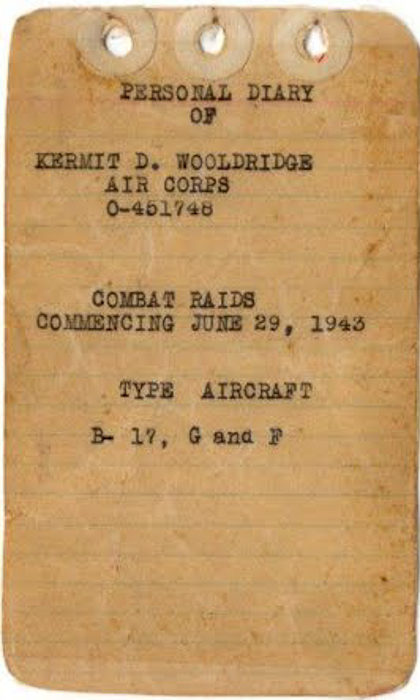
At Kimbolton Airfield, 2nd Lt. Wooldridge, 379th Bomb Group, 525th Bomb Squad, who formerly scorned the written word, began a chronicle of each of his 25 missions over Nazi-occupied Europe. Returning from each mission, pilot K.D. Wooldridge typed on small diary pages his recollection of that day’s work – targets bombed, engagements with Nazi fighters, planes being shot down, crippling damage to his own bombers and horrible loss of life.

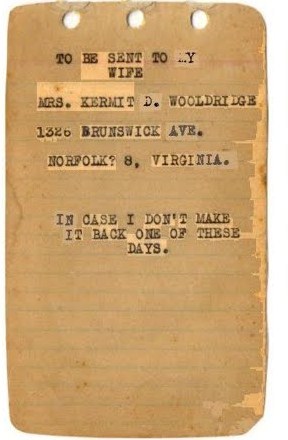
His written work, “Personal Diary of Kermit. D. Wooldridge, Combat Raids Commencing June 29, 1943” was dedicated to his wife Marjorie Wooldridge with these chilling words:

“IN CASE I DON’T MAKE IT BACK ONE OF THESE DAYS.”

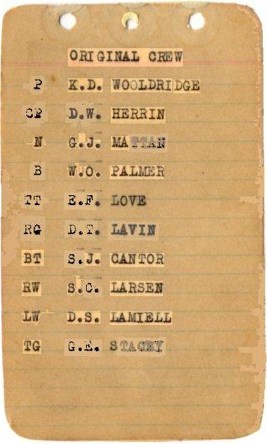
"To be sent to my wife" Wooldrige's diary KDW_Original_crew_from_scan
To Be Sent To My Wife Wooldridge’s diary Original Crew List of Wooldridge’s B-17

The missions were from June 29 to December 13, 1943.

Kermit Wooldridge would return home to the United States and his wife, where I would be born in November, 1944. Wooldridge would spend 25 years in the Army, retiring a Lt. Colonel in 1958. He and his my mother would raise four children.

Lt. Wooldridge, After Last Raid on December 13 1943

It was only after retirement from the Army that the wayward young man who wrote of the horrors of war as a 26 year-old, would then go to college and begin a second career as a math teacher.

After his death in 1994, my mother gave me the diary and asked me to do something with it one day. I did not read it until many years after his death. His story is not unique – my dad was an ordinary man, who along with his crews, was put into extraordinary circumstances. They all acted heroically, but would not like to be called heroes.

Over one-third of the B-17s over WWII Europe were lost.

I donated my father’s diary to the Library of Congress in Washington, D.C.

Here are a few excerpts from the diary of Lt. Kermit Wooldridge. The entire diary is online, each raid separately. sites.google.com/view/wooldridge-diary-wwii-pilot/home

Raid 18: 10/14/43

“Today we took off with a load of three 1000’ demos and a load of incendiaries. Our target the ball bearing plant at Schweinfurt, Germany. We had been briefed several times for this target and we knew it was going to be rough. It turned out to be the roughest ride that I ever hope to see…… we dropped our bombs OK and turned away from the target and ran right into the whole German air force….they were coming through the group in droves and shooting all the way. One FW190 rammed my right-wing man head on. They both went down in flames. They kept coming in groups of five and ten at the formation and in less than five minutes five of the seven ships in the squadron that I was leading had been shot down.

Well I and the other ship joined another squadron that had only four ships left. For the next hour and a half the fighters kept hammering at us. I was really doing violent evasive action to make them miss.   My ball turret gunner asked me if I thought I was flying a P-38. Well frankly I was giving her all she could take but still had no hope of making it back…we were near out of gas and it was time to do something if it was wrong….when the altimeter got down to an indicated 200 ‘ above the ground I started praying. One of the many that I had said today. When the reading was low (80 feet) the navigator said he saw a row of lights ahead. Sure enough there was a field about half a mile ahead. We went straight in and landed for we were too low to make much of a turn.

About half of our tail was shot off and the wings and fuselage were full of holes. The crew was O.K.”

KDW_and_wife_Marjorie__Bomber_returns_to_US_Dec,_1943

News cutting showing Wooldridge’s return from War.

This post was written by Frances Bekafigo, the daughter of Kermit D. Wooldridge.  My gratitude goes to her for allowing me to share these most personal details. She regularly posts extracts from the diary on Twitter @FrancesBekafigo and the full diary can be found on her website at sites.google.com/view/wooldridge-diary-wwii-pilot/home

This is an excellent recount of the life of a young B17 Pilot and is well worth a read.

Kimbolton

RAF Kimbolton Memorial Today

The last flight of Joe Kennedy and Wilford Willy – (RAF Fersfield).

There has been much written about the young Kennedy, his life, his family and his death, but a lot of information around his death has remained ‘unknown’ for many years. Even today, the actual cause of his death is not clear and will probably remain so.

Joseph Kennedy Jnr was based at RAF Fersfield (originally RAF Winfarthing) in Norfolk (Trail 27), and had only been there a few weeks before he tragically died on August 12th 1944, whilst operating on secret operations. A tragic loss, this is the last flight of Joseph Kennedy and Wilford Willy from RAF Fersfield, Norfolk, England.

The Crew – Lieutenant Joseph Kennedy Jnr.

Joseph Kennedy was born July 25th 1915, Nantasket, Massachusetts, he was the eldest brother of eight siblings including John F. Kennedy. He was son to Joseph Patrick Kennedy and Rose Fitzgerald. Throughout his life he had been pressured into the political life by his father who had high hopes that his son would become the future President. Joseph Jnr wanted to please. As war loomed, Joe Kennedy Jnr rose to the challenge seizing his opportunity to become the ‘shining light’ of the Kennedy family.

The Kennedy parents instilled a desire to be competitive, to win and succeed and to be the best. This came out in Joseph during his time at both home and at school. The pressure on Joseph was enormous, and it was clearly evident throughout his short life.

Joseph lived in the shadow of his younger brother John, who would captain a PT boat in the Far East, and in Joseph’s absence, go on to become President of the most powerful nation on Earth. John was the brighter, the more determined of the two, and this caused friction between them. Joe always wanting to ‘out-do’ his brother persevered, but never seemed to quite make it.

It was this determination and rivalry that perhaps led Joseph to do what he did, to impress, to be the best and the ideal way he thought was as a war hero.

With a remarkable academic background behind him, Joseph Kennedy joined the U.S. Naval Reserves on October 15th 1941, reporting to the Naval Air Station (N.A.S.) at Jacksonville, Florida the following day. After several months of training he received his commission and on January 10th 1943 he joined a flying patrol squadron. In May he became a Junior Grade Lieutenant transferring to a bomber squadron in the following July that year. In 1944, on July 1st, he was promoted to Lieutenant United States Naval Reserve. His military life would last just over one month.

Joseph was posted to RAF Dunkeswell serving under the RAF’s Coastal Command. Flying a PB4Y he would carry out U-Boat searches over the Atlantic around the Bay of Biscay and the Atlantic. As he accumulated flying hours, he rarely came into any real danger, even when posted to cover the Allied invasion fleet over Normandy he rarely came into contact with any opposing aircraft or vessels.

Joseph Kennedy’s opportunity came when volunteers were asked for to undertake a special secret and dangerous operation. He jumped at the chance to be a hero.

Joseph Kennedy arrived at RAF Fersfield, Norfolk on 30th July 1944 where he was trained for two weeks.  On August 10th 1944 he wrote a letter home, it would be his last communication with his family. Joseph Kennedy was to become a pilot in operation Anvil.

Lieutenant Wilford John Willy

Sadly, Lieutenant Wilford J. Willy (s/n: O-137078), has remained in the shadows probably because the status of Joseph Kennedy Jnr. A tragic loss nonetheless and no less an important one. Willy was born 13th May 1909, New Jersey. He enlisted in the Navy in 1928, gaining his Naval Wings on April 30th 1937, just two years after he had married his sweetheart, Edna C. Schaffery, the women he left behind. On advancing through the rank of Chief Petty Officer,  he was awarded Lower Grade Lieutenant (April 28th 1942) and two months later, on June 26th, he achieved the rank of Lieutenant. Willy served at a number of operational stations, including Pearl Harbour, before being posted to RAF Fersfield, in Norfolk.

Willy, now an expert in Radio Operations and procedures, became the Executive Officer of the Special Air Unit One (S.A.U.1), the rank he achieved when he took off with Kennedy on August 12th 1944.

Operations Anvil and Aphrodite.

Whilst Drone technology and research had been around as early as World War I, it was still relatively unchartered territory. However, radio controlled drones (modern name Unmanned Aerial Vehicles or U.A.V.s) were already being used with relative success for target practice by the RAF and USAAF during World War II. The ‘Queen Bee’ being one of many used by the RAF. The Germans had also been investigating drone and guided bomb use through examples such as the Mistel aircraft (the most successful being a combination of either a FW-190 or Me-109 mounted above a Ju 88).

Both the  USAAF and USN were undertaking secret trials into drone aircraft operations with the view of attacking the heavily defended and ‘impenetrable’ submarine and ‘V’ weapons sites across northern France . The aim, to stop, or at least reduce, the Nazi’s use of the V1, V2 rockets and the development of the new V3 canon.

Codenamed ‘Aphrodite‘ by the USAAF,  and ‘Anvil‘  by the Navy, they were two secret operations running side by side. The idea behind these operations, was to remove all excess equipment from war-weary B-17s and B-24s, fill them with explosives, such as the British Torpex, put in radio receivers so that the drone (baby) could be controlled by a separate aircraft (mother) and fly them into designated targets. A volunteer crew of two would take off, set the aircraft in flight and then bail out over the U.K. or English Channel, leaving the ‘baby’ in the control of the ‘mother’ aircraft. These would then fly, by remote control, to the target when they would be put into a dive destroying whatever they hit.

The controls of the B-17 . The arm linkage moved the control column in response to the radio controls. (credit USAF)

The idea was remarkable but not new, and the equipment whilst innovative for its day, was limited to say the least. In all the operations undertaken only one drone ever reached its target, and that was through more luck than skill.

‘Azon’ (from AZimuth ONly*1) controls had been used successfully on individual 500lb or 1000lb bombs, where the control box was attached to the rear of the bomb and controlled by the bomb aimer through a joy stick. Using two directional controls (left or right) he could direct a bomb very accurately onto a given point. The downside of Azon, was that range and fall had to be determined in the usual way by the bomb aimer and could not be altered once the bomb had left the aircraft.

Azon had been used and proven in attacking bridges, railways and other longitudinal targets and was very accurate with a good bomb aimer. However, because of its limitations, it could only be used in one dimension and therefore was not capable a making a ‘baby’ take off.

Two aircraft types were identified for the project. Boeing’s B-17 ‘Flying Fortress’ and Consolidated’s B-24 ‘Liberator’. These once converted would be given new identifications BQ-7 (usually B-17Fs) and BQ-8 (B-24D/J). In each case it was deemed that two crew members would be needed to raise the ‘baby’ off the ground, partly because of the strength needed to pull back the control columns in these heavy bombers. Once airborne, they would climb to around 20,000ft, arm the Torpex, set the aircraft on a trajectory to the target, switch on the receivers and bail out.

About twenty-five  BQ-7s were modified, but it is not known accurately how many USAAF BQ-8s were converted. However, it is known that at least two naval PB4Y-1s (the naval version of the B-24 of which 400 had been converted from B-24 status – these were given s/n 31936 – 32335) were converted to BQ-8 standard; one of which was flown by Lt. Kennedy and  Lt. Willy on the 12th August 1944.

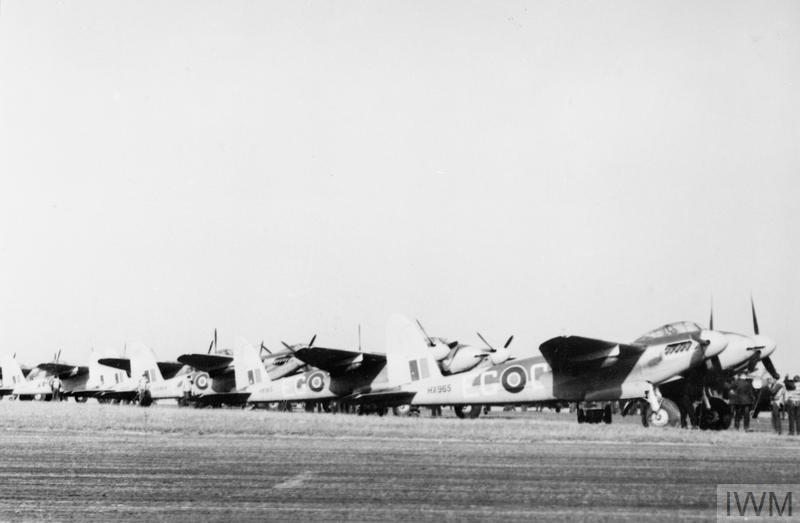
A number of support aircraft were needed for each mission. Prior to the attack a Mosquito XVI of the 653rd BS would photograph the target. Then the ‘baby’ would be accompanied by at least one fighter (either P-38 or P-51) incase the ‘baby’ lost control and had to be shot down and for fighter escort; a ‘mother’ either a Lockheed Ventura or another B-17 modified to CQ-4 standard, and a photographic  Mosquito from the 8th Combat Camera Unit (CCU) to record inflight behaviour. A post mission photo reconnoissance operation was carried out by the 25th BG at Watton to analyse the effectiveness of the bombing. It therefore took a lot of fuel, crew and aircraft to fly one drone to its target.

Because of the design features of the bombers, the USAAF looked into removing the cockpit to allow easy departure. The only aircraft that received this treatment was B-17F, “Olin’s 69’ERS” 42-30595 formally of 560BS, 388BG at Knettishall. It was never used on an Aphrodite mission  and was scrapped post war after being used for training in the open cockpit mode.  The BQ-8  (B-24) also had modifications made in the form of a widened hatch in the nose allowing for an easier escape from the aircraft. Once modified, the aircraft would have had all previous markings removed, and a special white or yellow paintwork applied to identify them from other bombers. To assist the controllers in sighting the ‘babies’ whilst in flight, the aircraft were fitted with a smoke canister that would be ignited allowing the bomb aimer to see the aircraft as it began its dive. In addition to this, two cameras were fitted to some ‘babies’ that transmitted pictures to the mother or support ship. These pointed at the controls and through the plexiglass. A revolutionary step forward in drone technology.

USAF designation system

A modified B-17 (BQ-7) with its canopy removed, this aircraft became a training drone. (Credit USAF)

In all, there were fifteen missions undertaken by the USAAF and USN, but none were to successfully hit their targets.  These included: Mimoyecques (Fortress); Siracourt (V1 Bunker); Watten (V2 Bunker); Heligoland (U-boat pens); Heide; Le Havre (docks); Hemmingstedt (oil refinery); Herford (marshalling yard) and Oldenburg (Power station). Both the operations and entire programme were cancelled only a few months after the Kennedy/Willy mission.

The last flight.

At RAF Fersfield, on August 12th 1944, Lieutenants Joseph Kennedy Jnr and Wilford J. Willy, both of the S.A.U. 1 of the Fleet Air Arm Wing Seven, boarded their converted B-24 Liberator, s/n 32271 (ex USAAF B-24J 42-110007)*2 and began their preflight checks. The aircraft was filled with 21,270lbs of explosive. At 17:55 and 17:56 two Lockheed Ventura ‘mother’ aircraft took off, followed by a further navigation aircraft and then the ‘baby’ at 18:07. The ‘baby’ climbed to 2,000 ft, the two ‘mothers’ 200 feet higher and slightly behind. They were joined by two Mosquitos, one for monitoring the weather, and the second, A USAAF F-8, to photograph the ‘baby’. This aircraft was flown by pilot Lieutenant Robert A. Tunnel and combat camera man Lieutenant David J. McCarthy. There was a further B-17 relay ship, a P-38 high altitude photo reconnaissance aircraft and five P-51 Mustangs to provide fighter cover.

The group set off toward the target at Mimoyecques , Northern France. They were to fly south-east toward the Suffolk coast, then turn south and head toward the target. Once level and stabilised, Kennedy and Willy handed over control to one of the ‘mother’ ships Then they reached the first control point (CP) at which time the group began to turn south; the ‘mother’ controlling the ‘baby’. Shortly after the turn was completed (about two minutes) Kennedy was heard to give the code “Spade Flush”, then at that 18:20 the ‘baby’ disintegrated in what was described as “two mid-air explosions” and a “large Fireball”.*4 The explosion, spread debris over a large area of the Suffolk countryside killing both crew members instantly. The following Mosquito also suffered damage and minor injuries to its crew. Following the explosion, all the aircraft were ordered back to base and the crews debriefed.

Many months (and indeed years) of investigations followed, but no firm conclusions could be drawn as to the precise cause of the explosion that ripped the aircraft apart. A number of speculative theories were drawn up, but the most plausible is that the electronic arming system was faulty and when Kennedy or Willy flicked the switch, an electronic short occurred that caused the bombs to detonate. Oddly the film that was in the following Mosquito has never been seen or made public – if indeed it was filming at that time.

The cause of deaths of Joseph Kennedy and Wilford Willy still remain a mystery to this day.

Joseph Kennedy wanted to be a hero. He wanted to be talked about as the one who achieved and outshone his brother. Sadly, this dream cost him his life.

Page 1 of August 23, 1944 condolence letter to the parents of Lt. Joseph Kennedy, Jr.,

The letter sent to the Kennedy’s after Joseph’s death.*3

Page 2 of August 23, 1944 condolence letter to the parents of Lt. Joseph Kennedy, Jr.,

The letter sent to the Kennedy’s after Joseph’s death.*3

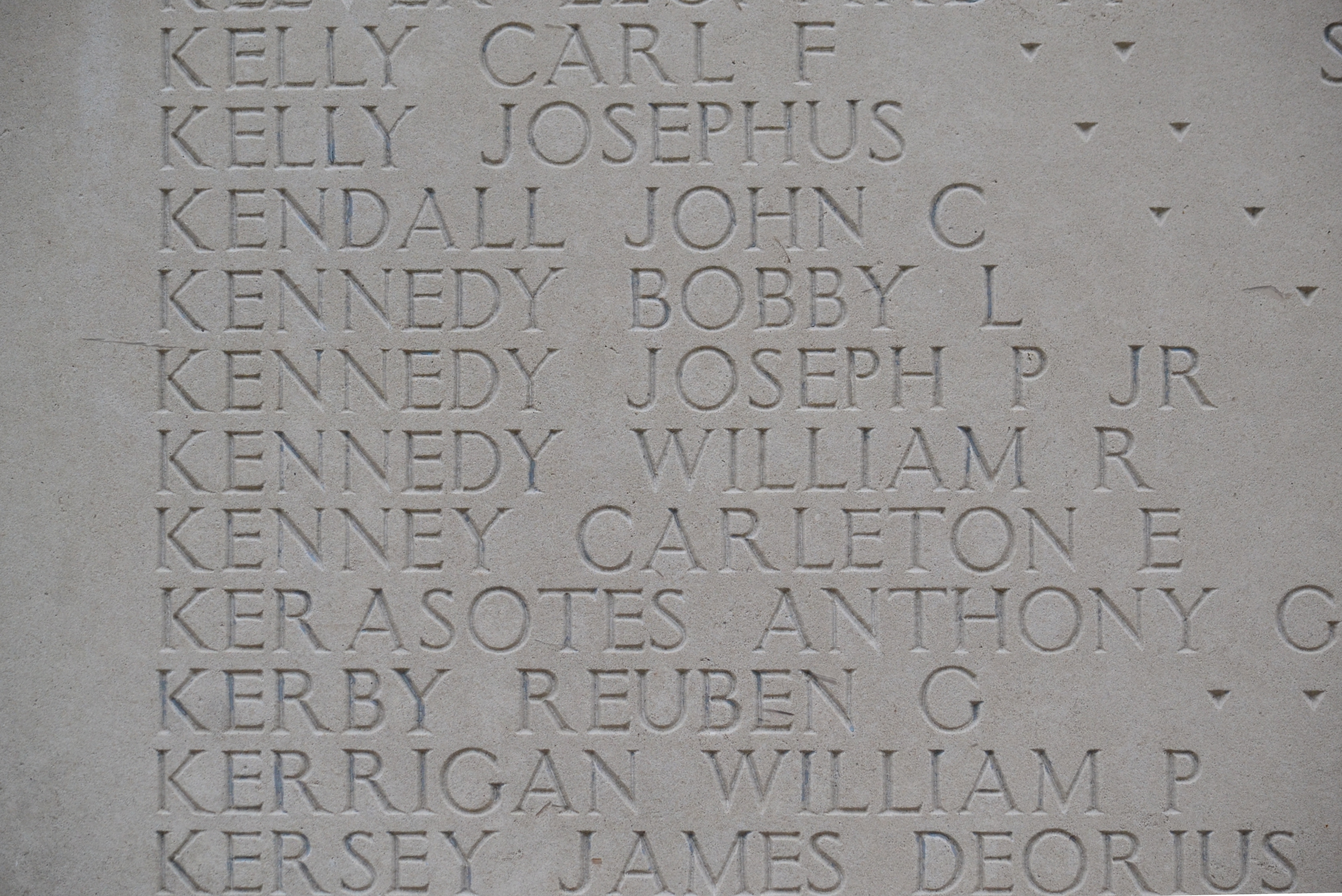
This fateful mission and its two crew members are remembered across the world. In France, the Mimoyecques museum contains a memorial honoring both pilots, and their names are carved in the Tablets of the Missing at the American Cemetery, Madingley, Cambridge. Kennedy has a ship the Destroyer ‘USS Joseph P. Kennedy Jr.’ DD850 named after him and this is now a museum in Battleship Cove, Fall River, Massachusetts. Both aviators were awarded the Naval Cross posthumously,

joe kennedy

Lieutenant Joseph P Kennedy Jr, USNR, appears on the Wall of the Missing at the American Cemetery, Madingley, Cambridgeshire.

Lieutenant Jospeh P. Kennedy Jnr had no dependents but Lieutenant Wilford J. Willy left a widow and three children.

Sources and further reading.

*1 Azimuth being the clockwise horizontal angle from a given point (usually North) to a second given point.

*2US Navy and US Marine Corps BuNos, Third Series (30147 to 39998)‘  Joe Baugher, accessed 20/8/15

*3 Photos taken from ‘A People at War‘  Archives.Gov, Accessed 20/8/15

*4Crisis Hunter: The Last Flight of Joseph P. Kennedy Jr.’ Paul Elgood, Columbia Point, 2014 pg 45, 65,

For a list of USAAF drones and pilotless missiles, see here.

For the details on Drones see Wikipedia.

For more information and types, see Mistel aircraft, on Wikipedia.

Pathfinder Memorial Brome, Suffolk – Press Release

A guest post from Clive Stevens

‘Aviation historians attempt to trace family members of wartime tragedy for new Memorial unveiling’

On November 10th 1943, a B-17 Flying Fortress heavy bomber which had taken off from Thorpe Abbotts Airfield, near Diss minutes earlier, crashed in Brome village after unsuccessfully attempting to reach the newly constructed concrete runway at Eye airfield.

Civilian eyewitness reports, documented at the time by United States Army Air Force Accident Investigators, stated that the aircraft was observed with an onboard fire and flying at very low level, before pulling-up sharply to avoid hitting the tree-lined avenue at the front of The Old Rectory (now the Oaksmere Country Hotel). The aircraft immediately stalled out, crashing into overhead power lines and a gang of local road workers clearing drainage ditches. Fire quickly engulfed the already burning aircraft as it dragged a horse and tumbril into a nearby field as the road men tried in vein to flee the scene. As the heat from the aviation-fuelled fire rapidly intensified, exploding ammunition and phosphorus ordnance prevented bystanders from being able to help any of the young airmen onboard the doomed Bomber.When the gravity of the situation was fully realised, 13 American Airmen, 4 British civilians and one horse had all tragically succumbed to the horrific accident which still to this day ranks as one of the very worst aviation related loss of life incidents in the whole of the Mid-Suffolk District.

Fressingfield lorry driver Roland Thirkettle narrowly avoided serious injury when he was stood beside his truck close to Brome Crossroads and saw the aircraft approaching at what he estimated to only be 100 feet high and heading directly towards him. It cleared the trees, violently nosed down, hit the road and came to an abrupt halt in the ploughed field with the tumbril beneath it. He stated in his report written on the day of the crash that he “had to run fast to keep from being hit!’ 

The local roadmen killed in the crash were Walter Clarkeaged 50 from Stradbroke, William Charles (Charlie) Burridge aged 54 of Langton Green, Eye, William Dixonof Finningham (who also owned the horse and tumbril) and Ernest Barker of Wetheringsett who died of his injuries two days later in Hartismere Hospital, Eye. (Dixon was working at the time for a Mr G Arnold and his former employer was a Mr R Turner – These details are provided in the faint hope that somebody might just have a picture of Dixon with his horse and tumbril).

Another eyewitness to the incident, William Cooper Browne, a local Builder, stated “I saw an Officer rush up to the burning plane, dive under one wing and drag out two of the badly burnt roadmen. In view of the intense heat, this Army Officer demonstrated the highest bravery and disregard for his own life.” Sadly both of those men rescued did not survive the ordeal.

Whilst Press censorship, propaganda and the issues of public morale often compromised such stories from being told during times of war, the incident was covered by the local Diss Express Newspaper at the time where funeral details of all the civilians killed were posted in the November 19th 1943 edition of the Newspaper. The bodies of the 13 young Servicemen who were aboard the aircraft were also recovered and buried at Brookwood Military Cemetery in Surrey with full Military honours. At the end of WWII, the next-of-kin for all those men where given the choice of having their sons and husbands returned to America for family burials or to be reinterred at the American Military Cemetery at Cambridge along with their fellow combatants, on land gifted for the purpose by Cambridge University at Madingley. Five of the Aircrew lost in the Brome crash still rest at Madingley today, including the pilot of the aircraft, Lt. Arthur Reynolds, who had previously flown a Combat Tour of missions over Europe with 91st Bomb Group, to which the famous B-17 ‘Memphis Belle’ was assigned.

It is very much hoped that any descendant family members of those locals who were both eyewitnesses to the tragedy and the four roadmen who were killed, could be traced in time to attend an unveiling of a new Memorial to honour all those who lost their lives at Brome eighty years ago this coming November. Ipswich resident Tarkey Barker of Chantry Estate, has spent the past few years researching his family tree and determined to be a distant cousin of Ernest Barker of Wetheringsett. 

On Friday November 10th at 10:40am, exactly 80 years to the minute that the mighty bomber crashed, local people are being invited to attend a Memorial Dedication Ceremony in the grounds of the Oaksmere Country Hotel, Brome, where current serving United States Air Force (USAF) personnel from Alconbury, near Huntingdon will perform an Honour Guard Ceremony and Folding of the Flag. The original B-17F Bomber, which was a top-secret radar equipped Pathfinder aircraft, was assigned to the 482nd Bomb Group and stationed at Alconbury Airfield and was performing a routine non-combat transit flight from Thorpe Abbotts Airfield and returning back to its home base, when events overtook the airmen moments into what should have been an entirely routine flight in unlimited ceiling and 1500 yards visibility. 

The organisers are very keen to gain any further information concerning the accident and would very much like to hear from anybody with a family connection to those involved. Local WWII Historians Maggie Aggiss, Steve Andrews and Clive Stevens who are coordinating the Memorial Project, can be contacted on3drews@tiscali.co.uk   and stressed that the general public are very much welcome to attend the Memorial unveiling ceremony in November, just 48 hours before the whole Country falls silent on Remembrance Sunday itself.

The timing of the Memorial Unveiling Service (which has been largely dictated by the date of the original crash) is anticipated to gain greater interest from the public due to the eagerly awaited release this Autumn of Stephen Spielberg & Tom Hank’s final ‘tip of the hat’ to WWII – Masters of the Air. Based upon the story of the United States 100th Bomb Group, who were posted to Thorpe Abbotts airfield in Norfolk in 1943, this new television Nine Part Series (and sister series to the award winning 2001 Band of Brothers), has been entirely filmed in the UK and charts the story of the United States Eighth Air Force daylight bombing campaign, flown from the many wartime airfields of Suffolk & Norfolk. 

Fund-Raising for this significant Memorial Project is very much an ongoing effort and any individual or business that might wish to consider donating towards to the extensive costs of constructing the Memorial can find out more details from the GoFundMe website by looking up ‘B-17 Crash Memorial Project – Suffolk, England.’

The official November 1943 Accident Report concluded, from both eyewitnesses interviews and the condition of the plexiglass canopy that was throw clear upon impact, that the pilots were combating fire in the cockpit at the point of loosing control, but the cause of the fire was 100% undetermined. It is hoped that by the placing of the Memorial in a prominent position within the beautiful grounds of The Oaksmere Hotel, the names of the many individuals who lost their lives that day will be forever remembered and the tragic story surrounding their deaths exposed to a new, younger audience, who are most probably unaware of what took place in the village eighty years ago. 

Please do not hesitate to make contact for any further details on the Pathfinder Memorial Project and we very much welcome your enquiry.

Written by

Clive Stevens

https://gofund.me/069e16b4

Little Snoring hardly the quietest of airfields! (Part 4)

In Part 3 Little Snoring had seen some short stay visitors, it had been attacked by enemy bombers and a famous face had been posted here. The bad weather had played havoc with flying duties but the parties had more than made up for it. In the final part, the war draws to a close, the airfield declines eventually closing to military activity. But its not quite the end for this little airfield with a big, big history.

The dawn of 1945 brought more of the same with both squadrons remaining here until after the end of hostilities.

The Sunderland Cup, an annual award presented to the most efficient WAAF section within Bomber Command, finally came to Little Snoring in 1945. A prestigious award, it brought many dignitaries to the airfield including: Air Commodore R.G. Spencer, Group Captain B.R. O’B. Hoare, DSO., DFC., and Air Vice Marshal E.B. Addison, CB., CBE., Air Officer Commanding 100 Group.

The cup was presented by Group Officer C. Woodhead, Deputy Director WAAF. to Flight Officer C.L. Gallavan, officer in charge of the WAAF. Section at the airfield. It was a very proud moment for the ladies of the airfield.

A group of WAAF. officers photographed with the Sunderland Cup. L-R – Front: Flight Officer Kitson of RAD Chipping Warden, Squadron Officer Ford of 100 Group, Group Officer E.C. Bather of H.Q. Bomber Command; Group Officer C. Woodhead, Deputy Director W.A.A.F. Flight Officer C.L. Gallavan of Little Snoring. (© IWM. CH15776)

515 were finally disbanded on June 10th that year whilst 23 Squadron remained in situ until 25th September 1945. With the addition of 141 Squadron in July 1945, the last few months were much quieter operationally even though there were three squadrons on the base, During this time, a great change began in the structure of the Air Force, with crews being posted out to other squadrons and units, and surplus aircraft being put into storage. Operational records show a continuous list of ‘Operational Flying Hours – Nil’.

The new Mosquito NF XXXs began replacing the ‘old stock’ of Mosquitoes that had been so successful in the previous months and years. But these updated models, with their more sophisticated radars, were not to see any operational flights with these units.

Eventually in September 1945, flying officially ceased  and the airfield was soon reduced to care and maintenance. Given over to 274 Maintenance Unit it became a storage site designated as No 112 Storage Sub-Site.

Like other airfields in this area, it became the home for surplus Mosquitoes on their way to a sad ending under the choppers blade. Luckily for some though, their fate would not be so awful and they were fired up and flight tested ready for delivery to the Fleet Air Arm or alternative Air Forces overseas. Many sadly though, ended up as fire wood.

The Nissen huts, like many airfield huts, were used to accommodate civilians until such times as suitable housing became available locally. In July 1951, No. 2 Civilian Anti-Aircraft Cooperation Unit (CAACU) was formed here, and flying a collection of warbirds including a: Beaufighter TT 10 (RD781); Spitfire XVI (TD344); Mosquito TT.35 (TA633); Vampires FB.5  (WA117); FB.9 (WL573); T11 (WZ584); Oxfords and an Anson. These would take to the skies, operating over the Wash off the Lincolnshire / Norfolk coast. In 1953 they too pulled out though, the airfield becoming too run down to be operational.

At this point, the site was largely passed to civilian hands, what was left was used by the Americans to store their own surplus equipment and not for any flying activities. A short lived move that eventually led to the final closure and demise of the airfield.

Following sale of the site, a large number of buildings were demolished or taken away for use elsewhere. The officers’ mess – which housed four ornately and beautifully written honours and awards boards, painted by Douglas Higgins – was also demolished, but luckily, these were saved by a local woman and now reside in the base’s ‘official’ church, St. Andrew’s, on the west wall. Written in paint, they detail the awards and ‘kills’ of the various crew members stationed at Little Snoring. Just a short walk from the church is the village sign which depicts a Mosquito, often seen over the skies of Little Snoring all those years ago.

In 1957, the McAully Flying Club was established here as the Fakenham Flying Club headed by its founder Elwyn ‘Mac’ McAully who sadly lost his life three years later in a flying accident at the airfield.

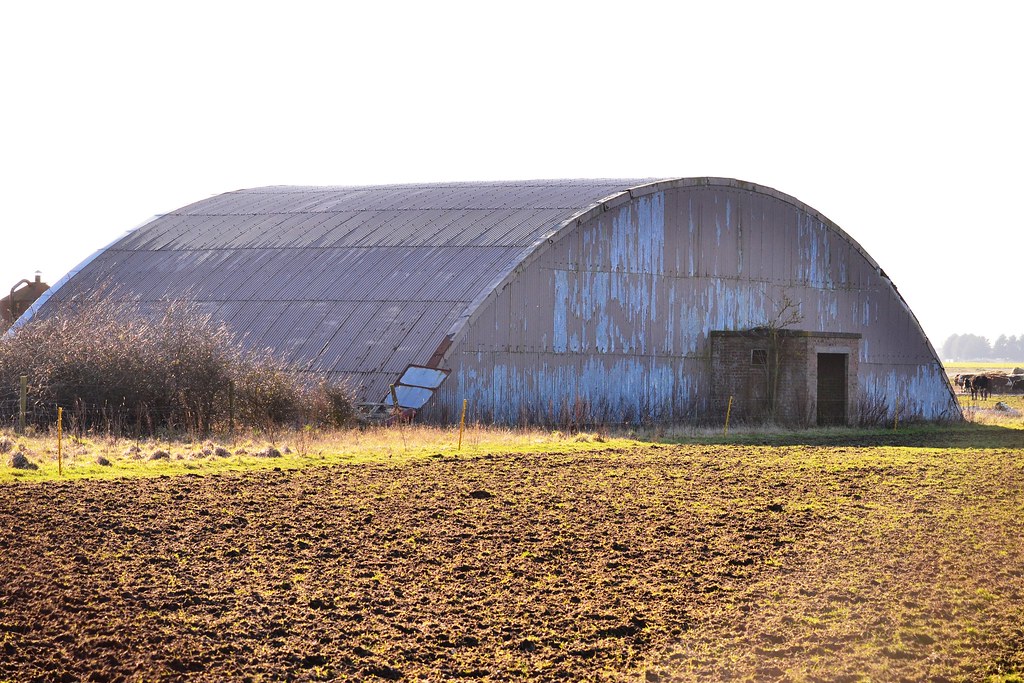
Since its closure, the runways have virtually all been removed, with only a few remnants of concrete left existing; the northern threshold of the main runway being used to store gravel and other road material. The largest and best preserved examples are two of the original T2 hangars, both used to store farm produce. A blister hangar is also on site but thought not an original of Little Snoring. Private flying now occurs on the sole remaining part of the runway located to the west. Part of the perimeter track forms the public road on the boundary of the eastern side of the airfield, and a small number of buildings, mainly huts, exist in private gardens used as storage sheds. The local caravan site has what is believed to be the base hospital and / or mortuary now a washing block.

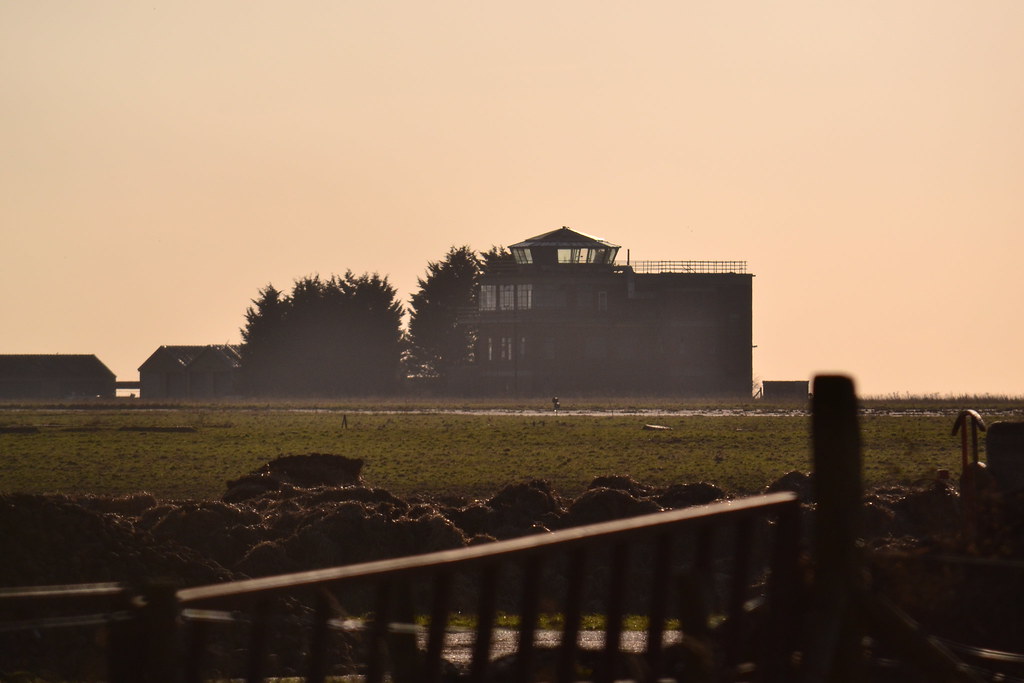
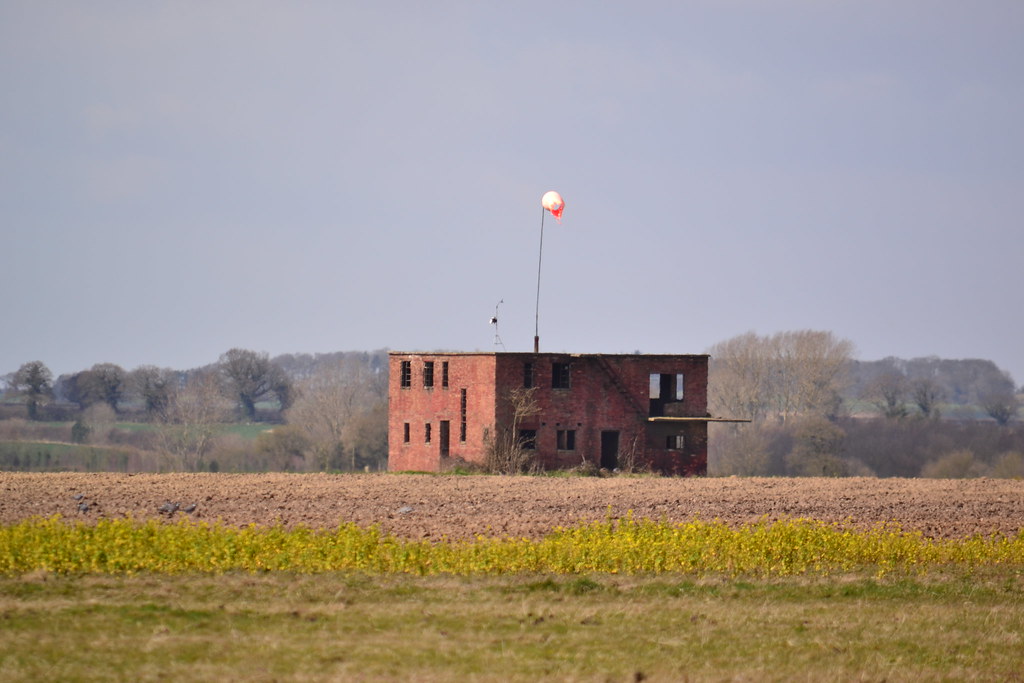
Little Snoring’s gem is its watch office, standing proud in the centre of the site, a lone wind sock fluttering from its walls. Run down and dilapidated, it is crying out for love and restoration, but I suspect this isn’t  going to happen and perhaps its days are very sadly numbered.

During its short operational life, twelve Lancasters and forty-three Mosquitoes were lost during missions over enemy territory and up until 2018, there existed no ‘official’ memorial in memory of these tragic losses. In July,  the Airfields of Britain Conservation Trust placed an airfield marker on the western end of the site, just beyond the runway’s threshold, that omission has at least been corrected.

The base commander, ‘glass eyed’ Group Captain ‘Bertie’ Rex O’Bryan Hoare (Sammy) was a known character and has been mentioned in a number of books discussing night intruder missions. He was a very successful Mosquito pilot  and looked up to by his fellow pilots. A superbly detailed account of him appears in ‘The Snoring Villages and is certainly worth a read. He sadly died in an air accident in 1947 in Singapore.

Little Snoring was by far a sleepy airfield. Those who were stationed here made the best use of what they had, and when the cold winter weather put paid to operational activities, recreational ‘sorties’ took over and the airfield came to life in other ways. Operationally, Little Snoring played a huge part in intruder operations, strafing airfields and interfering with German Night Fighter operations. Even Adolf Galland in his book ‘The First and the Last‘ acknowledges the extent to which 100 Group went to “set really difficult problems for the German Night Fighter Command”. A true accolade to any wartime airfield and the men and women who worked there.

Sources and further reading 

*1 National Archives AIR 27/890/15; AIR 27/890/16; AIR 27/1094/17; AIR 27/288/11; AIR 27/1981/31

*2 Ward C., & Smith S. “3 Group Bomber Command An Operational Record” Pen and Sword, 2008

*3 This is taken from the official Squadron Operational records, other sources including Chorley’s Bomber Command Losses state the crash was near to Broughton near Huntingdon.

*4 Bowman, M., “Battle of Berlin: Bomber Command over the Third Reich, 1943–1945” 2020, page 297 Pen and Sword (accessed via google books) 

Galland, A., “The First and and the Last“. Methuen & Co., London, 1955
The four award and honours boards in St. Andrew’s Church can be seen on the Flickr page.
A personal recollection of life at Little Snoring can be heard via the International Bomber Command Website.
The full story can be seen in Trail 22.

Little Snoring hardly the quietest of airfields! (Part 3)

In Part 2, 115 Squadron moved away from Little Snoring and the Electronic Warfare Group 100 Group took over. With that came a new type of aircraft, the Mosquito, operating as night intruders attacking enemy night fighters at their airfield. In this part, we see more new faces, a small detachment arrives, and a famous face is posted in.

The first of these new faces would appear over March and April, a small section comprising of only three aircraft (believed to be just two P-51s and a P-38) flying in American colours for training and trials with 100 Group. On March 24th, one of these aircraft would take part, somewhat unofficially, in the raid over Berlin. Flown by Major Tom Gates, he managed to get his name added to the operations board for that night, taking a P-51 to Berlin and back. During this epic flight, he apparently strayed over the Ruhr but the German anti-aircraft gunners failed to bring him down and he returned to Little Snoring unscathed by the first of several such experiences.*4

During mid April, Little Snoring was itself the subject of an attack from Luftwaffe aircraft, these intruders following the bomber stream home from a Serrate mission over Tergnier. According to operational records, the attack consisted of scattered bombs and cannon fire which caused no major damage nor casualties.

Another new face, this time for 515 Sqn, was that of Sqn. Ldr. Harold B. ‘Mick’ Martin of 617 Sqn fame, pilot of Lancaster ‘P – Poppsie‘. Whilst at 515 Sqn Martin would excel as a Mosquito pilot, strafing airfields, trains, railway yards and a flying boat base all in one night. He is also accredited with the shooting down of an unidentified aircraft and an Me 410.

But the bad luck that had shadowed Little Snoring crews would have the final say, when on April 11th, Mosquito DD783 flown by F.O. H. Stephen and F.O. A. Clifton spun from what was thought to have been a low level roll that went wrong. The manoeuvre led to a stall and spin at a height between 2,000 and 3,000 feet. Both airmen were sadly killed in the crash, the only 169 Sqn airmen to lose their lives whilst at the airfield.

Finally on June 4th 1944, both 169 Sqn and 1692 (Radar Development) Flight departed Little Snoring for pastures new. The move, hours before the D-Day landings being more than coincidental. The 3rd and 4th were given over to packing and moving equipment to Great Massingham, and only one early morning sortie was planned, but it had to be cut short when the aircraft developed engine trouble and hour or so into its flight over France.

With that, the two squadrons moved out and began to prepare for early morning flights over the Normandy coast in the early hours of June 6th 1944. Their short time at Little Snoring had been far from noteworthy, other than to say how badly the weather and lack of serviceable aircraft had dogged their early flying days.

515 Squadron who had moved onto the airfield just days after 169, would now be joined by 23 Sqn, also flying the Mosquito VI.   Both these squadrons would concentrate on enemy night fighter airfields, seeking them out and destroying enemy aircraft on the ground, a low level intruder role that 23 Sqn had performed well in the Middle East.

RAF Little Snoring

The watch office now derelict and forlorn.

The summer arrival brought a little light relief to those at Little Snoring. 23 Sqn who had arrived in two parties via Liverpool and Gourock, had previously been at Alghero in Sardinia. Their journey had not been the delight they would have wished for,  both ferries, the Strathnaver and the SS Moolton, being held outside the ports for over four days before staff were allowed to disembark. However, once at the airfield, seven days leave was granted and the majority of personnel left for London and a week’s recreation.

Training flights, night flying practise and target practice then filled their time with both squadrons taking part in firing practise over the Holbeach Range on the Wash. Compasses were swung on the aircraft and low flying became the immediate focus. Those crews undertaking night flying were amazed at the number of lights displayed at British airfields, the 23 Sqn adjutant describing them as ‘Pansy’ when referring to the Drem lighting system employed at many airfields at this time.

Sadly the poor weather returned and yet again many flights were cancelled at the last minute. Instead parties were held, and great merriment once again fell over the airfield.

On 5th June, ten sorties were carried out over night by 515 Sqn Mosquitoes. Airfields at Montdider, Rossieres, Ardorf, Varal and Marx being targeted. Further patrols were carried out over Wunstorf, Celle, Creil, Beavis and Courmeilles with bombs being dropped on some and vehicles set on fire at others. A road bridge and barge were attacked on the Vecht Canal and airfields at Twente and Plant Lunns were patrolled by two more Mosquitoes. Further patrols and attacks were undertaken using a variety of HE bombs and incendiaries. Other vehicles were also set on fire during these intruder raids. Two aircraft flown by, Sqn. Ldr. Shaw (the Flight Commander) and Sgt. Standley Smith (a/c 950), along with Flt. Lt. Butterfield and Sgt. Drew (a/c 189), took off from Little Snoring but neither were ever heard from again and were recorded as missing in action.

The remainder of June involved much the same, poor weather hampering night flying but where the squadron was able to get airborne, 515 patrolled numerous enemy airfields, attacking goods trains and destroying a small number of enemy aircraft. Some He 111s and Ju 88s were amongst those destroyed whilst attempting to take off. The month ended with 515 crews undertaking in excess of 415 hours night flying time and 48 hour daylight flying.

23 Sqn meanwhile were suffering the same disappointments with the weather, although this did not spoil the merriment, the adjutant reporting several parties occurring whilst the remainder of leave was taken and the last of the crews arrived from abroad. Some night sorties did take place, again trains were attacked and several airfields were bombed. A small number of aircraft were seen and attacked with some resulting in ‘kills’.

A small number of the Mosquitoes of both squadrons were modified to carry ASH, the American built airborne interception (AI) radars. By the end of the year training on the new equipment was in full swing as were the parties!

December brought a devastating blow for 23 squadron though, with the loss of their Commanding Officer W.Com. A. M. Murphy DFO, DFC and C de G with Palm. He had been in charge of 23 Sqn for almost a year and was both liked and respected by all those in the squadron. Air-sea patrols were carried out by the squadron in conjunction with the Air Sea Rescue Service but nothing was found of him, his aircraft, nor his navigator Flt. Sgt. Douglas Darbon. That night, the squadron was stood down and on the following day a party was held in which many attended from lunch time to well into the night – few were seen before lunch the following day. Within a few days, Murphy’s navigator took a turn for the worst, and applied for a posting out of the squadron. Much to his disappointment though he was offered an Operational Training Unit (OTU), a move he did not wish for nor relish.

On the 9th December a little lightheartedness crept into the squadron when two Canadian aircrew landed at the wrong base by mistake. Only when they were down did they realise their mistake and were immediately awarded the M.H.D.O.I.F. The adjutant doesn’t explain the acronym, but it is likely to be something derogatory!

The number of sorties being performed by the crews in 23 Sqn were reflected in their departures. With seven crews with between 50 and 65 flights on their logs, they were all lost as tour expired, the lack of crews now becoming an issue at the airfield.

The poor weather returned once more closing down the station on several occasions. More training mean that December had been the ‘heaviest’ training month since the squadron arrived in the UK. 23 Squadron’s first ASH sortie had to be scrubbed on the night of 18th, and was followed by the inevitable party and poker.

The 22nd saw two aircraft manage to get off the ground. Unfortunately these ASH equipped aircraft had no luck in seeking out the enemy. A Lancaster diverted from its own airfield made an appearance at the airfield on Christmas Eve and the crews were treated to one of Little Snoring’s magnificent parties, a party that needless to say, went on well into Christmas Day.

The squadron remained stood down for several days, but as December drew to a close further ASH equipped aircraft took part in sorties over occupied Europe. The year ended on a positive note though, and although the squadron had lost many experienced and well liked crews, they were looking forward to better weather and more operational flying.

In the last part, the war draws to a close, the military eventually pull out leaving the airfield to nature and new owners. Although there is no more military action, it is not yet the end of flying. Little Snoring is to live on for some time yet.
The full story can be seen in Trail 22.

Little Snoring hardly the quietest of airfields! (Part 2)

In Part 1, we saw how Little Snoring developed,  taking on the Lancasters of 115 Squadron with the radial engined MK.II aircraft. In this next part, they soon depart and ownership of the site takes a change and with it comes new aircraft, anew crews and a new role.

September for 115 Sqn would be much of the same for those stationed at the airfield. More training flights, interspersed with operations to Germany. As with other months, September would see further losses for the squadron. On September 6th, DS658 piloted by F/O. R. Barnes, ran off the runway on return from operations, the aircraft was so severely damaged it was considered beyond repair and used for spares. The crew fared much better though, with none receiving any injuries in the accident. A second incident occurred on the 14th when during crew trials on a new aircraft, the bomb sight jammed resulting  in the pilot being unable to maintain level flight. After ordering the crew into crash positions, the aircraft struck a bank a few miles from RAF Downham Market near to Magdalen station.  Six of the eight on board were killed, the two survivors sustaining serious injuries.

During this month, the HCU that had joined 115 Sqn at Little Snoring received a new posting, they would depart the airfield moving on to RAF Foulsham where they would carry on their role of training pilots for the Lancaster.

RAF Little Snoring

An air-raid shelter protected the personnel from attack.

In October, further operations to Kassel and mine laying in the West Frisians were badly affected due to six of the twelve aircraft being unable to take off. The first was affected by one of the air crew suffering airsickness; the second suffered a burst tyre which left it stranded on the perimeter’s edge; a third got bogged down in the mud trying to pass this one and three more got stuck behind these unable to pass or turn. The remainder of the aircraft got away safely though, and although carrying out operations satisfactorily, they encountered electrical storms over the target area which hampered the equipment on board. All these crews returned safely and there were no further mishaps

On November 7th, a near catastrophe was luckily avoided after Lancaster DS825 crashed on take off after one of its engines cut out part-way down the runway. After inducing a violent swing the bomber crashed causing its other engines to catch fire. Luckily there were no explosions and all the crew managed to escape the wreckage unhurt.

115’s last operation from Little Snoring would take place on November 23rd 1943, the day prior to its departure for RAF Witchford. Twelve Lancasters, six from both ‘A’ and ‘B’ Flights, lined up and revved their engines to take off speed departing once more for Berlin. With them  they took the usual mix of incendiaries and ‘cookies’, all destined to fall on Berlin’s streets. Two aircraft failed to take off and two returned early; one due to a faulty Gee set and the other a faulty air speed indicator. One of the returning aircraft dropped its payload on Texil, the other safely on unoccupied land before turning for home.  The remainder of the squadron continued on and successfully completed the operation, the attack being considered ‘satisfactory’.

With that, 115 Sqn’s time at Little Snoring had come to an end, departing the next day for RAF Witchford where it would continue the brave fight over Nazi Germany. On their arrival at Witchford, a new flight was immediately formed, ‘C’ Flight, and as a result new crew members would soon arrive.  Little Snoring meanwhile was about to see some major changes itself, not only in personnel and aircraft, but ownership as well.

On December 8th 1943, the station became the charge of 100 Group, the Electronic Warfare Group who had taken up residency elsewhere in this part of Norfolk.

100 Group were the last operational Bomber Command Group to be formed during the war, with a clearly defined role which was to provide night intruder support for bombing operations, and was headed by Air Commodore Edward Addison.  Like their counterparts at Great Massingham, Foulsham, North Creake, West Raynham and Sculthorpe amongst others, they would take part in electronic warfare and counter measures against enemy fighter operations. 100 Group, investigated a wide range of devises suitable for tracking, homing in on, or jamming enemy radars. With a wide rage of names; “Airborne Cigar“, “Jostle“, “Mandrel“, “Airborne Grocer“, “Carpet” and “Piperack“, they used both “Serrate” and “ASH” to attack the enemy on their own airfield at night before they could intercept the allied bombers.

With its takeover of Little Snoring, came 169 Sqn who had only been formed at Ayr just two months before. They received the Mosquito II, the remarkable twin engined beast from de-Havilland which was to perform well in its new role as Night Intruder. In support, came 1692 (Radar Development) Flight, also know as the (Bomber Support Training) Flight from RAF Drem, also in Scotland.

A few days later the two units were joined by a third squadron, 515 Sqn from RAF Hunsdon also with the Mosquito II and VI, and Bristol’s Beaufighter IIF.  All three would work in the area of Electronic warfare.

169’s departure from Ayr was marked with a very ‘successful’ party in the corporal’s mess, with contributions of £1.00 from officers and 2/- from non-commissioned ranks. The beer flowed well into the night, with many trying their rather shaky hands on the piano. Regular rallying on the squadron hunting horn brought the party goers back together and ensured the party spirit was maintained and kept going well into the night.

Norfolk’s wet and miserable weather greeted the personnel as they arrived over the next few days here at Little Snoring. Once they settled in, training flights were scheduled but many of these had to be cancelled due to the continuing rain and fog,

With talks by staff from Rolls Royce on engine handling and another on Bomber Command Operations and Tactics, December’s poor weather provided little time for flying. A reconnaissance was made of the Norwich pubs, and parties became the order of the day, Christmas leave was arranged and various quarters were decorated. As the mood lasted well into the New Year, the war had at least for now, come to a standstill.

On January 5th 1944, the monotony was broken when thirteen USAAF B-17s landed at the airfield by mistake, the American crews, much to the annoyance of those in residency, were given temporary use of the mess until they could depart some days later. Much ribbing by the locals  no doubt helped ease the burden of sharing their beer and alcohol supply.

Various flights did manage to take place in the meantime, using both the Beaufighter and Anson. Further talks were given by escaped POWs, who gave an interesting insight into what to expect if you were shot down over occupied territory.

Over the winter months, gliders were brought in for storage and maintenance, ready for the impending assault on the French coast. These were stored in hangars on teh western side of the airfield and moved prior to D-day.

On January 20th, the first operation finally took place, a Serrate flight over Northern Holland in support of the bombing of Berlin. Two Mosquitoes were detailed but one had to return shortly after take off as the aircraft’s skin began peeling away from the wing root. Those on board were ‘thoroughly disgusted with their bad luck’.

It was this bad luck that would dog the squadron for the remainder of the month. More cancelled flights, aircraft unserviceable and instruments failing during flights. It wasn’t until the 30th January that the string of bad luck would be broken when Sqn. Ldr. Joe Cooper and Flt. Lt. Ralph Connolly, shot down an Me 110, forty miles west of Berlin in Mosquito HJ711 (VI-P). This was the squadron’s first ‘kill’ of the war since being reformed. Utilising their AI equipment, they destroyed the aircraft with a 3 and 7 second burst of gunfire from 200 ft. The aircraft blew up causing the Mosquito to swerve so violently that it entered a near fatal spin. The crew were only able to pull out after falling to an altitude of 5,000 ft. All in all, they fell some 15,000 feet before recovering. Needless to say, there was huge jubilation when they returned, the aircraft being greeted by several hundred personnel at Little Snoring.

With two more kills in February, the tally of three would remain stagnant until mid April when a series of five more 110s were brought down. With three more in May, their total would stand at eleven by the time 169 Sqn were destined to leave.

RAF Little Snoring

The road uses the former eastern perimeter track, part of which is still visible to the side.

In the next part, a small detachment arrives bring further new types with them, a  famous face appears and bombers strike at Little Snoring.
The full story can be seen in Trail 22.

Little Snoring hardly the quietest of airfields! (Part 1)

In Trail 22 we revisit a former airfield that housed the mighty Lancasters of Bomber Command, one of the few Norfolk airfields to do so. It later took on the Mosquito, a model that remained here for the remainder of the war, taking part in the Night Intruder role, a role it excelled at.

This small and quiet village played host to some remarkable people and aircraft, it was an airfield that certainly didn’t reflect its name.

RAF Little Snoring

Little Snoring is, as its name suggests, a quiet village deep in the heart of Norfolk. Surrounded by beautiful countryside, it boasts a superb round towered church that holds a remarkable little gem of historical significance. Its history dates back to Anglo Saxon times, a time from whence its name derives.

Little Snoring

The Village sign reflects Little Snoring’s aviation history.

The airfield, located about 3 miles north-east of Fakenham on land  191 feet above sea level, was opened in July 1943 following a period of construction by the company Taylor Woodrow Ltd. It would during its history, house no less than five different squadrons along with several conversion units, development units and a glider maintenance section before being used for civilian flying in more modern times.

The airfield was originally opened over the period July / August 1943, quite late in the war, as a satellite for nearby RAF Foulsham. It had three runways: two constructed of concrete 1,400 yards in length, (01/19 and 13/31) and one (07/25) of 2,000 yards again in concrete. As with other Class A airfields its runways formed the typical ‘A’ shape, with thirty-six dispersal sites constructed around the perimeter. A bomb site lay to the north of the airfield, a fuel dump to the south and the accommodation blocks dispersed away from the airfield to the south-west. The airfield was built to accommodate 1,807 RAF and 361 WAAF personnel housed over eight dispersed domestic sites.

To accommodate the various squadrons and their aircraft, the airfield would have 5 hangars, two T2s, two Glider and a B1, all dotted around the perimeter of the airfield, Many of these were not finished when the first aircraft moved in.

Initially opening under the command of 3 Group Bomber Command, its first occupants were the rare Bristol Hercules engined Lancaster IIs of both 1678 HCU (Heavy Conversion Unit) and 115 Squadron (the first unit equipped with the model); formally of RAF East Wretham, who were to carry out night bombing duties, a role it would perform throughout the war.

Of the two units, 115 Sqn were the first to arrive, the advance party being led by F.Lt. W. A Major DFC on the 5th August 1943, from East Wretham. The main party, led by F.Lt. R. Howarson, followed the next day, with the rear party, led by P/O. M.G. Gladwell arriving on the 7th. During this time all flying operations were suspended allowing the squadron time to move and settle in.

115 Sqn was historically a First World War unit, forming in 1917 going on to see action in France in the following year. Post war it was disbanded only to reform again in 1937 in preparation for the second impending world conflict. It would go on to have the dubious honour of having the highest losses of not only 3 Group but the whole of Bomber Command as well – a title, which amounted to 208 crews,  not envied by anyone. *2

The two days following their arrival were taken up with flying training including bombing practice and air-to-sea firing before the first operations on the night of the 10th -11th August 1943.

Fourteen aircraft took off between 21:45 and 22:10 to attack Nuremberg, each aircraft carrying a mix of a 4,000lb ‘Cookie’ and incendiary bombs. Although much of the target was obscured by cloud, crews reported seeing many explosions on the ground along with fires being visible some 100 miles away.*1

Of those that departed that night one aircraft (DS684) had to return early due to the gunner’s economiser lead being unserviceable, with a second aircraft (DS665) failing to return and not being heard from again. Following a phone call received from RAF Detling in Kent, it was established that the aircraft had in fact crashed some 5 miles east of Maidstone, near to Hall Farm, Boughton Monchelsea in Kent*3. It would later be revealed that none of the crew on board had survived the crash.

With Italy crumbling, further pressure was applied to Germany’s ally through the bombing of both Milan and Turin; the might of the Lancasters now delivering their huge payloads on the two Italian cities.  It was during the Turin raid on the night of 12th August, that Flt.Sgt. Arthur Louis Aaron from 218 Sqn at RAF Downham Market, would earn a VC for his courageous effort in keeping his aircraft flying whilst seriously wounded.

RAF Little Snoring

One of two original T2 hangars still in use today. These have since been re-clad.

For 115 Sqn though, the night passed without mishap and all thirteen aircraft returned intact. The next few days saw no further operational flying, the crews undertaking training flights instead, a short relief from operations before they turned their attention northwards and the German rocket research establishment at Peenemunde.

Between 21:38 and 21:50, twelve Lancasters took off from Little Snoring taking a further combination of Cookies and incendiaries with them. Bombs were released  between 7,800 and 12,000ft, a level that just scraped the ceiling of the rising smoke. Of the twelve aircraft that departed, one was lost, that of DS630 ‘H’ flown by F/O. F.R. Pusey – none of the seven aircrew, who were only on their third operation, survived. This took the total of those aircraft lost in the first few days of flying from Little Snoring, to three, almost one per operation.

Another short period of training then followed, before they once again turned their attention to Germany and the capital Berlin.

Amazingly the Lancaster squadron would fair much better than many of its counterparts, particularly those flying Halifaxes and Stirlings, losing only one aircraft, DS630 to the enemy, unlike other squadrons, which were decimated by the Luftwaffe and air defences surrounding the German capital. Of the seven crew on board this aircraft, three were picked up after spending six days drifting in a dingy off the Dutch coast.

The remainder of August was much similar. Training flights and further operations, including mine laying off the West Frisians Islands and the French coast, saw the month draw to its end. Whilst comparatively quiet in terms of losses, the squadron was none the less racking up a steady score of ‘failed to returns’.

In August, Little Snoring would become one of those airfields that would bear witness to an incredible act of bravery one that like so many others would become one of those little known about stories of the war.

On the night of August 23rd – 24th 1943, Berlin was again attacked. On this raid Lancaster ‘KD802’ ‘M’ flying with 207 Sqn from RAF Langar, was attacked by a Ju 88 night fighter. The rear gunner, Sgt. R. Middleton, managed to return fire achieving some strikes on the enemy aircraft, which led to it catching fire and crashing. But Sgt. Middletons determined efforts did not prevent the enemy aircraft from getting his own hits on the Lancaster, causing a fire in both the starboard wing and fuselage. In addition t this, the tail plane and all its controls had also been damaged and the pilot was struggling to maintain control over the burning aircraft.

P.O. McIntosh ordered the bombs ditched at 22:49 hrs. With a lighter load he then turned for home in the hope of reaching home or at least safer territories. In a desperate effort to extinguish the fire, Sgt. Middleton then volunteered to climb out of the fuselage onto the wing, something that had been tried by others in similar situations, but it was a risky and daring challenge. The pilot P.O. McIntosh, refused to grant permission, fearing the the rear gunner would be lost in the strong winds, a risk he was not prepared to take.

Remarkably the aircraft reached the North Sea, McIntosh considered ditching the aircraft fearing its time was almost up, but before he could take action, the navigator announced that they had in fact reached England and the safety of home. Coming in from the north, the first suitable airfield they came across was Little Snoring.

Fuel was now low, and with the landing gear down one of the aircraft’s engines cut out, but using all his skill and training, McIntosh manged a successful and safe landing

The aircraft was written off, so extensive was the damage caused by the fire, but the crew were all safe and uninjured thanks due to an amazing feat of courage and determination by the crew to get the aircraft back home.

In part 2, 115 Sqn’s time at Little Snoring draws to a close. The Lancasters depart and a new aircraft arrives. With it, comes new ownership and a change in operations.
The full story can be seen in Trail 22.

2nd Lieutenant John C. Morgan – Medal Of Honour

On July 26th 1943, a dramatic and heroic act enabled not only the safe return of a badly damaged B-17, but also the majority of its crew, who no doubt, would have otherwise perished or at best, be captured and incarcerated. For his actions that day, the co-pilot, John C. Morgan Flight Officer (later 2nd Lt.) was awarded the highest military honour a US serviceman can receive – the Medal of Honour.

Born on August 24th, 1914 in Vernon, Wilbarger County, Texas, Morgan was the son of an attorney and the oldest of four children. At the age of 17 he graduated from Military school, going on to attend a number of further establishments including: the Amarillo College, the New Mexico Military Institute, a teacher college and a university, both in his home state Texas.  In 1934 he learned to fly, a passion that would shape his future.

john morgan page

Lieutenant John C “Red” Morgan of the 482nd Bomb Group with a B-17 Flying Fortress. (IWM FRE 2007)

After leaving education early , Morgan moved to Fiji where he worked on a plantation growing pineapples, staying there for four years until 1938. Still wanting to fly, he returned to the United States aboard the liner S.S.Monterey, where upon he tried to enlist in the US Army Air Corps. However, the Air Corps considered his education to be too poor, and so he was refused entry. With little alternative, Morgan sought employment in the booming Texas oil fields instead. A vast desert of oil pumps, Texas’ rich oil fields had begun what became known as the ‘Usher age’ – the start of the great period of oil.

In December 1939, Morgan married Margaret Maples in Oklahoma City, sadly though, the marriage would last just seventeen months. The cause of the demise of the union is not known, but it was whilst working in the oil fields that Morgan sustained a broken neck, an industrial accident that would potentially end all future prospects of work.

With his opportunities now restricted, in 1940, he attempted to join the US Army, and unsurprisingly was classified as medically unqualified for military service (graded ‘4-F’). Undeterred though, Morgan then tried an alternative route, enlisting in the Royal Canadian Air Force (RCAF) on August 4th, 1941. Somehow, Morgan manged to pass his medical gaining his place within the armed forces of Canada. Training at Saskatchewan and Ontario, he soon transferred to England and the instructor training site RAF Church Lawford. Following a spell  with the RAF, Morgan was awarded the rank of Flight Officer, a status he took with him on his transfer in March 1943 to the fledgling USAAF.

His initial posting would be flying in B-17s with the 92nd Bomb Group’s 326th Bomb Squadron, based at RAF Alconbury. The 92nd had only been activated a year earlier initially flying anti-submarine operations off the US coast. After moving to England in July\August, they carried out minor operations before taking on the training of replacement bomber crews. Major operations for the 92nd didn’t begin in earnest until the May 1943.

On his fifth mission, two months later, on July 26th 1943, John C. Morgan (s/n: O-2044877) would be co-pilot in B-17F #42-29802  “Ruthie II“. The aircraft, one of nineteen from the 92nd, was one of sixty from the 1st Bombardment Wing heading for the tyre plant at Hanover, when a canon shell ripped through the windscreen splitting the pilots head. The B-17 also suffered damage, the oxygen system to the tail, radio and waist gun positions was now inoperable. In the relentless attack that followed, the top turret gunner lost the use of both of his arms, one being completely shot off, as well as major injuries to his side; the intercom system was put out of action and several crew members had lost consciousness due to the lack of Oxygen.

Luftwaffe aircraft repeated their attacks, causing extensive injury and further damage to the B-17. The navigator, Keith Koske, tried in vain to assist the stricken top turret gunner, but in desperation, attached his parachute and pushed him out of the aircraft. Thankfully it worked, the gunner somehow survived the descent and was cared for by German surgeons until being repatriated n 1944.

Morgan meanwhile grappled with the severely wounded pilot, 1st Lt. Robert Campbell, who had by now wrapped his arms around the controls, to try and maintain level flight. Morgan, taking control, decided the protection of the formation was better than heading for home alone, and so for the next two hours he flew on holding the pilot back with one hand whilst steering with the other. Eventually, after completing the bomb run, the navigator came forward and gave assistance allowing the aircraft to reach the safety of England and RAF Foulsham. Sadly, 1st Lt. Robert Campbell died from his terrible injuries shortly after the severely damaged B-17 landed at Foulsham .

For his actions that day, Morgan received the Medal of Honour in the following December. The ceremony was presided over by Lt. General Ira C. Eaker. Morgan’s citation read*1:

The President of the United States of America, in the name of Congress, takes pleasure in presenting the Medal of Honor to Second Lieutenant (Air Corps) John Cary “Red” Morgan (ASN: 0-2044877), United States Army Air Forces, for conspicuous gallantry and intrepidity above and beyond the call of duty, while serving with the 326th Bombardment Squadron, 92d Bombardment Group (H), Eighth Air Force, participating on a bombing mission over enemy-occupied continental Europe, 28 July 1943. Prior to reaching the German coast on the way to the target, the B-17 airplane in which 2d Lt. Morgan was serving as copilot was attacked by a large force of enemy fighters, during which the oxygen system to the tail, waist, and radio gun positions was knocked out. A frontal attack placed a cannon shell through the windshield, totally shattering it, and the pilot’s skull was split open by a .303-caliber shell, leaving him in a crazed condition. The pilot fell over the steering wheel, tightly clamping his arms around it. Second Lt. Morgan at once grasped the controls from his side and, by sheer strength, pulled the airplane back into formation despite the frantic struggles of the semiconscious pilot. The interphone had been destroyed, rendering it impossible to call for help. At this time the top turret gunner fell to the floor and down through the hatch with his arms shot off at the shoulder and a gaping wound in his side. The waist, tail, and radio gunners had lost consciousness from lack of oxygen and, hearing no fire from their guns, the copilot believed they had bailed out. The wounded pilot still offered desperate resistance in his crazed attempts to fly the airplane. There remained the prospect of flying to and over the target and back to a friendly base wholly unassisted. In the face of this desperate situation, 2d Lt. Morgan made his decision to continue the flight and protect any members of the crew who might still be in the ship and for two hours he flew in formation with one hand at the controls and the other holding off the struggling pilot before the navigator entered the steering compartment and relieved the situation. The miraculous and heroic performance of 2d Lt. Morgan on this occasion resulted in the successful completion of a vital bombing mission and the safe return of his airplane and crew.”

(Whilst his citation notes July 28th as the day of Morgan’s action, the Hanover raid actually took place on July 26th and the citation is an error.)

Morgan receives the MOH from Lt. General Ira C. Eaker (IWM UPL 29867)

Morgan then returned to duty, undertaking further operations in a bomber over occupied Europe.

On March 6th 1944, Morgan would once again find himself in the thick of a heavy and prolonged battle over Germany. Flying withing a formation of 262 1st Bomb Division aircraft, it would prove to be another decisive day.

Morgan’s B-17. #42-3491 ‘Chopstick’, was flying with the 812nd BS, 482nd BG from Alconbury, when the aircraft was hit by flak over Berlin. The aircraft, which had been fitted with H2X , caught fire and exploded. Only four crew members were able to escape the fireball, Morgan amongst them. Once on the ground, their safety was by no means ensured, and very soon all four were captured by German ground forces. Morgan himself was incarcerated in Stalag Luft I for the next fourteen months. The remainder of the crew on board all perished.

For his actions and continued dedication to the Air Force, Morgan was rewarded with a promotion to the rank of 2nd Lieutenant, a move that occurred  in September 1944.

It is believed that this event made Morgan (who was now on his twentieth-sixth mission) the only known Medal of Honour recipient, to have been captured after receiving the Medal.

@IWM UPL 29865

#42-3491 ‘Chopstick‘ with Morgan on board. This plane is one of the original twelve H2X radar equipped pathfinders. Hit by 88mm flack near Berlin on 6th March 1944, the No.3 engine caught fire setting fire to the wing, causing the aircraft to explode and crash near Lake Havel, Berlin.  The plane was the lead bomber and Colonel Russell Alger Wilson, Commander of the 4th Bomb Wing, was onboard as Combat Leader. Wilson was one of the those killed in the explosion. (@IWM UPL 29865).

After the war Morgan remained in the new reformed air force, the USAF, serving in Korea until his retirement as a Lieutenant Colonel in 1953.

On January 17th, 1991 Morgan passed away, being was laid to rest at Arlington National Cemetery in Virginia, Section 59; Site 351.

The incredible story of Morgan’s bravery would form a part of the story line in the book and movie “Twelve O’Clock High”, when at the beginning, Lt. Jesse Bishop’s B-17 belly lands with a badly injured crew. (08:00 – 14:05).

Sources and further reading.

*1 The Congregational Medal of Honour website.

92nd BG website

B-17 Bomber Flying Fortress – The Queen Of The Skies website

Arlington National Cemetery website

RAF Foulsham – A Leader in Electronic Warfare. (Part 5)

Part 4 revealed how FIDO proved to be a valuable asset to Foulsham. A new model of aircraft arrived along with its US crews and the war entered its final year. Now, as the war draws to a close, the future looks uncertain.

FIDO’s record at Foulsham was, like many other airfields, a great success. Only on the night of 23rd February 1945 did fatalities occur whilst using the system. With several aircraft on ops that night, fog again prevented many from returning to their own bases, and a Mosquito from 239 Sqn based at nearby RAF West Raynham, attempted a landing without permission. FIDO had just been lit but some of the pipes had burst adding smoke to the fog that had by now risen to 50 feet above the runway. The pilot, 23 year old Flt.Sgt. Leonard Twigg attempted to land Mosquito NF.30 ‘NT354’ only to miss the runway and land some 70 feet to one side, colliding with a Halifax of 192 Squadron parked at its dispersal. The pilot was killed in the incident but the navigator (Flt Sgt. Turner) managed to escape with injuries. As a result only one other aircraft, a Halifax, landed that night, the others being diverted to alternative airfields.

Two other 192 Halifaxes were lost that night, both being shot down over Germany with the loss of almost all sixteen crewmen – the only three survivors being taken prisoner. Both Halifax MK. IIIs ‘DT-T’ and ‘DT-O’ carried British, Australian and other commonwealth crews.

But the events of the 23rd February would pale into insignificance on the next night- the worst on record for the Australian 462 Sqn. Considered ‘minor operations’, they were tasked with dropping window, flying ahead of seventy-four training aircraft who were acting as a diversionary raid over northern France. Four of the squadron’s aircraft were lost that night, with the loss of twenty-six of the thirty-one lives. A further 100 group aircraft, a B-17 from RAF Oulton was also lost that night, these five accounting for the bulk of the losses of that one operation.

The late spring of April 1945 produced further poor weather, and FIDO was brought into action once more (possibly for the last time) on the night of 18th/19th. The use of FIDO that night allowed some thirteen aircraft to successfully land, providing a safe landing for crews who were no doubt by now, looking to the war’s end and a apprehensive return to peacetime,.

By August 1945 the war in Europe was over and squadrons were already beginning to disband. The FIDO system was drained and dismantled after providing a safe take-off or landing for a considerable number of aircraft. For 462 Sqn, the 24th September 1945 signified the end of its road. Eleven months after its reformation at Driffield, it ceased to exist, being removed from RAF inventory for good. Its demise also signified the coming of the end of flying operations at Foulsham and ultimately its closure.

In June 1946 the airfield was closed to all flying duties, whereupon it became the final resting ground for a large number of Mosquitoes prior to scrapping. Foulsham then remained ‘in-service’ until the mid 1950s, with a US Army Special Signals Unit, until the MOD deemed the site surplus to requirements. It was then sold off in the 1980s and its doors closed for the last and final time.

RAF Foulsham

A former workshop nestled between two refurbished T2s.

Foulsham, like many of its counterparts in this region played a major part in the electronic war, monitoring and jamming radar transmissions for larger formations of bombers. Despite this important and ground breaking role, Foulsham had only a short operational existence.

Many of Foulsham’s buildings have surprisingly withstood the test of time. Whilst the runways have all but gone, now farm tracks and tree lines, some of the buildings do still remain and even from the roadside, you can see what must have been a remarkable place during its short, but hectic life. The road passes along the eastern side of the airfield, here, you can still see a number of the original T2 hangars, three in total, now utilised by a local potato business. (‘Addison Farm’ as it is aptly named, is in recognition of Air Vice Marshall Edward Barker Addison, the only person to Command 100 Group*2 during the war). Whilst two of these hangars have been re-clad, the third is still in its original metal. Hidden amongst these structures, are some of the original technical buildings, again some refurbished, some original. The mass concrete bases signify the manoeuvring areas linking this area to the main section of the airfield to the west.

At this point, there was until recently, gates separating the dispersal area to the east (now farm dwellings) to the hangar area on your left. During the War, this road was surprisingly open to the public and aircraft would be manoeuvred across the road, traffic being halted by an RAF Policeman.

Further to the north, beyond this area passing an air raid shelter, is the original entrance and further technical area. A pill-box, marks where the main entrance was. Turn left here and follow the road west. To your right you pass the original Fire Tender shed, a B1 hangar and other minor buildings in varying states of disrepair. To your left, a further T2, partially refurbished partially original. Further along, the road crosses the original N/S runway, full width remnants to the right and a tree-lined track to the left mark clearly where the enormous concrete structure was laid. The road ahead, is the where the 08/26 runway ran as it disappears over the brow of the hill. The road then turns away north leaving the runway and airfield behind you.

As with all airfields, the accommodation blocks and bomb stores were scattered well away from the main airfield. With some searching, evidence of these may be found amongst the hedges and trees, public roads utilising the concrete sections of RAF road laid down originally.

Whilst the main layout of Foulsham is difficult to see from the road, the last remaining buildings have fared quite well and remain some of the better examples of original wartime architecture. There is a distinct ‘feel’ to the site that transforms you back in time to the days when heavy bombers and lighter twin-engined aircraft would rumble along its runways. Recent and ongoing development work by the farmer seems to be sympathetic and ‘in tune’ with the site, many buildings being reclaimed from nature and now ‘on show’ to the passing public. Whilst all are on private land, they are easily seen and it seems that there may be a winning formula here that other land owners could quite easily follow and preserve what is left of our disappearing heritage.

RAF Foulsham

The remains of the 08/26 runway.

In the nearby village of Foulsham, beneath the village sign, stands a memorial to the crews and personnel who once served at RAF Foulsham.

The entire story of Foulsham can be seen in Trail 22.

Sources and Further Reading (Foulsham)

*1 Williams, G. “Flying through Fire – FIDO the Fogbuster of World War Two“. Alan Sutton Publishing, 1995.

*2 There is a 100 Group Association that keeps the memories of 100 group alive.  A number of Veterans from the group meet for reunions, coming from all over the world.

*3 The Congregational Medal of Honour Website.

*4 Bowman, M., “100 Group (Bomber Support)” 2006, Pen and Sword.

*5 National Archives: AIR 27/782/1

National Archives: AIR 27/1156/59
National Archives: AIR 27/1156/60
National Archives: AIR 27/1456/69
National Archives: AIR 27/1917/17
National Archives: AIR 27/1917/18
National Archives: AIR 27/1156/43

Sweetman. J., “Bomber Crew – Taking on the Reich“, Abacus, 2004

Janine Harrington, secretary for the Association, writes her own books based around 100 Group, read it through her blog.

Janine’s writings are inspired by her mother’s story of her wartime fiance Vic Vinnell of 192 Squadron at Foulsham, who, together with Canadian pilot Jack Fisher, never returned from a secret operation on the night of 26th / 27th November 1944.

The wartime memories project, has a section focusing on RAF Foulsham and people trying to trace crew members who served there. It is worth a look through perhaps you may know someone from there.