War makes men do terrible things to their fellow mankind. But through all the horror and sometimes insurmountable odds, courage and bravery shine through. Two gallant young men both in the same B-17 were awarded the Medal of Honour for acts of extreme bravery in the face of certain death.
Born on 3 June 1923, Arnett. Oklahoma, Donald Joseph Gott, began his air force career at the local base in 1943. By the end of the first year he had achieved the rank of First Lieutenant in the US Army Air Corps. Posted with the 729th. Bomber Squadron, 452nd Bombardment Group to Deopham Green, Norfolk, England, he was to fly a B-17 (42-97904) ‘Lady Jeannette’ along with his crew and co-pilot William E. Metzger.
Metzger was born February 9, 1922 – Lima, Ohio and by the time he was 22 he was a 2nd Lieutenant. He was to meet Gott at Deopham Green, Norfolk and together they would fly a number of missions over occupied Europe bombing strategic targets.
On the 9th November 1944, they took off with their crew on a mission that would take them into the German heartland to bomb the marshalling yards at Saarbrucken.
On this run, the aircraft, was badly hit by flak, three of the engines caught fire and were inoperable, the fires were so fierce that they were reaching the tail of the stricken aircraft.
Further fires within the fuselage started when flares were ignited, and this rapidly caught a hold. Hydraulic lines were severed and the liquid from within was jettisoned onto the burning fuselage. With communication lines cut and unable to contact the crew, both Gott and Metzger had some difficult decisions to make. They had not yet reached the target, the aircraft still held its bomb load and they were deep into occupied territory.
The crew too had suffered badly at the hands of the anti-aircraft fire. The engineer was wounded in the leg and the radio operators arm was severed below the elbow causing great pain and loss of blood. He would die very quickly if medical help was not found. Despite the quick thinking and application of tourniquet by fellow crew members, he soon passed out and fell unconscious.
Gott and Metzger decided that jettisoning the injured radio operator would not result in his receiving medical help and so they would drop the bombs and head for the nearest friendly territory where they could crash-land. Doing this, would risk not only the life of the operator, but that of the crew and themselves should the stricken aircraft explode.
Over the target, they released their bombs and flew alone toward allied territory. Flying low over the village of Hattonville, the aircraft was seen to swerve avoiding a church and homes. At this point, Metzger personally crawled through the aircraft and instructed the crew to bail out. Three chutes were seen by local people, two fell to earth and the third became entangled on the stabiliser and was trapped. A further three were seen moments later, all these escaped. Metzger decided to remain with Gott and try to land the aircraft with the radio operator on board. With only one working engine, Gott and Metzger brought the aircraft down through a series of tight turns and at only 100 feet from safety the aircraft banked and exploded. Crashing to earth it again suffered a second explosion and disintegrated killing all three crew members on board and the crew member still attached to the tail.
1st Lieutenant Gott and his co-pilot 2nd Lieutenant Metzger had shown great courage and determination to complete their mission, and to save their crew from certain death. They had shown the greatest of valour in what was to be the final act of their short lives.
Both men were killed on that day, November 4th 1944 aged 21 and 22 respectively. They were both posthumously awarded the Medal of Honour on the 16th May 1945.
Gott’s remains were returned to the United States and he was buried at the Harmon Cemetery, in Harmon, Ellis County, Oklahoma, USA. Metzger, was returned to his home town and was buried at Woodlawn Cemetery, Lima, Ohio.
Along with Gott and Metzger, crew members who did not survive were: T/Sgt Robert A, Dunlap and S/Sgt T.G. Herman B, Krimminger. The survivors were picked up by a a local field hospital and treated for their injuries: 2nd lt John A, Harland ; 2nd lt Joseph F, Harms ; S/Sgt B.T. James O, Fross ; S/Sgt R.W. William R, Robbins and T/Sg T.T. Russell W Gustafson.
A memorial now stands close to the site of the crash site.
Lt Raymond Harney (Photo courtesy of Tsymond Harney JR.)*1
A few years ago a story came to light that not only brought home the brutality of war but also the compassion found in war. It was of two American airmen whose World War II story finally come to a close 70 years after their death.
The two airmen, U.S. Army Air Corps 1st Lt. Raymond Harney (s/n O-523208) and U.S. Army Air Corps 2nd Lt. Warren French, (s/n O-2056584) of the 349th BS, 100th BG, were in a B17G (44-6306) over Germany on September 28th 1944, when they were hit by flak whilst on a mission to Merseberg. This would be their eighth and final mission.
Mission 652 involved a total of 342 B-17s which were sent to bomb the Merseburg/Leuna oil refinery and any additional targets of opportunity. During the operation, 10 B-17s were lost, 4 were damaged beyond repair and 251 damaged but repairable. Escort for the mission was provided by 212 P-51s of the USAAF.
B-17 ‘#44-6306’, was delivered to Kearney airbase on 28th June 1944, then moved to Grenier airbase, New Hampshire on 9th July 1944, for onward transport to the United Kingdom. It was assigned to the 349th Bomb Squadron, of the 100th Bomb Group, given the code ‘XR-G’, and based at RAF Thorpe Abbotts from the 12th July 1944.
The crew of #44-6306, assigned on the 28th August 1944, was: (Pilot) 1st Lt. Raymond E. Harney (Co-pilot); 2nd Lt. William R. Kimball (Navigator); 2nd Lt. Charles M. Hamrick (Bombardier); 2nd Lt. Warren. M. French (Top Turret/Engineer); Cpl. Thadeus L. Gotz (Radio Operator/Gunner); Cpl. Hubert J. Burleigh,Jr. (Ball Turret); Cpl. Melvin F. Cordray (Waist Gunner); Cpl. Robert C. Minear (Waist Gunner); Cpl James J. Sorenson, and (tail Gunner) Cpl. John H. Bundner. However, for reasons unknown at this time, for this particular mission, Gotz was not aboard, and instead S/Sgt. Jack D. Francisco flew as tail gunner and Cpl. Robert C. Minear flew as the Flight Engineer.
At 12:10, whilst over the target, the B-17 was hit in the number 2 engine by anti-aircraft flak. As a result, the engine caught fire, the aircraft withdrew from the protection of the formation, joining another formation further back, but began to fall back again when the number 4 engine was also feathered. Harney continued to fly the crippled B-17 for two hours after being hit, before finally deciding enough was enough and he ordered the crew to bail out. Being determined to save his friend and the aircraft, he also decided that he and the injured French, would remain and try to land the aircraft.
Outside of the village of Schwickershausen, to the north of another major target, Schweinfurt, Germany, they attempted a belly landing bringing the aircraft down in a turnip field. The B-17 slid across the ground, ripping off the port wing, causing a tremendous fire. Neither Harney nor French sadly survived the subsequent fireball.
Although he managed to get the crew to leave the aircraft, their safety was not guaranteed and sadly, three were killed by local police in the following days. An event not uncommon in Nazi Germany. Only two of the gunners, Cpl. Melvin F. Cordray, and Cpl. Robert C. Minear, survived as POWs.
What makes this story more significant than usual, is what followed after the crash.
The local people made a wooden cross in remembrance of the crew and they kept it hidden away in the local church for over 70 years.
The cross kept secret for so many years.*2
The large wooden cross, had the words “Hier ruhen in Gott! 2 amer. Flieger,” or “Here rests in God 2 American flyers,” engraved on it, along with details of the aircraft crash. On the 70th anniversary of the crash, 28th September 2014, a memorial service was held in the village of Schwickershausen. Following this, on 5th October, the cross was flown over to England in an American KC-135 Stratotanker from RAF Mildenhall, with two Luftwaffe Tornadoes escorting them over Germany. The cross was donated to the ‘Bloody 100th’ museum at Thorpe Abbots for safe keeping. A certificate was also handed over along with the cross signifying not only the now peaceful and co-operative alliance between the two nations, but the final closing of a chapter of the history of two crew members of the “Bloody Hundredth.”
The cross being transported in the Boom pod of a KC-135 Stratotanker. October 2014.*4
This is a remarkable story, and one that certainly stands out amongst the horrors and heroism of the Second World War.
Warren French’s memorial stone in Belgium*3
Lt. Raymond E. Harney’s Gravestone is at Ft. Snelling Cemetery in Minnesota, his remains are in the graveyard at Gemeindefriedhof Schwickershausen. Warren French’s headstone is in the Ardennes, Neuville-en-Cond, in Belgium.
Thorpe Abbotts airfield and museum is featured in Trail 12
After Part 3 of our journey, we see the US bomber airfield at Nuthampstead finally come to a close. But as the war approaches its conclusion, operations continue to be flown and losses continue to mount.
The US forces would go to Dresden the morning after the RAF had been. 431 B-17s of the entire 1st Bombardment Division, would prepare for take off at 07:00 hrs to be over Dresden at mid-day. With two other Divisions also in the air that day, escort would be from 784 Mustangs, with the 20th FG protecting the leaders the 1st Bombardment Wing, the 398th BG, followed by the 91st and 381st Bomb Groups respectively. In all, in excess of 2,000 American aircraft would fly into the heart of Germany that day.
It was to go disastrously wrong for the Group though, for even as they flew over Holland, they were already off course and now the weather was moving in. With their Gee system being constantly interfered with and throwing up faults, the lead plane of the 389th decided to take the more southerly route to fly around the cloud, taking the formation near to Munster, a city heavily guarded by flak. Although objecting to the move, both the 381st and the 91st followed – a move they would come to regret. The 91st were hit hard; many aircraft were damaged and their crewmen badly injured. Then, another defensive turn took the Wing, some 137 aircraft, a total of fifty miles of course. They were now heading to Schweinfurt, the scene of such devastation in August 1943 where high loses resulted the US temporarily ceasing air operations as a result. Not wanting to relive the experience, the formation then turned south again, taking them, and their escorts, even further off course.
By now, the leader’s Gee system had completely failed, and as the formation approached the target, the deputy’s system also ceased working. Lost and confused, they were gifted with a break in the cloud through which they could see an ancient city with a river running through it. The order was given and bombs were dropped. With little to no flak and no enemy fighters to resist them, the formation unleashed its devastating load onto those below. Unfortunately, it was not Dresden at all, but the Czech capital Prague, they were some eighty miles off course.*5
The 398th flew their final operation on April 25th 1945, a flight that took them to the Skoda Armament Works at Pilsen. The 398th were joined that day by the 91st, 92nd, 303rd, 305th, 379th, 384th, and the 381st Bomb Groups. With simultaneous operations happening elsewhere at Munich and the Me 262 airfield in Prague, 198 aircraft were flew to Pilsen to bomb the Skoda works.
In contrast to their first mission, take off was controlled and in good order. The first aircraft was airborne at 05:20 and the last 35 minutes later. Forming up took place over Debden Buncher (RAF Debden) at 5,000 feet and the Buncher was left at 06:40, when the entire formation headed for the coast. at 07:37, they crossed the French shoreline.*10
The 398th BG were tasked with leading the 1st Combat Bombardment Wing, totalling three Bomb Groups made up of 120 B-17s. In charge was Captain Michael Robinson, Commanding Offcier of the 601st BS. The weather was predicted to be good, so a visual bomb run was planned, however, over the target, this proved not to be the case and 10/10 cloud completely obscured the target. Forced to go round again, the formation made a 360o turn bringing them back in at the rear of the formation. By now flak had become both intense and accurate.
Two aircraft from the 602nd in the high squadron were hit. The first B-17G #42-97266 (K8-G, “Godfathers Inc.“) piloted by 2nd Lt. Allan Ferguson, quickly left the formation spiralling out of control. Three of those on board managed to escape the aircraft as it fell earthward. Of the crew, six were killed whilst two were captured becoming prisoners of war for the last remaining days of action*6*7
The second aircraft that day was that of Lt. Paul Coville, B-17G #43-38652 (K8-V, “Stinker Jr“). After the second bomb run, the aircraft was hit behind the #3 engine, leaving a large hole and a damaged engine. After falling out of formation and feathering the engine, Lt. Coville brought the aircraft back, at which point the engine caught fire. A small explosion then ripped the right wing off outboard of the engine, sending the aircraft spiralling towards the ground. The crew inside, frantically tried to get out, assisting each other with parachutes. All crewmen except the ball turret gunner S. Sgt. Charles Walker, manged to escape the aircraft, managing to find allied troops on the ground and safety.
During their search for safety both Coville and the waist gunner S. Sgt. Harry Overbough, took two prisoners each, Overbough’s ending up being revealed as escaped Jewish prisoners who had donned German army uniforms to help them escape. *7*8
After bombs away, the formation made a right turn and headed as briefed toward home, crossing the English coast at 14:26. The first aircraft touched down at Nuthampstead at 15:02.*10
With the last mission flown, Nuthampstead’s days were now numbered. A handful of ‘Revival’ flights were made transferring POWs from Barth in Germany to airfield A-10 in France. In addition, flights carrying ground crews over Germany also took place. By May 1945 though, the war was over and the exodus of American forces back to the united States began. Over the period May / June, 1945, the 398th would depart Nuthampstead, the ground force returning to the US from Greenock onboard the Queen Elizabeth, whilst the air personnel flew back between 21st and 27th May. After thirty days of rest and recuperation, the Group assembled at Drew Field, Florida where many officers and enlisted men were discharged from the service. The remaining handful were given duties elsewhere and transferred almost immediately.
A VE day service held at Nuthampstead airbase. (@IWM UPL 35448)
On September 1st 1945, Major Gene Nelson and Major Dean Ashworth, quietly and without ceremony, inactivated the Group – the 398th would be no more.
By the time the war had come to a close, the 398th had completed 6,419 operational sorties (175 missions) dropping some 15,700 tons of bombs. They lost some seventy*10 aircraft in operations. For their determination and outstanding flying over Derben on April 8th, the Group received a Presidential Unit Citation, this came in addition to 2,124 Air Medals, 531 DFCs, 2 Silver Stars, 18 Bronze Stars and 4 Purple Hearts (with others being awarded elsewhere). Whilst their losses were perhaps hugely significant compared to other Groups, they nonetheless performed gallantly and with dedication deserving of any military group.
Returned to RAF ownership a month later the airfield became a store and maintenance station storing ordnance for disposal, and by 1954 the military had no further interest in it, and it closed some 5 years later.
During the 1960s Nuthampstead was in the limelight once more when it was considered as a site for London’s third airport after Heathrow and Gatwick. Being so close to the capital made it an ideal proposition, but the proposal faced huge opposition from those living and working in the area. The decision would eventually favour Stansted, a site not even shortlisted in the initial phase.
The Roskill Commission Inquiry (1968-70), identified seventy-eight initial sites, reducing it to four possibles: Nuthampstead, Thurleigh (Bedford), Cublington (Bucks) and Foulness on the Essex coast, ignoring Stansted on grounds of air traffic, noise and poor road access.
After great debate, Cublington was finally chosen, however, following in-house arguments and disagreements, this was later overturned in favour of Foulness (Maplin Sands),*9 Nuthampstead being rejected on various points including most noise, most agricultural loss and the requirement of a rail link.
With work intending to start in the early 1970s, the plans were eventually shelved due to the 1973 oil crisis and instead a smaller proposal was put forward to build a site at Stansted, itself a former war-time airfield. The build eventually went ahead and today Stansted sees in excess of 15 million passengers, all of which could have been located at Nuthampstead.
With that, Nuthampstead was destined to be become farmland once more. The Forestry Commission planted tress in the former bomb store, itself leading to large quantities of munitions being discovered after the site was abandoned. A small strip was retained for karting and a small crop spraying business utilised part of the airfield. Much of this has now also ceased and whilst parts of the original runway and peri track concrete surfaces still exits, farmland prevails once more over the site.
Built mid war, Nuthampstead had a rather unfortunate start, with many serious problems for the 55th FG and their P-38 Lightnings. The 398th, the Group synonymous with the airfield, were a rookie Group but one that went on to perform 195 operations many over Germany, losing a number of aircraft and crews in the process. They took part in some the the war’s most ferocious battles including Schweinfurt on October 9th, Berlin on several occasions and the US Air Force’s last operation of the war, Pilsen on April 25th 1945.
Transferred back to RAF ownership post war it was a serious contender for London’s third airport, however, this was not to be and the airfield was largely removed, buildings were demolished and the runways were dug up for hardcore. Little remains of it today, a small private airstrip utilises some of the site, and a thriving museum continues to tell the story of those who served here. A stunning memorial stands outside the local pub frequented once by so many personnel who served here, at Nuthampstead, in those days of the 1940s.
The full history of RAF Nuthampstead can be read in Trail 32.
Sources and further information (Nuthampstead)
*1 Investigation of the US National Defense Program, Part 35. US Government Printing Office Available on Google books
*2 Fooy. F., “One of Thousands – A Navigator in the European Air War.” Lulu Publishing, 2015 Via Google Books
*3 Wilson. K. “Blood and Fears – How America’s Bomber Boys and Girls in England Won their War“. Weidenfeld & Nicholson, 2016 page 390
*7 “Hell from Heaven – Ch 35 – Mission 31 – Pilsen, Czechoslovakia, Our Last Combat Mission – April 25, 1945” published by Leonard Streitfeld, Bombardier, 600th Squadron on the 398th BG Memorial Association Website.
*8 MACR 14220
*9 Banister, D., “Transport Planning In the UK, USA and Europe” Taylor & Francis, 2003
*10 United States Army Air Forces, “The History of the 398th Bombardment Group (H)” (1945) World War Regimental Histories Book 124.
Missing Air Crew Reports 12214 and 12215
Ethell. J., & Price. A., “Target Berlin – Mission 250: March 6th 1944“. Janes, 1981
A good many photos, official records and personal stories are available on the 398th BG Memorial website. A great resource for those wanting to read more about the history of the 398th BG,
In Part 2 of this Trail, we saw how the 55th FG finally departed Nuthampstead having been dogged by mechanical problems. In this part, they are replaced by the 398th BG, a heavy bomber group who brought the B-17 ‘Flying Fortress’ with them. As ‘rookie’ crews though, their start may not have been the start they had wished for.
The new Group was a Heavy Bomber Group, equipped with B-17Gs, and would be the last Fortress Group to join the USAAF. Made up of four squadrons: 600th, 601st, 602nd and 603rd Bomb Squadrons (BS), the first personnel would arrive in Liverpool, on April 21st 1944, sailing on the USS Wakefield from Boston. Once at Nuthampstead, they would begin combat flights in a matter of days, their first mission taking place an May 6th that year.
Their journey to Nuthampstead had been a long one. Being activated on 1st March 1943 with a cadre from the 34th BG at Blythe, California. They trained hard, transferring to Orlando in Florida and then onto Spokane, Washington. In June 143, they transferred once more, this time to Rapid City, South Dakota, each time picking up new staff and crews as they went.
During training in the Autumn of 1943, the monotony of routine was broken when 2nd Lt. Thompson Highfill displayed courage and to assure the safety of his crew. After his B-17 suffered engine failure and complete wing disintegration, he ordered the crew to bale out, holding the aircraft as steady as he could whilst they made their escape. Too low to use his own chute, he made a wheels up landing, for which he was awarded the Distinguished Flying Cross, the first to the unit.
After further moves the unit was eventually war ready, and on March 24th 1944, the advance party began their journey to England. On April 22nd, the ground echelon arrived at Nuthampstead, the same day as the first section of the air echelon.
Having only been activated the year before, the 398th were a novice Group, but that would not prevent them operating against important strategic targets in Germany. These operations would include factories in Berlin, warehouses in Munich, marshalling yards in Saarbrucken, shipping facilities and docks in Kiel, along with oil refineries and aircraft production facilities in Munster. Thus even as a new unit, it would take part in some of the heaviest attacks on German industrial centres.
On May 6th, the 398th went into action for the first time, and like other newbies, it was a disaster. Although these missions were not seen as full missions (flying the full complement of aircraft and crews) they were nevertheless important in the development of the crews, honing their skills and allowing them to begin gelling as a close knit crew.
The morning started badly when breakfast was delayed. The take off as a result was also late with departures being badly timed. Forming up was ‘less than tidy’, with ten of the eighteen aircraft forming up on the wrong formation or in the wrong place. Once over the target, the ‘V’-weapons site at Sottevast, cloud prevented the bombers from seeing the target and so they returned without dropping a single bomb. Their inauguration had been far from successful but looking at it positively, there were no loses and all aircraft returned unharmed.
The rest of May saw the Group fly to Berlin no less than four times, in addition to targets at Kiel, Saarbrucken, Ludwigshafen, Ruhland and Dessau in Germany. They also flew to several targets in both France and Poland meaning there had been no let up for the novice flyers.
During the lead up to D-day, the 398th would attack coastal defences along the Cherbourg peninsula, softening up defences for the invasion forces who were about to land along the Normandy coast. These and other targets in France would dominate the early weeks of June, whilst July saw a return to the homeland and targets deep into Germany once more.
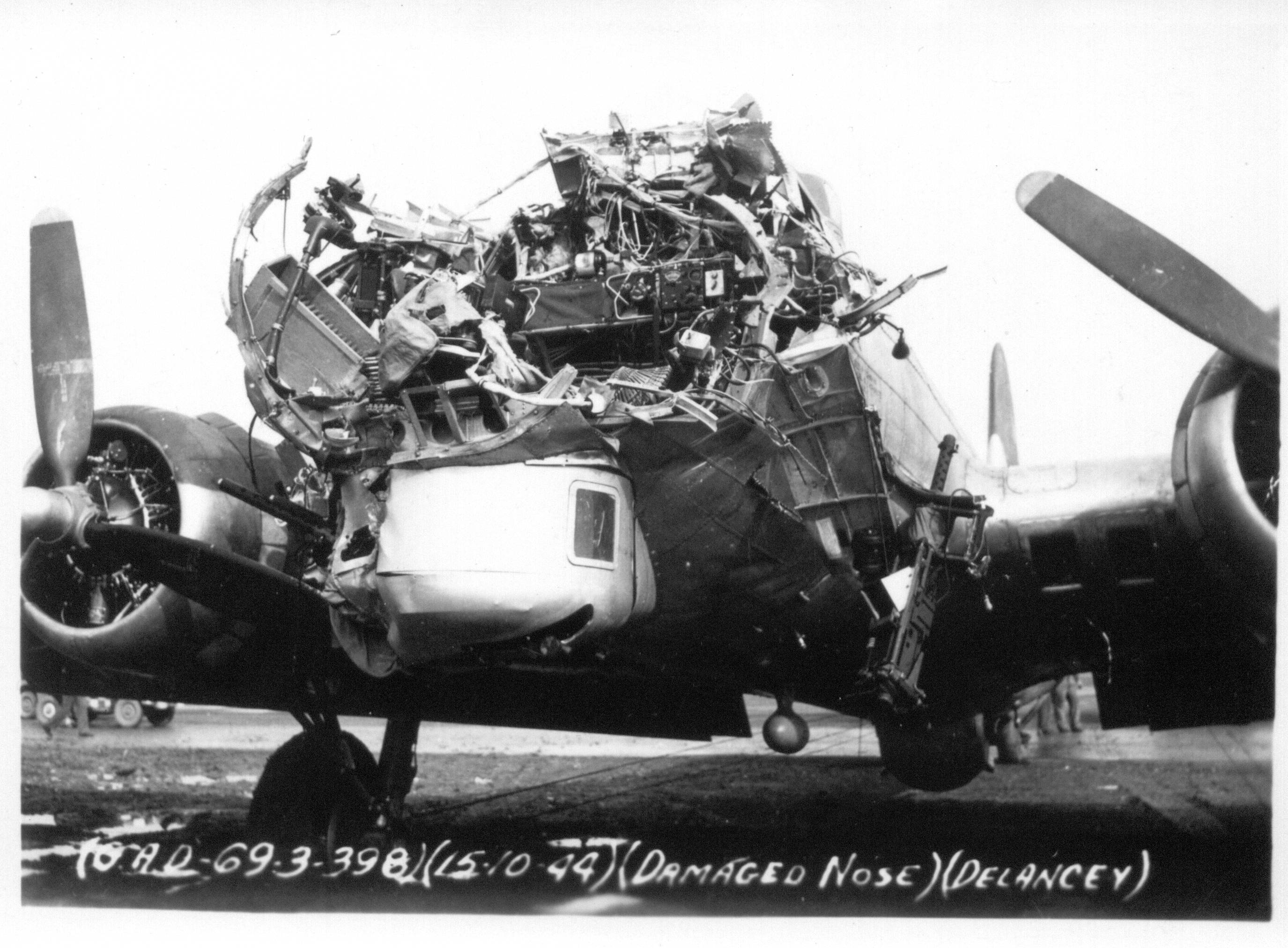
October 15th brought the true realities of war to the Group when a flak shell hit B-17G #43-38172 in the nose exploding inside the aircraft. The Toggler/bombardier, Sgt George Abbott, was killed outright, and the instruments were all but obliterated. With no oxygen and the nose barely recognisable, the pilot 1st Lt. Lawrence DeLancey, managed to bring the B-17 home thus saving the lives of the other crewmen on board.
B-17G #43-38172 “2 Sad Lovely Julie” hit in the nose by flak, killing the bombardier outright. (@IWM UPL13907)
For his actions, Lawrence De Lancey was awarded the Silver Star, Lt. General Doolittle’s letter citing the “sheer determination and tenacity” of De Lancey in bringing the aircraft and remaining crew home safely.
Christmas 1944 saw no easing up for the crews. On Christmas Eve, orders came through for every available bomber to be airborne. The winter of 1944-45 being one of the worst saw ground forces take a pounding in the Ardennes by a desperate last attempt at a breakthrough by the German land forces. Taking advantage of the fog and mist that had prevailed, air cover was limited for the allies but as soon as a break occurred, they would return in large numbers. That break occurred momentarily on the 24th.
Over 2,000 bombers of the Eighth Air Force, (which included 500 RAF and number of bombers from the Ninth AF) took to the skies that day, the largest Eighth Air Force operation to assemble over enemy territory in history.
The flyers did not experience mass opposition, in fact it was insufficient to make a difference, and so the operation fulfilled its objective of destroying supply links and disrupting airfield operations. On the way home, the bombers were faced with encroaching haze, many UK airfields becoming closed in and closed to landings. The 1st Air Division (formally 1st Bomb Division) were faced with a thick fog that forced them to land elsewhere, the 398th coming in at Ridgewell along with the 351st and Ridgwell’s normal residents the 381st. Christmas for the crews would be spent away from their England home that year.
On 3rd February 1945, the 1st AD were part of a force attacking Berlin again, lead by the 91st BG with Lt. Col. Marvin Lord, the group Operations manager who was chalking one up, never having flown to Berlin before, he took over from the normal lead pilot who was on a short pass.
As the formation neared the initial point (IP) over Lehmke, near Gardelegen, the formation began to close up causing extensive turbulence from prop wash. Before the bombardiers took over, aircraft jostled for positions ensuring their safe place in the group. At this point, it took two pilots to control the buffeting aircraft, as they were thrown about the sky within the ever tightening formation. Ninth in line were the 398th BG led by 1st Lt. Perry Powell in B-17G #43-38697, of the 603rd BS.
Affected by this powerful prop-wash, Powell decided to drop back and in doing so he got too close to the low squadron. His automatic reaction was to lift the nose of his heavily laden B-17, a reaction that caused the air-frame to suffer extreme stress, stresses that caused the fuselage to split open around the ball turret, sending the powerful front end into the front of Lt. John McCormick’s B-17 #42-97387 of the 602nd BS. The collision cut away the nose of the second aircraft. With no parachutes or safety straps, the navigator 2nd Lt. Second Lieutenant Bruce Phelps fell to his death.
Now no longer flyable aircraft, both B-17s began to fall, spiralling toward the ground and their inevitable fate – of the two crews, only three were seen to escape that day.
Out of Perry Powell’s aircraft, #43-38697, eight were killed, only the tail gunner S.Sgt. Joe Bancroft survived becoming a prisoner of war. From John McCormick’s B-17, #42-97387, only he and the Bombardier, Bill Logan, survived, seven losing their lives in the tragic accident that marred the operation that day*3, *4.
Later that month, on the 13th, the 398th would take part in the hugely disputed attack on Dresden, a combined force of Allied aircraft that would drop in excess of 4,500 tons of bombs on a city whose conditions led to a firestorm that killed more than 25,000 inhabitants.
In the last part we see how Nuthampstead’s war comes to a close. The airfield no longer required eventually closes, but not before it enters a great debate about its future and possible expansion.
The full history of RAF Nuthampstead can be read in Trail 32.
In Part 1, we looked at the construction of Nuthampstead and were introduced to the 55th FG, the first residents of the airfield. There had been a good start to their war, but things were about to take a turn for the worst.
Two days later, the 55th were again joined again by elements of the 20th FG, swelling their number into the fifties. A shortage of Lightnings had meant that the bulk of the deliveries had gone to Nuthampstead, leaving the Kings Cliff Group to fly along side the 55th until their own numbers had reached full capacity. However, very soon after take off that day, mechanical problems struck several of the Lightnings and they were forced to return. Forty-seven aircraft then continued on to their rendezvous point, but the Liberators of the 2nd BD were nowhere to be seen. Extremely low temperatures then caused further issues with the Allison engines and several more P-38s were forced to abort the mission and return home empty handed. By the time the bombers were located, the 38th FS were the only ones about, and the sixteen aircraft of the squadron began to protect their bigger friends from a swarm of attacking 109s and 190s.
Once back at Nuthampstead, claims were once again put in with a loss of none of their own. Apart from ongoing mechanical issues, the war was going well for the 55th.
On the 13th however, the gremlins struck again and this time they struck hard. The 55th were ordered to protect the 1st, 2nd and 3rd BD bombers to Bremen. Before they had even reached the bombers, three had to return due to mechanical problems with the engines and yet again, the extremely cold temperatures and humidity made flying difficult and the possibility of further problems more likely. Both engine issues and a determined fighter attack took its toll on the 55th, with seven aircraft failing to return that day, five being shot down and two lost from suspected engine problems that were by now dogging the Group.
These gremlins then reared their ugly heads again on the 29th, and once more it was over Bremen. Flying out over the Dutch coast the flight was attacked by a swarm of FW 190s, with full drop tanks and heavily laden, the Lightnings suffered badly once more with another seven P-38s failing to return to Nuthampstead.
Ongoing losses had meant that by the end of the month a third of the Group’s aircraft had been lost, either on operations or as a result of crashing on their return – the failings of the Lightning were now showing themselves in dramatic style. Poor performance at higher altitudes, where the bombers operated, seriously curtailed the ability of the engines to perform even satisfactorily. Oil turned to sludge and pipelines froze often leading to a catastrophic failure of the engines. Over the winter of 1943-44, over half the P-38 losses experienced were put down to the engine’s inability to cope with the moisture and freezing temperatures of the European skies. Compounding this, poor heating for the pilots led to immense discomfort, and even frost bite for some. Lengthy flights were taking their toll not only on the aircraft’s performance, but also the pilots ability to fight the better equipped enemy.
The new year of 1944 brought new challenges to the 55th. The mechanical problems of the Lightning continued, even with the introduction of the newer ‘J’ model, major engine problems prevented it from becoming the fighter it was designed to be, and as a result, losses continued to grow.
In February, the infamous ‘Big Week’ operation took place, the intended mass destruction of the German industrial region along the Rhine. The 55th offered a supporting role to the bombers but by no means was it a front row seat.
In March, after much speculation, the 8th Air Force turned its attentions to Berlin once more, a target that had been previously planned but scrubbed before take off, raised its head again. An initial flight in the first hours of March led to nothing more than failure after many bombers took too long to form up and subsequently returned low of fuel, those that did get away were forced to return due to cloud. On the 4th, another attempt was equally affected with many aircraft forced to attack targets elsewhere. But even after the recall was given, a small number of bombers did get through dropping the first, but totally ineffective, US bomb on the German capital. With them, acting as escort, were the P-38s of the 55th FG, Led by Lieutenant-Colonel Jack S. Jenkins, commanding officer, who would become the first US fighter pilot to reach Berlin. Although the operation was a failure, it would nevertheless be a milestone in America’s part in the war.
Lt. Col. Jack S. Jenkins, of Levelland, Texas, in his P-38 “The Texas Ranger.” (#42-67074) Jenkins was the first US fighter pilot to fly over Berlin. (@IWM FRE 2425)
On the way in, Jenkins and his companions in the 38th FS, had received hits from flak, and as usual, were suffering from engine trouble, so much so that only half the 38th made it to the target area. Flying in his later P-38 “Texas Ranger IV” (#42-67825), Jenkins failed to locate the bombers and upon turning for home, had to outrun a number of enemy aircraft at low level. When the story of his achievement hit the headlines it was both big news and a welcome morale booster for not only the 55th, but for the US forces in general.
Sadly, Lt. Col. Jenkins, the ‘hero’ of Berlin, would only fly for a further month following his flight over the capital, being shot down on April 10th, in the same P-38 “Texas Ranger IV” he had flown so well. He survived the incident but was captured and taken prisoner by the Germans, whether they knew of his achievement or not is not known.
On the day following the Berlin operation, March 6th, the USAAF returned to ‘The Big ‘B”. The 55th were again to be a part of the operation, directed to protect the bombers on their return leg of the mission. Once at the rally point north of Berlin, the bombers began their flight home seeking the protection of the forty-seven P-38s that the 55th put up. Once over enemy territory though, the gremlins that had now played almost as big a part in the war as the Group, reared their heads once more and sixteen of the aircraft developed faults forcing them, and an escort for them, to return home. It had been a black time for the 55th.
In the following month, a new model of the P-38 would emerge, the ‘Droopsnoot’ P-38, a fighter bomber version of the Lightning. Both the 20th FG and the 55th FG flew the version on this day, thirty-four of them being from the 55th. But the ‘Droopsnoot’s’ arrival would also mark the departure of the 55th from Nuthampstead, along with the simultaneous arrival of a new and very different Group.
Their time at Nuthampstead had been mixed. Scores of enemy aircraft had been claimed but many good airmen had been lost, and the aircraft they flew had proven to be less than perfect in the cold, damp European skies. But as the 55th left, the bombers of the 398th Bomb Group (BG) took over operations with the heavy bomber the B-17 Flying Fortress, this would be the aircraft and Group that Nuthampstead would become synonymous with.
Nuthampstead and the 55th FG in particular had suffered badly. Mechanical issues and caused untold damage and many losses in aircrew. Now it was time for them to move on and for a new group tp arrive at this Hertfordshire airfield. With departure of the 55th, came the Heavy Bomber Group the 398th.
In the next part, we travel along with the 398 BG as they take the war to Germany. But as new crews, things do not initially go their way, their first operations being ‘untidy’, a trait that inevitably leads to losses.
The full history of RAF Nuthampstead can be read in Trail 32.
Nuthampstead airfield is located in Hertfordshire, 5.5 miles south east of Royston and a short distance from the village that gave it its name. As an American airfield, it was given the designation Station 131, to hide its true location from the enemy, and was controlled mainly by the 8th Air Force’s 398th Bomb Group (BG).
The airfield itself was opened in 1943 with a US investment of over $2 million*1 and was the American’s nearest airfield to London. Built late in the war by construction workers of the 814th and 830th Engineer Battalions of the US Army, it used rubble brought in from the bomb sites of both London and Coventry. Nuthampstead was a Class A airfield with three intersecting runways of standard lengths; one of 2,000 yards, and two of 1,400 yards, and each the standard 50 yards wide. The Pinnacle of the ‘A’ pointed easterly, with the main runway running north-east to south-west, with the second and third runways running roughly north to south and east to west; all three were of a tarmac-covered concrete construction. The surrounding perimeter track contained some 50 spectacle hardstands and linked the airfield to two T2 hangars.
The technical area, located on the western side of the airfield, housed a wide range of technical huts and buildings including the watch office of a 12779/41 brick and reinforced concrete design; AM bombing teacher; photographic block; fuel compound and a Dinghy block along with a collection of typical wartime airfield buildings. Whilst most of these were Nissen huts, there were also both Romney and Seco huts on site as well.
As with all Class A airfields the accommodation sites were dispersed away from the main airfield to protect those on the base from air attack. These covered twelve separate areas capable of holding just short of 3,000 personnel. These sites were also standard designs and included: two communal areas, two WAAF sites, an Officers site, sick quarters, and both an airmen’s and sergeants’ quarters. All accommodation blocks were Nissen design with both ‘Jane’ and Romney hutting also being evident. As was common with all temporary built dwellings they were cold and not very homely.
Perhaps the one saving grace for those stationed here was that the technical site was connected to the accommodation site by a road that passed the Woodman Inn, a 17th Century pub that became very popular with those stationed here. The pub currently contains a number of photos and memorabilia relating to the airfield and a separate excellent museum can be found at the back of the pub’s car park. In addition to the draw of the local pub, personnel stationed here were provided with a baseball field, basketball courts, volleyball courts, a football field and even a rodeo, all of which led to Nuthampstead having the 8th Air Force’s champion basketball team ‘Frank’s Yanks’.*2
The baseball team, captained by Lt. Irwin Cohen, achieved a total of 34 consecutive wins against teams from the 1st, 2nd and 3rd Air Divisions as well as teams from various Fighter Groups of the 8th. They won the Eighth Air Force Championship on March 4th 1945.
By the time construction was started, gas attacks were seen as a much lower threat than they were at the beginning of the war, and as such, decontamination centres were now being built out of Nissen huts rather than the more sturdy thick walled brick designs used at the start of the war. Nuthampstead featured such an example, designed to drawing number 6517/42, it was an 18 bay Nissen hut combining all the facilities needed for decontamination should a gas attack occur. One of each of these was located at both Site 2 and Site 3.
Primarily a bomber station, Nuthampstead was initially operated by the 55th Fighter Group (FG) between September 1943 and April 1944, who flew the P-38 twin-boomed Lightning and later the P-51 ‘Mustang’.
The 55th were constituted on November 20th, 1940 being fully activated in January the following year. In May of 1942, they were converted from their initial fighters the P-43, to the P-38 whereupon they began training on the new type. A year later, over August and September 1943, they moved to England and were assigned to the US 8th Air Force and Nuthampstead.
The first personnel of three squadrons, the 38th Fighter Squadron (FS), 338th FS and 343rd FS travelled across the Atlantic from McChord Field in Washington, arriving at Nuthampstead in August. Preparations then began for the remainder of the Group and the airfield was re-designated Station 131 under the US naming system.
Their arrival in the Autumn of 1943 marked the arrival of the P-38, a 1939 design that soon gained devastating notoriety in several theatres of war.
The P-38 was a long range fighter that excelled more in the Far East than it did in the European theatre, but with this aircraft, the 55th FG claimed not only the honour of being the first fighter group to fly this long range aircraft, but also the first US fighter to fly over Berlin once long range tanks had been added.
The first of these aircraft, the improved P-38H, arrived in October with two groups, the 55th being one and the 20th FG at Kings Cliffe being the other. Whilst the ‘Lightning’ had previously been based in England in 1942, teething problems and modification work prevented them from actively taking part in any operational flights, being dispatched to North Africa before becoming fully operational in Europe.
Thus the 55th, were the first fully operational group, taking flight on October 15th when they undertook fighter sweeps along the Dutch coast, an uneventful flight it nevertheless marked the first operation of the type in Europe.
Previous problems with the type, notably around the aircraft’s mechanics, had not been fully resolved however, but that didn’t stop operations to the continent taking place. On November 3rd, the 55th performed their first deep penetration flight, escorting B-17s and B-24s of the 1st, 2nd and 3rd Bombardment Divisions in an attack on Wilhelmshaven. In the bomb run, the flight was attacked by Me 109s and FW190s, the 55th immediately joined in and claimed as many as six aircraft destroyed and several damaged. Their second mission had been a success, there had been no losses and several enemy aircraft were claimed as shot down – morale was riding high.
In part 2, we see how the 55th FG’s luck begins to run out, and how ongoing mechanical problems hamper operations. Losses would begin to mount up.
The full history of RAF Nuthampstead can be read in Trail 32.
Numerous churches across England have beautiful and ornate stained glass windows, many depicting stories from the Bible, some simply as decoration and some describing the lives of Saints, heraldry or angels. They are from a wide range of periods and cover a range of styles, although in each, lead framing provides the medium in which the glass is held together to form the window as a whole.
Each one is made from delicate and fragile glass, and although very decorative, they are vital to the churches integrity and to prevent water ingress. The oldest in-situ window dates back to the 12th Century, but fragments of glass have been found dating as far back as the 7th Century, when they were excavated at two monastery sites in both Monkwearmouth and Jarrow, both in Northumbria, in Northern England.
However, with the decline in the need for stained glass windows, the skill of making them has also declined. Thankfully though, due to the need for restoration and demand from modern churches, some skilled professionals do still make and restore these delightful pieces of art.
Stained galls windows have also been used more recently in the post war period as memorials to various bases, squadrons, and personnel who were lost during the Second World War, and these are just as ornate and delicate in their design as their original forbears.
A more recent example, and probably the most intricate one I’ve seen, is the memorial window in the Norman church St. George’s, Anstey, in East Hertfordshire, not far from the former RAF Nuthampstead, previously an American bomber base and the airfield to which it applies.
The window itself – dedicated in 2000 – was designed by Patrick Reyntiens, himself a veteran whose artistic career includes work at Westminster Abbey, Coventry Cathedral and the Washington Cathedral in Washington DC. He took his inspiration for this window from the Old Testament, in particular the journey of the Israelites out of Egypt, and when designing the window, split it into three separate panels.
The right panel depicts a pillar of fire, which led the Israelites by night. It is intertwined with B-17s utilising the fire to show the chaos and violence from which the crews emerged after their daylight bombing raids. Each B-17 shows the tail identification letter and the red wing and tail stripes of the 398th BG. The left panel portrays a pillar of smoke, from Exodus in the Old Testament, which led the Israelites by day, and again depicts the B-17s of the 398th as they perform their daylight operations. The centre panel, is a series of flying butterflies, mainly in silver, and symbolise the flight and transformation of the soul after death; something that occurred to all squadrons and bomb groups of the allied Air Forces. A close look at the window will reveal several of these butterflies are yellow, each forming part of a huge cross whose arms stretch out across the top of the window encompassing three birds.
What is particularly significant about these butterflies is that twenty-eight of them hold the names and squadron number of all those who lost their lives whilst serving with the 398th BG at Nuthampstead.
In all, there were 278 men killed on operations, with a further 10 either killed on base or in transit from the States, and another 7 killed whilst training in the United States – 294 personnel in total.
One of the many butterflies that hold the names of those lost at Nuthampstead.
St. George’s church was itself involved in the war when a B-17 from nearby Nuthampstead crashed into the castle mound located behind the church. No major damage was done to the church as the aircraft’s bombs did not explode, but, windows were blown damaged, the remnants of which are visible today.
The church can be found in the small village of Anstey, just south-west of the airfield site. To accompany the window, a booklet, free to visitors, has been complied by two, now very grown up, children of former 398th BG crewmen, Lee Anne Bradbury and Randy Strange. The booklet details every name on the window with details of its precise location within the butterflies. It also details each mission and loss statistic including those lost on training or whilst not on operations. It is a very useful and valuable addition to this amazing window.
After leaving the open expanses of Deopham Green and the roar of Snetterton, we head to a very remote and quiet airfield. Quiet and remote for a very special reason. From here, crews would experience top-secret flights, we would see a link to one of America’s greatest and most powerful families, and from here, the RAF would strike another blow at the heart of the Gestapo. We head to RAF Fersfield.
RAF Fersfield (Station 140/554)
29th August 1946. Photograph taken by No. 541 Squadron, sortie number RAF/106G/UK/1707. English Heritage (RAF Photography).*1
Originally built as a satellite for RAF Knettishall, RAF Fersfield was built-in late 1943. The third Class A airfield on this Trail, its main runway ran along a NE-SW direction, was 2,000 yds in length and was constructed of concrete. There was a second and third runway each of 1,400 yds running N-S and E-W, again of concrete. Fersfield had two T-2 Hangars, one to the north side and one to the south, and 50 loop dispersals for aircraft storage. The bomb dump was located to the north, the technical area to the south and the accommodation blocks to the south and south-west. Fersfield would eventually be able to accommodate up to 2,000 personnel of mixed rank and gender.
Initially, the airfield was called Winfarthing and designated station 140, it was then handed over to the USAAF who would rename it Station 554.
Fersfield was specifically chosen for its remote location as, unknown to those who came here, it was going to play a major role in the battle over Europe.
The first residents were a detachment of the 388th Bomb Group (BG) who were then based at Knettishall, and consisted of four bomb squadrons: the 560th, 561st, 562nd and 563rd. A detachment specifically from the 562nd, were brought here to perform special operations and research into radio controlled bombs using war-weary B-17s and B-24s. These special flights taking place between July 12th 1944 and 1st January 1945.
The 388th were unique in many ways. Aside from their work in radio controlled flights, they were also the only unit in the USAAF to not have formal squadron identification codes. However, after VE day and the end of hostilities, wireless transmitter codes were applied to aircraft under the left wing preceded with the aircraft’s individual letter as a prefix. This then, gave a unique four letter identification on each aircraft. Similarly, the various aircraft used as remote controlled aircraft had the top surfaces of each wing and tailplane painted white for recognition purposes. *4
An original T2 Hangar now stores grain.
Operating as Operation ‘Aphrodite‘, the idea of these operations was to remove all operational equipment from the aircraft, fill it with around 20,000 lb of ‘Torpex’ and fly it by remote control, into a specified target such as ‘V’ weapon sites, submarine pens (Operations Crossbow and Noball) or similar high prestige targets that were otherwise difficult to destroy .
Both the USAAF and USN were carrying out these trials. The Navy, also using Fersfield, called their operations ‘Anvil‘ and used the PB4Y (the Navy version of the B-24 ‘Liberator’) as their drone.
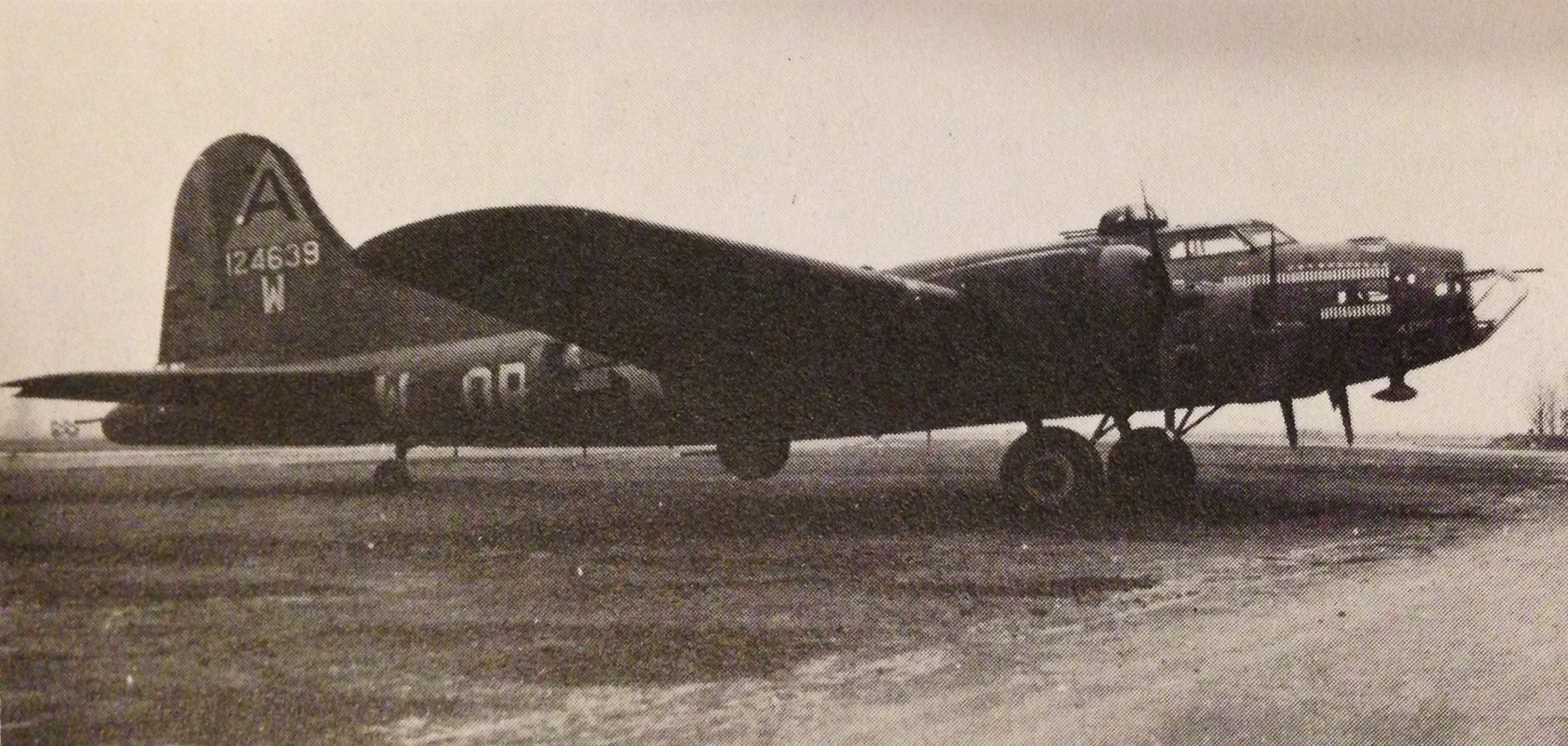
The first Aphrodite mission took place on August 4th 1944, and was to set the tone for all future operations. Mission 515, was flown using four B-17 ‘babies’ with four accompanying ‘mothers’ to target ‘V’ weapon sites at : Mimoyecques, Siracourt, Watten, and Wizernes. Escorting them were sixteen P-47s and sixteen P-51s. One of the babies, B-17 (#42-39835) ‘Wantta Spa(r)‘ (TU-N), had completed 16 missions between November 18th 1943 and July 6th 1944 with the 351st at Polebrook, and was declared to be “war-weary”. It took off but very quickly the crew – Lt J. Fisher and T/Sgt E. Most – realised there was a problem with the altimeter causing it to climb too quickly. Whilst T/Sgt Most bailed out, Lt. Fisher struggled on with the controls until it finally crashed in an almighty fireball in woodlands at Sudbourne, Suffolk, creating a crater 100ft wide. The three remaining ‘babies’ carried on but all failed to hit their designated targets. One Mother lost control and the baby hit a Gun Battery at Gravelines, the second overshot and the third B-17F formally (#41-24639) “The Careful Virgin” (OR-W) of the 91st BG (323rd BS), hit short due to controller error.
B-17F “The Careful Virgin” before modification and whilst in the hands of the 91st BG. (USAF Photo)
Similar results were to follow in another mission only two days later, and then again in further operations throughout both the Aphrodite and Anvil projects.
The most famous tragedy of these missions was that of Lieutenant Joseph P. Kennedy Jnr, who was killed when his PB4Y unexpectedly blew up over Suffolk killing both him and his co-pilot on 12th August 1944.*2 In all, there were twenty-five drone missions completed, but none successfully hit their designated target with either control or accuracy. The missions were all considered failures and the operations were all cancelled soon after.
Former Operations Block south of the Technical site.
Another secret operation taking place from Fersfield, also involved radio controlled bombs. Designated Operation ‘Batty‘ it involved GB-4 television controlled bombs being slung underneath B-17s and guided onto targets using TV. The 563rd BS provided much of the support whilst the other squadrons in the 388th BG, the crews. In the later part of 1944, a small number of these operations were flown again with little success and this too was abandoned before it could have any significant effect on the war.
All in all, the operations carried out here, were disastrous, killing as many crews and causing as much damage to the UK as it did the enemy. However, it did mean that the Allies had entered into the drone war and set the scene for future military operations. In all, there were 19 Aphrodite missions and 6 Batty operations carried out from RAF Fersfield.
The Americans left Fersfield toward the end of 1944, and it was then handed back to the RAF. A number of units used it for short periods, primarily for aircrew training, but none for major operational flights. However, it was not the end for the airfield, as Fersfield was to have one last remarkable mission and a further claim to fame.
Nissan Huts on the former accommodation site.
One of those squadrons who came here was 613 (City of Manchester) Squadron, who arrived at Fersfield on November 20th 1944. They were one of the twenty-one Royal Auxiliary Squadrons, and were considered the ‘baby’ of the Auxiliary Air Force by the other units. Formed on 1st February 1939 as part of No. 22 (Army Cooperation) Group, under Fighter Command, they were initially created with Hawker Hinds and a few Avro Tutors. It was then with another biplane, the Hawker Hector, and the monoplane the Lysander, that they moved with to France, early in the war to attack German gun positions and drop supplies to troops trapped in Calais by the advancing Wehrmacht.
613 performed a mix of roles, from Air Sea rescue operations from Martlesham Heath, to spraying lethal gas on troops in the event of an invasion, they moved from airfield to airfield gradually exchanging their older obsolete aircraft for more modern fighters as they went. They would take on both the North American Tomahawk followed by the incredible Mustang. It was with these aircraft that they were to escort the Venturas of 487 Sqn in their disastrous attack on the the Amsterdam power station in which Leonard Trent was awarded the VC. A mix up in rendezvous times meant the Venturas went on alone to the target, and thus paid the price for not having an escort with them.
In mid 1943, 613 Sqn operated from Snailwell near Newmarket, after which the ground personnel were sent to Sculthorpe and the aircrew to Lasham in Hampshire. This was to train all the personnel on the new Mosquito that the squadron was about to receive.
On joining the 2nd Tactical Air Force, they began attacks with their ‘Mossies’ on ‘Noball’ targets, and locomotives operating on the continent. It was at Lasham that 613 would become part of the newly formed 138 Wing, which would move soon after to Swanton Morley, but not before performing a very secret and daring mission.
Flying at very low level, they were to bomb the Kunstzaal Kleizkamp Art Gallery in the Hague, a former gallery turned Gestapo records office. Here documents relating to Dutch citizens for executions, deportation to concentration camps or labour camps were kept, and so it became a vital target for the wing. The operation was a total success, the building being all but demolished whilst nearby Dutch properties remained completely untouched.
The unit operated both on D-day, and supported the Americans in the Ardennes, flying through poor weather to strafe enemy ground troops who were trying to break through the American lines.
In November, the squadron moved to the continent in support of the allied forces whilst a small detachment of Mosquito VIs arrived here at Fersfield. They remained here until 7th August 1945, taking part in training flights, the last flight out taking place on August 5th 1945. At that point the squadron was disbanded the personnel transferring to 69 Squadron until their service ran out.
However, it was on March 21st 1945, that the crews of 613 Sqn would reunite with 487 Sqn, when the three Mosquito VI units of 21 Sqn (RAF), 464 Sqn (RAAF) and 487 Sqn (RNZAF) – now part of 140 Wing – were pulled back from the continent for a special mission to attack the Gestapo Headquarters at Copenhagen. Previously based at Hunsdon, the mission was Led by Gp. Capt. R. Bateson and Sqn. Ldr. E. Sismore, who took off in Mosquito RS570 ‘X’ at 08:35 and led a group of Mosquitoes in three waves of 6 aircraft in Operation Carthage.
The Shellhaus building raid gained notoriety for two reasons. Firstly, a large part of the building was bombed and destroyed and important documents were set alight, thus achieving the overall objective of the mission; another low-level, daring raid, it was operationally a great success.
However, Mosquitoes following the initial wave, attacked what they believed to be the target building, but it was in fact, a school masked by fire and smoke. This attack caused a significant number of unintentional civilian casualties including children at the school.
Six aircraft failed to return from the mission, four Mosquitoes (one of which crashed causing the smoke and fire that masked the school) and Two P-51s that were part of a twenty-eight strong fighter escort.
This operation was one of many daring low-level raids that the wing carried out, attacking various prestige targets including the Amiens prison. Together with 138 Wing, the Mosquito under the charge of Basil Embry, more than proved itself as a successful low-level bomber aircraft capable of delivering high precision attacks on pin-point targets.
The aircraft eventually left Fersfield which signified the end of overseas operations for the site, and Fersfield would become a staging post for units prior to disbandment. Between November 1944 and September 1945 a number of units would be located here which included: 98 and 107 (one week each); 140 (four days); 180 (one week), along with 226, and 605 Sqns. Operating a number of aircraft types including: Mosquitoes (T.III), Bostons (IIa), Hurricanes (IV), Martinets (TT.III), Mitchells (III) and Anson Is, Fersfield had now had its day, and in the last months of 1945, the site was closed and the land was sold off. Fersfield had closed its door for the last time and history had been written.
Post war, Fersfield had a brief spell of motor racing on its tracks and runways, but unlike Snetterton or Podington it would not last, and in 1951 Fersfield became agricultural once more, with many of the buildings being demolished and the remainder left to rot or, some thankfully, used for storage.
A few buildings remain on the technical Site.
Today a few buildings still do remain clinging onto life. The T-2 on the south side stores grain, and a number of Nissen huts that housed the technical aspects of the airfield, are now storage for farm machinery and other associated equipment. All these can be located at the end of a small road from the village, and when visiting, I found the workers here only too willing to allow the visitor to wander freely among them. Footpaths cross the southern side of this site and to the north across the field dissecting the airfield. The path is very poorly marked and you are simply wandering across the crops. From here, you can find the last few remains of the accommodation site, further south a short distance away. Latrines and other communal buildings are shrouded in weeds, gradually disappearing beneath the undergrowth. Trees sprout from between the walls where so many walked before or after a mission. Nissen huts survive further out, now dilapidated and hastily patched, their memories mixed amongst the personal belongings of new owners.
One of the many Latrines on the communal site.
It is hard to believe that an airfield with such an iconic history such as Fersfield never made it to the high status of so many others, as surprisingly, it was here in this quiet and remote part of Norfolk that aviation history was made and American politics changed forever.
Squadrons that stayed at Fersfield in the last months of the war.
98 Sqn – Arrived here first, on April 18th 1945, remaining here until December 18th that same year with the Mitchell. They were disbanded at this point.
605 Sqn – Arrived 25th April 1945 staying until 31st August 1945 as a detachment of Mosquito VIs. They were then disbanded and renumbered as 4 Squadron.
226 Sqn – Joined 605 at Fersfield on 27th April 1945, also as a detachment but with Mitchell IIs. They too were disbanded on September 20th that same year.
180 Sqn – stayed here between 7th June and 14th June 1945, a weeks break from their airfield at Achmer to where they returned.
107 Sqn – Arrived at Fersfield a month later on 3rd July, also staying for one week with Mosquito VIs coming across from France to where they to returned.
140 Sqn – Stayed here between the 9th and 12th July 1945 with Mosquito XVIs, whilst en route from Eindhoven to Acklington.
Mosquito Mk.VIs involved in the Operation Carthage,*3.
No 487 Squadron
RS570 ‘X’
Gp Capt R N Bateson / Sqn Ldr E B Sismore (Raid Leader)
PZ402 ‘A’
Wg Cdr F M Denton / Fg Off A J Coe (damaged, belly landed at base)
PZ462 ‘J’
Flt Lt R J Dempsey / Flt Sgt E J Paige (hit by flak, 1 engine u/s, returned safely)
PZ339 ‘T’
Sqn Ldr W P Kemp / Flt Lt R Peel
SZ985 ‘M’
Fg Off G L Peet / Fg Off L A Graham
NT123 ‘Z’
Flt Lt D V Pattison / Flt Sgt F Pygram (missing)
No 464 Squadron
PZ353
Flt Lt W K Shrimpton RAAF (Pilot) / Fg Off P R Lake RAAF
PZ463
Flt Lt C B Thompson / Sgt H D Carter
PZ309
Flt Lt A J Smith RAAF / Flt Sgt H L Green RAAF (Flt. Lt. Green’s first given name was “Eric” known to all as “Les”, a common abbreviation in Australia. H.L. Green is used in the ORBs)*5
SZ999
Fg Off H G Dawson RAAF / Fg Off P T Murray (missing)
RS609
Fg Off J H Palmer RAAF / 2nd Lt H H Becker RNorAF (missing)
SZ968
Wg Cdr Iredale RAAF / Fg Off Johnson
All aircraft took off at 0840; last back landed 1405.
No 21 Squadron
SZ977
Wg Cdr P A Kleboe / Fg Off K Hall (missing)
PZ306
Sqn Ldr A F Carlisle / Flt Lt N J Ingram
LR388
Sqn Ldr A C Henderson / Flt Lt W A Moore
HR162
Flt Lt M Hetherington / Fg Off J K Bell
No 21 Squadron records list only these four aircraft and crews above as taking part in this operation.
All aircraft took off at 0835; the three which returned did so at 1355.
Sources and further reading.
*1 Photograph in Public Domain, taken from Wikipedia 20/8/15
There are many memorials and murals around the world dedicated to those who lost their lives or served on wartime airfields fighting the Nazi tyranny. In the UK these amount to hundreds if not thousands, and every now and again, one springs up and looks stunning.
At Conington, the former RAF Glatton, now a training airfield which utilises one of the three original runways, is one such mural, dedicated to those of the 457th Bomb Group who served with and flew missions from the airfield between February 21st, 1944, until April 20th, 1945.
Glatton airfield was built in the last months of 1942, by the 809th and 862nd Engineer Battalion (Aviation) of the U.S. Army, as a class ‘A’ airfield, and would be of a standard size and shape catering for some 3,000 men and women of mixed rank.
The only units to use the airfield were the four bomb squadrons: the 748th, 749th, 750th, and 751st Bomb Squadrons of the 457th Bomb Group, 94th Combat Bombardment Wing of the 1st Bombardment Division. Flying B-17s, they would take part in some of the most horrific battles of the air war, losing some 729 personnel as either killed, missing or taken prisoner, dropping just short of 17,000 tons of bombs in 237 missions.
After training at Rapid City Airfield in South Dakota, the 457th would enter the war with a real baptism of fire. On Monday 21st February 1944, the combined forces of the USAAF and the RAF were involved in the ‘Big Week‘ campaign. Officially known as Operation ‘Argument‘, it was designed to smash the German aircraft industry in one fell swoop. For an entire week the allies pounded the industrial regions of the Rhine, as one of the war’s biggest joint operations, it didn’t nevertheless prove to be as definitive as planned.
They would attack ball bearing plants, aircraft factories and oil refineries. Helped prepare the way for the invasion and took part in Mission 311, on April 22nd 1944, a mission that became famous for the operation in which US forces lost more aircraft to enemy intruders than at any other time in the war.
They would also attack coastal defences, railways, fuel depots took part in the attacks at St. Lo.
Many special visitors would also be seen at Glatton airfield, including in March 1944, YB-29 #41-36963 ‘Hobo Queen‘*8 which took off from Salina Airbase in Kansas piloted by Colonel Frank Cook, as part of a plan to ferry B-29s to China to bomb Japan from airfields there.
On April 20th 1945, the 457th flew their final operational mission, attacking the marshalling yards at Seddin, to the south of Berlin. With the end of the war just around the corner there was little resistance from either ground forces or the Luftwaffe, none of the 457th aircraft taking hits or suffering any damage, it was virtually a ‘milk run’.
Following VE day, the 457th flew POWs back from Europe to England, then with no further action to undertake, the airfield was handed back to the RAF’s No. 3 Group under the control of Bomber Command operating both the Avro Lancaster and Consolidated B-24 Liberators flying out to the Middle East.
By June the war for the 457th was over. The men and machines were transferred back to the United States with the aircraft leaving Glatton between May 19th and 23rd, and the ground echelons sailing on the Queen Elizabeth from Gourock in Scotland, at the end of June. After arriving at New York there was 30 days rest before the men assembled at Sioux Falls. Here the axe fell and the 457th was no more, the four squadrons being disbanded for good and the Group removed from the Air Forces inventory.
Glatton itself was eventually closed and the site was then sold off in 1948, mostly returning to agriculture.
Since then, a training company has taken over part of the airfield, T6 Harvard Ltd, a small light training company, have operated out of Glatton since 2021 providing flying training for pilots on a variety of aircraft including both Chipmunks and Harvard aircraft.
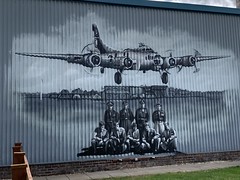
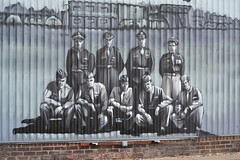
On the side of one of their buildings is a mural, painted by Nathan Murdock, a Peterborough artist, who created the design as a commission by the company owner Julie Churchill, and depicts a Lockheed/Vega B-17G-70-VE Fortress, #44-8557 of 748th Bombardment Squadron on its 234th mission, April 18, 1945. On board that day and depicted in the painting are: Roy Truba; Craig K Winters; Joseph Taylor; William Thistle; Luther Smith; Louis Domato; John H Taylor; John Miller and Harvey Henkel.
This crew was the last 457th crew to sustain a loss in the war when the aircraft was hit by flak over the marshalling yards in Freising on April 18th, two days before their last mission. Following the strike, the crew safely parachuted from the damaged plane, but Sgt. John T. Miller, the engineer, was killed. The rest of the crew landed safely but were soon captured and taken prisoner by the Germans. All were liberated by allied forces ten days later.
The mural was completed and then dedicated on August 19th, 2021 by the U.S. Air Force Col. Abe Jackson, EUCOM JAC commander, who said “Today symbolises an opportunity for us to recognise the significant contributions of those Airmen who came before us,”*1
The mural can be easily seen behind the clubhouse, which also has a display of photographs and memorabilia relating to the 457th and their time here at Glatton. It is a stunning piece of art work, not least of all becasue it is painted onto corregated metal, and is well worth a visit if you are in the area.
The mural depicting the crew and B-17 #44-8557 can be seen behind the clubhouse.
457th Bomb Group crew in 1945. Back row left to right: Roy Truba (Bombardier), Craig K Winters (Navigator), Joseph Taylor (Co-Pilot) and William Thistle (Pilot). Front row left to right: Luther Smith (Tail Gunner), Louis Domato (Radio Operator), John H Taylor (Ball Turret Gunner), John Miller (Flight Engineer) and Harvey Henkel (Right Waist Gunner). (Names taken from an original photo on the American Air Museum website).
RAF Framlingham (Parham) otherwise known as Station 153, achieved a remarkable record, or rather one man in particular did. His name was Hewitt Dunn, a Master Sergeant in the U.S.A.A.F and later the U.S.A.F.
Known as “Buck” he would achieve the remarkable record of completing 104 missions with the 390th Bombardment Group (Heavy) – a record that astounded many as life expectancy in a heavy bomber was short, and few survived beyond one tour of 30 missions.
Hewitt Tomlinson Dunn (s/n 13065206) was born on July 14th 1920. He progressed through school to join the Air Corps where he was assigned to the 390th Bombardment Group (Heavy), 13th Combat Wing, 3rd Air Division, Eighth Air Force, as a gunner in December 1943.
His first mission was with the 569th Bombardment Squadron in the following January. He completed his first gruelling tour of 30 missions by April that year, upon which he immediately applied for a further tour that he would complete by the summer of 1944. His attitude of ‘its not over until its won’, would see him accept a further remarkable third tour, virtually unheard of for a heavy bomber crew member.
On Friday, April 6th 1945, mission 930, an armada of aircraft of the U.S.A.A.F would strike at the marshalling yards in Leipzig, Germany. Inside B-17 #43-38663, ‘The Great McGinty‘, was Hewitt Dunn.
After the mission Dunn described how earlier at the morning briefing, he, like so many of his colleagues, had been a little ‘nervous’. Then, when the curtain was pulled back, their nervousness was justified, Leipzig – the 390th had been there before.
Many crews in that briefing would look to Dunn for signs of anguish, if he remained steady and relaxed, they knew it would be ‘easy’, if he sat forward, then it was going to be a difficult one. The atmosphere must have been tense.
Luckily, unlike other missions into the German heartland, this one turned out to be ‘just another mission’ a ‘milk run’. Much to the huge relief of those in command of the 390th, all aircraft returned safely.
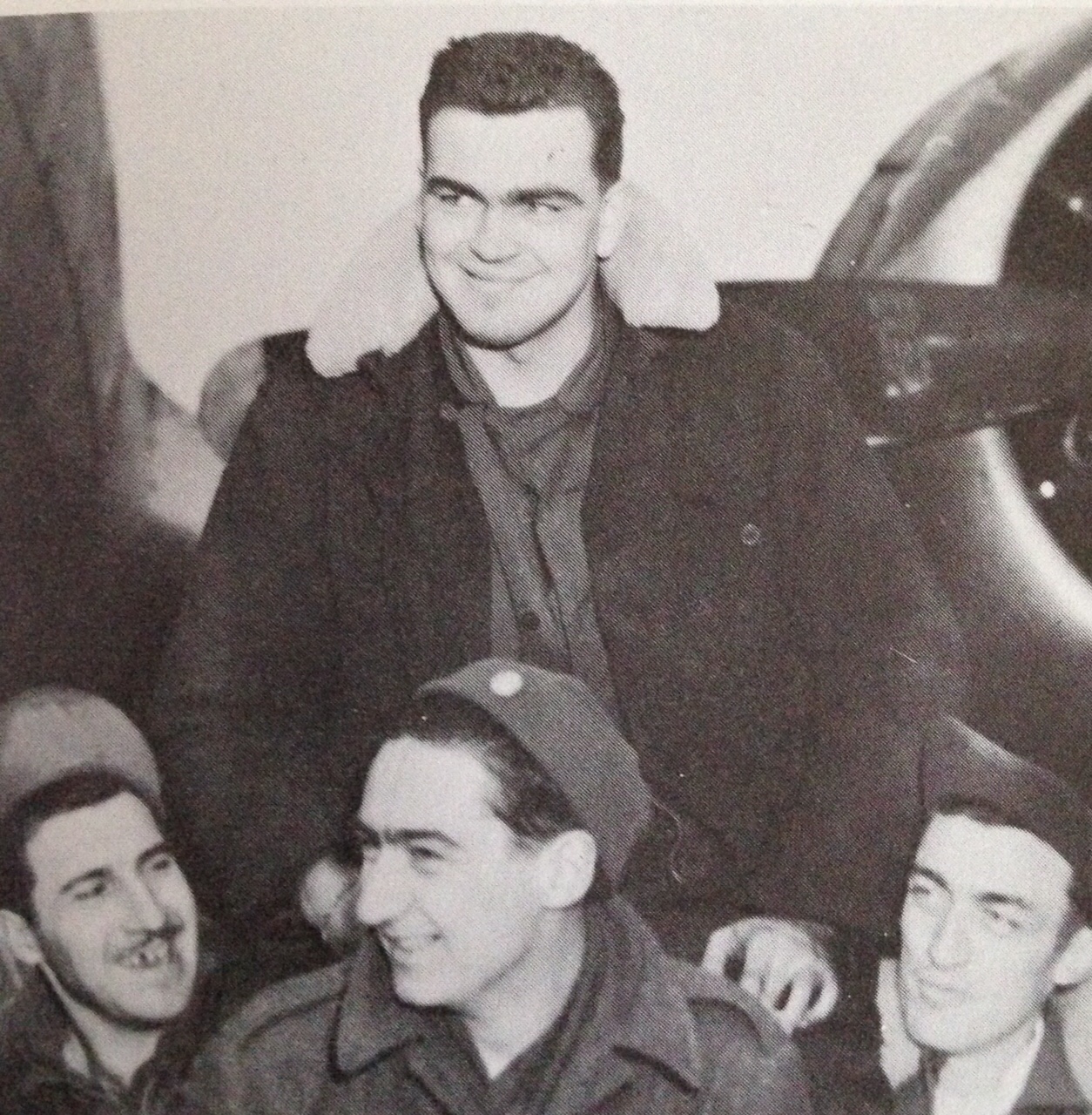
On his arrival back at Framlingham, Dunn was greeted by cheering crowds, ground crews lifted him high in their air carrying him triumphantly away from his aircraft, it was a heroes welcome.
By the time the war had finished, Dunn had flown in 104 missions, he had been a tail gunner on twenty-six missions, twice a top-turret gunner, a waist gunner and the remainder as togglier (Bombardier). He had flown over Berlin nine times, he claimed a FW-190 shot down and had amassed an impressive array of medals for his bravery and actions, and all at just 24 years old.
Post war, he continued to fly as an Instructor Gunner for B-52s in the 328th Bomb Squadron, 93rd Strategic Bomb Wing, at Castle Air Force Base in California. Here he was described as “quiet and reserved” and never talked about his war experiences. He was “handsome man with black hair”, and only when he wore his dress uniform, did others realise how well decorated he was.
Dunn was considered a rock by those who knew him and perhaps even immortal, but he was not, and on June 15th , 1961 after flying for a further 64 flights, he was tragically killed in a domestic incident that involved both his wife Peggy and his son. Precise details of his death are sketchy, and due to its nature, not a story to go into here, but at 41 years of age it was a domestic tragedy that took the life of a brave and heroic young man at far too an early age.
Dunn was a man who had flown in more missions than any other person in the Eighth Air Force and one who had gone on to train others in that very same role. He was highly decorated, and was looked up to and liked by those who knew him.
Following his death a service was held in Merced, California, his body was then taken to Arlington National Cemetery in Washington D.C. where he was finally laid to rest in grave number 3675, section 28.
For a man who achieved so much in his fighting career, little exists about him or his achievements. Maybe, by the end of the war, records were no longer needed, tales of dedication and bravery were no longer useful propaganda. Whatever the reason, Hewitt Dunn’s name should be heavily embossed in the history books of the Second World War.
Hewitt Dunn on return from his 100th mission, April 1945 (IWM)
Hewitt Dunn’s medal tally:
– Air Force Longevity Service Award with 3 oak leaf clusters
– Air Medal with 13 oak leaf clusters (2 silver, 3 bronze)
– Air Medal with 7 oak leaf clusters (1 silver, 2 bronze)
– American Campaign Medal
– Distinguished Flying Cross with 1 oak leaf cluster
– Good Conduct Medal
– National Defence Service Medal
– Silver Star
– World War II Victory Medal
– European-African-Middle Eastern Campaign Medal with 1 bronze star
– European-African-Middle Eastern Campaign Medal with 1 silver star
Post-script
This page was updated on 12th December 2023. I would personally like to thank all those who have contacted me in relation to the story, particularly in respect of his tragic and untimely death, they have all been appreciated. I believe there are numerous articles on-line looking at the events surrounding the domestic incident that ended his life, and for those who wish to seek more information, I have been told that “TJ3 History” is the most recent and details the events that led to his untimely and most tragic end of a brave and dedicated man.
This and other such accounts can be found in the link Heroic Tales of World War Two.






 Aviation Trails