In Trail 65 we head west again this time to the borders of Bedfordshire and Northampton, where a former wartime airfield evolved from a base for USAAF bombers into a centre of aviation excellence. First built during the Second World War, it supported critical missions over occupied Europe. In the post-war years, it transitioned into a leading site for aeronautical research, contributing to major advances in jet technology, carrier operations, and automated landing systems. Although official flying ended in 1994, the site continued to reflect a remarkable legacy, marking its place in history as a cornerstone of Britain’s military and civil aviation development.
In this trail, we go back to Bedfordshire and the former RAF Thurleigh.
RAF Thurleigh (Station 111)
Situated some 6.5 miles north of Bedford, RAF Thurleigh was built on land approximately 250 feet above sea level. Although not a high elevation, its open plateau setting – typical of many wartime airfields – exposed it to the elements. Surrounded by multiple river sources, the location benefited from good natural drainage, aiding its suitability as an airfield site.
The nearby village of Thurleigh has a long recorded history, appearing in the Domesday Book as La Lega*1 – a name that over centuries, has evolved into its current form. In a similar fashion, the airfield that bears the same name, would come to be known under many titles of its own: RAF Thurleigh, USAAF Station 111, RAE Bedford, Bedford Aerodrome, and Thurleigh Airfield Business Park amongst others. Yet throughout its history, one theme remained constant – aviation.
The War Reaches Bedfordshire: Early Bombings and Construction (1941)
Thurleigh’s association with the Second World War began even before construction commenced. Isolated bombing incidents in the parish during 1941 – possibly the result of jettisoned bombs from German aircraft – marked its early wartime experience. Once the airfield’s construction began however, it quickly caught the attention of the Luftwaffe. On 17th April that year, eight enemy bombs were dropped directly onto the construction site, causing damage to the incomplete runway. A second attack on 12th August 1941 saw another eight bombs fall along the northern boundary, again damaging the airfield and rupturing a water main*2. Both raids highlighted how conspicuous such developments were to enemy reconnaissance and subsequent aerial attacks.
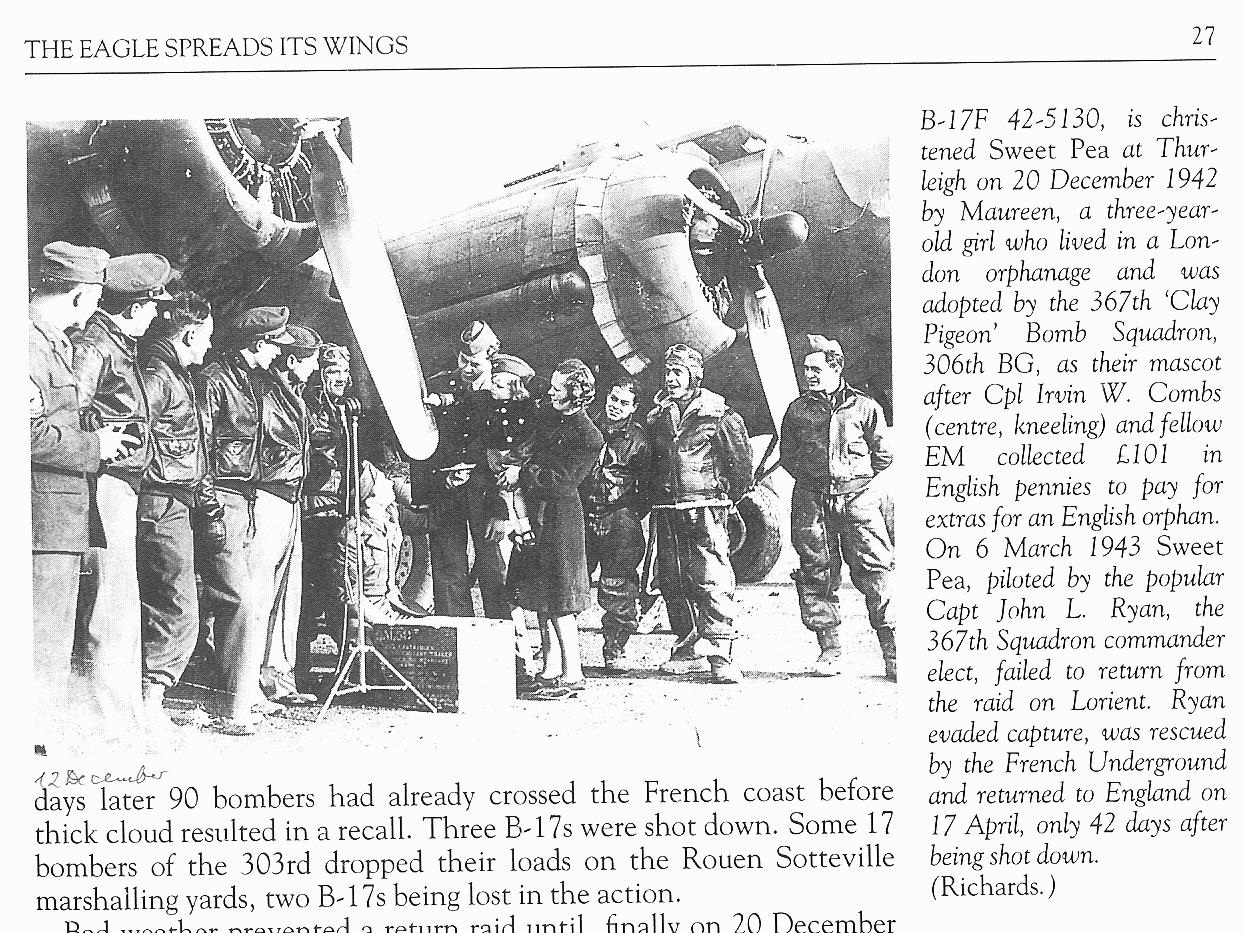
Once land had been sourced, the airfield’s construction was carried out by the company W.C. French Ltd. and officially opened during the summer of 1941. At this early stage, Thurleigh was a modest airfield in size, suited only for fighters or light to medium bombers. Its first operational residents were the personnel from No. 18 Operational Training Unit (OTU), part of the RAF’s Bomber Command. Having recently adopted the twin-engined Vickers Wellington, 18 OTU (formed from the Polish Training Unit in No. 6 Group, in June 1940 to train light bomber crews for Polish operational squadrons) was tasked with preparing new crews transitioning onto bombers ready for active duty.
Though OTUs were primarily training units, they often found themselves involved in operational sorties, especially during periods of ‘maximum effort’. As a result, many crews suffered casualties, even before they joined a front-line operational squadron.
Following them, in October 1941, 12 Operational Training Unit – first formed at RAF Benson in April 1940 – briefly stayed here. Their residency lasting a mere month, it remains unclear whether it was the entire unit, or just detachments that were present here during that time. It was also at this time that the first recorded aircraft landing took place at Thurleigh: Wellington IC R1234*3 touching down on the new runway, marking a small but important milestone in the station’s dramatic history.
12 OTU Were not the only training unit to reside here. The Central Gunnery School (CGS), famed for “training the trainers” remained here from December 1941 until their departure to RAF Sutton Bridge on the Lincolnshire / Norfolk border in April 1942.
First established at RAF Warmwell on 6th November 1939, the CGS would train both gunners of bombers and fighters in the art of aerial warfare, those attending having proven themselves in combat already. Once trained, they would return to their original squadrons and pass on their valuable knowledge to others.
Tropical Kit and Tragedy: The Brief Story of 160 Squadron (1942)
Thurleigh’s relative quiet made it an ideal location to raise a new unit, and on January 16th 1942, the ground echelon of 160 Squadron RAF, formed here. Created as a Consolidated B-24 Liberator unit under War Establishment order WAR/ME/448 (dated 31st December 1941), the squadron’s formation began with the arrival of 108 airmen, who were followed by a further 126 the very next day. Over the following weeks, the numbers of ground crew and support staff swelled, as it did, each one was issued with tropical kit, a move that suggested a deployment to the Far East.
Throughout the weeks that followed, the air echelon underwent heavy bomber training some with 1653 Heavy Conversion Unit at RAF Polebrook, while other crew members were sent to RAF Upwood for additional preparation. In mid-February, the posting finally came through and the ground party departed enroute to the Far East. Meanwhile, the air crews transferred to RAF Lyneham in Wiltshire, where they collected their new B-24s before they too left for the Far east.
Tragedy and Transition – May 1942
The now quieter Thurleigh would then experience a series of tragic accidents. On 18th May 1942, Wellington IC DV783, flown by a Polish crew led by Pilot Officer J. Kilmcsyk, crashed shortly after taking off. Just moments after departing the runway, the aircraft suddenly, and without warning, dived into the ground; the ensuing fireball killing all five crew members onboard. The Wellington, along with the crew’s bodies, was later recovered and the airmen interned in the Polish War Graves section of Newark cemetery in Nottinghamshire.
This was the second fatal crash suffered by the unit in as many days, a tragedy that was compounded by another such incident the following day – although mercifully this time, there would be no fatalities.
Not long after this short but devastating period, 18 OTU departed Thurleigh, a move that signified the end of its ties, as a training airfield, with Bomber Command. For the remainder of the war, there would be no further front line, RAF units assigned here, and attention now turned to its new owner, the United States Army Air Forces.
In Part 2, we continue our journey through Thurleigh’s wartime history. We see the arrival of the USAAF, and share their experiences both good and bad. We learn of the failures of the B-17 and how through innovation they overcome these problems becoming one of the most successful bomb groups of the war.
The full story of RAF Thurleigh can be. read in Trail 65.
There has been much written about the young Kennedy, his life, his family and his death, but a lot of information around his death has remained ‘unknown’ for many years. Even today, the actual cause of his death is not clear and will probably remain so.
Joseph Kennedy Jnr was based at RAF Fersfield (originally RAF Winfarthing) in Norfolk (Trail 27), and had only been there a few weeks before he tragically died on August 12th 1944, whilst operating on secret operations. A tragic loss, this is the last flight of Joseph Kennedy and Wilford Willy from RAF Fersfield, Norfolk, England.
The Crew – Lieutenant Joseph Kennedy Jnr.
Joseph Kennedy was born July 25th 1915, Nantasket, Massachusetts, he was the eldest brother of eight siblings including John F. Kennedy. He was son to Joseph Patrick Kennedy and Rose Fitzgerald. Throughout his life he had been pressured into the political life by his father who had high hopes that his son would become the future President. Joseph Jnr wanted to please. As war loomed, Joe Kennedy Jnr rose to the challenge seizing his opportunity to become the ‘shining light’ of the Kennedy family.
The Kennedy parents instilled a desire to be competitive, to win and succeed and to be the best. This came out in Joseph during his time at both home and at school. The pressure on Joseph was enormous, and it was clearly evident throughout his short life.
Joseph lived in the shadow of his younger brother John, who would captain a PT boat in the Far East, and in Joseph’s absence, go on to become President of the most powerful nation on Earth. John was the brighter, the more determined of the two, and this caused friction between them. Joe always wanting to ‘out-do’ his brother persevered, but never seemed to quite make it.
It was this determination and rivalry that perhaps led Joseph to do what he did, to impress, to be the best and the ideal way he thought was as a war hero.
With a remarkable academic background behind him, Joseph Kennedy joined the U.S. Naval Reserves on October 15th 1941, reporting to the Naval Air Station (N.A.S.) at Jacksonville, Florida the following day. After several months of training he received his commission and on January 10th 1943 he joined a flying patrol squadron. In May he became a Junior Grade Lieutenant transferring to a bomber squadron in the following July that year. In 1944, on July 1st, he was promoted to Lieutenant United States Naval Reserve. His military life would last just over one month.
Joseph was posted to RAF Dunkeswell serving under the RAF’s Coastal Command. Flying a PB4Y he would carry out U-Boat searches over the Atlantic around the Bay of Biscay and the Atlantic. As he accumulated flying hours, he rarely came into any real danger, even when posted to cover the Allied invasion fleet over Normandy he rarely came into contact with any opposing aircraft or vessels.
Joseph Kennedy’s opportunity came when volunteers were asked for to undertake a special secret and dangerous operation. He jumped at the chance to be a hero.
Joseph Kennedy arrived at RAF Fersfield, Norfolk on 30th July 1944, where he was trained for two weeks. On August 10th 1944, he wrote a letter home, it would be his last communication with his family. Joseph Kennedy was to become a pilot in operation Anvil, the Navy’s version of Aphrodite.
Lieutenant Wilford John Willy
Sadly, Lieutenant Wilford J. Willy (s/n: O-137078), has remained in the shadows probably because the status of Joseph Kennedy Jnr. A tragic loss nonetheless and no less an important one. Willy was born 13th May 1909, New Jersey. He enlisted in the Navy in 1928, gaining his Naval Wings on April 30th 1937, just two years after he had married his sweetheart, Edna C. Schaffery, the women he left behind. On advancing through the rank of Chief Petty Officer, he was awarded Lower Grade Lieutenant (April 28th 1942) and two months later, on June 26th, he achieved the rank of Lieutenant. Willy served at a number of operational stations, including Pearl Harbour, before being posted to RAF Fersfield, in Norfolk.
Willy, now an expert in Radio Operations and procedures, became the Executive Officer of the Special Air Unit One (S.A.U.1), the rank he achieved when he took off with Kennedy on August 12th 1944.
Operations Anvil and Aphrodite.
Whilst Drone technology and research had been around as early as World War I, it was still relatively unchartered territory. However, radio controlled drones (modern name Unmanned Aerial Vehicles or U.A.V.s) were already being used with relative success for target practice by the RAF and USAAF during World War II. The ‘Queen Bee’ being one of many used by the RAF. The Germans had also been investigating drone and guided bomb use through examples such as the Mistel aircraft (the most successful being a combination of either a FW-190 or Me-109 mounted above a Ju 88).
Both the USAAF and USN were undertaking secret trials into drone aircraft operations with the view of attacking the heavily defended and ‘impenetrable’ submarine and ‘V’ weapons sites across northern France . The aim, to stop, or at least reduce, the Nazi’s use of the V1, V2 rockets and the development of the new V3 canon.
Codenamed ‘Aphrodite‘ by the USAAF, and ‘Anvil‘ by the Navy, they were two secret operations running side by side. The idea behind these operations, was to remove all excess equipment from war-weary B-17s and B-24s, fill them with explosives, such as the British Torpex, put in radio receivers so that the drone (baby) could be controlled by a separate aircraft (mother) and fly them into designated targets. A volunteer crew of two would take off, set the aircraft in flight and then bail out over the U.K. or English Channel, leaving the ‘baby’ in the control of the ‘mother’ aircraft. These would then fly, by remote control, to the target when they would be put into a dive destroying whatever they hit.
The controls of the B-17 . The arm linkage moved the control column in response to the radio controls. (credit USAF)
The idea was remarkable but not new, and the equipment whilst innovative for its day, was basic to say the least. In all the operations undertaken only one drone ever reached its target, and that was through more luck than skill.
‘Azon’ (from AZimuth ONly*1) controls had been used successfully on individual 500lb or 1000lb bombs, where the control box was attached to the rear of the bomb and controlled by the bomb aimer through a joy stick. Using two directional controls (left or right) he could direct a bomb very accurately onto a given point. The downside of Azon, was that range and fall had to be determined in the usual way by the bomb aimer, and could not be altered once the bomb had left the aircraft.
Azon had been used and proven in attacking bridges, railways and other longitudinal targets and was very accurate with a good bomb aimer. However, because of its limitations, it could only be used in one dimension and therefore was not capable a making a ‘baby’ take off.
Two aircraft types were identified for the project. Boeing’s B-17 ‘Flying Fortress’ and Consolidated’s B-24 ‘Liberator’. These once converted would be given new identifications BQ-7 (usually B-17Fs) and BQ-8 (B-24D/J). In each case it was deemed that two crew members would be needed to raise the ‘baby’ off the ground, partly because of the strength needed to pull back the control columns in these heavy bombers. Once airborne, they would climb to around 20,000ft, arm the Torpex, set the aircraft on a trajectory to the target, switch on the receivers and bail out.
About twenty-five BQ-7s were modified, but it is not known accurately how many USAAF BQ-8s were converted. However, it is known that at least two naval PB4Y-1s (the naval version of the B-24 of which 400 had been converted from B-24 status – these were given s/n 31936 – 32335) were converted to BQ-8 standard; one of which was flown by Lt. Kennedy and Lt. Willy on the 12th August 1944.
A number of support aircraft were needed for each mission. Prior to the attack a Mosquito XVI of the 653rd BS would photograph the target. Then the ‘baby’ would be accompanied by at least one fighter (either P-38 or P-51) incase the ‘baby’ lost control and had to be shot down, and for fighter escort; a ‘mother’ either a Lockheed Ventura or another B-17 modified to CQ-4 standard, and a photographic Mosquito from the 8th Combat Camera Unit (CCU) to record in-flight behaviour. A post mission photo reconnaissance operation was carried out by the 25th BG at Watton to analyse the effectiveness of the bombing. It therefore took a lot of fuel, crew and aircraft to fly one drone to its target.
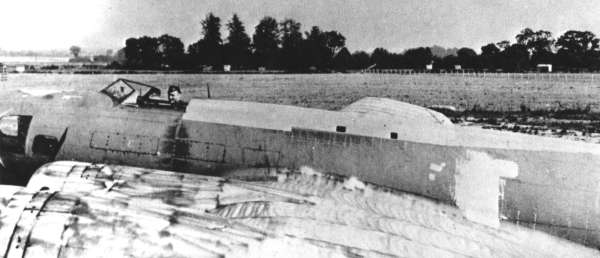
Because of the design features of the bombers, the USAAF looked into removing the cockpit to allow easy departure. The only aircraft that received this treatment was B-17F, “Olin’s 69’ERS” 42-30595 formally of 560BS, 388BG at Knettishall. It was never used on an Aphrodite mission and was scrapped post war after being used for training in the open cockpit mode. The BQ-8 (B-24) also had modifications made in the form of a widened hatch in the nose allowing for an easier escape from the aircraft. Once modified, the aircraft would have had all previous markings removed, and a special white or yellow paintwork applied to identify them from other bombers in the air. To assist the controllers in sighting the ‘babies’ whilst in flight, the aircraft were fitted with a smoke canister that would be ignited allowing the bomb aimer to see the aircraft as it began its dive. In addition to this, two cameras were fitted to some ‘babies’ that transmitted pictures to the mother or support ship. These pointed at the controls through the plexiglass, a revolutionary step forward in drone technology.
A modified B-17 (BQ-7) with its canopy removed, this aircraft became a training drone. (Credit USAF)
In all, there were fifteen missions undertaken by the USAAF and USN, but none were to successfully hit their targets. These included: Mimoyecques (Fortress); Siracourt (V1 Bunker); Watten (V2 Bunker); Heligoland (U-boat pens); Heide; Le Havre (docks); Hemmingstedt (oil refinery); Herford (marshalling yard) and Oldenburg (Power station). Both the operations and entire programme were cancelled only a few months after the Kennedy/Willy mission.
The last flight.
At RAF Fersfield, on August 12th 1944, Lieutenants Joseph Kennedy Jnr. and Wilford J. Willy, both of the S.A.U. 1 of the Fleet Air Arm Wing Seven, boarded their converted B-24 Liberator, s/n 32271 (ex USAAF B-24J 42-110007)*2 and began their preflight checks. The aircraft was filled with 21,270lbs of explosive. At 17:55 and 17:56 two Lockheed Ventura ‘mother’ aircraft took off, followed by a further navigation aircraft and then the ‘baby’ at 18:07. The ‘baby’ climbed to 2,000 ft, the two ‘mothers’ 200 feet higher and slightly behind. They were joined by two Mosquitoes, one for monitoring the weather, and the second, a USAAF F-8, to photograph the ‘baby’. This aircraft was flown by pilot Lieutenant Robert A. Tunnel and combat camera man Lieutenant David J. McCarthy. There was a further B-17 relay ship, a P-38 high altitude photo reconnaissance aircraft and five P-51 Mustangs to provide fighter cover.
The group set off toward the target at Mimoyecques , Northern France. They were to fly south-east toward the Suffolk coast, then turn south and head toward the target. Once level and stabilised, Kennedy and Willy handed over control to one of the ‘mother’ ships Then they reached the first control point (CP) at which time the group began to turn south; the ‘mother’ controlling the ‘baby’. Shortly after the turn was completed (about two minutes) Kennedy was heard to give the code “Spade Flush“, then at that 18:20 the ‘baby’ disintegrated in what was described as “two mid-air explosions” and a “large Fireball”.*4 The explosion, spread debris over a large area of the Suffolk countryside killing both crew members instantly. The following Mosquito also suffered damage and minor injuries to its crew. Following the explosion, all the aircraft were ordered back to base and the crews debriefed.
Many months (and indeed years) of investigations followed, but no firm conclusions could be drawn as to the precise cause of the explosion that ripped the aircraft apart. A number of speculative theories were drawn up, but the most plausible is that the electronic arming system was faulty, and when Kennedy or Willy, flicked the switch, an electronic short occurred that caused the bombs to detonate. Oddly the film that was in the following Mosquito has never been seen or made public – if indeed it was filming at that time.
The cause of death of both Joseph Kennedy and Wilford Willy still remain a mystery to this day, the secrecy behind one of the world’s worst explosions remaining locked away in archives.
Joseph Kennedy wanted to be a hero. He wanted to be talked about as the one who achieved and outshone his brother. Sadly, this dream cost him his life.
The letter sent to the Kennedy’s after Joseph’s death.*3
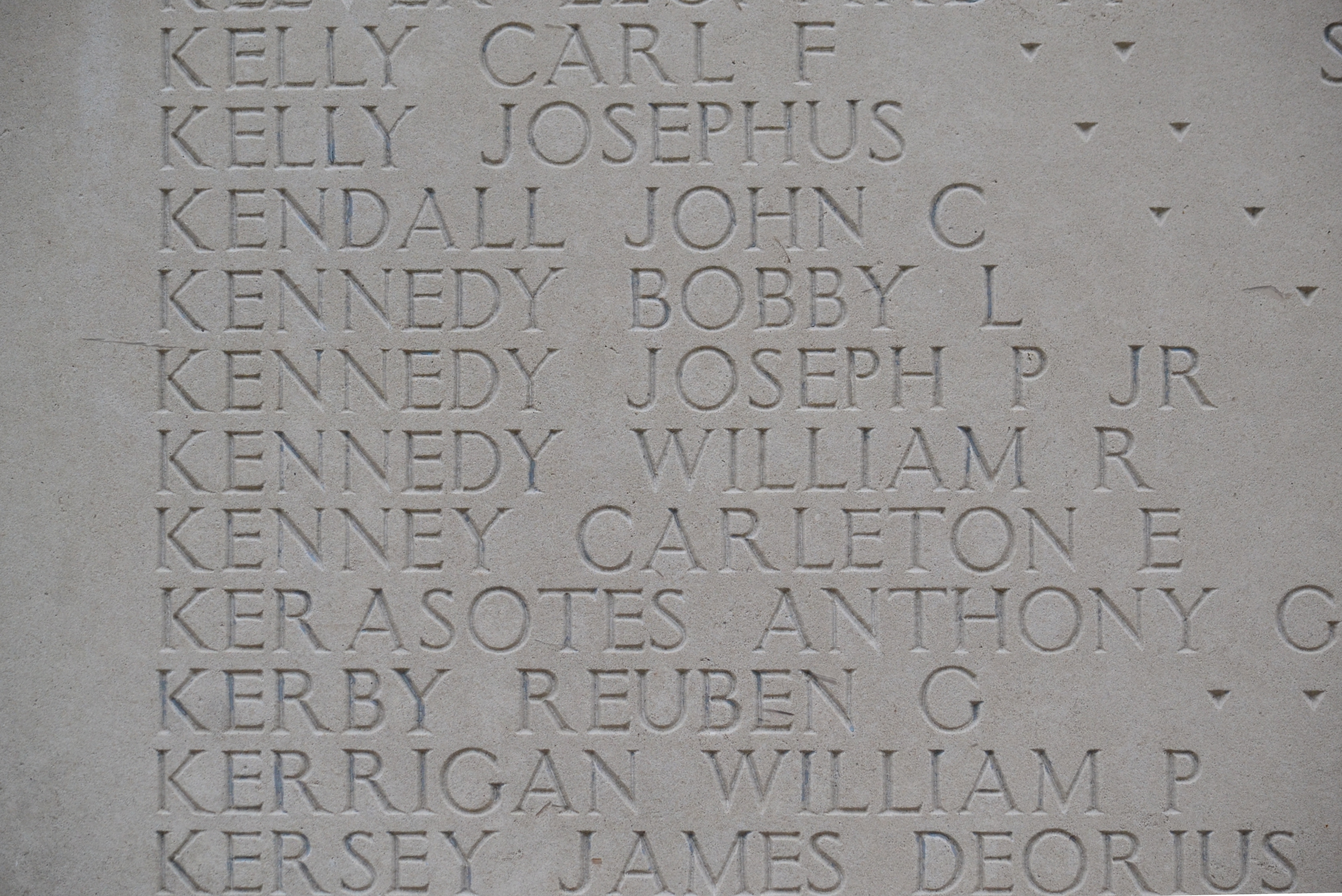
This fateful mission and its two crew members are remembered across the world. In France, the Mimoyecques museum contains a memorial honouring both pilots, and their names are carved in the Tablets of the Missing at the American Cemetery, Madingley, Cambridge. Kennedy has a ship the Destroyer ‘USS Joseph P. Kennedy Jr.’ DD850 named after him, and this is now a museum in Battleship Cove, Fall River, Massachusetts. Both aviators were awarded the Naval Cross posthumously,
Lieutenant Joseph P Kennedy Jr, USNR, appears on the Wall of the Missing at the American Cemetery, Madingley, Cambridgeshire.
Lieutenant Jospeh P. Kennedy Jnr had no dependents but Lieutenant Wilford J. Willy left a widow and three children.
Sources and further reading.
*1 Azimuth being the clockwise horizontal angle from a given point (usually North) to a second given point.
On 11th April 1944, a mix of 917 B-17s and B-24s of the 1st, 2nd and 3rd Bomb Divisions (BD) of the USAAF, departed their airfields in England to strike at a range of targets across Germany – it was mission 298. The 1st BD, made up of 341 B-17s, attacked targets at Cottibus, Dobberphel, Stettin, Trechel and Sorau. the Focke Wulf aircraft assembly plant in Germany.
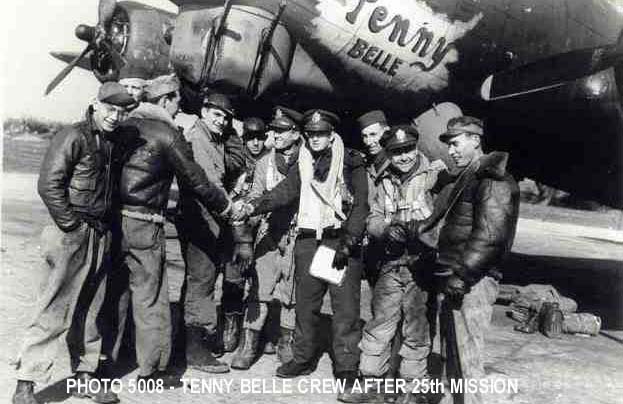
One of those aircraft taking part was #42-31083 “Tenny Belle” of the 525nd BS, 379th BG, based at RAF Kimbolton (Station 117) in Cambridgeshire. The aircraft had already flown thirty-seven operations before this one, but this would sadly be her last.
After taking off from Kimbolton at 07:41, the aircraft climbed to gain altitude and to form up. Its flight would take it easterly over Norfolk and the coast.
On board the aircraft, a B-17G-1-BO “Flying Fortress”, ‘FR*A’, was: 2nd Lt. John E. Daly Jr. (pilot); 2nd Lt. Robert W. Koerber (co-pilot); 2nd Lt. Williams F. Evans (navigator); S/Sgt. Carl B. Christensen (nose gunner/bombadier); T.Sgt. Omer L. Young (Flt. Engineer/top turret gunner); T.Sgt. Adriel Langendoerfer (radio operator); S.Sgt. Harvey W. Tuber (Ball turret gunner); S.Sgt. John N. MacCallum (right waist gunner); S.Sgt. Frank J. Hearne Jr. (left waist gunner) and S.Sgt. Howard L. Polizzo (tail gunner).
This was not Daly’s first crew though, they had formed at Pyote Air Base, Texas and transferred out to the UK together. On this operation, S/Sgt. Carl B. Christensen replaced the normal bombardier 1st Lt. Joseph Jennings who was at RAF Alconbury receiving Radar training.
#42-31083 ‘Tenny Belle‘ and probably Daly’s crew (centre facing camera) after the 25th mission. (IWM UPL 31620)
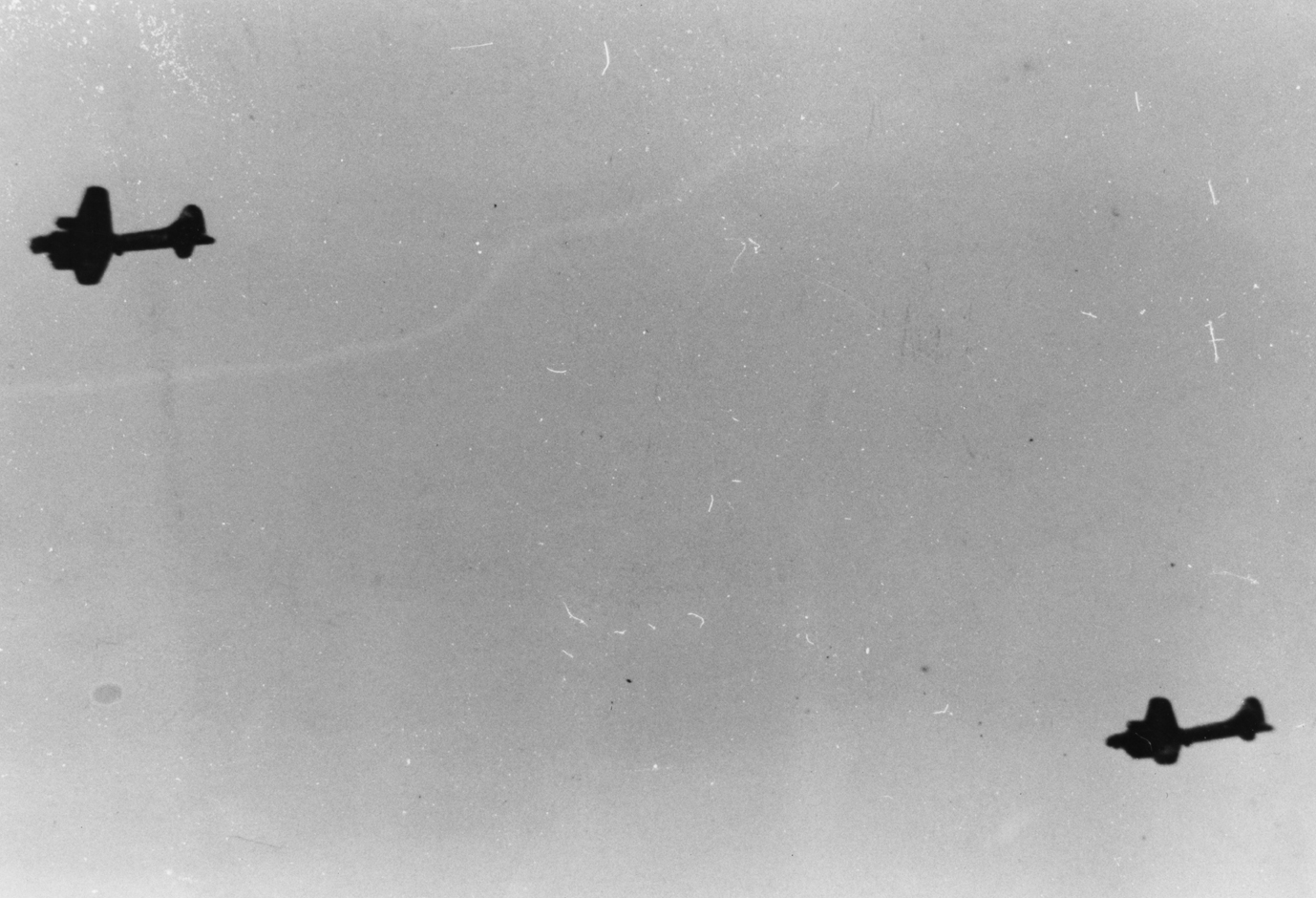
Once airborne, the aircraft levelled out and began to find its place in the formation before heading off over the sea to Germany. At 09:03 and at 9,000 feet, in formation travelling at about 115 mph, the aircraft for unknown reasons, suddenly and violently lurched to the left as if the pilot had tried to steer away from another aircraft; it then lurched once again, this time to the right throwing the crew around inside the fuselage in an uncontrollable manner. The forces acting on the weary aircraft were too great though, and a fracture caused it to split into two sections.
The “Tenny Belle“, now unstable and with no aerodynamic stability whatsoever, simply fell from the sky hitting the ground with such force as to completely destroy it. In the impact, it also killed nine of the ten crewmen left onboard. The tenth, 2nd LT. Evans, managed to don his chute and escape the stricken aircraft whilst it hung in the air on the smallest amount of lift possible immediately following the accident.
According to the official crash report Form AF-14, the aircraft came down four miles west-south-west of Downham Market in the small hamlet of Barroway Drove. However, some sources say the aircraft fell at Fen Farm some six miles south-west of the town, neither can be confirmed at this stage, although due to the nature of the accident, it is possible parts were located in both areas.
There was no record of any explosions, and all engines were reported by 2nd Lt. Evans as “running very fast”. In his statement following the crash he said:
“The formation entered the clouds and we levelled off. We were in the clouds only a few minutes when the ship swerved violently to the left. I thought the pilot saw another wing-tip and was trying to avoid it. We then swerved more violently to the right. I then figured out it was out of control and thought that the plane had broken in two. I had my chute on before this. The last I saw of the Bombadier, he was trying to put his chute on. We were going straight down, and the engines were all running fast. There did not appear to be any fire in the wings. I tried to get to the escape hatch, but everything at his point is very confused and I do not know if I got out this way. I remember looking down to see of my chute was on, and noting that it was backwards. It opened with some help from me and a moment later I hit the ground. I looked around to the plane coming down, the tail part landed way behind the ship and numbers of burning pieces were falling around. There was a farmer near and I tried to walk over to him, but I was feeling pretty shaky. He got a car and took me to a hospital. I didn’t feel any explosions and no alarm was given.”
The official board of enquiry concluded that:
“The cause of the accident is undetermined and consequently, responsibility therfor[sic] cannot be established.”
Post crash, the bodies of the crew were removed and the B-17 guarded, none of the bombs aboard detonated. It was later salvaged on the 18th April 1944, but the strength of the impact had completely destroyed its fragile structure.
The normal bombadier, Joseph Jennings learnt about the loss of the crew that day, the news affected him badly, and he never talked about them or their loss afterwards.
Pilot, 2nd Lt. John Daly, (s/n: 0-805776) had flown 273 hours and 15 minutes on B-17s, gaining his pilots licence on June 30th 1943. He was only 19 years of age and thought to be one of the youngest pilots to serve in the USAAF at that time.
Staff Sgt. Archibald Mathies (U.S. Air Force file photo)*1
Born in the Scottish town of Stonehouse, South Lanarkshire, on the 3rd June 1918, Archibald (Archie) Mathies was to become a Second World War hero. He was awarded the Medal of Honour (MOH) for his actions whilst at RAF Polebrook (USAAF Station 110) in Northamptonshire, England.
It would be on the 20th February 1944, shortly after arriving at Polebrook, that he would earn this honour but his life would be dramatically cut short.
Not long after his birth in Scotland, Mathies moved with his family to the United States, to a small town in Western Pennsylvania called Finleyville, in Washington County.
After leaving school, he began work in a local coal mine. The work was hard, and the pay was low; Mathies was not inspired. Then, following the Japanese attack on Pearl Harbour, as many other brave young American men did, he joined the Army, enlisting in Pittsburgh on the 30th December 1940. Mathies would transition through a number of stations and training centres before finally completing a course in aerial gunnery on the 22nd March 1943. His last U.S. posting was to the 796th Bombardment Squadron at Alexandria, Louisiana for operational training duties flying B-17s. He would leave here on the 8th December 1943 bound for England and the European Theatre of Operations.
Mathies arrived in the U.K. eight days later. His initial assignment was with the Eighth Air Force Replacement Depot, before being attached to the 1st Replacement and Training Squadron. On the 19th January 1944, he received his first and only operational squadron posting; the 510th Bomb Squadron, 351st Bomb Group, based at RAF Polebrook, as an engineer/gunner. Promotion was swift, and on 17th February 1944, probably following his first mission, Mathies was awarded the rank of Staff Sergeant.
A few days later, on 20th February 1944, the allies began the enormous aerial campaign known as ‘Big Week’. During this short period a massive number of aircraft would attack targets deep in the heart of Nazi Germany. One of the first, (Mission 226) would see a total of 417 aircraft fly from airfields across England. From RAF Polebrook, 39 B-17s took off to attack Leipzig. In the lead planes were Maj. Leonard B. Roper (s/n O-734101 ) of the 510th BS forming the high group, and Maj. James T. Stewart (s/n O-659405) of the 508th BS, leading the low group.
Flying in the number three ship of the lower Squadron, in B-17 (42-31763) ‘Ten Horsepower‘ was: Pilot: Clarry Nelson, Co-Pilot: Roland Bartley, Navigator: Walter Truemper, Engineer / Top Turret Gunner: Archie Mathies, Bombardier: Joe Martin, Radio Operator: Joe Rex, Ball Turret Gunner: Carl Moore, Waist Gunner: Tom Sowell, Waist Gunner: Russ Robinson, and Tail Gunner: Magnus Hagbo.
B-17 “Ten Horsepower” – cropped from the photo below- (TU-A, serial number 42-31763) taken prior to its crash”2.
On approaching the target, the formation was hit hard by fighters and flak, who would attack the formation for over an hour, hitting many aircraft in the subsequent melee. Ten Horsepower, was targeted repeatedly receiving many hits from 20mm cannon shells. In these attacks the co-pilot was killed and the pilot knocked unconscious from his wounds. Fearing the bomber was doomed, the bombardier jettisoned the bombs and then bailed out, later being captured by the Germans and becoming a prisoner of war. The remaining crew remained with the B-17 which soon began a deathly spiral toward the ground.
Mathies and the navigator (Walter Truemper) would eventually take over control of the aircraft and nurse it back to England. Once over their base at RAF Polebrook, the crew were instructed to bail out but both Mathies and Truemper refused to leave the injured pilot. After deliberation, they were given permission to try to land, the remaining two crew members prepared themselves for a heavy landing.
Guided in by a fellow aviator it was going to be very difficult. The first two attempts had to be aborted, but on the third attempt, as they approached the airfield, the aircraft struck the ground, killing all three crew members onboard.
The last moments of B-17G “Ten Horsepower” (TU-A, #42-21763) piloted by Second Lieutenant Walter E Truemper and Sergeant Archibald Mathies, as it is guided by a fellow aircraft after the pilot was severely injured. Truemper and Mathies unsuccessfully attempted to land the aircraft at Polebrook and were posthumously awarded the Medal of Honour for their bravery, 20th February 1944. (IWM FRE 4724)
The crash was a severe blow for the base, both air and ground crews were devastated. On returning from the mission, five other aircraft (42-38028, 42-38005, 42-39760, 42-39853 and 42-6151). were forced to land at nearby Glatton (Conington) only a short distance away.
This was only Mathies’ second mission and sadly, his last.
For his bravery, Mathies was awarded the Medal of Honour; his name now appears on page 280 of the St. Paul’s Cathedral Roll of Honour. Also, as a dedication to him, one of the temporary lodging units at the Joint Base Anacostia-Bolling is named after him, as is the Airman Leadership School at RAF Feltwell, and the Non commissioned Officer Academy at Keesler AFB, Mississippi. In addition, the bridge on Truemper Drive crossing Military Highway at Lackland Air Force Base, Texas; the USCIS Dallas District Office and the Mathies Coal Company in Pittsburgh, Pennsylvania, are all named in his honour.
Archibald Mathies citation reads:
“For conspicuous gallantry and intrepidity at risk of life above and beyond the call of duty in action against the enemy in connection with a bombing mission over enemy-occupied Europe on 20 February 1944. The aircraft on which Sgt. Mathies was serving as engineer and ball turret gunner was attacked by a squadron of enemy fighters with the result that the copilot was killed outright, the pilot wounded and rendered unconscious, the radio operator wounded and the plane severely damaged. Nevertheless, Sgt. Mathies and other members of the crew managed to right the plane and fly it back to their home station, where they contacted the control tower and reported the situation. Sgt. Mathies and the navigator volunteered to attempt to land the plane. Other members of the crew were ordered to jump, leaving Sgt. Mathies and the navigator aboard. After observing the distressed aircraft from another plane, Sgt. Mathies’ commanding officer decided the damaged plane could not be landed by the inexperienced crew and ordered them to abandon it and parachute to safety. Demonstrating unsurpassed courage and heroism, Sgt. Mathies and the navigator replied that the pilot was still alive but could not be moved and they would not desert him. They were then told to attempt a landing. After two unsuccessful efforts, the plane crashed into an open field in a third attempt to land. Sgt. Mathies, the navigator, and the wounded pilot were killed“.*3
Mathies was truly a brave and dedicated man, who in the face of adversity, refused to leave his wounded pilot and friend. Daring to land a badly damaged aircraft, he sadly lost his life showing both great courage and determination.
The crew of ‘Ten Horsepower‘ were:
Pilot: Clarry Nelson,
Co-Pilot: Roland Bartley,
Navigator: Walter Truemper
Engineer / Top Turret Gunner: Archie Mathies
Bombardier: Joe Martin (POW)
Radio Operator: Joe Rex,
Ball Turret Gunner: Carl Moore,
Waist Gunner: Tom Sowell,
Waist Gunner: Russ Robinson,
Tail Gunner: Magnus Hagbo
In Part 2, we saw how crews at East Kirkby took a battering over Germany and how the Allies turned their attention to the forthcoming invasion.
In this, the final part, the war finally comes to an end and RAF East Kirkby eventually closes, but not without making its mark.
With spring at an end, thoughts turned back to the impending invasion and the bombing of pinpoint targets in France: Railways, munitions factories, troop concentrations and transport links became the focus for Harris’s Air Force. Throughout the month of April both East Kirkby squadrons were in operations, and whilst not significantly high, a number of aircraft were lost adding to the lengthening list of casualties and those now missing.
The end of this period of the war was remarkable for several reasons, notably when Wing Commander Leonard Cheshire of 617 Sqn, flew a Mosquito at low level and marked the target, a factory in Toulouse, with great success. This delighted Harris, who gave the all clear to 5 Group to operate independently of the Pathfinders of 8 Group, a decision that did little to heal the growing rift between Don Bennett and Ralph Cochrane who had taken the idea to Harris in the first place.
Other targets then became the focus for 5 Group including the railway yards at La Chapelle. In the operation Cheshire put this method to the test once more. with 617 Sqn again to marking the target in conjunction with 8 Group’s Pathfinders. In the operation, 247 Lancasters from 5 Group were ordered to attack a pin point target. In the attack, 57 Sqn lost two aircraft. Of these two Lancasters the first, LL893 ‘DX-J’ was lost with all seven lives over St-Omer whilst the second, Lancaster MK. III ND582 ‘DX-S’ crashed after attempting a landing at Croydon. After overshooting the runway the aircraft, piloted by Canadian F.O. H. Young, struck at least three homes in Lavender Vale, a street adjoining the airfield. Three of the crew died immediately and a further one died from his injuries in hospital.
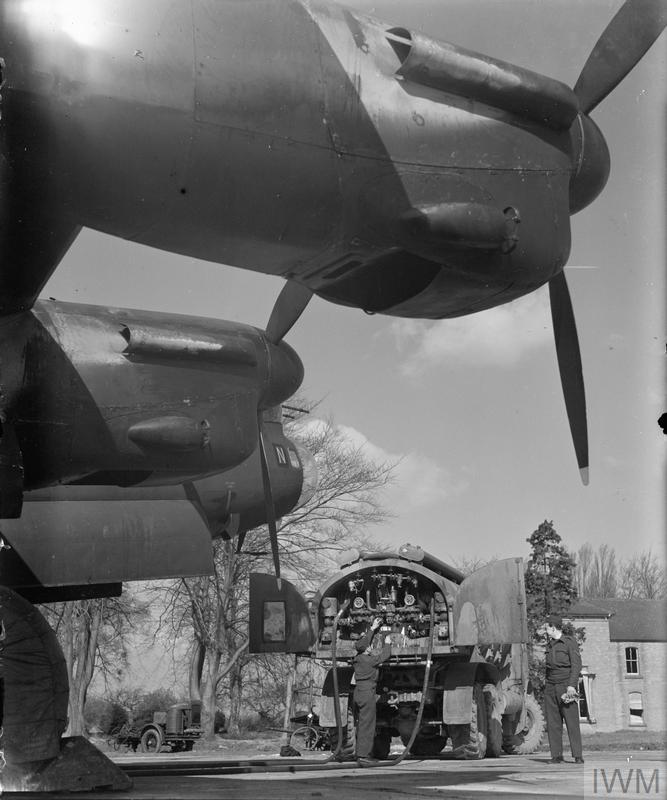
Operation POINTBLANK. Groundsmen refuel Lancaster ND560 ‘DX-N’, 57 Squadron in preparation for a night attack on the railway yards at La Chapelle, France. IWM (CH 12868)
Summer then dawned, and overnight, May 22nd-23rd, Cheshire once more, put his method to the test. 617 Sqn were again to mark the target, but a heavily defended Brunswick led to heavy losses for both the East Kirkby squadrons, 57 losing three Lancaster Mk.IIIs and 630 Sqn another two. Only five airmen made it out alive, each one being captured by the German ground forces and so becoming prisoners of war.
These losses were however a mere pin-prick compared to June. The mission of 21st-22nd to Wesseling near Cologne proved to be yet another massacre for 5 Group who sent a total of 133 Lancasters to attack the city’s oil facilities. A number of squadrons took heavy loses including both East Kirkby’s 57 and 630 Sqns with six and five losses respectively. One of these aircraft was abandoned whilst another ditched in the sea allowing all crewmen to be rescued, but the overall loss proved to be devastating.
The spring – summer of 1944 was defining, not only had 5 Group shown that low-level marking could be done, but the attacks on targets in France meant that the Luftwaffe were at a disadvantage. Their night tactics, relying on long range bomber flights, could not manage with the shorter ‘quick’ attacks, and so losses from Bomber Command began to lessen.
This reduction allowed for restaffing, with a large number of officers, NCOs and airmen being both posted in and out of the two squadrons. It also allowed for training flights to take place, some 476 hours of operations compared to 729 hours for non-operational flights for 630 Sqn alone.
Like many places across the UK, the coming of D-Day, and the fragile success of the invasion led to an increase in morale at the station. Ground crews being acknowledged for their long hours and hard work in keeping aircraft flying and operationally ready, without them, these operations could not have taken place at all.
This extra effort and improved state continued for several months, and by August, it was acknowledged that morale had lifted, discipline was at a high and health was overall very good. Casualties were also down, a real boost considering the extra effort and number of operations that had been taking place over the last few months. The summer was at last ending on a high.
August’s improvement coincided with the liberation of Paris, a major landmark in the war’s progress. Ground forces were charging ahead. In the air, Bomber Command had played a small part in the offensive supporting ground troops as needed and now they were released from the tight grip SHAEF had held over them. Discussions followed as to where best place their bombs, oil and communication were one option or alternatively, a return to the bombing of the cities and morale busting; oil won over, and so, much to Harris’s disappointment, the bombing of oil based targets began.
The looseness of the criteria however, allowed Harris to circumnavigate the ‘rules’ and turn his attention to cities with an oil link. He had got his way and the Air Ministry had got theirs.
Although individual operation losses were relatively low, 57 Sqn tallied some 56 aircraft by the end of 1944, whilst 630 Sqn reached 57. Non-operational loses for the two units were also on an equal par.
On the penultimate day of the year, East Kirkby was to witness, a short distance away from the airfield, the crash of a B-17 attempting to land. Aircraft #42-97479 (UX-L) of the 327thBS 92nd BG based at Podington (Station 109), crashed in a field between the two small hamlets of Old Bolinbroke and Hareby. On board that day were nine crew men: 2nd Lt. Joseph Martin Van Stratton (Pilot); 2nd Lt. Edward A Porter (Co-pilot); Sgt. Charles H Chambers (Bombardier); 2nd Lt. John E Cowan (Navigator); Sgt. Arthur R Estrada (Radio Operator); Sgt. Harold Raymond Barner (Ball Turret Gunner); Sgt. Wilfred A Bedard (Wasit Gunner); Sgt. Thomas G Standish ((Top Turret Gunner) and Sgt. William D White (Tail Gunner), who all lost their lives.
The aircraft, a Lockheed/Vega B-17G-15-VE Flying Fortress named “Belle of Liberty“, had returned from operations to the Bullay railway bridge located south-west of Koblenz, in Germany. After suffering engine failure, the pilot decided to abort the mission and attempt a landing at East Kirkby. In poor visibility and with one engine out, he overshot the runway and pulled up to attempt a second try. A second propeller then began windmilling and in trying to gain height to avoid a hill, the B-17 stalled and crashed.
A small memorial plaque has since been laid at the site in commemoration of those lost.
The wreck of the “Belle of Liberty” 30th December 1944. (IWM FRE 5762)
The winter of 1944-45 was one of the worst, ground troops were by now entrenched in the Ardennes around Bastogne, with the German army preparing for one last push through the forests. Fog and snow kept many airfields non-operational in the UK, aircraft struggling to get much needed support across to the continent.
At East Kirkby, January started on high spirits, but on the 9th, 630 Sqn Lancaster PD317 ‘LE-G’ struggled to get airborne when one of its engines cut out on take off. After jettisoning its bombs, the pilot, F.O. G Billings, opened the throttle to attempt a circuit and landing. However, the port wing lost lift and dropped causing the aircraft to cartwheel injuring five airmen and killing two. With one further loss on the 14th, this brought the spring tally to two aircraft. However, good news did soon come as six of the seven crew were repatriated by the April. The seventh airmen, W.O. E Edwards, struck the tail plane on baling out and died the next day.
Otherwise, 57 Sqn, scraped through with a clean sheet and no operational losses were encountered, but they did suffer an unfortunate incident when ‘DX-N’ PB382 (the predecessor of DX-N below) entered Swedish airspace and was shot down by flak on the night of February 8th-9th.
The losses encountered by 57 and 630 Sqn, were only pipped by the tragic accident that was reported to have happened on the 17th of April. Although the operational records record no evidence of the accident, even to the point of showing some of the aircraft involved taking part and completing their operations, it is recorded in some resources that six Lancasters of 57 Squadron were destroyed following a fire in the fuselage of Lancaster PB360. As a result of the fire, four men were killed and a further five injured, along with several civilian workers near the site.
The fire started at 17:45, causing a series of explosions which destroyed the five other Lancasters parked nearby. The Hangar on the airfield was also badly damaged, as was a neighbouring farm. The fires were so severe that fire crews were brought in from nearby airfields and the area was not declared ‘safe’ until the following day. The Lancasters involved were: PB360 (MK.III) ‘DX-N’; ND472 (MK.III) ‘DX-I’; LM673 (MK.III) ‘DX-U’; RF195 (MK.I) ‘DX-‘; PD347 (MK.I) ‘DX-P’ and NN765 (MK.I) ‘DX-‘.*3
By now German resistance was minimal. Fighters were rarely encountered in any number and flak batteries were reducing in their accuracy and intensity. By May, the war was at and end, and quickly both ‘Exodus’ and training flights became the norm along with cross country and high level bombing training flights taking the front stage. For 630 Sqn July signified the end, after a period of intense recruiting the squadron was disbanded after serving for approximately eighteen months of the war.
During that time they had shown great courage in action. On average they had flown 1,087 hours of operational flying per month and 286 hours on non-operational flights. This amounted to 2,147 operations over enemy territory during which 64 aircraft had been lost. With another six crashing, the toll was high, and their medal tally reflected that, with in excess of 60 awards being granted.
In a last days before disbandment a sports challenge with 57 Squadron allowed 630 to show their colours one last time, winning the overall trophy, and with a party to celebrate that night, the squadron went out on a high. The final day saw the last parade and the handing over of the squadron crest to the Air Ministry for safe keeping. With that, 630 squadron disbanded.
Their place at East Kirkby didn’t stay vacant for long though, for on the 27th July, 460 Sqn arrived to join 57 Sqn and serve its lasts days here at this Lincolnshire airfield.
57 Sqn would continue on, taking on the Lincoln bomber in August as a replacement for the Lancaster although numbers remained low at this time. Fighter affiliation, high level bombing training and cross country flights became the main focus, along with ferrying flights into the European continent bringing back personnel and equipment; a schedule that continued for the next four months, its time finally being called on November 25th 1945.
Throughout the war 57 Sqn had served with distinction, providing crews for not just one but two different squadrons, one of which went on to become perhaps the most famous unit in the RAF’s history. It was a success however, that came at a cost, with the highest loss rate of the whole of Bomber Command, they had taken part in some of Europe’s most ferocious aerial battles and still went on to perform admirably.
On disbandment, 103 Squadron then at Elsham Woods, was immediately renumbered as 57 Sqn, and the unit number lived on. The majority of personnel from the original 57 Sqn were transferred to the RAF’s Holding Station RAF Blyton Holding Unit, along with personnel from several other serving squadrons. Seven three-men crews remained at East Kirkby to ferry the Lancasters away whilst six crews transferred to Scampton to form the basis of the new squadron along with three Lincoln bombers.
460 Sqn an Australian unit, had also served well during its war time life. Being originally formed on November 25th 1941, it was made up of Australian crews, flown Wellingtons, Halifaxes and then Lancaster I and IIIs. Its move to East Kirkby from Binbrook signifying its end, as training flights took over bombing missions and personnel began to be transferred out. By October it too had disbanded.
In an acknowledgement of their bravery, the closing remarks in the Operation Record Books state how the Australian had been warmly welcomed to our shores and how they had cemented a great bond between the two allies against a common enemy. Appreciation and thanks was warmly given to those who had served in the unit.
With the war’s end, East Kirkby was rundown, but between spring 1946 and February 1948, a detachment of Mosquito B.IVs from Coningsby’s 139 (Jamaica) Sqn, operated here, joined between August 1947 and February 1948 by 231 Operational Conversion Unit (OCU) also on detachment from Coningsby. Flying a mix of Airspeed Oxfords, Avro Ansons & de Havilland Mosquito B.IVs, they were the last RAF units to use the airfield before it entered care and maintenance.
Then in 1951, the US Strategic Command 3rd Air Force took over the site, intending to use it as a stand-by airfield. As part of the plan, the runway was extended by 1,230 yards along with an expansion to the apron. Both the 3931st ABG and 3917th ABS were based here but only visiting C-47 ‘Skytrains’ (a derivative of the Dakota) of the 7th Air Division’s Rescue Squadrons, ever arrived.
Eventually, on 31 October 1958, the airfield was returned to Air Ministry under ‘Big Shuffle’ , the reorganisation of the Air Force and its sites in the UK and Europe.*4
With that, East Kirkby closed for good, being sold off in 1964 when it turned once again to agriculture. However, bought by the Panton Brothers, it was turned into a living museum including a taxiable Lancaster to commemorate not only the third brother – Christopher Panton, who was killed on a bombing raid over Nuremberg on 30th – 31st March, 1944 – but all those who served in Bomber Command during World War II.
Part of the museum includes the chapel, a stained glass window and memorial board listing all those who died whilst serving at the airfield in both 57 and 630 Sqn, are poignant reminders of the toll on human life at this one small Lincolnshire airfield.
*2 Worrall, R., “Battle of Berlin 1943-44” Osprey Publishing. 2019.
*3 Chorley, W.R., “Bomber Command Losses pof the Second World War – Vol. 6 1945” Midland Counties Publications 1998.
*4 Francis. P & Crisp. G., “Military Command and Control Organisation Volume 4 – The United States Air Forces in the UK” on behalf of English Heritage.
*5 The East Kirkby Museum have a website which gives far more detail, opening times, and other other visitor information.
National archives: AIR 27/538/38; AIR 27/538/44; AIR 27/538/43; AIR 27/2152/8; AIR 27/2152/7; AIR 27/2152/29; AIR 27/540/13; AIR 27/540/21; AIR 27/1910/11; AIR 27/540/8; AIR 27/540/7
The end of training flights in the Second World War in the quiet and blue skies of the United States, were occasionally ‘celebrated’ with flyovers and ‘buzzing’ of the home town of family or girl friend
The end of training flights in the Second World War in the quiet and blue skies of the United States, were occasionally ‘celebrated’ with flyovers and ‘buzzing’ of the home town of family or girl friends. Whilst this unofficial activity was frowned upon, in general, a blind eye was turned by Commanding Officers of the various Groups. However, one such activity was not taken quite so lightly, and almost led to the end of a promising career before it had even started.
At RAF Molesworth (Station 107) not far from Huntingdon, Cambridgeshire, the 303rd Bomb Group (BG) had been serving the Allied offensive since mid September 1942. They had taken heavy casualties after participating in many prestige missions including the disastrous August and October raids on the ball-bearing plant at Schweinfurt. The invincibility of the heavily armed B-17 was very quickly shown to be a myth.
After a period of calm, primarily due to persistent bad weather rather than any significant strategic military decision, the USAAF was allowed unofficial time to recuperate, rebuild and rearm. During this period, new recruits and aircraft poured into the United Kingdom via either the Northern or the Southern transit routes over the Atlantic Ocean.
On one of these aircraft was Lt. Jack Watson, a ‘green’ pilot’ who had recently completed his training, and was now on his way to fight in a war a long way from his Indianapolis home.
A fresh faced 2nd Lt. Jack Watosn who bravely brought home his burning and crippled B-17 bomber after ordering his crew to bail out. (IWM UPL 32160)
On eventual arrival at Molesworth, Lt. Watson was soon to experience for himself the horrors and reality of war. On January 11th 1944, he was part of a 291 bomber force attacking both the FW190 production factory as Oschersleben and the Junkers factory at Halberstadt, Germany. On what became one of the blackest days for the Group, eleven out of the forty aircraft dispatched were lost, an attrition rate of just over 25%, which was also the highest loss of the entire force.
On the inward flight, the weather, which had dogged much of the winter, closed in over the continent. A recall message was sent out, the 2nd and 3rd Divisions turning for home, but it was ignored by Brigadier General Robert F. Travis, 1st Bombardment Division Commander in the lead plane – ‘The Eight Ball‘. Original orders were to bomb by visual methods but if cloud cover prevailed then pathfinder Liberators were to mark the target.
As the weather had deteriorated, cloud being present as high as 24,000 feet, fighter cover was all but withdrawn. The bombers were now virtually on their own and much smaller in number.
Alerted early on, the Luftwaffe had managed to form an enormous welcoming party for the now weakened force. It would be the strongest collection of Luftwaffe aircraft since the October raids, and it was waiting, eager for blood.
The first contact between the two forces was made over the shallow waters of the Zuiderzee on the inward flight. A collection of rocket-firing fighters launched a gruesome attack on the lead section of the 303rd, an attack that lasted for several hours and took out numerous aircraft.
From the Initial point (IP) to the target, flak was light but accurate, more aircraft took hits and further damage was sustained by the formation. Those bombers that did get through managed to bomb the target, the accuracy of which was considered ‘excellent’.
On the return flight B-17F #42-29524 ‘Meat Hound‘, piloted by Lt. Jack Watson was attacked again by waves of enemy fighters who zoned in on the bomber and its supporting formation. With many aircraft now crippled, the B-17s were easy targets for the fierce and determined Luftwaffe defenders.
Lt. Watson’s aircraft, (a B-17F-55-BO, which had previously been assigned to the 306th BG transferring to the 303rd in July 1943), was hit hard over Durgerdam. The damage looked terminal, two engines were on fire, there was substantial damage around the wing root and the left elevator had been shot completely off. With such damage, not only was the aircraft difficult to control but it was losing vital airspeed and altitude as well.
Lt. Watson, gave the bail out order, holding the aircraft steady until all the crew had departed. Lt. Watson, who had by then put the aircraft on automatic pilot, was himself preparing to jump, but the thought of the cold waters below forced his retreat to the cockpit and the challenge of getting home alone.
Of those who did jump, four fell into the Ijsselmeer and sadly drowned, and another four were caught by occupying forces and sent to POW camps. The ninth, Lt. Col. Clayton David, the Co-Pilot, managed to evade capture eventually making his way back to England. Clayton’s journey took him through Holland and Belgium and on into France, where he headed south, eventually crossing the Pyrenees into Spain. From there, he reached Gibraltar eventually returning to England in May 1944, four months after he was reported as ‘Missing in Action.’ For his efforts he received the Purple Heart*1.
Lt. Watson, now alone in the crippled B-17 fought on, keeping the aircraft flying toward England. Once over home territory he brought the aircraft down through the thick cloud that had dogged so many of Britain’s airfields that winter, landing at RAF Metfield, an American Fighter airfield home at that time to the 353rd Fighter Group.
So severe was the fire on the aircraft that it took fire crews a considerable time to extinguish it. These crews were not only amazed to see just one crewman exit the aircraft, but also to find an unexploded shell sitting directly behind the pilots seat.
B-17 ‘Meat Hound‘ on the ground at Metfield, Suffolk after landing with two burning engines. The aircraft was subsequently written off and salvaged for usable parts. (IWM UPL 32171).
On his arrival back at Molesworth, Lt Watson received a telegram sent by New York Mayor Fiorello LaGuardia, forgiving Watson for his villainous activity previously in late 1943.
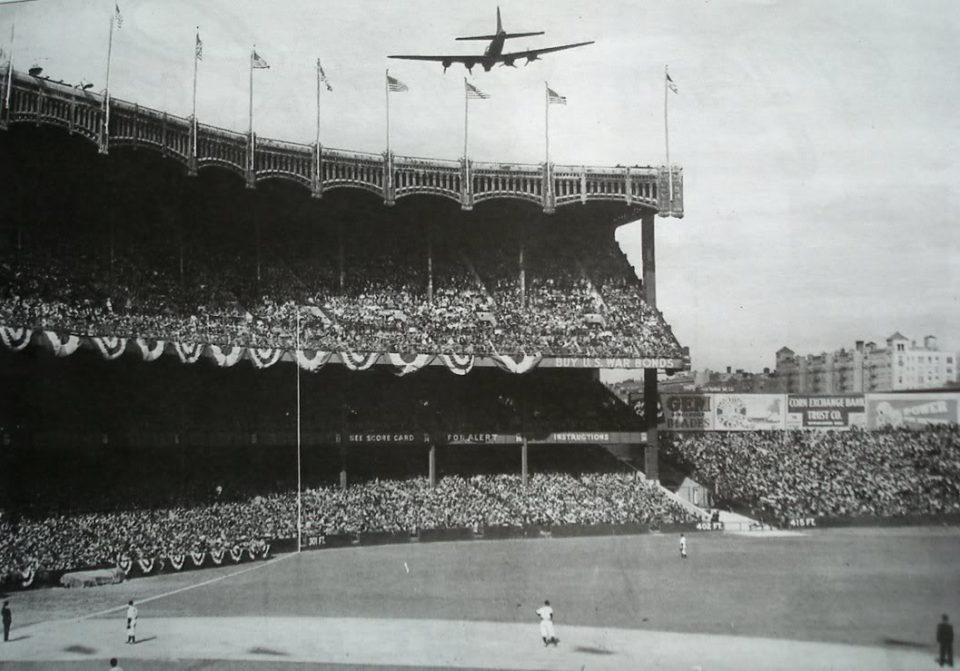
It was at this time that Watson along with three other pilots; 2nd Lts. Robert Sheets, Elmer Young, and Joseph Wheeler, buzzed the World Series game between St. Louis Cardinals and the New York Yankees at the Yankee Stadium, New York. Mayor LaGuardia was so incensed by the action at the time, that he insisted Watson and the others be disciplined, court martial proceedings being instigated as soon as the four landed in Maine*2.
However, it was not to be, the top brass needing every aircraft and crewman they could muster, sent the four on their way with a $75 fine and a stiff telling off!
Although tinged by the sad loss of his crew, the villain of the World Series’ Buzzing, had gone on to prove himself more than a worthy pilot, making history in more ways than one.
A Boeing B-17 ‘buzzes’ the Yankee stadium October 5th 1943. (Author unknown).*3
The crew of ‘Meat Hound‘ were:
Pilot – 2nd Lt. Jack Watson (Returned to Duty)
Co-Pilot – Lt Col. Clayton David (Evaded)
Navigator – 2nd Lt. John Leverton (POW)
Radio Operator – Stf. Sgt. Harry Romaniec (KIA)
Bombardier – 2nd Lt. Vance Colvin (KIA)
Flight Engineer/Top Turret Gunner – Stf. Sgt. Sam Rowland (POW)
Right Waist Gunner – Sgt. William Fussner (KIA)
Left Waist Gunner – Gene Stewart (POW)
Tail Gunner – Sgt. Roman Kosinski (POW)
Ball Turret Gunner – Sgt. Fred Booth (KIA)
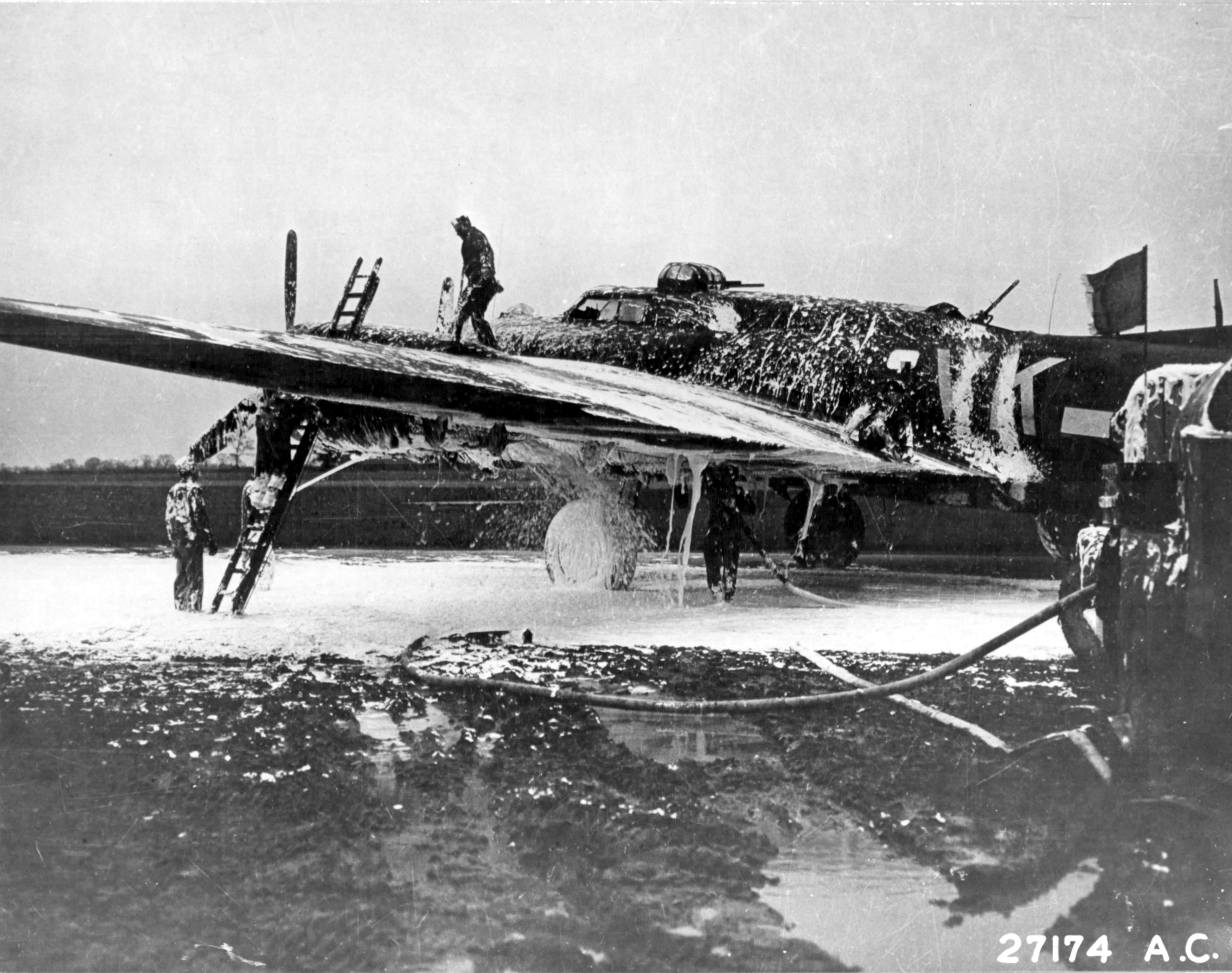
The B-17F, #42-29524, was delivered to Denver 31st December 1942; then assigned to the 423rd BS (306th BG) as ‘RD-D’ at Thurleigh 2nd March 1943. It was later transferred to the 358th BS (303rd BG) as ‘VK-K’ based at Molesworth on 30th July 1943.
For their efforts in this mission, the 303rd Bomb Group were awarded a Distinguished Unit Citation, the only time the entire unit achieved such an accolade.
Flying from RAF Rattlesden, Suffolk, England, navigator 2nd Lt. Robert E. Femoyer earned the Medal of Honour for action whilst on a mission to Merseburg. During this operation, he showed the highest level of dedication to his crew, performing a selfless act of bravery whilst being severely and fatally wounded.
Born October 31st 1921, Huntington, West Virginia, USA, he was the eldest child of Edward and Mary Femoyer. and attended Virginia Polytechnic Institute in Blacksburg, Virginia.
On 11th November 1942 Robert Femoyer enlisted and joined the Reserve Corps. He didn’t take up active duty until the following February when he began his basic training at Miami Beach, Florida. He joined the Army Air Corps in that same month and became a cadet at the University of Pittsburgh. He received his commission at the AAF Navigation School at Selman Field, Louisiana in 1943 and graduated, without gaining his wings, in 1944.
With his second lieutenant bars firmly under his belt, Femoyer received his first posting; and in September 1944 he left with the 711th Bomb Squadron as part of the 447th Bomb Group, Eighth Airforce. As a navigator he would determine routes and ensure the safe flight of his aircraft and other crew members to the bomb target and home.
On his fifth and final mission , and only a few days after his 23rd birthday, on November 2, 1944, the 711th attacked an oil refinery at Merseburg, near Leipzig, Germany. The B-17 he was in, was battered, hit several times by flak, and had two of the four engines damaged. The aircraft was difficult to fly and the navigational instruments were left almost useless. Femoyer himself had received shrapnel wounds to his side and back, was bleeding heavily and in a great deal of pain.
The B-17 quickly lost both height and speed and was forced to leave the formation, making it more vulnerable to attack from fighters, but Femoyer was not going let his compatriots down.
Deciding to turn for home the pilot asked for a route. In response, Femoyer, determined to keep a clear head, refused all medical assistance before planning their escape route home. He insisted he was propped up so he could read his maps, the injury to his body making sitting extremely difficult. Guiding the pilot safely around heavy flak zones, they eventually reached the safety of the English coast, where then, and only then, did Femoyer allow morphine and other medical aid to be administered. The pilot managed to guide the stricken aircraft home where upon landing at RAF Rattlesden, Femoyer was removed from his post, weak and having lost of lot of blood, and taken to hospital where he sadly died about an hour later.
For his valour and courage he was posthumously awarded the Medal of Honour, and his citation read:
“For conspicuous gallantry and intrepidity at the risk of his life above and beyond the call of duty near Merseburg, Germany, on Nov. 2, 1944. While on a mission, the bomber, of which 2d Lt. Femoyer was the navigator, was struck by three enemy antiaircraft shells. The plane suffered serious damage and 2d Lt. Femoyer was severely wounded in the side and back by shell fragments which penetrated his body. In spite of extreme pain and great loss of blood he refused an offered injection of morphine. He was determined to keep his mental faculties clear in order that he might direct his plane out of danger and so save his comrades. Not being able to arise from the floor, he asked to be propped up in order to enable him to see his charts and instruments. He successfully directed the navigation of his lone bomber for 2 1/2 hours so well it avoided enemy flak and returned to the field without further damage. Only when the plane had arrived in the safe area over the English Channel did he feel that he had accomplished his objective; then, and only then, he permitted an injection of a sedative. He died shortly after being removed from the plane. The heroism and self-sacrifice of 2d Lt. Femoyer are in keeping with the highest traditions of the 447th Bomb Group and the U.S. Army Air Corps.”
The body of 2nd Lt. Robert Edward Femoyer was returned to the United States to his adopted Florida home, and was buried in Greenlawn Cemetery in Jacksonville, Florida, Section 8, Lot 2. Florida historical resources list him as one of their own war heroes. His college, Virginia Tech, named a building the ‘Femoyer Hall’ in his honour in 1949 and in 2001, a stretch of West Virginia Route 152 from the Fifth Street crossing with Interstate 64 to the Huntington city limits, was officially designated Robert Femoyer Boulevard. Numerous air force bases have also named streets in his honour.
Robert Femoyer was the only American navigator to have received the Medal of Honour during service in World War Two and remains a Florida hero to this day.
War makes men do terrible things to their fellow mankind. But through all the horror and sometimes insurmountable odds, courage and bravery shine through. Two gallant young men both in the same B-17 were awarded the Medal of Honour for acts of extreme bravery in the face of certain death.
Born on 3 June 1923, Arnett. Oklahoma, Donald Joseph Gott, began his air force career at the local base in 1943. By the end of the first year he had achieved the rank of First Lieutenant in the US Army Air Corps. Posted with the 729th. Bomber Squadron, 452nd Bombardment Group to Deopham Green, Norfolk, England, he was to fly a B-17 (42-97904) ‘Lady Jeannette’ along with his crew and co-pilot William E. Metzger.
Metzger was born February 9, 1922 – Lima, Ohio and by the time he was 22 he was a 2nd Lieutenant. He was to meet Gott at Deopham Green, Norfolk and together they would fly a number of missions over occupied Europe bombing strategic targets.
On the 9th November 1944, they took off with their crew on a mission that would take them into the German heartland to bomb the marshalling yards at Saarbrucken.
On this run, the aircraft, was badly hit by flak, three of the engines caught fire and were inoperable, the fires were so fierce that they were reaching the tail of the stricken aircraft.
Further fires within the fuselage started when flares were ignited, and this rapidly caught a hold. Hydraulic lines were severed and the liquid from within was jettisoned onto the burning fuselage. With communication lines cut and unable to contact the crew, both Gott and Metzger had some difficult decisions to make. They had not yet reached the target, the aircraft still held its bomb load and they were deep into occupied territory.
The crew too had suffered badly at the hands of the anti-aircraft fire. The engineer was wounded in the leg and the radio operators arm was severed below the elbow causing great pain and loss of blood. He would die very quickly if medical help was not found. Despite the quick thinking and application of tourniquet by fellow crew members, he soon passed out and fell unconscious.
Gott and Metzger decided that jettisoning the injured radio operator would not result in his receiving medical help and so they would drop the bombs and head for the nearest friendly territory where they could crash-land. Doing this, would risk not only the life of the operator, but that of the crew and themselves should the stricken aircraft explode.
Over the target, they released their bombs and flew alone toward allied territory. Flying low over the village of Hattonville, the aircraft was seen to swerve avoiding a church and homes. At this point, Metzger personally crawled through the aircraft and instructed the crew to bail out. Three chutes were seen by local people, two fell to earth and the third became entangled on the stabiliser and was trapped. A further three were seen moments later, all these escaped. Metzger decided to remain with Gott and try to land the aircraft with the radio operator on board. With only one working engine, Gott and Metzger brought the aircraft down through a series of tight turns and at only 100 feet from safety the aircraft banked and exploded. Crashing to earth it again suffered a second explosion and disintegrated killing all three crew members on board and the crew member still attached to the tail.
1st Lieutenant Gott and his co-pilot 2nd Lieutenant Metzger had shown great courage and determination to complete their mission, and to save their crew from certain death. They had shown the greatest of valour in what was to be the final act of their short lives.
Both men were killed on that day, November 4th 1944 aged 21 and 22 respectively. They were both posthumously awarded the Medal of Honour on the 16th May 1945.
Gott’s remains were returned to the United States and he was buried at the Harmon Cemetery, in Harmon, Ellis County, Oklahoma, USA. Metzger, was returned to his home town and was buried at Woodlawn Cemetery, Lima, Ohio.
Along with Gott and Metzger, crew members who did not survive were: T/Sgt Robert A, Dunlap and S/Sgt T.G. Herman B, Krimminger. The survivors were picked up by a a local field hospital and treated for their injuries: 2nd lt John A, Harland ; 2nd lt Joseph F, Harms ; S/Sgt B.T. James O, Fross ; S/Sgt R.W. William R, Robbins and T/Sg T.T. Russell W Gustafson.
A memorial now stands close to the site of the crash site.
Lt Raymond Harney (Photo courtesy of Tsymond Harney JR.)*1
A few years ago a story came to light that not only brought home the brutality of war but also the compassion found in war. It was of two American airmen whose World War II story finally come to a close 70 years after their death.
The two airmen, U.S. Army Air Corps 1st Lt. Raymond Harney (s/n O-523208) and U.S. Army Air Corps 2nd Lt. Warren French, (s/n O-2056584) of the 349th BS, 100th BG, were in a B17G (44-6306) over Germany on September 28th 1944, when they were hit by flak whilst on a mission to Merseberg. This would be their eighth and final mission.
Mission 652 involved a total of 342 B-17s which were sent to bomb the Merseburg/Leuna oil refinery and any additional targets of opportunity. During the operation, 10 B-17s were lost, 4 were damaged beyond repair and 251 damaged but repairable. Escort for the mission was provided by 212 P-51s of the USAAF.
B-17 ‘#44-6306’, was delivered to Kearney airbase on 28th June 1944, then moved to Grenier airbase, New Hampshire on 9th July 1944, for onward transport to the United Kingdom. It was assigned to the 349th Bomb Squadron, of the 100th Bomb Group, given the code ‘XR-G’, and based at RAF Thorpe Abbotts from the 12th July 1944.
The crew of #44-6306, assigned on the 28th August 1944, was: (Pilot) 1st Lt. Raymond E. Harney (Co-pilot); 2nd Lt. William R. Kimball (Navigator); 2nd Lt. Charles M. Hamrick (Bombardier); 2nd Lt. Warren. M. French (Top Turret/Engineer); Cpl. Thadeus L. Gotz (Radio Operator/Gunner); Cpl. Hubert J. Burleigh,Jr. (Ball Turret); Cpl. Melvin F. Cordray (Waist Gunner); Cpl. Robert C. Minear (Waist Gunner); Cpl James J. Sorenson, and (tail Gunner) Cpl. John H. Bundner. However, for reasons unknown at this time, for this particular mission, Gotz was not aboard, and instead S/Sgt. Jack D. Francisco flew as tail gunner and Cpl. Robert C. Minear flew as the Flight Engineer.
At 12:10, whilst over the target, the B-17 was hit in the number 2 engine by anti-aircraft flak. As a result, the engine caught fire, the aircraft withdrew from the protection of the formation, joining another formation further back, but began to fall back again when the number 4 engine was also feathered. Harney continued to fly the crippled B-17 for two hours after being hit, before finally deciding enough was enough and he ordered the crew to bail out. Being determined to save his friend and the aircraft, he also decided that he and the injured French, would remain and try to land the aircraft.
Outside of the village of Schwickershausen, to the north of another major target, Schweinfurt, Germany, they attempted a belly landing bringing the aircraft down in a turnip field. The B-17 slid across the ground, ripping off the port wing, causing a tremendous fire. Neither Harney nor French sadly survived the subsequent fireball.
Although he managed to get the crew to leave the aircraft, their safety was not guaranteed and sadly, three were killed by local police in the following days. An event not uncommon in Nazi Germany. Only two of the gunners, Cpl. Melvin F. Cordray, and Cpl. Robert C. Minear, survived as POWs.
What makes this story more significant than usual, is what followed after the crash.
The local people made a wooden cross in remembrance of the crew and they kept it hidden away in the local church for over 70 years.
The cross kept secret for so many years.*2
The large wooden cross, had the words “Hier ruhen in Gott! 2 amer. Flieger,” or “Here rests in God 2 American flyers,” engraved on it, along with details of the aircraft crash. On the 70th anniversary of the crash, 28th September 2014, a memorial service was held in the village of Schwickershausen. Following this, on 5th October, the cross was flown over to England in an American KC-135 Stratotanker from RAF Mildenhall, with two Luftwaffe Tornadoes escorting them over Germany. The cross was donated to the ‘Bloody 100th’ museum at Thorpe Abbots for safe keeping. A certificate was also handed over along with the cross signifying not only the now peaceful and co-operative alliance between the two nations, but the final closing of a chapter of the history of two crew members of the “Bloody Hundredth.”
The cross being transported in the Boom pod of a KC-135 Stratotanker. October 2014.*4
This is a remarkable story, and one that certainly stands out amongst the horrors and heroism of the Second World War.
Warren French’s memorial stone in Belgium*3
Lt. Raymond E. Harney’s Gravestone is at Ft. Snelling Cemetery in Minnesota, his remains are in the graveyard at Gemeindefriedhof Schwickershausen. Warren French’s headstone is in the Ardennes, Neuville-en-Cond, in Belgium.
Thorpe Abbotts airfield and museum is featured in Trail 12
After Part 3 of our journey, we see the US bomber airfield at Nuthampstead finally come to a close. But as the war approaches its conclusion, operations continue to be flown and losses continue to mount.
The US forces would go to Dresden the morning after the RAF had been. 431 B-17s of the entire 1st Bombardment Division, would prepare for take off at 07:00 hrs to be over Dresden at mid-day. With two other Divisions also in the air that day, escort would be from 784 Mustangs, with the 20th FG protecting the leaders the 1st Bombardment Wing, the 398th BG, followed by the 91st and 381st Bomb Groups respectively. In all, in excess of 2,000 American aircraft would fly into the heart of Germany that day.
It was to go disastrously wrong for the Group though, for even as they flew over Holland, they were already off course and now the weather was moving in. With their Gee system being constantly interfered with and throwing up faults, the lead plane of the 389th decided to take the more southerly route to fly around the cloud, taking the formation near to Munster, a city heavily guarded by flak. Although objecting to the move, both the 381st and the 91st followed – a move they would come to regret. The 91st were hit hard; many aircraft were damaged and their crewmen badly injured. Then, another defensive turn took the Wing, some 137 aircraft, a total of fifty miles of course. They were now heading to Schweinfurt, the scene of such devastation in August 1943 where high loses resulted the US temporarily ceasing air operations as a result. Not wanting to relive the experience, the formation then turned south again, taking them, and their escorts, even further off course.
By now, the leader’s Gee system had completely failed, and as the formation approached the target, the deputy’s system also ceased working. Lost and confused, they were gifted with a break in the cloud through which they could see an ancient city with a river running through it. The order was given and bombs were dropped. With little to no flak and no enemy fighters to resist them, the formation unleashed its devastating load onto those below. Unfortunately, it was not Dresden at all, but the Czech capital Prague, they were some eighty miles off course.*5
The 398th flew their final operation on April 25th 1945, a flight that took them to the Skoda Armament Works at Pilsen. The 398th were joined that day by the 91st, 92nd, 303rd, 305th, 379th, 384th, and the 381st Bomb Groups. With simultaneous operations happening elsewhere at Munich and the Me 262 airfield in Prague, 198 aircraft were flew to Pilsen to bomb the Skoda works.
In contrast to their first mission, take off was controlled and in good order. The first aircraft was airborne at 05:20 and the last 35 minutes later. Forming up took place over Debden Buncher (RAF Debden) at 5,000 feet and the Buncher was left at 06:40, when the entire formation headed for the coast. at 07:37, they crossed the French shoreline.*10
The 398th BG were tasked with leading the 1st Combat Bombardment Wing, totalling three Bomb Groups made up of 120 B-17s. In charge was Captain Michael Robinson, Commanding Offcier of the 601st BS. The weather was predicted to be good, so a visual bomb run was planned, however, over the target, this proved not to be the case and 10/10 cloud completely obscured the target. Forced to go round again, the formation made a 360o turn bringing them back in at the rear of the formation. By now flak had become both intense and accurate.
Two aircraft from the 602nd in the high squadron were hit. The first B-17G #42-97266 (K8-G, “Godfathers Inc.“) piloted by 2nd Lt. Allan Ferguson, quickly left the formation spiralling out of control. Three of those on board managed to escape the aircraft as it fell earthward. Of the crew, six were killed whilst two were captured becoming prisoners of war for the last remaining days of action*6*7
The second aircraft that day was that of Lt. Paul Coville, B-17G #43-38652 (K8-V, “Stinker Jr“). After the second bomb run, the aircraft was hit behind the #3 engine, leaving a large hole and a damaged engine. After falling out of formation and feathering the engine, Lt. Coville brought the aircraft back, at which point the engine caught fire. A small explosion then ripped the right wing off outboard of the engine, sending the aircraft spiralling towards the ground. The crew inside, frantically tried to get out, assisting each other with parachutes. All crewmen except the ball turret gunner S. Sgt. Charles Walker, manged to escape the aircraft, managing to find allied troops on the ground and safety.
During their search for safety both Coville and the waist gunner S. Sgt. Harry Overbough, took two prisoners each, Overbough’s ending up being revealed as escaped Jewish prisoners who had donned German army uniforms to help them escape. *7*8
After bombs away, the formation made a right turn and headed as briefed toward home, crossing the English coast at 14:26. The first aircraft touched down at Nuthampstead at 15:02.*10
With the last mission flown, Nuthampstead’s days were now numbered. A handful of ‘Revival’ flights were made transferring POWs from Barth in Germany to airfield A-10 in France. In addition, flights carrying ground crews over Germany also took place. By May 1945 though, the war was over and the exodus of American forces back to the united States began. Over the period May / June, 1945, the 398th would depart Nuthampstead, the ground force returning to the US from Greenock onboard the Queen Elizabeth, whilst the air personnel flew back between 21st and 27th May. After thirty days of rest and recuperation, the Group assembled at Drew Field, Florida where many officers and enlisted men were discharged from the service. The remaining handful were given duties elsewhere and transferred almost immediately.
A VE day service held at Nuthampstead airbase. (@IWM UPL 35448)
On September 1st 1945, Major Gene Nelson and Major Dean Ashworth, quietly and without ceremony, inactivated the Group – the 398th would be no more.
By the time the war had come to a close, the 398th had completed 6,419 operational sorties (175 missions) dropping some 15,700 tons of bombs. They lost some seventy*10 aircraft in operations. For their determination and outstanding flying over Derben on April 8th, the Group received a Presidential Unit Citation, this came in addition to 2,124 Air Medals, 531 DFCs, 2 Silver Stars, 18 Bronze Stars and 4 Purple Hearts (with others being awarded elsewhere). Whilst their losses were perhaps hugely significant compared to other Groups, they nonetheless performed gallantly and with dedication deserving of any military group.
Returned to RAF ownership a month later the airfield became a store and maintenance station storing ordnance for disposal, and by 1954 the military had no further interest in it, and it closed some 5 years later.
During the 1960s Nuthampstead was in the limelight once more when it was considered as a site for London’s third airport after Heathrow and Gatwick. Being so close to the capital made it an ideal proposition, but the proposal faced huge opposition from those living and working in the area. The decision would eventually favour Stansted, a site not even shortlisted in the initial phase.
The Roskill Commission Inquiry (1968-70), identified seventy-eight initial sites, reducing it to four possibles: Nuthampstead, Thurleigh (Bedford), Cublington (Bucks) and Foulness on the Essex coast, ignoring Stansted on grounds of air traffic, noise and poor road access.
After great debate, Cublington was finally chosen, however, following in-house arguments and disagreements, this was later overturned in favour of Foulness (Maplin Sands),*9 Nuthampstead being rejected on various points including most noise, most agricultural loss and the requirement of a rail link.
With work intending to start in the early 1970s, the plans were eventually shelved due to the 1973 oil crisis and instead a smaller proposal was put forward to build a site at Stansted, itself a former war-time airfield. The build eventually went ahead and today Stansted sees in excess of 15 million passengers, all of which could have been located at Nuthampstead.
With that, Nuthampstead was destined to be become farmland once more. The Forestry Commission planted tress in the former bomb store, itself leading to large quantities of munitions being discovered after the site was abandoned. A small strip was retained for karting and a small crop spraying business utilised part of the airfield. Much of this has now also ceased and whilst parts of the original runway and peri track concrete surfaces still exits, farmland prevails once more over the site.
Built mid war, Nuthampstead had a rather unfortunate start, with many serious problems for the 55th FG and their P-38 Lightnings. The 398th, the Group synonymous with the airfield, were a rookie Group but one that went on to perform 195 operations many over Germany, losing a number of aircraft and crews in the process. They took part in some the the war’s most ferocious battles including Schweinfurt on October 9th, Berlin on several occasions and the US Air Force’s last operation of the war, Pilsen on April 25th 1945.
Transferred back to RAF ownership post war it was a serious contender for London’s third airport, however, this was not to be and the airfield was largely removed, buildings were demolished and the runways were dug up for hardcore. Little remains of it today, a small private airstrip utilises some of the site, and a thriving museum continues to tell the story of those who served here. A stunning memorial stands outside the local pub frequented once by so many personnel who served here, at Nuthampstead, in those days of the 1940s.
The full history of RAF Nuthampstead can be read in Trail 32.
Sources and further information (Nuthampstead)
*1 Investigation of the US National Defense Program, Part 35. US Government Printing Office Available on Google books
*2 Fooy. F., “One of Thousands – A Navigator in the European Air War.” Lulu Publishing, 2015 Via Google Books
*3 Wilson. K. “Blood and Fears – How America’s Bomber Boys and Girls in England Won their War“. Weidenfeld & Nicholson, 2016 page 390
*7 “Hell from Heaven – Ch 35 – Mission 31 – Pilsen, Czechoslovakia, Our Last Combat Mission – April 25, 1945” published by Leonard Streitfeld, Bombardier, 600th Squadron on the 398th BG Memorial Association Website.
*8 MACR 14220
*9 Banister, D., “Transport Planning In the UK, USA and Europe” Taylor & Francis, 2003
*10 United States Army Air Forces, “The History of the 398th Bombardment Group (H)” (1945) World War Regimental Histories Book 124.
Missing Air Crew Reports 12214 and 12215
Ethell. J., & Price. A., “Target Berlin – Mission 250: March 6th 1944“. Janes, 1981
A good many photos, official records and personal stories are available on the 398th BG Memorial website. A great resource for those wanting to read more about the history of the 398th BG,