Heartbreak on Christmas Eve 1944

On the morning of December 24th, 1944, Brigadier General  Frederick W. Castle (s/n 0-319375), woke to the greet the day, and like most pilots facing perilous missions, he probably wondered if it would be his last. However, knowing what I know about Castle from my research, he was a calm, confident and highly competent pilot, so most likely, he had every reason to believe in the success of his next mission. Sadly though, that was not to be the case. Castle never made it back that night. On Christmas Eve of 1944, this brave pilot lost his 30th and final battle.

Lieutenant Colonel Elliott Vandevanter of the 385th Bomb Group with Colonel Frederick W Castle (centre) of the 487th Bomb Group and Brigadier General Curtis A LeMay. *1

Frederick W. Castle was born on October 14th, 1908 at Fort McKinley in Manila, the Philippines. He came from an active military family and was the son of Col. Benjamin Frederick Castle. Following the end of World War 1, he was to settle in the United States in Mountain Lakes, New Jersey.

From a young age, Castle was groomed for a life of military service. He attended Boonton High School and Storm King Military Academy before moving on to the US Military Academy from where he graduated in June 1930.

His first service was with the New Jersey National Guard, where he stayed for two years  transferring to the Air Corps, March Field, California, then onto Kelly Field in Texas. Castle gained his wings in October 1931.

Serving as a pilot with the 17th Pursuit Squadron for 3 years, he eventually left the forces returning to civilian life but holding a reserve status. With the entry of the United States into the Second World War, Castle would be called upon by his good Friend Ira Eaker, and he returned in January 1942, being promoted within two months to Major and then onto Lieutenant Colonel in the following September.

With the forming of the Eighth Air Force in England, headed by General Ira Eaker, Castle was one of seven high-ranking officers selected to fly with him on the dangerous route over the Bay of Biscay, eventually arriving at Hendon wearing their civilian clothes. Joining Eaker on February 20th 1943 in the DC-3 from Lisbon were: Lt Colonel Frank Armstrong Jnr, Major Peter Beasley, Captain Beirne Lay Jnr, Lt. Harris Hull and Lt. William Cowart Jnr.

Castle desired a combat role, and this desire would lead to him taking over the command of the ailing 94th Bomb Group. His methods of command were initially considered weak, but in the face of low morale and apprehension, he personally took the 94th to some of the furthest targets yet, his first being Oschersleben in the heart of Germany; a mission that went on to inspire the film “12 o’clock High“.  Castle went on to fly in many combat missions including numerous high prestige targets, a role that took him on to Brigadier General and command of 4th Combat Wing.

On Christmas Eve 1944, following a week of poor weather, orders came though for a maximum effort mission, involving every available B-17 and B-24 in support of the troops in the Ardennes. Airfields, supply lines and troop movements were to be attacked, and good weather was at last predicted.

General Arnold with Colonel Frederick W Castle, Brigadier General Curtis LeMay, General Williams and General Anderson during a visit to Bury St Edmunds (Rougham), home of the 379th Bomb Group. Image stamped on reverse: 'Passed for publication 3 Sep 1943.' [stamp] nand '282085.' [censor no.] A printed caption was previously attached to the reverse however this has been removed. Associated news story: 'American Air Forces G.O.C. Meets The

General Arnold with Colonel Frederick W Castle, Brigadier General Curtis LeMay, General Williams and General Anderson during a visit to Bury St Edmunds (Rougham)*2

A joint effort, this would be the largest single attack to date involving 500 RAF and Ninth Air force bombers, 800 fighters and just short of 2,050 Eighth Air Force bombers. Such was the demand for aircraft, that even ‘war weary’ examples, were hastily armed and prepared, many unfit for more than assembly or training duties. Truly an armada of incredible proportions.

Taking lead position, Frederick Castle, was in B-17G-VE, ’44-8444′ “Treble Four“, an aircraft that had itself seen battle experience. Assigned to the 836BS, 487BG, and at RAF Lavenham, it was previously damaged in a raid over Darmstadt. The aircraft was salvaged in January 1945.

A veteran of 29 missions, Castle was a more than a competent leader. They set off, the weather as predicted, but with a haze that restricted ground level visibility. This haze prevented the fighters from leaving causing an all important delay. This delay was not considered a major problem at the time however, as the escorts would soon catchup and overtake the laden bombers. The Luftwaffe, making an unprecedented move, brought forward fighters into the Liege area to meet the oncoming bombers before any escorts could reach them. In the first few minutes of the battle, four of the 487th BG’s aircraft were downed and a further five forced to land in Belgium.

Castle’s lead plane, suffering problems with one of its engines (possibly due to previous battle damage) was attacked by the first wave of fighters, action was taken to leave the flight and join a formation further back. It was then attacked again, the aircraft catching fire, and the navigator wounded.

Castle took control, and even though still being attacked, refused to jettison the bombs for fear of killing civilians or allied troops below. Further attacks led to both engines on the starboard wing catching fire, which ultimately led to the fuel tank exploding sending the aircraft into an uncontrollable spin.

Through Castle’s actions, seven of the crewmen were able to leave the aircraft, sadly not all survived.

Frederick Castle died in the crash, his body is now buried in Henri-Chapelle American Cemetery, Liege, Belgium, Plot D, Row 13, Grave 53.

His citation reads:

“He was air commander and leader of more than 2,000 heavy bombers in a strike against German airfields on 24 December 1944. En route to the target, the failure of 1 engine forced him to relinquish his place at the head of the formation. In order not to endanger friendly troops on the ground below, he refused to jettison his bombs to gain speed maneuverability. His lagging, unescorted aircraft became the target of numerous enemy fighters which ripped the left wing with cannon shells. set the oxygen system afire, and wounded 2 members of the crew. Repeated attacks started fires in 2 engines, leaving the Flying Fortress in imminent danger of exploding. Realizing the hopelessness of the situation, the bail-out order was given. Without regard for his personal safety he gallantly remained alone at the controls to afford all other crewmembers an opportunity to escape. Still another attack exploded gasoline tanks in the right wing, and the bomber plunged earthward. carrying Gen. Castle to his death. His intrepidity and willing sacrifice of his life to save members of the crew were in keeping with the highest traditions of the military service*3.”

For his action, Frederick W. Castle was awarded the Medal of Honour posthumously. In 1946, the Castle Air Force Base, in the heart of California’s San Joaquin Valley, was dedicated in his name, and on June 20th, 1981, the Castle Air Museum was officially opened on the now closed base, for the purpose of preserving the Air Force and Castle heritage. Museum details can be found here. His  name is also on a plaque in the Memorial Park, in Mountain Lakes, New Jersey.

The awarding of the Medal of Honour, reflected the determination and personality of one of Eakers “Original Seven”, who chose to leave a safe position for a combat role, taking on the demoralised 94th, and leading them into some of the Second World War’s most ferocious air battles.

Sources and further reading.

*1 Photo from Roger Freeman Collection, IWM, FRE9833

*2 Photo from Roger Freeman Collection, IWM, FRE9879

*3 Congregational Medal of Honour SocietyWebsite, accessed 22/12/15

Mountain Lakes Library, Website, accessed 22/12/15

“The B-17 Flying Fortress Story”, Roger A Freeman, Arms and Armour, 1997.

Air Forces Historical Support, Division,  Website, accessed 22/12/15

“The Mighty Eighth”, Roger Freeman, Arms and Armour, 1986.

American Ghosts – RAF Kimbolton an Airfield with a Remarkable History.

Kimbolton was home to the American USAAF, it also housed one of the RAF’s rarest Wellington Bombers of the Second World War. The 379th BG were the main residents achieving a number of records whilst bombing heavily defended targets in occupied Europe. We go back to see what is left today.

RAF Kimbolton. (Station 117)

DSC_0108

Looking across Kimbolton today.

We arrive not far from the busy A14 to the south-west of Graffham Water. Perched on top of the hill, as many of these sites are, is Station 117 – Kimbolton. Having a short life, it was home to the 379th Bombardment Group of the Eighth Air Force, flying some 330 missions in B-17s. The site is split in two by the main road which uses part of the original perimeter track for it’s base. To one side is where the runways and dispersal pens would have been, to the other side the main hangers, admin blocks, fuel storage and squadron quarters. The former is now open fields used for agriculture and the later a well-kept and busy industrial site. What was the main runway is crossed by this road where there is now a kart track.

Kimbolton Airfield in 1945, taken by 541 Sqn RAF. (English Heritage RAF Photography – RAF_106G_UK_635_RP_3217)

Kimbolton was designed with three concrete runways, the main running north-west / south-east, (2154 yds); the second and third running slightly off north-south (1545 yds) and east-west (1407 yds), it also had two T2 hangars with a proposed third, along with 20 ‘loop’ style hardstands and 31 ‘frying pan’ hardstands around its perimeter.

The local railway line formed the northern boundary,  the bomb store was to the south-west, the technical and administrative site to the south-east and beyond that the accommodation sites. To house the huge numbers staff to be located at Kimbolton, there were two communal sites; a WAAF site; sick quarters; two sewage sites; two officers quarters, an airmen’s quarters; a sergeants site and two further sites with ablutions and latrines. These were all spread to the south-eastern corner of the airfield,

Originally built in 1941 as a  satellite for RAF Molesworth, it was initially used by the RAF’s Wellington IVs, a rare breed where only 220 airframes were built. 460 Sqn were formed out of ‘C’ flight 458 Sqn at Molesworth and used the Wellingtons until August 1942 when they replaced them with the Halifax II. Staying only until January 1942, their departure saw the handing over of both Molesworth and Kimbolton to the USAAF Eighth Air Force and the heavier B-17s. During this time, the airfield was still under construction, and although the majority of the infrastructure was already in place, the perimeter was yet to be completed.

First to arrive was the 91stBG, who only stayed for a month, before moving on to Bassingbourn.  A short stay by ground forces preceded extensions to the runways, accommodation and improved facilities. Now Kimbolton was truly ready for a Heavy Bomb Group.

Soon to arrive, was the 379th BG, 41st CW, flying B-17Fs. Activated in November 1942 they arrived at Kimbolton via Scotland, ground forces sailing from New York whilst the crews flew their aircraft from Maine to Prestwick via the northern supply route.

Arriving in April / May, their first mission would be that same month. The 379th would attack prestige targets such as industrial sites, oil refineries, submarine pens and other targets stretching from France and the lowlands to Norway and onto Poland. Targets famed for heavy defences and bitter fighting, they would often see themselves over, Ludwigshafen, Brunswick, Schweinfurt, Leipzig, Meresberg and Gelsenkirchen. They would receive two DUCs for action over Europe including, raids without fighter escort over central Germany on January 11th 1944. They assisted with the allied invasion, the breakout at St. Lo and attacked communication lines at the Battle of the Bulge. They  would operate from Kimbolton until after the war’s end, when on 12th June 1945, they began their departure to Casablanca.

Life at Kimbolton was not to be easy and initiation into the war would be harsh. On the first operation, four aircraft were lost, three over the target and one further crashing on return. Three of the crews were to die; a stark warning as to what would come. Their second mission would fair little better. An attack on Wilhelmshaven, saw a further six aircraft lost and heavy casualties amongst the survivors. Things were not going well for the 379th and with further losses, this was to be one of the bloodiest entries into the war for any Eight Air Force Group.

A B-17 Flying Fortress (FR-C, serial number 42-38183) nicknamed

B-17 Flying Fortress (‘FR-C’, 42-38183) “The Lost Angel” of the 379th BG sliding on grass after crash landing, flown by Lieutenant Edmund H Lutz at Kimbolton. (Roger Freeman Collection)

As the air battle progressed, further losses would be the pay off for accurate and determined bombing by the 379th. Flying in close formation as they did, accidents often occurred. On January 30th 1944, 42-3325 “Paddy Gremlin” was hit by bombs from above. Then again, on September 16th 1943, two further aircraft were downed by falling bombs, close formation flying certainly had its dangers.

Some 1 in 6 losses of the USAAF were due to accidents of one form or another. Collisions were another inevitable part of the close formation flying. A number of memorials around the country remember crews who lost their lives whilst flying in close formation. Kimbolton and the 379th were to be no different. On June 19th 1944, two B-17Gs 44-6133 (unnamed) and 42-97942 “Heavenly Body II” crashed over Canvey Island killing all but one of 44-6133 and three of Heavenly Body II. The official verdict stated that the second pilot failed to maintain the correct position whilst in poor visibility, a remarkable feat in any condition let alone poor visibility whilst possibly on instruments alone. (See full details of the terrible accident).

However, not all was bad for the 379th though. Luck was on the side of B-17F, 42-3167, “Ye Olde Pub“, when on December 20th 1943, anti-aircraft fire badly damaged the aircraft whilst over Bremen. The aircraft limping for home, was discovered by Lt. Franz Stigler of JG 27/6. On seeing the aircraft, Stigler escorted the B-17 over the North Sea, whereupon he saluted and departed allowing the B-17 safe passage home where it landed and was scrapped.

A number of prestige visitors were seen at Kimbolton. These included King George VI, Queen Elizabeth, Princess Elizabeth and General Doolittle. One particular and rather rare visitor arrived at Kimbolton on January 8th 1944. A rebuilt Messerschmitt BF-109 stayed here whilst on a familiarisation tour for crews. Shot down over Kent it was rebuilt to flying condition and flown around the country.

8th 1944.

Seen in front of a B-17, Messerschmitt BF-109 runs up her engine at Kimbolton, January 8th 1944. (Roger Freeman Collection FRE 4775)

All in all the 379th had a turbulent time. By the time they had left Kimbolton, they had lost a great many crews, but their record was second to none. They flew more sorties than any other Bomb Group of the Eighth Air Force – in excess of 10,000 in 330 missions; dropped around 24,000 tons of ordnance, equating to 2.3 tons per aircraft; pioneered the 12 ship formation that became standard practice in 1944 and had the lowest abortive rate of any group from 1943. Kimbolton was visited by Lieutenant General James Doolittle, and two B-17s held the record of that time “Ol Gappy” and “Birmingham Jewel“, for the most missions at the end of their service. They also had overall, one of the lowest loss rates of all Eighth AF Groups largely due to the high mission rates.

With their departure to Casablanca, the 379th would be the last operational unit to reside at Kimbolton. Post war it was retained by the RAF until sold off in the 1960s, it was returned to agriculture, the many buildings torn down, the runways dug up and crops planted where B-17s once flew.

DSC_0113

The old perimeter track exists for farm machinery and forms part of the main road.

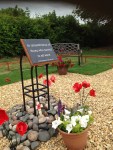
Kimbolton today is little more than a small industrial estate and farmland. At the main entrance to the industrial site, is a well-kept memorial. Two flags representing our two nations, stand aside a plaque showing the layout of the field as was, with airfield detail added.  Behind this, and almost un-noticeable, is a neat wooden box with a visitors book and a file documenting all those who left from here never to return. There are a considerable number of pages full of names and personal detail – a moving document. One of the B-17 pilots, Lt. Kermit D. Wooldridge, of the 525th Bomb Squadron, 379th Bomb Group, 8th Air Force kept a diary of his 25 raids, and many of the crew members mentioned in the memorial book appear in his diaries. These are currently being published by his daughter, and can be seen at https://sites.google.com/site/ww2pilotsdiary/  They tell of the raids, the crews and detailed events that took place over the skies of occupied Europe from June 29th 1943. I highly recommend reading it.

DSC_0109

Memorial book listing those that never came home.

This is a lovely place to sit (benches are there) and contemplate what must have been a magnificent sight all those years ago. It made me think of the part in the film ‘Memphis Belle’, where the crew were sitting listening to the poetry just prior to departure, how many young men also stood here ‘listening to poetry’. The control tower would have stood almost opposite where you are now, with views across an enormous expanse. Here they would have stood ‘counting them back’. Like everything else, it has gone and the site is now ‘peaceful’.

Kimbolton saw great deal of action in its short life. But if determination and grit were words to associate with any flying unit of the war, the 379th would be high on that list.

From Kimbolton we head off to another American Ghost, one that holds its own record and a beautiful stained glass window. We go to the American base at RAF Grafton Underwood.

Kimbolton was originally visited a couple of years ago, this is an update of that trail and it appears in Trail 6 – ‘American Ghosts’.

A short but eventful life, RAF Matching, Essex

RAF Matching (Station 166) or Matching Green, was built very late in the war, and was only operational for just over a year. It was initially built for the heavy bombers of the Eighth Air Force as a Class ‘A’ heavy bomber station, but was very soon transferred to the Ninth Air Force and used by medium bombers of the 391st Bomb Group, who supported the allied advance into Germany.

It was built with 3 runways all of concrete, 50 loop style hardstands, two T2 hangars; one to the south-east and one to the south-west, a number of blister hangars and a wide range of ancillary and support buildings. Both technical and accommodation areas were all to the east and south-east well away from the main area. The bomb site, had approximately three miles of roadway, giving an indication of its generous size.

matching green

The Watch Office at Matching now homes radar equipment.

Opened in January 1944 the first month would be busy for Matching Green. The first and primary residents were the Olive Drab B-26 Marauders of the 391st Bomb Group of the Ninth Air Force. The 391st were made up of 4 Bomb Squadrons: 572nd, 573rd, 574th, and 575th, and undertook their first mission within a month after arriving in England. They were a new group, ‘rookies’ in comparison to many, only being formed a year earlier.

Their primary targets were: airfields, bridges, marshalling yards and V- weapons sites across France. During the Allied invasion, they attacked German defences along the coast and as the allies moved further inland, they attacked fuel dumps and troop concentrations. They supported the break out at St. Lo in July 1944, and prevented the enemies retreat by attacking transport and communication links behind German lines.

Being to the south of the country, Matching Green was occasionally used by returning aircraft as a safe haven. On February 4th, just a month after it opened,  the first fatality would be recorded. Whilst returning from a mission to Frankfurt and with both engines on one side feathered, B-17G  ’42-31494′ (PY) of the 407BS, 92nd BG, based at Podington, failed to make the airfield and crashed on the approach to Matching Green. The resultant accident killed 5 of its crew members, a worse fate then the aircraft which was later salvaged.

matching green

One of the former accommodation sites.

In September 1944, the 391st moved from Matching Green to Roye/Amy in France, where they received a DUC for action against heavily defended sites without fighter escort. Their departure from Matching Green sounded the end and its short life would soon cease operationally. Between their arrival in January and their departure to France in  September, the 391st would fly some 6,000 sorties losing just under 200 crew members in action over Europe.

As the war drew to a close, the airfield was handed back to the RAF for paratroop activities. Elements of both RAF and the USAAF IX Troop Carrier Command, were reputed to have been based here, operating either Short Stirlings or C-47s. These were the last military units to operate from here and the site was closed in 1945, being returned to agriculture within a very short period of time. The majority of concrete was removed for nearby development, although many of the buildings were luckily left standing.  In the late 1980s, one of the T2 hangars was dismantled and transferred to  nearby North Weald Airfield. It remains there today re clad but still in aviation use. The Control Tower remains today and in remarkably good condition, adorned with electronic equipment, it us used use as a radar equipment test facility.

The site whilst agriculture, is now home to a large selection of fauna and flora. Deer roam freely across the site and a survey in the summer of 1999 recorded over 160 species of trees, grasses and wild flowers that included three different types of Orchid.

Matching Green, like other airfields in this area, lives in the shadow of the modern Stansted International Airport, and this has proven, in part, to be its savour.

matching green

The water tower at Matching Green in a former accommodation site.

Although close to Stansted, the network of country roads that lead to the airfield are small and signposts are few and far between. It is not an easy place to find – one of the many features of Second World War airfields. One of the first things you see is the old original water tower. It pokes its head above the many trees that now cover matching green airfield.

Access to this site is along what would have been the original entrance to the airfield. To mark the spot, a memorial has been built here. Sadly it’s not well looked after and was looking rather worn when I visited in the summer of 2015.

The tower, a rusty guardian, watches over a few of the remaining huts that once formed one of the many accommodation areas in this south-eastern corner of this airfield. A number of huts, in generally good condition, they are now utilised by a quantity of small businesses. The atmosphere of the place has not been lost and it is easy to imagine the hustle and bustle of crews moving between huts along its concrete paths. Some of the huts are in disrepair, a few have been ‘refurbished’ but the layout is clear.

From here drive back to the memorial and with the technical site behind you, turn left, drive along the road past the small forests and you can see evidence of more paths. These would have led to the technical area. This part, whilst predominantly agricultural, is also home to a number of deer and if you are lucky, as I was, you will see them walk across the road from one side to the other. A rather fitting sight bringing peace to a place that once brought death and destruction in the fight against an evil regime. Carry on along this road and you arrive at the more open areas of the airfield. To your right appears from almost nowhere, the original watch tower. In good condition also, it is fenced off and now used as a radar test facility.

August 2015 038

The perimeter track heads off to the north to join the east-west runway at the bend.

With the tower in front of you, the majority of the site is beyond this. A track, that was the perimeter track, leads off onto private land and a farm dwelling still using a blister hangar and other  small buildings. Carry on along the main road, at the bend you are now on the former NW-SE runway as it heads off north-east. At the next bend is further evidence  of the runways. Here the you are at the top of the ‘A’ where two of the three runways cross, now a mere track. Continue along, this is the second runway. It then turns and you drive along the perimeter track. To the south would have been one of the ‘T2s’ and loop dispersals, now all gone. On the other side of the road, the track heads off to the third runway and is used for storing farm ‘waste’.

Much of Matching Green has now gone, returned to agriculture and nature. A peaceful wind blows across the once busy airfield, a few huts linger as reminders of days long gone, but amongst the wild flowers a few well hidden surprises tell the short story of RAF Matching Green.

RAF King’s Cliffe – buildings not recommended for listing.

A recent assessment of the remaining buildings on the former RAF King’s Cliffe airfield, Northamptonshire, has not proven to be as positive as one had hoped for. The result could open the door to future development of the site and ultimately the permanent loss of these buildings as a result.

Oakington Pillbox Kings Cliffe Dec 2014

One of the rarer Oakington Pillboxes deemed not to be of Historical interest.

King’s Cliffe (originally visited in Trail 6) was the station for a number of RAF and USAAF units flying P-38s and P-51s amongst them . They operated as fighter escort for the heavy bombers of the Eighth, seeking out targets of opportunity, particularly enemy locomotives, as enemy fighters reduced in numbers. It was also the site of Glenn Miller’s final hangar concert, for which a memorial has been erected on the base of the hanger structure.

Closed post war, it was returned to agriculture, and the runways removed for hardcore. A few buildings still remain including: aircraft pens, pillboxes, the Battle headquarters and a rather dilapidated watch office. Away from the airfield site, the chapel and other small accommodation buildings survive in modern use. King’s Cliffe has certainly taken its share of post war degradation.

This survey was initiated following the successful planing application made for Jacks Green; the area to the southern side of the airfield around the Glenn Miller Memorial. This application has been granted (see here and the media reports here), and development is due to proceed. This combined with the findings of the survey by Historic England, won’t help the long-term future of King’s Cliffe’s buildings, and it may have further implications for the preservation of the site as a whole.

Historic England,  submitted their report to the Secretary of State who has deemed that the remaining buildings, including those mentioned, are not suitable for classification as “historically significant” and therefore will not be added to the list of  Buildings of Historical interest and so ‘listed’.

 Under the Planning (Listed Buildings and Conservation Areas) Act 1990 Buildings of Special Architectural or Historic interest; buildings that are deemed to be significant in terms of their architecture, historical importance or rarity, can be classified.

The full report can be accessed via the Historical England Website, but the key points they highlight are thus:

1. The Watch Office:

The report highlights the fact that of the 18 different models constructed, there are 220 examples still surviving today,  with many of them surviving in a better condition.

At King’s Cliffe the watch office (type Watch Office for Night Fighter Stations FCW4514) is a windowless shell, with some of its internal walls demolished and its balcony rails missing. There are no internal features. It is a poignant and dramatic ruin, but its condition precludes designation.

2. The Battle Headquarters:

At the time of the survey, the building was flooded and so access was inhibited, but it is thought that it is unlikely to contain anything of historical or architectural significance. Again Historic England state that there are better preserved examples on other sites around the UK.

The report states:

At King’s Cliffe, much of the essential wartime context has been lost with the removal of its runways and hangers. Moreover, the interior of the structure, which is flooded currently and effectively inaccessible, is unlikely to retain fixtures and fittings of interest. Together, these considerations mean that King’s Cliffe’s Battle HQ cannot be recommended as an addition to the List.

3. Fighter Pens:

Built to protect fighters and crews from attack, with soil mounds, brick walls and protectives rifle slits, there are a variety of these structures surviving today around the UK. More significant examples can be found at Battle of Britain airfields for example, and whilst those at King’s Cliffe were important, they are in mixed condition and according to the report, not of significant value.

The report states:

Elsewhere, however, the pens are very degraded or part demolished. The fact that only a proportion of the fighter pens survival relatively well as an ensemble, and that much of the essential wartime context has been lost with the removal of the runways and hangers, means that King’s Cliffe’s fighter pens cannot be recommended as additions to the List.

4. Pillboxes:

There are a small quantity of pillboxes around the airfield site and these represent a minute number of the 28,000 constructed in defence of the UK. Rarer examples are more likely to be selected for listing than the more common examples. Those found at King’s Cliffe are the Oakington style, a rarer model of which only 61 have been recorded by the English Heritage Monuments Protection Programme. Some of these have since been demolished and so an even smaller number exist today. However, “a high degree of selectivity” was used as a basis for the decision.

While the three examples at King’s Cliffe are also of undoubted interest, and generally survive in relatively good condition, a high degree of selectivity must be deployed when assessing structures of this late date. The loss of so many key components of the wartime airfield compromises their historic context and argues against recommending them for designation.

The conclusion of this report, states that the decision not to recommend listing these buildings is down to three primary points:

1. The fact there the buildings are in poor condition,
2. The fact that they are not ‘rare’ and,
3. The fact that because the other major features, (runways and hangars) have been removed, they are not significant in ‘Group Value’.

This decision is not surprising, but the wording suggests that any airfield with no runway or hangars, is not likely to have its buildings listed for preservation unless they are either very rare or in very good condition. After 75 years, that is extremely unlikely.

This outcome means that any decision to demolish the buildings lays with the landowner, and whilst they have been in situ for the last 70 years or so, there is now no need to retain them in any form should they so wish.

Ultimately, these buildings could be removed for land development, or agriculture use, meaning they would then be lost forever. That would leave the two small memorials as the only significant reminders of the King’s Cliffe site.

The full report can be accessed via the link below, which gives a detailed explanation for the decision. The annex of the report will be published on the Heritage Gateway website.

www.historicengland.org.uk case number 1426070

Anyone who wishes to challenge this decision can do so within 28 days with a request that the decision be reviewed in light of further evidence or because of irregularities in the process, full details are available through the link below. A form is available through this link, with appropriate guidance for completion. Both downloadable from the ‘Reviews of Listing Decisions’ page.

https://www.gov.uk/how-to-challenge-our-decision-to-list-or-not-list-a-building

If you are unable to access the website please contact:

The Listing Review Officer
Heritage Protection Branch
Culture Team
Department for Culture Media and Sport
4th Floor
100 Parliament Street
London
SW1A 2BQ

My thanks to Sandra Beale for forwarding this information.

Development Proposals could make RAF West Raynham Unique.

The second airfield that has recently seen proposals for new development is the large and complete site on Norfolk’s western side. It is RAF West Raynham. If these proceed, then West Raynham could be a unique development.

RAF West Raynham.

RAF West Raynham is a large airfield that operated well beyond the Second World War. It was home to some 20 squadrons and saw a range of aircraft including: Blenheims, Bostons, Tomahawks, Beaufighters, B-25 Mitchells, Mosquitos, B-17 Flying Fortresses, Canberras, Javelins and Bloodhound Missiles to name but a few.

It currently stands complete although a large part of it has been the focus of development since the RAF’s departure. Much of the former RAF housing has already been refurbished and sold off to private families; a solar park has also been built along the runway line and the accommodation sites developed sympathetically with the airfields history in mind.

Control Tower

The Grade II Listed Control Tower at West Raynham.

A recent report identified this site as being of “heritage value” and that whilst some of the buildings are “at risk” there is a strong desire to reuse buildings wherever possible. The only ‘listed’ building is the Control Tower (which is Grade II listed) which, along with the majority of the main buildings: Guard House, Station Headquarters, Chapel, Water Tower, District Heating Control Centre, four Hangers and the Training Dome, is in relatively good condition. A large majority of the remaining buildings were temporary or will require renovations to make them usable once again. The report states that:

“It is important that the character areas described keep their identity. The approach taken for existing buildings will vary according to the character area and the qualities of the specific buildings”.

The report also highlights the benefits of the MOD property, and that it provides suitable low-cost housing that would meet the Council’s housing target. It also states that the former technical area provides suitable accommodation for small industrial units or “start-up” businesses.

In essence, the survey illustrates the need to develop the site to fulfil the council’s need for housing whilst identifying the site as an important heritage site, and that the development should reflect this:

“The vision is to re-use and reinvigorate the site in a way that respects and celebrates the historic and architectural heritage of the site.”

The infrastructure of former RAF bases lend themselves to new villages; the layout, transport networks and available buildings, are perfectly suitable for the Garden Village idea. Open spaces intertwined with affordable accommodation and recreational facilities are all there. If this development goes ahead, then RAF West Raynham could become a well-preserved yet appropriately developed site that in the large part, reflects it historical importance and valued contribution to Britain’s defence network.

The full development brief can be found here from where the quotes were sourced.

West Raynham appeared in Trail 21.

West Raynham 042

Inside the Former officers Mess.

Development News for Britain’s Airfields.

Plans have been released this week for the development of three former RAF airfields in Norfolk. On the face of it, these represent steps forward in preservation whilst allowing a sympathetic development of these historical sites in at least two of them, and development and part preservation in a third. These proposals will not only revitalise the decaying structures, but will also allow public access to the very infrastructure of the sites that once protected our skies. In part, they offer a model for future development and preservation of Britain’s aviation heritage, whilst highlighting the sacrifice of the crews who flew from them.

The first of these is that of RAF Downham Market.

RAF Downham Market (RAF Bexwell)

Proposals were put to the government on Monday for a new multi-million pound technology park on the former RAF base at Downham Market. It is proposed that the site will create 4,600 jobs and become a centre of excellence for technology comparable to those already at Cambridge.

The £300m project will include a major campus dealing with data and data handling. This will include a research centre for both under and post-graduate students, a hotel, leisure and tourist facilities.

Whilst the proposals have only just been put forward, consultations have already started, and so final planning proposals are hoped to be revealed early in the new year. Local residents are raising objections due to the losing of the ‘green space’, along with increased pressure on the local infrastructure, which according to some, is already stretched.

According to reports, the plans also include restoring some of the few remaining buildings, creating a bronze statue and a museum to commemorate the work of Downham Market crews; something that is long overdue.

Downham Market airfield was the home of: 218 and 623 Sqns both flying Short Stirlings, 571 Sqn and 608 Sqn, both flying Mosquitos in the Pathfinder role and 635 Sqn who flew Lancasters between March 1944 and September 1945.  It is where Flt. Sgt. Arthur Aaron and Sqn. Ldr. Ian Bazalgette were both awarded VCs for their bravery and heroic acts whilst on missions over Europe. It is from where the last Mosquito mission took place which was also the last RAF operation of the war.

Whilst the runways and perimeter track are long gone, a few buildings still do remain in current use. There is no official memorial at Downham Market, although there is a memorial to both Aaron and Bazalgette outside the local church.

These plans are very much in the early stages, but a number of parties have shown an interest in the proposition and development is likely in the near future.

The government material can be accessed here.

Downham Market was originally visited in Trail 7.

Two B17s Collide near RAF Snetterton Heath (Station 138)

With the number of aircraft in the skies over Britain during the Second World War, it was inevitable that some would collide, often fatally. Carrying full bombs loads and full fuel tanks, these aircraft were literally ‘flying bombs’ and a collision would often have disastrous consequences.

One such incident happened on 29th January 1945 just months before the cessation of war. Two B-17s from the 96th Bomb Group collided over the small village of North Lopham near to RAF Snetterton Heath with the loss of all eighteen crew members.

The first aircraft, B-17G-DL*1 ’44-6137′, of the 337th Bomb Squadron was delivered from the factory to Tulsa Air Base on 12th May 1944; travelling on via Kearney Training base to Dow Field, Maine, on the 1st June 1944. It was initially assigned to the 452nd Bomb Group, where upon it was flown to RAF Deopham Green in Norfolk, England. After arriving at Deopham, it was immediately transferred to the 337th BS, 96th BG, and given the coding ‘AW – J’. The aircraft was subsequently flown on to RAF Snetterton Heath and operational status.

The second aircraft, B-17G -BO*1 ’43-38746′, was initially delivered to Lincoln Air Base on 16th September 1944. It was also flown on to Dow Field but later in the September of that same year. Here the aircraft was assigned to the 338th BS, 96th BG, transported to Snetterton Heath, and given the coding ‘BX – J’. The aircraft arrived for active duty in the October of 1944.

The 96th BG, consisted of four squadrons: the 337th, 338th, 339th and 413thBSs,  operating both B-17-F and B 17-G models. At the time of the accident they were part of the 3rd Air Division, 45th Combat Wing, Eighth Air Force.

The 96th BG like their crews, were relatively young. Activated on 15th July 1942 at Salt Lake City, Utah, the group wasn’t allocated any operational personnel until reaching Gallon Field in Idaho, in August that same year. They moved through a number of airfields and training camps, until setting sail for the European Theatre of Operation on the Queen Elizabeth, on 5th May 1943, arriving in Greenock, Scotland, six days later. After moving from Grafton Underwood to Andrews Field, in Essex, they finally arrived at their base RAF Snetterton Heath,  on 12th June 1943 where they would remain until December 1945.

By the end of the war the 96th BG would have completed 321 missions in total dropping in excess of 19,200 tons of ordinance, a figure that included around 130 tons of supplies. They would lose 189 aircraft in operations over Europe and would receive two Distinguish Unit Citations for their operations over both Regensburg and Poznan.

On the day in question, January 29th 1945, two years into their war, the two aircraft took off from their base at Snetterton Heath (Station 138) to attack the Bielefield Marshalling yards at Kassel as part of Mission 811.  As they were forming up to find their position in the flight, the disaster struck. The first aircraft flown by Second Lt. Alex Philipovitch,  flew across the path of the second aircraft flown by Second Lt. George Peretti. As a result Peretti’s port wing struck the B17 causing it to explode whilst his own was split in half. As a result of the collision, both aircraft plummeted helplessly to the ground killing all eighteen men on board.

Regrettably, this collision was one of many that occurred both within the USAAF and RAF during the Second World War, a sad loss of many a young life. Thankfully however, neither this tragedy, nor the sacrifice of the crews will be forgotten as the people of North Lopham have laid a commemorative memorial stone in the village centre on their combined war memorial, just a few miles away from Snetterton Heath airfield, now Snetterton race park.

The names of the crew members, many of whom were only 19 or 20 years of age, appear in the St Paul’s Cathedral Roll of Honour, London.

Aug 2015 found in North Lopham

The memorial stone at North Lopham

In honour of the crews:*2

B-17 ’44-6137′

2nd Lt. George .J. Peretti: Buried – St. John Cemetery, Illinois (age 22)
2nd Lt. Ernest .S. Throne: Buried – Fountain Grove Cemetery, Ohio (age 29)
2nd Lt. Gerald. S. Stambaugh: Buried – Keokuk National Cemetery, Iowa (age 23)
Sgt. Robert. I. Good: Buried – Greenville Union Cemetery, Ohio (age 24)
Sgt. Maynard. A. Faux: Purple Heart and Air Medal, Buried – Cambridge American Cemetery, UK (age 19)
Sgt. Gordon. C. Shaul: Buried – Ford City Cemetery, Pennsylvania (age 20)
Sgt. Noble. E. Ellington: Buried – Gwin Memorial Cemetery, Louisiana (age 25)
Sgt. Clarence. C Hagler: ETO Ribbon with 1 Battle Star, AD Ribbon, Air Medal, Buried – Gilmer City Cemetery, Texas (19 years old)
Sgt. Robert. R.Stone: Purple Heart, Air Medal, Buried – Forest Lawn Cemetery, North Carolina (age 22)

B-17, ’43-38746′

2nd Lt. Alex. Philipovitch: Purple Heart, Buried – Gettysburg National Cemetery, (age 23)
2nd Lt. John. C. Hubbard: Buried – McCall Cemetery, South Carolina, (age 30)
Flt. Off. Slatten. H. Gooden: Buried – Arlington National Cemetery, Virginia, (age 27)
Flt. Off. Martin. P. Schmidt: Buried – Saint Mary Cemetery, Omaha, (age 19)
T/Sgt. Richard. J. Zander: Buried – Mount Sinai Cemetery, Pennsylvania, (age 20)
T/Sgt. Charles. H. Tibbatts:  Purple Heart, Buried – Cambridge American Cemetery, UK
Sgt. Robert. K. Smith: Buried – Stones River National Cemetery, Tennessee, (age 19)
Sgt. James. E. Flora: Buried – Musselman Cemetery, Indiana, (age 20)
Sgt. William. F. Brauner: Buried – Calvary Cemetery and Mausoleum, Missouri, (age 19)

Sources:

RAF Snetterton Heath appears in Trail 27.
*1 – “The B-17 Flying Fortress Story”, Roger A Freeman with David Osborne, 1998, Arms and Armour
*2Find a Grave, accessed 14/11/15

RAF Fowlmere “a remarkable number of aviation firsts and combat records”.

This airfield concludes our three-part tour of Southern Cambridge for now; we shall be revisiting this area again shortly to see the remaining historic sites that once protected these green and pleasant lands from our invaders. This last stop however, is a former base just a stones throw from the Imperial War Museum and former Fighter Command base at Duxford – we go to RAF Fowlmere.

RAF Fowlmere (Station 378)

Fowlmere’s life can really be divided into two mains parts. That under the RAF as a Battle of Britain era airfield and that of the USAAF for which Fowlmere would achieve a remarkable number of aviation firsts and combat records.

But whatever its achievements, its wartime life was dogged by bad weather, and in particular rain! Poor drainage and heavy water logging left if unusable for large periods, inhospitable and rather bleak with poor accommodation, it was not a noteworthy ‘curriculum vitae’ for a prestigious fighter airfield. It is one of those airfields that took a long time to reach an honorary status, being home to a large number of RAF units, most for short assignments only, it was rarely in the spotlight. In total, it would be home to some 17 operational RAF squadrons,  a small number of training squadrons and one USAAF squadron. A rather high number for any second world war station.

Initially built as a First World War airfield, it opened on October 1st 1916, a small number of buildings were erected including six hangars and the runways were grass. It remained operational until the early 1920s at which point the buildings were demolished and the land reused.

With the next threat of an invasion looming, the defence of Britain was paramount. Fowlmere was then identified as a suitable site for a satellite to nearby Duxford, and Spitfires began to arrive from 19 Squadron. 19 Squadron would ‘yo-yo’ between Duxford and Fowlmere between June 1940 and August 1941, operating the Spitfire I,  IB and IIA in the process. These crews would operate as part of the Duxford Wing in the Battle of Britain where 19 Squadron would gain notoriety.

Duxford September 2015 436a

A sight once common over Fowlmere.

Following significant loses over France and southern England, the Boulton Paul Defiant was withdrawn from front line operations and pulled back to perform in ‘secondary’ duties. Part of this meant a short stay at Fowlmere in July 1940 for 264 Squadron who, whilst carrying out night-fighter duties, were in transit to Kirton-in-Lindsey.

Subsequent to their departure, there was a silence at Fowlmere which was only broken by a short five-day stay by the Hurriacne IIBs of 133 Squadron, whilst moving between Collyweston and Eglington. Noted for their twelve .303 machine guns and Merlin XX engines, first used in the Hurricane IIA, it used a mix of 30% glycol and 70% water. By using this mix, the fuel mixture was not only safer but it meant the engine would run much cooler thus giving it a longer life. Further examples of this aircraft would return later in the summer of 1942 with another squadron, 174 Sqn, also whilst transiting, but this time from and back to their main station at RAF Manston.

The winter of 1941 / 42 would remain quiet at Fowlmere, and it wouldn’t be until the following spring on March 12th, that there would be any significant action at the base. The first visitors being a detachment of Spitfire VBs from 154 Sqn whose main force was based away at Coltishall. Eventually, a month later, the entire squadron would transit over, but yet again, they would be another short-stay resident who would depart  for RAF Church Stanton in early May that year. Other than the short visits by the Hurricanes, all would be quiet again until the autumn and in September Fowlmere would be blessed with yet another short stay of transiting Spitfires. The VBs of 111 Squadron, would stay for one month whilst on their way the Mediterranean and North Africa. 111 would go on to become famous for their Lightnings and the ‘Black Arrows’ aerobatics team with their Hunters in the post war jet era.

Once again the winter would have a quietening effect on Fowlmere, and there would be little happen for the next few months. The following March though, would see a considerable amount of movement at the airfield. Preceded by a short stay of Austers from 655 Squadron, Spitfire VBs of 411 Squadron and Spitfire VCs of 167 Squadron would arrive in the early days of March. Their departures on the 12th and 13th respectively would be interceded by the arrival of more Spitfire VBs of 421 Squadron, who also left on the 13th of that month. Similar movements would take place only a few days later. On the 19th 2 Sqn RAF arrived and stayed for just over a month. But the arrival and departure of 2 Sqn signalled a big change for Fowlmere and their Mustang Is were to be not only the end of RAF interests in the airfield, but a sign of things yet to come.

Littlefriends.co.uk

Aircraft of the 503rd FS from the waist gunner’s position of a B-17. Aircraft seen are, from rear to foreground: P-51B ‘D7-O’ “Miss Max”; P-51D ‘D7-M’ “Sally II”; P-51D ‘D7-Z’ “Shy Ann”; and P-51D ‘D7-F’ “Dee”. *1

After April, Fowlmere would remain very quiet. With the increasing need for bomber bases for the USAAF, Fowlmere was identified as a possible site. This potential new lease of life was to be short-lived though and the decision was reversed only a matter of weeks later. It was not to be, but thankfully, it was not the end of Fowlmere.

Handed over to the Americans as a fighter airfield, it would be upgraded. Two new runways were built (1,400 and 1,600 yds) using Sommerfield Track and pierced planking, eight new blister hangars were erected, to compliment the ‘T2’ hangar to the north of the site and firm plans were drawn up that would shape Fowlmere for the rest of the war.

To deal with the staff, eight sites would be developed. All to the north-eastern side of the airfield, there would be a communal site, five accommodation blocks in total for officers and enlisted men separately, a sick quarters and a sewage treatment site. The main road to Fowlmere village already severed, would have a runway built across it, aircraft pens, technical buildings and a wide range of supporting structures including: fire sheds, harmonisation walls and around forty hardstands around a perimeter track that encircled the two runways. The main technical area would be to the north, whilst the bomb and fuel stores were to the south along side the remains of the southern section of the main road. Fowlmere would be taking on a new role and it would be permanent.

The control tower at Fowlmere, home of the 339th Fighter Group, 1945. Image via James G Robinson. Written on slide casing: 'Fowlmere Tower, 1945.'

Fowlmere Tower, 1945*2

Fowlmere would open again on the 4th April 1944 as Station 378, with the arrival of the 339th FG, the penultimate fighter group to be based in the UK. Flying P-51s, the 339th FG at this time consisted of three squadrons, the 503rd (D7), 504th (5Q) and 505th FS (6N). They would use Fowlmere as their only European base and whilst here would be used in both the fighter escort and ground attack role.

Their first mission was on April 30th with a fighter sweep over France, followed by around 5 weeks of escort duties of medium and heavy bombers. They soon made their mark on the air war though. In the first thirty days, they claimed forty aircraft shot down and fifteen destroyed on the ground.

Initially flying P-51Bs they would also use the ‘C’, ‘D’ and ‘K’ models. Missions would include: strafing runs over airfields; attacking communication lines; supporting the allied push out of Normandy; dive bombing locomotives; marshalling yards; anti-aircraft batteries and troops. They also supported allied advances such as the breakout at St Lo and in the Ardennes. The group received a Distinguished Unit Citation for operations on September 10th and 11th whilst attacking heavily defended airfields and defending bombers of the ‘Bloody Hundredth’ whilst attacking cities in Germany. All in all they were to prove themselves a formidable force in the air.

One of the peculiarities of the 339th was the stripped jacket and baseball cap wearing  Runway Control officer. It was worn so the pilots could see him and his signal that it was clear to take off. A signal they depended upon greatly. Here he signals to a P-51 at Fowlmere embarking on a bombing mission in August 1944.*3

Each time the 339th went into battle it would seem a new record would be set. On the 29th November 1944, in a ferocious air battle, Lt. Jack Daniell shot down five FW-190s, giving him ‘Ace in a day’ status, the last pilot of the US Eighth Air force to do so. In early 1945, during strafing attacks 105 aircraft were destroyed in one mission, another first for any group. A remarkable feat that was repeated only twelve days later with a high score of 118 and an individual record for its leader Captain Robert Ammon.

The 339th would not only becomes a formidable force, but they would be the first units to test new ‘G’ suits, designed to prevent blacking out in tight turns, an essential piece of clothing in today’s modern air force. They would also take the British designed gyroscopic gun sight and develop it for use in the P-51, an innovative device that calculated deflection increasing hit rates both at greater distances and with more accurately.

By the war’s end the 339th would rack up a total of  264 missions, with 680 aircraft destroyed, two-thirds being on the ground and on heavily defended airfields, whilst losing less than 100 aircraft and crews. They achieved the greatest number of air and ground ‘kills’ in any twelve month period of the war,  a DUC and a remarkable reputation.

Fowlmere had finally achieved the status of its more famous neighbours, but it was a little too late for this airfield, the war was finally over. After the Americans pulled out in October 1945, Fowlmere fell silent for the last permanent time. The land was eventually sold off in the 1950s long after all military operations had ceased.

Fowlmere is one of those airfields that is quite difficult to find. Tucked away at the back of the village access is through an industrial site and along a rather grand driveway that is actually a farmers track. The road leads to nowhere other than the farm, a small light airfield and a memorial.

Before driving or walking to the memorial start off at the village centre. Facing south, site 3 would be behind you, and sites 4, 9, 7 and 5 to your front. Take the road south and then turn in toward Manor farm; as you enter, there is an industrial site on your right. This road, was the original main entrance, and there would have been a picket post, Co’s house and Officer’s Mess to your right. On you left was a further Officer’s mess, recreation room for enlisted men, and a block with showers and ablutions for the Sergeants. The road bears right, here you can see, in the field to your right, a Nissen hut once part of the Communal area (Site 2). Now derelict and truly overgrown its days are definitely numbered. The original plan layout differs quite a bit from the current layout, and it is difficult to ascertain the precise nature of its origin. However, it could have been either an ‘A.M.W.D*4‘. or latrines for 310 – 400 enlisted men. Using satellite photos, you can clearly see the foundations for a number of other buildings including the: Officer’s Mess, Dental Centre, Stand-by set house and CO’s quarters. This road, which was originally much shorter than it is today takes you into an industrial estate that has reused some of the period buildings, these may well have come from the original site and have been moved or the site was built differently to the original design. It is at this stage difficult to determine.

Aug 2015 005

One of the few remaining structures at Fowlmere, now overgrown and disappearing, this Nissen hut stands on Site 2.

Leave here and turn right at the end of the road. This grand road takes you up the hill toward the airfield. On your left would have been the sick block Site 8 with a barrack hut, sick quarters with 18 beds, a garage and mortuary. Follow this road along, at the farm follow the road right, and the memorial is about 100 yards further along on your left. A small space has been made available for parking by the adjacent property who kindly ask you to look after the memorial during your visit. It is sad that we have to ask people to do this, it should be an absolute.

The memorial overlooks the remains of the airfield. The original T2 hangar stands reclad in its original position now storing small private aircraft. Other remains, the crew rest rooms and two main workshops, have been reclaimed by the farm and incorporated into the farm infrastructure. A considerable amount of concrete also exists from this technical area, again utilised by the farm.  The watch office, originally built to 17/65840 for the RAF, was later replaced by a the more common 343/43 two storey type; this too is long gone and would have been to your front beyond the hangar.

A quiet an unassuming place, Fowlmere remained a satellite for most if its life, seeing a number of temporary stays by some prestige aircraft and squadrons. It wasn’t until the latter parts of the war that it really came into its own, sadly though, this was short-lived; but the P-51s of the 339th would carry Fowlmere’s history into the annuls of time and the small private aircraft that now stand where Spitfires, Hurricanes and Mustangs were once dispersed, grace the skies where their forefathers cut their teeth – in the skies over war-torn Europe.

Aug 2015 018

The Memorial overlooks the airfield, the reclad T2 and its new inhabitants beyond.

A stones throw from Fowlmere, is the Imperial War Museum at Duxford, essential to anyone with an interest in the Second World War. Home of many displays, exhibitions, and restoration projects it has to be on everyone’s list of to-dos. The Duxford website can be accessed here.

Sources and further reading.

*1 Photo from Russell Abbey (www.55th.org) from the ‘Little Friends’ website.

*2 Photo from Roger Freeman collection FRE 5982  American Air Museum in Britain.

*3 Photo from Roger Freeman collection FRE 5961 American Air Museum in Britain.

*4 This is the reference on the site plans, if anyone knows what it means please let me know.

For Some it’s too late – RAF Caxton Gibbet

There are many airfields in this country that have sadly just ‘disappeared’. Whether it be to housing, industry or agriculture, the fact remains they are no longer there and are now reduced to fading memories and mere mentions in the history books. For many of these it is too late.

Thankfully though, many of our larger airfields have had their buildings, especially hangars or Nissen huts, reused in some guise or other and so they live on in the day-to-day lives of their new owners. Whilst travelling around southern Cambridgeshire on my recent trails, I came across several examples of these lost or forgotten sites. The first is the rather oddly named Caxton Gibbet.

RAF Caxton Gibbet.

Having a history worthy of reading in itself, Caxton Gibbet has links to not only the Doomsday book, but also the Romans and the Bronze Age with traces of early settlements being unearthed only recently. Its folklore talks of brutal and violent executions and  for a small village, it has a remarkable amount to shout about.

Its history therefore includes a lot of death and this wouldn’t change during the Second World War.

The small field that was Caxton Gibbet airfield was partly used as a relief landing ground. It was centred between the numerous airfields around here but it was never designed to be a major player nor hold more than about 80 personnel. It only had grass runways,  temporary accommodation and a few small brick structures, including airfield defence positions, to signify its existence . It was used primarily by nearby 22 Elementary Flying Training School ‘F’ Flight, based at Cambridge flying a variety of biplane trainers. It was also used as an emergency landing ground and it was not surprising to see a wounded bomber attempting landing here. Surprisingly though, despite its lack of ‘operational’ importance, Caxton Gibbet suffered a rather large number of attacks from Luftwaffe aircraft. A number of bombs were dropped on it, several personnel were killed and damage was inflicted to a number of aircraft. However, despite all this unwarranted attention, little impact was made on this small and rather ‘insignificant’ airfield during its long history.

A number of training accidents did occur, practising stalls and other dangerous manoeuvres did claim several lives from the young would-be pilots. Locals tell of aircraft falling from the sky and aircrews plummeting to their deaths.

Opened in 1934 it would remain in use  until the end of the war in 1945. A small gliding club utilised the site post-war but eventually it was closed and returned to agriculture.

A small village that is battling for its own existence against the spreading conurbations that now surround it, Caxton Gibbet is slowly being absorbed into much larger developments. As for the airfield, it would seem it has now disappeared but its stories, like Caxton’s  gruesome history, live on in the history books.

RAF Caxton Gibbet forms part of Trail 29.

Home to the P-51s with a Reputation for Success. RAF Steeple Morden

In the final section of these Cambridgeshire Trails, we end with two fighter stations, both of which played a vital part in the defence of Britain and subsequently taking the war to Germany. Our first stop, boasts probably one of the best memorials in the area if not the country. It is that of RAF Steeple Morden.

RAF Steeple Morden (Station 122)

RAF Steeple Morden has been on my list of places to go for quite some time. Since seeing the photos taken by my friend, and reader, Steve Darnell,  I have wanted to know much more about it. After driving for a short distance from our previous site at Gransden Lodge, we arrive at the site of this former base.

The wide open expanses reveal little of its former life, the travesties , the bravery nor even the mundane hustle and bustle of a busy fighter airfield.

FRE_002932 aerial view

Steeple Morden, 11 May 1945*1.

Construction of Steeple Morden began in 1939 with its opening the following year. Initially, a satellite for nearby RAF Bassingbourn, its early existence would be fairly low-key, housing Wellington MK.1s of 11 Operational Training Unit (OTU) who were based at nearby RAF Bassingbourn. 11 OTU as a training flight, used the airfield primarily for navigation, landing and other training operations. This wasn’t to say that Steeple Morden was to be all quiet though. The first and probably most talked about event of this time, was the mistaken landing by a Junkers Ju 88 after the crew became disoriented following a raid in the midlands. The aircraft crashed as it landed and was written off, but enough of it was salvageable to  be used for assessment purposes. Shortly after this, at least two attacks occurred by the Luftwaffe rendering a number of Wellingtons damaged. Whilst some damage was inflicted upon the airfield, little overall disruption occurred.

Being a training unit, accidents were inevitable. Following a tragedy filled inception, the OTUs generally were to lose a number of crews or aircraft through lack of experience or mechanical failures. 11 OTU was no exception. On April 5th 1941 Wellington L4216 careered off the flare path causing its undercarriage to collapse. Luckily no one was injured in this instance, but it would set the scene for further tragic incidents. Wellington L4302 stalled on the night of 18th April, killing both pilots as the aircraft plunged into the ground at Abington Pigotts and on 8th June 1941, Wellington Ic, R1728, mysteriously crashed into the sea killing all six crew members. It is believed they were bounced by enemy aircraft and shot down. Steeple Morden’s crews were not as unfortunate though as those at nearby Bassingbourn, whose loss rates were even higher, – but they would certainly not get away lightly.

Aug 2015 002

The Village Sign at Steeple Morden Reflects its Aviation Links.

Following runway upgrades at Bassingbourn in the Autumn of 1941, further aircrews would find themselves based here and the pace of life would increase. During 1942 11 OTU would take part in the 1000 bomber raids over Germany, and attacks on prestige targets such as Bremen, Düsseldorf, Essen and Koln. On the night of 25th/26th June 1942, Wellington Ics DV778, ‘KJ-A’; R1078, ‘TX-Q’ and X2313, ‘KJ-L’; would all fail to return from Bremen. These high prestige  targets would claim further: Australian, New Zealand, Canadian and British lives from 11 OTU.

In September 1942, Steeple Morden was handed over to the US Eighth Airforce, and 11 OTU would move on to their new base at RAF Westcott in Buckinghamshire, to carry on training activity there. Earmarked for a new bomber station, it was given the designation Station 122, and would undergo a huge structural transformation.

Three concrete runways were built, the main running NE-SW, and two secondary running E-W and NW-SE. A large concrete perimeter track linked each one with some 55 pan style hardstands, 9 blister hangars and a T2 hangar. The main dispersals were to the south-east and south-west, with the technical and administration areas to the north behind the watch office. There were seven crew sites, two further WAAF sites, two communal sites and a sick quarters, enough for over 2000 personnel. These were all situated to the north-east beyond the end of the main runway. The bomb store, capable of holding 100 tons of bombs, was to the south-east.

The first units to arrive were the: 5th, 12th, 13th and 14th Photographic Squadrons of the 3rd photographic Group, Eighth Airforce, who would remain here between 26th October and November 1942, whilst on their way to the Mediterranean Theatre of Operations and the Twelfth Air Force. Led by Colonel Elliot Roosevelt, the son of the US President, they would go on to achieve a Distinguished Unit Citation for their part in action over southern France.

FRE_000443

P-51 Mustangs of the 355th Fighter Group break formation, ready for landing, over the ground support vehicles and control tower of Steeple Morden Airfield. *2

For a short period between the departure of the Americans and January the following year, Steeple Morden would remain calm and quiet. The next residents being a return to training and 17 OTU (RAF), bringing with them Blenhheims, who wold also only stay for a very short period before moving off again to RAF Silverstone to the west.

The sound over Steeple Morden would then change for good. In came the mighty P-47 ‘Thunderbolts’ nicknamed ‘Jugs’ of the newly formed 355th Fighter Group (FG). No longer seen as suitable for a bomber station, Steeple Morden would be designated a fighter base and this would become its sole use for the remainder of the war.

The 355th FG was made up of 354th (Sqn code WR), 357th (OS) and 358th (YF) Fighter Squadrons, having white noses with red, blue and yellow rudders respectively. Their initiation into war would be slow, lack of supplies and aircraft restricting their ability to perform operationally. With a gentle start, they covered short-range bomber escort duties and low-level sweeps over Belgium, their first operational sortie being on 14th September 1943. Subsequent escort duties though, would take them deep into the heart of Germany. Using the American 75 gallon drop tanks as a substitute for slow delivered 108 gallon British paper tanks, they could reach Germany itself and support the beleaguered bombers of the Eighth Air force all the way to the target and back – a god send to the crews of the B-17s and B-24s.

The 355th would take part in some of Europe’s fiercest air battles, covering targets such as: Berlin, Karlsruhe, Misburg and Gelsenkirchen. But for such dramatic missions, ‘kill’ rates would remain remarkably low.

With the introduction of the new P-51 ‘Mustang’ the 355th’s fortune would turn. Now turning to strafing and low-level bombing runs, they would focus their attention on destroying the Luftwaffe on the ground. They would attack German airfields and earn themselves the apt name ‘The Steeple Morden Strafers‘. A DUC would follow on April 5th 1944 for an attack in a snow storm on the Luftwaffe airfield at Oberfaffenhofen and five other military bases. The 355th claiming to have destroyed 43 aircraft, damaging a further 81 and achieving 8 ‘kills’. From here the numbers continued to climb, both kill rates and the numbers of aircraft destroyed. They had certainly earned their reputation and their name.

FRE_000441 tower

Men of the 355th Fighter Group Survey the Airfield from Inside Steeple Morden Control Tower.*3

Further operations would take the 355th as far away as Politz in Poland, a remarkable achievement for a fighter aircraft, made possible by the addition of the larger drop tanks. The Normandy landings and the St Lo breakthrough were also covered by the 355th, supporting ground troops, strafing supply lines and enemy ground forces. Confidence and determination were high and a short visit by Glenn Miller would only go to increase the joys of the 355th’s successes – morale would be good.

Then Steeple Morden would take a blow. Early on January 1st 1945, B-17 ’42-37911′, “Heat’s on“, of the 401st BS, 91st BG, RAF Bassingbourn, would crash in the dispersal at Steeple Morden killing all crew members and injuring a number of staff on the ground. At least two P51-Ds, 44-14374, ‘WR-A‘ and 44-14498, ‘YF-S‘ were destoyed*4. Such were the fortunes of war.

“We started off the New Year of 1945 with a scheduled flight to the oil refineries at Merseburg on January 1st, but diverted to Kassel when we found Merseburg clouded over. No. 911, “Heats On”, of the 401st Squadron, on her 92nd mission and flown by 1Lt Earl J. Jeffers, had an engine fail on take-off. Lt Jeffers tried to put her down on the nearby 355th Fighter Group base at Steeple Morden, the main runway of which was directly in the flight path from runway 25 at Bassingbourn. Back on the 6th of March 1944, 2Lt Walter Wildinson in No. 761, “Blue Dreams”, had made a similar emergency landing at Steeple Morden. Although the crew forgot to lower the landing gear and completely wrecked the aircraft, no one in “Blue Dreams” or on the ground was injured. But, as “Heats On” touched down, for some unknown reason she careened into a P-51 dispersal area, striking parked aircraft and exploded, killing all 9 of the crew aboard. There are all sorts of ways to die in an air war. Several of the fighter base ground crew members were seriously injured, but none was killed. For us the mission was uneventful.”*5

As the war drew to a close, the 355th continued to strafe ground targets. Their final operation taking place on 25th April 1945. Their final tally would rise to over 860 ‘kills’ with 500 being as a result of ground strafing – one of the highest of any Eighth Air Force unit. Withdrawing Germans left airfields empty and allowed the allies to move to France and eventually into Germany itself. The 355th would go on to form part of the occupying Allied force leaving Steeple Morden for Gamblingen airfield on July 3rd 1945, and then onto Schweinfurt in April 1946, itself a former target for the Eighth Air Force. Eventually in August 1946 the 355th would return to the US without any equipment to be disbanded in the following November.

The departure of the 355th left Steeple Morden quiet. The 4th FG moved in with the 334th, 335th, and 336th FS before they too moved back to the US in November 1945 and temporary disbandment. Formed around a nucleus of former RAF ‘Eagle’ Squadron members, they came here from RAF Debden with a record of success that exceeded most other units. This departure signified the end for Steeple Morden and the airfield was finally closed. The land was sold off back to its original three owners in the early 1960s and it was returned to agriculture, having the majority of its infrastructure demolished or removed.

Aug 2015 018

Steeple Morden Technical Site today. The Watch Office would be to the Right in This Picture.

The only significant remnants of this historic airfield, now stand high on the hill-top, a few huts, odd buildings but a remarkable and formidable memorial, that are in tune with the success and bravery of all Steeple Morden’s Allied crews.

With Steeple Morden it is best to start in the village at the village sign, which signifies the links between the community and the base. Located at the village centre, the  sign depicts both an RAF Wellington and a P-51 flying low of the countryside.  A timely reminder that both RAF and USAAF services operated from  here. Take the main road east out of the village, and the airfield and memorial are on your right hand side. A small parking space, once a concrete road that led away from the main part of the airfield and housed general purpose huts, allows you to leave your car and view the memorial without causing a problem to the speeding traffic that uses this road.

Aug 2015 011

The Impressive Memorial to the Crews Who Served at RAF Steeple Morden, both USAAF and RAF.

A grand three-part concrete memorial, its centrepiece the propeller Bose of a P-51 Mustang, overlooks the airfield. To the right and left side are the inscriptions and dedications to the crews of both the RAF and the USAAF. A polished granite stone, all that is left of the watch tower, sits beneath the memorial and three former Nissen huts remain behind giving an atmospheric feel to this site. The fields beyond now completely agriculture this little part of the airfield virtually all that remains. Small sections of concrete, show where the technical site once stood, primarily to your left, with the dispersals and main airfield to your front. The watch office (drawing 13726/40) now long gone, would have been to your left and in front. The entire technical area in which you are standing is now soil, returned to agriculture once more. There are three small huts behind the memorial, these were the crew lockers and drying room, which stood in front of crews tennis courts, suitable for a much-needed recreation break. Along the hedgerow beside the road, would have been 5 further Nissen huts housing the defence crew quarters, again they have all gone.

Aug 2015 010

Crew Locker and Drying Rooms are Virtually the only buildings left.

On a warm summers day, the views from here are stunning. I can imagine a cold winter would transform this place to a freezing, inhospitable airfield with little protection from the elements. A dramatic change indeed.

If you leave here and continue east away from the village, you pass on your left the original operations block designed to drawing 228/43. It contained the crew briefing room, interrogation block and office annex. Still intact, the surrounding buildings mere piles of rubble. Continue on from here and you arrive at the village of Litlington. The church of St. Catherine’s is on your right and this is a ‘must stop’.

Aug 2015 025

The Airfield Operations Room, Whilst Standing, is in Poor Condition.

Before entering the church, look around, the houses opposite, and most of those making up Litlington, are on six of the former accommodation sites. Now mainly bungalows and family homes, there is virtually nothing left visible to show that this was once a vibrant military area.

Once inside the church you will see a beautiful stained glass window that commemorates the 355th FG. A P-47 and P-51, stand aside the eagle of the U.S. Air Force, with the 355th’s sword insignia at the centre of the crest; its detail and stunning blue colours enhanced in the summer light.

A specially commissioned painting can also be seen here. Created by Spencer Trickett, it depicts a P-51D “Miss Steve” as flown by Lt. William Cullerton of the 357th FS, 355th FG, at RAF Steeple Morden. His story is a remarkable one. Shot down by ground fire on April 8th 1945, he was captured by the SS, shot and left for dead. A Jewish doctor and German farmer found him and saved his life. He was then taken to a German hospital from where he escaped and was found by advancing American forces.

Cullerton was the fourth highest scoring ace of the group and the 29th of the entire Eighth Air Force. He was awarded: a Presidential Citation; the Victory in Europe Medal; the Air Medal with Clusters; the Distinguished Flying Cross with Clusters; the Purple Hear; Silver Star with Clusters and the Distinguished Service Cross. His aircraft, “Miss Steve” was named after his girlfriend whom he later married, and is depicted flying low over the church; a landmark used by Steeple Morden crews as it stands directly in line with the main runway.

Aug 2015 029

The Memorial Window at St. Catherine’s Church.

Whilst the majority of Steeple Morden has gone, there are thankfully strong community links with the Eighth and the veterans of the 355th. Whilst predominately American in ‘flavour’, the church window provides a fitting end to a fruitful trail, and what is surely one of the most prestigious memorials on any airfield today. For other photos of this and other memorials, click this link to the memorial page.

From here we go on to conclude this part of our trip with a visit to the RAF base at Fowlmere.

Notes and sources:

*1 Photo from IWM, Roger Freeman Collection, FRE2932,

*2 Photo from IWM, Roger Freeman Collection, FRE000443

*3 Photo from IWM, Roger Freeman Collection, FRE441

*4 Information from ‘Little Friendswebsite accessed 30/10/15

*5 Extract from “Mary Ruth Memories of Mobile…We Still Remember” Ch1- Another Time, Another Place–Lady Lois, Little Jean, published on 91st Bomb Group Website.