July 2nd 1919, H.M.A. R.34 Sets A World Record Flight.

On July 2nd 1919 at 01:42, airship R.34 lifted off from the airfield at East Fortune, east of Edinburgh, to make an epic voyage – the first crossing of the Atlantic Ocean east to west by a powered aircraft.

R.34 possibly at East Fortune. (author unknown)

Conceived as early as 1916, R.34 was built at the works of William Beardmore and Co. Ltd. of Inchinnan near Glasgow. At 634 feet in length with a top speed of 62 mph, she would have five 270 hp Sunbeam ‘Maori’ engines, and would cost £350,000 to build. Her massive size gave her an impressive 1,950,000 cubic feet for gas storage, and she would be equivalent in size to a Dreadnought battleship. A major step forward in airship design, her aerodynamic shape reduced total air resistance to that of just 7% of an equivalently sized flat disc.

As she was designed under war specifications, R.34 would be built to carry twenty 100 lb and four 550 lb bombs, a range of Pom-Pom guns, Lewis machine guns and a small number of two-pounder quick-firing guns; but as she wasn’t finished until after the war, none of these were ever fitted, nor was she ever flown in anger.

Completed in early 1919, she just missed out on achieving the record of the first Atlantic crossing, being laid up by damage caused by poor handling, and thus beaten to the record now held by Alcock and Brown.

In May, she arrived at East Fortune airfield, a major airship station in East Lothian, from where she carried out a number of test flights including an endurance flight across the Scandinavian countries. In July she was set to make the first  Atlantic crossing, east to west.

In preparation for the flight, eight engineers were sent to the United States to train ground crews in the safe handling of the airship. The Admiralty provided two  warships, the Renown and Tiger, as surface supply vessels, and should R.34 have got into difficulty, she could have been taken in tow by one, or both of the two vessels.

On the evening of 1st July 1919 the ship was fueled to capacity (some 6,000 gallons), and in the early hours of the morning she was moved out of her shed and prepared for the flight. Her captain, Major G. H. Scott, gave the order to release early, and at 1.42 am (GMT) R.34 lifted slowly in to the Scottish sky.

After battling strong winds and Atlantic storms, R.34 finally arrived at Mineola. Huge crowds had turned out to greet her and her crew, a grandstand had been erected, parks and public spaces were packed with onlookers. Major J. Pritchard (The Special Duties Officer) put on a parachute and jumped from the airship to become the first man to arrive in America by air. He helped organise ground staff and prepared the way for R.34 to safely dock. As she settled on her moorings, she had not only become the fist aircraft to fly the Atlantic East to West, but broke the current endurance record previously held by the North Sea Airship NS 11, also based at East Fortune.

A record was made, R.34 had put British Airship designs and East Fortune firmly on the map. After 108 hours and 12 minutes flying time, R.34, her crew and two stowaways: William Ballantyne and a small tabby kitten called “Whoopsie”, had landed at Mineola, Long Island, New York.

After a 3 day stay in which the crew were treated like the heroes they were, R.34 was prepared for the homeward journey. On Wednesday July 10th 1919, at 23:54 she lifted off and set sail for home.

With prevailing winds carrying her eastward, she made an astonishing 90 mph, giving the opportunity to cut some of the engines and preserve fuel. This gave the crew a chance to divert over London, but due to a mechanical breakdown, this was cancelled and R.34 continued on her original route. Poor weather at East Fortune meant that she was ordered to divert to Pulham Air Station, Norfolk, but even after clarification that the weather had improved, her return to East Fortune was denied and she had to continue to Pulham – much to the disgust of the crew on board. At Pulham, the reception was quiet, RAF personnel greeted her and secured her moorings. She has covered almost 7,500 miles at an average speed of 43 mph.

Eventually after a major refit at East Fortune, R.34 left for the return to Pulham. After six weeks of static mooring, R.34 was sent to Yorkshire, to Howden Airship Station. Here she was used to train American crews, was modified for mast mooring and used for general training duties. During one such training mission, she was badly damaged in strong winds, and after sustaining further damage whilst trying to moor and secure her, she began to buckle. Falling to the ground, she broke up and was damaged beyond repair. R.34 was then stripped of all useful materials and the remainder of her enormous structure sold for scrap – a rather ungainly ending to an incredible and historical machine.

H.M.A. R.34 and her crew had become the first to cross the Atlantic east to west, they had achieved the  longest endurance flight, and become the first aircraft to complete a double-crossing of the Atlantic.

East Fortune

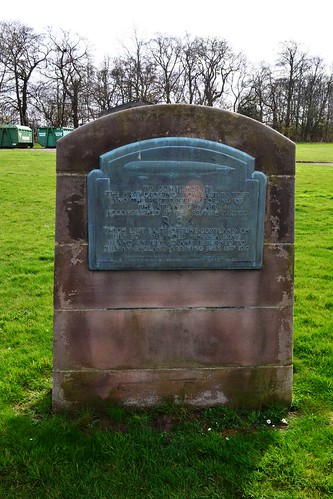
The memorial stone at East Fortune airfield commemorating the epic flight of R.34.

The Flight Crew for the Atlantic journey were:

Major G. H. Scott A.F.C – Captain
Captain G. S. Greenland – Second Officer
Second Lt. H. F. Luck- Third Officer
Second Lt. J. D. Shotter – Engineering Officer
Major G. G. H. Cooke DSC – Navigator
Major J. E. M. Pritchard O.B.E. – Special Duties
Lt. G. Harris – Meteorological Officer Second
Lt. R. F. Durrant – Wireless Officer
Lt. Commander Z. Lansdowne – Representative U S Navy
Brigadier General E. M. Maitland – Special Duties
Warrant Officer W. R. Mayes – First Coxswain
Flight Sergeant W. J. Robinson – Second Coxswain

Sergeant H. M. Watson – Rigger
Corporal R. J. Burgess – Rigger
Corporal F. Smith – Rigger
F. P. Browdie – Rigger
J. Forteath – Rigger Corporal

H. R. Powell – Wireless Telegraphy
W. J. Edwards – Wireless Telegraphy

W. R. Gent – Engineer
R. W. Ripley – Engineer
N. A. Scull – Engineer
G. Evenden – Engineer
J. Thirlwall – Engineer
E. P. Cross – Engineer
J. H. Gray – Engineer
G. Graham – Engineer
J. S. Mort – Engineer
J. Northeast – Engineer
R. Parker – Engineer

W. Ballantyne – Stowaway
“Whoopsie” – a small tabby kitten and stowaway

The crew of R.34 Crew – with the crew pets.

East Fortune airfield appears in Trail 42.

June 25th 1944, loss of a Rugby Star.

Sir Arthur Harris’s continuation of the bomber initiative of 14th February 1942, in which German cities became the focus for RAF raids, led to massed formations of light and heavy bombers striking at the very heart of Germany.

In order to achieve these aims, bomber forces of 1,000 aircraft would be required, meaning every available Bomber Command aircraft would be utilised along with those from Operational Training Units (OTU) and (Heavy) Converstion Units (CU).

On June 25th, 1942, whilst on operations to Bremen, the third of the ‘1,000’ bomber raids, one of the first operational aircraft casualties  for 1651 CU would occur when N7442 was shot down shortly before 01:00 by a Luftwaffe night-fighter over Holland. One factor that made this particular loss so great was that not only did all seven crewmen onboard lose their lives, but one of the crew, P/O. Lewis A. Booth (s/n: 118627), had gained international caps playing for England’s National  rugby team.

Born on September 26th 1909, Lewis Booth was the son of Alfred and Amie Booth. He was educated initially at Giggleswick School in Yorkshire, after which he transferred to the Malsis School becoming one of sixteen boys who was lost during the war and since commemorated on the Chapel’s Stained glass window.

Booth attended the Malsis school for two years, 1920-22, when the school first opened. A grand School, it was founded by Albert Henry Montagu, which grew and expanded over the years.

Ten years after he left the school, Booth made his international rugby debut in a game against Wales at Twickenham (January 21st, 1933), in front of a crowd of 64,000 fans; a game in which Wales beat England by 7 points to 3. Booth played his last international match against Scotland at Edinburgh’s Murrayfield stadium two years later on March 16th, 1935. Throughout his two year international rugby career he achieved seven caps for England scoring three tries, his first for England against Ireland at Twickenham, on 11th February 1933. After serving his national team, Booth went on to serve his country joining  the Royal Air Force where he achieved the rank of Pilot Officer within Bomber Command.

On the night of 25/26th June 1942, he was in a Short Stirling MK.I flying with 1651 Conversion Unit (CU) based at RAF Waterbeach in Cambridgeshire. 1651 CU was one of three Conversion Units set up in January 1942, by merging previously formed Conversion Flights. It served to convert crews of No. 3 Group to the Stirling, a rather ungainly aircraft that developed a poor reputation as a bomber. 1651 CU would join that night, sixty-eight other Stirlings in a force of over 1,000 aircraft; a mix of heavy and light bombers, ranging from the Hampden and Whitley to the Halifax and Lancaster.

Take off was at 23:58 from RAF Waterbeach, the weather that week had been good with little rain for many days. After forming up they headed for Germany a course that would take them across the North Sea and on to the western coast of Holland. Just 40 minutes into the flight, whilst over Waddenzee, the Stirling was attacked by a Luftwaffe night fighter and shot down with the loss of all seven crewmen on-board.

ROYAL AIR FORCE BOMBER COMMAND, 1942-1945.

A Stirling MK.I bomber of 1651 HCU at Waterbeach. @IWM (COL202)

P/O. Booth was publicly reported missing four days later on Tuesday 30th June in an article in the local paper “Yorkshire Post and Leeds Intelligencer”, which stated that he had been ‘lost in a Bomber Command raid’. The article highlighted Booth’s rugby career, saying that he had been a member of the Headingly Club playing over sixty games for his county team Yorkshire, before leaving to join up. 

P/O. Booth died just short of his 33rd birthday, he left behind a wife, Gladys, and a son Michael. His son would follow in his father’s footsteps also taking up rugby and also playing for his home country. P/O. Booth’s body was never recovered and remains missing to this day.

P/O Lewis Booth is joined by two other Pilot Officers, two Flying Officers, a Flight Lieutenant and two Sergeant Pilots amongst other ranks and service personnel all honoured by the Malsis School. Amongst the many awards they’ve achieved are three D.F.C.s and an A.F.M.

The game of rugby was hit hard by the Second World War, during which Germany would lose 16 of its international rugby players, Scotland 15, England 14, Wales 11, Australia 10, Ireland and France both 8, Wales 3 and New Zealand 2. All these losses were a severe blow to the international game, a game that brought many enemies face to face in a friendly tournament where there was little more at stake that honour and a cup.

With no official burial, P/O Booth’s service was commemorated on Panel 68 of the Runneymede Memorial, Surrey.

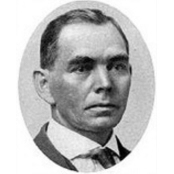
Lewis Alfred Booth @Tim Birdsall from the Malsis website.

Sources

ESPN Website.

The British Newspaper Archive.

Old Malsis Association website.

Rugby Football History website.

RAF Bradwell Bay Event July 17th 2021

A recent request from Eric Simonelli at the RAF Bradwell Bay Preservation Group. Eric is a key member of the group who are trying to preserve and promote the former RAF Bradwell Bay. He has kindly supplied a short write up and a flyer promoting a study day to be held in July for anyone interested. If you are, please contact the group direct and not myself at Aviation Trails.

RAF Bradwell Preservation Group.

Bradwell started off as a small grass aerodrome serving the firing range on the Dengie Peninsula, in the late 1930’s. In 1942 the aerodrome was expanded and became a large bases for 2,500 personnel who were to fly intruder missions to the continent and provide refuge for bombers returning with damage, casualties and short of fuel. To enable this level of activity there were many career opportunities for both men and women. This included aircraft maintenance, radio control, catering, motor transport and may more. Women were to fill all roles, apart from combat.  Today the RAF is fully inclusive.

RAF Bradwell Bay was host to many different squadrons up to the end of the war, with a variety aircraft types including Boston Havocs’, Mosquito’s, Spitfire’s, Tempest’s, Blenheim’s and Beaufighter’s. Other aircraft were based there for training and administrative purposes such as Miles Magisters, De-Haviland Dominies, Tiger Moths. At sometimes Bradwell Bay would have been an aeroplane spotter’s paradise. At least 25 squadrons are known to have been based there at different times.

Some parts of the airfield survive including the runways and control tower. However, the site is under threat of being demolished to make way for a second nuclear power station. As a group we are working to preserve as much as is possible, including building an archive to preserve memories and stories.

We have an unusual memorial and now are building an exhibition in the, nearby, Othona Centre. We are hoping to staff the exhibition at weekends or by appointment.

Bradwell Bay Memorial

Bradwell bay Memorial (Photo Eric Simonelli 2021)

more information can be found at: www.rafbradwellbay.co.uk

or email at: info@rafbradwellbay.co.uk

Eric has asked me to add the following ‘flyer’ to let you know about the study day being held locally for anyone interested in supporting the group and their aim to preserve Bradwell Bay. 

Inaugural Study Day

@ The Othona Community Centre

Saturday 17th July 2021

09:30 Reception and Coffee

3 Talks

WARTIME MALDON (World War 2) – by Stephen P. Nunn

A talk on George folliottPowell-Shedden by His Daughter

The Last CO – by Eric Simonelli

£25 inc Lunch, tea, and coffee (please advise of any dietary requirements on booking)

To book your place please complete the contact form on our website http://www.rafbradwellbay.co.uk

Members discount available

My thanks to Eric and good luck to them in their venture. 

4th June 1944 – Death of a Lancaster Crew

On June 3rd 1944, Lancaster ND841 ‘F2-D’ piloted by F/O. George. A. Young (s/n: 134149) RAFVR 635 Squadron, was detailed to mark and attack Calais as part of the preparations for D-Day. There would be eight other aircraft from RAF Downham Market also detailed for the mission and take off would be late that evening.

Initially, the aircraft and crew, were designated for training, but that night, nine aircraft and crews, were then detailed for operations to Calais, including F/O. Young’s crew in ‘D-Dog’. They were given orders to mark a coastal defence battery, as part of the preparations for the forthcoming D-Day invasion.

The mission as a whole would involve 127 Lancasters and 8 Mosquitoes of No.1, 3 and 8 Groups and the targets would be the gun batteries at both Calais and Wimerereux. It was a  diversionary raid as part of Operation “Fortitude South“, to fool the Germans into believing the invasion would occur in the Pas-de-Calais region.

At 28 minutes past midnight, F/O. Young lined the Lancaster up on the runway, opened the throttles and began the long run down the runway. As the Lancaster approached take off, it began to swing striking the roof of a B1 Hangar. In an uncontrollable state the aircraft crashed just outside the airfield killing all on board.

All other eight aircraft took off and returned safely after having dropped their bombs.

On board Lancaster F2-D that night was:

Lancaster D - Dog crashed RAF Downham Market 4.6.44

Lancaster ND841 ‘D’ and its crew before the fatal crash on June 4th 1944.

Pilot: F.O. George Ambrose Young, aged 24 (s/n: 134149) RAFVR.
Flight Engineer: Sgt. Thomas Snowball, aged 32 (s/n: 1100769) RAFVR
Navigator: F.Sgt. Howard Pritchard, aged 22 (s/n: 1578502) RAFVR
Bomb Aimer: F.O. Walter Thomas Olyott, aged 21 (s/n: 151238). RAFVR
Wireless Operator / Gunner: F.Sgt. Robert Sadler, aged 23 (s/n: 1526058). RAFVR
Air Gunner: F.Sgt. Stanley Wharton, aged 30 (s/n: 1578013) RAFVR
Air Gunner: F.Sgt. Charles Patrick Nallen, aged 20 (s/n: 427537) RAAF

The Operations record book (AIR 27/2155/7) for that day simply  states:

3.6.44  ‘D’ F/O Young G.A. hit hangar after taking off and crashed on airfield when large bomb exploded and the crew all killed.  8 aircraft returned to base .

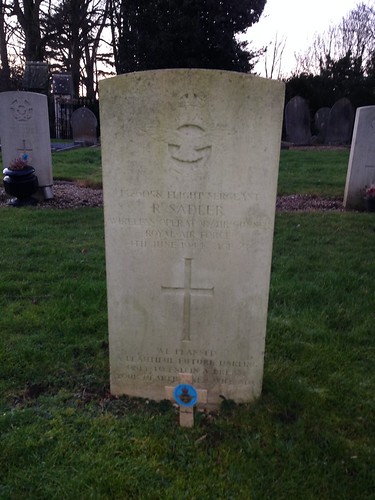
Three of the crew are buried in Kings Walk Cemetery, Downham Market, a short distance from the airfield.

Downham Market Cemetery

F.Sgt. Stanley Wharton (RAFVR)

Downham Market Cemetery

F.Sgt. Robert Sadler (RAFVR)

Downham Market Cemetery

F.O. Walter Thomas Olyott (RAFVR)

Memories of a Vulcan XH558 Restoration Volunteer.

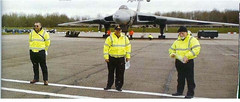
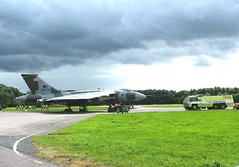
I was recently contacted by Trevor Danks, a volunteer during the restoration of Vulcan XH558, until 2015, the world’s last flying Vulcan bomber. Trevor very kindly sent me his memories along with a selection of his photos, taken whilst working as a volunteer during the aircraft’s restoration.

The Vulcan’s final farewell flight took place on October 28th 2015.

My sincere thanks go to Trevor for sharing his memories and photos with me.

Memories of a Vulcan XH558 Restoration Volunteer.

I joined the 558 Club at the RIAT 2000 at RAF Cottesmore. At that time I was unable to play any active part due to work commitments. However by 2005 I was semi retired and when the request came out for volunteers to help out with the restoration of XH558, I replied immediately.

I had been an Airframe Mechanic during my National Service in the RAF between 1955 and 1957. I had been fortunate to be posted to 232 OCU Valiant Squadron at RAF Gaydon and became a member of a ground crew on a Valiant. So the prospect of being in close proximity to the Vulcan was an exciting prospect.

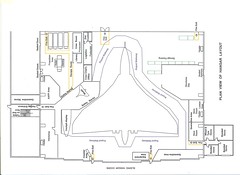
Following the first call for volunteers an e-mail was sent out asking if anyone knew someone who could do a drawing of the hangar at Bruntingthorpe, at minimum cost. I replied by e-mail to say that I would do it on my CAD system at no cost as part of my volunteer work. So on a cold April morning in 2005, I met Colin Marshall at Bruntingthorpe to discuss what was required. The first task was to take measurements of the hangar.  I was also supplied with a drawing of the Vulcan which had to be shown in position in the hangar. Another volunteer, Derek Bates, helped with the measuring of the hangar. The original drawing was to be part of a document for the Heritage Lottery Fund. However as time passed the drawing was amended a few times and the later version is shown below, which shows the visitors walkway.

Hangar Layout (Bruntingthorpe).

Hangar layout

The Hangar layout at Bruntingthorpe (Trevor Danks)

I became a member of the Wednesday Crew (See photo) together with a number of other volunteers. On that day there were a basic six of us who, from the start, did a variety of jobs. In the beginning we helped to set up the hangar to meet the requirements of Marshall Aerospace, the hangar becoming part of their engineering facilities located at Cambridge. Apart from the tidying up, dismantling or erecting shelving and racking, we participated in the setting up of the technical library, under the supervision of Frank Edmondson, this held all the Air Publications (AP’s).

Our main task lay with the 600 tons of spares held in the Deep Store, better known as “The Shed”. Over the days of the restoration we sorted, counted, placed in boxes and put the spares in the racking. This information was input to the computer. After which we then had to find and retrieve spares as and when required by the engineers. All this was carried out under the supervision of Simon Chipman. We were a happy bunch beavering away in The Shed, sometimes very hot and sometimes very cold depending on the time of the year. During tea and lunchtime breaks in the Airfield Diner we would reminisce about our days in the RAF or times past when the Vulcan was flying at displays.

In August 2006 it had reached a critical point where more finance was need to be able to complete the restoration. A fund raising operation had been carried out but the trust was still £500,000 short so the paid employees had been put on notice to end their employment. Everyone was convinced that it looked as this was to be the end of the project. After the aircraft had been rolled out to loud cheers a louder cheer went up as Sir Michael Knight, Chairman of VTTS Trust, announced a donation of £500,000 had been received from a mystery donor. The donor turned out to be Jack Hayward, owner at the time of Wolves football club.

When the Vulcan finally got to the stage of emerging from the hangar for such as engine runs we joined together with all the other volunteers who came on other days of the week. This usually required us to do a ‘FOD Plod’ which entailed us doing a walk of where the Vulcan was to pass, picking up any debris lying about. The first time the Vulcan was taken out for an engine test run, it was taken to a dispersal pad on the edge of the airfield. Having run the engines individually the time came to run them together up to 75% full power. I and a colleague were stationed on the perimeter track to prevent anyone coming along it. As the power increased we noticed a shed on the side of the perimeter track beginning to move. We quickly flagged the ground crew to shut down before the shed disappeared into the trees. The aircraft was then repositioned to continue the engine run.

First Flight.

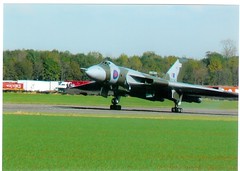
The most enjoyable FOD Plod was on 18th October 2007 when we were all out on the runway at 7.30am as dawn broke. The expectancy on that day was electric; our little crew had been appointed as the emergency team in the team bus with the task of dashing to an emergency entrance on the edge of the airfield. This was to let in emergency vehicles in the event of a mishap. Fortunately the day blossomed into a beautiful day both weather-wise and the rebirth of a much loved aircraft. When the crew of XH558 let off the brakes and that famous engine “Howl” was heard, one minute it was rushing down the runway and the next 100 feet up as it went past us in the viewing area.  We cheered like mad and hugged each other with not a dry eye in the house.

Sqd Ldr Dave Thomas - VOC Display Pilot ; AEO Barry Masefield - VOC AEO & Radio Op; Sqd Ldr Al McDicken - Marshalls Test Pilot

Sqd. Ldr Dave Thomas – VOC Display Pilot:  AEO Barry Masefield – VOC AEO & Radio Op.: Sqd Ldr Al McDicken – Marshalls’ Test Pilot

This was not the end but the beginning, as much had to done to get it to the stage of giving a display at the Waddington Air Show in 2008. There were other engine runs and flights, with XH558 getting her certificate to display just two days before the first day of the Air Show. All the time the Vulcan remained at Bruntingthorpe I continued to visit there on a Wednesday. When it moved to RAF Lyneham and the office to Hinckley, I changed my visits to Hinckley and became part of the education team. From this I developed my Power Point presentation to give talks about the restoration time.  However I retain the happy memories of our days at Bruntingthorpe and count myself very lucky to have been part of what can only be described as a great adventure. I was at Waddington for that first display and also managed to attend the day she flew with the two Lancaster bombers.

Since those days I have managed to visit Robin Hood Airport on a couple of occasions. The last time I managed to get the signatures of Taff Stone and Andrew Edmondson added to all the other signatures in my copy of Vulcan 607.

Photo Collection.

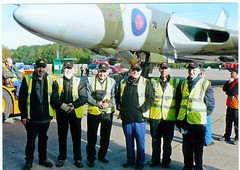
Weds crew John, Trevor, Peter, Dave, Bob and Vic.

‘The Wednesday Crew’ – John, Trevor, Peter, Dave, Bob and Vic.

Volunteers with Brunty Bear (XH558 Mascot)

Volunteers with ‘Brunty Bear’ (XH558 Mascot) On head centre front row.

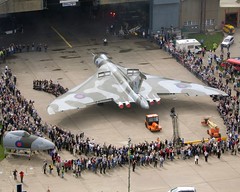
Roll Out Day - XH558 Outside for first time August 2006

Roll Out Day – XH558 Outside for first time August 2006.

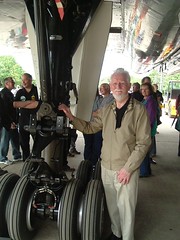
With Starboard Undercarriage Leg on Roll Out Day

With Starboard Undercarriage Leg on Roll Out Day.

First Flight.

Nose Wheel Off for First flight

Nose Wheel Off for First flight.

Volunteers after the First flight.

Volunteers after the First flight.

Start of Display Season.

Starting Fod Plod along runway April 2008 ready for display Season (John, Bob, Trevor)

Starting ‘Fod Plod’ along runway April 2008 ready for display Season. (John, Bob, Trevor).

At RAF Lyneham

At RAF Lyneham.

Trevor Danks – VOC Volunteer.
Founding Guardian No. 338.

My personal thanks again to Trevor and all the volunteers who took part in the restoration and displaying of XH558 and also to those who continue to work for her preservation.

RAF Leuchars – one of Britain’s oldest airfields (Part 5)

After Part 4, in this, the final part of Trail 62, we round off our look at RAF Leuchars. We have seen how to grew from a balloon training ground in the pre-war years to a training station for early flyers. Then on to maritime patrol, the Cold War and QRA status. Now as the years pass, defence cuts rear their heads once gain, Leuchars is once more under threat from politics.

The 1970s would see a return to training here at Leuchars with both the RAF and the Royal Navy embarking on new ventures with the Phantom – McDonnell Douglas’s all round, all-weather, multi-role aircraft. With new models, come new training units, and with the arrival of 111 Sqn the famous ‘Treble One’, in November 1975, also came a training support unit – the Post Operational Conversion Unit (later known as the Phantom Training Flight). The primary role of this unit was to train Fleet Air Arm aircrews for carrier borne models of the Phantom.

A No. 111 Squadron McDonnell Douglas F-4K Phantom FG.1, an aircraft closely associated with RAF Leuchars. (License: GNU Free Documentation License 1.2)

By the early 1970s, the shortcomings of the Lightning were now more than apparent, a lack of range and loitering ability becoming more obvious as the Phantom’s capabilities outshone it. A slower, but far more advanced Phantom, was proving to be more than just a suitable replacement for the now ageing ‘rocket of the skies’.

Whilst the Phantom was phased in and the Lightning phased out, pilots of the Lightnings continued to be wary of its tendency for engine fires, a problem that had  been present for some time. One such incident saw Lightning XS918 catch fire before the pilot (Flying Officer Doidge) manged to eject over the North Sea, West of The Bell Rock, 9 miles East of RAF Leuchars. Unfortunately controversy surrounded several aspects of the pilots kit, after he ejected he became detached from his survival kit, an inquiry highlighting ‘modifications’ to his clothing that may or may not have led to his tragic loss of life. In what appears to have been common practice amongst many airmen, changes were officially made to the kits supplied to aircrew in light of the accident.

The transition between Phantom and Lightning was a smooth if not rapid one. At Leuchars, the final farewell was made at the annual open day in September 1975, when six of 23 Squadron’s Lightnings and and four Phantoms of 43 Sqn formed a flypast. The Lightnings passing over the airfield in dramatic style saying a last farewell to the station where it has performed its duties so well for many years. With their disbandment in October, the baton and well and truly been passed over to a new breed of aircraft.

Between 1972 and 1978, Leuchars saw further sporadic returns of the Royal Navy, with 892 Squadron from HMS Ark Royal utilising the ground space for its operations. By 1978 though, 892 Sqn was disbanded, and their ship – the Ark Royal – decommissioned, bringing an end to this relationship between the navy and Leuchars. However, the FG.1 Phantoms used by 892 were absorbed into 111 Sqn, replacing the FGR.2s they had been operating before.

The end of 892 Sqn was marred by a tragic accident When rehearsing for the final solo display, the aircraft, a McDonnell Douglas Phantom FG 1 ‘XT868’ flown by Cdr. C. C. N. Davies and his navigator/observer Lt J. Gavin, suffered multiple engine failures whilst flying low, downwind along the runway axis. The aircraft entered a tight right hand turn through 180º to fly dead stick back along the runway. The Phantom’s right wing then struck the ground, and with the aircraft now perpendicular to the runway, the pilot ejected followed almost immediately by the observer. In their exits, the pilot was severely injured whilst the observer was sadly killed.

The decision to scrap the angled-decked carriers of the Navy would in turn have an eventual knock on effect at Leuchars. With both naval Buccaneers and Phantoms transferring to the RAF, no new training would take place – the Navy now looking toward the introduction the Harrier. The Phantom Training Flight would for now, remain at Leuchars though its role ‘downgraded’ to performing refresher training, ensuring that a round the clock, carrier based status was maintained in the UK.

It was also at this time that another film crew arrived – this time from the BBC – who used Ark Royal and her on-board flying units, including 892 Sqn, for their documentary ‘Sailor‘. The iconic insight into carrier operations was perhaps made even more famous by its theme tune of a similar name sung by Rod Stewart.

The 1970s saw continuous and increased intrusions into the the northern airspace around the UK, and as a result QRA scrambles became more common place at Leuchars than any other UK station. A massed show of force on Lenin’s centenary provided a massive ‘target’ for the QRA aircraft, with no less than 60 ‘Bears’ and ‘Badgers’ filling the skies on one day alone over the North Sea. A major headache for the QRA crews, it did however provide an excellent photo opportunity even allowing for a Marham Victor to shadow a Soviet Tu-95 ‘Bear’ much to the annoyance of the AOC No.1 Group when he got to hear about it.

With continued use, the runway needed a further resurfacing, and after the Phantoms of 43 Sqn had departed to Kinloss for a ‘Bolthole’ (where Station based aircraft deploy to temporary locations) deployment to carry out QRA operations from there, and those of 111 had left for Coningsby, Leuchars was left to the developers, and for an estimated eight months the airfield was effectively out of front line action.

Now with restricted runway use, the Whirlwind and Wessex helicopters and later Sea Kings, of 22 Sqn, would be the main users of Leuchars; their Air Sea Rescue operations combining with the Scottish Mountain Rescue teams, saving not only downed aircrew but stranded climbers as well . They would also be joined by the University Air Squadrons from nearby St. Andrew’s, Aberdeen and Dundee (later amalgamated to form the  East of Scotland Universities Air Squadron) who would use Leuchars for training with their Scottish Aviation Beagle Bulldogs.

Once completed, a second phase of work was then undertaken, new hardened aircraft shelters (HAS) were to be built. Common place on bases in Germany, these were designed to withstand conventional attacks, providing protection for individual aircraft whilst dispersed around the airfield. In an announcement made by Sir Michael Beetham the Chief of the Air Staff, Leuchars and five other airfields were to receive these ‘new’ shelters. It would take several years though before those at Leuchars were ready with its QRA aircraft safely tucked inside.

As the 1980s turned into the 1990s, the Phantom had now reached the end of its life and the new Multi Role Combat Aircraft (MRCA) the ‘Tornado’ would soon be appearing. The two Leuchars based squadrons, 43 and 111 were both stood down, the Phantoms removed and the Tornadoes brought in. 43 Sqn, who had been based at Leuchars since 1969 being the first to receive the new aircraft, a transition that saw all the Phantoms gone from the Scottish base within a year.

The introduction of the Tornado was not without its own political and military wrangling. Doubts cast upon the ability of the multi-role aircraft to perform as well as those aircraft it was designed to replace were raised by the military. History had shown some dramatic failures on this score whilst others, such as the Mosquito, had shown it more than possible with great success. Politicians however, seemed more drawn between upsetting the Americans who were trying to sell the F-15, and the multi national consortium Panavia Aircraft GmbH,  who collectively built the Tornado.  The decision would be a fine balance.

With the fall of the Berlin Wall, Soviet incursions  around the UK’s airspace would drop, the need for interceptors had now seemingly reduced, and so a review of the RAF’s front line operations was once again on the cards. The withdrawal of both the Phantom and shortly after the Buccaneer, left the Tornado as Britain’s only front line defence aircraft.

With the Gulf War in the 1991, the Tornadoes of Leuchars would play a major part and all eyes would be on them, scrutinising their every move. The gradual phasing out of Buccaneers and Jaguars leaving a lot on the shoulders of Tornado crews.

In 1995 two 43 Sqn Tornadoes from Leuchars were involved in a mid air collision over the North Sea. One of the aircraft ZE210 collided with the second, ZE733, during a joining up manoeuvre at 12,000ft whilst using night vision goggles. The pilot of ZE733 lost control and the two crew (Flt. Lt. McCarry and Flt. Lt. Booth) safely ejected, being rescued by an Air Sea Rescue helicopter from RAF Boulmer.  The second aircraft, ZE210, suffered damage to the hood and electrics, which knocked out the navigational aids. On landing, it took a considerable time to extract the crew due to the damage sustained to the hood. The aircraft was not repaired instead being used for spares before finally being dumped at St. Athan. *8

RAF Leuchars

Tornado ZE967 Gate Guard at Leuchars 2018.

The 2000s saw further upgrades to aircraft and new squadrons arrive. An Operation Conversion Unit for Tornadoes No. 56 (Reserve) Squadron, arrived in 2003. It was designed to upgrade pilots to the new variant Tornado. Absorbed into the long standing 43 Sqn, it remained on site and active until 2009 when it too was disbanded.

Further cut backs to finances meant the final departure of the Jaguars from bases in England. For Leuchars it would see the reforming of the University Air Squadrons into the ESUAS. A single training unit operating in conjunction with the three Scottish Universities .

After 2010 the Tornadoes were replaced by the Typhoons of 1 and 6 Sqns. 1 Sqn was reformed here on 15th September 2012, and joined 6 Sqn who had been reformed here on 6th September 2010, this offered an almost seamless transition from Tornadoes to Typhoons. These modern fighters now formed Britain’s front line of defence against potential aggressors taking over the QRA status for the north.  But in 2014, orders came through to move the RAF out of Leuchars transferring the aircraft, personnel and role to Lossiemouth in Moray. On 31st March 2015 at 12:00 hrs, ownership of Leuchars officially passed over to the Army, Leuchars’ named was changed to Leuchars Station, and its history as an operational airfield had finally come to an end.

Designated an emergency landing ground, (Master Diversion Airfield or MDA) between 2015 and 2016 no fewer than fifteen aircraft used Leuchars for ’emergency’ landings. These included: Tucanoes (Linton-on-Ouse), Tornadoes GR4 (Lossiemouth); Hawks (Leeming); Typhoons (Coningsby) and F15s from Lakenheath in Suffolk.

A minor respite in 2020 saw the QRA Typhoons return briefly as work was carried out on Lossiemouth’s runway. Within a short period of time though, this was completed and the aircraft departed once more leaving Leuchars quiet again.

This move signified the last full use of Leuchars by the Royal Air Force, responsibility of this long standing Scottish airfield being handed over to the the British Army who now based the Royal Scots Dragoon Guards and the Royal Engineers here. Various other non-flying units do serve here including The Military police units and 612 (R) Squadron, a medical unit of the RAF.

Whilst the defence cuts of 2010 indicated the closure of Leuchars, in October 2020, it was confirmed by the Ministry of Defence that they were looking into increasing both civilian and military usage of the airfield at Leuchars. Whilst there remains no intention to retain, or base aircraft here, the installation of fuel facilities does give hope that aviation will return in some form in the future. The indications are that by opening Leuchars to civilian traffic, it could bring revenue in to the hard pressed MOD*7.

Leuchars played a major part in two World conflicts being used primarily by the RAF throughout its life. The Royal Navy (Fleet Air Arm) have also been based here, as have the Army who are now the current main residents of the base. Other users include: the Dutch,  the Norwegians, the Canadians, Australians and New Zealand Air Forces as well as civil aviation organisations and University Air Squadrons.

More recently, with it being located closer to international airspace which is regularly penetrated by Soviet aircraft, the RAF’s Northern QRA aircraft were based here for many years before moving away to Lossiemouth in Moray, someway further north. Leuchars’ history is therefore long and very varied, covering a wide range of users in a multitude of roles.

RAF Leuchars has a history going back over 100 years. It was never upgraded to ‘A’ class status, and has only ever had two runways. Originally built from concrete and wood chip, the surface was upgraded to accommodate the jets of modern warfare, and the infrastructure has been added to as the airfield grew.

It has been home to a considerable number of front line squadrons along with an extensive collection of support flights, training flights and non-flying units. The number of people that have passed through its doors probably uncountable. It performed during the first World War, trained air crew in the inter-war years, and carried out vital work during the Second. Post war, it formed the front line of defence against potential Soviet aggression before returning to training through the University Air Squadrons across Scotland. Now home to the British Army, it is at least for the time being open for business, but as a flying military site, it is all but closed.

Its location has been in many ways its saviour. Operating maritime patrols and clandestine operations into occupied and neutral Europe. The Fleet Air Arm were formed from its units, and the Air Forces of several nations have been based here. It has a history that is so diverse and dynamic that very few other airfields in Britain can match it. As with other airfields across the country, its future hangs in the balance, I hope that this long living and prestigious site remains alive and well to honour all those who over the last 100 years have served from its runways.

Leuchars as an operational military site is not accessible to the general public and views across it are limited. It is thought that two rare First World War Double Royal Flying Corps General Service Aircraft Sheds are among the few original buildings that survive on the site. The accommodation areas have now been sold off to private buyers, but the airfield is intact as it is used as an emergency landing ground and by the ESUAS. With care, opportunities are there to see this historic and fascinating piece of Britain’s aviation history.

The full story of Leuchars can be seen on Trail 62.

Sources and further reading

*1 Fatal Air Accidents website 12th November 1918 – November 1919

*2 Royal Flying Corp Website

*3 An interesting film of 489 Beaufighters with invasion markings appears on the IWM website, it shows the take off and formation flying of the squadron along with some interesting ground shots too.

*4 For additional information and pilot stories about the ‘ball-bearing’ run see the Royal Institute of Navigation Blog.

*5 Thirsk, I. “de Havilland Mosquito – An illustrated History Vol.2“, Crecy 2006

*6 Further details about the BOAC Mosquitoes appear n ‘Mosquitoes on BOAC Service.

*7 The Courier.co.uk newspaper website.

*8, 11 Aviation Safety Network Website.

*9 National Archives AIR 27/2612/1

*10 Defence Transformation Volume 531: debated on Monday 18 July 2011 Dr. Liam Fox’s announcement to Parliament. UK Parliament House of Commons.

Gracie’s Guide to British Industrial History website.

Flying Magazine, (August 1972) website.

National Archives: AIR 27/1383

AIR 27/624/29

AIR 27/624/33

BAE Systems Website accessed 6/3/21.

For first hand stories of MRT work see Heavy Whalley’s blog

For a detailed account of life at Leuchars, read “Northern Q – The History of RAF Leuchars” by Ian Smith Watson.

RAF Leuchars – one of Britain’s oldest airfields (Part 2)

After Part 1 in which we saw how Leuchars came about and develop as we moved towards the Second World War, we enter the early 1940s. Here we now see anti shipping sorties, U boat hunts and a strange relationship spawn between the recently formed civilian organisation BOAC and RAF Leuchars.

Immediately after the declaration of war, searches began with flights penetrating out over the North Sea. On the September 4th, a Hudson of 224 Sqn spotted a Dornier 18. The Dornier attacked the Hudson which sustained damage in both the fuselage and fuel tank. Thankfully, the pilot evaded further damage and manged to nurse the aircraft back home to Leuchars without further problems. Leuchars’ position on the eastern coast provided an ideal opportunity for such flights, hunting for bombers, U-boats and ships over the North Sea; it was this operation perhaps that marked the beginning of these maritime searches- a role it would carry out for the next 5 years.

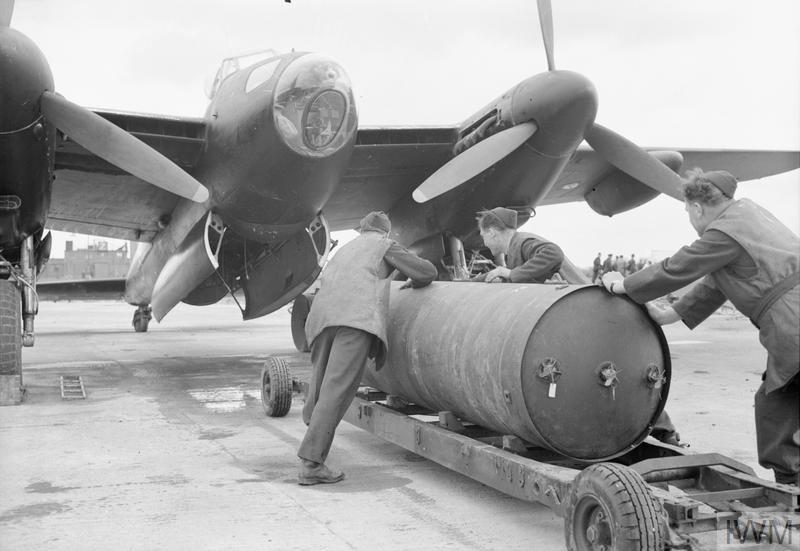
Armourers secure 250lb bombs in the bomb-bay of a Lockheed Hudson of No. 224 Squadron at RAF Leuchars. (public domain)

The two units at  Leuchars continued with repeated patrols, with 233 sighting  both enemy flying boats and a submarine on September 7th. Attacks were made on both but no signs of damage were reported to either. Sadly, on this day, a 224 Sqn Hudson was seen diving into the sea, no explanation was available as to the cause, and a launch was dispatched to search for survivors – sadly with no results. This rolling programme of patrols over the North Sea pretty much set the scene for the remainder of 1940, culminating in the departure of 233 Sqn in September, followed not long after by 224 Sqn on April 15th the following year.

At the base itself, more hangars were built, four (austerity) ‘C’ type hangars were added which expanded the servicing and maintenance area hugely. Leuchars was clearly expanding.

Leuchars like many of Britain’s airfields would not only operate ‘operational’ squadrons from them, but numerous support flights that would run along side. Some of these included: training flights, communications flights, Army support and co-operation flights, and Leuchars was no different. One such unit was that of  18 Group Communications Flight, who resided at Leuchars from the spring of 1940 right the way through to 1960. With only a brief spell at Turnhouse, it would operate a wide range of aircraft throughout its long service and be one of, if not the longest serving unit at the airfield.

The early part of 1940 saw yet another front line squadron arrive here at Leuchars, that of 605 Sqn with Hurricanes. The fighter squadron, whose battle honours would include The Battle of Britain and the Malta campaign,  would only stay for a very short period of time, transferring again at the end of the month to the rather unsuitable Wick, where only one Bessineau hangar existed and there were little or no dispersal facilities. As two other squadrons were also moving onto the airfield at the same time, it was decided to billet the non operational crews off the airfield site, an idea that became the norm in the following war years.

Over the next few years, there would be a plethora of squadrons use Leuchars. In October, 320 Sqn arrived in a move that saw the return of the Avro Anson. Within days of their arrival though the squadron would begin receiving the Hudson I. What makes this particular unit special was the fact that both it, and 321 Sqn with whom it would soon merge, were both formerly of the Royal Dutch Naval Air Service, and had arrived at Pembroke Dock in June that year after the Germans invaded Holland. They brought with them Fokker T VIII seaplanes which were quickly replaced with the Anson.

On January 18th 1941, the two units were merged to form 320 (Dutch) Sqn, whose headquarters were at Carew Cheriton under the command of Lieutenant Commander W. van Lier, at which point all but one of the Ansons were disposed of. For short time the unit would perform from both there and Silloth training crews on aerial photography in the Hudson, before returning here to Leuchars in the March, where upon they gradually updated the Hudsons with the MK.II, the MK.III and eventually the MK.IV before ending their link with Leuchars and departing to Bircham Newton in the April of 1942.

Another unusual squadron to arrive at Leuchars was that of 72 Sqn in November 1940. A Spitfire unit, they had then taken on the Gloster Gladiator, a 1934 designed bi-plane that became famous in the defence of Malta as ‘Faith‘, ‘Hope’, and ‘Charity‘. The switch to the bi-plane appears to have been made as a result of an unsuitable airfield at Acklington. However, and even though the Gladiator was in no way equal to the Spitfire, 72 Sqn retained the Gladiator well into the Spring of 1941, at which point they upgraded to the newer Spitfire, the IIa.

Arriving at Leuchars on November 29th, 1940, 72 Sqn immediately began flying patrols over the sea, their first being in the area around Dunbar. However, the Scottish winter weather dogged operational flying resulting in many cancelled flights and patrols. On December 8th, Green section led by P.O. Norfolk struck lucky, and the flight encountered a lone Luftwaffe Heinkel He.111 over Holy Island. The Spitfire engaged the Heinkel firing numerous shots at the enemy aircraft, but the bomber made his escape flying into the heavy cloud that blanketed the coastal skies. As a result, P.O. Norfolk was unable to make a claim against it. It was this very same bad weather that prevented the squadron’s proposed move back to Acklington, meaning that the planned trip for the 15th, was delayed, the aircraft unable to make the transfer until the end of the month.

AIRCRAFT OF THE ROYAL AIR FORCE 1939-1945: BRISTOL TYPE 152 BEAUFORT.

Beaufort Mark I, N1172 ‘AW-S’, of 42 Sqn RAF, in flight with L9834, also of 42 Sqn (@ IWM CH 2775)

The majority of 1941 saw similar moves; short stays by 86 Sqn (2nd February – 3rd March) with Blenheims; 42 Sqn (1st March – 18th June) with Beauforts on their way to the Far East; 107 Sqn (3rd March – 11th May) with Blenheims and 114 Sqn (13th May – 19th July) also with Blenheims, all of which brought a number of twin-engined models to the Scottish airfield. The primary role for these units was maritime patrols, monitoring and photographing vessels out over the cold waters of the North Sea.

In 1941 a strange relationship spawned between the recently formed British Overseas Airways Corporation (BOAC) and RAF Leuchars. BOAC – being formed by the amalgamation of British Airways Ltd and Imperial Airways – formed a partnership with Leuchars that would remain at the airfield up until the war’s end, operating in an ‘open’ but rather contradictory clandestine role.

The civilian company would initially operate a single Lockheed Model 14 Super Electra (the forerunner of the Hudson) named ‘Bashful Gertie‘, between Leuchars and Stockholm in neutral Sweden. Piloted by Swedish aircrew, the idea behind the route was to pass POW mail into Sweden where it could be forwarded to prison camps in occupied Europe. At the time though, Sweden was one of Europe’s largest producers of ball-bearings, a commodity that both the allied and axis powers needed in order to keep their war machine turning. It is now known that much of Germany’s war supply of ball-bearings was in fact coming from Sweden, but they were not the only country buying the Swedish goods. After dropping off the post, the Electra would be refuelled and filled with ball-bearings before returning to Leuchars. This run hence became known as the ‘ball-bearing run’. These operations would continue for several years from Leuchars, but upgrades at a later date, would see a new form take over from these rather slow and vulnerable aircraft.

On August 12th, another new squadron was formed here at Leuchars, that of 489 Sqn with Beauforts, who kept them until the January of 1942. At this point they began replacing them with the Blenheim IV. After departing to Thorney Island in March 1942, they returned here as a full squadron in October 1943. At this point they began receiving the Beaufighter X an aircraft they kept until the war’s end. Prior to D-day the squadron moved to RAF Langham in Norfolk where they donned invasion stripes ready for their part in the forthcoming invasion of Normandy*3.

A detachment of the Horsham-St-Faith based 105 Sqn, arrived at Leuchars in December 1941 bringing yet another twin-engined, but new design, to these Scottish shores. A revolution in aircraft design, it was the envy of the Luftwaffe and a joy for British pilots – the de Havilland Mosquito IV.

Aircrew of 105 Sqn next to a Mosquito (location unknown) (@IWM CH 018011 1)

The detachment would stay here until after September 1942 whereupon it would reform as a complete unit at RAF Marham in Norfolk. In the last days of September however, four aircraft would leave Leuchars to attack a ‘special’ target in Oslo.

In Oslo on this day was a gathering of high level Nazi officials at the Gestapo headquarters, and this was to be the primary target for the four aircraft. After bombing successfully, they four sped away at low level toward the sea and home, only to be attacked, by four FW-190s. All four Mosquitoes received damage to varying degrees, and one was sadly lost, that flown by twenty-six year old Flt. Sgt. F. Carter and his navigator twenty-year old Sgt. Young. The Mosquito was seen heading toward the Oslo Fjord (Lake Engervann) with its starboard engine on fire. Unable to maintain height, the aircraft clipped trees and struck the water killing the two crew. The two bodies were successfully  pulled from the Fjord by local fishermen and buried in Oslo. The four crews had only been posted to Leuchars the day before.

Little changed throughout 1942. More short detachments and movements through Leuchars saw 217 Sqn, 415 Sqn, 455 (RAAF), 144 Sqn and 544 Sqn bringing mainly twin engined models to Leuchars. Only the detachment of 544 Sqn with Spitfires saw any major changes. The longest standing unit at this time was 144 Sqn with Hampdens, but they were spread far and wide, detachments being located at Skitten, Sumburgh, Wick, Afrikanda and Vaenga.

In October, a month after the departure of 105 Sqn, the Mosquito returned once more. This time a new unit, 540 Sqn, who were created from both ‘H’ and ‘L’ flights of 1 Photographic Reconnaissance Unit (PRU). The multiple flights of this former RAF Benson unit was divided up into five separate consecutive squadrons 540 – 544. Flying models that included:  Mosquito II ‘DD615’, VIII ‘DZ424 and IX ‘LR422 they would also use the Spitfire IV up to the end of the year. Their role here was primarily to photograph targets in Norway and northern Europe, a role they performed until early February 1944. They would eventually return to their former home at RAF Benson leaving a sixteen month  stay at Leuchars behind.

In Part 3, the running of BOAC aircraft from Leuchars see a change, the war comes to a close and new larger aircraft begin to appear here at the Scottish base.

The full story of Leuchars can be seen on Trail 62.

RAF Leuchars – one of Britain’s oldest airfields (Part 1)

Following on from Trail 53 we leave the former RNAS Crail and Dunino behind and head north-west to the mecca of the golfing world, and the historic town of St. Andrew’s, where just outside of the University town is an airfield whose history goes back as far as 1911; this makes it one of Britain’s oldest and most established airfields. Its development then takes it through the First World World War, to the relative peace of the 1920s, the expansion period of the 1930s and on into the Second World War. Faced with potential closure it then went on to be one of the most significant and important airfields in Britain’s Cold War defence network.

Sadly politics played its part as it often does, and in 2011, its fate was sealed when at 4:48pm on July 18th, Dr. Liam Fox the then Secretary of State for Defence announced when talking about bringing the Army back from Germany: “Two major units and a formation headquarters will be based at Leuchars, increasing the number of posts there from 1,200 to more than 1,300. Consequently, the Typhoon force due to be built up there will instead be built up at RAF Lossiemouth.”*10 With that the airfield was to close, being transferred over to the Army, a transfer that occurred four years later in March 2015. Since then the RAF has, on occasion, returned for flying duties,  but its front line RAF role had gone. A state which exists today.

On this next stop, we take an extensive look at the long and incredible life of RAF Leuchars.

RAF Leuchars.

Leuchars sits on the north-eastern coast of Fife, on the banks of the River Eden as it enters the sea at St. Andrew’s Bay. To the north across the River Tay, lies Dundee, and to the west, the city of Perth. South of Leuchars is the University town of St. Andrews – the home of world golfing. Being literally on the shore line, Leuchars provided an ideal location for a whole host of maritime operations, aerial reconnaissance and even later on, search and rescue.

Its life began just after the turn of the last century in 1911, when powered flight was but a mere few years old.  Even before the first aero-engine had been started here, the site was being put to use by the Royal Engineers with a Balloon Squadron, who used it for reconnaissance training in the Tentsmuir Forest on the edge of what is now the airfield.

With the formation of the RFC in 1912, the Balloon Squadron would become part of the first military flying arm to exist in the UK. It would continue in its role as spotting for artillery, even as powered flight gradually became established. On the nearby beaches, small aircraft were tried and tested, but balloon training would ultimately remain the focus of the squadron.

In 1916, the RNAS then acquired the land and began to develop the site as a place for powered flight. Taking over farmland, and eventually swallowing up the resident farm, the airfield slowly expanded, and by 1918 its future was established. By this time, the RAF had been formed, the flying responsibilities of the Navy were transferred to the RAF and the first unit was ready to move in. The Grand Fleet School of Aerial Fighting and Gunnery, run by the RAF to train Naval airmen, resided at the airfield from the end of 1918 on into 1920. This unit, a new unit in its own right, was formed out of the disbanded 208 (Temporary) Training Depot Station which, whilst formed at East Fortune in the Scottish borders, had only been in existence for as little as one month.

RAF Leuchars

The control tower at Leuchars. The airfield’s proximity to the shore line being evident.

In these early days of flying, risks were high, the thrill of manned flight was a draw for many young men eager to experience the joy of soaring above the clouds. As a result, there were numerous accidents and Leuchars was no different.

On May 19th, 1919, Lt. David Gardiner Cooper (22) lost his life when he misjudged a slow roll whilst flying in his Sopwith Camel (F8497), and on August 1st, Canadian, Lt. Philip Hall-Smith (30) was killed, after his Camel was seen to inexplicably nose dive into the ground.*1*2 Two unfortunate losses after a war that had already taken hundreds of thousands of lives.

During the 1920s, with the war now over, military might was seen as an almost unnecessary waste, units were cutback, airfields that had been established for war were closed, and fighting men were returned to civvy street. Political fighting amongst the three arms of the military, saw the RAF cut back to a fraction of its former self, its cause for survival spearheaded by Lord Trenchard. However, Leuchars managed to cling on, remaining not only active, but receiving further development as well. More land was purchased and in 1925 the base was officially renamed RAF Training Base Leuchars.

It would be a time of dramatic change and turbulence for the fledgling Air Force though, and this was wholly reflected by the number of units appearing at Leuchars during this period. Operating as one of the UK’s major Naval training bases (the RAF being responsible for Naval flying at this point), the first of these units to appear was 203 Sqn in March 1920 which had reformed here after having been disbanded just two months earlier at Scopwick.

On April 1st 1923, the RAF Carrier units were re-designated under the new 400 series of squadron codes – a major stepping stone in RAF / Naval structure. Then a year later in 1924, these units were combined to form the new Fleet Air Arm (FAA), the flying branch of the Royal Navy. These changes had a major impact on operational numbers here at Leuchars.

Formally a Royal Naval Air Service unit, 203 Sqn initially flew the Sopwith Camel, replacing these  in April 1922, with the Nieuport and the General (Gloster) Nightjar. In mid September, the squadron was posted to Turkey, departing Leuchars onboard HMS Argus; a posting that would last for three months. After that, the squadron returned to Leuchars once more, again onboard HMS Argus, remaining active at Leuchars until 1st April 1923. At this point the squadron was disbanded, being divided into two Naval Flights: 401 and 402. The squadron as was, would be reformed later, but it would be another twenty-three years before they would see the shores of Leuchars once more.

203 Sqn would be joined a month after their arrival by another former RNAS unit – 205 Sqn. Like 203, it too was disbanded at Scopwick only to reform here at Leuchars in April 1920. Bringing another new model of aircraft to the Scottish airfield, 205 Sqn flew the Parnall Panther, and would serve in its entirety as 205 until October 1921, when the Mobile Flight element  was reformed as 3 Squadron. The remainder of 205 Sqn continued serving alongside here at Leuchars.

3 Squadron would operate out of the Scottish base until 1st April 1923, at which point it was similarly divided into three flights: 420, 421 and 422 now serving at Gosport. The remainder of 205 were also divided up into separate Flights – 440, 441 and 442, but unlike its sister unit, 205 would not return in any form to these Fife shores.

As part of this formation of the FAA, Leuchars would see all these Flights joined by another seven: 403, 404, 405, 406, 443, 445, and 446, and all around this time. This would bring a whole range of aircraft to these shores: Nightjars, Panthers, Nimrods, Flycatchers and the like.  Some of these units would depart for foreign shores whilst some would remain in the UK at other bases. The skies above Leuchars was now buzzing with activity.

For the majority of the 1930s, Leuchars would remain as an FAA training base, being renamed No. 1 Flying Training School, on April 1st 1935. Aircraft seen here would have included a range of training types including the: Fairey IIIF, Fairey Gordon, Avro Tutor and Avro 504N. For three continuous years pilots trained at Leuchars for the Fleet Air Arm, a branch that continued to be the responsibility of the RAF.

The mid to late 1930s would see tensions slowly rise in Germany, but Britain’s general post war doctrine was to defend her shores rather than attack any potential enemy. The Royal Navy was still seen at these times as the main military force, a belief that would very soon change. Britain in these early years, had not seen Germany (partly due to the devastating conditions of the Treaty of Versailles) but France, as her biggest potential aggressor, and as such long range aircraft or heavy bombers were not seen as an important requirement.

Government ideas that Britain should only arm itself with a view to defence against its nearest potential threat, meant that early on, defences were developed at the cost of attacking units. But by the time it was clear that Germany was the threat, Britain was lacking far behind, as little national development had been undertaken. This doctrine saw a far reaching impact right across Britain’s peace time airfields, which at this time included Leuchars. With only one squadron, 36 Sqn (the former Coastal Defence Torpedo Flt.) transiting through on its way to the Far East, preparation for war and flying in particular, remained limited to training flights here at the Scottish base.

As Britain then entered the Expansion Period, new aircraft specifications were being pushed through and airfield development became increasingly important. A number of new airfields were built and a restructuring of the RAF was once again on the cards. Here at Leuchars, the number of hangars was extended, with 7 Belfast Truss hangars being added to the site.

With further changes in the late 1930s, Leuchars became a Temporary Armament Training Camp (later station) with a small collection of Wapitis who used the nearby range at Tentsmuir.

Then in 1938, this restructuring took place, Leuchars, driven by its coastal location, was passed over to Coastal Command in an exchange that saw the two squadrons based at Thornaby (224 Sqn and 233 Sqn) transfer across here, whilst 1 FTS would leave for Netheravon. The Temporary Armament Training Camp previously established here would also disband.

Both these units brought the Avro Anson with them, 224 replacing them the following year with the Lockheed Hudson, a military aircraft born out of a civil transport model. Over the next two years, 224 Sqn would upgrade each of these with both the MK.II and MK.III models before departing to Limvadi in April 1941.

233 Sqn however, would have a more turbulent time, moving initially to Montrose, and then back to Leuchars, where they also took on the Hudson, only to replace it a month or so later with the Blenheim IV. Then, within less than a year, they would depart Leuchars for good, heading for Aldergrove in Northern Ireland where they would continue their operations with Coastal Command.

As 1938 passed the situation in Europe looked even more grave, and home based units were put on alert. 224 Sqn began carrying out searches of the North Sea, looking for vessels making their way to the open waters of the Atlantic. A further flight began sweeps of the Firth of Forth looking for submarines operating in the waters off the Scottish coast. However, in September, Neville Chamberlain returned from Munich, and following his ‘Peace in our time’ speech, war had seemingly been averted for the time being, and these precautionary measures were then relaxed.

In mid December, with tensions eased, 224 Sqn was granted 3 weeks leave allowing personnel time to go home over the Christmas period. The relaxation of measures was however, short lived, and a year later the squadron was put on a war footing with mobilisation orders coming through on September 1st 1939.

In part 2 Leuchars enters the war, being a coastal airfield the sea would dominate its actions and the squadrons that would be based here. It would also be the first line of defence against Luftwaffe bombers, ships and U-boats.

The full story of Leuchars can be seen on Trail 62.

de Havilland Mosquitoes in BOAC Service.

Very few countries around the world managed to avoid the influence of the Second World War as it ravaged and rampaged its way across the globe. One such nation that did manage to keep its borders secure though was Sweden, a place that became known as a safe haven for downed airmen or those trying to escape the clutches of the Nazi tyranny that would engulf vast swathes of the European continent. Surrounded by conflict and declared neutral, Sweden was to all intents and purposes cut off from the rest of the world.

However, Sweden was a country reliant on imports and exports, a reliance that led to extensive negotiations between herself and both the axis and allied powers who effectively blockaded her supply routes. Through these negotiations she achieved an  agreement to the rights of passage for ‘safe-conduct traffic’, an agreement that allowed the passage through hostile waters of shipping, allowing the exports of paper and wood from Sweden, in exchange for imports of food and oil.

Sweden’s role in the Second World war was largely political. If she was to survive she was going to have to forge safe links beyond her closest Scandinavian neighbours. Fearing she would be sucked into war and absorbed into a Europe ruled by Germany, she turned to Britain with a view to forging a safe airway between Stockholm and Scotland.

Discussions around the opening of the Swedish air routes began prior to war breaking out, negotiations between the Chairman of Britain’s Civil Aviation Authority (CAA), Sweden’s airline company AB Aerotransport (ABA) and Germany’s Hermann Goring, eventually led to an agreed flight once per week from Stockholm – Oslo-Stavanger-Perth. However, ongoing Swedish concerns led to long delays in activation of the service, even though a successful test flight involving a Junkers 52 had taking place on November 27th 1939.

The Swedish ABA were to run the operation, initially using three DC-3s (named Gripen ‘Griffin’, Gladen ‘kite’ and Falken ‘falcon’) painted bright orange and clearly marked Sweden/Schweden in large black lettering to prevent attacks from either side on a neutral aircraft. Throughout the war though this link was tenuous at best, heightened German aggression and fearsome weather often being the determining factors for the safe passage of the aircraft between the two countries. German restrictions on both freight and passengers angered the Swedes, who defiantly disobeyed their rulings. This decision led to a number of Swedish operated aircraft being attacked and shot down.

By 1945 the Swedes decided it was now too dangerous to fly, particularly with trigger happy defences and over keen allied pilots. The airspace around Sweden’s near neighbour Norway, had become a cauldron of  fire, and so the service was eventually closed down.

However, this official Swedish run route was not the only airway that operated between the two countries. The Norwegians also ran a service albeit reduced, as did the Americans later on in the war with five stripped out B-24 Liberators. Another service however, a ‘British’ service, also operated, but this was much more of a clandestine role than that of their Swedish counterparts.

At the time Sweden was a producer of iron but more importantly ball-bearings, a  commodity essential for any moving parts in machinery; whether it be a simple tool or a more complex engine, without them machinery simply wouldn’t work.

Ball-bearings in Sweden were all manufactured by one company, Svenska Kullagerfabriken AB (SKF), who before the war, exported around 9% of her total output to Germany with another 9% going to the United Kingdom. During the war however, this balance dramatically fell heavily on the side of Germany with as much as 65% of her total output ending up in German hands by 1943.*1 This imbalance was primarily due to the exports that were received in the occupied territories, falling into German hands, and being diverted into Germany’s own industrial operations.

Britain however, also needed these ball-bearings, and was perhaps more keen on maintaining this link than many would have initially thought. Having her supply line to Swedish goods cut was going to hit Britain hard. Britain needed all the ball-bearings she could find, and so Sweden was vital to this supply. So desperate were the British  authorities to obtain these components that they mounted two naval operations,  ‘Rubble‘ and ‘Performance‘, both of which turned out to be disastrous in terms of both the loss of life and the loss of shipping.

There were many other reasons why Britain wanted to maintain this link though, one was the expansion of its resistance operations across Scandinavia, Sweden providing a safe passage for agents entering and leaving the region safely, a move that was just as important as it was for returning escaped or interned airmen of the RAF and later USAAF.

Furthermore, Britain needed to ensure that Sweden was receiving as much British propaganda as it was German. If this line were to be severed, there would be a chance that the imbalance in material may have detrimental effects on Sweden’s future as the war developed.

In late 1939 flights began in secrecy, operated by British Airways Ltd, who used three Junkers 52 transport aircraft and one Lockheed Model 14 Super Electra (the forerunner of the Hudson) named ‘Bashful Gertie‘ (G-AGBG). Like the Swedish operation, these flights took place between Perth and Stockholm via Norway and were flown by civilian crews in civilian marked aircraft. However, this route was subsequently closed when one of the aircraft was attacked by a Luftwaffe fighter, and another was captured in Oslo when the Germans invaded Norway.

Then in 1939/40 the two British aviation companies, British Airways Ltd and Imperial Airways, merged to form the British Overseas Airways Corporation (BOAC), a civilian operation that would go on to serve as Britain’s leading national airline for many years after the war’s end. The amalgamation of these companies was an important step forward leading to the reinstatement of the Swedish route, this time using the military base at RAF Leuchars in Fife.

Also piloted by Swedish or Norwegian aircrew, the idea behind the route was to pass POW mail and propaganda (magazines, newspapers etc) into Sweden where it could be forwarded to prison camps in occupied Europe. However, constantly aware of the need for ball-bearings and the fact that Sweden was a major supplier of them, plans were put in place for returning aircraft to be refuelled and filled with ball-bearings before returning to Leuchars. This run hence became known as the ‘ball-bearing run‘.

In these early years of the war, BOAC operated other similar aircraft types, these included C-47 Dakotas, converted Whitley IV bombers and Curtis Wright C46 aircraft, but their lack of speed and manoeuvrability left them vulnerable to Luftwaffe attacks. It soon became clear that a new and much faster type was needed and so BOAC began to put pressure on de Havilland for their new Mosquito.

Picture

A Whitley bomber in BOAC markings *7

A trial flight was undertaken using an unmarked Mosquito of 105 Sqn (DK292) on August 6th 1942 (there is some confusion over this exact date), flown by  Fl. Lt. Parry and P. Off. Robinson, the results of which showed the aircraft to be highly suitable for the purpose of the flights. The journey from Leuchars to Stockholm covered some 800 miles was, on average, completed in around 3 hours.

On 15th December 1942 the first civilian operated model of the aircraft arrived at Leuchars. A Mosquito PR.IV ‘DZ411’,  it was assigned the civilian registration G-AGFV, and began flights to Stockholm on 4th February 1943. After this, it was joined by six other Mosquito MK.VI aircraft between April and May (all being given the sequential registrations G-AGGC to AGGH) with a further three in April 1944.

The incredible carrying capacity of the Mosquito, which would be proven later in the war, would allow for up to 650Kg (10 -12 crates) of ball-bearings to be carried in the aircraft’s bomb bay.

The opening of such a link was kept very secret, the British not wanting the Germans to know about the new revolutionary Mosquito, nor their important cargo. However, keeping such an operation from German intelligence was difficult, if not impossible, and soon they discovered that the flights were again taking place between the two countries. Now embroiled in a political stand off, the Germans put pressure on neutral Sweden to put a stop to these flights, insisting that they were giving the British an advantage, and that as a neutral country, they should not be allowing British aircraft to land on Swedish soil. The Swedes maintained that the service was purely civilian and controlled solely by the Swedish authorities, to which the Germans threatened to inform Hitler thus rendering the aircraft legitimate military targets. Fearing that the British would in turn close the passage for the safe-conduct traffic, the Swedes ignored the German threats and so the service continued.

However, so as to not infringe or violate Sweden’s wartime neutrality, it was vital that the Mosquitoes remained unarmed for these operations. But that made any aircraft on this run a potential ‘sitting duck’, even though, like their Lockheed predecessors, they carried BOAC insignia and were flown by civilian aircrew.

So all of these aircraft had to be changed from military status to civilian, this required the removal of all traces of armament. Modified at Hatfield – the home of the Mosquito – the resultant weight loss altered the aircraft’s centre of gravity and so additional ballast had to be added to prevent changes in the aircraft’s flying characteristics.

The first example DZ411, was a Mosquito B.IV Series II, powered by two Merlin 21/23 engines built under the contract 555/C.23(a) and converted to a PR.IV at Hatfield prior to its delivery to BOAC at RAF Leuchars. It would go on to serve until early 1945 with BOAC before presumably returning to RAF ownership.

The first of the next batch, all FB.VIs, was ‘HJ680’ another example built at Hatfield under the same contract 555/C.23(a) but with Merlin 23/25 engines. This aircraft was initially passed to BOAC at Bramcote on April 16th 1943, receiving the registration G-AGGC before flying on to Leuchars immediately after. On the 18th, on the return leg of its maiden flight for BOAC, it was chased by enemy fighters, but its speed and agility allowed the Mosquito to escape unharmed. It was eventually removed from service on November 30th 1944, but remained at Leuchars in case a ‘spare’ aircraft was urgently needed. This particular model was the longest serving Mosquito in BOAC’s service, being taken off the civil register on January 4th 1946, whereupon it was passed to 22 Maintenance Unit. On June 15th 1950, the example was eventually sold as scrap to the John Dale Scrap merchants.

The next aircraft ‘HJ681’ arrived at the same time, and remained in service until January 1944, under the civil registration G-AGGD. This particular aircraft crash landed in Sweden and was reduced to spare parts.

‘HJ718’ arrived on April 24th and was given the registration G-AGGE, it served until June 1945, whilst ‘HJ720’ (G-AGGF) crashed into high ground at Invernairk, Glen Esk on 17th August 1943, killing both crewmen Captain L.A. Wilkins and Radio Operator N.H. Beaumont. A further FB.VI, ‘HJ721’ (G-AGGG) also crashed, this time on the return leg only a mile or so from Leuchars on October 25th 1943, when the port engine failed. Both crewmen, Captain Hamre and Radio Operator Haug, lost their lives along with their passenger Mr Carl Rogers.

The last FB.VI ‘HJ723’ also built under the same contract as the other models, arrived on the 2nd May 1943, and would operate until the end of June 1945 as G-AGGH . It was subsequently handed over to the RAF and eventually presumably disposed of.

By the end of May 1943, a total of nine Mosquitoes would have been modified and delivered to BOAC at Leuchars*5.

DH98 Mosquito G-AGFV (DZ411) MkIV BOAC on 8th January 1943 (© 2021 BAE Systems)

In June 1943, with the need for ball-bearings increasing, two Mosquitoes departed Leuchars with two very important dignitaries onboard. Firstly the British president of the Swedish SKF airline and secondly a ball-bearings expert from the British authorities, who were going to negotiate the delivery of further supplies to Britain.

In order to accommodate these additional passengers the bomb bay of the aircraft had to be converted, thus allowing them to lay on their backs on padded felt*6. An additional reading lamp was fitted, along with an oxygen supply, intercom and even coffee. The passenger would have a piece of string the other end of which was tied to the pilots leg, and should the conditions  in the bomb bay become too uncomfortable, they would pull the string.

These operations were very soon regularly carrying human cargo. On the outward leg mail, newspapers and other written material held within its bomb bay, would be deposited in Sweden, the aircraft would be refuelled and stocked up with either human cargo (allied aircrew, special agents or scientists), ball-bearings or a mix of the two. The faster and far more agile Mosquito would, in most cases, be able to out run any opposing Luftwaffe fighter that should, and indeed did, try to intercept the aircraft whilst on one of these flights.

One such notable passenger who was carried back from Sweden was the nuclear physicist Niels Bohr whose work on atomic structures and quantum theory had won him the Nobel Prize in Physics in 1922.*4 His journey almost cost him his life though after he failed to operate his oxygen mask correctly. Only when the failed to respond to the pilot’s attempts to contact him, was action taken and the aircraft reduced altitude allowing Bohr to breathe normally and regain consciousness. Bohr went on to work on the Manhattan project, an American project that led to the development of the atomic bomb that would end the war, and plunge the world into the nuclear age.

A large number of other significant people were also carried by these Mosquitoes, Sgt. Jack Byrne who went on to be a  founder member of the SAS, after being shot in the face, bayoneted in the groin and detained in several prisoner of war camps, was one such person repatriated to Leuchars. Three of those who escaped in the famous ‘Wooden Horse‘ escape were also returned via Mosquitoes from Sweden; as where Norwegians Peter Bergsland and Jens Muller two of the three to escape in ‘The Great Escape’.

In ‘Operation Gunnerside’, the SOE operation to blow up the German heavy Water plant in Norway (featured in the film ‘The Heroes of Telemark‘), six of the team were repatriated using this route. A key player in this operation was Leif Tronstad, a Norwegian Physicist who was also flown to Scotland to provide vital information about the German efforts to produce heavy water at the plant.

A considerable number of British personalities were also flown into Sweden using this method; T.S. Elliot, Sir Kenneth Clarke and even the Bishop of Chichester were flown into Sweden this way.

Sgt. Jack Byrne, was shot, bayoneted and imprisoned. He fought at Dunkirk, on D-Day, in North Africa and at the Battle of the Bulge and then went on to be a founder member of the SAS.*2

By the end of 1943, 157 such flights had been made, 129 of which were by these Mosquitoes. A total of some 110 tonnes of freight (a mix of human and mainly ball bearings) had been carried.

Even though these flights were highly successful, a few aircraft were lost. In Mid August 1944, G-AGKP ‘LR296’ a former 27 MU aircraft was lost when it crashed into the sea nine miles from Leuchars. All three on board, Captain G. Rae, Radio Operator D.T. Roberts and Captain B.W.B. Orton (himself a BOAC Mosquito pilot), were killed as it approached Leuchars on its return flight from Stockholm.  The crash was believed to have been caused by the aircraft’s structural failure, the aircraft having been repaired previously after an accident in January. The total number of aircraft being used by BOAC reached fourteen, with five of these crashing including one G-AGKR ‘HJ792’ being lost at sea in August 1944 with no trace of either the aircraft or crew ever being found.

On 17th May 1945 the service officially ceased. Between 1941 and the war’s end, 1,200 of these trips had been made, many by the Mosquitoes. The service between Sweden and Scotland had been a vital link between the two countries not only for the supply of ball-bearings but a life line for escapees and special agents. For these Mosquitoes it was a remarkable achievement for an aircraft that would prove itself to be one of the war’s most incredible designs.

de Havilland Mosquitoes used by BOAC*3:

DK292 – The first Mosquito to fly the Leuchars – Stockholm route
DZ411 – G-AGFV flew to 1945
HJ667 – G-AGKO flew to 1945
HJ680 – G-AGGC flew to 1946
HJ681 – G-AGGD crash landed Sweden 1941
HJ718 – G-AGGE flew to 1945
HJ720 – G-AGGF crashed Invernairk 1943
HJ721 – G-AGGG crashed near to Leuchars 1943
HJ723 – G-AGGH flew to 1945
LR296 – G-AGKP crashed near Leuchars 1944
HJ792 – G-AGKR lost at sea 1944
HJ898 – Crew trainer retained RAF serial flew to 1945
HJ985 – Crew trainer retained RAF serial returned to RAF 1944
LR524 – Crew trainer retained RAF serial returned to RAF 1944

RAF Leuchars appears in Trail 53.

Sources and further reading.

*1 Martin Fritz (1975) Swedish ball-bearings and The German war economy,
Scandinavian Economic History Review, 23:1, 15-35, DOI: 10.1080/03585522.1975.10407803

*2 Photo from “Think Scotland website”  accessed 12/3/21

*3*6 The Mosquito Page Website accessed 12/3/21

*4 For additional information and pilot stories about the ‘ball-bearing’ run see the Royal Institute of Navigation Blog.

*5 Thirsk, I. “de Havilland Mosquito – An illustrated History Vol.2“, Crecy 2006

*7 Photo from Aircraft Enthusiast Group Website.

BAE Systems Website

P.O William Davis (Eagle Sqn) – March 18th 1941

RAF Sutton Bridge, was a small airfield on the Norfolk / Lincolnshire border a few miles from the Wash off the north Norfolk coast. Before, during and after the war it served as  training camp for new pilots, training them in the art of gunnery, utilising a firing range that had been in situ since 1926.

Many airmen of the RAF passed through Sutton Bridge, many of these were Commonwealth aircrew, some from Czechoslovakia and a few from the United States.

In the church yard behind the church of St. Matthew in the village, lie almost 60 graves of those who died in the fight for freedom, they are also joined by a German airman, foe united in death.

One such airmen is that of American Airman Pilot Officer William Lee Davis s/n: 61459 (RAFVR) who joined as part of the famed ‘Eagle’ Squadron, a group of volunteer American flyers.

P.O. Davis was from St. Louis and graduated at Central High School, before going on to attend Washington University. He was the son of William J. Davis of 4500 Arsenal Street, and a salesman in a cork and insulation firm in the area, when he joined up at the age of 25.

He left his job, signing with the Clayton-Knight Committee, a recruitment company for the Canadian and British Air Forces operating in the United States.  He was initially stationed at Love Field in Dallas, where he received four weeks of intensive training in aerobatics, gunnery and combat flying. After qualifying here, he transferred to Ottawa, where he was commissioned and then sent onto England to further his training. He was the first person from St. Louis to obtain a Commission in the Royal Air Force obtaining a deferment of his draft in doing so. When asked about joining the RAF, he told reporters that it was “a matter of sentiment and heritage” citing his English grandfather’s role as an officer in the Boar war.

P.O. Davis was no stranger to flying, having been a flyer before signing up for the RAFVR, achieving a total of 223 hours flying time, a commercial pilots licence and an advanced CAA Licence.

On arrival on March 5th 1941, these pilots were generally sent to No.3 Personnel Reception Centre at Bournemouth, before posting to No.56 Operational Training Unit (OTU) at Sutton Bridge. Here they completed their training and were then sent onto their respective operational squadrons. 

There were something in the region of 156 American Airmen who found their way into 56 OTU, many passed through with little or only minor mishaps. For P.O. Davis though it was to be the end of his dream, in an accident that would take his life.

On March 18th, a week after his arrival at Sutton Bridge, he took off in Hurricane P5195 on a general map reading flight across the Lincolnshire Fens. Whilst on the flight P.O. Davis became lost and decided to put down on farm land at New Leake Fen near Boston. Unfortunately, the ground in the Fens was soft causing the undercarriage to dig in and flip the Hurricane on its back. In the resultant crash, P.O. Davis broke his neck killing him instantly. He was not only the first from St. Louis to die, but the first American from Sutton Bridge to die also.

A citizen of the United States, Pilot Officer William Lee Davis is buried in the Church yard of St. Matthew’s Church, Sutton Bridge, Lincolnshire, Section P, Grave 56.

Pilot Officer William Lee Davis

Pilot Officer (Pilot) William Lee Davis