2nd Lt. Robert E. Femoyer MOH, 711th BS Rattlesden

Robert Femoyer.jpg Robert Femoyer 711th BS, 447BG

Flying from RAF Rattlesden, Suffolk, England, navigator 2nd Lt. Robert E. Femoyer earned the Medal of Honour for action whilst on a mission to Merseburg. During this operation, he showed the highest level of dedication to his crew, performing a selfless act of bravery whilst being severely and fatally wounded.

Born October 31st 1921, Huntington, West  Virginia, USA, he was the eldest child of Edward and Mary Femoyer. and attended Virginia Polytechnic Institute in Blacksburg, Virginia.

On 11th November 1942 Robert Femoyer enlisted and joined the Reserve Corps. He didn’t take up active duty until the following February when he began his basic training at Miami Beach, Florida. He joined the Army Air Corps in that same month and became a cadet at the University of Pittsburgh. He received his commission at the AAF Navigation School at Selman Field, Louisiana in 1943 and graduated, without gaining his wings, in 1944.

With his second lieutenant bars firmly under his belt, Femoyer received his first posting; and in September 1944 he left with the 711th Bomb Squadron as part of the 447th Bomb Group, Eighth Airforce. As a navigator he would determine routes and ensure the safe flight of his aircraft and other crew members to the bomb target and home.

On his fifth and final mission , and only a few days after his 23rd birthday, on November 2, 1944, the 711th attacked an oil refinery at Merseburg, near Leipzig, Germany. The B-17 he was in, was battered, hit several times by flak, and had two of the four engines damaged. The aircraft was difficult to fly and the navigational instruments were left almost useless. Femoyer himself had received shrapnel wounds to his side and back, was bleeding heavily and in a great deal of pain.

The B-17 quickly lost both height and speed and was forced to leave the formation, making it more vulnerable to attack from fighters, but Femoyer was not going let his compatriots down.

Deciding to turn for home the pilot asked for a route.  In response, Femoyer, determined to keep a clear head, refused all medical assistance before planning their escape route home. He insisted he was propped up so he could read his maps, the injury to his body making sitting extremely difficult. Guiding the pilot safely around heavy flak zones, they eventually reached the safety of the English coast, where then, and only then, did Femoyer allow morphine and other medical aid to be administered. The pilot managed to guide the stricken aircraft home where upon landing at RAF Rattlesden, Femoyer was removed from his post, weak and having lost of lot of blood, and taken to hospital where he sadly died about an hour later.

For his valour and courage he was posthumously awarded the Medal of Honour, and his citation read:

“For conspicuous gallantry and intrepidity at the risk of his life above and beyond the call of duty near Merseburg, Germany, on Nov. 2, 1944. While on a mission, the bomber, of which 2d Lt. Femoyer was the navigator, was struck by three enemy antiaircraft shells. The plane suffered serious damage and 2d Lt. Femoyer was severely wounded in the side and back by shell fragments which penetrated his body. In spite of extreme pain and great loss of blood he refused an offered injection of morphine. He was determined to keep his mental faculties clear in order that he might direct his plane out of danger and so save his comrades. Not being able to arise from the floor, he asked to be propped up in order to enable him to see his charts and instruments. He successfully directed the navigation of his lone bomber for 2 1/2 hours so well it avoided enemy flak and returned to the field without further damage. Only when the plane had arrived in the safe area over the English Channel did he feel that he had accomplished his objective; then, and only then, he permitted an injection of a sedative. He died shortly after being removed from the plane. The heroism and self-sacrifice of 2d Lt. Femoyer are in keeping with the highest traditions of the 447th Bomb Group and the U.S. Army Air Corps.”

The body of 2nd Lt. Robert Edward Femoyer was returned to the United States to his adopted Florida home, and was buried in Greenlawn Cemetery in Jacksonville, Florida, Section 8, Lot 2.  Florida historical resources list him as one of their own war heroes. His college, Virginia Tech, named a building the ‘Femoyer Hall’ in his honour in 1949 and in 2001, a stretch of West Virginia Route 152 from the Fifth Street crossing with Interstate 64 to the Huntington city limits, was officially designated Robert Femoyer Boulevard. Numerous air force bases have also named streets in his honour.

Robert Femoyer was the only American navigator to have received the Medal of Honour during service in World War Two and remains a Florida hero to this day.

For other heroic tales click here.

RAF Rattlesdon Today RAF Rattlesden is a light airfield utilising the former runway of the base.

Notes and Further Reading .

Source compiled from U.S. Air Force Office of History.

Few, if any, photos survive of Femoyer, but others of his squadron are at: http://www.447bg.com/Contacts.htm

de Havilland Mosquitoes in BOAC Service.

Very few countries around the world managed to avoid the influence of the Second World War as it ravaged and rampaged its way across the globe. One such nation that did manage to keep its borders secure though was Sweden, a place that became known as a safe haven for downed airmen or those trying to escape the clutches of the Nazi tyranny that would engulf vast swathes of the European continent. Surrounded by conflict and declared neutral, Sweden was to all intents and purposes cut off from the rest of the world.

However, Sweden was a country reliant on imports and exports, a reliance that led to extensive negotiations between herself and both the axis and allied powers who effectively blockaded her supply routes. Through these negotiations she achieved an  agreement to the rights of passage for ‘safe-conduct traffic’, an agreement that allowed the passage through hostile waters of shipping, allowing the exports of paper and wood from Sweden, in exchange for imports of food and oil.

Sweden’s role in the Second World war was largely political. If she was to survive she was going to have to forge safe links beyond her closest Scandinavian neighbours. Fearing she would be sucked into war and absorbed into a Europe ruled by Germany, she turned to Britain with a view to forging a safe airway between Stockholm and Scotland.

Discussions around the opening of the Swedish air routes began prior to war breaking out, negotiations between the Chairman of Britain’s Civil Aviation Authority (CAA), Sweden’s airline company AB Aerotransport (ABA) and Germany’s Hermann Goring, eventually led to an agreed flight once per week from Stockholm – Oslo-Stavanger-Perth. However, ongoing Swedish concerns led to long delays in activation of the service, even though a successful test flight involving a Junkers 52 had taking place on November 27th 1939.

The Swedish ABA were to run the operation, initially using three DC-3s (named Gripen ‘Griffin’, Gladen ‘kite’ and Falken ‘falcon’) painted bright orange and clearly marked Sweden/Schweden in large black lettering to prevent attacks from either side on a neutral aircraft. Throughout the war though this link was tenuous at best, heightened German aggression and fearsome weather often being the determining factors for the safe passage of the aircraft between the two countries. German restrictions on both freight and passengers angered the Swedes, who defiantly disobeyed their rulings. This decision led to a number of Swedish operated aircraft being attacked and shot down.

By 1945 the Swedes decided it was now too dangerous to fly, particularly with trigger happy defences and over keen allied pilots. The airspace around Sweden’s near neighbour Norway, had become a cauldron of  fire, and so the service was eventually closed down.

However, this official Swedish run route was not the only airway that operated between the two countries. The Norwegians also ran a service albeit reduced, as did the Americans later on in the war with five stripped out B-24 Liberators. Another service however, a ‘British’ service, also operated, but this was much more of a clandestine role than that of their Swedish counterparts.

At the time Sweden was a producer of iron but more importantly ball-bearings, a  commodity essential for any moving parts in machinery; whether it be a simple tool or a more complex engine, without them machinery simply wouldn’t work.

Ball-bearings in Sweden were all manufactured by one company, Svenska Kullagerfabriken AB (SKF), who before the war, exported around 9% of her total output to Germany with another 9% going to the United Kingdom. During the war however, this balance dramatically fell heavily on the side of Germany with as much as 65% of her total output ending up in German hands by 1943.*1 This imbalance was primarily due to the exports that were received in the occupied territories, falling into German hands, and being diverted into Germany’s own industrial operations.

Britain however, also needed these ball-bearings, and was perhaps more keen on maintaining this link than many would have initially thought. Having her supply line to Swedish goods cut was going to hit Britain hard. Britain needed all the ball-bearings she could find, and so Sweden was vital to this supply. So desperate were the British  authorities to obtain these components that they mounted two naval operations,  ‘Rubble‘ and ‘Performance‘, both of which turned out to be disastrous in terms of both the loss of life and the loss of shipping.

There were many other reasons why Britain wanted to maintain this link though, one was the expansion of its resistance operations across Scandinavia, Sweden providing a safe passage for agents entering and leaving the region safely, a move that was just as important as it was for returning escaped or interned airmen of the RAF and later USAAF.

Furthermore, Britain needed to ensure that Sweden was receiving as much British propaganda as it was German. If this line were to be severed, there would be a chance that the imbalance in material may have detrimental effects on Sweden’s future as the war developed.

In late 1939 flights began in secrecy, operated by British Airways Ltd, who used three Junkers 52 transport aircraft and one Lockheed Model 14 Super Electra (the forerunner of the Hudson) named ‘Bashful Gertie‘ (G-AGBG). Like the Swedish operation, these flights took place between Perth and Stockholm via Norway and were flown by civilian crews in civilian marked aircraft. However, this route was subsequently closed when one of the aircraft was attacked by a Luftwaffe fighter, and another was captured in Oslo when the Germans invaded Norway.

Then in 1939/40 the two British aviation companies, British Airways Ltd and Imperial Airways, merged to form the British Overseas Airways Corporation (BOAC), a civilian operation that would go on to serve as Britain’s leading national airline for many years after the war’s end. The amalgamation of these companies was an important step forward leading to the reinstatement of the Swedish route, this time using the military base at RAF Leuchars in Fife.

Also piloted by Swedish or Norwegian aircrew, the idea behind the route was to pass POW mail and propaganda (magazines, newspapers etc) into Sweden where it could be forwarded to prison camps in occupied Europe. However, constantly aware of the need for ball-bearings and the fact that Sweden was a major supplier of them, plans were put in place for returning aircraft to be refuelled and filled with ball-bearings before returning to Leuchars. This run hence became known as the ‘ball-bearing run‘.

In these early years of the war, BOAC operated other similar aircraft types, these included C-47 Dakotas, converted Whitley IV bombers and Curtis Wright C46 aircraft, but their lack of speed and manoeuvrability left them vulnerable to Luftwaffe attacks. It soon became clear that a new and much faster type was needed and so BOAC began to put pressure on de Havilland for their new Mosquito.
Picture

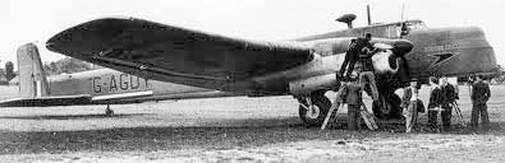
A Whitley bomber in BOAC markings *7

A trial flight was undertaken using an unmarked Mosquito of 105 Sqn (DK292) on August 6th 1942 (there is some confusion over this exact date), flown by  Fl. Lt. Parry and P. Off. Robinson, the results of which showed the aircraft to be highly suitable for the purpose of the flights. The journey from Leuchars to Stockholm covered some 800 miles was, on average, completed in around 3 hours.

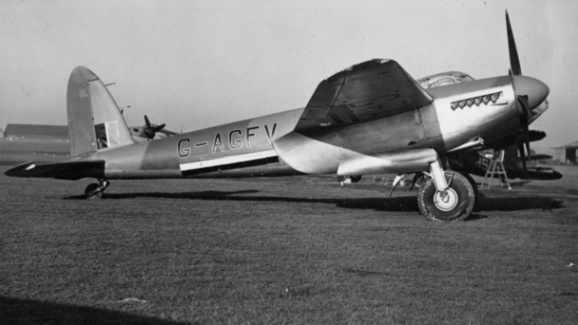
On 15th December 1942 the first civilian operated model of the aircraft arrived at Leuchars. A Mosquito PR.IV ‘DZ411’,  it was assigned the civilian registration G-AGFV, and began flights to Stockholm on 4th February 1943. After this, it was joined by six other Mosquito MK.VI aircraft between April and May (all being given the sequential registrations G-AGGC to AGGH) with a further three in April 1944.

The incredible carrying capacity of the Mosquito, which would be proven later in the war, would allow for up to 650Kg (10 -12 crates) of ball-bearings to be carried in the aircraft’s bomb bay.

The opening of such a link was kept very secret, the British not wanting the Germans to know about the new revolutionary Mosquito, nor their important cargo. However, keeping such an operation from German intelligence was difficult, if not impossible, and soon they discovered that the flights were again taking place between the two countries. Now embroiled in a political stand off, the Germans put pressure on neutral Sweden to put a stop to these flights, insisting that they were giving the British an advantage, and that as a neutral country, they should not be allowing British aircraft to land on Swedish soil. The Swedes maintained that the service was purely civilian and controlled solely by the Swedish authorities, to which the Germans threatened to inform Hitler thus rendering the aircraft legitimate military targets. Fearing that the British would in turn close the passage for the safe-conduct traffic, the Swedes ignored the German threats and so the service continued.

However, so as to not infringe or violate Sweden’s wartime neutrality, it was vital that the Mosquitoes remained unarmed for these operations. But that made any aircraft on this run a potential ‘sitting duck’, even though, like their Lockheed predecessors, they carried BOAC insignia and were flown by civilian aircrew.

So all of these aircraft had to be changed from military status to civilian, this required the removal of all traces of armament. Modified at Hatfield – the home of the Mosquito – the resultant weight loss altered the aircraft’s centre of gravity and so additional ballast had to be added to prevent changes in the aircraft’s flying characteristics.

The first example DZ411, was a Mosquito B.IV Series II, powered by two Merlin 21/23 engines built under the contract 555/C.23(a) and converted to a PR.IV at Hatfield prior to its delivery to BOAC at RAF Leuchars. It would go on to serve until early 1945 with BOAC before presumably returning to RAF ownership.

The first of the next batch, all FB.VIs, was ‘HJ680’ another example built at Hatfield under the same contract 555/C.23(a) but with Merlin 23/25 engines. This aircraft was initially passed to BOAC at Bramcote on April 16th 1943, receiving the registration G-AGGC before flying on to Leuchars immediately after. On the 18th, on the return leg of its maiden flight for BOAC, it was chased by enemy fighters, but its speed and agility allowed the Mosquito to escape unharmed. It was eventually removed from service on November 30th 1944, but remained at Leuchars in case a ‘spare’ aircraft was urgently needed. This particular model was the longest serving Mosquito in BOAC’s service, being taken off the civil register on January 4th 1946, whereupon it was passed to 22 Maintenance Unit. On June 15th 1950, the example was eventually sold as scrap to the John Dale Scrap merchants.

The next aircraft ‘HJ681’ arrived at the same time, and remained in service until January 1944, under the civil registration G-AGGD. This particular aircraft crash landed in Sweden and was reduced to spare parts.

‘HJ718’ arrived on April 24th and was given the registration G-AGGE, it served until June 1945, whilst ‘HJ720’ (G-AGGF) crashed into high ground at Invernairk, Glen Esk on 17th August 1943, killing both crewmen Captain L.A. Wilkins and Radio Operator N.H. Beaumont. A further FB.VI, ‘HJ721’ (G-AGGG) also crashed, this time on the return leg only a mile or so from Leuchars on October 25th 1943, when the port engine failed. Both crewmen, Captain Hamre and Radio Operator Haug, lost their lives along with their passenger Mr Carl Rogers.

The last FB.VI ‘HJ723’ also built under the same contract as the other models, arrived on the 2nd May 1943, and would operate until the end of June 1945 as G-AGGH . It was subsequently handed over to the RAF and eventually presumably disposed of.

By the end of May 1943, a total of nine Mosquitoes would have been modified and delivered to BOAC at Leuchars*5.
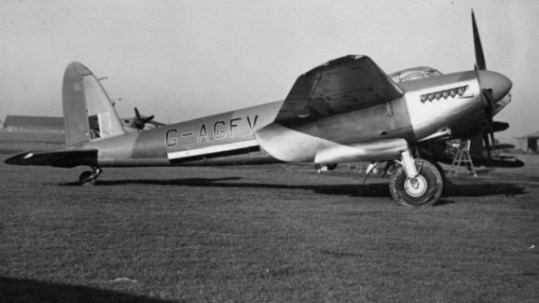
DH98 Mosquito G-AGFV (DZ411) MkIV BOAC on 8th January 1943 (© 2021 BAE Systems)

In June 1943, with the need for ball-bearings increasing, two Mosquitoes departed Leuchars with two very important dignitaries onboard. Firstly the British president of the Swedish SKF airline and secondly a ball-bearings expert from the British authorities, who were going to negotiate the delivery of further supplies to Britain.

In order to accommodate these additional passengers the bomb bay of the aircraft had to be converted, thus allowing them to lay on their backs on padded felt*6. An additional reading lamp was fitted, along with an oxygen supply, intercom and even coffee. The passenger would have a piece of string the other end of which was tied to the pilots leg, and should the conditions  in the bomb bay become too uncomfortable, they would pull the string.

These operations were very soon regularly carrying human cargo. On the outward leg mail, newspapers and other written material held within its bomb bay, would be deposited in Sweden, the aircraft would be refuelled and stocked up with either human cargo (allied aircrew, special agents or scientists), ball-bearings or a mix of the two. The faster and far more agile Mosquito would, in most cases, be able to out run any opposing Luftwaffe fighter that should, and indeed did, try to intercept the aircraft whilst on one of these flights.

One such notable passenger who was carried back from Sweden was the nuclear physicist Niels Bohr whose work on atomic structures and quantum theory had won him the Nobel Prize in Physics in 1922.*4 His journey almost cost him his life though after he failed to operate his oxygen mask correctly. Only when the failed to respond to the pilot’s attempts to contact him, was action taken and the aircraft reduced altitude allowing Bohr to breathe normally and regain consciousness. Bohr went on to work on the Manhattan project, an American project that led to the development of the atomic bomb that would end the war, and plunge the world into the nuclear age.

A large number of other significant people were also carried by these Mosquitoes, Sgt. Jack Byrne who went on to be a  founder member of the SAS, after being shot in the face, bayoneted in the groin and detained in several prisoner of war camps, was one such person repatriated to Leuchars. Three of those who escaped in the famous ‘Wooden Horse‘ escape were also returned via Mosquitoes from Sweden; as where Norwegians Peter Bergsland and Jens Muller two of the three to escape in ‘The Great Escape’.

In ‘Operation Gunnerside’, the SOE operation to blow up the German heavy Water plant in Norway (featured in the film ‘The Heroes of Telemark‘), six of the team were repatriated using this route. A key player in this operation was Leif Tronstad, a Norwegian Physicist who was also flown to Scotland to provide vital information about the German efforts to produce heavy water at the plant.

A considerable number of British personalities were also flown into Sweden using this method; T.S. Elliot, Sir Kenneth Clarke and even the Bishop of Chichester were flown into Sweden this way.

Sgt. Jack Byrne, was shot, bayoneted and imprisoned. He fought at Dunkirk, on D-Day, in North Africa and at the Battle of the Bulge and then went on to be a founder member of the SAS.*2

By the end of 1943, 157 such flights had been made, 129 of which were by these Mosquitoes. A total of some 110 tonnes of freight (a mix of human and mainly ball bearings) had been carried.

Even though these flights were highly successful, a few aircraft were lost. In Mid August 1944, G-AGKP ‘LR296’ a former 27 MU aircraft was lost when it crashed into the sea nine miles from Leuchars. All three on board, Captain G. Rae, Radio Operator D.T. Roberts and Captain B.W.B. Orton (himself a BOAC Mosquito pilot), were killed as it approached Leuchars on its return flight from Stockholm.  The crash was believed to have been caused by the aircraft’s structural failure, the aircraft having been repaired previously after an accident in January. The total number of aircraft being used by BOAC reached fourteen, with five of these crashing including one G-AGKR ‘HJ792’ being lost at sea in August 1944 with no trace of either the aircraft or crew ever being found.

On 17th May 1945 the service officially ceased. Between 1941 and the war’s end, 1,200 of these trips had been made, many by the Mosquitoes. The service between Sweden and Scotland had been a vital link between the two countries not only for the supply of ball-bearings but a life line for escapees and special agents. For these Mosquitoes it was a remarkable achievement for an aircraft that would prove itself to be one of the war’s most incredible designs.

de Havilland Mosquitoes used by BOAC*3:

DK292 – The first Mosquito to fly the Leuchars – Stockholm route
DZ411 – G-AGFV flew to 1945
HJ667 – G-AGKO flew to 1945
HJ680 – G-AGGC flew to 1946
HJ681 – G-AGGD crash landed Sweden 1941
HJ718 – G-AGGE flew to 1945
HJ720 – G-AGGF crashed Invernairk 1943
HJ721 – G-AGGG crashed near to Leuchars 1943
HJ723 – G-AGGH flew to 1945
LR296 – G-AGKP crashed near Leuchars 1944
HJ792 – G-AGKR lost at sea 1944
HJ898 – Crew trainer retained RAF serial flew to 1945
HJ985 – Crew trainer retained RAF serial returned to RAF 1944
LR524 – Crew trainer retained RAF serial returned to RAF 1944

RAF Leuchars appears in Trail 53.

Sources and further reading.

*1 Martin Fritz (1975) Swedish ball-bearings and The German war economy,
Scandinavian Economic History Review, 23:1, 15-35, DOI: 10.1080/03585522.1975.10407803

*2 Photo from “Think Scotland website”  accessed 12/3/21

*3*6 The Mosquito Page Website accessed 12/3/21

*4 For additional information and pilot stories about the ‘ball-bearing’ run see the Royal Institute of Navigation Blog.

*5 Thirsk, I. “de Havilland Mosquito – An illustrated History Vol.2“, Crecy 2006

*7 Photo from Aircraft Enthusiast Group Website.

BAE Systems Website

RAF Holme – From Bomber base to Fighter Development (P1)

In this next part of Trail 40, we head to the south-east of York, to an airfield that started off as a bomber airfield in the early stages of the war. As Bomber Command operations grew, so did the airfield, and so too did the casualties rise.

Post war, it went on to play a minor part in the cold war as an American air base, then like a phoenix out of  the ashes it rose to feature in the development of modern British fighter jets. Sadly, it all ended with the demise of the British aviation industry, now a handful of dilapidated buildings form the core of a rundown industrial estate that was once RAF Holme-on-Spalding Moor.

RAF Holme-on-Spalding Moor (RAF Holme/Spaldington)

The parish of Holme-on-Spalding Moor is  the largest historic parish in the county of  East Riding, covering 11,514 acres, with  a history that goes back as far as the iron age. The majority of the parish was, before the mid 1700s, a moorland, a bog in many places, that only the brave or knowledgeable could safely cross. The village and surrounding area is dominated by the medieval All Saints Church, that sits on land called Beacon Hill, 45m above sea level, about half a mile to the north-east of the village. The village  sits approximately halfway between York and Hull, whilst the airfield itself lies a few miles south-east of the village in the small hamlet of Tollingham.

Construction began in late 1940 as a bomber airfield for the expansion of the RAF’s No 4 Group, one of forty-three built in Yorkshire. It would initially cover around 400 acres, taking land from four separate local farms, an area that extended to over 1,500 acres as the war progressed.

RAF Holme on Spalding Moor

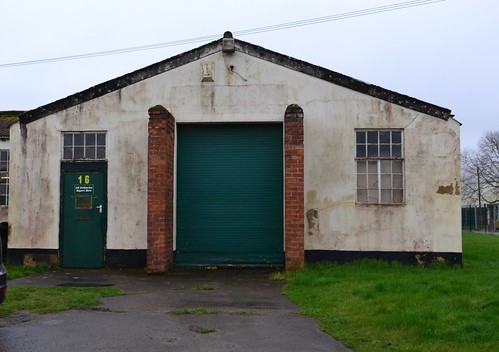
Many of the buildings still stand used as an industrial site.

Designed in the early stages of the war, as a parent station for Breighton and Melbourne (implemented after the introduction of the Base system in February 1943*1), Holme-on-Spalding Moor (or Holme) was built as a dispersed airfield with accommodation constructed to the north-east away from the main airfield site, the start of a new design aimed at reducing casualties in the event of an attack.  As a Scheme ‘M’ airfield, it would have one austerity measure ‘J’ type hangar and two type T2 hangars, designed to replace the former Type ‘C’ hangar. By the end of the war, these numbers would have been increased giving a total of five Type T2s and one ‘J’.

Whilst not a Class A airfield (implemented in 1942), Holme was built with three intersecting concrete runways, thirty-six dispersed hardstands and a watch office (designed to drawings 518/40 & 8936/40) built of brick, concrete and timber. As a parent airfield, the office would have a meteorological section attached.

The technical site was located to the north side of the airfield (within the legs of an upturned ‘A’ with the bomb store to the north-west and the dispersed accommodation area to the north-east. At its peak it housed upward of 3,000 personnel of mixed rank including nearly 500 WAAFs. For many, Holme-on-Spalding Moor was not a particularly pleasant stay, the locals objecting to the influx of airmen into their quiet community, forcing ‘nights out’ to go much further afield. Those who stayed here considered it bleak, cold and damp with few comforts, but like many personnel on Britain’s wartime airfields, they made the best of what they had.

Once the airfield was declared open, it was handed to No. 1 Group to train (Australian) bomber crews on the Wellington bomber. The first major squadron to arrive was 458 Sqn (RAAF), formed at Williamtown, New South Wales, under Article XV of the Empire Air Training Scheme. Many airmen were posted to Canada to finish their training, before finally being sent to the UK and their first operational squadron. The first thirty-seven of these qualified airmen spent the majority of August 1941 en route to the UK, arriving at Holme later that month, where they joined with other commonwealth airmen to form the squadron. The first aircraft they would use was the Vickers Wellington MK.IV, a model they retained until January/February 1942, when they replaced them with the MK.IC. At the end of March that year, 458 Sqn transferred to the Middle East, retaining various models of Wellingtons for the remainder of the war.

RAF Holme on Spalding Moor

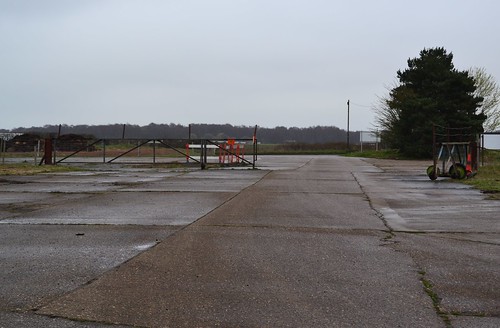
Very easily visible is one of the few hardstands that survive at Holme today.

Whilst here at Holme-on-Spalding Moor, 458 Sqn would focus on the strategic bombing campaign against Germany, taking part in operations that took them to numerous cities in both Holland and Germany.

On the night of 20th/21st October, ten aircraft from 458 Sqn  joined twenty-five other aircraft in a raid on the port of Antwerp. With other raids targeting Bremen, Wilhelmshaven, and Emden, it would be a busy night for Bomber Command. On board one the of the 458 Sqn aircraft (Wellington IV #Z1218, ‘FU-D’) was: Sgt. P. Hamilton (Pilot); Sgt. P. Crittenden; P/O. D. Fawkes; Sgt. T. Jackson; Sgt. A  Condie and Sgt. P. Brown. The aircraft would depart Holme-on-Spalding Moor at 18:39, on the squadron’s first operational sortie. The weather that night was fair but cloud covered much of the target, and so many aircraft returned with their bomb loads intact. On route, just after midnight, Wellington ‘FU-D’ was shot down by a German night-fighter, with all but Sgt. Brown being killed.

The average age of these men was just 23, Sgt. Philip George Crittenden (aged 20) was the first Australian airman to be killed whilst serving in an RAAF Bomber Command squadron. He, along with the remainder of the crew, were buried in the Charleroi Communal Cemetery, Belgium, and is commemorated on Panel 106 at the Australian War Memorial.

Pilots of No. 5 Flight at No. 4 SFTS, Saskatoon, Canada. The majority of the students are recently arrived members of the RAAF, who travelled to Canada under the Empire Training Scheme. Third row back, left side:  Sgt Phillip George Crittenden 400410 (KIA 20th/21st October 1941)*2

A second 458 Sqn bomber (#R1765) was lost on the night of 22nd/23rd October, on operations to Le Harve. Hit by flak, the aircraft made it back to England where the crew baled out. Only one crewman, Sgt. Hobbs, failed to do so, his body was subsequently found in the bomber’s wreckage. A third Wellington was lost before the year was out, that of  #R1775 which lost contact at 20:35 on the night of 15th/16th November 1941, with the loss of all crewmen.

The October also saw the arrival of No. 20 Blind Approach Training (BAT) Flight, formed at the sub-station RAF Breighton, they moved here in the same month only to be disbanded and reformed as 1520 Beam Approach Training (BAT) Flight. This addition brought Airspeed Oxfords and Tiger Moths to the airfield, and was designed as part of the pilot’s training programme teaching night landing procedures.

January 1942 saw little change, with the loss of three further aircraft, one (#Z1182) ‘FU-G’ due to icing causing the aircraft to crash just after take off, a further two were lost 3 days later,  #R1785 was hit by flak and crashed over the target, with #Z1312 hitting high tension wires after returning home suffering flak damage from an aborted mission. In total there were twelve airmen killed and six injured in just three days, a terrible startto 458 Sqn’s entry into the European war.

During the February 1942, 458 Sqn began changing their Mk.IVs for MK.ICs, and then on March 23rd they moved out of Holme-on-Spalding Moor and set off to the Middle East, where they remained until the war’s end.

RAF Holme on Spalding Moor

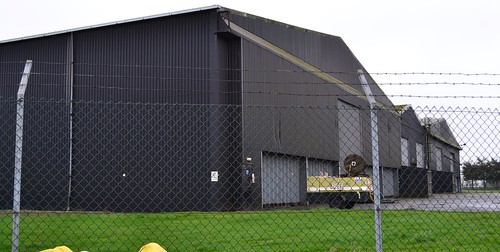
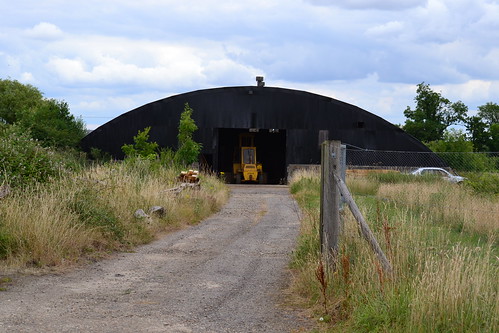
Original hangars once housed Lancasters, Halifaxes and Buccaneers!

This left 1520 (BAT) Flight the sole users of Holme-on-Spalding Moor, until the August when, for a short period of six weeks, 460 Sqn Conversion Flight stationed a flight of Halifaxes here from the sub-station at Breighton. The four engined heavies then went through a period of changes eventually taking on the Lancaster.

After their departure, the end of September saw another Wellington squadron arrive, that of 101 Sqn RAF. The squadron, who transferred in from No. 3 Group, remained off operations for a short while whilst they converted to the new Lancaster, a major change from the poorer performing twin-engined ‘Wimpy’.

It was during one of these training flights that 101 Sqn would suffer their first accident at Holme, when it was thought, a photo flash flare exploded causing structural failure of the  Lancaster’s fuselage whilst flying over Wales – all seven crewmen were lost in the tragic November accident. During the autumn and winter months training would continue as Wellingtons were gradually withdrawn from front line operations, and units converted to the four engined bombers, primarily the Lancasters. Holme-on-Spalding Moor was no different, and once over, 101 Sqn would continue where 485 Sqn left off, taking the fight to the German heartland. During 1942-43 they would lose six aircraft in non-operational flights and fifty-nine during operations.

During January 1943, the first three aircraft of the year would be lost; Lancaster Mk.Is #W4796 ‘SR-R’, #ED443 ‘SR-B’ and # ED447 ‘SR-Q’ were all lost on operations to Essen and Hamburg with no survivors. Twenty-one fully trained aircrew were gone along with their aircraft.

Whilst the Lancasters of 101 Sqn fared reasonably well compared to other units, casualties being generally light, there was one night that stood out above all others, a night that would devastate the crews of 101 Sqn.

RAF Holme on Spalding Moor

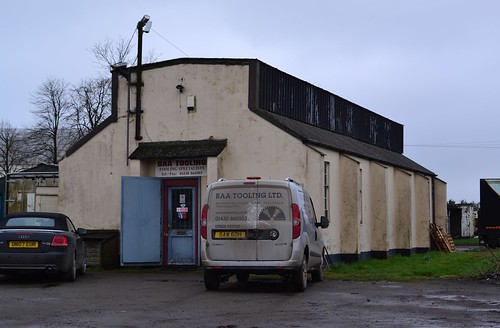
The parachute store is now a tool shop.

On the night of 4th/5th May 1943, during the Battle of the Rhur, 141 Halifaxes, 255 Lancasters, 10 Mosquitoes, 80 Stirlings and 110 Wellingtons headed for Dortmund. A massive force, it was the largest single force below the 1,000 bomber raids so far, it was also the first major attack on Dortmund. Reports say that marking was accurate, but decoy fires lit on the ground drew many bombers away from the actual target. Even so, damage was extensive, with large areas of the city being flattened, over 3,000 buildings were either destroyed or damaged and 1,700 people either killed or injured. Sadly, 200 POWs were amongst those killed, alas a new record had been set for ground casualties. As for the Lancaster force, only six were lost, a small percentage compared to the other aircraft, but all six were from 101 Squadron.

All aircraft took off between 21:40 and 22:05 and headed out toward Germany. Of the six lost, one was lost without trace #W4784 ‘SR-E’ piloted by Sgt. W. Nicholson, and another ‘SR-F’ #W4888, piloted by F/O. N. Stanford, was shot down by a night fighter crashing in Friesland with the loss of six. The remaining four crashed either on their way out from, or on their return to, the airfield. ‘SR-G’, #W4863 piloted by Sgt. J. Browning (RNZAF) crashed at Scorton near to Richmond, Yorks; ‘SR-U’ #ED776, piloted by F/S. F. Kelly crashed short of the runway without injury; ‘SR-X’ #ED830, piloted by Sgt.F Smith hit trees near to Little Ouseburn, Yorkshire, and ‘SR-T’ #ED835 piloted by W/O. G Hough, was hit by flak but managed to return to Holme-on-Spalding Moor crashing a few miles away between Hotham and North Cave. On this night twenty airmen were lost, one was taken as a POW and seven sustained injuries of varying degrees. It would be the worst night for 101 Squadron for many months.

All Saint's Church

W/O. Gerald Hough killed on the morning of May 5th 1943 on 101 Sqn’s worse night of the war so far.

With the final loss taking place on the night of 12th June 1943, 101 Sqn would three days later, depart Holme-on-Spalding Moor for good, moving to Ludford Magna in Lincolnshire. A move that was triggered by the reorganisation of Bomber Command boundaries, Holme being taken over by No. 4 Group RAF.

The move would mean there would be no peace at Holme though, as 101 Sqn departed 76 Sqn arrived not with Lancasters though, but the other four engined heavy – the Halifax.

In Part 2 we see how 78 Sqn coped with the Halifax, an aircraft that was overshadowed by the Lancaster. Initially a poor performer, with improved engines it began to make its mark. It was slow process and in the meantime casualties for Halifax crews remained high. We also see what happened to RAF Holme post war, and how it played its part in the development of Britain’s jet fighters.

Operation ‘Fuller’ – “The Channel Dash”.

On 12th February 1942, 18 young men took off on a daring mission from RAF Manston, in outdated and out gunned biplanes, to attack the German fleet sailing through the English Channel.

Leaving Brest harbour, a force of mighty ships including the Scharnhorst, Gneisenau and Prinz Eugen, attempted a break out, supported by sixty-six surface vessels and 250 aircraft, they were to head north through the Channel out into the North Sea and homeward to Germany where they could receive valuable repairs.

For many weeks the British had been monitoring the vessels awaiting some movement out to sea. Then,  German transmitting stations based at both Calais and Cherbourg, began a cat and mouse game transmitting false readings to interfere with British radar sets on the south coast. In mid February, the Luftwaffe organised themselves over northern France and the radars went wild with false readings and interference. Temporarily blinded by these measures, the British were unable to ‘see’ the mighty armada slip out into the Channel waters. Their escape had been a success.

The British, fearing such an attempt, had prepared six Fairy Swordfish of 825 Naval Air Squadron at nearby RAF Manston in readiness for the breakout. Ageing biplanes, they were no match for the Luftwaffe’s fast and more dominant fighters, nor the defensive guns of the mighty German fleet they were hoping to attack.

In front of their Swordfish, Lieut Cdr E Esmonde, RN, (2nd Left) on board HMS Ark Royal, October 1941. This photo was taken after the attack on the Bismark, and includes the various aircrew who received decorations as a result of that daring attack. (Left to right: Lieut P D Gick, RN, awarded DSC; Lieut Cdr E Esmonde, RN, awarded DSO; Sub Lieut V K Norfolk, RN, awarded DSC; A/PO Air L D Sayer. awarded DSM; A/ Ldg Air A L Johnson, awarded DSM). (© IWM A 5828)

In the cold winter of 1942, the Swordfish were kept ready, engines warmed and torpedoes armed, when suddenly and unexpectedly, at 12:25 on the 12th February, the fleet was sighted. They could no longer wait, and instead of attacking as planned at night, they would have to attack during the day, and so the order was given. The crews started their engines and set off on their daring and suicidal mission.

Shortly after take off, the escort arrived, merely ten Spitfires from No. 72 Squadron RAF, led by Squadron Leader Brian Kingcombe, and not the five Spitfire squadrons promised. The six Swordfish, led by  Lt. Cdr. Eugene Esmonde, dived to 50 feet and began their attack. Hoping to fly below the level of the anti-aircraft guns each of the six Swordfish flew gallantly toward their targets. Eventually hit and badly damaged, they pressed home their attacks, but they were out-gunned, and out performed, and just twenty minutes after the attack began, all six had fallen victim to the German guns. No torpedoes had struck home.

Of the eighteen men who took off that day, only five were to survive.

Leading the attack, Lt. Cdr. Esmonde was warded the V.C. Posthumously, he had previously been awarded the Distinguished Service Order for his part in the attack on the Battleship Bismark; an award that also went to: S/Lt. B Rose, S/Lt. E Lee, S/Lt. C Kingsmill, and S/Lt. R Samples. Flying with them, L/A. D. Bunce was awarded the Conspicuous Gallantry Medal and twelve of the airmen were mentioned in dispatches.

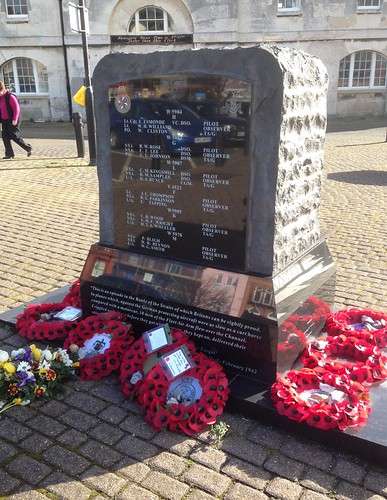
In their honour and to commemorate the brave attempt to hit the German fleet that day, a memorial was erected in Ramsgate Harbour, the names of the eighteen men are listed where their story is inscribed for eternity.

Operation 'Fuller'

The memorial stands in Ramsgate Harbour.

Operation 'Fuller'

The names of the 18 airmen and the Swordfish they flew.

RAF Biggin Hill Vestry demolished.

There has been an ongoing fight against Bromley Council who have made the decision to demolish the Vestry at Biggin Hill airfield, to make room for a new museum.

Concerns are not with the museum itself, in fact there have been calls for one for over 30 years, but they are with the current design of the building which campaigners say,  “is not sympathetic to the original building”.

The Grade 2 listed Chapel was built under instruction from Winston Churchill in 1951 as a dedication to those who fought in the great Battle over southern England.

A petition was recently set up by local people, which so far, has reached nearly 21,000 signatures, and was handed to the Government earlier this month. Protesters also say that once open, visitors to the chapel will not be able to view the existing stained glass window without payment of the museum entry fee, predicted to be £7.50.

Since then, the Vestry, a building of around 70 sq metres and adjoining the Chapel, has been completely demolished at a cost of £25,000.

It is thought that the Chapel itself will be closed to visitors for around a year whilst the new building is erected.

If you want to know more the petition can be found at:

https://you.38degrees.org.uk/petitions/protect-biggin-hill-st-george-s-raf-chapel-of-remembrance

You can also see footage of the news reports though the Downe Village website by scrolling down the front page.

RAF Debden (Part 1) – The Build up to the Battle of Britain.

Not far from Wethersfield, lies the parent airfield of Castle Camps. Now closed to aviation, it currently resides in the hands of the Army as the Carver Barracks. On this next part of this Trail we wind our way through the Essex countryside to the former fighter station that gained notoriety during the early 1940s, and in particular the Battle of Britain. In this, the first part of the visit, we look into the development of the airfield, and the build up that took it into the heart of the Battle. We visit the former RAF Debden.

RAF Debden (Station 356) – Essex

The internet and history books are awash with pictures and information about RAF Debden, and rightly so. It is an airfield with an incredible history, famous for its part in the Battle of Britain and the defence of London, it was home to no less than thirty RAF squadrons at some point; it was used by the U.S. volunteer squadrons the ‘Eagle Squadrons’, and then taken over by USAAF as a fighter airfield following their official entry into the war. It was then used again by the RAF post war up until 1975 when the British Army took over,  those whose hands it remains in today as the Carver Barracks.  Not only is it history long but the site is historically highly significant. According to Historic England, Debden airfield represents “one of the most complete fighter landscapes of the Battle of Britain period“, considered historically important due to its “largely intact defensive perimeter and flying-field with associated blast pens“.*1

Debden is therefore a remarkable site, but as an active military base, access and views are understandably very restricted. However, some buildings can still be seen from public areas, particularly the front as you pass by the main entrance.

RAF Debden

One of 11 Blister Hangars built at Debden.

Debden’s life began in the mid 1930s, it eventually opened in 1937, as part of the expansion programme of the pre-war era, and was classified as a fighter airfield under Scheme ‘C’ of the airfield construction programme. During this period, great consideration was given to the architectural features of airfield buildings, standard designs being finished and positioned aesthetically in line with both the local landscape, stone and environment. Design and construction of these airfields, in this the second part of the expansion phase, was carried out in conjunction with the Royal Fine Arts Commission, whose influence led to an overall improvement in airfield design. During this phase of expansion, over 100 permanent sites were built using these new designs, in fact, according to Historic England, it is these sites that have tended to survive in the best condition to date largely thanks due to their post war and Cold War usage. Even in this pre-war period, aesthetics were as important as operability!

Built by W. L. Fench Limited, Debden wasn’t completed until after it had been opened, thus the first units there were using the site in its unfinished state. The two initial landing surfaces were grass, but as a fighter airfield little more was needed. Even so, and not long after it opened, these were replaced by concrete and tarmac surfaces, giving the airfield much stronger and more adaptable landing surfaces. Being the standard 50 yards wide, these runways were also extended from the initial 1,600 and 1,300 yards to 2,600 and 2,100 yards respectively, allowing for larger and more powerful aircraft to utilise the site.

Debden had a large number of hangars built: three ‘C’ type, one Bellman and eleven blister hangars which were all spread around the perimeter and technical areas of the airfield. Some 80 hardstands were also provided, thus large quantities of aircraft were expected to use the site at one point or another.

Of these thirty operational flying squadrons to pass through Debden, the primary aircraft to see service would be the Spitfires and Hurricanes of Fighter Command. Biplanes such as the Demon and the Gloster Gladiator were also to feature here, as were the twin-engined aircraft the Beaufighter, Havoc/Bostons and the jet engined Meteor in the latter stages of the war. The period 1939 – 1942 though, was by far the busiest period for Debden, the majority of squadrons operating from here during this time.

Upon opening in 1937, Debden would operate the outdated and obsolete biplanes of the Royal Air Force, Hawker’s Fury II of 87 squadron being the first to arrive on 7th June 1937, being replaced shortly after by Gloster’s Gladiator, that famous Biplane that protected Malta as ‘Faith’, ‘Hope’ and ‘Charity’. In the summer of 1938, prior to the outbreak of war, Hurricanes were brought in and the entire squadron moved to airfields in France where they would stay until May 1940, when France was invaded by the German forces. Brought back to England, a short two-day stop over at Debden, would lead to a move north and Yorkshire before returning to the battle, and a night fighter role over Southern England.

Joining 87 Sqn in June 1937 were further Gladiators, those of 80  Squadron who, themselves formed a month earlier, would stay at Debden until departing for the Middle East and Ismailia a year later. A third squadron would arrive during this time, 73 Squadron, who shortly after reforming at nearby Mildenhall, would also replace their Hawker Furys with Gladiators coinciding with their move to Debden. Also moving to France, 73 Sqn would eventually move to the Middle East, where they would remain for the duration of the war, flying from numerous airfields including that of Habbaniyah, one of several places where my father was stationed post-war.

One other squadron would grace the skies over Debden that year, that of 29 Squadron, whose Hawker Demons were adapted to accept a Frazer-Nash turret for defence. A small aircraft, they would be no match for enemy fighters and so were replaced in December 1938 by the far superior aircraft the Blenheim IIF. Coinciding with this, was the movement of a detachment of 29 sqn aircraft to Martlesham Heath, which was followed by a months stay at RAF Drem in the border region before returning to Debden once more. By the end of June though, the entire squadron have been pulled out of Debden and moved to Digby in Lincolnshire and a new role as night fighters.

1938 also saw the reforming of 85 Squadron on the 1st June. 85 sqn, as a unit, had their roots in the First World War, being stationed in France before disbandment in the summer of 1919. But on this occasion, they were reformed out of ‘A’ Flight of 87 squadron prior to them taking on their Hurricanes and imminent move abroad. During the period 1939 – 1940, 85 Sqn would move around almost weekly, with one of their longest permanent stays being between November 1938 and September 1939 whilst here at Debden. Being the parent airfield of Castle Camps, Debden units would often be dispersed there, or in some cases stationed there, whilst also operating out of Debden – 85 Sqn being no exception.

Two other squadrons would fly from Debden during the winter/spring of 1939 – 40, both 17 and 504 operating the Hurricane MK. I. On an almost weekly basis, both units would yo-yo between Debden and Martlesham Heath, an almost continuous spiral of postings saw them using the ‘Heath’ as a forward operating airfield until around May 1940, when both units were moved to France in support of the B.E.F.

Hawker Hurricane Mark Is of No 17 Squadron taxiing at Debden, July 1940. In the foreground is YB-C, that of the CO, Squadron Leader Harold ‘Birdy’ Bird-Wilson, who was shot down on 24th September flying YB-W (P3878) (IWM – HU 54517)

As the fall of France turned into the Battle of Britain, fighter units to defend Britain became top priority. The dawn of 1940 would see the beginning of six more squadrons operate out of Debden, the majority of which would arrive during the height of the Battle. Debden, as the Sector Station responsible for the Thames Estuary and eastern approaches to London, would become a prestige Luftwaffe target during those early days of the Battle. As a result, it along with other Sector stations at Northolt, North Weald, Biggin Hill, Tangmere and Hornchurch, would endure some of the most sustained and prolonged attacks by German bomber formations.

To meet the demand for fighter units, 257 Squadron were reformed and posted to Debden initially flying the Spitfire MK. I. They quickly replaced these with the Hurricane I prior to them becoming operational on July 1st. Four days later they were joined at Debden by both 601 (the ‘Millionaires Squadron’ named so after the men who initially joined it) and 111 Squadron making this one of the largest collections of Hurricanes at that time.

85 Squadron were soon in the thick of the battle. As July 1940 turned to August, patrols would be sent up as regularly as the sun would rise, many of these patrols would result in enemy engagement; the Operational Record Books being testament to the continuing battle for the skies over Britain at that time. At the beginning of August on the 7th, Air Vice-Marshal K.R. Park M.C., D.F.C. visited  Debden, a visit that preceded the transfer of Debden from 12 Group into 11 Group. It was also at this time that the funeral of P/O. Britton of 17 Sqn took place, a young man who lost his life in a flying accident on the 6th whilst carrying out an air test in Hurricane N2456. In poor weather, visibility of only four miles, P/O Britton crashed into Debden Park destroying the aircraft in which he lost his life.

In mid August 1940, both ‘A’ and ‘B’ flights of 85 Sqn were brought back from Martlesham Heath and Castle Camps to Debden, a move that preceded the not only the first but one of the largest attacks by a Debden squadron on enemy aircraft.

In part 2, we see how Debden was affected by the German campaign, the relentless attacks that drew Debden crews into battle. We look at the changes at Debden and how the American made a name for themselves as determined and fearless fighter pilots.

*1 Historic England, Historic Military Aviation Sites – Conservation Guidance, 2016.