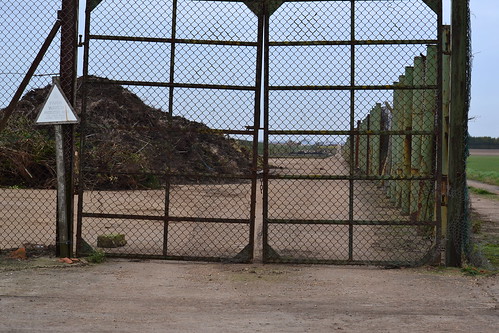
Trail 52 – RAF Bottesford and the bizarre accident that killed five airmen.

In this next trail we turn westward and head to the Midlands towards Nottingham and Leicester. Here we take in an airfield that was part of the RAF’s Bomber Command, and whilst it is an airfield that saw only a small number of squadrons operating from it, it nonetheless has a very significant story to tell.  Now a successful industrial park, much of the site remains – albeit behind a security gate and fencing. This airfield was home to both the RAF and the USAAF and played an important part in the fight against Nazi Germany. Today we visit the former airfield RAF Bottesford.

RAF Bottesford (Station 481)

RAF Bottesford was built in the period 1940 / 41 by the major airfield builder George Wimpey & Co. Ltd. It was known more locally as Normanton after the small village that lies on the south-western corner of the site, and although a Leicestershire airfield, it actually straddles both Leicestershire, Nottingham and Lincolnshire. As a new bomber airfield, it was the first in the area to be built with concrete surfaces, a welcome break from the problematic grassed surfaces that Bomber Command had been fighting against before.

In 1941 Bottesford would open under the control of No. 5 Group, a group formerly headed by Air Chief Marshal Sir Arthur Harris, who had seen the group carry out anti-shipping sweeps over the North Sea and leaflet drops over Germany. Now under the guidance of Air Chief Marshal Sir John Slessor, No. 5 Group was able to muster a considerable number of heavy bombers capable of reaching Germany’s heartland.

As a bomber airfield Bottesford had a wide range of technical buildings, three concrete runways, one of 2,000 yds (after being extended) and two just short of 1,500 yds, all 50 yds wide and linked by a perimeter track. The technical site with its various support buildings lay to the north-west of the airfield with the bomb site to the east, and accommodation areas dispersed to the north-east beyond the airfield perimeter.

Bottesford would accommodate around 2,500 personnel of mixed rank, both male and female, in conditions that were often described as ‘poor’, the site suffering from extensive rain and lack of quality drainage as the Operational Records would show *1.

Around the airfield there would eventually be 50 dispersals, half of these being constructed initially as ‘frying pan’ hardstands, and then with the introduction of the improved ‘spectacle hardstand’, this number was doubled by 1945.

Aircraft maintenance would initially be in four hangars, but these were also increased to ten in total, giving a mix of T2 and B1 designs. An unusual design feature of Bottesford was that some of these dispersals, and later hangars, were across a public road and, like RAF Foulsham (Trail 22), a gate system operated by RAF Police would allow the road to be closed off when aircraft were moved into or out of the area. The airfield would therefore, undergo quite a major change during its operational life.

Aerial photograph of Bottesford airfield looking west, the technical site is bottom right, 8 June 1942. Photograph taken by No. 1 Photographic Reconnaissance Unit, sortie number RAF/HLA/590. English Heritage (RAF Photography).

RAF photo reconnaissance photo taken on 8 June 1942. Compare this to the photograph taken three years later (below)*2

Aerial photograph of Bottesford airfield looking east, the technical site with seven T2 hangars, control tower and airfield code are top left, the bomb dump is on the right, 30 May 1945. Photograph taken by No. 544 Squadron, sortie number RAF/106G/LA/203. English Heritage (RAF Photography).

Bottesford 1945 *3

Only three operational front line RAF units would operate from Bottesford, the first being 207 Squadron flying the Avro Manchester, arriving on November 17th 1941, the same month as production of the Manchester ceased. Their arrival would also coincide with the arrival of 1524 (BEAM Approach Training) Flight operating the Airspeed Oxford.

207 Sqn were reformed as a new squadron at the beginning of November 1940, taking on the ill-fated Avro Manchester MK.I, before arriving here at Bottesford a year later. The first squadron to operate the type, they were soon to discover it had major issues, and so poor was the Manchester, that by the Spring of 1942 it was being withdrawn, replaced by its more successful sister the Lancaster. After its promising introduction into Bomber Command in late 1940, it became clear that the Manchester was going to become a troublesome aircraft. With engine seizures often followed by fires, it was very much under-powered even though it had what were in essence, two V12 engines mounted in one single engine.  Bearing failures led to engines failing, and already working at its limits, the Rolls-Royce Vulture engine was not able to keep the Manchester aloft without great skill from the crew.

After a period of bedding in and conversion of the crews to the new Manchester, the new year at Bottesford would start off badly, seeing the first casualty for 207 Sqn, on the night of 9th January 1942. On this mission, Manchester MK.I L7322 piloted by F/O G Bayley, would crash after being hit by flak on operations to Brest. There were 151 aircraft on this mission, with this aircraft being the only causality in which only three of the crew’s bodies were ever recovered.

The transition from the Manchester to the Lancaster would not be straight forward for 207 Sqn. Whilst on training flights, Lancaster MK.I ‘EM-G’ R5501 would collide in  mid-air with a Magister from RAF Cranwell, four crewmen would lose their lives along with the pilot of the Magister. Then on the 8th April, a second Lancaster would suffer problems when ‘EM-Z’ R5498 experienced fuel starvation in both starboard engines causing them to cut out. The aircraft crashed close to Normanton Lodge on the north-south boundary on approach to Bottesford’s main runway. Fortunately no one was seriously injured in the accident.

A third training accident occurred on the night of May 24th 1942, when Lancaster R5617 hit the ground in poor visibility near to Tavistock in Devon. In the resultant crash, four of the crew were killed whilst two further crewmen were injured. It was proving to be  a difficult transition for the crews of 207 Sqn.

The first operational loss of a 207 Sqn Lancaster came on the night of June 3rd / 4th, when ‘EM-Y’ R5847 was shot down whilst on a mission to Bremen in north-west Germany. During the flight, the aircraft were attacked by German night fighters. As a result a number of aircraft from various squadrons were lost, including this one flown by pilot W/O C. Watney, who along with all his crew, were killed.

With the last mission by a Manchester taking place on the night of June 25th / 26th, 1942 would be a difficult year for 207 Sqn, losing four Manchesters and twenty-five Lancasters, which when added to the twenty Manchesters lost in 1941, proved that things were not going well for the 5 Group squadron at Bottesford.
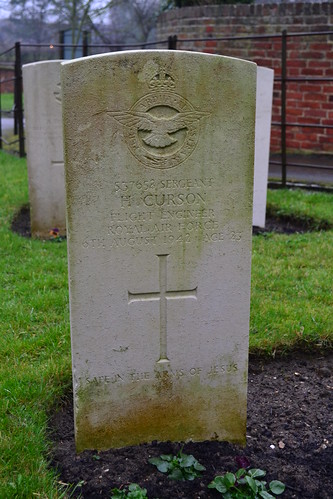
RAF Bottesford

Sgt. Harold Curson (s/n: 537658) was killed in a bizarre accident at Bottesford when a Manchester landed on top of a Lancaster destroying the aircraft and killing three of its crew.

Perhaps one of the most bizarre accidents to happen at Bottesford, occurred on August 6th 1942, when Manchester L7385 landed very badly. Somehow, the aircraft ended up on top of a Lancaster, R5550 who was also engaged in training operations. The accident was so severe, that two of the crew in the Manchester and three of the crew in the Lancaster were killed. The remaining five crewmen, whilst not killed in the accident, all sustained various degrees of injury.

Then in September 1942, 207 Sqn were transferred from Bottesford to nearby Langar, the satellite airfield for Bottesford. This would be the first of many moves that would last into early 1950 when the squadron was finally disbanded whilst operating the Avro Lincoln. The squadron’s tie with Avro had finally come to an end (207 Sqn would reform several times eventually being disbanded in the mid 1980s).

The October / November 1942 then saw two further Bomber Command squadrons move into this Leicester airfield, those of 90 Squadron and 467 Squadron.

Reformed here after being disbanded and absorbed into 1653 HCU the previous February, 90 Sqn brought with them the other great heavy bomber, the Stirling.

An enormous aircraft, the Stirling also failed to live up to its promise, suffering from a poor ceiling and often being targeted by fighters when in mass formations. The Stirlings were eventually pulled out of front line operations and moved to transport and SOE operations, such were their high losses.

At the end of the year once the squadron was fully manned and organised, No. 90 Sqn departed Bottesford taking the Mk.Is to RAF Ridgewell, where they continued on in the bomber role. The only casualty for 90 Sqn during this short time occurring on the very same day they moved when ‘WP-D’ BK625 crash landed at Ridgewell airfield.

Also during the month of November 1942, on the 24th, 467 Squadron (RAAF) joined 90 Sqn, in a move that saw the return of the Lancaster MK.I and MK.III, these crews must have been the envy of those who struggled with the mighty Stirling in their sister unit. Formed on the 7th November at RAF Scampton under the command of W/Cdr. C. Gomm DFC No. 5 Group, 467 Sqn were another short-lived squadron eventually being disbanded on September 30th 1945 at Metheringham airfield in Lincolnshire.

In the first days of their formation there were initially sixteen complete aircrews, divided into two flights: ‘A’ commanded by Acting S/Ldr. D Green DFC and ‘B’ Flight with Acting S/Ldr. A. Pappe DFC. As yet though, they had an insufficient number of aircraft to accommodate all the crews.

After arriving at Bottesford, 467 Sqn battled with lack of equipment and poor weather which hindered both training and flying activities. A number of dances were held to make the Australians and New Zealand crews “feel at home”,  and a visit was made by Air Marshal Williams (RAAF). At the end of the month, aircraft numbers totalled just seven.

By the end of December new aircraft had been delivered and the Lancaster total stood at nineteen, but poor weather continued to hamper flying. Early January saw the first sign of any operational action at Bottesford, which occurred on the night of January 2nd / 3rd 1943. Five crews were assigned to a ‘Gardening’ sortie, laying mines, which excited the ground crews who were keen to see their aircraft finally participating in operations. It wouldn’t be until January 17th / 18th that 467 Sqn would finally venture into German territory laden with bombs. A mission that took them to the heart of Germany and Berlin.
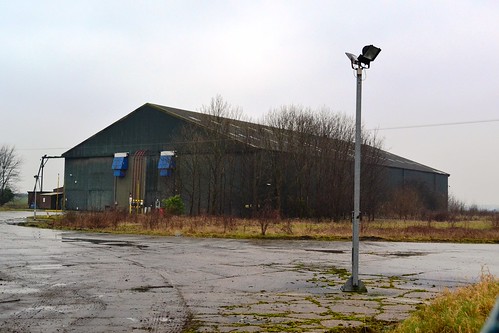
RAF Bottesford

One of Bottesford’s hangars in use today.

With great excitement nine Australian crews, who were keen to show what they were capable of, took off from Bottesford to hit the target. The mission was considered a ‘disappointment’, damage to the target being very light due to both haze and lack of good radar. Target Indicators were used for the first time on this mission and it was the first all four-engined sortie. On their return flight, Sgt. Broemeling, the rear-gunner of F/Lt. Thiele’s crew was found unconscious, he had suffered from oxygen starvation and even after diving the aircraft to a safe breathing height and giving artificial resuscitation, he was declared dead on arrival at Bottesford.

A second night saw 187 RAF bombers from No. 1, 4 and 5 Groups in a subsequent raid that, like the previous night, also resulted in poor results.  Bombing saw little damage on the ground but twenty-two aircraft were lost. One of these aircraft being from 467 Sqn, that of Lancaster ‘PO-N’ W4378, which was piloted by a New Zealander, Sgt. K Aicken. Sgt Aicken had been one of the original pilots at 467’s formation. All seven crewmen from ‘PO-N’ were killed that night.

The next casualties would occur a month later, in a mission that saw 338 RAF heavies attack the port of Wihelmshaven in northern Germany. With the mission considered a ‘failure’, outdated maps were blamed, pathfinders marking the target area inaccurately as a result. The raid would also be notable for the loss of two Bottesford Lancasters; ED525 and ED529. On board the second aircraft were two crewmen Sgt. Robert Sinden (s/n: 577701) and Sgt. Derek Arnold Booth (RAFVR) (s/n: 1378781) who were just 18 and 17 years old respectively – the youngest crewmen to lose their lives in Bomber Command’s campaign of 1943. None of the fourteen men were ever found, their aircraft lost without trace.

A year after their arrival 467 Sqn then departed Bottesford heading for RAF Waddington, a point at which the RAF handed Bottesford over to the Americans in answer to their call for airfields to support the forthcoming invasion of the continent. 467 Sqn would go on to fight under Bomber Command, and in that month a special Lancaster would join the Sqn, that of R5868 ‘PO-S’ which went on to be the first Lancaster to reach the 100 mission milestone completing a total of 137 before the war’s end. She sat outside RAF Scampton as a gate guard after the war but has thankfully ended her days as the centre piece of the Bomber Command Hall at the RAF Museum in Hendon.*4
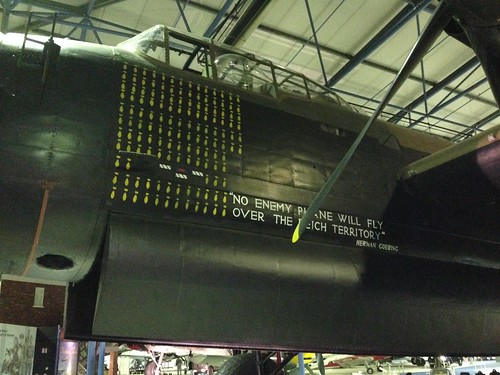
RAF Museum Hendon

‘S-Sugar’ a former 467 Sqn Lancaster stands in the RAF Museum, Hendon. Note the incorrect Spelling of ‘Hermann’ beneath the quote.

As one of a cluster in the area (North Witham (Trail 3), Spanhoe (Trail 6), Barkston Heath and Langar amongst others), Bottesford would become a home to the Glider units of the US Troop Carrier Command (TCC).

The airfield (renamed Station 481) would become the headquarters of the 50th Troop Carrier Wing (TCW), Ninth Air Force, and used as a staging post for new C-47 units arriving from the United States. The 50th remained here at Bottesford until April 1944 at which point they moved south to Exeter in their final preparations for the Normandy invasion.

This deployment would see a number of American units arrive, be organised and transfer to their own bases elsewhere, these included the eight squadrons of the 436th Troop Carrier Group (TCG) and the 440th Troop Carrier Group (TCG).

The 436th TCG were made up of the four squadrons:79th Troop Carrier Squadron (TCS), 80th TCS, 81st TCS and 82nd TCS, all flying C-47 aircraft. The Group was only one year old when they arrived at Bottesford, and their introduction to the war would be a baptism of fire.

The cramped barracks of the 436th TCG and 440th TCG at Bottesford. (IWM – FRE 3354)

Whilst primarily training and organising themselves at Bottesford they would go on to take part in the Normandy invasion, dropping paratroops early in the morning of June 6th 1944 into the Normandy arena. In the afternoon, they returned with gliders, again dropping them behind enemy lines to supply and support those already fighting on the ground. A further trip the following morning saw the group awarded a Distinguished Unit Citation (DUC) for their action over the Normandy landing zones. Before the war’s end the 436th would take part in four major allied airborne operations, dropping units of both the 82nd and the 101st Airborne.

The 440th, like the 436th, were a very young unit, only being activated the previous July, and like the 436th, their introduction would be a memorable one. Dropping paratroops of the 101st Airborne into Carentan on D-Day, followed by fuel, food and ammunition the next; for their action they too were awarded a DUC. The 440th would also take part in the Battle of the Bulge supplying troops at Bastogne and later the crossing of the Rhine.

Whilst both units were only here at Bottesford a short time, they undoubtedly played a major part in the Allied invasion and all major airborne battles on the continent, a point that Bottesford should be remembered for.

The 436th moved to Membury whilst the 440th moved to Exeter in a mass move with the 50th TCW. After this, the US brought in a Glider repair and maintenance unit, who only stayed here for a short time before they too departed for pastures new. This then left Bottesford surplus to American requirements, and so in July 1944 it was handed back to the RAF and 5 Group once more.

This transfer would see the last flying unit form here at Bottesford – the death knell was beginning to ring its ghostly tones.  The RAF’s 1668 Heavy Conversion Unit (HCU) formed on the 28th, brought back the heavy bomber, the Lancaster MK.I. Working with the HCU were the 1321 Bomber (Defence) Training Flight consisting of mainly Beaufighter and Spitfire aircraft, who operated here until 1st November 1944 when they were absorbed into 1668 and 1669 HCUs. The HCU used these aircraft for fighter affiliation tasks and heavy bomber training.

As a training unit there would be many accidents, either due to aircraft problems or pilot error, including the first major accident on 12th December 1944 where fire tore through the port wing of Lancaster MK.III JA908. Diverted to East Kirkby the Lancaster attempted a landing but damaged a wheel, and had to crash-land in a field near to the airfield. Whilst no-one was killed in the crash, eight aircrew were injured in the resultant fire.

In the August 1945, the HCU moved to Cottesmore and there was no longer a need for Bottesford as an operational airfield. Surplus to requirements it was placed into care and maintenance, and used to store surplus equipment including ammunition before being closed and sold to the farmer who’s been using it since 1962.

As with all RAF / USAAF airfields a number other flying units operated from Bottesford, maintenance units, RAF squadrons and Glider units all played their part in its rich tapestry of wartime history. A history that provided one of the largest numbers of hangars collectively, and one that saw many young men come and go, many not coming back at all.

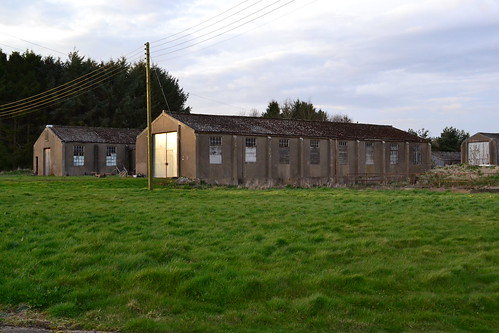
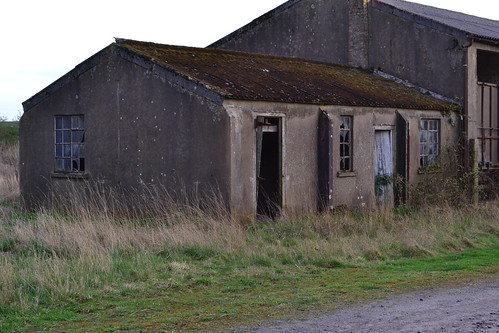
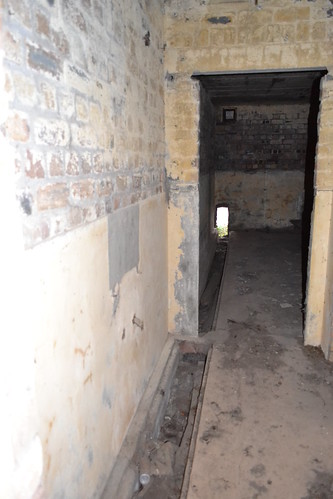
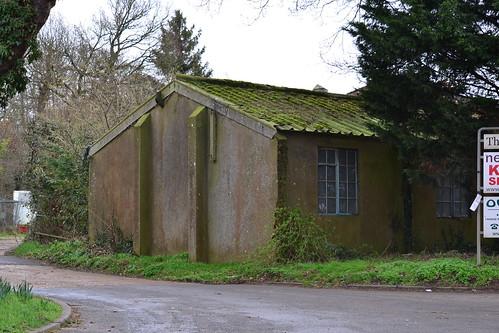
Today Bottesford is a thriving industrial and agricultural park, the farmer using large parts of it but the technical site being used by a number of industrial companies. The hangars are still present and in use, as are the runways now used for storage of vehicles rather than Lancasters, Stirlings, Manchesters or C-47s. The watch office has been refurbished and is used as offices, and several of the original buildings still remain in various states of disrepair. A flag of remembrance was hoisted outside the office in May 1995 and veterans have visited the site to pay their respects.

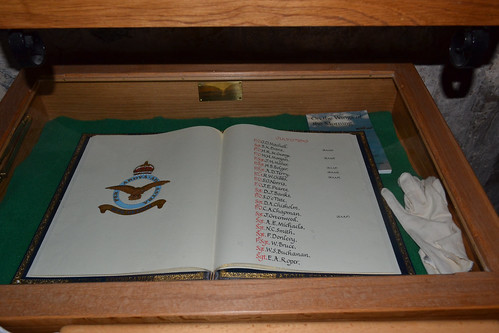
With access to the site through a security gate, you are left with some poor views from public roads, but the local church does have a small number of graves and a memorial which includes a book of remembrance.

Bottesford may have only been in existence for a short period, but it saw many aircraft and many crews, a mix of international airmen who brought new life to this small village on the border of three counties.
RAF Bottesford

A book of remembrance sits in the local church St. Mary the Virgin along with a small number of graves.

Links and sources

*1 AIR\271930\1 Operational Record Book 467 RAAF (Royal Australian Air Force) Summary of Events (National Archives).

*2 Source Imperial War Museum photo ref: RAF_HLA_590_V_6004

*3 Source Imperial War Museum photo ref: RAF_106G_LA_203_RP_3093

*4 The AVRO Heritage Museum Website has details of ‘S for Sugar’ and her journey to Hendon.

Defence of the Realm, Tony Wilkins takes a detailed look at the Avro Manchester.

The Bottesford Living History Group have a detailed website with photographs and personal accounts and is worth visiting.

Book – The loss of RAAF Catalina A24-49

I was contacted recently by Tony Morgan who told me about a book he had co-authored around the loss of RAAF Catalina A24-49, which was piloted by his uncle, Warwick Rose, who was only 22 at the time.

The details of the loss and book are as follows:

He was on a solo mine laying mission April 28, 1944 from Cairns in Far North Queensland via Groote Eylandt in the Gulf of Carpentaria to Manokwari Harbor, in what were the then Dutch East Indies, now a part of Indonesia. There were 10 crew members on that flight and having taken on fuel and pre-primed mines on Groote Eylandt, it is thought today that the heavily laden aircraft most likely crashed into the Arafura Sea, shortly after taking off.

The book, “A Mystery Unsolved…The Loss of Catalina A24-49” was written in conjunction with a retired RAAF historian, Bob Alford, primarily to ensure that the sad story of the loss of 10 brave young men would never be forgotten. The foreword was written by the Chief of the Defence Force, Air Chief Marshal, Mark Binskin.

If anyone is interested in knowing more or wishes to buy the book, please contact Tony  directly, by email, using the address below. The book currently retails at AUD 29.95.


A.E. (Tony) Morgan E-mail: aemorgan@myplace.net.au

4th June 1944 – Death of a Lancaster Crew

On June 3rd 1944, Lancaster ND841 ‘F2-D’ piloted by F/O. George. A. Young (s/n: 134149) RAFVR 635 Squadron, was detailed to attack Calais as part of the preparations for D-Day. There would be eight other aircraft from RAF Downham Market also detailed for the mission and take off would be late that evening.

The mission as a whole would involve 127 Lancasters and 8 Mosquitoes of No.1, 3 and 8 Groups and the targets would be the gun batteries at both Calais and Wimerereux. It was a  diversionary raid as part of Operation “Fortitude South“, to fool the Germans into believing the invasion would occur in the Pas-de-Calais region.

At 28 minutes past midnight, F/O. Young lined the Lancaster up on the runway, opened the throttles and began the long run down the runway. As the Lancaster approached take off, it began to swing striking the roof of a B1 Hangar. In an uncontrollable state the aircraft crashed just outside the airfield killing all on board.

All other eight aircraft took off and returned safely after having dropped their bombs.

On board Lancaster F2-D that night was:

Pilot: F.O. George Ambrose Young, aged 24 (s/n: 134149) RAFVR.
Flight Engineer: Sgt. Thomas Snowball, aged 32 (s/n: 1100769) RAFVR
Navigator: F.Sgt. Howard Pritchard, aged 22 (s/n: 1578502) RAFVR
Bomb Aimer: F.O. Walter Thomas Olyott, aged 21 (s/n: 151238). RAFVR
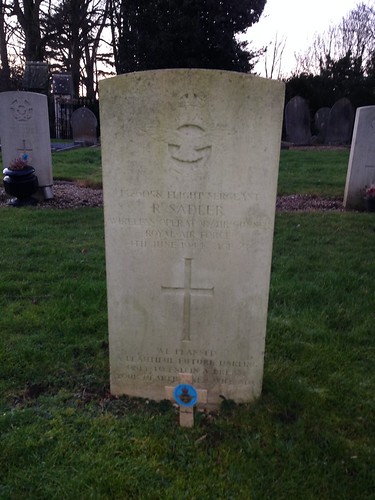
Wireless Operator / Gunner: F.Sgt. Robert Sadler, aged 23 (s/n: 1526058). RAFVR
Air Gunner: F.Sgt. Stanley Wharton, aged 30 (s/n: 1578013) RAFVR
Air Gunner: F.Sgt. Charles Patrick Nallen, aged 20 (s/n: 427537) RAAF

The Operations record book (AIR 27/2155/7) for that day simply  states:

3.6.44  ‘D’ F/O Young G.A. hit hangar after taking off and crashed on airfield when large bomb exploded and the crew all killed.  8 aircraft returned to base .

Three of the crew are buried in Kings Walk Cemetery, Downham Market, a short distance from the airfield.

Downham Market Cemetery

F.Sgt. Stanley Wharton (RAFVR)

Downham Market Cemetery

F.Sgt. Robert Sadler (RAFVR)

Downham Market Cemetery

F.O. Walter Thomas Olyott (RAFVR)

The death of the Robson Children, 1st December 1943.

It was on Wednesday 1st December 1943, that a 75 Squadron Stirling MK.III (EH880)  piloted by F/S J. S. Kerr (s/n 1558163) would be diverted from RAF Mepal and instructed to land at RAF Acklington in Northumbria. On the final approach it undershot striking a family home in Togston near Amble. Inside the house, Cliff House Farmhouse, was the Robson family. The five children, ranging in ages from 19 months to 9 years of age, were all killed, whilst the parents who were playing cards downstairs, escaped with varying injuries. All but one of the Stirling’s crew were killed, the mid upper gunner Sgt K Hook, was pulled from the burning wreckage his burning clothes being extinguished by the local butcher, Jim Rowell.

This crash was the greatest civilian loss of life in the district,

The crew of Stirling EH880 ‘AA-J’ were:

F/S George John Stewart Kerr, RAFVR (s/n 1558163) – Pilot.
Sgt. Donald Frank Wort, RAFVR (s/n 1585034) – Navigator.
Sgt. Ronald Smith, RAFVR (s/n 1239376) – Air Bomber.
Sgt. Derek Arthur Holt, RAFVR (s/n 1217087) – Wireless Operator.
Sgt. Leonard George Copsey, RAFVR (s/n 1691471) – Flight Engineer.
Sgt. Kenneth Gordon Hook, RAFVR (s/n 1335989) – Mid Upper Gunner.
Sgt. George William Thomas Lucas, RAFVR (s/n 1250557) – Rear Gunner.

The Robson children were:

Sheila (19 months)
William (3 Years)
Margery (5 Years)
Ethel (7 Years)
Sylvia (9 Years)

The ‘Times’ Newspaper, published the story of 3rd December 1943:

Aircraft Crash on Farmhouse. Family of five young children killed.

Five children – all their family – of Mr and Mrs W. Robson were killed when an Aircraft crashed into Cliff House, a small dairy farm near Amble, Northumberland, on Wednesday night. The children’s ages ranged from one to nine years. They were sleeping in an upstairs room.

The mother and father, who with two friends Mr. and Mrs Rowell of Dilston [Terrace] Amble, were sitting in a downstairs room, were injured but not seriously. One of the crew of the aircraft, a gunner, was saved by Mr. Rowell.

Mr Rowell said last night: “We did not realise what had happened until the house collapsed above our heads. We managed to stand up, bruised and badly dazed, and, looking upward we saw the sky. Mrs Robson tried to make her way towards the stairs, which had been blown away. My wife called my attention to a burning object outside which was moving about.  We rushed over and found it was a gunner with his clothes alight. Mr Rowell rolled the airman on the ground to extinguish the burning clothes. Although badly burned, the gunner was alive.

The children’s partly charred bodies were recovered later.

Five streets on a housing estate near to the crash site in Amble have since been named after each of the Robson children. The crew are remembered on a plaque in St. John the Divine, the official church of RAF Acklington St. John.

Trail 44 – Kent (Part 3) – Sir Barnes Wallis – His Later Years.

We continue, in Trail 44, looking at the life of Sir Barnes Wallis, a man known for his expertise in engineering and design. Following on from his early works in airship design, we now turn to his Second World War and post war work.

With the outbreak of the Second World War, new designs of aircraft and weapons were much-needed. Wallis’s geodesic design, as used in the R100, had been noticed by another Vickers designer Rex Pierson, who arranged for Wallis to transfer to Weybridge, where they formed a new team – Pierson working on the general design of the aircraft with Wallis designing the internal structures. This was a team that produced a number of notable designs including both the Wellesley and the Wellington; both of which utilised Wallis’s geodetic design in both the fuselage and wing construction.

What made Wallis’s idea so revolutionary was that the design made the air frame both light-weight and strong, and by having the bearers as part of the skin, it left more room inside the structure thus allowing for more fuel or ‘cargo’. An idea that helped provide greater gas storage for the R100.

Whilst both the Wellesley and the Wellington went on to be successful in the early stages of the war (11,400 Wellingtons saw service), they were both withdrawn from front line service by the mid war years, being replaced by more modern and advanced aircraft that could fly further and carry much larger payloads.

Saddened by the rising death toll, Wallis put many of his efforts into shortening the war. His idea was that if you attack and destroy the heart of production, then your enemy would have nothing to fight with; in this case, its power supply. To this end he started investigating the idea of breaching the dams of the Ruhr.

Wallis’s idea was to place an explosive device against the wall of the dam, thus utilising the water’s own pressure to fracture and break open the dam. Conventional bombing was not suitable as it was too difficult to place a large bomb accurately and sufficiently close enough to the dam to cause any significant damage. His idea, he said, was “childishly simple”.

Using the idea that spherical objects bounce across water, like stones thrown from a beach, he determined that a bomb could be skimmed across the reservoir over torpedo nets and strike the dam. A backward spin, induced by a motor in the aircraft’s fuselage, would force the bomb to keep to the dam wall where a detonator would explode the bomb at a predetermined depth, similar in fashion to a naval depth charge. The idea was simple in practical terms, ‘skip shot’ being used with great success by sailors in Nelson’s navy;  but it was going to be a long haul, to not only build such a weapon, the aircraft to drop it, nor train the expert crews to fly the aircraft; but to simply convince the Ministry of Aircraft Production that it was in fact feasible.

Wallis began performing a number of tests, first at his home using marbles and baths, then at Chesil Beach in Dorset. Both the Navy and the Ministry were interested when shown a film of the bomb in action, each wanting it for their own specific target; the Navy for the Tirpitz, and the Ministry for the dams. Wallis still determined to use it on the dams, carried out two projects side-by-side,  “Upkeep” for the dams, and “Highball” for the Navy*3.

“Upkeep” was initially spherical, and the first drop from a modified Lancaster took place in April 1943 at Reculver near to Herne Bay, where this statue is located. He persevered with aircraft heights, speeds and bomb design modifications, carefully honing them until on April 29th 1943, only three weeks before the actual attack, the bomb finally worked for the first time.

Wallis’s plan could now be put into action, and with a new squadron of the RAF’s elite bomber crews put in place, the stage was set and the dams of Ruhr Valley would be the target.

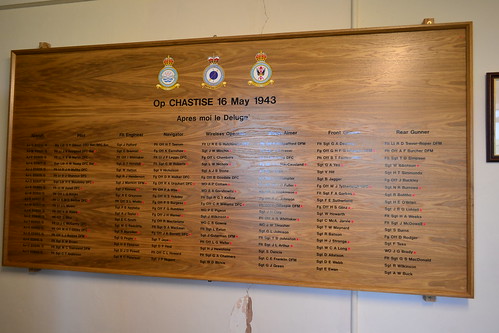
The attack on the dams have become legendary, and of the 19 aircraft of 617 Squadron that took off that May evening in 1943, only 11 returned, some after sustaining considerable damage. Operation Chastise saw two of the three dams, the Mohne and Eder, successfully breached and the third, the Sorpe, severely damaged forcing the Germans to partially drain it for safety.

Scampton September 2015 (17)

The names of the crews of 617 Squadron at RAF Scampton. Those with poppies next to them, did not return.

Following the success of Operation Chastise, Wallis went on to develop other bombs capable of devastating results. His initial plan, a Ten ton (22,000lb) bomb, had to be scaled back to 12,000lb as there was no aircraft capable of dropping it at that time. Codenamed ‘Tallboy’, it would be a deep penetration bomb 21 feet in length with a hardened steel case and 4 inches of steel in the nose. The bomb contained 5200lbs of high explosive Torpex (similar to that used in the Kennedy Aphrodite mission) and would have a terminal velocity of around 750 miles per hour.

The idea of Tallboy, was to create a deep underground crater into which structures would either fall or be rendered irreparable. With a time fuse that could be set to sixty minutes after release, it was used on strategic targets such as the Samur Railway Tunnel in France, rendering the tunnel useless as it had to be closed for a considerable amount of time.

The crater made by Barnes Wallis’s Tallboy bomb above the Samur Railway Tunnel, 9th June 1944. *4

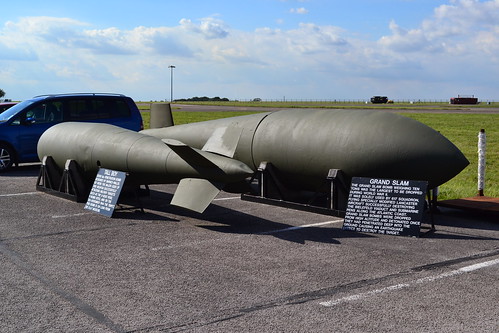
Soon after this, Wallis began developing his Ten Ton bomb, the “Grand Slam”, a mighty 26ft in length, it weighed 22,000lb, and would impact the ground at near supersonic speeds. Wallis’s design was such that the bomb could penetrate through 20 feet of solid concrete or 130 feet of earth, where it would explode creating a mini earthquake. It was this earthquake that would rock the foundations of buildings and structures, or simply suck them into a crater of massive proportions*5.

Production of the Grand Slam was slow though. It took two days for the casting to cool and then after machining, it took a further month for the molten Torpex  to set and cool. The first use of the Grand Slam occurred on 14th March 1945 against the Bielefeld Viaduct in Germany, on which one Grand Slam and 27 Tallboys were dropped. Unsurprisingly, the viaduct collapsed and the railway was put out of action.

Wallis had created more exceptionally devastating weapons, they were so successful that 854 Tallboys and 41 Grand Slams were dropped by the war’s end.

Scampton September 2015 (4)

The Tallboy and Grand Slam bombs, designed by Barnes Wallis.

Post war, Wallis carried on with his design and investigations into aerodynamics and flight. He was convinced that achieving supersonic flight with the greatest economy was the way forward, and in particular variable geometry wings. The government was keen to catch up with the U.S., awarding Vickers £500,000 to carry out research into supersonic flight. Wallis’s project received some of this money, and he researched unmanned supersonic flight in the form of surface-to-air missiles. Codenamed ‘Wild Goose‘ (later ‘Green Lizard’) the project ran to 1954 when it was terminated.

Wallis continued with his research into swing wing designs, his first being the JC9, a single seat aircraft 46 feet in length. It was produced but never completed and was scrapped before it ever got off the ground. Wallis wasn’t put off though, and he continued on developing the ‘Swallow’, a swing wing aircraft that could reach speeds of Mach 2.5 in model wind tunnel investigations.

In its bomber form it would have been equivalent in size to the American B-1, with a crew of 4 or 5, and a cruising speed of Mach 2. It would have a range of 5,000 miles whilst carrying a single Red Beard nuclear bomb.

Whilst not selected to meet the R.A.F.’s OR.330 (Operational Requirement 330), which was eventually awarded to TSR.2, they were interested enough for him to proceed until the 1957 Defence White Paper put an end to the project, and it was cancelled.

Looking for funding Wallis turned to the U.S. hoping they would grant him sufficient funds to continue his work. After many meetings between Wallis and the U.S American Mutual Weapons Development Program at NASA’s Langley research facility, he came away disappointed and saddened that the Americans used his ideas without granting him any funding.

American research continued, eventually developing into the successful General Dynamics F-111 ‘Aardvark’, the world’s first production swing-wing combat aircraft.

Wallis continued with other supersonic and hypersonic investigations; designs were drawn up for an aircraft capable of Mach 4-5, using a series of variable winglets to link subsonic, supersonic and hypersonic flights, many however, never went beyond the drawing board.

Wallis didn’t stop there, he continued with many great inspirational projects: the Stratosphere Chamber, a test chamber where by simulated impacts on aircraft travelling at 70,000 feet could be safely tested and analysed; the Parkes Telescope, a radio telescope in New South Wales; the Momentum Bomb, a nuclear bomb designed to be released at low-level and high-speed, enabling the release aircraft to escape the blast safely, and in the 1960s, a High Pressure Submarine designed to dive deeply beyond the range of current detection.

In recognition of his work, Wallis was knighted in 1968, and he was also made an Honorary Fellow of the Royal Aeronautical Society.

Wallis, after working beyond his forced retirement, died at the age of 83, on 30th October 1979, in Effingham, Surrey. He is buried in the local church, St Lawrence’s Church, in Effingham, a village he contributed greatly to. He was the church secretary for eight years, and an Effingham Parish Councillor, serving as Chairman for 10 years. He was also the Chairman of the Local Housing Association, which helped the poor and elderly of the village to find or build homes; and as a fanatical cricketer, he was Chairman of the KGV Management Committee who negotiated the landscaping of the “bowl” cricket ground, so good was the surface, it was used as a substitute for the Oval in London.

There are numerous memorials and dedications around the country to Wallis, and there is no doubt that he was both an incredible engineer and inventor who made a major contribution to not only the war, but British and world aviation in general.

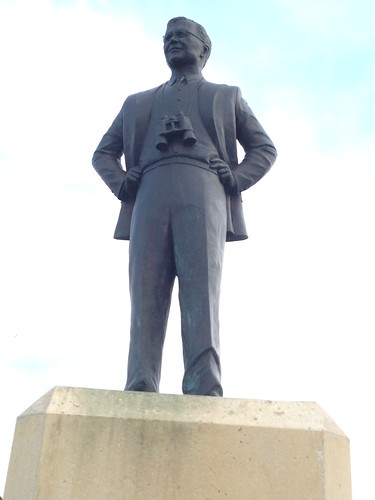
His statue at Herne Bay overlooks Reculver where the first “Upkeep” bomb was dropped by a Lancaster bomber during the Second World War, and it is a fine tribute to this remarkable man on this trail.

Barnes Wallis at Work

Sir Barnes Neville Wallis.

From here, we continue to travel east, toward the coastal town of Margate. A few miles away is the now closed Manston airport, formerly RAF Manston, an airfield that is rich in History, and one that closed causing such ill feeling amongst many.

Sources and further reading

*3 The Mail online published a report on the discovery of a Highball bomb found in Loch Striven, Scotland in July 2017.

*4 Photo © IWM (CL 4322)

*5 The Independent news website– “Secrets of the devastation caused by Grand Slam, the largest WWII bomb ever tested in the UK.” Published 22/1/14

The Barnes Wallis Foundation website has a great deal of information, pictures and clips of Barnes Wallis.

A list of memorials, current examples of both Upkeep and Highball bombs, and displays of material linked to Barnes Wallis, is available through the Sir Barnes Wallis (unofficial) website.


Trail 44 – Kent (Part 3) – Sir Barnes Wallis – His Early Years

After visiting the many museums and former airfields in the southern and central parts of Kent (Trail 4 and Trail 18) we now turn north and head to the northern coastline. Here we overlook the entrance to the Thames estuary, the Maunsell Forts – designed to protect the approaches to London and the east coast – and then take a short trip along the coastline of northern Kent. Our first stop is not an airfield nor a museum, it is a statue of the designer of one of the world’s most incredible weapons – the bouncing bomb. Our first short stop is at Herne Bay, and the statue of Sir Barnes Wallis.

Sir Barnes Wallis – Herne Bay

Sir Barnes Wallis

The Barnes Wallis statue located at the eastern end of the town overlooking the sea at Reculver.

There cannot be a person alive who has not seen, or know about, the famous Dambusters raid made by 617 Sqn. It is a story deeply embedded in history, one of the most daring raids ever made using incredible ideas, skill and tenacity. There is so much written about both it, and the man behind the idea – Sir Barnes Neville Wallis CBE FRS RDI FRAeS – a man famous for his engineering prowess and in particular the famous ‘Bouncing Bomb’ that was used by Guy Gibson’s 617 Squadron in that daring raid of 16th May 1943. But there is so much more to Barnes Wallis than the Bouncing bombs; he made a huge contribution to British Aviation, weaponry of the Second World War, and later on in his life, supersonic and hypersonic air travel.

He is certainly one the Britain’s more notable designers, and has memorials, statues and plaques spread across the length and breadth of the country in his honour. But he was not just a designer of the Bouncing bomb, his talent for engineering and design led him through a series of moves that enabled him to excel and become a major part of British history.

Born on 26th September 1887 in Ripley, Derbyshire, he was educated at Christ’s Hospital in Horsham, he went on to study engineering in London, and shortly afterwards moving to the Isle of Wight. With the First World War looming, he was offered a chance to work on airship designs – an innovative design that would become widely used by the Naval forces of both the U.K. and Germany.

Wallis cut his teeth in marine engines as an engineer and draughtsman. He began his career in the London’s shipyards, moving to the Isle of Wight after which he broke into airship design. He followed a colleague he had met whilst working as a draughtsman with John Samuel White’s shipyard, together they would design His Majesty’s Airship No.9 (HMA 9).

The design process of HMA 9 was dynamic to say the least. Early non-rigid airships were proving to be very successful, and the new rigids that were coming in – whilst larger and more capable of travelling longer distances with greater payloads – were becoming the target for successive quarrels between the government and the Admiralty. World unrest and political turmoil was delaying their development even though plans for HMA 9 had already been drawn up.

Joining with his colleague, H.B. Pratt in April 1913, at the engineering company Vickers, the two designers began drawing up plans for a new rigid based along the lines of the German Zeppelin. HMA 9 would be a step forward from the ill-fated HMA No. 1 “Mayfly”, and would take several years to complete. Further ‘interference’ from the Admiralty (One Winston Churchill) led to the order being cancelled but then reinstated during 1915. The final construction of the 526 ft. long airship was on 28th June 1916, but its first flight didn’t take place until the following November, when it became the first British rigid airship to take to the Skies.

HMA 9 (author unknown*1)

With this Wallis had made his mark, and whilst HMA 9 remained classed as an ‘experimental’ airship with only 198 hours and 16 minutes of air time, she was a major step forward in British airship design and technology.

The Pratt and Wallis partnership were to go on and create another design, improving on the rigids that have previously been based on Zeppelin designs, in the form of the R80. Created through the pressure of war, the R80 would have to be designed and built inside readily available sheds as both steel and labour were in very short supply. Even before design or construction could begin there were barriers facing the duo.

Construction started in 1917, but with the end of the war in 1918, there was little future as a military airship for R80. Dithering by the Air Ministry led to the initial cancellation of the project, forcing the work to carry on along a commercial basis until the project was reinstated once more. With this reinstatement, military modifications, such as gun positions, were added to the airship once again. With construction completed in 1920, she made her first flight that summer. However, after sustaining structural damage she was returned to the sheds where repair work was carried out, and a year later R80 took to the air once again. After a brief spell of use by the U.S. Navy for training purposes, R80 was taken to Pulham airship base in Norfolk and eventually scrapped. Wallis’s design had lasted for four years and had only flown for 73 hours.

However, undaunted by these setbacks, the Vickers partnership of Pratt and Wallis went on to develop further designs. In the 1920s, a project known as the 1924 Imperial Airship Scheme, was set up where by a Government sponsored developer would compete against a commercial developer, and the ‘best of both’ would be used to create a new innovative design of airship that would traverse the globe. This new design, would offer both passenger and mail deliveries faster than any current methods at that time.

The Government backed design (built at the Royal Airship Works at Cardington) would compete against Vickers with Wallis as the now Chief Designer.

The brief was for a craft that could transport 100 passengers at a speed of 70 knots over a range of 3,000 miles. Whilst both designs were similar in size and overall shape, they could not have been more different. Wallis, designing the R.100, used a mathematical geodetic wire mesh which gave a greater gas volume than the Government’s R101, which was primarily of stainless steel and a more classic design. This geodesic design was revolutionary, strong and lightweight, it would prove a great success and emerge again in Wallis’s future.

Built at the Howden site a few miles west of Hull, the R100 was designed with as few parts as possible to cut down on both costs and weight; indeed R100 had only 13 longitudinal girders half that of previous designs. Wallis’s design was so far-reaching it only used around 50 different main parts.

The design plan of Wallis’ R-100 airship (author unknown*2

The 1920s in Britain were very difficult years, with the economy facing depression and deflation, strikes were common place, and the R100 was not immune to them. Continued strikes by the workers at the site repeatedly held back construction, but eventually, on 16th December 1929, Wallis’s R100 made its maiden flight. After further trials and slight modifications to its tail, the R100 was ready. Then came a test of endurance for the airship, a flight to Canada, a flight that saw the R100 cover a journey of 3,364 miles in just under 79 hours. Welcomed as heroes, the return journey would be even quicker. Boosted by the prevailing Gulf Stream, R100 made a crossing of 2,995 miles in four minutes under 58 hours. The gauntlet had been thrown, and Wallis’s airship would be hard to beat.

The R101 would face a similar flight of endurance, this time to India, and it would use many of the same crew such was the shortage of experienced men. On October 4th 1930, R101 left its mooring at Cardington for India. Whilst over France she encountered terrible weather, a violent storm caused her to crash, whereupon she burst into flames and was destroyed with all but six of the 54 passengers and crew being killed.

The airship competition became a ‘one horse race’, but an inspection of the outer covering of Wallis’s R100 revealed excessive wear, only cured by replacing the skin, an expense the project could barely swallow. With plans already in place for the R102, the project was in jeopardy, and eventually, even after offers from the U.S. Government, it was deemed too expensive, and by 1932 R100, the worlds largest airship and most advanced of its time, had been scrapped and the parts sold off.

Wallis’s airship career had now come to an end, but his prowess and innovation as a designer had been proven, he had set the bench mark that others would find hard to follow.

In the next part, we look at the work carried out by Wallis both during the Second World War and in the later years of his life.

Sources and further reading

*1 Photo from The Airship Heritage Trust website.

*2 ibid

RAF Winfield and the Polish Connection (Part 2)

After Part 1, we return to RAF Winfield, where an ‘odd’ visitor arrives. We also see the post war demise of Winfield into the site it is today.

At the end of the war many Polish units and displaced persons were pulled back to the U.K. in preparation for their repatriation into civilian life and for some return to their native country. Winfield became the site of one such group; the 22 Artillery Support Company (Army Service Corps, 2nd Polish Corps) who whilst fighting in the Middle East and Italy adopted a rather odd mascot. He became known as Wojtek, a Syrian bear who was officially given the rank of Private in the Polish Army, and who ‘fought’ alongside them as one of their own.

THE POLISH ARMY IN BRITAIN, 1940-1947

Wojtek the Syrian bear adopted by the Polish relaxing at Winfield Airfield, the unit’s temporary home after the war.*1

After finding the bear as a young cub wrapped around the neck of a small Iranian boy, Lance Corporal Peter Prendys took him and adopted him. After the war, on October 28th 1946, the Polish Army along with the bear arrived at Winfield Displaced Persons Camp – little did they know what a stir Wojtek would cause.

As displaced persons the Polish men would venture into nearby Berwick, where the locals grew fond of them and drinks flowed in abundance. Wojtek would go with them, becoming a familiar, if not unorthodox, site amongst the streets and bars or Berwick. This cigarette smoking, beer loving character, often causing a stir wherever he went. He became renowned in the area, the local villagers would flock to see him. He joined in with the frolics and loved the life that he was being allowed to live.

As a bear he loved the rivers and the River Tweed flows only a short distance from Winfield, rich and fast flowing it is abundant in that other commodity – Salmon. However, Wojtek was under strict orders not to swim alone nor stray onto the airfield which although closed, could still provide a danger for him if seen.

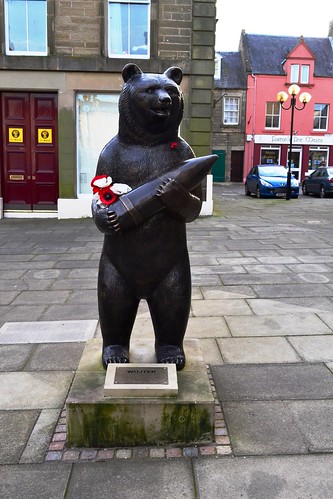
Wojtek became part of local history, eventually, a year after their arrival, the Polish unit were demobbed and they moved away. Wojtek was given to Edinburgh Zoo to look after, who did so until his death at the age of 21 in 1963. A statue stands in Princess Street Gardens beneath Edinburgh Castle as a reminder of both him and the Polish troops who were stationed at Winfield camp. A second statue of Wojtek stands in the centre of Duns, the village not far from Charterhall. The Wojtek Memorial Trust, set up in his honour, aims to promote both educational and friendship links between the young people of Scotland and Poland, an aim it tirelessly works towards today.

RAF Winfield

Statue of Wojtek in the centre of nearby Duns.

After the Polish troops left, Winfield was allocated to the USAF, and earmarked for development, but this never materialised and the site was left dormant. Winfield then reverted back to RAF control some five years later in October 1955, whereupon it was disposed of and sold off.

A small group of private flyers reopened the site, renovating the watch office and utilising a small hangar on the north of the airfield. This operation has now ceased and the watch office has sadly fallen into disrepair, it windows missing and open to the elements. The demise of Winfield and its subsequent decay has begun.

Winfield airfield lies between two roads, a further public road passes through the site although this was seen to be gated at the southern end. The most prominent feature is by far the Watch Office, a two-story design built to design 15684/41, having walls some 13.5 inches thick as was standard for all night-fighter stations (but different to the one at Charterhall).

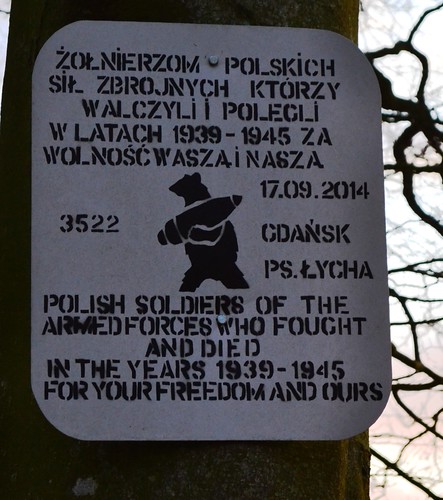
Other buildings also remain to the west on the main airfield site but these are only small and very few in number. The accommodation sites have all been removed, however, there are some buildings remaining in the former WAAF site to the north of the airfield. Located down a track just off the B4640, these buildings appear to be latrines and a possible WAAF decontamination block, with other partial remains nearby. Drawing numbers for these are unclear, (but appear to be 14420/41 and 14353/41) indicating WAAF (Officer and sergeant) quarters. Other buildings on this site look to have been a drying room, water storage tank and a picket post. Heading further south along this track leads to a small pond, here is a local design Fire Trailer shelter: a small brick-built building no more than about seven feet square. Presumably this pond was used to fill the fire trailer in cases of fire or attack and was located midway between the WAAF site and the main airfield. Also on this site, which is part of the Displaced Persons Camp, is a makeshift memorial to the Polish Armed Forces, dotted around the ground are a number of metal parts partially buried in the soil.

RAF Winfield

A plaque dedicated to the Polish Armed Forces placed next to the fire trailer hut.

The airfield runways and perimeter tracks are still in place, and years of both decay and locals using them to practice their driving skills on, have taken their toll. Like Charterhall, Winfield was also used as a motor racing circuit, although not to the same extent that Charterhall was. On one occasion though, as many as 50,000 spectators were known to have visited the site on one day alone!

Winfield like its parent site has now become history, the remnants of its past linger on as final reminders of the activities that went on here in the 1940s. The night fighter pilots who pushed the boundaries of aircraft location and interception are gradually fading away; the dilapidated buildings too are gradually crumbling and breaking apart. Inch by inch these sites are disappearing until one day soon, perhaps even they will have gone along with the brave young men who came here to train, to fight and in many cases to die.

As we leave the remnants of Winfield and Charterhall behind, we continue North to our next trail; nearing Edinburgh we take in more of Scotland’s natural beauty and even more tales of its wonderful but tragic aviation history.

My sincere thanks go to both Mr. and Mrs. Campbell for their hospitality and the help in touring these two sites. The history of both Charterhall and Winfield can be read in Trail 41.

Sources and Further Reading – RAF Winfield

*1 Photo IWM collections No.HU 16548.

The Polish Scottish Heritage website provides information about the scheme.

The Borders – RAF Charterhall (Part 3)

We carry on from Part 2 of Trail 41 for the final Part of RAF Charterhall. An airfield that had become known as ‘Slaughterhall’ it was about to see a new breed of aircraft, perhaps even a turn in luck.

RAF Charterhall

The main runway at Charterhall looking south.

The night of May 27th – 28th 1944 was a heavy night for Bomber Command, with large numbers of four engined heavies attacking targets in Germany.  On their return, ten Lancaster bombers were diverted to Charterhall, the first time the four engined bombers would use the airfield, but not the last. On the 8th June, another seven were to arrive, also diverted on their return from the continent. Then in July, a Halifax was diverted here after sustaining heavy flak damage over Helioland. The pilot, P/O W. Stewart of the RCAF and navigator P/O K. Evans (RAF) were both awarded DFCs for their action whilst badly injured, such was the determination to get all the crew and aircraft back safely.

July to October saw an increase in flying and an increase in accidents. July ‘led the way’ with heavy landings, burst tyres, ground collisions and engine failures being common place. The majority of these incidents were Beaufighter MKIIfs, some were visiting or passing aircraft who suffered problems and had to divert. Charterhall saw a mix of Lysanders, Barracuders, Beauforts, Wellingtons and Hurricanes all use Charterhall as a safe haven.

As the threat of attack was now diminishing, a reorganisation of the O.T.Us would see 9 Group disband in September that year. The responsibility of 54 O.T.U (now flying mainly Mosquitoes) and Charterhall would now pass to 12 Group.

Eventually 1944 turned to 1945 and the year that saw for 17 fatal crashes also saw 54 O.T.U. take on more aircraft and more crews.

January 1945 was incredibly harsh in terms of weather and the cold. Training new crews on new radar meant that Wellingtons were brought into Charterhall. Small teams of pupils would take turns to operate the radar to detect Hurricane ‘targets’. These new models increased the air frame numbers at Charterhall to 123 by the end of January.

RAF Charterhall

‘No. 1’ Building on the Technical site.

By now the allies were winding their way into Germany, pressure was increased by Bomber Command and so more heavies were to find Charterhall a refuge when the weather closed in. On the 15th February a large ‘Gardening’ operation led to 12 heavies landing at Charterhall along with four Mosquitoes who had been flying with them over Norway. All these aircraft were able to return to their various bases at Skipton-On-Swale, Leeming and Little Snoring the next day.

Two days later, more aircraft were to find Charterhall (and Winfield) needed. Some 266 aircrews – an incredible influx for one night – were going to need bedding – billiard tables, sofas and chairs suddenly became in very short supply.

The poor weather continued well into the year and snow caused some ‘minor’ accidents at Charterhall. The first confirmed death was not until early March and others were to follow. By May the war had come to an end and operations began to wind down. Winfield was closed and crews returned to Charterhall. Beaufighters were gradually sold, scrapped or moved elsewhere, and by August the last aircraft had left.

March would see the last fatalities at Charterhall, both in Mosquitoes on the 25th and 29th. In the former, the aircraft was in a high-speed vertical crash and the latter the pilot, Flight Lieutenant Cole (s/n125484), overshot the runway and crashed his Mosquito FBVI (HR297) a mile south of the airfield. He was 22.

Apart from a small detachment of crews from 770 Squadron Naval Air Branch carrying out trials, operations began slowing down. After VJ day, the Mosquito numbers were also wound down, only fifty-one aircraft remained by the end of August.

In September the order came through to vacate Charterhall and the packing began. By the end of the month 54 O.T.U. had all but vacated leaving Charterhall quiet once more. The last eighty aircraft consisting of: Mosquito VI,  XVII and NF30s, Martinets, an Oxford, Miles Master II, Ansons, Hurricane IICs and Wellington XVIIIs were flown out for the final time, 54 O.T.U. had played its part and their end lay ahead.

In the three years that Charterhall had been in operation, they had passed over 800 crews for night fighter operations, they had suffered over 330 accidents, 56 of which had resulted in deaths. During this time crews had flown just short of 92, 000 hours flying time day and night, with almost a third being carried out at night. Had it not been for this unit, the heavy bombers of Bomber Command may well have suffered even greater losses, the determined and deadly night fighters of the Luftwaffe may have had a much wider and easier reign over our skies and the losses we quote today would be even higher.

But the withdrawal of 54 O.T.U. was not the demise of Charterhall. For a short period it was set up as No 3 Armament Practice Station, designed to support and train fighter pilots in the art of gunnery. During its period here November 1945 – March 1947 it would see a range of aircraft types grace the runways of Charterhall.

The first units were the Spitfire IXB of 130 squadron from December 1st 1945 – January 24th 1946, followed by 165 Squadron’s Spitfire IXE between 30th December and January 24th 1946. On the day these two squadrons moved out, Charterhall entered a new era as the jet engines of Meteor F3s arrived under the command of 263 Squadron. After staying for one month they left, allowing the Mustang IVs of 303 (Polish) Squadron to utilise the airfield. Each of these squadrons followed a course which included air-to-air target practice, ground attack, bombing and dive bombing techniques.

Following the completion of the course 303 pulled out and the order was given to close No. 3 Armament Practice Station and wind Charterhall down for good. The RAF sent no further flying units here and apart from a detachment of Mosquitoes from 772 Squadron of the Fleet Air Arm, by the following summer, it had closed. The final spin of the airscrew had taken place.

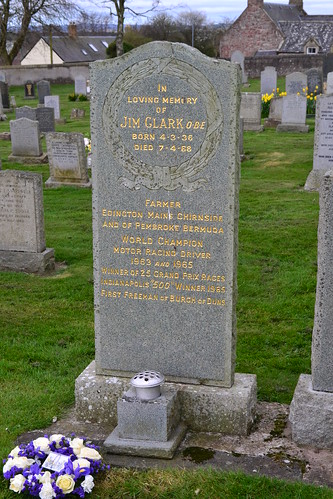
Post war, the airfield was left, the runways and buildings remained intact and the airfield was used by small light aircraft. Gradually though it fell into disrepair, used mainly for agriculture, it had a new lease of life when on Saturday May 31st, 1952, the airfield saw its first motor race using sections of the perimeter track and runways. A two-mile track became the proving ground for a number of the worlds most famous racing drivers including: Sir Stirling Moss, Jackie Stewart O.B.E., Roy Salvadori, Sir John Arthur ‘Jack’ Brabham, AO, OBE, Giuseppe “Nino” Farina and local boy Jim Clark O.B.E. Clark cut his racing teeth at Charterhall, eventually winning 25 Grand Prix races and the Indianapolis 500 in 1965. His grave lies in nearby Chirnside cemetery alongside his mother and father. Charterhall also saw the appearance of Scotland’s first organised sports car team, ‘Ecurie Ecosse’, using Jaguar cars*4. Racing occurred here until 1969, when the current owners took over the site.

The RAF then returned briefly in late 1976 undertaking trials of the Rapier ground-to-air missile system, in which a range of fast jets including Jaguars and Phantoms would participate. These lasted a month which would see the last and final RAF involvement end.

The owners reinvigorated the site providing a venue for rally sport events which started again in 1986. Eventually on March 30th, 2013, the last ever race was run and motor sport stopped for good and so another era finally came to a close.*5

RAF Charterhall

Jim Clark’s grave stone at Chirnside.

Today a section at the western end of the main runway is still available for use by light aircraft (with prior permission) and the main technical area is home to the Co-op Grain store, a facility which has a number of large stores for drying and storage of grain.

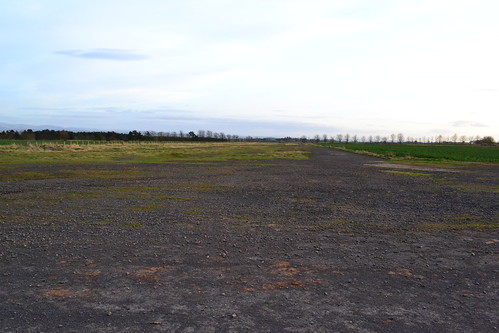
Accessing the site is from the B6460 where a memorial stands to the crews who passed through Charterhall and in particular Flight Lieutenant Hillary and Flight Sgt. Fison, who died in such tragic circumstances. A track leads all the way to the airfield site, which was the main entrance to the airfield. A good quantity of buildings still stand here on the technical site along with two of the original hangars. All of these are used for storage or stabling of animals including horses and are rather rundown. The perimeter track and runways are complete but their surfaces are breaking up and in a poor state of repair.

These buildings are a remarkable and poignant reminder of the tragic but significant years that Charterhall prepared and developed crews for the night fighter squadrons of the RAF. Hundreds passed through here, for many it was a difficult twelve weeks, for some it ended abruptly and decisively. Not known for its comforts, it was a pivotal station in the Second World War and indeed also for many years after for the those who went on to become some of the world’s most famous motor racing drivers.

Many airmen came and stayed, sixteen of them who were killed on active service whilst at Charterhall are buried in the nearby cemetery at Fogo, a short distance to the north of the airfield. Many are from around the commonwealth who came here to help and were never to return.

After leaving Charterhall, we head a little further east to Charterhall’s satellite and a site that had strong links with the forces of Poland. Remembered here is an usual mascot, a bear known as ‘Wojtek’. We stop off a few miles away at the satellite that was RAF Winfield.

Sources and further reading

*4 Obituary of Bill Dobson: ‘Ecurie Ecosse’ racing driver in ‘The Scotsman‘ newspaper 21st October 2008.

*5 A news report of the event can be read on ‘The Berwickshire News‘ Newspaper, 28th March 2013.

The Borders – RAF Charterhall (Part 1)

After leaving the Wolds of Yorkshire, Trail 41 takes us north across the border into Scotland. A land as diverse in its history as it is its beauty.  With fabulous views of the Cheviots to the south and the North Sea coast to the east, it is an area renowned for beautiful scenery and delightful walks. With Holy Island and Lindisfarne Castle standing proud, it also an area with a rich and diverse aviation history,

In this trail we stop off at two airfields where we find some remarkable relics and some terrible stories.

Our first stop is at a site that is little known about even though it played a major part in the night-fighter air war, and was also the proving ground for some of the world’s top motor racing drivers as well. Yet beneath all this glamour and bravado it holds a collection of terrible stories. We stop off at the former RAF Charterhall.

RAF Charterhall.

Located some 15 miles south-west of the coastal town of Berwick, Charterhall airfield had its aviation origins in the First World War. Its original name was RFC Eccles Tofts (although the two were not quite the same physical site), a landing ground for 77 Squadron who were based further north at Edinburgh, and flew the Royal Aircraft Factory BE.2c/d/e, BE.12, RE8, de Havilland DH6 and Avro’s 504k.  Whilst not official detached here, the airfield was available for these aircraft to land upon and be recovered should the need arise. It wasn’t kept open for long and soon disappeared returning to its former agricultural use.

Charterhall is one of those airfields that has a grand sounding name, suggesting regency and nobility, its reality though, was somewhat different. It gained the rather unsavoury, but apt, nick-name ‘Slaughterhall’, due to the high accident rate of the trainee aircrew who passed through here.

RAF Charterhall

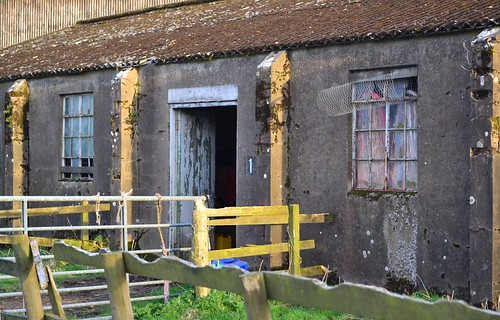
Technical buildings at Charterhall.

Many of the aircraft that operated from here were outdated and ‘war weary’, held together by the dedicated mechanics that took great pride in their work. Used for short-term placements of trainees, it would not house any true front line squadrons until the war’s end in 1945.

As a training airfield it would have a large number of airfield buildings, two Tarmacadam (Tarmac) runways the main running east-west of 1,600 yards and the second north-east/south-west of 1,100 yards; both were the standard 50 yards wide. There were some 38 dispersal pans, similar in shape to the ‘frying pan’ style , eight blister hangars and four main hangars of which two still survive. Chaterhall’s accommodation was initially designed for 1,392 airmen and 464 WAAFs – consisting of 126 Officers (both male and female) and 1,730 other ranks (again both male and female).

The main technical area was to the north side of the airfield with accommodation spread amongst the woods around this area. The watch office, long since demolished, was a mix of concrete and timber (thought to be initially a 518/40 design), which originally had timber floors, roof and stairs. However, an acute shortage of wood led to all these designs having only a timber balcony and control room. These modified designs (Charterhall included) were therefore built to a mix of 518/40 and 8936/40 specifications.

Another interesting feature of Charterhall would have been the instructional fuselage building. Here crews would have been trained using an aircraft fuselage (Charterhall had two, one each of Beaufighter and Blenheim) jacked up and linked to a controller’s panel. A number of simulated problems could be created for the crews to experience, anything from radio exercises through small warning lights to engine failure and even ditching. All crewmen had to have a good understanding of their aircraft, working hydraulics, electrical and fuel systems were all taught using this same method. In addition to these training fuselages, Charterhall would operate six Link Trainers, along with several other ‘state of the art’ training facilities.

RAF Charterhall

Many of the remaining buildings are in a poor state of repair.

The entire airfield would occupy around 143 hectares, it was certainly not large, especially considering the numbers of crews and mix of aircraft it would have during its short life.

Construction of Charterhall took place over 1941/42 opening on April 30th as part of 81 Group Fighter Command (and later 9 Group), receiving 54 Operational Training Unit (O.T.U) in May 1942. Formed two years earlier, they flew primarily Blenheim Is and Beaufighter IIs under the Squadron code ‘BF’ (Four different unit codes were used: BF, LX, ST and YX). A number of these aircraft were fitted with Aircraft Interception radar (AI) and some Blenheims were dual control.

To support the operations at Charterhall, a satellite airfield was built at nearby Winfield, a few miles east, both sites being used by 54 O.T.U. simultaneously. Later in the war, in an effort to divert marauding Luftwaffe bombers away from the two airfields, a dummy ‘Q’ site (No. 179) was built at Swinton also to the east of Charterhall.

The increase in O.T.U.s in these early days of the war was as a direct result of the increase in demand for new pilots in Fighter Command. In December 1940, 81 Group had six such units (54-59 O.T.U.) and by June 1941 this had increased to nine (52 – 60). By 1942, a total of twelve were in existence boosted by the addition of 12, 61 and 62 O.T.U. 54 O.T.U. would be one of two specialising in twin-engined night fighter flying. New crews, of which there were about 30 per month, were initially given about ten days to establish themselves and ‘crew up’. As time passed however, this time reduced to the point where some intakes were literally herded in a hangar and told to find a crewman or they would be allocated one! *1

Many of the crews arriving at Charterhall were brought in from around the Commonwealth and after passing their basic flying training instruction, would proceed through a further three stages of training. Some crews were also ex-fighter pilots already battled hardened, who had transferred in from front line units to night-fighters.

Progression through the course would be through initially three, and latterly four, squadrons. ‘A’ Squadron would be the initial conversion unit initiating crews on the rudiments of twin-engined aircraft as many had come from single engined fighter units. ‘B’ Squadron was the intermediate squadron, where the crews moved onto the larger twin-engined aircraft and finally ‘C’, (based at Winfield) was the advanced squadron honing skills such as aircraft interception and attack.  After completing the full training period, crews would receive postings to front line squadrons across the U.K. and beyond.

RAF Charterhall

A latrine on the technical site.

Initially on opening, Charterhall was not completely ready, especially the airfield’s lighting (Drem), and so training flights would only occur during the day. But, with the help of ground crews, this was soon rectified and by the end of the month considerable work had been done, and very soon night flying could begin.

The first daylight flights took place on May 13th 1942, followed by night flying seven days later, and – as crews were to find out very quickly – flying these aircraft would be a risky business.

During 1942 some 5000 aircrew would enter 81 Group’s training units, and they would suffer in the region of 2,000 accidents, of which just under 200 would be fatal. On May 23rd, 54 O.T.U’s first accident would occur when a ‘technical failure’ on a Blenheim Mk I, would cause the controls to jam. The aircrew were thankfully unhurt but the aircraft was severely damaged in the resultant crash. The first fatality would not be long in coming though, occurring just two days later, on May 25th, less than a month after 54 O.T.U’s arrival. On this day, Blenheim IV (Z6090) crashed killing both Pilot Officer J. A. Hill (s/n 115324) and Observer Sgt. A.E. Harrison (s/n 1384501) in an accident which is thought to have been caused by icing. P/O Hill is buried at Haddington (St. Martin’s) burial ground in East Lothain, whilst Sgt Harrison is buried in Middlesbrough (Acklam) Cemetery, Yorkshire.

During June, the first Beaufighters would begin to arrive, followed quickly by their first accident. Whilst on delivery by 2 Aircraft Delivery Flight at Colerne, the aircraft – a Beaufighter MkIIf – had an engine cut out causing it to crash about 10 kilometres north-west of Charterhall. Luckily the crew were able to walk away but the aircraft was written off.

During July bad weather hampered flying activities, but it didn’t prevent the unit from increasing its strength to seventy-seven aircraft.  Primarily Blenheims and Beaufighters, there were also a small number of Lysanders for target towing and four Airspeed Oxfords.

Accidents continued to occur at Charterhall, and it wasn’t until September 1942 that it would be fatality free – a welcome boost to the morale of the instructors at the time. However, the reprieve was short-lived, and October would see further accidents and yet more fatalities. On the 5th, two Blenheim MK Is (L6788 and L8613) collided: Pilot Sgt. J. Masters (missing – presumed drowned) and Navigator Sgt. J. Gracey were both killed. There were seven other accidents that month, a tally that involved two Blenheims and five Beaufighters, with the loss of one life. Causes included: two burst tyres, two overshoots, a loss of control and an undercarriage failure, all of which added to the lengthening list of accidents occurring at Charterhall.

The need for new crews increased the pressure on training stations to increase flying hours. Courses were cut short, spares were lacking and with only rudimentary rescue equipment, further deaths were inevitable. As a result, it wouldn’t be until March 1943 before Charterhall would see a break in these increasing fatalities.

The start of 1943 saw a new Station Commander, but the new change in command would not see the new year start on a good note…


(Part 2 of Trail 41 will continue shortly).

Sources and further reading

*1 An interview with Edward Braine, in ‘reel 4’ he describes his posting to RAF Charterhall for operational training; crewing up; transfer onto Bristol Beaufighters; position of navigator in Bristol Beaufighter; accident during training; method of observing aircraft at night and interpreting radar signals. Sound file reel 4 Recorded and presented by the Imperial War Museum.


RAF Methwold – unassumingly famous.

The East Anglia countryside is littered with remnants of the Second World War. The massive build up that occurred here in the mid 1940s has led to changes in both landscape and culture, the ‘friendly invasion’ as it has become fondly known, had a huge impact on the towns and villages around here. An area rich in aviation history there are numerous tales of heroism and valour to be found.

Whilst on the eighth Trail of aviation sites, we stop at the former site that was RAF Methwold.

RAF Methwold

Methwold Village sign

Methwold village sign

Located between Downham Market and Thetford, Methwold is a small rural setting on the edge of Thetford Forest. Its village sign and combined memorial, remind the passer-by of its strong air force links – a Lockheed Ventura taking off over the village church.

Methwold was actually built as a satellite for nearby RAF Feltwell and as such, had few squadrons of its own. Being a satellite its runways were of grass construction with little in the way of luxuries for accommodation.

On the day war broke out in Europe, 214 Squadron, equipped with Wellington MKIs, moved from RAF Feltwell to here at Methwold. Feltwell being larger, offered a prime target for the Luftwaffe and so their loss would be Methwold’s gain. The first production Wellington, the MKI was powered by two 1,000 hp Bristol Pegasus XVIII radial engines, and would soon be updated and replaced by the MKIA; the main difference being a change in gun turret from the Vickers to the Nash & Thomson. As part of Bomber Command, 214 Sqn did not carry out its first operational bombing flight until June 1940 some four months after it had left Methwold; but that is not to say casualties were not suffered.

On Monday November 6th 1939, Wellington L4345, crashed whilst circling on approach to Methwold. The accident resulted in the deaths of both crewmen, Pilot Officer J. Lingwood and Aircraftman 1, – A. Matthews.

Tragic accidents were not uncommon in these early stages of the war, another similar incident occurring at Methwold only a month later. In mid December, Pilot Officers W. Colmer and R. Russell-Forbes, along with Leading Aircraftman J. Warriner, were all killed whilst on approach to the airfield flying in another Wellington, R2699. Both these Officers were only recently commissioned and were still considered relative flying ‘novices’.

In February 1940, 214 Sqn departed Methwold and transferred to RAF Stradishall leaving only a small number of Wellington IIIs of 57 Sqn detached from their parent station at Feltwell. These would, in September 1942, be replaced by the mighty Lancaster, the four engined bomber that formed the backbone of the RAF’s Bomber Command.

The Intelligence Room of No. 140 Wing, No. 2 Group, at Methwold, Norfolk. © IWM (HU 81315)

Little happened at Methwold for the next two years, then in October 1942, 21 Sqn arrived. After having flown many missions against coastal targets in the Mediterranean, they were disbanded at Luqa only to be reformed and re-equipped at Bodney the same day. After changing their Blenheims for Venturas in May 1942, they transferred to RAF Methwold where they stayed for six months.

Operating both the Ventura MKI and II, they were the first Bomber Command squadron to re-equip with the type, and were one of the small number of squadrons who took part in the famous Eindhoven raid, attacking the Philips radio factory in December 1942. The daring Operation Oyster, would see the loss of sixteen aircraft – three of which belonged to 21 Sqn. Two of these aircraft crashed in enemy territory, whilst the third ditched in the North Sea after having been hit by enemy gunfire. Using a mix of Venturas, Bostons and Mosquitos, this mission perhaps revealed the true vulnerability of such aircraft over enemy territory, a warning that would violently repeat itself in the months to come.

The spring of 1943 would again see changes at Methwold; as 21 Sqn departed, the ‘Flying Dutchmen’ of 320 (Dutch) Sqn would move in. 320 Sqn, were formed after the German forces invaded the Netherlands and consisted of mainly Dutch nationals. They carried out both anti-shipping and rescue duties before transferring, from Leuchars, to Methwold via Bircham Newton. Upon arriving here, 320 Sqn was absorbed into No. 2 Group and would shortly swap their Hudson VIs for Mitchell IIs. After a very short transfer period, they then departed Methwold, moving to the much larger base at Attlebridge.

Two further squadrons of Venturas arrived at Methwold in the early spring of 1943. Both 464 (RAAF) and 487 (RNZAF) Sqns were formed, transferred and disbanded in unison, and both consisted of commonwealth crews. Having entered the war in a baptism of fire, they also flew alongside 21 Sqn on the Eindhoven raid; 464 Sqn contributing fourteen aircraft whilst 487 contributed sixteen – each squadron losing three aircraft and all but four of the twenty-four crewmen.

DSC_0029

One of the original hangers

The Venturas earned themselves the unsavoury title the ‘flying pig‘ partly due to their appearance and partly due to poor performance. Based on the Lockheed Model 18 Lodestar, it was primarily a passenger aircraft and even though it had powerful engines, it performance was low and so operational losses were often high.

On May 3rd 1943, whilst on a ‘Ramrod‘ mission, eleven out of twelve (one returning due to engine trouble) 487 Sqn aircraft were lost to enemy action, and all but twelve of the forty-four crewmen were killed. Of these twelve, Squadron Leader Leonard H. Trent, was captured and taken to Stalag Luft III where he participated in the ‘Great Escape‘. On his eventual return to England at the end of the war, he was awarded the Victoria Cross for his leadership in ensuring the bomb run was completed despite heavy enemy resistance and very high losses.

In the summer of 1943, both 464 and 487 Squadrons became part of the newly formed Second Tactical Air Force; a move that led to their departure from Methwold, along with a new role and new aircraft.

Following their departure, Methwold was passed over to 3 Group and was designated to receive the heavy four-engined bombers of Bomber Command. To accommodate them, the site was upgraded to Class ‘A’ standard. Three runways were built, five hangars (four ‘T2s’ and one ‘B1’) were erected, and a wide range of ancillary buildings added. Aircraft dispersal consisted of 36 hard standings mainly of the spectacle type.

The incoming ground and aircrews would be accommodated in areas to the east of the airfield, buildings were sufficient for a small bomber site of some 1,800 men and just over 300 women, by no means large.

In this interim period on March 13th, a lone American P-47 #42-74727, suffered engine failure whilst on a routine training flight in the area. In an attempt to land at Methwold, the P-47 Thunderbolt crashed, slightly injuring the pilot but writing off the aircraft.

The first of the heavy bombers to arrive at the newly constructed Methwold were the mighty Stirling IIIs of 218 Sqn. A small detachment from RAF Woolfox Lodge, they would operate from here along side 149 Squadron who moved here from RAF Lakenheath in May 1944. 149’s record so far had been highly distinguished. Participating in the RAF’s second bombing mission of the war on September 4th, they had gone on to take part in the first 1,000 bomber raid, attacked prestige targets such as the Rhur, and had taken part in the Battle of Hamburg. They had also been in action in the skies over the Rocket development site at Peenemunde. They had gone on to drop essential supplies to the French Resistance, and one of its pilots, Flight Sergeant Rawdon Middleton, had won the VC for his valour and determination in action. 149 Sqn would go on with the offensive right up until the war’s end, replacing the ill-fated Stirlings with Lancaster MKIs and later the MKIIIs in August 1944.

During the D-Day landings, 149 Squadron were tasked with dropping dummy parachutists away from the Normandy beaches. As part of Operation Titanic, they were to deceive the German ground forces, aiming to draw them away from the Normandy beaches, thus reducing the defensive force. A task that proved relatively successful in certain areas of the invasion zone, it caused confusion in the German ranks and pulled vital men away from drop zones. During this dramatic operation, two 149 Sqn Stirlings were lost; LJ621 ‘OJ-M’ and LX385  ‘OJ-C’ – with all but three of the eighteen crew being killed.

In August 1944, 218 Sqn moved the remaining crews over to Methwold completing the unit’s strength once more. This move also led to them taking on the Lancaster MKIs and IIIs. 218 Sqn was another squadron with a remarkable record of achievements, its most notable being the VC posthumously awarded to Flight Sergeant Arthur Aaron for his ‘most conspicuous bravery’ whilst at RAF Downham Market.

As the allied advance moved across Europe, 149 Sqn supported them. In December 1944, 218 Sqn departed Methwold taking their Lancasters to RAF Chedburgh and disbandment the following year. 218’s losses were not over though, just days before the war’s end on April 24th 1945, Lancaster NF955 ‘HA-H’ crashed on take off, the last fatality of the squadron’s operational record. For 149 Sqn food packages replaced bombs as the relief operation – Operation Manna – took hold. After the fall of Germany in 1945, 149 Sqn ferried POWs back to Methwold in Operation Exodus, and for many, it was their first taste of freedom for many years.

The final squadron to be stationed at Methwold was 207 Squadron, between October 1945 and the end of April 1946 also flying the Lancaster I and III. As with many other bomber command squadrons, its history was also long and distinguished; flying its final mission of the war on 25th April 1945, against the SS Barracks at Berchtesgaden. During its wartime service 207 Sqn had completed some 540 operations, lost 154 crews and earned themselves a total of 7 DSOs, 115 DFCs and 92 DFMs.

In 1946, the Lancasters of 149 Squadron departed Methwold and all fell quiet. The site was officially closed in 1958 and the land returned to the former owners. In the early 1960s, much of the concrete was removed for hardcore, buildings were demolished and the land returned to agriculture, a state it primarily survives in today.

RAF Methwold

Stores huts used for light industry

Methwold airfield is located south of the village of Methwold, accessible by the B1112. As you drive along this road, the technical area is to your left and the main airfield to your right. The entire site is primarily agricultural, with some of the remaining buildings being used for farming purposes or light industry. Many of these are accessible or at least can be seen from the main public highway.

Large parts of the runways do still exist, although much of them are covered in newly developed industrial units, or are hidden away on private land. These most notable developments are at the northern end of the runway closest to Methwold village. However, best views of what’s left, are from the southern end, along a farm track that was once the perimeter track. Also here, is a single large and original ‘T2’ hangar, now used for storing agricultural equipment and other farm related products. This main north-westerly runway, built later in the war, is also used for farm related storage. Divided by a large fence, it is now part track and part storage. The remaining sections of perimeter track, a fraction of its original size, allows access to the runway past the hangar to an area of development further south to where the turret trainers once stood. Also visible here, is the Gymnasium built to drawing 16428/40 later adapted by the addition of a projection room (889/42) for recreational films.

Back alongside the B1112 hidden amongst the woods, is the technical area. Here in between the trees are the former technical huts and workshops now used by small industrial units, many of which survive in varying conditions, some of these are accessible to the general public.

RAF Methwold

One of the former runways looking north-west.

Methwold was never intended to be major player in the war. home to a small number of squadrons, it housed a variety of aircraft and a number of nationals who all combined, tell incredible stories of heroism, bravery and dedication. The squadrons who passed though here, carried out some of the RAF’s most daring raids, whether it be as part of a thousand bomber raid, a small force to attack the heart of Reich, or a diversionary raid to foil air and ground forces.

Methwold is now quiet, agriculture has taken over. The sound of heavy piston engines are now replaced by the sound of tractors, the buildings that once housed brave young men and their incredible machines now home to the machinery of food and farming. The small remnants of Methwold hold stories of their own, for it is here that history was made, war was won and lives were lost – and all in a very unassuming manner.

Notes and further reading:

Methwold appears in Trail 8 and was originally visited in April 2013.

Local information and further detail is available from the local Methwold history group.