A guest post written by Dr. Donough Wilson to whom I owe my thanks for the write up and information about the tragic accident of Stirling LK380 ‘Y’, of 90 Squadron, RAF Tuddenham, 12:30, 9th November 1943, 80 years ago today.
Stirling III “Y” Yorker, 90 Squadron, Wratting Common and Tuddenham, July – November 1943
On Saturday 31 July 1943 a newly qualified crew were ‘posted in’ to ‘C’ Flight, 90 Squadron at RAF Wratting Common, Cambridgeshire. They comprised PO. Robert (Bob) Rodger [Pilot]; PO. Cliff Mitchell [Navigator]; Sgt. Robert (Tug) Wilson [Bomb aimer]; Sgt. Leslie Griffiths [Wireless Operator]; Sgt. Roy Child [Mid-Upper Gunner]; Sgt. Howell Jones [Rear Gunner (Australian)] and Sgt. Ed Daveny [Flight Engineer].
Six days later on the night of 6th/7th August, they completed their first mission, which was mine laying near Ile de Ré, La Rochelle, on the French west coast.
Their third mission on the night of the 23rd/24th August was to Berlin. What is significant about this raid is that they were caught and ‘coned’ by searchlights and then attacked by a JU.88 night fighter. As the crew called out information for Bob Rodger to act on, he threw the Stirling into a series of violent corkscrews in an attempt to evade their pursuer and stop themselves being shot down. This action luckily saved their lives and allowed them to fly again.
Between then and the end of September, further missions were flown to Nuremberg, Munchen Gladbach, Berlin again, Mannheim and Boulogne.
Prior to the second Berlin mission, a photographer from the national newspaper “The Daily Sketch” took a photograph of most of “Y” Yorker’s crew walking to their aircraft. Published on the front page of the newspaper, the caption read: ‘Sunset and zero hour before the great raid on Berlin. One of the crew is just aboard’
The photograph depicts from left to right Robert ‘Tug’ Wilson, Roy Child, Leslie Griffiths, Bob Roger, Arthur Stubbs the ground crew chief (nearest camera), Ed Daveny and bringing up the rear Howell Jones. Cliff Mitchell is missing from the photograph*1.
In the squadron records summary for September 1943, Pilot Officer Rodger was by then being listed as the second most experienced surviving pilot in ‘C’ Flight (behind Squadron Leader C. H. Wilson, who would go on to win the DFC and was shot down on 31 March 1944), and on October 1st, was promoted to Flight Lieutenant.
In early October, they flew missions to Kassell, Frankfurt, and Bremen, it was on the Bremen raid that the crew flew a new aircraft, LK380 “Y” Yorker. After Bremen they carried out some training flights before going on leave. Whilst the crew were away, 90 Squadron moved to RAF Tuddenham.
On Tuesday 9th November 1943, Bob Rodgers, now Flight Commander of ‘C’ Flight, took the pilot and two gunners of a new crew who were joining ‘C’ Flight, along with his own crew, on a training exercise in LK380 “Y” Yorker.
The task was to teach the new pilot and gunners the techniques of fighter evasion. The exercise would take place over the Shippea Hill area not far from RAF Mildenhall, which was not far outside of the Tuddenham circuit. The crew of “Y” Yorker were, by that time, considered an experienced crew having successfully completed ten missions over enemy territory, and successfully evading both ‘searchlight coning’, and attacking night fighters.
The three additional crew members joining Rodger’s crew for that exercise were Flight Sgt. Lees Smith [pilot], Flight Sgt. Morley Loyst [Mid-upper gunner (Canada)] and Sgt. Gordon Batten [Rear Gunner]. But missing from the flight was Roy Child, who was grounded with a medical condition.
That meant there were nine crew on board the Stirling that day, including British, Australian and Canadian airmen, a truly multinational mix.
They soon met-up with the training Hurricane IV, KW800, of the Air Fighting Development Unit, from RAF Wittering piloted by Flight Sgt. Ronald Brown (a veteran of Malta with thirty operations under his belt already). Brown had already completed one exercise that day with another 90 Squadron Stirling III, “T” Tommy, On joining with the Hurricane “Y” Yorker’s training quickly began.
“Y” Yorker was observed to be heading south, as if returning to Tuddenham. On approaching the area of the railway line and Shippea Hill level crossing, the Hurricane was seen to dive in a simulated rear attack. It swooped under the belly of the Stirling and then pulled-up into a climbing turn to the right, but unfortunately the pilot misjudged the distance between them, and sliced into the right wing of the Stirling, cutting-off the starboard outer engine along with a four-foot section of wing.
Both aircraft were mortally crippled. Flight Sgt. Brown baled out, but due to the low height he collided with telegraph wires and broke his legs. At 12:30 The Stirling reared up, rolled, and dived into the fen alongside the railway line, 150 yards from the Shippea Hill level crossing on the Mildenhall side. There were no survivors.
The crash site of 90 Sqn ‘Y’ Yorker. Shippea Hill level crossing is behind the photographer.
Although the bomber quickly sank in the boggy fen, unidentifiable partial remains of three crew were recovered immediately. A fourth body was recovered some days later, and a fifth was recovered in 1944. Four crew remain unaccounted for to this day.
In St. John’s Church, Beck Row, alongside Mildenhall airfield, is a memorial in the form of a recovered propeller blade from “Y” Yorker to the nine crew that lost their lives that day.
The Propeller commemorating 90 Sqn’s “Y” Yorker that crashed 9th November 1943*2.
In the Commonwealth War Graves plot adjacent to the church, amongst the other war dead, are the five graves of the airmen who were recovered from “Y” Yorker, each marked ‘An Unknown Airman, 9th November 1943’.
(From front left)The five Graves of the crew 90 Sqn ‘Y’ Yorker – Marked “Unknown airmen”
All of the crew members including those never found, are commemorated on the Royal Air Forces Memorial at Runnymede.
Dr. Donough Wilson
My sincere thanks go to Dr. Wilson for writing the post. I myself tried to get to St. John’s Church but on the day I went it was sadly closed, I shall endeavour to return and locate the propeller.
Sources and additional information.
*1 The photograph was originally taken by, and published in, “The Sketch” newspaper, in 1943, but in the book “Final Flights” (1989) Ian McLachlan (Patrick Stephens publishers), it is credited to the late Jim Munro, secretary of the 90 Squadron Association. On the Wratting Common history website [www.wcnhistory.org.uk] it is credited to Ron Pearson.
In Part 1, we saw how Little Staughton had developed initialled used by the USAAF as a depot for repairs and refurbishments, and how soon after it was handed back to the RAF and the Bennett’s Pathfinders.
The end of 1944 would be pivotal though, but not the happy celebratory time it should have been, but a solemn and heart rendering time for those stationed here.
On December 23rd 1944, twenty-seven Lancasters along with their three Mosquito reserves, would take off from Little Staughton and their sister airfields at Bourn and Gravely, to be joined by their escorts – three squadrons of Mustangs from 150 Wing, over France. Once out of the English fog and cloud that had harassed the bombers for several days before hand, the aircraft began to jostle for their correct position in the formation. The three formations, each made up of two Flights, A and B, would gradually settle down now able to see each other in the clearer skies above the heavy English cloud.In such a clear sky, it might be ill-considered to think that anything could go drastically wrong – but go wrong it did.
The watch office at Little Staughton is now a listed building.
Assemblies could always be a danger and would be unsettling for any crew. At the back of the six flight formation and unseen to the Little Staughton crews at the front, Graveley’s 35 Sqn’s Flying Officer G.S. Lawson in Lancaster ‘H-How’ (PB683) began closing in on his friend Pilot Officer R. Clarke in ‘F-Freddie’ (PB678). Misjudging the narrow distance between them, Lawson’s aircraft inadvertently made contact with the wing of Clarke’s, sending both aircraft, fully laden with fuel and bombs, spiralling to the icy waters of the English Channel below. As the two Lancasters fell uncontrollably towards Earth, others in the formation could do nothing except watch in horror and prey that chutes would somehow emerge from the two Lancasters. Miraculously, six airmen did manage to escape the stricken bombers before they either broke apart due to the extreme forces exerted upon them, or they hit the water.
A rescue search was mounted immediately. Little Staughton’s reserve pathfinder Mosquito from 105 Sqn, who was sat at the rear of the formation and witnessed everything, remained on station continually radioing the airmen’s positions back to control. He remained there, watching out, until the launch arrived to begin the arduous task of searching for signs of life. But the icy winter waters of the channel were too much for the badly protected airmen, and although six managed to escape the stricken bombers, all the crew of the launch could do was pull dead bodies from the cold water. Only one crewman was unaccounted for, the body of Flt.Lt. John Faulkner was some weeks later washed up on the beach at Dieppe. He remains buried there to this day.
Meanwhile, the front two formations consisting of Lancasters from Little Staughton flew on oblivious to the carnage that had occurred behind them. Being an Oboe operation meant that the aircraft had to fly for fifteen minutes straight and level without any deviation from the beam they were following. Hopefully, the predicted cloud over the target would give them some protection from flak and fighters, hence the reason for using Oboe. When they got there however, there was none, just clear bright skies and it was daylight. Ramrod 1415 was about to feel the brunt of the Luftwaffe’s determined pilots.
The first formation had somehow become detached from the second and third, meaning their escort was way behind and having to race to catch-up. With eight minutes to target they were alone, in clear skies and vulnerable.
It was then that the flak began. 88mm and 105mm shells began exploding all around the aircraft, peppering the fuselages like hailstones on a tin can.
Within minutes the gunners had found their mark, and the first aircraft was hit. Mosquito ML998 ‘HS-B’ with 25 year old Flt. Lt. Eric Carpenter, a Canadian, and Fl. Off. William Lambert as navigator, was on fire with both engines out. Moments later, the Mosquito exploded in a massive fireball. Neither airmen would survive and Little Staughton was now one crew down.
With three minutes to go, not only had the flak intensified but fighters had appeared on the scene too. The master bomber, Sqn. Ldr. Robert Palmer in Lancaster PB 371 ‘V’, received hits causing two engines to cut. His Lancaster was now more than ever difficult to fly but on he went fighting the reluctant aircraft every inch of the way. Then further hits badly damaged the Lancaster’s tail forcing the aircraft to turn over and tumble out of the bright German sky.
As the aircraft tumbled over and over, the rear gunner Flt.Sgt. R Yeulatt, another Canadian, manged to escape his turret, more by luck than skill. After his turret was separated from the spiralling Lancaster his body was forced out between the doors by the wind. This incredible escape would be his saviour – he would be the only survivor of the seven man crew.
With all Lancasters receiving intense fire it was going to be carnage – and it was.
One of the original hangars still in use today.
The second Lancaster to fall from the sky was that of American (RCAF) Flt.Lt. Arndt Reif in PB120 ‘P’. Reid’s aircraft was hit by both flak and enemy fighters. Reif himself was badly injured, and so he gave the order to bale out. Only two crewmen, Flt. Sgts MacLennan and Pearce, both Canadians, escaped with their lives, being picked up on the ground and incarcerated by the Germans.
Flt. Lt. R. Hockley in Lancaster PB141 ’60-F’ went down next. With no controls and one wing on fire, he gave the order to jump, and all seven crewmen managed to escape the burning wreck. Six were picked up by the Germans below, the seventh, 24 year old Pilot Officer Ken Hewitt was attacked by murderous civilians and shot several times. Efforts to save him by a local policeman failed and the murder was the subject to a post war criminal investigation, which concluded that the fatal shot came from Hubert Wester, who was later killed on the Eastern front. No other charges were brought against any of those present.
With one Mosquito and three Lancasters now gone, the deaths were stacking up. Fl. Off. R. Terpenning, an Australian, in Lancaster PB558 ‘A’ had by now taken several hits and was flying ‘on the deck’ to try and make his escape. Pounced on by further fighters, time was definitely of the essence.
The Lancaster’s gunners fought bravely to ward off continued determined Luftwaffe attacks. Fuel now streamed from the wing; two engines were out; the top turret had been severely damaged and many controls were out of action, it was a miracle the aircraft was still in the air. Once over Belgium and the relative safety of the allied lines, Terpenning gave the order to bale out, himself being the last to leave. All seven airmen made it safely out of the Lancaster and were back at Little Staughton just four days later.
By now chaos reigned. Communications were bad at best. Only some aircraft received the order to scatter and had done so, others meanwhile received orders to bomb visually and not by Oboe. Some of the formation dispersed, each aircraft beginning its own unscheduled bomb run.
The last of the formation aircraft to come down was that piloted by 22 year old Flt. Lt. Peter Thomas, in Lancaster PB523 ‘J’. It, like the others, had received substantial hits and was doomed to crash. After battling against persistent fighters and damaged controls, Thomas finally gave the order to bale out. With himself and a wounded Canadian P. Off. Frederick (Tex) Campbell upfront, the remaining crew escaped and the aircraft crashed. In the wreckage still at the controls, was the body of the pilot Flt. Lt. Thomas.
Of those who escaped four became prisoners of war, the fifth, twenty year old Flt. Sgt. Vivian Hobbs was killed after his chute collapsed on the descent.
Of the seventeen Little Staughton 582 Sqn Lancasters that went to Cologne that day, five failed to return along with a Mosquito of 109 Sqn. With a further two Lancasters from Gravely a total of eight aircraft were lost that day, along with all but one of their crews. The operation had been a disaster from the start, and the crews had paid the price.
After the operation Sqn. Ldr. Palmer, who was on his third operational tour and 111th sortie, was posthumously awarded the Victoria Cross for his determination in continuing on to the target, even though his aircraft was severely damaged. He insisted on flying straight and level to allow Oboe to pinpoint the target. As a result the crew placed their markers precisely on the target allowing those left following to bomb accurately.*3
The full story and VC citation for Sqn Ldr. Palmer, can be read in ‘Heroic Tales‘.
A Robins Aircraft Hangar still in use today.
The return trip to Cologne on New Year’s eve must have filled the crews with dread, however it proved to be uneventful in that all aircraft returned safely and without incident. Although losses were comparatively light for the two units, seventeen aircraft lost from 109 Sqn and around thirty from 582; equating to some 250 airmen in total; it was still a blow to the squadrons and to Little Staughton as a whole.
With a successful and uneventful last operation, the dawn of 1945 must have brought renewed hope for fewer losses and that of a forthcoming allied victory.
The poor weather of the Christmas period however, did little to deter operations over Germany. On 1st January 1945, 582 Sqn were once again in action flying to both Dortmund and Witten. For almost fifteen days crews would be flying operations, training flights or both. It was a gruelling time but losses were low. It wasn’t until the 16th-17th that the first aircraft would go down. Baling out over allied territory all crew apart from the rear gunner, Sgt. McNamara, survived. With 109 Sqn losing only one Mosquito on the 31st – again both airmen returning safely – January had proven light despite the increase in operations.
It was then in February that another Little Staughton airman would earn himself the Victoria Cross, the second for bravery and dedication to duty.
On the night of 23rd-24th February, only ten days after the historical attack on Dresden that resulted in a firestorm, 367 Lancasters and 13 Mosquitoes from 1, 6 and 8 Groups were detailed to attack the city of Pforzheim to the north-west of Stuttgart. This would be the only attack on the city and it would prove almost as devastating as Dresden and Hamburg.
The Master Bomber that night was a 582 Squadron Lancaster piloted by the only South African pilot in the Pathfinders, Captain Edwin Swales DFC. In his Lancaster III PB538 ‘N’, were seven other crewmen, including two navigators.
On the run in to the target, the Lancaster was badly hit by night fighters putting one engine and the rear turret guns out of action. Undeterred, Swales continued to perform his role, guiding the following bombers onto the target with the greatest of precision.
Only when he was satisfied that the attack had been carried out did he leave the target area. Now easy prey to more attacks, soon a second engine was put out of action, controls were damaged with some being inoperable. With a reduced speed and difficult flying conditions he headed for the allied lines, and once safely over them, he gave the order to bale out. All those on board made the jump to safety, leaving Swales at the control trying to maintain steady flight. Just as the last man left, the Lancaster gave up the struggle and was reported to hit high tension cables causing it to crash. Captain Swales was still at the controls when it was found later on.
The attack on Pforzheim was considered to be very accurate, with over 1,800 bombs having been dropped in little over twenty minutes. Over 17,000 people were known to have died that night in the raging fire that followed, and a post-war photograph, revealed that 83% of the built up area had been destroyed by the raid*4.
Swales’ VC was awarded posthumously, being the second such award to go to airman of Little Staughton, and the third of only three to the Pathfinders. His citation appeared in the Fifth Supplement to The London Gazette, of Friday, the 20th of April, 1945, and concluded: “Intrepid in the attack, courageous in the face of danger, he did his duty to the last, giving his life that his comrades might live.” His story also appears in ‘Heroic Tales’
The war was by now drawing to its inevitable conclusion, and the end of the Nazi’s reign of terror was near. For Little Staughton crews however, the job was far from over. By now the allies were so close to Germany that Oboe stations and forward operating airfields allowed accurate Oboe bombing of Berlin. On the 8th March 109 Squadron’s history was made with their first Oboe marking of Berlin and Munich; the longest range they ever attempted. Eighteen aircraft were ordered out to four targets, the other two being Dessau and Hamburg, The night was not the most successful though, with technical problems causing issues with a number of Pathfinder aircraft. On the Hamburg raid, four of the six aircraft marked well, one aircraft lost an engine and had to return early, whilst over Berlin, two of the four markers had to return without marking also due to technical issues. The Dessau raid suffered similar technical issues.
By now the war was in its last stages, and the night of 20th-21st April saw yet another pivotal moment in the history of the war, with the RAF’s last attack on the German capital. 109 Sqn were again in action, and it was Mosquito XVI ML929, piloted by F.O. A.C. Austin and F.O. P. Moorhead, who claimed the honour of dropping the last RAF bomb on the city. It was yet another feather in the cap for Little Staughton crews.
One of the original hardstands now has farmers sheds on it.
Other German cities then took the brunt of the Allied attacks. To the south, allied troops were approaching Hitler’s lair at Berchtesgaden, but the night’s attack in April would not be one to remember, as all Little Staughton’s aircraft suffered technical issues preventing them from marking the target. It is thought that the surrounding mountains had interrupted the Oboe signal leading to poor reception by the Pathfinders. Due to fog and snow, identifying the target was then made more difficult for the following bombers, but with relatively accurate strikes, the raid was considered a success. However, it was not to be the Pathfinder’s final night of glory.
Attention then turned to Manna operations, and 109 began to mark targets in Holland for food parcels. A remarkable effort allowing foodstuffs and urgent supplies to be dropped to starving civilians in Holland.
Whilst bomber command was concentrating on humanitarian flights, 109 Squadron took part in the final raid on Kiel on May 2nd-3rd, with four aircraft taking part. One suffered problems and was unable to mark leaving the remaining three to identify and mark the target. It was solely a Mosquito attack using aircraft from both 8 and 100 Group, after which large fires were seen rising from several parts of the town. After the last remnants of the German army left, it was declared ‘undefended’ and open, and allied troops entered unopposed just 36 hours later.
With the war’s end, the Pathfinders returned to dropping markers for food supplies, and ‘cooks’ tours began, aircrew taking ground crews on ‘sight-seeing’ trips over Germany to show the extent of the devastation caused by the war and the allied pounding of Germany’s towns and cities. An event that really brought home the effects of the war on Germany.
In September 1945 after much speculation and many staff movements, both squadrons were ordered to disband. 582 was first on the 10th with 109 Squadron soon after on the 30th. A glimmer of hope then came for 109 Sqn, when it was reborn through the renumbering of 627 Sqn at Woodhall Spa. To all intents and purposes though it was a different squadron to the one that had worked so hard and with such dedication here at Little Staughton. The operational record books for 582 Squadron simply states: “No further entry, Squadron disbanded as of 10th September 1945“. On roll were 147 airmen and 92 Officers, six of which were New Zealanders. The records also show that the squadron had dropped over 8,000 tons of bombs cumulatively, while 109 Sqn recorded: “This is the finish, all our aircraft were flown to Upwood today.”
Some 522 raids had been flown by 109 Squadron, covering over a staggering 5,400 sorties, while at either Little Staughton, Wyton or Marham, all with a loss of just 18 aircraft. 582 on the other hand had flown over 2,100 sorties in 165 raids with a loss of 28 Lancasters all whilst based at this little airfield in the Cambridgeshire countryside*4.
Throughout the war, thoughts had never been far away from post war aviation and in particular the development of new, larger and faster aircraft, both military and civil. With it would come the demand for bigger airfields and longer runways, which led to a search for possible extensions to existing airfields. Farnborough and the RAE (Royal Aircraft Establishment), was the preferred choice, but the site was penned in and unable to have its runway extended to the five miles thought necessary to accommodate new types of aircraft. Alternatives were sought with the final decision being the amalgamation of three airfields: Twinwood Farm, Thurleigh and Little Staughton; a five mile runway linking Thurleigh with Little Staughton which would then be linked by a taxi way with Twinwood Farm. The idea behind the huge development was to replicate the Californian Muroc test facility (now Edwards Air Force Base) to enable testing of new developments in aviation. The idea never materialised though, and would have no doubt faced serious opposition had it ever got to the consultation phase*1.
So, with no real need for Little Staughton it was soon surplus to military requirements, and with their dramatic reduction of assets, its days were sadly numbered.
Following the departure of the two squadrons, the airfield became used as a transport base, before finally closing in December 1945, and being placed into care and maintenance. In the 1950s the runway was given consideration again and work began to extend it for use in emergencies by US military aircraft, but this was also a short lived exercise, and by the end of the decade this too had ceased, and the site was closed to all military activity. For a short while it was used by the civilian Brooklands Aviation company as a repair depot, but was soon returned to farmland although the runway, and some of the perimeter tracks remain, used by a small aviation company along with several of the hangars which are used by light industry.
The Watch Office continues to stand and is now a Grade II listed building, being listed in December 2005 for its ‘special architectural and historic interest’. Historic England describe it as “One of a very small number of control towers of the Second World War period that have survived in a substantially complete state of preservation…This is an exceptionally well-preserved example of a 1941 control tower design for bomber satellite stations, of which 24 out of 45 built survive.”*2
With that, Little Staughton quietly slipped in to the history books. The buildings left standing echoing the hectic activities of two Pathfinder Squadrons, from which over 250 airmen lost their lives.
582 Sqn had been purposefully created for a role, a role it performed to the highest standard and with the greatest pride of any squadron in the RAF. 109 Sqn had performed with the same dedication and determination, meaning that Little Staughton crews were awarded two of the three VCs the Pathfinders earned, the highest honour to be bestowed on any military personnel. In addition to these, numerous other gallantry medals were also awarded to the many crews of both squadrons, a number of whom had flown in excess of 100 sorties whilst based here at Little Staughton.
Remnants of the airfield still exist as farm tracks.
Little Staughton was only operational for a short period of time. But in that time it achieved some of the highest accolades possible in military terms. It brought a great sense of pride to the local area, and a huge influx of men and machinery. Today it stands quiet, just outside of the village which marks its history with a small stone laid close to the end of the main runway. The local church, All Saints, also has a roll of honour commemorating all those personnel who lost their lives here, and a memorial stone close by pays homage to those who served and died in this remarkable place.
Sources and further reading (Little Staughton)*1 Smith, D., “Britain’s Military Airfields 1939 – 45” Patrick Stephens Limited, 1989*2 Historic England Website accessed 17/9/23
*3 Much of the report from this comes from a combination of Operational record books and secondary resources including Feast., S., “Heroic Endeavour“, Grub Street Publications, 2006.
*4 Middlebrook, M., Everitt. C., “The Bomber Command War Diaries“, Midland Publishing Ltd, 1996
National Archives Operational Records:
AIR 27/2052/2; AIR 27/2052/1; AIR 27/854/8; AIR 27/854/7; AIR 27/2052/7; AIR 27/2052/8; AIR 27/2052/10; AIR 27/2052/9; AIR 27/855/2; AIR 27/2052/14; AIR 27/2052/13; AIR 27/856/7; AIR 27/856/9; AIR 27/2449/1; AIR 27/2052/27
The memorial, located outside of Bexwell church, opposite what was the entrance to RAF Downham Market (Bexwell) was updated and officially rededicated on Sunday 8th July 2023.
It commemorates two pilots who were posthumously awarded the VC both whilst serving at the airfield during the Second World War.
Both Flt. Sgt. Arthur Louis Aaron, (218 Squadron) and Sqn. Ldr. Ian Willoughby Bazalgette (635 Squadron) lost their lives in heroic attempts to save not only their injured crew but also the aircraft in which they were flying. The awards were given posthumously following their deaths, a year apart, on 12th August 1943 and August 4th, 1944 respectively.
Up until now, a small memorial has been on the site commemorating the heroic action of both men, but on Sunday, a new memorial was unveiled which is far more befitting not only of the two men, but all those who served at the airfield during those dark days of World War II.
The memorial, in steel, stands at around six feet in height and shows not only the two VCs but the types of aircraft flown (Stirling, Lancaster and Mosquito) by the six squadrons who operated from RAF Downham Market along with their relative squadron codes.
Each symbol is cut out of the steel which (intentionally or not) allows the sun to shine through casting an image on the ground. The creator, Jonathan Horton, also made a series of steel silhouettes of the different aircraft, these were placed in the ground to appear as if flying toward the memorial.
Designer Johnathon Horton with the memorial.
The service opened at 02:30hrs, and was well attended by various military dignitaries from nearby RAF Marham, and the RAAF, also with representatives from the Royal Air Force Association, a local village spokeswomen and members of the community who helped organise the memorial as well as a former Mosquito pilot Flt. Lt. Colin Bell DFC, AE now 102 years old.
The new memorial with Station Commander Grp. Cpn. Frederick Wigglesworth (right) and Colin Bell DFC AE (left)
Words of prayer were said by Reverend (Wg CDR) Eddie Wynn, the blessing by Reverend Nigel Moat, words from Grp. Cpn. Frederick Wigglesworth (station Commander RAF Marham) and a bible reading from Air Commodore Steve Thornber CBE RAFR. Sadly a fly past by the BBMF Spitfire didn’t happen.
Two hymns were sung: O God, our help in ages past and The Airman’s hymn, with the National Anthem closing the ceremony.
The new memorial uses the original memorial rearranged in a new setting and attached to the new memorial rather than on a pedestal as before. The Pathfinder Moto ‘Strike Hard Strike Sure’ is also cut down the flanks of the sheet, further reflecting the work carried at Downham Market.
The updated board from the original memorial.
The memorial can be found outside of Bexwell Church opposite what is the former technical area of RAF Downham Market. Grid Reference TF 63142 03460, Post Code PE38 9LZ
It was on Wednesday 1st December 1943, that a 75 Squadron Stirling MK.III (EH880) piloted by F/S J. S. Kerr (s/n 1558163) would be diverted from RAF Mepal and instructed to land at RAF Acklington in Northumbria. On the final approach it undershot striking a family home in Togston near Amble. Inside the house, Cliff House Farmhouse, was the Robson family. The five children, ranging in ages from 19 months to 9 years of age, were all killed, whilst the parents who were playing cards downstairs, escaped with varying injuries. All but one of the Stirling’s crew were killed, the mid upper gunner Sgt K Hook, was pulled from the burning wreckage his burning clothes being extinguished by the local butcher, Jim Rowell.
This crash was the greatest civilian loss of life in the district,
The crew of Stirling EH880 ‘AA-J’ were:
F/S George John Stewart Kerr, RAFVR (s/n 1558163) – Pilot.
Sgt. Donald Frank Wort, RAFVR (s/n 1585034) – Navigator.
Sgt. Ronald Smith, RAFVR (s/n 1239376) – Air Bomber.
Sgt. Derek Arthur Holt, RAFVR (s/n 1217087) – Wireless Operator.
Sgt. Leonard George Copsey, RAFVR (s/n 1691471) – Flight Engineer.
Sgt. Kenneth Gordon Hook, RAFVR (s/n 1335989) – Mid Upper Gunner.
Sgt. George William Thomas Lucas, RAFVR (s/n 1250557) – Rear Gunner.
The ‘Times’ Newspaper, published the story of 3rd December 1943:
Aircraft Crash on Farmhouse. Family of five young children killed.
Five children – all their family – of Mr and Mrs W. Robson were killed when an Aircraft crashed into Cliff House, a small dairy farm near Amble, Northumberland, on Wednesday night. The children’s ages ranged from one to nine years. They were sleeping in an upstairs room.
The mother and father, who with two friends Mr. and Mrs Rowell of Dilston [Terrace] Amble, were sitting in a downstairs room, were injured but not seriously. One of the crew of the aircraft, a gunner, was saved by Mr. Rowell.
Mr Rowell said last night: “We did not realise what had happened until the house collapsed above our heads. We managed to stand up, bruised and badly dazed, and, looking upward we saw the sky. Mrs Robson tried to make her way towards the stairs, which had been blown away. My wife called my attention to a burning object outside which was moving about. We rushed over and found it was a gunner with his clothes alight. Mr Rowell rolled the airman on the ground to extinguish the burning clothes. Although badly burned, the gunner was alive.
The children’s partly charred bodies were recovered later.
Five streets on a housing estate near to the crash site in Amble have since been named after each of the Robson children. The crew are remembered on a plaque in St. John the Divine, the official church of RAF Acklington St. John.
In Part 1 Downham was born, serving the Stirlings of Bomber Command before becoming part of Bennett’s Pathfinder Force. A large airfield, it was often busy and as the war progressed toward D-Day, preparations began for operations over the invasion area.
On June 3rd 1944 Lancaster ND841 ‘F2-D‘ piloted by F/O. George. A. Young (s/n: 134149) RAFVR 635 Squadron, was detailed to attack Calais as part of the preparations for the forthcoming D-Day invasion. There would be eight other aircraft from RAF Downham Market also detailed for the mission, and take off would be late that evening.
The mission as a whole would involve 127 Lancasters and 8 Mosquitoes of 1, 3 and 8 Groups and the targets would be the gun batteries at both Calais and Wimerereux. It was a diversionary raid as part of Operation “Fortitude South“, the elaborate plan to fool the Germans into believing the invasion would occur in the Pas-de-Calais region.
At 28 minutes past midnight, F/O. Young lined the Lancaster up on the runway, opened the throttles and began the long run. As the Lancaster approached take off, it began to swing striking the roof of the B1 Hangar. In an uncontrollable state the aircraft crashed just outside the airfield killing all those on board. What was left of the aircraft was salvaged, and three of the crew buried in the local cemetery in Downham Market.
F.Sgt. Stanley Wharton (RAFVR) 635 Sqn. One of seven Killed 4th June 1944.
Two months later, another pilot of 635 Sqn, also flying a Lancaster III, ND811, ‘F2-T’, Squadron Leader Ian Bazalgette, would be awarded the second of Downham’s Victoria Crosses.
On August 4th 1944, flying Lancaster ‘T’ for Tommy, on a daylight raid to mark the V1 storage depot at Trossy St. Maximin, the aircraft was hit by flak knocking out both starboard engines and setting the aircraft on fire. Bazalgette pressed on, marked the target and then instructed the crew to bail out. Two of the crew were so badly injured they could not do so, and so Bazalgette attempted a crash landing. Unfortunately on impact with the ground the aircraft exploded, killing all three remaining crew members on board.
For his bravery and sacrifice, Ian Bazalgette was also awarded the V.C., the highest honour for military personnel. The London Gazette, of 14th August 1945, announced the award, citing: “His heroic sacrifice marked the climax of a long career of operations against the enemy. He always chose the more dangerous and exacting roles. His courage and devotion to duty were beyond praise“.
During that same month, August 1944, another squadron would appear here at Downham. Joining 635 Sqn were 608 Sqn, who had previously been operating abroad. They were reformed here on August 1st that year, also joining Bennett’s elite group. Another Mosquito squadron, they bolstered the number of aircraft and personnel present here at Downham. Flying the Mosquito XX, XXV and eventually XVI, they remained at Downham for a year whereupon they were once more disbanded. Whilst operating these aircraft, 608 Sqn would fly 1,726 operational sorties all as part of Bennett’s Pathfinder Force.
608 Sqn’s primary role was to carry out night strikes as part of the Pathfinder Operations focusing on the German heartland. Targets included: Berlin, Frankfurt, Hanover, Essen, Stuttgart, Nuremberg, Hamburg, Emden and Kiel. Their first operational sortie from Downham was on the night of 5th/6th August 1944, when a single Mosquito took off and bombed Wanne-Eickel.
Then, a month later, on the night of 6th November 1944, twelve aircraft from 608 Sqn took off in a diversionary attack on targets at Gelsenkirchen. The idea was to draw defences away from a much larger force attacking both Gravenhorst and Koblenz. The plan was for 608 to begin their attack five minutes ahead of the other forces, a plan that went like clockwork.
The full story of Mosquito KB364, piloted by P.O. James McLean (26) and Sgt. Mervyn Lambert Tansley (21), appears in Heroic Tales, but this was to be their final, fatal flight.
On return, the aircraft careered into All Saints’ Church, Bawdeswell, some 30 miles north-east of the airfield, setting it alight. The impact was such that parts of the aircraft struck two other homes, causing extensive damage to both properties. The resultant fire took four hours to extinguish and included crews from other nearby airfields. In honour of the two airmen, a plaque manufactured from part of the Mosquito has been mounted on the church wall inside the building.
The Christmas period of 1944 was a busy one for Downham and for the FIDO operators. With freezing fog, snow and general poor weather causing many problems for those on the continent and for those on British soil attempting to take off, FIDO crews were going to be busy. FIDO primarily designed as a landing aid, also permitted take offs during poor visibility. However, getting to the runway was a challenge in itself. Often with visibility down to just feet, ground staff would line the perimeter tracks with torches to guide each aircraft safely along. Anyone who made a mistake took the risk of running off the perimeter track, sinking into the ground along side or worse.
By the dawn of 1945 the war in Europe was all but over. Operations began to focus on troop concentrations, possible German escape routes and harbours. Both 635 and 608 Sqns continued operational flying until the war’s end. In August and early September these last two operational squadrons at Downham Market were disbanded, 608 Sqn on August 24th and 635 Sqn on September 1st. This left Downham devoid of all front line units.
A recently discovered photograph showing a D.H. Mosquito of Downham Market, taken on May 2nd 1945. It was taken just prior to the last mission undertaken by RAF aircraft on an attack on the Kiel Canal. It shows Ground & Aircrew next to their Mosquito and ‘Cookie’. It was found by Brian Emsley, his father Edward Emsley is far left.*
With peace now settling across Europe, focus turned to returning personnel back to ‘Civvy street’. Within 8 Group, a new scheme was set up, and personnel were encouraged to make use of it. Across the range of Pathfinder stations, EVT (Educational and Vocational Training) was introduced. These classes were designed to give personnel the much needed skills in a range of civilian areas, to help them integrate back into civil life. Classes were broad and included a range of domestic activities such as: landscape gardening, cookery, music and carpentry. Some of these such as ‘domestic science’ were designed with the WAAFs in mind, whilst others were geared more (but not exclusively) toward the men.
1945 – Landscape and floral gardening are subjects given in the E.V.T. classes at Downham Market. Leading Aircraftman Arthur Pickersgill [centre] is now the station instructor. (IWM CH16028)
RAF Downham Market finally closed in 1946, but in 1948 the site was used for night Helicopter flight trials by BEA – the civil air company – transporting mail using Sikorsky S-51 Helicopters. This was a short lived venture but was by the end, considered a very successful companion to the day times routes recently started between Peterborough and a number of towns between Kings Lynn and Norwich. The venture included installing a flashing Sodium Beacon at Downham Market, its precise location on the airfield is not known and it may well have been a mobile unit*4.
Eventually in 1957, the land was sold off. The site was returned to agriculture but the airfield’s runways remained intact. In the 1970s, the Downham Market by-pass was built and the concrete runways were an ideal source of local hardcore. All three were subsequently removed along with large sections of the perimeter track leaving a mere road’s width for the larger part. Many of the buildings were at this time left, and small businesses soon took them over. One of these, a kitchen sales shop, now houses a small display relating to the history of the airfield.
At ground level, the discerning eye and a general appreciation of airfield structure and layout, suggest a presence of something more interesting. Huts, whilst in very poor condition, poke through overgrown trees and bushes, and provide shelter and storage facilities for local industry. The condition of windows and brickwork suggest that time is gradually running out for this once thriving airfield, unless other businesses move in.
The main runway ran east – west and for many years a small section of this remained for the farmers use. It was this runway that utilised FIDO, the storage area (at the far end) now taken over by the car dealership.
The remnants of the main runway. Sadly this has now also been removed. It was this runway that utilised FIDO.
The remaining two runways were both removed for the hardcore. The western perimeter track remains in part width, from the threshold of the second runway virtually to the top to the threshold of the northern end of the third runway. However, the A10 road now dissects this and the uppermost part has been removed also. A new track (a public track) has been built for the farmer, this cuts across the northern end of the airfield and it is here that the (flooded) Battle Headquarters can be found. Now part of a ditch, its roof forms a bridge into one of the adjoining fields, it can only be found with careful searches of this ditch!
A flooded Battle Headquarters. Several rooms exist below ground level, but these are all flooded, some said to be very deep.
Virtually the entire length of the northern part of the peri track can be walked round to the eastern end of the main runway. Part way along, another track leads off to the former bomb store, this is private the store now a wooded area. Also along here is the ultra heavy fusing point, a shed that is now used by the local farmer. At the far end of the peri track is where the accommodation area was constructed for the FIDO installers using Laing Hutting. Across the road can be seen the car dealership built on what was the FIDO installation. None of the original buildings remain here, but the peri track widens out to full width again at this point and heads east back toward the technical area.
Across the road from the technical area is the camp entrance and Bexwell, a small collection of houses and a church. Here a small memorial is placed telling the stories of the two heroic and brave crew members Aaron and Bazalgette. This road is the old road that led to all the accommodation areas. The WAAF site being the first and one of only two sites left with buildings still in place.
Buildings on the WAAF site.
The other sites here include the Communal Site 1, Dormitory Site 1 (A), Sick Quarters, Dormitory Sites No. 2 (B), 3 (C), 4 (K) and 5 (J). Another track leads off to a sewage works. The road eventually joins the main A10. Across from here is the Communal Site 2, the second site with buildings still in use, and currently used by an engineering firm. A First World War memorial is also located here oddly hidden away amongst the bushes. Alongside these buildings are a pathway that leads to the second sewage treatment works. This site can also be accessed by public footpath from the main road into Downham itself.
The sewage site. Through the trees you can see the remains of Communal Site 2.
Downham Market is an airfield that has a remarkable history, the dedication and bravery of the crews being second to none. What is left of this historic site is continually under threat, decay and dilapidation rapidly taking over.
The town is regularly overflown by F-35s from Marham, but when I was first here, two Tornadoes flew over whilst I was reading the dedications to both Bazalgette and Aaron. A fitting tribute not only to the two brave pilots, but all the crews that served here and to a station originally built to serve as a satellite for the very same airfield.
In 2015, a £170m regeneration plan was announced, perhaps signalling the end of Downham Market airfield for good (see here) – further details of these plans were to be released in the early part of 2016, but the funding for the scheme seemed to have been withdrawn in January 2020. No more seems to have been said about this venture, but more recently, development work for a fast-food outlet and shop was started alongside the western perimeter track, hopefully this won’t lead to further loss.
In April 2017 a project was launched to raise money for a seven slab memorial to be built close to the site of the former Dormitory Site 1, adjacent to the A10 road. The project hoped to raise in the region of £250,000 to cover the cost of the memorial and provide a lasting memory of those who flew and died whilst serving at RAF Downham Market. The full story and pictures can be accessed on the Eastern Daily Press website. There are more details and a link to the donations page on the RAF Downham Market website. I have been unable to confirm latest details and it may be another victim to the pandemic of 2020/21, only time will tell.
Trail 7 next leaves Downham Market heading east towards Norwich, stopping off at RAF Marham. On the way, we pass through the Norfolk countryside and a secret that shall no doubt, forever remain just that.
Technical information regarding the site was obtained from official drawings 50/W/117/42 and 50/W/116/42 courtesy of RAF Museum Hendon.
*1 National Archives AIR 27/1350
*2 National Archives AIR 27/1352/5
*3 National Archives AIR 27/2155/1, AIR 27/381/5
*4 Woodley, C. “The History Of British European Airways” Pen & Sword, 2006
The RAF’s pathfinder group, 635 squadron, flew daring missions in Lancasters, and a site dedicated to the crew and personnel of the squadron can be found on the RAF pathfinders archive website. A superb collection of photographs and personal accounts bring their memories alive.
On June 3rd 1944, Lancaster ND841 ‘F2-D’ piloted by F/O. George. A. Young (s/n: 134149) RAFVR 635 Squadron, was detailed to mark and attack Calais as part of the preparations for D-Day. There would be eight other aircraft from RAF Downham Market also detailed for the mission and take off would be late that evening.
Initially, the aircraft and crew, were designated for training, but that night, nine aircraft and crews, were then detailed for operations to Calais, including F/O. Young’s crew in ‘D-Dog’. They were given orders to mark a coastal defence battery, as part of the preparations for the forthcoming D-Day invasion.
The mission as a whole would involve 127 Lancasters and 8 Mosquitoes of No.1, 3 and 8 Groups and the targets would be the gun batteries at both Calais and Wimerereux. It was a diversionary raid as part of Operation “Fortitude South“, to fool the Germans into believing the invasion would occur in the Pas-de-Calais region.
At 28 minutes past midnight, F/O. Young lined the Lancaster up on the runway, opened the throttles and began the long run down the runway. As the Lancaster approached take off, it began to swing striking the roof of a B1 Hangar. In an uncontrollable state the aircraft crashed just outside the airfield killing all on board.
All other eight aircraft took off and returned safely after having dropped their bombs.
On board Lancaster F2-D that night was:
Lancaster ND841 ‘D’ and its crew before the fatal crash on June 4th 1944.
Pilot: F.O. George Ambrose Young, aged 24 (s/n: 134149) RAFVR.
Flight Engineer: Sgt. Thomas Snowball, aged 32 (s/n: 1100769) RAFVR
Navigator: F.Sgt. Howard Pritchard, aged 22 (s/n: 1578502) RAFVR
Bomb Aimer: F.O. Walter Thomas Olyott, aged 21 (s/n: 151238). RAFVR
Wireless Operator / Gunner: F.Sgt. Robert Sadler, aged 23 (s/n: 1526058). RAFVR
Air Gunner: F.Sgt. Stanley Wharton, aged 30 (s/n: 1578013) RAFVR
Air Gunner: F.Sgt. Charles Patrick Nallen, aged 20 (s/n: 427537) RAAF
The Operations record book (AIR 27/2155/7) for that day simply states:
3.6.44 ‘D’ F/O Young G.A. hit hangar after taking off and crashed on airfield when large bomb exploded and the crew all killed. 8 aircraft returned to base .
Three of the crew are buried in Kings Walk Cemetery, Downham Market, a short distance from the airfield.
Middleton (s/n: 402745) was born on 22nd July 1916 in Waverley, New South Wales, Australia. Son of Francis and Faith Middleton, he was educated at Dubbo Hugh School. Nicknamed ‘Ron’ by his friends, he was a keen sportsman excelling at many sports particularly cricket and football. After leaving school, he worked as a ‘Jackaroo’ (cattle handler) until joining the Royal Australian Air Force on the 14th October 1940 under the Empire Air Training Scheme. He learnt to fly at Narromine, New South Wales and then was sent to Canada for further training in preparation for his posting to the UK. He finally arrived in Britain in September 1941, as a second pilot, and his first operational squadron was No. 149 Squadron RAF, who were flying Short Stirling bombers out of both Lakenheath and nearby Mildenhall in Suffolk.
Five student pilots from No. 7 Empire Air Training Scheme (EATS) course at No. 5 Elementary Flying Training School (5 EFTS) Narromine. They are left to right: Aircraftman (AC) Gordon Orchard; AC Douglas Scott; Leonard Reid; Pilot Officer (PO) Douglas Wilberforce Spooner (DFM); PO Rawdon Hume Middleton*2
Middleton’s first experience of operations, was in a Short Stirling over the Rhur, the industrial heartland of Nazi Germany. After spending a short time with 149 squadron he moved temporarily to No. 7 Squadron (RAF).
In July 1942, as first pilot, he was given his own aircraft and crew, it was also around this time that he returned to 149 squadron.
Their first mission together would be on July 31st, to bomb the strategic and heavily defended target, Düsseldorf. Middleton and his crew would continue to fly together and took part in other prestigious missions; namely Genoa on the 7th of November and his 28th mission, Turin on the 20th November. His 29th and final mission, would take place on the night of 28/29th November 1942.
In the early evening of the 28th he took off in Stirling BF372 coded ‘OJ-H’ as part of the raid on the Fiat works in Torino, Italy, along with 227 other aircraft which included – 117 Avro Lancasters, 46 Short Stirlings, 45 Handley Page Halifaxes, and 19 Vickers Wellingtons.
Middleton’s crew consisted of: Ft.Sgt. Leslie Anderson Hyder, Ft. Eng: Sgt. James Ernest Jeffrey, Bomb Aimer F.O. G. R. Royde, Wireless Operator: Sgt. John William Mackie; Gunners: P.O. N. E. Skinner, Sgt. D. Cameron and Sgt. H. W. Gough. Three of these had already completed their tour of 30 operations and could have left. However, their dedication to Middleton kept them together.
The mission would take the aircraft over the Alps and the Stirling, laden with bombs and fuel combined with having a notoriously poor ceiling, had to negotiate through the mountains rather than fly over them. A factor that often resulted in a high number of casualties.
Once over the target area, OJ-H was subjected to an extreme flak barrage. With poor visibility, Middleton had to make three passes over the target area to enable his crew to positively identify it. It was on the third pass that a shell burst hit the cockpit. The resulting damage was severe, and fragments had hit Middleton’s head badly injuring him. His right eye was lost and his skull exposed. There were further hits on the aircraft’s fuselage causing considerable damage to the control systems and airframe. Knocked unconscious by the blast, Middleton lost control and the aircraft plummeted through the skies to an altitude of around 800ft. The second pilot, Fl.Sgt. Hyder eventually managed to take the controls, release the bombs over the target and then pull the aircraft into a climb, safely reaching 1,500ft.
With his aircraft severely damaged, Middleton had a choice, get his crew to bail out over occupied France and certain capture, fly to Africa or head back to England; a journey that would last over 4 hours and put the aircraft at risk of attack and the crew in danger. Wanting to give them a fighting chance of getting home, he opted for the latter, and set a course for England.
Middleton was buried with full military honours at St. Johns Church, Beck Row. Suffolk.*3
The aircraft experienced a number of attacks as they crossed occupied France, but Middleton, fighting for survival, kept reassuring the crew that he would get them home. Eventually, and against all the odds, they made the English coast, and once over land Middleton ordered the crew to bail out. Five crewmen left the stricken aircraft whilst the other two remained to help him control it. Turning for the Channel, Middleton ordered the two remaining crew members to bail out, whilst he stayed at the controls, steadying the aircraft.
By now the Stirling was very low on fuel and it finally gave up the fight and crashed at 03:00 on the morning of November 29th 1942. Middleton, too injured and too weak to escape the wreckage, drowned within the aircraft fuselage. His two crew members, Sgt. James Ernest Jeffrey (576050) age 19 and Wireless Operator Sgt. John William Mackie (994362) age 30, despite escaping, also drowned. Both the bodies of Sgt Mackie and Sgt. Jeffrey were washed ashore later that day on the 29th.
Middleton’s body remained in the aircraft, but was eventually freed from the wreckage by the action of the sea, and was washed ashore on Shakespeare Beach, Dover, in February 1943. His remains were taken to RAF Lakenheath and he was buried in St John’s churchyard, Beck Row, within sight of his airfield in Suffolk, with full military honours. Middleton was only 26 and only one mission away from ending his tour and returning home.
For his action, dedication and bravery, Flt. Sgt. Middleton was posthumously awarded the Victoria Cross, the first to any serving member of the R.A.A.F in World War II. He was also posthumously awarded a commission as Pilot Officer, backdated to mid November before his sortie to Turin. Thirty years later, in 1978, Middleton’s V.C. was presented to the Australian War Memorial, in Canberra for safe keeping and preservation.
For their actions, the other crew members received three DFMs and two DFCs. Fl.Sgt. Leslie Hyder (DFM) was injured, P.Officer. N. Skinner (DFC) was also injured, along with Sgt. H. W. Gough (DFM). F.O. G. R. Royde (DFC) and Sgt. D. Cameron (DFM) escaped unhurt.
The London Gazette published a report on 12th January 1943. It said:
“Fl. Sgt. Middleton was captain and first pilot of a Stirling aircraft detailed to attack the Fiat Works in Turin one night in November, 1942. Very difficult flying conditions, necessitating three low altitude flights to identify the target, led to excessive petrol consumption, leaving barely sufficient fuel for the return journey. Before the bombs could be released the aircraft was damaged by anti-aircraft fire and a splinter from a shell which burst in the cockpit wounded both the pilots and the wireless officer. Fl. Sgt. Middleton’s right eye was destroyed and the bone above it exposed. He became unconscious and the aircraft dived to 800 ft. before control was regained by the second pilot, who took the aircraft up to 1,500 ft. releasing the bombs, the aircraft meanwhile being hit many times by light flack. On recovering consciousness Fl. Sgt. Middleton again took the controls and expressed his intention of trying to make the English coast, so that his crew could leave the aircraft by parachute. After four hours the badly damaged aircraft reached the French coast and there was once more engaged and hit by anti-aircraft fire. After crossing the Channel Fl. Sgt. Middleton ordered the crew to abandon the aircraft. Five left safely, but the front gunner and the flight engineer remained to assist the pilot, and perished with him when the aircraft crashed into the sea”.
Funeral service for 402745 Flight Sergeant Rawdon Hume Middleton, the RAAF’s first VC winner. He was buried with full military honours in a country churchyard near his station. Air Vice Marshal H. N. Wrigley represented the High Commissioner for Australia (Mr S. M. Bruce) and the RAAF. The graveside service was conducted by Squadron Leader H. C. Thrush of Prospect, SA, RAAF Chaplain. (Australian War Memorial Public Domain)
Middleton’s citation read:
“Flight Sergeant Middleton was determined to attack the target regardless of the consequences and not to allow his crew to fall into enemy hands. While all the crew displayed heroism of a high order, the urge to do so came from Flight Sergeant Middleton, whose fortitude and strength of will made possible the completion of the mission. His devotion to duty in the face of overwhelming odds is unsurpassed in the annals of the Royal Air Force”.
In honour of Middleton’s bravery, Number 1 RAAF Recruit Training Unit at RAAF Base Wagga has renamed the club in his name, the “Middleton VC Club”, and he also appeared on one of the 1995 Australian 45c stamps. The dining hall located at the nearby (now American) base at RAF Mildenhall in Suffolk, has also been named in his honour.
Middleton was a brave and dedicated young man who gave his life to save those of his crew. Each and every one of them acted with the highest dedication, sadly for some, it cost them dearly.
Sources
*1 photo courtesy of Australian War Memorial, image 100641, Public domain.
*2 photo courtesy of Australian War Memorial, image P01019.003, Public domain.
*3 Photo courtesy of Australian War Memorial, Image SUK10501, Public domain
*4 Photo courtesy of Australian War Memorial, Image SUK10500, Public domain
After part one of RAF East Wretham, we see how the poor fortunes of the Czech squadron of Bomber Command were left behind, a new breed of aircraft had now arrived in the form of the US fighter Group’s P-47s and P-51s. After the departure of Bomber Command, the site was turned over to the USAAF and renamed Station 133.
RAF East Wretham (Station 133)
With this change came a number of modifications to the airfield. Temporary Pierced Steel Planking (PSP) was laid, more concrete pathways added and the site accommodation improved generally. The work continued for several weeks whilst the personnel of the newly formed 359th Fighter Group (FG) were gathered together in the United States, finally shipping out across the Atlantic in the October 1943.
Only being recently manned, the 359th were truly a new group (although some pilots were drawn from other established combat units) being formed of the 368th, 369th and 370th Fighter Squadrons (FS). Arriving from Westover Field Massachusetts in the October 1943, they were one of the last units to join the Eighth Air Force with P-47 Thunderbolts; a move that bolstered fighter numbers to some 550, trebling the Eighth’s total number of fighters in only a matter of weeks.
By December they were combat ready, and their first mission took place on December 13th 1943 – an escort mission protecting heavy bombers as they attacked airfields in France. During the mission, thirty-six aircraft of the 359th carried out fighter sweeps in the Pas-de-Calais area without loss and without a single ‘kill’, a rather calm opening to their European war. On the 20th, they undertook their second mission, another escort of heavy bombers to Breman. Joining them were the 4th FG, 56th FG, 78th FG, 352nd FG, 353rd FG, 356th FG, and for their first time the 358th FG all flying P-47s. For the fighters it was another ‘uneventful’ mission with only minimal losses, but for the heavy bombers it was their first encounter with Me-410s, and their time-fused, aircraft launched missiles.
During March 1944 a special squadron was formed commanded by Capt. Charles E. Ettlesen of the 359th. Known as “Bill’s Buzz Boys”, the purpose of the unit was to develop ground-attack tactics as so few of these had been truly successful up until now.
The group tried many new ways of attacking enemy airfields, and in the month they were together, they succeeded in destroying or damaging numerous aircraft, blowing up several hangars, locomotives, barges and other small boats in their attacks. During one of these attacks on the airfield at Chateudun, Capt. Ettlesen hit a high tension wire which cut half way through his wing. He manged to fly the P-47 back to England landing at RAF Martlesham Heath in Suffolk, trailing a good 30 feet of wire behind him! On April 7th, the unit’s four flights returned to their respective groups, and the new tactics learned were taken to RAF Millfield, the brainchild of General Quesada to train pilots in the art of ground attack.
Capt Charles C. Ettlesen 369FS, 359FG, headed the specialised ground attack unit. After returning to East Wretham he was last seen going down to strafe a Locomotive north of Gotha, 9th Feb. 1945. Classed as MIA he was never heard from again. *2
The 359th at East Wretham continued on with bomber escort operations throughout the early stages of 1944, and then in the April, they began to convert to P-51 Mustangs, a change that involved major retraining of both pilots and ground crews. Used to the air-cooled Douglas Wasp engines of the P-47s, they now had to convert to liquid cooled Merlins. To prepare mechanics for the forthcoming Mustangs, ‘sample’ P-51Bs were sent out prior to the shipment to allow for a smooth transition from one aircraft to the other.
By May, the 359th were ready with their P-51s and their first foray into enemy territory took place on the 5th. Not unlike their first mission with P-47s, it was an escort mission to attack targets in the Pas-de-Calais and Siracourt areas in ‘Noball‘ operations. Like the first, it also was uneventful, cloud cover preventing both allied bombing or Luftwaffe intervention.
Ground attacks were incredibly dangerous, and the summer of 1944 would reinforce that fact. In May pilot, Major George “Pop” Doersch, whose daring would eventually take his ‘kill’ rate into double figures, flew too low to the ground in a strafing attack on an airfield near Rheims. In the attack his propeller struck the ground causing the blades to bend at the tips. Fortunately and using all his skill and strength, he managed to nurse the aircraft (P-51B) back to Manston where it landed without further incident.
Major George Doersh who took his P-51B too close to the ground bending the propeller tips. (IWM)* 3
As D-Day approached, the 359th focused on strafing ground targets in and around the Normandy area; railway locomotives and communication lines were all now very high priority. During the invasion itself, the 359th escorted the heavy bombers across the channel, and whilst over France, they took the opportunity to continue with these opportunist attacks.
With the new P-51s they were now able to fly deeper into the heart of Germany and as far east as Poland. It was during these later stages of the war that the 359th really began to make their mark, participating in some of the biggest bombing missions of Germany, including those of: Ludwigshafen, Stuttgart, Frankfurt, Berlin, Mersberg, and Brux.
On 11th September 1944, the green nosed Mustangs of the 359th were finally rewarded for their efforts when they received the Distinguished Unit Citation (DUC) for their action over Mersberg. After attacking over 150 Luftwaffe fighters they also went on to destroy seven locomotives on their way home. The detailed Citation highlights the bravery and dedication shown by the pilots of the 359th summing up with:
The conspicuous intrepidity, aggressive tactics and esprit de corps displayed by the pilots of this unit on this occasion accounted for the destruction of thirty-five enemy aircraft and contributed to the safe escort of the attacking bombardment formations. The actions of this unit reflect the highest credit upon the 359th Fighter Group and the Armed Forces of the United States.
The determination shown by the 359th resulted in many outstanding pilots. One, Maj. Raymond “X-Ray Eyes” Wetmore became the 359th’s (370th FS) top ace scoring 21 victories (plus 3 on the ground)- his last being an Me 163. Flying latterly in P-51 #44-14733, Wetmore, like Doersch had a very lucky escape when his aircraft was hit by friendly fire during the Battle of the Bulge. By putting the Mustang into a steep dive he was able to extinguish the fire and return home safely. Flying in three aircraft all called “Daddies Girl” after his daughter, he received numerous awards and by the end of the conflict had completed 142 missions covering 563 combat hours.
The old part remains cordoned off.
This attitude to the war, gave the 359th a worthy credit of 263 aircraft shot down with over 100 more being destroyed on the ground. In the 346 missions they flew, they lost a total of 106 of their own aircraft.
Along with further support operations in France and Holland, the 359th went on performing ground attack missions as the allied forces entered Germany. At the war’s end flying wound down, and the USAAF remained at East Wretham until the November of 1945 when the 359th departed, returning to the States and inactivation. With this, no further flying took place at East Wretham and the skies would fall quiet once more.
The airfield then reverted to 12 Group (RAF) ownership, then in May the following year, it was handed back once more to Bomber Command. Within a month the site was handed over to the Technical Training Command and finally East Wretham became a Polish resettlement camp for those personnel who were unable to return home. When they had all finally been moved on, the majority of the site became what it is today, used by the British Army as part of the massive Stanford Practical Training Area (STANTA) for manoeuvres and live firing training.
The bombs stores blast walls are still intact – just.
Today most traces of the airfield as it was are gone. A number of buildings notably a T2 hangar and several Nissen huts survive on what is now farmland or in the military camp. The unique Watch Tower was demolished after the war as were many of the other ‘temporary’ buildings. Now used by STANTA, a mix of old and new are intertwined with the majority standing on inaccessible military ground. Parts of the perimeter track and hardstands do exist, many overgrown or broken up by the weather and weed growth.
Perhaps the best and by far most accessible examples of East Wretham’s past, is the bomb site which forms part of the East Wretham Heath Nature Heritage Trail. Access is to the south of the site just off the main A1075, Thetford Road. A two-mile walk through Heath land, it takes you right through the original bomb store. An area of natural beauty, famed for its wetland and ancient flints, you can easily find the many blast walls and small fusing buildings still there. Also traceable are the tracks that once took bomb loaded trailers to the airfield across the heath. Many now buried under the acidic soil, their existence evident in exposed patches of bare concrete.
The decay is evident throughout the bomb store.
All these stores are being gradually reclaimed by nature, trees and rabbit holes have both taken their toll, the layout is still discernible and whilst much of the brickwork is ‘intact’, the warning signs are there and the wartime structures are crumbling fast.
A small airfield, East Wretham was never considered the most ‘homely’ of sites. Often wet and boggy, it was one of the less well-known and less famous places to be used. But the courage and determination of those who served here both RAF and USAAF, went a long way to helping defeat the tyranny that stood facing us across the small section of water not so far away.
Sources and further reading: (East Wretham)
For more detailed information on the Free Czechoslovak Air Force see their superb website.
After part 1, we continue at Holme-on-Spalding Moor. Holme has recently changed hands owing to the reorganisation of Bomber Command boundaries. 101 Squadron had departed and now 78 Sqn were moving in.
76 Sqn had been through a number of disbandments and reforms since its original inception in 1916. Being reformed in 1941, it arrived here at Holme-on-Spalding Moor from Linton-on-Ouse, another Yorkshire base. It was truly a multi-national squadron, made up of Polish, Norwegian, New Zealand and Canadian crews.
76 Sqn would see the war out at Holme, progressing through a series of Halifax upgrades, from the Mk.V, to the better performing MK.III and onto the MK.VI, a model they used in the final operations on 25th April 1945.
Shortly after arriving at Holme, 76 Sqn would suffer their first loss, with the downing of Halifax MP-Q #DK224, on the night of 22nd/23rd June 1943. On board this aircraft was Group Captain D. Wilson (RAAF) their station commander. Of the eight men on board all but one (Sgt. R. Huke’s, parachute failed to open after he had baled out of the aircraft) survived, seeing the war out as POWs. Whilst the crew survived, albeit in captivity, it was none the less a blow to the station losing such a prestigious officer. The mission to Mulhelm saw 557 aircraft of mixed types attack and destroy 64% of the town including road and rail links out of the city, virtually cutting it off from the outside world. Whilst a heavy loss for those on the ground, it also suffered the loss of thirty-five aircraft, 6.3% of the force, a figure well above the ‘acceptable’ limit of Bomber Command losses.
Perhaps one of the more bizarre accidents to happen at Holme was the death of a car driver who ended up on the runway as aircraft were taking off. On December 7th 1944, Halifax MK.III #NA171 ‘MP-E’ piloted by F/O. W. MacFarlane had begun its take off run when the pilot noticed a car parked on the runway. Unable to stop or divert, he lifted the huge aircraft up over the car, but clipping it as he passed. The occupant of the vehicle was killed but the aircraft carried on relatively unscathed. This same aircraft was brought down later that month over Kola with the loss of all but one of the crew.
For the duration of the war, 76 Sqn would take part in some of the heaviest air battles over Germany: Essen, Koln, Hamburg, Nurnberg and Berlin, in which losses were sustained in all. By the war’s end, 76 Sqn had been credited with 5,123 operational sorties, in which they had lost 139 aircraft, the highest number of missions by any Halifax squadron.
By the end of the war, it was decided that Bomber Command was to be reduced, No. 4 Group would become a transport group, No. 4 (Transport) Group, a change of ownership meant not only a change of role but a change of aircraft too. The Halifaxes were swapped for C-47 Dakotas in May 1945, and three months later the unit transferred from Holme to Broadwell and eventually the Far East.
Other resident units at Holme including No. 1689 (Bomber) Defence Training Flight (15th February 1944 – 7th May 1945) were also disbanded as their services were no longer needed. Many of these training flights had already disbanded by the end of 1944, as the force was being cut back and reduced. The Spitfires, Hurricanes and other assorted aircraft being disposed of in various manners.
One of two turret trainers still on site.
As 76 Sqn left, another Dakota unit moved in to the void left behind, but 512 Sqn, a short-lived squadron, left in the October and eventual disbandment in 1946.
For the next six years Holme-on-Spalding Moor was left in a state of care and maintenance, slowly degrading over that time. At this point Holme’s future took a turn for the better when No. 14 (Advanced) Flying Training School was reformed in response to an increase in pilot training needs. Reformed along with a small number of other training flights such as 15 Flying Training School, at Wethersfield, they were short-lived units, operating aircraft such as Airspeed Oxfords. No. 14 AFTS disbanded at the end of January 1953 at Holme.
However, the demise of 14 AFTS was to allow the airfield to transfer to the USAF, for deployment of its bombers of the Strategic Air Command (SAC). A move that would require extensive upgrading of the airfield including lengthening of the main runway to 2,000 yards. The USAF moved large amounts of equipment through Holme, while the main airfield at Elvington was also upgraded. The extensive work carried out here though would not to come to anything, and after three years the USAF pulled out leaving Holme empty once more.
The perimeter track bends round the former technical site.
However, it was not the end of Holme, the upgrading work meant that Holme airfield had a good long runway capable of taking the modern fast jets coming on-line. Blackburn Aviation Ltd, who were based not far away at Brough, saw the potential and began to carry out trials of the new Blackburn NA.39 ‘Buccaneer’. A rugged carrier-borne, high-speed, low-level strike aircraft, it went on to serve in both the Royal Navy and the RAF – the prototype (XK486) being first flown at RAE Bedford on 30th April 1958, piloted by Derek Whitehead.
As Brough could not accommodate the Buccaneer, the aircraft were towed on their own wheels, backwards, along the roads around the area. Protected by a Police escort, they were commonly seen in the back streets of Holme being prepared and test flown from the new runway at Holme airfield.
An aviation firm established by Robert Blackburn in 1911, Blackburn Aviation became an established aircraft manufacturer during the interwar and war years, producing models such as the T-4 Cubaroo of which only two were built, the B-2 trainer and the B-24 Skua, the first British aircraft to shoot down an enemy aircraft on 25th September 1939.
Blackburn concentrated on ship-borne aircraft, many, including the early variants, having folding wings. In the Second World War they produced the B46 Firebrand, a successful aircraft, of which they produced just over 200 models of different variants. The Buccaneer was their modern version and proved to be just as successful. In the 1950s they also produced the Beverley, which at the time was the largest transport aeroplane in the world.
Over the next 40 years, the British aircraft industry would go through major changes, big names like Blackburn were amalgamated into Hawker Siddeley Aviation, then British Aerospace and finally the modern BAE Systems.
AT the former RAF Bruntingthorpe, Buccaneers regularly perform fast taxis along the runway. A sight and sound that once graced Holme-on-Spalding Moor.
The change brought new opportunities for Holme. The development of the American McDonnell Douglas F-4 Phantom allowed for testing at Holme, along with Harriers and Hunters of Hawker Siddeley fame. Trails of the Phantom included taking it to the extremes of its performance envelope, pushing the aircraft through maximum turns at supersonic speeds. Don Headley, Hawker Siddeley’s Chief Test Pilot at Holme, described the tests as “arduous” but “exhilarating nevertheless”.*3
Being a test pilot was a dangerous job, pushing aircraft to unknown limits. Deputy Chief Test Pilot with Blackburn Aircraft, Gartrell R.I. “Sailor” Parker DFC, AFC, DSM had to eject from the first prototype Buccaneer XK486 on 5th October 1960 when it got into difficulty following the artificial horizon breaking whilst in cloud. Both he and his passenger, Dave Nightingale, managed to escape the aircraft without injury. However, he didn’t have such a lucky escape when on 19th February 1963, the aircraft he was testing, Buccaneer XN952, went into an upright spin following a Low Altitude Bombing System (LABS) demonstration over Holme airfield.
In this manoeuvre, the aircraft flys in low enters a climbing loop and then releases the bomb near to the top of the loop, the aircraft completes the loop pulling away before the bomb strikes the target (also called ‘Toss’ or ‘Loft’ Bombing). During the demonstration there was a loss of control due to a ‘roll-inertia coupling’ resulting in violent pitching and yawing, and loss of control as the aircraft rotated on all three axes. In the accident both Parker and his back seat observer, Mr Gordon R. C. Copeman (Senior Flight Test Observer), ejected from the aircraft, but Parker was too low, and Copeman fell into the burning wreckage after it had hit the ground. *4
Eventually on December 7th 1983, Buccaneer XV350 and Phantom XV429, took off from Holme for the final time signifying the final closure of Holme airfield, a closure that ended a long history of aviation. With that, the name ‘Blackburn’ was gone forever, but the legacy of Robert Blackburn and his remarkable work in the aviation field would live on for many years yet.
No longer required or aviation purposes, Holme was sold off, the runways and Perimeter tracks were dug up, and the grounds returned to agriculture.
Sadly, the technical area which is now an industrial estate, is run down and tatty. Many of the original buildings are used by small businesses, furniture manufacturers, tool makers and car part suppliers. Buildings that are not used are run down and in dangerous conditions, fenced off they have a limited life span left. That said however, it remains quite intact and there are a good number of buildings left to see.
Sadly many of the buildings are in a poor state of repair and have only a short life left.
If approaching from the village of Holme-on-Spalding Moor along Skiff Lane, you arrive at the first of three entrances. The first is the former perimeter track located at the north end of one of the secondary runways. The runway has long gone, but there is a hardstand still present, its large circular footprint giving a good indication of the nature of the site. This road leads round to the technical area and where the watch office was. A Post-war Fire Tender Shed does still stand here, but the office was believed demolished in 1984. This road is gated and access is not permitted beyond here.
Continue along the road and a second entrance allows access to a small number of buildings of the former technical site. There is evidence across the road of further buildings but these have been removed leaving only their foundations visible. Continue passed here and you arrive at the main entrance, the two memorials are located just inside on the left hand side. Continue along this road and you are entering the technical area, with a number of buildings on either side. Distinctly clear are the turret trainers and parachute stores, all in use with small businesses. At the end is one of the T2 hangars, re-clad and in use but inaccessible. Driving / walking round here you can see many of the former stores and admin blocks that formed the heart of the operations.
Some of these buildings are fenced off and in a dangerous condition, others have been better looked after, most are used by small businesses.
Commemorative memorials can be found at the former entrance to the site, including one to Group Captain (Lord) Cheshire VC, OM, DSO, DFC, who commanded 76 Sqn before being posted to Marston Moor. A highly respected man, he fought for changes to the Halifax to improve its handling and performance, and also post war, for funding for the memorials that stand at the entrance. His record of achievement and dedication is well versed across the history books and internet.
Memorial to Group Captain Leonard Cheshire.
Holme-on-Spalding Moor is a remarkable airfield that is steeped in history. From the early days of the 1941 to the end of 1983 it saw some of the most heroic acts and the greatest advances in aviation. It took the fight to the heart of Nazi Germany, it led the way in state of the art fighter testing, rising like a phoenix out of the ashes until its final dying day.
Its present condition does not sadly reflect the enormous contribution it, and its personnel played in those turbulent years of history. Whilst having a largely intact technical area, its condition is a sad reflection on the importance we place on these once busy and historical places. Even with considerable development between inception and closure, and an ever-changing facade, the main heart of Holme always remained, but today sadly, it is a heart whose beat is slowing and one that will no doubt eventually stop and die. A remarkable place indeed.
Not far from here are both the airfields at Breighton and Melbourne, both of which have flying activities still going on, ‘intact’ runways and a number of buildings are still present. Also in Holme village is the All Saints Church, sadly kept locked out of hours, it has a window of remembrance dedicated to the crews of 76 Sqn and their heroic battle against Nazi Germany. It also has a number of graves from those who never saw peacetime again. It is certainly worth a visit.
Sources and further reading.
*1 The base system was brought in following the need for more airfields at the end of 1942 when the United States was drawn into the war. To ease administrative and support problems associated with multiple airfields, they were combined into a groups of 3 (or 4) with a parent station and 2 (or 3) satellites. Overall command was given to the HQ airfield (or base) headed by an Air Commodore. Approved in February 1943, it was rolled out over the following year.
In this next part of Trail 40, we head to the south-east of York, to an airfield that started off as a bomber airfield in the early stages of the war. As Bomber Command operations grew, so did the airfield, and so too did the casualties rise.
Post war, it went on to play a minor part in the cold war as an American air base, then like a phoenix out of the ashes it rose to feature in the development of modern British fighter jets. Sadly, it all ended with the demise of the British aviation industry, now a handful of dilapidated buildings form the core of a rundown industrial estate that was once RAF Holme-on-Spalding Moor.
The parish of Holme-on-Spalding Moor is the largest historic parish in the county of East Riding, covering 11,514 acres, with a history that goes back as far as the iron age. The majority of the parish was, before the mid 1700s, a moorland, a bog in many places, that only the brave or knowledgeable could safely cross. The village and surrounding area is dominated by the medieval All Saints Church, that sits on land called Beacon Hill, 45m above sea level, about half a mile to the north-east of the village. The village sits approximately halfway between York and Hull, whilst the airfield itself lies a few miles south-east of the village in the small hamlet of Tollingham.
Construction began in late 1940 as a bomber airfield for the expansion of the RAF’s No 4 Group, one of forty-three built in Yorkshire. It would initially cover around 400 acres, taking land from four separate local farms, an area that extended to over 1,500 acres as the war progressed.
Many of the buildings still stand used as an industrial site.
Designed in the early stages of the war, as a parent station for Breighton and Melbourne (implemented after the introduction of the Base system in February 1943*1), Holme-on-Spalding Moor (or Holme) was built as a dispersed airfield with accommodation constructed to the north-east away from the main airfield site, the start of a new design aimed at reducing casualties in the event of an attack. As a Scheme ‘M’ airfield, it would have one austerity measure ‘J’ type hangar and two type T2 hangars, designed to replace the former Type ‘C’ hangar. By the end of the war, these numbers would have been increased giving a total of five Type T2s and one ‘J’.
Whilst not a Class A airfield (implemented in 1942), Holme was built with three intersecting concrete runways, thirty-six dispersed hardstands and a watch office (designed to drawings 518/40 & 8936/40) built of brick, concrete and timber. As a parent airfield, the office would have a meteorological section attached.
The technical site was located to the north side of the airfield (within the legs of an upturned ‘A’ with the bomb store to the north-west and the dispersed accommodation area to the north-east. At its peak it housed upward of 3,000 personnel of mixed rank including nearly 500 WAAFs. For many, Holme-on-Spalding Moor was not a particularly pleasant stay, the locals objecting to the influx of airmen into their quiet community, forcing ‘nights out’ to go much further afield. Those who stayed here considered it bleak, cold and damp with few comforts, but like many personnel on Britain’s wartime airfields, they made the best of what they had.
Once the airfield was declared open, it was handed to No. 1 Group to train (Australian) bomber crews on the Wellington bomber. The first major squadron to arrive was 458 Sqn (RAAF), formed at Williamtown, New South Wales, under Article XV of the Empire Air Training Scheme. Many airmen were posted to Canada to finish their training, before finally being sent to the UK and their first operational squadron. The first thirty-seven of these qualified airmen spent the majority of August 1941 en route to the UK, arriving at Holme later that month, where they joined with other commonwealth airmen to form the squadron. The first aircraft they would use was the Vickers Wellington MK.IV, a model they retained until January/February 1942, when they replaced them with the MK.IC. At the end of March that year, 458 Sqn transferred to the Middle East, retaining various models of Wellingtons for the remainder of the war.
Very easily visible is one of the few hardstands that survive at Holme today.
Whilst here at Holme-on-Spalding Moor, 458 Sqn would focus on the strategic bombing campaign against Germany, taking part in operations that took them to numerous cities in both Holland and Germany.
On the night of 20th/21st October, ten aircraft from 458 Sqn joined twenty-five other aircraft in a raid on the port of Antwerp. With other raids targeting Bremen, Wilhelmshaven, and Emden, it would be a busy night for Bomber Command. On board one the of the 458 Sqn aircraft (Wellington IV #Z1218, ‘FU-D’) was: Sgt. P. Hamilton (Pilot); Sgt. P. Crittenden; P/O. D. Fawkes; Sgt. T. Jackson; Sgt. A Condie and Sgt. P. Brown. The aircraft would depart Holme-on-Spalding Moor at 18:39, on the squadron’s first operational sortie. The weather that night was fair but cloud covered much of the target, and so many aircraft returned with their bomb loads intact. On route, just after midnight, Wellington ‘FU-D’ was shot down by a German night-fighter, with all but Sgt. Brown being killed.
The average age of these men was just 23, Sgt. Philip George Crittenden (aged 20) was the first Australian airman to be killed whilst serving in an RAAF Bomber Command squadron. He, along with the remainder of the crew, were buried in the Charleroi Communal Cemetery, Belgium, and is commemorated on Panel 106 at the Australian War Memorial.
Pilots of No. 5 Flight at No. 4 SFTS, Saskatoon, Canada. The majority of the students are recently arrived members of the RAAF, who travelled to Canada under the Empire Training Scheme. Third row back, left side: Sgt Phillip George Crittenden 400410 (KIA 20th/21st October 1941)*2
A second 458 Sqn bomber (#R1765) was lost on the night of 22nd/23rd October, on operations to Le Harve. Hit by flak, the aircraft made it back to England where the crew baled out. Only one crewman, Sgt. Hobbs, failed to do so, his body was subsequently found in the bomber’s wreckage. A third Wellington was lost before the year was out, that of #R1775 which lost contact at 20:35 on the night of 15th/16th November 1941, with the loss of all crewmen.
The October also saw the arrival of No. 20 Blind Approach Training (BAT) Flight, formed at the sub-station RAF Breighton, they moved here in the same month only to be disbanded and reformed as 1520 Beam Approach Training (BAT) Flight. This addition brought Airspeed Oxfords and Tiger Moths to the airfield, and was designed as part of the pilot’s training programme teaching night landing procedures.
January 1942 saw little change, with the loss of three further aircraft, one (#Z1182) ‘FU-G’ due to icing causing the aircraft to crash just after take off, a further two were lost 3 days later, #R1785 was hit by flak and crashed over the target, with #Z1312 hitting high tension wires after returning home suffering flak damage from an aborted mission. In total there were twelve airmen killed and six injured in just three days, a terrible startto 458 Sqn’s entry into the European war.
During the February 1942, 458 Sqn began changing their Mk.IVs for MK.ICs, and then on March 23rd they moved out of Holme-on-Spalding Moor and set off to the Middle East, where they remained until the war’s end.
Original hangars once housed Lancasters, Halifaxes and Buccaneers!
This left 1520 (BAT) Flight the sole users of Holme-on-Spalding Moor, until the August when, for a short period of six weeks, 460 Sqn Conversion Flight stationed a flight of Halifaxes here from the sub-station at Breighton. The four engined heavies then went through a period of changes eventually taking on the Lancaster.
After their departure, the end of September saw another Wellington squadron arrive, that of 101 Sqn RAF. The squadron, who transferred in from No. 3 Group, remained off operations for a short while whilst they converted to the new Lancaster, a major change from the poorer performing twin-engined ‘Wimpy’.
It was during one of these training flights that 101 Sqn would suffer their first accident at Holme, when it was thought, a photo flash flare exploded causing structural failure of the Lancaster’s fuselage whilst flying over Wales – all seven crewmen were lost in the tragic November accident. During the autumn and winter months training would continue as Wellingtons were gradually withdrawn from front line operations, and units converted to the four engined bombers, primarily the Lancasters. Holme-on-Spalding Moor was no different, and once over, 101 Sqn would continue where 485 Sqn left off, taking the fight to the German heartland. During 1942-43 they would lose six aircraft in non-operational flights and fifty-nine during operations.
During January 1943, the first three aircraft of the year would be lost; Lancaster Mk.Is #W4796 ‘SR-R’, #ED443 ‘SR-B’ and # ED447 ‘SR-Q’ were all lost on operations to Essen and Hamburg with no survivors. Twenty-one fully trained aircrew were gone along with their aircraft.
Whilst the Lancasters of 101 Sqn fared reasonably well compared to other units, casualties being generally light, there was one night that stood out above all others, a night that would devastate the crews of 101 Sqn.
The parachute store is now a tool shop.
On the night of 4th/5th May 1943, during the Battle of the Rhur, 141 Halifaxes, 255 Lancasters, 10 Mosquitoes, 80 Stirlings and 110 Wellingtons headed for Dortmund. A massive force, it was the largest single force below the 1,000 bomber raids so far, it was also the first major attack on Dortmund. Reports say that marking was accurate, but decoy fires lit on the ground drew many bombers away from the actual target. Even so, damage was extensive, with large areas of the city being flattened, over 3,000 buildings were either destroyed or damaged and 1,700 people either killed or injured. Sadly, 200 POWs were amongst those killed, alas a new record had been set for ground casualties. As for the Lancaster force, only six were lost, a small percentage compared to the other aircraft, but all six were from 101 Squadron.
All aircraft took off between 21:40 and 22:05 and headed out toward Germany. Of the six lost, one was lost without trace #W4784 ‘SR-E’ piloted by Sgt. W. Nicholson, and another ‘SR-F’ #W4888, piloted by F/O. N. Stanford, was shot down by a night fighter crashing in Friesland with the loss of six. The remaining four crashed either on their way out from, or on their return to, the airfield. ‘SR-G’, #W4863 piloted by Sgt. J. Browning (RNZAF) crashed at Scorton near to Richmond, Yorks; ‘SR-U’ #ED776, piloted by F/S. F. Kelly crashed short of the runway without injury; ‘SR-X’ #ED830, piloted by Sgt.F Smith hit trees near to Little Ouseburn, Yorkshire, and ‘SR-T’ #ED835 piloted by W/O. G Hough, was hit by flak but managed to return to Holme-on-Spalding Moor crashing a few miles away between Hotham and North Cave. On this night twenty airmen were lost, one was taken as a POW and seven sustained injuries of varying degrees. It would be the worst night for 101 Squadron for many months.
W/O. Gerald Hough killed on the morning of May 5th 1943 on 101 Sqn’s worse night of the war so far.
With the final loss taking place on the night of 12th June 1943, 101 Sqn would three days later, depart Holme-on-Spalding Moor for good, moving to Ludford Magna in Lincolnshire. A move that was triggered by the reorganisation of Bomber Command boundaries, Holme being taken over by No. 4 Group RAF.
The move would mean there would be no peace at Holme though, as 101 Sqn departed 76 Sqn arrived not with Lancasters though, but the other four engined heavy – the Halifax.
In Part 2 we see how 78 Sqn coped with the Halifax, an aircraft that was overshadowed by the Lancaster. Initially a poor performer, with improved engines it began to make its mark. It was slow process and in the meantime casualties for Halifax crews remained high. We also see what happened to RAF Holme post war, and how it played its part in the development of Britain’s jet fighters.

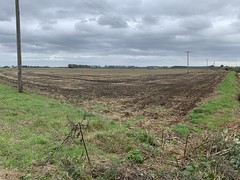
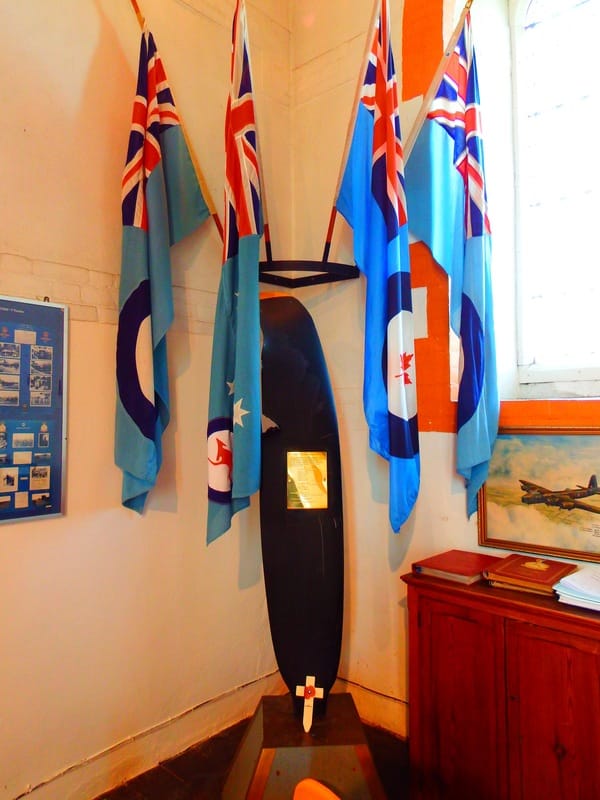
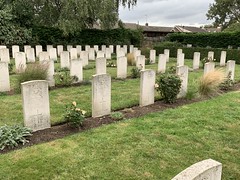
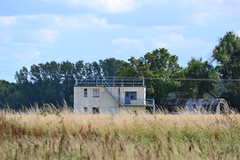
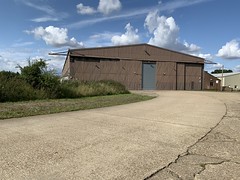

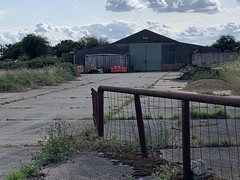

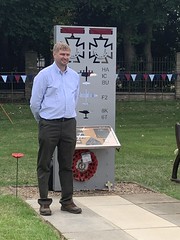
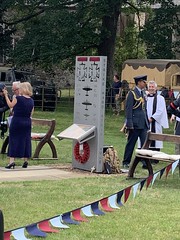
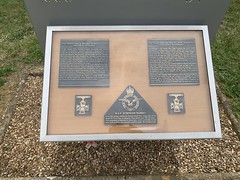


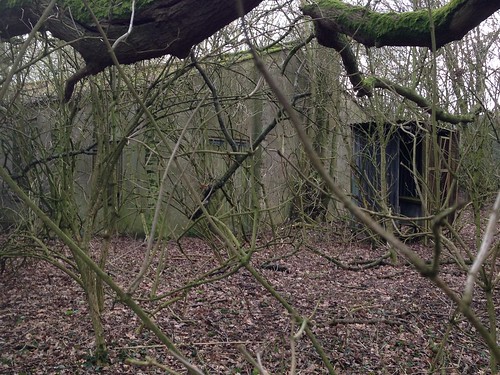
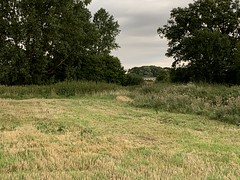

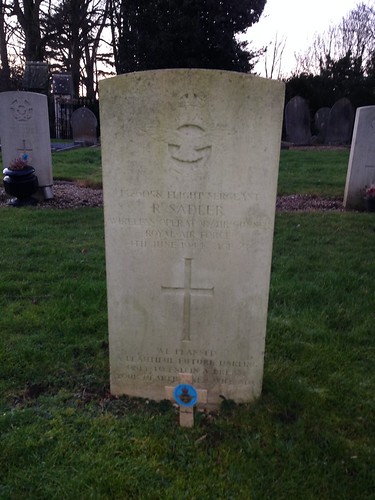


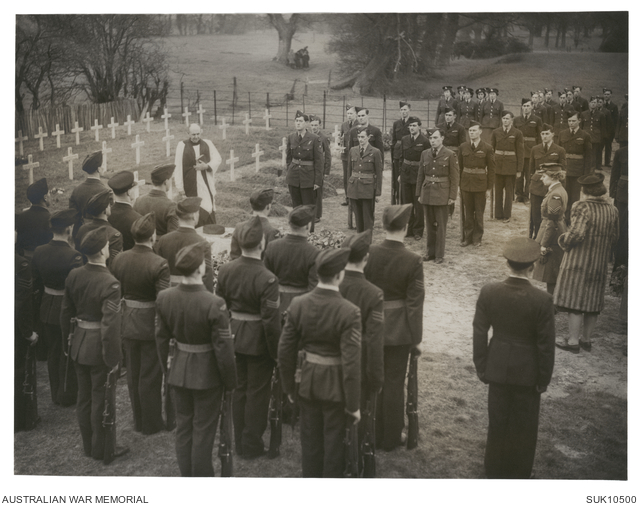
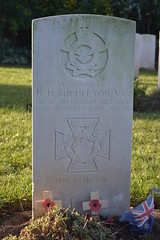


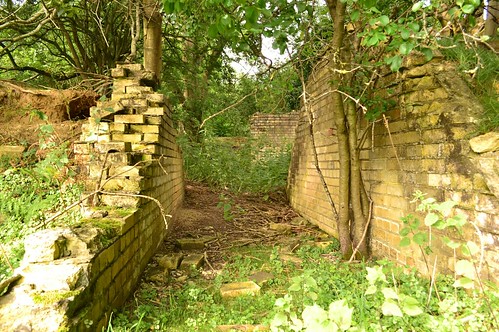
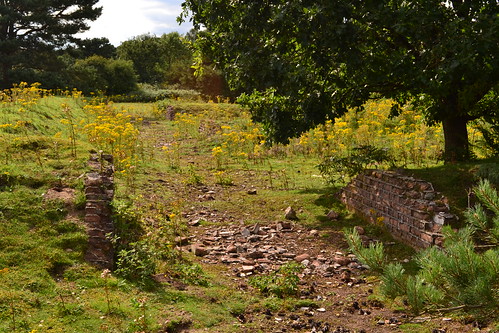

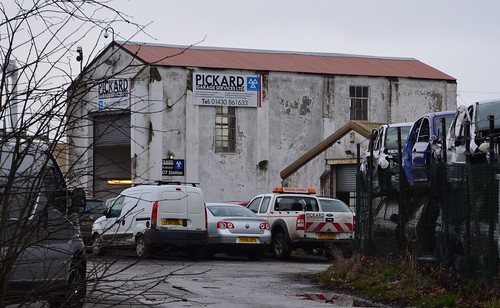
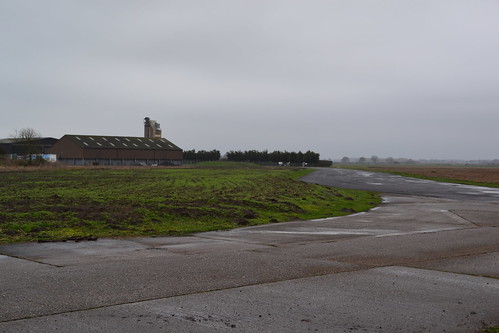
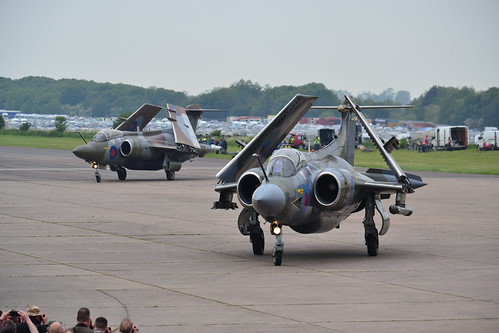
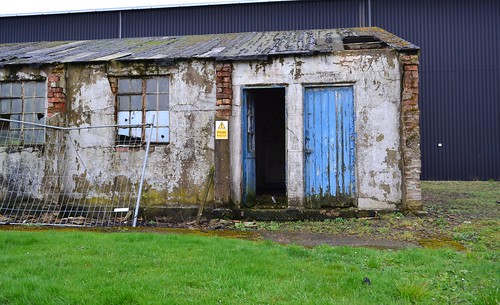
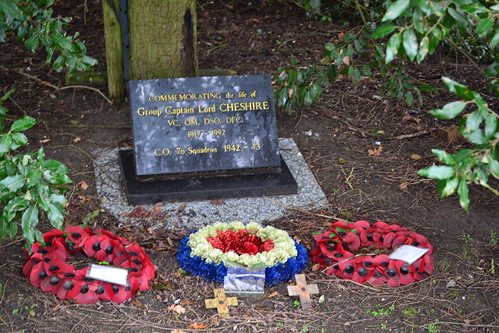
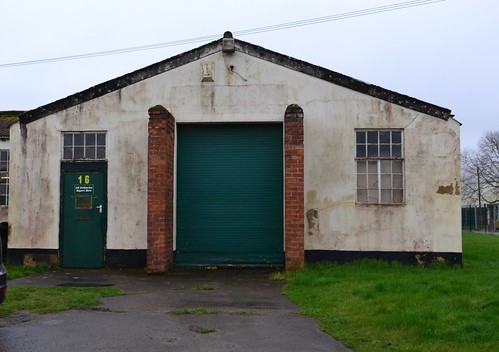
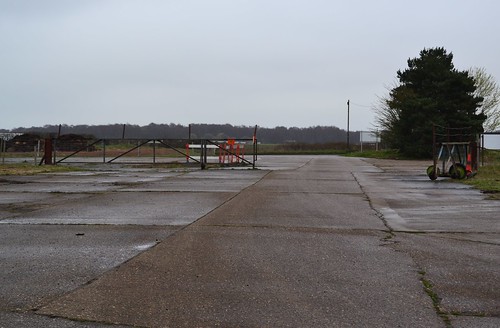

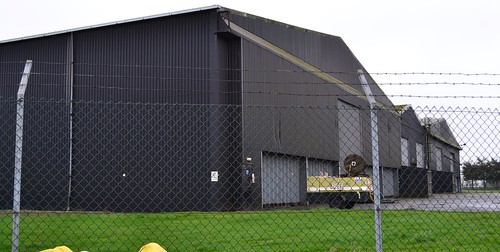
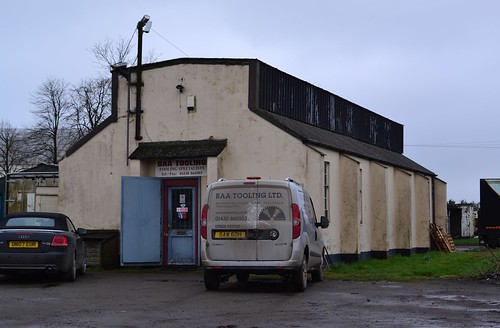

 Aviation Trails