RAF East Kirkby – Part 3 – the End of an Era.

In Part 2, we saw how crews at East Kirkby took a battering over Germany and how the Allies turned their attention to the forthcoming invasion.

In this, the final part, the war finally comes to an end and RAF East Kirkby eventually closes, but not without making its mark.

With spring at an end, thoughts turned back to the impending invasion and the bombing of pinpoint targets in France: Railways, munitions factories, troop concentrations and transport links became the focus for Harris’s Air Force. Throughout the month of April both East Kirkby squadrons were in operations, and whilst not significantly high, a number of aircraft were lost adding to the lengthening list of casualties and those now missing.

The end of this period of the war was remarkable for several reasons, notably when Wing Commander Leonard Cheshire of 617 Sqn, flew a Mosquito at low level and marked the target, a factory in Toulouse, with great success. This delighted Harris, who gave the all clear to 5 Group to operate independently of the Pathfinders of 8 Group, a decision that did little to heal the growing rift between Don Bennett and Ralph Cochrane who had taken the idea to Harris in the first place.

Other targets then became the focus for 5 Group including the railway yards at La Chapelle. In the operation Cheshire put this method  to the test once more. with 617 Sqn again to marking the target in conjunction with 8 Group’s Pathfinders. In the operation, 247 Lancasters from 5 Group were ordered to attack a pin point target. In the attack, 57 Sqn lost two aircraft. Of these two Lancasters the first, LL893 ‘DX-J’  was lost with all seven lives over St-Omer whilst the second, Lancaster MK. III ND582 ‘DX-S’ crashed after attempting a landing at Croydon. After overshooting the runway the aircraft, piloted by Canadian F.O. H. Young, struck at least three homes in Lavender Vale, a street adjoining the airfield. Three of the crew died immediately and a further one died from his injuries in hospital.

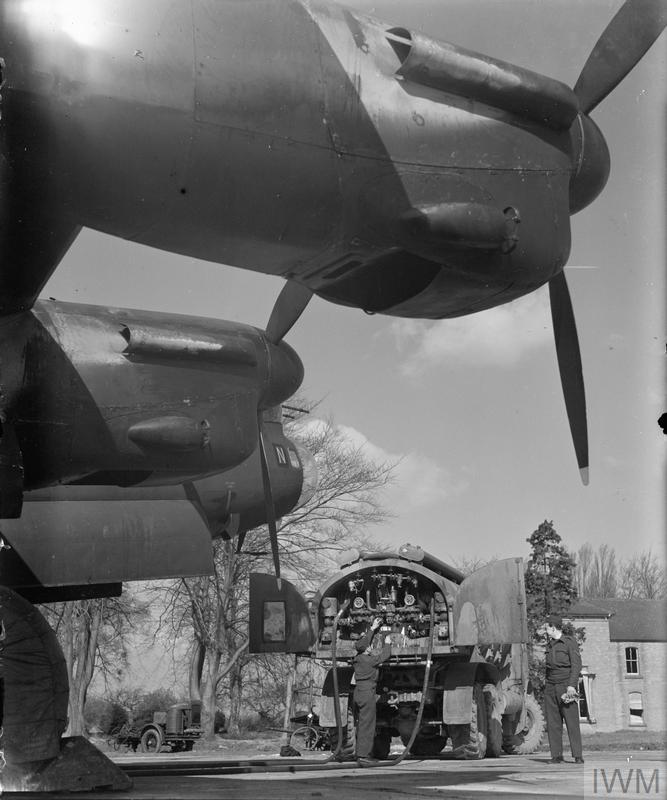
Operation POINTBLANK. Groundsmen refuel Lancaster ND560 ‘DX-N’, 57 Squadron in preparation for a night attack on the railway yards at La Chapelle, France. IWM (CH 12868)

Summer then dawned, and overnight, May 22nd-23rd, Cheshire once more, put his method  to the test. 617 Sqn were again to mark the target, but a heavily defended Brunswick led to heavy losses for both the East Kirkby squadrons, 57 losing three Lancaster Mk.IIIs and 630 Sqn another two. Only five airmen made it out alive, each one being captured by the German ground forces and so becoming prisoners of war.

These losses were however a mere pin-prick compared to June. The mission of 21st-22nd to Wesseling near Cologne proved to be yet another massacre for 5 Group who sent a total of 133 Lancasters to attack the city’s oil facilities. A number of squadrons took heavy loses including both East Kirkby’s 57 and 630 Sqns with six and five losses respectively. One of these aircraft was abandoned whilst another ditched in the sea allowing all crewmen to be rescued, but the overall loss proved to be devastating.

The spring – summer of 1944 was defining, not only had 5 Group shown that low-level marking could be done, but the attacks on targets in France meant that the Luftwaffe were at a disadvantage. Their night tactics, relying on long range bomber flights, could not manage with the shorter ‘quick’ attacks, and so losses from Bomber Command began to lessen.

This reduction allowed for restaffing, with a large number of officers, NCOs and airmen being both posted in and out of the two squadrons. It also allowed for training flights to take place, some 476 hours of operations compared to 729 hours for non-operational flights for 630 Sqn alone.

Like many places across the UK, the coming of D-Day, and the fragile success of the invasion led to an increase in morale at the station. Ground crews being acknowledged for their long hours and hard work in keeping aircraft flying and operationally ready, without them, these operations could not have taken place at all.

This extra effort and improved state continued for several months, and by August, it was acknowledged that morale had lifted, discipline was at a high and health was overall very good. Casualties were also down, a real boost considering the extra effort and number of operations that had been taking place over the last few months. The summer was at last ending on a high.

August’s improvement coincided with the liberation of Paris, a major landmark in the war’s progress. Ground forces were charging ahead. In the air, Bomber Command had played a small part in the offensive supporting ground troops as needed and now they were released from the tight grip SHAEF had held over them. Discussions followed as to where best place their bombs, oil and  communication were one option or alternatively, a return to the bombing of the cities and morale busting; oil won over, and so, much to Harris’s disappointment, the bombing of oil based targets began.

The looseness of the criteria however, allowed Harris to circumnavigate the ‘rules’ and turn his attention to cities with an oil link. He had got his way and the Air Ministry had got theirs.

Although individual operation losses were relatively low, 57 Sqn tallied some 56 aircraft by the end of 1944, whilst 630 Sqn reached 57. Non-operational loses for the two units were also on an equal par.

On the penultimate day of the year, East Kirkby was to witness, a short distance away from the airfield, the crash of a B-17 attempting to land. Aircraft #42-97479 (UX-L) of the 327thBS 92nd BG based at Podington (Station 109), crashed in a field between the two small hamlets of Old Bolinbroke and Hareby. On board that day were nine crew men: 2nd Lt. Joseph Martin Van Stratton (Pilot); 2nd Lt. Edward A Porter (Co-pilot); Sgt. Charles H Chambers (Bombardier); 2nd Lt. John E Cowan (Navigator); Sgt. Arthur R Estrada (Radio Operator); Sgt. Harold Raymond Barner (Ball Turret Gunner); Sgt. Wilfred A Bedard (Wasit Gunner); Sgt. Thomas G Standish ((Top Turret Gunner) and Sgt. William D White (Tail Gunner), who all lost their lives.

The aircraft, a Lockheed/Vega B-17G-15-VE Flying Fortress named “Belle of Liberty“, had returned from operations to the Bullay railway bridge located south-west of Koblenz, in Germany. After suffering engine failure, the pilot decided to abort the mission and attempt a landing at East Kirkby. In poor visibility and with one engine out, he overshot the runway and pulled up to attempt a second try. A second propeller then began windmilling and in trying to gain height to avoid a hill, the B-17 stalled and crashed.

A small memorial plaque has since been laid at the site in commemoration of those lost.

The wreck of the “Belle of Liberty” 30th December 1944.  (IWM FRE 5762)

The winter of 1944-45 was one of the worst, ground troops were by now entrenched in the Ardennes around Bastogne, with the German army preparing for one last push through the forests. Fog and snow kept many airfields non-operational in the UK, aircraft struggling to get much needed support across to the continent.

At East Kirkby, January started on high spirits, but on the 9th, 630 Sqn Lancaster PD317 ‘LE-G’ struggled to get airborne when one of its engines cut out on take off. After jettisoning its bombs, the pilot, F.O. G Billings, opened the throttle to attempt a circuit and landing. However, the port wing lost lift and dropped causing the aircraft to cartwheel injuring five airmen and killing two. With one further loss on the 14th, this brought the spring tally to two aircraft. However, good news did soon come as six of the seven crew were repatriated by the April. The seventh airmen, W.O. E Edwards, struck the tail plane on baling out and died the next day.

Otherwise, 57 Sqn, scraped through with a clean sheet and no operational losses were encountered, but they did suffer an unfortunate incident when ‘DX-N’ PB382 (the predecessor of DX-N below) entered Swedish airspace and was shot down by flak on the night of February 8th-9th.

The losses encountered by 57 and 630 Sqn, were only pipped by the tragic accident that was reported to have happened on the 17th of April. Although the operational records record no evidence of the accident, even to the point of showing some of the aircraft involved taking part and completing their operations, it is recorded in some resources that six Lancasters of 57 Squadron were destroyed following a fire in the fuselage of Lancaster PB360. As a result of the fire, four men were killed and a further five injured, along with several civilian workers near the site.

The fire started at 17:45, causing a series of explosions which destroyed the five other Lancasters parked nearby. The Hangar on the airfield was also badly damaged, as was a neighbouring farm. The fires were so severe that fire crews were brought in from nearby airfields and the area was not declared ‘safe’ until the following day. The Lancasters involved were: PB360 (MK.III) ‘DX-N’; ND472 (MK.III) ‘DX-I’; LM673 (MK.III) ‘DX-U’; RF195 (MK.I) ‘DX-‘; PD347 (MK.I) ‘DX-P’ and NN765 (MK.I) ‘DX-‘.*3

By now German resistance was minimal. Fighters were rarely encountered in any number and flak batteries were reducing in their accuracy and intensity. By May, the war was at and end, and quickly both ‘Exodus’ and training flights became the norm along with cross country and high level bombing training flights taking the front stage. For 630 Sqn July signified the end, after a period of intense recruiting the squadron was disbanded after serving for approximately eighteen months of the war.

During that time they had shown great courage in action. On average they had flown 1,087 hours of operational flying per month and 286 hours on non-operational flights. This amounted to 2,147 operations over enemy territory during which 64 aircraft had been lost. With another six crashing, the toll was high, and their medal tally reflected that, with in excess of 60 awards being granted.

In a last days before disbandment a sports challenge with 57 Squadron allowed 630 to show their colours one last time, winning the overall trophy, and with a party to celebrate that night, the squadron went out on a high. The final day saw the last parade and the handing over of the squadron crest to the Air Ministry for safe keeping. With that, 630 squadron disbanded.

Their place at East Kirkby didn’t stay vacant for long though, for on the 27th July, 460 Sqn arrived to join 57 Sqn and serve its lasts days here at this Lincolnshire airfield.

57 Sqn would continue on, taking on the Lincoln bomber in August as a replacement for the Lancaster although numbers remained low at this time. Fighter affiliation, high level bombing training and cross country flights became the main focus, along with ferrying flights into the European continent bringing back personnel and equipment; a schedule that continued for the next four months, its time finally being called on November 25th 1945.

Throughout the war 57 Sqn had served with distinction, providing crews for not just one but two different squadrons, one of which went on to become perhaps the most famous unit in the RAF’s history. It was a success however, that came at a cost, with the highest loss rate of the whole of Bomber Command, they had taken part in some of Europe’s most ferocious aerial battles and still went on to perform admirably.

On disbandment, 103 Squadron then at Elsham Woods, was immediately renumbered as 57 Sqn, and the unit number lived on. The majority of personnel from the original 57 Sqn were transferred to the RAF’s Holding Station RAF Blyton Holding Unit, along with personnel from several other serving squadrons. Seven three-men crews remained at East Kirkby to ferry the Lancasters away whilst six crews transferred to Scampton to form the basis of the new squadron along with three Lincoln bombers.

460 Sqn an Australian unit, had also served well during its war time life. Being originally formed on November 25th 1941, it was made up of Australian crews, flown Wellingtons, Halifaxes and then Lancaster I and IIIs. Its move to East Kirkby from Binbrook signifying its end, as training flights took over bombing missions and personnel began to be transferred out. By October it too had disbanded.

In an acknowledgement of their bravery, the closing remarks in the Operation Record Books state how the Australian had been warmly welcomed to our shores and how they had cemented a great bond between the two allies against a common enemy. Appreciation and thanks was warmly given to those who had served in the unit.

With the war’s end, East Kirkby was rundown, but between spring 1946 and February 1948, a detachment of Mosquito B.IVs from Coningsby’s 139 (Jamaica) Sqn, operated here, joined  between August 1947 and February 1948 by 231 Operational Conversion Unit (OCU) also on detachment from Coningsby. Flying a mix of Airspeed Oxfords, Avro Ansons & de Havilland Mosquito B.IVs, they were the last RAF units to use the airfield before it entered care and maintenance.

Then in 1951, the US Strategic Command 3rd Air Force took over the site, intending to use it as a stand-by airfield.  As part of the plan, the runway was extended by 1,230 yards along with an expansion to the apron. Both the 3931st ABG and 3917th ABS were based here but only visiting C-47 ‘Skytrains’ (a derivative of the Dakota) of the 7th Air Division’s Rescue Squadrons, ever arrived.

Eventually, on 31 October 1958, the airfield was returned to Air Ministry under ‘Big Shuffle’ , the reorganisation of the Air Force and its sites in the UK and Europe.*4

With that, East Kirkby closed for good, being sold off in 1964 when it turned once again to agriculture. However, bought by the Panton Brothers, it was turned into a living museum including a taxiable Lancaster to commemorate not only the third brother – Christopher Panton, who was killed on a bombing raid over Nuremberg on 30th – 31st March, 1944 – but all those who served in Bomber Command during World War II.

Part of the museum includes the chapel, a stained glass window and memorial board listing all those who died whilst serving at the airfield in both 57 and 630 Sqn, are poignant reminders of the toll on human life at this one small Lincolnshire airfield.

The full page can be read in Trail 1 – Lower Lincolnshire.

References and further reading (East Kirkby)

*1 Aviation Safety Network website accessed 19/10/24.

*2 Worrall, R., “Battle of Berlin 1943-44” Osprey Publishing. 2019.

*3 Chorley, W.R., “Bomber Command Losses pof the Second World War – Vol. 6 1945” Midland Counties Publications 1998.

*4 Francis. P & Crisp. G., “Military Command and Control Organisation
Volume 4  – The United States Air Forces in the UK” on behalf of English Heritage.

*5 The East Kirkby Museum have a website which gives far more detail, opening times, and other other visitor information.

National archives: AIR 27/538/38; AIR 27/538/44; AIR 27/538/43; AIR 27/2152/8; AIR 27/2152/7; AIR 27/2152/29; AIR 27/540/13; AIR 27/540/21; AIR 27/1910/11; AIR 27/540/8; AIR 27/540/7

American Air Museum Website Accessed 20.10.24

International Bomber Command Centre has several personal stories on their website, it is well worth a read.

Lincolnshire Aviation Heritage Centre Website.

RAF Hunsdon – The Mosquito Bites (Part 4)

In Part 3, we saw how Hunsdon and gone through various squadrons, operating the ill fated Turbinlite system which was soon withdrawn, and onto the arrival of the Mosquito, a deadly aircraft that could out run every German aircraft at its introduction. It was now time to bite, and the bite would come directly at the heart of the Gestapo.

In one of the war’s most famous attacks, so many questions would be asked, but answers would be short-coming and the truth may never come out. 

The new wing, previously formed at Sculthorpe, would consist of the three multinational squadrons, a ‘British’, Australian and New Zealand unit, and all would be based at Hunsdon as part of the RAF’s Second Tactical Air Force (2TAF) designed to support troops in the forthcoming invasion.

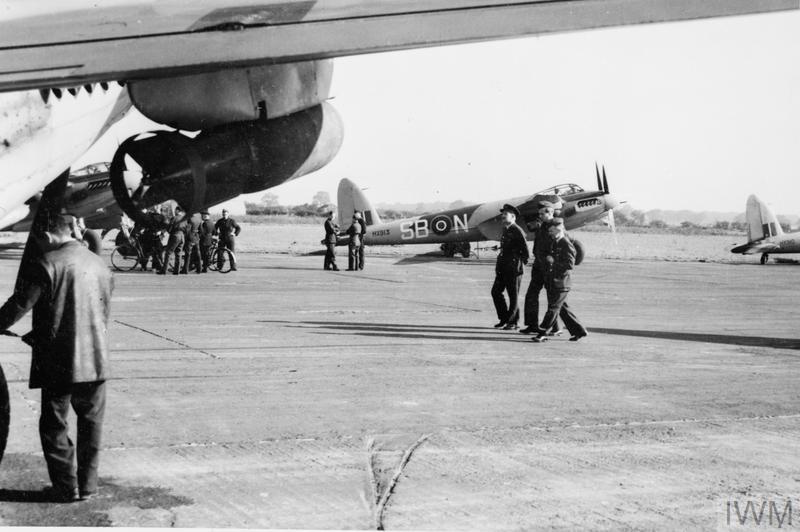
Group Captain P C “Pick” Pickard (centre), Commander No. 140 Wing, flanked by Wing Commander I G E “Daddy” Dale, Commanding Officer of No. 21 Squadron RAF (to Pickard’s right), and Wing Commander A G “Willie” Wilson, Commanding Officer of No. 487 Squadron RNZAF, visit No. 464 Squadron RAAF at Hunsdon, prior to a daylight raid against flying-bomb sites in the Pas-de-Calais. 464’s Mosquitoes (FB Mk VIs) have been loaded with 250-lb MC bombs for the operation: HX913 ‘SB-N’ can be seen in the background (@IWM HU 81335).

Between 1944 and 1945, 140 Wing would carry out many daring low-level bombing raids against V weapons targets, along with a key Gestapo building and a prison in occupied Europe. These particular raids were designed to both free captive resistance fighters and destroy important Gestapo documents. Operation Carthage took place in Denmark and occurred whilst the wing was based at RAF Fersfield in 1945, but the first, Ramrod 564 or ‘Operation Jericho’ as it has since become known, took place whilst they were based here at Hunsdon in early 1944.

There is a lot of speculation around Ramrod 564, many of the official records are missing, inaccurate or even vague. The operational record books for the four squadrons involved (three Mosquito and a Typhoon) are recorded as ‘secret’ and contain no details other than aircraft, times and dates.

However, we do know that the Operation, formulated by Air Vice Marshal Basil Embry, would be critical, even the amount of explosive itself had fine limits. Time was also of the essence, as several prisoners were thought to be destined for execution and so a time limit was placed on when it needed to be done by. The exact time of day was also critical, they needed as many guards to be in one place as possible, and the prisoners needed to be safely gathered together out of harms way. So, a time of 12:00 pm precisely on a date between 10th and 19th February was chosen, as both the guards and prisoners would be having lunch at this time. In the attack, six Mosquitoes would breach the outer wall in two places, whilst a further six would bomb the main prison buildings allowing the prisoners to escape whilst killing as many guards as possible.

Embry elected himself to lead the attack, but this was blocked by those higher up, As a result, and much against his wishes, Embry therefore had to choose a successor. Group Captain Percy C. Pickard (D.S.O. and two bars, D.F.C.) was chosen, but even though he was known as an expert pilot and leader, Embry was not convinced of Pickard’s ability to complete the job at such low level. Despite his reservations though, Embry duly informed Pickard of the decision and preparations for the operation began in earnest.

On February 18th that year, a day after the initial planned attack and in extremely poor weather, 19 Mosquitoes including a photo reconnaissance MK.VI (from the Operational Film Production Unit (OFPU) for propaganda purposes),  took off to attack, breech and destroy the walls and main building of the Amiens prison. A famously brave act, it resulted in the death of 3 crew members; Gp. Capt. Percy C. Pickard, and Flt. Lt. John A. Broadley, (RNZAF), both in Mosquito HX922, ‘EG-F’ and Flt. Lt. Richard W. Samson, (RNZAF) in Mosquito MM404 ‘SB-T’. Samson’s pilot, Sqn. Ldr. A. I. McRitchie survived his crash and was taken as a prisoner of war. Two Typhoons from 198 Sqn escorting the Mosquitoes are also thought to have failed to return (the ORBs don’t confirm this). Considered a success at the time, evidence has since come to light to suggest that the operation was ‘unnecessary’, and may have failed to achieve anything more than a successful PR role (see end note). *1

(A better quality version is available on the Pathe News website.)

All that aside, the raid took place at very low level and in poor weather, with bombs dropped against the wall with delayed fuses. There was little resistance on the flight in and Typhoons provided higher cover when it was needed.

The route would take the Mosquitoes from Hunsdon to Littlehampton – then via appropriate lattice to Tocqueville – Senarpont – Bourdon – then one mile South Doullens – Bouzincourt – two miles west-south-west to Albert – Target – Turn right – St. Saveur – Senarpont – Tocqueville – Hastings and back to Hunsdon.

During the flight out, four Mosquitoes and three Typhoons of 198 Sqn became lost in swirling snow and were forced to turn back as they had now lost contact with their main formations. The remaining crews flew on, but whilst over France a fifth Mosquito, flown by Flt. B. Hanafin, suffered engine problems and was also forced to turn back. On his return journey his was attacked by Flak from which he was seriously injured. Helped by his navigator the two were able to land back at RAF Ford where he was given medical treatment for his injuries.

Just three minutes behind schedule, the first wave of three aircraft followed the main road toward the prison’s eastern wall at tree top height. The second wave would attack the northern wall. Wg. Cdr. I. Smith 487 Sqn went in first dropping the bombs with 11 second fuses against the wall.

Wing Commander I Smith, Commanding Officer of No. 487 Squadron RNZAF, at Hunsdon (©IWM CH 12649)

The third and fourth waves attacked the south-eastern main building and north-western end respectively. Chaos then ensued inside the prison, as over running bombs had caused some damage inside and some prisoners were injured or struggled to escape.

Noting now that the walls and prison had been breached, the signal to abort was issued over the VHF radio probably by both Pickard and the OFPU Mosquito flown by Flt. Wickham (both the code word “Red, Red, Red” and who sent it are also disputed) instructing the four aircraft of the 21 Sqn Flight not to bomb. The message was heard by the flight, when they were between 2 and 4 miles out from the target, and so returned to base without dropping their payload.

During all this time, FW.190s continued to swarm and various dogfights took place between them and the Typhoons, but not before they had attacked some of the fleeing Mosquitoes who also returned fire.

It is unclear at what point in the attack that Pickard was shot down, but a Focke Wulf 190 flown by the ace Feldwebel Wilhelm Mayer, severed his tail sending his aircraft to the ground near to Saint Gratien. The resultant crash killing both occupants.

The story goes that Pickard had left his dog ‘Ming’ at RAF Sculthorpe, their previous airfield,  to be looked after whilst he was away. On the day he was shot down, 18th February 1944, the dog fell gravely ill. Pickard’s wife, Dorothy, went to get him and sensed, that after seeing the state of the animal, that Pickard had been killed . It took months for Ming to recover, and some years later whilst living in Rhodesia, Ming went outside, looked up to the sky as he always did when Pickard was flying, heard a whistle, collapsed and died.*6

Of the 700 prisoners detained inside the prison that day, 258 of them escaped,102 were killed and 74 were wounded*7, but the success remained secret from the public for a further eight months. With so much speculation surrounding the attack, it will no doubt remain one of the mysteries of war, but it was without doubt, an incredibly brave and daring mission that cost the lives of three superb young airmen.

A podcast using eyewitness accounts from the Imperial war museum can be heard through their website.

The Amiens raid was not the only daring low level raid carried out by the wing whilst at Hunsdon however. Airfields along with the Hazmeyer electrical equipment factory at Hengels in Belgium, were also attacked at low level. On this particular operation Mosquito MM482 was hit by intense flak setting the starboard engine on fire. As a result, the aircraft flown by Canadian Sqn. Ldr. A. W. Sugden with navigator Fl. Off. A. Bridger, was lost and both men were listed as missing. Having been with the squadron since 1942 they were considered ‘old timers’ by the others and were sorely missed.

The three squadrons of 140 Wing would soon depart Hunsdon though, leaving the joy of success and the turmoil of a thousand questions behind them. 464 went first on March 25th whilst 21 and 487 Sqns would both leave mid April, both moving to RAF Gravesend in Kent.

However, a month before the wing moved away, another Mosquito squadron would move in temporarily, meaning the airfield was awash with the aircraft of varying types. 409 (RCAF) Sqn’s time would be short, remaining here for just over a month before departing mid May, but they would return in June that same year staying for a further two months. Their final departure on the 25th August 1944, would end their association with Hunsdon for good, a move that took them to the continent and forward bases across the low countries.

Between June and the end of 1944, no less than six squadrons would come and go, most of them moving to the continent as the allied advanced progressed toward Germany. Each of these units would bring further Mosquitoes with them, with marks ranging from the MK.II and VI (418 Sqn); to the XIII with 29, 264 and 48 Squadrons, on to the XXX with 219 and 151 squadrons.

The longest to stay of these six units would be the first, 29 Squadron. Formed in 1915, they have operated almost continuously ever since, with just a short break between the wars and some reformation post war. Today they are based at Coningsby in Lincolnshire and are the southern most QRA Squadron currently flying Typhoons. They were in 1987, the first operational squadron to be equipped with the Tornado F3.

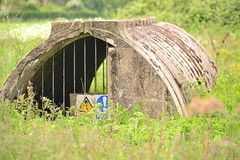
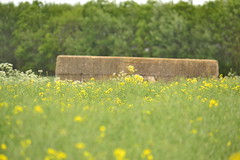
RAF Hunsdon Air Raid shelter

An air raid shelter now exposed.

At Hunsdon in 1944 though, the move would come as a surprise and with some reservations, but once here, it was considered to be an ‘improvement’ on West Malling. 29 Squadron would fly the NF. XIII Mosquito, arriving here on June 19th that year. The NF.XIII was the first variant night fighter to have the strengthened wing of the FB.VI, with increased fuel load and Merlin 23 engines. One such example, HK428 ‘RO-K’built at Leavesden, joined 29 Sqn at RAF Ford in early 1944.

On October 24th that year, during a flight test at Hunsdon, the aircraft suffered an overheating starboard engine and inactive flaps whilst in poor visibility. As a result the aircraft overshot the runway and crashed into a hedge causing the starboard undercarriage to collapse further damaging the aircraft. HK428 was subsequently repaired and passed to the Gunnery School at Catfoss in early 1945. It was eventually one of many that met the scrap man’s axe in 1946.*4

The Squadron would carry out patrols and intruder operations and whilst many of these were ‘uneventful’, several enemy aircraft were shot down including both Ju. 88s and Me. 110s. The last months of the war though were not all plane sailing. On July 1st, an accident during a flying test resulted in the loss of two good airmen and friends, Flt. Lt. John Barry and Fly. Off. Guy Hopkins.  A second Mosquito was hit by light flak at 500 feet on the 5th. Flying home on one engine, the aircraft made and emergency landing at RAF Ford, but somersaulted on the ground writing the aircraft off. Thankfully, and remarkably, in this instance neither crewman sustained any injury.

As the allies advanced more intruder missions took place. On some days the squadron was “let loose” to pick and locate their own targets, many choosing road or rail stock, damaging many trains as a result. The rest of the year and into 1945 would be the same. Intruder missions, ‘Flower‘ Operations (attacks against German night fighters at their airfield) brought some results. Then almost as quickly as they arrived they were given notice to move once more, and a huge party on the night of February 22nd 1945 preceded their departure to Colerne

Two other units arrived at Hunsdon after 29 Sqn, those of 418 (25th August, 1944) and 219 (29th August 1944) Squadrons. With all these Mosquitoes there must have been little room for any more aircraft as Hunsdon quickly filled  up with the type. 219 Sqn would quickly move out though, leaving what little space there was for a new unit, 488 Squadron who moved in the day prior to 219’s  departure. The last of this group of units to arrive that year was 151 Squadron. All but 151 transferred to the various airfields on the continent whilst 151 remained in the UK, leaving Hunsdon on March 1st 1945. It had certainly been a busy period at this Hertfordshire airfield.

1945 would be a reflection of the hectic movements of 1944. However, it would also bring a greater variety of aircraft as detachments arrived posted away from their main unit. It would also bring a slight change of role, as the range of twin engined Mosquitoes departed, single engined fighters came in.

The first would be a small detachment of 285 Sqn Hurricanes who resided here between January and June, followed in the beginning of March by 154 Sqn with Mustangs and Spitfires. 154 Sqn time here would be very short though, sadly ending their days here, just eighteen days later.

Almost at the same time, these units would be joined by 501 Sqn and 611 Sqn, 501 also ending their days of active duty here with their Tempest Vs, whilst 611 would swap their Spitfire VII for Mustang IVs before moving off to Peterhead and disbandment also. Both these units would however rise again the following year being reborn as the jet age dawned, to live on for a few more years.

442 Sqn, another Canadian unit, ended the flurry of units arriving in March that year when they brought Spitfire IXEs back for a spell from the continent, being stationed recently at B80 (Volkel) and B88 (Heesch), they had seen action first hand before arriving here. They soon replaced these aircraft with Mustangs though, moving on to RAF Digby in May as the war ended. 442 were also a short lived squadron, only being formed at Digby in February 1944. Their operational life had lasted just eighteen months.

April and May saw the last of the front line squadrons to reside at Hunsdon. The closing days of April saw 441 with Spitfires and 287 Sqn with a detachment of Tempests Vs. Both these units would move on elsewhere before they too saw the curtain fall, and their days as operational units cease. Like its sister squadron, 441 had only been operational for eighteen months, being formed in unison. In fact, their entire operational record matched to the day, even when they moved abroad.

Hunsdon then closed to operational activity, being used to receive returning men and materials up until mid 1946 whereupon it was placed into Care and Maintenance and allowed to run down. The tower was demolished very soon after the war ended, and the site was returned to agriculture. In total, Hunsdon’s crews accounted for over 220 enemy aircraft destroyed or damaged – a remarkable feat in any airfield’s chapter.

RAF Hunsdon Dispersal pen

One of the original dispersal pans.

Today Hunsdon remains one of the more accessible airfields of Britain. A number of public footpaths criss-cross its boundaries allowing unprecedented access to it. It is still an active site, allbeit much reduced – a small microlight operation exists here and has done since 1997. Using three small grass runways it has brought life, in albeit a small part, back to this old wartime airfield.

The perimeter track and narrow sections of all its runways still exist today and can be walked using a variety of footpaths. Along these paths and off to the sides can still be seen examples of runway lighting, drainage, inspection covers and even a small number of buildings.

The parachute store is one of the most notable of these, used by the farmer for storage, it is located at the north-western side of the airfield near to the former admins site and where the tower would have stood before being torn down. Also near here is the fire tender shed, now home to the local shooting club, a number of latrines \ wash blocks can also be found hidden amongst the trees to the south-east. The battle headquarters rests nestled amongst the crops still watching over the site, and small defence trenches and shelters can be found to the north and again these are visible from public footpaths. A number of airfield defences buildings in the form of pill boxes and an Oakington style pillbox can also be found around the site.

Many of these examples are buried amongst the undergrowth and are most easily seen in winter when the thorns and vegetation are at their lowest. Careful searching will also reveal a number of minor archaeological examples but again best in the winter when crops and weeds are minimal.

To the northern side of the airfield, next to where the microlight site is based, is a memorial to the crews of all nationalities who were based here all those years ago. Formed from a propeller boss of a Mosquito, it was donated to by the former Mosquito Museum (now de Havilland Aircraft Museum), it stands proud looking down what was the length of the secondary runway. A further memorial plaque can also be found on the wall of the village hall.

Hunsdon is a small site with a big history. It played a large part in trials of new innovations, carried out night intruder missions, and attacked with daring at low-level, at the very heart of the Gestapo. Hunsdon and its crews proudly earned their place in the annals of world history.

After walking Hunsdon we travel the short distance to the north-east to the outskirts of Bishop Stortford and a little known about airfield that is all but gone. We go to RAF Sawbridgeworth.

Further Reading and Sources (RAF Hunsdon)

*1 – The Amiens raid is one that has become embedded in history and is beyond doubt an incredible and daring low-level raid that succeeded in its aim. However, official records seem to have many errors, anomalies or missing details that it is very difficult to ascertain the accuracy of these historical ‘facts’.

The ORBs for each of the four squadrons give no details other than an ‘operation to France’, some crew names and aircraft numbers. There is no record of the use of the word ‘Jericho‘ but there are two sides to this story.

Some authors including Rowland White “Mosquito” and John Laffin “Raiders – Great Exploits of the Second World War“, both cite Basil Embry as the creator of the name ‘Jericho‘ before the missions took place, whilst Robert Lyman “The Jail Busters” cites a French film, made in 1946, as the author of creator of the name. Some believe the name was created by various media outlets since then whilst others say that Embry created the name after the operation had been carried out. It is however, widely considered that it was a post-war name as the original operation was ‘Ramrod 564‘ and none of the ORBs use the name ‘Jericho‘.  To further add mystery, the use of the title ‘Renovate‘ has also cited, but records in the National Archives show this as the secret VHF code word to be used by aircraft on the operation and not the Operation title.

The name aside, and more recently, one of the French Resistance fighters revealed his doubts about the operation, and considers that it may have been nothing more than a propaganda operation or a diversionary attack linked to D-Day. One book (one amongst many) on the subject has been written by author Simon Parry and historian Dr Jean-Pierre Ducellier entitled The Amiens Raid – Secrets Revealed‘ and is published by Red Kite. It goes into the details of the raid and possible reasons behind it.

There have also been theories that it was an MI6 operation but due to the nature and secrecy of the mission, little evidence is publicly available to substantiate this.

Of those who lost their lives, both Pickard and Broadley are buried in St. Pierre Cemetery, Amiens, whilst Sampson is buried in the Poix-de-Picardie cemetery in the Somme region.

*2 There is further information and personal stories about Tubinlite operations on RAF 23 Squadron, and they can be found on the 23 Squadron Blog site (1) and (2).  All ten were raised to squadron status on 2nd September 1942, but due to administration problems, five were not established until 8th September 1942)

*3 McCloskey, K., “Airwork – A History“. The History Press, 2013 (An excellent account of Airworks and  their part in the Turbinlite project).

*4 Thirsk, I., “de Havilland Mosquito – an Illustrated Story Vol 2” 2006, Crecy Publishing Limited.

*5 Photo from vintage wings website.

*6 Gunn, P.B., “Flying Lives – with a Norfolk Theme“, Peter Gunn, 2010

*7 National Archives, archived documents available via the old website

McCloskey, K., “Airwork – A History” History Press, 2012

National Archives: AIR 27/704/9; AIR 27/2001/1 – 19; AIR 27/33/21; AIR 27/704/39; AIR 27/704/11; AIR 27/1045/27; AIR 27/1045/33; AIR 27/1045/37; AIR 27/1802/55; AIR 27/1802/57; AIR 27/342/11

Vintage Wings of Canada Website

For information on building the memorials at Hunsdon and Sawbridgeworth visit Hertfordshire Airfields Memorial Group website.

The full story of RAF Hunsdon can be read in Trail 25.

RAF Hunsdon – The end of the Turbinlite (Part 2)

In part 1, we saw how Hunsdon was developed and how the new Turbinlite system was developed. However, things don’t quite go to pan the system falls doesn’t meet expectations.

After taking on Hurricanes IIB/C at Martlesham Heath in April, 3 Squadron arrived at Hunsdon from Stapleford Tawney, and like 85 Sqn, would remain here until mid May 1943, when it took its Mosquitoes to West Malling.

Pilots and aircraft of 3 Sqn would make their first appearance at Hunsdon on the 2nd August 1941 when twelve pilots arrived to practice formation flying with crews of the special Havoc Flight created earlier in May. These initial twelve would be followed by another twelve on the third, and then ten more crews on the sixth. The two squadrons would perform practice night flights together, formation flying and ‘dog fighting’ tactics with drogues. By the 10th, the bulk of the squadron had moved over leaving only a detachment both at Manston and Shoreham, where crews undertook both dawn and dusk patrols over southern England and over enemy airfields looking for bombers either landing or taking off.

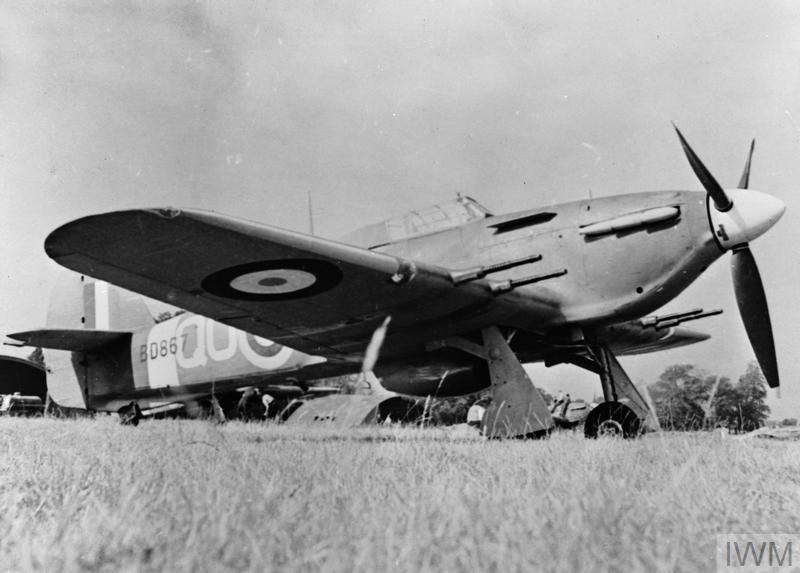
Hurricane IIC, BD867 ‘QO-Y’, 3 Sqn, at Hunsdon. The exhausts have shields over them to help prevent them being seen whilst on night fighter operations. (@IWM CH 3509)

The combined practice flights would take Hunsdon’s 3 Sqn and the Turbinlite Flights aircrew well into the summer and autumn of the following year, progress being marred by continuing poor weather. GCI (Ground Control Intercept) training and formation flying between the two units took up the majority of the time whilst they were here, however, both dusk and dawn patrols in their Hurricanes gave the pilots of 3 Sqn a little respite from the routine of formation flying with the two Special Flights.

September 1941 then brought the second of the two Special Flights to Hunsdon. On the 20th, 1459 (Fighter) Flight, the penultimate of the ten, was formed here also operating both Havoc Is and Boston IIs, Fs and IIIs. The last of the Flights to make up the ten units would follow just after, being based in northern England at RAF Acklington.

It was quickly found that the Turbinlites not only had a lack of firepower, but poor speed as well, so they were soon demoted to being used solely as a searchlight platform with 3 Squadron’s Hurricanes taking over the main role of interceptor.

With the formation of a new squadron at Croydon, 287 Sqn would have detachments spread far and wide including one here at Hunsdon. Staying here for virtually the entire war, they would fly a range of aircraft including: Blenheims, Hudsons; Lysanders; Hurricanes; Masters; Defiants; Martinets and Spitfires. Even as a detachment flying support flights, they were the longest resident at Hunsdon but never achieved the same status as many of those that were to be based here.

After the turbulence of 1941, 1942 would initially bring a much calmer time at Hunsdon, with less movements in or out of the airfield, although staff changes did cause problems for some units. Changes were initially relatively small, the first of which wouldn’t come until the July of 1942, when a small detachment of 605 Sqn Bostons arrived. After being reformed the month before, at RAF Ford, the small group remained here until mid March 1943, when after taking on the Mosquito, they transferred to Castle Camps in Essex.

605 had previously been posted to Batavia where the majority of ground personnel had been captured by enemy forces. Those that were left were posted to various units and the squadron disbanded. Its reformation at Ford would be a slow process, but gradually it would receive both men and aircraft, accepting machines from 23 Squadron as it also eventually took on the Mosquito.

Whilst based here at Hunsdon, they would primarily carry out training, performing cross country flights,  searchlight co-operation flights and gunnery practice. Navigation also came under scrutiny with logs being examined by the squadron’s navigation officer. By the end of August though, all was well and the personnel returned to Ford thus reuniting the entire squadron once more.

As was the case with many other airfields, training and support flights also used the same airfields, training pilots in new and more modern ways to fly. Hunsdon was no different, and in August a new Flight fulfilling this role was created here at Hunsdon. 1530 Beam Approach Training (BAT) Flight, who were formed specifically to train pilots to land in the dark, or poor weather, using a ‘beam’ (formally blind approach) or radio system. They remained here for some time eventually moving to Wittering where they were disbanded later in 1944.

It would also be in August 1942, that Hunsdon’s resident 85 Sqn would take on the Mosquito, the MK.IIs being a major change from the Havocs previously used. It would only be a trickle of aircraft at first, with just a small number of the ‘Wooden Wonders’ being received by the month’s end.

The trickle continued into September as did the nightly Havoc patrols. On the 7th, Sgt. McCormick sighted what he believed to be a Ju. 88, and closed in for the attack. After following the aircraft he managed to close to 150 feet at which point he opened fire on the starboard engine which quickly caught fire. The aircraft fell from the sky and was later seen burning on the sea below. It was confirmed not as a Ju. 88 but as an He.111 distinguished by its fixed rear-firing machine gun in the extreme end of the fuselage.

September 1942 then brought yet more change. At this point it was decided to raise all ten Turbinlite squadrons to squadron status. The date decided upon was September 2nd 1942. However, due to administration problems, only five could be raised on that date, the remaining five being raised six days later on the 8th of the month. By then, all ten Turbinlite training Flights had been disbanded and reformed as operational squadrons.

With that, 1451 became 530 Sqn on September 8th and continued to operate from Hunsdon, whilst 1459 became 538 Sqn and was relocated to Hibaldstow.

The reformation meant that flights were initially curtailed for 530 Sqn. The poor September weather then added to the issue meaning that flying was at best sporadic. Two further support Hurricanes soon arrived for the squadron taking the total available to four. But their arrival did not ease the situation, the poor weather and other factors continuing to dominate operations to the point that little operational flying took place at all.

October fared little better. More poor weather combined with the fact that three of their four Hurricane pilots (all American), were transferred to the US Army Air Corps, meant that 530 Sqn was unable to progress the way it had hoped. It had been a very poor start for the operational Turbinlites.

By November there were a total of eight Hurricane pilots, some of which had transferred in from O.T.Us, but all were lacking night flying experience. As a result, they were rushed through a night flying course at Hunsdon and were passed as ‘operational’ by the month’s end. However, the problems did not end there. Formation flying in good weather was considered difficult and in visibility of 2,000 ft or less, impossible. This meant that the required number of night flights were not being made which held back all operational flights. Compounding this, continuing bad weather had by now turned the ground very soft and a number of aircraft were getting bogged down in the mud. In addition, whilst aircraft serviceability was generally good, a few had experienced wrinkling of the skin over the air frame and were now awaiting an inspection before being allowed to fly. By now, the crews must have been wanting 1942 to draw to a very quick close.

And to a close it came. December brought rumours of the demise of the Turbinlite squadrons causing uncertainty amongst the personnel. Continuing bad weather had curtailed all but the most urgent of flights. Lectures prevailed bringing escape tactics and Luftwaffe organisation information up to date. A new Havoc was brought in for testing with a new windscreen deicing system, unfortunately this was found unsatisfactory, so a new hot air method was suggested by the squadron and tested under the same conditions. This proved much more successful.

Christmas celebrations then kept the personnel occupied and were ‘livelier than expected’ primarily due to the inclement weather. Crews in the meantime being kept on standby in case the weather turned and operations became necessary again.

RAF Hunsdon Battle Headquarters

The battle headquarters.

With New Year 1943, came the news that the Turbinlites were indeed being disbanded. Of the ten squadrons formed, only five made successful enemy intercepts – Turbinlite was not a great success and as a result, on the 25th January, 530 Squadron along with all other units, ceased to exist and all personnel were scattered amongst other squadrons.

The end of the Turbinlites meant that Hunsdon only had two operational units at this point, both 85 and 3 Sqn continuing to fly from the airfield when they could. The early part of the year, brought considerable fog and cold weather, the fog preventing flying on many occasions, which hampered test flights for 3 Sqn on their new Typhoons when they arrived in February.

By mid May though, both these units were to depart also, 3 Squadron transferring to West Malling, with the Mosquitoes of 85 Sqn joining them soon after, but not until after a very important ceremony.

The full story of RAF Hunsdon can be read in Trail 25.

RAF Hunsdon – The beginnings of Turbinlite (Part 1)

In Trail 25 we head to the south once more, to the west of Harlow, and to two wartime airfields; one of which played a major part in striking a blow at the very heart of the Nazi regime.

The county of Hertfordshire is an area popular with commuters to both London and the technological towns of Harlow and Bishops Stortford. Being north of London, it is also close to Stansted airport, itself an ex World War II airfield. Hertfordshire has some beautiful countryside, delightful little villages and quaint country pubs. It is also an area with a wealth of history.

Our first stop is a small airfield nestled in the heart of this beautiful countryside. It is situated north-east of the village that gives it its name, RAF Hunsdon.

RAF Hunsdon

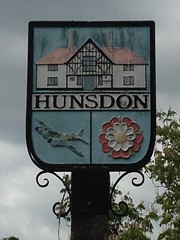
RAF Hunsdon Village sign

The Hunsdon Village sign reflects its history and links to the RAF.

Even before Hunsdon was built, it is referenced in some areas that the site was being used for a detachment of 107 Squadron Blenheims, then based at RAF Wattisham and later Leuchars. This may have been part of the ‘Scatter’ directive given to squadrons in the immediate period before war was officially declared, and was thought to occur between May 1939 and March 1941.  However, there are no references to this in the official squadron files and so this action is doubted. However, if this were the case, then it would certainly suggest an early use of the site before it was developed into a fully operational airfield, and it may have been an indication that an airfield was on its way in the near future.

The site was earmarked for development in 1940, with construction occurring over the period October 1940 to March 1941, after which the first squadron moved in. It was built by various construction companies and incorporated two asphalt runways; the main running east-west reaching 1,750 yards in length after its later extension, with a second running north-east to south-west  extended to 1,450 yards; both were built to the standard 50 yard width. Aircraft dispersals, maintenance and storage buildings consisted of eighteen ‘twin-engined’ hardstands; sixteen blister hangars (a mix of ‘Over’ (4) and  ‘Extra Over’ (12)) and a Bellman hangar. There was also a fuel dump and accommodation buildings for up to 2,240 airmen and some 276 WAAFs, all located across eight dispersed sites.

A large number of operational units, (in excess of twenty-five) would pass through its doors throughout its relatively short life, providing Hunsdon with a multinational mixture of crews and a number of aircraft types.

The airfield itself lies within a stone’s throw of London and so its initial role was that of night fighter operations covering London and the south / east area.

The first recognised squadron to make its mark at Hunsdon was 85 Squadron on May 3rd 1941, transferring across from RAF Debden flying Defiants and Havoc MK.Is. The move across on the 3rd went smoothly with personnel and equipment being transferred across in lorries and 32 seat busses, the majority of personnel arriving later that day.

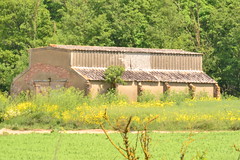
RAF Hunsdon Parachute store

The Parachute store now holds farm machinery.

On arrival at Hunsdon, personnel of ‘A’ Flight were immediately billeted on the aerodrome close to their dispersals, whilst those of ‘B’ Flight were housed on Number 2 Site, located about a mile or so from the main airfield area. Personnel of both the Headquarters Flight and the servicing Echelon were billeted even further away, about four miles in fact, at Gilstone Park. The officers meanwhile, had the better accommodation, being billeted in a house called ‘Boningtons’ believed to be the former home of “Mr. Brooke Bond” the family of the P.G. Tea empire. It is thought that the family purchased the house in 1940, moving out of their London residency to avoid the blitz. Unfortunately, it was rather a short lived purchase as the property was requisitioned by the RAF not long after!

By the end of the 4th, all 85 Sqn personnel were in and unpacked at Hunsdon, and so night flying duties could commence straight away with patrols taking place over the Felixstowe area. Immediately, a Heinkel He.111 was vectored onto, and a skirmish took place in which both aircraft both gave and received machine gun fire. The Luftwaffe bomber came off worst though, and was last seen diving into cloud firing a white verey pistol, either as a resignation of the fight or possibly as a distress signal to any would be rescuers.

Over the next few nights further contacts were made and several Ju. 88s were either confirmed or claimed as shot down. The squadron was performing well, morale was high and all was looking good.

The night of the 13th could have been different for some though. On his return from a patrol, Fly. Off. Hemingway’s instruments failed and with little choice, he gave the order to bale out. After his operator, Sgt. Bailey, had departed the Havoc, Hemingway followed, both men landing in close proximity to each other in the grounds of Much Hadam Hall (a grade 1 listed building built in the early 1700s). Whilst both airmen were safe, Hemingway’s was not the model jump, as he came to rest in a tree in the grounds of the hall. Bailey fared little better, landing rather ungainly on a bucket not too far away. This was Hemingway’s third successful bale out of a stricken aircraft, his previous two both occurring during the Battle of Britain.

On May 17th, Wg. Cdr. Peter Townsend, now with a DSO, flew to Great Massingham, Flt. Lt. Marshall flew to Odiham to test the runway and Flt. Lt. Rabone flew to Heston from where he collected a special and secret Havoc which was to be tested by the squadron. The first flight of this new variant occurred on May 23rd, and was quickly followed by a second aircraft on the 28th, After this, they would then begin testing both aircraft as a new night flying platform.

This particular type of aircraft was the forerunner of what became known as the Turbinlite Havoc, a new design that was the brainchild of one Sidney Cotton.*3

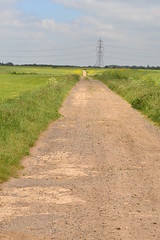
RAF Hunsdon Runway remains

The main runway has been reduced to a track.

With the help of William Helmore, Cotton took out two patents; GB 574970 and GB 574118, each one relating to this new idea. It would be Helmore (an Air Commodore) who would then develop the idea further turning it into what would become commonly known as the Turbinlite system.

Originally designated Air Target Illumination, Cotton’s idea was passed to the Alan Muntz Company, who in conjunction with G.E.C., developed it into what was at the time, the most powerful searchlight in the world, and one that would fit neatly into the nose of a Douglas Havoc, or Boston as it was known in the RAF.

The light was so powerful that it would require a staggering forty-eight batteries each stored in the bomb bay of the aircraft, adding an additional weight to the aircraft just short of 2,000lbs. The light was so strong (1,400 amps) that it would discharge in less than 12 seconds meaning its use was limited to short searches only.

Havoc Mark I (Turbinlite), AW400, on the ground at Burtonwood, Lancashire. This aircraft served with Nos. 1422 and 1454 (Turbinlite) Flights, and with 1459 (Turbinlite) Flight/538 Squadron RAF, before transfer to the USAAF in April 1943. (© IWM ATP 10654C)

The first full prototype Turbinlite aircraft fitted with the unit was Boston W8254 and was flown by Acting Squadron Leader A. Clouston of 1422 (Night Fighter) Flight formed at Heston on May 12th 1941. The Flight would then operate a number of these aircraft, along with several other types which included the only Turbinlite Mosquito; along with a Defiant, Wellington and Hurricane.

Heston was the home of Airwork, an aviation company set up by two ex-Cambridge students and soldiers of the great war, Sir Henry Nigel Norman and Alan Muntz.  Their vision, was to create the best aerodrome near London, a dream that would cost Norman his life and Muntz to lose his son. Airwork would go through many changes during its life, taking on several Government contracts including a range of flying schools to train RAF pilots throughout the Second World War. These included RAF Digby, RAF Grangemouth, RAF Scone (Perth) and RAF Linton-on-Ouse.

Airwork would themselves modify a further four Bostons, with a further sixteen being modified by the Heston Aircraft Company. A third batch was then developed at RAF Burtonwood, giving a total of nine flights for training and ten operational squadrons comprising just short of 100 aircraft in all.

It was soon realised however, that the Bostons lacked firepower and so the company began to look at the Mosquito as a possible replacement aircraft. Only one Mosquito was modified (W4087, a Hatfield built F.II) at Heston, but this idea, unlike the Boston, failed to progress any further than the prototype stage, and no other aircraft were converted.

The Only Mosquito converted to carry the Turbinlite.*5

The Turbinlite project quickly gained pace, but the units wouldn’t be raised to squadron status until September of the following year. In preparation, ten special Havoc flights were created to train crews to operate the aircraft. The first of two, formed at Hunsdon (and the first of the ten) was 1451 (Fighter) Flight on May 22nd 1941. The Flight used several examples that included both Boston IIIs (AL469 and Z2280) and Havoc Is (AE470 and AW405). It also utilised a Cygnet and Tiger Moth for pilot training. By the end of the month, 85 Sqn had flown a total of 505 hours, 482 of them undertaken in Havocs, with 213 of these being on night flights.

On August 9th 1941, 85 Sqn were joined here at Hunsdon by 3 Sqn, one of the original three squadrons to have been formed by the Royal Flying Corp. Created on May 13th 1912, when the Air Battalion of the Royal Engineers was absorbed in to the month old Royal Flying Corps, 3 Sqn joined both 1 and 2 Squadrons as the oldest units to have operated in the RFC. As such, its history is long and very distinguished.

In Part 2 we see how the Turbinlite develops, and how, as the war goes on, the first of Mosquitoes arrive.

The full story of RAF Hunsdon can be read in Trail 25.

RAF Sculthorpe – The Cold War continues but the end is in sight (4)

In Part 3, Sculthorpe had undertaken reconnaissance flights over Soviet territory risking all out war with the Russians. New bombers were arriving and Sculthorpe had reached its heyday. As the Cold War continued, new aircraft would arrive and mistakes will happen.

Mid 1955 would then see a change leadership at Sculthorpe with the departure of the Station Commander Colonel M. Jones, himself a veteran of the famous Tokyo raid led by General Doolittle. He would be replaced, in time, by another veteran, the former commander of RAF Attlebridge, Brigadier General Joseph Holzapple.

It was during this same year that a further and more serious disaster would strike at the heart of Sculthorpe personnel, when on the 9th December, an F-84F (#52-6692)  of the 55th Fighter-Bomber Sqn/20th Fighter-Bomber Wing,  was flying from Sculthorpe on an instrument training flight. Whilst over the Derbyshire countryside the aircraft flown by Lieutenant Roy Evans, a 24 year old from Polaski, Tennessee, ran low on fuel and suffered an engine flame out. After several attempts to relight the engine, Evans decided it was time to eject as the aircraft was losing height. The tower at RAF Burtonwood, could hear the pilot but he could not hear them, as he informed them that he was leaving the aircraft. At the time of the ejection the jet was said to be at about 2,500 ft and losing height rapidly.

Evans ejected, landing on the moors east of Hathersage injuring his ankle in the process. The aircraft meanwhile, hit the ground at around 300 miles per hour, some six miles away at Lodge Moor Hospital in Sheffield. The Thunderstreak  struck the roof of Ward ‘North Two’ ploughing through Ward ‘North One’ before eventually coming to rest in two parts by the garage and mortuary. One person inside the hospital was killed whilst seven others received minor injuries and shock*8.

One version of The Daily Mirror of 10th December, led with the story with the headline “Pilotless Jet Crashes on Hospital“, and gives details of the incident which could have been much worse as the jet narrowly missed a huge petrol storage tank and ambulance station. Whilst Lieutenant Evans survived this incident, he would later lose his life in another accident this time involving a reconnaissance version of the F-84 the ‘Thunderflash’ (#52-7349) on 21st August 1958 in Morocco.

Throughout the closing years of the 1950s, Sculthorpe and the 47th remained at the forefront of the nuclear tactical force. But changes were coming and already the move toward nuclear missile delivery systems was happening. The Tornado was becoming old and outdated yet it remained as the main aircraft with the USAF in Europe. The RB-66A ‘Destroyer’, a Douglas built all weather reconnaissance aircraft was being developed at this time, and would soon be delivered as a direct replacement for the Tornado. The RB-45s had performed well, but their record was not flawless either, a matter borne out in 1953 when between March 9th and 13th May, there were five incidents due to engine fires in RB-45As. In all there were thirty-seven serious mishaps including seven serious engine fires which marred the B-45’s record at Sculthorpe, some of which had resulted in fatalities*9.

File:Douglas RB-66B 54-506 19 TRS Scul BWD 18.05.57 edited-2.jpg

Douglas RB-66B #54-506 Between 1957 and 1959; it flew with the 19th TRS (66th TRW) (wikipedia)

Advances in in-flight refuelling were also made their presence felt. At Sculthorpe three KB-50 tankers joined the KB-29s of the 420th Air Refuelling Squadron bringing the advancement of three point refuelling replacing the single boom as used previously. The change would not be smooth though as on February 2nd 1957, two of the Sculthorpe aircraft collided in poor weather near Morigny, twenty miles from Saint-Lo (Manche), Normandy, thirteen crewmen were killed as a result of the crash.

The arrival of the RB-66A  ‘Destroyer’ in early 1958 was quite a step forward for the crews at Sculthorpe. Training and conversion courses became a priority, and the aircraft was generally liked by those who flew it.

The thought of nuclear weapons being stored locally raised a number of issues. People were naturally concerned about the security and safety of such weapons being located on such an important airbase, and in particular what the consequences of any accidents would be. Their fears were fuelled in 1958 when a weapons technician suffering from mental illness, locked himself in an atomic ‘bunker’ with a pistol for some eight hours.

The US authorities naturally played down the event, not quite reaching the point of denying it ever happened, but local people connected with the base, knew better. The base was put into ‘lock down’ and all staff were confined to quarters. Eventually the crisis was aired in the Commons, but reassurances from the American authorities did little to alleviate the worries of the local people.

By the summer of 1958, the B-45s’ days had finally come to a close and they were replaced by the B-66. But the introduction of any new aircraft can be difficult and the B-66 was no different.

One of the first incidents to befall the type at Sculthorpe was on April 14th 1958, when B-66 #54-0422 of the 19th TRS crashed on approach to Sculthorpe whilst attempting a blind landing. The weather at the time was good, but the aircraft was under instruction from the tower and so operating in ‘blind’ conditions. In the accident, which occurred just four miles from the airfield, all three crewmen were sadly killed.

In other cases, a number of aircrew found themselves without hydraulic fluid due to leaks in the undercarriage system. Unable to lower them by hand, they were faced with a difficult decision, and it would not be long before the first such incident would take place.

On July 3rd 1958, RB-66B #54-433 of the 19th TRS, was approaching Sculthorpe after having ‘gone around’, and was unable to lower the port landing gear. Both the starboard and nose wheels were down but the crew were unable to release the port. Deciding to eject from the aircraft, they set the autopilot to take the aircraft out to sea and then ejected.

Unfortunately, and for whatever reason, the aircraft flew in large circles until running out of fuel some twenty-six minutes later crashing just short of thirty miles from the airfield. There were no injuries in the accident but it would be one of several similar incidents to befall the model.

In all though, the B-66 at Sculthorpe only suffered four fatal accidents during its time in Britain, a rather more favourable record than that of its predecessor*9.

Long range operations of the 47th BW were gradually taken over by other branches of the US Strategic Air Command (SAC), reaching such a point that inevitably, the 47th’s services were no longer required. On June 22nd, 1962 they were officially disbanded and staff posted elsewhere. The designation was removed from the US military inventory and their remarkable achievements condemned to the history books. Cold War tactics now changing with long range bombing being replaced with more short range tactical aircraft and missiles.

Their departure left just two units at Sculthorpe, the 420th refuelling squadron and a detachment of a weather squadron with a handful of WB-50Ds. Any possibility of a nuclear air strike from Sculthorpe was now completely eliminated.

After this, political talks and imposed de-escalation strategies between the Cold War factions, prevented further deployment of large-scale US bombers on European soil, and so further deployments on this scale would not be seen again in the UK.

Gradually, as nuclear deterrents turned to both missiles and naval based platforms, Sculthorpe’s activity began to slow. Speculation then grew as to the future of the airfield. As early as 1961 it was suggested that there was truth in the reports and that the airfield would close in the near future, a rumour that came as a blow for the locals who had developed good relationships with the Americans.

A year later the announcement was made that it would close, and a gradual run down began. The bitter-sweet pill was made worse by the announcement that the US were also ‘phasing down’ Alconbury and Chelveston, whilst also closing RAF Bruntingthorpe in Leicestershire, all ex-wartime airfields extended by the US in the Cold War.

A possible reprieve due to the Cuban Missiles crises led to nothing, and the gradual wind down continued. By March 1964, the number of US personnel on the base stood at around 1,700 plus their dependants, a few civilians and Air Ministry employees*7. The 420th then with their outdated KB-50s also departed, and with no staff to administer, the admin and support group (7375th Combat Support Group) was also disbanded. There would be no more operational units to serve at Sculthorpe.

Then the base was returned to RAF ownership, and quickly placed into care and maintenance once more, held open by only a small detachment of support staff. Sections of the site were then sold off and preparations made for the disposal of the rest of the airfield. Some of the housing was retained however, for use by staff at various other airfields locally, primarily West Raynham and Marham.

For two years the base languished. The usual vandalism and stripping of any useful materials took its toll and the the base quickly fell into disrepair. However, all was not yet lost, two years after its closure in 1966, Sculthorpe saw yet another reprieve, when the USAF returned once more after being given their marching orders by the French. The base would act as both a storage facility and a support airfield for the American units at RAF Lakenheath, but the extensive damage was going to take time to repair and cost a considerable amount of money.

Grand ideas for the future of the base were put forward, even using it to test Concorde, the Anglo-French Supersonic airliner that would eventually end its days following a tragic crash in France. But none of these ideas materialised and Sculthorpe remained a standby base used for dispersing aircraft from other airfields.

This reprieve lasted for the next twenty years, but with minimal staffing and no operational units, it was a shadow of its former self. This change of luck did however, temporarily bring new life back to the airfield, with American F-4 Phantoms, C-130s, Galaxys and A-7 Corsairs appearing regularly. The RAF, needing a similar facility for RAF Bolthole operations (used when other airfield runways were resurfaced) also used Sculthorpe as a temporary base; Coltishall for example, basing their Jaguars here temporarily. As a storage facility it would also be used to store and convert foreign aircraft, F-100s, F-104 ‘Starfighters’ and T-33s from air forces overseas. French Mysteres and North American Sabres were also brought here for scrapping and disposal, first bids going to local museums, a process that went on well into the late 1980s. Sculthorpe became a mecca for plane spotters for at least another few years.

Eventually, with the Cold War ending, all this too ceased and in October 1992, Sculthorpe was officially closed, and the remaining handful of staff were posted out elsewhere.

Airmens huts

‘Hut 380’, a Second World War remnant- the former chapel which was restored in 2023 and occupied by the new Heritage centre.

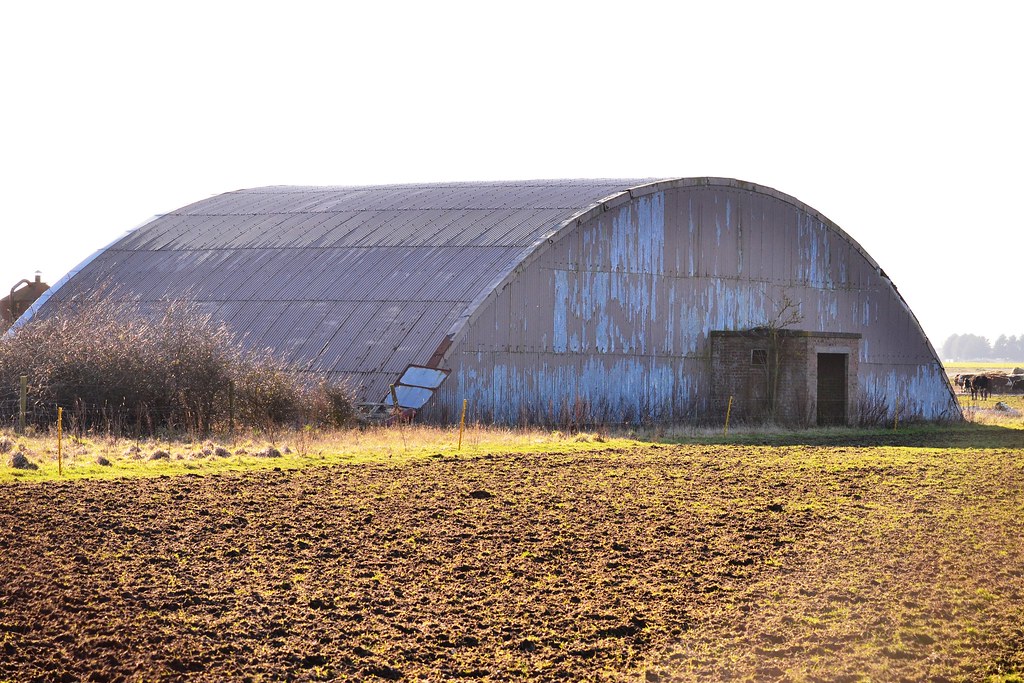
The enormous accommodation blocks and technical sites were sold off, but these and many of the remaining buildings were left to decay whilst planners gave thought as to what they should be used for. In 2008, the four T2 hangars were demolished, along with eight blister hangars, leaving just one remaining on the east side of the airfield. However, like a phoenix, Sculthorpe returned from the dead yet again, this time part of the enormous STANTA training area, with the RAF, the Army Air Corps and the USAF using it for manoeuvres, seeing such diverse models as the V-22 Osprey tilt wing aircraft using it for paratroops and rehearsals of supply drops over its enormous runways; much of this activity taking place at night. Even up until recently, C-130s had also been seen operating over here, again rehearsing quick ‘stop-‘n’-go’ drops, something that continues in part to this day.

The rise in ‘Soviet Aggression’ and post conflict tensions during the Cold War had secured the immediate post-war future of Sculthorpe. Not only were atomic weapons stored here ready, but a wide range of US aircraft that would otherwise not have been seen on British soil, were also based here. The demise of world peace had been the saviour of Sculthorpe’s future.

Looking at Sculthorpe, it is hard to believe its origins were in the Second World War. Being a real monster of the Cold War, Sculthorpe is clinging on by the skin of its teeth. The accommodation blocks that once housed 10,000 personnel have decayed and are severely vandalised, refurbished areas are now sold off and accommodating local families. A small industrial area has been developed from the technical area, and the local farmer grazes his cattle on the far reaches of the site. Many of the older original buildings have been left to rot and fall down. The MOD still retain ownership of the main part of the site, with a large part of the ancillary areas in private hands, such ownership does prevent some access but a good deal of the site is visible from permissible points.

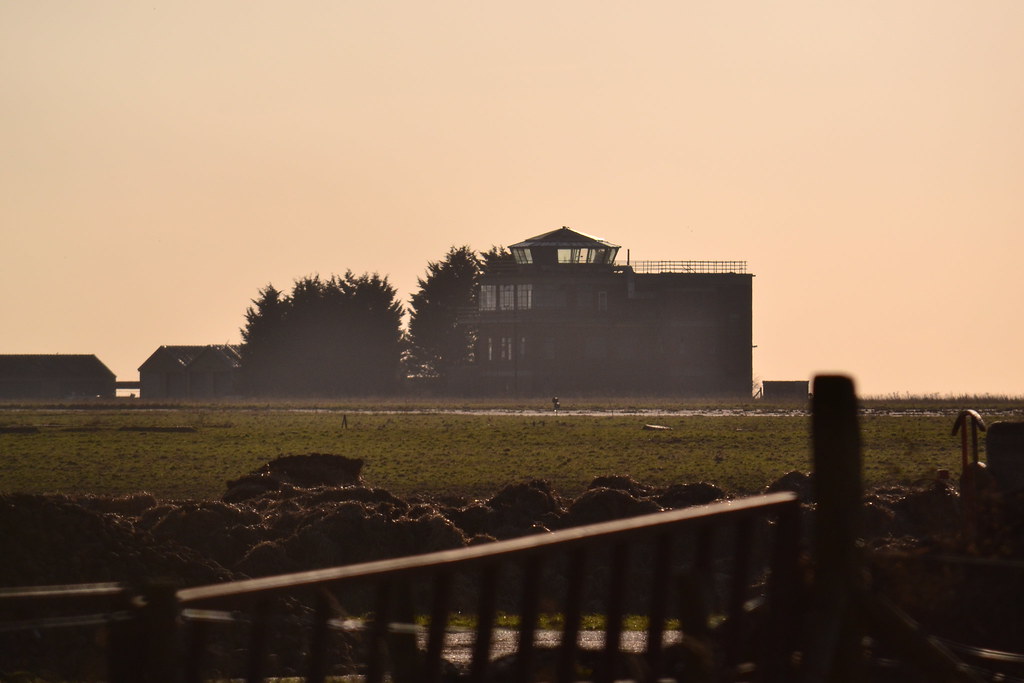
The original guard-house is no longer manned, and a number of other buildings close by are also empty. A small public track that once took eager plane spotters to the rear of the airfield, still allows views across the north of the now quiet site where a blister hangar continues to stand alone. The control tower that was visible in the distance from this point was demolished with little or no warning in 2022, and a number of original Nissan huts and Second World War buildings still remain hiding amongst new buildings and old developments.

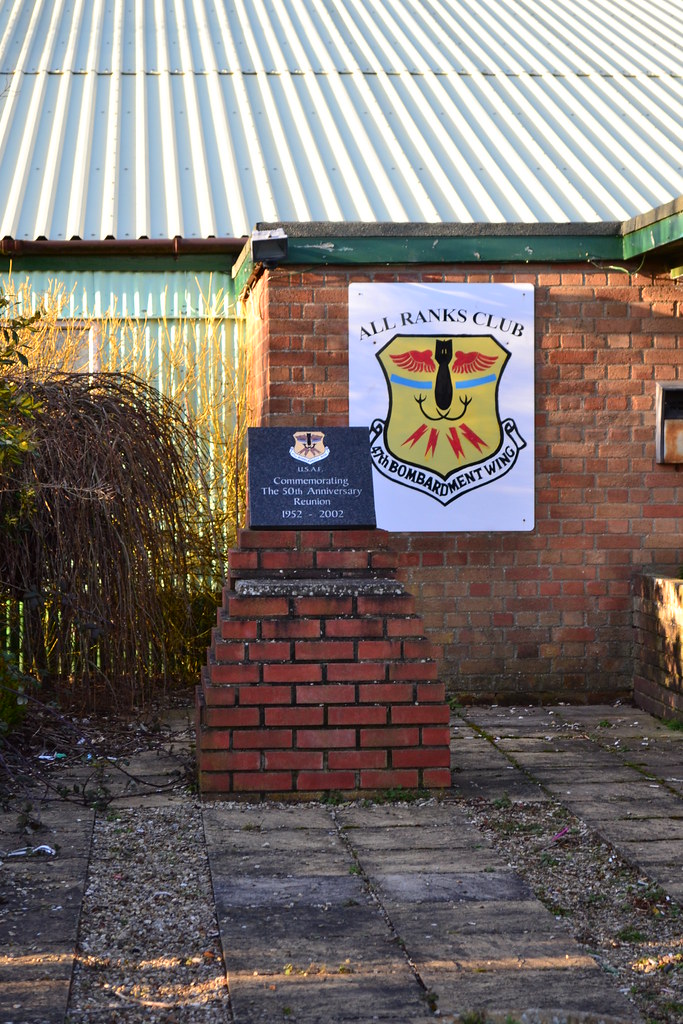
Reunion 'memorial'

In remembrance of the 47th BW, 50th anniversary reunion, 2002.

The post war ‘All Ranks Club’ housed a small exhibition of artefacts and information about Sculthorpe, depicting its post war life, and includes many interesting photos. The exhibition is open at certain times throughout the year allowing visitors to view them and talk to the volunteers some of whom actually served here at the base. In 2023/24, the Heritage Centre moved into the former Chapel after the staff refurbished the premises. The previous accommodation being returned to the public as a club house, its original purpose.

In 2022, a memorial was finally erected by the Airfields of Britain Conservation Trust outside the former main gate, and the original airfield sign was returned to the Heritage centre making its last journey home again.

The original name board returned to Sculthorpe 2023.

The original airfield sign had come back to Sculthorpe.

Sculthorpe was once a bustling airfield, it was home to some of the world’s heaviest bombers, and a mecca for aviation enthusiasts and plane spotters alike. Today, it is a decaying industrial site, a mix of old buildings and new developments; a remnant of the Cold War, it clings on to life by the skin of its teeth, maybe, just maybe, the Phoenix will rise up once more and spring into life once again.

The full story can be read in Trail 21.

Sources and further information (Sculthorpe).

*1 National Archives – AIR 27/1924/17

*2 Gunn, P.B., “Flying Lives – with a Norfolk Theme“, Peter Gunn, 2010

*3, *5 Cahill, W. “The Unseen Fight: USAAF radio counter-measure operations in Europe, 1943 to 1945” Journal of Aeronautical History Paper, 2020/06

*4 21 Sqn ORB Summary of Events 1943 Oct 01 – 1943 Nov 30, AIR 27/264/19

*5 Cahill, W., “The Unseen Fight: USAAF radio counter-measure operations in
Europe, 1943 to 1945” Journal of Aeronautical History, Paper 2020/06

*6 The Spyflight Website which gives considerable detail into the flights.

*7 Gunn., P. “Sculthorpe – Secrecy and Stealth, A Norfolk Airfield in the Cold War.” The History Press, 2014. (An excellent and well researched book that tells the in-depth story of Sculthorpe and the lives of those connected with it. A definite read for those wanting to know more).

*8 Aviation Safety Network Website.

*9 Davies, P. “B/EB-66 Destroyer Units in Combat” Osprey Publishing. 2021

Thirsk, I., “de Havilland Mosquito – an Illustrated Story Vol 2” 2006, Crecy Publishing Limited

National Archives: AIR 27/1924/19; AIR 27/1935/19; AIR 27/1326

Photos of Sculthorpe in its heyday can be seen on the Sculthorpe  Air Base website.

Further information and personal stories can be found on the 214 (Federated Malay States) Squadron website.

RAF Sculthorpe – The age of the Jet Bomber (3)

In Part 2, the war finally came to an end and Sculthorpe closed only to be reopened as a Very Heavy Bomber Base. Reconstruction has taken a number of years and although not fully ready, it starts to accept its new residents.

The first of the aircraft, two of Boeing’s huge B-29s, touched down at Sculthorpe on the 7th February 1949 late in the afternoon. However, six others also deployed to Sculthorpe, had to divert to RAF Lyneham due to the pilots not being able to see the runway in the bad weather. These aircraft would not arrive in Norfolk until later on, and so it was not to be the grand opening that many had wished for.

The deployment of US heavy bombers was seen by some as an extension of the US, and that Britain was becoming a ‘puppet’ of the US Government. The British Government try to make it clear to the public that this was not the case, and that these aircraft were only here on a temporary basis (90 day rotations), and that they were both ‘invited ‘ and did not have a nuclear capability. The Press on the other hand, did not see it quite so clearly.

It didn’t take long before the US 92nd Bomb Group were established at Sculthorpe. A veteran group of the Second World War, the 92nd had a prestigious history and one they would preserve and build upon. Formed of three squadrons, 325th BS, 326th BS and 327th BS, their numbers would swell staffing levels to almost 1,400, including both RAF and US personnel.

Various officials attended Sculthorpe’s many opening events, but the start of a new era was marred by a tragic mishap in late February, when an armourer,  Corporal Turcell, was killed when one of the B-29’s guns he was cleaning  accidentally discharged. It would unfortunately be the first of many tragedies to befall those at Sculthorpe over the coming years.*7

In March the airfield was officially opened with both the Union Flag and the Stars and Stripes being raised simultaneously. Behind the scenes however, construction work continued, with only half of the proposed six ‘Z’ blocks ready to take new residents and only sixty-two of the proposed married quarters being completed, it was far from ready.

Technical site buildings

A large part of Sculthorpe has been left to rot, piece by piece. These are the former RAF HQ and later the USAF Wing HQ.

The work carried on throughout the initial deployment and 90 days quickly passed. The 92nd’s placement at Sculthorpe soon came to an end and no sooner had they arrived then they began their journey back home to the United States. A relatively uneventful opening had come to a close.

The next of the rotations would take little time in coming. The intensity of each deployment getting greater each time, and even though the Berlin Blockade had come to an end, tensions remained very high right across Europe.

As the 92nd pulled out, a further three squadrons of B-29s began to arrive. Having already been in Japan, the three units the 343rd, 344th and 345th BS began by carrying out a number of exercises with the RAF, which included over June and July, the first multinational exercise code named “Foil“. Like many that would follow, this involved mock attacks by US and RAF bombers whilst fighters from the UK, US and Netherlands attempted to intercept them using camera guns. A successful exercise it gave rise to some interesting comparisons between the US and RAF aircraft, with many surprises in store.

As with the first deployment, the arrival of the B-29s did not all go to plan though, as on July 21st 1949, whilst transferring across from the US, one of them #44-62191 ‘suffered problems’ when its number 3 engine caught fire causing it to crash in an orchard at West Walton, 2 miles east of Wisbech in Cambridgeshire. The aircraft, a Boeing B-29A-65-BN, had a crew of twelve on board, and when it became clear that they were not going to make it, they  decided to abandon the aircraft and leave it to its fate.

All twelve of the crew successfully departed the aircraft landing nearby, but in doing so, two of them sustained serious, but not thought to have been life threatening injuries after exiting. The worst, suffered by the pilot, was a possible fractured skull whilst a second crewman suffered a fractured leg; it is believed both airmen made full recoveries. The aircraft itself ultimately crashed, landing in a field east of the small Fenland market town. The remains were quickly retrieved and some parts ended up in the local Fenland and West Norfolk Aviation Museum located in Wisbech. Now sadly closed, they were transferred to the Sculthorpe Heritage Centre located at Sculthorpe.

The 90 day rotations continued unabated. The next deployment bringing two different models; firstly the 63rd BS (43rd BG) with the extended B-29 the B50A ‘Stratobomber’ along with three refuelling aircraft the KB-29M, also a modified version of the B-29 with its turrets removed and refuelling facilities added.

What was perhaps more significant with this move was that the B-29 ‘Lucky Lady II‘ was part of this group. She and her crew had completed a ninety-four hour flight non-stop around the world, being refuelled four times in the air. This achievement sent out a major message to all those would be aggressors, wherever they may be in the world, that they were not beyond the range of the US heavy bombers.

As 1949 drew to a close, one other unit, 19th BS (22nd BG), would complete its rotation at Sculthorpe replacing the 63rd in November. It too brought another version of the B-29 the RB-29, a reconnaissance version of the heavy bomber. In support of this, a further unit would arrive in December, the 23rd Reconnaissance Squadron, bringing yet more versions of the B-29 to the airfield.

Tragedy then struck again in June 1950 when an RB-29A #42-94081, took off on a routine air test and gunnery exercise. During the exercise the outer engine was hit by the aircraft’s own guns setting it on fire. The aircraft was then difficult to  control and the pilot ordered the crew to bale out. As the B-29 hit the sea, three airmen, including the captain were still onboard; he failed to reach the aircraft’s dingy and sadly died as a result. Of the thirteen airmen on board seven lost their lives that day.

Control Tower

The watch office in a setting sun. This was ‘secretly’ demolished at short notice in March 2022.

The east/west crises continued with the war in Korea. The threat of an escalation spilling over into Europe led to a call for all US bases in Europe to be brought to full strength and further sites opened. Sculthorpe began its preparations and as the 301st BG and the 72nd Strategic Reconnaissance Squadron both departed for other UK bases, the site was left ready for the arrival of the 97th Bomb Group  and their B-50Ds.

This move signalled the beginning of a huge influx of men and machinery at Sculthorpe. Anti-aircraft batteries were brought in, along with ground units to defend the site from any possible attack. A range of aircraft support units also arrived boosting staffing considerably. With just over 400 RAF personnel, 1,800 US personnel and in excess of 600 army personnel, the quantity of men and women on the base was now as high as it had been during the Second World War.

With further deployments and new, larger aircraft arriving, not only was the need for further accommodation matched by the need for larger additional hardstands for the new bombers – the B-50 and B-36 ‘Peacemaker’, but the runways had to be extended even further, and an additional 1,200 feet was added calling for yet another diversion of the local road network.

In early 1951, after some friction between the RAF and US staff on the base, Sculthorpe, like both Mildenhall and Lakenheath, was officially handed over to the US forces, and although they all retained their RAF designation, they would be operated and maintained by US personnel; a standard that applies even today. It was a move that finally ensured America had its desired firm and permanent foot hold on UK soil.

The Cold War would then take a more devious turn. The arrival of the 323rd Reconnaissance Squadron (of the 91st Strategic Reconnaissance Wing) began its 90 day rotation with RB-45C ‘Tornados’, a reconnaissance version of the B-45 four engined bomber – the first if its kind to land on British soil. After landing at RAF Manston, the 323rd moved to Sculthorpe, where it would carry out ELINT (Electronic Intelligence Gathering) and mapping operations of western Europe. This intelligence gathering was not new, but since the end of the war, it had become more clandestine and difficult due to the clamp down by the Soviets on western spies.

Sculthorpe had now entered a new world, the Soviets had developed their own atomic bomb, and using a B-29 obtained at the end of the Second World War, reversed engineered it to provide a means by which to deliver it. The West had to find out more, and aerial reconnaissance was the only viable method with which to establish the location and number of such facilities.

There then followed extensive talks between the US and British Governments regarding Soviet ‘overflights’, western aircraft flying through Soviet airspace photographing and recording Soviet ground positions, SAM sites, airfields etc. Whilst not a new tactic, it was certainly a dangerous one, and one that could lead to all out atomic war should it go wrong.

Blister Hangar

Sculthorpe’s last remaining Blister hangar in a low setting sun.

As a result of these talks, the ‘Special Duties Flight Sculthorpe’ was formed, working in conjunction with the various squadrons of the 91st Strategic Reconnaissance Wing. RAF crews consisting of two pilots and a navigator, were flown to America for a period of extensive training on the RB-45. By the end of 1951, the course was complete and they returned to Sculthorpe to continue with further training along side crews of the 91st Wing in Norfolk.

This was a British unit, led by Squadron Leader John Crampton (who replaced the initial choice Sqn. Ldr. Micky Martin of the ‘Dambusters’ fame, as he had failed a high altitude medical examination) and was designed in part, to perform deep penetration flights into Soviet airspace carrying out reconnaissance missions for Britain’s planned ‘V’ Bomber force. It would also supply the Americans with substantial information for their own tactical use.

Four RB-45Cs were converted (including one spare), flown to RAF West Raynham they were stripped of all their American markings (allowing them to deny any knowledge of such activity) before their RAF insignia were applied (The RAF would deny ever having operated these aircraft). They were then returned to Sculthorpe as British aircraft operated by British crews. The flights would be code named Operation ‘Ju-jitsu‘, and would follow the same track that the British ‘V’ bombers would take in the event of all out war.

Initially three routes were chosen, one of which took the aircraft close to Moscow; a second flew to the Baltics and the last to southern Russia. To ‘protect’ crews, they were issued with false papers and maps, and told, if caught, to explain that, rather implausibly, they had simply become incredibly lost! Failure of the mission would therefore require a high degree of gullibility on the part of the Russians.

Only two such flights were ever made, each with three aircraft; the first on 17th/18th April 1952, and the second on 28th/29th April 1954*6.  The first occurred without any Soviet intervention, but they were understandably outraged and an investigation was carried out immediately.

After the first flight, the crews were congratulated by General LeMay, and the unit was then disbanded. However, it was reformed again, also at Sculthorpe, in 1954 (after a second such temporary reformation in September 1952 which was quickly disbanded again) and a second flight was made. This time the Soviets were ready for them. After having evaluated their air defence network they were far better prepared and the RAF crews were at a much greater level of danger than during their initial flights.

Whilst Soviet SAMs (Surface to Air Missiles) were impotent in that they had no guidance system, and it was thought Flak was unable to reach the high flying RB-45s, the trip would still be a dangerous one and strict radio silence was to be maintained by the crews. The flight itself turned out to be relatively uneventful, but Squadron Leader Crampton did witness Flak, and noticing that, whilst generally ineffective, it was indeed exploding at their height. Bursts were sufficiently close to convince the crews on board that a hasty return to the West was the better option, and a halt was called to the flight.

Some time after the operation, it was revealed that Soviet Mig pilots were instructed to ram the RB-45Cs as they had no suitable radar with which to track the intruders. However, no such contact was made and so thankfully the need never arose.

The unit was then again disbanded and all flights by them ceased for good. The consequences and risk of flying over Soviet territory now considered far too high.

1952 was a busy year at Sculthorpe, it went on to see the deployment of the 47th Bomb Wing (formally the 47th BG) of the Strategic Air Command from the United States. This wing consisted of the 84th, 85th, and 86th BS, along with the 420th Refuelling Sqn and the 19th Tactical Reconnaissance Sqn. These units operated a number of aircraft types including both the aforementioned B-45C and RB-45C, along with the B-66, KB-29, and KB-50 aircraft.

The 47th was activated on March 12th 1951, initially as the 47th Bombardment Wing (BW) but with just two squadrons – the 84th and 85th. As a new unit, it had the honour of being not only the first, but the only jet powered medium bomber Wing in the US Air Force. With NATO becoming more established and nuclear weapons arsenals expanding at a great rate of knots, the 47th were posted to Sculthorpe to provide an airborne nuclear strike force in support of NATO forces  who would be operating on the ground in any future conflict.

The B-45 achieved many “firsts.” It was the first US four-engine jet bomber to fly; the first American production jet bomber; the first jet bomber capable of carrying an atomic bomb; and the first multi-jet reconnaissance aircraft to refuel in mid-air. These were based at Sculthorpe between 1952-1958, with the 47th Bomb Wing (Light) along with RB-45Cs from the 19th Tactical Reconnaissance Squadron and Royal Air Force (RAF) Special Duty Flight. These RAF RB-45 crews flew highly classified reconnaissance missions deep into communist territory. (National Museum of the USAF)

A year later, a third squadron would arrive to join the Group, that of the 422nd BS. Within a month or two of its arrival though, the unit was re-designated as the 86th BS a move that brought it in line with its two sister squadrons. For six years the 47th would operate out of Sculthorpe acting as a nuclear support unit for NATO forces in Europe.

The influx of US personnel not only impacted on the immediate and local community, but much further afield as well. In 1953, it cemented strong relations with the people of Norfolk as a whole and in particular those of the coastal town of Hunstanton, when severe floods claimed over 300 lives nationally and 100 locally; some of these were families of those located at the base living in austerity houses near to the seafront.

However, it was more the actions of the personnel at Sculthorpe that led to this unique relationship. When the floods came, staff at Sculthorpe rallied round and attempted rescues of those stranded by the high waters. One such man was 22 year old Airman 2nd Class, Reis Leming of the 67th Air Rescue Squadron, who even as a non-swimmer, braved the freezing waters to rescue no less than twenty-seven people using dinghies from B-29s. His brave and selfless act won him the Soldier’s Medal from the US forces and the British George Medal.

Road sign Hunstanton

Airman 2nd Class, Reis Leming of the 67th Air Rescue Squadron was awarded the George Medal for his brave act on the night of 31st January 1953.

Various other personnel also received awards for their bravery. These included Staff Sergeant Freeman kilpatrick, (George Medal); Airman 1st Class Jimmy Brown  and Technical Sergeant John Germaine (Queen’s Commendation for Brave Conduct); Airman 1st Class Jake Smith (British Empire Medal) and Major Julian Perkinson (Honorary Member of the Order of the British Empire). Both Leming and Kilpatrick have roads in Hunstanton named after them and a plaque dedicated to those who lost their lives stands by the town’s war memorial alongside the Union Flag and the Stars and Stripes*7.

As the 1950s progressed the influx of personnel reached its maximum with some 10,000 personnel being associated with the airfield. The 47th remained the main force located at Sculthorpe but as a division, there would be other, more tactical short range aircraft, also present here. At any time, the 47th could put up between forty and fifty aircraft*7, predominately the B-45, in response to events either in Europe or across the world.

Joint operations continued between the Americans and RAF; including ground forces carrying out training operations ‘attacking’ the airfield to test the defenders in case of war, and training flights assisting gunnery battalions along the north Norfolk coast.

The build up of nuclear weapons also increased, weapon sizes were now more modest although the punch they packed was considerably greater than the original bombs dropped on Hiroshima and Nagasaki. Smaller and faster aircraft could carry these weapons and both were being stored at Sculthorpe. The unfortunate release of this information, soon became media headlines, and quickly became widely known. This plainly identified Sculthorpe as a major site from which any future nuclear attack would come.

The swelling of personnel numbers at Sculthorpe would be further aided by the arrival of the 19th Tactical Reconnaissance Squadron (TRS) and yet more RB-45Cs. Headed by the wartime and Korean veteran Major John Anderson, they would photograph Soviet movements along with installations both along and over the delicate east-west border.

In the final part, Sculthorpe maintains its status as a leading nuclear bomber base, housing US bombers and reconnaissance aircraft on this enormous site. East-West relations deteriorate further but there is hope for the future. In the meantime, bigger and more powerful jet bombers arrive.

The full story can be read in Trail 21.

9th November 1943 – Loss of Stirling LK380 90 Squadron.

A guest post written by Dr. Donough Wilson to whom I owe my thanks for the write up and information about the tragic accident of Stirling LK380 ‘Y’, of 90 Squadron, RAF Tuddenham, 12:30, 9th November 1943, 80 years ago today.

Stirling III “Y” Yorker, 90 Squadron, Wratting Common and Tuddenham, July – November 1943

On Saturday 31 July 1943 a newly qualified crew were ‘posted in’ to ‘C’ Flight, 90 Squadron at RAF Wratting Common, Cambridgeshire. They comprised PO. Robert (Bob) Rodger [Pilot]; PO. Cliff Mitchell [Navigator]; Sgt. Robert (Tug) Wilson [Bomb aimer]; Sgt. Leslie Griffiths [Wireless Operator]; Sgt. Roy Child [Mid-Upper Gunner]; Sgt. Howell Jones [Rear Gunner (Australian)] and Sgt. Ed Daveny [Flight Engineer].

Six days later on the night of 6th/7th August, they completed their first mission, which was mine laying near Ile de Ré, La Rochelle, on the French west coast.

Their third mission on the night of the 23rd/24th August was to Berlin. What is significant about this raid is that they were caught and ‘coned’ by searchlights and then attacked by a JU.88 night fighter. As the crew called out information for Bob Rodger to act on, he threw the Stirling into a series of violent corkscrews in an attempt to evade their pursuer and stop themselves being shot down. This action luckily saved their lives and allowed them to fly again.

Between then and the end of September, further missions were flown to Nuremberg, Munchen Gladbach, Berlin again, Mannheim and Boulogne.

Prior to the second Berlin mission, a photographer from the national newspaper “The Daily Sketch” took a photograph of most of “Y” Yorker’s crew walking to their aircraft. Published on the front page of the newspaper, the caption read: ‘Sunset and zero hour before the great raid on Berlin. One of the crew is just aboard

The photograph depicts from left to right Robert ‘Tug’ Wilson, Roy Child, Leslie Griffiths, Bob Roger, Arthur Stubbs the ground crew chief (nearest camera), Ed Daveny and bringing up the rear Howell Jones. Cliff Mitchell is missing from the photograph*1.

In the squadron records summary for September 1943, Pilot Officer Rodger was by then being listed as the second most experienced surviving pilot in ‘C’ Flight (behind Squadron Leader C. H. Wilson, who would go on to win the DFC and was shot down on 31 March 1944), and on October 1st,  was promoted to Flight Lieutenant.

In early October, they flew missions to Kassell, Frankfurt, and Bremen, it was on the Bremen raid that the crew flew a new aircraft, LK380 “Y” Yorker. After Bremen they carried out some training flights before going on leave. Whilst the crew were away, 90 Squadron moved to RAF Tuddenham.

On Tuesday 9th November 1943, Bob Rodgers, now Flight Commander of ‘C’ Flight,  took the pilot and two gunners of a new crew who were joining ‘C’ Flight, along with his own crew, on a training exercise in LK380 “Y” Yorker.

The task was to teach the new pilot and gunners the techniques of fighter evasion. The exercise would take place over the Shippea Hill area not far from RAF Mildenhall, which was not far outside of the Tuddenham circuit. The crew of “Y” Yorker were, by that time, considered an experienced crew having successfully completed ten missions over enemy territory, and successfully evading both ‘searchlight coning’, and attacking night fighters.

The three additional crew members joining Rodger’s crew for that exercise were Flight Sgt. Lees Smith [pilot], Flight Sgt. Morley Loyst [Mid-upper gunner (Canada)] and Sgt. Gordon Batten [Rear Gunner]. But missing from the flight was Roy Child, who was grounded with a medical condition.

That meant there were nine crew on board the Stirling that day, including British, Australian and Canadian airmen, a truly multinational mix.

They soon met-up with the training Hurricane IV, KW800, of the Air Fighting Development Unit, from RAF Wittering  piloted by Flight Sgt. Ronald Brown (a veteran of Malta with thirty operations under his belt already). Brown had already completed one exercise that day with another 90 Squadron Stirling III, “T” Tommy, On joining with the Hurricane “Y” Yorker’s training quickly began.

“Y” Yorker was observed to be heading south, as if returning to Tuddenham. On approaching the area of the railway line and Shippea Hill level crossing, the Hurricane was seen to dive in a simulated rear attack. It swooped under the belly of the Stirling and then pulled-up into a climbing turn to the right, but unfortunately the pilot misjudged the distance between them, and sliced into the right wing of the Stirling, cutting-off the starboard outer engine along with a four-foot section of wing.

Both aircraft were mortally crippled. Flight Sgt. Brown baled out, but due to the low height he collided with telegraph wires and broke his legs. At 12:30 The Stirling reared up, rolled, and dived into the fen alongside the railway line, 150 yards from the Shippea Hill level crossing on the Mildenhall side. There were no survivors.

The crash site of 90 sqn 'Y' Yorker Shippea Hill

The crash site of 90 Sqn ‘Y’ Yorker. Shippea Hill level crossing is behind the photographer.

Although the bomber quickly sank in the boggy fen, unidentifiable partial remains of three crew were recovered immediately. A fourth body was recovered some days later, and a fifth was recovered in 1944. Four crew remain unaccounted for to this day.

In St. John’s Church, Beck Row, alongside Mildenhall airfield, is a memorial in the form of a recovered propeller blade from “Y” Yorker to the nine crew that lost their lives that day.

The Propeller commemorating 90 Sqn’s “Y” Yorker that crashed 9th November 1943*2.

In the Commonwealth War Graves plot adjacent to the church, amongst the other war dead, are the five graves of the airmen who were recovered from “Y” Yorker, each marked ‘An Unknown Airman, 9th November 1943’.

5 Graves of the crew 90 Sqn 'Y' Torker - unknown airmen

(From front left)The five Graves of the crew 90 Sqn ‘Y’ Yorker – Marked “Unknown airmen”

All of the crew members including those never found, are commemorated on the Royal Air Forces Memorial at Runnymede.

Dr. Donough Wilson

My sincere thanks go to Dr. Wilson for writing the post. I myself tried to get to St. John’s Church but on the day I went it was sadly closed, I shall endeavour to return and locate the propeller.

Sources and additional information.

*1 The photograph was originally taken by, and published in, “The Sketch” newspaper, in 1943, but in the book “Final Flights” (1989) Ian McLachlan (Patrick Stephens publishers), it is credited to the late Jim Munro, secretary of the 90 Squadron Association. On the Wratting Common history website [www.wcnhistory.org.uk] it is credited to Ron Pearson.

*2 Photo from St. John’s Church website

The mission history is from J. Munro’s 90 Squadron history “Sing High” (1989).

RAF Little Staughton – Winner of Two VCs. Part 2

In Part 1, we saw how Little Staughton had developed initialled used by the USAAF as a depot for repairs and refurbishments, and how soon after it was handed back to the RAF and the Bennett’s Pathfinders.

The end of 1944 would be pivotal though, but not the happy celebratory time it should have been, but a solemn and heart rendering time for those stationed here.

On December 23rd 1944, twenty-seven Lancasters along with their three Mosquito reserves, would take off from Little Staughton and their sister airfields at Bourn and Gravely, to be joined by their escorts – three squadrons of Mustangs from 150 Wing, over France. Once out of the English fog and cloud that had harassed the bombers for several days before hand, the aircraft began to jostle for their correct position in the formation. The three formations, each made up of two Flights, A and B, would gradually settle down now able to see each other in the clearer skies above the heavy English cloud.In such a clear sky, it might be ill-considered to think that anything could go drastically wrong – but go wrong it did.

Little Staughton The watch office at Little Staughton is now a listed building.

Assemblies could always be a danger and would be unsettling for any crew. At the back of the six flight formation and unseen to the Little Staughton crews at the front, Graveley’s 35 Sqn’s Flying Officer G.S. Lawson in Lancaster ‘H-How’ (PB683) began closing in on his friend Pilot Officer R. Clarke in ‘F-Freddie’ (PB678). Misjudging the narrow distance between them, Lawson’s aircraft inadvertently made contact with the wing of Clarke’s, sending both aircraft, fully laden with fuel and bombs, spiralling to the icy waters of the English Channel below. As the two Lancasters fell uncontrollably towards Earth, others in the formation could do nothing except watch in horror and prey that chutes would somehow emerge from the two Lancasters. Miraculously, six airmen did manage to escape the stricken bombers before they either broke apart due to the extreme forces exerted upon them, or they hit the water.

A rescue search was mounted immediately. Little Staughton’s reserve pathfinder Mosquito from 105 Sqn, who was sat at the rear of the formation and witnessed everything, remained on station continually radioing the airmen’s positions back to control.  He remained there, watching out, until the launch arrived to begin the arduous task of searching for signs of life. But the icy winter waters of the channel were too much for the badly protected airmen, and although six managed to escape the stricken bombers, all the crew of the launch could do was pull dead bodies from the cold water. Only one crewman was unaccounted for, the body of  Flt.Lt. John Faulkner was some weeks later washed up on the beach at Dieppe. He remains buried there to this day.

Meanwhile, the front two formations consisting of Lancasters from Little Staughton flew on oblivious to the carnage that had occurred behind them. Being an Oboe operation meant that the aircraft had to fly for fifteen minutes straight and level without any deviation from the beam they were following. Hopefully, the predicted cloud over the target would give them some protection from flak and fighters, hence the reason for using Oboe. When they got there however, there was none, just clear bright skies and it was daylight. Ramrod 1415 was about to feel the brunt of the Luftwaffe’s determined pilots.

The first formation had somehow become detached from the second and third, meaning their escort was way behind and having to race to catch-up. With eight minutes to target they were alone, in clear skies and vulnerable.

It was then that the flak began. 88mm and 105mm shells began exploding all around the aircraft, peppering the fuselages like hailstones on a tin can.

Within minutes the gunners had found their mark, and the first aircraft was hit. Mosquito ML998 ‘HS-B’ with 25 year old Flt. Lt. Eric Carpenter, a Canadian, and Fl. Off. William Lambert as navigator, was on fire with both engines out. Moments later, the Mosquito exploded in a massive fireball. Neither airmen would survive and Little Staughton was now one crew down.

With three minutes to go, not only had the flak intensified but fighters had appeared on the scene too. The master bomber, Sqn. Ldr. Robert Palmer in Lancaster PB 371 ‘V’, received hits causing two engines to cut. His Lancaster was now more than ever difficult to fly but on he went fighting the reluctant aircraft every inch of the way. Then further hits badly damaged the Lancaster’s tail forcing the aircraft to turn over and tumble out of the bright German sky.

As the aircraft tumbled over and over, the rear gunner Flt.Sgt. R Yeulatt, another Canadian, manged to escape his turret, more by luck than skill. After his turret was separated from the spiralling Lancaster his body was forced out between the doors by the wind. This incredible escape would be his saviour – he would be the only survivor of the seven man crew.

With all Lancasters receiving intense fire it was going to be carnage – and it was.

Little Staughton One of the original hangars still in use today.

The second Lancaster to fall from the sky was that of American (RCAF) Flt.Lt. Arndt Reif in PB120 ‘P’. Reid’s aircraft was hit by both flak and enemy fighters. Reif himself was badly injured, and so he gave the order to bale out. Only two crewmen, Flt. Sgts MacLennan and Pearce, both Canadians, escaped with their lives, being picked up on the ground and incarcerated by the Germans.

Flt. Lt. R. Hockley in Lancaster PB141 ’60-F’ went down next. With no controls and one wing on fire, he gave the order to jump, and all seven crewmen managed to escape the burning wreck. Six were picked up by the Germans below, the seventh, 24 year old Pilot Officer Ken Hewitt was attacked by murderous civilians and shot several times. Efforts to save him by a local policeman failed and the murder was the subject to a post war criminal investigation, which concluded that the fatal shot came from Hubert Wester, who was later killed on the Eastern front. No other charges were brought against any of those present.

With one Mosquito and three Lancasters now gone, the deaths were stacking up. Fl. Off. R. Terpenning, an Australian, in Lancaster PB558 ‘A’ had by now taken several hits and was flying ‘on the deck’ to try and make his escape. Pounced on by further fighters, time was definitely of the essence.

The Lancaster’s gunners fought bravely to ward off continued determined Luftwaffe attacks. Fuel now streamed from the wing; two engines were out; the top turret had been severely damaged and many controls were out of action, it was a miracle the aircraft was still in the air. Once over Belgium and the relative safety of the allied lines, Terpenning gave the order to bale out, himself being the last to leave. All seven airmen made it safely out of the Lancaster and were back at Little Staughton just four days later.

By now chaos reigned. Communications were bad at best. Only some aircraft received the order to scatter and had done so, others meanwhile received orders to bomb visually and not by Oboe. Some of the formation dispersed, each aircraft beginning its own unscheduled bomb run.

The last of the formation aircraft to come down was that piloted by 22 year old  Flt. Lt. Peter Thomas, in Lancaster PB523 ‘J’. It, like the others, had received substantial hits and was doomed to crash. After battling against persistent fighters and damaged controls, Thomas finally gave the order to bale out. With himself and a wounded Canadian P. Off. Frederick (Tex) Campbell upfront, the remaining crew escaped and the aircraft crashed. In the wreckage still at the controls, was the body of the pilot Flt. Lt. Thomas.

Of those who escaped four became prisoners of war, the fifth, twenty year old Flt. Sgt. Vivian Hobbs was killed after his chute collapsed on the descent.

Of the seventeen Little Staughton 582 Sqn Lancasters that went to Cologne that day, five failed to return along with a Mosquito of 109 Sqn. With a further two Lancasters from Gravely a total of eight aircraft were lost that day, along with all but one of their crews. The operation had been a disaster from the start, and the crews had paid the price.

After the operation Sqn. Ldr. Palmer, who was on his third operational tour and 111th sortie,  was posthumously awarded the Victoria Cross for his determination in continuing on to the target, even though his aircraft was severely damaged. He insisted on flying straight and level to allow Oboe to pinpoint the target. As a result the crew placed their markers precisely on the target allowing those left following to bomb accurately.*3

The full story and VC citation for Sqn Ldr. Palmer, can be read in ‘Heroic Tales‘.

Little Staughton A Robins Aircraft Hangar still in use today.

The return trip to Cologne on New Year’s eve must have filled the crews with dread, however it proved to be uneventful in that all aircraft returned safely and without incident. Although losses were comparatively light for the two units, seventeen aircraft lost from 109 Sqn and around thirty from 582; equating to some 250 airmen in total; it was still a blow to the squadrons and to Little Staughton as a whole.

With a successful and uneventful last operation, the dawn of 1945 must have brought renewed hope for fewer losses and that of a forthcoming allied victory.

The poor weather of the Christmas period however, did little to deter operations over Germany. On 1st January 1945, 582 Sqn were once again in action flying to both Dortmund and Witten. For almost fifteen days crews would be flying operations, training flights or both. It was a gruelling time but losses were low. It wasn’t until the 16th-17th that the first aircraft would go down. Baling out over allied territory all crew apart from the rear gunner, Sgt. McNamara, survived. With 109 Sqn losing only one Mosquito on the 31st – again both airmen returning safely – January had proven light despite the increase in operations.

It was then in February that another Little Staughton airman would earn himself the Victoria Cross, the second for bravery and dedication to duty.

On the night of 23rd-24th  February,  only ten days after the historical attack on Dresden that resulted in a firestorm, 367 Lancasters and 13 Mosquitoes from 1, 6 and 8 Groups were detailed to attack the city of Pforzheim to the north-west of Stuttgart. This would be the only attack on the city and it would prove almost as devastating as Dresden and Hamburg.

The Master Bomber that night was a 582 Squadron Lancaster piloted by the only South African pilot in the Pathfinders, Captain Edwin Swales DFC. In his Lancaster III PB538 ‘N’, were seven other crewmen, including two navigators.

On the run in to the target, the Lancaster was badly hit by night fighters putting one engine and the rear turret guns out of action. Undeterred, Swales continued to perform his role, guiding the following bombers onto the target with the greatest of precision.

Only when he was satisfied that the attack had been carried out did he leave the target area. Now easy prey to more attacks, soon a second engine was put out of action, controls were damaged with some being inoperable. With a reduced speed and difficult flying conditions he headed for the allied lines, and once safely over them, he gave the order to bale out. All those on board made the jump to safety, leaving Swales at the control trying to maintain steady flight. Just as the last man left, the Lancaster gave up the struggle and was reported to hit high tension cables causing it to crash. Captain Swales was still at the controls when it was found later on.

The attack on Pforzheim  was considered to be very accurate, with over 1,800 bombs having been dropped in little over twenty minutes. Over 17,000 people were known to have died that night in the raging fire that followed, and a post-war photograph, revealed that 83% of the built up area had been destroyed by the raid*4.

Swales’ VC was awarded posthumously, being the second such award to go to airman of Little Staughton, and the third of only three to the Pathfinders. His citation appeared in the Fifth Supplement to The London Gazette, of Friday, the 20th of April, 1945, and concluded: “Intrepid in the attack, courageous in the face of danger, he did his duty to the last, giving his life that his comrades might live.” His story also appears in ‘Heroic Tales’

The war was by now drawing to its inevitable conclusion, and the end of the Nazi’s reign of terror was near. For Little Staughton crews however, the job was far from over. By now the allies were so close to Germany that Oboe stations and forward operating airfields allowed accurate Oboe bombing of Berlin. On the 8th March 109 Squadron’s history was made with their first Oboe marking of Berlin and Munich; the longest range they ever attempted. Eighteen aircraft were ordered out to four targets, the other two being Dessau and Hamburg, The night was not the most successful though, with technical problems causing issues with a number of Pathfinder aircraft. On the Hamburg raid, four of the six aircraft marked well, one aircraft lost an engine and had to return early, whilst over Berlin, two of the four markers had to return without marking also due to technical issues. The Dessau raid suffered similar technical issues.

By now the war was in its last stages, and the night of 20th-21st April saw yet another pivotal moment in the history of the war, with the RAF’s last attack on the German capital. 109 Sqn were again in action, and it was Mosquito XVI ML929, piloted by F.O. A.C. Austin and F.O. P. Moorhead, who claimed the honour of dropping the last RAF bomb on the city. It was yet another feather in the cap for Little Staughton crews.

Little Staughton One of the original hardstands now has farmers sheds on it.

Other German cities then took the brunt of the Allied attacks. To the south, allied troops were approaching Hitler’s lair at Berchtesgaden,  but the night’s attack in April would not be one to remember, as all Little Staughton’s aircraft suffered technical issues preventing them from marking the target. It is thought that the surrounding mountains had interrupted the Oboe signal leading to poor reception by the Pathfinders. Due to fog and snow, identifying the target was then made more difficult for the following bombers, but with relatively accurate strikes, the raid was considered a success. However, it was not to be the Pathfinder’s final night of glory.

Attention then turned to Manna operations, and 109 began to mark targets in Holland for food parcels. A remarkable effort allowing foodstuffs and urgent supplies to be dropped to starving civilians in Holland.

Whilst bomber command was concentrating on humanitarian flights, 109 Squadron took part in the final raid on Kiel on May 2nd-3rd, with four aircraft taking part. One suffered problems and was unable to mark leaving the remaining three to identify and mark the target.  It was solely a Mosquito attack using aircraft from both 8 and 100 Group, after which large fires were seen rising from several parts of the town. After the last remnants of the German army left, it was declared ‘undefended’ and open, and allied troops entered unopposed just 36 hours later.

With the war’s end, the Pathfinders returned to dropping markers for food supplies, and ‘cooks’ tours began, aircrew taking ground crews on ‘sight-seeing’ trips over Germany to show the extent of the devastation caused by the war and the allied pounding of Germany’s towns and cities. An event that really brought home the effects of the war on Germany.

In September 1945 after much speculation and many staff movements, both squadrons were ordered to disband. 582 was first on the 10th with 109 Squadron soon after on the 30th. A glimmer of hope then came for 109 Sqn, when it was reborn through the renumbering of 627 Sqn at Woodhall Spa. To all intents and purposes though it was a different squadron to the one that had worked so hard and with such dedication here at Little Staughton. The operational record books for 582 Squadron simply states: “No further entry, Squadron disbanded as of 10th September 1945“. On roll were 147 airmen and 92 Officers, six of which were New Zealanders. The records also show that the squadron had dropped over 8,000 tons of bombs cumulatively, while 109 Sqn recorded: “This is the finish, all our aircraft were flown to Upwood today.”

Some 522 raids had been flown by 109 Squadron, covering over a staggering 5,400 sorties, while at either Little Staughton, Wyton or Marham, all with a loss of just 18 aircraft. 582 on the other hand had flown over 2,100 sorties in 165 raids with a loss of 28 Lancasters all whilst based at this little airfield in the Cambridgeshire countryside*4.

Throughout the war, thoughts had never been far away from post war aviation and in particular the development of new, larger and faster aircraft, both military and civil. With it would come the demand for bigger airfields and longer runways, which led to a search for possible extensions to existing airfields.  Farnborough and the RAE (Royal Aircraft Establishment), was the preferred choice, but the site was penned in and unable to have its runway extended to the five miles thought necessary to accommodate new types of aircraft. Alternatives were sought with the final decision being the amalgamation of three airfields: Twinwood Farm, Thurleigh and Little Staughton; a five mile runway linking Thurleigh with Little Staughton which would then be linked by a taxi way with Twinwood Farm. The idea behind the huge development was to replicate the Californian Muroc test facility (now Edwards Air Force Base) to enable testing of new developments in aviation. The idea never materialised though, and would have no doubt faced serious opposition had it ever got to the consultation phase*1.

So, with no real need for Little Staughton it was soon surplus to military requirements, and with their dramatic reduction of assets, its days were sadly numbered.

Following the departure of the two squadrons, the airfield became used as a transport base, before finally closing in December 1945, and being placed into care and maintenance. In the 1950s the runway was given consideration again and work began to extend it for use in emergencies by US military aircraft, but this was also a short lived exercise, and by the end of the decade this too had ceased, and the site was closed to all military activity. For a short while it was used by the civilian Brooklands Aviation company as a repair depot, but was soon returned to farmland although the runway, and some of the perimeter tracks remain, used by a small aviation company along with several of the hangars which are used by light industry.

The Watch Office continues to stand and is now a Grade II listed building, being listed in December 2005 for its ‘special architectural and historic interest’. Historic England describe it as “One of a very small number of control towers of the Second World War period that have survived in a substantially complete state of preservation…This is an exceptionally well-preserved example of a 1941 control tower design for bomber satellite stations, of which 24 out of 45 built survive.”*2

With that, Little Staughton quietly slipped in to the history books. The buildings left standing echoing the hectic activities of two Pathfinder Squadrons, from which over 250 airmen lost their lives.

582 Sqn had been purposefully created for a role, a role it performed to the highest standard and with the greatest pride of any squadron in the RAF. 109 Sqn had performed with the same dedication and determination, meaning that Little Staughton crews were awarded two of the three VCs the Pathfinders earned, the highest honour to be bestowed on any military personnel. In addition to these, numerous other gallantry medals were also awarded to the many crews of both squadrons, a number of whom had flown in excess of 100 sorties whilst based here at Little Staughton.

Little Staughton Remnants of the airfield still exist as farm tracks.

Little Staughton was only operational for a short period of time. But in that time it achieved some of the highest accolades possible in military terms. It brought a great sense of pride to the local area, and a huge influx of men and machinery. Today it stands quiet, just outside of the village which marks its history with a small stone laid close to the end of the main runway. The local church, All Saints, also has a roll of honour commemorating all those personnel who lost their lives here, and a memorial stone close by pays homage to those who served and died in this remarkable place.

The entire story can be read in Trail 29.

Sources and further reading (Little Staughton)
*1 Smith, D., “Britain’s Military Airfields 1939 – 45” Patrick Stephens Limited, 1989
*2 Historic England Website accessed 17/9/23

*3 Much of the report from this comes from a combination of Operational record books and secondary resources including Feast., S., “Heroic Endeavour“, Grub Street Publications, 2006.

*4 Middlebrook, M., Everitt. C., “The Bomber Command War Diaries“, Midland Publishing Ltd, 1996

National Archives Operational Records:

AIR 27/2052/2; AIR 27/2052/1; AIR 27/854/8; AIR 27/854/7; AIR 27/2052/7; AIR 27/2052/8; AIR 27/2052/10; AIR 27/2052/9; AIR 27/855/2; AIR 27/2052/14; AIR 27/2052/13; AIR 27/856/7; AIR 27/856/9; AIR 27/2449/1; AIR 27/2052/27

Downham Market VC Memorial Updated.

The memorial, located outside of Bexwell church, opposite what was the entrance to RAF Downham Market (Bexwell) was updated and officially rededicated on Sunday 8th July 2023.

It commemorates two pilots who were posthumously awarded the VC  both whilst serving at the airfield during the Second World War.

Both Flt. Sgt. Arthur Louis Aaron, (218 Squadron) and Sqn. Ldr. Ian Willoughby Bazalgette (635 Squadron) lost their lives in heroic attempts to save not only their injured crew but also the aircraft in which they were flying. The awards were given posthumously following their deaths, a year apart, on 12th August 1943 and August 4th, 1944 respectively.

Up until now, a small memorial has been on the site commemorating the heroic action of both men, but on Sunday, a new memorial was unveiled which is far more befitting not only of the two men, but all those who served at the airfield during those dark days of World War II.

The memorial, in steel, stands at around six feet in height and shows not only the two VCs but the types of aircraft flown (Stirling, Lancaster and Mosquito) by the six squadrons who operated from RAF Downham Market along with their relative squadron codes.

Each symbol is cut out of the steel which (intentionally or not) allows the sun to shine through casting an image on the ground. The creator, Jonathan Horton, also made a series of steel silhouettes of the different aircraft, these were placed in the ground to appear as if flying toward the memorial.

Downham Market updated memorial

Designer Johnathon Horton with the memorial.

The service opened at 02:30hrs, and was well attended by various military dignitaries from nearby RAF Marham, and the RAAF, also with representatives from the Royal Air Force Association, a local village spokeswomen and members of the community who helped organise the memorial as well as a former Mosquito pilot Flt. Lt. Colin Bell DFC, AE now 102 years old.

Downham Market updated memorial

The new memorial with Station Commander Grp. Cpn. Frederick Wigglesworth (right) and Colin Bell DFC AE (left)

Words of prayer were said by Reverend (Wg CDR) Eddie Wynn, the blessing by Reverend Nigel Moat, words from Grp. Cpn. Frederick Wigglesworth (station Commander RAF Marham) and a bible reading from Air Commodore Steve Thornber CBE RAFR. Sadly a fly past by the BBMF Spitfire didn’t happen.

Two hymns were sung: O God, our help in ages past and The Airman’s hymn,  with the National Anthem closing the ceremony.

The new memorial uses the original memorial rearranged in a new setting and attached to the new memorial rather than on a pedestal as before. The Pathfinder Moto ‘Strike Hard Strike Sure’ is also cut down the flanks of the sheet, further reflecting the work carried at Downham Market.

Downham Market updated memorial

The updated board from the original memorial.

The memorial can be found outside of Bexwell Church opposite what is the former technical area of RAF Downham Market. Grid Reference TF 63142 03460, Post Code PE38 9LZ

The death of the Robson Children, 1st December 1943.

It was on Wednesday 1st December 1943, that a 75 Squadron Stirling MK.III (EH880)  piloted by F/S J. S. Kerr (s/n 1558163) would be diverted from RAF Mepal and instructed to land at RAF Acklington in Northumbria. On the final approach it undershot striking a family home in Togston near Amble. Inside the house, Cliff House Farmhouse, was the Robson family. The five children, ranging in ages from 19 months to 9 years of age, were all killed, whilst the parents who were playing cards downstairs, escaped with varying injuries. All but one of the Stirling’s crew were killed, the mid upper gunner Sgt K Hook, was pulled from the burning wreckage his burning clothes being extinguished by the local butcher, Jim Rowell.

This crash was the greatest civilian loss of life in the district,

The crew of Stirling EH880 ‘AA-J’ were:

F/S George John Stewart Kerr, RAFVR (s/n 1558163) – Pilot.
Sgt. Donald Frank Wort, RAFVR (s/n 1585034) – Navigator.
Sgt. Ronald Smith, RAFVR (s/n 1239376) – Air Bomber.
Sgt. Derek Arthur Holt, RAFVR (s/n 1217087) – Wireless Operator.
Sgt. Leonard George Copsey, RAFVR (s/n 1691471) – Flight Engineer.
Sgt. Kenneth Gordon Hook, RAFVR (s/n 1335989) – Mid Upper Gunner.
Sgt. George William Thomas Lucas, RAFVR (s/n 1250557) – Rear Gunner.

The Robson children were:

Sheila (19 months)
William (3 Years)
Margery (5 Years)
Ethel (7 Years)
Sylvia (9 Years)

The ‘Times’ Newspaper, published the story of 3rd December 1943:

Aircraft Crash on Farmhouse. Family of five young children killed.

Five children – all their family – of Mr and Mrs W. Robson were killed when an Aircraft crashed into Cliff House, a small dairy farm near Amble, Northumberland, on Wednesday night. The children’s ages ranged from one to nine years. They were sleeping in an upstairs room.

The mother and father, who with two friends Mr. and Mrs Rowell of Dilston [Terrace] Amble, were sitting in a downstairs room, were injured but not seriously. One of the crew of the aircraft, a gunner, was saved by Mr. Rowell.

Mr Rowell said last night: “We did not realise what had happened until the house collapsed above our heads. We managed to stand up, bruised and badly dazed, and, looking upward we saw the sky. Mrs Robson tried to make her way towards the stairs, which had been blown away. My wife called my attention to a burning object outside which was moving about.  We rushed over and found it was a gunner with his clothes alight. Mr Rowell rolled the airman on the ground to extinguish the burning clothes. Although badly burned, the gunner was alive.

The children’s partly charred bodies were recovered later.

Five streets on a housing estate near to the crash site in Amble have since been named after each of the Robson children. The crew are remembered on a plaque in St. John the Divine, the official church of RAF Acklington St. John.