In the heart of Norfolk, some 40 miles west of Norwich and 13 miles to the east of King’s Lynn, lies a small, quaint village typical of the English stereotype. Small ponds frequented by a range of ducks, are thought originally to be fish ponds for the 11th century Augustinian Abbey, and the history of the village is believed to go back as far as the 5th Century. Massingham boasts an excellent village pub, and a small shop along with beautiful walks that take you through some of Norfolk’s most beautiful countryside; it has to be one of Norfolk’s greatest visual assets.
Sited above this delight is the former airfield RAF Great Massingham, which during the war years was home to number of light bombers and even for a short while, the four engined heavy, the B-17. In Trail 21, we return to RAF Great Massingham.
RAF Great Massingham
Great Massingham airfield lies in the heart of Norfolk, some 40 miles west of Norwich and 13 miles to the east of King’s Lynn, lies a small, quaint village typical of the English stereotype. Small ponds frequented by a range of ducks, are thought originally to be fish ponds for the 11th century Augustinian Abbey, and the history of the village is believed to go back as far as the 5th Century. Massingham boasts an excellent village pub, and a small shop along with beautiful walks that take you through some of Norfolk’s most beautiful countryside; it has to be one of Norfolk’s greatest visual assets. Sited above this delight is the former airfield RAF Great Massingham, which during the war years was home to number of light bombers and even for a short while, the four engined heavy, the B-17.
Before entering Great Massingham I suggest you stop at Little Massingham and the church of St. Andrew’s. For inside this delightful but small church, is a roll of honour*1 that lists enormous amounts of information about the crews who served at the nearby base. It gives aircraft details, mission dates and crew names amongst others. It is a hugely detailed collection of information covering 1940-45, in which time 600 Massingham crews lost their lives. Seven of these crew members, are buried in the adjacent church yard: Sqn. Ldr. Hugh Lindsaye (18 Sqn), Sgt. John Wilson (RNZAF – 107 Sqn), Sgt. Thomas Poole (107 Sqn), P/O. Arthur Lockwood (107 Sqn), Flt. Sgt. Gordon Relph (107 Sqn), F/O. Charles Ronayne (RAF) and F/O. Joseph Watkins (239 Sqn), all being killed in different circumstances. This is a valuable and enlightening stop off to say the least.

The Roll of Honour in St. Andrew’s Church, Little Massingham.
On leaving the church turn right and you will almost straight away enter the village of Great Massingham. The airfield is to the east behind the village holding the high ground, which makes for a very windy and open site, whilst the village nestled on the lower ground, remains calm and quiet. Built originally as a satellite for the nearby West Raynham, Massingham opened in 1940 with grass runways initially under the command of 2 Group, Bomber Command and then latterly 100 Group, whose headquarters were at Bylaugh Hall. The distance between both RAF West Raynham and RAF Massingham was so small, that crews would cycle from one to the other each morning before operations.
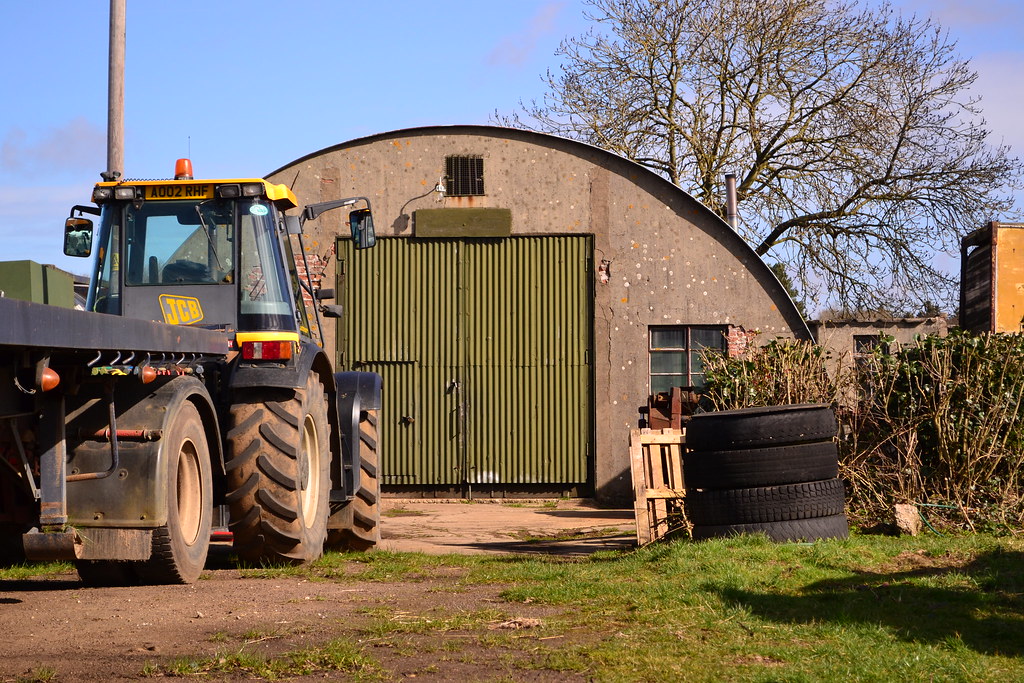
The Officers Mess now a farm building.
There were a total of four T2 hangars and one B1 hangar built on this site. The airfield also had sixteen pan-type hardstands and twenty-one loop-type hardstands, giving a total of thirty-seven dispersal points around its perimeter.
The main accommodation and communal sites which totalled five and two respectively, were near to Little Massingham church, to the west, along with further areas to the south of the airfield . These included a communal area to the south-west of the village and sufficient accommodation for 1,197 men, consisting of Officers, Senior NCOs and ordinary ranks. This was later upgraded to accommodate 1,778 men. In addition, accommodation was provided for the WAAFs of the airfield, 102 in total at the outset. This was also increased in the airfield’s upgrade, taking the total number of WAAFs to 431.
The bomb dump and ammunition stores were well to the north away from the personnel as was standard. A number of anti-aircraft sites were scattered around the perimeter offering good protection from any attacking aircraft.
The first occupants of Massingham were the Blenheim IVs of 18 Sqn RAF who arrived in the September of 1940.
18 Sqn were previously based at West Raynham, making the transition invariably very smooth. In fact, operations barely ceased during the change over, the last West Raynham sortie occurring on 7th September 1940 with a six ship formation attack on the docks and shipping at Dunkirk, and the first Great Massingham sortie on the evening of the 9th to Ostend.
Whilst at Great Massingham, 18 Sqn flew the Blenheim Mk.IV initially on short range bombing sorties to the French coast. All was fairly quiet for the first few weeks, the squadron’s first loss not occurring until November 28th 1940, when Blenheim P6934 crashed after hitting high tension wires west of the airfield. All three of the crew were injured and admitted to hospital, but Sgt. William E. Lusty (S/N: 751633) died from his injuries the following day.
18 Squadron remained at Great Massingham until April the following year (1941), performing in the low-level bombing role. Like most other RAF airfields around this area of Norfolk, it would be dominated by twin-engined aircraft like the Blenheim and its subsequent replacements. As a reminder to those who may have got complacent about the dangers of flying in wartime, the departure of 18 Sqn was marred by the loss of Squadron Leader Hugh Lindsaye (S/N: 40235), who was killed whilst towing a drogue near to Kings Lynn a few miles away. An investigation into the crash revealed that a drogue he was pulling had become separated and fouled the port elevator. The pilot lost control as a result and all three crewmen (SgT. Stone and F/O. Holmes) were killed. Sqn. Ldr. Lindsaye is one of those seven buried in Little Massingham.
Shortly after the departure of 18 Sqn, Massingham took on another Blenheim squadron in the form of 107 Sqn, a move that was coincided with a detachment of B-17 Flying Fortresses of 90 Squadron.
The B-17 (Fortress I) squadron was formed at Watton earlier that month, they moved to West Raynham whereupon they began trials at a number of smaller airfields including Bodney and Massingham, to see if they were suitable for the B-17. These initial tests, which were undertaken by Wing Commander McDougall and Major Walshe, were a series of ‘circuits and bumps’ designed to see if the ground and available runways were suitable. It was decided that Massingham was indeed suitable, and so a decision was made on the 13th, to base the aircraft at Massingham but retain the crews at West Raynham, transport vehicles ferrying them to and from the aircraft on a daily basis. For the next few days further tests were conducted, and engineers from Boeing came over to instruct ground crews on the B-17’s engineering and armaments. Concerns were soon raised by crews about Massingham’s grass runways, and how well they would perform with the heavier four engined B-17’s constantly pounding them.
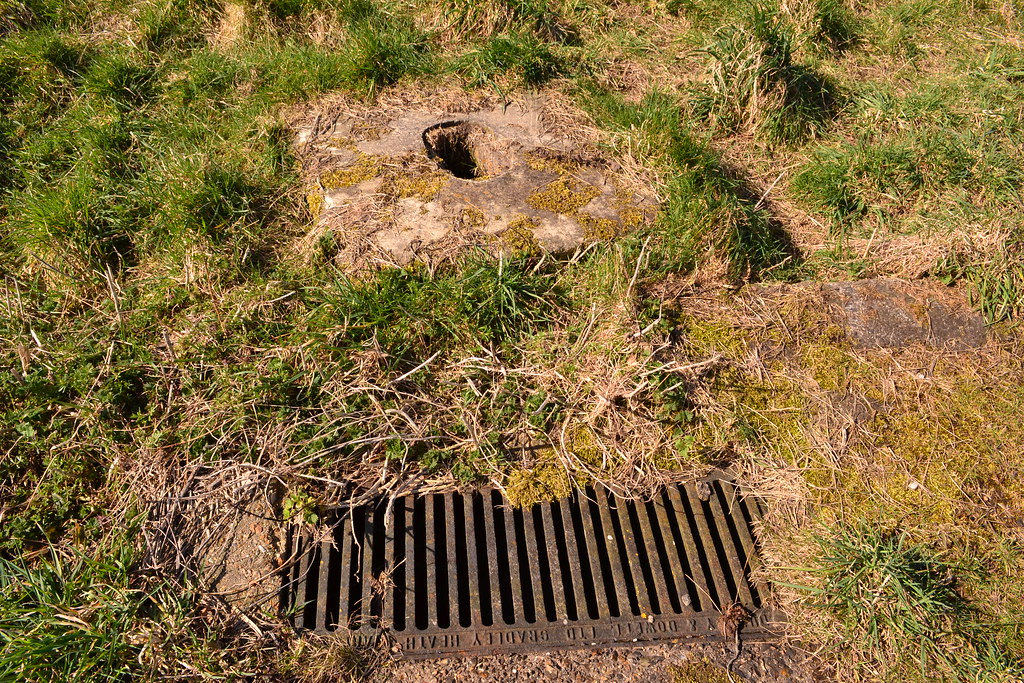
Remains around the perimeter track.
On the 23rd May, H.R.H The King conducted an inspection of Bomber Command aircraft at RAF Abingdon, in Oxfordshire. Amongst the types presented with the RAF bombers was a Fortress I from Massingham. The King, Queen and two Princess’s Elizabeth and Margaret, all attended and took a great interest in the Fortress. The Royal party taking considerable time to view and discuss the heavy bomber’s merits and features.
Back at Massingham, flight tests, training and examinations of the B-17 continued until in June 1941, when 90 Sqn were ordered out of both Massingham and West Raynham, moving to RAF Polebrook in Northamptonshire. But by the October, the Fortress’s had all gone from RAF bomber service, problems with freezing equipment convincing the RAF not to use the heavies in bombing operations.
By February 1942 the unit was disbanded and all its assets were absorbed into 1653 Heavy Conversion Unit (HCU). Within days of 90 Sqn’s arrival at Massingham, another more permanent squadron also arrived, again performing in the same low-level bombing role as their predecessors 18 Sqn. The spring of 1941 saw 2 group perform some of their largest operational sorties to date, with many Blenheims continuing their daylight raids on shipping and docks in north-west Germany.
It was during this hectic time, on May 11th, that 107 Sqn, would arrive at the Norfolk base at Massingham. Being taken off operations on the 10th, the air personnel made their way down from the Scottish base at Leuchars whilst the ground staff travelled by train the following day. A number of crews were posted on detachment to bases at Luqa, Ford and Manston.
After a short settling in period missions began again in earnest with their first twelve ship operation in Bomber Command taking them to Heliogoland on the 13th. Two of these Blenheims returned with engine problems, but the remainder managed to attack the target, in an operation that was considered a great success, with complete surprise being achieved. Flying at very low level was key to this operation, and whilst all aircraft returned home safely, one aircraft piloted by Sgt. Charney, flew so low he managed to strike the sea with his port engine; as a result, the airscrew was damaged and broke away leaving the aircraft flying on just one of its two powerplants!
The end of May was a difficult month for 107. On the 21st they returned to Heligoland, with nine aircraft taking off at 14:00, detailed for a daylight formation attack on the target. With visibility of 12 – 15 miles, they pressed home their attack from as low as fifty feet, in spite of what was an ‘intense and accurate’ flak barrage. Four aircraft were hit by this flak, and in one of them, Sgt. John Wilson (S/N: 40746) was killed when shrapnel struck him in the head. Sgt. Wilson is also one of the seven in the church yard at Little Massingham.*2
On the return flight, a second aircraft also damaged by the flak, had an engine catch fire. The pilot and crew were all lost after ditching in the sea. Fl. Sgt. Douglas J. R. Craig (S/N: 903947) never having being found, whilst two other crewmen (Sgt. Ratcliffe and Sgt. Smith) were seen climbing into their life raft, later being picked up by the Germans and interned as prisoners of war.
On the 23rd the squadron was then detailed to search for shipping off France’s west coast. Due to bad weather, they were unable to make Massingham and had to land at Portsmouth instead. Continued bad weather forced them to stay there until the 27th when they were able at last to return to Massingham. No further operations were then carried out that month.
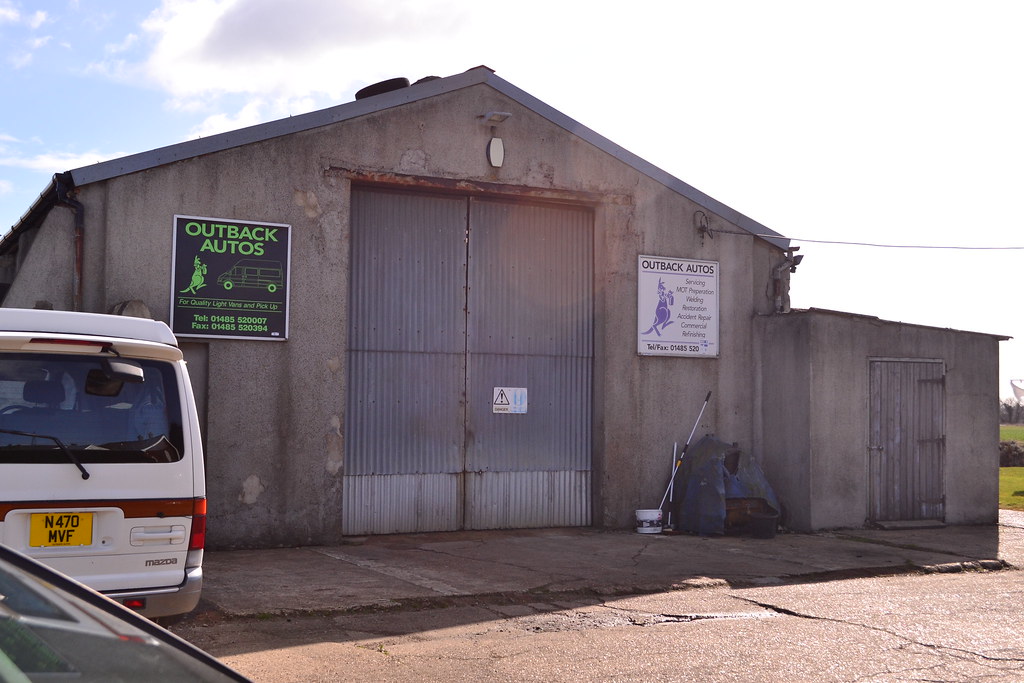
Gymnasium and attached Chancellery now a car repair shop.
The dawn of 1942 saw Bomber Command face its critics. High losses brought into question the viability of these small light aircraft as bombers over enemy territory, a situation that would see 2 Group, as it was, all but removed from operations by the year’s end.
But the end was not quite here, and January of 1942 saw 107 take on the Boston III ( an American built aircraft designated the ‘Havoc’) as a replacement for the now ageing Blenheim. With the new aircraft 107 remained at Massingham, at least until the early August, where they made a short move to Annan before returning to Massingham a mere week later. It would take only a month before the first 107 Sqn Boston would be lost.
Whilst on a training flight, Boston W8319, struggled to join the formation, after turning back, it was seen to fall to the ground, the resultant fireball killing all three crewmen on board.
Despite this, losses over the coming months remained light. With the introduction of US airmen and the 15th Bomb Squadron, June / July saw a number of Massingham aircraft transfer across to the American’s hosts 226 Sqn at Swanton Morley. One of these aircraft, crewed by two US airmen; Captain S. Strachan and Lt. C. Mente, crashed near RAF Molesworth killing both on board.
By the end of 1942, 107 Sqn had lost a total of 23 aircraft on operations, and with each Boston carrying four crewmen it meant losses were increasing for the unit.
In February 1943, the Boston IIIs were replaced by the IIIa model. During May, the whole of 2 Group would begin to transfer across to the 2nd Tactical Air Force (TAF) in preparations for the invasion the following year. Losses had been high for the group, the light bombers being easily cut down by both Luftwaffe fighters and flak.
At the end of August 1943, it was 107 Sqn’s turn and they departed Great Massingham for Hartford Bridge and a new life within the 2nd TAF. It was during these summer months that a Free French unit, 342 Lorraine Squadron would arrive at Massingham. A unit formed with Bostons at West Raynham, it would stay at Massingham between July and into early September before moving off to rejoin 107 Sqn at Hartford Bridge, also beginning a new life within the 2nd Tactical Air Force.
It was these postings that would lead to the end of Massingham as a day bomber station, and no further vulnerable light bombers of this nature would be stationed here again.
In April 1944 Great Massingham was redeveloped and upgraded, more accommodation blocks were provided and three concrete runways were laid; 03/21 and 13/31 both of 1,400 yards, and the third 09/27 at 2,000 yards, this would give the site the shape it retains today.
A year-long stay by 1694 Bomber (Defence) Training Flight with amongst them, Martinets, gave the airfield a much different feel. Target towing became the order the day and non ‘operational’ flying the new style. In the June of 1944, 169 Sqn would arrive at Massingham, operational flying was once again on the cards, with night intruder and bomber support missions being undertaken with the Wooden Wonder, the D.H. Mosquito. Between June and the cessation of conflict this would be a role the squadron would perform, and perform well, with numerous trains, ground targets and Luftwaffe night fighters falling victim to the Mosquito’s venomous attacks. Included in these are a damaged Ju 88 on the night of October 26th 1944 south of the Kiel Canal, and five trains on the night of October 29th.
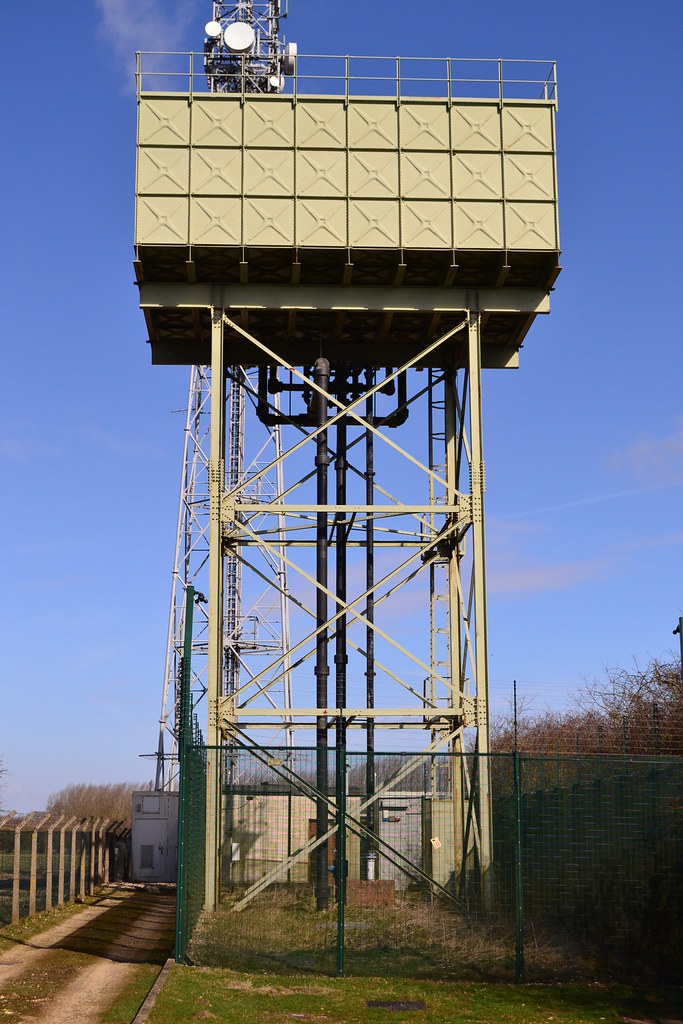
Original high-level Braithwaite water tank.
With them, came 1692 (Bomber Support Training) Flight, to train crews in the use of radar and night interception techniques.
Formed at RAF Drem in Scotland in 1942 as 1692 (Special Duties) Flight, they operated a range of aircraft including Defiants, Beaufighters and Mosquitoes. The two units stayed here at Massingham until both departed in August 1945, at which point 12 Group Fighter Command, took over responsibility of the site.
As radar and night interception roles developed, a new unit was created at Massingham under the control of the Central Fighter Establishment (CFE), who were to trial different techniques and strategies for air interception. They later moved to West Raynham where they continued to carry out this role.
Over the years a number of post war celebrities were stationed at Massingham, they included F.O. Keith Miller AM, MBE – the Australian Test cricketer; P.O. (later Squadron Leader) Bill Edrich DFC – the England cricketer and the BBC commentator – Flt. Sgt. Kenneth Wolstenholme DFC and Bar.
After the aircraft left, the airfield fell quiet and was very quickly closed. 1946 saw the last personnel leave, and it remained dormant until being sold in 1958. Bought by a farmer, it is now primarily agriculture, although a small private airfield has opened utilising the former runways, and flying visitors are welcomed with prior permission. The airfield at great Massingham has a public footpath running part way through it. This is accessible at either end of the southern side of the airfield, and permits access along part of the original perimeter track. Accessing the eastern end of the path is easiest, a gated road from the village takes you up to the airfield site. Once at the top, you can see the large expanse that was the main airfield site. Trees have since been cultivated and small coppices cover parts of it. To your right at this point the peri track continues on in an easterly direction, but this section is now private and access is not permitted. This track would have taken you toward the Watch office, the Fire Tender building and storage sheds – all these being demolished long ago. A further area to the south of here has now been cultivated, and there was, what is believed to have been a blister hangar, located at this point – this too has long since gone.
The public path turns left here and takes you round in a northerly direction. To your left is a T2 hangar, it is believed that this is not the original, but one that had been moved here from elsewhere. This however, cannot be confirmed, but there was certainly a T2 stood here originally.
The track continues round, a farm building, very much like a hangar, houses the aircraft that now fly. Sections of runway drainage are visible and piles of rubble show the location of smaller buildings. The track then takes you left again and back to the village past another dispersal site, now an industrial unit complete with blister hangar.
Other foundations can been seen beneath the bushes and leaves on your right. This may have been the original entrance to the site, although Massingham was unique in that in was never fenced off, nor guarded by a main gate. Other examples of airfield architecture may be found to the north side of the airfield, indeed satellite pictures show what looks like a B1 hangar on the northern perimeter.
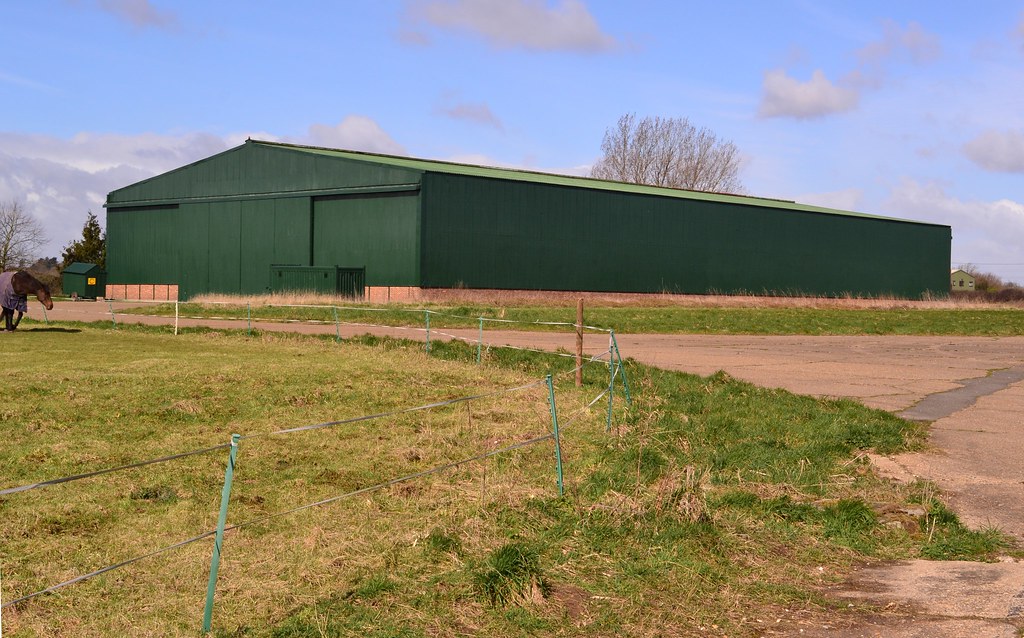
The perimeter track and T2 hanger re-sited post war.
After walking round, drive back toward Little Massingham, but turn left before leaving the village and head up toward the distant radio tower, itself a remnant from Massingham’s heyday. We pass on our left, the former accommodation site. Now a field, there is no sign of its previous existence. However, further up to the right, a small enclave utilises part of the Officers’ Mess, the squash court, and gymnasium with attached chancery. Hidden amongst the trees and bushes are remnants of the ablutions block, and other ancillary buildings. Continue along this road, then take the left turn, toward the tower. Here is the original high-level Braithwaite water tank and pump house, still used for its original purpose and in very good condition.
Finally, a lone pill-box defensive position can also be found to the west of the village, some distance from the airfield in the centre of a farmer’s field. All small reminders of the areas once busy life.
Great Massingham is a delightful little village, set in the heart of Norfolk’s countryside. Its idyllic centre, pubs and shops surround ponds and greens. A short walk away, is the windy and open expanse that once was a bustling airfield, resounding to the noise of piston engines. All is now much quieter, their memories but a book, some dilapidated buildings and a handful of graves. Standing at the end of the runway, looking down the expanse of concrete, you can easily imagine what it must have been like all those years ago. From Great Massingham we head east, to RAF Foulsham, before turning north and the North Norfolk coast, an area of outstanding natural beauty and some fine examples of airfield architecture.
Sources and links RAF Great Massingham
*1 A comprehensive history of RAF Massingham, including RAF material, is now under the care of the Massingham Historical Society. Contact Anthony Robinson antmassingham@gmail.com for details about the Museum or Roll of Honour, a hard copy of which can be purchased for a small fee.
*2 The ORB shows this as Sgt G, Wilson and not J.W. Wilson.
National Archives AIR 27/842/10
RAF Great Massingham is remembered on the Massingham village website which includes details of the Roll of Honour.
Massingham was first visited in 2015.


 Aviation Trails