The Amiens Prison Raid – February 18th 1945

There are multiple stories of heroism and daring stemming from the Second World War, each and everyone pushing man and machine beyond their boundaries. Many daring missions were flown in which crews performed and completed their task with extraordinary bravery and at great cost to both themselves, and to those on the ground.

Stories such as the ‘Dambusters’ have become famous and commemorated year on year, and yet another daring raid is barely mentioned or even considered by those outside of aviation history. The details of the raid remained secret for years after the event and even now, factual evidence is scarce or difficult to find; even the name of the operation can cause heated debate. The merits of the operation continue to be debated and many are still divided as to what the true purpose of the operation really was.

Whatever the reason behind it however, the historical fact is that the operation was a daring, low-level raid that helped many prisoners of war escape captivity and probably death, and one that was carried out in very difficult circumstances by a group of extremely brave young men.

It was of course the raid on the Amiens prison on February 18th 1944, by nineteen Mosquitoes of 140 Wing based at RAF Hunsdon.

As a new wing, it was formed at RAF Sculthorpe, and would consist of three multinational squadrons, a ‘British’, Australian and New Zealand unit, and all would be based at Hunsdon as part of the RAF’s Second Tactical Air Force (2TAF) designed to support ground troops in the forthcoming invasion of Europe.

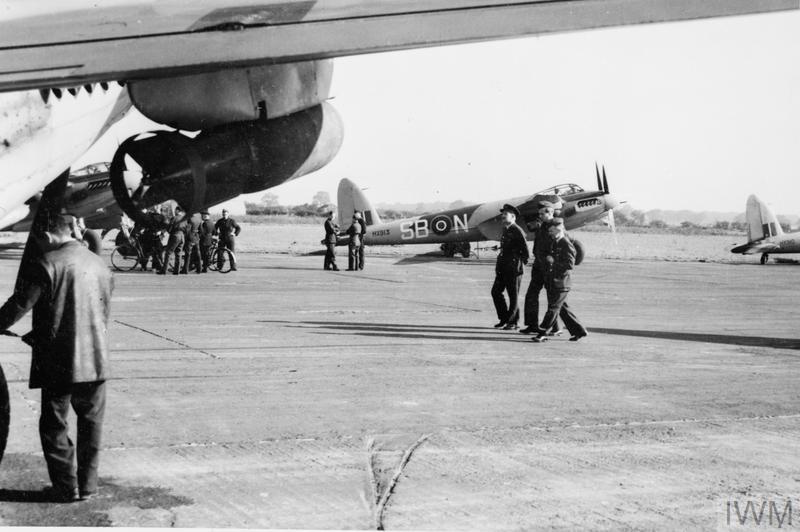
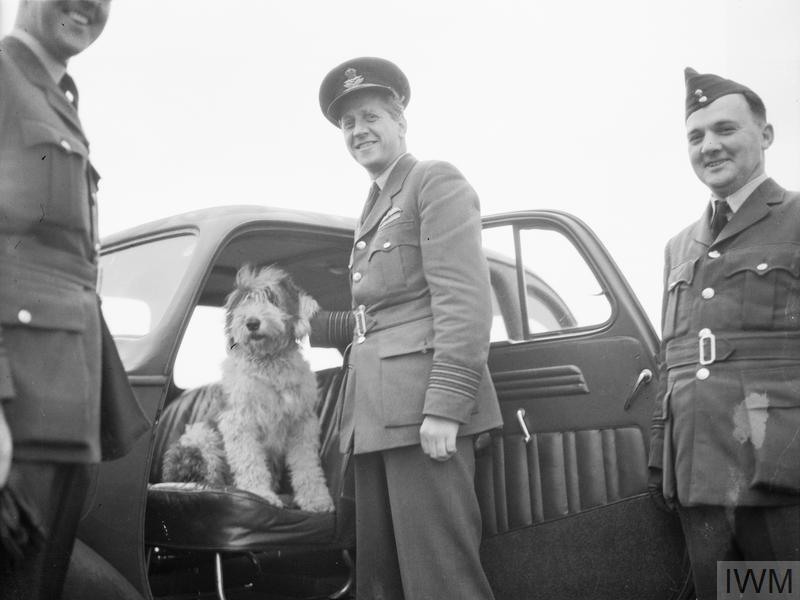
Group Captain P C “Pick” Pickard (centre), Commander No. 140 Wing, flanked by Wing Commander I G E “Daddy” Dale, Commanding Officer of No. 21 Squadron RAF (to Pickard’s right), and Wing Commander A G “Willie” Wilson, Commanding Officer of No. 487 Squadron RNZAF, visit No. 464 Squadron RAAF at Hunsdon, prior to a daylight raid against flying-bomb sites in the Pas-de-Calais. 464’s Mosquitoes (FB Mk VIs) have been loaded with 250-lb MC bombs for the operation: HX913 ‘SB-N’ can be seen in the background (@IWM HU 81335).

The raid on Amiens was not the only low level raid carried out by the Wing however. Between 1944 and 1945, they would attack numerous ‘V’ weapons sites, along with the Gestapo headquarters at Aarhus University and  the Shellhaus building in Copenhagen. Operation Carthage, another of their more famous raids, occurred whilst the wing was based at RAF Fersfield in 1945, but their most controversial raid, Ramrod 564 or ‘Operation Jericho’ as it has since become known, took place the year prior to that, whilst they were based at Hunsdon in early 1944.

There is a lot of speculation around Ramrod 564, many of the official records are missing, inaccurate or even vague. The operational record books for the squadrons involved  are recorded as ‘secret‘ and contain no details other than aircraft, times and dates.

The Operation, was designed to assist in the escape of 120 French patriots, who were reportedly condemned to death for assisting the Allies in the fight against the Nazis. These prisoners included key resistance fighters who had considerable knowledge of resistance operations in France, and so it was imperative that they escape.

The plan was for Mosquitoes of 140 Wing to attack from different directions, breaching the walls of the prison and blowing up several key buildings inside the prison holding German guards and soldiers. It would require each aircraft to carry 11 second, time-delay fuses in 500lb bombs dropped at very low level.

The Operation, formulated by Air Vice Marshal Basil Embry, would be critical, even the amount of explosive itself had fine limits, and time was also of the essence. The prisoner’s executions were imminent, so the attack had to be carried out quickly thus allowing only a small window of opportunity for the operation to take place.

The exact time of day that the attack could take place was also critical, there needed to be as many of the guards as possible in the key buildings at the time of attack, and the prisoners needed to be safely gathered together out of harms way. So, a time of 12:00 pm precisely on a date between 10th and 19th February was chosen, as both the guards and prisoners would be having lunch at this time, and it would be prior to the executions being carried out.

The route would take the aircraft from Hunsdon to Littlehampton, then via appropriate lattice to Tocqueville / Senarpont / Bourdon – one mile south, Doullens / Bouzincourt – two miles west-south-west, Albert / target – turn right – St. Saveur / Senarpont / Tocqueville / Hastings and return to Hunsdon.

In the attack, 3 waves of Mosquito would be used, 6 from 487 (RNZAF) Squadron, 6 from 464 (RAAF) Squadron and 6 from 21 Squadron. In addition, to record the attack, one aircraft (a Mosquito) of the Photographic Reconnaissance Unit (PRU) was detailed to monitor and film the entire operation. Along with them were three squadrons of Typhoons (198, 174 and 245) each protecting one of the three waves. These escorts were ordered to rendezvous with the waves one mile east of Littlehampton at Zero minus 45, 42 and 32 minutes respectively.

The first wave of Mosquitoes was directed to breach the wall in at least two places, the leading three aircraft attacking the eastern wall using the main road as a lead in. The second section of three aircraft would, when ten miles out from target, break away to the right at sufficient height as to allow them to observe the leading three aircraft, and if successful, attack the northern wall on a north-south run, immediately following the explosion of the bombs of the leading section. The time of this attack Zero Hour.

The second wave was ordered to bomb the main prison buildings, the leading three aircraft attacking the south-eastern end of main building and second section of three aircraft, attacking the north-western end of the key building. Both attacks were to be carried out in a similar fashion to the first. This would follow three minutes behind the first wave at Zero +3.

The final wave was a reserve wave intended to bomb if any of the first two waves failed to hit their targets. They would follow the same patterns as the first two, one section from east and one from north, but they would only bomb if it was seen that one of the previous attacks had failed. The details of the attacks would be determined by the leader and would happen thirteen minutes (zero +13) after the initial planned attack. If they were not required, the order to return would be given by the Group Leader or substitute.

Embry elected himself to lead the attack, but this was blocked by those higher up, As a result, and much against his wishes, Embry therefore had to choose a successor. Group Captain Percy C. Pickard (D.S.O. and two bars, D.F.C.) was chosen, but even though he was known as an expert pilot and leader, Embry was not convinced of Pickard’s ability to complete the job at such low level. Despite his reservations though, Embry duly informed Pickard of the decision and preparations for the operation began in earnest.

On February 18th that year, a day after the initial planned attack and in extremely poor weather, the Nineteen Mosquitoes took off to attack, breech and destroy the walls and a key building of the Amiens prison.

During the flight out, two Mosquitoes and three Typhoons of 198 Sqn became lost in swirling snow and were forced to turn back as they had now lost contact with their main formations. The remaining crews flew on, but whilst over France a third Mosquito, flown by Flt. B. Hanafin, suffered engine problems and was also forced to turn back. On his return journey he was attacked by Flak from which he was seriously injured. Helped by his navigator the two were able to land back at RAF Ford where he was given medical treatment for his injuries.

Just three minutes behind schedule, the first wave split and the first three aircraft followed the main road toward the prison’s eastern wall at tree top height. The second set of three waited and observed. Wing. Cdr. I. Smith, 487 Sqn, went in first, dropping his bombs with 11 second fuses against the wall. The second three then followed as instructed.

Wing Commander I Smith, Commanding Officer of No. 487 Squadron RNZAF, at Hunsdon (©IWM CH 12649)

Official reports state (edited only for fluency):

“Three Mosquitoes of No 487 Squadron attacked the eastern wall at 12:03 hours, just clearing the wall on a heading of 250 degrees with 12 bombs. The leader’s bombs were seen to hit the wall five feet from the ground, while other bursts were seen adjacent to the west wall with overshoots in fields to the north. Two aircraft of no 487 Squadron attacked the northern wall at 12:03 hours just clearing the wall on a heading of 150 degrees with 12 bombs. These attacks were directed at places later reported breached by reconnaissance aircraft. One bomb seen to hit the large building, and northern side of the eastern building was also reported hit.”

The second wave then attacked the south-eastern main building and north-western end respectively. Following the explosions chaos ensued inside the prison, guards were taken by surprise and over running bombs had caused some damage inside, prisoners began to run toward the gaps but some had been injured or struggled to escape.

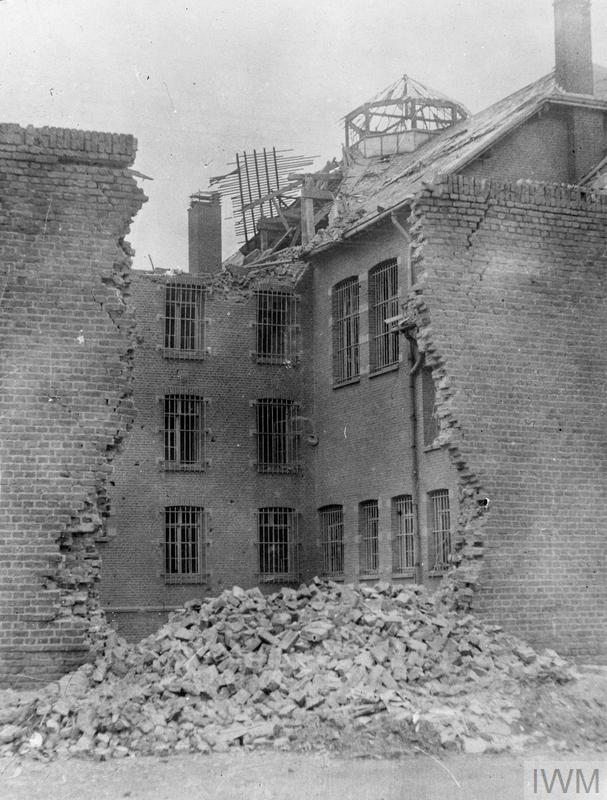
The 12 foot wide breach in the south side of the prison’s outer wall, through which 258 prisoners escaped. © IWM (C 4740)

Again reports say:

“Overhead view of the prison, showing the breaches made in the outer walls. Two Mosquitoes of No 464 Squadron bombed the eastern wall at 12:06 hours from 50 feet heading 150 degrees and 250 degrees with 8 x 500lb bombs. The wall appeared unbreached before the attack. Results were unobserved.

Two Mosquitoes of No 464 Squadron bombed the main building at 12:06 hours from 100 feet heading 150 and 250 degrees with 8 x 500lb bombs. The north wall appeared to be already damaged. One of these aircraft was seen to bomb and has not returned.

The breach in the Eastern wall. One Mosquito of the PRU circled the target three times between 12:03 and 12:10 hours from 400 to 500 feet using a cine film camera but carrying no bombs. He reported a large breach in the eastern centre of the north wall and considerable damage to the extension building west of main building as well as damage to the western end of main building. A number of men were seen in the courtyard near the separate building which appeared to be workshops and three men running into fields from large breach in northern wall.

The four aircraft of No 21 Squadron received VHF messages from ‘F’ of No 464 Squadron (Gp. Capt. Pickard) and PRU aircraft when between 2 and 4 miles from the target, instructing them not to bomb. Target was seen covered with smoke and they brought their bombs back.

The target was obscured by smoke, so later aircraft were instructed not to bomb. Two aircraft were missing from this operation; one was last seen circling the target and heard giving VHF messages not to bomb (Pickard) and the other after attacking the target, was seen at Freneuville at 12:10 hours at 50 feet leading his formation. It attacked a gun position and shortly afterwards dropped to starboard and was not seen again. One aircraft of No 467 Squadron was hit by light flak near Albert; starboard nacelle holed and starboard wheel collapsed on landing. One aircraft of No 21 Squadron landed at Ford – aircraft damaged. One aircraft of No 487 Squadron abandoned task south of Oisemont – pilot slightly wounded and aircraft damaged. Two aircraft of No 21 Squadron abandoned before leaving English Coast owing to technical failure.”

It is thought by some that Pickard had been shot down before giving the return order, but these reports state that it was both Pickard and the PRU Mosquito flown by Flt. Lt. Wickham, that gave 21 Sqn the “Red, Red, Red” order, sending the last wave home as their bombs were no longer needed.

After the attack, FW.190s began to swarm and various dogfights took place between them and the Typhoons, but not before they had attacked some of the fleeing Mosquitoes who also returned fire.

It was one of these FW190s flown by the ace Feldwebel Wilhelm Mayer, who  severed Pickard’s tail sending the aircraft into the ground near to Saint Gratien killing both occupants.

A story goes that Pickard had left his dog ‘Ming’ at RAF Sculthorpe, their previous airfield,  to be looked after whilst he was away. On the day he was shot down, 18th February 1944, the dog fell gravely ill. Pickard’s wife, Dorothy, went to get him and sensed that after seeing the state of the animal that Pickard had been killed . It took months for Ming to recover, and some years later whilst living in Rhodesia, Ming went outside looked up to the sky as he always did when Pickard was flying, heard a whistle, collapsed and died.*1

Group Captain P. C. “Pick” Pickard with his pet sheepdog “Ming”, pictured while resting from operations as Station Commander at Lissett, Yorkshire. © IWM (CH 10251)

A famously brave act, the attack resulted in the death of three crew members; Gp. Capt. Percy C. Pickard, and Flt. Lt. John A. Broadley, (RNZAF), both in Mosquito HX922, ‘EG-F’, and Flt. Lt. Richard W. Samson, (RNZAF) in Mosquito MM404 ‘SB-T’. Samson’s pilot, Sqn. Ldr. A. I. McRitchie survived his crash and was taken prisoner. Two Typhoons from 198 Sqn escorting the Mosquitoes are also thought to have failed to return (the ORBs don’t confirm this). Considered a success at the time, ‘evidence’ has since come to light to suggest that the operation was ‘unnecessary’, and may have failed to achieve anything more than a successful PR role (see end note). *2

Of the 700 prisoners detained within the walls of Amiens prison that day, a total of 258 escaped. In the confusion, 102 were killed and a further 74 wounded, but the success remained secret from the public for another eight months. With so much speculation around the attack, it will no doubt remain one of the mysteries of the war, but it was without doubt, an incredibly brave and daring mission that cost the lives of many superb young men.

A podcast using eyewitness accounts from the Imperial war museum can be heard through their website.

(A better quality version is available on the Pathe News website.)

All controversy aside, the raid took place at very low level and in very poor weather, with bombs dropped against a wall with delayed fuses. There was little resistance on the flight in and Typhoons provided higher cover when it was needed, but dogfights still ensued and lives were lost.

A daring attack, the Amiens raid was not the only one where lives were lost. Airfields along with the Hazmeyer electrical equipment factory at Hengels in Belgium, were also attacked at low level. On this particular operation Mosquito MM482 was hit by intense flak setting the starboard engine on fire. As a result, the aircraft flown by Canadian Sqn. Ldr. A. W. Sugden with navigator Fl. Off. A. Bridger, was lost and both men were listed as missing. Having been with the squadron since 1942 they were considered ‘old timers’ by the others and were sorely missed.

The three squadrons of 140 Wing would later depart Hunsdon, leaving the joy of success and the turmoil of a thousand questions behind them. 464 went first on March 25th whilst 21 and 487 Sqns would both leave mid April, both moving to RAF Gravesend in Kent.

The Amiens raid has no doubt caused great controversy, and as the years pass it will probably seep into the depths of history where it’ll become ‘just another raid’. But whist the background to it remains a mystery, it was done with great valour and courage by a group of young men who believed strongly that it was a worthy and much needed attack.

Aircraft involved in the attack (all Mosquito Mk.VI):

Crews attacking the target:
No 487 Squadron

‘R’ Wg Cdr Smith, DFC (Pilot) / Flt Lt Barnes, DFM (Navigator)
‘C’ Plt Off Powell / Plt Off Stevenson
‘H’ Flt Sgt Jennings / WO Nichols
‘J’ Plt Off Fowler / WO Wilkins
‘T’ Plt Off Sparkes / Plt Off Dunlop

No 464 Squadron

‘F’ Wg Cdr Iredale, DFC / Flt Lt McCaul, DFC
‘O’ Fg Off Monghan, DFM / Fg Off Dean, DFM
‘A’ Sqn Ldr Sugden / Fg Off Bridger
‘V’ Flt Lt McPhee, DFM / Flt Lt Atkins

Missing (Killed/POW)
No 464 Squadron

‘F’ Gp Capt P C Pickard, DSO, DFC / Flt Lt J A Broadley, DSO, DFC, DFM
‘T’ Sqn Ldr A I McRitchie / Flt Lt R W Samson

Crews instructed not to attack the target:
No 21 Squadron:

‘U’ Wg Cdr Dale / Fg Off Gabites
‘O’ Flt Lt Wheeler, DFC / Fg Off Redington
‘J’ Flt Lt Benn, DFC / Fg Off Roe
‘D’ Flt Lt Taylor, DFC / Sqn Ldr Livry DFC

Abortive Sorties
No 487 Squadron

‘Q’ Flt Lt Hanafin / Plt Off Redgrave

No 21 Squadron

‘P’ Flt Lt Hogan / Flt Sgt Crowfoot
‘F’ Flt Sgt Steadman / Plt Off Reynolds

PRU

‘C’ Flt Lt Wickam, DFC / Plt Off Howard

Escorts (Typhoons)

198 Squadron (six aircraft set off, three returned early)
174 Squadron (Eight aircraft took off and rendezvoused with Mosquitoes)
245 Squadron (Eight aircraft took off rendezvoused with Mosquitoes)

Sources and Further Reading

*1 Gunn, P.B., “Flying Lives – with a Norfolk Theme“, Peter Gunn, 2010

*2 – The Amiens raid is one that has become embedded in history and is beyond doubt an incredible and daring low-level raid that succeeded in its aim. However, official records seem to have many errors, anomalies or missing details that it is very difficult to ascertain the accuracy of these historical ‘facts’.

The ORBs for each of the four squadrons give no details other than an ‘operation to France’, some crew names and aircraft numbers. There is no record of the use of the word ‘Jericho‘ but there are two sides to this story.

Some authors including Rowland White “Mosquito” and John Laffin “Raiders – Great Exploits of the Second World War“, both cite Basil Embry as the creator of the name ‘Jericho‘ before the missions took place, whilst Robert Lyman “The Jail Busters” cites a French film, made in 1946, as the author of creator of the name. Some believe the name was created by various media outlets since then whilst others say that Embry created the name after the operation had been carried out. It is however, widely considered that it was a post-war name as the original operation was ‘Ramrod 564‘ and none of the ORBs use the name ‘Jericho‘.  To further add mystery, the use of the title ‘Renovate‘ has also cited, but records in the National Archives show this as the secret VHF code word to be used by aircraft on the operation and not the Operation title.

The name aside, and more recently, one of the French Resistance fighters revealed his doubts about the operation, and considers that it may have been nothing more than a propaganda operation or a diversionary attack linked to D-Day. One book (one amongst many) on the subject has been written by author Simon Parry and historian Dr Jean-Pierre Ducellier entitled The Amiens Raid – Secrets Revealed‘ and is published by Red Kite. It goes into the details of the raid and possible reasons behind it.

There have also been theories that it was an MI6 operation but due to the nature and secrecy of the mission, little evidence is publicly available to substantiate this.

Of those who lost their lives, both Pickard and Broadley are buried in St. Pierre Cemetery, Amiens, whilst Sampson is buried in the Poix-de-Picardie cemetery in the Somme region.

The Official report and details from it were accessed at the National Archives Web Archive © Crown Copyright 2004 and © Deltaweb International Ltd 2004

National Archives:

AIR-27-264-25; AIR-27-1170-23; AIR-27-1170-24; AIR-27-1924-27; AIR-27-1924-28; AIR-27-1935-27; AIR-27-1935-28; AIR-27-1109-4; AIR-27-1482-4; AIR-27-1482-3

Thirsk. I., “de Havilland Mosquito – An Illustrated  History Vol 2“. Crecy. 2006

White. R., “Mosquito” Bantam, 2023.

RAF East Kirkby – Part 3 – the End of an Era.

In Part 2, we saw how crews at East Kirkby took a battering over Germany and how the Allies turned their attention to the forthcoming invasion.

In this, the final part, the war finally comes to an end and RAF East Kirkby eventually closes, but not without making its mark.

With spring at an end, thoughts turned back to the impending invasion and the bombing of pinpoint targets in France: Railways, munitions factories, troop concentrations and transport links became the focus for Harris’s Air Force. Throughout the month of April both East Kirkby squadrons were in operations, and whilst not significantly high, a number of aircraft were lost adding to the lengthening list of casualties and those now missing.

The end of this period of the war was remarkable for several reasons, notably when Wing Commander Leonard Cheshire of 617 Sqn, flew a Mosquito at low level and marked the target, a factory in Toulouse, with great success. This delighted Harris, who gave the all clear to 5 Group to operate independently of the Pathfinders of 8 Group, a decision that did little to heal the growing rift between Don Bennett and Ralph Cochrane who had taken the idea to Harris in the first place.

Other targets then became the focus for 5 Group including the railway yards at La Chapelle. In the operation Cheshire put this method  to the test once more. with 617 Sqn again to marking the target in conjunction with 8 Group’s Pathfinders. In the operation, 247 Lancasters from 5 Group were ordered to attack a pin point target. In the attack, 57 Sqn lost two aircraft. Of these two Lancasters the first, LL893 ‘DX-J’  was lost with all seven lives over St-Omer whilst the second, Lancaster MK. III ND582 ‘DX-S’ crashed after attempting a landing at Croydon. After overshooting the runway the aircraft, piloted by Canadian F.O. H. Young, struck at least three homes in Lavender Vale, a street adjoining the airfield. Three of the crew died immediately and a further one died from his injuries in hospital.

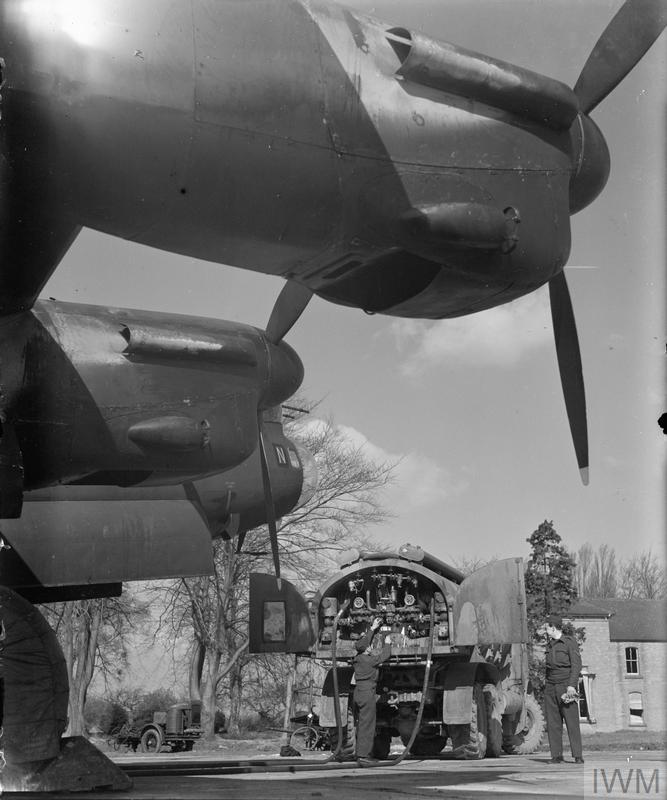
Operation POINTBLANK. Groundsmen refuel Lancaster ND560 ‘DX-N’, 57 Squadron in preparation for a night attack on the railway yards at La Chapelle, France. IWM (CH 12868)

Summer then dawned, and overnight, May 22nd-23rd, Cheshire once more, put his method  to the test. 617 Sqn were again to mark the target, but a heavily defended Brunswick led to heavy losses for both the East Kirkby squadrons, 57 losing three Lancaster Mk.IIIs and 630 Sqn another two. Only five airmen made it out alive, each one being captured by the German ground forces and so becoming prisoners of war.

These losses were however a mere pin-prick compared to June. The mission of 21st-22nd to Wesseling near Cologne proved to be yet another massacre for 5 Group who sent a total of 133 Lancasters to attack the city’s oil facilities. A number of squadrons took heavy loses including both East Kirkby’s 57 and 630 Sqns with six and five losses respectively. One of these aircraft was abandoned whilst another ditched in the sea allowing all crewmen to be rescued, but the overall loss proved to be devastating.

The spring – summer of 1944 was defining, not only had 5 Group shown that low-level marking could be done, but the attacks on targets in France meant that the Luftwaffe were at a disadvantage. Their night tactics, relying on long range bomber flights, could not manage with the shorter ‘quick’ attacks, and so losses from Bomber Command began to lessen.

This reduction allowed for restaffing, with a large number of officers, NCOs and airmen being both posted in and out of the two squadrons. It also allowed for training flights to take place, some 476 hours of operations compared to 729 hours for non-operational flights for 630 Sqn alone.

Like many places across the UK, the coming of D-Day, and the fragile success of the invasion led to an increase in morale at the station. Ground crews being acknowledged for their long hours and hard work in keeping aircraft flying and operationally ready, without them, these operations could not have taken place at all.

This extra effort and improved state continued for several months, and by August, it was acknowledged that morale had lifted, discipline was at a high and health was overall very good. Casualties were also down, a real boost considering the extra effort and number of operations that had been taking place over the last few months. The summer was at last ending on a high.

August’s improvement coincided with the liberation of Paris, a major landmark in the war’s progress. Ground forces were charging ahead. In the air, Bomber Command had played a small part in the offensive supporting ground troops as needed and now they were released from the tight grip SHAEF had held over them. Discussions followed as to where best place their bombs, oil and  communication were one option or alternatively, a return to the bombing of the cities and morale busting; oil won over, and so, much to Harris’s disappointment, the bombing of oil based targets began.

The looseness of the criteria however, allowed Harris to circumnavigate the ‘rules’ and turn his attention to cities with an oil link. He had got his way and the Air Ministry had got theirs.

Although individual operation losses were relatively low, 57 Sqn tallied some 56 aircraft by the end of 1944, whilst 630 Sqn reached 57. Non-operational loses for the two units were also on an equal par.

On the penultimate day of the year, East Kirkby was to witness, a short distance away from the airfield, the crash of a B-17 attempting to land. Aircraft #42-97479 (UX-L) of the 327thBS 92nd BG based at Podington (Station 109), crashed in a field between the two small hamlets of Old Bolinbroke and Hareby. On board that day were nine crew men: 2nd Lt. Joseph Martin Van Stratton (Pilot); 2nd Lt. Edward A Porter (Co-pilot); Sgt. Charles H Chambers (Bombardier); 2nd Lt. John E Cowan (Navigator); Sgt. Arthur R Estrada (Radio Operator); Sgt. Harold Raymond Barner (Ball Turret Gunner); Sgt. Wilfred A Bedard (Wasit Gunner); Sgt. Thomas G Standish ((Top Turret Gunner) and Sgt. William D White (Tail Gunner), who all lost their lives.

The aircraft, a Lockheed/Vega B-17G-15-VE Flying Fortress named “Belle of Liberty“, had returned from operations to the Bullay railway bridge located south-west of Koblenz, in Germany. After suffering engine failure, the pilot decided to abort the mission and attempt a landing at East Kirkby. In poor visibility and with one engine out, he overshot the runway and pulled up to attempt a second try. A second propeller then began windmilling and in trying to gain height to avoid a hill, the B-17 stalled and crashed.

A small memorial plaque has since been laid at the site in commemoration of those lost.

The wreck of the “Belle of Liberty” 30th December 1944.  (IWM FRE 5762)

The winter of 1944-45 was one of the worst, ground troops were by now entrenched in the Ardennes around Bastogne, with the German army preparing for one last push through the forests. Fog and snow kept many airfields non-operational in the UK, aircraft struggling to get much needed support across to the continent.

At East Kirkby, January started on high spirits, but on the 9th, 630 Sqn Lancaster PD317 ‘LE-G’ struggled to get airborne when one of its engines cut out on take off. After jettisoning its bombs, the pilot, F.O. G Billings, opened the throttle to attempt a circuit and landing. However, the port wing lost lift and dropped causing the aircraft to cartwheel injuring five airmen and killing two. With one further loss on the 14th, this brought the spring tally to two aircraft. However, good news did soon come as six of the seven crew were repatriated by the April. The seventh airmen, W.O. E Edwards, struck the tail plane on baling out and died the next day.

Otherwise, 57 Sqn, scraped through with a clean sheet and no operational losses were encountered, but they did suffer an unfortunate incident when ‘DX-N’ PB382 (the predecessor of DX-N below) entered Swedish airspace and was shot down by flak on the night of February 8th-9th.

The losses encountered by 57 and 630 Sqn, were only pipped by the tragic accident that was reported to have happened on the 17th of April. Although the operational records record no evidence of the accident, even to the point of showing some of the aircraft involved taking part and completing their operations, it is recorded in some resources that six Lancasters of 57 Squadron were destroyed following a fire in the fuselage of Lancaster PB360. As a result of the fire, four men were killed and a further five injured, along with several civilian workers near the site.

The fire started at 17:45, causing a series of explosions which destroyed the five other Lancasters parked nearby. The Hangar on the airfield was also badly damaged, as was a neighbouring farm. The fires were so severe that fire crews were brought in from nearby airfields and the area was not declared ‘safe’ until the following day. The Lancasters involved were: PB360 (MK.III) ‘DX-N’; ND472 (MK.III) ‘DX-I’; LM673 (MK.III) ‘DX-U’; RF195 (MK.I) ‘DX-‘; PD347 (MK.I) ‘DX-P’ and NN765 (MK.I) ‘DX-‘.*3

By now German resistance was minimal. Fighters were rarely encountered in any number and flak batteries were reducing in their accuracy and intensity. By May, the war was at and end, and quickly both ‘Exodus’ and training flights became the norm along with cross country and high level bombing training flights taking the front stage. For 630 Sqn July signified the end, after a period of intense recruiting the squadron was disbanded after serving for approximately eighteen months of the war.

During that time they had shown great courage in action. On average they had flown 1,087 hours of operational flying per month and 286 hours on non-operational flights. This amounted to 2,147 operations over enemy territory during which 64 aircraft had been lost. With another six crashing, the toll was high, and their medal tally reflected that, with in excess of 60 awards being granted.

In a last days before disbandment a sports challenge with 57 Squadron allowed 630 to show their colours one last time, winning the overall trophy, and with a party to celebrate that night, the squadron went out on a high. The final day saw the last parade and the handing over of the squadron crest to the Air Ministry for safe keeping. With that, 630 squadron disbanded.

Their place at East Kirkby didn’t stay vacant for long though, for on the 27th July, 460 Sqn arrived to join 57 Sqn and serve its lasts days here at this Lincolnshire airfield.

57 Sqn would continue on, taking on the Lincoln bomber in August as a replacement for the Lancaster although numbers remained low at this time. Fighter affiliation, high level bombing training and cross country flights became the main focus, along with ferrying flights into the European continent bringing back personnel and equipment; a schedule that continued for the next four months, its time finally being called on November 25th 1945.

Throughout the war 57 Sqn had served with distinction, providing crews for not just one but two different squadrons, one of which went on to become perhaps the most famous unit in the RAF’s history. It was a success however, that came at a cost, with the highest loss rate of the whole of Bomber Command, they had taken part in some of Europe’s most ferocious aerial battles and still went on to perform admirably.

On disbandment, 103 Squadron then at Elsham Woods, was immediately renumbered as 57 Sqn, and the unit number lived on. The majority of personnel from the original 57 Sqn were transferred to the RAF’s Holding Station RAF Blyton Holding Unit, along with personnel from several other serving squadrons. Seven three-men crews remained at East Kirkby to ferry the Lancasters away whilst six crews transferred to Scampton to form the basis of the new squadron along with three Lincoln bombers.

460 Sqn an Australian unit, had also served well during its war time life. Being originally formed on November 25th 1941, it was made up of Australian crews, flown Wellingtons, Halifaxes and then Lancaster I and IIIs. Its move to East Kirkby from Binbrook signifying its end, as training flights took over bombing missions and personnel began to be transferred out. By October it too had disbanded.

In an acknowledgement of their bravery, the closing remarks in the Operation Record Books state how the Australian had been warmly welcomed to our shores and how they had cemented a great bond between the two allies against a common enemy. Appreciation and thanks was warmly given to those who had served in the unit.

With the war’s end, East Kirkby was rundown, but between spring 1946 and February 1948, a detachment of Mosquito B.IVs from Coningsby’s 139 (Jamaica) Sqn, operated here, joined  between August 1947 and February 1948 by 231 Operational Conversion Unit (OCU) also on detachment from Coningsby. Flying a mix of Airspeed Oxfords, Avro Ansons & de Havilland Mosquito B.IVs, they were the last RAF units to use the airfield before it entered care and maintenance.

Then in 1951, the US Strategic Command 3rd Air Force took over the site, intending to use it as a stand-by airfield.  As part of the plan, the runway was extended by 1,230 yards along with an expansion to the apron. Both the 3931st ABG and 3917th ABS were based here but only visiting C-47 ‘Skytrains’ (a derivative of the Dakota) of the 7th Air Division’s Rescue Squadrons, ever arrived.

Eventually, on 31 October 1958, the airfield was returned to Air Ministry under ‘Big Shuffle’ , the reorganisation of the Air Force and its sites in the UK and Europe.*4

With that, East Kirkby closed for good, being sold off in 1964 when it turned once again to agriculture. However, bought by the Panton Brothers, it was turned into a living museum including a taxiable Lancaster to commemorate not only the third brother – Christopher Panton, who was killed on a bombing raid over Nuremberg on 30th – 31st March, 1944 – but all those who served in Bomber Command during World War II.

Part of the museum includes the chapel, a stained glass window and memorial board listing all those who died whilst serving at the airfield in both 57 and 630 Sqn, are poignant reminders of the toll on human life at this one small Lincolnshire airfield.

The full page can be read in Trail 1 – Lower Lincolnshire.

References and further reading (East Kirkby)

*1 Aviation Safety Network website accessed 19/10/24.

*2 Worrall, R., “Battle of Berlin 1943-44” Osprey Publishing. 2019.

*3 Chorley, W.R., “Bomber Command Losses pof the Second World War – Vol. 6 1945” Midland Counties Publications 1998.

*4 Francis. P & Crisp. G., “Military Command and Control Organisation
Volume 4  – The United States Air Forces in the UK” on behalf of English Heritage.

*5 The East Kirkby Museum have a website which gives far more detail, opening times, and other other visitor information.

National archives: AIR 27/538/38; AIR 27/538/44; AIR 27/538/43; AIR 27/2152/8; AIR 27/2152/7; AIR 27/2152/29; AIR 27/540/13; AIR 27/540/21; AIR 27/1910/11; AIR 27/540/8; AIR 27/540/7

American Air Museum Website Accessed 20.10.24

International Bomber Command Centre has several personal stories on their website, it is well worth a read.

Lincolnshire Aviation Heritage Centre Website.

RAF Little Walden (Station 165)

Sometimes, we come across quite unexpectedly, something of great interest. Whilst on my travels recently, passing through the southern regions of Cambridge into Essex, I came upon the former station RAF Little Walden. Being an unplanned visit, I was rather short in prior knowledge and preparation, no maps, aerial photographs, or other documents that I normally seek out before venturing off into the wilderness. So I was quite unprepared when I stumbled across the Watch Office from former station RAF Little Walden, otherwise known as Station 165 of the USAAF.

RAF Little Walden (Hadstock) – (Station 165)

Little Walden lies slightly closer to the village of Hadstock than it does Little Walden, and was originally called Hadstock. When construction began in 1942, it was allocated to the Eighth Air Force as a Class A bomber airfield. However, due to the bad winter of 1942/43 work ceased temporarily, being held up until well into the summer of 1943. At this point, Hadstock became known as Little Walden, a name change that coincided with the formation of the Ninth Air Force in Europe, an organisation whose primary role was the support of ground troops in the European theatre. With its headquarters at Sunninghill Park1 in Ascot, it would operate both transport and bomber units, taking many of these units (and their airfields) from the already established Eighth Air Force. Little Walden was one such airfield passing from the Eighth to the Ninth to fulfil this new role.

Although a Class A airfield, Little Walden’s main runway was slightly shorter than those of its counterparts, 1,900 yards as opposed to 2,000 yards, but the two auxiliary runways were both the standard 1,400 yards in length. A concrete and wood chip construction gave these runways good strength, it also had hardened perimeter tracks and fifty hardstands of the spectacle type. Grouped mainly in blocks of five, they were located around the perimeter track with a further block of eighteen to the north-west of the site. In the development process a public road the B1052, was closed as it passed directly though the centre of the proposed site.

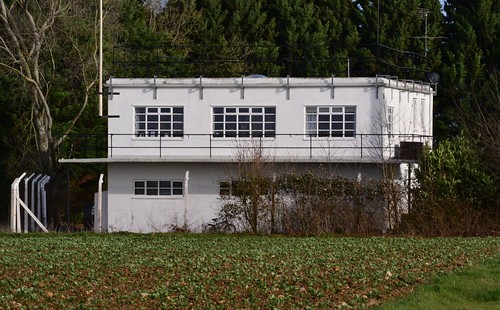
Little Walden Watch Office

Little Walden’s Watch Office is now a private residential property.

A large bomb store lay to the west of the airfield, surprisingly close to the majority of the hardstands, any major accidental discharge being likely to cause substantial damage to parked aircraft. There were four areas within the bomb store, each holding 200 tons of bombs and tail units, further stores held pyrotechnics, incendiaries, ‘small’ bombs, grenades and small arms ammunition. Most of these were secured by earth banks with fusing points (both ultra-heavy and heavy-light) being held in temporary brick buildings.

To the eastern side of the airfield lay the technical area, with one of the type T2 hangars (the second being located to the north), a fire tender shelter, and a watch office designed to drawing 12779/41 – the standard airfield design of 1942/43. Behind this, lay the main technical area, with its usual range of dingy stores, MT (Motor Transport) sheds, parachute stores and a wide range of ancillary buildings.

Accommodation for staff was, as usual by now, dispersed over eleven sites, a sick quarters, communal site and WAAF site accounting for three of them. A further sewage works made the twelfth site. All-in-all accommodation was provided for just short of 3,000 men and women of mixed rank.

On March 6th, 1944 the airfield officially opened, the day before its first residents arrived. The 409th BG were a new Group, only constituted on June 1st, the previous year (1943). They trained using Douglas A-20 Havocs (known in British service as the Boston) a twin engines light bomber capable of carrying up to 4,000lb of bombs.

The 409th BG formed at Will Rogers Field (Oklahoma) and transitioned through Woodward and DeRidder bases before arriving in the UK. Between March and September they operated out of Little Walden, bombing V-weapons sites and airfields in France in a strategic role. Initially they performed in the low-level role, but soon moved to higher altitudes, performing their first mission on April 13th 1944.

In the short period of residency at Little Walden, the 409th would lose a number of aircraft, one of the first being that of #43-9899 of the 642nd BS, which was written off in a landing accident on April 22nd 1944. Three days later a second aircraft, #43-9691, would also crash-land at Little Walden being damaged in the process.

May would also prove to be a difficult month for the 409th, with one aircraft ‘lost’ on the 9th, a further crash landing on the 11th, another lost on the 22nd and two further aircraft lost (classified as MIA) on the 27th. It was on this mission that a further Havoc would collide with a low flying Mustang resulting in several tragic deaths.

Havoc #43-10130 of the 643rd BS, piloted by Captain Roger D. Dunbar took off from Little Walden heading south-east, when it collided with P-51B #42-106907 of the 503rd FS, 339th FG, piloted by 2nd Lt. Robert L. Dickens. The Mustang, on a training flight, disintegrated killing the pilot, whilst the Havoc crashed into the farmland below. In the ensuing fire, a local farmer’s widow and trained nurse, Betty Everitt ran to the scene and managed to pull one of the airmen out of the aircraft. When returning to retrieve another crewman, one of the bombs on board the aircraft exploded killing her, her small dog, a helping Staff Sgt. and those left inside the aircraft. As a thank you to Betty, the US airmen, from the base, raised almost £3,000 to provide an education for her four-year old orphaned son, Tony2. This was not a one-off either, a fund set up by Stars and Stripes and the British Red Cross, aimed to raise funds for children who had suffered the loss of one or both parents. The amounts raised went a long way to getting these children an education that they would not otherwise have had.

Early June would see another such tragedy, when three more Havocs would collide. Havocs A-20G #43-9703 and #43-9946, both of the 641st BS, would crash whilst the third aircraft managed to land at the airfield. #43-9703 was piloted by Joseph R. Armistead, whilst #43-9946 was piloted by Thomas A. Beckett. A young girl, Marjorie Pask, ran to help, pulling two airmen out of the wreckage then waiting with them until help arrived. Five airmen including the pilots and an air gunner, Staff Sergeant Albert H Holiday, were all killed. It was not until later that Marjorie realised that there were many bombs scattered around the site and how much danger she had been in 3.

Staff Sgt. Albert H Holiday, killed June 11th 1944 in a collision between two Havocs of the 409th BG. (IWM-UPL 21530)

With two further loses and a forced landing in June, it was be a difficult month for the 409th. The late summer months of July and August would be lighter but by no means a clean sheet. In September 1944, on the 18th, the 409th were moved out of Little Walden and posted to a forward Landing Ground A-48 at Bretigny, where they would continue to suffer from landing accidents, Flak and fighters.

Next at Little Walden came the Mustangs of the 361st FG, in a move that saw possession of Little Walden pass back into the hands of the Eighth Air Force. Station 165 was now back with its original owners.

The 361st FG were the last of the P-47 Groups to arrive in the UK. Initially based at Bottisham, they converted to the P-51 in the weeks leading up to D-day. Using the Thunderbolts they earned a reputation as a strong and determined ground attack unit, hitting rail yards and transportation links across France.

A short break whilst transferring from Bottisham to Little Walden gave a somewhat minor break for the 361st. But, following changes to the Eighth’s overall structure, it was soon back to normal and more attacks over occupied France. In October, Lt. Urban Drew shot down two Me 262s who were in the process of taking off from their airfield at Achmer. What was more remarkable about the attack was that Lt. Drew had only arrived in the U.K. a few days earlier, had been grounded for a Victory Roll and then went on to become an Ace shooting down six enemy aircraft and the first pair of 262s! He was awarded the Air Force Cross, being denied the Distinguished Flying Cross until after the war when records from both the Luftwaffe and US Air Force were able to confirm his dramatic claims.

The Christmas and winter of 1944-45 was notoriously bad, very cold temperatures, fog, frost and ice played havoc with operations. The Battle of the Bulge was raging and the allies were finding it all but impossible to provide assistance from the air. Many Bomb Groups suffered terrible tragedies as collisions and accident numbers increased in the poorer weather. The Ninth, who themselves had primary roles in ground support were finding it particularly difficult. To help, a selection of men and machines from the 361st (and 352nd from Bodney) were transported to France and the airfields at St. Dizier (Y-64) and Asch (Y-29) where they were seconded into the Ninth Air Force.  The main force back at Little Walden continued to support bomber missions whenever they could, a difficult job in often appalling conditions.

Duxford American Airshow May 2016

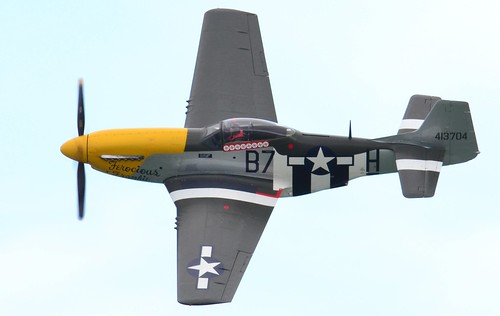
‘Ferocious Frankie’ #44-13704 (374th FS, 361st FG). The original crashed during a wheels up belly landing at RAF Little Walden, on November 9th, 1944. (This aircraft was flying at the Duxford American Airshow May 2016).

Aug 2015 317a

‘Ferocious Frankie’ (named after the wife of Lieutenant-Colonel Wallace E. Hopkins) seen at the Eastbourne Air Display August 2015.

By the end of January the seconding to the Ninth came to an end and the entire Group moved across to Belgium and Chievres, a former Belgian airfield captured and used by Luftwaffe bombers during the earlier years of the war. The 361st would remain there until April 1945 whereupon they returned back to Little Walden. During their absence Little Walden was made good use of. Being a ‘bomber airfield’ by design, its runways and hardstands were put to good use by Debach’s 493rd BG and their B-17 ‘Flying Fortresses’ whilst their own airfield was repaired and strengthened.

Spending only a month at Little Walden, the Air Echelons of the 493rd BG would depart in the April as the 361st FG returned. On the 20th, the 361st would fly their last operational mission, a flight that would close the record books culminating in a total of 441 missions. As the war ended and personnel were sent home, crews and aircraft of the 361st were dispersed to depots around the U.K., those that were left were sent home via the Queen Mary from Southampton arriving in New York in early November 1945. Within hours the group was disbanded and the men scattered to the four winds.

Between early September and early October 1945, the 56th FG ‘The Wolfpack’ were brought to Little Walden. The aircraft were also dispatched to depots around the country whilst personnel were brought to Little Walden for onward transportation to the United States. By mid October they too had gone.

Little Walden then began the wind down, transferring back to RAF ownership in early 1946. For the next twelve years or so, it was used to store surplus military equipment before they were sold off. After that, the site was returned to agriculture, the majority of the buildings pulled down and the runways dug up for road building hardcore.

The control tower stood for many years derelict and forlorn, until being purchased by an architect in 1982, eventually being turned into a private residence, the state it exists in today. The closed road has since been restored, utilising part of the NE-SW runway. Other parts that remain being a public footpath, but all a fraction of their former selves and no more than a tractor’s width wide.

What’s left of the technical area is a small industrial unit, remaining buildings being used for storage or small industrial companies. An access road from the B1052 passes the site an on to private residencies.

Little else survives of Little Walden. Memorial plaques are believed to be mounted on the side of the watch office, although I could not see these when I visited, and the village memorial mentions those who were stationed at the airfield.

The serenity of Little Walden does nothing to reflect the goings on here over 70 years ago. The aircraft are gone, the bird song replacing the sound of engines, and the busy runways now a small road. For those who were lost here, the watch office stands as  a memorial to their memory and the dedication shown by the many young men and women of the USAAF.

Sources and further reading.

1 Sunninghill Park was originally part of Windsor Forest and dates back to the 1600s and King Charles 1. Its ownership changed hands several times, and in the early 1800s during the Georgian period,  a large house was built upon it. The Ninth Air Force made it their headquarters between  November 1943 and September 1944, after which, in 1945, it was sold to the Crown Estate as a future home for Queen Elizabeth and Prince Philip, Duke of Edinburgh. However, before their marriage, the house burned down and the site remained unoccupied until the 1980s when a new property was designed and constructed for the Duke and Duchess of York. However, it was never occupied, the house fell into a very poor state of disrepair and was bought for £15m by an overseas investor. The site continued to decay and by 2014 was ordered for demolition.

2The Troy Record Newspaper Archives, Page 20, June 5th 1944 accessed 10/3/19.

3The full story can be read in ‘Balsham, A Village Story 1617-2017‘.

Little Walden is a new addition to Trail 46

RAF Sawbridgeworth – Part 4 – The end of an Era.

Continuing on from Part 3

2 (AC) Sqn by now, also had a move away on the cards, and following a meeting on the 28th January the advanced party departed first, followed on the 31st by the ground party. The Mustangs moving to RAF Bottisham, from where they would now operate before being divided and part moving to Fowlmere.  After a short stay at the two sites they returned to the Hertfordshire airfield once more. Their departure had lasted a mere four months.

RAF Sawbridgeworth Emergency generator

The Standby Generator House now a stores for machinery.

Whilst they were away, the airfield was used on a temporary basis by 652 Sqn flying Austers, On arrival, they immediately took over Blount’s Farm and used it for their own personal use. In the short time they were here, they participated in Exercise “Spartan” again in conjunction with the Army, departing the airfield in late  March.

After being spilt between Bottisham and Fowlmere, 2 (AC) Squadron was now reunited and returned to training flights, air to air firing, ground support flights and increased operational activities. A large part of the squadron’s role now included photographic reconnaissance of enemy territory, many of these operations taking place over the Hook of Holland, den Helder, Kijduin, and Ameland. Some of these required the squadron to detach to other stations but the majority of operations flew from Sawbridgeworth, the Mustangs fairing much better than the heavy Typhoons of 182 Squadron earlier on.

In Mid may, disaster struck again for the unit when three aircraft crashed into a hillside after setting off on a photo reconnaissance flight to photograph locomotive movements in northern France in Operation “Asphalt“. On the way out, a bank of sea fog was encountered and the order to climb was given. Unfortunately, flying abreast,  three of the ten Mustangs failed to clear the hill they encountered, and Pt. Off. J. McLeod, Fl. Off. D. Hirst and Fl. Off. N. Miller were all killed. The remaining aircraft then flew to Thruxton where they were detached to,  and a search commenced for the missing airmen. Their bodies were later recovered and funerals held in their respective homes at the end of the month.

Photo reconnaissance flights and attacks on shipping, increased becoming the main role for the squadron.  Sadly during one of these operations, Operation “Lagoon“, Fl. Off. Butt was killed when his Mustang crashed into the ground before he was able to land. The resultant explosion and fire killing him.

July 1943 saw yet another move for the squadron, this time to Gravesend, where they were immediately billeted under canvas and then inspected for fitness to serve overseas. No such move came through though, and after moving around various other local airfields, in November, 2 Sqn returned to the Hertfordshire airfield that had become their semi-permanent home; this time though, they were not unaccompanied, they brought with them the Mustangs of 4 Squadron.

During their absence, Sawbridgeworth had not been deserted, in fact it had been very busy and home to several other squadron detachments. On the 12th November 1943, 63, 168 and 170 Squadrons had all moved in with Mustangs, then on the 30th, both 63 and 168 departed moving back to their parent unit, their short detachment coming to an end; whilst 170 remained here until mid January when they were disbanded.

The return of 2 Sqn and the new Mustang unit that November, saw a continuation of reconnaissance operations  over the continent. 4 Sqn had been dogged by mechanical issues resulting in many unserviceable aircraft and even for the move, only five aircraft were able to make the initial flight. It was these ongoing issues that led to them to begin changing their old models for newer examples, a change that would unfortunately take time to complete.

For much of December the weather played the dominant part, the winter of 1943 – 44 being extremely wet and foggy. For much of the month the airfield was yet again, unserviceable and only top priority operational flying could take place and even that was sporadic.

At nearby Hunsdon, both a Mosquito and a Spitfire along with suitable trainers were made available, and it soon became known that 4 squadron was going to re-equip with both and move to Aston Down.  At last, the older, problematic Mustangs were being replaced by a much needed and higher performing aircraft.

Conversion of the crews would take place at Hunsdon who would transfer across regularly to take flight instructions whenever the weather allowed.  It didn’t come a moment too soon either as serviceability for the Mustangs of both squadrons, remained critically low; at the end of the month, 4 Sqn only had two airworthy aircraft.

In early January 1944, 4 Sqn finally got their departure orders and made the move to Aston Down. The conversion had been successful, and further training flights were carried out once at Aston Down, gradually more and more of the new models arrived bringing the squadron back up to full strength once more. That was not the end of 4 Squadron though, as on March 3rd 1944, they returned to Sawbridgeworth with their new Spitfires and their Mosquitoes, their period of reconnaissance training on the two types now almost complete.

On the 3rd March, two parties left Aston Down, the road party in the morning and then, in the afternoon, the air party, forming the largest ‘Balbo‘ the unit had known for some time. in all, twenty-two aircraft made up of Spitfires, Mosquitoes and Mustangs flew in formation all the way to Sawbridgeworth, their arrival in the late afternoon must have been a magnificent sight for those waiting on the ground.

The squadron was then divided into two flights, ‘A’ Flight flying the Spitfires and ‘B’ Flight the Mosquitoes. During March the ‘A’ Flight Spitfire XIs were used to fly photo reconnaissance sorties over ‘Noball‘ targets – rocket installations in France, the first operational sortie since December 12th. However, and a blow to the squadron, there was 10/10ths cloud over the target area and no photos were taken as a result.

With ‘A’ Flight busy on operational sorties, ‘B’ Flight continued with their Training flights in their Mosquitoes. However, as with the Typhoons earlier, things were not as straight forward and easy and they may have been. It was found that stones and clinker had found its way onto the tracks and these had been thrown up damaging the tail plane of the aircraft rendering all the aircraft used unserviceable.

Poor weather continued to hamper operations as it had done for months, the Mosquitoes now taking part in photographic flights having their flights cancelled and the squadron being stood down on several occasion.

In early April, they were ordered out of Sawbridgeworth and on the 4th, both air and ground parties left for Gatwick, their penultimate stop before moving to the continent where they would stay for many years after the war’s end.

Meanwhile, 2 Sqn had continued operations over enemy territory, carrying out both air-ground attacks and reconnaissance flights over the continent. Yet more detachments away at various airfields including Benson and North Weald, led to them being divided once more. However,  being posted to North Weald caused problems for the resident 268 Sqn who were now forced to leave there and come to Sawbridgeworth, North Weald being too small to accommodate both units. When 2 Sqn returned to Sawbridgeworth on March 26th to continue their operational activities, 268 departed, being transferred to RAF Gailes where the entire squadron undertook a Naval Bombardment course.

During their time here, 268 had been operational flying regular sorties over France. With the impending invasion, they photographed beach defences along the French coast, Radar station at Ostend and carried out “Noball” operations searching for and photographing V1 launch sites.

2 Sqn’s last departure from Sawbridgeworth than came, and on 24th March 1944, they along with 4 squadron shortly after, departed the airfield for Gatwick, never to return to Sawbridgeworth again.

2 Sqn would go on to serve well into the future, taking their Tornadoes to Marham in 1991 after serving in Germany post war. With a long and distinguished history that extends as far back as 1912, they would operative some of the worlds most modern aircraft including: Meteors, Hunters and Jaguars all in front line operations.

With 2 Squadron now departed and not going to return, there was room for other squadrons to utilise the airfield. April saw the arrival of both 80 Squadron on the 24th April followed by 126 Sqn on the 30th; both units flying Spitfires VB and IX respectively.

80 Sqn had been overseas for the last few years and as soon as they arrived at Sawbridgeworth, they were granted leave of up to seven days. Many were disgruntled at such a short period of time and some were given extensions. On return, the squadron then moved immediately to Hornchurch to form a new Wing along with 229 and 274 Squadrons.

Only one other squadron used the airfield after that, 126 Sqn, who, like 80 Squadron, had been abroad and were essentially regrouped here. No flying took place and once settled they were assigned to RAF Culmhead.

After D-Day no other units used the airfield and Sawbridgeworth had had its day. Now redundant it was handed over to the Maintenance Command and placed into care. All flying ceased, military units were pulled out and the airfield gradually wound down.

Its demise was swift, the mesh runways were quickly removed using POWs,  the tower was demolished a year after the cessation of conflict in 1945, and many other buildings were removed or demolished; the land rapidly turned back to agriculture.

Wandering the site today, there is luckily still quite a bit of evidence about. The perimeter track is complete, not in its full width throughout, but a large proportion of it. A number of pill boxes remain scattered around the perimeter of the site and the Battle Headquarters (design 11008/41) can be found with determined searching amongst the brambles and hedgerows.

To the west of the site is a small industrial complex utilising what was a ten-bed sick quarters, dental annex, a twelve bed Barrack hut that doubled as a hospital ward, mortuary and an ambulance shed. An ablutions block is was also located here and the site is more or less complete. Not far from here, is a modern farm, which houses a number of smaller original buildings including a Parachute store (built to drawing 11137/41), fabric store, sub station, main stores and other technical buildings. These are all located on private land and in use by the farmer. There is also a signals block, located nearby to these sites and easily visible from the road.

Across to the east of the airfield, is whats left of the communal site. Here stood 33 buildings in total, incorporating a wide range of supporting units for recreation and general living. The only remaining buildings being the standby generator house and the grocery store. Both are used by local businesses.

A memorial to those who served at Sawbridgeworth stands outside what was the guard house. A recent addition, it is a nice reminder of the dedication of the crews who were stationed here during two world wars.

Sawbridgeworth took years to develop and continually struggled with nature and her elements. Those stationed here struggled with mud and poor weather, undertaking co-operation flights, photographic reconnaissance operations and attacks on enemy targets on the continent. But it never really reached its true, and full potential, languishing in the background with no real direction or planning to see it thrive. Possible loved by many, but loathed by some, it remains today as a reminder of what those dark days of the 1940s were all about.

It is a small well hidden airfield and takes some finding. Hidden by woodland and crops, it was created through luck rather than good planning. The crews and aircraft of Sawbridgeworth played a big part in the Second World War, and all in its short but yet significant life.

Whilst in the area, a third,  very important and still active airfield, can be found not far away at North Weald.

Sources and Further Reading (Sawbridgeworth)

*1 Herts Memories website accessed 30/6/24

*2 National Archives AIR 27/406/1, 39 Squadron Operational Record Book 1916 May 01 – 1930 June 30

*3A Fleeting Peace’ website. visited 1/9/2024.

*4 (a form of gas that is thought to be harmless and used in trials. Mustard Gas would be stored and used in the event of an invasion). National Archives Air/27/19.

*5 National archives AIR 27/1135/1 – 182 Squadron Operational Record Book

National Archives: AIR 27/19/9;  AIR 27/19/13, AIR 27/19/15; AIR 27/19/19;  AIR 27/19/21, AIR-27-2876; AIR 27/19/25; AIR 27/19/30; AIR 27/19/33; AIR 27/19/32; AIR 27/19/36; AIR 27/19/30; AIR 27/1564/5; AIR 27/671/7;

For personal stories and further information see the Wartime Airfields website.

The Hertfordshire Airfields and Memorial Group have further information about the site and the memorial on their website.

The full story can be read in Trail 25.

RAF Sawbridgeworth – Part 3 – P-51s Arrive.

Continuing on from Part 2

With all Tomahawks now airworthy, if not troublesome, exercises away at other airfields were the main order of the day. Courses held here were well attended meaning the airfield would see a range of personnel, including naval staff, residing at the site for short durations, over the coming months.

RAF Sawbridgeworth Perimeter Track

Perimeter track

Personnel spirits were raised once more when Flt. Lt. Houseman and Sqn. Ldr. Eyres visited RAF Duxford in February to see the new American built P-51 ‘Mustang’, it was thought this was to be the new replacement for the Tomahawks which had been nothing but problematic throughout their time at Sawbridgeworth.

Convinced of the Mustang’s superiority, arrangements were quickly made for other personnel to also visit the airfield and see for themselves what the new aircraft was capable of. Then, in April 1942, after some initial training at Bottisham, the first three Mustangs arrived at Sawbridgeworth flown in from Speke, Liverpool. With a further six arriving the next day, the total number of Mustangs at the airfield quickly began to increase.

RAF Mustangs of 2 (Army Cooperation) Sqn.

As with the introduction of the Tomahawk, the introduction of a new aircraft takes time and is rarely trouble free. On April 9th, no less than three Mustangs were either written off or substantially damaged in accidents. The first, ‘AG401’, was on a message dropping flight when it inadvertently hit hidden HT cables severing its pitot head and aerial. With no air speed indicator, the aircraft made a fast landing causing the wheel to slip off the tracking and hit a hole in the ground. The wheel lodged itself in the hole causing the aircraft to flip onto its nose. In the second accident,  as ‘AG403’ piloted by Pt.Off. G. Gosnell, ran down the runway, it struck a second Mustang, ‘AG488’ piloted by Pt. Off. P. Willmett, who was taxiing prior to taking-off. After the impact, ‘AG403’ rose into the air, flipped onto its back and crashed into the ground fatally wounding Pilot Officer Gosnell. Pt. Off. Willmett in the second Mustang was however, uninjured in the collision.

Only ten days later Pt. Off. Willmett was involved in another accident when the Mustang he was flying, this time ‘AG492’, suffered a stalled engine. Unable to restart it, Willmett made a forced landing in a field near to High Wycombe. Neither he nor the aircraft suffered any injury or damage.

In June, further consideration was given to extending the runway once again and more surveys were made of the ground by Captain Storey of C.R.E. Bottisham. But any positive news from this was marred by the two deaths of personnel from Sawbridgeworth. Firstly , P. O. G. Young was killed in an air firing exercise at Stert Point ranges on Fenning Island. The aircraft failed to pull up after the attack and subsequently hit the sea wall completely destroying the aircraft. The cause of the accident remains unknown. The second person to die was LAC Dodds, who accidentally drowned whilst swimming in a river local to the airfield, both tragic accidents that marred an otherwise positive day.

Exercises in July took detachments to both  Snailwell and Wendling. Residing at Shipdham, they carried out forty-six sorties altogether all with excellent results – the Mustang and its crews were performing well. With the official release of the P-51 at the end of the month, the squadron was visited by press officials who were invited to take photos and also meet the crews who would be flying them.

On August 8th, 1942,  one of many support training units that were to operate from the airfield, was created here at Sawbridgeworth. The 1495 (Target Towing) Flight, who like 2 (AC) Sqn early on, was equipped with the Lysander and Martinet. It was a short lived unit though, created to support air-to-air gunnery practice using targets towed behind the aircraft; being absorbed into another unit at Hutton Cranswick merely a year later.

The naval link continued in September when a detachment of No. 809 Sqn Fleet Air Arm, arrived bringing with them Fairey Fulmars. The three aircraft staying here, were practising low level attacks through smoke screens in conjunction with 54 Division Battle School. A further twelve officers and six more aircraft then arrived at the end of the month bringing the total number of naval personnel to nine. These were very quickly supplemented over the next few days, and soon the airfield was awash with staff.

This cooperation between units brought many varied aircraft and personnel to Sawbridgeworth. A detachment of 239 Sqn arrived here for a short stay between 22nd October and 18th November, flying their own Mustang Is in conjunction with those of 2 (AC) Sqn, this move would have considerably increased the number of aircraft using the site and the station would have become increasingly active.

RAF Sawbridgeworth Sick quarters

Former Sick quarters

October 29th would sadly be another black day for the airfield though, with the loss of three more Mustangs during night manoeuvres. Flying in bad weather and unsure of their location, the flight of three descended to lower altitudes to gain visual references. In doing so, the first aircraft, ‘AG605’ flown by Pt. Off. D.  Williams, collided with trees and crashed. The aircraft was destroyed and the pilot was sadly killed. In the second incident, one of the wingmen (AG633), was forced to make a wheels up landing in a field next to the airfield after attempting an overshoot. The pilot, Pt. Off. P. Whittenham luckily escaped without injury. The last of the three, the leader of the flight (AG465), ran out of fuel and baled out leaving the aircraft to crash into hotel grounds at Ludgershall, Buckinghamshire. He landed without further incident.

Further cooperation flights, involved the arrival at the end of November, of sixteen Spitfires from the Norwegian squadron then based at North Weald. The pilots were here to train in Army cooperation, again operating alongside the Mustangs of the now expert 2 (AC) Sqn.

With the principle aircraft now being the Mustang for 2 (AC) Sqn, a few Tomahawks still remained on their books, and it was  one of these that would crash on landing causing minor injuries to the pilot Pt. Off. P. Gordon-Crosby in ‘AK144’. The type had by now though, seen its day and was largely phased out of squadron use by this time.

As 1942 drew to a close, Sawbridgeworth had grown and developed. It had links with squadrons across the country and across different forces, it had also seen a variety of nationalities reside at its grounds. Whilst it was at least now making its mark, conditions at the site were far from perfect, a problem that was to be highlighted when news came in to 182 Squadron based at Martlesham Heath that they were to relocate to Sawbridgeworth. In preparation, the station commander, Sqn. Ldr. T. Pugh and adjutant Flt. Lt. R. Melhuish, set off by road to inspect the airfield, paying particular attention to its  accommodation facilities, hardstands and runways.

It was clear from the outset that the airfield was “going to give everyone a formidable array of difficulties to face, the accommodation is uncompleted, the dispersals are uncompleted and deep in thick, clayey mud, and the larger hangar is only half erected and has no roof, and everywhere is mud, thick and sticky.” *5

These findings were then confirmed by  Flt. Lt. Manak, who returned to Martlesham after landing a Hurricane at Sawbridgeworth. The entry recorded in the ORB *5 reflected Manak’s feelings in just a few words: “He returns with a very dismal face.”

As a result, Sqn. Ldr. Pugh contacted Headquarters 11 Group to express his deepest concerns at the state of the airfield, but promised to try and see if the squadron could operate from it,despite the difficulties they would face. It was a brave attempt that would not last long. That night, in honour or the squadron, a party and competition were held between 132 and 182 Sqns at Martlesham which, as often happens, became a little ‘boisterous’ resulting in the C.O. and Squadron Engineer Officer both being sent to hospital for injuries sustained in the activities.

Then, on the 6th December, the ground party began their move, followed the next day by the air party lead by Flt. Lt. Manak, in which seventeen Typhoons and one Hurricane took off in groups of four, set for Sawbridgeworth. The problems they were going to face became immediately obvious as they were faced with sticky mud as soon as they landed. Undaunted by the challenges ahead, by the evening they are all bedded down ready for the challenges of their new home.

Conditions at the dispersals made flying virtually impossible for the heavier Typhoons, and considerable work was needed to bring them up to any sort of standard, deep “cleyey‘” mud prevailed making movement difficult, even the runways were a challenge despite the fact there was matting lain down.

By the 13th December, a week into their stay things had improved slightly, and flying began with thirteen officers putting in twelve hours thirty-five minutes of patrols.

RAF Sawbridgeworth Signals Block

Former Signals block

But by the 15th, the rain had returned, and the airfield became difficult to fly from once more. Further rain followed and by the 17th it was completely out of commission, a state it remained in for many days thereafter. With flying scaled right back, it was decided to make good use of the time by providing ground lectures covering a wide-range of topics. By the end of the month, little had changed and six aircraft were ordered to disperse as soon as possible to nearby RAF Hunsdon so that some flying could, at least, take place.

It was not until the 29th December that the airfield was in any state to permit flying to take place.  The six aircraft destined for Hunsdon then managed to take off, lead by Sqn. Ldr. Manak. To support them, a ground party also left taking with them supplies and spares to Hunsdon from where they would now operate until further notice.

To combat the continuing mud problem, the north-south runway was eventually relaid, the east-west runway was considered ‘usable’, as long as there was no further rain, and it was therefore left in situ. The slightest amount of rain however, would simply turn the ground into thick mud and slush.

Christmas then passed, and 1943 would see little change in the weather. After a few dry days, adverse weather returned once more, and once again the early days of January saw little flying take place. However, a short break did allow history to be made when, on the 3rd January 1943, the first operational sortie of 182 Squadron was made. Two Typhoons, flown by Flt. Lt. Manak and Sergeant Shields, flew to Martlesham Heath, where they were ‘ bombed up’ with 250lb bombs and then attacked inland port installations at Bruges. Whilst the overall outcome of the operation was not known, it was nevertheless the squadron’s first operation since its inception and there were no losses.

Between then and the 17th, bad weather persisted, it became so bad, that at one point the mud seeped through the mesh and a substantial amount of flying by the squadron, had to be cancelled as a result. However, on the 17th, ten aircraft were able to get airborne and after joining with four of those detached at Hunsdon, they made their way, with two lighter Mustangs from 2 (AC) Sqn, to RAF Snailwell where they would take part in ground support operation with Army Command. Snailwell’s resident 181 Sqn welcomed their sister squadron with open arms, and threw a huge party in their honour. The following day, they all took part in the training exercise “Shatter“, before all aircraft, from both squadrons, returned to Sawbridgeworth and the mud they had left behind. 182 Sqn then made the decision to attempt to operate the all its aircraft from the airfield, but, with mud accumulating along the track, by 23rd the new station commander W. Cdr. Bristow, had had enough and declared the runways unserviceable and the airfield all but closed.

By the 27th, concerns for Sawbridgeworth had reached the higher ranks of the military and the Air Officer Commanding  Army Co-operation Command, Air Marshal Sir Arthur Barratt KCB, CMG, MC, who arrived at the airfield to discuss the future of 182 Squadron with W. Cdr. Pugh. The outcome was that the squadron would have to move elsewhere as training had been held up for far too long, and this must now stop; a move away was on the cards and not a moment too soon either.

By the 30th January, all was set and the squadron managed to get airborne returning to their former station at Martlesham Heath. The following day all ground personnel also left and the squadron settled in at their former airfield, leaving a disastrous stay at Sawbridgeworth well and truly behind.

Part 4 continues with the end of the war and the end of Sawbridgeworth. The full story can be read in Trail 25.

RAF Sawbridgeworth – Part 2 – 1941

Continuing on from Part 1

The New Year 1941, started with good news when Wing Commander Geddes, received an OBE in the New Years Honours list. Celebrations were only slightly marred with two more attacks by German bombers; as before, there was no major damage and there were no casualties as a result.

Winter being what it was in 1941, poor weather very soon made its mark, and as a result, little flying was achieved over the whole of the new month.

It was during 1941, that Wing Commander Geddes and 2 (AC) Sqn would be heavily involved in the secret work of the Special Operations Execute (SOE) who were involved in dropping agents into occupied France. Much of the training of the aircrews for this role took place here at Sawbridgeworth, with practice flights using the famous ‘Black’ Lysanders. Even today, many years later, these operations and the role of the photographic reconnaissance units based here, remain deeply buried in the Archives, hidden from many a prying eye.

Winter lectures and the occasional flights, were interrupted by a three day visit by Colonel L. Kennedy, Air Liaison Officer of the American Armoured Forces. He inspected various aspects of the airfield and met with the airmen on various occasions.

The next few weeks up to spring saw little change, with fog, rain and snow persisting until mid March when warmer weather finally broke. But the persistent heavy rain had rendered the airfield unserviceable for even the Lysander, and so it was out of operation for much of the time. Not only had the rain affected flying, but the huts now being used for personnel had flooded, and as such, were classed as ‘uninhabitable’;  a position they remained in for a good while. Eventually, if only temporarily, routine training flights did resume, working in conjunction with the Army once again, they performed more gas attacks and dive bombing flights, but April’s infamous showers would soon return and play havoc, closing the airfield to flying due to the ground being waterlogged.

At the end of May, there was a hint of changes to come, when radio equipment was sent to Henlow to be fitted to Curtis Tomahawks, suggesting a replacement  aircraft was now on the cards. This, followed by several visits by the Works and Buildings representatives to discuss runway extensions and improvements, further went to affirming the suggestion of another step forward, both new facilities and a new aircraft – hopefully one that could operate in the damper weather now dogging the crews at Sawbridgeworth.

The weather over May then improved significantly, hot dry days helped dry out the previously sodden ground, and just in time too as 170 men from the Aerodrome maintenance company arrived to be housed under canvas for the duration of their week’s stay. Their role, to lay Army Track, the first hard runway used at the airfield.

With fine warm weather now presiding, pilots in groups of three, were sent to Old Sarum, a former WWI airfield, for conversion training to the new Tomahawks. Their return was greeted by a visit from both Marshal Viscount Trenchard CGB, GCVO, DSO, DSL, LLD and Air Marshal Sir Arthur Barrett KCG, CMG, MC. who were here to inspect the squadron and their current facilities.

RAF Sawbridgeworth Pill box

Part of the defence network

By the middle of August 1941, virtually all air crew were transitioned onto the Tomahawk, and were ready to fly the new type, the first of which began arriving from the Cunliffe Aircraft Co. Ltd over the next few weeks. The transition would not go smoothly however, with two aircraft, AH945 and AH928, both ground looping on the 9th and 10th September respectively. In addition, a further Tomahawk, ‘AH940’, was forced to land in a field the following week, when the engine cut out for no apparent reason. Whilst the pilot was unharmed, the aircraft sustained considerable damage to its underside and propellers. An investigation began immediately which revealed that faulty generator drive had been responsible, and so all Tomahawks were grounded until the bevel gears had been inspected by engineers from the Air Ministry.

September would prove to be a dark month for the squadron. Not only were the Tomahawks proving to be troublesome, but a water tanker hit and killed a 15 year old girl (Doris Bird) from the nearby village. An investigation was also held into this and no blame was apportioned to the driver. Doris’s funeral took place a short time later and was well attended by members of the station.

The continual presence of officials from various departments were bolstered by the arrival of representatives of the AMWD (Air Ministry Works Department) on both the 26th September and 10th October 1941, who inspected the runways and perimeter tracks. Within days, on 16th October, Flt.Lt. Hampton brought along revised plans for development of these tracks, taking into account the layout and difficulties that had been suffered, it would go on to change the format of the entire airfield once again.

Two days after this, Mr. Pallott, an electrical engineer from 10 Works Area, met with staff at the airfield to discuss the fitting of the Drem lighting. Development plans were now well in hand and Sawbridgeworth was heading ever closer toward expansion and classification as an airfield in its own right.

The sunny summer weather soon passed and by November ‘fair weather’ was the main description recorded in the operations books. Making best use of what dry weather there was, enabled both photographic and navigational exercises to take place. Then finally, on November 28th 1941, Sawbridgeworth’s day had at last arrived when Flt. Lt. K.K. Horn MC, took over control of the newly named Royal Air Force Sawbridgeworth, the name and title were now official, and the airfield had at last achieved its independence.

Little immediately changed however. The plans for development continued to roll on, as no work had as yet, been carried out, and the Lysanders, still being used, continued to take off for photographic sorties and training exercises;  lectures and ground based training also continued for all personnel, and many of the Tomahawks which were now airworthy again, also took part in exercises such as “Scorch” and “Swift“.

The weather continued to be a mix of high winds, fair days and rain, the weather again cancelling several night flights. Manoeuvres continued in conjunction with the various troop units and gas spraying training flights carried on as usual. During many of these manoeuvres, flights would disperse to other airfields giving the appearance of vacating Sawbridgeworth. These exercises could take days, and so the airfield became quiet for short periods of time whilst ground parties took spares, vehicles and rations to wherever they were being temporarily stationed.

The remaining personnel made good use of the facilities at Hyde Hall, attending ENSA shows and enjoying a christmas meal served by the Officers and NCOs. With spirits high, it was hoped that the new year 1942, would be a year that would bring further changes to both the airfield and those stationed here.

One thing that didn’t change though, was the seemingly continual arrival of ‘guests’, with both Sir Archibald Sinclair, Secretary of State for Air along with Group Captain Sir Louis Greig, looking round the station before enjoying an evenings ENSA entertainment.

In the middle of January, yet more dignitaries arrived, but these were not social visits but more strategic ones. A group made up of Air Commodores, Wing Commanders, Group Captains and Squadron Leaders along with representatives of the Army and the Air Ministry, all arrived to attend a meeting to discuss the future of RAF Sawbridgeworth. The many aspects of its design were discussed including the accommodation facilities, technical blocks, runways and wider airfield development, aspects that had no yet been reflected upon until now.

RAF Sawbridgeworth dispersal pen

The remaining dispersal pen

The meeting had a very positive outcome for Sawbridgeworth, and would see it finally become a fully developed airfield able to operate in its own right. It was unfortunately decided that concrete runways could not be laid down at the current time, and so Sommerfeld tracking would have to be the preferred option. However, it was also decided that a concrete perimeter track could be laid down and that it should be able to marry up with concrete runways in the future when and if, they were to be added. As Army Tracking was already in place, this would need to be replaced, and so it was decided to extend the runways at the same time. With limitations on the length of the runways due to the geographical nature of the site, it was decided to extend them as far as was feasible at that time. With this is mind, it was decided to lengthen the main east / west to 1,750 yards, whilst the north / south runway was to be extended to 1,200 yards, and the the North-east / south-west runway to 1,400 yards, not the full Fighter Command lengths but certainly large enough to take most light aircraft.

The runways here had given considerable problems over the years particularly with the poor weather, and many flights had had to be cancelled, sometimes for days at a time. In order to solve the problem, a number of different materials were trialled, including (as referred to in some resources) ‘coir matting’ an experimental material using coconut fibres formed into a mat (still commonly used today as domestic door mats) and laid down as a runway. However, this was found to be a failure, as it, like grass, soaked up the water causing great difficulty for the aircraft. This type of matting also required a lot of maintenance, and so metal Army track was used. During this latest upgrade the Sommerfeld tracking chosen would see Sawbridgeworth through to the end of the war and no concrete would be laid for runways.

Pieced together using interlocking sections, Sommerfeld Track required a lot less maintenance and was very strong.  With the new runways came the Drem lighting system which was developed at RAF Drem in Scotland, and was fast becoming the standard airfield lighting system. Here at Sawbridgeworth, it was placed alongside the track embedded into concrete blocks as opposed into the runway edges itself.

Now designated a Class ‘C’ aerodrome, Sawbridgeworth would also have concrete dispersals; fighters on the north side with Army Command on the south; both commands would also have dispersals located north of Matham’s Wood. In addition, hangars would be built as well as hardstands, the number of each being initially determined by Fighter Command requirements; six double Blenheim pens; two hardstands and four extra-over blister hangars. With further developments and later upgrades,it would eventually have eleven Dorman Long (4630/42) blister hangers along with one type T2 hangar. Buildings were upgraded and developed too. In the technical area there would be a parachute store; designed to drawing 11137/41, they are easily identifiable by their unique roof structure, designed to accommodate the hanging of parachutes as they dried out in the temperature controlled environment within.

As with many airfields a Battle Headquarters would also be added, (drawing 11008/41) these were sunk or partially sunk, and constructed with 13.5 inch thick walls. Inside was a PBX, an office and a space for messengers. In many cases only the roof and viewing slit was visible from the outside.

Around the perimeter thirteen (and not the original six) ‘Blenheim’ style aircraft pens were added with an additional fifteen (as opposed to two) frying pan style hardstands of 40 ft diameter each. In addition, eight dispersed sites of temporary construction were eventually added to the east of the airfield for accommodation, Hyde Hall accommodation would cease and it would be passed over to the Army for Motor vehicles storage and maintenance. A watch tower, fire tender station, hospital, grocery store, Link trainer, gymnasium and the usual accommodation blocks all added to create a much bigger site than had been previously been designed . At its peak Sawbridgeworth would accommodate 1,000 personnel of mixed rank and gender.

The conditions at the airfield were considered so poor at this time though, that immediate changes had to be made in order to keep it operationally active. The ground and accommodation areas being totally unsuitable for an operational airfield. The new upgrade would take time, so basic changes were made, and all in line with the longer term plans. These would enable Sawbridgeworth to operate both fighter and army Co-operation aircraft, even before the upgrade had taken place. The development was going to require a lot of maintenance and constructions workers to be on site, but rather than move the squadron and all its personnel to another airfield, it was decided to keep them all here and operate in conjunction with the development crews.

Part 3 continues with the development of Sawbridgeworth. The full story can be read in Trail 25.

RAF Sawbridgeworth – Humble Beginnings.

In Hertfordshire (Trail 25) is a small long, gone airfield that was once home to a number of squadrons including both 2 and 4 Squadrons RAF; two squadron that went on to operate, for many years, in Germany post war.

It is an airfield that its origins in the First World War. It struggled with poor weather, exceedingly bad drainage and was one that developed not through careful planning, but more the luck and perseverance of its station commander.

With remnants of its part still remaining, we take a look at the former RAF Sawbridgeworth.

RAF Sawbridgeworth

RAF Sawbridgeworth, also known as Mathams Wood and RFC Sawbridgeworth, was originally constructed as a second-class night landing ground during April 1916. After considering three sites in the area, Sawbridgeworth, a 31 acre site to the west of Shingle Hall was chosen, the reason being it had good approaches, was flat and had a main public road running alongside it.

Facilities at the ground were limited however; there were no hangars and only a small wooden hut with an occasional tent was provided in cases of bad weather. Any aircraft landing due to difficulties or damage, could have minor repairs carried out, but little more than that. As a result, staffing at the site was also minimal, manned by just one RFC officer and a handful of civilians who would carry out repairs and maintenance to any aircraft using the site. Whilst based here, the primary role of the RFC Officer was merely to provide signals to landing aircraft by using flares laid out in the form of an ‘L’ with the longer leg pointing downwind.*1

Sawbridgeworth was small, only being intended to take aircraft from 39 Sqn, a home defence unit who were currently based at nearby North Weald, and who were activated to combat the Zeppelins flying in from Germany to bomb targets in southern and eastern England.

It was indeed Lt. Leefe Robinson of 39 Sqn who attacked and shot down the first Zeppelin over British Territory on 2nd September 1916. Called the ‘Cuffley Zeppelin’ after the village near to where it crashed, Robinson was immediately  awarded the Victoria Cross for his action on that night, an honour not bestowed lightly.

Wreck of the German Zeppelin L 21 at Cuffley, Hertfordshire (IWM Q73672).

The squadron was initially formed with its headquarters at Hounslow, and had two Flights – one based at Hainhault Farm, and the other at Sutton’s Farm – both part of the Home Defence force, and were directed to protect London from Zeppelin attacks from the north-east coming across the Wash and down through East Anglia.

In August, the Headquarters were transferred to Woodford in Essex and a third Flight established at North Weald Bassett. The three Flights were then merged to form 39 Sqn RFC. The squadron would indeed primarily attack Zeppelins, but records show they also attacked a number of German Gothas also used to attack the capital..*2

Little use was made of Sawbridgeworth however, and in November 1918 it was closed as a landing ground, the site quickly reverting to its former agricultural use.

For almost 20 years the site remained in this form, until 1928, when a small gliding club was formed at nearby Shingle Hall Farm. It would turn out to be a short -lived venture however, ceasing to operate within a year or so. But despite this, all was not lost, and in 1933, a ‘Great Air Pagent’ took place in which fifteen aircraft paraded past a growing crowd who had come to experience the thrills and spills of flying. The Pagent itself, was part of a wider programme designed to tour the country raising money for local hospitals, and successfully visited 180 towns and cities across the country, being seen by over one million spectators. *3

Led by Mr. Charles W. A. Scott, AFC, the famous airman who held the world record for his flight from England to Australia, the event was to specifically raise money for a new wing at the Bishops Stortford Hospital, and would showcase a range of daring flying stunts to amaze the gathered crowd. The event was a great success, and a new wing was indeed opened at the hospital as a result. Also taking part was one of the more notable aviators, Pauline Gower, who would later go on set up the Women’s Section of the Air Transport Auxiliary in 1939.

However, there was no further flying activity at the site after the pageant, and no further aviation interest was shown in the area, until after 1934 when a beacon was located on the south side of the field.

Then, with tensions rising on the continent, it was decided to begin training troops in preparation for what may lie ahead, and in order to do this, a new landing ground was needed in the vicinity. However, due to developments in aircraft design, size and power, the site at Shingles Farm was determined too small and not able to accommodate the new types of aircraft coming through. To remedy the problem another area just a short distance away, was then chosen as the new site. *1

The new site lay between Shingle Hall Farm and a wooded area known as Matham’s Wood, (seen on 1/4 inch map sheet 9, Ref:L 9137) located to the north-west of the farm, and was larger in area then the previous site used. The Ministry obtained it in 1937, and it was passed directly to the control of Army Co-Operation (AC) Squadrons, commanded by the 22nd Army Co-Operation Command. It would immediately become an Advanced Landing Ground (ALG).

Designated Matham’s Wood ALG, Army Co-Operation units, in particular, 2 (AC) Squadron, would operate with Army units, under operational conditions, simulating what it would be like for the troops to perform in times of war. These training operations would later become fundamental in the training of SOE agents who would be transported into occupied Europe to work with numerous groups including the French Resistance. Whilst the site was only used intermittently, it nevertheless set the seeds for the growth of the site into the what would become Sawbridgeworth airfield.

Former grocery store

The former Grocery store.

2 (AC) would remain the primary user of Matham’s Wood arriving in June 1940 after their retreat from France earlier in May. Whilst on the continent, they were  attacked on many occasions by the advancing Germany forces, receiving as many as 75 bombs in one attack alone. In support of the Allied retreat to Dunkirk,  they carried out sorties both over the town itself and over the advancing German front lines; eventually being forced to pull back to England and Bekesbourne in Kent, where they initially made their new home.

On June 15th 1940, Matham’s Wood ALG officially opened with its first ‘resident’ units, and was referred to as Sawbridgeworth Advanced Landing Ground for the first time. Flt Lt. P. Edinger was the Officer in Charge, who would oversee two Flights on rotation in conjunction with a third Flight then based at Hatfield. With them, were the associate section 5 A.I.L and a photographic section with their trailer. In support of operations, a range of appropriate night flying equipment was also transported over to the airfield.

The move would also see the requisition of Blounts Farm on the southern side of the airfield – this would be used as the Flight Office. Crew accommodation however, would once again be rudimentary at best – initially tents being the main form of accommodation for anyone stationed here.

Over the next few months various tactical flights would take place in conjunction with numerous Army Units, many of these involving the Lysanders of 2 (AC) Sqn ‘dive bombing’ the ground troops or performing mock gas spraying attacks. This rather deadly weapon was kept stored at various airfields around the country including Macmerry in Scotland and were a back up to thwart any invasion attempt made by the Germans.

Later, at the end of July, the bulk of 2 (AC) Sqn was divided, one Flight moving from Hatfield to Cambridge, leaving the other two Flights at Sawbridgeworth.  This meant that ‘C’ Flight, now at at Cambridge, would operate under HQ 2 Corps, whilst ‘A’ and ‘B’ Flights left at Sawbridgeworth, would operate under XI Corps. This move, whilst minor in itself,  was the next step forward in establishing an airfield here at Sawbridgeworth. For the next few years 2 (AC) Sqn would operate out of Sawbridgeworth, spending in some cases days or even weeks at a time at other airfields as part of their operational role. This would be a regular occurrence until mid 1944 when they finally departed and moved onto the continent following D-day.

Following the defeat of the Allied forces in France and their retreat from Dunkirk, the fear of invasion was now high, and tactical reconnaissance sorties were flown daily over the coast and inland water ways looking for intruders. Lysanders of the two units based at Sawbridgeworth carried out many of these flights, photographing areas of coastline stretching from The Wash in Norfolk, to the Thames Estuary in the south.

Fearing that Lysanders were no match for enemy fighters, Wing Commander Geddes of 2 (AC) Sqn, put in a request for fighter aircraft for the Squadron to support any action that may be needed. The Boulton-Paul Defiant was identified as a possible model, and so flight trials began, trials which continued well into September.

The crews at Sawbridgeworth, still residing in temporary accommodation, were given a ray of hope on September 11th, 1940, when the Great Hyde Hall, a 15th  Century Manor House, was requisitioned for the billeting of 2 (AC) Sqn personnel; because of its size and location though, it would be destined to become a temporary Station Headquarters and the Officer’s Mess.

With this increasing use, Sawbridgeworth ALG was gradually growing and developing into an airfield in its own right. This was largely through luck more than careful planning, and was mainly due to the efforts of the Commanding Officer of 2 (AC) Squadron, Wing Commander A. W. Geddes.

It was Geddes who made another step forward when he met with the Section Officer, No. 10 Works, on September 20th, 1940 to discuss further improvements to Sawbridgeworth. These talks were very fruitful and the future of the site began to look more promising.

During all this, operations continued with co-operation and reconnaissance flights occurring regularly. The use of gas in these training sessions was a high priority as there was a fear that the Germans would use such a weapon themselves, or that if the invasion came, the Lysanders would be ordered to use it as well. To meet the demand for training, supplies of “S3D” gas were constantly forthcoming, with 650 Gallons of the type arriving at Sawbridgeworth at this time*4

October 1940 began with a parade and the awarding of the DFC to Sgt. J. Clark by Air Vice Marshal C.H.B. Blount CB, OBE, MC; after the parade, the AOC went on to inspect the ‘airfield’ including the Great Hyde Hall, to see how it was being used  following its requisitioning earlier on. On the same day, Brigadier Withington of XI Corps also visited Sawbridgeworth, examining the few huts now on site to check their suitability for a possible aerodrome guard, a cookhouse and possible accommodation blocks. These visits were all seen as positive steps for the airfield.

RAF Sawbridgeworth

Remains of a building located in Mathams Wood.

By now, the airfield had gained the attention of the Luftwaffe, firstly when a Ju 88 crashed nearby at Bishops Stortford church, exploding on impact, and secondly, a few days later on 8th October 1940, when two parachute mines were dropped in the grounds of Hyde Hall  causing damage to the windows, but thankfully without causing any casualties.

Another major move then came on October 9th, when the first permanent members of 2 (AC) Sqn moved in, a move that was followed five days later, when nearby Townsend House was taken over by the Equipment Section, and immediately turned it into a stores block.

On the 20th, nine more bombs fell, this time they hit the cricket field of Great Hyde Hall, but with little overall effect except perhaps, to disrupt the challenge of playing matches. In all these attacks, no one was hurt nor any major damage sustained, but each bomb brought the front line that little bit closer to home once more.

December came and Christmas approached adding a little merriment to the routines of airfield life. It was a worrying time for the cooks though, as the cook house located in the Assembly Hall in Sawbridgeworth itself, burnt down. A new cookhouse was quickly set up within the Great Hyde Hall, and was duly opened on December 24th just in time for a much welcomed Christmas dinner the following day.

Part 2 continues with the development of Sawbridgeworth. The full story can be read in Trail 25.

Trail 32 RAF Nuthampstead – The arrival of the 398th – Part 3

In Part 2 of this Trail, we saw how the 55th FG finally departed Nuthampstead having been dogged by mechanical problems. In this part, they are replaced by the 398th BG, a heavy bomber group who brought the B-17 ‘Flying Fortress’ with them. As ‘rookie’ crews though, their start may not have been the start they had wished for.

The new Group was a Heavy Bomber Group, equipped with B-17Gs, and would be the last Fortress Group to join the USAAF. Made up of four squadrons: 600th, 601st, 602nd and 603rd Bomb Squadrons (BS), the first personnel would arrive in Liverpool, on April 21st 1944, sailing on the USS Wakefield from Boston. Once at Nuthampstead, they would begin combat flights in a matter of days, their first mission taking place an May 6th that year.

Their journey to Nuthampstead had been a long one. Being activated on 1st March 1943 with a cadre from the 34th BG at Blythe, California. They trained hard, transferring to Orlando in Florida and then onto Spokane, Washington. In June 143, they transferred once more, this time to Rapid City, South Dakota, each time picking up new staff and crews as they went.

During training in the Autumn of 1943, the monotony of routine was broken when 2nd Lt. Thompson Highfill displayed courage and to assure the safety of his crew. After his B-17 suffered engine failure and complete wing disintegration, he ordered the crew to bale out, holding the aircraft as steady as he could whilst they made their escape. Too low to use his own chute, he made a wheels up landing, for which he was awarded the Distinguished Flying Cross, the first to the unit.

After further moves the unit was eventually war ready, and on March 24th 1944, the advance party began their journey to England. On April 22nd, the ground echelon arrived at Nuthampstead, the same day as the first section of the air echelon.

Having only been activated the year before, the 398th were a novice Group, but that would not prevent them operating against important strategic targets in Germany. These operations would include factories in Berlin, warehouses in Munich, marshalling yards in Saarbrucken, shipping facilities and docks in Kiel, along with oil refineries and aircraft production facilities in Munster. Thus even as a new unit, it would take part in some of the heaviest attacks on German industrial centres.

On May 6th, the 398th went into action for the first time, and like other newbies, it was a disaster. Although these missions were not seen as full missions (flying the full complement of aircraft and crews) they were nevertheless important in the development of the crews, honing their skills and allowing them to begin gelling as a close knit crew.

The morning started badly when breakfast was delayed. The take off as a result was also late with departures being badly timed. Forming up was ‘less than tidy’, with ten of the eighteen aircraft forming up on the wrong formation or in the wrong place. Once over the target, the ‘V’-weapons site at Sottevast, cloud prevented the bombers from seeing the target and so they returned without dropping a single bomb. Their inauguration had been far from successful but looking at it positively, there were no loses and all aircraft returned unharmed.

The rest of May saw the Group fly to Berlin no less than four times, in addition to targets at Kiel, Saarbrucken, Ludwigshafen, Ruhland and Dessau in Germany. They also flew to several targets in both France and Poland meaning there had been no let up for the novice flyers.

During the lead up to D-day, the 398th would attack coastal defences along the Cherbourg peninsula, softening up defences for the invasion forces who were about to land along the Normandy coast. These and other targets in France would dominate the early weeks of June, whilst July saw a return to the homeland and targets deep into Germany once more.

October 15th brought the true realities of war to the Group when a flak shell hit B-17G #43-38172 in the nose exploding inside the aircraft. The Toggler/bombardier,  Sgt George Abbott, was killed outright, and the instruments were all but obliterated. With no oxygen and the nose barely recognisable, the pilot 1st Lt. Lawrence DeLancey, managed to bring the B-17 home thus saving the lives of the other crewmen on board.

B-17G #43-38172 “2 Sad Lovely Julie” hit in the nose by flak, killing the bombardier outright. (@IWM UPL13907)

For his actions, Lawrence De Lancey was awarded the Silver Star, Lt. General Doolittle’s letter citing the “sheer determination and tenacity”  of De Lancey in bringing the aircraft and remaining crew home safely.

Christmas 1944 saw no easing up for the crews. On Christmas Eve, orders came through for every available bomber to be airborne. The winter of 1944-45 being one of the worst saw ground forces take a pounding in the Ardennes by a desperate last attempt at a breakthrough by the German land forces. Taking advantage of the fog and mist that had prevailed, air cover was limited for the allies but as soon as a break occurred, they would return in large numbers. That break occurred momentarily on the 24th.

Over 2,000 bombers of the Eighth Air Force, (which included 500 RAF and number of bombers from the Ninth AF) took to the skies that day, the largest Eighth Air Force operation to assemble over enemy territory in history.

The flyers did not experience mass opposition, in fact it was insufficient to make a difference, and so the operation fulfilled its objective of destroying supply links and disrupting airfield operations. On the way home, the bombers were faced with encroaching haze, many UK airfields becoming closed in and closed to landings. The 1st Air Division (formally 1st Bomb Division) were faced with a thick fog that forced them to land elsewhere, the 398th coming in at Ridgewell along with the 351st and Ridgwell’s normal residents the 381st. Christmas for the crews would be spent away from their England home that year.

On 3rd February 1945, the 1st AD were part of a force attacking Berlin again,  lead by the 91st BG with Lt. Col. Marvin Lord, the group Operations manager who was chalking one up, never having flown to Berlin before, he took over from the normal lead pilot who was on a short pass.

As the formation neared the initial point (IP) over Lehmke, near Gardelegen, the formation began to close up causing extensive turbulence from prop wash. Before the bombardiers took over, aircraft jostled for positions ensuring their safe place in the group. At this point, it took two pilots to control the buffeting aircraft, as they were thrown about the sky within the ever tightening formation. Ninth in line were the 398th BG led by 1st Lt. Perry Powell in B-17G #43-38697, of the 603rd BS.

Affected by this powerful prop-wash, Powell decided to drop back and in doing so he got too close to the low squadron. His automatic reaction was to lift the nose of his heavily laden B-17, a reaction that caused the air-frame to suffer extreme stress, stresses that caused the fuselage to split open around the ball turret, sending the powerful front end into the front of Lt. John McCormick’s B-17 #42-97387 of the 602nd BS. The collision cut away the nose of the second aircraft. With no parachutes or safety straps, the navigator 2nd Lt. Second Lieutenant Bruce Phelps fell to his death.

Now no longer flyable aircraft, both B-17s began to fall, spiralling toward the ground and their inevitable fate – of the two crews, only three were seen to escape that day.

Out of Perry Powell’s aircraft, #43-38697, eight were killed, only the tail gunner S.Sgt. Joe Bancroft survived becoming a prisoner of war. From John McCormick’s B-17, #42-97387, only he and the Bombardier, Bill Logan, survived, seven losing their lives in the tragic accident that marred the operation that day*3, *4.

Later that month, on the 13th, the 398th would take part in the hugely disputed attack on Dresden, a combined force of Allied aircraft that would drop in excess of 4,500 tons of bombs on a city whose conditions led to a firestorm that killed more than 25,000 inhabitants.

In the last part we see how Nuthampstead’s war comes to a close. The airfield no longer required eventually closes, but not before it enters a great debate about its future and possible expansion.

The full history of RAF Nuthampstead can be read in Trail 32.

Trail 32 RAF Nuthampstead (Station 131) – Part 1

Nuthampstead airfield is located in Hertfordshire, 5.5 miles south east of Royston and a short distance from the village that gave it its name. As an American airfield, it was given the designation Station 131, to hide its true location from the enemy, and was controlled mainly by the 8th Air Force’s 398th Bomb Group (BG).

The airfield itself was opened in 1943 with a US investment of over $2 million*1 and was the American’s nearest airfield to London. Built late in the war by construction workers of the 814th and 830th Engineer Battalions of the US Army, it used rubble brought in from the bomb sites of both London and Coventry. Nuthampstead was a Class A airfield with three intersecting runways of standard lengths; one of 2,000 yards, and two of 1,400 yards, and each the standard 50 yards wide. The Pinnacle of the ‘A’ pointed easterly, with the main runway running north-east to south-west, with the second and third runways running roughly north to south and east to west; all three were of a tarmac-covered concrete construction. The surrounding perimeter track contained some 50 spectacle hardstands and linked the airfield to two T2 hangars.

The technical area, located on the western side of the airfield, housed a wide range of technical huts and buildings including the watch office of a 12779/41 brick and reinforced concrete design; AM bombing teacher; photographic block; fuel compound and a Dinghy block along with a collection of typical wartime airfield buildings. Whilst most of these were Nissen huts, there were also both Romney and Seco huts on site as well.

As with all Class A airfields the accommodation sites were dispersed away from the main airfield to protect those on the base from air attack. These covered twelve separate areas capable of holding just short of 3,000 personnel. These sites were also standard designs and included: two communal areas, two WAAF sites, an Officers site, sick quarters, and both an airmen’s and sergeants’ quarters. All accommodation blocks were Nissen design with both ‘Jane’ and Romney hutting also being evident. As was common with all temporary built dwellings they were cold and not very homely.

Perhaps the one saving grace for those stationed here was that the technical site was connected to the accommodation site by a road that passed the Woodman Inn, a 17th Century pub that became very popular with those stationed here. The pub currently contains a number of photos and memorabilia relating to the airfield and a separate excellent museum can be found at the back of the pub’s car park. In addition to the draw of the local pub, personnel stationed here were provided with a baseball field, basketball courts, volleyball courts, a football field and even a rodeo, all of which led to Nuthampstead having the 8th Air Force’s champion basketball team ‘Frank’s Yanks’.*2

The baseball team, captained  by Lt. Irwin Cohen, achieved a total of 34 consecutive wins against teams from the 1st, 2nd and 3rd Air Divisions as well as teams from various Fighter Groups of the 8th. They won the Eighth Air Force Championship on March 4th 1945.

By the time construction was started, gas attacks were seen as a much lower threat than they were at the beginning of the war, and as such, decontamination centres were now being built out of Nissen huts rather than the more sturdy thick walled brick designs used at the start of the war. Nuthampstead featured such an example, designed to drawing number 6517/42, it was an 18 bay Nissen hut combining all the facilities needed for decontamination should a gas attack occur. One of each of these was located at both Site 2 and Site 3.

Primarily a bomber station, Nuthampstead was initially operated by the 55th Fighter Group (FG) between September 1943 and April 1944, who flew the P-38 twin-boomed Lightning and later the P-51 ‘Mustang’.

The 55th were constituted on November 20th, 1940 being fully activated in January the following year. In May of 1942, they were converted from their initial fighters the P-43, to the P-38 whereupon they began training on the new type. A year later, over August and September 1943, they moved to England and were assigned to the US 8th Air Force and Nuthampstead.

The first personnel of three squadrons, the 38th Fighter Squadron (FS), 338th FS and 343rd FS travelled across the Atlantic from McChord Field in Washington, arriving at Nuthampstead in August. Preparations then began for the remainder of the Group and the airfield was re-designated Station 131 under the US naming system.

Their arrival in the Autumn of 1943 marked the arrival of the P-38, a 1939 design that soon gained devastating notoriety in several theatres of war.

The P-38 was a long range fighter that excelled more in the Far East than it did in the European theatre, but with this aircraft, the 55th FG claimed not only the honour of being the first fighter group to fly this long range aircraft, but also the first US fighter to fly over Berlin once long range tanks had been added.

The first of these aircraft, the improved P-38H, arrived in October with two groups, the 55th being one and the 20th FG at Kings Cliffe being the other. Whilst the ‘Lightning’ had previously been based in England in 1942, teething problems and modification work prevented them from actively taking part in any operational flights, being dispatched to North Africa before becoming fully operational in Europe.

Thus the 55th, were the first fully operational group, taking flight on October 15th when they undertook fighter sweeps along the Dutch coast, an uneventful flight it nevertheless marked the first operation of the type in Europe.

Previous problems with the type, notably around the aircraft’s mechanics, had not been fully resolved however, but that didn’t stop operations to the continent taking place. On November 3rd, the 55th performed their first deep penetration flight, escorting B-17s and B-24s of the 1st, 2nd and 3rd Bombardment Divisions in an attack on Wilhelmshaven. In the bomb run, the flight was attacked by Me 109s and FW190s, the 55th immediately joined in and claimed as many as six aircraft destroyed and several damaged. Their second mission had been a success, there had been no losses and several enemy aircraft were claimed as shot down – morale was riding high.

In part 2, we see how the 55th FG’s luck begins to run out, and how ongoing mechanical problems hamper operations. Losses would begin to mount up.

The full history of RAF Nuthampstead can be read in Trail 32.

RAF Hunsdon – The beginnings of Turbinlite (Part 1)

In Trail 25 we head to the south once more, to the west of Harlow, and to two wartime airfields; one of which played a major part in striking a blow at the very heart of the Nazi regime.

The county of Hertfordshire is an area popular with commuters to both London and the technological towns of Harlow and Bishops Stortford. Being north of London, it is also close to Stansted airport, itself an ex World War II airfield. Hertfordshire has some beautiful countryside, delightful little villages and quaint country pubs. It is also an area with a wealth of history.

Our first stop is a small airfield nestled in the heart of this beautiful countryside. It is situated north-east of the village that gives it its name, RAF Hunsdon.

RAF Hunsdon

RAF Hunsdon Village sign

The Hunsdon Village sign reflects its history and links to the RAF.

Even before Hunsdon was built, it is referenced in some areas that the site was being used for a detachment of 107 Squadron Blenheims, then based at RAF Wattisham and later Leuchars. This may have been part of the ‘Scatter’ directive given to squadrons in the immediate period before war was officially declared, and was thought to occur between May 1939 and March 1941.  However, there are no references to this in the official squadron files and so this action is doubted. However, if this were the case, then it would certainly suggest an early use of the site before it was developed into a fully operational airfield, and it may have been an indication that an airfield was on its way in the near future.

The site was earmarked for development in 1940, with construction occurring over the period October 1940 to March 1941, after which the first squadron moved in. It was built by various construction companies and incorporated two asphalt runways; the main running east-west reaching 1,750 yards in length after its later extension, with a second running north-east to south-west  extended to 1,450 yards; both were built to the standard 50 yard width. Aircraft dispersals, maintenance and storage buildings consisted of eighteen ‘twin-engined’ hardstands; sixteen blister hangars (a mix of ‘Over’ (4) and  ‘Extra Over’ (12)) and a Bellman hangar. There was also a fuel dump and accommodation buildings for up to 2,240 airmen and some 276 WAAFs, all located across eight dispersed sites.

A large number of operational units, (in excess of twenty-five) would pass through its doors throughout its relatively short life, providing Hunsdon with a multinational mixture of crews and a number of aircraft types.

The airfield itself lies within a stone’s throw of London and so its initial role was that of night fighter operations covering London and the south / east area.

The first recognised squadron to make its mark at Hunsdon was 85 Squadron on May 3rd 1941, transferring across from RAF Debden flying Defiants and Havoc MK.Is. The move across on the 3rd went smoothly with personnel and equipment being transferred across in lorries and 32 seat busses, the majority of personnel arriving later that day.

RAF Hunsdon Parachute store

The Parachute store now holds farm machinery.

On arrival at Hunsdon, personnel of ‘A’ Flight were immediately billeted on the aerodrome close to their dispersals, whilst those of ‘B’ Flight were housed on Number 2 Site, located about a mile or so from the main airfield area. Personnel of both the Headquarters Flight and the servicing Echelon were billeted even further away, about four miles in fact, at Gilstone Park. The officers meanwhile, had the better accommodation, being billeted in a house called ‘Boningtons’ believed to be the former home of “Mr. Brooke Bond” the family of the P.G. Tea empire. It is thought that the family purchased the house in 1940, moving out of their London residency to avoid the blitz. Unfortunately, it was rather a short lived purchase as the property was requisitioned by the RAF not long after!

By the end of the 4th, all 85 Sqn personnel were in and unpacked at Hunsdon, and so night flying duties could commence straight away with patrols taking place over the Felixstowe area. Immediately, a Heinkel He.111 was vectored onto, and a skirmish took place in which both aircraft both gave and received machine gun fire. The Luftwaffe bomber came off worst though, and was last seen diving into cloud firing a white verey pistol, either as a resignation of the fight or possibly as a distress signal to any would be rescuers.

Over the next few nights further contacts were made and several Ju. 88s were either confirmed or claimed as shot down. The squadron was performing well, morale was high and all was looking good.

The night of the 13th could have been different for some though. On his return from a patrol, Fly. Off. Hemingway’s instruments failed and with little choice, he gave the order to bale out. After his operator, Sgt. Bailey, had departed the Havoc, Hemingway followed, both men landing in close proximity to each other in the grounds of Much Hadam Hall (a grade 1 listed building built in the early 1700s). Whilst both airmen were safe, Hemingway’s was not the model jump, as he came to rest in a tree in the grounds of the hall. Bailey fared little better, landing rather ungainly on a bucket not too far away. This was Hemingway’s third successful bale out of a stricken aircraft, his previous two both occurring during the Battle of Britain.

On May 17th, Wg. Cdr. Peter Townsend, now with a DSO, flew to Great Massingham, Flt. Lt. Marshall flew to Odiham to test the runway and Flt. Lt. Rabone flew to Heston from where he collected a special and secret Havoc which was to be tested by the squadron. The first flight of this new variant occurred on May 23rd, and was quickly followed by a second aircraft on the 28th, After this, they would then begin testing both aircraft as a new night flying platform.

This particular type of aircraft was the forerunner of what became known as the Turbinlite Havoc, a new design that was the brainchild of one Sidney Cotton.*3

RAF Hunsdon Runway remains

The main runway has been reduced to a track.

With the help of William Helmore, Cotton took out two patents; GB 574970 and GB 574118, each one relating to this new idea. It would be Helmore (an Air Commodore) who would then develop the idea further turning it into what would become commonly known as the Turbinlite system.

Originally designated Air Target Illumination, Cotton’s idea was passed to the Alan Muntz Company, who in conjunction with G.E.C., developed it into what was at the time, the most powerful searchlight in the world, and one that would fit neatly into the nose of a Douglas Havoc, or Boston as it was known in the RAF.

The light was so powerful that it would require a staggering forty-eight batteries each stored in the bomb bay of the aircraft, adding an additional weight to the aircraft just short of 2,000lbs. The light was so strong (1,400 amps) that it would discharge in less than 12 seconds meaning its use was limited to short searches only.

Havoc Mark I (Turbinlite), AW400, on the ground at Burtonwood, Lancashire. This aircraft served with Nos. 1422 and 1454 (Turbinlite) Flights, and with 1459 (Turbinlite) Flight/538 Squadron RAF, before transfer to the USAAF in April 1943. (© IWM ATP 10654C)

The first full prototype Turbinlite aircraft fitted with the unit was Boston W8254 and was flown by Acting Squadron Leader A. Clouston of 1422 (Night Fighter) Flight formed at Heston on May 12th 1941. The Flight would then operate a number of these aircraft, along with several other types which included the only Turbinlite Mosquito; along with a Defiant, Wellington and Hurricane.

Heston was the home of Airwork, an aviation company set up by two ex-Cambridge students and soldiers of the great war, Sir Henry Nigel Norman and Alan Muntz.  Their vision, was to create the best aerodrome near London, a dream that would cost Norman his life and Muntz to lose his son. Airwork would go through many changes during its life, taking on several Government contracts including a range of flying schools to train RAF pilots throughout the Second World War. These included RAF Digby, RAF Grangemouth, RAF Scone (Perth) and RAF Linton-on-Ouse.

Airwork would themselves modify a further four Bostons, with a further sixteen being modified by the Heston Aircraft Company. A third batch was then developed at RAF Burtonwood, giving a total of nine flights for training and ten operational squadrons comprising just short of 100 aircraft in all.

It was soon realised however, that the Bostons lacked firepower and so the company began to look at the Mosquito as a possible replacement aircraft. Only one Mosquito was modified (W4087, a Hatfield built F.II) at Heston, but this idea, unlike the Boston, failed to progress any further than the prototype stage, and no other aircraft were converted.

The Only Mosquito converted to carry the Turbinlite.*5

The Turbinlite project quickly gained pace, but the units wouldn’t be raised to squadron status until September of the following year. In preparation, ten special Havoc flights were created to train crews to operate the aircraft. The first of two, formed at Hunsdon (and the first of the ten) was 1451 (Fighter) Flight on May 22nd 1941. The Flight used several examples that included both Boston IIIs (AL469 and Z2280) and Havoc Is (AE470 and AW405). It also utilised a Cygnet and Tiger Moth for pilot training. By the end of the month, 85 Sqn had flown a total of 505 hours, 482 of them undertaken in Havocs, with 213 of these being on night flights.

On August 9th 1941, 85 Sqn were joined here at Hunsdon by 3 Sqn, one of the original three squadrons to have been formed by the Royal Flying Corp. Created on May 13th 1912, when the Air Battalion of the Royal Engineers was absorbed in to the month old Royal Flying Corps, 3 Sqn joined both 1 and 2 Squadrons as the oldest units to have operated in the RFC. As such, its history is long and very distinguished.

In Part 2 we see how the Turbinlite develops, and how, as the war goes on, the first of Mosquitoes arrive.

The full story of RAF Hunsdon can be read in Trail 25.