RAF Debden (Part 3) – The USAAF Arrives.

After Part 1 and Part 2 of the trail, we find that Debden has a new owner, the USAAF. Its fortunes change and it becomes home to one of the most famous Fighter Groups of the Second World War.

121 Sqn, were reformed in 1941 at Kirton-in-Lindsey, initially with the Hurricane MK. I, and then IIBs moving on to the Spitfire IIA and eventually the VB; a model they brought with them to Debden. 71 Squadron had been formed at Church Fenton, and after moving through a series of stations that included Martlesham Heath, they arrived at Debden on 3rd May 1942 also with the Spitfire VB. On September 29th 1942 the two RAF units along a with a third, the 133 Sqn at Great Sampford,  were officially disbanded, but the men of the three units were not dispersed. Instead they absorbed into the USAAF as the 4th Fighter Group (FG). The men of these squadrons were all originally US volunteers who formed the three  American ‘Eagle Squadrons‘ operating within the Royal Air Force.

The 4th FG was specially created to take these three squadrons, they were brought together at Debden where they became the 334th (71 Sqn), 335th (121 Sqn) and 336th (133 Sqn) Fighter Squadrons (FS).  Debden would then be passed from the RAF to the USAAF, the transition of which, would be smooth and relatively uneventful, the units retaining the Spitfires they already had before replacing them with P-47s later in 1943.

A Spitfire Mk. V (QP-V) of the 334th Fighter Squadron, 4th Fighter Group. Handwritten caption on reverse: '1942. 334 FS. 4th FG.'

A Spitfire Mk. V (QP-V) of the 334th Fighter Squadron, 4th Fighter Group. (IWM)

The handover of ownership of Debden took place on the 12th September 1942, with an official ceremony on the 29th to coincide with the disbandment of the RAF units. During this ceremony both Major General Spatz and Brigadier General Hunter were joined by Air Chief Marshal Sir Sholto Douglas of the RAF’s Fighter Command, to see Debden and the aircrews officially joining the ranks of the USAAF. Initially little changed after the handover, the most prominent feature being the removal of the RAF roundels and the application of the US Star on the aircraft’s fuselage and wings. New ground crews were brought in and trained by RAF personnel to maintain the Spitfires, and so RAF crews remained on site until such times as the American were in position to become self-sufficient.

As these crews had been involved in front line operations for some time – the 71st having gathered a total of over half the 73.5 kills recorded by the three squadrons – they were immediately made operational and went on performing in the duties they had been so adept at completing thus far. So proud of their origins were they, that the 4th FG stood out from their fellow Americans both in the way they flew, and the way they behaved.

With their first mission under the ‘Stars and Stripes’ on October 2nd, they would not have to wait long before seeing action once again. The Eagle Squadrons would become famous throughout the war, achieving many records in aerial combat over the next three years. Taking part in the Normandy invasion, aerial battles over Northern France, the Ardennes, the Rhineland, and over Berlin itself; they would not be short of combat experience. Throughout their time the 4th FG would achieve many ‘firsts’. They were the oldest fighter group of the Eighth Air Force, and their combined totals of  enemy aircraft destroyed both in the air and on the ground was the highest of the entire USAAF. They were also the top scoring Allied Fighter Group of the war, destroying 1016 enemy aircraft for a loss of 241 of their own aircraft, many of which were due to flak. They would be the first unit to engage the enemy in air battles over both Paris and Berlin, and they would be the first US Eighth AF Group to penetrate German airspace – a record they established on 28th July 1943. The 4th would also be the first fighter group to be selected to escort the heavy bombers of the USAAF on their first shuttle run, landing in Russia before returning home.

Not only did they undertake many ‘firsts’, but the 4th FG gained an undeniable reputation, between the 5th March and 24th April 1944 they earned a Distinguished Unit Citation when they shot down 189 enemy aircraft whilst destroying 134 on the ground. You cannot mention the 4th without mentioning the name of Donald M. Blakeslee, credited with 16 kills, he was a brilliant fighter pilot who retired from the USAAF as a Colonel. Blakeslee was considered one of finest combat fighter leaders of the Second World War who shunned publicity even refusing to paint ‘kills’ on his aircraft, and he was known, on several occasions, to give kills to rookie airmen. Blakeslee initially flew in 401 Sqn (RCAF) before transferring to 133 Sqn and then the USAAF when they transferred across. He was a remarkable man, a great leader who was looked up to by all those who flew with him, he sadly died in September 2008 leaving a daughter. All-in-all, the 4th achieved quite a remarkable record considering they were initially volunteers of the American air war in Europe.

The 4th FG would remain at Debden thought the war, leaving it only when the RAF required the return of the airfield in July 1945, at which point the whole group packed up and departed for Steeple Morden in Cambridgeshire.

Airmen of the 4th Fighter Group ride in the back of a jeep at Debden air base. A P-47 Thunderbolt is in the background of the shot. Passed by the U.S. Army on 2 October 1943, THUNDERBOLT MISSION. Associated Press photo shows:- Pilots at a U.S. Eighth Air Force station in England are taken by truck from the Dispersal room to their waiting P-47's (Thunderbolts) at the start of a sortie over enemy territory. L-R: Lt. Burt Wyman, Englewood, N.J. ; Lt. Leighton Read, Hillsboro, W.V.; F/O Glen Fiedler, Frederickburg, Tex. AKP/LFS 261022 . 41043bi.' [ caption].' Passed for publication ....1943'. [stamp].

Taken almost a year to the day the US forces moved in, airmen of the 4th FG are taken ot heir P-47s before departing on a mission over enemy territory. The aircrew are: L-R: Lt. Burt Wyman, Englewood, N.J. ; Lt. Leighton Read, Hillsboro, W.V.; F/O Glen Fiedler, Frederickburg, Texas. (FRE 28 – IWM).

As 1943 dawned it would become much quieter in terms of movements at Debden. Now officially a US fighter airfield, the RAF had little to do here. For a short period of a week, 303 Squadron would stop over, the only visitors to make any great use of the airfield for the entire year. With Debden having long concrete runways, it was regularly visited by the lighter bombers, Marauders and Havocs taking refuge here from their own fog bound airfields during poor winter weather. It was during this time in 1943, that The Duchess of Kent, made a royal visit to Debden, taking time out to inspect the aircraft and crews of the 4th Fighter Group, accompanied by General D. Hunter and Colonel Edward Anderson.

With that 1943 faded into 1944, the jet age was dawning and the end of the war nearing sight.  In the July, 616 Squadron appeared with the Meteor, Britain’s first operational Jet aircraft. The squadron detachment stayed here until early 1945 when they moved on to Colerne and eventually the continent.

This move would signify the end of operational flying at Debden. The RAF retained the site reforming the Empire Flying Training School here on 7th March 1946 by merging both 12 and 14 Radio Schools into one. Flying a number of aircraft including Proctors, Tiger Moths, Ansons, Dominie and Lincoln IIs until October 20th 1949 when it was disbanded and Debden became the Royal Air Force Technical College, Signals Division. After a further name change the unit was finally disbanded on April 8th 1960, after it had operated a variety of aircraft including an: Anson, Air Speed Oxford, Spitfire XVI, Lincoln and Varsity.

Between 1963 and October 1973, Vampire F. MK.3 VF301 stood outside Debden’s front gate as guardian, one of several that have been here. It is now sits in the Midland Air Museum at Baginton in the markings of 605 (County of Warwick) Sqn as ‘RAL-G’.

DH Vampire F-1

A former Guardian of Debden now at the Midland Air Museum at Coventry’s Baginton airport.

Although remaining open, the airfield was used for a number of public displays and as a race track, including in 1966, the RAF Debden Motor Gala which featured Donald Campbell’s car, Bluebird CN7, in which Campbell set the land speed record in 1964.  Parts of the site are still used for racing today by the Borough 19 Motor Club*3

In 1975 the airfield officially closed although 614 Gliding School (later 614 Volunteer Gliding School) remained on site using it for flying, until they too departed moving to Wethersfield in 1982.

The army took over the site when the RAF Departed and they remain there to this day.

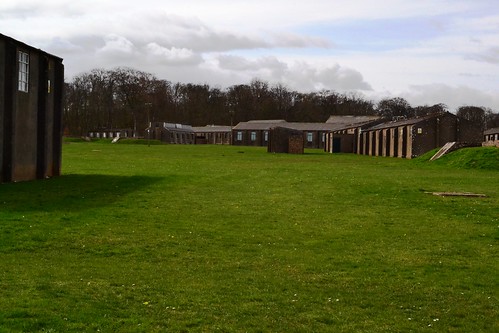
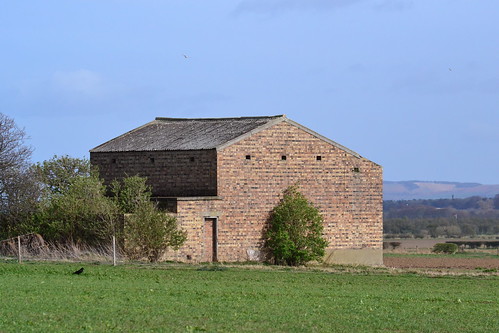
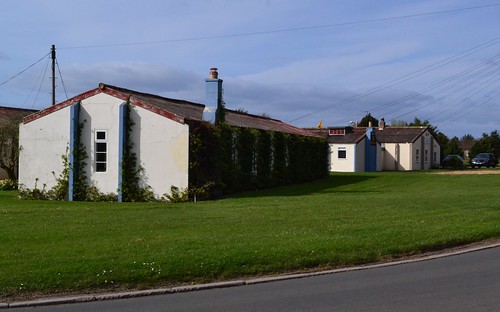
Debden, because if its post war usage, is a remarkably unique site, but whilst many of the original buildings remain intact, some even being listed as Grade II buildings*4, access is not permitted to the general public and therefore very little can be seen without prior permission. From public roads, high fences and thick hedges obscure most views although from the south, parts of the runway, and several dispersals can be seen quite easily.

RAF Debden

One of the pans now missing its Blister hangar.

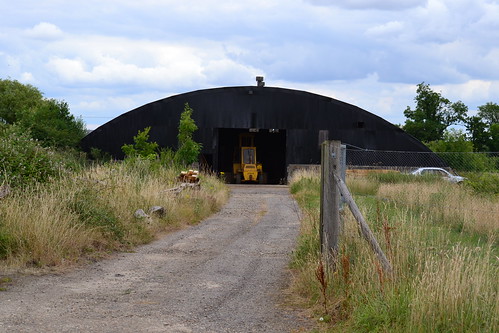
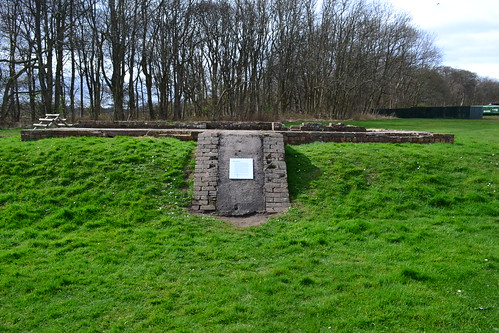
By keeping the gate house to your right and passing along the road east to west, you pass the current accommodation area, Guard House and modern buildings used by the current Army owners. Continuing along this road soon brings you to the memorial. Whilst there is no official parking space here, there is a grass verge opposite the memorial where you can safely park your car off the busy main road. Behind the memorial is the north-south runway, still in full width, in which a small section of it can be seen as it rises and dips over the hill. Returning toward the main entrance brings you to a parking area on your right, where public access is permitted to Rowney Wood. Here there are a small number of original buildings still left along with former roads / and taxi ways. During its US occupation, there were five Blister Hangars located here, today only a couple survive, both in current use by local companies.

Like many former airfields and military sites, Debden has been identified as a possible housing location, with the potential for the construction of 55,000 homes. The announcement to close the barracks was made on November 7th 2016, as part of the ‘Better Defence Estate’ strategy, in which 91 MOD sites across the country will close by 2040. Government figures say that the move will save £140 million by closing these sites which also includes the US base at Mildenhall.*5

Considering the history of RAF Debden and the current status of its buildings, the restrictive nature of the site is also its guardian angel. However, with the axe looming heavily overhead, what will become of this site in the future? Its runways will no doubt be dug up, the older non-classified buildings could be demolished, its pathways and taxiways removed. Debden is in danger of disappearing for good leaving only small traces of this once famous airfield that not only took part in the Battle of Britain, but whose airmen defended London in what was very much our darkest hour.

Sources and further reading.

*2 AIR 27/703/17 National Archives

*3 ‘Borough 19 Motor Club’ website has details of their race activities.

*4 One such building is the Sector Operations Block, built in 1938, to the designs of J.H. Binge of the Air Ministry’s Directorate of Works and Buildings (drawing no. 5000/137).

*5 The story was highlighted in the Saffron Walden Reporter website accessed 11th October 2017.

Royal Air Force Police Flights who were at Debden have photos and information on their website.

RAF Debden (Part 1) – The Build up to the Battle of Britain.

Not far from Wethersfield, lies the parent airfield of Castle Camps. Now closed to aviation, it currently resides in the hands of the Army as the Carver Barracks. On this next part of this Trail we wind our way through the Essex countryside to the former fighter station that gained notoriety during the early 1940s, and in particular the Battle of Britain. In this, the first part of the visit, we look into the development of the airfield, and the build up that took it into the heart of the Battle. We visit the former RAF Debden.

RAF Debden (Station 356) – Essex

The internet and history books are awash with pictures and information about RAF Debden, and rightly so. It is an airfield with an incredible history, famous for its part in the Battle of Britain and the defence of London, it was home to no less than thirty RAF squadrons at some point; it was used by the U.S. volunteer squadrons the ‘Eagle Squadrons’, and then taken over by USAAF as a fighter airfield following their official entry into the war. It was then used again by the RAF post war up until 1975 when the British Army took over,  those whose hands it remains in today as the Carver Barracks.  Not only is it history long but the site is historically highly significant. According to Historic England, Debden airfield represents “one of the most complete fighter landscapes of the Battle of Britain period“, considered historically important due to its “largely intact defensive perimeter and flying-field with associated blast pens“.*1

Debden is therefore a remarkable site, but as an active military base, access and views are understandably very restricted. However, some buildings can still be seen from public areas, particularly the front as you pass by the main entrance.

RAF Debden

One of 11 Blister Hangars built at Debden.

Debden’s life began in the mid 1930s, it eventually opened in 1937, as part of the expansion programme of the pre-war era, and was classified as a fighter airfield under Scheme ‘C’ of the airfield construction programme. During this period, great consideration was given to the architectural features of airfield buildings, standard designs being finished and positioned aesthetically in line with both the local landscape, stone and environment. Design and construction of these airfields, in this the second part of the expansion phase, was carried out in conjunction with the Royal Fine Arts Commission, whose influence led to an overall improvement in airfield design. During this phase of expansion, over 100 permanent sites were built using these new designs, in fact, according to Historic England, it is these sites that have tended to survive in the best condition to date largely thanks due to their post war and Cold War usage. Even in this pre-war period, aesthetics were as important as operability!

Built by W. L. Fench Limited, Debden wasn’t completed until after it had been opened, thus the first units there were using the site in its unfinished state. The two initial landing surfaces were grass, but as a fighter airfield little more was needed. Even so, and not long after it opened, these were replaced by concrete and tarmac surfaces, giving the airfield much stronger and more adaptable landing surfaces. Being the standard 50 yards wide, these runways were also extended from the initial 1,600 and 1,300 yards to 2,600 and 2,100 yards respectively, allowing for larger and more powerful aircraft to utilise the site.

Debden had a large number of hangars built: three ‘C’ type, one Bellman and eleven blister hangars which were all spread around the perimeter and technical areas of the airfield. Some 80 hardstands were also provided, thus large quantities of aircraft were expected to use the site at one point or another.

Of these thirty operational flying squadrons to pass through Debden, the primary aircraft to see service would be the Spitfires and Hurricanes of Fighter Command. Biplanes such as the Demon and the Gloster Gladiator were also to feature here, as were the twin-engined aircraft the Beaufighter, Havoc/Bostons and the jet engined Meteor in the latter stages of the war. The period 1939 – 1942 though, was by far the busiest period for Debden, the majority of squadrons operating from here during this time.

Upon opening in 1937, Debden would operate the outdated and obsolete biplanes of the Royal Air Force, Hawker’s Fury II of 87 squadron being the first to arrive on 7th June 1937, being replaced shortly after by Gloster’s Gladiator, that famous Biplane that protected Malta as ‘Faith’, ‘Hope’ and ‘Charity’. In the summer of 1938, prior to the outbreak of war, Hurricanes were brought in and the entire squadron moved to airfields in France where they would stay until May 1940, when France was invaded by the German forces. Brought back to England, a short two-day stop over at Debden, would lead to a move north and Yorkshire before returning to the battle, and a night fighter role over Southern England.

Joining 87 Sqn in June 1937 were further Gladiators, those of 80  Squadron who, themselves formed a month earlier, would stay at Debden until departing for the Middle East and Ismailia a year later. A third squadron would arrive during this time, 73 Squadron, who shortly after reforming at nearby Mildenhall, would also replace their Hawker Furys with Gladiators coinciding with their move to Debden. Also moving to France, 73 Sqn would eventually move to the Middle East, where they would remain for the duration of the war, flying from numerous airfields including that of Habbaniyah, one of several places where my father was stationed post-war.

One other squadron would grace the skies over Debden that year, that of 29 Squadron, whose Hawker Demons were adapted to accept a Frazer-Nash turret for defence. A small aircraft, they would be no match for enemy fighters and so were replaced in December 1938 by the far superior aircraft the Blenheim IIF. Coinciding with this, was the movement of a detachment of 29 sqn aircraft to Martlesham Heath, which was followed by a months stay at RAF Drem in the border region before returning to Debden once more. By the end of June though, the entire squadron have been pulled out of Debden and moved to Digby in Lincolnshire and a new role as night fighters.

1938 also saw the reforming of 85 Squadron on the 1st June. 85 sqn, as a unit, had their roots in the First World War, being stationed in France before disbandment in the summer of 1919. But on this occasion, they were reformed out of ‘A’ Flight of 87 squadron prior to them taking on their Hurricanes and imminent move abroad. During the period 1939 – 1940, 85 Sqn would move around almost weekly, with one of their longest permanent stays being between November 1938 and September 1939 whilst here at Debden. Being the parent airfield of Castle Camps, Debden units would often be dispersed there, or in some cases stationed there, whilst also operating out of Debden – 85 Sqn being no exception.

Two other squadrons would fly from Debden during the winter/spring of 1939 – 40, both 17 and 504 operating the Hurricane MK. I. On an almost weekly basis, both units would yo-yo between Debden and Martlesham Heath, an almost continuous spiral of postings saw them using the ‘Heath’ as a forward operating airfield until around May 1940, when both units were moved to France in support of the B.E.F.

Hawker Hurricane Mark Is of No 17 Squadron taxiing at Debden, July 1940. In the foreground is YB-C, that of the CO, Squadron Leader Harold ‘Birdy’ Bird-Wilson, who was shot down on 24th September flying YB-W (P3878) (IWM – HU 54517)

As the fall of France turned into the Battle of Britain, fighter units to defend Britain became top priority. The dawn of 1940 would see the beginning of six more squadrons operate out of Debden, the majority of which would arrive during the height of the Battle. Debden, as the Sector Station responsible for the Thames Estuary and eastern approaches to London, would become a prestige Luftwaffe target during those early days of the Battle. As a result, it along with other Sector stations at Northolt, North Weald, Biggin Hill, Tangmere and Hornchurch, would endure some of the most sustained and prolonged attacks by German bomber formations.

To meet the demand for fighter units, 257 Squadron were reformed and posted to Debden initially flying the Spitfire MK. I. They quickly replaced these with the Hurricane I prior to them becoming operational on July 1st. Four days later they were joined at Debden by both 601 (the ‘Millionaires Squadron’ named so after the men who initially joined it) and 111 Squadron making this one of the largest collections of Hurricanes at that time.

85 Squadron were soon in the thick of the battle. As July 1940 turned to August, patrols would be sent up as regularly as the sun would rise, many of these patrols would result in enemy engagement; the Operational Record Books being testament to the continuing battle for the skies over Britain at that time. At the beginning of August on the 7th, Air Vice-Marshal K.R. Park M.C., D.F.C. visited  Debden, a visit that preceded the transfer of Debden from 12 Group into 11 Group. It was also at this time that the funeral of P/O. Britton of 17 Sqn took place, a young man who lost his life in a flying accident on the 6th whilst carrying out an air test in Hurricane N2456. In poor weather, visibility of only four miles, P/O Britton crashed into Debden Park destroying the aircraft in which he lost his life.

In mid August 1940, both ‘A’ and ‘B’ flights of 85 Sqn were brought back from Martlesham Heath and Castle Camps to Debden, a move that preceded the not only the first but one of the largest attacks by a Debden squadron on enemy aircraft.

In part 2, we see how Debden was affected by the German campaign, the relentless attacks that drew Debden crews into battle. We look at the changes at Debden and how the American made a name for themselves as determined and fearless fighter pilots.

*1 Historic England, Historic Military Aviation Sites – Conservation Guidance, 2016.

389th BG Exhibition at Hethel.

Whilst visiting RAF Hethel (Trail 38), we drop into the exhibition of the of the 389th BG who were stationed here during World War II.

The exhibition is small but it has a lot to offer. Located in the former Chapel/Gymnasium, it has been carefully restored and filled with information and artefacts pertaining to the former airfield and U.S Air Force during the Second World War.  There are also articles from the 466th Bomb Group who were based at nearby RAF Attlebridge, the RAF and stories from local people who befriended the Americans whilst they were here.

The exhibition is located on a working poultry farm and so access is limited, open every second Sunday of each month between April and October, from 10:00 am to 4:00 pm.

The buildings have been painstakingly restored by volunteers, some of whom have had connections with the airfield or Lotus cars, the current owner of the airfield itself. In 2001 the museum opened its doors to the public, after moving a collection of memorabilia from the Lotus site over to their new home here at the 389th exhibition.

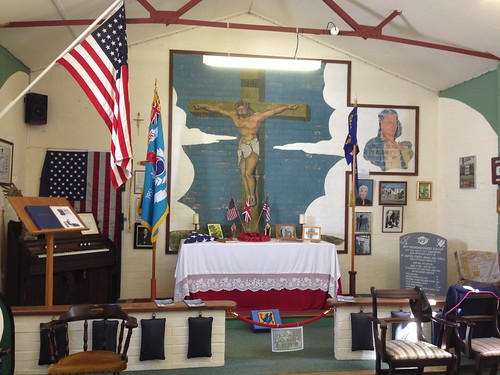
It was during the restoration that two murals were discovered, these are perhaps one of the more stunning aspects of the exhibition. Painted in 1943 by Sgt. Bud Doyle, the then Chaplin’s driver, they are located on one of the walls of the Chapel. One is of Christ on a cross, whilst the other is a portrait of a pilot, both have been restored and remain on display where they were originally painted all those years ago..

389th BG Exhibition Hethel

The restored murals in the Chapel.

Located here, are a number of items many with stories attached. In the Chaplin’s quarters next door, are maps and other documents relating to the groups activities.

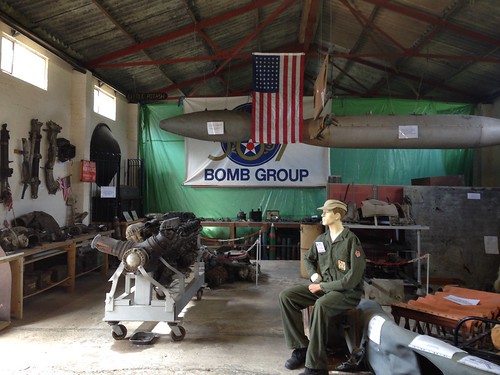
Two new Nissen huts have also been built, opened and dedicated in 2014 and 2017, they extend the exhibition further to include uniforms, service records, numerous photographs and more memorabilia.

RAF Hethel, 389th BG Museum

The dedication plaque.

There is also a refreshments bar offering the usual tea and snacks, along with a toilet facilities.

From the museum there are public footpaths into what was one of the accommodation areas of RAF Hethel, here are some of the remains of buildings, shelters primarily, hidden amongst the undergrowth. The footpaths are mainly concrete once you get onto the site.

RAF Hethel, 389th BG Museum

Part of the exhibition inside the former Chapel at RAF Hethel.

A nice little museum it has free entry and welcomes donations to help with the upkeep and maintenance of the site, if in the area, it is well worth a visit and your support .

The 389th website has further details and opening times and information of forthcoming events.

RAF Castle Camps – A return to Essex.

Bordered by Cambridge and Suffolk to the North, Hertfordshire to the west, London to the south and the North Sea to the east, Essex is a coastal county that boasts a diverse range of landscapes. Primarily commuter belt for London, it has a range of its own industrial giants, electronics and pharmaceuticals being prime employers of the area. It also has a long and diverse aviation history, hosting a number of wartime airfields some of which are still in use today – albeit under a different guise.

Following on from Trail 33 (Essex Pt. 1), we return once more to Essex to its northern borders to visit some of the airfields that can be found among its green fields and idyllic villages. We start off at the former airfield, RAF Castle Camps.

RAF Castle Camps.

Castle Camps lies straddling the borders of Cambridge and Essex, a small unassuming airfield, it was none the less home to thirteen operational units at some point in their wartime career. It was constructed early on in the war, in sight of an ancient Motte and bailey built by Aubrey de Vere, soon after the Norman Conquest. Itself quite a historic monument, there is evidence that dates the site back further to both the Saxons and Romans. This castle itself is known to be the largest Medieval fortress in the county, and dates back to the latter parts of the thirteen century*1. Originally known as Great Camps, and Camps Green, it is after this Castle that both the village and airfield gained their names.

Castle Camps housed a small number of aircraft types: Hurricanes, Beaufighters, Spitfires and Mosquitos all resided here, with some as detachments, but many as full squadrons. Even with increases in Squadron  numbers, only one unit was ever formed here, that of 527 Squadron in 1943. However, that did not mean a posting here was by any means ‘quiet’.

Opening in the summer of 1940, it was designed as a satellite for nearby R.A.F. Debden and as such, both its accommodation and facilities were rudimentary to say the least. A grass airfield, with initially little more than tents for sleeping, it possessed a more ‘informal’ atmosphere than many of the R.A.F.’s other airfields.

No. 85 Squadron – a First World War unit that had only been reformed two years before war broke out – had been stationed in France to face the advancing might of the German army. Badly beaten and continuously moved around the many airfields of France: Merville, Lille, Mons-en-Chaussee and Boulogne, the squadron was completely decimated with only four aircraft from those originally sent out returning. In May 1940, these aircraft were pulled back to Debden to reform and re-equip. With detachments at both Martlesham Heath (A Flight) and Castle Camps (B Flight) they would be led by the soon-to-be-famous, Squadron Leader Peter Townsend, D.F.C.

85 Sqn would  initially take on a regime of coastal patrols many starting in the early dawn sunlight and continuing on through until dusk. These repeated flights were undertaken using many new ‘green’ crews who were eager to get back at the enemy for defeats in France. Whilst those at Martlesham would be thrown into the deep end, the Debden and Castle Camps’ crews would find their time slightly less ‘strenuous’.

The CO of No. 85 Squadron, Sqn Ldr Peter Townsend, jumps down from Hurricane Mk I P3166 ‘VY-Q’ while being refueled at Castle Camps, July 1940. © IWM (HU 104489)

With many airmen arriving with less than 10 hours flying experience, it was vital they learn discipline and extreme vigilance whilst flying, and Townsend saw these flights as a way of achieving that. By the end of June 1940, the flights at Debden and Castle Camps had undertaken 505 hours of flying, of which only 25 had been recorded as ‘operational’.*2

The importance of this training was soon realised when on July 22nd 1940, Hurricane P3895 piloted by Pilot Officer John Laurence Bickerdike (s/n 36266), undershot the runway at Castle Camps. In the resultant crash,  Bickerdike at just 21 years of age, was killed.

On August 13th, ‘B’ Flight departed Castle Camps and returned to Debden joining with ‘A’ Flight from Martlesham Heath. At last the squadron was together again and it wouldn’t be long before they would be moving on to pastures new, this time to Croydon, on the southern outskirts of London.

Other than an almost passing overnight stay in September, 85 Squadron wouldn’t return to Castle Camps until the war’s end in 1945.

Hawker Hurricane P2923 ‘VY-R’ of No. 85 Squadron. The Operational Record Books show this aircraft being flown by F/O R.H.A. Lee, D.S.O., D.F.C., at Castle Camps, August 1940. He was lost on the evening of August 18th 1940. Note the ‘temporary’ wooden airmen huts see note below. © IWM (HU 104510)

Whilst Debden remained busy – 85 Sqn making a straight swap with 111 Sqn – Castle Camps was quiet. The next users would be 73 Squadron in early October 1940.

Moving from the night training duties of Church Fenton, 73 Squadron had themselves been more successful in France than 85 Sqn. Using Hurricanes in this night fighter role though proved to be a costly mistake, as they were wholly unsuited and casualties were high in these early flights. By the end of October into early November, operational sorties has ceased as preparations were made to transfer the entire unit, via HMS Furious, to Heliopolis.

With this departure, Castle Camps fell operationally quiet again, and it was decided to upgrade both the airfield’s accommodation and flying facilities.

Three runways were built all covered with tarmac: the main running south-west to north-east of 1,900 yards, with a secondary and third runway of 1,600 yards and 1,070 yards respectively. Both the main and third runways were later extended, the main to 2,600 yards and the third to a more standard 1,100 yards. Sixteen hardstands were provided for aircraft dispersal as hangars were not yet added, but a Bellman and eight blisters were later erected.

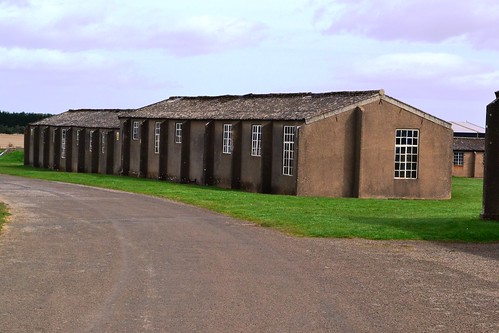
Accommodation would be provided for 1,178 male and 184 female staff, 1,179 of which were ordinary ranks. The original temporary wooden huts (possibly Laing huts) were supplemented with ‘improved’ Ministry of Supply (MoS) huts. These differed in that they had canted sides as opposed to vertical sides normally found in these types of accommodation huts. Three of these huts are believed to survive today in a very much modified condition and used for agricultural purposes, a big change from the time they were used by the W.A.A.F.s of Castle Camps.

Once construction was near complete, operational units would again return. On the 17th December 1941, 157 Squadron (formed at Debden three days earlier) were informed of their immediate  departure to Castle Camps, which would now become a self-serving airfield. The move, which would involve 3 Officers, 34 N.C.O.s and a few airmen, began that day, with ground crews from 3081 Servicing Echelon accompanying them on the next day. A range of other staff began arriving during the course of the closing days of 1941.

However,  the running of the airfield and squadron was badly hampered by the lack of an N.C.O Disciplinarian and Clerk, and by the fact that officers were having to travel back to Debden for accommodation, as it was not available yet here at Castle Camps – the situation was far from ideal.

As Christmas approached, morale began to decline. Influenced by a number of factors it was primarily due to both the lack of work and the isolation of the Castle Camps airfield; the continuing influx of ground personnel also hindered the camp, as by now, it was beginning to put a strain on the lack of completed accommodation. On the 21st, Wing Commander Gordon Slade and Pilot Officer Truscott, his observer, both arrived on posting from 604 Squadron at Middle Wallop. Joining Slade at Castle Camps a month to the day, would be Sqn. Ldr. Rupert Clerke, formerly of No.1 Photographic Reconnaissance Unit (P.R.U.), who flew the first operational Mosquito sortie the previous year on 17th September to Brest. It would be almost a year later on September 30th 1943, that Clerke would fly the first Mosquito day sortie, a flight that resulted in the loss of a Junkers Ju 88 off the Dutch coast.

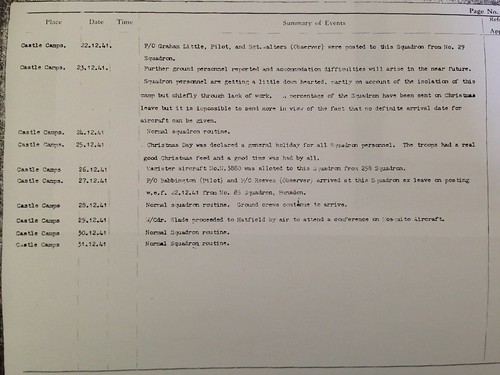
With little work to do, ‘Normal Squadron Routine‘ was repeatedly entered into the operations records, and so to help boost this flagging morale, the 25th December, was declared a general holiday for all staff who had were said to have a “real good Christmas feed and a good time was had by all“, no doubt a welcome break to the monotony that had preceded the season’s festivities.*3

Operations Record Book 157 Sqn

The entries for December reflect the poor morale and the regular Normal Squadron Routine that was becoming ‘routine’. Note the arrival of Sgt. Walters, His name appears in the Roll of Honour – see below. (AIR 27/1045)

Boxing day would see the first aircraft to arrive, bringing new hope to the squadron. A  Magister (N3880) was not what had been hoped for, but at least it was taking the squadron in the right direction.  More ground crews arrived and more “normal squadron routines” occurred. On the 29th, W/Cdr. Slade travelled to Hatfield to attend a conference on the new Mosquito and in the new year, Air Marshal Sir Sholto Douglas (A.O.C. in C. Fighter Command) arrived with the Debden Sector Commander Group Captain Peel. A full inspection of the airfield took place, which coincided with twelve airmen transferring on attachment to 32 Maintenance Unit (M.U.) at St. Athan, where the new Mosquitos were being “fitted and tested”.

A flurry of activity over the next few days saw W/Cdr. Slade travel to both Boscombe Down, and St. Athan – at last things seemed to be happening.

Finally, on the 26th January, 1942 the first Mosquito would land, flown in by W/Cdr. Slade. Slade, who had flown the prototype Mosquito previously at Boscombe Down, brought in a dual control aircraft (W4073) but hopes of more aircraft were soon dashed as this was sadly the only model to arrive for some time.

For the remaining weeks bad weather hampered work on the airfield, and with workshops, decent accommodation and tools still lacking, Castle Camps was rapidly becoming a thorn in the Squadron’s side.

Further ground staff came and went, Mosquitos were ferried between Hatfield and St. Athan by pilots of 157 sqn, for fitting of electronic equipment, W/Cdr. Slade and five officers moved in to dispersed accommodation at a large mansion known as “Walton House” near Ashdon, 3 miles from the airfield.

RAF Castle Camps

The village sign at Castle Camps reflects the ever-present Black Mosquitos of 157 Sqn at the airfield.

On February 22nd, a Beaufighter II arrived, flown by W/Cdr. Ashfield, and by the end of the month more than a dozen Mosquitos had been transferred for modification to St. Athan. There was now a light at the end of the cold, dark tunnel. Staffing was now up to 16 Officers, 12 N.C.Os and 160 other ranks; some of the accommodation site drainage had been sorted, officers showers and baths were now working, and the N.A.A.F.I was at last open and providing entertainment for the staff. The first football match was played between the squadron and the works flight, a resounding thrashing saw the squadron winning 6 – 0.

Over the next few weeks facilities would gradually improve, the weather began to get warmer, and the signs were that more aircraft would soon arrive. On March 9th 1942, the first two operational Mosquitos arrived at Castle Camps, and what a welcome sight it must have been.

The first to arrive were W4087 and W4098, neither were yet fully fitted, but that wouldn’t dishearten the staff at Castle Camps, at least things were now moving. Over the next few days a large number of Mosquitoes would arrive, these NF.IIs were Airborne Interception (AI) equipped night fighters, armed with four .303in Brownings and four 20mm cannon – all very potent weapons of the night war.

By March 29th 1942, 157 squadron had to its name: 14 Mosquitos, 1 Beaufighter (fully equipped), 1 dual Mosquito, 3 not fully equipped Mosquitos, and 2 Magisters. Night flying would now start, but a lack of workshops, sleeping accommodation and fitters meant that not all aircraft could be kept serviceable at this time. By the end of April, training flights had reached their peak, and 157 was now ready for war.

On April 27th 1942, operations would begin. Three patrols would take off followed by four the next day and then three on the 29th. No visuals were recorded from the first two nights but a Do. 217 was identified but subsequently lost in cloud.

At the end of the month F/Lt. Stoneman (Engineer Officer) invented a modification that improved the effectiveness of the Browning’s flash eliminator, an improvement that was so successful, it was quickly adopted by the Air Ministry for other models.

Successes were slow coming to 157 Sqn, problems with the A.I. sets led to frustrations and missed opportunities, but eventually they did come, and the Mosquito proved itself to be a truly outstanding night fighter.

RAF Castle Camps

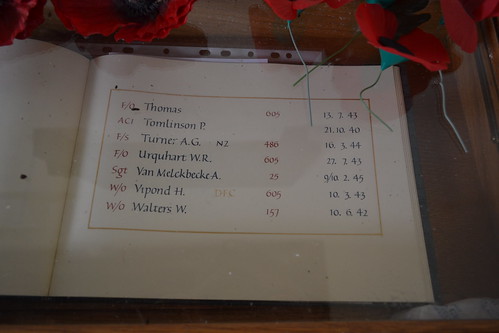
The Roll of Honour in All Saints Church lists W/O. W. A. C. Walters death as 10th June 1942. Walters (s/n 755538) arrived at Castle Camps on 22nd December 1941 (see above entry in O.R.B), he is currently buried in Nottingham Southern Cemetery, Sec. F.24. Grave 55. He was Son of Arthur and Annie Walters, of West Bridgford, Nottingham, and died at the age of 21.

By  March 1943 a change in command, Wing Commander V. J. Wheeler, M.C., D.F.C. replacing W/Cdr Slade, and then as night defenders turned to intruders, the role of 157 Sqn changed, and they prepared to move to pastures new and R.A.F. Bradwell Bay.

Around this time a small detachment of Mosquitos would share the facilities at Castle Camps, 456 sqn, who were primarily based at Middle Wallop, would have aircraft use the site between March and August 1943 – a month that would take Castle Camps into a new period, and new leadership.

The 15th would be a very busy day for staff at Castle Camps, with the departure of 157 Sqn came the simultaneous arrival of 605 Squadron.

RAF Castle Camps

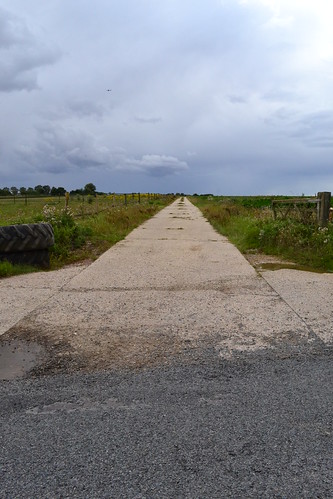
Part of the Perimeter Track that leads away to the airfield.

Led by the then Wing Commander George Lovell “Uncle” Denholm D.F.C., he was himself a Battle of Britain veteran, a Turbinlite advocate and was also famed for his part in the shooting down of the first German bomber on British soil. The famous ‘Humbie Heinkle’ was generally credited to Flight Lieutenant Archie McKellar of 602 Squadron from R.A.F. Drem, but Denholm and his 603 Sqn, played their part in damaging the aircraft before its eventual crash in East Lothian.

With the arrival of 605 Sqn and their Mosquitos, Castle Camps, like the stations at Bradwell Bay and Hunsdon, were quickly becoming synonymous with squadrons of the new type. Also Flying Mosquito IIs, (replaced four months later by the FB.VI) they would eventually depart here also for Bradwell Bay, but not before the ruggedness and reliability of the Mosquito would be put to the test.

On August 17th 1943, Sqn. Ldr. Mack and Flt. Sgt. Harrison, flew Mosquito FB.VI (HJ781) on a night intruder mission to Jagel in the northern most tip of Germany. Whilst on this mission, the aircraft was hit by a cable rocket projectile (Parachute and Cable or P.A.C.) fried from the ground. With a thin cable attached to a parachute they were designed to bring down allied aircraft and could be fired from either multiple or single launchers. HJ781, flew into one such cable which severed around 3 feet off the end of the starboard wing. The Mosquito, suffering considerable damage, managed to return to Castle Camps and was later repaired and returned to flight – such was the strength of the design of the Mosquito.

For the duration of their stay, 605 Sqn would perform almost nightly patrols over the airfields of the low countries and northern Germany, a tit-for-tat game played between the R.A.F. and the Luftwaffe, each aiming to catch returning aircraft as they approached their home airfield. A game that resulted in minor and relatively insignificant attacks on Castle Camps itself.

For eight months from June 1943, Castle Camps would be shared with a new squadron, the only squadron to be formed here, 527 Squadron, who were formed through the combining of both 74 and 75 Wing Calibration Flights from Duxford and Biggin Hill respectively.  Flying a collection of Hurricanes (I & IIB), Blenheim IV and Hornet Moths, they would test the accuracy of Britain’s defence radar systems across southern England and East Anglia.

The October departure of 605 sqn left 527 the only unit operating from Castle Camps, and operationally all was quiet once more. In the December 1943, 410 Sqn, another Hunsdon Mosquito unit arrived, stayed for a short while and then returned to Hunsdon in the April of 1944. A short but active spell saw them victors over a number of German types.

1944  would see another flurry of activity, with units arriving and departing in quick succession, and it would be a few months before another Mosquito would grace the skies over Castle Camps once more. 486 Sqn (RNZAF) , yo-yoed between Castle Camps and Ayr during the month of March, bringing with them yet another potent and deadly weapons platform, the Tempest V; followed by 91 Sqn while they were upgrading their Spitfire XII to XIVs.

Giving a useful indicator of scale, F/O. J. R. Cullen of No. 486 Squadron (RNZAF), poses with his Tempest Mk V at Castle Camps. Cullen became a successful Operation DIVER pilot, shooting down around 16 flying bombs. © IWM (CH 13967)

Between March and June little happened at Castle Camps, 68 Sqn*4 breaking the quiet with their Beaufighter VIFs at the end of June, which were quickly replaced with Mosquito XVIIs and Mosquito XIXs.  68 (Night Fighter) Squadron was primarily an R.A.F. Squadron, but Czechoslovak pilots formed one of its flights. The determination of the Flight’s crews resulted in some high ‘kill’ rates, with twenty-one verified kills, three probable, seven enemy planes damaged  and three V-1 flying bombs to their credit. The flight saw Twenty-three Czechoslovak pilots (twenty-one Czechs and two Slovaks) pass through their doors, culminating in an incredible 1,905 combat sorties covering 4,095 operational hours during the war.*5 By the October 68 Sqn too had departed, replaced by 151 Sqn and 25 Sqn for a short period both with yet another Mosquito model, the MK XXX.

1945 and the close of war saw units slowly begin to disband and wind down, 307 were followed by 85 Sqn who returned in the June and September also with the MK. XXX. A  huge improvement and development from their early Hurricanes of 1939 / 40 and a fitting end to a station that had seen many a brave young man come and go. 25 Sqn also returned, in both the August and October with the Mosquito VI, staying until June 1946, whereupon the airfield closed and returned to agriculture, a state it remains in today.

Castle Camps has little – aviation wise – to offer the visitor these days.  A recently erected memorial stands at the northern end of the airfield, the only visible marker of this once busy site that grew from a cold and windy field with little more than tents for accommodation, to a bustling site with possibly the most advanced and formidable fighters of the Second World War.

It may not appear to be much more than green fields and cattle farming, but sitting in the summer sun, as I did, you can still hear the rumblings of that magnificent engine the Merlin, as the Hurricanes and Mosquitos of the R.A.F. fly over your head transporting you back to those days of 1940s England.

Sources and further reading.

*1 The Castle Camps Village webiste details the history of the Castle.

*2 AIR/27/703/14 National Archives

*3 AIR/27/1045 National Archives

*4 An interesting blog highlighting some of the Czech pilots who flew with 68 Sqn.

*5 Pilot Josef Capka, D.F.M. (a member of the Guinea Pig Club) joined 68 Sqn after they left Castle Camps. His incredible story is told in the Free Czechoslovak Air Force blog and through his book ‘Red Sky at Night‘.

R.A.F. East Fortune – Scotland’s Baby that Grew up.

After leaving R.A.F Drem, we travel a few miles to the east, away from Edinburgh to an airfield that was originally built in the First World War. In the mid war years it was closed and returned to agriculture; then, as the Second World War loomed, it was reopened, used by both the Navy and the Air Force. As such, its history goes back to the turn of the last century. Today it is Scotland’s home of the National Museum of Flight, it is also has one of the best preserved collections of original buildings left in the country. In the second part of Trail 42, we visit the former airfield of R.A.F East Fortune.

R.A.F East Fortune.

R.A.F East Fortune is another airfield that has its roots in the First World War. Located 4 miles north-east of the small town of Haddington, and a similar distance east of R.A.F Drem, it has since become Scotland’s premier aviation museum, housing one of the best collections of aircraft in the north.

East Fortune National Museum of Flight

One of the many buildings left at East Fortune.

With the outbreak of war in 1914, German intrusions over British towns and cities became both a tangible and frightening threat. Scotland and the north-east along with North Sea shipping lanes, all became targets. To counteract these threats, a string of defensive airfields (Stations) were built along the eastern coast of Britain operating as a combined force in the British Home Defence Network.

East Fortune become one such station, from which, during 1915, a small number of aircraft would operate. Designed to protect the waters around the city of Edinburgh and the North Sea coast, it fulfilled this role using a selection of aircraft including types such as the: Sopwith Scout, Maurice Fairman, Avro 504 and B.E.2c.

It wasn’t until 1916 though that the airfield really came into its own. Officially opened in August as a Royal Naval Air Station, it operated initially Coastal Class airships, followed shortly after by North Sea Class airships, both of the non-rigid design. Later on, as airships developed, the more famous ‘R’ series rigid airships appeared and took their place at East Fortune.

As a major airship station, there would often be five or six of the type at East Fortune at any one time, each carrying out submarine patrols over the North Sea. To ensure their safety whilst on land, a number of airship sheds were built; the design and development of these sheds proceeded almost as fast and dramatic as the airships themselves.

When war broke out, the threat posed to British ships  by German submarines, became all too apparent. The Admiralty recognising the potential of airships as spotters, were soon to put in an order for a ship that would be able to travel at speeds of between 40 – 50 mph, carry two crew, 160lb of bombs, wireless equipment and sufficient fuel for up to 8 hours flying time. These airships would ideally reach altitudes of around 5,000ft, and their design be so basic, that the crew could be trained and in the air within weeks rather than months. The first of these ships was the Submarine Scout (S.S.) class, a design that was so simple, the first were airborne within three weeks of the initial prototype being built. In essence, these used the wingless fuselage of a B.E.2c aeroplane suspended beneath a simple envelope. These ‘S.S.’ ships were so successful in their role, that the Admiralty ordered more, bigger and faster airships, and so the Coastal Class was then born.

The Coastal Class was larger at 195.6 feet long. They had two 150hp engines, a top speed of 52 mph, and could be airborne for up to 22 hours at a time. Designed around a French design, they were made of three sections, an unusual “Tri-lobe” design. The gondola itself, utilised two shortened Avro seaplane aircraft fuselages, the tails were removed and the two sections joined back-to-back. This produced a car that could seat four or five crew members with two engines at opposing ends. Canvas and planking was added for further strength and improved crew comfort. Operating successfully for two years, many soon became weary and in need of updating. Deciding to opt for an improved alternative, the Admiralty scrapped the Coastal Class and brought in the last of the non-rigid designs, the North Sea (N.S.) Class.

Initial trials and operations of the N.S. Class proved it to be very unpopular. Problems with the drive system left many crews unhappy about its performance, its top speed of 57mph rarely, if ever, being achieved. The original engines, 250 horse-power Rolls Royce engines, had very elaborate transmission systems, in fact so elaborate that they were prone to breaking. The only answer was to replace the entire system and attach the propellers directly to the engine itself. Once this problem was overcome, the airship was hailed as a success to the point that many of them broke flight endurance records on an almost regular basis. Whilst flights of 30 hours or more were not unusual, some extended as far as 61 hours, and even post war, one of these ships flew for an incredible 101 hours non stop.

The period 1916 – 17 saw a rapid advancement in airship design and development. The larger rigid airships (so-called because the envelope was now wrapped around a rigid frame) were now coming into being, and the remainder of the war would see these new airships coming on-line and into service, many appearing at East Fortune.

To counter the German’s Zeppelin threat, three new manufactures were contracted to build these rigid ships: Beardmore, Armstrong and Whitworth, and lastly Shorts Brothers.

At East Fortune, (H.M.A) R.24 was delivered on October 28th 1917, and not without its problems. Initial testing revealed that it was two-thirds of a ton heavier than its sister ship R.23, and after investigations as to why, it was discovered that it was the rivets used that were the problem. In order to move the craft from its Beardmore shed, a number of weight modifications had to urgently be made. These modifications included removing an engine and all the associated components from the rear car.

RAF EAST FORTUNE DURING THE INTERWAR YEARS

The camouflaged Airship shed built to house H.M.A. R.34 at East Fortune. Note the smaller shed to the right. (IWM – Q103040)

Although now much lighter, R.24 paid the price with speed, with no replacement of the propulsion unit, she remained slow, achieving a top speed of little more than 35 mph. But she did cover some 4,200 miles and flew for 164 hours in total; most of which were as training flights. As an operational airship however, she was little more than useless, and was eventually scrapped in 1919.

The next rigid airship to arrive and operate from East Fortune was R.29 in the following June. R.29 went on to be considered the most successful wartime rigid airship. Being the only one to be involved in direct enemy action, she was responsible for the sinking of the German submarine UB.115. Commissioned on 20th June 1918, she was based at East Fortune and would cover around 8,200 operational miles, in some 335 hours flying time. This would be a short-lived active life though, lasting only five months before the war finally came to an end.

Carrying on flying post war, she would eventually be scrapped in October 1919 having covered in total, 11,334 miles in service, more than any other British rigid airship up to that time.

Post war, rigids continued to operate from East Fortune; R.34 perhaps being the most famous. Another craft from the works of William Beardmore and Co. Ltd. of Inchinnan near Glasgow, R.34 would be constructed in the later stages of the war under War Specifications. At 634 feet in length with a top speed of 62 mph generated by five 270 hp Sunbeam ‘Maori’ engines, she would cost £350,000 to build. R.34 would be designed to carry twenty 100 lb and four 550 lb bombs, a range of Pom-Pom, Lewis and two-pounder quick-firing guns, but as she wasn’t finished until after the war, none of these were ever fitted, nor was she flown in anger.

R.34 probably at East Fortune. (author unknown)

Completed in early 1919, she just missed out the first Atlantic crossing, being laid up by damage caused by poor handling, and thus beaten to the record now held by Alcock and Brown. In May, she arrived at East Fortune, here she carried out a number of test flights including an endurance flight across the Scandinavian countries. Then in July 1919, she became the first aircraft to make the Atlantic crossing, both east to west, and back again.

On the evening of 1st July 1919 the ship was fueled to capacity, in the early hours of the morning she was moved out of her shed and prepared for the flight. Her captain, Major Scott, decided gave the order to release and at 1.42 am (GMT) R.34 lifted slowly in to the Scottish sky.

A record was made, R.34 had put East Fortune firmly on the map. After 108 hours and 12 minutes flying time, R.34, her crew and two stowaways: William Ballantyne and a small tabby kitten called “Whoopsie”, landed at Mineola, Long Island, New York.

After a major refit at East Fortune, R.34 left for Pulham airship base in Norfolk. Here she carried out a number of flights, but was eventually badly damaged in strong winds, and after being stripped, she was sold for scrap – a rather ungainly ending to an incredible machine.

Airships were not to be the only user of East Fortune though. With the formation of the Royal Air Force in 1918, it would initially house No. 208 Training Depot Station (T.D.S.), designed to train torpedo bomber pilots using a variety of aircraft types, such as the Sopwith Camel and Beardmore W.B.III. In August 1918, it became 201 Training Depot Station, merging both 1 Torpedo Training Squadron, and the Torpedo Aeroplane School already at East Fortune.

A Sopwith Cuckoo (N6954) of the Torpedo Aeroplane School dropping a torpedo during trials at East Fortune, 24 – 26 July 1918. (IWM Q 67496)

On 21st October 1918, No. 185 Squadron was formed here, made by merging elements of 31, 33, 39 and 49 Torpedo Depot Stations, they would fly the Sopwith Cuckoo until April 1919, when it was reduced to a cadre, and then disbanded five days later on April 14th, 1919.

It was also in this month on the 31st, October 1918, just days before the armistice that year, that Bristol F.2b B8942 of 201 T.D.S, left R.A.F. East Fortune for a bombing mission against the German Fleet. During the take off, the aircraft stalled and crashed into the ground. In what must have been the last casualties of 201’s operations, the two crew: Lieutenant Lynn N. Bissell (age 19), and  Lieutenant Eric W. Bragg (22), were both killed when a bomb they were carrying exploded on impact. They have remained together ever since in Athelstaneford Parish Churchyard in East Lothian*1.

201 Training Depot Station were soon re-designated as the Torpedo Training School, finally being disbanded on February 1st, 1920, here at East Fortune.

This move signalled the end of East Fortune as an airfield for now. The site was closed, many of the buildings were removed either scrapped or sold off, and no further flying activity would take place.

East Fortune National Museum of Flight

A small part of the collection of wartime buildings that still exist at East Fortune.

After laying dormant for around twenty years, the outbreak of war saw East Fortune brought back to life once more. Designated a satellite for R.A.F. Drem, it was virtually unchanged in its layout. After a period of expansion and development, new runways were laid, a technical site established, and accommodation and administration areas developed. A bomb dump was created to the south-west, well away from the other areas to the north. The runways, tarmac laid on hardcore, were all non-standard lengths, 1,710 yards, 1,560 yards and 1,100 yards but they were the standard 50 yards wide.

The first to arrive were 60 Operational Training Unit (O.T.U.)  in June 1941. A night fighter development unit they flew a range of aircraft including: Boulton Paul’s Defiant, Miles’ Master and Magister, and Westland’s Lysander. In June 1942, the  twin-engined Beaufighter also arrived here, a year which also saw a return of the Blenheim and Beaufort. Some of these Beaufighters were dual control and several had Aircraft Interception (A.I.) equipment installed.

It was in one of these Defiants, that pilot Sergeant Anthony. D.C. La Gruta, (s/n 400719) (R.A.A.F.) was killed when the aircraft he was in plunged into the ground with such force that it buried itself some 16 feet down. The Ministry of Defence, unable to recover the wreckage, declared it a war grave and his body remains there to this day. A monument and parts of the wreckage currently mark the spot where the aircraft lies. Whilst it can’t be confirmed, it would appear that whilst out conducting a series of ‘homing tests’, the pilot lost control of the aircraft resulting in the tragic accident.

East Fortune National Museum of Flight

One of several Air Raid shelters at East Fortune.

During October 1942, No. 2 Glider School were formed here, they were quickly moved on however, and disbanded later at Dumfries – playing virtually no part in the development of East Fortune. On 24th November 1942, 60 O.T.U. was officially disbanded, and then immediately reformed as 132 (Coastal) Operational Training Unit, remaining at East Fortune airfield. Operating under the leadership of No. 17 (Training) Group (R.A.F. Coastal Command) it was designed to train crews in the long-range fighter and strike role. To achieve this, there were some sixty aircraft split primarily between Beaufighters and Blenheims; with other models such as Beauforts, Lysanders, Magisters and Spitfire VBs also adding to the busy airspace in this region of Southern Scotland.

In May 1944, Belgian Flying Officer, Gilbert A. E. Malchair, (s/n 132969), and Flight Sergeant, Roger H. L. Closon, (s/n 1424811), both of the Royal Air Force Volunteer Reserve, took off in Beaufighter ‘EL457’ on what is believed to be a training sortie. Little is still known about the accident but it is believed that the pilot reduced height to prevent icing, in doing so, the aircraft collided with the ground at Hedgehope Hill (Threestoneburn Wood) in the Cheviots. As a result, both crewmen were killed.

In 1944 a few D.H. Mosquitoes arrived at the airfield, but by now East Fortune had begun the long wind down. By May 1946, 132 O.T.U. was disbanded, and the aircraft were either dispersed or scrapped.

The airfield remained in R.A.F. hands, but during the cold war years, the U.S. Air Force lengthened two of the runways in anticipation of the Cold War becoming ‘hot’. Thankfully however,  hostilities never broke out and occupation of the site never materialised. East Fortune was then used as storage facility in case of any subsequent Soviet attack, primarily for the ‘Green Goddess’ fire engines, and later to store food stuffs by the Ministry for Agriculture and Fisheries. The site remained ‘open’, and for a short period – April to August 1961 – it acted as a replacement for Edinburgh’s Turnhouse international airport recording just short of 100,000 passenger movements. After this, in 1961, East Fortune was finally closed and the site vacated.

Callender-Hamilton Hangar East Fortune National Museum of Flight

Two of the three Callender-Hamilton hangars.

Over the years East Fortune had gone from an Airship site to a night fighter training school. Operational Training Units had lost crews and the entire site developed and expanded. Two of the three runways were expanded up to 2,000 yards, 46 hardstands were laid, it had 3 Callender-Hamilton hangars, 8 blister hangars, and accommodated 1,501 R.A.F personnel and 794 W.A.A.Fs. Designed as a satellite it had achieved a remarkable status, incredibly much more than it was ever designed to do.

Since its closure however, it has taken on a new role, developing both its past and preserving its history, turning it into what is possibly Scotland’s finest aviation museum. Many of the Second World War buildings still remain: The night flying store (drawing number 17831/40); three Callender-Hamilton hangars; Nissen stores, latrines and a refurbished parachute store. The Watch Office sadly not refurbished, is also present on the airfield site, as are a number of air raid shelters. The main runway is also still in situ, now used for Sunday markets, with the original section and extended post war sections being dissected by the road through the site. The perimeter track and secondary runways are also intact, having been used in part for racing activities.

East Fortune

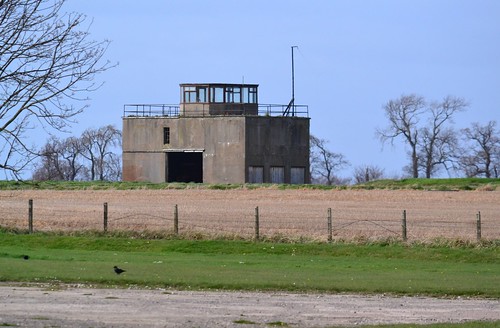
The Watch Office remains on the ‘active’ side of the airfield site.

One of the benefits of East Fortune is the location of all these buildings, primarily on one relatively small site. Access is easy although many of them are sadly locked and out-of-bounds to the public.

Considering its early history and the sacrifice many of its crews gave, East Fortune is an important site, it stands as a memorial to all those who came and died here, and to all those who not only wrote history, but have contributed to it over the last 100 years.

Sources and further reading:

Further details of R,34’s trip can be found here.

Additional pictures of East Fortune can be found on flckr.

More detailed information about R.34 and the development of Airships can be found on The Airship Heritage Trust website .

The Eastern Daily Press ran several articles on the commemoration of R34’s journey 100 years on. The articles are available on the EDP Website.

*1 The Commonwealth War Graves Commission website.

July 2nd 1919, H.M.A. R.34 Sets A World Record Flight.

On July 2nd 1919 at 01:42, airship R.34 lifted off from the airfield at East Fortune, east of Edinburgh, to make an epic voyage – the first crossing of the Atlantic Ocean east to west by a powered aircraft.

R.34 possibly at East Fortune. (author unknown)

Conceived as early as 1916, R.34 was built at the works of William Beardmore and Co. Ltd. of Inchinnan near Glasgow. At 634 feet in length with a top speed of 62 mph, she would have five 270 hp Sunbeam ‘Maori’ engines, and would cost £350,000 to build. Her massive size gave her an impressive 1,950,000 cubic feet for gas storage, and she would be equivalent in size to a Dreadnought battleship. A major step forward in airship design, her aerodynamic shape reduced total air resistance to that of just 7% of an equivalently sized flat disc.

As she was designed under war specifications, R.34 would be built to carry twenty 100 lb and four 550 lb bombs, a range of Pom-Pom guns, Lewis machine guns and a small number of two-pounder quick-firing guns; but as she wasn’t finished until after the war, none of these were ever fitted, nor was she ever flown in anger.

Completed in early 1919, she just missed out on achieving the record of the first Atlantic crossing, being laid up by damage caused by poor handling, and thus beaten to the record now held by Alcock and Brown.

In May, she arrived at East Fortune airfield, a major airship station in East Lothian, from where she carried out a number of test flights including an endurance flight across the Scandinavian countries. In July she was set to make the first  Atlantic crossing, east to west.

In preparation for the flight, eight engineers were sent to the United States to train ground crews in the safe handling of the airship. The Admiralty provided two  warships, the Renown and Tiger, as surface supply vessels, and should R.34 have got into difficulty, she could have been taken in tow by one, or both of the two vessels.

On the evening of 1st July 1919 the ship was fueled to capacity (some 6,000 gallons), and in the early hours of the morning she was moved out of her shed and prepared for the flight. Her captain, Major G. H. Scott, gave the order to release early, and at 1.42 am (GMT) R.34 lifted slowly in to the Scottish sky.

After battling strong winds and Atlantic storms, R.34 finally arrived at Mineola. Huge crowds had turned out to greet her and her crew, a grandstand had been erected, parks and public spaces were packed with onlookers. Major J. Pritchard (The Special Duties Officer) put on a parachute and jumped from the airship to become the first man to arrive in America by air. He helped organise ground staff and prepared the way for R.34 to safely dock. As she settled on her moorings, she had not only become the fist aircraft to fly the Atlantic East to West, but broke the current endurance record previously held by the North Sea Airship NS 11, also based at East Fortune.

A record was made, R.34 had put British Airship designs and East Fortune firmly on the map. After 108 hours and 12 minutes flying time, R.34, her crew and two stowaways: William Ballantyne and a small tabby kitten called “Whoopsie”, had landed at Mineola, Long Island, New York.

After a 3 day stay in which the crew were treated like the heroes they were, R.34 was prepared for the homeward journey. On Wednesday July 10th 1919, at 23:54 she lifted off and set sail for home.

With prevailing winds carrying her eastward, she made an astonishing 90 mph, giving the opportunity to cut some of the engines and preserve fuel. This gave the crew a chance to divert over London, but due to a mechanical breakdown, this was cancelled and R.34 continued on her original route. Poor weather at East Fortune meant that she was ordered to divert to Pulham Air Station, Norfolk, but even after clarification that the weather had improved, her return to East Fortune was denied and she had to continue to Pulham – much to the disgust of the crew on board. At Pulham, the reception was quiet, RAF personnel greeted her and secured her moorings. She has covered almost 7,500 miles at an average speed of 43 mph.

Eventually after a major refit at East Fortune, R.34 left for the return to Pulham. After six weeks of static mooring, R.34 was sent to Yorkshire, to Howden Airship Station. Here she was used to train American crews, was modified for mast mooring and used for general training duties. During one such training mission, she was badly damaged in strong winds, and after sustaining further damage whilst trying to moor and secure her, she began to buckle. Falling to the ground, she broke up and was damaged beyond repair. R.34 was then stripped of all useful materials and the remainder of her enormous structure sold for scrap – a rather ungainly ending to an incredible and historical machine.

H.M.A. R.34 and her crew had become the first to cross the Atlantic east to west, they had achieved the  longest endurance flight, and become the first aircraft to complete a double-crossing of the Atlantic.

East Fortune

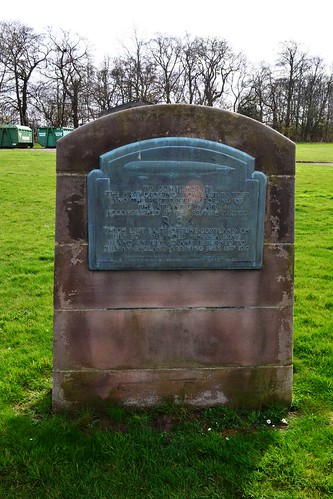
The memorial stone at East Fortune airfield commemorating the epic flight of R.34.

The Flight Crew for the Atlantic journey were:

Major G. H. Scott A.F.C – Captain
Captain G. S. Greenland – Second Officer
Second Lt. H. F. Luck- Third Officer
Second Lt. J. D. Shotter – Engineering Officer
Major G. G. H. Cooke DSC – Navigator
Major J. E. M. Pritchard O.B.E. – Special Duties
Lt. G. Harris – Meteorological Officer Second
Lt. R. F. Durrant – Wireless Officer
Lt. Commander Z. Lansdowne – Representative U S Navy
Brigadier General E. M. Maitland – Special Duties
Warrant Officer W. R. Mayes – First Coxswain
Flight Sergeant W. J. Robinson – Second Coxswain

Sergeant H. M. Watson – Rigger
Corporal R. J. Burgess – Rigger
Corporal F. Smith – Rigger
F. P. Browdie – Rigger
J. Forteath – Rigger Corporal

H. R. Powell – Wireless Telegraphy
W. J. Edwards – Wireless Telegraphy

W. R. Gent – Engineer
R. W. Ripley – Engineer
N. A. Scull – Engineer
G. Evenden – Engineer
J. Thirlwall – Engineer
E. P. Cross – Engineer
J. H. Gray – Engineer
G. Graham – Engineer
J. S. Mort – Engineer
J. Northeast – Engineer
R. Parker – Engineer

W. Ballantyne – Stowaway
“Whoopsie” – a small tabby kitten and stowaway

The crew of R.34 Crew – with the crew pets.

East Fortune airfield appears in Trail 42.

Historic RAF Halton to Close in 2022.

RAF Halton, currently used for basic training of new recruits, is set to close in 2022 following the Ministry of Defence’s announcement that it was having to save £140 million over the next ten years.

Halton is also used by the Specialist Training School, which is part of No 22 (Training) Group, which provides training in all three areas of: Environmental Management, Health and Safety and Quality Management for the Royal Air Force.

At Halton, new recruits go through a range of activities over a 9 week period including: general knowledge, fitness, inspections, arms instructions and of course P.T. etc,. The course culminates, for those successful candidates, in a graduation parade.

RAF Halton has its roots prior to the First World War, when the then land owner, Alfred de Rothschild, allowed the Army to use the land for manoeuvres. After a short while, the RFC (No. 3 Sqn) arrived with a small contingency of machines and men. When war broke out, the entire estate was handed over to Lord Kitchener, and by mid-war it was awash with tents and wooden huts accommodating up to 20,000 young men, many of whom would never be returning from the battlefields of France and Belgium.

By 1917 there was a great need for aircraft mechanics and technical expertise in the RFC, Halton would become the hub for training these men. New huts were established, and it became known as the School of Technical Training (Men), which would eventually pass some 14,000 mechanics by the end of the year. By the end of 1918, it would also be training women (2,000) and boys (2,000) along side the 6,000 mechanics it already had under its wing.

After the death of Alfred de Rothschild in 1918, the War Office purchased the entire estate from his nephew for £112,000 and developed it into a an Officer Cadet College for the forthcoming Royal Air Force in April. The transfer of the site eventually went through the following year, and Halton took on a new role.

In December 1919 a new apprentice scheme was set up, where boys between the ages of 15 and 16 were recruited and trained internally; the idea being to intensify the programme reducing it from its normal 5 years to only 3. In January 1922, the first group of 500 recruits arrived, and Halton became No. 1 School of Technical Training; a school that would provide both ground crew and technical staff for the RAF. This scheme ran for 73 years before closing, at which point it has created 40,000 trained recruits, not just for the RAF, but for overseas Air Forces as well.

Since then, Halton has continued to train recruits: chefs, stewards, tradesmen, maintenance crews and even helped in the development of innovative surgical procedures in the Princess Mary Royal Air Force Hospital, opened in 1927; a task it sadly no longer continues to do today.

Flying has, and does occur at RAF Halton. On the 15th June 1943, No. 529 Sqn RAF was formed here from the disbanded 1448 (Radar Calibration) Flight, previously at Duxford. Between 1943 and its disbandment on October 20th 1945, it operated the Rota I, Hornet Moth, Rota IIs, Airspeed Oxford and the Hoverfly I.

It has two grass runways and four large hangars. It also has its own dedicated Air Traffic Zone and manages around 15,000 powered aircraft movements, and 2,500 winch launched glider movements a year.

RAF Halton has had a number of ‘Gate Guards’ including Spitfire XVI ‘RW386’, Hunter F6 ‘XF527’ and currently, Tornado GR1 ‘8976M’ which, as the first British pre-production aircraft, first flew on March 14th 1977.

On site, is a museum dedicated to the history of RAF Halton and named in honour of the founder of the Royal Air Force, and the RAF’s apprenticeship scheme, Lord Trenchard. It was opened in 1999 and is open every Tuesday from 10:00 to 16:00 hours. At present it not known what the future holds in store for the museum once the site is closed.

Also on the Halton airfield site is a: Polish monument, restored World War I trenches, the World War I firing range, historic burial sites, a neolithic long Barrow (mound), the site of the former hospital, a church and an RAF logistics heritage centre.

Once closed, the local council hope to create a ‘mixed use’ site rather than just a ‘housing estate’. It has been reported that various film companies have been interested in Halton, whether or not these come to fruition is yet to be seen.

Today Halton continues to provide new recruits with the basic skills required by the demands of a modern Air Force; once ‘qualified’, recruits go on to training in their respective trades at other bases and RAF colleges around the country. It seeks to develop the ethos and ideals of Lord Trenchard when he set up the Royal Air Force in April 1918, an ethos that has made the Royal Air Force one of the most respected Air Forces in the world.

RAF Halton certainly has a significant history, its roots deep in the founding of both the Royal Flying Corps and the Royal Air Force. The site has numerous significant historical and architectural features, and hopefully, the true historical value of these will be considered before any tentative proposals are put in place.

The full news report appeared in the Bucks Herald newspaper  on 24th June 2017. (My thanks to Rich Reynolds for the link.)


RAF Drem – The home of Airfield Lighting Systems.

In Trail 42 we continue our journey northward driving along the coastal route taken by the A1 road. The North Sea views here are simply breathtaking. Heading toward the seat of the Scottish Government and the beautiful and historic city of Edinburgh, we visit two more airfields with long and distinguished histories. One of these also has perhaps, one of the best collections of preserved buildings left on any wartime airfield outside of Duxford.

We start off just outside of Edinburgh heading eastward at an airfield that became synonymous with airfield lighting. The idea was simplistic, the effect wide-reaching. It was so successful, it became standard across many of Britain’s wartime airfields, it is of course RAF Drem.

RAF Drem

Drem is often used when talking about airfield lighting systems, the lights used to illuminate perimeter tracks, runways and landing patterns during the Second World War. But as an airfield, it played a much bigger part in the war, hosting some 47 RAF squadrons, a selection of Fleet Air Arm units and various Technical and Developmental Flights at some stage during its wartime life.

Many of these units were here on short detachments or rotations, whilst not conducive to long-term development of the site, it did bring a wide variety of aircraft to this small airfield in Scotland: Hurricanes, Spitfires, Whirlwinds, Mosquitoes, Defiants, Beaufighters, Typhoons and Tempests to name but a few. It also brought a multitude of nationalities with it: French Czechoslovakian, Polish, Canadian, Australian and New Zealand airmen all used the airfield at some point.

Located in East Lothian, Drem has a history that started in the early stages of World War I. Used by 77 Sqn, who were based at nearby Edinburgh, it was then called West Fenton, a name it retained until 1919 when it was renamed Gullane. 77 Sqn were responsible for the protection of the east coast of Scotland, and in particular the Firth of Forth in the Home Defence role. They used a number of landing grounds in this region including both Eccles Toft (Charterhall) and Horndean (Winfield); and had detachments spread widely around the Edinburgh region: Turnhouse, New Haggerston, Whiteburn and Penston.

77 Squadron flew a number of BE Types in this role, a role that continued up to 13th June 1919 when the squadron was disbanded. Also in 1919, (21st February) cadres from both 151 and 152 squadrons were also based here, staying until September and June respectively, when they too were disbanded following the end of the war.

RAF Drem

The Stand-by Set house, an auxiliary power station, still remains in good condition today.

A year before the end of the conflict, No. 2 Training Depot Station was formed here flying types such as the Bristol Scout, Sopwith’s Pup and Camel, the S.E.5a, Avro’s 504, and the Royal Aircraft Factory F.2B. A short role, they too were disbanded at the end of 1919, thus bringing the end of flying to Gullane.

In the interwar years Gullane, although only a temporary facility, was renamed Trenent, and it remained in this guise for a further six years becoming a full-time facility in 1939. In two years time, it would undergo fighter name changes finally taking on the name it has today, that of RAF Drem.

It was on 17th March 1939 that Drem returned to the flying training role with No. 13 Flying Training School (FTS) being formed here, operating a number of aircraft types including, Avro’s Anson, and Hawker’s Audax and Harts. After being renamed 13 Service Flying Training School (SFTS) in September that year, it would only last a month before being disbanded and absorbed into No. 8, 14 and 15 (SFTS). But it was at this point that Drem’s potential as a fighter airfield would be realised and its first operational unit would move in. Drem had finally reached maturity and its war would very soon begin.

Transferred to Fighter Command at the end of October 1939, a number of operational units would quickly arrive: 602 (13/10/39-14/4/40), 609 (17/10/39-3/6/42) and detachments from 607 Sqn (10/10/39) and 72 Sqn (17/10/39) would all precede 111 Sqn (7/12/39-27/2/40) in these early days.

It was during this time, in the early stages of the ‘phoney war,’ that Drem aircrews would have their first and perhaps their most significant aircraft intercept.

On 16th October 1939, Heinkel He 111 ‘1H+JA’, of Stabskette/KG26 piloted by Kurt Lehmkuhl was spotted en-route to the Firth of Forth. Immediately, aircraft from Drem’s 602 Sqn and Turnhouse’s 603 Sqn, were ordered to take off and intercept the aircraft. Whilst the Heinkel tried desperately to avoid the Spitfires, their deadly firepower proved too much, and the aircraft was eventually brought down at Kidlaw Hill. This Heinkel became known affectionately as the ‘Humbie Heinkel‘ due to its close proximity to the village of Humbie. The air-frame rapidly became a tourist attraction, locals would climb up into the hills to see the intact bomber as it lay helpless amongst the Scottish heather. The aircraft lay just a few miles short of where an Airspeed Oxford (N4592) had crashed just two days earlier killing both its young corporals: Basil F. Evans (23) and Charles M. Thorpe (22). The hills around Edinburgh were fast becoming a graveyard!

As a result of the Heinkel attack, the two gunners Cpl. Bruno Reimann and Sgt. Gottleb Kowalke were both killed (both are buried at the German Military Cemetery at Cannock Chase), the pilot was injured, but the navigator remained unharmed. Both the navigator and pilot surrendered to a local Policeman who was first at the scene of the crash*1.  This shooting down was particularly notable as it was the first German aircraft to be brought down on British soil and the victory was claimed by Drem’s 602 Squadron pilot, Flt. Lt. Archie McKellar. McKellar’s jubilation would be short-lived though, being shot down and killed himself one year later and within days of the official ending of the Battle of Britain – his name would never appear in the Battle’s roll of Honour.

Perhaps one of the most iconic photos of the war, The ‘Humbie Heinkel’ lies on a Scottish hillside surrounded by onlookers, the first German aircraft to be shot down on British Soil.*2

Drem had now entered the war and whilst it was a ‘front line station’ its buildings would never be more than temporary. Crew numbers would reach 1,807 RAF air and ground crew along with a further 374 WAAFs. The runways (1 x 1850 yds extended to 2,300 yds and 2 of 1,400 yds) would remain grass and a number of hangers (15 in all) would include 3 Bellmans. Seven hardstands were built all suitable for single engined aircraft with the technical and main accommodation sites located to the north-east.

However, these early stages of the war were not all smooth running. In December 1939 tragedy struck when a combination of errors led to a number of 602 Squadron Spitfires inadvertently attacking a flight of Hampdens of 44 Squadron. During the confusion, in which it is thought the Hampdens failed to identify themselves correctly as ‘friendly’, two were shot down: Hampden I L4089 and Hampden I L4090. In the second aircraft Leading Aircraftman T. Gibbin was killed by the Spitfire’s bullets, as the two aircraft crashed into the cold waters of the North Sea. The remaining seven were all picked up by trawlers and taken safely to shore. In a moment of dark humour the next day, the remaining Hampdens departed Drem, dropping hundreds of toilet rolls over the squadron huts!

The winter of 1940 saw a short stay by 43 Sqn, arriving mid December and then departing at the end of February, possible one of the less appreciated stays knowing the inclement Scottish weather.

ROYAL AIR FORCE FIGHTER COMMAND, 1939-1945

RAF crews of 43 Squadron sit around their dispersal hut stove at Drem. (IWM)

The early months of 1940 saw a royal visit to Drem, when on 28th February 1940, King George VI visited, escorted by none other than Air Marshall Dowding. Whilst here, the King awarded Sqn. Ldr. Douglas Farquhar with the DFC after he had brought down another HE 111 that was able to be repaired at Drem and subsequently flown to a base in England for evaluation.

The subsequent months would prove to be very hectic for Drem. Like other airfields in the north, Drem was to become a home and solace for battle weary crews moved from 11 Group in the southern regions of Britain. To keep up their skills, they would fly both coastal patrols and convoy escort missions, a far cry from the hectic and turbulent skies of Kent and the south coast.

This rotation of units through Drem would continue throughout the war, most squadrons remaining for short periods of only a month or two, and many ‘leap-frogging’ between here and other stations. One of these units included, in 1940, 29 Sqn (RAF) a night fighter unit that excelled and became perhaps one of the most successful night fighter Squadrons of the Second World War.

With these short stays, came a variety of nationalities, including two Polish units (307 and 309); a French (340); two Canadian (409 and 410); an Australian (453) and three New Zealand squadrons (485, 486 and 488), each bringing their own touch of life to Drem.

With them also came night fighter training, and it was with one of these units 410 Sqn (RCAF) – who had only been formed a month earlier on 30th June 1941 – that Pilot, Sergeant Denis W. Hall, (s/n 1168705) and Gunner, Flight Sergeant Denis G. Cresswell (s/n 751880) would lose their lives, when their Defiant N1731 crashed into a hillside near to the village of Gifford in East Lothian, whilst on  a night training flight. Their military service at Drem had lasted a mere twenty-four days.

It was just prior to this, during 1940, that the Drem Lighting system was developed. Born out a necessity to solve issues around the Spitfire’s poor visibility when landing, the station Commander, Wing Commander “Batchy” Atcherly, personally addressed the issue. The problem was that Spitfires needed to keep their noses up in a relatively high angle of attack in order to maintain slow landing speeds, a configuration that meant the pilot could not see directly in front of him. Atcherly devised a plan using lights, whereby the pilots would be able to maintain this high angle and still be able to see where they were supposed to be going. He also had to overcome the added problem that lighting illuminated an airfield and thus attracted enemy aircraft over the site.

So he developed his idea, a bright lighting system that was mounted in such a way that only aircraft in the landing pattern and flight path could see the lights, yet they were dim enough and shrouded well enough, to be hidden from those not directly in the landing circuit. Essentially, the idea involved mounting covered lights on poles 10 feet high at designated points around the airfield indicating the landing pattern. If enemy aircraft were to approach, they would not be able to see the field and home based aircraft could land in relative safety. In an emergency, the entire system could be dimmed or even shut down, something that didn’t, as a rule, need doing.

The system was so successful that it was adopted by the RAF and used widely across other RAF airfields. Remnants of this system are scare today, but some can be found with careful scouring of the ground where runways were once laid.

During the latter half of 1940, Drem would be the place where the remains of the beleaguered 263 squadron would reform and recuperate. Formed in 1939, 263 would go on to serve in Norway with Gloster Gladiators, and after many problems, would bring their aircraft home during the Allied evacuation of Narvik. Unable to fly the great distance from Norway, the aircraft were loaded onto the carrier HMS Glorious for the trip home. It was during this trip that the Glorious met two of the German’s deadliest warships, the Scharnhorst and Gneisenau, who simply outgunned the carrier and on June 8th 1940, sank the Glorious with all the aircraft, many of its pilots and its commanding officer, on board.

The surviving fourteen pilots returned to Drem, where they were given Hurricanes. Gradually new pilots arrived and the squadron was returned to full strength. In July, after a short spell at Grangemouth, 263 Sqn returned to Drem with Whirlwinds replacing the Hurricanes.

Dogged by problems, the Whirlwinds were not to be the master of the air they had designed to be. 263 Sqn also brought a new idea they had successfully used in Norway, that of log-lined dispersals. Sadly they were too far away from the crew huts and apart from a photo opportunity, they were never used.

Slowly the war progressed, units came and went. Being near to the coast, Drem was regularly used for detachments of Air Sea Rescue Squadrons including 278 Squadron whose parent base was at Coltishall  several hundred miles south in Norfolk!

In the mid 1940s Drem’s focus narrowed not only in to the night fighter role, but also airborne radar investigations. The Radar Development Flight were formed here in December 1942 operating Defiant IIs and Beaufighter VIs. For six months they would fly these aircraft evaluating new radar designs and new methods in aircraft interception. They carried on this role through several name changes including: 1692 (Radio Development) Flight and then 1692 (Bomber Support Training Flight) after it had left Drem for Norfolk.

As the war drew to a close, the Royal Navy strengthened its involvement with Drem, renaming it HMS Nighthawk on May 3rd, 1945. The Royal Navy had a keen interest in night fighter training and used the skills of the RAF to aid its own programmes of night flying training.

Whilst RAF involvement had all but wound down, one final important act was to occur at Drem. Just as Drem aircraft had taken part in the first downing of a Luftwaffe aircraft at the start of the war, it was another Drem unit, 603 squadron, who would take part in the ending of the war. 603 Sqn Spitfires were tasked on May 11th 1945, just four days after returning to Drem, with escorting three white Junkers JU 52s that were carrying a number of German High Command officers into Drem as part of the official surrender of the Norwegian delegation. As part of this agreement, the senior officers would provide not only detailed information on the locations of mines laid out in the Norwegian waters: but the locations of all military shipping; lists of all stocks of oil; petrol and coal; coastal batteries and their associated supplies and all matters concerning German naval activity – including the surrender of the entire U-boat fleet.

The German High Command in front of their white JU52. Left to right: (from doorway) Lieutenant Albens; Captain Loewisch; Captain Kruger; and on extreme left, Commander Mundy Cox, RN, C/O of the Royal Naval Air Station. (IWM)

Throughout the war, the Fleet Air Arm (FAA) had a number of units use Drem themselves: 732, 770, 784, 884, 892 and both 1791 and 1792 squadrons were all based here along with detachments from three other FAA units. This brought a new breed of aircraft including the Seafire, Hellcat and Firefly to Scotland’s skies.

After the war ended the Royal Navy’s Night Fighter Training School pulled out, the RAF returned but never really used it for more than glider training, and eventually Drem was closed in September 1947. Its closure had been swift and its decline even faster.

Much of Drem today is agriculture. The airfield is split into two parts, divided by the B1345 road. To the west is the former airfield, a grass site with a virtually intact perimeter track. Along this track (now a farm road) are the various dispersals used during Drem’s wartime life. To the south is a Type B Fighter Pen, distinguished from Type ‘E’s by their cranked walls, greater in size, they provided greater protection to aircraft than the ‘E’.

The technical site sits to the north-east of the airfield, now a small industrial site it still contains many of the original buildings used by Drem’s personnel. Some of these have been refurbished whilst others contain many original features. Back along the road, the Stand-by Set house still stands and what remains of the accommodation site sits across the other side of this dividing road.

RAF Drem

Part of the Accommodation site still stands in use by small industrial and retail units. A small display of information about Drem is also located on this site.

Inside one of these buildings, the Arts & Crafts Gallery, now Fenton Barns Retail Village which is the former WAAF dining hall, is a small display providing information about Drem and its wartime operations, with free entry it is an interesting stop off if you have time.

RAF Drem had a long and chequered history. For such a  small airfield, it played a major part in the war: bringing down the first Luftwaffe bomber on British soil, being involved in the sad situation of friendly fire, and having a Royal visit. It provided solace for many weary crews, helped develop night fighter interception tactics and methods, and was used by the Royal Navy. It saw many nationalities pass through its doors, along with a wide range of aircraft types. Drem gave its name to a remarkable system of lighting that revolutionised airfield lighting both during the war and for aviation today. It certainly should have a place in today’s history books, it truly deserves it!

After we leave Drem, we travel a few miles south-east to a former satellite airfield of Drem. To an airfield that became a player in its own right, and has since been developed into perhaps Scotland’s biggest Aviation Museum  it is certainly one of the best preserved airfields around. We go to the former airfield at RAF East Fortune.

Sources and further reading:

*1 A report of the crash appeared 75 years later in The Berwickshire News.

*2 © National Archives of Scotland. http://www.scotlandsimages.com


RAF Goxhill Watch Office moved to the States.

As many of our airfields and their associated buildings disappear, or fall into disrepair, its good to hear when one has been saved, refurbished or at least reused in a way that preserves its history and heritage.

Watch Offices of the Second World War are few and far between, many of those that do still remain are either derelict, business offices or thankfully museums detailing the history of the units, men and machines that once graced their surroundings.

In The Virginian Pilot magazine, it was revealed that former RAF Goxhill’s Watch Office has been dismantled brick by brick and shipped over to the Pungo area of Virginia Beach in the United States.

The founder of the Military Aviation Museum at the site, Jerry Yagen, wanted to relocate the Watch Office in a project that has taken eight years to complete.

After demolishing the building, it was removed and taken to its new home where it was painstakingly rebuilt and repainted in its original colours and design. Mike Potter, the museum’s director, explained how the project we set up and managed, and how once the outside is completed, the interior will be rebuilt using original photographs and where possible, original equipment.

RAF Goxhill, which was designated Station 345 by the Americans, was opened in 1941 and acted primarily as a training of combat crew and crew replacement centre. At its peak it held 1709 active personnel of which 190 were officers. Its runways (initially 1 x 1,600 ft and 2 x 1,100 ft) were extended later to 1,600, 1,500 and 2,000 feet, and covered in Tarmac.

Many new units that arrived on the U.K. from the United States would arrive at Goxhill and then be instructed in operational procedure and sent to their respective bases throughout the U.K. The first aircraft to arrive were the P-38s of the 1st Fighter Group, the oldest and most distinguished fighter group in the USAAF, having its origins in World War I. On July 9th, 1942, two of the Groups squadrons arrived, and the airfield was officially handed over to the Americans shortly after in August. It was at this time that the 52nd FG arrived here bringing Sptifire Vs, one of the few British built aircraft to operate under the Stars and Stripes of the United States Army Air Force.

Both the 1st FG and later the 71st Fighter Squadron operated out of Goxhill, and were joined in December 1942, by more P-38s of the 78th Fighter Group. In the following June, P-47s of the 353rd FG arrived before moving off to Metfield a month later.

Toward the end of the war, bomber pilots who had completed their tours of duty were sent to Goxhill to retrain as Fighter Pilots, the idea being to fly fighters ahead of the bomber formations and report back both weather reports and keep at bay any loitering Luftwaffe aircraft.

Eventually closed in 1953, Goxhill was perhaps more synonymous with the 496 Fighter Training Group, operating both the 554th and 555th Fighter Training Squadrons, serving both the Eighth and Ninth Air Forces. Also attached to this unit was the 2nd Gunnery and Tow Target Flight providing targets for gunnery practice by those crews passing through Goxhill’s doors.

Once open, the Watch Office will be open to the public explains Mike Potter, “this is as authentic as it gets”, he goes on to say, as warbirds from the Second world War taxi past in a moment that takes you back to the 1940s and the darkest days of the Second World War.

The story appeared in The Virginian – Pilot online May 10th 2017.

RAF Winfield and the Polish Connection (Part 2)

After Part 1, we return to RAF Winfield, where an ‘odd’ visitor arrives. We also see the post war demise of Winfield into the site it is today.

At the end of the war many Polish units and displaced persons were pulled back to the U.K. in preparation for their repatriation into civilian life and for some return to their native country. Winfield became the site of one such group; the 22 Artillery Support Company (Army Service Corps, 2nd Polish Corps) who whilst fighting in the Middle East and Italy adopted a rather odd mascot. He became known as Wojtek, a Syrian bear who was officially given the rank of Private in the Polish Army, and who ‘fought’ alongside them as one of their own.

THE POLISH ARMY IN BRITAIN, 1940-1947

Wojtek the Syrian bear adopted by the Polish relaxing at Winfield Airfield, the unit’s temporary home after the war.*1

After finding the bear as a young cub wrapped around the neck of a small Iranian boy, Lance Corporal Peter Prendys took him and adopted him. After the war, on October 28th 1946, the Polish Army along with the bear arrived at Winfield Displaced Persons Camp – little did they know what a stir Wojtek would cause.

As displaced persons the Polish men would venture into nearby Berwick, where the locals grew fond of them and drinks flowed in abundance. Wojtek would go with them, becoming a familiar, if not unorthodox, site amongst the streets and bars or Berwick. This cigarette smoking, beer loving character, often causing a stir wherever he went. He became renowned in the area, the local villagers would flock to see him. He joined in with the frolics and loved the life that he was being allowed to live.

As a bear he loved the rivers and the River Tweed flows only a short distance from Winfield, rich and fast flowing it is abundant in that other commodity – Salmon. However, Wojtek was under strict orders not to swim alone nor stray onto the airfield which although closed, could still provide a danger for him if seen.

Wojtek became part of local history, eventually, a year after their arrival, the Polish unit were demobbed and they moved away. Wojtek was given to Edinburgh Zoo to look after, who did so until his death at the age of 21 in 1963. A statue stands in Princess Street Gardens beneath Edinburgh Castle as a reminder of both him and the Polish troops who were stationed at Winfield camp. A second statue of Wojtek stands in the centre of Duns, the village not far from Charterhall. The Wojtek Memorial Trust, set up in his honour, aims to promote both educational and friendship links between the young people of Scotland and Poland, an aim it tirelessly works towards today.

RAF Winfield

Statue of Wojtek in the centre of nearby Duns.

After the Polish troops left, Winfield was allocated to the USAF, and earmarked for development, but this never materialised and the site was left dormant. Winfield then reverted back to RAF control some five years later in October 1955, whereupon it was disposed of and sold off.

A small group of private flyers reopened the site, renovating the watch office and utilising a small hangar on the north of the airfield. This operation has now ceased and the watch office has sadly fallen into disrepair, it windows missing and open to the elements. The demise of Winfield and its subsequent decay has begun.

Winfield airfield lies between two roads, a further public road passes through the site although this was seen to be gated at the southern end. The most prominent feature is by far the Watch Office, a two-story design built to design 15684/41, having walls some 13.5 inches thick as was standard for all night-fighter stations (but different to the one at Charterhall).

Other buildings also remain to the west on the main airfield site but these are only small and very few in number. The accommodation sites have all been removed, however, there are some buildings remaining in the former WAAF site to the north of the airfield. Located down a track just off the B4640, these buildings appear to be latrines and a possible WAAF decontamination block, with other partial remains nearby. Drawing numbers for these are unclear, (but appear to be 14420/41 and 14353/41) indicating WAAF (Officer and sergeant) quarters. Other buildings on this site look to have been a drying room, water storage tank and a picket post. Heading further south along this track leads to a small pond, here is a local design Fire Trailer shelter: a small brick-built building no more than about seven feet square. Presumably this pond was used to fill the fire trailer in cases of fire or attack and was located midway between the WAAF site and the main airfield. Also on this site, which is part of the Displaced Persons Camp, is a makeshift memorial to the Polish Armed Forces, dotted around the ground are a number of metal parts partially buried in the soil.

RAF Winfield

A plaque dedicated to the Polish Armed Forces placed next to the fire trailer hut.

The airfield runways and perimeter tracks are still in place, and years of both decay and locals using them to practice their driving skills on, have taken their toll. Like Charterhall, Winfield was also used as a motor racing circuit, although not to the same extent that Charterhall was. On one occasion though, as many as 50,000 spectators were known to have visited the site on one day alone!

Winfield like its parent site has now become history, the remnants of its past linger on as final reminders of the activities that went on here in the 1940s. The night fighter pilots who pushed the boundaries of aircraft location and interception are gradually fading away; the dilapidated buildings too are gradually crumbling and breaking apart. Inch by inch these sites are disappearing until one day soon, perhaps even they will have gone along with the brave young men who came here to train, to fight and in many cases to die.

As we leave the remnants of Winfield and Charterhall behind, we continue North to our next trail; nearing Edinburgh we take in more of Scotland’s natural beauty and even more tales of its wonderful but tragic aviation history.

My sincere thanks go to both Mr. and Mrs. Campbell for their hospitality and the help in touring these two sites. The history of both Charterhall and Winfield can be read in Trail 41.

Sources and Further Reading – RAF Winfield

*1 Photo IWM collections No.HU 16548.

The Polish Scottish Heritage website provides information about the scheme.