RFC/RAF Allhallows – Kent.

Many of you will be aware of Mitch Peeke, a friend of mine and author, who has contributed several articles to Aviation Trails. He also organised the building of a memorial to the crew of B-17 #44-6133 which crashed after colliding with another B-17 over the Thames Estuary.  Mitch has now written about the former RAF/RFC site at Allhallows, located not far from the memorial, which is a long abandoned airfield, now totally agriculture, located on the northern coast of Kent on the Hoo Peninsula.

It has been included in Trail 44, as an addition to the Barnes Wallis memorial statue, the Herne Bay / Reculver Air Speed Record and the Amy Johnson statue. 

My thanks to Mitch.

RFC/RAF Allhallows. (1916-1935).

The operational life of this little known Kent airfield began in the October of 1916, a little over two years into World War 1. Situated just outside the Western boundary of Allhallows Village, the airfield was bounded to the North by the Ratcliffe Highway and to the East by Stoke Road. Normally used for agriculture, the land was earmarked for military use in response to a direct threat from Germany.

​Toward the end of 1915 and into 1916, German Zeppelin airships had begun raiding London and targets in the South-east by night. At a height of 11,000 feet, with a favourable wind from the East, these cigar-shaped monsters could switch off their engines and drift silently up the Thames corridor, to drop their bombs on the unsuspecting people of the city below, with what appeared to be impunity. 

Not surprisingly, these raids caused a considerable public outcry. To counter the threat, street lights were dimmed and heavier guns and powerful searchlights were brought in and Zeppelin spotters were mobilised. Soon, some RFC and Royal Naval Air Service squadrons were recalled from France and other, specifically Home Defence squadrons, were quickly formed as the defence strategy switched from the sole reliance on searchlights and anti-aircraft guns, to now include the use of aeroplanes. Incendiary bullets for use in aircraft were quickly developed, in the hope of any hits igniting the Zeppelins’ highly flammable lifting gas and thus bringing down these terrifying Hydrogen-filled German airships.

No. 50 Squadron RFC, was founded at Dover on 15 May 1916. Quickly formed in response to the Zeppelin threat, they were hastily equipped with a mixture of aircraft, including Royal Aircraft Factory BE2’s and BE12’s in their newly created home defence role. The squadron was literally spread about trying to cover the Northern side of the county, having flights based at various airfields around Kent. The squadron flew its first combat mission in August 1916, when one of its aircraft found and attacked a Zeppelin. Though the intruder was not brought down, it was deterred by the attack; the Zeppelin commander evidently preferred to flee back across the Channel, rather than press on to his target.

At the beginning of October 1916, elements of 50 Squadron moved into Throwley, a grass airfield at Cadman’s Farm, just outside of Faversham. This was to become the parent airfield for a Flight that was now to move into another, newly acquired grass airfield closer to London; namely, Allhallows. On 7 July 1917 a 50 Squadron Armstrong-Whitworth FK8 successfully shot down one of the  big German Gotha bombers off the North Foreland, Kent. 

Former RAF Allhallows Main Entrance

The main entrance of the former airfield (photo Mitch Peeke)

In February 1918, 50 Squadron finally discarded its strange assortment of mostly unsuitable aircraft, to be totally re-equipped with the far more suitable Sopwith Camel. 50 Squadron continued to defend Kent, with Camels still based at Throwley and Allhallows.  It was during this time that the squadron started using their running dogs motif on their aircraft, a tradition which continued until 1984. The design arose from the squadron’s Home Defence code name; Dingo.  

Also formed at Throwley in February of 1918, was a whole new squadron; No. 143, equipped with Camels. After a working-up period at Throwley, the complete new squadron took up residence at Allhallows that summer, the remnants of 50 Squadron now moving out. 

RFC Allhallows had undergone some changes since 1916. When first opened, it was literally just a mown grass field used for take-off and landing. Tents provided accommodation for mechanics and such staff, till buildings began to appear in 1917. The first buildings were workshops and stores huts, mostly on the Eastern side of the field, on the other side of Stoke Road from the gates. The airfield itself was never really developed, though. No Tarmac runway, no vast Hangars or other such military airfield infrastructure was ever built. 

On 1st April, 1918, the RFC and the RNAS were merged to become the RAF. 143 Squadron and their redoubtable Camels continued their residence at what was now RAF Allhallows even after the Armistice. In 1919, they re-equipped with the Sopwith Snipe, but with the war well and truly over, the writing was on the wall. They left Allhallows at the end of that summer and on October 31st, 1919; 143 Squadron was disbanded.

Their predecessors at Allhallows, 50 Squadron, were disbanded on 13th June 1919. An interesting aside is that the last CO of the squadron before their disbandment, was a certain Major Arthur Harris; later to become AOC-in-C of RAF Bomber Command during World War 2.

ABCT memorial Allhallows

The Allhallows was presented by the Airfields of Britain Conservation Trust. The former airfield lies beyond the trees. (Photo by Mitch Peeke).

Now minus its fighters, RAF Allhallows was put into care and maintenance. It was still an RAF station, but it no longer had a purpose. The great depression did nothing to enhance the airfield’s future, either. But it was still there. 

In 1935, a new airport at Southend, across the Thames Estuary in Essex, opened. A company based there called Southend-On-Sea Air Services Ltd began operating an hourly air service between this new airport and Rochester, here in Kent. They sought and were granted, permission to use the former RAF Allhallows as an intermediate stop on this shuttle service. Operating the new twin engined Short Scion monoplane passenger aircraft, each flight cost five shillings per passenger. Boasting a new railway terminus, a zoo and now a passenger air service, Allhallows was back on the map! 

Alas, the new air service was rather short-lived. The service was in fact run by Short Bros. and was used purely as a one-season only, testing ground for their new passenger plane, the Scion. At the end of that summer, the service was withdrawn. As the newly re-organised RAF no longer had a use for the station either, it was formally closed. Well, sort of. 

The land reverted to its original, agricultural use. But then, four years later, came World War 2. The former RAF station was now a declared emergency landing ground. In 1940, the RAF’s Hurricanes and Spitfires fought daily battles with the German Luftwaffe in the skies over Allhallows, as the might of Germany was turned on England once again, in an attempt at a German invasion. That planned hostile invasion never came to fruition thankfully, but in 1942/43 came another, this time, friendly invasion. America had entered the war and it wasn’t long before the skies over Allhallows reverberated to the sound of American heavy bombers from “The Mighty Eighth.” It wasn’t long before the sight of those same bombers returning in a battle-damaged state became all too familiar in the skies above Allhallows, either.

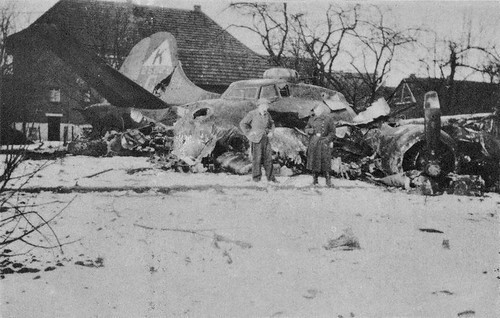
On 1st December 1943, an American B 17 heavy bomber, serial number 42-39808, code letters GD-F, from the 534th Bomb Squadron of the 381st Bombardment Group; was returning from a raid over Germany. She was heading for her base at Ridgewell in Essex, but the bomber had suffered a lot of battle damage over the target. Three of her crew were wounded, including the Pilot; Harold Hytinen, the Co-Pilot; Bill Cronin and the Navigator; Rich Maustead.

B-17 42-39808 of the 534BS/381BG [GD-F] based at RAF Ridgewell, crashed landed at Allhallows following a mission to Leverkusen on 1st December 1943 . The aircraft was salvaged at Watton, all crew returned to duty. (@IWM UPL 16678)

Tired from the long flight, fighting the pain from his wounds and struggling to keep the stricken bomber in the air, Hytinen chose to crash-land his aircraft at the former RAF station, Allhallows. Coming in roughly from the South-east, he brought her in low over the Rose and Crown pub, turned slightly to Port and set her down in a wheels-up landing along the longest part of the old airfield. All ten crew members survived and later returned to duty. The USAAF later salvaged their wrecked aircraft.

That incident was the last aviation related happening at the former airfield. In 2019, the Airfields of Britain Conservation Trust erected a memorial to the former RAF station, in the car park of the Village Hall. No visible trace of the airfield remains today, as the land has long since reverted to agriculture, but the uniform badge of the nearby Primary School, features a Sopwith Camel as part of the design of the school emblem. 

RAF Allhallows is yet another part of the UK’s disappearing heritage, but although it has long gone, it will be long remembered; at least in the village whose name it once bore.

By Mitch Peeke.

Editors Note: Allhallows, or to be more precise ‘Egypt Bay’ also on the Hoo Peninsula and a few miles west of Allhallows, was the location of the death of Geoffrey de Havilland Jnr., when on 27th September 1946 he flew a D.H. 108, in a rehearsal for his attempt the next day, on the World Air Speed record. He took the aircraft up for a test, aiming to push it to Mach: 0.87 to test it ‘controllability’. In a dive, the aircraft broke up, some say after breaking the sound barrier, whereupon the pilot was killed. The body of Geoffrey de Havilland Jnr. was days later, washed up some 25 miles away at Whitstable, not far from another air speed record site at Herne Bay – his neck was broken.

Sources and further Reading:

Airfields of Britain Conservation Trust website

​ Southend Timeline website

American Air Museum website

 Imperial War Museum website

Village Voices Magazine

Allhallows Life Magazine

379th BG Memorial, June 22nd 2019

June 22nd 2019, the day of the unveiling of the memorial to the crews of two 379th Bomb Group B-17s that collided over Allhallows, Kent on June 19th 1944.

The day finally arrived, after six months of organising, emailing, badgering and beavering away, Mitch Peeke’s vision of a memorial for the crew of B-17 #44-6133 piloted by 2nd Lieutenant Armand Ramacitti, finally arrived.

A break in what had been many days of storms and heavy rain allowed the sun to shine on this, a quiet corner on the northern coast of Kent. A place which overlooks the mud flats of the Thames Estuary, with Essex and Southend beyond. A place where like minded people gathered to pay their respects to the brave crew of a B-17 that fought tirelessly in the skies of Europe during World War II.

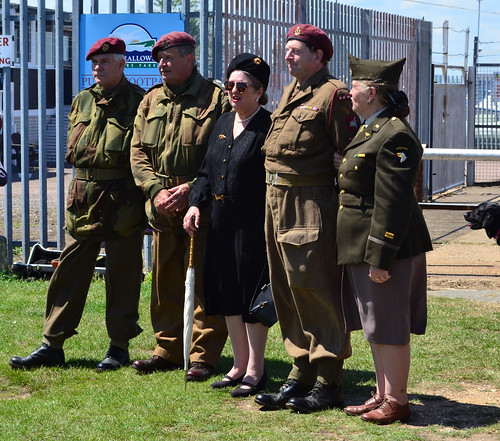
Flanked by two authentic World War II jeeps, reenactors and an Air Cadet Guard of Honour, Mitch Peeke took centre stage and reminded us why we were here. With the ‘Stars and Stripes’ flapping in the wind, Mitch told the story of the two aircraft that collided in the skies above, an accident in which eleven young men lost their lives almost 75 years ago to the day.

Allhallows Memorial 379th BG

The Thames Estuary were the B-17 came down.

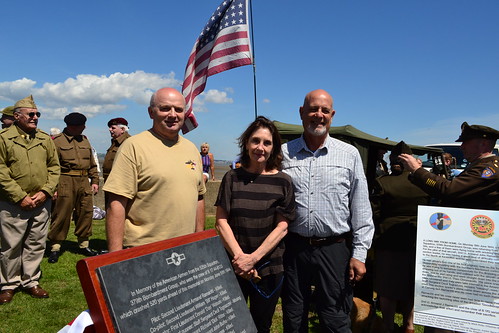
A solemn silence fell as Mitch then introduced two living relatives of that crew, Jeanne Cronis-Campbell (the daughter of Bombardier Second Lieutenant Theodore ‘Teddy‘ Chronopolis) and Noel Togazzini (nephew of Flight engineer/top turret gunner: Staff Sergeant Cecil Tognazzini), who had flown over all the way from the United States for this special occasion.

The sound of TAPS then resonated across the site, after which Jeanne and Noel lifted the flag from the plaque. The Reverend Steven Gwilt then blessed the memorial, and lead the gathered in  prayers of remembrance.

Allhallows Memorial 379th BG

Jeanne and Noel unveil the memorial.

The silence  prevailed, people’s thoughts perhaps turning to that day in 1944, and what must have been going through the minds of those young men as they battled to get out of that B-17 as it fell perilously towards Earth and a decisive fate.

Mitch then stepped forward once more, introduced the band who lightened the moment with their collection of well known 1940’s music. The band played on throughout the afternoon, the drinks flowed and friendships were forged. Just as in the 1940s, hands that had stretched across the sea were now hands together, stories and personal moments were shared, it was like meeting an old friend.

Allhallows Memorial 379th BG

The Memorial at Allhallows.

The day was more than a success, it was a celebration of life. A celebration that now sees a memorial, long since missed,  standing as close as it can to the point of impact, where all but one of the Ramacitti crew died.

My own personal thanks go to Mitch for the hard work he put in to organising the event, to both Jeanne and Noel, for sharing their stories and also to Geoff Burke for sharing stories of his own personal voyage to this point.

Most of all though, I would like to thank the crew of B-17 #44-6133, who fought so bravely for the freedom we all enjoy today.

The crew of #44-6133 were:

Pilot: Second Lieutenant Armand Ramacitti
Co-pilot: Second Lieutenant William ‘Bill’ Hager
Navigator: First Lieutenant Donald ‘Don’ Watson
Flight engineer/top turret gunner: Staff Sergeant Cecil Tognazzini
Radio Operator: Sergeant Richard ‘Dick’ Ritter
Ball turret gunner: Staff Sergeant John Burke
Waist gunner: Corporal Paul Haynes
Tail gunner: Sergeant Warren Oaks (his second mission)
Bombardier: Second Lieutenant Theodore Chronopolis

The full story of the accident can be read in Mitch’s guest post “A Long Way From Home.

Allhallows Memorial 379th BG

Mitch, Jeanne and Noel.

Allhallows Memorial 379th BG

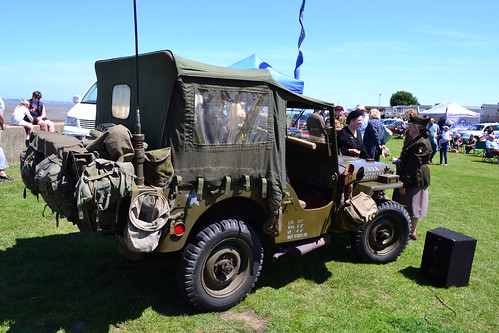
World War II Jeep ‘Jezebel’.

Allhallows Memorial 379th BG

Allhallows Memorial 379th BG

Geoff’s print of the two B-17s signed by some surviving members of the crew and relatives. Many of these crewmen have now passed on.

Allhallows Memorial 379th BG

Some of the reenactors.

A Wing and a Prayer – B-17 Memorial update.

The planned memorial for the crew of B-17 #44-6133 which collided with another B-17 ‘Heavenly Body II’ over Allhallows in Kent, has taken a major step forward recently.

In the crash all but one of the crewmen were killed and Mitch Peeke has been organising the erection of a memorial to commemorate the tragic accident.

With a large part of the funding having been raised, materials donated and a considerable number of leaflets distributed, there has been great interest shown from not only the UK but also from the United States.

Both Mitch and I have been in contact with Noel Tognazzini, the nephew of S/Sgt. Cecil Tognazzini, Flight Engineer/Top Turret Gunner on the B17 #44-6133.

Noel has made arrangements for not only himself, but also the daughter of 2nd Lt. Theodore Chronopolis, (Bombardier), Jeanne Crons Campbell, the only child of the sole survivor of #44-6133, to attend both the 75th anniversary of the crash on June 19 and the Allhallows event which Mitch has organised for June 22nd.

With a collection of Second World War vehicles, a live band and stalls from aviation related organisations, it is going to be a superb day with a great deal of supporters in attendance. With other events occurring locally at the same time, this will be a remarkable way to commemorate the loss of these young men who were so tragically taken from us in 1944.

Following the collision between the two aircraft, #44-6133 fell into the mud flats at Allhallows, from where most of the bodies were recovered; some at the time, some a while later, and who are now interred in the American Cemetery at Madingley, Cambridge. The body of Gunner Louis Schulte from #44-6133 was sent home and rests in a cemetery in St. Louis. Only two crewmen are still unaccounted for: Fred Kauffman, Co-pilot of Heavenly Body II, the second B-17, and Cecil Tognazzini from #44-6133, both of whom are listed on the tablets of the missing at Madingley. Their last resting places are very probably in the soft Thames mud that the aircraft crashed in.

Sole survivor Theodore Chronopolis, landed safely by parachute. He was fished out of the water by a passing  boat. The eight men of #44-6133’s crew who died that day were: Pilot 2nd Lt. Armand Ramacitti, Co-pilot 2nd Lt. William Hager, Navigator 2nd Lt. Donald Watson, Gunner S/Sgt. Richard Ritter, Gunner S/Sgt. Cecil Tognazzini, Gunner S/Sgt. John  Burke, Gunner Sgt. Warren Oaks and Gunner Cpl. Paul Haynes.

Mitch has set up a ‘gofundme’ fundraising account, with a target of £1000 to help secure the memorial for those young men who lost their lives that tragic day. Additional funds and collections on the day will go towards the up keep of Britain’s only flying B-17 – ‘Sally B’ (http://www.sallyb.org.uk/). 

For further information or if you would like to have a stall promoting your group, please contact Mitch direct at: madmitch.peeke978@gmail.com or leave a comment here and I’ll make sure he gets it.

Find the fund-raising account at: https://www.gofundme.com/ww2-aircrew-memorial 

The full story of the crash can be found using the link: ‘A Long way from Home’.

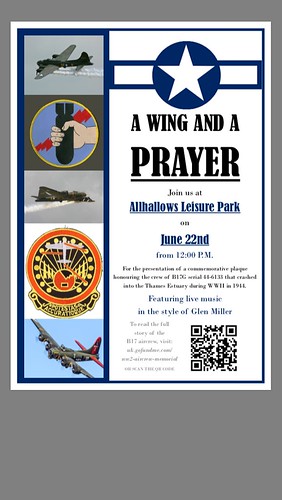
B-17 Memorial flyer Allhallows, Kent.

Latest update to 379th BG Memorial

Since the first posting about the proposed memorial to the crews of two B-17s, #44-6133 and  #42-97942 (Heavenly Body II) who collided over Allhallows on Monday 19th June 1944, I am pleased to announce that Mitch has made excellent progress and has secured: a Guard of Honour, a Vicar to bless the memorial, materials to build the memorial, a 1940’s ‘swing’ band, a display of military vehicles, refreshments for the day and a representative of the USAF possibly from the 48th Fighter Wing from RAF Lakenheath. Also, the plaque has been delivered to Mitch, and the story board to complement the memorial is also in the process of being made. Sadly a fly past was not permitted largely due to the fact that the flight path for Southend airport lies directly overhead!

The park where the memorial is to be placed is expecting between 3,000 and 4,000 people to be there, so this is an ideal opportunity for local charities or aviation related organisations to attend and raise themselves some much-needed funds.

Funding for the memorial itself has reached £500 (half of which has been promised by the park on which the memorial will stand) 50% of the original £1,000 sought after. A considerable amount of materials have very kindly been donated, the local paper ‘Kent Messenger’ has published the story, and local television news are also following the project with great interest. A number of other supporters have also shown an interest and their support.

Any money left over, along with money raised by collection buckets on the day, will go to support the B-17 ‘Sally B‘ (http://www.sallyb.org.uk/) to help keep Britain’s only B-17 where she belongs – in the sky.

The event is set for Saturday 22nd June 2019, with the unveiling taking place at midday, the first weekend after the anniversary of the crash.

Anyone wishing to attend, either as a visitor or for a stand, can contact Mitch at: madmitch.peeke978@gmail.com or leave a comment here and I’ll make sure he gets it.

Anyone wishing to donate to the memorial can do so at:  https://www.gofundme.com/ww2-aircrew-memorial 

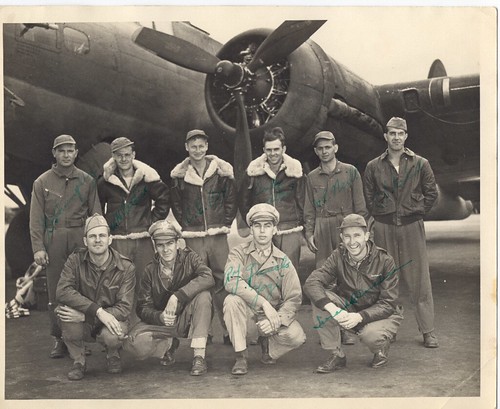
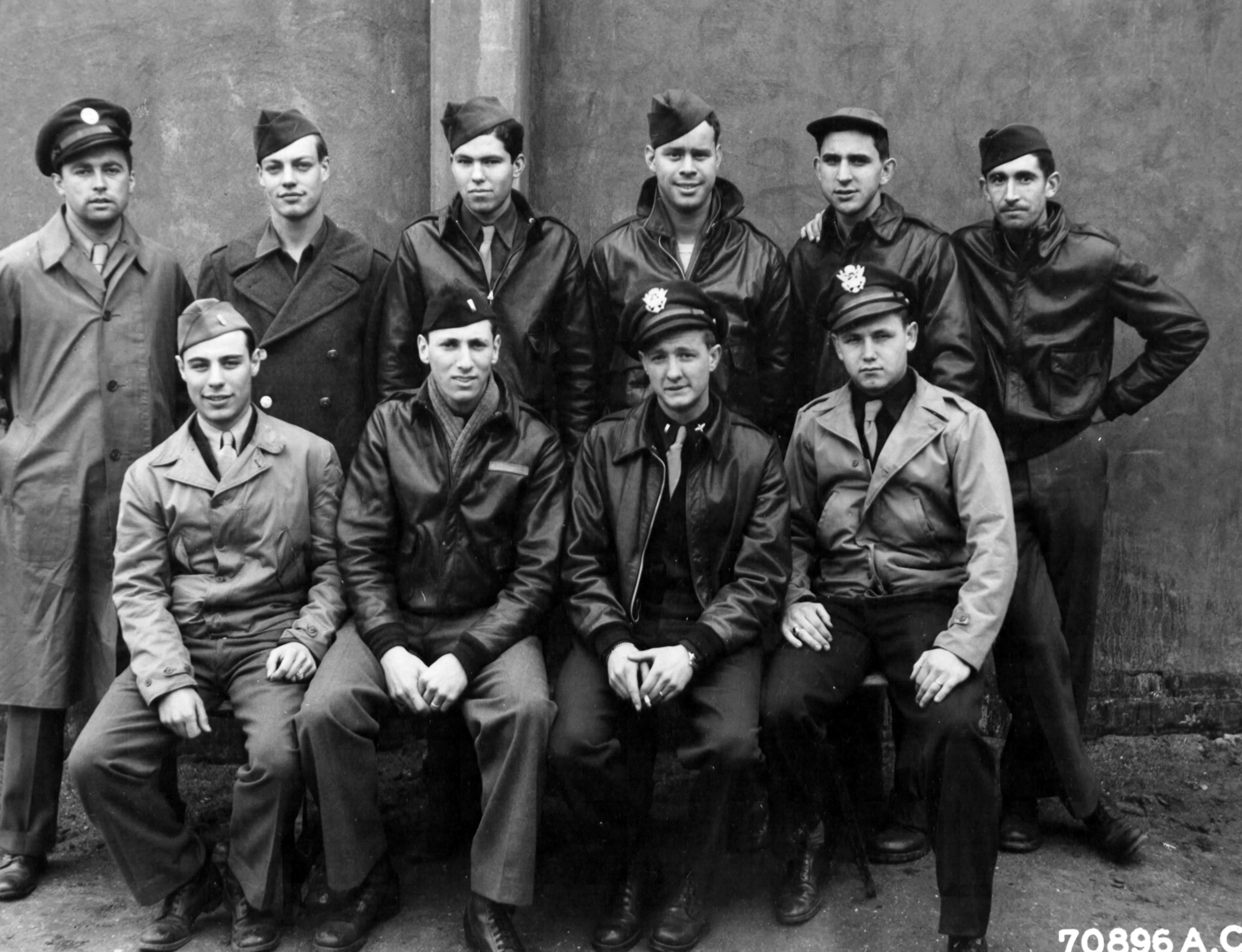
Crew of Heavenly Body II: Front Row, L to R: Edward Sadler; Fred Kauffman; Jack Gray; Lloyd Burns
Back Row, L to R; Louis Schulte; Leroy Monk; Richard Andrews; Richard Billings; William Farmer; Leonard Gibbs (Photo courtesy 379th BG Association archive,  by kind permission.)

B-17  #44-6133 was a Douglas/Long Beach B-17G-45-DL Flying Fortress delivered to Tulsa airbase, Oklahoma, May 10th, 1944. It was transferred to Hunter airbase, Savannah, Georgia, on May 19th, 1944, and then onto Dow Field on May 29th, 1944. She was assigned to the 525th BS, 379th BG as ‘FR-Y’at Kimbolton Jun 8th, 1944. The crew of #44-6133 were:

Pilot: Second Lieutenant Armand Ramacitti
Co-pilot: Second Lieutenant William ‘Bill’ Hager
Navigator: First Lieutenant Donald ‘Don’ Watson
Flight engineer/top turret gunner: Staff Sergeant Cecil Tognazzini
Radio Operator: Sergeant Richard ‘Dick’ Ritter
Ball turret gunner: Staff Sergeant John Burke
Waist gunner: Corporal Paul Haynes
Tail gunner: Sergeant Warren Oaks (his second mission)
Bombardier: Second Lieutenant Theodore Chronopolis

#42-97942 (Heavenly Body II) was a Lockheed/Vega B-17G-40-VE Flying Fortress delivered to Denver on April 11th, 1944. She then went onto Kearney air base in Nebraska on May 4th, 1944, before transferring also to Dow Field May 23rd, 1944. She was then assigned to 525th BS,  379th BG at Kimbolton as ‘FR-K’. The crew of #42-97942 were:

Pilot: First Lieutenant Lloyd Burns (just 19 years of age)
Bombardier: Second Lieutenant Jack Gray
Flight engineer/top turret gunner: Technical Sergeant Leonard Gibbs
Radio Operator: Technical Sergeant Leroy Monk
Ball turret gunner: Staff Sergeant William ‘Bill’ Farmer
Waist gunner: Staff Sergeant Richard ‘Dick’ Andrews
Co-pilot: Second Lieutenant Fred Kauffman
Navigator: Flight Officer Edward Sadler
Tail gunner: Staff Sergeant Louis Schulte