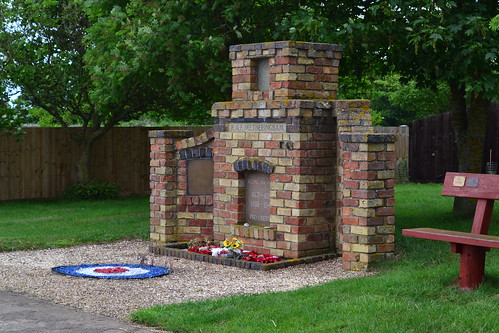
On Sunday July 30th 1944, Lancaster PB304 from 106 Squadron RAF Metheringham in Lincolnshire, crashed with the loss of all on board, along with two civilians, in Salford Greater Manchester.
Lancaster PB304, was a MK.III Lancaster based at RAF Metheringham in Lincolnshire, flying under the squadron code ZN-S. It was tasked to attack enemy strong points at Cahagnes in the Normandy battle zone following the Allied invasion in June.
The early briefing at 04:00 was not a welcome one, many men having been out the night before following a stand down order due to bad weather and heavy rain over the last two days. On board that day was: F/L. Peter Lines (Pilot); Sgt. Raymond Barnes (Flt. Eng.); F/O. Harry Reid RCAF (Nav.); F/O. John Harvey Steel (Air Bomber); Sgt. Arthur William Young (W.O/Gunner); Sgt. John Bruce Thornley Davenport (Mid-Upper Gunner) and Sgt. Mohand Singh (Rear Gunner)*1.
The operation, code-named Operation Bluecoat, would involve attacking six specific targets, each one identified to assist a forthcoming offensive by British land forces in the Normandy area.
After all the ground checks were completed and the signal given to depart, PB304 began the long taxi to the runway, take off was recorded as 05:55, but it is thought that this was ten minutes early with the first aircraft (ND682) departing at 06:05. Once in the air, the aircraft formed up alongside twenty other 106 Sqn aircraft, meeting with a smaller formation from 83 Sqn at Coningsby before joining the main formation.
The weather remained poor with heavy cloud blanketing the sky between 5,000 and 10,000 feet, as the 183 Lancasters from No. 5 Group and one Mosquito headed south toward the Normandy coast.
With further poor weather ahead, signals were beginning to come through to abandon the mission and return to base, but communication between aircraft was garbled and difficult to understand, it may have been as a result of German interference broadcasting messages over that of the master bomber. The order to abort finally came through just after 08:00 even though some of the formation had released bombs on target indicators (TI) dropped by the Pathfinders. Smoke was by now mixing with the low cloud causing more confusion and difficulty in identifying the primary targets. Not all aircraft understood the message however, and many continued circling in the skies above Cahagnes. To make a difficult situation even worse, there was by now, an approaching formation of over 450 American A-20s and B-26s along with just short of 260 P-51 and P-47 escorts on their way to France; the sky was full of aircraft in thick cloud and was an accident waiting to happen.
Difficult communication continued, some aircraft were seen disposing of their bomb loads over the Channel, whilst others retained them. Various courses were set for home, but with many airfields closed in by low cloud, alternatives were gong to be needed and alternative courses were issued to the returning bombers of each squadron.
106 Sqn were ordered to fly north along the western coast, passing over Pershore and on to Harwarden near Chester, before turning for home. The messages coming through continued to be misheard or misunderstood with several aircraft landing at either Pershore, Harwarden or Squires Gate at Blackpool. Gradually all aircraft managed to land, whether at home at Metheringham or at away airfields. Patiently the Metheringham staff waited, nothing had been heard from PB304 and they could not be contacted on the radio, something was wrong.
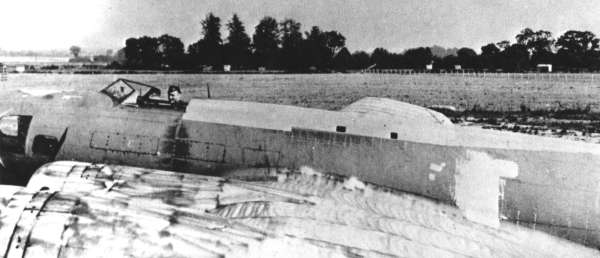
Precise details of the accident are sketchy, but an aircraft was seen flying low and in some difficulty. It passed low over Prestwich on the northern edges of Manchester, where it was later seen engulfed in flames. It twice passed over a playing field, where some suspect F/L. Lines was trying to make a crash landing, but this has not been confirmed. At some time around 10:10 -10:15 the aircraft came down resulting in a massive explosion, a full bomb load and fuel reserves igniting on impact. Many houses were damaged in the explosion with one being completely demolished.
As a result of the accident, all seven of the crew were killed along with two civilians, Lucy Bamford and George Morris, as well as, what is believed to be, over 100 others being injured all to varying degrees.
PB304 was the only aircraft lost that night, in a mission that perhaps with hindsight, should not have taken place. The poor weather and difficult communication playing their own part in the terrible accident in Salford on July 30th 1944.
The Memorial at Metheringham pays tribute to all those who flew with 106 Sqn.
Notes and Further Reading.
*1 Operational Record Book AIR 27/834/14 notes Sgt. Young as Sgt. A.L. Young.
A book written by Joseph Bamford the Grandson of Lucy who was killed that night, was published in 1996. “The Salford Lancaster” gives excellent details of the crew, the mission and the aftermath of the accident, published by Pen and Sword, it is certainly worth a read for those interested in knowing more about the incident.
Carter. K.C., & Mueller. R., “Combat Chronology 1941-1945“, Centre for Air Force History, Washington D.C.
Freeman. R., “Mighty Eighth War Diary“, Jane’s Publishing. 1980
The memorial, located outside of Bexwell church, opposite what was the entrance to RAF Downham Market (Bexwell) was updated and officially rededicated on Sunday 8th July 2023.
It commemorates two pilots who were posthumously awarded the VC both whilst serving at the airfield during the Second World War.
Both Flt. Sgt. Arthur Louis Aaron, (218 Squadron) and Sqn. Ldr. Ian Willoughby Bazalgette (635 Squadron) lost their lives in heroic attempts to save not only their injured crew but also the aircraft in which they were flying. The awards were given posthumously following their deaths, a year apart, on 12th August 1943 and August 4th, 1944 respectively.
Up until now, a small memorial has been on the site commemorating the heroic action of both men, but on Sunday, a new memorial was unveiled which is far more befitting not only of the two men, but all those who served at the airfield during those dark days of World War II.
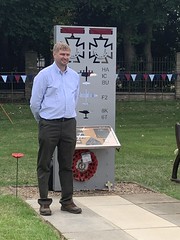
The memorial, in steel, stands at around six feet in height and shows not only the two VCs but the types of aircraft flown (Stirling, Lancaster and Mosquito) by the six squadrons who operated from RAF Downham Market along with their relative squadron codes.
Each symbol is cut out of the steel which (intentionally or not) allows the sun to shine through casting an image on the ground. The creator, Jonathan Horton, also made a series of steel silhouettes of the different aircraft, these were placed in the ground to appear as if flying toward the memorial.
Designer Johnathon Horton with the memorial.
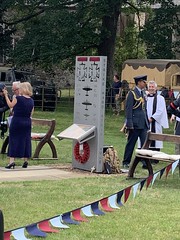
The service opened at 02:30hrs, and was well attended by various military dignitaries from nearby RAF Marham, and the RAAF, also with representatives from the Royal Air Force Association, a local village spokeswomen and members of the community who helped organise the memorial as well as a former Mosquito pilot Flt. Lt. Colin Bell DFC, AE now 102 years old.
The new memorial with Station Commander Grp. Cpn. Frederick Wigglesworth (right) and Colin Bell DFC AE (left)
Words of prayer were said by Reverend (Wg CDR) Eddie Wynn, the blessing by Reverend Nigel Moat, words from Grp. Cpn. Frederick Wigglesworth (station Commander RAF Marham) and a bible reading from Air Commodore Steve Thornber CBE RAFR. Sadly a fly past by the BBMF Spitfire didn’t happen.
Two hymns were sung: O God, our help in ages past and The Airman’s hymn, with the National Anthem closing the ceremony.
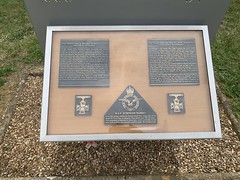
The new memorial uses the original memorial rearranged in a new setting and attached to the new memorial rather than on a pedestal as before. The Pathfinder Moto ‘Strike Hard Strike Sure’ is also cut down the flanks of the sheet, further reflecting the work carried at Downham Market.
The updated board from the original memorial.
The memorial can be found outside of Bexwell Church opposite what is the former technical area of RAF Downham Market. Grid Reference TF 63142 03460, Post Code PE38 9LZ
D-Day began many months if not years ahead of June 6th 1944. That day was to become famous as the biggest, most important day in the Second World War.
As the world’s largest amphibious assault force assembled along the South Coast of England, thousands of aircrew prepared for what was to be the most incredible night of their lives.
Across the Midland Counties, American ground crews prepared their fighters and paratrooper aircraft. Along southern England, the same scene was being played out. RAF crews too prepared Stirlings, Lancasters and Horsa gliders; fighter groups were briefed and paratroopers readied their gear. The invasion was on!
Flying an operation of this magnitude was going to require guts, daring and precision flying. There was little room for error.
In the lead up to June 6th, the RAF and USAAF had been bombing prime targets across Northern France to soften up the defending Germans. Supply lines were severed and gun emplacements destroyed. Beachhead bunkers had been heavily targeted, and supporting artillery further inland, hit hard.
In the air, fighters had been downing the Luftwaffe in an effort to gain vital air superiority over the drop zones.
At home, huge attempts were made to keep the plans and preparations as secret as possible. An intricate operation of deception was being played out; dummy airfields were built, camps and troop movements were hidden under cover and concealed in forests.
At an airfield in Norfolk, the day was to begin very badly for one particular young pilot. He was 1st Lt. Robert C. Frascotti of Milford, Massachusetts.
In the days leading up to D-Day at RAF Bodney (USAAF Station 141), the 352nd FG had been flying intruder missions over France, attacking ground targets and completing air superiority missions. P-51s were rapidly being prepared, and the growth of black and white stripes adorning aircraft, hinted of an imminent invasion.
In the late hours of June 5th, the P-51s were being fueled up and armed, ready for an early morning takeoff. The weather was not at its best and a low mist shrouded the airfield reducing visibility. The mission ahead was to support the troops landing on the Normandy beaches.
At 02:30, the pilots climbed in, fastened their belts and awaited the signal to launch D-Day. First to leave were the 486th FS. To help with the takeoff, temporary lights were placed along the runway, guiding the aircraft safely out of harm’s way into the night sky. One of these aircraft, unfortunately struck the lights knocking them out and plunging the airfield into darkness once more. Lining up behind them were the second flight of the 486th, including Frascotti’s P-51.
When lining up, the flight were unaware that they were off centre. Frascotti and his wingman, Lt. Carlton “Bud” Fuhrman, accelerated away and raced down the runway. Fuhrman watched Frascotti to his left when suddenly there was a massive fireball. Thinking someone had dropped their external fuel tanks, Fuhrman pulled up sharply and pushed on through the flames hoping his engine would not falter resulting in him crashing into the raging fire below. Momentarily blinded by the now total darkness, Fuhrman, pushed the stick forward and fought against the impending stall. Eventually his sight returned and he was able to read his instruments once more. Looking back, he could see Frascotti’s fully fueled plane engulfed in fire with no hope of an escape. Frascotti died instantly. The accident report filed after Frascotti’s death stated that an inadequately lit tower along with poor weather and high levels of traffic had caused him to inadvertently strike the unfinished new control tower at Bodney resulting in the ignition of his fuel. Tragically, Frascotti died instantly, and the aircraft was a total loss.
Frascotti’s plane, a blue nosed P-51B-5 Mustang, 43-6685 was named ‘Umbriago‘. In Italian, ‘umbriago’ means ‘drunk’. Frascotti could have named his plane for that reason, but it could also be he was referring to the World War II-era song of 1944, “Umbriago”by Jimmy Durante about a fabled friend of the same name. The song lyrics end with,“So when you feel low, better send for my friend, Umbriago.”
At a mere 21 years of age, 1st Lt. Robert C. Frascotti had many tributes written about him. There was one benefit of his tragic accident: the following aircraft now had a ‘guiding light’ by which they could safely takeoff and leave for Normandy.
Frascotti was born on February 13, 1923 into a very close-knit and patriotic family in Milford, Massachusetts. (His father fought in World War I where he was gassed). Frascotti was awarded his pilot wings in Marianna, Florida on March 25, 1943, then completed advanced fighter training before deploying to England in March 1944. He joined the 486th FS of the 352nd FG, otherwise known as ‘The Blue Nosed Bastards of Bodney”.
1st Lt. Donald “Red” Whinnem of Hartford, Connecticut, was best friends with Frascotti since the early days of flight school. On D-Day at Bodney, “Red” took off without incident and flew for sixteen hours, returning to discover the tragedy that had occurred. “Red” says of his friend, “Bob was the nicest guy you would ever want to know, and a great athlete as well. He could stir up laughter anywhere he went, and he was great fun to be with. Bob would sing a song or tell a story and cheer everyone up. You couldn’t ask for a better friend, and he was closer than a brother to me.”
During his service, Frascotti was credited with the destruction of two enemy aircraft on the ground whilst strafing enemy airfields. On D-Day, he departed for his 89th mission. This was to be his last mission of the war as he was due to return to the States leaving conflict behind him. Sadly, he never made that journey home to Massachusetts until many years later.
Initially, Frascotti was buried in England. His remains were eventually taken back to Massachusetts in 1948 after his next of kin had his body exhumed, and he now lies in the Sacred Heart Cemetery, in Milford. Lt. Robert C. Frascotti VFW Post 1544 in his hometown, now bears his name, and on December 6, 2013, as part of the annual “Wreaths Across the Worcester and Norfolk District”, a group of local veterans, families and friends, laid a holiday wreath at Calzone Park in Milford to remember the fallen veterans of the area, including Frascotti. Since the war, every year until his death in 1998, 1st Lt. Donald “Red” Whinnem travelled to Frascotti’s grave in Milford to pay his respects and remember his wartime friend.
Fly-pasts and tributes continue to be paid for Frascotti, in both the United States and here at RAF Bodney, Norfolk. 1st Lt. Robert C. Frascotti will long be remembered for his brave sacrifice, and we that are here, are honored to continue to tell his story.
As for RAF Bodney, the airfield is now an Army training camp and part of the Stanford Training Area (STANTA) in Thetford Forest. Little remains of the airfield today but the history held within its decaying walls will long live on.
Robert Frascotti next to his P-51B, 43-6685, named ‘Umbriago’ . At 21 years of age he was killed on his final mission before returning home. (Photo – Marc Hamel)
In April 2023 a group of archaeological surveyors arrived at the former RAF Downham Market and began digging trenches on the western perimeter along where the track led to the threshold of the main east-west runway. They were looking for historical artefacts of any significance, either wartime or Anglo-Saxon. Apart from odd items, nothing of any real significance was found and the trenches were filled in.
The remains of the perimeter track after diggers removed it.
In mid May, the diggers moved in again, but these were the developer’s diggers, and they began to remove a strip of the western perimeter track along half its length, taking away what would have been the site of two hangars, and several hardstands along with it.
Evident from the thick concrete slabs that have been lifted, are substantial sections of piping for drainage, along with wiring most likely for the perimeter track lighting. Each section of concrete has thick reinforcement cable thread through it to give added strength.
Pipework going through the track bed.
The planning for this site has been ongoing for about 15 years, stalling over various aspects since the current landowners took over. Now, finally, an agreement has been reached and some 240 houses have been earmarked for this site on the former airfield. Other plans have been considered for the remains of the technical area but these didn’t seem to come to fruition. All the runways have been removed and only small sections of peri track now remain, one as a private road and the other along this section to the north of this site.
RAF Downham Market, otherwise known as RAF Bexwell, was opened in July 1942 and closed in 1946. It was home to the Pathfinders of Don Bennett and to Stirlings, Lancaster’s and Mosquitos. It features in Trail 7.
There is extensive pipework along the length of the removed track.
There has been much written about the young Kennedy, his life, his family and his death, but a lot of information around his death has remained ‘unknown’ for many years. Even today, the actual cause of his death is not clear and will probably remain so.
Joseph Kennedy Jnr was based at RAF Fersfield (originally RAF Winfarthing) in Norfolk (Trail 27), and had only been there a few weeks before he tragically died on August 12th 1944, whilst operating on secret operations. A tragic loss, this is the last flight of Joseph Kennedy and Wilford Willy from RAF Fersfield, Norfolk, England.
The Crew – Lieutenant Joseph Kennedy Jnr.
Joseph Kennedy was born July 25th 1915, Nantasket, Massachusetts, he was the eldest brother of eight siblings including John F. Kennedy. He was son to Joseph Patrick Kennedy and Rose Fitzgerald. Throughout his life he had been pressured into the political life by his father who had high hopes that his son would become the future President. Joseph Jnr wanted to please. As war loomed, Joe Kennedy Jnr rose to the challenge seizing his opportunity to become the ‘shining light’ of the Kennedy family.
The Kennedy parents instilled a desire to be competitive, to win and succeed and to be the best. This came out in Joseph during his time at both home and at school. The pressure on Joseph was enormous, and it was clearly evident throughout his short life.
Joseph lived in the shadow of his younger brother John, who would captain a PT boat in the Far East, and in Joseph’s absence, go on to become President of the most powerful nation on Earth. John was the brighter, the more determined of the two, and this caused friction between them. Joe always wanting to ‘out-do’ his brother persevered, but never seemed to quite make it.
It was this determination and rivalry that perhaps led Joseph to do what he did, to impress, to be the best and the ideal way he thought was as a war hero.
With a remarkable academic background behind him, Joseph Kennedy joined the U.S. Naval Reserves on October 15th 1941, reporting to the Naval Air Station (N.A.S.) at Jacksonville, Florida the following day. After several months of training he received his commission and on January 10th 1943 he joined a flying patrol squadron. In May he became a Junior Grade Lieutenant transferring to a bomber squadron in the following July that year. In 1944, on July 1st, he was promoted to Lieutenant United States Naval Reserve. His military life would last just over one month.
Joseph was posted to RAF Dunkeswell serving under the RAF’s Coastal Command. Flying a PB4Y he would carry out U-Boat searches over the Atlantic around the Bay of Biscay and the Atlantic. As he accumulated flying hours, he rarely came into any real danger, even when posted to cover the Allied invasion fleet over Normandy he rarely came into contact with any opposing aircraft or vessels.
Joseph Kennedy’s opportunity came when volunteers were asked for to undertake a special secret and dangerous operation. He jumped at the chance to be a hero.
Joseph Kennedy arrived at RAF Fersfield, Norfolk on 30th July 1944 where he was trained for two weeks. On August 10th 1944 he wrote a letter home, it would be his last communication with his family. Joseph Kennedy was to become a pilot in operation Anvil.
Lieutenant Wilford John Willy
Sadly, Lieutenant Wilford J. Willy (s/n: O-137078), has remained in the shadows probably because the status of Joseph Kennedy Jnr. A tragic loss nonetheless and no less an important one. Willy was born 13th May 1909, New Jersey. He enlisted in the Navy in 1928, gaining his Naval Wings on April 30th 1937, just two years after he had married his sweetheart, Edna C. Schaffery, the women he left behind. On advancing through the rank of Chief Petty Officer, he was awarded Lower Grade Lieutenant (April 28th 1942) and two months later, on June 26th, he achieved the rank of Lieutenant. Willy served at a number of operational stations, including Pearl Harbour, before being posted to RAF Fersfield, in Norfolk.
Willy, now an expert in Radio Operations and procedures, became the Executive Officer of the Special Air Unit One (S.A.U.1), the rank he achieved when he took off with Kennedy on August 12th 1944.
Operations Anvil and Aphrodite.
Whilst Drone technology and research had been around as early as World War I, it was still relatively unchartered territory. However, radio controlled drones (modern name Unmanned Aerial Vehicles or U.A.V.s) were already being used with relative success for target practice by the RAF and USAAF during World War II. The ‘Queen Bee’ being one of many used by the RAF. The Germans had also been investigating drone and guided bomb use through examples such as the Mistel aircraft (the most successful being a combination of either a FW-190 or Me-109 mounted above a Ju 88).
Both the USAAF and USN were undertaking secret trials into drone aircraft operations with the view of attacking the heavily defended and ‘impenetrable’ submarine and ‘V’ weapons sites across northern France . The aim, to stop, or at least reduce, the Nazi’s use of the V1, V2 rockets and the development of the new V3 canon.
Codenamed ‘Aphrodite‘ by the USAAF, and ‘Anvil‘ by the Navy, they were two secret operations running side by side. The idea behind these operations, was to remove all excess equipment from war-weary B-17s and B-24s, fill them with explosives, such as the British Torpex, put in radio receivers so that the drone (baby) could be controlled by a separate aircraft (mother) and fly them into designated targets. A volunteer crew of two would take off, set the aircraft in flight and then bail out over the U.K. or English Channel, leaving the ‘baby’ in the control of the ‘mother’ aircraft. These would then fly, by remote control, to the target when they would be put into a dive destroying whatever they hit.
The controls of the B-17 . The arm linkage moved the control column in response to the radio controls. (credit USAF)
The idea was remarkable but not new, and the equipment whilst innovative for its day, was limited to say the least. In all the operations undertaken only one drone ever reached its target, and that was through more luck than skill.
‘Azon’ (from AZimuth ONly*1) controls had been used successfully on individual 500lb or 1000lb bombs, where the control box was attached to the rear of the bomb and controlled by the bomb aimer through a joy stick. Using two directional controls (left or right) he could direct a bomb very accurately onto a given point. The downside of Azon, was that range and fall had to be determined in the usual way by the bomb aimer and could not be altered once the bomb had left the aircraft.
Azon had been used and proven in attacking bridges, railways and other longitudinal targets and was very accurate with a good bomb aimer. However, because of its limitations, it could only be used in one dimension and therefore was not capable a making a ‘baby’ take off.
Two aircraft types were identified for the project. Boeing’s B-17 ‘Flying Fortress’ and Consolidated’s B-24 ‘Liberator’. These once converted would be given new identifications BQ-7 (usually B-17Fs) and BQ-8 (B-24D/J). In each case it was deemed that two crew members would be needed to raise the ‘baby’ off the ground, partly because of the strength needed to pull back the control columns in these heavy bombers. Once airborne, they would climb to around 20,000ft, arm the Torpex, set the aircraft on a trajectory to the target, switch on the receivers and bail out.
About twenty-five BQ-7s were modified, but it is not known accurately how many USAAF BQ-8s were converted. However, it is known that at least two naval PB4Y-1s (the naval version of the B-24 of which 400 had been converted from B-24 status – these were given s/n 31936 – 32335) were converted to BQ-8 standard; one of which was flown by Lt. Kennedy and Lt. Willy on the 12th August 1944.
A number of support aircraft were needed for each mission. Prior to the attack a Mosquito XVI of the 653rd BS would photograph the target. Then the ‘baby’ would be accompanied by at least one fighter (either P-38 or P-51) incase the ‘baby’ lost control and had to be shot down and for fighter escort; a ‘mother’ either a Lockheed Ventura or another B-17 modified to CQ-4 standard, and a photographic Mosquito from the 8th Combat Camera Unit (CCU) to record inflight behaviour. A post mission photo reconnoissance operation was carried out by the 25th BG at Watton to analyse the effectiveness of the bombing. It therefore took a lot of fuel, crew and aircraft to fly one drone to its target.
Because of the design features of the bombers, the USAAF looked into removing the cockpit to allow easy departure. The only aircraft that received this treatment was B-17F, “Olin’s 69’ERS” 42-30595 formally of 560BS, 388BG at Knettishall. It was never used on an Aphrodite mission and was scrapped post war after being used for training in the open cockpit mode. The BQ-8 (B-24) also had modifications made in the form of a widened hatch in the nose allowing for an easier escape from the aircraft. Once modified, the aircraft would have had all previous markings removed, and a special white or yellow paintwork applied to identify them from other bombers. To assist the controllers in sighting the ‘babies’ whilst in flight, the aircraft were fitted with a smoke canister that would be ignited allowing the bomb aimer to see the aircraft as it began its dive. In addition to this, two cameras were fitted to some ‘babies’ that transmitted pictures to the mother or support ship. These pointed at the controls and through the plexiglass. A revolutionary step forward in drone technology.
A modified B-17 (BQ-7) with its canopy removed, this aircraft became a training drone. (Credit USAF)
In all, there were fifteen missions undertaken by the USAAF and USN, but none were to successfully hit their targets. These included: Mimoyecques (Fortress); Siracourt (V1 Bunker); Watten (V2 Bunker); Heligoland (U-boat pens); Heide; Le Havre (docks); Hemmingstedt (oil refinery); Herford (marshalling yard) and Oldenburg (Power station). Both the operations and entire programme were cancelled only a few months after the Kennedy/Willy mission.
The last flight.
At RAF Fersfield, on August 12th 1944, Lieutenants Joseph Kennedy Jnr and Wilford J. Willy, both of the S.A.U. 1 of the Fleet Air Arm Wing Seven, boarded their converted B-24 Liberator, s/n 32271 (ex USAAF B-24J 42-110007)*2 and began their preflight checks. The aircraft was filled with 21,270lbs of explosive. At 17:55 and 17:56 two Lockheed Ventura ‘mother’ aircraft took off, followed by a further navigation aircraft and then the ‘baby’ at 18:07. The ‘baby’ climbed to 2,000 ft, the two ‘mothers’ 200 feet higher and slightly behind. They were joined by two Mosquitos, one for monitoring the weather, and the second, A USAAF F-8, to photograph the ‘baby’. This aircraft was flown by pilot Lieutenant Robert A. Tunnel and combat camera man Lieutenant David J. McCarthy. There was a further B-17 relay ship, a P-38 high altitude photo reconnaissance aircraft and five P-51 Mustangs to provide fighter cover.
The group set off toward the target at Mimoyecques , Northern France. They were to fly south-east toward the Suffolk coast, then turn south and head toward the target. Once level and stabilised, Kennedy and Willy handed over control to one of the ‘mother’ ships Then they reached the first control point (CP) at which time the group began to turn south; the ‘mother’ controlling the ‘baby’. Shortly after the turn was completed (about two minutes) Kennedy was heard to give the code “Spade Flush”, then at that 18:20 the ‘baby’ disintegrated in what was described as “two mid-air explosions” and a “large Fireball”.*4 The explosion, spread debris over a large area of the Suffolk countryside killing both crew members instantly. The following Mosquito also suffered damage and minor injuries to its crew. Following the explosion, all the aircraft were ordered back to base and the crews debriefed.
Many months (and indeed years) of investigations followed, but no firm conclusions could be drawn as to the precise cause of the explosion that ripped the aircraft apart. A number of speculative theories were drawn up, but the most plausible is that the electronic arming system was faulty and when Kennedy or Willy flicked the switch, an electronic short occurred that caused the bombs to detonate. Oddly the film that was in the following Mosquito has never been seen or made public – if indeed it was filming at that time.
The cause of deaths of Joseph Kennedy and Wilford Willy still remain a mystery to this day.
Joseph Kennedy wanted to be a hero. He wanted to be talked about as the one who achieved and outshone his brother. Sadly, this dream cost him his life.
The letter sent to the Kennedy’s after Joseph’s death.*3
The letter sent to the Kennedy’s after Joseph’s death.*3
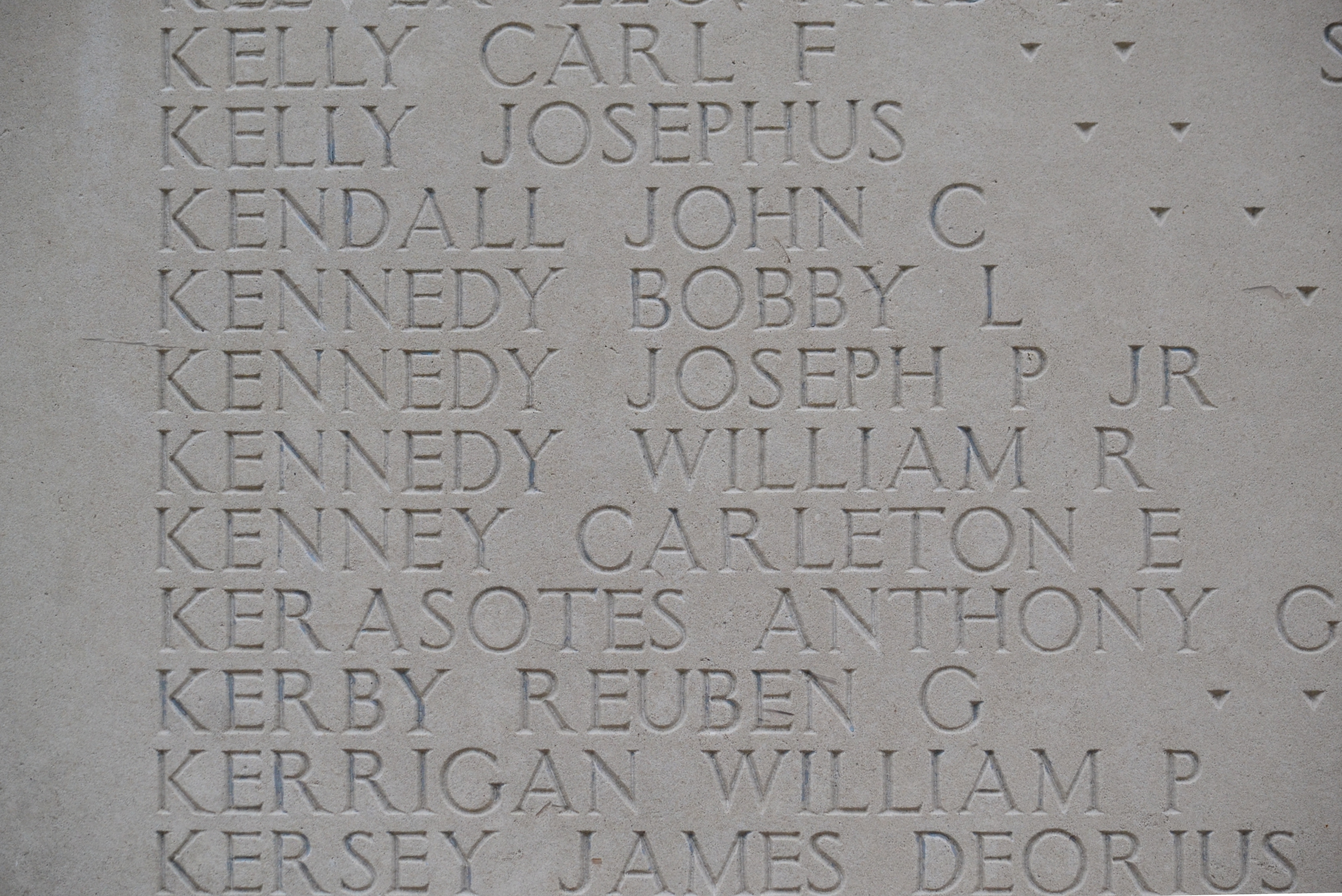
This fateful mission and its two crew members are remembered across the world. In France, the Mimoyecques museum contains a memorial honoring both pilots, and their names are carved in the Tablets of the Missing at the American Cemetery, Madingley, Cambridge. Kennedy has a ship the Destroyer ‘USS Joseph P. Kennedy Jr.’ DD850 named after him and this is now a museum in Battleship Cove, Fall River, Massachusetts. Both aviators were awarded the Naval Cross posthumously,
Lieutenant Joseph P Kennedy Jr, USNR, appears on the Wall of the Missing at the American Cemetery, Madingley, Cambridgeshire.
Lieutenant Jospeh P. Kennedy Jnr had no dependents but Lieutenant Wilford J. Willy left a widow and three children.
Sources and further reading.
*1 Azimuth being the clockwise horizontal angle from a given point (usually North) to a second given point.
In Part 3 Little Snoring had seen some short stay visitors, it had been attacked by enemy bombers and a famous face had been posted here. The bad weather had played havoc with flying duties but the parties had more than made up for it. In the final part, the war draws to a close, the airfield declines eventually closing to military activity. But its not quite the end for this little airfield with a big, big history.
The dawn of 1945 brought more of the same with both squadrons remaining here until after the end of hostilities.
The Sunderland Cup, an annual award presented to the most efficient WAAF section within Bomber Command, finally came to Little Snoring in 1945. A prestigious award, it brought many dignitaries to the airfield including: Air Commodore R.G. Spencer, Group Captain B.R. O’B. Hoare, DSO., DFC., and Air Vice Marshal E.B. Addison, CB., CBE., Air Officer Commanding 100 Group.
The cup was presented by Group Officer C. Woodhead, Deputy Director WAAF. to Flight Officer C.L. Gallavan, officer in charge of the WAAF. Section at the airfield. It was a very proud moment for the ladies of the airfield.
515 were finally disbanded on June 10th that year whilst 23 Squadron remained in situ until 25th September 1945. With the addition of 141 Squadron in July 1945, the last few months were much quieter operationally even though there were three squadrons on the base, During this time, a great change began in the structure of the Air Force, with crews being posted out to other squadrons and units, and surplus aircraft being put into storage. Operational records show a continuous list of ‘Operational Flying Hours – Nil’.
The new Mosquito NF XXXs began replacing the ‘old stock’ of Mosquitoes that had been so successful in the previous months and years. But these updated models, with their more sophisticated radars, were not to see any operational flights with these units.
Eventually in September 1945, flying officially ceased and the airfield was soon reduced to care and maintenance. Given over to 274 Maintenance Unit it became a storage site designated as No 112 Storage Sub-Site.
Like other airfields in this area, it became the home for surplus Mosquitoes on their way to a sad ending under the choppers blade. Luckily for some though, their fate would not be so awful and they were fired up and flight tested ready for delivery to the Fleet Air Arm or alternative Air Forces overseas. Many sadly though, ended up as fire wood.
The Nissen huts, like many airfield huts, were used to accommodate civilians until such times as suitable housing became available locally. In July 1951, No. 2 Civilian Anti-Aircraft Cooperation Unit (CAACU) was formed here, and flying a collection of warbirds including a: Beaufighter TT 10 (RD781); Spitfire XVI (TD344); Mosquito TT.35 (TA633); Vampires FB.5 (WA117); FB.9 (WL573); T11 (WZ584); Oxfords and an Anson. These would take to the skies, operating over the Wash off the Lincolnshire / Norfolk coast. In 1953 they too pulled out though, the airfield becoming too run down to be operational.
At this point, the site was largely passed to civilian hands, what was left was used by the Americans to store their own surplus equipment and not for any flying activities. A short lived move that eventually led to the final closure and demise of the airfield.
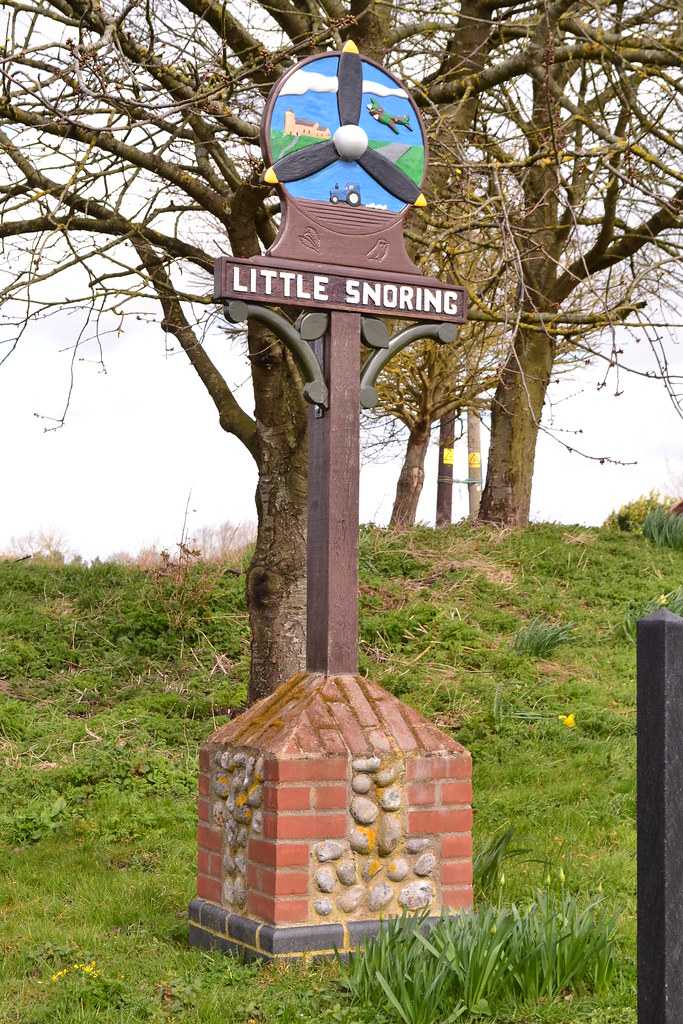
Following sale of the site, a large number of buildings were demolished or taken away for use elsewhere. The officers’ mess – which housed four ornately and beautifully written honours and awards boards, painted by Douglas Higgins – was also demolished, but luckily, these were saved by a local woman and now reside in the base’s ‘official’ church, St. Andrew’s, on the west wall. Written in paint, they detail the awards and ‘kills’ of the various crew members stationed at Little Snoring. Just a short walk from the church is the village sign which depicts a Mosquito, often seen over the skies of Little Snoring all those years ago.
In 1957, the McAully Flying Club was established here as the Fakenham Flying Club headed by its founder Elwyn ‘Mac’ McAully who sadly lost his life three years later in a flying accident at the airfield.
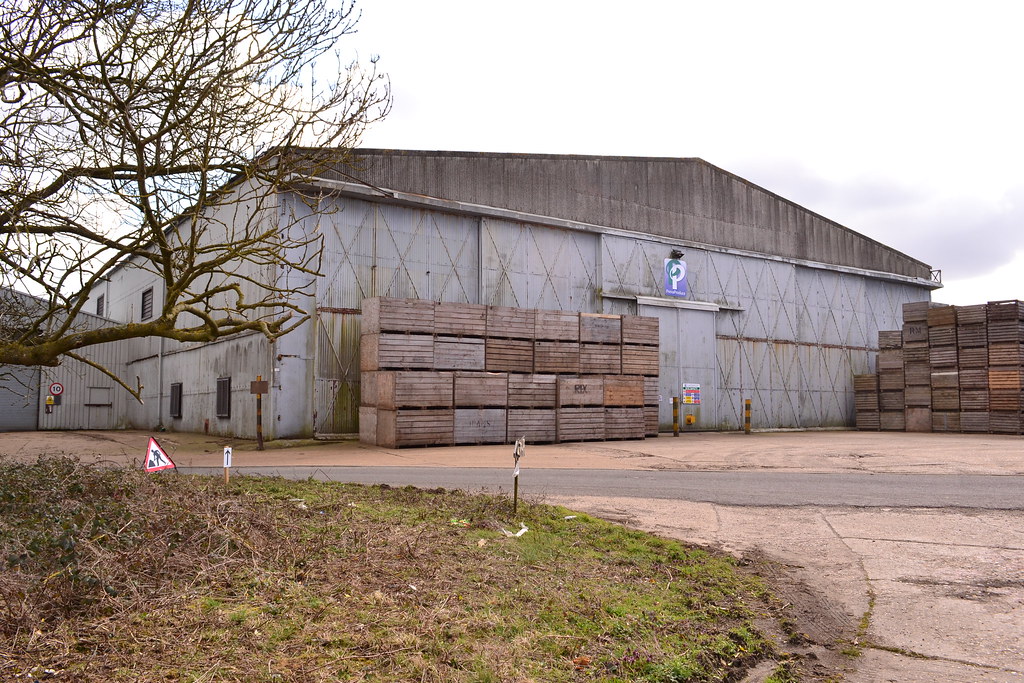
Since its closure, the runways have virtually all been removed, with only a few remnants of concrete left existing; the northern threshold of the main runway being used to store gravel and other road material. The largest and best preserved examples are two of the original T2 hangars, both used to store farm produce. A blister hangar is also on site but thought not an original of Little Snoring. Private flying now occurs on the sole remaining part of the runway located to the west. Part of the perimeter track forms the public road on the boundary of the eastern side of the airfield, and a small number of buildings, mainly huts, exist in private gardens used as storage sheds. The local caravan site has what is believed to be the base hospital and / or mortuary now a washing block.
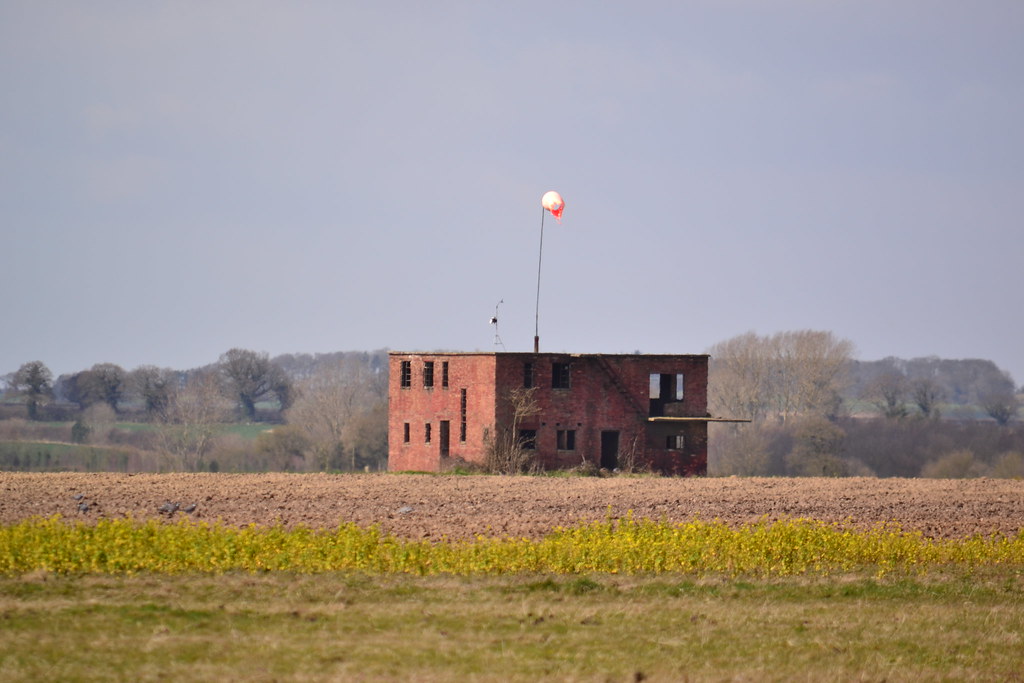
Little Snoring’s gem is its watch office, standing proud in the centre of the site, a lone wind sock fluttering from its walls. Run down and dilapidated, it is crying out for love and restoration, but I suspect this isn’t going to happen and perhaps its days are very sadly numbered.
During its short operational life, twelve Lancasters and forty-three Mosquitoes were lost during missions over enemy territory and up until 2018, there existed no ‘official’ memorial in memory of these tragic losses. In July, the Airfields of Britain Conservation Trust placed an airfield marker on the western end of the site, just beyond the runway’s threshold, that omission has at least been corrected.
The base commander, ‘glass eyed’ Group Captain ‘Bertie’ Rex O’Bryan Hoare (Sammy) was a known character and has been mentioned in a number of books discussing night intruder missions. He was a very successful Mosquito pilot and looked up to by his fellow pilots. A superbly detailed account of him appears in ‘The Snoring Villages‘and is certainly worth a read. He sadly died in an air accident in 1947 in Singapore.
Little Snoring was by far a sleepy airfield. Those who were stationed here made the best use of what they had, and when the cold winter weather put paid to operational activities, recreational ‘sorties’ took over and the airfield came to life in other ways. Operationally, Little Snoring played a huge part in intruder operations, strafing airfields and interfering with German Night Fighter operations. Even Adolf Galland in his book ‘The First and the Last‘ acknowledges the extent to which 100 Group went to “set really difficult problems for the German Night Fighter Command”. A true accolade to any wartime airfield and the men and women who worked there.
Sources and further reading
*1 National Archives AIR 27/890/15; AIR 27/890/16; AIR 27/1094/17; AIR 27/288/11; AIR 27/1981/31
*2 Ward C., & Smith S. “3 Group Bomber Command An Operational Record” Pen and Sword, 2008
*3 This is taken from the official Squadron Operational records, other sources including Chorley’s Bomber Command Losses state the crash was near to Broughton near Huntingdon.
*4 Bowman, M., “Battle of Berlin: Bomber Command over the Third Reich, 1943–1945” 2020, page 297Pen and Sword (accessed via google books)
Galland, A., “The First and and the Last“. Methuen & Co., London, 1955
The four award and honours boards in St. Andrew’s Church can be seen on the Flickr page.
A personal recollection of life at Little Snoring can be heard via the International Bomber Command Website.
In Part 2, 115 Squadron moved away from Little Snoring and the Electronic Warfare Group 100 Group took over. With that came a new type of aircraft, the Mosquito, operating as night intruders attacking enemy night fighters at their airfield. In this part, we see more new faces, a small detachment arrives, and a famous face is posted in.
The first of these new faces would appear over March and April, a small section comprising of only three aircraft (believed to be just two P-51s and a P-38) flying in American colours for training and trials with 100 Group. On March 24th, one of these aircraft would take part, somewhat unofficially, in the raid over Berlin. Flown by Major Tom Gates, he managed to get his name added to the operations board for that night, taking a P-51 to Berlin and back. During this epic flight, he apparently strayed over the Ruhr but the German anti-aircraft gunners failed to bring him down and he returned to Little Snoring unscathed by the first of several such experiences.*4
During mid April, Little Snoring was itself the subject of an attack from Luftwaffe aircraft, these intruders following the bomber stream home from a Serrate mission over Tergnier. According to operational records, the attack consisted of scattered bombs and cannon fire which caused no major damage nor casualties.
Another new face, this time for 515 Sqn, was that of Sqn. Ldr. Harold B. ‘Mick’ Martin of 617 Sqn fame, pilot of Lancaster ‘P – Poppsie‘. Whilst at 515 Sqn Martin would excel as a Mosquito pilot, strafing airfields, trains, railway yards and a flying boat base all in one night. He is also accredited with the shooting down of an unidentified aircraft and an Me 410.
But the bad luck that had shadowed Little Snoring crews would have the final say, when on April 11th, Mosquito DD783 flown by F.O. H. Stephen and F.O. A. Clifton spun from what was thought to have been a low level roll that went wrong. The manoeuvre led to a stall and spin at a height between 2,000 and 3,000 feet. Both airmen were sadly killed in the crash, the only 169 Sqn airmen to lose their lives whilst at the airfield.
Finally on June 4th 1944, both 169 Sqn and 1692 (Radar Development) Flight departed Little Snoring for pastures new. The move, hours before the D-Day landings being more than coincidental. The 3rd and 4th were given over to packing and moving equipment to Great Massingham, and only one early morning sortie was planned, but it had to be cut short when the aircraft developed engine trouble and hour or so into its flight over France.
With that, the two squadrons moved out and began to prepare for early morning flights over the Normandy coast in the early hours of June 6th 1944. Their short time at Little Snoring had been far from noteworthy, other than to say how badly the weather and lack of serviceable aircraft had dogged their early flying days.
515 Squadron who had moved onto the airfield just days after 169, would now be joined by 23 Sqn, also flying the Mosquito VI. Both these squadrons would concentrate on enemy night fighter airfields, seeking them out and destroying enemy aircraft on the ground, a low level intruder role that 23 Sqn had performed well in the Middle East.
The watch office now derelict and forlorn.
The summer arrival brought a little light relief to those at Little Snoring. 23 Sqn who had arrived in two parties via Liverpool and Gourock, had previously been at Alghero in Sardinia. Their journey had not been the delight they would have wished for, both ferries, the Strathnaver and the SS Moolton, being held outside the ports for over four days before staff were allowed to disembark. However, once at the airfield, seven days leave was granted and the majority of personnel left for London and a week’s recreation.
Training flights, night flying practise and target practice then filled their time with both squadrons taking part in firing practise over the Holbeach Range on the Wash. Compasses were swung on the aircraft and low flying became the immediate focus. Those crews undertaking night flying were amazed at the number of lights displayed at British airfields, the 23 Sqn adjutant describing them as ‘Pansy’ when referring to the Drem lighting system employed at many airfields at this time.
Sadly the poor weather returned and yet again many flights were cancelled at the last minute. Instead parties were held, and great merriment once again fell over the airfield.
On 5th June, ten sorties were carried out over night by 515 Sqn Mosquitoes. Airfields at Montdider, Rossieres, Ardorf, Varal and Marx being targeted. Further patrols were carried out over Wunstorf, Celle, Creil, Beavis and Courmeilles with bombs being dropped on some and vehicles set on fire at others. A road bridge and barge were attacked on the Vecht Canal and airfields at Twente and Plant Lunns were patrolled by two more Mosquitoes. Further patrols and attacks were undertaken using a variety of HE bombs and incendiaries. Other vehicles were also set on fire during these intruder raids. Two aircraft flown by, Sqn. Ldr. Shaw (the Flight Commander) and Sgt. Standley Smith (a/c 950), along with Flt. Lt. Butterfield and Sgt. Drew (a/c 189), took off from Little Snoring but neither were ever heard from again and were recorded as missing in action.
The remainder of June involved much the same, poor weather hampering night flying but where the squadron was able to get airborne, 515 patrolled numerous enemy airfields, attacking goods trains and destroying a small number of enemy aircraft. Some He 111s and Ju 88s were amongst those destroyed whilst attempting to take off. The month ended with 515 crews undertaking in excess of 415 hours night flying time and 48 hour daylight flying.
23 Sqn meanwhile were suffering the same disappointments with the weather, although this did not spoil the merriment, the adjutant reporting several parties occurring whilst the remainder of leave was taken and the last of the crews arrived from abroad. Some night sorties did take place, again trains were attacked and several airfields were bombed. A small number of aircraft were seen and attacked with some resulting in ‘kills’.
A small number of the Mosquitoes of both squadrons were modified to carry ASH, the American built airborne interception (AI) radars. By the end of the year training on the new equipment was in full swing as were the parties!
December brought a devastating blow for 23 squadron though, with the loss of their Commanding Officer W.Com. A. M. Murphy DFO, DFC and C de G with Palm. He had been in charge of 23 Sqn for almost a year and was both liked and respected by all those in the squadron. Air-sea patrols were carried out by the squadron in conjunction with the Air Sea Rescue Service but nothing was found of him, his aircraft, nor his navigator Flt. Sgt. Douglas Darbon. That night, the squadron was stood down and on the following day a party was held in which many attended from lunch time to well into the night – few were seen before lunch the following day. Within a few days, Murphy’s navigator took a turn for the worst, and applied for a posting out of the squadron. Much to his disappointment though he was offered an Operational Training Unit (OTU), a move he did not wish for nor relish.
On the 9th December a little lightheartedness crept into the squadron when two Canadian aircrew landed at the wrong base by mistake. Only when they were down did they realise their mistake and were immediately awarded the M.H.D.O.I.F. The adjutant doesn’t explain the acronym, but it is likely to be something derogatory!
The number of sorties being performed by the crews in 23 Sqn were reflected in their departures. With seven crews with between 50 and 65 flights on their logs, they were all lost as tour expired, the lack of crews now becoming an issue at the airfield.
The poor weather returned once more closing down the station on several occasions. More training mean that December had been the ‘heaviest’ training month since the squadron arrived in the UK. 23 Squadron’s first ASH sortie had to be scrubbed on the night of 18th, and was followed by the inevitable party and poker.
The 22nd saw two aircraft manage to get off the ground. Unfortunately these ASH equipped aircraft had no luck in seeking out the enemy. A Lancaster diverted from its own airfield made an appearance at the airfield on Christmas Eve and the crews were treated to one of Little Snoring’s magnificent parties, a party that needless to say, went on well into Christmas Day.
The squadron remained stood down for several days, but as December drew to a close further ASH equipped aircraft took part in sorties over occupied Europe. The year ended on a positive note though, and although the squadron had lost many experienced and well liked crews, they were looking forward to better weather and more operational flying.
In the last part, the war draws to a close, the military eventually pull out leaving the airfield to nature and new owners. Although there is no more military action, it is not yet the end of flying. Little Snoring is to live on for some time yet.
In Part 1, we saw how Little Snoring developed, taking on the Lancasters of 115 Squadron with the radial engined MK.II aircraft. In this next part, they soon depart and ownership of the site takes a change and with it comes new aircraft, anew crews and a new role.
September for 115 Sqn would be much of the same for those stationed at the airfield. More training flights, interspersed with operations to Germany. As with other months, September would see further losses for the squadron. On September 6th, DS658 piloted by F/O. R. Barnes, ran off the runway on return from operations, the aircraft was so severely damaged it was considered beyond repair and used for spares. The crew fared much better though, with none receiving any injuries in the accident. A second incident occurred on the 14th when during crew trials on a new aircraft, the bomb sight jammed resulting in the pilot being unable to maintain level flight. After ordering the crew into crash positions, the aircraft struck a bank a few miles from RAF Downham Market near to Magdalen station. Six of the eight on board were killed, the two survivors sustaining serious injuries.
During this month, the HCU that had joined 115 Sqn at Little Snoring received a new posting, they would depart the airfield moving on to RAF Foulsham where they would carry on their role of training pilots for the Lancaster.
An air-raid shelter protected the personnel from attack.
In October, further operations to Kassel and mine laying in the West Frisians were badly affected due to six of the twelve aircraft being unable to take off. The first was affected by one of the air crew suffering airsickness; the second suffered a burst tyre which left it stranded on the perimeter’s edge; a third got bogged down in the mud trying to pass this one and three more got stuck behind these unable to pass or turn. The remainder of the aircraft got away safely though, and although carrying out operations satisfactorily, they encountered electrical storms over the target area which hampered the equipment on board. All these crews returned safely and there were no further mishaps
On November 7th, a near catastrophe was luckily avoided after Lancaster DS825 crashed on take off after one of its engines cut out part-way down the runway. After inducing a violent swing the bomber crashed causing its other engines to catch fire. Luckily there were no explosions and all the crew managed to escape the wreckage unhurt.
115’s last operation from Little Snoring would take place on November 23rd 1943, the day prior to its departure for RAF Witchford. Twelve Lancasters, six from both ‘A’ and ‘B’ Flights, lined up and revved their engines to take off speed departing once more for Berlin. With them they took the usual mix of incendiaries and ‘cookies’, all destined to fall on Berlin’s streets. Two aircraft failed to take off and two returned early; one due to a faulty Gee set and the other a faulty air speed indicator. One of the returning aircraft dropped its payload on Texil, the other safely on unoccupied land before turning for home. The remainder of the squadron continued on and successfully completed the operation, the attack being considered ‘satisfactory’.
With that, 115 Sqn’s time at Little Snoring had come to an end, departing the next day for RAF Witchford where it would continue the brave fight over Nazi Germany. On their arrival at Witchford, a new flight was immediately formed, ‘C’ Flight, and as a result new crew members would soon arrive. Little Snoring meanwhile was about to see some major changes itself, not only in personnel and aircraft, but ownership as well.
On December 8th 1943, the station became the charge of 100 Group, the Electronic Warfare Group who had taken up residency elsewhere in this part of Norfolk.
100 Group were the last operational Bomber Command Group to be formed during the war, with a clearly defined role which was to provide night intruder support for bombing operations, and was headed by Air Commodore Edward Addison. Like their counterparts at Great Massingham, Foulsham, North Creake, West Raynham and Sculthorpe amongst others, they would take part in electronic warfare and counter measures against enemy fighter operations. 100 Group, investigated a wide range of devises suitable for tracking, homing in on, or jamming enemy radars. With a wide rage of names; “Airborne Cigar“, “Jostle“, “Mandrel“, “Airborne Grocer“, “Carpet” and “Piperack“, they used both “Serrate” and “ASH” to attack the enemy on their own airfield at night before they could intercept the allied bombers.
With its takeover of Little Snoring, came 169 Sqn who had only been formed at Ayr just two months before. They received the Mosquito II, the remarkable twin engined beast from de-Havilland which was to perform well in its new role as Night Intruder. In support, came 1692 (Radar Development) Flight, also know as the (Bomber Support Training) Flight from RAF Drem, also in Scotland.
A few days later the two units were joined by a third squadron, 515 Sqn from RAF Hunsdon also with the Mosquito II and VI, and Bristol’s Beaufighter IIF. All three would work in the area of Electronic warfare.
169’s departure from Ayr was marked with a very ‘successful’ party in the corporal’s mess, with contributions of £1.00 from officers and 2/- from non-commissioned ranks. The beer flowed well into the night, with many trying their rather shaky hands on the piano. Regular rallying on the squadron hunting horn brought the party goers back together and ensured the party spirit was maintained and kept going well into the night.
Norfolk’s wet and miserable weather greeted the personnel as they arrived over the next few days here at Little Snoring. Once they settled in, training flights were scheduled but many of these had to be cancelled due to the continuing rain and fog,
With talks by staff from Rolls Royce on engine handling and another on Bomber Command Operations and Tactics, December’s poor weather provided little time for flying. A reconnaissance was made of the Norwich pubs, and parties became the order of the day, Christmas leave was arranged and various quarters were decorated. As the mood lasted well into the New Year, the war had at least for now, come to a standstill.
On January 5th 1944, the monotony was broken when thirteen USAAF B-17s landed at the airfield by mistake, the American crews, much to the annoyance of those in residency, were given temporary use of the mess until they could depart some days later. Much ribbing by the locals no doubt helped ease the burden of sharing their beer and alcohol supply.
Various flights did manage to take place in the meantime, using both the Beaufighter and Anson. Further talks were given by escaped POWs, who gave an interesting insight into what to expect if you were shot down over occupied territory.
Over the winter months, gliders were brought in for storage and maintenance, ready for the impending assault on the French coast. These were stored in hangars on teh western side of the airfield and moved prior to D-day.
On January 20th, the first operation finally took place, a Serrate flight over Northern Holland in support of the bombing of Berlin. Two Mosquitoes were detailed but one had to return shortly after take off as the aircraft’s skin began peeling away from the wing root. Those on board were ‘thoroughly disgusted with their bad luck’.
It was this bad luck that would dog the squadron for the remainder of the month. More cancelled flights, aircraft unserviceable and instruments failing during flights. It wasn’t until the 30th January that the string of bad luck would be broken when Sqn. Ldr. Joe Cooper and Flt. Lt. Ralph Connolly, shot down an Me 110, forty miles west of Berlin in Mosquito HJ711 (VI-P). This was the squadron’s first ‘kill’ of the war since being reformed. Utilising their AI equipment, they destroyed the aircraft with a 3 and 7 second burst of gunfire from 200 ft. The aircraft blew up causing the Mosquito to swerve so violently that it entered a near fatal spin. The crew were only able to pull out after falling to an altitude of 5,000 ft. All in all, they fell some 15,000 feet before recovering. Needless to say, there was huge jubilation when they returned, the aircraft being greeted by several hundred personnel at Little Snoring.
With two more kills in February, the tally of three would remain stagnant until mid April when a series of five more 110s were brought down. With three more in May, their total would stand at eleven by the time 169 Sqn were destined to leave.
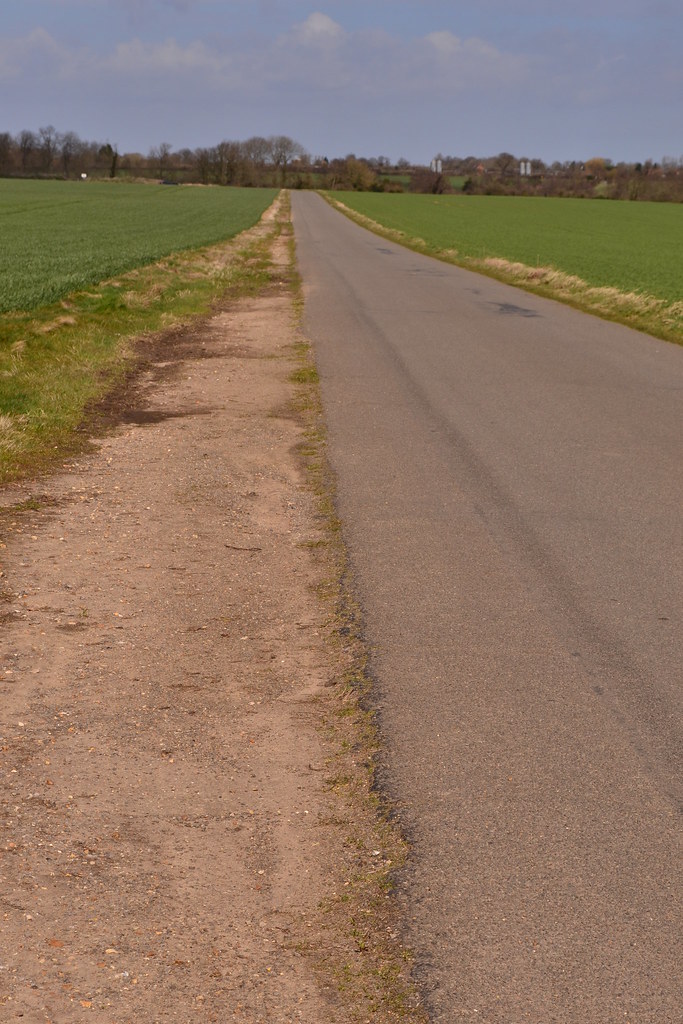
The road uses the former eastern perimeter track, part of which is still visible to the side.
In the next part, a small detachment arrives bring further new types with them, a famous face appears and bombers strike at Little Snoring.
In Trail 22 we revisit a former airfield that housed the mighty Lancasters of Bomber Command, one of the few Norfolk airfields to do so. It later took on the Mosquito, a model that remained here for the remainder of the war, taking part in the Night Intruder role, a role it excelled at.
This small and quiet village played host to some remarkable people and aircraft, it was an airfield that certainly didn’t reflect its name.
RAF Little Snoring
Little Snoring is, as its name suggests, a quiet village deep in the heart of Norfolk. Surrounded by beautiful countryside, it boasts a superb round towered church that holds a remarkable little gem of historical significance. Its history dates back to Anglo Saxon times, a time from whence its name derives.
The Village sign reflects Little Snoring’s aviation history.
The airfield, located about 3 miles north-east of Fakenham on land 191 feet above sea level, was opened in July 1943 following a period of construction by the company Taylor Woodrow Ltd. It would during its history, house no less than five different squadrons along with several conversion units, development units and a glider maintenance section before being used for civilian flying in more modern times.
The airfield was originally opened over the period July / August 1943, quite late in the war, as a satellite for nearby RAF Foulsham. It had three runways: two constructed of concrete 1,400 yards in length, (01/19 and 13/31) and one (07/25) of 2,000 yards again in concrete. As with other Class A airfields its runways formed the typical ‘A’ shape, with thirty-six dispersal sites constructed around the perimeter. A bomb site lay to the north of the airfield, a fuel dump to the south and the accommodation blocks dispersed away from the airfield to the south-west. The airfield was built to accommodate 1,807 RAF and 361 WAAF personnel housed over eight dispersed domestic sites.
To accommodate the various squadrons and their aircraft, the airfield would have 5 hangars, two T2s, two Glider and a B1, all dotted around the perimeter of the airfield, Many of these were not finished when the first aircraft moved in.
Initially opening under the command of 3 Group Bomber Command, its first occupants were the rare Bristol Hercules engined Lancaster IIs of both 1678 HCU (Heavy Conversion Unit) and 115 Squadron (the first unit equipped with the model); formally of RAF East Wretham, who were to carry out night bombing duties, a role it would perform throughout the war.
Of the two units, 115 Sqn were the first to arrive, the advance party being led by F.Lt. W. A Major DFC on the 5th August 1943, from East Wretham. The main party, led by F.Lt. R. Howarson, followed the next day, with the rear party, led by P/O. M.G. Gladwell arriving on the 7th. During this time all flying operations were suspended allowing the squadron time to move and settle in.
115 Sqn was historically a First World War unit, forming in 1917 going on to see action in France in the following year. Post war it was disbanded only to reform again in 1937 in preparation for the second impending world conflict. It would go on to have the dubious honour of having the highest losses of not only 3 Group but the whole of Bomber Command as well – a title, which amounted to 208 crews, not envied by anyone. *2
The two days following their arrival were taken up with flying training including bombing practice and air-to-sea firing before the first operations on the night of the 10th -11th August 1943.
Fourteen aircraft took off between 21:45 and 22:10 to attack Nuremberg, each aircraft carrying a mix of a 4,000lb ‘Cookie’ and incendiary bombs. Although much of the target was obscured by cloud, crews reported seeing many explosions on the ground along with fires being visible some 100 miles away.*1
Of those that departed that night one aircraft (DS684) had to return early due to the gunner’s economiser lead being unserviceable, with a second aircraft (DS665) failing to return and not being heard from again. Following a phone call received from RAF Detling in Kent, it was established that the aircraft had in fact crashed some 5 miles east of Maidstone, near to Hall Farm, Boughton Monchelsea in Kent*3. It would later be revealed that none of the crew on board had survived the crash.
With Italy crumbling, further pressure was applied to Germany’s ally through the bombing of both Milan and Turin; the might of the Lancasters now delivering their huge payloads on the two Italian cities. It was during the Turin raid on the night of 12th August, that Flt.Sgt. Arthur Louis Aaron from 218 Sqn at RAF Downham Market, would earn a VC for his courageous effort in keeping his aircraft flying whilst seriously wounded.
One of two original T2 hangars still in use today. These have since been re-clad.
For 115 Sqn though, the night passed without mishap and all thirteen aircraft returned intact. The next few days saw no further operational flying, the crews undertaking training flights instead, a short relief from operations before they turned their attention northwards and the German rocket research establishment at Peenemunde.
Between 21:38 and 21:50, twelve Lancasters took off from Little Snoring taking a further combination of Cookies and incendiaries with them. Bombs were released between 7,800 and 12,000ft, a level that just scraped the ceiling of the rising smoke. Of the twelve aircraft that departed, one was lost, that of DS630 ‘H’ flown by F/O. F.R. Pusey – none of the seven aircrew, who were only on their third operation, survived. This took the total of those aircraft lost in the first few days of flying from Little Snoring, to three, almost one per operation.
Another short period of training then followed, before they once again turned their attention to Germany and the capital Berlin.
Amazingly the Lancaster squadron would fair much better than many of its counterparts, particularly those flying Halifaxes and Stirlings, losing only one aircraft, DS630 to the enemy, unlike other squadrons, which were decimated by the Luftwaffe and air defences surrounding the German capital. Of the seven crew on board this aircraft, three were picked up after spending six days drifting in a dingy off the Dutch coast.
The remainder of August was much similar. Training flights and further operations, including mine laying off the West Frisians Islands and the French coast, saw the month draw to its end. Whilst comparatively quiet in terms of losses, the squadron was none the less racking up a steady score of ‘failed to returns’.
In August, Little Snoring would become one of those airfields that would bear witness to an incredible act of bravery one that like so many others would become one of those little known about stories of the war.
On the night of August 23rd – 24th 1943, Berlin was again attacked. On this raid Lancaster ‘KD802’ ‘M’ flying with 207 Sqn from RAF Langar, was attacked by a Ju 88 night fighter. The rear gunner, Sgt. R. Middleton, managed to return fire achieving some strikes on the enemy aircraft, which led to it catching fire and crashing. But Sgt. Middletons determined efforts did not prevent the enemy aircraft from getting his own hits on the Lancaster, causing a fire in both the starboard wing and fuselage. In addition t this, the tail plane and all its controls had also been damaged and the pilot was struggling to maintain control over the burning aircraft.
P.O. McIntosh ordered the bombs ditched at 22:49 hrs. With a lighter load he then turned for home in the hope of reaching home or at least safer territories. In a desperate effort to extinguish the fire, Sgt. Middleton then volunteered to climb out of the fuselage onto the wing, something that had been tried by others in similar situations, but it was a risky and daring challenge. The pilot P.O. McIntosh, refused to grant permission, fearing the the rear gunner would be lost in the strong winds, a risk he was not prepared to take.
Remarkably the aircraft reached the North Sea, McIntosh considered ditching the aircraft fearing its time was almost up, but before he could take action, the navigator announced that they had in fact reached England and the safety of home. Coming in from the north, the first suitable airfield they came across was Little Snoring.
Fuel was now low, and with the landing gear down one of the aircraft’s engines cut out, but using all his skill and training, McIntosh manged a successful and safe landing
The aircraft was written off, so extensive was the damage caused by the fire, but the crew were all safe and uninjured thanks due to an amazing feat of courage and determination by the crew to get the aircraft back home.
In part 2, 115 Sqn’s time at Little Snoring draws to a close. The Lancasters depart and a new aircraft arrives. With it, comes new ownership and a change in operations.
This is an article submitted by Steve Williams on behalf of FONFA (Friends of the New Forest Airfields), a charity aiming to preserve the aviation heritage of the New Forest. For more information about their work and the airfields concerned see their website at https://fonfa.co.uk/
The Twelve airfields of the New Forest.
Driving through the New Forests’ lush and tranquil scenery today, it is hard to imagine that during the mid-1940s The Forest was progressively militarised, as Britain defended itself from threatened invasion, and prepared for Operation Overlord, the D Day landings. By May 1944 there were a staggering 2,876,000 troops from many nations, together with their vehicles and equipment in Southern England. Many of these were in the New Forest, which is located close to the major ports of Southampton and Poole and had flat terrain and trees to provide camouflage for the build-up of troops and supplies, as well as hiding aircraft.
At the start of The War there were only two active airfields in the New Forest. The sea plane base at Calshot, and the civilian airport at Christchurch. Both played key roles during and after The War. The bombing of Britain during the early part of The War provided the stimulus to build many new airfields across the South of England. Five concrete runway airfields for heavy aircraft such as bombers, maritime patrol, troop transport and glider towing were built in the New Forest at Stoney Cross, Ibsley, Holmsley South, Beaulieu and Hurn.
As part of the preparation for D Day, a chain of Advanced Landing Grounds (ALG) were rapidly built on agricultural land, or existing airports. Five of these were in the New Forest at Winkton, Lymington, Needs Oar Point, Bisterne and on Christchurch airfield. These were temporary airfields and there were few permanent buildings. Much of the accommodation was tented. These five airfields played a major role during the build-up and execution of the D Day landings. They became operational during late March or early April 1944 and in the few weeks after D Day the RAF and USAAF squadrons moved from the New Forest Advanced Landing Grounds to new Advanced Landing Grounds built on liberated land in France, to continue providing support to the advancing troops.
This meant that four of the New Forest Advanced Landing Grounds were no longer required and were returned to agricultural use after just three months of intense operation. The larger concrete runway airfields remained in use longer. By the end of the 1940s only Calshot, Christchurch and Hurn existed. Calshot and Christchurch shut down in the 1960s leaving only Hurn, or what we now know as Bournemouth International Airport.
For me, the most interesting of the New Forest Airfields was Christchurch. It was operational for around 40 years, starting and finishing its life as a civilian airfield. The Air Defence Research and Development Establishment was set up at Christchurch and this made many ground-breaking scientific developments in areas such as airborne radar, ground controlled interception, radio navigation and low visibility landing aids. During the War, the Airspeed factory at Christchurch was an important Centre for the assembly of Horsa gliders and the manufacture and maintenance of aircraft including the Airspeed Oxford and the Mosquito. After the War, De Haviland took over the Airspeed factory and produced Vampire, Venom and Sea Vixen military jets as well as the Ambassador twin engine airliner.
During 1944, the New Forest airfields were manned by over 25,000 military and 10,000 civilian staff and there were estimated to be around 1,500 RAF and USAAF aircraft. The airfields were involved in every aspect of air warfare from research and development, training, defensive and offensive missions, reconnaissance, and supporting the operations of secret agents and Resistance Organisations in occupied Europe. During the D-Day period, hundreds of sorties were flown daily. The ‘Advanced Landing Ground’ at Needs Oar Point was the busiest airfield in the country for around three weeks. Take offs or landings occurred as often as one every 45 seconds, for up to eighteen hours a day.
Building an Advanced Landing Ground
It is hard to imagine the scale of the social impact that this number of military personnel had on the unique culture, legal framework and way of life of the population of the New Forest. Each of the airfields has unique stories of bravery of those who flew from them and there are fascinating memories of life during these difficult years from those living on the RAF stations or in the New Forest during this period.
Today there is very little left of these airfields, especially the Advanced Landing Grounds. There are remnants of the larger concrete runway airfields and the runway pattern of some are still visible from the air.
RAF Beaulieu Airfield today from an aircraft approaching Southampton Airport
Airspeed Ambassador taking off from Christchurch airfield (Photo by John Levesley)
There are memorials and/or information boards at some of the airfields, this is at RAF Ibsley
A good overview of each of the airfields can be found in Alan Brown’s book, Twelve Airfields. For those who would like to find out more there is a wealth of detailed information, artefacts, archives, interactive displays, pictures, videos, models and dioramas, pilot’s stories and limited edition prints at The Friends of the New Forest Airfields, (FONFA) Heritage Centre, located near Bransgore on the former RAFCamp at Sopley.
RAF Sopley was not an airfield, but a very important early radar station, also known as “Starlight”. Much of the ground-breaking work done at Purbeck Radar in Swanage and at Christchurch was put into operation at Sopley. This evolved into what we now know as air traffic control.
A great deal of archives, pilot stories, memories of those who servedand useful information, together with the opening times for the Heritage Centre, can be found on the FONFA web site at https://fonfa.co.uk
The USAAF P-38 Lightnings that operated from New Forest Airfields during 1944 in support of D Day
Article written by Steve Williams (FONFA) who provided all the photos. (My thanks go to Steve for the article and the work FONFA do in keeping this important part of our heritage alive. It is hoped to add more as information comes in from Steve and eventually to separate each of the twelve airfields out to give as much detail as possible to each).









 Aviation Trails