de Havilland Mosquitoes in BOAC Service.

Very few countries around the world managed to avoid the influence of the Second World War as it ravaged and rampaged its way across the globe. One such nation that did manage to keep its borders secure though was Sweden, a place that became known as a safe haven for downed airmen or those trying to escape the clutches of the Nazi tyranny that would engulf vast swathes of the European continent. Surrounded by conflict and declared neutral, Sweden was to all intents and purposes cut off from the rest of the world.

However, Sweden was a country reliant on imports and exports, a reliance that led to extensive negotiations between herself and both the axis and allied powers who effectively blockaded her supply routes. Through these negotiations she achieved an  agreement to the rights of passage for ‘safe-conduct traffic’, an agreement that allowed the passage through hostile waters of shipping, allowing the exports of paper and wood from Sweden, in exchange for imports of food and oil.

Sweden’s role in the Second World war was largely political. If she was to survive she was going to have to forge safe links beyond her closest Scandinavian neighbours. Fearing she would be sucked into war and absorbed into a Europe ruled by Germany, she turned to Britain with a view to forging a safe airway between Stockholm and Scotland.

Discussions around the opening of the Swedish air routes began prior to war breaking out, negotiations between the Chairman of Britain’s Civil Aviation Authority (CAA), Sweden’s airline company AB Aerotransport (ABA) and Germany’s Hermann Goring, eventually led to an agreed flight once per week from Stockholm – Oslo-Stavanger-Perth. However, ongoing Swedish concerns led to long delays in activation of the service, even though a successful test flight involving a Junkers 52 had taking place on November 27th 1939.

The Swedish ABA were to run the operation, initially using three DC-3s (named Gripen ‘Griffin’, Gladen ‘kite’ and Falken ‘falcon’) painted bright orange and clearly marked Sweden/Schweden in large black lettering to prevent attacks from either side on a neutral aircraft. Throughout the war though this link was tenuous at best, heightened German aggression and fearsome weather often being the determining factors for the safe passage of the aircraft between the two countries. German restrictions on both freight and passengers angered the Swedes, who defiantly disobeyed their rulings. This decision led to a number of Swedish operated aircraft being attacked and shot down.

By 1945 the Swedes decided it was now too dangerous to fly, particularly with trigger happy defences and over keen allied pilots. The airspace around Sweden’s near neighbour Norway, had become a cauldron of  fire, and so the service was eventually closed down.

However, this official Swedish run route was not the only airway that operated between the two countries. The Norwegians also ran a service albeit reduced, as did the Americans later on in the war with five stripped out B-24 Liberators. Another service however, a ‘British’ service, also operated, but this was much more of a clandestine role than that of their Swedish counterparts.

At the time Sweden was a producer of iron but more importantly ball-bearings, a  commodity essential for any moving parts in machinery; whether it be a simple tool or a more complex engine, without them machinery simply wouldn’t work.

Ball-bearings in Sweden were all manufactured by one company, Svenska Kullagerfabriken AB (SKF), who before the war, exported around 9% of her total output to Germany with another 9% going to the United Kingdom. During the war however, this balance dramatically fell heavily on the side of Germany with as much as 65% of her total output ending up in German hands by 1943.*1 This imbalance was primarily due to the exports that were received in the occupied territories, falling into German hands, and being diverted into Germany’s own industrial operations.

Britain however, also needed these ball-bearings, and was perhaps more keen on maintaining this link than many would have initially thought. Having her supply line to Swedish goods cut was going to hit Britain hard. Britain needed all the ball-bearings she could find, and so Sweden was vital to this supply. So desperate were the British  authorities to obtain these components that they mounted two naval operations,  ‘Rubble‘ and ‘Performance‘, both of which turned out to be disastrous in terms of both the loss of life and the loss of shipping.

There were many other reasons why Britain wanted to maintain this link though, one was the expansion of its resistance operations across Scandinavia, Sweden providing a safe passage for agents entering and leaving the region safely, a move that was just as important as it was for returning escaped or interned airmen of the RAF and later USAAF.

Furthermore, Britain needed to ensure that Sweden was receiving as much British propaganda as it was German. If this line were to be severed, there would be a chance that the imbalance in material may have detrimental effects on Sweden’s future as the war developed.

In late 1939 flights began in secrecy, operated by British Airways Ltd, who used three Junkers 52 transport aircraft and one Lockheed Model 14 Super Electra (the forerunner of the Hudson) named ‘Bashful Gertie‘ (G-AGBG). Like the Swedish operation, these flights took place between Perth and Stockholm via Norway and were flown by civilian crews in civilian marked aircraft. However, this route was subsequently closed when one of the aircraft was attacked by a Luftwaffe fighter, and another was captured in Oslo when the Germans invaded Norway.

Then in 1939/40 the two British aviation companies, British Airways Ltd and Imperial Airways, merged to form the British Overseas Airways Corporation (BOAC), a civilian operation that would go on to serve as Britain’s leading national airline for many years after the war’s end. The amalgamation of these companies was an important step forward leading to the reinstatement of the Swedish route, this time using the military base at RAF Leuchars in Fife.

Also piloted by Swedish or Norwegian aircrew, the idea behind the route was to pass POW mail and propaganda (magazines, newspapers etc) into Sweden where it could be forwarded to prison camps in occupied Europe. However, constantly aware of the need for ball-bearings and the fact that Sweden was a major supplier of them, plans were put in place for returning aircraft to be refuelled and filled with ball-bearings before returning to Leuchars. This run hence became known as the ‘ball-bearing run‘.

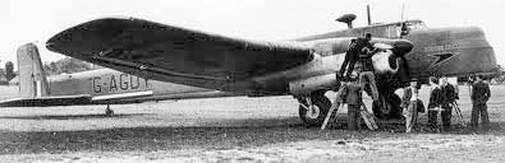
In these early years of the war, BOAC operated other similar aircraft types, these included C-47 Dakotas, converted Whitley IV bombers and Curtis Wright C46 aircraft, but their lack of speed and manoeuvrability left them vulnerable to Luftwaffe attacks. It soon became clear that a new and much faster type was needed and so BOAC began to put pressure on de Havilland for their new Mosquito.

Picture

A Whitley bomber in BOAC markings *7

A trial flight was undertaken using an unmarked Mosquito of 105 Sqn (DK292) on August 6th 1942 (there is some confusion over this exact date), flown by  Fl. Lt. Parry and P. Off. Robinson, the results of which showed the aircraft to be highly suitable for the purpose of the flights. The journey from Leuchars to Stockholm covered some 800 miles was, on average, completed in around 3 hours.

On 15th December 1942 the first civilian operated model of the aircraft arrived at Leuchars. A Mosquito PR.IV ‘DZ411’,  it was assigned the civilian registration G-AGFV, and began flights to Stockholm on 4th February 1943. After this, it was joined by six other Mosquito MK.VI aircraft between April and May (all being given the sequential registrations G-AGGC to AGGH) with a further three in April 1944.

The incredible carrying capacity of the Mosquito, which would be proven later in the war, would allow for up to 650Kg (10 -12 crates) of ball-bearings to be carried in the aircraft’s bomb bay.

The opening of such a link was kept very secret, the British not wanting the Germans to know about the new revolutionary Mosquito, nor their important cargo. However, keeping such an operation from German intelligence was difficult, if not impossible, and soon they discovered that the flights were again taking place between the two countries. Now embroiled in a political stand off, the Germans put pressure on neutral Sweden to put a stop to these flights, insisting that they were giving the British an advantage, and that as a neutral country, they should not be allowing British aircraft to land on Swedish soil. The Swedes maintained that the service was purely civilian and controlled solely by the Swedish authorities, to which the Germans threatened to inform Hitler thus rendering the aircraft legitimate military targets. Fearing that the British would in turn close the passage for the safe-conduct traffic, the Swedes ignored the German threats and so the service continued.

However, so as to not infringe or violate Sweden’s wartime neutrality, it was vital that the Mosquitoes remained unarmed for these operations. But that made any aircraft on this run a potential ‘sitting duck’, even though, like their Lockheed predecessors, they carried BOAC insignia and were flown by civilian aircrew.

So all of these aircraft had to be changed from military status to civilian, this required the removal of all traces of armament. Modified at Hatfield – the home of the Mosquito – the resultant weight loss altered the aircraft’s centre of gravity and so additional ballast had to be added to prevent changes in the aircraft’s flying characteristics.

The first example DZ411, was a Mosquito B.IV Series II, powered by two Merlin 21/23 engines built under the contract 555/C.23(a) and converted to a PR.IV at Hatfield prior to its delivery to BOAC at RAF Leuchars. It would go on to serve until early 1945 with BOAC before presumably returning to RAF ownership.

The first of the next batch, all FB.VIs, was ‘HJ680’ another example built at Hatfield under the same contract 555/C.23(a) but with Merlin 23/25 engines. This aircraft was initially passed to BOAC at Bramcote on April 16th 1943, receiving the registration G-AGGC before flying on to Leuchars immediately after. On the 18th, on the return leg of its maiden flight for BOAC, it was chased by enemy fighters, but its speed and agility allowed the Mosquito to escape unharmed. It was eventually removed from service on November 30th 1944, but remained at Leuchars in case a ‘spare’ aircraft was urgently needed. This particular model was the longest serving Mosquito in BOAC’s service, being taken off the civil register on January 4th 1946, whereupon it was passed to 22 Maintenance Unit. On June 15th 1950, the example was eventually sold as scrap to the John Dale Scrap merchants.

The next aircraft ‘HJ681’ arrived at the same time, and remained in service until January 1944, under the civil registration G-AGGD. This particular aircraft crash landed in Sweden and was reduced to spare parts.

‘HJ718’ arrived on April 24th and was given the registration G-AGGE, it served until June 1945, whilst ‘HJ720’ (G-AGGF) crashed into high ground at Invernairk, Glen Esk on 17th August 1943, killing both crewmen Captain L.A. Wilkins and Radio Operator N.H. Beaumont. A further FB.VI, ‘HJ721’ (G-AGGG) also crashed, this time on the return leg only a mile or so from Leuchars on October 25th 1943, when the port engine failed. Both crewmen, Captain Hamre and Radio Operator Haug, lost their lives along with their passenger Mr Carl Rogers.

The last FB.VI ‘HJ723’ also built under the same contract as the other models, arrived on the 2nd May 1943, and would operate until the end of June 1945 as G-AGGH . It was subsequently handed over to the RAF and eventually presumably disposed of.

By the end of May 1943, a total of nine Mosquitoes would have been modified and delivered to BOAC at Leuchars*5.
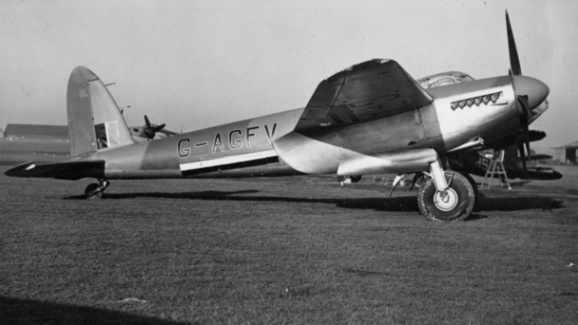
DH98 Mosquito G-AGFV (DZ411) MkIV BOAC on 8th January 1943 (© 2021 BAE Systems)

In June 1943, with the need for ball-bearings increasing, two Mosquitoes departed Leuchars with two very important dignitaries onboard. Firstly the British president of the Swedish SKF airline and secondly a ball-bearings expert from the British authorities, who were going to negotiate the delivery of further supplies to Britain.

In order to accommodate these additional passengers the bomb bay of the aircraft had to be converted, thus allowing them to lay on their backs on padded felt*6. An additional reading lamp was fitted, along with an oxygen supply, intercom and even coffee. The passenger would have a piece of string the other end of which was tied to the pilots leg, and should the conditions  in the bomb bay become too uncomfortable, they would pull the string.

These operations were very soon regularly carrying human cargo. On the outward leg mail, newspapers and other written material held within its bomb bay, would be deposited in Sweden, the aircraft would be refuelled and stocked up with either human cargo (allied aircrew, special agents or scientists), ball-bearings or a mix of the two. The faster and far more agile Mosquito would, in most cases, be able to out run any opposing Luftwaffe fighter that should, and indeed did, try to intercept the aircraft whilst on one of these flights.

One such notable passenger who was carried back from Sweden was the nuclear physicist Niels Bohr whose work on atomic structures and quantum theory had won him the Nobel Prize in Physics in 1922.*4 His journey almost cost him his life though after he failed to operate his oxygen mask correctly. Only when the failed to respond to the pilot’s attempts to contact him, was action taken and the aircraft reduced altitude allowing Bohr to breathe normally and regain consciousness. Bohr went on to work on the Manhattan project, an American project that led to the development of the atomic bomb that would end the war, and plunge the world into the nuclear age.

A large number of other significant people were also carried by these Mosquitoes, Sgt. Jack Byrne who went on to be a  founder member of the SAS, after being shot in the face, bayoneted in the groin and detained in several prisoner of war camps, was one such person repatriated to Leuchars. Three of those who escaped in the famous ‘Wooden Horse‘ escape were also returned via Mosquitoes from Sweden; as where Norwegians Peter Bergsland and Jens Muller two of the three to escape in ‘The Great Escape’.

In ‘Operation Gunnerside’, the SOE operation to blow up the German heavy Water plant in Norway (featured in the film ‘The Heroes of Telemark‘), six of the team were repatriated using this route. A key player in this operation was Leif Tronstad, a Norwegian Physicist who was also flown to Scotland to provide vital information about the German efforts to produce heavy water at the plant.

A considerable number of British personalities were also flown into Sweden using this method; T.S. Elliot, Sir Kenneth Clarke and even the Bishop of Chichester were flown into Sweden this way.

Sgt. Jack Byrne, was shot, bayoneted and imprisoned. He fought at Dunkirk, on D-Day, in North Africa and at the Battle of the Bulge and then went on to be a founder member of the SAS.*2

By the end of 1943, 157 such flights had been made, 129 of which were by these Mosquitoes. A total of some 110 tonnes of freight (a mix of human and mainly ball bearings) had been carried.

Even though these flights were highly successful, a few aircraft were lost. In Mid August 1944, G-AGKP ‘LR296’ a former 27 MU aircraft was lost when it crashed into the sea nine miles from Leuchars. All three on board, Captain G. Rae, Radio Operator D.T. Roberts and Captain B.W.B. Orton (himself a BOAC Mosquito pilot), were killed as it approached Leuchars on its return flight from Stockholm.  The crash was believed to have been caused by the aircraft’s structural failure, the aircraft having been repaired previously after an accident in January. The total number of aircraft being used by BOAC reached fourteen, with five of these crashing including one G-AGKR ‘HJ792’ being lost at sea in August 1944 with no trace of either the aircraft or crew ever being found.

On 17th May 1945 the service officially ceased. Between 1941 and the war’s end, 1,200 of these trips had been made, many by the Mosquitoes. The service between Sweden and Scotland had been a vital link between the two countries not only for the supply of ball-bearings but a life line for escapees and special agents. For these Mosquitoes it was a remarkable achievement for an aircraft that would prove itself to be one of the war’s most incredible designs.

de Havilland Mosquitoes used by BOAC*3:

DK292 – The first Mosquito to fly the Leuchars – Stockholm route
DZ411 – G-AGFV flew to 1945
HJ667 – G-AGKO flew to 1945
HJ680 – G-AGGC flew to 1946
HJ681 – G-AGGD crash landed Sweden 1941
HJ718 – G-AGGE flew to 1945
HJ720 – G-AGGF crashed Invernairk 1943
HJ721 – G-AGGG crashed near to Leuchars 1943
HJ723 – G-AGGH flew to 1945
LR296 – G-AGKP crashed near Leuchars 1944
HJ792 – G-AGKR lost at sea 1944
HJ898 – Crew trainer retained RAF serial flew to 1945
HJ985 – Crew trainer retained RAF serial returned to RAF 1944
LR524 – Crew trainer retained RAF serial returned to RAF 1944

RAF Leuchars appears in Trail 53.

Sources and further reading.

*1 Martin Fritz (1975) Swedish ball-bearings and The German war economy,
Scandinavian Economic History Review, 23:1, 15-35, DOI: 10.1080/03585522.1975.10407803

*2 Photo from “Think Scotland website”  accessed 12/3/21

*3*6 The Mosquito Page Website accessed 12/3/21

*4 For additional information and pilot stories about the ‘ball-bearing’ run see the Royal Institute of Navigation Blog.

*5 Thirsk, I. “de Havilland Mosquito – An illustrated History Vol.2“, Crecy 2006

*7 Photo from Aircraft Enthusiast Group Website.

BAE Systems Website

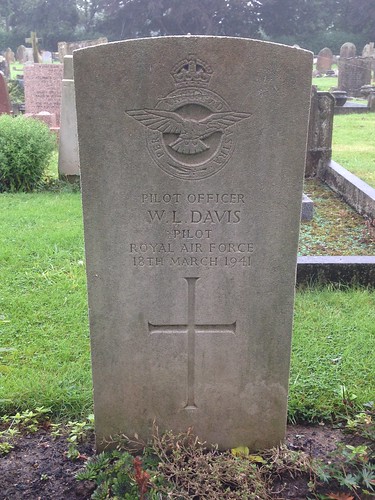
P.O William Davis (Eagle Sqn) – March 18th 1941

RAF Sutton Bridge, was a small airfield on the Norfolk / Lincolnshire border a few miles from the Wash off the north Norfolk coast. Before, during and after the war it served as  training camp for new pilots, training them in the art of gunnery, utilising a firing range that had been in situ since 1926.

Many airmen of the RAF passed through Sutton Bridge, many of these were Commonwealth aircrew, some from Czechoslovakia and a few from the United States.

In the church yard behind the church of St. Matthew in the village, lie almost 60 graves of those who died in the fight for freedom, they are also joined by a German airman, foe united in death.

One such airmen is that of American Airman Pilot Officer William Lee Davis s/n: 61459 (RAFVR) who joined as part of the famed ‘Eagle’ Squadron, a group of volunteer American flyers.

P.O. Davis was from St. Louis and graduated at Central High School, before going on to attend Washington University. He was the son of William J. Davis of 4500 Arsenal Street, and a salesman in a cork and insulation firm in the area, when he joined up at the age of 25.

He left his job, signing with the Clayton-Knight Committee, a recruitment company for the Canadian and British Air Forces operating in the United States.  He was initially stationed at Love Field in Dallas, where he received four weeks of intensive training in aerobatics, gunnery and combat flying. After qualifying here, he transferred to Ottawa, where he was commissioned and then sent onto England to further his training. He was the first person from St. Louis to obtain a Commission in the Royal Air Force obtaining a deferment of his draft in doing so. When asked about joining the RAF, he told reporters that it was “a matter of sentiment and heritage” citing his English grandfather’s role as an officer in the Boar war.

P.O. Davis was no stranger to flying, having been a flyer before signing up for the RAFVR, achieving a total of 223 hours flying time, a commercial pilots licence and an advanced CAA Licence.

On arrival on March 5th 1941, these pilots were generally sent to No.3 Personnel Reception Centre at Bournemouth, before posting to No.56 Operational Training Unit (OTU) at Sutton Bridge. Here they completed their training and were then sent onto their respective operational squadrons. 

There were something in the region of 156 American Airmen who found their way into 56 OTU, many passed through with little or only minor mishaps. For P.O. Davis though it was to be the end of his dream, in an accident that would take his life.

On March 18th, a week after his arrival at Sutton Bridge, he took off in Hurricane P5195 on a general map reading flight across the Lincolnshire Fens. Whilst on the flight P.O. Davis became lost and decided to put down on farm land at New Leake Fen near Boston. Unfortunately, the ground in the Fens was soft causing the undercarriage to dig in and flip the Hurricane on its back. In the resultant crash, P.O. Davis broke his neck killing him instantly. He was not only the first from St. Louis to die, but the first American from Sutton Bridge to die also.

A citizen of the United States, Pilot Officer William Lee Davis is buried in the Church yard of St. Matthew’s Church, Sutton Bridge, Lincolnshire, Section P, Grave 56.

Pilot Officer William Lee Davis

Pilot Officer (Pilot) William Lee Davis

Trail 61 – RAF Dishforth – Along the A1 trail (Part 4).

In Part 3 we saw how Dishforth turned from a bomber base to one of training, its role had gone full circle. Now the war was drawing to a close, its future left hanging in the balance. With the dawn of the jet age, opportunities are there but Dishforth gets left out. As Bombers are withdrawn, a new type appears though, and many appear here at Dishforth.

As 1945 dawned, it was becoming clear that the war’s end was in sight. Conversion courses to heavy bombers were being scaled back as losses fell and the need for more crews diminished. On April 6th, the HCU was officially disbanded and the staff posted elsewhere.

1945 would also see the end of 6 (RCAF) Group, the group that had flown almost 40,000 sorties with a loss of 10,000 aircrew from its several Yorkshires bases, Dishforth of course, being one of the first.

Not long after the disposal of the HCU, the 1695 (Bomber) Defence Training Flight, a unit set up to work in conjunction with the HCUs, was also disbanded.  In July 1945, the unit flew its last flight and its Spitfires, Hurricanes, Martinets and Air Speed Oxfords all departed Dishforth. The fighter element had also now gone from this historic base.

For the next couple of years little would happen at Dishforth, the Canadian link was broken, bombers were removed and the airfield remained relatively quiet. However, it was to see the four engined Halifax return once more, albeit very briefly.

1948 was a year of change, with no need for bombers, transport aircraft were to be the new type appearing at Dishforth. Conversion Units continuing on where the HCUs left off. 240 Operational Conversion Unit (OCU) made an appearance with a second, 241 OCU forming on January 5th 1948. Formed out of the renumbering of 1332 Heavy Transport Conversion Unit, they operated  a mix of Halifaxes, Hastings, Yorks and Vallettas all of which had now become the flavour of the day.  With these new units coming in, other units such as No 1381 (Transport) Conversion Unit, were disbanded.

Handley Page Hastings C Mk 1, location unknown. (©IWM ATP 16063D)

Another squadron, 47 Sqn also appeared at Dishforth that year. In September, they transferred in from RAF Fairford, and immediately began replacing their ageing Halifaxes with the Hastings C.1 transport aircraft. They remained at Dishforth for just a year, moving on to nearby Topcliffe in the autumn of 1949. This was mirrored  by 297 Sqn, who also came, swapped their Halifaxes and then also departed to Topcliffe.

240 OCU led Dishforth into the new decade. In April 1951, further changes saw them disband and amalgamate with 240 to form 242 OCU, but still the Vallettas and Hastings were top dog. As time progressed they would convert to Argosys, Beverleys and eventually the Hercules, moving on to eventually disband at RAF Lyneham in 1992.

The mid 50’s saw other changes, with 30 Sqn arriving in April also operating the  Beverley C1 until its departure in 1959, and 215 Sqn in April 1956 with the Pioneer CC1. Originally a First World War Sqn they had operated a range of aircraft including the Virginia, Harrow, Wellington, Liberator (B-24) and Dakota, before disbandment and reformation here. They solely operated from this airfield before again being disbanded and reformed as 230 Sqn here at Dishforth in 1958. By November though they would also go the way of their predecessors and move out, this time to Nicosia, before returning (briefly via Dishforth in April 1959) to Upavon.

Another Dakota unit,  1325 (Transport) Flight operated from here in the August of 1956, before it too departed, eventually disbanding in Singapore in 1960.

By the end of the 50s, all these units had departed and Dishforth’s future was now in the balance. With no RAF Flying there seemed little point in keeping it open.

Small training aircraft from other Yorkshire bases including Leeming, Topcliffe and Linton-On-Ouse, then used the base as a satellite and emergency landing ground. The Jet Provosts of 1 FTS and 3 FTS being frequent users.

With the withdrawal of all RAF personnel, Dishforth was handed over to the Army Air Corp who based a number of helicopter units here during the 1990s and early 2000s. These units primarily: 657 ; 659; 664; 669; 670; 671 and 672 Sqns all operated the Lynx or Gazelle helicopters in a range of roles.

As of 2021, Dishforth remains in the possession of the Army, home to 6 Regiment Royal Logistics Corp, who consist of three squadrons: 62 Squadron and 64 Squadron (both hybrid squadrons made up of Drivers and Logistic Supply Specialists) and 600 HQ Squadron including the Regimental Head Quarters who provide support to the other two task squadrons. Their role is to provide logistic support to 1 UK Division, preparing forces for both fixed and responsive tasks.

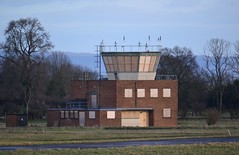
With other non military units using the site as well, Dishforth’s future is once again in doubt. A large airfield, with extensive hangar space and ground area, it is ideally located near to the A1 road. The tower has recently been boarded up and parts of the perimeter track are beginning to decay, Dishforth too will soon close (earmarked for closure in 2031) under Government cutbacks, but hopefully its history will live on and the memories of those who passed though its doors will remain alive and well.

Dishforth currently remains an active Military site and as such access is limited. The A168 runs parallel to the main runway between it and the A1. The hangars remain, the tower is also present although in the last two years or so it has been boarded up. Remnants of the Second World War can be found round the perimeter by using the smaller roads around the base, but again these are restricted.

With the recent announcement of the closure of Linton-On-Ouse, both Dishforth and Topcliffe will also close, three more of Britain’s war time bomber airfields will then be gone from Britain’s landscape.

The full page can be seen in Trail 61 – RAF Dishforth – Along the A1 Trail.

Sources and further reading.

*1Bygone Times‘  – Halifax LK930 remembered and a tale of two Palterton village heroes. by Jack Richards. A web page detailing the crash of LK930 on the night of 21st/22nd March.

National Archives AIR-27-141-1

National Archives AIR-27-660-1

National Archives AIR-27-1837-1

Harris, A., “Bomber Offensive‘ 1998, Greenhill Books.

Millar, G., “The Bruneval Raid – Stealing Hitler’s Radar” 1974, Cassell & Co.

RCAF 425 Alouettes Sqn – a blog honouring 425 Sqn by Pierre Lagacé

Ward. C., “4 Group Bomber Command” 2012, Pen & Sword.

Trail 61 – RAF Dishforth – Along the A1 trail (Part 3).

In Part 2 we saw the first of the Canadian units form at Dishforth, still a new unit, they very quickly become part of the new 6 Group (RCAF).  As they began operations over occupied Europe, they quickly learnt that war brings casualties. We also see that Dishforth soon becomes ‘upgraded’ to a Standard ‘A’ specification airfield, and then the Canadians move out and a new training unit move in. The aircraft now get bigger.

The new year brought new changes both at Dishforth and within the RAF. Expansion of the force saw a new Group born, that of 6 (RCAF) Group, and after some four years of wrangling between the Canadians and the British, all but two of the Canadian squadrons, and their airfields, were transferred over to RAF control. The formation of the Group was with mixed emotions though, the Canadians having no control nor say over its operation, but still paying the bill for the squadrons for the duration of the war – a rather one sided agreement in the eyes of the Canadians. However, the expansion increased Squadron numbers, now some 37% of the RAF’s pilots were from the Dominion and of these, almost two-thirds were Canadian.

On January 1st 1943, 6 (RCAF) Group was therefore officially up and running, and it would be now that 426 Sqn would become operational.

Their start to the war began with an attack on the French port at Lorient on the night of 14th/15th January. 6 Group’s first attack as an operational group, was part of a 122 strong aircraft formation, sending nine Wellingtons and six Halifaxes. Only two aircraft were lost that night, both Wellingtons, one a Polish crew from 300 Sqn and the other a Canadian crew from 426 Sqn.

The aircraft, piloted by 21 year old P.O. George Milne (s/n:J/9355), was lost without trace, presumably crashing into the sea on its way to the target, it was not heard from since leaving Dishforth at 22:37.

Within a month of 6 Group’s inauguration, 426 Sqn would suffer a heavy blow when its Commanding Officer Wing Commander Blanchard would be shot down whilst returning from Germany. The aircraft, a Wellington III ‘X3420’ was shot down by Hauptmann Manfred Meurer near Limburg with the loss of all six crewmen. It was a bitter blow to the fledgling squadron.

The role of commander then passed to Wing Commander Leslie Crooks DFC a non-Canadian, he would lead the squadron into battle on numerous occasions. A brave and determined leader, he would soon add a DSO to his collection, dutifully awarded after surviving an attack from a night fighter, when he nursed the stricken bomber home. Unable to land the aircraft due to its extensive damage, he ordered the crew to bail out leaving the Wellington to its ultimate and final fate.  Crooks, would go on to lead further operational missions with the squadron, but sadly his luck would run out over Peenemunde on the night of August 17th/18th 1943 when he was lost for good.

The time then came to upgrade Dishforth, its now unsuitable surfaces needed replacing and the airfield needed bringing up to ‘modern’ standards. The two Canadian units moved out – 425 Sqn to North Africa in May, and 426 Sqn to Linton-On-Ouse in June. That left the airfield operationally silent. The bulldozers and earth-movers then moved in;  its three concrete and tarmac runways were constructed, and the whole site was upgraded to the Class ‘A’ specification. By November the works were all but complete and it was handed over to No.61 Training Base, 6 (RCAF) Group, led by the transfer in of 1664 Heavy Conversion Unit (HCU) operating the four engined heavy the Halifax Mk.III.

Formed in May 1943 at Croft, they were renamed 1664 (RCAF) ‘Caribou’ HCU on moving to Dishforth and were primarily a training unit converting pilots onto Halifaxes from other aircraft – usually twin engined bombers like the Wellington. One of their first customers was the former Dishforth unit 425 Sqn, who returned from Tunisia with their Wellingtons to convert over to the Halifax over the next month. By mid December they were all done, and they departed for RAF Tholthorpe where they picked up their new aircraft.

RAF Dishforth

A rather sad end to the Watch office.

Converting crews to the four engined types was no easy task, and whilst crews were experienced, accidents did still happen.

The first Dishforth blow came to 1664 (RCAF) HCU two days before Christmas 1943. Halifax V ‘ZU-C’ crashed after getting into difficulties whilst on a night training flight. The aircraft was partially abandoned, but three of the crew were killed and a further two were injured. This tragic accident would not be the last for the Dishforth unit though, and would draw 1943 to a sad close.

Some of these accidents were understandably down to the inexperience of crews on the new type, as the night of January 30th 1944 showed. Halifax V DG308 flown by F.L. J. Bissett DFM along with a student, came into land at Dishforth. The student inadvertently lowered the bomb doors rather than the flaps causing the aircraft to come in too fast. Bissett, in an effort to avert a catastrophe, swung the Halifax off the runway subjecting it to great stresses. As a result of this action, the undercarriage collapsed and the aircraft fell on its belly severely damaging it. But Bisset had done his job, and the student had learnt a valuable lesson.

With two further accidents on the following night, one due to a strong cross wind and the second when the aircraft hit high ground due to excessive drift, the training programmes were proving hard going for the Dishforth unit.

For some crewmen there was even the misfortune of multiple crashes, and for one man in particular, these unfortunate events occurred in the space of just one week.

For Sgt. H. (Ray) Collver, mid March would be his worst week. During a training flight on the 16th, his Halifax swung on landing, badly damaging the undercarriage. Thankfully however, there were no major injuries and all walked away relatively unhurt. But then on the night of 21st/22nd, he was on a night training flight (thought to be a nickle flight), when the port inner engine failed, and refused to feather. The cause of the problem was not clear, but the aircraft began to shake violently as a result. Before coming down in Derbyshire, Sgt. Cullver gave the order to abandon the Halifax, two of the crew escaping through the nose hatch. By then though, the bomber was too low for others to escape, the remainder of the crew were effectively trapped inside. When the aircraft hit the ground, two of the four left on board were killed, the remaining two Sgt. Russ Pym and Sgt. Cullver were injured, Cullver being thrown clear as the Halifax struck a bank aside a road*1.

On many occasions though, pilot error was not a cause, engine faults seeming to have been the primary cause of the aircraft’s demise; problems that either required an engine to be shut down or engines failing, seeming to be high on the list of causes for the squadron’s losses.

During August a Lancaster Finishing Flight was set up within the HCU at Dishforth, its job to polish pilots and crews in their Lancasters before returning them to operational units. Loses here would be far lower.

By the years end, the HCU would have lost some fifty aircraft on training flights, which for a training unit, was a substantial number of heavy aircraft and for the Command.

With the close of the war ahead, changes are in the pipeline for both the Royal Air Force and Dishforth. With the need for bombers diminishing, a new form of aircraft arrives and in good number. In the final part we see Dishforth head in to the jet era but opportunities are missed and sadly it gets left behind, its future then looks bleak.

The full page can be seen in Trail 61 – RAF Dishforth – Along the A1 Trail.

Trail 61 – RAF Dishforth – Along the A1 trail (Part 2).

After seeing Dishforth’s pre-war construction and arrival of its first squadrons in Part 1, we head in to 1941, more trips to Germany and a special mission to Italy.

The beginnings of 1941 were much the same for the two Dishforth units. Trips to Germany were very much the order of the day. But on February 3rd, six Whitleys from 51 Squadron were sent as part of a force to blow up the aqueduct crossing the Tragino river in the Campania province of southern Italy. Code named Operation ‘Colossus‘, it was a daring operation where troops would be parachuted into enemy territory, destroy their target and escape by submarine.

After departing to Mildenhall, the Dishforth aircraft then flew on to Malta, arriving at Luqa airfield after a long, eleven hour flight. On the night of the 11th, the plan was put in place. Two aircraft were to perform a diversionary attack on the marshalling yards at Foggia, whilst the remainder dropped members of ‘X’ Troop in the valleys near to the target. Whilst the aqueduct was successfully blown apart, none of the ground forces, nor the crew of one of the 78 Squadron Whitleys on the diversionary raid, managed to get home. All were unfortunately picked up by Italian forces and placed in POW camps. The raid being a success, had suffered high losses.

That same night, the remaining crews at Dishforth fared little better. On returning to the airfield following a raid on Bremen, they were ordered to divert to RAF Drem in Scotland. Four of the aircraft either misunderstood the instruction, got lost or ran out of fuel, resulting in each of them being abandoned over the British countryside. Unfortunately even abandoning an undamaged aircraft was not entirely safe, as nine of the twenty crewmen suffered injuries whilst doing so. All four of the aircraft were left to their inevitable and catastrophic rendezvous with mother Earth.

A new Bomber Command Directive drove the Group’s Whitleys to Germany night after night. Then a turn of focus to aircraft factories saw a change in operations, and although losses for Bomber Command were high, both the Dishforth units managed to scrape through relatively unscathed.

April saw the departure of 78 Squadron from Dishforth, this time though there would be no return, and their time here had finally come to an end.  Dishforth however, continued on, retaining its one operational squadron, that of 51 Sqn, who continued to soldier bravely on with their Whitley Vs.

Industrial targets were then once again at the forefront of Bomber Command’s agenda. 51 Sqn joining many other units on raids to the German heartland. In early May, they visited Ludwigshafen, followed by Dortmund, Duisburg and Dussledorf losing one aircraft on each operation (P5106, Z6663, Z6657, and Z6563 respectively) with the loss of all but five of the airmen on board.

Whilst 51 Sqn’s losses per operation continued to be relatively light, overall they suffered some of the highest losses for the year, some 43 aircraft being lost on operations throughout 1941. A tally that put them amongst the top five biggest losses of Bomber Command squadrons for the year.

As with many bomber stations, support and training flights also operated from these larger airfields, Dishforth was no different with 1512 Beam Approach Training Flight (formally 12 Blind Approach Training Flight) forming here in October 1941. The unit trained pilots to land in poor visibility using a system designed ironically by the Germans. Previously known as ‘Blind Approach’, it was felt the the use of the word ‘Blind’ was not very reassuring for pilots and so all units were changed to Beam. Also ironic as no beam was actually used, but more a single distorted radio transmission.

The dawn of 1942 saw more of the same for the Bombers of 51 Sqn and 4 Group. With a renewed focus on the German fleet anchored at Brest, Bomber Command would soon pay the price, and it would be Operation ‘Fuller’, that would be the cause.

On the night of February 12th, a determined and combined force of naval vessels and aircraft along with RAF aircraft, would attack the a force of mighty ships including the ScharnhorstGneisenau and Prinz Eugen as it made its way through the English Channel to home waters from Brest harbour. For over a year, the ships had been a thorn in the sides of the RAF, being damaged and repaired they could not be put out of action permanently. Patched up but not fit for heavy warfare, the attacks came in poor weather, ideal for a sea escape. The resultant allied losses were a tragedy for both services, and would leave them blooded and badly scarred.

Thankfully though, the fortunes of the Command would soon turn, albeit briefly on the night of the 27th-28th February, bringing a smile to both the faces of the British forces and the population as a whole. February would thankfully close on a good note.

The events began at Thruxton airfield, where twelve Whitley bombers were having holes cut in their floors and special doors added to allow paratroopers to jump through. This small force would be led by 51 Sqn W.C. Charles ‘Percy’ Pickard who, described as a tall, fair haired pipe-smoker, was known as a real character within 51 Sqn. Pickard’s character had been projected well beyond the mess halls of Dishforth though, noticeably after he took a leading part as Squadron Leader Dickson in ‘Target for Tonight‘; the RAF’s 1941 film about a crew on a bombing mission over Germany. Pickard would eventually leave 51 Sqn, transferring to the 2nd Tactical Air Force in Operation ‘Jerrico’, and the attack on the prison at Amiens where he met his death with almost seventy operations to his name.

The February raid was to be carried out by a small force of British Paratroops, which involved them being dropped into enemy territory to capture a secret German radar site. Once established, they were to remove vital components from the radar and bring them back to England for analysis. The raid, whilst not without its hiccups, was a huge success in the war of the electronics, and not only allowed the British to examine the workings of the radar, but also provided them with a prisoner who was one of the operational technicians at the site. The night had been a real coup, and a much needed morale booster for the RAF and the UK’s population. Known as the ‘Bruneval Raid‘, Britain now had a significant insight into the German Wurzburg radar system, and 51 Sqn played a major part in delivering those gallant men to their drop zone. For his part in the operation Pickard was awarded a bar to his DSO.

Charles ‘Percy’ Pickard (believed to be at Lissett, Yorkshire) with his dog ‘Ming’.(© IWM CH 10251)

In May 1942, 51 Sqn received orders to depart Dishforth for the base at Chivenor in Devon. This too would be their final farewell to the Yorkshire base as they would not be returning. By the end of the year they would be replacing their Whitleys with the Halifax, their last Whitley being lost whilst at Dishforth a few days prior to their departure on the night of 23rd/24th April 1942.

A short period of calm then led to further changes. It was during this ‘quiet period’, that the 1472 (Army Co-Operation) Flight formed here at Dishforth. Using only light aircraft: Battles, Tomahawks Hurricanes and Masters, they didn’t require the lengthy runways that heavy bombers needed, and operated in conjunction with land based forces primarily on training operations.

It was after this that a new Canadian unit 425 (Alouette) Sqn RCAF was formed here at Dishforth. The first ever French-Canadian unit formed in the U.K., it was led by W.C. J. St. Pierre, and was part of a Canadian force manned totally by Canadian personnel. It would not be ready and operational though until the October of 1942.  It was also during October that another Canadian squadron would be formed, also here at Dishforth, that of 426 (Thunderbird) Sqn led by W.C. Sedley Blanchard. A third unit, that of 6 Group’s Communication Flight also joined the Canadians here at Dishforth.

Both these squadrons flew the twin-engined Wellington, with its remarkable geodetic design, a sturdy aircraft it would be the main type used by the two squadrons for the next year.

425 Sqn spent the next weeks building up to operational status, training flights both cross country and in the local area being carried out when the weather permitted. It was on one of these flights that the first Wellington was lost from the squadron. During a fighter affiliation exercise, in which cloud ranged from 3/10 to 6/10 at 3,000 ft to 10/10 at higher altitudes, the 403 Sqn Spitfire ‘attacking’ the Wellington collided with the nose turret bringing down both the Spitfire and the Wellington. There were no survivors from the bomber.

Once declared operational, 425 Sqn’s inauguration into the war soon occurred. On the night of October 5th/6th 1942, they took part in a raid on Aachen. 101 Wellingtons, almost half the force, were sent to the town but weather was poor and target markers were way off track, some 17 miles away over the Dutch town of Lutterade. As a result, little significant damage was done to the target, and it was the Dutch who bore the brunt of the force. To make matters worse, 425 Sqn lost one of its aircraft, Wellington III ‘X3943’ KW-G piloted by Sgt. O’Driscoll. The first operational loss for the squadron with the entire crew being killed when the aircraft crashed in Essex on its return home.

In Part 3, we head in to 1943 where we see the official formation of 6 Group (RCAF) – the Canadians officially arrive in Yorkshire and the Group begins operations over occupied Europe. Dishforth plays a big part in those operations.

The full page can be seen in Trail 61 – RAF Dishforth – Along the A1 Trail.

Trail 61 – RAF Dishforth Along the A1 trail (Part 1).

As we continue our journey north along the A1, the ‘Great North Road’, (Trail 54, Trail 57) we come across an airfield that began life in the prewar expansion period of the 1930s. Destined to become a bomber station for a large part of the war, it soon returned to its initial role as a training base, a role it carried on after the war’s eventual end. Today the base is still active but in the hands of the British Army, and although no major flying takes place, it does occasionally see the odd aircraft pass by.

This airfield sits alongside the A1 road, this offers opportunities to see what’s left and observe the goings on at the base. On the next part of our trail along the A1, we stop off at the former RAF Dishforth,

RAF Dishforth.

As a prewar airfield built during the expansion period, Dishforth was a ‘non-dispersed’ airfield, distinguished by having both its accommodation and technical areas located closely together. Initially it fell under the control of 3 Group Bomber Command, but would soon transfer to 4 Group for use as a training airfield for their bombers; a Command which in itself was also born out of the expansion era of the 1930s.

By the war’s end, Dishforth would have grown considerably, eventually being capable of catering for over 2,500 personnel, and upgraded to the standard Class ‘A’ specification with three concrete and tarmac runways (1 at 2,000 and 2 at 1,400 yards in length). The main runway runs parallel to the main A1 road, in a north-west to south-east direction, with the two subsidiary runways running east / west and north-east to south-west, thus forming the recognisable ‘A’ shape of this airfield design.

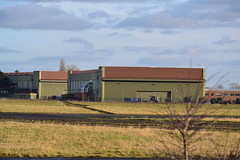
Around the perimeter were twenty-seven pan and eleven spectacle hardstands, and to the south-east, located between the legs of the ‘A’, were five ‘C’ type hangars and a range of ancillary, technical and storage buildings. The Watch office, initially located between the hangers overlooking the pan, was later rebuilt to the north of the airfield over looking the entire flying site now to the south.

Alongside Dishforth came airfields at Linton-on-Ouse, Driffield, Leconfield and Finningley, all of which would see a range of light and medium bombers grace their runways. Other major airfields built at this time included the bomber bases at Wyton and Upwood in Cambridgeshire, Scampton in Lincolnshire and the fighter airfield at Debden in Essex, the RAF was indeed expanding at great speed.

On January 12th 1937, the first of the squadrons arrived, 10 Squadron RAF, with a mix of Heyfords and Virginias. The move was led by the advanced party, followed by the main party on the 25th and the rear party on the 2nd February. Whilst settling in and preparing the airfield for operations, they were joined by another squadron, 78 Sqn, also with Heyford IIIs.

K3489 the first production Handley Page Heyford the last biplane heavy bomber. These aircraft were well liked at the time and were, unbelievably, able to be looped as was seen at the 1935 Hendon Air show.  Note the retractable gun turret. (©IWM ATP 7352C)

Within a month of their arrival at Dishforth though, 10 sqn would begin to replace these now obsolete biplanes with Whitleys, flying both the MK.I and later the much improved Merlin powered MK.IV, until their eventual departure from Dishforth in July 1940. The first of these Tiger IX powered MK.Is arrived on the 9th March, followed by sporadic arrivals culminating at the end of June, with a full complement of aircraft; the last of these being Whitley K7195 on the June 25th.

One of the highlights for 10 squadron’s posting to Dishforth, was to perform a ‘set piece’ at the 1937 Hendon Air Show, five Dishforth aircraft performing well to the gathered crowds below. This was nothing new to the Squadron, having previously performed at Mildenhall for the King’s review and at Old Sarum for an Indian Army Officers School, both in July 1935.

Over the remainder of the year and into 1938, a number of observer calibration flights took place. These were later supplemented with squadron operations, under what was described as ‘war conditions’, and although repeatedly hampered by bad weather, the squadron managed 3,733 daylight hours and 752 night flying hours, over the two year period.

78 Sqn, which was officially reformed on 1st November 1936 under the command of Wing Commander M.B. Frew DSO, MC, AFC, was also assigned the obsolete aircraft. With a second flight forming in April 1937, they too soon began updating these models with both the MK.I and later in 1939, the MKIVa Whitleys.

Following the disbandment of the rather mashed together Air Defence Great Britain (ADGB) and the introduction of the four commands (Fighter, Bomber, Training and Coastal), Dishforth and its two squadrons would now fall under the control of the newly formed 4 Group. With Air Commodore A. T. Harris as its (short lived) lead, 4 Group’s headquarters made its move from Mildenhall to Linton-on-Ouse, only a few miles to the south-east of Dishforth. Yorkshire would now become the county synonymous with the Group and its aircraft.

4 Group had struggled obtaining a suitable bombing range to use with its Whitleys, Harris, in his book ‘Bomber Offensive‘, talks about being frustrated because he repeatedly came up against local objections. Abbotsford was one such site that dragged on largely due to objections about the local swan population. As it turned out, having a range actually kept people away and as a result the swans thrived!

The dawn of 1939 would herald a new era. January introduced Dishforth to the forthcoming events with the loss Whitley K7211 off the coast of Kent. The last message from the aircraft being received  at 18:20 on January 23rd. There then followed an extensive search, but despite the efforts of the Royal Navy, neither the aircraft, nor its crew, were ever found, and the Whitley along with its crew remains missing to his day.

The declaration of war by Neville Chamberlain in September 1939, shook the nation. It brought with it immediate mobilisation orders to the Group. Within days 10 Squadron were ordered to send eight aircraft on a reconnaissance and ‘Nickle‘ flight over northern Germany. Following Air Plan No. 14, they were loaded with propaganda leaflets, the aircraft then flew over the ‘target’ dropping these ‘paper bombs’ on the citizens below. Returning anti-aircraft fire was light and sporadic, and as a result, all aircraft returned without incident.

RAF Dishforth

Two of Dishforth’s five hangars.

On the night of the 21st, two more 10 Sqn aircraft were ordered out on another Nickle operation, this time over Bremen and Hamburg; an additional order was given to “create a disturbance in Berlin”. Again no enemy aircraft were encountered, and anti-aircraft fire was very light. But with that, and a flight of three more Whitleys on the night of 1st/2nd October, 10 Sqn had gained the honour of being the first allied squadron to fly over the German capital during wartime.

Meanwhile, Dishforth’s other squadron, 78 Sqn, were allocated as 4 Group’s Reserve Squadron, acting as a pool for training crews and a reservoir for the Group’s other front line squadrons. I wonder if, at the time, there were any reservations about such a move from those within the squadron.

However, by early October 1939 a move was on the cards for 78 Sqn. Linton-on-Ouse was now calling, and early in the morning of 15th the move had begun with the Whitleys landing at Linton. This move, a few miles south, would temporarily leave Dishforth with only one operational squadron.

This lull lasted until early December, when 51 Sqn joined those at Dishforth. Like other squadrons, they had ditched their ageing Virginias for the more modern Whitley and were now in the process of upgrading these to the MK.V.

The winter of 1939/40 was a harsh one, and as a result little flying took place from the snowed in Dishforth. With only a short lull in February, aircraft were well and truly ‘frozen in’ for the large part of the winter months. It was most certainly a cold start to the war, and even when the thaw came, the ground remained dangerous to fly from due to water logging from the melting snow.

Following the German invasion of Denmark and Norway, 4 Group’s aircraft began attacks on airfields and supply routes being used by the Germans. Both 51 Sqn and 10 Sqn visited several of these airfields including Aalbourg on the night of 22nd-23rd April. On this operation, one of 51 Sqn’s aircraft, Whitely IV ‘MH-G’ piloted by F.O. J Birch, was lost without trace not long after departing Dishforth at 21:50.

By July 1940, the Battle of Britain was in full swing and 10 Sqn were moving out; the period between January and July being filled with numerous and relatively uneventful trips to Germany. Barely cold, their vacant beds were quickly filled by 78 Squadron, who had previously departed to Linton-on-Ouse; now they were given orders to return back to Dishforth.

The month of July had been one of some confusion for the squadron, initial orders requiring they transfer to the unfinished RAF Leeming, the place where kit and materials had, by now, been sent. What’s more, they were also informed that they would continue performing the role of reserve squadron whilst at Leeming, but now however, on moving to Dishforth, they were made fully operational for the first time since war had broken out with Germany.

The move went relatively smoothly, aircraft were deposited at Topcliffe (Dishforth’s satellite) with personnel transferring directly to Dishforth. The move involved organising transport from not only Linton, but also York and Leeming too, such was the wide spread of both men and equipment. As a result, “very little useful work” was done, the primary objective being to reorganise the squadron following the confusion of the orders and counter orders over the previous weeks.

A Whitley at an unknown location revving up its engines. © IWM CH 681

As we leave 1940 behind and head to 1941, we see, part 2, what changes come to Dishforth. There are more ventures into Germany and a special mission to Italy that results in success but at a great cost.

The full page can be seen in Trail 61 – RAF Dishforth – Along the A1 Trail.

Help Wanted – RAF King’s Cliffe!

In 2014, I published Trail 6 – ‘American Ghosts’ a trail around six American bases from the Second World War, one of these, RAF King’s Cliffe, was, at the time, under threat of development.

In 2015, objections from over 300 people were received which included supporters of Glenn Miller, aviation enthusiasts, wildlife groups and local people alike, who all highlighted concerns over the proposed development of the site and the impact it may have.

At an initial meeting in September that year, the council failed to come to any overall decision as they needed to consider further reports from different interested parties.  At a second meeting held on Wednesday 14th October,  after considering all the issues raised, East Northamptonshire Council approved the plans and so planning for 55 holiday homes were passed on an area known as Jack’s Green.

This area includes a memorial to the late Glenn Miller, who performed his last ever hangar concert here at King’s Cliffe before being lost over the sea. Assurances from the land owner at that time, were that the development would be in keeping with the area and that the memorial would remain “exactly as it was”.

I have not been able to return to Jack’s Green, nor King’s Cliffe airfield to see how this development has affected the area, and was wanting to know if anyone had photos of the development taken since the development started or more so, in the years following. As it would directly affect the memorial and adjoining public footpath, I was interested in the Jack’s Green area especially. I know that many geocachers use this path as do horse riders, walkers and enthusiasts alike, and am hoping someone may have a small collection of photos I could see.

Any photos you are willing to share would be very much appreciated.

My sincere thanks.

Andy

Links

The BBC report can be accessed here.

RAF King’s Cliffe was visited in Trail 6

Previous reports can be found here.

Glenn Miller Memorial RAF Kings Cliffe Dec 2014

Glenn Miller Memorial RAF Kings Cliffe Dec 2014

RAF Tuddenham – The last of the FIDOs (Part 2)

In Part one, we saw Tuddenham’s opening to the war. A rather cold and uninspiring airfield, it housed the Stirlings of 90 Squadron. Now, the Lancasters were arriving and front line bombing missions were once again on the horizon. 

The first of these major operations was on the night of 10th/11th June, when seven Lancasters, a mix of MK.Is and MK.IIIs, left Tuddenham to bomb rail facilities at Dreux –  90 Sqn had at last returned to the ‘front line.’

Sadly it was not to be the best night for the squadron, of the seven Lancasters that departed, two never returned home. The first NE149 ‘WP-A’ and the second NE177 ‘WP-B’ (both MK.IIIs), crashing in France. Of the fourteen airmen on board, three evaded capture, one was caught, and the remaining ten were all killed – it was not the most auspicious start for the unit. 

With two more Lancasters lost that month – one on the infamous Gelsenkirchen raid in which seventeen Lancasters were lost – June had proven to be difficult, and even though Stirlings were still operating, the Lancaster had become the main type and it wasn’t going to be an easy ride to Christmas. Forty-three, 90 Sqn airmen had been posted as either ‘killed’ or ‘missing’ in June alone.

Bomber Command’s tactical support of the land based forces continued on until mid September, by which time, Harris was back in charge and Bomber Command could once again turn its attention to targets in the German heartland. As the allied forces moved ever closer, night raids turned to daylight as allied air power began to get its grip on the skies over Europe. 

In October, a new squadron would reform here at Tuddenham, 186 Squadron also flying Lancaster MK.I and IIIs. Originally having its roots on board HMS Argus in 1918, it was another unit that had had short spells of activity before being disbanded once again. In a very different guise to its original formation, this time it was born out of 90 Sqn’s ‘C’ Flight, there the differences cease and by the December,  the squadron had left Tuddenham moving to Stradishall where it remained until the war’s end, and its final disbandment once more. 

The remainder of the year was relatively quiet for the Tuddenham group, regular missions with little or no opposition meant losses were low, and results were generally considered successful. But with bad weather setting in across both the UK and the wider continent, many squadrons had days of being stood down. Tuddenham on the other hand, with their FIDO system, was able to put up more flights than many others. Indeed during the Battle of the Bulge in the Ardennes, 90 Sqn were one of the few units able to launch attacks when most others were fog bound. 

The dawn of 1945 brought hope for an end to the war as the allied war machine moved ever closer to Berlin. The German’s last ditch attempt in the Ardennes was eventually overrun, and bombing picked up as fair weather returned once more. 

On February 2nd, Wing Commander W. G. Bannister joined the squadron on attachment. On the same day as he arrived, he took off at 20:52 in Lancaster HK610 ‘WP-Z’ along with thirteen other Lancasters from the squadron. Around an hour later, the aircraft collided with Lancaster PD336 ‘WP-P’, striking the tail trapping the rear gunner, Sgt. K. Hudspeth, inside the turret by his legs. Injured, he lay slumped over his guns. The pilot turned the aircraft over the Wash and ordered the bombs dumped in the sea. The rear tyre of the aircraft was burst and the port side of the tail was badly damaged, maybe even missing, and the turret by now was hanging off the aircraft. The pilot ordered chutes to be put on, after which the mid gunner Sgt. G. Wraith, went to help Sgt. Hudspeth, pulling him back into the aircraft’s fuselage where he administered morphine. The Lancaster made its way back to Tuddenham, and with the radio knocked out, red flares were fired to inform ground staff of its difficulties. Badly damaged with injured on board, the Lancaster made a safe landing, thanks to the skill of the pilot and crew.

Bannister’s Lancaster however, did not recover from the collision. After striking ‘P’ for Peter, the aircraft fell from the sky, crashing at 21:25,  3 miles from Bury St. Edmunds;  sadly there were no survivors.   

March 1945 saw a return of the Stirling to Tuddenham with 138 Sqn*3 transferring from Tempsford with the MK.V. As soon as they arrived they began to replace these with Lancasters MK.I and IIIs. 138 Sqn had been heavily involved in clandestine operations with the SOE, dropping agents into occupied Europe. With the need for such missions now largely gone, operations were wound down and the Stirling squadron were to be upgraded to front line bomber status. The first operational mission under this new guise was planned for the 28th but postponed until the following day. Three aircraft were ordered and all returned safely after having bombed the target. 

As the war drew  to its conclusion, 90 Squadron turned their attention to Kiel with both mining and bombing to prevent a German withdrawal. By the of the month it was all but over and operation Manna was put into place. On April 30th, 90 Sqn began their part in dropping supplies to the Dutch – targeting Rotterdam. Drop zones were identified by red T.Is and / or white crosses placed on the ground. By the end of the month 23 tons of food supplies had been dropped by the one squadron alone. During May, they began flights to Juvincourt to collect and bring back prisoners of war, dropping them at various sites including Dunsfold, Tangmere, Wing and Oakley; the aircraft then returned to base before carrying out further flights. 

On the 25th, ‘Cooks tours’ began, aircrew flying ground crew to Germany to see for themselves the damage inflicted by the war on the German heartland, it was a harrowing site for many. 

RAF Tuddenham

An electrical sub station shows its original RAF paint work

With no operational flying to do, training flights took over. It was a major change for  both the air and ground crews. As bases around the country began to close, so squadrons were moved around in preparation for disbandment. In April, two more Lancaster squadrons arrived here at Tuddenham, both 149 and 207 Sqns transferring across from RAF Methwold. The number of bomber squadrons now residing at Tuddenham totalling four.

Finally, in November 1946 the death knell finally rang for Tuddenham and it too was closed, flying ceased and the aircraft were all withdrawn. All four squadrons were pulled out of Tuddenham, 90 and 186 Sqns taking their Lancasters to RAF Wyton, whilst 149 and 207 went to RAF Stradishall. In what must have been a mass exodus, Tuddenham fell suddenly silent.

The airfield stood dormant for many years  whilst remaining in RAF hands, but then in 1953 life returned once more as the USAF arrived and used it as an ammunition storage area and renovation depot for surplus WWII ammunition and equipment. The American forces remained here for four years until 1957 when they too finally withdrew.

Tuddenham itself continued to stay in RAF ownership for a short while longer. As tension rose in the early part of the Cold War, ideal because of its low population and rural location, it was earmarked as a site for the new Thor missiles. New launch pads were built and a small section of the site was redeveloped accordingly.  Then in July 1959, 107 Squadron RAF reformed here, operating three of the Thor missiles as part of the UK-USA nuclear deterrent agreement. Retaining these until July 1963, the site finally closed once and for all. At this point all military personnel moved out and the gates were finally locked.

After this, Tuddenham was earmarked for quarrying to meet the rising demand for housing. Large sections were returned to agriculture, but a quarry opened to extract the much-needed materials for house construction. This operation has continued to the present day and has been responsible for the removal of large quantities of the main airfield site.

Visiting Tuddenham, reveals little of the history of the airfield and the people who stayed here. A few buildings, primarily the gymnasium and squash court remain standing, but in a very poor state and are likely to be pulled down soon. The roof has collapsed and part of the walls are missing. Located to the south of the airfield, they stand as reminders of those days long gone.

Other technical areas and the main part of the airfield, are now the workings of the quarry. The entrance to this site, rather insignificant, is part of the original perimeter track and is marked by an electrical sub-station. The shell is intact and complete with two blast walls, even the original RAF paint work can be seen! Overgrown and hidden beneath large thorns, this lone building will no doubt soon go the way of others some distance away.

Tuddenham airfield now stands lonely, large parts excavated and gone along with the memories of those who were stationed here. A pig farm covers a large part of the southern section and very little remains other than a few dilapidated buildings whose days are also very numbered. Tuddenham’s place in history is most certainly confined to the books and the memories of those whose numbers are also rapidly diminishing.

Before leaving Tuddenham, return to the village and stop at the village green. The village sign depicts a Lancaster flying low over the Suffolk landscape. A sundial, beautifully crafted marks the history of 90 Sqn, both the aircraft flown (1917 – 1965) as well as the airfields they were stationed at throughout their life. A superb tribute to a once active airfield and the gallant heroes of 90 Squadron Royal Air Force who served here*4.

RAF Tuddenham

Beneath the sundial, all the aircraft used by 90 squadron.

In July 2021 I was contacted by Herb Zydney who was stationed at the former RAF Tuddenham in the mid 1950s, he kindly sent some photos and has since sent the original road sign ‘home’ to remind us of RAF Tuddenham. Hopefully this will be suitable displayed. 

RAF Tuddenham road sign

The original road sign to Tuddenham airfield. It has since been returned to Tuddenham for display. (Photo courtesy Herb Zydney)

On leaving Tuddenham, carry on in a south-easterly direction toward Bury St. Edmunds and follow the A14 east. Passing Bury, we arrive at an industrial area on your left. Here we discover an aviation dream world see Trail 16.

Sources and Further Reading.

*1 National Archives AIR 27/731/25

*2 Grehan. J. & Mace. M. “Bomber Harris – Sir Arthur Harris’ Despatch on War Operations“, Pen & Sword, 2014

*3 No. 138 Squadron RAF went on to be the first ‘V-bomber’ squadron of the RAF, flying the Vickers Valiant between 1955 until being disbanded in 1962.

*4 Personal stories of personnel from 90 Squadron at Tuddenham can be found here on the Wartime Memories Project website.

*5 Williams, G. “Flying Through Fire – FIDO The Fogbuster of World War Two“, Alan Sutton Publishing. 1995 (An excellent book detailing the work on FIDO and its installations at each airfield).

National Archives: AIR 27/733/3; AIR 27/733/4

My thanks to Herb Zydney for the You Tube video and photos, they are very much appreciated.

RAF Tuddenham – The last of the FIDOs (Part 1).

In this trail we return to an RAF bomber airfield which opened later in the war. With a relatively quiet start, it soon became a front line base operating the four engined heavies the Lancasters of Bomber Command. Within a short time of it opening, it would become one of only a small number of airfields that would use the cleverly designed fog clearing system FIDO, a system that allowed aircraft to take-off and land in difficult weather conditions. As a result, it became a safe haven on more than one occasion. 

In Trail 16 we return to RAF Tuddenham.

RAF Tuddenham

Tuddenham (as opposed to the decoy site North Tuddenham) is one of those places that is today surrounded by large towns. To the north-east lies Thetford, to the south-east, Bury-St.-Edmunds and to the south-west that mecca of horse racing – Newmarket. As a result, the landscape of the area today is somewhat different to what it was in the 1930s and 40s.

Using land requisitioned in 1943 it was opened that same year. A standard Class ‘A’ airfield, its main runway ran south-east to north-west and was the standard 2,000 yards in length. With two secondary runways both of 1,400 yards, it would open under the control of 3 Group Bomber Command. For its protection it had its own decoy site built a short distance away at Cavenham, but even this didn’t stop attacks on the airfield, none of which thankfully caused any major damage.

Built by Taylor Woodrow, it would have two T2 and later one B1 hangar, with thirty-eight loop style hardstands and a perimeter track of the standard 50 yards width. A standard watch office for all commands (design 12779/41) was later redesigned to match the new war-time standard 343/43 design which had the smaller windows especially designed for bomber airfields.

RAF Tuddenham

Tuddenham village sign showing its links to a once active airfield.

Accommodation for air and ground crews was located on land to the south of the airfield spread across twelve sites. A mix of huts, they would accommodate around 2,000 personnel of which some 250 were WAAFs. Built as temporary buildings, these huts were unheated and unhomely, they were cramped and cold and as such, Tuddenham was not one of the most popular stations with crews posted there.

A fairly nondescript airfield, it was first frequented by the RAF’s 90 Squadron with the huge Stirling MK.III. 90 Squadron in name, had been in existence since 1917 although it had been disbanded and reformed on no less than four previous occasions, and had been at a variety of locations before arriving here at Tuddenham. This time however, it would be a much more permanent formation, and for the duration of the war it would reside at only one station, that of RAF Tuddenham.

90 Squadron had previously been recreated to test the suitability of B-17s for RAF service. Initially based at Watton, it would be less than a year before they were disbanded once more. Their more recent reincarnation led them to Wratting Common, from where they departed on their journey to Tuddenham on October 13th 1943.

According to the official records*1, this move was ‘worked out in every detail‘ and it went ‘expeditiously without incident‘ even though the airfield was still in a state of non completion. 90 Squadron’s first operational mission from Tuddenham occurred on the 17th, a return to mine laying off the Frisian Islands. Classed as ‘minor’ operations three aircraft were ordered to fly that day, one of which had to return early due to being struck by lightning and suffering damage to a number of areas including the rear turret. With only three other mining operations and an air-sea rescue search that month, the move to Tuddenham would have been uneventful had it not been for an accident involving Stirling EF497, piloted by Sgt. Wallace Jones who was aged just 21. The crew of the Stirling were on an air test when the aircraft struck trees just close to RAF Benson in Oxfordshire. As a result, all of the crew, of which three were in the RCAF, died in the ensuing crash. 

With only two other operational losses before the year was out, the Stirlings of 90 Sqn were not fairing as badly as many other units, but the days of the type were indeed now numbered as losses overall in 3 Group were high. The Stirling would soon be relegated to secondary duties completely. 

December 1943 would see a major installation take place at Tuddenham. By now, the fog dispersal system FIDO, was in place across several other British airfields and was proving to be a major breakthrough in poor weather flying.

Designed after pre-war investigations into ways of dispersing fog, it led to oil burners being laid along a mile length of the main runway at Tuddenham. Where these crossed secondary runways, the burners were entrenched and metal plates placed over the top to prevent aircraft using these runways, from having an accident. 

At Tuddenham (classed as FIDO Station XIX), the Mark IV Haigill burners were used, each burner was 40 yards in length and made of three pipes looped at the ends. Oil was fed into the burner via a feed pipe from the main pump on the southern side of the airfield. 

Supplying these burners took huge quantities of oil, this was brought in on the nearby railway which passed through the village of Higham. A special siding was constructed which could take a large number of wagons from which fuel was pumped into a small pumping station. From here, it would then cross several fields via underground pipes into one of three large storage tanks capable of holding around half a million gallons of fuel in total.

Work began at Tuddenham early in the new year 1944, and again Taylor Woodrow were charged with the task of carrying out the construction. By August, they were ready and stocks had begun arriving ready for a test burn.

Location unknown. FIDO burners alongside a runway 1945. © IWM CH 15274

FIDO amazed all those who saw it for the first time. Its ability to clear not only fog but low cloud as well, was a god send to those who were unfortunate enough to have found themselves lost in the thick of it. The first use of FIDO at Tuddenham was on August 8th 1944, when by pure accident, an American B-26 ‘Marauder’ was caught by fog. On that day, a test burn was planned, the burners were lit and the amazed onlookers watched as both fog and low cloud began to clear. Suddenly, out of the darkness and murk came the B-26, who had attempted to land elsewhere no less than eight times unsuccessfully. Seeing the bright blaze of Tuddenham’s burners, the pilot made for the airfield, flew over it to ascertain what it was, and once satisfied, made a successful wheels up landing. 

FIDO would be used regularly over the next few months, in November it provided a safe haven for both RAF and USAAF aircraft. In Geoffrey Williams’ book ‘Flying Through Fire‘, he quotes one pilot as stating he could see Tuddenham’s FIDO “from Ostend at 7,000 ft“, a point that illustrates the effectiveness of FIDO in poor conditions. 

The idea behind FIDO was to install it at a number of airfields that were located in a ‘hub’ of other airfields, thus keeping returning aircraft as close to their parent airfield as much as possible. It allowed returning aircraft to land (and take off) safely in poor or deteriorating weather conditions, but it was used ‘sparingly’, as in one day’s total of 6 hours burn, some 200,000 gallons*5 of fuel had been used. Not many sites actually had FIDO installed, just fifteen in the UK, eleven of which were Bomber Command airfields. However, FIDO was undoubtedly successful, these fifteen alone enabled somewhere in the region of 2,500 safe landings that would have no doubt led to a number of casualties or even deaths had it not been available. The airfields were very much appreciated by those who were caught out when returning from raids over Europe, the only major complaints being glare from the bright fires as aircraft came into land*2

RAF Tuddenham

South of the airfield lay the Squash court and Gymnasium.

Back in early 1944, Tuddenham’s operations continued, the Stirlings of 90 Sqn were soldiering on. More mining operations and bombing raids on the French coast dominated the months of January and February, whilst ‘special duties’ (SOE supply operations) took over as the main focus from March to May. By this time the Stirlings were starting to be replaced by the Lancaster, as it was now being relegated universally to secondary operations: supply sorties, paratroop transport and mining operations off the European coast. 

This transition began on May 11th, with pilots gaining initial experience by flying as 2nd pilot in other squadrons. New crewmen were soon being posted in, many of these from Conversion Units, whilst 90 Sqn’s Stirling crews were posted out. The continual cycle of trained crews coming in and ‘untrained’ crews going out filling the record books.

During all this operations continued on, and Stirlings continued to be lost. Four aircraft were shot down in May, three of them, on the two consecutive nights between the 8th and 10th, with many of the crewmen either being killed or captured.

The last Stirling to be lost on operations for 90 Sqn was on the night of June 2nd / 3rd when EF294 ‘WP-B’ crashed in France in the early hours of the 3rd. Of those on board, two managed to evade capture whilst the remaining five were caught and imprisoned in POW camps. 

With the invasion of Normandy on June 5th/6th, four Lancasters and fifteen Stirlings were prepared for operations in connection with the landings, but the Lancasters were withdrawn – perhaps to the annoyance of those on board. The Stirlings all took off and carried out their mission successfully, each one returning to Tuddenham safely. 

The last Stirling only operation took place on June 7th, the last two aircraft to return landing at Newmarket after completing their special operations. The Lancaster would now take over as the main aircraft and so 90 Squadron would soon return to bombing operations once more.

RAF Tuddenham

A sundial on the village green remembers the crews of 90 Squadron RAF.

In Part two the Lancaster arrive, but it is not the most auspicious of starts for the squadron. 

RAF Watton – The origins of ECM (Part 2)

In part 1 we saw how Watton had been built as a pre-war expansion period airfield and how the Blenheims that were stationed here were decimated in the face of a superior enemy. Eventually begin withdrawn, they were simply outclassed.

Eventually, the airfield like so many in this area, was handed over to the Americans. It was re-designated and would take on a different role. Watton would now grow and develop.

The USAAF renamed the airfield Station 376, they redeveloped the accommodation blocks, added more hardstands and laid a steel mat runway. The original hangars were added to so that there were now not only the original ‘C’ types, but also the more modern ‘B1’ and ‘T2’ types, along with three smaller blisters hangars. In 1944, the steel matting was removed and a concrete runway built in its place. The airfield’s history would now become a little more complex as it officially became two sites utilising the same single runway.

The main airfield itself would house aircraft of the 802nd Reconnaissance Group (Provisional), who were later renamed the 25th Bomb Group (Reconnaissance). Whilst on the southern edge of the site, a new complex was built for the repair and refurbishment depot the 3rd Strategic Air Depot (SAD). This complex grew so large that it became a site in its own right, gaining the designation Neaton (Station 505). The name has been somewhat confusing however, as the site was actually closer to the village of Griston that it was to Neaton.

A collection of B-24 engines removed from their mounts. (IWM UPL 5385)

The role of the 3rd SAD was to maintain and repair the battle damaged B-24s of the 2nd Air Division, that had by now, flooded into the UK from the United States. This unenviable task required the recovery of the heavy bombers, washing them out and  perhaps removing the remains of airmen before returning them to flyable condition once more. Whilst not designed to be so, the acronym SAD certainly reflected the role perfectly.

Neaton consisted of a number of sites, 4 accommodation sites, a communal site, a sick quarters, two motor sites, a ‘miscellaneous’ site housing a Steam Jenny and then a 9AD site with tool sheds and other maintenance related buildings. The majority of these accommodation sites incorporated either the more common Laing or Nissen huts.

Watton itself would now become synonymous with reconnaissance, surveillance and electronic countermeasures (ECM). A new unit, 25th Bomb Group (Reconnaissance), it was constituted on 17th July 1944, and activated in England on 9th August that year. They would only serve from one UK airfield, that of Watton, where they would stay until VE day serving under the umbrella of the 8th Air Force. A visit by the famous ‘Carpetbaggers‘ (the special operations group designed to support French resistance operations) also saw the black Liberator’s fly regular missions from here during this time.

The end of Mosquito PR Mk XVI “M” NS774 of the 25th BG after crashing at RAF Watton (Station 376) 25th March 1943. (IWM UPL 6964)

The role of the Watton Group was to carryout reconnaissance missions over the seas around Britain and the Azores, gathering meteorological data. Combined with flights over the continent, the information they would gather, would help in the preparation of bombing missions. They would also carryout aerial mapping and photo reconnaissance missions, identifying German troop movements both at night and during the day.  Many of these operations involved major battles, including northern France, the Rhineland and the Ardennes. Additional tasks included electronic countermeasures using ‘chaff’, and flying ahead of large formations to ascertain last minute weather reports. A varied and dangerous collections of roles, they used a number of aircraft types including: B-17s, B-24s, B-25s, B-26s and P-38 Lightnings.

When VE day did finally arrive, the American unit departed returning to Drew Field in Florida. The August of that year must have been quite surreal, as the Americans left, flying was reduced and Watton was returned back to RAF ownership.

With the war now over, flying units began to return to the UK, many being disbanded not long after. One such unit was 527 Sqn who arrived here in the November, only to be disbanded in the April of 1946.

The next four years saw no other front line ‘operational’ flying units here at Watton, but the 1950s would bring a number of units back through its gates. With the introduction of the jet engine at the end of the war, piston engines fighters were soon being replaced by newer designs.

RAF Watton

One of Watton’s many accommodation blocks in modern use.

The ECM activity initiated at Watton by the 25th Bomb Group, would continue on in these early post-war years. For some twenty years or so in fact, through a variety of aircraft including: the Mosquito, Wellington, Domine, Lincoln, Anson, Proctor, Canberra, Meteor, Sea Fury, Firefly, Venom and many others. Each of these would not only play a vital part in the development and use of ECM, but radio research and training as well. Warfare had taken on a very new twist.

This move would see Watton becoming a hub for ECM activity. A number of RAF and Naval squadrons would operate from here undertaking such tasks. At the end of the war, Watton had become home to the Radio Warfare Establishment (RWE), renamed in 1946 to  the Central Signals Establishment (CSE). It was only one of five such units operating jointly between the military and National Air Traffic Services Organisation (NATS).  The Navy and RAF would jointly use Watton at this time, albeit for only a short period of time between March and September 1947, when the Naval Air Warfare Radio Unit moved in under the disguise of 751 NAS.

The role of the CSE was very complex, for too complex to discuss here, but with a number of squadrons operating under different roles whilst at Watton, it would culminate in 1948 in the forming of three un-numbered units: a Signals Research Squadron, a Monitoring Squadron and a Radio Countermeasures (RCM) Squadron. In essence, their role was to monitor and jam Soviet electronic communications and defence systems – it was an total airborne electronic warfare operation.*1

But the use of un-numbered squadrons was short lived, by the end of the decade the CSE had reverted to using numbered squadrons once more, their role to probe the air defences along the Soviet borders. British aircraft combined with ground stations, would monitor the reaction and activity of Soviet communications, seeing how they responded to intrusions into their airspace. By knowing this detail,  countermeasures could be put in place to jam or scramble these communications, ideally rendering them useless or at least temporarily incapacitated. The first of these numbered squadrons were 192 and 199, who were originally  the calibration and training units of the CSE.

Reformed here in July 1951 flying Mosquitoes, Lincoln B.2s and then the enormous Washington (B-29), 192 Sqn would not receive their first jet until January 1953 when the Canberra B.2 arrived. 192 Sqn would also fly the Varsity and the Comet C.2 before being disbanded and renumbered as 51 Sqn in August 1958.

199 Squadron (reformed on the same day) flew both the Lincoln B.2 and the Mosquito NF.36, in the same role as 192; their stay lasting until April 1952, at which point they moved to Hemswell in Lincolnshire where they picked up their first jet engined aircraft.

The August of 1952 saw a number of other units reform, disband or pass through Watton. 116 Sqn were reformed on the 1st, another ex Calibration flight of the CSE, it stayed until August 1958 when it was disbanded and reformed as 115 Sqn. A battle hardened squadron from Bomber Command, they had since themselves been disbanded. No longer flying operational bombers, the Varsitys 115 Sqn would operate would be the new form of transport, as they were reformed and moved on within days of their inception in that August.

On that same day in late August 1958, 245 Sqn would reform, also from the renumbering of another squadron – 527 Sqn. Flying Canberras they too were gone within days of their reformation.

As 1959 began to close and 1960 dawned, Watton would become the home of a new unit, 263 Sqn, who were operating Bloodhound missiles, the RAF’s ground to air missile used to defend Britain’s airfield against attacking aircraft. The operational use of these giant weapons lasted here until June 1963.

The 1960s saw the last of the flyers, lasting only between January 1962 and May 1963, 151 Sqn operated from here as the Signals Development Squadron, bringing back the props of the Hastings, Lincoln and Varsity before being renumbered again and subsequently disbanded.

Other units at Watton included 97 Sqn from 1963 – 1967; 98 Sqn (1/10/63 – 17/4/69), 360 Sqn (1/10/63 – 17/4/69) and 361 Sqn (2/1/67 – 14/7/67) two of which were both reformed and disbanded at Watton.

As can be expected, there were a large number of subsidiary and support units based at Watton, many of these attached to the Radio Warfare Establishment, along with SAM Training units, a range of flight units and other various regiments.

RAF Watton

Part of the disused Eastern Radar complex.

By the 1970s all flying had ceased leaving Eastern, and latterly Border Radar, the only ‘operational’ activity on the site. Eventually of course, even these were moved in the early 1990s, signalling the demise of the airfield as an active base. Watton was then handed over to the British Army.

A few years later the Army also reduced it use of Watton and the accommodation areas were sold off for private housing; a move that helped retain that airfield ‘feel’ that it still maintains today. More of the site was then sold later and new housing estates were built on the land where this previously stood; the entire feel of this has now since gone, replaced instead by a rabbit warren of roads with boxes for houses. The last remaining parts of the main airfield were sold off in 2012, the runway and peri-track being retained by the farmer and used for agricultural purposes.

Neaton too was sold off and has now been replaced by HMP Wayland, a prison holding category ‘C’ prisoners at her majesty’s pleasure.  One gruesome part of history being replaced by another.

Today, the perimeter tracks, runways and hard standings support nothing more than housing. A proportion of the perimeter track remains with a small wire fence being the only defence to the continued onslaught of development. The original 4 “C” type hangars were all demolished as were the two control towers, one of which was built to support the new jet-era. Some minor buildings continue to remain surrounded by the original RAF housing, but these are few and far between, and even their future is uncertain.

Almost as lip service, many roads are named after an aircraft, Liberator, Marauder, etc., those aircraft synonymous with the operations of Watton and Neaton. Various concrete remains poke through the undergrowth and make this part of the site rather untidy. How long is it before they too disappear?

The site is split by the main road with some of the former administration buildings remaining on one side with the airfield and accommodation on the other. Some of these buildings are still in use with civilian operators and as such, have been well-preserved; others such as the technical site, have not been so fortunate and have become very rundown and in high states of disrepair.

RAF Watton

Memorial to the 455th AAA ‘The Rabbs’ located on the airfield site.

As for the airfield itself, two small memorials ‘guard’ the entrance to the new development. On the one side is the bent propeller recovered from a crashed Blenheim (R3800) shot down in the loss of eleven aircraft over Aalborg on 13th August 1940; on the other side a memorial that commemorates the 25th Bomb group USAAF. On the original housing site itself, a further memorial commemorates the 455th AAA ‘The Rabbs‘ who were given the task of defending Britain’s airfields against the Luftwaffe.  Owned by Stanford Training Area (STANTA) for a period of time and used for air mobile training, the odd Hercules or Army helicopter might have been seen here. However, this has now ceased and housing is creeping ever closer. I’m sure it won’t be long before many of these remaining remnants are lost to the developer’s digger.

Sources and Further Reading.

*1 Flintham, V., “High Stakes: Britain’s Air Arms in Action 1945-1990Pen and Sword, Oct 2008.

National Archives AIR 27/263/1: AIR 27/263/2

A website dedicated to RAF Watton has an extensive range of personal stories and information about life at Watton. It also has a video of the retrieval of Blenheim R3821 being recovered from Aalborg airport.

Further Pictures of the remains at these sites can be seen on Flckr.

NB: There is a museum commemorating the lives of the Watton personnel, open on limited days only, details can be found on their website.

Watton can be found on Trail 9.