RAF North Witham – A Truly Historical Place

On the western fringes of Lincolnshire close to the Leicestershire border, is an airfield that is little known about, yet its part in history is perhaps one of the most important played by any airfield in Britain. Famous battles such as the Normandy invasion, the Ardennes and the crossing of the Rhine all took place because of the events that occurred here, and were it not for North Witham, many may not have been as successful as they were. For the next part of trail 3, we head west to perhaps one of Britain’s best kept secrets.

RAF North Witham (Station 479)

RAF North Witham sits quietly amongst the trees of Twyford Woods, a site originally known as Witham Wood, it is now a public space owned and maintained by the U.K.’s Forestry Commission.

Originally, North Witham was one of twelve airfields in the Leicestershire cluster intended to be an RAF bomber station for No. 7 Group, however, it was never used operationally by the Royal Air Force, instead like ten others in the area, it was handed over to the US Ninth Air Force and in particular the IX Troop Carrier Command.
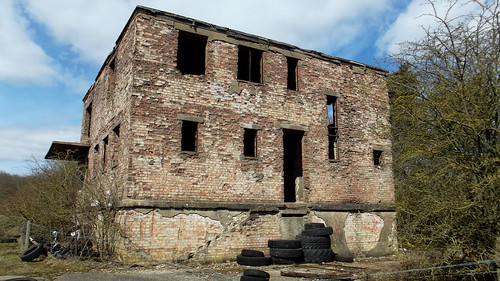
North Whitham control tower

North Witham’s Tower – now a mere shell.

As it was originally designed as a bomber station it was built to the Air Ministry’s class ‘A’ specification, formed around the usual three triangular runways, perimeter track and aircraft hardstands. With construction beginning in the mid-war years 1942/43, its main runway would be 2000 yds long, with the second and third runways 1,400 yds in length and all 50 yds wide. To accommodate the aircraft, 50  ‘spectacle’ style dispersals were built, scattered around the adjoining perimeter track. As a bomber base it had a bomb store, located to the north-eastern side of the airfield, with the admin and technical site to the south-east. One feature of North Witham was its operations block, built to drawing 4891/42, it was larger than most, with ceilings of 14 feet high. Amongst the myriad of rooms were a battery room, cipher office, meteorology room, PBX, traffic office and teleprinter room, all accessed through specially designed air locks. A further feature of this design was the attachment of a Nissen hut to house plant equipment and boiler equipment, a feature not commonly seen at this time.

Aircraft maintenance could be carried out in one of two ‘T2’ hangars with additional work space provided by one of six ‘Butler’ hangars. Designed and built by the Butler Manufacturing Company of Kansas, USA, these were supplied in kit form and had to be erected on site by an Engineer Aviation Battalion. These ‘hangars’ had rigid box section girders over a canvas cladding, and once fully erected, gave a wide 40 ft span. Quite a rare feature, these types of structures were only built in limited numbers during the Second World War and only appeared on American occupied airfields. Post-war however, they were far more commonly used appearing on many American cold-war sites across the UK.

A hangar under construction at the 1st Tactical Air Depot at North Witham. Printed caption on reverse: '77877 AC - A butler hangar under construction by members of the 833rd Engineer Aviation Battalion at North Witham, England. U.S. Air Force Photo.'

A ‘Butler’ hangar under construction by members of the 833rd Engineer Aviation Battalion (EAB) at a very snowy North Witham (IWM479)

The Ninth Air Force was born in 1942 out of the ashes of the V Air Support Command, and then combined with units already located in the England operating under the American Eighth Air Force. Its initial activities focused on the allied push across North Africa followed by the move up into southern Europe through Italy.

Moving to England in October 1943, it then became the tactical Air Force that would support the Normandy invasion, supplying medium bombers, operating as troop support and providing supply flights. Facilitation of this massive invasion required both a huge backup, and an intricate supply and support network. North Witham would form part of this support network through both repair and maintenance of the troop carrier aircraft that were operated by the Ninth Air Force – primarily the C-47s. The main group undertaking this role at North Witham was the 1st Tactical Air Depot comprising the 29th and 33rd Air Depot Groups between January and September 1944*1. One of a number of depots, they were once described as the “backbone of Supply for the Army Air Force”, and had a complicated arrangement that encompassed numerous groups across the entire world theatre.

For such a large base, North Witham would be operationally ‘underused’, the only unit to fly from here being those of the IX Troop Carrier Command (TCC), who would primarily use C-47 ‘Skytrains’ – an established and true workhorse, and one that would go on to supply many air forces around the world.

During the Sicily campaign, it was found that many incoming aircraft were not finding the drop zones as accurately as they should and as a result, paratroops were being widely and thinly scattered. More accurate flying aided by precise target marking was therefore required and so the first Pathfinder School was set up.

North Whitham pen

Part of one of North Witham’s 50 dispersal pans.

The IX TCC Pathfinder School (incorporating the 1st, 2nd, 3rd and 4th Pathfinder Squadrons) was formed whilst the TCC was at RAF Cottesmore. Initially having only seven C-47 aircraft, it arrived at North Witham in March 1944. These aircraft were fitted with ‘modern’ Gee radar and navigation equipment, and would be used to train paratroops of the 101st and 82nd Airborne to mark targets prior to the main invasion force arriving.

These crack troops would remain at North Witham for short periods before returning to their own designated bases. The idea being a joint venture to land the troops who would then set up a ‘homing’ station using ‘Eureka’ beacons that would connect to ‘Rebecca’ receivers in the aircraft. This would allow flying to near pinpoint accuracy even in poor weather or at night; something that would be employed with relative success in the forthcoming Normandy landings.

On arrival at North Witham, the Pathfinders were accommodated in the huts originally provided for the depot’s crews – some 1,250 enlisted men and 75 officers. Many of these displaced men were rehoused in tents along the northern end of the site which only added a further strain to the already rudimentary accommodation that was already in place at the airfield. At its height, North Witham would house upward of 3,700 men in total, a figure that included an RAF detachment of 86 men and large quantities of GIs.

Pathfinders of North Witham were the first to leave the UK and enter the Normandy arena. Departing late in the evening of June 5th, men of the 82nd and 101st Airborne climbed aboard their C-47s and departed in to the night sky. North Witham based C-47A*2 ‘#42-93098’ piloted by Lieutenant Colonel Joel Crouch*3, led the way. Nineteen other North Witham aircraft joined Crouch that night, with only one being lost in the entire mission. The Douglas built C-47A-15-DK Skytrain, #42-92845 was lost en route due to mechanical failure – the aircraft ditching in the sea. All the crew and paratroops on-board were believed to have been rescued by the British destroyer HMS Tartar.

Image result for Lieutenant Colonel Joel Crouch and his crew

The Crew of C-47A #42-93098, a few hours before they left for Normandy. Including Pilot, Lieutenant Colonel Joel Crouch (centre), Captain Vito Pedone (copilot), Captain William Culp (Navigator), Harold Coonrod (Radio Operator), along with Dr. Ed Cannon (physician), and E. Larendeal (crew chief)

Pathfinder training continued at North Witham into the summer of 1944, training that included Polish paratroops (1st Independent Polish Airborne Brigade) who would perform a similar role to their American counterparts. These various Pathfinder groups would go on to have long and distinguished careers, supporting the battles at Arnhem, the Ardennes and participating in Operation Varsity – the Allied crossing of the Rhine.

As the Allies pushed further into enemy territory, the flying distance from England became too great and so new airfields were either constructed or captured airfields refurbished. The Pathfinder School soon moved away to Hampshire and the maintenance units, needed nearer the front lines, gradually departed to new bases on the continent.

September 1944 would see big changes in the Ninth and the knock-on was felt at North Witham. Firstly, the IX TCC transferred from the Ninth AF to the First Allied Airborne Army, and as a result, the Air Depot title was changed to IX Troop Carrier Service Wing (Provisional), which was re-assigned to aid and supply the new Troop Carrier Groups (TCG) now based in France. To accomplish this new role, groups often used borrowed or war-weary C-47s, C-46 (Commandos) or C-109s (converted B-24 Liberators) to fulfil their role. Secondly, the Pathfinder School was re-designated IX Troop Carrier Pathfinder Group (Provisional) and they moved away from North Witham to their new base at Chalgrove near Oxford. Now much quieter, life otherwise carried on at North Witham, but gradually the UK-based maintenance and repair work slowed down, and before long its fate was sealed and the airfield began the long wind-down that many of these unique places suffered.

By the war’s end the last American personnel had pulled out and the site was handed back to the RAF’s 40 Group who, after using it for a brief spell as a maintenance depot themselves, placed it under care and maintenance. It was used as a munitions and hardware store until 1948, and then finally, in 1956, it was closed by the Ministry and the site sold two years later.

Photograph of North Witham taken on 17th January 1947. The technical site and barrack sites are at the top left, the bomb dump is bottom left. (IWM RAF_CPE_UK_1932_FP_1221)

The site, intact as it was, was returned to the Forestry Commission who planted a range of new trees around the site, covering the vast areas of grass. The technical area was developed into a small industrial unit and perhaps most sadly the watch office left to decay and fall apart.

Today the three runways and perimeter track still exist almost in their entirety, and remarkably, in generally good condition. Largely overgrown with weeds and small trees, the remainder is well hidden obscuring what little there is in the way of buildings – most being demolished and the remains left piled up where they stood. However, a T2 hangar is now used on the industrial estate and the watch office still stands tucked away amongst the trees and undergrowth. This area is a favourite place for dog walkers, and because of its runways, it is accessible for prams and pushchairs. Whilst here, I spoke to quite a few people, remarkably none of them knew of the site’s historical significance let alone the office’s existence!

Today the watch office remains open to the elements. Surrounded by used tyres and in constant threat of the impending industrial complex over the fence, its future is uncertain. Access stairs have been removed, but an entrance has been made by piling tyres up to the door – presumably by those wishing to enter and ‘explore’ further. Little evidence of its history can be seen from the outside, even the rendering has been removed, and so, any possible personal links with the past are more than likely now gone.

DSCF1273

The view of the main runway from outside the tower.

Returning back to the main public entrance along the perimeter track, a number of dispersal pens can be found; overgrown but relatively intact, they are a further sign that even here, war was never very far away.

North Witham was one of those ‘backroom boys’ whose contribution, whilst extremely important, is little known about. The work carried out here not only helped to maintain a strong and reliable fighting force, but one that spearheaded the frontal invasion of Normandy. It served as a cold and perhaps uncomfortable home to many brave troops, many of whom took the fight direct to Nazi Germany.

Standing here today, it is quiet and strangely surreal – you can almost hear the roar of engines. Looking along its enormous runways you get an eerie feeling – how many troops also stood here, spending their last few hours in this quiet place. Looking around now, it is difficult to imagine the immense work that went on here, the gathering of equipment as preparations were made for the big push into Normandy on that famous June night.

North Witham is truly a remarkable place, hidden away amongst the trees as a giant time capsule, a monument to those who lived, worked and died during that turbulent time in 1944-45.

After leaving North Witham, we return to the main A1 road and head south. Any journey here can not avoid briefly mentioning RAF Wittering, its Harrier still standing proudly outside the main gate. All went quiet here following the Government cutbacks of December 2010, but flying has now returned in the form of Grob Trainers – a small reprieve for this historic site. Wittering can seen later in Trail 37.

Another view along the main runway.

Another view along the main runway.

Sadly in May 2015, Twyford Woods was the scene of a large illegal rave, over 1000 people attended the event where a number of arrests were made in the violent altercations that took place*4. A sad day that would turn the souls of those who sacrificed themselves for the freedom we take for granted so very easily today.

(North Witham was originally visited in early 2013)

Links and sources

*1 American Air Museum in Britain

*2 C-47A #42-93098 itself was later lost whilst flying with the 439th Troop Carrier Group (TCG) on September 18th 1944, whilst flying in support of Operation ‘Market Garden‘ in Holland.

*3 Superb footage of Crouch and his crew as they depart from North Witham is available on-line here, it also shows the Watch Tower in its former glory.

*4 A report of the event is available on the BBC News website.
Spanhoe Airfield – into the Jaws of Death

RAF Spanhoe (Station 493)

With the BEF evacuation at Dunkirk, some thought that the war was over and that the mighty Nazi war machine was undefeatable. Poised on the edge France, a mere 20 or so miles from the English coast, the armies of the Wehrmacht were waiting ready to pounce and invade England. For Britain though, the defences came up and the determination to defeat this evil regime grew even stronger.

Defeat in the air during the Battle of Britain reversed the fortunes of Germany. Then the Japanese attack on Pearl Harbour in the Pacific, which led to the United States joining the war, set the scene for a new and vigorous joint front that would lead to the eventual invasion of occupied Europe, and ultimately the freedom for those held in the grip of the Nazi tyranny.

Plans for the invasion were never far from the thoughts of those in power – even in the darkest hours of both Dunkirk and the Battle for the British homeland. To complete this enormous task, an operation of unprecedented size and complexity would be needed. Vehicles, troops and supplies would all needed to be ferried across the English Channel, a massive air armada would have to fly thousands of young men to the continent. To succeed in this auspicious and daring operation, a number of both training and operational airfields would need to be built, and in 1943 Spanhoe was born.

Known originally as RAF Wakerley (and also referred to as Harringworth or Spanhoe Lodge) it was handed over to the U.S.A.A.F. and designated Station 493.

RAF Spanhoe Lodge

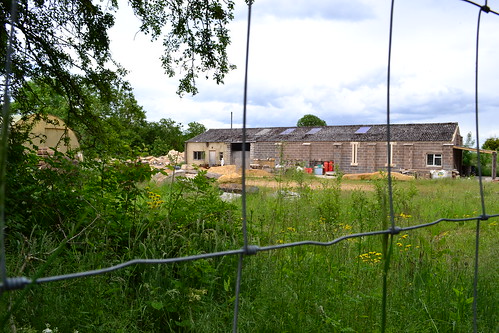
Remaining buildings on the Technical site at Spanhoe Lodge.

Located in the county of Northamptonshire, it would be a huge site with three concrete runways, the longest of which was 6000 ft. Two smaller intersecting runways were of 4,200 ft and all three were a huge 150 ft wide. A total of 50 spectacle hardstands were spread around the perimeter track whilst the tower, built to a 1941 design (12779/41), was located to the south of the airfield between the technical area and main airfield. Such was the design of the airfield, that the tower was located a good distance away from the main runway to the north. The technical area included a small number of Quonset huts, temporary brick-built buildings and two T2 hangars. Instructional and training buildings included a Synthetic Navigation Classroom (2075/43) designed with the most up-to-date projection and synthetic training instruments possible. These buildings were made more distinct by the two glazed astrodomes located at one end of the building which could be used on nights when stars were visible.

As Spanhoe was originally built as a bomber station, a bomb and pyrotechnic store was built on the eastern side of the airfield with three huge fuel stores, one to the north and two others to the west, all capable of holding 72,000 gallons of aviation fuel each.

Accommodation for the crews and ground staff was widely spread to the south amongst the local woods and fields, and consisted of numerous cold Quonset huts – but for the residents, Spanhoe was considered nothing special to write home about.

The first U.S. units to arrive were the Troop Carriers the of the 315th Troop Carrier Group (TCG), whose journey from the United States was not as straightforward as most.

Whilst on their way over the north Atlantic route, they were hit by bad weather and had to be diverted to Greenland. Here they stayed for over a month scouring the seas for downed aircraft and dropping supplies to the crews before they were rescued.

Eventually the 315th made England and began a series of training operations. A small detachment were sent to Algiers to assist in the dropping of supplies to troops in the Sicily and Italy campaigns before returning to the main squadron in the U.K. The 315th arrived at Spanhoe on 7th February 1944 now part of the Ninth Air Force,  IX Troop Carrier Command, 52nd Troop Carrier Wing. They operated two versions of the adapted Douglas DC-3; the C-47 Skytrain and the C-53 Skytrooper transport aircraft. Four Troop Carrier Squadrons (TCS) would use Spanhoe: the 34th, 43rd, 309th and 310th, and would all operate purely as paratroop carriers.

C-47 Skytrains of the 315th Troop Carrier Group in flight. Handwritten caption on reverse: 'C-47 Skytrain. 315 TCG over Lincolnshire. C-47 before 1944.'Image actually shows Harringworth Viaduct. RAF Spanhoe, the home field of the two Aircraft, is slightly out of shot to the left, making this right on the border of Rutland & Northamptonshire.

C-47 Skytrains of the 315th Troop Carrier Group in flight. over the Harringworth Viaduct. RAF Spanhoe, the home of the two Aircraft is just out of shot. (IWM – FRE 3396)

For the next few months they would train in preparation for the forthcoming D-day landings in which they would rehearse both formation flying at night and night paratroop drops with the 82nd Airborne; the unit the 315th would take to drop zones behind enemy lines in Normandy. These preparations were relentless, and not without casualties. The 315th were considered as one of the ‘weaker’ elements of the air invasion force, and would carry out drops nightly until the paratroops had completed their full quota of jumps and all were finally classed as ‘proficient’. The majority of these jumps were however, carried out in clear weather, a point that had not been factored into the final decision.

Flying at night would, unsurprisingly, claim  lives and this was brought home when on the night of May 11th-12th, two aircraft from the 315th’s sister group the 316th, collided during combined operations, killing fourteen airmen.

Even with all this training and a very high aircraft maintenance programme, there were many factors that could affect the outcome of operations. Some 40% of crews had only recently arrived before operations, and thus were not a party to a large part of the training missions.  Of the 924 crews that were designated for the operations, 20% had only had minimal training and 75% had never actually been under fire. The airborne crews were not well prepared.

On the third day of June the order came through to paint invasion stripes on the aircraft. These three white and two black stripes, each two feet wide, were designed to enable the recognition of allied aircraft who were sworn to radio silence over the invasion zones. D-Day was now imminent.

The 52nd’s mission would involve all the other groups of the Wing, taking aircraft from: Barkston Heath (61st TCG), Folkingham (313th TCG) Saltby (314th TCG) and Cottesmore (316th TCG) as well as eleven other paratroop and glider-towing units of the U.S. Ninth Air Force and fifteen RAF Squadrons – it was going to be an incredible sight.

315th C-47 landing at Spanhoe. On the ground can be seen the 315th’s C-109 (converted B-24) tanker . (Knight Collection)

Forty-eight aircraft took off from Spanhoe and formed up with the other Groups at checkpoint ‘ATLANTA’, they continued on toward Bristol turning south at checkpoint ‘CLEVELAND’ . They flew crossed the south coast at Portland and headed out toward Guernsey. The route would then take them north of the island where the 52nd would turn east and head over the Cherbourg Peninsula. They would drop their load of heavily laden paratroops south of Utah beach to capture the important town of St. Mere-Eglise. A ten-mile wide corridor would be filled with aircraft and gliders.

Over the drop zone the aircraft encountered cloud and heavy flak. Whilst a quarter received damage, all but one were able to return to England, the last being lost over the drop zone. For their efforts that night, the 315th TCG was awarded the Distinguished Unit Citation, the only one they would receive during the war.

After D-day, units of the 315th continued to drop supplies to the advancing troops, a default role they carried out for much of the war.

Tragedy was to rear its ugly head again and strike down Spanhoe crews. In July 1944, 369 Polish paratroopers arrived for training as part of Operation ‘Burden’. This involved thirty-three C-47s of the 309th TCS, fully loaded flying in formation at around 1,300 ft. The aim of the flight was to drop the Polish Paratroops at a drop zone (DZ) over R.A.F. Wittering.

RAF Spanhoe Lodge

One of the few overgrown buildings at the entrance to Spanhoe Lodge.

Shortly before arriving at the DZ near to the Village of Tinwell, two aircraft made deadly contact and both plummeted to the ground. Twenty-six paratroops and eight crewmen were killed that day, the only survivor was Corporal Thomas Chambers who jumped from an open door. Eyewitness accounts tell of “soil soaked in aviation fuel”, and bodies strapped to part open parachutes as many tried to jump as the aircraft fell. This tragic accident was a devastating blow to the Polish troops especially as they had not yet been able to prove themselves in combat and one that ultimately led to the disbandment of the section and reabsorption into other units.*1

The 315th’s next major combat mission would be ‘Market Garden‘ on September 17th, 1944, another event that led to many tragedies. On the initial day, ninety aircraft left Spanhoe with 354 Paratroops of the U.S. 82nd Airborne, the following day another fifty-four aircraft took British paratroops and then on the third day they were to take Polish troops. However, bad weather continually caused the cancellation of the Polish operations and even with attempts at take-offs, it wasn’t to be. Finally on September 23rd good skies returned and operations could once more be carried out. During all this time, the Polish troops were loaded and unloaded, stores under the wings of the C-47s were added and then removed, it became so frustrating that one Polish paratrooper, unable to cope with the stress and anticipation of operations, fatally shot himself.

Later that month, another plan was hatched to resupply the beleaguered troops in Holland. The idea was to land large numbers of C-47s on different airfields close to Nijmegen. Not sure if they had been secured, or even taken, the daring mission went ahead. Escorting fighters and ground attack aircraft neutralised anti-aircraft positions around the airfields allowing hundreds of C-47s to land, deposit their supplies and take off again, in a mission that took over six hours to complete. In total: jeeps, trailers, motorcycles, fuel, ammunition, rations and 882 new troops were all delivered safely without the loss of a single transport aircraft – a remarkable feat.

Further supplies were dropped to troops during both the Battle of the Bulge and Operation Varsity – the crossing of the Rhine – in March 1945. During this operation, the 315th would drop more British paratroopers near Wesel, Germany, a mission that would cost 19 aircraft with a further 36 badly damaged.

By now the Allies were in Germany and the Troop Carrier units were able to move to France leaving their U.K. bases behind. This departure signalled the operational end for Spanhoe and all military flying at the airfield would now cease.

Two months later the 253rd Maintenance Unit arrived and prepared Spanhoe for the receiving of thousands of military vehicles that would soon be arriving from the continent. Now surplus to requirements, they would either be scrapped or sold off, Spanhoe became a huge car park and at its height, would accommodate 17,500 vehicles. For the next two years trucks, trailers and jeeps of all shapes and sizes would pass through, until in 1947 the unit left and the site was closed for good and eventually sold off.

This was not the end for Spanhoe though. Aviation and controversy would return again for a fleeting moment on August 12th 1960, with the crash of Vickers Valiant BK1 ‘XD864’ of 7 Squadron RAF. The aircraft, piloted by Flt. Lt. Brian Wickham, took off from its base at nearby RAF Wittering, turned and crashed on Spanhoe airfield just three minutes after take off. The official board of enquiry concluded that the accident was caused by pilot error and that Flt. Lt. Wickham, was guilty of “blameworthy negligence”. The Boards findings were investigated by an independent body who successfully identified major flaws in both the analysis and the Boards subsequent findings.  Sadly no review of the accident or the Boards decision has ever taken place since.

Spanhoe Lodge

Spanhoe was the home of the 315th Troop Carrier Group, part of the 52nd Troop Carrier Wing, Ninth Air Force.

Spanhoe was then turned into a limestone quarry by new owners, the runways and the majority of the perimeter track was dug up and the substrate was removed. The majority of the buildings were demolished but a few were left and now survive as small industrial units involved in, amongst other things, aircraft maintenance and preservation work. A private flying club has also started up and small light aircraft now use what remains of the southern section of the perimeter track and technical area.

The main entrance to the airfield is no longer grand, and in no way reflects the events that once took place here. From this point you can see some of the original technical buildings and hidden behind the thicket, what was possibly a picket post. A footpath though the nearby woods allows access to the remains of eastern end of the main runway and perimeter track, other than this little is accessible without permission.

Outside the main entrance are two memorials consisting of a modern board detailing the group and squadron codes, and a stone obelisk listing the names of those crew members who failed to come home. Both are well cared for if not a little weathered.

DSC_0159

Spanhoe Lodge memorial

Spanhoe leaves a legacy, for both good reasons and bad. The crews that left here taking hundreds of young men into the jaws of death showed great bravery and skill. Determination to be the best and perform at the limits were driving factors behind their successes. Relentless training led to the deaths of many who had never even seen combat, and the scars of these events linger in what remains of the airfield today. Thankfully for the time being, the spirit of aviation lives on, and Spanhoe clings to the edge, each last gasp of breath a reminder of those brave men who flew defenceless in those daring and dangerous missions over occupied Europe.

On leaving Spanhoe, return to the main road, keeping the airfield to your left, join the A43, and then turn right and then immediately left. Follow signs to Oundle and Kings Cliffe and our next destination, the former airfield at Kings Cliffe, an airfield with its own modern controversies.

Spanhoe features as part of Trail 6, ‘American Ghosts’.

Sources and Further Reading

*1 A list of those killed in the Tinwell Crash can be found via this Dutch website for Polish War Graves.

The 315th TCG has a detailed website with regular newsletters and photographs.