Trail 65 – RAF Thurleigh Part 2 – The USAAF Arrive.

In Part 1 we saw how RAF Thurleigh emerged from the Bedfordshire countryside and was shaped by early Luftwaffe raids on the construction site. We saw the arrival of new RAF training units flying Wellington bombers, and their subsequent departure to the far East. We saw how tragedy and fatal accidents claimed the lives of new Polish crews training at the station with 18 OTU, and how with Bomber Command moving on, Thurleigh’s role was set to change dramatically.

A New Ally Arrives: The American Transformation of Thurleigh

At the end of 1941, after the surprise attack on Pearl Harbour, America entered the conflict declaring war on both Japan and Germany and their allies. Over the next few months high ranking officials hurriedly put plans in place to send twenty-eight American bomb groups to the United Kingdom, and the European theatre of war. In a meeting between General Eaker and Air Chief Marshal Arthur Harris, discussions took place that would not only facilitate such a move, but also give the Americans suitable airfields on which to house their new heavy bombers.

Aware that most British airfields were too small to accommodate the American’s heavy bomber units, Eaker went on to press Harris for specific details including both their locations and the facilities available at each one. Anticipating this, Harris handed over the identity of eight potential sites, many of them RAF satellite stations, but all suitable for the American’s use. Amongst these were the airfields at Polebrook, Chelveston, Molesworth, Kimbolton, and of course Thurleigh.

Initially designated Station B-4, Thurleigh would then undergo a major modification programme, one that would bring it up to the new Class ‘A’ standard, a specification that would make it suitable for the American heavy bombers, both the B-24 ‘Liberator’ and the B-17 ‘Flying Fortresses’ that Eaker was sending over.

Thurleigh

One of the former arms buildings.

Construction crews quickly began work, both extending and reinforcing the short runways; they added additional hardstands, and expanded both the technical and domestic sites. Upon completion, the airfield would feature three concrete runways: one of 2,000 feet and two of 1,400 feet in length, each being the standard 50 yards wide. Aircraft dispersal was facilitated by a total of 51 loop and frying-pan style hardstands arranged around a full length perimeter track.

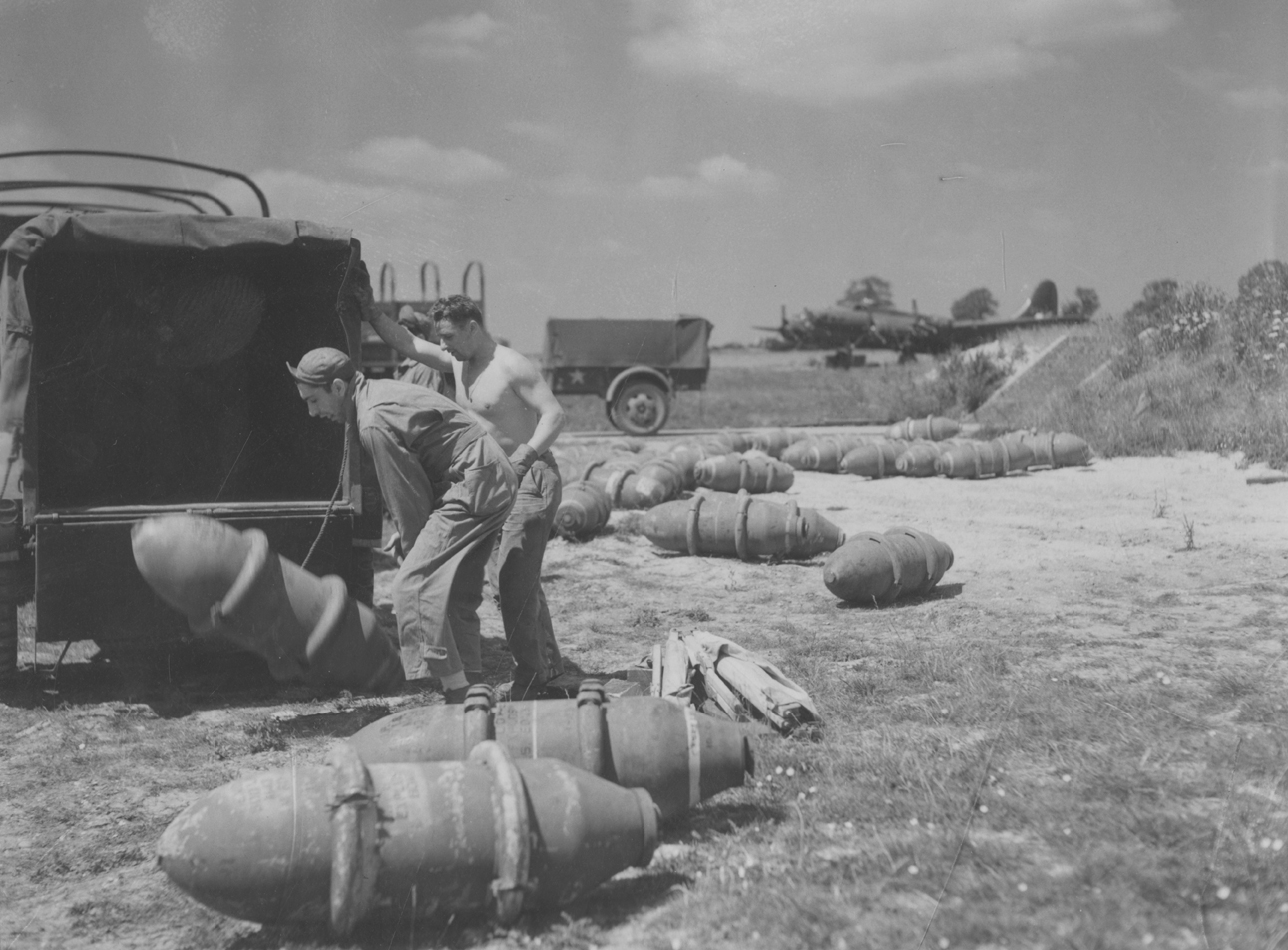
In addition, and unusually, four T2 hangars were erected, providing protective aircraft shelter and maintenance facilities. The bomb store was discreetly placed in Galsey Wood, a wooded area to the northwest and away from the main flying and accommodation areas – an essential safety precaution in wartime.

Fifteen accommodation sites, including two communal areas, two WAAF quarters, medical facilities, and barrack blocks, were all established along the road leading away from Thurleigh village to the south-west of the airfield. These sites employed a variety of wartime construction styles – brick, timber, concrete, steel, asbestos, and plasterboard – using standard designs from Laing, Nissen, Seco, Jane, Romney, and others. At full capacity, the base would accommodate over 440 officers and more than 2,500 enlisted personnel, including members of the Women’s Auxiliary Air Force.

After being allocated to the Americans on August 10th 1942, Thurleigh opened with its first residents. On 7th September that year, the first and only front line bomber Group to operate from the airfield, the 306th Bomb Group (BG), arrived with its four squadrons of B-17s: the 367th, 368th, 369th and 423rd Bomb Squadrons (BS). In command would be Col. Charles B. “Chip” Overcracker.

The 306th Bomb Group: Arrival of “The Reich Wreckers” (Autumn 1942)

Known as “The Reich Wreckers” the 306th would have many claims to fame, including being the oldest operational Bomb Group in the 8th Air Force and the only one to remain at the same station (Thurleigh) in England for the longest period of time. In addition, they were the first unit to have personnel achieve their first tour of operations, a major mile stone that gave the whole air force hope that going home was indeed possible.

Thurleigh

A graffiti panel rescued from a 423rd BS barrack now on display at the museum.

The Group, designated the 306th, were constituted on January 28th 1942, and activated in March that same year. Their journey to the UK began at Gowen Field in Idaho, transferring through Wendover Field to their embarkation point at New York onboard HMS Queen Elizabeth. The ground echelon set sale, travelling across the treacherous north Atlantic route to arrive at Greenock in Scotland, on September 5th, 1942.

The air echelon travelled separately, arriving a week later in small groups touching down at Thurleigh between the 8th and 13th September, having flown their own thirty-five aircraft across the northern route. This cold and bleak route took them via Greenland and Iceland, before passing over northern Ireland to arrive at Prestwick in Scotland on the north-west coast. During the journey over, one B-17F, with a crew of nine and one passenger, exploded for no apparent reason, 150 miles from Gander Lake,  Newfoundland. A second aircraft also ditched in the Irish Sea. The crew in this instance were picked up, but the aircraft was lost in the cold waters of the North Atlantic. This was the third B-17 the group had lost since their inauguration.

The 306th would go on to fight in some of the most bitter air battles of the war, including Schweinfurt, Stuttgart, Hannover, Berlin, Ludwigshafen and Leipzig. They would lead the first US bomber penetration of German skies; Big Week in February 1944, and go on to support both the Normandy landings and the St. Lo breakout. They would remain active throughout the war achieving numerous awards including two Medals of Honour, numerous Purple Hearts and two Distinguished Unit Citations (DUC) for action over occupied Europe.

Their arrival at Thurleigh was not however the great dream they may have wished for. On unloading, the 306th were greeted by unfinished buildings and mud – lots of it. Tents immediately formed the basis of personnel  accommodation and the officers’ mess was so small, staff had to operate in three shifts to enable them all to get fed.

Not only was a considerable amount of work needing to be done to get the station ready, but being new to the European theatre, a huge amount of ‘up-skilling’ was also going to be needed. To this end, intelligence staff, operations controllers and flight controllers were all sent to RAF stations to learn the ‘tricks of the trade’ enabling them to operate alongside their British counterparts in what was about to become a very busy airspace.

Baptism by Fire: First Operations and Early Losses

This poor start was then compounded when on October 2nd 1942, during a practice mission over the Wash, one of the waist gunners of B-17 #41-24492 ‘Lady Halitosis‘ of the 367th BS, suffered oxygen failure. In a bid to help the gunner, the pilot put the aircraft into a steep dive losing some 9,000 feet of altitude in a matter of minutes. The dive and subsequent recovery was so severe that the aircraft’s control cables snapped, and part of the starboard wing broke away taking an engine with it. The aircraft then caught fire and the bomb bay doors became detached. One of these doors, struck the rear section of the aircraft with such force that it severed the fuselage at the tail. The rear gunner, trapped inside his position, desperately tried to escape, hammering at the plexiglass and fuselage to break out. With only a 1,000 feet of air left, he just managed to break through the fuselage and free himself from his falling coffin. His parachute luckily opened, and he landed safely some distance away south-east of Spalding in Lincolnshire. His luck, already used exhaustively, somehow managed to continue on for a few moments more, when the remainder of the burning  B-17 came crashing down a mere one hundred yards or so from where he was sat.

Rescue crews from a nearby anti-aircraft gun ran to the scene but they were unable to get close enough to the wreckage due the the ferocity of the fire, and sadly, all six of those left inside, perished. During the whole episode only one other crewman managed to escape – Ball Turret Gunner Private Raymond McAskill – suffering slight injuries as he did so.

The event was so understandably harrowing for gunner S.Sgt. William Kellum, that he was eventually grounded, his mental state rendering him ‘unfit’ to continue on after having only carried out a few missions following his horrific flight debut in England.

With this disaster behind them, the 306th took to the air once more on their maiden operation on October 9th 1942, an operation to bomb the steel works at Lille, France. But again, it was not to be the glorious outcome they all would have wished for.

For the first time, over 100 American bombers, a mix of B-24s and B-17s, led by the soon to be legendary Col. Edward “Ted” Timberlake, flew across the English Channel to France. The huge formation, escorted by over 400 fighters, a mix of Spitfires – now part of the 4th Fighter Group –  and P-38 “Lightnings”, knew how important this mission was going to be.

Waiting for them were the battle hardened Luftwaffe pilots of JG 26 in their FW190s, they were not going to let the bombers through easily and the sky would be full.

With departure planned for 08:32, the lumbering giants gradually rose in to the air and set route for France.

As the bombers reached the target, the Luftwaffe struck, focussing initially on the B-24s of 93rd BG. Attacking from their favoured position, the rear, they struck at the formation ignoring the fighters flying high above. Releasing over the target, bombing was considered poor, some bomb aimers not even finding the target and so dropping their bombs on alternative sites. During the action, the formation had become disjointed, partly due to some turning back with technical problems and partly to some being knocked out by enemy fighters – the defensive wall had been breached.

As for the 306th, a second aircraft was lost, and this time there were no survivors. A third B-17, #41-24486 “Man O’ War” piloted by 2nd. Lt. James M. Stewart, lost three engines and its radio failed. It was about to ditch in the English Channel, when – as if out of a boy’s action story – a Spitfire, flown by Flt. Lt. Andrews of 91 Sqn, appeared alongside and guided the B-17 to RAF Manston in Kent where it made a successful crash landing. None of the crew were injured in the event, saved no doubt by the actions of Flt. Lt. Andrews.

Inexperience played a large part for many of the crews taking part that day. Being new to operational duties, not only had they suffered poor aiming but gunners had made hugely exaggerated claims about the numbers of enemy aircraft shot down – although probably unknowingly to them. In reply to the frenzied attack on the formation, air gunners sprayed bullets all over the sky hitting everything except the enemy. A mix of poor training and a determination to prove their worth, had been a recipe for disaster.

Thurleigh

One of several buildings on the bomb store.

Not only was the bomb aiming poor but so was the navigation. Many navigators, like the gunners, were simply not experienced enough, nor trained well enough for the European geography. With thick cloud being present almost all of the time, many new crews were unable to identify specific geographical features and were simply lost within 10 minutes of leaving their home base.*4

During this initial operation experienced enemy fighters were both fearsome and determined in their attacks. Whilst few bombers were actually shot down, all of those in the lagging 306th received hits from the FW-190s – some severely. The opening few weeks had been a real eye opener for the 306th, an experience resembling a baptism of fire not only for those newbies the “The Reich Wreckers“, but for the Eighth Air Force as a whole.

Weather, Warnings, and Misfires: October’s Frustrating Missions

The British winter weather then intervened. Several operations were cancelled as were training flights which were greatly needed. A cancelled flight to Lorient on October 21st, merely two weeks after their first operation, meant that the entire 306th returned without dropping a single bomb. The declining weather and poor visibility was to blame, but some ninety aircraft did continue on, and of those who did bomb, their bombs simply “bounced off” the submarine pens, having no impact whatsoever. *5

Aircrews were learning that operations over enemy territory were high risk, but even scrubbed missions could have their problems: aircraft still had tanks full of petrol and bomb-bays were still filled with tons of high explosives. For the 306th, troubles on this mission began even before they had left British airspace. When the abort signal came through, it instructed crews to drop their ordnance in the Wash – a large body of shallow coastal water off the north Norfolk coast.  Whilst it became a common practice for scrubbed missions, for one B-17 it was not going to be a simple or straight forward task.

Emergency Landing: A B-17 Touches Down at Sutton Bridge

B-17F, #41-24460 ‘RD-A’, “Little Audrey” of the 423 BS, began the process of releasing its bombs when suddenly the life raft latch broke loose causing the raft to escape and wrap itself around the elevator rendering the aircraft difficult to control.

Captain Mack McKay, 306th BG points to a “kill” marking painted on his B-17 Flying Fortress “Little Audrey” (IWM FRE 4418)

Now being unstable in flight, the B-17 had to find a safe place to land, and near to the Wash was the firing range at Holbeach and its associated airfield at RAF Sutton Bridge. A physically small grass airfield that was used for gunnery training of RAF fighters, it was not designed to take large four-engined heavy bombers. The likely hood of getting down safely was slim, but after using all his skill and judgement, the pilot managed to put the bomber down safely on the grass much to the joy of those inside the bomber. Once remedial work had been carried out on the aircraft, the crew began to prepare for the take off, an event just as risky as the landing and with odds just as bad.

Being an unusual aircraft to see at Sutton Bridge, huge crowds gathered to see the B-17 and to witness what could have been a terrible accident had the take off been misjudged on the small grass strip. Fortunately though, again using all his skill and judgement, the pilot got the aircraft up and the B-17 successfully rose in to the air making its way home to Thurleigh being waved off by the extensive crowd of locals gathered by. *6

Mounting Pressure: Heavy Losses and Royal Visits

The early days of November 1942, saw missions 3, 4 and 5 for the 306th. Visits to Brest, Lille and St. Nazaire, saw a further four aircraft lost with all crews listed as ‘missing in action’. These early loses were beginning to mount, and those in charge were beginning to voice their concerns.

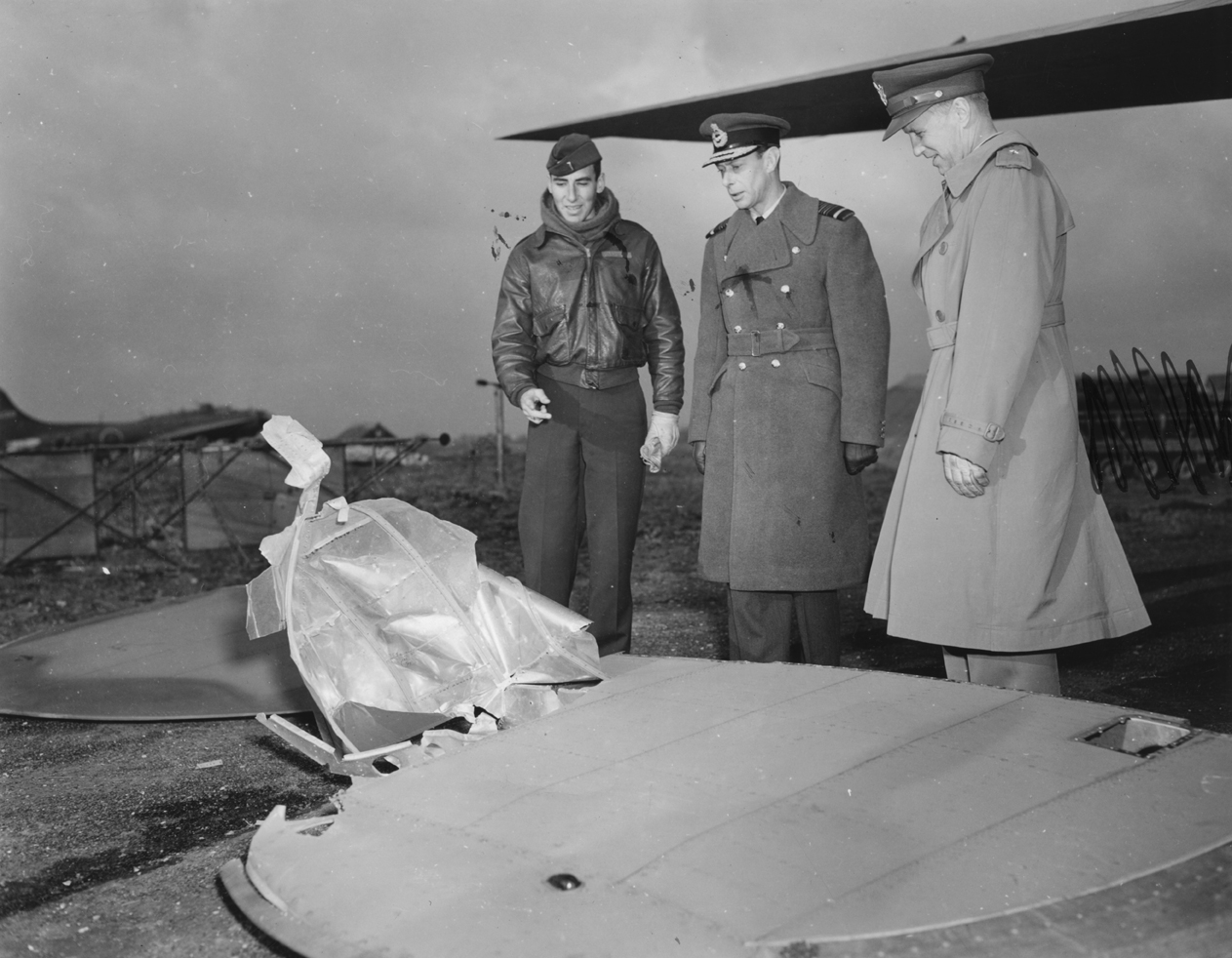
On November 13th, a Royal visit was made in which General Carl Spaatz and King George VI carried out a tour of the many airfields now in the region, including Thurleigh. Whilst the Royal party were here, they were shown around the airfield, seeing the various facilities available. They were also introduced to several crews and ground staff with whom they chatted happily.

Brigadier-General Newton Longfellow and Lieutenant Robert L Riordan of the 306th Bomb Group, show King George VI part of a damaged B-17 Flying Fortress during a royal visit. (IWM FRE 4390)

The B-17’s Fatal Flaw – and its Remedy

But the relief brought by important visitors didn’t prevent problems in the air. By now, the Luftwaffe had got the measure the of the B-17 and pilots, such as Oberstleutant Egon Mayer, quickly found its Achilles heel. Even though bristling with guns, the B-17s suffered from ‘blind spots’, areas where the gun’s arc didn’t cover. This made the bomber vulnerable, and the worst position was through a direct full frontal attack. New tactics were then used by the Luftwaffe, directing fire directly at the front of the aircraft, potentially its most vulnerable position. It became so successful, that some 30% of pilots and co-pilots in the 306th were killed in such attacks.*7  With little protection, early model B-17Es were quickly withdrawn from front line operations and investigations carried out into a possible remedy to the problem.*8

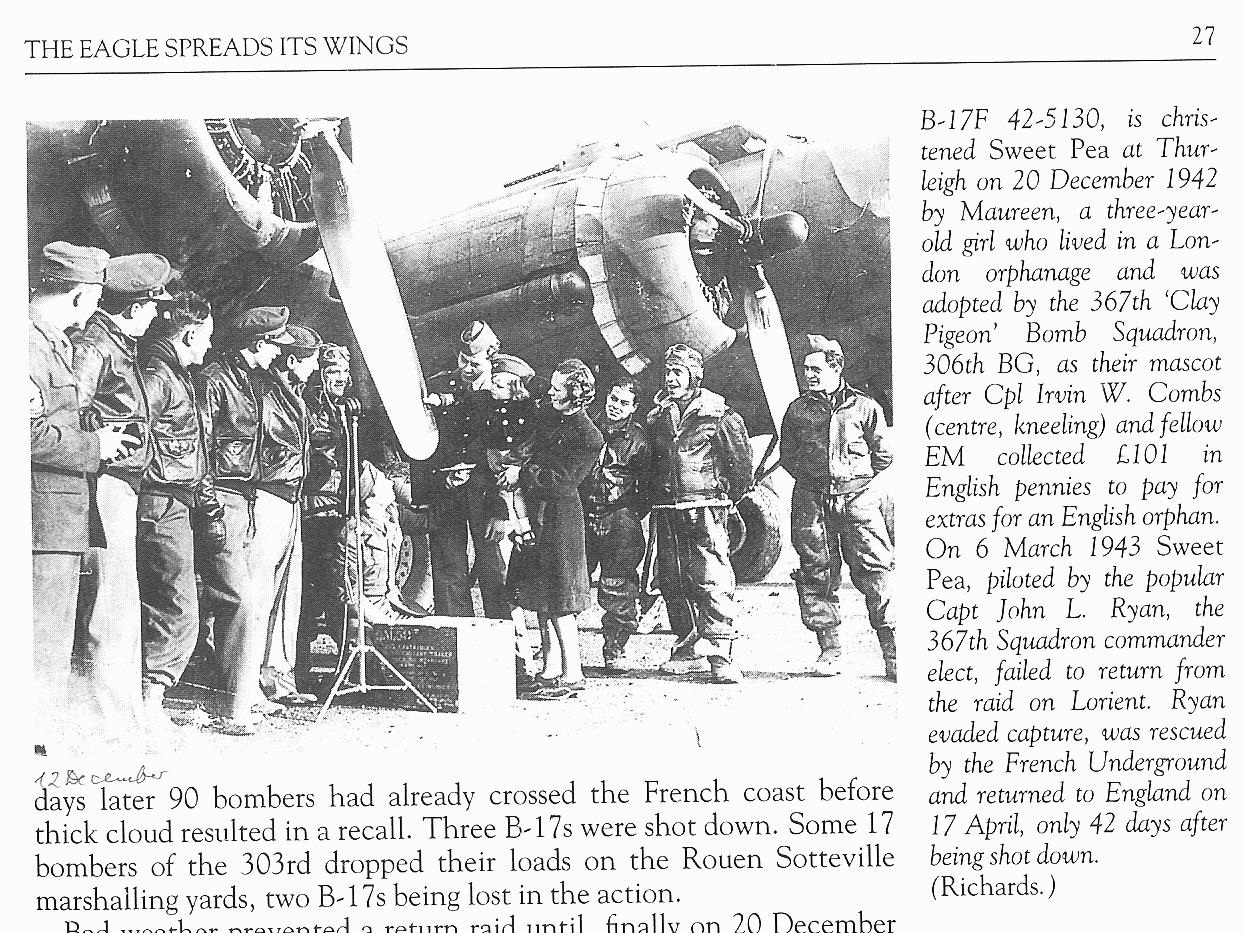
Naturally the B-17 crews realised this vulnerability too, and also set about finding their own remedy. Whilst official routes were being taken to solve the problem, these were taking too long, and a quicker solution was needed. Within the 367th BS an armourer  and a welder (S. Sgts. James C. Green and Ben F. Marcilonis) got together and took matters into their own hands. They designed and built a new bracket that could hold a heavy .50 machine gun fitted into the nose of the aircraft to protect this gap in the forward arc.  Once constructed and fitted, trials began, the ‘guinea pig’ being a B-17F #42-5130 named “Sweet Pea“.

The bracket fitted to Sweet Pea, proved to be so successful that it was adopted not only by the 306th but the 8th Air Service Command as a whole*9 becoming part of a modification feature to future B-17 models.

The aircraft  was unusual for other reasons though. It was ‘christened’ on December 20th 1942, by a small orphan girl called ‘Maureen’ whom the 367th BS had adopted from a London orphanage. They gave her the nickname ‘Sweet Pea‘ and to mark the occasion, she dipped her hand in paint and placed a print on the aircraft as a form of dedication.. Like many aircraft of the ‘Reich Wreckers’, Sweet Pea would fly on several operations, suffering a great deal of damage in the process; eventually failing to return from operations to Lorient on March 6th 1943, with one airman killed in action, one evading and eight being taken prisoners of war.

The news report on the dedication of ‘Sweet Pea‘ by Maureen – a three year-old orphan – at Thurleigh. (IWM UPL 15963)

Thurleigh had transformed from a training airfield into a heavy bomber base ready for its new American role. Upgraded to Class “A” standard it soon became home to the 306th Bomb Group – “The Reich Wreckers.” Their arrival in September 1942 was far from smooth though: unfinished buildings, muddy conditions, and a steep learning curve in the European theatre made for a difficult start. Early missions brought tragedy, from training accidents to heavy combat losses, while poor weather and inexperience compounded their struggles. Yet alongside setbacks came resilience, adaptation, and even innovation, as crews refined tactics and strengthened their aircraft. With these foundations laid, the stage was set for the 306th to face the increasingly bitter air battles of 1943.

The entire history can be read in Trail 65

Trail 65 – RAF Thurleigh Part 1 – Its Birth.

In Trail 65 we head west again this time to the borders of Bedfordshire and Northampton, where a former wartime airfield evolved from a base for USAAF bombers into a centre of aviation excellence. First built during the Second World War, it supported critical missions over occupied Europe. In the post-war years, it transitioned into a leading site for aeronautical research, contributing to major advances in jet technology, carrier operations, and automated landing systems. Although official flying ended in 1994, the site continued to reflect a remarkable legacy, marking its place in history as a cornerstone of Britain’s military and civil aviation development.

In this trail, we go back to Bedfordshire and the former RAF Thurleigh.

RAF Thurleigh (Station 111)

Situated some 6.5 miles north of Bedford, RAF Thurleigh was built on land approximately 250 feet above sea level. Although not a high elevation, its open plateau setting – typical of many wartime airfields – exposed it to the elements. Surrounded by multiple river sources, the location benefited from good natural drainage, aiding its suitability as an airfield site.

The nearby village of Thurleigh has a long recorded history, appearing in the Domesday Book as La Lega*1 – a name that over centuries, has evolved into its current form. In a similar fashion, the airfield that bears the same name, would come to be known under many titles of its own: RAF Thurleigh, USAAF Station 111, RAE Bedford, Bedford Aerodrome, and Thurleigh Airfield Business Park amongst others. Yet throughout its history, one theme remained constant – aviation.

The War Reaches Bedfordshire: Early Bombings and Construction (1941)

Thurleigh’s association with the Second World War began even before construction commenced. Isolated bombing incidents in the parish during 1941 – possibly the result of jettisoned bombs from German aircraft – marked its early wartime experience. Once the airfield’s construction began however, it quickly caught the attention of the Luftwaffe. On 17th April that year, eight enemy bombs were dropped directly onto the construction site, causing damage to the incomplete runway. A second attack on 12th August 1941 saw another eight bombs fall along the northern boundary, again damaging the airfield and rupturing a water main*2. Both raids highlighted how conspicuous such developments were to enemy reconnaissance and subsequent aerial attacks.

Once land had been sourced, the airfield’s construction was carried out by the company W.C. French Ltd. and officially opened during the summer of 1941. At this early stage, Thurleigh was a modest airfield in size, suited only for fighters or light to medium bombers. Its first operational residents were the personnel from No. 18 Operational Training Unit (OTU), part of the RAF’s Bomber Command. Having recently adopted the twin-engined Vickers Wellington, 18 OTU (formed from the Polish Training Unit in No. 6 Group, in June 1940 to train light bomber crews for Polish operational squadrons) was tasked with preparing new crews transitioning onto bombers ready for active duty.

Though OTUs were primarily training units, they often found themselves involved in operational sorties, especially during periods of ‘maximum effort’. As a result, many crews suffered casualties, even before they joined a front-line operational squadron.

Following them, in October 1941, 12 Operational Training Unit – first formed at RAF Benson in April 1940 – briefly stayed here. Their residency lasting a mere month, it remains unclear whether it was the entire unit, or just detachments  that were present here during that time. It was also at this time that the first recorded aircraft landing took place at Thurleigh: Wellington IC R1234*3 touching down on the new runway, marking a small but important milestone in the station’s dramatic history.

12 OTU Were not the only training unit to reside here. The Central Gunnery School (CGS), famed for “training the trainers” remained here from December 1941 until their departure to RAF Sutton Bridge on the Lincolnshire / Norfolk border in April 1942.

First established at RAF Warmwell on 6th November 1939, the CGS would train both gunners of bombers and fighters in the art of aerial warfare, those attending having proven themselves in combat already. Once trained, they would return to their original squadrons and pass on their valuable knowledge to others.

Tropical Kit and Tragedy: The Brief Story of 160 Squadron (1942)

Thurleigh’s relative quiet made it an ideal location to raise a new unit, and on January 16th 1942, the ground echelon of 160 Squadron RAF, formed here. Created as a Consolidated B-24 Liberator unit under War Establishment order WAR/ME/448 (dated 31st December 1941), the squadron’s formation began with the arrival of 108 airmen, who were followed by a further 126 the very next day. Over the following weeks, the numbers of ground crew and support staff swelled, as it did, each one was issued with tropical kit, a move that suggested a deployment to the Far East.

Throughout the weeks that followed, the air echelon underwent heavy bomber training some with 1653 Heavy Conversion Unit at RAF Polebrook, while  other crew members were sent to RAF Upwood for additional preparation. In mid-February, the posting finally came through and the ground party departed enroute to the Far East. Meanwhile, the air crews transferred to RAF Lyneham in Wiltshire, where they collected their new B-24s before they too left for the Far east.

Tragedy and Transition – May 1942

The now quieter Thurleigh would then experience a series of tragic accidents. On 18th May 1942, Wellington IC DV783, flown by a Polish crew led by Pilot Officer J. Kilmcsyk, crashed shortly after taking off. Just moments after departing the runway, the aircraft suddenly, and without warning, dived into the ground; the ensuing fireball killing all five crew members onboard. The Wellington, along with the crew’s bodies, was later recovered and the airmen interned in the Polish War Graves section of Newark cemetery in Nottinghamshire.

This was the second fatal crash suffered by the unit in as many days, a tragedy that was compounded by another such incident the following day – although mercifully this time, there would be no fatalities.

Not long after this short but devastating period, 18 OTU departed Thurleigh, a move that signified the end of its ties, as a training airfield, with Bomber Command. For the remainder of the war,  there would be no further front line, RAF units assigned here, and attention now turned to its new owner, the United States Army Air Forces.

In Part 2, we continue our journey through Thurleigh’s wartime history. We see the arrival of the USAAF, and share their experiences both good and bad. We learn of the failures of the B-17 and how through innovation they overcome these problems becoming one of the most successful bomb groups of the war.

The full story of RAF Thurleigh can be. read in Trail 65.

The last flight of Joe Kennedy and Wilford Willy – (RAF Fersfield).

There has been much written about the young Kennedy, his life, his family and his death, but a lot of information around his death has remained ‘unknown’ for many years. Even today, the actual cause of his death is not clear and will probably remain so.

Joseph Kennedy Jnr was based at RAF Fersfield (originally RAF Winfarthing) in Norfolk (Trail 27), and had only been there a few weeks before he tragically died on August 12th 1944, whilst operating on secret operations. A tragic loss, this is the last flight of Joseph Kennedy and Wilford Willy from RAF Fersfield, Norfolk, England.

The Crew – Lieutenant Joseph Kennedy Jnr.

Joseph Kennedy was born July 25th 1915, Nantasket, Massachusetts, he was the eldest brother of eight siblings including John F. Kennedy. He was son to Joseph Patrick Kennedy and Rose Fitzgerald. Throughout his life he had been pressured into the political life by his father who had high hopes that his son would become the future President. Joseph Jnr wanted to please. As war loomed, Joe Kennedy Jnr rose to the challenge seizing his opportunity to become the ‘shining light’ of the Kennedy family.

The Kennedy parents instilled a desire to be competitive, to win and succeed and to be the best. This came out in Joseph during his time at both home and at school. The pressure on Joseph was enormous, and it was clearly evident throughout his short life.

Joseph lived in the shadow of his younger brother John, who would captain a PT boat in the Far East, and in Joseph’s absence, go on to become President of the most powerful nation on Earth. John was the brighter, the more determined of the two, and this caused friction between them. Joe always wanting to ‘out-do’ his brother persevered, but never seemed to quite make it.

It was this determination and rivalry that perhaps led Joseph to do what he did, to impress, to be the best and the ideal way he thought was as a war hero.

With a remarkable academic background behind him, Joseph Kennedy joined the U.S. Naval Reserves on October 15th 1941, reporting to the Naval Air Station (N.A.S.) at Jacksonville, Florida the following day. After several months of training he received his commission and on January 10th 1943 he joined a flying patrol squadron. In May he became a Junior Grade Lieutenant transferring to a bomber squadron in the following July that year. In 1944, on July 1st, he was promoted to Lieutenant United States Naval Reserve. His military life would last just over one month.

Joseph was posted to RAF Dunkeswell serving under the RAF’s Coastal Command. Flying a PB4Y he would carry out U-Boat searches over the Atlantic around the Bay of Biscay and the Atlantic. As he accumulated flying hours, he rarely came into any real danger, even when posted to cover the Allied invasion fleet over Normandy he rarely came into contact with any opposing aircraft or vessels.

Joseph Kennedy’s opportunity came when volunteers were asked for to undertake a special secret and dangerous operation. He jumped at the chance to be a hero.

Joseph Kennedy arrived at RAF Fersfield, Norfolk on 30th July 1944, where he was trained for two weeks.  On August 10th 1944, he wrote a letter home, it would be his last communication with his family. Joseph Kennedy was to become a pilot in operation Anvil, the Navy’s version of Aphrodite.

Lieutenant Wilford John Willy

Sadly, Lieutenant Wilford J. Willy (s/n: O-137078), has remained in the shadows probably because the status of Joseph Kennedy Jnr. A tragic loss nonetheless and no less an important one. Willy was born 13th May 1909, New Jersey. He enlisted in the Navy in 1928, gaining his Naval Wings on April 30th 1937, just two years after he had married his sweetheart, Edna C. Schaffery, the women he left behind. On advancing through the rank of Chief Petty Officer,  he was awarded Lower Grade Lieutenant (April 28th 1942) and two months later, on June 26th, he achieved the rank of Lieutenant. Willy served at a number of operational stations, including Pearl Harbour, before being posted to RAF Fersfield, in Norfolk.

Willy, now an expert in Radio Operations and procedures, became the Executive Officer of the Special Air Unit One (S.A.U.1), the rank he achieved when he took off with Kennedy on August 12th 1944.

Operations Anvil and Aphrodite.

Whilst Drone technology and research had been around as early as World War I, it was still relatively unchartered territory. However, radio controlled drones (modern name Unmanned Aerial Vehicles or U.A.V.s) were already being used with relative success for target practice by the RAF and USAAF during World War II. The ‘Queen Bee’ being one of many used by the RAF. The Germans had also been investigating drone and guided bomb use through examples such as the Mistel aircraft (the most successful being a combination of either a FW-190 or Me-109 mounted above a Ju 88).

Both the  USAAF and USN were undertaking secret trials into drone aircraft operations with the view of attacking the heavily defended and ‘impenetrable’ submarine and ‘V’ weapons sites across northern France . The aim, to stop, or at least reduce, the Nazi’s use of the V1, V2 rockets and the development of the new V3 canon.

Codenamed ‘Aphrodite‘ by the USAAF,  and ‘Anvil‘  by the Navy, they were two secret operations running side by side. The idea behind these operations, was to remove all excess equipment from war-weary B-17s and B-24s, fill them with explosives, such as the British Torpex, put in radio receivers so that the drone (baby) could be controlled by a separate aircraft (mother) and fly them into designated targets. A volunteer crew of two would take off, set the aircraft in flight and then bail out over the U.K. or English Channel, leaving the ‘baby’ in the control of the ‘mother’ aircraft. These would then fly, by remote control, to the target when they would be put into a dive destroying whatever they hit.

The controls of the B-17 . The arm linkage moved the control column in response to the radio controls. (credit USAF)

The idea was remarkable but not new, and the equipment whilst innovative for its day, was basic to say the least. In all the operations undertaken only one drone ever reached its target, and that was through more luck than skill.

‘Azon’ (from AZimuth ONly*1) controls had been used successfully on individual 500lb or 1000lb bombs, where the control box was attached to the rear of the bomb and controlled by the bomb aimer through a joy stick. Using two directional controls (left or right) he could direct a bomb very accurately onto a given point. The downside of Azon, was that range and fall had to be determined in the usual way by the bomb aimer, and could not be altered once the bomb had left the aircraft.

Azon had been used and proven in attacking bridges, railways and other longitudinal targets and was very accurate with a good bomb aimer. However, because of its limitations, it could only be used in one dimension and therefore was not capable a making a ‘baby’ take off.

Two aircraft types were identified for the project. Boeing’s B-17 ‘Flying Fortress’ and Consolidated’s B-24 ‘Liberator’. These once converted would be given new identifications BQ-7 (usually B-17Fs) and BQ-8 (B-24D/J). In each case it was deemed that two crew members would be needed to raise the ‘baby’ off the ground, partly because of the strength needed to pull back the control columns in these heavy bombers. Once airborne, they would climb to around 20,000ft, arm the Torpex, set the aircraft on a trajectory to the target, switch on the receivers and bail out.

About twenty-five  BQ-7s were modified, but it is not known accurately how many USAAF BQ-8s were converted. However, it is known that at least two naval PB4Y-1s (the naval version of the B-24 of which 400 had been converted from B-24 status – these were given s/n 31936 – 32335) were converted to BQ-8 standard; one of which was flown by Lt. Kennedy and  Lt. Willy on the 12th August 1944.

A number of support aircraft were needed for each mission. Prior to the attack a Mosquito XVI of the 653rd BS would photograph the target. Then the ‘baby’ would be accompanied by at least one fighter (either P-38 or P-51) incase the ‘baby’ lost control and had to be shot down, and for fighter escort; a ‘mother’ either a Lockheed Ventura or another B-17 modified to CQ-4 standard, and a photographic  Mosquito from the 8th Combat Camera Unit (CCU) to record in-flight behaviour. A post mission photo reconnaissance operation was carried out by the 25th BG at Watton to analyse the effectiveness of the bombing. It therefore took a lot of fuel, crew and aircraft to fly one drone to its target.

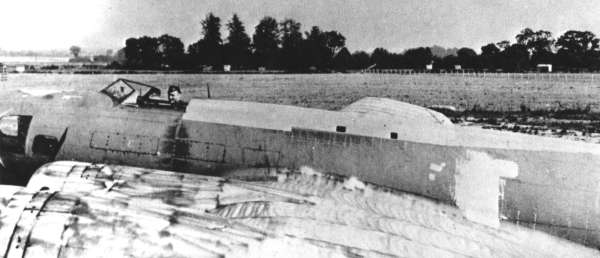
Because of the design features of the bombers, the USAAF looked into removing the cockpit to allow easy departure. The only aircraft that received this treatment was B-17F, “Olin’s 69’ERS” 42-30595 formally of 560BS, 388BG at Knettishall. It was never used on an Aphrodite mission  and was scrapped post war after being used for training in the open cockpit mode.  The BQ-8  (B-24) also had modifications made in the form of a widened hatch in the nose allowing for an easier escape from the aircraft. Once modified, the aircraft would have had all previous markings removed, and a special white or yellow paintwork applied to identify them from other bombers in the air. To assist the controllers in sighting the ‘babies’ whilst in flight, the aircraft were fitted with a smoke canister that would be ignited allowing the bomb aimer to see the aircraft as it began its dive. In addition to this, two cameras were fitted to some ‘babies’ that transmitted pictures to the mother or support ship. These pointed at the controls through the plexiglass, a revolutionary step forward in drone technology.

USAF designation system

A modified B-17 (BQ-7) with its canopy removed, this aircraft became a training drone. (Credit USAF)

In all, there were fifteen missions undertaken by the USAAF and USN, but none were to successfully hit their targets.  These included: Mimoyecques (Fortress); Siracourt (V1 Bunker); Watten (V2 Bunker); Heligoland (U-boat pens); Heide; Le Havre (docks); Hemmingstedt (oil refinery); Herford (marshalling yard) and Oldenburg (Power station). Both the operations and entire programme were cancelled only a few months after the Kennedy/Willy mission.

The last flight.

At RAF Fersfield, on August 12th 1944, Lieutenants Joseph Kennedy Jnr. and Wilford J. Willy, both of the S.A.U. 1 of the Fleet Air Arm Wing Seven, boarded their converted B-24 Liberator, s/n 32271 (ex USAAF B-24J 42-110007)*2 and began their preflight checks. The aircraft was filled with 21,270lbs of explosive. At 17:55 and 17:56 two Lockheed Ventura ‘mother’ aircraft took off, followed by a further navigation aircraft and then the ‘baby’ at 18:07. The ‘baby’ climbed to 2,000 ft, the two ‘mothers’ 200 feet higher and slightly behind. They were joined by two Mosquitoes, one for monitoring the weather, and the second, a USAAF F-8, to photograph the ‘baby’. This aircraft was flown by pilot Lieutenant Robert A. Tunnel and combat camera man Lieutenant David J. McCarthy. There was a further B-17 relay ship, a P-38 high altitude photo reconnaissance aircraft and five P-51 Mustangs to provide fighter cover.

The group set off toward the target at Mimoyecques , Northern France. They were to fly south-east toward the Suffolk coast, then turn south and head toward the target. Once level and stabilised, Kennedy and Willy handed over control to one of the ‘mother’ ships Then they reached the first control point (CP) at which time the group began to turn south; the ‘mother’ controlling the ‘baby’. Shortly after the turn was completed (about two minutes) Kennedy was heard to give the code “Spade Flush“, then at that 18:20 the ‘baby’ disintegrated in what was described as “two mid-air explosions” and a “large Fireball”.*4 The explosion, spread debris over a large area of the Suffolk countryside killing both crew members instantly. The following Mosquito also suffered damage and minor injuries to its crew. Following the explosion, all the aircraft were ordered back to base and the crews debriefed.

Many months (and indeed years) of investigations followed, but no firm conclusions could be drawn as to the precise cause of the explosion that ripped the aircraft apart. A number of speculative theories were drawn up, but the most plausible is that the electronic arming system was faulty, and when Kennedy or Willy, flicked the switch, an electronic short occurred that caused the bombs to detonate. Oddly the film that was in the following Mosquito has never been seen or made public – if indeed it was filming at that time.

The cause of death of both Joseph Kennedy and Wilford Willy still remain a mystery to this day, the secrecy behind one of the world’s worst explosions remaining locked away in archives.

Joseph Kennedy wanted to be a hero. He wanted to be talked about as the one who achieved and outshone his brother. Sadly, this dream cost him his life.

Page 1 of August 23, 1944 condolence letter to the parents of Lt. Joseph Kennedy, Jr.,

The letter sent to the Kennedy’s after Joseph’s death.*3

Page 2 of August 23, 1944 condolence letter to the parents of Lt. Joseph Kennedy, Jr.,

The letter sent to the Kennedy’s after Joseph’s death.*3

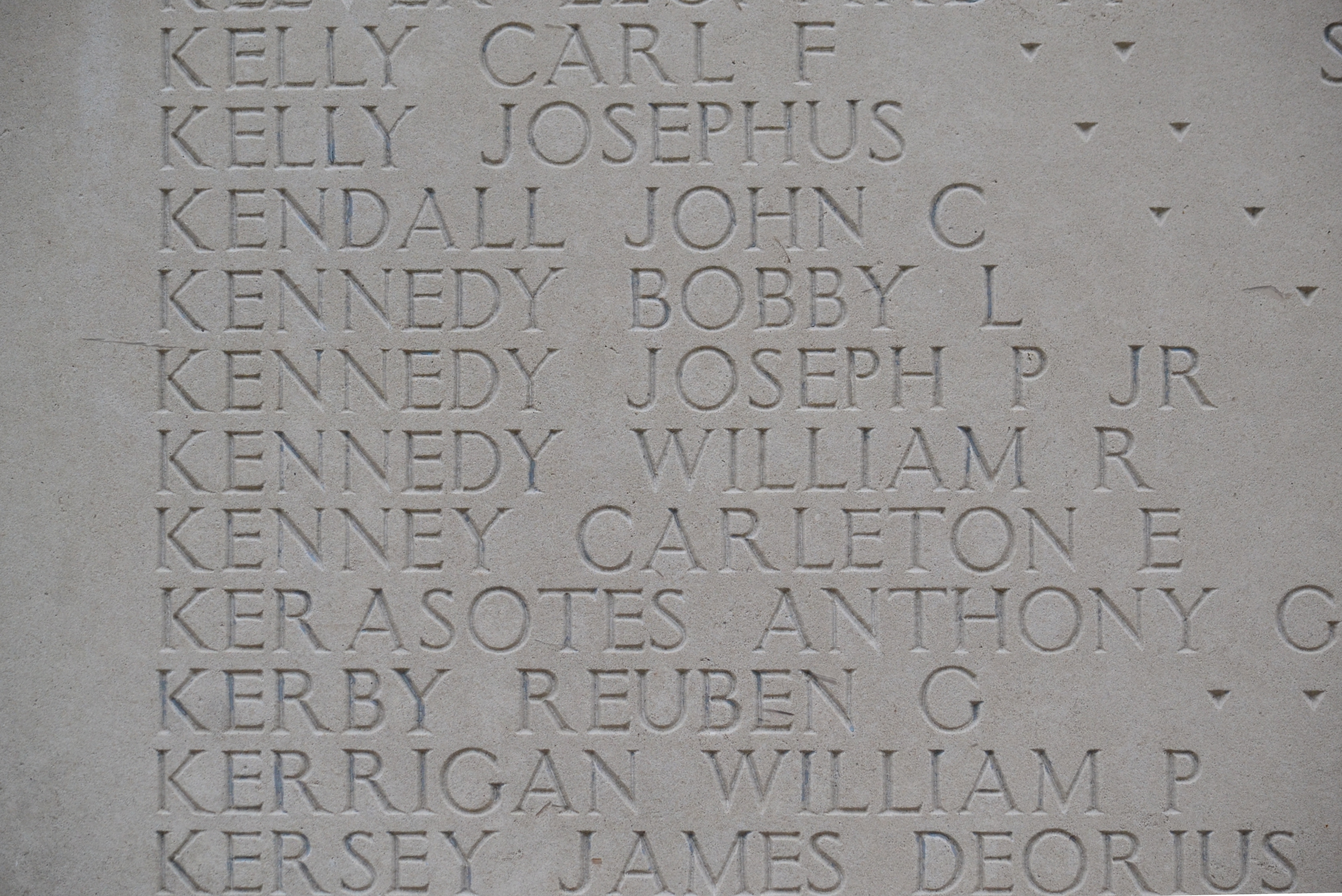
This fateful mission and its two crew members are remembered across the world. In France, the Mimoyecques museum contains a memorial honouring both pilots, and their names are carved in the Tablets of the Missing at the American Cemetery, Madingley, Cambridge. Kennedy has a ship the Destroyer ‘USS Joseph P. Kennedy Jr.’ DD850 named after him, and this is now a museum in Battleship Cove, Fall River, Massachusetts. Both aviators were awarded the Naval Cross posthumously,

joe kennedy

Lieutenant Joseph P Kennedy Jr, USNR, appears on the Wall of the Missing at the American Cemetery, Madingley, Cambridgeshire.

Lieutenant Jospeh P. Kennedy Jnr had no dependents but Lieutenant Wilford J. Willy left a widow and three children.

Sources and further reading.

*1 Azimuth being the clockwise horizontal angle from a given point (usually North) to a second given point.

*2US Navy and US Marine Corps BuNos, Third Series (30147 to 39998)‘  Joe Baugher, accessed 20/8/15

*3 Photos taken from ‘A People at War‘  Archives.Gov, Accessed 20/8/15

*4 Elgood, P., ‘Crisis Hunter: The Last Flight of Joseph P. Kennedy Jr.’ Columbia Point, 2014, pg 45, 65,

For a list of USAAF drones and pilotless missiles, see the Directory of US Military Rockets and Missiles website.

For the details on Drones see Wikipedia.

For more information and types, see Mistel aircraft, on Wikipedia.

Boeing B-29s in the UK.

During March 1944, an event took place in the UK that considering its historical importance, is little known about. It was actually quite a momentous event, especially in terms of aviation history, and in particular the Second World War.

As a follow on to RAF Glatton and Trail 6, we look into the short-lived presence of Boeing’s mighty aircraft the B-29 ‘Superfortress’, in what would appear to be its first and only wartime presence on British soil.

At the time of the bombing of Pearl Harbour in 1941, the United States was less than ready for a global war. The retaliation and defeat of not only Japan, but Nazi Germany as well, was going to be both costly and massive, requiring a huge increase in manufacturing of both arms and machinery.

This increase meant not only aircraft for the Air Force, but the infrastructure to support and train the aircrews too. A network of airfields and supporting organisations totalling some $100 million in 1940, would, by the war’s end be valued in the region of  $3,000 million. In terms of size, this infrastructure would cover an area of land equal to the combined areas of: New Hampshire, Vermont, Massachusetts, and Connecticut.*1

To complete the task, along with aiding her allies, the U.S. was going to need to design and manufacture many new models of aircraft, aircraft that would outshine anything previously made available to the U.S. forces. Long range bombers in particular, capable of travelling great distances were going to be required – and a lot of them. At the outbreak of the European war, the U.S. Army Air Corps was in comparison to the European forces, very small, commanding just 26,000 officers and enlisted men, and operating only 800 front-line aircraft. The Luftwaffe on the other hand, had expanded considerably over the previous years, now commanding some 3,600 aircraft. The British, who were still some way behind the Germans but growing rapidly, had available to them some 2,000 aircraft, whilst the French could muster slightly over 1,700. *1a

To meet this demand, U.S. aircraft manufacturers were going to have to start by modifying, and with some exceptions, redesigning the various aircraft types that were already available to the U.S.  forces. However, and likewise the British and German manufacturers, new models were going to have to be designed and put into production very quickly if victory was to be achieved in any of the world’s theatres.

Preempting war, the US Government put out tenders for long range bombers, in answer to which during the 1930s, the Boeing Model 299, first flew. Eventually being purchased by the US Government to fulfil the role, it was put into production as the iconic B-17 ‘Flying Fortress’, and was followed not long after by the B-24 ‘Liberator’; a more modern aircraft which took its maiden flight in 1939. But sitting on the drawing board at this time, was another aircraft that performed even better, the formidable B-29, a bomber designed to fly at altitudes up to 40,000ft, beyond the range of anti-aircraft guns and  faster than many fighters of the time. The aircraft was so advanced in design that depending upon its payload it was capable of flying distances of up to 5,000 miles, far beyond that of any other heavy bomber.

Whilst the U.S. aircraft manufacturers had already begun designing and testing these new models, it would be some time before the number and types of available aircraft would come anywhere close to being comparable to those of the Luftwaffe, R.A.F. or even later, the Imperial Japanese Air Force.

By August 1942 both the development and production of these two heavy bombers, the B-17 and B-24, were well underway, and so it was decided that they would go initially to the European theatre rather than the Far East. The competition for the attack on Japan now lay between the B-29 and Consolidated’s competitor the B-32 ‘Dominator’ – an enlarged and also pressurised version of their B-24. However, two years after the first design drawings were revealed, neither of these aircraft types had yet flown, and so the shorter ranged B-17 and B-24s were going to have to fill the gap until such times as their replacements could arrive.

The war in the Far East would provide its own set of problems. The distance that supplies would have to be taken would take time and before any invasion could take place, lost ground not only had to be recovered, but held. To achieve this, ground forces would need to be protected by an air umbrella, a defensive shield formed so tightly that air supremacy was guaranteed.

Getting supplies into China was difficult, by air it required long and dangerous flights over the ‘Hump’, the Himalayan mountain range, usually fulfilled by C-47s and DC-3s, their commercial equivalent. With the C-46 ‘Commando’ and C-87 coming on line later on, the frequency and quantity of these supplies could increase but it was still not enough for the Chinese, nor for the difficult task ahead.

By March 1943 the stage was set. The Fourteenth Air Force was created out of Maj. Gen. Claire Chennault’s China Air Task Force, which by the summer time, had begun attacks on coastal positions, ports and troop concentrations under Japanese control.  This air umbrella was in part achieved over Burma, and the desired attacks on Japan now looked more possible, but the B-17s and B-24s that had worked tirelessly lacked the range to hit the Japanese homeland;  the long range high performance B-29 was by now desperately needed.

During the Quebec Conference in August that year, U.S. officials put forward their proposal to stage American long range bombers on airfields in China, the area required for such bases being under Chinese control already and therefore not at the mercy of the Japanese forces. This offensive, designated the Matterhorn Project, would involve the still as yet untested  in battle, B-29s, their longer range and larger bomb capacity enabling them to ‘bomb Japan into submission’ in a similar way that Sir Arthur Harris had hoped for in Europe with the RAF’s bombing campaign against Germany’s industrial targets and cities.

To meet these aims a new force would be created, the Twentieth Air Force, which would be made up of two commands: the XX Bomber Command from China and the XXI Bomber Command who would be based in the Mariana Islands after they were retaken from Japanese control.

The aircraft destined to carry out this role, the B-29, was still very much an unknown quantity. Rushed into production with scant attention to testing, it was a monster of an aircraft, with a crew of eleven in pressurised compartments, electronic gun turrets and a massive 141 ft wingspan. The project was to be the biggest in U.S. aviation history, spares alone in the initial contract costing $19.5m, and one which General Arnold
referred to as the “$3 billion gamble”.*1b

The following film “Birth of the B-29 Superfortress” shows a B-29 production line and a test YB-29 in flight. It also contains some short graphic images at the start.

A batch of four XB-29 prototypes were built, and after initial test flights, a further fourteen ‘test’ aircraft, designated the YB-29, were also constructed. But problems with design drawings, missing parts and rushed testing meant that production was slowed to a minimum, part finished aircraft being stored whilst awaiting vital components. After test flights it became apparent that the B-29’s engines were prone to overheating and in several cases catching fire. This delayed further testing reducing flying time considerably until the problems could be solved. During flight tests, this problem with the engines was graphically seen, first on February 18th 1943, and then again a year later.

In February, XB-29 #41-003 (the second prototype XB) crashed into a meat packing factory killing all eight crew on board along with twenty civilians on the ground. The pilot, Eddie Allen, had already received the Air Medal for successfully landing the same XB-29 following another engine fire in the preceding December. A year later, January 29th 1944, engine problems caused yet another accident when  #41-36967, the last of the  fourteen*2 Wichita YB-29s  manufactured, crashed after losing all four engines whilst in the air. This problem with overheating engines becoming the proverbial  ‘thorn in the side’ of the Boeing production team.

By the summer of 1943, B-29 training squadrons were being set up, the first, the 58th Bombardment Operational Training Wing (Heavy) later the 58th BW (Very Heavy), was formed with the 40th, 444th, 462nd, 468th and 472nd Bombardment Groups, each with four or five squadrons of their own.

After a period of training four of these groups (the 472nd was disbanded April 1944) would transfer to India flying via Africa to join the Twelfth Air Force initially flying supplies over ‘the Hump’, before taking part in operations against Japan from the Chinese airfields.

Departure for these groups occurred over the March – April 1944 period, during which time one of these aircraft would divert to the U.K. causing a huge stir whilst ‘touring’ several U.K. airbases.

Whilst precise sources seem scarce, it is thought that flying B-29s across the southern route raised fears of a Luftwaffe attack whilst en-route, and so a plan of ‘disinformation’ was set in motion to fool the Germans into thinking that the B-29s were to be based in England, ready to be used against German targets. The first part of this ruse was in early March 1944, when YB-29 #41-36963 ‘Hobo Queen‘ took off from Salina Airbase in Kansas and flew to England. It initially took the southern route toward Africa, but then deviated north heading to Newfoundland. The YB-29, piloted by Colonel Frank Cook, then flew across to the UK initially landing at RAF St. Mawgan, in Cornwall.

During its short stay in the U.K. it was known to have visited RAF Horsham St. Faith near Norwich,  RAF Bassingbourn on the 8th March, RAF Knettishall and RAF Glatton on 11th March before its final departure from RAF St. Mawgan to India in April that year. The route took the YB-29 to Marrakech, Cairo (2nd April), Karachi (5th Apr) finally arriving at  Kharagpur, India, on 6th Apr 1944 . Once here, it was assigned to the 769th Bomb Squadron, 462nd Bomb Group who were then based at Piardoba in India, where it was modified as a tanker to ferry fuel over ‘the Hump’. The YB-29, the only test model to fly overseas,  gave a successful service, eventually being declared war weary and returned to the United States, its eventual fate being unknown, presumably, like many war weary models, the aircraft was scrapped.*3

Whilst in the U.K. the YB-29 was certainly a major draw, over 1,000 key personnel viewing the aircraft at RAF Glatton alone, its enormous size dwarfing anything that had been seen in U.K. skies before.

The ruse was considered a success. The many B-29s that followed across the southern route did so without any interference from German aircraft, although how much of that was actually down to the ruse itself, is hard to distinguish. It is even thought in some circles that photos of the ‘Hobo Queen‘ appeared in the newspaper of the National Socialist German Workers’ Party,  The Völkischer Beobachter, although an initial search of the paper through the Austrian National Library proved fruitless.

Crews and ground staff swarm around B-29 #41-36963 at Glatton airfield 11th March 1944*4.

Although B-29s were initially considered for the European theatre none operated from British soil until after the wars end, when a joint British and American operation, Project ‘Ruby‘*5, investigated deep penetration bombs against reinforced concrete structures. Three B-29s were prepared in the United States along with four B-17s and a select detachment of admin, maintenance, technical staff and air crew,  who arrived at RAF Marham, Norfolk, on March 15th 1946. Initial plans were to test a series of bombs on the submarine assembly plant at Farge, but due to the close proximity of housing and an electricity plant, the U-boat shelter at Heligoland was used instead. The bombing trials began on March 25th by which time an original three B-17s from RAF Mildenhall had also joined the group.

A number of both American and British bombs were tested in the trials:

  • The US 22,000lb. ‘Amazon’ bomb
  • The US rocket assisted 4,500lb. ‘Disney’ bomb (used by B-17s in the latter stages of the war)
  • The 4,500lb. ‘Disney’ bomb without rocket assistance
  • The American 22,000lb. fabricated ‘Grand Slam’ (designated T14)
  • The American 12,000lb. fabricated ‘Tall Boy’ (designated T10)
  • The British 12,000lb, ‘Tall Boy’
  • The British 2,000lb. Armour Piercing  bomb
  • The inert loaded 2,000lb. SAP (M103) bomb
  • The Picratol filled 2,000lb. SAP (M103) bomb
  • The 1,650lb. Model bomb

The results of the trials were quite conclusive, none of these bombs in their current form, were capable of penetrating the 23 ft thick concrete of the Farge roof, and therefore, all would need adapting, redeveloping or redesigning if such operations were to be carried out again.

Post war, B-29s were brought into the UK and operated as Boeing Washington B1s, operating with nine RAF Squadrons: No. 15, 35, 44, 57, 90, 115, 149, 192 and 207 at various airfields including RAF Marham, RAF Coningsby, RAF Watton and RAF Waddington, eventually being replaced by the high flying English Electric Canberra. The B-29 then disappeared from operational service in the UK.

Without doubt, the development of the B-29 had a major impact on the world as we know it today, and even though its first arrival in the UK in March 1944 caused a major stir in the aviation world, it incredibly remains a little known about clear fact. With little documentation available, there is clearly much more research to be done.

Since the original posting of this article, I have been contacted by Daniel Partridge whose grandfather (Leon Suthers) was at Randolph Field in the United States, after the war’s end. He has sent me some photos of ‘Hobo Queen’ after she returned to the US. According to information Daniel has supplied, she was used as a training airframe from January 1945 until 1954, after which she was scrapped. From the photos, you can see that much of the aircraft has been stripped away, presumably as part of this programme, yet the 45 camel ‘mission scores’ have been left. Further information from Daniel confirms that these Camels represent flights ‘over the hump’. My sincere thanks to Daniel for the information.

Hobo Queen

Hobo Queen Post War (Photo courtesy Daniel Partridge)

Hobo Queen

Hobo Queen Post War (Photo courtesy Daniel Partridge)

Sources and further reading.

*1 Nalty, B., et al. “With Courage The U.S. Army Air Forces in World War II” 1994. Air Force Historical Studies Office (p61)

*1a ibid (p38)

*1b ibid (p147)

*2 Only 14 YB-29BWs were built (#41-36954 – #41-36967) and all at Wichita. They were painted olive drab upper surfaces and light gull grey lower surfaces.

*3 MSN 3334.

*4 Image courtesy of 457th BG Association.

*5 Comparative Test of the Effectiveness of Large Bombs Against Large Reinforced Concrete Structures (PDF), Report of the Air Proving Ground Command, Elgin Field, Florida – Anglo-American Bomb Test Project “Ruby”. October 31st, 1946.

Simons. G.M., “B-29 Superfortress: Giant Bomber of World War Two and Korea“. Pen and Sword Aviation. (2012)

Mann. R.A., The B-29 Superfortress: A Comprehensive Registry of the Planes and Their Mission McFarland & Company Inc. (2004)

Harris, S.R., Jr. “B-29s Over Japan, 1944-1945: A Group Commander’s Diary” McFarland & Company Inc. (2011)

Mann. R.A.,.”The B-29 Superfortress Chronology, 1934-1960” McFarland & Company Inc. (2009)

11th April 1944 – Loss of B-17 ‘Tenny Belle’ RAF Kimbolton

On 11th April 1944, a mix of 917 B-17s and B-24s of the 1st,  2nd and 3rd Bomb Divisions (BD) of the USAAF, departed their airfields in England to strike at a range of targets across Germany – it was mission 298. The 1st BD, made up of 341 B-17s, attacked targets at Cottibus, Dobberphel, Stettin, Trechel and Sorau. the Focke Wulf aircraft assembly plant in Germany.

One of those aircraft taking part was #42-31083 “Tenny Belle” of the 525nd BS, 379th BG, based at RAF Kimbolton (Station 117) in Cambridgeshire. The aircraft had already flown thirty-seven operations before this one, but this would sadly be her last.

After taking off from Kimbolton at 07:41, the aircraft climbed to gain altitude and to form up. Its flight would take it easterly over Norfolk and the coast.

On board the aircraft, a B-17G-1-BO “Flying Fortress”, ‘FR*A’, was: 2nd Lt. John E. Daly Jr. (pilot); 2nd Lt. Robert W. Koerber (co-pilot); 2nd Lt. Williams F. Evans (navigator); S/Sgt. Carl B. Christensen (nose gunner/bombadier); T.Sgt. Omer L. Young (Flt. Engineer/top turret gunner); T.Sgt. Adriel Langendoerfer (radio operator); S.Sgt. Harvey W. Tuber (Ball turret gunner); S.Sgt. John N. MacCallum (right waist gunner); S.Sgt. Frank J. Hearne Jr. (left waist gunner) and S.Sgt. Howard L. Polizzo (tail gunner).

This was not Daly’s first crew though, they had formed at Pyote Air Base, Texas and transferred out to the UK together. On this operation, S/Sgt. Carl B. Christensen replaced the normal bombardier 1st Lt. Joseph Jennings who was at RAF Alconbury receiving Radar training.

#42-31083 ‘Tenny Belle‘ and probably Daly’s crew (centre facing camera) after the 25th mission.  (IWM UPL 31620)

Once airborne, the aircraft levelled out and began to find its place in the formation before heading off over the sea to Germany. At 09:03 and at 9,000 feet, in formation travelling at about 115 mph, the aircraft for unknown reasons, suddenly and violently lurched to the left as if the pilot had tried to steer away from another aircraft; it then lurched once again, this time to the right throwing the crew around inside the fuselage in an uncontrollable manner. The forces acting on the weary aircraft were too great though, and a fracture caused it to split into two sections.

The “Tenny Belle“, now unstable and with no aerodynamic stability whatsoever, simply fell from the sky hitting the ground with such force as to completely destroy it. In the impact, it also killed nine of the ten crewmen left onboard. The tenth, 2nd LT. Evans, managed to don his chute and escape the stricken aircraft whilst it hung in the air on the smallest amount of lift possible immediately following the accident.

According to the official crash report Form AF-14, the aircraft came down four miles west-south-west of Downham Market in the small hamlet of Barroway Drove. However, some sources say the aircraft fell at Fen Farm some six miles south-west of the town, neither can be confirmed at this stage, although due to the nature of the accident, it is possible parts were located in both areas.

There was no record of any explosions, and all engines were reported by 2nd Lt. Evans as “running very fast”.  In his statement following the crash he said:

The formation entered the clouds and we levelled off. We were in the clouds only a few minutes when the ship swerved violently to the left. I thought the pilot saw another wing-tip and was trying to avoid it. We then swerved more violently to the right. I then figured out it was out of control and thought that the plane had broken in two. I had my chute on before this. The last I saw of the Bombadier, he was trying to put his chute on. We were going straight down, and the engines were all running fast. There did not appear to be any fire in the wings. I tried to get to the escape hatch, but everything at his point is very confused and I do not know if I got out this way. I remember looking down to see of my chute was on, and  noting that it was backwards. It opened with some help from me and a moment later I hit the ground. I looked around to the plane coming down, the tail part landed way behind the ship and numbers of burning pieces were falling around. There was a farmer near and I tried to walk over to him, but I was feeling pretty shaky. He got a car and took me to a hospital. I didn’t feel any explosions and no alarm was given.”

The official board of enquiry concluded that:

The cause of the accident is undetermined and consequently, responsibility therfor[sic] cannot be established.”

Post crash, the bodies of the crew were removed and the B-17 guarded, none of the bombs aboard detonated. It was later salvaged on the 18th April 1944, but the strength of the impact had completely destroyed its fragile structure.

The normal bombadier, Joseph Jennings learnt about the loss of the crew that day, the news affected him badly, and he never talked about them or their loss afterwards.

Pilot, 2nd Lt. John Daly, (s/n: 0-805776) had flown 273 hours and 15 minutes on B-17s, gaining his pilots licence on June 30th 1943. He was only 19 years of age and thought to be one of the youngest pilots to serve in the USAAF at that time.

Sources and further reading.

Air Accident Form (A.A.F.) No. 14 USAAF.

American Air Museum Website accessed 14/1/25

Downham Market Heritage Centre

Sgt. Archibald Mathies, USAAF, 510th BS, 351st BG (Medal Of Honour)

Staff Sgt. Archibald Mathies (U.S. Air Force file photo)*1

Born in the Scottish town of Stonehouse, South Lanarkshire, on the 3rd June 1918, Archibald (Archie) Mathies was to become a Second World War hero. He was awarded the Medal of Honour (MOH) for his actions whilst at RAF Polebrook (USAAF Station 110) in Northamptonshire, England.

It would be on the 20th February 1944, shortly after arriving at Polebrook, that he would earn this honour but his life would be dramatically cut short.

Not long after his birth in Scotland, Mathies moved with his family to the United States, to a small town in Western Pennsylvania called Finleyville, in Washington County.

After leaving school, he began work in a local coal mine. The work was hard, and the pay was low; Mathies was not inspired. Then, following the Japanese attack on Pearl Harbour, as many other brave young American men did, he joined the Army, enlisting in Pittsburgh on the 30th December 1940. Mathies would transition through a number of stations and training centres before finally completing a course in aerial gunnery on the 22nd March 1943. His last U.S. posting was to the 796th Bombardment Squadron at Alexandria, Louisiana for operational training duties flying B-17s. He would leave here on the 8th December 1943 bound for England and the European Theatre of Operations.

Mathies arrived in the U.K. eight days later. His initial assignment was with the Eighth Air Force Replacement Depot, before being attached to the 1st Replacement and Training Squadron. On the 19th January 1944, he received his first and only operational squadron posting; the 510th Bomb Squadron, 351st Bomb Group, based at RAF Polebrook, as an engineer/gunner. Promotion was swift, and on 17th February 1944, probably following his first mission, Mathies was awarded the rank of Staff Sergeant.

A few days later, on 20th February 1944, the allies began the enormous aerial campaign known as ‘Big Week’. During this short period a massive number of aircraft would attack targets deep in the heart of Nazi Germany. One of the first, (Mission 226) would see a total of 417 aircraft fly from airfields across England. From RAF Polebrook, 39 B-17s took off to attack Leipzig. In the lead planes were Maj. Leonard B. Roper (s/n O-734101 ) of the 510th BS forming the high group, and Maj. James T. Stewart (s/n O-659405) of the 508th BS, leading the low group.

Flying in the number three ship of the lower Squadron, in B-17 (42-31763) ‘Ten Horsepower‘ was: Pilot: Clarry Nelson, Co-Pilot: Roland Bartley, Navigator: Walter Truemper, Engineer / Top Turret Gunner: Archie Mathies, Bombardier: Joe Martin, Radio Operator: Joe Rex, Ball Turret Gunner: Carl Moore, Waist Gunner: Tom Sowell, Waist Gunner: Russ Robinson, and Tail Gunner: Magnus Hagbo.

mathies page

B-17 “Ten Horsepower” – cropped from the photo below- (TU-A, serial number 42-31763) taken prior to its crash”2.

On approaching the target, the formation was hit hard by fighters and flak, who would attack the formation for over an hour, hitting many aircraft in the subsequent melee. Ten Horsepower, was targeted repeatedly receiving many hits from 20mm cannon shells. In these attacks the co-pilot was killed and the pilot knocked unconscious from his wounds. Fearing the bomber was doomed, the bombardier jettisoned the bombs and then bailed out, later being captured by the Germans and becoming a prisoner of war. The remaining crew remained with the B-17 which soon began a deathly spiral toward the ground.

Mathies and the navigator (Walter Truemper) would eventually take over control of the aircraft and nurse it back to England. Once over their base at RAF Polebrook, the crew were instructed to bail out but both Mathies and Truemper refused to leave the injured pilot. After deliberation, they were given permission to try to land, the remaining two crew members prepared themselves for a heavy landing.

Guided in by a fellow aviator it was going to be very difficult. The first two attempts had to be aborted, but on the third attempt, as they approached the airfield, the aircraft struck the ground, killing all three crew members onboard.

The last moments of B-17G “Ten Horsepower” (TU-A, #42-21763) piloted by Second Lieutenant Walter E Truemper  and Sergeant Archibald Mathies, as it is guided by a fellow aircraft after the pilot was severely injured. Truemper and Mathies unsuccessfully attempted to land the aircraft at Polebrook and were posthumously awarded the Medal of Honour for their bravery, 20th February 1944. (IWM FRE 4724)

The crash was a severe blow for the base, both air and ground crews were devastated. On returning from the mission, five other aircraft (42-38028, 42-38005, 42-39760, 42-39853 and 42-6151). were forced to land at nearby Glatton (Conington) only a short distance away.

This was only Mathies’ second mission and sadly, his last.

For his bravery, Mathies was awarded the Medal of Honour; his name now appears on page 280 of the St. Paul’s Cathedral Roll of Honour. Also, as a dedication to him, one of the temporary lodging units at the Joint Base Anacostia-Bolling is named after him, as is the Airman Leadership School at RAF Feltwell,  and the Non commissioned Officer Academy at Keesler AFB, Mississippi. In addition, the bridge on Truemper Drive crossing Military Highway at Lackland Air Force Base, Texas; the USCIS Dallas District Office and the Mathies Coal Company in Pittsburgh, Pennsylvania, are all named in his honour.

Archibald Mathies  citation reads:

For conspicuous gallantry and intrepidity at risk of life above and beyond the call of duty in action against the enemy in connection with a bombing mission over enemy-occupied Europe on 20 February 1944. The aircraft on which Sgt. Mathies was serving as engineer and ball turret gunner was attacked by a squadron of enemy fighters with the result that the copilot was killed outright, the pilot wounded and rendered unconscious, the radio operator wounded and the plane severely damaged. Nevertheless, Sgt. Mathies and other members of the crew managed to right the plane and fly it back to their home station, where they contacted the control tower and reported the situation. Sgt. Mathies and the navigator volunteered to attempt to land the plane. Other members of the crew were ordered to jump, leaving Sgt. Mathies and the navigator aboard. After observing the distressed aircraft from another plane, Sgt. Mathies’ commanding officer decided the damaged plane could not be landed by the inexperienced crew and ordered them to abandon it and parachute to safety. Demonstrating unsurpassed courage and heroism, Sgt. Mathies and the navigator replied that the pilot was still alive but could not be moved and they would not desert him. They were then told to attempt a landing. After two unsuccessful efforts, the plane crashed into an open field in a third attempt to land. Sgt. Mathies, the navigator, and the wounded pilot were killed“.*3

Mathies was truly a brave and dedicated man, who in the face of adversity, refused to leave his wounded pilot and friend. Daring to land a badly damaged aircraft, he sadly lost his life showing both great courage and determination.

The crew of ‘Ten Horsepower‘ were:

Pilot: Clarry Nelson,
Co-Pilot: Roland Bartley,
Navigator: Walter Truemper
Engineer / Top Turret Gunner: Archie Mathies
Bombardier: Joe Martin (POW)
Radio Operator: Joe Rex,
Ball Turret Gunner: Carl Moore,
Waist Gunner: Tom Sowell,
Waist Gunner: Russ Robinson,
Tail Gunner: Magnus Hagbo

Notes:

*1 Photo from Malmstrom Air Force Base website.

*2 Photo IWM Freeman Collection FRE 4725

*3 Citation taken from: US Army Centre for Military History website.

RAF East Kirkby – Part 3 – the End of an Era.

In Part 2, we saw how crews at East Kirkby took a battering over Germany and how the Allies turned their attention to the forthcoming invasion.

In this, the final part, the war finally comes to an end and RAF East Kirkby eventually closes, but not without making its mark.

With spring at an end, thoughts turned back to the impending invasion and the bombing of pinpoint targets in France: Railways, munitions factories, troop concentrations and transport links became the focus for Harris’s Air Force. Throughout the month of April both East Kirkby squadrons were in operations, and whilst not significantly high, a number of aircraft were lost adding to the lengthening list of casualties and those now missing.

The end of this period of the war was remarkable for several reasons, notably when Wing Commander Leonard Cheshire of 617 Sqn, flew a Mosquito at low level and marked the target, a factory in Toulouse, with great success. This delighted Harris, who gave the all clear to 5 Group to operate independently of the Pathfinders of 8 Group, a decision that did little to heal the growing rift between Don Bennett and Ralph Cochrane who had taken the idea to Harris in the first place.

Other targets then became the focus for 5 Group including the railway yards at La Chapelle. In the operation Cheshire put this method  to the test once more. with 617 Sqn again to marking the target in conjunction with 8 Group’s Pathfinders. In the operation, 247 Lancasters from 5 Group were ordered to attack a pin point target. In the attack, 57 Sqn lost two aircraft. Of these two Lancasters the first, LL893 ‘DX-J’  was lost with all seven lives over St-Omer whilst the second, Lancaster MK. III ND582 ‘DX-S’ crashed after attempting a landing at Croydon. After overshooting the runway the aircraft, piloted by Canadian F.O. H. Young, struck at least three homes in Lavender Vale, a street adjoining the airfield. Three of the crew died immediately and a further one died from his injuries in hospital.

Operation POINTBLANK. Groundsmen refuel Lancaster ND560 ‘DX-N’, 57 Squadron in preparation for a night attack on the railway yards at La Chapelle, France. IWM (CH 12868)

Summer then dawned, and overnight, May 22nd-23rd, Cheshire once more, put his method  to the test. 617 Sqn were again to mark the target, but a heavily defended Brunswick led to heavy losses for both the East Kirkby squadrons, 57 losing three Lancaster Mk.IIIs and 630 Sqn another two. Only five airmen made it out alive, each one being captured by the German ground forces and so becoming prisoners of war.

These losses were however a mere pin-prick compared to June. The mission of 21st-22nd to Wesseling near Cologne proved to be yet another massacre for 5 Group who sent a total of 133 Lancasters to attack the city’s oil facilities. A number of squadrons took heavy loses including both East Kirkby’s 57 and 630 Sqns with six and five losses respectively. One of these aircraft was abandoned whilst another ditched in the sea allowing all crewmen to be rescued, but the overall loss proved to be devastating.

The spring – summer of 1944 was defining, not only had 5 Group shown that low-level marking could be done, but the attacks on targets in France meant that the Luftwaffe were at a disadvantage. Their night tactics, relying on long range bomber flights, could not manage with the shorter ‘quick’ attacks, and so losses from Bomber Command began to lessen.

This reduction allowed for restaffing, with a large number of officers, NCOs and airmen being both posted in and out of the two squadrons. It also allowed for training flights to take place, some 476 hours of operations compared to 729 hours for non-operational flights for 630 Sqn alone.

Like many places across the UK, the coming of D-Day, and the fragile success of the invasion led to an increase in morale at the station. Ground crews being acknowledged for their long hours and hard work in keeping aircraft flying and operationally ready, without them, these operations could not have taken place at all.

This extra effort and improved state continued for several months, and by August, it was acknowledged that morale had lifted, discipline was at a high and health was overall very good. Casualties were also down, a real boost considering the extra effort and number of operations that had been taking place over the last few months. The summer was at last ending on a high.

August’s improvement coincided with the liberation of Paris, a major landmark in the war’s progress. Ground forces were charging ahead. In the air, Bomber Command had played a small part in the offensive supporting ground troops as needed and now they were released from the tight grip SHAEF had held over them. Discussions followed as to where best place their bombs, oil and  communication were one option or alternatively, a return to the bombing of the cities and morale busting; oil won over, and so, much to Harris’s disappointment, the bombing of oil based targets began.

The looseness of the criteria however, allowed Harris to circumnavigate the ‘rules’ and turn his attention to cities with an oil link. He had got his way and the Air Ministry had got theirs.

Although individual operation losses were relatively low, 57 Sqn tallied some 56 aircraft by the end of 1944, whilst 630 Sqn reached 57. Non-operational loses for the two units were also on an equal par.

On the penultimate day of the year, East Kirkby was to witness, a short distance away from the airfield, the crash of a B-17 attempting to land. Aircraft #42-97479 (UX-L) of the 327thBS 92nd BG based at Podington (Station 109), crashed in a field between the two small hamlets of Old Bolinbroke and Hareby. On board that day were nine crew men: 2nd Lt. Joseph Martin Van Stratton (Pilot); 2nd Lt. Edward A Porter (Co-pilot); Sgt. Charles H Chambers (Bombardier); 2nd Lt. John E Cowan (Navigator); Sgt. Arthur R Estrada (Radio Operator); Sgt. Harold Raymond Barner (Ball Turret Gunner); Sgt. Wilfred A Bedard (Wasit Gunner); Sgt. Thomas G Standish ((Top Turret Gunner) and Sgt. William D White (Tail Gunner), who all lost their lives.

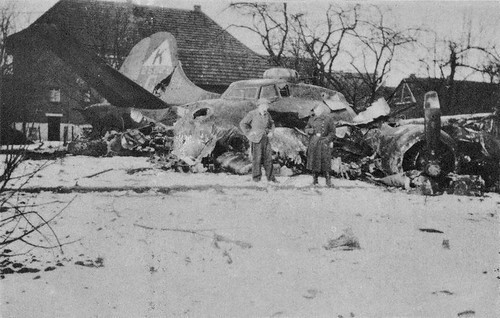
The aircraft, a Lockheed/Vega B-17G-15-VE Flying Fortress named “Belle of Liberty“, had returned from operations to the Bullay railway bridge located south-west of Koblenz, in Germany. After suffering engine failure, the pilot decided to abort the mission and attempt a landing at East Kirkby. In poor visibility and with one engine out, he overshot the runway and pulled up to attempt a second try. A second propeller then began windmilling and in trying to gain height to avoid a hill, the B-17 stalled and crashed.

A small memorial plaque has since been laid at the site in commemoration of those lost.

The wreck of the “Belle of Liberty” 30th December 1944.  (IWM FRE 5762)

The winter of 1944-45 was one of the worst, ground troops were by now entrenched in the Ardennes around Bastogne, with the German army preparing for one last push through the forests. Fog and snow kept many airfields non-operational in the UK, aircraft struggling to get much needed support across to the continent.

At East Kirkby, January started on high spirits, but on the 9th, 630 Sqn Lancaster PD317 ‘LE-G’ struggled to get airborne when one of its engines cut out on take off. After jettisoning its bombs, the pilot, F.O. G Billings, opened the throttle to attempt a circuit and landing. However, the port wing lost lift and dropped causing the aircraft to cartwheel injuring five airmen and killing two. With one further loss on the 14th, this brought the spring tally to two aircraft. However, good news did soon come as six of the seven crew were repatriated by the April. The seventh airmen, W.O. E Edwards, struck the tail plane on baling out and died the next day.

Otherwise, 57 Sqn, scraped through with a clean sheet and no operational losses were encountered, but they did suffer an unfortunate incident when ‘DX-N’ PB382 (the predecessor of DX-N below) entered Swedish airspace and was shot down by flak on the night of February 8th-9th.

The losses encountered by 57 and 630 Sqn, were only pipped by the tragic accident that was reported to have happened on the 17th of April. Although the operational records record no evidence of the accident, even to the point of showing some of the aircraft involved taking part and completing their operations, it is recorded in some resources that six Lancasters of 57 Squadron were destroyed following a fire in the fuselage of Lancaster PB360. As a result of the fire, four men were killed and a further five injured, along with several civilian workers near the site.

The fire started at 17:45, causing a series of explosions which destroyed the five other Lancasters parked nearby. The Hangar on the airfield was also badly damaged, as was a neighbouring farm. The fires were so severe that fire crews were brought in from nearby airfields and the area was not declared ‘safe’ until the following day. The Lancasters involved were: PB360 (MK.III) ‘DX-N’; ND472 (MK.III) ‘DX-I’; LM673 (MK.III) ‘DX-U’; RF195 (MK.I) ‘DX-‘; PD347 (MK.I) ‘DX-P’ and NN765 (MK.I) ‘DX-‘.*3

By now German resistance was minimal. Fighters were rarely encountered in any number and flak batteries were reducing in their accuracy and intensity. By May, the war was at and end, and quickly both ‘Exodus’ and training flights became the norm along with cross country and high level bombing training flights taking the front stage. For 630 Sqn July signified the end, after a period of intense recruiting the squadron was disbanded after serving for approximately eighteen months of the war.

During that time they had shown great courage in action. On average they had flown 1,087 hours of operational flying per month and 286 hours on non-operational flights. This amounted to 2,147 operations over enemy territory during which 64 aircraft had been lost. With another six crashing, the toll was high, and their medal tally reflected that, with in excess of 60 awards being granted.

In a last days before disbandment a sports challenge with 57 Squadron allowed 630 to show their colours one last time, winning the overall trophy, and with a party to celebrate that night, the squadron went out on a high. The final day saw the last parade and the handing over of the squadron crest to the Air Ministry for safe keeping. With that, 630 squadron disbanded.

Their place at East Kirkby didn’t stay vacant for long though, for on the 27th July, 460 Sqn arrived to join 57 Sqn and serve its lasts days here at this Lincolnshire airfield.

57 Sqn would continue on, taking on the Lincoln bomber in August as a replacement for the Lancaster although numbers remained low at this time. Fighter affiliation, high level bombing training and cross country flights became the main focus, along with ferrying flights into the European continent bringing back personnel and equipment; a schedule that continued for the next four months, its time finally being called on November 25th 1945.

Throughout the war 57 Sqn had served with distinction, providing crews for not just one but two different squadrons, one of which went on to become perhaps the most famous unit in the RAF’s history. It was a success however, that came at a cost, with the highest loss rate of the whole of Bomber Command, they had taken part in some of Europe’s most ferocious aerial battles and still went on to perform admirably.

On disbandment, 103 Squadron then at Elsham Woods, was immediately renumbered as 57 Sqn, and the unit number lived on. The majority of personnel from the original 57 Sqn were transferred to the RAF’s Holding Station RAF Blyton Holding Unit, along with personnel from several other serving squadrons. Seven three-men crews remained at East Kirkby to ferry the Lancasters away whilst six crews transferred to Scampton to form the basis of the new squadron along with three Lincoln bombers.

460 Sqn an Australian unit, had also served well during its war time life. Being originally formed on November 25th 1941, it was made up of Australian crews, flown Wellingtons, Halifaxes and then Lancaster I and IIIs. Its move to East Kirkby from Binbrook signifying its end, as training flights took over bombing missions and personnel began to be transferred out. By October it too had disbanded.

In an acknowledgement of their bravery, the closing remarks in the Operation Record Books state how the Australian had been warmly welcomed to our shores and how they had cemented a great bond between the two allies against a common enemy. Appreciation and thanks was warmly given to those who had served in the unit.

With the war’s end, East Kirkby was rundown, but between spring 1946 and February 1948, a detachment of Mosquito B.IVs from Coningsby’s 139 (Jamaica) Sqn, operated here, joined  between August 1947 and February 1948 by 231 Operational Conversion Unit (OCU) also on detachment from Coningsby. Flying a mix of Airspeed Oxfords, Avro Ansons & de Havilland Mosquito B.IVs, they were the last RAF units to use the airfield before it entered care and maintenance.

Then in 1951, the US Strategic Command 3rd Air Force took over the site, intending to use it as a stand-by airfield.  As part of the plan, the runway was extended by 1,230 yards along with an expansion to the apron. Both the 3931st ABG and 3917th ABS were based here but only visiting C-47 ‘Skytrains’ (a derivative of the Dakota) of the 7th Air Division’s Rescue Squadrons, ever arrived.

Eventually, on 31 October 1958, the airfield was returned to Air Ministry under ‘Big Shuffle’ , the reorganisation of the Air Force and its sites in the UK and Europe.*4

With that, East Kirkby closed for good, being sold off in 1964 when it turned once again to agriculture. However, bought by the Panton Brothers, it was turned into a living museum including a taxiable Lancaster to commemorate not only the third brother – Christopher Panton, who was killed on a bombing raid over Nuremberg on 30th – 31st March, 1944 – but all those who served in Bomber Command during World War II.

Part of the museum includes the chapel, a stained glass window and memorial board listing all those who died whilst serving at the airfield in both 57 and 630 Sqn, are poignant reminders of the toll on human life at this one small Lincolnshire airfield.

The full page can be read in Trail 1 – Lower Lincolnshire.

References and further reading (East Kirkby)

*1 Aviation Safety Network website accessed 19/10/24.

*2 Worrall, R., “Battle of Berlin 1943-44” Osprey Publishing. 2019.

*3 Chorley, W.R., “Bomber Command Losses pof the Second World War – Vol. 6 1945” Midland Counties Publications 1998.

*4 Francis. P & Crisp. G., “Military Command and Control Organisation
Volume 4  – The United States Air Forces in the UK” on behalf of English Heritage.

*5 The East Kirkby Museum have a website which gives far more detail, opening times, and other other visitor information.

National archives: AIR 27/538/38; AIR 27/538/44; AIR 27/538/43; AIR 27/2152/8; AIR 27/2152/7; AIR 27/2152/29; AIR 27/540/13; AIR 27/540/21; AIR 27/1910/11; AIR 27/540/8; AIR 27/540/7

American Air Museum Website Accessed 20.10.24

International Bomber Command Centre has several personal stories on their website, it is well worth a read.

Lincolnshire Aviation Heritage Centre Website.

Lt. Jack Watson 303rd BG. – From Villain to Hero.

The end of training flights in the Second World War in the quiet and blue skies of the United States, were occasionally ‘celebrated’ with flyovers and ‘buzzing’ of the home town of family or girl friend

The end of training flights in the Second World War in the quiet and blue skies of the United States, were occasionally ‘celebrated’ with flyovers and ‘buzzing’ of the home town of family or girl friends. Whilst this unofficial activity was frowned upon, in general, a blind eye was turned by Commanding Officers of the various Groups. However, one such activity was not taken quite so lightly, and almost led to the end of a promising career before it had even started.

At RAF Molesworth (Station 107) not far from Huntingdon, Cambridgeshire, the 303rd Bomb Group (BG) had been serving the Allied offensive since mid September 1942. They had taken heavy casualties after participating in many prestige missions including the disastrous August and October raids on the ball-bearing plant at Schweinfurt. The invincibility of the heavily armed B-17 was very quickly shown to be a myth.

After a period of calm, primarily due to persistent bad weather rather than any  significant strategic military decision, the USAAF was allowed unofficial time to recuperate, rebuild and rearm. During this period, new recruits and aircraft poured into the United Kingdom via either the Northern or the Southern transit routes over the Atlantic Ocean.

On one of these aircraft was Lt. Jack Watson, a ‘green’ pilot’ who had recently completed his training, and was now on his way to fight in a war a long way from his Indianapolis home.

jack watson page A fresh faced 2nd Lt. Jack Watosn who bravely brought home his burning and crippled B-17 bomber after ordering his crew to bail out. (IWM UPL 32160)

On eventual arrival at Molesworth, Lt. Watson was soon to experience for himself the horrors and reality of war. On January 11th 1944, he was part of a 291 bomber force attacking both the FW190 production factory as Oschersleben and the Junkers factory at Halberstadt, Germany. On what became one of the blackest days for the Group, eleven out of the forty aircraft dispatched were lost, an attrition rate of just over 25%, which was also the highest loss of the entire force.

On the inward flight, the weather, which had dogged much of the winter, closed in over the continent.  A recall message was sent out, the 2nd and 3rd Divisions turning for home, but it was ignored by Brigadier General Robert F. Travis, 1st Bombardment Division Commander in the lead plane – ‘The Eight Ball‘. Original orders were to bomb by visual methods but if cloud cover prevailed then pathfinder Liberators  were to mark the target.

As the weather had deteriorated, cloud being present as high as 24,000 feet, fighter cover was all but withdrawn. The bombers were now virtually on their own and much smaller in number.

Alerted early on, the Luftwaffe had managed to form an enormous welcoming party for the now weakened force. It would be the strongest collection of Luftwaffe aircraft since the October raids, and it was waiting, eager for blood.

The first contact between the two forces was made over the shallow waters of the  Zuiderzee on the inward flight. A collection of rocket-firing fighters launched a gruesome attack on the lead section of the 303rd, an attack that lasted for several hours and took out numerous aircraft.

From the Initial point (IP) to the target, flak was light but accurate, more aircraft took hits and further damage was sustained by the formation. Those bombers that did get through managed to bomb the target, the accuracy of which was considered ‘excellent’.

On the return flight  B-17F #42-29524 ‘Meat Hound‘, piloted by Lt. Jack Watson was attacked again by waves of enemy fighters who zoned in on the bomber and its supporting formation. With many aircraft now crippled, the B-17s were easy targets for the fierce and determined Luftwaffe defenders.

Lt. Watson’s aircraft, (a B-17F-55-BO, which had previously been assigned to the 306th BG transferring to the 303rd in July 1943), was hit hard over Durgerdam. The damage looked terminal, two engines were on fire, there was substantial damage around the wing root and the left elevator had been shot completely off. With such damage, not only was the aircraft difficult to control but it was losing vital airspeed and altitude as well.

Lt. Watson, gave the bail out order, holding the aircraft steady until all the crew had departed. Lt. Watson, who had by then put the aircraft on automatic pilot, was himself preparing to jump, but the thought of the cold waters below forced his retreat to the cockpit and the challenge of getting home alone.

Of those who did jump, four fell into the Ijsselmeer and sadly drowned, and another four were caught by occupying forces and sent to POW camps. The ninth, Lt. Col. Clayton David, the Co-Pilot, managed to evade capture eventually making his way back to England. Clayton’s journey took him through Holland and Belgium and on into France, where he headed south, eventually crossing the Pyrenees into Spain. From there, he reached Gibraltar eventually returning to England in May 1944, four months after he was reported as ‘Missing in Action.’ For his efforts he received the Purple Heart*1.

Lt. Watson, now alone in the crippled B-17 fought on, keeping the aircraft flying toward England. Once over home territory he brought the aircraft down through the thick cloud that had dogged so many of Britain’s airfields that winter, landing at RAF Metfield, an American Fighter airfield home at that time to the 353rd Fighter Group.

So severe was the fire on the aircraft that it took fire crews a considerable time to extinguish it. These crews were not only amazed to see just one crewman exit the aircraft, but also to find an unexploded shell sitting directly behind the pilots seat.

WM UPL 32171 B-17 ‘Meat Hound‘ on the ground at Metfield, Suffolk after landing with two burning engines. The aircraft was subsequently written off and salvaged for usable parts.  (IWM UPL 32171).

On his arrival back at Molesworth, Lt Watson received a telegram sent by New York Mayor Fiorello LaGuardia, forgiving Watson for his villainous activity previously in late 1943.

It was at this time that Watson along with three other pilots; 2nd Lts. Robert Sheets, Elmer Young, and Joseph Wheeler, buzzed the World Series game between St. Louis Cardinals and the New York Yankees at the Yankee Stadium, New York. Mayor LaGuardia was so incensed by the action at the time, that he insisted Watson and the others be disciplined, court martial proceedings being instigated as soon as the four landed in Maine*2.

However, it was not to be, the top brass needing every aircraft and crewman they could muster, sent the four on their way with a $75 fine and a stiff telling off!

Although tinged by the sad loss of his crew, the villain of the World Series’ Buzzing, had gone on to prove himself more than a worthy pilot, making history in more ways than one.

Yankee Stadium, Bronx, NY, October 5, 1943 – B-17 Flying Fortress bombers makes a surprise visit during the first game of the 1943 World Series

A Boeing B-17 ‘buzzes’ the Yankee stadium October 5th 1943. (Author unknown).*3

The crew of ‘Meat Hound‘ were:

Pilot – 2nd Lt. Jack Watson (Returned to Duty)
Co-Pilot – Lt Col. Clayton David (Evaded)
Navigator – 2nd Lt. John Leverton (POW)
Radio Operator –  Stf. Sgt. Harry Romaniec (KIA)
Bombardier – 2nd Lt. Vance Colvin (KIA)
Flight Engineer/Top Turret Gunner – Stf. Sgt. Sam Rowland (POW)
Right Waist Gunner – Sgt. William Fussner (KIA)
Left Waist Gunner – Gene Stewart (POW)
Tail Gunner – Sgt. Roman Kosinski (POW)
Ball Turret Gunner – Sgt. Fred Booth (KIA)

The B-17F, #42-29524, was delivered to Denver 31st December 1942; then assigned to the 423rd BS (306th BG) as ‘RD-D’ at Thurleigh 2nd March 1943. It was later transferred to the  358th BS (303rd BG) as ‘VK-K’ based at Molesworth on 30th July 1943.

For their efforts in this mission, the 303rd Bomb Group were awarded a Distinguished Unit Citation, the only time the entire unit achieved such an accolade.

This and other similar stories appears in Heroic tales of World War 2.

Sources and Further Reading.

Missing Air Crew Report 4269

*1 Herald-Whig Obituaries Website accessed 27/5/19

*2 303rd BG website ‘Outfield Fly’ by Hap Rocketto accessed 27/5/19

*3 Photo appeared in ‘Old-Time Baseball Photos and Essays’, blogsite. accessed 27/5/19

Major George Preddy – 352nd FG – A tragic loss.

In Trail 8, we heard about a number of heroic tales and tragic losses. One of those, was that of one of the highest scoring P-51 pilots, Major George Preddy of the 487th Fighter Squadron (FS), 352nd Fighter Group (FG), based at RAF Bodney (Station 141)

George E. Preddy Jnr (0-430846), from Greensboro, North Carolina, was born on 5th February 1919, and graduated from Greensboro High School at the age of sixteen. Preddy became interested in flying whilst in college and made his first solo flight in 1938 at 19 years of age.

Preddy page

Major George E “Rasty” Preddy Jr in the cockpit of his P-51 Mustang (HO-P), #44-13321 nicknamed “Cripes A’ Mighty 3rd.” (@IWM FRE 006368)

His road to war would take time and effort. His introduction to flying was as a barnstormer which led him to attempting entry into the US Navy no less than three times, each time being rejected on account of his small stature and curved spine. With each rejection came more determination, his love of flying taking him back to Barnstorming, whilst he undertook bodybuilding and stretching exercises to straighten his back. Eventually, in the summer of 1940, he applied to the USAAF and to his delight he passed all the relevant examinations. However, as the US was not yet at war, Preddy’s entrance would take yet more time and so to gain experience and better prepare himself, he joined the Army National Guard, being posted to the 252nd Coast Artillery, which went on to protect the important oil refineries on the islands of Aruba and Curaçao, in the southern Caribbean Sea.

The following year in In April 1941,  Preddy received his orders to report for flying training, from which he graduated on December 12th that same year. December 1941 saw the Japanese attack on Pearl Harbour, an attack that led to the US joining the Second World War, and an attack that led to Preddy, commissioned as a Second Lieutenant, being posted to Australia to the 9th Pursuit Squadron (PS), 49th Pursuit Group (PG) in the defence of northern Australia.

Whilst here, Preddy would fly Curtiss P-40s, he named his first plane, ‘Tarheel‘,
as a tribute to his home state. During his time here, he damaged both a Japanese fighter and a bomber in combat operations. Sadly though, in the summer of 1942, he was involved with a collision with another P-40, an accident that would kill Preddy’s friend and colleague, and leave Preddy seriously ill in hospital for another six months or so.

In the October of 1942, Preddy returned to the US, it was here that he would cross paths once again with Lt. Jack Donalson, a pilot who was also a veteran of the early Pacific theatre, and who was with him on that tragic day in July 1942. The two met at Trumbull Field, Connecticut, on January 15th 1943, where the newly formed 352nd FG were training and forming up. The 352nd would be made up of three squadrons (328th, 486th and 487th), Preddy would initially be assigned to the 487th FS.

The 352nd would continue training, their new P-47 Thunderbolts arriving three days later. With the P-47 being new, there were many accidents and losses, primarily due to a carburettor hose clamp becoming loose. Luckily Preddy avoided all such incidents and by May 1943, he and the 352nd were ready for action.

On the 7th July the 352nd arrived at RAF Bodney (newly named Station 141) a small grassed airfield not far from RAF Watton in Norfolk. With small incursions into enemy territory the first few months were generally event free. Preddy would get his first kill later that year on December 1st 1943, while flying P-47D-5-RE Thunderbolt (HO-P) #42-8500 “Cripes A’Mighty“, a name he gave to all his aircraft, so-called because it was his favourite expression. Whilst escorting bombers back from a mission over occupied Europe, Preddy noticed a formation of German fighters who were focusing their attention on stragglers, easy pickings for the experienced and deadly Bf-109s. Preddy and his squadron dived down, bouncing the Germans, causing his first victim to explode in a flurry of cannon fire.

Preddy’s first year would end with two confirmed kills, a tally that would only grow as time went on. In his second kill, he would sadly lose his wing man, Lt. Richard Grow, but for his action he would receive the Silver Star, one of many achievements Preddy would gain.

On January 29th 1944, Preddy would come close to death for a second time, when after dispatching an FW-190, he was hit by Flak and had to ditch in the sea. After spending a short time in the water he was picked up by an RAF Air Sea Rescue Walrus and returned to Bodney.

Over March and April, the new P-51 Mustangs began to arrive at Bodney, an aircraft that would lead to Preddy achieving ‘Ace’ status. On May 13th, the 487th dived down on around thirty Bf-109s, Preddy accounted for two taking his tally over the magical ‘Five’ Kills and ‘Ace’ status.

During the summer of 1944 Preddy would achieve many more ‘kills’, by now he was well on his way to becoming the leading ace in the European skies. In March he was made Operations Manager of the 487th, and promoted to Captain.

By mid July Preddy has reached 14.5 kills, all a mix of single and twin-engined aircraft, and by the end of the month, this has risen to 21.83 kills, taking him to the top spot and leading ‘Ace’ of the 352nd.

Following an escort mission on the 5th, a further mission, in which Preddy was ordered to lead on the 6th, was scrubbed due to bad weather. With the day free to themselves, the officers mess became the focus of attention and the drinks ran freely

By the time Preddy had got to bed, he was well and truly drunk, and as with many operations of the war, the weather cleared and the operation was on once more, Preddy was woken after only an hours sleep and struggled to get to the briefing. Still reeling under the influence, he took off and lead the group into battle. Worse for wear, he emptied his stomach in the cockpit and headed toward the enemy.

As the bomber and their escorts approached Hamburg, Preddy led the attack on the Luftwaffe fighters.  In the airspace between 30,000 ft and 5,000 ft, Preddy managed to shoot down six Bf-109s, with numerous hits around canopies, wing roots and fuselages. On return he was greeted like a hero, the ground crews and squadron pilots crowding his aircraft. Preddy gave a simple reply to the eager crowd, vowing “Never again” would he fly with a hangover.  Following this mission Preddy was awarded the DSC and sent home to the US for a well-earned rest on a 30 day leave.

Preddy page

Major George Preddy, during his return to the United States between August & October 1944. Taken at a Press Conference in the Pentagon Building.’ (@IWM FRE 00346)

On his return in October, Preddy was again promoted, this time to Major, whereupon he commenced his second operational tour. His involvement with the 487th would not last long though, as with his promotion came new responsibilities and the command of the 328th FS, taking over from Lt. Col. John Edwards.

The hard winter of 1944-45 tore into the souls of the ground and air forces across Europe. Severe frosts, snow and cold made Bodney a difficult place to be. But the war continued and in the forests of the Ardennes, German forces were gathering. With few flights being carried out due to thick fog and freezing conditions, the German armoured brigades under the control of Field Marshal Gerd von Rundstedt, made a daring breakthrough (Operation Bodenplatte) in what became know as the ‘Battle of the Bulge’. Ground forces made continued calls for air support, but with increasingly bad weather, few flights were able to make it.

The order then came through and on the 22nd December 1944, the 352nd were to move to Belgium and Asch (Y-29) a small grassed airfield near to Genk in the province of Limburg. The 352nd crammed all the cold weather clothing they could into their aircraft and set off. By the end of the day the Group had settled in the cold of Belgium, it was a far cry from the relative warmth of Bodney.

Preddy’s time in Belgium would be short-lived however. As the weather cleared more missions were undertaken. On Christmas Day, the 328th would have one of its finest battles, shooting down eleven enemy aircraft, but it was a victory that would be eclipsed by the loss of perhaps its greatest leader and airman.

On that day there were two missions ordered, Preddy would lead the second of the two, an escort mission into Germany and Koblenz. On the return trip, Preddy was vectored to Liege, and warned of ‘heavy flak’.  Arriving south of the city, Preddy, along with his wingman Lt. Gordon Cartee, and another pilot Lt. James Bouchier of the 479 th FG, spotted an FW-190 and gave chase at tree-top level.

On entering the area, ground forces opened fire, the Anti-Aircraft battery were American, and all three allied aircraft were hit. Lt. Bouchier managed to climb high enough to bail out, landing safely in the British sector, Lt. Cartee, also having been hit, also managed to escape and get home, but not until after he saw Preddy’s P-51, turn and dive into the ground. Major George Preddy died in the crash.

Preddy’s death was devastating for both the group at both Asch and those back home at Bodney. Festivities were subdued to say the least. Preddy’s dashing good looks and character were well-known, his relationship with his own ground crews were one of the best, he always took time out for them and praised their efforts in keeping him flying. At 25 years of age, Major George Preddy was not a born killer, just a young man who loved to fly, and to fly well.

George Preddy had flown 143 combat missions, he had has been credited with shooting down 26.83 enemy aircraft, the highest in the 352nd FG, and destroying 5 enemy aircraft on the ground. His combined total of 31.83 aircraft was just 6 short of the Group’s highest, a total that most certainly isn’t conclusive.

His commanding officer Lt. Col. John C. Meyer, who held the Group’s record and  was the fourth ranking American Air Ace, described Preddy as “the complete fighter pilot”.  A man so brave and dedicated that he would be awarded, amongst others: the Distinguished Service Cross; Silver Star (1 Oak Leaf Cluster); Distinguished Flying Cross (6 Oak Leaf Clusters); Air Medal (6 Oak Leaf Clusters); Croix de Guerre, and the Purple Heart.

In 1968 the city of Greensboro dedicated Preddy Boulevard in honour for both George and his brother. The Preddy Memorial Foundation also created a petition to have Fayetteville’s Pope Air Force Base renamed Pope-Preddy Air Force Base.
George Preddy’s career may have been short, but his influence went far and wide especially amongst those who knew of him.

Major George Preddy is buried in the Lorraine American Cemetery, just outside Saint-Avold,  Moselle, France, alongside his brother, another fighter pilot, in Plot A, Row 21, Grave 43.

Sources and further reading.

RAF Bodney appears in Trail 8.

North Carolina Museum of History website Accessed 23/8/18

Freeman, R.A., “The Mighty Eighth“, Arms and Armour, 1986

The Preddy Memorial Foundation website Accesses 20/8/18

2nd Lt. Robert E. Femoyer MOH, 711th BS Rattlesden

Robert Femoyer.jpg Robert Femoyer 711th BS, 447BG

Flying from RAF Rattlesden, Suffolk, England, navigator 2nd Lt. Robert E. Femoyer earned the Medal of Honour for action whilst on a mission to Merseburg. During this operation, he showed the highest level of dedication to his crew, performing a selfless act of bravery whilst being severely and fatally wounded.

Born October 31st 1921, Huntington, West  Virginia, USA, he was the eldest child of Edward and Mary Femoyer. and attended Virginia Polytechnic Institute in Blacksburg, Virginia.

On 11th November 1942 Robert Femoyer enlisted and joined the Reserve Corps. He didn’t take up active duty until the following February when he began his basic training at Miami Beach, Florida. He joined the Army Air Corps in that same month and became a cadet at the University of Pittsburgh. He received his commission at the AAF Navigation School at Selman Field, Louisiana in 1943 and graduated, without gaining his wings, in 1944.

With his second lieutenant bars firmly under his belt, Femoyer received his first posting; and in September 1944 he left with the 711th Bomb Squadron as part of the 447th Bomb Group, Eighth Airforce. As a navigator he would determine routes and ensure the safe flight of his aircraft and other crew members to the bomb target and home.

On his fifth and final mission , and only a few days after his 23rd birthday, on November 2, 1944, the 711th attacked an oil refinery at Merseburg, near Leipzig, Germany. The B-17 he was in, was battered, hit several times by flak, and had two of the four engines damaged. The aircraft was difficult to fly and the navigational instruments were left almost useless. Femoyer himself had received shrapnel wounds to his side and back, was bleeding heavily and in a great deal of pain.

The B-17 quickly lost both height and speed and was forced to leave the formation, making it more vulnerable to attack from fighters, but Femoyer was not going let his compatriots down.

Deciding to turn for home the pilot asked for a route.  In response, Femoyer, determined to keep a clear head, refused all medical assistance before planning their escape route home. He insisted he was propped up so he could read his maps, the injury to his body making sitting extremely difficult. Guiding the pilot safely around heavy flak zones, they eventually reached the safety of the English coast, where then, and only then, did Femoyer allow morphine and other medical aid to be administered. The pilot managed to guide the stricken aircraft home where upon landing at RAF Rattlesden, Femoyer was removed from his post, weak and having lost of lot of blood, and taken to hospital where he sadly died about an hour later.

For his valour and courage he was posthumously awarded the Medal of Honour, and his citation read:

“For conspicuous gallantry and intrepidity at the risk of his life above and beyond the call of duty near Merseburg, Germany, on Nov. 2, 1944. While on a mission, the bomber, of which 2d Lt. Femoyer was the navigator, was struck by three enemy antiaircraft shells. The plane suffered serious damage and 2d Lt. Femoyer was severely wounded in the side and back by shell fragments which penetrated his body. In spite of extreme pain and great loss of blood he refused an offered injection of morphine. He was determined to keep his mental faculties clear in order that he might direct his plane out of danger and so save his comrades. Not being able to arise from the floor, he asked to be propped up in order to enable him to see his charts and instruments. He successfully directed the navigation of his lone bomber for 2 1/2 hours so well it avoided enemy flak and returned to the field without further damage. Only when the plane had arrived in the safe area over the English Channel did he feel that he had accomplished his objective; then, and only then, he permitted an injection of a sedative. He died shortly after being removed from the plane. The heroism and self-sacrifice of 2d Lt. Femoyer are in keeping with the highest traditions of the 447th Bomb Group and the U.S. Army Air Corps.”

The body of 2nd Lt. Robert Edward Femoyer was returned to the United States to his adopted Florida home, and was buried in Greenlawn Cemetery in Jacksonville, Florida, Section 8, Lot 2.  Florida historical resources list him as one of their own war heroes. His college, Virginia Tech, named a building the ‘Femoyer Hall’ in his honour in 1949 and in 2001, a stretch of West Virginia Route 152 from the Fifth Street crossing with Interstate 64 to the Huntington city limits, was officially designated Robert Femoyer Boulevard. Numerous air force bases have also named streets in his honour.

Robert Femoyer was the only American navigator to have received the Medal of Honour during service in World War Two and remains a Florida hero to this day.

For other heroic tales click here.

RAF Rattlesdon Today RAF Rattlesden is a light airfield utilising the former runway of the base.

Notes and Further Reading .

Source compiled from U.S. Air Force Office of History.

Few, if any, photos survive of Femoyer, but others of his squadron are at: http://www.447bg.com/Contacts.htm