RAF East Kirkby – Part 3 – the End of an Era.

In Part 2, we saw how crews at East Kirkby took a battering over Germany and how the Allies turned their attention to the forthcoming invasion.

In this, the final part, the war finally comes to an end and RAF East Kirkby eventually closes, but not without making its mark.

With spring at an end, thoughts turned back to the impending invasion and the bombing of pinpoint targets in France: Railways, munitions factories, troop concentrations and transport links became the focus for Harris’s Air Force. Throughout the month of April both East Kirkby squadrons were in operations, and whilst not significantly high, a number of aircraft were lost adding to the lengthening list of casualties and those now missing.

The end of this period of the war was remarkable for several reasons, notably when Wing Commander Leonard Cheshire of 617 Sqn, flew a Mosquito at low level and marked the target, a factory in Toulouse, with great success. This delighted Harris, who gave the all clear to 5 Group to operate independently of the Pathfinders of 8 Group, a decision that did little to heal the growing rift between Don Bennett and Ralph Cochrane who had taken the idea to Harris in the first place.

Other targets then became the focus for 5 Group including the railway yards at La Chapelle. In the operation Cheshire put this method  to the test once more. with 617 Sqn again to marking the target in conjunction with 8 Group’s Pathfinders. In the operation, 247 Lancasters from 5 Group were ordered to attack a pin point target. In the attack, 57 Sqn lost two aircraft. Of these two Lancasters the first, LL893 ‘DX-J’  was lost with all seven lives over St-Omer whilst the second, Lancaster MK. III ND582 ‘DX-S’ crashed after attempting a landing at Croydon. After overshooting the runway the aircraft, piloted by Canadian F.O. H. Young, struck at least three homes in Lavender Vale, a street adjoining the airfield. Three of the crew died immediately and a further one died from his injuries in hospital.
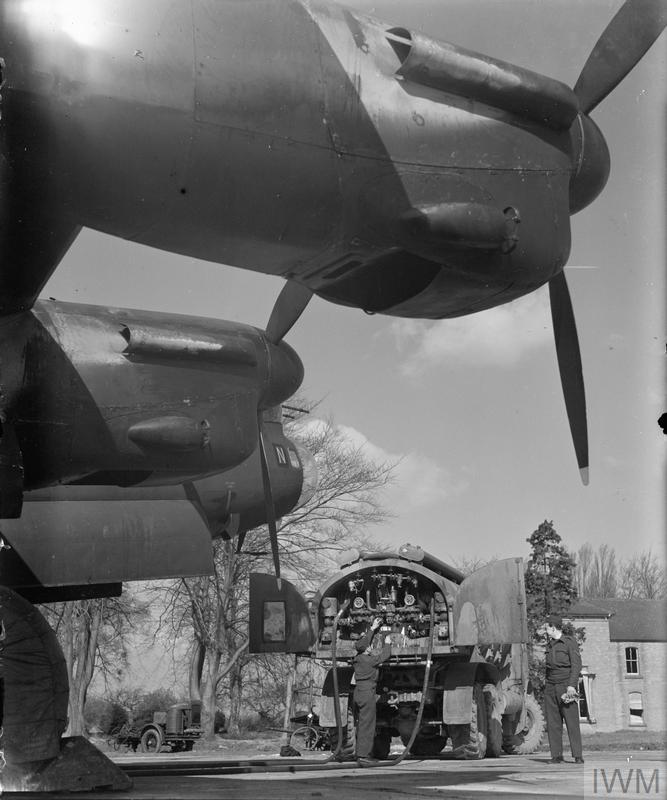
Operation POINTBLANK. Groundsmen refuel Lancaster ND560 ‘DX-N’, 57 Squadron in preparation for a night attack on the railway yards at La Chapelle, France. IWM (CH 12868)

Summer then dawned, and overnight, May 22nd-23rd, Cheshire once more, put his method  to the test. 617 Sqn were again to mark the target, but a heavily defended Brunswick led to heavy losses for both the East Kirkby squadrons, 57 losing three Lancaster Mk.IIIs and 630 Sqn another two. Only five airmen made it out alive, each one being captured by the German ground forces and so becoming prisoners of war.

These losses were however a mere pin-prick compared to June. The mission of 21st-22nd to Wesseling near Cologne proved to be yet another massacre for 5 Group who sent a total of 133 Lancasters to attack the city’s oil facilities. A number of squadrons took heavy loses including both East Kirkby’s 57 and 630 Sqns with six and five losses respectively. One of these aircraft was abandoned whilst another ditched in the sea allowing all crewmen to be rescued, but the overall loss proved to be devastating.

The spring – summer of 1944 was defining, not only had 5 Group shown that low-level marking could be done, but the attacks on targets in France meant that the Luftwaffe were at a disadvantage. Their night tactics, relying on long range bomber flights, could not manage with the shorter ‘quick’ attacks, and so losses from Bomber Command began to lessen.

This reduction allowed for restaffing, with a large number of officers, NCOs and airmen being both posted in and out of the two squadrons. It also allowed for training flights to take place, some 476 hours of operations compared to 729 hours for non-operational flights for 630 Sqn alone.

Like many places across the UK, the coming of D-Day, and the fragile success of the invasion led to an increase in morale at the station. Ground crews being acknowledged for their long hours and hard work in keeping aircraft flying and operationally ready, without them, these operations could not have taken place at all.

This extra effort and improved state continued for several months, and by August, it was acknowledged that morale had lifted, discipline was at a high and health was overall very good. Casualties were also down, a real boost considering the extra effort and number of operations that had been taking place over the last few months. The summer was at last ending on a high.

August’s improvement coincided with the liberation of Paris, a major landmark in the war’s progress. Ground forces were charging ahead. In the air, Bomber Command had played a small part in the offensive supporting ground troops as needed and now they were released from the tight grip SHAEF had held over them. Discussions followed as to where best place their bombs, oil and  communication were one option or alternatively, a return to the bombing of the cities and morale busting; oil won over, and so, much to Harris’s disappointment, the bombing of oil based targets began.

The looseness of the criteria however, allowed Harris to circumnavigate the ‘rules’ and turn his attention to cities with an oil link. He had got his way and the Air Ministry had got theirs.

Although individual operation losses were relatively low, 57 Sqn tallied some 56 aircraft by the end of 1944, whilst 630 Sqn reached 57. Non-operational loses for the two units were also on an equal par.

On the penultimate day of the year, East Kirkby was to witness, a short distance away from the airfield, the crash of a B-17 attempting to land. Aircraft #42-97479 (UX-L) of the 327thBS 92nd BG based at Podington (Station 109), crashed in a field between the two small hamlets of Old Bolinbroke and Hareby. On board that day were nine crew men: 2nd Lt. Joseph Martin Van Stratton (Pilot); 2nd Lt. Edward A Porter (Co-pilot); Sgt. Charles H Chambers (Bombardier); 2nd Lt. John E Cowan (Navigator); Sgt. Arthur R Estrada (Radio Operator); Sgt. Harold Raymond Barner (Ball Turret Gunner); Sgt. Wilfred A Bedard (Wasit Gunner); Sgt. Thomas G Standish ((Top Turret Gunner) and Sgt. William D White (Tail Gunner), who all lost their lives.

The aircraft, a Lockheed/Vega B-17G-15-VE Flying Fortress named “Belle of Liberty“, had returned from operations to the Bullay railway bridge located south-west of Koblenz, in Germany. After suffering engine failure, the pilot decided to abort the mission and attempt a landing at East Kirkby. In poor visibility and with one engine out, he overshot the runway and pulled up to attempt a second try. A second propeller then began windmilling and in trying to gain height to avoid a hill, the B-17 stalled and crashed.

A small memorial plaque has since been laid at the site in commemoration of those lost.

The wreck of the “Belle of Liberty” 30th December 1944.  (IWM FRE 5762)

The winter of 1944-45 was one of the worst, ground troops were by now entrenched in the Ardennes around Bastogne, with the German army preparing for one last push through the forests. Fog and snow kept many airfields non-operational in the UK, aircraft struggling to get much needed support across to the continent.

At East Kirkby, January started on high spirits, but on the 9th, 630 Sqn Lancaster PD317 ‘LE-G’ struggled to get airborne when one of its engines cut out on take off. After jettisoning its bombs, the pilot, F.O. G Billings, opened the throttle to attempt a circuit and landing. However, the port wing lost lift and dropped causing the aircraft to cartwheel injuring five airmen and killing two. With one further loss on the 14th, this brought the spring tally to two aircraft. However, good news did soon come as six of the seven crew were repatriated by the April. The seventh airmen, W.O. E Edwards, struck the tail plane on baling out and died the next day.

Otherwise, 57 Sqn, scraped through with a clean sheet and no operational losses were encountered, but they did suffer an unfortunate incident when ‘DX-N’ PB382 (the predecessor of DX-N below) entered Swedish airspace and was shot down by flak on the night of February 8th-9th.

The losses encountered by 57 and 630 Sqn, were only pipped by the tragic accident that was reported to have happened on the 17th of April. Although the operational records record no evidence of the accident, even to the point of showing some of the aircraft involved taking part and completing their operations, it is recorded in some resources that six Lancasters of 57 Squadron were destroyed following a fire in the fuselage of Lancaster PB360. As a result of the fire, four men were killed and a further five injured, along with several civilian workers near the site.

The fire started at 17:45, causing a series of explosions which destroyed the five other Lancasters parked nearby. The Hangar on the airfield was also badly damaged, as was a neighbouring farm. The fires were so severe that fire crews were brought in from nearby airfields and the area was not declared ‘safe’ until the following day. The Lancasters involved were: PB360 (MK.III) ‘DX-N’; ND472 (MK.III) ‘DX-I’; LM673 (MK.III) ‘DX-U’; RF195 (MK.I) ‘DX-‘; PD347 (MK.I) ‘DX-P’ and NN765 (MK.I) ‘DX-‘.*3

By now German resistance was minimal. Fighters were rarely encountered in any number and flak batteries were reducing in their accuracy and intensity. By May, the war was at and end, and quickly both ‘Exodus’ and training flights became the norm along with cross country and high level bombing training flights taking the front stage. For 630 Sqn July signified the end, after a period of intense recruiting the squadron was disbanded after serving for approximately eighteen months of the war.

During that time they had shown great courage in action. On average they had flown 1,087 hours of operational flying per month and 286 hours on non-operational flights. This amounted to 2,147 operations over enemy territory during which 64 aircraft had been lost. With another six crashing, the toll was high, and their medal tally reflected that, with in excess of 60 awards being granted.

In a last days before disbandment a sports challenge with 57 Squadron allowed 630 to show their colours one last time, winning the overall trophy, and with a party to celebrate that night, the squadron went out on a high. The final day saw the last parade and the handing over of the squadron crest to the Air Ministry for safe keeping. With that, 630 squadron disbanded.

Their place at East Kirkby didn’t stay vacant for long though, for on the 27th July, 460 Sqn arrived to join 57 Sqn and serve its lasts days here at this Lincolnshire airfield.

57 Sqn would continue on, taking on the Lincoln bomber in August as a replacement for the Lancaster although numbers remained low at this time. Fighter affiliation, high level bombing training and cross country flights became the main focus, along with ferrying flights into the European continent bringing back personnel and equipment; a schedule that continued for the next four months, its time finally being called on November 25th 1945.

Throughout the war 57 Sqn had served with distinction, providing crews for not just one but two different squadrons, one of which went on to become perhaps the most famous unit in the RAF’s history. It was a success however, that came at a cost, with the highest loss rate of the whole of Bomber Command, they had taken part in some of Europe’s most ferocious aerial battles and still went on to perform admirably.

On disbandment, 103 Squadron then at Elsham Woods, was immediately renumbered as 57 Sqn, and the unit number lived on. The majority of personnel from the original 57 Sqn were transferred to the RAF’s Holding Station RAF Blyton Holding Unit, along with personnel from several other serving squadrons. Seven three-men crews remained at East Kirkby to ferry the Lancasters away whilst six crews transferred to Scampton to form the basis of the new squadron along with three Lincoln bombers.

460 Sqn an Australian unit, had also served well during its war time life. Being originally formed on November 25th 1941, it was made up of Australian crews, flown Wellingtons, Halifaxes and then Lancaster I and IIIs. Its move to East Kirkby from Binbrook signifying its end, as training flights took over bombing missions and personnel began to be transferred out. By October it too had disbanded.

In an acknowledgement of their bravery, the closing remarks in the Operation Record Books state how the Australian had been warmly welcomed to our shores and how they had cemented a great bond between the two allies against a common enemy. Appreciation and thanks was warmly given to those who had served in the unit.

With the war’s end, East Kirkby was rundown, but between spring 1946 and February 1948, a detachment of Mosquito B.IVs from Coningsby’s 139 (Jamaica) Sqn, operated here, joined  between August 1947 and February 1948 by 231 Operational Conversion Unit (OCU) also on detachment from Coningsby. Flying a mix of Airspeed Oxfords, Avro Ansons & de Havilland Mosquito B.IVs, they were the last RAF units to use the airfield before it entered care and maintenance.

Then in 1951, the US Strategic Command 3rd Air Force took over the site, intending to use it as a stand-by airfield.  As part of the plan, the runway was extended by 1,230 yards along with an expansion to the apron. Both the 3931st ABG and 3917th ABS were based here but only visiting C-47 ‘Skytrains’ (a derivative of the Dakota) of the 7th Air Division’s Rescue Squadrons, ever arrived.

Eventually, on 31 October 1958, the airfield was returned to Air Ministry under ‘Big Shuffle’ , the reorganisation of the Air Force and its sites in the UK and Europe.*4

With that, East Kirkby closed for good, being sold off in 1964 when it turned once again to agriculture. However, bought by the Panton Brothers, it was turned into a living museum including a taxiable Lancaster to commemorate not only the third brother – Christopher Panton, who was killed on a bombing raid over Nuremberg on 30th – 31st March, 1944 – but all those who served in Bomber Command during World War II.

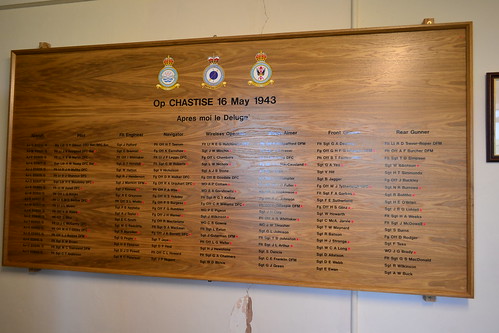
Part of the museum includes the chapel, a stained glass window and memorial board listing all those who died whilst serving at the airfield in both 57 and 630 Sqn, are poignant reminders of the toll on human life at this one small Lincolnshire airfield.

The full page can be read in Trail 1 – Lower Lincolnshire.

References and further reading (East Kirkby)

*1 Aviation Safety Network website accessed 19/10/24.

*2 Worrall, R., “Battle of Berlin 1943-44” Osprey Publishing. 2019.

*3 Chorley, W.R., “Bomber Command Losses pof the Second World War – Vol. 6 1945” Midland Counties Publications 1998.

*4 Francis. P & Crisp. G., “Military Command and Control Organisation
Volume 4  – The United States Air Forces in the UK” on behalf of English Heritage.

*5 The East Kirkby Museum have a website which gives far more detail, opening times, and other other visitor information.

National archives: AIR 27/538/38; AIR 27/538/44; AIR 27/538/43; AIR 27/2152/8; AIR 27/2152/7; AIR 27/2152/29; AIR 27/540/13; AIR 27/540/21; AIR 27/1910/11; AIR 27/540/8; AIR 27/540/7

American Air Museum Website Accessed 20.10.24

International Bomber Command Centre has several personal stories on their website, it is well worth a read.

Lincolnshire Aviation Heritage Centre Website.
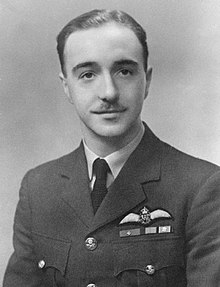
Flt. Lt. William ‘Bill’ Reid VC 61 Squadron, RAF Syerston

In 1942 Air Ministry Directive S.46368/D.C.A.S. turned Bomber Command’s focus to the morale of the German population and in particular its industrial workforce. Bomber Command now turned to strategic bombing, a controversial campaign that was debated for many years after, it was seen as a way to destroy the enemy’s industrial output, by attacking the very workforce that produced it.

William Reid VC.jpg

Flt. Lt. Bill Reid VC (IWM CHP 794)

But as loses had mounted, Bomber Command had been forced to fly at night, a task that was almost impossible to satisfactorily achieve for most bomber crews who had been trained to bomb in daylight. Indeed, only some 3 in every 100 bombers were hitting within 5 miles of the aiming point at the start of the campaign.

Harris himself knew that hitting a single target consistently, at night was impossible, and so there was little choice seen other than the controversial bombing campaign.

On one of these raids, on the night of 3rd/4th November 1943, Bomber Command sent a large raid of almost 600 aircraft to Germany. In that raid was Acting Flight Lieutenant William (Bill) Reid, a Scot born in Baillieston, Glasgow, and the son of a Blacksmith .

Reid performed his duties that night in a manner that would see him earn the Victoria Cross, the highest honour possible, for taking his damaged Lancaster to the heart of Dussledorf and bombing the target even though he himself and his Flight Engineer were wounded; the navigator killed and the aircraft severely damaged and so difficult to fly.

That evening, eleven Lancasters from 61 Squadron, RAF Syserton, took off on a mission to bomb Dusseldorf. Reid’s aircraft, Lancaster LM360 was second to depart taking off at 16:59. On board with Flt. Lt. William (Bill) Reid were: Sgt. J. Norris (Flt Eng); Flt. Sgt. J. Jeffries (Nav); Sgt T. Rolton (Bomb Aimer); Flt. Sgt. J. Mann (WT/ Air Gunner); Flt. Sgt. S. Baldwin (Air Gunner) and Flt. Sgt. A. Emerson (Air Gunner).

As the aircraft crossed the Dutch coast there was a terrific bang outside the aircraft  which resulted in the windscreen being shattered and partially blown out. Reid was wounded in the head, shoulders and hands, and the plane temporarily went out of control. Flak continued to burst all around the Lancaster with one further burst injuring the Flight Engineer, who was next to read, and causing further injuries to Reid himself. The port elevator had been shot away and to compensate, Reid had to pull the stick fully back just to keep the plane straight and level. Between Reid and the Flight Engineer, they maintained level flight as part of the formation of almost 600 aircraft across an 8 to 10 mile span of up to 6000 feet deep – the option of turning back was not a viable one.

Keeping the plane straight and level, Reid watched the target indicators. The bombs were dropped and the photographic evidence taken. Turning the aircraft away, the Lancaster headed for home. Reid knew that he was the only one who could fly the aircraft and even with with no elevator, virtually no instruments and at night, he was determined to make it back safely. With further attacks from night fighters on the return trip, it was not an easy journey, but they eventually made it to England. Once over the English coast they looked for a suitable airfield to land, they came across the beacons at the American base at RAF Shipdham in Norfolk, and Reid put the aircraft down. Almost immediately, the legs of the undercarriage collapsed and the aircraft hit the runway on its belly, sliding along for some 50 yards or so, before coming to a complete stop. At this point Reid realised the Navigator had died slumped in his seat behind him.

Reid, severely injured, had managed to fly the badly damaged aircraft, without oxygen and with wounded on board, for many hours from deep inside Germany, the actions of which earned the 22-year-old acting Flight Lieutenant the Victoria Cross.

His citation in the Third Supplement to the London Gazette on Tuesday 14th December 1943 covered an entire page and read:

Air Ministry, 14th December, 1943.

The KING has been graciously pleased to confer the VICTORIA CROSS on the undermentioned officer in recognition of most conspicuous bravery: —

Acting Flight Lieutenant William REID (124438), Royal Air Force Volunteer Reserve, No. 61 Squadron.

On the night of November 3rd, 1943, Flight Lieutenant Reid was pilot and captain of a Lancaster aircraft detailed to attack Dusseldorf.

Shortly after crossing the Dutch coast, the pilot’s windscreen was shattered by fire from a Messerschmitt 110. Owing to a failure in the heating circuit, the rear gunner’s hands were too cold for him to open fire immediately or to operate his microphone and so give warning of danger; but after a brief delay he managed to return the Messerschmitt’s fire and it was driven off.

During the fight with the Messerschmitt, Flight Lieutenant Reid was wounded in the head, shoulders and hands. The elevator trimming tabs of the aircraft were damaged and it became difficult to control. The rear turret, too, was badly damaged and the communications system and compasses were put out of action. Flight Lieutenant Reid ascertained that his crew were unscathed and, saying nothing about his own injuries,
he continued his mission.

Soon afterwards, the Lancaster was attacked by a Focke Wulf 190. This time, the enemy’s fire raked the bomber from stem to stern. The rear gunner replied with his only serviceable gun but the state of his turret made accurate aiming impossible. The navigator was killed and the wireless operator fatally injured. The mid-upper turret was hit and the oxygen system put out of action. Flight Lieutenant Reid was again wounded and the flight engineer, though hit in the forearm, supplied him with oxygen from a portable supply.

Flight Lieutenant Reid refused to be turned from his objective and Dusseldorf was reached some 50 minutes later. He had memorised his course to the target and had continued in such a normal manner that the bomb-aimer, who was cut off by the failure of the communications system, knew nothing of his captain’s injuries or of the casualties to his comrades. Photographs show that, when the bombs were released, the aircraft was right over the centre of the target.

Steering by the pole star and the moon, Flight Lieutenant Reid then set course for home. He was growing weak from loss of blood. The emergency oxygen supply had given out. With the windscreen shattered, the cold was intense. He lapsed into semi-consciousness. The flight engineer, with some help from the bomb-aimer, kept the
Lancaster in the air despite heavy anti-aircraft fire over the Dutch coast.

The North Sea crossing was accomplished. An airfield was sighted. The captain revived, resumed control and made ready to land. Ground mist partially obscured the runway lights. The captain was also much bothered by blood from his head wound getting into his eyes. But he made a safe landing although one leg of the damaged undercarriage collapsed when the load came on.

Wounded in two attacks, without oxygen, suffering severely from cold, his navigator dead, his wireless operator fatally wounded, his aircraft crippled and defenceless,  Flight Lieutenant Reid showed superb courage and leadership in penetrating a further 200  miles into enemy territory to attack one of the most strongly defended targets in Germany, every additional mile increasing the hazards of the long and perilous journey home. His tenacity and devotion to duty were beyond praise.

Reid would go on to fly in Bomber Command being transferred to the famous 617 Sqn at Woodhall Spa after his recovery. Here he would fly with Leonard Cheshire, another VC holder, on Tallboy missions, dropping the enormous weapon onto heavily fortified or deeply buried structures.

On 31st July 1944, sixteen Lancasters and two Mosquitoes of 617 Sqn were ordered to attack the V-1 site at Rily-la-Montage, a railway tunnel used by the Germans to store the pilot-less flying bombs ‘The Doodlebug’.  Here Flt. Lt. William ‘Bill’ Reid’s luck would finally run out.

He had managed so far to evade either death or capture, only to be struck down by bombs from one of his own. The Lancaster Mk.I (ME557) ‘KC-S’ he was flying with 617 Sqn, shuddered as allied bombs crashed through the Lancaster severing the control cables, fracturing the structure of the Lancaster’s body and removing one of the port engines. Uncontrollable, the aircraft then entered a spin. Reid gave the order to bail out, himself escaping through the hatch above his head. He landed heavily, breaking an arm in the process – an injury that would hinder his escape from his pursuers. Within an hour he was captured, interrogated and sent on to a POW camp. Reid and one other crewman, Flying Officer D. Luker, were the only two airmen to escape the stricken  Lancaster, the remaining five all being killed in the crash.

As the allied forces moved ever closer, the much admired Reid was moved from camp to camp, ending his war at Stalag III – a POW camp made famous by ‘The Great Escape’ and ‘The Wooden Horse’.

Back at the RAF Woodhall Spa in Lincolnshire, he colleagues ‘mourned’ his capture by joking that he had escaped with all their money, money he had won in an early morning card game in the officers mess at the Petwood Hotel. *1.

Liberated in May 1945, Reid returned home and became well known in the agricultural business. He became great friends with the that other Scottish VC holder John Cruickshank a friendship that lasted a good many years.

Some time after moving to his new home in Crieff, Bill Reid sadly passed away; his death being announced  on November 28th 2001. He was buried in the local cemetery at Crieff.

Sources and Further Reading.

National Archives AIR 27/578/22
National Archives  AIR 27/2128/24
National Archives  AIR 27/2128/23

The Third Supplement of The London Gazette Publication date: 10th December 1943; Supplement: 36285 Page: 5435

World At War Series BBC narrated by Lawrence Olivier Episode 12

*1 Sweetman, J. “Bomber Crew – Taking on the Reich“, Abacus, 2004 pg 207

The Scotsman Newspaper website, 29th November 2001.

Trail 44 – Kent (Part 3) – Sir Barnes Wallis – His Later Years.

We continue, in Trail 44, looking at the life of Sir Barnes Wallis, a man known for his expertise in engineering and design. Following on from his early works in airship design, we now turn to his Second World War and post war work.

With the outbreak of the Second World War, new designs of aircraft and weapons were much-needed. Wallis’s geodesic design, as used in the R100, had been noticed by another Vickers designer Rex Pierson, who arranged for Wallis to transfer to Weybridge, where they formed a new team – Pierson working on the general design of the aircraft with Wallis designing the internal structures. This was a team that produced a number of notable designs including both the Wellesley and the Wellington; both of which utilised Wallis’s geodetic design in both the fuselage and wing construction.

What made Wallis’s idea so revolutionary was that the design made the air frame both light-weight and strong, and by having the bearers as part of the skin, it left more room inside the structure thus allowing for more fuel or ‘cargo’. An idea that helped provide greater gas storage for the R100.

Whilst both the Wellesley and the Wellington went on to be successful in the early stages of the war (11,400 Wellingtons saw service), they were both withdrawn from front line service by the mid war years, being replaced by more modern and advanced aircraft that could fly further and carry much larger payloads.

Saddened by the rising death toll, Wallis put many of his efforts into shortening the war. His idea was that if you attack and destroy the heart of production, then your enemy would have nothing to fight with; in this case, its power supply. To this end he started investigating the idea of breaching the dams of the Ruhr.

Wallis’s idea was to place an explosive device against the wall of the dam, thus utilising the water’s own pressure to fracture and break open the dam. Conventional bombing was not suitable as it was too difficult to place a large bomb accurately and sufficiently close enough to the dam to cause any significant damage. His idea, he said, was “childishly simple”.

Using the idea that spherical objects bounce across water, like stones thrown from a beach, he determined that a bomb could be skimmed across the reservoir over torpedo nets and strike the dam. A backward spin, induced by a motor in the aircraft’s fuselage, would force the bomb to keep to the dam wall where a detonator would explode the bomb at a predetermined depth, similar in fashion to a naval depth charge. The idea was simple in practical terms, ‘skip shot’ being used with great success by sailors in Nelson’s navy;  but it was going to be a long haul, to not only build such a weapon, the aircraft to drop it, nor train the expert crews to fly the aircraft; but to simply convince the Ministry of Aircraft Production that it was in fact feasible.

Wallis began performing a number of tests, first at his home using marbles and baths, then at Chesil Beach in Dorset. Both the Navy and the Ministry were interested when shown a film of the bomb in action, each wanting it for their own specific target; the Navy for the Tirpitz, and the Ministry for the dams. Wallis still determined to use it on the dams, carried out two projects side-by-side,  “Upkeep” for the dams, and “Highball” for the Navy*3.

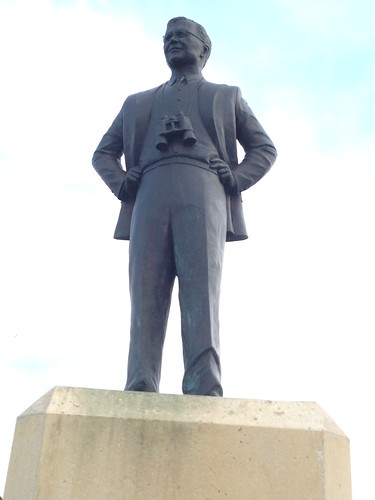
“Upkeep” was initially spherical, and the first drop from a modified Lancaster took place in April 1943 at Reculver near to Herne Bay, where this statue is located. He persevered with aircraft heights, speeds and bomb design modifications, carefully honing them until on April 29th 1943, only three weeks before the actual attack, the bomb finally worked for the first time.

Wallis’s plan could now be put into action, and with a new squadron of the RAF’s elite bomber crews put in place, the stage was set and the dams of Ruhr Valley would be the target.

The attack on the dams have become legendary, and of the 19 aircraft of 617 Squadron that took off that May evening in 1943, only 11 returned, some after sustaining considerable damage. Operation Chastise saw two of the three dams, the Mohne and Eder, successfully breached and the third, the Sorpe, severely damaged forcing the Germans to partially drain it for safety.

Scampton September 2015 (17)

The names of the crews of 617 Squadron at RAF Scampton. Those with poppies next to them, did not return.

Following the success of Operation Chastise, Wallis went on to develop other bombs capable of devastating results. His initial plan, a Ten ton (22,000lb) bomb, had to be scaled back to 12,000lb as there was no aircraft capable of dropping it at that time. Codenamed ‘Tallboy’, it would be a deep penetration bomb 21 feet in length with a hardened steel case and 4 inches of steel in the nose. The bomb contained 5200lbs of high explosive Torpex (similar to that used in the Kennedy Aphrodite mission) and would have a terminal velocity of around 750 miles per hour.

The idea of Tallboy, was to create a deep underground crater into which structures would either fall or be rendered irreparable. With a time fuse that could be set to sixty minutes after release, it was used on strategic targets such as the Samur Railway Tunnel in France, rendering the tunnel useless as it had to be closed for a considerable amount of time.

The crater made by Barnes Wallis’s Tallboy bomb above the Samur Railway Tunnel, 9th June 1944. *4

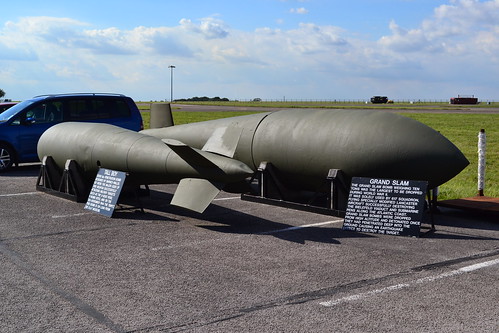
Soon after this, Wallis began developing his Ten Ton bomb, the “Grand Slam”, a mighty 26ft in length, it weighed 22,000lb, and would impact the ground at near supersonic speeds. Wallis’s design was such that the bomb could penetrate through 20 feet of solid concrete or 130 feet of earth, where it would explode creating a mini earthquake. It was this earthquake that would rock the foundations of buildings and structures, or simply suck them into a crater of massive proportions*5.

Production of the Grand Slam was slow though. It took two days for the casting to cool and then after machining, it took a further month for the molten Torpex  to set and cool. The first use of the Grand Slam occurred on 14th March 1945 against the Bielefeld Viaduct in Germany, on which one Grand Slam and 27 Tallboys were dropped. Unsurprisingly, the viaduct collapsed and the railway was put out of action.

Wallis had created more exceptionally devastating weapons, they were so successful that 854 Tallboys and 41 Grand Slams were dropped by the war’s end.

Scampton September 2015 (4)

The Tallboy and Grand Slam bombs, designed by Barnes Wallis.

Post war, Wallis carried on with his design and investigations into aerodynamics and flight. He was convinced that achieving supersonic flight with the greatest economy was the way forward, and in particular variable geometry wings. The government was keen to catch up with the U.S., awarding Vickers £500,000 to carry out research into supersonic flight. Wallis’s project received some of this money, and he researched unmanned supersonic flight in the form of surface-to-air missiles. Codenamed ‘Wild Goose‘ (later ‘Green Lizard’) the project ran to 1954 when it was terminated.

Wallis continued with his research into swing wing designs, his first being the JC9, a single seat aircraft 46 feet in length. It was produced but never completed and was scrapped before it ever got off the ground. Wallis wasn’t put off though, and he continued on developing the ‘Swallow’, a swing wing aircraft that could reach speeds of Mach 2.5 in model wind tunnel investigations.

In its bomber form it would have been equivalent in size to the American B-1, with a crew of 4 or 5, and a cruising speed of Mach 2. It would have a range of 5,000 miles whilst carrying a single Red Beard nuclear bomb.

Whilst not selected to meet the R.A.F.’s OR.330 (Operational Requirement 330), which was eventually awarded to TSR.2, they were interested enough for him to proceed until the 1957 Defence White Paper put an end to the project, and it was cancelled.

Looking for funding Wallis turned to the U.S. hoping they would grant him sufficient funds to continue his work. After many meetings between Wallis and the U.S American Mutual Weapons Development Program at NASA’s Langley research facility, he came away disappointed and saddened that the Americans used his ideas without granting him any funding.

American research continued, eventually developing into the successful General Dynamics F-111 ‘Aardvark’, the world’s first production swing-wing combat aircraft.

Wallis continued with other supersonic and hypersonic investigations; designs were drawn up for an aircraft capable of Mach 4-5, using a series of variable winglets to link subsonic, supersonic and hypersonic flights, many however, never went beyond the drawing board.

Wallis didn’t stop there, he continued with many great inspirational projects: the Stratosphere Chamber, a test chamber where by simulated impacts on aircraft travelling at 70,000 feet could be safely tested and analysed; the Parkes Telescope, a radio telescope in New South Wales; the Momentum Bomb, a nuclear bomb designed to be released at low-level and high-speed, enabling the release aircraft to escape the blast safely, and in the 1960s, a High Pressure Submarine designed to dive deeply beyond the range of current detection.

In recognition of his work, Wallis was knighted in 1968, and he was also made an Honorary Fellow of the Royal Aeronautical Society.

Wallis, after working beyond his forced retirement, died at the age of 83, on 30th October 1979, in Effingham, Surrey. He is buried in the local church, St Lawrence’s Church, in Effingham, a village he contributed greatly to. He was the church secretary for eight years, and an Effingham Parish Councillor, serving as Chairman for 10 years. He was also the Chairman of the Local Housing Association, which helped the poor and elderly of the village to find or build homes; and as a fanatical cricketer, he was Chairman of the KGV Management Committee who negotiated the landscaping of the “bowl” cricket ground, so good was the surface, it was used as a substitute for the Oval in London.

There are numerous memorials and dedications around the country to Wallis, and there is no doubt that he was both an incredible engineer and inventor who made a major contribution to not only the war, but British and world aviation in general.

His statue at Herne Bay overlooks Reculver where the first “Upkeep” bomb was dropped by a Lancaster bomber during the Second World War, and it is a fine tribute to this remarkable man on this trail.

Barnes Wallis at Work

Sir Barnes Neville Wallis.

From here, we continue to travel east, toward the coastal town of Margate. A few miles away is the now closed Manston airport, formerly RAF Manston, an airfield that is rich in History, and one that closed causing such ill feeling amongst many.

Sources and further reading

*3 The Mail online published a report on the discovery of a Highball bomb found in Loch Striven, Scotland in July 2017.

*4 Photo © IWM (CL 4322)

*5 The Independent news website– “Secrets of the devastation caused by Grand Slam, the largest WWII bomb ever tested in the UK.” Published 22/1/14

The Barnes Wallis Foundation website has a great deal of information, pictures and clips of Barnes Wallis.

A list of memorials, current examples of both Upkeep and Highball bombs, and displays of material linked to Barnes Wallis, is available through the Sir Barnes Wallis (unofficial) website.


Trail 44 – Kent (Part 3) – Sir Barnes Wallis – His Early Years

After visiting the many museums and former airfields in the southern and central parts of Kent (Trail 4 and Trail 18) we now turn north and head to the northern coastline. Here we overlook the entrance to the Thames estuary, the Maunsell Forts – designed to protect the approaches to London and the east coast – and then take a short trip along the coastline of northern Kent. Our first stop is not an airfield nor a museum, it is a statue of the designer of one of the world’s most incredible weapons – the bouncing bomb. Our first short stop is at Herne Bay, and the statue of Sir Barnes Wallis.

Sir Barnes Wallis – Herne Bay

Sir Barnes Wallis

The Barnes Wallis statue located at the eastern end of the town overlooking the sea at Reculver.

There cannot be a person alive who has not seen, or know about, the famous Dambusters raid made by 617 Sqn. It is a story deeply embedded in history, one of the most daring raids ever made using incredible ideas, skill and tenacity. There is so much written about both it, and the man behind the idea – Sir Barnes Neville Wallis CBE FRS RDI FRAeS – a man famous for his engineering prowess and in particular the famous ‘Bouncing Bomb’ that was used by Guy Gibson’s 617 Squadron in that daring raid of 16th May 1943. But there is so much more to Barnes Wallis than the Bouncing bombs; he made a huge contribution to British Aviation, weaponry of the Second World War, and later on in his life, supersonic and hypersonic air travel.

He is certainly one the Britain’s more notable designers, and has memorials, statues and plaques spread across the length and breadth of the country in his honour. But he was not just a designer of the Bouncing bomb, his talent for engineering and design led him through a series of moves that enabled him to excel and become a major part of British history.

Born on 26th September 1887 in Ripley, Derbyshire, he was educated at Christ’s Hospital in Horsham, he went on to study engineering in London, and shortly afterwards moving to the Isle of Wight. With the First World War looming, he was offered a chance to work on airship designs – an innovative design that would become widely used by the Naval forces of both the U.K. and Germany.

Wallis cut his teeth in marine engines as an engineer and draughtsman. He began his career in the London’s shipyards, moving to the Isle of Wight after which he broke into airship design. He followed a colleague he had met whilst working as a draughtsman with John Samuel White’s shipyard, together they would design His Majesty’s Airship No.9 (HMA 9).

The design process of HMA 9 was dynamic to say the least. Early non-rigid airships were proving to be very successful, and the new rigids that were coming in – whilst larger and more capable of travelling longer distances with greater payloads – were becoming the target for successive quarrels between the government and the Admiralty. World unrest and political turmoil was delaying their development even though plans for HMA 9 had already been drawn up.

Joining with his colleague, H.B. Pratt in April 1913, at the engineering company Vickers, the two designers began drawing up plans for a new rigid based along the lines of the German Zeppelin. HMA 9 would be a step forward from the ill-fated HMA No. 1 “Mayfly”, and would take several years to complete. Further ‘interference’ from the Admiralty (One Winston Churchill) led to the order being cancelled but then reinstated during 1915. The final construction of the 526 ft. long airship was on 28th June 1916, but its first flight didn’t take place until the following November, when it became the first British rigid airship to take to the Skies.

HMA 9 (author unknown*1)

With this Wallis had made his mark, and whilst HMA 9 remained classed as an ‘experimental’ airship with only 198 hours and 16 minutes of air time, she was a major step forward in British airship design and technology.

The Pratt and Wallis partnership were to go on and create another design, improving on the rigids that have previously been based on Zeppelin designs, in the form of the R80. Created through the pressure of war, the R80 would have to be designed and built inside readily available sheds as both steel and labour were in very short supply. Even before design or construction could begin there were barriers facing the duo.

Construction started in 1917, but with the end of the war in 1918, there was little future as a military airship for R80. Dithering by the Air Ministry led to the initial cancellation of the project, forcing the work to carry on along a commercial basis until the project was reinstated once more. With this reinstatement, military modifications, such as gun positions, were added to the airship once again. With construction completed in 1920, she made her first flight that summer. However, after sustaining structural damage she was returned to the sheds where repair work was carried out, and a year later R80 took to the air once again. After a brief spell of use by the U.S. Navy for training purposes, R80 was taken to Pulham airship base in Norfolk and eventually scrapped. Wallis’s design had lasted for four years and had only flown for 73 hours.

However, undaunted by these setbacks, the Vickers partnership of Pratt and Wallis went on to develop further designs. In the 1920s, a project known as the 1924 Imperial Airship Scheme, was set up where by a Government sponsored developer would compete against a commercial developer, and the ‘best of both’ would be used to create a new innovative design of airship that would traverse the globe. This new design, would offer both passenger and mail deliveries faster than any current methods at that time.

The Government backed design (built at the Royal Airship Works at Cardington) would compete against Vickers with Wallis as the now Chief Designer.

The brief was for a craft that could transport 100 passengers at a speed of 70 knots over a range of 3,000 miles. Whilst both designs were similar in size and overall shape, they could not have been more different. Wallis, designing the R.100, used a mathematical geodetic wire mesh which gave a greater gas volume than the Government’s R101, which was primarily of stainless steel and a more classic design. This geodesic design was revolutionary, strong and lightweight, it would prove a great success and emerge again in Wallis’s future.

Built at the Howden site a few miles west of Hull, the R100 was designed with as few parts as possible to cut down on both costs and weight; indeed R100 had only 13 longitudinal girders half that of previous designs. Wallis’s design was so far-reaching it only used around 50 different main parts.

The design plan of Wallis’ R-100 airship (author unknown*2

The 1920s in Britain were very difficult years, with the economy facing depression and deflation, strikes were common place, and the R100 was not immune to them. Continued strikes by the workers at the site repeatedly held back construction, but eventually, on 16th December 1929, Wallis’s R100 made its maiden flight. After further trials and slight modifications to its tail, the R100 was ready. Then came a test of endurance for the airship, a flight to Canada, a flight that saw the R100 cover a journey of 3,364 miles in just under 79 hours. Welcomed as heroes, the return journey would be even quicker. Boosted by the prevailing Gulf Stream, R100 made a crossing of 2,995 miles in four minutes under 58 hours. The gauntlet had been thrown, and Wallis’s airship would be hard to beat.

The R101 would face a similar flight of endurance, this time to India, and it would use many of the same crew such was the shortage of experienced men. On October 4th 1930, R101 left its mooring at Cardington for India. Whilst over France she encountered terrible weather, a violent storm caused her to crash, whereupon she burst into flames and was destroyed with all but six of the 54 passengers and crew being killed.

The airship competition became a ‘one horse race’, but an inspection of the outer covering of Wallis’s R100 revealed excessive wear, only cured by replacing the skin, an expense the project could barely swallow. With plans already in place for the R102, the project was in jeopardy, and eventually, even after offers from the U.S. Government, it was deemed too expensive, and by 1932 R100, the worlds largest airship and most advanced of its time, had been scrapped and the parts sold off.

Wallis’s airship career had now come to an end, but his prowess and innovation as a designer had been proven, he had set the bench mark that others would find hard to follow.

In the next part, we look at the work carried out by Wallis both during the Second World War and in the later years of his life.

Sources and further reading

*1 Photo from The Airship Heritage Trust website.

*2 ibid