September 26th 1942, a near tragedy for three RAF Squadrons.

The Eagle Squadrons were three RAF Squadrons made up of American volunteers, their achievements and records are well-known and well documented, however, it was not all plain sailing for these determined and courageous flyers. For one Squadron in particular, 133 Squadron, September 26th 1942 would be a disaster, a disaster that would almost wipe out the entire flight of twelve airmen.

133 Squadron had been on the front line serving at RAF Biggin Hill and RAF Martlesham Heath before arriving at RAF Great Sampford, a satellite for RAF Debden. The ground crews were predominately British, assisting and training the US ground crews in aircraft maintenance and support. All the pilots however, were US volunteers, formed into three separate squadrons but under RAF control.

1st Lt Dominic 'Don' Gentile and Spitfire BL255 'Buckeye-Don', 336th FS, 4th FG, 8th AF.

1st Lt Dominic ‘Don’ Gentile and Spitfire BL255 ‘Buckeye-Don’. The photo was taken after 133 Squadron RAF was disbanded and absorbed into the USAAF as the, 336th FS, 4th FG, 8th AF. (@IWM)

133 Squadron would arrive at RAF Great Sampford on September 23rd 1942, the same day as 616 Sqn RAF departed, they would be the last operational unit to fully use the airfield before its eventual closure.

Initially flying the Spitfire VBs, they soon replaced them with the MK.IX, a Spitfire that was essentially a MK.V with an updated engine. Having a higher ceiling than the FW-190 and being marginally faster, its improved performance took the Luftwaffe by complete surprise. It was so new and improved, that it remained on the secret list until after this particular operational flight.

On that fateful day, September 26th 1942, fourteen Spitfires of 133 Sqn took off from RAF Great Sampford in Essex, piloting those Spitfires were:

BS313 – F/Lt. Edward Gordon Brettell DFC (61053) The only British pilot and leader
BS275 – P/O. Leonard T. Ryerson (O-885137)
BS446 – P/O. William H. Baker Jr (O-885113)
BS137 – P/O. Dennis D. Smith (O-885128)
BR638 – P/O. G.B. Sperry (O-885112)
BS445 – P/O. Dominic “Buckeye-Don” S. Gentile (O-885109)
BS138 – P/O. Gilbert G. Wright (?)
BS279 – F/Lt. Marion E. Jackson (O-885117)
BS447 – P/O. R.E. Smith (O-885110)
BR640 – P/O. C.A. Cook (O-885112)
BS148 – P/O. Richard “Bob” N. Beaty (?)
BS301 – P/O. G.H. Middleton Jr (O-885127)
BS140 – P/O. Gene P. Neville (O-885129)
Unknown  – P/O. Ervin “Dusty” Miller (O-885138) (not listed but known to have been on the flight).

They were to fly to RAF Bolt Head in Devon, where they would meet with 401 Squadron (RCAF) and 64 Squadron RAF, refuel and be briefed for the mission. A mission that was supposed to be straight forward and relatively uneventful.

The aim of the mission was to escort US bombers to Morlaix on the Brest peninsula. The usual commander of 133 Sqn, Red McColpin, was not placed in charge that day, instead he had been posted, and a British Pilot, F/Lt. Edward Gordon Brettell DFC, was issued with the task.

McColpin was a strict disciplinarian and his leadership was admired by those who followed him. Without this leadership, 133’s preparation was slack and they ultimately paid the price for this.

After landing at 12:30 hours, they realised there were no facilities at Bolt Head for refuelling, and they would have to go with what they had. This would kick-start a catalogue of errors that would ultimately seal the fate of the flight. Following a briefing in which Wing Commander Kingcombe DFC and all but two of 133 Sqn pilots had failed to show up for, the flight (which included the sixteen 401 (RCAF) Squadron Spitfire IXs from RAF Kenley) took off at 13:50 hours. Of the fourteen 133 Sqn Spitfires sent to Bolt Head, only twelve would be needed, and two pilots were instructed to remain at Bolt Head, they were P/O. Ervin Miller, and P/O. Don “Buckeye-Don” S. Gentile, they would be the luckiest two men of the squadron that day.

The briefing, a very vague and rushed one, instructed the flight to carry out a ‘Circus‘ mission escorting seventy-five B-17 Flying Fortresses from the 92nd BG, 97th BG and the 301st BG, who were bombing Cherbourg and the airfields at Maupertus and Morlaix in Brittany. When the squadron took off the weather was clear, and winds were predicted to be 35 mph at 24,000 feet, but 5 miles off the English coast, they encountered 10/10th cumulus cloud cover at 7,000 feet, and so had to climb above it so that they could locate the bombers more easily.

The take of was a mess, disorganised and lacking both radio information and in many cases maps, the aircraft were lucky not to collide with each other.

Of the three RAF squadrons involved in the mission, 401 would take the high position, 133 the middle and 64 Squadron, the lower. They were to form up over Bolt Head at 2,000 feet and then head at 200o at 180 mph to overtake the bombers before they arrived at the target. If they could not locate the bombers, the flight was to circle the target for three minutes and then depart.

As the flight approached the rendezvous area, one 133 Squadron Spitfire had to drop out of formation and return home, as he had encountered engine problems; this problem was thought to be due to his low fuel. The remainder of the flight  scanned the skies for any sign of the bomber formation, and after searching for some 45 minutes, they spotted the bombers, some 50 miles south of Brest. The bombers had in fact already turned for home after having discarded their bombs near to the Pyrenees.

By now the 301st BG had been recalled, as their fighter escort failed to materialise, whilst the 97th BG had continued on. However, due to the heavy cloud cover over the target area, they had been ineffective as no bombing of the target had taken place. The American bombers, who were only three months into their European air war, had inadvertently miscalculated a tail wind putting them off track well away from the Bay of Biscay.

1st Lt George H Middleton Jr 336FS, 4FG, 8AF USAAF. Former Eagle Sqn Spitfire pilot.

P/O. G.H. Middleton Jr of 133 Squadron RAF was shot down and taken Prisoner of War (@IWM).

The three squadrons formed up on the bombers at just after 16:45 hours, with 64 Squadron on the port side, 401 Squadron on the starboard and 133 Squadron behind. The whole formation then flew north for 30 minutes, at which point it became evident that the wind speed was in fact over 100 mph, and not the 35 mph as stated by the Meteorological Office, or at the briefing! It has since been revealed that this information was known to those in authority, but it had not been passed down the chain of command and the pilots were never informed.

The formation then spotted land, the bombers thought they were over Falmouth and turned right. 64 and 401 Squadron broke away maintaining height, but 133 Squadron dropped down below the cloud base and prepared to land.

133 Squadron then began to search for the airfield, and after searching in vain, they found a large town, this they hoped would give them the vital fix they desperately needed. Flying low over the houses they realised they were not over England at all but in fact still over France. The flight, uninformed of the 100 mph north-easterly wind at their altitude, had also been blown wildly off course, and after 1.5 hours flying time, the situation had suddenly become very severe indeed.

The Squadron flight Leader, Flight Lieutenant E.G. Brettell, wanting to ascertain his exact position, called up a ground direction finding station who provided a  bearing and heading – 100 miles off the English coast with a homing vector of 020o. It was at this point they suddenly realised they were over the port of Brest, one of the most heavily defended ports under German occupation.

Immediately, the sky filled with flak and small arms anti-aircraft fire. The pilot in the number 2 position, Pilot Officer Gene Neville (O-885129) in Spitfire #BS140, took a direct and fatal hit, he was killed instantly. Three other aircraft were to be shot down in the melee that followed: Pilot Officer William H Baker Jr (O-885113) in Spitfire #BS446; Pilot Officer Leonard Ryerson (O-885137) in Spitfire #BS275 and Pilot Officer Dennis Smith (O-885128) in Spitfire #BS294 – all four were killed, and all four were awarded the Purple Heart.

2nd Lt. Gene P. Neville 133 (Eagle) Sqn RAF, stands before his MK. IX Spitfire at Great Sampford. He was Killed during the Morlaix disaster. (@IWM UPL 18912)

The remainder of 133 Squadron struggling to defend themselves, they scattered and were forced to land out of fuel, either on the island of Ouissant or on the French mainland.

Of the seven 133 squadron pilots who crash landed on French soil, five were known to have been captured immediately and taken prisoner: P/O. G.B. Sperry; F/Lt.  Edward Brettell; F/Lt. M.E. Jackson; P/O. C.A. Cook and P/O. G.H. Middleton Jr., with a sixth, P/O. G.G. Wright, evading the Germans for several days before being captured later on.

Of these initial five, F/Lt. Jackson was injured in his crash and hospitalised for eight weeks. He was then taken to Stalag Luft III from where he was able to escape for about ten days by jumping from the roof of his cell house into a lorry load of evergreen branches that were being taken away from the camp.

Another Pilot, F/Lt.  Edward Brettell  DFC. was executed for his part in the Great Escape from the same prison camp, Stalag Luft III, whilst P/O. Robert E. Smith, the last remaining pilot, managed to abandon his aircraft evading capture, eventually returning to England on 18th January 1943.

The pilot who turned back early due to his own engine problems,  P/O. Robert Beatty,  crash landed his Spitfire at Kingsbridge in Devon after he too ran out of fuel over the Channel. During the crash he sustained severe injuries but luckily survived his ordeal and was able to give an account of the mission through what he heard over the radio.

Several of the 401 Squadron pilots,  who had continued on, also reported being low on fuel and gave their intention to bail out before land was finally sighted. One of these, P/O. Junius L. Hokan (s/n: J/6833), did have to bail out over the sea, he was last seen in a gradual dive, his aircraft heading seaward. His body was never recovered. Others in the flight that day only just made land fall, one crashed and was taken to hospital where he recovered from his injuries, the others just managed to reach either RAF Bolt Head or RAF Harrowbeer. The Operational Record Books for 401 Squadron state that “many casualties were avoided by the clear thinking and cool behaviour of all members of our Squadron“.

A full report of the days tragic events was issued to Fighter Command Headquarters by Wing Commander Kingcombe DFC, Squadron Leader Gaze and Squadron leader K. Hodson DFC.

S/L Gordon Brettell 133 Eagle Squadron

S/L Gordon Brettell, 133 Eagle Squadron, executed for his part in the Great Escape breakout at Stalag Luft III  (@IWM UPL 25574)

The effect on those left behind in 133 Squadron was devastating. The result of poor preparation, inadequate briefings and sub-standard communication between the Met. Office and Fighter Command had cost many lives, and very nearly many, many more. A number of postings to the Far East soon followed, and many lessons weren’t that day that led to improvements preventing such a tragedy ever happening again.

133 Squadron would continue to operate after this, transferring over to the USAAF being renumbered as 336th FS, 4th FG, three days later as planned, leaving both RAF Great Sampford and the sad memories of that very tragic day far behind.
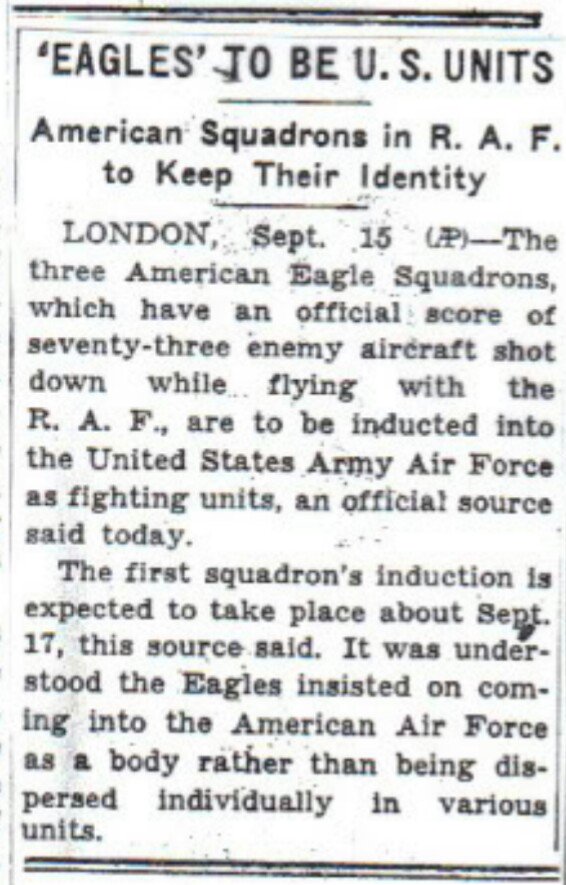
New York Times September 16 1942.

Sources and further reading.

Great Sampford appears in Trail 50.

National Archives: Operational Record Book 133 Sqn – AIR 27/945/2

National Archives: Operational Record Book 401 Sqn – AIR 27/1772/17

National Archives: Operational record Book 64 Sqn – AIR 27/590/41

*3 Price. A., “Spitfire – A Complete Fighting History“, Promotional Reprint Company,  (1974).

September 26th 1942, a near tragedy for three RAF Squadrons.

The Eagle Squadrons were three RAF Squadrons made up of American volunteers, their achievements and records are well-known and well documented, however, it was not all plain sailing for these determined and courageous flyers. For one Squadron in particular, 133 Squadron, September 26th 1942 would be a disaster, a disaster that would almost wipe out the entire flight of twelve airmen.

133 Squadron had been on the front line serving at RAF Biggin Hill and RAF Martlesham Heath before arriving at RAF Great Sampford, a satellite for RAF Debden. The ground crews were predominately British, assisting and training the US ground crews in aircraft maintenance and support. All the pilots however, were US volunteers, formed into three separate squadrons but under RAF control.

1st Lt Dominic 'Don' Gentile and Spitfire BL255 'Buckeye-Don', 336th FS, 4th FG, 8th AF.

1st Lt Dominic ‘Don’ Gentile and Spitfire BL255 ‘Buckeye-Don’. The photo was taken after 133 Squadron RAF was disbanded and absorbed into the USAAF as the, 336th FS, 4th FG, 8th AF. (@IWM)

133 Squadron would arrive at RAF Great Sampford on September 23rd 1942, the same day as 616 Sqn RAF departed, they would be the last operational unit to fully use the airfield before its eventual closure.

Initially flying the Spitfire VBs, they soon replaced them with the MK.IX, a Spitfire that was essentially a MK.V with an updated engine. Having a higher ceiling than the FW-190 and being marginally faster, its improved performance took the Luftwaffe by complete surprise. It was so new and improved, that it remained on the secret list until after this particular operational flight.

On that fateful day, September 26th 1942, fourteen Spitfires of 133 Sqn took off from RAF Great Sampford in Essex, piloting those Spitfires were:

BS313 – F/Lt. Edward Gordon Brettell DFC (61053) The only British pilot and leader
BS275 – P/O. Leonard T. Ryerson (O-885137)
BS446 – P/O. William H. Baker Jr (O-885113)
BS137 – P/O. Dennis D. Smith (O-885128)
BR638 – P/O. G.B. Sperry (O-885112)
BS445 – P/O. Dominic “Buckeye-Don” S. Gentile (O-885109)
BS138 – P/O. Gilbert G. Wright (?)
BS279 – F/Lt. Marion E. Jackson (O-885117)
BS447 – P/O. R.E. Smith (O-885110)
BR640 – P/O. C.A. Cook (O-885112)
BS148 – P/O. Richard “Bob” N. Beaty (?)
BS301 – P/O. G.H. Middleton Jr (O-885127)
BS140 – P/O. Gene P. Neville (O-885129)
Unknown  – P/O. Ervin “Dusty” Miller (O-885138) (not listed but known to have been on the flight).

They were to fly to RAF Bolt Head in Devon, where they would meet with 401 Squadron (RCAF) and 64 Squadron RAF, refuel and be briefed for the mission. A mission that was supposed to be straight forward and relatively uneventful.

The aim of the mission was to escort US bombers to Morlaix on the Brest peninsula. The usual commander of 133 Sqn, Red McColpin, was not placed in charge that day, instead he had been posted, and a British Pilot, F/Lt. Edward Gordon Brettell DFC, was issued with the task.

McColpin was a strict disciplinarian and his leadership was admired by those who followed him. Without this leadership, 133’s preparation was slack and they ultimately paid the price for this.

After landing at 12:30 hours, they realised there were no facilities at Bolt Head for refuelling, and they would have to go with what they had. This would kick-start a catalogue of errors that would ultimately seal the fate of the flight. Following a briefing in which Wing Commander Kingcombe DFC and all but two of 133 Sqn pilots had failed to show up for, the flight (which included the sixteen 401 (RCAF) Squadron Spitfire IXs from RAF Kenley) took off at 13:50 hours. Of the fourteen 133 Sqn Spitfires sent to Bolt Head, only twelve would be needed, and two pilots were instructed to remain at Bolt Head, they were P/O. Ervin Miller, and P/O. Don “Buckeye-Don” S. Gentile, they would be the luckiest two men of the squadron that day.

The briefing, a very vague and rushed one, instructed the flight to carry out a ‘Circus‘ mission escorting seventy-five B-17 Flying Fortresses from the 92nd BG, 97th BG and the 301st BG, who were bombing Cherbourg and the airfields at Maupertus and Morlaix in Brittany. When the squadron took off the weather was clear, and winds were predicted to be 35 mph at 24,000 feet, but 5 miles off the English coast, they encountered 10/10th cumulus cloud cover at 7,000 feet, and so had to climb above it so that they could locate the bombers more easily.

The take of was a mess, disorganised and lacking both radio information and in many cases maps, the aircraft were lucky not to collide with each other.

Of the three RAF squadrons involved in the mission, 401 would take the high position, 133 the middle and 64 Squadron, the lower. They were to form up over Bolt Head at 2,000 feet and then head at 200o at 180 mph to overtake the bombers before they arrived at the target. If they could not locate the bombers, the flight was to circle the target for three minutes and then depart.

As the flight approached the rendezvous area, one 133 Squadron Spitfire had to drop out of formation and return home, as he had encountered engine problems; this problem was thought to be due to his low fuel. The remainder of the flight  scanned the skies for any sign of the bomber formation, and after searching for some 45 minutes, they spotted the bombers, some 50 miles south of Brest. The bombers had in fact already turned for home after having discarded their bombs near to the Pyrenees.

By now the 301st BG had been recalled, as their fighter escort failed to materialise, whilst the 97th BG had continued on. However, due to the heavy cloud cover over the target area, they had been ineffective as no bombing of the target had taken place. The American bombers, who were only three months into their European air war, had inadvertently miscalculated a tail wind putting them off track well away from the Bay of Biscay.

1st Lt George H Middleton Jr 336FS, 4FG, 8AF USAAF. Former Eagle Sqn Spitfire pilot.

P/O. G.H. Middleton Jr of 133 Squadron RAF was shot down and taken Prisoner of War (@IWM).

The three squadrons formed up on the bombers at just after 16:45 hours, with 64 Squadron on the port side, 401 Squadron on the starboard and 133 Squadron behind. The whole formation then flew north for 30 minutes, at which point it became evident that the wind speed was in fact over 100 mph, and not the 35 mph as stated by the Meteorological Office, or at the briefing! It has since been revealed that this information was known to those in authority, but it had not been passed down the chain of command and the pilots were never informed.

The formation then spotted land, the bombers thought they were over Falmouth and turned right. 64 and 401 Squadron broke away maintaining height, but 133 Squadron dropped down below the cloud base and prepared to land.

133 Squadron then began to search for the airfield, and after searching in vain, they found a large town, this they hoped would give them the vital fix they desperately needed. Flying low over the houses they realised they were not over England at all but in fact still over France. The flight, uninformed of the 100 mph north-easterly wind at their altitude, had also been blown wildly off course, and after 1.5 hours flying time, the situation had suddenly become very severe indeed.

The Squadron flight Leader, Flight Lieutenant E.G. Brettell, wanting to ascertain his exact position, called up a ground direction finding station who provided a  bearing and heading – 100 miles off the English coast with a homing vector of 020o. It was at this point they suddenly realised they were over the port of Brest, one of the most heavily defended ports under German occupation.

Immediately, the sky filled with flak and small arms anti-aircraft fire. The pilot in the number 2 position, Pilot Officer Gene Neville (O-885129) in Spitfire #BS140, took a direct and fatal hit, he was killed instantly. Three other aircraft were to be shot down in the melee that followed: Pilot Officer William H Baker Jr (O-885113) in Spitfire #BS446; Pilot Officer Leonard Ryerson (O-885137) in Spitfire #BS275 and Pilot Officer Dennis Smith (O-885128) in Spitfire #BS294 – all four were killed, and all four were awarded the Purple Heart.

2nd Lt. Gene P. Neville 133 (Eagle) Sqn RAF, stands before his MK. IX Spitfire at Great Sampford. He was Killed during the Morlaix disaster. (@IWM UPL 18912)

The remainder of 133 Squadron struggling to defend themselves, they scattered and were forced to land out of fuel, either on the island of Ouissant or on the French mainland.

Of the seven 133 squadron pilots who crash landed on French soil, five were known to have been captured immediately and taken prisoner: P/O. G.B. Sperry; F/Lt.  Edward Brettell; F/Lt. M.E. Jackson; P/O. C.A. Cook and P/O. G.H. Middleton Jr., with a sixth, P/O. G.G. Wright, evading the Germans for several days before being captured later on.

Of these initial five, F/Lt. Jackson was injured in his crash and hospitalised for eight weeks. He was then taken to Stalag Luft III from where he was able to escape for about ten days by jumping from the roof of his cell house into a lorry load of evergreen branches that were being taken away from the camp.

Another Pilot, F/Lt.  Edward Brettell  DFC. was executed for his part in the Great Escape from the same prison camp, Stalag Luft III, whilst P/O. Robert E. Smith, the last remaining pilot, managed to abandon his aircraft evading capture, eventually returning to England on 18th January 1943.

The pilot who turned back early due to his own engine problems,  P/O. Robert Beatty,  crash landed his Spitfire at Kingsbridge in Devon after he too ran out of fuel over the Channel. During the crash he sustained severe injuries but luckily survived his ordeal and was able to give an account of the mission through what he heard over the radio.

Several of the 401 Squadron pilots,  who had continued on, also reported being low on fuel and gave their intention to bail out before land was finally sighted. One of these, P/O. Junius L. Hokan (s/n: J/6833), did have to bail out over the sea, he was last seen in a gradual dive, his aircraft heading seaward. His body was never recovered. Others in the flight that day only just made land fall, one crashed and was taken to hospital where he recovered from his injuries, the others just managed to reach either RAF Bolt Head or RAF Harrowbeer. The Operational Record Books for 401 Squadron state that “many casualties were avoided by the clear thinking and cool behaviour of all members of our Squadron“.

A full report of the days tragic events was issued to Fighter Command Headquarters by Wing Commander Kingcombe DFC, Squadron Leader Gaze and Squadron leader K. Hodson DFC.

The effect on those left behind in 133 Squadron was devastating. The result of poor preparation, inadequate briefings and sub-standard communication between the Met. Office and Fighter Command had cost many lives, and very nearly many, many more. A number of postings to the Far East soon followed, and many lessons weren’t that day that led to improvements preventing such a tragedy ever happening again.

133 Squadron would continue to operate after this, transferring over to the USAAF being renumbered as 336th FS, 4th FG, three days later as planned, leaving both RAF Great Sampford and the sad memories of that very tragic day far behind.

S/L Gordon Brettell 133 Eagle Squadron

S/L Gordon Brettell, 133 Eagle Squadron, executed for his part in the Great Escape breakout at Stalag Luft III  (@IWM UPL 25574)

Sources and further reading.

Great Sampford appears in Trail 50.

National Archives: Operational Record Book 133 Sqn – AIR 27/945/2

National Archives: Operational Record Book 401 Sqn – AIR 27/1772/17

National Archives: Operational record Book 64 Sqn – AIR 27/590/41

*3 Price. A., “Spitfire – A Complete Fighting History“, Promotional Reprint Company,  (1974).

RAF Debden (Part 3) – The USAAF Arrives.

After Part 1 and Part 2 of the trail, we find that Debden has a new owner, the USAAF. Its fortunes change and it becomes home to one of the most famous Fighter Groups of the Second World War.

121 Sqn, were reformed in 1941 at Kirton-in-Lindsey, initially with the Hurricane MK. I, and then IIBs moving on to the Spitfire IIA and eventually the VB; a model they brought with them to Debden. 71 Squadron had been formed at Church Fenton, and after moving through a series of stations that included Martlesham Heath, they arrived at Debden on 3rd May 1942 also with the Spitfire VB. On September 29th 1942 the two RAF units along a with a third, the 133 Sqn at Great Sampford,  were officially disbanded, but the men of the three units were not dispersed. Instead they absorbed into the USAAF as the 4th Fighter Group (FG). The men of these squadrons were all originally US volunteers who formed the three  American ‘Eagle Squadrons‘ operating within the Royal Air Force.

The 4th FG was specially created to take these three squadrons, they were brought together at Debden where they became the 334th (71 Sqn), 335th (121 Sqn) and 336th (133 Sqn) Fighter Squadrons (FS).  Debden would then be passed from the RAF to the USAAF, the transition of which, would be smooth and relatively uneventful, the units retaining the Spitfires they already had before replacing them with P-47s later in 1943.

A Spitfire Mk. V (QP-V) of the 334th Fighter Squadron, 4th Fighter Group. Handwritten caption on reverse: '1942. 334 FS. 4th FG.'

A Spitfire Mk. V (QP-V) of the 334th Fighter Squadron, 4th Fighter Group. (IWM)

The handover of ownership of Debden took place on the 12th September 1942, with an official ceremony on the 29th to coincide with the disbandment of the RAF units. During this ceremony both Major General Spatz and Brigadier General Hunter were joined by Air Chief Marshal Sir Sholto Douglas of the RAF’s Fighter Command, to see Debden and the aircrews officially joining the ranks of the USAAF. Initially little changed after the handover, the most prominent feature being the removal of the RAF roundels and the application of the US Star on the aircraft’s fuselage and wings. New ground crews were brought in and trained by RAF personnel to maintain the Spitfires, and so RAF crews remained on site until such times as the American were in position to become self-sufficient.

As these crews had been involved in front line operations for some time – the 71st having gathered a total of over half the 73.5 kills recorded by the three squadrons – they were immediately made operational and went on performing in the duties they had been so adept at completing thus far. So proud of their origins were they, that the 4th FG stood out from their fellow Americans both in the way they flew, and the way they behaved.

With their first mission under the ‘Stars and Stripes’ on October 2nd, they would not have to wait long before seeing action once again. The Eagle Squadrons would become famous throughout the war, achieving many records in aerial combat over the next three years. Taking part in the Normandy invasion, aerial battles over Northern France, the Ardennes, the Rhineland, and over Berlin itself; they would not be short of combat experience. Throughout their time the 4th FG would achieve many ‘firsts’. They were the oldest fighter group of the Eighth Air Force, and their combined totals of  enemy aircraft destroyed both in the air and on the ground was the highest of the entire USAAF. They were also the top scoring Allied Fighter Group of the war, destroying 1016 enemy aircraft for a loss of 241 of their own aircraft, many of which were due to flak. They would be the first unit to engage the enemy in air battles over both Paris and Berlin, and they would be the first US Eighth AF Group to penetrate German airspace – a record they established on 28th July 1943. The 4th would also be the first fighter group to be selected to escort the heavy bombers of the USAAF on their first shuttle run, landing in Russia before returning home.

Not only did they undertake many ‘firsts’, but the 4th FG gained an undeniable reputation, between the 5th March and 24th April 1944 they earned a Distinguished Unit Citation when they shot down 189 enemy aircraft whilst destroying 134 on the ground. You cannot mention the 4th without mentioning the name of Donald M. Blakeslee, credited with 16 kills, he was a brilliant fighter pilot who retired from the USAAF as a Colonel. Blakeslee was considered one of finest combat fighter leaders of the Second World War who shunned publicity even refusing to paint ‘kills’ on his aircraft, and he was known, on several occasions, to give kills to rookie airmen. Blakeslee initially flew in 401 Sqn (RCAF) before transferring to 133 Sqn and then the USAAF when they transferred across. He was a remarkable man, a great leader who was looked up to by all those who flew with him, he sadly died in September 2008 leaving a daughter. All-in-all, the 4th achieved quite a remarkable record considering they were initially volunteers of the American air war in Europe.

The 4th FG would remain at Debden thought the war, leaving it only when the RAF required the return of the airfield in July 1945, at which point the whole group packed up and departed for Steeple Morden in Cambridgeshire.

Airmen of the 4th Fighter Group ride in the back of a jeep at Debden air base. A P-47 Thunderbolt is in the background of the shot. Passed by the U.S. Army on 2 October 1943, THUNDERBOLT MISSION. Associated Press photo shows:- Pilots at a U.S. Eighth Air Force station in England are taken by truck from the Dispersal room to their waiting P-47's (Thunderbolts) at the start of a sortie over enemy territory. L-R: Lt. Burt Wyman, Englewood, N.J. ; Lt. Leighton Read, Hillsboro, W.V.; F/O Glen Fiedler, Frederickburg, Tex. AKP/LFS 261022 . 41043bi.' [ caption].' Passed for publication ....1943'. [stamp].

Taken almost a year to the day the US forces moved in, airmen of the 4th FG are taken ot heir P-47s before departing on a mission over enemy territory. The aircrew are: L-R: Lt. Burt Wyman, Englewood, N.J. ; Lt. Leighton Read, Hillsboro, W.V.; F/O Glen Fiedler, Frederickburg, Texas. (FRE 28 – IWM).

As 1943 dawned it would become much quieter in terms of movements at Debden. Now officially a US fighter airfield, the RAF had little to do here. For a short period of a week, 303 Squadron would stop over, the only visitors to make any great use of the airfield for the entire year. With Debden having long concrete runways, it was regularly visited by the lighter bombers, Marauders and Havocs taking refuge here from their own fog bound airfields during poor winter weather. It was during this time in 1943, that The Duchess of Kent, made a royal visit to Debden, taking time out to inspect the aircraft and crews of the 4th Fighter Group, accompanied by General D. Hunter and Colonel Edward Anderson.

With that 1943 faded into 1944, the jet age was dawning and the end of the war nearing sight.  In the July, 616 Squadron appeared with the Meteor, Britain’s first operational Jet aircraft. The squadron detachment stayed here until early 1945 when they moved on to Colerne and eventually the continent.

This move would signify the end of operational flying at Debden. The RAF retained the site reforming the Empire Flying Training School here on 7th March 1946 by merging both 12 and 14 Radio Schools into one. Flying a number of aircraft including Proctors, Tiger Moths, Ansons, Dominie and Lincoln IIs until October 20th 1949 when it was disbanded and Debden became the Royal Air Force Technical College, Signals Division. After a further name change the unit was finally disbanded on April 8th 1960, after it had operated a variety of aircraft including an: Anson, Air Speed Oxford, Spitfire XVI, Lincoln and Varsity.

Between 1963 and October 1973, Vampire F. MK.3 VF301 stood outside Debden’s front gate as guardian, one of several that have been here. It is now sits in the Midland Air Museum at Baginton in the markings of 605 (County of Warwick) Sqn as ‘RAL-G’.

DH Vampire F-1

A former Guardian of Debden now at the Midland Air Museum at Coventry’s Baginton airport.

Although remaining open, the airfield was used for a number of public displays and as a race track, including in 1966, the RAF Debden Motor Gala which featured Donald Campbell’s car, Bluebird CN7, in which Campbell set the land speed record in 1964.  Parts of the site are still used for racing today by the Borough 19 Motor Club*3

In 1975 the airfield officially closed although 614 Gliding School (later 614 Volunteer Gliding School) remained on site using it for flying, until they too departed moving to Wethersfield in 1982.

The army took over the site when the RAF Departed and they remain there to this day.

Debden, because if its post war usage, is a remarkably unique site, but whilst many of the original buildings remain intact, some even being listed as Grade II buildings*4, access is not permitted to the general public and therefore very little can be seen without prior permission. From public roads, high fences and thick hedges obscure most views although from the south, parts of the runway, and several dispersals can be seen quite easily.

RAF Debden

One of the pans now missing its Blister hangar.

By keeping the gate house to your right and passing along the road east to west, you pass the current accommodation area, Guard House and modern buildings used by the current Army owners. Continuing along this road soon brings you to the memorial. Whilst there is no official parking space here, there is a grass verge opposite the memorial where you can safely park your car off the busy main road. Behind the memorial is the north-south runway, still in full width, in which a small section of it can be seen as it rises and dips over the hill. Returning toward the main entrance brings you to a parking area on your right, where public access is permitted to Rowney Wood. Here there are a small number of original buildings still left along with former roads / and taxi ways. During its US occupation, there were five Blister Hangars located here, today only a couple survive, both in current use by local companies.

Like many former airfields and military sites, Debden has been identified as a possible housing location, with the potential for the construction of 55,000 homes. The announcement to close the barracks was made on November 7th 2016, as part of the ‘Better Defence Estate’ strategy, in which 91 MOD sites across the country will close by 2040. Government figures say that the move will save £140 million by closing these sites which also includes the US base at Mildenhall.*5

Considering the history of RAF Debden and the current status of its buildings, the restrictive nature of the site is also its guardian angel. However, with the axe looming heavily overhead, what will become of this site in the future? Its runways will no doubt be dug up, the older non-classified buildings could be demolished, its pathways and taxiways removed. Debden is in danger of disappearing for good leaving only small traces of this once famous airfield that not only took part in the Battle of Britain, but whose airmen defended London in what was very much our darkest hour.

Sources and further reading.

*2 AIR 27/703/17 National Archives

*3 ‘Borough 19 Motor Club’ website has details of their race activities.

*4 One such building is the Sector Operations Block, built in 1938, to the designs of J.H. Binge of the Air Ministry’s Directorate of Works and Buildings (drawing no. 5000/137).

*5 The story was highlighted in the Saffron Walden Reporter website accessed 11th October 2017.

Royal Air Force Police Flights who were at Debden have photos and information on their website.