RAF Graveley and the Pathfinders (Part 1).

In Trail 29 we turn south and head to the southern end of Cambridgeshire. This area is rich in fighter stations, both RAF and USAAF. Home to Duxford and Bader’s ‘Big Wing’, Mustangs, Spitfires and Hurricanes once, and on many occasions still do, grace the blue skies of this historical part of the country.

We start off though not at a fighter station but one belonging to those other true professionals, the Pathfinders of No 8 Group RAF, and former RAF Graveley,

RAF Graveley
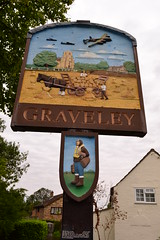
Village sign Graveley village sign depicts its aviation heritage.

Graveley airfield sits on the south side of Huntingdon, a few miles to the east of St. Neots in Cambridgeshire. It takes its unusual name from the nearby village. The airfield itself would see a number of changes to its infrastructure, including both upgrades and improvements and it would be home to several different squadrons during  its wartime life.

Initially built as a satellite for RAF Tempsford, Graveley opened in March 1942 when it accepted its first residents, 161 (Special Duty) Squadron.  Formed from a combination of elements from both 138 Sqn and the King’s Flight, it had been formed less than a month earlier at RAF Newmarket  and would bring with it the Lysander IIIA, the Hudson MkI and the Whitley V.

The role of the Special Duty Sqn  was to drop agents of the Special Operations Executive (SOE) into occupied France, a role it would perform throughout its operational wartime life.  Their stay at Graveley would however be short lived, remaining here for a mere month before departing to  Graveley’s parent airfield in Bedfordshire, before moving elsewhere once more.

By the war’s end, Graveley would have become a complete operational airfield in its own right, forming part of Air Vice Marshall Donald Bennett’s 8 Group, with the Pathfinders. After upgrading, its initial concrete runways of 1,600 yards, 1,320 yards and 1,307 yards would be transformed into the standard lengths of one 2,000 yards and two 1,400 yard runways; the measures associated with all Class ‘A’ specification airfields.

Accommodation for all personnel was spread around the north side of the airfield, across the main Offord to Graveley road. These were separated into nine separate accommodation areas, incorporating both a separate communal area and sick quarters. Graveley would, once complete, accommodate upward of 2,600 personnel, a figure that included almost 300 WAAFs.

As with all sites, the bomb store was well away from the accommodation area, to the south-west, partially enclosed by the ‘A’ frame of the three runways. The 50 foot perimeter track linked these runaways with 36 pan style hardstands, all suitable for heavy bombers (after the extension three of these were replaced by loops). The main technical area, with its range of stores, workshops and ancillary buildings lay to the north-west, where two of the three T-2 hangars were also located, the third being erected to the south-east next to the only B-1 hangar on the site.
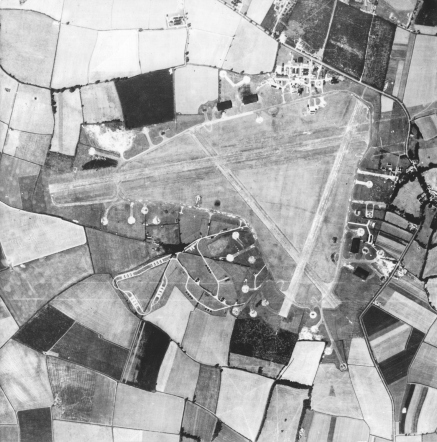
scan10_020

RAF Graveley (author unknown)

Following the immediate departure of 161 Sqn, Graveley lay operationally dormant. However, in May’s ‘1000’ bomber raid, aircraft from 26 OTU based at RAF Wing, flew from Graveley as part of the massive bombing operation. Sadly four of the Wellingtons (all Mk ICs) failed to return; WS704, DV740, DV707 and DV709. One of these, DV709 crashed some thirteen miles north-east of Cambridge whilst trying to make an emergency landing at Graveley. Unfortunately, when the aircraft came down, it overturned killing two of the crew on board: Sgt. J. Dixon the pilot, and Sgt. B. Camlin the tail gunner. Both these airmen were laid to rest in Beck Row Cemetery, at nearby Mildenhall.
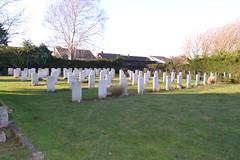
St. John's Church Beck Row, Mildenhall

Beck Row Cemetery, Mildenhall.

The difficulty faced by Bomber Command crews in accurately hitting targets at night had, by now, become a problem for the ‘top brass’ at High Wycombe, and by April 1942, it had been decided, much against the views of Arthur Harris, that a new special Pathfinder Force was to be set up as soon as possible. As if adding salt to the wound, Harris was then instructed to organise it, and with a mixed charge of emotions, he appointed the then Group Captain Don Bennett, a man who had proven himself to have excellent flying and navigation skills.

Bennett then took charge, and on August 15th 1942, he formally took control of the new 8 (Pathfinder) Group, consisting of a specialised group of airmen who were considered to be the cream of the crop.

With its headquarters initially at RAF Wyton, Bennett received the first five founder squadrons of which 35 Sqn was one, the very day they moved into Graveley airfield.
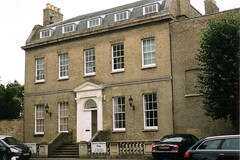
Castle Hill House, Huntingdon

Castle Hill House, Huntingdon, headquarters of the Pathfinders 1943 – 45. (Photo Paul Cannon)

Initially arriving with Halifax IIs, 35 Sqn would upgrade to the MK III in the following October, and then to the Lancaster I and III a year later. There would be little respite for the crews arriving here however, for they would be flying their first mission from Graveley, just three days after their initial arrival.

On the night of 18th/19th August 1942, a total of 31 PFF aircraft left to mark the target at Flensburg, close to the German-Danish border. However, poor weather and strong winds, prevented accurate marking, and two Danish towns were accidentally bombed as a result. It was a rather disastrous start for 35 Sqn and the Pathfinders.

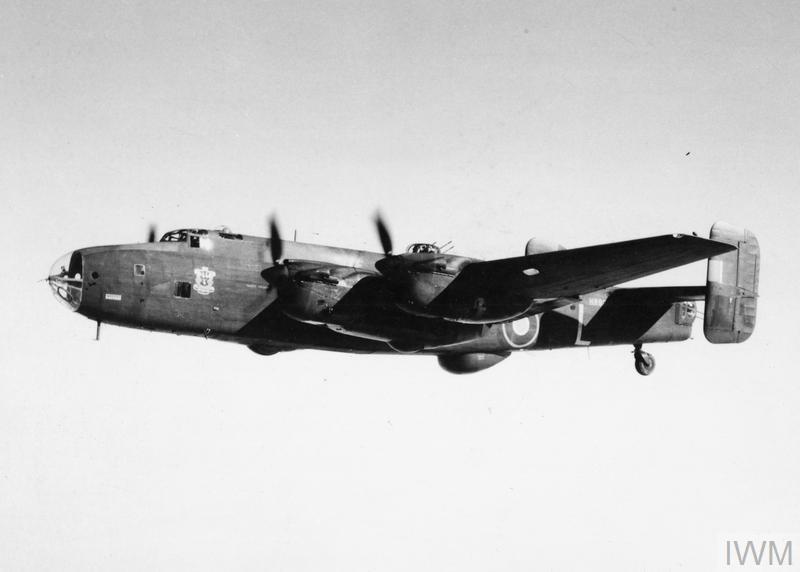
Another blow was to fall 35 Sqn a month later, when on the night of 19th September 1942, the experienced 24 year old Wing Commander James.H. Marks DSO, DFC was lost when his Halifax II (W7657) ‘TL-L’  crashed at Blesme in France. Also being lost that night with W.C. Marks, was 19 year old F.L. Alan J. Child DFC and 25 year old F.O. Richard L. Leith-Hay-Clark; the remaining three crewmen being taken prisoner by the Germans. The squadron designation for this aircraft would then be reallocated, as was the case in in all squadrons, and as if bad luck were playing its hand yet again, that aircraft, Halifax HR928, would also crash with the loss of all its crew, including the highly experienced Sqn Ldr. Alec Panton Cranswick.
graveley

Halifax Mark II Series 1A, HR928 ‘TL-L’, 35 Sqn RAF being flown by Sqn Ldr A P Cranswick, an outstanding Pathfinder pilot who was killed on the night of 4/5 July 1944 on his 107th mission. The Cranswick coat-of-arms decorates the nose just below the cockpit.(I© IWM HU 92966)

In October, Gravely made history when it was earmarked to become the first operational airfield to test the new and revolutionary fog clearing system, FIDO. Classified as Station II, it would be the second of only fifteen British airfields to have the system installed and whilst it had its opponents, it was generally accepted and greeted by all who used it.

Installed by contractors William Press, the system’s pipes were laid along the length of the runway, a not easy feat as operations continued in earnest. One of the initial problems found with the FIDO system, was the crossing of the intersecting runways, pipes had to be hidden to avoid aircraft catching them and an obvious disaster ensuing. Two types of pipe were laid at Graveley, initially the Four Oaks type burner, but this was later replaced by the Haigas (Mk.I) burner. A more complex system, the Haigas took considerable time to install but by January 1943 it was ready, and an aerial inspection was then carried out by Mr. A Hartley – the Technical Director of the Petroleum Warfare Dept (PWD) and Chief engineer of the Anglo-Iranian oil Co. It was Hartley who later played a major role in PLUTO, the cross channel pipeline installed for D-day. Hartley, himself a non flyer, was flown over the burning pipes in a Gypsy Major by no less than Don Bennett himself.

It was later, on February 18th, that Bennett made the first four-engined heavy bomber FIDO landing at Graveley, using a Lancaster of 156 Sqn from Oakington. Setting off from Oakington, Bennett headed towards Graveley airfield, and with the burners lit, he remarked how he was able to see them from some 60 miles distant, the fire providing a far better light than searchlights alone, the means by which aircraft had been guided home on foggy nights previously. A great success, Bennett requested that certain minor modifications be made as he thought pilots could be distracted by the cross pipes at the threshold of the runway. Hartley keen to please Bennett, duly arranged for the necessary alterations and the modification were carried out without further delay.  However, further problems were to come to light on the the first operational lighting of the system, when bushes, hedges and telegraph poles adjacent to the pipelines were ignited due to an extension of the system passing through a nearby orchard!

The installation of FIDO meant that huge oil containers had to be installed too. At Graveley, sixteen cylindrical tanks were mounted in two banks, each tank holding up to 12,000 gallons of fuel. These tanks were kept topped up by road tankers, there being no railway line nearby as was the case at other stations.

Over the next few months, FIDO was tested further, but for various reasons its benefits weren’t truly exploited. On one occasion it was prevented from being lit by a crashed Halifax on the runway, the resultant lack of FIDO after the accident, was then blamed for the loss of two more aircraft, neither being able to safely put down in the poor conditions.  On another night, poorly maintained pipes caused burning fuel to spill onto the ground rather than heating the vaporising pipes above. Bennett somewhat angry at this, once more requested modifications to be made, needless to say they were not long in coming!

With further trials, one pilot was remarked as describing flying through FIDO as “entering the jaws of hell”*1 but once crews were used to it, the benefits were by far outweighing the drawbacks.

The safety of FIDO could not assist all crews though, and a number of other experienced crews were to be lost from Graveley over the next few months. But all news was not bad. The night of 18th/19th November 1942 saw a remarkable turn of fortune.

In Part 2 we see how Graveley sees out the war, the changes that occur, the new aircraft and new squadrons that arrive.

The whole trail can be read in Trail 29 – Southern Cambridgeshire.
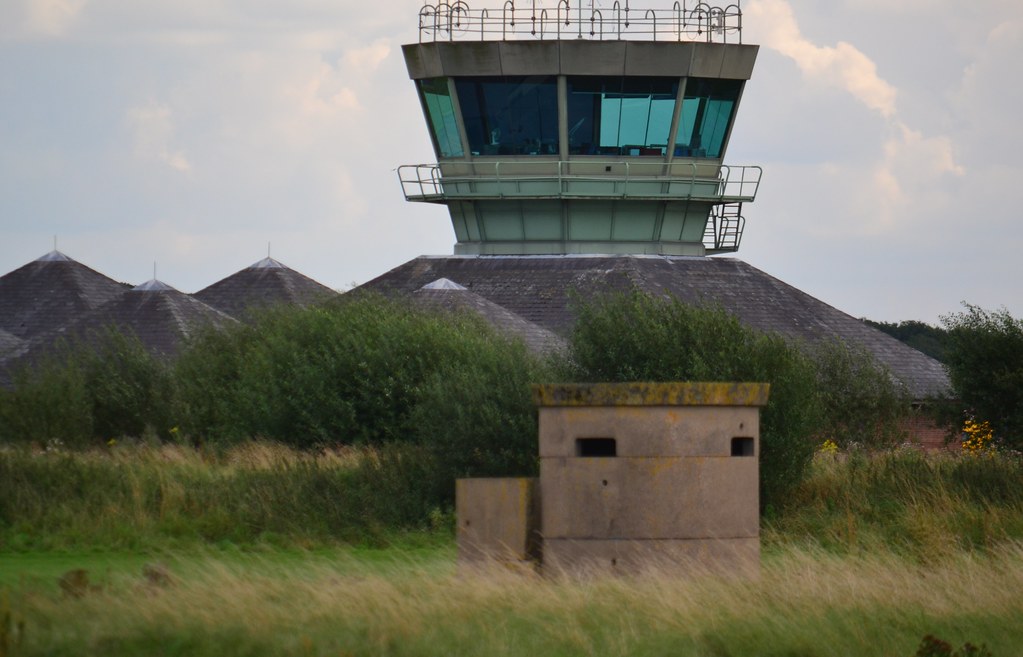
RAF Leeming – The Great North Road (Pt 3).

In the next part of this trail, Leeming enters the jet age, its future still in the balance as many of Britain’s airfields are closed and sold off. But with new aircraft coming on line and a new threat looming from the east, Leeming survives and takes on a new role.

The end of World War 2 saw a Europe devastated by war. The Eastern countries liberated by the Russians had survived the tyranny of the Nazi regime, only to be embroiled in Communist hardship and doctrines. A new threat was emerging as mistrust grew between the Eastern Bloc and the Western Allies. A new Europe would emerge hanging delicately by a fine thread of peace: the Cold War was approaching.

Immediately though, there was little need for many of Britain’s extensive range of wartime airfields, and many were either put in to ‘Care and Maintenance’, sold off or simply closed and left to decay. But this new threat would see some of Britain’s wartime airfields remain open, some turning into missile bases, and some continuing in the air defence or strategic bombing role. For Leeming, this was perhaps, its saviour.

Within a month of the Canadian’s departure, a new unit would arrive at Leeming, not a front line fighter squadron nor a heavy bomber squadron, but a training unit, 54 Operational Training Unit (O.T.U.), which had been operational throughout the war. Flying a range of aircraft types, they were a far cry from the heavies that had preceded them over the last two years or so.

Their arrival in June was heralded by the ferrying in of a number of aircraft types, ranging from Tiger Moths to  Martinets and Wellingtons. Fighters such as the Tempest and Mosquito were also brought in during these early days of post war Leeming. The purpose of 54 O.T.U. was as a night fighter training unit, using ‘modern’ radar sets whose development had started during the war.

But years of neglect and a lack of funding, had meant that many of Britain’s airfields – to which Leeming was no exception – were in a poor state of repair, and much work was urgently needed to bring them up to a good standard. Over the next year or so, major repairs would be carried out. As a priority, the wartime accommodation buildings and now outdated water system were targeted first. Help in doing this was enlisted from German P.O.W.s who were yet to be repatriated, billeting them in the former accommodation blocks within the airfield grounds.

The immediate post war era saw a massive demobbing of forces personnel, this led to a  decline in service manpower, a move that resulted in the 1949 National Service Act. As a result of this act, adults between 17 and 21, were required, by law, to perform 18 months National Service.  This draft led to an influx of untrained personnel, who were brought in to fill gaps in important trades, but short service lengths meant the training was inadequate for many, and so a number of unskilled or poorly skilled personnel were placed in prime engineering positions. This lack of skilled personnel may well have contributed to a number of the many minor and major mishaps that occurred in the R.A.F. in the immediate years following the war.

Training new pilots was a risky business in these post war days, and on November 8th 1946, Pilot – Sqn. Ldr. Noel Dan Halifax R.A.F. (s/n: 33404), and his navigator F.O. Roy Edward Chater R.A.F.V.R. (s/n: 194286) were both killed whilst undertaking a training flight out of Leeming airfield. Chater was one of many young men who had come from the Emanuel College, Cambridge and was 21 years of age at the time of his death*6; his pilot was 27.

On that fateful day, the Mosquito, an NF30  serial number ‘NT266’, departed Leeming  in the late morning on a cross country training flight. Part of this flight took the Mosquito across the moors to the east of Leeming airfield. Whilst over the moors, the aircraft entered thick cloud which may have caused ice to form on the wings and / or control surfaces of the aircraft. The pilot, whilst a veteran of the Second World War and a Colditz inmate, had been in a P.O.W. camp for many years and was possibly inexperienced in both the aircraft type, and the weather conditions in which they were flying. After entering the cloud, the aircraft was then seen by a local farmer to dive in to the ground at Pockley Moor – killing both crewmen outright – the aircraft digging itself into the soft Moorland, where parts of it remain today. The Mosquito, a Leavesden aircraft built under contract 1/576 had only been at Leeming since the July, and was struck off charge as a result of the crash.

On May 1st the following year (1947), following the disbandment and subsequent merging of 54 O.T.U. with 13 O.T.U., a new unit, 228 Operational Conversion Unit (O.C.U.) was formed at Leeming. Flying a mix of piston engined and jet aircraft, it would eventually disband in 1961 before being reformed at Leuchars in Scotland in 1965.

One of the many types operated by the O.C.U. included the Meteor NF.36, a night fighter version of the Meteor that would be fitted with American built radar units. A delay  in supply of these models though meant that their presence would be limited, resulting in the reintroduction of the MK.XXX – a previous version of the aircraft. With a mix of aircraft types and a new influx of engineers, Leeming would soon see a return of the problems experienced by the Canadians only months before during the war.

Specialist tooling, experience in different aircraft and new parts were all once again in short supply, and in early 1948, this combination may well have led to the loss of a second Mosquito along with its pilot. In fact, as the 1940s drew to their close, pilot error and engine problems were commonly recorded as the causes of such accidents.

The O.C.U. would provide the opportunity for crews to convert from one aircraft type to another. The rise in tension in the Middle East (of which my father was to be a part of) saw the introduction firstly of the Brigand conversion course, and later the Mosquito light bomber course. These were then joined by both the Beaufighter and Meteor 7 courses. But these courses were dogged by delays, primarily due to the high number of unserviceable aircraft, created as a result of these aforementioned issues.

The early 1950s saw further changes to the R.A.F.’s training programmes, as squadrons were disbanded crews were posted elsewhere, and the aircraft they had been operating were moved about or scrapped. With much of this occurring at Leeming, the airfield would become a hive of activity. The silver lining on this rather dark cloud though, meant that the older outdated piston engines were disposed of, and more jets were brought in. The R.A.F.’s modernisation could at last perhaps begin.

RAF Leeming

A mix of old and new at Leeming.

On August 13th 1951, one of the most tragic of post war accidents was to happen to two Leeming aircraft – a Wellington and a Martinet both operated by 228 O.C.U. 

The two aircraft were carrying out air interception flights, the Wellington being used to train aircrew in the use of the interception radar, and the Martinet playing the part of the ‘target’. This was seen as an opportunity to give good experience to a group of Air Cadets who were visiting Leeming, both to see how these flights were carried out, and to give them experience in flying – it was meant to be a joyful day, but it sadly turned very sour with no warning.

With Cadets taking turns in each type, the two aircraft departed Leeming, and headed out over the Yorkshire countryside, the Martinet hiding amongst the cloud whilst the Wellington tried to track it.

The MK.XVIII Wellington (PG367) was flying over Husdwell in North Yorkshire with a crew of seven on  board that included one Air Cadet. The Martinet had a crew of two, again one was an Air Cadet gaining flying experience in the aircraft.

All of a sudden, the Martinet appeared of of the clouds colliding with the Wellington who had ironically failed to see him. The two aircraft struck each other, the collision causing the Martinet to immediately fall groundward killing instantly both the Cadet and the pilot. The Wellington meanwhile began to spin and break apart. The tail section, holding the parachutes, broke away leaving the crew stranded in the main fuselage. An experienced member of the crew, Ft. Lt John Alan Quinton (R.A.F.) G.C., D.F.C. managed to locate one parachute, strapped it onto the young cadet before he either fell, or was pushed  out, through the hole left by the now missing tail. 

With no further means of escape, the crew could do nothing but await their fate, one that came within moments and with the inevitable fatal consequences.

Of the nine people on board the two aircraft that day, only one, the cadet, sixteen year old Derek Coates A.T.C., survived, the remaining eight all being killed when the two aircraft hit the ground.

As a result of his actions, Flt. Lt. Quinton was awarded the George Cross posthumously, details being published in the London Gazette on 23rd October 1951:*8

CENTRAL CHANCERY OF THE ORDERS OF KNIGHTHOOD.
St. James’s Palace, S.W.I.
23rd October. 1951.

The KING has been graciously pleased to approve the posthumous award of the GEORGE CROSS to: —

Flight Lieutenant John Alan QUINTON, D.F.C. (115714), Royal Air Force, No. 228  Operational Conversion Unit.

On August the 13th, 1951, Flight Lieutenant Quinton was a Navigator under instruction in a Wellington aircraft which was involved in a midair collision. The sole survivor from the crash was an Air Training Corps Cadet who was a passenger in the aircraft, and he has established the fact that his life was saved by a supreme act of gallantry displayed by Flight Lieutenant Quinton, who in consequence sacrificed his own life. Both Flight Lieutenant Quinton and the cadet were in the rear compartment of the aircraft when the collision occurred. The force of the impact caused the aircraft to break up, and as it was plunging towards the earth out of control, Flight Lieutenant Quinton picked up the only parachute within reach, and clipped it on to the cadet’s harness. He pointed to the rip cord and a gaping hole in the aircraft, thereby indicating that the cadet should jump. At that moment a further portion of the aircraft was torn away and the cadet was flung through the side of the aircraft clutching his rip cord, which he subsequently pulled and landed safely. Flight Lieutenant Quinton acted with superhuman speed, displaying the most commendable courage and self-sacrifice as he well knew that in giving up the only parachute within reach, he was forfeiting any chance of saving his own life. Such an act of heroism and humanity ranks with the very highest traditions of the Royal Air Force, besides establishing him as a very gallant and courageous officer who, by his action, displayed the most conspicuous heroism.

Since then, a memorial has been dedicated to those who died, so their names may live on and so that the tragic accident may never be forgotten.

It was during this early part of the 1950s, that it was decided to upgrade Leeming to accept more jets, a new perimeter track and an extension to the runway was needed, better radio networks and accommodation blocks were required. Work began over the winter of 1951/52 which caused major disruption for those stationed at the base; so to allow flying to continue, it was decided to transfer the O.C.U. to RAF Coltishall. To add insult to injury, the snow and bad weather of 1951/52 further delayed the transfer of the O.C.U., the process not being completed until February at the earliest. By the summer though, work was almost completed and the O.C.U. returned now having in excess of 40 Meteors on its books. Leeming had now properly entered the jet age.

The increase in world tensions and improvements to the Air Force’s readiness, saw many reviews of the training programmes. Leeming’s wing was divided into three squadrons, each one focusing on a different aspect of flying training. Students would pass though each section before being allocated to an operational unit.

During the mid 50’s yet more work was carried at Leeming, including resurfacing of runways, a new airfield lighting system and further extensions to the accommodation areas. A new Vampire also emerged, the T.II, and new a Meteor, the NF.12.

1956 would see the jet age take a step further, with more new models arriving at Leeming destined for the O.C.U., that of Gloster’s Delta winged Javelin F.A.W.5.  To deal with the lack of trained crews required by the increase in numbers of squadrons waiting to transfer over to the Javelin, a ground training section was created within 228 O.C.U. – that of the Javelin Mobile Training Unit (J.M.T.U.) in early 1957.

Set up using simulators and radar equipment in caravans, a flying classroom was provided in one of two Vickers Valletas, a twin engined aircraft used to replace the Dakotas used in wartime. Gradually over time, a dedicated trainer version of the Javelin was brought in, the T.3, which meant that by 1959, the J.M.T.U. was no longer required, and it was disbanded.

The Javelin’s ingress into squadron life was slow,  until the September of 1957, when 33 Squadron (reformed following the disbandment of 264 Sqn) arrived at Leeming. Initially bringing more Meteors, they transitioned over to the Javelin F.A.W. 7 in the summer of the following year. Based on a design requirement F.44/46 for a twin-seat all weather / night fighter, the Javelin was developed into over ten different marks before its production was finally curtailed.

33 Sqn would not stay long though, apart from a short revisit it departed Leeming a year later, moving to Middleton St. George, now Durham Tees Valley Airport.

The transference to the Javelin was now happening in earnest, and with so many front line squadrons converting to the Javelin, it was imperative that training was increased. However, politics would play their part in the downfall of 228 O.C.U. and its eventual, but temporary, demise. With somewhere in the region of over eighty aircraft operated by the squadron, Duncan Sandy’s 1957 Defence White Paper would see RAF units cut back once more as numbers were reduced in light of perceived changes in the style and nature of any future nuclear war. The O.C.U. was therefore, disbanded in 1962 after it had moved to Middleton St George, its role ceasing after many years of active and all but unbroken duty since 1929.

The White Paper of 1957 is often considered as one of aviation’s greatest scythes cutting five major aircraft projects and two engine development programmes.  The first of these, the Avro 730 was followed by, the Saunders-Roe SR.177, the Short Seamew (a small lightweight anti-submarine aircraft), the Fairey Delta 3 Long Range Interceptor and the The Hawker P.1121. The Lightning was also hit hard but survived the cull to fill the gap between manned interceptors and ground to air missiles. Whilst cancelling these projects others did survive, the thin Wing Javelin (cancelled post White paper), the Hunter, and of course the Harrier, a remarkable leap in aviation*9.

A number of visiting units stopped by at Leeming during this turbulent time of the late 1950s / early 1960s. This brought a lot of aircraft and a lot of personnel, which Leeming, as an already cramped base, could not ideally hold. But the extensive range of aircraft must have made for excellent viewing for those interested in aviation.

Following the departure of 228 O.C.U., Leeming would immediately be occupied by another unit. The arrival of No. 3 Flying Training School (F.T.S.), under the control of 23 Group Flying Training Command.

In the last part of this trail, we see how Leeming became a front line operational station, giving up the training role to accommodate the R.A.F.’s modern front line fighter of the time the Tornado.

The full Trail can be seen in Trail 57.