In Part 3, we saw how Hunsdon and gone through various squadrons, operating the ill fated Turbinlite system which was soon withdrawn, and onto the arrival of the Mosquito, a deadly aircraft that could out run every German aircraft at its introduction. It was now time to bite, and the bite would come directly at the heart of the Gestapo.
In one of the war’s most famous attacks, so many questions would be asked, but answers would be short-coming and the truth may never come out.
The new wing, previously formed at Sculthorpe, would consist of the three multinational squadrons, a ‘British’, Australian and New Zealand unit, and all would be based at Hunsdon as part of the RAF’s Second Tactical Air Force (2TAF) designed to support troops in the forthcoming invasion.
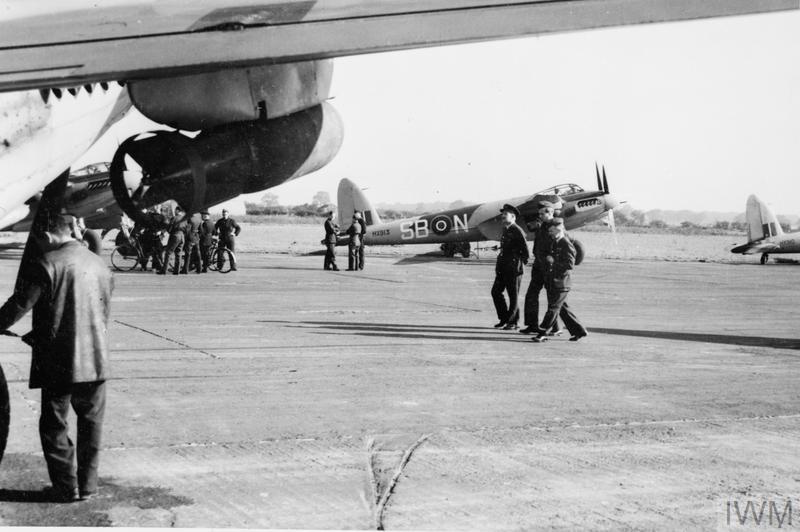
Group Captain P C “Pick” Pickard (centre), Commander No. 140 Wing, flanked by Wing Commander I G E “Daddy” Dale, Commanding Officer of No. 21 Squadron RAF (to Pickard’s right), and Wing Commander A G “Willie” Wilson, Commanding Officer of No. 487 Squadron RNZAF, visit No. 464 Squadron RAAF at Hunsdon, prior to a daylight raid against flying-bomb sites in the Pas-de-Calais. 464’s Mosquitoes (FB Mk VIs) have been loaded with 250-lb MC bombs for the operation: HX913 ‘SB-N’ can be seen in the background (@IWM HU 81335).
Between 1944 and 1945, 140 Wing would carry out many daring low-level bombing raids against V weapons targets, along with a key Gestapo building and a prison in occupied Europe. These particular raids were designed to both free captive resistance fighters and destroy important Gestapo documents. Operation Carthage took place in Denmark and occurred whilst the wing was based at RAF Fersfield in 1945, but the first, Ramrod 564 or ‘Operation Jericho’ as it has since become known, took place whilst they were based here at Hunsdon in early 1944.
There is a lot of speculation around Ramrod 564, many of the official records are missing, inaccurate or even vague. The operational record books for the four squadrons involved (three Mosquito and a Typhoon) are recorded as ‘secret’ and contain no details other than aircraft, times and dates.
However, we do know that the Operation, formulated by Air Vice Marshal Basil Embry, would be critical, even the amount of explosive itself had fine limits. Time was also of the essence, as several prisoners were thought to be destined for execution and so a time limit was placed on when it needed to be done by. The exact time of day was also critical, they needed as many guards to be in one place as possible, and the prisoners needed to be safely gathered together out of harms way. So, a time of 12:00 pm precisely on a date between 10th and 19th February was chosen, as both the guards and prisoners would be having lunch at this time. In the attack, six Mosquitoes would breach the outer wall in two places, whilst a further six would bomb the main prison buildings allowing the prisoners to escape whilst killing as many guards as possible.
Embry elected himself to lead the attack, but this was blocked by those higher up, As a result, and much against his wishes, Embry therefore had to choose a successor. Group Captain Percy C. Pickard (D.S.O. and two bars, D.F.C.) was chosen, but even though he was known as an expert pilot and leader, Embry was not convinced of Pickard’s ability to complete the job at such low level. Despite his reservations though, Embry duly informed Pickard of the decision and preparations for the operation began in earnest.
On February 18th that year, a day after the initial planned attack and in extremely poor weather, 19 Mosquitoes including a photo reconnaissance MK.VI (from the Operational Film Production Unit (OFPU) for propaganda purposes), took off to attack, breech and destroy the walls and main building of the Amiens prison. A famously brave act, it resulted in the death of 3 crew members; Gp. Capt. Percy C. Pickard, and Flt. Lt. John A. Broadley, (RNZAF), both in Mosquito HX922, ‘EG-F’ and Flt. Lt. Richard W. Samson, (RNZAF) in Mosquito MM404 ‘SB-T’. Samson’s pilot, Sqn. Ldr. A. I. McRitchie survived his crash and was taken as a prisoner of war. Two Typhoons from 198 Sqn escorting the Mosquitoes are also thought to have failed to return (the ORBs don’t confirm this). Considered a success at the time, evidence has since come to light to suggest that the operation was ‘unnecessary’, and may have failed to achieve anything more than a successful PR role (see end note). *1
(A better quality version is available on the Pathe News website.)
All that aside, the raid took place at very low level and in poor weather, with bombs dropped against the wall with delayed fuses. There was little resistance on the flight in and Typhoons provided higher cover when it was needed.
The route would take the Mosquitoes from Hunsdon to Littlehampton – then via appropriate lattice to Tocqueville – Senarpont – Bourdon – then one mile South Doullens – Bouzincourt – two miles west-south-west to Albert – Target – Turn right – St. Saveur – Senarpont – Tocqueville – Hastings and back to Hunsdon.
During the flight out, four Mosquitoes and three Typhoons of 198 Sqn became lost in swirling snow and were forced to turn back as they had now lost contact with their main formations. The remaining crews flew on, but whilst over France a fifth Mosquito, flown by Flt. B. Hanafin, suffered engine problems and was also forced to turn back. On his return journey his was attacked by Flak from which he was seriously injured. Helped by his navigator the two were able to land back at RAF Ford where he was given medical treatment for his injuries.
Just three minutes behind schedule, the first wave of three aircraft followed the main road toward the prison’s eastern wall at tree top height. The second wave would attack the northern wall. Wg. Cdr. I. Smith 487 Sqn went in first dropping the bombs with 11 second fuses against the wall.

Wing Commander I Smith, Commanding Officer of No. 487 Squadron RNZAF, at Hunsdon (©IWM CH 12649)
The third and fourth waves attacked the south-eastern main building and north-western end respectively. Chaos then ensued inside the prison, as over running bombs had caused some damage inside and some prisoners were injured or struggled to escape.
Noting now that the walls and prison had been breached, the signal to abort was issued over the VHF radio probably by both Pickard and the OFPU Mosquito flown by Flt. Wickham (both the code word “Red, Red, Red” and who sent it are also disputed) instructing the four aircraft of the 21 Sqn Flight not to bomb. The message was heard by the flight, when they were between 2 and 4 miles out from the target, and so returned to base without dropping their payload.
During all this time, FW.190s continued to swarm and various dogfights took place between them and the Typhoons, but not before they had attacked some of the fleeing Mosquitoes who also returned fire.
It is unclear at what point in the attack that Pickard was shot down, but a Focke Wulf 190 flown by the ace Feldwebel Wilhelm Mayer, severed his tail sending his aircraft to the ground near to Saint Gratien. The resultant crash killing both occupants.
The story goes that Pickard had left his dog ‘Ming’ at RAF Sculthorpe, their previous airfield, to be looked after whilst he was away. On the day he was shot down, 18th February 1944, the dog fell gravely ill. Pickard’s wife, Dorothy, went to get him and sensed, that after seeing the state of the animal, that Pickard had been killed . It took months for Ming to recover, and some years later whilst living in Rhodesia, Ming went outside, looked up to the sky as he always did when Pickard was flying, heard a whistle, collapsed and died.*6
Of the 700 prisoners detained inside the prison that day, 258 of them escaped,102 were killed and 74 were wounded*7, but the success remained secret from the public for a further eight months. With so much speculation surrounding the attack, it will no doubt remain one of the mysteries of war, but it was without doubt, an incredibly brave and daring mission that cost the lives of three superb young airmen.
A podcast using eyewitness accounts from the Imperial war museum can be heard through their website.
The Amiens raid was not the only daring low level raid carried out by the wing whilst at Hunsdon however. Airfields along with the Hazmeyer electrical equipment factory at Hengels in Belgium, were also attacked at low level. On this particular operation Mosquito MM482 was hit by intense flak setting the starboard engine on fire. As a result, the aircraft flown by Canadian Sqn. Ldr. A. W. Sugden with navigator Fl. Off. A. Bridger, was lost and both men were listed as missing. Having been with the squadron since 1942 they were considered ‘old timers’ by the others and were sorely missed.
The three squadrons of 140 Wing would soon depart Hunsdon though, leaving the joy of success and the turmoil of a thousand questions behind them. 464 went first on March 25th whilst 21 and 487 Sqns would both leave mid April, both moving to RAF Gravesend in Kent.
However, a month before the wing moved away, another Mosquito squadron would move in temporarily, meaning the airfield was awash with the aircraft of varying types. 409 (RCAF) Sqn’s time would be short, remaining here for just over a month before departing mid May, but they would return in June that same year staying for a further two months. Their final departure on the 25th August 1944, would end their association with Hunsdon for good, a move that took them to the continent and forward bases across the low countries.
Between June and the end of 1944, no less than six squadrons would come and go, most of them moving to the continent as the allied advanced progressed toward Germany. Each of these units would bring further Mosquitoes with them, with marks ranging from the MK.II and VI (418 Sqn); to the XIII with 29, 264 and 48 Squadrons, on to the XXX with 219 and 151 squadrons.
The longest to stay of these six units would be the first, 29 Squadron. Formed in 1915, they have operated almost continuously ever since, with just a short break between the wars and some reformation post war. Today they are based at Coningsby in Lincolnshire and are the southern most QRA Squadron currently flying Typhoons. They were in 1987, the first operational squadron to be equipped with the Tornado F3.
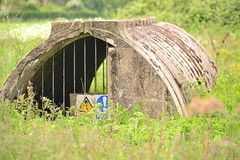
An air raid shelter now exposed.
At Hunsdon in 1944 though, the move would come as a surprise and with some reservations, but once here, it was considered to be an ‘improvement’ on West Malling. 29 Squadron would fly the NF. XIII Mosquito, arriving here on June 19th that year. The NF.XIII was the first variant night fighter to have the strengthened wing of the FB.VI, with increased fuel load and Merlin 23 engines. One such example, HK428 ‘RO-K’built at Leavesden, joined 29 Sqn at RAF Ford in early 1944.
On October 24th that year, during a flight test at Hunsdon, the aircraft suffered an overheating starboard engine and inactive flaps whilst in poor visibility. As a result the aircraft overshot the runway and crashed into a hedge causing the starboard undercarriage to collapse further damaging the aircraft. HK428 was subsequently repaired and passed to the Gunnery School at Catfoss in early 1945. It was eventually one of many that met the scrap man’s axe in 1946.*4
The Squadron would carry out patrols and intruder operations and whilst many of these were ‘uneventful’, several enemy aircraft were shot down including both Ju. 88s and Me. 110s. The last months of the war though were not all plane sailing. On July 1st, an accident during a flying test resulted in the loss of two good airmen and friends, Flt. Lt. John Barry and Fly. Off. Guy Hopkins. A second Mosquito was hit by light flak at 500 feet on the 5th. Flying home on one engine, the aircraft made and emergency landing at RAF Ford, but somersaulted on the ground writing the aircraft off. Thankfully, and remarkably, in this instance neither crewman sustained any injury.
As the allies advanced more intruder missions took place. On some days the squadron was “let loose” to pick and locate their own targets, many choosing road or rail stock, damaging many trains as a result. The rest of the year and into 1945 would be the same. Intruder missions, ‘Flower‘ Operations (attacks against German night fighters at their airfield) brought some results. Then almost as quickly as they arrived they were given notice to move once more, and a huge party on the night of February 22nd 1945 preceded their departure to Colerne
Two other units arrived at Hunsdon after 29 Sqn, those of 418 (25th August, 1944) and 219 (29th August 1944) Squadrons. With all these Mosquitoes there must have been little room for any more aircraft as Hunsdon quickly filled up with the type. 219 Sqn would quickly move out though, leaving what little space there was for a new unit, 488 Squadron who moved in the day prior to 219’s departure. The last of this group of units to arrive that year was 151 Squadron. All but 151 transferred to the various airfields on the continent whilst 151 remained in the UK, leaving Hunsdon on March 1st 1945. It had certainly been a busy period at this Hertfordshire airfield.
1945 would be a reflection of the hectic movements of 1944. However, it would also bring a greater variety of aircraft as detachments arrived posted away from their main unit. It would also bring a slight change of role, as the range of twin engined Mosquitoes departed, single engined fighters came in.
The first would be a small detachment of 285 Sqn Hurricanes who resided here between January and June, followed in the beginning of March by 154 Sqn with Mustangs and Spitfires. 154 Sqn time here would be very short though, sadly ending their days here, just eighteen days later.
Almost at the same time, these units would be joined by 501 Sqn and 611 Sqn, 501 also ending their days of active duty here with their Tempest Vs, whilst 611 would swap their Spitfire VII for Mustang IVs before moving off to Peterhead and disbandment also. Both these units would however rise again the following year being reborn as the jet age dawned, to live on for a few more years.
442 Sqn, another Canadian unit, ended the flurry of units arriving in March that year when they brought Spitfire IXEs back for a spell from the continent, being stationed recently at B80 (Volkel) and B88 (Heesch), they had seen action first hand before arriving here. They soon replaced these aircraft with Mustangs though, moving on to RAF Digby in May as the war ended. 442 were also a short lived squadron, only being formed at Digby in February 1944. Their operational life had lasted just eighteen months.
April and May saw the last of the front line squadrons to reside at Hunsdon. The closing days of April saw 441 with Spitfires and 287 Sqn with a detachment of Tempests Vs. Both these units would move on elsewhere before they too saw the curtain fall, and their days as operational units cease. Like its sister squadron, 441 had only been operational for eighteen months, being formed in unison. In fact, their entire operational record matched to the day, even when they moved abroad.
Hunsdon then closed to operational activity, being used to receive returning men and materials up until mid 1946 whereupon it was placed into Care and Maintenance and allowed to run down. The tower was demolished very soon after the war ended, and the site was returned to agriculture. In total, Hunsdon’s crews accounted for over 220 enemy aircraft destroyed or damaged – a remarkable feat in any airfield’s chapter.

One of the original dispersal pans.
Today Hunsdon remains one of the more accessible airfields of Britain. A number of public footpaths criss-cross its boundaries allowing unprecedented access to it. It is still an active site, allbeit much reduced – a small microlight operation exists here and has done since 1997. Using three small grass runways it has brought life, in albeit a small part, back to this old wartime airfield.
The perimeter track and narrow sections of all its runways still exist today and can be walked using a variety of footpaths. Along these paths and off to the sides can still be seen examples of runway lighting, drainage, inspection covers and even a small number of buildings.
The parachute store is one of the most notable of these, used by the farmer for storage, it is located at the north-western side of the airfield near to the former admins site and where the tower would have stood before being torn down. Also near here is the fire tender shed, now home to the local shooting club, a number of latrines \ wash blocks can also be found hidden amongst the trees to the south-east. The battle headquarters rests nestled amongst the crops still watching over the site, and small defence trenches and shelters can be found to the north and again these are visible from public footpaths. A number of airfield defences buildings in the form of pill boxes and an Oakington style pillbox can also be found around the site.
Many of these examples are buried amongst the undergrowth and are most easily seen in winter when the thorns and vegetation are at their lowest. Careful searching will also reveal a number of minor archaeological examples but again best in the winter when crops and weeds are minimal.
To the northern side of the airfield, next to where the microlight site is based, is a memorial to the crews of all nationalities who were based here all those years ago. Formed from a propeller boss of a Mosquito, it was donated to by the former Mosquito Museum (now de Havilland Aircraft Museum), it stands proud looking down what was the length of the secondary runway. A further memorial plaque can also be found on the wall of the village hall.
Hunsdon is a small site with a big history. It played a large part in trials of new innovations, carried out night intruder missions, and attacked with daring at low-level, at the very heart of the Gestapo. Hunsdon and its crews proudly earned their place in the annals of world history.
After walking Hunsdon we travel the short distance to the north-east to the outskirts of Bishop Stortford and a little known about airfield that is all but gone. We go to RAF Sawbridgeworth.
Further Reading and Sources (RAF Hunsdon)
*1 – The Amiens raid is one that has become embedded in history and is beyond doubt an incredible and daring low-level raid that succeeded in its aim. However, official records seem to have many errors, anomalies or missing details that it is very difficult to ascertain the accuracy of these historical ‘facts’.
The ORBs for each of the four squadrons give no details other than an ‘operation to France’, some crew names and aircraft numbers. There is no record of the use of the word ‘Jericho‘ but there are two sides to this story.
Some authors including Rowland White “Mosquito” and John Laffin “Raiders – Great Exploits of the Second World War“, both cite Basil Embry as the creator of the name ‘Jericho‘ before the missions took place, whilst Robert Lyman “The Jail Busters” cites a French film, made in 1946, as the author of creator of the name. Some believe the name was created by various media outlets since then whilst others say that Embry created the name after the operation had been carried out. It is however, widely considered that it was a post-war name as the original operation was ‘Ramrod 564‘ and none of the ORBs use the name ‘Jericho‘. To further add mystery, the use of the title ‘Renovate‘ has also cited, but records in the National Archives show this as the secret VHF code word to be used by aircraft on the operation and not the Operation title.
The name aside, and more recently, one of the French Resistance fighters revealed his doubts about the operation, and considers that it may have been nothing more than a propaganda operation or a diversionary attack linked to D-Day. One book (one amongst many) on the subject has been written by author Simon Parry and historian Dr Jean-Pierre Ducellier entitled ‘The Amiens Raid – Secrets Revealed‘ and is published by Red Kite. It goes into the details of the raid and possible reasons behind it.
There have also been theories that it was an MI6 operation but due to the nature and secrecy of the mission, little evidence is publicly available to substantiate this.
Of those who lost their lives, both Pickard and Broadley are buried in St. Pierre Cemetery, Amiens, whilst Sampson is buried in the Poix-de-Picardie cemetery in the Somme region.
*2 There is further information and personal stories about Tubinlite operations on RAF 23 Squadron, and they can be found on the 23 Squadron Blog site (1) and (2). All ten were raised to squadron status on 2nd September 1942, but due to administration problems, five were not established until 8th September 1942)
*3 McCloskey, K., “Airwork – A History“. The History Press, 2013 (An excellent account of Airworks and their part in the Turbinlite project).
*4 Thirsk, I., “de Havilland Mosquito – an Illustrated Story Vol 2” 2006, Crecy Publishing Limited.
*5 Photo from vintage wings website.
*6 Gunn, P.B., “Flying Lives – with a Norfolk Theme“, Peter Gunn, 2010
*7 National Archives, archived documents available via the old website
McCloskey, K., “Airwork – A History” History Press, 2012
National Archives: AIR 27/704/9; AIR 27/2001/1 – 19; AIR 27/33/21; AIR 27/704/39; AIR 27/704/11; AIR 27/1045/27; AIR 27/1045/33; AIR 27/1045/37; AIR 27/1802/55; AIR 27/1802/57; AIR 27/342/11
Vintage Wings of Canada Website
For information on building the memorials at Hunsdon and Sawbridgeworth visit Hertfordshire Airfields Memorial Group website.
The full story of RAF Hunsdon can be read in Trail 25.
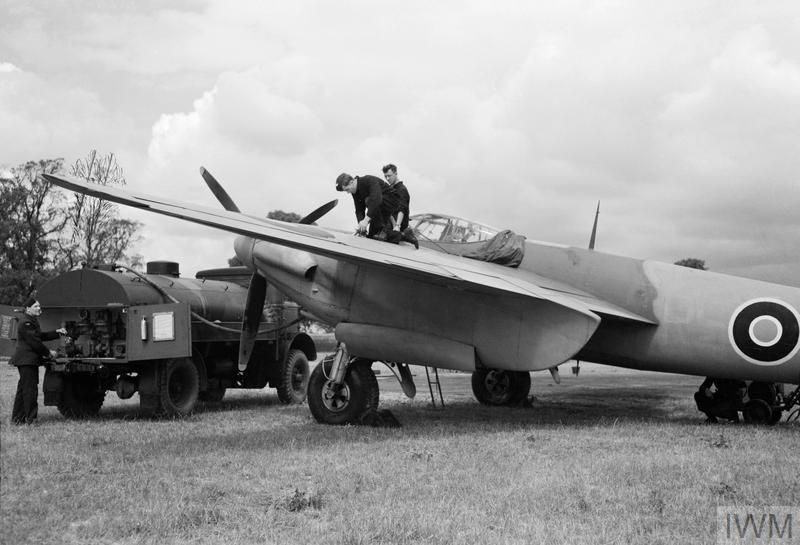

 Aviation Trails