On June 3rd 1944, Lancaster ND841 ‘F2-D’ piloted by F/O. George. A. Young (s/n: 134149) RAFVR 635 Squadron, was detailed to mark and attack Calais as part of the preparations for D-Day. There would be eight other aircraft from RAF Downham Market also detailed for the mission and take off would be late that evening.
Initially, the aircraft and crew, were designated for training, but that night, nine aircraft and crews, were then detailed for operations to Calais, including F/O. Young’s crew in ‘D-Dog’. They were given orders to mark a coastal defence battery, as part of the preparations for the forthcoming D-Day invasion.
The mission as a whole would involve 127 Lancasters and 8 Mosquitoes of No.1, 3 and 8 Groups and the targets would be the gun batteries at both Calais and Wimerereux. It was a diversionary raid as part of Operation “Fortitude South“, to fool the Germans into believing the invasion would occur in the Pas-de-Calais region.
At 28 minutes past midnight, F/O. Young lined the Lancaster up at the easter end of the main east-west runway, opened the throttles and began the long run to take off. Carrying a full load meant the aircraft was heavy, its 4,000lb ‘cookie’ filling the bomb-bay. As the Lancaster began to lift off, it started to swing, striking the roof of a B1 Hangar. In an uncontrollable state, the aircraft crashed just outside the airfield, near to Broomhill Farm, killing all those on board.
In a farmhouse on the other side of the airfield, the windows were blown out, and a huge mushroom cloud filled the sky as the cookie exploded along with fuel and bullets. The blast was so powerful it was felt over a quarter of a mile away, sending shock waves not only through the immediate area, but right across the airfield as well. As fire crews and personnel ran to the scene desperate to help, they were forced back, fear of further explosions and a ferocious fire proving too much.
The operation went on however, and after diverting the aircraft onto another runway, all remaining eight aircraft took off, marked their target and returned safely to Downham Market.
On board Lancaster F2-D that night was:

Lancaster ND841 ‘D’ and its crew before the fatal crash on June 4th 1944 (Downham Market Heritage Centre).
Pilot: F.O. George Ambrose Young, aged 24 (s/n: 134149) RAFVR.
Flight Engineer: Sgt. Thomas Snowball, aged 32 (s/n: 1100769) RAFVR
Navigator: F.Sgt. Howard Pritchard, aged 22 (s/n: 1578502) RAFVR
Bomb Aimer: F.O. Walter Thomas Olyott, aged 21 (s/n: 151238). RAFVR
Wireless Operator / Gunner: F.Sgt. Robert Sadler, aged 23 (s/n: 1526058). RAFVR
Air Gunner: F.Sgt. Stanley Wharton, aged 30 (s/n: 1578013) RAFVR
Air Gunner: F.Sgt. Charles Patrick Nallen, aged 20 (s/n: 427537) RAAF
The Operations record book (AIR 27/2155/7) for that day simply states:
3.6.44 ‘D’ F/O Young G.A. hit hangar after taking off and crashed on airfield when large bomb exploded and the crew all killed. 8 aircraft returned to base .
Three of the crew are buried in Kings Walk Cemetery, Downham Market, a short distance from the airfield.

F. Sgt. Stanley Wharton (RAFVR)
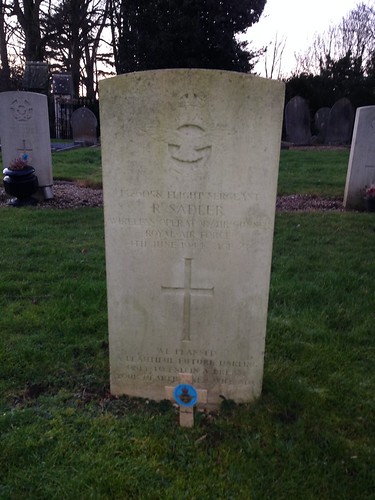
F. Sgt. Robert Sadler (RAFVR)

F.O. Walter Thomas Olyott (RAFVR)
RAF Downham Market features in Trail 7 – North West Norfolk.
Sources and Further Reading:
National Archives AIR 27/2155/7
 Aviation Trails