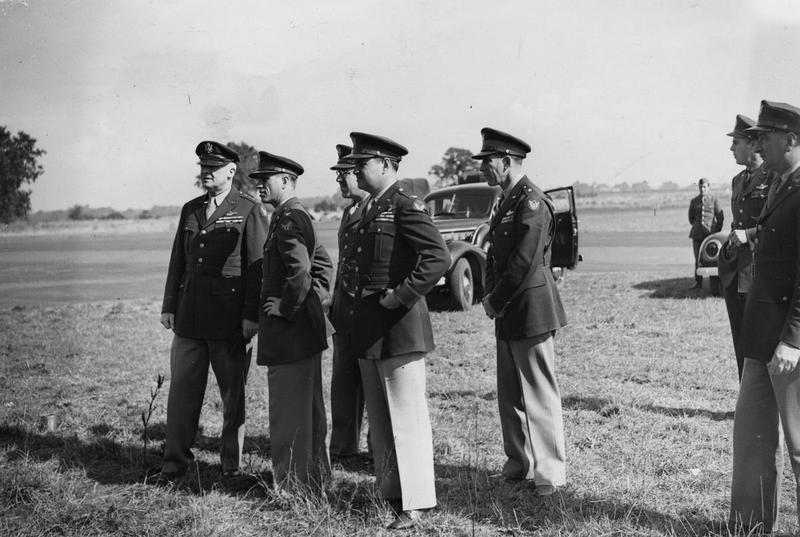
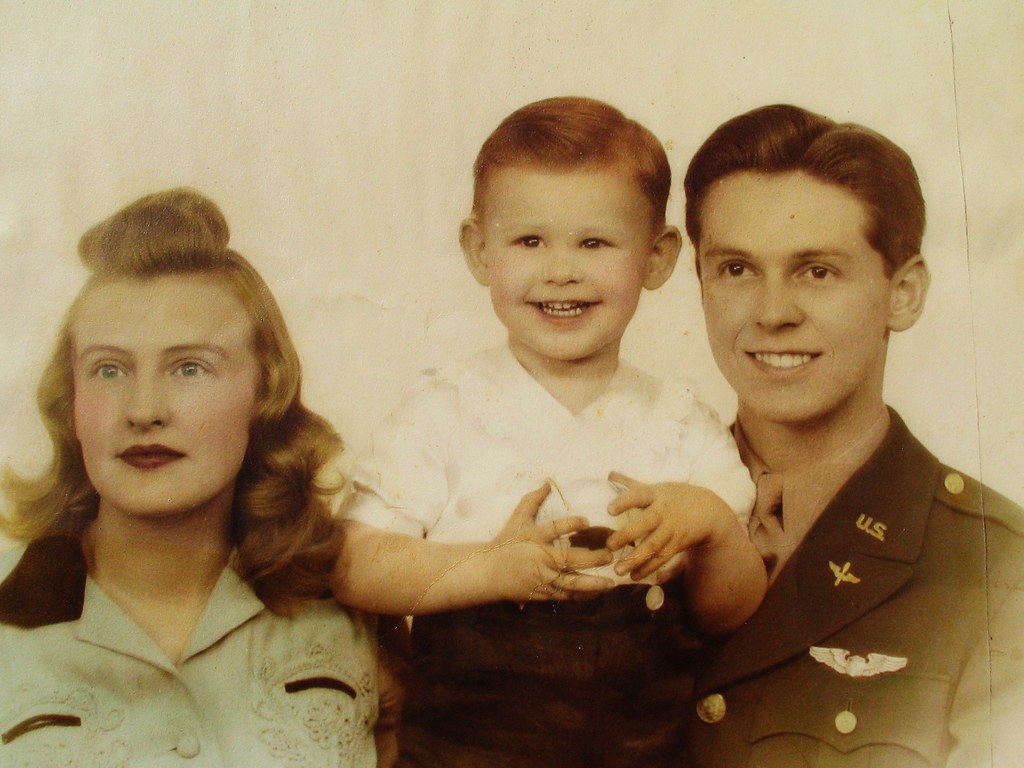
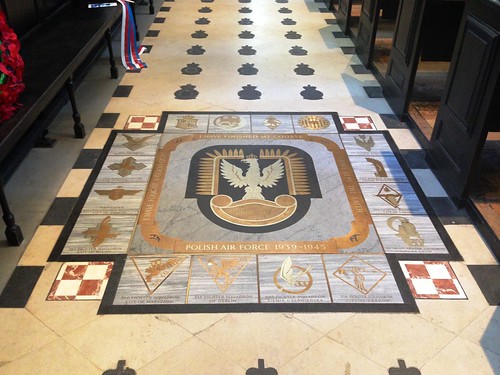
2nd Lt. John Walter Crago (RAF Kings Cliffe)

I was recently contacted by Mike Herring and Trevor Danks, regarding the story of 2nd Lt. John Crago who was based at RAF Kings Cliffe in Northamptonshire during World War 2.

It was sad tale of how this young man died in a tragic accident not long after arriving in the UK from the United States.

Mike and Trevor have allowed me to reproduce the entire text with photos to share with you, my sincere thanks go to them both. Here is John Crago’s story.

This is the story of 2nd Lt. John Walter Crago who tragically lost his life in an aircraft crash on 31st December 1943 whilst operating from Kings Cliffe airfield.

Firstly, however, let us look at his origins.

His grandparents were Harry and Bessie Crago who were born and lived in Cornwall on the SW tip of England. Harry was born in Liskeard in November 1858 and Bessie in Duloe in May 1862.

The surname “Crago” is quite common in that area. Cornwall had been a major source of tin and lead for many years and there were extensive mine works around the county.

After leaving school Harry worked in the mines from about the age of 12.

In 1878 Harry and Bessie, still unmarried, moved to the coal mining village of Wingate, near Durham, in the North East of England, where Harry worked as a coal miner.

In the early part of 1879 Harry and Bessie married at Wingate and by 1881 they were living at 13, Emily Street, Wheatley Hill, Wingate and had a one year old son with them – William.

As an aside the village of Wingate is well known to some people in Kings Cliffe. It was the home of the writer’s wife’s parents until their recent death and  brothers and sisters still live there.

The coincidence increases as it is also the place where friends, Rodger Barker, living in Kings Cliffe, and Jim Vinales, managed to crash a Vulcan bomber in 1971, that had lost two engines. The crew fortunately survived. (see chapter one of “Vulcan 607” Corgi books).

In 1882 Harry and Bessie emigrated to the USA, by now having two children , and it is no co-incidence that they settled in Pennsylvania which was a significant coal mining area, Harry working there as a miner.

Their third child, Walter P Crago, was born at Houtzvale, P.A. on 16th August 1893. He is the father of the subject of this story.

In the US Census of 1910 16 year old Walter is shown as having no occupation, although his father and elder brother are working as miners.

In the 1920 US Census, Walter is married to Margaret K Crago and they have a one year old son, John Walter, born 5th April 1917 who is the subject of our story. His father’s marriage to Margaret does not seem to have lasted as by 1930 Walter has married Lorena C Crago (nee’ Curtis).

John Walter Crago is brought up in Philipsburg, PA, a small town of about 3000 people (twice as big as Kings Cliffe) which is situated about 200 miles due west of New York.

Philisburg main street via Mike Herring

A view of modern Philipsburg main street.

Our next glimpse of John W is in his High school Year book in 1934 when he was 17 years old.
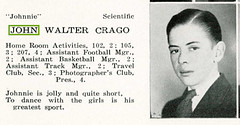
John Walter Crago via Mike Herring

Johnnie did one year in high school and was clearly keen on his sport as well as the local girls!

Six year later in the US Census of 1940 John’s father, Walter, is by then the part owner and bar tender of a restaurant/tap room in Philipsburg and John W is working for him.

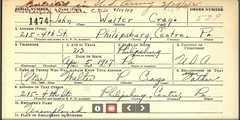
In Europe WW2 is in full flow and clearly the US is preparing for its possible involvement as John is signed on in the draft on 16th October 1940.

He is described on his draft form as 5’-8 ½” (1.74m) tall, weighing 135 pounds (61kg) with hazel eyes, light completion and brown hair.
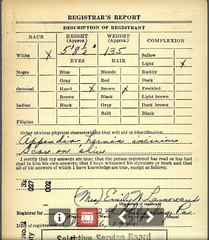
draft via Mike Herring

John’s Draft paper.

draft 2 via Mike Herring

John trained to be an Army Air force pilot and joined the 55th fighter squadron, part of the 20th fighter group.

They arrived at Clyde in Scotland in August 1943, then travelled to their new base at Kings Cliffe in Northamptonshire, England. The 20th fighter group consisted of three squadrons of about 14 planes each – 55th, 77th and 79th.

The group was the first to fly the new P-38 Lightning escort, fighter ground attack air craft in combat in Europe.

P-38 via Mike Herring

P-38 Lightning

There was insufficient room at Kings Cliffe for all of three squadrons and therefore 55 Fighter Squadron , of which John Crago was a member, were based at RAF Wittering, just two miles North of Kings Cliffe.

The P-38 Lightning had a somewhat chequered history in its’ early days. It had several recognised problems, but because of the needs in Europe for a powerful, high flying escort aircraft, the early ones were shipped out without those problems being resolved. They suffered from many engine failures, and instability in certain circumstances.

Of significance to our story is part of the Wikipedia article on the development of the P-38 which reads –

“Another issue of the P-38 arose from its unique design feature of outwardly rotating, counter rotating propellers. Losing one of the two engines in any two engine non centre line thrust aircraft on take-off creates sudden drag, yawing the nose towards the dead engine and rolling the wing tip down on the side of the dead engine. Normal training in flying twin engine aircraft when losing one engine on take-off is to push the remaining engine to full throttle to maintain airspeed. If the pilot did this on a P-38, regardless of which engine had failed, the resulting engine torque produces an uncontrollable yawing roll and the aircraft would flip over and hit the ground.”
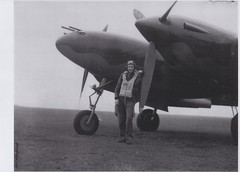
Crago with P-38 via Mike Herring

John Crago with his P- 38J Lightning – 1943


Crago at Kings Cliffe 1943 via Mike Herring

John W Crago in 1943 at Kings Cliffe

The first mission for 55 squadron was on 28th  December 1943 consisting of a sweep across the Dutch coast without encountering enemy aircraft. The mission summary report for that day reads –

28th December 1943

  1. 55th Fighter Squadron, 20th Fighter Group, Captain McAuley leading.
  2. 12 up at 1308 Down Wittering 1510
  3. Nil
  4. O 4 SWEEP
  5. To N. Nil
  6. Altitude over English coast mid-channel R/T jammed and remained so until mid-channel return trip. Landfall in, Wooderhoodf, at 1402. Altitude 20,000 feet. Light to moderate flak accurate for altitude over Flushing. Left turn and proceeded from Walchern to Noordwal 18 to 20,000 feet.
  7. Landfall out 1416 Noordwal. Weather clear all the way.

The second mission on the 30th December was more serious, escorting B-17 and B-24 bombers on an attack on a chemical plant near Ludwigshafen. The mission report for that day reads –

30th December 1943

  1. 55th Fighter Squadron, 20th Fighter Group
  2. 14 up 1121 at Kings Cliffe. Down 1500 Wittering.
  3. 3 aborts. Captain Jackson, Lt. Col. Jenkins – Radio. Lt. Sarros, gas siphoning.
  4. Bomber escort. Field order No. 210
  5. Nil
  6. Nil
  7. Nil
  8. Nil
  9. Landfall Ostend 24,000 feet at 1212. Climbed to 25,000 feet Brussels circled area 15 minutes. Proceeded to R/v with bombers. St. Menechoulde 25,000 feet at 1312. Reims 2 Me 109’s seen diving through bomber formation. Squadron left Bombers Compegiegne 1346. Encountered light flak Boulogne. Landfall out 1407, 24,000 feet. Clouds 6/10 over channel. 10/10 just inland. R/t ok.

The third mission was scheduled for 31st December and involved escorting bombers on an attack on a ball bearing factory at Bordeaux. John Crago was one of the 14 pilots of 55 squadron scheduled to be on this trip. He was temporarily based at RAF Wittering whilst suitable accommodation was built at Kings Cliffe and was flying from Wittering to Kings Cliffe to be briefed on the mission with the other pilots of 55, 77 and 79 Squadron who made up 20 Group. On arriving at Kings Cliffe he reported problems with his landing gear and did a low level fly past the control tower so that they could observe any obvious problem. As he approached the tower smoke was seen coming from his left hand engine.

He would have been flying slowly, close to stall speed, so that the tower had more time to observe any problem. Bearing in mind the reported problem with the P-38 flying on one engine the plane probably became uncontrollable. He clearly achieved some height as his eventual crash site was about two miles away at the village of Woodnewton. He did not survive the crash.

map via Mike Herring


location of crash via Mike Herring

Map of Woodnewton – crash site marked in red.
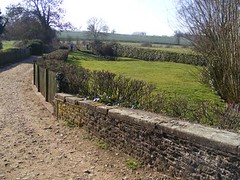
Lt. Crago's crash site

Lt. Crago’s crash site. (Photo courtesy Trevor Dank)

Lt. Crago's crash site

Lt. Crago’s crash site. (Photo courtesy Trevor Dank)

John Crago is buried at the Cambridge American Cemetery; plot A/5/22.

Commemoration Plaque

Plaque to commemorate Lt. Crago. (Photo courtesy Trevor Dank)

His was one of the bodies of American servicemen whose next of kin decided not to repatriate.  One could conjecture that he was left to rest in the land where many generations of his forefathers had lived.

Grave via Mike Herring


Kings Cliffe old blokes via Mike Herring

‘Kings Cliffe Old Blokes Club’ at the grave of John Crago.

Mike Herring
Kings Cliffe Heritage

Sources:

Vulcan 607 by Rowland White, Corgi Books.
US Census 1900, 1910, 1920, 1930, and 1940.
UK Census 1861, 1871,and 1881
Ancestry.com
Ancestry.co.uk
The American Air Museum – Duxford  www.iwm.org.uk/duxford
2nd Air Division Memorial Library – Norwich www.2ndair.org.uk

Report from Woodnewton Heritage Group

New Year’s Eve this year marks the 75th anniversary of a tragic accident in Woodnewton which resulted in the death of an American pilot and brought the realities of the Second World War closer to the inhabitants of our village.

JOHN WALTER CRAGO

John Walter Crago held the rank of 2nd Lieutenant in the US Army Air Force. He died instantly in an accident on 31st December 1943 when his aircraft crash landed in Woodnewton, in the field known as Stepping End just beyond Conegar Farm.

Lieutenant Crago was born on 5th April 1917 in Phillipsburgh, Pennsylvania, the son of Walter P Crago and Margaret K Jones. He had enlisted in March 1942 and was a member of the 55th Fighter Squadron of the 20th Fighter Group.  This Group was under the command of the 67th Fighter Wing of the Vlll Fighter Command of the USAAF. When he died he was 26 years old.

The circumstances leading to the accident on 31st December are recorded here in general terms only as told by former and existing residents of Woodnewton and supported by information from the Internet. It is not meant to be definitive.

The USAAF was assigned RAF Kings Cliffe in early 1943 and it was re-designated as Station 367. It was the most northerly and westerly of all US Army Air Force fighter stations. At that time RAF Kings Cliffe was a very primitive base, lacking accommodation and other basic facilities, so the Americans undertook an extensive building programme at the base during 1943. The 20th Fighter Group arrived on 26th August 1943 from its training base in California having crossed the USA by railway and then the Atlantic aboard HMS Queen Elizabeth on a five-day unescorted trip. The Group comprised three Fighter Squadrons; two of those Squadrons were based at Station 367 whilst the third, the 55th Fighter Squadron (Lieutenant Crago’s), was based at RAF Wittering whilst additional accommodation was being built at Kings Cliffe. The Group did not come back together at Station 367 until April 1944. Up to December 1943 the Group flew Republic P-47 Thunderbolt planes. With the arrival of their new Lockheed P-38 Lightening planes in late December 1943 the 20th Fighter Group entered fully into operational combat and was engaged in providing escort and fighter support to heavy and medium bombers to targets on the continent.

In the early morning of 31st December 1943 Lieutenant Crago was to fly from RAF Wittering to Station 367 to be briefed on his first combat mission – to provide escort protection on a bombing mission to attack an aircraft assembly factory at Bordeaux and an airfield at La Rochelle. This was to be just the 3rd mission by the fully-operational Group flying P-38’s. The planes of the 55th Squadron took off from RAF Wittering three abreast but unfortunately the right wing-tip of Lieutenant Crago’s plane struck the top of a search light tower on take-off.  Lieutenant Crago must have lost some control of the aircraft but not it would appear the total control of the plane. He flew it from Wittering and was trying to get to Station 367. Unfortunately, he only got as far as Woodnewton.

The plane approached the village from the north-east, flying very low over Back Lane (Orchard Lane) and St Mary’s Church but crash landed in the field known as Stepping End just beyond Conegar Farm. Eyewitnesses said that the pilot discharged his guns to warn people on the ground that he had lost control of the plane and was about to crash. Wreckage from the plane was still visible in Stepping End in the 1950’s and a “drop tank” (for additional fuel) could also be seen in the hedge between King’s Ground and Checkers. A brief reconnoitre in November 2018 however found no recognisable evidence of the plane in the hedgerows around the fields.

Stepping End is the first open field – no hedges or fencing – on the right-hand side of the track from Woodnewton to Southwick. From Mill Lane, cross the bridge over the Willowbrook, and continue until the land begins to rise at the start of the hill. King’s Ground and Checkers are the next two fields on the right along the same track.

It is understood that 2nd Lieutenant Crago, whilst no doubt a qualified and proficient pilot, had had only 7 hours flying experience in the Group’s new P-38 Lightning at the time of the accident.

A memorial plaque to Lieutenant Crago was put up in St Mary’s Church to commemorate his death. The wording on this memorial faded over time however, and the plaque was replaced in 2001, although the wording on the two plaques is the same.

2nd Lieutenant John Crago is buried and commemorated at the Cambridge American Cemetery and Memorial (Plot A Row 5 Grave 22). His photograph can be seen at “www/20thfightergroup.com/kiakita”.


My sincere thanks go to Mike and Trevor for sending the text and pictures and for allowing me to share the sad story of Lt. John Walter Crago. 
RAF Leuchars – one of Britain’s oldest airfields (Part 3)

In Part 2, a number of twin engined models frequented Leuchars performing anti shipping roles and U Boat hunts out in the North Sea. BOAC had begun its clandestine role and shipping ball-bearings back from neutral Sweden. We now see a change to these flights and as the war ends, a new much larger breed begin to appear here are Leuchars.

Throughout all these changes at Leuchars, the BOAC company had been continually running its clandestine operations to Sweden. But by now it was clear that a new, faster more agile aircraft was needed. Even though they were marked with civilian markings and flown by Swedish crews, the Electras were slow and cumbersome and made easy targets for both fighters and flak. Now, with the development of the Mosquito, the opportunity had finally arrived.

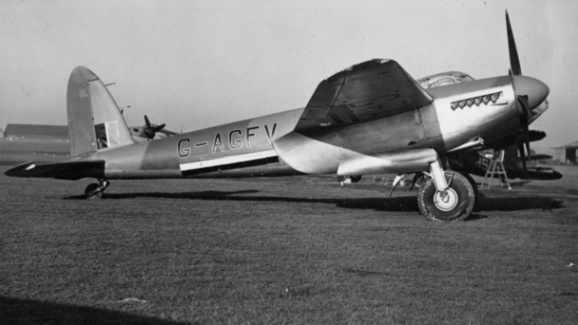
It was during December 1942 that the first civilian operated model of the aircraft arrived here at Leuchars. A Mosquito PR.IV ‘DZ411’,  it was assigned the civilian registration G-AGFV, and would begin flights to Stockholm on 4th February 1943, after which it was joined by six other aircraft. These MK.VIs were given the sequential registrations G-AGGC to GH, and would arrive during the April and May of that year.

By the end of April the following year, a total of nine Mosquitoes would have been modified and delivered to BOAC at Leuchars*5.

BOAC Mosqquito BAE Systems (@BAE Systems)

All these aircraft had to be changed from military status to civilian, this required the removal of all traces of armament. Modified at Hatfield – the home of the Mosquito – the resultant weight loss altered the aircraft’s centre of gravity and so additional ballast had to be added to prevent changes in the aircraft’s flying characteristics.

It was vital that the Mosquitoes remained unarmed for these operations, so as to not infringe or violate Sweden’s wartime neutrality, however, this made any aircraft on this run a potential ‘sitting duck’, even though, like their Lockheed predecessors, they carried BOAC insignia and were flown by civilian aircrew.

These operations were by now carrying more than just mail and ball-bearings though. These covert operations, took the civilian marked and unarmed Mosquito across the North Sea to Sweden, where it would drop off the mail, papers and other written material held within its bomb bay, and return with prominent scientists, special agents or allied aircrew who had been interned in Sweden as well as vital ball-bearings produced by the Swedes. The faster and far more agile Mosquito would, in most cases, be able to out run any opposing Luftwaffe fighter that should, and indeed did, try to intercept the aircraft whilst on one of these flights.

The returning ‘passenger’ on these flights had the unfortunate prospect of having to sit in a modified ventral bay for the whole duration of the flight. The prospect of further internment probably outweighing that of cramp and three hours of discomfort.

One such notable passenger who was carried back from Sweden, was the nuclear physicist Niels Bohr, whose work on atomic structures and quantum theory, had won him the Nobel Prize for Physics in 1922.*4 He would go on to work on the Atom Bomb in the Manhattan Project, the results of which were seen at both Hiroshima and Nagasaki in 1945.

Even though these flights were highly successful, a few aircraft were lost. In Mid August 1944, G-AGKP ‘LR296’, a former 27 MU aircraft, was lost when it crashed into the sea nine miles from Leuchars. All three on board were killed as it approached on return from Stockholm; the passenger being a BOAC Mosquito pilot himself. The crash was believed to have been caused by a structural failure, the aircraft having been repaired previously after an accident in January. By the war’s end fourteen Mosquitoes had been used in some way by BOAC, five of which crashed.*6

As the war moved on, squadron numbers at Leuchars begin to diminish. 1943 brought only two, that of 235 Sqn and 333 (Royal Norwegian Air Force) Sqn who were formed here on April 5th as ‘B’ Flight after the dividing and renumbering of 1477 (Norwegian) Flight. This was a split unit, one part flying the Catalina from Woodhaven, whilst ‘B’ Flight flew the Mosquito MK.II. An upgrade to the MK.VI then saw the unit move to join the famous Banff Strike Wing in September 1944. Whilst at Leuchars they operated as sub-hunters and convoy escorts, whilst ‘A’ flight flew more clandestine operations smuggling secret agents and supplies into occupied Norway. The Mosquito as a multi-function aircraft performed well in these duties, and by the end of the war numerous U-boats had been attacked by aircraft based at the Scottish airfield.

RAF Leuchars

One of the Hangars at Leuchars 2018

With 1944 dawning and major events happening on the continent, more changes would take place at Leuchars.

In the early months, proposals to extend and widen one of the runways was put forward, a part of which was agreed in April. This move also required the relocation of the Watch Office and widening of the perimeter tracks. A further three squadrons would pass through this year beginning with a detachment of 281 Sqn, who stayed for a year from February. A second unit 206 Sqn, stayed here for less than three weeks. But then September/October would bring a new and interesting model in the shape of the B-24 Liberator and 547 Sqn. A change to the smaller twin-engined models that had frequented Leuchars for the last four years or so, the move here was unfortunately a signal of their ending though, the squadron being disbanded in June 1945 never to appear again.

Whilst here, the Liberators would patrol the Norwegian coast in the A/U (anti-U boat) role, many of these patrols being uneventful, the U-boat threat by now greatly reduced compared to its previous Atlantic successes. However, on October 12th, Liberator MK.VI “G” did spot a U boat on the surface which it attacked with both front and rear turrets. Strikes from both guns were seen on and around the conning tower, and it was initially thought that the sub was sunk. After patrolling for a further 45 minutes, the U boat was again sighted some two miles away, but managed to escape in the poor weather. It was believed by the crew to have been a 740 ton vessel which had subsequently suffered damage from the attack.

The B-24s of the these RAF squadrons would be complemented by B-24s now flying separate runs to Sweden by the Americans. In addition to these, Leuchars also saw the reintroduction of the popular and highly successful American built Douglas DC3. The route to Stockholm now being a little less dangerous than it had been in previous years.

The arrival of the Liberator had signified a big change in direction for Leuchars,  they were to be the first of many four engined heavies to serve from the Fife base.

In 1945, 519 Sqn brought along the Halifax III, but sadly they were to go the way of 547 Sqn and disband here at Leuchars in the following May; it too would not reappear in the RAF’s inventory of operational Squadrons. 519 were a meteorological unit, collecting data for flying operations. Using both the Spitfire VII and Halifax IIIs, they would climb to altitudes of around 40,000 ft, and collect valuable meteorological data. Using Prata I, Prata II and Recipe I (Pressure And Temperature Ascent) many of these flights would take the aircraft high out over the North Sea.

With the close of the war, Leuchars had seen no less than twenty-eight operational squadrons pass through its doors, some of these merely staying for a day, whilst others were more prolonged. A range of aircraft had come and gone, mainly twin-engined models operating in the photographic reconnaissance or anti-shipping role. With its position on the north eastern coast, Leuchars had proven vital to maritime operations protecting the seas between Britain and Scandinavia, an area it had operated in, in a number of clandestine roles. But with the war now at an end, these were no longer required, and Leuchars’ role would again revert back to its original one – that of training.

The post war world was very different to the pre-war one, Britain like many other countries was rapidly trying to revert to pre-war budgets. A reduction in the armed forces was seen as essential to cutting costs, whilst rebuilding the nations cities that had been so heavily bombed in the Blitz, was paramount. As a result, the RAF as with the other forces, were having to do with what they had. A reduction in man power and machinery though would not only mean a reduction in squadrons, but the airfields that used them.

Leuchars, like so many, was now under the potential threat of closure. However, the increasing post war tensions between the east and west created the Cold War, with a strained and anxious stand off between Soviet and Western forces right across the European frontier. As had happened before, Leuchars’ position would once again be its saviour. Over the coming years it would see a wealth of operational aircraft and a broad range of front line fighters be based in this small corner of Scotland,

The coming months after the war’s end would see further four-engined models reappear, a previous resident 203 Sqn who had been here in the 1920s, returned from overseas operations in May 1946, bringing back with them the B-24 (Liberator VIII). Within two months though, this would be replaced by the Lancaster GR.3, a version of the mighty four-engined heavy that had wreaked so much devastation across Germany’s industrial cities. But by 1947, 203’s link with the Scottish airfield would finally draw to a close, and the squadron would depart for good.

160 Sqn who arrived a month later in June, also brought the Liberator, and similarly began taking on the Lancaster GR.3. By October though their demise had also arrived, they were renumbered and reformed as 120 Sqn, and by 1947 they had lost the last of their Liberators retaining only the Lancaster.

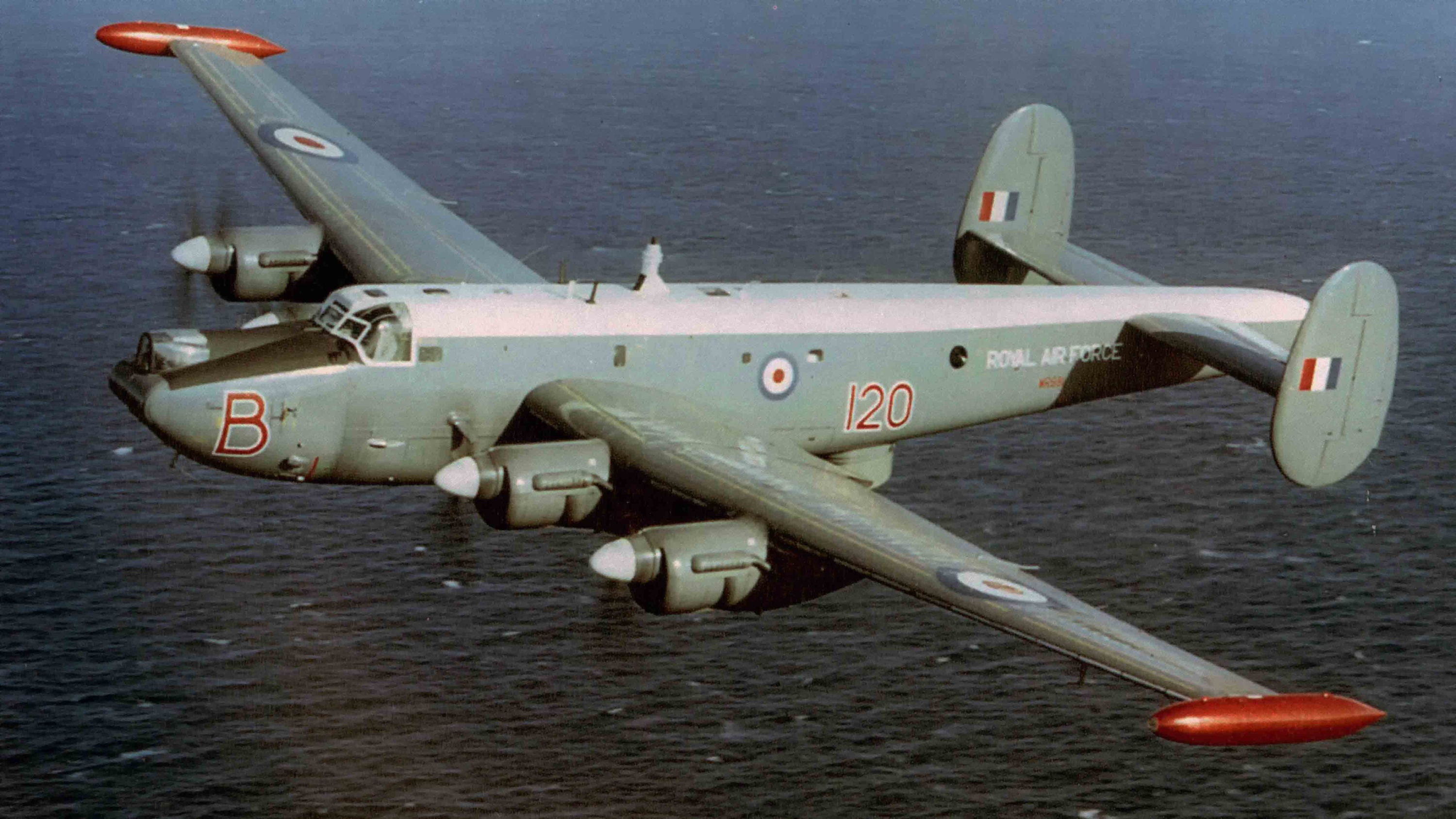
In December 1950, 120 Sqn were posted to Kinloss, where its wartime bombers were replaced with the newer Avro model, the long range maritime patrol aircraft, the Shackleton with its rare contra-rotating props.

Avro Shackleton MR.3 (WR989) of 120 Sqn RAF (@BAE Sytems)

The aircraft, built in response to the growing Soviet threat, was designed around the Lancaster,  Roy Chadwick’s dream bomber. Chadwick, like R.J. Mitchell, having sadly died before their dream had finally been put into service. Built to Air Ministry Specification R 5/46, the Shackleton was initially designed with gun turrets and two Rolls-Royce Griffon 57A engines inboard, and two Roll-Royce Griffon 57 engines outboard.

One other unit arrived here at Leuchars that year, that of 82 Sqn, initially as a Lancaster detachment and then in June 1947 as a base with its own detachments at Eastleigh, Dar-es-Salaam and Lusaka. The last of the prop driven aircraft were now making their ultimate RAF appearances, and soon Leuchars would enter in the jet age.

In Part 4 Leuchars enters the jet age. The Cold War begins and Leuchars takes on a new challenge as it moves to a new Command, that of Fighter Command.

The full story of Leuchars can be seen on Trail 62.

RAF Leuchars – one of Britain’s oldest airfields (Part 1)

Following on from Trail 53 we leave the former RNAS Crail and Dunino behind and head north-west to the mecca of the golfing world, and the historic town of St. Andrew’s, where just outside of the University town is an airfield whose history goes back as far as 1911; this makes it one of Britain’s oldest and most established airfields. Its development then takes it through the First World World War, to the relative peace of the 1920s, the expansion period of the 1930s and on into the Second World War. Faced with potential closure it then went on to be one of the most significant and important airfields in Britain’s Cold War defence network.

Sadly politics played its part as it often does, and in 2011, its fate was sealed when at 4:48pm on July 18th, Dr. Liam Fox the then Secretary of State for Defence announced when talking about bringing the Army back from Germany: “Two major units and a formation headquarters will be based at Leuchars, increasing the number of posts there from 1,200 to more than 1,300. Consequently, the Typhoon force due to be built up there will instead be built up at RAF Lossiemouth.”*10 With that the airfield was to close, being transferred over to the Army, a transfer that occurred four years later in March 2015. Since then the RAF has, on occasion, returned for flying duties,  but its front line RAF role had gone. A state which exists today.

On this next stop, we take an extensive look at the long and incredible life of RAF Leuchars.

RAF Leuchars.

Leuchars sits on the north-eastern coast of Fife, on the banks of the River Eden as it enters the sea at St. Andrew’s Bay. To the north across the River Tay, lies Dundee, and to the west, the city of Perth. South of Leuchars is the University town of St. Andrews – the home of world golfing. Being literally on the shore line, Leuchars provided an ideal location for a whole host of maritime operations, aerial reconnaissance and even later on, search and rescue.

Its life began just after the turn of the last century in 1911, when powered flight was but a mere few years old.  Even before the first aero-engine had been started here, the site was being put to use by the Royal Engineers with a Balloon Squadron, who used it for reconnaissance training in the Tentsmuir Forest on the edge of what is now the airfield.

With the formation of the RFC in 1912, the Balloon Squadron would become part of the first military flying arm to exist in the UK. It would continue in its role as spotting for artillery, even as powered flight gradually became established. On the nearby beaches, small aircraft were tried and tested, but balloon training would ultimately remain the focus of the squadron.

In 1916, the RNAS then acquired the land and began to develop the site as a place for powered flight. Taking over farmland, and eventually swallowing up the resident farm, the airfield slowly expanded, and by 1918 its future was established. By this time, the RAF had been formed, the flying responsibilities of the Navy were transferred to the RAF and the first unit was ready to move in. The Grand Fleet School of Aerial Fighting and Gunnery, run by the RAF to train Naval airmen, resided at the airfield from the end of 1918 on into 1920. This unit, a new unit in its own right, was formed out of the disbanded 208 (Temporary) Training Depot Station which, whilst formed at East Fortune in the Scottish borders, had only been in existence for as little as one month.

RAF Leuchars

The control tower at Leuchars. The airfield’s proximity to the shore line being evident.

In these early days of flying, risks were high, the thrill of manned flight was a draw for many young men eager to experience the joy of soaring above the clouds. As a result, there were numerous accidents and Leuchars was no different.

On May 19th, 1919, Lt. David Gardiner Cooper (22) lost his life when he misjudged a slow roll whilst flying in his Sopwith Camel (F8497), and on August 1st, Canadian, Lt. Philip Hall-Smith (30) was killed, after his Camel was seen to inexplicably nose dive into the ground.*1*2 Two unfortunate losses after a war that had already taken hundreds of thousands of lives.

During the 1920s, with the war now over, military might was seen as an almost unnecessary waste, units were cutback, airfields that had been established for war were closed, and fighting men were returned to civvy street. Political fighting amongst the three arms of the military, saw the RAF cut back to a fraction of its former self, its cause for survival spearheaded by Lord Trenchard. However, Leuchars managed to cling on, remaining not only active, but receiving further development as well. More land was purchased and in 1925 the base was officially renamed RAF Training Base Leuchars.

It would be a time of dramatic change and turbulence for the fledgling Air Force though, and this was wholly reflected by the number of units appearing at Leuchars during this period. Operating as one of the UK’s major Naval training bases (the RAF being responsible for Naval flying at this point), the first of these units to appear was 203 Sqn in March 1920 which had reformed here after having been disbanded just two months earlier at Scopwick.

On April 1st 1923, the RAF Carrier units were re-designated under the new 400 series of squadron codes – a major stepping stone in RAF / Naval structure. Then a year later in 1924, these units were combined to form the new Fleet Air Arm (FAA), the flying branch of the Royal Navy. These changes had a major impact on operational numbers here at Leuchars.

Formally a Royal Naval Air Service unit, 203 Sqn initially flew the Sopwith Camel, replacing these  in April 1922, with the Nieuport and the General (Gloster) Nightjar. In mid September, the squadron was posted to Turkey, departing Leuchars onboard HMS Argus; a posting that would last for three months. After that, the squadron returned to Leuchars once more, again onboard HMS Argus, remaining active at Leuchars until 1st April 1923. At this point the squadron was disbanded, being divided into two Naval Flights: 401 and 402. The squadron as was, would be reformed later, but it would be another twenty-three years before they would see the shores of Leuchars once more.

203 Sqn would be joined a month after their arrival by another former RNAS unit – 205 Sqn. Like 203, it too was disbanded at Scopwick only to reform here at Leuchars in April 1920. Bringing another new model of aircraft to the Scottish airfield, 205 Sqn flew the Parnall Panther, and would serve in its entirety as 205 until October 1921, when the Mobile Flight element  was reformed as 3 Squadron. The remainder of 205 Sqn continued serving alongside here at Leuchars.

3 Squadron would operate out of the Scottish base until 1st April 1923, at which point it was similarly divided into three flights: 420, 421 and 422 now serving at Gosport. The remainder of 205 were also divided up into separate Flights – 440, 441 and 442, but unlike its sister unit, 205 would not return in any form to these Fife shores.

As part of this formation of the FAA, Leuchars would see all these Flights joined by another seven: 403, 404, 405, 406, 443, 445, and 446, and all around this time. This would bring a whole range of aircraft to these shores: Nightjars, Panthers, Nimrods, Flycatchers and the like.  Some of these units would depart for foreign shores whilst some would remain in the UK at other bases. The skies above Leuchars was now buzzing with activity.

For the majority of the 1930s, Leuchars would remain as an FAA training base, being renamed No. 1 Flying Training School, on April 1st 1935. Aircraft seen here would have included a range of training types including the: Fairey IIIF, Fairey Gordon, Avro Tutor and Avro 504N. For three continuous years pilots trained at Leuchars for the Fleet Air Arm, a branch that continued to be the responsibility of the RAF.

The mid to late 1930s would see tensions slowly rise in Germany, but Britain’s general post war doctrine was to defend her shores rather than attack any potential enemy. The Royal Navy was still seen at these times as the main military force, a belief that would very soon change. Britain in these early years, had not seen Germany (partly due to the devastating conditions of the Treaty of Versailles) but France, as her biggest potential aggressor, and as such long range aircraft or heavy bombers were not seen as an important requirement.

Government ideas that Britain should only arm itself with a view to defence against its nearest potential threat, meant that early on, defences were developed at the cost of attacking units. But by the time it was clear that Germany was the threat, Britain was lacking far behind, as little national development had been undertaken. This doctrine saw a far reaching impact right across Britain’s peace time airfields, which at this time included Leuchars. With only one squadron, 36 Sqn (the former Coastal Defence Torpedo Flt.) transiting through on its way to the Far East, preparation for war and flying in particular, remained limited to training flights here at the Scottish base.

As Britain then entered the Expansion Period, new aircraft specifications were being pushed through and airfield development became increasingly important. A number of new airfields were built and a restructuring of the RAF was once again on the cards. Here at Leuchars, the number of hangars was extended, with 7 Belfast Truss hangars being added to the site.

With further changes in the late 1930s, Leuchars became a Temporary Armament Training Camp (later station) with a small collection of Wapitis who used the nearby range at Tentsmuir.

Then in 1938, this restructuring took place, Leuchars, driven by its coastal location, was passed over to Coastal Command in an exchange that saw the two squadrons based at Thornaby (224 Sqn and 233 Sqn) transfer across here, whilst 1 FTS would leave for Netheravon. The Temporary Armament Training Camp previously established here would also disband.

Both these units brought the Avro Anson with them, 224 replacing them the following year with the Lockheed Hudson, a military aircraft born out of a civil transport model. Over the next two years, 224 Sqn would upgrade each of these with both the MK.II and MK.III models before departing to Limvadi in April 1941.

233 Sqn however, would have a more turbulent time, moving initially to Montrose, and then back to Leuchars, where they also took on the Hudson, only to replace it a month or so later with the Blenheim IV. Then, within less than a year, they would depart Leuchars for good, heading for Aldergrove in Northern Ireland where they would continue their operations with Coastal Command.

As 1938 passed the situation in Europe looked even more grave, and home based units were put on alert. 224 Sqn began carrying out searches of the North Sea, looking for vessels making their way to the open waters of the Atlantic. A further flight began sweeps of the Firth of Forth looking for submarines operating in the waters off the Scottish coast. However, in September, Neville Chamberlain returned from Munich, and following his ‘Peace in our time’ speech, war had seemingly been averted for the time being, and these precautionary measures were then relaxed.

In mid December, with tensions eased, 224 Sqn was granted 3 weeks leave allowing personnel time to go home over the Christmas period. The relaxation of measures was however, short lived, and a year later the squadron was put on a war footing with mobilisation orders coming through on September 1st 1939.

In part 2 Leuchars enters the war, being a coastal airfield the sea would dominate its actions and the squadrons that would be based here. It would also be the first line of defence against Luftwaffe bombers, ships and U-boats.

The full story of Leuchars can be seen on Trail 62.

P.O William Davis (Eagle Sqn) – March 18th 1941

RAF Sutton Bridge, was a small airfield on the Norfolk / Lincolnshire border a few miles from the Wash off the north Norfolk coast. Before, during and after the war it served as  training camp for new pilots, training them in the art of gunnery, utilising a firing range that had been in situ since 1926.

Many airmen of the RAF passed through Sutton Bridge, many of these were Commonwealth aircrew, some from Czechoslovakia and a few from the United States.

In the church yard behind the church of St. Matthew in the village, lie almost 60 graves of those who died in the fight for freedom, they are also joined by a German airman, foe united in death.

One such airmen is that of American Airman Pilot Officer William Lee Davis s/n: 61459 (RAFVR) who joined as part of the famed ‘Eagle’ Squadron, a group of volunteer American flyers.

P.O. Davis was from St. Louis and graduated at Central High School, before going on to attend Washington University. He was the son of William J. Davis of 4500 Arsenal Street, and a salesman in a cork and insulation firm in the area, when he joined up at the age of 25.

He left his job, signing with the Clayton-Knight Committee, a recruitment company for the Canadian and British Air Forces operating in the United States.  He was initially stationed at Love Field in Dallas, where he received four weeks of intensive training in aerobatics, gunnery and combat flying. After qualifying here, he transferred to Ottawa, where he was commissioned and then sent onto England to further his training. He was the first person from St. Louis to obtain a Commission in the Royal Air Force obtaining a deferment of his draft in doing so. When asked about joining the RAF, he told reporters that it was “a matter of sentiment and heritage” citing his English grandfather’s role as an officer in the Boar war.

P.O. Davis was no stranger to flying, having been a flyer before signing up for the RAFVR, achieving a total of 223 hours flying time, a commercial pilots licence and an advanced CAA Licence.

On arrival on March 5th 1941, these pilots were generally sent to No.3 Personnel Reception Centre at Bournemouth, before posting to No.56 Operational Training Unit (OTU) at Sutton Bridge. Here they completed their training and were then sent onto their respective operational squadrons. 

There were something in the region of 156 American Airmen who found their way into 56 OTU, many passed through with little or only minor mishaps. For P.O. Davis though it was to be the end of his dream, in an accident that would take his life.

On March 18th, a week after his arrival at Sutton Bridge, he took off in Hurricane P5195 on a general map reading flight across the Lincolnshire Fens. Whilst on the flight P.O. Davis became lost and decided to put down on farm land at New Leake Fen near Boston. Unfortunately, the ground in the Fens was soft causing the undercarriage to dig in and flip the Hurricane on its back. In the resultant crash, P.O. Davis broke his neck killing him instantly. He was not only the first from St. Louis to die, but the first American from Sutton Bridge to die also.

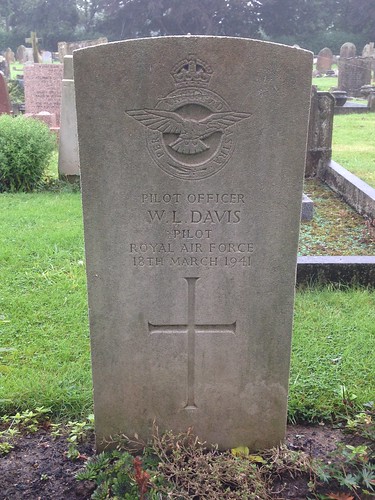
A citizen of the United States, Pilot Officer William Lee Davis is buried in the Church yard of St. Matthew’s Church, Sutton Bridge, Lincolnshire, Section P, Grave 56.

Pilot Officer William Lee Davis

Pilot Officer (Pilot) William Lee Davis

Help Wanted – RAF King’s Cliffe!

In 2014, I published Trail 6 – ‘American Ghosts’ a trail around six American bases from the Second World War, one of these, RAF King’s Cliffe, was, at the time, under threat of development.

In 2015, objections from over 300 people were received which included supporters of Glenn Miller, aviation enthusiasts, wildlife groups and local people alike, who all highlighted concerns over the proposed development of the site and the impact it may have.

At an initial meeting in September that year, the council failed to come to any overall decision as they needed to consider further reports from different interested parties.  At a second meeting held on Wednesday 14th October,  after considering all the issues raised, East Northamptonshire Council approved the plans and so planning for 55 holiday homes were passed on an area known as Jack’s Green.

This area includes a memorial to the late Glenn Miller, who performed his last ever hangar concert here at King’s Cliffe before being lost over the sea. Assurances from the land owner at that time, were that the development would be in keeping with the area and that the memorial would remain “exactly as it was”.

I have not been able to return to Jack’s Green, nor King’s Cliffe airfield to see how this development has affected the area, and was wanting to know if anyone had photos of the development taken since the development started or more so, in the years following. As it would directly affect the memorial and adjoining public footpath, I was interested in the Jack’s Green area especially. I know that many geocachers use this path as do horse riders, walkers and enthusiasts alike, and am hoping someone may have a small collection of photos I could see.

Any photos you are willing to share would be very much appreciated.

My sincere thanks.

Andy

Links

The BBC report can be accessed here.

RAF King’s Cliffe was visited in Trail 6

Previous reports can be found here.

Glenn Miller Memorial RAF Kings Cliffe Dec 2014

Glenn Miller Memorial RAF Kings Cliffe Dec 2014

RAF Watton – The origins of ECM (Part 2)

In part 1 we saw how Watton had been built as a pre-war expansion period airfield and how the Blenheims that were stationed here were decimated in the face of a superior enemy. Eventually begin withdrawn, they were simply outclassed.

Eventually, the airfield like so many in this area, was handed over to the Americans. It was re-designated and would take on a different role. Watton would now grow and develop.

The USAAF renamed the airfield Station 376, they redeveloped the accommodation blocks, added more hardstands and laid a steel mat runway. The original hangars were added to so that there were now not only the original ‘C’ types, but also the more modern ‘B1’ and ‘T2’ types, along with three smaller blisters hangars. In 1944, the steel matting was removed and a concrete runway built in its place. The airfield’s history would now become a little more complex as it officially became two sites utilising the same single runway.

The main airfield itself would house aircraft of the 802nd Reconnaissance Group (Provisional), who were later renamed the 25th Bomb Group (Reconnaissance). Whilst on the southern edge of the site, a new complex was built for the repair and refurbishment depot the 3rd Strategic Air Depot (SAD). This complex grew so large that it became a site in its own right, gaining the designation Neaton (Station 505). The name has been somewhat confusing however, as the site was actually closer to the village of Griston that it was to Neaton.

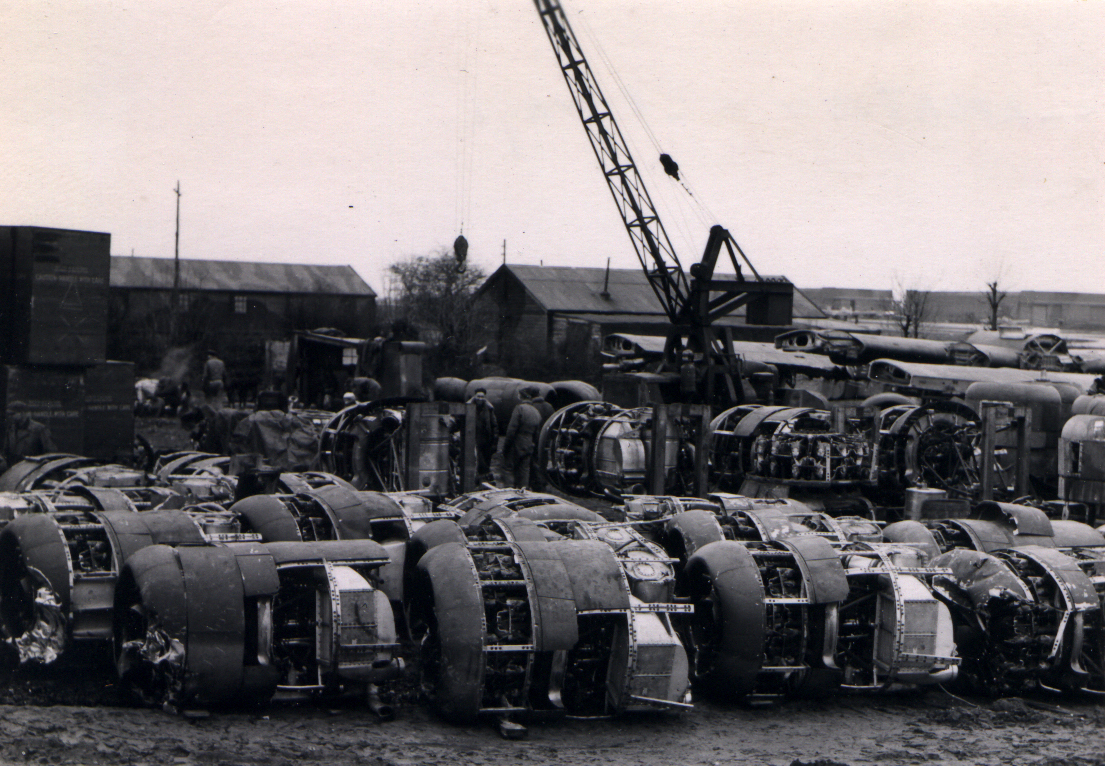
A collection of B-24 engines removed from their mounts. (IWM UPL 5385)

The role of the 3rd SAD was to maintain and repair the battle damaged B-24s of the 2nd Air Division, that had by now, flooded into the UK from the United States. This unenviable task required the recovery of the heavy bombers, washing them out and  perhaps removing the remains of airmen before returning them to flyable condition once more. Whilst not designed to be so, the acronym SAD certainly reflected the role perfectly.

Neaton consisted of a number of sites, 4 accommodation sites, a communal site, a sick quarters, two motor sites, a ‘miscellaneous’ site housing a Steam Jenny and then a 9AD site with tool sheds and other maintenance related buildings. The majority of these accommodation sites incorporated either the more common Laing or Nissen huts.

Watton itself would now become synonymous with reconnaissance, surveillance and electronic countermeasures (ECM). A new unit, 25th Bomb Group (Reconnaissance), it was constituted on 17th July 1944, and activated in England on 9th August that year. They would only serve from one UK airfield, that of Watton, where they would stay until VE day serving under the umbrella of the 8th Air Force. A visit by the famous ‘Carpetbaggers‘ (the special operations group designed to support French resistance operations) also saw the black Liberator’s fly regular missions from here during this time.

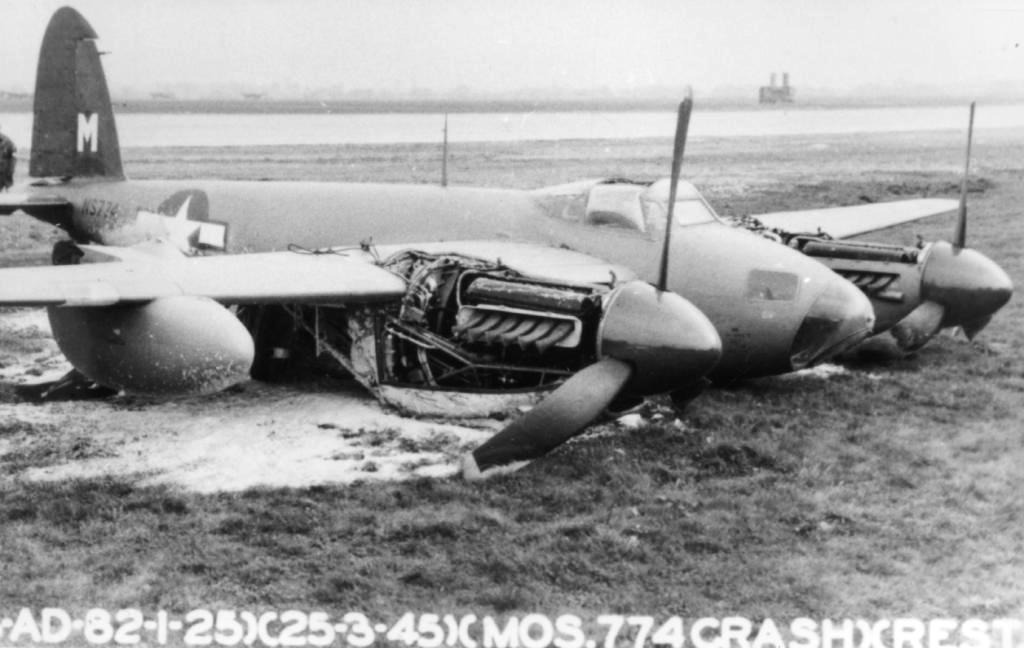
The end of Mosquito PR Mk XVI “M” NS774 of the 25th BG after crashing at RAF Watton (Station 376) 25th March 1943. (IWM UPL 6964)

The role of the Watton Group was to carryout reconnaissance missions over the seas around Britain and the Azores, gathering meteorological data. Combined with flights over the continent, the information they would gather, would help in the preparation of bombing missions. They would also carryout aerial mapping and photo reconnaissance missions, identifying German troop movements both at night and during the day.  Many of these operations involved major battles, including northern France, the Rhineland and the Ardennes. Additional tasks included electronic countermeasures using ‘chaff’, and flying ahead of large formations to ascertain last minute weather reports. A varied and dangerous collections of roles, they used a number of aircraft types including: B-17s, B-24s, B-25s, B-26s and P-38 Lightnings.

When VE day did finally arrive, the American unit departed returning to Drew Field in Florida. The August of that year must have been quite surreal, as the Americans left, flying was reduced and Watton was returned back to RAF ownership.

With the war now over, flying units began to return to the UK, many being disbanded not long after. One such unit was 527 Sqn who arrived here in the November, only to be disbanded in the April of 1946.

The next four years saw no other front line ‘operational’ flying units here at Watton, but the 1950s would bring a number of units back through its gates. With the introduction of the jet engine at the end of the war, piston engines fighters were soon being replaced by newer designs.

RAF Watton

One of Watton’s many accommodation blocks in modern use.

The ECM activity initiated at Watton by the 25th Bomb Group, would continue on in these early post-war years. For some twenty years or so in fact, through a variety of aircraft including: the Mosquito, Wellington, Domine, Lincoln, Anson, Proctor, Canberra, Meteor, Sea Fury, Firefly, Venom and many others. Each of these would not only play a vital part in the development and use of ECM, but radio research and training as well. Warfare had taken on a very new twist.

This move would see Watton becoming a hub for ECM activity. A number of RAF and Naval squadrons would operate from here undertaking such tasks. At the end of the war, Watton had become home to the Radio Warfare Establishment (RWE), renamed in 1946 to  the Central Signals Establishment (CSE). It was only one of five such units operating jointly between the military and National Air Traffic Services Organisation (NATS).  The Navy and RAF would jointly use Watton at this time, albeit for only a short period of time between March and September 1947, when the Naval Air Warfare Radio Unit moved in under the disguise of 751 NAS.

The role of the CSE was very complex, for too complex to discuss here, but with a number of squadrons operating under different roles whilst at Watton, it would culminate in 1948 in the forming of three un-numbered units: a Signals Research Squadron, a Monitoring Squadron and a Radio Countermeasures (RCM) Squadron. In essence, their role was to monitor and jam Soviet electronic communications and defence systems – it was an total airborne electronic warfare operation.*1

But the use of un-numbered squadrons was short lived, by the end of the decade the CSE had reverted to using numbered squadrons once more, their role to probe the air defences along the Soviet borders. British aircraft combined with ground stations, would monitor the reaction and activity of Soviet communications, seeing how they responded to intrusions into their airspace. By knowing this detail,  countermeasures could be put in place to jam or scramble these communications, ideally rendering them useless or at least temporarily incapacitated. The first of these numbered squadrons were 192 and 199, who were originally  the calibration and training units of the CSE.

Reformed here in July 1951 flying Mosquitoes, Lincoln B.2s and then the enormous Washington (B-29), 192 Sqn would not receive their first jet until January 1953 when the Canberra B.2 arrived. 192 Sqn would also fly the Varsity and the Comet C.2 before being disbanded and renumbered as 51 Sqn in August 1958.

199 Squadron (reformed on the same day) flew both the Lincoln B.2 and the Mosquito NF.36, in the same role as 192; their stay lasting until April 1952, at which point they moved to Hemswell in Lincolnshire where they picked up their first jet engined aircraft.

The August of 1952 saw a number of other units reform, disband or pass through Watton. 116 Sqn were reformed on the 1st, another ex Calibration flight of the CSE, it stayed until August 1958 when it was disbanded and reformed as 115 Sqn. A battle hardened squadron from Bomber Command, they had since themselves been disbanded. No longer flying operational bombers, the Varsitys 115 Sqn would operate would be the new form of transport, as they were reformed and moved on within days of their inception in that August.

On that same day in late August 1958, 245 Sqn would reform, also from the renumbering of another squadron – 527 Sqn. Flying Canberras they too were gone within days of their reformation.

As 1959 began to close and 1960 dawned, Watton would become the home of a new unit, 263 Sqn, who were operating Bloodhound missiles, the RAF’s ground to air missile used to defend Britain’s airfield against attacking aircraft. The operational use of these giant weapons lasted here until June 1963.

The 1960s saw the last of the flyers, lasting only between January 1962 and May 1963, 151 Sqn operated from here as the Signals Development Squadron, bringing back the props of the Hastings, Lincoln and Varsity before being renumbered again and subsequently disbanded.

Other units at Watton included 97 Sqn from 1963 – 1967; 98 Sqn (1/10/63 – 17/4/69), 360 Sqn (1/10/63 – 17/4/69) and 361 Sqn (2/1/67 – 14/7/67) two of which were both reformed and disbanded at Watton.

As can be expected, there were a large number of subsidiary and support units based at Watton, many of these attached to the Radio Warfare Establishment, along with SAM Training units, a range of flight units and other various regiments.

RAF Watton

Part of the disused Eastern Radar complex.

By the 1970s all flying had ceased leaving Eastern, and latterly Border Radar, the only ‘operational’ activity on the site. Eventually of course, even these were moved in the early 1990s, signalling the demise of the airfield as an active base. Watton was then handed over to the British Army.

A few years later the Army also reduced it use of Watton and the accommodation areas were sold off for private housing; a move that helped retain that airfield ‘feel’ that it still maintains today. More of the site was then sold later and new housing estates were built on the land where this previously stood; the entire feel of this has now since gone, replaced instead by a rabbit warren of roads with boxes for houses. The last remaining parts of the main airfield were sold off in 2012, the runway and peri-track being retained by the farmer and used for agricultural purposes.

Neaton too was sold off and has now been replaced by HMP Wayland, a prison holding category ‘C’ prisoners at her majesty’s pleasure.  One gruesome part of history being replaced by another.

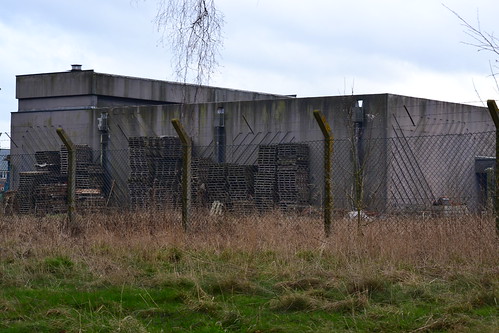
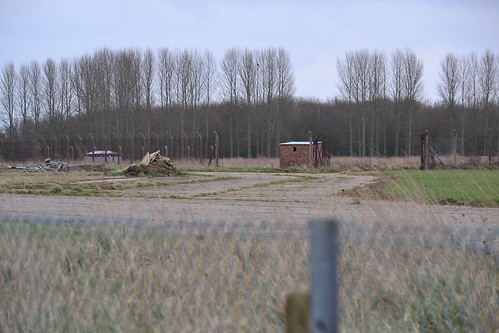
Today, the perimeter tracks, runways and hard standings support nothing more than housing. A proportion of the perimeter track remains with a small wire fence being the only defence to the continued onslaught of development. The original 4 “C” type hangars were all demolished as were the two control towers, one of which was built to support the new jet-era. Some minor buildings continue to remain surrounded by the original RAF housing, but these are few and far between, and even their future is uncertain.

Almost as lip service, many roads are named after an aircraft, Liberator, Marauder, etc., those aircraft synonymous with the operations of Watton and Neaton. Various concrete remains poke through the undergrowth and make this part of the site rather untidy. How long is it before they too disappear?

The site is split by the main road with some of the former administration buildings remaining on one side with the airfield and accommodation on the other. Some of these buildings are still in use with civilian operators and as such, have been well-preserved; others such as the technical site, have not been so fortunate and have become very rundown and in high states of disrepair.

RAF Watton

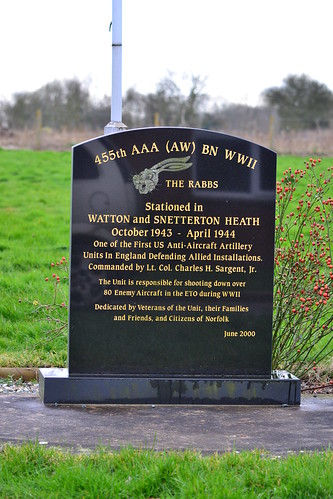
Memorial to the 455th AAA ‘The Rabbs’ located on the airfield site.

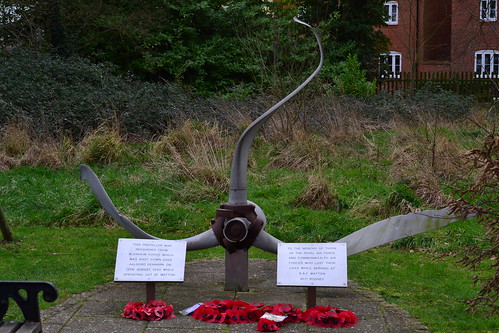
As for the airfield itself, two small memorials ‘guard’ the entrance to the new development. On the one side is the bent propeller recovered from a crashed Blenheim (R3800) shot down in the loss of eleven aircraft over Aalborg on 13th August 1940; on the other side a memorial that commemorates the 25th Bomb group USAAF. On the original housing site itself, a further memorial commemorates the 455th AAA ‘The Rabbs‘ who were given the task of defending Britain’s airfields against the Luftwaffe.  Owned by Stanford Training Area (STANTA) for a period of time and used for air mobile training, the odd Hercules or Army helicopter might have been seen here. However, this has now ceased and housing is creeping ever closer. I’m sure it won’t be long before many of these remaining remnants are lost to the developer’s digger.

Sources and Further Reading.

*1 Flintham, V., “High Stakes: Britain’s Air Arms in Action 1945-1990Pen and Sword, Oct 2008.

National Archives AIR 27/263/1: AIR 27/263/2

A website dedicated to RAF Watton has an extensive range of personal stories and information about life at Watton. It also has a video of the retrieval of Blenheim R3821 being recovered from Aalborg airport.

Further Pictures of the remains at these sites can be seen on Flckr.

NB: There is a museum commemorating the lives of the Watton personnel, open on limited days only, details can be found on their website.

Watton can be found on Trail 9.

RAF Watton – The origins of ECM (Part 1)

Norfolk once boasted many major airfields, virtually all of which are now closed to military flying. Marham is the only major survivor spearheading the RAF’s front line fighter force, in conjunction with Lincolnshire’s RAF Coningsby and RAF Lossiemouth in Moray, Scotland.

However, during the Second World War the Norfolk landscape was very different; it was littered with front line airfields, composed mainly of light bomber and fighter squadrons, all of which could be found with relative ease.

One such airfield was that of Watton. Used by a range of light and heavy aircraft, its history was chequered, bearing witness to some of the more gruesome aspects of the air-war.

Today it is a housing estate, the single runway remains and is used for storage, the hangers and technical buildings have gone and the accommodation areas have all been sold off. That said, the perimeter track remains in part, the ‘feel’ of the airfield hangs over the area and a number of memorials pay silent tribute to those who served here.

Found on the edge of the town of Watton in Norfolk, we go back to this once busy RAF base and see what has changed, and relive the life of RAF Watton.

RAF Watton (Station 376)

RAF Watton, located some 11.5 miles north-east of Thetford, opened in 1939 as a medium bomber station with the RAF. Unusually it only had one runway, a grass example, which was later extended to 2,000 yards and crossed the airfield in an east-west direction.

The late 1930s saw a massive expansion of Britain’s military might, and in particular, its airfields. With little foresight into what lay ahead, these pre-war and early war airfields were not designed, nor built, as dispersed sites. Once the realisation of what the war would bring hit home however, later examples would be dispersed, giving a new dimension to airfield design. As a result, Watton (built by the John Laing company) was constructed with much of the accommodation block, technical area, hangars and so on, all being placed closely together on one single site.

Housing for the personnel was located in the north-western corner, with the technical area just east of this. The bomb dump, an ideal target, was further to the east of this area. Four ‘C’ type hangers were constructed each having a span of 150 feet, a length of 300 feet and a height of 35 feet. Whilst Watton was a medium bomber airfield, and thus aircraft were relatively small, it was envisaged at this time that larger, heavier bombers would soon come on line, and so foresight deemed larger than necessary hangar space be provided. A 1934/35 design, these hangars would be common place across expansion period airfields.

Another architectural design found at Watton was the redesigned Watch Office, an all concrete affair built to drawing 207/36, it was one that would very quickly become inadequate, requiring either heavily modifying or, as was in many other cases, replacing altogether.

RAF Watton

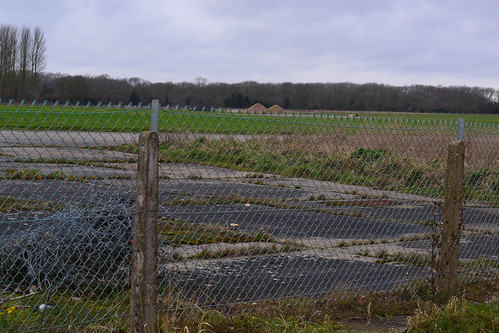
Part of Watton’s decaying perimeter track.

Partially opened in 1937, the airfield wasn’t fully completed and handed over to the RAF until 1939. Being a pre-war design, building materials were in good supply, and so the  accommodation blocks were constructed using brick, and they catered well for those who would find themselves posted here.

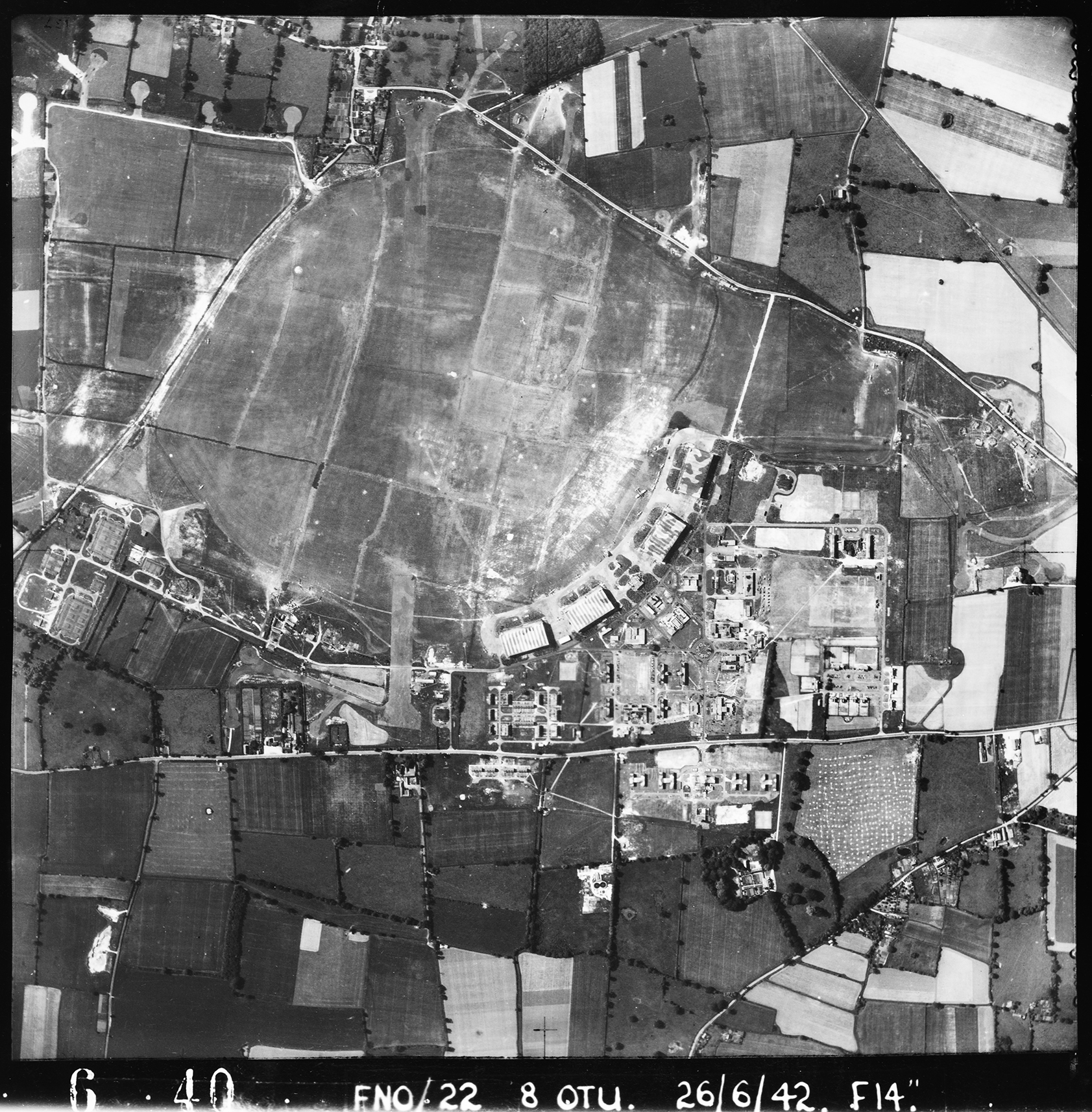
Another aspect considered at this time was that of camouflage; airfields were enormous open expanses and could be easily seen from great distances and heights. Numerous proposals for hiding them were put forward, a move that resulted in the formation of a special unit within the Directorate of Works led by Colonel Sir John Turner. Watton came under the eyes of Sir John and his department, and this led to an ingenious camouflage pattern of fields and hedges being painted across the entire airfield,  thus disguising it from prying eyes above. Whilst not completely effective, it certainly went some way to protecting it from attack.

RAF_FNO_22_RV_6040

Watton airfield taken in 1942 by No. 8 Operational Training Unit. The four hangars can be seen in the centre of the photo with the patchwork of ‘fields’ disguising the main airfield. English Heritage (RAF Photography).

The first postings to arrive were the men and machines of 21 and 34 Squadrons RAF. Their arrivals on March 2nd 1939 saw a reuniting of both squadrons under the Command of Group Captain P. J. Vincent DFC and 6 (B) Group . On the 7th, the airfield was inspected by the Group’s AOC after which 34 Sqn performed a flypast; one such event that would be the start of many visits from numerous dignitaries including the Marshall of the Royal Air Force himself, Sir Edward Ellington  GCB, CMG, CBE.

Little flying took place by either squadron at this time however, as the aerodrome was soon unserviceable due to the very poor British weather. Grass runways soon became bogs, and as was found across many grassed airfields at this time, unsafe for aircraft to either take off or land without mishap. From April  things picked up slightly, and intensive training began in the form of station tactics and defence exercises. The weather would however, continue to be the worst enemy, repeatedly preventing or restricting flying from taking place.

In August, 34 Sqn received orders to depart Watton and  proceed to Singapore, and so on the 12th, the air and ground parties began their long transit leaving Watton and England far behind. The quiet of their departure would not last ling however, as within a few days of them leaving, their empty beds would be filled once more, when the Blenheims and crews of 82 Sqn arrived.

At 11:05 on September 3rd 1939, notification came though to Watton of Britain’s declaration of war. Within days of the announcement aircraft were being moved out under the ‘Scatter’ scheme to another airfield, Sealand, for there was a fear of imminent air attacks following the war’s declaration. The Blenheims remained at Sealand until mid September, at which point they were recalled and prepared for attacks on vessels belonging to the German Navy. These vessels were not located however, and so the order to stand by was cancelled and the crews stood down. This would sadly become a regular and frustrating occurrence for the men of 21 Sqn.

Shortly after on the 9th, the first of the new MK.IV Blenheims were collected from Rootes Ltd at Speke, with further examples arriving over the next few days. Further movements saw aircraft detached to Netheravon and then onto Bassingbourne where Blenheim L8473 was damaged as it ‘nosed over’ whilst taxiing. A minor, but unfortunate accident, it would be the first of many more serious losses for the squadron.

RAF Watton

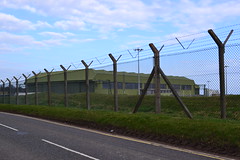
A fence separates the housing estate from the airfield remains.

On 26th September, another order came through for aircraft of 21 Sqn to stand by to attack  the German fleet, whilst a further two Blenheims (L8734 and L8743) would fly to the Rhur to carry out a photographic reconnaissance mission. However, bad weather, industrial smoke and a faulty camera prevented both aircraft from carrying out their duties: each one returning to Watton empty handed but unscathed – crews reporting heavy flak over the target area. The whole of October and November were pretty much a wash-out. Bad weather with prolonged heavy rain prevented any substantial flying beyond the local area. Air gunnery and co-operation flights were carried out whenever  possible, but the late months of 1939 had certainly been a ‘phoney war’ for 21 Sqn.

As 1940 dawned, things on the continent began to heat up and ground attacks increased for both Watton squadrons. Low-level sorties saw them attacking troop formations and enemy hardware as its galloped its was across the low-countries. Whilst bravely flying on and escorted by fighters, overall loses for the slower Blenheims of 2 Group were beginning to rise, a pattern that would only increase in the face of a far superior enemy in the coming months.

These losses were borne out by 82 Sqn in dramatic style on the 17th May, when twelve aircraft took off at 04:50 to attack Gembloux. They were met with heavy anti-aircraft fire and overwhelming fighter opposition – fifteen BF.109s, decimated the squadron. All but one aircraft was lost, the only survivor being P8858 crewed by Sgt. Morrison, Sgt. Carbutt and AC Cleary. Whilst not injured in the melee, the aircraft was badly damaged and as a result, was deemed irreparable and written off. An entire squadron had all but been wiped out in one fell swoop.

This disaster would be reflected right across 2 Group, who had now suffered its greatest overall loss to date, but for 82 Sqn it would not yet be the end of this traumatic and devastating period. The burning cauldron that was now facing the light bomber was taking its toll on crews, who were all at a distinct disadvantage to their Luftwaffe counterparts. On the 21st, three more aircraft were lost from Watton, with one being forced down in France, another lost without trace and a third limping home so badly damaged it also had to be written off.

A short visit by 18 Sqn between 21st and 26th May barely interrupted proceedings at Watton. After returning from France, they had spent no less than nine days in May at five different airfields including the nearby Great Massingham.

By early June 1940 Operation Dynamo had been completed and France was lost. The British Bulldog, whilst not a spent force, had shown her teeth, been bitten hard and was now licking her heavy wounds. Preparations would now begin to protect her own shores from the impending invasion.

Fuelled by revenge, combined attacks by both 21 and 82 Sqn continued on into the summer months. But revenge alone does not protect a crew from superior fighters and heavy flak. On June 11th, three more 21 Sqn aircraft were lost whilst attacking positions around La Mare, it is thought all three fell to Luftwaffe fighters. Two days later on the 13th, another five aircraft were lost, two from 21 Sqn and three from 82 Sqn; losses were mounting for the light bombers and Watton was amongst those bearing the brunt of these. On the 24th, 21 Sqn saw a reprieve, whether to rest crews, take on a new role or simply regroup, they began a move north to RAF Lossiemouth in Scotland. 82 Sqn however, would remain at Watton, where they would carry on with the punishing raids over the continent.

After the arrival and departure of another short stay unit, 105 Sqn between 10th July and 31st October, Watton was now left in the lone hands of 82 Sqn, a situation that would remain until the spring of 1942.

The dramatic loss of eleven crews back in May would come back to haunt 82 Sqn in August that year. On the 12th, another twelve aircraft took off on a high altitude bombing mission to Aalborg in Denmark. The airfield they were to target was well defended, and as if history were to repeat itself, once again eleven of the twelve aircraft were lost. The only one to return, that of R3915 crewed by Sgt. Baron, Sgt. Mason and Sgt, Marriott, turned back early due to low fuel.

In the space of three months, an entire squadron has been all but wiped out not once, but twice, unsustainable losses that would surely bring the squadron to its knees.

RAF Watton

Memorial to the crews lost at Aalborg, 13th August 1940. The propeller of Blenheim R3800, that crashed that day.

It was loses like this that helped convince the authorities to eventually withdraw Blenheims from front line service during 1942 – the Blenheim being long outdated and outclassed. At this time, Watton’s 82 Sqn, would begin their transfer to the Far East, a place they would remain at until the war’s end.

A lull in operations meant that Watton was then reduced to mainly training flights, through the Advanced Flying Unit. Small single and twin-engined aircraft providing the activity over the Norfolk countryside. Many of the crews being trained here would be shipped out to the satellite airfield at Bodney, before returning here for their evening meals.

A brief interlude in the May of 1942 saw the rebirth of the former 90 Squadron, a First World War unit that had gone through this very process on a number of occasions since its inception in 1917.

Flying the American B-17 ‘Flying Fortress’ or Fortress I as it was in RAF designations, 90 Sqn was set up to trial the use of the four-engined heavy for its suitability as an RAF bomber. During the first 15 days at Watton, the squadron gained personnel and received their first aircraft,  after which they moved to nearby RAF West Raynham. Here they would begin these trials which also required the use of a number of smaller airfields in the local area. These included both RAF Great Massingham and RAF Bodney, neither of which were particularly suited to the heavy bombers.

Watton then saw no further operational units, and in the mid 1943, it was handed over to the Americans who began to develop the airfield into something more suitable for their needs. It was now that Watton would take on a more sinister role.

In Part 2 we see how the Americans developed Watton, and how it became two sites rather than just one, and also, how its role in Electronic countermeasure took it into the post war years.

The full story of Watton can be found in Trail 9.

Brigadier General Frederick W. Castle – Heartbreak on Christmas Eve, 1944

On the morning of December 24th, 1944, Brigadier General  Frederick W. Castle (s/n 0-319375), woke to the greet the day, and like most pilots facing perilous missions, he probably wondered if it would be his last. However, knowing what I know about Castle from my research, he was a calm, confident and highly competent pilot, so most likely he had every reason to believe in the success of his next mission. Sadly though, that was not to be the case. Castle never made it back that night. On Christmas Eve of 1944, this brave pilot lost his 30th and final battle.

Lieutenant Colonel Elliott Vandevanter of the 385th Bomb Group with Colonel Frederick W Castle (centre) of the 487th Bomb Group and Brigadier General Curtis A LeMay. *1

Frederick W. Castle was born on October 14th, 1908 at Fort McKinley in Manila, the Philippines. He came from an active military family and was the son of Col. Benjamin Frederick Castle. Following the end of World War 1, he was to settle in the United States in Mountain Lakes, New Jersey.

From a young age, Castle was destined to follow in his fathers footsteps, groomed for a life of military service. He attended Boonton High School and Storm King Military Academy before moving on to the US Military Academy from where he graduated in June 1930.

His first service was with the New Jersey National Guard, where he stayed for two years  transferring to the Air Corps, March Field, California, then onto Kelly Field in Texas. Castle gaining his wings in October 1931.

Serving as a pilot with the 17th Pursuit Squadron for 3 years, he eventually left the forces returning to civilian life but holding a reserve status. With the entry of the United States into the Second World War, Castle would be called upon by his good Friend Ira Eaker, returning to the fold in January 1942, and being promoted within two months to Major. By the following September, Castle had been promoted yet again, he was now a Lieutenant Colonel.

With the forming of the Eighth Air Force in England, headed by General Ira Eaker, Castle was one of seven high-ranking officers selected to fly with him on the dangerous route over the Bay of Biscay, eventually arriving at Hendon wearing their civilian clothes. Joining Eaker on February 20th 1943 in the DC-3 from Lisbon were: Lt Colonel Frank Armstrong Jnr, Major Peter Beasley, Captain Beirne Lay Jnr, Lt. Harris Hull and Lt. William Cowart Jnr.

Castle desired a combat role, and this desire would lead to him taking over the command of the ailing 94th Bomb Group. His methods of command were initially considered weak, but in the face of low morale and apprehension, he personally took the 94th to some of the furthest targets yet, his first being Oschersleben in the heart of Germany; a mission that went on to inspire the film “12 o’clock High“.  Castle went on to fly in many combat missions including numerous high prestige targets, a role that took him on to Brigadier General and command of 4th Combat Wing.

On Christmas Eve 1944, following a week of poor weather, orders came though for a maximum effort mission, involving every available B-17 and B-24 in support of the troops in the Ardennes. Airfields, supply lines and troop movements were to be attacked, and following weeks of poor weather, a break was at last predicted.

As a joint effort, this would be the largest single attack to date involving 500 RAF and Ninth Air force bombers, 800 fighters and just short of 2,050 Eighth Air Force bombers. Such was the demand for aircraft, that even ‘war weary’ examples, were hastily armed and prepared, many unfit for more than assembly or training duties. Truly an armada of incredible proportions.

General Arnold with Colonel Frederick W Castle, Brigadier General Curtis LeMay, General Williams and General Anderson during a visit to RAF Rougham, home of the 379th BG. *2

Taking lead position, Frederick Castle, was in B-17G-VE, ’44-8444′ “Treble Four“, an aircraft that had itself seen battle experience. Assigned to the 836BS, 487BG, and at RAF Lavenham, it was previously damaged in a raid over Darmstadt. The aircraft was  later salvaged in January 1945.

A veteran of 29 missions, Castle was a more than a competent leader. They set off, the weather was as predicted but with a haze that restricted ground level visibility. It was this haze prevented the fighters from leaving causing an all important delay in the escorts. This delay was not considered a major problem at the time however, as the escorts being faster, would soon catchup and overtake the heavily laden bombers. The Luftwaffe, in an unprecedented move, brought forward fighters into the Liege area to meet the oncoming bombers before any escorts could reach them. In the first few minutes of the battle, four of the 487th BG’s aircraft were downed and a further five forced to land in Belgium.

Castle’s lead plane, suffering problems with one of its engines (possibly due to previous battle damage) was attacked by the first wave of fighters, action was taken to leave the flight and join a formation further back. It was then attacked again, the aircraft catching fire, and the navigator being wounded.

Castle took control, and even though still being attacked, refused to jettison the bombs for fear of killing civilians or allied troops below. Further attacks led to both engines on the starboard wing catching fire, which ultimately led to the fuel tank exploding sending the aircraft into an uncontrollable spin.

Through Castle’s actions, seven of the crewmen were able to leave the aircraft, sadly  though not all survived.

Frederick Castle died in the crash, his body is now buried in Henri-Chapelle American Cemetery, Liege, Belgium, Plot D, Row 13, Grave 53.

His citation reads:

“He was air commander and leader of more than 2,000 heavy bombers in a strike against German airfields on 24 December 1944. En route to the target, the failure of 1 engine forced him to relinquish his place at the head of the formation. In order not to endanger friendly troops on the ground below, he refused to jettison his bombs to gain speed maneuverability. His lagging, unescorted aircraft became the target of numerous enemy fighters which ripped the left wing with cannon shells. set the oxygen system afire, and wounded 2 members of the crew. Repeated attacks started fires in 2 engines, leaving the Flying Fortress in imminent danger of exploding. Realizing the hopelessness of the situation, the bail-out order was given. Without regard for his personal safety he gallantly remained alone at the controls to afford all other crewmembers an opportunity to escape. Still another attack exploded gasoline tanks in the right wing, and the bomber plunged earthward. carrying Gen. Castle to his death. His intrepidity and willing sacrifice of his life to save members of the crew were in keeping with the highest traditions of the military service*3.”

For his action, Frederick W. Castle was awarded the Medal of Honour posthumously. In 1946, the Castle Air Force Base, in the heart of California’s San Joaquin Valley, was dedicated in his name, and on June 20th, 1981, the Castle Air Museum was officially opened on the now closed base, for the purpose of preserving the Air Force and Castle heritage. Museum details can be found on their website. His  name is also on a plaque in the Memorial Park, in Mountain Lakes, New Jersey.

The awarding of the Medal of Honour, reflected the determination and personality of one of Eakers “Original Seven”, who chose to leave a safe position for a combat role, taking on the demoralised 94th, and leading them into some of the Second World War’s most ferocious air battles.

Sources and further reading.

*1 Photo from Roger Freeman Collection, IWM, FRE9833

*2 Photo from Roger Freeman Collection, IWM, FRE9879

*3 Congregational Medal of Honour SocietyWebsite, accessed 22/12/15

Mountain Lakes Library, Website, accessed 22/12/15

“The B-17 Flying Fortress Story”, Roger A Freeman, Arms and Armour, 1997.

Air Forces Historical Support, Division,  Website, accessed 22/12/15

“The Mighty Eighth”, Roger Freeman, Arms and Armour, 1986.

1st. Lt. William G. Rueckert, RAF Hardwick – Update

I recently published a post about the life and death of 1st. Lt. William Rueckert, who was killed on his first and only operational mission from RAF Hardwick in Norfolk.

William, Dee and Little Bill Dorothea ‘Dee’, Little Bill and William

Since then, I have been able to obtain, thanks to the Air Force Historical Research Agency Maxwell AFB, copies of another accident report that William was involved in.

The story was retold by Dee, William’s young wife as occurring at Biggs Field, El Paso in Texas and involved a B-24 colliding with another aircraft. It is now believed this was in fact a collision at Lemoore AAF as the details of the incident are very similar to those originally told by Dee.

At the time, the Army Air Corps used a range of aircraft to train pilots in basic flying, one of the more powerful and complex models was the single engined aircraft the Vultee BT-13 (replaced by the Vultee BT-15). On May 20th, 1943, William was flying solo in BT-15 #42-1957 at Lemoore AAF, and was approaching to land.

The official records (crash number 43-5-20-6) held at the Air Force Historical Research Agency, states that:

At 17:02, May 20, 1943, while upon final approach at Lemoore Field at the termination of a routine training flight, Student Officer, 1st. Lt. W.G. Rueckert collided with A/C  D.W. Christedsen [sic].

Both airplanes were approaching the field in the usual manner. The wind was slightly from the right at 10 mph. Position of the approaching ships gave the control ship stationed on the south-west corner of the mat no cause for alarm. A/C Christensen in ship 32 was in front below and to the right of Lt. Rueckert in ship 12. Several hundred yards from the south-west edge of the mat. Lt. Rueckert noticeably dropped the nose of his ship which struck the A/C Christensen’s airplane behind the canopy. Both airplanes remained in contact and fell to the edge of the mat from a height of about 50 feet. A/C Christensen plane landed on its back, exploded and burned killing A/C Christensen immediately. Lt. Rueckert’s landed nose first, broke clear of the other plane and the pilot jumped out and attempted to extinguish the blaze with his fire extinguisher. He sustained a cut on his forehead and shock. The fire truck and ambulance arrived immediately afterward, put out the blaze and conveyed Lt. Rueckert to the hospital.

Lt. Rueckert stated that he never saw A/C Christensen’s plane in the traffic pattern.

It is probable that one or both pilots were making improper correction for wind drift although witnesses were located at angles which made it impossible to verify this fact.”

The enquiry that followed concluded:

Failure of pilot in airplane to look around. Poor correction for drift on the part of one or both pilots. Lack of control tower in the vicinity of mat. Present control tower is approximately four thousand feet from the scene of the accident.

Dee would later retell the story to Bill, describing how she went to the hospital and how she had to remove little splinters of the shatter windshield from William’s forehead for weeks after the crash.

As a result it is now believed that the accident William suffered was indeed at Lemoore and not at El Paso. I shall continue to search for any evidence to the contrary, but it is almost certain that this is now the case.

Another small part of the jigsaw has fallen into place, and I once again thank Bill for allowing me to publish his father’s story.

See the full story of William’s life and death at under Heroic Tales – 1st. Lt. William G. Rueckert.

Sources:

Accident number 43-5-20-6 Lemoore Army Air Field provided by the Air Force Historical Research Agency.

Remembrance Sunday – In Honour of 150,000 RAF Personnel.

On Armistice day we pay tribute to all Service men and women who served and died in the defence of freedom. This year we pay particular homage to those of the RAF through a visit to the remarkable St. Clement Danes Church in London.

St. Clement Danes Church – London

St. Clement Danes church stands almost oddly in the centre of London in the Strand, surrounded on all sides by traffic; like an island it offers sanctuary and peace yet its history is far from peaceful.

St. Clement Danes - Church of the RAF

The view toward the Altar. The floor contains nearly 900 Squadron badges of the Royal Air Force.

It reputedly dates back to the Ninth Century AD following the expulsion of the Danes from the City of London, in the late 870s, by King Alfred. As a gesture, he allowed Danes who had English wives to remain nearby, allowing them to dedicate the local church to St. Clement of the Danes. Ever since this time, a church has remained, albeit in part, on this very site.

St. Clement Danes - Church of the RAF

The ‘Rosette’ of Commonwealth Air Force Badges embedded into the floor.

In the 1300s and then again in the late 1600s it was rebuilt, the second time influenced by the great Sir Christopher Wren – notable for his designs of buildings both in and outside of London. Regarded as being Britain’s most influential architect of all time, he designed many famous buildings such as the Library at Trinity College and the Royal Hospital at Chelsea. Wren also redesigned both Kensington and Hampton Court Palaces – his influences stretched far and wide.

Of course Wren’s ultimate master-piece was St. Paul’s Cathedral in London, a structure that reflected both his skill, vision and personality.

During the Great Fire of London in 1666, eighty-seven churches were destroyed in London, but only fifty-two were subsequently rebuilt. Whilst not directly damaged by the fire, St. Clement Danes was included in that list due to its very poor condition and Wren was invited to undertake the huge task.

St. Clement Danes - Church of the RAF

The Memorial to all the Polish airmen who served with the Royal Air Force during World War II.

It then stood just short of 300 years before incendiary bombs of the Luftwaffe destroyed it in May 1941. Leaving nothing but a few walls and the tower, Wren’s design had been reduced to ashes and rubble.

For over ten years it lay in ruins, until it was decided to raise funds and rebuild it. In 1958, following a national appeal by the Royal Air Force, St. Clement Danes was officially opened and dedicated as the Central Church of the Royal Air Force in memory of all those who fought and died whilst in RAF service, and to ‘serve as a perpetual shrine of remembrance’ to them all.

In completing the restoration, every branch of the RAF was included. At the entrance of the church, is the rosette of the Commonwealth made up of all the Air Forces badges of the Commonwealth countries, each of which flew with RAF crews during the conflicts. Beyond the rosette, the floor from the north aisle to the south aisle of the Nave contains nearly 900 squadron badges each one made in Welsh Slate and embedded into the floor.

Around the walls of the church, four on each side and two to the front, are ten Books of Remembrance from 1915 to the present day, in which are listed 150,000 names of those who died whilst in RAF service. A further book on the west wall, contains a further 16,000 names of USAAF personnel killed whilst based in the United Kingdom during the Second World War.

St. Clement Danes - Church of the RAF

Ten Books of Remembrance contain 150,000 names of those who died in RAF Service 1915 – the present day. A further book contains 16,000 names of USAAF airmen who were killed.

On either side of the Altar, are boards and badges dedicated to every branch of the RAF. Two boards list the names of those who were awarded the Victoria Cross and others the George Cross. Other slate badges represent the various units to serve and support the main fighter and bomber groups, including: RAF Training units, Fighter Control units, Maintenance units, University Air Squadrons, Medical units, Communication squadrons, Groups, Colleges and Sectors.

In the North Aisle, a further memorial, also embedded into the floor, remembers those who escaped the Nazi tyranny in Poland and joined the RAF to carry on the fight during World War II. Each Polish Squadron is represented in a beautifully designed memorial around which is written:

“I have fought a good fight, I have finished my course’ I have kept the faith”

Smaller dedications can also be found around the church, such as the Mosquito Aircrew Association, dedicated to both air and ground crews of the mighty ‘Wooden-Wonder’. Some of these memorials are in the form of gifts of thanks many of which come from other nations as their own tribute to those who came from so far away to give their lives in the name of freedom and democracy.


At the going down of the sun and in the morning
We will remember them.

Why not support the British Legion through their website