If visiting the airfields of North Norfolk, then a stop at the grand 17th Century Blickling Hall is a must. Here, not only do we have a house that dates back some 400 years, but an estate that goes back even further to the 15th Century, and once belonged to the Boleyn family. A mix of Jacobean architecture, grand paintings and tapestries complement a library that contains one of the most historically significant collections of manuscripts and books in England. Walks that take you through a 4,800 acre estate of gardens, wild meadows and woodland, are brimming with wildlife. Even on busy days, you cannot fail to enjoy the peace and tranquillity, the inviting waters of the lake and views over the Norfolk countryside.
But equally important, you have a house that once belonged to Philip Kerr, 11th Marquis of Lothian, Britain’s Ambassador to the United States. Lord Lothian, played a major part in Britain’s war, convincing Churchill to write to Roosevelt, explaining the consequences of a Nazi victory in Europe and the poor defensive position Britain lay in at that time. A letter that began a chain of events including Lord Lothian’s speech to the American people, that eventually led to the ‘Lend-Lease’ programme being initiated and arms allowed to flow into Britain.
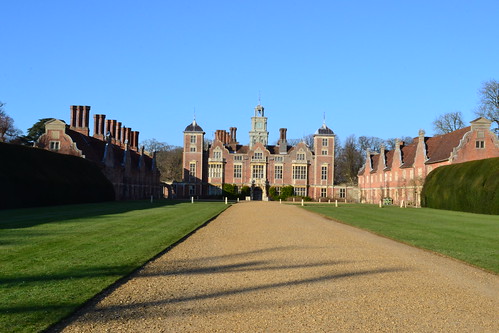
Blickling Hall, the Museum can be found in the buildings to the right hand side.
A few miles from Blickling, is the airfield RAF Oulton, part of 100 Group commanded by Air Commodore Addison, whom the farm at RAF Foulsham is named after. Oulton utilised much of the house and grounds of Blickling, billeting officers in its ‘wings’ and other ranks in Nissen huts within its grounds. The lake was regularly used for dingy training, the upper floors allowed for bathing in baths – a real luxury for aircrews in the Second World War.
Housed within one of the ‘wings’, is a small museum, the RAF Oulton Museum.
The museum itself is situated in the upper floors on the eastern side, utilising one of the former barrack blocks used by the RAF. The original paintwork still colours the walls and a ‘mock’ billet has been recreated using original furniture sourced from local shops, auctions and through donations.
The museum holds a unique collection of photographs, personal letters and stories gathered over a number of years accumulating into a fascinating record of life at RAF Oulton only a few miles away. The winter of 1944-45 was one of the worst on record and many of the photographs show crew members relaxing in the snow on and around the base.
Letters tell of the local people, their connections with the base, the pub outside the main gate formerly the ‘Bird in Hand’, (now a private residence) and the Buckinghamshire Arms next to Blickling Hall, (still a pub) where crews would spend their evenings and ‘free’ time.
Log books and uniforms from those stationed at Oulton, along with a mix of original artefacts and replica newspapers, all help to recreate the atmosphere of an RAF billet. It is packed with historical and personal information – a real gem for those interested in history and life on the RAF base.
A great little museum, it is certainly worth a visit.
More information about Blickling Hall and the RAF Museum can be found on the National Trust Website.
By the end of the Second World War, there were a substantial number of airfields covering the UK, mainly used by the Royal Air Force, the United States Army Air Force, the Royal Navy and all their associated branches; they were handed back to the RAF at the end of the war as the various forces were pulled out. Some were used as POW or repatriation camps, some were used to store surplus aircraft, vehicles or ordinance; many were put into care and maintenance whilst the RAF decided their ultimate fate.
Thankfully a few have lasted as airfields and are even fulfilling that role today, sadly though, many were dug up, their runways used for hardcore, the buildings demolished and the events that occurred there reserved for the history books.
The scale and pace of development was massive. The size of these sites bigger than many of the villages they took their names from, the populations larger than many towns of the time. Architecturally they changed the landscape dramatically.
Today as they dwindle away, many are mere names, locals have little knowledge of their existence, memorials are being forgotten, and life is moving on.
As a little reminder of those times and to put the scale of development into perspective, here are two maps held by the British Library that show the main Royal Air Force and Royal Navy airfields as of 31st December 1944.
The two maps, divide the UK and show not only the airfields but satellites as well. They also show Royal Air Force and Royal Navy Water Airfields, and Royal Air Force Moorings. There are a number of sites not included on the map such as relief landing grounds, and training schools, but they do give an indication of the number of airfields that covered the UK by the end of the war.
These are both low resolution pictures, and copyright is held by the British Library who have given permission for them to be reproduced here.
In this, the 34th trail, we go back to the northern area of Norfolk, not far from the North Sea coast, and then head south. We end up near to RAF Attlebridge found in Trail 7, west of the city of Norwich.
Our first stop was a quite unassuming airfield, but one that played an important role during the Second World War. British readers will remember the distinct voice of one Raymond Baxter OBE, the voice behind so many thrilling air show commentaries, the TV programme ‘Tomorrow’s World‘ and a wide range of outside commentaries that brought the wonders of science and technology into our homes. Baxter himself served in 602 Sqn RAF, and was stationed at the airfield in the latter stages of the war. We are of course at RAF Matlask.
RAF Matlask (Station 178)
Documented on airfield site plans and other RAF Documents as Matlask, as opposed to Matlaske the name of the village, it was a large grassed airfield hidden well into the Norfolk countryside.
The village of Matlaske separates the main airfield from the four airmen sites and sewage disposal site, which were widely spread away to the north; only site 2 (communal and WAAF area) and site 7 (Sick Quarters), were located in the village itself.
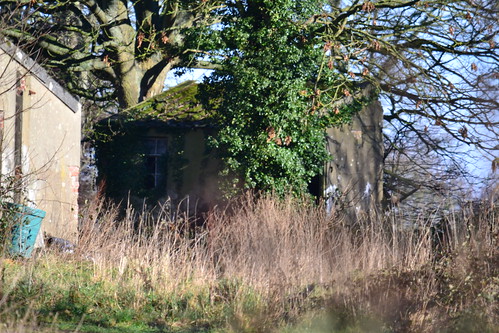
One of the few remaining buildings at Matlask. This being the former Site 3.
Accommodation was substantial, even taking over the large and rather grand Barningham Hall for the Officer’s Mess. The current building dates back to 1612 and stands in 150 Hectares of garden, park and lakes, a rather ‘up market’ dwelling, that is closed off to public access.
Other accommodation included a range of the usual huts, ‘Nissen’ and ‘Laing’ being the most prominent, with brick and timber featuring most.
The airfield itself stands to the south of the village, with the main entrance way off to the western side. A guard hut would have marked the main gate where a number of brick buildings would have been used for storage, technical activities, fuel storage and the like. A small road took you onto the concrete perimeter track that led all the way round the site. Dispersal was provided by 21 concrete hardstands, although a further 21 temporary hardstands were planned. One single T2 hangar was located next to the technical area, with a further 5 Blister hangers (design 12512/41) spread around the perimeter. Aircraft dispersal was also provided by the standard 6 Type B protected dispersal pens, (7151/41) with built-in air raid shelters; each shelter having a crew entrance and emergency exit. Matlask initially had one watch tower to the north of the site next to the technical area. This was later modified to a two storey design and then a further example was built slightly to the south, this being of the more common two storey ‘standard’. wartime design (343/43).
Matlask although tucked away in the Norfolk countryside would not be devoid of activity. Some 22 RAF squadrons, an Air Sea Rescue unit and an American Fighter Group would all use it at some point.
Designed initially as a satellite for Coltishall, it was dogged with drainage problems, and surprisingly never seem to warrant any form of hard runway. It was opened in 1940 as part of 12 group, destined for fighter defence of the Midlands.
In 1937, 72 Sqn (RAF) was reformed. they moved around a variety of bases eventually ending up at Matlask’s parent base, RAF Coltishall. When Coltishall was attacked in late October 1940, it was decided to move the Spitfire squadron to Matlask for protection. This merely brought the war to Matlask for on the 29th, five Dorniers attacked the airfield, inflicting damage on several dispersed aircraft and injuring a number of personnel.
The village sign in Matlaske village.
After this attack, the first of two, the Spitfires would leave and Matlask would revert back to a satellite having no permanent residents of its own. This situation continued until May/June 1941, when Spitfires IIbs would arrive also from RAF Coltishall (Trail 7) . 222 Sqn (RAF) only stayed until the following July, moving south to the large fighter base at RAF Manston, in Kent.
This would then set the tone for Matlask, a large number of short stays, most for no more than a month or so. But whilst their stays were short, the diversity of aircraft they used was not. Spitfire Is, IIbs, IX, XVI, Hurricane II, Airacobra I, Walrus, Lysanders, Westland Whirlwind, Typhoon Ia and Ib, P-47 ‘Thunderbolts’, Miles Master, Martinets, Hawker’s Henley, Tempest Vs and Mustang IIIs would all grace the skies over this region of Norfolk.
Perhaps one of the more notable examples to fly here, was the American Airacobra. 601 Sqn (RAF) moved from RAF Manston to Matlask at the end of June 1941, bringing Hurricanes with them. These were replaced by the distinctive tricycle undercarriaged P-39 ‘Airacobra‘ a short time after. The first auxiliary squadron, 601 was known as the “Millionaires’ Squadron” and said to have been created by Lord Grosvenor at the gentlemen’s club “White’s“. Membership was initially very restricted, and boasted a unique initiation into the ‘club’. Whilst a determined and very professional unit in the air, they acquired a reputation for flamboyance and bravado on the ground.
In looking for a new fighter, the RAF turned to the Americans. The Airacobra was trialled and whilst found to have a number of advantages over its adversaries, it was considered too poor at heights over 15,000ft. Used in only a small number of raids it was deemed inadequate and soon replaced, with many supplied models being sent on to Russia and the Far East. 601 would use these partly at Matlask and then back at the Fighter Development Unit at Duxford where they moved to on August 16th 1941.
On that same day, Spitfires arrived with 19 Sqn (RAF). They changed their Mk.IIs for Vbs before moving off to RAF Ludham in December. It was during this stay though that a change was to take place for Matlask.
On October 1st 1941, 278 Sqn would be formed out of 3 Air Sea Rescue (ASR) Flight, operating Lysander IIIs. These, whilst successful in SOE missions, were considered the weak link in the Air Sea Rescue Role. Operating initially as a spotter, it would fly to the last reported position of the downed aircraft, carry out a search, drop whatever aids it could, and then pass the information on to a Walrus which would collect the airman. In theory this worked well, but due to its poor capacity (supplies were limited to what could be fitted on the bomb racks), slow speed and vulnerability, it was limited to flying no further than 40 miles from the coast. As a result, and almost immediately, the Lysanders were replaced by the Walrus, an aircraft 278 Sqn operated for some time. Performing in this vital role, they were eventually moved in April 1942 to RAF Coltishall leaving Matlask firmly behind.
Around the time 19 Sqn departed Matlask, 137 Sqn moved in. They were to be perhaps the longest-serving squadron at Matlask and perhaps also one of the most notable.
Operating in the Coastal patrol and fighter role, they brought with them the Westland Whirlwind. Potentially thought be a world-beater, they would be liked by their crews, perform well at low altitude and have a punch that matched anything in the European Theatre at that time. However, having a poor combat range, and production problems with their engines, they were only built-in limited numbers and were restricted to ground attack, anti-shipping duties and low-level sorties. As such, they were only supplied to 2 operational squadrons, 137 Sqn and 263 Sqn; 137 Sqn being the second. Operations by the Whirlwind were mixed. Some great successes were reported, its concentrated fire power proving devastating not only to enemy aircraft but more heavily armoured targets including locomotives.
Despite this however, 137 Sqn was to suffer a major blow in February 1942. Whilst escorting British destroyers, they were unaware of the presence of the two German warships Scharnhorst and Gneisenau. On diving to investigate, they were attacked from above by escorting Bf-109s and of the six Whirlwinds sent out, four were shot down and lost. Despite its good performance, it was never to enter full production and soon the Whirlwind would be declared obsolete and be destined to fall into aviation obscurity.
137 Sqn would leave Matlask in August 1942 only to return 10 days later before departing again to RAF Snailwell at the end of the month. Almost as a direct replacement, Typhoons from Snailwell’s 56 Sqn and Coltishall’s 266 Sqn took their place. 56 Sqn stayed here for almost a year, moving to Manston in July 1943 whilst 266 Sqn moved to Duxford that same month. One of the last fatalities of 56 Sqn was Flight Sergeant R.G. Gravett (s/n 1268706), flying a ‘Rhubarb’ mission in his Typhoon JP392, who was killed when his aircraft was hit by Flak whilst attacking a locomotive at Leiden train station. The resultant crash, which hit 5 homes in Leiden, also killed one civilian and wounded five others.*1
After 56 Sqn’s departure the airfield was allocated to the Eighth Air Force and given the designation Station 178. Sadly though, it was only used for small detachments of the 56th FG flying P-47 ‘Thunderbolts’, and plans to expand the station to three runways were not carried out.
Apart from target towing activities, the early summer of 1943 was relatively quiet at Matlask; Lysanders returned along with the more unusual Masters, Henleys and Martinets of 1489 Flt.
Then came a flurry of fighter activity. The July of that year would see Matlask become a fighter base once again, with Spitfires, Tempest and Mustangs all being stationed here. Some 11 squadrons: 611, 195, 609, 3, 486, 65, 122, 229, 453, 602 and 451 all brought their own variety of fighter with them over the next year.
January 1944 would bring two more ‘unusual’ visitors to Matlask, although neither would be particularly graceful. On the 11th, B-17G (s/n 42-31090) ‘Nasty Habit‘ was instructed to land at Matlask, because of poor weather at its own station, RAF Deenethorpe (Trail 6). The B17 overshot and crashed through the boundary hedges and onto the road. Flying with the 613 BS, 401 BG, it was salvaged ten days later.
B-17G (s/n 42-31090) ‘Nasty Habit’ *2
Then at the end of that month, whilst returning from a mission to Berlin, Halifax III, HX239*3 ‘HD-G’ of 466 Sqn RAF Leconfield, attempted a landing at Matlask due to low fuel. On touchdown the pilot, P.O. D. Graham realised he was on a collision course for a group of workmen. In averting what could have been a major catastrophe, he ground looped and hit a partially built building, injuring three of the crew members. For the crew, a mix of Canadians and Australians, it was not the most comfortable of landings!
Almost as quickly as it all started, aircrews left and Matlask fell silent. The war came to an end and the RAF pulled out. 451 Squadron leapfrogged between here and nearby RAF Swannington, finally leaving on April 6th 1945 to RAF Lympne in Kent. The end had arrived for Matlask. A short spell as a POW camp and then it began its rapid return to agriculture and its present day form.
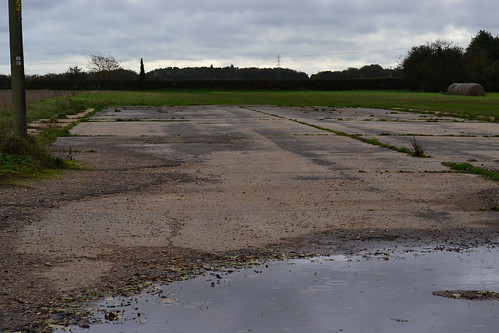
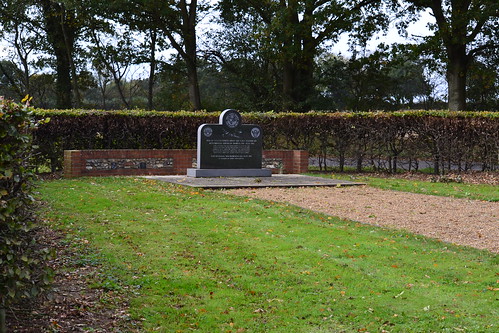
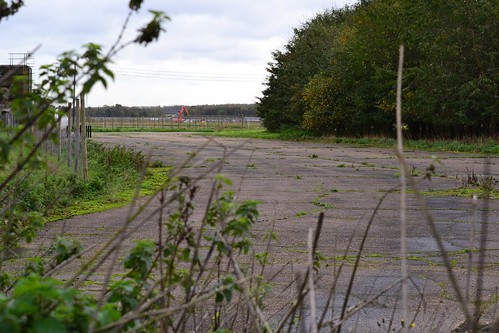
Matlask airfield today is very different from its heyday of the 1940s. The perimeter track is all but gone, only a small section remains as a simple farm track that leads across what was the northern section of the airfield. Half way across this part of the airfield lay the remains of the base of the T2 hanger. Today its holds farm machinery, waste and other products. On the north-western side would have been the main gate and the technical area. The two towers have left no remnants and even the last fighter pen is all but indistinguishable. Having grass runways, means the site is flat and unrecognisable as having any notable history. A memorial erected by the Airfields of Britain Conservation Trust stands on what was the north-eastern section of the airfield just south of the village. From the village, heading south past this memorial takes you parallel to the airfield, the former perimeter tracks only feet from where you are driving.
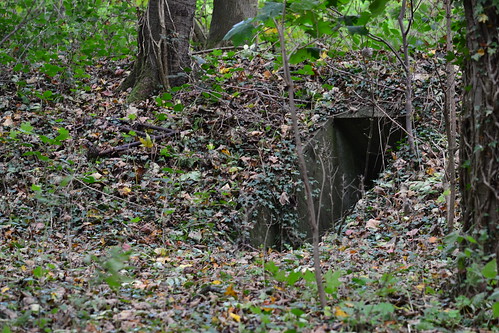
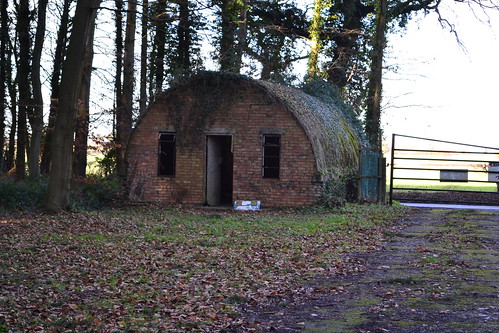
In the village of Matlaske itself, you can find the former sick quarters – site 7, its distinctive roadway still evident but housing small homes and Bungalows now rather than sick bays of the 1940s. To the west there are a small number of buildings remaining on private land, shrouded in vegetation and trees, they are barely visible from the roadside. This would have been the former site 3, the location of six airmen’s barracks, five latrines, an ablutions block, drying room, fuel compound and a picket post. A small community in its own right.
Many of the accommodation sites are located within the grounds of Barningham Hall and the roadways that once took weary crews to and from the airfield now gone. Driving down the western side past the technical site, presents no sign of wartime activity. The former huts have all been removed, and even the battle headquarters, often one of the last few buildings to survive, has been removed.
Matlask has all but gone. When I visited early in 2016 it was a foggy, cold morning. The Norfolk wind has replaced the piston engines, the Merlin’s no longer resonate across the open expanse. The village is quiet. A public defibrillator in an old phone box perhaps a metaphorical gesture. The village sign acknowledges the history, a lone aircraft flying low over the village. As the fog lifts on this winter morning it reveals a wide open expanse that was once the busy and historic RAF Matlask.
Raymond Baxter commentates on some British Classics at RAF St. Athan.
After leaving Matlask airfield, we head south, a short distance to the former base at Swannington.
sources
*1 Air War WW2 database V4.1, Jan Nieuwenhuis, Netherlands
This airfield forms the second stop on our Essex trail and is an airfield that is probably unique in that it was named after a General. After leaving Matching Green, we travel a short distance away and stop at the former base Andrews Field.
RAF Andrews Field
Andrews Field (officially Great Saling or Station 485) can be found nestled in the Essex countryside, not far from Stansted airport, about 3 miles west of Braintree. It has the unique honour, among many, to have been the first airfield designed and built for the USAAF in England.
Construction began in the summer of 1942 as a bomber station for the then fledging Eighth Air Force. Units from the 96th BG would start to arrive mid 1943 and their first operational duty would come in the middle of that same year. Heavy bombers of the 96th would go on to perform a strategic bombing role for the remainder of the Second World War, although not from Andrews Field.
Great Saling was renamed Andrews Field in honour of Lieut. Gen. Frank M. Andrews, who was killed when his B-24 crash-landed in Iceland on 3rd May 1943. Andrews was the eighth American general to lose his life (or to be reported missing in action) since the war began, and was known as a ‘doer’, once quoted in the New York Times as saying: “I don’t want to be one of those generals who die in bed.”*3
The airfield was built as a Class A airfield, with accommodation situated to the north-eastern side of the airfield. A communal site, two mess sites, six airmen accommodation sites, two WAAF sites, a sick quarters and a sewage works would accommodate upward of 3,000 officers, airmen, WAAFs and ground crews. The airfield, with the pinnacle of the ‘A’ pointing north, had three hard runways, the main (2,000yds) running east-west and two secondary (1,400 yd) running north-west to south-east and north-east to south-west respectively. A perimeter track with 50 hardstands joined the three runways together. Further storage and maintenance ‘sheds’ were provided by two T2 hangars, one to the south and one to the east. A bomb store, for small bombs, incendiaries and fusing, was also to the south next to Boxted Woods. The main administrative area was to the east, where the main entrance led out of the site to the accommodation areas. The technical aspects of Great Saling were widely spread and in comparison to many other airfields of this nature, quite thinly catered for. With the majority of the work being undertaken on this side of the airfield, the western side was left primarily for aircraft dispersal.
B-26 Marauder (s/n 43-34132) “Patricia Ann” of the 450th BS undergoing an engine test at Andrews Field. The aircraft collided with another B-26 (42-96279) over Beauville Airfield, it suffered damage but was able to return*1.
The first but not primary residents, were the heavy B-17s of the 96th BG, 4th BW, Eighth Air Force. Activated in July 1942 at Salt Lake City Utah, they trained on B-17s from the start of their inception. Moving to the United Kingdom in the following May, they would stay at Andrews Field for only one month before moving on to nearby Snetterton Heath on 12th June 1943. The 96th would operate four squadrons (337th, 338th, 339th and 413rd BS), attacking targets such as shipyards, harbours, aircraft factories, and major industrial targets across occupied Europe. Later in the war, they would receive a Distinguished Unit Citation before their return to the United States post war.
With their departure, Andrews Field would be passed over to a new unit, the 332nd BG, who were to be the largest and most major operational unit to serve at Andrews Field for the duration of the hostilities.
The USAAF was not generally associated with medium bombers, and the introduction of the Martin B-26 Marauder, would bring a whole host of issues. Rushed into service, it was to gain notoriety for poor handling, regular engine failures, weak undercarriage and high stall speeds that led to a string of accidents and crew deaths. The aircraft soon gained a collection of unsavoury names; ‘Widow Maker‘, ‘Baltimore Whore‘ and ‘Flying Prostitute‘, reasons for which were born out in its early days of flying.
B-26 Marauder (s/n 41-18276) “Pickled Dilly” of the 322nd BG. Later shot down 13km south of Abbeville, by Bf-109G-6 (JG301/1), July 8, 1944. 3 KIA 4 POW*2
The 322nd BG, activated at MacDill, Florida, trained with this particular aircraft and Marauder Squadrons soon found themselves transferring across the Atlantic to bases in both Suffolk and Norfolk as part of Eaker’s Eighth Air Force.
General Eaker however, soon decided that the low flying, medium bombers were adding little to his strategic bombing campaign, and so placed all the Marauder units under the control of the VIII Air Support Command, very much a back seat of the mighty Eighth’s activities. Coinciding with this move, was the decision to move all Marauder units of the 3rd Wing south so as to be within easy reach of the continent and more able to support the impending invasion. The first units to be affected were the 386th (to Boxted), the 322nd (from Rougham to Andrews Field) and the 323rd (to Earls Colne). The headquarters for these also moved south, taking up new residency at the less luxurious Marks Hall, an Elizabethan mansion!
After a series of disasters at Rougham, the 322nd, arrived at Andrews Field on June 12th 1943. The four squadrons (449th, 450th, 451st and 452nd BS) all returned to action in the July, following a series of intense low-level training duties. Better successes followed, and this led to a growing belief in the Marauder’s capability in proven hands; the future began to look brighter for the aircraft. The 322nd went on to use their new skills, attacking targets that included airfields across the lowlands, power stations, shipyards and the rail networks. Success flourished and the 322nd would eventually earn themselves both notoriety and a DUC for their high performance; if nothing else it was a reputation that stopped the Marauder crews being on the wrong end of B-17 crew jokes.
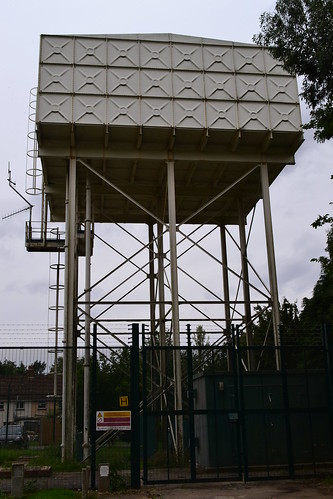
The 80,000 gl Braithwaite Water Tower at Andrews Field
On October 6th, 1943, the four units of the VIII Air Support Command flew their last mission as part of the Eighth. Now there was a new control, the Ninth Air Force had moved to England. A new focus and more low-level strikes against the enemy led the preparation for the invasion. Coastal defences were hit and airfields in the northern area of France were targeted as part of operation STARKEY, the allied plan to fool the Germans into thinking a full-scale attack would take place around the channel ports.
Following the June invasion, for which the 322nd played a major part, they went on to continue supporting Allied ground movements. Battles at Caen and St. Lo helped the Allied forces advance through France: bridges, railway junctions, defensive positions and ordnance depots all came under the focus of the 322nd.
As the Allies moved further in land toward Germany, so too did the Marauders. In September 1944, the 322nd left Andrews Field and moved to Beauvais in France. They continued to support the Allies into the German Heartland performing their last mission on April 24th 1945, before commencing inventory duties in Germany and then returning to the US for disbandment on 15th December 1945.
By the end of their tour, the 322nd had performed remarkably. The Marauder had gone from one of the most despised aircraft to the perhaps one of the most respected. Its ability to perform in good hands, and its sturdy airframe, reflected its remarkably low loss rate, 0.3 %, 13 losses in only 4000 sorties.
After their departure, Andrews Field was passed to RAF control and a considerable number of fighter units would pass through here. First came the Mustang IIIs of 316 Sqn, who arrived in August 1944, staying until September 1945. The October of 1944, saw yet more Mustangs arrive, with 19, 122, 129, 315 and 316 sqns again all with the Mark IIIs. By now Andrews Field was a very busy base, and even more units were to pass through. In December, 309 Sqn arrived staying until August 1945, and it was during this year (1945) that 65 Sqn brought the updated Mustang IV as did 303 Sqn later in the August. A monopoly of American hardware was only broken for two months (June to August 1945) by the Spitfires of 276 Sqn.
Then as the jet age dawned and Meteors began to arrive, two squadrons would operate the aircraft from Andrews Field; both 616 Sqn and 504 Sqn (albeit for a short period only) would fly the MK.III, transforming the sound from piston engines to jet engines. As December 1945 came so did the departure of the 303 Sqn and the last remaining Mustangs, a move that signalled the end of military action at Andrews Field. Following this, the airfield was mothballed and finally put into care and maintenance.
Andrews Field was to produce some remarkable records during its operational time. The first by B-26 ‘Mild and Bitter‘ s/n 41-31819, of the 450th BS, was the first Allied bomber to pass 100 operational missions (in Europe). A second, ‘Flak Bait‘, s/n 41-31773, became the first to surpass 200 missions – both remarkable feats when at that time few pilots relished the thought of flying just one mission let alone two hundred.
Post war, the airfield was used for a multitude of roles, eventually having much of its infrastructure removed and returning to a primarily agricultural role. However, aviation grew from the ashes and flying thrives once again through light aviation as Andrews Field Aviation. Offering a range of flying lessons, they keep the spirit of Andrews Field alive long after the last military aircraft departed on its final journey. Using a grass runway that follows the line of the original, it is one of the few reminders that an airfield existed here many years ago.
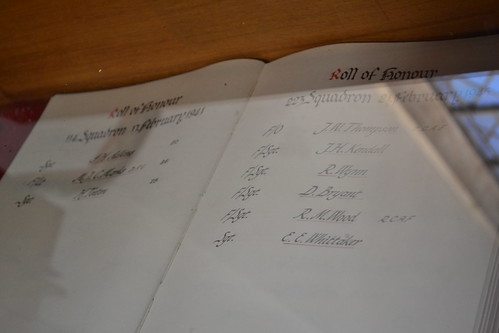
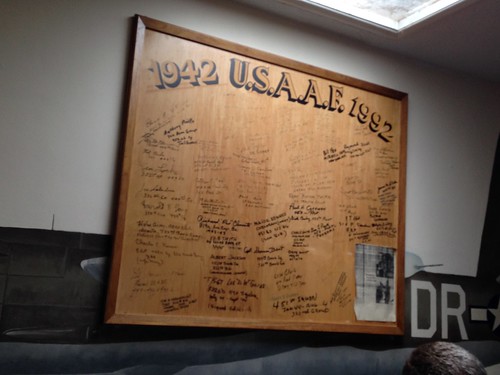
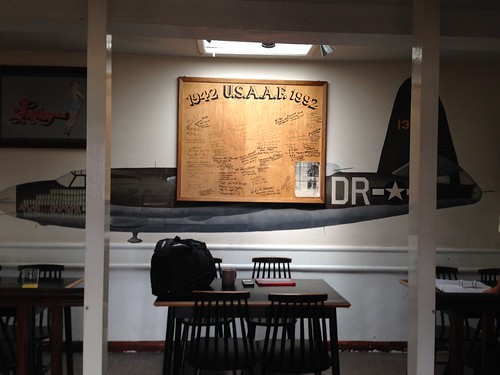
A memorial board in the airfield clubhouse
Visiting Andrews Field today, there is little of its former life left. The runways, buildings and perimeter tracks have all but been removed. Much of the evidence of its existence lies in the nearby village of Great Saling. The 80,000 gl high level water tower (Braithwaite built to design 16305/41) stands on the former Site 3, now a playing field, and a defensive pill-box hints at the area’s historical use. The main accommodation areas are now either all built upon with small housing estates or ploughed up for agricultural purposes. The original entrance from the main road is today the entrance to a small quarry.
Driving away from the village to the rear of the airfield takes you along the former north-western perimeter track. Down here almost buried under the hedgerow are the steep banks of the firing butt. The road continues round to the southern side of the site, again utilising part of the original perimeter track. Entering the site, takes you alongside the runway to the clubhouse and parking areas. From here one of the remaining two T2s can still be seen, lurking in amongst the tress, as if defiant to development.
A rather unusual addition to the site is a somewhat forlorn Dassault Mystere IVA jet, gradually decaying in the British weather. It certainly has seen better days, and maybe one day it too will rise from the ashes and become a thing of aviation beauty once more.
A memorial to those who built the airfield can be found where the entrance to the sick quarters were, and a further memorial can be seen along the road linking Great Saling and the A120 in memory of the crews of the 322nd BG. Inside the clubhouse is a mural and photos of the airfield whilst under construction.
The mural painted to commemorate the crews of the 322nd.
Andrews Field is an airfield that has clung onto its heritage, but whilst much of its former life has gone, the sound of small piston engined aircraft provides something of a reminder of the mighty engines that once relentlessly throbbed on this amazingly historical site.
After leaving Andrews Field, we travel a few miles west back again toward Stansted Airport. We stop at Great Dunmow and the neighbouring church at Little Easton.
Sources and further reading
1 Photo Roger Freeman Collection, IWM, FRE4482
*2 Photo Roger Freeman Collection, IWM, FRE1187
*3 New York Times published May 5th 1943 (accessed May 26th 2018)
“The Mighty Eighth“, (1970), Roger Freeman, Arms and Armour,
“RAF Squadrons“, (1998) CG Jefford, Airlife
A number of detailed and remarkable websites exist around the B-26, each is worthy of a visit.
Today, 13th February, marks the birthday of an American airman who like so many, died at the young age of just 21, in the early morning of D-Day, 1944.
He was a gallant and brave young man, whose tragedy perhaps led to the success of his fellow airmen, and whose sacrifice is still remembered today.
As the world’s largest amphibious assault force assembled along the South Coast of England, thousands of aircrew prepared for what was to be the most incredible night of their lives.
Across the Midland Counties, American ground crews prepared their fighters and paratrooper aircraft. Along southern England, the same scene was being played out. RAF crews too prepared their aircraft; fighter groups were briefed and paratroopers readied their gear. The invasion was on!
Flying an operation of this magnitude was going to require guts, daring and precision flying. There was little room for error.
In the lead up to June 6th, the RAF and USAAF had been bombing prime targets across Northern France to soften up the defending Germans. Supply lines were severed and gun emplacements destroyed. Beachhead bunkers had been heavily targeted, and supporting artillery further inland, hit hard.
In the air, fighters had been downing the Luftwaffe in an effort to gain vital air superiority over the drop zones. At home, huge attempts were made to keep the plans and preparations as secret as possible. An intricate operation of deception was being played out; dummy airfields were built, camps and troop movements were hidden under cover and concealed in forests.
At an airfield in Norfolk, the day was to begin very badly for one particular young pilot. He was 1st Lt. Robert C. Frascotti of Milford, Massachusetts.
In the days leading up to D-Day at RAF Bodney (USAAF Station 141), the 352nd FG had been flying intruder missions over France, attacking ground targets and completing air superiority missions. P-51s were rapidly being prepared, and the growth of black and white stripes adorning aircraft, hinted of an imminent invasion.
In the late hours of June 5th, the P-51s were being fueled up and armed, ready for an early morning takeoff. The weather was not at its best and a low mist shrouded the airfield reducing visibility. The mission ahead was to support the troops landing on the Normandy beaches.
At 02:30, the pilots climbed in, fastened their belts and awaited the signal to launch D-Day. First to leave were the 486th FS. To help with the takeoff, temporary lights were placed along the runway, guiding the aircraft safely out of harm’s way into the night sky. One of these aircraft, unfortunately struck the lights knocking them out and plunging the airfield into darkness once more. Lining up behind them were the second flight of the 486th, including Frascotti’s P-51.
When lining up, the flight were unaware that they were off centre. Frascotti and his wingman, Lt. Carlton “Bud” Fuhrman, accelerated away and raced down the runway. Fuhrman watched Frascotti to his left when suddenly there was a massive fireball. Thinking someone had dropped their external fuel tanks, Fuhrman pulled up sharply and pushed on through the flames hoping his engine would not falter resulting in him crashing into the raging fire below. Momentarily blinded by the now total darkness, Fuhrman, pushed the stick forward and fought against the impending stall. Eventually his sight returned and he was able to read his instruments once more. Looking back, he could see Frascotti’s fully fueled plane engulfed in fire with no hope of an escape. Frascotti died instantly.
The accident report filed after Frascotti’s death stated that an inadequately lit tower along with poor weather and high levels of traffic had caused him to inadvertently strike the unfinished control tower at Bodney resulting in the ignition of his fuel. Tragically, Frascotti died instantly, and the aircraft was a total loss.
Frascotti’s plane, a blue nosed P-51B-5 Mustang, 43-6685 was named ‘Umbriago‘. In Italian, ‘umbriago’ means ‘drunk’. Frascotti could have named his plane for that reason, but it could also be he was referring to the World War II-era song of 1944, “Umbriago”by Jimmy Durante about a fabled friend of the same name. The song lyrics end with,“So when you feel low, better send for my friend, Umbriago.”
At a mere 21 years of age, 1st Lt. Robert C. Frascotti had many tributes written about him. There was one benefit of his tragic accident: the following aircraft now had a ‘guiding light’ by which they could safely takeoff and leave for Normandy.
Frascotti was born on February 13th, 1923 into a very close-knit and patriotic family in Milford, Massachusetts. (His father fought in World War I where he was gassed). Frascotti was awarded his pilot wings in Marianna, Florida on March 25, 1943, then completed advanced fighter training before deploying to England in March 1944. He joined the 486th FS of the 352nd FG, otherwise known as ‘The Blue Nosed Bastards of Bodney”. 1st Lt. Donald “Red” Whinnem of Hartford, Connecticut, was best friends with Frascotti since the early days of flight school. On D-Day at Bodney, “Red” took off without incident and flew for sixteen hours, returning to discover the tragedy that had occurred. “Red” says of his friend;
“Bob was the nicest guy you would ever want to know, and a great athlete as well. He could stir up laughter anywhere he went, and he was great fun to be with. Bob would sing a song or tell a story and cheer everyone up. You couldn’t ask for a better friend, and he was closer than a brother to me.”
During his service, Frascotti was credited with the destruction of two enemy aircraft on the ground whilst strafing enemy airfields. On D-Day, he departed for his 89th mission. This was to be his last mission of the war as he was due to return to the States leaving conflict behind him. Sadly, he never made that journey home to Massachusetts until many years later.
Initially, Frascotti was buried in England. His remains were eventually taken back to Massachusetts in 1948 after his next of kin had his body exhumed, and he now lies in the Sacred Heart Cemetery, in Milford. Lt. Robert C. Frascotti VFW Post 1544 in his hometown, now bears his name, and on December 6th, 2013, as part of the annual “Wreaths Across the Worcester and Norfolk District”, a group of local veterans, families and friends, laid a holiday wreath at Calzone Park in Milford to remember the fallen veterans of the area, including Frascotti. Since the war, every year until his death in 1998, 1st Lt. Donald “Red” Whinnem traveled to Frascotti’s grave in Milford to pay his respects and remember his wartime friend.
Fly pasts and tributes continue to be paid for Frascotti, in both the United States and here at RAF Bodney, Norfolk. 1st Lt. Robert C. Frascotti will long be remembered for his brave sacrifice, and we that are here, are honored to continue to tell his story.
As for RAF Bodney, the airfield is now an Army training camp and part of the Stanford Training Area (STANTA) in Thetford Forest. Little remains of the airfield today but the history held within its decaying walls will long live on.
Robert Frascotti next to his P-51B, 43-6685, named ‘Umbriago’ . At 21 years of age he was killed on his final mission before returning home. (Photo – Marc Hamel)
I came across this video on You Tube, published on May 27th 2013, it shows the control tower at Bodney airfield.
(The Frascotti page was originally posted on June 6th 2014)
There has been a recent ‘spate’ of developments with planning applications that affect Britain’s wartime heritage, and in particular the airfields that were used during the Second World War.
With land at a premium, a housing crisis that is growing, these sites are becoming more and more handsome as development opportunities. Many have a ready-made infrastructure, many are open fields and as such, prime agricultural or development land. So what does the future hold for Britain’s heritage?
We have seen applications submitted or at least interest shown, for the former: RAF Kings Cliffe, RAF Downham Market, RAF West Raynham, RAF Denethorpe and RAF Coltishall, further applications have now been seen affecting former RAF Dunsfold, RAF Bourn and RAF Wellesbourne Mountford.
We also know that the USAF have given notice of withdrawal from their major UK base at RAF Mildenhall, the smaller site at RAF Molesworth and the remaining site at RAF Alconbury. The Government has already announced it will be selling these sites for housing after the military withdrawal in 2020-23. These three sites form part of an estimated £500m sell-off that would also include: RAF Barnham (Suffolk), Kneller Hall (Twickenham), Claro and Deverell Barracks (Ripon), Lodge Hill (Kent), Craigiehall (Edinburgh), HMS Nelson Wardroom (Portsmouth), Hullavington Airfield (Wiltshire) and MOD Felton (London). Changes at RAF Lakenheath will also see job losses through streamlining of operations.
It is estimated that the 12 sites could accommodate an estimated 15,000 homes with Alconbury having 5,000 alone.
The former airfield and barracks at RAF Waterbeach is also subject to planning proposals, and the Bassingbourn barracks near Cambridge is also under the development spotlight. The recent closure of Manston (a vital Second World War airfield) has led to speculation of its future both as an airfield (possibly London’s third) and as a development opportunity. These are perhaps just a few of the prime areas of land that are now becoming the focus of planners and developers alike.
There are many variables in this heated and long-lasting debate, in fact far too many to raise and discuss here. Strong feelings exist both toward and against the idea of development and it is certainly not a new one. Employment, jobs, environment, heritage, housing etc, they all create discussion and a strong case for both arguments, but the debate here is not “should we build or not” this is quite frankly, inevitable and in many cases much-needed, no, it’s more how can we meet the needs of an ever-growing population with the needs to preserve historically important sites that form the very thread of today’s society.
We have a dynamic population, and as health care improves, social mobility increases and a growing desire to own our own home increases, the need for more housing, affordable homes and homes for rent also increases. We are an ageing population, care homes, schools for our children and hospitals for the sick are all in much greater need. Where do we build them?
Whilst housing demands have always been with us and the need for more housing an all important one, the recent developments suggest that these old airfields could become prime land to meet these future housing needs.
Many of the current Second World War airfields are now either industrial conurbations or agricultural areas. Most have little or no remnants of their former lives visible, and certainly not widely accessible. Many argue that these sites are scrub, derelict and in need of development, and some indeed are. A proportion of the more recently used sites, are ‘mothballed’ or in part operating aviation related activities. They cover huge areas and have a ready-made infrastructure such were the designs of war and post war airfields. These sites also contain extensive dereliction, primarily due to being left and allowed to decay by their owners. Vandalism and pilfering has left them rotting like carcasses of forgotten wild animals. Where industry has been operating, contaminates have seeped into the soils, damaging flora and fauna growth; some so severe that they are rendered too difficult to reclaim as ‘Green Space’. Certainly on paper, they offer good sources for today’s desperate housing stock.
However, balance this against the historical and cultural importance of these places and the argument becomes a little blurred at the seams. Had it not been for the people who came to this country from all over the world to fight the Nazi tyranny in the war years 1939-45, then Britain and Europe would probably not be the Europe we know today. Many thousands of people gave their lives during those dark days, and for many of them, these airfields were their last homes, cold, often draughty huts on the outskirts of some bleak airfield. Their dedication helped form the very society we live in today, the democracy and freedom of speech we so enjoy and relish, the open spaces where we can walk our dog without fear and in freedom. The fact that we can have this very debate, is in itself, testament to those who came here never to return. The very nature and fabric of our local communities has been built around the ‘friendly invasion’ the acceptance of others into our quaint life and idyllic life-styles. Influences from other nations and cultures grew and developed as a result of those who came here from far and wide to give up their lives.
These sites have become monuments to them, their lives and deaths, many still have no known grave; many simply ‘disappeared’ such was the ferocity of the explosion that killed them. The design of Britain’s airfields are architecturally significant to our heritage, buildings were designed to fulfil a purpose and just like our castles and stately homes, they are monuments to a significant period of not only British, but world history. Our education system, includes this very period as a subject for discussion, debate and analysis. To build over such sites without due regard to them would be a travesty, and one that we would regret in the future. To paraphrase that well-known quote; If we are to learn from our mistakes then we need to remember the past. The Second World War is still, for the moment, in living memory, the veterans and civilians who survived it are dwindling in numbers and very soon their memories will be lost for ever. Each day brings news of a lost veteran or a newly discovered story. If we don’t acknowledge the value of these places, if we don’t plan for their ‘preservation’ then both we and our future generations, will be the ones to regret it.
So where do we go from here? The plans published for RAF West Raynham and RAF Coltishall take into account the nature of these sites, they are sympathetic to their historical value and acknowledge the sacrifices made. West Raynham utilises the very buildings that were created, thus keeping the atmosphere for those who wish to visit. Small museums create a record, first hand experiences and artefacts, all valuable records for the education of future generations. But both of these are unique. Both closed in more recent history, they have retained their structures whereas many older sites have had theirs long since demolished.
It is a delicate balance, and as sad as it would be to see them go, there has to be legislation to create compromise. Sympathetic developments have to be the way forward, acknowledgement of the sacrifice has to be high on the agenda. Many of the airfields I have been too have no museum, no memorial barely even a signpost. Surely this is wrong.
If we are to preserve our fragile heritage, we need to consider the implications of the planning process, to look at the value of these sites as both suitable housing and significant historical areas, the sacrifice of the many needs to be acknowledged and it needs to be done soon.
There are many tragic and sad events associated with the Second World War, a recent discovery is no different. The story of a B-17 and her crew as they left on one of the first missions of the American air war has recently come to light with the discovery of the aircraft off the North Norfolk coast.
The story of this particular aircraft, believed to be B-17F-VE ’42-29752′ is especially sad, not only because it was the first operational mission of the unit and the first casualty, but because of the nature of the loss; just moments after take off, a month after it and its crews had first arrived in the UK.
The B-17, was built and delivered at Cheyenne on February 12th 1943. Its journey to the UK would take it through a number of stations, via Walker airbase, Salina, and on to Presque Isle, in the north-eastern sector of Maine, where it arrived on April 8th 1943. It was here that it was allocated to the 338th BS, 96th BG and ferried across the northern route with the air echelon of the 338th, arriving at RAF Grafton Underwood in April 1943, before onward shipment and operational duties.
The 338th BS had only been activated themselves one year earlier in July 1942 and as such were relatively new to the war. Their journey took them through a number of training bases from Salt Lake City, through Utah, Idaho and onto their final station at Pyote AAB Texas. From here, the air and ground echelons went their separate ways, the air echelon travelling north and the ground crews to Camp Kilmer, New Jersey and onward via the Queen Elizabeth to Greenock, Scotland and the European Theatre of Operation. The ground echelons arrived at Great Saling (Andrews Field) in early May 1943 moving to Snetterton Heath a month later where they would join up with the air echelons.
It would be whilst temporarily based here at Grafton Underwood, on May 13th 1943 that the B-17 would end its short life and become an almost forgotten part of history.
The 338th would take part in a 72 aircraft mission to bomb the Longuenesse and Ft. Rouge Airfields at St Omer, France. On the day in question, the aircraft were to form up over the North Norfolk coast, before heading off south. Crews had been briefed about the possibility of being attacked by marauding Luftwaffe aircraft and so many crews had their guns charged as they climbed away from the airfield. It was this very precaution that led to the tragic death of one of the crew members and demise of the B-17.
As the aircraft, piloted by Capt. Derrol Rogers, formed up, a waist gun was accidentally discharged sending high calibre bullets into the stabilizer completely severing it and forcing the aircraft into an uncontrollable climb and potential stall. Fighting with the controls, Capt. Rogers fought to keep it from crashing. Both he and his Co-Pilot: Lt. Norville Gorse, managed to get the aircraft back under control long enough to allow the crew to bail out over land. Once out, they took the aircraft back out over The Wash and jettisoned the bombs. Then as they approached land once more, they tied a rope to the yolk and bailed out themselves.
Aircraft, believed to be 42-29752, after the waist gun was accidentally discharged, severing the stabilizer. (American Air Museum)*1
Lt. Gorse was picked up by an RAF rescue launch and returned to his unit, but unfortunately, Capt. Rogers, being in the sea for some time, didn’t survive. He was the only fatality of the incident, the remaining crew all returning to their base and operational duties.
The B-17 now unmanned and destabilized, plunged into the North Sea where it has laid for the last 70 years. A truly tragic start to a very bitter war.
An engine was initially caught up in a fishing boat net in the 1970s, but no real investigation was made of the wreck. More recently, towards the end of 2015, a small team of divers went back down to photograph the aircraft, and it was then that it was identified and its remarkable story revealed.
The Crew of B-17 ’42-29752′
Capt: Derrol W. Rogers,
Co-pilot: Norville Gorse,
Navigator: Joe Hudson,
Bombardier: George Rawlings,
Flight engineer/top turret gunner: Basil Maxwell,
Radio Operator: Bob Bennett,
Ball turret gunner: Alf Miles,
Waist gunner: Bob Dominick,
Waist gunner: Edwin Wolfkuhle,
Tail gunner: Ed Youngers (injured by discharged bullets)
Capt. D.W. Rogers (s/n O-403737) is listed in the St Paul’s Roll of Honour, (Page 360), he is buried in the Cambridge American Cemetery, Madingley, Plot D, Row 7, Grave 69, he was awarded the DFC and Purple Heart.
*1 Photo from the American Air Museum (IWM) UPL 19232
Deenethorpe saw action by 4 squadrons from the 401st Bombardment group, reputedly the “The best damned outfit in the USAAF”. They flew 254 combat missions and received two Distinguished unit Citations. They had the best bombing accuracy of the mighty Eighth and one of the lowest loss ratios of any USAAF unit. However, a local disaster and inauspicious start, did not mean it was all plain sailing.
RAF Deenethorpe (Station 128)
Deenethorpe October 1942, taken by No. 8 OTU (RAF/FNO/166). English Heritage (RAF Photography). The memorial is to the bottom right*1
Constructed in 1942/43 as a Class ‘A’ airfield, it would have three concrete runways, a main of 2,000 yds and two secondary both 1,400 yds. The main runway ran in a north-east to south-west direction whilst the two secondary runways ran north-west to south-east and east-west respectively. The airfield was built adjacent to the (now) main A427 Weldon to Upper Benefield road and had around 50 loop style hardstands for aircraft dispersal.
For maintenance of the heavy bombers, two ‘T2’ hangars were sited on the airfield, one to the south-eastern corner and the second to the west, next to the apex of the ‘A’. Fuel stores were in the southern and northern sections, away form the technical site located to the south-east. Accommodation sites for 421 Officers and 2,473 enlisted men were also to the south-east beyond the road. Initially used by the RAF as a training base, it was quickly adopted by the USAAF and personnel soon moved in.
The main inhabitants of Deenethorpe were the four squadrons of the 401st BG, 94th Combat Wing, 1st Air Division. This Division, operated from nine airfields, in this Peterborough-Cambridge-Northampton triangle with three further fields to the south-east of Cambridge. A small cluster of sites located close together but away from the main 2nd and 3rd Air Divisions of Norfolk and Suffolk.
The 401st were a short-term unit operating until the end of the war; although they did go on to serve post war in the 1950s following reactivation. Originally constituted on March 20th 1943, they moved through various training airfields eventually arriving in England in October/November 1943.
B-17 Flying Fortress SC-O (42-97487) “Hangover Haven” of the 612th BS/401st BG after crash landing at Deenethorpe, 3rd October 1944*2
The four squadrons of the 401st, the 612th, 613th, 614th and 615th, all flew B-17Gs and operated with the codes ‘SC’, ‘IN’, ‘IW’ and ‘IY’ respectively. Using a tail code of a white ‘S’ in a black triangle, a yellow band was later added across the fin (prior to September 1943, the tail fin codes were reversed, i.e. black ‘S’ in a white triangle as in the above photo). The ground forces arrived via Greenock sailing on the Queen Mary, whilst the air echelon flew the northern routes via Iceland. Their introduction into the war would be a swift one.
The primary role of the 401st would be to attack strategic targets, such as submarine pens, ship building sites, heavy industrial units, marshalling yards and other vital transport routes. Many of these were heavily defended either by flak or by fighter cover, much of which was very accurate and determined.
On the 26th November 1943 they would fly their first mission – Bremen, headed by their commanding officer Colonel Harold W. Bowman. It was not to be an auspicious start though. With 24 crews briefed, engines started at 08:00, twenty-four B-17s rolled along the perimeter track to their take off positions at the head of the northern end of the main runway.
It was then that B-17 “Penny’s Thunderhead” 42-31098, of the 614th BS, slipped of the perimeter track trapping the following aircraft, commanded by the Station Commander Major Seawell, behind it. Then a further incident occurred where aircraft 42-39873, “Stormy Weather” suffered brake failure and collided into the tail of 42-31091 “Maggie“, severely damaging the tail. Four crews were out of action before the first mission had even starte. Bad luck was not to stop there. Once over the target, cloud obscured vision and whilst on the bomb run “Fancy Nancy“, 42-37838, collided with another B17 from the 388thBG. “Fancy Nancy” was luckily able to return to England, but severely damaged it could only make RAF Detling in Kent where it crash landed. So severe was the damage, that it could only be salvaged for parts and scrap. The mission report for the day shows that the ball turret gunner lost his life in the incident, the turret being cut free from the fuselage. A further gunner was wounded by flak and a third suffered frost injuries to his face.
On their second mission, the 401st were able to claim their first kill. A FW-190 was hit over the target at Solingen and the aircraft destroyed, but their luck was not necessarily about to change.
Within a matter of weeks the 401st were to have yet another set back and it was only due to the quick thinking of the crew that casualties were kept to a minimum. On December 5th 1943, mission 3 for the 401st, target Paris; B-17 42-39825, “Zenobia” crashed on take off coming to rest in nearby Deenethorpe village. The uninjured crew vacated the burning aircraft and warned the villagers of an impending explosion. Fire crews and colleagues rushed to the scene, and the two remaining injured crewmen were safely pulled out. Twenty minutes after the initial crash, the aircraft, full of fuel and bombs, finally exploded destroying a number of properties along with the fire tender. The explosion was so enormous, it was heard nine miles away.
The crew of the B17 which crashed on the village of Deenthorpe. L-R. T/Sgt William D Woodward, (t/t), Sergeant Waldon D Cohen, (b/t), Sergeant Harold J Kelsen, (w/g), Sergeant Robert V Kerr, (t/g), S/Sgt Benjamin C Misser, (r/o), and Lieutenant Walter B Keith, talking to Captain RJ White, who rescued the navigator Lieutenant King. The navigator and bomb-aimer are still in hospital, recovering from injuries. *3
The new year however, brought new luck. During operations in both January and February 1944 against aircraft production facilities, the 401st were awarded two DUCs for their action and as part of the 1st Air Division, they would be awarded a Presidential Citation. The 401st attacked many prestige targets during their time at Deenethorpe including: Schweinfurt, Brunswick, Berlin, Frankfurt, Merseburg and Cologne, achieving an incredible 30 consecutive missions without the loss of a single crew member.
Like many of their counterparts, they would go on to support the Normandy invasion, the break out at St Lo. the Siege of Brest and the airborne assault in Holland. They attacked communication lines in the Battle of the Bulge and went on to support the Allied crossing into Hitler’s homeland over the Rhine.
The 401st performed many operations, 254 in total. Their last being on April 20th 1945 to the Marshalling yards at Brandenburg. During the mission, B17 “Der Grossarschvogel” (The Big Ass Bird) was shot down. Five crew members were killed in the crash and several others, who had managed to escape, were beaten by civilians almost killing two of them. Ironically, they were ‘saved’ by Luftwaffe personnel, and in one case, even freed although the orders had been to shoot him.
These were not to be the last 401st fatalities though. On May 5th 1945, VE day of all days, Sgt G. Kinney was hit by the spinning propeller of a taxying B17 killing him; a devastating end to operational activities at Deenethorpe.
On June 20th, the 401st vacated Deenethorpe, returning via the same route that they came and were then disbanded in the US. Deenethorpe was returned to RAF ownership and retained until the 1960s when it was sold off. The standard design 12779/41 tower was demolished in 1996 and the remainder of site returned to agriculture. All major buildings have been removed as have two of the three runways. The main one still exists today for light aircraft and microlights, as does most of the perimeter track – but as a mere fraction of its former self.
Whilst there is little to see of this once enormous airfield, best views can be obtained from the main road the A427 Weldon to Upper Benefield road. A few miles along from Weldon on your left is the airfield. Stop at the memorial. The original control tower, now gone, stood proud, visible from here beyond the memorial. The technical site would be to your right, and you would be looking almost straight down the secondary runway to your left. The communal and accommodation sites were directly behind you and traces of these can be seen but only as building footings. In the distance you can see the modern-day hangars used to store the microlights,
Access to this area is restricted, prior permission being needed before entering the site, records show that there have been a number of ‘incidents’ with landowners and users of the airfield. So what little remains is best viewed from here.
The memorial is flanked by two flags, is neat and well cared for. The runway layout is depicted on the memorial stone and it proudly states the achievements of the 401st. I am led to believe the ‘Wheatsheaf’ pub further along was the haunt of many an American airman and has a ‘401 bar’ with photos and memorabilia. I was not able to visit this unfortunately and cannot therefore verify this. Definitely one for another day!
Modern activity at Deenethorpe
Deenethorpe is one of those airfields that has quietly slipped away, the passage of time leaving only simple scars on the landscape. This once busy and prestigious airfield now nothing more than rubble and fields with a memorial to mark the brave actions, the death and the sacrifice made by crews of the United States Army Air Force so long ago.
A BBC news report covered the planting of a time capsule in June 2011, when the widow of Tom Parker (the last of the 401st Bombardment Squadron crew, that flew the B-17 plane “Lady Luck” out of Deenethorpe), kept their promise that whoever was last would bring a collection of tankards back to Deenethorpe with their own personal stories. The tankards were a gift from the pilot of Lady Luck, Lt Bob Kamper who presented them to the crew at a reunion in 1972. Mr Parker, the last member of the crew, sadly died in March 2011.
Deenethorpe falls under Northampton County Council, and like Kings Cliffe in the same area, has been the subject of planning applications. It is proposed that the airfield be removed and all flying activity stopped. A Garden Village will be built on the site, and the area landscaped accordingly. The proposal can be found here.
Deenethorpe was originally visited in Trail 6, ‘American Ghosts‘, from here we go onto an airfield that saw action involving a large numbers of paratroopers, we go to Spanhoe Lodge.
The 401st BG website contain a vast amount of information about crews, aircraft and missions of the 401st. It can be accessed here.
I highly recommend the book, “The B-17 Flying Fortress Story“, by Roger Freeman, published by Arms and Armour, 1998. Some aspects may have been updated, but the detail is incredible and a worthwhile investment for anyone interested in this area.
As 2015 fades away I would like to take this opportunity to thank each and every one of you who has visited, followed, liked, reblogged, commented and generally supported “Aviation Trails” during the last year. Without you, it would not be the site it is today.
It has certainly grown over the last year and taken on a new dimension. Investment in research material has enabled much longer posts and more personal information to be included, something that I know many people like to see. Not only do ‘we’ as enthusiasts, historical ‘writers’, modellers, relations of veterans etc. preserve our common history, but openly promote and educate others through the writing we do.
I believe it is important to remember what went on, the sacrifice and dedication to freedom, and if I can go a small way to helping that then it has all been worthwhile.
I have been inspired to take up old hobbies, learnt about aspects of military and natural history that I had never heard of, found new places in the world and been a part of a group of people who share the desire to learn, educate and inform others. It has been a wonderful year.
The tally of airfields I have visited is now around 75, double what it was this time last year. I have walked in the footsteps of famous people like Guy Gibson, Glenn Miller and Joe Kennedy, stood where important and famous missions have been planned and executed, trodden the very ground where so many young men and women served their country, many thousands giving the ultimate sacrifice.
It has been a most humbling experience.
So to each and every one of you, a heartfelt thank you, and here’s to a happy, peaceful and rewarding 2016.
On the morning of December 24th, 1944, Brigadier General Frederick W. Castle (s/n 0-319375), woke to the greet the day, and like most pilots facing perilous missions, he probably wondered if it would be his last. However, knowing what I know about Castle from my research, he was a calm, confident and highly competent pilot, so most likely, he had every reason to believe in the success of his next mission. Sadly though, that was not to be the case. Castle never made it back that night. On Christmas Eve of 1944, this brave pilot lost his 30th and final battle.
Lieutenant Colonel Elliott Vandevanter of the 385th Bomb Group with Colonel Frederick W Castle (centre) of the 487th Bomb Group and Brigadier General Curtis A LeMay. *1
Frederick W. Castle was born on October 14th, 1908 at Fort McKinley in Manila, the Philippines. He came from an active military family and was the son of Col. Benjamin Frederick Castle. Following the end of World War 1, he was to settle in the United States in Mountain Lakes, New Jersey.
From a young age, Castle was groomed for a life of military service. He attended Boonton High School and Storm King Military Academy before moving on to the US Military Academy from where he graduated in June 1930.
His first service was with the New Jersey National Guard, where he stayed for two years transferring to the Air Corps, March Field, California, then onto Kelly Field in Texas. Castle gained his wings in October 1931.
Serving as a pilot with the 17th Pursuit Squadron for 3 years, he eventually left the forces returning to civilian life but holding a reserve status. With the entry of the United States into the Second World War, Castle would be called upon by his good Friend Ira Eaker, and he returned in January 1942, being promoted within two months to Major and then onto Lieutenant Colonel in the following September.
With the forming of the Eighth Air Force in England, headed by General Ira Eaker, Castle was one of seven high-ranking officers selected to fly with him on the dangerous route over the Bay of Biscay, eventually arriving at Hendon wearing their civilian clothes. Joining Eaker on February 20th 1943 in the DC-3 from Lisbon were: Lt Colonel Frank Armstrong Jnr, Major Peter Beasley, Captain Beirne Lay Jnr, Lt. Harris Hull and Lt. William Cowart Jnr.
Castle desired a combat role, and this desire would lead to him taking over the command of the ailing 94th Bomb Group. His methods of command were initially considered weak, but in the face of low morale and apprehension, he personally took the 94th to some of the furthest targets yet, his first being Oschersleben in the heart of Germany; a mission that went on to inspire the film “12 o’clock High“. Castle went on to fly in many combat missions including numerous high prestige targets, a role that took him on to Brigadier General and command of 4th Combat Wing.
On Christmas Eve 1944, following a week of poor weather, orders came though for a maximum effort mission, involving every available B-17 and B-24 in support of the troops in the Ardennes. Airfields, supply lines and troop movements were to be attacked, and good weather was at last predicted.
General Arnold with Colonel Frederick W Castle, Brigadier General Curtis LeMay, General Williams and General Anderson during a visit to Bury St Edmunds (Rougham)*2
A joint effort, this would be the largest single attack to date involving 500 RAF and Ninth Air force bombers, 800 fighters and just short of 2,050 Eighth Air Force bombers. Such was the demand for aircraft, that even ‘war weary’ examples, were hastily armed and prepared, many unfit for more than assembly or training duties. Truly an armada of incredible proportions.
Taking lead position, Frederick Castle, was in B-17G-VE, ’44-8444′ “Treble Four“, an aircraft that had itself seen battle experience. Assigned to the 836BS, 487BG, and at RAF Lavenham, it was previously damaged in a raid over Darmstadt. The aircraft was salvaged in January 1945.
A veteran of 29 missions, Castle was a more than a competent leader. They set off, the weather as predicted, but with a haze that restricted ground level visibility. This haze prevented the fighters from leaving causing an all important delay. This delay was not considered a major problem at the time however, as the escorts would soon catchup and overtake the laden bombers. The Luftwaffe, making an unprecedented move, brought forward fighters into the Liege area to meet the oncoming bombers before any escorts could reach them. In the first few minutes of the battle, four of the 487th BG’s aircraft were downed and a further five forced to land in Belgium.
Castle’s lead plane, suffering problems with one of its engines (possibly due to previous battle damage) was attacked by the first wave of fighters, action was taken to leave the flight and join a formation further back. It was then attacked again, the aircraft catching fire, and the navigator wounded.
Castle took control, and even though still being attacked, refused to jettison the bombs for fear of killing civilians or allied troops below. Further attacks led to both engines on the starboard wing catching fire, which ultimately led to the fuel tank exploding sending the aircraft into an uncontrollable spin.
Through Castle’s actions, seven of the crewmen were able to leave the aircraft, sadly not all survived.
Frederick Castle died in the crash, his body is now buried in Henri-Chapelle American Cemetery, Liege, Belgium, Plot D, Row 13, Grave 53.
His citation reads:
“He was air commander and leader of more than 2,000 heavy bombers in a strike against German airfields on 24 December 1944. En route to the target, the failure of 1 engine forced him to relinquish his place at the head of the formation. In order not to endanger friendly troops on the ground below, he refused to jettison his bombs to gain speed maneuverability. His lagging, unescorted aircraft became the target of numerous enemy fighters which ripped the left wing with cannon shells. set the oxygen system afire, and wounded 2 members of the crew. Repeated attacks started fires in 2 engines, leaving the Flying Fortress in imminent danger of exploding. Realizing the hopelessness of the situation, the bail-out order was given. Without regard for his personal safety he gallantly remained alone at the controls to afford all other crewmembers an opportunity to escape. Still another attack exploded gasoline tanks in the right wing, and the bomber plunged earthward. carrying Gen. Castle to his death. His intrepidity and willing sacrifice of his life to save members of the crew were in keeping with the highest traditions of the military service*3.”
For his action, Frederick W. Castle was awarded the Medal of Honour posthumously. In 1946, the Castle Air Force Base, in the heart of California’s San Joaquin Valley, was dedicated in his name, and on June 20th, 1981, the Castle Air Museum was officially opened on the now closed base, for the purpose of preserving the Air Force and Castle heritage. Museum details can be found here. His name is also on a plaque in the Memorial Park, in Mountain Lakes, New Jersey.
The awarding of the Medal of Honour, reflected the determination and personality of one of Eakers “Original Seven”, who chose to leave a safe position for a combat role, taking on the demoralised 94th, and leading them into some of the Second World War’s most ferocious air battles.
Sources and further reading.
*1 Photo from Roger Freeman Collection, IWM, FRE9833
*2 Photo from Roger Freeman Collection, IWM, FRE9879
*3Congregational Medal of Honour Society, Website, accessed 22/12/15