In November 2011, the Coalition Government, led by David Cameron, set out its ambitions to stimulate the development and construction sector in order to meet the rising demand for housing in England. The document ‘Laying the Foundations: A Housing Strategy for England ‘ sets out the long-term plans for tackling the current critical housing shortage.
The Government states in the document that:
In 2009/10, there were 115,000 new build housing completions in England. Meanwhile, the latest household projections suggest that the number of households will grow by 232,000 per year (average annual figure until 2033).
If this growing demand is to be met, then there needs to be both extensive investment and increased development in the housing sector.
The problem as seen by the Government is wide-reaching: Investors, developers, growing families, growth of tenants and restrictions by the lending banks were all factors that culminated in the stagnation of new housing development; but one of the biggest issues, and probably the most contentious, is where to build these houses.
Land in the UK is at a premium, finding the right location that meets the demands both socially, geographically, and economically, is a challenge, and we’re not talking about a handful of houses here, we’re talking about thousands at any one given time.
As part of the proposals to solve these issues, the Government said it will:
– Free up public sector land with capacity to deliver up to 100,000 new homes – with ‘Build Now, Pay Later’ deals on the table, where there is market demand and where this is affordable and represents value for money, to support builders who are struggling to get finance upfront.
– We will provide more support for local areas that want to deliver larger scale new development to meet the needs of their growing communities – through locally planned large-scale development – with a programme of support for places with the ambition to support new housing development on various scales.
– We have consulted on simplifying planning policy through the draft National Planning Policy Framework (NPPF).
– We are giving communities new powers to deliver the development they want through Community Right to Build.
Former defence sites especially airfields, have become prime ‘targets’ for housing development, and for a variety of reasons, (many of these have been highlighted in previous posts: Britain’s Airfields – What does the future hold?). However, they are not unique. Other ‘Brown Field’ sites, ex industrial areas, derelict housing estates and so on, are also targets and have also been identified as possible areas for development. The problem with some of these sites is clearing them, many may have contaminated soils or are just ‘inappropriate’ for housing development, and so existing land, adjacent or near to other larger conurbations, is preferred. It would now seem that this is where many of these new developments are heading. (Many of the identified sites are listed in the ‘National Land Use Database of Previously Developed Land 2012 (NLUD-PDL)‘ ).
Adding to this, the Ministry of Defence is desperate to save money and recently gave notice of its intention to close and sell off a number of active sites around the UK, again these have been highlighted previously, (Britain’s Airfields – What does the future hold?). Furthermore, with American interests in European defence also wavering, the possibility of further cuts, or condensing of their activities, is also a possibility on top of those previously identified.
With all this in mind, the Government recently outlined and published its list of the first 14 sites where new ‘Garden Villages’ will be built. One of these is directly on the former airfield at Deenethorpe whilst a second directly affects the currently active site at former Andrews Field.
Whilst neither the Deenethorpe nor Andrews Field development proposals are new, this move certainly signifies the end of flying at Deenethorpe and certain development of one of the UK’s larger former bomber bases. It also threatens flying opportunities in Essex and risks further development on that site.
This move is a major step forward in meeting the current housing crises, but at what cost both environmentally, locally and historically? How much of the history of these sites will be lost or preserved and what does it say about preservation of historical sites in this country? This could well be the ‘thin end of the wedge’ for these old sites – only time will tell.
On a recent trail in Suffolk, I was lucky enough to be able to visit two terrific museums both situated in the former Watch Offices of U.S.A.A.F bomber bases.
The second of these was at the former base at RAF Debach.
Like many of these sites the airfield and tower fell into disrepair after the war and remained so for many years, gradually deteriorating in the extremes of the British weather. By 1960, vegetation had taken hold and the building had become derelict.
But in the mid 1990s, the land owner decided to invest in the tower and with help from volunteers began a major restoration project that would not only restore it to its former glory, but make it into a memorial and museum to the crews and staff who lived, served and died whilst on active service at RAF Debach.
Usually open on Sunday’s, and Wednesday’s by appointment, I had the delightful opportunity to be given a personal guided tour of the site by the knowledgeable and dedicated wife of the current land owner.
1940s inside the Watch Office
The volunteers of the site were there, busy working away, and were more than happy to chat providing one of the warmest welcomes I’ve ever had the pleasure of.
The site today is a busy working farm, and any self-respecting visitor will appreciate the work, time and money that has been poured into this site. Not just the tower, but the cafe, the various buildings that remain, the enormous and varied collection of memorabilia and working vehicles hat have been collected and resorted to full working order.
The tower itself has been returned to what it would have been like during its use in the late 1940s. Each room filled with original equipment (where possible) sourced from around the world. Old photographs have been used as references and provide excellent comparisons to the current displays.
The glass house has been rebuilt, and as with other towers, provides excellent views over the former site. What a sight it must have been to stand here watching the bombers return from their daylight missions over Europe.
The ‘Glass House’ on top of the Watch Office.
The main room houses a number of dressed mannequins, radio sets and wartime artefacts set out as it would have been; whilst other rooms contain personal effects, electronic equipment, administration equipment, maps and the like. Photographs around the building tell the more personal stories of Debach airfield during the war.
Outside, one of the former huts now houses what has to be one of, if not the biggest collections of original nursing and dental equipment around. An entire dental room is on display each item having been bought by the owners over a number of years. Much of this equipment having been hidden away and not generally on show elsewhere.
Debach houses one of the finest collections of dental equipment around.
The usual array of uniforms, weapons and artefacts gathered from the airfield can also be found, along with a collection of toys and gifts made by POWs kept here post war. This collection is thought to be the biggest in the eastern region.
Also found here is an original Queen Mary trailer now converted in to a small cinema which shows films from the era, giving further insights and experiences of life in the 1940s.
Another original building, the former fire tender shed, is now a collection of household materials and artefacts depicting various rooms of a house during the Second World War. For anyone interested in domestic life in the 1940s this is a must.
One of the many rooms depicting war and post war domestic life.
Many of the original buildings on the technical site remain, the dingy shed, parachute store and stores huts, and whilst many are used for storing farm machinery, one does hold a large number of working second world war vehicles. I was lucky enough to have them start one of these up and the noise was incredible. These vehicles just ooze power!
Not being a knowledgeable vehicle buff myself, several of the volunteers gladly took timeout to explain the history and uses of each one and allowed me the freedom to wander around them.
One of the many restored vehicles that run today.
Other buildings contain further vehicles, again all restored and running. Aircraft parts and a B-17 engine recovered after 57 years are also on view, along with more Second World War artefacts that fill these rooms.
Even though the technical site is a working farm, there are no unrealistic restrictions to access and as a visitor you are warmly welcomed to wander.
Across the road, only a short walk away, is the memorial. This has been laid outside the former headquarters building, which is now used by a small industrial unit. Again I was invited in, and allowed to peruse the photographs and record boards that adorn the walls. These photos show the building as it was during the war and make for very interesting viewing.
Debach museum is a fascinating and well run museum where a friendly welcome, excellent facilities and enormous collection of Second World War equipment is fabulously displayed, I simply cannot recommend it enough.
For further information, event listing and opening times visit the museum website.
On December 20th 1943, high above war-torn Europe, the lives of a Luftwaffe fighter pilot and the crew of an American B-17 would collide in an event that has become famous around the aviation world.
On that day, a B-17, “Ye Olde Pub“, of the 379th BG based at RAF Kimbolton (USAAF Station 117) , would be so severely damaged it would defy the laws of gravity and somehow remain airborne as it departed Bremen, Germany, having valiantly carried out its mission. In the skies over the freezing waters of the North Sea, the bomber hanging by a thread, with two engines out, all but one of its guns but the top turret empty or frozen, its rudder and left horizontal stabiliser torn to pieces, a dead crew member and several others wounded; “The Pub”, as its crew affectionately nicknamed her, seemed destined to fall from the skies. Just then, the pilot and co-pilot watched helplessly as bullets ripped through the cockpit ceiling, wounding the pilot, and causing the oxygen system to malfunction, leaving the desperate crew destined to succumb to anoxia in mere moments. It was then that the bomber fell into a slow upside-down flat spin. It did not take long before the pilot saw his co-pilot, eyes closed due to lack of oxygen, that he too, slowly lost consciousness as he watched the farmlands of Germany far beneath them, grow closer with each passing moment. The fate appeared sealed for the badly beaten bomber and the lives of her remaining crew. “The Pub” would be easy prey for the hunters of the Luftwaffe. At that precise moment, and with hundreds of miles still to get home, a lone Bf 109 would see the stricken bomber, take off and prepare to shoot it down. The German pilot was an ace, and his plane had 22 victory marks, and he only needed to shoot down one more bomber to earn the long coveted Knight’s Cross.
However, the loaded guns of the 109 did not rain down its fire of death upon the bomber. Instead – and against all that was meant to happen in war – they stayed silent. The 109 cautiously approached the B-17, its pilot carefully manoeuvred around the aircraft watching for any sign from the gun crews that might suggest they were about to fire. Inside, he saw its pilot who sat stunned in disbelief at the sight before him, and from the outside of the bomber, he knew whatever crew remained were likely desperately fighting to save their wounded comrades and themselves. (As the B-17 lost altitude, the remaining crew, including the pilot and co-pilot regained consciousness, and somehow managed to right the plane and set her on a course for home.)
In the B-17, pilot 2nd Lieutenant Charlie Brown watched in amazement as the 109 piloted by 2nd Lieutenant Franz Stigler formed up against it, perhaps teasing the crew before delivering the final and devastating blow. Stigler however, a sworn enemy of the Eighth Air Force, instead of firing, gestured to the crewmen to fly to Sweden and safety. But Brown, stubborn in his determination to get his crew home, didn’t understand, and carried on flying straight and level toward the North Sea and home. Stigler flew alongside, fearing the bomber would never make it and crash into the sea, so he continued to gesture to the crew. Steadfast, they carried onward, watching the 109, waiting for him to attack the defenceless bomber. Finally, fearing he may be shot down himself, Stigler saluted the crew and departed, leaving the bomber to fly safely back to England.
The story of this brief encounter remained unknown for many years – Stigler sworn to secrecy for fear of his own life, and Brown for fear of complacency in the Air Force, were both unable to openly talk about the experience. Then, after many years and through extensive research and letter-writing, the two pilots finally met up in a meeting that was so charged with emotion that it reduced both men to tears.
Immortalised in John Shaw’s painting* and Adam Mako’s book, “A Higher Call” is the dramatic story of this strange and heartfelt encounter.
John Shaws’ painting of the two aircraft flying together.
This is not a book about one meeting though. This is a book about two men, the people behind the guns, the characters, their experiences and their lives. It tells the story of Franz Stigler, how he, as a natural pacifist, was drawn into a vulgar fight waged by madmen and tyrants thirsty for revenge. The story is told as he progressed from flying school then onto Egypt and Sicily and eventually back to defend his homeland against the continued onslaught of heavy bomber formations reigning death and destruction upon a foe so evil, it led to the slaughter of millions of innocent people.
But why did Stigler let the bomber crew live? The book reveals his character, his determination to carry out his duty to defend his homeland, the honour that existed between friend and foe, the unwritten rules of warfare, and the distaste he had for all that Nazism stood for. When these worlds collided, he had to make a decision. His finger poised over the trigger, to squeeze it or not? That… That was the moment when Franz Stigler realized if he DID shoot, it would be no ‘victory’ for him. With that, his desire to earn the Knight’s Cross disappeared. He knew that there were more important aspirations for him.
In this well written book , Mako reveals the man behind the gesture. Through research and interviews with both crewmen, he lays out the story of Stigler delving into his character, digging deep into the memories of that night and the events that led up to and after it. He explores the events that created the man, the decisions that made him the person he was. A man to whom medals and numbers were not important, a man who would risk his own life to ensure the safety of others.
It would look at how the people of post war Germany, would turn against him and his kind, laying the blame for defeat firmly at the feet of the fighter pilot. How a once hero of the Reich would become the villain, be despised by those he protected even though he disagreed with what they stood for.
This is a fascinating and compelling book, detailed in every aspect – it is difficult to put down. It provides a fascinating insight into the man and his machine, the tragedies and traumas of war. Supplemented by original letters and photographs, this book is a fascinating read into the story behind the picture, and the events that occurred on that day, December 20th 1943.
A Higher Call is written by Adam Makos and Larry Alexander is published by Atlantic Books.
* The original painting was created by Robert Harper, the Assistant Intelligence Officer of the 448th BG at RAF Seething where Brown’s B-17 landed.
As we depart Framlingham we head a short distance away to the south-west, to another U.S Bomber base also with a remarkable museum. As we head towards Ipswich we arrive at Debach, the former base of the 493rd BG(H) and a group named after its commander Col. Elbert Helton, “Helton’s Hellcats.”
RAF Debach (Station 152).
Debach was one of the last bases to be built during the war, hence its life span was relatively short. Construction began in 1943 opening in 1944 and was constructed by the 820th Engineer Battalion (Aviation) whose headquarters were at Great Barrington in the Cotswolds.
The 820th arrived, by boat, at Glasgow, unprepared but warned about the ‘English reserve‘ that they were likely to encounter. After travelling by train to Debach they were kept ‘on base’ sleeping in tents that were arranged around the airfield they were intending to build. Against orders, the men then decided it was time to see what England was all about and set off along its leafy lanes with thatched cottages and chocolate box views. Their first real taste of England came at the local pub ‘The Dog‘ in Grundisburgh, which sat across a wooden bridge from the local village green.
A traditional pub, it had served the locals for centuries, and to the Americans, it was stuck there. Old men with pipes sat in the corners while oak beams held the low ceilings just above the GI’s heads.
Part of the runway at Debach, cracking and breaking up, built by the 820th Engineer Battalion, it once resounded to the roar of heavy bombers.
After thinking they had entered a weird new world, the GIs tried the beers, all of them, to find one that suited the American taste buds the best. Before long, word spread, and the pub empty on their arrival, quickly filled with inquisitive English people, interested in seeing what these Americans were really like.
After an evening of much talk and drinking, the GI’s left for their tented homes, their first introduction to the British being a polite and pleasant affair. By the end of the evening the pub had run out of beer, the first time such a thing had happened in its 450 year old history.
Debach as a Class ‘A’ site, had three concrete runways, the main running slightly off north/east-south/west, the second east-west, and the third slightly off north-south. The runway patterns at Debach were slightly different to the norm in that the cross of the ‘A’ was at the base rather than part way up, but the various lengths were as per other Class ‘A’ models.
A perimeter track with 50 spectacle hardstands joined the thresholds of each runway, with the bomb store to the south-east and the accommodation, admin and technical areas all spread along the western side. The airfield site encompassed the medieval site of Thistledon Hall, a three-moated house that has historical features dating back to the late 16th and early 17th Century. A building that was demolished by the 820th Engineer Battalion to make way for the airfield.
Accommodation was split over 6 officer and enlisted crewmen sites, two WAAF sites, a sick quarters and admin block that granted access to the main airfield. The majority of the buildings were Nissen huts, with some Romneys, a blister hanger for the gunnery trainer and two T2 hangars.
The watch office was of the standard wartime design, built to drawing 12779/41 later adapted to take the much smaller windows as per the updated drawing 343/43. This gave it a slightly different appearance to non-modified towers of the time.
In the technical area, Debach had the usual range of buildings, stores and supply huts, however, the parachute store was almost unique in that it had its own drying room attached – perhaps as a result of the late building of the site. Like many of the forty-one airfields built to house the USAAF heavy bombers, Debach cost nearly £1,000,000 to construct, a small amount compared to the £645, 000,000 it cost to build all 250 US airfields in the UK*.
The mid war years saw a dramatic and rapid build up of the Eighth Air Force on British soil. This build up had seen huge numbers of both men and machinery arrive via Atlantic routes, many coming through the large ports at Greenock or Liverpool. The 40th, and last group to be assigned to the ‘Mighty Eighth’, would be the 493rd Bombardment Group (Heavy) and they would be assigned to RAF Debach.
The perimeter track forms access for farm vehicles.
The 493rd would be a relatively short-lived unit, moving from their training ground at McCook Army Airfield in Nebraska, to their headquarters at Elveldon Hall, and Debach airfield. They remained here until their return to Sioux Falls post war. Their entire service would last just short of 2 years. Following their activation in November 1943, they had their ground echelons assigned in early 1944 with the air echelons joining in the following May. Ground crews were pulled in from other units to form these ground echelons, with additional support coming over from the U.S arriving at Liverpool on the USS Brazil. The 493rd were initially assigned the mighty ‘Olive-Drab’ B-24H ‘Liberator’ a lumbering giant of the skies it was loved by many and loathed by some.
Their inauguration would be a baptism of fire, celebrations overshadowed by events taking place overseas. On the morning of Tuesday 6th June 1944, high spirits took the crews of the 860th, 861st, 862nd and 863rd Bombardment squadrons high above the beaches of Normandy. Joining some 11,000 other aircraft, this 3rd Air Division unit would aim to soften up German gun defences dug in along the Normandy beach head. As the allies moved inland, the 493rd would go on to target key bridges and airfields, German strongholds around St. Lo and Caen. Other strategic targets further inland would include marshalling yards, manufacturing plants and the heavily defended oil plants at Merseberg.
Cpl. Kenneth Blair died in a tragic accident on July 8th 1944. He is buried in the Cambridge American Cemetery, Madingley.*1
Losses in battle are often more ‘acceptable’ than losses though accidents, and Debach would have its share of both. On July 8th 1944 only a month after their first mission, Cpl. Kenneth Blair (s/n: 39692721) of the 18th Weather Squadron, 493rd BG would be killed in a tragic accident that involved him walking into the spinning propeller of a running B-24. Only minutes before, he had received good news that took him to his ultimate and tragic death.
The last mission to see the 493rd using B-24s was on August 24th, when fifty-two B-24s and 383 B-17s attacked Kiel in Germany. Within two weeks crews were using the formidable B-17G ‘Flying Fortress’, an aircraft that took them back to the German Heartland. Using these aircraft they went on to support the allied push through Holland to Arnhem, and in the fight back against Von Rundstedt’s last-ditch attempt to push back the Allies in the Ardennes.
The parachute room was rare with its addition of a separate drying area.
Late 1944 was a difficult time for the crews of the Air Forces. many of the airfields in the UK were shrouded in fog, causing many operations to be cancelled at late notice. Those that did go ahead were largely ineffective until finally, the clouds lifted and the fog dispersed. The frustration for the crews must have been immense.
It was during this time that one crew had a very lucky escape in an event that was reflected on many airfields across England. On December 12th, whilst on the 493rd’s third trip to Darmstadt, B-17 #43-38219 ‘Devil’s Own‘ suffered an engine problem that resulted in an intense fire on the port wing. In an attempt to extinguish the fire, the pilot, Lt. John E. DeWitt, put the aircraft into a dive. This proved fruitless and with little choice left he decided to bring the stricken aircraft back to Debach. The fire had now become so intense that there was an almost certain chance that the wing would separate from the fuselage. The resulting crash would have most certainly led to the deaths of the crew and those on the ground below.
DeWitt flew straight in to Debach narrowly missing parked aircraft and vehicles. The crew abandoned the B-17 and within moments the entire bomb load exploded in an explosion that was so severe that the nearby hangar doors were blown completely off their rails. The aircraft was blown apart and pieces spread across a wide area.
With fires still burning, ‘Devil’s Own‘ is scattered across a wide area of Debach. (IWM)
The weather at this time was to play its own part in Debach’s history. Even though it was a relatively new airfield, the frost and cold worked its way into the runway surfaces, and with continued heavy use, it began to break up. New runways were the only answer and so as soon as the aircraft left to attack Uim on March 1st, the ground echelons and servicing units began the arduous task of moving every possible piece of machinery and all supplies over to a temporary base at Little Walden. The 493rd would fly twenty missions from this site as the runways of Debach were removed and then relaid. Remarkably the entire event went with out a single hitch.
In 1945, the 493rd went on to support the Rhine crossing softening up defences along the German borders, but by the end of April, their bombing war was over, their last mission was carried out on the 20th April 1945 in which they attacked the marshalling yards at Nauen just 38 km west of Berlin. An event that would take their bomb load tally to 11,733 tons in 4,871 sorties. For the remainder of the war the 493rd took part in operation Mania, dropping food in six missions over Holland. Further revival flights took the 493rd to Austria on four occasions in the last days of May 1945.
In the following month the ground echelons returned via the Queen Elizabeth to New York whilst the air echelons flew back in the following July and August. Following thirty days rest and recuperation the unit was disbanded. Debach was now devoid of aircraft and the empty accommodation blocks became a site for both German and Italian Prisoners of War, and displaced persons.
Post war, Debach fell into disrepair. It was eventually sold to the current landowner after the T2s were removed and the runways largely dug up for the lucrative road hardcore. Many of the technical buildings were left and, as with the watch tower, they were in a very poor state of repair.
The Watch Office is now a superbly restored museum dedicated to those who served at Debach.
Debach is now a busy farm, the watch tower has been superbly refurbished as have many of the remaining buildings. It now forms the 493d BG museum which houses an incredible amount of memorabilia and wartime stories. It also has a remarkable collection of toys and other items made by prisoners of war and is thought to be the largest collection in the East Anglia region.
Debach is a working farm and the museum is only open at limited times. However, the curators and farm owners are happy to oblige visitors, my self having a personal guided tour of the museum during the summer of 2016. Much of the perimeter track is still there, sections of the runways are also there in part and allow for the landing of light aircraft during special occasions; but these are amongst the farm grounds and generally off-limits to the public. Then technical area has several buildings used for storage of farm material and a wide collection of military vehicles and memorabilia. The parachute and dingy store are still present as are former motor transport shed and other stores; as a visitor you are able to wander these at will.
If you leave through via main entrance (itself the original airfield entrance) cross the road, walk along the track, on your right you will find the former headquarters building which is now a small industrial unit, this is where you will find the memorial. I was invited in to the building to browse, again freely, at the various photos and mission charts that adorned the walls. These give a fascinating insight into the lives of those at Debach.
When you leave here, head north, (left) turn right at the main road and pass the Clopton Commercial Park (the northern most end of the main and secondary runway, which is still visible beneath the many huts built upon them now). Turn right into Debach village, the village sign is on your left. Depicting a B-17 flying over the village, it has at its base a dedication to those who served and died at the base. Behind the houses to your right are where many of the hardstands upon which the B-17s would have stood. These are now gone beneath the homes of the local residents. Continue on and then turn first right, this road is the old perimeter track and takes you to the end of the secondary runway. From here you can see along its length and width which is still full width today. The decay is obvious though and large cracks filled with small bushes are a sign of its impending demise. This road, still using the perimeter track, then takes you round toward the end of the main runway and away from the site.
The Dingy Store is one of the many buildings in use today storing farm machinery.
Whilst only being around for a short period of time, Debach has, like so many of these wartime airfields, its own unique stories to tell. It has a history that is part of a time so dramatic that it has become a monument to human ingenuity, planning and suffering.
Almost forgotten and abandoned for good, Debach has been painstakingly and lovingly restored to represent a superb monument to those who fought and died from his airfield. The dedication of the owners is second to none, their passion for the site reflected in the warm welcome you receive when visiting. The small group of volunteers that work so tirelessly to keep it open, enables it to stand today as a reminder of so many events that occurred in the dreadful years leading up to end of the conflict in 1945.
Links and further reading.
Whilst in the village, the now closed church of All Saints also has a memorial in its graveyard.
The 493rd Museum website has all the details of the site and the museum opening hours.
*Wilson, K., “Blood and Fears – How America’s Bomber Boys and Girls in England Won Their War.”, Weiden & Nicolson. 2016
*1 Photo from IWM image UPL 20040
Arbib, Robert S, “Here we are together: The Notebook of an American Soldier in Britain.”, Longmans, Green And Co. (1946)
At the height of the war, the life expectancy of a fighter pilot was measured in weeks, for a bomber crew it was perhaps even less. With tours of duty standing at around 30 missions, it was rare to find anyone who survived these tours without at least serious injury or mental health issues. Many paid the price with their life.
Whilst aircraft could be salvaged, patched up, repaired and put back into the air, it was not so easy for crewmen to be returned to battle so quickly. It was therefore, very rare to find anyone completing one or even two missions in a front line aircraft. Of course the subject of what constitutes a mission is in itself open for debate, ‘milk runs’ leaflet drops etc all create fractions of a mission, but this aside, for any airman to surpass 100 missions was indeed rare.
We have seen that Master Sergeant Hewitt Dunn flew 104 missions from RAF Framlingham, the highest in the European Theatre, but he was by no means the only one to surpass this incredible number.
Pilots and crews occasionally transferred across theatres, especially at the end of the war in Europe, or conveyed via the U.K. to the Middle Eastern theatre during these hostilities. One such man was Ashley E. Woolridge, initially a 2nd Lt. in the U.S.A.A.F. during the Second World War.
Woolridge was born on November 8th, 1916 in Clearfield County, Pennsylvania. He graduated from school in 1934 going on to West Point Military Academy and then achieving a BSc from Lock Haven State Teachers College also in Pennsylvania. He used his numerous qualifications to teach Maths, English and Science at Hanover High School until 1941, when, just prior to the Japanese attack on Pearl Harbour, he enrolled in the U.S. Aviation Cadet Detachment, graduating in July of 1942. He was commissioned as a 2nd Lt. and pilot of the Air Corps.
Woolridge’s first operation was to fly the northern route to England with his group the 319th Bomb Group (Medium) operating the B-26 ‘Marauder’. The 319th initially arrived at East Anglia along with three other medium bomb groups. The 319th were sent to RAF Shipdham where they regrouped before being posted to nearby Horsham St. Faith (now Norwich airport). A period of low-level training across the Norfolk countryside, saw the unit posted to their designated theatre in north Africa. A number of accidents due to poor weather saw Woolridge’s crews suffer before experiencing any battle at all.
The 319th began transferring to Africa in the Autumn of 1942, joining the Twelfth Air Force, who would attack targets in Tunisia until early 1943. After further training, Woolridge and the 319th went on to support the Sicily and Italy campaigns: Salerno, Anzio and Monte Cassino.
At the beginning of November 1944, he was awarded command of the 320th BG, a sister group of the 319th and one who had followed them across the Atlantic and onto Africa.
By early 1945 he had achieved 106 missions, accumulating in excess of 440 combat hours. He and the groups he had served in, had gained a number of distinguished awards including Unit Citations. Personally, he gained a Silver Star, a DFC with two clusters, a Presidential Unit Citation with two clusters and two Personal Croix De Guerre Avec Palms. At the end of 1945, in November, he was discharged from the Air Force with a remarkable record of achievement behind him.
In civilian life he joined a number of church groups, married Barbara Anne Leitzinger on September 16th, 1948 and raised a family many of whom preceded him in death.
Ashley Woolridge eventually died on Monday, May 3, 2004 at the age of 87. He was buried at Hillcrest Cemetery, Clearfield,
Pennsylvania. His memorial stone depicts a B-26, the aircraft he flew 106 incredible missions in and achieved so much with.
Lt. A. Woolridge in the cockpit of a B-26 Marauder, nicknamed “Hellcat.” (IWM)
His full obituary can be seen on the ‘Findagrave‘website.
Other remarkable achievements can be found in “Heroic Tales“.
Located in the old refurbished Watch Tower at RAF Framlingham is the museum of the 390th Bombardment Group (H). Parham airfield, as it is more commonly known, was home to the heavy B-17s of the U.S.A.A.F from 1943 to 1945 (see Trail 39) and the museum tells of the many people who were stationed at Framlingham during this time.
The airfield was sold off after the war and the tower left to deteriorate for some 30 years. A small group of volunteers then got together and raised enough funds to transform the building into what it is today, finally opening its doors in 1976.
The former Watch Tower, now refurbished, holds a remarkable and historical collection.
The entrance located next to the small car park, displays a large board, on which lists all those who flew from Framlingham and never returned, 729 in all, and a further 754 who were taken as prisoners of war. The seemingly endless list of names being a stark reminder of the losses that occurred flying from Framlingham.
The main museum is split into two layers, the ground floor housing the many heavier and larger artefacts, including engines (a Wright Cyclone from a B-17 and a Merlin from a Mosquito NF.II to name but two), and aircraft and undercarriage parts from both fighters and heavy bombers. The upper floor, houses a large diorama, with an array of uniforms and photographs of life at RAF Framlingham. A doorway allows access to the balcony and further steps to the ‘glass house’ on the roof. With fantastic views over what is left of the airfield, you can only imagine what it was like standing here as the bombers took off or returned following a mission over occupied Europe. With an adjoining Quonset hut remodelled as a barrack room to represent what it would have been like during the time that the 390th were here, the whole experience gives a good insight into airfield life during the Second World War.
A further hut tells the unique story of the Resistance Organisation, in a thoughtful and meaningful way. Personal items, documents, photographs and examples of equipment, all add to the fascinating story of this most secret organisation.
A number of undercarriage parts stand against the wall on the lower floor.
A further room off here houses the wall of remembrance, a chapel to go and pay your respects. The number of signatures from veterans and their families show the immense interest in retracing the steps of lost loved ones.
The wall of remembrance has been signed by visiting veterans.
Perhaps some of the more unusual exhibits in the museum are the top, and tail turrets from a B-24 Liberator and a further Frazer-Nash top turret from a Short Stirling of the R.A.F, all refurbished from what was basically scrap metal. Also on the upper floor, is what is believed to be parts of the bomb bay from Joe Kennedy’s adapted B-24 (PBY) Liberator that blew up on the Anvil mission over Suffolk, killing both Kennedy and his co pilot “Bud” Willy – a very rare find indeed.
Uniforms, documents and some of the more unusual aspects of the air war are nicely displayed in glass cabinets throughout the building and all add up to a fascinating trip back to the 1940s.
More than just a list of names, those who never returned or who taken prisoner are listed – over 1,400 crew members.
A further bonus for anyone interested in the aviation war is the ‘research room’, where you can access hundreds of records, both print and electronic, pertaining to the people who were based at RAF Framlingham during the war, a very useful addition to any small museum.
A good cafe that sells a range of products, refreshments and food, finishes the day off nicely. All in all, the museum and the very helpful volunteers at Framlingham, tell a remarkable story of the air war and of the people who were based here. To top it all off it is free, but donations are as always, very much welcomed, and in my opinion, exceedingly well-earned.
Parham museum is open Sundays and Bank Holiday Mondays, April – October and Wednesdays (June – August). The website has further details.
RAF Framlingham (Parham) otherwise known as Station 153, achieved a remarkable record, or rather one man in particular did. His name was Hewitt Dunn, a Master Sergeant in the U.S.A.A.F and later the U.S.A.F.
Known as “Buck” he would achieve the remarkable record of completing 104 missions with the 390th Bombardment Group (Heavy) – a record that astounded many as life expectancy in a heavy bomber was short, and few survived beyond one tour of 30 missions.
Hewitt Tomlinson Dunn (s/n 13065206) was born on July 14th 1920. He progressed through school to join the Air Corps where he was assigned to the 390th Bombardment Group (Heavy), 13th Combat Wing, 3rd Air Division, Eighth Air Force, as a gunner in December 1943.
His first mission was with the 569th Bombardment Squadron in the following January. He completed his first gruelling tour of 30 missions by April that year, upon which he immediately applied for a further tour that he would complete by the summer of 1944. His attitude of ‘its not over until its won’, would see him accept a further remarkable third tour, virtually unheard of for a heavy bomber crew member.
On Friday, April 6th 1945, mission 930, an armada of aircraft of the U.S.A.A.F would strike at the marshalling yards in Leipzig, Germany. Inside B-17 #43-38663, ‘The Great McGinty‘, was Hewitt Dunn.
After the mission Dunn described how earlier at the morning briefing, he, like so many of his colleagues, had been a little ‘nervous’. Then, when the curtain was pulled back, their nervousness was justified, Leipzig – the 390th had been there before.
Many crews in that briefing would look to Dunn for signs of anguish, if he remained steady and relaxed, they knew it would be ‘easy’, if he sat forward, then it was going to be a difficult one. The atmosphere must have been tense.
Luckily, unlike other missions into the German heartland, this one turned out to be ‘just another mission’ a ‘milk run’. Much to the huge relief of those in command of the 390th, all aircraft returned safely.
On his arrival back at Framlingham, Dunn was greeted by cheering crowds, ground crews lifted him high in their air carrying him triumphantly away from his aircraft, it was a heroes welcome.
By the time the war had finished, Dunn had flown in 104 missions, he had been a tail gunner on twenty-six missions, twice a top-turret gunner, a waist gunner and the remainder as togglier (Bombardier). He had flown over Berlin nine times, he claimed a FW-190 shot down and had amassed an impressive array of medals for his bravery and actions, and all at just 24 years old.
Post war, he continued to fly as an Instructor Gunner for B-52s in the 328th Bomb Squadron, 93rd Strategic Bomb Wing, at Castle Air Force Base in California. Here he was described as “quiet and reserved” and never talked about his war experiences. He was “handsome man with black hair”, and only when he wore his dress uniform, did others realise how well decorated he was.
Dunn was considered a rock by those who knew him and perhaps immortal, but he was not, and on June 15th , 1961 after flying for a further 64 flights, he was killed. Details of his death are sketchy, but the man who had flown in more missions than any other person in the Eighth Air Force and had gone to train others in that very role, was highly decorated. He was looked up to and liked by those who knew him.
Following his death a service was held in Merced, California, his body was then taken to Arlington National Cemetery in Washington D.C. where he was finally laid to rest in grave number 3675, section 28.
For a man who achieved so much in his fighting career, little exists about him or his achievements. Maybe, by the end of the war, records were no longer needed, tales of dedication and bravery were no longer useful propaganda. Whatever the reason, Hewitt Dunn’s name should be heavily embossed in the history books of the Second World War.
Hewitt Dunn on return from his 100th mission, April 1945 (IWM)
Hewitt Dunn’s medal tally:
– Air Force Longevity Service Award with 3 oak leaf clusters
– Air Medal with 13 oak leaf clusters (2 silver, 3 bronze)
– Air Medal with 7 oak leaf clusters (1 silver, 2 bronze)
– American Campaign Medal
– Distinguished Flying Cross with 1 oak leaf cluster
– Good Conduct Medal
– National Defence Service Medal
– Silver Star
– World War II Victory Medal
– European-African-Middle Eastern Campaign Medal with 1 bronze star
– European-African-Middle Eastern Campaign Medal with 1 silver star
In Trail 39 we turn south once more and return to Suffolk, to the southern most regions of East Anglia, to an area known for its outstanding beauty and its stunning coastline. It is also an area rich in both Second World War and Cold War history. Perhaps better known for its fighter and light bomber stations, it was also the location for several heavy bomber bases, each one with its own fascinating story to tell.
We start off this trail at the former site of American base at RAF Framlingham.
RAF Framlingham (Station 153)
RAF Framlingham is actually closer to the village of Parham than it is the town of Framlingham, hence it was also known as RAF Parham – a name that it became synonymous with. Built as a class ‘A’ bomber station its official American designation was Station 153.
Building work commenced in 1942, and as with most large bomber stations it was designed to the Class A specification to include: three concrete runways (one of 6,400 ft and two of 4,400 feet in length), an adjoining perimeter track that linked fifty ‘pan style’ dispersals; two T-2 hangars (one to the west with the technical site and one to the south-east) and accommodation for some 3,000 personnel dispersed in 10 sites to the south-west of the airfield. A further sewage treatment plant dealt with the site’s waste.
The main runway ran east-west and to the eastern end sat the bomb store, a large area that included: a pyrotechnic store, fusing point, incendiary store and small arms store – all encircled by a concrete roadway.
Part of the Perimeter track at the southern end of the airfield. To the right was the crew rest rooms, locker and drying rooms.
The administration site sat between the main technical site and accommodation areas all located to the south-west side of the airfield.
Opened in 1943, the first residents were the B-17s of 95th Bomb Group which consisted of four bomb squadrons: the 334th, 335th, 336th and the 412th. Flying a tail code of a square ‘B’ they initially formed part of the 4th Bomb Wing, changing to the 13th Combat Wing, 3rd Air Division of the Eighth Air Force in September 1943 following the reorganisation of the U.S. Air Force in Europe.
Following their inception and constitution on 28th January 1942 and subsequent activation in June, they moved from their training ground at Barksdale Field, Louisiana, through Oregon, Washington and eventually to Rapid City Air force Base in South Dakota. They began their move across the Atlantic in the spring of 1943, taking the southern route via Florida arriving at Alconbury and then moving on directly to Framlingham in early May/June that year. It was whilst stationed at Alconbury though that they would have their first few encounters of the war, and they would not all be plain sailing.
On May 27th, 1943 just 14 days after their first mission, ground crews were loading 500 lb bombs onto a 334th BS B-17 ’42-29685′ when the bombs inexplicably detonated, the Alconbury landscape was instantly turned to utter carnage and devastation. The blast was so severe that it killed eighteen men (another later died of his injuries), injured twenty-one seriously and fourteen others slightly. The B-17 involved was completely destroyed and very little of its remains could be found in or around the huge crater that was left deep in the Alconbury soil. Three other aircraft, 42-29808, 42-29706 and 42-29833, all sat within 500 feet of the explosion, were severely damaged and subsequently scrapped. In total, fifteen B-17s were damaged by the blast, it was a major blow to the 95th and a terrible start to their war.
There then followed a transition period in which the group moved to Framlingham. During this time operations would continue from both airfields leaving the squadrons split between the two bases. The first few missions were relatively light in terms of numbers of aircraft lost, however, on June 13th 1943, they were part of a ‘small’ force of seventy-six B-17s targeting Kiel’s U-boat yards. This was to be no easy run for the 95th, a total of twenty-two aircraft were lost on this raid and of the eighteen aircraft who set off from Framlingham in the lead section, two aborted and only six made it back. In one of the lead planes, was the newly appointed Brigadier General Nathan Bedford Forrest as observer. Riddled with bullet holes, his aircraft plummeted from of the sky with the majority of its tail plane missing and one of its engines ablaze. His body was never found and he became the first U.S. General causality of the war. In total, the raid resulted in 236 crewmen being listed as either missing, killed or wounded – this would be the 95th’s heaviest and most costly mission of the entire war.
A view from the tower looking East to West.
Two days after this mission the group would depart Framlingham and move to RAF Horham a few miles north-west, where they remained for the remainder of the war. The majority of the crews would probably be pleased to move away leaving behind many terrible memories and lost friends. However, the tide would turn and they would go on to gain a remarkable reputation and make a number of USAAF records. They would be the only Eighth Air Force group to achieve three Distinguished Unit Citations (DUC), and be the first group to bomb Berlin. They also claimed the highest number of enemy aircraft shot down by any bomb group and they would be the group to suffer the last aircraft loss (on a mission) of the war – all quite remarkable considering their devastating introduction to the European Theatre.
As the 95th departed Framlingham so moved in the 390th BG.
The 390th BG like the 95th and 100th were part of the 13th Combat Wing, 3rd Air Division. They too were a new Group, only being formed themselves early in 1943. The 390th BG was made up of four B-17 bomb squadrons: the 568th, 569th, 570th and 571st, and at initial full strength consisted of just short of 400 personnel. They formed part of the larger second wave of USAAF influxes who were all new recruits and whose arrival in the U.K. would double the size of the USAAF’s presence overnight.
Old hands of the Mighty Eighth, took great pride in teasing these new recruits whose bravado and cockiness would soon be knocked out of them by the more experienced Luftwaffe fighter pilots.
The 390th would create quite a stir in the Suffolk countryside and not just because of their ‘smooth taking’, ‘endless supply of chocolate’ and ‘upbeat music’. Up until now, the ‘smuggling’ of pets into American airbases had been by-and-large ignored, but with the 390th came a Honey Bear, a beast that quite frequently escaped only to be confronted by rather bemused locals! There would be however, despite all this frivolity, no rest period for the crews, and operations would start the 12th August 1943, less than a month after they arrived.
The latter parts of 1943 saw a lot of poor weather over both the U.K. and the continent, and this combined with the heavy use of smoke screens by the Germans, prevented large numbers of bombers finding their targets. As a result, many crews sought targets of opportunity thus breaking up strong defensive formations. The eager Luftwaffe pilots made good use of this, taking advantage of broken formations and poor defences. As a result, the bombers of this new influx would receive many heavy casualties and August 12th was to become the second heaviest loss of life in the American air war so far.
1943 would be a busy time for the 390th, within a few days and on the anniversary of the U.S. VIII Air Force’s first European operation, they would attack the Messerschmitt factory at Regensburg, a mission for which they would receive their first Distinguished Unit Citation (DUC).
The operation would be a blood bath. On that day 147 B-17s took off with the 390th forming the high squadron in the first formation. For over an hour and a half, multiple fighters of the Luftwaffe attacked the formations which were split by delayed arrivals, and large gaps in the formation. Compounded with this was the fact that the escorting P-47s had to return home leaving the formations largely undefended. With no fighter escort the bombers became easy prey and the numbers of blood-thirsty attacks increased. The rear and low formations of the force were decimated and departing P-47 fighter crews could only look on in horror.
Over the target, skies cleared and bombing accuracy was excellent, but it was the 390th that would excel. Of the seven groups to attack, the 390th manged to get 58% of its bombs within 1000 ft of the target and 94% within 2000 ft, a remarkable achievement for a fledgling group. Flying on, they passed over the Alps and across Italy onto North Africa where they landed – their first shuttle mission was complete. The run in to the target and subsequent journey to North Africa would create multiple records; two B-17s, one of which belonged to the 390th, sought sanctuary in neutral Switzerland, the first of any group to do so. But the journey across Europe had been difficult and it would cost the lives of six B-17 crews – it had truly been a hard-won DUC.
Two months and some 20 missions later, they would repeat this epic achievement. On October 14th 1943, they took part in the second major attack on Schweinfurt, a target whose name alone put the fear of God into many crews. The route that day would take them across some of the most notorious Flak black spots, Aachen, Frankfurt, Bad Kissingen and Schweinfurt itself. On top of that, Luftwaffe fighters would be hungry for blood, many crew members knew this would be a one way trip.
Take off was at 10:00am, and the Third Air Division would provide 154 aircraft, but again due to mechanical problems and poor weather, the formation were scattered across the sky and defences were weak. As they crossed the channel enemy aircraft were few and far between, giving false hopes to rookie crews who were cruising 20,000 feet above the ground. Eventually at around 1:00pm the escorts left and the waiting Luftwaffe crews stepped in. All hell broke loose. Rockets, timed bombs and heavy machine gun fire riddled the B-17 formations – Schweinfurt was going to live up to its reputation. After fending off relentless attacks by the Luftwaffe, the formation reached their target and all 390th aircraft managed to bomb with an accuracy of 51% of the MPI (Mean Point of Impact). For this they received their second DUC – the newbies were rapidly becoming masters of the air.
The widest section of runway, now a mere fraction of its former self.
1943 would draw to a close, and the optimism of many ‘successful’ raids over the Reich would bring the dawn of 1944. Big week in February saw the massed attacks on the German aircraft production factories, and in March, the 390th attacked Berlin. During this raid B-17 ’42-30713′ “Phyllis Marie” made an emergency landing only to be captured intact by the Luftwaffe and flown under KG200. It was later found in Bavaria.
Other major targets for the 390th this year included Frankfurt marshalling yards, Cologne, Mannheim, the navel yards at Bremen and the oil refineries at Mersburg. In 1944 the 390th softened the German defences along the Atlantic coast just fifteen minutes before the invasion force landed in June. They followed up the advance by supporting the allied break out at St. Lo.
During August 1944, the 390th flew a round mission that took them for the second time to a Russian airfield. After refuelling and rearming, they attacked the oil refineries at Trzebinia (later famed with the POW’s ‘death march’ across western Europe) and then back to Russia. Three days later they flew to North Africa, depositing high explosives in Romania, and then four days after that, the return trip to Framlingham bombing Toulouse on the way.
The cold winter of 1944 would become well-known for its snow and ice, a period in which almost as many aircraft were lost to ice as to enemy action. On December 27th, the cold would claim B-17 ’42-107010′ “Gloria-Ann II” of the 569th BS. A build up of ice would bring her down within a minute of taking off and the ensuing explosion of fuel and bombs would cause a fire from which nine crew members would perish. Houses in the vicinity of Parham were also damaged but there were no local casualties and the aircraft would be salvaged and reborn as “Close Crop“.
Battle damage was often severe, here B-17G #42-97849 “Liberty Bell” of the 570th BS, shows extensive damage to her tail section. (IWM)
In the early months of 1945 the Ardennes was also gripped in this terrible fog and cold. The 390th took off in support of the paratroopers locked in the Belgium forests, bombing strategic targets beyond the Ardennes, they cut German lines preventing further supplies reaching the front.
By 1945 it was no longer a rare occurrence for bombers to have exceeded the 100 mission milestone, for the crews however, it was a target to avoid. For the 390th, April 1945 would see the first US airman to surpass the 100 mission mark achieved solely whilst operating in the European theatre. Hewitt Dunn, acting as bombardier (Togglier) was the first US Eighth AF airman to surpass 100 missions in an operational span that started in January 1944 and that had seen him in virtually every position of an operational B-17, and over virtually every high risk target in occupied Europe – he was just 24 years old.
Gradually the summer sun came and with it clear skies. Allied air operations increased and soon the end was in sight for Nazi Germany, but air accidents and US losses would still continue. On landing his B-17 “Chapel in the Sky“, Murrell Corder ground looped his aircraft to prevent crashing into other parked B-17s. In doing so, he clipped the wings of “Satan’s Second Sister” severely damaging both aircraft, thankfully though, there were no casualties.
At the end of the war the 390th left Framlingham and returned to the United States. They had received two Distinguished Unit Citations, had the highest enemy aircraft claim of any unit on one single mission and reached the first 100th mission of any aircrew member. Their tally had amounted to 300 missions in which they had dropped over 19,000 tons of bombs. They had definitely earned their place in the Framlingham history books.
On departure, Framlingham was given back to the RAF who used it as a transit camp to help with the relocation of displaced Polish people. It was then closed in the late 1940s and sold back to the local farmer, with whom it remains today.
A small consortium of volunteers have manged to rebuild the control tower into a fabulous museum, displaying a wide variety of aircraft and airfield parts, and personal stories from those at Framlingham. They have also refurbished a couple of Nissen huts, recreating life in a barrack room as it would have been during the Second World War, and displaying articles and stories from the resistance organisation.
As for the airfield, much of the perimeter track remains as do long sections of the runways as farm tracks. The public road today passes through the centre of the airfield dissecting the technical area from the bomb store. From the northern most end a footpath allows you to walk along the north-western section of the perimeter track, currently used by a road repair company for storing stone chippings and lorries. The hardstands have been removed and piles of rubble contain evidence of drainage and electrical supply pipes. From the road at this point you can also see a small section of the main runway – now holding piggery sheds – which has virtually all been removed. From the western side of the perimeter track you can look along the north-west to south-east runway, a mere fraction of its former self, it is barely wide enough for a tractor let alone a heavily laden B-17 and her crew.
Returning to the museum front takes you along the widest part of this runway. A small section at almost full width, it gives you an indication of the 150 feet of concrete that makes up these great structures, and an insight into what they would have been like during the mid 1940s.
The Watch office is now a refurbished museum and highly recommended.
Behind the museum stands one of the hangars, this along with the tower are the two most discernible buildings left on site. Many of the accommodation buildings are now gone, and what is left is difficult to see. A footpath does allow access across the bomb store – now a wooded area, but if walking from the north, it is virtually impossible to park a car due to the very narrow and tight roads in the area.
Like many of Britain’s airfields Framlingham holds a wealth of stories in its midsts. The near constant roar of B-17s flying daily missions over occupied Europe are now whispers in the trees. The museum, a lone statue, gazes silently over the remains of the airfield offering views of ghostly silhouettes as they lumber passed on their way to a world gradually being forgotten. Framlingham and the 390th, have definitely earned their place in the world’s history books.
Whilst in the area, take a short trip to Framlingham town, below the castle, is St Michael’s church and above the door a 390th Group Hatchment in honour of those who served at Framlingham.
From here, we travel south-west toward Ipswich and stop at another USAAF base also with a fabulous museum. We go to RAF Debach – home of the 493rd BG(H).
Notes, sources and further reading.
*Photos exist of what appears to be a Type ‘J’ or ‘K’ hangar on the site. This does not appear on the airfield drawings however and its origin is as yet unknown.
A number of sources were used to research the history of RAF Framlingham and the 390th, they are highly recommended for further information. They include:
As we leave both Swanton Morley and Hingham behind, we head directly east crossing the main A11 toward Wymondham and Mulbarton. Here we visit another former USAAF base now home to Lotus cars. We stop off at RAF Hethel.
RAF Hethel (Station 114)
RAF Hethel was initially designed for the RAF but, like so many airfields of the Second World War, it was transferred very quickly to the USAAF for use by the bombers of the Eighth Air Force. Construction of the site began in 1941 and wasn’t complete when the first units arrived in 1942.
The ground echelons of the 320th BG arrived at Hethel in September, poised and ready for training. Travelling across the northern sea route, they arrived long before the air echelons who, due to extremely bad weather, had to divert from their designated route to the longer Southern route, via Africa. As this was considerably further to fly, many of the B-26s, of these units did not arrive until well into the December.
A dramatic picture of B-24 Liberator ’44-40085′ “Z-Bar” of the 389th BG after crash landing at Hethel. It was hit by British Flak and on trying to land, crashed into a radar building. Surprisingly all the crew escaped. 22nd April 1944 (IWM)
Training of these raw crews became the responsibility of the Eighth Air Force – and raw they certainly were. The 320th had only been active since June 23rd that year, and within weeks they would be posted to North Africa once suitable airfields had been secured.
Construction work continued on Hethel throughout the latter stages of 1942 and into 1943; the number of hardstands rose from the original 36 to 50 giving a mix of both ‘spectacle’ and ‘frying pan’ types dotted around the three concrete runways. The main runway ran north-east to south-west with two smaller runways traversing east-west and north-west to south-east respectively. A large bomb store was located to the north-west, the opposite side to both the technical and accommodation areas both of which were to the south-eastern side of the airfield. That all important commodity, fuel, was stored to the south, and three T2 hangars would eventually provide room for aircraft maintenance away from the bitter 1940’s winters.
With the 320th away in North Africa, Hethel was operationally quiet, but the summer of 1943 would once again bring changes.
Oil had long been considered a major target, reduce your enemies oil supplies and you reduce their ability to function. Stopping these supplies however, was going to be no easy task. The mighty German war machine was using oil located in the far eastern regions of Europe, located at the very edge of any major allied aircraft’s range. This gave the Luftwaffe plenty of time to attack, on both the inward and outward journeys. With round trips in excess of 2,000 miles, they would be dangerous and difficult missions for any crews. Polesti in Romania would become synonymous with oil production and a major target for the allied forces. To reach it, crews would have to fly from North Africa at very low-level, something they had not even thought possible let alone trained for in B-24s. In the summer a plan was hatched to do just that, a low-level bomber raid by B-24 Liberators of the Eighth and Ninth Air Force launched from bases in North Africa.
Hethel and the 389th would play their part in this daring plan. The first vanguard of the 389th led by Brigadier General Jack Wood, arrived at Hethel on June 11th 1943, followed by the air echelons of the four squadrons: 564th, 565th, 566th and 567th over the next two weeks. The ground echelons travelling by ship, would arrive some time later. Urgency was the key word and so as to not lose valuable training time, ground crews were drafted in from nearby Shipdham (93rd BG) and Hardwick’s 44th BG.
This change in tactics, from high-level to low certainly perplexed the crews of the 389th. New top-secret bomb sights had been trialled over The Wash to the north of the Norfolk coast and they had been successful in their operation. Extensive training operations were put in place to prepare the crews for the forthcoming operations. So intense was this low-level training, that two B-24Ds collided over East Anglia, ’42-40687′ piloted by 1st Lt. Edward Fowble, and ’42-40774′ “Heaven Can Wait” piloted by 1st Lt. Harold James, struck each other. Whilst both aircraft managed to return to Hethel, one of the navigators, 2nd Lt. Charles Quantrell sadly lost his life. Eventually on the 31st June, the crews left Hethel, to join those they had worked so hard with, they flew via Portreath to their destination in Libya. From here they would undertake a multitude of missions including the support of the Sicily invasion before going on to attack the infamous oil refineries at Polesti. Whilst in Libya the 389th would earn many distinctions including a posthumous Medal of Honour to Lt. Lloyd H. Hughes (s/n 0-666292) for his determination in dropping his bombs on target even though his B-24 was burning ferociously. The 389th would also receive the Distinguished Unit Citation (DUC) from Lt. General Spaatz and hence forth become known as “The Sky Scorpions“.
One of the remaining buildings on the Accommodation site.
Whilst the main sections of the 389th were out in Libya, the remaining Hethel units were reduced to training and Air-Sea rescue missions, ironically searching for downed B-17 crews, something the Liberator would prove to be invaluable at.
With the return of the Africa detachments, the Bomb Group was complete again, and missions over occupied Europe could begin once more from Hethel. Their first contribution to this new phase was to attack Leeuwarden, but cloud cover forced them to find alternative targets on which they unleashed their devastating load. With operation STARKEY about to commence, the 389th were ordered to target the Luftwaffe airfields in the St. Omer region, and then again six days later they visited St. Andre De L’Eure. The next day, the 389th were informed that they would be returning to North Africa this time in support of the Salerno beachhead. A blow to those crews who had only recently arrived here at Hethel.
With the group split again, Hethel based units would continue the fight on. As the renamed 2nd Bombardment Division, they now carried a large Black ‘C’ enclosed in a white circle on their tail fins and starboard wingtip, they would also fly the updated ‘H’ model B-24. With a nose turret, more experienced crews had their reservations about these aircraft, slower and heavier they were also colder due to gaps in the turret surrounds.
A number of strategic missions took these aircraft over occupied Europe many deep across the German Heartland. As 1943 drew to a close the 389th would attack dock yards at Vegesack, Danzig and Wilhelmshaven; targets at Munster, Breman, Emden and Kiel to name but a few. It was at Emden that the Luftwaffe fighters were trialling a new weapon, a bomb dangled on 100 feet of wire to catch the bombers. A rather poor attempt it nevertheless caused great concern for pilots having to fly through wires hanging in an already busy sky. To bring 1943 to a close, on the 30th and 31st December, the 389th were part of further large formations attacking both Ludwigshafen on the Rhine and the airfield at St. Jean D’Angeley respectively.
Views of the former Technical site, now under the ownership of Lotus cars. The grey line across the centre of the photograph is the former runway now a testing track.
A new year brought little change, but with the introduction of H2X-equipped aircraft, bombing became more accurate, and new targets were identified; ‘No Ball’ operations began and attacks on German cities increased. Late February saw the 389th in action during ‘Big Week’, an operation designed to cripple the German aircraft industry by targeting both aircraft and component manufacturing sites.
With the lead up to D-day, operations would occur almost every day from June 2nd up to June 29th, there would be only six days in this month period where no missions were flown by the 389th.
November 1944 would bring another devastating blow to the crews of Hethel. A collision between B-24J ’42-50452′ ‘Earthquake Magoon‘ and another B-24J ’44-10513’ on November 21st over the local parish of Carelton Rode, saw the loss of 17 of the 20 crew men. A devastating blow that highlighted the need for good communication and careful flying in these close quarters.
Missions carried on and as the war drew to a close, fighter attacks became less effective but even more daring. Pockets of resistance were becoming a ‘nuisance’ and the need for the further ports led to an attack in the Bordeaux region. On April 14th 1945, 1,161 heavy bombers were sent to the area. The 2nd Air Division accounted for 336 of these aircraft, of which only two were lost; B-24J ’42-50774′ “Stand By” and B-24J ’42-51233′ “The Bigast Boid“.
In “The Bigast Boid” of the 567th BS, was pilot 2nd Lt. Edward Bush and his nine other crew members. The aircraft was seemingly hit by friendly fire from B-17s flying above, completely severing the aircraft in half at the trailing edge of the wing, resulting in total loss of control. In the subsequent crash all ten crew members were killed. Other pilots from the 389th who witnessed the accident, attributed the fires and crash to flares being dropped from higher flying B-17s, – such was the danger of flying in tight formations.
Leon J Nowicki, engineer of the 389th BG with the B-24 “The Bigast Boid”. The aircraft would be lost to ‘friendly fire’ on April 14th 1945. (IWM)
Eleven days later on April 25th, 1945 the 389th BG flew its final mission. The last target to receive the attention of the four squadrons was Salsburg, an operation that closed the books on 321 operational missions in five different versions of B-24. In total they dropped 17,548 tons of ordnance, lost 116 aircraft as Missing in action and claimed 209 enemy aircraft shot down. In 1945 they were awarded ‘best squadron’ on efficiency, an award that clearly reflected their attitude and dedication to the war effort.
With the departure of the air echelon at the end of May 1945 and the ground echelons from Bristol, the unit was given 30 days ‘R and R’ before inactivation in September. Hethel like so many airfields was then handed back to RAF Fighter Command who stationed a small number of Squadrons here before disbanding them. In September 1945, 65 Sqn and 126 Sqn were here with Mustang IVs. 65 Sqn stayed taking on Spitfire LF XVI E models before moving to Spilsby in early 1946. 126 Sqn left, had a months stay at Bradwell bay and then returned here, also taking the Spitfire LF XVI E and eventual disbandment in the following March.
Five Polish squadrons then came to Hethel. During the period March to December 1946: 302, 303, 308, 316 and 317 each stayed bringing with them Spitfire XVIs / Es, Mustang IIIs, and IVs, before all being disbanded in the December 1946.
Some technical activity on the site became almost token in comparison and eventually, after being used for repatriation and displaced persons purposes, Hethel was closed and sold off. After laying dormant for a number of years, the majority of the site was bought by Lotus Cars, the company who own the ‘airfield’ today using part of the main runway and perimeter track for testing their high performance cars. The remaining accommodation areas were bought back by the local farmer and are now used for chicken farming, or left allowing the woods to envelop what is left of the accommodation sites.
A T2 Hangar moved to the northern side of the airfield. One of the better ‘accessible’ features of Hethel.
Considering the role of the Lotus factory, access is generally good. Look for signs for ‘Lotus Engineering’ and drive along the road passing the Lotus site. This was the main entrance to the airfield, separating the ten accommodation and defence sites (on your right) from the main airfield to your left. On the right hand side are some of the former Defence site buildings, now used by small industrial units, the Lotus factory taking over the main technical area including the control tower. On your left is one of the original three hangars. Continue on past the Lotus entrance along the road as far as you can. To your right is a wood, this once housed Communal Site 1 and beyond this the other accommodation sites. A footpath allows access through here where a small number of buildings can be seen albeit enveloped in very dense undergrowth. The road along here eventually turns into a farm, and private property, however, the chapel and Gymnasium are located along this road and have since been turned into a museum. Access to the museum is through this gate. Beyond, the road turns into a footpath and utilises the former perimeter track linking to the main runway to the north. This runs alongside the track now used by Lotus.
From here turn back, return to the main road and turn right. Follow the road parallel to the former east-west runway and turn right. Keep going following the road round, eventually you come to another T2 Hangar. Not originally erected here, it was moved at some point from elsewhere, but is perhaps one of the better examples of airfield archaeology left on the site that is ‘accessible’.
Whilst the majority of Hethel has been removed or utilised by Lotus, it makes for a fascinating trip. The museum, run by volunteers, opens infrequently but I believe offers a fabulous insight into life on the base during the war. One of the more stunning aspects of the exhibition is a number of murals painted in 1944 by “Bud” Doyle. A small memorial is also located at the museum in honour of those who served here.
Hethel was once a heaving airfield, it has now taken on a new sound, but the memories of those brave young men still linger in the Norfolk air; the trees sway to the tunes of their music and their lives rest peacefully at last, honoured in the churches of the nearby Norfolk villages.
Sources and notes
While in the area, visit All Saints Church at Hethel, a memorial headstone dedicated to the crews of Hethel is located in the churchyard with a Roll of Honour inside the church itself. It also contains a Roll of Honour and extracts from ‘The Attlebridge Diaries’, for those who flew as part of the 466th BG from nearby RAF Attlebridge.
A plaque and small stained glass window in All Saints Church, Carelton Rode, commemorates the deaths of the seventeen airmen killed in a mid-air collision in November 1944.
The Hethel Museum was closed on my visit, but a blog site gives some details of the exhibits along with the restricted opening time information.
I recommend: Freeman, R.A., “The Mighty Eighth“, published by Arms and Armour, 1986 which has proven to be a valuable source of background information.
Also Joe Baugher’s website, for serial numbers of the USAAF aircraft.
With the BEF evacuation at Dunkirk, some thought that the war was over and that the mighty Nazi war machine was undefeatable. Poised on the edge France, a mere 20 or so miles from the English coast, the armies of the Wehrmacht were waiting ready to pounce and invade England. For Britain though, the defences came up and the determination to defeat this evil regime grew even stronger.
Defeat in the air during the Battle of Britain reversed the fortunes of Germany. Then the Japanese attack on Pearl Harbour in the Pacific, which led to the United States joining the war, set the scene for a new and vigorous joint front that would lead to the eventual invasion of occupied Europe, and ultimately the freedom for those held in the grip of the Nazi tyranny.
Plans for the invasion were never far from the thoughts of those in power – even in the darkest hours of both Dunkirk and the Battle for the British homeland. To complete this enormous task, an operation of unprecedented size and complexity would be needed. Vehicles, troops and supplies would all needed to be ferried across the English Channel, a massive air armada would have to fly thousands of young men to the continent. To succeed in this auspicious and daring operation, a number of both training and operational airfields would need to be built, and in 1943 Spanhoe was born.
Known originally as RAF Wakerley (and also referred to as Harringworth or Spanhoe Lodge) it was handed over to the U.S.A.A.F. and designated Station 493.
Remaining buildings on the Technical site at Spanhoe Lodge.
Located in the county of Northamptonshire, it would be a huge site with three concrete runways, the longest of which was 6000 ft. Two smaller intersecting runways were of 4,200 ft and all three were a huge 150 ft wide. A total of 50 spectacle hardstands were spread around the perimeter track whilst the tower, built to a 1941 design (12779/41), was located to the south of the airfield between the technical area and main airfield. Such was the design of the airfield, that the tower was located a good distance away from the main runway to the north. The technical area included a small number of Quonset huts, temporary brick-built buildings and two T2 hangars. Instructional and training buildings included a Synthetic Navigation Classroom (2075/43) designed with the most up-to-date projection and synthetic training instruments possible. These buildings were made more distinct by the two glazed astrodomes located at one end of the building which could be used on nights when stars were visible.
As Spanhoe was originally built as a bomber station, a bomb and pyrotechnic store was built on the eastern side of the airfield with three huge fuel stores, one to the north and two others to the west, all capable of holding 72,000 gallons of aviation fuel each.
Accommodation for the crews and ground staff was widely spread to the south amongst the local woods and fields, and consisted of numerous cold Quonset huts – but for the residents, Spanhoe was considered nothing special to write home about.
The first U.S. units to arrive were the Troop Carriers the of the 315th Troop Carrier Group (TCG), whose journey from the United States was not as straightforward as most.
Whilst on their way over the north Atlantic route, they were hit by bad weather and had to be diverted to Greenland. Here they stayed for over a month scouring the seas for downed aircraft and dropping supplies to the crews before they were rescued.
Eventually the 315th made England and began a series of training operations. A small detachment were sent to Algiers to assist in the dropping of supplies to troops in the Sicily and Italy campaigns before returning to the main squadron in the U.K. The 315th arrived at Spanhoe on 7th February 1944 now part of the Ninth Air Force, IX Troop Carrier Command, 52nd Troop Carrier Wing. They operated two versions of the adapted Douglas DC-3; the C-47 Skytrain and the C-53 Skytrooper transport aircraft. Four Troop Carrier Squadrons (TCS) would use Spanhoe: the 34th, 43rd, 309th and 310th, and would all operate purely as paratroop carriers.
C-47 Skytrains of the 315th Troop Carrier Group in flight. over the Harringworth Viaduct. RAF Spanhoe, the home of the two Aircraft is just out of shot. (IWM – FRE 3396)
For the next few months they would train in preparation for the forthcoming D-day landings in which they would rehearse both formation flying at night and night paratroop drops with the 82nd Airborne; the unit the 315th would take to drop zones behind enemy lines in Normandy. These preparations were relentless, and not without casualties. The 315th were considered as one of the ‘weaker’ elements of the air invasion force, and would carry out drops nightly until the paratroops had completed their full quota of jumps and all were finally classed as ‘proficient’. The majority of these jumps were however, carried out in clear weather, a point that had not been factored into the final decision.
Flying at night would, unsurprisingly, claim lives and this was brought home when on the night of May 11th-12th, two aircraft from the 315th’s sister group the 316th, collided during combined operations, killing fourteen airmen.
Even with all this training and a very high aircraft maintenance programme, there were many factors that could affect the outcome of operations. Some 40% of crews had only recently arrived before operations, and thus were not a party to a large part of the training missions. Of the 924 crews that were designated for the operations, 20% had only had minimal training and 75% had never actually been under fire. The airborne crews were not well prepared.
On the third day of June the order came through to paint invasion stripes on the aircraft. These three white and two black stripes, each two feet wide, were designed to enable the recognition of allied aircraft who were sworn to radio silence over the invasion zones. D-Day was now imminent.
The 52nd’s mission would involve all the other groups of the Wing, taking aircraft from: Barkston Heath (61st TCG), Folkingham (313th TCG) Saltby (314th TCG) and Cottesmore (316th TCG) as well as eleven other paratroop and glider-towing units of the U.S. Ninth Air Force and fifteen RAF Squadrons – it was going to be an incredible sight.
315th C-47 landing at Spanhoe. On the ground can be seen the 315th’s C-109 (converted B-24) tanker . (Knight Collection)
Forty-eight aircraft took off from Spanhoe and formed up with the other Groups at checkpoint ‘ATLANTA’, they continued on toward Bristol turning south at checkpoint ‘CLEVELAND’ . They flew crossed the south coast at Portland and headed out toward Guernsey. The route would then take them north of the island where the 52nd would turn east and head over the Cherbourg Peninsula. They would drop their load of heavily laden paratroops south of Utah beach to capture the important town of St. Mere-Eglise. A ten-mile wide corridor would be filled with aircraft and gliders.
Over the drop zone the aircraft encountered cloud and heavy flak. Whilst a quarter received damage, all but one were able to return to England, the last being lost over the drop zone. For their efforts that night, the 315th TCG was awarded the Distinguished Unit Citation, the only one they would receive during the war.
After D-day, units of the 315th continued to drop supplies to the advancing troops, a default role they carried out for much of the war.
Tragedy was to rear its ugly head again and strike down Spanhoe crews. In July 1944, 369 Polish paratroopers arrived for training as part of Operation ‘Burden’. This involved thirty-three C-47s of the 309th TCS, fully loaded flying in formation at around 1,300 ft. The aim of the flight was to drop the Polish Paratroops at a drop zone (DZ) over R.A.F. Wittering.
One of the few overgrown buildings at the entrance to Spanhoe Lodge.
Shortly before arriving at the DZ near to the Village of Tinwell, two aircraft made deadly contact and both plummeted to the ground. Twenty-six paratroops and eight crewmen were killed that day, the only survivor was Corporal Thomas Chambers who jumped from an open door. Eyewitness accounts tell of “soil soaked in aviation fuel”, and bodies strapped to part open parachutes as many tried to jump as the aircraft fell. This tragic accident was a devastating blow to the Polish troops especially as they had not yet been able to prove themselves in combat and one that ultimately led to the disbandment of the section and reabsorption into other units.*1
The 315th’s next major combat mission would be ‘Market Garden‘ on September 17th, 1944, another event that led to many tragedies. On the initial day, ninety aircraft left Spanhoe with 354 Paratroops of the U.S. 82nd Airborne, the following day another fifty-four aircraft took British paratroops and then on the third day they were to take Polish troops. However, bad weather continually caused the cancellation of the Polish operations and even with attempts at take-offs, it wasn’t to be. Finally on September 23rd good skies returned and operations could once more be carried out. During all this time, the Polish troops were loaded and unloaded, stores under the wings of the C-47s were added and then removed, it became so frustrating that one Polish paratrooper, unable to cope with the stress and anticipation of operations, fatally shot himself.
Later that month, another plan was hatched to resupply the beleaguered troops in Holland. The idea was to land large numbers of C-47s on different airfields close to Nijmegen. Not sure if they had been secured, or even taken, the daring mission went ahead. Escorting fighters and ground attack aircraft neutralised anti-aircraft positions around the airfields allowing hundreds of C-47s to land, deposit their supplies and take off again, in a mission that took over six hours to complete. In total: jeeps, trailers, motorcycles, fuel, ammunition, rations and 882 new troops were all delivered safely without the loss of a single transport aircraft – a remarkable feat.
Further supplies were dropped to troops during both the Battle of the Bulge and Operation Varsity – the crossing of the Rhine – in March 1945. During this operation, the 315th would drop more British paratroopers near Wesel, Germany, a mission that would cost 19 aircraft with a further 36 badly damaged.
By now the Allies were in Germany and the Troop Carrier units were able to move to France leaving their U.K. bases behind. This departure signalled the operational end for Spanhoe and all military flying at the airfield would now cease.
Two months later the 253rd Maintenance Unit arrived and prepared Spanhoe for the receiving of thousands of military vehicles that would soon be arriving from the continent. Now surplus to requirements, they would either be scrapped or sold off, Spanhoe became a huge car park and at its height, would accommodate 17,500 vehicles. For the next two years trucks, trailers and jeeps of all shapes and sizes would pass through, until in 1947 the unit left and the site was closed for good and eventually sold off.
This was not the end for Spanhoe though. Aviation and controversy would return again for a fleeting moment on August 12th 1960, with the crash of Vickers Valiant BK1 ‘XD864’ of 7 Squadron RAF. The aircraft, piloted by Flt. Lt. Brian Wickham, took off from its base at nearby RAF Wittering, turned and crashed on Spanhoe airfield just three minutes after take off. The official board of enquiry concluded that the accident was caused by pilot error and that Flt. Lt. Wickham, was guilty of “blameworthy negligence”. The Boards findings were investigated by an independent body who successfully identified major flaws in both the analysis and the Boards subsequent findings. Sadly no review of the accident or the Boards decision has ever taken place since.
Spanhoe was the home of the 315th Troop Carrier Group, part of the 52nd Troop Carrier Wing, Ninth Air Force.
Spanhoe was then turned into a limestone quarry by new owners, the runways and the majority of the perimeter track was dug up and the substrate was removed. The majority of the buildings were demolished but a few were left and now survive as small industrial units involved in, amongst other things, aircraft maintenance and preservation work. A private flying club has also started up and small light aircraft now use what remains of the southern section of the perimeter track and technical area.
The main entrance to the airfield is no longer grand, and in no way reflects the events that once took place here. From this point you can see some of the original technical buildings and hidden behind the thicket, what was possibly a picket post. A footpath though the nearby woods allows access to the remains of eastern end of the main runway and perimeter track, other than this little is accessible without permission.
Outside the main entrance are two memorials consisting of a modern board detailing the group and squadron codes, and a stone obelisk listing the names of those crew members who failed to come home. Both are well cared for if not a little weathered.
Spanhoe Lodge memorial
Spanhoe leaves a legacy, for both good reasons and bad. The crews that left here taking hundreds of young men into the jaws of death showed great bravery and skill. Determination to be the best and perform at the limits were driving factors behind their successes. Relentless training led to the deaths of many who had never even seen combat, and the scars of these events linger in what remains of the airfield today. Thankfully for the time being, the spirit of aviation lives on, and Spanhoe clings to the edge, each last gasp of breath a reminder of those brave men who flew defenceless in those daring and dangerous missions over occupied Europe.
On leaving Spanhoe, return to the main road, keeping the airfield to your left, join the A43, and then turn right and then immediately left. Follow signs to Oundle and Kings Cliffe and our next destination, the former airfield at Kings Cliffe, an airfield with its own modern controversies.
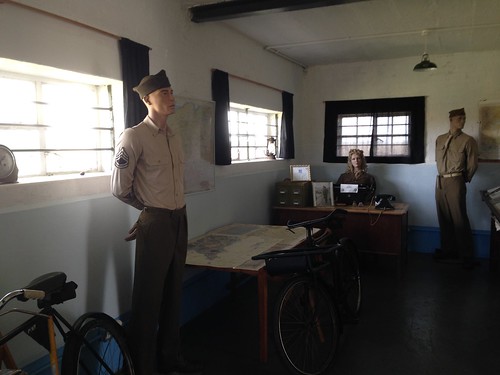
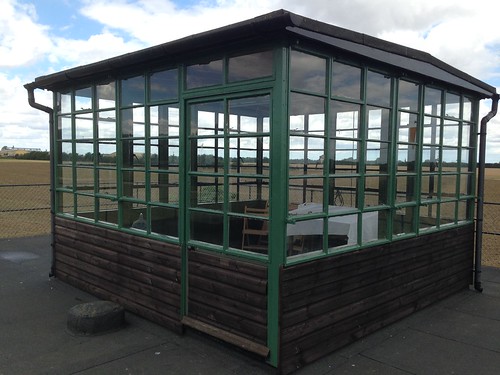
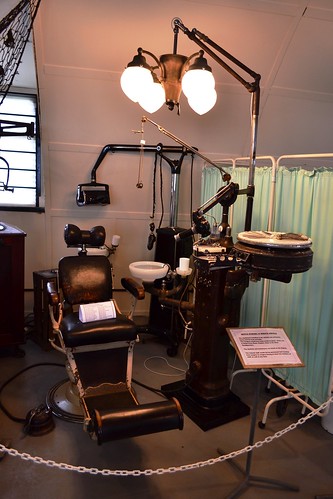
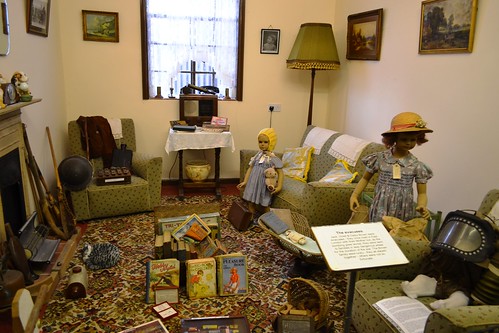
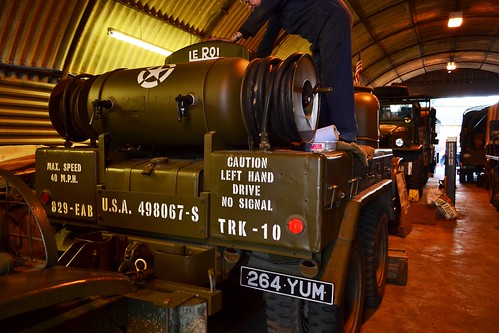

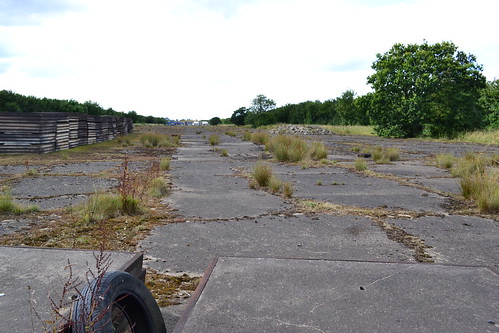
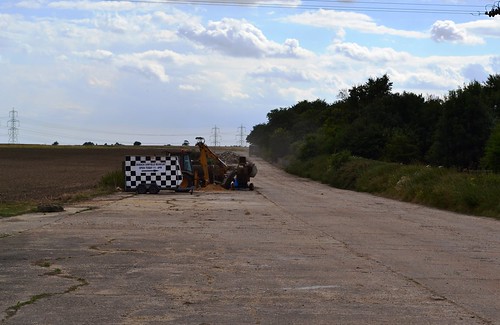

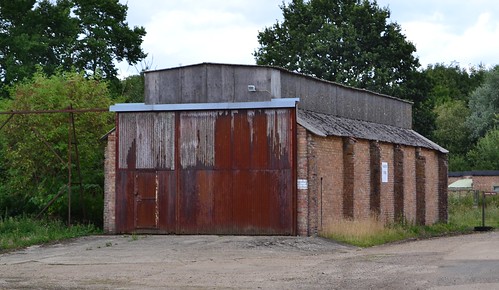

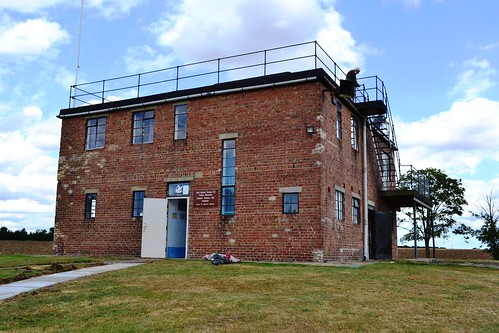
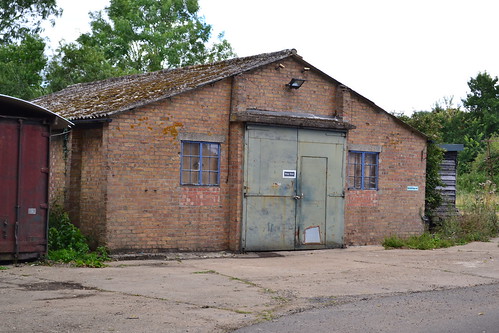

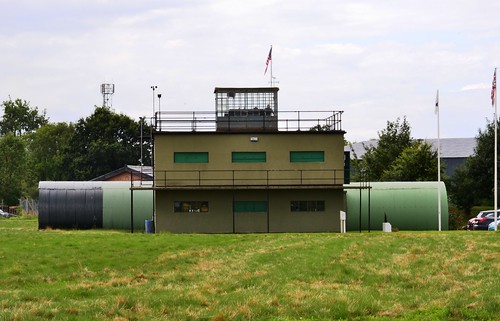
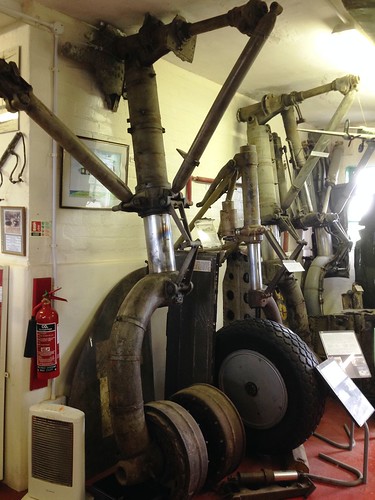

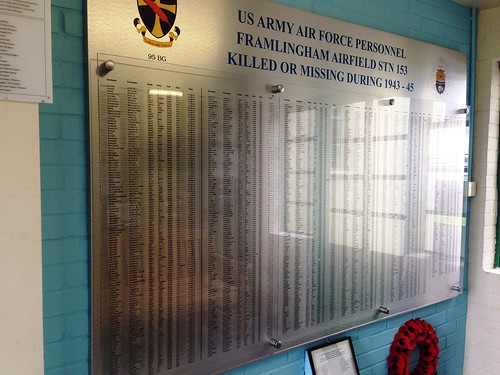
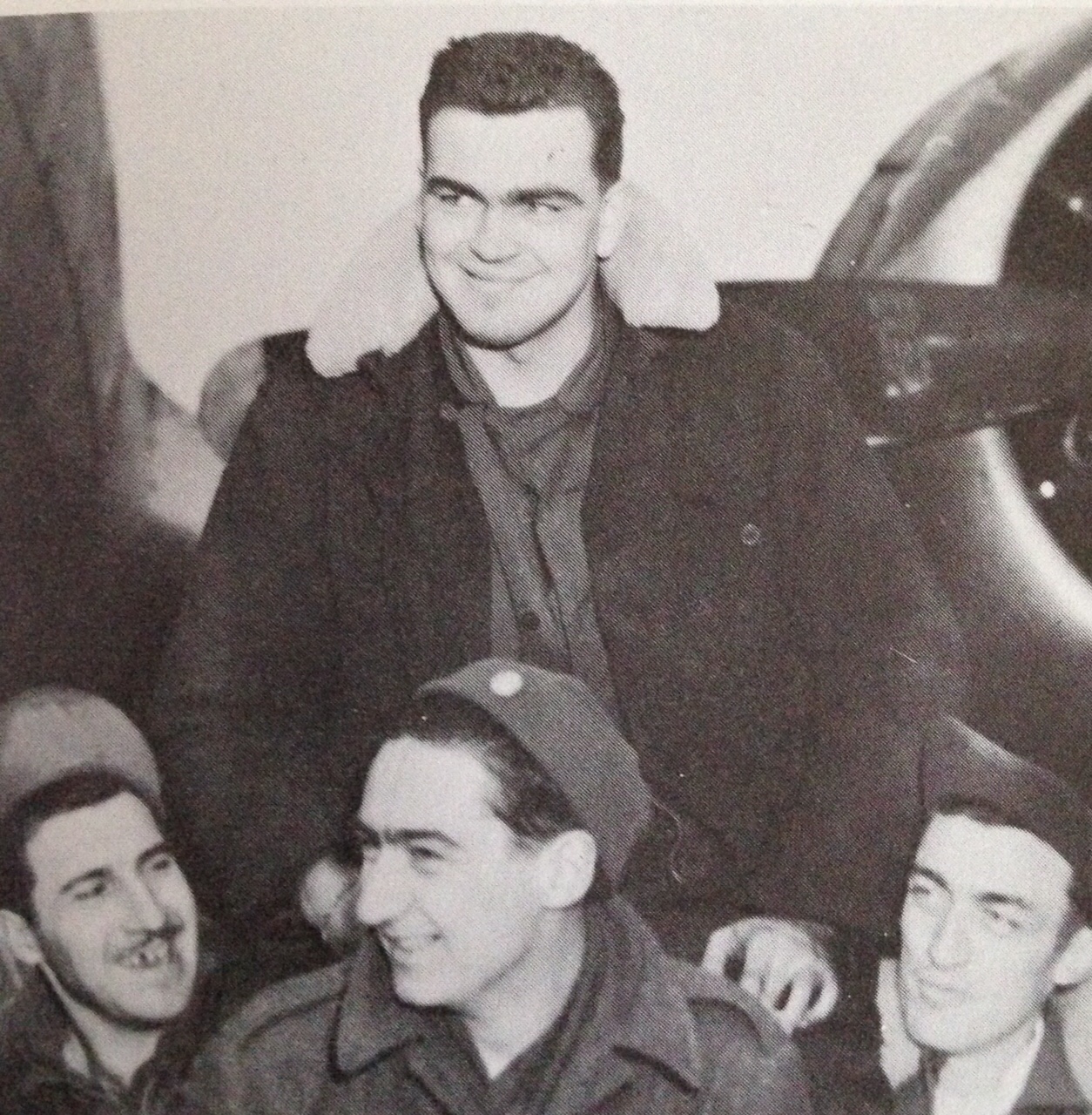
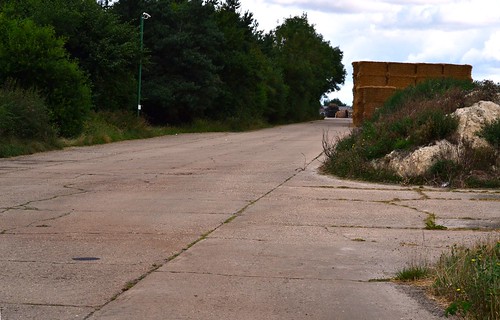

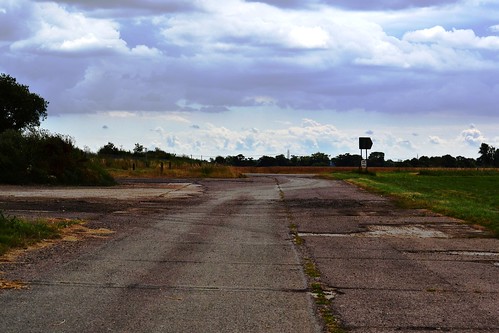

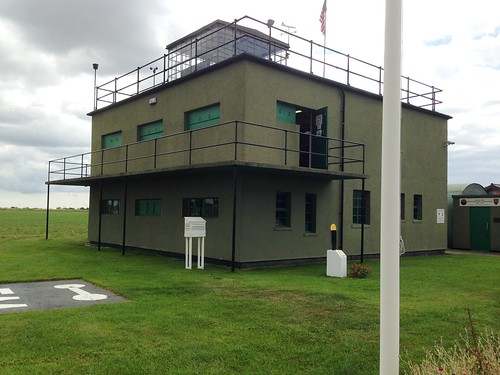


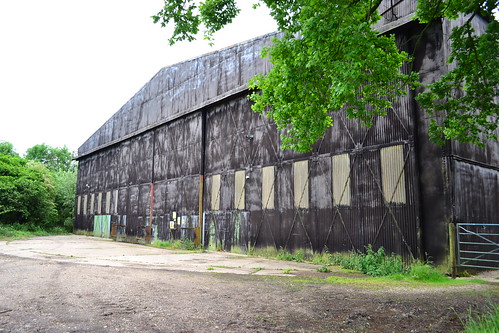
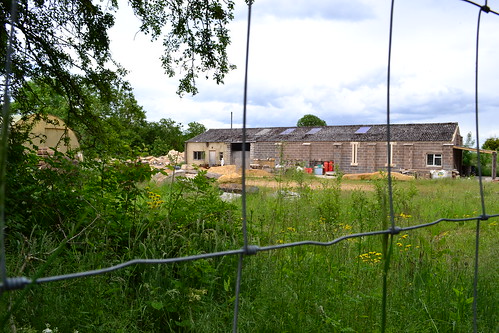


 Aviation Trails