Disaster at RAF Tibenham.

In this post, we revisit Tibenham in Norfolk, the home of the 445th Bomb Group, Eighth Air Force. Whilst here, the 445th would suffer the worst casualty rate of any Bomb Group in a single mission, a mission that virtually wiped out the entire Group. Yet they would no give up, determined they would go onto have one of the most successful bombs on target statistics of all the Eighth’s Bomb Groups, a record they can be proud of.

RAF Tibenham (Station 124)

Station 124 was one of those purpose-built airfields designed specifically for the USAAF in the mid-part of the war. Known to the locals as Tivetshall, it occupies a site previously used by the Royal Flying Corps in World War 1 (although there appears to be no record of units based here).

In preparation for the Air Force’s arrival, a Class A airfield was built, with three standard concrete and tarmac runways, the primary of 2,000 yds and two secondary each 1,400 yds long and all the standard 50 yds wide. In addition, there were thirty-five ‘frying pans’ hardstands and a further seventeen ‘spectacle’ hardstands, all dotted around the perimeter track. Aircraft maintenance was completed in two T2 hangars, one in the technical area and one other to the south side of the airfield. The bomb store was located to the north-west of the airfield, with the technical and administrative areas to the east. Beyond this, dispersed further to the north-east were the accommodation areas: two communal sites, a WAAF site, sick quarters and seven male accommodation sites. Accommodation was initially designed for 3,000 personnel, using mainly Nissen huts with some Orlit hutting on site. Most other buildings were ‘temporary’ and built of brick.

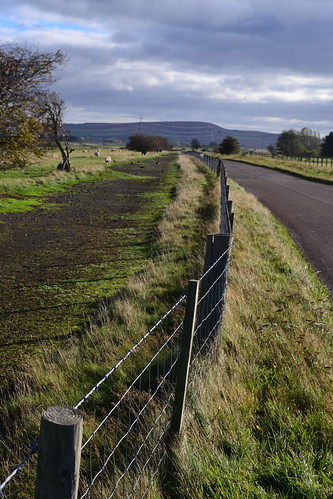
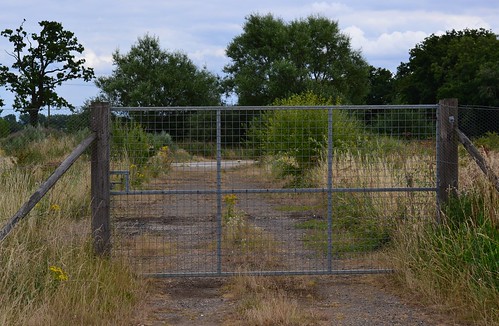
RAF Tibenham Perimeter track

Part of the perimeter track – RAF Tibenham

Built over 1941-1942 by W. and C. French Ltd, it was opened in 1942, and was the temporary residence for the ground echelons of two squadrons of the 320th BG in November that year. The plan was to send the air echelons via the northern route, but due to heavy losses of the 47th and 319th BGs, they were diverted to North Africa via the southern route. The Ground echelons would then join them departing both Tibenham and nearby Hethel on November 21st 1942.

Tibenham then remained unoccupied by operational forces until November 4th 1943, when the 700th, 701st, 702nd and 703rd Bomb Squadrons of the 445th Bomb Group, Eighth Air Force arrived.

The 445th’s journey brought them from Gowen Field in Idaho, through Wendover Air Force Base in Utah, to Sioux City where they completed their training. In October the ground echelons sailed on the Queen Mary arriving in Scotland in early November. The air echelons flew the southern route, covering Florida, Puerto Rico, Brazil and West Africa before arriving shortly afterwards.

Flying B-24 Liberators, they would perform their first mission on December 13th 1943 – a month after their arrival. Their first target was the U-boat pens at Kiel. Along with other units of the 2nd Bomb Division fifteen aircraft would take off and undertake what was to be a relatively uneventful sortie, all the 445th aircraft returning with only two aircraft damaged and no casualties.

Their third mission, also in December, was less successful. A massive force of 546 bombers left England to attack Breman, arriving over the target between 11:42 and 12:14, the force was badly hit by ME-410s of the Luftwaffe. The 445th had fifteen of their aircraft damaged, with two crewmen wounded and eleven classed as ‘missing’. The realities of war were beginning to bite home.

1944 would be a more decisive year for Tibenham and the 445th. During the February ‘Big Week’ campaign against the German aircraft industry, Tibenham would suffer from accidental bombing by a returning Liberator. After being recalled, a  B-24 accidentally released a bomb whilst flying over Tibenham airfield, the resultant explosion killing two servicemen and a civilian in a nearby house.

The 445th would also suffer this year, but for their determination and action over Gotha they would be awarded a Distinguished Unit Citation (DUC), an award that reflected their bravery.
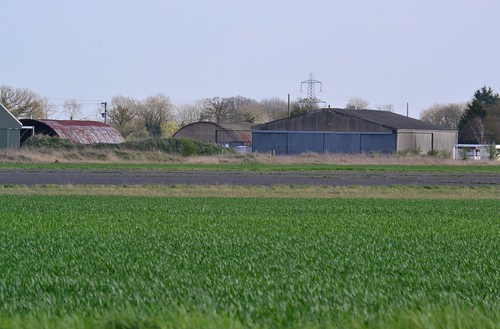
RAF Tibenham

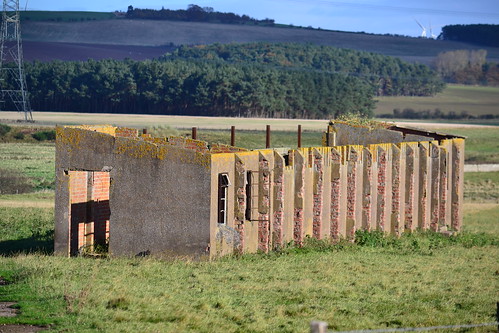
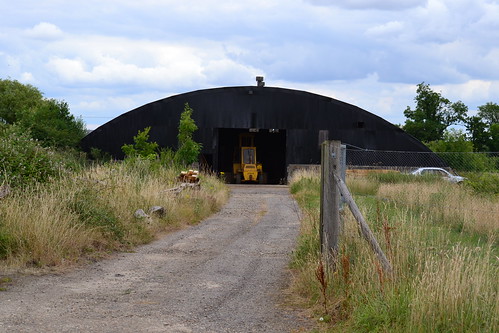
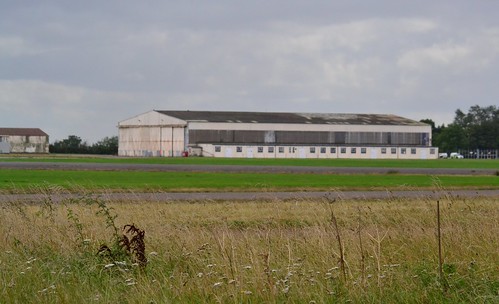
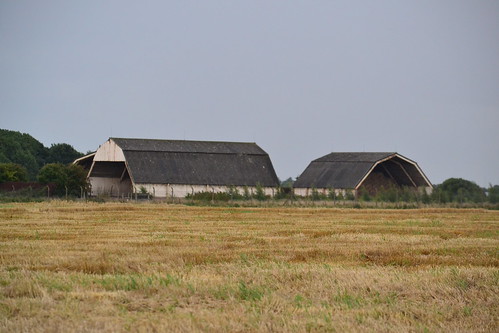
Today’s huts and hangars

The eight groups of the 2nd Bomb Division (BD) were targeting the Me-110 factories on February 24th 1944, dropping 372 tons of high explosive bombs. During the  mission 239 aircraft would leave England in three large wing formations, the 445th in the 2nd Combat Wing (CW) were to fly in the lead, along with the 389th BG and the 453rd BG. Behind them were the 14th Combat Wing with the 20th Combat Wing bringing up the rear.

The lead group were hit hard as much as 80 minutes before the target. Flying ahead of schedule, they had failed to rendezvous with their escort and so were at a huge disadvantage. Flying at altitude, the lead aircraft of the 389th suffered oxygen problems, which caused the bomb aimer to suffer from anoxia, the condition led to him release the bombs early, over Eisenach and not the primary target. As the bombs fell toward the ground, others in the wing began to follow suit, all releasing their bombs far too early, and well away from the target area. The 445th realising there was a problem, ignored the false signal and continued on to the target alone. Being out of formation and without escort, the B-24s were ‘sitting ducks’, and unsurprisingly were given special attention by the Luftwaffe.

From then on, and for an hour after the bomb run, Luftwaffe fighters attacked the B-24s, and one by one, the heavy bombers fell from the sky as fighters picked them off. After two and a half hours of relentless attacks, thirteen of the original twenty-five aircraft had been lost and nine others were badly damaged. The mission had cost 50% of the groups aircraft, but it was a tragedy that was not to be their last, nor their worst.

The main formation who had released early, had also suffered badly, being subjected to aerial bombing, cable bombing and rockets, an attack which led to a mission tally of thirty-three aircraft being lost and 314 airmen being classed as ‘missing in action’.

March 1944 would also be a noteworthy month. It was the end of a career as Commanding Officer for Capt. James Stewart, Commander of the 703rd BS. Posted here before he was declared unfit for flying duty, he arrived as ‘Operations Officer’, before being given the Command of the 703rd. He would go onto fly ten missions with the 703rd before departing Tibenham for Old Buckenham and the 453rd BG as Group Operations Manager.

Because the 445th had flown many missions over the winter months, March would become noteworthy for another reason. Four months after their first operation, Lt. Sam Miller and the crew of B-24 #42-110037 of the 700th BS had completed twenty-five missions whilst here at Tibenham, they were the first crew of the group to do so. At last some good news had brought relief to the horrors of the previous months and in particular the disaster of ‘Big Week’.

Ground personnel of the 445th Bomb Group gather around a B-24 Liberator (I5-B+, serial number 42-110037) after its return to base on D-Day. Printed caption on reverse: '51451- Ground crew swarming around a bomber returning from a D-Day mission for information on the invasion.' Handwritten caption on reverse: 'Lt Sam Miller's B-24 returning to Tibenham, Norfolk after he and crew completed a 25 mission tour of operations. First crew in the 445th bomb Group to do so.'

The return of B-24 #42-110037 after its crew had completed 25 Missions (USAF).

In the lead up to the Normandy invasion in June, the 445th attacked airfields in the Paris area along with V-weapons sites in Northern France, and on D-Day itself, they returned and attacked the shore installations, pounding them before the land forces arrived. The 445th then went on to help with the breakout at St. Lo striking enemy defensive positions. The Tibenham group were now so successful that they led the ratings for the most accurate bombing of all the Liberator groups in Europe, these successes though, were to be short-lived, for on September 27th 1944, the 445th would suffer its own ‘day of infamy’.

On that day the group was allocated the Henschel facility in Kassel, and they were to lead 315 B-24s to the target. Navigating by GEE the 445th took a wrong turn and left the protection of the formation. The turn went unnoticed by the remainder of the group and so, all of a sudden, the 445th were now out on a limb and lacking the protection of the formation once again.

The group then all dropped their bombs, but unbeknown to them they were not over Kassel but were in fact over Gottingen some 20 miles away. After implementing the withdrawal plan, the 445th put themselves even further away from the main force, they were now alone. All of a sudden the 445th met II/JG.4, and what followed would all but wipe out the group.

Fw-190s approached the group from behind, three abreast diving down as they fired. Then followed two Me-109 Gruppen of JG.4 who picked off the damaged aircraft. With individuals falling away, the formation was spread and broken up, some 150 enemy aircraft had attacked and devastated the group.

In around five minutes, the Luftwaffe fighters had picked off and dispatched twenty-five B-24s and damaged most of those that remained flying. Only the intervention of US fighters stopped the total and complete annihilation of the group. The scene was devastating, the sky was full of smoke and debris, parachutes from both sides floated through the carnage. Three more B-24s crashed on the way, luckily in allied territory, two others managed to reach Manston’s emergency runway and one more crashed at Old Buckenham. The four remaining aircraft managed to limp back to Tibenham, but only one was able to fly again the next day.

In a written account*1, Pilot Capt. William R Dewey Jr describes the scene in his B-24 (one of those that made Manston)

“The tail turret had caught fire, from direct hits by 20 mm cannon in the first wave of FW-190s, both waist gunners were wounded and bloody along with the tail gunner. There was a huge hole in the right waist ahead of the window, the left waist window was shattered. Control cables to the tail were partially damaged, and the twin vertical rudders appeared frayed and disintegrating. Looking out the copilot’s window we could see a 3′ diameter hole in the upper surface of the wing behind the #3 engine, where 100 octane gasoline was splashing out.”

Dewey goes on to explain how the co-pilot William L. Boykin Jr, carried oxygen bottles back to the wounded crew, gave them first aid and comforted them. Dewey then decided to drop below oxygen requirement level and risk ditching. Switching channels to the emergency channel, he manged to contact air-sea rescue using the code word “Colgate“. After obtaining a radar fix, they gave him a heading for Manston.

After an hour Dewey spotted Manston and began the task of landing not knowing what condition the flaps, undercarriage or tyres were in. Thankfully all were in good order and he described it as:

“the best I ever made in a B-24 – like we were on feathers. A day we will never forget!”*1

Statistics for the day were horrendous, the efficiency of the German controllers had been spectacular, no previous efforts had yielded such incredible results; 236 men were missing, 1 was dead and 13 were injured in the resultant crashes. This loss, left only ten aircraft in the entire group, and would go down as the worst operational day of the war for any single group of ‘The Mighty Eighth’.

The 445th would regroup and return though. In December and January they supported the troops in the Battle of the Bulge by bombing German communication lines, helping the Paratroops holding up in the forests of the Ardennes.

On February 24th 1945, Ford built Liberator B-24H-1-FO #42-7619 “Bunnie” a veteran of 103 missions, took off from Tibenham’s main east-west runway. Within seconds something went wrong and the bomber crashed a few hundred yards west of the airfield. In the crash four of the crew were killed, the remaining five managed to survive.

Photo of

“Chuck” Walker & his crew being congratulated by Lt. Col. Fleming, (deputy commander) on completion of their 35th mission and “Bunnie’s” 100th.(IWM)

and then on 24th March 1945, they dropped food, ammunition and medical supplies to the troops who had made the Rhine crossing at Wesel. They returned later that day to bomb the landing grounds at Stormede.

The 445th went on to carry out a total of 282 operations building a reputation for high accuracy bombing in the face of danger. Further awards were received from the French for their support of the Resistance, in dropping food supplies, gaining them the Croix de Guerre, a highly regarded award.

The 445th flew their last mission on 25th April 1945, the last mission by the Eighth Air Force in Europe, attacking airfields and rail targets in south-east Germany and Czechoslovakia without loss. The 445th finally returned to the US at the end of hostilities leaving behind huge numbers of crews for whom home would never be back on their own soil.

After their departure in May / June, Tibenham remained ‘operational’ although no operational flying took place. The RAF then began to sell off parts of the airfield to the local farmers. A short-lived expansion of the airfield’s runway in 1955 led nowhere, as no aircraft were assigned to the airbase, and in 1959, Tibenham was finally closed as a military base. During this time, the Norfolk Gliding Club took over part of the site, paying a rent to the Ministry of Defence, remaining here even after 1964/65 when the airfield site was finally sold.

Since then the Club has fought long and hard to keep flying at Tibenham. Battles over land and attempts to curb flying have so far failed. Gradually bit-by-bit the infrastructure has been removed, sold off for hardcore and agriculture use.

Flying at Tibenham

Small piston engined aircraft keep the spirit alive

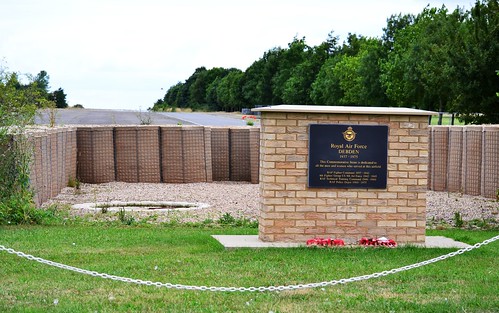
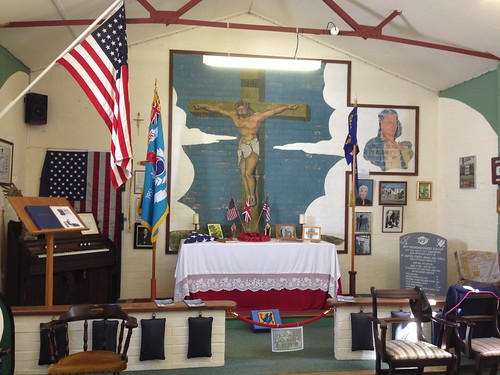
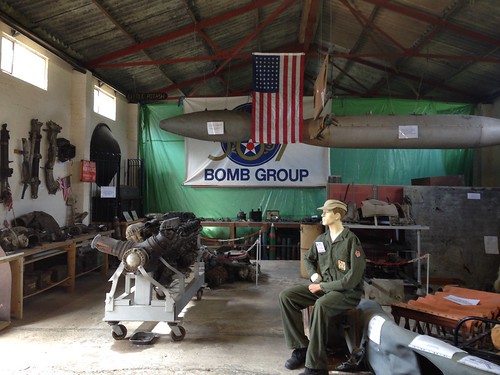
A small collection of memorabilia and photographs of the four squadrons based at Tibenham are maintained by the club, and a memorial stands as a lasting legacy to those who never returned.

Currently, large parts of two of the runways remain; the perimeter track can also be seen, being split by the main road round the airfield. Also a small number of huts are still being used and the site is in remarkable condition as a result.

Other evidence is hard to find, the majority of the accommodation, stores and works all being located to the east amongst the trees and on private land. I am reliably informed that primitive airfield defences can be found amongst the trees at the end of the runway. These amount to a ladder that would enable any defence troops to climb up and remain hidden should any German paratroopers fall.

The heavily laden bombers have long since been replaced by the grace and beauty of gliders, the control tower and other major buildings are now history, but as the summer sun and cool breeze wafts across the open skies above Norfolk, it is easy to picture these lumbering bombers, fuelled and crewed waiting for their turn to depart. With the roar of labouring engines now long gone, peace has returned once more to this quiet corner of Norfolk.
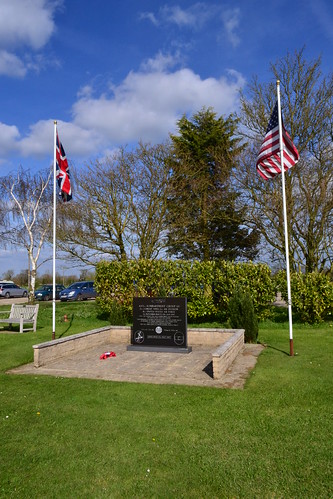
RAF Tibenham memorial

Memorial dedicated to the 445th BG.

Tibenham was initially visited in April 2014 when these photos were taken. It appears as part of Trail 13 along with Old Buckenham and East Wretham. This page is an update with additional information on the 445th’s history.

Sources and further reading.

The Norfolk Gliding Club website gives details of their activities, opening times and flying operations.

*1 A typescript memoir written by Capt. William R. Dewey ‘Disaster at Kassel’: 27th Sep 1944. Second Air Division Digital Archive . Ref: MC 371/250, USF 5/1 accessed 25/3/18.

All Saints Church in Tibenham also has a small memorial and kneelers dedicated to those who flew from Tibenham.

50 Aviation Trails Reached!

I am pleased to announce that since starting Aviation Trails four years ago, I have now reached that magic number of 50 Trails around Britain’s wartime airfields, a feat I never thought would happen.

Each Trail covers two or more sites, in some cases six, many three, covering in total, over 100 former RAF and USAAF airfields and museums around Britain.

I can honestly say its been a terrific four years, in which I have learnt a lot about Britain’s wartime past, the men and machines that flew from these places and the tragedies that occurred at so many. The development of these airfields was staggering, the process of construction, and the subsequent decay just as eye-opening. These sites and the people who used them, have changed both the British and world landscape, leaving in many cases scars that may never heal. The buildings and stretches of concrete that remain are monuments to human endurance and sacrifice, a sacrifice that we hope may never have to be repeated.

RAF Tibenham Perimeter track

The perimeter track at the former RAF Tibbenham.

During these four years there have been several changes at many of these sites, hangars and other buildings have gone, runways are continuing to be dug up as they become prime land for development. As we speak there are numerous sites under planning proposals, whilst others are waiting in the wings to hear what their fate will be.

To compile these trails I have personally visited each and every one of these sites, even a field has a certain something when you know who stood there before you.

To all those who have visited, commented and followed me on this journey, I thank you, I hope you have enjoyed the journey back in time as much as I have writing it. I hope that through these trails, the memories of those who gave their all may live on so that future generations may know who they were and what they did, so that we may enjoy the peace we do today.

Here’s to the next 50!

Andy.

RAF Andrews Field – (Great Saling/Station 485) – Trail 33: Essex Part 1.

RAF Attlebridge  (Station 120) – Trail 7: Northwest Norfolk.

RAF Barton BendishTrail 7: Northwest Norfolk.

RAF Biggin Hill (Westersham) (Station 343) – Trail 4: Kent Part 1.

RAF Bircham NewtonTrail 20: North Norfolk (Part 1).

RAF Bodney (Station 141) – Trail 8: Swaffham and Her Neighbours (Part 1 of 3).

RAF BournTrail 31: Southern Cambridgeshire (Part 2).

RAF Brenzett (ALG) – Trail 18: Kent Part 2.

RAF BruntonTrail 47: Northumberland.

RAF Bungay (Flixton) (Station 125) – Trail 14:  Central Suffolk (Part 1).

RAF Bury St. Edmunds (Rougham) (Station 468) – Trail 16: West Suffolk (part 1).

RAF Castle CampsTrail 45: Essex (Part 2).

RAF Caxton GibbetTrail 29: Southern Cambridge (Part 1).

RAF Charterhall Trail 41: The Borders of Scotland and England.

RAF ChedburghTrail 49: Bomber Command – Bury St. Edmunds to Haverhill

RAF Collyweston Trail 37: The Northern Reaches of Cambridgeshire.

RAF Coltishall – Trail 7: Northwest Norfolk.

RAF ConingsbyTrail 1: Lower Lincolnshire.

RAF CottamTrail 40: Yorkshire (East Riding).

RAF CranwellTrail 2: Lincoln Borders and Newark.

RAF Debach (Station 152) – Trail 39: Suffolk around Ipswich (Part 1).

RAF Debden (Station 356) – Trail 46: Essex Part 3,

RAF Deenethorpe (Station 128) – Trail 6: American Ghosts.

RAF Deopham Green (Station 142) – Trail 27: Southern Norfolk (Part 3).

RAF Digby (Scopwick) – Trail 1: Lower Lincolnshire.

RAF Docking – Trail 20: North Norfolk (Part 1).

RAF Downham Market (Bexwell) – Trail 7: Northwest Norfolk.

RAF Drem – Trail 42: Edinburgh’s Neighbours.

RAF East Fortune – Trail 42: Edinburgh’s Neighbours.

RAF East Kirkby Trail 1: Lower Lincolnshire.

RAF East Wretham (Station 133) – Trail 13: Southern Norfolk around Diss (Part 2).

RAF Eye (Brome) (Station 134) – Trail 14: Central Suffolk (Part 1).

RAF Fersfield – (Station 130) – Trail 28: Southern Norfolk (Part 4).

RAF FoulshamTrail 22North Norfolk (Part 3).

RAF FowlmereTrail 32Southern Cambridgeshire (Part 3).

RAF Framlingham (Parham) (Station 153)Trail 39: Suffolk around Ipswich (Part 1).

RAF Glatton (Station 130) – Trail 6: American Ghosts.

RAF Gransden Lodge – Trail 31: Southern Cambridgeshire (Part 2).

RAF Graveley – Trail 29: Southern Cambridge (Part 1).

RAF Grafton Underwood (Station 106) – Trail 6: American Ghosts.

RAF Great Dunmow (Station 164)- Trail 33: Essex (Part 1).

RAF Great MassinghamTrail 21: North Norfolk (Part 2).

RAF Great Sampford (Station 359) – Trail 50: Haverhill’s neighbours – Wratting Common and Great Sampford.

RAF Hardwick (Station 104) – Trail 12: Southern Norfolk around Diss (Part 1).

RAF Hawkinge – Trail 18: Kent Part 2.

RAF Hethel – Trail 38: To the West of Norwich.

RFC HinghamTrail 38: To the West of Norwich.

RAF Hunsdon – Trail 25: Hertfordshire.

RAF Kimbolton (Station 117) – Trail 6: American Ghosts.

RAF King’s Cliffe (Station 367) – Trail 6: American Ghosts.

RAF LanghamTrail 23: North Norfolk (Part 4).

RAF Lashenden (Headcorn) – Trail 18: Kent Part 2.

RAF Lavenham (Station 137) – Trail coming soon.

RAF Little Snoring – – Trail 22North Norfolk (Part 3).

RAF MarhamTrail 7: Northwest Norfolk.

RAF Martlesham HeathTrail 48: Suffolk around Ipswich (Part 2).

RAF Matching (Station 166) – Trail 33: Essex Part 1.

RAF Matlask (Station 178) – Trail 34: North Norfolk (Part 5).

RAF MattishallTrail 36: North Norfolk (Part 6).

RAF Mendlesham (Station 156) – Trail 15: Central Suffolk (Part 2).

RAF MepalTrail 11: Around Ely.

RAF Methwold – Trail 8: Swaffham and Her Neighbours (Part 1).

RAF Millfield –  Trail 47: Northumberland.

RAF Narborough (Narborough Aerodrome)- Trail 7: Northwest Norfolk.

RAF North CreakeTrail 23: North Norfolk (Part 4).

RAF North Pickenham (Station 143) – Trail 9: Swaffham and Her Neighbours (Part 2).

RAF North WealdTrail 25: Hertfordshire.

RAF North Witham (Station 479) – Trail 3: Gone But Not Forgotten.

RAF Old Buckenham (Station 144) – Trail 13: Southern Norfolk around Diss (Part 2).

RAF Oulton – Trail 34: North Norfolk (Part 5).

RAF Polebrook (Station 110) – Trail 19: Northamptonshire American Ghosts II.

RAF Rattlesden (Station 126) – Trail 15: (Central Suffolk (Part 2).

RAF SawbridgeworthTrail 25: Hertfordshire.

RAF ScamptonTrail 30: Scampton and the Heritage Centre.

RAF SculthorpeTrail 21: North Norfolk Part 2.

RAF Shipdham (Station 115) – Trail 10: Swaffham and Her Neighbours (Part 3).

RAF Snetterton Heath – (Station 138) – Trail 27: Southern Norfolk (Part 3).

RAF Spanhoe Lodge (Station 493) – Trail 6: American Ghosts.

RAF Steeple Morden – Trail 32: Southern Cambridgeshire (Part 3).

RAF Stoke OrchardTrail 24: Gloucestershire.

RAF Stradishall- Trail 49: Bomber Command – Bury St. Edmunds to Haverhill

RAF Sutton BridgeTrail 3: Gone But Not Forgotten.

RAF Swannington – Trail 36: North Norfolk (Part 6) 

RAF Swanton Morley – Trail 38: To the West of Norwich.

RAF Thorpe Abbotts (Station 139) – Trail 12: Southern Norfolk around Diss (Part 1).

RAF Tibenham (Station 124) – Trail 13: Southern Norfolk around Diss (Part 2).

RAF Tuddenham – Trail 16: West Suffolk (Part 1).

RAF Tydd St. Mary – Trail 37: The Northern Reaches of Cambridgeshire.

RAF Upwood – Trail 17: The Pathfinders.

RAF Warboys – Trail 17: The Pathfinders.

RAF Watton (Station 376/Station 505) – Trail 9: Swaffham & Her Neighbours (Part 2).

RAF Wendling (Station 118) – Trail 10: Swaffham and Her Neighbours (Part 3).

RAF West Malling Trail 4: Kent Part 1.

RAF West RaynhamTrail 21: North Norfolk Part 2.

RAF WethersfieldTrail 45: Essex (Part 2).

RAF Westley – Trail 16: West Suffolk (part 1).

RAF WinfieldTrail 41: The Borders of Scotland and England.

RAF Winthorpe Trail 2: Lincoln Borders and Newark.

RAF WitchfordTrail 11: Around Ely.

RAF Wittering  – Trail 37: The Northern Reaches of Cambridgeshire.

RAF Woodall SpaTrail 1: Lower Lincolnshire.

RAF Wratting CommonTrail 50 – Haverhill’s neighbours – Wratting Common and Great Sampford.


Great Sampford – A disaster for the U.S. “Eagles”.

After leaving RAF Wratting Common, we turn south and head back past Haverhill towards Finchingfield. Reputedly one of the most photographed villages in England, it has a ‘chocolate box’ appeal, its quaint houses, old tea shops and village pond, reminiscent of Britain’s long and distant past. Finchingfield and this trail, are also close to the airfield at Wethersfield, and a short detour to the east, is an added bonus and a worthy addition to the trail.

This next airfield, a small satellite airfield, lies one and a half miles to the west of Great Sampford village, and five miles south-east of Saffron Walden. It is actually quite remote, with no public roads close to the site. Footpaths do cross parts of the former airfield, which is all now  completely agricultural.

As we head south we stop  off at the former airfield RAF Great Sampford.

RAF Great Sampford (Station 359)

RAF Great Sampford was a short-lived airfield, built initially as a satellite for RAF Debden, it would be used primarily by RAF Fighter Command, and later by the US Eighth Air Force. It was also used by 38 Group for paratroop training, and by the Balloon Command.

Being a satellite it was a rudimentary airfield, and accommodation was basic; utilising wooden huts as opposed to the more pleasant brick dwellings found at its parent station RAF Debden. It was very much the poorer of the airfields in the area, although by the war’s end a wooden hut would no doubt have been preferential to a cold, metal Nissen hut!

As a satellite it would be used by a small number of squadrons, No. 65 RAF, No. 133 (Eagle Squadron) RAF and No. 616 Squadron RAF. The famous Eagle Squadrons being manned by American volunteers, 133 Sqn was later renamed 336th Fighter Squadron (FS), 4th Fighter Group (FG), after their absorption into the US Army Air Force.

There were two runways at Great Sampford, one of grass and one of steel matting (Sommerfeld track), a steel mat designed by Austrian Expatriate, Kurt Sommerfeld. The tracking was adapted from a First World War idea, and was a steel mat that when arrived, was rolled up in rolls 3.25 m (10 ft 8 in) wide by 23 m (75 ft 6 in) long. It was so well designed that a full track could be laid, by an unskilled force, in a matter of hours. Each section could be replaced easily if damaged, and the entire track could be lifted and transported by lorry, aeroplane or boat to another location and then reused.

Sommerfeld track (along with a handful of other track types) were common on fighter, training and satellite airfields, especially in the early part of the war. It was also used extensively on forward landing grounds in Kent and later France after the Allied invasion of Normandy.

Tracking had to be robust, it had to be able to withstand heavy landings and be non-conspicuous from the air. Sommerfeld track met both of these, and other stringent criteria very well, although it wasn’t without its problems. Crews often complained of a build up of mud after heavy rain, and concerns over both tyre and undercarriage damage were also extensively voiced. Some records report tail wheels being ripped off after catching in the track lattice.

At Great Sampford the steel matting was 1600 yards long, extended later to 2,000 yards, the grass strip being much shorter at just over 1,000 yards. A concrete perimeter track circumnavigated the airfield, and due to the nature of the area the airfield took on a very odd shape indeed. With many corners and little in the way of straight sections, it may have suited the longer noses of the RAF’s Spitfires well, avoiding the need to weave continuously to see passed the long engine. However, because it was small and uneven, it caused numerous problems for pilots taking off, the hedges and trees proving difficult obstacles to clear without stalling the aircraft in an attempt to get above them.

Hangars and maintenance huts were also sparse, but four blister hangars were provided as the main structures for aircraft repair and maintenance.

Opened on 14th April 1942, the first unit to use the site was No. 65 (East India) Squadron RAF who arrived the same day that it was opened. No. 65 Sqn, being veterans of both Dunkirk and the Battle of Britain, had been moved about to regroup and refit, upgrading its aircraft numerous times before settling with the Spitfire.

The Spitfire VB of 65 Sqn (who were previously based at Debden) was a modified MK.V,  the first production version of the Spitfire to have clipped wingtips, a modification that reduced the wingspan down to 32 ft but increased the roll rate and airspeed at much lower altitudes. No. 65 Squadron, would use their Spitfire VBs for low-level fighter sweeps and bomber escort duties, something that suited the clipped wing version well.

Between April and July 1942, 65 Squadron would move between Debden, Martlesham Heath and Hawkinge with short spells in between at Great Sampford. They would then have a longer spell in Kent before leaving for RAF Drem in Southern Scotland. These repeated moves were largely in response to the threat of renewed Luftwaffe attacks on the airfields of southern England, and were part of a much larger plan put into place to protect the front line squadrons.

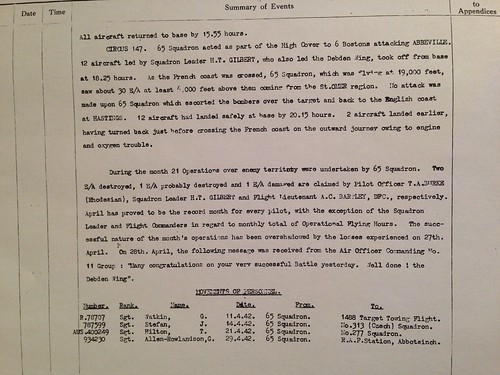
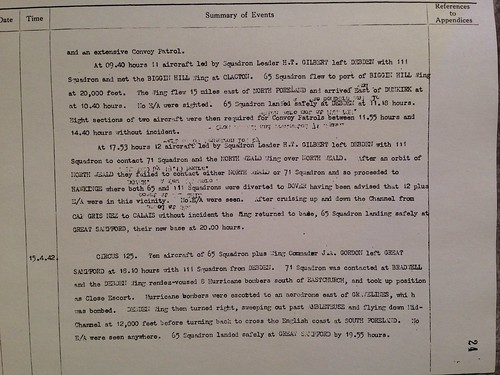
65 Squadron ORB Great Sampford

The entry in the Operational Record Book for April 14th shows the first landing of Spitfires at Great Sampford. (AIR 27/594/4)

On April 14th, the move took place, a move that was achieved under some difficulty as the squadron was called upon to participate in two Rodeo (fighter sweeps) operations. After extensive searching between Cap Gris Nez and Calais, no enemy aircraft were sighted, and so the wing returned to their various bases. At 20:00 hrs, the first 65 Sqn aircraft touched down at Great Sampford – the base was now open and operational.

The next mission would be the very next day – there was no let up for the busy flyers! “Circus 125” led by Wing Commander J. Gordon, consisted of ten aircraft from Great Sampford, who after taking off at 18:10, met with the bomber formation and escorted them to an airfield target near Gravelines. The entire mission was uneventful and the aircraft arrived safely back at Great Sampford at 19:55 hrs.

This mission pretty much set the standard for the remainder of the month. Numerous Rodeo and Circus operations saw 65 Sqn repeatedly penetrate French airspace with various sighting of, but little contact with, enemy aircraft. The first real skirmish took place on the 25th, when the Boston formation they were escorting was attacked by fourteen FW-190s. One of the Bostons was hit and subsequently crashed into the sea. Flt. Sgt. Stillwell (Red 3) of 65 Sqn threw his own dingy out to the downed crewman who seemed to make no effort to reach it – he was then assumed to be already dead.

On the April 27th, “Circus 142” took place, the escort of eight Hurricane bombers who were attacking St. Omer aerodrome. Three sections ‘Red’, ‘White’ and ‘Blue’ made up 65 Squadron’s section of the Wing, and consisted of both Rhodesian, Czech and British airmen. The Wing flew across the Channel at 15,000 ft, and when on approach to the target, they were attacked by 50-60 FW-190s. In the ensuing dogfight F/O. D. Davies, in Spitfire #W3461; P/O. Tom Grantham (s/n: 80281) flying Spitfire #BL442, and P/O. Frederick Haslett (s/n: 80143) in Spitfire #AB401, were all reported missing presumed dead. It was thought that both F/O. Davies and P/O. Grantham may have collided as they were together when they went down, P/O. Grantham was just 19 years of age.

There were no further losses that month although operations continued up until the last day. In all, 21 operations had been flown in which 2 enemy aircraft were destroyed, 1 was a probable and 1 was damaged. April proved to be a record month in terms of operational flying hours for every pilot below the rank of Squadron Leader, the successes of which though, were marred by the sad events of the 27th and the loss of three colleagues.

On the 28th, their last day of this, the first of several stays at Great Sampford, a congratulatory message came though from the Air Officer Commanding No. 11 Group, “Well done the Debden Wing”, which went some way to lighten the atmosphere before the new month set in.*1

65 Squadron ORB Great Sampford

The Operational Record Book for 65 Squadron. A message of congratulations from the Air Officer Commanding No. 11 Group. (AIR 27/594/4)

It was three months later on July 29th 1942, that 65 Squadron would depart Great Sampford for the last time, and the next squadron would arrive, the Spitfire VIs of No. 616 Squadron RAF.

No. 616 Sqn were formed prior to the declaration of war in November 1938. An Auxiliary Air Force Unit, it too took part in supporting both the Dunkirk evacuation and the early days of the Battle of Britain. Now, at Great Sampford, it had been given the high altitude Spitfire, the MK. Vl, an attempt by Supermarine to tackle the Luftwaffe’s high altitude bombers, and quite the opposite to the VBs of 65 Sqn – these Spitfires had extended wingtips!

616 Squadron would, like 65 Sqn before them, spend July to September yo-yoing between Great Sampford and the airfields further south, Ipswich and Hawkinge, before departing Great Sampford for the final time on September 23rd 1942 for RAF Tangmere. Whilst here at Great Sampford, they would perform fighter sweeps, bomber escort and air patrols over northern France, engaging with the enemy on numerous occasions.

On the same day as 616 Sqn departed, the last operational unit would arrive at Great Sampford, the U.S. volunteer squadron, 133 Squadron known as one of the ‘Eagle Squadrons’. Being one of three squadrons manned totally by American crews, it had been on the front line serving at RAF Biggin Hill and RAF Martlesham Heath before arriving here at Great Sampford. Whilst some British RAF ground crews helped servicing and maintenance, the aircrew were entirely US, and crews were regularly changed as losses were incurred or crews were transferred out.

Many of these new recruits came in from other units. Ground crews coming into Great Sampford would have to get the train to Saffron Walden where they were met by a small truck who would take them to RAF Debden for a meal and freshen up. Afterwards they were transferred, again by truck, the few miles here to Great Sampford, the transformation was astonishing! In the words of many of those who were stationed here, “there was nothing ‘great’ about Great Sampford!”*2 Also flying Spitfire VBs, they were to quickly replace them with the MK.IX, a Spitfire that was essentially a MK.V with an updated engine. Having a higher ceiling than the FW-190 and being marginally faster, its improved performance took the Luftwaffe by complete surprise.

It would be a short-lived stay at Great Sampford though, as 133 Sqn RAF were disbanded on the 29th September, being renumbered as 336th FS, 4th FG, USAAF, and officially becoming US Air Force personnel. They were no longer volunteers of the Royal Air Force.

Just three days before this final transfer, on September 26th 1942, 133 Sqn would suffer a major disaster, and one that almost wiped out the entire squadron.

A small force of seventy-five B-17s from the 92nd BG, 97th BG and the 301st BG, were to mount raids on Cherbourg and the airfields at Maupertus and Morlaix, when the weather closed in. The 301st BG were recalled as their fighter escort failed to materialise, and the 97th BG were ineffective as cloud had prevented bombing to take place. The RAF’s 133 (Eagle) Sqn were to provide twelve aircraft (plus two spares) to escort the bombers on these raids. After refuelling and a rather vague briefing at RAF Bolt Head in Devon, they set off. Unbeknown to them at the time, the two pilots instructed to stay behind, P/O. Don Gentile and P/O. Erwin Miller, had a guardian angel watching over them that day.

During talks with P/O. Beaty, it was ascertained that the Spitfires had flown out above 10/10th cloud cover and so were unable to see any ground features, thus not being able to gain a true understanding of where they were. Added to that, a 100 mph north-easterly wind blew the aircraft far off course into the bay of Biscay. Finding the bombers after 45 minutes of searching, the flight set for home and reduced their altitude to below the cloud for bearings. Being over land they searched for the airfield, all the time getting low on fuel. Instead of being over Cornwall however, where they thought they were, they were in fact over Brest, a heavily defended port, and in the words of 2nd Lt. Erwin Miller – “all Hell broke loose.” *3

In the subsequent battle, all but one of 133 Sqn aircraft were lost, with four pilots being killed.  P/O. William H. Baker Jr (O-885113) in Spitfire #BS446; P/O. Gene Neville (O-885129) in Spitfire #BS140 – Millers replacement; P/O. Leonard Ryerson (O-885137) in Spitfire #BS275 and P/O. Dennis Smith (O-885128) in Spitfire #BS294.

Only one pilot managed to return, P/O. Robert ‘Bob’ Beatty,  who crash landing his Spitfire at Kingsbridge in Devon after he too ran out of fuel. During the crash he sustained severe injuries but luckily survived his ordeal. From his debriefing it was thought that several others managed to land either on the island of Ouissant or on the French mainland. Of these, six were known to have been captured and taken prisoners of war, one of whom, F/Lt. Edward Brettell  DFC was executed for his part in the Great Escape from Stalag Luft III. A full report of the events of that day are available in an additional page.

There would be no further operational flying take place for the rest of the month for 133 Sqn – all in all it was a disastrous end for them, and to their spell as RAF aircrew.*4

Pilot Officer Gene P. Neville 133 (Eagle) Sqn RAF, stands before his MK. IX Spitfire at Great Sampford. He was Killed during the Morlaix disaster. (@IWM UPL 18912)

Because these marks of Spitfire were in short supply, the remainder of the Squadron were re-equipped with the former MK.VBs, a model they retained into 1943 before replacing them with the bigger and heavier Republic P-47 ‘Thunderbolts’.

As a result of the losses, the dynamics of the group would change. The cohesive nature of the men who had been together for so long, was now broken and the base took on a very different atmosphere.

The effect on those left behind was devastating, morale slumped, and in an attempt to raise it, Donald ‘Don’ Blakeslee ordered the remaining pilots to line up along the eastern perimeter track and take off in formation; something that had been considered virtually impossible due to its short length, uneven surface and rather awkwardly placed trees along its boundary. Blakeslee, who became a legendary fighter pilot with both 133 Sqn and later the 4th Fighter Group (FG), led the group in true American Style, getting all the aircraft off the ground without any mishaps. Heading for Debden, they formed up, and flew directly over the station at below 500 feet, shaking windows and impressing those on the ground with precision flying that took as much out of the pilots as did air to air combat.

That night, the mess hall at Debden, was awash with celebrations as 133 Squadron pilots enjoyed the limelight they had for so long deserved.

On the next day, September 29th, the crews packed their personal belongings and departed Great Sampford for the comforts of Debden, where an official handover took place. General Carl Spaatz and Air Chief Marshal Sir Sholto Douglas, witnessing the official transfer of the three Eagle Squadrons to the United States Air Eighth Air Force, a move that on the whole, pleased the American airmen.

From then on, Great Sampford would remain under control of the USAAF, being used as a satellite for the 4th FG at Debden, but without any permanent residents. The occasional flight of Spitfires or P-47s would land here whilst on detachment or away pending a Luftwaffe attack. In the early stages of 1943, the Americans decided that Great Sampford (renamed Station 359 as per US designations) was no longer suitable for their needs as it wouldn’t accommodate either the  P-38s or the P-47s due to its awkward size and shape. By February 1943 they had pulled out, and Great Sampford was returned to RAF ownership. By March 1943 the airfield now surplus to flying requirements, was closed, used only by a large selection of RAF Regiments training in airfield defence, Guard of Honour duties and VIP Security. The station eventually closed in August 1944.

Airmen of the 336th Fighter Squadron, 4th Fighter Group with a clipped wing Spitfire Mk. Vb (MD-A), 1943. Handwritten caption on reverse: '19A. KP. Fall, 1942. Great Sampford Satellite Field. 336th crew by 336th Spit Mk. Vb. Wings clipped by sawing off wing & pounding in board then carving and painting it. MD-A, red/blue wheel. Source -Bill Chick, Megura.'

Airmen of the 336th Fighter Squadron, 4th Fighter Group with a clipped wing Spitfire Mk. Vb (MD-A), 1943. at Great Sampford. (@IWM – FRE3230)

However, this closure was not the end for Great Sampford. With paratroop operations progressing in Europe, the airfield was put back into use on 6th December 1944 by 620 Sqn in Operation ‘Vigour‘.

No. 38 Group, in need of practice areas, had acquired the airfield, and were dropping SAS paratroops into the site. This flight preceded another similar activity the following day where Horsa gliders pulled by 620 Sqn Stirlings, took part in Operation ‘Recurrent‘; a cross-country flight from RAF Dunmow in Essex. This flight culminated with the Horsas being released and landing here at Great Sampford. These activities continued throughout the appalling winter of 1944 / 45, and into the following months. In March, in the lead up to Operation ‘Varsity‘ the allied crossing of the Rhine, there was further activity in the skies of this small grass strip. Operation ‘Riff Raff‘  saw yet more paratroops and gliders at Great Sampford, whilst in November 1945, after the war’s end, Operation ‘Share-Out‘ saw the final use of Great Sampford by the paratroops. No. 620 Squadron, who had been based at RAF Dunmow, were now winding down themselves and their use of Great Sampford ceased virtually overnight.

Since then, Great Sampford has become completely agricultural, the perimeter track virtually all that remains of this small but rather interesting site. It lies in a remote area, fed only by farm tracks and small footpaths. The tracks, now a fraction of their original size, still weave their way around the airfield as they did for that short, but busy time, in the mid 1940s.

Regretfully the airfield and its unique history has all but passed into the history books, and rather sadly, no memorial marks the airfield, even though many airmen were lost during  the many sorties in those dark days of the war-torn years of the 1940s.

We depart Great Sampford heading off once more, the airfields of Essex and East Anglia beckoning. As we move off, we spare a thought for those for whom this was the last view they had of ‘home’, and of those who never came back to this quiet and remote part of the world.

Sources and further reading

*1 National Archives: AIR 27/594/4 .

*2 Goodson. J,. “Tumult in the clouds” Penguin UK, (2009) 

*3 Price. A., “Spitfire – A Complete Fighting History“, Promotional Reprint Company,  (1974).

*4 National Archives: AIR 27/945/26

National Archives: AIR 27/945/25

The “Slightly-out-of-Focuswebsite has details of a photo essay documenting the planning and execution of an airborne exercise prior to Operation Varsity. It’s a detailed document which includes gliders of 38 Group RAF landing at Great Sampford.

September 8th 1943 – Tragedy at RAF Mepal.

On the night of September 8/9th 1943,  a force of 257 aircraft comprising 119 Wellingtons, 112 Stirlings, 16 Mosquitoes and 10 Halifaxes took off from various bases around the U.K. to bomb the Nazi gun positions at Boulogne. Included in this force were aircraft from the RAF’s Operational Training Units, and for the first time of the war, five B-17s flown by US aircrews of the USAAF’s 422nd BS, 305th BG at Grafton Underwood. This was the first of eight such missions to test the feasibility of the USAAF carrying out night operations over Europe.  After the remaining seven missions, in which the squadron had dropped 68 tons of bombs, the idea was scrapped, the concept considered ‘uneconomical’ although the aircraft themselves proved to be more than capable of the operations.

The Gun battery targeted, was the emplacement that housed the Germans’ long-range guns, and the target wold be marked by Oboe Mosquitoes. With good weather and clear visibility, navigation was excellent, allowing the main force to successfully drop their bombs in the target area causing several huge explosions. However, not many fires were seen burning and the mission was not recorded as a success. Reports subsequently showed that the emplacement was undamaged due to both inaccurate marking by Pathfinders, and bombing by the main force. However, as both anti-aircraft fire and night fighter activity were light, no aircraft were lost during the flight making it a rather an uneventful night.

However, the mission was not all plain sailing, and whilst all crews returned, the night was marred by some very tragic events.

Three Stirlings were to take off from their various bases that night: at 21:00 hrs from Chedburgh, Stirling MK. III, EF136, piloted by F/S. R. Bunce of 620 Sqn; at 21:30, another Stirling MK.III, from 75 Sqn at RAF Mepal, BK809 ‘JN-T*1‘ piloted by F/O I.R.Menzies of the RNZAF; and lastly at 21:58 also from Chedburgh, Stirling MK. I, R9288 ‘BU-Q’ piloted by N.J. Tutt  of 214 Sqn.  Unfortunately all three aircraft were to suffer the same and uncanny fate, swinging violently on take off. The first EF136 crashed almost immediately, the second BK809 struck a fuel bowser, and the third R9288 ended up in the bomb dump. Miraculously in both the Chedburgh incidents there were no casualties at all, all fourteen crew men surviving what must have been one of their luckiest escapes of the war! The same cannot be said for the second though.

Stirling BK809 was part of a seventeen strong force of 75 Sqn aircraft. Each aircraft was carrying its full load made up of 1,000lb and 500lb bombs. As the Stirling was running along the runway, it swung violently, striking a fuel bowser which sent it careering into houses bordering the edge of the airfield.

One of the occupants of one of the houses, Mr. P. Smith, saw the aircraft approaching and ran into the street to warn others to get clear. As the aircraft struck the rear of the houses, it burst into flames causing some of the bombs to detonate. This brought considerable rubble down on the occupants of the second house, Mr and Mrs John Randall.

Mrs Randall managed to get out, her legs injured, whereupon she was met by a local fireman, Mr. A.E. Kirby of the National Fire Service. Mr. Kirby went on to help search in the wreckage of the house until his attempts were thwarted by another explosion. His body, along with that of Mr. Randall, was found the next day.

Two other people were also killed that night trying to provide assistance, those being F/Sgt Peter Gerald Dobson, RNZAF and Section Officer Joan Marjorie Easton WAAF. F/Sgt. Dobson was later mentioned in despatches. Three members of the crew lost their lives as a result of the accident, F/O. Menzies and F/O. N. Gale both died in the actual crash whilst Sgt. A. Mellor died later from injuries sustained in the accident.

A number of others were injured in the crash and one further member of the squadron, Cpl Terence Henry King B.E.M, was awarded the British Empire Medal “for his bravery that night in giving assistance“.

The mission on the night of September 8/9th 1943 will not go down as one of the most remarkable, even though  it was unique in many respects, but it will be remembered for the sad loss of crews, serving officers and civilians alike in what was a very tragic and sad event.

The crew of Stirling BK809 were:

F/O. Ian Robert Menzies RNZAF NZ415002. (Pilot).
P/O. Derek Albert Arthur Cordery RAFVR 136360. (Nav).
P/O. Norman Hathway Gale RAFVR 849986. (B/A).
Sgt. Ralph Herbert Barker RNZAF NZ417189. (W/O).
Sgt. Albert Leslie Mellor RAFVR 943914. (Flt. Eng).
Sgt. Bullivant G RAFVR 1395379. (Upp. G)
Sgt. Stewart Donald Muir RNZAF NZ416967. (R/G).

RAF Mepal was visited in Trail 11.

Sources and Further Reading.

*1 Chorley, 1996 “Bomber Command Losses 1943” notes this aircraft as AA-T.

Chorley, W.R., “Bomber Command Losses – 1943“, Midland Counties, (1996)

Middlebrook M., & Everitt C., “The Bomber Command War Diaries”  Midland Publishing, (1996)

Further details of this accident, the crews and those involved can be found on the 75 (NZ) Sqn blog. This includes the gravestones of those killed and a newspaper report of the event.

My thanks also go to Neil Bright (Twitter handle @Blitz_Detective) for the initial  information.

RAF Milfield – Arguably One of Britain’s Most Significant Airfields.

High up in the northern most reaches of England is an airfield that has repeatedly appeared in the memoirs of many RAF and USAAF pilots. Not because it was a busy front-line station dealing with the constant battle against marauding enemy bombers, but more simply because it was a training station. However, this airfield was no ordinary training facility. It operated a large number of aircraft whose pilots played a major part in both the Normandy landings and the drive on through France and the low countries. In this, the next trail, we visit Northumberland, and a place where ground attack pilots honed their skills, perfecting the use of rockets, canon and bombs, in the destruction of enemy troop convoys, trains and tanks. The first stop on this trail is an airfield that is arguably one of Britain’s most significant airfields – RAF Milfield.

RAF Milfield.

RAF Milfield lies a short distance from the village it takes its name from, at the foot of the Cheviot hills on an area known as the Millfield Plain. It is an area steeped in history. On this site, evidence has been found of Neolithic hearths, storage pits and post holes.  There is also evidence of two Bronze Age circular houses and a further three rectangular houses dating back to the ‘Dark Age’; an age that probably pre-dates the Anglo-Saxon conquest of the area from around AD 547.

This area was also the scene of many fierce and brutal battles between the English and the Scots, The Battle of Homildon Hill and the Battle of Flodden were both fought within a few miles of this very site. In both these conflicts, heavy casualties were suffered by both sides, and it is therefore, an area that is both used to war, and one that is rich in historical interest.

RAF Milfield

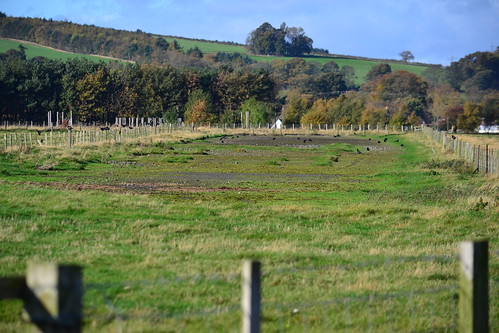
The Perimeter track is now the public road, parts lay visible alongside with associated dispersal pans.

As a military aviation site, Milfield came into being during the First World War. One of several such sites in the region that was used as little more than an emergency landing ground by 77 Squadron who were based further north at Edinburgh. Known at the time as Woodbridge, it would be a quiet little site that would soon disappear, quickly returning to its agricultural roots once war was over.

As a second war with Germany seemed inevitable, the need for new airfields became evermore apparent, and so the Air Ministry implemented the airfield expansion scheme. This programme developed so quickly that by 1942 there was a front line airfield opening at the rate of one every three days! As the German forces moved ever more quickly, and the Fall of France led to the Battle of Britain, the need for fresh, well-trained pilots became paramount. With home reserves drying up, the Commonwealth became an untapped source that would fill the ever-increasing void that was becoming a thorn in the side of the RAF.

Trained only in basic flying techniques, these crews had to be battle hardened and fit for action in a matter of weeks or even less. Initial training operations were mere ‘lip-service’ and recruits often had as much chance of killing themselves as they did the enemy they were intended to down. To meet this demand, numerous training stations were created, manned mainly by Operational Training Units (OTU), they were governed by the various arms of the Air Command: Fighter, Bomber, Naval, Transport etc.

At these training sites, crews would in essence, perform a ‘post-graduate’ training exercise, where they would be assembled for the first time and trained in their respective roles on the aircraft they would be expected to fly operationally. Milfield would be designated as one such station, and was initially identified as a suitable location for a bomber command site. Following requisition of the land in early 1941, the green-light for development was given, the process was put into place, and RAF Milfield was born.

Before any bomber crew would use Milfield though, it would pass from Bomber Command control over to Fighter Command whose focus would now be fighter pilots, and in particular, those specialising in both ground attack and dive bombing techniques.

As pilots came from all across the world, their training standards were some what disjointed, and so a refresher course bringing all crews up to the same standard would be required. This was a role that Milfield would fulfil. Working in conjunction with its satellite station a  few miles to the east, RAF Brunton, Milfield crews would spend some 9 to 10 weeks in total on flying techniques, both solo and formation flying, with the more advanced training taking place at RAF Brunton.

Nestled between the main road and the River Till, Milfield would be built to bomber station specifications, the three runways being wood chip and concrete one of 1,400 yards and two of 1,100 Yards. During development and subsequent handover to Fighter Command though, the new Class ‘A’ airfield standard would come in to being, requiring all airfields to be built with a longer runway specification. However, being a fighter training site, these were not imposed and whilst two of the runways were extended (1,800 and 1,300 yards) they were not to the full Class A specification.

RAF Milfield

The runway threshold is still surviving, note the close proximity of the hills in the background.

As a training airfield it would be exceptionally busy. An expected turnover would be a new course starting around every 3 weeks, which would mean a considerable number of aircrew and aircraft; in excess of 100 air frames would be located here at Milfield at any one time. The primary fighter aircraft at this point would be the Hurricane with other examples including the Miles Master and Magister. To repair and maintain the aircraft, two T2 hangars were constructed with a further eight blister hangars located around the dispersal areas. Squadron dispersal huts were spread around the perimeter, with the technical area and main hangars being located to the south-eastern side. Accommodation, designed to be temporary, was dispersed over 13 sites, and would be designed to accommodate in the region of 1,650 staff, both male and female. Like many airfields though, this figure was surpassed with the actual ‘on roll’ totals varying considerably reflecting the constant movement of staff. Including the numerous support staff, it is believed that some 3,300 people were employed at Milfield at its height.

Adjacent to the airfield was the former Galewood Farm House, an old farm building used as an Officer’s mess during the airfield’s operational life. Destroyed in the 1960s, it was once part of an estate that adjoined the airfield, and was previously home to Josephine Butler. Josephine was the leader of a national women’s political campaign in Victorian England, who campaigned on behalf of prostitutes, abused and trafficked women until her death in 1906*1. Now commandeered by the military, a snooker table with lights powered by a generator was placed inside, and nearby stood the NAAFI theatre, the recreational building showing the usual films to keep the personnel entertained.

It was during this construction period that the first enemy action would occur over Milfield. On September 1st 1941, at 23:00 hrs, six bombs were dropped in the vicinity of Milfield. A crater 72 feet wide and 10 feet deep was recorded, the road was blocked and telephone lines were brought down. Also during this time, and whilst not officially open, aircraft would land at Millfield, presumably as test landings or after getting into difficulty. One of the first casualties here was that of Sgt. James B Spangler (R71573) RCAF flying Hurricane V7044 on 25th June 1941, who was “killed in the course of a training flight” whilst flying with 59 OTU. This tragic accident would be a sign of things to come.

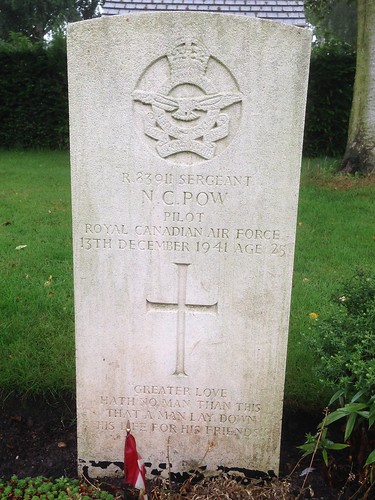
Because of the nature of training flights, accidental deaths on or around Milfield would become fairly common. These included on October 6th, 1941, Hurricane MK. I W9177 which was forced to Bellyland in a field near to Stocksfield just west of Newcastle-upon-Tyne. On 13th December 1941, Sgt. Norman Clunie Pow, (R83911) RCAF, again of 59 OTU, crashed in Hurricane P3809. Sgt. Pow was just 25 years of age and was buried some several hundred miles away next to RAF Sutton Bridge in Lincolnshire, another training station.

Sutton Bridge Churchyard

Sgt. Pow’s grave at Sutton Bridge.

As a training airfield, no operational front line squadrons would use Milfield, other than a detachment of 184 Sqn Hurricane IIDs between 1st December, 1942 and 1st March, 1943. The only other use of Milfield by ‘front line’ units would be as a transit base in the early post-war months.

The first full unit to arrive was that of 59 Operational Training Unit (OTU), arriving in the August of 1942.

59 OTU were originally formed at Turnhouse in December 1940, and operated amongst other things, the Hurricane, the Magister, the Fairy Battle and finally Hawker’s Tempest, all in a training capacity. After spending some five months at Crosby-on-Eden, the unit transferred to Milfield where they trained pilots in the ground attack role. As with many training stations, casualties were high, with many accidents happening through either pilot error or mechanical defects. Many of the Hurricanes used here were veterans themselves, beaten and patched up following intensive fighting in the Battle of Britain, many were long past their sell by date.

One of the first accidents to occur was that of Sgt. K. Dole, RCAF, who stalled whilst performing aerobatics – either authorised or not. His aircraft, a Hurricane MK.I ‘V7316’, MF 89 of ‘Z’ flight 59 OTU, crashed on farmland near Cornhill in August 1942. Luckily Sgt. Dole was unhurt, and the aircraft was salvaged; being repaired and sent to operations in the Middle East. The same fate however, did not fall to P/O J. Methum, who was killed in early September 1942, when his Hurricane MK.I ‘V6840’ crashed in a forced landing a few miles away to the east. The aircraft was written off in this most tragic of accidents.

The dangers of training became evermore apparent over the next few months, Saturday 27th March 1943 being particularly poor for 59 OTU with two crashes on the same day.  Hurricanes Mk.I ‘W9184’ and ‘W9121’ crashing in forced landings and night landings respectively. Both pilots were killed that day; Sgt. Robert MacFadzean (s/n: 1349862) born of US resident parents, and Welshman, Sgt. Gordon Cullener (s/n: 1383311).

Four months after 59 OTU’s arrival, No 1 Specialised Low Attack Instructors School  (SLAIS) would also be formed here (7th December, 1942) another unit that used the Hurricane and the Magister. One of the Chief Instructors of the School would be Squadron Leader J.H. “Ginger” Lacey DFM and Bar, a Battle of Britain Veteran who ended his career with 28 confirmed kills.

Hurricane MK.IID of No. 1 Specialised Low Attack Instructors School being refuelled and rearmed by Ground crew, including a WAAF, on a wet dispersal at Milfield. The fairings covering the two Vickers 40mm anti-tank guns beneath the wings have been removed and a warning notice hung from the barrel. (IWM CH 18134)

Low flying, in even in the relative safety of Northern England, was not immune from accidents, mishaps or misjudgements by the pilots. On 21st February 1943, Hurricane MK.II ‘HW731’ of the SLAIS hit an obstacle one mile north of Beal, the pilot escaped unharmed and after nursing the aircraft back to Milfield, it was repaired and converted for ground training purposes as ‘4616M’.

As flying training continued, so too did the number of accidents, burst tyres, engine malfunctions and fires, pilot error and collisions accounting for a wide range of them. On April 27th 1943, two Hurricanes collided in mid-air whilst performing formation flying. Both airmen, F/Sgt Davies and F/O Thompson were killed; an event that was mirrored in the following July when Hurricanes ‘P3475’ and ‘V7173’ also collided again with fatal results. New Zealander Charles Humphrey (s/n: 421056) is buried locally.

On May 1st 1943, 59 OTU transferred from 81 Group to No. 9 Group, at which point 81 Group was disbanded. No 9. took over 81’s responsibility, and it remained primarily a training arm of the Royal Air Force. For 59 OTU though, little would change.

On September 16th 1943, a B-17F-BO  (42-30030) named ‘Old Ironsides‘ ran out of fuel whilst returning from La Rochelle. The pilot Lieutenant Henry J Nagorka, decided to ditch in the sea near Farne Islands, off the Northumbrian coast. The aircraft quickly filled with water and in under four minutes she had disappeared beneath the waves.

During the ditching two crewmen were lost, waist gunners: S/Sgt. Ed Christensen and S/Sgt. Claude Whitehead, whilst the tail gunner S/Sgt. Harris lost a leg. Those that survived managed to climb into a dingy and sailed to St Cuthbert’s Island where they awaited rescue. Upon being saved, they were transferred to Milfield, where they were collected by another B-17 from the USAAF. However, as Milfield was a fighter airfield and its runways hadn’t been extended to Class A specifications, there were doubts about the aircraft’s ability to get off the ground on the short space available. To overcome the problem, the hedges at the end of the runway were removed and steal planking temporarily laid, the problem never arose though as the B-17 along with its additional human cargo left Milfield safely.

B-17F ‘Old Ironsides’ 42-30030, was loss at sea on the 16th September 1943 with the loss of two men. (IWM UPL 28296)

On January 26th 1944, both 59 OTU and the SLAIS were disbanded and a new unit formed, the Fighter Leaders School (FLS). The School had its origins in 52 OTU formed at Chedworth, and was in January, created as a unit in its own right. Formed through the need for more ground attack pilots in preparation for the forthcoming invasion, it was a unit that would take on the responsibility for the majority of the RAF’s ground attack crews. One notable figure of the FLS at Milfield was Bob Doe DSO, DFC & Bar, another veteran of the Battle of Britain. He would later return to operational duties after his short stay here in Northumberland.

Using the codes HK, OQ and MF, the FLS operated a number of aircraft predominately Spitfire VBs, and Spitfire MK IXs along with a handful of other marks. It later went on to adopt the Sabre engined Typhoon IB. In total over 130 aircraft would be used by the  Milfield unit, an incredible amount of aircraft on one site at any one time. Milfield continued to be in the spotlight.

It was also during this time, early 1944, that the USAAF would begin to send their pilots to Milfield to train on their ranges. With them, came a variety of US built aircraft, P-38 ‘Lightnings’, P-47 ‘Thunderbolts’ and the P-51 ‘Mustangs’. The brainchild of General Quesada, the plan was to train Ninth Air Force pilots in the art of dive bombing, skip bombing and low-level attacks, techniques that would become paramount if the push through France and on into Germany was to succeed. The arrival and increased use of Milfield by the US crews gave an indication that the impending invasion was drawing ever closer.

One of the earliest accidents for the FLS was in March of 1944, when Mohawk MK.III AR633 of 510 Squadron was hit by a Typhoon (JR509) of the Fighter Leader School on take off. Also on this day, a Spitfire MK.IIa (P8549) of the FLS tragically blew up in mid-air during a dive bombing attack on the Goswick ranges. The pilot of the Spitfire, F/Lt. Bouquen, a Belgian, was killed in the incident.

About a month later, a flight of four P47D Thunderbolts from the 366th FS (358th FG) from RAF Raydon attached to Milfield, were carrying out practice strafing attacks on a military convoy. During the climb out of the attack, one of the Thunderbolts (#42-25530), piloted by 1st Lt A. Serapiglia collided head on with Spitfire Mk 1 ‘R6762’ which was preparing to land at nearby RAF Eshott. In the collision, both pilots Sgt. Kai Knajenhjelm a 19-year-old Norwegian and Lt. Serapiglia were killed. After the investigation it was deemed that all future exercises should be performed “outside of local flying areas” of nearby airfields, something that perhaps seems obvious today, but reflects the hectic and often frantic skies over northern England in the 1940s.

A further accident to befall the Americans occurred on May 27th 1944, when a P-38 ‘Lightning’ #42-67425, of the 392nd FS, 367th FG piloted by Dueron H. Robertson, of the Ninth Air force, suffered a landing accident. The aircraft suffered major damage in the crash.

One of the benefits of attending the FLS was the diverse range not only of nationalities: Dutch, Czech, Canadian, Australian, New Zealand and South Africans to name but a few, but also the range of aircraft used. At the end of courses, trainees – now fully fledged fight pilots – were sometimes given the opportunity to try out other types of aircraft. An action that no doubt put the fear of God into the Station Commander who was heard to have shut his door and say “to hell with it”*2 . A number of other incidents occurred during this hectic time, which saw, by the end of December 1944, the FLS being absorbed into the Central Fighter Establishment based at RAF Wittering. Following this, the staff at Milfield all moved out, and momentarily peace prevailed once more.

Between mid December 1944 and into early January 1945, 56 OTU was reformed. Previously at RAF Sutton Bridge in Lincolnshire, it brought new aircraft, to the area, and Northumbria now reverberated to the radial engines of the Typhoon IB and the Tempest V; as four squadrons operated the aircraft using the codes FE, GF, HQ and OD. A collection of other aircraft types also graced the skies of this now highly significant airfield, Spitfires, Tiger Moths, Leopard Moths and Magisters to name but a few.

Even though the war in Europe was winding its way toward its conclusive ending, priority for aircraft was given to this purposefully created unit, and practice flights continued in earnest. The skies remained busy and accident numbers remained high.  In the space of one month between mid January and mid February 1945, there were no less than 8 incidents involving aircraft from Milfield and 56 OTU. As with many incidents here, poor weather, engine failures and pilot error were the causes of many  aircraft abandonment, pilot injuries and tragically deaths. In these eight incidents six involved Typhoons and two involved Tempests.

RAF Milfield

MG & Cannon Range building, one of the few remaining structures at Milfield.

March and April were similar stories, accidents, mishaps and deaths continued to plague Milfield, with pilot error accounting for a larger number of the accidents. Perhaps one of the most bizarre incidents took place on March 8th 1945 when the leader of a Spitfire squadron ‘deliberately’ attacked a Typhoon Mk.Ib ‘MP187’ of 56 OTU, killing the pilot F/O. R Smith of the Royal Canadian Air Force. The Typhoon was commonly mistaken for the Luftwaffe’s Focke Wolf 190, a formidable beast that became the scourge of the USAAF bomber formations.

The closing stages of the war didn’t bring a respite either. Saturday 12th May saw a collision between Tempests ‘EJ685’ and ‘NV759’ an event that killed an instructor pilot. Even after the war’s end, accidents continued to occur, with June, July, August and September all witnessing  further deaths and incidents. August 23rd saw Typhoon ‘SW638’ collide on the ground with two other aircraft, both those struck were written off whilst the ‘offending’ aircraft was badly damaged.

At the end of the war, and over just a two-day period, the only two operational units to use Milfield would arrive, using it as a transit stop. Both 164 Squadron and 183 Squadron would arrive and depart on the same day 16 – 17th June 1945 bringing with them yet more Typhoons.

Eventually, nearly nine months after the war’s end, on February 14th 1946, 56 OTU were disbanded, but not before one final roll of the dice when the life of an RAF pilot was taken. On January 29th 1946, whilst on a “Camera Exercise” and after performing a slow roll ten miles west of Holy Island, Tempest Mk. V EJ859 piloted by F/Lt. Vincent Parker (s/n 42356) RAFVR, an Australian aged 27, dived into the ground killing him. In a cruel twist of irony, F/Lt Parker was killed after having survived as a prisoner of war since 16th August 1940. He had remained in a German POW camp until its liberation at the end of hostilities, returning to England in June 1945, his post-war, peacetime life had been shorter than his life in captivity.

The departure of 56 OTU signified the end of the RAF’s interests in Milfield, and although not a front line operational airfield, it had become a very active and played a highly significant role in fighter training and development. Used to train both new and experienced pilots, it had become one of the RAF’s top fighter pilot training stations, developing pilot’s proficiency in low-level weapons delivery techniques. No matter how dangerous the training got, crews had continued to pass through, morale had  remained high and the standards were never dropped. Of the 1,200 pilots who had passed through here, many went on to make their names as the top ground attack pilots of the Second World War.

Immediately after the war, many of the accommodation huts were used to house Latvian soldiers, many staying here up until 1950. Local people were then housed in refurbished WAAF blocks before moving on to more permanent housing in the local village.

Soon after, Milfield began its decline with many of the buildings being demolished over the coming years. During the cold war era, the two T2 hangars were designated storage units for dried foods and emergency rations, thankfully a role that never had to be called into operation.  Eventually the runways were dug up and removed for hardcore, quarrying took over the southern end of the airfield and much of the surface layers were removed in the process.

During the 1970s investigations were carried by Air Anglia into the possibility of commencing commuter flights to European cities, but the project failed to ‘get off the ground’ and the service was scrapped before it ever developed into anything more than investigative flights.

Now partly returning to agriculture, a small section of the airfield has been retained by the Borders Glider Club*3 . The battle to keep gliders and flying here alive, being a long and difficult one. Through this small organisation, that operates only at the weekends, the spirit of flying lives on, and Milfield continues to fight for survival, a fight that has been both emotive and historically significant in the battle for the skies over Britain. The T2s have now gone as has virtually all the remaining buildings. A stone statue built by an Italian POW who was employed on the local farm, stands on private land, marking what was the official entrance to the airfield during the war years, it is clearly visible from the road side.

RAF Milfield

One of two sculptures, one made by an Italian POW, the second copied by an RAF serviceman.

Located four miles north-west of Wooler and Visiting today, there is some evidence of the former airfield left. Small sections of the perimeter track are now the public road, but alongside the road,  the remainder of the track can just still be seen. The north-western end of the runway is also visible as are a small collection of dispersal pans.  The MG & Cannon Range building still stands, minus its roof it is rapidly decaying, it has a very short life left.

Interestingly, as a training airfield, Milfield used both a Fisher Front Turret Trainer and Hawarden Trainer, a simulation trainer that used the fuselage of a Spitfire to train pilots in interception techniques. A model suspended from the ceiling up to 60 feet away from the pilot could be moved forwards or backwards by operating the opposite movement of the Spitfire’s throttle. As the Spitfire ‘accelerated’ the model moved backwards along a rail, rather similar in design to a 1970’s child’s toy. During these sessions a range of flying skills could be tested, interception and aircraft recognition, throttle control and cockpit procedures included. A primitive method that was state of the art in 1941. Sadly neither of these exist today.

Two memorials are located at this site, the first in a public car park to the western end of the airfield, next to the Maelmin heritage trail. The second is located outside the club house of the Borders Gliding Club, approximately on the site of the former watch office, itself no longer there. This memorial was commissioned by the club entirely through donations and is their way of acknowledging the sacrifice of those who flew from Milfield.

Interestingly a comment made by visitor Reginald Hall states that his wife’s uncle, David Harrison, (born in Gateshead in 1911) was stationed here to “strip out as much non-essential equipment as possible from the planes (he said principally Spitfires) to lighten their weight and so permit a greater quantity of fuel to be carried, sufficient to enable the return flights from Milfield to Scandinavia that were required for photographic reconnaissance“. Unfortunately the exact date of this Reg is unsure of, but I thank him for his comment which can be read in full in the comments below.

Milfield is arguably one of the most significant airfields of the Second World War, many Spitfire, Hurricane and Typhoon pilots quote it in their memoirs, their time here short but memorable. Here ground attack pilots cut their teeth, low-level strafing and dive bombing techniques being honed to absolute perfection. The battle for Europe would certainly have been more difficult were it not for those daring young men who passed through this remote but historically important airfield.

After we leave Milfield, we head east, toward the coast and the satellite of Milfield. A small airfield, it too played a major part in the development of ground attack crews and it too saw many accidents and losses through its training programme. From here we go to RAF Brunton.

Sources and Further Reading.

*1 A website tells the story of Josephine Butler’s life, and another has photos of Galewood farm-house.

*2 Dunn, W.R., “Fighter Pilot: The First American Ace of World War II“,  1996, The University Press of Kentucky, Page 118.

*3 Border flying club website

The Friends of Berwick and District Museum and Archives website provide information about the archaeological history of Milfield.

A book has been published about RAF Milfield, a complementary website gives fabulous personal detail of life at the airfield and is well worth a visit.

Photos of those stationed at Milfield can be seen through the BGC Flckr account.

RAF Debden (Part 3) – The USAAF Arrives.

After Part 1 and Part 2 of the trail, we find that Debden has a new owner, the USAAF. Its fortunes change and it becomes home to one of the most famous Fighter Groups of the Second World War.

121 Sqn, were reformed in 1941 at Kirton-in-Lindsey, initially with the Hurricane MK. I, and then IIBs moving on to the Spitfire IIA and eventually the VB; a model they brought with them to Debden. 71 Squadron had been formed at Church Fenton, and after moving through a series of stations that included Martlesham Heath, they arrived at Debden on 3rd May 1942 also with the Spitfire VB. On September 29th 1942 the two RAF units along a with a third, the 133 Sqn at Great Sampford,  were officially disbanded, but the men of the three units were not dispersed. Instead they absorbed into the USAAF as the 4th Fighter Group (FG). The men of these squadrons were all originally US volunteers who formed the three  American ‘Eagle Squadrons‘ operating within the Royal Air Force.

The 4th FG was specially created to take these three squadrons, they were brought together at Debden where they became the 334th (71 Sqn), 335th (121 Sqn) and 336th (133 Sqn) Fighter Squadrons (FS).  Debden would then be passed from the RAF to the USAAF, the transition of which, would be smooth and relatively uneventful, the units retaining the Spitfires they already had before replacing them with P-47s later in 1943.

A Spitfire Mk. V (QP-V) of the 334th Fighter Squadron, 4th Fighter Group. Handwritten caption on reverse: '1942. 334 FS. 4th FG.'

A Spitfire Mk. V (QP-V) of the 334th Fighter Squadron, 4th Fighter Group. (IWM)

The handover of ownership of Debden took place on the 12th September 1942, with an official ceremony on the 29th to coincide with the disbandment of the RAF units. During this ceremony both Major General Spatz and Brigadier General Hunter were joined by Air Chief Marshal Sir Sholto Douglas of the RAF’s Fighter Command, to see Debden and the aircrews officially joining the ranks of the USAAF. Initially little changed after the handover, the most prominent feature being the removal of the RAF roundels and the application of the US Star on the aircraft’s fuselage and wings. New ground crews were brought in and trained by RAF personnel to maintain the Spitfires, and so RAF crews remained on site until such times as the American were in position to become self-sufficient.

As these crews had been involved in front line operations for some time – the 71st having gathered a total of over half the 73.5 kills recorded by the three squadrons – they were immediately made operational and went on performing in the duties they had been so adept at completing thus far. So proud of their origins were they, that the 4th FG stood out from their fellow Americans both in the way they flew, and the way they behaved.

With their first mission under the ‘Stars and Stripes’ on October 2nd, they would not have to wait long before seeing action once again. The Eagle Squadrons would become famous throughout the war, achieving many records in aerial combat over the next three years. Taking part in the Normandy invasion, aerial battles over Northern France, the Ardennes, the Rhineland, and over Berlin itself; they would not be short of combat experience. Throughout their time the 4th FG would achieve many ‘firsts’. They were the oldest fighter group of the Eighth Air Force, and their combined totals of  enemy aircraft destroyed both in the air and on the ground was the highest of the entire USAAF. They were also the top scoring Allied Fighter Group of the war, destroying 1016 enemy aircraft for a loss of 241 of their own aircraft, many of which were due to flak. They would be the first unit to engage the enemy in air battles over both Paris and Berlin, and they would be the first US Eighth AF Group to penetrate German airspace – a record they established on 28th July 1943. The 4th would also be the first fighter group to be selected to escort the heavy bombers of the USAAF on their first shuttle run, landing in Russia before returning home.

Not only did they undertake many ‘firsts’, but the 4th FG gained an undeniable reputation, between the 5th March and 24th April 1944 they earned a Distinguished Unit Citation when they shot down 189 enemy aircraft whilst destroying 134 on the ground. You cannot mention the 4th without mentioning the name of Donald M. Blakeslee, credited with 16 kills, he was a brilliant fighter pilot who retired from the USAAF as a Colonel. Blakeslee was considered one of finest combat fighter leaders of the Second World War who shunned publicity even refusing to paint ‘kills’ on his aircraft, and he was known, on several occasions, to give kills to rookie airmen. Blakeslee initially flew in 401 Sqn (RCAF) before transferring to 133 Sqn and then the USAAF when they transferred across. He was a remarkable man, a great leader who was looked up to by all those who flew with him, he sadly died in September 2008 leaving a daughter. All-in-all, the 4th achieved quite a remarkable record considering they were initially volunteers of the American air war in Europe.

The 4th FG would remain at Debden thought the war, leaving it only when the RAF required the return of the airfield in July 1945, at which point the whole group packed up and departed for Steeple Morden in Cambridgeshire.

Airmen of the 4th Fighter Group ride in the back of a jeep at Debden air base. A P-47 Thunderbolt is in the background of the shot. Passed by the U.S. Army on 2 October 1943, THUNDERBOLT MISSION. Associated Press photo shows:- Pilots at a U.S. Eighth Air Force station in England are taken by truck from the Dispersal room to their waiting P-47's (Thunderbolts) at the start of a sortie over enemy territory. L-R: Lt. Burt Wyman, Englewood, N.J. ; Lt. Leighton Read, Hillsboro, W.V.; F/O Glen Fiedler, Frederickburg, Tex. AKP/LFS 261022 . 41043bi.' [ caption].' Passed for publication ....1943'. [stamp].

Taken almost a year to the day the US forces moved in, airmen of the 4th FG are taken ot heir P-47s before departing on a mission over enemy territory. The aircrew are: L-R: Lt. Burt Wyman, Englewood, N.J. ; Lt. Leighton Read, Hillsboro, W.V.; F/O Glen Fiedler, Frederickburg, Texas. (FRE 28 – IWM).

As 1943 dawned it would become much quieter in terms of movements at Debden. Now officially a US fighter airfield, the RAF had little to do here. For a short period of a week, 303 Squadron would stop over, the only visitors to make any great use of the airfield for the entire year. With Debden having long concrete runways, it was regularly visited by the lighter bombers, Marauders and Havocs taking refuge here from their own fog bound airfields during poor winter weather. It was during this time in 1943, that The Duchess of Kent, made a royal visit to Debden, taking time out to inspect the aircraft and crews of the 4th Fighter Group, accompanied by General D. Hunter and Colonel Edward Anderson.

With that 1943 faded into 1944, the jet age was dawning and the end of the war nearing sight.  In the July, 616 Squadron appeared with the Meteor, Britain’s first operational Jet aircraft. The squadron detachment stayed here until early 1945 when they moved on to Colerne and eventually the continent.

This move would signify the end of operational flying at Debden. The RAF retained the site reforming the Empire Flying Training School here on 7th March 1946 by merging both 12 and 14 Radio Schools into one. Flying a number of aircraft including Proctors, Tiger Moths, Ansons, Dominie and Lincoln IIs until October 20th 1949 when it was disbanded and Debden became the Royal Air Force Technical College, Signals Division. After a further name change the unit was finally disbanded on April 8th 1960, after it had operated a variety of aircraft including an: Anson, Air Speed Oxford, Spitfire XVI, Lincoln and Varsity.

Between 1963 and October 1973, Vampire F. MK.3 VF301 stood outside Debden’s front gate as guardian, one of several that have been here. It is now sits in the Midland Air Museum at Baginton in the markings of 605 (County of Warwick) Sqn as ‘RAL-G’.

DH Vampire F-1

A former Guardian of Debden now at the Midland Air Museum at Coventry’s Baginton airport.

Although remaining open, the airfield was used for a number of public displays and as a race track, including in 1966, the RAF Debden Motor Gala which featured Donald Campbell’s car, Bluebird CN7, in which Campbell set the land speed record in 1964.  Parts of the site are still used for racing today by the Borough 19 Motor Club*3

In 1975 the airfield officially closed although 614 Gliding School (later 614 Volunteer Gliding School) remained on site using it for flying, until they too departed moving to Wethersfield in 1982.

The army took over the site when the RAF Departed and they remain there to this day.

Debden, because if its post war usage, is a remarkably unique site, but whilst many of the original buildings remain intact, some even being listed as Grade II buildings*4, access is not permitted to the general public and therefore very little can be seen without prior permission. From public roads, high fences and thick hedges obscure most views although from the south, parts of the runway, and several dispersals can be seen quite easily.

RAF Debden

One of the pans now missing its Blister hangar.

By keeping the gate house to your right and passing along the road east to west, you pass the current accommodation area, Guard House and modern buildings used by the current Army owners. Continuing along this road soon brings you to the memorial. Whilst there is no official parking space here, there is a grass verge opposite the memorial where you can safely park your car off the busy main road. Behind the memorial is the north-south runway, still in full width, in which a small section of it can be seen as it rises and dips over the hill. Returning toward the main entrance brings you to a parking area on your right, where public access is permitted to Rowney Wood. Here there are a small number of original buildings still left along with former roads / and taxi ways. During its US occupation, there were five Blister Hangars located here, today only a couple survive, both in current use by local companies.

Like many former airfields and military sites, Debden has been identified as a possible housing location, with the potential for the construction of 55,000 homes. The announcement to close the barracks was made on November 7th 2016, as part of the ‘Better Defence Estate’ strategy, in which 91 MOD sites across the country will close by 2040. Government figures say that the move will save £140 million by closing these sites which also includes the US base at Mildenhall.*5

Considering the history of RAF Debden and the current status of its buildings, the restrictive nature of the site is also its guardian angel. However, with the axe looming heavily overhead, what will become of this site in the future? Its runways will no doubt be dug up, the older non-classified buildings could be demolished, its pathways and taxiways removed. Debden is in danger of disappearing for good leaving only small traces of this once famous airfield that not only took part in the Battle of Britain, but whose airmen defended London in what was very much our darkest hour.

Sources and further reading.

*2 AIR 27/703/17 National Archives

*3 ‘Borough 19 Motor Club’ website has details of their race activities.

*4 One such building is the Sector Operations Block, built in 1938, to the designs of J.H. Binge of the Air Ministry’s Directorate of Works and Buildings (drawing no. 5000/137).

*5 The story was highlighted in the Saffron Walden Reporter website accessed 11th October 2017.

Royal Air Force Police Flights who were at Debden have photos and information on their website.

RAF Debden (Part 2) – The Battle of Britain.

Following on from the first part of this Trail, we see how Debden was thrust into the Battle of Britain and the historic changes that followed.

On August 18th 1940,  at 17:30, the squadron consisting of thirteen aircraft were scrambled to patrol the Skies over Debden. Almost immediately they were diverted to Canterbury and ordered to patrol at 20,000 ft. Five minutes after reaching their designated point, they were ordered into battle attacking ‘raid 51’ who were crossing the coast in the vicinity of Folkestone. Within minutes, the two formations were entwined and the aircraft of 85 squadron set about the 150 – 250 machines of the Luftwaffe.

A mix of J.U. 87s, H.E.111s, J.U. 88s, M.E. 110s and M.E. 109s were staggered in layers between 10,000 feet and 18,000 feet, and as soon as the aircraft of 85 squadron were sighted, the enemy immediately employed tactical defensive manoeuvres with some of the bombers heading seaward whilst other climbed toward their fighter protection.

Hugely lacking in aircraft numbers, the RAF  had little choice but to ‘dive in’, as a result large numbers of individual ‘dog fights’ occurred, resulting in aircraft being strewn across the Essex sky around Foulness Point.  For a while there was complete chaos, aircraft were burning and crews knew little of each other’s whereabouts. In one incident P/O. J. Marshall (Yellow 2) followed his leader into attack. In the melee that followed Marshall flew into a cloud of vapour created by a damaged H.E.111 his wing colliding with the tail of the Heinkel severing it completely and cutting the wing tip-off of his own aircraft. Despite the damage Marshall nursed his crippled aircraft to Debden where he landed safely and unhurt.

During this attack six Me 110s, three Me 109s and one He 111 were confirmed as destroyed, a further He 111, Me 110, Ju 87 and Me 109 were confirmed as probables, whilst four Me 110s and two Do 17s were known to have been damaged.

85 Squadron casualties on the day consisted of one Hurricane destroyed and one damaged. It was during this attack that  Flight Lieutenant Richard H.A. Lee, D.S.O., D.F.C. (s/n 33208), flying as Blue 1, was last seen by Sqn. Ldr. Townsend and F/O. Gowers 10 miles east of Foulness Point chasing 5 Me 109s. He lost contact and failed to return to Debden.  Lee, a veteran with nine victories to his name, was Lord Trenchard’s Godson, and was reported missing that day. *2

On the next day, 19th August 1940, 85 Squadron departed Debden, swapping places with 111 squadron who had previously moved to Croydon. In a signal Air Chief Marshal Sir Cyril Newall, G.C.B., C.M.G., C.B.E., A.M., expressed his thanks to the crews of 85 Sqn, sending his gratitude for “all your hard fighting” in which he added “This is the right spirit for dealing with the enemy.” 85 Squadron went on to continue the fight at Croydon flying in the same determined manner they had shown whilst based at Debden.*2

RAF Debden

The memorial at Debden sits at the end of the north south runway (seen behind).

It was also during August 1940 that Debden became a focus for attacks by the Luftwaffe. On the 20th, a small reconnaissance mission took German aircraft over the airfield along with other airfields in the region. Six days later, on August 26th, the first attack on Debden would occur, a combined attack that would also involve strikes on Kenley, Biggin Hill, Hornchurch and North Weald airfields.

Whilst 11 Group – whose sector headquarters were at Debden – put up ten squadrons and one flight to intercept the incoming raiders,  a number of bombers did get through and over 100 bombs were dropped on the airfield damaging the landing area; the sergeants mess, NAAFI , a motor transport depot and equipment stores. In addition to this the water and electricity supplies were both cut, and five personnel were killed. The raid was made worse by the inefficient vectoring of protective aircraft from Duxford due to them being unable to obtain the correct radio frequency. This mishap did little to help the ongoing ‘dispute’ between Air Marshal Sir Keith Park and Air Vice-Marshall (later Air Marshal) Sir Trafford Leigh-Mallory, who were both locked in dispute over the defences of 11 Group’s airfields – it was arguably this feud that eventually cost Park his command of 11 Group, and a move as AOC to Malta.

At the end of August, Debden would once again become the focus of Luftwaffe attacks. Shortly after 8:00am on the morning of August 31st 1940, waves of Luftwaffe bombers flew over Kent turning northwards toward North Weald, Duxford and Debden. A formation of Dornier bombers managed to reach Debden again where they dropped over 100 incendiary and high explosive bombs on the airfield. This time the sick quarters and barrack blocks received direct hits whilst other buildings were damaged by blasts.

Further attacks on September 3rd and 15th failed to materialise and Debden was finally left alone to lick its wounds and repair the damage to its fragile infrastructure. It was also during this time (2nd September to the 5th September 1940) that all three resident squadrons: 257, 601 and 111  would depart, leaving Debden behind and heading further south to pastures new.

With the ending of the Battle of Britain, things would become a little quieter at Debden, although movements of man and machine would continue with a perpetual occurrence. The October and November would see more short stays: 25 squadron (8th October for around two and half months); 219 Sqn as a detachment for two months, and 264 Sqn at the end of November for just one month. These changes would lead Debden into the new year and 1941.

During 1941, 85 Squadron would return yet again, and after being bounced around with almost regular occurrence this, their final visit, would be in the night fighter role. Initially using their Hurricanes and then Defiants, they soon replaced these with the Havoc before vacating the site for good and the fields of Hunsdon in May that year.

There were yet more short stays during 1941: 54 Squadron in June (two days), 403 Squadron (25th August  – 3rd October); 258 Squadron (3rd October  – 1st November); 129 Squadron (1st November – 22nd December); 418 squadron (15th November – 15th April 1942); a detachment of 287 Squadron; 157 who were reformed here on 13th December moving to Castle Camps five days later where they would receive their Mosquito II aircraft, and finally 65 Squadron who arrived three days before Christmas and stayed until 14th April 1942.

One of these squadrons, 403 Squadron flying Spitfire VBs, was formed as a result of Article XV of the Riverdale Agreement, in which it was agreed between the British Government and the nations of the commonwealth: Canada, Australia and New Zealand; that their trained military personnel would fly and operate as part of the Royal Air Force. This would mean that both air and ground crews would perform their duties under RAF command. Some 70 squadrons were created as a result of this agreement, and of those seventy, 67 were numbered in the 400 series. Even though they were part of the RCAF, RNZAF and RAAF, they were treated as integral parts of the British Royal Air Force for the duration of the conflict.

Into 1942 and yet more of the same, 350, 41, 124, 232 and 531 Squadrons all following this similar pattern of short stays and placements, thus life at Debden was becoming a constant carousel of ground crews and flying personnel. Two squadrons from here did make a real name for themselves though, that of 71 and 121 Squadrons.

In Part 3, we see Debden take on a new owner, its fortune changes and it becomes home to one of the most famous Fighter Groups of the USAAF – the 4th Fighter Group.

RAF Debden (Part 1) – The Build up to the Battle of Britain.

Not far from Wethersfield, lies the parent airfield of Castle Camps. Now closed to aviation, it currently resides in the hands of the Army as the Carver Barracks. On this next part of this Trail we wind our way through the Essex countryside to the former fighter station that gained notoriety during the early 1940s, and in particular the Battle of Britain. In this, the first part of the visit, we look into the development of the airfield, and the build up that took it into the heart of the Battle. We visit the former RAF Debden.

RAF Debden (Station 356) – Essex

The internet and history books are awash with pictures and information about RAF Debden, and rightly so. It is an airfield with an incredible history, famous for its part in the Battle of Britain and the defence of London, it was home to no less than thirty RAF squadrons at some point; it was used by the U.S. volunteer squadrons the ‘Eagle Squadrons’, and then taken over by USAAF as a fighter airfield following their official entry into the war. It was then used again by the RAF post war up until 1975 when the British Army took over,  those whose hands it remains in today as the Carver Barracks.  Not only is it history long but the site is historically highly significant. According to Historic England, Debden airfield represents “one of the most complete fighter landscapes of the Battle of Britain period“, considered historically important due to its “largely intact defensive perimeter and flying-field with associated blast pens“.*1

Debden is therefore a remarkable site, but as an active military base, access and views are understandably very restricted. However, some buildings can still be seen from public areas, particularly the front as you pass by the main entrance.

RAF Debden

One of 11 Blister Hangars built at Debden.

Debden’s life began in the mid 1930s, it eventually opened in 1937, as part of the expansion programme of the pre-war era, and was classified as a fighter airfield under Scheme ‘C’ of the airfield construction programme. During this period, great consideration was given to the architectural features of airfield buildings, standard designs being finished and positioned aesthetically in line with both the local landscape, stone and environment. Design and construction of these airfields, in this the second part of the expansion phase, was carried out in conjunction with the Royal Fine Arts Commission, whose influence led to an overall improvement in airfield design. During this phase of expansion, over 100 permanent sites were built using these new designs, in fact, according to Historic England, it is these sites that have tended to survive in the best condition to date largely thanks due to their post war and Cold War usage. Even in this pre-war period, aesthetics were as important as operability!

Built by W. L. Fench Limited, Debden wasn’t completed until after it had been opened, thus the first units there were using the site in its unfinished state. The two initial landing surfaces were grass, but as a fighter airfield little more was needed. Even so, and not long after it opened, these were replaced by concrete and tarmac surfaces, giving the airfield much stronger and more adaptable landing surfaces. Being the standard 50 yards wide, these runways were also extended from the initial 1,600 and 1,300 yards to 2,600 and 2,100 yards respectively, allowing for larger and more powerful aircraft to utilise the site.

Debden had a large number of hangars built: three ‘C’ type, one Bellman and eleven blister hangars which were all spread around the perimeter and technical areas of the airfield. Some 80 hardstands were also provided, thus large quantities of aircraft were expected to use the site at one point or another.

Of these thirty operational flying squadrons to pass through Debden, the primary aircraft to see service would be the Spitfires and Hurricanes of Fighter Command. Biplanes such as the Demon and the Gloster Gladiator were also to feature here, as were the twin-engined aircraft the Beaufighter, Havoc/Bostons and the jet engined Meteor in the latter stages of the war. The period 1939 – 1942 though, was by far the busiest period for Debden, the majority of squadrons operating from here during this time.

Upon opening in 1937, Debden would operate the outdated and obsolete biplanes of the Royal Air Force, Hawker’s Fury II of 87 squadron being the first to arrive on 7th June 1937, being replaced shortly after by Gloster’s Gladiator, that famous Biplane that protected Malta as ‘Faith’, ‘Hope’ and ‘Charity’. In the summer of 1938, prior to the outbreak of war, Hurricanes were brought in and the entire squadron moved to airfields in France where they would stay until May 1940, when France was invaded by the German forces. Brought back to England, a short two-day stop over at Debden, would lead to a move north and Yorkshire before returning to the battle, and a night fighter role over Southern England.

Joining 87 Sqn in June 1937 were further Gladiators, those of 80  Squadron who, themselves formed a month earlier, would stay at Debden until departing for the Middle East and Ismailia a year later. A third squadron would arrive during this time, 73 Squadron, who shortly after reforming at nearby Mildenhall, would also replace their Hawker Furys with Gladiators coinciding with their move to Debden. Also moving to France, 73 Sqn would eventually move to the Middle East, where they would remain for the duration of the war, flying from numerous airfields including that of Habbaniyah, one of several places where my father was stationed post-war.

One other squadron would grace the skies over Debden that year, that of 29 Squadron, whose Hawker Demons were adapted to accept a Frazer-Nash turret for defence. A small aircraft, they would be no match for enemy fighters and so were replaced in December 1938 by the far superior aircraft the Blenheim IIF. Coinciding with this, was the movement of a detachment of 29 sqn aircraft to Martlesham Heath, which was followed by a months stay at RAF Drem in the border region before returning to Debden once more. By the end of June though, the entire squadron have been pulled out of Debden and moved to Digby in Lincolnshire and a new role as night fighters.

1938 also saw the reforming of 85 Squadron on the 1st June. 85 sqn, as a unit, had their roots in the First World War, being stationed in France before disbandment in the summer of 1919. But on this occasion, they were reformed out of ‘A’ Flight of 87 squadron prior to them taking on their Hurricanes and imminent move abroad. During the period 1939 – 1940, 85 Sqn would move around almost weekly, with one of their longest permanent stays being between November 1938 and September 1939 whilst here at Debden. Being the parent airfield of Castle Camps, Debden units would often be dispersed there, or in some cases stationed there, whilst also operating out of Debden – 85 Sqn being no exception.

Two other squadrons would fly from Debden during the winter/spring of 1939 – 40, both 17 and 504 operating the Hurricane MK. I. On an almost weekly basis, both units would yo-yo between Debden and Martlesham Heath, an almost continuous spiral of postings saw them using the ‘Heath’ as a forward operating airfield until around May 1940, when both units were moved to France in support of the B.E.F.

Hawker Hurricane Mark Is of No 17 Squadron taxiing at Debden, July 1940. In the foreground is YB-C, that of the CO, Squadron Leader Harold ‘Birdy’ Bird-Wilson, who was shot down on 24th September flying YB-W (P3878) (IWM – HU 54517)

As the fall of France turned into the Battle of Britain, fighter units to defend Britain became top priority. The dawn of 1940 would see the beginning of six more squadrons operate out of Debden, the majority of which would arrive during the height of the Battle. Debden, as the Sector Station responsible for the Thames Estuary and eastern approaches to London, would become a prestige Luftwaffe target during those early days of the Battle. As a result, it along with other Sector stations at Northolt, North Weald, Biggin Hill, Tangmere and Hornchurch, would endure some of the most sustained and prolonged attacks by German bomber formations.

To meet the demand for fighter units, 257 Squadron were reformed and posted to Debden initially flying the Spitfire MK. I. They quickly replaced these with the Hurricane I prior to them becoming operational on July 1st. Four days later they were joined at Debden by both 601 (the ‘Millionaires Squadron’ named so after the men who initially joined it) and 111 Squadron making this one of the largest collections of Hurricanes at that time.

85 Squadron were soon in the thick of the battle. As July 1940 turned to August, patrols would be sent up as regularly as the sun would rise, many of these patrols would result in enemy engagement; the Operational Record Books being testament to the continuing battle for the skies over Britain at that time. At the beginning of August on the 7th, Air Vice-Marshal K.R. Park M.C., D.F.C. visited  Debden, a visit that preceded the transfer of Debden from 12 Group into 11 Group. It was also at this time that the funeral of P/O. Britton of 17 Sqn took place, a young man who lost his life in a flying accident on the 6th whilst carrying out an air test in Hurricane N2456. In poor weather, visibility of only four miles, P/O Britton crashed into Debden Park destroying the aircraft in which he lost his life.

In mid August 1940, both ‘A’ and ‘B’ flights of 85 Sqn were brought back from Martlesham Heath and Castle Camps to Debden, a move that preceded the not only the first but one of the largest attacks by a Debden squadron on enemy aircraft.

In part 2, we see how Debden was affected by the German campaign, the relentless attacks that drew Debden crews into battle. We look at the changes at Debden and how the American made a name for themselves as determined and fearless fighter pilots.

*1 Historic England, Historic Military Aviation Sites – Conservation Guidance, 2016.

389th BG Exhibition at Hethel.

Whilst visiting RAF Hethel (Trail 38), we drop into the exhibition of the of the 389th BG who were stationed here during World War II.

The exhibition is small but it has a lot to offer. Located in the former Chapel/Gymnasium, it has been carefully restored and filled with information and artefacts pertaining to the former airfield and U.S Air Force during the Second World War.  There are also articles from the 466th Bomb Group who were based at nearby RAF Attlebridge, the RAF and stories from local people who befriended the Americans whilst they were here.

The exhibition is located on a working poultry farm and so access is limited, open every second Sunday of each month between April and October, from 10:00 am to 4:00 pm.

The buildings have been painstakingly restored by volunteers, some of whom have had connections with the airfield or Lotus cars, the current owner of the airfield itself. In 2001 the museum opened its doors to the public, after moving a collection of memorabilia from the Lotus site over to their new home here at the 389th exhibition.

It was during the restoration that two murals were discovered, these are perhaps one of the more stunning aspects of the exhibition. Painted in 1943 by Sgt. Bud Doyle, the then Chaplin’s driver, they are located on one of the walls of the Chapel. One is of Christ on a cross, whilst the other is a portrait of a pilot, both have been restored and remain on display where they were originally painted all those years ago..

389th BG Exhibition Hethel

The restored murals in the Chapel.

Located here, are a number of items many with stories attached. In the Chaplin’s quarters next door, are maps and other documents relating to the groups activities.

Two new Nissen huts have also been built, opened and dedicated in 2014 and 2017, they extend the exhibition further to include uniforms, service records, numerous photographs and more memorabilia.

RAF Hethel, 389th BG Museum

The dedication plaque.

There is also a refreshments bar offering the usual tea and snacks, along with a toilet facilities.

From the museum there are public footpaths into what was one of the accommodation areas of RAF Hethel, here are some of the remains of buildings, shelters primarily, hidden amongst the undergrowth. The footpaths are mainly concrete once you get onto the site.

RAF Hethel, 389th BG Museum

Part of the exhibition inside the former Chapel at RAF Hethel.

A nice little museum it has free entry and welcomes donations to help with the upkeep and maintenance of the site, if in the area, it is well worth a visit and your support .

The 389th website has further details and opening times and information of forthcoming events.

R.A.F. Wethersfield (U.S.A.A.F. Station 170).

After a short journey from Castle Camps we soon arrive at our next port of call. This airfield, although a Second World War airfield, saw little action but was used by both the U.S.A.A.F. and the R.A.F. both during and after the war. Whilst it does not generally have active flying units today, it does house the M.O.D. dog training unit and as such is classed as an active military site.

This part of the trail brings us to the former airfield RAF Wethersfield.

R.A.F. Wethersfield (Station 170).

RAF Wethersfield was originally designed and built as a Class ‘A’ bomber airfield with construction occurring during 1942. During this expansion period materials and labour were both in short supply, which delayed the completion of the airfield until late 1943. During this period, ownership of the airfield passed hands several times, initially belonging to the Eighth Air Force, it was to be loaned to the R.A.F. between December 1942 and May 1943, before returning back to American hands. However, the delay to construction meant that by the time it was completed and opened, it would not be used by the R.A.F. but passed instead directly into the hands of the ‘new’ U.S. Ninth Air Force.

Constituted in 1941, the Ninth had already been fighting in Egypt and Libya, before they were moved to England in late 1943 in preparation for the forthcoming invasion of the continent. Throughout the remainder of the war they would pave the way for the advancing forces from Normandy deep into Germany itself. As an Air force, it would be disbanded in 1945 only to be reborn post war as part of the Tactical Air Command, and latterly the Continental Air Command, at which point it was assigned to Reserve and National Guard duties.

The first units to arrive at Wethersfield did so in the February of 1944, four months before the invasion took place. The first aircraft to arrive were the A-20 ‘Havocs’ of the 416th Bombardment Group (Light). The Group, who was only a year old itself, was made up of the: 668th, 669th, 670th and 671st Bomb Squadrons, and would fall under the control of the IX Bomber Command, Ninth Air Force who had their headquarters at the rather grand stately home Marks Hall in Essex.

A-20 Havocs, including (serial number 43-9701) of the 416th BG. 9701 was salvaged August 18th 1945. IWM (FRE 6403)

A journey that started at Will Rogers Airfield in Oklahoma, would take the men of the 416th from Lake Charles in Louisiana, through Laurel Airfield, Mississippi and onto Wethersfield some 28 miles to the south-east of Cambridge, in Essex.

As a Class A airfield, its three concrete runways would be standard lengths: 1 x 2,000 yards and 2 x 1,400 yards, all the normal 50 yards wide. Scattered around the perimeter were fifty hardstands for aircraft dispersal – all but one being of the spectacle style.

The 2,500 ground and air crews would be allocated standard accommodation, primarily Nissen huts, situated over several sites to the south-west of the main airfield site. Two T2 hangars were provided for aircraft maintenance, one in the technical area also to the south-west, and the second to the east. One notable building at Wethersfield was a Ctesiphon hut. An unusual, and indeed controversial design, it originated in the Middle East when a sergeant, unable to camouflage his tent, had poured concrete over it. As the pole was removed, the structure remained both intact and strong. The commanding officer, Major J.H. De W. Waller took the idea, named it after a 1,600 year old palace at Bagdad, and developed it in the UK, through the Waller Housing Corporation.

The idea behind the building is that a metal frame is constructed, similar in design to Nissen hut ribs, then covered with hessian after which concrete is poured over it. As the concrete hardens, the hessian sags giving added strength through its ‘corrugated’ shape. The ‘scaffolds’ are then removed leaving the hut’s shell standing independently. At Wethersfield there were originally fourteen of these huts built, all within the technical site, it is not currently known whether any of these still exist today, but it is extremely unlikely as most were pulled down post war.

The 416th BG were part of the 97th Combat Wing, and were among the first to receive the new ‘Havocs’, along with the 409th and 410th BG who were also under the control of the 97th. For the short period between the 416th’s arrival (February 1944) and the invasion in June, they carried out sustained training missions transferring their skills from the B-25s they had earlier used, to the new A-20s, which included operational sorties targeting V-weapons sites in northern France starting in March 1944.

During these flights, accidents would happen. A number of aircraft were damaged or written off whilst attempting  landings at Wethersfield: ’43-9203′, (671st BS) piloted by George W. Cowgill crashed on 21st April 1944; ’43-9209′ piloted by Pilot Elizabeth O. Turner, crashed on 13th August 1944, and ’43-9368′ crashed two days earlier on 11th August 1944. Some of these accidents resulted in fatalities, including that of ’43-9223′ (668th BS) which crashed on a routine test flight 1.5 miles north-west of Wethersfield, on 9th May 1944. The pilot Capt. William P. Battersby (the Squadron Operations Officer) and a passenger Private First Class Charles W. Coleman (s/n 32372194) a Parachute Rigger, were both killed in the accident.

In the April, two months after the Americans had moved in, the R.A.F. officially handed over the airfield to the U.S. forces in a ceremony that unusually, saw a large number of civilians take part.

As the invasion neared, the 416th began to attack coastal defences and airfields  that were supporting Luftwaffe forces. During and after the invasion they targeted rail bottlenecks, marshalling yards, road networks, bridges and other strategic targets to prevent the build up of reinforcements and troop movements into Normandy.

As the German forces retreated, the 416th attacked escape routes in the Falaise Gap to the south of Caen, destroying the many bridges that allowed the German armies to leave the encircled area. During the battle, nine aircraft were lost, and all those lucky enough to return suffered flak damage, some of it heavy. For their actions here between the 6th and 9th of August 1944, the 416th earned themselves a Distinguished Unit Citation (D.U.C.) the only one they would receive during the conflict.

By the following September, the Allies had pushed into France and the Ninth began to move across to captured airfields on the continent, the 416th being one of those to go. Leaving the leafy surroundings of Wethersfield for the Advanced Landing Ground (A.L.G.) at Melun, to the south of Paris, it would be a move that would coincide with the change to the new A-26 ‘Invader’; the 416th being the first unit to do so, another first and another distinction. During their seven month stay at Wethersfield the 416th BG would fly 141 operational sorties losing twenty-one aircraft in the process.

A-20 Havocs and A-26 Invaders of the 416th Bomb Group at Wethersfield. This picture was probably taken around the time the 416th were departing Wethersfield for the Landing Ground at Melun, France. FRE 7445 (IWM)

With their departure, Wethersfield was handed back to the R.A.F. and the First Allied Airborne Army. This would see a dramatic change from the light twin-engined A-20s to the mighty four-engined Stirlings MK.IV, the former heavy bombers turned transport and glider tugs, whose nose stood at over 20 feet from the ground.

The two squadrons operating these aircraft at Wethersfield, 196 Sqn and 299 Sqn, would both arrive on the same day, October 9th 1944 and depart within 24 hours of each other on 26th and 25th of January 1945 respectively.

The Stirling, initially a heavy bomber of Bomber Command, was pulled from front line bombing missions due to its high losses, many squadrons replacing them with the newer Lancaster. 196 Sqn however, retained the Stirling and instead transferred from Bomber Command into the Allied Expeditionary Air Force.

The Stirlings proved to be much more suited to their new role supporting resistance and S.O.E. operations in occupied Europe. But the heavy weight of the Stirling took its toll on the runways at Wethersfield, and eventually they began to break up. Now in need of repairs, the two squadrons were pulled out and sent to Shepherds Grove where they would eventually be disbanded at the war’s end.

RAF Wethersfield

One of the original T2 Hangars on the south-eastern side.

A short stay in March of 1945 by the 316th Troop Carrier Group (T.C.G.) allowed them to participate in Operation ‘Varsity‘, transporting paratroops of the British 6th Airborne across the Rhine into Wessel, and on into northern Germany itself. An operation that saw 242 C-47 and C-53 transport aircraft leave bases in England filled with paratroops and their associated hardware. For many of these troops, it was their first drop into enemy territory – a true baptism of fire. During the take offs, paratroopers witnessed a V-1 flying bomb race across the Wethersfield sky, the Germans last-ditch effort to turn the tide that was very much against them. Immediately after the operation the 316th returned to their home station at R.A.F. Cottesmore, a move that signified the operational end of Wethersfield for the Second World War. Now unoccupied the site was put into care and maintenance, a state it remained in for a good number of years.

With the heightening threat of a soviet attack and the suggestion of the Cold War turning ‘hot’, Wethersfield was then given a new lease of life. On the 1st June 1952, the U.S. returned once more with the 20th Fighter Bomber Wing (F.B.W.), the 55th and 77th Fighter Bomber Squadrons (F.B.S.) operating the F-84G ‘Thunderjet’.

To accommodate the new jets, the main runway was extended, the original wartime buildings were removed and replaced with more modern structures. The original control tower was developed and upgraded to meet the new higher standards required of a military airfield. Accommodation and family support was also considered. Like many U.S. bases in the U.K. they had their own shops, bowling complex, basketball centre, Youth club, cinema and school. Wethersfield was to become, for a short period of time, a front line base and a major part of the U.S.’s twenty-two European bases.

Children are shown around RAF Wethersfield as part of cementing American and British relations. 

The F-84G was a Tactical-fighter bomber designed to carry a 2,000 lb nuclear bomb for use on enemy airfields in the event of all out war. Operating as part of the 49th Air Division, 3rd Air Force, they would operate in conjunction with the B-45’s located at nearby R.A.F. Sculthorpe.

In June 1955, the wing, now reformed but utilising the same units, began flying the Republic F-84F ‘Thunderstreak’. The ‘F’ model was essentially a swept-wing version of the ‘G’; designed to be more powerful whilst utilising many of the tooling used by the ‘G’. Gradually the ‘G’ was phased out by the 20th with the ‘F’ becoming the standard flying air frame.

Up grading of the F-84F to the F-100 ‘Super Sabres’ occurred in 1957, during which time the unit was also re-designated the 20th Tactical Fighter Wing after a major reorganisation of the U.S. forces in Europe. The Super Sabres remaining in service here until 1970 when the nearby development of Stansted Airport led to the Wing moving to Upper Heyford in Oxfordshire. Prior to this move Wethersfield would bear witness to the first demonstration of the F-111 in U.K. skies, an aircraft that would become the back-bone of the 20th after its departure to Upper Heyford in June that year.

In 1963, Wethersfield suffered a blow when  an F-100F Super Sabre ’56-3991′ piloted by First Lieutenant Paul Briggs (s/n 69418A) and co-pilot Colonel Wendell Kelley (s/n 7784A) crashed at Gosfield in Essex. The aircraft experienced repeated “severe compressor stalls” and ongoing problems with oil pressure. After disposing of their fuel tanks over the sea, the aircraft was guided back towards Wethersfield. Eventually the crew decided to eject, the co-pilot asked for the canopy to be blown, and believing he had gone, the pilot ejected. It was not until afterwards that the pilot realised the co-pilot was still in the aircraft, and he was killed in the resultant crash in a farmer’s field. To commemorate the tragic accident that took the life of Colonel Kelley, a memorial stands on the village playing field*1.

RAF Wethersfield

Cold War Shelters located on the original hardstands.

With this move in 1970, Wethersfield went back into care and maintenance, used by the airport repair organisation the Rapid Engineer Deployable Heavy Operational Repair Squadron Engineers or RED HORSE for short, who were responsible for the rapid repair of runways and other large airfield structures in times of war. This would also mean the end of operational flying at Wethersfield, and after the departure of the 20th, no further active flying units would return.

As the Americans began their European wind down, the ‘RED HORSE’ unit was also pulled out and the site returned to Ministry of Defence ownership. The R.A.F.’s M.O.D. Police units moved in during 1991, the hands of which it remains in today.

The airfield is still complete, the runways a little worn, its surfaces ‘damaged’ by experimentation with new techniques and repair practices, but it is used by visiting aircraft associated with Police and M.O.D. operations – Police Helicopters and the like. A glider training unit 614  V.G.S. also reside here utilising one of the remaining T2 hangars, keeping the aviation spirit alive if only for a short while longer.

Today it remains an active Military base, and as such access is strictly forbidden. The roads around the airfield do offer some views but these are limited. A public road and footpath is located at the north-eastern end of the site, from here the runway, parts of the perimeter track and hangar can be seen through the fencing. Passing the main entrance, there are a small number of buildings remaining derelict on adjacent farmland, these were part of the original accommodation site and are few and far between. Continuing along this road leads to a dead-end and private dwelling, but it does allow views of the current  accommodation and training buildings on the former technical area, all now very modern.

RAF Wethersfield

There have been many of these post-war additions to the airfield,

Whilst Wethersfield remains an active site, plans were announced in March 2016 to dispose of it as part of the M.O.D.’s plan to sell off many of its sites to raise money and streamline its activities. If planning permission is granted, Wethersfield could see 4,850 homes being built on it and the resident units of the military being moved elsewhere. It is planned to pass Wethersfield over to the Homes and Communities Agency by 2020, for its disposal*2.

Having a short war service and limited cold war history, Wethersfield is one of those airfields that never achieved huge recognition. Despite this, it was nonetheless, one that played its part in major world history. Achieving many ‘firsts’ and seeing many new developments in aviation, it is slowly starting that decline into obscurity. If the Government have their way, Wethersfield will shortly become a housing estate, and its history will sadly become yet another of those condemned to the local library.

After leaving here, we carry on into Essex and yet another airfield that has remained active but not as a flying base. We go to the Carver Barracks and the former R.A.F. Debden.

Sources and further Reading.

*1A website dedicated to the 20th T.F.W. at Wethersfield has a number of pictures of both aircraft and people associated with Wethersfield and the 20th T.F.W.  It also includes a transcript of the discussion between the pilot and the tower prior to the Sabre’s crash. There are also other documents relating to the crash located on the site.

*2 The announcement was highlighted ion the Essex Live website, March 24th 2016.