The last flight of Joe Kennedy and Wilford Willy – (RAF Fersfield).

There has been much written about the young Kennedy, his life, his family and his death, but a lot of information around his death has remained ‘unknown’ for many years. Even today, the actual cause of his death is not clear and will probably remain so.

Joseph Kennedy Jnr was based at RAF Fersfield (originally RAF Winfarthing) in Norfolk (Trail 27), and had only been there a few weeks before he tragically died on August 12th 1944, whilst operating on secret operations. A tragic loss, this is the last flight of Joseph Kennedy and Wilford Willy from RAF Fersfield, Norfolk, England.

The Crew – Lieutenant Joseph Kennedy Jnr.

Joseph Kennedy was born July 25th 1915, Nantasket, Massachusetts, he was the eldest brother of eight siblings including John F. Kennedy. He was son to Joseph Patrick Kennedy and Rose Fitzgerald. Throughout his life he had been pressured into the political life by his father who had high hopes that his son would become the future President. Joseph Jnr wanted to please. As war loomed, Joe Kennedy Jnr rose to the challenge seizing his opportunity to become the ‘shining light’ of the Kennedy family.

The Kennedy parents instilled a desire to be competitive, to win and succeed and to be the best. This came out in Joseph during his time at both home and at school. The pressure on Joseph was enormous, and it was clearly evident throughout his short life.

Joseph lived in the shadow of his younger brother John, who would captain a PT boat in the Far East, and in Joseph’s absence, go on to become President of the most powerful nation on Earth. John was the brighter, the more determined of the two, and this caused friction between them. Joe always wanting to ‘out-do’ his brother persevered, but never seemed to quite make it.

It was this determination and rivalry that perhaps led Joseph to do what he did, to impress, to be the best and the ideal way he thought was as a war hero.

With a remarkable academic background behind him, Joseph Kennedy joined the U.S. Naval Reserves on October 15th 1941, reporting to the Naval Air Station (N.A.S.) at Jacksonville, Florida the following day. After several months of training he received his commission and on January 10th 1943 he joined a flying patrol squadron. In May he became a Junior Grade Lieutenant transferring to a bomber squadron in the following July that year. In 1944, on July 1st, he was promoted to Lieutenant United States Naval Reserve. His military life would last just over one month.

Joseph was posted to RAF Dunkeswell serving under the RAF’s Coastal Command. Flying a PB4Y he would carry out U-Boat searches over the Atlantic around the Bay of Biscay and the Atlantic. As he accumulated flying hours, he rarely came into any real danger, even when posted to cover the Allied invasion fleet over Normandy he rarely came into contact with any opposing aircraft or vessels.

Joseph Kennedy’s opportunity came when volunteers were asked for to undertake a special secret and dangerous operation. He jumped at the chance to be a hero.

Joseph Kennedy arrived at RAF Fersfield, Norfolk on 30th July 1944, where he was trained for two weeks.  On August 10th 1944, he wrote a letter home, it would be his last communication with his family. Joseph Kennedy was to become a pilot in operation Anvil, the Navy’s version of Aphrodite.

Lieutenant Wilford John Willy

Sadly, Lieutenant Wilford J. Willy (s/n: O-137078), has remained in the shadows probably because the status of Joseph Kennedy Jnr. A tragic loss nonetheless and no less an important one. Willy was born 13th May 1909, New Jersey. He enlisted in the Navy in 1928, gaining his Naval Wings on April 30th 1937, just two years after he had married his sweetheart, Edna C. Schaffery, the women he left behind. On advancing through the rank of Chief Petty Officer,  he was awarded Lower Grade Lieutenant (April 28th 1942) and two months later, on June 26th, he achieved the rank of Lieutenant. Willy served at a number of operational stations, including Pearl Harbour, before being posted to RAF Fersfield, in Norfolk.

Willy, now an expert in Radio Operations and procedures, became the Executive Officer of the Special Air Unit One (S.A.U.1), the rank he achieved when he took off with Kennedy on August 12th 1944.

Operations Anvil and Aphrodite.

Whilst Drone technology and research had been around as early as World War I, it was still relatively unchartered territory. However, radio controlled drones (modern name Unmanned Aerial Vehicles or U.A.V.s) were already being used with relative success for target practice by the RAF and USAAF during World War II. The ‘Queen Bee’ being one of many used by the RAF. The Germans had also been investigating drone and guided bomb use through examples such as the Mistel aircraft (the most successful being a combination of either a FW-190 or Me-109 mounted above a Ju 88).

Both the  USAAF and USN were undertaking secret trials into drone aircraft operations with the view of attacking the heavily defended and ‘impenetrable’ submarine and ‘V’ weapons sites across northern France . The aim, to stop, or at least reduce, the Nazi’s use of the V1, V2 rockets and the development of the new V3 canon.

Codenamed ‘Aphrodite‘ by the USAAF,  and ‘Anvil‘  by the Navy, they were two secret operations running side by side. The idea behind these operations, was to remove all excess equipment from war-weary B-17s and B-24s, fill them with explosives, such as the British Torpex, put in radio receivers so that the drone (baby) could be controlled by a separate aircraft (mother) and fly them into designated targets. A volunteer crew of two would take off, set the aircraft in flight and then bail out over the U.K. or English Channel, leaving the ‘baby’ in the control of the ‘mother’ aircraft. These would then fly, by remote control, to the target when they would be put into a dive destroying whatever they hit.

The controls of the B-17 . The arm linkage moved the control column in response to the radio controls. (credit USAF)

The idea was remarkable but not new, and the equipment whilst innovative for its day, was basic to say the least. In all the operations undertaken only one drone ever reached its target, and that was through more luck than skill.

‘Azon’ (from AZimuth ONly*1) controls had been used successfully on individual 500lb or 1000lb bombs, where the control box was attached to the rear of the bomb and controlled by the bomb aimer through a joy stick. Using two directional controls (left or right) he could direct a bomb very accurately onto a given point. The downside of Azon, was that range and fall had to be determined in the usual way by the bomb aimer, and could not be altered once the bomb had left the aircraft.

Azon had been used and proven in attacking bridges, railways and other longitudinal targets and was very accurate with a good bomb aimer. However, because of its limitations, it could only be used in one dimension and therefore was not capable a making a ‘baby’ take off.

Two aircraft types were identified for the project. Boeing’s B-17 ‘Flying Fortress’ and Consolidated’s B-24 ‘Liberator’. These once converted would be given new identifications BQ-7 (usually B-17Fs) and BQ-8 (B-24D/J). In each case it was deemed that two crew members would be needed to raise the ‘baby’ off the ground, partly because of the strength needed to pull back the control columns in these heavy bombers. Once airborne, they would climb to around 20,000ft, arm the Torpex, set the aircraft on a trajectory to the target, switch on the receivers and bail out.

About twenty-five  BQ-7s were modified, but it is not known accurately how many USAAF BQ-8s were converted. However, it is known that at least two naval PB4Y-1s (the naval version of the B-24 of which 400 had been converted from B-24 status – these were given s/n 31936 – 32335) were converted to BQ-8 standard; one of which was flown by Lt. Kennedy and  Lt. Willy on the 12th August 1944.

A number of support aircraft were needed for each mission. Prior to the attack a Mosquito XVI of the 653rd BS would photograph the target. Then the ‘baby’ would be accompanied by at least one fighter (either P-38 or P-51) incase the ‘baby’ lost control and had to be shot down, and for fighter escort; a ‘mother’ either a Lockheed Ventura or another B-17 modified to CQ-4 standard, and a photographic  Mosquito from the 8th Combat Camera Unit (CCU) to record in-flight behaviour. A post mission photo reconnaissance operation was carried out by the 25th BG at Watton to analyse the effectiveness of the bombing. It therefore took a lot of fuel, crew and aircraft to fly one drone to its target.

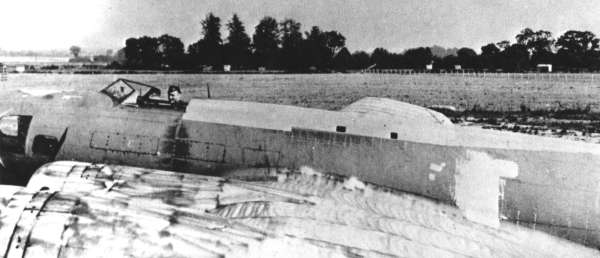
Because of the design features of the bombers, the USAAF looked into removing the cockpit to allow easy departure. The only aircraft that received this treatment was B-17F, “Olin’s 69’ERS” 42-30595 formally of 560BS, 388BG at Knettishall. It was never used on an Aphrodite mission  and was scrapped post war after being used for training in the open cockpit mode.  The BQ-8  (B-24) also had modifications made in the form of a widened hatch in the nose allowing for an easier escape from the aircraft. Once modified, the aircraft would have had all previous markings removed, and a special white or yellow paintwork applied to identify them from other bombers in the air. To assist the controllers in sighting the ‘babies’ whilst in flight, the aircraft were fitted with a smoke canister that would be ignited allowing the bomb aimer to see the aircraft as it began its dive. In addition to this, two cameras were fitted to some ‘babies’ that transmitted pictures to the mother or support ship. These pointed at the controls through the plexiglass, a revolutionary step forward in drone technology.
USAF designation system

A modified B-17 (BQ-7) with its canopy removed, this aircraft became a training drone. (Credit USAF)

In all, there were fifteen missions undertaken by the USAAF and USN, but none were to successfully hit their targets.  These included: Mimoyecques (Fortress); Siracourt (V1 Bunker); Watten (V2 Bunker); Heligoland (U-boat pens); Heide; Le Havre (docks); Hemmingstedt (oil refinery); Herford (marshalling yard) and Oldenburg (Power station). Both the operations and entire programme were cancelled only a few months after the Kennedy/Willy mission.

The last flight.

At RAF Fersfield, on August 12th 1944, Lieutenants Joseph Kennedy Jnr. and Wilford J. Willy, both of the S.A.U. 1 of the Fleet Air Arm Wing Seven, boarded their converted B-24 Liberator, s/n 32271 (ex USAAF B-24J 42-110007)*2 and began their preflight checks. The aircraft was filled with 21,270lbs of explosive. At 17:55 and 17:56 two Lockheed Ventura ‘mother’ aircraft took off, followed by a further navigation aircraft and then the ‘baby’ at 18:07. The ‘baby’ climbed to 2,000 ft, the two ‘mothers’ 200 feet higher and slightly behind. They were joined by two Mosquitoes, one for monitoring the weather, and the second, a USAAF F-8, to photograph the ‘baby’. This aircraft was flown by pilot Lieutenant Robert A. Tunnel and combat camera man Lieutenant David J. McCarthy. There was a further B-17 relay ship, a P-38 high altitude photo reconnaissance aircraft and five P-51 Mustangs to provide fighter cover.

The group set off toward the target at Mimoyecques , Northern France. They were to fly south-east toward the Suffolk coast, then turn south and head toward the target. Once level and stabilised, Kennedy and Willy handed over control to one of the ‘mother’ ships Then they reached the first control point (CP) at which time the group began to turn south; the ‘mother’ controlling the ‘baby’. Shortly after the turn was completed (about two minutes) Kennedy was heard to give the code “Spade Flush“, then at that 18:20 the ‘baby’ disintegrated in what was described as “two mid-air explosions” and a “large Fireball”.*4 The explosion, spread debris over a large area of the Suffolk countryside killing both crew members instantly. The following Mosquito also suffered damage and minor injuries to its crew. Following the explosion, all the aircraft were ordered back to base and the crews debriefed.

Many months (and indeed years) of investigations followed, but no firm conclusions could be drawn as to the precise cause of the explosion that ripped the aircraft apart. A number of speculative theories were drawn up, but the most plausible is that the electronic arming system was faulty, and when Kennedy or Willy, flicked the switch, an electronic short occurred that caused the bombs to detonate. Oddly the film that was in the following Mosquito has never been seen or made public – if indeed it was filming at that time.

The cause of death of both Joseph Kennedy and Wilford Willy still remain a mystery to this day, the secrecy behind one of the world’s worst explosions remaining locked away in archives.

Joseph Kennedy wanted to be a hero. He wanted to be talked about as the one who achieved and outshone his brother. Sadly, this dream cost him his life.

Page 1 of August 23, 1944 condolence letter to the parents of Lt. Joseph Kennedy, Jr.,

The letter sent to the Kennedy’s after Joseph’s death.*3

Page 2 of August 23, 1944 condolence letter to the parents of Lt. Joseph Kennedy, Jr.,

The letter sent to the Kennedy’s after Joseph’s death.*3

This fateful mission and its two crew members are remembered across the world. In France, the Mimoyecques museum contains a memorial honouring both pilots, and their names are carved in the Tablets of the Missing at the American Cemetery, Madingley, Cambridge. Kennedy has a ship the Destroyer ‘USS Joseph P. Kennedy Jr.’ DD850 named after him, and this is now a museum in Battleship Cove, Fall River, Massachusetts. Both aviators were awarded the Naval Cross posthumously,
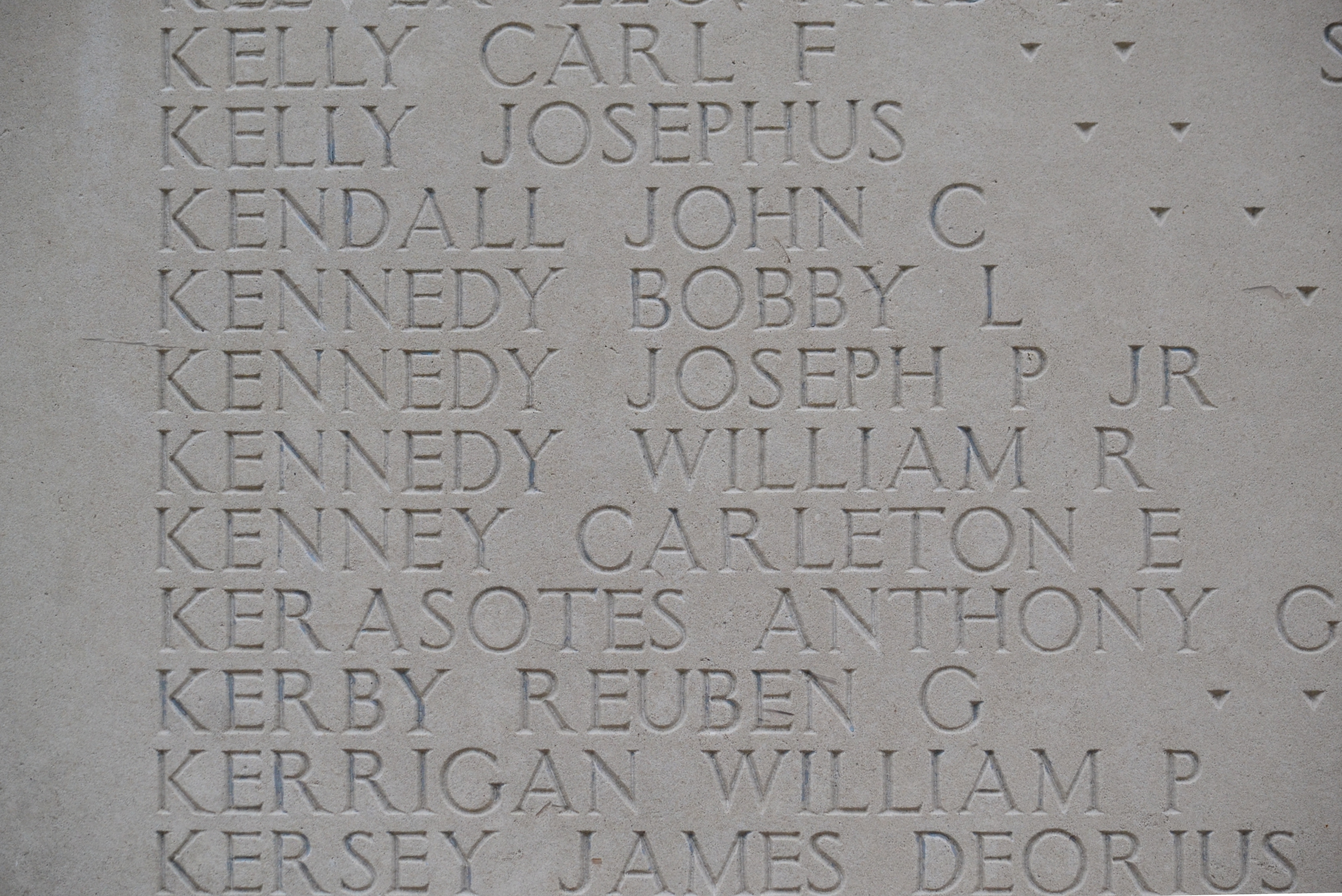
joe kennedy

Lieutenant Joseph P Kennedy Jr, USNR, appears on the Wall of the Missing at the American Cemetery, Madingley, Cambridgeshire.

Lieutenant Jospeh P. Kennedy Jnr had no dependents but Lieutenant Wilford J. Willy left a widow and three children.

Sources and further reading.

*1 Azimuth being the clockwise horizontal angle from a given point (usually North) to a second given point.

*2US Navy and US Marine Corps BuNos, Third Series (30147 to 39998)‘  Joe Baugher, accessed 20/8/15

*3 Photos taken from ‘A People at War‘  Archives.Gov, Accessed 20/8/15

*4 Elgood, P., ‘Crisis Hunter: The Last Flight of Joseph P. Kennedy Jr.’ Columbia Point, 2014, pg 45, 65,

For a list of USAAF drones and pilotless missiles, see the Directory of US Military Rockets and Missiles website.

For the details on Drones see Wikipedia.

For more information and types, see Mistel aircraft, on Wikipedia.

Boeing B-29s in the UK.

During March 1944, an event took place in the UK that considering its historical importance, is little known about. It was actually quite a momentous event, especially in terms of aviation history, and in particular the Second World War.

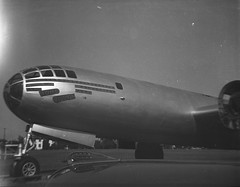
As a follow on to RAF Glatton and Trail 6, we look into the short-lived presence of Boeing’s mighty aircraft the B-29 ‘Superfortress’, in what would appear to be its first and only wartime presence on British soil.

At the time of the bombing of Pearl Harbour in 1941, the United States was less than ready for a global war. The retaliation and defeat of not only Japan, but Nazi Germany as well, was going to be both costly and massive, requiring a huge increase in manufacturing of both arms and machinery.

This increase meant not only aircraft for the Air Force, but the infrastructure to support and train the aircrews too. A network of airfields and supporting organisations totalling some $100 million in 1940, would, by the war’s end be valued in the region of  $3,000 million. In terms of size, this infrastructure would cover an area of land equal to the combined areas of: New Hampshire, Vermont, Massachusetts, and Connecticut.*1

To complete the task, along with aiding her allies, the U.S. was going to need to design and manufacture many new models of aircraft, aircraft that would outshine anything previously made available to the U.S. forces. Long range bombers in particular, capable of travelling great distances were going to be required – and a lot of them. At the outbreak of the European war, the U.S. Army Air Corps was in comparison to the European forces, very small, commanding just 26,000 officers and enlisted men, and operating only 800 front-line aircraft. The Luftwaffe on the other hand, had expanded considerably over the previous years, now commanding some 3,600 aircraft. The British, who were still some way behind the Germans but growing rapidly, had available to them some 2,000 aircraft, whilst the French could muster slightly over 1,700. *1a

To meet this demand, U.S. aircraft manufacturers were going to have to start by modifying, and with some exceptions, redesigning the various aircraft types that were already available to the U.S.  forces. However, and likewise the British and German manufacturers, new models were going to have to be designed and put into production very quickly if victory was to be achieved in any of the world’s theatres.

Preempting war, the US Government put out tenders for long range bombers, in answer to which during the 1930s, the Boeing Model 299, first flew. Eventually being purchased by the US Government to fulfil the role, it was put into production as the iconic B-17 ‘Flying Fortress’, and was followed not long after by the B-24 ‘Liberator’; a more modern aircraft which took its maiden flight in 1939. But sitting on the drawing board at this time, was another aircraft that performed even better, the formidable B-29, a bomber designed to fly at altitudes up to 40,000ft, beyond the range of anti-aircraft guns and  faster than many fighters of the time. The aircraft was so advanced in design that depending upon its payload it was capable of flying distances of up to 5,000 miles, far beyond that of any other heavy bomber.

Whilst the U.S. aircraft manufacturers had already begun designing and testing these new models, it would be some time before the number and types of available aircraft would come anywhere close to being comparable to those of the Luftwaffe, R.A.F. or even later, the Imperial Japanese Air Force.

By August 1942 both the development and production of these two heavy bombers, the B-17 and B-24, were well underway, and so it was decided that they would go initially to the European theatre rather than the Far East. The competition for the attack on Japan now lay between the B-29 and Consolidated’s competitor the B-32 ‘Dominator’ – an enlarged and also pressurised version of their B-24. However, two years after the first design drawings were revealed, neither of these aircraft types had yet flown, and so the shorter ranged B-17 and B-24s were going to have to fill the gap until such times as their replacements could arrive.

The war in the Far East would provide its own set of problems. The distance that supplies would have to be taken would take time and before any invasion could take place, lost ground not only had to be recovered, but held. To achieve this, ground forces would need to be protected by an air umbrella, a defensive shield formed so tightly that air supremacy was guaranteed.

Getting supplies into China was difficult, by air it required long and dangerous flights over the ‘Hump’, the Himalayan mountain range, usually fulfilled by C-47s and DC-3s, their commercial equivalent. With the C-46 ‘Commando’ and C-87 coming on line later on, the frequency and quantity of these supplies could increase but it was still not enough for the Chinese, nor for the difficult task ahead.

By March 1943 the stage was set. The Fourteenth Air Force was created out of Maj. Gen. Claire Chennault’s China Air Task Force, which by the summer time, had begun attacks on coastal positions, ports and troop concentrations under Japanese control.  This air umbrella was in part achieved over Burma, and the desired attacks on Japan now looked more possible, but the B-17s and B-24s that had worked tirelessly lacked the range to hit the Japanese homeland;  the long range high performance B-29 was by now desperately needed.

During the Quebec Conference in August that year, U.S. officials put forward their proposal to stage American long range bombers on airfields in China, the area required for such bases being under Chinese control already and therefore not at the mercy of the Japanese forces. This offensive, designated the Matterhorn Project, would involve the still as yet untested  in battle, B-29s, their longer range and larger bomb capacity enabling them to ‘bomb Japan into submission’ in a similar way that Sir Arthur Harris had hoped for in Europe with the RAF’s bombing campaign against Germany’s industrial targets and cities.

To meet these aims a new force would be created, the Twentieth Air Force, which would be made up of two commands: the XX Bomber Command from China and the XXI Bomber Command who would be based in the Mariana Islands after they were retaken from Japanese control.

The aircraft destined to carry out this role, the B-29, was still very much an unknown quantity. Rushed into production with scant attention to testing, it was a monster of an aircraft, with a crew of eleven in pressurised compartments, electronic gun turrets and a massive 141 ft wingspan. The project was to be the biggest in U.S. aviation history, spares alone in the initial contract costing $19.5m, and one which General Arnold
referred to as the “$3 billion gamble”.*1b

The following film “Birth of the B-29 Superfortress” shows a B-29 production line and a test YB-29 in flight. It also contains some short graphic images at the start.

A batch of four XB-29 prototypes were built, and after initial test flights, a further fourteen ‘test’ aircraft, designated the YB-29, were also constructed. But problems with design drawings, missing parts and rushed testing meant that production was slowed to a minimum, part finished aircraft being stored whilst awaiting vital components. After test flights it became apparent that the B-29’s engines were prone to overheating and in several cases catching fire. This delayed further testing reducing flying time considerably until the problems could be solved. During flight tests, this problem with the engines was graphically seen, first on February 18th 1943, and then again a year later.

In February, XB-29 #41-003 (the second prototype XB) crashed into a meat packing factory killing all eight crew on board along with twenty civilians on the ground. The pilot, Eddie Allen, had already received the Air Medal for successfully landing the same XB-29 following another engine fire in the preceding December. A year later, January 29th 1944, engine problems caused yet another accident when  #41-36967, the last of the  fourteen*2 Wichita YB-29s  manufactured, crashed after losing all four engines whilst in the air. This problem with overheating engines becoming the proverbial  ‘thorn in the side’ of the Boeing production team.

By the summer of 1943, B-29 training squadrons were being set up, the first, the 58th Bombardment Operational Training Wing (Heavy) later the 58th BW (Very Heavy), was formed with the 40th, 444th, 462nd, 468th and 472nd Bombardment Groups, each with four or five squadrons of their own.

After a period of training four of these groups (the 472nd was disbanded April 1944) would transfer to India flying via Africa to join the Twelfth Air Force initially flying supplies over ‘the Hump’, before taking part in operations against Japan from the Chinese airfields.

Departure for these groups occurred over the March – April 1944 period, during which time one of these aircraft would divert to the U.K. causing a huge stir whilst ‘touring’ several U.K. airbases.

Whilst precise sources seem scarce, it is thought that flying B-29s across the southern route raised fears of a Luftwaffe attack whilst en-route, and so a plan of ‘disinformation’ was set in motion to fool the Germans into thinking that the B-29s were to be based in England, ready to be used against German targets. The first part of this ruse was in early March 1944, when YB-29 #41-36963 ‘Hobo Queen‘ took off from Salina Airbase in Kansas and flew to England. It initially took the southern route toward Africa, but then deviated north heading to Newfoundland. The YB-29, piloted by Colonel Frank Cook, then flew across to the UK initially landing at RAF St. Mawgan, in Cornwall.

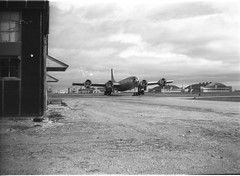
During its short stay in the U.K. it was known to have visited RAF Horsham St. Faith near Norwich,  RAF Bassingbourn on the 8th March, RAF Knettishall and RAF Glatton on 11th March before its final departure from RAF St. Mawgan to India in April that year. The route took the YB-29 to Marrakech, Cairo (2nd April), Karachi (5th Apr) finally arriving at  Kharagpur, India, on 6th Apr 1944 . Once here, it was assigned to the 769th Bomb Squadron, 462nd Bomb Group who were then based at Piardoba in India, where it was modified as a tanker to ferry fuel over ‘the Hump’. The YB-29, the only test model to fly overseas,  gave a successful service, eventually being declared war weary and returned to the United States, its eventual fate being unknown, presumably, like many war weary models, the aircraft was scrapped.*3

Whilst in the U.K. the YB-29 was certainly a major draw, over 1,000 key personnel viewing the aircraft at RAF Glatton alone, its enormous size dwarfing anything that had been seen in U.K. skies before.

The ruse was considered a success. The many B-29s that followed across the southern route did so without any interference from German aircraft, although how much of that was actually down to the ruse itself, is hard to distinguish. It is even thought in some circles that photos of the ‘Hobo Queen‘ appeared in the newspaper of the National Socialist German Workers’ Party,  The Völkischer Beobachter, although an initial search of the paper through the Austrian National Library proved fruitless.

Crews and ground staff swarm around B-29 #41-36963 at Glatton airfield 11th March 1944*4.

Although B-29s were initially considered for the European theatre none operated from British soil until after the wars end, when a joint British and American operation, Project ‘Ruby‘*5, investigated deep penetration bombs against reinforced concrete structures. Three B-29s were prepared in the United States along with four B-17s and a select detachment of admin, maintenance, technical staff and air crew,  who arrived at RAF Marham, Norfolk, on March 15th 1946. Initial plans were to test a series of bombs on the submarine assembly plant at Farge, but due to the close proximity of housing and an electricity plant, the U-boat shelter at Heligoland was used instead. The bombing trials began on March 25th by which time an original three B-17s from RAF Mildenhall had also joined the group.

A number of both American and British bombs were tested in the trials:

  • The US 22,000lb. ‘Amazon’ bomb
  • The US rocket assisted 4,500lb. ‘Disney’ bomb (used by B-17s in the latter stages of the war)
  • The 4,500lb. ‘Disney’ bomb without rocket assistance
  • The American 22,000lb. fabricated ‘Grand Slam’ (designated T14)
  • The American 12,000lb. fabricated ‘Tall Boy’ (designated T10)
  • The British 12,000lb, ‘Tall Boy’
  • The British 2,000lb. Armour Piercing  bomb
  • The inert loaded 2,000lb. SAP (M103) bomb
  • The Picratol filled 2,000lb. SAP (M103) bomb
  • The 1,650lb. Model bomb

The results of the trials were quite conclusive, none of these bombs in their current form, were capable of penetrating the 23 ft thick concrete of the Farge roof, and therefore, all would need adapting, redeveloping or redesigning if such operations were to be carried out again.

Post war, B-29s were brought into the UK and operated as Boeing Washington B1s, operating with nine RAF Squadrons: No. 15, 35, 44, 57, 90, 115, 149, 192 and 207 at various airfields including RAF Marham, RAF Coningsby, RAF Watton and RAF Waddington, eventually being replaced by the high flying English Electric Canberra. The B-29 then disappeared from operational service in the UK.

Without doubt, the development of the B-29 had a major impact on the world as we know it today, and even though its first arrival in the UK in March 1944 caused a major stir in the aviation world, it incredibly remains a little known about clear fact. With little documentation available, there is clearly much more research to be done.

Since the original posting of this article, I have been contacted by Daniel Partridge whose grandfather (Leon Suthers) was at Randolph Field in the United States, after the war’s end. He has sent me some photos of ‘Hobo Queen’ after she returned to the US. According to information Daniel has supplied, she was used as a training airframe from January 1945 until 1954, after which she was scrapped. From the photos, you can see that much of the aircraft has been stripped away, presumably as part of this programme, yet the 45 camel ‘mission scores’ have been left. Further information from Daniel confirms that these Camels represent flights ‘over the hump’. My sincere thanks to Daniel for the information.

Hobo Queen

Hobo Queen Post War (Photo courtesy Daniel Partridge)

Hobo Queen

Hobo Queen Post War (Photo courtesy Daniel Partridge)

Sources and further reading.

*1 Nalty, B., et al. “With Courage The U.S. Army Air Forces in World War II” 1994. Air Force Historical Studies Office (p61)

*1a ibid (p38)

*1b ibid (p147)

*2 Only 14 YB-29BWs were built (#41-36954 – #41-36967) and all at Wichita. They were painted olive drab upper surfaces and light gull grey lower surfaces.

*3 MSN 3334.

*4 Image courtesy of 457th BG Association.

*5 Comparative Test of the Effectiveness of Large Bombs Against Large Reinforced Concrete Structures (PDF), Report of the Air Proving Ground Command, Elgin Field, Florida – Anglo-American Bomb Test Project “Ruby”. October 31st, 1946.

Simons. G.M., “B-29 Superfortress: Giant Bomber of World War Two and Korea“. Pen and Sword Aviation. (2012)

Mann. R.A., The B-29 Superfortress: A Comprehensive Registry of the Planes and Their Mission McFarland & Company Inc. (2004)

Harris, S.R., Jr. “B-29s Over Japan, 1944-1945: A Group Commander’s Diary” McFarland & Company Inc. (2011)

Mann. R.A.,.”The B-29 Superfortress Chronology, 1934-1960” McFarland & Company Inc. (2009)

2nd Lt. Robert E. Femoyer MOH, 711th BS Rattlesden

Robert Femoyer.jpg Robert Femoyer 711th BS, 447BG

Flying from RAF Rattlesden, Suffolk, England, navigator 2nd Lt. Robert E. Femoyer earned the Medal of Honour for action whilst on a mission to Merseburg. During this operation, he showed the highest level of dedication to his crew, performing a selfless act of bravery whilst being severely and fatally wounded.

Born October 31st 1921, Huntington, West  Virginia, USA, he was the eldest child of Edward and Mary Femoyer. and attended Virginia Polytechnic Institute in Blacksburg, Virginia.

On 11th November 1942 Robert Femoyer enlisted and joined the Reserve Corps. He didn’t take up active duty until the following February when he began his basic training at Miami Beach, Florida. He joined the Army Air Corps in that same month and became a cadet at the University of Pittsburgh. He received his commission at the AAF Navigation School at Selman Field, Louisiana in 1943 and graduated, without gaining his wings, in 1944.

With his second lieutenant bars firmly under his belt, Femoyer received his first posting; and in September 1944 he left with the 711th Bomb Squadron as part of the 447th Bomb Group, Eighth Airforce. As a navigator he would determine routes and ensure the safe flight of his aircraft and other crew members to the bomb target and home.

On his fifth and final mission , and only a few days after his 23rd birthday, on November 2, 1944, the 711th attacked an oil refinery at Merseburg, near Leipzig, Germany. The B-17 he was in, was battered, hit several times by flak, and had two of the four engines damaged. The aircraft was difficult to fly and the navigational instruments were left almost useless. Femoyer himself had received shrapnel wounds to his side and back, was bleeding heavily and in a great deal of pain.

The B-17 quickly lost both height and speed and was forced to leave the formation, making it more vulnerable to attack from fighters, but Femoyer was not going let his compatriots down.

Deciding to turn for home the pilot asked for a route.  In response, Femoyer, determined to keep a clear head, refused all medical assistance before planning their escape route home. He insisted he was propped up so he could read his maps, the injury to his body making sitting extremely difficult. Guiding the pilot safely around heavy flak zones, they eventually reached the safety of the English coast, where then, and only then, did Femoyer allow morphine and other medical aid to be administered. The pilot managed to guide the stricken aircraft home where upon landing at RAF Rattlesden, Femoyer was removed from his post, weak and having lost of lot of blood, and taken to hospital where he sadly died about an hour later.

For his valour and courage he was posthumously awarded the Medal of Honour, and his citation read:

“For conspicuous gallantry and intrepidity at the risk of his life above and beyond the call of duty near Merseburg, Germany, on Nov. 2, 1944. While on a mission, the bomber, of which 2d Lt. Femoyer was the navigator, was struck by three enemy antiaircraft shells. The plane suffered serious damage and 2d Lt. Femoyer was severely wounded in the side and back by shell fragments which penetrated his body. In spite of extreme pain and great loss of blood he refused an offered injection of morphine. He was determined to keep his mental faculties clear in order that he might direct his plane out of danger and so save his comrades. Not being able to arise from the floor, he asked to be propped up in order to enable him to see his charts and instruments. He successfully directed the navigation of his lone bomber for 2 1/2 hours so well it avoided enemy flak and returned to the field without further damage. Only when the plane had arrived in the safe area over the English Channel did he feel that he had accomplished his objective; then, and only then, he permitted an injection of a sedative. He died shortly after being removed from the plane. The heroism and self-sacrifice of 2d Lt. Femoyer are in keeping with the highest traditions of the 447th Bomb Group and the U.S. Army Air Corps.”

The body of 2nd Lt. Robert Edward Femoyer was returned to the United States to his adopted Florida home, and was buried in Greenlawn Cemetery in Jacksonville, Florida, Section 8, Lot 2.  Florida historical resources list him as one of their own war heroes. His college, Virginia Tech, named a building the ‘Femoyer Hall’ in his honour in 1949 and in 2001, a stretch of West Virginia Route 152 from the Fifth Street crossing with Interstate 64 to the Huntington city limits, was officially designated Robert Femoyer Boulevard. Numerous air force bases have also named streets in his honour.

Robert Femoyer was the only American navigator to have received the Medal of Honour during service in World War Two and remains a Florida hero to this day.

For other heroic tales click here.

RAF Rattlesdon Today RAF Rattlesden is a light airfield utilising the former runway of the base.

Notes and Further Reading .

Source compiled from U.S. Air Force Office of History.

Few, if any, photos survive of Femoyer, but others of his squadron are at: http://www.447bg.com/Contacts.htm

RAF Fersfield – where history was changed forever.

After leaving the open expanses of Deopham Green and the roar of Snetterton, we head to a very remote and quiet airfield. Quiet and remote for a very special reason. From here, crews would experience top-secret flights, we would see a link to one of America’s greatest and most powerful families, and from here, the RAF would strike another blow at the heart of the Gestapo. We head to RAF Fersfield.

RAF Fersfield (Station 140/554)

https://upload.wikimedia.org/wikipedia/commons/1/15/RAF_Fersfield_-_29_Aug_1946_Airfield.jpg

29th August 1946. Photograph taken by No. 541 Squadron, sortie number RAF/106G/UK/1707. English Heritage (RAF Photography).*1

Originally built as a satellite for RAF Knettishall, RAF Fersfield was built-in late 1943. The third Class A airfield on this Trail, its main runway ran along a NE-SW direction, was 2,000 yds in length and was constructed of concrete. There was a second and third runway each of 1,400 yds running N-S and E-W, again of concrete. Fersfield had two T-2 Hangars, one to the north side and one to the south, and 50 loop dispersals for aircraft storage. The bomb dump was located to the north, the technical area to the south and the accommodation blocks to the south and south-west. Fersfield would eventually be able to accommodate up to 2,000 personnel of mixed rank and gender.

Initially, the airfield was called Winfarthing and designated station 140, it was then handed over  to the USAAF who would rename it Station 554.

Fersfield was specifically chosen for its remote location as, unknown to those who came here, it was going to play a major role in the battle over Europe.

The first residents were a detachment of the 388th Bomb Group (BG) who were then based at Knettishall, and consisted of four bomb squadrons: the 560th, 561st, 562nd and 563rd. A detachment specifically from the 562nd, were brought here to perform special operations and research into radio controlled bombs using war-weary B-17s and B-24s. These special flights taking place between July 12th 1944 and 1st January 1945.

The 388th were unique in many ways. Aside from their work in radio controlled flights, they were also the only unit in the USAAF to not have formal squadron  identification codes. However, after VE day and the end of hostilities, wireless transmitter codes were applied to aircraft under the left wing preceded with the aircraft’s individual letter as a prefix. This then, gave a unique four letter identification on each aircraft. Similarly, the various aircraft used as remote controlled aircraft had the top surfaces of each wing and tailplane painted white for recognition purposes. *4

T2 Hangar now a store

An original T2 Hangar now stores grain.

Operating as Operation ‘Aphrodite‘, the idea of these operations was to remove all operational equipment from the aircraft, fill it with around 20,000 lb of ‘Torpex’ and fly it by remote control, into a specified target such as ‘V’ weapon sites, submarine pens (Operations Crossbow and Noball) or similar high prestige targets that were otherwise difficult to destroy .

Both the USAAF and USN were carrying out these trials. The Navy, also using Fersfield, called their operations ‘Anvil‘ and used the PB4Y (the Navy version of the B-24 ‘Liberator’) as their drone.

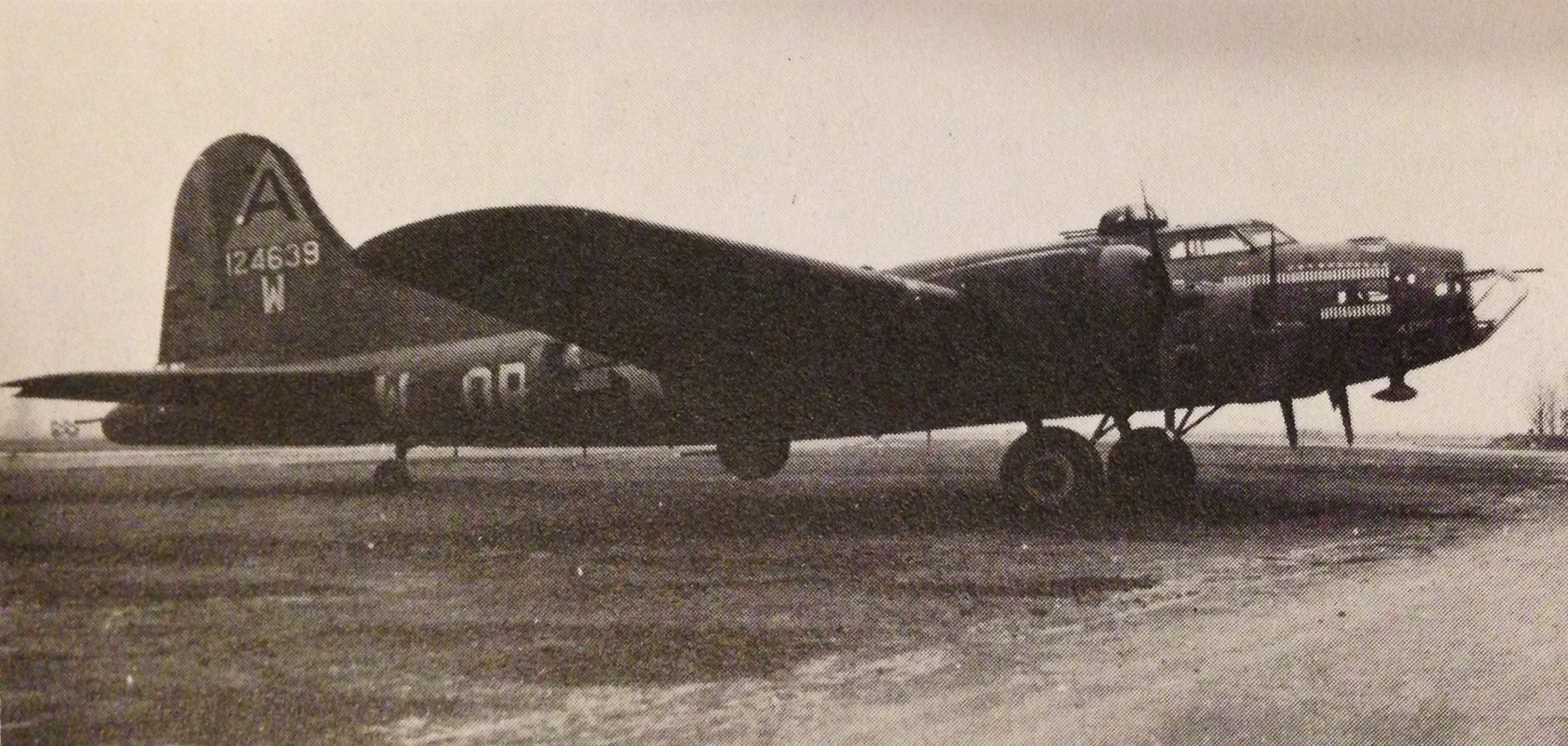
The first Aphrodite mission took place on August 4th 1944, and was to set the tone for all future operations. Mission 515, was flown using four B-17 ‘babies’ with four accompanying ‘mothers’ to target ‘V’  weapon sites at : Mimoyecques, Siracourt, Watten, and Wizernes. Escorting them were sixteen P-47s and sixteen P-51s. One of the babies, B-17 (#42-39835) ‘Wantta Spa(r)‘ (TU-N), had completed 16 missions between November 18th 1943 and July 6th 1944 with the 351st at Polebrook, and was declared to be “war-weary”. It took off but very quickly the crew – Lt J. Fisher and T/Sgt E. Most – realised there was a problem with the altimeter causing it to climb too quickly. Whilst T/Sgt Most bailed out, Lt. Fisher struggled on with the controls until it finally crashed in an almighty fireball in woodlands at Sudbourne, Suffolk, creating a crater 100ft wide. The three remaining ‘babies’ carried on but all failed to hit their designated targets. One Mother lost control and the baby hit a Gun Battery at Gravelines, the second overshot and the third B-17F formally (#41-24639) “The Careful Virgin”  (OR-W) of the 91st BG (323rd BS), hit short due to controller error.

The Careful Virgin 41-24639

B-17F “The Careful Virgin” before modification and whilst in the hands of the 91st BG. (USAF Photo)

Similar results were to follow in another mission only two days later, and then again in further operations throughout both the Aphrodite and Anvil projects.

The most famous tragedy of these missions was that of Lieutenant Joseph P. Kennedy Jnr, who was killed when his PB4Y unexpectedly blew up over Suffolk killing both him and his co-pilot on 12th August 1944.*2 In all, there were twenty-five drone missions completed, but none successfully hit their designated target with either control or accuracy. The missions were all considered failures and the operations were all cancelled soon after.

Operations Block

Former Operations Block south of the Technical site.

Another secret operation taking place from Fersfield, also involved radio controlled bombs. Designated Operation ‘Batty‘ it involved GB-4 television controlled bombs being  slung underneath B-17s and guided onto targets using TV. The 563rd BS provided much of the support whilst the other squadrons in the 388th BG, the crews. In the later part of 1944, a small number of these operations were flown again with little success and this too was abandoned before it could have any significant effect on the war.

All in all, the operations carried out here, were disastrous, killing as many crews and causing as much damage to the UK as it did the enemy. However, it did mean that the Allies had entered into the drone war and set the scene for future military operations. In all, there were 19 Aphrodite missions and 6 Batty operations carried out from RAF Fersfield.

The Americans left Fersfield toward the end of 1944, and it was then handed back to the RAF. A number of units used it for short periods, primarily for aircrew training, but none for major operational flights. However, it was not the end for the airfield, as Fersfield was to have one last remarkable mission and a further claim to fame.

Accomodation Site

Nissan Huts on the former accommodation site.

One of those squadrons who came here was 613 (City of Manchester) Squadron, who arrived at Fersfield on November 20th 1944. They were one of the twenty-one Royal Auxiliary Squadrons, and were considered the ‘baby’ of the Auxiliary Air Force by the other units. Formed on 1st February 1939 as part of No. 22 (Army Cooperation) Group, under Fighter Command, they were initially created with Hawker Hinds and a few Avro Tutors. It was then with another biplane, the Hawker Hector, and the monoplane the Lysander, that they moved with to France, early in the war to attack German gun positions and drop supplies to troops trapped in Calais by the advancing Wehrmacht.

613 performed a mix of roles, from Air Sea rescue operations from Martlesham Heath, to spraying lethal gas on troops in the event of an invasion, they moved from airfield to airfield gradually exchanging their older obsolete aircraft for more modern fighters as they went. They would take on both the North American Tomahawk followed by the incredible Mustang. It was with these aircraft that they were to escort the Venturas of 487 Sqn in their disastrous attack on the the Amsterdam power station in which Leonard Trent was awarded the VC. A mix up in rendezvous times meant the Venturas went on alone to the target, and thus paid the price for not having an escort with them.

In mid 1943, 613 Sqn operated from Snailwell near Newmarket, after which the ground personnel were sent to Sculthorpe and the aircrew to Lasham in Hampshire. This was to train all the personnel on the new Mosquito that the squadron was about to receive.

On joining the 2nd Tactical Air Force, they began attacks with their ‘Mossies’ on ‘Noball’ targets, and locomotives operating on the continent. It was at Lasham that 613 would become part of the newly formed 138 Wing, which would move soon after to Swanton Morley, but not before performing a very secret and daring mission.

Flying at very low level, they were to bomb the Kunstzaal Kleizkamp Art Gallery in the Hague, a former gallery turned Gestapo records office. Here documents relating to Dutch citizens for executions, deportation to concentration camps or labour camps were kept, and so it became a vital target for the wing. The operation was a total success, the building being all but demolished whilst nearby Dutch properties remained completely untouched.

The unit operated both on D-day, and supported the Americans in the Ardennes, flying through poor weather to strafe enemy ground troops who were trying to break through the American lines.

In November, the squadron moved to the continent in support of the allied forces whilst a small detachment of Mosquito VIs arrived here at Fersfield. They remained here until 7th August 1945, taking part in training flights, the last flight out taking place on August 5th 1945. At that point the squadron was disbanded the personnel transferring to 69 Squadron until their service ran out.

However, it was on March 21st 1945, that the crews of 613 Sqn would reunite with 487 Sqn, when the three Mosquito VI units of 21 Sqn (RAF), 464 Sqn (RAAF) and 487 Sqn (RNZAF) – now part of 140 Wing – were pulled back from the continent for a special mission to attack the Gestapo Headquarters at Copenhagen. Previously based at Hunsdon, the mission was Led by Gp. Capt. R. Bateson and Sqn. Ldr. E. Sismore, who took off in Mosquito RS570 ‘X’ at 08:35 and led a group of Mosquitoes in three waves of 6 aircraft in Operation Carthage.

The Shellhaus building raid gained notoriety for two reasons. Firstly, a large part of the building was bombed and destroyed and important documents were set alight, thus achieving the overall objective of the mission; another low-level, daring raid, it was operationally a great success.

However, Mosquitoes following the initial wave, attacked what they believed to be the target building, but it was in fact, a school masked by fire and smoke. This attack caused a significant number of unintentional civilian casualties including children at the school.

Six aircraft failed to return from the mission, four Mosquitoes (one of which crashed causing the smoke and fire that masked the school) and Two P-51s that were part of a twenty-eight strong fighter escort.

This operation was one of many daring low-level raids that the wing carried out, attacking various prestige targets including  the Amiens prison. Together with 138 Wing, the Mosquito under the charge of Basil Embry, more than proved itself as a successful low-level bomber aircraft capable of delivering high precision attacks on pin-point targets.

The aircraft eventually left Fersfield which signified the end of overseas operations for the site, and Fersfield would become a staging post for units prior to disbandment. Between November 1944 and September 1945 a number of units would be located here  which included: 98 and 107 (one week each); 140 (four days); 180 (one week), along with 226, and 605 Sqns. Operating a number of aircraft types including: Mosquitoes (T.III), Bostons (IIa), Hurricanes (IV), Martinets (TT.III), Mitchells (III) and Anson Is, Fersfield had now had its day, and in the last months of 1945, the site was closed and the land was sold off. Fersfield had closed its door for the last time and history had been written.

Post war, Fersfield had a brief spell of motor racing on its tracks and runways, but unlike Snetterton or Podington it would not last, and in 1951 Fersfield became agricultural once more, with many of the buildings being demolished and the remainder left to rot or, some thankfully, used for storage.

Nissen Huts

A few buildings remain on the technical Site.

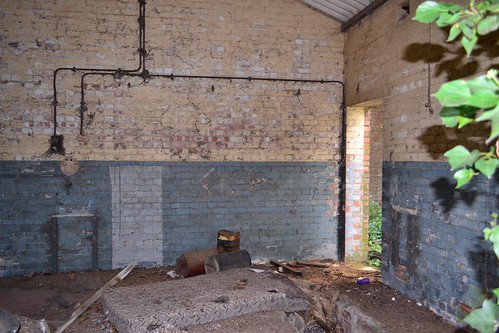
Today a few buildings still do remain clinging onto life. The T-2 on the south side stores grain, and a number of Nissen huts  that housed the technical aspects of the airfield, are now storage for farm machinery and other associated equipment. All these can be located at the end of a small road from the village, and when visiting, I found the workers here only too willing to allow the visitor to wander freely among them. Footpaths cross the southern side of this site and to the north across the field dissecting the airfield. The path is very poorly marked and you are simply wandering across the crops. From here, you can find the last few remains of the accommodation site, further south a short distance away. Latrines and other communal buildings are shrouded in weeds, gradually disappearing beneath the undergrowth. Trees sprout from between the walls where so many walked before or after a mission. Nissen huts survive further out, now dilapidated and hastily patched, their memories mixed amongst the personal belongings of new owners.

Latrine Block

One of the many Latrines on the communal site.

It is hard to believe that an airfield with such an iconic history such as Fersfield never made it to the high status of so many others, as  surprisingly, it was here in this quiet and remote part of Norfolk that aviation history was made and American politics changed forever.

Squadrons that stayed at Fersfield in the last months of the war.

98 Sqn – Arrived here first, on April 18th 1945, remaining here until December 18th that same year with the Mitchell. They were disbanded at this point.

605 Sqn – Arrived 25th April 1945 staying until 31st August 1945 as a detachment of Mosquito VIs. They were then disbanded and renumbered as 4 Squadron.

226 Sqn – Joined 605 at Fersfield on 27th April 1945, also as a detachment but with Mitchell IIs. They too were disbanded on September 20th that same year.

180 Sqn – stayed here between 7th June and 14th June 1945, a weeks break from their airfield at Achmer to where they returned.

107 Sqn – Arrived at Fersfield a month later on 3rd July, also staying for one week with Mosquito VIs coming across from France to where they to returned.

140 Sqn – Stayed here between the 9th and 12th July 1945 with Mosquito XVIs, whilst en route from Eindhoven to Acklington.

Mosquito Mk.VIs involved in the Operation Carthage,*3.

No 487 Squadron

RS570 ‘X’ Gp Capt R N Bateson / Sqn Ldr E B Sismore (Raid Leader)
PZ402 ‘A’ Wg Cdr F M Denton / Fg Off A J Coe (damaged, belly landed at base)
PZ462 ‘J’ Flt Lt R J Dempsey / Flt Sgt E J Paige (hit by flak, 1 engine u/s, returned safely)
PZ339 ‘T’ Sqn Ldr W P Kemp / Flt Lt R Peel
SZ985 ‘M’ Fg Off G L Peet / Fg Off L A Graham
NT123 ‘Z’ Flt Lt D V Pattison / Flt Sgt F Pygram (missing)

No 464 Squadron

PZ353 Flt Lt W K Shrimpton RAAF (Pilot) / Fg Off P R Lake RAAF
PZ463 Flt Lt C B Thompson / Sgt H D Carter
PZ309 Flt Lt A J Smith RAAF / Flt Sgt H L Green RAAF (Flt. Lt. Green’s first given name was “Eric” known to all as “Les”, a common abbreviation in Australia. H.L. Green is used in the ORBs)*5
SZ999 Fg Off H G Dawson RAAF / Fg Off P T Murray (missing)
RS609 Fg Off J H Palmer RAAF / 2nd Lt H H Becker RNorAF (missing)
SZ968 Wg Cdr Iredale RAAF / Fg Off Johnson
All aircraft took off at 0840; last back landed 1405.

No 21 Squadron

SZ977 Wg Cdr P A Kleboe / Fg Off K Hall (missing)
PZ306 Sqn Ldr A F Carlisle / Flt Lt N J Ingram
LR388 Sqn Ldr A C Henderson / Flt Lt W A Moore
HR162 Flt Lt M Hetherington / Fg Off J K Bell
No 21 Squadron records list only these four aircraft and crews above as taking part in this operation.
All aircraft took off at 0835; the three which returned did so at 1355.

Sources and further reading.

*1 Photograph in Public Domain, taken from Wikipedia 20/8/15

*2 For a more detailed explanation of the operation that killed Joseph Kennedy Jnr. see  ‘The Last Flight of Joe Kennedy and Wilford Willy‘.

*3 Information from The National Archives, 21/8/15

*4 Freeman. R., “The Mighty Eighth” Arms and Armour, 1986

*5 My thanks go to Chris Berkley of the Canowindra Historical Society and Museum Inc. for the correction.

National Archives: AIR-27-1924-54, AIR-27-1924-53

M/Sgt. Hewitt Dunn – 104 Missions with the 390th (Framlingham)

RAF Framlingham (Parham) otherwise known as Station 153, achieved a remarkable record, or rather one man in particular did. His name was Hewitt Dunn, a Master Sergeant in the U.S.A.A.F and later the U.S.A.F.

Known as “Buck” he would achieve the remarkable record of completing 104 missions with the 390th Bombardment Group (Heavy) – a record that astounded many as life expectancy in a heavy bomber was short, and few survived beyond one tour of 30 missions.

Hewitt Tomlinson Dunn (s/n 13065206) was born on July 14th 1920. He progressed through school to join the Air Corps where he was assigned to the 390th Bombardment Group (Heavy), 13th Combat Wing, 3rd Air Division, Eighth Air Force, as a gunner in December 1943.

His first mission was with the 569th Bombardment Squadron in the following January. He completed his first gruelling tour of 30 missions by April that year, upon which he immediately applied for a further tour that he would complete by the summer of 1944. His attitude of ‘its not over until its won’, would see him accept a further remarkable third tour, virtually unheard of for a heavy bomber crew member.

On Friday, April 6th 1945, mission 930, an armada of aircraft of the U.S.A.A.F would strike at the marshalling yards in Leipzig, Germany. Inside B-17 #43-38663, ‘The Great McGinty‘, was Hewitt Dunn.

After the mission Dunn described how earlier at the morning briefing, he, like so many of his colleagues, had been a little ‘nervous’. Then, when the curtain was pulled back, their nervousness was justified, Leipzig – the 390th had been there before.

Many crews in that briefing would look to Dunn for signs of anguish, if he remained steady and relaxed, they knew it would be ‘easy’, if he sat forward, then it was going to be a difficult one. The atmosphere must have been tense.

Luckily, unlike other missions into the German heartland, this one turned out to be ‘just another mission’ a ‘milk run’. Much to the huge relief of those in command of the 390th, all aircraft returned safely.

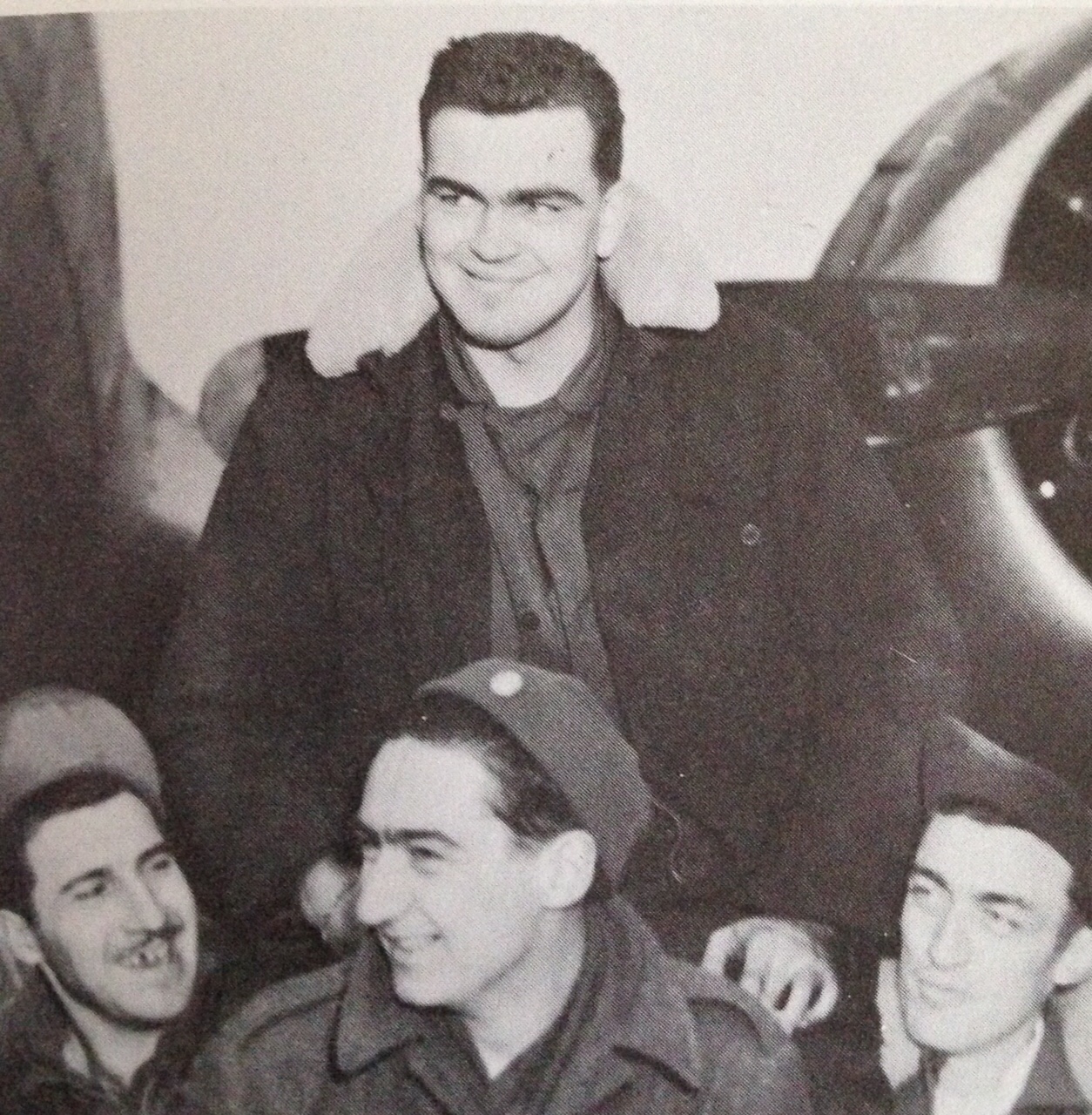
On his arrival back at Framlingham, Dunn was greeted by cheering crowds, ground crews lifted him high in their air carrying him triumphantly away from his aircraft, it was a heroes welcome.

By the time the war had finished, Dunn had flown in 104 missions, he had been a tail gunner on twenty-six missions, twice a top-turret gunner, a waist gunner and the remainder as togglier (Bombardier). He had flown over Berlin nine times, he claimed a FW-190 shot down and had amassed an impressive array of medals for his bravery and actions, and all at just 24 years old.

Post war, he continued to fly as an Instructor Gunner for B-52s in the 328th Bomb Squadron, 93rd Strategic Bomb Wing, at Castle Air Force Base in California. Here he was described as “quiet and reserved” and never talked about his war experiences. He was “handsome man with black hair”, and only when he wore his dress uniform, did others realise how well decorated he was.

Dunn was considered a rock by those who knew him and perhaps even immortal, but he was not, and on June 15th , 1961 after flying for a further 64 flights, he was tragically killed in a domestic incident that involved both his wife Peggy and his son. Precise details of his death are sketchy, and due to its nature, not a story to go into here, but at 41 years of age it was a domestic tragedy that took the life of a brave and heroic young man at far too an early age.

Dunn was a man who had flown in more missions than any other person in the Eighth Air Force and one who had gone on to train others in that very same role. He was highly decorated, and was looked up to and liked by those who knew him.

Following his death a service was held in Merced, California, his body was then taken to Arlington National Cemetery in Washington D.C. where he was finally laid to rest in grave number 3675, section 28.

For a man who achieved so much in his fighting career, little exists about him or his achievements. Maybe, by the end of the war, records were no longer needed, tales of dedication and bravery were no longer useful propaganda. Whatever the reason, Hewitt Dunn’s name should be heavily embossed in the history books of the Second World War.

hewiit-dunn

Hewitt Dunn on return from his 100th mission, April 1945 (IWM)

Hewitt Dunn’s medal tally:

– Air Force Longevity Service Award with 3 oak leaf clusters
– Air Medal with 13 oak leaf clusters (2 silver, 3 bronze)
– Air Medal with 7 oak leaf clusters (1 silver, 2 bronze)
– American Campaign Medal
– Distinguished Flying Cross with 1 oak leaf cluster
– Good Conduct Medal
– National Defence Service Medal
– Silver Star
– World War II Victory Medal
– European-African-Middle Eastern Campaign Medal with 1 bronze star
– European-African-Middle Eastern Campaign Medal with 1 silver star

Post-script

This page was updated on 12th December 2023. I would personally like to thank all those who have contacted me in relation to the story, particularly in respect of his tragic and untimely death, they have all been appreciated. I believe there are numerous articles on-line looking at the events surrounding the domestic incident that ended his life, and for those who wish to seek more information, I have been told that “TJ3 History” is the most recent and details the events that led to his untimely and most tragic end of a brave and dedicated man. 

This and other such accounts can be found in the link Heroic Tales of World War Two.

Australian Flt. Sgt. Rawdon H. Middleton VC (RAAF) 149 Sqn RAF

100641

Pilot Officer Rawdon Middleton (RAAF)*1

Middleton (s/n: 402745) was born on 22nd July 1916 in Waverley, New South Wales, Australia. Son of Francis and Faith Middleton, he was educated at Dubbo Hugh School. Nicknamed ‘Ron’ by his friends, he was a keen sportsman excelling at many sports particularly cricket and football. After leaving school, he worked as a ‘Jackaroo’ (cattle handler) until joining the Royal Australian Air Force on the 14th October 1940 under the Empire Air Training Scheme. He learnt to fly at Narromine, New South Wales and then was sent to Canada for further training in preparation for his posting to the UK. He finally arrived in Britain in September 1941, as a second pilot, and his first operational squadron was No. 149 Squadron RAF, who were flying Short Stirling bombers out of both Lakenheath and nearby Mildenhall in Suffolk.

P01019.003

Five student pilots from No. 7 Empire Air Training Scheme (EATS) course at No. 5 Elementary Flying Training School (5 EFTS) Narromine. They are left to right: Aircraftman (AC) Gordon Orchard; AC Douglas Scott; Leonard Reid; Pilot Officer (PO) Douglas Wilberforce Spooner (DFM); PO Rawdon Hume Middleton*2

Middleton’s first experience of operations, was in a Short Stirling over the Rhur, the industrial heartland of Nazi Germany. After spending a short time with 149 squadron he moved temporarily to No. 7 Squadron (RAF).

In July 1942, as first pilot, he was given his own aircraft and crew, it was also around this time that he returned to 149 squadron.

Their first mission together would be on July 31st, to bomb the strategic and heavily defended target, Düsseldorf. Middleton and his crew would continue to fly together and took part in other prestigious missions; namely Genoa on the 7th of November and his 28th mission, Turin on the 20th November. His 29th and final mission, would take place on the night of 28/29th November 1942.

In the early evening of the 28th he took off in Stirling BF372 coded ‘OJ-H’ as part of the raid on the Fiat works in Torino, Italy, along with 227 other aircraft which included – 117 Avro Lancasters, 46 Short Stirlings, 45 Handley Page Halifaxes, and 19 Vickers Wellingtons.

Middleton’s crew consisted of: Ft.Sgt. Leslie Anderson Hyder, Ft. Eng: Sgt. James Ernest Jeffrey, Bomb Aimer F.O. G. R. Royde, Wireless Operator: Sgt. John William Mackie; Gunners: P.O. N. E. Skinner, Sgt. D. Cameron and Sgt. H. W. Gough. Three of these had already completed their tour of 30 operations and could have left. However, their dedication to Middleton kept them together.

The mission would take the aircraft over the Alps and the Stirling, laden with bombs and fuel combined with having a notoriously poor ceiling, had to negotiate through the mountains rather than fly over them. A factor that often resulted in a high number of casualties.

Once over the target area, OJ-H was subjected to an extreme flak barrage. With poor visibility, Middleton had to make three passes over the target area to enable his crew to positively identify it. It was on the third pass that a shell burst hit the cockpit. The resulting damage was severe, and fragments had hit Middleton’s head badly injuring him. His right eye was lost and his skull exposed. There were further hits on the aircraft’s fuselage causing considerable damage to the control systems and airframe. Knocked unconscious by the blast, Middleton lost control and the aircraft plummeted through the skies to an altitude of around 800ft. The second pilot, Fl.Sgt. Hyder eventually managed to take the controls, release the bombs over the target and then pull the aircraft into a climb, safely reaching 1,500ft.

With his aircraft severely damaged, Middleton had a choice, get his crew to bail out over occupied France and certain capture, fly to Africa or head back to England; a journey that would last over 4 hours and put the aircraft at risk of attack and the crew in danger. Wanting to give them a fighting chance of getting home, he opted for the latter, and set a course for England.

SUK10501

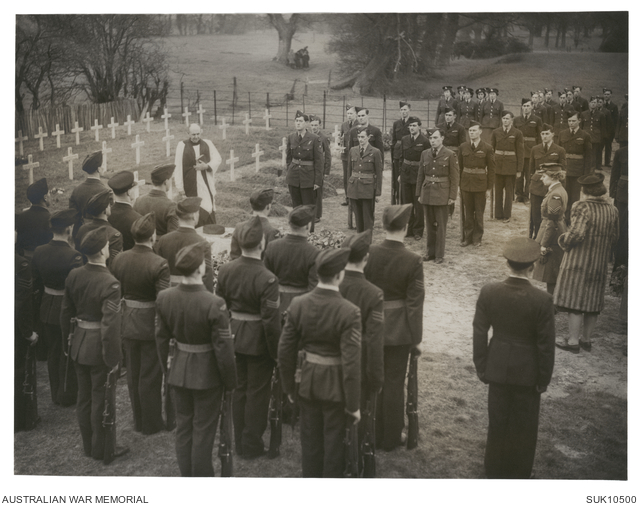
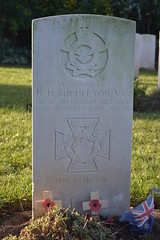
Middleton was buried with full military honours at St. Johns Church, Beck Row. Suffolk.*3

The aircraft experienced a number of attacks as they crossed occupied France, but Middleton, fighting for survival, kept reassuring the crew that he would get them home. Eventually, and against all the odds, they made the English coast, and once over land Middleton ordered the crew to bail out. Five crewmen left the stricken aircraft whilst the other two remained to help him control it. Turning for the Channel, Middleton ordered the two remaining crew members to bail out, whilst he stayed at the controls, steadying the aircraft.

By now the Stirling was very low on fuel and it finally gave up the fight and crashed at 03:00 on the morning of November 29th 1942. Middleton, too injured and too weak to escape the wreckage, drowned within the aircraft fuselage. His two crew members, Sgt. James Ernest Jeffrey (576050) age 19 and Wireless Operator Sgt. John William Mackie (994362) age 30, despite escaping, also drowned. Both the bodies of Sgt Mackie and Sgt. Jeffrey were washed ashore later that day on the 29th.

Middleton’s body remained in the aircraft, but was eventually freed from the wreckage by the action of the sea, and was washed ashore on Shakespeare Beach, Dover, in February 1943. His remains were taken to RAF Lakenheath and he was buried in St John’s churchyard, Beck Row, within sight of his airfield in Suffolk, with full military honours. Middleton was only 26 and only one mission away from ending his tour and returning home.

For his action, dedication and bravery, Flt. Sgt. Middleton was posthumously awarded the Victoria Cross, the first to any serving member of the R.A.A.F in World War II. He was also posthumously awarded a commission as Pilot Officer, backdated to mid November before his sortie to Turin. Thirty years later, in 1978, Middleton’s V.C. was presented to the Australian War Memorial, in Canberra for safe keeping and preservation.

For their actions, the other crew members received three DFMs and two DFCs. Fl.Sgt. Leslie Hyder (DFM) was injured, P.Officer. N. Skinner (DFC) was also injured, along with Sgt. H. W. Gough (DFM). F.O. G. R. Royde (DFC) and Sgt. D. Cameron (DFM) escaped unhurt.

The London Gazette published a report on 12th January 1943. It said:

“Fl. Sgt. Middleton was captain and first pilot of a Stirling aircraft detailed to attack the Fiat Works in Turin one night in November, 1942. Very difficult flying conditions, necessitating three low altitude flights to identify the target, led to excessive petrol consumption, leaving barely sufficient fuel for the return journey. Before the bombs could be released the aircraft was damaged by anti-aircraft fire and a splinter from a shell which burst in the cockpit wounded both the pilots and the wireless officer. Fl. Sgt. Middleton’s right eye was destroyed and the bone above it exposed. He became unconscious and the aircraft dived to 800 ft. before control was regained by the second pilot, who took the aircraft up to 1,500 ft. releasing the bombs, the aircraft meanwhile being hit many times by light flack. On recovering consciousness Fl. Sgt. Middleton again took the controls and expressed his intention of trying to make the English coast, so that his crew could leave the aircraft by parachute. After four hours the badly damaged aircraft reached the French coast and there was once more engaged and hit by anti-aircraft fire. After crossing the Channel Fl. Sgt. Middleton ordered the crew to abandon the aircraft. Five left safely, but the front gunner and the flight engineer remained to assist the pilot, and perished with him when the aircraft crashed into the sea”.

Funeral service for 402745 Flight Sergeant Rawdon Hume Middleton, the RAAF’s first VC winner. He was buried with full military honours in a country churchyard near his station. Air Vice Marshal H. N. Wrigley represented the High Commissioner for Australia (Mr S. M. Bruce) and the RAAF. The graveside service was conducted by Squadron Leader H. C. Thrush of Prospect, SA, RAAF Chaplain. (Australian War Memorial Public Domain)

Middleton’s citation read:

“Flight Sergeant Middleton was determined to attack the target regardless of the consequences and not to allow his crew to fall into enemy hands. While all the crew displayed heroism of a high order, the urge to do so came from Flight Sergeant Middleton, whose fortitude and strength of will made possible the completion of the mission. His devotion to duty in the face of overwhelming odds is unsurpassed in the annals of the Royal Air Force”.

In honour of Middleton’s bravery, Number 1 RAAF Recruit Training Unit at RAAF Base Wagga has renamed the club in his name, the “Middleton VC Club”, and he also appeared on one of the 1995 Australian 45c stamps. The dining hall located at the nearby (now American) base at RAF Mildenhall in Suffolk, has also been named in his honour.

St. John's Church Beck Row, Mildenhall

Fl. Sgt. Rawdon Hume Middleton, VC (RAAF) 149 Sqn RAF, St. John’s Church, Beck Row, Suffolk.

Middleton was a brave and dedicated young man who gave his life to save those of his crew. Each and every one of them acted with the highest dedication, sadly for some, it cost them dearly.

Sources

*1 photo courtesy of Australian War Memorial, image 100641, Public domain.

*2 photo courtesy of Australian War Memorial, image P01019.003, Public domain.

*3 Photo courtesy of Australian War Memorial, Image SUK10501, Public domain

*4 Photo courtesy of Australian War Memorial, Image SUK10500, Public domain

September 26th 1942, a near tragedy for three RAF Squadrons.

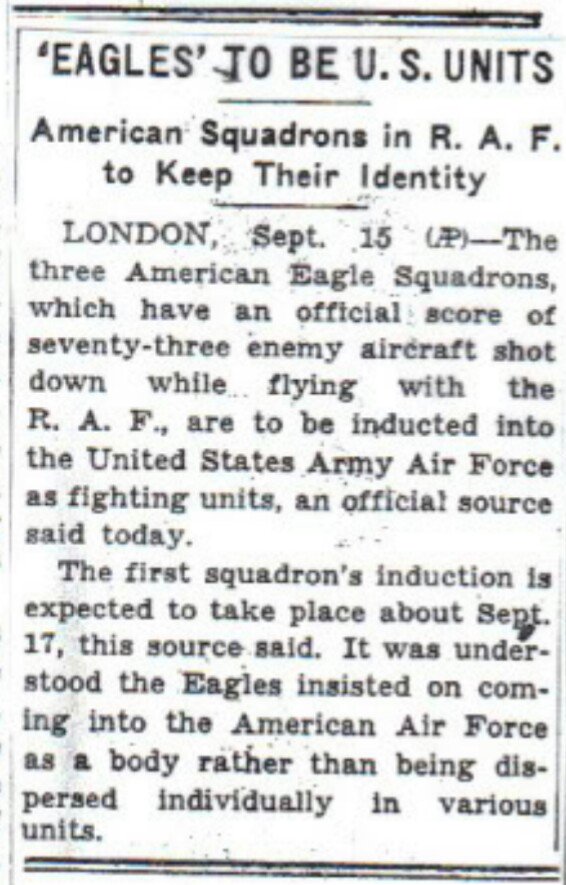
The Eagle Squadrons were three RAF Squadrons made up of American volunteers, their achievements and records are well-known and well documented, however, it was not all plain sailing for these determined and courageous flyers. For one Squadron in particular, 133 Squadron, September 26th 1942 would be a disaster, a disaster that would almost wipe out the entire flight of twelve airmen.

133 Squadron had been on the front line serving at RAF Biggin Hill and RAF Martlesham Heath before arriving at RAF Great Sampford, a satellite for RAF Debden. The ground crews were predominately British, assisting and training the US ground crews in aircraft maintenance and support. All the pilots however, were US volunteers, formed into three separate squadrons but under RAF control.

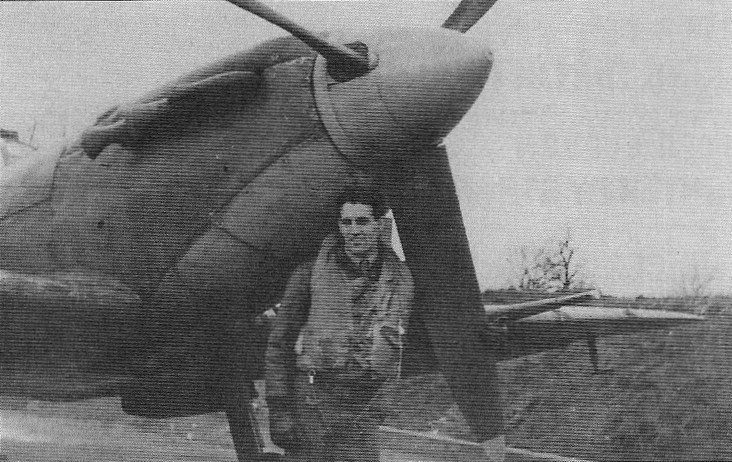
1st Lt Dominic ‘Don’ Gentile and Spitfire BL255 ‘Buckeye-Don’. The photo was taken after 133 Squadron RAF was disbanded and absorbed into the USAAF as the, 336th FS, 4th FG, 8th AF. (@IWM UPL 15072)

133 Squadron would arrive at RAF Great Sampford on September 23rd 1942, the same day as 616 Sqn RAF departed, they would be the last operational unit to fully use the airfield before its eventual closure.

Initially flying the Spitfire VBs, they soon replaced them with the MK.IX, a Spitfire that was essentially a MK.V with an updated engine. Having a higher ceiling than the FW-190 and being marginally faster, its improved performance took the Luftwaffe by complete surprise. It was so new and improved, that it remained on the secret list until after this particular operational flight.

On that fateful day, September 26th 1942, fourteen Spitfires of 133 Sqn took off from RAF Great Sampford in Essex, piloting those Spitfires were:

BS313 – F/Lt. Edward Gordon Brettell DFC (61053) The only British pilot and leader
BS275 – P/O. Leonard T. Ryerson (O-885137)
BS446 – P/O. William H. Baker Jr (O-885113)
BS137 – P/O. Dennis D. Smith (O-885128)
BR638 – P/O. G.B. Sperry (O-885112)
BS445 – P/O. Dominic “Buckeye-Don” S. Gentile (O-885109)
BS138 – P/O. Gilbert G. Wright (?)
BS279 – F/Lt. Marion E. Jackson (O-885117)
BS447 – P/O. R.E. Smith (O-885110)
BR640 – P/O. C.A. Cook (O-885112)
BS148 – P/O. Richard “Bob” N. Beaty (?)
BS301 – P/O. G.H. Middleton Jr (O-885127)
BS140 – P/O. Gene P. Neville (O-885129)
Unknown  – P/O. Ervin “Dusty” Miller (O-885138) (not listed but known to have been on the flight).

They were to fly to RAF Bolt Head in Devon, where they would meet with 401 Squadron (RCAF) and 64 Squadron RAF, refuel and be briefed for the mission. A mission that was supposed to be straight forward and relatively uneventful.

The aim of the mission was to escort US bombers to Morlaix on the Brest peninsula. The usual commander of 133 Sqn, Red McColpin, was not placed in charge that day, instead he had been posted, and a British Pilot, F/Lt. Edward Gordon Brettell DFC, was issued with the task.

McColpin was a strict disciplinarian and his leadership was admired by those who followed him. Without this leadership, 133’s preparation was slack and they ultimately paid the price for this.

After landing at 12:30 hours, they realised there were no facilities at Bolt Head for refuelling, and they would have to go with what they had. This would kick-start a catalogue of errors that would ultimately seal the fate of the flight. Following a briefing in which Wing Commander Kingcombe DFC and all but two of 133 Sqn pilots had failed to show up for, the flight (which included the sixteen 401 (RCAF) Squadron Spitfire IXs from RAF Kenley) took off at 13:50 hours. Of the fourteen 133 Sqn Spitfires sent to Bolt Head, only twelve would be needed, and two pilots were instructed to remain at Bolt Head, they were P/O. Ervin Miller, and P/O. Don “Buckeye-Don” S. Gentile, they would be the luckiest two men of the squadron that day.

The briefing, a very vague and rushed one, instructed the flight to carry out a ‘Circus‘ mission escorting seventy-five B-17 Flying Fortresses from the 92nd BG, 97th BG and the 301st BG, who were bombing Cherbourg and the airfields at Maupertus and Morlaix in Brittany. When the squadron took off the weather was clear, and winds were predicted to be 35 mph at 24,000 feet, but 5 miles off the English coast, they encountered 10/10th cumulus cloud cover at 7,000 feet, and so had to climb above it so that they could locate the bombers more easily.

The take of was a mess, disorganised and lacking both radio information and in many cases maps, the aircraft were lucky not to collide with each other.

Of the three RAF squadrons involved in the mission, 401 would take the high position, 133 the middle and 64 Squadron, the lower. They were to form up over Bolt Head at 2,000 feet and then head at 200o at 180 mph to overtake the bombers before they arrived at the target. If they could not locate the bombers, the flight was to circle the target for three minutes and then depart.

As the flight approached the rendezvous area, one 133 Squadron Spitfire had to drop out of formation and return home, as he had encountered engine problems; this problem was thought to be due to his low fuel. The remainder of the flight  scanned the skies for any sign of the bomber formation, and after searching for some 45 minutes, they spotted the bombers, some 50 miles south of Brest. The bombers had in fact already turned for home after having discarded their bombs near to the Pyrenees.

By now the 301st BG had been recalled, as their fighter escort failed to materialise, whilst the 97th BG had continued on. However, due to the heavy cloud cover over the target area, they had been ineffective as no bombing of the target had taken place. The American bombers, who were only three months into their European air war, had inadvertently miscalculated a tail wind putting them off track well away from the Bay of Biscay.

P/O. G.H. Middleton Jr of 133 Squadron RAF was shot down and taken Prisoner of War (@IWM UPL 18927).

The three squadrons formed up on the bombers at just after 16:45 hours, with 64 Squadron on the port side, 401 Squadron on the starboard and 133 Squadron behind. The whole formation then flew north for 30 minutes, at which point it became evident that the wind speed was in fact over 100 mph, and not the 35 mph as stated by the Meteorological Office, or at the briefing! It has since been revealed that this information was known to those in authority, but it had not been passed down the chain of command and the pilots were never informed.

The formation then spotted land, the bombers thought they were over Falmouth and turned right. 64 and 401 Squadron broke away maintaining height, but 133 Squadron dropped down below the cloud base and prepared to land.

133 Squadron then began to search for the airfield, and after searching in vain, they found a large town, this they hoped would give them the vital fix they desperately needed. Flying low over the houses they realised they were not over England at all but in fact still over France. The flight, uninformed of the 100 mph north-easterly wind at their altitude, had also been blown wildly off course, and after 1.5 hours flying time, the situation had suddenly become very severe indeed.

The Squadron flight Leader, Flight Lieutenant E.G. Brettell, wanting to ascertain his exact position, called up a ground direction finding station who provided a  bearing and heading – 100 miles off the English coast with a homing vector of 020o. It was at this point they suddenly realised they were over the port of Brest, one of the most heavily defended ports under German occupation.

Immediately, the sky filled with flak and small arms anti-aircraft fire. The pilot in the number 2 position, Pilot Officer Gene Neville (O-885129) in Spitfire #BS140, took a direct and fatal hit, he was killed instantly. Three other aircraft were to be shot down in the melee that followed: Pilot Officer William H Baker Jr (O-885113) in Spitfire #BS446; Pilot Officer Leonard Ryerson (O-885137) in Spitfire #BS275 and Pilot Officer Dennis Smith (O-885128) in Spitfire #BS294 – all four were killed, and all four were awarded the Purple Heart.

2nd Lt. Gene P. Neville 133 (Eagle) Sqn RAF, stands before his MK. IX Spitfire at Great Sampford. He was Killed during the Morlaix disaster. (@IWM UPL 18912)

The remainder of 133 Squadron struggling to defend themselves, they scattered and were forced to land out of fuel, either on the island of Ouissant or on the French mainland.

Of the seven 133 squadron pilots who crash landed on French soil, five were known to have been captured immediately and taken prisoner: P/O. G.B. Sperry; F/Lt.  Edward Brettell; F/Lt. M.E. Jackson; P/O. C.A. Cook and P/O. G.H. Middleton Jr., with a sixth, P/O. G.G. Wright, evading the Germans for several days before being captured later on.

Of these initial five, F/Lt. Jackson was injured in his crash and hospitalised for eight weeks. He was then taken to Stalag Luft III from where he was able to escape for about ten days by jumping from the roof of his cell house into a lorry load of evergreen branches that were being taken away from the camp.

Another Pilot, F/Lt.  Edward Brettell  DFC. was executed for his part in the Great Escape from the same prison camp, Stalag Luft III, whilst P/O. Robert E. Smith, the last remaining pilot, managed to abandon his aircraft evading capture, eventually returning to England on 18th January 1943.

The pilot who turned back early due to his own engine problems,  P/O. Robert Beatty,  crash landed his Spitfire at Kingsbridge in Devon after he too ran out of fuel over the Channel. During the crash he sustained severe injuries but luckily survived his ordeal and was able to give an account of the mission through what he heard over the radio.

Several of the 401 Squadron pilots,  who had continued on, also reported being low on fuel and gave their intention to bail out before land was finally sighted. One of these, P/O. Junius L. Hokan (s/n: J/6833), did have to bail out over the sea, he was last seen in a gradual dive, his aircraft heading seaward. His body was never recovered. Others in the flight that day only just made land fall, one crashed and was taken to hospital where he recovered from his injuries, the others just managed to reach either RAF Bolt Head or RAF Harrowbeer. The Operational Record Books for 401 Squadron state that “many casualties were avoided by the clear thinking and cool behaviour of all members of our Squadron“.

A full report of the days tragic events was issued to Fighter Command Headquarters by Wing Commander Kingcombe DFC, Squadron Leader Gaze and Squadron leader K. Hodson DFC.

S/L Gordon Brettell, 133 Eagle Squadron, executed for his part in the Great Escape breakout at Stalag Luft III  (@IWM UPL 25574)

The effect on those left behind in 133 Squadron was devastating. The result of poor preparation, inadequate briefings and sub-standard communication between the Met. Office and Fighter Command had cost many lives, and very nearly many, many more. A number of postings to the Far East soon followed, and many lessons weren’t that day that led to improvements preventing such a tragedy ever happening again.

133 Squadron would continue to operate after this, transferring over to the USAAF being renumbered as 336th FS, 4th FG, three days later as planned, leaving both RAF Great Sampford and the sad memories of that very tragic day far behind.

New York Times September 16 1942.

Sources and further reading.

Great Sampford appears in Trail 50.

National Archives: Operational Record Book 133 Sqn – AIR 27/945/2

National Archives: Operational Record Book 401 Sqn – AIR 27/1772/17

National Archives: Operational record Book 64 Sqn – AIR 27/590/41

*3 Price. A., “Spitfire – A Complete Fighting History“, Promotional Reprint Company,  (1974).

1st Lt. Raymond Harney and 2nd Lt. Warren French – 349th BS, 100th BG

Lt Raymond Harney (Photo courtesy of Tsymond Harney JR.)*1

A few years ago a story came to light that not only brought home the brutality of war but also the compassion found in war. It was of two American airmen whose World War II story finally come to a close 70 years after their death.

The two airmen, U.S. Army Air Corps 1st Lt. Raymond Harney (s/n O-523208) and U.S. Army Air Corps 2nd Lt. Warren French, (s/n O-2056584) of the 349th BS, 100th BG, were in a B17G (44-6306) over Germany on September 28th 1944, when they were hit by flak whilst on a mission to Merseberg. This would be their eighth and final mission.

Mission 652 involved a total of 342 B-17s which were sent to bomb the Merseburg/Leuna oil refinery and any additional targets of opportunity. During the operation, 10 B-17s were lost, 4 were damaged beyond repair and 251 damaged but repairable. Escort for the mission was provided by 212 P-51s of the USAAF.

B-17 ‘#44-6306’, was delivered to Kearney airbase on 28th June 1944,  then moved to Grenier airbase, New Hampshire on 9th July 1944, for onward transport to the United Kingdom.  It was assigned to the 349th Bomb Squadron, of the 100th Bomb Group, given the code ‘XR-G’, and based at RAF Thorpe Abbotts from the 12th July 1944.

The crew of #44-6306, assigned on the 28th August 1944, was: (Pilot) 1st Lt. Raymond E.Harney (Co-pilot); 2nd Lt. William R.Kimball (Navigator); 2nd Lt. Charles M.Hamrick (Bombardier); 2nd Lt. Warren.M.French (Top Turret/Engineer); Cpl. Thadeus L.Gotz (Radio Operator/Gunner); Cpl. Hubert J.Burleigh,Jr. (Ball Turret); Cpl. Melvin F.Cordray (Waist Gunner); Cpl. Robert C.Minear (Waist Gunner); Cpl James J.Sorenson, and (tail Gunner) Cpl. John H. Bundner. However, for reasons unknown at this time, for this particular mission, Gotz was not aboard, and instead S/Sgt. Jack D.Francisco flew as tail gunner and Cpl. Robert C.Minear flew as the Flight Engineer.

At 12:10, whilst over the target, the B-17 was hit in the number 2 engine by anti-aircraft flak. As a result, the engine caught fire, the aircraft withdrew from the protection of the formation, joining another formation further back, but began to fall back again when the number 4 engine was also feathered. Harney continued to fly the crippled B-17 for two hours after being hit, before finally deciding enough was enough and he ordered the crew to bail out. Being determined to save his friend and the aircraft, he also decided that he and the injured French, would remain and try to land the aircraft.

Outside of the village of Schwickershausen, to the north of another major target, Schweinfurt, Germany, they attempted a belly landing bringing the aircraft down in a turnip field. The B-17 slid across the ground, ripping off the port wing, causing a tremendous fire. Neither Harney nor French sadly survived the subsequent fireball.

Although he managed to get the crew to leave the aircraft, their safety was not guaranteed and sadly, three were killed by local police in the following days. An event not uncommon in Nazi Germany. Only two of the gunners, Cpl. Melvin F.Cordray, and Cpl. Robert C.Minear, survived as POWs.

What makes this story more significant than usual, is what followed after the crash.

The local people made a wooden cross in remembrance of the crew and they kept it hidden away in the local church for over 70 years.

The cross kept secret for so many years.*2

The large wooden cross, had the words “Hier ruhen in Gott! 2 amer. Flieger,” or “Here rests in God 2 American flyers,” engraved on it, along with details of the aircraft crash. On the 70th anniversary of the crash, 28th September 2014, a memorial service was held in the village of Schwickershausen. Following this, on 5th October, the cross was flown over to England in an American KC-135 Stratotanker from RAF Mildenhall, with two Luftwaffe Tornadoes escorting them over Germany. The cross was donated to the ‘Bloody 100th’ museum at Thorpe Abbots for safe keeping. A certificate was also handed over along with the cross signifying not only the now peaceful and co-operative alliance between the two nations, but the final closing of a chapter of the history of two crew members of the “Bloody Hundredth.”

The cross being transported in the Boom pod of a KC-135 Stratotanker. October 2014.*4

This is a remarkable story, and one that certainly stands out amongst the horrors and heroism of the Second World War.

2Lt Warren M French

Warren French’s memorial stone in Belgium*3

Lt. Raymond E. Harney’s Gravestone is at Ft. Snelling Cemetery in Minnesota, his remains are in the graveyard at Gemeindefriedhof Schwickershausen. Warren French’s headstone is in the Ardennes, Neuville-en-Cond, in Belgium.

Thorpe Abbotts airfield and museum is featured in Trail 12

Sources:

*1 photo the Bloody 100th Foundation.

*2 Photo from RAF Mildenhall news

*3 Photo from ‘Find a Grave

*4 Photo from RAF Mildenhall News

This story first appeared in the RAF Mildenhall News report October 20th 2014.

M/Sgt. Hewitt Dunn – Flew 104 missions.

RAF Framlingham (Parham) otherwise known as Station 153, achieved a remarkable record, or rather one man in particular did. His name was Hewitt Dunn, a Master Sergeant in the U.S.A.A.F and later the U.S.A.F.

Known as “Buck” he would achieve the remarkable record of completing 104 missions with the 390th Bombardment Group (Heavy) – a record that astounded many as life expectancy in a heavy bomber was short, and few survived beyond one tour of 30 missions.

Hewitt Tomlinson Dunn (s/n 13065206) was born on July 14th 1920. He progressed through school to join the Air Corps where he was assigned to the 390th Bombardment Group (Heavy), 13th Combat Wing, 3rd Air Division, Eighth Air Force, as a gunner in December 1943.

His first mission was with the 569th Bombardment Squadron in the following January. He completed his first gruelling tour of 30 missions by April that year, upon which he immediately applied for a further tour that he would complete by the summer of 1944. His attitude of ‘its not over until its won’, would see him accept a further remarkable third tour, virtually unheard of for a heavy bomber crew member.

On Friday, April 6th 1945, mission 930, an armada of aircraft of the U.S.A.A.F would strike at the marshalling yards in Leipzig, Germany. Inside B-17 #43-38663, ‘The Great McGinty‘, was Hewitt Dunn.

After the mission Dunn described how earlier at the morning briefing, he, like so many of his colleagues, had been a little ‘nervous’. Then, when the curtain was pulled back, their nervousness was justified, Leipzig – the 390th had been there before.

Many crews in that briefing would look to Dunn for signs of anguish, if he remained steady and relaxed, they knew it would be ‘easy’, if he sat forward, then it was going to be a difficult one. The atmosphere must have been tense.

Luckily, unlike other missions into the German heartland, this one turned out to be ‘just another mission’ a ‘milk run’. Much to the huge relief of those in command of the 390th, all aircraft returned safely.

On his arrival back at Framlingham, Dunn was greeted by cheering crowds, ground crews lifted him high in their air carrying him triumphantly away from his aircraft, it was a heroes welcome.

By the time the war had finished, Dunn had flown in 104 missions, he had been a tail gunner on twenty-six missions, twice a top-turret gunner, a waist gunner and the remainder as togglier (Bombardier). He had flown over Berlin nine times, he claimed a FW-190 shot down and had amassed an impressive array of medals for his bravery and actions, and all at just 24 years old.

Post war, he continued to fly as an Instructor Gunner for B-52s in the 328th Bomb Squadron, 93rd Strategic Bomb Wing, at Castle Air Force Base in California. Here he was described as “quiet and reserved” and never talked about his war experiences. He was “handsome man with black hair”, and only when he wore his dress uniform, did others realise how well decorated he was.

Dunn was considered a rock by those who knew him and perhaps immortal, but he was not, and on June 15th , 1961 after flying for a further 64 flights, he was killed. Details of his death are sketchy, but the man who had flown in more missions than any other person in the Eighth Air Force and had gone to train others in that very role, was highly decorated. He was looked up to and liked by those who knew him.

Following his death a service was held in Merced, California, his body was then taken to Arlington National Cemetery in Washington D.C. where he was finally laid to rest in grave number 3675, section 28.

For a man who achieved so much in his fighting career, little exists about him or his achievements. Maybe, by the end of the war, records were no longer needed, tales of dedication and bravery were no longer useful propaganda. Whatever the reason, Hewitt Dunn’s name should be heavily embossed in the history books of the Second World War.

hewiit-dunn

Hewitt Dunn on return from his 100th mission, April 1945 (IWM)

Hewitt Dunn’s medal tally:

– Air Force Longevity Service Award with 3 oak leaf clusters
– Air Medal with 13 oak leaf clusters (2 silver, 3 bronze)
– Air Medal with 7 oak leaf clusters (1 silver, 2 bronze)
– American Campaign Medal
– Distinguished Flying Cross with 1 oak leaf cluster
– Good Conduct Medal
– National Defence Service Medal
– Silver Star
– World War II Victory Medal
– European-African-Middle Eastern Campaign Medal with 1 bronze star
– European-African-Middle Eastern Campaign Medal with 1 silver star

Hewitt Dunn’s story is one of many featured in Heroic Tales.

RAF Tuddenham – The last of the FIDOs (Part 2)

In Part one, we saw Tuddenham’s opening to the war. A rather cold and uninspiring airfield, it housed the Stirlings of 90 Squadron. Now, the Lancasters were arriving and front line bombing missions were once again on the horizon. 

The first of these major operations was on the night of 10th/11th June, when seven Lancasters, a mix of MK.Is and MK.IIIs, left Tuddenham to bomb rail facilities at Dreux –  90 Sqn had at last returned to the ‘front line.’

Sadly it was not to be the best night for the squadron, of the seven Lancasters that departed, two never returned home. The first NE149 ‘WP-A’ and the second NE177 ‘WP-B’ (both MK.IIIs), crashing in France. Of the fourteen airmen on board, three evaded capture, one was caught, and the remaining ten were all killed – it was not the most auspicious start for the unit. 

With two more Lancasters lost that month – one on the infamous Gelsenkirchen raid in which seventeen Lancasters were lost – June had proven to be difficult, and even though Stirlings were still operating, the Lancaster had become the main type and it wasn’t going to be an easy ride to Christmas. Forty-three, 90 Sqn airmen had been posted as either ‘killed’ or ‘missing’ in June alone.

Bomber Command’s tactical support of the land based forces continued on until mid September, by which time, Harris was back in charge and Bomber Command could once again turn its attention to targets in the German heartland. As the allied forces moved ever closer, night raids turned to daylight as allied air power began to get its grip on the skies over Europe. 

In October, a new squadron would reform here at Tuddenham, 186 Squadron also flying Lancaster MK.I and IIIs. Originally having its roots on board HMS Argus in 1918, it was another unit that had had short spells of activity before being disbanded once again. In a very different guise to its original formation, this time it was born out of 90 Sqn’s ‘C’ Flight, there the differences cease and by the December,  the squadron had left Tuddenham moving to Stradishall where it remained until the war’s end, and its final disbandment once more. 

The remainder of the year was relatively quiet for the Tuddenham group, regular missions with little or no opposition meant losses were low, and results were generally considered successful. But with bad weather setting in across both the UK and the wider continent, many squadrons had days of being stood down. Tuddenham on the other hand, with their FIDO system, was able to put up more flights than many others. Indeed during the Battle of the Bulge in the Ardennes, 90 Sqn were one of the few units able to launch attacks when most others were fog bound. 

The dawn of 1945 brought hope for an end to the war as the allied war machine moved ever closer to Berlin. The German’s last ditch attempt in the Ardennes was eventually overrun, and bombing picked up as fair weather returned once more. 

On February 2nd, Wing Commander W. G. Bannister joined the squadron on attachment. On the same day as he arrived, he took off at 20:52 in Lancaster HK610 ‘WP-Z’ along with thirteen other Lancasters from the squadron. Around an hour later, the aircraft collided with Lancaster PD336 ‘WP-P’, striking the tail trapping the rear gunner, Sgt. K. Hudspeth, inside the turret by his legs. Injured, he lay slumped over his guns. The pilot turned the aircraft over the Wash and ordered the bombs dumped in the sea. The rear tyre of the aircraft was burst and the port side of the tail was badly damaged, maybe even missing, and the turret by now was hanging off the aircraft. The pilot ordered chutes to be put on, after which the mid gunner Sgt. G. Wraith, went to help Sgt. Hudspeth, pulling him back into the aircraft’s fuselage where he administered morphine. The Lancaster made its way back to Tuddenham, and with the radio knocked out, red flares were fired to inform ground staff of its difficulties. Badly damaged with injured on board, the Lancaster made a safe landing, thanks to the skill of the pilot and crew.

Bannister’s Lancaster however, did not recover from the collision. After striking ‘P’ for Peter, the aircraft fell from the sky, crashing at 21:25,  3 miles from Bury St. Edmunds;  sadly there were no survivors.   

March 1945 saw a return of the Stirling to Tuddenham with 138 Sqn*3 transferring from Tempsford with the MK.V. As soon as they arrived they began to replace these with Lancasters MK.I and IIIs. 138 Sqn had been heavily involved in clandestine operations with the SOE, dropping agents into occupied Europe. With the need for such missions now largely gone, operations were wound down and the Stirling squadron were to be upgraded to front line bomber status. The first operational mission under this new guise was planned for the 28th but postponed until the following day. Three aircraft were ordered and all returned safely after having bombed the target. 

As the war drew  to its conclusion, 90 Squadron turned their attention to Kiel with both mining and bombing to prevent a German withdrawal. By the of the month it was all but over and operation Manna was put into place. On April 30th, 90 Sqn began their part in dropping supplies to the Dutch – targeting Rotterdam. Drop zones were identified by red T.Is and / or white crosses placed on the ground. By the end of the month 23 tons of food supplies had been dropped by the one squadron alone. During May, they began flights to Juvincourt to collect and bring back prisoners of war, dropping them at various sites including Dunsfold, Tangmere, Wing and Oakley; the aircraft then returned to base before carrying out further flights. 

On the 25th, ‘Cooks tours’ began, aircrew flying ground crew to Germany to see for themselves the damage inflicted by the war on the German heartland, it was a harrowing site for many. 

RAF Tuddenham

An electrical sub station shows its original RAF paint work

With no operational flying to do, training flights took over. It was a major change for  both the air and ground crews. As bases around the country began to close, so squadrons were moved around in preparation for disbandment. In April, two more Lancaster squadrons arrived here at Tuddenham, both 149 and 207 Sqns transferring across from RAF Methwold. The number of bomber squadrons now residing at Tuddenham totalling four.

Finally, in November 1946 the death knell finally rang for Tuddenham and it too was closed, flying ceased and the aircraft were all withdrawn. All four squadrons were pulled out of Tuddenham, 90 and 186 Sqns taking their Lancasters to RAF Wyton, whilst 149 and 207 went to RAF Stradishall. In what must have been a mass exodus, Tuddenham fell suddenly silent.

The airfield stood dormant for many years  whilst remaining in RAF hands, but then in 1953 life returned once more as the USAF arrived and used it as an ammunition storage area and renovation depot for surplus WWII ammunition and equipment. The American forces remained here for four years until 1957 when they too finally withdrew.

Tuddenham itself continued to stay in RAF ownership for a short while longer. As tension rose in the early part of the Cold War, ideal because of its low population and rural location, it was earmarked as a site for the new Thor missiles. New launch pads were built and a small section of the site was redeveloped accordingly.  Then in July 1959, 107 Squadron RAF reformed here, operating three of the Thor missiles as part of the UK-USA nuclear deterrent agreement. Retaining these until July 1963, the site finally closed once and for all. At this point all military personnel moved out and the gates were finally locked.

After this, Tuddenham was earmarked for quarrying to meet the rising demand for housing. Large sections were returned to agriculture, but a quarry opened to extract the much-needed materials for house construction. This operation has continued to the present day and has been responsible for the removal of large quantities of the main airfield site.

Visiting Tuddenham, reveals little of the history of the airfield and the people who stayed here. A few buildings, primarily the gymnasium and squash court remain standing, but in a very poor state and are likely to be pulled down soon. The roof has collapsed and part of the walls are missing. Located to the south of the airfield, they stand as reminders of those days long gone.

Other technical areas and the main part of the airfield, are now the workings of the quarry. The entrance to this site, rather insignificant, is part of the original perimeter track and is marked by an electrical sub-station. The shell is intact and complete with two blast walls, even the original RAF paint work can be seen! Overgrown and hidden beneath large thorns, this lone building will no doubt soon go the way of others some distance away.

Tuddenham airfield now stands lonely, large parts excavated and gone along with the memories of those who were stationed here. A pig farm covers a large part of the southern section and very little remains other than a few dilapidated buildings whose days are also very numbered. Tuddenham’s place in history is most certainly confined to the books and the memories of those whose numbers are also rapidly diminishing.

Before leaving Tuddenham, return to the village and stop at the village green. The village sign depicts a Lancaster flying low over the Suffolk landscape. A sundial, beautifully crafted marks the history of 90 Sqn, both the aircraft flown (1917 – 1965) as well as the airfields they were stationed at throughout their life. A superb tribute to a once active airfield and the gallant heroes of 90 Squadron Royal Air Force who served here*4.

RAF Tuddenham

Beneath the sundial, all the aircraft used by 90 squadron.

In July 2021 I was contacted by Herb Zydney who was stationed at the former RAF Tuddenham in the mid 1950s, he kindly sent some photos and has since sent the original road sign ‘home’ to remind us of RAF Tuddenham. Hopefully this will be suitable displayed. 

RAF Tuddenham road sign

The original road sign to Tuddenham airfield. It has since been returned to Tuddenham for display. (Photo courtesy Herb Zydney)

On leaving Tuddenham, carry on in a south-easterly direction toward Bury St. Edmunds and follow the A14 east. Passing Bury, we arrive at an industrial area on your left. Here we discover an aviation dream world see Trail 16.

Sources and Further Reading.

*1 National Archives AIR 27/731/25

*2 Grehan. J. & Mace. M. “Bomber Harris – Sir Arthur Harris’ Despatch on War Operations“, Pen & Sword, 2014

*3 No. 138 Squadron RAF went on to be the first ‘V-bomber’ squadron of the RAF, flying the Vickers Valiant between 1955 until being disbanded in 1962.

*4 Personal stories of personnel from 90 Squadron at Tuddenham can be found here on the Wartime Memories Project website.

*5 Williams, G. “Flying Through Fire – FIDO The Fogbuster of World War Two“, Alan Sutton Publishing. 1995 (An excellent book detailing the work on FIDO and its installations at each airfield).

National Archives: AIR 27/733/3; AIR 27/733/4

My thanks to Herb Zydney for the You Tube video and photos, they are very much appreciated.