RAF East Wretham (P2)- From Bomber Command to USAAF

After part one of RAF East Wretham, we see how the poor fortunes of the Czech squadron of Bomber Command were left behind, a new breed of aircraft had now arrived in the form of the US fighter Group’s P-47s and P-51s. After the departure of Bomber Command, the site was turned over to the USAAF and renamed Station 133.

RAF East Wretham (Station 133)

With this change came a number of modifications to the airfield. Temporary Pierced Steel Planking (PSP) was laid, more concrete pathways added and the site accommodation improved generally. The work continued for several weeks whilst the personnel of the newly formed 359th Fighter Group (FG) were gathered together in the United States, finally shipping out across the Atlantic in the October 1943.

Only being recently manned, the 359th were truly a new group (although some pilots were drawn from other established combat units) being formed of the 368th, 369th and 370th Fighter Squadrons (FS). Arriving from Westover Field Massachusetts in the October 1943, they were one of the last units to join the Eighth Air Force with P-47 Thunderbolts; a move that bolstered fighter numbers to some 550, trebling the Eighth’s total number of fighters in only a matter of weeks.

By December they were combat ready, and their first mission took place on December 13th 1943 – an escort mission protecting  heavy bombers as they attacked airfields in France. During the mission, thirty-six aircraft of the 359th carried out fighter sweeps in the  Pas-de-Calais area without loss and without a single ‘kill’, a rather calm opening to their European war. On the 20th, they undertook their second mission, another escort of heavy bombers to Breman. Joining them were the 4th FG, 56th FG, 78th FG, 352nd FG, 353rd FG, 356th FG, and for their first time the 358th FG all flying P-47s. For the fighters it was another ‘uneventful’ mission with only minimal losses, but for the heavy bombers it was their first encounter with Me-410s, and their time-fused, aircraft launched missiles.

During March 1944 a special squadron was formed commanded by Capt. Charles E. Ettlesen of the 359th. Known as “Bill’s Buzz Boys”, the purpose of the unit was to develop ground-attack tactics as so few of these had been truly successful up until now.

The group tried many new ways of attacking enemy airfields, and in the month they were together, they succeeded in destroying or damaging numerous aircraft, blowing up several hangars, locomotives, barges and other small boats in their attacks. During one of these attacks on the airfield at Chateudun, Capt. Ettlesen hit a high tension wire which cut half way through his wing. He manged to fly the P-47 back to England landing at RAF Martlesham Heath in Suffolk, trailing a good 30 feet of wire behind him! On April 7th, the unit’s four flights returned to their respective groups, and the new tactics learned were taken to RAF Millfield, the brainchild of General Quesada to train pilots in the art of ground attack.

, 8AF USAAF.

Capt Charles C. Ettlesen 369FS, 359FG, headed the specialised ground attack unit. After returning to East Wretham he was last seen going down to strafe a Locomotive north of Gotha, 9th Feb. 1945. Classed as MIA he was never heard from again. *2

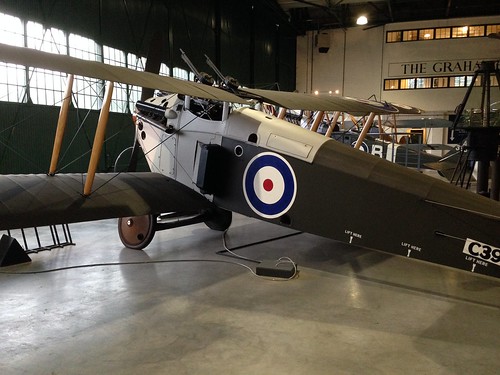
The 359th at East Wretham continued on with bomber escort operations throughout the early stages of 1944, and then in the April, they began to convert to P-51 Mustangs, a change that involved major retraining of both pilots and ground crews. Used to the air-cooled Douglas Wasp engines of the P-47s, they now had to convert to liquid cooled Merlins. To prepare mechanics for the forthcoming Mustangs, ‘sample’ P-51Bs were sent out prior to the shipment to allow for a smooth transition from one aircraft to the other.

By May, the 359th were ready with their P-51s and their first foray into enemy territory took place on the 5th. Not unlike their first mission with P-47s, it was an escort mission to attack targets in the Pas-de-Calais and Siracourt areas in ‘Noball‘ operations. Like the first, it also was uneventful, cloud cover preventing both allied bombing or Luftwaffe intervention.

Ground attacks were incredibly dangerous, and the summer of 1944 would reinforce that fact. In May pilot, Major George “Pop” Doersch, whose daring would eventually take his ‘kill’ rate into double figures, flew too low to the ground in a strafing attack on an airfield near Rheims. In the attack his propeller struck the ground causing the blades to bend at the tips. Fortunately and using all his skill and strength, he managed to nurse the aircraft (P-51B) back to Manston where it landed without further incident.

George

Major George Doersh who took his P-51B too close to the ground bending the propeller tips. (IWM)* 3

As D-Day approached, the 359th focused on strafing ground targets in and around the Normandy area; railway locomotives and communication lines were all now very high priority. During the invasion itself, the 359th escorted the heavy bombers across the channel, and whilst over France, they took the opportunity to continue with these opportunist attacks.

With the new P-51s they were now able to fly deeper into the heart of Germany and as far east as Poland. It was during these later stages of the war that the 359th really began to make their mark, participating in some of the biggest bombing missions of Germany, including those of: Ludwigshafen, Stuttgart, Frankfurt, Berlin, Mersberg, and Brux.

On 11th September 1944, the green nosed Mustangs of the 359th were finally rewarded for their efforts when they received the Distinguished Unit Citation (DUC) for their action over Mersberg. After attacking over 150 Luftwaffe fighters they also went on to destroy seven  locomotives on their way home. The detailed Citation highlights the bravery and dedication shown by the pilots of the 359th summing up with:

The conspicuous intrepidity, aggressive tactics and esprit de corps displayed by the pilots of this unit on this occasion accounted for the destruction of thirty-five enemy aircraft and contributed to the safe escort of the attacking bombardment formations. The actions of this unit reflect the highest credit upon the 359th Fighter Group and the Armed Forces of the United States.

The determination shown by the 359th resulted in many outstanding pilots. One, Maj. Raymond “X-Ray Eyes” Wetmore became the 359th’s (370th FS) top ace scoring 21 victories (plus 3 on the ground)- his last being an Me 163. Flying latterly  in P-51 #44-14733, Wetmore, like Doersch had a very lucky escape when his aircraft was hit by friendly fire during the Battle of the Bulge. By putting the Mustang into a steep dive he was able to extinguish the fire and return home safely. Flying in three aircraft all called “Daddies Girl” after his daughter, he received numerous awards and by the end of the conflict had completed 142 missions covering 563 combat hours.

RAF East Wretham 4

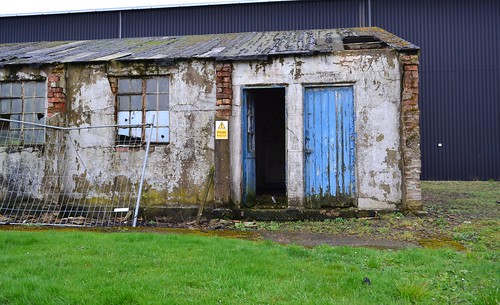
The old part remains cordoned off.

This attitude to the war, gave the 359th a worthy credit of 263 aircraft shot down with over 100 more being destroyed on the ground. In the 346 missions they flew, they lost a total of 106 of their own aircraft.

Along with further support operations in France and Holland, the 359th went on performing ground attack missions as the allied forces entered Germany. At the war’s end flying wound down, and the USAAF remained at East Wretham until the November of 1945 when the 359th departed, returning to the States and inactivation. With this, no further flying took place at East Wretham and the skies would fall quiet once more.

The airfield then reverted to 12 Group (RAF) ownership, then in May the following year, it was handed back once more to Bomber Command. Within a month the site was handed over to the Technical Training Command and finally East Wretham became a Polish resettlement camp for those personnel who were unable to return home. When they had all finally been moved on, the majority of the site became what it is today, used by the British Army as part of the massive Stanford Practical Training Area (STANTA) for manoeuvres and live firing training.

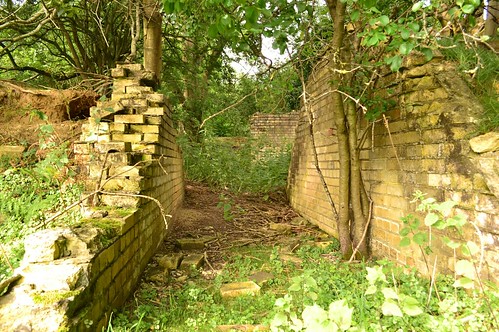
Bomb Store

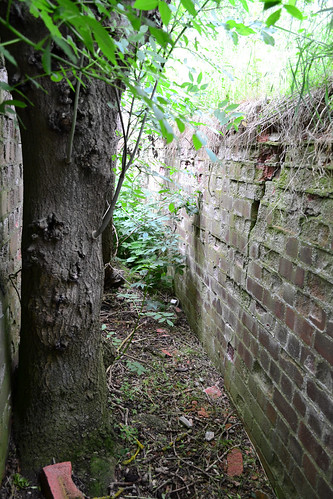
The bombs stores blast walls are still intact – just.

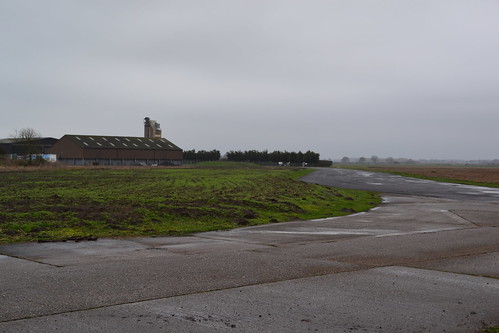
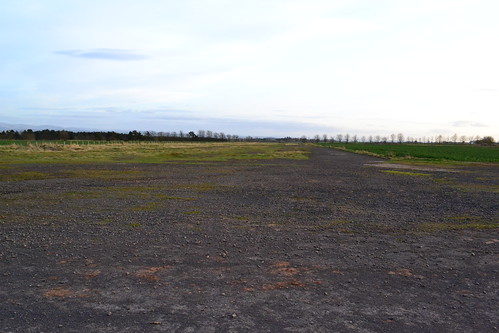
Today most traces of the airfield as it was are gone. A number of buildings notably a T2 hangar and several Nissen huts survive on what is now farmland or in the military camp. The unique Watch Tower was demolished after the war as were many of the other ‘temporary’ buildings. Now used by STANTA, a mix of old and new are intertwined with the majority standing on inaccessible military ground. Parts of the perimeter track and hardstands do exist, many overgrown or broken up by the weather and weed growth.

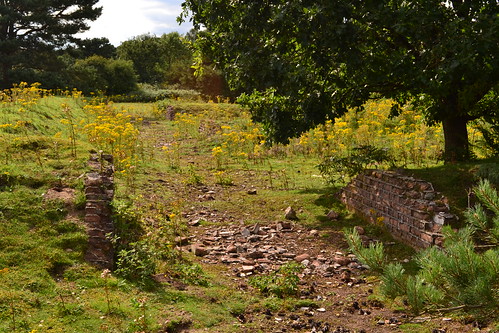
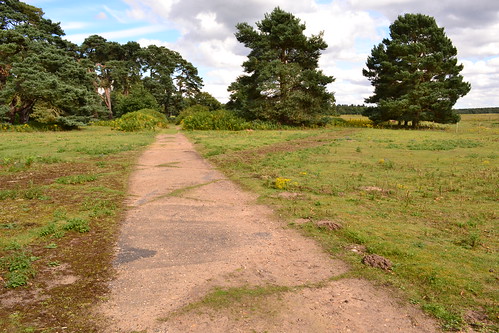
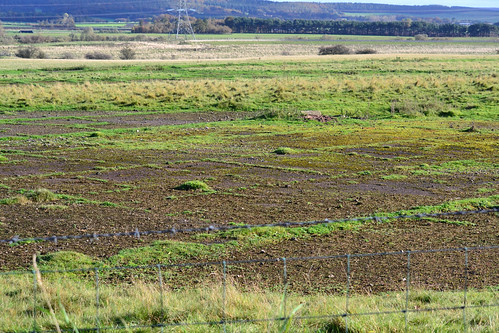
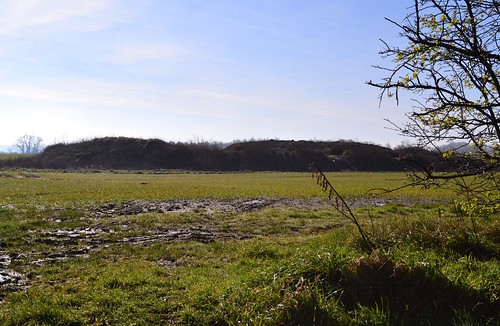
Perhaps the best and by far most accessible examples of East Wretham’s past, is the bomb site which forms part of the East Wretham Heath Nature Heritage Trail. Access is to the south of the site just off the main A1075, Thetford Road. A two-mile walk through Heath land, it takes you right through the original bomb store. An area of natural beauty, famed for its wetland and ancient flints, you can easily find the many blast walls and small fusing buildings still there. Also traceable are the tracks that once took bomb loaded trailers to the airfield across the heath. Many now buried under the acidic soil, their existence evident in exposed patches of bare concrete.

Bomb Store

The decay is evident throughout the bomb store.

All these stores are being gradually reclaimed by nature, trees and rabbit holes have both taken their toll, the layout is still discernible and whilst much of the brickwork is ‘intact’, the warning signs are there and the wartime structures are crumbling fast.

A small airfield, East Wretham was never considered the most ‘homely’ of sites. Often wet and boggy, it was one of the less well-known and less famous places to be used. But the courage and determination of those who served here both RAF and USAAF, went a long way to helping defeat the tyranny that stood facing us across the small section of water not so far away.

Sources and further reading: (East Wretham)

For more detailed information on the Free Czechoslovak Air Force see their superb website.

No.311 ORB – AIR 27/1687/7

*1 IWM –  FRE 6117

*2 IWM – UPL 31469

*3 IWM – UPL 22685

Norfolk Wildlife Trust website.

RAF East Wretham – Home to the Czechs of Bomber Command (P1)

Hidden in the depths of Thetford Forest not far from the two major US Air bases at Mildenhall and Lakenheath, is a former airfield that has received a new lease of life as an Army training facility. Once home to Bomber Command’s only Czechoslovakian Squadron, it was also home to Canadians and other Commonwealth nationals. After their final departure, it became the home of an American Fighter unit meaning its history is both diverse and multinational.

In Trail 13, we stop off at the former Station 133, more widely known as RAF East Wretham.

RAF East Wretham (Station 133)

Originally built in the early part of the Second World War and opened in March 1940, East Wretham was primarily designed as a satellite airfield for nearby RAF Honington.  Being a satellite the airfield’s facilities would be basic, accommodation rudimentary and technical facilities limited. It would however, be developed as the war progressed and as its use increased. The main runway for example, (running north-east to south-west) was initially grass but with the arrival of the USAAF it would be covered with Pierced Steel Planking (PSP), designed to strengthen the surfaces and thus prevent aircraft digging into the soil.

East Wretham would also have a range of hangars. In addition to the standard two ‘T2’ hangars, it would have a canvas Bessoneau hangar, (more generally linked to the First World and inter-war years),  and an additional four Blister hangars (9392/42) all believed to be double ‘extra over’ blister hangars each 69 ft wide in the singular design.

The watch office at East Wretham was another unusual design. Built to drawing 15498/40, it was originally a single storey room built on concrete pillars with a flat roof. It was then modified later on in the war to include an overhanging observation room, with the extension being mounted on metal pillars. This new extension had considerably more glazing than the original structure, and was more in keeping with the building style of other wartime airfields. These extra windows gave a much better view across the entire airfield, especially useful as the office was unusually located along the perimeter fence well behind the technical area of the airfield!

The Control Tower of the 359th Fighter Group at East Wretham. Caption on reverse: 'Caption on reverse: '359th FG Photos Source: T.P. Smith via Char Baldridge, Historian Description: #13 Control Tower at Station F-133, East Wretham, England.'

The unusual design of the Watch Office can clearly be seen in this photograph*1. (IWM)

Originally there were only 27 ‘frying pan’ style concrete hardstands, each one being located at various points around the perimeter track, all in groups of three or four. These were then added to later on, again using steel planking, to extend the number of dispersal points located on hard surfaces; a further indication to the problems with the boggy soil found in this part of East Anglia.

Accommodation for the initial 1,700 personnel, was dispersed over twelve sites around the north of the airfield, and across the road from the main airfield site. One of these sites (Site 2) was the nearby Wretham Hall, a grand building built in 1912, it was utilised by Officers of the USAAF for their own personal accommodation. Sadly, the grand three storey building was demolished in the early 1950s, possibly as a result of its wartime use.

A bomb storage site was also built on the airfield. Located on the south side of the site, it was well away from any accommodation or technical buildings. It was also well away from the three large fuel stores,  which boasted storage capacities of: 24,000, 40,000 and 90,000 gallons.

The initial use of East Wretham was as a dispersal for aircraft based at Honington, the first of which was a newly formed Czechoslovakian Squadron, No. 311 (Czech) Sqn, on 29th July 1940. So new were they that they didn’t receive their Wellington ICs until the August. This was to be a unique squadron in that it was the only Czech squadron to fly with Bomber Command, and whilst the main body of the squadron was located at Honington, the operational flight (A Flight) moved to East Wretham shortly after its  formation. In mid September a decision was made to move the entire squadron across to East Wretham posting a detachment to RAF Stradishall, where they stayed until April 1942.

On September 10th 1940, 311 Sqn, now with a small number of operational crews, took part in their first mission, a true baptism of fire flying directly into the German heartland and Berlin. For one of the crews and their Wellington, this would not go well, the aircraft believed forced down in the vicinity of a railway line near Leidschendam in Zuid-Holland, with all but one of the six airmen on-board being captured.

The only crew member not to be caught was Sgt. Karl Kunka, who managed to evade capture for a short period, only to shoot himself with the aircraft’s Very Pistol. It was thought that he carried out this action to not only avoid capture but any possible retaliation against his family back home in Czechoslovakia. Whilst Sgt. Kunka’s wounds were not initially fatal, they were so severe that he later died, failing to respond to treatment whilst in hospital.

The aircraft, Wellington MK.Ia, #L7788, ‘KX-E’, was also captured, repainted in Luftwaffe colours and flown for testing and evaluation to Rechlin, the Luftwaffe’s main aircraft test facility north of Berlin.

RAF East Wretham 3

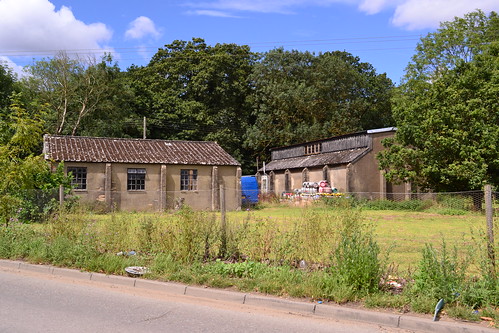
East Wretham still uses the Nissen huts and smaller buildings today.

During December 1941, a further Czech unit, No.1429 Czech Operational Training Flight (COTF) was formed along side 311 Sqn, under the command of Sqn/Ldr. Josef Šejbl. This unit was designed specifically to train Czechoslovakian aircrews for Bomber Command, with instructors for the flight, being taken from 311 Sqn following completion of their tour of operations.

As aircrew completed their training, they were transferred to the operational flight, a steady but slow build up meant that numbers were quite low, the squadron being  considerably reduced by heavy casualties in the early stages of the war. As with other Bomber Command squadrons, 311 Sqn carried out night bombing missions, many penetrating Germany itself.

1941 would see more missions to Germany, starting with the first three nights January 1st – 3rd, when Bomber Command aircraft hit Bremen, with 311 Sqn taking part on the night of the 2nd. On this night, three aircraft from 311 Sqn would join the Hampdens and Whitleys of Bomber Command in attacking a major railway junction in the centre of the city, where fires and explosions were seen as far away as 20 miles. A relatively successful operation, it would not be long before the first casualties of 311 Sqn would occur.

On the night of January 16th – 17th Wellington IC #T2519 ‘EX-Y’ was lost on a mission to Wilhelmshaven, the aircraft going down after suffering ‘technical’ problems. Last heard from  at 22:21, the aircraft disappeared without trace along with the entire crew, none of whom were ever heard from again.

1941 would end as it started, with a return trip to Wilhelmshaven, in which good results were recorded. One aircraft was lost on this mission, Wellington #T2553 ‘EX-B’, the pilot, Sgt. Alois Siska ditching the aircraft after it had sustained serious flak damage over the target area. As the aircraft sunk, it took the life of the rear gunner Sgt. Rudolf Skalicky, the other’s climbing into the aircraft’s dingy, a small craft in which they remained for several days.

As the dingy drifted towered the Dutch coast, the icy conditions would take two more lives, that of Sgt. Josef Tomanek (Co/P) and F/O. Josef Mohr (Nav.), whilst the pilot, Sgt. Siska, suffered badly from frost bite and gangrene. The remaining crewmen, F/O. Josef Scerba (W/O), Sgt. Pavel Svoboda (air gunner) along with Sgt. Siska, were picked up by German forces and  interned as POWs, mainly staying in hospitals for treatment for cold related injuries. Sgt. Svoboda went on to escape captivity no less than three times, evading capture until after the war whereupon he returned to England.

By mid 1942, 311 Sqn were assigned a new posting and a new airfield, but before departing in their final month, April 1942, they  would be visited by two particularly significant dignitaries. On April 3rd, Air Vice Marshal J. Baldwin, Air Officer Commanding No. 3 Group, RAF Bomber Command, visited to award the DFC  to P/O. Karel Becvar for his services as a navigator with 311 Sqn. Then on the 18th April, the President of the Czechoslovak Republic, Dr. Edward Benes, arrived along with several other dignitaries to inspect the Squadron, and give a speech regarding the work carried out by the crews here at East Wretham.

Tarck to Bomb Store

A number of tracks remain on the site.

During their last month, 311 Sqn would fly twelve more operations before finally departing Norfolk for Northern Ireland and Aldergrove. Whilst here at East Wretham, they would fly 1,011 sorties which included both attacks on industrial targets and propaganda leaflet drops. On the 30th, the main air body along with the rear party departed the site, the bulk of the squadron moving two days earlier. After their departure, 311 Sqn would not return to East Wretham.

In November 1942, after a long quiet break, East Wretham would spring into life once more with the arrival of another bomber squadron, No. 115 Sqn (RAF) from Mildenhall now flying  Wellington MK.IIIs.

Over the winter of 1942-43, 115 Sqn would lose ten aircraft, most to missions over Germany but two whilst ‘Gardening’, the last occurring on the night of New Years Eve 1942.

During the early months of 1943 six more Wellingtons would be lost from 115 Sqn, KO-D, KO-X, KO-C, KO-N, KO-T and KO-Q, the new year had not brought new fortunes.

By now the limits of the Wellington had been realised and its days as a front line bomber were numbered. A poor performer in the bombing theatre, it would be gradually moved to other duties, being replaced by the superior four-engined heavies; 115 Sqn was no exception. The MK.II Lancaster, powered by four Bristol Hercules engines, was less common than the Merlin powered MK.I and MK.III, but none the less was far superior to the Wellington in both performance and bomb carrying capacity.

The first Lancaster arrived in the March of 1943, and as it did the Wellingtons began to depart. To help train crews on the new aircraft, a detachment from 1657 Heavy Conversion Unit (HCU) would be re-designated 1678 (Heavy Conversion) Flight (HCF) and was based here at East Wretham.

Flying the radial engined Lancaster MK.IIs under the code ‘SW’, they were one of only two HCFs to be established in Bomber Command, both in May of that year. Specifically set up to convert crews from the Wellington to the Lancaster, they were a short-lived unit, becoming a Heavy Conversion Unit once more on September 16th 1943, after moving to RAF Foulsham. During this time the flight would operate only eight aircraft in total, losing none whilst at East Wretham.

Even with the new aircraft though, flying over Germany was not without its problems for 115 Sqn. The first aircraft to be lost, and the first of its type in Bomber Command, Lancaster MK.II #DS625 ‘KO-W’ was lost without trace in a raid to Berlin on the night of March 29th/30th. The Pilot Sgt. H. Ross, (RCAF) and his crew all being commemorated on the Runnymede memorial. The aircraft being new, it had only flown 26 hours since its arrival at East Wretham earlier that year on March 9th.

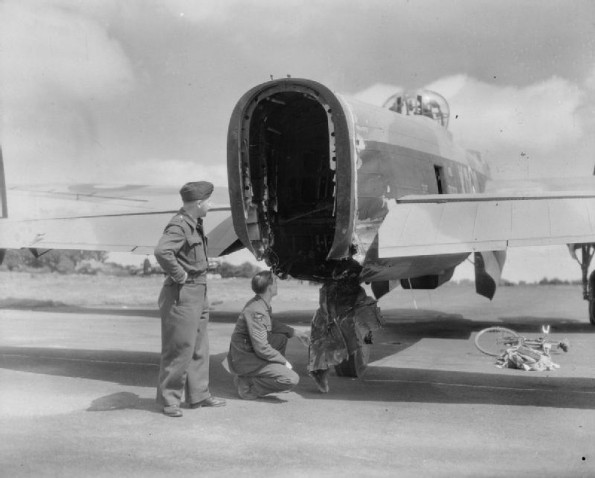
rear-turret-of-Lanc-lost-595x478

Avro Lancaster B Mk II, DS669 ‘KO-L’, of No. 115 Squadron, was hit by bombs from an aircraft flying above. during a raid on Cologne on the night of 28th/29th June 1943. The tail gun and gunner were both lost. (Author unknown)

With more missions into Germany, 115 Squadron’s Lancasters  would continue to serve well, perhaps one of the worst nights occurring just days before their eventual departure to RAF Little Snoring in early August 1943.

On the night of 2nd/3rd a mission was planned for Hamburg in which 740 aircraft were allocated. Of these, 329 were Lancasters, by far the largest contingency of the raid. Whilst over Germany, the formation entered a severe thunderstorm, and with many aircraft suffering from icing, they were forced to either turn back, or find other targets. The poor weather, including lightning, accounted for several of the losses that night including one of three lost from 115 Sqn.

Lancaster #DS673 was shot down by a night fighter, #DS685 was lost without trace and #DS715 was struck by lightning causing it to crash not far from the target. From the three that went down that night, there were no survivors from the twenty-one crewmen on board. 115’s time at East Wretham would close on a very sour note indeed.

With the departure of 115 Sqn in August, East Wretham would then pass from RAF ownership into the hands of the US Eighth Air Force, to become Station 133, the home of the three squadrons of the 359th Fighter Group – ‘The Unicorns’

RAF Holme – From Bomber base to Fighter Development (P2)

After part 1, we continue at Holme-on-Spalding Moor. Holme has recently changed hands owing to the reorganisation of Bomber Command boundaries. 101 Squadron had departed and now 78 Sqn were moving in.

76 Sqn had been through a number of disbandments and reforms since its original inception in 1916.  Being reformed in 1941, it arrived here at Holme-on-Spalding Moor from Linton-on-Ouse, another Yorkshire base. It was truly a multi-national squadron, made up of Polish, Norwegian, New Zealand and Canadian crews.

76 Sqn would see the war out at Holme, progressing through a series of Halifax upgrades, from the Mk.V, to the better performing MK.III and onto the MK.VI, a model they used in the final operations on 25th April 1945.

Shortly after arriving at Holme, 76 Sqn would suffer their first loss, with the downing of Halifax MP-Q #DK224, on the night of 22nd/23rd June 1943. On board this aircraft was Group Captain D. Wilson (RAAF) their station commander.  Of the eight men on board all but one (Sgt. R. Huke’s, parachute failed to open after he had baled out of the aircraft) survived, seeing the war out as POWs. Whilst the crew survived, albeit in captivity, it was none the less a blow to the station losing such a prestigious officer. The mission to Mulhelm saw 557 aircraft of mixed types attack and destroy 64% of the town including road and rail links out of the city, virtually cutting it off from the outside world. Whilst a heavy loss for those on the ground, it also suffered the loss of thirty-five aircraft, 6.3% of the force, a figure well above the ‘acceptable’ limit of Bomber Command losses.

File:Royal Air Force Bomber Command, 1942-1945. CE91.jpg

Halifax B Mk.II, DK148 ‘MP-G’ “Johnnie the Wolf”, of No. 76 Squadron RAF rests at Holme-on-Spalding Moor, after crash-landing on return from an operation to Essen on the night of 25th/26th July 1943. The propeller from the damaged port-inner engine flew off shortly after the bombing run, tearing a large hole in the fuselage. The mid-upper gunner immediately baled out, but the pilot, F/L. C. M. Shannon, regained control of the aircraft and managed to bring the rest of the crew back to Holme. © IWM (CE 91).

Perhaps one of the more bizarre accidents to happen at Holme was the death of a car driver who ended up on the runway as aircraft were taking off. On December 7th 1944, Halifax MK.III #NA171 ‘MP-E’ piloted by F/O. W. MacFarlane had begun its take off run when the pilot noticed a car parked on the runway. Unable to stop or divert, he lifted the huge aircraft up over the car, but clipping it as he passed. The occupant of the vehicle was killed but the aircraft carried on relatively unscathed. This same aircraft was brought down later that month over Kola with the loss of all but one of the crew.

For the duration of the war, 76 Sqn would take part in some of the heaviest air battles over Germany: Essen, Koln, Hamburg, Nurnberg and Berlin, in which losses were sustained in all. By the war’s end, 76 Sqn had been credited with 5,123 operational sorties, in which they had lost 139 aircraft, the highest number of missions by any Halifax squadron.

By the end of the war, it was decided that Bomber Command was to be reduced, No. 4 Group would become a transport group, No. 4 (Transport) Group, a change of ownership meant not only a change of role but a change of aircraft too. The Halifaxes were swapped for C-47 Dakotas in May 1945, and three months later the unit transferred from Holme to Broadwell and eventually the Far East.

Other resident units at Holme including No. 1689 (Bomber) Defence Training Flight (15th February 1944 – 7th May 1945) were also disbanded as their services were no longer needed. Many of these training flights had already disbanded by the end of 1944, as the force was being cut back and reduced. The Spitfires, Hurricanes and other assorted aircraft being disposed of in various manners.

RAF Holme on Spalding Moor

One of two turret trainers still on site.

As 76 Sqn left, another Dakota unit moved in to the void left behind, but 512 Sqn, a short-lived squadron, left in the October and eventual disbandment in 1946.

For the next six years Holme-on-Spalding Moor was left in a state of care and maintenance, slowly degrading over that time. At this point Holme’s future took a turn for the better when No. 14 (Advanced) Flying Training School  was reformed in response to an increase in pilot training needs. Reformed along with a small number of other training flights such as 15 Flying Training School, at Wethersfield, they were short-lived units, operating aircraft such as Airspeed Oxfords. No. 14 AFTS disbanded at the end of January 1953 at Holme.

However, the demise of 14 AFTS was to allow the airfield to transfer to the USAF, for deployment of its bombers of the Strategic Air Command (SAC). A move that would require extensive upgrading of the airfield including lengthening of the main runway to 2,000 yards. The USAF moved large amounts of equipment through Holme, while the main airfield at Elvington was also upgraded. The extensive work carried out here though would not to come to anything, and after three years the USAF pulled out leaving Holme empty once more.

RAF Holme on Spalding Moor

The perimeter track bends round the former technical site.

However, it was not the end of Holme, the upgrading work meant that Holme airfield had a good long runway capable of taking the modern fast jets coming on-line. Blackburn Aviation Ltd, who were based not far away at Brough, saw the potential and began to carry out trials of the new Blackburn NA.39 ‘Buccaneer’. A rugged carrier-borne, high-speed, low-level strike aircraft, it went on to serve in both the Royal Navy and the RAF – the prototype (XK486) being first flown at RAE Bedford on 30th April 1958, piloted by Derek Whitehead.

As Brough could not accommodate the Buccaneer, the aircraft were towed on their own wheels, backwards, along the roads around the area. Protected by a Police escort, they were commonly seen in the back streets of Holme being prepared and test flown from the new runway at Holme airfield.

An aviation firm established by Robert Blackburn in 1911, Blackburn Aviation became an established aircraft manufacturer during the interwar and war years, producing models such as the T-4 Cubaroo of which only two were built, the B-2 trainer and the B-24 Skua, the first British aircraft to shoot down an enemy aircraft on 25th September 1939.

Blackburn concentrated on ship-borne aircraft, many, including the early variants, having folding wings. In the Second World War they produced the B46 Firebrand, a successful aircraft, of which they produced just over 200 models of different variants. The Buccaneer was their modern version and proved to be just as successful. In the 1950s they also produced the Beverley, which at the time was the largest transport aeroplane in the world.

Over the next 40 years, the British aircraft industry would go through major changes, big names like Blackburn were amalgamated into Hawker Siddeley Aviation, then British Aerospace and finally the modern BAE Systems.

Bruntingthorpe May 2016 106

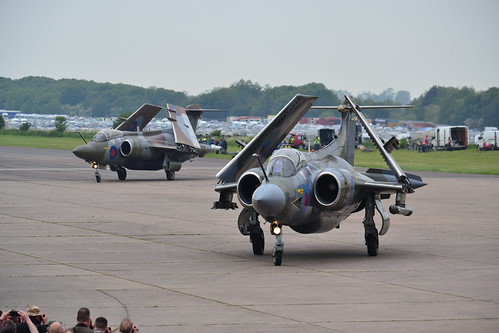
AT the former RAF Bruntingthorpe, Buccaneers regularly perform fast taxis along the runway. A sight and sound that once graced Holme-on-Spalding Moor.

The change brought new opportunities for Holme. The development of the American McDonnell Douglas F-4 Phantom allowed for testing at Holme, along with Harriers and Hunters of Hawker Siddeley fame. Trails of the Phantom included taking it to the extremes of its performance envelope, pushing the aircraft through maximum turns at supersonic speeds. Don Headley, Hawker Siddeley’s Chief Test Pilot at Holme, described the tests as “arduous” but “exhilarating nevertheless”.*3

Being a test pilot was a dangerous job, pushing aircraft to unknown limits. Deputy Chief Test Pilot with Blackburn Aircraft, Gartrell R.I. “Sailor” Parker DFC, AFC, DSM had to eject from the first prototype Buccaneer XK486 on 5th October 1960 when it got into difficulty following the artificial horizon breaking whilst in cloud. Both he and his passenger, Dave Nightingale, managed to escape the aircraft without injury. However, he didn’t have such a lucky escape when on 19th February 1963, the aircraft he was testing, Buccaneer XN952, went into an upright spin following a Low Altitude Bombing System (LABS) demonstration over Holme airfield.

In this manoeuvre, the aircraft flys in low enters a climbing loop and then releases the bomb near to the top of the loop, the aircraft completes the loop pulling away before the bomb strikes the target (also called ‘Toss’ or ‘Loft’ Bombing).  During the demonstration there was a loss of control due to a ‘roll-inertia coupling’ resulting in violent pitching and yawing, and loss of control as the aircraft rotated on all three axes. In the accident both Parker and his back seat observer, Mr Gordon R. C. Copeman (Senior Flight Test Observer), ejected from the aircraft, but Parker was too low, and Copeman fell into the burning wreckage after it had hit the ground. *4

Eventually on December 7th 1983, Buccaneer XV350 and Phantom XV429, took off  from Holme for the final time signifying the final closure of Holme airfield, a closure that ended a long history of aviation. With that, the name ‘Blackburn’ was gone forever, but the legacy of Robert Blackburn and his remarkable work in the aviation field would live on for many years yet.

No longer required or aviation purposes, Holme was sold off, the runways and Perimeter tracks were dug up, and the grounds returned to agriculture.

Sadly, the technical area which is now an industrial estate, is run down and tatty. Many of the original buildings are used by small businesses, furniture manufacturers, tool makers and car part suppliers. Buildings that are not used are run down and in dangerous conditions, fenced off they have a limited life span left. That said however, it remains quite intact and there are a good number of buildings left to see.

RAF Holme on Spalding Moor

Sadly many of the buildings are in a poor state of repair and have only a short life left.

If approaching from the village of Holme-on-Spalding Moor along Skiff Lane, you arrive at the first of three entrances. The first is the former perimeter track located at the north end of one of the secondary runways. The runway has long gone, but there is a hardstand still present, its large circular footprint giving a good indication of the nature of the site. This road leads round to the technical area and where the watch office was. A Post-war Fire Tender Shed does still stand here, but the office was believed  demolished in 1984. This road is gated and access is not permitted beyond here.

Continue along the road and a second entrance allows access to a small number of buildings of the former technical site. There is evidence across the road of further buildings but these have been removed leaving only their foundations visible. Continue passed here and you arrive at the main entrance, the two memorials are located just inside on the left hand side.  Continue along this road and you are entering the technical area, with a number of buildings on either side. Distinctly clear are the turret trainers and parachute stores, all in use with small businesses. At the end is one of the T2 hangars, re-clad and in use but inaccessible. Driving / walking round here you can see many of the former stores and admin blocks that formed the heart of the operations.

Some of these buildings are fenced off and in a dangerous condition, others have been better looked after, most are used by small businesses.

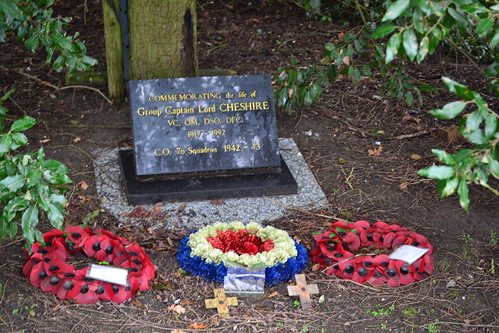
Commemorative memorials can be found at the former entrance to the site, including one to Group Captain (Lord) Cheshire VC, OM, DSO, DFC, who commanded 76 Sqn before being posted to Marston Moor. A highly respected man, he fought for changes to the Halifax to improve its handling and performance, and also post war, for funding for the memorials that stand at the entrance. His record of achievement and dedication is well versed across the history books and internet.

RAF Holme on Spalding Moor

Memorial to Group Captain Leonard Cheshire.

Holme-on-Spalding Moor is a remarkable airfield that is steeped in history. From the early days of the 1941 to the end of 1983 it saw some of the most heroic acts and the greatest advances in aviation. It took the fight to the heart of Nazi Germany, it led the way in state of the art fighter testing, rising like a phoenix out of the ashes until its final dying day.

Its present condition does not sadly reflect the enormous contribution it, and its personnel played in those turbulent years of history. Whilst having a largely intact technical area, its condition is a sad reflection on the importance we place on these once busy and historical places. Even with considerable development between inception and closure, and an ever-changing facade, the main heart of Holme always remained, but today sadly, it is a heart whose beat is slowing and one that will no doubt eventually stop and die. A remarkable place indeed.

Not far from here are both the airfields at Breighton and Melbourne, both of which have flying activities still going on, ‘intact’ runways and a number of buildings are still present. Also in Holme village is the All Saints Church, sadly kept locked out of hours, it has a window of remembrance dedicated to the crews of 76 Sqn and their heroic battle against Nazi Germany. It also has a number of graves from those who never saw peacetime again. It is certainly worth a visit.

Sources and further reading.

*1 The base system was brought in following the need for more airfields at the end of 1942 when the United States was drawn into the war. To ease administrative and support problems associated with multiple airfields, they were combined into a groups of 3 (or 4) with a parent station and 2 (or 3) satellites. Overall command was given to the HQ airfield (or base) headed by an Air Commodore. Approved in February 1943, it was rolled out over the following year.

*2 Australian War Memorial, Article number P04303.010

*3 Caygill, P., “Phantom from the Cockpit“, Leo Cooper Ltd; First Edition edition (26 July 2005) Pg 134

*4 ejection-history Website accessed 27/8/18.

ORB AIR 27/1902/1 National Archives

The 458 Squadron website aims to preserve the Squadron’s history paying tribute to those who served.

Chorley, W.R., Bomber Command Losses of the Second World War, Midland Counties Publications (1994)

BAE Systems website, accessed 27/8/18.

Trail 52 – RAF Bottesford and the bizarre accident that killed five airmen.

In this next trail we turn westward and head to the Midlands towards Nottingham and Leicester. Here we take in an airfield that was part of the RAF’s Bomber Command, and whilst it is an airfield that saw only a small number of squadrons operating from it, it nonetheless has a very significant story to tell.  Now a successful industrial park, much of the site remains – albeit behind a security gate and fencing. This airfield was home to both the RAF and the USAAF and played an important part in the fight against Nazi Germany. Today we visit the former airfield RAF Bottesford.

RAF Bottesford (Station 481)

RAF Bottesford was built in the period 1940 / 41 by the major airfield builder George Wimpey & Co. Ltd. It was known more locally as Normanton after the small village that lies on the south-western corner of the site, and although a Leicestershire airfield, it actually straddles both Leicestershire, Nottingham and Lincolnshire. As a new bomber airfield, it was the first in the area to be built with concrete surfaces, a welcome break from the problematic grassed surfaces that Bomber Command had been fighting against before.

In 1941 Bottesford would open under the control of No. 5 Group, a group formerly headed by Air Chief Marshal Sir Arthur Harris, who had seen the group carry out anti-shipping sweeps over the North Sea and leaflet drops over Germany. Now under the guidance of Air Chief Marshal Sir John Slessor, No. 5 Group was able to muster a considerable number of heavy bombers capable of reaching Germany’s heartland.

As a bomber airfield Bottesford had a wide range of technical buildings, three concrete runways, one of 2,000 yds (after being extended) and two just short of 1,500 yds, all 50 yds wide and linked by a perimeter track. The technical site with its various support buildings lay to the north-west of the airfield with the bomb site to the east, and accommodation areas dispersed to the north-east beyond the airfield perimeter.

Bottesford would accommodate around 2,500 personnel of mixed rank, both male and female, in conditions that were often described as ‘poor’, the site suffering from extensive rain and lack of quality drainage as the Operational Records would show *1.

Around the airfield there would eventually be 50 dispersals, half of these being constructed initially as ‘frying pan’ hardstands, and then with the introduction of the improved ‘spectacle hardstand’, this number was doubled by 1945.

Aircraft maintenance would initially be in four hangars, but these were also increased to ten in total, giving a mix of T2 and B1 designs. An unusual design feature of Bottesford was that some of these dispersals, and later hangars, were across a public road and, like RAF Foulsham (Trail 22), a gate system operated by RAF Police would allow the road to be closed off when aircraft were moved into or out of the area. The airfield would therefore, undergo quite a major change during its operational life.

Aerial photograph of Bottesford airfield looking west, the technical site is bottom right, 8 June 1942. Photograph taken by No. 1 Photographic Reconnaissance Unit, sortie number RAF/HLA/590. English Heritage (RAF Photography).

RAF photo reconnaissance photo taken on 8 June 1942. Compare this to the photograph taken three years later (below)*2

Aerial photograph of Bottesford airfield looking east, the technical site with seven T2 hangars, control tower and airfield code are top left, the bomb dump is on the right, 30 May 1945. Photograph taken by No. 544 Squadron, sortie number RAF/106G/LA/203. English Heritage (RAF Photography).

Bottesford 1945 *3

Only three operational front line RAF units would operate from Bottesford, the first being 207 Squadron flying the Avro Manchester, arriving on November 17th 1941, the same month as production of the Manchester ceased. Their arrival would also coincide with the arrival of 1524 (BEAM Approach Training) Flight operating the Airspeed Oxford.

207 Sqn were reformed as a new squadron at the beginning of November 1940, taking on the ill-fated Avro Manchester MK.I, before arriving here at Bottesford a year later. The first squadron to operate the type, they were soon to discover it had major issues, and so poor was the Manchester, that by the Spring of 1942 it was being withdrawn, replaced by its more successful sister the Lancaster. After its promising introduction into Bomber Command in late 1940, it became clear that the Manchester was going to become a troublesome aircraft. With engine seizures often followed by fires, it was very much under-powered even though it had what were in essence, two V12 engines mounted in one single engine.  Bearing failures led to engines failing, and already working at its limits, the Rolls-Royce Vulture engine was not able to keep the Manchester aloft without great skill from the crew.

After a period of bedding in and conversion of the crews to the new Manchester, the new year at Bottesford would start off badly, seeing the first casualty for 207 Sqn, on the night of 9th January 1942. On this mission, Manchester MK.I L7322 piloted by F/O G Bayley, would crash after being hit by flak on operations to Brest. There were 151 aircraft on this mission, with this aircraft being the only causality in which only three of the crew’s bodies were ever recovered.

The transition from the Manchester to the Lancaster would not be straight forward for 207 Sqn. Whilst on training flights, Lancaster MK.I ‘EM-G’ R5501 would collide in  mid-air with a Magister from RAF Cranwell, four crewmen would lose their lives along with the pilot of the Magister. Then on the 8th April, a second Lancaster would suffer problems when ‘EM-Z’ R5498 experienced fuel starvation in both starboard engines causing them to cut out. The aircraft crashed close to Normanton Lodge on the north-south boundary on approach to Bottesford’s main runway. Fortunately no one was seriously injured in the accident.

A third training accident occurred on the night of May 24th 1942, when Lancaster R5617 hit the ground in poor visibility near to Tavistock in Devon. In the resultant crash, four of the crew were killed whilst two further crewmen were injured. It was proving to be  a difficult transition for the crews of 207 Sqn.

The first operational loss of a 207 Sqn Lancaster came on the night of June 3rd / 4th, when ‘EM-Y’ R5847 was shot down whilst on a mission to Bremen in north-west Germany. During the flight, the aircraft were attacked by German night fighters. As a result a number of aircraft from various squadrons were lost, including this one flown by pilot W/O C. Watney, who along with all his crew, were killed.

With the last mission by a Manchester taking place on the night of June 25th / 26th, 1942 would be a difficult year for 207 Sqn, losing four Manchesters and twenty-five Lancasters, which when added to the twenty Manchesters lost in 1941, proved that things were not going well for the 5 Group squadron at Bottesford.

RAF Bottesford

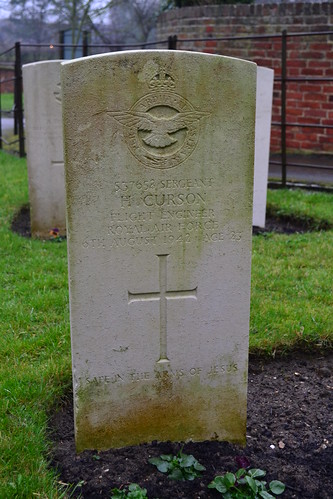
Sgt. Harold Curson (s/n: 537658) was killed in a bizarre accident at Bottesford when a Manchester landed on top of a Lancaster destroying the aircraft and killing three of its crew.

Perhaps one of the most bizarre accidents to happen at Bottesford, occurred on August 6th 1942, when Manchester L7385 landed very badly. Somehow, the aircraft ended up on top of a Lancaster, R5550 who was also engaged in training operations. The accident was so severe, that two of the crew in the Manchester and three of the crew in the Lancaster were killed. The remaining five crewmen, whilst not killed in the accident, all sustained various degrees of injury.

Then in September 1942, 207 Sqn were transferred from Bottesford to nearby Langar, the satellite airfield for Bottesford. This would be the first of many moves that would last into early 1950 when the squadron was finally disbanded whilst operating the Avro Lincoln. The squadron’s tie with Avro had finally come to an end (207 Sqn would reform several times eventually being disbanded in the mid 1980s).

The October / November 1942 then saw two further Bomber Command squadrons move into this Leicester airfield, those of 90 Squadron and 467 Squadron.

Reformed here after being disbanded and absorbed into 1653 HCU the previous February, 90 Sqn brought with them the other great heavy bomber, the Stirling.

An enormous aircraft, the Stirling also failed to live up to its promise, suffering from a poor ceiling and often being targeted by fighters when in mass formations. The Stirlings were eventually pulled out of front line operations and moved to transport and SOE operations, such were their high losses.

At the end of the year once the squadron was fully manned and organised, No. 90 Sqn departed Bottesford taking the Mk.Is to RAF Ridgewell, where they continued on in the bomber role. The only casualty for 90 Sqn during this short time occurring on the very same day they moved when ‘WP-D’ BK625 crash landed at Ridgewell airfield.

Also during the month of November 1942, on the 24th, 467 Squadron (RAAF) joined 90 Sqn, in a move that saw the return of the Lancaster MK.I and MK.III, these crews must have been the envy of those who struggled with the mighty Stirling in their sister unit. Formed on the 7th November at RAF Scampton under the command of W/Cdr. C. Gomm DFC No. 5 Group, 467 Sqn were another short-lived squadron eventually being disbanded on September 30th 1945 at Metheringham airfield in Lincolnshire.

In the first days of their formation there were initially sixteen complete aircrews, divided into two flights: ‘A’ commanded by Acting S/Ldr. D Green DFC and ‘B’ Flight with Acting S/Ldr. A. Pappe DFC. As yet though, they had an insufficient number of aircraft to accommodate all the crews.

After arriving at Bottesford, 467 Sqn battled with lack of equipment and poor weather which hindered both training and flying activities. A number of dances were held to make the Australians and New Zealand crews “feel at home”,  and a visit was made by Air Marshal Williams (RAAF). At the end of the month, aircraft numbers totalled just seven.

By the end of December new aircraft had been delivered and the Lancaster total stood at nineteen, but poor weather continued to hamper flying. Early January saw the first sign of any operational action at Bottesford, which occurred on the night of January 2nd / 3rd 1943. Five crews were assigned to a ‘Gardening’ sortie, laying mines, which excited the ground crews who were keen to see their aircraft finally participating in operations. It wouldn’t be until January 17th / 18th that 467 Sqn would finally venture into German territory laden with bombs. A mission that took them to the heart of Germany and Berlin.

RAF Bottesford

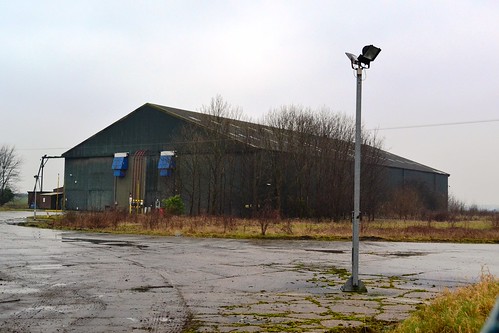
One of Bottesford’s hangars in use today.

With great excitement nine Australian crews, who were keen to show what they were capable of, took off from Bottesford to hit the target. The mission was considered a ‘disappointment’, damage to the target being very light due to both haze and lack of good radar. Target Indicators were used for the first time on this mission and it was the first all four-engined sortie. On their return flight, Sgt. Broemeling, the rear-gunner of F/Lt. Thiele’s crew was found unconscious, he had suffered from oxygen starvation and even after diving the aircraft to a safe breathing height and giving artificial resuscitation, he was declared dead on arrival at Bottesford.

A second night saw 187 RAF bombers from No. 1, 4 and 5 Groups in a subsequent raid that, like the previous night, also resulted in poor results.  Bombing saw little damage on the ground but twenty-two aircraft were lost. One of these aircraft being from 467 Sqn, that of Lancaster ‘PO-N’ W4378, which was piloted by a New Zealander, Sgt. K Aicken. Sgt Aicken had been one of the original pilots at 467’s formation. All seven crewmen from ‘PO-N’ were killed that night.

The next casualties would occur a month later, in a mission that saw 338 RAF heavies attack the port of Wihelmshaven in northern Germany. With the mission considered a ‘failure’, outdated maps were blamed, pathfinders marking the target area inaccurately as a result. The raid would also be notable for the loss of two Bottesford Lancasters; ED525 and ED529. On board the second aircraft were two crewmen Sgt. Robert Sinden (s/n: 577701) and Sgt. Derek Arnold Booth (RAFVR) (s/n: 1378781) who were just 18 and 17 years old respectively – the youngest crewmen to lose their lives in Bomber Command’s campaign of 1943. None of the fourteen men were ever found, their aircraft lost without trace.

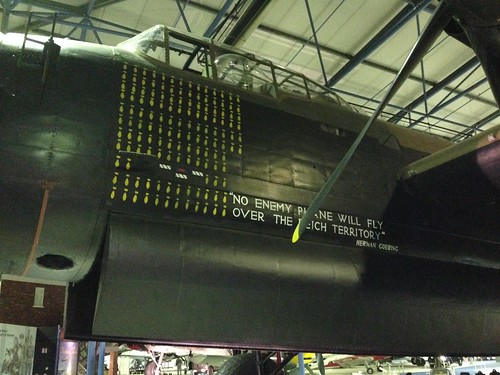
A year after their arrival 467 Sqn then departed Bottesford heading for RAF Waddington, a point at which the RAF handed Bottesford over to the Americans in answer to their call for airfields to support the forthcoming invasion of the continent. 467 Sqn would go on to fight under Bomber Command, and in that month a special Lancaster would join the Sqn, that of R5868 ‘PO-S’ which went on to be the first Lancaster to reach the 100 mission milestone completing a total of 137 before the war’s end. She sat outside RAF Scampton as a gate guard after the war but has thankfully ended her days as the centre piece of the Bomber Command Hall at the RAF Museum in Hendon.*4

RAF Museum Hendon

‘S-Sugar’ a former 467 Sqn Lancaster stands in the RAF Museum, Hendon. Note the incorrect Spelling of ‘Hermann’ beneath the quote.

As one of a cluster in the area (North Witham (Trail 3), Spanhoe (Trail 6), Barkston Heath and Langar amongst others), Bottesford would become a home to the Glider units of the US Troop Carrier Command (TCC).

The airfield (renamed Station 481) would become the headquarters of the 50th Troop Carrier Wing (TCW), Ninth Air Force, and used as a staging post for new C-47 units arriving from the United States. The 50th remained here at Bottesford until April 1944 at which point they moved south to Exeter in their final preparations for the Normandy invasion.

This deployment would see a number of American units arrive, be organised and transfer to their own bases elsewhere, these included the eight squadrons of the 436th Troop Carrier Group (TCG) and the 440th Troop Carrier Group (TCG).

The 436th TCG were made up of the four squadrons:79th Troop Carrier Squadron (TCS), 80th TCS, 81st TCS and 82nd TCS, all flying C-47 aircraft. The Group was only one year old when they arrived at Bottesford, and their introduction to the war would be a baptism of fire.

The cramped barracks of the 436th TCG and 440th TCG at Bottesford. (IWM – FRE 3354)

Whilst primarily training and organising themselves at Bottesford they would go on to take part in the Normandy invasion, dropping paratroops early in the morning of June 6th 1944 into the Normandy arena. In the afternoon, they returned with gliders, again dropping them behind enemy lines to supply and support those already fighting on the ground. A further trip the following morning saw the group awarded a Distinguished Unit Citation (DUC) for their action over the Normandy landing zones. Before the war’s end the 436th would take part in four major allied airborne operations, dropping units of both the 82nd and the 101st Airborne.

The 440th, like the 436th, were a very young unit, only being activated the previous July, and like the 436th, their introduction would be a memorable one. Dropping paratroops of the 101st Airborne into Carentan on D-Day, followed by fuel, food and ammunition the next; for their action they too were awarded a DUC. The 440th would also take part in the Battle of the Bulge supplying troops at Bastogne and later the crossing of the Rhine.

Whilst both units were only here at Bottesford a short time, they undoubtedly played a major part in the Allied invasion and all major airborne battles on the continent, a point that Bottesford should be remembered for.

The 436th moved to Membury whilst the 440th moved to Exeter in a mass move with the 50th TCW. After this, the US brought in a Glider repair and maintenance unit, who only stayed here for a short time before they too departed for pastures new. This then left Bottesford surplus to American requirements, and so in July 1944 it was handed back to the RAF and 5 Group once more.

This transfer would see the last flying unit form here at Bottesford – the death knell was beginning to ring its ghostly tones.  The RAF’s 1668 Heavy Conversion Unit (HCU) formed on the 28th, brought back the heavy bomber, the Lancaster MK.I. Working with the HCU were the 1321 Bomber (Defence) Training Flight consisting of mainly Beaufighter and Spitfire aircraft, who operated here until 1st November 1944 when they were absorbed into 1668 and 1669 HCUs. The HCU used these aircraft for fighter affiliation tasks and heavy bomber training.

As a training unit there would be many accidents, either due to aircraft problems or pilot error, including the first major accident on 12th December 1944 where fire tore through the port wing of Lancaster MK.III JA908. Diverted to East Kirkby the Lancaster attempted a landing but damaged a wheel, and had to crash-land in a field near to the airfield. Whilst no-one was killed in the crash, eight aircrew were injured in the resultant fire.

In the August 1945, the HCU moved to Cottesmore and there was no longer a need for Bottesford as an operational airfield. Surplus to requirements it was placed into care and maintenance, and used to store surplus equipment including ammunition before being closed and sold to the farmer who’s been using it since 1962.

As with all RAF / USAAF airfields a number other flying units operated from Bottesford, maintenance units, RAF squadrons and Glider units all played their part in its rich tapestry of wartime history. A history that provided one of the largest numbers of hangars collectively, and one that saw many young men come and go, many not coming back at all.

Today Bottesford is a thriving industrial and agricultural park, the farmer using large parts of it but the technical site being used by a number of industrial companies. The hangars are still present and in use, as are the runways now used for storage of vehicles rather than Lancasters, Stirlings, Manchesters or C-47s. The watch office has been refurbished and is used as offices, and several of the original buildings still remain in various states of disrepair. A flag of remembrance was hoisted outside the office in May 1995 and veterans have visited the site to pay their respects.

With access to the site through a security gate, you are left with some poor views from public roads, but the local church does have a small number of graves and a memorial which includes a book of remembrance.

Bottesford may have only been in existence for a short period, but it saw many aircraft and many crews, a mix of international airmen who brought new life to this small village on the border of three counties.

RAF Bottesford

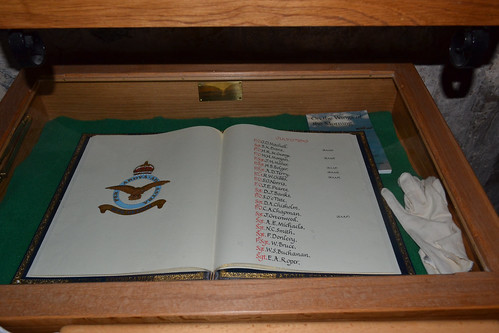
A book of remembrance sits in the local church St. Mary the Virgin along with a small number of graves.

Links and sources

*1 AIR\271930\1 Operational Record Book 467 RAAF (Royal Australian Air Force) Summary of Events (National Archives).

*2 Source Imperial War Museum photo ref: RAF_HLA_590_V_6004

*3 Source Imperial War Museum photo ref: RAF_106G_LA_203_RP_3093

*4 The AVRO Heritage Museum Website has details of ‘S for Sugar’ and her journey to Hendon.

Defence of the Realm, Tony Wilkins takes a detailed look at the Avro Manchester.

The Bottesford Living History Group have a detailed website with photographs and personal accounts and is worth visiting.

The Development of Britain’s Airfields (Part 6).

After considering the architecture of Britain’s airfields in Part 5, we turn to the hard surfaces, primarily the runways. Developed out of necessity, they created a steep learning curve for those involved in their construction. Many problems were found, many materials were tried, but ultimately they were built and even after their removal for hardcore, many have left scars in the tissue of the earth that remind us of their once massive presence.

Runways, Perimeter Tracks and Hardstands

In the pre-war years, the development of hard runways and large airfields was a new phenomena, hard surfaces being a new aspect still very much a topic of considerable controversy. In the First World War, water logging and mud was an issue even for the small biplanes that filled the skies over Britain and  France. To overcome this, ash was spread over landing surfaces and to some degree successfully, but even though many local remedies were tried, it wouldn’t be taken seriously until the Second World War loomed.

Glatton (Conington) second runway markings

Runways like this one at Glatton (Conington) remain in good condition and used by the local flying club.

At this point the typical airfield layout included up to four grass runways, one of 1,300 x 400 yards and three of 1,000 x 200 yards, many were even smaller. Bomber and Fighter Command, realising that not only would the new era of aircraft call for longer, hard runways on its airfields, but the need to maintain year round activity was essential if Britain was to defeat the Luftwaffe.

Both Fighter and Bomber Command pushed the Government to allow these to be developed, on the one hand Sir Hugh Dowding, fighting the corner for Fighter Command, pressed home the need for hard surfaces on his fighter airfields, whilst Sir Arthur Harris on the other, pushed for hard surfaces on his bomber airfields.

The entire process was lengthy and complex, and lacked in-depth, professional knowledge. The first hard ‘pavements’ later runways and taxi ways, being constructed based on road building techniques and knowledge. So before any firm decisions could be made, trials would need to be carried out to determine not only whether or not they were indeed needed, but if so, how they should be best constructed.

Initial steps in runway construction was started as early as 1937, where ‘flexible’ runways were constructed comprising layers of brick or stone covered with two further layers of tarmac and a coat of asphalt to seal the structure in. Concrete pavements, which proved to be much stronger were either 150 mm or 200 mm thick slabs laid directly onto the ground after the topsoil had been removed by heavy machinery. As would be expected, these early designs failed quite quickly under the heavy loads of the fighters and bombers that were coming into service. Rapid repairs were carried by adding a further layer of tarmac (6.5cm) and another layer (2cm) of sealant.

These early flexible constructions continued to fail whereas the concrete designs stood up to much more wear and tear and proved longer lasting. However, time was short and the learning curve would be steep.

The test to determine these needs was to take a Whitley bomber, laden to equal its full operational weight, and taxi it across a grassed surface.  A rather primitive assessment, it was intended to ascertain the effects of the aircraft on the ground beneath. Trials were first carried out at Farnborough and then Odiham, and these were generally successful, the Whitley only bogging down on recently disturbed soils. Further trials were then carried out at RAF Stradishall in March 1938, and the results were a little more mixed. Whilst no take offs or landings took place during these trials, the general agreement was that more powerful bombers would have no problems using grassed surfaces, as long as the ground was properly prepared and well maintained. All well and good when the soils were dry and well-drained.

By April 1939, the Air Ministry conceded, and agreed to lay runways at a small number of fighter and bomber airfields, of which Kenley, Biggin Hill, Debden and Stradishall were identified.  Whilst construction was slow, only two fighters airfields being completed by the outbreak of war, progress was finally being made.

These initial runways were only 800 yards long and 50 yards wide, but were extended later that year to 1,000 yards long, as aircraft were repeatedly running off the ends on to the grassed areas. Over the years Stradishall in particular, would be further developed, its longest runway eventually extending to 2,000 yards.

RAF Charterhall

The runway at Charterhall in the borders, breaking up after many years of use both by training units and as a motor racing circuit post war.

During the early war years, the demand for airfields grew. By early 1940 the requirement was for three runways as close as possible at 60o to each other, and of a minimum length of 1,000 yards with room for extension up to 1,400 yards. This then became the norm by late 1940 especially at bomber airfields, with the main runway being 1,400 yards and subsidiaries at 1,100 yards. A month later, this increased by another 200 yards with a requirement to be able to extend to 2,000 and 1,400 yards respectively.

However, these short piecemeal responses were not sufficient and it was both a continual problem and a thorn in the side for the Air Ministry. Sir Arthur Harris, in raising his concerns for airfields belonging to Bomber Command, also pushed the need to develop good, long and reliable surfaces. He voiced his frustration in a vehement letter*6 to Lord Beaverbrook in 1941, In which he states:

“For twenty years everybody on the stations and the squadrons has been screaming for runways without avail.”

and he continues stressing the need for hard surfaces particularly in winter as:

“Through not having runways our effort will be seriously detracted from in normal winter conditions and reduced very probably to zero in abnormal winter conditions.”

He then goes on to state that Britain’s views were ‘blinkered’ saying that:

“Every other nation throughout the world has long been convinced of the necessity for runways…”

By the summer of 1941, the length of runways had again increased, all stations would now have a main runway of 2,000 yards and two subsidiaries of 1,400 yards and where this was not possible, then a minimum of 1,600 and 1,100 yards (fighter and night fighter stations being shorter at 1,300 and 1,400 yards respectively).

The harsh winters were less than ideal for laying concrete (by far the best material for the job) but any delay could mean the difference between success and failure. Elaborate testing was therefore passed over, materials were laid and experience led the way. This method of trail and error, led to many instances of runways having to be dug up and relaid, this in itself led to problems as aircraft, men and machinery had to then be moved and housed elsewhere. The American Eighth Air Force suffered greatly with these problem, fully laden bombers repeatedly breaking through the surface or falling off the edges as it gave way.

Another consideration was that of training and satellite airfields. As the need for new pilots increased, the training of new recruits intensified. The harsh winters were causing major headaches for these airfields as mud, stones and other winter debris was causing continuous problems for flying. With both man power and materials being in short supply, suitable alternatives were sought.  A number of solutions were offered all very similar in their design and material.

The answer it seemed lay in steel matting – of which twelve different types were used – the more common being : Sommerfeld Track, Pierced Steel Planking (PSP – also called Marston Mat), or Square Mesh Track (SMT).

Sommerfeld track was a steel mat designed by Austrian Kurt Sommerfeld. The tracking was adapted from a First World War idea, and was a steel mat that when arrived, was rolled up in rolls 3.25 m (10 ft 8 in) wide by 23 m (75 ft 6 in) long. It was so well designed that a full track could be laid, by an unskilled force, in a matter of hours. Each section could be replaced easily if damaged, and the entire track could be lifted and transported by lorry, aeroplane or boat to another location and then reused.

Sommerfeld track (along with these other track types) were not only used commonly on training and satellite airfields, but also on Advanced and Forward Landing Grounds in Kent and later France after the Allied invasion of Normandy. In the build up to D-Day, 24 Advanced Landing Grounds in southern England were created using this form of Steel Matting,

Tracking had to be robust, it had to be able to withstand heavy landings and be non-conspicuous from the air. Sommerfeld track met both of these, and other stringent criteria very well, although it wasn’t without its problems. Crews often complained of a build up of mud after heavy rain, and concerns over both tyre and undercarriage damage were also extensively voiced; several records reporting tail wheels being ripped off after catching in the track lattice.

Because of the poor state and short length of runways, bombers were still regularly running off the ends, especially at night, or being unable to fly because the surfaces were poor or even unusable. A number of ideas were tested out to alleviate the problem, one such idea led to twenty sites testing arrester hook facilities. Several heavy bombers: Halifax, Manchester, Stirlings  and later the Lancaster,  were all modified to undertake these trials, with Woodhall Spa becoming the first airfield to have the full complement of six arrester sets.

Runway arrester gear

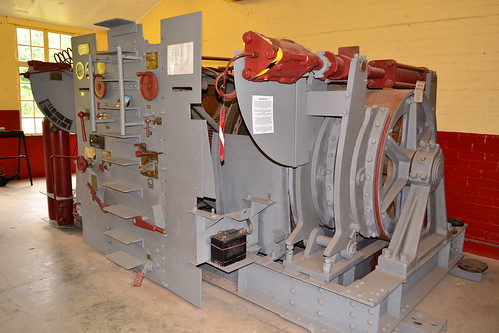
Runway arrester gear at Woodhall Spa.

The idea was met with scepticism, but trials went ahead and in January 1942, a list of priority airfields was sent out to the Headquarters of No. 1,3,4, and 5 Groups RAF detailing those twenty sites selected for the equipment. At the top of the list was RAF Woodhall Spa in Lincolnshire, followed by Bottesford, Swinderby, Ossington, Syerston, Middleton St. George, Linton, and ending with Waterbeach and Stradishall. By late 1942 Woodhall Spa was ready and in October, five landings were made by an Avro Manchester.  A month later the decision was made to install units at all major operational airfields, but this never came to fruition and the idea was soon mothballed. By 1943, it had been forgotten about and the 120 or so units built were scrapped (many being left buried where they were laid).

It was finally during early 1942 that a standard design airfield would be put in place. Known as the Class ‘A’, it would be the standard to which all new airfields and updated older sites would be made.

A Class A airfield would be designed around three hard concrete runways, shaped like an ‘A’ with each runway at 60o  to each other where possible. The main runway would be aligned with the prevailing wind again were possible to allow aircraft to take off/land into the wind as often as possible (north-east, south-west). In several cases, due to land features and local restrictions, this was not always possible, and so many permutations of design were seen as a result.

Rapidly becoming the largest part of the airfield layout, the runways and other paved areas – perimeters tracks, aprons and hardstands – were now given high priority. The standard now called for a main runway of 2,000 yards with two subsidiaries of 1,400 yards. Each of these would be 50 yards wide whilst the connecting perimeter tracks would be 50 feet wide. Along side these runways would be an emergency landing strip, a grassed area given a landing surface of 400 and  200 yards respectively.

Dues to the high numbers of bombers returning badly damaged and unable to make safe and proper landings, a small number of emergency strips were created by extending the main runways to 4,000 yards long and 400 yards wide. One such airfield was RAF Manston in Kent. Being on of the closest airfields to the continent, it was often the first place a stricken aircraft, especially a bomber, would seek out.

Whilst the general layout of airfields did not change for the remainder of the war, some further runways were extended to 3,000 yards, one such example being RAF Sculthorpe in Norfolk which was prepared to take the heavy B29 ‘Superfortress’ and post war, the B-36 ‘Peacemaker’.

A further point worth mentioning here is that of dispersals, not required pre-war, they were also an aspect of airfield architecture that were born out of the Second World War. In the inter-war years, aircraft were housed either on a central pan (apron or ramp) or within hangars. These collections of aircraft were easy targets and even a small amount of munitions could cause huge damage. In 1939 the need for dispersals was therefore recognised and so to address the issue, hedges were removed and tracks created that took aircraft away from the main runway but kept them within easy reach of the airfield site. The initial design was that of the ‘frying pan’ a 150 ft circle connected to the perimeter track by a small concrete track.

However, by 1942, it was found that aircraft were clogging up these tracks, some even ‘falling off’ the concrete onto soft soil and so blocking following aircraft in their tracks. The answer was the ‘spectacle’ or ‘loop’ hardstand, so-called by their oval shape, generally in pairs, that allow aircraft in and out without the need to turn or block access tracks. From 1942 onward, this model became the standard hardstand for all Class A airfields, and the aim was to have 50 such hardstands placed strategically around the perimeter, with 25 at satellite airfields. As the threat of attack diminished toward the end of the war, ‘finger’ or ‘star’ dispersals began to appear, much less effective than the predecessors, they were however cheaper and easier to construct.

RAF Milfield

Unusual as many training airfields didn’t have aircraft pans, RAF Millfield, in the borders, had several

In addition to hardstands, pens were built on fighter stations. The first, an experimental pit, was dug at Feltwell, whilst overly expensive and obtrusive, it did lead the way to aircraft pens later on, pens that were developed as either type ‘B’ or ‘E’  on these fighter airfields. The main difference here is that the early type ‘B’ had cranked side walls whereas the ‘E’ had walls that were straight. The former requiring more space, was later phased out in favour of the ‘E’, named so by its shape, using side and back walls to protect the fighter or small bomber located within.

Remains of Type 'B' fighter Pen

The remains of a Type ‘B’ Fighter Pen at Matlaske.

RAF Macmerry

A Type ‘B’ Pen at RAF Macmerry. The cranked wall can be seen to the right, with the central wall on the left. The entrance is to the bottom right.

Examples of these pens were located at Matlaske (type ‘B’ – built to design 7151/41) and Macmerry in Scotland, whilst the type ‘E’ were found on airfields especially those around London that included Biggin HiIl, Kenley and North Weald.

Kingscliffe airfield

One of the ‘E’ type pens found at Kings Cliffe. Adapted with rifle slits for additional defence.

These pens were designed to specific dimensions and were designed as either a ‘Hurricane’ or ‘Blenheim’ to accommodate either a single engined or twin-engined aircraft. Within the back wall of these pens was a shelter for up to 25 personnel, and in some cases, they had Stanton Shelters built-in to the structures. Some, for example, at Kings Cliffe in Northampton, remain with rifle slits for additional protection from ground forces.

King's Cliffe airfield

Inside the aircraft pen shelter at King’s Cliffe.

Whilst the majority of these shelters were manufactured using banks of soil, sandbags, brick or concrete, there was a least one example at RAF Drem, in Scotland which used logs cut to size and shape and built in the style of a Scandinavian house. It is these various designs of aircraft pen that paved the way to modern hardened aircraft shelters (HAS) seen on military airfields today.

From the early days of grass runways to the massive lengths of concrete that were created up to and after the mid 1940s, runways and hardstands have become a defining factor in airfield design. The sole purpose of an airfield – to get aircraft off the ground as quickly as possible, get them to their target and them get them home again – led to the development of both runway lengths and construction materials, much of which has paved the way for modern airfields today. These early leaps into runway designs have enabled larger and heavier aircraft to make those important journeys that we very much take for granted in this the modern world of air travel and general aviation.

In the next section we look at one of the buildings most associated with the airfield. An early form of aircraft storage, its role changed as it was soon realised that aircraft needed to be dispersed and not grouped together on large aprons as they were in the prewar era. Aesthetics and neatly lined up aircraft were no longer an important factor in front line flying, but safety and the ability to repair aircraft quickly and efficiently were. Here we introduce the hangar, a huge building often of a temporary or transportable nature, that became one of the more longer lasting structures of airfield architecture.

Sources and further reading. 

*6 Letter from Arthur Harris to Lord Beaverbrook, February 1941 – AIR 19/492 – National Archives

The Development of Britain’s Airfields (Part 4).

In Part 4 of the Development of Britain’s Airfields, we take a short look at the construction process and the numerous companies that were involved in building the airfield. Once a site was found in Part 3, compulsory purchase was made and the developers moved in.

Building the airfield.

The creation of airfields was set, each plan was studied, trees, shrubs and hedges were removed, ditches filled and the land leveled to a maximum gradient of 1:60.

First of all to reduce the risk of machinery being bogged down, perimeter tracks were built. This allowed the delivery of heavy loads to any part of the site, and so were originally designed to carry support vehicles rather than aircraft. One reason why so many grassed airfields had hard perimeter tracks.

With such a big workforce being drafted in, accommodation for the workers would be needed, these would generally be the huts that would be used for the aircrews and other personnel on the base once active. Drainage and dry storage was needed as a matter of urgency, and were usually a priority even before the accommodation areas.

RAF Bury St Edmunds (Rougham)

Buildings would be built using a range of materials.

Hiding these enormous excavations was going to a headache for the authorities. How do you hide a building site covering many acres? (Average grassed stations covered 200 – 400 acres whilst those with runways were around 500 acres extending to over 1,000 by the war’s end).  Numerous strategies were tried from painting the ground to covering it with coal dust, even adding wood chip to the concrete surfaces was used all with little real impact. Any spy or reconnaissance pilot worth his salt would have spotted the works and reported back immediately.

Gradually the airfield developed. Workers worked in shifts covering a 24 hour working day, seven days a week, this meant that the construction period was relatively short and the completion rapid. By the end of the war some £200 million worth of work had been carried out involving somewhere in the region of 130,000 individuals including engineering workers, and building sub-contractors.

As the site neared completion, RAF staff would begin moving in. The stores officer or ‘Equipment manager’ would often be first, ordering the necessary supplies to accommodate the forthcoming personnel. He would usually be followed by a NAFFI and a medical officer who would officially declare the site ready for occupation. Once this had been given the ground crews would be brought in, followed by aircrews and the aircraft. Even with a newly opened site, it was rare that it was ever fully finished, often accommodation was rudimentary or cooking facilities limited. In some cases tents were the order of the day until construction was completed. Great emphasis was placed on getting the site open and operational rather than ready. In some cases ground crews, who were otherwise waiting for aircraft to arrive, would take to shovels and picks to complete or improve upon work that had been started on site.

Also the airfield needed naming. Names were usually taken from the nearest village or town, and where confusion might arise from a similar name, it could then be taken from an alternative nearby village. This is why some airfields appear to be quite distant from their respective named locations. Alternatives to this would be geographical features or alternatively local farms e.g RAF Twinwood Farm. The Americans used the system of numbering partly because (a) the American airmen were unable to pronounce accurately some of the English names and were often found getting confused by them, and (b) the American administration system made it easier to use numbers rather than names.

By now the airfield was built, or at least open, the first unit would arrive and airfield defences would be set up. Military personnel would become established and operations would soon begin. All this could occur within months, it was a massive undertaking achieved in very little time.

In the next section we look at the architecture of British airfields, how the idea of replication in design led to architectural developments, and how the demand for materials led to changes in airfield buildings.

The Development of Britain’s Airfields (Part 3).

In Part 3 of this series, we turn from the political scene of Part 2 and look at how airfields were identified, The process and methodology of airfield selection.

Choosing a site.

Choosing an airfield site during these prewar periods was especially difficult as there were many ‘unknown’ factors to predict, a factor in itself that helped determine the needs of each of the various schemes mentioned previously. However, there were a number of airfields already in situ, some used by the military and some used by civilian aviation. As remnants of the First World War, many military sites were inadequate or inappropriate for the growing future needs of the RAF, but with some work, they could be developed into workable sites as the basic infrastructure was already there in place.

As well as these RAF sites, there were also civilian airfields, which the Government considered as potential military airfields. Because civil aviation had grown amongst the wealthier members of society, although not exclusively, this meant that in the pre-war period, there were some 90 airfields*4 owned either by local councils or under private ownership. Many of these were requisitioned by the authorities, but because many were small or located very close to built-up areas, (in 1928 the Air Ministry ‘encouraged’ towns of 20,000+ inhabitants to have a municipal airport), they were not suitable for modern fighter or bomber aircraft. As a result, many of these became training or maintenance sites, some linked to aircraft production facilities, but none were ‘operational’ for fighting units.

A further group of airfields in use at this time, were those of the AA (Automobile Association – better known as a motoring organisation). The AA Landing Grounds were often ex First World War sites located near to hotels and other places of interest to the motorist. Fuel was usually supplied at, or near to, each site, and each one was ‘tested’ by an aircraft on behalf of the AA before it was granted AA status. As these sites were registered, their locations were readily available to the Germans and so they were closed and rendered unsuitable for aircraft. However, land in close proximity was occasionally used, and so a new site would be created in a similar location.

With all these sites available, one would imagine choosing a site and developing it, would be relatively straight forward, but this is far from the truth. Many of these sites were inadequate, and the process of repairing/upgrading or rectifying it was simply not going to be sufficient. Therefore, many new sites were going to be required and the process by which a site was identified, acquired and then subsequently developed was not at all straightforward. In each case the Air Ministry Directorate (AMDGW) and Air Ministries Aerodromes Board would work in very close conjunction with numerous other Government departments and interested public bodies. These would include local Electricity Boards, Drainage Boards, the Geological Survey Department and the local War Agricultural Committee, who were concerned about flooding caused by run-off from the sudden building of large expanses of concrete.

In the first instance, using an ordnance survey map, areas that were below 50 feet above sea level or above 650 feet were generally ignored, the former being prone to flooding whilst the latter suffering high levels of low cloud or hill fog. Next a circle with a radius of 1,100 yards was marked off, this had to be flat with minimal rise in the ground layer. It also had to be free from obstructions and ideally at least three miles away from any other flying location. Next officers from the Air Ministries Aerodromes Board would walk the site, field by field, recording maximum landing distances, and noting any unidentified obstacles, trees, hedges, ditches or more permanent structures that would need removal.

By September 1939, board officials had identified, examined and recorded around 4,000 possible sites in the U.K. Many would be simply filed away never to see aviation of any kind, whilst others would become famous for years to come.

Once a suitable site had been identified and examined, the local geology had to be established where possible. In the pre-war years, no consideration was given to hard runways, they didn’t exist in any real form and were not seen as needed as any aircraft of that time could happily take off from a grass strip. However, in order to prevent aircraft wheels from bogging down, or flooding closing an airfield, well-drained soils were absolutely paramount.

Once the site had been accepted, the land was requisitioned, forcibly purchased using new powers created under the Emergency Powers (Defence) Act 1939. This gave virtually immediate access and ownership of the land – with little notice to the land owner – to the Government. These powers also saw their way to reducing the ‘NIMBY*5 effect, protests against developments being side-lined through political clout.

The next stage in the process was to put the job out to tender. The difficulty here was that secrecy was of the utmost importance, and so little of the detail was released other than an approximate location. As the war progressed, the number of construction companies involved became fewer, and those that were involved more established, prime contractors being Wimpey, Laing, Taylor-Woodrow and McAlpine – all of whom went on to be major construction companies post war. That said, no major airfield would generally be completed by one single contractor, as the whole process required a wide range of skills based operations. As one completed their task, another would come in, sometimes dual operations would be carried out simultaneously. For example taxiways and access roads may have been built by Tarmac, whereas the runway may have been built by McAlpine. Accommodation areas often used ‘Nissen’, or in many USAAF cases, ‘Quonset’ huts, many of these and other ‘standard’ buildings were erected by buildings contractors whereas other more substantial buildings may have been built by John Laing and Co.

By the outbreak of war, 100 sites had been purchased, as the number was relatively small, the board were able to be ‘particular’ in their choice, something that was quickly disregarded as the war progressed.

Airfields are highly labour intensive projects requiring an enormous workforce and extensive heavy machinery, little of which were available in the early 1940s. Irish labour provided the backbone of the initial workforce, whilst heavy plant came in from the United States. At its peak there were some 60,000 men employed on airfield construction, all of whom were unable to spend their time rebuilding the devastated towns and cities of the UK.

As the war progressed, the Royal Air Force Airfield Construction Service began taking a greater role in airfield construction, diversifying away from their original role as repairers of damaged airfields sites. There would be an initial 20 squadrons created to carry out these tasks, with a further 6 being formed later in the war. With squadron numbers ranging from 5001 to 5026, they would be initially involved in the updating of older sites and the creation of ALGs, eventually taking on a much greater responsibility of airfield construction. These squadrons, were of course given great assistance by the well established Royal Engineers.

In 1942, the United States joined the European theatre sending their own Engineer Aviation Battalions to the U.K. Their task was to support these British squadrons by building their own airfields ready for the huge influx of men and machines that was about to arrive. The first site completed by the Americans and opened in 1943, was Great Saling (later renamed Andrews Field) by the 819th engineer Aviation Battalion. Not being experienced in U.K. soils, it was a steep learning curve fraught with a number of initial problems.

Former RAF Andrewsfield

RAF Andrews Field memorial to the 819th Engineer Aviation Battalion.

In 1939 there were only 60 military airfields in the UK, by 1940 this had increased to 280, almost tripling to over 720 by 1945. Between 1939 and 1945 444 airfields*2,4 new airfields were built by these organisations – an amazing feat by any standard. Using almost a third of Britain’s total construction labour force, they were often open and manned within a matter of months rather than years. Building Britain’s wartime airfields was not cheap. Many, like Debach the last USAAF airfield to be constructed, cost almost £1,000,000 to construct.  A small amount compared to the £645, 000,000 it cost to build all 250 US airfields in the UK*5a

This whole process however was not fool-proof. In a number of situations sites were identified and requisitioned, but not developed. In several cases they were partly built, and in others like RAF Cottam, they were completely built but then never occupied. Some airfields were identified for USAAF use, only to be declined and then handed over to their RAF counterparts. Some US bases were never actually started but remained named and therefore official sites even though they remained as farmers fields!

The lead up to war led to a massive change in the British landscape. Keeping airfields secret led to many being built in remote areas and away from major towns. Little did the inhabitants of these quiet little villages know, but their population was about to increase, in some cases by thousands.

In the next section we look at how the airfield was built, the process of construction and the difficulties faced during this phase.

Sources and further reading. 

*2 Smith, D.J., “Britain’s Military Airfields 1939-1945“, Patrick Stephens Limited, 1989

*4 Francis, P., et al, “Nine Thousand Miles of Concrete, Historic England in Conjunction with the Airfield Research Group (ARG). pdf document Published 15/1/16 via website accessed 2/1/18

*5 NIMBY – Acronym used to describe the objections of local planning projects. (Not In My Back Yard).

*5a Wilson. K., “Blood and Fears – How America’s Bomber Boys and Girls in England Won Their War.”, Weiden & Nicolson. (2016)

The Development of Britain’s Airfields (Part 2).

In this series of posts we look at the development of Britain’s airfields and how they developed over the years. We move on from Part 1, and the “Road to War”, to look at the Political response to Germany’s build up and the development of the airfield. We focus on the expansion period 1934-1939, and the political moves that helped shape the airfields that are found in Britain today.

The expansion period and airfield development.

In this, the expansion period 1934-39, airfield development would become a prime factor in the RAF’s own development.  The driving force behind this was the need to increase the numbers of front line aircraft, both fighters and bombers, if Britain was to be able to match Germany’s growing armed forces and her desires over Europe. To this end, a number of schemes were created, each one building upon the previous through  adaptation of technological development, design improvement and political pressure. A continuation of updating meant that the face of the British airfield would change considerably from 1934 to the end of the war in 1945. This development would then go on post war as the world entered the jet age and nuclear deterrent.

Whilst many of Britain’s original airfields dated back to the First World War, the vast majority had vanished, (of the original 301 only 45 remained and of these 17 were civil*2) the rest being sold cheaply in the reorganisation of the post war RAF. Of those that did remain, many were poorly kept, the permanent huts that had been built were in poor condition and flying surfaces totally inadequate for the heavier aircraft that were envisaged.  Many of these airfields were located around London (including Biggin Hill and North Weald) and were built on a clay subsoil, a soil that holds water and led to numerous accidents as aircraft landed badly. The RAF began to apply pressure on the Government, but with no real direction, there was little hope of achieving anything more than lip service.

RAF Museum Hendon

Early biplanes formed the backbone of the interwar years.

The Government finally realising that change was needed, formed a new department, whose role of executing these new plans it fell to. The Air Ministry Directorate General of Works (AMDGW) under the control of Ernest Holloway, oversaw the process with the new Air Ministries Aerodromes (later Airfield) Board, being responsible for identifying the new airfield. The Lands Branch of the Air Ministry would purchase the land, and then the construction, development and maintenance would be carried out under contract, by civilian organisations, to the Air Ministry.

This process took airfield design through a series of successive alphabetically listed schemes commencing with ‘A’ (not to be confused with Class ‘A’ airfields that emerged much later in 1942) progressing through to ‘M’. Due to the rapid changes in these designs though, not all were implemented, many being absorbed into subsequent models before they could be administered. The future development and expansion of the RAF would be built-in to these schemes, restricted initially by the monetary cost of such a plan. But the overall  aim would be to build the RAF up to full strength within eight years (1942).

The key to these designs was continuity and replication. By creating a series of standard design drawings for everything from latrines to heating systems, hangars and runways, airfields could be ‘mass produced’ with ease, saving both time and money, which was paramount if the RAF was to be ready for the forthcoming war.

In essence, these schemes increased targets for aircraft numbers, including training facilities and airfield design:*2,3,4

Scheme A – (adopted in July 1934) is the scheme that set the bench mark by which all future schemes would develop, and called for a front line total of 1,544 aircraft within the next five years. Of these, 1,252 would be allocated specifically for home defence. This scheme was responsible for bringing military aviation back to the north of England, Norfolk and Suffolk, of which Marham (the first), Feltwell and Stradishall were among the first completed. These airfields were designed as “non-dispersed” (or compact) airfields, where all domestic sites were located close to the main airfield site, and not spread about the surrounding area as was common practice in war-time airfield designs. At this stage, the dangers of an air attack were not being wholeheartedly considered, and such an attack could have proven devastating if bombs had been accurately dropped. It was thought that by having personnel close by, airfields would run both economically and efficiently, and of course they could more easily be protected from ground forces.

Scheme ‘A’ would also introduce the idea of standard building designs, in which all new airfields (and older original airfields) would now be built to.

Scheme B – was never submitted to Government

Scheme C – adopted May 1935 following Hitler’s boast to Anthony Eden that the German Air Force had surpassed the RAF’s in number, a claim that has since been discounted. This would develop bomber bases within flying distance of Germany (notably Lincolnshire and Yorkshire), and proposed creating a further 70 bomber and 35 fighter squadrons accommodating 1,500 front line aircraft within two years.

Scheme D – was never submitted to Government

Scheme E – was never submitted to Government

Scheme F – replaced Scheme ‘C’ and was approved in March 1936. Scheme ‘F’ expanded the defence force, further increasing front line numbers to 1,736 with a foreseeable number of 2,500 by 1939. This scheme saw the creation of additional factories in close proximity to the already adopted car manufacturing plants in the industrial midlands. A move that was intended to assist with the supply of new aircraft and aircraft components. Such was the industrial output at this time that Aircraft Storage Units (ASU) had to be specially set up utilising land on already established Flying Training Schools. These ASU stations would be specifically created to assemble or disassemble aircraft for transport to fighter bases, either within or outside of Britain. Scheme ‘F’ would also create further new front line airfields, examples including: Debden, Upwood, Scampton and Dishforth, with further updating being implemented at previously built airfields.

Scheme G – was never submitted to Government

Scheme Hreached proposal at the end of 1936 and would have increased front line strength at the expense of the reserves, and so was rejected. It was at this point that the ADGB and associated bodies were split into the four aforementioned commands each headed by a Commander-in-Chief (CIC)

Scheme I – was not used

Scheme Jonly reached proposal, but would have provided the RAF with 2,400 front line aircraft. It was considered too expensive and rejected in lieu of Scheme ‘K’.

Scheme Kreached proposal in March 1938, but was considered too small following the German’s annexation of Austria. A further review was requested which accelerated the expansion, and was proposed a month later as Scheme ‘L’.

Scheme L – passed by the Government on 27th April 1938, it called upon industry to produce the maximum output possible over the next two years. Superseded by ‘M’ after the Munich crisis, new airfields included: Binbrook, Leeming, Middle Wallop, and Horsham St. Faith. This scheme required 2,373 front line aircraft in 152 squadrons, and focused on fighter Command; in particular, increasing the number of fighter pilot training units. Scheme ‘L’ also called for increased accommodation facilities to allow for this increase in trainee pilots, and it called for new RAF Hospitals, the first of which was at Ely in Cambridgeshire.

Scheme M – approved on 7th November 1938 and called for 2,550 front line aircraft by March 1942. Airfield examples included: Swanton Morley in Norfolk, Coningsby in Lincolnshire and West Malling in Kent. This scheme introduced the ‘J’ and ‘K’ hangars, implemented as part of austerity measures, one of the few permanent buildings now on site.

By the outbreak of war the RAF had a force that equalled less than half that of the Luftwaffe, Fighter Command possessing only 1,500 aircraft (less than was required under Scheme ‘F’), of which many were already outdated or inadequate. Bomber Command had 920 aircraft, but nothing was bigger than a twin-engined aircraft with limited capabilities.

RAF Museum Hendon

The RAF’s front line bombers were twin-engined with limited capability.

The four Commands created out of the ADGB were also undergoing dramatic change, with aircraft being distributed more appropriately and groups being formed to streamline operations. Whilst still far below the levels at which the Luftwaffe were operating, the RAF had over the last few years seen a major reconstruction process, both in terms of aircraft and airfield development, along with major changes in the Air Force’s structure.

As aircraft were designed to perform different duties, airfields within their commands would also differ in their operation and construction. Hangars or watch offices for example, would be designed but modified depending upon the nature of the airfield they were servicing. Standard buildings would be altered to suit the different needs of the different duties, and airfield design would take a change in direction, the non-dispersed site being discarded for the safer, but less efficient, dispersed site.

As the years progressed, further changes to airfield development would occur as new, larger and heavier aircraft were developed. The four engined heavies: Stirling, Halifax and Lancaster, determining new designs and new requirements. The entrance of the USAAF in the European theatre also played a part in airfield design and development, and by 1942, a new standard would be devised by which all future airfields would be built.

The Class ‘A’ airfield became the standard airfield design for bomber airfields, with many fighter airfields, training and temporary airfields remaining either as grass or using a form of steel matting. Twelve different types of matting were developed during the war, the most common being – Sommerfeld Track, Pierced Steel Planking (PSP – also called Marston Mat), or Square Mesh Track (SMT). The Class A was determined primarily by its runway layout and measures, formed around three intersecting runways at 60o to each other, the main was 2,000 yards long with two subsidiaries of 1,400 yards, each 50 yards wide. An extension of 75 yards was provided alongside the runaway to allow for emergency landings. In addition, another grass strip clear of all obstacles was also provided, these measured 400 and 200 yards respectively.

The Class A would set the standard from now on, the British airfield was now a major geographical conurbation. They were now like small towns, with cinemas, gymnasiums and other recreational facilities, they had dispersed accommodation areas, technical sites, large aircraft maintenance sheds and hard runways that only a few years earlier were unheard of.

Each of these schemes brought new requirements for airfield designs; their layouts and buildings were changing almost as fast as aircraft development. The airfield had finally evolved.

In the next part we look at the way in which a site was chosen, the number of agencies involved and the criteria for airfield location.

Sources and further reading. 

*2 Smith, D.J., “Britain’s Military Airfields 1939-1945“, Patrick Stephens Limited, 1989

*3 “Norfolk Heritage Explorer pdf document published by Norfolk County Council – via  website accessed 2/1/18,

*4 Francis, P., et al, “Nine Thousand Miles of Concrete, Historic England in Conjunction with the Airfield Research Group (ARG). pdf document Published 15/1/16 via website accessed 2/1/18

The Development of Britain’s Airfields (Part 1).

The development of Britain’s airfields has been both rapid and complex. The design, layout and specific requirements of airfields changing as the need for areas suitable for larger and more powerful aircraft arose. From the early days of flight through the expansion period of 1934 – 1939, and on into the cold war, Britain’s airfields have become iconic symbols not only of Britain’s defence, but also the rapid development of air travel.

The range of airfields is as wide as their developmental history: fighter; Bomber; Coastal Command; Emergency Landing Grounds (ELG); Relief Landing Ground (RLG); Satellite Landing Grounds (SLG); Advanced Landing Grounds (ALG) and Cub Strips, not to mention the fake ‘Q’ sites along with the various training, glider and ATC sites.

It is a very detailed and complex subject, and one in which there have been many valuable and in-depth texts written. It is a subject that is far too detailed to cover in its entirety here, but by focusing on the main features of airfield development, we can at least shed some light on the huge undertaking that reshaped the British landscape, and whose effect has been long-lasting, becoming the widespread topic of interest it is today.

In the following series of eight posts, we look at the development of these airfields, the main structures that are associated with them and how Britain’s airfields grew from basic fields to major conurbations as a result of the direct threat of war.

We start with the build up to war and the growth of the Royal Air Force from 1918.

Britain’s Road to War.

The Royal Air Force was formed on April 1st 1918 through an act of Parliament that saw its predecessor, the Royal Flying Corp, mutate into what has become not only one of the premier fighting forces of the world, but also the oldest Air Force in the World. However, in the post-war era following the First World War, political opinion was very much against the continuation of the RAF, feeling that it was exhausting an already depleted national economy and contravening a stern non-rearmament policy. In addition, an apathetic and vehemently pacifist post war public was also hard to convince that a third force, which was seen as ‘weaker’ than its two older sisters, was really necessary.

Two men, Winston Churchill (then Minister for War) and Air Marshal Trenchard (as Chief of the Air Staff), crusaded on behalf of the RAF, seeing it as the valuable asset it had become. In the Trenchard memorandum of December 1919, Trenchard outlined the biggest re-organisation of the Royal Air Force in history, a change that included everything from insignia and uniforms, to buildings and training. It was a change that would establish the RAF as an air force capable of mobilisation and expansion at a moments notice.

To achieve these goals, Trenchard would set up a rigorous training plan, with stations specifically designed to deal with the various aspects that would be needed; an Air Force Cadet College at Cranwell, a flying training school for Air Force Staff in Andover, a further scheme for short-service commissions and a technical college at Halton (set to close in 2022) in Buckinghamshire.

RAF Cranwell

RAF Cranwell in Lincolnshire remains the Officer Training College today.

This re-organisation would be a re-organisation for survival, and would involve the disbandment and demobilising of vast numbers of men and women; the subsequent rundown of the RAF being both rapid and immediate. By March 1920, in excess of 23,000 officers, 21,000 cadets and 227,000 other ranks and been demobilised and returned to ‘civvy street’. The new RAF was small, formed with just 3,280 officers and 25,000 other ranks. Assets too were stripped, airfields were sold off and hardware disposed of, but the Air Force was going to survive as an independent fighting force that would become a major peacekeeping force within the next few decades.

In the 1920s, and even though limited by the 10 Year Rule on defence expenditure, Trenchard envisaged a build up of the Air Force, incorporating both fighters and bombers, to a level that would be both powerful and dominant. He set a target of some 52 Home Defence Squadrons, but his continued battles with the Army, Royal Navy and politicians alike, meant that this figure would take many years to achieve and Britain would be poorly protected in the case of attack.

In a statement by the Secretary of State for Air, Sir Samual Hoare, at a meeting of the Imperial Conference on October 19th, 1923, Sir Samual highlighted the inadequate numbers that were present for Home Defence, he said:

“When the Navy and Army requirements were met and the squadrons provided for the Air Command in Iraq, and provision made for training in Great Britain, the machines left for home defence in Great Britain were altogether insignificant. I may give as an instance of this insignificance the fact that a few months ago at the height of the Turkish crisis, when we had sent two Royal Air Force squadrons to Constantinople, we were left with only twenty-four first-line machines actually available for home defence against air attack.”

Whilst slow, the 1920s and early 1930s did see the RAF expand, achieving 65 squadrons by January 1st 1935, mostly manned by fully trained reserves. This did however, do little to bolster the front line numbers of available fighters, and as demands for spending cuts in the world’s depression started to bite, this build up began to slow even further.

It was during these early 1930s that movements in Germany, in particular with Hitler and the rise of the Nazi Party, gave rise to an uneasy feeling across Europe; a feeling that would lead to new policies being implemented, policies that would refuel the impetus of Britain re-arming its major forces in the latter half of the 1930s.

With events like the Schneider Trophy and displays at Hendon capturing the imagination of the public, the Government saw these as a way to develop new faster and more agile aircraft, and as a pedestal on which to put both Britain and the RAF. These air displays continued until 1937, when a war with Germany became evermore likely, and the previously formed rearming policies began to take shape.

German boasting of its redevelopment was barely enough to hide the fact that it was rearming as early as 1932, and the speed at which this was happening would far outstrip the RAF’s meagre numbers in the years following the Nazi’s rise to power in 1933. In these early years, Britain’s bomber strength was as low as five night, and six-day bomber squadrons, each one operating limited, slow and cumbersome biplanes. Aircraft that were no match for even the reduced force that Germany was to front during the controversial Spanish Civil War.

Germany’s rearming was occurring at an alarming rate, and after Goring’s inauguration as head of the Reich Commission for Aviation, a formal request for the purchase of British aircraft, by Goring, was refused, but ironically not the supply of two military supercharged aero-engines that were to be built under license in Germany! Britain was not alone in this action though, the USA also sold Germany contravening merchandise during the 1930s, 19 aircraft and 569 aero-engines crossed the Atlantic, with most of these being supplied during 1934.*1 Perhaps even more astonishingly, the World War 1 German Ace Ernst Udet visited the US in the 1930s, where he developed not only ground attack and dive bombing techniques, but purchased two Curtiss Hawk II biplanes, which were taken back to Germany for evaluation for future dive bomber designs. This action eventually led to the Germans developing the Junkers Ju-87, famously known as the ‘Stuka‘, an aircraft that wreaked fear and havoc across the European continent.

Although the depression of the 1930s held German production back, the number of air-frame plants rose from 2,813 in January 1933 to almost 38,000 in 1935. This rearming was becoming so rapid, that in 1933, six new aircraft manufacturers joined the seven already established – all diversifying from other engineering areas to begin aircraft manufacture. By 1935, the total number of air-frame and aero-engine plants had risen to an astonishing 53,865, an increase of nearly 50,000 in just two years.

This massive increase was highlighted in a letter from Winston Churchill to Stanley Baldwin (three times British Prime Minister) on March 17th 1935*8, in which Churchill pointed out that:

“I believe that the Germans are already as strong as we are and possibly stronger, and that if we carry out our new programme as prescribed Germany will be 50 per cent stronger than we by the end of 1935 or the beginning of 1936.”

This increase eventually led to a number of changes in Britain. One such change was the demand for a twin-engined aircraft capable of delivering a 1,000lb bomb up to 720 miles away. Whilst not record-breaking, specification B.9/32 led to both the Wellington and the Hudson being developed, each a major step forward from the biplanes in RAF service at that time.

A further major change that the German action brought about, occurred during the mid – late years of the 1930s (1934-1939) where Britain saw, what is now commonly referred to as, “the Expansion Period”, a period in which the RAF began to increase its numbers also. It was during this period (between May and July 1936) that the idea of Trenchard’s small elite force would become four; the Air Defence of Great Britain (ADGB) along with No.1 Air Defence Group and other administration and command groups, would be disbanded and reformed as four new commands: Fighter Command (HQ at Stanmore), Bomber Command (HQ at Uxbridge), Coastal Command (HQ at Lee-on-Solent) and Training Command (HQ at Ternhill). In addition, new aircraft were going to be required, particularly fighters and heavy bombers, and to support these new aircraft, a massive support network:  new training facilities; aircraft and aero-engine factories; storage facilities; armaments factories; flying schools, and of course a range of new airfields would be needed. Running in conjunction with this would be research and development. The RAF’s budget, which included research and procurement, rose from £17.5m in 1934-5 to £74.5m by 1938-39, a massive injection of cash to help develop these new ideas.

This demand would begin the process by which Britain would develop its airfields and air force, kick starting the huge economic and technological change that would see Britain move from the simple bi-plane to jet technology, and airfields that covered not just a few, but several thousands of acres of land across the British landscape.

Britain had entered the arms race with Germany, and it would be a race to the death.

In the second part we examine the political response focusing on the expansion period 1934-1939, and how Britain’s airfields changed as a direct result.

Notes, sources and further reading.

CAB\24\164 Note from the Meeting  of the Imperial Conference on October 19th, 1923. (National Archives)

*1 Dancey, P.G., and Vajda, A-V, “German Aircraft Industry and Production, 1933-45“. 1998, Airlife Publishing Ltd

*8 Churchill, W.S., “The Second World War Volume I – The Gathering Storm“, Cassell, 1948

Trail 50 – RAF Wratting Common – One of the best records of No. 3 Group.

In this next Trail, the 50th trail around Britain’s Wartime airfields, we continue looking at Bomber Command’s airfields around the Cambridge / Suffolk borders. Being a bomber base, this is another that operated both the ill-fated Stirling, and then later the famous Lancaster; it is also a base that had some of the best survival records of 3 Group, but it also paid the price that came with the Stirling.

Turning north-west from Haverhill toward the metropolis of Cambridge, we visit an airfield that is on one of the highest points in the eastern region, at just below 400 feet above sea level, it was cold and inhospitable in winter, but it was one whose pride and significant contribution shall live on. Here we visit the former Bomber Command base RAF Wratting Common.

RAF Wratting Common (West Wickham)

Wratting Common airfield opened in the latter part of the war, May 1943. It was initially named after the local village, West Wickham, which lies a couple of miles to the west. However, due to confusion with another airfield, it was renamed in the August, becoming known as Wratting Common, the name it retained, and used, for the remainder of the war.

Operating under No. 3 Group the losses from Wratting Common would be high, 260 personnel would lose their lives here, equating to almost eleven every month for the duration of its short two-year life. Many of these crews would be Short Stirling crews, the enormous bomber that would take an incredible amount of punishment, but suffered with a limited service ceiling and a weak undercarriage that led to numerous accidents whilst landing or taking off.

Wratting Common was opened in May 1943, under the Class A specification. Three concrete and wood chip runways were built to 2,000 yards and 1,400 yards respectively. A perimeter track joined the three runways and housed 36 spectacle hardstands for aircraft dispersal. Repairs were carried out in one of five hangars, four T2s and one B1, mainly located to the north and west of the airfield. To the south lay the bomb store, and the site had the usual range of standard design buildings. The watch office was of the 12279/41 design, a design adopted by all major airfields by the end of 1943.
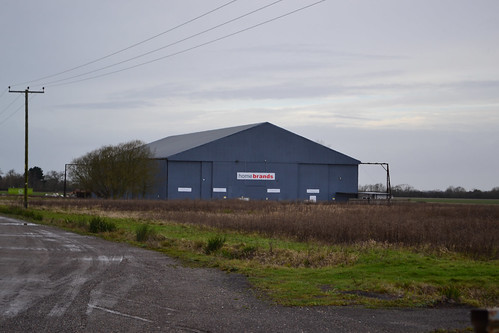
RAF Wratting Common

The only B1 hangar built at Wratting Common still survives today.

Designed to take just over 2,000 males and 348 female staff, it had 10 domestic sites  spread about the northern side, these would receive in the region  of 2,500 males of various ranks and 486 females, numbers fluctuating as crews invariably failed to return home and units came and went.

As it was a short-lived airfield, it would have only two operational front line squadrons, No. 90 and No. 195, although other units did use the airfield including: No. 24 Heavy Glider Maintenance Section, No. 273 Maintenance Unit, No. 1552 Radio Aids Training (RAT) Flight (No 2 Section) and No. 1651 Heavy Conversion Unit (HCU).

The opening of the airfield was preceded by the arrival of S/Ldr. W. K. Young , who took early control of the site and oversaw the final preparations for the forthcoming crews. Between April and May, construction was completed, defences were set up, and by the end of May the first operational aircraft began arriving. A handover saw a new and permanent Station Commander take over, a change that saw operational sorties begin within a matter of days.

No 90 Sqn, a first World War squadron, had been absorbed by 17 OTU in 1940, and then reformed again in May 1941. They served for almost a year being the only RAF unit at that time to fly the B-17 before being disbanded once more. This pattern of reforming and disbanding was one that 90 Sqn would perform almost perpetually.

Reforming again in November 1942 at RAF Bottesford, they began operations with the Stirling MK.I, transferring to RAF Ridgewell in December where they began to receive the MK.III. Arriving here at Wratting Common, in the last days of May 1943, they would remain here until the October that year before moving off to RAF Tuddenham,

During these five months 90 Sqn would lose 185 aircrew, a figure testament to the problems with the Stirling but also to the dedication of the crews to ‘get the job done’.

The first sortie took place on the night of 3rd/4th June 1943, when ten aircraft carried out a mine-laying mission off the Biscay ports. A rather uneventful mission, it would be one of the few where all aircraft returned safely.

With Bomber Command’s Battle of the Ruhr approaching its final chapter, 90 Sqn would suffer their first casualties on the night of June 21st/22nd, 1943. It was a mission to Krefield, a mission that saw 705 aircraft drop 2,306 tons of bombs on the town destroying almost half of it. It was the largest area of devastation so far of any mission and was preceded by an almost perfect marking from the RAF’s Pathfinders. The night was marred by high losses though, just over 6% of the force being lost, many as a result of night-fighter action. Of these, 90 Sqn got off lightly losing only one aircraft, Stirling MK.III ‘WP-T’ with the loss of all seven crewmen, a crew that included both an Australian and a Canadian airman.
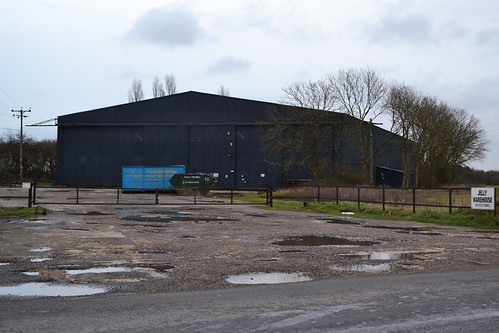
RAF Wratting Common

One of the remaining five T2 Hangars still in use at Wratting Common.

By the 26th, just four days later, another five aircraft had been lost with only four survivors; a hefty blow that took the lives of thirty-one airmen whilst in their prime.

A new month proved little better, on the night of 3rd/4th July, three more aircraft would be lost, one ‘WP-F’ returning beaten up overshot the runway without thankfully, loss of life. The remaining two aircraft were lost over Belgium and Germany, with only one crewman surviving, captured by ground forces and surviving as a POW.

July would see a both further losses and 90 Sqn returning to Hamburg no less than three times before the month was over. Bomber Command’s tactic of area bombing would now turn from the industrial heartland to the city of Hamburg, and its enormous ship building works. Hamburg would of course become well-known for a number of reasons, the destructive firestorms that would devastate the town, the first joint efforts of the USAAF and RAF, and the use of ‘Window‘ for the first time.

Surprisingly during these raids, 90 squadron would have a rather uniquely ‘clean bill of health’, especially considering the nature of the target. Hamburg would not be easy, attacking at heights of around 13 – 16,000 feet, they would be dropping a mix of high explosive and incendiary bombs, well below the height of other squadrons. On the first night 24th/25th July, all 90 squadron aircraft would return to base, a night that was followed by the loss of one aircraft (Stirling ‘WP-S’) to Essen, before they returned to Hamburg on the 27th/28th.

The loss of this Stirling ‘S-Sugar’ was significant in that it was piloted by the Squadron Leader, S/L. Joseph Dugdale DFC, (s/n 39071). Presumed lost over the sea, the aircraft also had two New Zealanders and an Australian on board, one of which was washed up on the Norfolk coast along with two other members of the crew.

After attacking Hamburg, and damaged by flak, Stirling BK693 ‘WP-A’  would limp back to England landing at nearby RAF Stradishall, where it swung off the runway hitting another Stirling parked at a dispersal. The only 90 Sqn loss that night, it would set a precedent for the third and final attack of the month. Returning the next night, 777 aircraft would fly in from the north of the city, attacking areas so far not damaged by allied bombing. This raid would not be considered one of the RAF’s most ‘successful’ though, the bombing ‘creeping back’ some four miles into residential areas with huge loss of civilian life. Of the 119 Stirlings sent out that night, only four were lost, the only casualty of 90 squadron being ‘WP-F’ which took off at 22:00 hrs, crashing out of control without loss just after.

These light casualties, gave 90 Sqn one of the best records of No. 3 Group, a record that continued to the end of July and the closure of the Battle of the Ruhr.

At the end of July, Wratting Common was visited by an American airman. In rather less than ideal circumstances, Major William Julian of the 83rd FS, 78th FG, based at  Duxford, made a  wheels up landing in his battle damaged P-47 #41-6628, ‘HL-R’. The aircraft would eventually be recovered and repaired only to suffer a similar fate later on. July had been a busy month at Wratting Common!

August 1943 brought the change of name to the airfield, but no change in operations. Missions included Nuremberg, another return to Hamburg, Turin (famous for the VC awarded to Flt. Sgt. Arthur Aaron), and now for the first time, the rocket research establishment at Peenemunde. It was also a time when Sir Arthur Harris turned his attention to Berlin, the heart of the German Reich. A city heavily defended and a long way into occupied Europe, it was going to be difficult for Bomber Crews, and 90 Squadron’s run of luck could be about to falter.

During the short period of late August and early September 1943, 1,600 sorties would be flown to Berlin, and if the German’s determination to survive was going to be seen anywhere, it was going to be in their fearless defence of the capital.
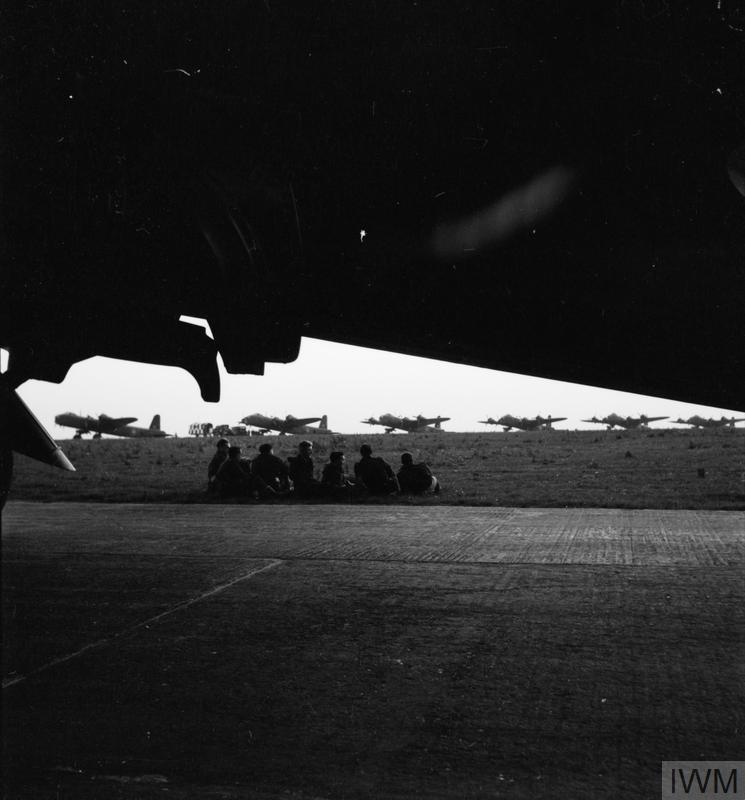
The crew of a Short Stirling Mk III, No. 90 Squadron by their aircraft on a hard stand north of the main runway at Wratting Common, watch as other Stirlings of the Squadron prepare for the night’s operation, a raid on Berlin. (@IWM CH10900)

On the first night of August 23rd/24th 1943, two 90 Squadron aircraft were lost, one ditching in the sea just off the coast near Cuxhaven north-west of Hamburg. After spending 7 days, 16 hours and 10 minutes in their dingy, three of the crew were rescued, the remaining four having been killed*1.

A second Stirling, EH937 ‘WP-S’ was also lost that night. Piloted by Flt. Sgt. Kenneth Longmore, (s/n 413622) an Australian and hairdresser by trade, it crashed in the Ilsselmeer, a stretch of water north of Amsterdam. The aircraft, along with all its crew, were lost at 20:37, three being killed and four classified as ‘missing’.

The path to Berlin was lit by Pathfinders, and of the 727 aircraft sent, 124 were Stirlings, the loss rate for the mission being just short of 8% in total.

The crew of a Stirling are debriefed by an intelligence officer after the costly night raid on Berlin, 23/24 August 1943. © IWM (CH 10804) Can you identify any of these men?

A further loss of a single aircraft on the night of 27th/28th August led to a return to Berlin, and another night of heavy losses for Bomber Command. The Stirling loss rate alone being 16% of the force. Luckily 90 Squadron themselves came off ‘lightly’ once more, losing only one aircraft that night, Stirling MK. III ‘WP-Q’ piloted by W/O. Martin P. Callaway RAFVR, (s/n: 155479), who was only 20 years old.

A third raid to Berlin, saw the withdrawal of both Stirlings and Halifaxes from these duties, their losses being too high compared to those of the Lancaster. The Germans now employing a range of tactics to illuminate the night sky, allowing the night fighters to pick the bombers off almost at will.

There then followed a period of relative calm, until at the end of September, when on the night of 22nd/23rd, 90 Sqn returned to Hannover. A raid that would perhaps be recorded as one of their worst. Between 18:50 and 18:54, three aircraft would depart Wratting Common, one ‘WP-K’ would not get far, its starboard engine catching fire shortly after take off causing the laden bomber to explode at a height of 500 feet. All but one of the crew were killed instantly, whilst the seventh, F/S. Duffy, later died from his injuries.

Of the remaining two aircraft, one was brought down by night fighters over the target, with the loss of all on board, and the third, badly beaten, limped backed to England crashing at RAF Lakenheath in  Suffolk. Two crewmen survived as prisoners, parachuting from the aircraft after confusion arose when the pilot lost control of the Stirling – the remainder of the crew being either killed or injured. For airmanship and courage Sgt. Jones was awarded the Conspicuous Gallantry Medal whilst W/O Denton was awarded a DFC, and Sgt. Suddens a DFM.

By October 1943 the Stirling’s days were numbered, and orders had come through for 90 Sqn to depart Wratting Common for RAF Tuddenham. Crews began to pack and aircraft were readied for their eventual departure. On the 12th a final air test would be carried out on Stirling EP426 ‘WP-W’  and it would not go well. A full crew watched aboard as the pilot W/O. George R. Hilton(s/n: 158247) RAFVR tried to land the aircraft with the starboard outer engine feathered. The landing was a disaster and the resultant crash killed all but one of the crew, Sgt. J. Moran the rear gunner being injured. With that 90 Sqn departed Wratting Common taking with it a record that was one to be proud of, but as part of Bomber Commands overall  strategy, it certainly had paid a high price.

For around six weeks the airfield was, flying wise, very quiet, final departures and preparations for new arrivals were made. At the end of November a new unit would arrive, bringing back the mighty Stirling to this open and cold station once again.
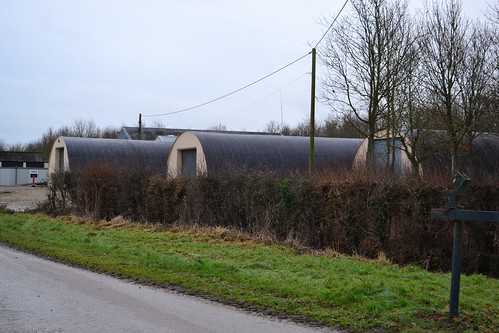
RAF Wratting Common

Nissen huts once used by technical staff are now part of the farm complex.

1651 Heavy Conversion Unit (HCU) were one of three such units still operating the Stirling, the remainder having switched to Lancasters or Halifaxes previously. Whilst at Wratting Common, 1651 HCU would convert crews to four engined heavies, a task much-needed as the toll of recent attacks on the German heartland was beginning to bite. Now withdrawn from front line bombing duties, Stirling crews were feeling a little pushed out, often left by the crews of Lancasters and Halifaxes who rose to the higher levels to avoid the fighters and flak. The conversion to Lancasters by Bomber Command was long and slow, the poor winter of 1943/44 playing a large part in its delay, restricting flying hours and crew training. Once ‘passed’ on Stirlings, crews would go to Lancaster finishing Schools, honing their skills on a much more adored aircraft.

The HCU would remain here for a year, suffering its own share of problems and accidents. Within the first week one Stirling would crash just 20 minutes after take off whilst on an emergency approach to nearby RAF Downham Market.  After losing power the aircraft spun violently crashing into the ground. Thankfully and very remarkably, all the crew escaped with minor injuries.

In June 1944, the renowned undercarriage of the Stirling would lead to problems for the ground crews of Wratting Common. On the night of 6th June, Stirling BF473 landed on the runway at Wratting Common whereupon its port tyre burst. On departing the aircraft, leaving it to the ground crews to recover, the crew left and headed back for their debriefing. Just a few minutes behind them though, was Wellington JA619 of 69 Squadron at RAF Northolt. Suffering engine trouble, the Wellington made an emergency approach unaware of the huge obstacle that lay ahead. The two aircraft collided, creating a huge fireball that took both RAF and local fire crews several hours to extinguish. In the incident, two of the Wellington crew received injuries and a further two were killed, their bodies were not recovered until the next morning after the fire had been put out.

Further training and minor accidents continued, July 1944, saw one major loss with the crash of Stirling MK.III LK565 ‘QQ-R’. Whilst banking, the pilot F/S. DH Wilson lost control of the aircraft causing it to crash killing all eight on board; the eighth man being an additional navigator.

The year progressed and more crews were turned out. Spares for the Stirling became scarce and eventually the HCU was itself to convert to the Lancaster, the Stirlings later being disposed off. With that, 1651 HCU pulled out of Wratting Common leaving only a front line Lancaster Squadron, who arrived eight days previously, the  only operational unit using Wratting Common.

195 Sqn, previously a Typhoon Squadron, had reformed at Witchford from ‘C’ flight of 115 Squadron. Flying the Lancaster MK.I and III, it arrived at Wratting Common on November 13th 1944, staying until August 1945 where upon it was disbanded.

By now the RAF bomber crews had all but total control of the skies, carrying out a number of raids in daylight such was the state of the German defences. With attacks on Merseburg, Dortmund, Oberhausen and Hamm, losses were low, around 1%, considerably lower than figures previously seen. The high morale of bomber command was about to take a battering though, in the daylight raid on the 12th December 1944 on Witten, a town that had seen extreme violence on the night of Kristallnacht of 9th/10th November 1938.

During the raid a force of 140 Lancasters from 3 Group attacked the steel works of Ruhrstahl, which made steel used in the production of aircraft, tanks and other armaments. In the attack, nine Lancasters were lost and the steel works were missed by bombs. Of these, 195 Sqn lost four Lancasters: HK697 ‘A4-C‘; NG351 ‘JE-E‘; PB112 ‘JE-H‘ and PB196 ‘JE-D‘. One crew survived a crash landing, two other crewmen were taken prisoner but the remainder were all killed – a terrible night for Bomber Command and for 195 Sqn in particular.

As the war neared its conclusion further raids were carried out, losses fell as defences weakened, a mix of both day and night sorties saw operations to Munich, Duisburg, Dortmund, Dresden and once again Berlin. 195 Sqn’s last operational bombing sortie took place on April 24th 1945, following which they took part in Operation ‘Manna‘, dropping food supplies to the starving Dutch people.

After this, 195 Sqn began the operations to bring home the many POWs in Operation ‘Exodus’, a task they took great pride in. On May 7th 1945, the last flight took place from Wratting Common and the squadron was disbanded on August 14th. No longer required, Wratting Common airfield was closed, and within eight months its hangar doors were shut for the final time, the site then returned to agriculture a state in which it survives in today.
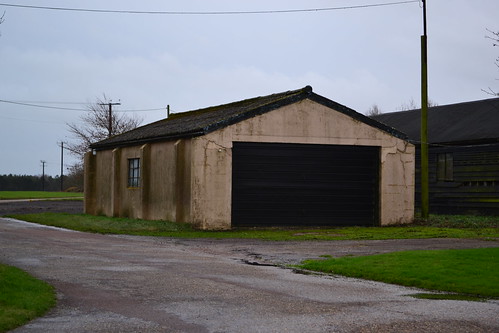
RAF Wratting Common

One of the few permanent buildings left on the technical site.

Wratting Common was a short-lived airfield, its crews took part in many of Bomber Command’s most fierce-some air battles, losing a large number of men in the process. Whilst not the enormous toll we’ve come to expect from bomber squadrons, it none the less suffered the terrible injustices of war, and the loss of life that scarred so many families for so long. Long may they be remembered.

The efforts of the many Bomber Command crews were never forgotten though, and land owned by the Vestey family was donated for a memorial that was organised through the efforts of numerous people. Some of the original buildings have been refurbished and are now used by the local farm, several of the hangars remain also in use by local companies, by using them they are at least preserving them.

If approaching from the Haverhill direction, the first structures you see are the two hangers, a T2 and a B1, either side of the road. The B1 to your left and the T2 to your right, both linked across the road by a former track and dispersal point. There would have been four spectacle dispersal points here, all now removed. A footpath near to this point does cross part of the airfield site, allowing some access to remnants of the perimeter tracks. Continue along this road and then turn right, you will then come across Weston Woods Farm. This is the former entrance to the airfield site and here stands the memorial and a number of buildings owned by the farm. In the distance, you can see a further T2, and a small group of Nissen huts again owned by the farm. This area was once the technical area, stores, Motor Transport huts and a range of technical buildings were plentiful in the late 1940s. Now reduced to nothing more than a handful, they are reminders of the days when the RAF’s heavy bombers graced the site.

A short distance along the road from here was the operations block (now gone) and turning left at the junction, the first of the domestic sites – Site 7. The road between here and the nearby village of Weston Colville are where the majority of these site stood, the basic concrete entrances being the only significant indication of anything being here. The village sign at Weston Colville displays a Stirling indicating its links to the airfield and the domestic sites that once stood on this ground.

With little of this site remaining, a handful of buildings, the memorial and a well designed information board, keep the history of those young men who flew from here in the few short years of its existence alive, their stories shall live on as will the memories of the fight they took deep into the heart of the Nazi homeland.

From Wratting Common we head south again, turning back on our tracks and returning toward Haverhill. From here we continue on with our trail around Britain’s airfields and back once more into the counties of Suffolk and Essex.
RAF Wratting Common

Weston Colville village sign depicts its links with Wratting Common, the village being home to the many domestic sites of the airfield.

Sources, notes and further Reading.

*1 Chorley., W. R., “Bomber Command Losses 1943“, Midland Counties Publications, 1996.

A book of remembrance is thought to be in St Mary’s Church, West Wickham. Sadly on the day I visited, the church was unusually locked.

A website dedicated to those who flew from Wratting Common has a lot of additional information and photographs, it is certainly worth a visit.