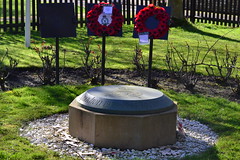
June 16th 1942 loss of Stirling LS-X.

On June 16th, 1942, Stirling LS-X #N6088, took off from RAF Waterbeach in Cambridgeshire, on a routine training flight. On board that day were: (Pilot) P/O. M. Scansie (RNZAF); Sgt. E. Morris; Flt/Sgt. J. Tomlinson; Sgt. D. Robinson; Sgt. J. Smith; Sgt. R. Broadbridge; Flt/Sgt. H. Johnson (RCAF) and Sgt. R. Le Blanc.

At 15:25 the aircraft, a Stirling MK.I of ‘C’ Flight 1651 Conversion Unit (CU), left Waterbeach heading north-westerly. It was to be a routine cross country navigation exercise.

Around forty-five minutes later, the aircraft was seen on fire, and falling in a spiral toward the ground with its port wing detached, outside of the outboard engine. The bomber hit the ground on the Great North Road near to Barnby Moor.

The crew flying the aircraft that day were a young crew, the pilot being 24 years of age, whilst Sgt. Ernest Morris was 19, Sgt. David Robinson – 21, Sgt. Roland Broadbridge – 20, Flt/Sgt. Harry Johnson – 26 and Sgt. R. Le Blanc. the oldest at 27 years of age.

What also made this particular accident more significant was that the Stirling, a veteran of European Operations, had flown for nearly 250 hours on twenty-two operational sorties, a remarkable achievement for a Stirling!

The Stirling would prove to be a poor bomber. Designed to Air Ministry Specification B.12/36 (the very reason it was to be poor), it had to have a reduced wingspan to enable it to fit inside the currently available hangars. This reduction gave poor lift qualities, barely able to achieve more than 17,000 feet when fully loaded. Another restrictive feature was the bomb bay design. Being sectioned it could not accommodate the larger bombs being brought into production as the war progressed, thus it underachieved compared to its stable mates the Halifax and Lancaster. The original specification set out such requirements, and so the design was flawed from the start. It did however, have good low altitude handling capabilities, but this wasn’t enough to secure its future as a long term investment in Bomber Command.

As a bomber, casualties in Stirlings were high, and toward the end of the war it was reduced to secondary operations, an area where it more than proved its worth as both a glider tug, mine layer and paratroop transport aircraft.

Apart from Sgt. Robinson, all of the crew are buried at Finningley, St. Oswalds Church. Sgt. Robinson is buried in his home town Bedlay Cemetery, Lanark.

RAF Waterbeach appears in Trail 11.

Sources and Further Reading.

The crew’s interment along with photos of Raymond Le Blanc are available on the Compagnons de la Libération du Havre website.

Chorley. W., “Bomber Command Losses Heavy Conversion Units and Miscellaneous Units 1939-1947 ” Midland Publishing, 2003.


RAF Sculthorpe – A relic of the Cold War (Part 5)

After Part 4, in this, the final part, we see how Sculthorpe has fared, and what has happened to it now. As a major Cold War player its future is uncertain, but definitely not yet over! Gradually, as nuclear deterrents turned to both missiles and naval based platforms, Sculthorpe’s activity began to slow. Being returned to RAF ownership in 1964, it was eventually placed in care and maintenance once more, held open by only a small detachment of support staff. However, all was not yet lost, for later in that same decade, Sculthorpe saw yet another reprieve, when the USAF returned once more, needing a base from which to operate its aircraft whilst other airfields were redeveloped and runways resurfaced. This temporarily brought new life back to Sculthorpe, with American F-4 Phantoms and C-130s operating from here. The RAF, needing a similar facility, also used Sculthorpe as a temporary base, Coltishall for example, basing their Jaguars here temporarily. This process went on well into the late 1980s and Sculthorpe became a mecca for plane spotters for at least another few years. Eventually all this too ceased and before the final farewell the site was used to store North American Sabres prior to them being scrapped and disposed of.  
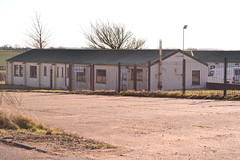
Airmens huts

‘Hut 380’, a Second World War remnant.

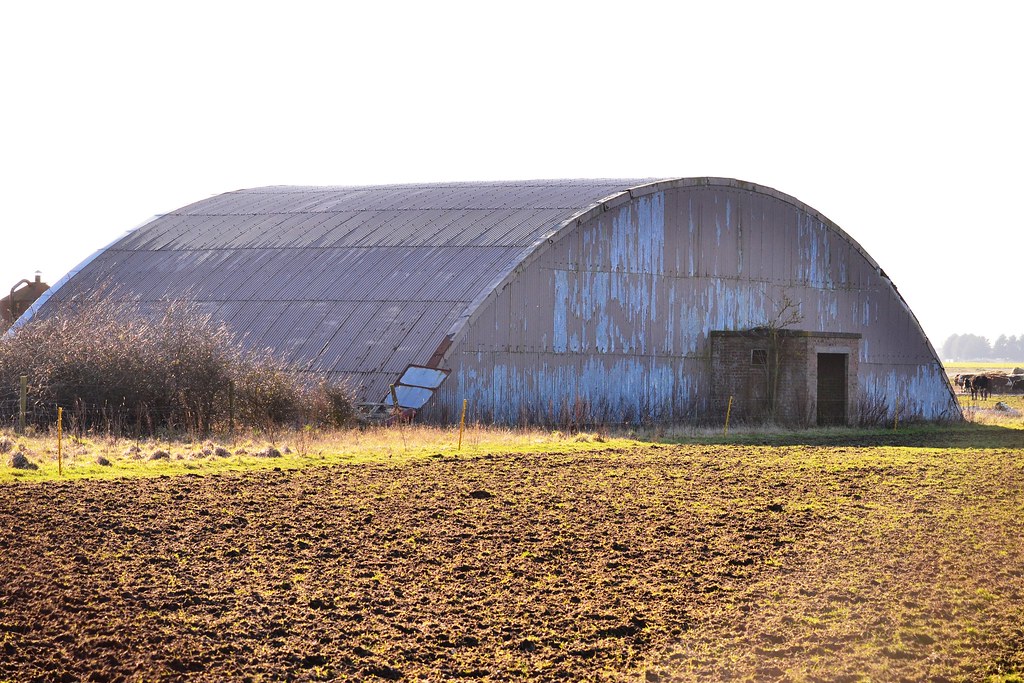
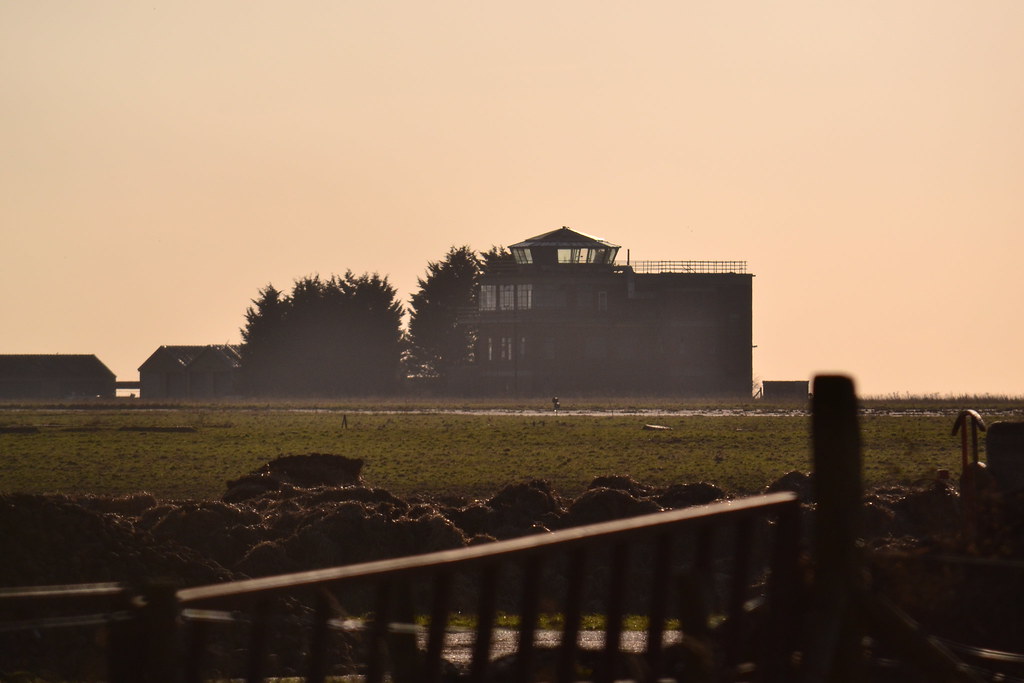
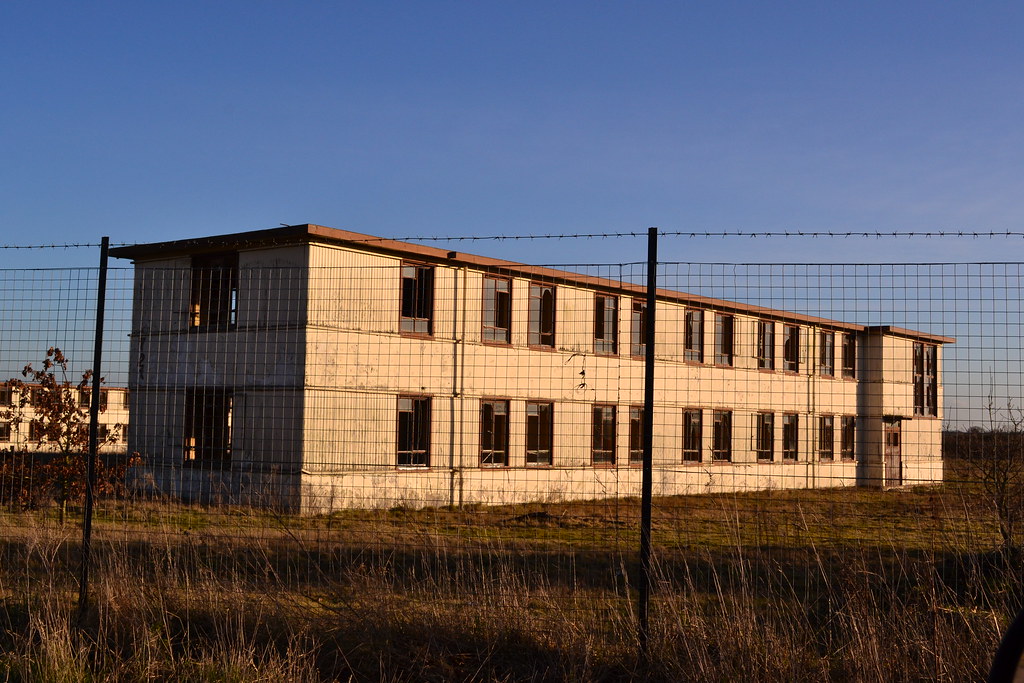
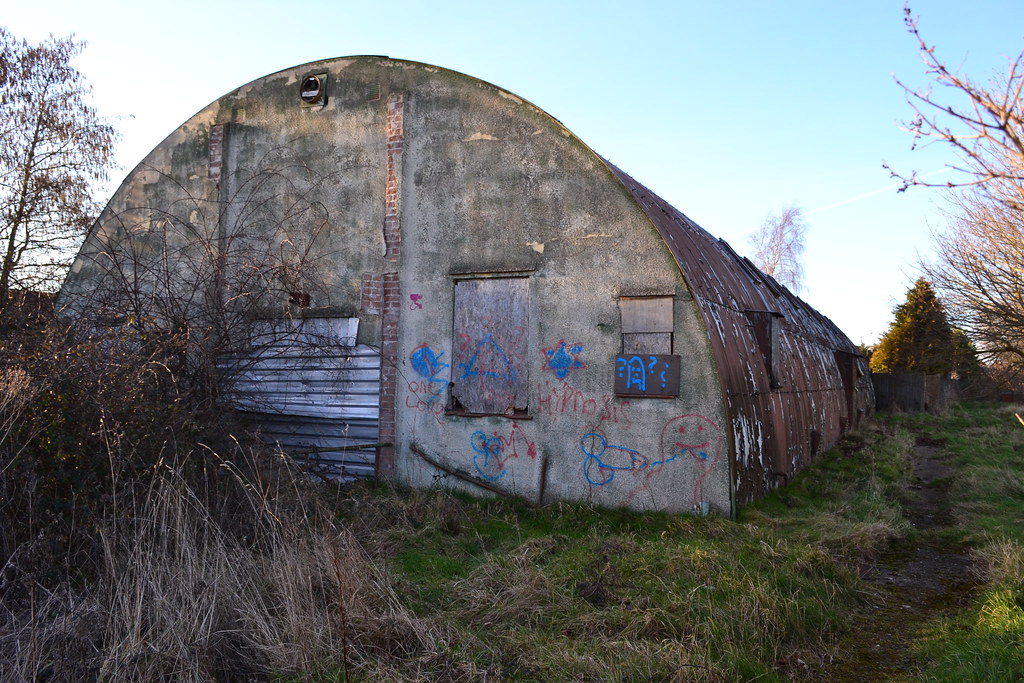
Sculthorpe finally closed its doors in 1992, the enormous accommodation blocks and technical sites were sold off. Both these and many of the remaining buildings were left to decay, whilst planners gave thought as to what they should be used for. However, like a phoenix, Sculthorpe returned from the dead yet again. The RAF, the Army Air Corps and the USAF using it for manoeuvres, seeing such diverse models as the V-22 Osprey tilt wing aircraft, using it for paratroops and rehearsals of supply drops over its enormous runways; much of this activity taking place at night. Even up until recently, C-130s had also been seen operating here, again rehearsing quick ‘stop-‘n’-go’ drops, something that continues in part to this day. The rise in ‘Soviet Aggression’ and post conflict tensions during the Cold War had secured the immediate post-war future of Sculthorpe. Not only were atomic weapons stored here ready, but a wide range of US aircraft that would otherwise not have been seen on British soil, were also based here. The demise of world peace had been the saviour of Sculthorpe’s future. Looking at Sculthorpe, it is hard to believe its origins were in the Second World War. Being a real monster of the Cold War, Sculthorpe is clinging on by the skin of its teeth. The accommodation blocks that once housed 10,000 personnel are decaying and vandalised, refurbished areas are now sold off and accommodating local families. A small industrial area has been developed from the technical area, and the local farmer grazes his cattle on the far reaches of the site. Many of the older original buildings have been left to rot and fall down. The American authorities still retain some ownership of the site, whilst a large part of it is in private hands, such ownership does prevent some access but a good deal of the site is visible from permissible points. The original guard-house is no longer manned, and a number of other buildings close by are also empty. A small public track that once took eager plane spotters to the rear of the airfield, still allows views across the north of the now quiet site where a blister hangar continues to stand alone. The control tower is still intact visible in the distance from this point, as are a number of original Nissan huts and Second World War buildings hidden amongst new buildings and old developments.
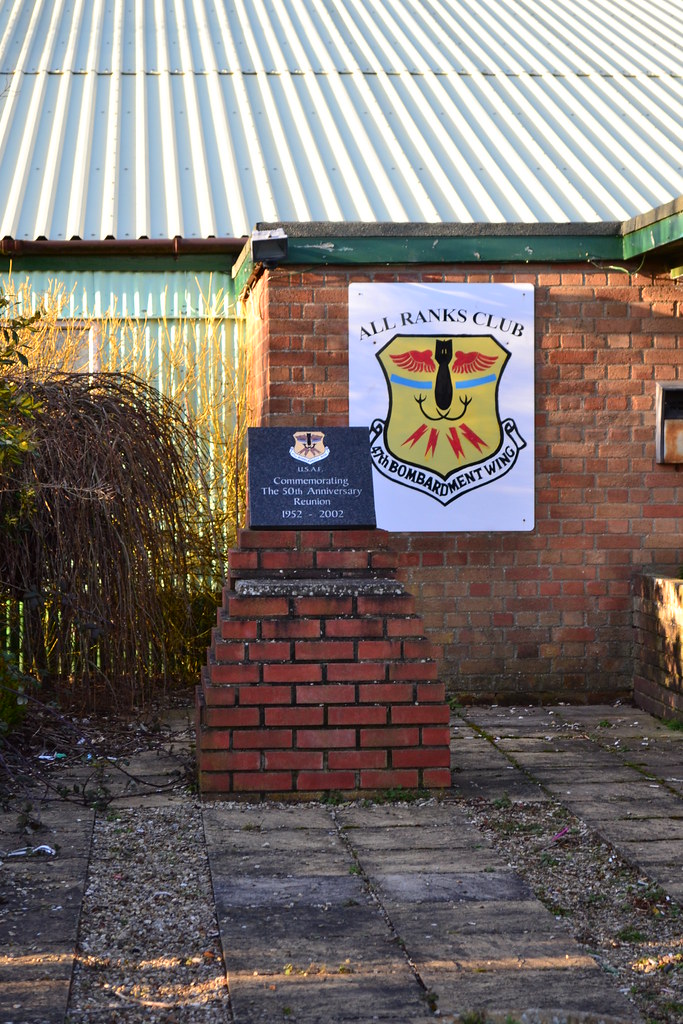
Reunion 'memorial'

In remembrance of the 47th BW, 50th anniversary reunion, 2002.

The post war ‘All Ranks Club’ houses a small exhibition of artefacts and information about Sculthorpe, depicting its post war life, and includes many interesting photos. The exhibition is open at certain times throughout the year allowing visitors to view them and talk to the volunteers some of which actually served here at the base. Sculthorpe was once a bustling airfield, it was home to some of the world’s heaviest bombers, and a mecca for aviation enthusiasts and plane spotters alike. Today, it is a decaying industrial site, a mix of old buildings and new developments; a remnant of the Cold War, it clings on to life by the skin of its teeth, maybe, just maybe, the Phoenix will rise up once more and spring into life once again. The full history can be seen in Trail 21. Sources and further information. *1 National Archives – AIR 27/1924/17 *2 Gunn, P.B., “Flying Lives – with a Norfolk Theme“, Peter Gunn, 2010 *3, *5 Cahill, W. “The Unseen Fight: USAAF radio counter-measure operations in Europe, 1943 to 1945” Journal of Aeronautical History Paper, 2020/06 *4 21 Sqn ORB Summary of Events 1943 Oct 01 – 1943 Nov 30, AIR 27/264/19 *5 Cahill, W., “The Unseen Fight: USAAF radio counter-measure operations in Europe, 1943 to 1945” Journal of Aeronautical History, Paper 2020/06 *6 The Spyflight Website which gives considerable detail into the flights. National Archives: AIR 27/1924/19; AIR 27/1935/19; AIR 27/1326 Photos of Sculthorpe in its heyday can be seen on the Sculthorpe  Air Base website. Further information and personal stories can be found on the 214 (Federated Malay States) Squadron website. Gunn, P., “Sculthorpe – Secrecy and Stealth, A Norfolk Airfield in the Cold War“, 2014, The History Press.

RAF Sculthorpe – A relic of the Cold War (Part 4)

In Part 3, Sculthorpe had been through he war, and was now being developed ready for the arrival of B-29s on 90 day rotations. Their arrival though, was not as easy as they had hoped. The arrival of the aircraft did not all go to plan though, as on July 21st 1949, whilst transferring across from the US, one of the B-29s #44-62191 ‘suffered problems’ 2 miles east of Wisbech in Cambridgeshire. The aircraft, a Boeing B-29A-65-BN, had a crew of twelve on board, but it soon became clear that they were not going to make it, and so decided to abandon the aircraft and leave it to its fate. All twelve of the crew successfully departed the aircraft landing nearby, but in doing so, two of them sustained serious, but not thought to have been life threatening, injuries after exiting. The worst, suffered by the pilot, was a possible fractured skull, whilst the second crewman suffered a fractured leg; it is believed both airmen made full recoveries. The aircraft itself ultimately crashed, landing in a field east of the small Fenland market town. The remains were quickly retrieved and some parts have since ended up in the local Fenland and West Norfolk Aviation Museum located in Wisbech. The lack of constant use however, meant that much of the accommodation at Sculthorpe had deteriorated to an unacceptable level. Damp and rot had set in and more work was now needed to bring it back up to standard before further deployments could take place. Even as this was being carried out though, bombs and other supplies were quickly beginning to arrive, and soon Sculthorpe was ready to allow an American foothold on British soil once more. Further temporary deployments included both the 92nd and 98th BGs, each also flying B-29s that were capable of dropping atomic weapons should the need arise, thankfully, this requirement wasn’t needed and at the end of each deployment the units moved on to other theatres or their home bases back in the United States. These regular ninety day duty rotations became a bit of a saviour for Sculthorpe, with other aircraft like the mighty B-36 ‘Peacemaker’ and the North American B-45 ‘Tornado’ finding themselves located here. Acting as the front-line bombers designed to attack Soviet targets from the UK, they became a major deterrent in the dramatic face off between East and West.
Blister Hangar

Sculthorpe’s remaining Blister hangar in a low setting sun.

Further cold war tensions saw in 1952, the deployment of the 47th Bomb Wing (formally the 47th BG) of the Strategic Air Command from the United States. This wing consisted of the 84th, 85th, and 86th BS, along with the 420th Refuelling Sqn and the 19th Tactical Reconnaissance Sqn. These units operated a number of aircraft types including the: B-45, B-66, KB-29, KB-50, and RB-45C aircraft. The 47th was activated on March 12th 1951, initially as the 47th Bombardment Wing (BW) but with just two squadrons – the 84th and 85th. As a new unit, it had the honour of being not only the first, but the only jet powered medium bomber Wing in the US Air Force. With NATO becoming more established and nuclear weapons arsenals expanding at a great rate of knots, the 47th were posted to Sculthorpe to provide an airborne nuclear strike force in support of NATO forces  who would be operating on the ground in any future conflict. A year later, a third squadron would arrive to join the Group, that of the 422nd BS. Within a month or two of its arrival though, the unit was re-designated as the 86th BS a move that brought it in line with its two sister squadrons. For three years the 47th would operate out of Sculthorpe acting as a nuclear support unit for NATO forces in Europe. Coinciding with the arrival of the US Wing in 1952, was the formation of the ‘Special Duties Flight Sculthorpe’. This was a British unit, led by Squadron Leader John Crampton (who replaced the initial choice Sqn. Ldr. Micky Martin of the ‘Dambusters’ fame, as he had failed a high altitude medical examination)  and was designed to perform deep penetration flights into Soviet airspace carrying out reconnaissance missions for Britain’s planned ‘V’ Bomber force. This was also used as a cover for covert US operations. Only two such flights were made, each with three aircraft; the first on 17th/18th April 1952, and the second on 28th/29th April 1954*6. These flights were performed by British crews flying American RB-45Cs with their US markings replaced by British roundels. A political ‘loop-hole’ that prevented US aircraft flying over Soviet territory allowed British aircraft to do so. These flights took place under Operation ‘Ju-jitsu‘, with four aircraft which were leased from the US 91st Strategic Reconnaissance Wing. Initially three routes were chosen, one of which took the aircraft close to Moscow. To ‘protect’ crews, they were issued with false papers and maps, and told, if caught, to explain  that rather implausibly, they had simply become incredibly lost! After these flights, which weren’t totally without mishap, the crews were congratulated by General LeMay, and the unit was then disbanded. However, it was reformed again, also at Sculthorpe, in 1954 (after a second such temporary reformation in September 1952) and a second flight was made. This time the Soviets were ready for them, after having evaluated their air defence network they were far better prepared and the crews were at a much greater level of danger than during their initial flights. It has since been revealed that Soviet aircraft were instructed to ram the RB-45Cs as they had no suitable radar with which to track the intruders. However, no such contact was made, and whilst flak was now the problem, it was generally ineffective, but sufficient to make the crews on board make a hasty return to the West where they received more fuel before returning to Sculthorpe. The unit was then again disbanded and all flights by them ceased. The RB-45Cs now being outdated, were too slow and obsolete to perform such high risk flights over soviet territory.
Control Tower

The watch office in a setting sun

Meanwhile at Sculthorpe, the operations of the 47th BW were gradually being taken over by other branches of the US Strategic Air Command (SAC), this take over reached such a point that inevitably the 47th were withdrawn and transferred home to the US. Once here, they were dissolved, and on February 8th 1955, the wing was removed from the US military inventory and their remarkable achievements condemned to the history books. After this, political talks and imposed de-escalation strategies between the Cold War factions, prevented further deployment of large-scale US bombers on European soil, and so further deployments on this scale would not be seen again in the UK. As the Cold War subsides, Sculthorpe’s future become uncertain, but it is definitely not yet over. In the last part we see how Sculthorpe has fared and look at what the future holds now. The full history can be seen in Trail 21.

RAF Sculthorpe – A relic of the Cold War (Part 3)

In Part 2, we left with the winter of 1942-43 arriving along with a special visitor. The harsh winter of 1943-44 would see a special visitor come to Sculthorpe. Wing Commander Leonard Cheshire arrived to discuss, with Pickard, the plausibility of dropping food and clothing to his brother in Sagan (Salag Luft III) using the Mosquito. Cheshire knowing Pickard’s vast experience, thought he was the ideal person to speak to. Whether this was a personal effort to provide comfort to his brother or whether Cheshire was considering the Mosquito for low level precision attacks is not known, but the latter befell the Wing not long after Cheshire’s visit. The December of 1943 would bring major changes here at Sculthorpe. On New Year’s Eve, the Wing, along with Pickard and all three Mosquito squadrons, would leave the Norfolk site, taking their Mosquito VIs to RAF Hunsdon. A much smaller airfield, where the overcrowding experienced at Sculthorpe must have been considerably worse. It was from Hunsdon that Pickard would famously make his last flight. A story goes that Pickard had left his dog ‘Ming’ at Sculthorpe to be looked after whilst he was away. On the day he was shot down, 18th February 1944, on the Amien raid, the dog fell gravely ill. Pickard’s wife, Dorothy, went to get him and sensed that Pickard had been killed after seeing the state of the animal. It took months for Ming to recover, and some years later whilst living in Rhodesia, Ming went outside, looked up to the sky as he always did when Pickard was flying, heard a whistle, collapsed and died.*2 The departure of the Wing effectively left Sculthorpe with no operational units, until on January 6th 1944, when a new and very different squadron began to move in. Crews from 214 (Federated Malay States) Squadron based under 3 Group at Downham Market, arrived in two waves, the initial group coming across in early January 1944, whilst the main body continued  operations flying their Stirling bombers. Those that arrived here quickly settled in, but a lack of decent paths meant that initial training was mixed with the unenviable task of digging and laying of new paths. Whilst attending lectures and link training were the primary tasks for the pilots and Flight Engineers, the gunners and other aircrew were given the more ‘practical’ task of constructing the new paths ready for the remainder of the squadron’s arrival. Then on the 25th, the remaining crews and staff of the squadron departed Downham Market, thus ending their link with 3 Group. Once here, flying circuits and more lectures became the order of the day. Additional training on ‘Monica‘ equipment, fighter affiliation tasks and local cross countries then took the squadron to late spring at which point operations began to take place. The arrival of 214 Sqn heralded more than just a new bomber squadron though, for they would not be flying the Stirling as they had been; instead, they were set up as part of 100 Group, becoming an official member in mid January 1944. Their arrival here would not only see them change Groups but would also see them convert to the American built B-17 ‘Flying Fortress’. Now designated 214 (BS) Sqn,  214 Sqn’s  arrival would bring a major change to Sculthorpe, a change that would continue for the next five months. Operating in the Electronic Warfare role within 100 Group, they would carry out radio jamming operations, an early form of Electronic Counter Measures (ECM). The urgency of the conversion, led to the unit taking on fourteen UK based B17-Fs , their ordered ‘G’ models being used as a trade off*3. The British B-17 (designated Fortress I, II and III) crews were joined by personnel from various U.S. units. Their role was to train and support the air and ground crews in both flying and maintaining the new aircraft, a role they performed well, right into the early summer of 1944. The set up was so successful that American personnel were soon posted in to fly alongside the RAF crews, thus expanding the influence of the Group.
Technical site buildings

A large part of Sculthorpe has been left to rot, piece by piece.

Flying along side other bomber formations, 214 squadron would use systems including ‘Monica‘ to track or jam enemy radar, they performed ‘spoof’ missions to entice enemy fighters up to them rather than the main force that was attacking targets elsewhere; a rouse that worked well initially. Other operations flown by the Group, included: jamming or swamping German radio communications, jamming navigation aids and searching for new signals that may suggest new or improved German radar.*3 The successes of 100 Group, prompted the setting up of the U.S. 803rd (Prov) BS (H) in March that year, a US Group who would learn from and perform in the same role as 214 Sqn. Initially taking six veteran crews, all having reached 25 missions, from 96th BG at Snetterton Heath combined with those already at Sculthorpe, they would soon build up to a strength of twelve aircraft all based here at the Norfolk airfield. Of these initial six all but one were fitted with Carpet and Mandrel jamming equipment, whilst the sixth (B-17G) had jammers and search equipment in the form of SCR-587 and Hallicrafters S-27 VHF signals intelligence receivers (SIGINT) to track Luftwaffe radar and radio transmissions.*5 The initial set up of the unit was seen as ‘messy’ and disorganised with no real focus. This led to delays in preparation, organisation and training. As D-day appeared over the horizon, the U.S. group was distinctly lacking in preparation and action was needed fast. To assist in the training and operations of the Fortress, a new separate unit was also set up here at Sculthorpe. From April 24th 1944, 1699 (Fortress Training) Flight who operated each of the Fortress I, II and III, carried out the conversion and training role for these crews, and to speed the process up, they also used the B-24 Liberator along with some smaller examples such as the Avro Anson and Air Speed Oxford. Then, five months after their arrival, both 214 Sqn and the 803rd were both posted out to RAF Oulton, (May 1944), where they continued with their ECM roles. The 803rd, now commanded by Lieutenant Colonel Clayton Scott, began to work on the support of Operation Overlord, and even as late as June 5th, equipment was still being fitted to the aircraft. The Fortress Training Flight moved with the two ECM units and in October it was disbanded and immediately reformed as 1699 (Bomber Support) Conversion Unit, a designation it used for a year before being renamed once more. The departure of the three squadrons (along with the resident non-flying units) was not a coincidence, for Sculthorpe had been earmarked for redevelopment into a Very Heavy Bomber base (VHB). As soon as the personnel had moved out, workmen moved in, taking up residence in the now empty nissen huts.
Accomodation Block

Barrack Block

There then followed a period of sustained redevelopment. This included the removal and reinstatement of longer runways along with the construction of twelve very heavy bomber hardstands. Surrounding public roads were also diverted and further properties were demolished to make way for the airfield’s new expansion. The driving force behind this move was the anticipated deployment of the enormous Boeing B-29 “Superfortress”, but when the war in Europe came to an end a year later, further development of Sculthorpe ceased and the B-29s never arrived as permanent residents. For the next 3 years or so, the station was basically closed, it was placed into care and maintenance with only occasional use keeping it alive; one such operator being the 1510 Beam Approach Beacon System Flight (BABS) based at nearby Bircham Newton. However, four years after the war’s end, between May and August of 1949, the airfield got a reprieve, when the 344th BS, 98th BG, USAAF did bring B-29s to Sculthorpe for the first of a number of several 90 day deployments. The first of these temporary postings were in response to the growing Soviet aggression in Eastern Europe. Identified as one of only a few sites suitable for the heavy bomber, the reprieve led to further development of the site with new storage facilities being constructed. The focus of these buildings were specifically to house and prepare atomic bombs ready for use should Anglo-Soviet relations deteriorate to a war status. In Part 4, as the Cold War warms up, Sculthorpe becomes a major player in the front line of a potential European war. The full history can be seen in Trail 21.

RAF Sculthorpe – A relic of the Cold War (Part 2)

In Part 1 we saw how Sculthorpe was developed in the mid war years but had not lived up to expectations. Two squadrons were about to move in, 464 and 487 neither of whom were overly impressed by its lack of comfort! 487 were the first to transfer. On the 19th, the advance party left Methwold followed in the early afternoon of the 20th by the main road party. The aircraft and crews then transferred over an hour or so after that.  On the 21st the aircraft of 464 Sqn also departed Methwold, the departure tinged with sadness as many were sorry to be leaving what had been a good home. The weather typical as it is, once again closed in, and several aircraft had to try two or three times before finally getting down safely at Sculthorpe. Fortunately there were no mishaps and all crews and aircraft arrived safely. By the evening all were unpacked and settling down for the night. The lack of buildings became quickly evident though, a fact made worse by the lack of bicycles, Sculthorpe being so widespread that it meant it was difficult to get around without transport. As a result, more bikes were needed and an order was placed with an urgent request. Coinciding with this, was a memo informing staff, of the impending move to form a new headquarters here, a move which would see both new recruits along with an increase in staffing levels. This was a further worry as there was still insufficient accommodation for those already here.
Bomb store

Sculthorpe’s bomb store.

The month ended on a better note however, with good weather, night sorties and training on new equipment gave a hint of things to come. A new station Commander also arrived at this time, in the form of Group Captain P.C.  Pickard DSO, DFC, once again hopes for the two squadrons were rising. Pickard’s arrival was by no means a coincidence – a new Wing was being formed and he had been chosen to lead it. Pickard’s record as a leader was outstanding, and he had been hand picked, for the role, by none other than Air Vice Marshall Basil Embry. Pickard’s role here at Sculthorpe was to set up and command 140 Wing, a new unit consisting of three Mosquito squadrons, under the control of 2 Group of the Second Tactical Air Force headed by Embry himself. Even while the new Wing was being formed, training continued for those already here at Sculthorpe. On August 18th, whilst on one such flight, one of the Venturas (AE668) of 464 Sqn crashed into a Welsh hillside at Llandwrog, with the loss of all four crewmen. What was unusual, and concerning, was why the aircraft was so far off course at the time; the Welsh mountains not being where it should have been. It was not known why the aircraft crashed nor indeed whether the deviation of course was a factor in the accident, but it was a heart felt tragedy and the squadron’s first accident whilst at Sculthorpe. Three days after this, on August 21st, the first of the new replacement aircraft arrived, two DH Mosquitoes, a milestone that coincided the following day with the setting up of a Mosquito Conversion Flight. The purpose of the Flight was to convert Ventura aircrew from both 464 and 487 Sqns over to the Mosquito. Flying was slow to start with, as appalling weather prevented any chance of taking off, even in the day-time; a situation that would prevail for some time. By now, the new postings for the surplus gunners of both units had begun to filter through, and gradually, one by one, they trickled out of Sculthorpe to their new respective squadrons elsewhere. It wasn’t  just the aircrew that were being posted out either, a number of tradesmen were also posted out, but oddly enough, they were not being replaced. The distinct lack of skilled technical personnel soon raised alarm bells amongst the units, for as a Mosquito squadron,  487 had no carpenters, and other skilled workers were becoming distinctly lacking. By early September Mosquito numbers had reached well into double figures, the lack of manpower was now the issue which was being made worse by the lack of spares, a situation that led to many aircraft being classed as unserviceable. A common problem seemed to be the undercarriages, repairs taking longer than usual keeping aircraft annoyingly grounded. The 15th September 1943 saw another turn in the status of Sculthorpe, seeing it gain its own independence and becoming an operational airfield in its own right. With this, Sculthorpe had finally grown up. On the 28th, the numbers of aircraft on the books had reached over 70 when another squadron (21) arrived to join both 464 and 487 thus completing the formation of the Wing. The ORB for 464 Sqn stating that the airfield was not built for three squadrons (and a conversion flight) and that overcrowding was now a major issue for those based here at a cold and wet Sculthorpe. 21 Sqn was another Ventura unit, themselves having a history as far back as 1915, and very soon after their arrival, they too, would begin to receive the Mosquito. As with 464 and 487 Sqns, pilots were quickly placed on the conversion course flying with the Conversion Flight at Sculthorpe. The transformation from Ventura to Mosquito being expedited with all speed. By the 4th October, virtually all pilots had converted and completed cross country solo flights at low level. Only the incident on the 1st, when Ft.  Lt. Henderson suffered engine trouble and subsequent fire, marred the otherwise rapid and clean transfer across. In the incident, Fl. Lt. Henderson managed to bring the aircraft down safely at RAF Attlebridge. Other good news for the unit was that those in the administration offices were now able to move from their cold and unsuitable temporary accommodation block to a new permanent building, this new block being the ‘best they had experienced since leaving RAF Oulton‘. Meanwhile 464 and 487 Sqn had both been flying operationally, October 9th being the blackest day yet for the New Zealanders, when twelve Mosquitoes were dispatched for the first operations over occupied territory. An attack on Metz was planned but owing to bad weather only one or two aircraft managed to find the target. After dropping their bombs it wasn’t clear whether the target was hit or not, but worse news was yet to come. The formation, which had been dispersed due to poor weather, was being led by Wing Commander Alan G. Wilson DFC along with his navigator F.O. Donald C. F. Bridgman of 487 Sqn. During the attack the formation encountered severe anti-aircraft fire, and Wilson’s aircraft (HX965) was repeatedly hit. The navigator sustained mortal wounds and the aircraft was set on fire. In a desperate attempt to clear the fire, Wing Commander Wilson had to douse the flames with his hands causing extensive burning and injury. He managed to eject the now smouldering materials from the aircraft, but considerable damage had by now been done. Now flying on his own with his mortally wounded companion beside him, Wilson showed extreme courage and determination, flying the stricken aircraft back to England where he made a successful crash landing at RAF Manston in Kent.
Accomodation blck adjacent to the guard room

Blocks adjacent to the Guard Room.

A second aircraft (HX912), flown by Flt. Lt. Phillip C. C. Kerr and F.O. Bernard J. E. Hannan (464 Sqn) – were less lucky, both being killed when the aircraft dropped its bombs at low level. It is believed the subsequent explosion also blew up the Mosquito. On a separate operation to attack the aircraft engine factory at Woippy in France, Mosquito  HX938 piloted by Sqn. Ldr. Walter F. Wallington DFC and navigator P.O.  James H. Fawdrraf, dropped its bombs by accident  and crashed. This time, both airmen managed to bail out, but some thirty people on the ground were killed. Sqn. Ldr. Wallington managed to evade capture but P.O. Fawdrraf was not so lucky and was picked up by German ground forces. The same fate did not befall two more 487 Sqn airmen that day. Flt. Lt. Edgar W. P. Court and Flt. Lt. Jack B. Sands were both killed when their Mosquito (HX937) blew up whilst flying on one engine near to Antwerp. It had been a very sad day for the Wing, and the loss of several ‘good’ men would be deeply felt by both squadrons. More rain and strong winds eventually turned Sculthorpe into something that resembled a “seaplane base”, by the end of the month, the entire site was waterlogged. The winds were so severe they were reported to have lifted hut roofs off their mountings causing even more problems for those inside. The foul weather broke momentarily on the 22nd – 23rd October and allowed for some bombing practice to take place. On return, one of the 464 Sqn Mosquitoes overshot and crashed onto a hedge at the end of the runway. On the 23rd, one of 487’s Mosquitoes ‘T’ for Tommy, did exactly the same thing, coming to rest only feet from the wreck that was previously a Mosquito. As if that was not remarkable enough, a few minutes later one of 21 Sqn’s aircraft also overshot, landing directly on top of the 464 Sqn aircraft! Miraculously no one was hurt in any of these incidents, but according to 21 Sqn’s ORB “considerable loss of public property sustained“, presumably referring to the pile of wood chippings now sitting at the end of the runway.*4 The fact that no one was hurt was a miracle in itself, and all the cockpits remaining intact was a sight that gave the personnel at Sculthorpe a great belief in the strength of the Wooden Wonder! By October’s end, the crews of all squadrons were now fully conversant with the new Mosquito, and the supporting Conversion Flight was disbanded; specific training units taking on the role elsewhere. In Part 3, the harsh winter of 1943-44 arrives and so does a special visitor. Does it mean something new for Sculthorpe? The full history can be seen in Trail 21.  

RAF Sculthorpe – A relic of the Cold War (Part 1)

In the heart of Norfolk, lies an airfield that had its origins in the Second World War, but its legacy is more of a Cold War monster that was a key player in what could have been the world’s demise. In the second part of Trail 21, we return to that relic of the Cold War – RAF Sculthorpe. RAF Sculthorpe  Sculthorpe airfield is located a few miles to the north-west of the town of Fakenham in Norfolk, in a parish that has links as far back as the Romans and even pre-historic eras. The airfield itself however, has its origins more recently, in the latter part of the Second World War, but it has a much larger claim to fame one that it still retains to this day.
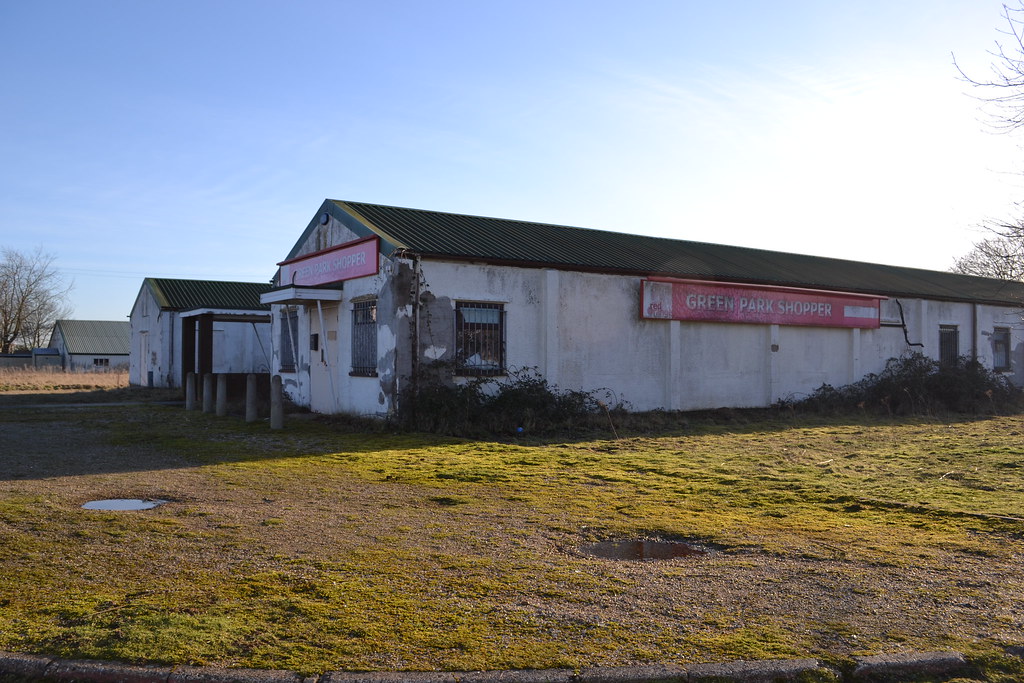
A once busy shop

A once busy shop now derelict and forgotten.

Designed initially as a heavy bomber site, and satellite to RAF West Raynham, Sculthorpe had three runways, one of 12,000ft and two of 6,000ft, and all made of concrete. By the end of its life, it had enormous technical and administration sites and was capable of housing up to 10,000 personnel, giving Sculthorpe the ability to boast being one of the biggest airbases in Western Europe, an honour it retains to this day. Built by a collection of major companies including: Bovis Ltd, John Laing & Sons, and Constable Hart & Co. Ltd; it would boast as many as five major hangars, one B1 and four T2s, along with several blister hangars all located around the site. Although built in the Second World War, Sculthorpe had a limited War life, being opened quite late, in January 1943. Operating under the control of 2 Group, the first users were those of the 11 Heavy Glider Maintenance Section along with 2 Heavy Glider Maintenance Unit, who both moved in as soon as it opened. As non-flying units they prepared, repaired and maintained Horsa gliders, many of which would have been used the following year in the Normandy invasion. These units remained in situ at Sculthorpe for almost a year, departing in mid March 1944. Following an initial year’s development and growth, Sculthorpe finally opened operationally with Boston IIIAs of 342 (Lorraine) Squadron on May 15th 1943. 342 Sqn had originally been set up as a Free French squadron in September 1941, operating in the Middle East with French crews. Their time there had not been good though, with many losses as a result of flying what were now considered ‘out of date’ aircraft – the Blenheim. It was then decided, after talks between the RAF and General Valin, the Commander of the Free French Air Force, to bring these men back and retrain them on more modern aircraft, and so in September 1942, orders from the UK directed many of these airmen back to the UK. Sadly however, during their return voyage, two of the four ships that were used to transport them, were sunk by German U-boats and many of the  personnel were lost as a result. Once in the UK, refresher courses were undertaken with 342 Sqn being officially re-formed, on April 1st 1943, using these French personnel at nearby RAF West Raynham . Once formed, training continued, followed not long after by the first loss, when one of the aircraft attempted an emergency landing after running out of fuel. That aside, the Boston IIIa, or A20, they were now using, was considered a much improved model compared to the Blenheim, with both greater power and better armament, it was far more suited to the role it was about to perform. Following further training, the squadron finally transferred over to Sculthorpe on May 15th 1943, where crews attended lectures on “evasive action and fighter control”. Two further crashes would cost the squadron several more airmen, some of whom were highly experienced and valued members of the unit.  The move of the squadron also signified a change for Sculthorpe itself, as at this time, it ceased to be a satellite of West Raynham – the move to total independence was now a step nearer, albeit temporarily.
RAF Sculthorpe

One of many buildings on site today.

As the saying goes, any port in a storm, and Sculthorpe provided that port. On May 19th, an American B-17 was forced to make an emergency landing at the airfield. On board the aircraft were three injured crewmen, the ball turret gunner, and the two waist gunners. The Ball Turret Gunner was given urgent medical assistance, but unfortunately he later died from those injuries, whilst the two waist gunners, both with frost bite to their hands and ears, thankfully survived. A second B-17 landed some time after the landing and collected the crewmen, transferring them back to their own base where they received further medical assistance. There then came yet another change at Sculthorpe, as the Free French unit was combined with two other squadrons, 88 and 107 to form the new 137 Wing; a Wing made up of both French and British units.  On June 12th 1943, under the new Wing, 342 Sqn’s first operational flight took place, a ‘circus’ raid undertaken in conjunction with 107 Sqn. These types of operations would become the norm for the next month, and whilst there were some losses, they were thankfully light. In mid July, orders came through for the unit to depart Sculthorpe and move to nearby RAF Great Massingham, a move that was well organised and one that went smoothly. By the evening of July 19th all but two aircraft had departed Sculthorpe, and crews were settling in well to their new home. There was no let up at Sculthorpe though, as over the next two days two more squadrons would move in to the now vacant premises. Orders for the transfer of both 464 (RAAF) and 487 (RNZAF) Squadrons were received with mixed emotions though. To make things worse, the transfer of both men and machinery did not go totally to plan and only happened following a change in operations and planning. Both Squadrons had been flying from  RAF Methwold, an airfield not far from Sculthorpe, as light bomber units with Lockheed’s Venturas. They regularly attacked targets in western Europe, often without fighter escort, which resulted in some heavy losses for the units. It was whilst at Methwold that Sqn. Ldr. Leonard Trent would perform so bravely receiving the Victoria Cross for his actions on May 3rd, 1943, with 487 (RNZAF) Sqn. The whole process began in mid June with an initial order requiring 464 (RAAF) Sqn, to move to Dunsfold, however, that move never materialised, the order being cancelled on July 4th. This meant that preparations would stop, and the squadron would remain here at Methwold. They then entered a period of training, the weather having curtailed many operational flights for both this unit and others across the UK. Then on July 10th, the weather broke just enough for an operational flight to be carried out by 464, attacking targets at St. Omer. These were hit with great success; the 487 squadron commander commenting “a wizard piece of bombing”,  but still the squadron awaited, with anticipation, news of its next posting. Then two days later, whilst a contingent of the Australian press where visiting, news came through that the two units were to change its aircraft for Mosquitoes, and that the pilots would be fully trained within 6 weeks. The swap although not what was expected, was generally accepted well by the squadrons, but it brought disappointment for both the wireless operators and air gunners of each unit, who would have no place on board the two-seat ‘Mossie’,  and would have to be transferred out. Following further training, the long awaited news finally arrived. For 487 Sqn it arrived on July 16th, noted as ‘Panic day’, and on July 17th for 464 Sqn. Both squadrons would now transfer over to Sculthorpe. In preparation, 464 Sqn’s station adjutant visited the new airfield on the 19th to assess its condition, but he was not impressed! He reported that “there was very little of it to work in comfort and everything is drastically dispersed.”*1 His aggrieved feelings about the site were further exasperated by a lack of office space, the only silver lining to the whole move, being that more accommodation was apparently ‘in the pipeline’. In Part 2 we see how both 464 and 487 Sqns get on at this dispersed, lacking in comfort site. The full history can be seen in Trail 21.

Sgt. James Ward VC.- 75 (NZ) Sqn RAF Feltwell.

We have seen through the many ‘Heroic tales‘, acts of daring and valour that have astounded the average man in the street. Acts of heroism that were completed without forethought or consideration for personal safety, where the lives of fellow crewmen and their aircraft were put far beyond that of their own.

Some of these included flying an aircraft with astonishing injuries, staying with an aircraft until such times as all the crew have either left – or because they have been unable to leave – remaining at the controls to attempt a landing without help or hydraulics. There have even been cases of airmen exiting the aircraft to extinguish external fires whilst both at altitude and at speed. Indeed this is not a solitary occurrence; a number of airmen have been known to have performed such acts, some successfully others less so. But the fact that an airmen is willing to perform such an act of bravery, is in itself, incredible.

One such action occurred in July 1941 and was performed by 2nd Pilot Sgt. James Allen Ward (RNZAF) of 75 (NZ) Sqn, RAF Feltwell.

Sgt. James Allan Ward, 75 (NZ) Squadron RAF, standing in the cockpit of his Vickers Wellington Mark IC, L7818 ‘AA-V’, at Feltwell, Norfolk. (© IWM (CH 2963)

Sgt. Ward, the Son of Mr. Percy Harold Ward and Mrs. Ada May Ward, of Wanganui, Wellington, New Zealand was born on 14th June 1919, and was, following his training, posted to 75 (NZ) Sqn then at RAF Feltwell in Norfolk. The squadron were operating the new Vickers Wellington MK.Ic, or ‘Wimpey‘ as it was affectionately known, on a bombing mission to Munster in Germany.

Take off was at 23.10 on the night of July 7th 1941. On board (aircraft CNF.994/L7818) that night were: Canadian S/L. R. Widdowson (Pilot); Sgts. J. Ward (2nd Pilot); L.A. Lawton (Navigator); Mason (Wireless Op); Evans (Front Gunner) and A. Box (Rear Gunner), as part of a force of ten Wimpeys from Feltwell along with thirty-nine others from nearby bases.

The flight out was uneventful, with no interactions with either flak nor Luftwaffe night fighters. Over the target, bombs were released and several fires were seen to light, although German reports stated that little damage was done and no casualties were incurred.

The return leg took the formation over the Zuider Zee at which point the Wellington was strafed by canon fire from an Me 110 flying beneath it. As shells ripped though the fuselage, the rear gunner was injured in the foot but managed to return fire sending the attacker plummeting to Earth with heavy smoke pouring from the port engine.

Shortly after this, the Wellington’s wing, housing a fuel line damaged in the attack, itself caught fire and with the aircraft having a fabric covering, it was only a matter of time before it would also fall to Earth in a massive fireball.

With S/L Widdowson struggling to control the aircraft, which had had half its rudder shot away, its elevators severely damaged, hydraulics ruptured, flaps inoperable and bomb doors opened and damaged; a decision had to be made as to what to do next.

A bale out appeared to be the only safe and viable option. S/L. Widdowson gave the order and the crew began preparations to depart the stricken aircraft. Almost as a last minute attempt to save it, Widdowson instructed the crew to try and extinguish the fire, and they began ripping away the fabric covering the geodesic framework. Ward, grabbing a fire extinguisher, shot jets of agent through the hole toward the fire. At altitude and speed, the air stream was far too strong and the attempt had little effect on the burning engine.

At this point, and without attention to his own safety, Sgt. Ward decided to climb out and try to smother the fire with a canvas engine cover that had been used to raise S/L. Widdowson’s seat. Much to the dismay and protests of the other crewmen, Ward grabbed a parachute and attached a rope to himself and the Navigator, and began to climb out through the astrodome located between the wings in the fuselage’s ceiling. By punching holes in the aircraft’s fabric, he was able retain a foot and hand hold on to the aircraft, manoeuvring himself tight against the air frame toward the burning wing.

Once out onto the starboard wing, he approached the fire and pushed the canvas into the hole left by the flames. The fire burning furiously by now, was intense, and caused Sgt. Ward great pain forcing him to withdraw his hand several times before the slipstream finally caught the canvas tearing it from the hole and out into the dark night sky.

Being partially successful, there was little left for Sgt. Ward to do, so he began the arduous journey back toward the aircraft’s fuselage and its relative safety. By smothering the fire as he did, Ward’s attempts had made a difference, and shortly afterwards the fire extinguished itself enabling both the aircraft and crew to return to England safely making an emergency landing at RAF Newmarket Heath.

The Wellington with ‘hand-tholes’ after Sgt Ward tried to extinguish the fire.  (A) The hole caused by shell and, afterwards, by fire; (B) The Astro-Hatch through which Sergeant Ward, VC climbed; (1, 2 and 3) Holes kicked in the fabric by Sergeant Ward.(IWM CH3223)

Landing at 04:30, the Wellington came to a stop only after striking a fence on the airfield boundary, its brakes being totally unusable.

For his action, Sgt. James (Jimmy) Ward was awarded the Victoria Cross, the highest honour for bravery and extraordinary courage; he was the first New Zealander to win such an award during the Second World War. S/L. Widdowson for his actions, was awarded an immediate D.F.C. whilst Sgt. Box, the D.F.M.

At the time of the incident Sgt. Ward was only 22 years of age, he would be given his own crew and would go on to complete ten missions in total before, on the eleventh, being shot down and killed in another Wellington of 75 (NZ) Sqn over Hamburg on September 15th 1941.

Sgt Ward’s death brought a severe blow to the crews of 75 (NZ) Sqn, who perhaps thinking him invincible, went on to perform with great pride and determination in the face of great adversity. With over 8,000 sorties flown, the highest of any squadron in 3 Group, came a high cost, 193 aircraft being lost, the second highest of any Bomber Command Squadron of the Second World War.

Sgt Ward’s body was recovered from the crash that killed him, and along with his three comrades was laid to rest in the Ohlsdorf Cemetery in Hamburg, CWCG Plot 5A. A1. 9.

The report of Sgt. Ward’s VC. (Auckland Library Heritage Collection : 13 August 1941 : Item ref # AWNS 19410813-23-1)

Sgt. Ward’s citation appeared in the London Gazette “No. 35238” on 5 August 1941 p. 4515 and reads:

“On the night of 7th July, 1941, Sergeant Ward was second pilot of a Wellington returning from an attack on Munster.

When flying over the Zuider Zee at 13,000 feet, the aircraft was attacked from beneath by a Messerschmitt which secured hits with cannon shell and incendiary bullets. The rear gunner was wounded in the foot but delivered a burst of fire which sent the enemy fighter down, apparently out of control.

Fire then broke out near the starboard engine and, fed by petrol from a split pipe, quickly gained an alarming hold and threatened to spread to the entire wing. The crew forced a hole in the fuselage and made strenuous efforts to reduce the fire with extinguishers, and even the coffee in their vacuum flasks, but without success. They were then warned to be ready to abandon the aircraft.

As a last resort, Sergeant Ward volunteered to make an attempt to smother the fire with an engine cover which happened to be in use as a cushion. At first he proposed to discard his parachute, to reduce wind resistance, but was finally persuaded to take it. A rope from the dingy was tied to him, though this was of little help and might have become a danger had he been blown off the aircraft. With the help of the navigator, he then climbed through the narrow astro-hatch and put on his parachute. The bomber was flying at a reduced speed but the wind pressure must have been sufficient to render the operation one of extreme difficulty.

Breaking the fabric to make hand and foot holds where necessary, and also taking advantage of existing holes in the fabric, Sergeant Ward succeeded in descending three feet to the wing and proceeding another three feet to a position behind the engine, despite the slipstream from the airscrew which nearly blew him off the wing. Lying in this precarious position, he smothered the fire in the wing fabric and tried to push the cover into the hole in the wing and on to the leaking pipe from which the fire came. As soon as he removed his hand, however, the terrific wind blew the cover out and when he tried again it was lost. Tired as he was, he was able with the navigator’s assistance, to make successfully the perilous journey back into the aircraft.

There was now no danger of fire spreading from the petrol pipe, as there was no fabric left nearby, and in due course it burnt itself out. When the aircraft was nearly home some petrol which had collected in the wing blazed up furiously but died down quite suddenly. A safe landing was then made despite the damage sustained by the aircraft.

The flight home had been made possible by the gallant action of Sergeant Ward in extinguishing the fire on the wing in circumstances of the greatest difficulty and at the risk of his life.”

Sources.

National Archives – AIR 27/645/34, AIR 27/645/33

Auckland War Memorial Museum Website.

RAF Downham Market (Part 1 – The beginning)

In Trail 7, we visited the northern part of Norfolk, not far from the coast where it borders Cambridgeshire to the west and the North Sea to the north and east. In this part of the trail we visit a site that was once one of Norfolk’s most prestigious airfields, where not one, but two VCs were awarded to airmen of the RAF.

Not far from RAF Marham, we return to this once busy airfield to see what is left and take another look at the incredible history that was RAF Downham Market.

RAF Downham Market (Bexwell)

Located in the corner of the A10 and A1122, 10 miles south of Kings Lynn and and 15 miles north east of Ely, RAF Downham Market (known locally as Bexwell) was only open for four years. Yet considering its relatively short life, it created for itself a unique history that was, and remains, unprecedented in military history.

Built by W. & C. French Ltd., it was primarily a bomber station serving initially with 2 Group before transferring to 3 Group and then to 8 PFF (Pathfinder) Group, Bomber Command. Opened as a satellite station to RAF Marham, it eventually became an airfield in its own right, achieving this status on 3rd March 1944, when it became a parent station itself.
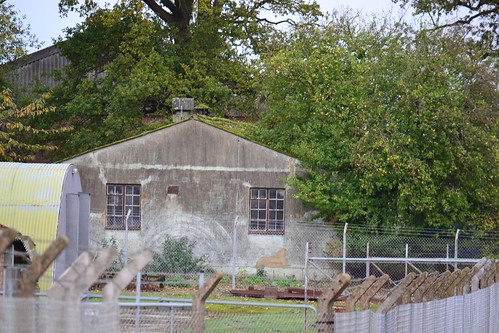
RAF Downham Market

One of the several buildings surviving at Downham Market.

Downham opened in 1942 as a bomber station, a role it performed for the duration of the Second World War. To achieve this, it would require substantial runways and a number of dispersed accommodation sites. As a classic Class ‘A’ airfield, it was spread over a large area incorporating two main sites, the main airfield to the north and the accommodation to the south. It was equipped to accommodate 1,719 male and 326 female personnel at its peak. A network of small roads would link all these dispersed sites together.

Downham would have three concrete runways the main being 1,900 yards long running east-west, whilst the second and third ran north-west to south-east and north-east to south-west, each 1,400 yds long. The classic ‘A’ formed by these runways, was linked by a perimeter track with 36 original pan style hardstands. At its peak, Downham boasted seven hangers, six ‘T2’ and one ‘B1’ which replaced two of the hardstands reducing the number to 34. None of these hangars survive here today. It had the usual bomb store (to the north east), technical area (south side) and eight accommodation areas spread well to the south and south west. As with all these Class ‘A’ stations, the two areas were separated by a public road, the ‘airfield’ to the north and accommodation to the south.

Today, little remains of the actual airfield site, the runways having been removed some considerable time ago. However, on the technical site there are a number of buildings still remaining, and in the accommodation areas further buildings also exist. All of these are either used by local industry or local farmers.

On opening, Downham received its first residents, the Stirling MK.Is of 218 (Gold Coast) Squadron. Arriving on the 8th July 1942, they would retain these aircraft until February 1943, when the new updated Stirling MK.III was brought into squadron service. 218 Sqn had a history that went back to the First World War; disbanded in 1919 they had been reborn in 1936, and were posted to France where their Fairey Battles were decimated by the superior fighters of the Luftwaffe. In November 1940, prior to arriving here at Downham, the squadron joined 3 Group, it remained operational with this Group for the remainder of the war.

On July 6th, they began preparing for their move to Downham, aircraft were stood down and no operational flying took place. On the morning of the 7th, thirteen Stirlings departed RAF Marham, completing the 10 mile straight line flight they arrived at Downham fifteen minutes later. By midnight, the entire squadron had transferred over, and crews were settling into their new quarters. Over the next few days air tests, fighter affiliations and cross country flying were the order of the day, the first operational flight not taking place until the 12th. In Stirling ‘HA-N’ was P.O. Farquharson and in ‘HA-R’ was Sgt. Hartley. A ‘gardening’ mission, only two crews were assigned and briefed but records show that “The vegetables were planted in the allotted positions. 18,000lb of seed were planted during this effort“*1. With that, Downham Market had now entered the war.

Over the next few weeks operations began to build, and targets moved into Germany itself. Lubeck, Vegesack, Duisberg, Hamburg and Saarbrucken were all on the initial list of operations. Apart from early returners due to ice or poor weather, all operations were considered successful and bombing was ‘accurate’.

On 29th July, a royal party visited RAF Downham Market to see how the crews were settling in at the new station. Led by Air Vice Marshall HRH The Duke of Kent, and accompanied by Sir Louis Grieg KBE CBO (ret),  the party were given an official tour of the airfield by Wing Commander P. D. Holder DFC – the Station Commander. After talking to a number of ground crews and watching Stirlings being bombed up, the Royal party then sampled the delights of the officers mess before departing the airfield.

In February 1943, 218 began replacing their Stirling MK.Is with the upgraded MK.IIIs, the last model of the Stirling bomber before they were relegated to other duties. By June, the last of the MK.Is were gone. Although fitted with better engines, the MK.III still remained limited by both its short wingspan and poorly designed bomb-bay.

In the following month a major decision was made to install the still experimental FIDO fog dispersal system here at Downham Market. With RAF Graveley only just having hers installed, the benefits of this system were by now bearing fruits, but despite this, only fifteen British airfields were to have the system installed. FIDO used oil burnt through a series of pipes set alongside the runway. These burners were supplied from large storage tanks, which in Downham’s case, were located to the south-east just off the airfield site. Each tank was filled by road from Kings Lynn, five tankers carrying out two runs each to complete the fill. Oil from these tanks, was then fed into the system – which was installed along the main east-west runway – by large pumps. Once lit, the burners could clear extensive fog or mist in a relatively quick time. The main storage tank site is today a car dealership, all signs of the network of pipes having since been removed.

Downham’s FIDO installation was slow at first, and only covered the initial touchdown area and the first 700 yards of the main east-west runway. A number of burner types were fitted at Downham over a period of time, starting with the MK.III or Haigill burner. These were in turn were replaced y the MK.IV and eventually, when labour became more available, the MK.V which was a sturdier, longer lasting burner capable of withstanding much heavier use.  It wouldn’t be until late 1943/44 that a longer section of the system was installed, now extending to 1,362 yds, almost the entire length of the main runway. The problem with FIDO was always where runways crossed, and here the pipes had to be placed below ground level. Along side the runway they were above ground, and with difficulty in seeing, some aircraft did manage to damage the piping on more than one occasion. With experimental lighting and landings used in the autumn of 1943, the first use of the system was on the night of December 16th/17th that year, when a large number of aircraft returning from Berlin were diverted to Downham due to their own bases being fog bound.

Over 35 aircraft landed at Downham that night, the toll on crews had FIDO not been in existence would certainly have been considerably higher than the terrible price that had already been paid on that disastrous night over Berlin. FIDO with all its counter arguments, had proved its worth in one fell swoop.

The Short Stirling, the first of the heavies for Bomber Command, was liked by many crews, but its short-comings were to become apparent all too soon. One of its problems was its enormous height, created through its huge and weak, undercarriage, which sometimes made landings difficult. Another recurring problem was a significant swing to port when taking off, combine the two features, and you have a difficult aeroplane to control at the best of times, let alone when badly damaged or in very poor weather.

One of the first casualties at Downham occurred on the morning of May 14th 1943, when Stirling ‘BF480’ HA-I piloted by Sgt. W. Carney, swung on touchdown careering off the runway into the Watch Office. No injuries were sustained by those onboard, but two other crewmen on the ground, who had previously landed, were killed in the accident. Coincidentally, another 218 Sqn Stirling, ‘EF367’, HA-G had a similar landing away at RAF Chedburgh at the same time on the same night. Onboard that aircraft there were an American and a New Zealander, all but two of the crewmen were killed, the others  escaping with injuries.

With plans for the invasion of occupied Europe well in hand by mid 1943, movements across Britain were starting to take place. At Downham a number of hangars were used to store Horsa gliders (hence the large number on site) ready for the invasion the following year. Between April 1943 and March 1944 the airfield was awash with stored examples. Accompanying the gliders were No. 14 Heavy Glider Maintenance Section, who maintained and prepared the gliders ready for when they were needed.

In the August 1943, an element of 218 Sqn was extracted to create a new squadron, 623 Sqn, using the MK.III Stirlings already on site. On the very day they were formed, 10th August 1943, four crews were briefed for operations, the target Nuremberg. Unfortunately, once over the target, crews had difficulty in distinguishing any relevant ground detail, and as a result, bombs were scattered over a wide area and the operation was largely unsuccessful. With little opposition all aircraft returned to Downham safely.
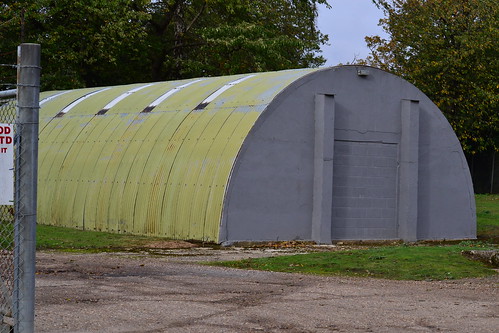
RAF Downham Market

One of the many huts that were left on the airfield.

However, two days after this on the night of August 12th /13th 1943, it was a different matter. It was whilst flying a 218 Sqn Stirling over Turin, that Flight Sergeant Arthur Louis Aaron, would suffer bullet strikes to his head that would break his jaw and tear away a large part of his face. Further bullets damaged his lung and right arm rendering it useless. Aaron still fought on though, despite his severe injuries, managing to assist the bomb-aimer in flying the stricken Stirling away from the enemy. Unable to speak, he communicated instructions to his bomb-aimer by writing with his left hand. Aaron attempted on four occasions to land the plane, but with failing strength, he was persuaded to vacate the cockpit; enabling the bomb-aimer to complete the belly landing on the fifth attempt. Aaron later died from exhaustion, the consequence of his determination and unparalleled allegiance to his crew, his aircraft and his duty. Aaron was the first of two pilots to receive the Victoria Cross whilst at Downham Market – both for extreme bravery in the face of the enemy.

The new squadron 623 Sqn, like many other squadrons however, was to be a short lived one. With high demand for Stirlings in the Conversion Units, it was decided to utilise the aircraft of 623 Sqn for this role, and on December 6th 1943 the unit was officially disbanded. Some crews returned to 218 Sqn but many others were posted out to new units. Flying of a total of 150 sorties in just four months, the squadron would lose ten aircraft, a loss rate of almost 7%.

The void left by 623 Sqn would be soon filled though. Just four days later another unit would transfer in, that of 214 (Federated Malay States) Sqn from RAF Chedburgh also a Stirling MK.III unit. For the majority of December, 214 Sqn would carry out ‘gardening’ missions, dropping mines designated ‘Nectarines‘ or ‘Cinnamon‘. Other operations would see bombs dropped on ‘Special Targets‘ although the Operational Records don’t specify the identity of these targets. 214 Sqn as with 623 Sqn, would be another of these short stay units, on January 17th 1944 they would transfer to RAF Sculthorpe and 100 Group, for RCM (electronic warfare) duties and a new aircraft, the B-17 Flying Fortress or Fortress I. As crews carried out circuits, lectures and training at Sculthorpe, the remainder of the squadron continued operations from Downham. By the 24th January though, all personnel had transferred over and Downham Market was far behind them.

In March 1944, Downham’s long standing unit 218 Sqn was finally ordered out, and on the 7th the entire squadron departed, the operations books simply stating: “218 Sqn moved from Downham Market to Woolfox Lodge by road and air today“. *2 Once at Woolfox Lodge, they would begin disposing of their Stirlings to take on the new heavy bomber – the Avro Lancaster.

The dust wasn’t allowed to settle at Downham however, and before long more personnel and a new Squadron would arrive, ready to fill the skies of Norfolk. This was no ordinary squadron though. With concerns about the poor quality of bombing and the lack of accuracy, it was decided to form a new Group that went much against the wishes of Arthur Harris. Seen as ‘elitist’, Harris vehemently disagreed with the new Group and fought his corner bravely. But with little choice in the matter and lacking his own high level support, he eventually succumbed to the Air Ministry’s demands, putting in command the Australian Group Captain Donald C.T Bennett, CB, CBE, DSO.

The new group would be called 8 Group (PFF) ‘The Pathfinders’, and was designed to use the cream of Bomber Command crews whose record for bombing had been excellent. Aircraft from the Group were to fly ahead of the main bomber force and ‘mark’ the target by various means – coloured flares being the primary and main method. In principle it worked well, but as records show, it was not without its own difficulties or setbacks.

Bennett, an aggressive pilot who didn’t suffer fools gladly, quickly won the admiration of his crews. He was also highly admired by Harris, who once described him as the the “most efficient airman” he had ever met; Harris considered Bennett perfect for the role. In appointing Bennett, Harris dismissed all other possible candidates including Air Chief Marshall Basil Embry, the Air Ministry’s most likely favourite.

The Pathfinders were officially formed on 15th August 1942, with 8 Group coming into official formation in January 1943. With the arrival of the new Squadron, 635 Sqn, Downham would now be playing its part in this role. This change would also mean a change in aircraft type at this Norfolk airfield, out went the now relegated Stirlings and in came Avro’s remarkable four engined heavy, the Lancaster MK.III.
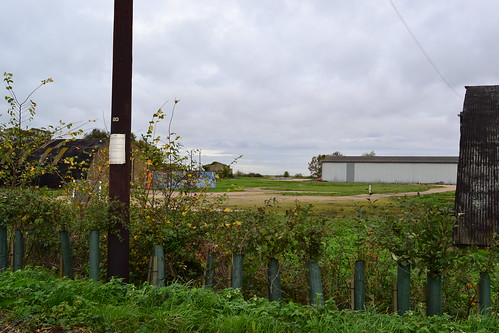
RAF Downham Market

The remains of the Technical site looking toward the airfield.

635 Sqn was created under the command of Wing Commander Alan George Seymour Cousens on March 20th 1944. Using ‘C’ Flight from RAF Graveley’s 35 Sqn and ‘C’ Flight from RAF Bourn’s 97 Sqn. A total of eight aircraft and crews from each flight immediately began the move to Downham. At 09:15 the first of the road crews arrived from Bourn, with further sporadic arrivals until 11:00. The first aircraft to arrive touched down at 12:00, and within the next 20 minutes all aircraft were safely on the ground. Graveley crews began arriving soon after this, their first aircraft, along with a ground party, arriving at 15:05.

The new squadron consisted of 36 Officers, 120 NCOs and 200 ‘other ranks’. They were accommodated in Site ‘J’ whilst 20 NCOs and 40 armourers were accommodated in site ‘B’. A small number of officers were put up in the Rectory just outside the main gate of the airfield*3.

Shortly after the crews had landed, they were quickly briefed for an operation to attack Munich, but by the time the aircraft were prepared and bombs loaded, the operation was cancelled, the crews were then given the chance to settle in to their new homes.

635 Sqn would continue to use the Mk.III Lancaster for the next four months, replacing it with the Lancaster MK.VI  from March onward. This was an unusual model of the famous aircraft as it had neither a nose nor mid-upper turret, instead it was crammed with electronic radar jamming devices. Also replacing the normal three-bladed propellers were four bladed examples, aiming to improve the aircraft’s performance.

A growth in aircraft numbers and the development of Pathfinder methods soon led to a new branch of the Group, the Light Night Striking Force (LNSF) equipped with de Havilland’s ‘Wooden Wonder‘ the Mosquito.  In response to this, 571 Sqn, a new light bomber squadron equipped with the Mosquito XVI, was born here at Downham on April 5th 1944, barely two weeks after 635 Sqn themselves arrived. As a temporary measure it was decided that on April 10th, the squadron would be reduced to one Flight instead of two leaving eight aircraft plus a ‘spare’ at Downham whilst the remainder transferred to RAF Graveley. The idea behind the move was two-fold, firstly to bolster the expansion of 105 Sqn at Graveley, and secondly, to provide experience for the ground crews on the Mosquito.

The move went well, but on the 17th, a new order would come through that would change Downham yet again.

Movement order 21 required the entire 571 squadron to transfer to RAF Oakington, effective by 24th April. With that, preparations began and the advanced party moved from Downham on the 22nd followed by the rear party on the 24th. The entire squadron including the Graveley detachment were, by the end of the day, now at Oakington. Due to the move, there were no operations flown by the squadron from Downham Market during this short period of their history.

This departure left 635 Sqn as the only operational squadron at Downham Market. Whilst somewhat quieter, it is was not to be all plane sailing.

In Part 2, we see how Downham takes part in D-Day, the end of the war approaches but operations continue and Downham remains busy. After the war, the airfield is used for other purposes, and eventually closes. We then see what remains today and ask what does the future hold?

The full Trail appears in Trail 7.
September 8th 1943 – Tragedy at RAF Mepal.

On the night of September 8/9th 1943,  a force of 257 aircraft comprising 119 Wellingtons, 112 Stirlings, 16 Mosquitoes and 10 Halifaxes took off from various bases around the U.K. to bomb the Nazi gun positions at Boulogne. Included in this force were aircraft from the RAF’s Operational Training Units, and for the first time of the war, five B-17s flown by US aircrews of the USAAF’s 422nd BS, 305th BG at Grafton Underwood. This was the first of eight such missions to test the feasibility of the USAAF carrying out night operations over Europe.  After the remaining seven missions, in which the squadron had dropped 68 tons of bombs, the idea was scrapped, the concept considered ‘uneconomical’ although the aircraft themselves proved to be more than capable of the operations.

RAF Mepal - memorial

RAF Memorial – Mepal

The Gun battery targeted, was the emplacement that housed the Germans’ long-range guns, and the target wold be marked by Oboe Mosquitoes. With good weather and clear visibility, navigation was excellent, allowing the main force to successfully drop their bombs in the target area causing several huge explosions. However, not many fires were seen burning and the mission was not recorded as a success. Reports subsequently showed that the emplacement was undamaged due to both inaccurate marking by Pathfinders, and bombing by the main force. However, as both anti-aircraft fire and night fighter activity were light, no aircraft were lost during the flight making it a rather an uneventful night.

However, the mission was not all plain sailing, and whilst all crews returned, the night was marred by some very tragic events.

Three Stirlings were to take off from their various bases that night: at 21:00 hrs from Chedburgh, Stirling MK. III, EF136, piloted by F/S. R. Bunce of 620 Sqn; at 21:30, another Stirling MK.III, from 75 Sqn at RAF Mepal, BK809 ‘JN-T*1‘ piloted by F/O I.R.Menzies of the RNZAF; and lastly at 21:58 also from Chedburgh, Stirling MK. I, R9288 ‘BU-Q’ piloted by N.J. Tutt  of 214 Sqn.  Unfortunately all three aircraft were to suffer the same and uncanny fate, swinging violently on take off. The first EF136 crashed almost immediately, the second BK809 struck a fuel bowser, and the third R9288 ended up in the bomb dump. Miraculously in both the Chedburgh incidents there were no casualties at all, all fourteen crew men surviving what must have been one of their luckiest escapes of the war! The same cannot be said for the second though.

Stirling BK809 was part of a seventeen strong force of 75 Sqn aircraft. Each aircraft was carrying its full load made up of 1,000lb and 500lb bombs. As the Stirling was running along the runway, it swung violently, striking a fuel bowser which sent it careering into houses bordering the edge of the airfield.

One of the occupants of one of the houses, Mr. P. Smith, saw the aircraft approaching and ran into the street to warn others to get clear. As the aircraft struck the rear of the houses, it burst into flames causing some of the bombs to detonate. This brought considerable rubble down on the occupants of the second house, Mr and Mrs John Randall.

Mrs Randall managed to get out, her legs injured, whereupon she was met by a local fireman, Mr. A.E. Kirby of the National Fire Service. Mr. Kirby went on to help search in the wreckage of the house until his attempts were thwarted by another explosion. His body, along with that of Mr. Randall, was found the next day.

Two other people were also killed that night trying to provide assistance, those being F/Sgt Peter Gerald Dobson, RNZAF and Section Officer Joan Marjorie Easton WAAF. F/Sgt. Dobson was later mentioned in despatches. Three members of the crew lost their lives as a result of the accident, F/O. Menzies and F/O. N. Gale both died in the actual crash whilst Sgt. A. Mellor died later from injuries sustained in the accident.

A number of others were injured in the crash and one further member of the squadron, Cpl Terence Henry King B.E.M, was awarded the British Empire Medal “for his bravery that night in giving assistance“.

The mission on the night of September 8/9th 1943 will not go down as one of the most remarkable, even though  it was unique in many respects, but it will be remembered for the sad loss of crews, serving officers and civilians alike in what was a very tragic and sad event.

The crew of Stirling BK809 were:

F/O. Ian Robert Menzies RNZAF NZ415002. (Pilot).
P/O. Derek Albert Arthur Cordery RAFVR 136360. (Nav).
P/O. Norman Hathway Gale RAFVR 849986. (B/A).
Sgt. Ralph Herbert Barker RNZAF NZ417189. (W/O).
Sgt. Albert Leslie Mellor RAFVR 943914. (Flt. Eng).
Sgt. Bullivant G RAFVR 1395379. (Upp. G)
Sgt. Stewart Donald Muir RNZAF NZ416967. (R/G).

RAF Mepal was visited in Trail 11.

Sources and Further Reading.

*1 Chorley, 1996 “Bomber Command Losses 1943” notes this aircraft as AA-T.

National Archives: AIR 27/646/42: 75 Sqn ORB September 1943

Chorley, W.R., “Bomber Command Losses – 1943“, Midland Counties, (1996)

Middlebrook M., & Everitt C., “The Bomber Command War Diaries”  Midland Publishing, (1996)

Further details of this accident, the crews and those involved can be found on the 75 (NZ) Sqn blog. This includes the gravestones of those killed and a newspaper report of the event.

My thanks also go to Neil Bright for the initial  information.

Loss of Mosquito FBVI ‘NS828’ RAF Swanton Morley.

Memorial to Fl. Lt. J Paterson and Fl. Lt J. Mellar

On April 25/26th 1944, 487 Sqn (RNZAF) moved from RAF Gravesend to RAF Swanton Morley in Norfolk, taking with them D.H. Mosquitoes. They had only been at Gravesend a few days when news of the new move came through.

487 Sqn had previously been involved in ground attacks on German airfields across the occupied countries, and in several high profile missions. In particular, during the previous February, they had been involved in Operation ‘Jericho‘, the attack on the Amiens Jail, in France. It was also a Methwold based Ventura piloted by Squadron Leader Leonard H. Trent, who, on 3rd May 1943, had led the Squadron in a disastrous daylight attack on the power station at Amsterdam. As a result of his actions that day, Sqn. Ldr. Trent received the V.C., the highest honour bestowed on personnel of the armed forces.

On their arrival at Swanton Morley, 487 Sqn would immediately begin training for new air operations, their part in the forthcoming D-day invasion at Normandy, with the first flights taking off the following day.

On April 27th three ‘targets’ were chosen, the Grimston Range not far away from Swanton Morley, the Bradenham Range in the Chilterns, and lastly the Army Gunnery School site at Stiffkey, on the North Norfolk coast. Each of these were to be ‘attacked’ in cross country sorties by the Mosquitoes.

In one of those Mosquitoes ‘EG-A’ was Pilot Flight Lieutenant John Charles Paterson (NZ/2150), and his Navigator Flight Lieutenant John James Spencer Mellar (s/n: 49175) both of the R.N.Z.A.F.

The day’s sortie went well, until the return flight home was made. It was on this leg of the flight that the port engine of the Mosquito, a Hatfield built FBVI ‘NS828’ under contract 555/C.23(a), began to overheat.

Immediately Flt. Lt. Paterson feathered the engine – now flying on just one. The Mosquito was lined up on approach to Swanton Morley for a single-engined landing, but all did not go well. Unfortunately,  instead of putting the aircraft down on the runway, the aircraft overshot the airfield crashing into a field beyond, the resultant accident killing both pilot and navigator instantly.

The Operational Record Book (AIR 27/1935/31) for April 27th states:

Formation dive bombing on Grimstone [sic] range. Low level bombing on Bradenham Range. Formation cross country with air to sea firing practice off the coast at Wells. In the evening six aircraft carried out formation attacks on gun positions at an army Gunnery School at Stiffkey. Returning from this ‘A’, F/Lt. Paterson developed engine trouble and feathered the airscrew.  In attempting to land, he overshot and crashed. F.Lt. Paterson and his navigator F. Lt. Mellar, were both killed.”

Since then, a memorial has been erected in memory of the two men, located on the side of the B1110 Dereham Road just outside the village of North Elmham in Norfolk, it stands not far from the site of the crash site, west of Swanton Morley airfield. After the crash, Flt. Lt. Paterson’s body was buried at Shepperton Church Cemetery, whilst Flt. Lt. Mellar was buried at Brookwood Military Cemetery plot 24. D. 20.

Flight Lieutenant Mellar was 29 on the date of his passing, he was the son of William Edward and Eleanor Mellar; and husband of Dorothy Freda Mellar. Flight Lieutenant Paterson was 24 years of age, he was the son of John Alexander and Alice Louise Paterson, of Papakura, Auckland, New Zealand, and husband of Doris Josephine Paterson, of Shepperton.

Swanton Morley appears in Trail 38.