RAF Debden (Part 2) – The Battle of Britain.

Following on from the first part of this Trail, we see how Debden was thrust into the Battle of Britain and the historic changes that followed.

On August 18th 1940,  at 17:30, the squadron consisting of thirteen aircraft were scrambled to patrol the Skies over Debden. Almost immediately they were diverted to Canterbury and ordered to patrol at 20,000 ft. Five minutes after reaching their designated point, they were ordered into battle attacking ‘raid 51’ who were crossing the coast in the vicinity of Folkestone. Within minutes, the two formations were entwined and the aircraft of 85 squadron set about the 150 – 250 machines of the Luftwaffe.

A mix of J.U. 87s, H.E.111s, J.U. 88s, M.E. 110s and M.E. 109s were staggered in layers between 10,000 feet and 18,000 feet, and as soon as the aircraft of 85 squadron were sighted, the enemy immediately employed tactical defensive manoeuvres with some of the bombers heading seaward whilst other climbed toward their fighter protection.

Hugely lacking in aircraft numbers, the RAF  had little choice but to ‘dive in’, as a result large numbers of individual ‘dog fights’ occurred, resulting in aircraft being strewn across the Essex sky around Foulness Point.  For a while there was complete chaos, aircraft were burning and crews knew little of each other’s whereabouts. In one incident P/O. J. Marshall (Yellow 2) followed his leader into attack. In the melee that followed Marshall flew into a cloud of vapour created by a damaged H.E.111 his wing colliding with the tail of the Heinkel severing it completely and cutting the wing tip-off of his own aircraft. Despite the damage Marshall nursed his crippled aircraft to Debden where he landed safely and unhurt.

During this attack six Me 110s, three Me 109s and one He 111 were confirmed as destroyed, a further He 111, Me 110, Ju 87 and Me 109 were confirmed as probables, whilst four Me 110s and two Do 17s were known to have been damaged.

85 Squadron casualties on the day consisted of one Hurricane destroyed and one damaged. It was during this attack that  Flight Lieutenant Richard H.A. Lee, D.S.O., D.F.C. (s/n 33208), flying as Blue 1, was last seen by Sqn. Ldr. Townsend and F/O. Gowers 10 miles east of Foulness Point chasing 5 Me 109s. He lost contact and failed to return to Debden.  Lee, a veteran with nine victories to his name, was Lord Trenchard’s Godson, and was reported missing that day. *2

On the next day, 19th August 1940, 85 Squadron departed Debden, swapping places with 111 squadron who had previously moved to Croydon. In a signal Air Chief Marshal Sir Cyril Newall, G.C.B., C.M.G., C.B.E., A.M., expressed his thanks to the crews of 85 Sqn, sending his gratitude for “all your hard fighting” in which he added “This is the right spirit for dealing with the enemy.” 85 Squadron went on to continue the fight at Croydon flying in the same determined manner they had shown whilst based at Debden.*2

RAF Debden

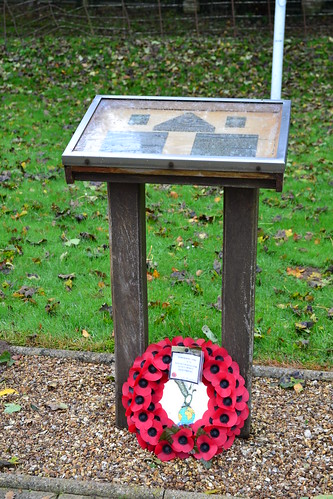
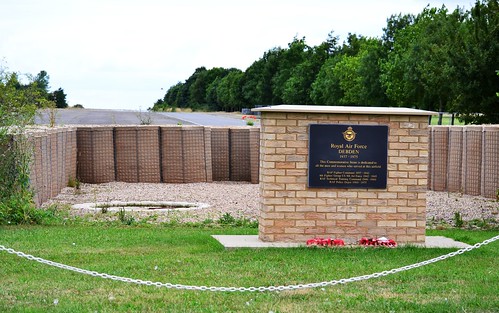
The memorial at Debden sits at the end of the north south runway (seen behind).

It was also during August 1940 that Debden became a focus for attacks by the Luftwaffe. On the 20th, a small reconnaissance mission took German aircraft over the airfield along with other airfields in the region. Six days later, on August 26th, the first attack on Debden would occur, a combined attack that would also involve strikes on Kenley, Biggin Hill, Hornchurch and North Weald airfields.

Whilst 11 Group – whose sector headquarters were at Debden – put up ten squadrons and one flight to intercept the incoming raiders,  a number of bombers did get through and over 100 bombs were dropped on the airfield damaging the landing area; the sergeants mess, NAAFI , a motor transport depot and equipment stores. In addition to this the water and electricity supplies were both cut, and five personnel were killed. The raid was made worse by the inefficient vectoring of protective aircraft from Duxford due to them being unable to obtain the correct radio frequency. This mishap did little to help the ongoing ‘dispute’ between Air Marshal Sir Keith Park and Air Vice-Marshall (later Air Marshal) Sir Trafford Leigh-Mallory, who were both locked in dispute over the defences of 11 Group’s airfields – it was arguably this feud that eventually cost Park his command of 11 Group, and a move as AOC to Malta.

At the end of August, Debden would once again become the focus of Luftwaffe attacks. Shortly after 8:00am on the morning of August 31st 1940, waves of Luftwaffe bombers flew over Kent turning northwards toward North Weald, Duxford and Debden. A formation of Dornier bombers managed to reach Debden again where they dropped over 100 incendiary and high explosive bombs on the airfield. This time the sick quarters and barrack blocks received direct hits whilst other buildings were damaged by blasts.

Further attacks on September 3rd and 15th failed to materialise and Debden was finally left alone to lick its wounds and repair the damage to its fragile infrastructure. It was also during this time (2nd September to the 5th September 1940) that all three resident squadrons: 257, 601 and 111  would depart, leaving Debden behind and heading further south to pastures new.

With the ending of the Battle of Britain, things would become a little quieter at Debden, although movements of man and machine would continue with a perpetual occurrence. The October and November would see more short stays: 25 squadron (8th October for around two and half months); 219 Sqn as a detachment for two months, and 264 Sqn at the end of November for just one month. These changes would lead Debden into the new year and 1941.

During 1941, 85 Squadron would return yet again, and after being bounced around with almost regular occurrence this, their final visit, would be in the night fighter role. Initially using their Hurricanes and then Defiants, they soon replaced these with the Havoc before vacating the site for good and the fields of Hunsdon in May that year.

There were yet more short stays during 1941: 54 Squadron in June (two days), 403 Squadron (25th August  – 3rd October); 258 Squadron (3rd October  – 1st November); 129 Squadron (1st November – 22nd December); 418 squadron (15th November – 15th April 1942); a detachment of 287 Squadron; 157 who were reformed here on 13th December moving to Castle Camps five days later where they would receive their Mosquito II aircraft, and finally 65 Squadron who arrived three days before Christmas and stayed until 14th April 1942.

One of these squadrons, 403 Squadron flying Spitfire VBs, was formed as a result of Article XV of the Riverdale Agreement, in which it was agreed between the British Government and the nations of the commonwealth: Canada, Australia and New Zealand; that their trained military personnel would fly and operate as part of the Royal Air Force. This would mean that both air and ground crews would perform their duties under RAF command. Some 70 squadrons were created as a result of this agreement, and of those seventy, 67 were numbered in the 400 series. Even though they were part of the RCAF, RNZAF and RAAF, they were treated as integral parts of the British Royal Air Force for the duration of the conflict.

Into 1942 and yet more of the same, 350, 41, 124, 232 and 531 Squadrons all following this similar pattern of short stays and placements, thus life at Debden was becoming a constant carousel of ground crews and flying personnel. Two squadrons from here did make a real name for themselves though, that of 71 and 121 Squadrons.

In Part 3, we see Debden take on a new owner, its fortune changes and it becomes home to one of the most famous Fighter Groups of the USAAF – the 4th Fighter Group.

RAF Debden (Part 1) – The Build up to the Battle of Britain.

Not far from Wethersfield, lies the parent airfield of Castle Camps. Now closed to aviation, it currently resides in the hands of the Army as the Carver Barracks. On this next part of this Trail we wind our way through the Essex countryside to the former fighter station that gained notoriety during the early 1940s, and in particular the Battle of Britain. In this, the first part of the visit, we look into the development of the airfield, and the build up that took it into the heart of the Battle. We visit the former RAF Debden.

RAF Debden (Station 356) – Essex

The internet and history books are awash with pictures and information about RAF Debden, and rightly so. It is an airfield with an incredible history, famous for its part in the Battle of Britain and the defence of London, it was home to no less than thirty RAF squadrons at some point; it was used by the U.S. volunteer squadrons the ‘Eagle Squadrons’, and then taken over by USAAF as a fighter airfield following their official entry into the war. It was then used again by the RAF post war up until 1975 when the British Army took over,  those whose hands it remains in today as the Carver Barracks.  Not only is it history long but the site is historically highly significant. According to Historic England, Debden airfield represents “one of the most complete fighter landscapes of the Battle of Britain period“, considered historically important due to its “largely intact defensive perimeter and flying-field with associated blast pens“.*1

Debden is therefore a remarkable site, but as an active military base, access and views are understandably very restricted. However, some buildings can still be seen from public areas, particularly the front as you pass by the main entrance.

RAF Debden

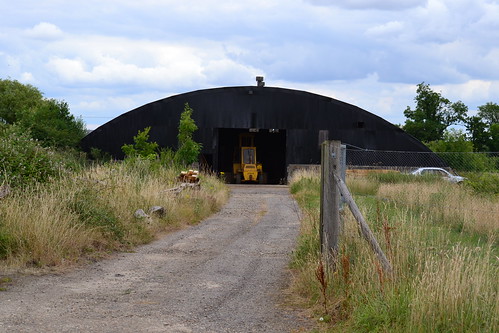
One of 11 Blister Hangars built at Debden.

Debden’s life began in the mid 1930s, it eventually opened in 1937, as part of the expansion programme of the pre-war era, and was classified as a fighter airfield under Scheme ‘C’ of the airfield construction programme. During this period, great consideration was given to the architectural features of airfield buildings, standard designs being finished and positioned aesthetically in line with both the local landscape, stone and environment. Design and construction of these airfields, in this the second part of the expansion phase, was carried out in conjunction with the Royal Fine Arts Commission, whose influence led to an overall improvement in airfield design. During this phase of expansion, over 100 permanent sites were built using these new designs, in fact, according to Historic England, it is these sites that have tended to survive in the best condition to date largely thanks due to their post war and Cold War usage. Even in this pre-war period, aesthetics were as important as operability!

Built by W. L. Fench Limited, Debden wasn’t completed until after it had been opened, thus the first units there were using the site in its unfinished state. The two initial landing surfaces were grass, but as a fighter airfield little more was needed. Even so, and not long after it opened, these were replaced by concrete and tarmac surfaces, giving the airfield much stronger and more adaptable landing surfaces. Being the standard 50 yards wide, these runways were also extended from the initial 1,600 and 1,300 yards to 2,600 and 2,100 yards respectively, allowing for larger and more powerful aircraft to utilise the site.

Debden had a large number of hangars built: three ‘C’ type, one Bellman and eleven blister hangars which were all spread around the perimeter and technical areas of the airfield. Some 80 hardstands were also provided, thus large quantities of aircraft were expected to use the site at one point or another.

Of these thirty operational flying squadrons to pass through Debden, the primary aircraft to see service would be the Spitfires and Hurricanes of Fighter Command. Biplanes such as the Demon and the Gloster Gladiator were also to feature here, as were the twin-engined aircraft the Beaufighter, Havoc/Bostons and the jet engined Meteor in the latter stages of the war. The period 1939 – 1942 though, was by far the busiest period for Debden, the majority of squadrons operating from here during this time.

Upon opening in 1937, Debden would operate the outdated and obsolete biplanes of the Royal Air Force, Hawker’s Fury II of 87 squadron being the first to arrive on 7th June 1937, being replaced shortly after by Gloster’s Gladiator, that famous Biplane that protected Malta as ‘Faith’, ‘Hope’ and ‘Charity’. In the summer of 1938, prior to the outbreak of war, Hurricanes were brought in and the entire squadron moved to airfields in France where they would stay until May 1940, when France was invaded by the German forces. Brought back to England, a short two-day stop over at Debden, would lead to a move north and Yorkshire before returning to the battle, and a night fighter role over Southern England.

Joining 87 Sqn in June 1937 were further Gladiators, those of 80  Squadron who, themselves formed a month earlier, would stay at Debden until departing for the Middle East and Ismailia a year later. A third squadron would arrive during this time, 73 Squadron, who shortly after reforming at nearby Mildenhall, would also replace their Hawker Furys with Gladiators coinciding with their move to Debden. Also moving to France, 73 Sqn would eventually move to the Middle East, where they would remain for the duration of the war, flying from numerous airfields including that of Habbaniyah, one of several places where my father was stationed post-war.

One other squadron would grace the skies over Debden that year, that of 29 Squadron, whose Hawker Demons were adapted to accept a Frazer-Nash turret for defence. A small aircraft, they would be no match for enemy fighters and so were replaced in December 1938 by the far superior aircraft the Blenheim IIF. Coinciding with this, was the movement of a detachment of 29 sqn aircraft to Martlesham Heath, which was followed by a months stay at RAF Drem in the border region before returning to Debden once more. By the end of June though, the entire squadron have been pulled out of Debden and moved to Digby in Lincolnshire and a new role as night fighters.

1938 also saw the reforming of 85 Squadron on the 1st June. 85 sqn, as a unit, had their roots in the First World War, being stationed in France before disbandment in the summer of 1919. But on this occasion, they were reformed out of ‘A’ Flight of 87 squadron prior to them taking on their Hurricanes and imminent move abroad. During the period 1939 – 1940, 85 Sqn would move around almost weekly, with one of their longest permanent stays being between November 1938 and September 1939 whilst here at Debden. Being the parent airfield of Castle Camps, Debden units would often be dispersed there, or in some cases stationed there, whilst also operating out of Debden – 85 Sqn being no exception.

Two other squadrons would fly from Debden during the winter/spring of 1939 – 40, both 17 and 504 operating the Hurricane MK. I. On an almost weekly basis, both units would yo-yo between Debden and Martlesham Heath, an almost continuous spiral of postings saw them using the ‘Heath’ as a forward operating airfield until around May 1940, when both units were moved to France in support of the B.E.F.

Hawker Hurricane Mark Is of No 17 Squadron taxiing at Debden, July 1940. In the foreground is YB-C, that of the CO, Squadron Leader Harold ‘Birdy’ Bird-Wilson, who was shot down on 24th September flying YB-W (P3878) (IWM – HU 54517)

As the fall of France turned into the Battle of Britain, fighter units to defend Britain became top priority. The dawn of 1940 would see the beginning of six more squadrons operate out of Debden, the majority of which would arrive during the height of the Battle. Debden, as the Sector Station responsible for the Thames Estuary and eastern approaches to London, would become a prestige Luftwaffe target during those early days of the Battle. As a result, it along with other Sector stations at Northolt, North Weald, Biggin Hill, Tangmere and Hornchurch, would endure some of the most sustained and prolonged attacks by German bomber formations.

To meet the demand for fighter units, 257 Squadron were reformed and posted to Debden initially flying the Spitfire MK. I. They quickly replaced these with the Hurricane I prior to them becoming operational on July 1st. Four days later they were joined at Debden by both 601 (the ‘Millionaires Squadron’ named so after the men who initially joined it) and 111 Squadron making this one of the largest collections of Hurricanes at that time.

85 Squadron were soon in the thick of the battle. As July 1940 turned to August, patrols would be sent up as regularly as the sun would rise, many of these patrols would result in enemy engagement; the Operational Record Books being testament to the continuing battle for the skies over Britain at that time. At the beginning of August on the 7th, Air Vice-Marshal K.R. Park M.C., D.F.C. visited  Debden, a visit that preceded the transfer of Debden from 12 Group into 11 Group. It was also at this time that the funeral of P/O. Britton of 17 Sqn took place, a young man who lost his life in a flying accident on the 6th whilst carrying out an air test in Hurricane N2456. In poor weather, visibility of only four miles, P/O Britton crashed into Debden Park destroying the aircraft in which he lost his life.

In mid August 1940, both ‘A’ and ‘B’ flights of 85 Sqn were brought back from Martlesham Heath and Castle Camps to Debden, a move that preceded the not only the first but one of the largest attacks by a Debden squadron on enemy aircraft.

In part 2, we see how Debden was affected by the German campaign, the relentless attacks that drew Debden crews into battle. We look at the changes at Debden and how the American made a name for themselves as determined and fearless fighter pilots.

*1 Historic England, Historic Military Aviation Sites – Conservation Guidance, 2016.

Trail 44 – Kent (Part 3) – Sir Barnes Wallis – His Later Years.

We continue, in Trail 44, looking at the life of Sir Barnes Wallis, a man known for his expertise in engineering and design. Following on from his early works in airship design, we now turn to his Second World War and post war work.

With the outbreak of the Second World War, new designs of aircraft and weapons were much-needed. Wallis’s geodesic design, as used in the R100, had been noticed by another Vickers designer Rex Pierson, who arranged for Wallis to transfer to Weybridge, where they formed a new team – Pierson working on the general design of the aircraft with Wallis designing the internal structures. This was a team that produced a number of notable designs including both the Wellesley and the Wellington; both of which utilised Wallis’s geodetic design in both the fuselage and wing construction.

What made Wallis’s idea so revolutionary was that the design made the air frame both light-weight and strong, and by having the bearers as part of the skin, it left more room inside the structure thus allowing for more fuel or ‘cargo’. An idea that helped provide greater gas storage for the R100.

Whilst both the Wellesley and the Wellington went on to be successful in the early stages of the war (11,400 Wellingtons saw service), they were both withdrawn from front line service by the mid war years, being replaced by more modern and advanced aircraft that could fly further and carry much larger payloads.

Saddened by the rising death toll, Wallis put many of his efforts into shortening the war. His idea was that if you attack and destroy the heart of production, then your enemy would have nothing to fight with; in this case, its power supply. To this end he started investigating the idea of breaching the dams of the Ruhr.

Wallis’s idea was to place an explosive device against the wall of the dam, thus utilising the water’s own pressure to fracture and break open the dam. Conventional bombing was not suitable as it was too difficult to place a large bomb accurately and sufficiently close enough to the dam to cause any significant damage. His idea, he said, was “childishly simple”.

Using the idea that spherical objects bounce across water, like stones thrown from a beach, he determined that a bomb could be skimmed across the reservoir over torpedo nets and strike the dam. A backward spin, induced by a motor in the aircraft’s fuselage, would force the bomb to keep to the dam wall where a detonator would explode the bomb at a predetermined depth, similar in fashion to a naval depth charge. The idea was simple in practical terms, ‘skip shot’ being used with great success by sailors in Nelson’s navy;  but it was going to be a long haul, to not only build such a weapon, the aircraft to drop it, nor train the expert crews to fly the aircraft; but to simply convince the Ministry of Aircraft Production that it was in fact feasible.

Wallis began performing a number of tests, first at his home using marbles and baths, then at Chesil Beach in Dorset. Both the Navy and the Ministry were interested when shown a film of the bomb in action, each wanting it for their own specific target; the Navy for the Tirpitz, and the Ministry for the dams. Wallis still determined to use it on the dams, carried out two projects side-by-side,  “Upkeep” for the dams, and “Highball” for the Navy*3.

“Upkeep” was initially spherical, and the first drop from a modified Lancaster took place in April 1943 at Reculver near to Herne Bay, where this statue is located. He persevered with aircraft heights, speeds and bomb design modifications, carefully honing them until on April 29th 1943, only three weeks before the actual attack, the bomb finally worked for the first time.

Wallis’s plan could now be put into action, and with a new squadron of the RAF’s elite bomber crews put in place, the stage was set and the dams of Ruhr Valley would be the target.

The attack on the dams have become legendary, and of the 19 aircraft of 617 Squadron that took off that May evening in 1943, only 11 returned, some after sustaining considerable damage. Operation Chastise saw two of the three dams, the Mohne and Eder, successfully breached and the third, the Sorpe, severely damaged forcing the Germans to partially drain it for safety.

Scampton September 2015 (17)

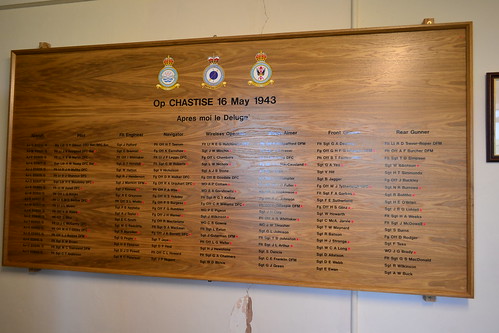
The names of the crews of 617 Squadron at RAF Scampton. Those with poppies next to them, did not return.

Following the success of Operation Chastise, Wallis went on to develop other bombs capable of devastating results. His initial plan, a Ten ton (22,000lb) bomb, had to be scaled back to 12,000lb as there was no aircraft capable of dropping it at that time. Codenamed ‘Tallboy’, it would be a deep penetration bomb 21 feet in length with a hardened steel case and 4 inches of steel in the nose. The bomb contained 5200lbs of high explosive Torpex (similar to that used in the Kennedy Aphrodite mission) and would have a terminal velocity of around 750 miles per hour.

The idea of Tallboy, was to create a deep underground crater into which structures would either fall or be rendered irreparable. With a time fuse that could be set to sixty minutes after release, it was used on strategic targets such as the Samur Railway Tunnel in France, rendering the tunnel useless as it had to be closed for a considerable amount of time.

The crater made by Barnes Wallis’s Tallboy bomb above the Samur Railway Tunnel, 9th June 1944. *4

Soon after this, Wallis began developing his Ten Ton bomb, the “Grand Slam”, a mighty 26ft in length, it weighed 22,000lb, and would impact the ground at near supersonic speeds. Wallis’s design was such that the bomb could penetrate through 20 feet of solid concrete or 130 feet of earth, where it would explode creating a mini earthquake. It was this earthquake that would rock the foundations of buildings and structures, or simply suck them into a crater of massive proportions*5.

Production of the Grand Slam was slow though. It took two days for the casting to cool and then after machining, it took a further month for the molten Torpex  to set and cool. The first use of the Grand Slam occurred on 14th March 1945 against the Bielefeld Viaduct in Germany, on which one Grand Slam and 27 Tallboys were dropped. Unsurprisingly, the viaduct collapsed and the railway was put out of action.

Wallis had created more exceptionally devastating weapons, they were so successful that 854 Tallboys and 41 Grand Slams were dropped by the war’s end.

Scampton September 2015 (4)

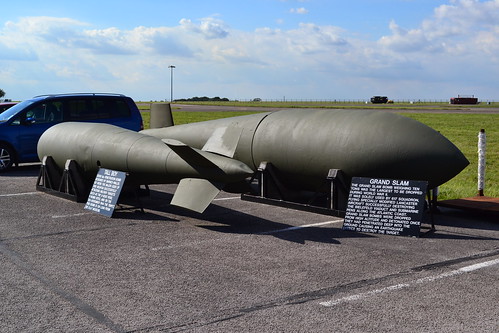
The Tallboy and Grand Slam bombs, designed by Barnes Wallis.

Post war, Wallis carried on with his design and investigations into aerodynamics and flight. He was convinced that achieving supersonic flight with the greatest economy was the way forward, and in particular variable geometry wings. The government was keen to catch up with the U.S., awarding Vickers £500,000 to carry out research into supersonic flight. Wallis’s project received some of this money, and he researched unmanned supersonic flight in the form of surface-to-air missiles. Codenamed ‘Wild Goose‘ (later ‘Green Lizard’) the project ran to 1954 when it was terminated.

Wallis continued with his research into swing wing designs, his first being the JC9, a single seat aircraft 46 feet in length. It was produced but never completed and was scrapped before it ever got off the ground. Wallis wasn’t put off though, and he continued on developing the ‘Swallow’, a swing wing aircraft that could reach speeds of Mach 2.5 in model wind tunnel investigations.

In its bomber form it would have been equivalent in size to the American B-1, with a crew of 4 or 5, and a cruising speed of Mach 2. It would have a range of 5,000 miles whilst carrying a single Red Beard nuclear bomb.

Whilst not selected to meet the R.A.F.’s OR.330 (Operational Requirement 330), which was eventually awarded to TSR.2, they were interested enough for him to proceed until the 1957 Defence White Paper put an end to the project, and it was cancelled.

Looking for funding Wallis turned to the U.S. hoping they would grant him sufficient funds to continue his work. After many meetings between Wallis and the U.S American Mutual Weapons Development Program at NASA’s Langley research facility, he came away disappointed and saddened that the Americans used his ideas without granting him any funding.

American research continued, eventually developing into the successful General Dynamics F-111 ‘Aardvark’, the world’s first production swing-wing combat aircraft.

Wallis continued with other supersonic and hypersonic investigations; designs were drawn up for an aircraft capable of Mach 4-5, using a series of variable winglets to link subsonic, supersonic and hypersonic flights, many however, never went beyond the drawing board.

Wallis didn’t stop there, he continued with many great inspirational projects: the Stratosphere Chamber, a test chamber where by simulated impacts on aircraft travelling at 70,000 feet could be safely tested and analysed; the Parkes Telescope, a radio telescope in New South Wales; the Momentum Bomb, a nuclear bomb designed to be released at low-level and high-speed, enabling the release aircraft to escape the blast safely, and in the 1960s, a High Pressure Submarine designed to dive deeply beyond the range of current detection.

In recognition of his work, Wallis was knighted in 1968, and he was also made an Honorary Fellow of the Royal Aeronautical Society.

Wallis, after working beyond his forced retirement, died at the age of 83, on 30th October 1979, in Effingham, Surrey. He is buried in the local church, St Lawrence’s Church, in Effingham, a village he contributed greatly to. He was the church secretary for eight years, and an Effingham Parish Councillor, serving as Chairman for 10 years. He was also the Chairman of the Local Housing Association, which helped the poor and elderly of the village to find or build homes; and as a fanatical cricketer, he was Chairman of the KGV Management Committee who negotiated the landscaping of the “bowl” cricket ground, so good was the surface, it was used as a substitute for the Oval in London.

There are numerous memorials and dedications around the country to Wallis, and there is no doubt that he was both an incredible engineer and inventor who made a major contribution to not only the war, but British and world aviation in general.

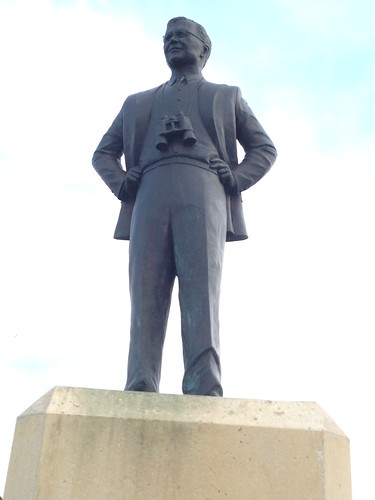
His statue at Herne Bay overlooks Reculver where the first “Upkeep” bomb was dropped by a Lancaster bomber during the Second World War, and it is a fine tribute to this remarkable man on this trail.

Barnes Wallis at Work

Sir Barnes Neville Wallis.

From here, we continue to travel east, toward the coastal town of Margate. A few miles away is the now closed Manston airport, formerly RAF Manston, an airfield that is rich in History, and one that closed causing such ill feeling amongst many.

Sources and further reading

*3 The Mail online published a report on the discovery of a Highball bomb found in Loch Striven, Scotland in July 2017.

*4 Photo © IWM (CL 4322)

*5 The Independent news website– “Secrets of the devastation caused by Grand Slam, the largest WWII bomb ever tested in the UK.” Published 22/1/14

The Barnes Wallis Foundation website has a great deal of information, pictures and clips of Barnes Wallis.

A list of memorials, current examples of both Upkeep and Highball bombs, and displays of material linked to Barnes Wallis, is available through the Sir Barnes Wallis (unofficial) website.


Trail 44 – Kent (Part 3) – Sir Barnes Wallis – His Early Years

After visiting the many museums and former airfields in the southern and central parts of Kent (Trail 4 and Trail 18) we now turn north and head to the northern coastline. Here we overlook the entrance to the Thames estuary, the Maunsell Forts – designed to protect the approaches to London and the east coast – and then take a short trip along the coastline of northern Kent. Our first stop is not an airfield nor a museum, it is a statue of the designer of one of the world’s most incredible weapons – the bouncing bomb. Our first short stop is at Herne Bay, and the statue of Sir Barnes Wallis.

Sir Barnes Wallis – Herne Bay

Sir Barnes Wallis

The Barnes Wallis statue located at the eastern end of the town overlooking the sea at Reculver.

There cannot be a person alive who has not seen, or know about, the famous Dambusters raid made by 617 Sqn. It is a story deeply embedded in history, one of the most daring raids ever made using incredible ideas, skill and tenacity. There is so much written about both it, and the man behind the idea – Sir Barnes Neville Wallis CBE FRS RDI FRAeS – a man famous for his engineering prowess and in particular the famous ‘Bouncing Bomb’ that was used by Guy Gibson’s 617 Squadron in that daring raid of 16th May 1943. But there is so much more to Barnes Wallis than the Bouncing bombs; he made a huge contribution to British Aviation, weaponry of the Second World War, and later on in his life, supersonic and hypersonic air travel.

He is certainly one the Britain’s more notable designers, and has memorials, statues and plaques spread across the length and breadth of the country in his honour. But he was not just a designer of the Bouncing bomb, his talent for engineering and design led him through a series of moves that enabled him to excel and become a major part of British history.

Born on 26th September 1887 in Ripley, Derbyshire, he was educated at Christ’s Hospital in Horsham, he went on to study engineering in London, and shortly afterwards moving to the Isle of Wight. With the First World War looming, he was offered a chance to work on airship designs – an innovative design that would become widely used by the Naval forces of both the U.K. and Germany.

Wallis cut his teeth in marine engines as an engineer and draughtsman. He began his career in the London’s shipyards, moving to the Isle of Wight after which he broke into airship design. He followed a colleague he had met whilst working as a draughtsman with John Samuel White’s shipyard, together they would design His Majesty’s Airship No.9 (HMA 9).

The design process of HMA 9 was dynamic to say the least. Early non-rigid airships were proving to be very successful, and the new rigids that were coming in – whilst larger and more capable of travelling longer distances with greater payloads – were becoming the target for successive quarrels between the government and the Admiralty. World unrest and political turmoil was delaying their development even though plans for HMA 9 had already been drawn up.

Joining with his colleague, H.B. Pratt in April 1913, at the engineering company Vickers, the two designers began drawing up plans for a new rigid based along the lines of the German Zeppelin. HMA 9 would be a step forward from the ill-fated HMA No. 1 “Mayfly”, and would take several years to complete. Further ‘interference’ from the Admiralty (One Winston Churchill) led to the order being cancelled but then reinstated during 1915. The final construction of the 526 ft. long airship was on 28th June 1916, but its first flight didn’t take place until the following November, when it became the first British rigid airship to take to the Skies.

HMA 9 (author unknown*1)

With this Wallis had made his mark, and whilst HMA 9 remained classed as an ‘experimental’ airship with only 198 hours and 16 minutes of air time, she was a major step forward in British airship design and technology.

The Pratt and Wallis partnership were to go on and create another design, improving on the rigids that have previously been based on Zeppelin designs, in the form of the R80. Created through the pressure of war, the R80 would have to be designed and built inside readily available sheds as both steel and labour were in very short supply. Even before design or construction could begin there were barriers facing the duo.

Construction started in 1917, but with the end of the war in 1918, there was little future as a military airship for R80. Dithering by the Air Ministry led to the initial cancellation of the project, forcing the work to carry on along a commercial basis until the project was reinstated once more. With this reinstatement, military modifications, such as gun positions, were added to the airship once again. With construction completed in 1920, she made her first flight that summer. However, after sustaining structural damage she was returned to the sheds where repair work was carried out, and a year later R80 took to the air once again. After a brief spell of use by the U.S. Navy for training purposes, R80 was taken to Pulham airship base in Norfolk and eventually scrapped. Wallis’s design had lasted for four years and had only flown for 73 hours.

However, undaunted by these setbacks, the Vickers partnership of Pratt and Wallis went on to develop further designs. In the 1920s, a project known as the 1924 Imperial Airship Scheme, was set up where by a Government sponsored developer would compete against a commercial developer, and the ‘best of both’ would be used to create a new innovative design of airship that would traverse the globe. This new design, would offer both passenger and mail deliveries faster than any current methods at that time.

The Government backed design (built at the Royal Airship Works at Cardington) would compete against Vickers with Wallis as the now Chief Designer.

The brief was for a craft that could transport 100 passengers at a speed of 70 knots over a range of 3,000 miles. Whilst both designs were similar in size and overall shape, they could not have been more different. Wallis, designing the R.100, used a mathematical geodetic wire mesh which gave a greater gas volume than the Government’s R101, which was primarily of stainless steel and a more classic design. This geodesic design was revolutionary, strong and lightweight, it would prove a great success and emerge again in Wallis’s future.

Built at the Howden site a few miles west of Hull, the R100 was designed with as few parts as possible to cut down on both costs and weight; indeed R100 had only 13 longitudinal girders half that of previous designs. Wallis’s design was so far-reaching it only used around 50 different main parts.

The design plan of Wallis’ R-100 airship (author unknown*2

The 1920s in Britain were very difficult years, with the economy facing depression and deflation, strikes were common place, and the R100 was not immune to them. Continued strikes by the workers at the site repeatedly held back construction, but eventually, on 16th December 1929, Wallis’s R100 made its maiden flight. After further trials and slight modifications to its tail, the R100 was ready. Then came a test of endurance for the airship, a flight to Canada, a flight that saw the R100 cover a journey of 3,364 miles in just under 79 hours. Welcomed as heroes, the return journey would be even quicker. Boosted by the prevailing Gulf Stream, R100 made a crossing of 2,995 miles in four minutes under 58 hours. The gauntlet had been thrown, and Wallis’s airship would be hard to beat.

The R101 would face a similar flight of endurance, this time to India, and it would use many of the same crew such was the shortage of experienced men. On October 4th 1930, R101 left its mooring at Cardington for India. Whilst over France she encountered terrible weather, a violent storm caused her to crash, whereupon she burst into flames and was destroyed with all but six of the 54 passengers and crew being killed.

The airship competition became a ‘one horse race’, but an inspection of the outer covering of Wallis’s R100 revealed excessive wear, only cured by replacing the skin, an expense the project could barely swallow. With plans already in place for the R102, the project was in jeopardy, and eventually, even after offers from the U.S. Government, it was deemed too expensive, and by 1932 R100, the worlds largest airship and most advanced of its time, had been scrapped and the parts sold off.

Wallis’s airship career had now come to an end, but his prowess and innovation as a designer had been proven, he had set the bench mark that others would find hard to follow.

In the next part, we look at the work carried out by Wallis both during the Second World War and in the later years of his life.

Sources and further reading

*1 Photo from The Airship Heritage Trust website.

*2 ibid

Scotland’s National Museum of Flight – East Fortune (Part 1).

In the third part of Trail 42, we take a closer look at Scotland’s National Museum of Flight based on the former East Fortune airfield.

Located east of Edinburgh, not far from the main A1 road, between East Linton and Athelstaneford, East Fortune is an airfield with its roots set in the First World War. A former Airship station, it went on to house various training flights, and host a wide range of aircraft. Post war, it was adapted for possible U.S.A.F. use, then used to store food stuffs, and East Fortune stepped in to accommodate flights when Edinburgh’s Turnhouse airport was closed for maintenance and upgrading.

Since 1975 it has housed one of the best collections of aircraft in the country (many from the former Strathallan collection) along with a number of well-preserved airfield buildings. This site is so historically important that it is now a Scheduled Monument, the terms of which are set out in the Ancient Monuments and Archaeological Areas Act 1979*1. Whilst not graded, East Fortune is, by definition, considered to be of national importance, and any such alterations or work done to it, has to have consent granted from Historic England who manages the process of scheduled monument consent on behalf of the Secretary of State.

To help preserve these buildings, several projects have been undertaken to restore them keeping as much as possible to the original war-time designs, with the work being undertaken by Smith Scott Mullan Associates of Edinburgh.*2

The National Museum of Flight has its aircraft stored in three hangars arranged by theme: civilian, military, and along with the Concorde Experience the Jet Age hangar. A fourth hangar is used for restoration and is closed to the public although tours can be arranged by appointment. The three main hangars are themselves historical pieces, each being a World War two Callender-Hamilton hangar.

Originally designed in the late 1930s, by Callender Cable and Construction, they were initially designed with canvas doors, but later models, built in 1940, were constructed with metal doors. Whist being more secure, and no doubt warmer, they reduced the clear door height from 25 feet to 17 feet. The overall length of 185 feet and door openings of 90 feet remained the same however. These examples at East Fortune were recently restored, again by Smith Scott Mullan Associates, using funds in the region of £3.6m awarded mainly by the Scottish Government but also the National Heritage Lottery Fund.

A number of the smaller technical buildings on the site were also targeted for restoration. After finding sagging roofs, penetrating damp, cracked or damaged rendering and distorted windows; five of the site’s buildings were earmarked for restoration and a five-year programme put in place to restore and preserve them, again keeping as close to the original designs as possible.

These buildings are now in full-time use, used for exhibitions, artefact storage and as an education centre.

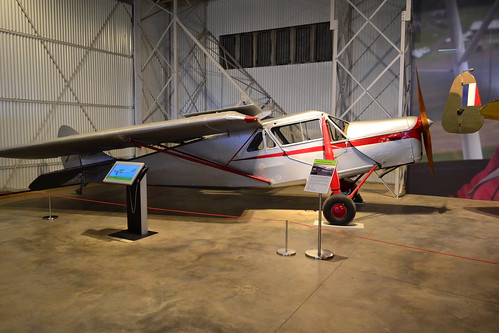
In the first hangar, the Civilian Aviation Hangar, you can explore a range of civilian aircraft types, one notable model being the DH80 – de Havilland Puss Moth. A relatively unique aircraft, it was designed so that its wings could be folded back for easier storage. The undercarriage, an innovative feature in itself, could be turned through ninety degrees to act as air brakes thus allowing the pilot to land at a much steeper approach. Very popular, these models were often flown long distances with notable pilots including the long distance flyer Amy Johnson. Whilst primarily civilian, some models were used by the Royal Air Force, both 24 Squadron (Oct – Dec 1939) and 510 Squadron (delivered May 1941 on its formation). This particular model (ex G-ABDW) was the first Puss Moth to fly to Australia.

East Fortune National Museum of Flight The de Havilland Puss Moth VH-UQB (ex Strathallan G-ABDW), the first Puss Moth to fly to Australia.

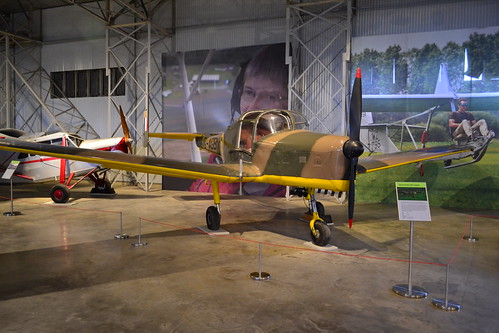
Another notable aircraft here at East Fortune is the Miles M18 MKII Prototype. Built as a private venture it was intended to replace the Miles Magister. During test flights it was noted that the aircraft could not be put into a spin by the pilot. However, sadly lacking in what the Air Ministry described as ‘robustness’, it was not put into full production and so only three models were ever built; the MKI, MKII and MKIII. The last remaining example here at East Fortune, G-AHKY, ‘HM545’, is the MKII and had a Certificate of Airworthiness up until September 1989, it was delivered to East Fortune four years later in 1993. It has a notable history in that it was sent to the Royal Navy on short loan, this may have been for service trials and was with 759 squadron in January 1941. In 1956 it won the Goodyear Trophy Air Race and in 1961, the Kings Cup Air Race reaching a speed of 142 mph.

The three M18s operated with two engine types, the D.H. Gipsy Major engine (MKI) and the Blackburn Cirrus Major engine (MKII/III), giving a maximum speed of 142 mph and a ceiling height of 12,800 feet. It had a cruising speed of 130 mph. This particular example remains the only one left in existence.

East Fortune National Museum of Flight The Miles M18 MKII Prototype, the only remaining example of its type.

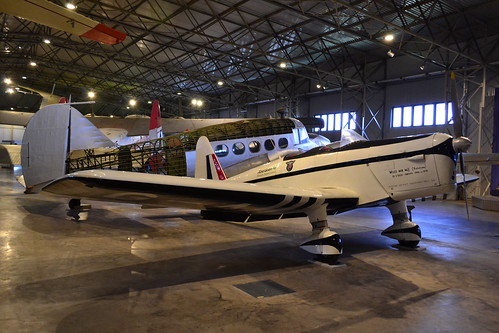
Also at East Fortune is a General Aircraft Cygnet. Designed in 1936, it was first flown in May 1937, and was at that time, the first all-metal stressed-skin light plane to be both constructed and flown in the U.K. This particular model, was a later modified model having a nose wheel as opposed to a tail wheel and designated the GAL.42 Cygnet II. After the initial prototype, only ten production models were ever built with five going to the Royal Air Force (24 and 510 Squadron, 51 and 52 O.T.U.). This and one other (reported to be in very poor condition in Argentina) are the only surviving examples in the world.

G-AGBN is currently exhibited in military colours, an ex Strathallan example, it served as ES915 with both 51 and 52 O.T.U. preparing pilots for the Boston, another tricycle carriage aircraft of the Second World War. It is also reported that the Cygnet was flown by Guy Gibson, adding further historical interest to this model.

East Fortune National Museum of Flight The General Aircraft L.42 Cygnet II – adapted as a trainer for pilots of RAF Boston aircraft.

Other civilian examples found here include: an Avro Anson in part construction form, a de Havilland Dove 6, G-ANOV (ex SAFU Stansted), a Jetstream 3100 (G-JSSD) and a BAC 111-510ED located outside the hangar.

East Fortune Ex Prestwick Jetstream 3100 (G-JSSD)

The civilian hangar at East Fortune holds many rare and interesting examples from aviation’s history. Each one worthy of saving and viewing. In the next part, we look into the military examples at East Fortune, with aircraft ranging from the Second World War through the Cold war to the modern fighters of the Royal Air Force.

Sources and Further Reading:

*1The National Archives

*2 Smith Scott Mullan Associates website

Flt. Sgt. Arthur L. Aaron, V.C., D.F.M., 218 Sqn, RAF Downham Market

The Second World War produced some incredible heroes, men and women, who in he face of incredible odds, continued to carry out their duties, often going beyond those expected of anyone.

One such man was Arthur Louis Aaron, of 218 Squadron, RAF Downham Market, Norfolk.

Image result for arthur louis aaron

Arthur Louis Aaron (RAFVR) V.C., D.F.M, (source unknown)

Aaron, born 5th March, 1922, in Leeds,  who at the time that war was declared, was training to become an architect at Leeds School of Architecture. On joining the Royal Air Force on December 15th, 1941, he was sent, via Canada, to No.1 British Flying Training School (B.F.T.S.) at Terrell, Texas, where he completed his initial flying training.

Aaron like the other recruits would pass through ten weeks of biplane flying, moving onto monoplane aircraft at which point, if successful, they would receive their wings. Returning back home also via Canada, he was hoping to fly fighters but was disappointed when he was posted to bomber training, and was sent to 6 Advanced Flying Unit at Little Rissington. After further training, he was sent on to 1657 Heavy Conversion Unit (Stradishall) flying Stirling MKIs, and then on 17th April 1943, he was posted to his first operational flying unit, 218 (Gold Coast) Squadron, at RAF Downham Market.  

Whilst here at Downham Market, Aaron continued flying Short Stirling bombers, the large heavy bomber that proved to be both vulnerable to fighters and poor performing. Due to high losses it  was eventually pulled out of front line bombing duties, and used for mine laying, glider towing and parachute operations.

Aaron’s first mission would be the very next day after arriving at Downham Market. He, and his crew, would fly a ‘gardening’ mission laying mines off Biaritz, after which he would be sent on more heavily defended targets within German occupied Europe and Germany itself.

At 21:35 on the night of August 12 – 13th 1943, Flt. Sgt. Aaron and his crew: Sgt. M. M. Mitchem (Flt Eng.); Sgt. A. C. Brennan (RCAF) (Nav.); Flt. Sgt. A. W. Larden (RCAF) (Bomb Aim.); Sgt. T. Guy (Wop/AG); Sgt. J. Richmond (M.U. Gunner) and Sgt. T. M. McCabe (R. Gunner), all took off from Downham Market on their second mission of August to attack Turin, a night that featured several attacks on Italian targets.

This would be Aaron’s 20th and final mission, three as co-pilot and seventeen as pilot. He was a man known for his courage and bravery, only 12 days earlier he had struggled with his aircraft whilst his crew bravely fought fires that had broken out in the fuselage after being hit by incendiaries from aircraft flying above. Using his skill and judgement, he managed to evade both flak and searchlights by corkscrewing his aircraft whilst the crew members put out the fire that resulted from the accident. For his action on this day, he would be awarded the D.F.M.,*1 one of the highest possible awards for non-commissioned officers in the Royal Air Force, but this, like his V.C., would only come posthumously after his death on 13th August 1943.

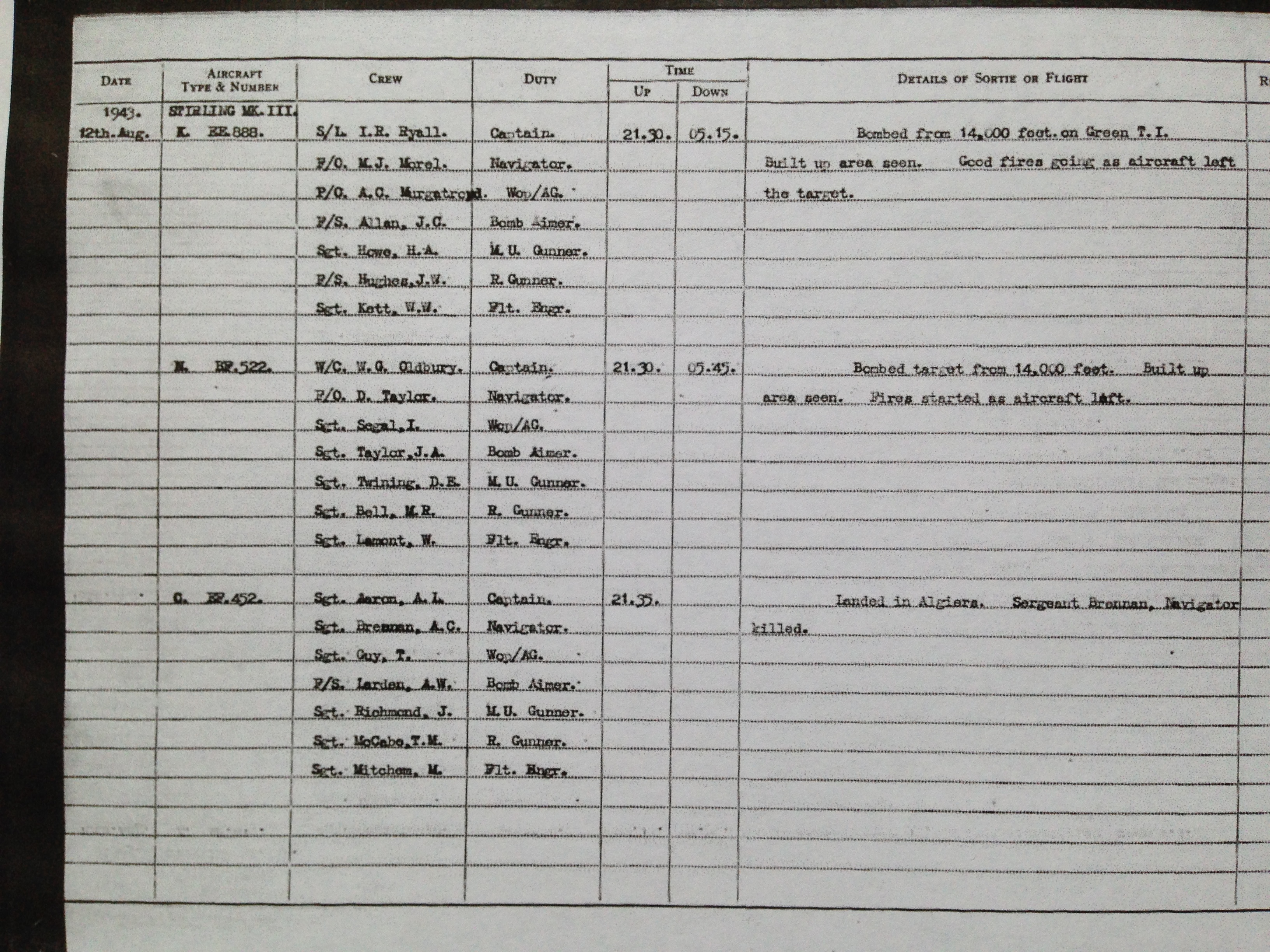
That night, two of the thirteen 218 Sqn aircraft from RAF Downham Market in Norfolk, would be posted ‘missing’; Stirling HA-Y ‘MZ 263’ piloted by F/O J. McMallister, and that of 21-year-old Arthur Aaron – Stirling III ‘EF452’ HA-O . Whilst in the bomber stream heading toward Turin,  the aircraft was hit by gunfire from another aircraft. The navigator, (Sgt. Brennan s/n R/117605) was killed, Sgt. Mitchem and Flt. Sgt. Larden were both injured. The aircraft, now badly damaged, had been hit in three of the engines resulting in one of them being put out of action. Both front and rear turrets were immobilised, various control lines were broken and the windscreen was shattered. During the attack, Aaron received devastating blows to his face, his jaw being broken and quantities of flesh being blown away. A further bullet struck him in the chest, puncturing his lung. Now in great pain and severely injured, Aaron fell against the control column forcing the aircraft into a dive. After the Flight Engineer regained control, a course was set for North Africa, Aaron was moved to the rear of the plane where he was treated. He remained here for only a short time, insisting on returning to the cockpit where he was placed with his feet on the rudder bars. Wanting to take over, he had simply insufficient strength, and was persuaded to assist rather than fly. He wrote notes with his left hand, guiding the crew toward the airfield at Bone, in Algiers. After four failed attempts at landing, the bomb-aimer finally managed to get the aircraft down, low on fuel and with its undercarriage still raised.

The entry in the Operations Record Book for August 12th 1943, merely states “Landed in Algiers, Sergeant Brennan, Navigator Killed.”*2

At 15:00 on August 13th 1943, Arthur Aaron finally lost his determined battle to survive and died from his terrible injuries. He had fought on, overcoming severe pain and injury to guide his crewmen back to safety. Flt. Sgt. Aaron was buried alongside Sgt. Brennan in Bone War Cemetery, in Algeria.

For their action Flt. Sgt. Larden received the C.G.M., and Sgt Mitcham and Sgt. Guy, both a D.F.M.

Arthur Aaron was awarded not only his D.F.M. from his previous mission, but the V.C., the highest honour for military personnel. His V.C. was announced in the London Gazette on November 5th, 1943*3.

It reads:

Air Ministry, 5th November, 1943.

The King has been graciously pleased to confer the Victoria Cross on the undermentioned airman in recognition of most conspicuous bravery:
1458181 Acting Flight Sergeant Arthur Louis Aaron, D.F.M., Royal Air Force Volunteer Reserve, No. 218 Squadron (deceased).

On the night of 12 August 1943, Flight Sergeant Aaron was captain and pilot of a Stirling aircraft detailed to attack Turin. When approaching to attack, the bomber received devastating bursts of fire from an enemy fighter. Three engines were hit, the windscreen shattered, the front and rear turrets put out of action and the elevator control damaged, causing the aircraft to become unstable and difficult to control. The navigator was killed and other members of the crew were wounded.

A bullet struck Flight Sergeant Aaron in the face, breaking his jaw and tearing away part of his face. He was also wounded in the lung and his right arm was rendered useless. As he fell forward over the control column, the aircraft dived several thousand feet. Control was regained by the flight engineer at 3,000 feet. Unable to speak, Flight Sergeant Aaron urged the bomb aimer by signs to take over the controls. Course was then set southwards in an endeavour to fly the crippled bomber, with one engine out of action, to Sicily or North Africa.

Flight Sergeant Aaron was assisted to the rear of the aircraft and treated with morphia. After resting for some time he rallied and, mindful of his responsibility as captain of aircraft, insisted on returning to the pilot’s cockpit, where he was lifted into his seat and had his feet placed on the rudder bar. Twice he made determined attempts to take control and hold the aircraft to its course but his weakness was evident and with difficulty he was persuaded to desist. Though in great pain and suffering from exhaustion, he continued to help by writing directions with his left hand.

Five hours after leaving the target the petrol began to run low, but soon afterwards the flare path at Bone airfield was sighted. Flight Sergeant Aaron summoned his failing strength to direct the bomb aimer in the hazardous task of landing the damaged aircraft in the darkness with undercarriage retracted. Four attempts were made under his direction; at the fifth Flight Sergeant Aaron was so near to collapsing that he had to be restrained by the crew and the landing was completed by the bomb aimer.

Nine hours after landing, Flight Sergeant Aaron died from exhaustion. Had he been content, when grievously wounded, to lie still and conserve his failing strength, he would probably have recovered, but he saw it as his duty to exert himself to the utmost, if necessary with his last breath, to ensure that his aircraft and crew did not fall into enemy hands. In appalling conditions he showed the greatest qualities of courage, determination and leadership and, though wounded and dying, he set an example of devotion to duty which has seldom been equalled and never surpassed.

A number of memorials exist in honour of Arthur Aaron. On the site of the former accommodation blocks at Bexwell (RAF Downham Market) stands a small plaque in his honour along side that of Squadron Leader Ian Bazalgette, who also won the V.C. whilst at Downham Market.

There is another plaque in the main hall of Roundhay School, Leeds, Aaron’s former school; another commemoration can be found at the AJEX Jewish Military Museum in Hendon, London, and a five-metre bronze sculpture by Graham Ibbeson has been erected on a roundabout to the north of Leeds city centre. Unveiled on 24th March 2001 by the last survivor of the crew, Malcolm Mitchem, it represents the freedom Aaron’s sacrifice helped ensure.

RAF Downham Market

The Memorial Plaque at the former RAF Downham Market.

Sources and Further Reading:

RAF Downham Market appears in Trail 7.

Other Heroic tales appear in Heroic Tales of WW II.

*1 London Gazette, 15th October 1943, page 4620.

*2 Air 27/1351 – National Archives

*3 London Gazette, (supplement) 5th November 5th, 1943, page 4859

No. 218 Gold Coast Squadron, 1936-1945. A blog that has many letters, from Aaron along with the history of 218 Squadron.

RAF Drem – The home of Airfield Lighting Systems.

In Trail 42 we continue our journey northward driving along the coastal route taken by the A1 road. The North Sea views here are simply breathtaking. Heading toward the seat of the Scottish Government and the beautiful and historic city of Edinburgh, we visit two more airfields with long and distinguished histories. One of these also has perhaps, one of the best collections of preserved buildings left on any wartime airfield outside of Duxford.

We start off just outside of Edinburgh heading eastward at an airfield that became synonymous with airfield lighting. The idea was simplistic, the effect wide-reaching. It was so successful, it became standard across many of Britain’s wartime airfields, it is of course RAF Drem.

RAF Drem

Drem is often used when talking about airfield lighting systems, the lights used to illuminate perimeter tracks, runways and landing patterns during the Second World War. But as an airfield, it played a much bigger part in the war, hosting some 47 RAF squadrons, a selection of Fleet Air Arm units and various Technical and Developmental Flights at some stage during its wartime life.

Many of these units were here on short detachments or rotations, whilst not conducive to long-term development of the site, it did bring a wide variety of aircraft to this small airfield in Scotland: Hurricanes, Spitfires, Whirlwinds, Mosquitoes, Defiants, Beaufighters, Typhoons and Tempests to name but a few. It also brought a multitude of nationalities with it: French Czechoslovakian, Polish, Canadian, Australian and New Zealand airmen all used the airfield at some point.

Located in East Lothian, Drem has a history that started in the early stages of World War I. Used by 77 Sqn, who were based at nearby Edinburgh, it was then called West Fenton, a name it retained until 1919 when it was renamed Gullane. 77 Sqn were responsible for the protection of the east coast of Scotland, and in particular the Firth of Forth in the Home Defence role. They used a number of landing grounds in this region including both Eccles Toft (Charterhall) and Horndean (Winfield); and had detachments spread widely around the Edinburgh region: Turnhouse, New Haggerston, Whiteburn and Penston.

77 Squadron flew a number of BE Types in this role, a role that continued up to 13th June 1919 when the squadron was disbanded. Also in 1919, (21st February) cadres from both 151 and 152 squadrons were also based here, staying until September and June respectively, when they too were disbanded following the end of the war.
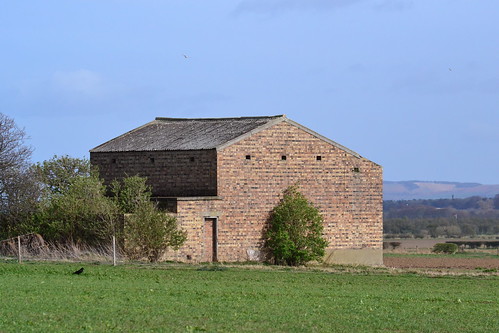
RAF Drem

The Stand-by Set house, an auxiliary power station, still remains in good condition today.

A year before the end of the conflict, No. 2 Training Depot Station was formed here flying types such as the Bristol Scout, Sopwith’s Pup and Camel, the S.E.5a, Avro’s 504, and the Royal Aircraft Factory F.2B. A short role, they too were disbanded at the end of 1919, thus bringing the end of flying to Gullane.

In the interwar years Gullane, although only a temporary facility, was renamed Trenent, and it remained in this guise for a further six years becoming a full-time facility in 1939. In two years time, it would undergo fighter name changes finally taking on the name it has today, that of RAF Drem.

It was on 17th March 1939 that Drem returned to the flying training role with No. 13 Flying Training School (FTS) being formed here, operating a number of aircraft types including, Avro’s Anson, and Hawker’s Audax and Harts. After being renamed 13 Service Flying Training School (SFTS) in September that year, it would only last a month before being disbanded and absorbed into No. 8, 14 and 15 (SFTS). But it was at this point that Drem’s potential as a fighter airfield would be realised and its first operational unit would move in. Drem had finally reached maturity and its war would very soon begin.

Transferred to Fighter Command at the end of October 1939, a number of operational units would quickly arrive: 602 (13/10/39-14/4/40), 609 (17/10/39-3/6/42) and detachments from 607 Sqn (10/10/39) and 72 Sqn (17/10/39) would all precede 111 Sqn (7/12/39-27/2/40) in these early days.

It was during this time, in the early stages of the ‘phoney war,’ that Drem aircrews would have their first and perhaps their most significant aircraft intercept.

On 16th October 1939, Heinkel He 111 ‘1H+JA’, of Stabskette/KG26 piloted by Kurt Lehmkuhl was spotted en-route to the Firth of Forth. Immediately, aircraft from Drem’s 602 Sqn and Turnhouse’s 603 Sqn, were ordered to take off and intercept the aircraft. Whilst the Heinkel tried desperately to avoid the Spitfires, their deadly firepower proved too much, and the aircraft was eventually brought down at Kidlaw Hill. This Heinkel became known affectionately as the ‘Humbie Heinkel‘ due to its close proximity to the village of Humbie. The air-frame rapidly became a tourist attraction, locals would climb up into the hills to see the intact bomber as it lay helpless amongst the Scottish heather. The aircraft lay just a few miles short of where an Airspeed Oxford (N4592) had crashed just two days earlier killing both its young corporals: Basil F. Evans (23) and Charles M. Thorpe (22). The hills around Edinburgh were fast becoming a graveyard!

As a result of the Heinkel attack, the two gunners Cpl. Bruno Reimann and Sgt. Gottleb Kowalke were both killed (both are buried at the German Military Cemetery at Cannock Chase), the pilot was injured, but the navigator remained unharmed. Both the navigator and pilot surrendered to a local Policeman who was first at the scene of the crash*1.  This shooting down was particularly notable as it was the first German aircraft to be brought down on British soil and the victory was claimed by Drem’s 602 Squadron pilot, Flt. Lt. Archie McKellar. McKellar’s jubilation would be short-lived though, being shot down and killed himself one year later and within days of the official ending of the Battle of Britain – his name would never appear in the Battle’s roll of Honour.

Perhaps one of the most iconic photos of the war, The ‘Humbie Heinkel’ lies on a Scottish hillside surrounded by onlookers, the first German aircraft to be shot down on British Soil.*2

Drem had now entered the war and whilst it was a ‘front line station’ its buildings would never be more than temporary. Crew numbers would reach 1,807 RAF air and ground crew along with a further 374 WAAFs. The runways (1 x 1850 yds extended to 2,300 yds and 2 of 1,400 yds) would remain grass and a number of hangers (15 in all) would include 3 Bellmans. Seven hardstands were built all suitable for single engined aircraft with the technical and main accommodation sites located to the north-east.

However, these early stages of the war were not all smooth running. In December 1939 tragedy struck when a combination of errors led to a number of 602 Squadron Spitfires inadvertently attacking a flight of Hampdens of 44 Squadron. During the confusion, in which it is thought the Hampdens failed to identify themselves correctly as ‘friendly’, two were shot down: Hampden I L4089 and Hampden I L4090. In the second aircraft Leading Aircraftman T. Gibbin was killed by the Spitfire’s bullets, as the two aircraft crashed into the cold waters of the North Sea. The remaining seven were all picked up by trawlers and taken safely to shore. In a moment of dark humour the next day, the remaining Hampdens departed Drem, dropping hundreds of toilet rolls over the squadron huts!

The winter of 1940 saw a short stay by 43 Sqn, arriving mid December and then departing at the end of February, possible one of the less appreciated stays knowing the inclement Scottish weather.

ROYAL AIR FORCE FIGHTER COMMAND, 1939-1945

RAF crews of 43 Squadron sit around their dispersal hut stove at Drem. (IWM)

The early months of 1940 saw a royal visit to Drem, when on 28th February 1940, King George VI visited, escorted by none other than Air Marshall Dowding. Whilst here, the King awarded Sqn. Ldr. Douglas Farquhar with the DFC after he had brought down another HE 111 that was able to be repaired at Drem and subsequently flown to a base in England for evaluation.

The subsequent months would prove to be very hectic for Drem. Like other airfields in the north, Drem was to become a home and solace for battle weary crews moved from 11 Group in the southern regions of Britain. To keep up their skills, they would fly both coastal patrols and convoy escort missions, a far cry from the hectic and turbulent skies of Kent and the south coast.

This rotation of units through Drem would continue throughout the war, most squadrons remaining for short periods of only a month or two, and many ‘leap-frogging’ between here and other stations. One of these units included, in 1940, 29 Sqn (RAF) a night fighter unit that excelled and became perhaps one of the most successful night fighter Squadrons of the Second World War.

With these short stays, came a variety of nationalities, including two Polish units (307 and 309); a French (340); two Canadian (409 and 410); an Australian (453) and three New Zealand squadrons (485, 486 and 488), each bringing their own touch of life to Drem.

With them also came night fighter training, and it was with one of these units 410 Sqn (RCAF) – who had only been formed a month earlier on 30th June 1941 – that Pilot, Sergeant Denis W. Hall, (s/n 1168705) and Gunner, Flight Sergeant Denis G. Cresswell (s/n 751880) would lose their lives, when their Defiant N1731 crashed into a hillside near to the village of Gifford in East Lothian, whilst on  a night training flight. Their military service at Drem had lasted a mere twenty-four days.

It was just prior to this, during 1940, that the Drem Lighting system was developed. Born out a necessity to solve issues around the Spitfire’s poor visibility when landing, the station Commander, Wing Commander “Batchy” Atcherly, personally addressed the issue. The problem was that Spitfires needed to keep their noses up in a relatively high angle of attack in order to maintain slow landing speeds, a configuration that meant the pilot could not see directly in front of him. Atcherly devised a plan using lights, whereby the pilots would be able to maintain this high angle and still be able to see where they were supposed to be going. He also had to overcome the added problem that lighting illuminated an airfield and thus attracted enemy aircraft over the site.

So he developed his idea, a bright lighting system that was mounted in such a way that only aircraft in the landing pattern and flight path could see the lights, yet they were dim enough and shrouded well enough, to be hidden from those not directly in the landing circuit. Essentially, the idea involved mounting covered lights on poles 10 feet high at designated points around the airfield indicating the landing pattern. If enemy aircraft were to approach, they would not be able to see the field and home based aircraft could land in relative safety. In an emergency, the entire system could be dimmed or even shut down, something that didn’t, as a rule, need doing.

The system was so successful that it was adopted by the RAF and used widely across other RAF airfields. Remnants of this system are scare today, but some can be found with careful scouring of the ground where runways were once laid.

During the latter half of 1940, Drem would be the place where the remains of the beleaguered 263 squadron would reform and recuperate. Formed in 1939, 263 would go on to serve in Norway with Gloster Gladiators, and after many problems, would bring their aircraft home during the Allied evacuation of Narvik. Unable to fly the great distance from Norway, the aircraft were loaded onto the carrier HMS Glorious for the trip home. It was during this trip that the Glorious met two of the German’s deadliest warships, the Scharnhorst and Gneisenau, who simply outgunned the carrier and on June 8th 1940, sank the Glorious with all the aircraft, many of its pilots and its commanding officer, on board.

The surviving fourteen pilots returned to Drem, where they were given Hurricanes. Gradually new pilots arrived and the squadron was returned to full strength. In July, after a short spell at Grangemouth, 263 Sqn returned to Drem with Whirlwinds replacing the Hurricanes.

Dogged by problems, the Whirlwinds were not to be the master of the air they had designed to be. 263 Sqn also brought a new idea they had successfully used in Norway, that of log-lined dispersals. Sadly they were too far away from the crew huts and apart from a photo opportunity, they were never used.

Slowly the war progressed, units came and went. Being near to the coast, Drem was regularly used for detachments of Air Sea Rescue Squadrons including 278 Squadron whose parent base was at Coltishall  several hundred miles south in Norfolk!

In the mid 1940s Drem’s focus narrowed not only in to the night fighter role, but also airborne radar investigations. The Radar Development Flight were formed here in December 1942 operating Defiant IIs and Beaufighter VIs. For six months they would fly these aircraft evaluating new radar designs and new methods in aircraft interception. They carried on this role through several name changes including: 1692 (Radio Development) Flight and then 1692 (Bomber Support Training Flight) after it had left Drem for Norfolk.

As the war drew to a close, the Royal Navy strengthened its involvement with Drem, renaming it HMS Nighthawk on May 3rd, 1945. The Royal Navy had a keen interest in night fighter training and used the skills of the RAF to aid its own programmes of night flying training.

Whilst RAF involvement had all but wound down, one final important act was to occur at Drem. Just as Drem aircraft had taken part in the first downing of a Luftwaffe aircraft at the start of the war, it was another Drem unit, 603 squadron, who would take part in the ending of the war. 603 Sqn Spitfires were tasked on May 11th 1945, just four days after returning to Drem, with escorting three white Junkers JU 52s that were carrying a number of German High Command officers into Drem as part of the official surrender of the Norwegian delegation. As part of this agreement, the senior officers would provide not only detailed information on the locations of mines laid out in the Norwegian waters: but the locations of all military shipping; lists of all stocks of oil; petrol and coal; coastal batteries and their associated supplies and all matters concerning German naval activity – including the surrender of the entire U-boat fleet.

The German High Command in front of their white JU52. Left to right: (from doorway) Lieutenant Albens; Captain Loewisch; Captain Kruger; and on extreme left, Commander Mundy Cox, RN, C/O of the Royal Naval Air Station. (IWM)

Throughout the war, the Fleet Air Arm (FAA) had a number of units use Drem themselves: 732, 770, 784, 884, 892 and both 1791 and 1792 squadrons were all based here along with detachments from three other FAA units. This brought a new breed of aircraft including the Seafire, Hellcat and Firefly to Scotland’s skies.

After the war ended the Royal Navy’s Night Fighter Training School pulled out, the RAF returned but never really used it for more than glider training, and eventually Drem was closed in September 1947. Its closure had been swift and its decline even faster.

Much of Drem today is agriculture. The airfield is split into two parts, divided by the B1345 road. To the west is the former airfield, a grass site with a virtually intact perimeter track. Along this track (now a farm road) are the various dispersals used during Drem’s wartime life. To the south is a Type B Fighter Pen, distinguished from Type ‘E’s by their cranked walls, greater in size, they provided greater protection to aircraft than the ‘E’.

The technical site sits to the north-east of the airfield, now a small industrial site it still contains many of the original buildings used by Drem’s personnel. Some of these have been refurbished whilst others contain many original features. Back along the road, the Stand-by Set house still stands and what remains of the accommodation site sits across the other side of this dividing road.
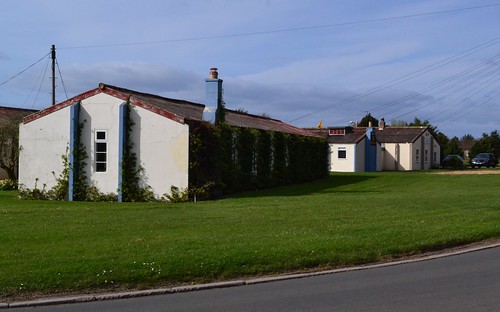
RAF Drem

Part of the Accommodation site still stands in use by small industrial and retail units. A small display of information about Drem is also located on this site.

Inside one of these buildings, the Arts & Crafts Gallery, now Fenton Barns Retail Village which is the former WAAF dining hall, is a small display providing information about Drem and its wartime operations, with free entry it is an interesting stop off if you have time.

RAF Drem had a long and chequered history. For such a  small airfield, it played a major part in the war: bringing down the first Luftwaffe bomber on British soil, being involved in the sad situation of friendly fire, and having a Royal visit. It provided solace for many weary crews, helped develop night fighter interception tactics and methods, and was used by the Royal Navy. It saw many nationalities pass through its doors, along with a wide range of aircraft types. Drem gave its name to a remarkable system of lighting that revolutionised airfield lighting both during the war and for aviation today. It certainly should have a place in today’s history books, it truly deserves it!

After we leave Drem, we travel a few miles south-east to a former satellite airfield of Drem. To an airfield that became a player in its own right, and has since been developed into perhaps Scotland’s biggest Aviation Museum  it is certainly one of the best preserved airfields around. We go to the former airfield at RAF East Fortune.

Sources and further reading:

*1 A report of the crash appeared 75 years later in The Berwickshire News.

*2 © National Archives of Scotland. http://www.scotlandsimages.com
 

RAF Winfield and the Polish Connection (Part 2)

After Part 1, we return to RAF Winfield, where an ‘odd’ visitor arrives. We also see the post war demise of Winfield into the site it is today.

At the end of the war many Polish units and displaced persons were pulled back to the U.K. in preparation for their repatriation into civilian life and for some return to their native country. Winfield became the site of one such group; the 22 Artillery Support Company (Army Service Corps, 2nd Polish Corps) who whilst fighting in the Middle East and Italy adopted a rather odd mascot. He became known as Wojtek, a Syrian bear who was officially given the rank of Private in the Polish Army, and who ‘fought’ alongside them as one of their own.

THE POLISH ARMY IN BRITAIN, 1940-1947

Wojtek the Syrian bear adopted by the Polish relaxing at Winfield Airfield, the unit’s temporary home after the war.*1

After finding the bear as a young cub wrapped around the neck of a small Iranian boy, Lance Corporal Peter Prendys took him and adopted him. After the war, on October 28th 1946, the Polish Army along with the bear arrived at Winfield Displaced Persons Camp – little did they know what a stir Wojtek would cause.

As displaced persons the Polish men would venture into nearby Berwick, where the locals grew fond of them and drinks flowed in abundance. Wojtek would go with them, becoming a familiar, if not unorthodox, site amongst the streets and bars or Berwick. This cigarette smoking, beer loving character, often causing a stir wherever he went. He became renowned in the area, the local villagers would flock to see him. He joined in with the frolics and loved the life that he was being allowed to live.

As a bear he loved the rivers and the River Tweed flows only a short distance from Winfield, rich and fast flowing it is abundant in that other commodity – Salmon. However, Wojtek was under strict orders not to swim alone nor stray onto the airfield which although closed, could still provide a danger for him if seen.

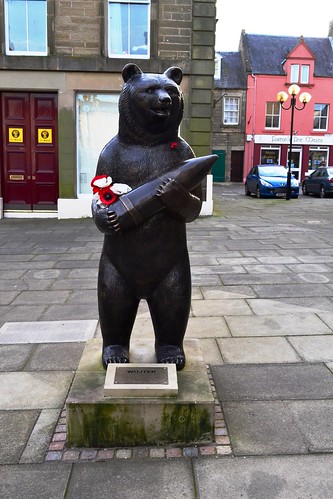
Wojtek became part of local history, eventually, a year after their arrival, the Polish unit were demobbed and they moved away. Wojtek was given to Edinburgh Zoo to look after, who did so until his death at the age of 21 in 1963. A statue stands in Princess Street Gardens beneath Edinburgh Castle as a reminder of both him and the Polish troops who were stationed at Winfield camp. A second statue of Wojtek stands in the centre of Duns, the village not far from Charterhall. The Wojtek Memorial Trust, set up in his honour, aims to promote both educational and friendship links between the young people of Scotland and Poland, an aim it tirelessly works towards today.

RAF Winfield

Statue of Wojtek in the centre of nearby Duns.

After the Polish troops left, Winfield was allocated to the USAF, and earmarked for development, but this never materialised and the site was left dormant. Winfield then reverted back to RAF control some five years later in October 1955, whereupon it was disposed of and sold off.

A small group of private flyers reopened the site, renovating the watch office and utilising a small hangar on the north of the airfield. This operation has now ceased and the watch office has sadly fallen into disrepair, it windows missing and open to the elements. The demise of Winfield and its subsequent decay has begun.

Winfield airfield lies between two roads, a further public road passes through the site although this was seen to be gated at the southern end. The most prominent feature is by far the Watch Office, a two-story design built to design 15684/41, having walls some 13.5 inches thick as was standard for all night-fighter stations (but different to the one at Charterhall).

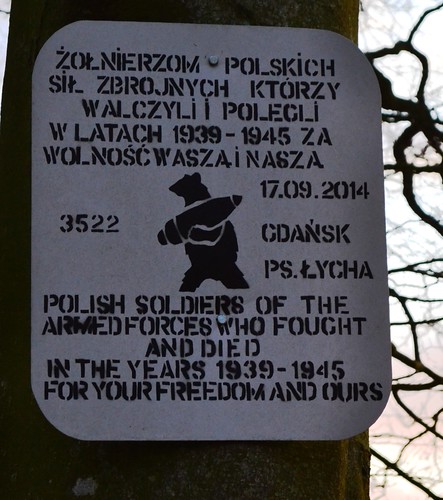
Other buildings also remain to the west on the main airfield site but these are only small and very few in number. The accommodation sites have all been removed, however, there are some buildings remaining in the former WAAF site to the north of the airfield. Located down a track just off the B4640, these buildings appear to be latrines and a possible WAAF decontamination block, with other partial remains nearby. Drawing numbers for these are unclear, (but appear to be 14420/41 and 14353/41) indicating WAAF (Officer and sergeant) quarters. Other buildings on this site look to have been a drying room, water storage tank and a picket post. Heading further south along this track leads to a small pond, here is a local design Fire Trailer shelter: a small brick-built building no more than about seven feet square. Presumably this pond was used to fill the fire trailer in cases of fire or attack and was located midway between the WAAF site and the main airfield. Also on this site, which is part of the Displaced Persons Camp, is a makeshift memorial to the Polish Armed Forces, dotted around the ground are a number of metal parts partially buried in the soil.

RAF Winfield

A plaque dedicated to the Polish Armed Forces placed next to the fire trailer hut.

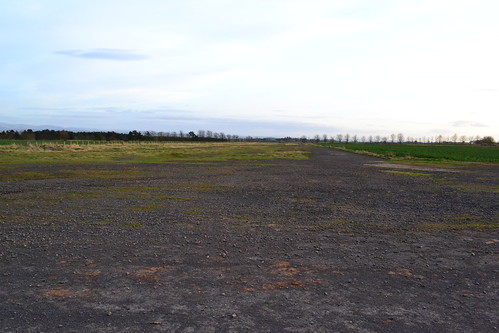
The airfield runways and perimeter tracks are still in place, and years of both decay and locals using them to practice their driving skills on, have taken their toll. Like Charterhall, Winfield was also used as a motor racing circuit, although not to the same extent that Charterhall was. On one occasion though, as many as 50,000 spectators were known to have visited the site on one day alone!

Winfield like its parent site has now become history, the remnants of its past linger on as final reminders of the activities that went on here in the 1940s. The night fighter pilots who pushed the boundaries of aircraft location and interception are gradually fading away; the dilapidated buildings too are gradually crumbling and breaking apart. Inch by inch these sites are disappearing until one day soon, perhaps even they will have gone along with the brave young men who came here to train, to fight and in many cases to die.

As we leave the remnants of Winfield and Charterhall behind, we continue North to our next trail; nearing Edinburgh we take in more of Scotland’s natural beauty and even more tales of its wonderful but tragic aviation history.

My sincere thanks go to both Mr. and Mrs. Campbell for their hospitality and the help in touring these two sites. The history of both Charterhall and Winfield can be read in Trail 41.

Sources and Further Reading – RAF Winfield

*1 Photo IWM collections No.HU 16548.

The Polish Scottish Heritage website provides information about the scheme.

RAF Bardney to become a Shooting Range

After the closure of many of Britain’s wartime airfields, many were returned to agriculture or converted for use by light industry. Some were completely removed and some developed into housing. RAF Bardney, located a few miles to the east of Lincoln, has since been one of those used for a multitude of light industrial and agricultural uses and has been the recent subject of a planning application.

Bardney was home to three RAF squadrons during World War Two: Nos 9, (April 1943 – July 1945);  No. 227, who were reformed here at Bardney from ‘A’ flight of No. 9 Sqn and ‘B’ flight of 619 Sqn, staying for two weeks in October 1944; and finally No. 189 Sqn (April – October 1945) – all three squadrons operated the Lancaster MKI and MKIII.

During their stay here, No. 9 Sqn operated as part of 5 Group Bomber Command, using the Squadron code ‘WS’, and after moving in from nearby Waddington, they carried out a number of operations into the German heartland losing fifty-nine aircraft during 1943, half of which were whilst based here at Bardney.

The first fatality occurred on April 30th, when Lancaster III WS-R, ‘KD838’ was lost without trace in an operation to Essen. None of the seven crew members were ever found nor was there ever any trace of the aircraft.

9 Squadron was a mix of nationalities: British, Australian, Canadian, Rhodesian and Trinidadian. As with KD838, a large number of these crews were lost without trace, and as such, have no known grave – their memories being carved into the walls of the Runnymede Memorial.

ROYAL AIR FORCE BOMBER COMMAND, 1942-1945.

Lancaster Mk III, ED831 ‘WS-H’, of No 9 Squadron RAF, flown by Squadron Leader A M Hobbs RNZAF and his crew, at Bardney. © IWM (CH 10405)

In the dying stages of the war, Bardney was used by the RAF’s Bomber Command Film Unit, flying Lancasters and Mosquitoes, the unit was itself eventually disbanded at Upwood later in the same year.

Post war Bardney was used  as a Thor missiles base by No. 106 Squadron (July 1959 – May 1963), before its eventual closure and final disposal.

A planning application was originally submitted in September 2016 for a:

“Change of use and conversion of existing agricultural land and associated outbuildings to provide an outdoor activities centre providing archery, air rifle shooting, axe throwing, combat archery and zombie training, and the construction of earth bunds to a maximum height of 3.0metres (bunds already constructed), in accordance with the amended plans received by the Local Planning Authority on 15th November 2016”.

Objections were put forward by local people and comments made by other interested bodies such as Environmental Health, Health and Safety and the Economic Development Team. Permission was initially granted in December that year. There are certain conditions in the terms of the decision, but it seems more than likely that the development will progress as planned.

The proposal and supporting documents can be found on the East Lindsey District Council Planning site.

The story first appeared in ‘Lincolnshire Live‘ news report on May 27th 2017.

The Borders – RAF Charterhall (Part 3)

We carry on from Part 2 of Trail 41 for the final Part of RAF Charterhall. An airfield that had become known as ‘Slaughterhall’ it was about to see a new breed of aircraft, perhaps even a turn in luck.

RAF Charterhall

The main runway at Charterhall looking south.

The night of May 27th – 28th 1944 was a heavy night for Bomber Command, with large numbers of four engined heavies attacking targets in Germany.  On their return, ten Lancaster bombers were diverted to Charterhall, the first time the four engined bombers would use the airfield, but not the last. On the 8th June, another seven were to arrive, also diverted on their return from the continent. Then in July, a Halifax was diverted here after sustaining heavy flak damage over Helioland. The pilot, P/O W. Stewart of the RCAF and navigator P/O K. Evans (RAF) were both awarded DFCs for their action whilst badly injured, such was the determination to get all the crew and aircraft back safely.

July to October saw an increase in flying and an increase in accidents. July ‘led the way’ with heavy landings, burst tyres, ground collisions and engine failures being common place. The majority of these incidents were Beaufighter MKIIfs, some were visiting or passing aircraft who suffered problems and had to divert. Charterhall saw a mix of Lysanders, Barracuders, Beauforts, Wellingtons and Hurricanes all use Charterhall as a safe haven.

As the threat of attack was now diminishing, a reorganisation of the O.T.Us would see 9 Group disband in September that year. The responsibility of 54 O.T.U (now flying mainly Mosquitoes) and Charterhall would now pass to 12 Group.

Eventually 1944 turned to 1945 and the year that saw for 17 fatal crashes also saw 54 O.T.U. take on more aircraft and more crews.

January 1945 was incredibly harsh in terms of weather and the cold. Training new crews on new radar meant that Wellingtons were brought into Charterhall. Small teams of pupils would take turns to operate the radar to detect Hurricane ‘targets’. These new models increased the air frame numbers at Charterhall to 123 by the end of January.

RAF Charterhall

‘No. 1’ Building on the Technical site.

By now the allies were winding their way into Germany, pressure was increased by Bomber Command and so more heavies were to find Charterhall a refuge when the weather closed in. On the 15th February a large ‘Gardening’ operation led to 12 heavies landing at Charterhall along with four Mosquitoes who had been flying with them over Norway. All these aircraft were able to return to their various bases at Skipton-On-Swale, Leeming and Little Snoring the next day.

Two days later, more aircraft were to find Charterhall (and Winfield) needed. Some 266 aircrews – an incredible influx for one night – were going to need bedding – billiard tables, sofas and chairs suddenly became in very short supply.

The poor weather continued well into the year and snow caused some ‘minor’ accidents at Charterhall. The first confirmed death was not until early March and others were to follow. By May the war had come to an end and operations began to wind down. Winfield was closed and crews returned to Charterhall. Beaufighters were gradually sold, scrapped or moved elsewhere, and by August the last aircraft had left.

March would see the last fatalities at Charterhall, both in Mosquitoes on the 25th and 29th. In the former, the aircraft was in a high-speed vertical crash and the latter the pilot, Flight Lieutenant Cole (s/n125484), overshot the runway and crashed his Mosquito FBVI (HR297) a mile south of the airfield. He was 22.

Apart from a small detachment of crews from 770 Squadron Naval Air Branch carrying out trials, operations began slowing down. After VJ day, the Mosquito numbers were also wound down, only fifty-one aircraft remained by the end of August.

In September the order came through to vacate Charterhall and the packing began. By the end of the month 54 O.T.U. had all but vacated leaving Charterhall quiet once more. The last eighty aircraft consisting of: Mosquito VI,  XVII and NF30s, Martinets, an Oxford, Miles Master II, Ansons, Hurricane IICs and Wellington XVIIIs were flown out for the final time, 54 O.T.U. had played its part and their end lay ahead.

In the three years that Charterhall had been in operation, they had passed over 800 crews for night fighter operations, they had suffered over 330 accidents, 56 of which had resulted in deaths. During this time crews had flown just short of 92, 000 hours flying time day and night, with almost a third being carried out at night. Had it not been for this unit, the heavy bombers of Bomber Command may well have suffered even greater losses, the determined and deadly night fighters of the Luftwaffe may have had a much wider and easier reign over our skies and the losses we quote today would be even higher.

But the withdrawal of 54 O.T.U. was not the demise of Charterhall. For a short period it was set up as No 3 Armament Practice Station, designed to support and train fighter pilots in the art of gunnery. During its period here November 1945 – March 1947 it would see a range of aircraft types grace the runways of Charterhall.

The first units were the Spitfire IXB of 130 squadron from December 1st 1945 – January 24th 1946, followed by 165 Squadron’s Spitfire IXE between 30th December and January 24th 1946. On the day these two squadrons moved out, Charterhall entered a new era as the jet engines of Meteor F3s arrived under the command of 263 Squadron. After staying for one month they left, allowing the Mustang IVs of 303 (Polish) Squadron to utilise the airfield. Each of these squadrons followed a course which included air-to-air target practice, ground attack, bombing and dive bombing techniques.

Following the completion of the course 303 pulled out and the order was given to close No. 3 Armament Practice Station and wind Charterhall down for good. The RAF sent no further flying units here and apart from a detachment of Mosquitoes from 772 Squadron of the Fleet Air Arm, by the following summer, it had closed. The final spin of the airscrew had taken place.

Post war, the airfield was left, the runways and buildings remained intact and the airfield was used by small light aircraft. Gradually though it fell into disrepair, used mainly for agriculture, it had a new lease of life when on Saturday May 31st, 1952, the airfield saw its first motor race using sections of the perimeter track and runways. A two-mile track became the proving ground for a number of the worlds most famous racing drivers including: Sir Stirling Moss, Jackie Stewart O.B.E., Roy Salvadori, Sir John Arthur ‘Jack’ Brabham, AO, OBE, Giuseppe “Nino” Farina and local boy Jim Clark O.B.E. Clark cut his racing teeth at Charterhall, eventually winning 25 Grand Prix races and the Indianapolis 500 in 1965. His grave lies in nearby Chirnside cemetery alongside his mother and father. Charterhall also saw the appearance of Scotland’s first organised sports car team, ‘Ecurie Ecosse’, using Jaguar cars*4. Racing occurred here until 1969, when the current owners took over the site.

The RAF then returned briefly in late 1976 undertaking trials of the Rapier ground-to-air missile system, in which a range of fast jets including Jaguars and Phantoms would participate. These lasted a month which would see the last and final RAF involvement end.

The owners reinvigorated the site providing a venue for rally sport events which started again in 1986. Eventually on March 30th, 2013, the last ever race was run and motor sport stopped for good and so another era finally came to a close.*5

RAF Charterhall

Jim Clark’s grave stone at Chirnside.

Today a section at the western end of the main runway is still available for use by light aircraft (with prior permission) and the main technical area is home to the Co-op Grain store, a facility which has a number of large stores for drying and storage of grain.

Accessing the site is from the B6460 where a memorial stands to the crews who passed through Charterhall and in particular Flight Lieutenant Hillary and Flight Sgt. Fison, who died in such tragic circumstances. A track leads all the way to the airfield site, which was the main entrance to the airfield. A good quantity of buildings still stand here on the technical site along with two of the original hangars. All of these are used for storage or stabling of animals including horses and are rather rundown. The perimeter track and runways are complete but their surfaces are breaking up and in a poor state of repair.

These buildings are a remarkable and poignant reminder of the tragic but significant years that Charterhall prepared and developed crews for the night fighter squadrons of the RAF. Hundreds passed through here, for many it was a difficult twelve weeks, for some it ended abruptly and decisively. Not known for its comforts, it was a pivotal station in the Second World War and indeed also for many years after for the those who went on to become some of the world’s most famous motor racing drivers.

Many airmen came and stayed, sixteen of them who were killed on active service whilst at Charterhall are buried in the nearby cemetery at Fogo, a short distance to the north of the airfield. Many are from around the commonwealth who came here to help and were never to return.

After leaving Charterhall, we head a little further east to Charterhall’s satellite and a site that had strong links with the forces of Poland. Remembered here is an usual mascot, a bear known as ‘Wojtek’. We stop off a few miles away at the satellite that was RAF Winfield.

Sources and further reading

*4 Obituary of Bill Dobson: ‘Ecurie Ecosse’ racing driver in ‘The Scotsman‘ newspaper 21st October 2008.

*5 A news report of the event can be read on ‘The Berwickshire News‘ Newspaper, 28th March 2013.