The Development of Britain’s Airfields (Part 3).

In Part 3 of this series, we turn from the political scene of Part 2 and look at how airfields were identified, The process and methodology of airfield selection.

Choosing a site.

Choosing an airfield site during these prewar periods was especially difficult as there were many ‘unknown’ factors to predict, a factor in itself that helped determine the needs of each of the various schemes mentioned previously. However, there were a number of airfields already in situ, some used by the military and some used by civilian aviation. As remnants of the First World War, many military sites were inadequate or inappropriate for the growing future needs of the RAF, but with some work, they could be developed into workable sites as the basic infrastructure was already there in place.

As well as these RAF sites, there were also civilian airfields, which the Government considered as potential military airfields. Because civil aviation had grown amongst the wealthier members of society, although not exclusively, this meant that in the pre-war period, there were some 90 airfields*4 owned either by local councils or under private ownership. Many of these were requisitioned by the authorities, but because many were small or located very close to built-up areas, (in 1928 the Air Ministry ‘encouraged’ towns of 20,000+ inhabitants to have a municipal airport), they were not suitable for modern fighter or bomber aircraft. As a result, many of these became training or maintenance sites, some linked to aircraft production facilities, but none were ‘operational’ for fighting units.

A further group of airfields in use at this time, were those of the AA (Automobile Association – better known as a motoring organisation). The AA Landing Grounds were often ex First World War sites located near to hotels and other places of interest to the motorist. Fuel was usually supplied at, or near to, each site, and each one was ‘tested’ by an aircraft on behalf of the AA before it was granted AA status. As these sites were registered, their locations were readily available to the Germans and so they were closed and rendered unsuitable for aircraft. However, land in close proximity was occasionally used, and so a new site would be created in a similar location.

With all these sites available, one would imagine choosing a site and developing it, would be relatively straight forward, but this is far from the truth. Many of these sites were inadequate, and the process of repairing/upgrading or rectifying it was simply not going to be sufficient. Therefore, many new sites were going to be required and the process by which a site was identified, acquired and then subsequently developed was not at all straightforward. In each case the Air Ministry Directorate (AMDGW) and Air Ministries Aerodromes Board would work in very close conjunction with numerous other Government departments and interested public bodies. These would include local Electricity Boards, Drainage Boards, the Geological Survey Department and the local War Agricultural Committee, who were concerned about flooding caused by run-off from the sudden building of large expanses of concrete.

In the first instance, using an ordnance survey map, areas that were below 50 feet above sea level or above 650 feet were generally ignored, the former being prone to flooding whilst the latter suffering high levels of low cloud or hill fog. Next a circle with a radius of 1,100 yards was marked off, this had to be flat with minimal rise in the ground layer. It also had to be free from obstructions and ideally at least three miles away from any other flying location. Next officers from the Air Ministries Aerodromes Board would walk the site, field by field, recording maximum landing distances, and noting any unidentified obstacles, trees, hedges, ditches or more permanent structures that would need removal.

By September 1939, board officials had identified, examined and recorded around 4,000 possible sites in the U.K. Many would be simply filed away never to see aviation of any kind, whilst others would become famous for years to come.

Once a suitable site had been identified and examined, the local geology had to be established where possible. In the pre-war years, no consideration was given to hard runways, they didn’t exist in any real form and were not seen as needed as any aircraft of that time could happily take off from a grass strip. However, in order to prevent aircraft wheels from bogging down, or flooding closing an airfield, well-drained soils were absolutely paramount.

Once the site had been accepted, the land was requisitioned, forcibly purchased using new powers created under the Emergency Powers (Defence) Act 1939. This gave virtually immediate access and ownership of the land – with little notice to the land owner – to the Government. These powers also saw their way to reducing the ‘NIMBY*5 effect, protests against developments being side-lined through political clout.

The next stage in the process was to put the job out to tender. The difficulty here was that secrecy was of the utmost importance, and so little of the detail was released other than an approximate location. As the war progressed, the number of construction companies involved became fewer, and those that were involved more established, prime contractors being Wimpey, Laing, Taylor-Woodrow and McAlpine – all of whom went on to be major construction companies post war. That said, no major airfield would generally be completed by one single contractor, as the whole process required a wide range of skills based operations. As one completed their task, another would come in, sometimes dual operations would be carried out simultaneously. For example taxiways and access roads may have been built by Tarmac, whereas the runway may have been built by McAlpine. Accommodation areas often used ‘Nissen’, or in many USAAF cases, ‘Quonset’ huts, many of these and other ‘standard’ buildings were erected by buildings contractors whereas other more substantial buildings may have been built by John Laing and Co.

By the outbreak of war, 100 sites had been purchased, as the number was relatively small, the board were able to be ‘particular’ in their choice, something that was quickly disregarded as the war progressed.

Airfields are highly labour intensive projects requiring an enormous workforce and extensive heavy machinery, little of which were available in the early 1940s. Irish labour provided the backbone of the initial workforce, whilst heavy plant came in from the United States. At its peak there were some 60,000 men employed on airfield construction, all of whom were unable to spend their time rebuilding the devastated towns and cities of the UK.

As the war progressed, the Royal Air Force Airfield Construction Service began taking a greater role in airfield construction, diversifying away from their original role as repairers of damaged airfields sites. There would be an initial 20 squadrons created to carry out these tasks, with a further 6 being formed later in the war. With squadron numbers ranging from 5001 to 5026, they would be initially involved in the updating of older sites and the creation of ALGs, eventually taking on a much greater responsibility of airfield construction. These squadrons, were of course given great assistance by the well established Royal Engineers.

In 1942, the United States joined the European theatre sending their own Engineer Aviation Battalions to the U.K. Their task was to support these British squadrons by building their own airfields ready for the huge influx of men and machines that was about to arrive. The first site completed by the Americans and opened in 1943, was Great Saling (later renamed Andrews Field) by the 819th engineer Aviation Battalion. Not being experienced in U.K. soils, it was a steep learning curve fraught with a number of initial problems.

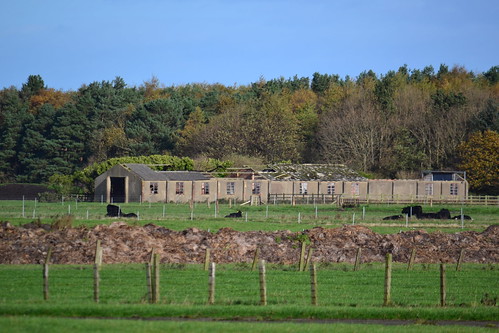
Former RAF Andrewsfield

RAF Andrews Field memorial to the 819th Engineer Aviation Battalion.

In 1939 there were only 60 military airfields in the UK, by 1940 this had increased to 280, almost tripling to over 720 by 1945. Between 1939 and 1945 444 airfields*2,4 new airfields were built by these organisations – an amazing feat by any standard. Using almost a third of Britain’s total construction labour force, they were often open and manned within a matter of months rather than years. Building Britain’s wartime airfields was not cheap. Many, like Debach the last USAAF airfield to be constructed, cost almost £1,000,000 to construct.  A small amount compared to the £645, 000,000 it cost to build all 250 US airfields in the UK*5a

This whole process however was not fool-proof. In a number of situations sites were identified and requisitioned, but not developed. In several cases they were partly built, and in others like RAF Cottam, they were completely built but then never occupied. Some airfields were identified for USAAF use, only to be declined and then handed over to their RAF counterparts. Some US bases were never actually started but remained named and therefore official sites even though they remained as farmers fields!

The lead up to war led to a massive change in the British landscape. Keeping airfields secret led to many being built in remote areas and away from major towns. Little did the inhabitants of these quiet little villages know, but their population was about to increase, in some cases by thousands.

In the next section we look at how the airfield was built, the process of construction and the difficulties faced during this phase.

Sources and further reading. 

*2 Smith, D.J., “Britain’s Military Airfields 1939-1945“, Patrick Stephens Limited, 1989

*4 Francis, P., et al, “Nine Thousand Miles of Concrete, Historic England in Conjunction with the Airfield Research Group (ARG). pdf document Published 15/1/16 via website accessed 2/1/18

*5 NIMBY – Acronym used to describe the objections of local planning projects. (Not In My Back Yard).

*5a Wilson. K., “Blood and Fears – How America’s Bomber Boys and Girls in England Won Their War.”, Weiden & Nicolson. (2016)

The Development of Britain’s Airfields (Part 2).

In this series of posts we look at the development of Britain’s airfields and how they developed over the years. We move on from Part 1, and the “Road to War”, to look at the Political response to Germany’s build up and the development of the airfield. We focus on the expansion period 1934-1939, and the political moves that helped shape the airfields that are found in Britain today.

The expansion period and airfield development.

In this, the expansion period 1934-39, airfield development would become a prime factor in the RAF’s own development.  The driving force behind this was the need to increase the numbers of front line aircraft, both fighters and bombers, if Britain was to be able to match Germany’s growing armed forces and her desires over Europe. To this end, a number of schemes were created, each one building upon the previous through  adaptation of technological development, design improvement and political pressure. A continuation of updating meant that the face of the British airfield would change considerably from 1934 to the end of the war in 1945. This development would then go on post war as the world entered the jet age and nuclear deterrent.

Whilst many of Britain’s original airfields dated back to the First World War, the vast majority had vanished, (of the original 301 only 45 remained and of these 17 were civil*2) the rest being sold cheaply in the reorganisation of the post war RAF. Of those that did remain, many were poorly kept, the permanent huts that had been built were in poor condition and flying surfaces totally inadequate for the heavier aircraft that were envisaged.  Many of these airfields were located around London (including Biggin Hill and North Weald) and were built on a clay subsoil, a soil that holds water and led to numerous accidents as aircraft landed badly. The RAF began to apply pressure on the Government, but with no real direction, there was little hope of achieving anything more than lip service.

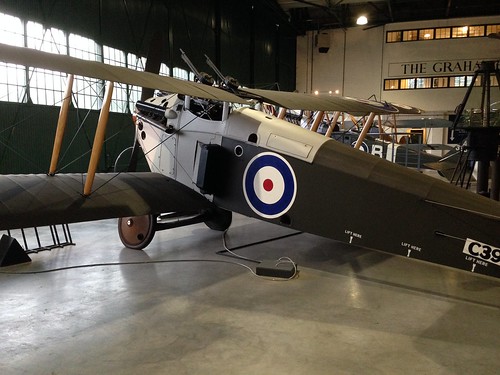
RAF Museum Hendon

Early biplanes formed the backbone of the interwar years.

The Government finally realising that change was needed, formed a new department, whose role of executing these new plans it fell to. The Air Ministry Directorate General of Works (AMDGW) under the control of Ernest Holloway, oversaw the process with the new Air Ministries Aerodromes (later Airfield) Board, being responsible for identifying the new airfield. The Lands Branch of the Air Ministry would purchase the land, and then the construction, development and maintenance would be carried out under contract, by civilian organisations, to the Air Ministry.

This process took airfield design through a series of successive alphabetically listed schemes commencing with ‘A’ (not to be confused with Class ‘A’ airfields that emerged much later in 1942) progressing through to ‘M’. Due to the rapid changes in these designs though, not all were implemented, many being absorbed into subsequent models before they could be administered. The future development and expansion of the RAF would be built-in to these schemes, restricted initially by the monetary cost of such a plan. But the overall  aim would be to build the RAF up to full strength within eight years (1942).

The key to these designs was continuity and replication. By creating a series of standard design drawings for everything from latrines to heating systems, hangars and runways, airfields could be ‘mass produced’ with ease, saving both time and money, which was paramount if the RAF was to be ready for the forthcoming war.

In essence, these schemes increased targets for aircraft numbers, including training facilities and airfield design:*2,3,4

Scheme A – (adopted in July 1934) is the scheme that set the bench mark by which all future schemes would develop, and called for a front line total of 1,544 aircraft within the next five years. Of these, 1,252 would be allocated specifically for home defence. This scheme was responsible for bringing military aviation back to the north of England, Norfolk and Suffolk, of which Marham (the first), Feltwell and Stradishall were among the first completed. These airfields were designed as “non-dispersed” (or compact) airfields, where all domestic sites were located close to the main airfield site, and not spread about the surrounding area as was common practice in war-time airfield designs. At this stage, the dangers of an air attack were not being wholeheartedly considered, and such an attack could have proven devastating if bombs had been accurately dropped. It was thought that by having personnel close by, airfields would run both economically and efficiently, and of course they could more easily be protected from ground forces.

Scheme ‘A’ would also introduce the idea of standard building designs, in which all new airfields (and older original airfields) would now be built to.

Scheme B – was never submitted to Government

Scheme C – adopted May 1935 following Hitler’s boast to Anthony Eden that the German Air Force had surpassed the RAF’s in number, a claim that has since been discounted. This would develop bomber bases within flying distance of Germany (notably Lincolnshire and Yorkshire), and proposed creating a further 70 bomber and 35 fighter squadrons accommodating 1,500 front line aircraft within two years.

Scheme D – was never submitted to Government

Scheme E – was never submitted to Government

Scheme F – replaced Scheme ‘C’ and was approved in March 1936. Scheme ‘F’ expanded the defence force, further increasing front line numbers to 1,736 with a foreseeable number of 2,500 by 1939. This scheme saw the creation of additional factories in close proximity to the already adopted car manufacturing plants in the industrial midlands. A move that was intended to assist with the supply of new aircraft and aircraft components. Such was the industrial output at this time that Aircraft Storage Units (ASU) had to be specially set up utilising land on already established Flying Training Schools. These ASU stations would be specifically created to assemble or disassemble aircraft for transport to fighter bases, either within or outside of Britain. Scheme ‘F’ would also create further new front line airfields, examples including: Debden, Upwood, Scampton and Dishforth, with further updating being implemented at previously built airfields.

Scheme G – was never submitted to Government

Scheme Hreached proposal at the end of 1936 and would have increased front line strength at the expense of the reserves, and so was rejected. It was at this point that the ADGB and associated bodies were split into the four aforementioned commands each headed by a Commander-in-Chief (CIC)

Scheme I – was not used

Scheme Jonly reached proposal, but would have provided the RAF with 2,400 front line aircraft. It was considered too expensive and rejected in lieu of Scheme ‘K’.

Scheme Kreached proposal in March 1938, but was considered too small following the German’s annexation of Austria. A further review was requested which accelerated the expansion, and was proposed a month later as Scheme ‘L’.

Scheme L – passed by the Government on 27th April 1938, it called upon industry to produce the maximum output possible over the next two years. Superseded by ‘M’ after the Munich crisis, new airfields included: Binbrook, Leeming, Middle Wallop, and Horsham St. Faith. This scheme required 2,373 front line aircraft in 152 squadrons, and focused on fighter Command; in particular, increasing the number of fighter pilot training units. Scheme ‘L’ also called for increased accommodation facilities to allow for this increase in trainee pilots, and it called for new RAF Hospitals, the first of which was at Ely in Cambridgeshire.

Scheme M – approved on 7th November 1938 and called for 2,550 front line aircraft by March 1942. Airfield examples included: Swanton Morley in Norfolk, Coningsby in Lincolnshire and West Malling in Kent. This scheme introduced the ‘J’ and ‘K’ hangars, implemented as part of austerity measures, one of the few permanent buildings now on site.

By the outbreak of war the RAF had a force that equalled less than half that of the Luftwaffe, Fighter Command possessing only 1,500 aircraft (less than was required under Scheme ‘F’), of which many were already outdated or inadequate. Bomber Command had 920 aircraft, but nothing was bigger than a twin-engined aircraft with limited capabilities.

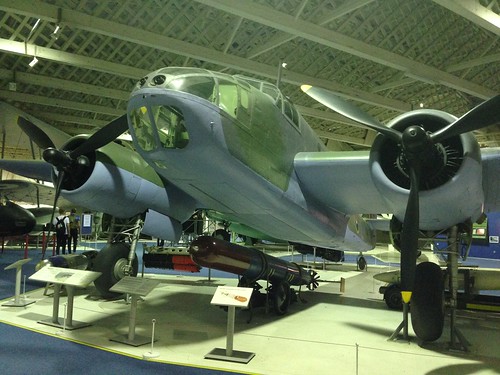
RAF Museum Hendon

The RAF’s front line bombers were twin-engined with limited capability.

The four Commands created out of the ADGB were also undergoing dramatic change, with aircraft being distributed more appropriately and groups being formed to streamline operations. Whilst still far below the levels at which the Luftwaffe were operating, the RAF had over the last few years seen a major reconstruction process, both in terms of aircraft and airfield development, along with major changes in the Air Force’s structure.

As aircraft were designed to perform different duties, airfields within their commands would also differ in their operation and construction. Hangars or watch offices for example, would be designed but modified depending upon the nature of the airfield they were servicing. Standard buildings would be altered to suit the different needs of the different duties, and airfield design would take a change in direction, the non-dispersed site being discarded for the safer, but less efficient, dispersed site.

As the years progressed, further changes to airfield development would occur as new, larger and heavier aircraft were developed. The four engined heavies: Stirling, Halifax and Lancaster, determining new designs and new requirements. The entrance of the USAAF in the European theatre also played a part in airfield design and development, and by 1942, a new standard would be devised by which all future airfields would be built.

The Class ‘A’ airfield became the standard airfield design for bomber airfields, with many fighter airfields, training and temporary airfields remaining either as grass or using a form of steel matting. Twelve different types of matting were developed during the war, the most common being – Sommerfeld Track, Pierced Steel Planking (PSP – also called Marston Mat), or Square Mesh Track (SMT). The Class A was determined primarily by its runway layout and measures, formed around three intersecting runways at 60o to each other, the main was 2,000 yards long with two subsidiaries of 1,400 yards, each 50 yards wide. An extension of 75 yards was provided alongside the runaway to allow for emergency landings. In addition, another grass strip clear of all obstacles was also provided, these measured 400 and 200 yards respectively.

The Class A would set the standard from now on, the British airfield was now a major geographical conurbation. They were now like small towns, with cinemas, gymnasiums and other recreational facilities, they had dispersed accommodation areas, technical sites, large aircraft maintenance sheds and hard runways that only a few years earlier were unheard of.

Each of these schemes brought new requirements for airfield designs; their layouts and buildings were changing almost as fast as aircraft development. The airfield had finally evolved.

In the next part we look at the way in which a site was chosen, the number of agencies involved and the criteria for airfield location.

Sources and further reading. 

*2 Smith, D.J., “Britain’s Military Airfields 1939-1945“, Patrick Stephens Limited, 1989

*3 “Norfolk Heritage Explorer pdf document published by Norfolk County Council – via  website accessed 2/1/18,

*4 Francis, P., et al, “Nine Thousand Miles of Concrete, Historic England in Conjunction with the Airfield Research Group (ARG). pdf document Published 15/1/16 via website accessed 2/1/18

The Development of Britain’s Airfields (Part 1).

The development of Britain’s airfields has been both rapid and complex. The design, layout and specific requirements of airfields changing as the need for areas suitable for larger and more powerful aircraft arose. From the early days of flight through the expansion period of 1934 – 1939, and on into the cold war, Britain’s airfields have become iconic symbols not only of Britain’s defence, but also the rapid development of air travel.

The range of airfields is as wide as their developmental history: fighter; Bomber; Coastal Command; Emergency Landing Grounds (ELG); Relief Landing Ground (RLG); Satellite Landing Grounds (SLG); Advanced Landing Grounds (ALG) and Cub Strips, not to mention the fake ‘Q’ sites along with the various training, glider and ATC sites.

It is a very detailed and complex subject, and one in which there have been many valuable and in-depth texts written. It is a subject that is far too detailed to cover in its entirety here, but by focusing on the main features of airfield development, we can at least shed some light on the huge undertaking that reshaped the British landscape, and whose effect has been long-lasting, becoming the widespread topic of interest it is today.

In the following series of eight posts, we look at the development of these airfields, the main structures that are associated with them and how Britain’s airfields grew from basic fields to major conurbations as a result of the direct threat of war.

We start with the build up to war and the growth of the Royal Air Force from 1918.

Britain’s Road to War.

The Royal Air Force was formed on April 1st 1918 through an act of Parliament that saw its predecessor, the Royal Flying Corp, mutate into what has become not only one of the premier fighting forces of the world, but also the oldest Air Force in the World. However, in the post-war era following the First World War, political opinion was very much against the continuation of the RAF, feeling that it was exhausting an already depleted national economy and contravening a stern non-rearmament policy. In addition, an apathetic and vehemently pacifist post war public was also hard to convince that a third force, which was seen as ‘weaker’ than its two older sisters, was really necessary.

Two men, Winston Churchill (then Minister for War) and Air Marshal Trenchard (as Chief of the Air Staff), crusaded on behalf of the RAF, seeing it as the valuable asset it had become. In the Trenchard memorandum of December 1919, Trenchard outlined the biggest re-organisation of the Royal Air Force in history, a change that included everything from insignia and uniforms, to buildings and training. It was a change that would establish the RAF as an air force capable of mobilisation and expansion at a moments notice.

To achieve these goals, Trenchard would set up a rigorous training plan, with stations specifically designed to deal with the various aspects that would be needed; an Air Force Cadet College at Cranwell, a flying training school for Air Force Staff in Andover, a further scheme for short-service commissions and a technical college at Halton (set to close in 2022) in Buckinghamshire.

RAF Cranwell

RAF Cranwell in Lincolnshire remains the Officer Training College today.

This re-organisation would be a re-organisation for survival, and would involve the disbandment and demobilising of vast numbers of men and women; the subsequent rundown of the RAF being both rapid and immediate. By March 1920, in excess of 23,000 officers, 21,000 cadets and 227,000 other ranks and been demobilised and returned to ‘civvy street’. The new RAF was small, formed with just 3,280 officers and 25,000 other ranks. Assets too were stripped, airfields were sold off and hardware disposed of, but the Air Force was going to survive as an independent fighting force that would become a major peacekeeping force within the next few decades.

In the 1920s, and even though limited by the 10 Year Rule on defence expenditure, Trenchard envisaged a build up of the Air Force, incorporating both fighters and bombers, to a level that would be both powerful and dominant. He set a target of some 52 Home Defence Squadrons, but his continued battles with the Army, Royal Navy and politicians alike, meant that this figure would take many years to achieve and Britain would be poorly protected in the case of attack.

In a statement by the Secretary of State for Air, Sir Samual Hoare, at a meeting of the Imperial Conference on October 19th, 1923, Sir Samual highlighted the inadequate numbers that were present for Home Defence, he said:

“When the Navy and Army requirements were met and the squadrons provided for the Air Command in Iraq, and provision made for training in Great Britain, the machines left for home defence in Great Britain were altogether insignificant. I may give as an instance of this insignificance the fact that a few months ago at the height of the Turkish crisis, when we had sent two Royal Air Force squadrons to Constantinople, we were left with only twenty-four first-line machines actually available for home defence against air attack.”

Whilst slow, the 1920s and early 1930s did see the RAF expand, achieving 65 squadrons by January 1st 1935, mostly manned by fully trained reserves. This did however, do little to bolster the front line numbers of available fighters, and as demands for spending cuts in the world’s depression started to bite, this build up began to slow even further.

It was during these early 1930s that movements in Germany, in particular with Hitler and the rise of the Nazi Party, gave rise to an uneasy feeling across Europe; a feeling that would lead to new policies being implemented, policies that would refuel the impetus of Britain re-arming its major forces in the latter half of the 1930s.

With events like the Schneider Trophy and displays at Hendon capturing the imagination of the public, the Government saw these as a way to develop new faster and more agile aircraft, and as a pedestal on which to put both Britain and the RAF. These air displays continued until 1937, when a war with Germany became evermore likely, and the previously formed rearming policies began to take shape.

German boasting of its redevelopment was barely enough to hide the fact that it was rearming as early as 1932, and the speed at which this was happening would far outstrip the RAF’s meagre numbers in the years following the Nazi’s rise to power in 1933. In these early years, Britain’s bomber strength was as low as five night, and six-day bomber squadrons, each one operating limited, slow and cumbersome biplanes. Aircraft that were no match for even the reduced force that Germany was to front during the controversial Spanish Civil War.

Germany’s rearming was occurring at an alarming rate, and after Goring’s inauguration as head of the Reich Commission for Aviation, a formal request for the purchase of British aircraft, by Goring, was refused, but ironically not the supply of two military supercharged aero-engines that were to be built under license in Germany! Britain was not alone in this action though, the USA also sold Germany contravening merchandise during the 1930s, 19 aircraft and 569 aero-engines crossed the Atlantic, with most of these being supplied during 1934.*1 Perhaps even more astonishingly, the World War 1 German Ace Ernst Udet visited the US in the 1930s, where he developed not only ground attack and dive bombing techniques, but purchased two Curtiss Hawk II biplanes, which were taken back to Germany for evaluation for future dive bomber designs. This action eventually led to the Germans developing the Junkers Ju-87, famously known as the ‘Stuka‘, an aircraft that wreaked fear and havoc across the European continent.

Although the depression of the 1930s held German production back, the number of air-frame plants rose from 2,813 in January 1933 to almost 38,000 in 1935. This rearming was becoming so rapid, that in 1933, six new aircraft manufacturers joined the seven already established – all diversifying from other engineering areas to begin aircraft manufacture. By 1935, the total number of air-frame and aero-engine plants had risen to an astonishing 53,865, an increase of nearly 50,000 in just two years.

This massive increase was highlighted in a letter from Winston Churchill to Stanley Baldwin (three times British Prime Minister) on March 17th 1935*8, in which Churchill pointed out that:

“I believe that the Germans are already as strong as we are and possibly stronger, and that if we carry out our new programme as prescribed Germany will be 50 per cent stronger than we by the end of 1935 or the beginning of 1936.”

This increase eventually led to a number of changes in Britain. One such change was the demand for a twin-engined aircraft capable of delivering a 1,000lb bomb up to 720 miles away. Whilst not record-breaking, specification B.9/32 led to both the Wellington and the Hudson being developed, each a major step forward from the biplanes in RAF service at that time.

A further major change that the German action brought about, occurred during the mid – late years of the 1930s (1934-1939) where Britain saw, what is now commonly referred to as, “the Expansion Period”, a period in which the RAF began to increase its numbers also. It was during this period (between May and July 1936) that the idea of Trenchard’s small elite force would become four; the Air Defence of Great Britain (ADGB) along with No.1 Air Defence Group and other administration and command groups, would be disbanded and reformed as four new commands: Fighter Command (HQ at Stanmore), Bomber Command (HQ at Uxbridge), Coastal Command (HQ at Lee-on-Solent) and Training Command (HQ at Ternhill). In addition, new aircraft were going to be required, particularly fighters and heavy bombers, and to support these new aircraft, a massive support network:  new training facilities; aircraft and aero-engine factories; storage facilities; armaments factories; flying schools, and of course a range of new airfields would be needed. Running in conjunction with this would be research and development. The RAF’s budget, which included research and procurement, rose from £17.5m in 1934-5 to £74.5m by 1938-39, a massive injection of cash to help develop these new ideas.

This demand would begin the process by which Britain would develop its airfields and air force, kick starting the huge economic and technological change that would see Britain move from the simple bi-plane to jet technology, and airfields that covered not just a few, but several thousands of acres of land across the British landscape.

Britain had entered the arms race with Germany, and it would be a race to the death.

In the second part we examine the political response focusing on the expansion period 1934-1939, and how Britain’s airfields changed as a direct result.

Notes, sources and further reading.

CAB\24\164 Note from the Meeting  of the Imperial Conference on October 19th, 1923. (National Archives)

*1 Dancey, P.G., and Vajda, A-V, “German Aircraft Industry and Production, 1933-45“. 1998, Airlife Publishing Ltd

*8 Churchill, W.S., “The Second World War Volume I – The Gathering Storm“, Cassell, 1948

Trail 50 – RAF Wratting Common – One of the best records of No. 3 Group.

In this next Trail, the 50th trail around Britain’s Wartime airfields, we continue looking at Bomber Command’s airfields around the Cambridge / Suffolk borders. Being a bomber base, this is another that operated both the ill-fated Stirling, and then later the famous Lancaster; it is also a base that had some of the best survival records of 3 Group, but it also paid the price that came with the Stirling.

Turning north-west from Haverhill toward the metropolis of Cambridge, we visit an airfield that is on one of the highest points in the eastern region, at just below 400 feet above sea level, it was cold and inhospitable in winter, but it was one whose pride and significant contribution shall live on. Here we visit the former Bomber Command base RAF Wratting Common.

RAF Wratting Common (West Wickham)

Wratting Common airfield opened in the latter part of the war, May 1943. It was initially named after the local village, West Wickham, which lies a couple of miles to the west. However, due to confusion with another airfield, it was renamed in the August, becoming known as Wratting Common, the name it retained, and used, for the remainder of the war.

Operating under No. 3 Group the losses from Wratting Common would be high, 260 personnel would lose their lives here, equating to almost eleven every month for the duration of its short two-year life. Many of these crews would be Short Stirling crews, the enormous bomber that would take an incredible amount of punishment, but suffered with a limited service ceiling and a weak undercarriage that led to numerous accidents whilst landing or taking off.

Wratting Common was opened in May 1943, under the Class A specification. Three concrete and wood chip runways were built to 2,000 yards and 1,400 yards respectively. A perimeter track joined the three runways and housed 36 spectacle hardstands for aircraft dispersal. Repairs were carried out in one of five hangars, four T2s and one B1, mainly located to the north and west of the airfield. To the south lay the bomb store, and the site had the usual range of standard design buildings. The watch office was of the 12279/41 design, a design adopted by all major airfields by the end of 1943.

RAF Wratting Common

The only B1 hangar built at Wratting Common still survives today.

Designed to take just over 2,000 males and 348 female staff, it had 10 domestic sites  spread about the northern side, these would receive in the region  of 2,500 males of various ranks and 486 females, numbers fluctuating as crews invariably failed to return home and units came and went.

As it was a short-lived airfield, it would have only two operational front line squadrons, No. 90 and No. 195, although other units did use the airfield including: No. 24 Heavy Glider Maintenance Section, No. 273 Maintenance Unit, No. 1552 Radio Aids Training (RAT) Flight (No 2 Section) and No. 1651 Heavy Conversion Unit (HCU).

The opening of the airfield was preceded by the arrival of S/Ldr. W. K. Young , who took early control of the site and oversaw the final preparations for the forthcoming crews. Between April and May, construction was completed, defences were set up, and by the end of May the first operational aircraft began arriving. A handover saw a new and permanent Station Commander take over, a change that saw operational sorties begin within a matter of days.

No 90 Sqn, a first World War squadron, had been absorbed by 17 OTU in 1940, and then reformed again in May 1941. They served for almost a year being the only RAF unit at that time to fly the B-17 before being disbanded once more. This pattern of reforming and disbanding was one that 90 Sqn would perform almost perpetually.

Reforming again in November 1942 at RAF Bottesford, they began operations with the Stirling MK.I, transferring to RAF Ridgewell in December where they began to receive the MK.III. Arriving here at Wratting Common, in the last days of May 1943, they would remain here until the October that year before moving off to RAF Tuddenham,

During these five months 90 Sqn would lose 185 aircrew, a figure testament to the problems with the Stirling but also to the dedication of the crews to ‘get the job done’.

The first sortie took place on the night of 3rd/4th June 1943, when ten aircraft carried out a mine-laying mission off the Biscay ports. A rather uneventful mission, it would be one of the few where all aircraft returned safely.

With Bomber Command’s Battle of the Ruhr approaching its final chapter, 90 Sqn would suffer their first casualties on the night of June 21st/22nd, 1943. It was a mission to Krefield, a mission that saw 705 aircraft drop 2,306 tons of bombs on the town destroying almost half of it. It was the largest area of devastation so far of any mission and was preceded by an almost perfect marking from the RAF’s Pathfinders. The night was marred by high losses though, just over 6% of the force being lost, many as a result of night-fighter action. Of these, 90 Sqn got off lightly losing only one aircraft, Stirling MK.III ‘WP-T’ with the loss of all seven crewmen, a crew that included both an Australian and a Canadian airman.

RAF Wratting Common

One of the remaining five T2 Hangars still in use at Wratting Common.

By the 26th, just four days later, another five aircraft had been lost with only four survivors; a hefty blow that took the lives of thirty-one airmen whilst in their prime.

A new month proved little better, on the night of 3rd/4th July, three more aircraft would be lost, one ‘WP-F’ returning beaten up overshot the runway without thankfully, loss of life. The remaining two aircraft were lost over Belgium and Germany, with only one crewman surviving, captured by ground forces and surviving as a POW.

July would see a both further losses and 90 Sqn returning to Hamburg no less than three times before the month was over. Bomber Command’s tactic of area bombing would now turn from the industrial heartland to the city of Hamburg, and its enormous ship building works. Hamburg would of course become well-known for a number of reasons, the destructive firestorms that would devastate the town, the first joint efforts of the USAAF and RAF, and the use of ‘Window‘ for the first time.

Surprisingly during these raids, 90 squadron would have a rather uniquely ‘clean bill of health’, especially considering the nature of the target. Hamburg would not be easy, attacking at heights of around 13 – 16,000 feet, they would be dropping a mix of high explosive and incendiary bombs, well below the height of other squadrons. On the first night 24th/25th July, all 90 squadron aircraft would return to base, a night that was followed by the loss of one aircraft (Stirling ‘WP-S’) to Essen, before they returned to Hamburg on the 27th/28th.

The loss of this Stirling ‘S-Sugar’ was significant in that it was piloted by the Squadron Leader, S/L. Joseph Dugdale DFC, (s/n 39071). Presumed lost over the sea, the aircraft also had two New Zealanders and an Australian on board, one of which was washed up on the Norfolk coast along with two other members of the crew.

After attacking Hamburg, and damaged by flak, Stirling BK693 ‘WP-A’  would limp back to England landing at nearby RAF Stradishall, where it swung off the runway hitting another Stirling parked at a dispersal. The only 90 Sqn loss that night, it would set a precedent for the third and final attack of the month. Returning the next night, 777 aircraft would fly in from the north of the city, attacking areas so far not damaged by allied bombing. This raid would not be considered one of the RAF’s most ‘successful’ though, the bombing ‘creeping back’ some four miles into residential areas with huge loss of civilian life. Of the 119 Stirlings sent out that night, only four were lost, the only casualty of 90 squadron being ‘WP-F’ which took off at 22:00 hrs, crashing out of control without loss just after.

These light casualties, gave 90 Sqn one of the best records of No. 3 Group, a record that continued to the end of July and the closure of the Battle of the Ruhr.

At the end of July, Wratting Common was visited by an American airman. In rather less than ideal circumstances, Major William Julian of the 83rd FS, 78th FG, based at  Duxford, made a  wheels up landing in his battle damaged P-47 #41-6628, ‘HL-R’. The aircraft would eventually be recovered and repaired only to suffer a similar fate later on. July had been a busy month at Wratting Common!

August 1943 brought the change of name to the airfield, but no change in operations. Missions included Nuremberg, another return to Hamburg, Turin (famous for the VC awarded to Flt. Sgt. Arthur Aaron), and now for the first time, the rocket research establishment at Peenemunde. It was also a time when Sir Arthur Harris turned his attention to Berlin, the heart of the German Reich. A city heavily defended and a long way into occupied Europe, it was going to be difficult for Bomber Crews, and 90 Squadron’s run of luck could be about to falter.

During the short period of late August and early September 1943, 1,600 sorties would be flown to Berlin, and if the German’s determination to survive was going to be seen anywhere, it was going to be in their fearless defence of the capital.

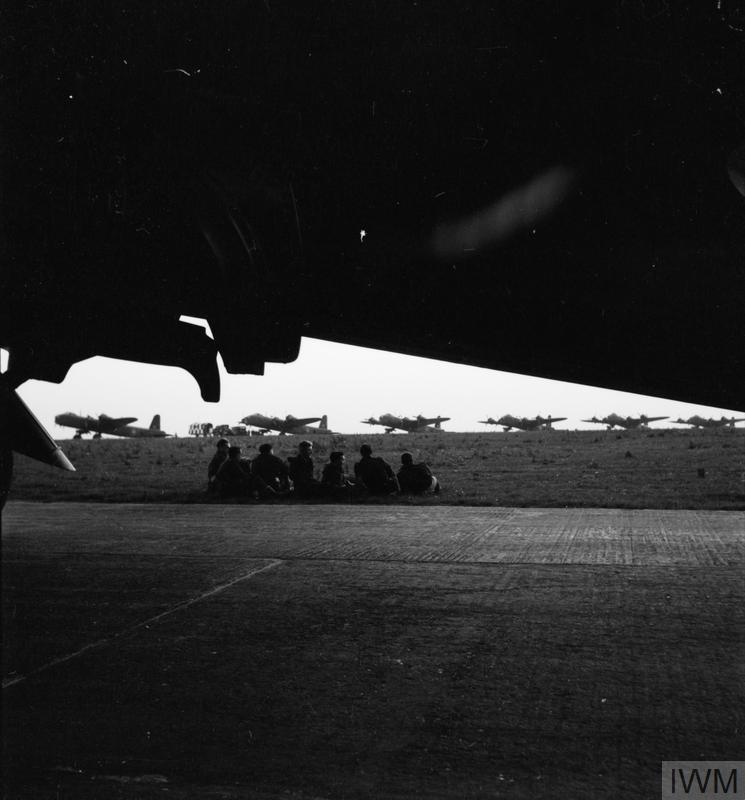
The crew of a Short Stirling Mk III, No. 90 Squadron by their aircraft on a hard stand north of the main runway at Wratting Common, watch as other Stirlings of the Squadron prepare for the night’s operation, a raid on Berlin. (@IWM CH10900)

On the first night of August 23rd/24th 1943, two 90 Squadron aircraft were lost, one ditching in the sea just off the coast near Cuxhaven north-west of Hamburg. After spending 7 days, 16 hours and 10 minutes in their dingy, three of the crew were rescued, the remaining four having been killed*1.

A second Stirling, EH937 ‘WP-S’ was also lost that night. Piloted by Flt. Sgt. Kenneth Longmore, (s/n 413622) an Australian and hairdresser by trade, it crashed in the Ilsselmeer, a stretch of water north of Amsterdam. The aircraft, along with all its crew, were lost at 20:37, three being killed and four classified as ‘missing’.

The path to Berlin was lit by Pathfinders, and of the 727 aircraft sent, 124 were Stirlings, the loss rate for the mission being just short of 8% in total.

The crew of a Stirling are debriefed by an intelligence officer after the costly night raid on Berlin, 23/24 August 1943. © IWM (CH 10804) Can you identify any of these men?

A further loss of a single aircraft on the night of 27th/28th August led to a return to Berlin, and another night of heavy losses for Bomber Command. The Stirling loss rate alone being 16% of the force. Luckily 90 Squadron themselves came off ‘lightly’ once more, losing only one aircraft that night, Stirling MK. III ‘WP-Q’ piloted by W/O. Martin P. Callaway RAFVR, (s/n: 155479), who was only 20 years old.

A third raid to Berlin, saw the withdrawal of both Stirlings and Halifaxes from these duties, their losses being too high compared to those of the Lancaster. The Germans now employing a range of tactics to illuminate the night sky, allowing the night fighters to pick the bombers off almost at will.

There then followed a period of relative calm, until at the end of September, when on the night of 22nd/23rd, 90 Sqn returned to Hannover. A raid that would perhaps be recorded as one of their worst. Between 18:50 and 18:54, three aircraft would depart Wratting Common, one ‘WP-K’ would not get far, its starboard engine catching fire shortly after take off causing the laden bomber to explode at a height of 500 feet. All but one of the crew were killed instantly, whilst the seventh, F/S. Duffy, later died from his injuries.

Of the remaining two aircraft, one was brought down by night fighters over the target, with the loss of all on board, and the third, badly beaten, limped backed to England crashing at RAF Lakenheath in  Suffolk. Two crewmen survived as prisoners, parachuting from the aircraft after confusion arose when the pilot lost control of the Stirling – the remainder of the crew being either killed or injured. For airmanship and courage Sgt. Jones was awarded the Conspicuous Gallantry Medal whilst W/O Denton was awarded a DFC, and Sgt. Suddens a DFM.

By October 1943 the Stirling’s days were numbered, and orders had come through for 90 Sqn to depart Wratting Common for RAF Tuddenham. Crews began to pack and aircraft were readied for their eventual departure. On the 12th a final air test would be carried out on Stirling EP426 ‘WP-W’  and it would not go well. A full crew watched aboard as the pilot W/O. George R. Hilton(s/n: 158247) RAFVR tried to land the aircraft with the starboard outer engine feathered. The landing was a disaster and the resultant crash killed all but one of the crew, Sgt. J. Moran the rear gunner being injured. With that 90 Sqn departed Wratting Common taking with it a record that was one to be proud of, but as part of Bomber Commands overall  strategy, it certainly had paid a high price.

For around six weeks the airfield was, flying wise, very quiet, final departures and preparations for new arrivals were made. At the end of November a new unit would arrive, bringing back the mighty Stirling to this open and cold station once again.

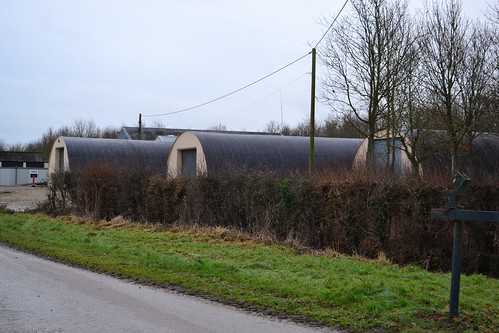
RAF Wratting Common

Nissen huts once used by technical staff are now part of the farm complex.

1651 Heavy Conversion Unit (HCU) were one of three such units still operating the Stirling, the remainder having switched to Lancasters or Halifaxes previously. Whilst at Wratting Common, 1651 HCU would convert crews to four engined heavies, a task much-needed as the toll of recent attacks on the German heartland was beginning to bite. Now withdrawn from front line bombing duties, Stirling crews were feeling a little pushed out, often left by the crews of Lancasters and Halifaxes who rose to the higher levels to avoid the fighters and flak. The conversion to Lancasters by Bomber Command was long and slow, the poor winter of 1943/44 playing a large part in its delay, restricting flying hours and crew training. Once ‘passed’ on Stirlings, crews would go to Lancaster finishing Schools, honing their skills on a much more adored aircraft.

The HCU would remain here for a year, suffering its own share of problems and accidents. Within the first week one Stirling would crash just 20 minutes after take off whilst on an emergency approach to nearby RAF Downham Market.  After losing power the aircraft spun violently crashing into the ground. Thankfully and very remarkably, all the crew escaped with minor injuries.

In June 1944, the renowned undercarriage of the Stirling would lead to problems for the ground crews of Wratting Common. On the night of 6th June, Stirling BF473 landed on the runway at Wratting Common whereupon its port tyre burst. On departing the aircraft, leaving it to the ground crews to recover, the crew left and headed back for their debriefing. Just a few minutes behind them though, was Wellington JA619 of 69 Squadron at RAF Northolt. Suffering engine trouble, the Wellington made an emergency approach unaware of the huge obstacle that lay ahead. The two aircraft collided, creating a huge fireball that took both RAF and local fire crews several hours to extinguish. In the incident, two of the Wellington crew received injuries and a further two were killed, their bodies were not recovered until the next morning after the fire had been put out.

Further training and minor accidents continued, July 1944, saw one major loss with the crash of Stirling MK.III LK565 ‘QQ-R’. Whilst banking, the pilot F/S. DH Wilson lost control of the aircraft causing it to crash killing all eight on board; the eighth man being an additional navigator.

The year progressed and more crews were turned out. Spares for the Stirling became scarce and eventually the HCU was itself to convert to the Lancaster, the Stirlings later being disposed off. With that, 1651 HCU pulled out of Wratting Common leaving only a front line Lancaster Squadron, who arrived eight days previously, the  only operational unit using Wratting Common.

195 Sqn, previously a Typhoon Squadron, had reformed at Witchford from ‘C’ flight of 115 Squadron. Flying the Lancaster MK.I and III, it arrived at Wratting Common on November 13th 1944, staying until August 1945 where upon it was disbanded.

By now the RAF bomber crews had all but total control of the skies, carrying out a number of raids in daylight such was the state of the German defences. With attacks on Merseburg, Dortmund, Oberhausen and Hamm, losses were low, around 1%, considerably lower than figures previously seen. The high morale of bomber command was about to take a battering though, in the daylight raid on the 12th December 1944 on Witten, a town that had seen extreme violence on the night of Kristallnacht of 9th/10th November 1938.

During the raid a force of 140 Lancasters from 3 Group attacked the steel works of Ruhrstahl, which made steel used in the production of aircraft, tanks and other armaments. In the attack, nine Lancasters were lost and the steel works were missed by bombs. Of these, 195 Sqn lost four Lancasters: HK697 ‘A4-C‘; NG351 ‘JE-E‘; PB112 ‘JE-H‘ and PB196 ‘JE-D‘. One crew survived a crash landing, two other crewmen were taken prisoner but the remainder were all killed – a terrible night for Bomber Command and for 195 Sqn in particular.

As the war neared its conclusion further raids were carried out, losses fell as defences weakened, a mix of both day and night sorties saw operations to Munich, Duisburg, Dortmund, Dresden and once again Berlin. 195 Sqn’s last operational bombing sortie took place on April 24th 1945, following which they took part in Operation ‘Manna‘, dropping food supplies to the starving Dutch people.

After this, 195 Sqn began the operations to bring home the many POWs in Operation ‘Exodus’, a task they took great pride in. On May 7th 1945, the last flight took place from Wratting Common and the squadron was disbanded on August 14th. No longer required, Wratting Common airfield was closed, and within eight months its hangar doors were shut for the final time, the site then returned to agriculture a state in which it survives in today.

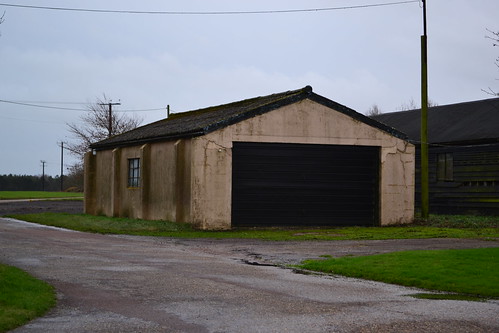
RAF Wratting Common

One of the few permanent buildings left on the technical site.

Wratting Common was a short-lived airfield, its crews took part in many of Bomber Command’s most fierce-some air battles, losing a large number of men in the process. Whilst not the enormous toll we’ve come to expect from bomber squadrons, it none the less suffered the terrible injustices of war, and the loss of life that scarred so many families for so long. Long may they be remembered.

The efforts of the many Bomber Command crews were never forgotten though, and land owned by the Vestey family was donated for a memorial that was organised through the efforts of numerous people. Some of the original buildings have been refurbished and are now used by the local farm, several of the hangars remain also in use by local companies, by using them they are at least preserving them.

If approaching from the Haverhill direction, the first structures you see are the two hangers, a T2 and a B1, either side of the road. The B1 to your left and the T2 to your right, both linked across the road by a former track and dispersal point. There would have been four spectacle dispersal points here, all now removed. A footpath near to this point does cross part of the airfield site, allowing some access to remnants of the perimeter tracks. Continue along this road and then turn right, you will then come across Weston Woods Farm. This is the former entrance to the airfield site and here stands the memorial and a number of buildings owned by the farm. In the distance, you can see a further T2, and a small group of Nissen huts again owned by the farm. This area was once the technical area, stores, Motor Transport huts and a range of technical buildings were plentiful in the late 1940s. Now reduced to nothing more than a handful, they are reminders of the days when the RAF’s heavy bombers graced the site.

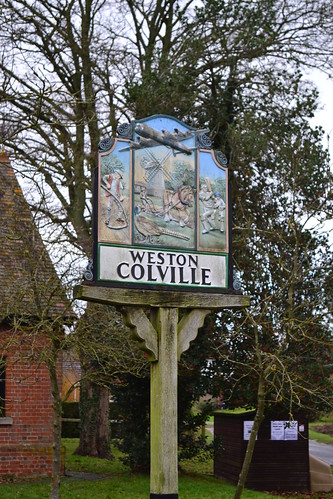
A short distance along the road from here was the operations block (now gone) and turning left at the junction, the first of the domestic sites – Site 7. The road between here and the nearby village of Weston Colville are where the majority of these site stood, the basic concrete entrances being the only significant indication of anything being here. The village sign at Weston Colville displays a Stirling indicating its links to the airfield and the domestic sites that once stood on this ground.

With little of this site remaining, a handful of buildings, the memorial and a well designed information board, keep the history of those young men who flew from here in the few short years of its existence alive, their stories shall live on as will the memories of the fight they took deep into the heart of the Nazi homeland.

From Wratting Common we head south again, turning back on our tracks and returning toward Haverhill. From here we continue on with our trail around Britain’s airfields and back once more into the counties of Suffolk and Essex.

RAF Wratting Common

Weston Colville village sign depicts its links with Wratting Common, the village being home to the many domestic sites of the airfield.

Sources, notes and further Reading.

*1 Chorley., W. R., “Bomber Command Losses 1943“, Midland Counties Publications, 1996.

A book of remembrance is thought to be in St Mary’s Church, West Wickham. Sadly on the day I visited, the church was unusually locked.

A website dedicated to those who flew from Wratting Common has a lot of additional information and photographs, it is certainly worth a visit.

RAF Stradishall – Disaster for 214 Squadron

In the second part of RAF Stradishall, we carry on from part 1, looking at the terrible circumstances around 214 Squadron’s worst night. The developments of Stradishall in the later war years and the post war development with the arrival of the Cold War and the jet age.

The raid would be to Hanau railways yards located 25 km east of Frankfurt am Main. During the raid thirty-five Wellingtons and fourteen Hampdens from  both 57 Squadron (RAF Feltwell) and 214 Sqn (RAF Stradishall) would be dispatched. Take off was between 20:00 and 21:00 hrs and the attack by 214 Sqn would be carried out at heights as low as 400 feet using a mix of 250 lb and 500 lb bombs with impact fuses and some 3 hour delay fuses. During the attack, railway lines, bridges and carriages were hit, explosions were seen and the gunners strafed stationary trains and gun positions. The bomb aiming and shooting was reported as ‘good’.*3

However, of the fourteen 214 Sqn Wellingtons that left, seven were lost and a further Wellington was hit in both engines by light flak the pilot nursing it back to England. Of those seven lost, one airman, Sgt. C. Davidson was taken prisoner of war, four have no known grave and the remaining thirty-seven all died, and remain buried in graves across Belgium and Germany. Truly a terrible night for 214 Sqn. 57 Squadron fared little better, losing five aircraft with the deaths of twenty-five airmen, the remaining five being taken prisoner.

Further losses that month were restricted to just odd aircraft with the last loss being recorded on the night of 28th/29th April, with all crewmen being lost. Before the month would be out, 214 would begin the conversion to Stirlings, a new start and a new challenge.

The Stirling would prove to be a robust but under performing aircraft, its short wingspan and subsequent lack of lift, proving to be its biggest downfall. 214 Sqn would, during the conversion programme, write off nine aircraft, much of this though being as a result of operational activity, some however, due to pilot error or accidents. The first incident occurring on May 5th, 1942, approximately one week into the programme, when Stirling N6092 piloted by F/O. Gasper and Sgt. M Savage, swung on take off resulting in its undercarriage collapsing.

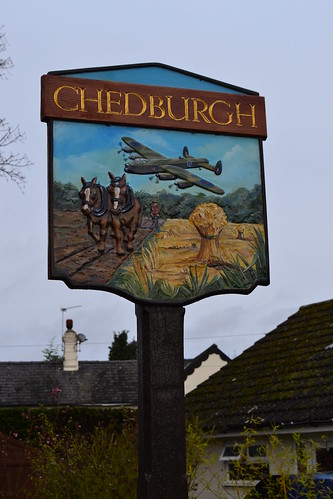
In the October 1942, 214 Sqn would leave for the final time, moving off to Stradishall’s satellite airfield, RAF Chedburgh, where they remained until December 1943. Following this they transferred to RAF Downham Market. The last loss of a 214 aircraft at Stradishall being on the night of September 19th/20th with the loss of Stirling ‘BU-U’ R9356 along with four of the seven crew, the remaining three being taken prisoners. By the end of 1942, 214 Sqn would have lost thirty-three Stirlings, twice that of the Wellington, all-in-all a huge loss of life.


RAF Stradishall

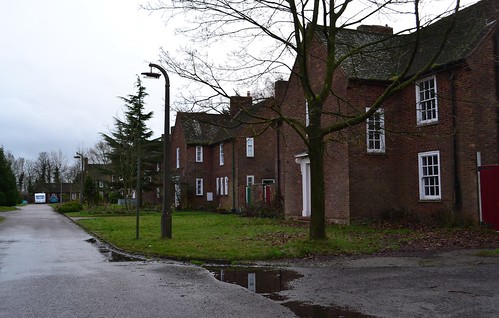
Former Married quarters are now private dwellings, but still retain that feel they had when they were first built.

The December of 1944 not only saw the departure, for the last time, of the Stirling as a heavy bomber, but it heralded the arrival of the Lancaster, the remarkable four-engined bomber that became the backbone of Bomber Command. In total 7,377 of the bombers were produced, including 430 that were constructed in Canada. A remarkable aircraft born out of the much under-powered and disliked Avro Manchester, it went on to fly over 156,000 sorties, dropping over 50 million incendiary bombs and over 608,000 tons of HE bombs.

186 Sqn would be the first unit here with the Lancaster both the MK.I and the MK.III, operating them in a number of missions over occupied Europe.

One of the saddest ends to the war and the operations of 186 Squadron was on the night of April 134th/14th. Whilst returning from bombing the U-boat yards at Kiel, two Lancasters: P8483  ‘X’ and P8488 ‘J’ collided at 02:26. Five of the crew from AP-X were killed, either instantly or as a result of injuries sustained, whilst all seven of AP-J lost their lives. This loss would account for a high proportion of the squadron’s losses, 186 Sqn only losing nine Lancasters in the six months of residency – a considerable change to the carnage suffered at Stradishall earlier on in the war. 186 Sqn would finally be disbanded here in July 1945.

Over the next four years, there would be a return of both the Stirling and the Lancaster, but this time in the transport role, as Stradishall was passed over to Transport Command. No. 51 Sqn, and No. 158 Sqn both flying Stirlings (158 Sqn being disbanded at Stradishall) 35 Sqn, 115 Sqn, 149 Sqn and 207 Sqn all operating various models of the Lancaster until February 1949.

There would then be a lull in operations at Stradishall between April and July 1949 whilst the airfield was put into care and maintenance. Following this 203 Advanced Flying School (AFS) moved in with a range of aircraft types, including the Meteor and the Vampire. Also thrown into the mix were a number of piston engined aircraft, notably the Spitfire XIV, XVI and XVIII, along with Tempests, Beaufighters and Mosquito T3s. Other training aircraft also came along covering everything from the Tiger Moth to the modern jet fighter. A new age was dawning.

On the night of August 31st and September 1st 1949, 203 AFS and 226 Operational Conversion Unit (OCU) at Driffield, would both disband and reopen under each other’s titles, the new 226 OCU now operating as the training unit converting pilots to jet aircraft.

RAF Stradishall

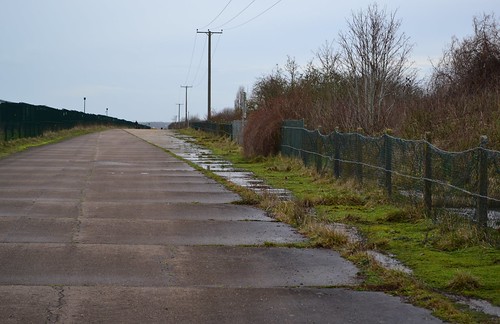
To the left was the main airfield now covered by a solar farm, to the right would have been the hangars, the original apron concrete still visible.

The post war years of the 1950s would see Stradishall thrown back into front line operations once more, this time there would be no heavy bombers though, but there would be plenty of front line fighters.

First along were the night fighter variants of the Meteor (NF.11) and Venom (NF.3) between March 1955 and March 1957, a residency for a reformed 125 Squadron that coincided with 245 Squadron only 3 months behind them. No. 245 swapping the Meteor for the Hunter before being disbanded in June that year.

No. 89 Squadron (another unit reformed in December 1955) saw the arrival of the new delta wing Javelins FAW6 & FAW2 working alongside the ageing Venom Night Fighters. They flew these aircraft for thirteen months before being disbanded once more, and then renamed as 85 Squadron whilst here at Stradishall. After this re-branding they continued to fly the Javelins. In 1959 they too departed Stradishall for RAF West Malling and then onto RAF West Raynham, where they too disbanded once more.

1957 saw more of the same, 152 Squadron yo-yoing between Stradishall and Wattisham, finally disbanding here in July 1958 with 263 Squadron following a similar pattern, also disbanding here in the same month with their Hunter F.6s.

In July 1958, No. 1 Squadron were yet another unit to reform here, carrying on from where 263 Sqn left off. After replacing the F.6s of 263 Sqn with FGA.9s in the fighter / strike role, they finally departed to Waterbeach, eventually becoming a front line Harrier unit at Cottesmore.

Gradually operations at Stradishall were beginning to wind down. In June 1959 No. 54 Squadron also replaced the Hunter F.6s with FGA.9s before they too departed for Waterbeach in Cambridgeshire. 54 Sqn went on to fly both the Phantom and the Jaguar as front line operational units, all iconic aircraft of the Cold War. A very short spell by three Hunter squadrons led to the eventual closure of Stradishall in 1960 as a front line fighter station; 208, 111 and 43 Sqns all playing a minor part in the final operations at this famous airfield. The last flying unit No.1 Air Navigation School (ANS) finally closing the station doors as they too disbanded on August 26th 1970, being absorbed by No. 6 Flying Training School.

RAF Stradishall

Some older buildings can still be found outside the grounds of the Prison.

A considerable number of non-operational units would also operate from Stradishall throughout its operational life such as 21 Blind Approach Training Flight,  meaning just short of 50 flying units would use the facilities at Stradishall, all helping to train and prepare aircrews for the RAF and the defence of Britain.

Stradishall’s long and distinguished aviation history finally came to a close when it was sold off and handed over to HM Prison Service, becoming as it is today, HMP Highpoint Prison (North) and HMP Highpoint Prison (South). A rather ungainly ending to a remarkably historic airfield.

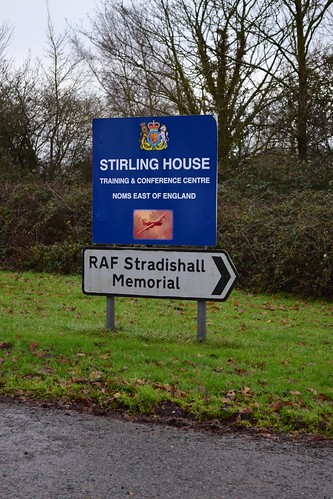
Stradishall is located a few miles south-west of Chedburgh, the main A143 dissects the two prison blocks, the north side being the former accommodation area, with the south block being the technical area and main airfield site. Access to the site is therefore limited, however, the former officers mess and associated buildings are available to view, as are a number of former technical buildings. A large memorial is currently displayed outside the officer’s mess building, named Stirling House  in memory of the aircraft type that flew from here, and it is open to the public. The foyer of the building, now a Prison Officer Training facility, is opened, and holds a roll of Honour, for those lost at the airfield.

RAF Stradishall

The current Prison Officers Training facility is named after the ill-fated Stirling that flew from RAF Stradishall. The Memorial being well sign posted.

Through the high security fencing, and around the site a number of buildings can still be seen, the familiar layout and design being standard of wartime and post war airfields. By turning off the A143 prior to reaching the memorial site, a small back access road allows public access to the airfield site. This is now, in part, a conservation area where the runways have all been removed, parts of the perimeter track do still remain and public access is permitted. The runways have been replaced by a solar farm, large panels cover the entire area and all are encased in high security fencing with closed circuit TV preventing you from wandering too close to the high-tech plant.

Walking along the northern side of the airfield, views can be seen of the accommodation area, again a number of former buildings can be seen through the fencing, their style typical of the expansion period design.

RAF Stradishall

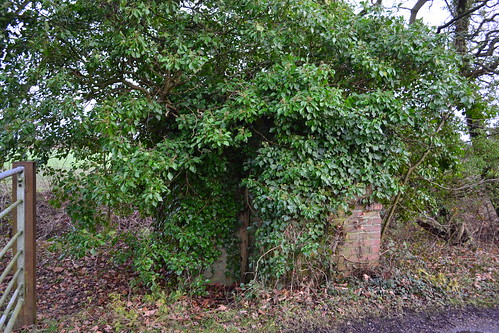
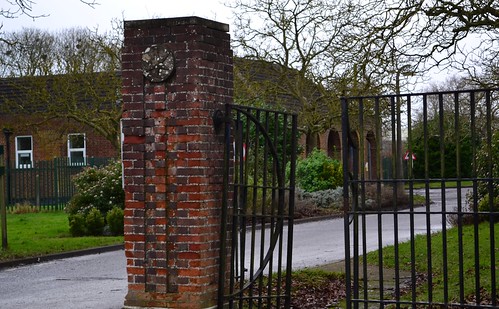
The dilapidated gateway hides many original buildings and a layout that reflects airfield design of the expansion period.

Back on the main road, turning left passing the prison, a turn off gives access to the aforementioned officers mess and memorial, it is well signposted, and continuing on, brings you to the former married quarters, now private housing, again typical of airfield design. Across the road from here, a farm track still has a small number of buildings now in a very poor state, this would have been an entrance to the accommodation area behind the current north side Prison.  They are both quite well hidden by undergrowth but they are visible with a little effort.

Stradishall, like many of the early expansion period airfields, with its neo-Georgian style architecture and well designed layout, lasted well into the cold war period. These early examples which set the standard for future designs, proved to be long-lasting and robust, unlike many of their later counterparts hastily built with temporary accommodation. Whilst a rather unfitting end to a long and distinguished life, the transformation into a prison has in part, been its saviour, and one that has preserved many of its fine buildings for the foreseeable future at least.

Sources and Further Reading.

*1 419 (Special Duties) Flight were initially formed at North Weald on 21st August 1940, being  disbanded and re designated 1419 (Special Duties ) Flight on 1st March 1941 at Stradishall. They in turn were disbanded on 25th August 1941 to be reformed at Newmarket as 138 Sqn. they moved back to Stradishall on 16th December 1941. In February 1942, the nucleus of 138 Sqn formed 161 Sqn at Newmarket continuing the role of SOE operations from there.

*2 Grehan, J., Mace, M., “Unearthing Churchill’s Secret Army: The Official List of SOE Casualties and Their Stories“, Pen and Sword Military, 2012

*3 ORB 214 Sqn: AIR\27\1321\8 National Archives.

RAF Stradishall – The early years.

Moving on from RAF Chedburgh, we continue south-west along the A143 to another former bomber airfield, and the parent station of Chedburgh. This next site has a history that dates back to the late 1930s and is one that has many of its original buildings still in situ, many thankfully still being used albeit by a completely different organisation.

The next stop on this trail is the historically famous airfield the former RAF Stradishall.

RAF Stradishall.

RAF Stradishall has a rather unique history, it was one of the first to be built during the expansion period of Britain’s Air Force beginning in 1935.  A series of Schemes, this programme was to develop the RAF over a period of years to prepare it for the forth coming war; a series of schemes that continued well into the war and created the basis of what we see today around Britain’s forgotten landscape.

This first scheme, Scheme ‘A’ (adopted by the Government in July 1934), set the bench mark by which all future schemes would develop, and called for a front line total of 1,544 aircraft within the following five years. Of these aircraft, 1,252 would be allocated specifically for ‘home defence’. This scheme brought military aviation back to the north of England, and to the eastern counties of Norfolk and Suffolk. Under this scheme, a number of airfields would be built or developed, of which Marham (the first completed under these schemes), Feltwell and Stradishall were among the first. These airfields were designed as “non-dispersed” airfields, where all domestic sites were located close to the main airfield site, and not spread about the surrounding area as was common practice in later airfield designs. At this stage, the dangers of an air attack were not being whole heartedly considered, and such an attack could have proven devastating if bombs had been accurately dropped.

Thus in 1938 Stradishall was born, its neo-Georgian style buildings built-in line with common agreements and local features. Within the grounds of the airfield accommodation blocks provided rooms for just over 2,500 personnel of mixed rank, and all tightly packed in within the main airfield site.

In these pre-war years, the development of hard runways and large airfields was a new phenomena, hard surfaces being a new aspect still very much a topic of considerable controversy. By now, Bomber Command had realised that the new era of bombers would call for hard runways on its airfields, and so they pushed the Government on allowing these to be developed. However, before any firm decisions could be made, trials would need to be carried out to determine whether or not they were indeed needed and if so, how they should be best constructed.

The test to determine these needs was to take a Whitley bomber, laden to equal its full operational weight, and taxi it across a grassed surface.  A rather primitive assessment, it was intended to ascertain the effects of the aircraft on the ground beneath. Trials were first carried out at Farnborough and then Odiham, and these were generally successful, the Whitley only bogging down on recently disturbed soils. Further trials were then carried out here at Stradishall in March 1938, and the results were a little more mixed. Whilst no take offs or landings took place during these trials, the general agreement was that more powerful bombers would have no problems using grassed surfaces, as long as the ground was properly prepared and well maintained. All well and good when the soils were dry and well-drained.

However, Dowding continued to press home the need for hard surfaces, and by April 1939, it had finally been recognised by the Air Ministry that Dowding was indeed right. A number of fighter and bomber airfields were then designated to have hard runways, of which Stradishall was one. These initial runways were only 800 yards long and 50 yards wide, extended later that year to 1,000 yards long, as aircraft were repeatedly running off the ends of the runways on to the grassed areas. Over the years Stradishall would be expanded and further developed, its longest runway eventually extending to 2,000 yards.

Stradishall was also one of the first batch of airfields to have provisions for the new idea of dispersing aircraft around the perimeter. To meet this requirement, hard stands were created to take parked aircraft between sorties, thus avoiding the pre-war practice of collective storage, and so reducing the risk of damage should an attacking force arrive – a practice not necessarily extended to the accommodation! By the end of development, Stradishall would have a total of 36 hardstands of mixed types, the extension of the runway being responsible for the removal and subsequent replacement of some. For maintenance, five ‘C’ type hangars and three ‘T2’ hangars were built, again standard designs that would be later superseded as the need required.

As Stradishall was one of this first batch of new airfields, it would also be used for trials of airfield camouflaging, particularly as the now large concrete expanses would reveal the tell-tale sign of a military airfield. On wet days the sun would shine off these surfaces making the site highly visible for some considerable distance. Initial steps at Stradishall used fine coloured slag chippings added to the surface of the paved areas. Whilst generally successful, and initially adopted at many bomber stations, Fighter Command refused the idea as too many aircraft were suffering burst or damaged tyres as a result of the sharp stones being used. Something that is reflected in many casualty records of airfields around the country.

RAF Stradishall

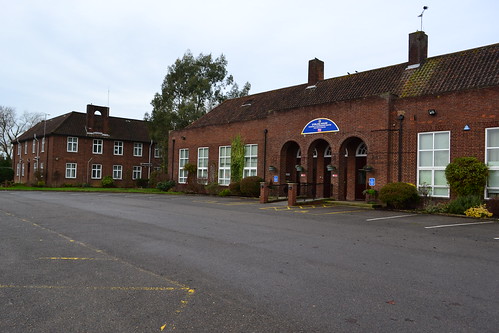
The Type ‘B’ Officers Mess at Stradishall is now a Prison Officers Training Facility. The Officers quarters are located in wings on either side of the mess hall.

On opening Stradishall would fall under the command of 3 Group Bomber Command, and would operate as an RAF airfield until as late as 1970, being home to 27 different operational front line squadrons during this time. Many of these would be formed here and many, particularly those post-war, would be disbanded here, giving Stradishall a long and diverse history.

The first squadrons to arrive did so on March 10th 1938. No. 9 Sqn and No. 148 Sqn (RAF) arriving with Heyford III and the Vickers Wellesley respectively. 148 Sqn replaced these outdated Wellesleys with the Heyfords in November, and then again replacing these with both the Wellington and Anson before departing for Harwell on September 6th 1939. No. 9 Sqn also replaced their aircraft with Wellingtons in January 1939, themselves departing on July 7th that same year.

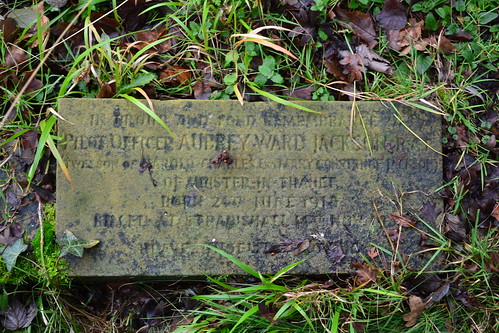
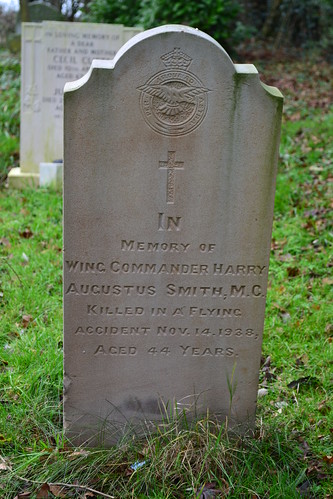
It was during a night training flight, on November 14th 1938, that Wing Commander Harry A. Smith MC along with his navigator Pilot Officer Aubrey W. Jackson would be killed in Heyford III K5194, when the aircraft undershot the airfield striking trees outside the airfield boundary. The crash was so forceful that the aircraft burst into flames killing both airmen.

Wing Commander Smith MC qualified as a pilot whilst in the Royal Flying Corps in 1916, and was the first of his rank to be killed since the inception of Bomber Command in July 1936. He had been awarded the Military Cross ‘for gallantry and distinguished service in the field‘ in 1918.

Pilot Officer Jackson was appointed for a Short Service Commission in January 1937, and later a Permanent Commission. He was only 20 years old at the time of his death.

Both crewmen are buried in Stradishall’s local cemetery.

St. Margaret of Antioch, Stradishall

A very much less than grand grave stone marks the plot of P.O. Aubrey W. Jackson, killed on November 14th 1938 on a night training flight.

St. Margaret of Antioch, Stradishall

Wing Commander Smith, killed alongside P.O. Jackson on a night training flight. He was the first of his rank to die since the formation of Bomber Command.

Two more squadrons arrived here in 1939. No. 75 Sqn operated the Wellington MK. I from July, departing here just after the outbreak of war in September, and 236 Sqn flying Blenheims between the end of October and December that same year. 236 Sqn were reformed here after being disbanded in 1919, and after replacing the Night-Fighter Blenheims with Beaufighters, they went on with the type until the end of the war and disbandment once more. Almost simultaneously, 254 Squadron reformed here in October 1939, also with Blenheims. They remained here building up to strength before moving to RAF Sutton Bridge in Lincolnshire in December – one of many ‘short stay’ units to operate from Stradishall during its life.

This pattern would set the general precedence for the coming years, with bizarrely, 1940 seeing what must have been one of the shortest lived squadrons of the war. No. 148 Sqn being reformed on April 30th with Wellingtons only to be disbanded some twenty days later!

This year saw three further squadrons arrive at Stradishall: 150 Sqn on June 15th, with the Fairy Battle (the only single engined front line aircraft to be used here during the war), whilst on their way to RAF Newton; a detachment of Wellington MK.IC from 311 Sqn based at East Wretham (Sept); and 214 Sqn flying three variants of Wellington between 14th February 1940 and 28th April 1942. No. 214 Sqn would be the main unit to operate from here during this part of the war, and would suffer a high number of casualties whilst here.

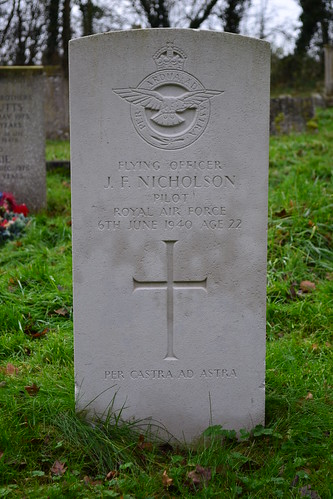
On June 6th 1940, 214 Sqn Wellington IA ‘N2993’ piloted by F/O. John F. Nicholson (s/n 70501), would take off on a routine night flying practice flight. During the flight, it is thought that F/O. Nicholson became blinded by searchlights throwing the aircraft out of control. Unable to regain that control, the aircraft came down near to Ely, Cambridgeshire, killing the five crewmen along with an additional Leading Aircraftman (LAC) Maurice Peling who had joined them for the flight. A tragic accident that needlessly took the lives of many young men. F/O. Nicholson is buried in the local cemetery at Stradishall, whilst the remainder of the crew are buried in different cemeteries scattered around the country.

St. Margaret of Antioch, Stradishall

F/O. J. Nicholson was killed when he lost control of his Wellington on the night of June 6th 1940.

214 Sqn began operations from Stradishall on the night of June 14th/15th, the day German forces began entering Paris. This first raid was to the Black Forest region of Germany, a mission that was relatively uneventful.

Joining 214 Sqn at Stradishall was another unit, 138 Sqn*1 between December 1941 and March 1942. Flying a mix of aircraft, including the Lysander, Whitley, and later: Liberator, Stirling and Halifax, they would perform duties associated with the Special Operations Executive (SOE) carrying out clandestine missions dropping agents behind enemy lines.

It was one of these aircraft, Lysander III T1508, that crashed in January, nosing over near to the French town of Issoudun, a medieval town that bordered the regions of occupied France and ‘free’ France. The towns people protected many wanted resistance supporters, and so it was the scene of many heroic acts. From this particular accident, Squadron Leader J. Nesbit-Dufort managed to escape, evading capture and eventually returning to England where he was awarded the DSO for his actions. Needing to destroy the aircraft, locals pushed the Lysander onto nearby railway lines where it was obliterated after being hit by a passing train*2. It is believed that this was the first Lysander to be lost on these clandestine operations.

This night of January 28th/29th 1942, was a particularly bad night for Stradishall, with three aircraft being lost, two from 138 Squadron and one from 214 Squadron. Thirteen souls were lost that night none of which have any known grave.

1942 would also see a short one month stay by the Wellingtons of 101 Squadron, a detachment of 109 Squadron, and the accommodation of 215 Squadron’s ground echelon. Formed at Newmarket, the ground crews were posted to India whilst the air echelons were formed up at Waterbeach joining them with Wellingtons in April.

An updating of Wellington MK.Is with the MK.VI saw the remainder of 109 Squadron move into Stradishall, only leaving a small detachment at Upper Heyford – a residency that only lasted 4 months between April and July 1942. As 109 Sqn left, Stradishall was joined by the Heavy Conversion Unit 1657 HCU.

Formed as a bomber training unit through the merger of No. 7, 101, 149 and 218 Squadron Conversion Flights and 1427 (Training Flight), it would also operate the Stirling, and later the Lancaster along with some smaller aircraft such as the Airspeed Oxford. They would remain here until late 1944 when they too were finally disbanded. This meant that 1943 was quieter than usual, there wasn’t any sign of the previous ebbing and flowing that had taken place in the preceding years.

With a focus on training, few of these aircraft were used for ‘operational’ sorties until the closing stages of the war. That said, there were still a number of accidents and crashes that resulted in injury. A number of these were due to technical issues, engine failure, engine fires or undercarriage problems, some were due to pilot error. One of the earliest incidents here was that of Stirling MK.I W7470 which crashed, after suffering engine problems over County Durham. The accident killed two crewmen and injured a further two.

After a short spell at Honnington, 214 Sqn would join 1657 HCU, also replacing the Wellington with the ill-fated Short Stirling MK.I in April 1942. But the last flights of the Wellington would not be a good one. The night of April 1st/2nd 1942 would go down as 214 Sqn’s worst on record, and one that would prove devastating to the crews left behind.

In part two of RAF Stradishall, we look at the later war years, the terribly sad events that scarred 214 Squadron, and Stradishall’s post war development. The dawning of the jet age.

RAF Chedburgh – An appalling loss of life.

In this next trail, we start just a few miles to the south-west of Bury St. Edmunds in Suffolk, where we visit a number of airfields that were associated with the heavy bombers of the RAF’s Bomber Command.

Our first stop, although a satellite, more than earned its rightful place in the history books of aviation. It is an airfield where large numbers of the ill-fated Stirling flew many missions over occupied Europe, where the staggering statistics of lost men and machines speak for themselves.

Now little more than fields and a small industrial estate, the remnants of this wartime airfield stand as reminders of those dark days in the 1940s when night after night, young men flew enormous machines over enemy territory to drop their deadly payload on heavily defended industrial targets.

We begin our next trip at the former airfield RAF Chedburgh, home to the mighty four-engined bombers of No. 3 Group Bomber Command of the Royal Air Force.

RAF Chedburgh.

Built in 1942 (by John Laing and Son Ltd) as a satellite for RAF Stradishall, Chedburgh would be built to the Class A specification, a later addition to the RAF’s war effort. Being a bomber station Chedburgh would have three runways made of concrete, the initial construction being one of 2,000 yards and two of 1,400 yards, all the standard 50 yards wide, as was the standard specification brought in during 1941. Later on, these would be extended giving Chedburgh much longer runways than many of its counterparts, i.e. one at 3,000 yards and two at 2,000 yards. Having runways this long, meant that heavy bombers could use the site when in trouble, something that Chedburgh would get used to very quickly.

With the village of Chedburgh to the north of the site, directly opposite the main gate; the technical area along the north-eastern side of the main runway, and the bomb store to the east, Chedburgh would have two T2 hangars, a B1 and later on 3 glider hangars. Dotted around the perimeter track were a number of dispersals comprising 34 pan styles and 2 looped.

RAF Chedburgh

Chedburgh village sign reflects it aviation history.

Whilst housing only two major squadrons 214 Squadron and 620 Squadron, it would also be home to a small number of other operational units, 218, 301, 304 Sqns and 1653 Heavy Conversion Unit (HCU).

Opening under the control of No. 3 Group, on September 7th 1942, the first resident unit was 214 Squadron (RAF) flying the Stirling MK. I, a model they operated until as late as February 1944. The bulk of the unit arrived in the October, with operations beginning very soon after. Within four months they would begin replacing some of these models with the upgraded MK.III, also operating these until the beginning of 1944 and after transferring to RAF Downham Market in Norfolk.

As with many airfields at this time, the arrival of personnel preceded the completion of the works, development continuing well into the operational time of its residents, something that would cause a problem in the coming months.

It was in March of 1943 that the first casualties would occur, the night of March 1st/2nd being a baptism of fire for 214 Sqn. Stirling MK. I (R9143) BU-E piloted by F/S. J. Lyall (RCAF) would be hit by flak, she was badly damaged, and then abandoned by her crew. As he descended from the stricken aircraft, F/O. Hotson (RNZAF) would be hit by a splintering shell – the wounding he received as a result would be fatal. The remainder of the crew all escaped the aircraft safely but were later captured by the Germans and incarcerated. A multi-national crew, this loss was to be followed just two nights later with the loss of another Stirling, ‘BU-C’, but this time none of the seven crewmen were to survive.

Then on the next night, 5th/6th March, whilst on operations to Essen (the 100,000th sortie by RAF aircraft), Stirling BK662 ‘BU-K’ crashed into the North Sea about 30 km north-northwest of Ijmuiden. Only one of the crew, Air Gunner Sgt. William H. Trotter (s/n: 1128255) was ever found, the rest of the crew remaining ‘missing in action’. This was the first Stirling to be listed as such since the squadron’s operations began. This raid would prove devastating, taking the lives of 75 RAF airmen, but the War Office considered it a major success in terms of  industrial damage to the German war machine. The targeted Krupps factory, which sat in the centre of over 100 acres of industrialised area, was devastated by both accurate marking and then the subsequent bombing.

Throughout this month there were further loses to the squadron: Stirlings ‘BU-Q’ and  ‘BU-A’ (in which F/S. D Moore (RCAF) and Sgt. T. Wilson were both awarded the George medal for saving the life of their companion Sgt. J. Flack), along with ‘BU-M’ were all lost; ‘BU-M’ losing all but one crewman. Another aircraft, ‘BU-L’, lost all seven aircrew  on the night of March 27th/28th, and closing March off, was a collision between Stirlings BK663 and EF362, which left several more crewmen either injured or dead. Although many losses were as a direct result of flak or night fighters, the cracks were beginning to show, and the poor performance of the Stirling was becoming evermore apparent.

It was during this year on 17th June 1943, that Chedburgh’s second main operational unit would be formed, 620 Sqn (RAF), also carrying out bomber operations, again with the Stirling MK. I and later in the August, the MK. III. Also part of 3 Group Bomber Command, 620 Sqn were created through the streamlining of 214 Sqn and 149 Sqn at nearby Lakenheath. The move reduced each of the two former squadrons from three flights to two,  releasing ‘C’ Flight of 214 Sqn who were already stationed here at Chedburgh.

RAF Chedburgh

Parts of the perimeter track and runways remain as tracks used for storage.

As many of these crews were already well established and experienced, there would be no delay in commencing operations, the first sortie occurring on the night of the 19th June 1943 – two days after their formation. The first casualties occurred three days later on the night of 22nd/23rd June 1943, just a few days into their operational campaign. There then followed five months of heavy operational activity, a period in which the Stirling and its crews would be pushed to the very limit and beyond. The shortcomings of the aircraft being realised further more.

Being on a partially built airfield would be the cause of the demise of Stirling EF336 (QS-D) which swung on take off and ran into the partially constructed perimeter track. The uneven surface caused the undercarriage to collapse, and whilst there were no injuries to the crew, the aircraft was written off.

The poor service ceiling of the Stirling led to several aircraft being damaged through falling bombs from aircraft flying above. A number of Stirlings were recorded returning to bases, including Chedburgh, with damage to the air frames, damage caused by these falling ‘friendly’ bombs!  However, the extent of this damage did give great credit to the aircraft, showing both its robustness and strength in design; something that often gets forgotten when talking about the Stirling in operations.

The next few months for 620 Sqn would be filled with a mix of operational sorties, mining operations (Gardening) and training flights, including both ‘Bullseye‘ and ‘Eric‘; testing the home defence searchlight and AA batteries both at night and during the day. During a fighter affiliation exercise on July 2nd, two 620 Squadron aircraft collided, ‘EF394’ (QS-V) and BK724 (QS-Y)  killing fifteen and injuring two. One of those killed, Flight Mechanic AIC Arthur Haigh (s/n: 1768277) was only 18 years old, and one of five ground crew who were aboard the two aircraft that day.

Both 214 Sqn and 620 Sqn would go on for the next few months taking part in some of the war’s largest bomber missions including Hamburg, Essen and Remscheid. A number of aircraft would be lost and many aircrew along with them. The worst recorded night for 620 Sqn was the night operation on August 27th/28th, 1943 to Nuremberg, when three aircraft were shot down, all Stirling MK.IIIs: BF576 (QS-F) piloted by Sgt. Frank Eeles (s/n: 1531789); EE942 (QS-R) piloted by Flt. Sgt. John F. Nichols (s/n: 1318759) and EF451 (QS-D) piloted by Sgt. William H. Duroe (s/n: 658365). These three losses accounted for sixteen deaths and five taken as POWs, there were no other survivors.

The last 214 Sqn Stirling to be written off during bombing missions occurred on the night of November 22nd/23rd, 1943. Whilst on a mission to Berlin, Stirling EF445 (BU-J) was hit by flak, attacked by a FW-190 and then suffered icing. The resultant damage along with a lack of fuel, caused the pilot to ditch in the North Sea with the loss of two crewmen: pilot F/S. George A. Atkinson (s/n: 1485104) and Sgt. W. Sweeney (RCAF) (s/n: R/79844).

620’s stay at Chedburgh would be fairly short-lived, taking part in their final operation on the night of November 19th/20th, 1943 to Leverkusen. They then departed Chedburgh at the end of that month after suffering a heavy toll on their numbers and a devastating start to their war. By now the limitations of the Stirling were very well-known, and it was already being replaced by the much favoured Lancaster. In the short five months it had existed, the squadron had lost eighteen of its aircraft in operations, and a further six in accidents, statistics that are however, overshadowed by the loss of ninety-three lives. 620 Sqn left both Chedburgh and Bomber Command to join other units at RAF Leicester East and the Allied Expeditionary Air Force in November, where the unit was to perform Airborne operations along side 196 Sqn and 1665 Heavy Conversion Unit (HCU). A role that 620 performed for the remainder of the war.

With their departure came the arrival of another Stirling squadron, 1653 HCU, a Stirling training unit rather than a front line operational squadron. A month later 214 Sqn would also leave Chedburgh taking their Stirlings to Downham Market and then onto Sculthorpe where they replaced them with the B-17 Flying Fortress.

A P-51 Mustang (5Q-Q, serial number 42-106672) of the 504th Fighter Squadron, 339th Fighter Group, that has crash landed at Chedburgh, 18 May 1944. (IWM FRE 2784)

1653 HCU, as a training unit, would also have it share of accidents and losses, many due to technical problems, but some due to pilot error. A number of accidents were caused by tyres blowing, and some were caused by engine failures, the bravery of these pilots in dealing with these matters being no less than exemplary. One such incident being that of F/O. Hannah and his crew, who took off at 20:50 on the evening of November 3rd 1944, on a radar training flight. Immediately after take off both port engines cut out, something that was almost fatal in a Stirling. The aircraft, virtually uncontrollable, was heading towards a row of cottages but the crew managed to turn it  away missing the houses but colliding with a row of trees instead. All of the crew were injured to varying degrees – one fatally. Sgt. Eddie (RCAF) dying in the resultant crash.

After a year of being at Chedburgh, 1653 HCU would also depart (December 1944) by which time the Lancaster was well and truly the main bomber of the RAF. This late stage of the war would not be the end of Chedburgh though, Bomber Command retaining its use, sending the Lancasters I and III of 218 (Gold Coast)*1 Squadron here from RAF Methwold.

On December 2nd 1944 the first ground units began to arrive, with flying personnel arriving on the 5th, after much-needed runway repairs were completed. The airfield reopened with the arrival of eighteen Lancasters, formed into three new flights, of which thirteen would undertake operations on the 8th, to the railway yards at Duisburg – their first from Chedburgh. Both this mission and that of the 11th to the marshalling yards at Osterfeld, were heavily restricted by thick cloud, and so G-H navigation aids were used in conjunction with ‘Oboe‘.

For the majority of the remainder of the war Bomber Command continued its strategic missions against German cities, with marshalling yards and oil refineries being other major targets. It was of course this continued use of bomber aircraft against what was now a demoralised and weakened German population, that led to the outcry over Harris’s continued attacks on German cities. A controversial action that led to his move away from the lime light at the war’s end, and the lack of recognition for bomber commands efforts throughout the conflict.

218 Sqn would continue on though. The winter of 1944 / 45 proving to be one of the worst weather wise, many missions were either scrubbed or carried out in poor weather. On the night of January 1st/2nd 1945, one hundred and forty-six aircraft of No. 3 Group were tasked with the attack on Vohwinkel railway yards. During the attack in which 218 Sqn were a part, two aircraft were hit by heavy anti-aircraft fire from American guns below. One of these was 218 Sqn Lancaster MK. I PB768 (XH-B) piloted by 20 yr old Australian F/O. Robert G. Grivell. The accuracy of these guns was ironically excellent, hitting the aircraft not once but twice, causing it to spin uncontrollably toward the ground. All but one of the crew were killed in the ensuing crash.

It was during this period that the RAF began daylight bombing missions too, such was the poor state of the defending Luftwaffe. Numerous missions over the next weeks led to attacks on the coking plants at both Datteln and Hattingen, repeated again on March 17th in attacks at Huls (and Dortmund). Hattingen was again attacked by 218 Sqn aircraft on the 18th without loss.

ROYAL AIR FORCE BOMBER COMMAND, 1942-1945.

Mechanics at work on an engine of Lancaster B Mk. III, (LM577) ‘HA-Q’ “Edith”, of No. 218 Squadron. On March 19th 1945, this aircraft was hit by flak over Gelsenkirchen damaging the rear turret and injuring the gunner’s eye. LM577 went on to complete more flying hours than any other Lancaster on the station.(© IWM (CH 15460))

The remainder of the war would see 218 Sqn fly from Chedburgh, completing many missions until the war’s end. During Operation ‘Manna‘ in which the German Army lifted an embargo on food transport into Holland, ten Lancasters of 218 Squadron dropped food supplies to the starving Dutch below. Understandably April had seen fewer operations than in previous months, but with May seeing many more food trips to the Hague, 218 Squadron leapt to the top of the leader board for operational tours, overtaking both 77 Sqn and 115 Sqn their closest friendly ‘competitors’. With further flights under ‘Manna‘, and then repatriation flights under both ‘Dodge‘ and ‘Exodus‘ 218 Sqn continued to operate the long haul flights into European territory.

During August the big wind down began, and the Lancasters were gradually flown out of Chedburgh for disposal. Then on the 10th, 218 (Gold Coast) Squadron was finally disbanded, and the various crews sent home to their respective territories across the globe.

On August 27th 1945, the last two Lancasters departed Chedburgh, and all was very quiet for those left behind. Then in September, two Polish bomber squadrons arrived, both 301 and 304 Sqns remaining here until they were also disbanded a year later on December 18th, 1946; their Warwicks, Wellingtons and Halifaxes being no doubt scrapped. Whilst here, the Polish squadrons flew long-range transport flights, retaining at least some link to the heavy aircraft and long-range flights that had been common only a year or so before.

Over the remaining years the airfield, like many, has reduced to both agriculture and industrial use. The watch Office has been heavily modified and lies hidden within an industrial complex that has completely taken over the former technical site. A number of these original buildings still survive and visible from the main A143 Bury St. Edmunds to Haverhill road, the road that separates the airfield from the village opposite. The runways and perimeter tracks, visible only in small parts, are mere concrete platforms, now used to store farm produce and machinery, rather than the lumbering bombers of RAF Bomber Command.

The huts used to house the 1,600 RAF personnel and 240 WAAFs, have all been removed, as have the thirty-six hardstands – the airfield site now being completely agricultural.

RAF Chedburgh

Some technical buildings remain in use today.

Whilst Chedburgh was only built as a satellite airfield, by the end of the war it had been witness to many great sacrifices. Eighty-three aircraft had been lost on operations, all but 12 being Stirlings; eighteen from 620 Sqn and fifty from 214 Sqn. For a period of only fourteen months for 214 Sqn and five for 620 Sqn, this was an appalling loss of life, and one that was sadly mirrored by many bomber squadrons across the British Isles in the 1940s.

Sources and further reading

Much of the specific detail for these loses came from the Chorley, W.R., “Bomber Command Losses series”, published by Midland Counties Publications.

*1 A number of books are available on this squadron. One written by Ron Warburton, ‘Ron’s War‘ chronicles the life of a Flight Engineer of a Lancaster in 218 (Gold Coast) Sqn whilst at Chedburgh in 1945. It is published by RW Press, and available online. ISBN-13: 978-0983178804

A second book is also available, “From St Vith to Victory: 218 (Gold Coast) Squadron and the Campaign Against Nazi Germany“, written by Stephen Smith, and published by Pen and Sword Aviation in 2010 (ISBN10 1473855403). It details the life of 218 (Gold Coast Sqn) from its inception through to its disbandment in 1945.

A blog has also been set up dedicated to those who served in 218 (Gold Coast) Sqn and it gives a detailed history from 1936-1945. It has also been created by Stephen Smith who has also published other books relating to 218 Sqn including “A Short War” and “A Stirling Effort” which relates specifically to their time at RAF Downham Market.  https://218squadron.wordpress.com/

RAF Brunton – A little known about airfield.

In this the second stop on our trip to Northumberland, we travel close to the North Sea coast not far from the eastern borders of England and Scotland. A small airfield, this was the satellite to RAF Milfield, and performed an important role in the Second World War. You cannot mention Milfield without reference to this airfield, and vice versa. Here we stop off at that little known about site RAF Brunton.

RAF Brunton.

Brunton is located some 3.5 miles to the south-east of Seahouses, a short distance from the Northumbrian coast. The village it takes its name from sits alongside the airfield, and is made up of a handful of buildings – primarily farmhouses. It is an open and flat area ideal for an airfield, and only a short flying distance away from its parent airfield RAF Milfield.

Brunton was designed as a satellite, and even though it was not a major airfield, it more than fulfilled the role of one. A constantly busy site, it somehow managed to ward off the high numbers of tragedies, losses and accidents that dogged Milfield and many other aircrew training facilities.

Brunton was conceived during the development of Milfield, when the need for another site was soon realised. The land on which Brunton stands was requisitioned in 1941, opening for business in early 1942. With its three runways forming an almost perfect equilateral triangle at its centre, it had a 50 yard perimeter track and twenty-five hardstands of the frying pan style. The longest of the three runways ran slightly off north-south, and was originally built to a length of 1,600 yards – it was later extended to 2,000 yards. The second and third runways, intersecting almost at their centre, were both 1,100 yards and were also extended but to 1,400 and 2,000 yards respectively.

RAF Brunton

One of several exposed shelters at RAF Brunton.

Unusually, the accommodation areas were all closely tied together, a rare feature that placed them to the south of the airfield straddling the local railway (now the East Coast main line from which views can be seen as you pass by). Being a satellite, Brunton was only designed to accommodate small numbers of personnel, upward of some 750 men and women of mixed ranks.

As a satellite, there were no permanent hangars built, but four blister hangars were erected around the site, and used to maintain the aircraft. These Blister hangars (a name given to cover a wide range of arched aircraft shelters initially designed by architects and engineers, Norman & Dawbarn and William C. Inman of Miskins and Sons) were known as Dorman Long hangars, and were built to design 4630/42. At slightly under 72 feet in length they were 45 feet wide with a height of over 20 feet. Dorman Long hangars differed in design to other hangars by being constructed of four sections each held together by three RSJ type ribs, and ‘I’ shaped Purlins along the roof. These hangars were also bolted to foundations rather than staked to the ground like the more conventional blister hangars in use at that time. A similar hangar was used at RAF Sawbridgeworth in Hertfordshire – none of which survive today.

As a satellite, Brunton would work closely with its parent. It would be used in the second part of the 9-10 week pilot’s course to train pilots in formation flying, ground attack and strafing techniques. In the ground attack role, pilots would use a mix of rockets, bombs and cannon to destroy dummy convoys and strongholds. There were a number of ranges in the region providing targets for this particular role; Brunton aircraft predominately using the gunnery range at Goswick Dunes on which numerous ex-army vehicles, including Churchill Tanks, were placed.

Even before Brunton officially opened, it would witness a tragic accident in which it became the final resting place of one Whitley bomber, and three of its four crew. On November 6/7th 1941, whilst on a training flight, the MK. V Whitley (Z6932) of 10 Sqn, RAF Leeming, became lost in poor weather due to a failure of its navigation equipment. After landing on the partially built site, the Whitley took off again, heading south in an effort to locate its home base. As it lifted off, it struck a steam roller causing the aircraft to jolt and strike live high tension cables. The aircraft burst into flames and subsequently crashed. The Wireless Operator/Rear Gunner Sgt. Robert Whitlock, RAFVR (s/n: 163028) was pulled free by a crew from the local search light battery, but the remainder of the crew: Pilot F/Sgt. William Stuart RCAF, (s/n: R/60298) P/O. Richard. S. Austin, RNZAF, (s/n: 403785) and Observer Sgt. P. Bryant, RAFVR, (s/n: 976876), all perished. Bryant was a mere 23 years of age whilst Stuart and Austin were both just 21 years old.

Brunton’s opening in the summer of 1942, coincided with the start of operations at RAF Milfield, Brunton’s first residents would be 59 Operational Training Unit, a unit set up to train pilots for Fighter Command.

59 OTU operated the Hurricane, many of which were themselves veterans of the Battle of Britain. War-weary and battle-scarred, they were joined by a number of other aircraft types including Magisters and Fairy Battles. These flights would take the now adept pilots and train them to fly in formation and at low-level. A speciality would be to fly across the sea, at low-level, turn toward land and then strike at land based targets with bombs and canon or later rockets.

During the Spring of 1942 it was decided to allocate reserve squadron numbers to Operational Training Units, these numbers being in the range 551 – 566. The idea behind this plan – code name ‘Saracen‘ – was to create a series of squadrons that could be mobilised at a moments notice to counteract an imminent German invasion threat. The plans were later revised under the codename ‘Banquet‘ but would remain, in essence, in its original form well into 1944 before being seen as unnecessary, and so  withdrawn. At Brunton, 559 Sqn was allocated, (500 was generally added to the OTU number to create the reserve number) but the pilots of 31 Course, like many others, were never officially mobilised. However, Brunton was run as if it were a fully fledged operational squadron, the same rules and regulations, with two flights ‘E’ and ‘F’ both operating the Hurricane MK.I.

Flying with old and war-weary aircraft was difficult. Many would suffer engine fires, oil leaks or complete engine failures – some whilst in flight – and they rarely flew without the need for excessive trimming or constant adjustments to flying controls. These continuing problems would hound the pilots and ground crews for months, but undeterred they carried on, and morale remained particularly high.

RAF Brunton

A very small number of buildings exist dotted about the former airfield. Thought to be the former flight offices, these examples are the largest.

On October 13th 1942, one of these Hurricanes would suffer from such a problem and its engine would fail causing the pilot to crash-land. A MK.I  Hurricane (P3524) it would be forced to land in a field not far from Alnwick, the county town a few miles to the south-west of the airfield. The aircraft was slightly damaged in the incident but fortunately the pilot, Sgt. C. Tidy (s/n 1042890), would walk away unhurt. In carrying out the controlled crash, Sgt. Tidy would steer his aircraft down missing a nearby school, but as he exited the aircraft, the documents he was carrying were scattered to the four winds. Wanting to do their bit, a local school master organised a search party with the boys in his care, and the documents were all gathered up and retrieved successfully. *1

Brunton, like Milfield, would have a high turnover of visiting aircraft. Many would come from Milfield, but some from much further afield to practice landings at night or as pilots transferred from one aerodrome to another. Some aircraft were also using Brunton as a safe haven, getting down after getting in trouble in the air. In March 1943 a Hurricane MK. I (W9121) of 59 OTU based at Milfield  crashed whilst on final approach at night to Brunton airfield. The pilot, Sgt. Cullener was very sadly killed in an event that was repeated in early 1944, when another Milfield 59 OTU Hurricane MK.I (P3104) also crashed on its approach to Brunton.

The dawn of 1944 saw 59 OTU along with the Specialised Low Attack Instructors School  (SLAIS) (also formed in 1942 at Milfield) disband, being replaced by a specialised unit the Fighter Leader School. The FLS was a unit designed solely to train pilots in the ground attack role and was set up primarily in preparation for the forthcoming Allied Invasion of Normandy. With this change so came a change of aircraft type, the Spitfire VB and MK IX now becoming the main aircraft operated in place of the Hurricane. The FLS would make great use of Brunton, training many pilots until it moved to Wittering at the end of 1944.

But not all staff would vacate Brunton in this move. A small detachment remained behind to give support to the build up of the newly reformed 56 Operational Training Unit who were brought together, both here and at Milfield, in place of the vacating FLS. This meant that the two sites would continue to operate very closely, but now using the heavier radial engined Tempests and Typhoons still in the ground attack role rather than the previous Spitfires and the now vulnerable Hurricanes of before.

The Typhoons came in with a number of teething troubles, one such attribute was the propensity to lose its tail plane during mid-flight, or the engine suffering a blow-back resulting in a fire in the engine or worse still in the cockpit. These issues were soon dealt with  though, and the Typhoon went on to become renowned as a ground attack aircraft, with its bombs or rockets proving devastating weapons in the role.

Av Typhoon IB JP853/SA-K of No 486 Squadron (Tangmere) (IWM CH 11578)

Brunton continued its close relationship with Milfield, supporting its 140 aircraft. Course No. 1 would begin in that January of 1945 and through it a large number of pilots would pass on their way to new roles in the European campaign.

Even as the war drew to a close accidents were still to happen and Brunton was no exception. In early January 1945, whilst being ferried from Milfield to Brunton Typhoon IB. (RB343) developed engine failure on take of at Milfield causing it to lose height and ultimately crash into the ground. The pilot, Canadian born P/O Nelson I. Gordon (J88818) was killed. Then just a month before the end of the war on April 9th, Tempest MK. V (EJ845) swung on take off at Brunton colliding with a wind sock. The accident took the life of another Canadian pilot, 32-years-old F/Lt. Ivan W. Smith (J22244) RCAF; he remains buried at Harrogate (Stonefall) Cemetery in Yorkshire along with over 1,000 other war dead.

Gradually though, the need for ground attack pilots diminished and Brunton, no longer required, was earmarked for closure. The war finally came to a close, and on February 14th 1946, 56 OTU were disbanded and the RAF pulled out of Brunton almost immediately. The airfield was now all but deserted.

After the war, for around 20 years, the Borders Parachute Centre occupied Brunton, until the land was sold, and the owner gave them notice to quit. Their lease ran out in 2004 and the club closed on the site. During this time a small contingent of RAF personnel were brought in when a radar facility was set up on the eastern side of the site. This too eventually closed though, and the personnel were pulled out. A small number of private pilots used the airfield to store and fly their aircraft from, it is believed they too have had to vacate the site, although this is not certain.

A large portion of the airfield still exists and in very good condition today. If travelling toward Brunton village you pass beneath the main East Coast main line railway, and on into the village. This road was the original entrance to the airfield, with the main technical area to your left. Now only farm buildings stand here, but the concrete pathway is still visible as it leads away to the main airfield site. Views across the airfield from this point offer little advantage, so turning back and driving along side the railway  down a single track, will lead you along the western side of the airfield and toward the back of the site. This is another original road and provides much better, but still limited, views of the site. The runways and perimeter track are present and many air raid shelters are also present along this western side. The remainder of the buildings from these various sites are now gone.

The small radar / monitoring dome is also still present but on the eastern side of the airfield, and although information about this is scarce, it was linked to nearby RAF Boulmer, and manned by RAF personnel. Boulmer which is currently the home of the Air Surveillance and Control System (ASACS) plays a key role in the home defence of the United Kingdom. Boulmer is linked to a number of monitoring stations around the British Isles and monitors, around the clock, an area of over one million square miles of airspace. This airspace stretches from the northern tip of Norway to as far out as Iceland and beyond, and encompasses the whole of the United Kingdom. With links direct to the QRA sites at RAF Coningsby, it monitors and tracks all aircraft activity around British Airspace, and in particular Soviet intrusions into this Airspace.

RAF Brunton

Another of the exposed shelters to along the western boundary. The taxiway of a short distance from here.

Brunton, whilst only a satellite, proved its worth during the Second World War. It trained numerous pilots in the art of ground attack techniques, and was pivotal in both the Normandy invasion and the drive on through occupied Europe. Visited by many commonwealth pilots, it was more ‘relaxed’ than other wartime airfields, but always maintained the highest of standards, operating as strictly and smoothly as any operational airfield of the Second World War.

Sources and further Reading.

*1 Article appeared in “The Northumbrian Times – No. 28” and was quoted in Walton, D. (1999), Northumberland Aviation Diary, Norav Publications.

RAF Milfield – Arguably One of Britain’s Most Significant Airfields.

High up in the northern most reaches of England is an airfield that has repeatedly appeared in the memoirs of many RAF and USAAF pilots. Not because it was a busy front-line station dealing with the constant battle against marauding enemy bombers, but more simply because it was a training station. However, this airfield was no ordinary training facility. It operated a large number of aircraft whose pilots played a major part in both the Normandy landings and the drive on through France and the low countries. In this, the next trail, we visit Northumberland, and a place where ground attack pilots honed their skills, perfecting the use of rockets, canon and bombs, in the destruction of enemy troop convoys, trains and tanks. The first stop on this trail is an airfield that is arguably one of Britain’s most significant airfields – RAF Milfield.

RAF Milfield.

RAF Milfield lies a short distance from the village it takes its name from, at the foot of the Cheviot hills on an area known as the Millfield Plain. It is an area steeped in history. On this site, evidence has been found of Neolithic hearths, storage pits and post holes.  There is also evidence of two Bronze Age circular houses and a further three rectangular houses dating back to the ‘Dark Age’; an age that probably pre-dates the Anglo-Saxon conquest of the area from around AD 547.

This area was also the scene of many fierce and brutal battles between the English and the Scots, The Battle of Homildon Hill and the Battle of Flodden were both fought within a few miles of this very site. In both these conflicts, heavy casualties were suffered by both sides, and it is therefore, an area that is both used to war, and one that is rich in historical interest.
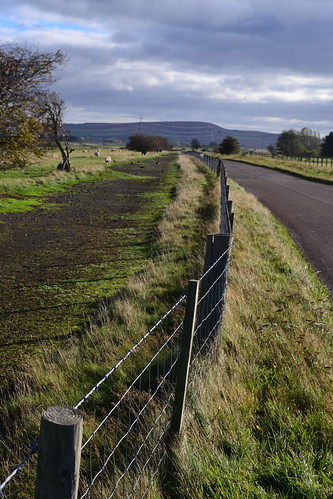
RAF Milfield

The Perimeter track is now the public road, parts lay visible alongside with associated dispersal pans.

As a military aviation site, Milfield came into being during the First World War. One of several such sites in the region that was used as little more than an emergency landing ground by 77 Squadron who were based further north at Edinburgh. Known at the time as Woodbridge, it would be a quiet little site that would soon disappear, quickly returning to its agricultural roots once war was over.

As a second war with Germany seemed inevitable, the need for new airfields became evermore apparent, and so the Air Ministry implemented the airfield expansion scheme. This programme developed so quickly that by 1942 there was a front line airfield opening at the rate of one every three days! As the German forces moved ever more quickly, and the Fall of France led to the Battle of Britain, the need for fresh, well-trained pilots became paramount. With home reserves drying up, the Commonwealth became an untapped source that would fill the ever-increasing void that was becoming a thorn in the side of the RAF.

Trained only in basic flying techniques, these crews had to be battle hardened and fit for action in a matter of weeks or even less. Initial training operations were mere ‘lip-service’ and recruits often had as much chance of killing themselves as they did the enemy they were intended to down. To meet this demand, numerous training stations were created, manned mainly by Operational Training Units (OTU), they were governed by the various arms of the Air Command: Fighter, Bomber, Naval, Transport etc.

At these training sites, crews would in essence, perform a ‘post-graduate’ training exercise, where they would be assembled for the first time and trained in their respective roles on the aircraft they would be expected to fly operationally. Milfield would be designated as one such station, and was initially identified as a suitable location for a bomber command site. Following requisition of the land in early 1941, the green-light for development was given, the process was put into place, and RAF Milfield was born.

Before any bomber crew would use Milfield though, it would pass from Bomber Command control over to Fighter Command whose focus would now be fighter pilots, and in particular, those specialising in both ground attack and dive bombing techniques.

As pilots came from all across the world, their training standards were some what disjointed, and so a refresher course bringing all crews up to the same standard would be required. This was a role that Milfield would fulfil. Working in conjunction with its satellite station a  few miles to the east, RAF Brunton, Milfield crews would spend some 9 to 10 weeks in total on flying techniques, both solo and formation flying, with the more advanced training taking place at RAF Brunton.

Nestled between the main road and the River Till, Milfield would be built to bomber station specifications, the three runways being wood chip and concrete one of 1,400 yards and two of 1,100 Yards. During development and subsequent handover to Fighter Command though, the new Class ‘A’ airfield standard would come in to being, requiring all airfields to be built with a longer runway specification. However, being a fighter training site, these were not imposed and whilst two of the runways were extended (1,800 and 1,300 yards) they were not to the full Class A specification.
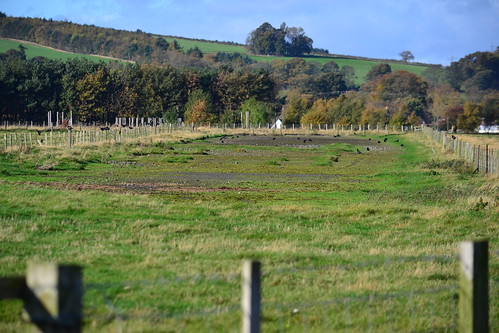
RAF Milfield

The runway threshold is still surviving, note the close proximity of the hills in the background.

As a training airfield it would be exceptionally busy. An expected turnover would be a new course starting around every 3 weeks, which would mean a considerable number of aircrew and aircraft; in excess of 100 air frames would be located here at Milfield at any one time. The primary fighter aircraft at this point would be the Hurricane with other examples including the Miles Master and Magister. To repair and maintain the aircraft, two T2 hangars were constructed with a further eight blister hangars located around the dispersal areas. Squadron dispersal huts were spread around the perimeter, with the technical area and main hangars being located to the south-eastern side. Accommodation, designed to be temporary, was dispersed over 13 sites, and would be designed to accommodate in the region of 1,650 staff, both male and female. Like many airfields though, this figure was surpassed with the actual ‘on roll’ totals varying considerably reflecting the constant movement of staff. Including the numerous support staff, it is believed that some 3,300 people were employed at Milfield at its height.

Adjacent to the airfield was the former Galewood Farm House, an old farm building used as an Officer’s mess during the airfield’s operational life. Destroyed in the 1960s, it was once part of an estate that adjoined the airfield, and was previously home to Josephine Butler. Josephine was the leader of a national women’s political campaign in Victorian England, who campaigned on behalf of prostitutes, abused and trafficked women until her death in 1906*1. Now commandeered by the military, a snooker table with lights powered by a generator was placed inside, and nearby stood the NAAFI theatre, the recreational building showing the usual films to keep the personnel entertained.

It was during this construction period that the first enemy action would occur over Milfield. On September 1st 1941, at 23:00 hrs, six bombs were dropped in the vicinity of Milfield. A crater 72 feet wide and 10 feet deep was recorded, the road was blocked and telephone lines were brought down. Also during this time, and whilst not officially open, aircraft would land at Millfield, presumably as test landings or after getting into difficulty. One of the first casualties here was that of Sgt. James B Spangler (R71573) RCAF flying Hurricane V7044 on 25th June 1941, who was “killed in the course of a training flight” whilst flying with 59 OTU. This tragic accident would be a sign of things to come.

Because of the nature of training flights, accidental deaths on or around Milfield would become fairly common. These included on October 6th, 1941, Hurricane MK. I W9177 which was forced to Bellyland in a field near to Stocksfield just west of Newcastle-upon-Tyne. On 13th December 1941, Sgt. Norman Clunie Pow, (R83911) RCAF, again of 59 OTU, crashed in Hurricane P3809. Sgt. Pow was just 25 years of age and was buried some several hundred miles away next to RAF Sutton Bridge in Lincolnshire, another training station.
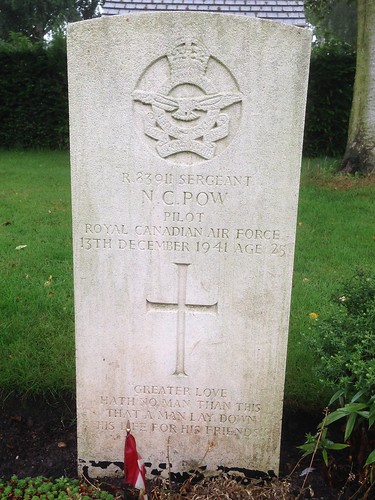
Sutton Bridge Churchyard

Sgt. Pow’s grave at Sutton Bridge.

As a training airfield, no operational front line squadrons would use Milfield, other than a detachment of 184 Sqn Hurricane IIDs between 1st December, 1942 and 1st March, 1943. The only other use of Milfield by ‘front line’ units would be as a transit base in the early post-war months.

The first full unit to arrive was that of 59 Operational Training Unit (OTU), arriving in the August of 1942.

59 OTU were originally formed at Turnhouse in December 1940, and operated amongst other things, the Hurricane, the Magister, the Fairy Battle and finally Hawker’s Tempest, all in a training capacity. After spending some five months at Crosby-on-Eden, the unit transferred to Milfield where they trained pilots in the ground attack role. As with many training stations, casualties were high, with many accidents happening through either pilot error or mechanical defects. Many of the Hurricanes used here were veterans themselves, beaten and patched up following intensive fighting in the Battle of Britain, many were long past their sell by date.

One of the first accidents to occur was that of Sgt. K. Dole, RCAF, who stalled whilst performing aerobatics – either authorised or not. His aircraft, a Hurricane MK.I ‘V7316’, MF 89 of ‘Z’ flight 59 OTU, crashed on farmland near Cornhill in August 1942. Luckily Sgt. Dole was unhurt, and the aircraft was salvaged; being repaired and sent to operations in the Middle East. The same fate however, did not fall to P/O J. Methum, who was killed in early September 1942, when his Hurricane MK.I ‘V6840’ crashed in a forced landing a few miles away to the east. The aircraft was written off in this most tragic of accidents.

The dangers of training became evermore apparent over the next few months, Saturday 27th March 1943 being particularly poor for 59 OTU with two crashes on the same day.  Hurricanes Mk.I ‘W9184’ and ‘W9121’ crashing in forced landings and night landings respectively. Both pilots were killed that day; Sgt. Robert MacFadzean (s/n: 1349862) born of US resident parents, and Welshman, Sgt. Gordon Cullener (s/n: 1383311).

Four months after 59 OTU’s arrival, No 1 Specialised Low Attack Instructors School  (SLAIS) would also be formed here (7th December, 1942) another unit that used the Hurricane and the Magister. One of the Chief Instructors of the School would be Squadron Leader J.H. “Ginger” Lacey DFM and Bar, a Battle of Britain Veteran who ended his career with 28 confirmed kills.
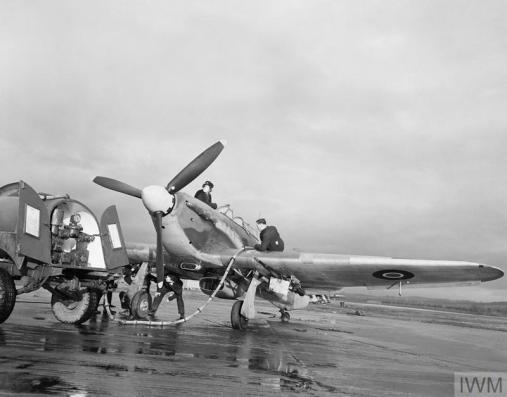
Hurricane MK.IID of No. 1 Specialised Low Attack Instructors School being refuelled and rearmed by Ground crew, including a WAAF, on a wet dispersal at Milfield. The fairings covering the two Vickers 40mm anti-tank guns beneath the wings have been removed and a warning notice hung from the barrel. (IWM CH 18134)

Low flying, in even in the relative safety of Northern England, was not immune from accidents, mishaps or misjudgements by the pilots. On 21st February 1943, Hurricane MK.II ‘HW731’ of the SLAIS hit an obstacle one mile north of Beal, the pilot escaped unharmed and after nursing the aircraft back to Milfield, it was repaired and converted for ground training purposes as ‘4616M’.

As flying training continued, so too did the number of accidents, burst tyres, engine malfunctions and fires, pilot error and collisions accounting for a wide range of them. On April 27th 1943, two Hurricanes collided in mid-air whilst performing formation flying. Both airmen, F/Sgt Davies and F/O Thompson were killed; an event that was mirrored in the following July when Hurricanes ‘P3475’ and ‘V7173’ also collided again with fatal results. New Zealander Charles Humphrey (s/n: 421056) is buried locally.

On May 1st 1943, 59 OTU transferred from 81 Group to No. 9 Group, at which point 81 Group was disbanded. No 9. took over 81’s responsibility, and it remained primarily a training arm of the Royal Air Force. For 59 OTU though, little would change.

On September 16th 1943, a B-17F-BO  (42-30030) named ‘Old Ironsides‘ ran out of fuel whilst returning from La Rochelle. The pilot Lieutenant Henry J Nagorka, decided to ditch in the sea near Farne Islands, off the Northumbrian coast. The aircraft quickly filled with water and in under four minutes she had disappeared beneath the waves.

During the ditching two crewmen were lost, waist gunners: S/Sgt. Ed Christensen and S/Sgt. Claude Whitehead, whilst the tail gunner S/Sgt. Harris lost a leg. Those that survived managed to climb into a dingy and sailed to St Cuthbert’s Island where they awaited rescue. Upon being saved, they were transferred to Milfield, where they were collected by another B-17 from the USAAF. However, as Milfield was a fighter airfield and its runways hadn’t been extended to Class A specifications, there were doubts about the aircraft’s ability to get off the ground on the short space available. To overcome the problem, the hedges at the end of the runway were removed and steal planking temporarily laid, the problem never arose though as the B-17 along with its additional human cargo left Milfield safely.

B-17F ‘Old Ironsides’ 42-30030, was loss at sea on the 16th September 1943 with the loss of two men. (IWM UPL 28296)

On January 26th 1944, both 59 OTU and the SLAIS were disbanded and a new unit formed, the Fighter Leaders School (FLS). The School had its origins in 52 OTU formed at Chedworth, and was in January, created as a unit in its own right. Formed through the need for more ground attack pilots in preparation for the forthcoming invasion, it was a unit that would take on the responsibility for the majority of the RAF’s ground attack crews. One notable figure of the FLS at Milfield was Bob Doe DSO, DFC & Bar, another veteran of the Battle of Britain. He would later return to operational duties after his short stay here in Northumberland.

Using the codes HK, OQ and MF, the FLS operated a number of aircraft predominately Spitfire VBs, and Spitfire MK IXs along with a handful of other marks. It later went on to adopt the Sabre engined Typhoon IB. In total over 130 aircraft would be used by the  Milfield unit, an incredible amount of aircraft on one site at any one time. Milfield continued to be in the spotlight.

It was also during this time, early 1944, that the USAAF would begin to send their pilots to Milfield to train on their ranges. With them, came a variety of US built aircraft, P-38 ‘Lightnings’, P-47 ‘Thunderbolts’ and the P-51 ‘Mustangs’. The brainchild of General Quesada, the plan was to train Ninth Air Force pilots in the art of dive bombing, skip bombing and low-level attacks, techniques that would become paramount if the push through France and on into Germany was to succeed. The arrival and increased use of Milfield by the US crews gave an indication that the impending invasion was drawing ever closer.

One of the earliest accidents for the FLS was in March of 1944, when Mohawk MK.III AR633 of 510 Squadron was hit by a Typhoon (JR509) of the Fighter Leader School on take off. Also on this day, a Spitfire MK.IIa (P8549) of the FLS tragically blew up in mid-air during a dive bombing attack on the Goswick ranges. The pilot of the Spitfire, F/Lt. Bouquen, a Belgian, was killed in the incident.

About a month later, a flight of four P47D Thunderbolts from the 366th FS (358th FG) from RAF Raydon attached to Milfield, were carrying out practice strafing attacks on a military convoy. During the climb out of the attack, one of the Thunderbolts (#42-25530), piloted by 1st Lt A. Serapiglia collided head on with Spitfire Mk 1 ‘R6762’ which was preparing to land at nearby RAF Eshott. In the collision, both pilots Sgt. Kai Knajenhjelm a 19-year-old Norwegian and Lt. Serapiglia were killed. After the investigation it was deemed that all future exercises should be performed “outside of local flying areas” of nearby airfields, something that perhaps seems obvious today, but reflects the hectic and often frantic skies over northern England in the 1940s.

A further accident to befall the Americans occurred on May 27th 1944, when a P-38 ‘Lightning’ #42-67425, of the 392nd FS, 367th FG piloted by Dueron H. Robertson, of the Ninth Air force, suffered a landing accident. The aircraft suffered major damage in the crash.

One of the benefits of attending the FLS was the diverse range not only of nationalities: Dutch, Czech, Canadian, Australian, New Zealand and South Africans to name but a few, but also the range of aircraft used. At the end of courses, trainees – now fully fledged fight pilots – were sometimes given the opportunity to try out other types of aircraft. An action that no doubt put the fear of God into the Station Commander who was heard to have shut his door and say “to hell with it”*2 . A number of other incidents occurred during this hectic time, which saw, by the end of December 1944, the FLS being absorbed into the Central Fighter Establishment based at RAF Wittering. Following this, the staff at Milfield all moved out, and momentarily peace prevailed once more.

Between mid December 1944 and into early January 1945, 56 OTU was reformed. Previously at RAF Sutton Bridge in Lincolnshire, it brought new aircraft, to the area, and Northumbria now reverberated to the radial engines of the Typhoon IB and the Tempest V; as four squadrons operated the aircraft using the codes FE, GF, HQ and OD. A collection of other aircraft types also graced the skies of this now highly significant airfield, Spitfires, Tiger Moths, Leopard Moths and Magisters to name but a few.

Even though the war in Europe was winding its way toward its conclusive ending, priority for aircraft was given to this purposefully created unit, and practice flights continued in earnest. The skies remained busy and accident numbers remained high.  In the space of one month between mid January and mid February 1945, there were no less than 8 incidents involving aircraft from Milfield and 56 OTU. As with many incidents here, poor weather, engine failures and pilot error were the causes of many  aircraft abandonment, pilot injuries and tragically deaths. In these eight incidents six involved Typhoons and two involved Tempests.
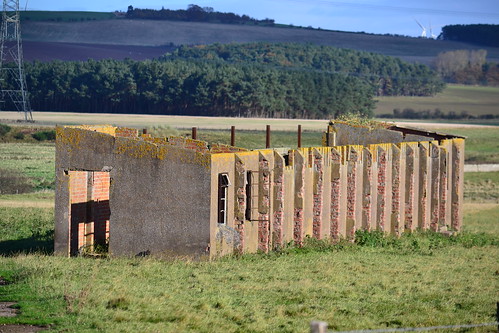
RAF Milfield

MG & Cannon Range building, one of the few remaining structures at Milfield.

March and April were similar stories, accidents, mishaps and deaths continued to plague Milfield, with pilot error accounting for a larger number of the accidents. Perhaps one of the most bizarre incidents took place on March 8th 1945 when the leader of a Spitfire squadron ‘deliberately’ attacked a Typhoon Mk.Ib ‘MP187’ of 56 OTU, killing the pilot F/O. R Smith of the Royal Canadian Air Force. The Typhoon was commonly mistaken for the Luftwaffe’s Focke Wolf 190, a formidable beast that became the scourge of the USAAF bomber formations.

The closing stages of the war didn’t bring a respite either. Saturday 12th May saw a collision between Tempests ‘EJ685’ and ‘NV759’ an event that killed an instructor pilot. Even after the war’s end, accidents continued to occur, with June, July, August and September all witnessing  further deaths and incidents. August 23rd saw Typhoon ‘SW638’ collide on the ground with two other aircraft, both those struck were written off whilst the ‘offending’ aircraft was badly damaged.

At the end of the war, and over just a two-day period, the only two operational units to use Milfield would arrive, using it as a transit stop. Both 164 Squadron and 183 Squadron would arrive and depart on the same day 16 – 17th June 1945 bringing with them yet more Typhoons.

Eventually, nearly nine months after the war’s end, on February 14th 1946, 56 OTU were disbanded, but not before one final roll of the dice when the life of an RAF pilot was taken. On January 29th 1946, whilst on a “Camera Exercise” and after performing a slow roll ten miles west of Holy Island, Tempest Mk. V EJ859 piloted by F/Lt. Vincent Parker (s/n 42356) RAFVR, an Australian aged 27, dived into the ground killing him. In a cruel twist of irony, F/Lt Parker was killed after having survived as a prisoner of war since 16th August 1940. He had remained in a German POW camp until its liberation at the end of hostilities, returning to England in June 1945, his post-war, peacetime life had been shorter than his life in captivity.

The departure of 56 OTU signified the end of the RAF’s interests in Milfield, and although not a front line operational airfield, it had become a very active and played a highly significant role in fighter training and development. Used to train both new and experienced pilots, it had become one of the RAF’s top fighter pilot training stations, developing pilot’s proficiency in low-level weapons delivery techniques. No matter how dangerous the training got, crews had continued to pass through, morale had  remained high and the standards were never dropped. Of the 1,200 pilots who had passed through here, many went on to make their names as the top ground attack pilots of the Second World War.

Immediately after the war, many of the accommodation huts were used to house Latvian soldiers, many staying here up until 1950. Local people were then housed in refurbished WAAF blocks before moving on to more permanent housing in the local village.

Soon after, Milfield began its decline with many of the buildings being demolished over the coming years. During the cold war era, the two T2 hangars were designated storage units for dried foods and emergency rations, thankfully a role that never had to be called into operation.  Eventually the runways were dug up and removed for hardcore, quarrying took over the southern end of the airfield and much of the surface layers were removed in the process.

During the 1970s investigations were carried by Air Anglia into the possibility of commencing commuter flights to European cities, but the project failed to ‘get off the ground’ and the service was scrapped before it ever developed into anything more than investigative flights.

Now partly returning to agriculture, a small section of the airfield has been retained by the Borders Glider Club*3 . The battle to keep gliders and flying here alive, being a long and difficult one. Through this small organisation, that operates only at the weekends, the spirit of flying lives on, and Milfield continues to fight for survival, a fight that has been both emotive and historically significant in the battle for the skies over Britain. The T2s have now gone as has virtually all the remaining buildings. A stone statue built by an Italian POW who was employed on the local farm, stands on private land, marking what was the official entrance to the airfield during the war years, it is clearly visible from the road side.

RAF Milfield

One of two sculptures, one made by an Italian POW, the second copied by an RAF serviceman.

Located four miles north-west of Wooler and Visiting today, there is some evidence of the former airfield left. Small sections of the perimeter track are now the public road, but alongside the road,  the remainder of the track can just still be seen. The north-western end of the runway is also visible as are a small collection of dispersal pans.  The MG & Cannon Range building still stands, minus its roof it is rapidly decaying, it has a very short life left.

Interestingly, as a training airfield, Milfield used both a Fisher Front Turret Trainer and Hawarden Trainer, a simulation trainer that used the fuselage of a Spitfire to train pilots in interception techniques. A model suspended from the ceiling up to 60 feet away from the pilot could be moved forwards or backwards by operating the opposite movement of the Spitfire’s throttle. As the Spitfire ‘accelerated’ the model moved backwards along a rail, rather similar in design to a 1970’s child’s toy. During these sessions a range of flying skills could be tested, interception and aircraft recognition, throttle control and cockpit procedures included. A primitive method that was state of the art in 1941. Sadly neither of these exist today.

Two memorials are located at this site, the first in a public car park to the western end of the airfield, next to the Maelmin heritage trail. The second is located outside the club house of the Borders Gliding Club, approximately on the site of the former watch office, itself no longer there. This memorial was commissioned by the club entirely through donations and is their way of acknowledging the sacrifice of those who flew from Milfield.

Interestingly a comment made by visitor Reginald Hall states that his wife’s uncle, David Harrison, (born in Gateshead in 1911) was stationed here to “strip out as much non-essential equipment as possible from the planes (he said principally Spitfires) to lighten their weight and so permit a greater quantity of fuel to be carried, sufficient to enable the return flights from Milfield to Scandinavia that were required for photographic reconnaissance“. Unfortunately the exact date of this Reg is unsure of, but I thank him for his comment which can be read in full in the comments below.

Milfield is arguably one of the most significant airfields of the Second World War, many Spitfire, Hurricane and Typhoon pilots quote it in their memoirs, their time here short but memorable. Here ground attack pilots cut their teeth, low-level strafing and dive bombing techniques being honed to absolute perfection. The battle for Europe would certainly have been more difficult were it not for those daring young men who passed through this remote but historically important airfield.

After we leave Milfield, we head east, toward the coast and the satellite of Milfield. A small airfield, it too played a major part in the development of ground attack crews and it too saw many accidents and losses through its training programme. From here we go to RAF Brunton.

Sources and Further Reading.

*1 A website tells the story of Josephine Butler’s life, and another has photos of Galewood farm-house.

*2 Dunn, W.R., “Fighter Pilot: The First American Ace of World War II“,  1996, The University Press of Kentucky, Page 118.

*3 Border flying club website

The Friends of Berwick and District Museum and Archives website provide information about the archaeological history of Milfield.

A book has been published about RAF Milfield, a complementary website gives fabulous personal detail of life at the airfield and is well worth a visit.

Photos of those stationed at Milfield can be seen through the BGC Flckr account.

Remembrance Sunday – Fogo Churchyard – Lest we forget.

On this, Remembrance Sunday, we pay tribute and homage to those who gave the ultimate sacrifice, to those who put their lives on the line so that we may live peacefully and free.

Not far from the former RAF Charterhall airfield in Berwickshire, is a small church that dates back to the late 1600s. The hamlet in which it stands, Fogo, is small. In 2004 it had a population of just 21 people, yet it is the resting place of 16 service personnel from the Second World War. These are Commonwealth graves with men from: the Royal New Zealand Air Force; Royal Australian Air Force; Royal Navy Volunteer Reserves;  Royal Air Force Volunteer Reserves; Royal New Zealand Navy and the Royal Canadian Air Force, all of whom died in service on and around RAF Charterhall.

Fogo Church

The sixteen men lay together in a Commonwealth War Graves Commission site.

These are those sixteen – We shall remember them:

Fogo Church

F.O. John Morris, (s/n: J/10253) RCAF, killed October 24th, 1942.

F.O. John Morris was one of many pilots who suffered as a result of the autumn storms. It is believed he lost control of his Beaufighter MKIIF (R2313) whilst in the clouds and crashed into the ground in the local area.

Fogo Church

F.O. Thomas James Donohue (s/n: 411880) RAAF, Killed November 10th, 1942.

F.O. Donohue was one of many Australian crewmen to pass through Winfield and Charterhall. Sadly it was to be the final resting place for F.O. Donohue, his Blenheim MK V (BA111) crashing into the ground following the port engine cutting out. This was the third Blenheim crash of the month.

Fogo Church

Sgt. Clarence Leonard Hutchesson (s/n: 401729) RAAF, Killed November 13th, 1942.

On the 13th November Beaufighter MKIIF R2378 took off from RAF Winfield with Pilot Sgt. Hutchesson and Navigator Sgt. R. Bell on board. The aircraft collided with another Beaufighter (T3359) near to Kettleshall Farm, Poleworth. Both crewmen in R2378 were killed, whilst the other crew managed to fly back to Winfield where they landed safely.

Fogo Church

Flt. Sgt. Terence Cosson (s/n: 417024) RNZAF, Killed June 9th, 1943.

Flt. Sgt. Cosson was killed when the Beaufighter he was flying (V8163) spun into the ground and burned.

Fogo Church

Petty Officer Airman Arthur Herbert Percy Archibald (s.n: 3171) RNZN, Killed July 19th, 1943.

Petty Officer Airman Archibald was flying a Fairy Barracuda MKII (DP868) from the RNAS Worthy Down to Scotland when he got into difficulties. The engine failed, after which the aircraft crashed at Charterhall killing him.

Fogo Church

Flt. Sgt. Will Andrew (S/n: 415280) RNZAF, Killed July 27th 1943.

July 1943 saw a high number of accidents at Charterhall, Flt. Sgt. Andrew being one of the first fatalities of the month. He was killed when his Beaufighter (T3419) swung on take-off. This action caused the aircraft to collide with a blister hangar and then crash into a taxiing Beaufort. The pilot of the Beaufort was uninjured although the aircraft sustained considerable damage.

Fogo Church

Flt. Sgt. Edward John Stacy Williams (s/n: 409952) RAAF, Killed September 19th, 1943.

Flt. Sgt. Williams was killed following a night flight engine fire. The pilot of the Beaufighter (T3361) Flt. Sgt. McGrath reported to RAF Winfield that he and his navigator were bailing out, but the when the aircraft was later found in the area, the bodies of both crewmen were still inside – both dead.

Fogo Church

F.O. Gordon William Bigmore (s/n: 418047) RAAF, Killed October 18th, 1943.

It is believed that on the 18th, F.O. Bigmore lost control of his aircraft, Beaufighter MKIIF (T2438) whilst in cloud and on approach to the airfield. The aircraft collided with high ground killing the pilot and causing severe injuries to the navigator F.O. Hirst.

Fogo Church

Sgt. Gilbert Douglas James Hanlon (s/n: 1333983) RAFVR, Killed February 17th, 1944.

Sgt. Hanlon was killed when he lost control on final approach to the airfield at Winfield. The Beaufighter MKIIF (R2375) collided with the ground some 2 miles south of the airfield on farmland.

Fogo Church

Sub-Lieutenant (A) James Allen Luke, RNVR, Killed March 1st, 1944.

March 1944 started off badly, when Sub-Lieutenant (A) Luke (above) and Sub-Lieutenant (A) Newburgh-Hutchins (below) tried to land their Fairy Fulmar in a snow storm at nearby RAF Winfield. The aircraft, a Fulmer MKI (X8696), was on a flight from the trials aircraft carrier HMS Pretoria Castle when it flew into the snow storm.

Fogo Church

Sub-Lieutenant (A) Christopher Newburgh-Hutchins RNVR, killed March 1st, 1944.

Fogo Church

W/O. Hamilton Alexander Douglas (s/n: 405843) RAAF, Killed March 18th, 1944.

On March 18th, W/O. Douglas of the RAAF was killed when the Miles Martinet T.T. (EM481) he was flying crashed on take-off at RAF Charterhall.

Fogo Church

Flt. Lt. Michael John Dunn O’Leary DFC  (s/n: 77614), RAFVR, Killed May 11th, 1944

Flt. Lt. O’Leary DFC was involved in what was possibly Charterhall’s most serious accident, when Beaufighter V8614 suffered an engine failure on the starboard wing; the aircraft unable to gain height, crashed into the ground. Flt. Lt. O’Leary was one of four crewmen killed, a crew that included two instructors and two pupils. O’Leary had just been awarded his DFC for gallantry prior to arriving at 54 OTU.

Fogo Church

F.O. John Owen Scott (s/n: 151287) RAFVR, Killed August 5th, 1944.

F.O. Scott was killed in early August when his Beaufighter MKIF (V8739) suffered engine failure at 800 feet and spun into the ground at Charterhall.

Fogo Church

F.O. Frank Ernest Larkman ( s/n: J/42709) RCAF, Killed March 3rd, 1945.

F.O. Frank Ernest Larkman was another crewman involved in a serious accident, when the Beaufighter NF VI (KV976) he was a pupil in, lost both its artificial horizon and its gyros. At 5,000 feet and in cloud, the pilot Flt. Sgt. Wedgewood as instructor, perhaps became disoriented and the aircraft crashed into the sea 3 miles north of Berwick. A further unknown crewman who was also aboard, also died in the incident.
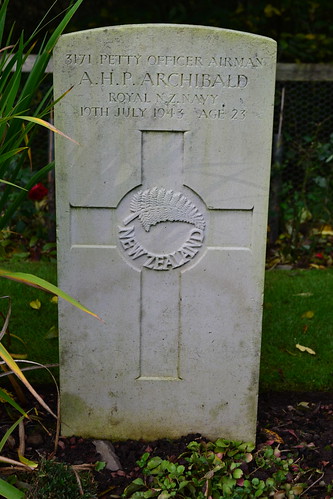
Fogo Church

F.O. Ernest Arthur Clough (s/n: 147069) RAFVR, Killed July 13th, 1945.

Sadly many crews lost their lives at, or after, the war’s end. Flt. Lt. Clough was one such man. Flying a Hawker Typhoon IB (RB210) of 56 OTU from Winfield, he flew into high ground near North Charlton, Northumberland, in the resultant crash on July 13th, 1945, he was killed.
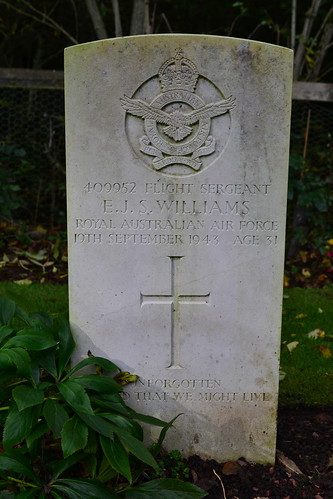
RAF Charterhall and RAF Winfield were both training grounds where many airmen were trained using unfamiliar or war-weary aircraft. As a result of inexperience, bad weather or in many cases, technical issues, there were a number of accidents many of which ended tragically. These sixteen are just a few of those who lost their lives in these accidents and are now buried in this quiet and secluded part of Scotland.

Lest we forget.

Fogo Church

Fogo Kirk in the autumn sun.