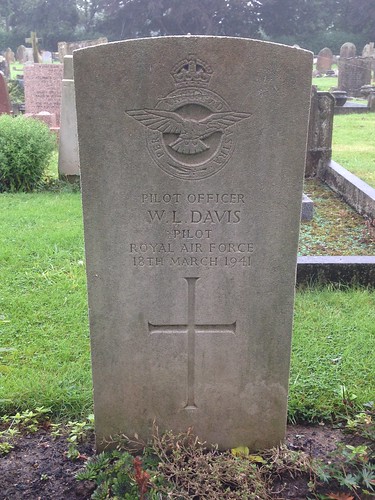
RAF Sedgeford – Operational during two World Wars.

In this new addition to Trail 20, we visit a former airfield whose history not only stems back to the First World War, but is deeply rooted in it. Between the wars it lay dormant, and then sprang into life once more, as military activity in Norfolk increased during the 1940s.  Known under four different names, and controlled by three different branches of the armed forces, we visit an airfield that has been the subject of one of Britain’s largest archaeological digs in recent years. Situated east of the coastal resort of Heacham in Norfolk, it now forms the first airfield on our tour in Trail 20. We start the Trail at the former RAF Sedgeford.

RAF Sedgeford (RFC Sedgeford, RNAS Sedgeford)

Also known as RFC Sedgeford,  RNAS Sedgeford or Sedgeford Aerodrome, the airfield lies just outside of the village from which it takes its name, and on the south side of the B1454 Docking Road.

Sedgeford originally opened as a First World War airfield during the latter half of 1915 as Royal Naval Air Station (RNAS) Sedgeford. It was initially a Class 1 night landing ground (NLG) for the main base at Great Yarmouth (South Denes) much further to the east on East Anglia’s North Sea Coast.

The Royal Naval Air Service were themselves a fledgling service, being formed only a year earlier in July 1914, after the naval wing of the Royal Flying Corps (RFC) was removed from RFC control, being placed under the jurisdiction of the Admiralty. At their time of formation the RNAS had on its books some fifty-five seaplanes (inc. ship-borne aircraft); forty aeroplanes; seven airships; 111 officers and 544 men*1.

With aviation very much in its infancy, the RNAS had been using mainly airships, and were only just beginning to venture into aeroplanes as a means of fighting a war. With a range of airfields in the area including both RFC Holt and RFC Bacton (NLG), it also used Ludham (HMS Flycatcher), Pulham (an airship station), Hickling Road (a seaplane airfield), Lowestoft (a balloon site) and Great Yarmouth (South Denes which was a mixed use airfield for home defence and marine operations). From these humble beginnings, the RNAS were to become a strong force during the First World War.

With the might of the Zeppelin ruling the skies, it wasn’t long before the first attacks were made along the North Norfolk coast, ranging from Great Yarmouth to Kings Lynn. These attacks, and continuing intruder flights by Zeppelins, called for a much greater aerial protection of East Anglia. It was this call that led to the creation of not only Sedgeford but also Aldeburgh, Bacton, Holt, Narborough (which later became Norfolk’s first military airfield) and Burgh Castle as active airfields operating armed flying units*2.

During the early part of 1916, RNAS Sedgeford was transferred across to the RFC (themselves only formed on 13th April 1912) and used as a training station. The site was developed with further buildings added, eventually gaining eleven canvassed Bessonneaux hangars, two more permanent General Service Sheds, a range of buildings suitable for aircraft repair and maintenance, barrack huts, MT (motor transport) sheds and even a locomotive shed fed by a branch line to the main Hunstanton and West Norfolk Railway a mile or so to the north. Sedgeford would develop into a substantial sized airfield with some 100 buildings accommodating over 1,200 personnel including WRENs and WRAFs. Whilst the overall dimensions of the site cannot be confirmed, it is thought that the airfield covered around 170 acres.

The WRAFs, (known affectionately as ‘Penguins,’ because they didn’t fly) were often found working in aircraft doping sheds repairing aircraft fabrics using a potentially harmful ‘dope’ containing an acetate solvent. The fumes from this solvent were known to be lethal in large doses, with many of those using it on a regular basis, feeling ill or in extreme cases, dying from the effects of its toxic fumes. To combat the problem, some First World War doping sheds had extractor fans built into them to remove these hazardous fumes, and at Sedgeford, evidence has been found (by the Sedgeford Historical and Archaeological Research Project), that confirms their use here.

Over the next few years Sedgeford would house a number of flying units, both training and ‘operational’ whilst preparing to move to France. The first of these (No. 45 Squadron) arrived on 21st May 1916 operating the Bristol BE.2b, an aircraft that they had been using since April at Thetford. Over the next five months, 45 Sqn would take on three other aircraft types: the Henry Farman F.20, (June to August), Royal Aircraft Factory FE.2b (July to Sept) and lastly the Sopwith 1 1/2 Strutter (July to Sept 1917); the first British aeroplane to have synchronised guns firing through a two bladed propeller. The rather odd name was given to the aircraft because of the unusual ‘half-struts’ that attached the wings to the fuselage.
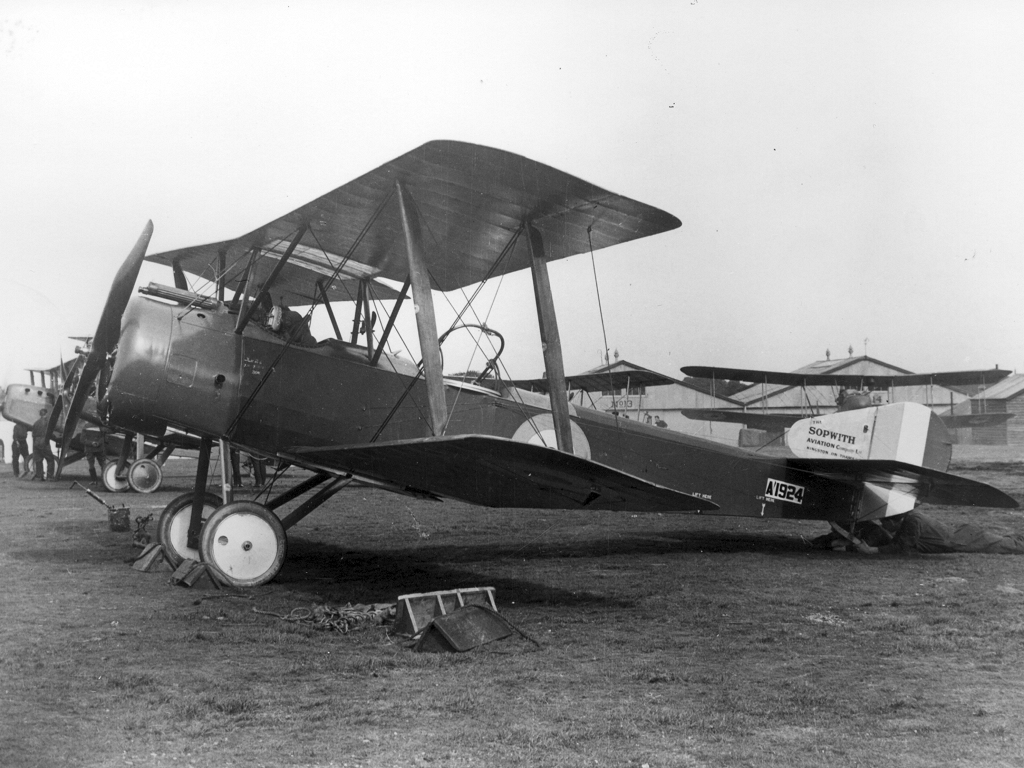
Sopwith 1 1/Strutter (unknown photographer via Wikipedia.)

In August 1916, 45 Sqn was broken up, with the nucleus being used to form a new squadron here at Sedgeford – No. 64 Sqn. The remainder of No. 45 Sqn then prepared for France, a move it made two months later.

No. 64 Sqn continued using the Henry Farman F.20s that had previously been allocated to them, but over time, they too would use a variety of aircraft types including: the Royal Aircraft Factory BE.2c and FE.2b, Sopwith’s famous Pup, the Avro 504 and the de Havilland DH5.

Then on February 1st 1917, 64 Sqn was itself then split, the demand for new pilots and new squadrons increasing as the conflict entered its third gruesome year. From this split, another new squadron was born, No. 53 Reserve Squadron, who were  themselves re-designated as No. 53 Training Squadron on 31st May 1917, and operated models such as the RE.8, BE.2c, Avro 504J and the DH.6. They would eventually leave Sedgeford and end their days at Harlaxton where they were disbanded and merged into another unit.

Although many of these pilots were ‘experienced’, being in training meant there were of course accidents, many taking the lives of the young men who had been drawn to the thrill of flying. One such pilot, twenty year old Sec. Lt. Arthur Le Roy Dean, was killed when his Sopwith ‘Pup’ (official name Scout) B1788 spun into the ground whilst flying with 64 Sqn on August 8th 1917. He initially survived the crash only to die from his injuries the following day.

RAF Sedgeford

The grave of Second Lieutenant Arthur Dean RFC.

The 9th would prove to be a black day for 64 Sqn, after they lost a second pilot, Canadian Lt. Edward Gordon Hanlan, who was killed when his DH.5 (#A9393) crashed following a wing failure whilst performing a loop over the airfield at nearby Bircham Newton.

September 1917 would prove to be a busy month for both Sedgeford airfield and the many airmen stationed there. On the 15th, another new unit arrived to join 64 Sqn. They too were a new squadron, only being formed a few days earlier at Upavon. No. 87 Sqn, remained at Sedgeford for just three months prior to moving to Hounslow before themselves moving across to St. Omer in France, which was rapidly becoming the hub of the Royal Flying Corp in continental Europe.

This month was the penultimate month of 64’s stay at Sedgeford, and prior to them leaving for France another Sopwith Pup (#B1787) would take the life of its pilot, 2Lt. Francis Brian Hallam Anderson (aged 19) who, like Sec. Lt. Dean, survived the actual crash only to succumb to his injuries and die several days later on the 8th. Flying these lightweight aircraft was not proving to be easy.

By mid October (14th), orders to move had come through, and 64 Squadron packed its bags – they were on their way to France taking their DH5s to St. Omer.  St. Omer being the very place the parent squadron (No. 45 Sqn) had moved to almost a year to the day previously. The many faces of 45 Sqn surely being different to those that departed a year before.

It was in France that 64 Sqn’s Acting Captain Flt, Lt. James A. Slater MC., DFC. would go on to be the Sqn’s top ace achieving 22 kills, which when added to the two he achieved with No. 1 Sqn, gave him a total of 24 kills. His determination and expertise in the air earning him both the DFC and Military Cross (with Bar) which was Gazetted in the London Gazette Supplement published on February 1st 1918*3*4.

The beginning of November 1917 would see another short lived unit arrive at this Norfolk site, and it would be the brief reuniting of two sister units.

Both No. 72 Sqn and No. 87 Sqn, had their roots firmly fixed in the same place – the Central Flying School at Upavon; 87 being formed from the resident ‘D’ Flight whilst 72 were formed from ‘A’ Flight. Whilst they perhaps enjoyed a momentary annexation, it would not last long before they would all depart and go their separate ways for good. Whilst 87 Sqn moved to the cold winter of France, No. 72 Sqn would take their Pups to the much warmer Persian Gulf and onto Basra and Baghdad, where they stayed until the war’s end.

Sedgeford was rapidly becoming a major player in the RFC’s continued development, with yet another new unit arriving here the same month they were formed – No. 110 Sqn. They too would be another relatively short stay unit, and again, operating a number of different aircraft types. Formed on November 1st, they were created out of the nucleus of 38 Training Squadron at Rendcomb, and stopped off at Dover on their way to Sedgeford. By June 1918, they were on their way again, moving to Kenley in Surrey, a station that would become famous in the Second World War as a fighter airfield.

Within days of 110 Sqn’s arrival, pilot James Alan Pearson was killed following a flying accident at Sedgeford. Pearson, who was from Chesterfield, had only joined the RFC in August that same year, transferring from South Farnborough, to Winchester, Oxford and then Hendon, where he joined No. 19 Training Squadron on September 19th, 1917. On November 19th, he completed his probationary period and was confirmed as a Temporary Second Lieutenant upon which, he was posted to No. 110 Sqn, at Sedgeford, just after the main squadron arrived at the busy Norfolk airfield.

His death came within a matter of days of his arrival, some references stating he ‘blacked out’, whilst other say his aircraft, a Martinsyde Elephant (#B866), broke apart. No doubt, both actions resulted from a steep dive from which Pearson never recovered. During the dive, and probable breakup of the aeroplane, Pearson was thrown out of the cockpit, unaided or not conscious, he failed to survive the fall. His official service record (AIR 76/396/34) simply states ‘Killed as result of aero accident‘, the short few entries showing how limited, at 18 years old, his experience was.

RAF Sedgeford

The grave of 18 yr old, Sec. Lt. James A. Pearson at St. Mary’s Church, Docking, who was killed within four months of joining the RFC.

As the war turned to another year and the winter of 1917/18 dragged on, New Year’s day 1918, would see No. 110 Sqn joined by another newly formed unit, No. 122 Sqn, who whilst  initially operating a range of aircraft, were earmarked to receive the de Havilland DH.9.  However, the transition would not go smoothly and it would ultimately result in the squadron’s demise.

Both 110 and 122 Sqns were assigned to go to France, 110 Sqn leaving on 15th June 1918 initially to Kenley before Bettoncourt to the south of Nancy in France, whilst No. 122 Sqn were to be sent to Hamble (which became the more prominent Upper Hayford post World War Two) where they were to take on the DH.9s before also moving to the continent.

However, the unit was disbanded whilst still as a training unit at Sedgeford on the day prior to its move on 17th August 1918. No. 122 was then reformed at Hamble, but further plans stalled as the DH.9 was replaced by the DH.10 and a delay in allocation prevented the reformed squadron from its final activation. With the war’s end and no further requirement seen for the squadron, the process then halted, and in November 1918, the squadron was disbanded for good .

With the war in Europe now over, the withdrawal of squadrons from France began and units started the long journey home. Sedgeford would continue to host some of these units, continuing to perform their role as a training airfield. Even at this point, expansion of the airfield was still occurring but the future for Sedgeford was not bright.

At the end of 1918, No 3 Fighting School (FS) (who had been formed at nearby Bircham Newton) arrived at Sedgeford. Being a former Aerial Fighting and Gunnery School, it operated a number of different aircraft types including: Pups, a range of de Havilland models, Dolphins, Camels and Handley Page 0/400s.

Perhaps now, as the war was over, a lapse in concentration or exuberant antics may have caused the death of young twenty-one year old 2Lt. Jack Garside of the Fighting School. He was killed on the 18th November just a week after the armistice when his Camel (E7253) was involved in a ‘flying accident’ over Hunstanton.  Although born in Yorkshire, Jack was buried at his parents home town of Coventry, in the London Road Cemetery.

The accidents didn’t stop there either. In the new year, on January 24th 1919, two more Sopwith Camels collided over Sedgeford airfield. Camel C8318 flown by Capt. Cecil Frederick King MC., DFC., was in collision with H2724 flown by Lt Hector Daniel MC.

Capt. King, who had been wounded in France, had been awarded not only the Military Cross in April 1918, but also the Distinguished Flying Cross in August 1918 along with the Croix de Guerre. Incredibly he was just short of his 19th birthday. Lt Daniel (a South African), survived the accident, and also achieved the Military Cross along with the Air Force Cross in July 1918 and June 1919 respectively.*5

RAF Sedgeford

The grave of Capt. Cecil Frederick King MC., DFC, Croix de Guerre

The wind down was slow at Sedgeford, but March 1919 would see two major changes at the airfield. Firstly, on the 14th, No. 3 FS was disbanded, reforming as No. 7 Training Squadron (TS), who continued in the training role at Sedgeford. By October though, with cutbacks in the pipeline, it would no longer be required and so operations were curtailed, and it was finally disbanded.

Secondly, the end of March saw the arrival of a cadre of No. 13 Sqn with RE.8s. Their journey to Sedgeford had taken them around the many battlefields of France over the last three years, the skies of Norfolk must have been a more than welcome break for the young pilots.

As more and more units were disbanded, Sedgeford too would feel the bite. On New Year’s Eve 1919/20, orders were received and subsequently carried out, to disband the last remaining squadron at the airfield, and with this, the end of Sedgeford as a flying base was now signalled.

The interwar years saw many of the buildings removed, many being sold off or demolished, but fortunately some remained, falling into disrepair or put to agricultural use. What remained of the airfield was left in a dormant state, fading bit by bit. But, the 1930s increase in international tensions would be the saviour of Sedgeford, as war once again reared its ugly head. This time however, it would not be as an operational airfield with the usual buzz and activity it was once so used to, this time it would be a much quieter decoy site.

With so many strategic airfields located in East Anglia, and with the extended development of Bircham Newton as few miles away, the protection of these sites was paramount.  The war of deception created the dummy airfield, with the sole purpose of diverting the Luftwaffe bombers away from the real airfield located nearby. Sedgeford was seen as a suitable location for such a site, the few remaining buildings being partly representative of a wartime airfield. With a little development and appropriate lighting added, Sedgeford  became one such site, the remaining buildings being utilised to create an image of activity one would expect to see on an active airfield.

RAF Sedgeford

The airfield today is far different from the one used in World War One.

These decoy sites were the brainchild of Colonel John Fisher Turner, a retired Officer from the Air Ministry who had turned his hand to film work and special effects. Working with a team of tradesmen and engineers, they produced life-like aircraft, vehicles, boats and buildings using canvas, wood and other lightweight materials that when viewed from the air, look like the real thing. With lights added to give the impression of runway lighting, fires and vehicles, it proved to be a major coup in the war against the Luftwaffe. Designated as both a ‘Q’ (night time) and ‘K’ (day time) decoy station, Sedgeford was operational between June 1940 and August 1942, after which time the larger threat of bombing had sub-sided.

Sedgeford had a small number of operators on site to perform the deception, and because they were to attract enemy attention, they were provided with a shelter, the bulk of which still exists on the site today. After this, Sedgeford was finally closed down and  returned to agricultural use once more. A state it has remained in ever since.

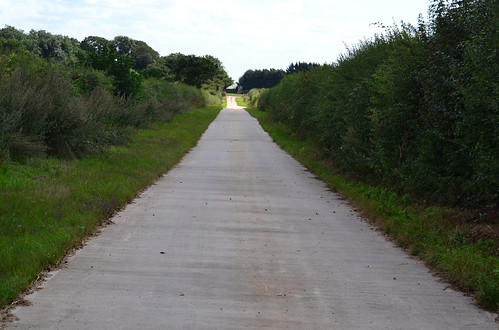
The airfield’s site is located just outside of the village, a gate and long path indicate the original entrance to the site. This path was once lined with First World War buildings, none of which remain today. The actual airfield itself is now an agricultural field, the railway spur that led from the main line has also gone, as has the main line itself. From the public road there are sadly no indications of the significance of this once historic site.
RAF Sedgeford

The main entrance and long road into former RAF Sedgeford. The field to the left would have had several buildings along it. The buildings remaining today are located beyond the forest on the horizon.

Along from the airfield toward the village of Docking, is another private dwelling that was also known to have been used as a billet for Sedgeford’s airmen. Formally the Union Workhouse it dates back to 1835 and was one of the largest workhouses in Norfolk at that time. Intended to hold up to 450 people, it rarely had more than 100 at any one time. The RFC took over the building in 1916 handing it back at the war’s end.

Since 2009 the Sedgeford Historical and Archaeological Research Project (SHARP) has carried out a huge excavation of the site at Sedgeford, uncovering a number of foundations and links to Sedgeford’s aviation history. Some of these buildings include the mortuary and Officers quarters, with its very ornate fireplace, and the World War 2 shelter mentioned previously. These are all firmly on private land hidden in a small wood around which the majority of the technical buildings were originally erected. Access to these sites is understandably only with permission, something I didn’t have on the day. The project, which has been carried out yearly, also uncovered numerous building foundations and a track for a hangar door. Substantial information being gleaned from the various digs being carried out over the years.

The types of buildings remaining at Sedgeford, especially the First World War examples, make this quite a unique site. So few buildings exist from this era, Stow Maries being the only other site with examples of any quality. This, along with the many deaths and sacrifices witnessed by Sedgeford, make it both historically and architecturally significant, and as such, perhaps the site should be protected.

The history of Sedgeford is extraordinary. Many of those who passed through its doors were teenagers, some lasted only weeks, whilst others went on to fly for years performing acts of great bravery and daring. But one thing that draws them all together was the thrill of flying in an era were flight was new and boundaries were unknown. Their bravery and courage should be remembered.

Sedgeford airfield had sadly all but passed into the history books, but recent excavations have given new life to this once significant site, and maybe one day, these will be given public status, and the memories of those who served and died here will live again.

This recognition took a step forward when on 21st July 1918 the Airfields of Britain Conservation Trust erected a memorial at Sedgeford. The report can be seen on both Your Local Paper website, and the ABCT website along with videos of the day and interviews with SHARP members.

From Sedgeford we continue with Trail 20, and travel east toward Docking, stopping off at St. Mary’s Church, before travelling a few miles further to the former airfield RAF Docking.

Sources and further reading.

*1 Fleet Air Arm Officers Association Website accessed 10/8/2019

*2 Gunn. P. “Aviation Landmarks – Norfolk and Suffolk“. The History Press (2017)

*3 London Gazette Publication date: Supplement: 30827, Page:9204.

*4 London Gazette, Publication date: Supplement: 30507. Page:1606 Supplement page 1606.

*5 National Archives AIR 76/276/120, AIR 76/121/132

SHARP interim report 2011 (pdf via website)
Sedgeford Historical and Archaeological Research Project website.

Norfolk in the First World War: Somme to Armistice project Website accessed 11/8/19

The Workhouse, The Story of an Institution website. Accessed 12/8/19

Photos of Sedgeford’s buildings can be seen on the ‘Derelict places’ website.

RAF Metheringham – One of Bomber Command’s finest. (Part 3)

In this, the last part of RAF Metheringham, we see how one of its brave crews earned the Victoria Cross for their outstanding bravery, and how, as the war camr to a close, Metheringham was closed down and disposed of.

On the night 24th/25th April, 1944, took 106 Sqn back to Germany once more, to Munich and another ‘clear night’ with accurate bombing reported. But, then it was Schweinfurt a city that would become synonymous with high casualties especially amongst colleagues in the US Air Force.

Metheringham would send sixteen aircraft that night with take off commencing at 21.25 from the Lincolnshire airfield with another mix of 4,000lb, 41lb and 30lb bombs. Over the target, marking would again be low level by Mosquitoes but this time  it was inaccurate. Strong winds hampered the bombers, with many of the bombs falling away from the main target. Crews reported large fires across the city accompanied by ‘large explosions’. Sadly these were not to be the target and as a result the mission was not deemed a success.

Of the 206 Lancasters sent out that night (26th/27th) twenty-one were lost to heavy and sustained night fighter attacks, a figure of 10% of the force, a terrible blow for Harris and his Command. From Metheringham, five aircraft failed to return, with a further one returning on three engines. Methringham’s loss that night was some 31%, a third of its force gone in one mission. It was a difficult mission for 106 Sqn, with thirty-six airmen lost,  (JB601 was carrying a second pilot). Ten of these were taken alive as POWs, four managed to evade capture, whilst the rest were killed. The deaths of the remaining twenty-two must have had another huge impact in the Metheringham dining room that morning.

During this mission the remarkable actions by the crew of Lancaster ME669, and in particular Flight Engineer Sergeant Norman C. Jackson (later Warrant Officer), would become well known. After being hit several times by a  night fighter, a fire started in the inner wing section next to the upper fuel tank.  Sgt. Jackson, who had been wounded in the leg and shoulder, donned his parachute and grabbed a fire extinguisher before climbing out on to the wing through an escape hatch in the fuselage roof. Upon leaving, his parachute was deployed into the cockpit area, where his colleagues gathered it up and gradually fed the lines through the hole allowing Jackson to gain access to the fire in the wing. Undertaking such an act on a burning aircraft and at altitude, was no easy task and getting back, had he been successful, virtually impossible. The wind knocked the extinguisher out of his grip which prevented Jackson from succeeding in achieving his aim. The fire, now spreading, began to burn both his parachute, hands and face and fearing for his safety, his colleagues let go, releasing him from the stricken bomber. Sgt. Jackson fell to Earth, his parachute partially burned, opened and allowed him to reach the ground alive, but suffering several injuries in the process.

The 21 year old Canadian Captain, F/O. Frederick M. Miffin D.F.C., then ordered the crew to abandon the aircraft; himself and 20 year old F/Sgt, Norman H. Johnson (Air Gunner) both failing to survive.

Sgt. Jackson’s brave attempt to save his colleagues and their aircraft earned him the Victoria Cross for his actions, his citation being published in the Fourth Supplement to the London Gazette on Tuesday 23rd October 1945.*2

The Schweinfurt raid had been a major blow to the Metheringham crews, but it had also shown their courage and determination to win, regardless of the dangers to their own safety.

Another heavy blow on the night of 7th/8th May took another four aircraft along with all but one of the crew, Sgt. J Smith evading capture, in a month that would see a further six aircraft go down with heavy losses.

June 1944 would see another remarkable event take place. Although the entire crew of DV367 were lost on the night of 7th / 8th, they were all awarded the DFM for their action, an usual act in any squadron, and one that nonetheless reflected the bravery of RAF crews at that time.

RAF Metheringham

Metheringham’s memorial garden rests besides a C-47 Dakota ‘KG651’ as a representative model that visited the airfield at the end of the war. Visitors are able to enter the aircraft and sit in the cockpit.

Following the Allied invasion of Normandy, the US forces would begin to use Metheringham as an evacuation point for wounded American troops from nearby  Nocton Hall Military Hospital. Once a suitable recovery had been made, the troops were brought to Metheringham and flown on to Prestwick for onward travel and reparation to the United States.

Rarely a month would go by without the squadron facing some loss. Exactly a month later in July, Metheringham would see yet another dip in their crew numbers as five more aircraft went down on the mission to St.-Leu-D’Esserent – the flying bomb storage dump. A force of 208 Lancasters and thirteen Mosquitoes accurately bombed the mouth and access roads to the tunnels in which the bombs were being stored. Metheringham’s loss was particularly high, almost a third of the sixteen sent out being lost. Whilst many airmen were either captured or evaded capture, another eighteen were lost.

In September 1944, No. 1690 (Bomber) Defence Training Flight arrived ay Metheringham airfield. A unit formed seven months earlier at Syerston after 1485 (Bomber) Gunnery Flight was re-designated, it operated a number of single and twin engined aircraft including the Spitfire, Oxford and Wellington bomber under the code ‘9M’. They were used to train bomber crews in the art of defence against fighters, performing violent moves to throw off their attacker. One famous pilot of this unit who served at Metheringham was the Commanding Officer Sqn. Ldr. John Leslie Munro, CNZM, DSO, QSO, DFC, JP of 617  Sqn fame. The Flight would leave Metheringham in the summer of 1945, being disbanded in October that same year back at Syerston.

It had been a long and difficult war for the crews at RAF Metheringham. As the end of the war drew ever closer, they all knew their last mission would soon be here. On April 25th 1945, that day arrived.

Sixteen Lancasters took off to either bomb Tonsberg in the southern region of Norway, or mine the Oslo fjord. A last ditch effort to force the capitulation of the German leadership and end the conflict that had devastated the world for the last six years.

By the time the cease fire was announced, 106 squadron had flown 5,834 sorties with a loss of 187 aircraft (59 from Metheringham), 3.21% on average per mission. 17,781 tons of bombs and mines were dropped and 267 decorations awarded.

After the war, 106 Sqn was earmarked for ‘Tiger Force’ operations and training was tailored to meet these new requirements: fighter affiliation sorties, high level bombing and air-sea firing exercises. Also during May, operation ‘Exodus‘ was put into place and a number of 106 Sqn aircraft flew to the Continent to bring back POWs, many landing at Dunsfold on their return. On the 9th May, whilst evacuating POWs from Rheine airfield, one aircraft from 106 Sqn struck a bomb crater causing damage to the aircraft, the crew and their valuable cargo of POWs thankfully escaped unhurt. The aircraft was then repaired with parts being ferried over from Metheringham the next day. Between May 4th and May 11th, Metheringham crews repatriated 1,484 prisoners of war bringing them home from captivity.

During June aircraft were exchanged with those from 8 Group at RAF Oakington, RAF Warboys and RAF Graveley, allowing Operation ‘Firebrand‘ to be completed by the 19th. Other operations included ‘Rebecca‘, ‘Dodge‘, ‘Nickel‘ and ‘SPASM‘.

On June 15th, another Lancaster squadron, No. 467 (RAAF), joined 106 here at Metheringham. In the days preceding their arrival, they spent many hours dropping ordnance into the sea, a comment in the ORB stated “it seemed like the old days with all serviceable aircraft loaded with incendiaries and it looked like a real operational take off.” It goes on to say a ‘waste but necessary‘ reflecting perhaps the feelings of the men as the squadron wound down for the final few weeks.

The advanced party arrived to make sure the transition went smoothly, with the main party arriving shortly afterwards. Beer was supplied by Metheringham and the crews soon got to know each other well. On July 11th, an athletics competition was run between the two squadrons, involving contests such as ‘tug-o- war’, ‘hop, step and jump’, ‘throwing the cricket ball’ and distance races.

With the announcements of Japan’s capitulation on August 15th, all 106 Sqn ‘Tiger Force’ training flights were cancelled although it continued to be used as the basis of further training operations. B.A.B.S. (Beam Approach Beacon System) training also continued at the airfield.

RAF Metheringham

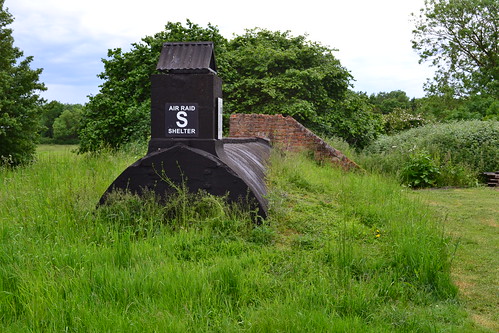
Air Raid Shelters were once common place on Britain’s airfields.

Shortly after 467’s disbandment on September 30th 1945, October saw yet another Lancaster unit arrived at Metheringham, No. 189 Squadron who brought yet more Lancaster MK.Is and III. to be disposed of and they too were disbanded within a month.

The poor weather that had caused so many problems during the winters of the 1940s leading to Metheringham having FIDO installed, continued on into 1946 curtailing many flights and operations. On 13th  February 1946 the final curtain came down and a memo came though to Metheringham to ‘stand down’ from all operational and non-operational flying as of 00:01, 15th February 1946. Sixteen aircraft were to be ferried to RAF Graveley to have Mark III H2S units fitted, although this was cancelled and the aircraft were sent to Waddington (10), Binbrook (1), Lindholme (4) and one further Lancaster going to Waddington. By 22nd February 1946 all aircraft had left Metheringham and the squadron no longer existed, 106 Squadron was once more consigned to the history books and Metheringham airfield would follow not long after. Men, machinery and administrative items were then disposed of in accordance with the relevant Bomber command instructions. By April, everyone had left, the site was stripped and placed in care and maintenance, a condition it remained in until December 1950, whereupon it was abandoned before being sold off ten years later.

Like many stations, local people used the accommodation sites for their own accommodation, the runways were eventually pulled up for hardcore, buildings and other metal structures were removed for scrap or sold off to farmers. By the early 1970s Metheringham had all but been wiped off the map. The Watch Office left to decay has since been bought by a local developer, with a mammoth task ahead of him he hopes to turn it into accommodation and a small museum/residential block.

Metheringham’s record of achievement was a proud one, with generally low loss statistics they were to face some of the toughest challenges of the war, losing many crews in the process. Their determination to survive and to win over the Nazi tyranny led to many brave and heroic acts, acts which helped secure the release of hundreds of captured airmen.

RAF Metheringham

There are many reminders of RAF Metheringham.

Metheringham’s gallant and brave young men, are all remembered in a small, but excellent museum that now utilises part of one of the accommodation areas. A memorial to the aircrew stands on the eastern perimeter track as a reminder of the 995 Airmen who were lost whilst serving with 106 Sqn.

Much of Metheringham’s runway and perimeter track still exists today, in most part as a public road. The width of the concrete bases far exceeding the width of the road. A memorial stands to the eastern side overlooking the main airfield site (Site 1) with lines of tress denoting the remainder of runways long gone. The main B1189 road dissects the accommodation areas with Site 1, as was common with late wartime airfields. The museum lies off the junction of this road and the main Woodhall Spa road B1191 along the entrance to Westmoor Farm. If taking the B1189 toward the Metheringham village, you will pass a number of former wartime buildings used as small industrial units and farm storage. These are on private land although the museum do organise visits to some of these at certain times of the year. After passing these, turn right, this road was one of the secondary runways and crosses the remains of the main runway part way down. It then bends to the right taking you along the perimeter track, and then right again to the memorial – a circular route that traverses what was the peri track. Several of the hardstands still survive, mainly on farm property and difficult to see from the ground, but the number of buildings still standing is quite remarkable for such a short lived airfield.

Trail 1 then continues on, visiting another former Bomber Command airfield RAF Woodhall Spa.

Sources and further reading.

*1 Fleming, J., “The Callendar Effect: The Life and Work of Guy Stewart Callendar (1898-1964)“, 2007, The American Meteorological Society

*2 The London Gazette, 23rd October 1945.

*3 Operational Record Book March 1944 – IWM AIR-27-834-6

Operational Record Book January 1944 – IWM AIR 27/834/1

Operational Record Book November 1943 – IWM AIR 27/833/22

Operational Record Book April 1944 – IWM AIR 27/834/8

Operational Record Book – Squadron Number: 106 Summary of Events: Y – IWM AIR 27/835/9, (01 May 1945 – 28 February 1946)

467 RAAF (Royal Australian Air Force) Summary of Events: Y 01 May 1945 – 30 September 1945 – IWM AIR 27/1931/33

Middlebrook. M., Everitt. C., “The Bomber Command War Diaries.” 1996, Midland Publishing.

Records of a 1690 BDTF pilot can be read on the Website ‘A Pilot’s Story‘.

Metheringham Airfield Museum webiste holds details of opening times, admission fees and special events. An excellent little museum it is well worth a visit.

RAF Metheringham – One of Bomber Command’s finest. (Part 2)

After Part 1, we continue following the crews of 106 Squadron at RAF Metheringham. The weather and in particular fog became a huge problem for aircrew, and bomber Command in particular. Something had to be done.

During the 1940s, fog was a particular problem around Britain’s airfields, often reducing visibility down to virtually nil, meaning bombers could neither take off nor land. Arthur Harris realising the effect this was having on his bomber operations, requested investigations be carried out into a possible method for clearing the fog thus allowing bombers to operate in this appalling conditions and widening the possibilities of operations in bad weather.

Churchill, influenced by Harris’s argument, instructed his Scientific Adviser Lord Cherwell to begin action at once, and so the Petroleum Warfare Department began to assemble a team of experts – who had already carried out some investigations into the weather and methods for dealing with fog – into a team to investigate the problem. A wide ranging group of scientists and industrialists carried out research concluding that heat was by far the best method for clearing fog over the low lying landscape.

The requirement put forward was to clear a standard Class A runway of at least 1,000 yards long and 50 yards wide, and an area up to 100 feet above the ground – a staggering 1.65m cubic yards of air. Further limitations were then put on the order restricting the placement of any obstacles likely to endanger an aircraft within 50 feet of the runway’s edge.  A mammoth task but one which saw the development of the oil burning FIDO system.

The FIDO (Fog Investigation and Dispersal Operation) system was developed under the leadership a British Civil Engineer Arthur Clifford Hartley, CBE who worked with the Petroleum Warfare Department, and whose initial ideas involved using one of two streams of fuel; petroleum trialled at RAF Graveley, and Coke trialled at RAF Lakenheath.  After initial (and rather crude) tests at both Moody Down (petroleum) and Staines (coke), petroleum was found to be the better of the two fuels, and henceforth, the Gravely model was used as a template for fourteen further sites of which Metheringham was one.

Installed at Metheringham during early 1944, it saw pipes laid alongside the runway which when lit, created an initial mass of smoke. Once the system had ‘warmed up’ the smoke dissipated and the fog began to ‘burn off’ as the immense heat from the burners created an up draft of warm air.

By the war’s end FIDO had been used across England to assist in the landing of almost 2,500 aircraft most of which would otherwise have not been able to land without great danger to the crews or ground staff; it had been one of the war’s greatest success stories and was sold as such to the wider public. So successful in its outcomes, FIDO was intended to be installed at London’s major airport Heathrow, after the war, but the cost of running each system was astronomical, burning some 6,000 – 7,000 gallons of fuel in four minutes – the time it took to clear the designated volume of air. It is estimated that during its wartime use, something like 30 million gallons of fuel were burnt and whilst the cost to the taxpayer was tremendous,  it is thought to have saved the lives of over 10,000 airmen in the process.*1

Back in the air, the night of March 15th/16th saw split missions  with one section going to Stuttgart and and a further six aircraft heading to the aero-engine factory at Woippy in France. These six made up a total formation of twenty-two Lancasters, a flight that included 617 Sqn aircraft. With promises of good weather over the Metz region, it came as  a huge disappointment to find 10/10 cloud cover over the entire target.  Even with the target being identified on the H2S screen and five marker flares being dropped, the leader announced the mission scrubbed and all aircraft were instructed to return to base taking their full complement of bombs with them. So strong were the crew feelings that 617 Sqn’s leader, Leonard Cheshire, seriously considered complaining! However, despite this, all aircraft returned including those of 106 Sqn to Metheringham with only minor flak damage to ND331.

Lancaster B Mark IIIs of No. 106 Squadron at Metheringham,heading to Frankfurt. The attack on 22/23 March 1944 caused extensive destruction to eastern, central and western districts of the city. © IWM (CH 12543)

With the next few missions passing without major incident, the night of March 30th, would deal a hefty blow to the crews of 106 Sqn.

With take off starting at 22:15, seventeen Lancasters would depart Metheringham heading for Nurumberg carrying a range of 4,000lb, 1,000lb, 500lb, 41lb and 30lb bombs. Over the target, skymarkers guided the bomb-aimers as cloud was reported as heavy as 10/10 again. Searchlights and flak were evident as were fighters which attacked and damaged Lancaster ND332 piloted by F/O. Penman. The Lancaster, which claimed two enemy aircraft damaged, returned to England putting down on Manston’s emergency runway. Both the rear and mid upper turrets were out of action, one of the engines caught fire, and on landing, the undercarriage collapsed due to the enemy action. luckily though, no crewmen were injured in the sustained attack that caused the Lancaster’s severe damage.

A further Lancaster had to return early, Lancaster JB567 after suffering the failure of the port inner engine landing back at Metheringham after two and half hours into the flight. Similarly it was an engine failure that also caused the early return of JB641 this time landing three hours after departure. Three of the seventeen Lancasters were already out of action.

Meanwhile on the continent, Lancaster ND585, was reported missing, later being found to have been shot down by a German night fighter, crashing in Belgium with the loss of all its crew. On board was, at 18 years old, another of Bomber Command’s youngest ever crewmen, Sgt. Julian Mackilligin RAFVR (S/N: 1804016), who even at his young age, was already half way through his operational quota. He was buried at the Hotton War Cemetery, Luxenbourg.

Next came another two losses, Lancasters JB566 piloted by F/S. T. Hall DFM and ND535 piloted by F/O. J Starkey. Both went down with the loss of all but four crewmen. The mission had indeed been costly, forty-two airmen were out of action, seventeen of them killed.*3

By the end of the first quarter of 1944, 106 Sqn had carried out more sorties than any other 5 Group squadron (358) losing 8 aircraft in the process. This gave the men of Metheringham an average of 19 sorties per aircraft in the first 90 days.

April began with a mix of bombing and ‘Gardening‘ missions, operations that included laying mines along the Koningberger Seekanel, with mines being dropped from as low as 150 ft. Even though some aircraft reported heavy ground fire from the banks of the Canal, the mission was deemed to be a great success and all aircraft returned safely.

The month continued to go well for the Metheringham crews, but the night of April 22nd / 23rd would take another toll on the morale of the crews. That  night saw twenty Lancasters fly to Brunswick as part of  a much larger force of 238 Lancasters and seventeen Mosquitoes. The mission, whilst generally uneventful, marked the first operation in low level target marking by No. 5 Group over a large city, an aid that proved fruitless on this occasion partly due to low cloud/haze obscuring the bomb aimer’s clear sight. With varying reports of cloud from 5/10 to no cloud and haze, all bombers reported bombing on markers, but damage and ground causalities were recorded as low.

RAF Metheringham

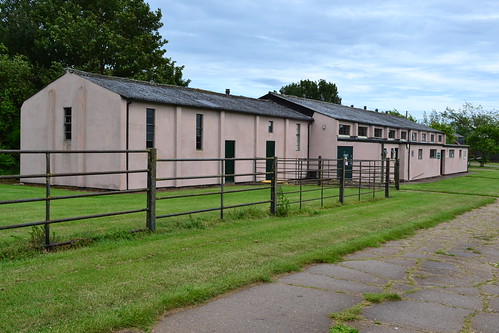
The former Gymnasium now forms part of the museum and holds a range functions including weddings and talks.

RAF loses that night were also relatively low, with only four aircraft being lost from the whole flight. Sadly though, one of these, Lancaster MK.III ‘JB567’ ZN-E piloted by F/Lt. J. Lee was a Metheringham aircraft. F/Lt Lee had only one more mission to go before completing his first tour of duty. Only two of his crew survived, being picked up by German forces and sent to POW camps. This loss only went to strengthen the idea that it was difficult, if not impossible, to achieve a full tour of duty unscathed.

The next night 24th/25th April, 1944, took 106 Sqn back to Germany once more, to Munich and another ‘clear night’ with accurate bombing reported. But, then it was Schweinfurt a city that would become synonymous with high casualties especially amongst colleagues in the US Air Force.

In part 3, we see how incredible brave acts earned a Metheringham airman the highest honour – the Victoria Cross.

The entire post can be seen in Trail 1.

July 30th 1944 – Loss of Lancaster PB304 – 106 Squadron.

On Sunday July 30th 1944, Lancaster PB304 from 106 Squadron RAF Metheringham in Lincolnshire, crashed with the loss of all on board, along with two civilians, in Salford Greater Manchester.

Lancaster PB304, was a MK.III Lancaster based at RAF Metheringham in Lincolnshire, flying under the squadron code ZN-S. It was tasked to attack enemy strong points at Cahagnes in the Normandy battle zone following the Allied invasion in June.

The early briefing at 04:00 was not a welcome one, many men having been out the night before following a stand down order due to bad weather and heavy rain over the last two days. On board that day was: F/L. Peter Lines (Pilot); Sgt. Raymond Barnes (Flt. Eng.); F/O. Harry Reid RCAF (Nav.); F/O. John Harvey Steel (Air Bomber); Sgt. Arthur William Young (W.O/Gunner); Sgt. John Bruce Thornley Davenport (Mid-Upper Gunner) and Sgt. Mohand Singh (Rear Gunner)*1.

The operation, code-named Operation Bluecoat, would involve attacking six specific targets, each one identified to assist a forthcoming offensive by British land forces in the Normandy area.

After all the ground checks were completed and the signal given to depart, PB304 began the long taxi to the runway, take off was recorded as 05:55, but it is thought that this was ten minutes early with the first aircraft (ND682) departing at 06:05. Once in the air, the aircraft formed up alongside twenty other 106 Sqn aircraft,  meeting with a smaller formation from 83 Sqn at Coningsby before joining the main formation.

The weather remained poor with heavy cloud blanketing the sky between 5,000 and 10,000 feet, as the 183 Lancasters from No. 5 Group and one Mosquito headed south toward the Normandy coast.

With further poor weather ahead, signals were beginning to come through to abandon the mission and return to base, but communication between aircraft was garbled and difficult to understand, it may have been as a result of German interference broadcasting messages over that of the master bomber. The order to abort finally came through just after 08:00 even though some of the formation had released bombs on target indicators (TI) dropped by the Pathfinders. Smoke was by now mixing with the low cloud causing more confusion and difficulty in identifying the primary targets. Not all aircraft understood the message however, and many continued circling in the skies above Cahagnes. To make a difficult situation even worse, there was by now, an  approaching formation of over 450 American A-20s and B-26s along with just short of 260 P-51 and P-47 escorts on their way to France; the sky was full of aircraft in thick cloud and was an accident waiting to happen.

Difficult communication continued, some aircraft were seen disposing of their bomb loads over the Channel, whilst others retained them. Various courses were set for home, but with many airfields closed in by low cloud, alternatives were gong to be needed and alternative courses were issued to the returning bombers of each squadron.

106 Sqn were ordered to fly north along the western coast, passing over Pershore and on to Harwarden near Chester, before turning for home. The messages coming through continued to be misheard or misunderstood with several aircraft landing at either Pershore, Harwarden or Squires Gate at Blackpool. Gradually all aircraft managed to land, whether at home at Metheringham or at away airfields. Patiently the Metheringham staff waited, nothing had been heard from PB304 and they could not be contacted on the radio, something was wrong.

Precise details of the accident are sketchy, but an aircraft was seen flying low and in some difficulty. It passed low over Prestwich on the northern edges of Manchester, where it was later seen engulfed in flames. It twice passed over a playing field, where some suspect F/L. Lines was trying to make a crash landing, but this has not been confirmed. At some time around 10:10 -10:15 the aircraft came down resulting in a massive explosion, a full bomb load and fuel reserves igniting on impact. Many houses were damaged in the explosion with one being completely demolished.

As a result of the accident, all seven of the crew were killed along with two civilians, Lucy Bamford and George Morris, as well as, what is believed to be, over 100 others being injured all to varying degrees.

PB304 was the only aircraft lost that night, in a mission that perhaps with hindsight, should not have taken place. The poor weather and difficult communication playing their own part in the terrible accident in Salford on July 30th 1944.

RAF Metheringham

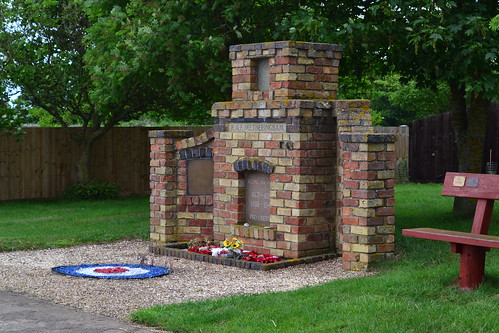
The Memorial at Metheringham pays tribute to all those who flew with 106 Sqn.

Notes and Further Reading.

*1 Operational Record Book AIR 27/834/14 notes Sgt. Young as Sgt. A.L. Young.

A book written by Joseph Bamford the Grandson of Lucy who was killed that night, was published in 1996. “The Salford Lancaster” gives excellent details of the crew, the mission and the aftermath of the accident, published by Pen and Sword, it is certainly worth a read for those interested in knowing more about the incident.

Carter. K.C., & Mueller. R., “Combat Chronology 1941-1945“, Centre for Air Force History, Washington D.C.

Freeman. R., “Mighty Eighth War Diary“, Jane’s Publishing. 1980

RAF Metheringham – One of Bomber Command’s finest. (Part 1)

In this post we return to Lincolnshire and ‘Bomber County’, to the area south of the city of Lincoln. Here, we are not far from the still active RAF Coningsby, the former RAF Woodhall Spa, the Officer Training College at RAF Cranwell and the former bomber base RAF East Kirkby.

Many of the airfields in this area were the RAF’s Bomber Command airfields, several housing the four-engined heavies the Lancaster bomber. Being a flat region of England it was an ideal landscape for Bomber Command, it was also near enough to the continent and yet far away from intruders to suffer the risk of major attack.

We continue on on this trail by visiting one such airfield, an airfield that lasted until the war’s end featuring only one major flying unit, 106 Squadron. Today, we add a new addition to Trail 1 as we visit the former base RAF Metheringham.

RAF Metheringham.

Located on the edge of the Lincolnshire Fens 3 miles east of the Lincoln Cliff escarpment, and near to the village from which it takes its name, Metheringham was opened in 1943 as a class ‘A’ bomber airfield under the control of No. 54 Base, 5 Group, RAF Bomber Command. It would fall under the control of the main base at RAF Coningsby, operating in conjunction with RAF Woodhall Spa, in a three station network implemented to streamline the Bomber Command structure.

Like many airfields of the time, it had the usual three concrete  runways; a main runway running slightly off north-south at  2,000 yds,  and two additional runways of 1,400 yds each running north-east to south-west and north-west to south-east. The technical area was located to the west of the airfield, with the huge bomb store to the north. Metheringham had two T2 hangars and one B1, along with numerous spectacle hardstands around the perimeter track.

RAF Metheringham

Large sections of Metheringham’s runways still exist mainly as public highways. The line of trees denotes a further runway.

The accommodation areas, mainly Nissen hutting, were spread to the south and west of the airfield, separated from the main airfield by the public highway, a feature common with many late wartime airfields. The entire site covered 650 acres, previously utilised as forest or rich farmland,

Built from requisitioned land over the winter of 1942/43, construction was not complete until after the advanced party arrived in early November 1942. Described by some as ‘cold’, ‘bleak’ and ‘inhospitable’, it was not unlike the many other unfinished wartime airfields scattered across Britain at the time. Muddy and with little in the way of creature comforts, it was soon to be home for bomber crews of the Royal Air Force, who would reside here for the remainder of the war.

With the advanced party hurriedly connecting mains water and power, the first and primary unit to serve from the airfield, 106 Squadron, began arriving hoping for something more than cold huts and muddy pathways.

A First World War Squadron who had been disbanded in 1919 and reformed in 1938 as war loomed, 106 Squadron had initially operated single engined and twin-engined light trainers before transferring to No. 5 Group and bombers. It first real foray into the bomber war was with the under-powered Manchester before switching to the far superior big sister, the Lancaster, in May 1942. This change over occurred at their previous station RAF Syerston, and within a week of their November 11th arrival here at Metheringham, they were flying their first Metheringham mission, and it would be right into the German Heartland.

Following on from the usual familiarisation flights, thirteen Lancasters of 106 Sqn would take to the air on the night of November 18th/19th for a bombing raid on the German capital. Mid November signified the start of  a period known as the ‘Battle of Berlin’, a period in the Second World War where Air Chief Marshal Sir Arthur Harris, would finally get the chance to put into practice the idea that massed bombing of the capital would bring about the demise of the morale of the population by sustained attacks from Bomber Command. After witnessing first hand the Blitz of Britain’s cities, Harris was determined that such a campaign could succeed. However, ignoring the fact that the German’s own example had failed in reducing the British morale, he pressed on, sending wave after wave of bombers deep into Germany and Berlin itself.

So it began on that November night. With each 106 Sqn Lancaster carrying a 4,000lb bomb along with a mix of smaller bombs, they set off for Berlin. With moderate flak over the target, and no night-fighters encountered,  resultant damage was light especially compared to some missions that would be flown by the Command.

The raid itself was not considered a great success, and whilst no major injuries were sustained on the mission, Sgt. R. Smith, the Mid upper gunner of Lancaster JB642, suffered severe frost bite after passing out due to a faulty Oxygen system in the aircraft. After landing at the fighter airfield at RAF Tangmere, Sgt Smith was treated for his injuries.

With one other aircraft landing away from base, the remainder of 106 Sqn all made it back to Metheringham with relatively minor damage. A remarkable escape considering the nature of the target.

RAF Metheringham

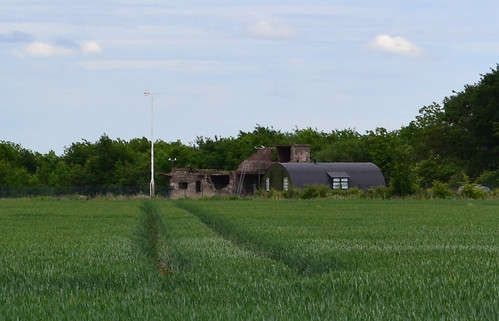
There were plans to rebuild the Watch Office, a mammoth task considering its very poor condition.

A return to Berlin saw 106 Sqn back in the air on the 22nd/23rd and then again on the following night 23rd/24th November. The continuing spell of good luck saw all crews return safely again with only light to moderate damage to their aircraft. However, the night of 26th/27th would see 106’s luck finally run out and the first Metheringham loss.

Lancasters JB592 piloted By F/O. J. Hoboken DFC (his third flight to the capital that week) and ED873 piloted by F/O. R. Neil, were both lost that night. JB592, was brought down not far from Gross-Karben, in Hesse Germany with the loss of all the crew on board. ED873 suffered early engine problems with the starboard outer engine surging not long after take off. Once passed the coast, the 4,000 lb bomb was safely jettisoned and sent to the waters below where it was seen to explode by the crew. The aircraft then turned to land, overshot the runway and crashed into a field opposite the airfield. The crew were uninjured apart from the rear gunner (Sgt. Parker) who received minor injuries in the crash. This injury would however, prove to be a godsend, playing a vital role in his survival later on. This third night of bombing saw a force of 443 Lancasters take a heavy toll, with 28 being lost in action over the continent and another 14 over England. A loss rate of over 6%.

It was F/O. Neil’s crew who, after their lucky escape, would fall as the next victims of Berlin’s defence. With the original rear gunner still out of action due to the broken arm received in the last crash, he was replaced by Sgt. G. Stubbs, who made his last and fatal flight in ED874 on the night of December 2nd/3rd. The aircraft was brought down with the loss of all those on board, including the replacement Sgt. Stubbs. Berlin was fast becoming a rather large and sharp thorn in the side of Metheringham crews who by now, longed for a change in the target.

With one more Lancaster lost that year (Lancaster MK.III ‘JB638’, ZN-G) again with all on board, the cold 1943 winter drew to a close with many empty bunks in the Metheringham huts. It would be a long and bitter winter though, a winter that would last for several months over the 1943/44 period and all as the Battle for Berlin continued to rage on.

The New Year 1944 should have brought new hope for the Metheringham crews, but sadly things were to be worse – much worse. In fact, it would go on to prove to be the worst year in 106 Sqn’s history with their highest losses experienced to date.

The year began with fine but cold weather recorded as fifteen crews reported for duty on New Years Day. With bated breath they waited for the curtain to be pulled back to see where the bomb run marker would now take them. A thin line that denoted high chances of survival or low. But once again, and to the dismay of crews, the flight line marked its way across the continent to Berlin, it would be yet another night over the capital. With a take off time of 23:59, crews were briefed, checks carried out and engines started. Over the target 10/10 cloud were reported, so bombing was carried out on Pathfinder markers, with many of the Metheringham aircraft verifying their position with H2S.

Although fifteen aircraft took off, only thirteen made it to Berlin, Lancasters JB642 ‘ZN-J’ and JB645 ‘ZN-F’, both MK.IIIs, were shot down with the loss of thirteen airmen. The youngest of these, Sergeant John Alfred Withington (s/n: 1628244) was only 18 years of age and one of the youngest causalities of Bomber Command. The only survivor, F/S. A. Elsworthy, was captured and taken to a POW camp, Stalag Luft III in the German province of Lower Silesia  not far from the town of Sagan.

RAF Metheringham

Many of Metheringham’s buildings remained scattered about the accommodation areas.

With yet more flights to Berlin, briefings were becoming rather repetitive, and January ended the way it began with the loss of another seven air crew led by RAAF pilot P/O. K Kirland. Over the whole month, 106 Squadron had flown 123 sorties over nine nights, a total of 769 flying hours,  dropping 497 tons of bombs, the second highest total in the whole of No. 5 Group.

In the next post we see how Metheringham along with thirteen other airfields coped with the problem of fog, and how they continued to take the battle deep into the heart of Germany.

The full post can be seen in Trail 1. 

June 25th 1944, loss of a Rugby Star.

Sir Arthur Harris’s continuation of the bomber initiative of 14th February 1942, in which German cities became the focus for RAF raids, led to massed formations of light and heavy bombers striking at the very heart of Germany.

In order to achieve these aims, bomber forces of 1,000 aircraft would be required, meaning every available Bomber Command aircraft would be utilised along with those from Operational Training Units (OTU) and (Heavy) Converstion Units (CU).

On June 25th, 1942, whilst on operations to Bremen, the third of the ‘1,000’ bomber raids, one of the first operational aircraft casualties  for 1651 CU would occur when N7442 was shot down shortly before 01:00 by a Luftwaffe night-fighter over Holland. One factor that made this particular loss so great was that not only did all seven crewmen onboard lose their lives, but one of the crew, P/O. Lewis A. Booth (s/n: 118627), had gained international caps playing for England’s National  rugby team.

Born on September 26th 1909, Lewis Booth was the son of Alfred and Amie Booth. He was educated initially at Giggleswick School in Yorkshire, after which he transferred to the Malsis School becoming one of sixteen boys who was lost during the war and since commemorated on the Chapel’s Stained glass window.

Booth attended the Malsis school for two years, 1920-22, when the school first opened. A grand School, it was founded by Albert Henry Montagu, which grew and expanded over the years.

Ten years after he left the school, Booth made his international rugby debut in a game against Wales at Twickenham (January 21st, 1933), in front of a crowd of 64,000 fans; a game in which Wales beat England by 7 points to 3. Booth played his last international match against Scotland at Edinburgh’s Murrayfield stadium two years later on March 16th, 1935. Throughout his two year international rugby career he achieved seven caps for England scoring three tries, his first for England against Ireland at Twickenham, on 11th February 1933. After serving his national team, Booth went on to serve his country joining  the Royal Air Force where he achieved the rank of Pilot Officer within Bomber Command.

On the night of 25/26th June 1942, he was in a Short Stirling MK.I flying with 1651 Conversion Unit (CU) based at RAF Waterbeach in Cambridgeshire. 1651 CU was one of three Conversion Units set up in January 1942, by merging previously formed Conversion Flights. It served to convert crews of No. 3 Group to the Stirling, a rather ungainly aircraft that developed a poor reputation as a bomber. 1651 CU would join that night, sixty-eight other Stirlings in a force of over 1,000 aircraft; a mix of heavy and light bombers, ranging from the Hampden and Whitley to the Halifax and Lancaster.

Take off was at 23:58 from RAF Waterbeach, the weather that week had been good with little rain for many days. After forming up they headed for Germany a course that would take them across the North Sea and on to the western coast of Holland. Just 40 minutes into the flight, whilst over Waddenzee, the Stirling was attacked by a Luftwaffe night fighter and shot down with the loss of all seven crewmen on-board.

ROYAL AIR FORCE BOMBER COMMAND, 1942-1945.

A Stirling MK.I bomber of 1651 HCU at Waterbeach. @IWM (COL202)

P/O. Booth was publicly reported missing four days later on Tuesday 30th June in an article in the local paper “Yorkshire Post and Leeds Intelligencer”, which stated that he had been ‘lost in a Bomber Command raid’. The article highlighted Booth’s rugby career, saying that he had been a member of the Headingly Club playing over sixty games for his county team Yorkshire, before leaving to join up. 

P/O. Booth died just short of his 33rd birthday, he left behind a wife, Gladys, and a son Michael. His son would follow in his father’s footsteps also taking up rugby and also playing for his home country. P/O. Booth’s body was never recovered and remains missing to this day.

P/O Lewis Booth is joined by two other Pilot Officers, two Flying Officers, a Flight Lieutenant and two Sergeant Pilots amongst other ranks and service personnel all honoured by the Malsis School. Amongst the many awards they’ve achieved are three D.F.C.s and an A.F.M.

The game of rugby was hit hard by the Second World War, during which Germany would lose 16 of its international rugby players, Scotland 15, England 14, Wales 11, Australia 10, Ireland and France both 8, Wales 3 and New Zealand 2. All these losses were a severe blow to the international game, a game that brought many enemies face to face in a friendly tournament where there was little more at stake that honour and a cup.

With no official burial, P/O Booth’s service was commemorated on Panel 68 of the Runneymede Memorial, Surrey.

Lewis Booth @Tim Birdsall from the Malsis website.

Sources

ESPN Website accessed 12/6/19.

The British Newspaper Archive.

Old Malsis Association website accessed 14/6/19.

Rugby Football History website accessed 14/6/19.

June 16th 1942 loss of Stirling LS-X.

On June 16th, 1942, Stirling LS-X #N6088, took off from RAF Waterbeach in Cambridgeshire, on a routine training flight. On board that day were: (Pilot) P/O. M. Scansie (RNZAF); Sgt. E. Morris; Flt/Sgt. J. Tomlinson; Sgt. D. Robinson; Sgt. J. Smith; Sgt. R. Broadbridge; Flt/Sgt. H. Johnson (RCAF) and Sgt. R. Le Blanc.

At 15:25 the aircraft, a Stirling MK.I of ‘C’ Flight 1651 Conversion Unit (CU), left Waterbeach heading north-westerly. It was to be a routine cross country navigation exercise.

Around forty-five minutes later, the aircraft was seen on fire, and falling in a spiral toward the ground with its port wing detached, outside of the outboard engine. The bomber hit the ground on the Great North Road near to Barnby Moor.

The crew flying the aircraft that day were a young crew, the pilot being 24 years of age, whilst Sgt. Ernest Morris was 19, Sgt. David Robinson – 21, Sgt. Roland Broadbridge – 20, Flt/Sgt. Harry Johnson – 26 and Sgt. R. Le Blanc. the oldest at 27 years of age.

What also made this particular accident more significant was that the Stirling, a veteran of European Operations, had flown for nearly 250 hours on twenty-two operational sorties, a remarkable achievement for a Stirling!

The Stirling would prove to be a poor bomber. Designed to Air Ministry Specification B.12/36 (the very reason it was to be poor), it had to have a reduced wingspan to enable it to fit inside the currently available hangars. This reduction gave poor lift qualities, barely able to achieve more than 17,000 feet when fully loaded. Another restrictive feature was the bomb bay design. Being sectioned it could not accommodate the larger bombs being brought into production as the war progressed, thus it underachieved compared to its stable mates the Halifax and Lancaster. The original specification set out such requirements, and so the design was flawed from the start. It did however, have good low altitude handling capabilities, but this wasn’t enough to secure its future as a long term investment in Bomber Command.

As a bomber, casualties in Stirlings were high, and toward the end of the war it was reduced to secondary operations, an area where it more than proved its worth as both a glider tug, mine layer and paratroop transport aircraft.

Apart from Sgt. Robinson, all of the crew are buried at Finningley, St. Oswalds Church. Sgt. Robinson is buried in his home town Bedlay Cemetery, Lanark.

RAF Waterbeach appears in Trail 11.

Sources and Further Reading.

The crew’s interment along with photos of Raymond Le Blanc are available on the Compagnons de la Libération du Havre website.

Chorley. W., “Bomber Command Losses Heavy Conversion Units and Miscellaneous Units 1939-1947 ” Midland Publishing, 2003.


A desperate plea for help!

I have recently been contacted by Mike Potter, the former Museum Director of Jerry Yagen’s Warbird collection / museum in Virginia. A self confessed ‘aviation nut’, Mike is struggling to find details of the inner workings of a standard World War II Watch Office built to design 518/40.
For those who may not know, or remember, the Military Aviation Museum is the team that dismantled the former RAF Goxhill Watch Office in North Lincolnshire (post June 2017) in 2017 and had it shipped back to the United States where it has been painstakingly rebuilt brick by brick to its former glory. The refurbishment is all but complete and will be opening to the public very shortly. However, Mike and his team of dedicated volunteers, are trying to find out about the various posters, boards and instruments located within the office as specific information is quite rare.

Mike has been using a photo taken at RAF Snaith as a ‘model’ and specific questions refer to the ‘SANDRA‘ poster? flares or signal rockets? and Landing Control Board on the left side of the picture. Mike would like further details on the operation of these and pictures or originals that they could obtain for their own watch office.

Royal Air Force Bomber Command, 1942-1945. CH18743.jpg
By Clark N S (Fg Off), Royal Air Force official photographer – (
IWM – CH18743)

The team have been on contact with numerous organisations here in the UK who have all supplied various drawings, pictures and advice, but as yet these specific details remain a little ‘foggy’. If anyone knows of precise information about these items or any others within the office, please get in contact with Mike (Mhpotterone@gmail.com) or myself and I will pass the information on.

Specifically, they would like to find a digital copy or photo of the poster titled “Searchlight Assistance To Lost Aircraft”.  They are also looking to learn what kind of signal flares or rockets are below the poster, and finally specifically what is on the Landing Control Board, and how the various markers were used.  If anyone has a clearer photograph or illustration of this kind of Board, it would be quite helpful.

Ideally someone who worked in the/a Watch Office itself would be ideal, however, I appreciate due to the length of time that has passed, this may not sadly be possible any longer.

Any help anyone can offer would be most gratefully appreciated by both Mike and his team.

Many thanks, Andy

Philpott J.A. (GB1312948) (RCAF) (Part 1)

Some time ago I was given the chance to look through the flying logs of Jack Philpott (RCAF), books that record his daily activities through flying training to operational duties and eventual demobbing at the end of the war. I have been researching these events ever since and have a draft version of his early career. This is an ongoing project and I would like to hear from anyone with information or photos they are willing to share, of any of the stations or events mentioned in Jack’s history.

My sincerest thanks go to his wife Hazel, her son Ronnie and the family members that have contributed to the works, without them it would not have been possible.

P/O J. A. Philpott - Log Books

P/O J. A. Philpott - Log Books

P/O J. A. Philpott - Log Books

P/O J. A. Philpott - Log Books

Jack Philpott and Englishman who went to war for Canada.

On September 2nd 1941, almost two years to the day after Britain declared war on Germany, the flying career of Jack Philpott began. He learned to fly through the British Commonwealth Air Training Plan (BCATP), a plan designed to bolster the Royal Air Force’s dwindling numbers by training aircrews in Canada ready for the war in Europe.

Jack Philpott went through a years training, qualifying as an Air Observer Navigator and Bomb Aimer before being posted to the Middle East and operations over the Mediterranean. He survived the war, returning to the UK where he married his sweetheart on October 18th 1949.

After leaving school Jack entered the building trade where he worked with his father. He decided to sign up and joined the ranks of the Royal Air Force being seconded to Canada to train as an aircrew member under the terms of the British Commonwealth Air Training Plan. Whilst in Canada, Jack would undertake a range of flying duties, air navigation, bomb aiming and cross-country flying, qualifying in September 1942. Jack would not be chosen for Pilot training though, the reason being due to something being wrong with his eyesight under night flying conditions; particularly with landing judgement. So Jack would go on to train as aircrew, being a successful airman in the many courses he undertook.

As a trainee in Canada he was a non-combatant, and initially flew with civilian pilots before meeting his first military instructor.

On arrival in Canada on September 2nd 1941, Jack was stationed at No.1 Elementary Flying Training School (EFTS) Malton, Ontario in Canada. Here he joined course no. 37 and would begin flying training on both the bi-plane, the De Havilland Tiger Moth, and the ground based Link trainer. His first flight, which lasted 35 minutes, was a  familiarisation flight with ‘Mr. May’ as pilot and took place in aircraft #4377. Two further flights would take his total flying hours in a D.H. Moth to 2:15, flying in aircraft  #5116 and #4377.

After a two-day break, he would then fly four other D.H. Moths, #4216, #4390, #4399 and #4396, this time his pilots were Mr. Dagley, Mr. Hinch and Mr. Clark. These four sessions amounting to 3:15, took his total flying hours so far to 5:30.

Jack’s wife Hazel, who carried out war work as a civilian working with the RAF, noted that where she was they had the de Havilland Tiger Moth, and whilst they were very manoeuvrable, she recalls how they could easily go into a spin if not handled properly.

Again a short break led to further flying, carrying out different aerial manoeuvres with Mr. Hinch, Mr. Mongraw, Mr. Anten and his first military pilot Flying Officer Turner. The latter two flights being ‘progress checks’ after which Mr. Hinch signs Jack off with a total of 9:00 hours flying time. Interspersed with these sessions in the air, would be challenges in a Link trainer (#617) over seven days between 4th and 19th. Jack achieved grades here of B to A+, all completed over four hours in total during this time.

Jack’s initial training at Malton would end there, on September 19th 1941, seventeen days after his arrival.

10 Air Observer School

There then followed a two month break after which Jack transferred to No. 10 Air Observer School (AOS) Chatham, New Brunswick. Here, he would undertake a series of flying activities, some of which were with Mr. George Neal, who went on to be a Guinness Book of World Record Holder qualifying as the oldest active, licensed pilot.

The RCAF Station Chatham, opened in 1940 under the British Commonwealth Air Training Plan. Here two schools were opened one of which was No. 10 Air Observer School on 21st July 1941. Jack would attend the School between 10th November 1941 and 16th February 1942.

His first flight would be on the 23rd in Anson ‘4’, with another civilian pilot Mr. Neal. A number of cross-country flights would see Jack as Navigator (1st and 2nd) until the 19th December when he undertook his first bombing flight. Using flash bombs, Jack would fly Anson ‘S’. A single photography flight using hand-held obliques, preceded further practice bombing flights in which both flash bombs and 11.5 lb bombs were dropped. It is thought these occurred on the Miramichi river range.

Miramichi River Range, New Brunswick.

Over the Miramichi River Range, New Brunswick.

January 1942 brought further cross-country flights again with Jack flying as 1st or 2nd Navigator, his initial night flying experience being on the 7th January 1942 with Mr. Roy as pilot in Anson ‘U’. Further cross-country flight and bombing practices followed with his first taste of unforeseen action being on the 22nd January 1942, when one of the engines of Anson ‘Y’ failed just after take off.

January ended with a total of 31:40 hours flying time, to which two days in February gave a total of 64:50 hours flying time at Chatham. By the end of the Air Observer’s Navigation Course Jack had achieved 85.5 % marks achieving an ‘exceptional’ status. Subjects included: Plotting, compasses and instruments, meteorology, bombing, reconnaissance, photography, signals, maps and charts and finally air work.

No 6 Bombing and Gunnery School, Mountain view

After moving to Mountain View in Ontario, Jack joined No. 6 Bombing and Gunnery School (B & G) Mountain View, Ontario, his course running between 16th February 1942 and 28th March 1942.

His first flight was recorded on 28th February in Fairy Battle #1986, flying with F/O Compton, his first experience with RCAF military personnel. This would be the first of two air-to-air camera gun exercises, which were followed on 2nd March by his first live air-to-ground gunnery action. A free gun beam test, he fired 200 rounds achieving 4 hits in a flight of 45 minutes.

Throughout the remainder of March he would undertake a mix of air-to-air; air-to-ground; low-level and high-level bombing duties, tasks which included night flights and flying with a number of different instructors.

By the end of his course his total day bombing time would amount to 15:05 hours with a further 5:20 hours at night. With a gunnery total of 10:40, Jack’s total flying time at No. 6 B & G was 31:05 hours. His marks for the gunnery course amounted to 83.5% and the bombing course slightly lower at 77.4% both achieving a pass. With this he was now Qualified as Air Observer Bomb Aimer.

2 Advanced Navigation School, Pennfield Ridge

After completing this course he moved on to navigation, joining No. 2 Advanced Navigation School, Pennfield Ridge, New Brunswick, on 30th March 1942. Jack would be on the Air Observers Advanced Navigation course and would fly a large number of air training flights all in Avro Ansons between 5th April and 24th April 1942. During this course, and before taking to the air, Jack would learn to use the Mk.IX Sextant, carrying out a substantial number of measurements during March and early April. It would be this sextant that he would then operate in his many initial flights, all in Anson #6888. Ground sessions would be interspersed with air sessions, later flying in Ansons #6717, #6399 and #6275. Using the stars, moon and sun, Jack would calculate their location all using the Mk.IX. This was a sextant put into service in 1938, and was designed by P. F. Everitt of Henry Hughes and Son.

During April he would amass 17:35 hours flying time during the day and 16:25 at night. This took his total flying time to 117 hours. At the end of the course, his log book states ‘Passed’, and this would set him off on his way to England.

England.

Jack’s arrival in England would be on 22nd May, after which there would be a period of non-flying. He was then posted to No.1 Coastal Operational Training Unit (COTU) based at Silloth, in Cumberland. Silloth was not described by some as homely place, having few permanent buildings and mainly tents for sleeping. The Mess was a small, local hotel used to serve the local golf course in peacetime

Here, starting on 16th September 1942, the now Sergeant Jack Philpott would fly a number of local sorties and familiarisation flights as ‘Observer’. All these flights would be carried out in a new aircraft, the Lockheed Hudson. The Hudson was a twin-engined, all metal skinned aircraft with a twin tail and a rather ‘tubby appearance’.

During these flights Jack would get used to the workings of the Hudson, the undercarriage, flaps and other systems, he would also undertake map reading exercises and fly along the coastline to familiarise himself with the landmarks. Other flights included trips across to Carlisle, Stranraer and onto Newcastle. During this flight on 28th October, the aircraft suffered from severe ‘up currents’ from the Scottish hills, this made flying the aircraft difficult for a ‘novice’.

November would see Jack and his pilot Sgt Hewitt, begin a series of Air Sea Rescue sorties as well as bombing and gunnery practice. The first search flight was for a lost Anson, an air sea rescue operation that produced no result. By the end of November (23rd), Jack would have achieved a further 33:05 hours of daylight flying and 3:45 night. His grading following this posting was as an ‘above average’ navigator and he was recommended for specialist raining by the Chief Flying Instructor at Silloth. This would end his period in Cumberland.

The new year would bring a new posting and the Ferry Unit at RAF Lyneham in Wiltshire. This would be a short stay, carrying out a small number of local flights, ferry flights and air tests, transferring to the Ferry Unit at Portreath in Cornwall, in Hudson AM631 on 9th February 1943 along with his pilot, Sgt Hewitt.

Posting to his first Operational Squadron.

On 10th February 1943 Jack would get his first operational posting to the Mediterranean and No. 500 Squadron RAF. He would fly out to Gibraltar that day, flying via Lisbon and having to navigate through very low cloud often ‘down to the deck’.

Whilst here, Jack would carry out further training again with the Mk.IX and Mk. IXA sextant. This would build on the work he did in the UK, with his last training flight occurring later on, on 20th July 1943.

On the next day 11th February 1943, the Hudson flew to Blida from Gibraltar, where the weather was good and the crew would carry out local circuits and familiarisation flights. Jack’s pilot for some of these flight would be F/L Barwod DFC in Hudson FX627, who would be replaced by F/O Fitzgerald in Hudson FK708 for dive bombing practice.

On the 19th February, F/O Poole DFC would be Jack’s pilot for his first operational sortie, taking off at 13:43 they would perform a convoy escort which was scrubbed after 2 hours into the flight because of deteriorating weather! A rather frustrating first experience no doubt.

The remainder of February saw four anti-submarine sweeps for Jack with his own pilot Sgt. Hewitt, flights that would take them around Algiers Bay, Bone, Oran and the Balearic islands off eastern Spain.

By the end of February 1943, Jack had flown 41:00 operational hours, over 7 sorties, giving a total of 10 sorties so far. His total operational flying hours now amounted to 51:00.

March 1943 was much of the same, but sightings were of a different nature. On the 2nd, flying in Hudson ‘Q’, Sgts. Hewitt, Philpott, Hickmott and Elliott, took off at 06:00 for a sweep of “Special X No. 1”. Whist flying, a Ju 88 was seen which initially appeared to turn to attack, but then flew into the sun and avoided combat with the Hudson. They returned to base landing at 12:30.

On the 15th, whilst performing a 7 hour flight, 2 convoys were sighted along with a whale as the sun sank over the horizon. Further convoy escorts which included several false contacts, sub hunts and a ship from convoy ‘Riband‘ which struck a submerged mine. Other convoys for the month included: ‘Sateen‘, ‘Don‘ and ‘Trafford‘.

On the 29th, the Hudson (AM781) in which Jack was flying with Sgt Hewitt, was involved in a U-boat strike. The U-boat, which was unidentified, was later reported destroyed off Ibiza. Another aircraft was seen, but it too was unidentified. The month ended with the escort of convoy ‘Lotus‘. A further 14 sorties this month took Jack’s operational flying total to 118:30 hours.

The next part currently being researched is Jack’s operational history. It involves numerous convoy escorts, sub hunts and a crash. I am also looking into his post war life and details of his early life, but described as a secretive man, he kept a lot to himself.

March 18th 1941 – Death of P.O William Davis (Eagle Sqn)

RAF Sutton Bridge, was a small airfield on the Norfolk / Lincolnshire border a few miles from the Wash off the north Norfolk coast. Before, during and after the war it served as  training camp for new pilots, training them in the art of gunnery, utilising a firing range that had been in situ since 1926.

Many airmen of the RAF passed through Sutton Bridge, many of these were Commonwealth aircrew, some from Czechoslovakia and a few from the United States.

In the church yard behind the church of St. Matthew in the village, lie almost 60 graves of those who died in the fight for freedom, they are also joined by a German airman, foe united in death.

One such airmen is that of American Airman Pilot Officer William Lee Davis s/n: 61459 (RAFVR) who joined as part of the famed ‘Eagle’ Squadron, a group of volunteer American flyers.

P.O. Davis was from St. Louis and graduated at Central High School, before going on to attend Washington University. He was the son of William J. Davis of 4500 Arsenal Street, and a salesman in a cork and insulation firm in the area, when he joined up at the age of 25.

He left his job, signing with the Clayton-Knight Committee, a recruitment company for the Canadian and British Air Forces operating in the United States.  He was initially stationed at Love Field in Dallas, where he received four weeks of intensive training in aerobatics, gunnery and combat flying. After qualifying here, he transferred to Ottawa, where he was commissioned and then sent onto England to further his training. He was the first person from St. Louis to obtain a Commission in the Royal Air Force obtaining a deferment of his draft in doing so. When asked about joining the RAF, he told reporters that it was “a matter of sentiment and heritage” citing his English grandfather’s role as an officer in the Boar war.

P.O. Davis was no stranger to flying, having been a flyer before signing up for the RAFVR, achieving a total of 223 hours flying time, a commercial pilots licence and an advanced CAA Licence.

On arrival on March 5th 1941, these pilots were generally sent to No.3 Personnel Reception Centre at Bournemouth, before posting to No.56 Operational Training Unit (OTU) at Sutton Bridge. Here they completed their training and were then sent onto their respective operational squadrons.

There were something in the region of 156 American Airmen who found their way into 56 OTU, many passed through with little or only minor mishaps. For P.O. Davis though it was to be the end of his dream, in an accident that would take his life.

On March 18th, a week after his arrival at Sutton Bridge, he took off in Hurricane P5195 on a general map reading flight across the Lincolnshire Fens. Whilst on the flight P.O. Davis became lost and decided to put down on farm land at New Leake Fen near Boston. Unfortunately, the ground in the Fens was soft causing the undercarriage to dig in and flip the Hurricane on its back. In the resultant crash, P.O. Davis broke his neck killing him instantly. He was not only the first from St. Louis to die, but the first American from Sutton Bridge to die also.

A citizen of the United States, Pilot Officer William Lee Davis is buried in the Church yard of St. Matthew’s Church, Sutton Bridge, Lincolnshire, Section P, Grave 56.

Pilot Officer William Lee Davis

Pilot Officer (Pilot) William Lee Davis