The death of the Robson Children, 1st December 1943.

It was on Wednesday 1st December 1943, that a 75 Squadron Stirling MK.III (EH880)  piloted by F/S J. S. Kerr (s/n 1558163) would be diverted from RAF Mepal and instructed to land at RAF Acklington in Northumbria. On the final approach it undershot striking a family home in Togston near Amble. Inside the house, Cliff House Farmhouse, was the Robson family. The five children, ranging in ages from 19 months to 9 years of age, were all killed, whilst the parents who were playing cards downstairs, escaped with varying injuries. All but one of the Stirling’s crew were killed, the mid upper gunner Sgt K Hook, was pulled from the burning wreckage his burning clothes being extinguished by the local butcher, Jim Rowell.

This crash was the greatest civilian loss of life in the district,

The crew of Stirling EH880 ‘AA-J’ were:

F/S George John Stewart Kerr, RAFVR (s/n 1558163) – Pilot.
Sgt. Donald Frank Wort, RAFVR (s/n 1585034) – Navigator.
Sgt. Ronald Smith, RAFVR (s/n 1239376) – Air Bomber.
Sgt. Derek Arthur Holt, RAFVR (s/n 1217087) – Wireless Operator.
Sgt. Leonard George Copsey, RAFVR (s/n 1691471) – Flight Engineer.
Sgt. Kenneth Gordon Hook, RAFVR (s/n 1335989) – Mid Upper Gunner.
Sgt. George William Thomas Lucas, RAFVR (s/n 1250557) – Rear Gunner.

The Robson children were:

Sheila (19 months)
William (3 Years)
Margery (5 Years)
Ethel (7 Years)
Sylvia (9 Years)

The ‘Times’ Newspaper, published the story of 3rd December 1943:

Aircraft Crash on Farmhouse. Family of five young children killed.

Five children – all their family – of Mr and Mrs W. Robson were killed when an Aircraft crashed into Cliff House, a small dairy farm near Amble, Northumberland, on Wednesday night. The children’s ages ranged from one to nine years. They were sleeping in an upstairs room.

The mother and father, who with two friends Mr. and Mrs Rowell of Dilston [Terrace] Amble, were sitting in a downstairs room, were injured but not seriously. One of the crew of the aircraft, a gunner, was saved by Mr. Rowell.

Mr Rowell said last night: “We did not realise what had happened until the house collapsed above our heads. We managed to stand up, bruised and badly dazed, and, looking upward we saw the sky. Mrs Robson tried to make her way towards the stairs, which had been blown away. My wife called my attention to a burning object outside which was moving about.  We rushed over and found it was a gunner with his clothes alight. Mr Rowell rolled the airman on the ground to extinguish the burning clothes. Although badly burned, the gunner was alive.

The children’s partly charred bodies were recovered later.

Five streets on a housing estate near to the crash site in Amble have since been named after each of the Robson children. The crew are remembered on a plaque in St. John the Divine, the official church of RAF Acklington St. John.

RAF Downham Market (Part 1 – The beginning)

In Trail 7, we visited the northern part of Norfolk, not far from the coast where it borders Cambridgeshire to the west and the North Sea to the north and east. In this part of the trail we visit a site that was once one of Norfolk’s most prestigious airfields, where not one, but two VCs were awarded to airmen of the RAF.

Not far from RAF Marham, we return to this once busy airfield to see what is left and take another look at the incredible history that was RAF Downham Market.

RAF Downham Market (Bexwell)

Located in the corner of the A10 and A1122, 10 miles south of Kings Lynn and and 15 miles north east of Ely, RAF Downham Market (known locally as Bexwell) was only open for four years. Yet considering its relatively short life, it created for itself a unique history that was, and remains, unprecedented in military history.

Built by W. & C. French Ltd., it was primarily a bomber station serving initially with 2 Group before transferring to 3 Group and then to 8 PFF (Pathfinder) Group, Bomber Command. Opened as a satellite station to RAF Marham, it eventually became an airfield in its own right, achieving this status on 3rd March 1944, when it became a parent station itself.
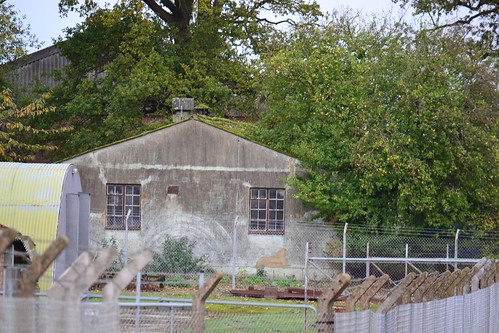
RAF Downham Market

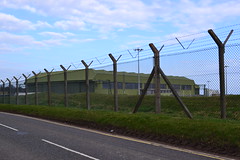
One of the several buildings surviving at Downham Market.

Downham opened in 1942 as a bomber station, a role it performed for the duration of the Second World War. To achieve this, it would require substantial runways and a number of dispersed accommodation sites. As a classic Class ‘A’ airfield, it was spread over a large area incorporating two main sites, the main airfield to the north and the accommodation to the south. It was equipped to accommodate 1,719 male and 326 female personnel at its peak. A network of small roads would link all these dispersed sites together.

Downham would have three concrete runways the main being 1,900 yards long running east-west, whilst the second and third ran north-west to south-east and north-east to south-west, each 1,400 yds long. The classic ‘A’ formed by these runways, was linked by a perimeter track with 36 original pan style hardstands. At its peak, Downham boasted seven hangers, six ‘T2’ and one ‘B1’ which replaced two of the hardstands reducing the number to 34. None of these hangars survive here today. It had the usual bomb store (to the north east), technical area (south side) and eight accommodation areas spread well to the south and south west. As with all these Class ‘A’ stations, the two areas were separated by a public road, the ‘airfield’ to the north and accommodation to the south.

Today, little remains of the actual airfield site, the runways having been removed some considerable time ago. However, on the technical site there are a number of buildings still remaining, and in the accommodation areas further buildings also exist. All of these are either used by local industry or local farmers.

On opening, Downham received its first residents, the Stirling MK.Is of 218 (Gold Coast) Squadron. Arriving on the 8th July 1942, they would retain these aircraft until February 1943, when the new updated Stirling MK.III was brought into squadron service. 218 Sqn had a history that went back to the First World War; disbanded in 1919 they had been reborn in 1936, and were posted to France where their Fairey Battles were decimated by the superior fighters of the Luftwaffe. In November 1940, prior to arriving here at Downham, the squadron joined 3 Group, it remained operational with this Group for the remainder of the war.

On July 6th, they began preparing for their move to Downham, aircraft were stood down and no operational flying took place. On the morning of the 7th, thirteen Stirlings departed RAF Marham, completing the 10 mile straight line flight they arrived at Downham fifteen minutes later. By midnight, the entire squadron had transferred over, and crews were settling into their new quarters. Over the next few days air tests, fighter affiliations and cross country flying were the order of the day, the first operational flight not taking place until the 12th. In Stirling ‘HA-N’ was P.O. Farquharson and in ‘HA-R’ was Sgt. Hartley. A ‘gardening’ mission, only two crews were assigned and briefed but records show that “The vegetables were planted in the allotted positions. 18,000lb of seed were planted during this effort“*1. With that, Downham Market had now entered the war.

Over the next few weeks operations began to build, and targets moved into Germany itself. Lubeck, Vegesack, Duisberg, Hamburg and Saarbrucken were all on the initial list of operations. Apart from early returners due to ice or poor weather, all operations were considered successful and bombing was ‘accurate’.

On 29th July, a royal party visited RAF Downham Market to see how the crews were settling in at the new station. Led by Air Vice Marshall HRH The Duke of Kent, and accompanied by Sir Louis Grieg KBE CBO (ret),  the party were given an official tour of the airfield by Wing Commander P. D. Holder DFC – the Station Commander. After talking to a number of ground crews and watching Stirlings being bombed up, the Royal party then sampled the delights of the officers mess before departing the airfield.

In February 1943, 218 began replacing their Stirling MK.Is with the upgraded MK.IIIs, the last model of the Stirling bomber before they were relegated to other duties. By June, the last of the MK.Is were gone. Although fitted with better engines, the MK.III still remained limited by both its short wingspan and poorly designed bomb-bay.

In the following month a major decision was made to install the still experimental FIDO fog dispersal system here at Downham Market. With RAF Graveley only just having hers installed, the benefits of this system were by now bearing fruits, but despite this, only fifteen British airfields were to have the system installed. FIDO used oil burnt through a series of pipes set alongside the runway. These burners were supplied from large storage tanks, which in Downham’s case, were located to the south-east just off the airfield site. Each tank was filled by road from Kings Lynn, five tankers carrying out two runs each to complete the fill. Oil from these tanks, was then fed into the system – which was installed along the main east-west runway – by large pumps. Once lit, the burners could clear extensive fog or mist in a relatively quick time. The main storage tank site is today a car dealership, all signs of the network of pipes having since been removed.

Downham’s FIDO installation was slow at first, and only covered the initial touchdown area and the first 700 yards of the main east-west runway. A number of burner types were fitted at Downham over a period of time, starting with the MK.III or Haigill burner. These were in turn were replaced y the MK.IV and eventually, when labour became more available, the MK.V which was a sturdier, longer lasting burner capable of withstanding much heavier use.  It wouldn’t be until late 1943/44 that a longer section of the system was installed, now extending to 1,362 yds, almost the entire length of the main runway. The problem with FIDO was always where runways crossed, and here the pipes had to be placed below ground level. Along side the runway they were above ground, and with difficulty in seeing, some aircraft did manage to damage the piping on more than one occasion. With experimental lighting and landings used in the autumn of 1943, the first use of the system was on the night of December 16th/17th that year, when a large number of aircraft returning from Berlin were diverted to Downham due to their own bases being fog bound.

Over 35 aircraft landed at Downham that night, the toll on crews had FIDO not been in existence would certainly have been considerably higher than the terrible price that had already been paid on that disastrous night over Berlin. FIDO with all its counter arguments, had proved its worth in one fell swoop.

The Short Stirling, the first of the heavies for Bomber Command, was liked by many crews, but its short-comings were to become apparent all too soon. One of its problems was its enormous height, created through its huge and weak, undercarriage, which sometimes made landings difficult. Another recurring problem was a significant swing to port when taking off, combine the two features, and you have a difficult aeroplane to control at the best of times, let alone when badly damaged or in very poor weather.

One of the first casualties at Downham occurred on the morning of May 14th 1943, when Stirling ‘BF480’ HA-I piloted by Sgt. W. Carney, swung on touchdown careering off the runway into the Watch Office. No injuries were sustained by those onboard, but two other crewmen on the ground, who had previously landed, were killed in the accident. Coincidentally, another 218 Sqn Stirling, ‘EF367’, HA-G had a similar landing away at RAF Chedburgh at the same time on the same night. Onboard that aircraft there were an American and a New Zealander, all but two of the crewmen were killed, the others  escaping with injuries.

With plans for the invasion of occupied Europe well in hand by mid 1943, movements across Britain were starting to take place. At Downham a number of hangars were used to store Horsa gliders (hence the large number on site) ready for the invasion the following year. Between April 1943 and March 1944 the airfield was awash with stored examples. Accompanying the gliders were No. 14 Heavy Glider Maintenance Section, who maintained and prepared the gliders ready for when they were needed.

In the August 1943, an element of 218 Sqn was extracted to create a new squadron, 623 Sqn, using the MK.III Stirlings already on site. On the very day they were formed, 10th August 1943, four crews were briefed for operations, the target Nuremberg. Unfortunately, once over the target, crews had difficulty in distinguishing any relevant ground detail, and as a result, bombs were scattered over a wide area and the operation was largely unsuccessful. With little opposition all aircraft returned to Downham safely.
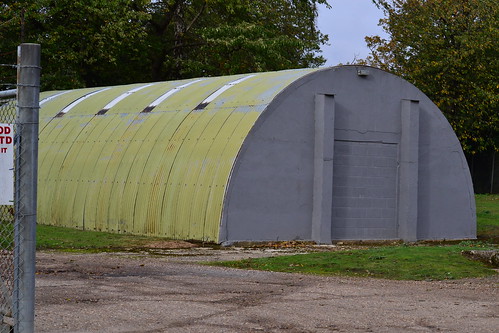
RAF Downham Market

One of the many huts that were left on the airfield.

However, two days after this on the night of August 12th /13th 1943, it was a different matter. It was whilst flying a 218 Sqn Stirling over Turin, that Flight Sergeant Arthur Louis Aaron, would suffer bullet strikes to his head that would break his jaw and tear away a large part of his face. Further bullets damaged his lung and right arm rendering it useless. Aaron still fought on though, despite his severe injuries, managing to assist the bomb-aimer in flying the stricken Stirling away from the enemy. Unable to speak, he communicated instructions to his bomb-aimer by writing with his left hand. Aaron attempted on four occasions to land the plane, but with failing strength, he was persuaded to vacate the cockpit; enabling the bomb-aimer to complete the belly landing on the fifth attempt. Aaron later died from exhaustion, the consequence of his determination and unparalleled allegiance to his crew, his aircraft and his duty. Aaron was the first of two pilots to receive the Victoria Cross whilst at Downham Market – both for extreme bravery in the face of the enemy.

The new squadron 623 Sqn, like many other squadrons however, was to be a short lived one. With high demand for Stirlings in the Conversion Units, it was decided to utilise the aircraft of 623 Sqn for this role, and on December 6th 1943 the unit was officially disbanded. Some crews returned to 218 Sqn but many others were posted out to new units. Flying of a total of 150 sorties in just four months, the squadron would lose ten aircraft, a loss rate of almost 7%.

The void left by 623 Sqn would be soon filled though. Just four days later another unit would transfer in, that of 214 (Federated Malay States) Sqn from RAF Chedburgh also a Stirling MK.III unit. For the majority of December, 214 Sqn would carry out ‘gardening’ missions, dropping mines designated ‘Nectarines‘ or ‘Cinnamon‘. Other operations would see bombs dropped on ‘Special Targets‘ although the Operational Records don’t specify the identity of these targets. 214 Sqn as with 623 Sqn, would be another of these short stay units, on January 17th 1944 they would transfer to RAF Sculthorpe and 100 Group, for RCM (electronic warfare) duties and a new aircraft, the B-17 Flying Fortress or Fortress I. As crews carried out circuits, lectures and training at Sculthorpe, the remainder of the squadron continued operations from Downham. By the 24th January though, all personnel had transferred over and Downham Market was far behind them.

In March 1944, Downham’s long standing unit 218 Sqn was finally ordered out, and on the 7th the entire squadron departed, the operations books simply stating: “218 Sqn moved from Downham Market to Woolfox Lodge by road and air today“. *2 Once at Woolfox Lodge, they would begin disposing of their Stirlings to take on the new heavy bomber – the Avro Lancaster.

The dust wasn’t allowed to settle at Downham however, and before long more personnel and a new Squadron would arrive, ready to fill the skies of Norfolk. This was no ordinary squadron though. With concerns about the poor quality of bombing and the lack of accuracy, it was decided to form a new Group that went much against the wishes of Arthur Harris. Seen as ‘elitist’, Harris vehemently disagreed with the new Group and fought his corner bravely. But with little choice in the matter and lacking his own high level support, he eventually succumbed to the Air Ministry’s demands, putting in command the Australian Group Captain Donald C.T Bennett, CB, CBE, DSO.

The new group would be called 8 Group (PFF) ‘The Pathfinders’, and was designed to use the cream of Bomber Command crews whose record for bombing had been excellent. Aircraft from the Group were to fly ahead of the main bomber force and ‘mark’ the target by various means – coloured flares being the primary and main method. In principle it worked well, but as records show, it was not without its own difficulties or setbacks.

Bennett, an aggressive pilot who didn’t suffer fools gladly, quickly won the admiration of his crews. He was also highly admired by Harris, who once described him as the the “most efficient airman” he had ever met; Harris considered Bennett perfect for the role. In appointing Bennett, Harris dismissed all other possible candidates including Air Chief Marshall Basil Embry, the Air Ministry’s most likely favourite.

The Pathfinders were officially formed on 15th August 1942, with 8 Group coming into official formation in January 1943. With the arrival of the new Squadron, 635 Sqn, Downham would now be playing its part in this role. This change would also mean a change in aircraft type at this Norfolk airfield, out went the now relegated Stirlings and in came Avro’s remarkable four engined heavy, the Lancaster MK.III.
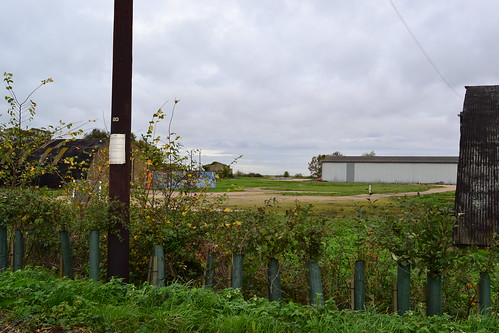
RAF Downham Market

The remains of the Technical site looking toward the airfield.

635 Sqn was created under the command of Wing Commander Alan George Seymour Cousens on March 20th 1944. Using ‘C’ Flight from RAF Graveley’s 35 Sqn and ‘C’ Flight from RAF Bourn’s 97 Sqn. A total of eight aircraft and crews from each flight immediately began the move to Downham. At 09:15 the first of the road crews arrived from Bourn, with further sporadic arrivals until 11:00. The first aircraft to arrive touched down at 12:00, and within the next 20 minutes all aircraft were safely on the ground. Graveley crews began arriving soon after this, their first aircraft, along with a ground party, arriving at 15:05.

The new squadron consisted of 36 Officers, 120 NCOs and 200 ‘other ranks’. They were accommodated in Site ‘J’ whilst 20 NCOs and 40 armourers were accommodated in site ‘B’. A small number of officers were put up in the Rectory just outside the main gate of the airfield*3.

Shortly after the crews had landed, they were quickly briefed for an operation to attack Munich, but by the time the aircraft were prepared and bombs loaded, the operation was cancelled, the crews were then given the chance to settle in to their new homes.

635 Sqn would continue to use the Mk.III Lancaster for the next four months, replacing it with the Lancaster MK.VI  from March onward. This was an unusual model of the famous aircraft as it had neither a nose nor mid-upper turret, instead it was crammed with electronic radar jamming devices. Also replacing the normal three-bladed propellers were four bladed examples, aiming to improve the aircraft’s performance.

A growth in aircraft numbers and the development of Pathfinder methods soon led to a new branch of the Group, the Light Night Striking Force (LNSF) equipped with de Havilland’s ‘Wooden Wonder‘ the Mosquito.  In response to this, 571 Sqn, a new light bomber squadron equipped with the Mosquito XVI, was born here at Downham on April 5th 1944, barely two weeks after 635 Sqn themselves arrived. As a temporary measure it was decided that on April 10th, the squadron would be reduced to one Flight instead of two leaving eight aircraft plus a ‘spare’ at Downham whilst the remainder transferred to RAF Graveley. The idea behind the move was two-fold, firstly to bolster the expansion of 105 Sqn at Graveley, and secondly, to provide experience for the ground crews on the Mosquito.

The move went well, but on the 17th, a new order would come through that would change Downham yet again.

Movement order 21 required the entire 571 squadron to transfer to RAF Oakington, effective by 24th April. With that, preparations began and the advanced party moved from Downham on the 22nd followed by the rear party on the 24th. The entire squadron including the Graveley detachment were, by the end of the day, now at Oakington. Due to the move, there were no operations flown by the squadron from Downham Market during this short period of their history.

This departure left 635 Sqn as the only operational squadron at Downham Market. Whilst somewhat quieter, it is was not to be all plane sailing.

In Part 2, we see how Downham takes part in D-Day, the end of the war approaches but operations continue and Downham remains busy. After the war, the airfield is used for other purposes, and eventually closes. We then see what remains today and ask what does the future hold?

The full Trail appears in Trail 7.

4th June 1944 – Death of a Lancaster Crew

On June 3rd 1944, Lancaster ND841 ‘F2-D’ piloted by F/O. George. A. Young (s/n: 134149) RAFVR 635 Squadron, was detailed to mark and attack Calais as part of the preparations for D-Day. There would be eight other aircraft from RAF Downham Market also detailed for the mission and take off would be late that evening.

Initially, the aircraft and crew, were designated for training, but that night, nine aircraft and crews, were then detailed for operations to Calais, including F/O. Young’s crew in ‘D-Dog’. They were given orders to mark a coastal defence battery, as part of the preparations for the forthcoming D-Day invasion.

The mission as a whole would involve 127 Lancasters and 8 Mosquitoes of No.1, 3 and 8 Groups and the targets would be the gun batteries at both Calais and Wimerereux. It was a  diversionary raid as part of Operation “Fortitude South“, to fool the Germans into believing the invasion would occur in the Pas-de-Calais region.

At 28 minutes past midnight, F/O. Young lined the Lancaster up on the runway, opened the throttles and began the long run down the runway. As the Lancaster approached take off, it began to swing striking the roof of a B1 Hangar. In an uncontrollable state the aircraft crashed just outside the airfield killing all on board.

All other eight aircraft took off and returned safely after having dropped their bombs.

On board Lancaster F2-D that night was:

Lancaster D - Dog crashed RAF Downham Market 4.6.44

Lancaster ND841 ‘D’ and its crew before the fatal crash on June 4th 1944.

Pilot: F.O. George Ambrose Young, aged 24 (s/n: 134149) RAFVR.
Flight Engineer: Sgt. Thomas Snowball, aged 32 (s/n: 1100769) RAFVR
Navigator: F.Sgt. Howard Pritchard, aged 22 (s/n: 1578502) RAFVR
Bomb Aimer: F.O. Walter Thomas Olyott, aged 21 (s/n: 151238). RAFVR
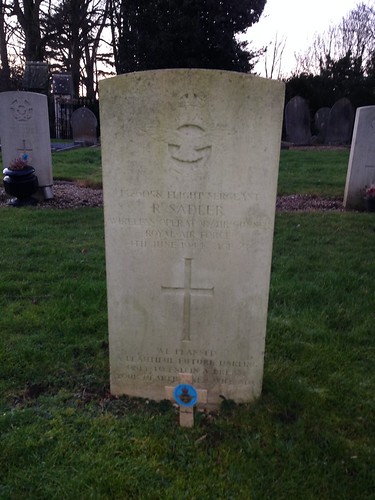
Wireless Operator / Gunner: F.Sgt. Robert Sadler, aged 23 (s/n: 1526058). RAFVR
Air Gunner: F.Sgt. Stanley Wharton, aged 30 (s/n: 1578013) RAFVR
Air Gunner: F.Sgt. Charles Patrick Nallen, aged 20 (s/n: 427537) RAAF

The Operations record book (AIR 27/2155/7) for that day simply  states:

3.6.44  ‘D’ F/O Young G.A. hit hangar after taking off and crashed on airfield when large bomb exploded and the crew all killed.  8 aircraft returned to base .

Three of the crew are buried in Kings Walk Cemetery, Downham Market, a short distance from the airfield.

Downham Market Cemetery

F.Sgt. Stanley Wharton (RAFVR)

Downham Market Cemetery

F.Sgt. Robert Sadler (RAFVR)

Downham Market Cemetery

F.O. Walter Thomas Olyott (RAFVR)

RAF Leuchars – one of Britain’s oldest airfields (Part 3)

In Part 2, a number of twin engined models frequented Leuchars performing anti shipping roles and U Boat hunts out in the North Sea. BOAC had begun its clandestine role and shipping ball-bearings back from neutral Sweden. We now see a change to these flights and as the war ends, a new much larger breed begin to appear here are Leuchars.

Throughout all these changes at Leuchars, the BOAC company had been continually running its clandestine operations to Sweden. But by now it was clear that a new, faster more agile aircraft was needed. Even though they were marked with civilian markings and flown by Swedish crews, the Electras were slow and cumbersome and made easy targets for both fighters and flak. Now, with the development of the Mosquito, the opportunity had finally arrived.

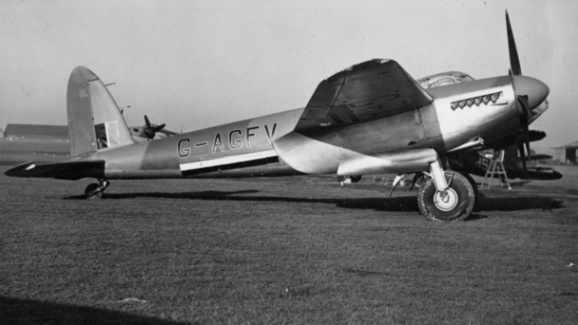
It was during December 1942 that the first civilian operated model of the aircraft arrived here at Leuchars. A Mosquito PR.IV ‘DZ411’,  it was assigned the civilian registration G-AGFV, and would begin flights to Stockholm on 4th February 1943, after which it was joined by six other aircraft. These MK.VIs were given the sequential registrations G-AGGC to GH, and would arrive during the April and May of that year.

By the end of April the following year, a total of nine Mosquitoes would have been modified and delivered to BOAC at Leuchars*5.

BOAC Mosqquito BAE Systems (@BAE Systems)

All these aircraft had to be changed from military status to civilian, this required the removal of all traces of armament. Modified at Hatfield – the home of the Mosquito – the resultant weight loss altered the aircraft’s centre of gravity and so additional ballast had to be added to prevent changes in the aircraft’s flying characteristics.

It was vital that the Mosquitoes remained unarmed for these operations, so as to not infringe or violate Sweden’s wartime neutrality, however, this made any aircraft on this run a potential ‘sitting duck’, even though, like their Lockheed predecessors, they carried BOAC insignia and were flown by civilian aircrew.

These operations were by now carrying more than just mail and ball-bearings though. These covert operations, took the civilian marked and unarmed Mosquito across the North Sea to Sweden, where it would drop off the mail, papers and other written material held within its bomb bay, and return with prominent scientists, special agents or allied aircrew who had been interned in Sweden as well as vital ball-bearings produced by the Swedes. The faster and far more agile Mosquito would, in most cases, be able to out run any opposing Luftwaffe fighter that should, and indeed did, try to intercept the aircraft whilst on one of these flights.

The returning ‘passenger’ on these flights had the unfortunate prospect of having to sit in a modified ventral bay for the whole duration of the flight. The prospect of further internment probably outweighing that of cramp and three hours of discomfort.

One such notable passenger who was carried back from Sweden, was the nuclear physicist Niels Bohr, whose work on atomic structures and quantum theory, had won him the Nobel Prize for Physics in 1922.*4 He would go on to work on the Atom Bomb in the Manhattan Project, the results of which were seen at both Hiroshima and Nagasaki in 1945.

Even though these flights were highly successful, a few aircraft were lost. In Mid August 1944, G-AGKP ‘LR296’, a former 27 MU aircraft, was lost when it crashed into the sea nine miles from Leuchars. All three on board were killed as it approached on return from Stockholm; the passenger being a BOAC Mosquito pilot himself. The crash was believed to have been caused by a structural failure, the aircraft having been repaired previously after an accident in January. By the war’s end fourteen Mosquitoes had been used in some way by BOAC, five of which crashed.*6

As the war moved on, squadron numbers at Leuchars begin to diminish. 1943 brought only two, that of 235 Sqn and 333 (Royal Norwegian Air Force) Sqn who were formed here on April 5th as ‘B’ Flight after the dividing and renumbering of 1477 (Norwegian) Flight. This was a split unit, one part flying the Catalina from Woodhaven, whilst ‘B’ Flight flew the Mosquito MK.II. An upgrade to the MK.VI then saw the unit move to join the famous Banff Strike Wing in September 1944. Whilst at Leuchars they operated as sub-hunters and convoy escorts, whilst ‘A’ flight flew more clandestine operations smuggling secret agents and supplies into occupied Norway. The Mosquito as a multi-function aircraft performed well in these duties, and by the end of the war numerous U-boats had been attacked by aircraft based at the Scottish airfield.

RAF Leuchars

One of the Hangars at Leuchars 2018

With 1944 dawning and major events happening on the continent, more changes would take place at Leuchars.

In the early months, proposals to extend and widen one of the runways was put forward, a part of which was agreed in April. This move also required the relocation of the Watch Office and widening of the perimeter tracks. A further three squadrons would pass through this year beginning with a detachment of 281 Sqn, who stayed for a year from February. A second unit 206 Sqn, stayed here for less than three weeks. But then September/October would bring a new and interesting model in the shape of the B-24 Liberator and 547 Sqn. A change to the smaller twin-engined models that had frequented Leuchars for the last four years or so, the move here was unfortunately a signal of their ending though, the squadron being disbanded in June 1945 never to appear again.

Whilst here, the Liberators would patrol the Norwegian coast in the A/U (anti-U boat) role, many of these patrols being uneventful, the U-boat threat by now greatly reduced compared to its previous Atlantic successes. However, on October 12th, Liberator MK.VI “G” did spot a U boat on the surface which it attacked with both front and rear turrets. Strikes from both guns were seen on and around the conning tower, and it was initially thought that the sub was sunk. After patrolling for a further 45 minutes, the U boat was again sighted some two miles away, but managed to escape in the poor weather. It was believed by the crew to have been a 740 ton vessel which had subsequently suffered damage from the attack.

The B-24s of the these RAF squadrons would be complemented by B-24s now flying separate runs to Sweden by the Americans. In addition to these, Leuchars also saw the reintroduction of the popular and highly successful American built Douglas DC3. The route to Stockholm now being a little less dangerous than it had been in previous years.

The arrival of the Liberator had signified a big change in direction for Leuchars,  they were to be the first of many four engined heavies to serve from the Fife base.

In 1945, 519 Sqn brought along the Halifax III, but sadly they were to go the way of 547 Sqn and disband here at Leuchars in the following May; it too would not reappear in the RAF’s inventory of operational Squadrons. 519 were a meteorological unit, collecting data for flying operations. Using both the Spitfire VII and Halifax IIIs, they would climb to altitudes of around 40,000 ft, and collect valuable meteorological data. Using Prata I, Prata II and Recipe I (Pressure And Temperature Ascent) many of these flights would take the aircraft high out over the North Sea.

With the close of the war, Leuchars had seen no less than twenty-eight operational squadrons pass through its doors, some of these merely staying for a day, whilst others were more prolonged. A range of aircraft had come and gone, mainly twin-engined models operating in the photographic reconnaissance or anti-shipping role. With its position on the north eastern coast, Leuchars had proven vital to maritime operations protecting the seas between Britain and Scandinavia, an area it had operated in, in a number of clandestine roles. But with the war now at an end, these were no longer required, and Leuchars’ role would again revert back to its original one – that of training.

The post war world was very different to the pre-war one, Britain like many other countries was rapidly trying to revert to pre-war budgets. A reduction in the armed forces was seen as essential to cutting costs, whilst rebuilding the nations cities that had been so heavily bombed in the Blitz, was paramount. As a result, the RAF as with the other forces, were having to do with what they had. A reduction in man power and machinery though would not only mean a reduction in squadrons, but the airfields that used them.

Leuchars, like so many, was now under the potential threat of closure. However, the increasing post war tensions between the east and west created the Cold War, with a strained and anxious stand off between Soviet and Western forces right across the European frontier. As had happened before, Leuchars’ position would once again be its saviour. Over the coming years it would see a wealth of operational aircraft and a broad range of front line fighters be based in this small corner of Scotland,

The coming months after the war’s end would see further four-engined models reappear, a previous resident 203 Sqn who had been here in the 1920s, returned from overseas operations in May 1946, bringing back with them the B-24 (Liberator VIII). Within two months though, this would be replaced by the Lancaster GR.3, a version of the mighty four-engined heavy that had wreaked so much devastation across Germany’s industrial cities. But by 1947, 203’s link with the Scottish airfield would finally draw to a close, and the squadron would depart for good.

160 Sqn who arrived a month later in June, also brought the Liberator, and similarly began taking on the Lancaster GR.3. By October though their demise had also arrived, they were renumbered and reformed as 120 Sqn, and by 1947 they had lost the last of their Liberators retaining only the Lancaster.

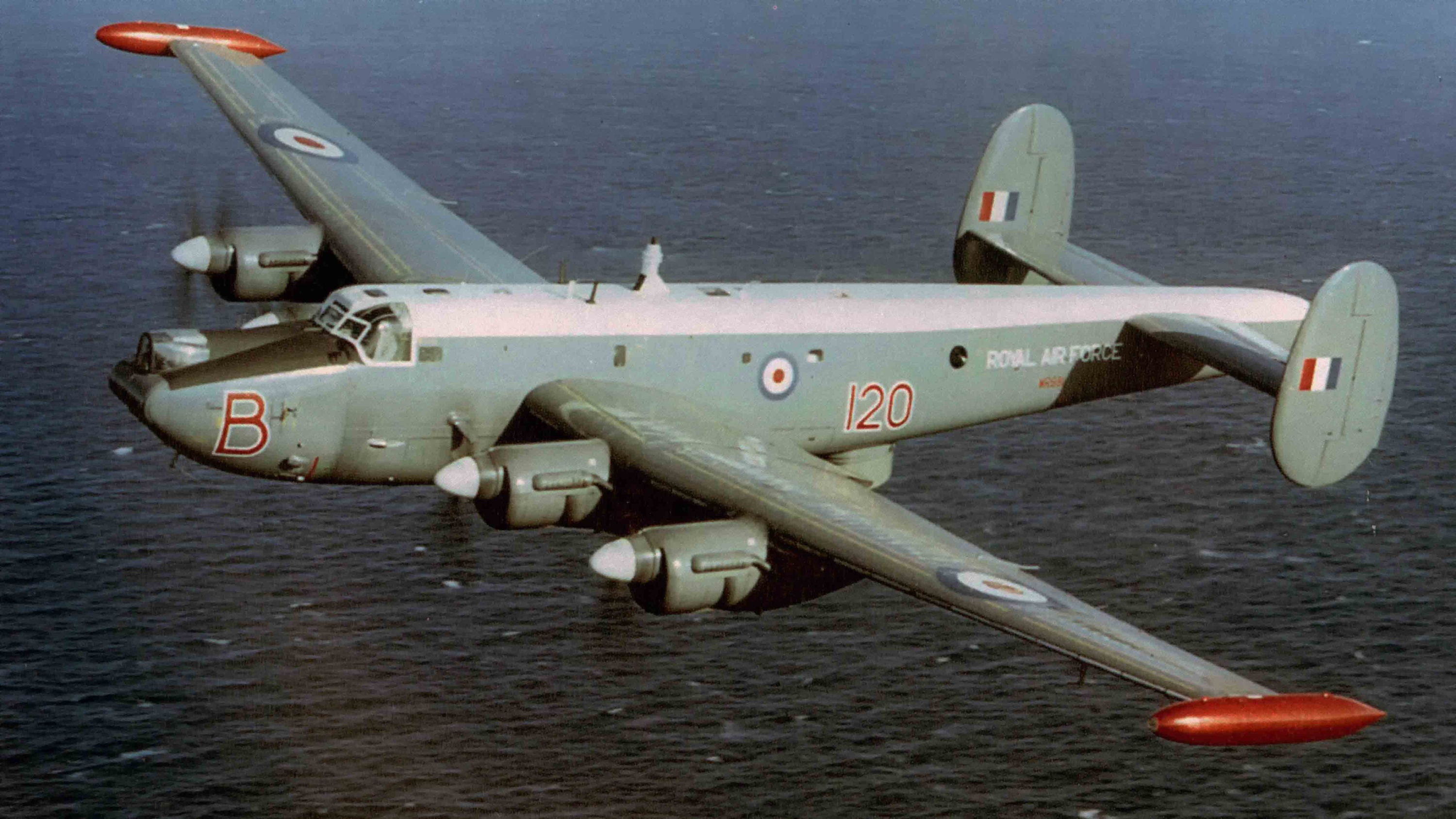
In December 1950, 120 Sqn were posted to Kinloss, where its wartime bombers were replaced with the newer Avro model, the long range maritime patrol aircraft, the Shackleton with its rare contra-rotating props.

Avro Shackleton MR.3 (WR989) of 120 Sqn RAF (@BAE Sytems)

The aircraft, built in response to the growing Soviet threat, was designed around the Lancaster,  Roy Chadwick’s dream bomber. Chadwick, like R.J. Mitchell, having sadly died before their dream had finally been put into service. Built to Air Ministry Specification R 5/46, the Shackleton was initially designed with gun turrets and two Rolls-Royce Griffon 57A engines inboard, and two Roll-Royce Griffon 57 engines outboard.

One other unit arrived here at Leuchars that year, that of 82 Sqn, initially as a Lancaster detachment and then in June 1947 as a base with its own detachments at Eastleigh, Dar-es-Salaam and Lusaka. The last of the prop driven aircraft were now making their ultimate RAF appearances, and soon Leuchars would enter in the jet age.

In Part 4 Leuchars enters the jet age. The Cold War begins and Leuchars takes on a new challenge as it moves to a new Command, that of Fighter Command.

The full story of Leuchars can be seen on Trail 62.

RAF Leuchars – one of Britain’s oldest airfields (Part 2)

After Part 1 in which we saw how Leuchars came about and develop as we moved towards the Second World War, we enter the early 1940s. Here we now see anti shipping sorties, U boat hunts and a strange relationship spawn between the recently formed civilian organisation BOAC and RAF Leuchars.

Immediately after the declaration of war, searches began with flights penetrating out over the North Sea. On the September 4th, a Hudson of 224 Sqn spotted a Dornier 18. The Dornier attacked the Hudson which sustained damage in both the fuselage and fuel tank. Thankfully, the pilot evaded further damage and manged to nurse the aircraft back home to Leuchars without further problems. Leuchars’ position on the eastern coast provided an ideal opportunity for such flights, hunting for bombers, U-boats and ships over the North Sea; it was this operation perhaps that marked the beginning of these maritime searches- a role it would carry out for the next 5 years.

Armourers secure 250lb bombs in the bomb-bay of a Lockheed Hudson of No. 224 Squadron at RAF Leuchars. (public domain)

The two units at  Leuchars continued with repeated patrols, with 233 sighting  both enemy flying boats and a submarine on September 7th. Attacks were made on both but no signs of damage were reported to either. Sadly, on this day, a 224 Sqn Hudson was seen diving into the sea, no explanation was available as to the cause, and a launch was dispatched to search for survivors – sadly with no results. This rolling programme of patrols over the North Sea pretty much set the scene for the remainder of 1940, culminating in the departure of 233 Sqn in September, followed not long after by 224 Sqn on April 15th the following year.

At the base itself, more hangars were built, four (austerity) ‘C’ type hangars were added which expanded the servicing and maintenance area hugely. Leuchars was clearly expanding.

Leuchars like many of Britain’s airfields would not only operate ‘operational’ squadrons from them, but numerous support flights that would run along side. Some of these included: training flights, communications flights, Army support and co-operation flights, and Leuchars was no different. One such unit was that of  18 Group Communications Flight, who resided at Leuchars from the spring of 1940 right the way through to 1960. With only a brief spell at Turnhouse, it would operate a wide range of aircraft throughout its long service and be one of, if not the longest serving unit at the airfield.

The early part of 1940 saw yet another front line squadron arrive here at Leuchars, that of 605 Sqn with Hurricanes. The fighter squadron, whose battle honours would include The Battle of Britain and the Malta campaign,  would only stay for a very short period of time, transferring again at the end of the month to the rather unsuitable Wick, where only one Bessineau hangar existed and there were little or no dispersal facilities. As two other squadrons were also moving onto the airfield at the same time, it was decided to billet the non operational crews off the airfield site, an idea that became the norm in the following war years.

Over the next few years, there would be a plethora of squadrons use Leuchars. In October, 320 Sqn arrived in a move that saw the return of the Avro Anson. Within days of their arrival though the squadron would begin receiving the Hudson I. What makes this particular unit special was the fact that both it, and 321 Sqn with whom it would soon merge, were both formerly of the Royal Dutch Naval Air Service, and had arrived at Pembroke Dock in June that year after the Germans invaded Holland. They brought with them Fokker T VIII seaplanes which were quickly replaced with the Anson.

On January 18th 1941, the two units were merged to form 320 (Dutch) Sqn, whose headquarters were at Carew Cheriton under the command of Lieutenant Commander W. van Lier, at which point all but one of the Ansons were disposed of. For short time the unit would perform from both there and Silloth training crews on aerial photography in the Hudson, before returning here to Leuchars in the March, where upon they gradually updated the Hudsons with the MK.II, the MK.III and eventually the MK.IV before ending their link with Leuchars and departing to Bircham Newton in the April of 1942.

Another unusual squadron to arrive at Leuchars was that of 72 Sqn in November 1940. A Spitfire unit, they had then taken on the Gloster Gladiator, a 1934 designed bi-plane that became famous in the defence of Malta as ‘Faith‘, ‘Hope’, and ‘Charity‘. The switch to the bi-plane appears to have been made as a result of an unsuitable airfield at Acklington. However, and even though the Gladiator was in no way equal to the Spitfire, 72 Sqn retained the Gladiator well into the Spring of 1941, at which point they upgraded to the newer Spitfire, the IIa.

Arriving at Leuchars on November 29th, 1940, 72 Sqn immediately began flying patrols over the sea, their first being in the area around Dunbar. However, the Scottish winter weather dogged operational flying resulting in many cancelled flights and patrols. On December 8th, Green section led by P.O. Norfolk struck lucky, and the flight encountered a lone Luftwaffe Heinkel He.111 over Holy Island. The Spitfire engaged the Heinkel firing numerous shots at the enemy aircraft, but the bomber made his escape flying into the heavy cloud that blanketed the coastal skies. As a result, P.O. Norfolk was unable to make a claim against it. It was this very same bad weather that prevented the squadron’s proposed move back to Acklington, meaning that the planned trip for the 15th, was delayed, the aircraft unable to make the transfer until the end of the month.

AIRCRAFT OF THE ROYAL AIR FORCE 1939-1945: BRISTOL TYPE 152 BEAUFORT.

Beaufort Mark I, N1172 ‘AW-S’, of 42 Sqn RAF, in flight with L9834, also of 42 Sqn (@ IWM CH 2775)

The majority of 1941 saw similar moves; short stays by 86 Sqn (2nd February – 3rd March) with Blenheims; 42 Sqn (1st March – 18th June) with Beauforts on their way to the Far East; 107 Sqn (3rd March – 11th May) with Blenheims and 114 Sqn (13th May – 19th July) also with Blenheims, all of which brought a number of twin-engined models to the Scottish airfield. The primary role for these units was maritime patrols, monitoring and photographing vessels out over the cold waters of the North Sea.

In 1941 a strange relationship spawned between the recently formed British Overseas Airways Corporation (BOAC) and RAF Leuchars. BOAC – being formed by the amalgamation of British Airways Ltd and Imperial Airways – formed a partnership with Leuchars that would remain at the airfield up until the war’s end, operating in an ‘open’ but rather contradictory clandestine role.

The civilian company would initially operate a single Lockheed Model 14 Super Electra (the forerunner of the Hudson) named ‘Bashful Gertie‘, between Leuchars and Stockholm in neutral Sweden. Piloted by Swedish aircrew, the idea behind the route was to pass POW mail into Sweden where it could be forwarded to prison camps in occupied Europe. At the time though, Sweden was one of Europe’s largest producers of ball-bearings, a commodity that both the allied and axis powers needed in order to keep their war machine turning. It is now known that much of Germany’s war supply of ball-bearings was in fact coming from Sweden, but they were not the only country buying the Swedish goods. After dropping off the post, the Electra would be refuelled and filled with ball-bearings before returning to Leuchars. This run hence became known as the ‘ball-bearing run’. These operations would continue for several years from Leuchars, but upgrades at a later date, would see a new form take over from these rather slow and vulnerable aircraft.

On August 12th, another new squadron was formed here at Leuchars, that of 489 Sqn with Beauforts, who kept them until the January of 1942. At this point they began replacing them with the Blenheim IV. After departing to Thorney Island in March 1942, they returned here as a full squadron in October 1943. At this point they began receiving the Beaufighter X an aircraft they kept until the war’s end. Prior to D-day the squadron moved to RAF Langham in Norfolk where they donned invasion stripes ready for their part in the forthcoming invasion of Normandy*3.

A detachment of the Horsham-St-Faith based 105 Sqn, arrived at Leuchars in December 1941 bringing yet another twin-engined, but new design, to these Scottish shores. A revolution in aircraft design, it was the envy of the Luftwaffe and a joy for British pilots – the de Havilland Mosquito IV.

Aircrew of 105 Sqn next to a Mosquito (location unknown) (@IWM CH 018011 1)

The detachment would stay here until after September 1942 whereupon it would reform as a complete unit at RAF Marham in Norfolk. In the last days of September however, four aircraft would leave Leuchars to attack a ‘special’ target in Oslo.

In Oslo on this day was a gathering of high level Nazi officials at the Gestapo headquarters, and this was to be the primary target for the four aircraft. After bombing successfully, they four sped away at low level toward the sea and home, only to be attacked, by four FW-190s. All four Mosquitoes received damage to varying degrees, and one was sadly lost, that flown by twenty-six year old Flt. Sgt. F. Carter and his navigator twenty-year old Sgt. Young. The Mosquito was seen heading toward the Oslo Fjord (Lake Engervann) with its starboard engine on fire. Unable to maintain height, the aircraft clipped trees and struck the water killing the two crew. The two bodies were successfully  pulled from the Fjord by local fishermen and buried in Oslo. The four crews had only been posted to Leuchars the day before.

Little changed throughout 1942. More short detachments and movements through Leuchars saw 217 Sqn, 415 Sqn, 455 (RAAF), 144 Sqn and 544 Sqn bringing mainly twin engined models to Leuchars. Only the detachment of 544 Sqn with Spitfires saw any major changes. The longest standing unit at this time was 144 Sqn with Hampdens, but they were spread far and wide, detachments being located at Skitten, Sumburgh, Wick, Afrikanda and Vaenga.

In October, a month after the departure of 105 Sqn, the Mosquito returned once more. This time a new unit, 540 Sqn, who were created from both ‘H’ and ‘L’ flights of 1 Photographic Reconnaissance Unit (PRU). The multiple flights of this former RAF Benson unit was divided up into five separate consecutive squadrons 540 – 544. Flying models that included:  Mosquito II ‘DD615’, VIII ‘DZ424 and IX ‘LR422 they would also use the Spitfire IV up to the end of the year. Their role here was primarily to photograph targets in Norway and northern Europe, a role they performed until early February 1944. They would eventually return to their former home at RAF Benson leaving a sixteen month  stay at Leuchars behind.

In Part 3, the running of BOAC aircraft from Leuchars see a change, the war comes to a close and new larger aircraft begin to appear here at the Scottish base.

The full story of Leuchars can be seen on Trail 62.

RAF Leuchars – one of Britain’s oldest airfields (Part 1)

Following on from Trail 53 we leave the former RNAS Crail and Dunino behind and head north-west to the mecca of the golfing world, and the historic town of St. Andrew’s, where just outside of the University town is an airfield whose history goes back as far as 1911; this makes it one of Britain’s oldest and most established airfields. Its development then takes it through the First World World War, to the relative peace of the 1920s, the expansion period of the 1930s and on into the Second World War. Faced with potential closure it then went on to be one of the most significant and important airfields in Britain’s Cold War defence network.

Sadly politics played its part as it often does, and in 2011, its fate was sealed when at 4:48pm on July 18th, Dr. Liam Fox the then Secretary of State for Defence announced when talking about bringing the Army back from Germany: “Two major units and a formation headquarters will be based at Leuchars, increasing the number of posts there from 1,200 to more than 1,300. Consequently, the Typhoon force due to be built up there will instead be built up at RAF Lossiemouth.”*10 With that the airfield was to close, being transferred over to the Army, a transfer that occurred four years later in March 2015. Since then the RAF has, on occasion, returned for flying duties,  but its front line RAF role had gone. A state which exists today.

On this next stop, we take an extensive look at the long and incredible life of RAF Leuchars.

RAF Leuchars.

Leuchars sits on the north-eastern coast of Fife, on the banks of the River Eden as it enters the sea at St. Andrew’s Bay. To the north across the River Tay, lies Dundee, and to the west, the city of Perth. South of Leuchars is the University town of St. Andrews – the home of world golfing. Being literally on the shore line, Leuchars provided an ideal location for a whole host of maritime operations, aerial reconnaissance and even later on, search and rescue.

Its life began just after the turn of the last century in 1911, when powered flight was but a mere few years old.  Even before the first aero-engine had been started here, the site was being put to use by the Royal Engineers with a Balloon Squadron, who used it for reconnaissance training in the Tentsmuir Forest on the edge of what is now the airfield.

With the formation of the RFC in 1912, the Balloon Squadron would become part of the first military flying arm to exist in the UK. It would continue in its role as spotting for artillery, even as powered flight gradually became established. On the nearby beaches, small aircraft were tried and tested, but balloon training would ultimately remain the focus of the squadron.

In 1916, the RNAS then acquired the land and began to develop the site as a place for powered flight. Taking over farmland, and eventually swallowing up the resident farm, the airfield slowly expanded, and by 1918 its future was established. By this time, the RAF had been formed, the flying responsibilities of the Navy were transferred to the RAF and the first unit was ready to move in. The Grand Fleet School of Aerial Fighting and Gunnery, run by the RAF to train Naval airmen, resided at the airfield from the end of 1918 on into 1920. This unit, a new unit in its own right, was formed out of the disbanded 208 (Temporary) Training Depot Station which, whilst formed at East Fortune in the Scottish borders, had only been in existence for as little as one month.

RAF Leuchars

The control tower at Leuchars. The airfield’s proximity to the shore line being evident.

In these early days of flying, risks were high, the thrill of manned flight was a draw for many young men eager to experience the joy of soaring above the clouds. As a result, there were numerous accidents and Leuchars was no different.

On May 19th, 1919, Lt. David Gardiner Cooper (22) lost his life when he misjudged a slow roll whilst flying in his Sopwith Camel (F8497), and on August 1st, Canadian, Lt. Philip Hall-Smith (30) was killed, after his Camel was seen to inexplicably nose dive into the ground.*1*2 Two unfortunate losses after a war that had already taken hundreds of thousands of lives.

During the 1920s, with the war now over, military might was seen as an almost unnecessary waste, units were cutback, airfields that had been established for war were closed, and fighting men were returned to civvy street. Political fighting amongst the three arms of the military, saw the RAF cut back to a fraction of its former self, its cause for survival spearheaded by Lord Trenchard. However, Leuchars managed to cling on, remaining not only active, but receiving further development as well. More land was purchased and in 1925 the base was officially renamed RAF Training Base Leuchars.

It would be a time of dramatic change and turbulence for the fledgling Air Force though, and this was wholly reflected by the number of units appearing at Leuchars during this period. Operating as one of the UK’s major Naval training bases (the RAF being responsible for Naval flying at this point), the first of these units to appear was 203 Sqn in March 1920 which had reformed here after having been disbanded just two months earlier at Scopwick.

On April 1st 1923, the RAF Carrier units were re-designated under the new 400 series of squadron codes – a major stepping stone in RAF / Naval structure. Then a year later in 1924, these units were combined to form the new Fleet Air Arm (FAA), the flying branch of the Royal Navy. These changes had a major impact on operational numbers here at Leuchars.

Formally a Royal Naval Air Service unit, 203 Sqn initially flew the Sopwith Camel, replacing these  in April 1922, with the Nieuport and the General (Gloster) Nightjar. In mid September, the squadron was posted to Turkey, departing Leuchars onboard HMS Argus; a posting that would last for three months. After that, the squadron returned to Leuchars once more, again onboard HMS Argus, remaining active at Leuchars until 1st April 1923. At this point the squadron was disbanded, being divided into two Naval Flights: 401 and 402. The squadron as was, would be reformed later, but it would be another twenty-three years before they would see the shores of Leuchars once more.

203 Sqn would be joined a month after their arrival by another former RNAS unit – 205 Sqn. Like 203, it too was disbanded at Scopwick only to reform here at Leuchars in April 1920. Bringing another new model of aircraft to the Scottish airfield, 205 Sqn flew the Parnall Panther, and would serve in its entirety as 205 until October 1921, when the Mobile Flight element  was reformed as 3 Squadron. The remainder of 205 Sqn continued serving alongside here at Leuchars.

3 Squadron would operate out of the Scottish base until 1st April 1923, at which point it was similarly divided into three flights: 420, 421 and 422 now serving at Gosport. The remainder of 205 were also divided up into separate Flights – 440, 441 and 442, but unlike its sister unit, 205 would not return in any form to these Fife shores.

As part of this formation of the FAA, Leuchars would see all these Flights joined by another seven: 403, 404, 405, 406, 443, 445, and 446, and all around this time. This would bring a whole range of aircraft to these shores: Nightjars, Panthers, Nimrods, Flycatchers and the like.  Some of these units would depart for foreign shores whilst some would remain in the UK at other bases. The skies above Leuchars was now buzzing with activity.

For the majority of the 1930s, Leuchars would remain as an FAA training base, being renamed No. 1 Flying Training School, on April 1st 1935. Aircraft seen here would have included a range of training types including the: Fairey IIIF, Fairey Gordon, Avro Tutor and Avro 504N. For three continuous years pilots trained at Leuchars for the Fleet Air Arm, a branch that continued to be the responsibility of the RAF.

The mid to late 1930s would see tensions slowly rise in Germany, but Britain’s general post war doctrine was to defend her shores rather than attack any potential enemy. The Royal Navy was still seen at these times as the main military force, a belief that would very soon change. Britain in these early years, had not seen Germany (partly due to the devastating conditions of the Treaty of Versailles) but France, as her biggest potential aggressor, and as such long range aircraft or heavy bombers were not seen as an important requirement.

Government ideas that Britain should only arm itself with a view to defence against its nearest potential threat, meant that early on, defences were developed at the cost of attacking units. But by the time it was clear that Germany was the threat, Britain was lacking far behind, as little national development had been undertaken. This doctrine saw a far reaching impact right across Britain’s peace time airfields, which at this time included Leuchars. With only one squadron, 36 Sqn (the former Coastal Defence Torpedo Flt.) transiting through on its way to the Far East, preparation for war and flying in particular, remained limited to training flights here at the Scottish base.

As Britain then entered the Expansion Period, new aircraft specifications were being pushed through and airfield development became increasingly important. A number of new airfields were built and a restructuring of the RAF was once again on the cards. Here at Leuchars, the number of hangars was extended, with 7 Belfast Truss hangars being added to the site.

With further changes in the late 1930s, Leuchars became a Temporary Armament Training Camp (later station) with a small collection of Wapitis who used the nearby range at Tentsmuir.

Then in 1938, this restructuring took place, Leuchars, driven by its coastal location, was passed over to Coastal Command in an exchange that saw the two squadrons based at Thornaby (224 Sqn and 233 Sqn) transfer across here, whilst 1 FTS would leave for Netheravon. The Temporary Armament Training Camp previously established here would also disband.

Both these units brought the Avro Anson with them, 224 replacing them the following year with the Lockheed Hudson, a military aircraft born out of a civil transport model. Over the next two years, 224 Sqn would upgrade each of these with both the MK.II and MK.III models before departing to Limvadi in April 1941.

233 Sqn however, would have a more turbulent time, moving initially to Montrose, and then back to Leuchars, where they also took on the Hudson, only to replace it a month or so later with the Blenheim IV. Then, within less than a year, they would depart Leuchars for good, heading for Aldergrove in Northern Ireland where they would continue their operations with Coastal Command.

As 1938 passed the situation in Europe looked even more grave, and home based units were put on alert. 224 Sqn began carrying out searches of the North Sea, looking for vessels making their way to the open waters of the Atlantic. A further flight began sweeps of the Firth of Forth looking for submarines operating in the waters off the Scottish coast. However, in September, Neville Chamberlain returned from Munich, and following his ‘Peace in our time’ speech, war had seemingly been averted for the time being, and these precautionary measures were then relaxed.

In mid December, with tensions eased, 224 Sqn was granted 3 weeks leave allowing personnel time to go home over the Christmas period. The relaxation of measures was however, short lived, and a year later the squadron was put on a war footing with mobilisation orders coming through on September 1st 1939.

In part 2 Leuchars enters the war, being a coastal airfield the sea would dominate its actions and the squadrons that would be based here. It would also be the first line of defence against Luftwaffe bombers, ships and U-boats.

The full story of Leuchars can be seen on Trail 62.

Remembrance Sunday – In Honour of 150,000 RAF Personnel.

On Armistice day we pay tribute to all Service men and women who served and died in the defence of freedom. This year we pay particular homage to those of the RAF through a visit to the remarkable St. Clement Danes Church in London.

St. Clement Danes Church – London

St. Clement Danes church stands almost oddly in the centre of London in the Strand, surrounded on all sides by traffic; like an island it offers sanctuary and peace yet its history is far from peaceful.

St. Clement Danes - Church of the RAF

The view toward the Altar. The floor contains nearly 900 Squadron badges of the Royal Air Force.

It reputedly dates back to the Ninth Century AD following the expulsion of the Danes from the City of London, in the late 870s, by King Alfred. As a gesture, he allowed Danes who had English wives to remain nearby, allowing them to dedicate the local church to St. Clement of the Danes. Ever since this time, a church has remained, albeit in part, on this very site.

St. Clement Danes - Church of the RAF

The ‘Rosette’ of Commonwealth Air Force Badges embedded into the floor.

In the 1300s and then again in the late 1600s it was rebuilt, the second time influenced by the great Sir Christopher Wren – notable for his designs of buildings both in and outside of London. Regarded as being Britain’s most influential architect of all time, he designed many famous buildings such as the Library at Trinity College and the Royal Hospital at Chelsea. Wren also redesigned both Kensington and Hampton Court Palaces – his influences stretched far and wide.

Of course Wren’s ultimate master-piece was St. Paul’s Cathedral in London, a structure that reflected both his skill, vision and personality.

During the Great Fire of London in 1666, eighty-seven churches were destroyed in London, but only fifty-two were subsequently rebuilt. Whilst not directly damaged by the fire, St. Clement Danes was included in that list due to its very poor condition and Wren was invited to undertake the huge task.

St. Clement Danes - Church of the RAF

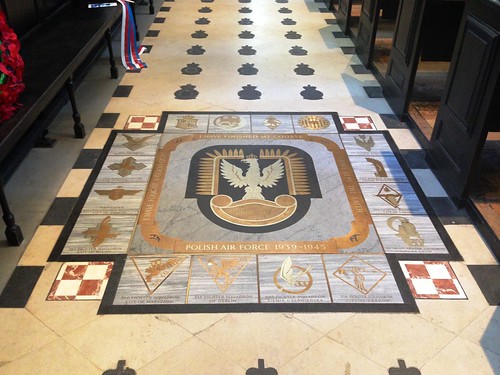
The Memorial to all the Polish airmen who served with the Royal Air Force during World War II.

It then stood just short of 300 years before incendiary bombs of the Luftwaffe destroyed it in May 1941. Leaving nothing but a few walls and the tower, Wren’s design had been reduced to ashes and rubble.

For over ten years it lay in ruins, until it was decided to raise funds and rebuild it. In 1958, following a national appeal by the Royal Air Force, St. Clement Danes was officially opened and dedicated as the Central Church of the Royal Air Force in memory of all those who fought and died whilst in RAF service, and to ‘serve as a perpetual shrine of remembrance’ to them all.

In completing the restoration, every branch of the RAF was included. At the entrance of the church, is the rosette of the Commonwealth made up of all the Air Forces badges of the Commonwealth countries, each of which flew with RAF crews during the conflicts. Beyond the rosette, the floor from the north aisle to the south aisle of the Nave contains nearly 900 squadron badges each one made in Welsh Slate and embedded into the floor.

Around the walls of the church, four on each side and two to the front, are ten Books of Remembrance from 1915 to the present day, in which are listed 150,000 names of those who died whilst in RAF service. A further book on the west wall, contains a further 16,000 names of USAAF personnel killed whilst based in the United Kingdom during the Second World War.

St. Clement Danes - Church of the RAF

Ten Books of Remembrance contain 150,000 names of those who died in RAF Service 1915 – the present day. A further book contains 16,000 names of USAAF airmen who were killed.

On either side of the Altar, are boards and badges dedicated to every branch of the RAF. Two boards list the names of those who were awarded the Victoria Cross and others the George Cross. Other slate badges represent the various units to serve and support the main fighter and bomber groups, including: RAF Training units, Fighter Control units, Maintenance units, University Air Squadrons, Medical units, Communication squadrons, Groups, Colleges and Sectors.

In the North Aisle, a further memorial, also embedded into the floor, remembers those who escaped the Nazi tyranny in Poland and joined the RAF to carry on the fight during World War II. Each Polish Squadron is represented in a beautifully designed memorial around which is written:

“I have fought a good fight, I have finished my course’ I have kept the faith”

Smaller dedications can also be found around the church, such as the Mosquito Aircrew Association, dedicated to both air and ground crews of the mighty ‘Wooden-Wonder’. Some of these memorials are in the form of gifts of thanks many of which come from other nations as their own tribute to those who came from so far away to give their lives in the name of freedom and democracy.


At the going down of the sun and in the morning
We will remember them.

Why not support the British Legion through their website

RAF Upwood (Trail 17) – The Graveyard of RAF Squadrons (Part 4)

In Part 3 Upwood became part of the Pathfinders operating Mosquitoes on major operations as Bennett’s Pathfinder Force. Eventually the war drew to a close and bombing operations wound down. Then we entered the jet age.

With the war in Europe now over, Upwood would become a ‘graveyard’ for RAF squadrons. The first of these 105 Squadron, arrived in the same month as 156 departed, with Mosquito XVIs. By the end of January 1946 they were gone, but like the Phoenix of Greek folklore, they would arise from the ashes at Benson in the early 1960s.

102 Squadron were another typical example of this, arriving in February 1946, only to be disbanded two weeks later, being renumbered as 53 Squadron. 53 Sqn made a conscious effort to buck the trend by  flying with the four engined heavies the Liberator VIs and VIIIs, but sadly they too did not last long, closing in the summer of that same year.

1946 was a busy year at Upwood, with what seemed a constant ebb and flow of ‘heavies’, this motion setting a scene that would prevail for the next eight years or so.

February 1946 finally saw the departure of 139 Sqn to Hemswell, after two years at Upwood, their time here had come – their historic role had come to an end. But for Upwood, it was still not the final curtain, for on July 29th, another unit would arrive, 7 Squadron. The unit was reduced to just ten aircraft prior to the move, and would not take on any new models until 1949 when the Lincoln B.2 arrived. An aircraft developed from the highly successful Lancaster, it would be used in operations over Malaya until the squadron was disbanded and then reformed elsewhere with Valiants in 1956.

Back in November 1946, two other squadrons would reform here at Upwood, both 148 and 214 Sqns, and both with Lancaster B.1 (F.E.). These ‘tropicalised’ versions of the B.1 had been destined to go to the Far East to fly operations against Japan as the ‘Tiger Force‘. These modifications included changes made to the radio, radar, navigational aids and included having a 400 gallon fuel tank installed in the bomb bay. Faced with the high temperatures of the Far East, they were painted white on top to reduce heat absorption, and black underneath. Fortunately though, the war with Japan had ended before they could be used, and in 1949, both these units would lose them in favour of the Lincoln also. This meant that Upwood now boasted three Lincoln squadrons, the war may have been over, but the power of the Merlin continued on well into the mid 1950s, these three squadrons disbanding between 1954 and 1956.

In the summer months of 1952, Dirk Bogarde starred in a film made at Upwood using Lancasters in an ‘Appointment in London‘.

A wartime story it was made by Mayflower Film Productions, and used four Lancasters crewed by Upwood airmen. Starring Dirk Bogarde, it is a story of intense rivalry between a Wing Commander aiming for his 90th mission, and an American officer, there is the usual love story attached as the two try to put aside their rivalry to achieve their own personal aims.

On February 23rd 1954, a forth Lincoln squadron arrived at Upwood, 49 Squadron took the number of four engined heavy bombers even further, staying here until August 1st the following year, at which point they were disbanded only to be reborn at Wittering in 1956.

By now, the RAF’s long range jet bomber, the Canberra, had been in service for a few years, and had proved itself as a more than capable aircraft. A first generation medium bomber, it was designed by W. E. W. ‘Teddy’ Petter, and would go on to set the world altitude record of 70,310 ft two years after entering service here at Upwood.

The success of the Canberra would be one to rival the Lancaster and Spitfire. Being built in twenty-seven different versions, it was exported to over fifteen countries world wide. In the RAF it served with no less than thirty-five squadrons, several of them ending up here at Upwood. Over 900 examples were built by British companies, with a further 403 being built under licence by the American Martin Company and designated the B-57. In RAF service, it reigned for fifty-seven years, the last examples being stood down in 2006.

Between 22nd May 1955 and 11th September 1961, eight RAF squadrons: 18, 61, 50, 40, 76, 542 and finally 21,  were all disbanded at Upwood, and all operating the aforementioned Canberra; primarily the B.2 or B.6 models, few of them operating the model for more than three years. There was also a return of 35 Sqn, the former Bomber Command unit who operated from Upwood in early 1940; they came over from Marham having operated as the Washington Conversion Unit before renumbering as 35 Sqn. They remained here until September 1961 whereupon they were disbanded for the penultimate time.
After the last Canberra Sqn had departed, Upwood remained under RAF control as part of the RAF’s Strike Command, until 1964 when they too pulled out leaving a small care and maintenance unit behind. Over the next few years Upwood would be used in the training of non-flying duties, until these units also left, the last in 1981. Upwood’s future now looked very insecure.

RAF Upwood

Inside the Gate house, the USAF presence. (Security Police Squadron).

Fortunately though, control of Upwood was then passed to the USAF for training and support services for nearby RAF Alconbury and RAF Lakenheath. It was earmarked for medical services, and should an attack occur during the Cold War, it would quickly be turned into a control area ready to deal with heavy nuclear attack casualties. Thankfully this was never put to the test though, and gradually the USAF phased out its use of Upwood, and as other airfields closed, personnel numbers became less and the homes they used emptied. Eventually, even the 423rd Medical Squadron pulled out, taking their community support, equipment and staff with them.

Upwood finally closed on 26th October 2012, and the remaining buildings including the NAFFI and NCO homes, were all sold off to developers and the site wound down. Since then, there have been numerous attempts to purchase the site and develop it with housing. These have all faltered along the way for one reason or another. On the positive side, the hangars remain actively used by an aero-engine company who refurbish jet engines. A glider club has been agreed a 10 year lease on the remaining parts of the runways (although these have been removed) and two Nissen huts have been fully refurbished to allow modern use. This part of the airfield looks and feels like a real and active military base, whilst the admin and medical side are ghostly reminders of its past. Standing on the site looking around, the imagination can only begin to think how this lonely and desolate place once bustled with crews and aircraft, crews going about their business and vehicles ferrying aircrew to their machines.

RAF Upwood

RAF Upwood’s hangars are still in use today. Aero engines outside await work.

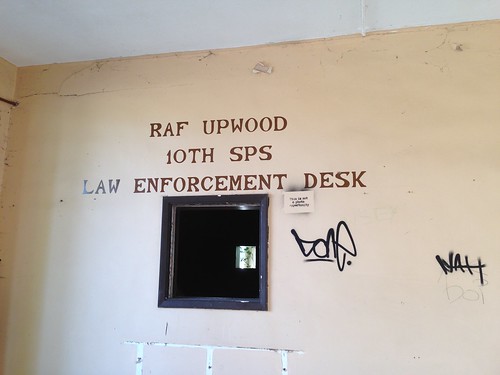
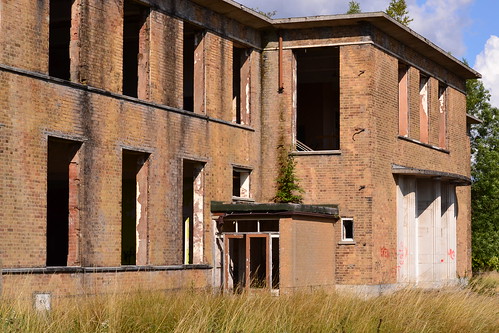
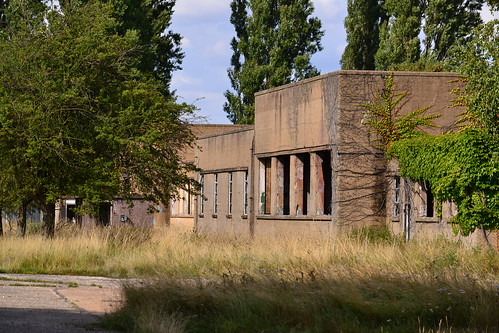
Today it is an enormous site covered with derelict buildings as if left following an atomic blast. The windows are all shattered, the buildings vandalised and graffiti daubed on all the walls. Two tanks have been brought in and a small urban assault company use it for mock battles. The guardroom, officers quarters and associated mess halls all remain, some in a worse state than others.

In 2017 the redundant site was acquired without conditions, and planning permission obtained for a comprehensive development of a small six acres of the site. This plan, put forward by Lochailort *5 included 60 houses. Huntingdon District Council have now incorporated Upwood into their long term Local Plan, and a proposal is under consideration for further development which would include the removal of large quantities of the buildings. It would also see hardstands being replaced by a mix of housing (450 homes) and business premises. The intention is to keep the architecturally significant buildings and layout, along with the hangars, thus retaining the military atmosphere, developing it “in a way which respects its setting and former use“.*4 I only hope that the sympathetic approach is indeed used, and that this incredible and historic site does not become another of Britain’s matchbox towns.

Post Script:

A website dedicated to RAF Upwood shows a range of older photographs, squadron details and information about Upwood’s history. Created by Sean Edwards, it is well worth a visit for more specific details.

A local gentleman has purchased a scrapped Canberra nose section that once flew  from Upwood, and has rebuilt it. It remains in his garage and is displayed at shows around the country.

Sources and further reading.

National Archives – AIR 27/379/4
National Archives – AIR-27-961-4

BAE Systems Website

*1 Photo from the UK Archives, (https://www.flickr.com/photos/nationalarchives) no known copyright restrictions.

*2 Josepf Jakobs story can be read on the: Josef Jakobs blog with further information on the Upwood Website.

*3 Middlebrook, M & Everitt, C. “The Bomber Command War Diaries 1939-1945“, Midland Publishing (1996)

*4 Huntingdonshire District Council Local Plan Proposal

*5 Lochailort Investments Ltd, Webiste.

Thirsk, I., “de Havilland Mosquito an illustrated History – Vol 2” Crecy publishing (2006)

For more information and details of the Pathfinders, see the excellent RAF Pathfinders Archive at: https://raf-pathfinders.com/

The full text can be read in Trail 17 – The Pathfinders

RAF Upwood (Trail 17) – The Graveyard of RAF Squadrons (Part 3)

In Part 2 Upwood progressed through the early war years as a training airfield operating a range of aircraft types. As the larger, heavier aircraft came n line, its wet and boggy ground became churned up necessitating the construction of hard runways.

By the end of the year these runways were completed, and in the early months of 1944, two more new squadrons would arrive at the airfield, 139 and 156 in February and March respectively.

By  now Bomber Command aircraft had been pounding German cities and industrial targets, the period January to March 1944 was to see Berlin hit particularly hard, and with Stirlings being withdrawn due to their high losses, the Lancaster crews would now be taking the brunt.

Now under the control of Bennett’s new Pathfinder Force (PFF), 139 (Jamaica) Sqn would bring with them the beautiful and much loved Mosquito MK.XX. Coming from nearby RAF Wyton, they had already begun replacing these with the MK.XVI, flying both models whilst performing operations from the Cambridgeshire airfield. The following month a Lancaster squadron, 156, who were based at another PFF airfield, RAF Warboys, joined 139. Within a month Upwood had become a major front line airfield, the roar of multiple Merlins now filling the Cambridgeshire skies.

RAF Upwood

139 (Jamaica) Squadron had a long history, which had begun on July 3rd 1918. This first period of their existence lasted only a year, the unit being disbanded in March 1919. With the onset of war they were called back into operation being reformed in 1936, when they went on to fly Blenheims, and later Hudsons, until being disbanded and renumbered as 62 Sqn in April 1942. Reformed again in the June of that year 139 Sqn would go on to serve well into the late 1950s.

Named ‘Jamaica’ Squadron, 139 acquired their name as a result of the huge effort of the colony to provide enough money for twelve Blenheims, a remarkable effort considering the nature and size of the country. It was from Trinidad that Sqn. Ldr. Ulric Cross came, the most decorated West Indian of World War II, who earned himself the DSO and DFC whilst flying with the Pathfinders.

139’s drafting in to the Pathfinders occurred at the end of May 1943, leaving 2 Group for Don Bennett’s 8 Group, they formed the nucleus of the Light Night Striking Force (LNSF).  At this time they were still at RAF Marham, but moved across to Wyton and then onto Upwood arriving here on 1st February 1944, with a mix of Mosquito IV, IX, XX and XVIs.

There would be no settling in period for 139 Sqn, their first sortie, marking for a raid on Berlin, was due that very night. Take off for F.O. D Taylor and F.Lt. C. Bedell in Mosquito DZ 476, was at 17:50; they dropped their Target Indicator which was subsequently bombed on by Mosquitoes from another squadron. Whilst flak was recorded as ‘slight’, the aircraft was heavily engaged over Neinburg. The Mosquito landed back at Upwood, ending the squadrons first successful operation from here, at 22:40.

Photograph taken during an attack by De Havilland Mosquito B Mark IVs of No. 139 Squadron, on the locomotive sheds at Tours, France (date unknown) © IWM C 3409

156 Squadron were one of the four initial Pathfinder units having been taken on by the new Group in August 1942 whilst at RAF Warboys a few miles up the road. After two years of relatively high losses for the Squadron, the time for change had come, and they moved across here to RAF Upwood. Hopefully a new start for the depleted unit would see better results and higher morale. As 156 moved in, the few remaining aircraft of the NTU moved out, rejoining the main collection at Warboys, the unit having been split over the two sites for some time.

However, the first three months of 1944 were to prove to be the worst for 156 Sqn, over half its total yearly losses occurring during this period. This culminated, at the end of March, with the loss of four Upwood aircraft. Lancaster MK.IIIs: ND406 (S),  ND466 (Z), ND476 (V) and ND492 (L) all left as part of a seventeen strong force from Upwood joining with a further ninety-three other PFF aircraft to attack Nuremberg. Even though the weather was against the bombers, the operation went ahead, the 795 heavy bombers of Bomber Command making their way east. Strong winds caused havoc, with large parts of the force drifting off course, much farther north than they should have done. This resulted in them unknowingly bombing Schweinfurt and not Nuremberg. Outward bound, the German defences waited, many picking off the bombers before they even reached Germany. In total 95 bombers were lost, 82 of them on the outward journey. For 156 Squadron it was another devastating blow, and for Bomber Command a disaster, their biggest loss of the entire war*3.

RAF Upwood

A huge number of derelict buildings remain on the now abandoned site.

Of the thirty 156 Sqn airmen lost that night (two Lancasters were carrying eight crewmen), only six survived, each of these being incarcerated as POWs, the rest all being killed and buried in this region of Germany.

The months preceding June were taken up with missions to support the impending D-Day landings. With Bomber Command forces being pulled away from targets in Germany, many missions now focused on V weapons sites, rail and transport links, coastal batteries and airfields across western France. The number of Pathfinder Mosquitoes increased, as did the need for precision bombing, the wider ‘blanket’ bombing not being implemented on these small scale targets.

The transportation plan as it was known, required intense operations from 8 Group, and although the number of missions rocketed the number of casualties fell. Morale was on the increase and things were looking up for the crews of Upwood based aircraft.

With the Pathfinders being mainly experienced and skilled crews, any loss was considered damaging. In the period up to D-Day, losses for both squadrons were  in single figures, but of those who were lost, many were DFC or DFM holders, including on the 27th – 28th April, 156 Sqn Lancaster III ND409, which had five DFC bearing crewmen on board.

During this raid, which was only some four weeks after Nuremburg, 323 aircraft attacked Friedrichshafen’s engineering plants, where components were made for German tanks. Highlighted as an ‘outstanding’ raid, marking was near perfect which resulted in the entire destruction of the plant and almost three-quarters of the town.

Meanwhile, the Canadians were busily building Mosquitoes for the RAF, and on May 10th – 11th, the first Bomber Command MK. XX built in Canada, was written off when a flare ignited inside the aircraft. Returning from Ludwigshafen, the marker had failed to release only to cause disaster near Cambridge on the return flight. Inside the aircraft were Flying Officers G. Lewis and A. Woollard DFM, Woollard going on to survive a second serious crash on 12th June when his aircraft crashed in Sweden after it was hit by flak. Flying Officer Lewis in the first crash failed to survive.

In June 1944, a very special aircraft was unveiled at the de Havilland Canada Downsview factory during the ‘Million Dollar Day’ ceremonies. Mosquito KB273 was unveiled by  the cousin of Geoffrey de Havilland Junior, Joan Fontaine, the Hollywood film star, who gave her name to the aircraft. KB273 ‘Joan‘ would be passed to 139 Sqn here at Upwood before being handed over to 608 Sqn in August. In fact, KB273 was one of many Mosquitoes from this same stable that passed through 139 Sqn to the Downham Market unit. It was sadly lost on 29th February 1945, its pilot evading capture whilst the navigator was taken as a POW.

Losses remained relatively low on a month by month basis for the two squadrons, an excellent improvement compared to previous months and against other units. By the end of the year, 139 Sqn had sustained twenty operational losses whilst 156 Sqn suffered fifty-two. All in all 1944 had been a little more positive.

The dawn of 1945 saw the world entering the final stages of the war. The long and cold winter of 1944-45 prevented many operations from being carried out, and even though the Luftwaffe were finding it difficult to put up sufficient numbers of aircraft and skilled pilots, losses in Bomber Command were still high overall. Last ditch efforts saw attacks from fighter jets, mainly Me 262s, and 1945 would signify the end of operations from Upwood for one of the two Pathfinder squadrons based here.

For 156 Sqn the early months of 1945 would be their last, and although there was an all out effort, casualties were relatively light. With one Lancaster being lost in January (PB186) with all on board; three in February – two over the Prosper Benzol plant at Rottrop, (ME366, PB505) and another (PB701) over Dussledorf – January and February would close with few losses. March similarly would see another two in the closing hours of the month over Berlin, both crews of PB468 and PB517 being completely wiped out.

Germany continued to be pounded by large formations during April, a month that saw many of the last major operations for several squadrons. For 156, their final bombing mission came on the 25th, sixteen aircraft taking part in a raid to Wangerooge in which Bomber Command lost seven aircraft – six of which were collisions in near perfect weather. For 156 though, the raid was casualty free, and with that their bombing raids ceased. The final capitulation of Germany was taking place and mercy raids could now be flown to supply those who had lived in terror and hunger under the Nazi regime.

3010671412_0a0a4fd717

Aerial photo taken on 25th April 1945 over Wangerooge*1.

In that month alone, Squadron crews were awarded no less than: one DSO; nineteen DFCs; a CGM and three DFMs. Aircrews had flown over 850 operational hours in 141 sorties, a small fraction of the 4,839 they had flown in their three year existence. By June, operations for 156 Sqn had wound down at Upwood and they moved back to Wyton, finally being disbanded and removed from the  RAF register in September.

139 Sqn meanwhile, had continued their marking for night raids on German cities. During the period late February to the end of March, 139 Sqn carried out thirty-six consecutive night raids on Berlin, one of these being the largest ever attack by Mosquitoes on the German capital. On this operation, 142 twin-engined ‘Wooden Wonders’ from a number of different squadrons unleashed their loads in two waves over the German city. 139 Sqn leading the Light Night Striking force using up to date models of H2S.

After the Battle of Berlin had ended, along with a winter of heavy bombing, the analysis would now begin. Bomber Command’s effectiveness, and in particular its bombing strategy, would suddenly be under the spotlight, with its leader Sir Arthur Harris, the focal point. It would be a legacy that would last for generations to come, even to this day the debate continues, and there are many that fight the cause in support of Harris’s operational strategy.

The end of the bombing war for 139 Sqn came in May 1945, ironically their busiest month of the year, flying 256 sorties which culminated with an attack on Kiel.

Throughout their operational tour, 139 Sqn had lost a total 23 aircraft in 438 raids , the highest of all the Mosquito PFF squadrons.

Part 4 takes us into the Cold War, the development of the jet engine in which Upwood becomes a graveyard for disbanding RAF Squadrons.

The full text can be read in Trail 17 – The Pathfinders

RAF Upwood (Trail 17) – The Graveyard of RAF Squadrons (Part 2)

In Part 1 we saw how Upwood was formed and how the first squadrons arrived ready to show off their new Fairey Battles. As September 1939 dawned, war was declared and Upwood stepped up to the mark and prepared itself for the conflict.

The immediate issuing of order S.D.107 and S.D.107a, resulted in the whole of 63 Sqn, including their dispersed aircraft, being moved to Abingdon, whose crews and aircraft were in turn moved to France. The transfer of men and machinery being completed by 08:00 on the 8th September, at which point 63 Sqn joined No.6 Group, leaving Upwood far behind.

52 Sqn also brought back their aircraft from Alconbury filling the spaces left by 63 Sqn, before moving themselves to Kidlington, and then onto Abingdon where they would join once again with 63 Sqn.

The outbreak of war saw huge changes for the RAF. The immediate mobilisation began with the implementation of the ‘Scatter Scheme’, where aircraft were dispersed away from parent airfields to avoid the ‘imminent’ threat of attack. Over at West Raynham, 90 Sqn were doing just that. In mid September, aircraft that were dispersed to Weston-on-the-Green were now brought over to the all but vacant Upwood, in a move that preceded a more long lasting move by the squadron to the airfield.

RAF Upwood

Guard house to the former airfield.

Over the next few weeks a mix of Mk.I and MK.IV Blenheims were collected and brought into Upwood supporting the training role carried out by 90 Sqn. Training was a risky business, as many trainee crews would find out. On the 18th October, two Upwood Blenheims crashed, one in a field with its undercarriage retracted following an engine failure, and the second on the airfield itself. The worst of these was Blenheim L4876 which crashed on take off, and resulted in the loss of the life of the pilot P.O T. Peeler. His observer, Sgt. Dobbin was injured, whilst the wireless operator, AC2 Brown,  managed to escape without injury.

Over the winter months Upwood would rise in the league tables of airfields notorious for flooding and water logged  ground. The heavy rains making the airfield unserviceable on numerous occasions. This caused great concern for the air staff who made the difficult decision to cut short training programmes, thus enabling the supply of aircrew to be maintained. It did however, mean that there would be a supply to front line squadrons of crews with partial or less than perfect training.  This problem would persist at Upwood for some time to come, eventually being partly solved by the building of hard runways.

1940 brought with it another training squadron, 35 Sqn, who also found the ground at Upwood difficult, their move being hampered for several weeks before they could finally settle in and begin operations properly. The summary for February shows thirteen days were lost to bad weather and nine to waterlogged surfaces!

March 12th 1940, saw another fatal accident at Upwood, with the death of trainee pilot Sgt. Alphonse Hermels (s/n: 517823) whose aircraft collided with a Blenheim on detachment from  90 Sqn, the two aircraft taking off simultaneously but neither apparently being aware of the other’s presence.

In early April, both 35 and 90 Sqns were disbanded and amalgamated to form No. 17 Operational Training Unit (OTU). The name of 35 Sqn would be reborn as part of Bomber Command at Boscombe Down at the year’s end, but that would be their ties with this rather wet airfield cut, until in 1956, when it would return extending its stay to a more permanent five years. For the next three years the OTU would be the main user of Upwood, flying with a wide range of aircraft types, including: the Lysander, Anson, Hurricane, Spitfire, Wellington and Fairey Battle. The unit  eventually departed to Silverstone – famous for British Motor Racing – in December 1943.

As the BEF were being withdrawn from the beaches of Dunkirk, Britain began to brace itself for the impending invasion. Although the Battle of Britain would not officially start for some time yet, the period immediately after Dunkirk saw minor attacks on British airfields, particularly those in East Anglia. On several days during June, enemy bombers would penetrate British airspace and unload their small bomb loads on these sites. Some of the first enemy intruder missions were recorded at this time, and Upwood would receive its fair share of bombings although little damage was done.

This operational ‘dry spell’ was momentarily broken when 26 Squadron appeared on the scene at Upwood. For what must be one of the most mobile squadrons of the RAF, 26 Squadron were constantly transferring from airfield to airfield, staying here on an overnight stop in early October. In the space of less than a week the squadron had operated from no less than 6 different airfields including: Twinwood Farm (Glenn Miller’s last stop), Barton Bendish, and Snailwell.

RAF Upwood

Upwood’s collection of buildings are numerous.

Upwood was to experience some rather difficult times and localised action. Numerous accidents were interspersed with attacks by marauding Luftwaffe aircraft, they even had their own parachuting spy. The event caused a great deal of excitement around the base, and saw the spy,  42 yr old Josef Jakobs, being found guilty of treason and subsequently executed at the Tower of London.

Jakobs, who parachuted into England on January 31st 1941, broke his ankle when he landed at Dovehouse Farm, Ramsey Hollow, a few miles from the airfield. He was found by passing farm workers (Charles Baldock and Harry Coulson) after firing shots into the air. With him were maps with both RAF Upwood and RAF Warboys identified, transmitting equipment, codes, £497 in £1.00 notes and false papers. He was arrested, taken to Cannon Row Police Station in London where he was handed over to Lt. Col. Tommy ‘Tar’ Robertson of MI5.

Robertson took Jakobs to ‘Camp 020’ a special interrogation camp run by MI5, on Ham Common, where he was treated for his injuries and interrogated with a view to turning him into a ‘double agent’. However, his position had already been compromised because of local gossip about his capture, and so MI5 could not guarantee his position with the spy network.

Jakobs was finally tried under the Treachery Act under military law – a court martial consisting of four military figures. The court hearing began on 4th August and lasted two days. He was subsequently found guilty of treason and on the morning of the 15th he was shot by a firing squad formed from the Holding Battalion of the Scots Guards at the Tower of London, his body being buried in an unmarked grave in St. Mary’s Roman Catholic Cemetery in Kensal Green, North-West London.*2

Often, training airfield squadrons would operate in conjunction with various specialised units, in this case 11 Blind Approach Training Flight who were formed here at Upwood, in October 1941, with Air Speed Oxfords. This unit was quickly renamed 1511 (Beam Approach Training) Flight, and trained pilots in the use of navigation beams for poor weather or night landings. These twin engined Oxfords were found in numerous training flights and at numerous airfields across Britain and in Canada, and were generally popular with trainees.

As the war progressed new advances meant that the older aircraft were becoming tired and in need of replacement. With larger bombers coming on line, Wellingtons pulled from front line service were now being used in training operations. Added to this, the introduction of the Lancasters of the Navigation Training Unit (NTU) in June 1943, meant that Upwood’s runways could no longer withstand the churning up by heavy aircraft, and it was now that Upwood’s notoriously bad surface began to really show its true colours.

RAF Upwood

A scene typical of the buildings at Upwood

Being a heavier breed than the Blenheims and Oxfords, the ground began to break up, and it was for this reason that the OTU moved to Silverstone, and the Beam Training Flight moved out to Greenham Common. This left the airfield devoid of all operational aircraft apart from the NTU. It was now time to make amends at Upwood.

Whilst the site was all but vacant, one of the RAF’s Airfield Construction Flights moved in and construction began on the three concrete runways needed for Upwood to continue operations. The brain child of Wing Co. Alexander John ‘Daddy’ Dow, they were a huge organisation that supported the RAF’s front line squadrons by building, repairing and maintaining their runways.

In Part 3 Upwood see the arrival and use of the four engined heavies. The Pathfinders are born and Upwood becomes a front line bomber airfield.

The full text can be read in Trail 17 – The Pathfinders