The Amiens Prison Raid – February 18th 1945

There are multiple stories of heroism and daring stemming from the Second World War, each and everyone pushing man and machine beyond their boundaries. Many daring missions were flown in which crews performed and completed their task with extraordinary bravery and at great cost to both themselves, and to those on the ground.

Stories such as the ‘Dambusters’ have become famous and commemorated year on year, and yet another daring raid is barely mentioned or even considered by those outside of aviation history. The details of the raid remained secret for years after the event and even now, factual evidence is scarce or difficult to find; even the name of the operation can cause heated debate. The merits of the operation continue to be debated and many are still divided as to what the true purpose of the operation really was.

Whatever the reason behind it however, the historical fact is that the operation was a daring, low-level raid that helped many prisoners of war escape captivity and probably death, and one that was carried out in very difficult circumstances by a group of extremely brave young men.

It was of course the raid on the Amiens prison on February 18th 1944, by nineteen Mosquitoes of 140 Wing based at RAF Hunsdon.

As a new wing, it was formed at RAF Sculthorpe, and would consist of three multinational squadrons, a ‘British’, Australian and New Zealand unit, and all would be based at Hunsdon as part of the RAF’s Second Tactical Air Force (2TAF) designed to support ground troops in the forthcoming invasion of Europe.

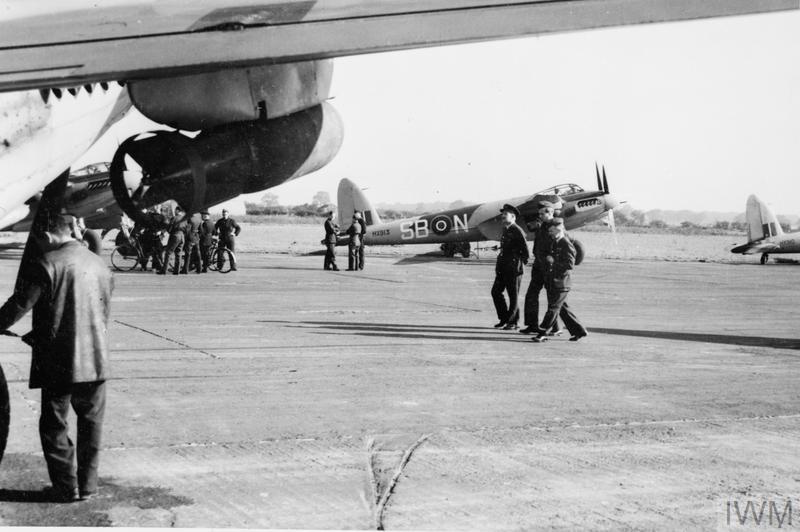
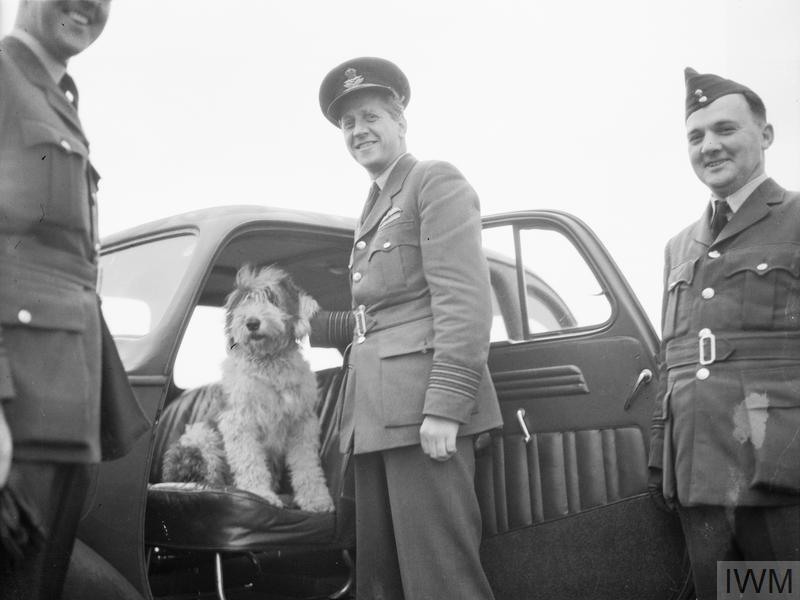
Group Captain P C “Pick” Pickard (centre), Commander No. 140 Wing, flanked by Wing Commander I G E “Daddy” Dale, Commanding Officer of No. 21 Squadron RAF (to Pickard’s right), and Wing Commander A G “Willie” Wilson, Commanding Officer of No. 487 Squadron RNZAF, visit No. 464 Squadron RAAF at Hunsdon, prior to a daylight raid against flying-bomb sites in the Pas-de-Calais. 464’s Mosquitoes (FB Mk VIs) have been loaded with 250-lb MC bombs for the operation: HX913 ‘SB-N’ can be seen in the background (@IWM HU 81335).

The raid on Amiens was not the only low level raid carried out by the Wing however. Between 1944 and 1945, they would attack numerous ‘V’ weapons sites, along with the Gestapo headquarters at Aarhus University and  the Shellhaus building in Copenhagen. Operation Carthage, another of their more famous raids, occurred whilst the wing was based at RAF Fersfield in 1945, but their most controversial raid, Ramrod 564 or ‘Operation Jericho’ as it has since become known, took place the year prior to that, whilst they were based at Hunsdon in early 1944.

There is a lot of speculation around Ramrod 564, many of the official records are missing, inaccurate or even vague. The operational record books for the squadrons involved  are recorded as ‘secret‘ and contain no details other than aircraft, times and dates.

The Operation, was designed to assist in the escape of 120 French patriots, who were reportedly condemned to death for assisting the Allies in the fight against the Nazis. These prisoners included key resistance fighters who had considerable knowledge of resistance operations in France, and so it was imperative that they escape.

The plan was for Mosquitoes of 140 Wing to attack from different directions, breaching the walls of the prison and blowing up several key buildings inside the prison holding German guards and soldiers. It would require each aircraft to carry 11 second, time-delay fuses in 500lb bombs dropped at very low level.

The Operation, formulated by Air Vice Marshal Basil Embry, would be critical, even the amount of explosive itself had fine limits, and time was also of the essence. The prisoner’s executions were imminent, so the attack had to be carried out quickly thus allowing only a small window of opportunity for the operation to take place.

The exact time of day that the attack could take place was also critical, there needed to be as many of the guards as possible in the key buildings at the time of attack, and the prisoners needed to be safely gathered together out of harms way. So, a time of 12:00 pm precisely on a date between 10th and 19th February was chosen, as both the guards and prisoners would be having lunch at this time, and it would be prior to the executions being carried out.

The route would take the aircraft from Hunsdon to Littlehampton, then via appropriate lattice to Tocqueville / Senarpont / Bourdon – one mile south, Doullens / Bouzincourt – two miles west-south-west, Albert / target – turn right – St. Saveur / Senarpont / Tocqueville / Hastings and return to Hunsdon.

In the attack, 3 waves of Mosquito would be used, 6 from 487 (RNZAF) Squadron, 6 from 464 (RAAF) Squadron and 6 from 21 Squadron. In addition, to record the attack, one aircraft (a Mosquito) of the Photographic Reconnaissance Unit (PRU) was detailed to monitor and film the entire operation. Along with them were three squadrons of Typhoons (198, 174 and 245) each protecting one of the three waves. These escorts were ordered to rendezvous with the waves one mile east of Littlehampton at Zero minus 45, 42 and 32 minutes respectively.

The first wave of Mosquitoes was directed to breach the wall in at least two places, the leading three aircraft attacking the eastern wall using the main road as a lead in. The second section of three aircraft would, when ten miles out from target, break away to the right at sufficient height as to allow them to observe the leading three aircraft, and if successful, attack the northern wall on a north-south run, immediately following the explosion of the bombs of the leading section. The time of this attack Zero Hour.

The second wave was ordered to bomb the main prison buildings, the leading three aircraft attacking the south-eastern end of main building and second section of three aircraft, attacking the north-western end of the key building. Both attacks were to be carried out in a similar fashion to the first. This would follow three minutes behind the first wave at Zero +3.

The final wave was a reserve wave intended to bomb if any of the first two waves failed to hit their targets. They would follow the same patterns as the first two, one section from east and one from north, but they would only bomb if it was seen that one of the previous attacks had failed. The details of the attacks would be determined by the leader and would happen thirteen minutes (zero +13) after the initial planned attack. If they were not required, the order to return would be given by the Group Leader or substitute.

Embry elected himself to lead the attack, but this was blocked by those higher up, As a result, and much against his wishes, Embry therefore had to choose a successor. Group Captain Percy C. Pickard (D.S.O. and two bars, D.F.C.) was chosen, but even though he was known as an expert pilot and leader, Embry was not convinced of Pickard’s ability to complete the job at such low level. Despite his reservations though, Embry duly informed Pickard of the decision and preparations for the operation began in earnest.

On February 18th that year, a day after the initial planned attack and in extremely poor weather, the Nineteen Mosquitoes took off to attack, breech and destroy the walls and a key building of the Amiens prison.

During the flight out, two Mosquitoes and three Typhoons of 198 Sqn became lost in swirling snow and were forced to turn back as they had now lost contact with their main formations. The remaining crews flew on, but whilst over France a third Mosquito, flown by Flt. B. Hanafin, suffered engine problems and was also forced to turn back. On his return journey he was attacked by Flak from which he was seriously injured. Helped by his navigator the two were able to land back at RAF Ford where he was given medical treatment for his injuries.

Just three minutes behind schedule, the first wave split and the first three aircraft followed the main road toward the prison’s eastern wall at tree top height. The second set of three waited and observed. Wing. Cdr. I. Smith, 487 Sqn, went in first, dropping his bombs with 11 second fuses against the wall. The second three then followed as instructed.

Wing Commander I Smith, Commanding Officer of No. 487 Squadron RNZAF, at Hunsdon (©IWM CH 12649)

Official reports state (edited only for fluency):

“Three Mosquitoes of No 487 Squadron attacked the eastern wall at 12:03 hours, just clearing the wall on a heading of 250 degrees with 12 bombs. The leader’s bombs were seen to hit the wall five feet from the ground, while other bursts were seen adjacent to the west wall with overshoots in fields to the north. Two aircraft of no 487 Squadron attacked the northern wall at 12:03 hours just clearing the wall on a heading of 150 degrees with 12 bombs. These attacks were directed at places later reported breached by reconnaissance aircraft. One bomb seen to hit the large building, and northern side of the eastern building was also reported hit.”

The second wave then attacked the south-eastern main building and north-western end respectively. Following the explosions chaos ensued inside the prison, guards were taken by surprise and over running bombs had caused some damage inside, prisoners began to run toward the gaps but some had been injured or struggled to escape.

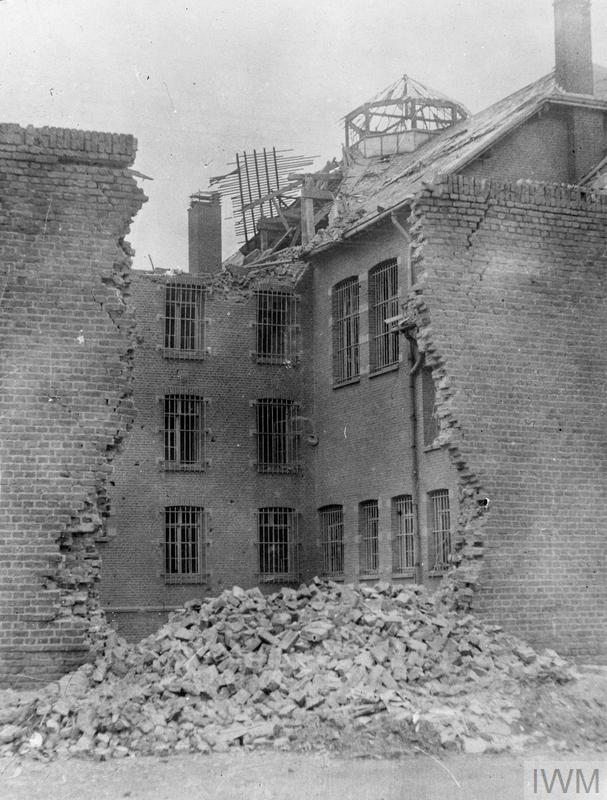
The 12 foot wide breach in the south side of the prison’s outer wall, through which 258 prisoners escaped. © IWM (C 4740)

Again reports say:

“Overhead view of the prison, showing the breaches made in the outer walls. Two Mosquitoes of No 464 Squadron bombed the eastern wall at 12:06 hours from 50 feet heading 150 degrees and 250 degrees with 8 x 500lb bombs. The wall appeared unbreached before the attack. Results were unobserved.

Two Mosquitoes of No 464 Squadron bombed the main building at 12:06 hours from 100 feet heading 150 and 250 degrees with 8 x 500lb bombs. The north wall appeared to be already damaged. One of these aircraft was seen to bomb and has not returned.

The breach in the Eastern wall. One Mosquito of the PRU circled the target three times between 12:03 and 12:10 hours from 400 to 500 feet using a cine film camera but carrying no bombs. He reported a large breach in the eastern centre of the north wall and considerable damage to the extension building west of main building as well as damage to the western end of main building. A number of men were seen in the courtyard near the separate building which appeared to be workshops and three men running into fields from large breach in northern wall.

The four aircraft of No 21 Squadron received VHF messages from ‘F’ of No 464 Squadron (Gp. Capt. Pickard) and PRU aircraft when between 2 and 4 miles from the target, instructing them not to bomb. Target was seen covered with smoke and they brought their bombs back.

The target was obscured by smoke, so later aircraft were instructed not to bomb. Two aircraft were missing from this operation; one was last seen circling the target and heard giving VHF messages not to bomb (Pickard) and the other after attacking the target, was seen at Freneuville at 12:10 hours at 50 feet leading his formation. It attacked a gun position and shortly afterwards dropped to starboard and was not seen again. One aircraft of No 467 Squadron was hit by light flak near Albert; starboard nacelle holed and starboard wheel collapsed on landing. One aircraft of No 21 Squadron landed at Ford – aircraft damaged. One aircraft of No 487 Squadron abandoned task south of Oisemont – pilot slightly wounded and aircraft damaged. Two aircraft of No 21 Squadron abandoned before leaving English Coast owing to technical failure.”

It is thought by some that Pickard had been shot down before giving the return order, but these reports state that it was both Pickard and the PRU Mosquito flown by Flt. Lt. Wickham, that gave 21 Sqn the “Red, Red, Red” order, sending the last wave home as their bombs were no longer needed.

After the attack, FW.190s began to swarm and various dogfights took place between them and the Typhoons, but not before they had attacked some of the fleeing Mosquitoes who also returned fire.

It was one of these FW190s flown by the ace Feldwebel Wilhelm Mayer, who  severed Pickard’s tail sending the aircraft into the ground near to Saint Gratien killing both occupants.

A story goes that Pickard had left his dog ‘Ming’ at RAF Sculthorpe, their previous airfield,  to be looked after whilst he was away. On the day he was shot down, 18th February 1944, the dog fell gravely ill. Pickard’s wife, Dorothy, went to get him and sensed that after seeing the state of the animal that Pickard had been killed . It took months for Ming to recover, and some years later whilst living in Rhodesia, Ming went outside looked up to the sky as he always did when Pickard was flying, heard a whistle, collapsed and died.*1

Group Captain P. C. “Pick” Pickard with his pet sheepdog “Ming”, pictured while resting from operations as Station Commander at Lissett, Yorkshire. © IWM (CH 10251)

A famously brave act, the attack resulted in the death of three crew members; Gp. Capt. Percy C. Pickard, and Flt. Lt. John A. Broadley, (RNZAF), both in Mosquito HX922, ‘EG-F’, and Flt. Lt. Richard W. Samson, (RNZAF) in Mosquito MM404 ‘SB-T’. Samson’s pilot, Sqn. Ldr. A. I. McRitchie survived his crash and was taken prisoner. Two Typhoons from 198 Sqn escorting the Mosquitoes are also thought to have failed to return (the ORBs don’t confirm this). Considered a success at the time, ‘evidence’ has since come to light to suggest that the operation was ‘unnecessary’, and may have failed to achieve anything more than a successful PR role (see end note). *2

Of the 700 prisoners detained within the walls of Amiens prison that day, a total of 258 escaped. In the confusion, 102 were killed and a further 74 wounded, but the success remained secret from the public for another eight months. With so much speculation around the attack, it will no doubt remain one of the mysteries of the war, but it was without doubt, an incredibly brave and daring mission that cost the lives of many superb young men.

A podcast using eyewitness accounts from the Imperial war museum can be heard through their website.

(A better quality version is available on the Pathe News website.)

All controversy aside, the raid took place at very low level and in very poor weather, with bombs dropped against a wall with delayed fuses. There was little resistance on the flight in and Typhoons provided higher cover when it was needed, but dogfights still ensued and lives were lost.

A daring attack, the Amiens raid was not the only one where lives were lost. Airfields along with the Hazmeyer electrical equipment factory at Hengels in Belgium, were also attacked at low level. On this particular operation Mosquito MM482 was hit by intense flak setting the starboard engine on fire. As a result, the aircraft flown by Canadian Sqn. Ldr. A. W. Sugden with navigator Fl. Off. A. Bridger, was lost and both men were listed as missing. Having been with the squadron since 1942 they were considered ‘old timers’ by the others and were sorely missed.

The three squadrons of 140 Wing would later depart Hunsdon, leaving the joy of success and the turmoil of a thousand questions behind them. 464 went first on March 25th whilst 21 and 487 Sqns would both leave mid April, both moving to RAF Gravesend in Kent.

The Amiens raid has no doubt caused great controversy, and as the years pass it will probably seep into the depths of history where it’ll become ‘just another raid’. But whist the background to it remains a mystery, it was done with great valour and courage by a group of young men who believed strongly that it was a worthy and much needed attack.

Aircraft involved in the attack (all Mosquito Mk.VI):

Crews attacking the target:
No 487 Squadron

‘R’ Wg Cdr Smith, DFC (Pilot) / Flt Lt Barnes, DFM (Navigator)
‘C’ Plt Off Powell / Plt Off Stevenson
‘H’ Flt Sgt Jennings / WO Nichols
‘J’ Plt Off Fowler / WO Wilkins
‘T’ Plt Off Sparkes / Plt Off Dunlop

No 464 Squadron

‘F’ Wg Cdr Iredale, DFC / Flt Lt McCaul, DFC
‘O’ Fg Off Monghan, DFM / Fg Off Dean, DFM
‘A’ Sqn Ldr Sugden / Fg Off Bridger
‘V’ Flt Lt McPhee, DFM / Flt Lt Atkins

Missing (Killed/POW)
No 464 Squadron

‘F’ Gp Capt P C Pickard, DSO, DFC / Flt Lt J A Broadley, DSO, DFC, DFM
‘T’ Sqn Ldr A I McRitchie / Flt Lt R W Samson

Crews instructed not to attack the target:
No 21 Squadron:

‘U’ Wg Cdr Dale / Fg Off Gabites
‘O’ Flt Lt Wheeler, DFC / Fg Off Redington
‘J’ Flt Lt Benn, DFC / Fg Off Roe
‘D’ Flt Lt Taylor, DFC / Sqn Ldr Livry DFC

Abortive Sorties
No 487 Squadron

‘Q’ Flt Lt Hanafin / Plt Off Redgrave

No 21 Squadron

‘P’ Flt Lt Hogan / Flt Sgt Crowfoot
‘F’ Flt Sgt Steadman / Plt Off Reynolds

PRU

‘C’ Flt Lt Wickam, DFC / Plt Off Howard

Escorts (Typhoons)

198 Squadron (six aircraft set off, three returned early)
174 Squadron (Eight aircraft took off and rendezvoused with Mosquitoes)
245 Squadron (Eight aircraft took off rendezvoused with Mosquitoes)

Sources and Further Reading

*1 Gunn, P.B., “Flying Lives – with a Norfolk Theme“, Peter Gunn, 2010

*2 – The Amiens raid is one that has become embedded in history and is beyond doubt an incredible and daring low-level raid that succeeded in its aim. However, official records seem to have many errors, anomalies or missing details that it is very difficult to ascertain the accuracy of these historical ‘facts’.

The ORBs for each of the four squadrons give no details other than an ‘operation to France’, some crew names and aircraft numbers. There is no record of the use of the word ‘Jericho‘ but there are two sides to this story.

Some authors including Rowland White “Mosquito” and John Laffin “Raiders – Great Exploits of the Second World War“, both cite Basil Embry as the creator of the name ‘Jericho‘ before the missions took place, whilst Robert Lyman “The Jail Busters” cites a French film, made in 1946, as the author of creator of the name. Some believe the name was created by various media outlets since then whilst others say that Embry created the name after the operation had been carried out. It is however, widely considered that it was a post-war name as the original operation was ‘Ramrod 564‘ and none of the ORBs use the name ‘Jericho‘.  To further add mystery, the use of the title ‘Renovate‘ has also cited, but records in the National Archives show this as the secret VHF code word to be used by aircraft on the operation and not the Operation title.

The name aside, and more recently, one of the French Resistance fighters revealed his doubts about the operation, and considers that it may have been nothing more than a propaganda operation or a diversionary attack linked to D-Day. One book (one amongst many) on the subject has been written by author Simon Parry and historian Dr Jean-Pierre Ducellier entitled The Amiens Raid – Secrets Revealed‘ and is published by Red Kite. It goes into the details of the raid and possible reasons behind it.

There have also been theories that it was an MI6 operation but due to the nature and secrecy of the mission, little evidence is publicly available to substantiate this.

Of those who lost their lives, both Pickard and Broadley are buried in St. Pierre Cemetery, Amiens, whilst Sampson is buried in the Poix-de-Picardie cemetery in the Somme region.

The Official report and details from it were accessed at the National Archives Web Archive © Crown Copyright 2004 and © Deltaweb International Ltd 2004

National Archives:

AIR-27-264-25; AIR-27-1170-23; AIR-27-1170-24; AIR-27-1924-27; AIR-27-1924-28; AIR-27-1935-27; AIR-27-1935-28; AIR-27-1109-4; AIR-27-1482-4; AIR-27-1482-3

Thirsk. I., “de Havilland Mosquito – An Illustrated  History Vol 2“. Crecy. 2006

White. R., “Mosquito” Bantam, 2023.

Operation ‘Fuller’ – “The Channel Dash”.

The Second World War was full of extraordinary operations many of which succeeded in their aim resulting in great jubilation on home shores, whilst others will always be remembered for their catastrophic fail and loss of life. In these operations, and even though the mission may have failed, those who took part went far beyond the ‘call of duty’, showing incredible bravery and self sacrifice for the better good.

One such operation took place on February 12th 1942.

Up until now, German warships had been causing havoc in the waters around Britain, sinking in excess of 100,000 tons of allied shipping since the opening days of the war; their ‘trophies’ including the aircraft carrier HMS Glorious and the battleship HMS Hood. In January 1942, three of those German warships responsible the Gneisenau, Scharnhorst (Gluckstein and Salmon as the ships were known by bomber command crews) and Prinz Eugen, all heavily armed and battle hardened, were laying in the port of Brest. Even by remaining there, they were causing the Royal Navy an immense headache, as they were diverted from other important tasks, including operations in the Middle East against German supply ships supplying Rommel, and the valuable protection of allied shipping crossing the Atlantic. The small fleet were a major thorn in the Royal Navy’s side and had to be dealt with.

Coastal Command had been closely monitoring the vessels over a period of months, but information had led to little more than that. With the aim of sinking these ships, the RAF became involved undertaking a total of 299 attacks against them whilst docked in the port. During these attacks, forty-three aircraft were lost along with 247 brave airmen. Included in these raids, were in December 1941, ten such operations by Bomber Command which resulted in the loss of some twenty aircraft and seventy airmen. On the 8th of that month, forty-seven bombers escorted by ten fighter squadrons also attacked the docks. Whilst the three ships remained intact, three enemy fighters were claimed to have been shot down but with with the loss of four Stirlings.

During this time though, the ships were indeed hit, and in the case of Scharnhorst, damaged badly, but none ever badly enough not to be beyond repair.

The decision was eventually made therefore, to move the ships, Hitler’s fear of a second front being opened in Scandinavia proving to be the deciding factor. On that decision two routes were considered, the northern route around Scotland which would take the small, but powerful fleet in range of British carriers and warships at Scapa Flow, a fight the Germans did not want to engage in. Alternatively, they could attempt a daring dash through the narrow and well defended English Channel. It was a difficult decision to make.

The presence of the ship and their likely move to safer harbours prompted William Helmore (one of those behind the Turbinlite project) to go to the Alan Muntz Company with an idea as to how to sink them. In conjunction with GEC, RAE Farnborough, Dowty and Stones of Deptford to name but a few, the idea of a radio controlled, 5 ton torpedo with a diameter of 39 inches able to fit a Lancaster bomber, was devised.

The idea was that a Mosquito would control the torpedo once it had been dropped from the Lancaster, and a mast would rise to maintain radio contact with the controlling aircraft. The torpedo would have a range of 25 miles with a warhead weighing 1 ton, limited only by the size of the Lancaster. While tests were carried out, many issues raised their heads including an air supply for the engine, (a Meteor Tank engine) which all proved too complicated and the project was eventually shelved*4.

However, following a meeting on January 12th, 1942 between many top ranking German officials including Hitler, Raeder (the C In C of the Navy), Vice-Admiral Ciliax and Adolf Galland as commander of the Luftwaffe in the Channel area, a decision was finally made, the shorter English Channel route would be the one to take and so Operation Cerberus, (the breakout) was born.

The decision raised great concerns though. Both Galland and other Luftwaffe officials knew that there were too few available fighters in the region – just some two groups and a few training units – to be able to provide the 24 hour protection the ships needed as they dashed through the straits. Night fighters were especially needed, a decision which was affirmed and granted by Major General Jeschonnek, the Luftwaffe Chief of Staff; but the numbers of aircraft available to Galland would still remain greatly inferior to those on British soil ready to attack.

So, Operation Thunderbolt (Donnerkeil ) was put in place, the air umbrella that would protect the ships as they sailed northward. Operation Cerebus (the breakout) was affirmed with February 11th chosen as ‘X’ day, and a sailing time set at 8:00pm. In the weeks leading up to the ‘dash’, German transmitting stations based at both Calais and Cherbourg, began a cat and mouse game transmitting a series of elaborate but false messages to interfere with British radar stations along the south coast. They provided a cover story, suggesting that the fleet would set sail but head toward the Pacific in support of the Japanese and not north to Scandinavia. In preparation, trial runs were made to test engines, guns and communications. The British, still monitoring their actions, began a series of raids on the port, none of which achieved any great success.

During these attacks, which had been occurring regularly since early January, several aircraft were lost including: three Manchesters from 61 Squadron; two Hampdens from 144 Sqn; three Wellingtons, one each from 12, 142 and 300 Sqns and on the 10th February, another Manchester from 61 Sqn.

To meet the anticipated challenge, Galland had some 252 fighters, including a mix of 109s, 190s and some thirty 110 night fighters at his disposal, but he argued, it was still not enough to provide the cover he wanted.

As ‘X’ day approached, the radars went wild with false readings and interference. But the British, now aware of an impending escape, were on high alert, additional Motor Torpedo Boats (MTBs) were docked at Dover and Swordfish aircraft were drafted in to RAF Manston in Kent. Some 1,100 magnetic mines were laid along the projected route and Dover command was put on standby. At 8:00pm on February 11th,  the flotilla began to assemble outside of Brest harbour, just as a routine air raid was launched, and so the port was shut down. Although only one aircraft was lost, a Wellington from 150 Sqn, the raid proved no more than a nuisance, only delaying the fleet’s departure by two hours.

Now temporarily blinded by false radio measures, the British were unable to ‘see’ the mighty armada as it finally slipped out into the open waters of the Channel. Their escape had been a success.

During the night, good progress was made by the fleet and the lost time was made up quickly. Meanwhile, the skies remained quiet, the British not yet realising the ruse. The early morning remained dark, night fighters patrolled along side the fleet at wave top level, thus avoiding detection by British radar. Day fighters joined them in a relay operation that would be held below the cloud ceiling of 1,500 feet.

At 11:00 am on the 12th, the Germans intercepted a British message signalling that the fleet had been spotted. But it remained another hour before further RAF aircraft were seen, the British being wary and unsure of the message’s accuracy. Even though for months the British Command had been monitoring the fleet, those in command failed to act on valuable information, a mistake that led to a vital delay in operations.

Then, in the early hours of the afternoon, as the fleet approached the narrowest point of the Channel, British defences at Dover opened fire. A sea battle then raged between German warships and British MTBs, but for all their valiant efforts they failed to achieve their goal.

At 13:20 A group of sixteen Spitfires took off from Kenley on a Beaufort escort mission that were sent out to search for, and attack the fleet. They initially  rendezvoused with twelve more Spitfires from 602 Sqn, but then failed to meet the Beauforts over Manston. The formation then continued on to the target area looking for the convoy and its escort. Soon after arriving over the Channel, 485 (NZ) Sqn’s leader, Group Captain, Francis V. Beamish DSO and Bar, DFC, AFC, spotted six destroyers, two E-Boats and two German Battle cruisers. At his altitude there was no fighter escort, the mix of Bf109s and FW190s remaining firmly below radar level at 600ft.

Seizing his chance, Beamish then attacked one of the destroyers raking it with gunfire along the length of its deck, a Spitfire’s guns were no match for the destroyer though and little damage was done. The remaining aircraft of the two squadrons then took on the enemy who were forming a low level protective umbrella, achieving a greater rate of success with several ‘kills’ being reported back at Kenley.

Now fully aware of the situation, the RAF and Navy were called into action. At RAF Manston, eighteen young men began to prepare for take off, their target, the escaping German fleet of some sixty-six surface vessels including the warships Gneisenau, Scharnhorst and Prinz Eugen, now sailing almost unopposed through the English Channel.

The six Fairy Swordfish of 825 Naval Air Squadron were ageing biplanes, they were no match for Galland’s fast and more dominant fighters, nor the defensive guns of the mighty German fleet they were hoping to attack. To pitch a handful of biplanes with torpedoes against such a heavily armed and well prepared armada, turned out to be no less than suicide.

In front of their Swordfish, Lieut Cdr E Esmonde, RN, (2nd Left) on board HMS Ark Royal, October 1941. This photo was taken after the attack on the Bismark, and includes the various aircrew who received decorations as a result of that daring attack. (Left to right: Lieut P D Gick, RN, awarded DSC; Lieut Cdr E Esmonde, RN, awarded DSO; Sub Lieut V K Norfolk, RN, awarded DSC; A/PO Air L D Sayer. awarded DSM; A/ Ldg Air A L Johnson, awarded DSM). (© IWM A 5828)

The winter of 1942 was very cold, but the Swordfish were kept ready, engines warmed and torpedoes armed, now they could no longer wait, and instead of attacking as planned at night, they would have to attack during the day, and so the order to go was given. The crews started their engines and set off on their daring mission in what was appalling weather.

Shortly after take off, the escort arrived, merely ten Spitfires from No. 72 Squadron RAF, led by Squadron Leader Brian Kingcombe, and not the five Spitfire squadrons promised. The six Swordfish, led by  Lt. Cdr. Eugene Esmonde, dived down to 50 feet and began their attack. Hoping to fly below the level of the anti-aircraft guns each of the six Swordfish flew gallantly toward their targets. Eventually, and even though they were hit and badly damaged, they pressed home their attacks, but they were out-gunned, and out performed, and just twenty minutes after the attack began, all six had fallen victim to the German guns. No torpedoes had struck home.

Of the eighteen men who took off that day, only five were to survive.

Leading the attack, Lt. Cdr. Esmonde (an ex-Imperial Airways captain) was warded the V.C. Posthumously, he had previously been awarded the Distinguished Service Order for his part in the attack on the Battleship Bismark; an award that also went to: S/Lt. B Rose, S/Lt. E Lee, S/Lt. C Kingsmill, and S/Lt. R Samples. Flying with them, L/A. D. Bunce was awarded the Conspicuous Gallantry Medal and twelve of the airmen were mentioned in dispatches.

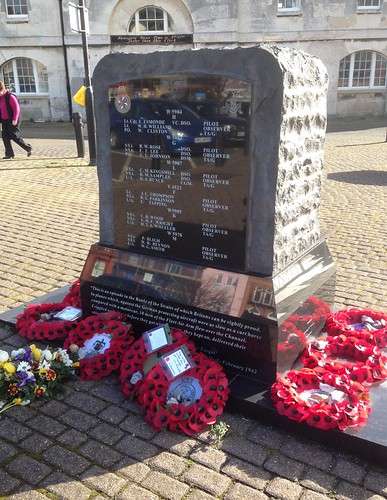
The attack became known as ‘The Channel dash’ officially called Operation Fuller, and in honour of the brave attempt to hit the German fleet that day, a memorial was erected in Ramsgate Harbour, the names of the eighteen Swordfish crew are listed where their story is inscribed for eternity.

Operation Fuller was a disaster not only for the Royal Navy and Coastal Command who had been monitoring the fleet for many months, but also for the Royal Air Force. A force of some 100 aircraft made up from almost every Group of Bomber Command had made its way to the Channel. By the time evening had dawned, it had become clear that some sixteen aircraft from the force had been lost. The loss of life from those sixteen aircraft totalled sixty-four, with a further five being captured and incarcerated as prisoners of war.*1

Bomber Command were not without their terrible stories either. The sad loss of W/C. R MacFadden DFC and his six crew who remained in their dingy after their Wellington from 214 Sqn ditched in the cold waters of the Channel. Over a period of 72 hours all but Sgt. Murray, slowly died from the cold, he being rescued at the last minute and incarcerated by the Germans. Of all the RAF squadrons that took part that day, their losses amounted to: 49 Sqn (4 x Hampdens); 50 Sqn (1 x Hampden); 103 Sqn (1 x Wellington);  110 Sqn (1 x Blenheim); 114 Sqn (1 x Blenheim); 144 Sqn (2 x Hampdens); 214 Sqn (1 x Wellington); 419 Sqn (2 x Wellingtons); 420 Sqn (2 x Hampdens) and 455 Sqn (1 x Hampden)*2

February 12th had been a disaster, so bad that The Daily Mirror reported on February 16th 1942 under the headline “9 Lost Hours in the Channel“,  that a demand had been put forward to Parliament for a complete statement on Naval strategy during the event. It also questioned the “suitability of Admiral Sir Dudley Pound”, in fulfilling his role. The paper goes onto say that a lag of some nine hours had largely been ignored by officials, that being the time between the first notice and when action was finally taken against the fleet. It also says that although the initial sighting was no earlier than 10:42 am, it took another hour before it too was responded to.  The public had been mislead it believed.

The entire operation has been badly organised by those in command, with little or no cohesion nor coordination between this various forces involved. As a result, the entire operation was a catastrophe with a major loss of life and no real result. The entire operation was seen by some as akin to a “Gilbert and Sullivan” comedy*3.

However, from that disaster came stories of untold heroism, bravery and self sacrifice by a group of men that have turned this event into one of Britain’s most remarkable and incredible stories of the war.

Operation 'Fuller' The memorial stands in Ramsgate Harbour.
Operation 'Fuller' The names of the 18 airmen and the Swordfish they flew.

Sources and Further reading

*1 To read more about Bomber Commands part in operation Fuller and a German film of the event, see the Pathfinders Website.

*2 Chorley, W.R., “Bomber Command Losses of the Second World War – 1942” 1994, Midland Counties publications.

*3 Bennet, D “Pathfinder“, Goodall, 1998

*4 McCloskey, K., “Airwork – A History.” The History Press, 2012

A German account of the ‘dash’ is given in “The First and the Last” by Adolf Galland published in 1955 by Meuthuen & Co.. Ltd.

Smith. G., “Heroes of Bomber Command – Cambridgeshire“. Countryside Books (2007)

National Archives AIR 27/1933/20, AIR 27/1933/21

RAF East Kirkby – Part 3 – the End of an Era.

In Part 2, we saw how crews at East Kirkby took a battering over Germany and how the Allies turned their attention to the forthcoming invasion.

In this, the final part, the war finally comes to an end and RAF East Kirkby eventually closes, but not without making its mark.

With spring at an end, thoughts turned back to the impending invasion and the bombing of pinpoint targets in France: Railways, munitions factories, troop concentrations and transport links became the focus for Harris’s Air Force. Throughout the month of April both East Kirkby squadrons were in operations, and whilst not significantly high, a number of aircraft were lost adding to the lengthening list of casualties and those now missing.

The end of this period of the war was remarkable for several reasons, notably when Wing Commander Leonard Cheshire of 617 Sqn, flew a Mosquito at low level and marked the target, a factory in Toulouse, with great success. This delighted Harris, who gave the all clear to 5 Group to operate independently of the Pathfinders of 8 Group, a decision that did little to heal the growing rift between Don Bennett and Ralph Cochrane who had taken the idea to Harris in the first place.

Other targets then became the focus for 5 Group including the railway yards at La Chapelle. In the operation Cheshire put this method  to the test once more. with 617 Sqn again to marking the target in conjunction with 8 Group’s Pathfinders. In the operation, 247 Lancasters from 5 Group were ordered to attack a pin point target. In the attack, 57 Sqn lost two aircraft. Of these two Lancasters the first, LL893 ‘DX-J’  was lost with all seven lives over St-Omer whilst the second, Lancaster MK. III ND582 ‘DX-S’ crashed after attempting a landing at Croydon. After overshooting the runway the aircraft, piloted by Canadian F.O. H. Young, struck at least three homes in Lavender Vale, a street adjoining the airfield. Three of the crew died immediately and a further one died from his injuries in hospital.

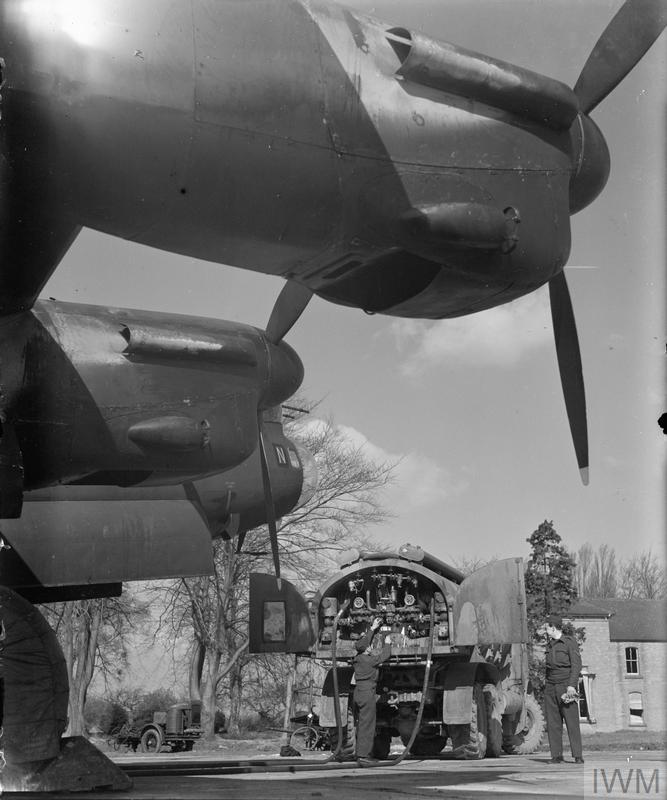
Operation POINTBLANK. Groundsmen refuel Lancaster ND560 ‘DX-N’, 57 Squadron in preparation for a night attack on the railway yards at La Chapelle, France. IWM (CH 12868)

Summer then dawned, and overnight, May 22nd-23rd, Cheshire once more, put his method  to the test. 617 Sqn were again to mark the target, but a heavily defended Brunswick led to heavy losses for both the East Kirkby squadrons, 57 losing three Lancaster Mk.IIIs and 630 Sqn another two. Only five airmen made it out alive, each one being captured by the German ground forces and so becoming prisoners of war.

These losses were however a mere pin-prick compared to June. The mission of 21st-22nd to Wesseling near Cologne proved to be yet another massacre for 5 Group who sent a total of 133 Lancasters to attack the city’s oil facilities. A number of squadrons took heavy loses including both East Kirkby’s 57 and 630 Sqns with six and five losses respectively. One of these aircraft was abandoned whilst another ditched in the sea allowing all crewmen to be rescued, but the overall loss proved to be devastating.

The spring – summer of 1944 was defining, not only had 5 Group shown that low-level marking could be done, but the attacks on targets in France meant that the Luftwaffe were at a disadvantage. Their night tactics, relying on long range bomber flights, could not manage with the shorter ‘quick’ attacks, and so losses from Bomber Command began to lessen.

This reduction allowed for restaffing, with a large number of officers, NCOs and airmen being both posted in and out of the two squadrons. It also allowed for training flights to take place, some 476 hours of operations compared to 729 hours for non-operational flights for 630 Sqn alone.

Like many places across the UK, the coming of D-Day, and the fragile success of the invasion led to an increase in morale at the station. Ground crews being acknowledged for their long hours and hard work in keeping aircraft flying and operationally ready, without them, these operations could not have taken place at all.

This extra effort and improved state continued for several months, and by August, it was acknowledged that morale had lifted, discipline was at a high and health was overall very good. Casualties were also down, a real boost considering the extra effort and number of operations that had been taking place over the last few months. The summer was at last ending on a high.

August’s improvement coincided with the liberation of Paris, a major landmark in the war’s progress. Ground forces were charging ahead. In the air, Bomber Command had played a small part in the offensive supporting ground troops as needed and now they were released from the tight grip SHAEF had held over them. Discussions followed as to where best place their bombs, oil and  communication were one option or alternatively, a return to the bombing of the cities and morale busting; oil won over, and so, much to Harris’s disappointment, the bombing of oil based targets began.

The looseness of the criteria however, allowed Harris to circumnavigate the ‘rules’ and turn his attention to cities with an oil link. He had got his way and the Air Ministry had got theirs.

Although individual operation losses were relatively low, 57 Sqn tallied some 56 aircraft by the end of 1944, whilst 630 Sqn reached 57. Non-operational loses for the two units were also on an equal par.

On the penultimate day of the year, East Kirkby was to witness, a short distance away from the airfield, the crash of a B-17 attempting to land. Aircraft #42-97479 (UX-L) of the 327thBS 92nd BG based at Podington (Station 109), crashed in a field between the two small hamlets of Old Bolinbroke and Hareby. On board that day were nine crew men: 2nd Lt. Joseph Martin Van Stratton (Pilot); 2nd Lt. Edward A Porter (Co-pilot); Sgt. Charles H Chambers (Bombardier); 2nd Lt. John E Cowan (Navigator); Sgt. Arthur R Estrada (Radio Operator); Sgt. Harold Raymond Barner (Ball Turret Gunner); Sgt. Wilfred A Bedard (Wasit Gunner); Sgt. Thomas G Standish ((Top Turret Gunner) and Sgt. William D White (Tail Gunner), who all lost their lives.

The aircraft, a Lockheed/Vega B-17G-15-VE Flying Fortress named “Belle of Liberty“, had returned from operations to the Bullay railway bridge located south-west of Koblenz, in Germany. After suffering engine failure, the pilot decided to abort the mission and attempt a landing at East Kirkby. In poor visibility and with one engine out, he overshot the runway and pulled up to attempt a second try. A second propeller then began windmilling and in trying to gain height to avoid a hill, the B-17 stalled and crashed.

A small memorial plaque has since been laid at the site in commemoration of those lost.

The wreck of the “Belle of Liberty” 30th December 1944.  (IWM FRE 5762)

The winter of 1944-45 was one of the worst, ground troops were by now entrenched in the Ardennes around Bastogne, with the German army preparing for one last push through the forests. Fog and snow kept many airfields non-operational in the UK, aircraft struggling to get much needed support across to the continent.

At East Kirkby, January started on high spirits, but on the 9th, 630 Sqn Lancaster PD317 ‘LE-G’ struggled to get airborne when one of its engines cut out on take off. After jettisoning its bombs, the pilot, F.O. G Billings, opened the throttle to attempt a circuit and landing. However, the port wing lost lift and dropped causing the aircraft to cartwheel injuring five airmen and killing two. With one further loss on the 14th, this brought the spring tally to two aircraft. However, good news did soon come as six of the seven crew were repatriated by the April. The seventh airmen, W.O. E Edwards, struck the tail plane on baling out and died the next day.

Otherwise, 57 Sqn, scraped through with a clean sheet and no operational losses were encountered, but they did suffer an unfortunate incident when ‘DX-N’ PB382 (the predecessor of DX-N below) entered Swedish airspace and was shot down by flak on the night of February 8th-9th.

The losses encountered by 57 and 630 Sqn, were only pipped by the tragic accident that was reported to have happened on the 17th of April. Although the operational records record no evidence of the accident, even to the point of showing some of the aircraft involved taking part and completing their operations, it is recorded in some resources that six Lancasters of 57 Squadron were destroyed following a fire in the fuselage of Lancaster PB360. As a result of the fire, four men were killed and a further five injured, along with several civilian workers near the site.

The fire started at 17:45, causing a series of explosions which destroyed the five other Lancasters parked nearby. The Hangar on the airfield was also badly damaged, as was a neighbouring farm. The fires were so severe that fire crews were brought in from nearby airfields and the area was not declared ‘safe’ until the following day. The Lancasters involved were: PB360 (MK.III) ‘DX-N’; ND472 (MK.III) ‘DX-I’; LM673 (MK.III) ‘DX-U’; RF195 (MK.I) ‘DX-‘; PD347 (MK.I) ‘DX-P’ and NN765 (MK.I) ‘DX-‘.*3

By now German resistance was minimal. Fighters were rarely encountered in any number and flak batteries were reducing in their accuracy and intensity. By May, the war was at and end, and quickly both ‘Exodus’ and training flights became the norm along with cross country and high level bombing training flights taking the front stage. For 630 Sqn July signified the end, after a period of intense recruiting the squadron was disbanded after serving for approximately eighteen months of the war.

During that time they had shown great courage in action. On average they had flown 1,087 hours of operational flying per month and 286 hours on non-operational flights. This amounted to 2,147 operations over enemy territory during which 64 aircraft had been lost. With another six crashing, the toll was high, and their medal tally reflected that, with in excess of 60 awards being granted.

In a last days before disbandment a sports challenge with 57 Squadron allowed 630 to show their colours one last time, winning the overall trophy, and with a party to celebrate that night, the squadron went out on a high. The final day saw the last parade and the handing over of the squadron crest to the Air Ministry for safe keeping. With that, 630 squadron disbanded.

Their place at East Kirkby didn’t stay vacant for long though, for on the 27th July, 460 Sqn arrived to join 57 Sqn and serve its lasts days here at this Lincolnshire airfield.

57 Sqn would continue on, taking on the Lincoln bomber in August as a replacement for the Lancaster although numbers remained low at this time. Fighter affiliation, high level bombing training and cross country flights became the main focus, along with ferrying flights into the European continent bringing back personnel and equipment; a schedule that continued for the next four months, its time finally being called on November 25th 1945.

Throughout the war 57 Sqn had served with distinction, providing crews for not just one but two different squadrons, one of which went on to become perhaps the most famous unit in the RAF’s history. It was a success however, that came at a cost, with the highest loss rate of the whole of Bomber Command, they had taken part in some of Europe’s most ferocious aerial battles and still went on to perform admirably.

On disbandment, 103 Squadron then at Elsham Woods, was immediately renumbered as 57 Sqn, and the unit number lived on. The majority of personnel from the original 57 Sqn were transferred to the RAF’s Holding Station RAF Blyton Holding Unit, along with personnel from several other serving squadrons. Seven three-men crews remained at East Kirkby to ferry the Lancasters away whilst six crews transferred to Scampton to form the basis of the new squadron along with three Lincoln bombers.

460 Sqn an Australian unit, had also served well during its war time life. Being originally formed on November 25th 1941, it was made up of Australian crews, flown Wellingtons, Halifaxes and then Lancaster I and IIIs. Its move to East Kirkby from Binbrook signifying its end, as training flights took over bombing missions and personnel began to be transferred out. By October it too had disbanded.

In an acknowledgement of their bravery, the closing remarks in the Operation Record Books state how the Australian had been warmly welcomed to our shores and how they had cemented a great bond between the two allies against a common enemy. Appreciation and thanks was warmly given to those who had served in the unit.

With the war’s end, East Kirkby was rundown, but between spring 1946 and February 1948, a detachment of Mosquito B.IVs from Coningsby’s 139 (Jamaica) Sqn, operated here, joined  between August 1947 and February 1948 by 231 Operational Conversion Unit (OCU) also on detachment from Coningsby. Flying a mix of Airspeed Oxfords, Avro Ansons & de Havilland Mosquito B.IVs, they were the last RAF units to use the airfield before it entered care and maintenance.

Then in 1951, the US Strategic Command 3rd Air Force took over the site, intending to use it as a stand-by airfield.  As part of the plan, the runway was extended by 1,230 yards along with an expansion to the apron. Both the 3931st ABG and 3917th ABS were based here but only visiting C-47 ‘Skytrains’ (a derivative of the Dakota) of the 7th Air Division’s Rescue Squadrons, ever arrived.

Eventually, on 31 October 1958, the airfield was returned to Air Ministry under ‘Big Shuffle’ , the reorganisation of the Air Force and its sites in the UK and Europe.*4

With that, East Kirkby closed for good, being sold off in 1964 when it turned once again to agriculture. However, bought by the Panton Brothers, it was turned into a living museum including a taxiable Lancaster to commemorate not only the third brother – Christopher Panton, who was killed on a bombing raid over Nuremberg on 30th – 31st March, 1944 – but all those who served in Bomber Command during World War II.

Part of the museum includes the chapel, a stained glass window and memorial board listing all those who died whilst serving at the airfield in both 57 and 630 Sqn, are poignant reminders of the toll on human life at this one small Lincolnshire airfield.

The full page can be read in Trail 1 – Lower Lincolnshire.

References and further reading (East Kirkby)

*1 Aviation Safety Network website accessed 19/10/24.
*2 Worrall, R., “Battle of Berlin 1943-44” Osprey Publishing. 2019.

*3 Chorley, W.R., “Bomber Command Losses pof the Second World War – Vol. 6 1945” Midland Counties Publications 1998.

*4 Francis. P & Crisp. G., “Military Command and Control Organisation
Volume 4  – The United States Air Forces in the UK” on behalf of English Heritage.

*5 The East Kirkby Museum have a website which gives far more detail, opening times, and other other visitor information.

National archives: AIR 27/538/38; AIR 27/538/44; AIR 27/538/43; AIR 27/2152/8; AIR 27/2152/7; AIR 27/2152/29; AIR 27/540/13; AIR 27/540/21; AIR 27/1910/11; AIR 27/540/8; AIR 27/540/7

American Air Museum Website Accessed 20.10.24

International Bomber Command Centre has several personal stories on their website, it is well worth a read.

Lincolnshire Aviation Heritage Centre Website.

RAF East Kirkby – Part 2 – a Relentless Slog.

In Part 1 we saw how East Kirkby came about, how its one main unit was used to create further units and how the war had taken its toll on those stationed here. In this part, we end 1943, but the high hopes of better things are far, far away.

The opening of September 1943, was however, the tip of the iceberg, for on the night of 23rd – 24th, three more aircraft were lost whilst on operations to Mannheim; all but five of the twenty-one men involved being killed, with those surviving five being incarcerated by the German forces. The operation had seen almost 630 aircraft take part in a raid that resulted in huge devastation with over 25,000 people being bombed out of their homes.

With the loss of two further aircraft in the closing days of September, the total dead or captured stood at seven Lancasters (forty-nine crewmen) with only four airmen returning to their Lincolnshire home. It had been a devastating start for the squadron at their new home in Lincolnshire.

October 1943 was much the same, major battles over the German Reich took further tolls with another four Lancasters falling from the skies. Most of these crews were also killed with just a handful surviving to be taken prisoner. The numbers of experienced crews on roll were quickly dwindling and replacements were now urgently needed.

NX611 'Just Jane'

The Lancaster ‘DX-F’ at East Kirkby, paying tribute to all those who flew from the airfield and in Bomber Command.

Then in mid November, 57 Sqn would be split for a second time to form yet another new squadron. This time, ‘B’ Flight were taken out and re-designated 630 Sqn. Initially being given the designation of an auxiliary squadron, it was however, a status that was never achieved. The entire flight consisting of nine crews and 106 ground staff, were led by the American, Sqn. Ldr. Malcom Crocker DFC, who simply moved across the airfield locating to new quarters and new dispersals, thus creating two operational squadrons at the site. Being battle hardened already, it took less than three days to complete the move before operations for them began once again.

November also saw Bomber Command enter its fourth month of the ‘Battle of Berlin‘, a period that saw intense bombing of the German capital with repeated raids on the city by heavy bombers of the RAF. It was also a time when the ill-fated Stirlings were finally pulled out of front line bombing campaigns, their losses becoming insurmountable. The decision to do so however, would put further pressure on the Lancaster and Halifax crews who were then left to complete the job with fewer aircraft and increasingly tired crews.

This period would become one of the RAF’s most testing times, and for the next four and a half months, Bomber Command, led by Sir Arthur Harris,  would continue to pound Berlin and other major cities deep inside Germany. The winter would be harsh, flights would be long, and it would be a gruelling time for the crews of Bomber Command.

The void left by the Stirlings was filled by the Halifaxes, and their loses now also soared. The battle for Berlin was a battle that would quickly diminish the capability of the RAF if loses were to continue at their current pace.

As the war entered 1944, the crews of Bomber Command became weakened and tired. Extensive battles had taken their toll and a rest was much needed. With poor weather dominating January that rest came, as crews were grounded unable to fly in the appalling winter weather.

The new year would see 617 Squadron dominate the way for 5 Group, their fame and successes taking a large chunk of the new reels. However, at East Kirkby, 630 Squadron would take on a new commander with the arrival of Wing Commander Deas in early February, taking over from Wing Commander J. Rollinson. Deas would continue to lead the squadron for the next five months, as it battled its way through the harsh winter period into spring and onto summer.

The pressure was however on Harris. He was now ordered to turn his men away from Berlin and help the Americans with the invasion plans supporting them in Operation Argument, otherwise known as ‘Big Week’. The operation was designed to weaken the German aircraft industry to prevent reinforcements of aircraft in the build up and launch of Operation Overlord.

In one last vain attempt to hit the capital, Harris planned four nights of raids in February, but poor weather curtailed these allowing only one raid to take place that on the night of the 15th – 16th February.

In the raid, which proved to be Bomber Command’s penultimate flight over the city, both 57 and 630 Squadrons would be involved. A mix of almost 900 Halifaxes and Lancasters saw losses amounting to over forty aircraft, one of these coming from 57 Sqn and another from 630 Sqn with the loss of all crewmen.

In order to lower losses, the formations would be concentrated, dropping 2,600 tonnes of bombs in just twenty minutes, a rain-storm of explosives that would see forty-five aircraft bomb every minute.*2

With that the Battle of Berlin came to an end, fizzling out as operations turned to The Rhine and its heavily defended industrial infrastructure.

The first area targeted was Leipzig, on the night of February 19th-20th. Here another 800 plus aircraft flew to Germany and back. They met determined German fighters as soon as they crossed the coast after which ensued a relentless air battle all the way to the target. Once there, it was completely covered in cloud and sky marking by the Pathfinders was the only possible method of identifying the target. In the operation, 630 Sqn put up nineteen aircraft and 57 Sqn, twenty; all but three returned home that night.

The Leipzig attack would prove to be a disaster for Bomber Command, strong winds meaning some bombers had arrived before the Pathfinders, and then had to circle the target for some considerable time before the markers arrived. This resulted in many of them being shot down by flak with some colliding in the dark, night sky. A loss of seventy-five aircraft that night led to the withdrawal of the second of the heavies – the Merlin powered Halifaxes – from front line operations; like the Stirlings before them, their loses had become unsustainable. This move put yet another heavy burden on the Lancasters crews, as it became the main heavy bomber now able to carry the war into Germany,

The night also proved to be an important one for one East Kirkby Pilot, W.O. J. White, whose determination to get the ‘job done’ and come home, led to him receiving the award of a DFM. In the attack, his rear gunner was mortally wounded, and the aircraft badly shot up with both hydraulics and an outer engine rendered unserviceable. Undeterred, W.O. White carried on to the target, dropping the bombs and then returning to England. On arrival, he managed to negotiate  landing the crippled aircraft at an unfamiliar airfield away from home. His courage and determination being more than worthy of the award he received for his actions.

With no break nor time to rest, another operation was ordered the following night, and although the 20th-21st attack on Stuttgart was a clear scoreboard for 57 Sqn, 630 lost another two; one of these ‘ND563’ swinging violently to port after travelling three-quarters of the way along the main runway. After crashing through a boundary fence and crossing a road on its belly, the bomb load exploded before anyone could escape. It was a tragic loss of life for those based at East Kirkby.

BBC war correspondent Richard North interviews the crew of Lancaster “S -Sugar” of No. 630 Squadron RAF on their return to East Kirkby, after bombing the marshalling yards at Juvisy-sur-Orge, France. IWM (CH 12778)

February closed with operations to Schweinfurt and Augsburg, an enquiry into the crash of ND5663 and the funerals of those who had lost their lives that day. With one squadron each losing a further crew, losses were continuing to mount for the two squadrons.

The early spring months would finally draw to a close over two disastrous nights. The first, on 24th – 25th March, saw Harris send his men back to Berlin one more time. In a last effort to bomb the capital, the RAF sent another 800 plus aircraft to the German capital, it would prove to be one of the worst for 630 Sqn, when three aircraft, including that of W.O. J. White who had just been awarded the DFM, were lost.

It was a dramatic figure that would be repeated on the last night of the month, when almost another 800 aircraft made up of Lancasters, Halifaxes and Mosquitoes were sent to Nuremberg. Weather reports from a Meteorological Mosquito were ignored and whist the operation should have been cancelled, it went ahead. In a moon-filled sky, the  result was carnage.

By the time all aircraft had returned, losses stood at 95 crews, almost 12% of the entire force sent out, and the biggest loss for the Command of the war so far. The weather experienced had caused the biggest problems, not only for the main bomber-stream, but also for the Pathfinders,  with strong winds blowing many aircraft widely off track causing them to bomb Schweinfurt, some 50 miles away,  by mistake. Of those that did bomb the correct target, many reported that they were unable to see it due to heavy cloud, which combined with the strong winds, forced both them and the Pathfinders to mark and bomb the wrong area. As a result, little damage was done to the city, and dropping bombs too early, caused ‘creep back’ to extend for some 10 miles ahead of the target. All-in-all more crews were lost that night then there were casualties on the ground, losses that were totally unsustainable for the command.

The German defences on both nights had been extensive and determined. Tame Boar and Wild Boar tactics along with Schrage Musik, the upward firing cannons, had devastated formations who were scattered far and wide. Harris had gambled with his crews and lost.

The disastrous nights of Berlin and Nuremberg led to a short pause in operations in much the same way as the dreaded raid on Schweinfurt did for the Americans. A new focus would take no chances, and precise bombing became the order of the day.

After devastating operations over the German cities, thoughts turn to the invasion and supporting the ground forces. A choice that did not agree with Harris, but one the crews would take in their stride…

The full page can be read in Trail 1 – Lower Lincolnshire.

RAF East Kirkby – Part 1 – A new Station emerges.

In the heart of Lincolnshire lies a former wartime bomber base that holds a particular and unique item dedicated to those who served in Bomber Command. The airfield where it is housed, was only used for a relatively short period of time, and by two main operational squadrons, yet it was one which saw the greatest number lost in the whole command.

In the next part of the trail, we travel away from Woodhall Spa to a former airfield synonymous with the Lancaster – RAF East Kirkby.

RAF East Kirkby

RAF East Kirkby is one of many Bomber Command airfields located in the Eastern county of Lincolnshire, a region that known as ‘Bomber County’. During its life it was home to two main front line squadrons along with a handful of other support units.

The airfield sits some 4 miles south-west of Spilsby and 12 miles north of Boston, in an area strongly associated with the Romans. Indeed, Lincoln – or Lindum Colonia as the Romans called it – became one of the largest and most influential Roman towns in England. Later, this area was where many invading Vikings settled, providing the local towns with examples of their own Nordic names, many of which can still be seen today. As time passed, both the Normans and the armies of Cromwell played their own part in the development of Lincolnshire, meaning the region has been left littered with several hundred monuments and numerous sites of archaeological and historical interest to offer the visitor.

Being in the lower regions of Lincolnshire, parts of it are only 40 feet above sea level meaning it is an area with a rich agricultural history as well; some areas being used to grow crops and of course tulips, bringing a wealth of colour and a wide range of crop to the area. It is all this that gives Lincolnshire both its beauty and its wide ranging historical interest.

Initially, East Kirkby airfield was built as a decoy site for nearby Coningsby and Manby, the site, complete with decoy wooden Whitley bombers, was decommissioned on June 27th 1941 and the area designated for a class A airfield –  RAF East Kirkby. Following requisition of the farmland in 1942, construction began by the building company John Laing & Sons Ltd., which included, amongst others, the first flushing toilets in the area. The airfield was finally completed in 1943, opening on August 20th that same year under the control of Bomber Command.

Located to the south-east of the village that gave it its name, the apex of the ‘A’, formed by the three standard runways, pointed westward with the main runway approximately north-south and the two subsidiaries west to north-east and west to south-east, each being the standard 2,000 and 1,400 yards in length and 50 yards wide.

As a bomber airfield the much needed runways would be of a concrete construction, and the airfield would boast six T2 hangars and a single B1 for maintenance and storage; a technical area stood to the north-west, with accommodation and the bomb store, spread around the area away from the main airfield site. Dispersals for aircraft storage and preparation consisted of twenty-seven spectacle hardstands along with five loop hardstands, all located around the extensive perimeter track.

As a decoy site, it had been bombed on several occasions, and having accommodation and high explosives near to the airfield was not a good combination. These accommodation blocks were of  a ‘temporary’ construction, very different to the luxury of Scampton, from where the first residents would come.  At its height RAF East Kirkby could cater for 1,965 RAF personnel with a further 482 WAAFs all of mixed rank.

Initial ownership went to 5 Group Bomber Command, whose headquarters were at the time at Morton Hall near Swinderby, in the North Kesteven district of Lincolnshire, and would operate as 55 Base, the parent station of sub-stations Spilsby and Strubby.

A somewhat posed photo of Flt. Sgt. J Morgan, the rear gunner of a 630 Sqn. Lancaster at East Kirkby. @IWM (CH 12776)

The first resident unit was that of 57 Squadron who took it on immediately upon its opening, bringing both the Lancaster MK.I and MK.III with them.

After forming in 1916, they were, like many other squadrons at that time, disbanded after the war’s end in 1919, but then, as similar events unfolded on the continent once more, they were reformed (in 1931) to run continuously to the end of the Second World War. With further breaks post-war, they would continue to operate up to the current day, flying a wide range of aircraft from Victor tankers in the Falklands to their current model the Prefect T1 trainer at RAF Cranwell.

57’s history goes far deeper than that though, for it was whilst at Scampton, their previous home before East Kirkby, that ‘C’ Flight was separated from the main squadron to form the basis of 617 Squadron, better known as ‘The Dambusters‘; the Flight Commander, Sqn. Ldr. ‘Dinghy’ Young only being appointed to 57 Sqn a matter of weeks before the transfer took place.

However, it was at East Kirkby that 57 Squadron were now based. On August 27th 1943, just after the split, the advanced party arrived at East Kirkby to start what would be three days of moving and settling in. The first section of the main party arrived on the 28th with the remainder joining them on the 29th. During this time all flying operations were understandably cancelled and the time was allocated to the huge task of moving men and equipment over to their new base.

Operations commenced quickly on the 30th, when fourteen aircraft were detailed for operations to Munchen-Gladbach. All aircraft except one, completed the operation in which ground defences were ‘light’ and bombing was recorded as being ‘good’ with a large explosion seen in the target area. The only casualty of the flight being Lancaster MK.III ‘ED655’ which returned early with an engine failure. Thankfully though, there were no injuries nor any further problems incurred.

On the following night another fourteen aircraft were detailed to attack Berlin, the ‘big city’, an operation which brought August to an end and a total of twelve operations (179 sorties) amounting to over 940 hours flying time for the month.

It wouldn’t be long though before the first causalities would arise at the new station. On the night of September 3rd 1943, Lancaster ‘JA914’  DX-O was part of another fourteen flight raid on Berlin. On board that night was Australian Pilot Flt. Sgt. W. Grindley and his crew, which included one other Australian and a New Zealander.

After departing East Kirkby at 19:30 hrs, the aircraft made its way toward the capital. As it neared the target, search lights managed to cone the bomber, allowing a German night fighter (FW190) flown by pilot Unteroffizier Fritz Brinkmann of the Stab/JG 300, to attack the aircraft, bringing it down at Zehrensdorf with the loss of all seven crewmen on board.

Three of the crew were recovered and remained buried in the Berlin 1939-1945 War Cemetery whilst the remaining four were not. They have been commemorated on the Runnymede Memorial.  The remains of the bomber were themselves discovered in a lake, and recovered on September 29th 1997; a large section of wing which is now displayed in the Deutsches Technik Museum, in Berlin.*1

On the 22nd September, a further crew were lost when an intruder, since known to be Major Wolf Dietrich Meister of the Stab V./KG 2, flying an Me 410 A-1 from Schiphol airfield, followed the bomber home and intercepted it near to the airfield. As it fell from the sky both the Flight Engineer and the Bomb Aimer managed to escape the burning wreck, both parachuting to safety, but the other five failed to get out and were killed in the resultant crash and fire.

In Part 2, we continue with the ups and downs of life in Bomber Command, seeing how the airfield continues to develop and how the war affects those based at the Lincolnshire airfield.

The full page can be read in Trail 1 – Lower Lincolnshire.

RAF Fersfield – where history was changed forever.

After leaving the open expanses of Deopham Green and the roar of Snetterton, we head to a very remote and quiet airfield. Quiet and remote for a very special reason. From here, crews would experience top-secret flights, we would see a link to one of America’s greatest and most powerful families, and from here, the RAF would strike another blow at the heart of the Gestapo. We head to RAF Fersfield.

RAF Fersfield (Station 140/554)

https://upload.wikimedia.org/wikipedia/commons/1/15/RAF_Fersfield_-_29_Aug_1946_Airfield.jpg

29th August 1946. Photograph taken by No. 541 Squadron, sortie number RAF/106G/UK/1707. English Heritage (RAF Photography).*1

Originally built as a satellite for RAF Knettishall, RAF Fersfield was built-in late 1943. The third Class A airfield on this Trail, its main runway ran along a NE-SW direction, was 2,000 yds in length and was constructed of concrete. There was a second and third runway each of 1,400 yds running N-S and E-W, again of concrete. Fersfield had two T-2 Hangars, one to the north side and one to the south, and 50 loop dispersals for aircraft storage. The bomb dump was located to the north, the technical area to the south and the accommodation blocks to the south and south-west. Fersfield would eventually be able to accommodate up to 2,000 personnel of mixed rank and gender.

Initially, the airfield was called Winfarthing and designated station 140, it was then handed over  to the USAAF who would rename it Station 554.

Fersfield was specifically chosen for its remote location as, unknown to those who came here, it was going to play a major role in the battle over Europe.

The first residents were a detachment of the 388th Bomb Group (BG) who were then based at Knettishall, and consisted of four bomb squadrons: the 560th, 561st, 562nd and 563rd. A detachment specifically from the 562nd, were brought here to perform special operations and research into radio controlled bombs using war-weary B-17s and B-24s. These special flights taking place between July 12th 1944 and 1st January 1945.

The 388th were unique in many ways. Aside from their work in radio controlled flights, they were also the only unit in the USAAF to not have formal squadron  identification codes. However, after VE day and the end of hostilities, wireless transmitter codes were applied to aircraft under the left wing preceded with the aircraft’s individual letter as a prefix. This then, gave a unique four letter identification on each aircraft. Similarly, the various aircraft used as remote controlled aircraft had the top surfaces of each wing and tailplane painted white for recognition purposes. *4

T2 Hangar now a store

An original T2 Hangar now stores grain.

Operating as Operation ‘Aphrodite‘, the idea of these operations was to remove all operational equipment from the aircraft, fill it with around 20,000 lb of ‘Torpex’ and fly it by remote control, into a specified target such as ‘V’ weapon sites, submarine pens (Operations Crossbow and Noball) or similar high prestige targets that were otherwise difficult to destroy .

Both the USAAF and USN were carrying out these trials. The Navy, also using Fersfield, called their operations ‘Anvil‘ and used the PB4Y (the Navy version of the B-24 ‘Liberator’) as their drone.

The first Aphrodite mission took place on August 4th 1944, and was to set the tone for all future operations. Mission 515, was flown using four B-17 ‘babies’ with four accompanying ‘mothers’ to target ‘V’  weapon sites at : Mimoyecques, Siracourt, Watten, and Wizernes. Escorting them were sixteen P-47s and sixteen P-51s. One of the babies, B-17 (#42-39835) ‘Wantta Spa(r)‘ (TU-N), had completed 16 missions between November 18th 1943 and July 6th 1944 with the 351st at Polebrook, and was declared to be “war-weary”. It took off but very quickly the crew – Lt J. Fisher and T/Sgt E. Most – realised there was a problem with the altimeter causing it to climb too quickly. Whilst T/Sgt Most bailed out, Lt. Fisher struggled on with the controls until it finally crashed in an almighty fireball in woodlands at Sudbourne, Suffolk, creating a crater 100ft wide. The three remaining ‘babies’ carried on but all failed to hit their designated targets. One Mother lost control and the baby hit a Gun Battery at Gravelines, the second overshot and the third B-17F formally (#41-24639) “The Careful Virgin”  (OR-W) of the 91st BG (323rd BS), hit short due to controller error.

The Careful Virgin 41-24639

B-17F “The Careful Virgin” before modification and whilst in the hands of the 91st BG. (USAF Photo)

Similar results were to follow in another mission only two days later, and then again in further operations throughout both the Aphrodite and Anvil projects.

The most famous tragedy of these missions was that of Lieutenant Joseph P. Kennedy Jnr, who was killed when his PB4Y unexpectedly blew up over Suffolk killing both him and his co-pilot on 12th August 1944.*2 In all, there were twenty-five drone missions completed, but none successfully hit their designated target with either control or accuracy. The missions were all considered failures and the operations were all cancelled soon after.

Operations Block

Former Operations Block south of the Technical site.

Another secret operation taking place from Fersfield, also involved radio controlled bombs. Designated Operation ‘Batty‘ it involved GB-4 television controlled bombs being  slung underneath B-17s and guided onto targets using TV. The 563rd BS provided much of the support whilst the other squadrons in the 388th BG, the crews. In the later part of 1944, a small number of these operations were flown again with little success and this too was abandoned before it could have any significant effect on the war.

All in all, the operations carried out here, were disastrous, killing as many crews and causing as much damage to the UK as it did the enemy. However, it did mean that the Allies had entered into the drone war and set the scene for future military operations. In all, there were 19 Aphrodite missions and 6 Batty operations carried out from RAF Fersfield.

The Americans left Fersfield toward the end of 1944, and it was then handed back to the RAF. A number of units used it for short periods, primarily for aircrew training, but none for major operational flights. However, it was not the end for the airfield, as Fersfield was to have one last remarkable mission and a further claim to fame.

Accomodation Site

Nissan Huts on the former accommodation site.

One of those squadrons who came here was 613 (City of Manchester) Squadron, who arrived at Fersfield on November 20th 1944. They were one of the twenty-one Royal Auxiliary Squadrons, and were considered the ‘baby’ of the Auxiliary Air Force by the other units. Formed on 1st February 1939 as part of No. 22 (Army Cooperation) Group, under Fighter Command, they were initially created with Hawker Hinds and a few Avro Tutors. It was then with another biplane, the Hawker Hector, and the monoplane the Lysander, that they moved with to France, early in the war to attack German gun positions and drop supplies to troops trapped in Calais by the advancing Wehrmacht.

613 performed a mix of roles, from Air Sea rescue operations from Martlesham Heath, to spraying lethal gas on troops in the event of an invasion, they moved from airfield to airfield gradually exchanging their older obsolete aircraft for more modern fighters as they went. They would take on both the North American Tomahawk followed by the incredible Mustang. It was with these aircraft that they were to escort the Venturas of 487 Sqn in their disastrous attack on the the Amsterdam power station in which Leonard Trent was awarded the VC. A mix up in rendezvous times meant the Venturas went on alone to the target, and thus paid the price for not having an escort with them.

In mid 1943, 613 Sqn operated from Snailwell near Newmarket, after which the ground personnel were sent to Sculthorpe and the aircrew to Lasham in Hampshire. This was to train all the personnel on the new Mosquito that the squadron was about to receive.

On joining the 2nd Tactical Air Force, they began attacks with their ‘Mossies’ on ‘Noball’ targets, and locomotives operating on the continent. It was at Lasham that 613 would become part of the newly formed 138 Wing, which would move soon after to Swanton Morley, but not before performing a very secret and daring mission.

Flying at very low level, they were to bomb the Kunstzaal Kleizkamp Art Gallery in the Hague, a former gallery turned Gestapo records office. Here documents relating to Dutch citizens for executions, deportation to concentration camps or labour camps were kept, and so it became a vital target for the wing. The operation was a total success, the building being all but demolished whilst nearby Dutch properties remained completely untouched.

The unit operated both on D-day, and supported the Americans in the Ardennes, flying through poor weather to strafe enemy ground troops who were trying to break through the American lines.

In November, the squadron moved to the continent in support of the allied forces whilst a small detachment of Mosquito VIs arrived here at Fersfield. They remained here until 7th August 1945, taking part in training flights, the last flight out taking place on August 5th 1945. At that point the squadron was disbanded the personnel transferring to 69 Squadron until their service ran out.

However, it was on March 21st 1945, that the crews of 613 Sqn would reunite with 487 Sqn, when the three Mosquito VI units of 21 Sqn (RAF), 464 Sqn (RAAF) and 487 Sqn (RNZAF) – now part of 140 Wing – were pulled back from the continent for a special mission to attack the Gestapo Headquarters at Copenhagen. Previously based at Hunsdon, the mission was Led by Gp. Capt. R. Bateson and Sqn. Ldr. E. Sismore, who took off in Mosquito RS570 ‘X’ at 08:35 and led a group of Mosquitoes in three waves of 6 aircraft in Operation Carthage.

The Shellhaus building raid gained notoriety for two reasons. Firstly, a large part of the building was bombed and destroyed and important documents were set alight, thus achieving the overall objective of the mission; another low-level, daring raid, it was operationally a great success.

However, Mosquitoes following the initial wave, attacked what they believed to be the target building, but it was in fact, a school masked by fire and smoke. This attack caused a significant number of unintentional civilian casualties including children at the school.

Six aircraft failed to return from the mission, four Mosquitoes (one of which crashed causing the smoke and fire that masked the school) and Two P-51s that were part of a twenty-eight strong fighter escort.

This operation was one of many daring low-level raids that the wing carried out, attacking various prestige targets including  the Amiens prison. Together with 138 Wing, the Mosquito under the charge of Basil Embry, more than proved itself as a successful low-level bomber aircraft capable of delivering high precision attacks on pin-point targets.

The aircraft eventually left Fersfield which signified the end of overseas operations for the site, and Fersfield would become a staging post for units prior to disbandment. Between November 1944 and September 1945 a number of units would be located here  which included: 98 and 107 (one week each); 140 (four days); 180 (one week), along with 226, and 605 Sqns. Operating a number of aircraft types including: Mosquitoes (T.III), Bostons (IIa), Hurricanes (IV), Martinets (TT.III), Mitchells (III) and Anson Is, Fersfield had now had its day, and in the last months of 1945, the site was closed and the land was sold off. Fersfield had closed its door for the last time and history had been written.

Post war, Fersfield had a brief spell of motor racing on its tracks and runways, but unlike Snetterton or Podington it would not last, and in 1951 Fersfield became agricultural once more, with many of the buildings being demolished and the remainder left to rot or, some thankfully, used for storage.

Nissen Huts

A few buildings remain on the technical Site.

Today a few buildings still do remain clinging onto life. The T-2 on the south side stores grain, and a number of Nissen huts  that housed the technical aspects of the airfield, are now storage for farm machinery and other associated equipment. All these can be located at the end of a small road from the village, and when visiting, I found the workers here only too willing to allow the visitor to wander freely among them. Footpaths cross the southern side of this site and to the north across the field dissecting the airfield. The path is very poorly marked and you are simply wandering across the crops. From here, you can find the last few remains of the accommodation site, further south a short distance away. Latrines and other communal buildings are shrouded in weeds, gradually disappearing beneath the undergrowth. Trees sprout from between the walls where so many walked before or after a mission. Nissen huts survive further out, now dilapidated and hastily patched, their memories mixed amongst the personal belongings of new owners.

Latrine Block

One of the many Latrines on the communal site.

It is hard to believe that an airfield with such an iconic history such as Fersfield never made it to the high status of so many others, as  surprisingly, it was here in this quiet and remote part of Norfolk that aviation history was made and American politics changed forever.

Squadrons that stayed at Fersfield in the last months of the war.

98 Sqn – Arrived here first, on April 18th 1945, remaining here until December 18th that same year with the Mitchell. They were disbanded at this point.

605 Sqn – Arrived 25th April 1945 staying until 31st August 1945 as a detachment of Mosquito VIs. They were then disbanded and renumbered as 4 Squadron.

226 Sqn – Joined 605 at Fersfield on 27th April 1945, also as a detachment but with Mitchell IIs. They too were disbanded on September 20th that same year.

180 Sqn – stayed here between 7th June and 14th June 1945, a weeks break from their airfield at Achmer to where they returned.

107 Sqn – Arrived at Fersfield a month later on 3rd July, also staying for one week with Mosquito VIs coming across from France to where they to returned.

140 Sqn – Stayed here between the 9th and 12th July 1945 with Mosquito XVIs, whilst en route from Eindhoven to Acklington.

Mosquito Mk.VIs involved in the Operation Carthage,*3.

No 487 Squadron

RS570 ‘X’ Gp Capt R N Bateson / Sqn Ldr E B Sismore (Raid Leader)
PZ402 ‘A’ Wg Cdr F M Denton / Fg Off A J Coe (damaged, belly landed at base)
PZ462 ‘J’ Flt Lt R J Dempsey / Flt Sgt E J Paige (hit by flak, 1 engine u/s, returned safely)
PZ339 ‘T’ Sqn Ldr W P Kemp / Flt Lt R Peel
SZ985 ‘M’ Fg Off G L Peet / Fg Off L A Graham
NT123 ‘Z’ Flt Lt D V Pattison / Flt Sgt F Pygram (missing)

No 464 Squadron

PZ353 Flt Lt W K Shrimpton RAAF (Pilot) / Fg Off P R Lake RAAF
PZ463 Flt Lt C B Thompson / Sgt H D Carter
PZ309 Flt Lt A J Smith RAAF / Flt Sgt H L Green RAAF (Flt. Lt. Green’s first given name was “Eric” known to all as “Les”, a common abbreviation in Australia. H.L. Green is used in the ORBs)*5
SZ999 Fg Off H G Dawson RAAF / Fg Off P T Murray (missing)
RS609 Fg Off J H Palmer RAAF / 2nd Lt H H Becker RNorAF (missing)
SZ968 Wg Cdr Iredale RAAF / Fg Off Johnson
All aircraft took off at 0840; last back landed 1405.

No 21 Squadron

SZ977 Wg Cdr P A Kleboe / Fg Off K Hall (missing)
PZ306 Sqn Ldr A F Carlisle / Flt Lt N J Ingram
LR388 Sqn Ldr A C Henderson / Flt Lt W A Moore
HR162 Flt Lt M Hetherington / Fg Off J K Bell
No 21 Squadron records list only these four aircraft and crews above as taking part in this operation.
All aircraft took off at 0835; the three which returned did so at 1355.

Sources and further reading.

*1 Photograph in Public Domain, taken from Wikipedia 20/8/15

*2 For a more detailed explanation of the operation that killed Joseph Kennedy Jnr. see  ‘The Last Flight of Joe Kennedy and Wilford Willy‘.

*3 Information from The National Archives, 21/8/15

*4 Freeman. R., “The Mighty Eighth” Arms and Armour, 1986

*5 My thanks go to Chris Berkley of the Canowindra Historical Society and Museum Inc. for the correction.

National Archives: AIR-27-1924-54, AIR-27-1924-53

RAF Hunsdon – The Mosquito Bites (Part 4)

In Part 3, we saw how Hunsdon and gone through various squadrons, operating the ill fated Turbinlite system which was soon withdrawn, and onto the arrival of the Mosquito, a deadly aircraft that could out run every German aircraft at its introduction. It was now time to bite, and the bite would come directly at the heart of the Gestapo.

In one of the war’s most famous attacks, so many questions would be asked, but answers would be short-coming and the truth may never come out. 

The new wing, previously formed at Sculthorpe, would consist of the three multinational squadrons, a ‘British’, Australian and New Zealand unit, and all would be based at Hunsdon as part of the RAF’s Second Tactical Air Force (2TAF) designed to support troops in the forthcoming invasion.

Group Captain P C “Pick” Pickard (centre), Commander No. 140 Wing, flanked by Wing Commander I G E “Daddy” Dale, Commanding Officer of No. 21 Squadron RAF (to Pickard’s right), and Wing Commander A G “Willie” Wilson, Commanding Officer of No. 487 Squadron RNZAF, visit No. 464 Squadron RAAF at Hunsdon, prior to a daylight raid against flying-bomb sites in the Pas-de-Calais. 464’s Mosquitoes (FB Mk VIs) have been loaded with 250-lb MC bombs for the operation: HX913 ‘SB-N’ can be seen in the background (@IWM HU 81335).

Between 1944 and 1945, 140 Wing would carry out many daring low-level bombing raids against V weapons targets, along with a key Gestapo building and a prison in occupied Europe. These particular raids were designed to both free captive resistance fighters and destroy important Gestapo documents. Operation Carthage took place in Denmark and occurred whilst the wing was based at RAF Fersfield in 1945, but the first, Ramrod 564 or ‘Operation Jericho’ as it has since become known, took place whilst they were based here at Hunsdon in early 1944.

There is a lot of speculation around Ramrod 564, many of the official records are missing, inaccurate or even vague. The operational record books for the four squadrons involved (three Mosquito and a Typhoon) are recorded as ‘secret’ and contain no details other than aircraft, times and dates.

However, we do know that the Operation, formulated by Air Vice Marshal Basil Embry, would be critical, even the amount of explosive itself had fine limits. Time was also of the essence, as several prisoners were thought to be destined for execution and so a time limit was placed on when it needed to be done by. The exact time of day was also critical, they needed as many guards to be in one place as possible, and the prisoners needed to be safely gathered together out of harms way. So, a time of 12:00 pm precisely on a date between 10th and 19th February was chosen, as both the guards and prisoners would be having lunch at this time. In the attack, six Mosquitoes would breach the outer wall in two places, whilst a further six would bomb the main prison buildings allowing the prisoners to escape whilst killing as many guards as possible.

Embry elected himself to lead the attack, but this was blocked by those higher up, As a result, and much against his wishes, Embry therefore had to choose a successor. Group Captain Percy C. Pickard (D.S.O. and two bars, D.F.C.) was chosen, but even though he was known as an expert pilot and leader, Embry was not convinced of Pickard’s ability to complete the job at such low level. Despite his reservations though, Embry duly informed Pickard of the decision and preparations for the operation began in earnest.

On February 18th that year, a day after the initial planned attack and in extremely poor weather, 19 Mosquitoes including a photo reconnaissance MK.VI (from the Operational Film Production Unit (OFPU) for propaganda purposes),  took off to attack, breech and destroy the walls and main building of the Amiens prison. A famously brave act, it resulted in the death of 3 crew members; Gp. Capt. Percy C. Pickard, and Flt. Lt. John A. Broadley, (RNZAF), both in Mosquito HX922, ‘EG-F’ and Flt. Lt. Richard W. Samson, (RNZAF) in Mosquito MM404 ‘SB-T’. Samson’s pilot, Sqn. Ldr. A. I. McRitchie survived his crash and was taken as a prisoner of war. Two Typhoons from 198 Sqn escorting the Mosquitoes are also thought to have failed to return (the ORBs don’t confirm this). Considered a success at the time, evidence has since come to light to suggest that the operation was ‘unnecessary’, and may have failed to achieve anything more than a successful PR role (see end note). *1

(A better quality version is available on the Pathe News website.)

All that aside, the raid took place at very low level and in poor weather, with bombs dropped against the wall with delayed fuses. There was little resistance on the flight in and Typhoons provided higher cover when it was needed.

The route would take the Mosquitoes from Hunsdon to Littlehampton – then via appropriate lattice to Tocqueville – Senarpont – Bourdon – then one mile South Doullens – Bouzincourt – two miles west-south-west to Albert – Target – Turn right – St. Saveur – Senarpont – Tocqueville – Hastings and back to Hunsdon.

During the flight out, four Mosquitoes and three Typhoons of 198 Sqn became lost in swirling snow and were forced to turn back as they had now lost contact with their main formations. The remaining crews flew on, but whilst over France a fifth Mosquito, flown by Flt. B. Hanafin, suffered engine problems and was also forced to turn back. On his return journey his was attacked by Flak from which he was seriously injured. Helped by his navigator the two were able to land back at RAF Ford where he was given medical treatment for his injuries.

Just three minutes behind schedule, the first wave of three aircraft followed the main road toward the prison’s eastern wall at tree top height. The second wave would attack the northern wall. Wg. Cdr. I. Smith 487 Sqn went in first dropping the bombs with 11 second fuses against the wall.

Wing Commander I Smith, Commanding Officer of No. 487 Squadron RNZAF, at Hunsdon (©IWM CH 12649)

The third and fourth waves attacked the south-eastern main building and north-western end respectively. Chaos then ensued inside the prison, as over running bombs had caused some damage inside and some prisoners were injured or struggled to escape.

Noting now that the walls and prison had been breached, the signal to abort was issued over the VHF radio probably by both Pickard and the OFPU Mosquito flown by Flt. Wickham (both the code word “Red, Red, Red” and who sent it are also disputed) instructing the four aircraft of the 21 Sqn Flight not to bomb. The message was heard by the flight, when they were between 2 and 4 miles out from the target, and so returned to base without dropping their payload.

During all this time, FW.190s continued to swarm and various dogfights took place between them and the Typhoons, but not before they had attacked some of the fleeing Mosquitoes who also returned fire.

It is unclear at what point in the attack that Pickard was shot down, but a Focke Wulf 190 flown by the ace Feldwebel Wilhelm Mayer, severed his tail sending his aircraft to the ground near to Saint Gratien. The resultant crash killing both occupants.

The story goes that Pickard had left his dog ‘Ming’ at RAF Sculthorpe, their previous airfield,  to be looked after whilst he was away. On the day he was shot down, 18th February 1944, the dog fell gravely ill. Pickard’s wife, Dorothy, went to get him and sensed, that after seeing the state of the animal, that Pickard had been killed . It took months for Ming to recover, and some years later whilst living in Rhodesia, Ming went outside, looked up to the sky as he always did when Pickard was flying, heard a whistle, collapsed and died.*6

Of the 700 prisoners detained inside the prison that day, 258 of them escaped,102 were killed and 74 were wounded*7, but the success remained secret from the public for a further eight months. With so much speculation surrounding the attack, it will no doubt remain one of the mysteries of war, but it was without doubt, an incredibly brave and daring mission that cost the lives of three superb young airmen.

A podcast using eyewitness accounts from the Imperial war museum can be heard through their website.

The Amiens raid was not the only daring low level raid carried out by the wing whilst at Hunsdon however. Airfields along with the Hazmeyer electrical equipment factory at Hengels in Belgium, were also attacked at low level. On this particular operation Mosquito MM482 was hit by intense flak setting the starboard engine on fire. As a result, the aircraft flown by Canadian Sqn. Ldr. A. W. Sugden with navigator Fl. Off. A. Bridger, was lost and both men were listed as missing. Having been with the squadron since 1942 they were considered ‘old timers’ by the others and were sorely missed.

The three squadrons of 140 Wing would soon depart Hunsdon though, leaving the joy of success and the turmoil of a thousand questions behind them. 464 went first on March 25th whilst 21 and 487 Sqns would both leave mid April, both moving to RAF Gravesend in Kent.

However, a month before the wing moved away, another Mosquito squadron would move in temporarily, meaning the airfield was awash with the aircraft of varying types. 409 (RCAF) Sqn’s time would be short, remaining here for just over a month before departing mid May, but they would return in June that same year staying for a further two months. Their final departure on the 25th August 1944, would end their association with Hunsdon for good, a move that took them to the continent and forward bases across the low countries.

Between June and the end of 1944, no less than six squadrons would come and go, most of them moving to the continent as the allied advanced progressed toward Germany. Each of these units would bring further Mosquitoes with them, with marks ranging from the MK.II and VI (418 Sqn); to the XIII with 29, 264 and 48 Squadrons, on to the XXX with 219 and 151 squadrons.

The longest to stay of these six units would be the first, 29 Squadron. Formed in 1915, they have operated almost continuously ever since, with just a short break between the wars and some reformation post war. Today they are based at Coningsby in Lincolnshire and are the southern most QRA Squadron currently flying Typhoons. They were in 1987, the first operational squadron to be equipped with the Tornado F3.

RAF Hunsdon Air Raid shelter

An air raid shelter now exposed.

At Hunsdon in 1944 though, the move would come as a surprise and with some reservations, but once here, it was considered to be an ‘improvement’ on West Malling. 29 Squadron would fly the NF. XIII Mosquito, arriving here on June 19th that year. The NF.XIII was the first variant night fighter to have the strengthened wing of the FB.VI, with increased fuel load and Merlin 23 engines. One such example, HK428 ‘RO-K’built at Leavesden, joined 29 Sqn at RAF Ford in early 1944.

On October 24th that year, during a flight test at Hunsdon, the aircraft suffered an overheating starboard engine and inactive flaps whilst in poor visibility. As a result the aircraft overshot the runway and crashed into a hedge causing the starboard undercarriage to collapse further damaging the aircraft. HK428 was subsequently repaired and passed to the Gunnery School at Catfoss in early 1945. It was eventually one of many that met the scrap man’s axe in 1946.*4

The Squadron would carry out patrols and intruder operations and whilst many of these were ‘uneventful’, several enemy aircraft were shot down including both Ju. 88s and Me. 110s. The last months of the war though were not all plane sailing. On July 1st, an accident during a flying test resulted in the loss of two good airmen and friends, Flt. Lt. John Barry and Fly. Off. Guy Hopkins.  A second Mosquito was hit by light flak at 500 feet on the 5th. Flying home on one engine, the aircraft made and emergency landing at RAF Ford, but somersaulted on the ground writing the aircraft off. Thankfully, and remarkably, in this instance neither crewman sustained any injury.

As the allies advanced more intruder missions took place. On some days the squadron was “let loose” to pick and locate their own targets, many choosing road or rail stock, damaging many trains as a result. The rest of the year and into 1945 would be the same. Intruder missions, ‘Flower‘ Operations (attacks against German night fighters at their airfield) brought some results. Then almost as quickly as they arrived they were given notice to move once more, and a huge party on the night of February 22nd 1945 preceded their departure to Colerne

Two other units arrived at Hunsdon after 29 Sqn, those of 418 (25th August, 1944) and 219 (29th August 1944) Squadrons. With all these Mosquitoes there must have been little room for any more aircraft as Hunsdon quickly filled  up with the type. 219 Sqn would quickly move out though, leaving what little space there was for a new unit, 488 Squadron who moved in the day prior to 219’s  departure. The last of this group of units to arrive that year was 151 Squadron. All but 151 transferred to the various airfields on the continent whilst 151 remained in the UK, leaving Hunsdon on March 1st 1945. It had certainly been a busy period at this Hertfordshire airfield.

1945 would be a reflection of the hectic movements of 1944. However, it would also bring a greater variety of aircraft as detachments arrived posted away from their main unit. It would also bring a slight change of role, as the range of twin engined Mosquitoes departed, single engined fighters came in.

The first would be a small detachment of 285 Sqn Hurricanes who resided here between January and June, followed in the beginning of March by 154 Sqn with Mustangs and Spitfires. 154 Sqn time here would be very short though, sadly ending their days here, just eighteen days later.

Almost at the same time, these units would be joined by 501 Sqn and 611 Sqn, 501 also ending their days of active duty here with their Tempest Vs, whilst 611 would swap their Spitfire VII for Mustang IVs before moving off to Peterhead and disbandment also. Both these units would however rise again the following year being reborn as the jet age dawned, to live on for a few more years.

442 Sqn, another Canadian unit, ended the flurry of units arriving in March that year when they brought Spitfire IXEs back for a spell from the continent, being stationed recently at B80 (Volkel) and B88 (Heesch), they had seen action first hand before arriving here. They soon replaced these aircraft with Mustangs though, moving on to RAF Digby in May as the war ended. 442 were also a short lived squadron, only being formed at Digby in February 1944. Their operational life had lasted just eighteen months.

April and May saw the last of the front line squadrons to reside at Hunsdon. The closing days of April saw 441 with Spitfires and 287 Sqn with a detachment of Tempests Vs. Both these units would move on elsewhere before they too saw the curtain fall, and their days as operational units cease. Like its sister squadron, 441 had only been operational for eighteen months, being formed in unison. In fact, their entire operational record matched to the day, even when they moved abroad.

Hunsdon then closed to operational activity, being used to receive returning men and materials up until mid 1946 whereupon it was placed into Care and Maintenance and allowed to run down. The tower was demolished very soon after the war ended, and the site was returned to agriculture. In total, Hunsdon’s crews accounted for over 220 enemy aircraft destroyed or damaged – a remarkable feat in any airfield’s chapter.

RAF Hunsdon Dispersal pen

One of the original dispersal pans.

Today Hunsdon remains one of the more accessible airfields of Britain. A number of public footpaths criss-cross its boundaries allowing unprecedented access to it. It is still an active site, allbeit much reduced – a small microlight operation exists here and has done since 1997. Using three small grass runways it has brought life, in albeit a small part, back to this old wartime airfield.

The perimeter track and narrow sections of all its runways still exist today and can be walked using a variety of footpaths. Along these paths and off to the sides can still be seen examples of runway lighting, drainage, inspection covers and even a small number of buildings.

The parachute store is one of the most notable of these, used by the farmer for storage, it is located at the north-western side of the airfield near to the former admins site and where the tower would have stood before being torn down. Also near here is the fire tender shed, now home to the local shooting club, a number of latrines \ wash blocks can also be found hidden amongst the trees to the south-east. The battle headquarters rests nestled amongst the crops still watching over the site, and small defence trenches and shelters can be found to the north and again these are visible from public footpaths. A number of airfield defences buildings in the form of pill boxes and an Oakington style pillbox can also be found around the site.

Many of these examples are buried amongst the undergrowth and are most easily seen in winter when the thorns and vegetation are at their lowest. Careful searching will also reveal a number of minor archaeological examples but again best in the winter when crops and weeds are minimal.

To the northern side of the airfield, next to where the microlight site is based, is a memorial to the crews of all nationalities who were based here all those years ago. Formed from a propeller boss of a Mosquito, it was donated to by the former Mosquito Museum (now de Havilland Aircraft Museum), it stands proud looking down what was the length of the secondary runway. A further memorial plaque can also be found on the wall of the village hall.

Hunsdon is a small site with a big history. It played a large part in trials of new innovations, carried out night intruder missions, and attacked with daring at low-level, at the very heart of the Gestapo. Hunsdon and its crews proudly earned their place in the annals of world history.

After walking Hunsdon we travel the short distance to the north-east to the outskirts of Bishop Stortford and a little known about airfield that is all but gone. We go to RAF Sawbridgeworth.

Further Reading and Sources (RAF Hunsdon)

*1 – The Amiens raid is one that has become embedded in history and is beyond doubt an incredible and daring low-level raid that succeeded in its aim. However, official records seem to have many errors, anomalies or missing details that it is very difficult to ascertain the accuracy of these historical ‘facts’.

The ORBs for each of the four squadrons give no details other than an ‘operation to France’, some crew names and aircraft numbers. There is no record of the use of the word ‘Jericho‘ but there are two sides to this story.

Some authors including Rowland White “Mosquito” and John Laffin “Raiders – Great Exploits of the Second World War“, both cite Basil Embry as the creator of the name ‘Jericho‘ before the missions took place, whilst Robert Lyman “The Jail Busters” cites a French film, made in 1946, as the author of creator of the name. Some believe the name was created by various media outlets since then whilst others say that Embry created the name after the operation had been carried out. It is however, widely considered that it was a post-war name as the original operation was ‘Ramrod 564‘ and none of the ORBs use the name ‘Jericho‘.  To further add mystery, the use of the title ‘Renovate‘ has also cited, but records in the National Archives show this as the secret VHF code word to be used by aircraft on the operation and not the Operation title.

The name aside, and more recently, one of the French Resistance fighters revealed his doubts about the operation, and considers that it may have been nothing more than a propaganda operation or a diversionary attack linked to D-Day. One book (one amongst many) on the subject has been written by author Simon Parry and historian Dr Jean-Pierre Ducellier entitled The Amiens Raid – Secrets Revealed‘ and is published by Red Kite. It goes into the details of the raid and possible reasons behind it.

There have also been theories that it was an MI6 operation but due to the nature and secrecy of the mission, little evidence is publicly available to substantiate this.

Of those who lost their lives, both Pickard and Broadley are buried in St. Pierre Cemetery, Amiens, whilst Sampson is buried in the Poix-de-Picardie cemetery in the Somme region.

*2 There is further information and personal stories about Tubinlite operations on RAF 23 Squadron, and they can be found on the 23 Squadron Blog site (1) and (2).  All ten were raised to squadron status on 2nd September 1942, but due to administration problems, five were not established until 8th September 1942)

*3 McCloskey, K., “Airwork – A History“. The History Press, 2013 (An excellent account of Airworks and  their part in the Turbinlite project).

*4 Thirsk, I., “de Havilland Mosquito – an Illustrated Story Vol 2” 2006, Crecy Publishing Limited.

*5 Photo from vintage wings website.

*6 Gunn, P.B., “Flying Lives – with a Norfolk Theme“, Peter Gunn, 2010

*7 National Archives, archived documents available via the old website

McCloskey, K., “Airwork – A History” History Press, 2012

National Archives: AIR 27/704/9; AIR 27/2001/1 – 19; AIR 27/33/21; AIR 27/704/39; AIR 27/704/11; AIR 27/1045/27; AIR 27/1045/33; AIR 27/1045/37; AIR 27/1802/55; AIR 27/1802/57; AIR 27/342/11

Vintage Wings of Canada Website

For information on building the memorials at Hunsdon and Sawbridgeworth visit Hertfordshire Airfields Memorial Group website.

The full story of RAF Hunsdon can be read in Trail 25.

RAF Hunsdon – The Arrival of the Mosquito (Part 3)

In Part 2, we saw how the Turbinlite system failed to produce what was expected of it, and eventually the system was scrapped and the squadrons disbanded. Those left at Hunsdon continued the night operations but soon they too would depart this Hertfordshire airfield leaving room for an influx of Mosquitoes – de Havilland’s ‘Wooden Wonder’.

On May 5th 1943, 85 Sqn would officially receive its squadron badge, although it was a former World War One Squadron, it had never been officially presented with it, and time had caught up. With the whole squadron lined up outside the Bellman Hangar, A.O.C. 11 Group, Air Vice Marshall H.W. Saunders, C.B.E., M.C., D.F.C., M.M., gave a speech highlighting how well the squadron had performed; shooting down ninety enemy aircraft in France, fifty in the Battle of Britain and a further twenty in night operations whilst at Hunsdon. He went on to highlight the number of decorations its crews had been awarded: four D.S.Os; seventeen D.F.Cs; three D.F.Ms, and Bars to both the D.F.Cs. and D.F.Ms. He then presented the station badge to the Commanding Officer Wing Commander Cunningham. At this point it was announced that the squadron would be moving south to West Malling in Kent and he wished the squadron good luck.

With just a few more days left before departure,  operations continued and on the 8th, three more JU. 88s were spotted but intercepted by Spitfires from other squadrons before the Mosquitoes could get to them. It was not to be the glorious ending 85 Sqn had hoped for.

After a farewell dinner for both 85 and 3 squadrons in the officer’s mess, preparations began for the move. Three Harrows arrived to collect  personal belongings and equipment, and then, on the 13th, 85 Squadron departed, all ten aircrews performing individual flypasts over the watch office to show their respect and thanks to those who had worked along side them, it was a sad day for Hunsdon.  The Harrows once loaded, departed shortly after with the main ground party departing by train soon after that.

The dispersals and accommodation did not remain vacant for long though, they were immediately taken over by a new squadron, 157 Squadron along with their servicing wing 3081 Servicing Echelon.

The new squadron was also a Mosquito Squadron, transferring in from Bradwell Bay. Night patrols had been the order of the day and these continued, and even as the squadron moved into their new home a Do. 17 was intercepted and shot down near Felixstowe.

Mosquito II of 157 Sqn being refuelled at Hunsdon, 16 June 1943. (©IWM CH 10312)

During the day, personnel took to painting and refurbishing the dispersals, whilst at night patrols continued on, an F.W. 190 falling victim to Flt. Lt. H. Tappin DFC and Fly. Off. I. Thomas in Mosquito S.727

The remainder of the month and into June involved further night patrols,  many being cancelled due to poor weather, whilst on the ground yet more decorating took place, with all crews taking part.

June then saw the temporary arrival of 515 Sqn with Defiants moving in from Heston. On June 1st, all aircraft had been received at Hunsdon with the rear party arriving later by road. As soon as 11 Group Headquarters had been notified of the squadron’s readiness, the order came though to move sections to forward bases ready for night operations. Eight aircraft immediately took off from Hunsdon but poor weather curtailed any further flights and they all returned the next day without taking part. This routine pretty much set the scene the remainder of the month. Shortly after arriving here 515 would start to accept the Beaufighter, a remarkable step up from the Defiant and an aircraft they would take when they left Hunsdon for Little Snoring in December that year.

Then in July, a new version Mosquito began to arrive with 157 Sqn – the MK.VI. ‘Ranger‘ patrols became a priority, attacking freight locos across the enemy network. On the 19th August, the Sqn claimed their 100th victim, a landmark number that was acknowledged by Sector Commander Group Captain Harris.

The next few months were a  mix of sporadic contacts but few engagements, ‘uneventful’ patrols and cancelled flights due to poor weather. The arrival of a Lancaster out of fuel in early October, a Wellington damaged by flak and a lost B-17 possibly heightening the excitement on the airfield.  A large portion of this time was taken with sports including shooting until finally ‘discouraged’ by local landlords.

RAF Hunsdon Latrines and drying rooms

Remains of the latrines and drying rooms.

157 Sqn however, wouldn’t remain at Hunsdon for much longer, departing with their Mosquitoes for Predannack in November that same year. A relatively uneventful stay at Hunsdon had finally come to an end.

Movements into and out of Hunsdon would continue in November, with the arrival of yet another Mosquito unit, 410 (Royal Canadian Air Force) Squadron. The unit would stay here on three separate occasions throughout 1943 and 1944, each time being for a short period only before moving on again elsewhere. Each stay would bring a new model Mosquito: MK. VI, MK.XIII, and finally the MK.XXX before moving off to the continent in 1944 and their eventual disbandment in June 1945. Whilst the squadron was primarily Canadian (seventy-two personnel), it also consisted of sixteen RAF personnel and four Americans, making it a multinational mix of aircrew, officers and ground crews.

It was whilst at their previous station, West Malling, that they would make the first ‘kill’ of 11 Group, when on the 5th November, a Mosquito piloted by Flg. Off. Green and his navigator Pt. Off. Goodhew, intercepted an Me. 410 and shot it down approximately 15 miles from Dungeoness. Three days later they would arrive at Hunsdon, where a turn in the weather prevented any further kills for the unit for the remainder of the month.

Training flights were managed on the odd occasion, intercepting friendly bombers with camera guns along with several Mahmoud exercises. On the 26th November tragedy struck when on one of these flights Flg. Off. J.J. Blanchfield in Mosquito DD669 struck the target Mosquito DZ259 flown by W.Off. C. James and his navigator Flt. Sgt. T. Levine. Both crews reported that they were bailing out, but both Blanchfield and his navigator Flg. Off. K. Cox, were killed in the accident.

The squadron’s  remaining time at Hunsdon was much similar, training flights, the odd operational scramble and bad weather persisted to the end of the year. But in December, one Mosquito flown by Flg. Off. “Joe” Schultz and Flg. Off. Williams manged to shoot down no less than three Dornier 217s in an epic air battle in which they themselves narrowly missed being the victim.

After vectoring onto the initial target, Schultz managed to shoot it down even though the Dornier tried to evade the attack by both attempting to fly into cloud and carrying out violent evasive movements. After dispatching this aircraft, Schultz pursued a second aircraft which exploded some 50 feet ahead of him, causing his own aircraft to jolt as it passed through the debris. A third Dornier gave a more difficult challenge, and even though both its engines were hit, the crew continued to return fire whilst the pilot made aggressive and violent defensive movements. The Mosquito in return, had its instruments put out of action and both engines hit, causing a fire in one. Luckily, this extinguished itself, but the second engine then failed altogether. Schultz managed to safely land the aircraft at Bradwell Bay using the single damaged engine, a remarkable feat considering the damage to the Mosquito and its components.

During the month, yet another new version Mosquito began to arrive at the squadron in addition to those already on station. By the end of the December, when they finally departed Hunsdon for Castle Camps, they had on their books: two Mosquito MK.IIs, one MK.III, one XII and seventeen XIIIs. A squadron Magister was also registered, but the Oxford they had, had struck a hill severely injuring the pilot, Flt. Lt. M.A. Cybulski DFC at Winter Hill, Belmont near Bolton. Flt. Lt. Cybulski had completed his tour of duty and was transferring to 9 Group when the accident happened.

New years eve 1944 would undoubtedly bring the most significant of the RAF units to Hunsdon and the one for which it is most famous. The arrival of  21 Sqn, 464 Sqn and 487 Sqn combined together to form 140 Wing, would see a number of dare-devil raids against German targets which, like the dams raid of 617 Sqn, would be forever discussed by historians.

The full story of RAF Hunsdon can be read in Trail 25.

RAF Hunsdon – The end of the Turbinlite (Part 2)

In part 1, we saw how Hunsdon was developed and how the new Turbinlite system was developed. However, things don’t quite go to pan the system falls doesn’t meet expectations.

After taking on Hurricanes IIB/C at Martlesham Heath in April, 3 Squadron arrived at Hunsdon from Stapleford Tawney, and like 85 Sqn, would remain here until mid May 1943, when it took its Mosquitoes to West Malling.

Pilots and aircraft of 3 Sqn would make their first appearance at Hunsdon on the 2nd August 1941 when twelve pilots arrived to practice formation flying with crews of the special Havoc Flight created earlier in May. These initial twelve would be followed by another twelve on the third, and then ten more crews on the sixth. The two squadrons would perform practice night flights together, formation flying and ‘dog fighting’ tactics with drogues. By the 10th, the bulk of the squadron had moved over leaving only a detachment both at Manston and Shoreham, where crews undertook both dawn and dusk patrols over southern England and over enemy airfields looking for bombers either landing or taking off.

Hurricane IIC, BD867 ‘QO-Y’, 3 Sqn, at Hunsdon. The exhausts have shields over them to help prevent them being seen whilst on night fighter operations. (@IWM CH 3509)

The combined practice flights would take Hunsdon’s 3 Sqn and the Turbinlite Flights aircrew well into the summer and autumn of the following year, progress being marred by continuing poor weather. GCI (Ground Control Intercept) training and formation flying between the two units took up the majority of the time whilst they were here, however, both dusk and dawn patrols in their Hurricanes gave the pilots of 3 Sqn a little respite from the routine of formation flying with the two Special Flights.

September 1941 then brought the second of the two Special Flights to Hunsdon. On the 20th, 1459 (Fighter) Flight, the penultimate of the ten, was formed here also operating both Havoc Is and Boston IIs, Fs and IIIs. The last of the Flights to make up the ten units would follow just after, being based in northern England at RAF Acklington.

It was quickly found that the Turbinlites not only had a lack of firepower, but poor speed as well, so they were soon demoted to being used solely as a searchlight platform with 3 Squadron’s Hurricanes taking over the main role of interceptor.

With the formation of a new squadron at Croydon, 287 Sqn would have detachments spread far and wide including one here at Hunsdon. Staying here for virtually the entire war, they would fly a range of aircraft including: Blenheims, Hudsons; Lysanders; Hurricanes; Masters; Defiants; Martinets and Spitfires. Even as a detachment flying support flights, they were the longest resident at Hunsdon but never achieved the same status as many of those that were to be based here.

After the turbulence of 1941, 1942 would initially bring a much calmer time at Hunsdon, with less movements in or out of the airfield, although staff changes did cause problems for some units. Changes were initially relatively small, the first of which wouldn’t come until the July of 1942, when a small detachment of 605 Sqn Bostons arrived. After being reformed the month before, at RAF Ford, the small group remained here until mid March 1943, when after taking on the Mosquito, they transferred to Castle Camps in Essex.

605 had previously been posted to Batavia where the majority of ground personnel had been captured by enemy forces. Those that were left were posted to various units and the squadron disbanded. Its reformation at Ford would be a slow process, but gradually it would receive both men and aircraft, accepting machines from 23 Squadron as it also eventually took on the Mosquito.

Whilst based here at Hunsdon, they would primarily carry out training, performing cross country flights,  searchlight co-operation flights and gunnery practice. Navigation also came under scrutiny with logs being examined by the squadron’s navigation officer. By the end of August though, all was well and the personnel returned to Ford thus reuniting the entire squadron once more.

As was the case with many other airfields, training and support flights also used the same airfields, training pilots in new and more modern ways to fly. Hunsdon was no different, and in August a new Flight fulfilling this role was created here at Hunsdon. 1530 Beam Approach Training (BAT) Flight, who were formed specifically to train pilots to land in the dark, or poor weather, using a ‘beam’ (formally blind approach) or radio system. They remained here for some time eventually moving to Wittering where they were disbanded later in 1944.

It would also be in August 1942, that Hunsdon’s resident 85 Sqn would take on the Mosquito, the MK.IIs being a major change from the Havocs previously used. It would only be a trickle of aircraft at first, with just a small number of the ‘Wooden Wonders’ being received by the month’s end.

The trickle continued into September as did the nightly Havoc patrols. On the 7th, Sgt. McCormick sighted what he believed to be a Ju. 88, and closed in for the attack. After following the aircraft he managed to close to 150 feet at which point he opened fire on the starboard engine which quickly caught fire. The aircraft fell from the sky and was later seen burning on the sea below. It was confirmed not as a Ju. 88 but as an He.111 distinguished by its fixed rear-firing machine gun in the extreme end of the fuselage.

September 1942 then brought yet more change. At this point it was decided to raise all ten Turbinlite squadrons to squadron status. The date decided upon was September 2nd 1942. However, due to administration problems, only five could be raised on that date, the remaining five being raised six days later on the 8th of the month. By then, all ten Turbinlite training Flights had been disbanded and reformed as operational squadrons.

With that, 1451 became 530 Sqn on September 8th and continued to operate from Hunsdon, whilst 1459 became 538 Sqn and was relocated to Hibaldstow.

The reformation meant that flights were initially curtailed for 530 Sqn. The poor September weather then added to the issue meaning that flying was at best sporadic. Two further support Hurricanes soon arrived for the squadron taking the total available to four. But their arrival did not ease the situation, the poor weather and other factors continuing to dominate operations to the point that little operational flying took place at all.

October fared little better. More poor weather combined with the fact that three of their four Hurricane pilots (all American), were transferred to the US Army Air Corps, meant that 530 Sqn was unable to progress the way it had hoped. It had been a very poor start for the operational Turbinlites.

By November there were a total of eight Hurricane pilots, some of which had transferred in from O.T.Us, but all were lacking night flying experience. As a result, they were rushed through a night flying course at Hunsdon and were passed as ‘operational’ by the month’s end. However, the problems did not end there. Formation flying in good weather was considered difficult and in visibility of 2,000 ft or less, impossible. This meant that the required number of night flights were not being made which held back all operational flights. Compounding this, continuing bad weather had by now turned the ground very soft and a number of aircraft were getting bogged down in the mud. In addition, whilst aircraft serviceability was generally good, a few had experienced wrinkling of the skin over the air frame and were now awaiting an inspection before being allowed to fly. By now, the crews must have been wanting 1942 to draw to a very quick close.

And to a close it came. December brought rumours of the demise of the Turbinlite squadrons causing uncertainty amongst the personnel. Continuing bad weather had curtailed all but the most urgent of flights. Lectures prevailed bringing escape tactics and Luftwaffe organisation information up to date. A new Havoc was brought in for testing with a new windscreen deicing system, unfortunately this was found unsatisfactory, so a new hot air method was suggested by the squadron and tested under the same conditions. This proved much more successful.

Christmas celebrations then kept the personnel occupied and were ‘livelier than expected’ primarily due to the inclement weather. Crews in the meantime being kept on standby in case the weather turned and operations became necessary again.

RAF Hunsdon Battle Headquarters

The battle headquarters.

With New Year 1943, came the news that the Turbinlites were indeed being disbanded. Of the ten squadrons formed, only five made successful enemy intercepts – Turbinlite was not a great success and as a result, on the 25th January, 530 Squadron along with all other units, ceased to exist and all personnel were scattered amongst other squadrons.

The end of the Turbinlites meant that Hunsdon only had two operational units at this point, both 85 and 3 Sqn continuing to fly from the airfield when they could. The early part of the year, brought considerable fog and cold weather, the fog preventing flying on many occasions, which hampered test flights for 3 Sqn on their new Typhoons when they arrived in February.

By mid May though, both these units were to depart also, 3 Squadron transferring to West Malling, with the Mosquitoes of 85 Sqn joining them soon after, but not until after a very important ceremony.

The full story of RAF Hunsdon can be read in Trail 25.

RAF Hunsdon – The beginnings of Turbinlite (Part 1)

In Trail 25 we head to the south once more, to the west of Harlow, and to two wartime airfields; one of which played a major part in striking a blow at the very heart of the Nazi regime.

The county of Hertfordshire is an area popular with commuters to both London and the technological towns of Harlow and Bishops Stortford. Being north of London, it is also close to Stansted airport, itself an ex World War II airfield. Hertfordshire has some beautiful countryside, delightful little villages and quaint country pubs. It is also an area with a wealth of history.

Our first stop is a small airfield nestled in the heart of this beautiful countryside. It is situated north-east of the village that gives it its name, RAF Hunsdon.

RAF Hunsdon

RAF Hunsdon Village sign

The Hunsdon Village sign reflects its history and links to the RAF.

Even before Hunsdon was built, it is referenced in some areas that the site was being used for a detachment of 107 Squadron Blenheims, then based at RAF Wattisham and later Leuchars. This may have been part of the ‘Scatter’ directive given to squadrons in the immediate period before war was officially declared, and was thought to occur between May 1939 and March 1941.  However, there are no references to this in the official squadron files and so this action is doubted. However, if this were the case, then it would certainly suggest an early use of the site before it was developed into a fully operational airfield, and it may have been an indication that an airfield was on its way in the near future.

The site was earmarked for development in 1940, with construction occurring over the period October 1940 to March 1941, after which the first squadron moved in. It was built by various construction companies and incorporated two asphalt runways; the main running east-west reaching 1,750 yards in length after its later extension, with a second running north-east to south-west  extended to 1,450 yards; both were built to the standard 50 yard width. Aircraft dispersals, maintenance and storage buildings consisted of eighteen ‘twin-engined’ hardstands; sixteen blister hangars (a mix of ‘Over’ (4) and  ‘Extra Over’ (12)) and a Bellman hangar. There was also a fuel dump and accommodation buildings for up to 2,240 airmen and some 276 WAAFs, all located across eight dispersed sites.

A large number of operational units, (in excess of twenty-five) would pass through its doors throughout its relatively short life, providing Hunsdon with a multinational mixture of crews and a number of aircraft types.

The airfield itself lies within a stone’s throw of London and so its initial role was that of night fighter operations covering London and the south / east area.

The first recognised squadron to make its mark at Hunsdon was 85 Squadron on May 3rd 1941, transferring across from RAF Debden flying Defiants and Havoc MK.Is. The move across on the 3rd went smoothly with personnel and equipment being transferred across in lorries and 32 seat busses, the majority of personnel arriving later that day.

RAF Hunsdon Parachute store

The Parachute store now holds farm machinery.

On arrival at Hunsdon, personnel of ‘A’ Flight were immediately billeted on the aerodrome close to their dispersals, whilst those of ‘B’ Flight were housed on Number 2 Site, located about a mile or so from the main airfield area. Personnel of both the Headquarters Flight and the servicing Echelon were billeted even further away, about four miles in fact, at Gilstone Park. The officers meanwhile, had the better accommodation, being billeted in a house called ‘Boningtons’ believed to be the former home of “Mr. Brooke Bond” the family of the P.G. Tea empire. It is thought that the family purchased the house in 1940, moving out of their London residency to avoid the blitz. Unfortunately, it was rather a short lived purchase as the property was requisitioned by the RAF not long after!

By the end of the 4th, all 85 Sqn personnel were in and unpacked at Hunsdon, and so night flying duties could commence straight away with patrols taking place over the Felixstowe area. Immediately, a Heinkel He.111 was vectored onto, and a skirmish took place in which both aircraft both gave and received machine gun fire. The Luftwaffe bomber came off worst though, and was last seen diving into cloud firing a white verey pistol, either as a resignation of the fight or possibly as a distress signal to any would be rescuers.

Over the next few nights further contacts were made and several Ju. 88s were either confirmed or claimed as shot down. The squadron was performing well, morale was high and all was looking good.

The night of the 13th could have been different for some though. On his return from a patrol, Fly. Off. Hemingway’s instruments failed and with little choice, he gave the order to bale out. After his operator, Sgt. Bailey, had departed the Havoc, Hemingway followed, both men landing in close proximity to each other in the grounds of Much Hadam Hall (a grade 1 listed building built in the early 1700s). Whilst both airmen were safe, Hemingway’s was not the model jump, as he came to rest in a tree in the grounds of the hall. Bailey fared little better, landing rather ungainly on a bucket not too far away. This was Hemingway’s third successful bale out of a stricken aircraft, his previous two both occurring during the Battle of Britain.

On May 17th, Wg. Cdr. Peter Townsend, now with a DSO, flew to Great Massingham, Flt. Lt. Marshall flew to Odiham to test the runway and Flt. Lt. Rabone flew to Heston from where he collected a special and secret Havoc which was to be tested by the squadron. The first flight of this new variant occurred on May 23rd, and was quickly followed by a second aircraft on the 28th, After this, they would then begin testing both aircraft as a new night flying platform.

This particular type of aircraft was the forerunner of what became known as the Turbinlite Havoc, a new design that was the brainchild of one Sidney Cotton.*3

RAF Hunsdon Runway remains

The main runway has been reduced to a track.

With the help of William Helmore, Cotton took out two patents; GB 574970 and GB 574118, each one relating to this new idea. It would be Helmore (an Air Commodore) who would then develop the idea further turning it into what would become commonly known as the Turbinlite system.

Originally designated Air Target Illumination, Cotton’s idea was passed to the Alan Muntz Company, who in conjunction with G.E.C., developed it into what was at the time, the most powerful searchlight in the world, and one that would fit neatly into the nose of a Douglas Havoc, or Boston as it was known in the RAF.

The light was so powerful that it would require a staggering forty-eight batteries each stored in the bomb bay of the aircraft, adding an additional weight to the aircraft just short of 2,000lbs. The light was so strong (1,400 amps) that it would discharge in less than 12 seconds meaning its use was limited to short searches only.

Havoc Mark I (Turbinlite), AW400, on the ground at Burtonwood, Lancashire. This aircraft served with Nos. 1422 and 1454 (Turbinlite) Flights, and with 1459 (Turbinlite) Flight/538 Squadron RAF, before transfer to the USAAF in April 1943. (© IWM ATP 10654C)

The first full prototype Turbinlite aircraft fitted with the unit was Boston W8254 and was flown by Acting Squadron Leader A. Clouston of 1422 (Night Fighter) Flight formed at Heston on May 12th 1941. The Flight would then operate a number of these aircraft, along with several other types which included the only Turbinlite Mosquito; along with a Defiant, Wellington and Hurricane.

Heston was the home of Airwork, an aviation company set up by two ex-Cambridge students and soldiers of the great war, Sir Henry Nigel Norman and Alan Muntz.  Their vision, was to create the best aerodrome near London, a dream that would cost Norman his life and Muntz to lose his son. Airwork would go through many changes during its life, taking on several Government contracts including a range of flying schools to train RAF pilots throughout the Second World War. These included RAF Digby, RAF Grangemouth, RAF Scone (Perth) and RAF Linton-on-Ouse.

Airwork would themselves modify a further four Bostons, with a further sixteen being modified by the Heston Aircraft Company. A third batch was then developed at RAF Burtonwood, giving a total of nine flights for training and ten operational squadrons comprising just short of 100 aircraft in all.

It was soon realised however, that the Bostons lacked firepower and so the company began to look at the Mosquito as a possible replacement aircraft. Only one Mosquito was modified (W4087, a Hatfield built F.II) at Heston, but this idea, unlike the Boston, failed to progress any further than the prototype stage, and no other aircraft were converted.

The Only Mosquito converted to carry the Turbinlite.*5

The Turbinlite project quickly gained pace, but the units wouldn’t be raised to squadron status until September of the following year. In preparation, ten special Havoc flights were created to train crews to operate the aircraft. The first of two, formed at Hunsdon (and the first of the ten) was 1451 (Fighter) Flight on May 22nd 1941. The Flight used several examples that included both Boston IIIs (AL469 and Z2280) and Havoc Is (AE470 and AW405). It also utilised a Cygnet and Tiger Moth for pilot training. By the end of the month, 85 Sqn had flown a total of 505 hours, 482 of them undertaken in Havocs, with 213 of these being on night flights.

On August 9th 1941, 85 Sqn were joined here at Hunsdon by 3 Sqn, one of the original three squadrons to have been formed by the Royal Flying Corp. Created on May 13th 1912, when the Air Battalion of the Royal Engineers was absorbed in to the month old Royal Flying Corps, 3 Sqn joined both 1 and 2 Squadrons as the oldest units to have operated in the RFC. As such, its history is long and very distinguished.

In Part 2 we see how the Turbinlite develops, and how, as the war goes on, the first of Mosquitoes arrive.

The full story of RAF Hunsdon can be read in Trail 25.