Deenethorpe saw action by 4 squadrons from the 401st Bombardment group, reputedly the “The best damned outfit in the USAAF”. They flew 254 combat missions and received two Distinguished unit Citations. They had the best bombing accuracy of the mighty Eighth and one of the lowest loss ratios of any USAAF unit. However, a local disaster and inauspicious start, did not mean it was all plain sailing.
RAF Deenethorpe (Station 128)

Deenethorpe October 1942, taken by No. 8 OTU (RAF/FNO/166). English Heritage (RAF Photography). The memorial is to the bottom right*1
Constructed in 1942/43 as a Class ‘A’ airfield, it would have three concrete runways, a main of 2,000 yds and two secondary both 1,400 yds. The main runway ran in a north-east to south-west direction whilst the two secondary runways ran north-west to south-east and east-west respectively. The airfield was built adjacent to the (now) main A427 Weldon to Upper Benefield road and had around 50 loop style hardstands for aircraft dispersal.
For maintenance of the heavy bombers, two ‘T2’ hangars were sited on the airfield, one to the south-eastern corner and the second to the west, next to the apex of the ‘A’. Fuel stores were in the southern and northern sections, away form the technical site located to the south-east. Accommodation sites for 421 Officers and 2,473 enlisted men were also to the south-east beyond the road. Initially used by the RAF as a training base, it was quickly adopted by the USAAF and personnel soon moved in.
The main inhabitants of Deenethorpe were the four squadrons of the 401st BG, 94th Combat Wing, 1st Air Division. This Division, operated from nine airfields, in this Peterborough-Cambridge-Northampton triangle with three further fields to the south-east of Cambridge. A small cluster of sites located close together but away from the main 2nd and 3rd Air Divisions of Norfolk and Suffolk.
The 401st were a short-term unit operating until the end of the war; although they did go on to serve post war in the 1950s following reactivation. Originally constituted on March 20th 1943, they moved through various training airfields eventually arriving in England in October/November 1943.

B-17 Flying Fortress SC-O (42-97487) “Hangover Haven” of the 612th BS/401st BG after crash landing at Deenethorpe, 3rd October 1944*2
The four squadrons of the 401st, the 612th, 613th, 614th and 615th, all flew B-17Gs and operated with the codes ‘SC’, ‘IN’, ‘IW’ and ‘IY’ respectively. Using a tail code of a white ‘S’ in a black triangle, a yellow band was later added across the fin (prior to September 1943, the tail fin codes were reversed, i.e. black ‘S’ in a white triangle as in the above photo). The ground forces arrived via Greenock sailing on the Queen Mary, whilst the air echelon flew the northern routes via Iceland. Their introduction into the war would be a swift one.
The primary role of the 401st would be to attack strategic targets, such as submarine pens, ship building sites, heavy industrial units, marshalling yards and other vital transport routes. Many of these were heavily defended either by flak or by fighter cover, much of which was very accurate and determined.
On the 26th November 1943 they would fly their first mission – Bremen, headed by their commanding officer Colonel Harold W. Bowman. It was not to be an auspicious start though. With 24 crews briefed, engines started at 08:00, twenty-four B-17s rolled along the perimeter track to their take off positions at the head of the northern end of the main runway.
It was then that B-17 “Penny’s Thunderhead” 42-31098, of the 614th BS, slipped of the perimeter track trapping the following aircraft, commanded by the Station Commander Major Seawell, behind it. Then a further incident occurred where aircraft 42-39873, “Stormy Weather” suffered brake failure and collided into the tail of 42-31091 “Maggie“, severely damaging the tail. Four crews were out of action before the first mission had even starte. Bad luck was not to stop there. Once over the target, cloud obscured vision and whilst on the bomb run “Fancy Nancy“, 42-37838, collided with another B17 from the 388thBG. “Fancy Nancy” was luckily able to return to England, but severely damaged it could only make RAF Detling in Kent where it crash landed. So severe was the damage, that it could only be salvaged for parts and scrap. The mission report for the day shows that the ball turret gunner lost his life in the incident, the turret being cut free from the fuselage. A further gunner was wounded by flak and a third suffered frost injuries to his face.
On their second mission, the 401st were able to claim their first kill. A FW-190 was hit over the target at Solingen and the aircraft destroyed, but their luck was not necessarily about to change.
Within a matter of weeks the 401st were to have yet another set back and it was only due to the quick thinking of the crew that casualties were kept to a minimum. On December 5th 1943, mission 3 for the 401st, target Paris; B-17 42-39825, “Zenobia” crashed on take off coming to rest in nearby Deenethorpe village. The uninjured crew vacated the burning aircraft and warned the villagers of an impending explosion. Fire crews and colleagues rushed to the scene, and the two remaining injured crewmen were safely pulled out. Twenty minutes after the initial crash, the aircraft, full of fuel and bombs, finally exploded destroying a number of properties along with the fire tender. The explosion was so enormous, it was heard nine miles away.

The crew of the B17 which crashed on the village of Deenthorpe. L-R. T/Sgt William D Woodward, (t/t), Sergeant Waldon D Cohen, (b/t), Sergeant Harold J Kelsen, (w/g), Sergeant Robert V Kerr, (t/g), S/Sgt Benjamin C Misser, (r/o), and Lieutenant Walter B Keith, talking to Captain RJ White, who rescued the navigator Lieutenant King. The navigator and bomb-aimer are still in hospital, recovering from injuries. *3
The new year however, brought new luck. During operations in both January and February 1944 against aircraft production facilities, the 401st were awarded two DUCs for their action and as part of the 1st Air Division, they would be awarded a Presidential Citation. The 401st attacked many prestige targets during their time at Deenethorpe including: Schweinfurt, Brunswick, Berlin, Frankfurt, Merseburg and Cologne, achieving an incredible 30 consecutive missions without the loss of a single crew member.
Like many of their counterparts, they would go on to support the Normandy invasion, the break out at St Lo. the Siege of Brest and the airborne assault in Holland. They attacked communication lines in the Battle of the Bulge and went on to support the Allied crossing into Hitler’s homeland over the Rhine.
The 401st performed many operations, 254 in total. Their last being on April 20th 1945 to the Marshalling yards at Brandenburg. During the mission, B17 “Der Grossarschvogel” (The Big Ass Bird) was shot down. Five crew members were killed in the crash and several others, who had managed to escape, were beaten by civilians almost killing two of them. Ironically, they were ‘saved’ by Luftwaffe personnel, and in one case, even freed although the orders had been to shoot him.
These were not to be the last 401st fatalities though. On May 5th 1945, VE day of all days, Sgt G. Kinney was hit by the spinning propeller of a taxying B17 killing him; a devastating end to operational activities at Deenethorpe.
On June 20th, the 401st vacated Deenethorpe, returning via the same route that they came and were then disbanded in the US. Deenethorpe was returned to RAF ownership and retained until the 1960s when it was sold off. The standard design 12779/41 tower was demolished in 1996 and the remainder of site returned to agriculture. All major buildings have been removed as have two of the three runways. The main one still exists today for light aircraft and microlights, as does most of the perimeter track – but as a mere fraction of its former self.
Whilst there is little to see of this once enormous airfield, best views can be obtained from the main road the A427 Weldon to Upper Benefield road. A few miles along from Weldon on your left is the airfield. Stop at the memorial. The original control tower, now gone, stood proud, visible from here beyond the memorial. The technical site would be to your right, and you would be looking almost straight down the secondary runway to your left. The communal and accommodation sites were directly behind you and traces of these can be seen but only as building footings. In the distance you can see the modern-day hangars used to store the microlights,
Access to this area is restricted, prior permission being needed before entering the site, records show that there have been a number of ‘incidents’ with landowners and users of the airfield. So what little remains is best viewed from here.
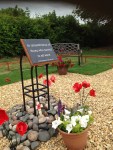
The memorial is flanked by two flags, is neat and well cared for. The runway layout is depicted on the memorial stone and it proudly states the achievements of the 401st. I am led to believe the ‘Wheatsheaf’ pub further along was the haunt of many an American airman and has a ‘401 bar’ with photos and memorabilia. I was not able to visit this unfortunately and cannot therefore verify this. Definitely one for another day!

Modern activity at Deenethorpe
Deenethorpe is one of those airfields that has quietly slipped away, the passage of time leaving only simple scars on the landscape. This once busy and prestigious airfield now nothing more than rubble and fields with a memorial to mark the brave actions, the death and the sacrifice made by crews of the United States Army Air Force so long ago.
A BBC news report covered the planting of a time capsule in June 2011, when the widow of Tom Parker (the last of the 401st Bombardment Squadron crew, that flew the B-17 plane “Lady Luck” out of Deenethorpe), kept their promise that whoever was last would bring a collection of tankards back to Deenethorpe with their own personal stories. The tankards were a gift from the pilot of Lady Luck, Lt Bob Kamper who presented them to the crew at a reunion in 1972. Mr Parker, the last member of the crew, sadly died in March 2011.
May their stories live on forever more.
The BBC news report can be found here.
Deenethorpe falls under Northampton County Council, and like Kings Cliffe in the same area, has been the subject of planning applications. It is proposed that the airfield be removed and all flying activity stopped. A Garden Village will be built on the site, and the area landscaped accordingly. The proposal can be found here.
Deenethorpe was originally visited in Trail 6, ‘American Ghosts‘, from here we go onto an airfield that saw action involving a large numbers of paratroopers, we go to Spanhoe Lodge.
Sources and further reading.
*1 Photo from IWM American Air Museum In Britain.
*2 Photo Roger Freeman Collection, from IWM American Air Museum In Britain. FRE 8079
*3 Photo Roger Freeman Collection, from IWM American Air Museum In Britain. FRE 2218
The 401st BG website contain a vast amount of information about crews, aircraft and missions of the 401st. It can be accessed here.
I highly recommend the book, “The B-17 Flying Fortress Story“, by Roger Freeman, published by Arms and Armour, 1998. Some aspects may have been updated, but the detail is incredible and a worthwhile investment for anyone interested in this area.




 Aviation Trails