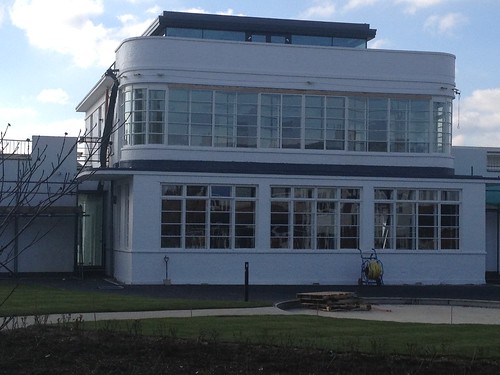
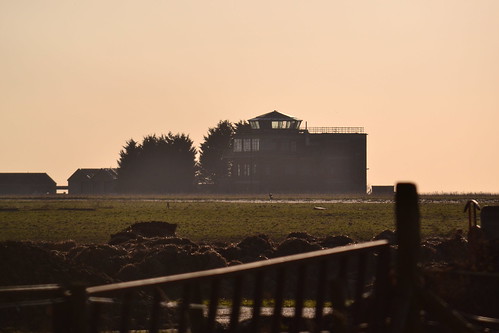
Trail 66 – RAF Chelveston – Part 2 – Operational Beginnings

In Part 1, we saw how RAF Chelveston began its life in 1940 on land straddling the Bedfordshire–Northamptonshire border as part of Britain’s wartime airfield expansion programme. Initially referred to as Shelton during planning, the station opens in 1941 with basic grass runways before gradually developing into a standard three-runway bomber airfield. In time it would pass into American control as USAAF Station 105.

1941 – From Opening to Operational Beginnings:

Chelveston airfield officially opened its doors on August 15th 1941, as RAF Chelveston, and initially fell under the control of Flying Officer J.B. Townsend, 2 Group, RAF Bomber Command. Still in the process of construction, the airfield was parented by RAF Polebrook, a relationship that dissolved upon Chelveston gaining its full self-governing status on 2nd September that same year.

To provide protection from attack, RAF Podington (now the Santa Pod drag strip) was allocated as a satellite station, and a decoy or ‘Q’ site (Q144A) was constructed at Swineshead. In addition to these measures, an airfield defence unit, 2819 Defence Squadron, was established here with twelve Bofor anti-aircraft guns, providing protection from any roaming enemy aircraft.

Immediately on transfer of the airfield to the RAF, permission was granted to extend the three runways, the main from 4,100 ft to 6,000 ft and the second from 3,700 ft to 4,167 ft. The third, would remain at 3,700 ft for the time being. These extensions, along with further general updating, would eventually bring the airfield up to the Class ‘A’ standard format, making it suitable for the allied heavy bomber fleet. However, progress was slow, and this degree of modernisation would not be achieved for another two years or so.

Construction work therefore continued well into 1942. In addition to the runway extensions, the bulk of the ‘frying pan’ style dispersals were also added, and the accommodation area was extended, enabling upward of some 3,000 personnel to be located here. The bomb store was also added at this point, and the technical area was extended to include a wider range of technical buildings and stores.

The RAF’s 2 Group remained in control of Chelveston for only two months, ownership then transferring to 8 Group in October 1941. 8 Group were a former World War 1 group, who would go on to disband and reform again later, as the famous ‘Pathfinders’ under Donald Bennett.

Although 8 Group was a bomber group, Chelveston’s first resident flying unit would not reflect that role. The new runways, not yet fully completed and strengthened, were incapable of bearing the heavy loads imposed by Bomber Command’s aircraft. Instead, The small, light aircraft of the Central Gunnery School (CGS) were brought in as a temporary measure, giving the unit a much-needed operating base. Lacking a permanent home and  sufficient space to operate, the school also maintained a presence at nearby RAF Thurleigh, effectively dividing its activities between the two airfields. The CGS was a long standing organisation, made up of  several components including the Pilot Gunnery Instructor’s Training Wing, and were destined to eventually move to RAF Sutton Bridge in Lincolnshire. The CGS, being a training unit, trained  gunnery instructors for both fighters and bombers.

From British Training to American Arrival: Chelveston in Transition

The CGS remained at Chelveston only briefly, departing in stages during February and March 1942 once the extension and upgrading works had been largely completed. Initially, part of the training wing relocated to RAF Wittering in Cambridgeshire, before re-joining the remainder of the unit at Sutton Bridge in Lincolnshire the following month. Once reunited, the CGS became one of the largest, single training establishments of the war.

The lull at Chelveston between the CGS’s departure and the arrival of its successor proved far from uneventful though. On 8th May 1942, a tragic accident occurred – and one that was witnessed by only a handful of observers. On that day, a visiting Wellington IC (R1412) of No. 21 OTU, RAF Moreton-in-Marsh, landed at Chelveston and promptly began transferring aircrew to another aircraft preparing to depart. One of the passengers – Air Gunner Sgt. Matthew Callaghan (s/n: 1069247), RAFVR – stepped down from the Wellington and headed over towards the waiting aircraft. Distracted momentarily, he misjudged his position and was killed when he ran into a spinning propellor of the Wellington. He was just a week short of his 27th birthday.*2*3

The tragedy didn’t stop progress though, and two days later a small detachment of the Airborne Forces Experimental Establishment (AFEE)*4 arrived at Chelveston. This small unit was present to test airborne equipment and techniques – the methods and apparatus used to transport men and materiel to the battlefield.

Tracing its origins to the Central Landing School at RAF Ringway in June 1940, the AFEE was established in response to Churchill’s directive for a corps of expert parachutists; later expanding its remit to include gliders and, eventually, rotary-wing aircraft.

At Chelveston though, the newly developed AFEE would use Airspeed Horsa gliders along with their tow aircraft, both the Whitley and the Short Stirling, to test safe loading methods for a range of equipment. A specialist unit, they would go on to test both the General Aircraft Hotspur glider and the Hamilcar, adding to those which provided much needed transport to the continent on both D-day and in Operation ‘Market Garden’.

It was during one of these trials, on 3rd June 1942, that the airframe of Hotspur BT500, suffered severe stress resulting in the aircraft breaking up in mid-air near to the small village of Denford in Northamptonshire. Luckily, the two crew, both of whom were Polish, managed to bale out of the glider, one suffering minor injuries as he did so.

Later in that same June, Chelveston received its second airborne group, an arrival that suggested a potential new owner in the months to come. The American unit, the 60th Transport Group (TG), comprised of the 10th, 11th and 12th Transport Squadrons operating a variant of the C-47 Dakota.  They arrived in staggered sections bringing with them ninety-three officers along with 727 other ranks and fifty-two aircraft all under the command of Lieutenant Colonel A. J. Kerwin Malone. *5

This initial American allocation, would indeed lead to a new ownership of RAF Chelveston. But, with no immediate official ceremony, the change was gradual, and ownership wouldn’t be cemented until the end of the year once all the resident British units had departed.

Activated on 1st December 1940, at Olmsted Air Field in Pennsylvania, the 60th Transport Group was one of the oldest transport groups in the United States Army Air Force, and is said  to be the first to deploy overseas to the European theatre of operations*6. Following its initial training period, the unit prepared for overseas service, with the ground echelon crossing to the United Kingdom onboard the Queen Elizabeth, while the air echelon made the longer, northern transatlantic journey via Greenland; arriving in England around 12th June 1942.

On arrival, the men of the 60th were formally briefed on their conduct both on and off the station, and reflecting common fears of attack, were instructed to carry firearms at all times. Supported by a detachment of RAF personnel led by Squadron Leader Clayton, they also received instruction on the operation of British airfields and the complexities of a busy UK airspace.

Initially, the group’s role centred on transporting goods between air depots and operational airfields, but this sedate role was soon changed to training with the US Army’s airborne 2nd Battalion, 503rd Parachute Infantry Regiment. This relationship lead to the battalion’s first parachute jump over England. As their responsibilities grew, the 60th also began training for specialised operations, a shift formally recognised in mid-July 1942 with its redesignation as the 60th Troop Carrier Group.
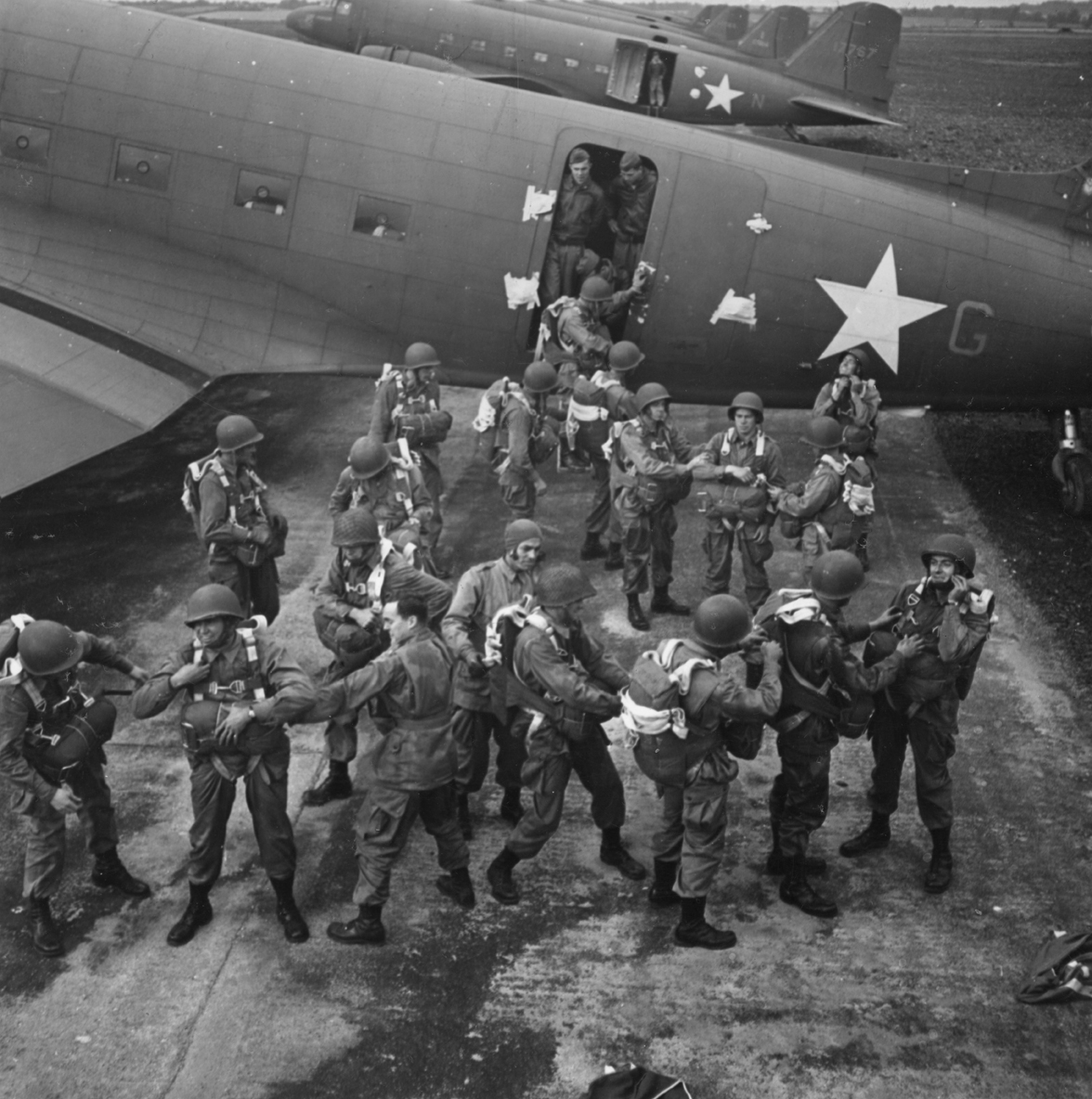
Paratroopers of the 503rd US Parachute Infantry Regiment prepare to board a C-47 Skytrain of the 60th Troop Carrier Group.. Another C-47 (serial number 41-7767) is visible in the background (Not Chelveston FRE3377).

However, the 60th’s stay at Chelveston would also be short lived; in early August, they departed the airfield stopping off briefly at RAF Aldermaston before transiting to the 12th Air Force and the North Africa campaign. On departure, they took the airborne forces with whom they had been training, with them. Whilst in North Africa, they would take part in many airborne operations including both the invasion of Sicily and the liberation of Greece, remaining in the Mediterranean theatre for the duration of the war.

The departure of the 60 TCG was not as smooth as one would wish for however. The poor British weather hampered the move, causing it to be delayed on several occasions. When it did finally get away, the second section had to make an unscheduled stop at a nearby airfield as it was approached by a lone German Me110 fighter. Intercepted by RAF Spitfires, the roaming 110 was quickly despatched and the TCG were allowed to continue on their way unhampered. *7

After their departure, Chelveston received a series of visits and inspections by senior Allied figures. These visits sparked rumours of an impending change in operations, and began with Group Captain Donald ‘Don’ Bennett, commander of the newly-formed Pathfinder Force within RAF Bomber Command, who was accompanied by Colonel Duncan of the USAAF. A few days later, the airfield was visited by Brigadier General Ira C. Eaker. It was in the aftermath of Eaker’s visit that ownership of Chelveston truly changed, marking the beginning of a new chapter in the airfield’s long and distinguished career.

In the next part of Chelveston’s history, we see the airfield finally step onto the operational stage. With the arrival of the USAAF’s 301st Bombardment Group and the first B-17 Flying Fortresses, the station began launching real combat missions over occupied Europe. What followed were the opening operations, early trials, and first losses that marked Chelveston’s transition from a developing airfield into an active participant in the Allied air offensive.

The whole story of Chelveston can be read in Trail 66. Northants and Bedfordshire (Part 2)
Trail 66 – RAF Chelveston – Part 1 – Important Beginnings.

In Trail 66, we return to the Bedfordshire and Northamptonshire borderlands to visit the site of another former bomber airfield that has been almost entirely erased from the landscape. Although its wartime service was relatively brief, it was defined by intense operational pressures, loss, and remarkable acts of heroism.

Despite continuing in use well into the Cold War and beyond, the airfield failed to leave the regional mark it deserved. Over time, its purpose changed and its structures were gradually removed, the land being adapted to modern energy use, leaving little visible evidence of its former importance. This transformation stands in contrast to the role the station once played and the legacy it holds today.

Home to a small number of RAF units, it was predominately an American base during the Second World War, and remained with them into the depths of the Cold War. Although flying activity ceased in 1962 with the departure of the modern United States Air Force, a military presence remained there until the Ministry Of Defence (MOD) sold the site as recently as 2005.

Whilst some aspects of the original airfield do remain, the vast majority has been decommissioned and removed, including the runways, works buildings and training facilities, leaving little more than ghostly evidence behind.

In this part of our trip to Northants and Bedfordshire, we visit the former RAF Chelveston.

RAF Chelveston (Station 105).

RAF Chelveston (Station 105) lies across the two counties of  Bedfordshire and Northamptonshire, and although the border crosses roughly through the centre, the majority of the site lies in Northampton. Like many wartime airfields it went through a series of name changes depending upon who owned  it at the time. Today it is known as Chelveston Renewable Energy Park, reflecting its modern use as the ‘centre of technological innovation’ capable of producing enough electricity, to power 60,000 properties.*1

During the planning stages in 1940 the aerodrome site was briefly referred to as Shelton, after the nearby village to the east. Before the station officially opened in 1941, however, the name was changed and it entered service as RAF Chelveston, the official British designation. Later in the war the airfield passed into American control and was designated Station 105 by the United States Army Air Force. Over the years though, it was also referred to as RAF Station Chelveston, and simply Chelveston Aerodrome, reflecting both its early planning name and the variety of roles it fulfilled throughout its operational history.

The land upon which the airfield sits, lies approximately four miles to the east of Rushden and about twenty-seven miles south-west of Peterborough. It shares a region – designated by a Peterborough, Northampton and Bedford triangle – with a number of other former bomber airfields including Kimbolton, Thurleigh and Molesworth.

The land for Chelveston (a name derived from a Norman family) was acquired by the Air Ministry in 1940, with construction beginning shortly afterwards. The airfield was initially intended for the RAF and the reformed 8 Group, with Taylor-Woodrow Ltd serving as the main contractor. At first, it had grass runways and minimal storage, consisting of a single ‘J’-type brick-and-metal hangar measuring 300 ft by 151 ft. Later, two ‘T2’-type metal hangars were added, each 240 ft long, 115 ft wide, and 29 ft high. The original design fell under development scheme ‘M’ of the Government’s expansion programme, which essentially replaced the earlier ‘C’-type hangars with the newer ‘J’-type. Since construction began during the war rather than before it, accommodation sites were dispersed away from the main airfield site – unlike pre-war designs, where living quarters were typically located on-site.

At Chelveston, these accommodation sites were positioned to the south-west of the airfield, unusually close to the main runway’s flightpath – in-fact within just a few hundred feet of its threshold. In all there were twelve accommodation sites, supplemented by two sewerage sites, giving a total of fourteen in all. These accommodation areas included: two communal sites, officers’ quarters, enlisted men’s quarters, sick quarters, and a large WAAF area with its own sewerage facilities.

The all important technical area, lay directly across the dividing public road from here; a little further north than the accommodation area and on the western side of the main airfield. It included a wide range of buildings including: MT (motor transport) sheds, operations blocks, briefing rooms, link trainers, stores, flight offices, works offices and the like.

Typical of the range of buildings found on any wartime airfield, they were a mix of both temporary and permanent construction. The manufacturers involved were also typical of those pertaining to wartime airfields: Laing, Romney, SECO, Ministry of Works and Nissen, who used a variety of construction materials including timber, iron, plasterboard, brick and concrete to create these various standard design structures.

On the main airfield itself, No. 1 runway ran north-east to south-west, whilst No. 2 dissected it in a north-west to south-east direction. The third runway, No.3, ran just off north to south. The classic ‘A’ frame was created by the crossing of all three in the centre of the airfield with the runways extending extensively beyond this point. As in all cases, the three runways were linked by a circular perimeter track, around which eventually, some fifty-five hardstands were built; both a mix of ‘spectacle’ and ‘frying-pan’ types.

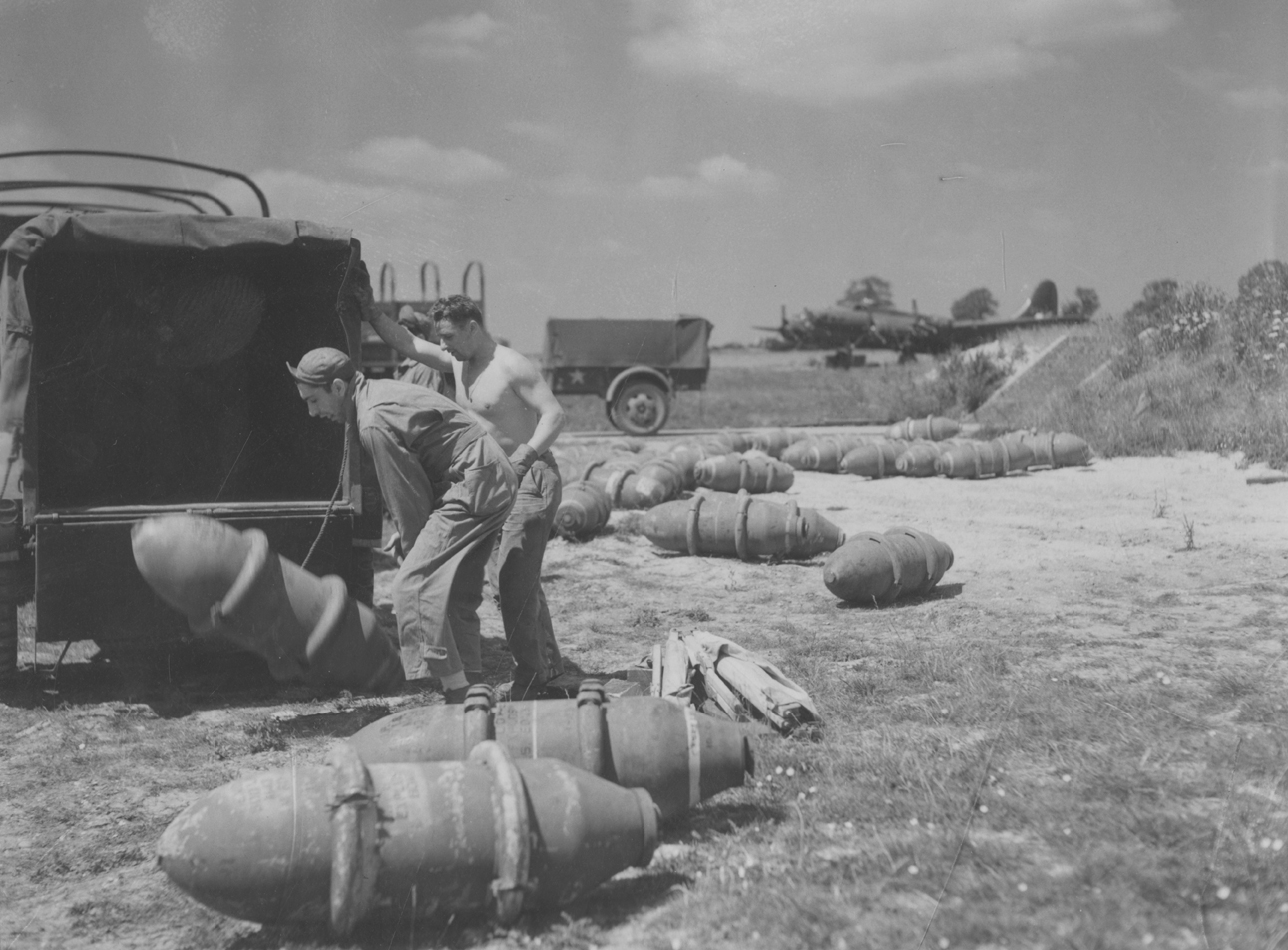
As with all airfields of its kind, a bomb store would be incorporated well away from the accommodation and technical areas, and in Chelveston’s case this was just off to the north-east. Here, a number of hardened shelters were interlinked by small tracks along which the bombs were transported to the various aircraft dispersals.

Bombs being man-handled at Chelveston. (IWM FRE10440).

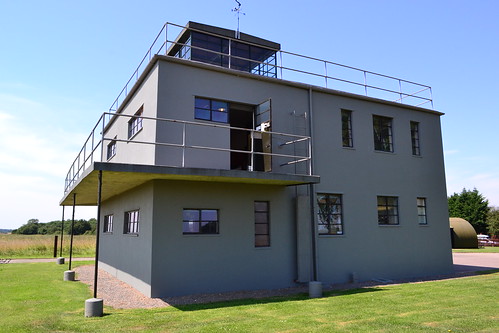
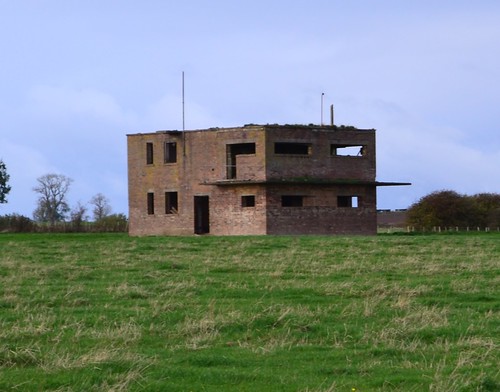
Overseeing movements in and out of the airfield was the watch office, which stood proud with clear views across the airfield. Located to the western side of the site, the office was built to drawing 518/40 – the largest and most common wartime design. This particular build evolved from the 1939 drawing, number 5845/39, and incorporated the meteorological office within its layout. By combining both functions into a single structure, it enabled the rapid exchange of vital weather information.

Chelveston’s construction began in 1940 on land straddling the Bedfordshire-Northamptonshire border. A basic airfield to start with, it soon began to develop and grow, all part of Britain’s rapid wartime airfield expansion programme. Over the next few months it would grow and develop into a standard three-runway bomber airfield complete with dispersals, technical buildings, bomb stores and extensive accommodation sites. Though the landscape has since been transformed into the modern Chelveston Renewable Energy Park, the wartime layout still hints at the scale and ambition of the original station.

The story of how this quiet stretch of countryside evolved from construction site to operational wartime airfield begins in Part 2, as RAF Chelveston opens its runways and the station starts its journey toward becoming an important Allied base.

The whole story of Chelveston can be read in Trail 66. Northants and Bedfordshire (Part 2)

New Years Eve 1943 – The death of 2nd Lt. John W. Crago (RAF Kings Cliffe)

In 2021, I was contacted by Mike Herring and Trevor Danks, regarding the story of 2nd Lt. John Crago who was based at RAF Kings Cliffe in Northamptonshire during World War 2.

It was sad tale of how one young man died in a tragic accident not long after arriving in the UK from the United States. Mike and Trevor kindly allowed me to reproduce the entire text with photos to share with you, my sincere thanks go to them both.

This is the story of 2nd Lt. John Walter Crago who tragically lost his life in an aircraft crash on 31st December 1943 whilst operating from Kings Cliffe airfield.

Firstly, however, let us look at his origins.

His grandparents were Harry and Bessie Crago who were born and lived in Cornwall on the SW tip of England. Harry was born in Liskeard in November 1858 and Bessie in Duloe in May 1862.

The surname “Crago” is quite common in that area. Cornwall had been a major source of tin and lead for many years and there were extensive mine works around the county.

After leaving school Harry worked in the mines from about the age of 12.

In 1878 Harry and Bessie, still unmarried, moved to the coal mining village of Wingate, near Durham, in the North East of England, where Harry worked as a coal miner.

In the early part of 1879 Harry and Bessie married at Wingate and by 1881 they were living at 13, Emily Street, Wheatley Hill, Wingate and had a one year old son with them – William.

As an aside the village of Wingate is well known to some people in Kings Cliffe. It was the home of the writer’s wife’s parents until their recent death and  brothers and sisters still live there.

The coincidence increases as it is also the place where friends, Rodger Barker, living in Kings Cliffe, and Jim Vinales, managed to crash a Vulcan bomber in 1971, that had lost two engines. The crew fortunately survived. (see chapter one of “Vulcan 607” Corgi books).

In 1882 Harry and Bessie emigrated to the USA, by now having two children , and it is no co-incidence that they settled in Pennsylvania which was a significant coal mining area, Harry working there as a miner.

Their third child, Walter P Crago, was born at Houtzvale, P.A. on 16th August 1893. He is the father of the subject of this story.

In the US Census of 1910 16 year old Walter is shown as having no occupation, although his father and elder brother are working as miners.

In the 1920 US Census, Walter is married to Margaret K Crago and they have a one year old son, John Walter, born 5th April 1917 who is the subject of our story. His father’s marriage to Margaret does not seem to have lasted as by 1930 Walter has married Lorena C Crago (nee’ Curtis).

John Walter Crago is brought up in Philipsburg, PA, a small town of about 3000 people (twice as big as Kings Cliffe) which is situated about 200 miles due west of New York.

Philisburg main street via Mike Herring

A view of modern Philipsburg main street.

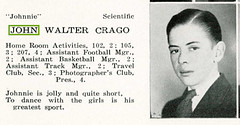
Our next glimpse of John W is in his High school Year book in 1934 when he was 17 years old.

John Walter Crago via Mike Herring

Johnnie did one year in high school and was clearly keen on his sport as well as the local girls!

Six year later in the US Census of 1940 John’s father, Walter, is by then the part owner and bar tender of a restaurant/tap room in Philipsburg and John W is working for him.

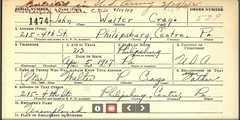
In Europe WW2 is in full flow and clearly the US is preparing for its possible involvement as John is signed on in the draft on 16th October 1940.

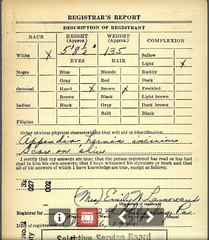
He is described on his draft form as 5’-8 ½” (1.74m) tall, weighing 135 pounds (61kg) with hazel eyes, light completion and brown hair.

draft via Mike Herring

John’s Draft paper.

draft 2 via Mike Herring

John trained to be an Army Air force pilot and joined the 55th fighter squadron, part of the 20th fighter group.

They arrived at Clyde in Scotland in August 1943, then travelled to their new base at Kings Cliffe in Northamptonshire, England. The 20th fighter group consisted of three squadrons of about 14 planes each – 55th, 77th and 79th.

The group was the first to fly the new P-38 Lightning escort, fighter ground attack air craft in combat in Europe.

P-38 via Mike Herring

P-38 Lightning

There was insufficient room at Kings Cliffe for all of three squadrons and therefore 55 Fighter Squadron , of which John Crago was a member, were based at RAF Wittering, just two miles North of Kings Cliffe.

The P-38 Lightning had a somewhat chequered history in its’ early days. It had several recognised problems, but because of the needs in Europe for a powerful, high flying escort aircraft, the early ones were shipped out without those problems being resolved. They suffered from many engine failures, and instability in certain circumstances.

Of significance to our story is part of the Wikipedia article on the development of the P-38 which reads –

“Another issue of the P-38 arose from its unique design feature of outwardly rotating, counter rotating propellers. Losing one of the two engines in any two engine non centre line thrust aircraft on take-off creates sudden drag, yawing the nose towards the dead engine and rolling the wing tip down on the side of the dead engine. Normal training in flying twin engine aircraft when losing one engine on take-off is to push the remaining engine to full throttle to maintain airspeed. If the pilot did this on a P-38, regardless of which engine had failed, the resulting engine torque produces an uncontrollable yawing roll and the aircraft would flip over and hit the ground.”

Crago with P-38 via Mike Herring

John Crago with his P- 38J Lightning – 1943


Crago at Kings Cliffe 1943 via Mike Herring

John W Crago in 1943 at Kings Cliffe

The first mission for 55 squadron was on 28th  December 1943 consisting of a sweep across the Dutch coast without encountering enemy aircraft. The mission summary report for that day reads –

28th December 1943

  1. 55th Fighter Squadron, 20th Fighter Group, Captain McAuley leading.
  2. 12 up at 1308 Down Wittering 1510
  3. Nil
  4. O 4 SWEEP
  5. To N. Nil
  6. Altitude over English coast mid-channel R/T jammed and remained so until mid-channel return trip. Landfall in, Wooderhoodf, at 1402. Altitude 20,000 feet. Light to moderate flak accurate for altitude over Flushing. Left turn and proceeded from Walchern to Noordwal 18 to 20,000 feet.
  7. Landfall out 1416 Noordwal. Weather clear all the way.

The second mission on the 30th December was more serious, escorting B-17 and B-24 bombers on an attack on a chemical plant near Ludwigshafen. The mission report for that day reads –

30th December 1943

  1. 55th Fighter Squadron, 20th Fighter Group
  2. 14 up 1121 at Kings Cliffe. Down 1500 Wittering.
  3. 3 aborts. Captain Jackson, Lt. Col. Jenkins – Radio. Lt. Sarros, gas siphoning.
  4. Bomber escort. Field order No. 210
  5. Nil
  6. Nil
  7. Nil
  8. Nil
  9. Landfall Ostend 24,000 feet at 1212. Climbed to 25,000 feet Brussels circled area 15 minutes. Proceeded to R/v with bombers. St. Menechoulde 25,000 feet at 1312. Reims 2 Me 109’s seen diving through bomber formation. Squadron left Bombers Compegiegne 1346. Encountered light flak Boulogne. Landfall out 1407, 24,000 feet. Clouds 6/10 over channel. 10/10 just inland. R/t ok.

The third mission was scheduled for 31st December and involved escorting bombers on an attack on a ball bearing factory at Bordeaux. John Crago was one of the 14 pilots of 55 squadron scheduled to be on this trip. He was temporarily based at RAF Wittering whilst suitable accommodation was built at Kings Cliffe and was flying from Wittering to Kings Cliffe to be briefed on the mission with the other pilots of 55, 77 and 79 Squadron who made up 20 Group. On arriving at Kings Cliffe he reported problems with his landing gear and did a low level fly past the control tower so that they could observe any obvious problem. As he approached the tower smoke was seen coming from his left hand engine.

He would have been flying slowly, close to stall speed, so that the tower had more time to observe any problem. Bearing in mind the reported problem with the P-38 flying on one engine the plane probably became uncontrollable. He clearly achieved some height as his eventual crash site was about two miles away at the village of Woodnewton. He did not survive the crash.

map via Mike Herring


location of crash via Mike Herring

Map of Woodnewton – crash site marked in red.

Lt. Crago's crash site

Lt. Crago’s crash site. (Photo courtesy Trevor Dank)

Lt. Crago's crash site

Lt. Crago’s crash site. (Photo courtesy Trevor Dank)

John Crago is buried at the Cambridge American Cemetery; plot A/5/22.

Commemoration Plaque

Plaque to commemorate Lt. Crago. (Photo courtesy Trevor Dank)

His was one of the bodies of American servicemen whose next of kin decided not to repatriate.  One could conjecture that he was left to rest in the land where many generations of his forefathers had lived.

Grave via Mike Herring


Kings Cliffe old blokes via Mike Herring

‘Kings Cliffe Old Blokes Club’ at the grave of John Crago.

Mike Herring
Kings Cliffe Heritage

Sources:

Vulcan 607 by Rowland White, Corgi Books.
US Census 1900, 1910, 1920, 1930, and 1940.
UK Census 1861, 1871,and 1881
Ancestry.com
Ancestry.co.uk
The American Air Museum – Duxford  www.iwm.org.uk/duxford
2nd Air Division Memorial Library – Norwich www.2ndair.org.uk

Report from Woodnewton Heritage Group

New Year’s Eve this year marks the 75th anniversary of a tragic accident in Woodnewton which resulted in the death of an American pilot and brought the realities of the Second World War closer to the inhabitants of our village.

JOHN WALTER CRAGO

John Walter Crago held the rank of 2nd Lieutenant in the US Army Air Force. He died instantly in an accident on 31st December 1943 when his aircraft crash landed in Woodnewton, in the field known as Stepping End just beyond Conegar Farm.

Lieutenant Crago was born on 5th April 1917 in Phillipsburgh, Pennsylvania, the son of Walter P Crago and Margaret K Jones. He had enlisted in March 1942 and was a member of the 55th Fighter Squadron of the 20th Fighter Group.  This Group was under the command of the 67th Fighter Wing of the Vlll Fighter Command of the USAAF. When he died he was 26 years old.

The circumstances leading to the accident on 31st December are recorded here in general terms only as told by former and existing residents of Woodnewton and supported by information from the Internet. It is not meant to be definitive.

The USAAF was assigned RAF Kings Cliffe in early 1943 and it was re-designated as Station 367. It was the most northerly and westerly of all US Army Air Force fighter stations. At that time RAF Kings Cliffe was a very primitive base, lacking accommodation and other basic facilities, so the Americans undertook an extensive building programme at the base during 1943. The 20th Fighter Group arrived on 26th August 1943 from its training base in California having crossed the USA by railway and then the Atlantic aboard HMS Queen Elizabeth on a five-day unescorted trip. The Group comprised three Fighter Squadrons; two of those Squadrons were based at Station 367 whilst the third, the 55th Fighter Squadron (Lieutenant Crago’s), was based at RAF Wittering whilst additional accommodation was being built at Kings Cliffe. The Group did not come back together at Station 367 until April 1944. Up to December 1943 the Group flew Republic P-47 Thunderbolt planes. With the arrival of their new Lockheed P-38 Lightening planes in late December 1943 the 20th Fighter Group entered fully into operational combat and was engaged in providing escort and fighter support to heavy and medium bombers to targets on the continent.

In the early morning of 31st December 1943 Lieutenant Crago was to fly from RAF Wittering to Station 367 to be briefed on his first combat mission – to provide escort protection on a bombing mission to attack an aircraft assembly factory at Bordeaux and an airfield at La Rochelle. This was to be just the 3rd mission by the fully-operational Group flying P-38’s. The planes of the 55th Squadron took off from RAF Wittering three abreast but unfortunately the right wing-tip of Lieutenant Crago’s plane struck the top of a search light tower on take-off.  Lieutenant Crago must have lost some control of the aircraft but not it would appear the total control of the plane. He flew it from Wittering and was trying to get to Station 367. Unfortunately, he only got as far as Woodnewton.

The plane approached the village from the north-east, flying very low over Back Lane (Orchard Lane) and St Mary’s Church but crash landed in the field known as Stepping End just beyond Conegar Farm. Eyewitnesses said that the pilot discharged his guns to warn people on the ground that he had lost control of the plane and was about to crash. Wreckage from the plane was still visible in Stepping End in the 1950’s and a “drop tank” (for additional fuel) could also be seen in the hedge between King’s Ground and Checkers. A brief reconnoitre in November 2018 however found no recognisable evidence of the plane in the hedgerows around the fields.

Stepping End is the first open field – no hedges or fencing – on the right-hand side of the track from Woodnewton to Southwick. From Mill Lane, cross the bridge over the Willowbrook, and continue until the land begins to rise at the start of the hill. King’s Ground and Checkers are the next two fields on the right along the same track.

It is understood that 2nd Lieutenant Crago, whilst no doubt a qualified and proficient pilot, had had only 7 hours flying experience in the Group’s new P-38 Lightning at the time of the accident.

A memorial plaque to Lieutenant Crago was put up in St Mary’s Church to commemorate his death. The wording on this memorial faded over time however, and the plaque was replaced in 2001, although the wording on the two plaques is the same.

2nd Lieutenant John Crago is buried and commemorated at the Cambridge American Cemetery and Memorial (Plot A Row 5 Grave 22). His photograph can be seen at “www/20thfightergroup.com/kiakita”.

My sincere thanks go to Mike and Trevor for sending the text and pictures and for allowing me to share the sad story of Lt. John Walter Crago. 

Boeing B-29s in the UK.

During March 1944, an event took place in the UK that considering its historical importance, is little known about. It was actually quite a momentous event, especially in terms of aviation history, and in particular the Second World War.

As a follow on to RAF Glatton and Trail 6, we look into the short-lived presence of Boeing’s mighty aircraft the B-29 ‘Superfortress’, in what would appear to be its first and only wartime presence on British soil.

At the time of the bombing of Pearl Harbour in 1941, the United States was less than ready for a global war. The retaliation and defeat of not only Japan, but Nazi Germany as well, was going to be both costly and massive, requiring a huge increase in manufacturing of both arms and machinery.

This increase meant not only aircraft for the Air Force, but the infrastructure to support and train the aircrews too. A network of airfields and supporting organisations totalling some $100 million in 1940, would, by the war’s end be valued in the region of  $3,000 million. In terms of size, this infrastructure would cover an area of land equal to the combined areas of: New Hampshire, Vermont, Massachusetts, and Connecticut.*1

To complete the task, along with aiding her allies, the U.S. was going to need to design and manufacture many new models of aircraft, aircraft that would outshine anything previously made available to the U.S. forces. Long range bombers in particular, capable of travelling great distances were going to be required – and a lot of them. At the outbreak of the European war, the U.S. Army Air Corps was in comparison to the European forces, very small, commanding just 26,000 officers and enlisted men, and operating only 800 front-line aircraft. The Luftwaffe on the other hand, had expanded considerably over the previous years, now commanding some 3,600 aircraft. The British, who were still some way behind the Germans but growing rapidly, had available to them some 2,000 aircraft, whilst the French could muster slightly over 1,700. *1a

To meet this demand, U.S. aircraft manufacturers were going to have to start by modifying, and with some exceptions, redesigning the various aircraft types that were already available to the U.S.  forces. However, and likewise the British and German manufacturers, new models were going to have to be designed and put into production very quickly if victory was to be achieved in any of the world’s theatres.

Preempting war, the US Government put out tenders for long range bombers, in answer to which during the 1930s, the Boeing Model 299, first flew. Eventually being purchased by the US Government to fulfil the role, it was put into production as the iconic B-17 ‘Flying Fortress’, and was followed not long after by the B-24 ‘Liberator’; a more modern aircraft which took its maiden flight in 1939. But sitting on the drawing board at this time, was another aircraft that performed even better, the formidable B-29, a bomber designed to fly at altitudes up to 40,000ft, beyond the range of anti-aircraft guns and  faster than many fighters of the time. The aircraft was so advanced in design that depending upon its payload it was capable of flying distances of up to 5,000 miles, far beyond that of any other heavy bomber.

Whilst the U.S. aircraft manufacturers had already begun designing and testing these new models, it would be some time before the number and types of available aircraft would come anywhere close to being comparable to those of the Luftwaffe, R.A.F. or even later, the Imperial Japanese Air Force.

By August 1942 both the development and production of these two heavy bombers, the B-17 and B-24, were well underway, and so it was decided that they would go initially to the European theatre rather than the Far East. The competition for the attack on Japan now lay between the B-29 and Consolidated’s competitor the B-32 ‘Dominator’ – an enlarged and also pressurised version of their B-24. However, two years after the first design drawings were revealed, neither of these aircraft types had yet flown, and so the shorter ranged B-17 and B-24s were going to have to fill the gap until such times as their replacements could arrive.

The war in the Far East would provide its own set of problems. The distance that supplies would have to be taken would take time and before any invasion could take place, lost ground not only had to be recovered, but held. To achieve this, ground forces would need to be protected by an air umbrella, a defensive shield formed so tightly that air supremacy was guaranteed.

Getting supplies into China was difficult, by air it required long and dangerous flights over the ‘Hump’, the Himalayan mountain range, usually fulfilled by C-47s and DC-3s, their commercial equivalent. With the C-46 ‘Commando’ and C-87 coming on line later on, the frequency and quantity of these supplies could increase but it was still not enough for the Chinese, nor for the difficult task ahead.

By March 1943 the stage was set. The Fourteenth Air Force was created out of Maj. Gen. Claire Chennault’s China Air Task Force, which by the summer time, had begun attacks on coastal positions, ports and troop concentrations under Japanese control.  This air umbrella was in part achieved over Burma, and the desired attacks on Japan now looked more possible, but the B-17s and B-24s that had worked tirelessly lacked the range to hit the Japanese homeland;  the long range high performance B-29 was by now desperately needed.

During the Quebec Conference in August that year, U.S. officials put forward their proposal to stage American long range bombers on airfields in China, the area required for such bases being under Chinese control already and therefore not at the mercy of the Japanese forces. This offensive, designated the Matterhorn Project, would involve the still as yet untested  in battle, B-29s, their longer range and larger bomb capacity enabling them to ‘bomb Japan into submission’ in a similar way that Sir Arthur Harris had hoped for in Europe with the RAF’s bombing campaign against Germany’s industrial targets and cities.

To meet these aims a new force would be created, the Twentieth Air Force, which would be made up of two commands: the XX Bomber Command from China and the XXI Bomber Command who would be based in the Mariana Islands after they were retaken from Japanese control.

The aircraft destined to carry out this role, the B-29, was still very much an unknown quantity. Rushed into production with scant attention to testing, it was a monster of an aircraft, with a crew of eleven in pressurised compartments, electronic gun turrets and a massive 141 ft wingspan. The project was to be the biggest in U.S. aviation history, spares alone in the initial contract costing $19.5m, and one which General Arnold
referred to as the “$3 billion gamble”.*1b

The following film “Birth of the B-29 Superfortress” shows a B-29 production line and a test YB-29 in flight. It also contains some short graphic images at the start.

A batch of four XB-29 prototypes were built, and after initial test flights, a further fourteen ‘test’ aircraft, designated the YB-29, were also constructed. But problems with design drawings, missing parts and rushed testing meant that production was slowed to a minimum, part finished aircraft being stored whilst awaiting vital components. After test flights it became apparent that the B-29’s engines were prone to overheating and in several cases catching fire. This delayed further testing reducing flying time considerably until the problems could be solved. During flight tests, this problem with the engines was graphically seen, first on February 18th 1943, and then again a year later.

In February, XB-29 #41-003 (the second prototype XB) crashed into a meat packing factory killing all eight crew on board along with twenty civilians on the ground. The pilot, Eddie Allen, had already received the Air Medal for successfully landing the same XB-29 following another engine fire in the preceding December. A year later, January 29th 1944, engine problems caused yet another accident when  #41-36967, the last of the  fourteen*2 Wichita YB-29s  manufactured, crashed after losing all four engines whilst in the air. This problem with overheating engines becoming the proverbial  ‘thorn in the side’ of the Boeing production team.

By the summer of 1943, B-29 training squadrons were being set up, the first, the 58th Bombardment Operational Training Wing (Heavy) later the 58th BW (Very Heavy), was formed with the 40th, 444th, 462nd, 468th and 472nd Bombardment Groups, each with four or five squadrons of their own.

After a period of training four of these groups (the 472nd was disbanded April 1944) would transfer to India flying via Africa to join the Twelfth Air Force initially flying supplies over ‘the Hump’, before taking part in operations against Japan from the Chinese airfields.

Departure for these groups occurred over the March – April 1944 period, during which time one of these aircraft would divert to the U.K. causing a huge stir whilst ‘touring’ several U.K. airbases.

Whilst precise sources seem scarce, it is thought that flying B-29s across the southern route raised fears of a Luftwaffe attack whilst en-route, and so a plan of ‘disinformation’ was set in motion to fool the Germans into thinking that the B-29s were to be based in England, ready to be used against German targets. The first part of this ruse was in early March 1944, when YB-29 #41-36963 ‘Hobo Queen‘ took off from Salina Airbase in Kansas and flew to England. It initially took the southern route toward Africa, but then deviated north heading to Newfoundland. The YB-29, piloted by Colonel Frank Cook, then flew across to the UK initially landing at RAF St. Mawgan, in Cornwall.

During its short stay in the U.K. it was known to have visited RAF Horsham St. Faith near Norwich,  RAF Bassingbourn on the 8th March, RAF Knettishall and RAF Glatton on 11th March before its final departure from RAF St. Mawgan to India in April that year. The route took the YB-29 to Marrakech, Cairo (2nd April), Karachi (5th Apr) finally arriving at  Kharagpur, India, on 6th Apr 1944 . Once here, it was assigned to the 769th Bomb Squadron, 462nd Bomb Group who were then based at Piardoba in India, where it was modified as a tanker to ferry fuel over ‘the Hump’. The YB-29, the only test model to fly overseas,  gave a successful service, eventually being declared war weary and returned to the United States, its eventual fate being unknown, presumably, like many war weary models, the aircraft was scrapped.*3

Whilst in the U.K. the YB-29 was certainly a major draw, over 1,000 key personnel viewing the aircraft at RAF Glatton alone, its enormous size dwarfing anything that had been seen in U.K. skies before.

The ruse was considered a success. The many B-29s that followed across the southern route did so without any interference from German aircraft, although how much of that was actually down to the ruse itself, is hard to distinguish. It is even thought in some circles that photos of the ‘Hobo Queen‘ appeared in the newspaper of the National Socialist German Workers’ Party,  The Völkischer Beobachter, although an initial search of the paper through the Austrian National Library proved fruitless.

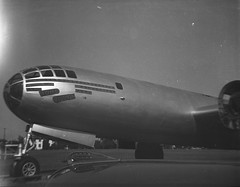
Crews and ground staff swarm around B-29 #41-36963 at Glatton airfield 11th March 1944*4.

Although B-29s were initially considered for the European theatre none operated from British soil until after the wars end, when a joint British and American operation, Project ‘Ruby‘*5, investigated deep penetration bombs against reinforced concrete structures. Three B-29s were prepared in the United States along with four B-17s and a select detachment of admin, maintenance, technical staff and air crew,  who arrived at RAF Marham, Norfolk, on March 15th 1946. Initial plans were to test a series of bombs on the submarine assembly plant at Farge, but due to the close proximity of housing and an electricity plant, the U-boat shelter at Heligoland was used instead. The bombing trials began on March 25th by which time an original three B-17s from RAF Mildenhall had also joined the group.

A number of both American and British bombs were tested in the trials:

  • The US 22,000lb. ‘Amazon’ bomb
  • The US rocket assisted 4,500lb. ‘Disney’ bomb (used by B-17s in the latter stages of the war)
  • The 4,500lb. ‘Disney’ bomb without rocket assistance
  • The American 22,000lb. fabricated ‘Grand Slam’ (designated T14)
  • The American 12,000lb. fabricated ‘Tall Boy’ (designated T10)
  • The British 12,000lb, ‘Tall Boy’
  • The British 2,000lb. Armour Piercing  bomb
  • The inert loaded 2,000lb. SAP (M103) bomb
  • The Picratol filled 2,000lb. SAP (M103) bomb
  • The 1,650lb. Model bomb

The results of the trials were quite conclusive, none of these bombs in their current form, were capable of penetrating the 23 ft thick concrete of the Farge roof, and therefore, all would need adapting, redeveloping or redesigning if such operations were to be carried out again.

Post war, B-29s were brought into the UK and operated as Boeing Washington B1s, operating with nine RAF Squadrons: No. 15, 35, 44, 57, 90, 115, 149, 192 and 207 at various airfields including RAF Marham, RAF Coningsby, RAF Watton and RAF Waddington, eventually being replaced by the high flying English Electric Canberra. The B-29 then disappeared from operational service in the UK.

Without doubt, the development of the B-29 had a major impact on the world as we know it today, and even though its first arrival in the UK in March 1944 caused a major stir in the aviation world, it incredibly remains a little known about clear fact. With little documentation available, there is clearly much more research to be done.

Since the original posting of this article, I have been contacted by Daniel Partridge whose grandfather (Leon Suthers) was at Randolph Field in the United States, after the war’s end. He has sent me some photos of ‘Hobo Queen’ after she returned to the US. According to information Daniel has supplied, she was used as a training airframe from January 1945 until 1954, after which she was scrapped. From the photos, you can see that much of the aircraft has been stripped away, presumably as part of this programme, yet the 45 camel ‘mission scores’ have been left. Further information from Daniel confirms that these Camels represent flights ‘over the hump’. My sincere thanks to Daniel for the information.

Hobo Queen

Hobo Queen Post War (Photo courtesy Daniel Partridge)

Hobo Queen

Hobo Queen Post War (Photo courtesy Daniel Partridge)

Sources and further reading.

*1 Nalty, B., et al. “With Courage The U.S. Army Air Forces in World War II” 1994. Air Force Historical Studies Office (p61)

*1a ibid (p38)

*1b ibid (p147)

*2 Only 14 YB-29BWs were built (#41-36954 – #41-36967) and all at Wichita. They were painted olive drab upper surfaces and light gull grey lower surfaces.

*3 MSN 3334.

*4 Image courtesy of 457th BG Association.

*5 Comparative Test of the Effectiveness of Large Bombs Against Large Reinforced Concrete Structures (PDF), Report of the Air Proving Ground Command, Elgin Field, Florida – Anglo-American Bomb Test Project “Ruby”. October 31st, 1946.

Simons. G.M., “B-29 Superfortress: Giant Bomber of World War Two and Korea“. Pen and Sword Aviation. (2012)
Mann. R.A., The B-29 Superfortress: A Comprehensive Registry of the Planes and Their Mission McFarland & Company Inc. (2004)

Harris, S.R., Jr. “B-29s Over Japan, 1944-1945: A Group Commander’s Diary” McFarland & Company Inc. (2011)

Mann. R.A.,.”The B-29 Superfortress Chronology, 1934-1960” McFarland & Company Inc. (2009)

Sgt. Archibald Mathies, USAAF, 510th BS, 351st BG (Medal Of Honour)

Staff Sgt. Archibald Mathies (U.S. Air Force file photo)*1

Born in the Scottish town of Stonehouse, South Lanarkshire, on the 3rd June 1918, Archibald (Archie) Mathies was to become a Second World War hero. He was awarded the Medal of Honour (MOH) for his actions whilst at RAF Polebrook (USAAF Station 110) in Northamptonshire, England.

It would be on the 20th February 1944, shortly after arriving at Polebrook, that he would earn this honour but his life would be dramatically cut short.

Not long after his birth in Scotland, Mathies moved with his family to the United States, to a small town in Western Pennsylvania called Finleyville, in Washington County.

After leaving school, he began work in a local coal mine. The work was hard, and the pay was low; Mathies was not inspired. Then, following the Japanese attack on Pearl Harbour, as many other brave young American men did, he joined the Army, enlisting in Pittsburgh on the 30th December 1940. Mathies would transition through a number of stations and training centres before finally completing a course in aerial gunnery on the 22nd March 1943. His last U.S. posting was to the 796th Bombardment Squadron at Alexandria, Louisiana for operational training duties flying B-17s. He would leave here on the 8th December 1943 bound for England and the European Theatre of Operations.

Mathies arrived in the U.K. eight days later. His initial assignment was with the Eighth Air Force Replacement Depot, before being attached to the 1st Replacement and Training Squadron. On the 19th January 1944, he received his first and only operational squadron posting; the 510th Bomb Squadron, 351st Bomb Group, based at RAF Polebrook, as an engineer/gunner. Promotion was swift, and on 17th February 1944, probably following his first mission, Mathies was awarded the rank of Staff Sergeant.

A few days later, on 20th February 1944, the allies began the enormous aerial campaign known as ‘Big Week’. During this short period a massive number of aircraft would attack targets deep in the heart of Nazi Germany. One of the first, (Mission 226) would see a total of 417 aircraft fly from airfields across England. From RAF Polebrook, 39 B-17s took off to attack Leipzig. In the lead planes were Maj. Leonard B. Roper (s/n O-734101 ) of the 510th BS forming the high group, and Maj. James T. Stewart (s/n O-659405) of the 508th BS, leading the low group.

Flying in the number three ship of the lower Squadron, in B-17 (42-31763) ‘Ten Horsepower‘ was: Pilot: Clarry Nelson, Co-Pilot: Roland Bartley, Navigator: Walter Truemper, Engineer / Top Turret Gunner: Archie Mathies, Bombardier: Joe Martin, Radio Operator: Joe Rex, Ball Turret Gunner: Carl Moore, Waist Gunner: Tom Sowell, Waist Gunner: Russ Robinson, and Tail Gunner: Magnus Hagbo.

mathies page

B-17 “Ten Horsepower” – cropped from the photo below- (TU-A, serial number 42-31763) taken prior to its crash”2.

On approaching the target, the formation was hit hard by fighters and flak, who would attack the formation for over an hour, hitting many aircraft in the subsequent melee. Ten Horsepower, was targeted repeatedly receiving many hits from 20mm cannon shells. In these attacks the co-pilot was killed and the pilot knocked unconscious from his wounds. Fearing the bomber was doomed, the bombardier jettisoned the bombs and then bailed out, later being captured by the Germans and becoming a prisoner of war. The remaining crew remained with the B-17 which soon began a deathly spiral toward the ground.

Mathies and the navigator (Walter Truemper) would eventually take over control of the aircraft and nurse it back to England. Once over their base at RAF Polebrook, the crew were instructed to bail out but both Mathies and Truemper refused to leave the injured pilot. After deliberation, they were given permission to try to land, the remaining two crew members prepared themselves for a heavy landing.

Guided in by a fellow aviator it was going to be very difficult. The first two attempts had to be aborted, but on the third attempt, as they approached the airfield, the aircraft struck the ground, killing all three crew members onboard.

The last moments of B-17G “Ten Horsepower” (TU-A, #42-21763) piloted by Second Lieutenant Walter E Truemper  and Sergeant Archibald Mathies, as it is guided by a fellow aircraft after the pilot was severely injured. Truemper and Mathies unsuccessfully attempted to land the aircraft at Polebrook and were posthumously awarded the Medal of Honour for their bravery, 20th February 1944. (IWM FRE 4724)

The crash was a severe blow for the base, both air and ground crews were devastated. On returning from the mission, five other aircraft (42-38028, 42-38005, 42-39760, 42-39853 and 42-6151). were forced to land at nearby Glatton (Conington) only a short distance away.

This was only Mathies’ second mission and sadly, his last.

For his bravery, Mathies was awarded the Medal of Honour; his name now appears on page 280 of the St. Paul’s Cathedral Roll of Honour. Also, as a dedication to him, one of the temporary lodging units at the Joint Base Anacostia-Bolling is named after him, as is the Airman Leadership School at RAF Feltwell,  and the Non commissioned Officer Academy at Keesler AFB, Mississippi. In addition, the bridge on Truemper Drive crossing Military Highway at Lackland Air Force Base, Texas; the USCIS Dallas District Office and the Mathies Coal Company in Pittsburgh, Pennsylvania, are all named in his honour.

Archibald Mathies  citation reads:

For conspicuous gallantry and intrepidity at risk of life above and beyond the call of duty in action against the enemy in connection with a bombing mission over enemy-occupied Europe on 20 February 1944. The aircraft on which Sgt. Mathies was serving as engineer and ball turret gunner was attacked by a squadron of enemy fighters with the result that the copilot was killed outright, the pilot wounded and rendered unconscious, the radio operator wounded and the plane severely damaged. Nevertheless, Sgt. Mathies and other members of the crew managed to right the plane and fly it back to their home station, where they contacted the control tower and reported the situation. Sgt. Mathies and the navigator volunteered to attempt to land the plane. Other members of the crew were ordered to jump, leaving Sgt. Mathies and the navigator aboard. After observing the distressed aircraft from another plane, Sgt. Mathies’ commanding officer decided the damaged plane could not be landed by the inexperienced crew and ordered them to abandon it and parachute to safety. Demonstrating unsurpassed courage and heroism, Sgt. Mathies and the navigator replied that the pilot was still alive but could not be moved and they would not desert him. They were then told to attempt a landing. After two unsuccessful efforts, the plane crashed into an open field in a third attempt to land. Sgt. Mathies, the navigator, and the wounded pilot were killed“.*3

Mathies was truly a brave and dedicated man, who in the face of adversity, refused to leave his wounded pilot and friend. Daring to land a badly damaged aircraft, he sadly lost his life showing both great courage and determination.

The crew of ‘Ten Horsepower‘ were:

Pilot: Clarry Nelson,
Co-Pilot: Roland Bartley,
Navigator: Walter Truemper
Engineer / Top Turret Gunner: Archie Mathies
Bombardier: Joe Martin (POW)
Radio Operator: Joe Rex,
Ball Turret Gunner: Carl Moore,
Waist Gunner: Tom Sowell,
Waist Gunner: Russ Robinson,
Tail Gunner: Magnus Hagbo

Notes:

*1 Photo from Malmstrom Air Force Base website.

*2 Photo IWM Freeman Collection FRE 4725

*3 Citation taken from: US Army Centre for Military History website.

2nd Lt. John Walter Crago (RAF Kings Cliffe)

I was recently contacted by Mike Herring and Trevor Danks, regarding the story of 2nd Lt. John Crago who was based at RAF Kings Cliffe in Northamptonshire during World War 2.

It was sad tale of how this young man died in a tragic accident not long after arriving in the UK from the United States.

Mike and Trevor have allowed me to reproduce the entire text with photos to share with you, my sincere thanks go to them both. Here is John Crago’s story.

This is the story of 2nd Lt. John Walter Crago who tragically lost his life in an aircraft crash on 31st December 1943 whilst operating from Kings Cliffe airfield.

Firstly, however, let us look at his origins.

His grandparents were Harry and Bessie Crago who were born and lived in Cornwall on the SW tip of England. Harry was born in Liskeard in November 1858 and Bessie in Duloe in May 1862.

The surname “Crago” is quite common in that area. Cornwall had been a major source of tin and lead for many years and there were extensive mine works around the county.

After leaving school Harry worked in the mines from about the age of 12.

In 1878 Harry and Bessie, still unmarried, moved to the coal mining village of Wingate, near Durham, in the North East of England, where Harry worked as a coal miner.

In the early part of 1879 Harry and Bessie married at Wingate and by 1881 they were living at 13, Emily Street, Wheatley Hill, Wingate and had a one year old son with them – William.

As an aside the village of Wingate is well known to some people in Kings Cliffe. It was the home of the writer’s wife’s parents until their recent death and  brothers and sisters still live there.

The coincidence increases as it is also the place where friends, Rodger Barker, living in Kings Cliffe, and Jim Vinales, managed to crash a Vulcan bomber in 1971, that had lost two engines. The crew fortunately survived. (see chapter one of “Vulcan 607” Corgi books).

In 1882 Harry and Bessie emigrated to the USA, by now having two children , and it is no co-incidence that they settled in Pennsylvania which was a significant coal mining area, Harry working there as a miner.

Their third child, Walter P Crago, was born at Houtzvale, P.A. on 16th August 1893. He is the father of the subject of this story.

In the US Census of 1910 16 year old Walter is shown as having no occupation, although his father and elder brother are working as miners.

In the 1920 US Census, Walter is married to Margaret K Crago and they have a one year old son, John Walter, born 5th April 1917 who is the subject of our story. His father’s marriage to Margaret does not seem to have lasted as by 1930 Walter has married Lorena C Crago (nee’ Curtis).

John Walter Crago is brought up in Philipsburg, PA, a small town of about 3000 people (twice as big as Kings Cliffe) which is situated about 200 miles due west of New York.

Philisburg main street via Mike Herring

A view of modern Philipsburg main street.

Our next glimpse of John W is in his High school Year book in 1934 when he was 17 years old.

John Walter Crago via Mike Herring

Johnnie did one year in high school and was clearly keen on his sport as well as the local girls!

Six year later in the US Census of 1940 John’s father, Walter, is by then the part owner and bar tender of a restaurant/tap room in Philipsburg and John W is working for him.

In Europe WW2 is in full flow and clearly the US is preparing for its possible involvement as John is signed on in the draft on 16th October 1940.

He is described on his draft form as 5’-8 ½” (1.74m) tall, weighing 135 pounds (61kg) with hazel eyes, light completion and brown hair.

draft via Mike Herring

John’s Draft paper.

draft 2 via Mike Herring

John trained to be an Army Air force pilot and joined the 55th fighter squadron, part of the 20th fighter group.

They arrived at Clyde in Scotland in August 1943, then travelled to their new base at Kings Cliffe in Northamptonshire, England. The 20th fighter group consisted of three squadrons of about 14 planes each – 55th, 77th and 79th.

The group was the first to fly the new P-38 Lightning escort, fighter ground attack air craft in combat in Europe.

P-38 via Mike Herring

P-38 Lightning

There was insufficient room at Kings Cliffe for all of three squadrons and therefore 55 Fighter Squadron , of which John Crago was a member, were based at RAF Wittering, just two miles North of Kings Cliffe.

The P-38 Lightning had a somewhat chequered history in its’ early days. It had several recognised problems, but because of the needs in Europe for a powerful, high flying escort aircraft, the early ones were shipped out without those problems being resolved. They suffered from many engine failures, and instability in certain circumstances.

Of significance to our story is part of the Wikipedia article on the development of the P-38 which reads –

“Another issue of the P-38 arose from its unique design feature of outwardly rotating, counter rotating propellers. Losing one of the two engines in any two engine non centre line thrust aircraft on take-off creates sudden drag, yawing the nose towards the dead engine and rolling the wing tip down on the side of the dead engine. Normal training in flying twin engine aircraft when losing one engine on take-off is to push the remaining engine to full throttle to maintain airspeed. If the pilot did this on a P-38, regardless of which engine had failed, the resulting engine torque produces an uncontrollable yawing roll and the aircraft would flip over and hit the ground.”

Crago with P-38 via Mike Herring

John Crago with his P- 38J Lightning – 1943


Crago at Kings Cliffe 1943 via Mike Herring

John W Crago in 1943 at Kings Cliffe

The first mission for 55 squadron was on 28th  December 1943 consisting of a sweep across the Dutch coast without encountering enemy aircraft. The mission summary report for that day reads –

28th December 1943

  1. 55th Fighter Squadron, 20th Fighter Group, Captain McAuley leading.
  2. 12 up at 1308 Down Wittering 1510
  3. Nil
  4. O 4 SWEEP
  5. To N. Nil
  6. Altitude over English coast mid-channel R/T jammed and remained so until mid-channel return trip. Landfall in, Wooderhoodf, at 1402. Altitude 20,000 feet. Light to moderate flak accurate for altitude over Flushing. Left turn and proceeded from Walchern to Noordwal 18 to 20,000 feet.
  7. Landfall out 1416 Noordwal. Weather clear all the way.

The second mission on the 30th December was more serious, escorting B-17 and B-24 bombers on an attack on a chemical plant near Ludwigshafen. The mission report for that day reads –

30th December 1943

  1. 55th Fighter Squadron, 20th Fighter Group
  2. 14 up 1121 at Kings Cliffe. Down 1500 Wittering.
  3. 3 aborts. Captain Jackson, Lt. Col. Jenkins – Radio. Lt. Sarros, gas siphoning.
  4. Bomber escort. Field order No. 210
  5. Nil
  6. Nil
  7. Nil
  8. Nil
  9. Landfall Ostend 24,000 feet at 1212. Climbed to 25,000 feet Brussels circled area 15 minutes. Proceeded to R/v with bombers. St. Menechoulde 25,000 feet at 1312. Reims 2 Me 109’s seen diving through bomber formation. Squadron left Bombers Compegiegne 1346. Encountered light flak Boulogne. Landfall out 1407, 24,000 feet. Clouds 6/10 over channel. 10/10 just inland. R/t ok.

The third mission was scheduled for 31st December and involved escorting bombers on an attack on a ball bearing factory at Bordeaux. John Crago was one of the 14 pilots of 55 squadron scheduled to be on this trip. He was temporarily based at RAF Wittering whilst suitable accommodation was built at Kings Cliffe and was flying from Wittering to Kings Cliffe to be briefed on the mission with the other pilots of 55, 77 and 79 Squadron who made up 20 Group. On arriving at Kings Cliffe he reported problems with his landing gear and did a low level fly past the control tower so that they could observe any obvious problem. As he approached the tower smoke was seen coming from his left hand engine.

He would have been flying slowly, close to stall speed, so that the tower had more time to observe any problem. Bearing in mind the reported problem with the P-38 flying on one engine the plane probably became uncontrollable. He clearly achieved some height as his eventual crash site was about two miles away at the village of Woodnewton. He did not survive the crash.

map via Mike Herring


location of crash via Mike Herring

Map of Woodnewton – crash site marked in red.

Lt. Crago's crash site

Lt. Crago’s crash site. (Photo courtesy Trevor Dank)

Lt. Crago's crash site

Lt. Crago’s crash site. (Photo courtesy Trevor Dank)

John Crago is buried at the Cambridge American Cemetery; plot A/5/22.

Commemoration Plaque

Plaque to commemorate Lt. Crago. (Photo courtesy Trevor Dank)

His was one of the bodies of American servicemen whose next of kin decided not to repatriate.  One could conjecture that he was left to rest in the land where many generations of his forefathers had lived.

Grave via Mike Herring


Kings Cliffe old blokes via Mike Herring

‘Kings Cliffe Old Blokes Club’ at the grave of John Crago.

Mike Herring
Kings Cliffe Heritage

Sources:

Vulcan 607 by Rowland White, Corgi Books.
US Census 1900, 1910, 1920, 1930, and 1940.
UK Census 1861, 1871,and 1881
Ancestry.com
Ancestry.co.uk
The American Air Museum – Duxford  www.iwm.org.uk/duxford
2nd Air Division Memorial Library – Norwich www.2ndair.org.uk

Report from Woodnewton Heritage Group

New Year’s Eve this year marks the 75th anniversary of a tragic accident in Woodnewton which resulted in the death of an American pilot and brought the realities of the Second World War closer to the inhabitants of our village.

JOHN WALTER CRAGO

John Walter Crago held the rank of 2nd Lieutenant in the US Army Air Force. He died instantly in an accident on 31st December 1943 when his aircraft crash landed in Woodnewton, in the field known as Stepping End just beyond Conegar Farm.

Lieutenant Crago was born on 5th April 1917 in Phillipsburgh, Pennsylvania, the son of Walter P Crago and Margaret K Jones. He had enlisted in March 1942 and was a member of the 55th Fighter Squadron of the 20th Fighter Group.  This Group was under the command of the 67th Fighter Wing of the Vlll Fighter Command of the USAAF. When he died he was 26 years old.

The circumstances leading to the accident on 31st December are recorded here in general terms only as told by former and existing residents of Woodnewton and supported by information from the Internet. It is not meant to be definitive.

The USAAF was assigned RAF Kings Cliffe in early 1943 and it was re-designated as Station 367. It was the most northerly and westerly of all US Army Air Force fighter stations. At that time RAF Kings Cliffe was a very primitive base, lacking accommodation and other basic facilities, so the Americans undertook an extensive building programme at the base during 1943. The 20th Fighter Group arrived on 26th August 1943 from its training base in California having crossed the USA by railway and then the Atlantic aboard HMS Queen Elizabeth on a five-day unescorted trip. The Group comprised three Fighter Squadrons; two of those Squadrons were based at Station 367 whilst the third, the 55th Fighter Squadron (Lieutenant Crago’s), was based at RAF Wittering whilst additional accommodation was being built at Kings Cliffe. The Group did not come back together at Station 367 until April 1944. Up to December 1943 the Group flew Republic P-47 Thunderbolt planes. With the arrival of their new Lockheed P-38 Lightening planes in late December 1943 the 20th Fighter Group entered fully into operational combat and was engaged in providing escort and fighter support to heavy and medium bombers to targets on the continent.

In the early morning of 31st December 1943 Lieutenant Crago was to fly from RAF Wittering to Station 367 to be briefed on his first combat mission – to provide escort protection on a bombing mission to attack an aircraft assembly factory at Bordeaux and an airfield at La Rochelle. This was to be just the 3rd mission by the fully-operational Group flying P-38’s. The planes of the 55th Squadron took off from RAF Wittering three abreast but unfortunately the right wing-tip of Lieutenant Crago’s plane struck the top of a search light tower on take-off.  Lieutenant Crago must have lost some control of the aircraft but not it would appear the total control of the plane. He flew it from Wittering and was trying to get to Station 367. Unfortunately, he only got as far as Woodnewton.

The plane approached the village from the north-east, flying very low over Back Lane (Orchard Lane) and St Mary’s Church but crash landed in the field known as Stepping End just beyond Conegar Farm. Eyewitnesses said that the pilot discharged his guns to warn people on the ground that he had lost control of the plane and was about to crash. Wreckage from the plane was still visible in Stepping End in the 1950’s and a “drop tank” (for additional fuel) could also be seen in the hedge between King’s Ground and Checkers. A brief reconnoitre in November 2018 however found no recognisable evidence of the plane in the hedgerows around the fields.

Stepping End is the first open field – no hedges or fencing – on the right-hand side of the track from Woodnewton to Southwick. From Mill Lane, cross the bridge over the Willowbrook, and continue until the land begins to rise at the start of the hill. King’s Ground and Checkers are the next two fields on the right along the same track.

It is understood that 2nd Lieutenant Crago, whilst no doubt a qualified and proficient pilot, had had only 7 hours flying experience in the Group’s new P-38 Lightning at the time of the accident.

A memorial plaque to Lieutenant Crago was put up in St Mary’s Church to commemorate his death. The wording on this memorial faded over time however, and the plaque was replaced in 2001, although the wording on the two plaques is the same.

2nd Lieutenant John Crago is buried and commemorated at the Cambridge American Cemetery and Memorial (Plot A Row 5 Grave 22). His photograph can be seen at “www/20thfightergroup.com/kiakita”.


My sincere thanks go to Mike and Trevor for sending the text and pictures and for allowing me to share the sad story of Lt. John Walter Crago. 

Help Wanted – RAF King’s Cliffe!

In 2014, I published Trail 6 – ‘American Ghosts’ a trail around six American bases from the Second World War, one of these, RAF King’s Cliffe, was, at the time, under threat of development.

In 2015, objections from over 300 people were received which included supporters of Glenn Miller, aviation enthusiasts, wildlife groups and local people alike, who all highlighted concerns over the proposed development of the site and the impact it may have.

At an initial meeting in September that year, the council failed to come to any overall decision as they needed to consider further reports from different interested parties.  At a second meeting held on Wednesday 14th October,  after considering all the issues raised, East Northamptonshire Council approved the plans and so planning for 55 holiday homes were passed on an area known as Jack’s Green.

This area includes a memorial to the late Glenn Miller, who performed his last ever hangar concert here at King’s Cliffe before being lost over the sea. Assurances from the land owner at that time, were that the development would be in keeping with the area and that the memorial would remain “exactly as it was”.

I have not been able to return to Jack’s Green, nor King’s Cliffe airfield to see how this development has affected the area, and was wanting to know if anyone had photos of the development taken since the development started or more so, in the years following. As it would directly affect the memorial and adjoining public footpath, I was interested in the Jack’s Green area especially. I know that many geocachers use this path as do horse riders, walkers and enthusiasts alike, and am hoping someone may have a small collection of photos I could see.

Any photos you are willing to share would be very much appreciated.

My sincere thanks.

Andy

Links

The BBC report can be accessed here.

RAF King’s Cliffe was visited in Trail 6

Previous reports can be found here.

Glenn Miller Memorial RAF Kings Cliffe Dec 2014

Glenn Miller Memorial RAF Kings Cliffe Dec 2014

RAF Polebrook – the First USAAF Bombing mission (Pt 2).

In Part One of RAF Polebrook, we saw how the airfield had been developed, how it had been used by the first B-17s in RAF service. We saw how the first USAAF B-17 had landed setting the wheels of history in motion. We also saw the first USAAF bombing mission, and the American’s first major losses of the war. By mid 1943 a new unit, the 351st Bomb Group, was now arriving at Polebrook and they too were preparing for combat and their first mission of the War.

On May 12th 1943, the 351st would be initiated into the conflict, but it was not the most auspicious of starts to their campaign. The Eighth Air Force put up a force of seventy-two B-17s from the 4 BW and a further ninety-seven from the 1 BW. The call required all fourteen 351st BG aircraft to head for St. Omer / Ft. Rouge in France. After the lead aircraft discovered a fault in the oxygen system, it turned for home, the remaining aircraft then became disorganised and returned to base without dropping a single bomb.

The 351st would improve and go on to attack many prestige targets including: Schweinfurt, Mayen, Koblenz, Hannover, Berlin, Cologne, Mannheim and Hamburg. They would later go on to target submarine pens, harbours and ‘V’ weapons sites. Ground support was provided for both the Normandy invasion, the Battle of the Bulge and other major ground battles up to and including the crossing of the Rhine.

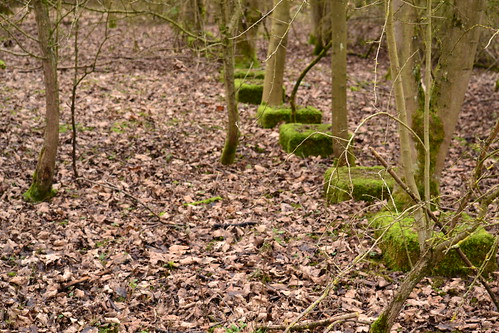
foundations

Stone foundations poke through the undergrowth.

In October 1943, the unit received the first of its Distinguished Unit Citations (DUC), with highly accurate bombing in very challenging conditions raising the standing of this new group. A second DUC was to follow in January 1944 for action deep in the heart of Germany. During an attack on Leipzig in the ‘Big Week’ campaign of 20th – 25th February 1944, two crewmen of the 510th, 2nd Lt Walter Truemper (Navigator) and Sgt. Archibald Mathies*2 (Flt. Engineer), both received Medals of Honour for taking over their stricken aircraft when both Pilot and Co-Pilot were injured / killed. B-17, TU-A ‘Ten Horsepower‘ (#42-31763), was directly hit by flak, both Truemper and Mathies nursed the aircraft back to Polebrook where they allowed the other crew members to bail out safely. On attempting to land the aircraft for the third time, it crashed (Great North Road) between Glatton (Trail 6) and Polebrook exploding, killing all three remaining crew members.

A B-17G Flying Fortress nicknamed

The last moments of B-17G “Ten Horsepower” (TU-A, #42-21763) piloted by Second Lieutenant Walter E Truemper  and Sergeant Archibald Mathies, as it is guided by a fellow aircraft after the pilot was severely injured. Truemper and Mathies unsuccessfully attempted to land the aircraft at Polebrook and were posthumously awarded the Medal of Honour for their bravery, 20th February 1944. (IWM FRE 4724)

It was also during this time that (Cp.) Clark Gable was stationed at Polebrook, initially to make recruitment films for air gunners, flying five combat missions in total and taking a film crew on each one. The first was on 4th May 1943 and his last on 23rd September that same year. He was initially awarded the Air Medal, and later the Distinguished Flying Cross, finally leaving Polebrook with over 50,000 feet of film on 5th November 1943. In 1944, the film ‘Combat America’, narrated by Gable himself, was shown in theatres around the United States. The film covers the 351st from their departure from the United states through their campaign. Included is footage of the collision between the two B-17s on May 7th 1943.

Another remarkable record was set at Polebrook, between 13th June 1943 and January 11th 1944, when Maj. Eliza LeDoux would lead the 509th BS (351st BG) for fifty-two  consecutive missions without losing either a single man nor a single aeroplane. An astonishing example set when at the same time other US Groups were losing aircraft at a rate of around 5%.

Major LeDoux, commanding officer of the 351st Bomb Group the cockpit of a B-17 Flying Fortress, 20 June 1943. Official caption on image:

Major LeDoux, CO, 509th BS, 351st BG, 20th June 1943. He led his squadron without loss for 52 consecutive missions.

The 351st remained at Polebrook until shortly after VE day, returning to the US and becoming deactivated on August 28th 1945. Polebrook then became quiet once more being put under care and maintenance until its closure in 1948.

During the three years the 351st were at Polebrook, they flew a total of 279 B-17s on 9,075 sorties with 7,945 of them dropping 20,778 tons of bombs. Air gunners on these aircraft were credited with 303 enemy aircraft destroyed. In all they flew 311 credited missions losing 175 B-17s in all.

One interesting point about Polebrook was that as a station under care and maintenance, it is thought that within its hangars was the last Short Stirling to be owned by the Royal Air Force.  A MK.V aircraft, it was struck off charge in 1946, a point that ended a long and interesting career for an aircraft that has long been considered a failure. As a bomber, this was certainly partly true, the many teething problems it had suffered – a lack of altitude, poor climb rate, continued engine problems and a tendency to swing on take off – all giving it a bad name. However, it could out manoeuvre a Lancaster and it could give any fighter of its time a run for its money. By the end of its flying career, the Stirling was loved by its crews, it had been a successful transport aircraft, mining platform and had brought many POWs back home after the war. Sadly though, none survived other than as wrecks at the bottom of Fjords or as bits salvaged from various crash sites across Europe. The days of the Stirling were now over and the only person to gain any benefit from them was to be the scrap man.

Thor site walls

3 Thor missile sites remain used for farm machinery.

But it wasn’t quite the same for Polebrook. Post war, and with the heightened threat from the Soviet Union, Polebrook was once more brought back to life, with three Thor missile sites being constructed in the centre of the main runway. These remained operational until August 1963 when they were finally removed and the site closed off. It was sold back to the former owners, at which point the airfield’s runways were dug up for valuable hardcore and many of the buildings were pulled down.

Standing on the site now, the wind howling across the open fields, it is easy to imagine how the site must have been all those years ago. A memorial stands on what remains of the main runway, a small section of concrete, overlooking the airfield.

Memorial

A memorial looks over the remnants of the main runway.

Two benches carved in marble with a main triangular stone are beautifully carved and cared for. Trees planted in lines mark the threshold where many bombers would have left on their way to targets in occupied Europe. A guest book is supplied in a wooden box and signatures reveal visitors from all over the world.

Across the road from here, tucked away in the corner of a field, is the main battle headquarters. Originally a sunken chamber with communications centre and raised platform, it allows observers a full 360 degree view over the site and surrounding area. Built to specification 1008/41 it is sadly now flooded and standing proud of the ground. Both access points are open to the more adventurous, or fool hardy, explorer.

Battle Headquarters designed to drawing 1008/41.

The battle headquarters offers 360 degree views.

The single largest and most well-preserved building is the original ‘J’ type hangar. Used for farming purposes, it is well looked after and visible from most parts of the site. The T2 hangars that would have been opposite are gone. as has the control tower and other main structures.

The three Thor sites are still standing, used by the farmer for storage. They were (at the time of visiting) buried beneath hay bales and farm machinery. One is clearly visible however, the blast walls standing proud. Whilst careful exploring around the others reveals tracks and remains of the housing for the Liquid oxygen supply tank and hydropneumatic controllers, all ancillary buildings are gone.

The best evidence of life at Polebrook can be seen from the entrance to the ‘industrial’ site on the Lutton to Polebrook Road. This area, now woodland, is actually designated a nature reserve and access is freely available. This small road is the original entrance to the airfield and to both your left and right are the technical areas. Beneath the leaves and muddy floor, road ways still lined with kerbstones, are visible, and whilst the road way is not clear, it is possible to make out the general view of the site.

main entrance

The original entrance to the airfield. The main road in the distance separates the technical areas, left and right, from the accommodation areas in the woods ahead.

Hidden amongst the trees and brambles, are a few good examples of the buildings once used. Most, are now piles of concrete, but quite a few shelters are still about and accessible. Storage tanks are open, the covers gone and so as a caution, tread very carefully amongst the bushes watching your footing.

From the entrance, to your left and a little further in, are two buildings, still shells but intact. The larger, I believe is the operations block, a smaller building next to it may have been a power or perhaps communications building.

operations block and adjacent building

One of the various substantial remains, possibly the operations block.

Polebrook is unique in that it has/had examples of twin looped pill boxes. Here one firing window is situated above the other. A few other more standard examples are also on site some easily seen from the road or track.

I believe that the office on the site contains a full-scale model of the airfield as it was, and that the owner is more than helpful to visitors. Unfortunately on the day I was there, I was unable to take advantage of this so a return visit is certainly on the cards for later.

I was amazingly surprised by Polebrook. It is a truly an atmospheric place with plenty to see for the visitor; remnants of a time gone by lay hidden amongst the trees and brambles of the now wooded area, and little reminders of lives lost, lay beneath the leaves. A howling winter wind replaced by summer sun, carry the voices of those young men across its open expanse and through its decaying walls of history.

Polebrook appears in Trail 19.

Sources and further Reading

*1 Ashton Wold – Historic England information sheet List Entry Number: 1001715 accessed 6/2/19

*2 Photo taken from Wikipedia open source. http://commons.wikimedia.org/wiki/File:Polebrook-Aug1948.png

*3 The story of Archie Mathies appears in the ‘Heroic Tales‘. The crew list of B-17 ‘Ten Horsepower‘ was:

Pilot: Clarry Nelson,
Co-Pilot: Roland Bartley,
Navigator: Walter Truemper
Engineer / Top Turret Gunner: Archie Mathies
Bombardier: Joe Martin (POW)
Radio Operator: Joe Rex,
Ball Turret Gunner: Carl Moore,
Waist Gunner: Tom Sowell,
Waist Gunner: Russ Robinson,
Tail Gunner: Magnus Hagbo

Anton. T., & Nowlin. B., “When Football went to War” 2013, Triumph Books

Freeman, R., “The Mighty Eighth War Diary“, (1981) Jane’s Publishing.

Freeman, R., “The Mighty Eighth“, (1986), Arms and Armour Press.

For further information, see the superbly detailed website dedicated to the 351st BG with photos of crews and aircraft.

If time allows, the nearby Polebrook church also has a memorial dedicated to the personnel of the base.

Polebrook was originally visited in the latter part of 2014, the full Trail can be seen in Trail 19.

RAF Polebrook – The First USAAF Bombing mission (Pt 1).

At the top of Northants, close to the Cambridge / Huntingdon borders, lie a number of wartime airfields. Relatively high up, they can be bleak and windy, but to those interested in aviation history they offer some amazing stories and fascinating walks. Some of these sites have been covered in earlier Trails e.g. Kingscliffe, Deenethorpe, Spanhoe Lodge and Grafton Underwood, but because of their close proximity, they could all be combined with this trip.

Our visit today in Trail 19 is the former RAF Polebrook, home to the famous Clark Gable, and the site that saw the very first official Eighth Air Force Bombing mission in August 1942.

RAF Polebrook (Station 110)

To the west of Peterborough, across the A1 and through some of the most gorgeous countryside this area has to offer, is Polebrook, a small village that once bustled with the sound of military voices. Originally designed for the RAF’s Bomber Command, Polebrook opened in May 1941, as a Class II airfield built by George Wimpey and Co. Ltd. It had three runways, the main one being (08-26) 1,280 yards in length, with two further runways (14-32) of 1,200 yards and (02-20), 1,116 yards, giving the site a substantial feeling of size. To accommodate the dispersed aircraft, it was designed with thirty hardstands laid mainly to the south-west and eastern sides of the airfield. The administration and technical sites were located to the north.

Aircraft maintenance was carried out in two type T2 hangars and one J type hanger, which sat next to each other, there were in addition, a range of technical buildings, a Watch Office (with Meteorological Section to design 518/40, to which a circular addition was made to the roof) and around 20 pill boxes built to provide defensive cover of the overall site.

To the north of the site across the main road, lies an area known as Ashton Wold Woods. Within the wood is the Ashton Estate, which was purchased and developed by the banker, Lionel Rothschild in 1860. It was after this that the estate was developed into a country home for his grandson, Charles Rothschild.

Charles, a banker by trade, set about creating a formal garden on the estate along with his wife Rozsika, and later his daughter Miriam. He had the grand honour of being the country’s leading expert on fleas, as well as a naturalist and conservationist who was responsible for forming the Society for the Promotion of Nature Reserves in 1912.

After his death and subsequently Rozsika’s in 1940, the house passed to their daughter, but when the construction of the airfield began, the house and gardens were requisitioned for use as both as a hospital and accommodation site. During the war, the site suffered badly through neglect, and post war, Miriam set about restoring parts of the estate. Sadly it was not fully restored and parts continued to fall into disrepair*1.

RAF Polebrook, Taken August 1948*2

A year after Miriam inherited the estate, the first RAF unit arrived, No 90 squadron (28th June 1941) with Fortress Is, otherwise known as Boeing’s B-17C, who stayed until their disbandment in February 1942. Although liked by their crews, the Fortresses were dogged by high altitude problems (freezing guns) and poor bombing results. This early version of the B-17 was not to be a record breaker and had a relatively short life before being replaced later by better models. Between 8th July and September 2nd, 1941 Polebrook Fortresses made 22 daylight attacks against targets including: Wilhelmshaven, Bremen, Brest, Emden, Kiel, Oslo, and Rotterdam. The RAF eventually decided to pull out of these daylight raids and the airfield momentarily fell silent to operational activities.

B-17C #40-2079 delivered to the RAFSerial: AN518 (Mistakenly marked as AM518 at the Boeing Factory) 90 Squadron

Delivered to the RAF [AN537] as part of Lend-Lease. This was the last B-17C produced; 90 Squadron [WP-L] Polebrook 13th May 1941. The aircraft later transferred to No. 220 Squadron at Alder-grove, Northern Ireland. (IWM UPL 31070)

Polebrook airfield was then handed over to the USAAF (June 28th 1942) and re-designated Station 110. It was felt however, that the current runways were inadequate for the American’s new model B-17s, and so a period of expansion then occurred. During this time the hardstands were increased to 50, the main runway (concrete and tarmac) was extended to 2,000 yards and the two secondary runways were both extended to 1,400 yards. Accommodation blocks were increased now allowing for 2,000 personnel, and the whole site was brought up to Class A standard; all-in-all it was a major redevelopment of the entire site.

The first American units were those of the 97th BG of the 1st Combat Wing. The 97th were constituted on 28th January 1942 and activated in the following February. Passing from MacDill Field in Florida through Saratosa they would make their way across the northern route to Prestwick. On route to their departure points, elements of the group were detached and sent to the Pacific coast, whilst the remainder continued on to Europe. The first manned B-17 #41-9085, ‘Jarrin Jenny‘ arrived in the UK on 1st July 1942 touching down at Prestwick in Scotland after a 3,000 mile long flight via Greenland, with the first ground echelons arriving via the Queen Elizabeth, shortly before on 10th June. Five days after ‘Jarrin Jenny’s‘ arrival, the aircraft would reach their new base, and the Northampton countryside would become a buzz of activity, as much from the curious locals as the Americans they were in awe of.

Bill Colantoni of the 306th Bomb Group with a B-17 Flying Fortress (serial number 41-9085) nicknamed

Bill Colantoni poses in front of B-17 #41-9085 ‘Jarrin’ Jenny’ at Polebrook, the first B-17 to arrive in the UK. (IWM UPL 6830)

Almost immediately after arriving int the UK the four squadrons of the 97th were split. Between June and the end of November the Headquarters unit, along with the 340th BS and 341st BS were based here at Polebrook, whilst the 342nd and 414th BS went to the satellite airfield at nearby Grafton Underwood (Trail 6).

Within a month of arriving on August 17th, the 97th BG would enter service flying the first operational mission of the USAAF from England, under the control of the Eighth Air Force. However, hastily formed, these early groups of bombers were made up of poorly trained crews, many of the gunners never having fired their guns at moving targets, nor had pilots flown at high altitude on Oxygen or in close formation. Such was the rush to get the aircraft overseas, that basic radio, flying and gunnery skills were all lacking, and if they were not to become easy targets for the more experienced and ruthless Luftwaffe, then they were going to have to endure a very steep learning curve indeed. Thus the early part of August was to be filled with intensive flying practice, with the RAF offering their services as mock enemy fighters, trainers and advisers, supporting the Americans through the tough training regime that would hopefully save their lives in the coming weeks and months.

By the 9th August it was decided that the 97th was combat ready and orders came through for their first mission. Sadly the 10th August brought poor weather, and the mission was scrubbed much to the disappointment of the those in the Group.

Two days after this, even before a bomb was dropped in anger, the dangers of flying in cloudy European skies would become all too apparent when a 340th BS, B-17E #41-9098 ‘Big Bitch‘ (not to be confused with #41-9021 ‘The Big Bitch’, which transferred to the 390th BG at Framlingham and was renamed “Hangar Queen“), collided with mountains in Wales whilst on a navigation exercise to Burtonwood, killing all eleven on board. The 97th were now racking up many ‘firsts’ adding the first B-17 fatalities to their extending roll.

August 12th saw the next call to arms, but again the weather played a cruel joke on the men of the 97th, the mission being scrubbed yet again; it was beginning to appear that someone was playing a rather frustrating joke at the expense of the eager young men.

Their next mission, detailed on the 16th was then again called. This time was ‘third time lucky’ and the following day the first official mission of the Eighth Air Force was given the green light. At 15:12 six B-17s in two waves of three left the runway at Polebrook and history was made. After rendezvousing with their ninety-seven RAF Spitfire escorts, they headed for the French coast only to turn away and head for home when just ten miles from the enemy’s coast. This time it was not the weather at fault, the mission was a planned feint to tease the Luftwaffe away from the main force following behind – a group of Twelve B-17s from each of the 342nd, 414th and 340th BS.

This mission was not only the USAAF’s first mission, but it also saw the testing of new electronic counter-measures equipment. Flying alongside this formation were nine Boulton Paul Defiants carrying the counter-measures equipment. Code named “Moonshine“, the equipment consisted of ‘repeaters’ designed to repeat back to the German’s their own radar signals thus giving the impression of a much larger and more formidable force.  These first two Polebrook flights split, the first making their feint toward Alderney, whilst the second force flew toward Dunkirk, it was this flight that was accompanied by the nine Defiants. Before reaching the coast though, they turned and headed for home their job done. It was reported by the British that an estimated 150 Luftwaffe fighters rose up to meet the ‘massive’ force, but no interception took place and all aircraft returned to base.

Amongst the main force following on, were three of the Eighth’s most prestigious personnel; the Group’s Commander Colonel Frank Armstrong Jnr who sat beside Major Paul Tibbbets (Tibbets was to go on and drop the first Atomic bomb on Hiroshima thus ending the war with Japan) in ‘Butcher Shop‘; whilst in the second wave flew General Ira Eaker, Commanding General of the entire Eighth Air Force, in ‘Yankee Doodle‘. Bombing results were ‘good’, the clear skies proving to be the bombardiers best friend that day. All aircraft returned, the only casualty being a pigeon that hit the windshield of one of the B-17s as it approached Polebrook. The first mission was over, the ice had been broken.

This first mission, a trip to Rouen, preceded several attacks across the low countries, until in the November when the Group (previously assigned to the Eighth on September 14th) transferred to the Twelfth Air Force. They were now heading for  North Africa. Over the period 18-20th November the air echelons departed Polebrook heading for Hurn before flying on to North Africa. The Ground echelons left shortly after, a point at which the 97th’s connection with Polebrook ceased leaving nothing but a legacy behind.

Original J type hangar built to specification 5835/39

The original Type ‘J’ Hangar still in use today.

In the short time the 97th stayed at Polebrook they would complete 14 missions over occupied Europe, dropping 395 tons of bombs. They would then go on to earn themselves two Distinguished Unit Citations and complete a number of ‘firsts’ whilst operating in the Middle East. But with the 97th now gone, Polebrook airfield would enter a period of relative calm and peace.

Then in April / May 1943, Station 110 once more resonated with American voices, with the arrival of the 351st BG. Another new Group, they were initially assigned to the 1 Bombardment Wing (1 BW) of the 101 Provisional Combat Bomb Wing (101 PCBW). After the USAAF went through periods of change and renumbering, this eventually became the 94th Combat Wing, (1st Bombardment Division). The 351st operated with B-17s of the: 508th (code YB), 509th, (code (RQ), 510th, (code TU) and 511th (code DS) Bomb Squadrons, distinguished by a triangular ‘J’ on the tail.

A film taken at Polebrook showing a number of aircrew and aircraft of the 351st BG. Several views of the technical and accommodation sites give a good contrast to the views of today, especially the ‘J’ type hangar that appears above.

The 351st were only activated in the previous October, and were, as ‘rookies’, to take part in some of the most severe aerial battles in Europe. Luckily for them though, training programmes back home had improved, and the gaps that were present in the first crew selections had now been filled.

As with all units new to the theatre of war, a short time was spent on familiarisation and formation flying techniques. Shortly before the 351st were deemed combat ready they were practising formation flying over Polebrook when tragedy struck.

Former Washington Redskins player Major Keith Birlem (508th BS) was piloting B-17 #42-29865 ‘YB-X’ when the plane dropped down severing the tail of another B-17 #42-29491 (509th BS) piloted by Capt Roy Snipes. Both aircraft fell from the sky landing as burning wrecks near to the perimeter of the airfield. The accident took the lives of all twenty airmen on-board the two aircraft. Major Birlem had flown his one and only combat mission just three days earlier, on his birthday, gaining experience as a co-pilot with the 303rd BG who were stationed at Molesworth.

In part 2 we see how the 351st entered the European conflict along with the further development and subsequent rundown of Polebrook immediately after the war. We also look at how the increase in tension of the Cold War brought Polebrook back to life once more, and how it eventually closed for good leading to the condition we find it in today.

The Development of Britain’s Airfields (Part 8).

In this, the last of the series looking at the development of Britain’s airfields, we look at the Watch Office, perhaps the most atmospheric of buildings associated with Britain’ wartime airfields. The hub of an airfield control, it was where aircraft were counted out and back, where the battle was monitored and the cries of those who fought in the air war were heard.

Though only a recent addition to airfield architecture, it developed quickly and became one of the technologically advanced offices in the world.

Watch Offices.

The Watch office, Watch Tower or in American terms Control Tower, was the centre piece of any airfield, the place in which all operations were controlled. Even today, the control tower is the one feature that stands high above the rest of the airfield with commanding views across the entire site.

Many of these watch offices remain today, some as fabulous museums, some as private dwellings, but many are sadly derelict or even worse – gone altogether. This that do survive create a haunting and evocative feeling when seen from inside.

Thorpe Abbotts Museum

The beautifully restored Thorpe Abbots Watch Office (design 15683/41).

Unlike hangar development, the watch office appeared quite late in the development of the airfield, only really coming into being as war seemed inevitable. Before this, a rudimentary office was often all that was used, usually attached to the side of the main hangar, and was used to ‘book’ aircraft in and out. But by the mid war period the watch office had become a major structure on the airfield, a standard design (depending upon the airfield use) with two or more floors and often a ‘glass house’ for observation purposes.

For obvious reasons the watch office was built away from other buildings with clear sight over the entire airfield, an important aspect if controllers were to keep watch on the many aircraft that were moving about the airfield space. A vital asset to the airfield it was often targeted by marauding bombers, and in the case of attack, the controllers within would relocate to an emergency battle headquarters, hidden at ground level on a remote part of the airfield, but still with views across the site.

The basic watch office was often adapted rather than demolished and rebuilt, this can and does, cause great confusion as to its design origin. Further more, on some sites, the original was abandoned but not demolished, and a new office built elsewhere on a nearby site, thus giving rise to two offices on the one airfield eg. Matlask and Martlesham Heath

The Watch Office as we know it was first seen on military airfields in 1926 and resembled a small bungalow with bay windows. Those constructed on bomber bases would be slightly smaller than those on fighter bases, a fighter base office having a pilots office attached. The idea behind this was to keep pilots as close to the airfield  control centre so they could quickly be scrambled and report back to the airfield controller on their return. These early design were found on airfields such as Bircham Newton in Norfolk, Hendon and Tangmere and were all built to the same  basic 1926 drawing design only modified to take the extra pilots room.

The standard shape of the World War 2 Watch Office stems back to the mid 1930s, with the introduction of a two-storey building that was square in design. Like similar buildings of its time, it was brick, a building material that was replaced with concrete, in 1936.

RAF West Malling Control Tower under refurbishment

West Malling a 5845/39 design which is now a coffee shop.

By the end of the expansion period, and with the introduction of hard runways, it was realised that the non-dispersed sites gave poor visibility for early watch offices, views across the airfields were not clear and so a quick remedy was called for. The answer lay in two choices, (a) demolish the current buildings  and rebuild it in a better location, or (b) add an extension. In many cases the former was the better idea and this progressed quite quickly, however, where the latter was chosen, remedial work required alteration of the building whilst it remained in use.

A further complication to these designs was the introduction of meteorological sections, which all new buildings erected at the beginning of the war now had. This gave a mix of design styles, enough though there was only a small selection of design drawings from which to work.

These late expansion period and early war designs introduced the idea of ‘viewing platforms’ or parapets, surrounded by safety railings along the front of the building. These deign also had very large glass fronted walls, bright and airy they allowed a lot of light to enter the building but gave cause for concern later on, when it was realised that a bomb blast would cause severed injury to the occupants in an attack. It was also found that during night operations, large windows were more difficult to black out and so smaller windows offered both better protection and greater ease of black out.

As building materials became scare, particularly wood and brick, concrete became the norm. This change also led to drawing changes even though the basic design inside and out, was the same.

In order to appreciate the changes to watch office designs, one needs to consider the different roles that airfields played during the war. Bomber Command airfields would have a differ office to a fighter Command airfield, which in turn, had a different office to a satellite or night-fighter station.

Thorpe Abbotts Museum

Watch Offices give commanding views across the airfield. (Thorpe Abbots).

The regional control stations where these first offices were being built were certainly getting the better choice at this time, standard fighter and bomber airfields having to use inferior designs that very soon became outdated and inadequate for the needs of the airfield.

During the massive building programme of 1941/42, there was some effort made to standardise all airfield Watch Offices, this resulted in the 1941 design drawing no. 12779/41. This was to be the basic airfield watch office design, with its parapet, six large windows to the front and outside access steps. As older airfields were brought up to Class A Specification, many had these new Watch Offices built to replace the older original ones. Some simply had adaptation of the original. Here the use of the airfield had a bearing on the watch office modification / design, and whilst the basic 12779/41 model was employed, slight variations did exist where the airfield was not a bomber airfield.

Therefore various adaptations of this did follow, examples of which include the slightly smaller 13023/41 (RAF Cottam), those with modified smaller windows 15371/41 (Kimbolton) and 343/43 (Martlesham Heath),  and the smaller Night-Fighter design 15684/41 (Winfield). Being a Night-Fighter station Winfield, had the same basic design but construction methods were totally different. This new design 15684/41, would become standard at all night fighter bases.

All these alternative designs appear outwardly very similar to the original, but differ mainly in window design only, although the physical size of some is different.

RAF Winfield

The Night-Fighter station Watch Office at Winfield (15684/41) is a similar design but smaller, having only four windows in the front.

This design, 343/43, eventually became the most common design for watch offices and appeared on all operational stations and Operation Training Unit airfields after 1943, using a set of six half-size windows across the front.

Tower (2)

The smaller windows of Parham (Framlingham) were half the original design size (12779/41 modified to 343/43).

A further addition was the glass observation room located on the roof of the Watch Office. These were generally only applied to Group control offices, and gave an excellent all round unrestricted view of the entire airfield. Examples that exist today, such as Framlingham above, are replicas but have been built to very high standards.

Former RAF Martlesham Heath

Martlesham Heath is a similar design to Framlingham (modified to 343/43) – Note the runway heading board on the roof.

At the end of the war some airfields such as Sculthorpe and West Raynham had their Watch Offices modified as they changed roles to Very Heavy Bomber Stations. This new design 294/45, improved on former buildings as a complete new design based on a steel frame with precast concrete floors. It had an extra floor added and then the octagonal ‘glass house’ or Visual Control Room with slanted glass to reduce glare.

Control Tower

Sculthorpe’s modified tower gives 360 degree views over the airfield. A three-story block it utilises the former World War 2 Watch Office.

The Watch Office has been the hub of airfield command and control since the mid 1930s, it has developed from the humble shed to a multi-functional technologically advanced building dominating the skyline of the airfield today. Sadly though, many are now gone, and of those that are left only a few remain in good condition or open to the public.

Summary

The war-time airfield incorporated numerous building designs and shapes, certainly far too many to cover here, the wide variety of technical buildings, synthetic trainers, parachute stores, headquarters and general stores, all changing as the war progressed.  The design and materials used in these structures was as varied as the designs themselves. But as the RAF grew so too did the airfields they used. The runways, the hangars, the technical buildings and accommodation sites have all grown alongside. Sadly many of these buildings have now vanished, but the process and speed at which they developed has been unprecedented. From humble grass strips with wooden shacks to enormous conurbations with numerous buildings, they have become iconic symbols representing decades of both aviation history and human sacrifice.

The entire page can be viewed separately:

Part 1 – The Road to War.
Part 2 – The Expansion Period and airfield development.
Part 3 – Choosing a site.
Part 4 – Building the airfield.
Part 5 – Airfield Architecture.
Part 6 – Runways and Hardstands.
Part 7 – Hangars and aircraft sheds.

or as a whole document.