RAF Bircham Newton (Part 4 – Bircham Enters the War)

So far we have seen how Bircham Newton developed from a First World War training airfield through the cutbacks of the early 1920s, and on into the Expansion period of the 1930s. Bircham is now in the hands of Coastal Command, a force lacking in materials but not will power. The units at Bircham work hard, and new developments come along that will help save lives at sea and put Bircham on the map. After Part 3, Bircham now enters the war.

The declaration of war and the early 1940’s would see some remarkable events take place at Bircham Newton; new aircraft and new roles, along with some advances that were to help downed airmen who ended up in Britain’s coastal waters.

One of these advances, was the creation of the ‘Bircham Barrel’, a container manufactured from the tail end of a 250lb bomb that was carried under the wing of searching Air Sea Rescue (ASR) aircraft and dropped to downed aircrews. The barrel was based on the ‘Thornaby bag’ a container designed at RAF Thornaby, in which supplies of: water, food rations, first-aid equipment, clothing and cigarettes were all placed. The Bircham Barrel, developed this idea a little further, making it more water tight and easier to retrieve by crews once in the water.*4

The Barrel was placed under the wing of an aircraft on a bomb rack, and once a crew was sighted, the pilot could drop the barrel providing the crew with sufficient rations for several days. After tests, the idea was given the green light and by 1941 it was in use by a range of aircraft operating in the ASR role.

With an increase in coastal operations from Bircham, particularly in the Air Sea Rescue role, many of the aircraft that would now use the airfield would be the twin-engined types. Kicking off the decade were the Bristol Blenheims, of 254 Sqn in January 1940. Joining a small detachment of 233 Sqn  Blenheims that had arrived here late in 1939, 254 Sqn only stayed for three months, operating as ‘Trade defence’ or fisheries protection unit – perhaps one of the lesser well known operations of Coastal Command.

Twin-engined models were not to be the only aircraft seen at Bircham though. The spring and early summer of 1940 would see further detachments with Hurricanes from 229 Sqn, a short stay by 235 Sqn and the first of a number of Royal Navy’s Fleet Air Arm (FAA) units 815 Sqn with the delightful Swordfish. One further unit to be based here at this time, would bring with it one of the more intriguing models of aircraft used during the Second World War, the Wellington DWI of No 2 General Reconnaissance Unit (GRU).

One of the roles of the GRU was to detect and destroy German mines, particularly new magnetic mines that were proving to be a menace to allied shipping. Using a Wellington 1A bomber modified to carry a large 51 foot ring of wood containing an aluminium coil, it would generate, using a Ford motor, an electronic signature that would resemble a ship. By flying low and slow over the water, it was hoped that the signal from the coil would detonate the new mines. Whilst the idea worked well in principal on land, over water it caused a number of issues primarily because the aircraft had to fly between 60 feet and 35 feet to detonate the mine. A number of successful detonations were recorded, but some aircraft were struck by the blast wash, causing them to be knocked ‘off balance’ as the mines exploded. Fortunately though, there are no recordings of any serious damage being sustained by these aircraft, but it was nonetheless, a dangerous job to do and because of advances elsewhere, it became a short lived attempt to gain an advantage over the Germans in the mine laying war.

ROYAL AIR FORCE OPERATIONS IN THE MIDDLE EAST AND NORTH AFRICA, 1940-1943.

Wellington DWI Mark II of No. 1 GRU based at Ismaliya. The ring weighed over two and a quarter tons.© IWM (CM 5312)

Like the Swordfish, both the Wellingtons of 2 GRU and the Blenheims of 235 Sqn were only based at Bircham for a month, all departing in May 1940, although 235 Sqn did return in the summer staying this time for a year. The immediate period after their departure saw yet more FAA units arrive, 826 and 812 Sqns, with Albacores and Swordfish respectively. Both of these units would operate as shipping patrols and also in mine laying operations, but would again only stay for a short period of time. During operations on 21st June 1940, at De Kooy Naval air base, one 826 Sqn aircraft was lost, two of the Albacore’s crewmen: Sub Lieutenant (A) Peter William S. Butterworth, (famed for his acting in the ‘Carry On’ films) and Telegraphist /Air Gunner Robert (TAG) J. Jackson, were both captured. Sub. Lt Butterworth survived ending up in Stalag Luft III after several failed escape attempts, whilst TAG Jackson died in captivity on 18th January 1945. The third crewman, Sub-Lieutenant Victor J. Dyke, died the day after the attack.*6

Peter Butterworth - Wikipedia

Peter Butterworth from the 1968 film “Carry on… Up the Khyber” (wikipedia)

Bircham’s long standing 206 Sqn were by now replacing their Blenheims with Hudsons, the American built twin engined aircraft designed around the civil Lockheed Super Electra. By militarising it, they produced an aircraft that would serve well in Coastal Command operations.

Initially carrying out convoy duties, the Hudsons would then patrol as far away as the ‘North German Islands’, but primarily flew reconnaissance patrols along the  coastline between Norway and Brest. Shipping was engaged on a number of occasions as were flak and Luftwaffe aircraft. During May, as the new Hudsons were being delivered, a number were lost to enemy action, particularly fighters.

For one Hudson, (P5120), life at Bircham would be short lived, the aircraft arriving here in April, only to be written off after a crash landing in June. The aircraft, one of three, departed Bircham on June 19th at 23:50 for a night patrol. On return it struck a ridge on the airfield’s approach causing it to bounce heavily. The aircraft then stalled and hit the ground so hard it caused the undercarriage to collapse. Thankfully all four crewmen emerged from the aircraft unhurt.

WITH A HUDSON OF COASTAL COMMAND

Hudson C-VX (P5120) of 206 Sqn on patrol before being written off in a crash landing. (© IWM CH 287)

Both during and after the build up to Hitler’s planned invasion of Britain, airfields across southern England were targeted by the Luftwaffe, and Bircham Newton was no exception. Whilst not a fighter airfield high on the list of Luftwaffe priorities, bombs nonetheless did fall on the airfield, and it was the Hurricane detachment of 229 Sqn based here, who were tasked with providing cover against such attacks.

In addition, many support units were also based at Bircham, these would provide training for pilots, gunners, navigators, other members of aircrew along with cooperation with ground operations as well. One such unit here at Bircham was No. 1 Anti Aircraft Co-operation Unit (AACU) which consisted of several Flights, designated ‘B’, ‘C’, ‘D’, ‘K’ and ‘M’, they all operated the Hawker Henley, the Hurricane’s little known relative.

With Flights designated A – Z (‘I’ was omitted), the unit operated at various airfields across Britain, flying a mix of Henley IIIs, Wallace, Lysander and Battle aircraft, with both Flights ‘B’ and ‘M’ being formed here at Bircham Newton. Several of these Flights also used RAF Langham, another Coastal Command / training airfield a few miles away on the Norfolk coast, particularly useful for the training of heavy anti-aircraft guns.

The Henley – built along side the Hurricane – essentially used the same jigs, their similarity thus being quite stark. The Henley was initially designed as a light bomber with modifications to the guns and an additional seat added behind the pilot. However, changes in Government policy toward daylight bombers meant that the Henley was soon transferred to other duties notably target towing. To assist this, a small propeller driven motor was added to the port side of the aircraft, just below the rear cockpit, this would power the winch that held the target drogue as it was towed some 7,000ft behind the aircraft for gunners to aim at*5.

ROYAL AIR FORCE COASTAL COMMAND, 1939-1945.

Hawker Henley, L3353, of ‘K’ or ‘M’ Flight, No. 1 AACU, next to a bomb crater at Bircham Newton. A lone Do 17 dropped seven high explosive bombs on the station causing light damage but also slightly damaging this aircraft. The similarities to the Hurricane are very evident. (IWM CE 43)

In November of 1940, two more squadrons were formed here, one, another First World War unit, was 252 Sqn. It would not fly operationally from here though, instead collecting its aircraft from Chivenor to where it would move a matter of weeks later.

The second unit, 221 Sqn was formed on the 21st November, and was also a former World War One unit. Disbanded in 1919, it would serve for the remainder of the war with the Wellingtons in the Coastal Command role. The initial order was to train crews at Bircham prior to their move to operations at Limvardy, a role it would perform using twenty-four Wellington IC aircraft. By the end of the month two such models, N2909 and N2910 were delivered and ready to be used for the job. A third aircraft, a dual control Wellington (R2700), arrived on the 6th and then on the 12th December, the personnel were all moved off site to a new location the rather grand Heacham Hall. The hall, which burned down during the war, was a 17th Century building, and had historic ties to Matoaka (better known as “Pocahontas”), who married local man John Rolfe. It must have been a  rather nice change for the airmen to be ‘off base’ and in more luxurious, and historical, surroundings.

During the remainder of December more aircraft arrived and by the last day of the year, eleven more Wellingtons were ‘on role’ along with a growing number of personnel – both air and ground crew.

1941 started on a high for Bircham Newton, with a Royal Visit. On 26th January, the Royal party consisting of King George VI, Queen Elizabeth, and Princesses Margaret and Elizabeth, visited the area inspecting the airfield and its aircraft. Whilst here, the King gave airmen a number of awards before the whole party moved of to other airfields across Norfolk.

For the whole of January, training flights were the order of the day for the Wellingtons of 221 Sqn, but poor weather meant that only 12 out of the 31 days were actually suitable. However, by March 27th 1941, all pilots had flown solo by day and a new flight was crewed up and ready for operations. The squadron then began its move over to Limvardy in Northern Ireland.

The summer of 1941 was another busy time for Bircham Newton. In May, two squadrons appeared, the first 200 Sqn was formed from 206 Sqn, which had already been used to create 220 Sqn earlier on. 200 Sqn were formed to perform the ‘operational duties of a Coastal Command general reconnaissance land-plane squadron’ in other words maritime and anti-submarine patrols. It would be made up initially of 210 personnel, who would depart Bircham on the 25th to Greenock, whilst seven Hudsons would fly to Gibraltar on route to Gambia. It would remain abroad until its disbandment at the war’s end in 1945.

The second, 500 Sqn moved in from Detling in Kent, bringing Blenheims with it. With detachments at both Limvardi and Carew Cheriton, these were replaced by the Hudson V in November before the unit departed for Stornaway in Scotland’s Western Isles in May 1942. Once at Bircham they immediately began patrols, looking for downed aircrew, mines or enemy shipping. Poor weather restricted many of these patrols, but both mines and shipping were spotted, sadly no dinghies or aircraft were found in these early days.

The next unit to arrive was another Blenheim squadron, 248 Sqn who performed convoy patrols and strikes against enemy shipping. During July, a month after they moved in, they began to replace the Blenheim with Beaufighter ICs, a powerful and heavily armed aircraft built to design Specification F.37/35. After initial handling issues, it became a sturdy weapons platform that performed well, especially in the anti-shipping role, carrying a torpedo or rockets. For the next month the weather prevented much in the way of flying, with fog, rain and poor visibility preventing all but minimal flying, the squadron remained firmly on the ground for a good deal of August.
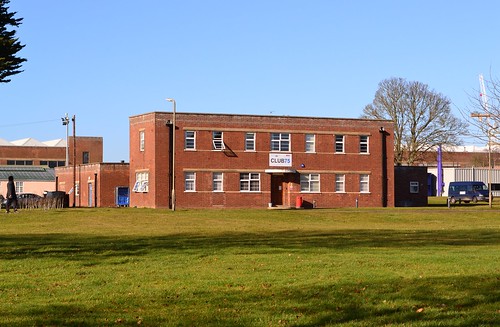
Armoury and Photographic building

Former armoury and photographic building.

The last of the summer squadrons to arrive were 53 Sqn and 59 Sqn. Initially based at Detling / Thorney Island, they had also maintained a detachment of aircraft here at Bircham. Once the two squadrons had reformed at Bircham, they both took on the Hudson replacing their Blenheims before departing back to St Eval in the October of that year (53 Sqn) and North Coates (59 Sqn).

By September 1941, the need for more Air Sea Rescue aircraft, particularly deep search aircraft, had become ever more apparent, and it called for the creation of two more squadrons able to perform such tasks. However, suitable aircraft were in short supply, especially Lockheed’s Hudson with ASV (Air to Surface Vessel) radar equipment and Lindholme rescue gear. Thanks though to Sir John Salmond GCB, CMG, CVO, DSO & Bar , Coastal Command’s corner was fought, and even though by the end of 1941, aircraft were still few and far between, by the December one of these Squadrons, 279 Sqn, was up and running here at Bircham. However, it would be a long haul, and it would not be until March the following year before they would be fully operational and their Hudsons operating regularly in the Air Sea Rescue role from this airfield.

The second squadron, 280 Sqn however, was not given the Hudson, instead they had to contend with the Anson. Another unit set up in 1941, its primary base was also at Detling in Kent. Whilst performing this duty, they maintained a detachment of aircraft here at Bircham Newton, a position it held whilst the bulk of the squadron moved to Langham in Norfolk in the summer of 1942. It would then be after this, that the entire squadron would move into Bircham Newton.

Like its sister unit it would take time to become fully operational and it would not be until June before the squadron was operating as it should. The benefit of both units was quickly seen though, thirty-five men from six crews were rescued over May – June by 279 Sqn, whilst one crew was rescued by 280 Sqn within days of them becoming fully operational.

The early years of the war were busy for Bircham Newton, and as war progresses, further units arrive and depart, the hectic scenes will not be stopping yet!

The full text can be seen in Trail 20 – North Norfolk Part 1.
RAF Bircham Newton (Part 3 – The build up begins).

In Part 2 we saw how Bircham had grown following the immediate post war cutbacks, and how France was seen as a threat. Now as developments occur in Germany, the dynamics of Europe begin to change and we enter the Expansion Period of the late 1930s.

Bircham sees more new squadrons, new aircraft and further developments to its infrastructure.

In the 1930s, the Government’s plans for expansion took a new direction when Germany too began to build up its armed forces – albeit surreptitiously at first. New expansion schemes were put in place, which not only signified the expansion of the RAF’s forces, but the number of available airfields, their design, and the number of their associated buildings as well.

One of these modifications was the construction of a standard watch office with attached tower. Designed as drawing 1959/34, it became the standard design used for all Watch Offices of this time, and was in essence a square building with a small observation tower built onto a flat roof. In addition to this, Bircham also had new barrack blocks (2357/36) built, now in the familiar ‘H’ shape, supplementing the previous models which were in the form of a ‘T’. These new buildings had reinforced roofs giving better protection to those inside should it be struck by small incendiaries.

The decade started off on a bad foot however, with the loss of a 207 Sqn aircraft, a Fairey IIIF on January 21st 1930. A previous resident of Bircham, the rear party had brought the last of the personnel to Bircham in November 1929. The next weeks were spent getting as many airmen flying solo on the Fairey IIIFs as possible. However, poor visibility due to fog that day, caused the aircraft ‘J9637’ to crash into an orchard near Sudbury in Suffolk killing both crewmen: F.O. Donald Mackenzie (aged 25) and Cpl. Leonard Edward Barnard who was a year younger.

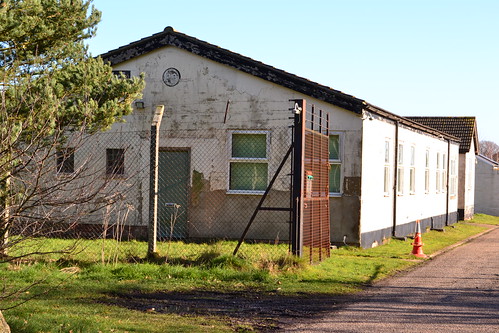
Former Technical Building

One of the former technical buildings no longer used.

In November 1935 information was received at Bircham that two new squadrons were to be formed here, 21 Sqn and 34 Sqn, both bomber units flying Hawker Hinds. Personnel began arriving on December 3rd and began to work on 207 Sqn’s  updated Fairey Gordons, preparing them for dispatch to Cardington prior to their move abroad once more. 21 Sqn were allocated Hangar No. 17, and would receive their first Hind (K.4638) on New Years Eve 1935.

34 Sqn on the other hand, wouldn’t receive their first batch of Hinds until January 1936, when four examples were delivered from the Hawker Aircraft Company Ltd. at Brooklands, by pilots from other units. With two more Hinds being delivered on June 11th, also by pilots of other units, the cadre would soon be preparing to move. On July 30th, both 21 and 34 cadres were ordered north, making the move from Bircham Newton to Abbotsinch in Scotland.

The latter part of the decade reflected previous events at Bircham. Many new changes meant that events at the airfield were as dynamic as ever. Several new squadrons were formed resulting in new crews and some new aircraft. Sharing the space at Bircham were 18 Sqn (Harts and Hinds), 49 Sqn (formed from ‘C’ Flight of 18 Sqn) and ending the decade 206 Sqn with Ansons and later Hudsons. 206 would themselves later be used to form 220 Sqn, which in turn would see ‘C’ Flight be renamed as 269 Sqn. Many of these new squadrons would in turn depart Bircham as changes occurred on the continent.

With 206 came new changes of command at Bircham. Their arrival in 1936, saw a move to Coastal Command (16 Group). Formed at Manston in June under the initial command of Sqn. Ldr. A. H. Love, 23 (Training) Group, 206 Sqn had three flights of six aircraft each and a further six Ansons in reserve. The squadron transferred across to Bircham at the end of July by which time the command had been taken over by Wing Commander F.J. Vincent D.F.C.

206’s main role at this point was training pilots selected for Flying Boats and the  Blenheim squadrons of Coastal Command. Shortly after arrival, the unit’s command would pass over to Wing Commander H. Long D.S.O., and by June 1937, 270 pilots would have been successfully converted in 2,700 hours of flying time.

Naturally accidents did occur during this time, on November 9th 1936, 220 Sqn Anson ‘K6199’ stalled after take-off killing P.O. Peter White (age 23) and injuring three others: Sqn. Ldr. William M. M. Hurley (the pilot), AC.2 Eric D. Butler and AC.1 Reginald K. Birtwistle. The aircraft was written off, after which a court of enquiry recommended modifications to locking bars, as it appeared that the pre-flight checks had been made with the control systems locked. The aircraft was left as an instructional air frame and a stark reminder for proper pre-flight checks!*7

A second accident occurred a year later in September 1937, when another 220 Sqn Anson, ‘K6227’ also stalled, this time falling into the sea near Conway. This time, the crew were not so lucky, with all three, a Sergeant, an AC.1 and an AC.2 all being killed. Their average age was just 22 years old.

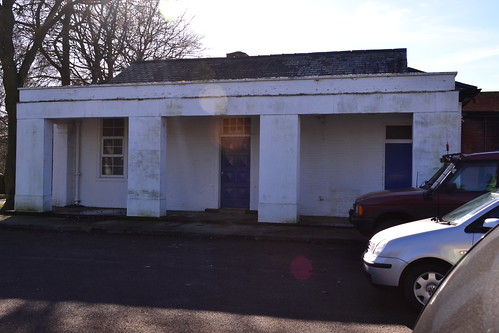
Guard House

The former Guard House now stands as a shop.

During the later years of the 1930s, a royal visitor was often seen parked in the hangars at Bircham Newton. The Airspeed Envoy G-AEXX of the King’s Flight was a regular here, being so close to Sandringham House, the Royal residency, it was an ideal location for the aircraft. The Envoy was a creation of the Airspeed company, headed by the author Nevil Shute, a former de Havilland and Vickers employee who later set up his own business, Airspeed Limited. The Envoy was later developed into the Airspeed Oxford which became one of the main trainers used by the RAF.

As the era closed and just weeks before the outbreak of war, another squadron arrived here at Bircham in the form of 42 Sqn with Vickers Vildebeests. The Vildebeest was a late 1920s design biplane, designed to meet Specification 25/25 which required an aircraft operating in the Coastal Defence role and capable of both day bombing and ant-shipping torpedo operations. Several marks were manufactured, up to and including the MK.IV of which only 18 were built. It was some of these that were later delivered to 42 Sqn at Bircham Newton. These aircraft remained in service at Bircham until April 1940, when they were replaced by Beauforts at which point, 42 Sqn departed Bircham transferring to Thorney Island in West Sussex.

On the day war was declared, another very mobile squadron appeared at the door of Bircham, this time it was the Blenheims of 90 Sqn who made a very brief appearance here from West Raynham. Over a period of just two weeks they would locate at five different RAF stations!

With the introduction of the last of the Expansion Schemes ‘L’ and ‘M’ over the years 1938 -39, Bircham would see yet more changes to its infrastructure, notably the demolition of the repair sheds and their replacement with three Type ‘C’ hangars. At this point a fourth was also proposed such was the size and nature of activity at Bircham Newton. In addition, the two original Belfast type hangars were retained providing a mass of hangar space on the airfield. Another bonus for Bircham was the addition of further accommodation blocks, providing better accommodation for the many new air and ground crews who were increasingly appearing at this Norfolk site.

Teetering on the bring of war, Bircham was now operational, more modern aircraft are filtering through and Coastal Command operations begin in earnest. In Part 4, Bircham Newton enters the war.

The full text can be seen in Trail 20 – North Norfolk Part 1.
RAF Bircham Newton (Part 2 – The 1920s)

In Part 1 – The Early Years – we saw how Bircham Newton was created and how it was chosen to be the forefront of long rang bombers targeting Berlin. We saw the untimely death of One Captain Cecil Darley and how, as we enter the 1920s, a new build up of the RAF was required following massive cutbacks after the First World War. In Part 2, we progress through the 20s, Bircham develops into a larger station and how one of its pilots won his VC before arriving here.

This decision to rebuild the RAF in response to France’s build up, then led to an initial burst of refurbishment and development of Britain’s current airfield stock, those not closed by the post-war political hatchet. This included Norfolk’s Bircham Newton.

The link forged in late 1918 with bombers would carry Bircham right through the 1920s and on into the mid 1930s, during which time a number of squadrons would either be formed here or pass through in transit elsewhere. The first of these was through the reforming of 207 Squadron on February 1st, 1920 with DH.9As. This unit came from the nucleus of 274 Sqn, itself a previous resident of Bircham. As a cadre, it would remain here for two years before departing for warmer climates and Turkey, in the Autumn of 1922. That was not the end of the link though, after a spell abroad the squadron would return to the UK, coming back to RAF Bircham Newton at the end of the decade. This return would bring a new variety of aircraft, the Fairey IIIF. By 1932 though, these models were themselves being replaced by another Fairey aircraft, the Gordon, and within three more years the squadron would be back on the road to the Middle East once more.

Another small cadre appeared here on New Year’s Day 1920. Moving in from the former Narborough airfield (Norfolk’s first), the cadre from 60 Squadron would disband later that month, having the good fortune to reappear at Risalpur, India, later in the year.

Over the period 1923 – 24 three more squadrons arrived at Bircham, 7 Sqn (who were formed here from 100 Sqn and stayed for four years); 11 Squadron (6 months) and 99 Squadron (four years) bringing a wide range of aircraft with them to this part of Norfolk. Delights such as the Vickers Vimy; Virginia II, III, IV, V, VI and VII; DH.9A, Fairey Fawn and the Handley Page Hyderabad were all present during this short period of time.

Squash courts

The original squash courts are still used as they were intended.

With such a mass of movement, accidents were inevitable. 7 Sqn suffered a loss when Vickers Vimy (F9187) overturned whilst landing at night on 16th October 1923. Damage to the aircraft itself was not too severe and it was repaired, however, one of the four man crew, AC.1 Ronald Sinclair Watson (aged 20), was not so lucky and was killed  in the crash. The remaining three crew all escaped unhurt.

Another accident befell a 99 Sqn aircraft on 27th February 1925, in which one of its crew was also killed with a second injured. The Avro 504K ‘H3083’,  spun after attempting a stall turn, the manoeuvre resulted in the death of P.O. Cecil S. Marshall Woode also aged just 20. This was the first fatal accident for 99 Sqn.

This build up of squadrons saw continuous movements both in and out of Bircham throughout the 1920s, resulting in many more personnel and aircraft residing at the airfield.

In mid January 1928, 39 Sqn appeared at Bircham (DH.9A) staying for just one year, followed soon after on March 21st, by 101 Sqn. This was another former RFC unit, and were reformed, under the initial command of Sqn. Ldr. J. C. P. Wood. Sqn. Ldr. Wood was posted in from RAF Uxbridge to oversee the formation of the unit and the training of the crews. At its inception the squadron had just 23 airmen in its ranks and was tasked with operating the Sidestrand, an aircraft built by Boulton and Paul aircraft manufacturers.

File:Im1927v145-p46f.jpg

The first example Boulton Paul Sidestrand (Grace’s Guide)

The first model built, J.7938 was collected and brought to Bircham Newton, it was then taken to Ringstead for testing there. It was however, unfortunately damaged in a landing accident after it developed an oil pressure problem whilst being flown by F.O. Duggan, the now Squadron Commander.

Meanwhile, at Bircham, Ground crew were occupied with further ground and air tests, along with lectures by staff from the Bristol Aeroplane Co. on maintenance of the  Sidestrand’s engine, the Jupiter VIIIF.

Rounding off the 1920s was 35 (Bomber) Sqn, reformed with DH.9As and then the Fairey IIIFs, followed not long after by the Fairey  Gordon. 35 Sqn was commanded by  Gilbert Stuart Martin Insall, who had in 1915 been awarded the VC for his actions in France. After having attacked  a German aircraft, he was forced down suffering numerous hits to his own aircraft. Once down, he was able to complete sufficient repairs enabling him to take off again, but in a hail of gunfire that kept others seeking cover.

Later, Insall was shot down again, this time he and his crewman were both injured and captured. Moved from hospital to a POW camp, he made two escape attempts, being recaptured in the first but successfully escaping in the second.

Once repatriated, Insall was by now, a keen archaeologist, and flying with 35 Sqn enabled him to take photographs of the Norfolk landscape. These photographs led to discoveries that have since proven to be very important in the archaeological world. His endeavours in this area went on to help in the development of aerial photography as a reconnaissance tool and to aerial photography as a whole.

However, by the mid 1930s, both Insall and 35 Sqn had also departed Bircham Newton, heading for warmer climates and the Sudan, this move ending their link with this Norfolk airfield.

By now, Bircham had grown considerably, partly in response to the number of its users but also in response to the growing concern over what was happening on the continent. The airfield would by now, have a single aircraft repair section shed along with three double bay general service sheds. All of these were located in the south-eastern corner of the main airfield site, sat in a row with doors facing north-west.

In Part 3, we enter the uncertain times of the 1930s. Germany begins a build up of her forces, and Bircham changes commands being transferred over to Coastal Command.

The full text can be seen in Trail 20 – North Norfolk Part 1.

RAF Bircham Newton (Part 1 – The Early Years)

The north Norfolk coast area boasts numerous wartime airfields and several Cold War examples too, all of which are now closed. Many of these retain buildings or parts of runways in various states of disrepair. In Trail 20, we visit three of these and in one case a substantial amount remains solely thanks to its owners. As we revisit Trail 20, we look at the long history of RAF Bircham Newton.

RAF Bircham Newton.

RAF Bircham Newton has one of the country’s best preserved technical and accommodation areas anywhere in the UK. This remarkable achievement is largely down to the owners, the Construction Industry Training Board (CITB), who opened their first training centre here at Bircham Newton in 1966. Attracted particularly by the large hangars, they are an organisation who specialise in training people for the construction industry through a number of training centres spread across the UK. Their work at Bircham Newton has ensured maintenance/preservation of many (but not all) of the buildings on site.

Located 8 miles from the Norfolk town of Fakenham, RAF Bircham Newton has associations with several airfields including: RAF West Raynham (its parent), RAF Docking (its satellite from where all night flying took place) and four minor decoy sites including the former RFC/RAF Sedgeford.

With its origins in the First World War, prior to the birth of the Royal Air Force, Bircham Newton has had a long and distinguished career mainly serving under 16 Group Coastal Command, who operated a range of single and twin engined aircraft from the site.

By the end of the Second World War, it would have seen considerable development, including three runways, all BRC steel matting (British Reinforcing Concrete), three ‘C’ Type Hangars, three Bellmans, ten Blister hangars and two Belfast hangars mainly located in the south eastern corner. It would also have an extensive range of accommodation and technical buildings catering for around 3,000 personnel of mixed rank and gender.

Opened in 1916, little initially happened with the airfield, and it wasn’t until near the war’s then that Bircham really came into being. Its first operational use was as a Fighter Gunnery School in 1918, with No. 3 School of Aerial Fighting & Gunnery (later known as No. 3 Fighting School) as its initial resident.

The School was born out of the need to train both pilots and gunners in the early biplanes to use their guns effectively in aerial combat. With their roots in the Auxiliary School of Aerial Gunnery, they were formed in May 1918 when Numbers 2 and 4 merged with another two Schools, Numbers 1 and 2 School of Aerial Gunnery. This amalgamation of ‘Schools’ was designed to streamline the complex array of establishments that had grown out of the need for new gunners and pilots. Once formed, they would be one of four new schools which were joined by a fifth in September later that year. Operating a range of aircraft including: B.E.2e, Bristol M.IC, D.H.4, Dolphins, Camels and H.P. 0/400 aircraft, their stay at Bircham would however, be short lived, moving to nearby RAF Sedgeford in November of that year.

Early losses with trainee pilots were high, novices learning to fly the hard way. At Bircham, one such loss occurred to 2Lt. Horace G. R. Boyt, who was killed when his Sopwith Camel (D8226) of No. 3 Fighting School stalled whilst attempting a forced landing near to Thornham bombing range, on July 31st 1918. 2Lt. Boyt was only 19 years of age at the time of his death – a young man taken in the prime of his life.

Possibly Bircham’s most significant early aircraft was the Handley Page V/1500 (Super-Handley) bombers*1. An enormous four-engined aircraft, it first flew in May 1918, and was designed to hit Germany hard, striking targets as far away as Berlin. The V/1500 was more than capable for the role too. It could carry up to thirty 250lb bombs over a range of 1,300 miles with a crew of six. Even more unusual, especially for an aircraft so large, it boasted folding wings; presumably this allowed it to be placed inside a hangar/repair shed for maintenance or storage.

BRITISH AIRCRAFT OF THE FIRST WORLD WAR

Handley-Page V/1500 heavy bomber biplane possibly at Bircham Newton. (© IWM Q 67329)

These aircraft arrived with three squadrons, the first 166 Squadron, was formed on 13th June 1918. Whilst initially receiving FE.2Bs, the squadron was created with the sole purpose of bombing Berlin, and the d’elite crews (mainly Canadian) were hand picked accordingly; a situation not unlike 617 (Dambusters) Sqn of the Second World War. Bircham Newton was chosen for these aircraft, as it was both the most suitable and the most easterly aerodrome available to the RAF at that time.

Formed under the command of Major Cecil H. Darley DSC and Bar, DFC,  a seasoned veteran of the war, the squadron fell under the control of 3 Group, a relationship it maintained until 13th September 1918 when it was transferred to 86 Wing, 27 Group. As the squadron rapidly developed, it naturally grew in size taking on new staff on a regular basis. By the end of September, after its Group transfer, it would have 17 officers and 308 ‘other ranks’ on its books.

After building the squadron up and preparing for war, an audacious and no doubt suicidal attack, was planned for November 9th 1918 – a raid on Berlin. However, maintenance problems meant that only two of the three aircraft at Bircham Newton were serviceable, this despite ground crews working hard to get all three in the air. There then followed a spell of bad weather which caused even further delay to the operation. By the time the situation had improved and the weather was more favourable, the armistice had been agreed, and so the raid was no longer required. As a result, the squadron was ordered to ‘stand down’ and the raid never took place.

For 166 Squadron it was a bitter disappointment, had the war gone on and the flight taken place, they certainly would have made history regardless of whether or not they were successful in their task. Perhaps they too would would have been as famous as their Second World War partners 617 Sqn.

As for the V/1500s, it is believed they were left in Bircham’s sheds, allowed to decay until they had deteriorated beyond use, ultimately they were scrapped. A rather appalling end to an incredible aircraft.*2

The second squadron to be formed with these remarkable aircraft here at Bircham, was 167 Sqn, who also failed to see any active military service. Being formed on the 18th November 1918, just days after the Armistice was agreed, they too were no longer required.

The last of these special squadrons to be created was 274 Sqn,  which was also  formed here, at Bircham Newton, a year later on 15th June 1919. Personnel for the unit came from the nucleus of No.  5 (Communication) Squadron after it was renamed. As the war had now come to a conclusive end though, there seemed little need for these huge, long-range bombers and so all three units were disbanded each within six or seven months of their initial creation.

The immediate post-war era saw little interest in the building of a military force, especially an air force, and strong opposition from both the Navy and Army was fuelled by an anti-war feeling amongst the British public. As a result, many airfields were sold off, aircraft and equipment were scrapped and thousands of personnel demobbed. Airfields like Bircham Newton, now had in their store, numerous surplus aircraft awaiting disposal.

On of these surplus aircraft was the V/1500, and it would be Major Darley of 166 Sqn, who would go on to fly one, not in an operational  capacity, but as a non-stop flight to Madrid to promote these long range aircraft as potential civilian transports. It was not all plain sailing though, for the trip nearly cost Major Darley his life when, on the return leg, the aircraft got into difficulties and crashed into he sea off Biarritz. Managing to survive the accident, Major Darley eventually returned home to Bircham where he continued his military service. In honour of his achievements, the Spanish Government awarded Major Darley the Cross of Military Merit.*3

In a twist of fate, Major (now Captain) Cecil H. Darley, was joined in 1919 by his brother Flt. Lt. Charles Curtis Darley, also a veteran of the First World War, here at Bircham Newton, and they would be tasked with flying more of these surplus aircraft, this time Vickers Vimys, to Cairo. On their first trip together, on 24th September 1919, they departed Bircham heading for France, then onto Rome and eventually Cairo. On the 27th, following a forced stop at Lake Bracciano, 20 miles from Rome, the aircraft struck a telegraph pole causing it to crash. The resultant fire killed Captain Cecil Darley whilst his brother tried in vane to pull him free from the burning wreckage.*3

BRITISH AIRCRAFT OF THE INTERWAR PERIOD

Vickers Vimy (© IWM Q 73389)

Whilst Britain had entered a period of ‘demilitarisation’, the early 1920s saw increasing Government concern over France’s build up of military aircraft, particularly its bombers. The Government now saw France not as  potential Allie, but a potential aggressor, and there was now a growing concern over Britain’s lack of defensive strength.

By 1922, Britain had only 12 squadrons available in the UK, a weak and lacking force it would have been unable to counteract any aggressive moves made by the French. Consequently the Government put in a place a plan to rebuild its forces and increase this number, to a more substantial 52 squadrons by the mid 1920s.

In Part 2. we see how Bircham developed in response to the Governments plans and how new squadrons arrived at this rapidly developing airfield.

The full text can be seen in Trail 20 – North Norfolk Part 1.

July 2nd 1919, H.M.A. R.34 Sets A World Record Flight.

On July 2nd 1919 at 01:42, airship R.34 lifted off from the airfield at East Fortune, east of Edinburgh, to make an epic voyage – the first crossing of the Atlantic Ocean east to west by a powered aircraft.

R.34 possibly at East Fortune. (author unknown)

Conceived as early as 1916, R.34 was built at the works of William Beardmore and Co. Ltd. of Inchinnan near Glasgow. At 634 feet in length with a top speed of 62 mph, she would have five 270 hp Sunbeam ‘Maori’ engines, and would cost £350,000 to build. Her massive size gave her an impressive 1,950,000 cubic feet for gas storage, and she would be equivalent in size to a Dreadnought battleship. A major step forward in airship design, her aerodynamic shape reduced total air resistance to that of just 7% of an equivalently sized flat disc.

As she was designed under war specifications, R.34 would be built to carry twenty 100 lb and four 550 lb bombs, a range of Pom-Pom guns, Lewis machine guns and a small number of two-pounder quick-firing guns; but as she wasn’t finished until after the war, none of these were ever fitted, nor was she ever flown in anger.

Completed in early 1919, she just missed out on achieving the record of the first Atlantic crossing, being laid up by damage caused by poor handling, and thus beaten to the record now held by Alcock and Brown.

In May, she arrived at East Fortune airfield, a major airship station in East Lothian, from where she carried out a number of test flights including an endurance flight across the Scandinavian countries. In July she was set to make the first  Atlantic crossing, east to west.

In preparation for the flight, eight engineers were sent to the United States to train ground crews in the safe handling of the airship. The Admiralty provided two  warships, the Renown and Tiger, as surface supply vessels, and should R.34 have got into difficulty, she could have been taken in tow by one, or both of the two vessels.

On the evening of 1st July 1919 the ship was fueled to capacity (some 6,000 gallons), and in the early hours of the morning she was moved out of her shed and prepared for the flight. Her captain, Major G. H. Scott, gave the order to release early, and at 1.42 am (GMT) R.34 lifted slowly in to the Scottish sky.

After battling strong winds and Atlantic storms, R.34 finally arrived at Mineola. Huge crowds had turned out to greet her and her crew, a grandstand had been erected, parks and public spaces were packed with onlookers. Major J. Pritchard (The Special Duties Officer) put on a parachute and jumped from the airship to become the first man to arrive in America by air. He helped organise ground staff and prepared the way for R.34 to safely dock. As she settled on her moorings, she had not only become the fist aircraft to fly the Atlantic East to West, but broke the current endurance record previously held by the North Sea Airship NS 11, also based at East Fortune.

A record was made, R.34 had put British Airship designs and East Fortune firmly on the map. After 108 hours and 12 minutes flying time, R.34, her crew and two stowaways: William Ballantyne and a small tabby kitten called “Whoopsie”, had landed at Mineola, Long Island, New York.

After a 3 day stay in which the crew were treated like the heroes they were, R.34 was prepared for the homeward journey. On Wednesday July 10th 1919, at 23:54 she lifted off and set sail for home.

With prevailing winds carrying her eastward, she made an astonishing 90 mph, giving the opportunity to cut some of the engines and preserve fuel. This gave the crew a chance to divert over London, but due to a mechanical breakdown, this was cancelled and R.34 continued on her original route. Poor weather at East Fortune meant that she was ordered to divert to Pulham Air Station, Norfolk, but even after clarification that the weather had improved, her return to East Fortune was denied and she had to continue to Pulham – much to the disgust of the crew on board. At Pulham, the reception was quiet, RAF personnel greeted her and secured her moorings. She has covered almost 7,500 miles at an average speed of 43 mph.

Eventually after a major refit at East Fortune, R.34 left for the return to Pulham. After six weeks of static mooring, R.34 was sent to Yorkshire, to Howden Airship Station. Here she was used to train American crews, was modified for mast mooring and used for general training duties. During one such training mission, she was badly damaged in strong winds, and after sustaining further damage whilst trying to moor and secure her, she began to buckle. Falling to the ground, she broke up and was damaged beyond repair. R.34 was then stripped of all useful materials and the remainder of her enormous structure sold for scrap – a rather ungainly ending to an incredible and historical machine.

H.M.A. R.34 and her crew had become the first to cross the Atlantic east to west, they had achieved the  longest endurance flight, and become the first aircraft to complete a double-crossing of the Atlantic.

East Fortune

The memorial stone at East Fortune airfield commemorating the epic flight of R.34.

The Flight Crew for the Atlantic journey were:

Major G. H. Scott A.F.C – Captain
Captain G. S. Greenland – Second Officer
Second Lt. H. F. Luck- Third Officer
Second Lt. J. D. Shotter – Engineering Officer
Major G. G. H. Cooke DSC – Navigator
Major J. E. M. Pritchard O.B.E. – Special Duties
Lt. G. Harris – Meteorological Officer Second
Lt. R. F. Durrant – Wireless Officer
Lt. Commander Z. Lansdowne – Representative U S Navy
Brigadier General E. M. Maitland – Special Duties
Warrant Officer W. R. Mayes – First Coxswain
Flight Sergeant W. J. Robinson – Second Coxswain

Sergeant H. M. Watson – Rigger
Corporal R. J. Burgess – Rigger
Corporal F. Smith – Rigger
F. P. Browdie – Rigger
J. Forteath – Rigger Corporal

H. R. Powell – Wireless Telegraphy
W. J. Edwards – Wireless Telegraphy

W. R. Gent – Engineer
R. W. Ripley – Engineer
N. A. Scull – Engineer
G. Evenden – Engineer
J. Thirlwall – Engineer
E. P. Cross – Engineer
J. H. Gray – Engineer
G. Graham – Engineer
J. S. Mort – Engineer
J. Northeast – Engineer
R. Parker – Engineer

W. Ballantyne – Stowaway
“Whoopsie” – a small tabby kitten and stowaway

The crew of R.34 Crew – with the crew pets.

East Fortune airfield appears in Trail 42.

4th June 1944 – Death of a Lancaster Crew

On June 3rd 1944, Lancaster ND841 ‘F2-D’ piloted by F/O. George. A. Young (s/n: 134149) RAFVR 635 Squadron, was detailed to mark and attack Calais as part of the preparations for D-Day. There would be eight other aircraft from RAF Downham Market also detailed for the mission and take off would be late that evening.

Initially, the aircraft and crew, were designated for training, but that night, nine aircraft and crews, were then detailed for operations to Calais, including F/O. Young’s crew in ‘D-Dog’. They were given orders to mark a coastal defence battery, as part of the preparations for the forthcoming D-Day invasion.

The mission as a whole would involve 127 Lancasters and 8 Mosquitoes of No.1, 3 and 8 Groups and the targets would be the gun batteries at both Calais and Wimerereux. It was a  diversionary raid as part of Operation “Fortitude South“, to fool the Germans into believing the invasion would occur in the Pas-de-Calais region.

At 28 minutes past midnight, F/O. Young lined the Lancaster up on the runway, opened the throttles and began the long run down the runway. As the Lancaster approached take off, it began to swing striking the roof of a B1 Hangar. In an uncontrollable state the aircraft crashed just outside the airfield killing all on board.

All other eight aircraft took off and returned safely after having dropped their bombs.

On board Lancaster F2-D that night was:

Lancaster D - Dog crashed RAF Downham Market 4.6.44

Lancaster ND841 ‘D’ and its crew before the fatal crash on June 4th 1944.

Pilot: F.O. George Ambrose Young, aged 24 (s/n: 134149) RAFVR.
Flight Engineer: Sgt. Thomas Snowball, aged 32 (s/n: 1100769) RAFVR
Navigator: F.Sgt. Howard Pritchard, aged 22 (s/n: 1578502) RAFVR
Bomb Aimer: F.O. Walter Thomas Olyott, aged 21 (s/n: 151238). RAFVR
Wireless Operator / Gunner: F.Sgt. Robert Sadler, aged 23 (s/n: 1526058). RAFVR
Air Gunner: F.Sgt. Stanley Wharton, aged 30 (s/n: 1578013) RAFVR
Air Gunner: F.Sgt. Charles Patrick Nallen, aged 20 (s/n: 427537) RAAF

The Operations record book (AIR 27/2155/7) for that day simply  states:

3.6.44  ‘D’ F/O Young G.A. hit hangar after taking off and crashed on airfield when large bomb exploded and the crew all killed.  8 aircraft returned to base .

Three of the crew are buried in Kings Walk Cemetery, Downham Market, a short distance from the airfield.

Downham Market Cemetery

F.Sgt. Stanley Wharton (RAFVR)

Downham Market Cemetery

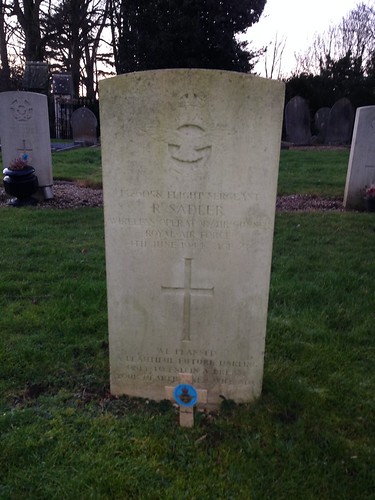
F.Sgt. Robert Sadler (RAFVR)

Downham Market Cemetery

F.O. Walter Thomas Olyott (RAFVR)

Loss of Mosquito FBVI ‘NS828’ RAF Swanton Morley.

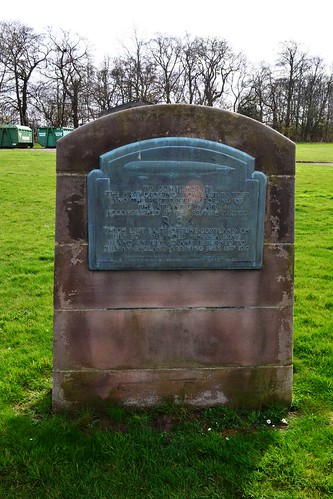
Memorial to Fl. Lt. J Paterson and Fl. Lt J. Mellar

On April 25/26th 1944, 487 Sqn (RNZAF) moved from RAF Gravesend to RAF Swanton Morley in Norfolk, taking with them D.H. Mosquitoes. They had only been at Gravesend a few days when news of the new move came through.

487 Sqn had previously been involved in ground attacks on German airfields across the occupied countries, and in several high profile missions. In particular, during the previous February, they had been involved in Operation ‘Jericho‘, the attack on the Amiens Jail, in France. It was also a Methwold based Ventura piloted by Squadron Leader Leonard H. Trent, who, on 3rd May 1943, had led the Squadron in a disastrous daylight attack on the power station at Amsterdam. As a result of his actions that day, Sqn. Ldr. Trent received the V.C., the highest honour bestowed on personnel of the armed forces.

On their arrival at Swanton Morley, 487 Sqn would immediately begin training for new air operations, their part in the forthcoming D-day invasion at Normandy, with the first flights taking off the following day.

On April 27th three ‘targets’ were chosen, the Grimston Range not far away from Swanton Morley, the Bradenham Range in the Chilterns, and lastly the Army Gunnery School site at Stiffkey, on the North Norfolk coast. Each of these were to be ‘attacked’ in cross country sorties by the Mosquitoes.

In one of those Mosquitoes ‘EG-A’ was Pilot Flight Lieutenant John Charles Paterson (NZ/2150), and his Navigator Flight Lieutenant John James Spencer Mellar (s/n: 49175) both of the R.N.Z.A.F.

The day’s sortie went well, until the return flight home was made. It was on this leg of the flight that the port engine of the Mosquito, a Hatfield built FBVI ‘NS828’ under contract 555/C.23(a), began to overheat.

Immediately Flt. Lt. Paterson feathered the engine – now flying on just one. The Mosquito was lined up on approach to Swanton Morley for a single-engined landing, but all did not go well. Unfortunately,  instead of putting the aircraft down on the runway, the aircraft overshot the airfield crashing into a field beyond, the resultant accident killing both pilot and navigator instantly.

The Operational Record Book (AIR 27/1935/31) for April 27th states:

Formation dive bombing on Grimstone [sic] range. Low level bombing on Bradenham Range. Formation cross country with air to sea firing practice off the coast at Wells. In the evening six aircraft carried out formation attacks on gun positions at an army Gunnery School at Stiffkey. Returning from this ‘A’, F/Lt. Paterson developed engine trouble and feathered the airscrew.  In attempting to land, he overshot and crashed. F.Lt. Paterson and his navigator F. Lt. Mellar, were both killed.”

Since then, a memorial has been erected in memory of the two men, located on the side of the B1110 Dereham Road just outside the village of North Elmham in Norfolk, it stands not far from the site of the crash site, west of Swanton Morley airfield. After the crash, Flt. Lt. Paterson’s body was buried at Shepperton Church Cemetery, whilst Flt. Lt. Mellar was buried at Brookwood Military Cemetery plot 24. D. 20.

Flight Lieutenant Mellar was 29 on the date of his passing, he was the son of William Edward and Eleanor Mellar; and husband of Dorothy Freda Mellar. Flight Lieutenant Paterson was 24 years of age, he was the son of John Alexander and Alice Louise Paterson, of Papakura, Auckland, New Zealand, and husband of Doris Josephine Paterson, of Shepperton.

Swanton Morley appears in Trail 38.

RAF Watton – The origins of ECM (Part 2)

In part 1 we saw how Watton had been built as a pre-war expansion period airfield and how the Blenheims that were stationed here were decimated in the face of a superior enemy. Eventually begin withdrawn, they were simply outclassed.

Eventually, the airfield like so many in this area, was handed over to the Americans. It was re-designated and would take on a different role. Watton would now grow and develop.

The USAAF renamed the airfield Station 376, they redeveloped the accommodation blocks, added more hardstands and laid a steel mat runway. The original hangars were added to so that there were now not only the original ‘C’ types, but also the more modern ‘B1’ and ‘T2’ types, along with three smaller blisters hangars. In 1944, the steel matting was removed and a concrete runway built in its place. The airfield’s history would now become a little more complex as it officially became two sites utilising the same single runway.

The main airfield itself would house aircraft of the 802nd Reconnaissance Group (Provisional), who were later renamed the 25th Bomb Group (Reconnaissance). Whilst on the southern edge of the site, a new complex was built for the repair and refurbishment depot the 3rd Strategic Air Depot (SAD). This complex grew so large that it became a site in its own right, gaining the designation Neaton (Station 505). The name has been somewhat confusing however, as the site was actually closer to the village of Griston that it was to Neaton.

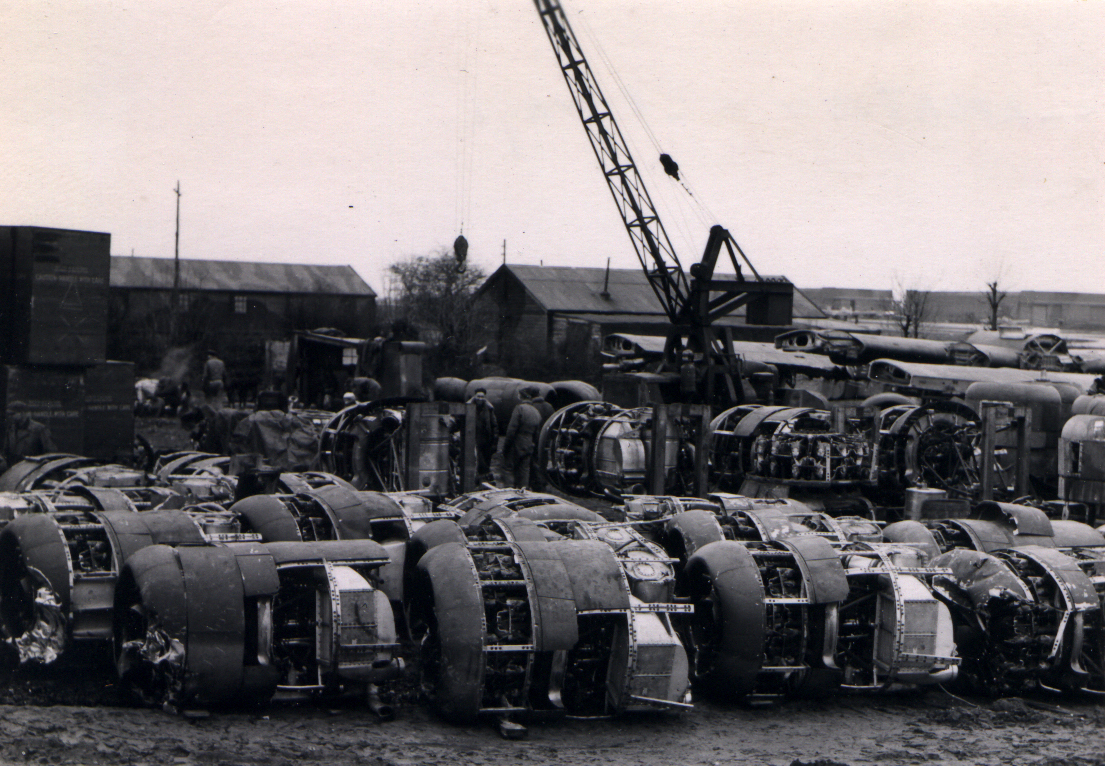
A collection of B-24 engines removed from their mounts. (IWM UPL 5385)

The role of the 3rd SAD was to maintain and repair the battle damaged B-24s of the 2nd Air Division, that had by now, flooded into the UK from the United States. This unenviable task required the recovery of the heavy bombers, washing them out and  perhaps removing the remains of airmen before returning them to flyable condition once more. Whilst not designed to be so, the acronym SAD certainly reflected the role perfectly.

Neaton consisted of a number of sites, 4 accommodation sites, a communal site, a sick quarters, two motor sites, a ‘miscellaneous’ site housing a Steam Jenny and then a 9AD site with tool sheds and other maintenance related buildings. The majority of these accommodation sites incorporated either the more common Laing or Nissen huts.

Watton itself would now become synonymous with reconnaissance, surveillance and electronic countermeasures (ECM). A new unit, 25th Bomb Group (Reconnaissance), it was constituted on 17th July 1944, and activated in England on 9th August that year. They would only serve from one UK airfield, that of Watton, where they would stay until VE day serving under the umbrella of the 8th Air Force. A visit by the famous ‘Carpetbaggers‘ (the special operations group designed to support French resistance operations) also saw the black Liberator’s fly regular missions from here during this time.

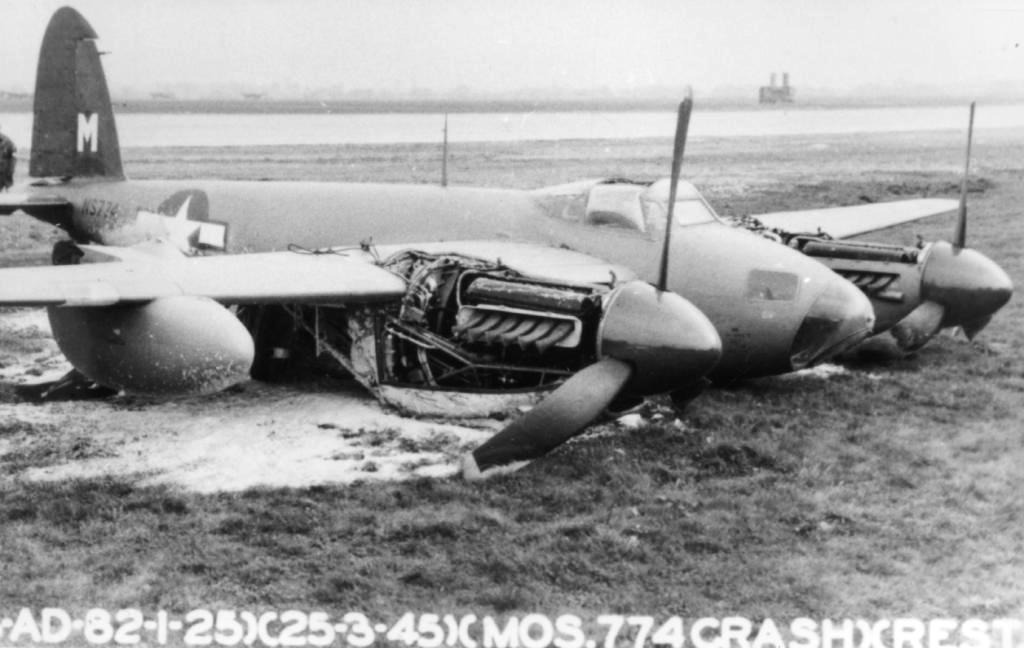
The end of Mosquito PR Mk XVI “M” NS774 of the 25th BG after crashing at RAF Watton (Station 376) 25th March 1943. (IWM UPL 6964)

The role of the Watton Group was to carryout reconnaissance missions over the seas around Britain and the Azores, gathering meteorological data. Combined with flights over the continent, the information they would gather, would help in the preparation of bombing missions. They would also carryout aerial mapping and photo reconnaissance missions, identifying German troop movements both at night and during the day.  Many of these operations involved major battles, including northern France, the Rhineland and the Ardennes. Additional tasks included electronic countermeasures using ‘chaff’, and flying ahead of large formations to ascertain last minute weather reports. A varied and dangerous collections of roles, they used a number of aircraft types including: B-17s, B-24s, B-25s, B-26s and P-38 Lightnings.

When VE day did finally arrive, the American unit departed returning to Drew Field in Florida. The August of that year must have been quite surreal, as the Americans left, flying was reduced and Watton was returned back to RAF ownership.

With the war now over, flying units began to return to the UK, many being disbanded not long after. One such unit was 527 Sqn who arrived here in the November, only to be disbanded in the April of 1946.

The next four years saw no other front line ‘operational’ flying units here at Watton, but the 1950s would bring a number of units back through its gates. With the introduction of the jet engine at the end of the war, piston engines fighters were soon being replaced by newer designs.

RAF Watton

One of Watton’s many accommodation blocks in modern use.

The ECM activity initiated at Watton by the 25th Bomb Group, would continue on in these early post-war years. For some twenty years or so in fact, through a variety of aircraft including: the Mosquito, Wellington, Domine, Lincoln, Anson, Proctor, Canberra, Meteor, Sea Fury, Firefly, Venom and many others. Each of these would not only play a vital part in the development and use of ECM, but radio research and training as well. Warfare had taken on a very new twist.

This move would see Watton becoming a hub for ECM activity. A number of RAF and Naval squadrons would operate from here undertaking such tasks. At the end of the war, Watton had become home to the Radio Warfare Establishment (RWE), renamed in 1946 to  the Central Signals Establishment (CSE). It was only one of five such units operating jointly between the military and National Air Traffic Services Organisation (NATS).  The Navy and RAF would jointly use Watton at this time, albeit for only a short period of time between March and September 1947, when the Naval Air Warfare Radio Unit moved in under the disguise of 751 NAS.

The role of the CSE was very complex, for too complex to discuss here, but with a number of squadrons operating under different roles whilst at Watton, it would culminate in 1948 in the forming of three un-numbered units: a Signals Research Squadron, a Monitoring Squadron and a Radio Countermeasures (RCM) Squadron. In essence, their role was to monitor and jam Soviet electronic communications and defence systems – it was an total airborne electronic warfare operation.*1

But the use of un-numbered squadrons was short lived, by the end of the decade the CSE had reverted to using numbered squadrons once more, their role to probe the air defences along the Soviet borders. British aircraft combined with ground stations, would monitor the reaction and activity of Soviet communications, seeing how they responded to intrusions into their airspace. By knowing this detail,  countermeasures could be put in place to jam or scramble these communications, ideally rendering them useless or at least temporarily incapacitated. The first of these numbered squadrons were 192 and 199, who were originally  the calibration and training units of the CSE.

Reformed here in July 1951 flying Mosquitoes, Lincoln B.2s and then the enormous Washington (B-29), 192 Sqn would not receive their first jet until January 1953 when the Canberra B.2 arrived. 192 Sqn would also fly the Varsity and the Comet C.2 before being disbanded and renumbered as 51 Sqn in August 1958.

199 Squadron (reformed on the same day) flew both the Lincoln B.2 and the Mosquito NF.36, in the same role as 192; their stay lasting until April 1952, at which point they moved to Hemswell in Lincolnshire where they picked up their first jet engined aircraft.

The August of 1952 saw a number of other units reform, disband or pass through Watton. 116 Sqn were reformed on the 1st, another ex Calibration flight of the CSE, it stayed until August 1958 when it was disbanded and reformed as 115 Sqn. A battle hardened squadron from Bomber Command, they had since themselves been disbanded. No longer flying operational bombers, the Varsitys 115 Sqn would operate would be the new form of transport, as they were reformed and moved on within days of their inception in that August.

On that same day in late August 1958, 245 Sqn would reform, also from the renumbering of another squadron – 527 Sqn. Flying Canberras they too were gone within days of their reformation.

As 1959 began to close and 1960 dawned, Watton would become the home of a new unit, 263 Sqn, who were operating Bloodhound missiles, the RAF’s ground to air missile used to defend Britain’s airfield against attacking aircraft. The operational use of these giant weapons lasted here until June 1963.

The 1960s saw the last of the flyers, lasting only between January 1962 and May 1963, 151 Sqn operated from here as the Signals Development Squadron, bringing back the props of the Hastings, Lincoln and Varsity before being renumbered again and subsequently disbanded.

Other units at Watton included 97 Sqn from 1963 – 1967; 98 Sqn (1/10/63 – 17/4/69), 360 Sqn (1/10/63 – 17/4/69) and 361 Sqn (2/1/67 – 14/7/67) two of which were both reformed and disbanded at Watton.

As can be expected, there were a large number of subsidiary and support units based at Watton, many of these attached to the Radio Warfare Establishment, along with SAM Training units, a range of flight units and other various regiments.

RAF Watton

Part of the disused Eastern Radar complex.

By the 1970s all flying had ceased leaving Eastern, and latterly Border Radar, the only ‘operational’ activity on the site. Eventually of course, even these were moved in the early 1990s, signalling the demise of the airfield as an active base. Watton was then handed over to the British Army.

A few years later the Army also reduced it use of Watton and the accommodation areas were sold off for private housing; a move that helped retain that airfield ‘feel’ that it still maintains today. More of the site was then sold later and new housing estates were built on the land where this previously stood; the entire feel of this has now since gone, replaced instead by a rabbit warren of roads with boxes for houses. The last remaining parts of the main airfield were sold off in 2012, the runway and peri-track being retained by the farmer and used for agricultural purposes.

Neaton too was sold off and has now been replaced by HMP Wayland, a prison holding category ‘C’ prisoners at her majesty’s pleasure.  One gruesome part of history being replaced by another.

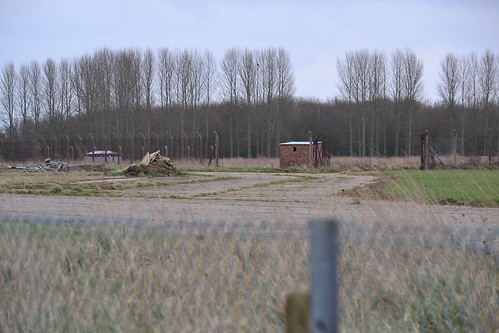
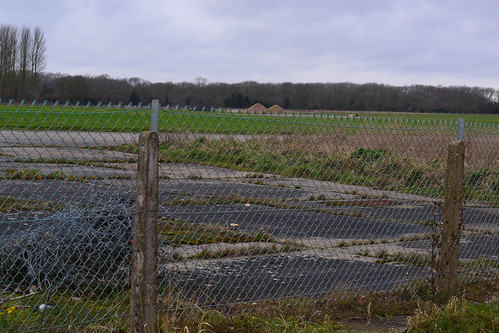
Today, the perimeter tracks, runways and hard standings support nothing more than housing. A proportion of the perimeter track remains with a small wire fence being the only defence to the continued onslaught of development. The original 4 “C” type hangars were all demolished as were the two control towers, one of which was built to support the new jet-era. Some minor buildings continue to remain surrounded by the original RAF housing, but these are few and far between, and even their future is uncertain.

Almost as lip service, many roads are named after an aircraft, Liberator, Marauder, etc., those aircraft synonymous with the operations of Watton and Neaton. Various concrete remains poke through the undergrowth and make this part of the site rather untidy. How long is it before they too disappear?

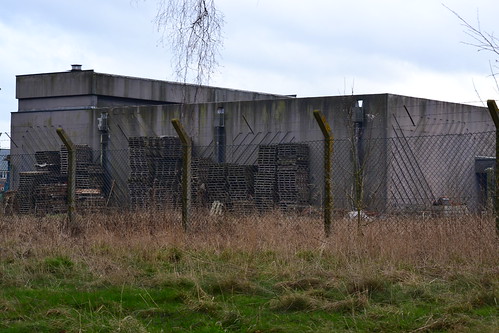
The site is split by the main road with some of the former administration buildings remaining on one side with the airfield and accommodation on the other. Some of these buildings are still in use with civilian operators and as such, have been well-preserved; others such as the technical site, have not been so fortunate and have become very rundown and in high states of disrepair.

RAF Watton

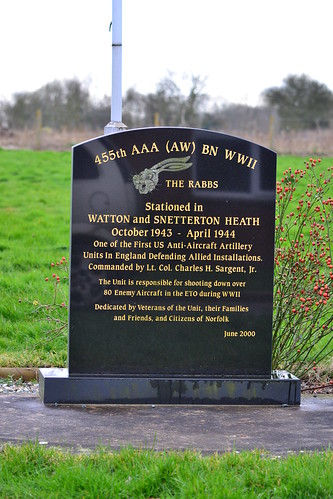
Memorial to the 455th AAA ‘The Rabbs’ located on the airfield site.

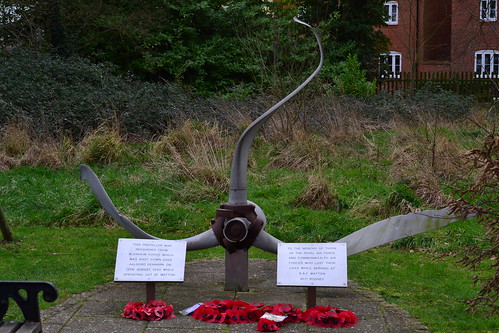
As for the airfield itself, two small memorials ‘guard’ the entrance to the new development. On the one side is the bent propeller recovered from a crashed Blenheim (R3800) shot down in the loss of eleven aircraft over Aalborg on 13th August 1940; on the other side a memorial that commemorates the 25th Bomb group USAAF. On the original housing site itself, a further memorial commemorates the 455th AAA ‘The Rabbs‘ who were given the task of defending Britain’s airfields against the Luftwaffe.  Owned by Stanford Training Area (STANTA) for a period of time and used for air mobile training, the odd Hercules or Army helicopter might have been seen here. However, this has now ceased and housing is creeping ever closer. I’m sure it won’t be long before many of these remaining remnants are lost to the developer’s digger.

Sources and Further Reading.

*1 Flintham, V., “High Stakes: Britain’s Air Arms in Action 1945-1990Pen and Sword, Oct 2008.

National Archives AIR 27/263/1: AIR 27/263/2

A website dedicated to RAF Watton has an extensive range of personal stories and information about life at Watton. It also has a video of the retrieval of Blenheim R3821 being recovered from Aalborg airport.

Further Pictures of the remains at these sites can be seen on Flckr.

NB: There is a museum commemorating the lives of the Watton personnel, open on limited days only, details can be found on their website.

Watton can be found on Trail 9.

RAF Watton – The origins of ECM (Part 1)

Norfolk once boasted many major airfields, virtually all of which are now closed to military flying. Marham is the only major survivor spearheading the RAF’s front line fighter force, in conjunction with Lincolnshire’s RAF Coningsby and RAF Lossiemouth in Moray, Scotland.

However, during the Second World War the Norfolk landscape was very different; it was littered with front line airfields, composed mainly of light bomber and fighter squadrons, all of which could be found with relative ease.

One such airfield was that of Watton. Used by a range of light and heavy aircraft, its history was chequered, bearing witness to some of the more gruesome aspects of the air-war.

Today it is a housing estate, the single runway remains and is used for storage, the hangers and technical buildings have gone and the accommodation areas have all been sold off. That said, the perimeter track remains in part, the ‘feel’ of the airfield hangs over the area and a number of memorials pay silent tribute to those who served here.

Found on the edge of the town of Watton in Norfolk, we go back to this once busy RAF base and see what has changed, and relive the life of RAF Watton.

RAF Watton (Station 376)

RAF Watton, located some 11.5 miles north-east of Thetford, opened in 1939 as a medium bomber station with the RAF. Unusually it only had one runway, a grass example, which was later extended to 2,000 yards and crossed the airfield in an east-west direction.

The late 1930s saw a massive expansion of Britain’s military might, and in particular, its airfields. With little foresight into what lay ahead, these pre-war and early war airfields were not designed, nor built, as dispersed sites. Once the realisation of what the war would bring hit home however, later examples would be dispersed, giving a new dimension to airfield design. As a result, Watton (built by the John Laing company) was constructed with much of the accommodation block, technical area, hangars and so on, all being placed closely together on one single site.

Housing for the personnel was located in the north-western corner, with the technical area just east of this. The bomb dump, an ideal target, was further to the east of this area. Four ‘C’ type hangers were constructed each having a span of 150 feet, a length of 300 feet and a height of 35 feet. Whilst Watton was a medium bomber airfield, and thus aircraft were relatively small, it was envisaged at this time that larger, heavier bombers would soon come on line, and so foresight deemed larger than necessary hangar space be provided. A 1934/35 design, these hangars would be common place across expansion period airfields.

Another architectural design found at Watton was the redesigned Watch Office, an all concrete affair built to drawing 207/36, it was one that would very quickly become inadequate, requiring either heavily modifying or, as was in many other cases, replacing altogether.

RAF Watton

Part of Watton’s decaying perimeter track.

Partially opened in 1937, the airfield wasn’t fully completed and handed over to the RAF until 1939. Being a pre-war design, building materials were in good supply, and so the  accommodation blocks were constructed using brick, and they catered well for those who would find themselves posted here.

Another aspect considered at this time was that of camouflage; airfields were enormous open expanses and could be easily seen from great distances and heights. Numerous proposals for hiding them were put forward, a move that resulted in the formation of a special unit within the Directorate of Works led by Colonel Sir John Turner. Watton came under the eyes of Sir John and his department, and this led to an ingenious camouflage pattern of fields and hedges being painted across the entire airfield,  thus disguising it from prying eyes above. Whilst not completely effective, it certainly went some way to protecting it from attack.

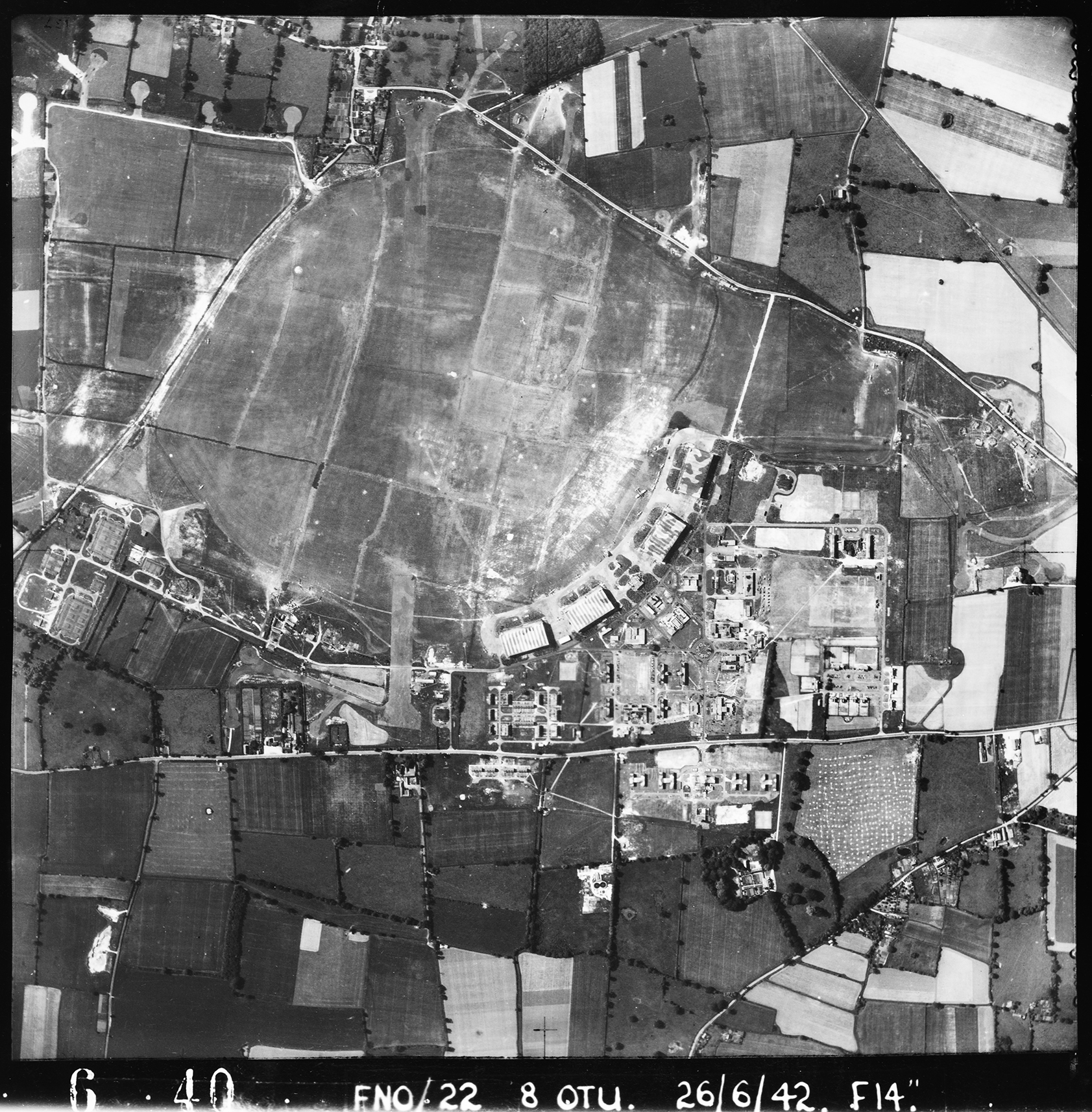
RAF_FNO_22_RV_6040

Watton airfield taken in 1942 by No. 8 Operational Training Unit. The four hangars can be seen in the centre of the photo with the patchwork of ‘fields’ disguising the main airfield. English Heritage (RAF Photography).

The first postings to arrive were the men and machines of 21 and 34 Squadrons RAF. Their arrivals on March 2nd 1939 saw a reuniting of both squadrons under the Command of Group Captain P. J. Vincent DFC and 6 (B) Group . On the 7th, the airfield was inspected by the Group’s AOC after which 34 Sqn performed a flypast; one such event that would be the start of many visits from numerous dignitaries including the Marshall of the Royal Air Force himself, Sir Edward Ellington  GCB, CMG, CBE.

Little flying took place by either squadron at this time however, as the aerodrome was soon unserviceable due to the very poor British weather. Grass runways soon became bogs, and as was found across many grassed airfields at this time, unsafe for aircraft to either take off or land without mishap. From April  things picked up slightly, and intensive training began in the form of station tactics and defence exercises. The weather would however, continue to be the worst enemy, repeatedly preventing or restricting flying from taking place.

In August, 34 Sqn received orders to depart Watton and  proceed to Singapore, and so on the 12th, the air and ground parties began their long transit leaving Watton and England far behind. The quiet of their departure would not last ling however, as within a few days of them leaving, their empty beds would be filled once more, when the Blenheims and crews of 82 Sqn arrived.

At 11:05 on September 3rd 1939, notification came though to Watton of Britain’s declaration of war. Within days of the announcement aircraft were being moved out under the ‘Scatter’ scheme to another airfield, Sealand, for there was a fear of imminent air attacks following the war’s declaration. The Blenheims remained at Sealand until mid September, at which point they were recalled and prepared for attacks on vessels belonging to the German Navy. These vessels were not located however, and so the order to stand by was cancelled and the crews stood down. This would sadly become a regular and frustrating occurrence for the men of 21 Sqn.

Shortly after on the 9th, the first of the new MK.IV Blenheims were collected from Rootes Ltd at Speke, with further examples arriving over the next few days. Further movements saw aircraft detached to Netheravon and then onto Bassingbourne where Blenheim L8473 was damaged as it ‘nosed over’ whilst taxiing. A minor, but unfortunate accident, it would be the first of many more serious losses for the squadron.

RAF Watton

A fence separates the housing estate from the airfield remains.

On 26th September, another order came through for aircraft of 21 Sqn to stand by to attack  the German fleet, whilst a further two Blenheims (L8734 and L8743) would fly to the Rhur to carry out a photographic reconnaissance mission. However, bad weather, industrial smoke and a faulty camera prevented both aircraft from carrying out their duties: each one returning to Watton empty handed but unscathed – crews reporting heavy flak over the target area. The whole of October and November were pretty much a wash-out. Bad weather with prolonged heavy rain prevented any substantial flying beyond the local area. Air gunnery and co-operation flights were carried out whenever  possible, but the late months of 1939 had certainly been a ‘phoney war’ for 21 Sqn.

As 1940 dawned, things on the continent began to heat up and ground attacks increased for both Watton squadrons. Low-level sorties saw them attacking troop formations and enemy hardware as its galloped its was across the low-countries. Whilst bravely flying on and escorted by fighters, overall loses for the slower Blenheims of 2 Group were beginning to rise, a pattern that would only increase in the face of a far superior enemy in the coming months.

These losses were borne out by 82 Sqn in dramatic style on the 17th May, when twelve aircraft took off at 04:50 to attack Gembloux. They were met with heavy anti-aircraft fire and overwhelming fighter opposition – fifteen BF.109s, decimated the squadron. All but one aircraft was lost, the only survivor being P8858 crewed by Sgt. Morrison, Sgt. Carbutt and AC Cleary. Whilst not injured in the melee, the aircraft was badly damaged and as a result, was deemed irreparable and written off. An entire squadron had all but been wiped out in one fell swoop.

This disaster would be reflected right across 2 Group, who had now suffered its greatest overall loss to date, but for 82 Sqn it would not yet be the end of this traumatic and devastating period. The burning cauldron that was now facing the light bomber was taking its toll on crews, who were all at a distinct disadvantage to their Luftwaffe counterparts. On the 21st, three more aircraft were lost from Watton, with one being forced down in France, another lost without trace and a third limping home so badly damaged it also had to be written off.

A short visit by 18 Sqn between 21st and 26th May barely interrupted proceedings at Watton. After returning from France, they had spent no less than nine days in May at five different airfields including the nearby Great Massingham.

By early June 1940 Operation Dynamo had been completed and France was lost. The British Bulldog, whilst not a spent force, had shown her teeth, been bitten hard and was now licking her heavy wounds. Preparations would now begin to protect her own shores from the impending invasion.

Fuelled by revenge, combined attacks by both 21 and 82 Sqn continued on into the summer months. But revenge alone does not protect a crew from superior fighters and heavy flak. On June 11th, three more 21 Sqn aircraft were lost whilst attacking positions around La Mare, it is thought all three fell to Luftwaffe fighters. Two days later on the 13th, another five aircraft were lost, two from 21 Sqn and three from 82 Sqn; losses were mounting for the light bombers and Watton was amongst those bearing the brunt of these. On the 24th, 21 Sqn saw a reprieve, whether to rest crews, take on a new role or simply regroup, they began a move north to RAF Lossiemouth in Scotland. 82 Sqn however, would remain at Watton, where they would carry on with the punishing raids over the continent.

After the arrival and departure of another short stay unit, 105 Sqn between 10th July and 31st October, Watton was now left in the lone hands of 82 Sqn, a situation that would remain until the spring of 1942.

The dramatic loss of eleven crews back in May would come back to haunt 82 Sqn in August that year. On the 12th, another twelve aircraft took off on a high altitude bombing mission to Aalborg in Denmark. The airfield they were to target was well defended, and as if history were to repeat itself, once again eleven of the twelve aircraft were lost. The only one to return, that of R3915 crewed by Sgt. Baron, Sgt. Mason and Sgt, Marriott, turned back early due to low fuel.

In the space of three months, an entire squadron has been all but wiped out not once, but twice, unsustainable losses that would surely bring the squadron to its knees.

RAF Watton

Memorial to the crews lost at Aalborg, 13th August 1940. The propeller of Blenheim R3800, that crashed that day.

It was loses like this that helped convince the authorities to eventually withdraw Blenheims from front line service during 1942 – the Blenheim being long outdated and outclassed. At this time, Watton’s 82 Sqn, would begin their transfer to the Far East, a place they would remain at until the war’s end.

A lull in operations meant that Watton was then reduced to mainly training flights, through the Advanced Flying Unit. Small single and twin-engined aircraft providing the activity over the Norfolk countryside. Many of the crews being trained here would be shipped out to the satellite airfield at Bodney, before returning here for their evening meals.

A brief interlude in the May of 1942 saw the rebirth of the former 90 Squadron, a First World War unit that had gone through this very process on a number of occasions since its inception in 1917.

Flying the American B-17 ‘Flying Fortress’ or Fortress I as it was in RAF designations, 90 Sqn was set up to trial the use of the four-engined heavy for its suitability as an RAF bomber. During the first 15 days at Watton, the squadron gained personnel and received their first aircraft,  after which they moved to nearby RAF West Raynham. Here they would begin these trials which also required the use of a number of smaller airfields in the local area. These included both RAF Great Massingham and RAF Bodney, neither of which were particularly suited to the heavy bombers.

Watton then saw no further operational units, and in the mid 1943, it was handed over to the Americans who began to develop the airfield into something more suitable for their needs. It was now that Watton would take on a more sinister role.

In Part 2 we see how the Americans developed Watton, and how it became two sites rather than just one, and also, how its role in Electronic countermeasure took it into the post war years.

The full story of Watton can be found in Trail 9.

RAF Great Massingham – Blenheims, Bostons and Mosquitoes.

In the heart of Norfolk, some 40 miles west of Norwich and 13 miles to the east of King’s Lynn, lies a small, quaint village typical of the English stereotype. Small ponds frequented by a range of ducks, are thought originally to be fish ponds for the 11th century Augustinian Abbey, and the history of the village is believed to go back as far as the 5th Century.  Massingham boasts an excellent village pub, and a small shop along with beautiful walks that take you through some of Norfolk’s most beautiful countryside; it has to be one of Norfolk’s greatest visual assets.

Sited above this delight is the former airfield RAF Great Massingham, which during the war years was home to number of light bombers and even for a short while, the four engined heavy, the B-17. In Trail 21, we return to RAF Great Massingham.

RAF Great Massingham

Great Massingham airfield lies in the heart of Norfolk, some 40 miles west of Norwich and 13 miles to the east of King’s Lynn, lies a small, quaint village typical of the English stereotype. Small ponds frequented by a range of ducks, are thought originally to be fish ponds for the 11th century Augustinian Abbey, and the history of the village is believed to go back as far as the 5th Century.  Massingham boasts an excellent village pub, and a small shop along with beautiful walks that take you through some of Norfolk’s most beautiful countryside; it has to be one of Norfolk’s greatest visual assets. Sited above this delight is the former airfield RAF Great Massingham, which during the war years was home to number of light bombers and even for a short while, the four engined heavy, the B-17.

Before entering Great Massingham I suggest you stop at Little Massingham and the church of St. Andrew’s. For inside this delightful but small church, is a roll of honour*1 that lists enormous amounts of information about the crews who served at the nearby base. It gives aircraft details, mission dates and crew names amongst others. It is a hugely detailed collection of information covering 1940-45, in which time 600 Massingham crews lost their lives. Seven of these crew members, are buried in the adjacent church yard: Sqn. Ldr. Hugh Lindsaye (18 Sqn), Sgt. John Wilson (RNZAF – 107 Sqn), Sgt. Thomas Poole (107 Sqn), P/O. Arthur Lockwood (107 Sqn), Flt. Sgt. Gordon Relph (107 Sqn), F/O. Charles Ronayne (RAF) and F/O. Joseph Watkins (239 Sqn), all being killed in different circumstances. This is a valuable and enlightening stop off to say the least.

RAF Great Massingham

The Roll of Honour in St. Andrew’s Church, Little Massingham.

On leaving the church turn right and you will almost straight away enter the village of Great Massingham. The airfield is to the east behind the village holding the high ground, which makes for a very windy and open site, whilst the village nestled on the lower ground, remains calm and quiet. Built originally as a satellite for the nearby West Raynham, Massingham opened in 1940 with grass runways initially under the command of 2 Group, Bomber Command and then latterly 100 Group, whose headquarters were at Bylaugh Hall. The distance between both RAF West Raynham and RAF Massingham was so small, that crews would cycle from one to the other each morning before operations.

RAF Great Massingham

The Officers Mess now a farm building.

There were a total of four T2 hangars and one B1 hangar built on this site. The airfield also had sixteen pan-type hardstands and twenty-one loop-type hardstands, giving a total of thirty-seven dispersal points around its perimeter.

The main accommodation and communal sites which totalled five and two respectively, were near to Little Massingham church, to the west, along with further areas to the south of the airfield . These included a communal area to the south-west of the village and sufficient accommodation for 1,197 men, consisting of Officers, Senior NCOs and ordinary ranks.  This was later upgraded to accommodate 1,778 men. In addition, accommodation was provided for the WAAFs of the airfield, 102 in total at the outset. This was also increased in the airfield’s upgrade, taking the total number of  WAAFs to 431.

The bomb dump and ammunition stores were well to the north away from the personnel as was standard. A number of anti-aircraft sites were scattered around the perimeter offering good protection from any attacking aircraft.

The first occupants of Massingham were the Blenheim IVs of 18 Sqn RAF who arrived in the September of 1940.

18 Sqn were previously based at West Raynham, making the transition invariably very smooth. In fact, operations barely ceased during the change over, the last West Raynham sortie occurring on 7th September 1940 with a six ship formation attack on the docks and shipping at Dunkirk, and the first Great Massingham sortie on the evening of the 9th to Ostend.

Whilst at Great Massingham, 18 Sqn flew the Blenheim Mk.IV initially on short range bombing sorties to the French coast. All was fairly quiet for the first few weeks, the squadron’s first loss not occurring until November 28th 1940, when Blenheim P6934 crashed after hitting high tension wires west of the airfield. All three of the crew were injured and admitted to hospital, but Sgt. William E. Lusty (S/N: 751633) died from his injuries the following day.

18 Squadron remained at Great Massingham until April the following year (1941), performing in the low-level bombing role. Like most other RAF airfields around this area of Norfolk, it would be dominated by twin-engined aircraft like the Blenheim and its subsequent replacements. As a reminder to those who may have got complacent about the dangers of flying in wartime, the departure of 18 Sqn was marred by the loss of Squadron Leader Hugh Lindsaye (S/N: 40235), who was killed whilst towing a drogue near to Kings Lynn a few miles away. An investigation into the crash revealed that a drogue he was pulling had become separated and fouled the port elevator. The pilot lost control as a result and all three crewmen (SgT. Stone and F/O. Holmes) were killed. Sqn. Ldr. Lindsaye is one of those seven buried in Little Massingham.

Shortly after the departure of 18 Sqn, Massingham took on another Blenheim squadron in the form of 107 Sqn, a move that was coincided with a detachment of B-17 Flying Fortresses of 90 Squadron.

The B-17 (Fortress I) squadron was formed at Watton earlier that month, they moved to West Raynham whereupon they began trials at a number of smaller airfields including Bodney and Massingham, to see if they were suitable for the B-17. These initial tests, which were undertaken by Wing Commander McDougall and Major Walshe, were a series of ‘circuits and bumps’ designed to see if the ground and available runways were suitable. It was decided that Massingham was indeed suitable, and so a decision was made on the 13th, to base the aircraft at Massingham but retain the crews at West Raynham, transport vehicles ferrying them to and from the aircraft on a daily basis. For the next few days further tests were conducted, and engineers from Boeing came over to instruct ground crews on the B-17’s engineering and armaments. Concerns were soon raised by crews about Massingham’s grass runways, and how well they would perform with the heavier four engined B-17’s constantly pounding them.

RAF Great Massingham

Remains around the perimeter track.

On the 23rd May, H.R.H The King conducted an inspection of Bomber Command aircraft at RAF Abingdon, in Oxfordshire. Amongst the types presented with the RAF bombers was a Fortress I from Massingham. The King, Queen and two Princess’s Elizabeth and Margaret, all attended and took a great interest in the Fortress. The Royal party taking considerable time to view and discuss the heavy bomber’s merits and features.

Back at Massingham, flight tests, training and examinations of the B-17 continued until in June 1941, when 90 Sqn were ordered out of both Massingham and West Raynham, moving to RAF Polebrook in Northamptonshire. But by the October, the Fortress’s had all gone from RAF bomber service, problems with freezing equipment convincing the RAF not to use the heavies in bombing operations.

By February 1942 the unit was disbanded and all its assets were absorbed into 1653 Heavy Conversion Unit (HCU). Within days of 90 Sqn’s arrival at Massingham, another more permanent squadron also arrived, again performing in the same low-level bombing role as their predecessors 18 Sqn. The spring of 1941 saw 2 group perform some of their largest operational sorties to date, with many Blenheims continuing their daylight raids on shipping and docks in north-west Germany.

It was during this hectic time, on May 11th, that 107 Sqn, would arrive at the Norfolk base at Massingham. Being taken off operations on the 10th, the air personnel made their way down from the Scottish base at Leuchars whilst the ground staff travelled by train the following day. A number of crews were posted on detachment to bases at Luqa, Ford and Manston.

After a short settling in period missions began again in earnest with their first twelve ship operation in Bomber Command taking them to Heliogoland on the 13th. Two of these Blenheims returned with engine problems, but the remainder managed to attack the target, in an operation that was considered a great success, with complete surprise being achieved. Flying at very low level was key to this operation, and whilst all aircraft returned home safely, one aircraft piloted by Sgt. Charney, flew so low he managed to strike the sea with his port engine; as a result, the airscrew was damaged and broke away leaving the aircraft flying on just one of its two powerplants!

The end of May was a difficult month for 107. On the 21st they returned to Heligoland, with nine aircraft taking off at 14:00, detailed for a daylight formation attack on the target. With  visibility of 12 – 15 miles, they pressed home their attack from as low as fifty feet, in spite of what was an ‘intense and accurate’ flak barrage. Four aircraft were hit by this flak, and in one of them, Sgt. John Wilson (S/N: 40746) was killed when shrapnel struck him in the head. Sgt. Wilson is also one of the seven in the church yard at Little Massingham.*2

On the return flight, a second aircraft also damaged by the flak, had an engine catch fire. The pilot and crew were all lost after ditching in the sea. Fl. Sgt. Douglas J. R. Craig (S/N: 903947) never having being found, whilst two other crewmen (Sgt. Ratcliffe and Sgt. Smith) were seen climbing into their life raft, later being picked up by the Germans and interned as prisoners of war.

On the 23rd the squadron was then detailed to search for shipping off France’s west coast. Due to bad weather, they were unable to make Massingham and had to land at Portsmouth instead. Continued bad weather forced them to stay there until the 27th when they were able at last to return to Massingham. No further operations were then carried out that month.

RAF Great Massingham

Gymnasium and attached Chancellery now a car repair shop.

The dawn of 1942 saw Bomber Command face its critics. High losses brought into question the viability of these small light aircraft as bombers over enemy territory, a situation that would see 2  Group, as it was, all but removed from operations by the year’s end.

But the end was not quite here, and January  of 1942 saw 107 take on the Boston III ( an American built aircraft designated the ‘Havoc’) as a replacement for the now ageing Blenheim. With the new aircraft 107 remained at Massingham, at least until the early August, where they made a short move to Annan before returning to Massingham a mere week later. It would take only a month before the first 107 Sqn Boston would be lost.

Whilst on a training flight, Boston W8319, struggled to join the formation, after turning back, it was seen to fall to the ground, the resultant fireball killing all three crewmen on board.

Despite this, losses over the coming months remained light. With the introduction of US airmen and the 15th Bomb Squadron, June / July saw a number of Massingham aircraft transfer across to the American’s hosts 226 Sqn at Swanton Morley. One of these aircraft, crewed by two US airmen; Captain S. Strachan and Lt. C. Mente, crashed near RAF Molesworth killing both on board.

By the end of 1942, 107 Sqn had lost a total of 23 aircraft on operations, and with each Boston carrying four crewmen it meant losses were increasing for the unit.

In February 1943, the Boston IIIs were replaced by the IIIa model. During May, the whole of 2 Group would begin to transfer across to the 2nd Tactical Air Force (TAF) in preparations for the invasion the following year. Losses had been high for the group, the light bombers being easily cut down by both Luftwaffe fighters and flak.

At the end of August 1943, it was 107 Sqn’s turn and they departed Great Massingham for Hartford Bridge and a new life within the 2nd TAF. It was during these summer months that a Free French unit, 342 Lorraine Squadron would arrive at Massingham. A unit formed with Bostons at West Raynham, it would stay at Massingham between July and into early September before moving off to rejoin 107 Sqn at Hartford Bridge, also beginning a new life within the 2nd Tactical Air Force.

It was these postings that would lead to the end of Massingham as a day bomber station, and no further vulnerable light bombers of this nature would be stationed here again.

In April 1944 Great Massingham  was redeveloped and upgraded, more accommodation blocks were provided and three concrete runways were laid; 03/21 and 13/31 both of 1,400 yards, and the third 09/27 at  2,000 yards, this would give the site the shape it retains today.

A year-long stay by 1694 Bomber (Defence) Training Flight with amongst them, Martinets, gave the airfield a much different feel. Target towing became the order the day and non ‘operational’ flying the new style. In the June of 1944, 169 Sqn would arrive at Massingham, operational flying was once again on the cards, with night intruder and bomber support missions being undertaken with the Wooden Wonder, the D.H. Mosquito. Between June and the cessation of conflict this would be a role the squadron would perform, and perform well, with numerous trains, ground targets and Luftwaffe night fighters falling victim to the Mosquito’s venomous attacks. Included in these are a damaged Ju 88 on the night of October 26th 1944 south of the Kiel Canal, and five trains on the night of October 29th.

RAF Great Massingham

Original high-level Braithwaite water tank.

With them, came 1692 (Bomber Support Training) Flight, to train crews in the use of radar and night interception techniques.

Formed at RAF Drem in Scotland in 1942 as 1692 (Special Duties) Flight, they operated a range of aircraft including Defiants, Beaufighters and Mosquitoes. The two units stayed here at Massingham until both departed in August 1945, at which point 12 Group Fighter Command, took over responsibility of the site.

As radar and night interception roles developed, a new unit was created at Massingham under the control of the Central Fighter Establishment (CFE), who were to trial different techniques and strategies for air interception. They later moved to West Raynham where they continued to carry out this role.

Over the years a number of  post war celebrities were stationed at Massingham, they included F.O. Keith Miller AM, MBE – the Australian Test cricketer; P.O. (later Squadron Leader) Bill Edrich DFC – the England cricketer and the BBC commentator – Flt. Sgt. Kenneth Wolstenholme DFC and Bar.

After the aircraft left, the airfield fell quiet and was very quickly closed. 1946 saw the last personnel leave, and it remained dormant until being sold in 1958. Bought by a farmer, it is now primarily agriculture, although a small private airfield has opened utilising the former runways, and flying visitors are welcomed with prior permission. The airfield at great Massingham has a public footpath running part way through it. This is accessible at either end of the southern side of the airfield, and permits access along part of the original perimeter track. Accessing the eastern end of the path is easiest, a gated road from the village takes you up to the airfield site. Once at the top, you can see the large expanse that was the main airfield site. Trees have since been cultivated and small coppices cover parts of it. To your right at this point the peri track continues on in an easterly direction, but this section is now private and access is not permitted. This track would have taken you toward the Watch office, the Fire Tender building and storage sheds – all these being demolished long ago. A further area to the south of here has now been cultivated, and there was, what is believed to have been a blister hangar, located at this point – this too has long since gone.

The public path turns left here and takes you round in a northerly direction. To your left is a T2 hangar, it is believed that this is not the original, but one that had been moved here from elsewhere. This however, cannot be confirmed, but there was certainly a T2 stood here originally.

The track continues round, a farm building, very much like a hangar, houses the aircraft that now fly. Sections of runway drainage are visible and piles of rubble show the location of smaller buildings. The track then takes you left again and back to the village past another dispersal site, now an industrial unit complete with blister hangar.

Other foundations can been seen beneath the bushes and leaves on your right. This may have been the original entrance to the site, although Massingham was unique in that in was never fenced off, nor guarded by a main gate. Other examples of airfield architecture may be found to the north side of the airfield, indeed satellite pictures show what looks like a B1 hangar on the northern perimeter.

RAF Great Massingham

The perimeter track and T2 hanger re-sited post war.

After walking round, drive back toward Little Massingham, but turn left before leaving the village and head up toward the distant radio tower, itself a remnant from Massingham’s heyday. We pass on our left, the former accommodation site. Now a field, there is no sign of its previous existence. However, further up to the right, a small enclave utilises part of the Officers’ Mess, the squash court, and gymnasium with attached chancery. Hidden amongst the trees and bushes are remnants of the ablutions block, and other ancillary buildings. Continue along this road, then take the left turn, toward the tower. Here is the original high-level Braithwaite water tank and pump house, still used for its original purpose and in very good condition.

Finally, a lone pill-box defensive position can also be found to the west of the village, some distance from the airfield in the centre of a farmer’s field. All small reminders of the areas once busy life.

Great Massingham is a delightful little village, set in the heart of Norfolk’s countryside. Its idyllic centre, pubs and shops surround ponds and greens. A short walk away, is the windy and open expanse that once was a bustling airfield, resounding to the noise of piston engines. All is now much quieter, their memories but a book, some dilapidated buildings and a handful of graves. Standing at the end of the runway, looking down the expanse of concrete, you can easily imagine what it must have been like all those years ago. From Great Massingham we head east, to RAF Foulsham, before turning north and the North Norfolk coast, an area of outstanding natural beauty and some fine examples of airfield architecture.

Sources and links RAF Great Massingham

*1 A comprehensive history of RAF Massingham, including RAF material, is now under the care of the Massingham Historical Society. Contact Anthony Robinson antmassingham@gmail.com for details about the Museum or Roll of Honour, a hard copy of which can be purchased for a small fee.

*2 The ORB shows this as Sgt G, Wilson and not J.W. Wilson.

National Archives AIR 27/842/10

RAF Great Massingham is remembered on the Massingham village website which includes details of the Roll of Honour.

Massingham was first visited in 2015.